Cambridge A Level English - Language and Literature (AS Level only, from 2016) 8695 — 2017 May/June Paper 9 · Variant 2
8695/92/M/J/17 · 50 marks · ≈56 min
The question paper and its mark scheme, free to read here and free to download. This is Cambridge’s own paper, exactly as it was sat.
Question paper20 pages



Mark scheme5 pages
Answers below. Sit the paper first if you are practising.
Paper as text
Question paper, page 1
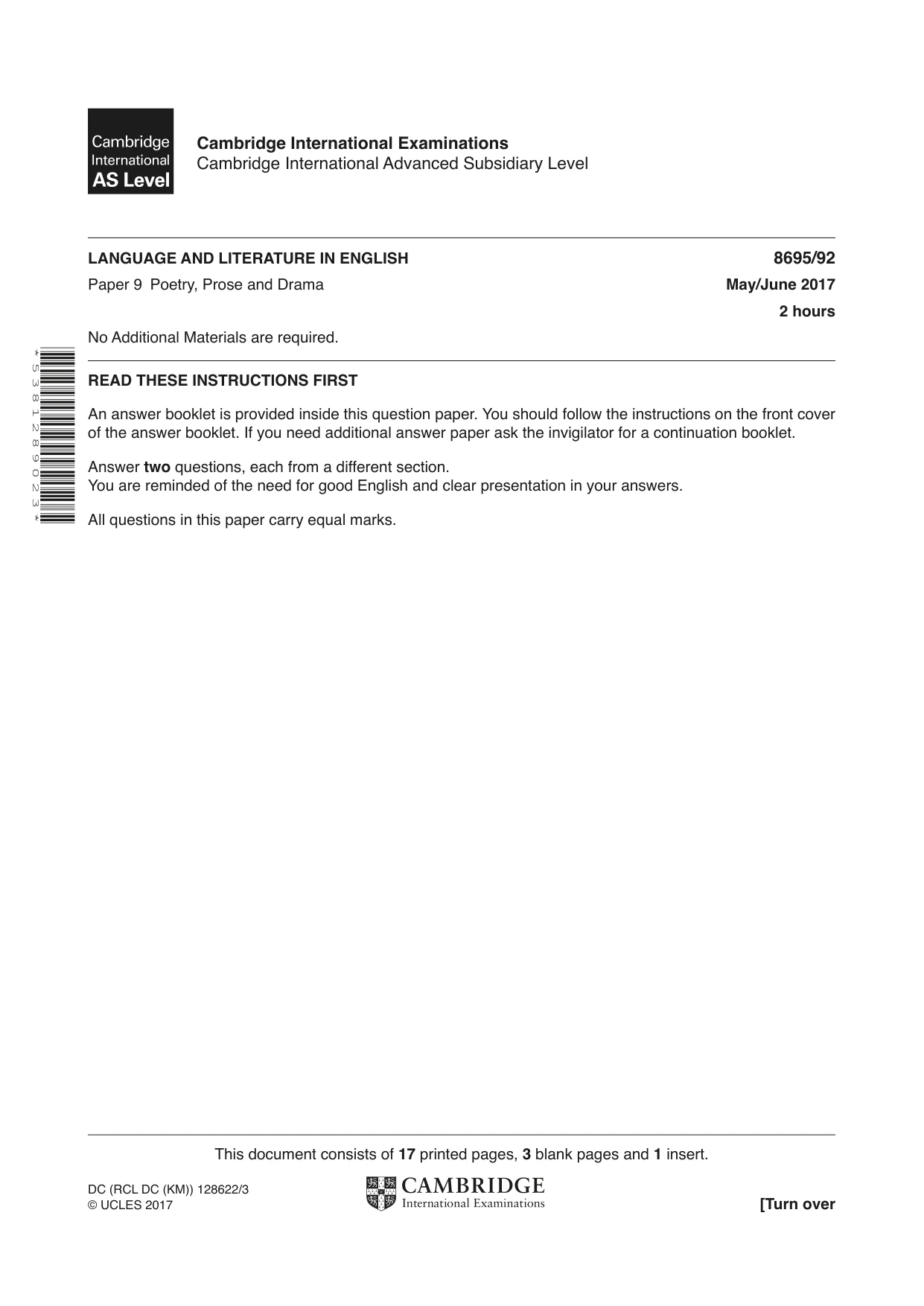
This document consists of 17 printed pages, 3 blank pages and 1 insert. DC (RCL DC (KM)) 128622/3 © UCLES 2017 [Turn over Cambridge International Examinations Cambridge International Advanced Subsidiary Level * 5 3 8 1 2 8 9 0 2 3 * LANGUAGE AND LITERATURE IN ENGLISH 8695/92 Paper 9 Poetry, Prose and Drama May/June 2017 2 hours No Additional Materials are required. READ THESE INSTRUCTIONS FIRST An answer booklet is provided inside this question paper. You should follow the instructions on the front cover of the answer booklet. If you need additional answer paper ask the invigilator for a continuation booklet. Answer two questions, each from a different section. You are reminded of the need for good English and clear presentation in your answers. All questions in this paper carry equal marks.
Question paper, page 2
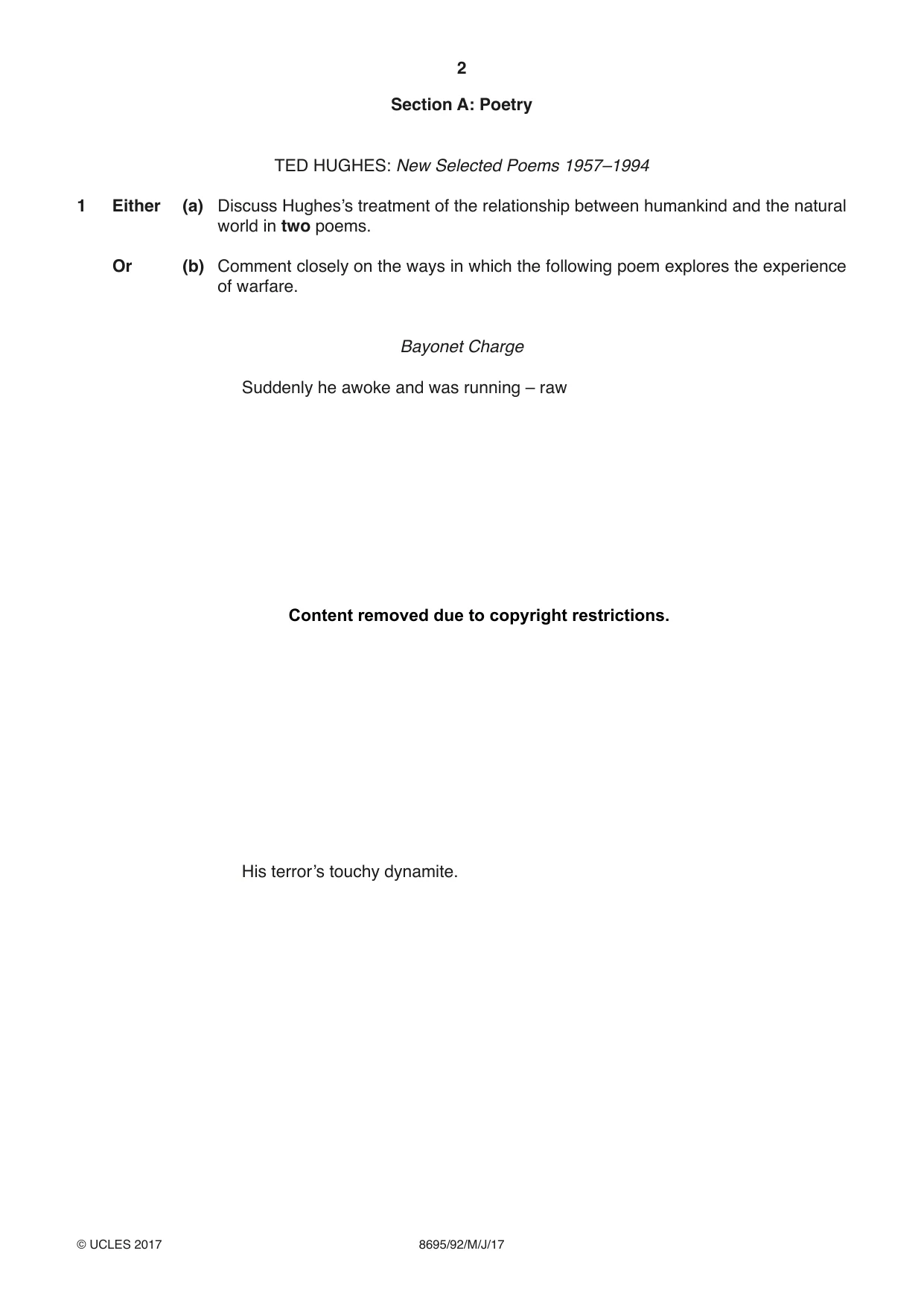
2 8695/92/M/J/17 © UCLES 2017 Section A: Poetry TED HUGHES: New Selected Poems 1957–1994 1 Either (a) Discuss Hughes’s treatment of the relationship between humankind and the natural world in two poems. Or (b) Comment closely on the ways in which the following poem explores the experience of warfare. Bayonet Charge Suddenly he awoke and was running – raw His terror’s touchy dynamite. Content removed due to copyright restrictions.
Question paper, page 3
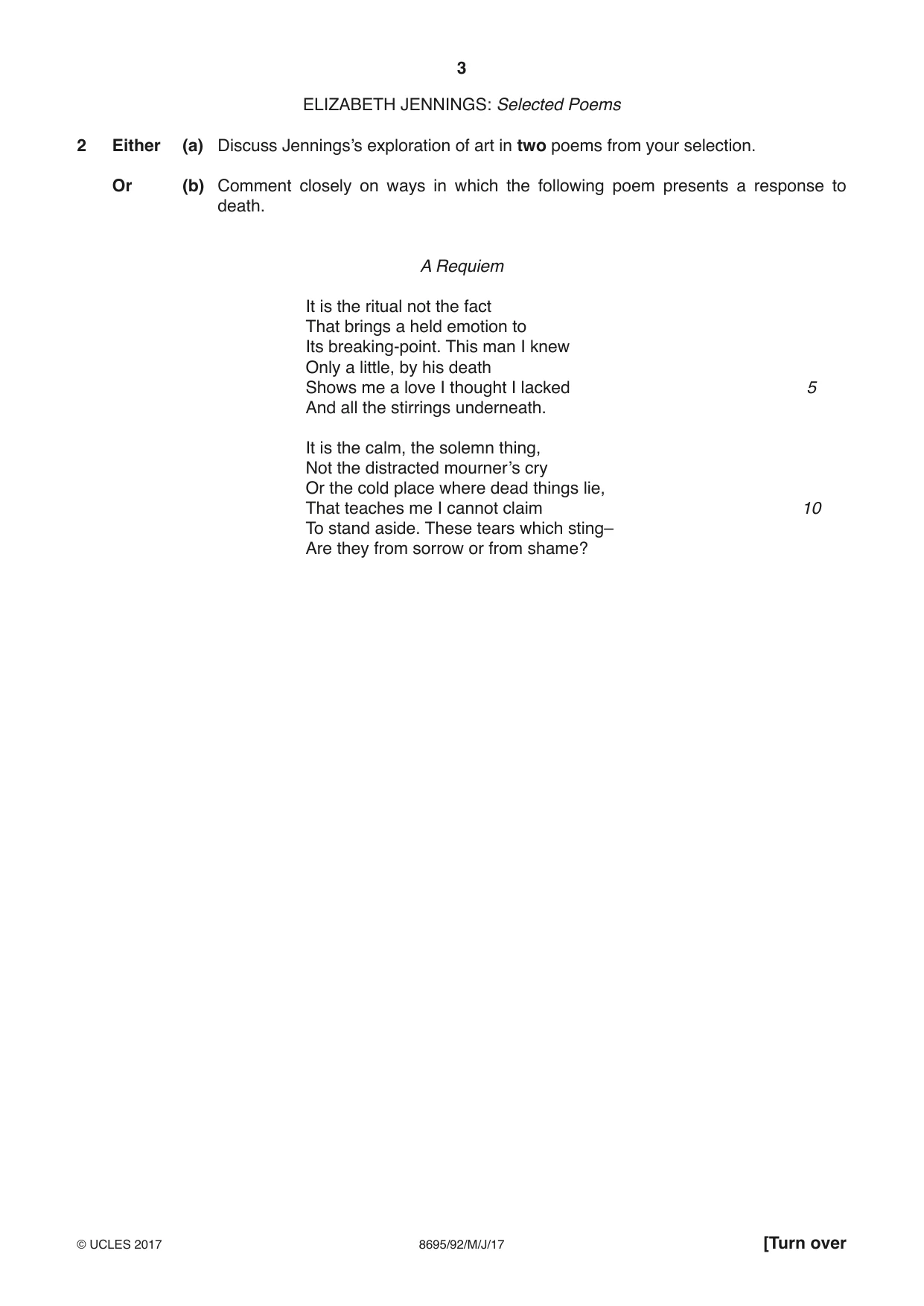
3 8695/92/M/J/17 © UCLES 2017 [Turn over ELIZABETH JENNINGS: Selected Poems 2 Either (a) Discuss Jennings’s exploration of art in two poems from your selection. Or (b) Comment closely on ways in which the following poem presents a response to death. A Requiem It is the ritual not the fact That brings a held emotion to Its breaking-point. This man I knew Only a little, by his death Shows me a love I thought I lacked And all the stirrings underneath. It is the calm, the solemn thing, Not the distracted mourner’s cry Or the cold place where dead things lie, That teaches me I cannot claim To stand aside. These tears which sting– Are they from sorrow or from shame? 5 10
Question paper, page 4
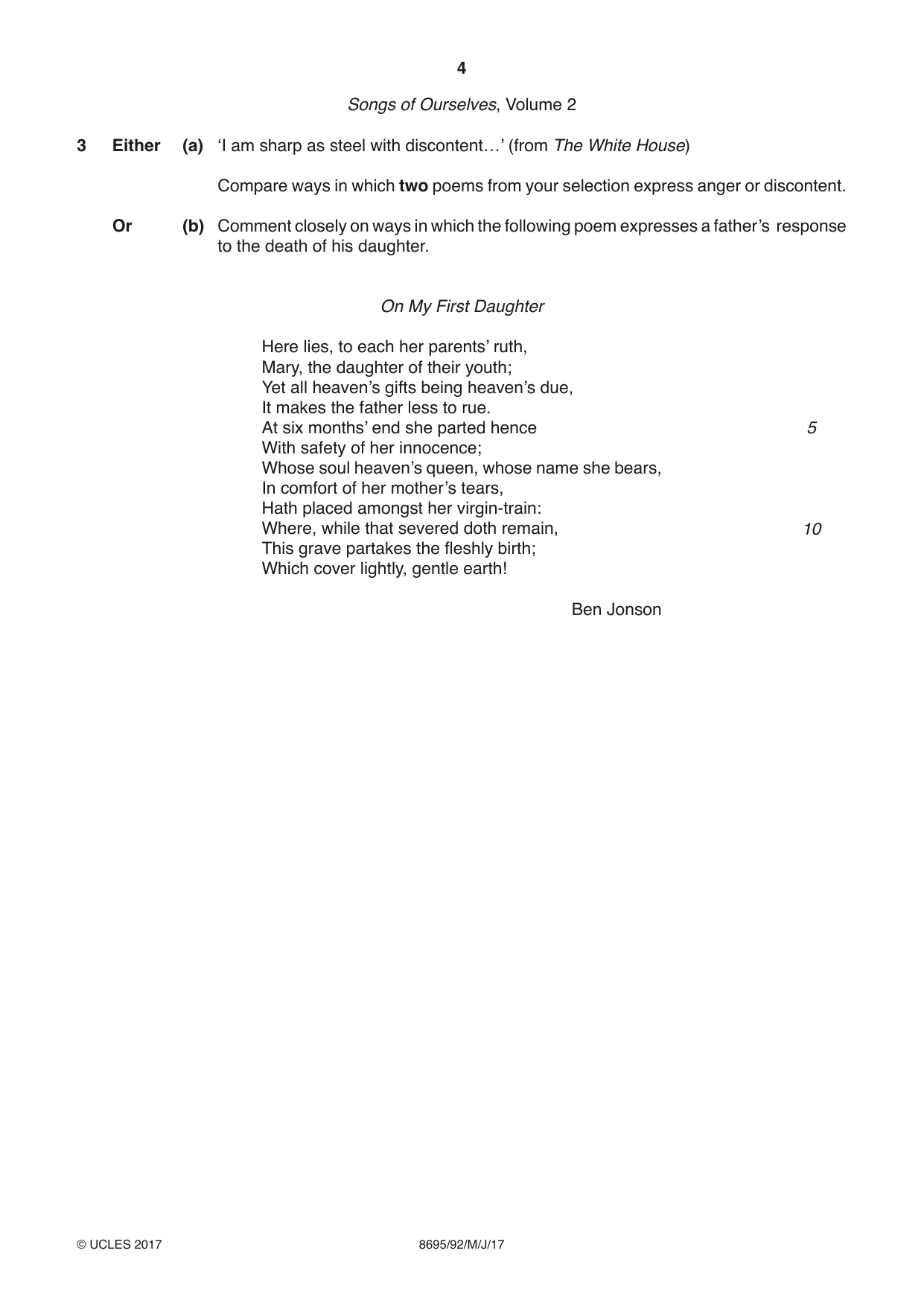
4 8695/92/M/J/17 © UCLES 2017 Songs of Ourselves, Volume 2 3 Either (a) ‘I am sharp as steel with discontent…’ (from The White House) Compare ways in which two poems from your selection express anger or discontent. Or (b) Comment closely on ways in which the following poem expresses a father’s response to the death of his daughter. On My First Daughter Here lies, to each her parents’ ruth, Mary, the daughter of their youth; Yet all heaven’s gifts being heaven’s due, It makes the father less to rue. At six months’ end she parted hence With safety of her innocence; Whose soul heaven’s queen, whose name she bears, In comfort of her mother’s tears, Hath placed amongst her virgin-train: Where, while that severed doth remain, This grave partakes the fleshly birth; Which cover lightly, gentle earth! Ben Jonson 5 10
Question paper, page 5
5 8695/92/M/J/17 © UCLES 2017 [Turn over Turn over for Section B.
Question paper, page 6
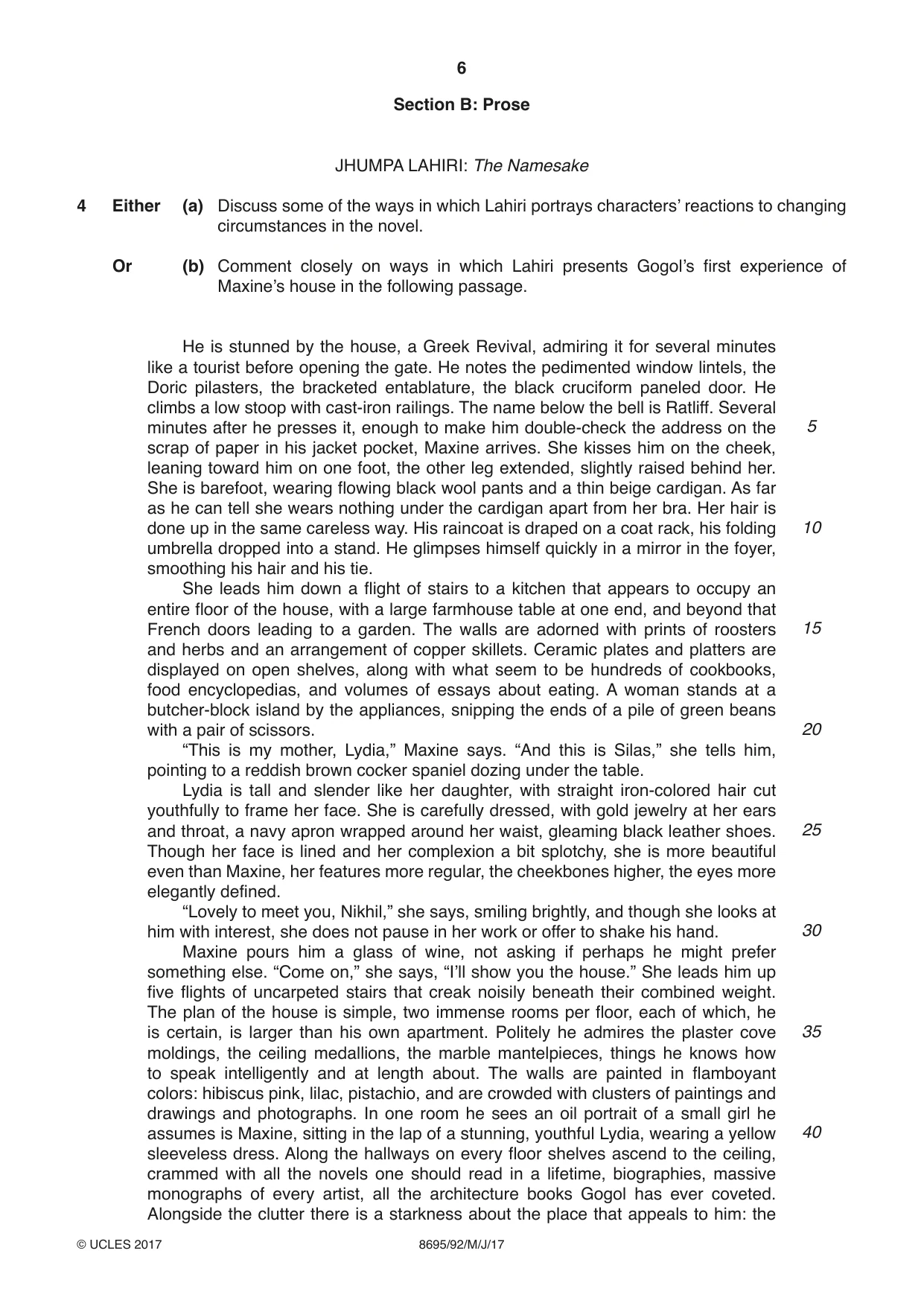
6 8695/92/M/J/17 © UCLES 2017 Section B: Prose JHUMPA LAHIRI: The Namesake 4 Either (a) Discuss some of the ways in which Lahiri portrays characters’ reactions to changing circumstances in the novel. Or (b) Comment closely on ways in which Lahiri presents Gogol’s first experience of Maxine’s house in the following passage. He is stunned by the house, a Greek Revival, admiring it for several minutes like a tourist before opening the gate. He notes the pedimented window lintels, the Doric pilasters, the bracketed entablature, the black cruciform paneled door. He climbs a low stoop with cast-iron railings. The name below the bell is Ratliff. Several minutes after he presses it, enough to make him double-check the address on the scrap of paper in his jacket pocket, Maxine arrives. She kisses him on the cheek, leaning toward him on one foot, the other leg extended, slightly raised behind her. She is barefoot, wearing flowing black wool pants and a thin beige cardigan. As far as he can tell she wears nothing under the cardigan apart from her bra. Her hair is done up in the same careless way. His raincoat is draped on a coat rack, his folding umbrella dropped into a stand. He glimpses himself quickly in a mirror in the foyer, smoothing his hair and his tie. She leads him down a flight of stairs to a kitchen that appears to occupy an entire floor of the house, with a large farmhouse table at one end, and beyond that French doors leading to a garden. The walls are adorned with prints of roosters and herbs and an arrangement of copper skillets. Ceramic plates and platters are displayed on open shelves, along with what seem to be hundreds of cookbooks, food encyclopedias, and volumes of essays about eating. A woman stands at a butcher-block island by the appliances, snipping the ends of a pile of green beans with a pair of scissors. “This is my mother, Lydia,” Maxine says. “And this is Silas,” she tells him, pointing to a reddish brown cocker spaniel dozing under the table. Lydia is tall and slender like her daughter, with straight iron-colored hair cut youthfully to frame her face. She is carefully dressed, with gold jewelry at her ears and throat, a navy apron wrapped around her waist, gleaming black leather shoes. Though her face is lined and her complexion a bit splotchy, she is more beautiful even than Maxine, her features more regular, the cheekbones higher, the eyes more elegantly defined. “Lovely to meet you, Nikhil,” she says, smiling brightly, and though she looks at him with interest, she does not pause in her work or offer to shake his hand. Maxine pours him a glass of wine, not asking if perhaps he might prefer something else. “Come on,” she says, “I’ll show you the house.” She leads him up five flights of uncarpeted stairs that creak noisily beneath their combined weight. The plan of the house is simple, two immense rooms per floor, each of which, he is certain, is larger than his own apartment. Politely he admires the plaster cove moldings, the ceiling medallions, the marble mantelpieces, things he knows how to speak intelligently and at length about. The walls are painted in flamboyant colors: hibiscus pink, lilac, pistachio, and are crowded with clusters of paintings and drawings and photographs. In one room he sees an oil portrait of a small girl he assumes is Maxine, sitting in the lap of a stunning, youthful Lydia, wearing a yellow sleeveless dress. Along the hallways on every floor shelves ascend to the ceiling, crammed with all the novels one should read in a lifetime, biographies, massive monographs of every artist, all the architecture books Gogol has ever coveted. Alongside the clutter there is a starkness about the place that appeals to him: the 5 10 15 20 25 30 35 40
Question paper, page 7
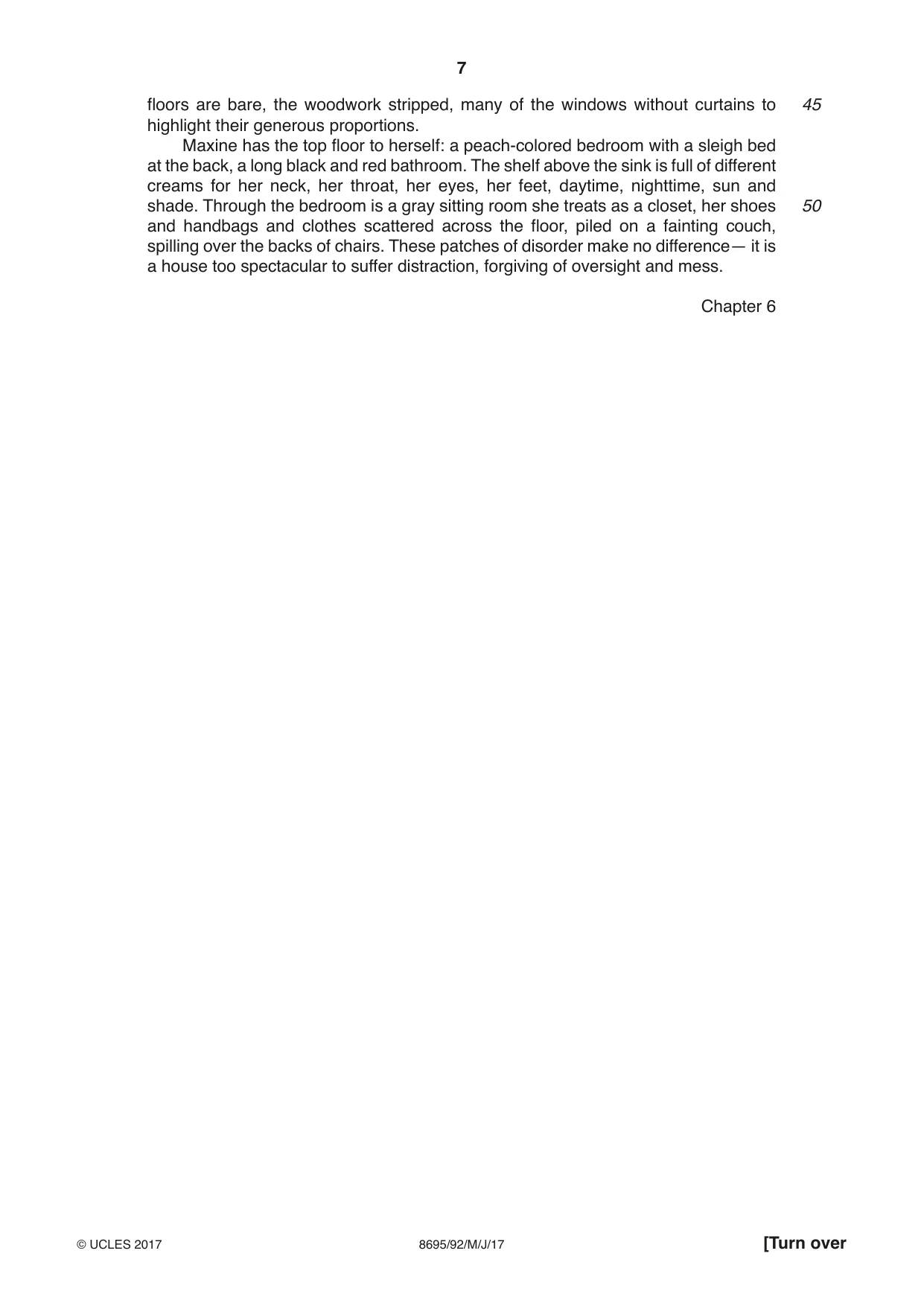
7 8695/92/M/J/17 © UCLES 2017 [Turn over floors are bare, the woodwork stripped, many of the windows without curtains to highlight their generous proportions. Maxine has the top floor to herself: a peach-colored bedroom with a sleigh bed at the back, a long black and red bathroom. The shelf above the sink is full of different creams for her neck, her throat, her eyes, her feet, daytime, nighttime, sun and shade. Through the bedroom is a gray sitting room she treats as a closet, her shoes and handbags and clothes scattered across the floor, piled on a fainting couch, spilling over the backs of chairs. These patches of disorder make no difference— it is a house too spectacular to suffer distraction, forgiving of oversight and mess. Chapter 6 45 50
Question paper, page 8
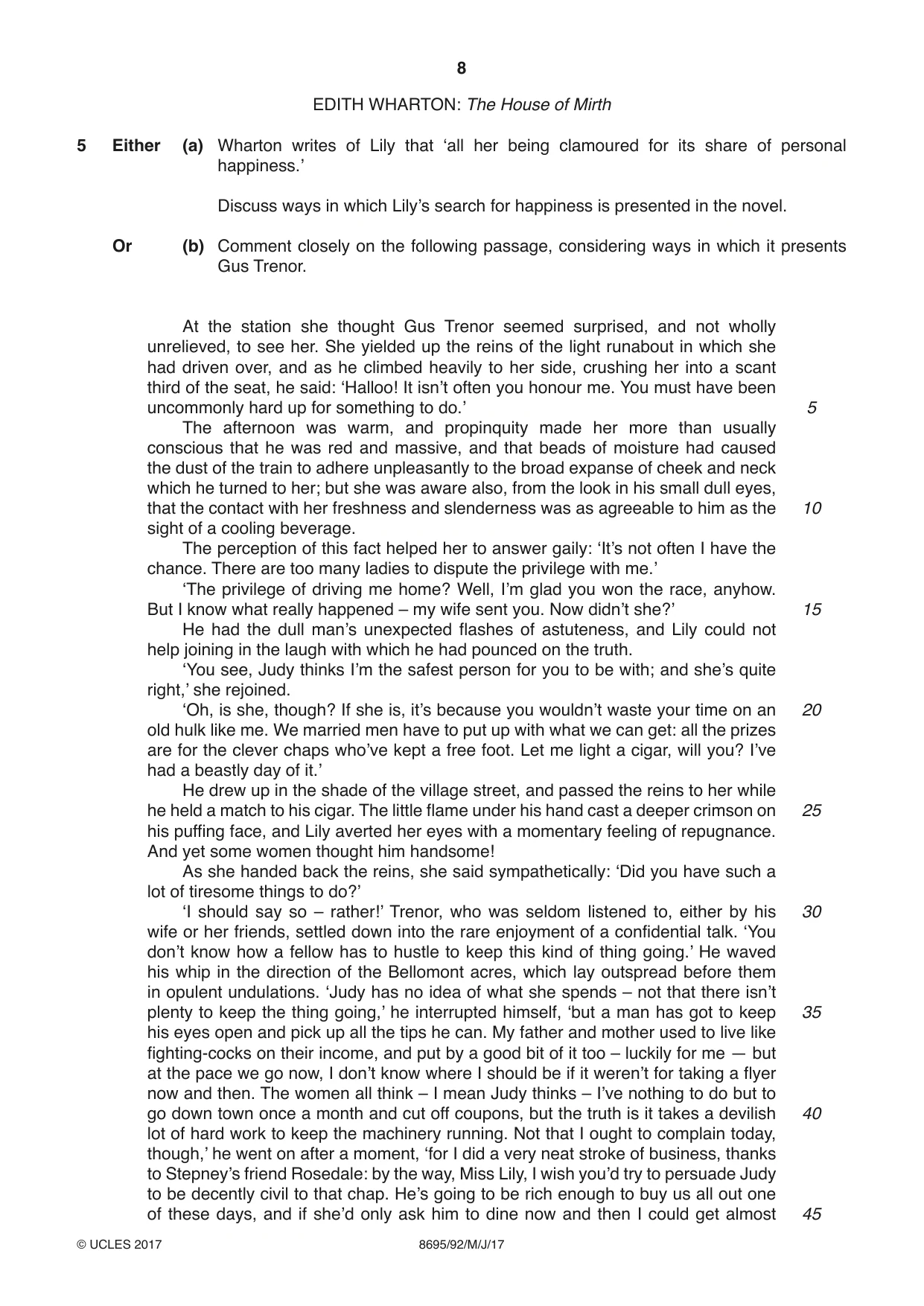
8 8695/92/M/J/17 © UCLES 2017 EDITH WHARTON: The House of Mirth 5 Either (a) Wharton writes of Lily that ‘all her being clamoured for its share of personal happiness.’ Discuss ways in which Lily’s search for happiness is presented in the novel. Or (b) Comment closely on the following passage, considering ways in which it presents Gus Trenor. At the station she thought Gus Trenor seemed surprised, and not wholly unrelieved, to see her. She yielded up the reins of the light runabout in which she had driven over, and as he climbed heavily to her side, crushing her into a scant third of the seat, he said: ‘Halloo! It isn’t often you honour me. You must have been uncommonly hard up for something to do.’ The afternoon was warm, and propinquity made her more than usually conscious that he was red and massive, and that beads of moisture had caused the dust of the train to adhere unpleasantly to the broad expanse of cheek and neck which he turned to her; but she was aware also, from the look in his small dull eyes, that the contact with her freshness and slenderness was as agreeable to him as the sight of a cooling beverage. The perception of this fact helped her to answer gaily: ‘It’s not often I have the chance. There are too many ladies to dispute the privilege with me.’ ‘The privilege of driving me home? Well, I’m glad you won the race, anyhow. But I know what really happened – my wife sent you. Now didn’t she?’ He had the dull man’s unexpected flashes of astuteness, and Lily could not help joining in the laugh with which he had pounced on the truth. ‘You see, Judy thinks I’m the safest person for you to be with; and she’s quite right,’ she rejoined. ‘Oh, is she, though? If she is, it’s because you wouldn’t waste your time on an old hulk like me. We married men have to put up with what we can get: all the prizes are for the clever chaps who’ve kept a free foot. Let me light a cigar, will you? I’ve had a beastly day of it.’ He drew up in the shade of the village street, and passed the reins to her while he held a match to his cigar. The little flame under his hand cast a deeper crimson on his puffing face, and Lily averted her eyes with a momentary feeling of repugnance. And yet some women thought him handsome! As she handed back the reins, she said sympathetically: ‘Did you have such a lot of tiresome things to do?’ ‘I should say so – rather!’ Trenor, who was seldom listened to, either by his wife or her friends, settled down into the rare enjoyment of a confidential talk. ‘You don’t know how a fellow has to hustle to keep this kind of thing going.’ He waved his whip in the direction of the Bellomont acres, which lay outspread before them in opulent undulations. ‘Judy has no idea of what she spends – not that there isn’t plenty to keep the thing going,’ he interrupted himself, ‘but a man has got to keep his eyes open and pick up all the tips he can. My father and mother used to live like fighting-cocks on their income, and put by a good bit of it too – luckily for me — but at the pace we go now, I don’t know where I should be if it weren’t for taking a flyer now and then. The women all think – I mean Judy thinks – I’ve nothing to do but to go down town once a month and cut off coupons, but the truth is it takes a devilish lot of hard work to keep the machinery running. Not that I ought to complain today, though,’ he went on after a moment, ‘for I did a very neat stroke of business, thanks to Stepney’s friend Rosedale: by the way, Miss Lily, I wish you’d try to persuade Judy to be decently civil to that chap. He’s going to be rich enough to buy us all out one of these days, and if she’d only ask him to dine now and then I could get almost 5 10 15 20 25 30 35 40 45
Question paper, page 9
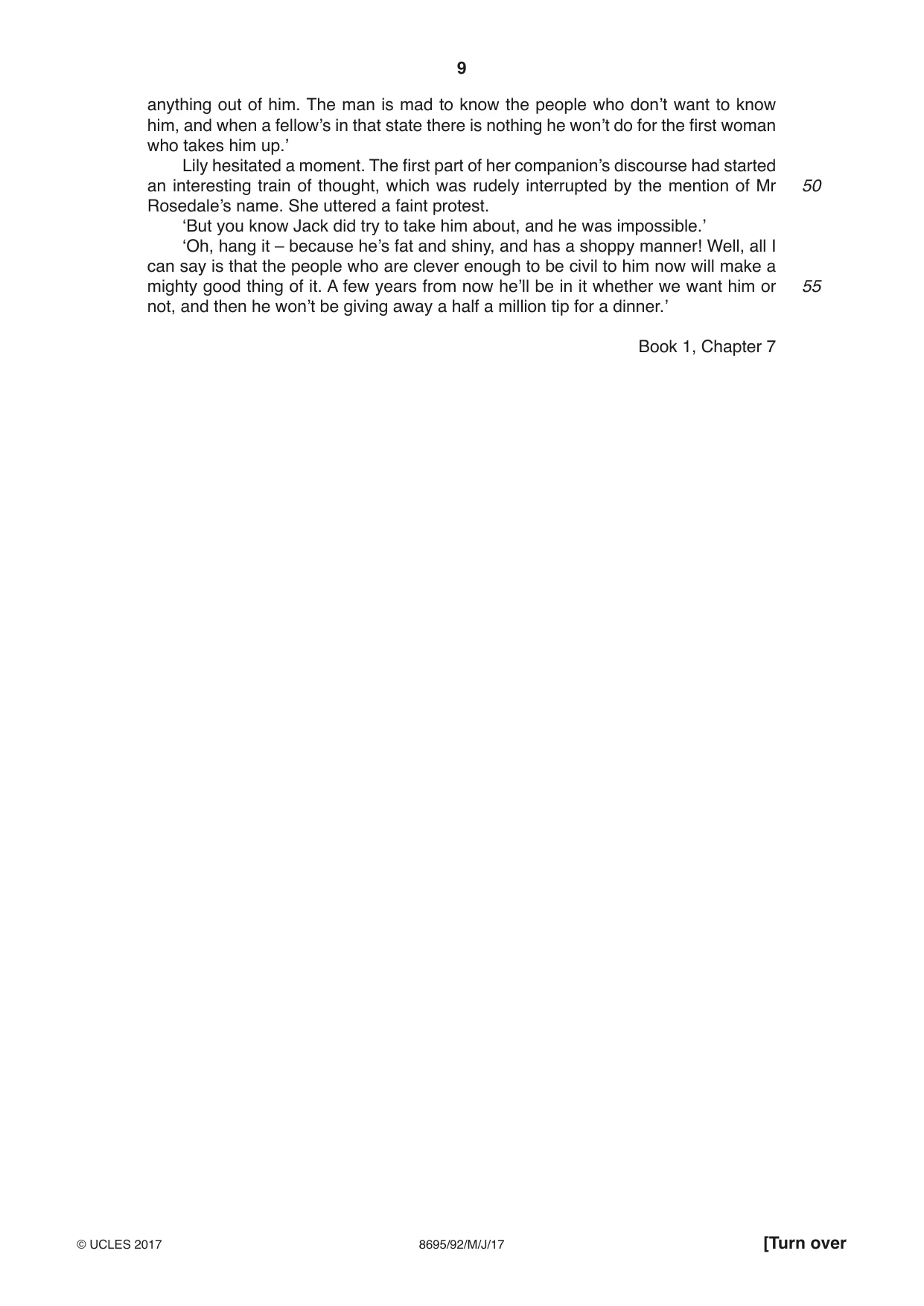
9 8695/92/M/J/17 © UCLES 2017 [Turn over anything out of him. The man is mad to know the people who don’t want to know him, and when a fellow’s in that state there is nothing he won’t do for the first woman who takes him up.’ Lily hesitated a moment. The first part of her companion’s discourse had started an interesting train of thought, which was rudely interrupted by the mention of Mr Rosedale’s name. She uttered a faint protest. ‘But you know Jack did try to take him about, and he was impossible.’ ‘Oh, hang it – because he’s fat and shiny, and has a shoppy manner! Well, all I can say is that the people who are clever enough to be civil to him now will make a mighty good thing of it. A few years from now he’ll be in it whether we want him or not, and then he won’t be giving away a half a million tip for a dinner.’ Book 1, Chapter 7 50 55
Question paper, page 10
10 8695/92/M/J/17 © UCLES 2017 Stories of Ourselves 6 Either (a) Discuss ways in which two stories present relationships between parents and their children. Or (b) Comment closely on the following passage from Secrets, considering ways in which it explores the past. A tiny rattle began as the kettle warmed up, then it bubbled and steam gushed quietly from its spout. The cards began to curl slightly in the jet of steam but she didn’t seem to be watching. The stamps peeled moistly off and he put them in a saucer of water to flatten them. ‘Who is Brother Benignus?’ he asked. She seemed not to hear. He asked again and she looked over her glasses. ‘He was a friend.’ His flourishing signature appeared again and again. Sometimes Bro Benignus, sometimes Benignus and once Iggy. ‘Is he alive?’ ‘No, he’s dead now. Watch the kettle doesn’t run dry.’ When he had all the stamps off he put the postcards together and replaced them in the pigeon-hole. He reached over towards the letters but before his hand touched them his aunt’s voice, harsh for once, warned. ‘A-A-A,’ she moved her pen from side to side. ‘Do-not-touch,’ she said and smiled. ‘Anything else, yes! That section, no!’ She resumed her writing. The boy went through some other papers and found some photographs. One was of a beautiful girl. It was very old-fashioned but he could see that she was beautiful. The picture was a pale brown oval set on a white square of card. The edges of the oval were misty. The girl in the photograph was young and had dark, dark hair scraped severely back and tied like a knotted rope on the top of her head – high arched eyebrows, her nose straight and thin, her mouth slightly smiling, yet not smiling – the way a mouth is after smiling. Her eyes looked out at him dark and knowing and beautiful. ‘Who is that?’ he asked. ‘Why? What do you think of her?’ ‘She’s all right.’ ‘Do you think she is beautiful?’ The boy nodded. ‘That’s me,’ she said. The boy was glad he had pleased her in return for the stamps. Other photographs were there, not posed ones like Aunt Mary’s but Brownie snaps of laughing groups of girls in bucket hats like German helmets and coats to their ankles. They seemed tiny faces covered in clothes. There was a photograph of a young man smoking a cigarette, his hair combed one way by the wind against a background of sea. ‘Who is that in the uniform?’ the boy asked. ‘He’s a soldier,’ she answered without looking up. ‘Oh,’ said the boy. ‘But who is he?’ ‘He was a friend of mine before you were born,’ she said. Then added, ‘Do I smell something cooking? Take your stamps and off you go. That’s the boy.’ The boy looked at the back of the picture of the man and saw in black spidery ink ‘John, Aug’ 15 Ballintoye’. ‘I thought maybe it was Brother Benignus,’ he said. She looked at him not answering. ‘Was your friend killed in the war?’ At first she said no, but then she changed her mind. ‘Perhaps he was,’ she said, then smiled. ‘You are far too inquisitive. Put it to use 5 10 15 20 25 30 35 40 45
Question paper, page 11
11 8695/92/M/J/17 © UCLES 2017 [Turn over and go and see what is for tea. Your mother will need the kettle.’ She came over to the bureau and helped tidy the photographs away. Then she locked it and put the keys on the shelf. ‘Will you bring me up my tray?’ The boy nodded and left. Secrets 50
Question paper, page 12
12 8695/92/M/J/17 © UCLES 2017 Section C: Drama AMA ATA AIDOO: The Dilemma of a Ghost and Anowa 7 Either (a) Discuss Aidoo’s dramatic presentation of women’s roles in traditional societies in both of these plays. Or (b) In what ways, and with what dramatic effects, does Aidoo present tension between Esi and Ato in the following extract from The Dilemma of a Ghost ? Esi: But why should she behave in such a strange way? Content removed due to copyright restrictions.
Question paper, page 13
13 8695/92/M/J/17 © UCLES 2017 [Turn over It is ESI KOM who, following ATO’s gaze and seeing her, rushes forward to support her on.] Act 5, The Dilemma of a Ghost Content removed due to copyright restrictions.
Question paper, page 14
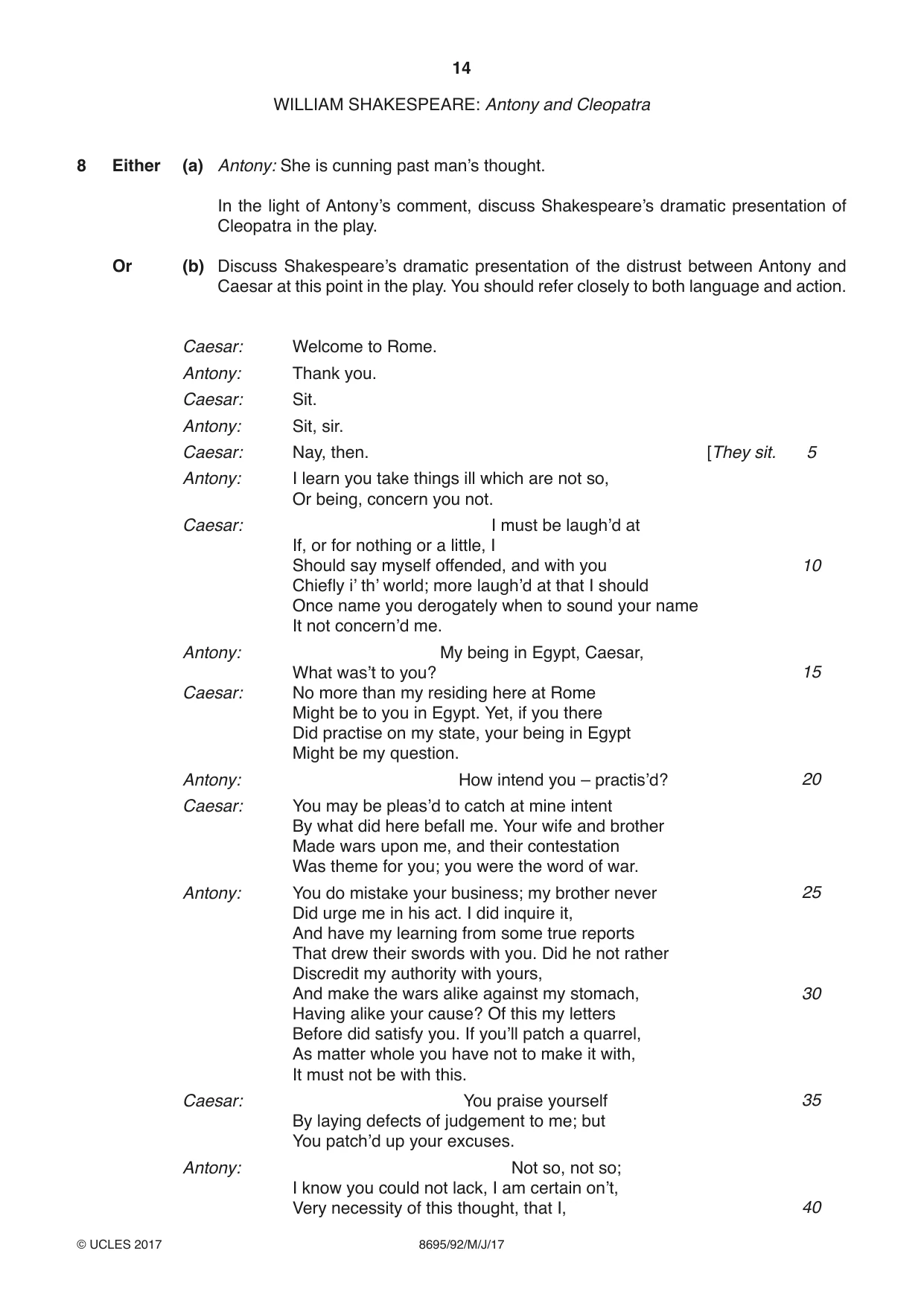
14 8695/92/M/J/17 © UCLES 2017 WILLIAM SHAKESPEARE: Antony and Cleopatra 8 Either (a) Antony: She is cunning past man’s thought. In the light of Antony’s comment, discuss Shakespeare’s dramatic presentation of Cleopatra in the play. Or (b) Discuss Shakespeare’s dramatic presentation of the distrust between Antony and Caesar at this point in the play. You should refer closely to both language and action. Caesar: Welcome to Rome. Antony: Thank you. Caesar: Sit. Antony: Sit, sir. Caesar: Nay, then. [They sit. Antony: I learn you take things ill which are not so, Or being, concern you not. Caesar: I must be laugh’d at If, or for nothing or a little, I Should say myself offended, and with you Chiefly i’ th’ world; more laugh’d at that I should Once name you derogately when to sound your name It not concern’d me. Antony: My being in Egypt, Caesar, What was’t to you? Caesar: No more than my residing here at Rome Might be to you in Egypt. Yet, if you there Did practise on my state, your being in Egypt Might be my question. Antony: How intend you – practis’d? Caesar: You may be pleas’d to catch at mine intent By what did here befall me. Your wife and brother Made wars upon me, and their contestation Was theme for you; you were the word of war. Antony: You do mistake your business; my brother never Did urge me in his act. I did inquire it, And have my learning from some true reports That drew their swords with you. Did he not rather Discredit my authority with yours, And make the wars alike against my stomach, Having alike your cause? Of this my letters Before did satisfy you. If you’ll patch a quarrel, As matter whole you have not to make it with, It must not be with this. Caesar: You praise yourself By laying defects of judgement to me; but You patch’d up your excuses. Antony: Not so, not so; I know you could not lack, I am certain on’t, Very necessity of this thought, that I, 5 10 15 20 25 30 35 40
Question paper, page 15
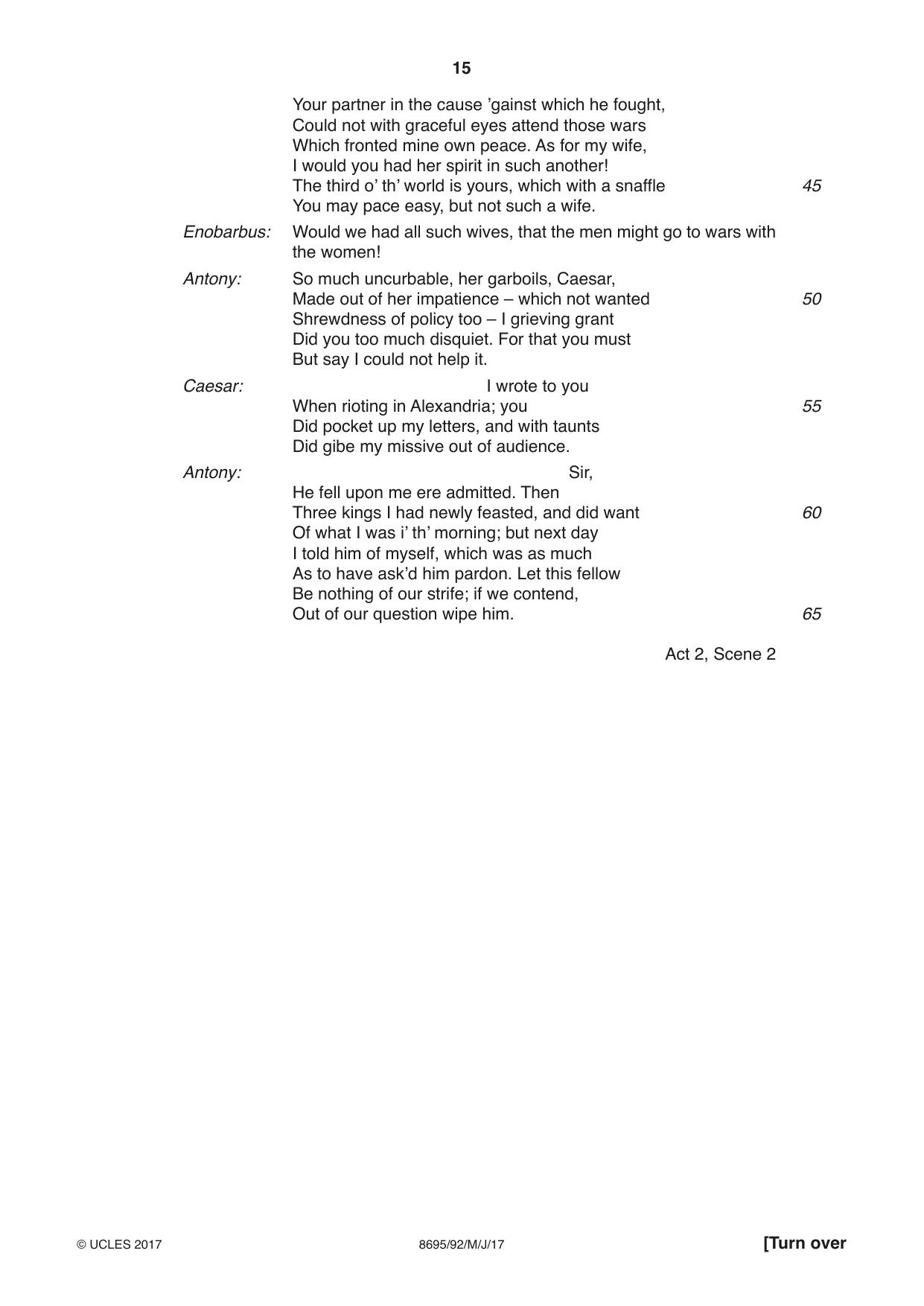
15 8695/92/M/J/17 © UCLES 2017 [Turn over Your partner in the cause ’gainst which he fought, Could not with graceful eyes attend those wars Which fronted mine own peace. As for my wife, I would you had her spirit in such another! The third o’ th’ world is yours, which with a snaffle You may pace easy, but not such a wife. Enobarbus: Would we had all such wives, that the men might go to wars with the women! Antony: So much uncurbable, her garboils, Caesar, Made out of her impatience – which not wanted Shrewdness of policy too – I grieving grant Did you too much disquiet. For that you must But say I could not help it. Caesar: I wrote to you When rioting in Alexandria; you Did pocket up my letters, and with taunts Did gibe my missive out of audience. Antony: Sir, He fell upon me ere admitted. Then Three kings I had newly feasted, and did want Of what I was i’ th’ morning; but next day I told him of myself, which was as much As to have ask’d him pardon. Let this fellow Be nothing of our strife; if we contend, Out of our question wipe him. Act 2, Scene 2 45 50 55 60 65
Question paper, page 16
16 8695/92/M/J/17 © UCLES 2017 BRIAN FRIEL: Philadelphia, Here I Come! 9 Either (a) Discuss Friel’s dramatic presentation of emigration and attitudes to emigration in the play. Or (b) Discuss the significance and dramatic effects of this extract from the play. You should pay close attention to both language and action. Kate: But £3 15s Gar! We could never live on that. Content removed due to copyright restrictions.
Question paper, page 17
17 8695/92/M/J/17 © UCLES 2017 [She kisses him passionately, quickly, then breaks off and goes.] Episode 1 Content removed due to copyright restrictions.
Question paper, page 18
18 8695/92/M/J/17 © UCLES 2017 BLANK PAGE
Question paper, page 19
19 8695/92/M/J/17 © UCLES 2017 BLANK PAGE
Question paper, page 20
20 8695/92/M/J/17 © UCLES 2017 Permission to reproduce items where third-party owned material protected by copyright is included has been sought and cleared where possible. Every reasonable effort has been made by the publisher (UCLES) to trace copyright holders, but if any items requiring clearance have unwittingly been included, the publisher will be pleased to make amends at the earliest possible opportunity. To avoid the issue of disclosure of answer-related information to candidates, all copyright acknowledgements are reproduced online in the Cambridge International Examinations Copyright Acknowledgements Booklet. This is produced for each series of examinations and is freely available to download at www.cie.org.uk after the live examination series. Cambridge International Examinations is part of the Cambridge Assessment Group. Cambridge Assessment is the brand name of University of Cambridge Local Examinations Syndicate (UCLES), which is itself a department of the University of Cambridge. BLANK PAGE
Mark scheme, page 1
® IGCSE is a registered trademark. This document consists of 5 printed pages. © UCLES 2017 [Turn over Cambridge International Examinations Cambridge International Advanced Subsidiary Level LANGUAGE AND LITERATURE IN ENGLISH 8695/92 Paper 9 Poetry, Prose and Drama May/June 2017 MARK SCHEME Maximum Mark: 50 Published This mark scheme is published as an aid to teachers and candidates, to indicate the requirements of the examination. It shows the basis on which Examiners were instructed to award marks. It does not indicate the details of the discussions that took place at an Examiners’ meeting before marking began, which would have considered the acceptability of alternative answers. Mark schemes should be read in conjunction with the question paper and the Principal Examiner Report for Teachers. Cambridge will not enter into discussions about these mark schemes. Cambridge is publishing the mark schemes for the May/June 2017 series for most Cambridge IGCSE®, Cambridge International A and AS Level and Cambridge Pre-U components, and some Cambridge O Level components.
Mark scheme, page 2
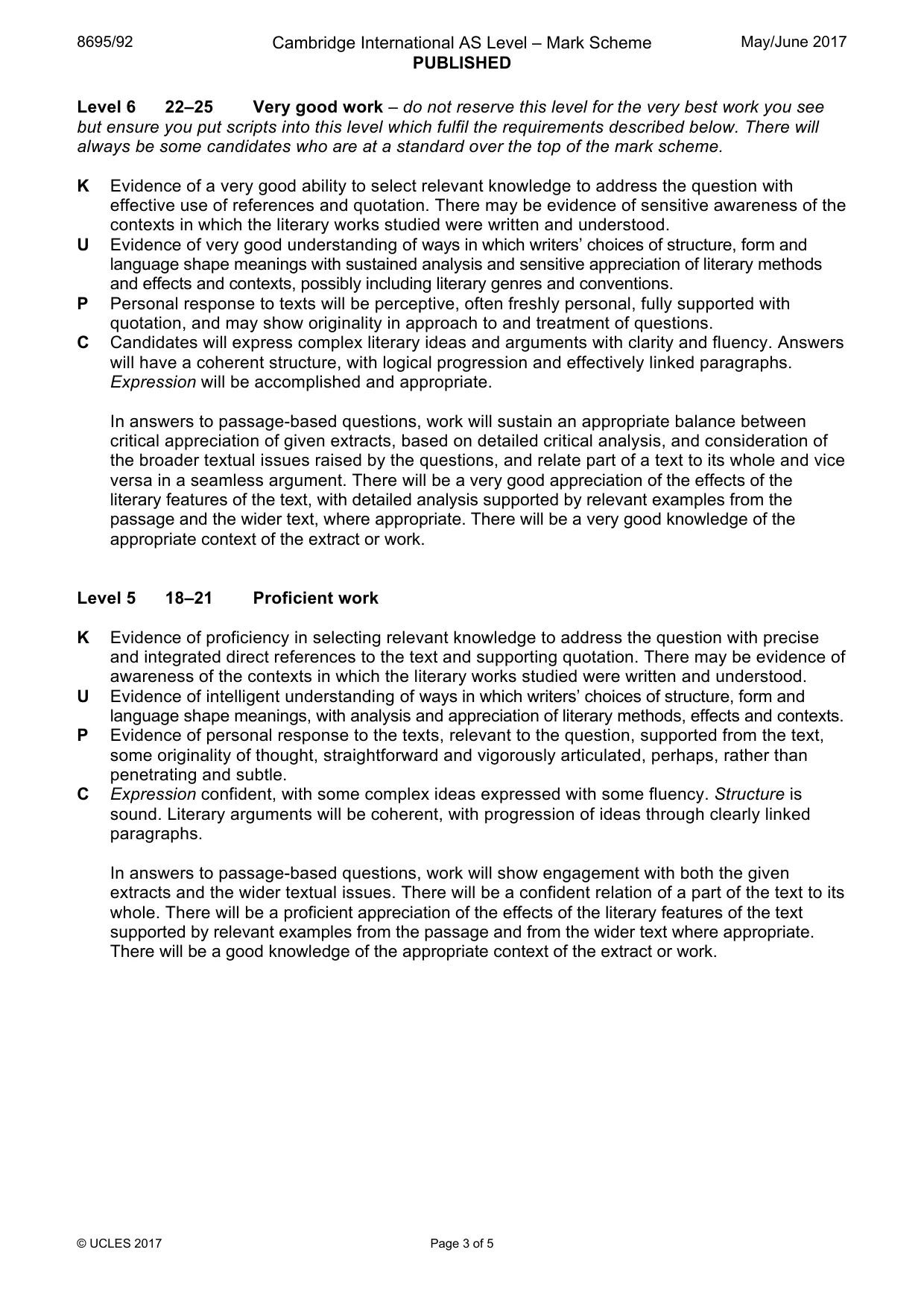
8695/92 Cambridge International AS Level – Mark Scheme PUBLISHED May/June 2017 © UCLES 2017 Page 2 of 5 Using the mark levels Place the answer in a level first. Look for the ‘best fit’ of the answer into a level. An answer needs to show evidence of most but not necessarily ALL of the qualities described in a level, in order to be placed in that level. Then award a mark for the relative position of the answer within the level. Candidates may address the question in many different ways. Do not expect any particular focus or approach and do not penalise answers for leaving out a particular focus. Reward what is there, showing what you are rewarding, in your comments. Consider all strands and weigh up the performance as a whole in placing the answer in a level, then show that you have done so in the summative comment: e.g. Solid K of texts, limited evidence of U and mostly narrative, evidence of P with some, good personal response and generally clear C throughout. Assessment Objectives: AO1 The ability to respond to texts in the three main forms (Prose, Poetry and Drama) of different types and from different cultures. AO2 An understanding of the ways in which writers’ choices of form, structure and language shape meanings. AO3 The ability to produce informed, independent opinions and judgements on literary texts. AO4 The ability to communicate clearly the knowledge, understanding and insight appropriate for literary study. Each answer is marked out of 25, in accordance with the General Marking Criteria below. Each band is divided into strands corresponding to the Assessment Objectives – Knowledge, Understanding, Personal Response, Communication.
Mark scheme, page 3
8695/92 Cambridge International AS Level – Mark Scheme PUBLISHED May/June 2017 © UCLES 2017 Page 3 of 5 Level 6 22–25 Very good work – do not reserve this level for the very best work you see but ensure you put scripts into this level which fulfil the requirements described below. There will always be some candidates who are at a standard over the top of the mark scheme. K Evidence of a very good ability to select relevant knowledge to address the question with effective use of references and quotation. There may be evidence of sensitive awareness of the contexts in which the literary works studied were written and understood. U Evidence of very good understanding of ways in which writers’ choices of structure, form and language shape meanings with sustained analysis and sensitive appreciation of literary methods and effects and contexts, possibly including literary genres and conventions. P Personal response to texts will be perceptive, often freshly personal, fully supported with quotation, and may show originality in approach to and treatment of questions. C Candidates will express complex literary ideas and arguments with clarity and fluency. Answers will have a coherent structure, with logical progression and effectively linked paragraphs. Expression will be accomplished and appropriate. In answers to passage-based questions, work will sustain an appropriate balance between critical appreciation of given extracts, based on detailed critical analysis, and consideration of the broader textual issues raised by the questions, and relate part of a text to its whole and vice versa in a seamless argument. There will be a very good appreciation of the effects of the literary features of the text, with detailed analysis supported by relevant examples from the passage and the wider text, where appropriate. There will be a very good knowledge of the appropriate context of the extract or work. Level 5 18–21 Proficient work K Evidence of proficiency in selecting relevant knowledge to address the question with precise and integrated direct references to the text and supporting quotation. There may be evidence of awareness of the contexts in which the literary works studied were written and understood. U Evidence of intelligent understanding of ways in which writers’ choices of structure, form and language shape meanings, with analysis and appreciation of literary methods, effects and contexts. P Evidence of personal response to the texts, relevant to the question, supported from the text, some originality of thought, straightforward and vigorously articulated, perhaps, rather than penetrating and subtle. C Expression confident, with some complex ideas expressed with some fluency. Structure is sound. Literary arguments will be coherent, with progression of ideas through clearly linked paragraphs. In answers to passage-based questions, work will show engagement with both the given extracts and the wider textual issues. There will be a confident relation of a part of the text to its whole. There will be a proficient appreciation of the effects of the literary features of the text supported by relevant examples from the passage and from the wider text where appropriate. There will be a good knowledge of the appropriate context of the extract or work.
Mark scheme, page 4
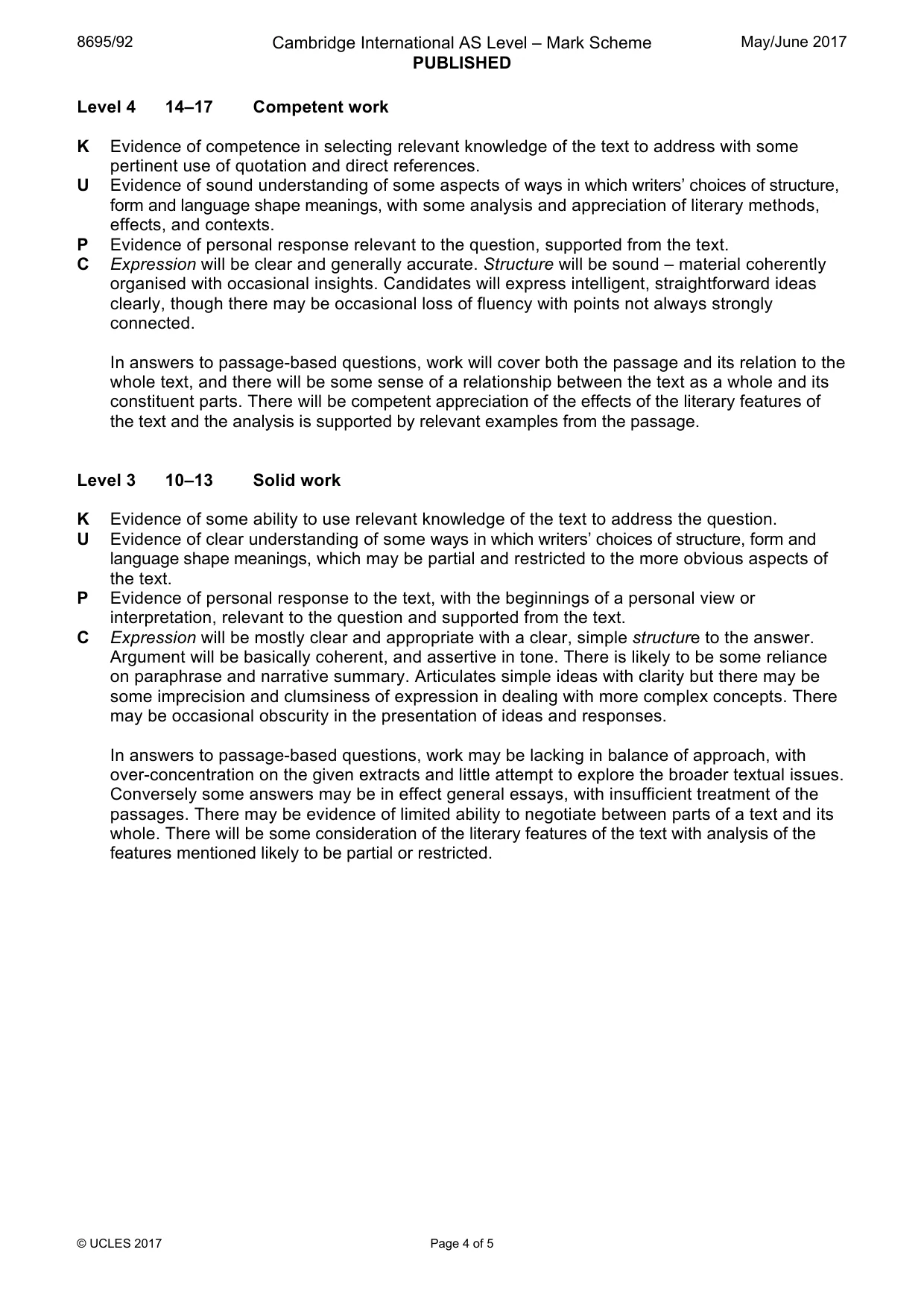
8695/92 Cambridge International AS Level – Mark Scheme PUBLISHED May/June 2017 © UCLES 2017 Page 4 of 5 Level 4 14–17 Competent work K Evidence of competence in selecting relevant knowledge of the text to address with some pertinent use of quotation and direct references. U Evidence of sound understanding of some aspects of ways in which writers’ choices of structure, form and language shape meanings, with some analysis and appreciation of literary methods, effects, and contexts. P Evidence of personal response relevant to the question, supported from the text. C Expression will be clear and generally accurate. Structure will be sound – material coherently organised with occasional insights. Candidates will express intelligent, straightforward ideas clearly, though there may be occasional loss of fluency with points not always strongly connected. In answers to passage-based questions, work will cover both the passage and its relation to the whole text, and there will be some sense of a relationship between the text as a whole and its constituent parts. There will be competent appreciation of the effects of the literary features of the text and the analysis is supported by relevant examples from the passage. Level 3 10–13 Solid work K Evidence of some ability to use relevant knowledge of the text to address the question. U Evidence of clear understanding of some ways in which writers’ choices of structure, form and language shape meanings, which may be partial and restricted to the more obvious aspects of the text. P Evidence of personal response to the text, with the beginnings of a personal view or interpretation, relevant to the question and supported from the text. C Expression will be mostly clear and appropriate with a clear, simple structure to the answer. Argument will be basically coherent, and assertive in tone. There is likely to be some reliance on paraphrase and narrative summary. Articulates simple ideas with clarity but there may be some imprecision and clumsiness of expression in dealing with more complex concepts. There may be occasional obscurity in the presentation of ideas and responses. In answers to passage-based questions, work may be lacking in balance of approach, with over-concentration on the given extracts and little attempt to explore the broader textual issues. Conversely some answers may be in effect general essays, with insufficient treatment of the passages. There may be evidence of limited ability to negotiate between parts of a text and its whole. There will be some consideration of the literary features of the text with analysis of the features mentioned likely to be partial or restricted.
Mark scheme, page 5
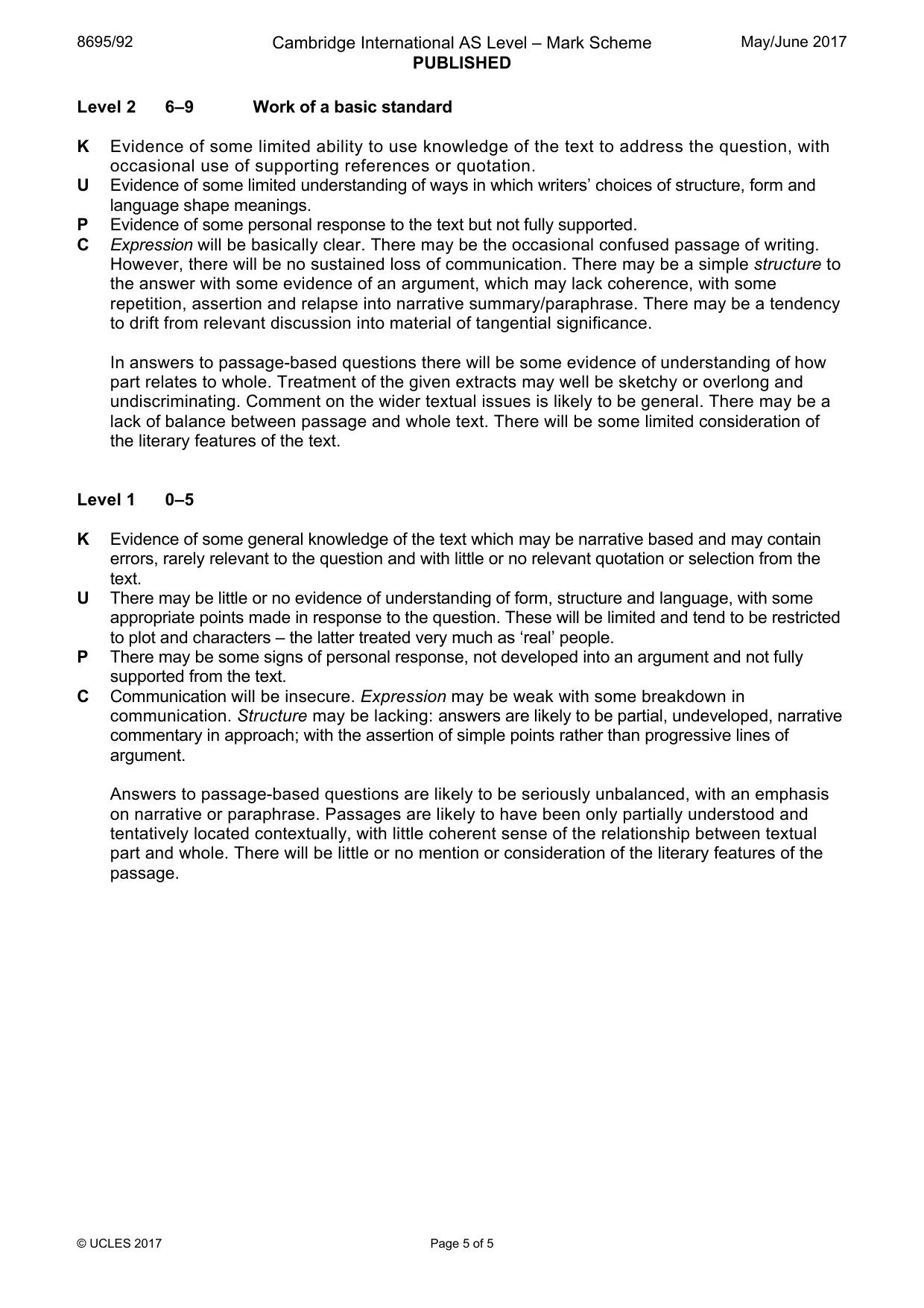
8695/92 Cambridge International AS Level – Mark Scheme PUBLISHED May/June 2017 © UCLES 2017 Page 5 of 5 Level 2 6–9 Work of a basic standard K Evidence of some limited ability to use knowledge of the text to address the question, with occasional use of supporting references or quotation. U Evidence of some limited understanding of ways in which writers’ choices of structure, form and language shape meanings. P Evidence of some personal response to the text but not fully supported. C Expression will be basically clear. There may be the occasional confused passage of writing. However, there will be no sustained loss of communication. There may be a simple structure to the answer with some evidence of an argument, which may lack coherence, with some repetition, assertion and relapse into narrative summary/paraphrase. There may be a tendency to drift from relevant discussion into material of tangential significance. In answers to passage-based questions there will be some evidence of understanding of how part relates to whole. Treatment of the given extracts may well be sketchy or overlong and undiscriminating. Comment on the wider textual issues is likely to be general. There may be a lack of balance between passage and whole text. There will be some limited consideration of the literary features of the text. Level 1 0–5 K Evidence of some general knowledge of the text which may be narrative based and may contain errors, rarely relevant to the question and with little or no relevant quotation or selection from the text. U There may be little or no evidence of understanding of form, structure and language, with some appropriate points made in response to the question. These will be limited and tend to be restricted to plot and characters – the latter treated very much as ‘real’ people. P There may be some signs of personal response, not developed into an argument and not fully supported from the text. C Communication will be insecure. Expression may be weak with some breakdown in communication. Structure may be lacking: answers are likely to be partial, undeveloped, narrative commentary in approach; with the assertion of simple points rather than progressive lines of argument. Answers to passage-based questions are likely to be seriously unbalanced, with an emphasis on narrative or paraphrase. Passages are likely to have been only partially understood and tentatively located contextually, with little coherent sense of the relationship between textual part and whole. There will be little or no mention or consideration of the literary features of the passage.
What you needed in this session
Cambridge’s own grade thresholds for 2017 May/June, Paper 9 · Variant 2. A higher threshold means an easier paper — the bar moves with how the cohort did.