Cambridge A Level English - Language and Literature (AS Level only, from 2016) 8695 — 2019 Oct/Nov Paper 9 · Variant 2
8695/92/O/N/19 · 50 marks · ≈56 min
The question paper and its mark scheme, free to read here and free to download. This is Cambridge’s own paper, exactly as it was sat.
Question paper20 pages


Mark scheme6 pages
Answers below. Sit the paper first if you are practising.
Paper as text
Question paper, page 1
This document consists of 17 printed pages, 3 blank pages and 1 Insert. DC (RCL (GO)) 166010/3 © UCLES 2019 [Turn over Cambridge Assessment International Education Cambridge International Advanced Subsidiary Level LANGUAGE AND LITERATURE IN ENGLISH 8695/92 Paper 9 Poetry, Prose and Drama October/November 2019 2 hours No Additional Materials are required. READ THESE INSTRUCTIONS FIRST An answer booklet is provided inside this question paper. You should follow the instructions on the front cover of the answer booklet. If you need additional answer paper ask the invigilator for a continuation booklet. Answer two questions, each from a different section. You are reminded of the need for good English and clear presentation in your answers. All questions in this paper carry equal marks. * 9 4 0 3 8 4 5 9 3 3 *
Question paper, page 2
2 8695/92/O/N/19 © UCLES 2019 Section A: Poetry ROBERT FROST: Selected Poems 1 Either (a) Discuss ways in which Frost presents rural landscape. You should refer to two poems in your answer. Or (b) Comment closely on ways in which Frost presents the speaker’s experience of the night-time camp. An Unstamped Letter in Our Rural Letter Box Last night your watchdog barked all night, Content removed due to copyright restrictions.
Question paper, page 3
3 8695/92/O/N/19 © UCLES 2019 [Turn over To say as much I write you this. Content removed due to copyright restrictions.
Question paper, page 4
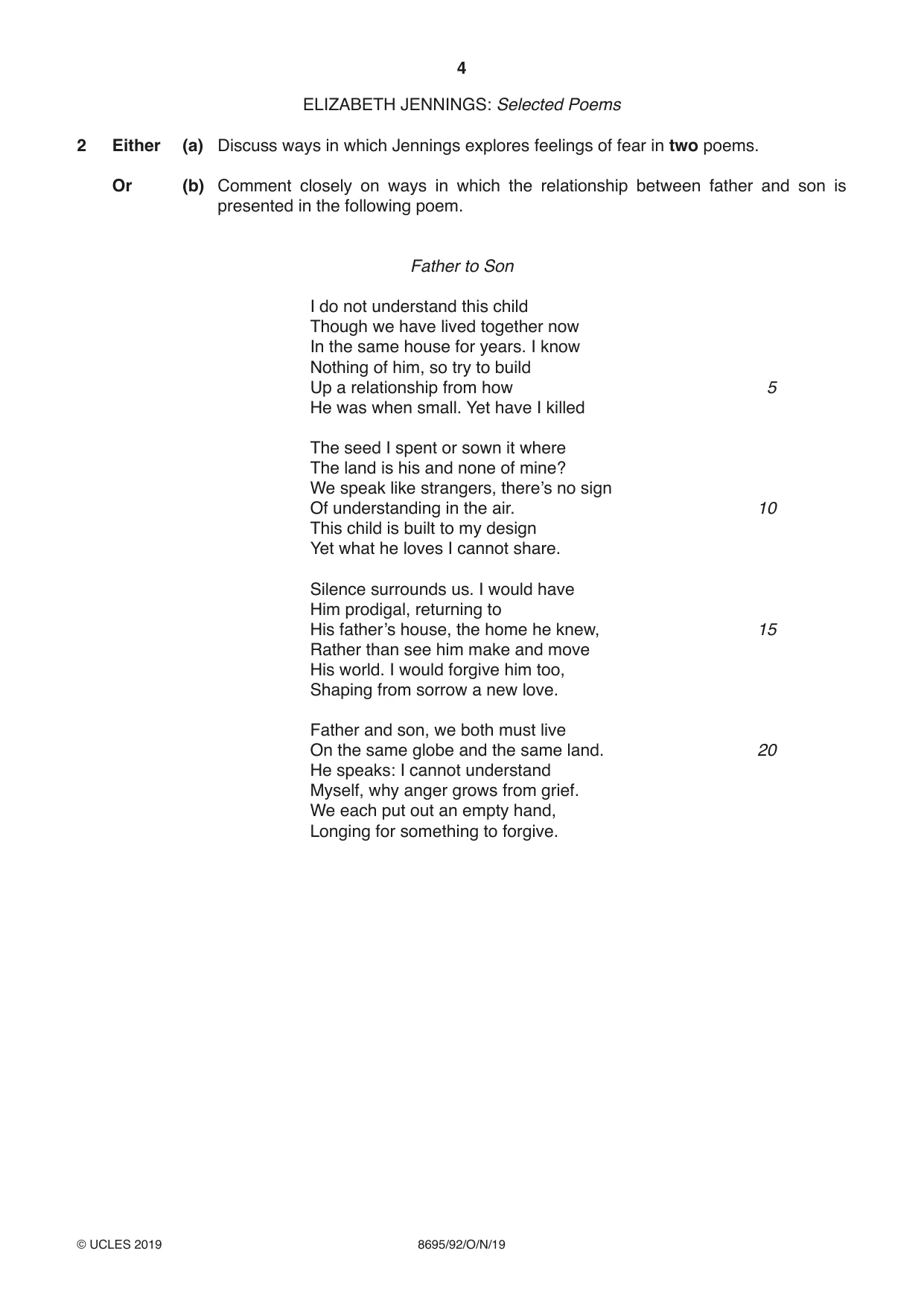
4 8695/92/O/N/19 © UCLES 2019 ELIZABETH JENNINGS: Selected Poems 2 Either (a) Discuss ways in which Jennings explores feelings of fear in two poems. Or (b) Comment closely on ways in which the relationship between father and son is presented in the following poem. Father to Son I do not understand this child Though we have lived together now In the same house for years. I know Nothing of him, so try to build Up a relationship from how He was when small. Yet have I killed The seed I spent or sown it where The land is his and none of mine? We speak like strangers, there’s no sign Of understanding in the air. This child is built to my design Yet what he loves I cannot share. Silence surrounds us. I would have Him prodigal, returning to His father’s house, the home he knew, Rather than see him make and move His world. I would forgive him too, Shaping from sorrow a new love. Father and son, we both must live On the same globe and the same land. He speaks: I cannot understand Myself, why anger grows from grief. We each put out an empty hand, Longing for something to forgive. 5 10 15 20
Question paper, page 5
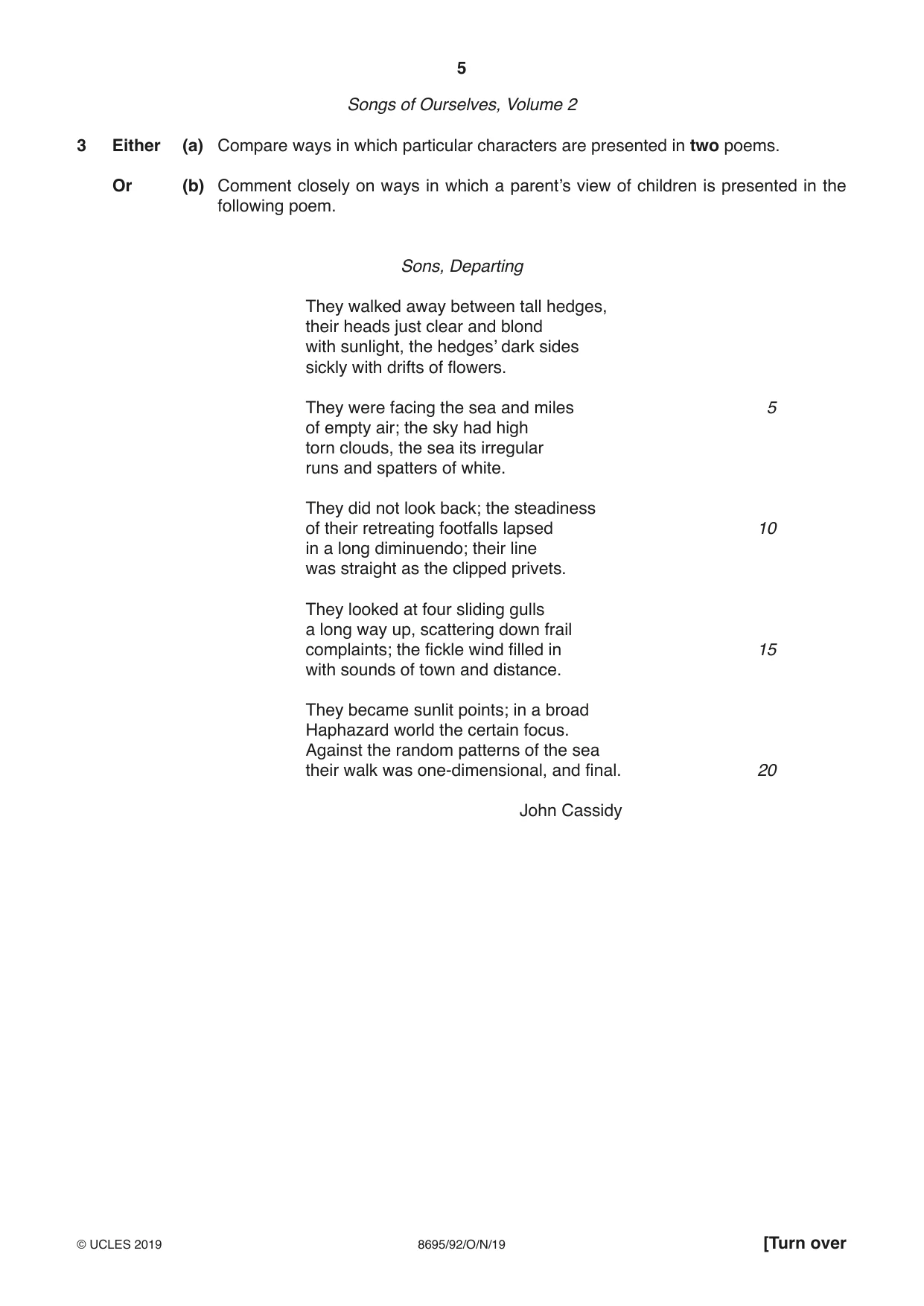
5 8695/92/O/N/19 © UCLES 2019 [Turn over Songs of Ourselves, Volume 2 3 Either (a) Compare ways in which particular characters are presented in two poems. Or (b) Comment closely on ways in which a parent’s view of children is presented in the following poem. Sons, Departing They walked away between tall hedges, their heads just clear and blond with sunlight, the hedges’ dark sides sickly with drifts of flowers. They were facing the sea and miles of empty air; the sky had high torn clouds, the sea its irregular runs and spatters of white. They did not look back; the steadiness of their retreating footfalls lapsed in a long diminuendo; their line was straight as the clipped privets. They looked at four sliding gulls a long way up, scattering down frail complaints; the fickle wind filled in with sounds of town and distance. They became sunlit points; in a broad Haphazard world the certain focus. Against the random patterns of the sea their walk was one-dimensional, and final. John Cassidy 5 10 15 20
Question paper, page 6
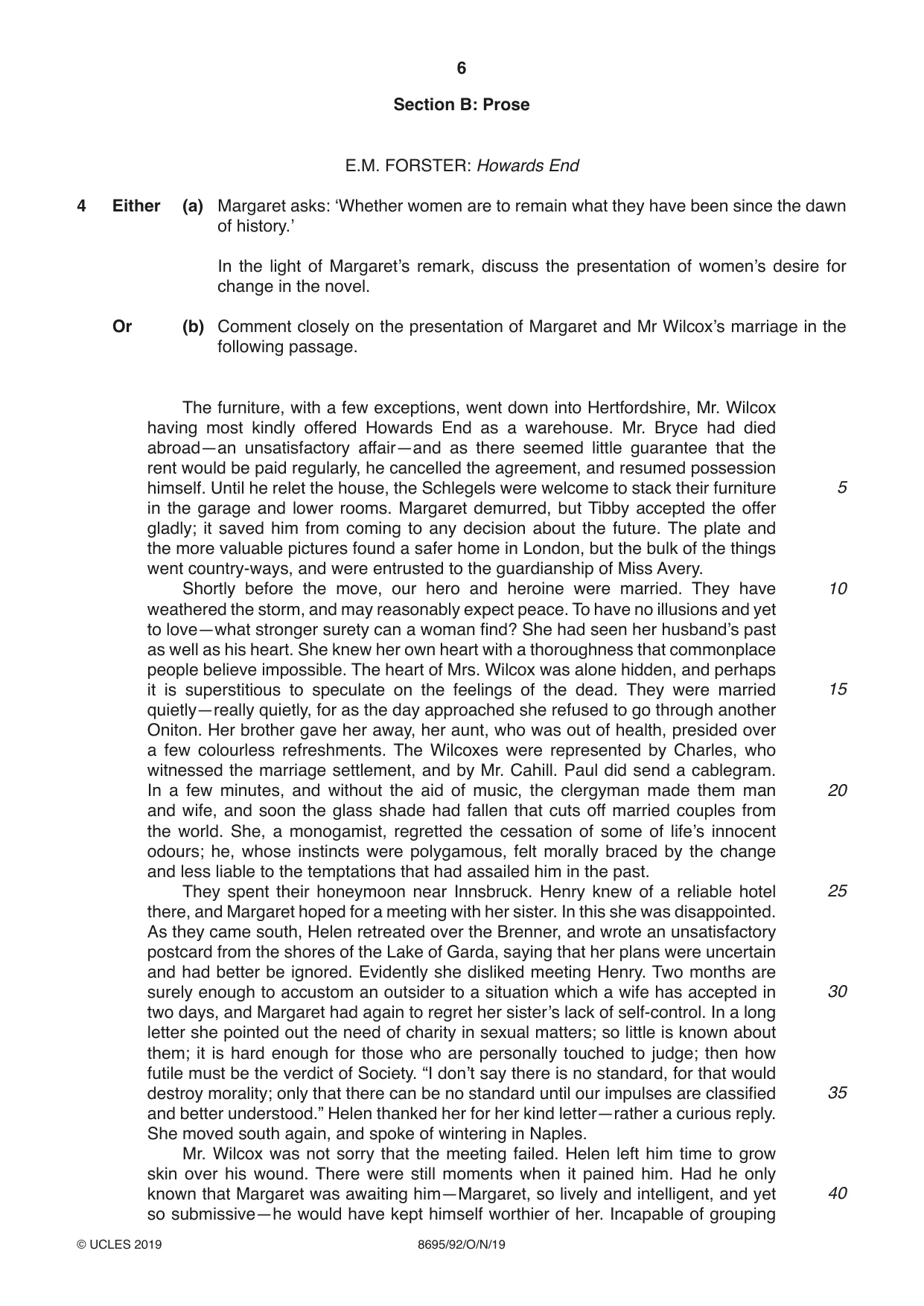
6 8695/92/O/N/19 © UCLES 2019 Section B: Prose E.M. FORSTER: Howards End 4 Either (a) Margaret asks: ‘Whether women are to remain what they have been since the dawn of history.’ In the light of Margaret’s remark, discuss the presentation of women’s desire for change in the novel. Or (b) Comment closely on the presentation of Margaret and Mr Wilcox’s marriage in the following passage. The furniture, with a few exceptions, went down into Hertfordshire, Mr. Wilcox having most kindly offered Howards End as a warehouse. Mr. Bryce had died abroad—an unsatisfactory affair—and as there seemed little guarantee that the rent would be paid regularly, he cancelled the agreement, and resumed possession himself. Until he relet the house, the Schlegels were welcome to stack their furniture in the garage and lower rooms. Margaret demurred, but Tibby accepted the offer gladly; it saved him from coming to any decision about the future. The plate and the more valuable pictures found a safer home in London, but the bulk of the things went country-ways, and were entrusted to the guardianship of Miss Avery. Shortly before the move, our hero and heroine were married. They have weathered the storm, and may reasonably expect peace. To have no illusions and yet to love—what stronger surety can a woman find? She had seen her husband’s past as well as his heart. She knew her own heart with a thoroughness that commonplace people believe impossible. The heart of Mrs. Wilcox was alone hidden, and perhaps it is superstitious to speculate on the feelings of the dead. They were married quietly—really quietly, for as the day approached she refused to go through another Oniton. Her brother gave her away, her aunt, who was out of health, presided over a few colourless refreshments. The Wilcoxes were represented by Charles, who witnessed the marriage settlement, and by Mr. Cahill. Paul did send a cablegram. In a few minutes, and without the aid of music, the clergyman made them man and wife, and soon the glass shade had fallen that cuts off married couples from the world. She, a monogamist, regretted the cessation of some of life’s innocent odours; he, whose instincts were polygamous, felt morally braced by the change and less liable to the temptations that had assailed him in the past. They spent their honeymoon near Innsbruck. Henry knew of a reliable hotel there, and Margaret hoped for a meeting with her sister. In this she was disappointed. As they came south, Helen retreated over the Brenner, and wrote an unsatisfactory postcard from the shores of the Lake of Garda, saying that her plans were uncertain and had better be ignored. Evidently she disliked meeting Henry. Two months are surely enough to accustom an outsider to a situation which a wife has accepted in two days, and Margaret had again to regret her sister’s lack of self-control. In a long letter she pointed out the need of charity in sexual matters; so little is known about them; it is hard enough for those who are personally touched to judge; then how futile must be the verdict of Society. “I don’t say there is no standard, for that would destroy morality; only that there can be no standard until our impulses are classified and better understood.” Helen thanked her for her kind letter—rather a curious reply. She moved south again, and spoke of wintering in Naples. Mr. Wilcox was not sorry that the meeting failed. Helen left him time to grow skin over his wound. There were still moments when it pained him. Had he only known that Margaret was awaiting him—Margaret, so lively and intelligent, and yet so submissive—he would have kept himself worthier of her. Incapable of grouping 5 10 15 20 25 30 35 40
Question paper, page 7
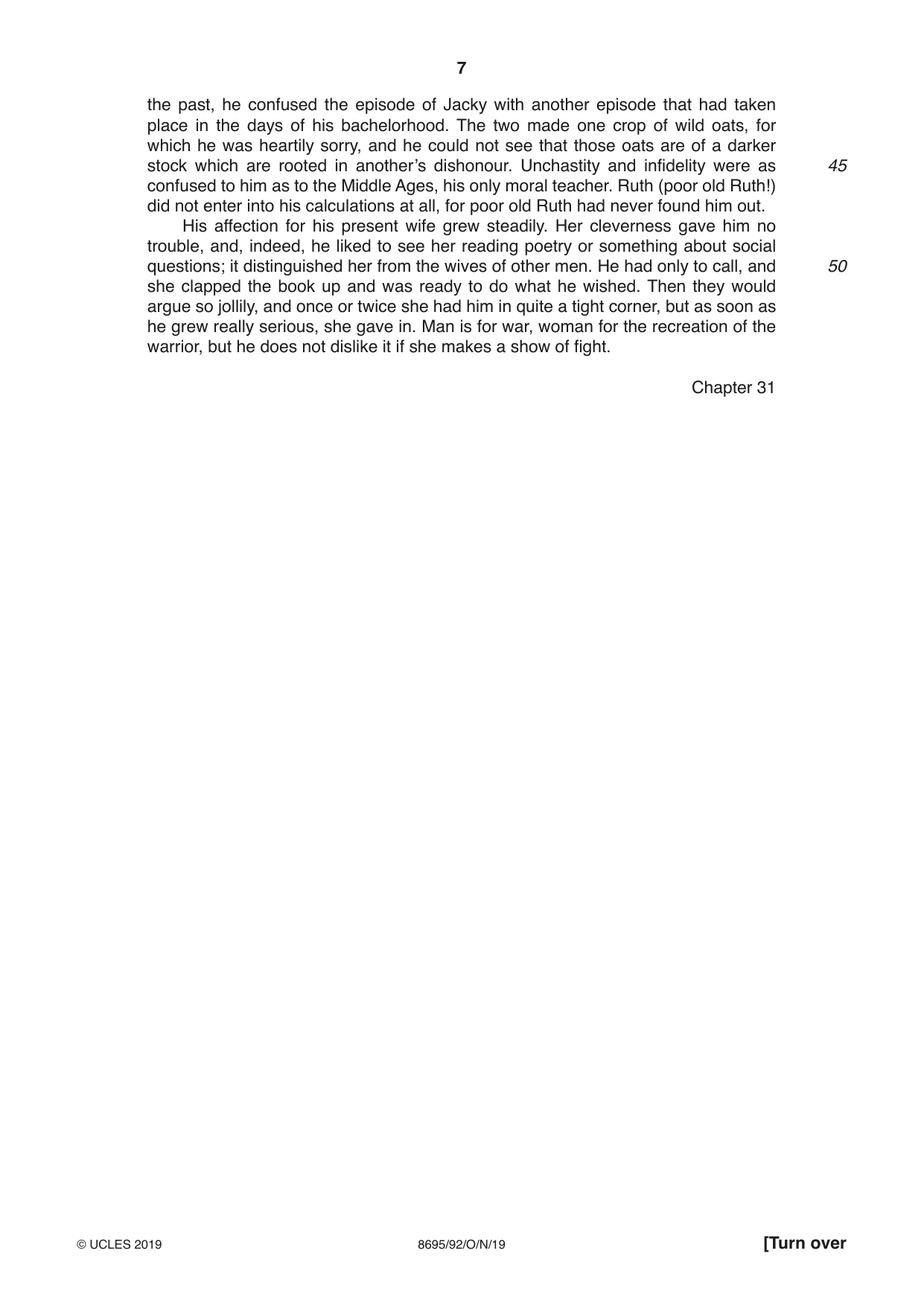
7 8695/92/O/N/19 © UCLES 2019 [Turn over the past, he confused the episode of Jacky with another episode that had taken place in the days of his bachelorhood. The two made one crop of wild oats, for which he was heartily sorry, and he could not see that those oats are of a darker stock which are rooted in another’s dishonour. Unchastity and infidelity were as confused to him as to the Middle Ages, his only moral teacher. Ruth (poor old Ruth!) did not enter into his calculations at all, for poor old Ruth had never found him out. His affection for his present wife grew steadily. Her cleverness gave him no trouble, and, indeed, he liked to see her reading poetry or something about social questions; it distinguished her from the wives of other men. He had only to call, and she clapped the book up and was ready to do what he wished. Then they would argue so jollily, and once or twice she had him in quite a tight corner, but as soon as he grew really serious, she gave in. Man is for war, woman for the recreation of the warrior, but he does not dislike it if she makes a show of fight. Chapter 31 45 50
Question paper, page 8
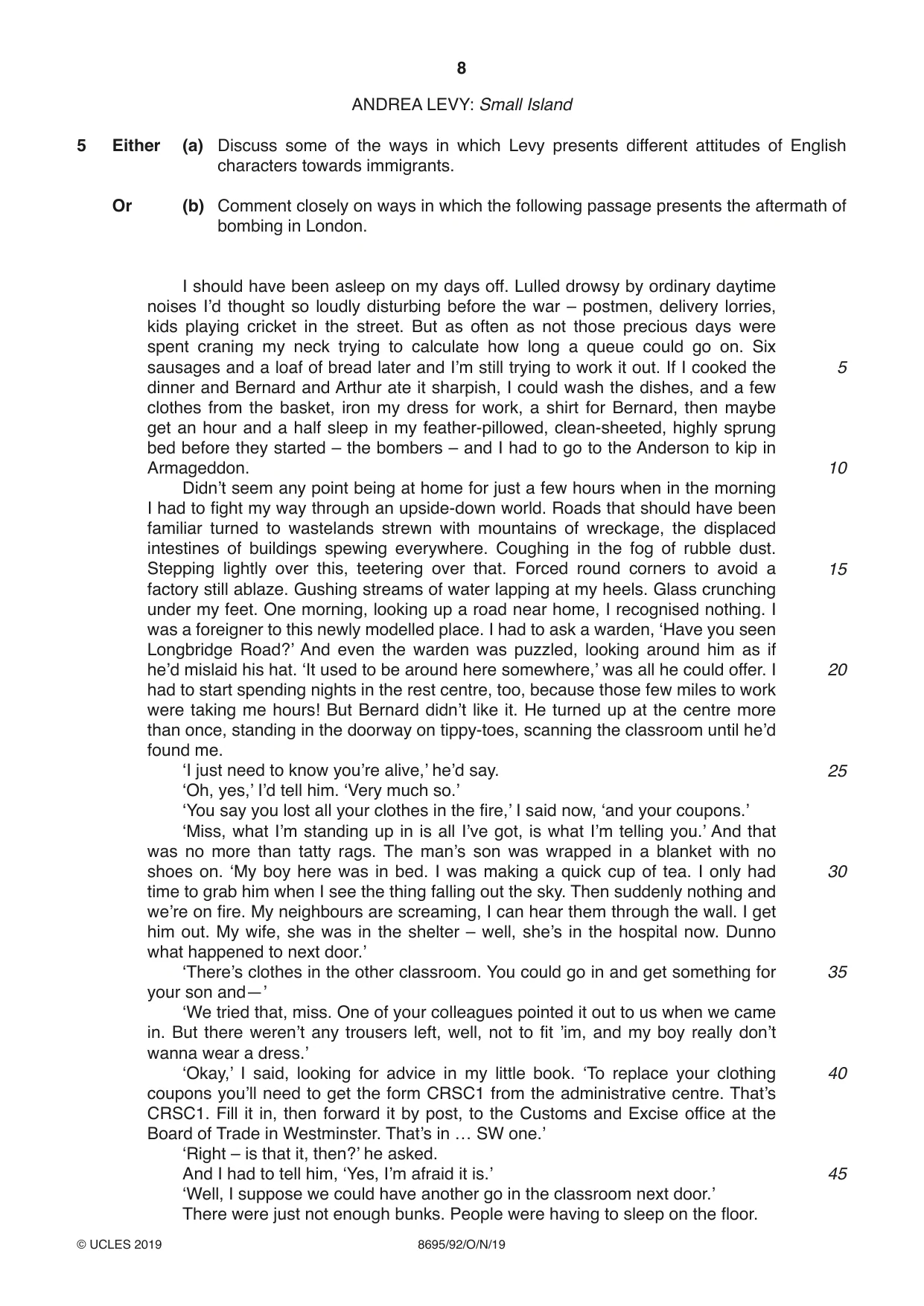
8 8695/92/O/N/19 © UCLES 2019 ANDREA LEVY: Small Island 5 Either (a) Discuss some of the ways in which Levy presents different attitudes of English characters towards immigrants. Or (b) Comment closely on ways in which the following passage presents the aftermath of bombing in London. I should have been asleep on my days off. Lulled drowsy by ordinary daytime noises I’d thought so loudly disturbing before the war – postmen, delivery lorries, kids playing cricket in the street. But as often as not those precious days were spent craning my neck trying to calculate how long a queue could go on. Six sausages and a loaf of bread later and I’m still trying to work it out. If I cooked the dinner and Bernard and Arthur ate it sharpish, I could wash the dishes, and a few clothes from the basket, iron my dress for work, a shirt for Bernard, then maybe get an hour and a half sleep in my feather-pillowed, clean-sheeted, highly sprung bed before they started – the bombers – and I had to go to the Anderson to kip in Armageddon. Didn’t seem any point being at home for just a few hours when in the morning I had to fight my way through an upside-down world. Roads that should have been familiar turned to wastelands strewn with mountains of wreckage, the displaced intestines of buildings spewing everywhere. Coughing in the fog of rubble dust. Stepping lightly over this, teetering over that. Forced round corners to avoid a factory still ablaze. Gushing streams of water lapping at my heels. Glass crunching under my feet. One morning, looking up a road near home, I recognised nothing. I was a foreigner to this newly modelled place. I had to ask a warden, ‘Have you seen Longbridge Road?’ And even the warden was puzzled, looking around him as if he’d mislaid his hat. ‘It used to be around here somewhere,’ was all he could offer. I had to start spending nights in the rest centre, too, because those few miles to work were taking me hours! But Bernard didn’t like it. He turned up at the centre more than once, standing in the doorway on tippy-toes, scanning the classroom until he’d found me. ‘I just need to know you’re alive,’ he’d say. ‘Oh, yes,’ I’d tell him. ‘Very much so.’ ‘You say you lost all your clothes in the fire,’ I said now, ‘and your coupons.’ ‘Miss, what I’m standing up in is all I’ve got, is what I’m telling you.’ And that was no more than tatty rags. The man’s son was wrapped in a blanket with no shoes on. ‘My boy here was in bed. I was making a quick cup of tea. I only had time to grab him when I see the thing falling out the sky. Then suddenly nothing and we’re on fire. My neighbours are screaming, I can hear them through the wall. I get him out. My wife, she was in the shelter – well, she’s in the hospital now. Dunno what happened to next door.’ ‘There’s clothes in the other classroom. You could go in and get something for your son and—’ ‘We tried that, miss. One of your colleagues pointed it out to us when we came in. But there weren’t any trousers left, well, not to fit ’im, and my boy really don’t wanna wear a dress.’ ‘Okay,’ I said, looking for advice in my little book. ‘To replace your clothing coupons you’ll need to get the form CRSC1 from the administrative centre. That’s CRSC1. Fill it in, then forward it by post, to the Customs and Excise office at the Board of Trade in Westminster. That’s in … SW one.’ ‘Right – is that it, then?’ he asked. And I had to tell him, ‘Yes, I’m afraid it is.’ ‘Well, I suppose we could have another go in the classroom next door.’ There were just not enough bunks. People were having to sleep on the floor. 5 10 15 20 25 30 35 40 45
Question paper, page 9
9 8695/92/O/N/19 © UCLES 2019 [Turn over ‘But my house has gone. Surely there is some compensation I can have now so I can find another property?’ ‘Well, madam, you could try writing to the Assistance Board or send to the War Damage Commission for a form CI but they don’t usually pay out until after the war.’ ‘Usually! What are you talking about? How many wars have we had where this has happened? And please, miss, don’t get me wrong but what exactly will they do with my claim if, God forbid, we don’t win?’ Sometimes the food ran out and all we had to offer anyone was a blinking cup of tea. Chapter 27 50 55
Question paper, page 10
10 8695/92/O/N/19 © UCLES 2019 Stories of Ourselves 6 Either (a) Compare ways in which two stories present violent events or the threat of violence. Or (b) Comment closely on the presentation of the father in the following passage from The Fly in the Ointment. ‘It must have been worrying,’ the son said. ‘Worrying? You keep on using that word. I’m not worrying. Things are fine,’ said the old man, smiling aggressively. ‘I feel they’re fine. I know they’re fine.’ ‘Well, you always were an optimist,’ smiled his son. ‘Listen to me a moment. I want you to get this idea,’ said his father, his warm voice going dead and rancorous and his nostrils fidgeting. His eyes went hard, too. A different man was speaking, and even a different face; the son noticed for the first time that like all big-faced men his father had two faces. There was the outer face like a soft warm and careless daub of innocent sealing-wax and inside it, as if thumbed there by a seal, was a much smaller one, babyish, shrewd, scared and hard. Now this little inner face had gone greenish and pale and dozens of little veins were broken on the nose and cheeks. The small, drained, purplish lips of this little face were speaking. The son leaned back instinctively to get just another inch away from this little face. ‘Listen to this,’ the father said and leaned forward on the table as his son leaned back, holding his right fist up as if he had a hammer in his hand and was auctioning his life. ‘I am sixty-five. I don’t know how long I shall live, but let me make this clear: if I were not an optimist I wouldn’t be here. I wouldn’t stay another minute.’ He paused, fixing his son’s half-averted eyes to let the full meaning of his words bite home. ‘I’ve worked hard,’ the father went on. ‘For thirty years I built up this business from nothing. You wouldn’t know it, you were a child, but many’s the time coming down from the North I’ve slept in this office to be on the job early the next morning.’ He looked decided and experienced like a man of forty, but now he softened to sixty again. The ring in the hard voice began to soften into a faint whine and his thick nose sniffed. ‘I don’t say I’ve always done right,’ he said. ‘You can’t live your life from A to Z like that. And now I haven’t a penny in the world. Not a cent. It’s not easy at my time of life to begin again. What do you think I’ve got to live for? There’s nothing holding me back. My boy, if I wasn’t an optimist I’d go right out. I’d finish it.’ Suddenly the father smiled and the little face was drowned in a warm flood of triumphant smiles from the bigger face. He rested his hands on his waistcoat and that seemed to be smiling too, his easy coat smiling, his legs smiling and even winks of light on the shining shoes. Then he frowned. ‘Your hair’s going thin,’ he said. ‘You oughtn’t to be losing your hair at your age. I don’t want you to think I’m criticising you, you’re old enough to live your own life, but your hair you know – you ought to do something about it. If you used oil every day and rubbed it in with both hands, the thumbs and forefingers is what you want to use, it would be better. I’m often thinking about you and I don’t want you to think I’m lecturing you, because I’m not, so don’t get the idea this is a lecture, but I was thinking, what you want, what we all want, I say this for myself as well as you, what we all want is ideas – big ideas. We go worrying along but you just want bigger and better ideas. You ought to think big. Take your case. You’re a lecturer. I wouldn’t be satisfied with lecturing to a small batch of people in a university town. I’d lecture the world. You know, you’re always doing yourself injustice. We all do. Think big.’ ‘Well,’ said his son, still smiling, but sharply. He was very angry. ‘One’s enough in the family. You’ve thought big till you bust.’ He didn’t mean to say this, because he hadn’t really the courage, but his pride was touched. 5 10 15 20 25 30 35 40 45
Question paper, page 11
11 8695/92/O/N/19 © UCLES 2019 [Turn over ‘I mean,’ said the son, hurriedly covering it up in a panic, ‘I’m not like you … I …’ ‘What did you say?’ said the old man. ‘Don’t say that.’ It was the smaller of the two faces speaking in a panic. ‘Don’t say that. Don’t use that expression. That’s not a right idea. Don’t you get a wrong idea about me. We paid sixpence in the pound,’ said the old man proudly. The son began again, but his father stopped him. ‘Do you know,’ said the bigger of his two faces, getting bigger as it spoke, ‘some of the oldest houses in the city are in Queer Street, some of the biggest firms in the country? I came up this morning with Mr Higgins, you remember Higgins? They’re in liquidation. They are. Oh yes.” The Fly in the Ointment 50 55
Question paper, page 12
12 8695/92/O/N/19 © UCLES 2019 Section C: Drama WOLE SOYINKA: Death and the King’s Horseman 7 Either (a) Discuss the dramatic presentation of the Pilkings’s relationship and its significance to the play as a whole. Or (b) In what ways, and with what effects, are the girls presented in the following extract? You should pay careful attention to both language and action. Girls [in turn. In an ‘English’ accent]: Well well it’s Mister Amusa. Content removed due to copyright restrictions.
Question paper, page 13
13 8695/92/O/N/19 © UCLES 2019 [Turn over Girl: Now! Scene 3 Content removed due to copyright restrictions.
Question paper, page 14
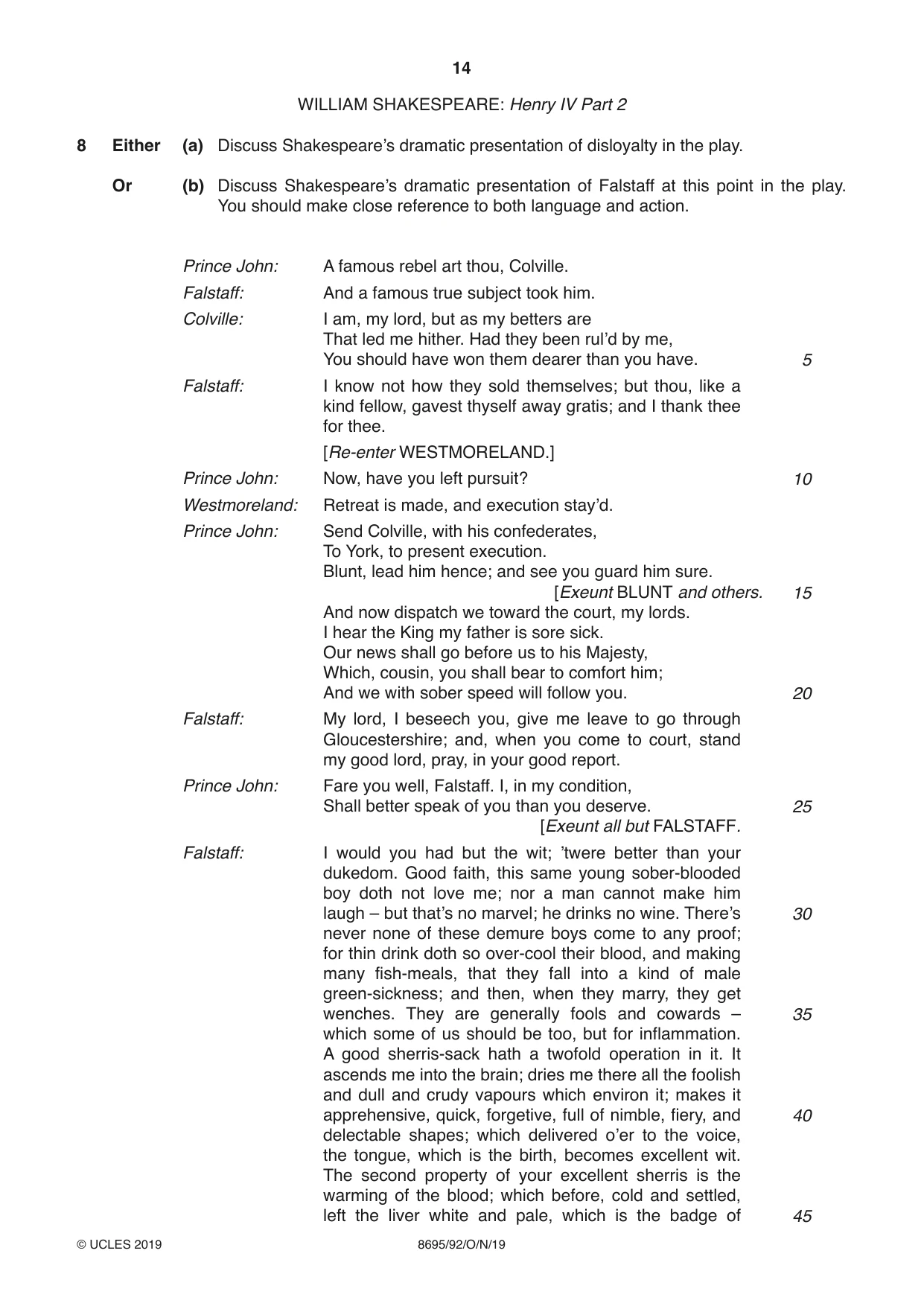
14 8695/92/O/N/19 © UCLES 2019 WILLIAM SHAKESPEARE: Henry IV Part 2 8 Either (a) Discuss Shakespeare’s dramatic presentation of disloyalty in the play. Or (b) Discuss Shakespeare’s dramatic presentation of Falstaff at this point in the play. You should make close reference to both language and action. Prince John: A famous rebel art thou, Colville. Falstaff: And a famous true subject took him. Colville: I am, my lord, but as my betters are That led me hither. Had they been rul’d by me, You should have won them dearer than you have. Falstaff: I know not how they sold themselves; but thou, like a kind fellow, gavest thyself away gratis; and I thank thee for thee. [Re-enter WESTMORELAND.] Prince John: Now, have you left pursuit? Westmoreland: Retreat is made, and execution stay’d. Prince John: Send Colville, with his confederates, To York, to present execution. Blunt, lead him hence; and see you guard him sure. [Exeunt BLUNT and others. And now dispatch we toward the court, my lords. I hear the King my father is sore sick. Our news shall go before us to his Majesty, Which, cousin, you shall bear to comfort him; And we with sober speed will follow you. Falstaff: My lord, I beseech you, give me leave to go through Gloucestershire; and, when you come to court, stand my good lord, pray, in your good report. Prince John: Fare you well, Falstaff. I, in my condition, Shall better speak of you than you deserve. [Exeunt all but FALSTAFF. Falstaff: I would you had but the wit; ’twere better than your dukedom. Good faith, this same young sober-blooded boy doth not love me; nor a man cannot make him laugh – but that’s no marvel; he drinks no wine. There’s never none of these demure boys come to any proof; for thin drink doth so over-cool their blood, and making many fish-meals, that they fall into a kind of male green-sickness; and then, when they marry, they get wenches. They are generally fools and cowards – which some of us should be too, but for inflammation. A good sherris-sack hath a twofold operation in it. It ascends me into the brain; dries me there all the foolish and dull and crudy vapours which environ it; makes it apprehensive, quick, forgetive, full of nimble, fiery, and delectable shapes; which delivered o’er to the voice, the tongue, which is the birth, becomes excellent wit. The second property of your excellent sherris is the warming of the blood; which before, cold and settled, left the liver white and pale, which is the badge of 5 10 15 20 25 30 35 40 45
Question paper, page 15
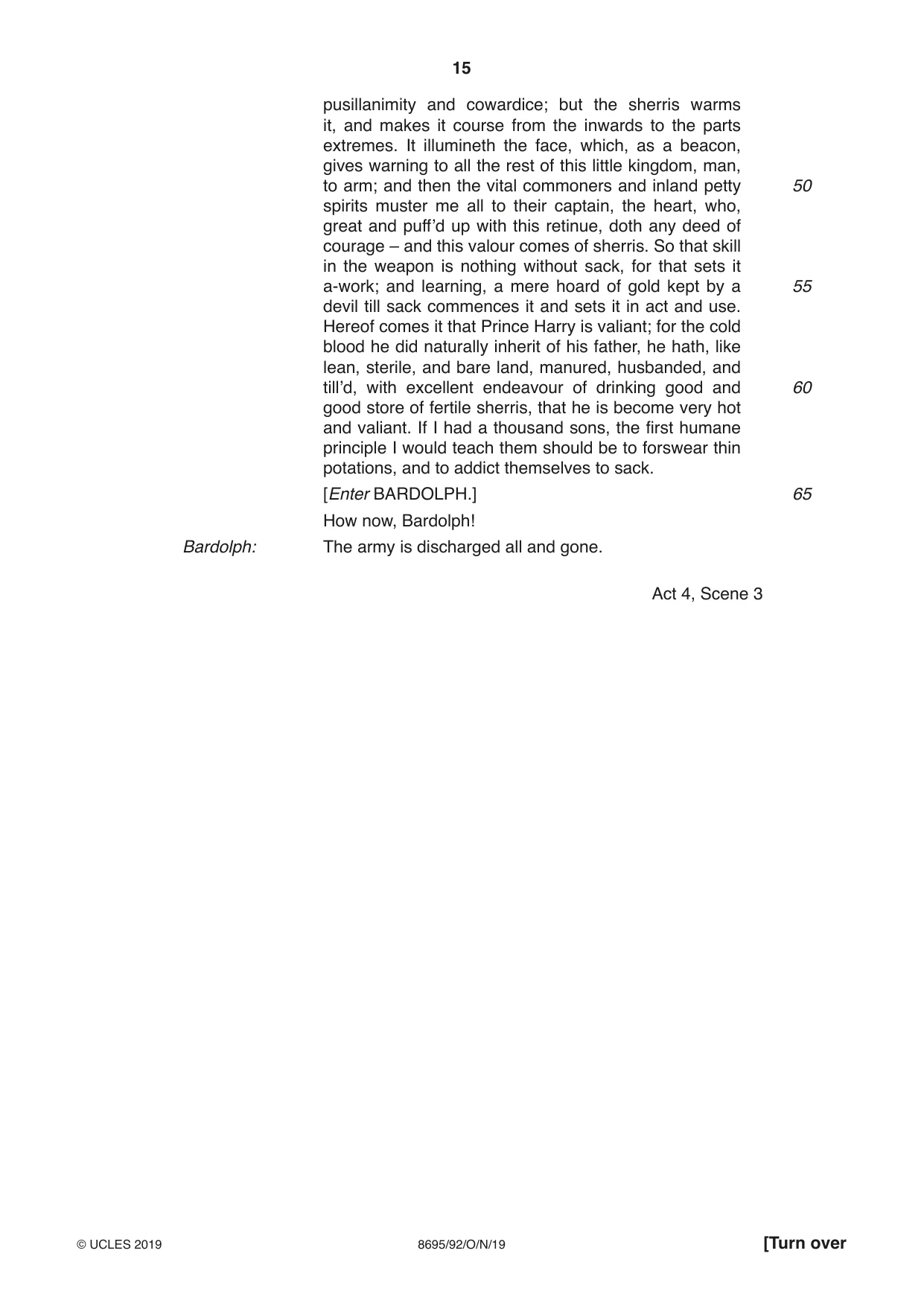
15 8695/92/O/N/19 © UCLES 2019 [Turn over pusillanimity and cowardice; but the sherris warms it, and makes it course from the inwards to the parts extremes. It illumineth the face, which, as a beacon, gives warning to all the rest of this little kingdom, man, to arm; and then the vital commoners and inland petty spirits muster me all to their captain, the heart, who, great and puff’d up with this retinue, doth any deed of courage – and this valour comes of sherris. So that skill in the weapon is nothing without sack, for that sets it a-work; and learning, a mere hoard of gold kept by a devil till sack commences it and sets it in act and use. Hereof comes it that Prince Harry is valiant; for the cold blood he did naturally inherit of his father, he hath, like lean, sterile, and bare land, manured, husbanded, and till’d, with excellent endeavour of drinking good and good store of fertile sherris, that he is become very hot and valiant. If I had a thousand sons, the first humane principle I would teach them should be to forswear thin potations, and to addict themselves to sack. [Enter BARDOLPH.] How now, Bardolph! Bardolph: The army is discharged all and gone. Act 4, Scene 3 50 55 60 65
Question paper, page 16
16 8695/92/O/N/19 © UCLES 2019 BRIAN FRIEL: Philadelphia, Here I Come! 9 Either (a) In what ways, and with what effects, does Friel present the attractions of America in the play? Or (b) With close reference to language and action, discuss Friel’s dramatic presentation of Gar at this point in the play. Public: At six o’clock he remembered about the bloody pollock, and him in the middle of the Angelus. Content removed due to copyright restrictions.
Question paper, page 17
17 8695/92/O/N/19 © UCLES 2019 [poker-stiff again] Shamelessly, Sir, shamelessly. Episode 1 Content removed due to copyright restrictions.
Question paper, page 18
18 8695/92/O/N/19 © UCLES 2019 BLANK PAGE
Question paper, page 19
19 8695/92/O/N/19 © UCLES 2019 BLANK PAGE
Question paper, page 20
20 8695/92/O/N/19 © UCLES 2019 BLANK PAGE Permission to reproduce items where third-party owned material protected by copyright is included has been sought and cleared where possible. Every reasonable effort has been made by the publisher (UCLES) to trace copyright holders, but if any items requiring clearance have unwittingly been included, the publisher will be pleased to make amends at the earliest possible opportunity. To avoid the issue of disclosure of answer-related information to candidates, all copyright acknowledgements are reproduced online in the Cambridge Assessment International Education Copyright Acknowledgements Booklet. This is produced for each series of examinations and is freely available to download at www.cambridgeinternational.org after the live examination series. Cambridge Assessment International Education is part of the Cambridge Assessment Group. Cambridge Assessment is the brand name of the University of Cambridge Local Examinations Syndicate (UCLES), which itself is a department of the University of Cambridge.
Mark scheme, page 1
This document consists of 6 printed pages. © UCLES 2019 [Turn over Cambridge Assessment International Education Cambridge International Advanced Subsidiary Level LANGUAGE AND LITERATURE IN ENGLISH 8695/92 Paper 9 Poetry, Prose and Drama October/November 2019 MARK SCHEME Maximum Mark: 50 Published This mark scheme is published as an aid to teachers and candidates, to indicate the requirements of the examination. It shows the basis on which Examiners were instructed to award marks. It does not indicate the details of the discussions that took place at an Examiners’ meeting before marking began, which would have considered the acceptability of alternative answers. Mark schemes should be read in conjunction with the question paper and the Principal Examiner Report for Teachers. Cambridge International will not enter into discussions about these mark schemes. Cambridge International is publishing the mark schemes for the October/November 2019 series for most Cambridge IGCSE™, Cambridge International A and AS Level components and some Cambridge O Level components.
Mark scheme, page 2
8695/92 Cambridge International AS Level – Mark Scheme PUBLISHED October/November 2019 © UCLES 2019 Page 2 of 6 Generic Marking Principles These general marking principles must be applied by all examiners when marking candidate answers. They should be applied alongside the specific content of the mark scheme or generic level descriptors for a question. Each question paper and mark scheme will also comply with these marking principles. GENERIC MARKING PRINCIPLE 1: Marks must be awarded in line with: • the specific content of the mark scheme or the generic level descriptors for the question • the specific skills defined in the mark scheme or in the generic level descriptors for the question • the standard of response required by a candidate as exemplified by the standardisation scripts. GENERIC MARKING PRINCIPLE 2: Marks awarded are always whole marks (not half marks, or other fractions). GENERIC MARKING PRINCIPLE 3: Marks must be awarded positively: • marks are awarded for correct/valid answers, as defined in the mark scheme. However, credit is given for valid answers which go beyond the scope of the syllabus and mark scheme, referring to your Team Leader as appropriate • marks are awarded when candidates clearly demonstrate what they know and can do • marks are not deducted for errors • marks are not deducted for omissions • answers should only be judged on the quality of spelling, punctuation and grammar when these features are specifically assessed by the question as indicated by the mark scheme. The meaning, however, should be unambiguous. GENERIC MARKING PRINCIPLE 4: Rules must be applied consistently e.g. in situations where candidates have not followed instructions or in the application of generic level descriptors. GENERIC MARKING PRINCIPLE 5: Marks should be awarded using the full range of marks defined in the mark scheme for the question (however; the use of the full mark range may be limited according to the quality of the candidate responses seen). GENERIC MARKING PRINCIPLE 6: Marks awarded are based solely on the requirements as defined in the mark scheme. Marks should not be awarded with grade thresholds or grade descriptors in mind.
Mark scheme, page 3
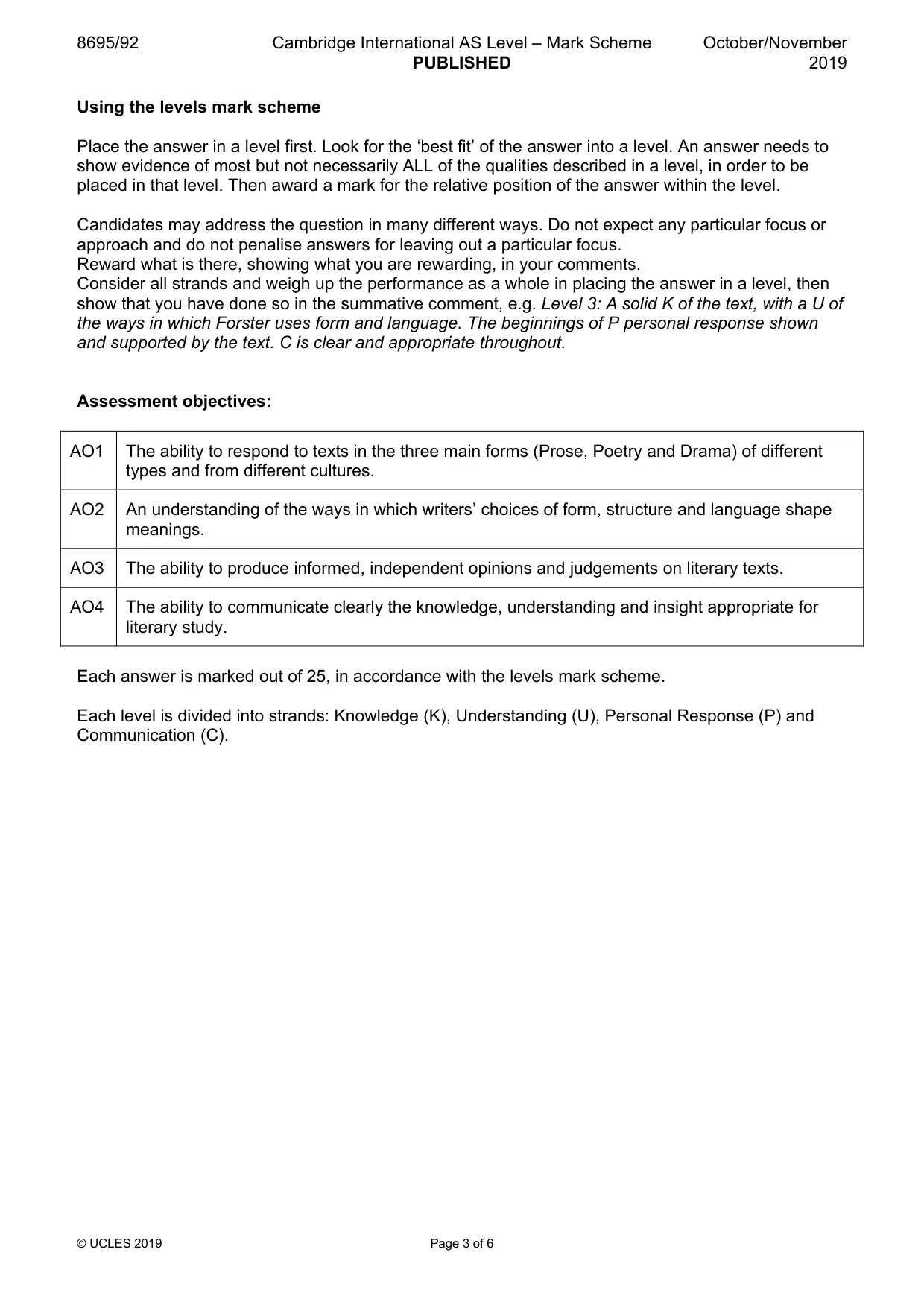
8695/92 Cambridge International AS Level – Mark Scheme PUBLISHED October/November 2019 © UCLES 2019 Page 3 of 6 Using the levels mark scheme Place the answer in a level first. Look for the ‘best fit’ of the answer into a level. An answer needs to show evidence of most but not necessarily ALL of the qualities described in a level, in order to be placed in that level. Then award a mark for the relative position of the answer within the level. Candidates may address the question in many different ways. Do not expect any particular focus or approach and do not penalise answers for leaving out a particular focus. Reward what is there, showing what you are rewarding, in your comments. Consider all strands and weigh up the performance as a whole in placing the answer in a level, then show that you have done so in the summative comment, e.g. Level 3: A solid K of the text, with a U of the ways in which Forster uses form and language. The beginnings of P personal response shown and supported by the text. C is clear and appropriate throughout. Assessment objectives: AO1 The ability to respond to texts in the three main forms (Prose, Poetry and Drama) of different types and from different cultures. AO2 An understanding of the ways in which writers’ choices of form, structure and language shape meanings. AO3 The ability to produce informed, independent opinions and judgements on literary texts. AO4 The ability to communicate clearly the knowledge, understanding and insight appropriate for literary study. Each answer is marked out of 25, in accordance with the levels mark scheme. Each level is divided into strands: Knowledge (K), Understanding (U), Personal Response (P) and Communication (C).
Mark scheme, page 4
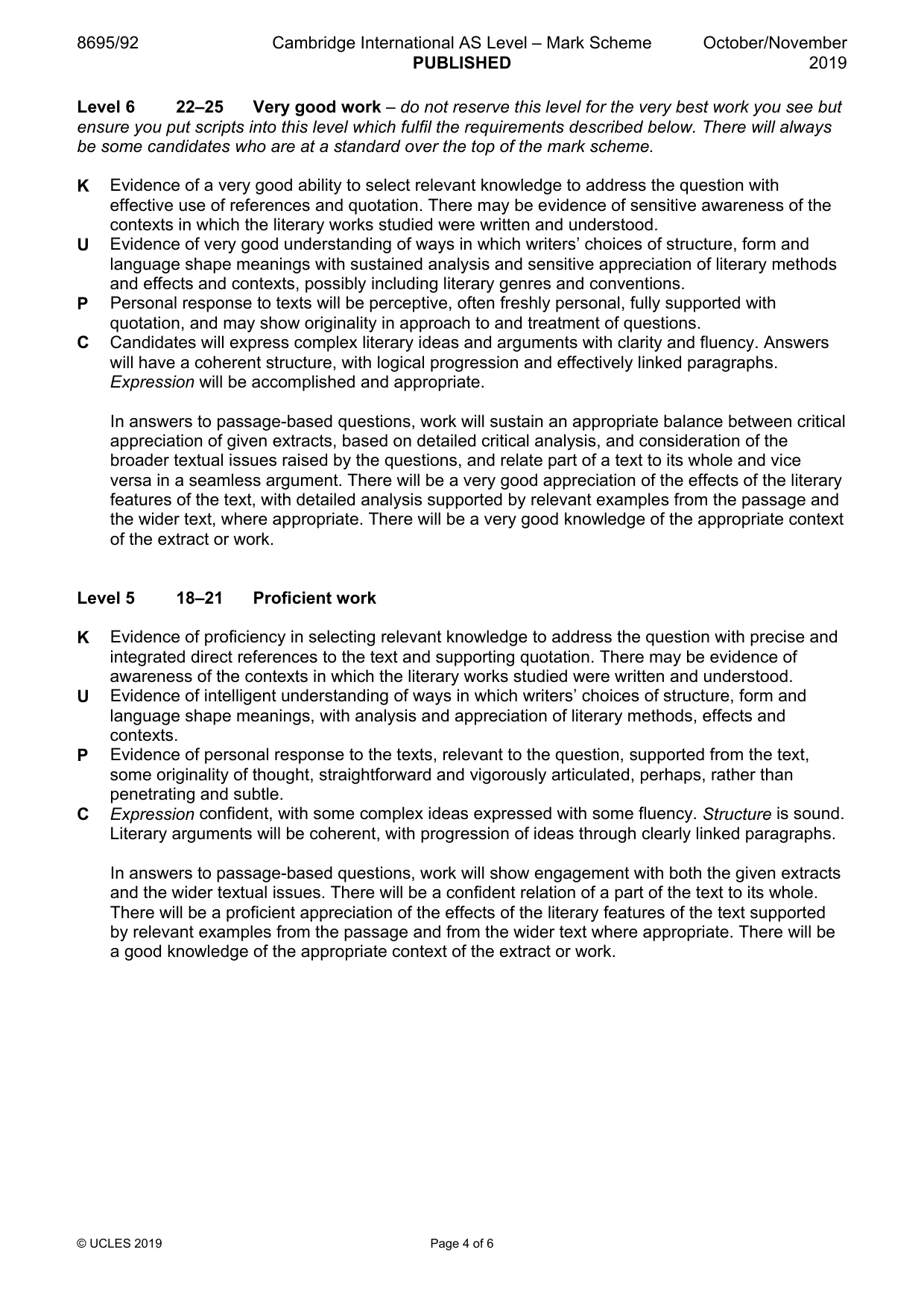
8695/92 Cambridge International AS Level – Mark Scheme PUBLISHED October/November 2019 © UCLES 2019 Page 4 of 6 Level 6 22–25 Very good work – do not reserve this level for the very best work you see but ensure you put scripts into this level which fulfil the requirements described below. There will always be some candidates who are at a standard over the top of the mark scheme. K Evidence of a very good ability to select relevant knowledge to address the question with effective use of references and quotation. There may be evidence of sensitive awareness of the contexts in which the literary works studied were written and understood. U Evidence of very good understanding of ways in which writers’ choices of structure, form and language shape meanings with sustained analysis and sensitive appreciation of literary methods and effects and contexts, possibly including literary genres and conventions. P Personal response to texts will be perceptive, often freshly personal, fully supported with quotation, and may show originality in approach to and treatment of questions. C Candidates will express complex literary ideas and arguments with clarity and fluency. Answers will have a coherent structure, with logical progression and effectively linked paragraphs. Expression will be accomplished and appropriate. In answers to passage-based questions, work will sustain an appropriate balance between critical appreciation of given extracts, based on detailed critical analysis, and consideration of the broader textual issues raised by the questions, and relate part of a text to its whole and vice versa in a seamless argument. There will be a very good appreciation of the effects of the literary features of the text, with detailed analysis supported by relevant examples from the passage and the wider text, where appropriate. There will be a very good knowledge of the appropriate context of the extract or work. Level 5 18–21 Proficient work K Evidence of proficiency in selecting relevant knowledge to address the question with precise and integrated direct references to the text and supporting quotation. There may be evidence of awareness of the contexts in which the literary works studied were written and understood. U Evidence of intelligent understanding of ways in which writers’ choices of structure, form and language shape meanings, with analysis and appreciation of literary methods, effects and contexts. P Evidence of personal response to the texts, relevant to the question, supported from the text, some originality of thought, straightforward and vigorously articulated, perhaps, rather than penetrating and subtle. C Expression confident, with some complex ideas expressed with some fluency. Structure is sound. Literary arguments will be coherent, with progression of ideas through clearly linked paragraphs. In answers to passage-based questions, work will show engagement with both the given extracts and the wider textual issues. There will be a confident relation of a part of the text to its whole. There will be a proficient appreciation of the effects of the literary features of the text supported by relevant examples from the passage and from the wider text where appropriate. There will be a good knowledge of the appropriate context of the extract or work.
Mark scheme, page 5
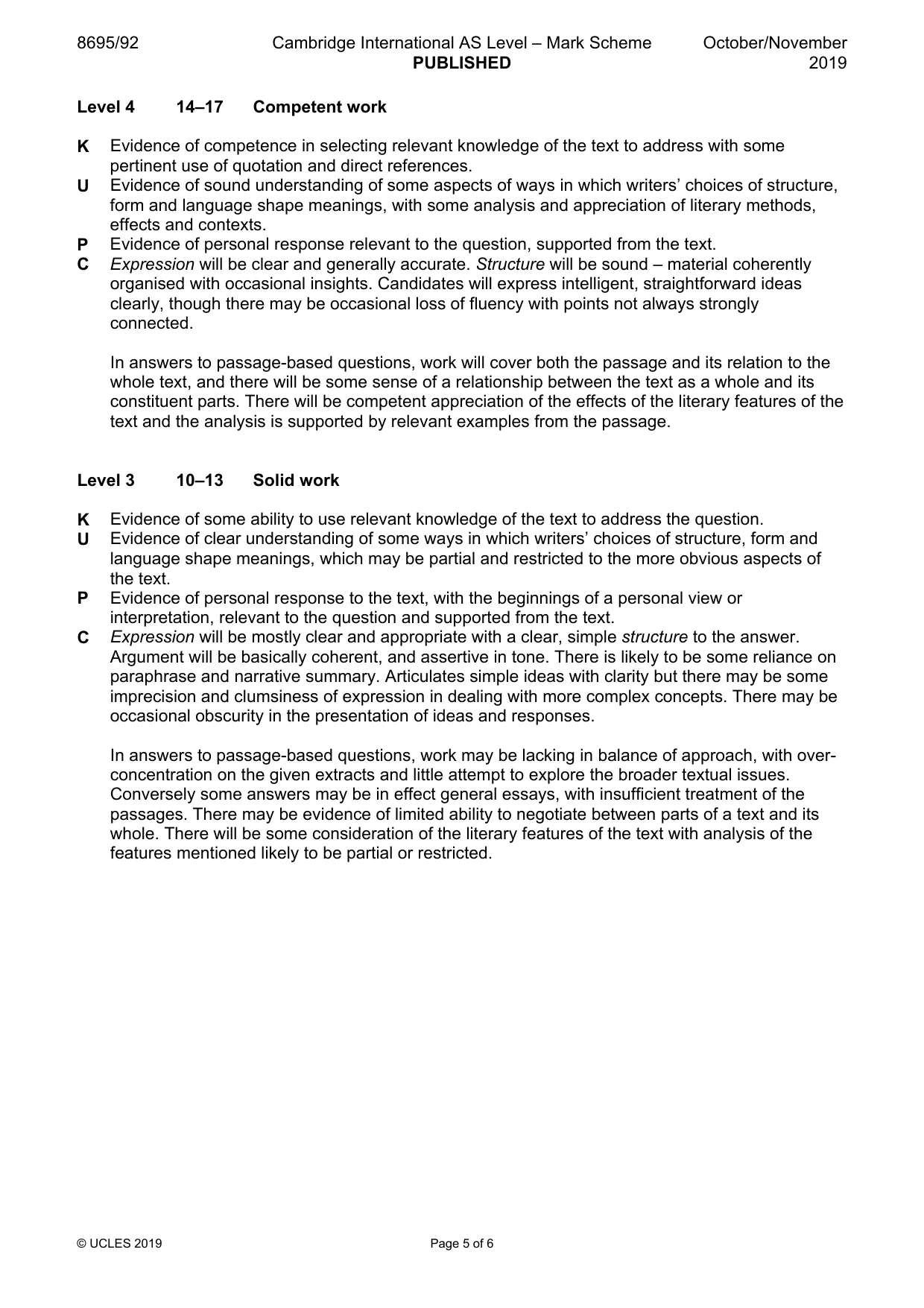
8695/92 Cambridge International AS Level – Mark Scheme PUBLISHED October/November 2019 © UCLES 2019 Page 5 of 6 Level 4 14–17 Competent work K Evidence of competence in selecting relevant knowledge of the text to address with some pertinent use of quotation and direct references. U Evidence of sound understanding of some aspects of ways in which writers’ choices of structure, form and language shape meanings, with some analysis and appreciation of literary methods, effects and contexts. P Evidence of personal response relevant to the question, supported from the text. C Expression will be clear and generally accurate. Structure will be sound – material coherently organised with occasional insights. Candidates will express intelligent, straightforward ideas clearly, though there may be occasional loss of fluency with points not always strongly connected. In answers to passage-based questions, work will cover both the passage and its relation to the whole text, and there will be some sense of a relationship between the text as a whole and its constituent parts. There will be competent appreciation of the effects of the literary features of the text and the analysis is supported by relevant examples from the passage. Level 3 10–13 Solid work K Evidence of some ability to use relevant knowledge of the text to address the question. U Evidence of clear understanding of some ways in which writers’ choices of structure, form and language shape meanings, which may be partial and restricted to the more obvious aspects of the text. P Evidence of personal response to the text, with the beginnings of a personal view or interpretation, relevant to the question and supported from the text. C Expression will be mostly clear and appropriate with a clear, simple structure to the answer. Argument will be basically coherent, and assertive in tone. There is likely to be some reliance on paraphrase and narrative summary. Articulates simple ideas with clarity but there may be some imprecision and clumsiness of expression in dealing with more complex concepts. There may be occasional obscurity in the presentation of ideas and responses. In answers to passage-based questions, work may be lacking in balance of approach, with over- concentration on the given extracts and little attempt to explore the broader textual issues. Conversely some answers may be in effect general essays, with insufficient treatment of the passages. There may be evidence of limited ability to negotiate between parts of a text and its whole. There will be some consideration of the literary features of the text with analysis of the features mentioned likely to be partial or restricted.
Mark scheme, page 6
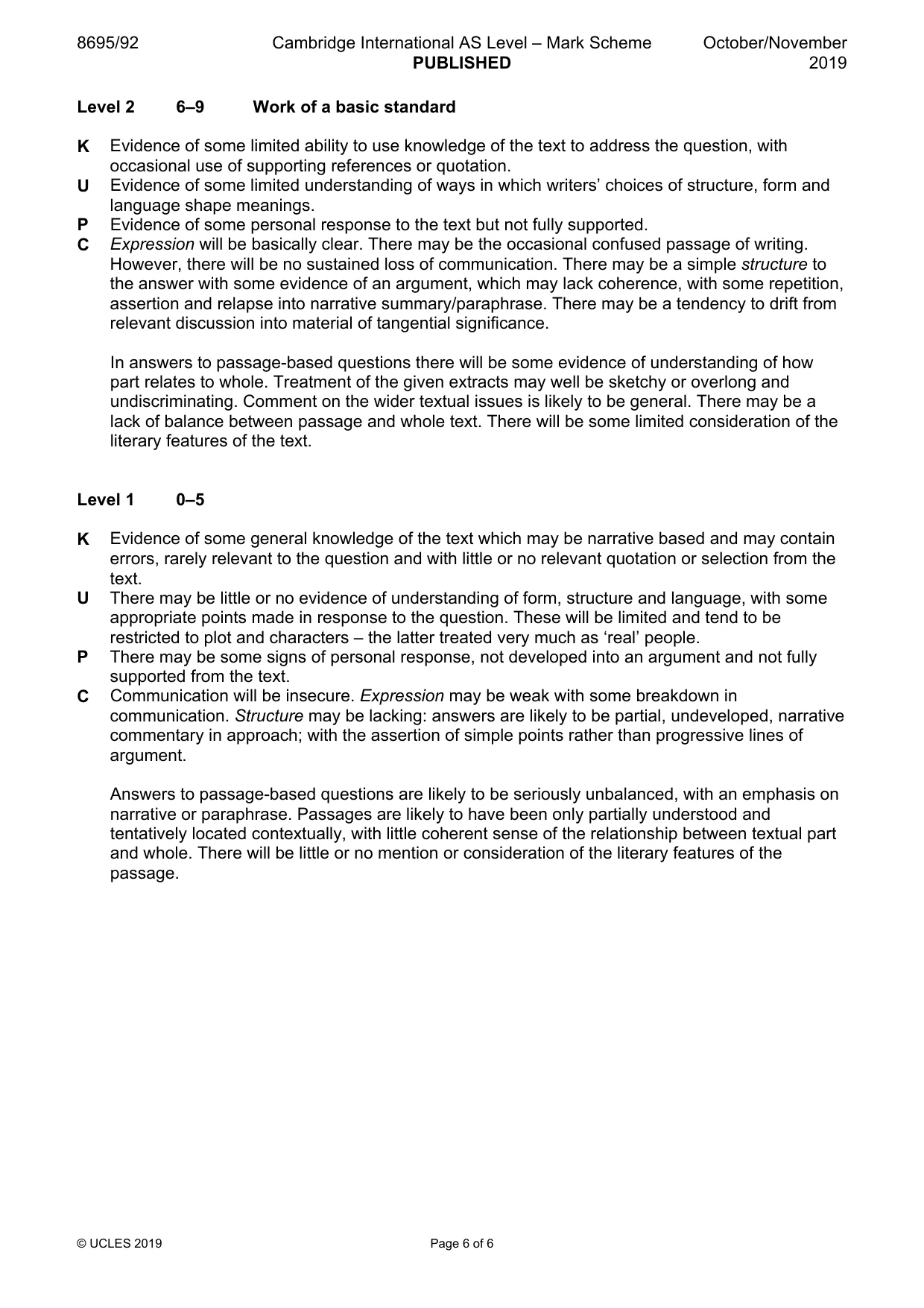
8695/92 Cambridge International AS Level – Mark Scheme PUBLISHED October/November 2019 © UCLES 2019 Page 6 of 6 Level 2 6–9 Work of a basic standard K Evidence of some limited ability to use knowledge of the text to address the question, with occasional use of supporting references or quotation. U Evidence of some limited understanding of ways in which writers’ choices of structure, form and language shape meanings. P Evidence of some personal response to the text but not fully supported. C Expression will be basically clear. There may be the occasional confused passage of writing. However, there will be no sustained loss of communication. There may be a simple structure to the answer with some evidence of an argument, which may lack coherence, with some repetition, assertion and relapse into narrative summary/paraphrase. There may be a tendency to drift from relevant discussion into material of tangential significance. In answers to passage-based questions there will be some evidence of understanding of how part relates to whole. Treatment of the given extracts may well be sketchy or overlong and undiscriminating. Comment on the wider textual issues is likely to be general. There may be a lack of balance between passage and whole text. There will be some limited consideration of the literary features of the text. Level 1 0–5 K Evidence of some general knowledge of the text which may be narrative based and may contain errors, rarely relevant to the question and with little or no relevant quotation or selection from the text. U There may be little or no evidence of understanding of form, structure and language, with some appropriate points made in response to the question. These will be limited and tend to be restricted to plot and characters – the latter treated very much as ‘real’ people. P There may be some signs of personal response, not developed into an argument and not fully supported from the text. C Communication will be insecure. Expression may be weak with some breakdown in communication. Structure may be lacking: answers are likely to be partial, undeveloped, narrative commentary in approach; with the assertion of simple points rather than progressive lines of argument. Answers to passage-based questions are likely to be seriously unbalanced, with an emphasis on narrative or paraphrase. Passages are likely to have been only partially understood and tentatively located contextually, with little coherent sense of the relationship between textual part and whole. There will be little or no mention or consideration of the literary features of the passage.
What you needed in this session
Cambridge’s own grade thresholds for 2019 Oct/Nov, Paper 9 · Variant 2. A higher threshold means an easier paper — the bar moves with how the cohort did.