Cambridge A Level English - Language and Literature (AS Level only, from 2016) 8695 — 2020 May/June Paper 9 · Variant 2
8695/92/M/J/20
The question paper and its mark scheme, free to read here and free to download. This is Cambridge’s own paper, exactly as it was sat.
Question paper20 pages






Mark scheme6 pages
Answers below. Sit the paper first if you are practising.
Paper as text
Question paper, page 1
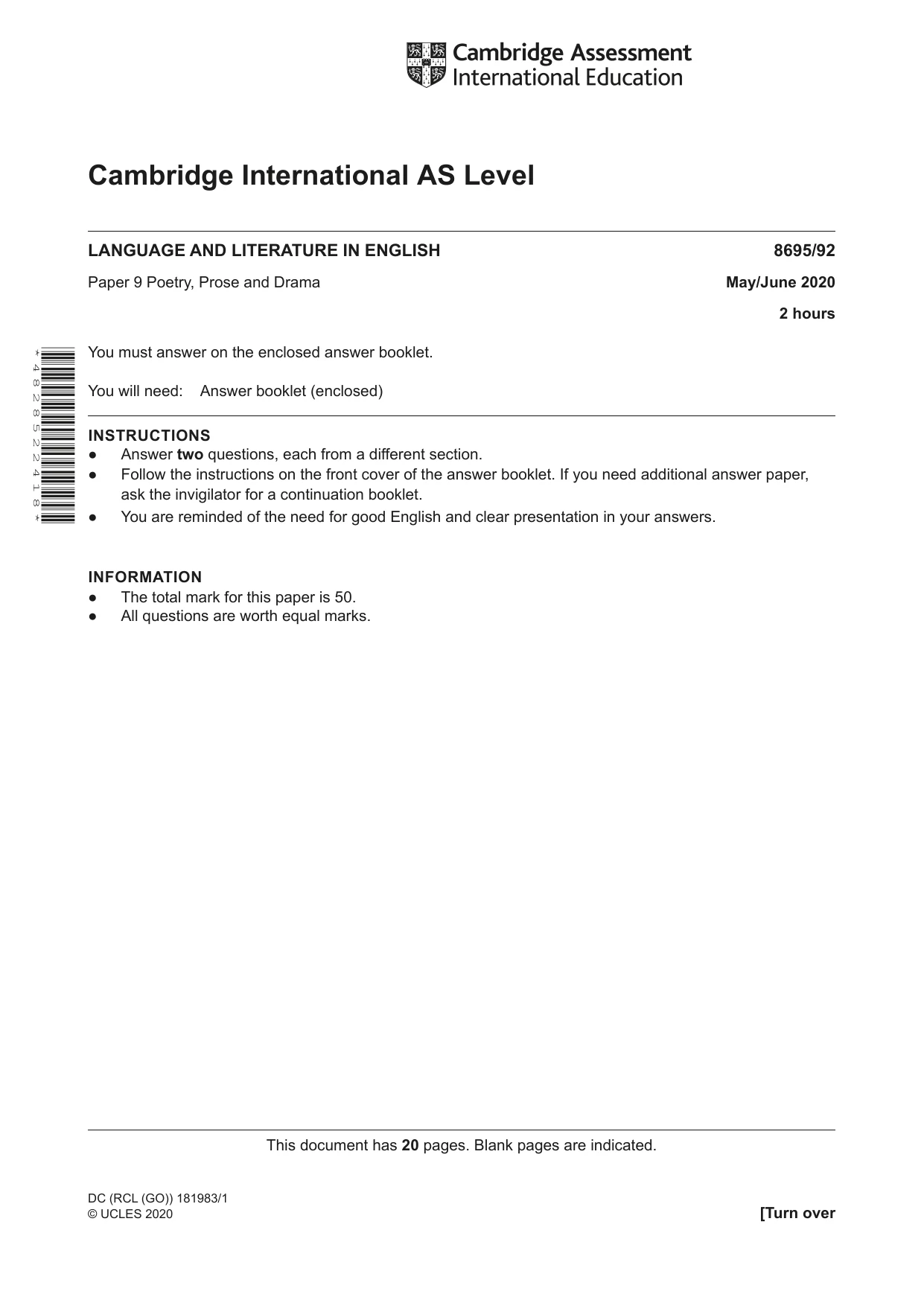
This document has 20 pages. Blank pages are indicated. Cambridge International AS Level LANGUAGE AND LITERATURE IN ENGLISH 8695/92 Paper 9 Poetry, Prose and Drama May/June 2020 2 hours You must answer on the enclosed answer booklet. You will need: Answer booklet (enclosed) INSTRUCTIONS ● Answer two questions, each from a different section. ● Follow the instructions on the front cover of the answer booklet. If you need additional answer paper, ask the invigilator for a continuation booklet. ● You are reminded of the need for good English and clear presentation in your answers. INFORMATION ● The total mark for this paper is 50. ● All questions are worth equal marks. * 4 8 2 8 5 2 2 4 1 8 * DC (RCL (GO)) 181983/1 © UCLES 2020 [Turn over
Question paper, page 2
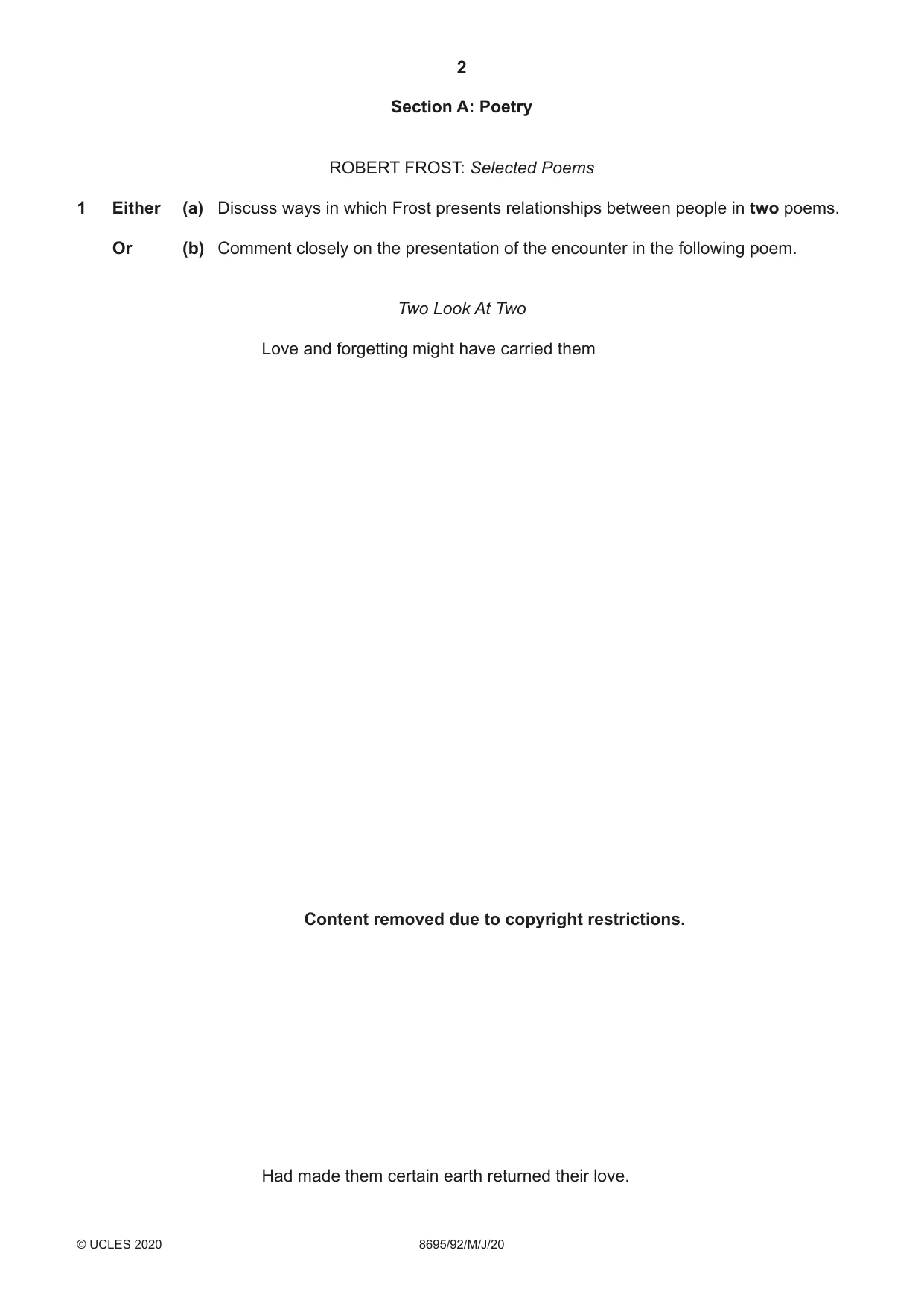
2 8695/92/M/J/20 © UCLES 2020 Section A: Poetry ROBERT FROST: Selected Poems 1 Either (a) Discuss ways in which Frost presents relationships between people in two poems. Or (b) Comment closely on the presentation of the encounter in the following poem. Two Look At Two Love and forgetting might have carried them Had made them certain earth returned their love. Content removed due to copyright restrictions.
Question paper, page 3
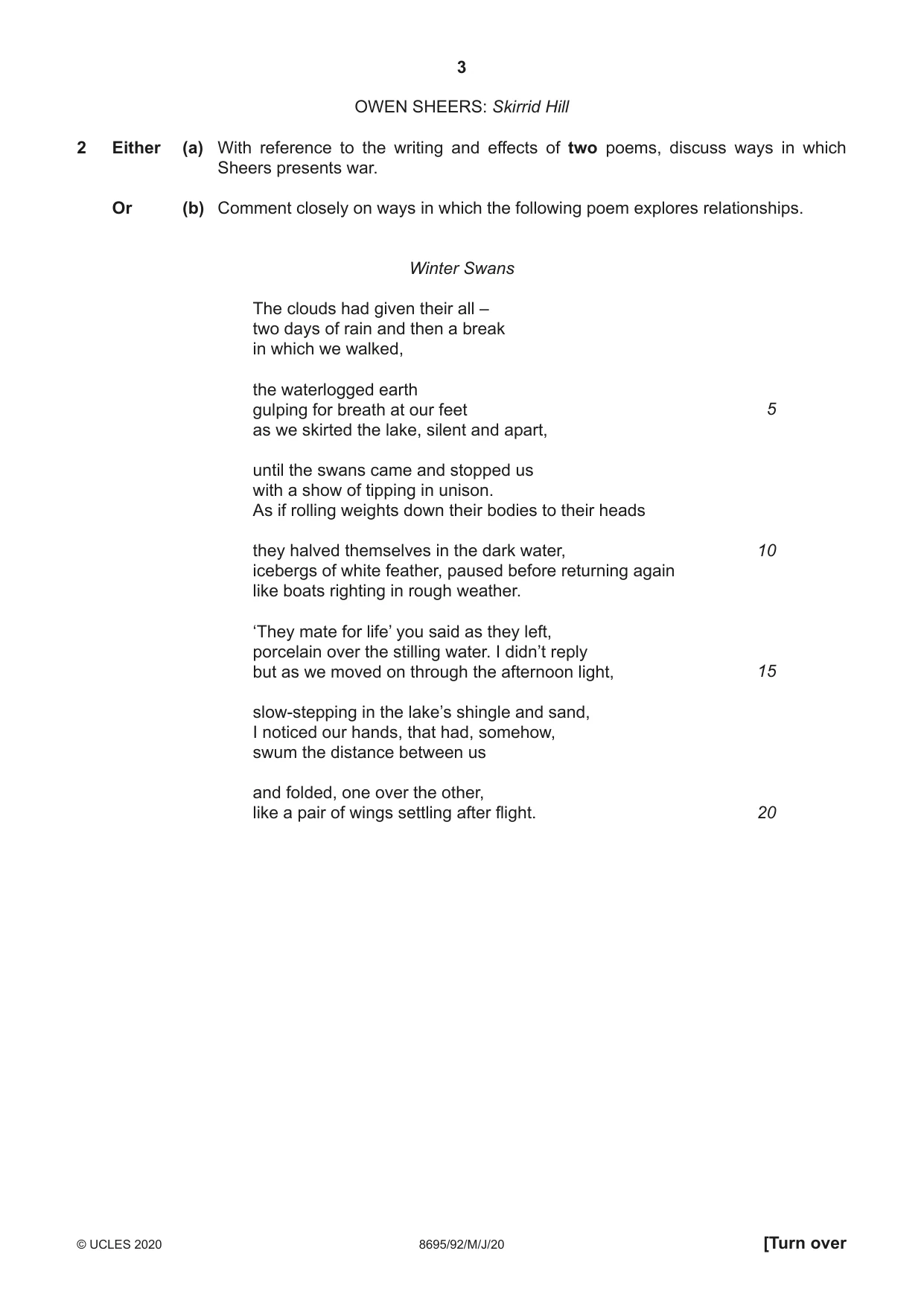
3 8695/92/M/J/20 © UCLES 2020 [Turn over OWEN SHEERS: Skirrid Hill 2 Either (a) With reference to the writing and effects of two poems, discuss ways in which Sheers presents war. Or (b) Comment closely on ways in which the following poem explores relationships. Winter Swans The clouds had given their all – two days of rain and then a break in which we walked, the waterlogged earth gulping for breath at our feet as we skirted the lake, silent and apart, until the swans came and stopped us with a show of tipping in unison. As if rolling weights down their bodies to their heads they halved themselves in the dark water, icebergs of white feather, paused before returning again like boats righting in rough weather. ‘They mate for life’ you said as they left, porcelain over the stilling water. I didn’t reply but as we moved on through the afternoon light, slow-stepping in the lake’s shingle and sand, I noticed our hands, that had, somehow, swum the distance between us and folded, one over the other, like a pair of wings settling after flight. 5 10 15 20
Question paper, page 4
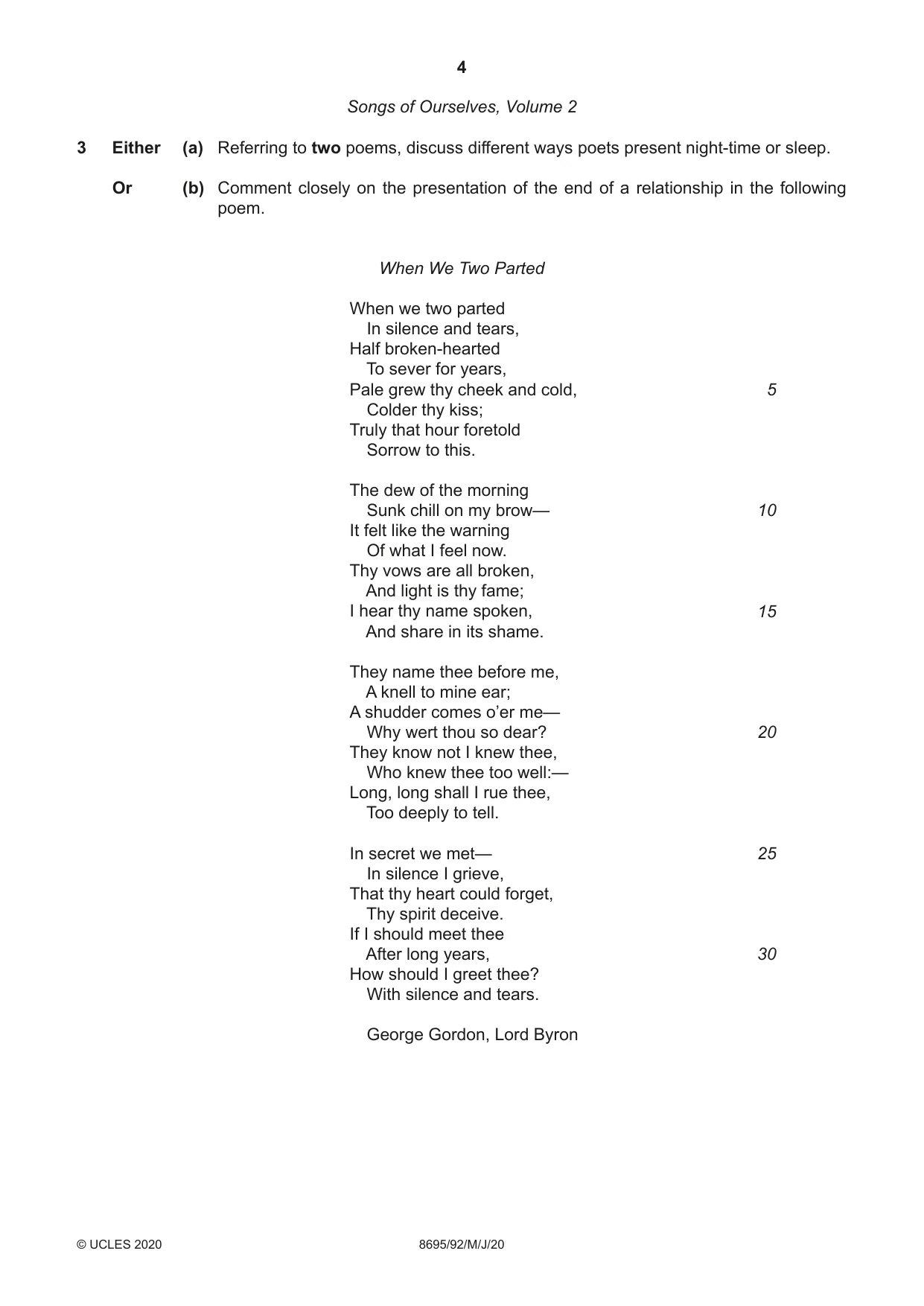
4 8695/92/M/J/20 © UCLES 2020 Songs of Ourselves, Volume 2 3 Either (a) Referring to two poems, discuss different ways poets present night-time or sleep. Or (b) Comment closely on the presentation of the end of a relationship in the following poem. When We Two Parted When we two parted In silence and tears, Half broken-hearted To sever for years, Pale grew thy cheek and cold, Colder thy kiss; Truly that hour foretold Sorrow to this. The dew of the morning Sunk chill on my brow— It felt like the warning Of what I feel now. Thy vows are all broken, And light is thy fame; I hear thy name spoken, And share in its shame. They name thee before me, A knell to mine ear; A shudder comes o’er me— Why wert thou so dear? They know not I knew thee, Who knew thee too well:— Long, long shall I rue thee, Too deeply to tell. In secret we met— In silence I grieve, That thy heart could forget, Thy spirit deceive. If I should meet thee After long years, How should I greet thee? With silence and tears. George Gordon, Lord Byron 5 10 15 20 25 30
Question paper, page 5
5 8695/92/M/J/20 © UCLES 2020 [Turn over Turn over for Section B.
Question paper, page 6
6 8695/92/M/J/20 © UCLES 2020 Section B: Prose E.M. FORSTER: Howards End 4 Either (a) Discuss ways in which Forster presents the lives of the wealthy in the novel. Or (b) Comment closely on the following passage, considering ways in which it presents Leonard Bast. Leonard left it at that—so long as she did not guess the man. She stood at the window and slowly pulled up the blinds. The hotel looked over a dark square. The mists had begun. When she turned back to him her eyes were shining. “Don’t you worry,” he pleaded. “I can’t bear that. We shall be all right if I get work. If I could only get work—something regular to do. Then it wouldn’t be so bad again. I don’t trouble after books as I used. I can imagine that with regular work we should settle down again. It stops one thinking.” “Settle down to what?” “Oh, just settle down.” “And that’s to be life!” said Helen, with a catch in her throat. “How can you, with all the beautiful things to see and do—with music—with walking at night—” “Walking is well enough when a man’s in work,” he answered. “Oh, I did talk a lot of nonsense once, but there’s nothing like a bailiff in the house to drive it out of you. When I saw him fingering my Ruskins and Stevensons, I seemed to see life straight and real, and it isn’t a pretty sight. My books are back again, thanks to you, but they’ll never be the same to me again, and I shan’t ever again think night in the woods is wonderful.” “Why not?” asked Helen, throwing up the window. “Because I see one must have money.” “Well, you’re wrong.” “I wish I was wrong, but—the clergyman—he has money of his own, or else he’s paid; the poet or the musician—just the same; the tramp—he’s no different. The tramp goes to the work-house in the end, and is paid for with other people’s money. Miss Schlegel the real thing’s money, and all the rest is a dream.” “You’re still wrong. You’ve forgotten Death.” Leonard could not understand. “If we lived forever, what you say would be true. But we have to die, we have to leave life presently. Injustice and greed would be the real thing if we lived for ever. As it is, we must hold to other things, because Death is coming. I love Death—not morbidly, but because He explains. He shows me the emptiness of Money. Death and Money are the eternal foes. Not Death and Life. Never mind what lies behind Death, Mr. Bast, but be sure that the poet and the musician and the tramp will be happier in it than the man who has never learnt to say, ‘I am I.’” “I wonder.” “We are all in a mist—I know, but I can help you this far—men like the Wilcoxes are deeper in the mist than any. Sane, sound Englishmen! Building up empires, levelling all the world into what they call common sense. But mention Death to them and they’re offended, because Death’s really Imperial, and He cries out against them for ever.” “I am as afraid of Death as any one.” “But not of the idea of Death.” “But what is the difference?” “Infinite difference,” said Helen, more gravely than before. Leonard looked at her wondering, and had the sense of great things sweeping out of the shrouded night. But he could not receive them, because his heart was still 5 10 15 20 25 30 35 40 45
Question paper, page 7
7 8695/92/M/J/20 © UCLES 2020 [Turn over full of little things. As the lost umbrella had spoilt the concert at Queen’s Hall, so the lost situation was obscuring the diviner harmonies now. Death, Life, and Materialism were fine words, but would Mr. Wilcox take him on as a clerk? Talk as one would, Mr. Wilcox was king of this world, the superman, with his own morality, whose head remained in the clouds. “I must be stupid,” he said apologetically. Chapter 27 50
Question paper, page 8
8 8695/92/M/J/20 © UCLES 2020 ANDREA LEVY: Small Island 5 Either (a) What, to you, seems to be the significance of the novel’s title, Small Island? Or (b) Comment closely on the presentation of Gilbert’s thoughts in the following passage. I was a giant living on land no bigger than the soles of my shoes. Everywhere I turn I gazed on sea. The palm trees that tourists thought rested so beautiful on every shore were my prison bars. Horizons my tormenting borders. I envied the pelican, I envied the crow – with wings they could fly easy from this place to rest in some other. I became a big-talk man – even when the clinking of small change in my ragged pockets accused me of being a fool. Oh, there were plenty men like me, wandering this small island, their head cluttered with the sights they had once looked on. If you would listen then we would talk – widen your eyes with stories of war and the Mother Country. Tell you of bombs, planes, bullets and guns. Fog and snow and autumn mist. Come, ask a question you have always wanted to know. The King – oh, a fine man, and Shakespeare too. Paved with gold, no – but, yes, diamonds appear on the ground in the rain. When my mirror could only return to me a look of disgust, a dainty girl like Celia Langley, who would gasp excited at my traveller’s tales, puffed me proud as a prince. I had no thought of courtship, my only need was her adoration. Entrance her, dazzle her. Come, let me tell her those truths, those lies, those half-baked dreams. But with Hortense my feet landed on solid ground with such a thump my ankles nearly snapped. How come this woman who was inches shorter than I could look down at me from so high a height that I felt like a dwarf? Oh, she was pretty – a golden complexion that left a faint blush of pink at her rounded cheeks. Eyes flashing alive – brown and wide with lashes that flapped like butterflies’ wings. And her lips could have been soft and charming if not always pinched tight with vexation or lifted haughty about the corners to show her disdain. Man, when she doubted the truth her eyebrows would raise so high on her forehead they looked to be blown there by the wind. How did this woman learn to sneer so? Was it through bad odour or was she always smelling her top lip? Even her ears could cuss you. Come, let us face it, my big talk just shrivel in the face of her scorn. She did not like me. My face distressed her, my jokes confused her, my tales of war bored her and talk of England made her yawn. So I thought she was messing with me when she offered me the twenty-eight pounds and ten shillings I needed for a passage to England. ‘I can lend you the money,’ was all she said. She followed it with no explanation. Man, I do not recall that she even smiled. I laughed – a sort of giggle you make when someone is having a joke you do not find funny. But she just stare on me in so serious a way it led me straight to wondering how I might pay her back. Excited now, I decided that every week I would send her money. A little at first until I find me feet, then I would build it up. Sometimes more, sometimes less, but regular until this woman was paid. I would write it down in a little book so no argument would occur. My honour would see the debt was paid. Hear this, I even thought to slit my finger to seal the deal in blood. But she had not finished with me yet. With no persuasion, with no fancy words, with no declarations of love, she let me know that I would have to marry her for the money. This woman was looking for escape and I was to be the back she would ride out on. When I walked away from her that day I went to sit under the refuge of the guango tree. Tree lizards still scuttled up the bark and the cicadas still hissed like cymbals. But the ground was now parched and dry – too hard for me to push my fingers down into the earth. And it was there that I wept. I am not too proud to tell you I sobbed like a boy lost. I was beaten. There was no choice before me except one. If Hortense had money to buy me then, come, let us face it, my price was not too dear. Chapter 18 5 10 15 20 25 30 35 40 45
Question paper, page 9
9 8695/92/M/J/20 © UCLES 2020 [Turn over Turn over for Question 6.
Question paper, page 10
10 8695/92/M/J/20 © UCLES 2020 Stories of Ourselves 6 Either (a) Discuss ways in which two stories from your selection present significant change for the characters. Or (b) Comment closely on the following passage from Elephant, considering ways in which it presents family relationships. I knew it was a mistake to let my brother have the money. I didn’t need anybody else owing me. But when he called and said he couldn’t make the payment on his house, what could I do? I’d never been inside his house – he lived a thousand miles away, in California; I’d never even seen his house – but I didn’t want him to lose it. He cried over the phone and said he was losing everything he’d worked for. He said he’d pay me back. February, he said. Maybe sooner. No later, anyway, than March. He said his income-tax refund was on the way. Plus, he said, he had a little investment that would mature in February. He acted secretive about the investment thing, so I didn’t press for details. ‘Trust me on this,’ he said. ‘I won’t let you down.’ He’d lost his job last July, when the company he worked for, a fiberglass insulation plant, decided to lay off two hundred employees. He’d been living on his unemployment since then, but now the unemployment was gone, and his savings were gone, too. And he didn’t have health insurance any longer. When his job went, the insurance went. His wife, who was ten years older, was diabetic and needed treatment. He’d had to sell the other car – her car, an old station wagon – and a week ago he’d pawned his TV. He told me he’d hurt his back carrying the TV up and down the street where the pawnshops did business. He went from place to place, he said, trying to get the best offer. Somebody finally gave him a hundred dollars for it, this big Sony TV. He told me about the TV, and then about throwing his back out, as if this ought to cinch it with me, unless I had a stone in place of a heart. ‘I’ve gone belly up,’ he said. ‘But you can help me pull out of it.’ ‘How much?’ I said. ‘Five hundred. I could use more, sure, who couldn’t?’ he said. ‘But I want to be realistic. I can pay back five hundred. More than that, I’ll tell you the truth, I’m not so sure. Brother, I hate to ask. But you’re my last resort. Irma Jean and I are going to be on the street before long. I won’t let you down,’ he said. That’s what he said. Those were his exact words. We talked a little more – mostly about our mother and her problems – but, to make a long story short, I sent him the money. I had to. I felt I had to, at any rate – which amounts to the same thing. I wrote him a letter when I sent the check and said he should pay the money back to our mother, who lived in the same town he lived in and who was poor and greedy. I’d been mailing checks to her every month, rain or shine, for three years. But I was thinking that if he paid her the money he owed me it might take me off the hook there and let me breathe for a while. I wouldn’t have to worry on that score for a couple of months, anyway. Also, and this is the truth, I thought maybe he’d be more likely to pay her, since they lived right there in the same town and he saw her from time to time. All I was doing was trying to cover myself some way. The thing is, he might have the best intentions of paying me back, but things happen sometimes. Things get in the way of best intentions. Out of sight, out of mind, as they say. But he wouldn’t stiff his own mother. Nobody would do that. I spent hours writing letters, trying to make sure everybody knew what could be expected and what was required. I even phoned out there to my mother several times, trying to explain it to her. But she was suspicious over the whole deal. I went through it with her on the phone step by step, but she was still suspicious. I told her the money that was supposed to come from me on the first of March and on the first 5 10 15 20 25 30 35 40 45
Question paper, page 11
11 8695/92/M/J/20 © UCLES 2020 [Turn over of April would instead come from Billy, who owed the money to me. She’d get her money, and she didn’t have to worry. The only difference was that Billy would pay it to her those two months instead of me. He’d pay her the money I’d normally be sending to her, but instead of him mailing it to me and then me having to turn around and send it to her he’d pay it to her directly. On any account, she didn’t have to worry. She’d get her money, but for those two months it’d come from him – from the money he owed me. My God, I don’t know how much I spent on phone calls. And I wish I had fifty cents for every letter I wrote, telling him what I’d told her and telling her what to expect from him – that sort of thing. Elephant 50 55
Question paper, page 12
12 8695/92/M/J/20 © UCLES 2020 Section C: Drama ARTHUR MILLER: All My Sons 7 Either (a) How, and with what dramatic effects, does Miller present Joe Keller as a businessman in the play? Or (b) With close reference to detail of language and action, discuss Miller’s presentation of tension between Chris and Ann in the following extract. Chris: Interesting woman, isn’t she? Content removed due to copyright restrictions.
Question paper, page 13
13 8695/92/M/J/20 © UCLES 2020 [Turn over [They break and laugh in embarrassment.] Act 2 Content removed due to copyright restrictions.
Question paper, page 14
14 8695/92/M/J/20 © UCLES 2020 WILLIAM SHAKESPEARE: Henry IV Part 2 8 Either (a) How, and with what dramatic effects, does Shakespeare present contrasts between Prince Hal and his brother, Prince John, in the play? Or (b) With close reference to detail, discuss Shakespeare’s presentation of responses to the new king’s rule in the following episodes. SCEΝΕ ΙV. London. A street. [Enter BEADLES, dragging in HOSTESS QUICKLY and DOLL TEARSHEET.] Hostess: No, thou arrant knave; I would to God that I might die, that I might have thee hang’d. Thou hast drawn my shoulder out of joint. 1 Beadle: The constables have delivered her over to me; and she shall have whipping-cheer enough, I warrant her. There hath been a man or two lately kill’d about her. Doll: Nut-hook, nut-hook, you lie. Come on; I’ll tell thee what, thou damn’d tripe-visag’d rascal, an the child I now go with do miscarry, thou wert better thou hadst struck thy mother, thou paper-fac’d villain. Hostess: O the Lord, that Sir John were come! He would make this a bloody day to somebody. But I pray God the fruit of her womb miscarry! 1 Beadle: If it do, you shall have a dozen of cushions again; you have but eleven now. Come, I charge you both go with me; for the man is dead that you and Pistol beat amongst you. Doll: I’ll tell you what, you thin man in a censer, I will have you as soundly swing’d for this – you due-bottle rogue, you filthy famish’d correctioner, if you be not swing’d, I’ll forswear half- kirtles. 1 Beadle: Come, come, you she knight-errant, come. Hostess: O God, that right should thus overcome might! Well, of sufferance comes ease. Doll: Come, you rogue, come; bring me to a justice. Hostess: Ay, come, you starv’d bloodhound. Doll: Goodman death, goodman bones! Hostess: Thou atomy, thou! Doll: Come, you thin thing! come, you rascal! 1 Beadle: Very well. [Exeunt. SCENE V. Westminster. Near the Abbey. [Enter GROOMS, strewing rushes.] 1 Groom: More rushes, more rushes! 2 Groom: The trumpets have sounded twice. 3 Groom: ’Twill be two o’clock ere they come from the coronation. Dispatch, dispatch. [Exeunt. 5 10 15 20 25 30 35
Question paper, page 15
15 8695/92/M/J/20 © UCLES 2020 [Turn over [Trumpets sound, and the KING and his Train pass over the stage. After them enter FALSTAFF, SHALLOW, PISTOL, BARDOLPH, and PAGE.] Falstaff: Stand here by me, Master Robert Shallow; I will make the King do you grace. I will leer upon him, as ’a comes by; and do but mark the countenance that he will give me. Pistol: God bless thy lungs, good knight! Falstaff: Come here, Pistol; stand behind me. [To SHALLOW] O, if I had had time to have made new liveries, I would have bestowed the thousand pound I borrowed of you. But ’tis no matter; this poor show doth better; this doth infer the zeal I had to see him. Shallow: It doth so. Falstaff: It shows my earnestness of affection – Shallow: It doth so. Falstaff: My devotion – Shallow: It doth, it doth, it doth. Falstaff: As it were, to ride day and night; and not to deliberate, not to remember, not to have patience to shift me – Shallow: It is best, certain. Falstaff: But to stand stained with travel, and sweating with desire to see him; thinking of nothing else, putting all affairs else in oblivion, as if there were nothing else to be done but to see him. Pistol: ’Tis ‘semper idem’ for ‘obsque hoc nihil est’. ’Tis all in every part. Shallow: ’Tis so, indeed. Pistol: My knight, I will inflame thy noble liver And make thee rage. Thy Doll, and Helen of thy noble thoughts, Is in base durance and contagious prison; Hal’d thither By most mechanical and dirty hand. Rouse up revenge from ebon den with fell Alecto’s snake, For Doll is in. Pistol speaks nought but truth. Falstaff: I will deliver her. [Shouts within, and the trumpets sound.] Pistol: There roar’d the sea, and trumpet-clangor sounds. Act 5, Scenes 4 and 5 40 45 50 55 60 65 70
Question paper, page 16
16 8695/92/M/J/20 © UCLES 2020 WOLE SOYINKA: Death and the King’s Horseman 9 Either (a) Discuss some of the ways in which Soyinka dramatises contrasts between Yoruban and European culture in the play. Or (b) With close reference to detail of language and action, discuss Soyinka’s presentation of Olunde in the following extract. Olunde: Can I go now? Content removed due to copyright restrictions.
Question paper, page 17
17 8695/92/M/J/20 © UCLES 2020 I must see him before he turns cold. Scene 4 Content removed due to copyright restrictions.
Question paper, page 18
18 8695/92/M/J/20 © UCLES 2020 BLANK PAGE
Question paper, page 19
19 8695/92/M/J/20 © UCLES 2020 BLANK PAGE
Question paper, page 20
20 8695/92/M/J/20 © UCLES 2020 Permission to reproduce items where third-party owned material protected by copyright is included has been sought and cleared where possible. Every reasonable effort has been made by the publisher (UCLES) to trace copyright holders, but if any items requiring clearance have unwittingly been included, the publisher will be pleased to make amends at the earliest possible opportunity. To avoid the issue of disclosure of answer-related information to candidates, all copyright acknowledgements are reproduced online in the Cambridge Assessment International Education Copyright Acknowledgements Booklet. This is produced for each series of examinations and is freely available to download at www.cambridgeinternational.org after the live examination series. Cambridge Assessment International Education is part of the Cambridge Assessment Group. Cambridge Assessment is the brand name of the University of Cambridge Local Examinations Syndicate (UCLES), which itself is a department of the University of Cambridge. BLANK PAGE
Mark scheme, page 1
This document consists of 6 printed pages. © UCLES 2020 [Turn over Cambridge International AS Level LANGUAGE AND LITERATURE IN ENGLISH 8695/92 Paper 9 Poetry, Prose and Drama May/June 2020 MARK SCHEME Maximum Mark: 50 Published Students did not sit exam papers in the June 2020 series due to the Covid-19 global pandemic. This mark scheme is published to support teachers and students and should be read together with the question paper. It shows the requirements of the exam. The answer column of the mark scheme shows the proposed basis on which Examiners would award marks for this exam. Where appropriate, this column also provides the most likely acceptable alternative responses expected from students. Examiners usually review the mark scheme after they have seen student responses and update the mark scheme if appropriate. In the June series, Examiners were unable to consider the acceptability of alternative responses, as there were no student responses to consider. Mark schemes should usually be read together with the Principal Examiner Report for Teachers. However, because students did not sit exam papers, there is no Principal Examiner Report for Teachers for the June 2020 series. Cambridge International will not enter into discussions about these mark schemes. Cambridge International is publishing the mark schemes for the June 2020 series for most Cambridge IGCSE™ and Cambridge International A & AS Level components, and some Cambridge O Level components.
Mark scheme, page 2
8695/92 Cambridge International AS Level – Mark Scheme PUBLISHED May/June 2020 © UCLES 2020 Page 2 of 6 Generic Marking Principles These general marking principles must be applied by all examiners when marking candidate answers. They should be applied alongside the specific content of the mark scheme or generic level descriptors for a question. Each question paper and mark scheme will also comply with these marking principles. GENERIC MARKING PRINCIPLE 1: Marks must be awarded in line with: • the specific content of the mark scheme or the generic level descriptors for the question • the specific skills defined in the mark scheme or in the generic level descriptors for the question • the standard of response required by a candidate as exemplified by the standardisation scripts. GENERIC MARKING PRINCIPLE 2: Marks awarded are always whole marks (not half marks, or other fractions). GENERIC MARKING PRINCIPLE 3: Marks must be awarded positively: • marks are awarded for correct/valid answers, as defined in the mark scheme. However, credit is given for valid answers which go beyond the scope of the syllabus and mark scheme, referring to your Team Leader as appropriate • marks are awarded when candidates clearly demonstrate what they know and can do • marks are not deducted for errors • marks are not deducted for omissions • answers should only be judged on the quality of spelling, punctuation and grammar when these features are specifically assessed by the question as indicated by the mark scheme. The meaning, however, should be unambiguous. GENERIC MARKING PRINCIPLE 4: Rules must be applied consistently e.g. in situations where candidates have not followed instructions or in the application of generic level descriptors. GENERIC MARKING PRINCIPLE 5: Marks should be awarded using the full range of marks defined in the mark scheme for the question (however; the use of the full mark range may be limited according to the quality of the candidate responses seen). GENERIC MARKING PRINCIPLE 6: Marks awarded are based solely on the requirements as defined in the mark scheme. Marks should not be awarded with grade thresholds or grade descriptors in mind.
Mark scheme, page 3
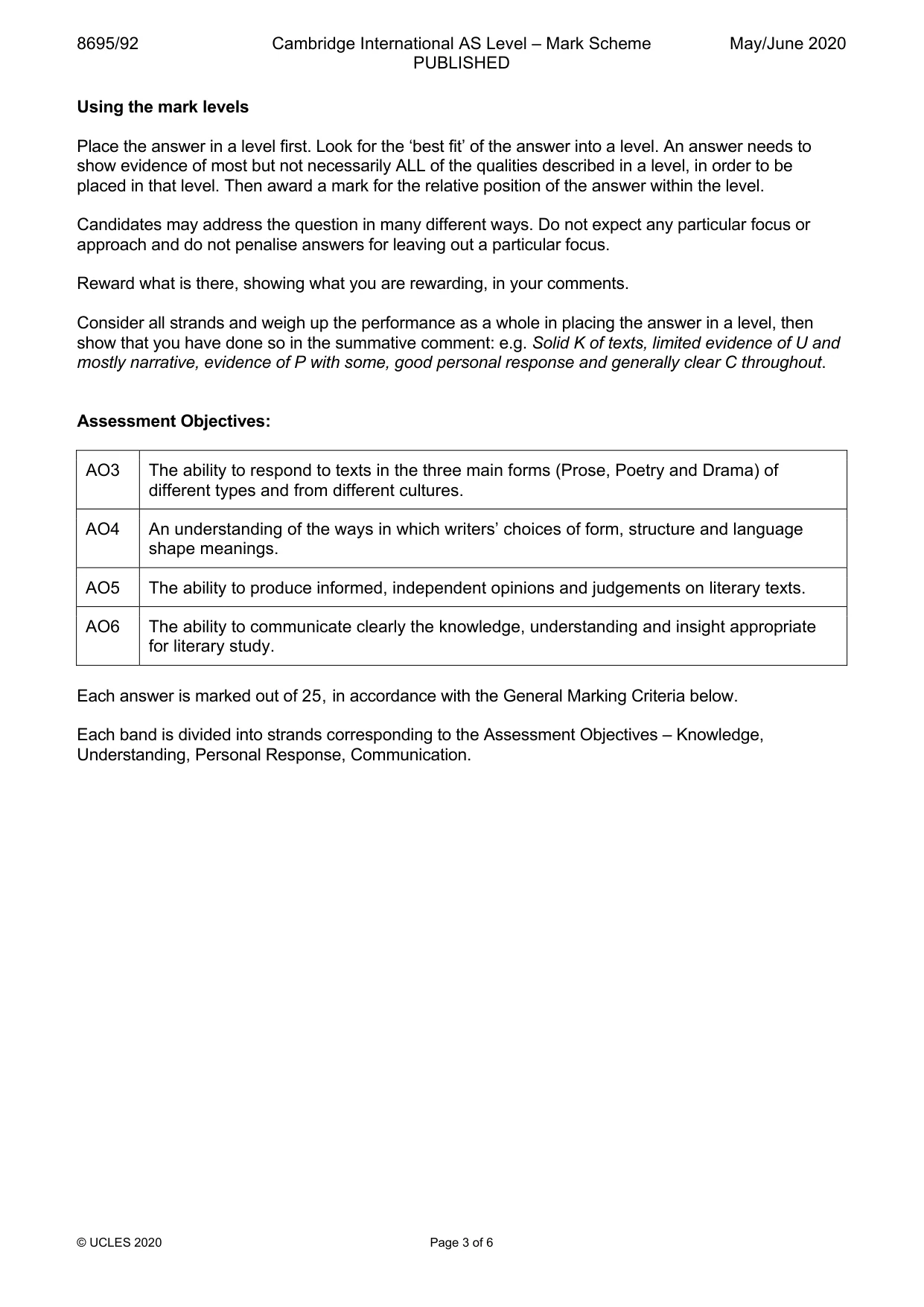
8695/92 Cambridge International AS Level – Mark Scheme PUBLISHED May/June 2020 © UCLES 2020 Page 3 of 6 Using the mark levels Place the answer in a level first. Look for the ‘best fit’ of the answer into a level. An answer needs to show evidence of most but not necessarily ALL of the qualities described in a level, in order to be placed in that level. Then award a mark for the relative position of the answer within the level. Candidates may address the question in many different ways. Do not expect any particular focus or approach and do not penalise answers for leaving out a particular focus. Reward what is there, showing what you are rewarding, in your comments. Consider all strands and weigh up the performance as a whole in placing the answer in a level, then show that you have done so in the summative comment: e.g. Solid K of texts, limited evidence of U and mostly narrative, evidence of P with some, good personal response and generally clear C throughout. Assessment Objectives: AO3 The ability to respond to texts in the three main forms (Prose, Poetry and Drama) of different types and from different cultures. AO4 An understanding of the ways in which writers’ choices of form, structure and language shape meanings. AO5 The ability to produce informed, independent opinions and judgements on literary texts. AO6 The ability to communicate clearly the knowledge, understanding and insight appropriate for literary study. Each answer is marked out of 25, in accordance with the General Marking Criteria below. Each band is divided into strands corresponding to the Assessment Objectives – Knowledge, Understanding, Personal Response, Communication.
Mark scheme, page 4
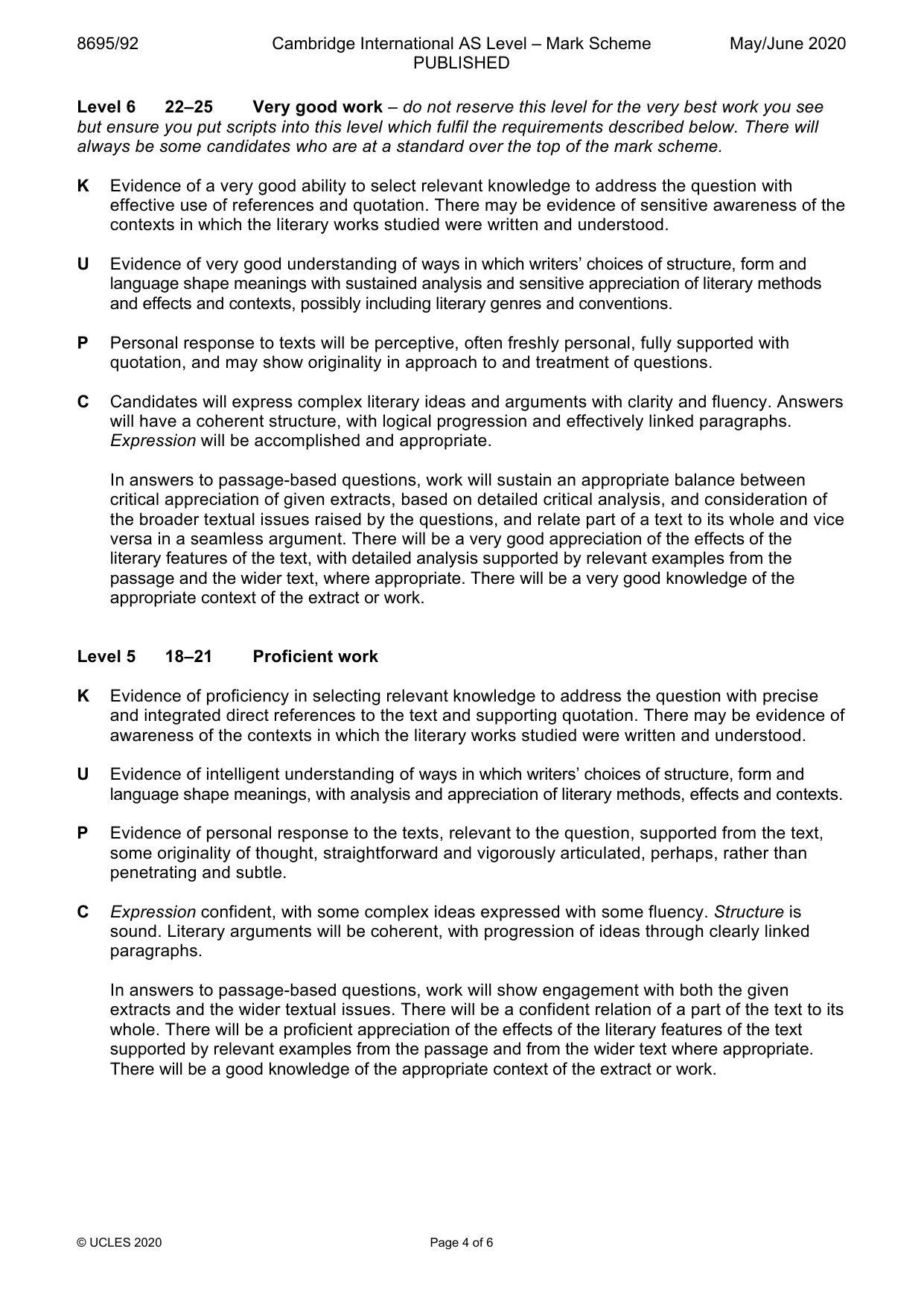
8695/92 Cambridge International AS Level – Mark Scheme PUBLISHED May/June 2020 © UCLES 2020 Page 4 of 6 Level 6 22–25 Very good work – do not reserve this level for the very best work you see but ensure you put scripts into this level which fulfil the requirements described below. There will always be some candidates who are at a standard over the top of the mark scheme. K Evidence of a very good ability to select relevant knowledge to address the question with effective use of references and quotation. There may be evidence of sensitive awareness of the contexts in which the literary works studied were written and understood. U Evidence of very good understanding of ways in which writers’ choices of structure, form and language shape meanings with sustained analysis and sensitive appreciation of literary methods and effects and contexts, possibly including literary genres and conventions. P Personal response to texts will be perceptive, often freshly personal, fully supported with quotation, and may show originality in approach to and treatment of questions. C Candidates will express complex literary ideas and arguments with clarity and fluency. Answers will have a coherent structure, with logical progression and effectively linked paragraphs. Expression will be accomplished and appropriate. In answers to passage-based questions, work will sustain an appropriate balance between critical appreciation of given extracts, based on detailed critical analysis, and consideration of the broader textual issues raised by the questions, and relate part of a text to its whole and vice versa in a seamless argument. There will be a very good appreciation of the effects of the literary features of the text, with detailed analysis supported by relevant examples from the passage and the wider text, where appropriate. There will be a very good knowledge of the appropriate context of the extract or work. Level 5 18–21 Proficient work K Evidence of proficiency in selecting relevant knowledge to address the question with precise and integrated direct references to the text and supporting quotation. There may be evidence of awareness of the contexts in which the literary works studied were written and understood. U Evidence of intelligent understanding of ways in which writers’ choices of structure, form and language shape meanings, with analysis and appreciation of literary methods, effects and contexts. P Evidence of personal response to the texts, relevant to the question, supported from the text, some originality of thought, straightforward and vigorously articulated, perhaps, rather than penetrating and subtle. C Expression confident, with some complex ideas expressed with some fluency. Structure is sound. Literary arguments will be coherent, with progression of ideas through clearly linked paragraphs. In answers to passage-based questions, work will show engagement with both the given extracts and the wider textual issues. There will be a confident relation of a part of the text to its whole. There will be a proficient appreciation of the effects of the literary features of the text supported by relevant examples from the passage and from the wider text where appropriate. There will be a good knowledge of the appropriate context of the extract or work.
Mark scheme, page 5
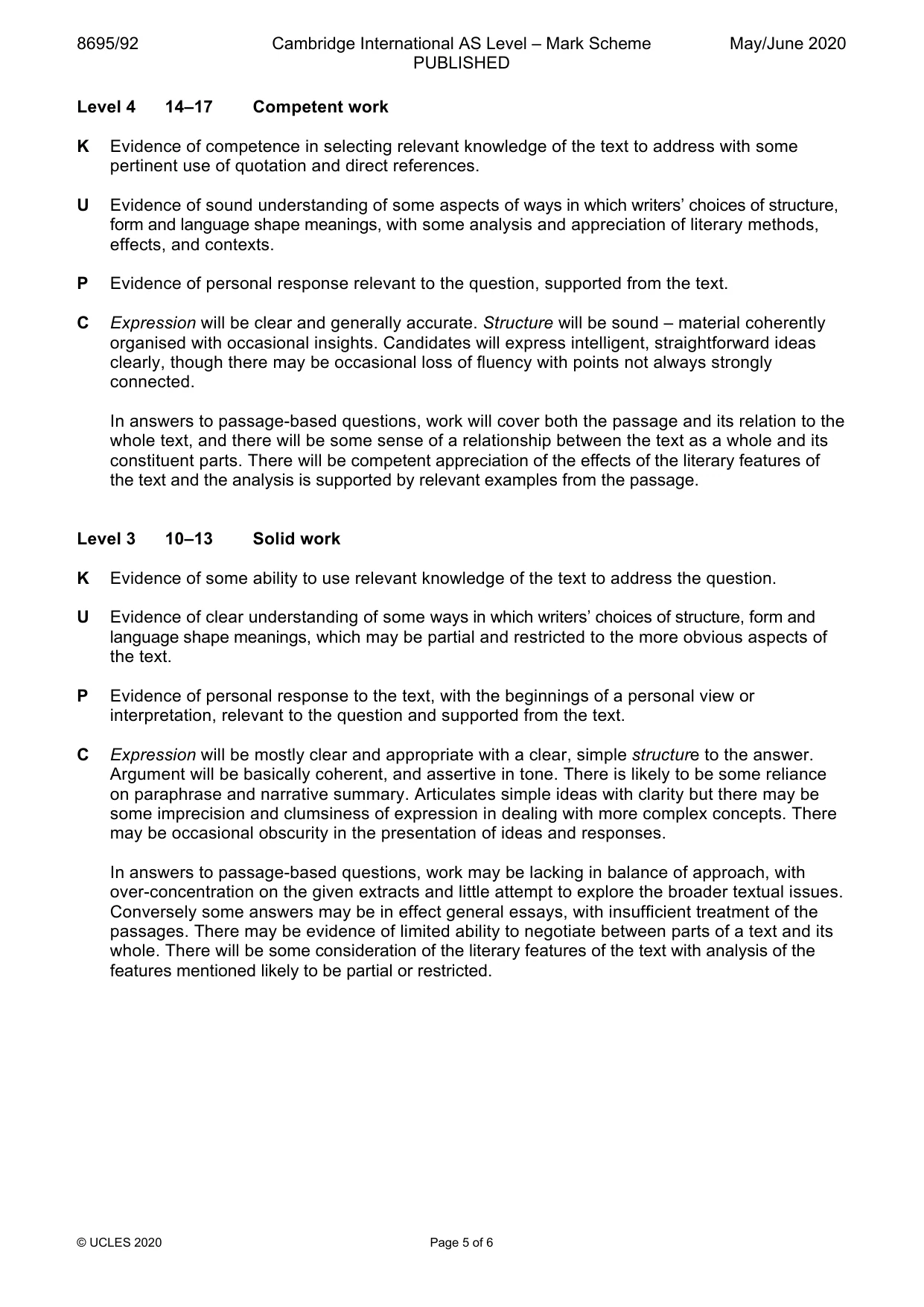
8695/92 Cambridge International AS Level – Mark Scheme PUBLISHED May/June 2020 © UCLES 2020 Page 5 of 6 Level 4 14–17 Competent work K Evidence of competence in selecting relevant knowledge of the text to address with some pertinent use of quotation and direct references. U Evidence of sound understanding of some aspects of ways in which writers’ choices of structure, form and language shape meanings, with some analysis and appreciation of literary methods, effects, and contexts. P Evidence of personal response relevant to the question, supported from the text. C Expression will be clear and generally accurate. Structure will be sound – material coherently organised with occasional insights. Candidates will express intelligent, straightforward ideas clearly, though there may be occasional loss of fluency with points not always strongly connected. In answers to passage-based questions, work will cover both the passage and its relation to the whole text, and there will be some sense of a relationship between the text as a whole and its constituent parts. There will be competent appreciation of the effects of the literary features of the text and the analysis is supported by relevant examples from the passage. Level 3 10–13 Solid work K Evidence of some ability to use relevant knowledge of the text to address the question. U Evidence of clear understanding of some ways in which writers’ choices of structure, form and language shape meanings, which may be partial and restricted to the more obvious aspects of the text. P Evidence of personal response to the text, with the beginnings of a personal view or interpretation, relevant to the question and supported from the text. C Expression will be mostly clear and appropriate with a clear, simple structure to the answer. Argument will be basically coherent, and assertive in tone. There is likely to be some reliance on paraphrase and narrative summary. Articulates simple ideas with clarity but there may be some imprecision and clumsiness of expression in dealing with more complex concepts. There may be occasional obscurity in the presentation of ideas and responses. In answers to passage-based questions, work may be lacking in balance of approach, with over-concentration on the given extracts and little attempt to explore the broader textual issues. Conversely some answers may be in effect general essays, with insufficient treatment of the passages. There may be evidence of limited ability to negotiate between parts of a text and its whole. There will be some consideration of the literary features of the text with analysis of the features mentioned likely to be partial or restricted.
Mark scheme, page 6
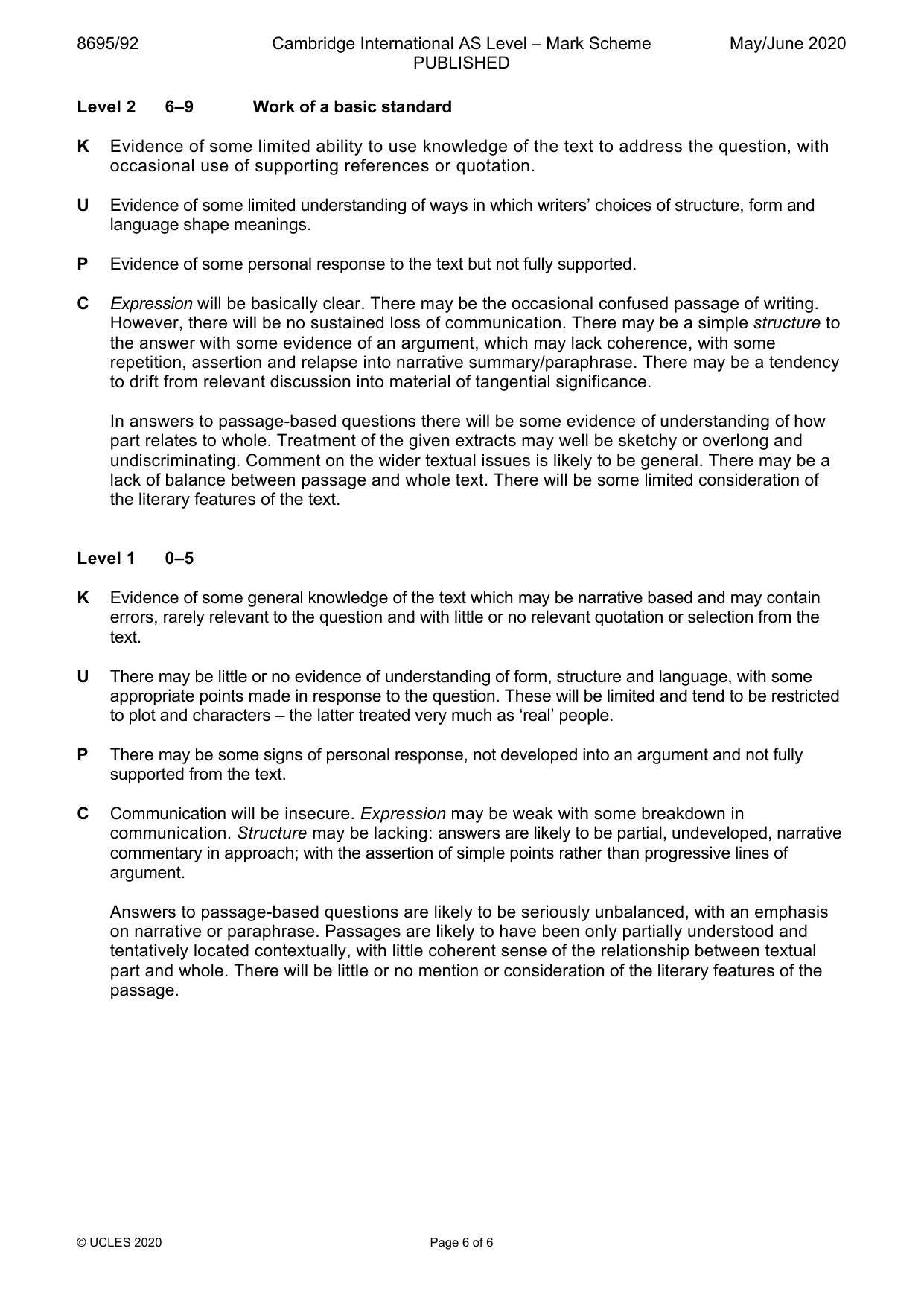
8695/92 Cambridge International AS Level – Mark Scheme PUBLISHED May/June 2020 © UCLES 2020 Page 6 of 6 Level 2 6–9 Work of a basic standard K Evidence of some limited ability to use knowledge of the text to address the question, with occasional use of supporting references or quotation. U Evidence of some limited understanding of ways in which writers’ choices of structure, form and language shape meanings. P Evidence of some personal response to the text but not fully supported. C Expression will be basically clear. There may be the occasional confused passage of writing. However, there will be no sustained loss of communication. There may be a simple structure to the answer with some evidence of an argument, which may lack coherence, with some repetition, assertion and relapse into narrative summary/paraphrase. There may be a tendency to drift from relevant discussion into material of tangential significance. In answers to passage-based questions there will be some evidence of understanding of how part relates to whole. Treatment of the given extracts may well be sketchy or overlong and undiscriminating. Comment on the wider textual issues is likely to be general. There may be a lack of balance between passage and whole text. There will be some limited consideration of the literary features of the text. Level 1 0–5 K Evidence of some general knowledge of the text which may be narrative based and may contain errors, rarely relevant to the question and with little or no relevant quotation or selection from the text. U There may be little or no evidence of understanding of form, structure and language, with some appropriate points made in response to the question. These will be limited and tend to be restricted to plot and characters – the latter treated very much as ‘real’ people. P There may be some signs of personal response, not developed into an argument and not fully supported from the text. C Communication will be insecure. Expression may be weak with some breakdown in communication. Structure may be lacking: answers are likely to be partial, undeveloped, narrative commentary in approach; with the assertion of simple points rather than progressive lines of argument. Answers to passage-based questions are likely to be seriously unbalanced, with an emphasis on narrative or paraphrase. Passages are likely to have been only partially understood and tentatively located contextually, with little coherent sense of the relationship between textual part and whole. There will be little or no mention or consideration of the literary features of the passage.