Cambridge A Level English - Language and Literature (AS Level only, from 2016) 8695 — 2018 Oct/Nov Paper 9 · Variant 2
8695/92/O/N/18 · 50 marks · ≈56 min
The question paper and its mark scheme, free to read here and free to download. This is Cambridge’s own paper, exactly as it was sat.
Question paper20 pages




Mark scheme6 pages
Answers below. Sit the paper first if you are practising.
Paper as text
Question paper, page 1
This document consists of 17 printed pages, 3 blank pages and 1 insert. DC (RCL (GO)) 145822/2 © UCLES 2018 [Turn over Cambridge International Examinations Cambridge International Advanced Subsidiary Level * 7 3 9 0 5 1 2 1 0 9 * LANGUAGE AND LITERATURE IN ENGLISH 8695/92 Paper 9 Poetry, Prose and Drama October/November 2018 2 hours No Additional Materials are required. READ THESE INSTRUCTIONS FIRST An answer booklet is provided inside this question paper. You should follow the instructions on the front cover of the answer booklet. If you need additional answer paper ask the invigilator for a continuation booklet. Answer two questions, each from a different section. You are reminded of the need for good English and clear presentation in your answers. All questions in this paper carry equal marks.
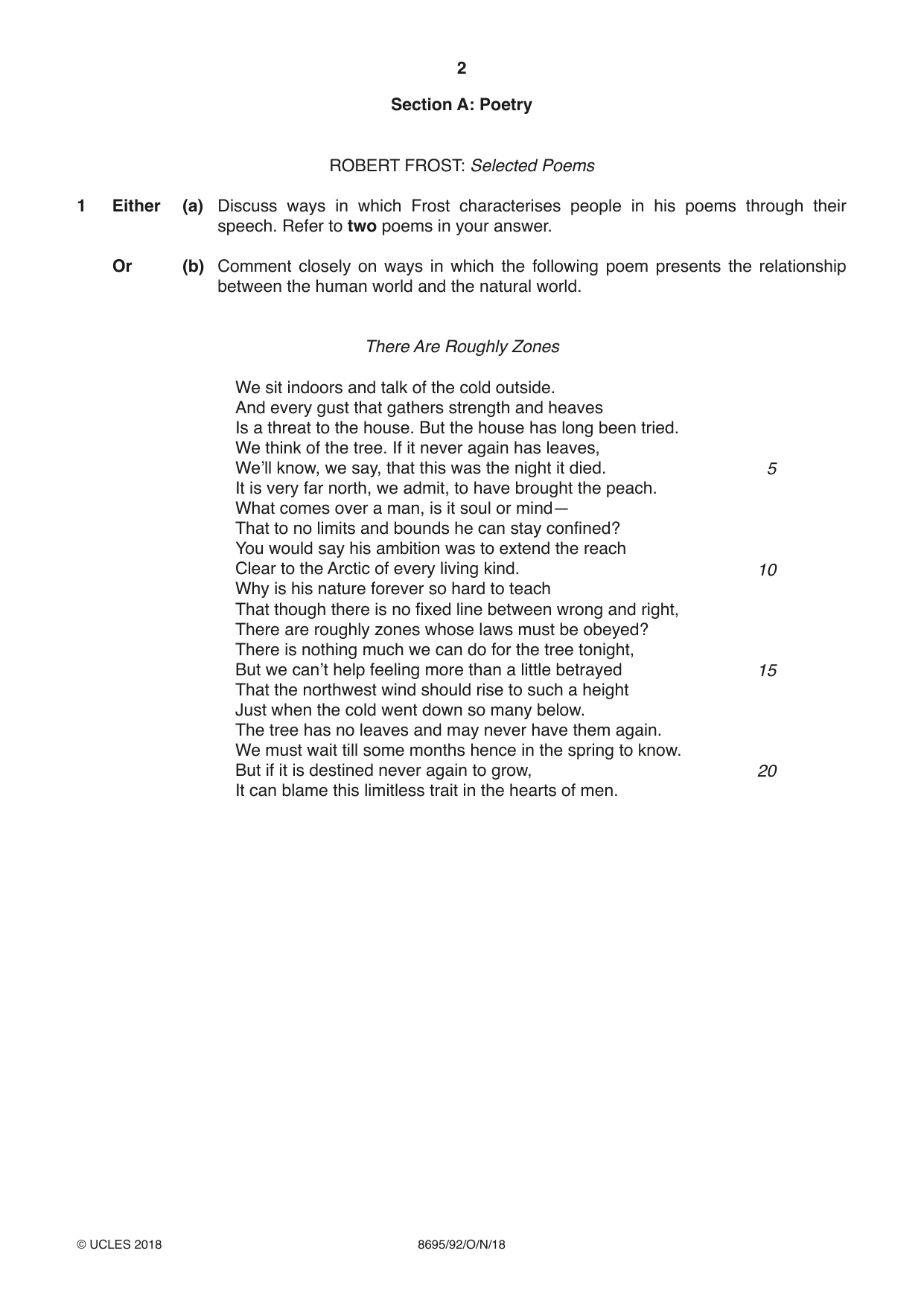
Question paper, page 2
2 8695/92/O/N/18 © UCLES 2018 Section A: Poetry ROBERT FROST: Selected Poems 1 Either (a) Discuss ways in which Frost characterises people in his poems through their speech. Refer to two poems in your answer. Or (b) Comment closely on ways in which the following poem presents the relationship between the human world and the natural world. There Are Roughly Zones We sit indoors and talk of the cold outside. And every gust that gathers strength and heaves Is a threat to the house. But the house has long been tried. We think of the tree. If it never again has leaves, We’ll know, we say, that this was the night it died. It is very far north, we admit, to have brought the peach. What comes over a man, is it soul or mind— That to no limits and bounds he can stay confined? You would say his ambition was to extend the reach Clear to the Arctic of every living kind. Why is his nature forever so hard to teach That though there is no fixed line between wrong and right, There are roughly zones whose laws must be obeyed? There is nothing much we can do for the tree tonight, But we can’t help feeling more than a little betrayed That the northwest wind should rise to such a height Just when the cold went down so many below. The tree has no leaves and may never have them again. We must wait till some months hence in the spring to know. But if it is destined never again to grow, It can blame this limitless trait in the hearts of men. 5 10 15 20
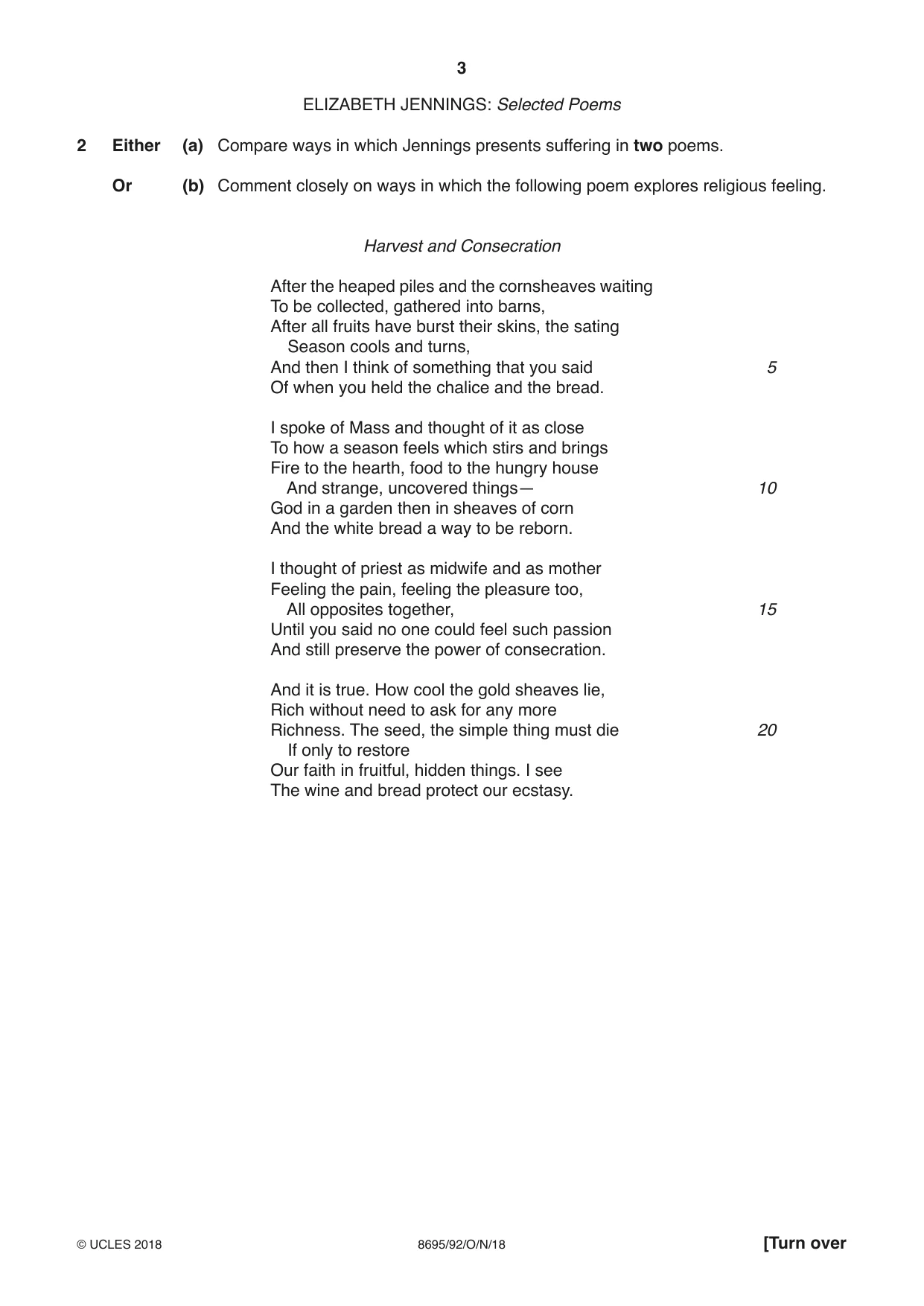
Question paper, page 3
3 8695/92/O/N/18 © UCLES 2018 [Turn over ELIZABETH JENNINGS: Selected Poems 2 Either (a) Compare ways in which Jennings presents suffering in two poems. Or (b) Comment closely on ways in which the following poem explores religious feeling. Harvest and Consecration After the heaped piles and the cornsheaves waiting To be collected, gathered into barns, After all fruits have burst their skins, the sating Season cools and turns, And then I think of something that you said Of when you held the chalice and the bread. I spoke of Mass and thought of it as close To how a season feels which stirs and brings Fire to the hearth, food to the hungry house And strange, uncovered things— God in a garden then in sheaves of corn And the white bread a way to be reborn. I thought of priest as midwife and as mother Feeling the pain, feeling the pleasure too, All opposites together, Until you said no one could feel such passion And still preserve the power of consecration. And it is true. How cool the gold sheaves lie, Rich without need to ask for any more Richness. The seed, the simple thing must die If only to restore Our faith in fruitful, hidden things. I see The wine and bread protect our ecstasy. 5 10 15 20
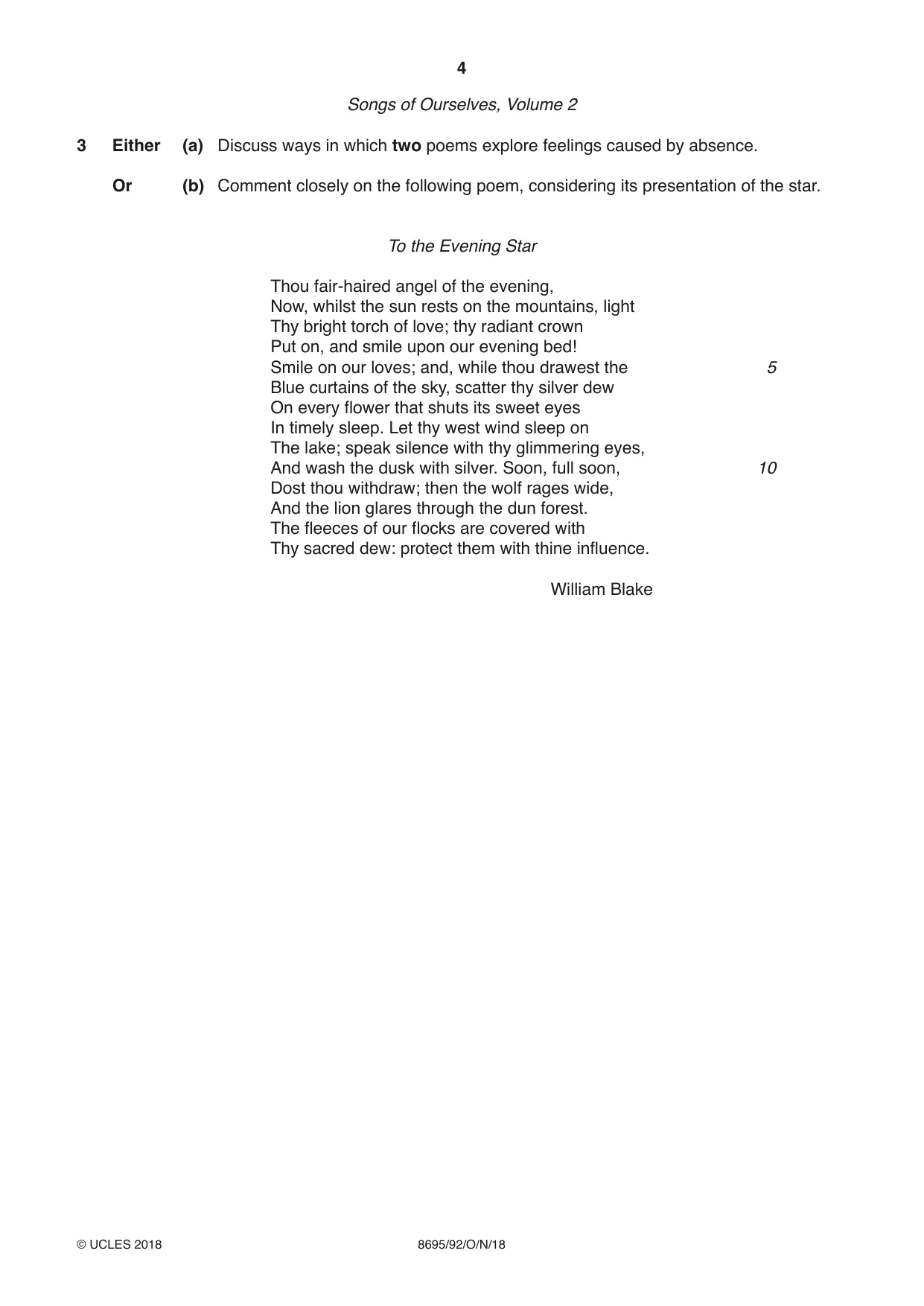
Question paper, page 4
4 8695/92/O/N/18 © UCLES 2018 Songs of Ourselves, Volume 2 3 Either (a) Discuss ways in which two poems explore feelings caused by absence. Or (b) Comment closely on the following poem, considering its presentation of the star. To the Evening Star Thou fair-haired angel of the evening, Now, whilst the sun rests on the mountains, light Thy bright torch of love; thy radiant crown Put on, and smile upon our evening bed! Smile on our loves; and, while thou drawest the Blue curtains of the sky, scatter thy silver dew On every flower that shuts its sweet eyes In timely sleep. Let thy west wind sleep on The lake; speak silence with thy glimmering eyes, And wash the dusk with silver. Soon, full soon, Dost thou withdraw; then the wolf rages wide, And the lion glares through the dun forest. The fleeces of our flocks are covered with Thy sacred dew: protect them with thine influence. William Blake 5 10
Question paper, page 5
5 8695/92/O/N/18 © UCLES 2018 [Turn over Turn over for Section B.
Question paper, page 6
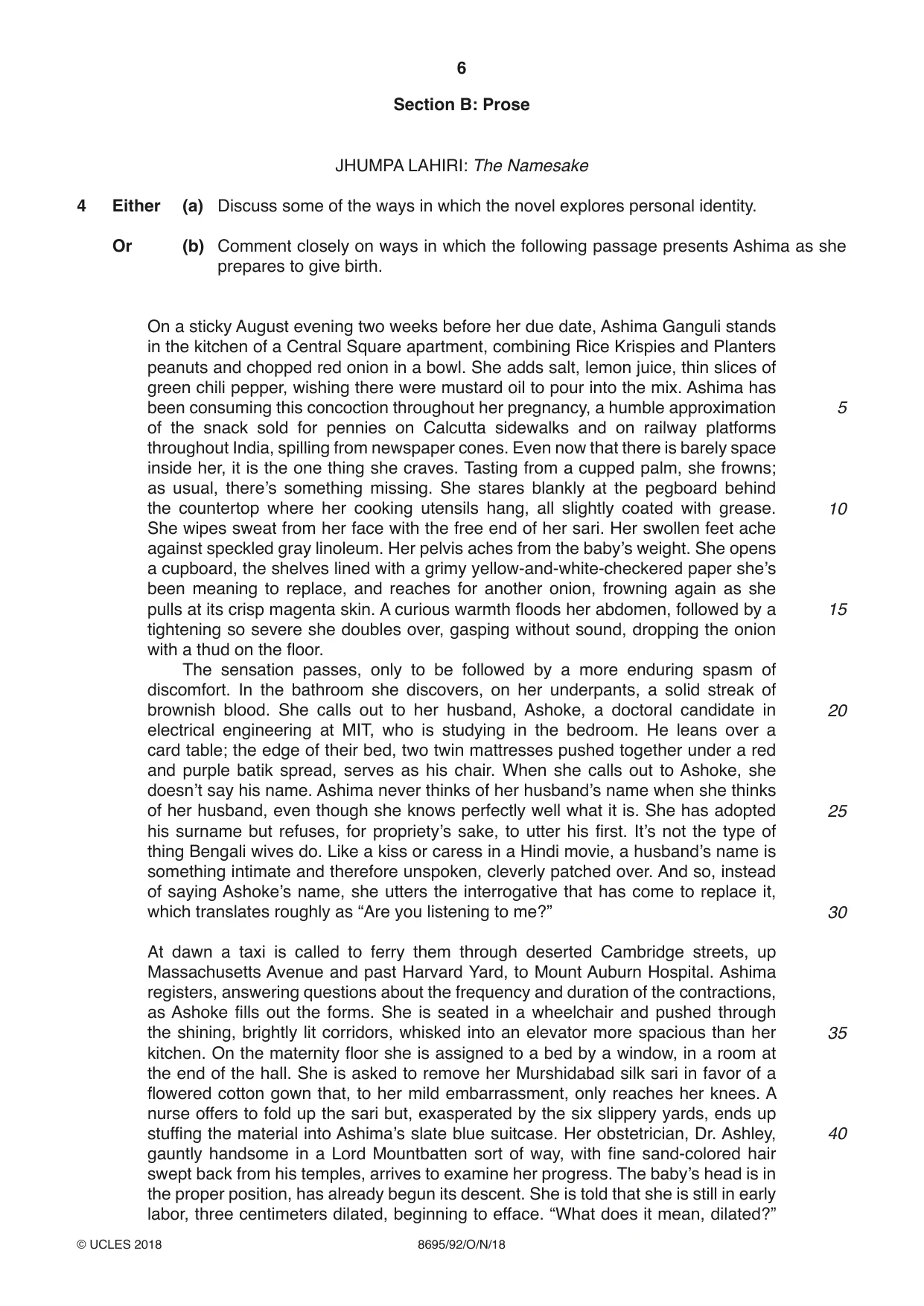
6 8695/92/O/N/18 © UCLES 2018 Section B: Prose JHUMPA LAHIRI: The Namesake 4 Either (a) Discuss some of the ways in which the novel explores personal identity. Or (b) Comment closely on ways in which the following passage presents Ashima as she prepares to give birth. On a sticky August evening two weeks before her due date, Ashima Ganguli stands in the kitchen of a Central Square apartment, combining Rice Krispies and Planters peanuts and chopped red onion in a bowl. She adds salt, lemon juice, thin slices of green chili pepper, wishing there were mustard oil to pour into the mix. Ashima has been consuming this concoction throughout her pregnancy, a humble approximation of the snack sold for pennies on Calcutta sidewalks and on railway platforms throughout India, spilling from newspaper cones. Even now that there is barely space inside her, it is the one thing she craves. Tasting from a cupped palm, she frowns; as usual, there’s something missing. She stares blankly at the pegboard behind the countertop where her cooking utensils hang, all slightly coated with grease. She wipes sweat from her face with the free end of her sari. Her swollen feet ache against speckled gray linoleum. Her pelvis aches from the baby’s weight. She opens a cupboard, the shelves lined with a grimy yellow-and-white-checkered paper she’s been meaning to replace, and reaches for another onion, frowning again as she pulls at its crisp magenta skin. A curious warmth floods her abdomen, followed by a tightening so severe she doubles over, gasping without sound, dropping the onion with a thud on the floor. The sensation passes, only to be followed by a more enduring spasm of discomfort. In the bathroom she discovers, on her underpants, a solid streak of brownish blood. She calls out to her husband, Ashoke, a doctoral candidate in electrical engineering at MIT, who is studying in the bedroom. He leans over a card table; the edge of their bed, two twin mattresses pushed together under a red and purple batik spread, serves as his chair. When she calls out to Ashoke, she doesn’t say his name. Ashima never thinks of her husband’s name when she thinks of her husband, even though she knows perfectly well what it is. She has adopted his surname but refuses, for propriety’s sake, to utter his first. It’s not the type of thing Bengali wives do. Like a kiss or caress in a Hindi movie, a husband’s name is something intimate and therefore unspoken, cleverly patched over. And so, instead of saying Ashoke’s name, she utters the interrogative that has come to replace it, which translates roughly as “Are you listening to me?” At dawn a taxi is called to ferry them through deserted Cambridge streets, up Massachusetts Avenue and past Harvard Yard, to Mount Auburn Hospital. Ashima registers, answering questions about the frequency and duration of the contractions, as Ashoke fills out the forms. She is seated in a wheelchair and pushed through the shining, brightly lit corridors, whisked into an elevator more spacious than her kitchen. On the maternity floor she is assigned to a bed by a window, in a room at the end of the hall. She is asked to remove her Murshidabad silk sari in favor of a flowered cotton gown that, to her mild embarrassment, only reaches her knees. A nurse offers to fold up the sari but, exasperated by the six slippery yards, ends up stuffing the material into Ashima’s slate blue suitcase. Her obstetrician, Dr. Ashley, gauntly handsome in a Lord Mountbatten sort of way, with fine sand-colored hair swept back from his temples, arrives to examine her progress. The baby’s head is in the proper position, has already begun its descent. She is told that she is still in early labor, three centimeters dilated, beginning to efface. “What does it mean, dilated?” 5 10 15 20 25 30 35 40
Question paper, page 7
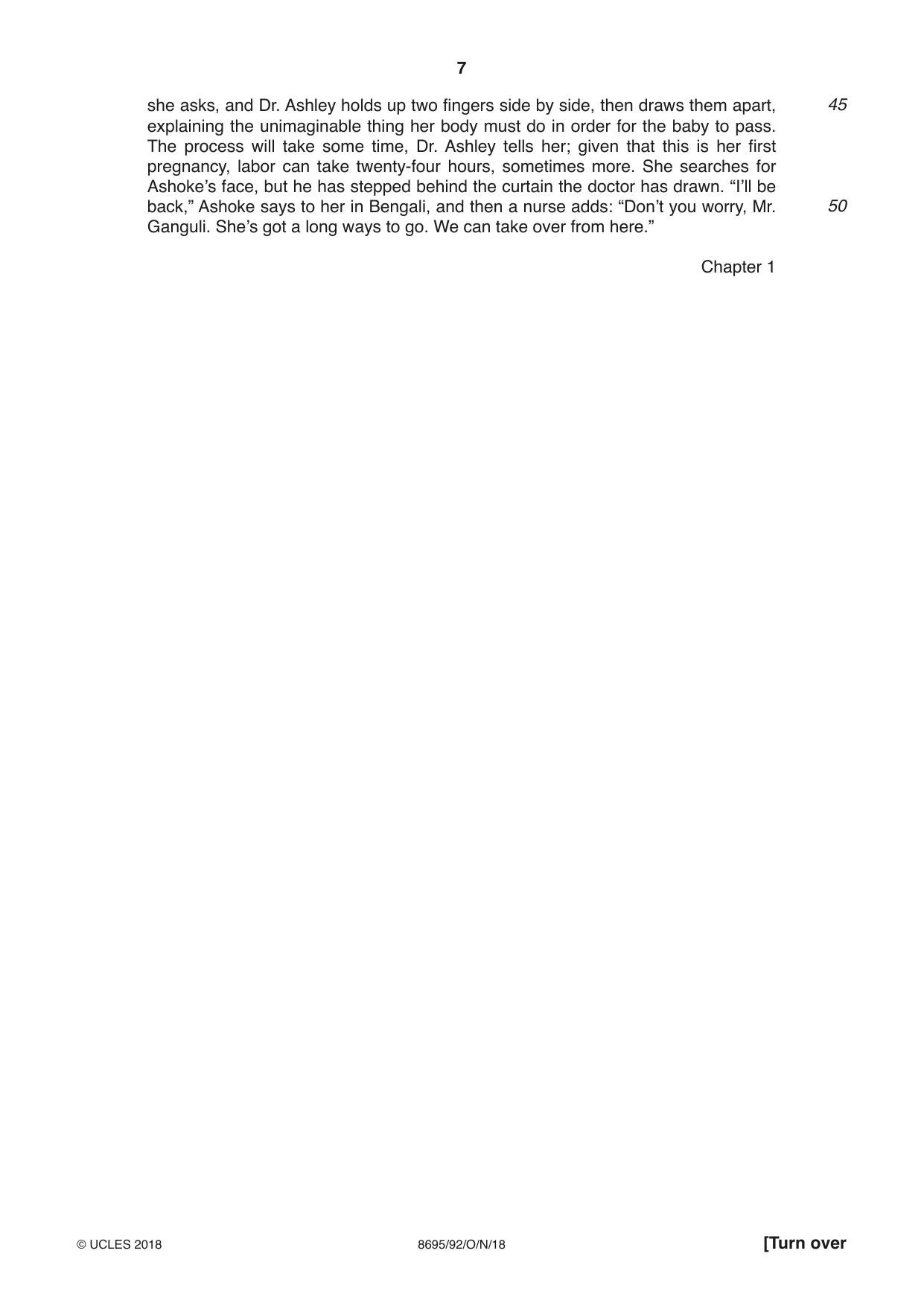
7 8695/92/O/N/18 © UCLES 2018 [Turn over she asks, and Dr. Ashley holds up two fingers side by side, then draws them apart, explaining the unimaginable thing her body must do in order for the baby to pass. The process will take some time, Dr. Ashley tells her; given that this is her first pregnancy, labor can take twenty-four hours, sometimes more. She searches for Ashoke’s face, but he has stepped behind the curtain the doctor has drawn. “I’ll be back,” Ashoke says to her in Bengali, and then a nurse adds: “Don’t you worry, Mr. Ganguli. She’s got a long ways to go. We can take over from here.” Chapter 1 45 50
Question paper, page 8
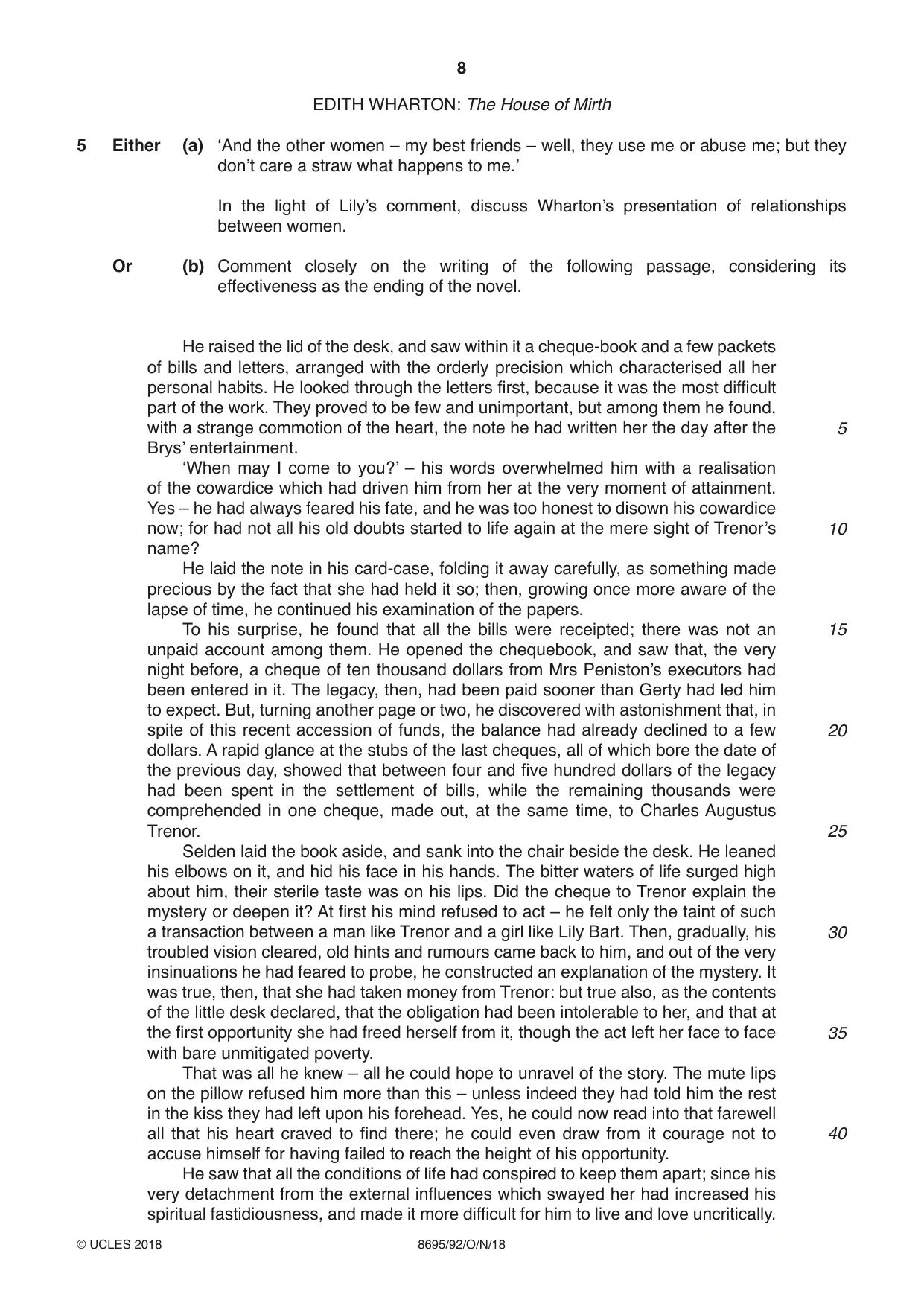
8 8695/92/O/N/18 © UCLES 2018 EDITH WHARTON: The House of Mirth 5 Either (a) ‘And the other women – my best friends – well, they use me or abuse me; but they don’t care a straw what happens to me.’ In the light of Lily’s comment, discuss Wharton’s presentation of relationships between women. Or (b) Comment closely on the writing of the following passage, considering its effectiveness as the ending of the novel. He raised the lid of the desk, and saw within it a cheque-book and a few packets of bills and letters, arranged with the orderly precision which characterised all her personal habits. He looked through the letters first, because it was the most difficult part of the work. They proved to be few and unimportant, but among them he found, with a strange commotion of the heart, the note he had written her the day after the Brys’ entertainment. ‘When may I come to you?’ – his words overwhelmed him with a realisation of the cowardice which had driven him from her at the very moment of attainment. Yes – he had always feared his fate, and he was too honest to disown his cowardice now; for had not all his old doubts started to life again at the mere sight of Trenor’s name? He laid the note in his card-case, folding it away carefully, as something made precious by the fact that she had held it so; then, growing once more aware of the lapse of time, he continued his examination of the papers. To his surprise, he found that all the bills were receipted; there was not an unpaid account among them. He opened the chequebook, and saw that, the very night before, a cheque of ten thousand dollars from Mrs Peniston’s executors had been entered in it. The legacy, then, had been paid sooner than Gerty had led him to expect. But, turning another page or two, he discovered with astonishment that, in spite of this recent accession of funds, the balance had already declined to a few dollars. A rapid glance at the stubs of the last cheques, all of which bore the date of the previous day, showed that between four and five hundred dollars of the legacy had been spent in the settlement of bills, while the remaining thousands were comprehended in one cheque, made out, at the same time, to Charles Augustus Trenor. Selden laid the book aside, and sank into the chair beside the desk. He leaned his elbows on it, and hid his face in his hands. The bitter waters of life surged high about him, their sterile taste was on his lips. Did the cheque to Trenor explain the mystery or deepen it? At first his mind refused to act – he felt only the taint of such a transaction between a man like Trenor and a girl like Lily Bart. Then, gradually, his troubled vision cleared, old hints and rumours came back to him, and out of the very insinuations he had feared to probe, he constructed an explanation of the mystery. It was true, then, that she had taken money from Trenor: but true also, as the contents of the little desk declared, that the obligation had been intolerable to her, and that at the first opportunity she had freed herself from it, though the act left her face to face with bare unmitigated poverty. That was all he knew – all he could hope to unravel of the story. The mute lips on the pillow refused him more than this – unless indeed they had told him the rest in the kiss they had left upon his forehead. Yes, he could now read into that farewell all that his heart craved to find there; he could even draw from it courage not to accuse himself for having failed to reach the height of his opportunity. He saw that all the conditions of life had conspired to keep them apart; since his very detachment from the external influences which swayed her had increased his spiritual fastidiousness, and made it more difficult for him to live and love uncritically. 5 10 15 20 25 30 35 40
Question paper, page 9
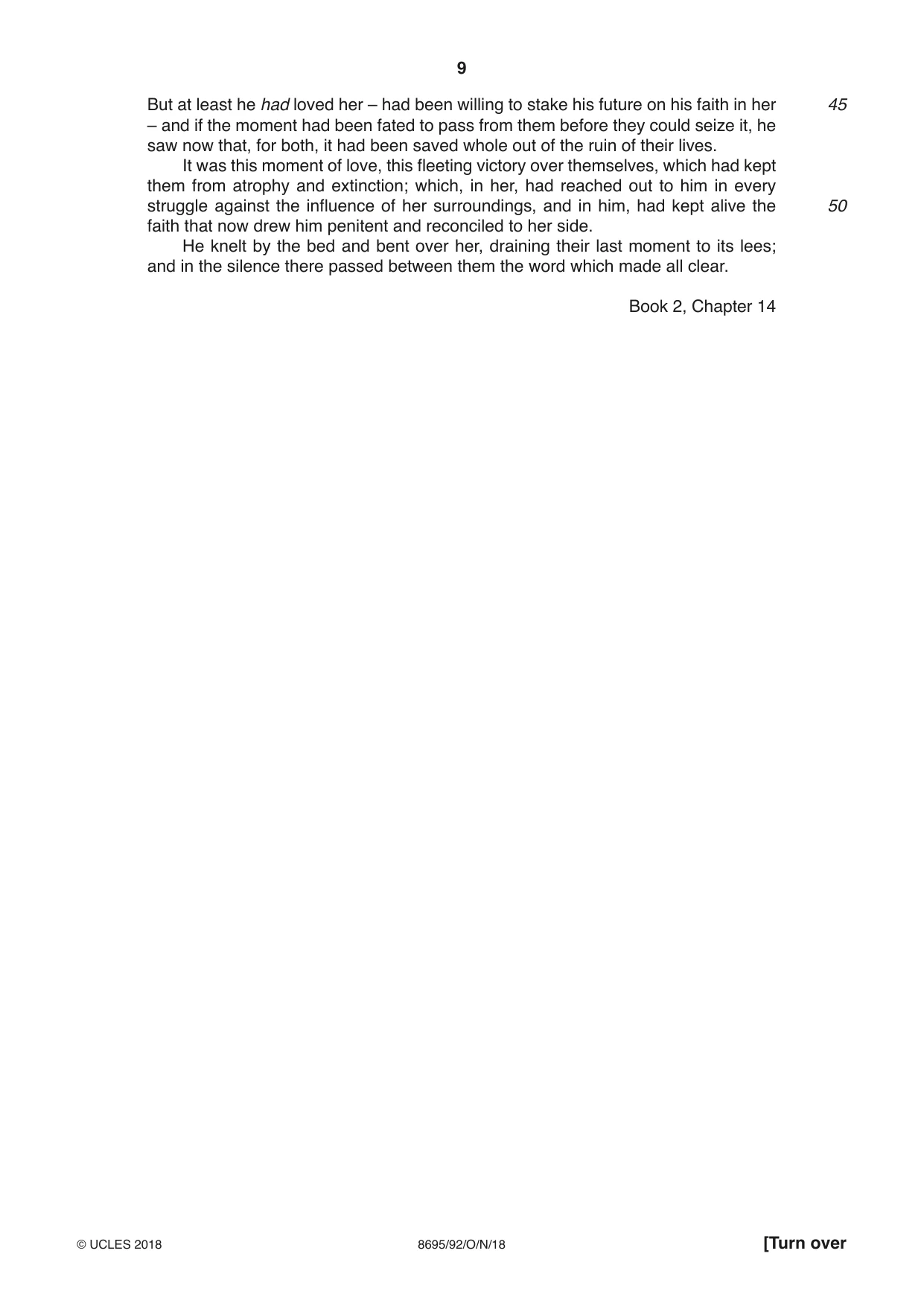
9 8695/92/O/N/18 © UCLES 2018 [Turn over But at least he had loved her – had been willing to stake his future on his faith in her – and if the moment had been fated to pass from them before they could seize it, he saw now that, for both, it had been saved whole out of the ruin of their lives. It was this moment of love, this fleeting victory over themselves, which had kept them from atrophy and extinction; which, in her, had reached out to him in every struggle against the influence of her surroundings, and in him, had kept alive the faith that now drew him penitent and reconciled to her side. He knelt by the bed and bent over her, draining their last moment to its lees; and in the silence there passed between them the word which made all clear. Book 2, Chapter 14 45 50
Question paper, page 10
10 8695/92/O/N/18 © UCLES 2018 Stories of Ourselves 6 Either (a) Compare the presentation and importance of human relationships in two stories. Or (b) Comment closely on the presentation of the characters and their attitudes in the following passage from An Englishman’s Home. Build. It was a word so hideous that no one in Much Malcock dared use it above a whisper. ‘Housing scheme’, ‘Development’, ‘Clearance’, ‘Council houses’, ‘Planning’ – these obscene words had been expunged from the polite vocabulary of the district, only to be used now and then, with the licence allowed to anthropologists, of the fierce tribes beyond the parish boundary. And now the horror was in their midst, the mark of Plague in the court of the Decameron. After the first moment of shock, Mr Metcalfe rallied for action, hesitated for a moment whether or no to plunge down the hill and challenge the enemy on his own ground, and decided against it; this was the moment to act with circumspection. He must consult Lady Peabury. It was three-quarters of a mile to the house; the lane ran past the gate which gave access to Westmacott’s field; a crazily-hung elm gate and deep cow-trodden mud, soon in Mr Metcalfe’s imagination, to give place to golden privet and red gravel. Mr Metcalfe could see the heads of the intruders bobbing beyond the hedge; they bore urban, purposeful black hats. He drove on, miserably. Lady Peabury was in the morning-room reading a novel; early training gave a guilty spice to this recreation, for she had been brought up to believe that to read a novel before luncheon was one of the gravest sins it was possible for a gentlewoman to commit. She slipped the book under a cushion and rose to greet Mr Metcalfe. ‘I was just getting ready to go out,’ she explained. Mr Metcalfe had no time for politenesses. ‘Lady Peabury,’ he began at once, ‘I have very terrible news.’ ‘Oh dear! Is poor Mr Cruttwell having trouble with the Wolf Cub account again?’ ‘No; at least, he is; there’s another fourpence gone astray; on the credit side this time, which makes it more worrying. But that isn’t what I came about. It is something that threatens our whole lives. They are going to build in Westmacott’s field.’ Briefly, but with emotion, he told Lady Peabury what he had seen. She listened gravely. When he had finished there was silence in the morning- room; six little clocks ticked among the chintzes and the potted azaleas. At last Lady Peabury spoke: ‘Westmacott has behaved very badly,’ she said. ‘I suppose you can’t blame him.’ ‘I do blame him, Mr Metcalfe, very severely. I can’t understand it at all. He always seemed a very decent man … I was thinking of making Mrs Westmacott secretary of the Women’s Institute. He had no right to do a thing like that without consulting us. Why, I look right on to that field from my bedroom windows. I could never understand why you didn’t buy the field yourself.’ It was let for £3 18s.; they had asked £170 for it; there was tithe and property tax on top of that. Lady Peabury knew this. ‘Any of us could have bought it at the time of sale,’ said Mr Metcalfe rather sharply. ‘It always went with your house.’ In another minute, Mr Metcalfe felt, she would be telling him that he had behaved very badly; that he had always seemed a very decent man. She was, in fact, thinking on just those lines at the moment. ‘I daresay it’s not too late even now for you to make an offer,’ she said. 5 10 15 20 25 30 35 40 45
Question paper, page 11
11 8695/92/O/N/18 © UCLES 2018 [Turn over ‘We are all equally threatened,’ said Mr Metcalfe. ‘I think we ought to act together. Hodge won’t be any too pleased when he hears the news.’ Colonel Hodge had heard, and he was none too pleased. He was waiting at the Hall when Mr Metcalfe got back. ‘Do you know what that scoundrel Westmacott has done?’ ‘Yes,’ said Mr Metcalfe rather wearily, ‘I know.’ The interview with Lady Peabury had not gone off quite as he had hoped. She had shown no enthusiasm for common action. ‘Sold his field to a lot of jerry builders.’ ‘Yes, I know.’ ‘Funny, I always thought it was your field.’ ‘No,’ said Mr Metcalfe, ‘never.’ ‘It always used to go with this house.’ ‘Yes, I know, but I didn’t happen to want it.’ ‘Well, it’s put us all in a pretty nasty fix, I must say. D’you suppose they’d sell it back to you now?’ An Englishman’s Home 50 55 60
Question paper, page 12
12 8695/92/O/N/18 © UCLES 2018 Section C: Drama WOLE SOYINKA: Death and the King’s Horseman 7 Either (a) In what ways does Soyinka dramatise a sense of duty and responsibility in Death and the King’s Horseman? Or (b) With close reference to detail, discuss Soyinka’s presentation of Jane and Olunde in the following extract. Olunde: I was sent a cable. Content removed due to copyright restrictions
Question paper, page 13
13 8695/92/O/N/18 © UCLES 2018 [Turn over Jane [after a moment’s pause]: Perhaps I can understand you now. Scene 4 Content removed due to copyright restrictions
Question paper, page 14
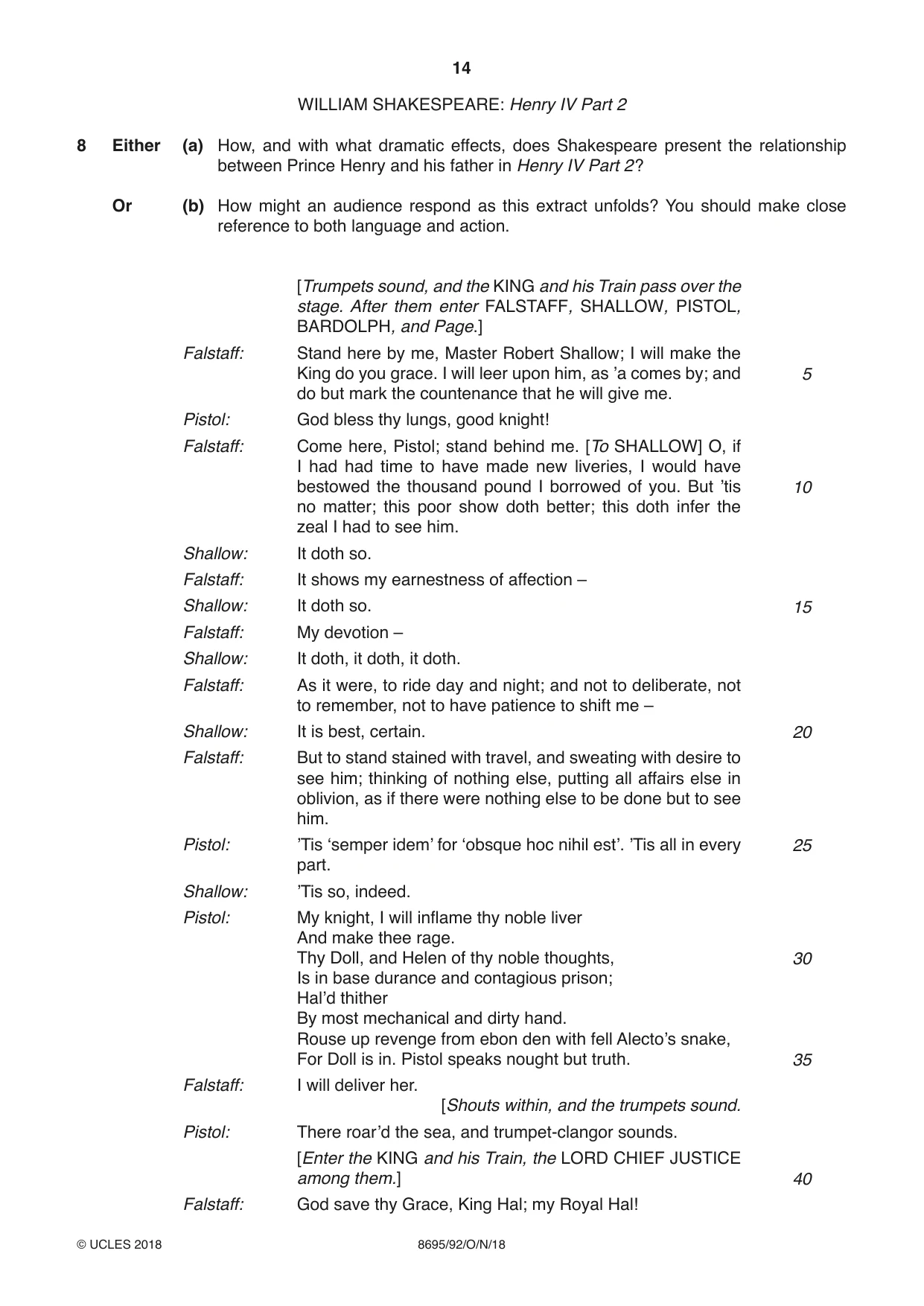
14 8695/92/O/N/18 © UCLES 2018 WILLIAM SHAKESPEARE: Henry IV Part 2 8 Either (a) How, and with what dramatic effects, does Shakespeare present the relationship between Prince Henry and his father in Henry IV Part 2? Or (b) How might an audience respond as this extract unfolds? You should make close reference to both language and action. [Trumpets sound, and the KING and his Train pass over the stage. After them enter FALSTAFF, SHALLOW, PISTOL, BARDOLPH, and Page.] Falstaff: Stand here by me, Master Robert Shallow; I will make the King do you grace. I will leer upon him, as ’a comes by; and do but mark the countenance that he will give me. Pistol: God bless thy lungs, good knight! Falstaff: Come here, Pistol; stand behind me. [To SHALLOW] O, if I had had time to have made new liveries, I would have bestowed the thousand pound I borrowed of you. But ’tis no matter; this poor show doth better; this doth infer the zeal I had to see him. Shallow: It doth so. Falstaff: It shows my earnestness of affection – Shallow: It doth so. Falstaff: My devotion – Shallow: It doth, it doth, it doth. Falstaff: As it were, to ride day and night; and not to deliberate, not to remember, not to have patience to shift me – Shallow: It is best, certain. Falstaff: But to stand stained with travel, and sweating with desire to see him; thinking of nothing else, putting all affairs else in oblivion, as if there were nothing else to be done but to see him. Pistol: ’Tis ‘semper idem’ for ‘obsque hoc nihil est’. ’Tis all in every part. Shallow: ’Tis so, indeed. Pistol: My knight, I will inflame thy noble liver And make thee rage. Thy Doll, and Helen of thy noble thoughts, Is in base durance and contagious prison; Hal’d thither By most mechanical and dirty hand. Rouse up revenge from ebon den with fell Alecto’s snake, For Doll is in. Pistol speaks nought but truth. Falstaff: I will deliver her. [Shouts within, and the trumpets sound. Pistol: There roar’d the sea, and trumpet-clangor sounds. [Enter the KING and his Train, the LORD CHIEF JUSTICE among them.] Falstaff: God save thy Grace, King Hal; my Royal Hal! 5 10 15 20 25 30 35 40
Question paper, page 15
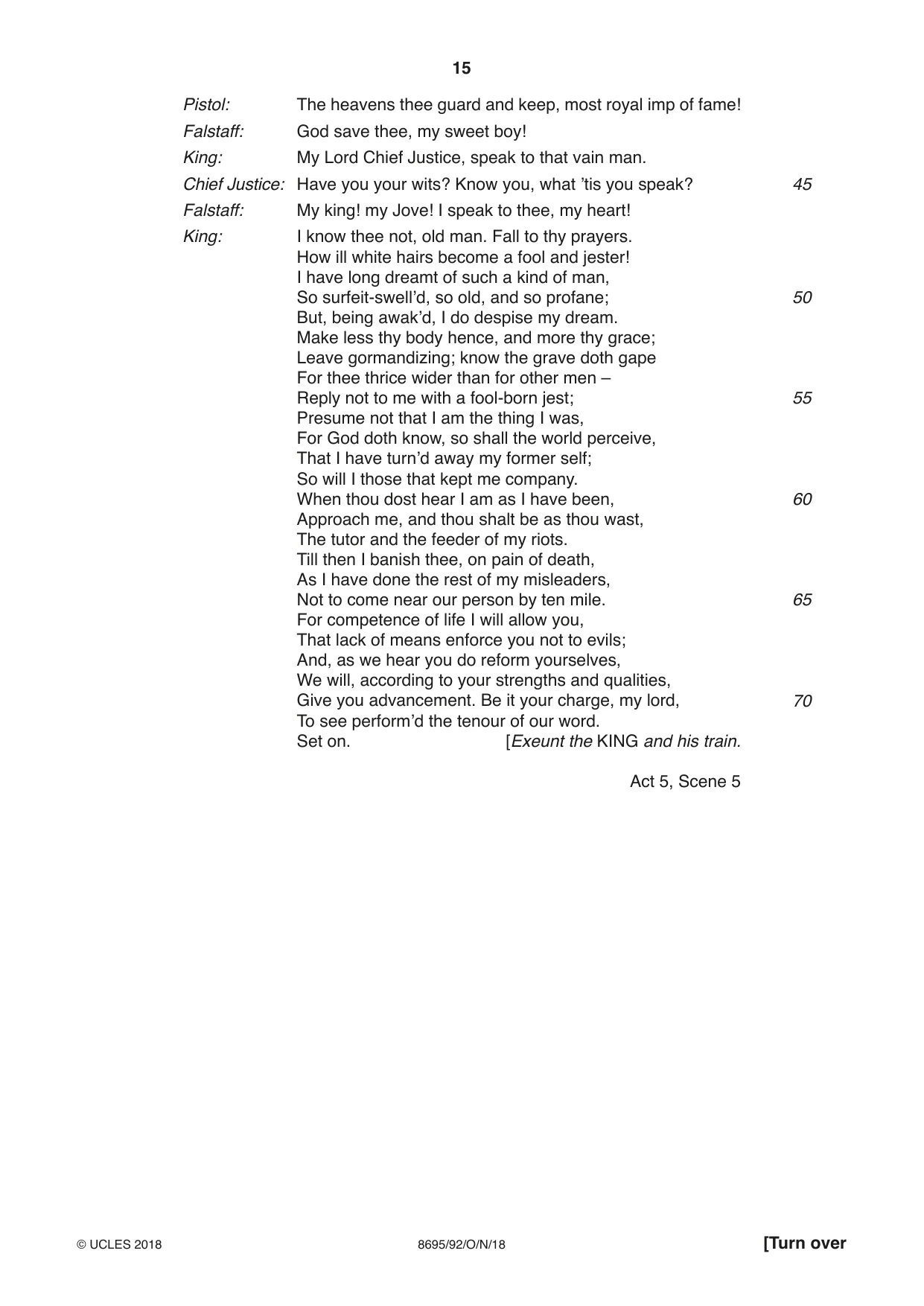
15 8695/92/O/N/18 © UCLES 2018 [Turn over Pistol: The heavens thee guard and keep, most royal imp of fame! Falstaff: God save thee, my sweet boy! King: My Lord Chief Justice, speak to that vain man. Chief Justice: Have you your wits? Know you, what ’tis you speak? Falstaff: My king! my Jove! I speak to thee, my heart! King: I know thee not, old man. Fall to thy prayers. How ill white hairs become a fool and jester! I have long dreamt of such a kind of man, So surfeit-swell’d, so old, and so profane; But, being awak’d, I do despise my dream. Make less thy body hence, and more thy grace; Leave gormandizing; know the grave doth gape For thee thrice wider than for other men – Reply not to me with a fool-born jest; Presume not that I am the thing I was, For God doth know, so shall the world perceive, That I have turn’d away my former self; So will I those that kept me company. When thou dost hear I am as I have been, Approach me, and thou shalt be as thou wast, The tutor and the feeder of my riots. Till then I banish thee, on pain of death, As I have done the rest of my misleaders, Not to come near our person by ten mile. For competence of life I will allow you, That lack of means enforce you not to evils; And, as we hear you do reform yourselves, We will, according to your strengths and qualities, Give you advancement. Be it your charge, my lord, To see perform’d the tenour of our word. Set on. [Exeunt the KING and his train. Act 5, Scene 5 45 50 55 60 65 70
Question paper, page 16
16 8695/92/O/N/18 © UCLES 2018 BRIAN FRIEL: Philadelphia, Here I Come! 9 Either (a) How, and with what dramatic effects, is Gar’s father (S.B.) presented in the play? Or (b) With close reference to detail, discuss Friel’s dramatic presentation of Gar’s state of mind at this point in the play. [PUBLIC gives over a note. BOYLE does not look at it.] Content removed due to copyright restrictions
Question paper, page 17
17 8695/92/O/N/18 © UCLES 2018 Together: ‘Philadelphia, here I come.’ [Curtain] Episode 1 Content removed due to copyright restrictions
Question paper, page 18
18 8695/92/O/N/18 © UCLES 2018 BLANK PAGE
Question paper, page 19
19 8695/92/O/N/18 © UCLES 2018 BLANK PAGE
Question paper, page 20
20 8695/92/O/N/18 © UCLES 2018 BLANK PAGE Permission to reproduce items where third-party owned material protected by copyright is included has been sought and cleared where possible. Every reasonable effort has been made by the publisher (UCLES) to trace copyright holders, but if any items requiring clearance have unwittingly been included, the publisher will be pleased to make amends at the earliest possible opportunity. To avoid the issue of disclosure of answer-related information to candidates, all copyright acknowledgements are reproduced online in the Cambridge International Examinations Copyright Acknowledgements Booklet. This is produced for each series of examinations and is freely available to download at www.cie.org.uk after the live examination series. Cambridge International Examinations is part of the Cambridge Assessment Group. Cambridge Assessment is the brand name of University of Cambridge Local Examinations Syndicate (UCLES), which is itself a department of the University of Cambridge.
Mark scheme, page 1
This document consists of 6 printed pages. © UCLES 2018 [Turn over Cambridge Assessment International Education Cambridge International Advanced Subsidiary Level LANGUAGE AND LITERATURE IN ENGLISH 8695/92 Paper 9 Poetry, Prose and Drama October/November 2018 MARK SCHEME Maximum Mark: 50 Published This mark scheme is published as an aid to teachers and candidates, to indicate the requirements of the examination. It shows the basis on which Examiners were instructed to award marks. It does not indicate the details of the discussions that took place at an Examiners’ meeting before marking began, which would have considered the acceptability of alternative answers. Mark schemes should be read in conjunction with the question paper and the Principal Examiner Report for Teachers. Cambridge International will not enter into discussions about these mark schemes. Cambridge International is publishing the mark schemes for the October/November 2018 series for most Cambridge IGCSE™, Cambridge International A and AS Level components and some Cambridge O Level components.
Mark scheme, page 2
8695/92 Cambridge International AS Level – Mark Scheme PUBLISHED October/November 2018 © UCLES 2018 Page 2 of 6 Generic Marking Principles These general marking principles must be applied by all examiners when marking candidate answers. They should be applied alongside the specific content of the mark scheme or generic level descriptors for a question. Each question paper and mark scheme will also comply with these marking principles. GENERIC MARKING PRINCIPLE 1: Marks must be awarded in line with: • the specific content of the mark scheme or the generic level descriptors for the question • the specific skills defined in the mark scheme or in the generic level descriptors for the question • the standard of response required by a candidate as exemplified by the standardisation scripts. GENERIC MARKING PRINCIPLE 2: Marks awarded are always whole marks (not half marks, or other fractions). GENERIC MARKING PRINCIPLE 3: Marks must be awarded positively: • marks are awarded for correct/valid answers, as defined in the mark scheme. However, credit is given for valid answers which go beyond the scope of the syllabus and mark scheme, referring to your Team Leader as appropriate • marks are awarded when candidates clearly demonstrate what they know and can do • marks are not deducted for errors • marks are not deducted for omissions • answers should only be judged on the quality of spelling, punctuation and grammar when these features are specifically assessed by the question as indicated by the mark scheme. The meaning, however, should be unambiguous. GENERIC MARKING PRINCIPLE 4: Rules must be applied consistently e.g. in situations where candidates have not followed instructions or in the application of generic level descriptors. GENERIC MARKING PRINCIPLE 5: Marks should be awarded using the full range of marks defined in the mark scheme for the question (however; the use of the full mark range may be limited according to the quality of the candidate responses seen). GENERIC MARKING PRINCIPLE 6: Marks awarded are based solely on the requirements as defined in the mark scheme. Marks should not be awarded with grade thresholds or grade descriptors in mind.
Mark scheme, page 3
8695/92 Cambridge International AS Level – Mark Scheme PUBLISHED October/November 2018 © UCLES 2018 Page 3 of 6 Introduction For general administrative guidance, see Notes for Examiners Handbook. Assessment objectives: AO1 The ability to respond to texts in the three main forms (Prose, Poetry and Drama) of different types and from different cultures. AO2 An understanding of the ways in which writers’ choices of form, structure and language shape meanings. AO3 The ability to produce informed, independent opinions and judgements on literary texts. AO4 The ability to communicate clearly the knowledge, understanding and insight appropriate for literary study. Each answer is marked out of 25, in accordance with the levels mark scheme. Each level is divided into strands: Knowledge (K), Understanding (U), Personal Response (P) and Communication (C). Using the levels mark scheme Place the answer in a level first. Look for the “best fit” of the answer into a level. An answer needs to show evidence of most but not necessarily all of the qualities described in a level, in order to be placed in that level. Then award a mark for the relative position of the answer within the level. Candidates may address the question in many different ways. Do not expect any particular focus or approach and do not penalise answers for leaving out a particular focus. Reward what is there, showing what you are rewarding, in your comments. Consider all strands and weigh up the performance as a whole in placing the answer in a level, then show that you have done so in the summative comment, e.g. Sound K of texts, some evidence of U but mostly narrative, occasional evidence of P, mainly clear C. Principles of Annotation Annotating English Literature scripts has the following purposes: • to follow best practice in assessing English Literature essays • to record the comments and developing thought of the examiner doing the work of assessment • to facilitate the summative comments and overall mark given to an essay. The annotations made on scripts become public property following marking and may be cited as evidence in case of appeal. Annotations are therefore vital, not just in ensuring the mark given is what the student deserves, but also in making the marking process demonstrably clear to any potential reader.
Mark scheme, page 4
8695/92 Cambridge International AS Level – Mark Scheme PUBLISHED October/November 2018 © UCLES 2018 Page 4 of 6 Level 6 22–25 Very good work – do not reserve this level for the very best work you see but ensure you put scripts into this level which fulfil the requirements described below. There will always be some candidates who are at a standard over the top of the mark scheme. K Evidence of a very good ability to select relevant knowledge to address the question with effective use of references and quotation. There may be evidence of sensitive awareness of the contexts in which the literary works studied were written and understood. U Evidence of very good understanding of ways in which writers’ choices of structure, form and language shape meanings with sustained analysis and sensitive appreciation of literary methods and effects and contexts, possibly including literary genres and conventions. P Personal response to texts will be perceptive, often freshly personal, fully supported with quotation, and may show originality in approach to and treatment of questions. C Candidates will express complex literary ideas and arguments with clarity and fluency. Answers will have a coherent structure, with logical progression and effectively linked paragraphs. Expression will be accomplished and appropriate. In answers to passage-based questions, work will sustain an appropriate balance between critical appreciation of given extracts, based on detailed critical analysis, and consideration of the broader textual issues raised by the questions, and relate part of a text to its whole and vice versa in a seamless argument. There will be a very good appreciation of the effects of the literary features of the text, with detailed analysis supported by relevant examples from the passage and the wider text, where appropriate. There will be a very good knowledge of the appropriate context of the extract or work. Level 5 18–21 Proficient work K Evidence of proficiency in selecting relevant knowledge to address the question with precise and integrated direct references to the text and supporting quotation. There may be evidence of awareness of the contexts in which the literary works studied were written and understood. U Evidence of intelligent understanding of ways in which writers’ choices of structure, form and language shape meanings, with analysis and appreciation of literary methods, effects and contexts. P Evidence of personal response to the texts, relevant to the question, supported from the text, some originality of thought, straightforward and vigorously articulated, perhaps, rather than penetrating and subtle. C Expression confident, with some complex ideas expressed with some fluency. Structure is sound. Literary arguments will be coherent, with progression of ideas through clearly linked paragraphs. In answers to passage-based questions, work will show engagement with both the given extracts and the wider textual issues. There will be a confident relation of a part of the text to its whole. There will be a proficient appreciation of the effects of the literary features of the text supported by relevant examples from the passage and from the wider text where appropriate. There will be a good knowledge of the appropriate context of the extract or work.
Mark scheme, page 5
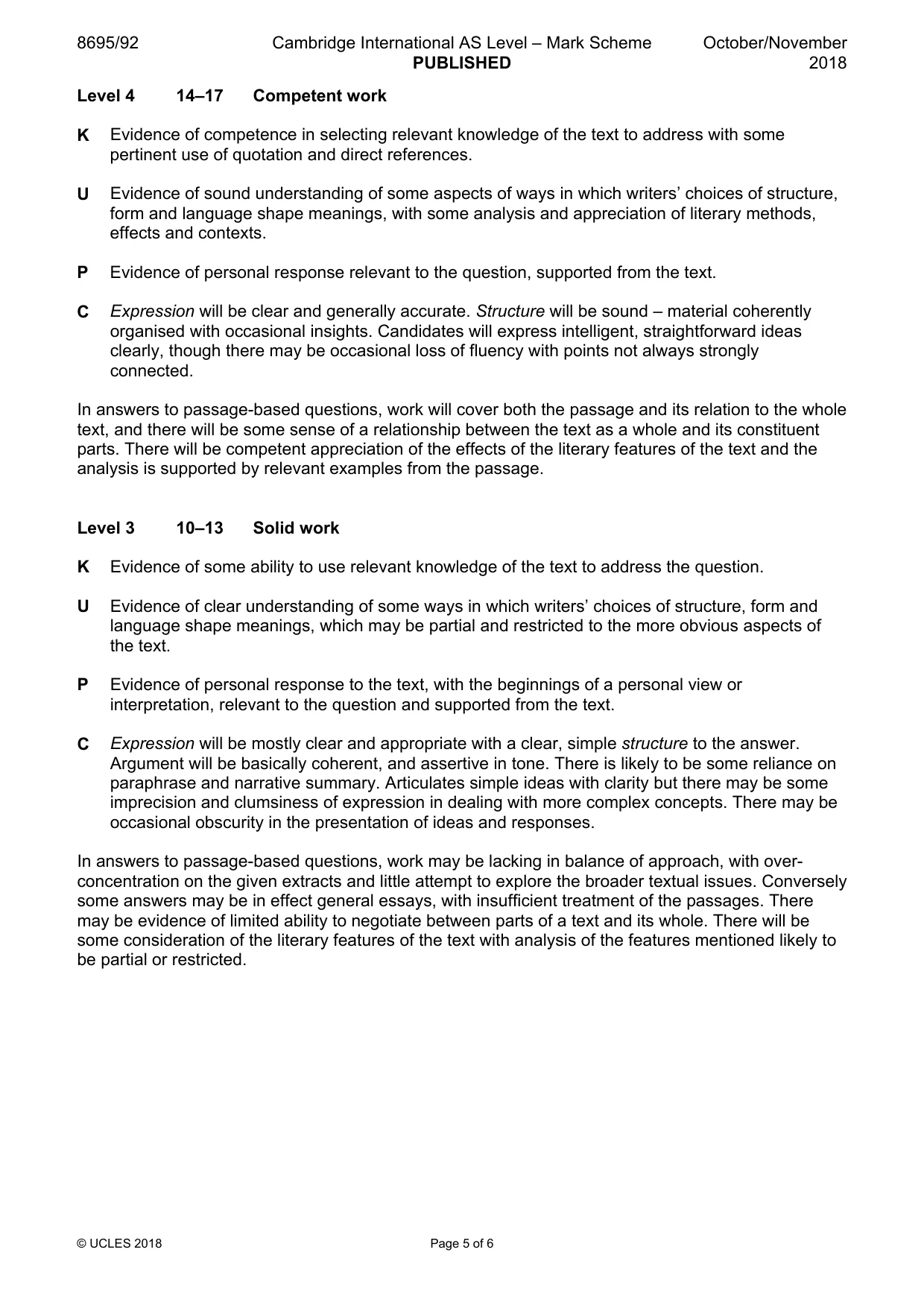
8695/92 Cambridge International AS Level – Mark Scheme PUBLISHED October/November 2018 © UCLES 2018 Page 5 of 6 Level 4 14–17 Competent work K Evidence of competence in selecting relevant knowledge of the text to address with some pertinent use of quotation and direct references. U Evidence of sound understanding of some aspects of ways in which writers’ choices of structure, form and language shape meanings, with some analysis and appreciation of literary methods, effects and contexts. P Evidence of personal response relevant to the question, supported from the text. C Expression will be clear and generally accurate. Structure will be sound – material coherently organised with occasional insights. Candidates will express intelligent, straightforward ideas clearly, though there may be occasional loss of fluency with points not always strongly connected. In answers to passage-based questions, work will cover both the passage and its relation to the whole text, and there will be some sense of a relationship between the text as a whole and its constituent parts. There will be competent appreciation of the effects of the literary features of the text and the analysis is supported by relevant examples from the passage. Level 3 10–13 Solid work K Evidence of some ability to use relevant knowledge of the text to address the question. U Evidence of clear understanding of some ways in which writers’ choices of structure, form and language shape meanings, which may be partial and restricted to the more obvious aspects of the text. P Evidence of personal response to the text, with the beginnings of a personal view or interpretation, relevant to the question and supported from the text. C Expression will be mostly clear and appropriate with a clear, simple structure to the answer. Argument will be basically coherent, and assertive in tone. There is likely to be some reliance on paraphrase and narrative summary. Articulates simple ideas with clarity but there may be some imprecision and clumsiness of expression in dealing with more complex concepts. There may be occasional obscurity in the presentation of ideas and responses. In answers to passage-based questions, work may be lacking in balance of approach, with over- concentration on the given extracts and little attempt to explore the broader textual issues. Conversely some answers may be in effect general essays, with insufficient treatment of the passages. There may be evidence of limited ability to negotiate between parts of a text and its whole. There will be some consideration of the literary features of the text with analysis of the features mentioned likely to be partial or restricted.
Mark scheme, page 6
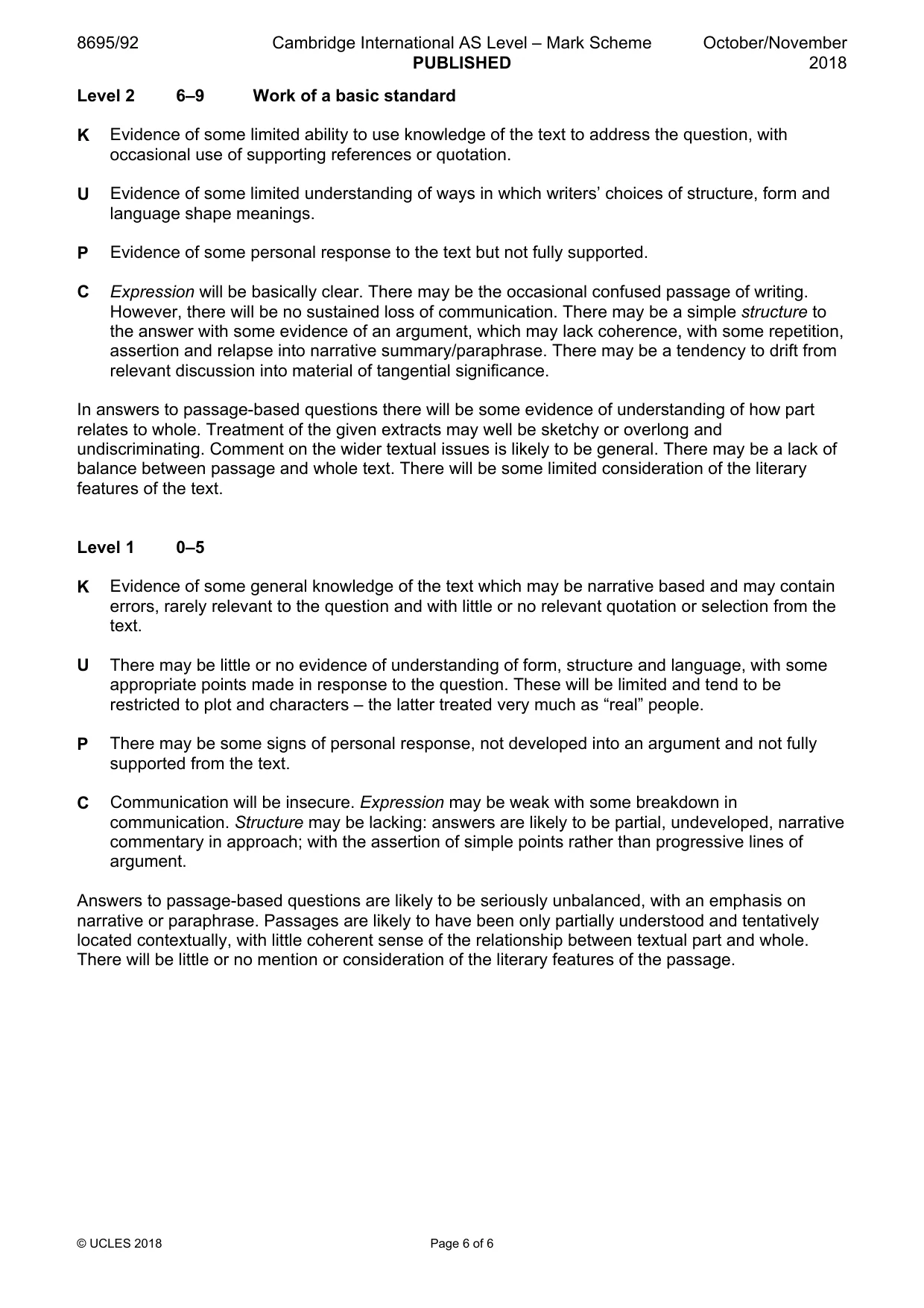
8695/92 Cambridge International AS Level – Mark Scheme PUBLISHED October/November 2018 © UCLES 2018 Page 6 of 6 Level 2 6–9 Work of a basic standard K Evidence of some limited ability to use knowledge of the text to address the question, with occasional use of supporting references or quotation. U Evidence of some limited understanding of ways in which writers’ choices of structure, form and language shape meanings. P Evidence of some personal response to the text but not fully supported. C Expression will be basically clear. There may be the occasional confused passage of writing. However, there will be no sustained loss of communication. There may be a simple structure to the answer with some evidence of an argument, which may lack coherence, with some repetition, assertion and relapse into narrative summary/paraphrase. There may be a tendency to drift from relevant discussion into material of tangential significance. In answers to passage-based questions there will be some evidence of understanding of how part relates to whole. Treatment of the given extracts may well be sketchy or overlong and undiscriminating. Comment on the wider textual issues is likely to be general. There may be a lack of balance between passage and whole text. There will be some limited consideration of the literary features of the text. Level 1 0–5 K Evidence of some general knowledge of the text which may be narrative based and may contain errors, rarely relevant to the question and with little or no relevant quotation or selection from the text. U There may be little or no evidence of understanding of form, structure and language, with some appropriate points made in response to the question. These will be limited and tend to be restricted to plot and characters – the latter treated very much as “real” people. P There may be some signs of personal response, not developed into an argument and not fully supported from the text. C Communication will be insecure. Expression may be weak with some breakdown in communication. Structure may be lacking: answers are likely to be partial, undeveloped, narrative commentary in approach; with the assertion of simple points rather than progressive lines of argument. Answers to passage-based questions are likely to be seriously unbalanced, with an emphasis on narrative or paraphrase. Passages are likely to have been only partially understood and tentatively located contextually, with little coherent sense of the relationship between textual part and whole. There will be little or no mention or consideration of the literary features of the passage.
What you needed in this session
Cambridge’s own grade thresholds for 2018 Oct/Nov, Paper 9 · Variant 2. A higher threshold means an easier paper — the bar moves with how the cohort did.