Cambridge A Level English - Language and Literature (AS Level only, from 2016) 8695 — 2019 Oct/Nov Paper 9 · Variant 1
8695/91/O/N/19 · 50 marks · ≈56 min
The question paper and its mark scheme, free to read here and free to download. This is Cambridge’s own paper, exactly as it was sat.
Question paper20 pages





Mark scheme6 pages
Answers below. Sit the paper first if you are practising.
Paper as text
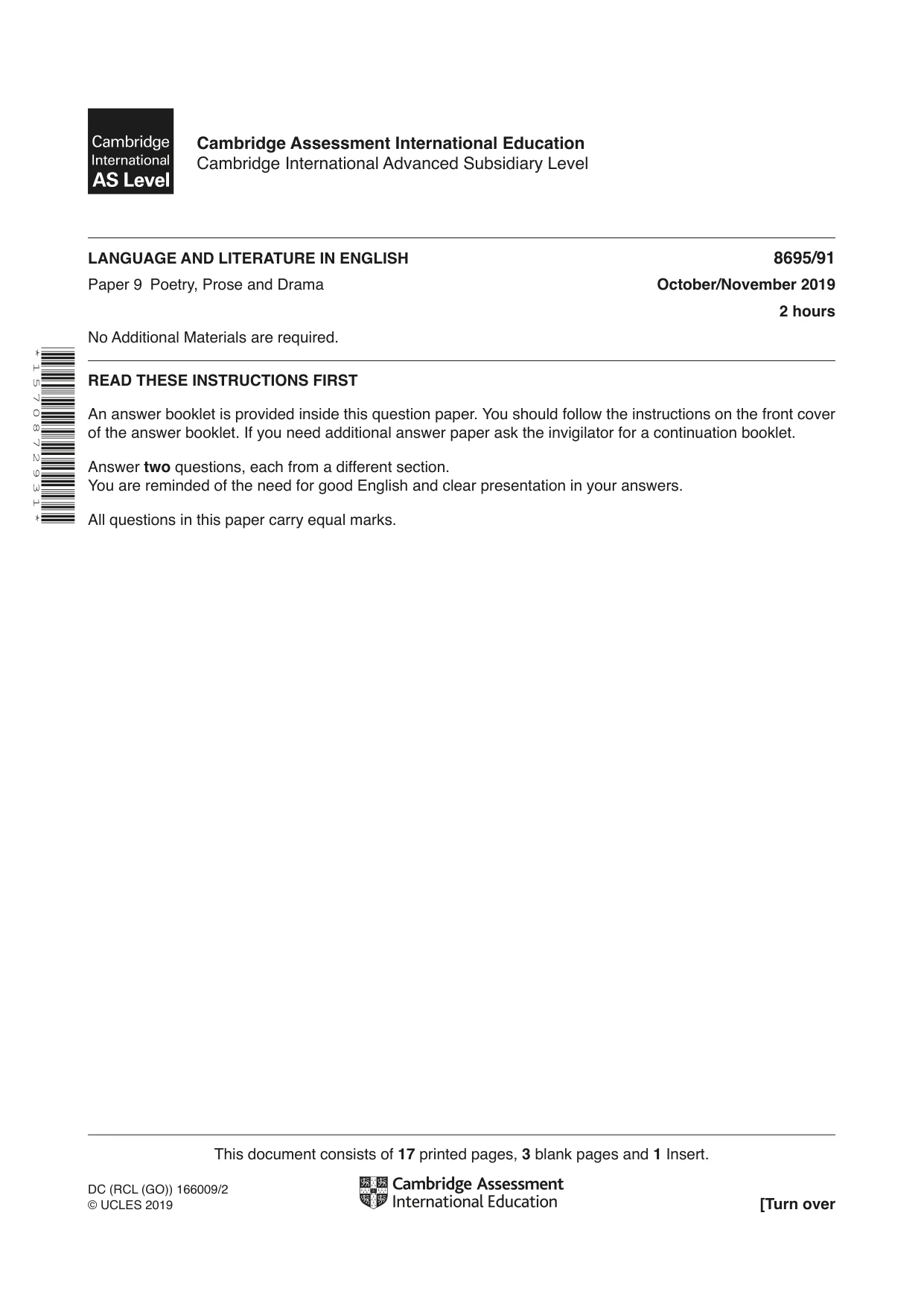
Question paper, page 1
This document consists of 17 printed pages, 3 blank pages and 1 Insert. DC (RCL (GO)) 166009/2 © UCLES 2019 [Turn over Cambridge Assessment International Education Cambridge International Advanced Subsidiary Level LANGUAGE AND LITERATURE IN ENGLISH 8695/91 Paper 9 Poetry, Prose and Drama October/November 2019 2 hours No Additional Materials are required. READ THESE INSTRUCTIONS FIRST An answer booklet is provided inside this question paper. You should follow the instructions on the front cover of the answer booklet. If you need additional answer paper ask the invigilator for a continuation booklet. Answer two questions, each from a different section. You are reminded of the need for good English and clear presentation in your answers. All questions in this paper carry equal marks. * 1 5 7 0 8 7 2 9 3 1 *
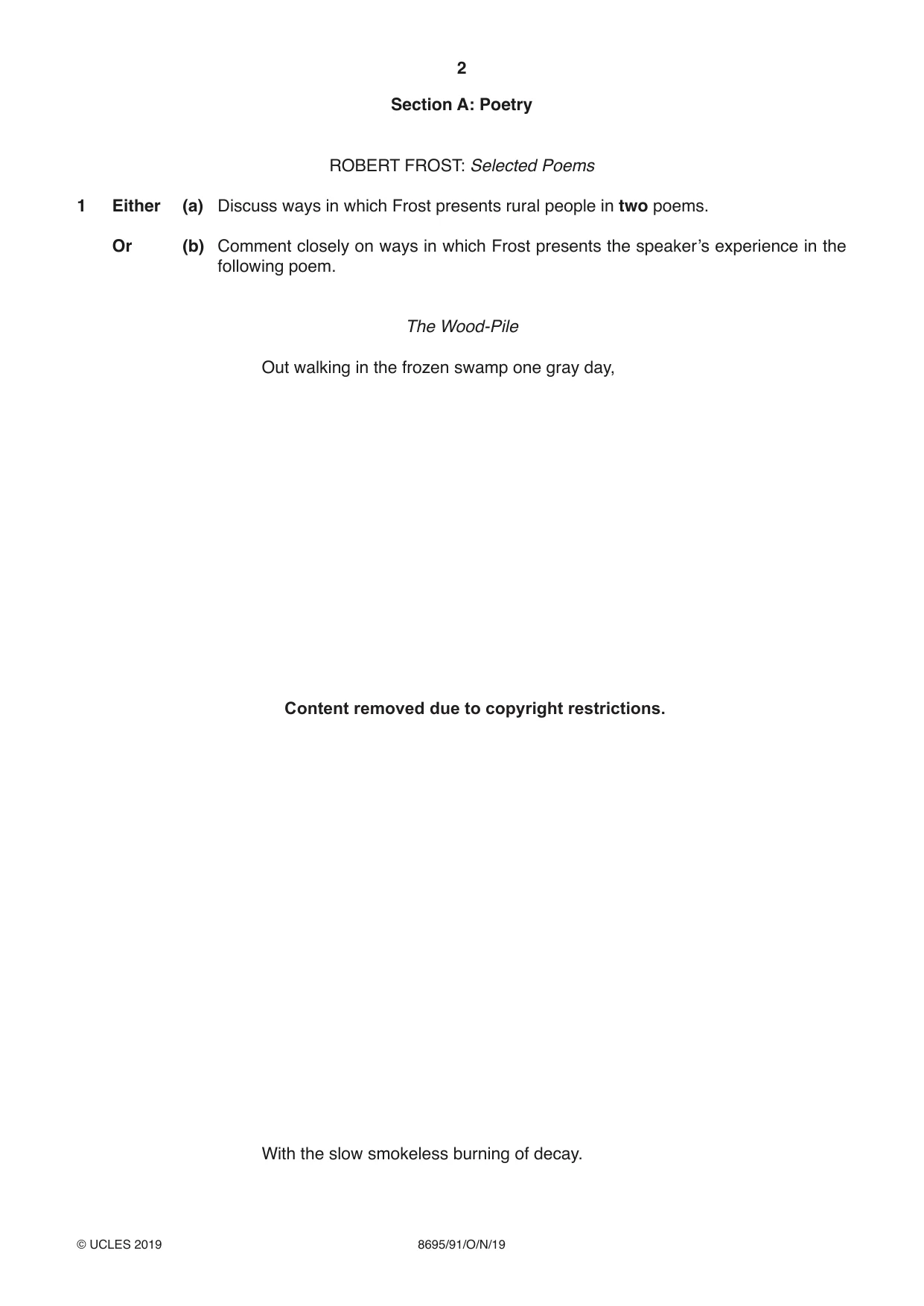
Question paper, page 2
2 8695/91/O/N/19 © UCLES 2019 Section A: Poetry ROBERT FROST: Selected Poems 1 Either (a) Discuss ways in which Frost presents rural people in two poems. Or (b) Comment closely on ways in which Frost presents the speaker’s experience in the following poem. The Wood-Pile Out walking in the frozen swamp one gray day, With the slow smokeless burning of decay. Content removed due to copyright restrictions.
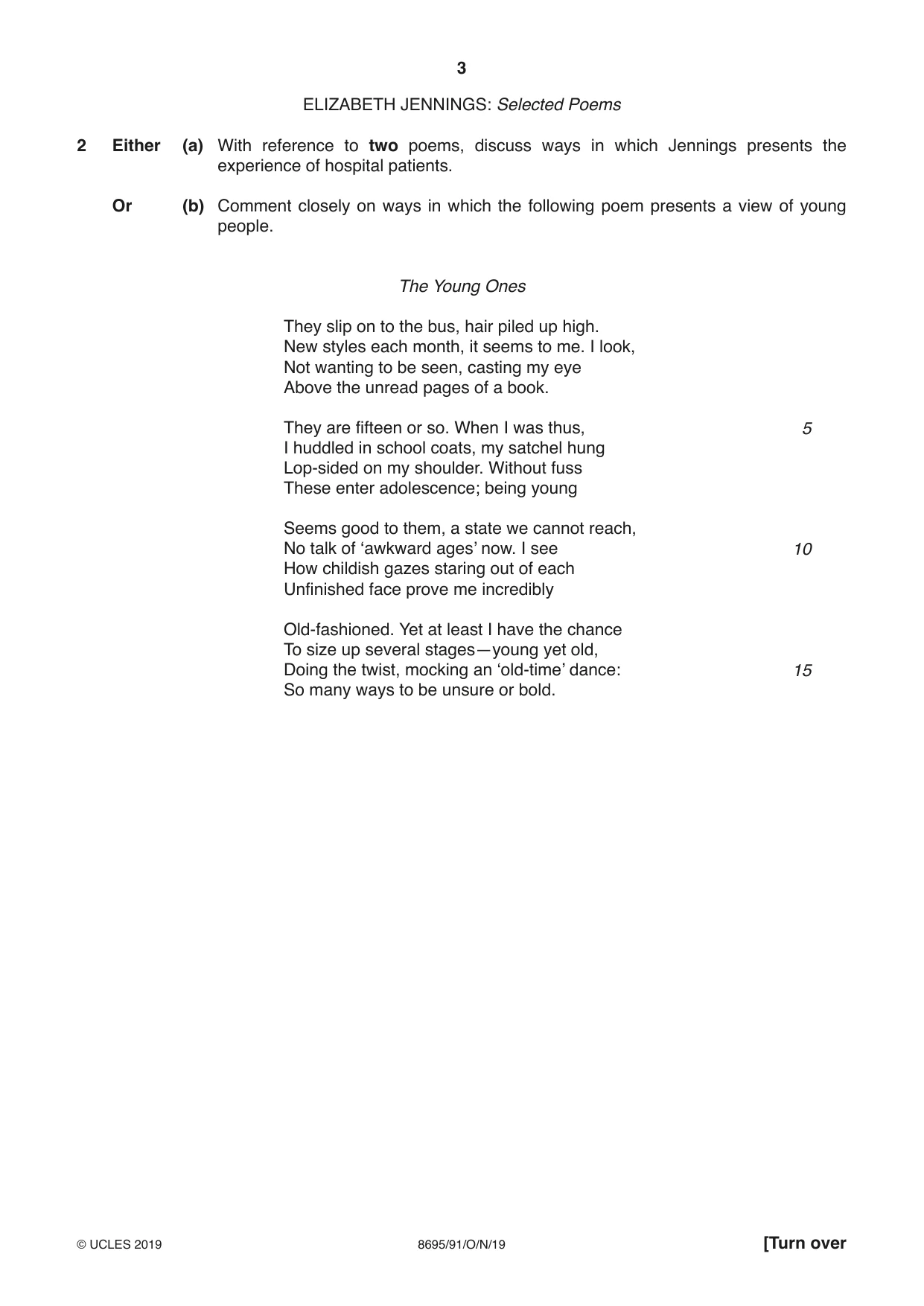
Question paper, page 3
3 8695/91/O/N/19 © UCLES 2019 [Turn over ELIZABETH JENNINGS: Selected Poems 2 Either (a) With reference to two poems, discuss ways in which Jennings presents the experience of hospital patients. Or (b) Comment closely on ways in which the following poem presents a view of young people. The Young Ones They slip on to the bus, hair piled up high. New styles each month, it seems to me. I look, Not wanting to be seen, casting my eye Above the unread pages of a book. They are fifteen or so. When I was thus, I huddled in school coats, my satchel hung Lop-sided on my shoulder. Without fuss These enter adolescence; being young Seems good to them, a state we cannot reach, No talk of ‘awkward ages’ now. I see How childish gazes staring out of each Unfinished face prove me incredibly Old-fashioned. Yet at least I have the chance To size up several stages—young yet old, Doing the twist, mocking an ‘old-time’ dance: So many ways to be unsure or bold. 5 10 15
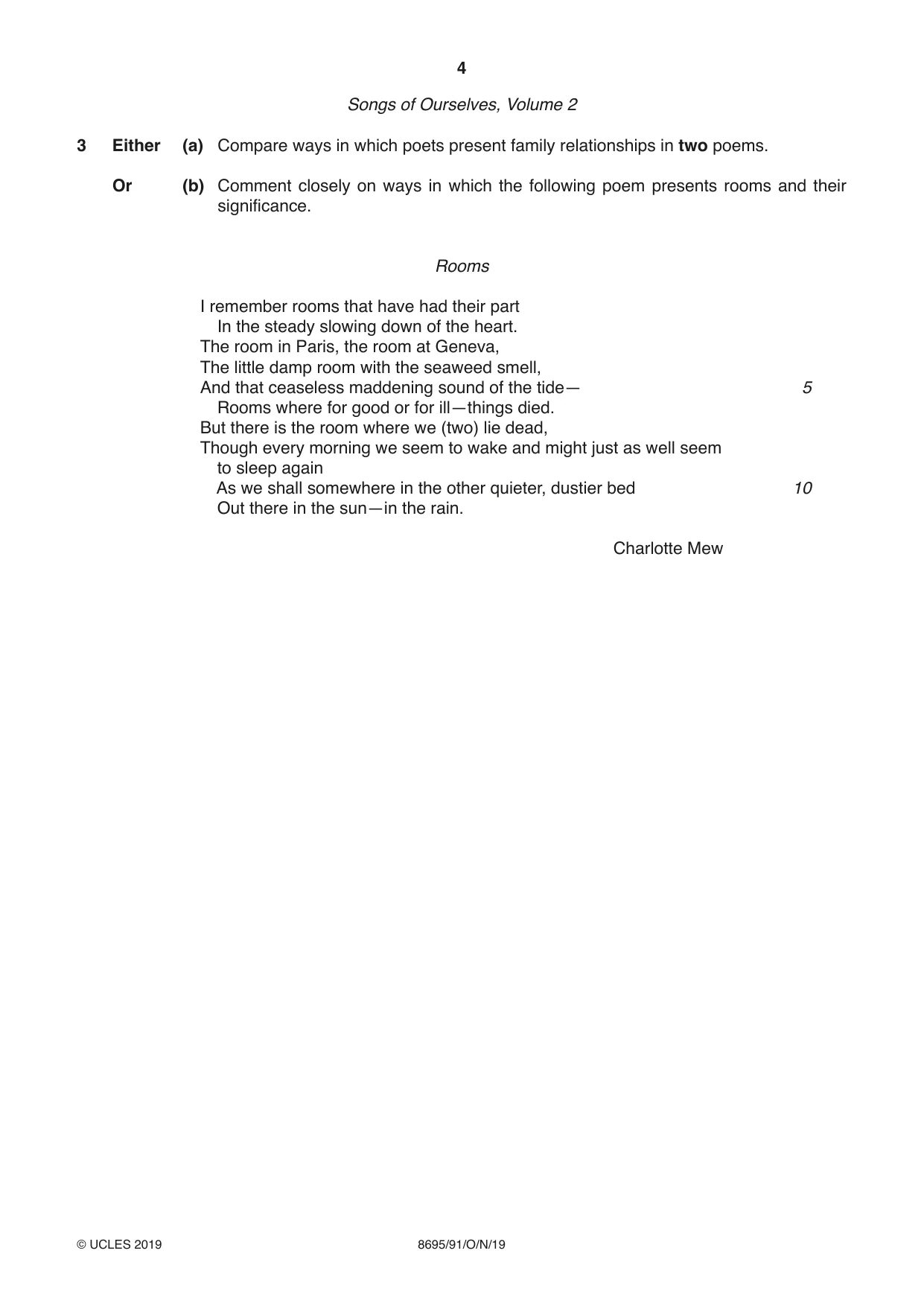
Question paper, page 4
4 8695/91/O/N/19 © UCLES 2019 Songs of Ourselves, Volume 2 3 Either (a) Compare ways in which poets present family relationships in two poems. Or (b) Comment closely on ways in which the following poem presents rooms and their significance. Rooms I remember rooms that have had their part In the steady slowing down of the heart. The room in Paris, the room at Geneva, The little damp room with the seaweed smell, And that ceaseless maddening sound of the tide— Rooms where for good or for ill—things died. But there is the room where we (two) lie dead, Though every morning we seem to wake and might just as well seem to sleep again As we shall somewhere in the other quieter, dustier bed Out there in the sun—in the rain. Charlotte Mew 5 10
Question paper, page 5
5 8695/91/O/N/19 © UCLES 2019 [Turn over Turn over for Section B.
Question paper, page 6
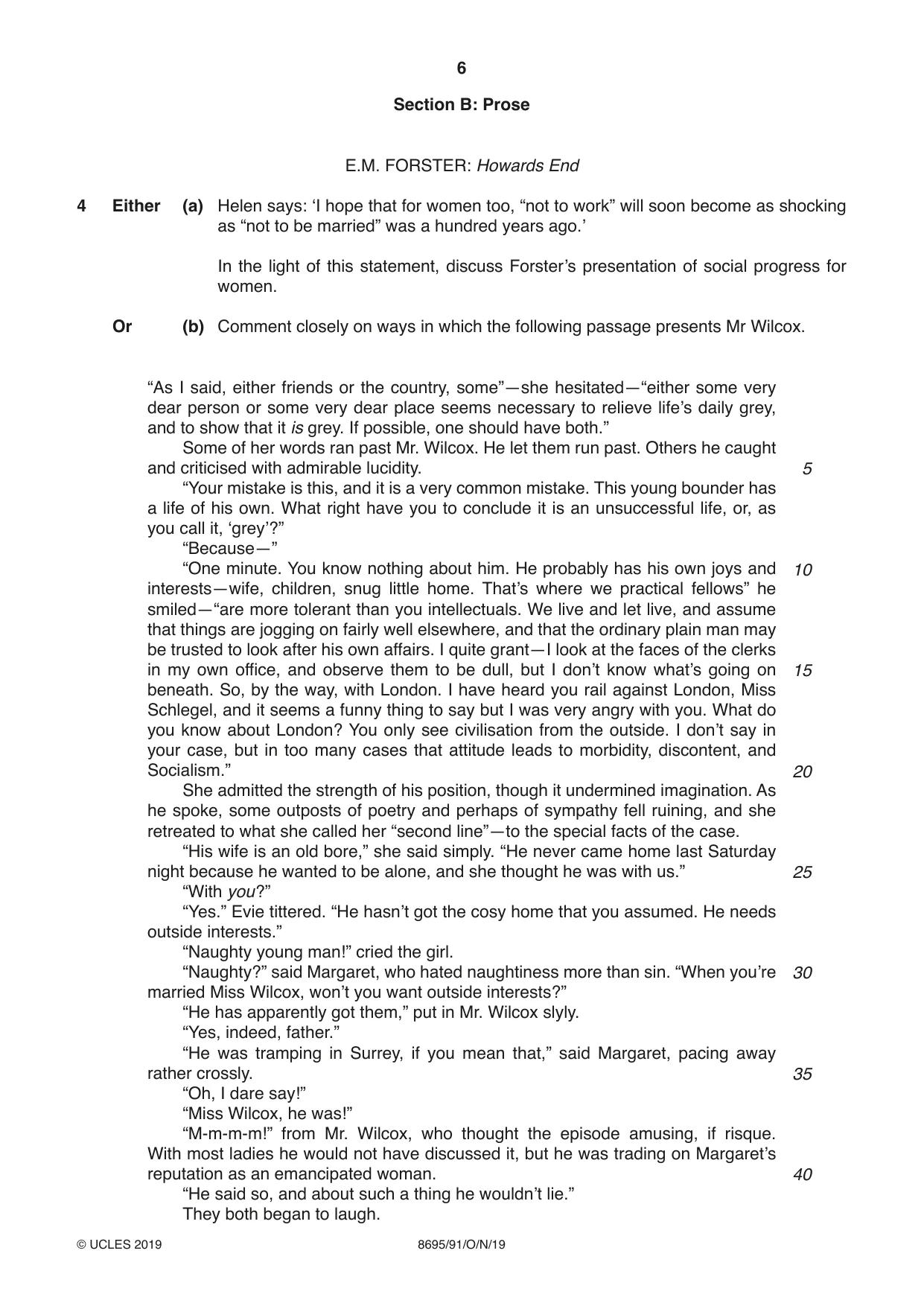
6 8695/91/O/N/19 © UCLES 2019 Section B: Prose E.M. FORSTER: Howards End 4 Either (a) Helen says: ‘I hope that for women too, “not to work” will soon become as shocking as “not to be married” was a hundred years ago.’ In the light of this statement, discuss Forster’s presentation of social progress for women. Or (b) Comment closely on ways in which the following passage presents Mr Wilcox. “As I said, either friends or the country, some”—she hesitated—“either some very dear person or some very dear place seems necessary to relieve life’s daily grey, and to show that it is grey. If possible, one should have both.” Some of her words ran past Mr. Wilcox. He let them run past. Others he caught and criticised with admirable lucidity. “Your mistake is this, and it is a very common mistake. This young bounder has a life of his own. What right have you to conclude it is an unsuccessful life, or, as you call it, ‘grey’?” “Because—” “One minute. You know nothing about him. He probably has his own joys and interests—wife, children, snug little home. That’s where we practical fellows” he smiled—“are more tolerant than you intellectuals. We live and let live, and assume that things are jogging on fairly well elsewhere, and that the ordinary plain man may be trusted to look after his own affairs. I quite grant—I look at the faces of the clerks in my own office, and observe them to be dull, but I don’t know what’s going on beneath. So, by the way, with London. I have heard you rail against London, Miss Schlegel, and it seems a funny thing to say but I was very angry with you. What do you know about London? You only see civilisation from the outside. I don’t say in your case, but in too many cases that attitude leads to morbidity, discontent, and Socialism.” She admitted the strength of his position, though it undermined imagination. As he spoke, some outposts of poetry and perhaps of sympathy fell ruining, and she retreated to what she called her “second line”—to the special facts of the case. “His wife is an old bore,” she said simply. “He never came home last Saturday night because he wanted to be alone, and she thought he was with us.” “With you?” “Yes.” Evie tittered. “He hasn’t got the cosy home that you assumed. He needs outside interests.” “Naughty young man!” cried the girl. “Naughty?” said Margaret, who hated naughtiness more than sin. “When you’re married Miss Wilcox, won’t you want outside interests?” “He has apparently got them,” put in Mr. Wilcox slyly. “Yes, indeed, father.” “He was tramping in Surrey, if you mean that,” said Margaret, pacing away rather crossly. “Oh, I dare say!” “Miss Wilcox, he was!” “M-m-m-m!” from Mr. Wilcox, who thought the episode amusing, if risque. With most ladies he would not have discussed it, but he was trading on Margaret’s reputation as an emancipated woman. “He said so, and about such a thing he wouldn’t lie.” They both began to laugh. 5 10 15 20 25 30 35 40
Question paper, page 7
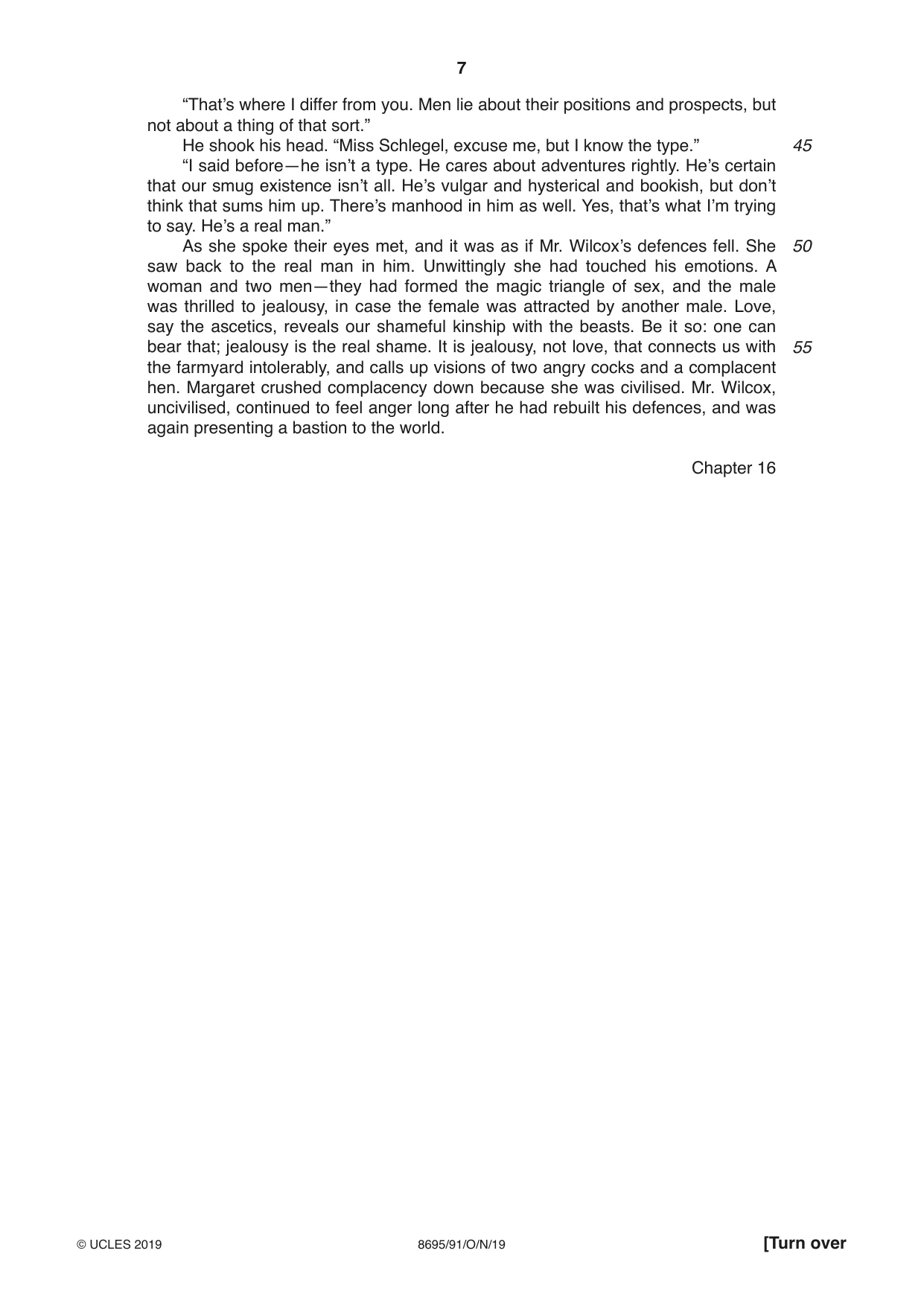
7 8695/91/O/N/19 © UCLES 2019 [Turn over “That’s where I differ from you. Men lie about their positions and prospects, but not about a thing of that sort.” He shook his head. “Miss Schlegel, excuse me, but I know the type.” “I said before—he isn’t a type. He cares about adventures rightly. He’s certain that our smug existence isn’t all. He’s vulgar and hysterical and bookish, but don’t think that sums him up. There’s manhood in him as well. Yes, that’s what I’m trying to say. He’s a real man.” As she spoke their eyes met, and it was as if Mr. Wilcox’s defences fell. She saw back to the real man in him. Unwittingly she had touched his emotions. A woman and two men—they had formed the magic triangle of sex, and the male was thrilled to jealousy, in case the female was attracted by another male. Love, say the ascetics, reveals our shameful kinship with the beasts. Be it so: one can bear that; jealousy is the real shame. It is jealousy, not love, that connects us with the farmyard intolerably, and calls up visions of two angry cocks and a complacent hen. Margaret crushed complacency down because she was civilised. Mr. Wilcox, uncivilised, continued to feel anger long after he had rebuilt his defences, and was again presenting a bastion to the world. Chapter 16 45 50 55
Question paper, page 8
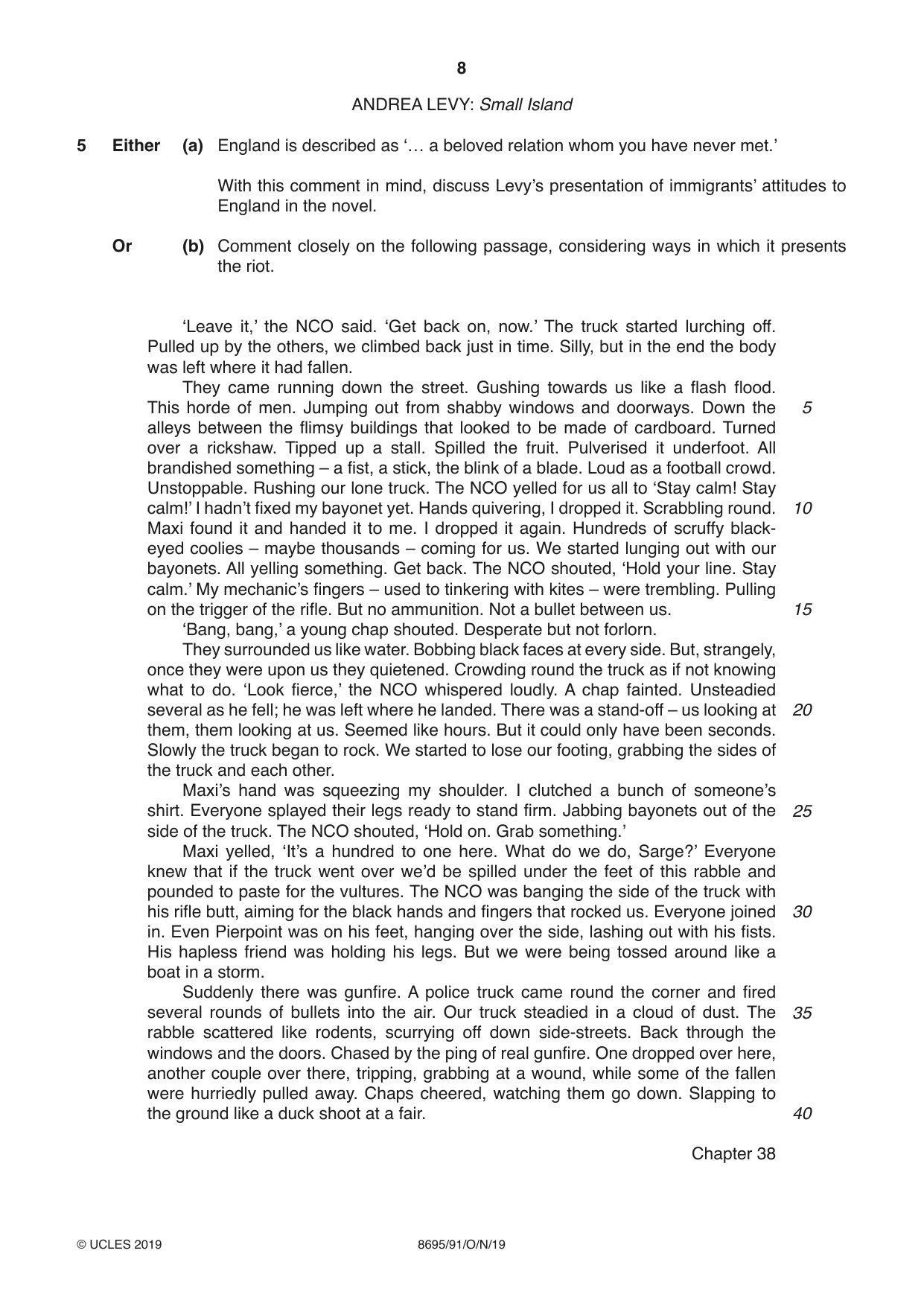
8 8695/91/O/N/19 © UCLES 2019 ANDREA LEVY: Small Island 5 Either (a) England is described as ‘… a beloved relation whom you have never met.’ With this comment in mind, discuss Levy’s presentation of immigrants’ attitudes to England in the novel. Or (b) Comment closely on the following passage, considering ways in which it presents the riot. ‘Leave it,’ the NCO said. ‘Get back on, now.’ The truck started lurching off. Pulled up by the others, we climbed back just in time. Silly, but in the end the body was left where it had fallen. They came running down the street. Gushing towards us like a flash flood. This horde of men. Jumping out from shabby windows and doorways. Down the alleys between the flimsy buildings that looked to be made of cardboard. Turned over a rickshaw. Tipped up a stall. Spilled the fruit. Pulverised it underfoot. All brandished something – a fist, a stick, the blink of a blade. Loud as a football crowd. Unstoppable. Rushing our lone truck. The NCO yelled for us all to ‘Stay calm! Stay calm!’ I hadn’t fixed my bayonet yet. Hands quivering, I dropped it. Scrabbling round. Maxi found it and handed it to me. I dropped it again. Hundreds of scruffy black- eyed coolies – maybe thousands – coming for us. We started lunging out with our bayonets. All yelling something. Get back. The NCO shouted, ‘Hold your line. Stay calm.’ My mechanic’s fingers – used to tinkering with kites – were trembling. Pulling on the trigger of the rifle. But no ammunition. Not a bullet between us. ‘Bang, bang,’ a young chap shouted. Desperate but not forlorn. They surrounded us like water. Bobbing black faces at every side. But, strangely, once they were upon us they quietened. Crowding round the truck as if not knowing what to do. ‘Look fierce,’ the NCO whispered loudly. A chap fainted. Unsteadied several as he fell; he was left where he landed. There was a stand-off – us looking at them, them looking at us. Seemed like hours. But it could only have been seconds. Slowly the truck began to rock. We started to lose our footing, grabbing the sides of the truck and each other. Maxi’s hand was squeezing my shoulder. I clutched a bunch of someone’s shirt. Everyone splayed their legs ready to stand firm. Jabbing bayonets out of the side of the truck. The NCO shouted, ‘Hold on. Grab something.’ Maxi yelled, ‘It’s a hundred to one here. What do we do, Sarge?’ Everyone knew that if the truck went over we’d be spilled under the feet of this rabble and pounded to paste for the vultures. The NCO was banging the side of the truck with his rifle butt, aiming for the black hands and fingers that rocked us. Everyone joined in. Even Pierpoint was on his feet, hanging over the side, lashing out with his fists. His hapless friend was holding his legs. But we were being tossed around like a boat in a storm. Suddenly there was gunfire. A police truck came round the corner and fired several rounds of bullets into the air. Our truck steadied in a cloud of dust. The rabble scattered like rodents, scurrying off down side-streets. Back through the windows and the doors. Chased by the ping of real gunfire. One dropped over here, another couple over there, tripping, grabbing at a wound, while some of the fallen were hurriedly pulled away. Chaps cheered, watching them go down. Slapping to the ground like a duck shoot at a fair. Chapter 38 5 10 15 20 25 30 35 40
Question paper, page 9
9 8695/91/O/N/19 © UCLES 2019 [Turn over Turn over for Question 6.
Question paper, page 10
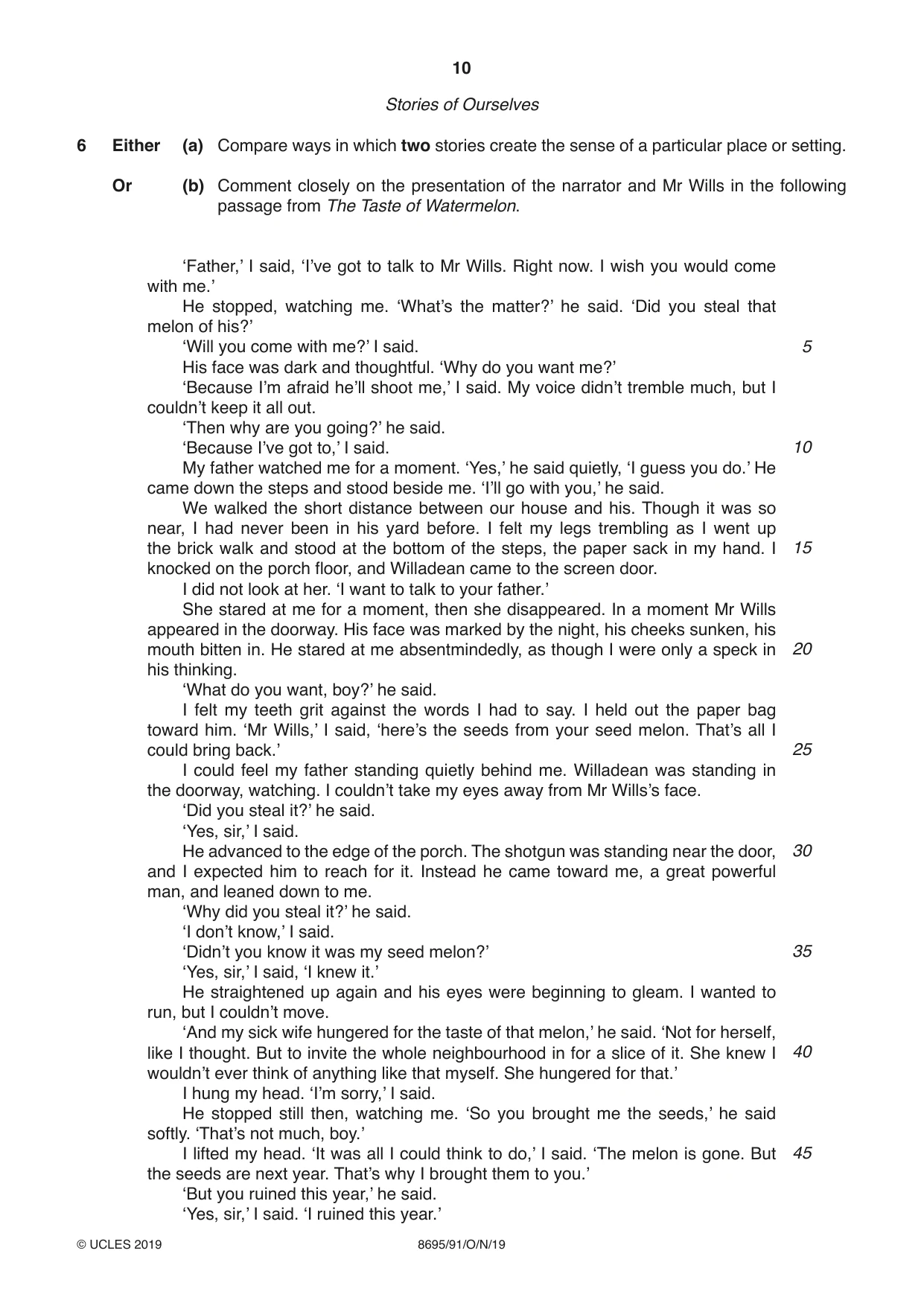
10 8695/91/O/N/19 © UCLES 2019 Stories of Ourselves 6 Either (a) Compare ways in which two stories create the sense of a particular place or setting. Or (b) Comment closely on the presentation of the narrator and Mr Wills in the following passage from The Taste of Watermelon. ‘Father,’ I said, ‘I’ve got to talk to Mr Wills. Right now. I wish you would come with me.’ He stopped, watching me. ‘What’s the matter?’ he said. ‘Did you steal that melon of his?’ ‘Will you come with me?’ I said. His face was dark and thoughtful. ‘Why do you want me?’ ‘Because I’m afraid he’ll shoot me,’ I said. My voice didn’t tremble much, but I couldn’t keep it all out. ‘Then why are you going?’ he said. ‘Because I’ve got to,’ I said. My father watched me for a moment. ‘Yes,’ he said quietly, ‘I guess you do.’ He came down the steps and stood beside me. ‘I’ll go with you,’ he said. We walked the short distance between our house and his. Though it was so near, I had never been in his yard before. I felt my legs trembling as I went up the brick walk and stood at the bottom of the steps, the paper sack in my hand. I knocked on the porch floor, and Willadean came to the screen door. I did not look at her. ‘I want to talk to your father.’ She stared at me for a moment, then she disappeared. In a moment Mr Wills appeared in the doorway. His face was marked by the night, his cheeks sunken, his mouth bitten in. He stared at me absentmindedly, as though I were only a speck in his thinking. ‘What do you want, boy?’ he said. I felt my teeth grit against the words I had to say. I held out the paper bag toward him. ‘Mr Wills,’ I said, ‘here’s the seeds from your seed melon. That’s all I could bring back.’ I could feel my father standing quietly behind me. Willadean was standing in the doorway, watching. I couldn’t take my eyes away from Mr Wills’s face. ‘Did you steal it?’ he said. ‘Yes, sir,’ I said. He advanced to the edge of the porch. The shotgun was standing near the door, and I expected him to reach for it. Instead he came toward me, a great powerful man, and leaned down to me. ‘Why did you steal it?’ he said. ‘I don’t know,’ I said. ‘Didn’t you know it was my seed melon?’ ‘Yes, sir,’ I said, ‘I knew it.’ He straightened up again and his eyes were beginning to gleam. I wanted to run, but I couldn’t move. ‘And my sick wife hungered for the taste of that melon,’ he said. ‘Not for herself, like I thought. But to invite the whole neighbourhood in for a slice of it. She knew I wouldn’t ever think of anything like that myself. She hungered for that.’ I hung my head. ‘I’m sorry,’ I said. He stopped still then, watching me. ‘So you brought me the seeds,’ he said softly. ‘That’s not much, boy.’ I lifted my head. ‘It was all I could think to do,’ I said. ‘The melon is gone. But the seeds are next year. That’s why I brought them to you.’ ‘But you ruined this year,’ he said. ‘Yes, sir,’ I said. ‘I ruined this year.’ 5 10 15 20 25 30 35 40 45
Question paper, page 11
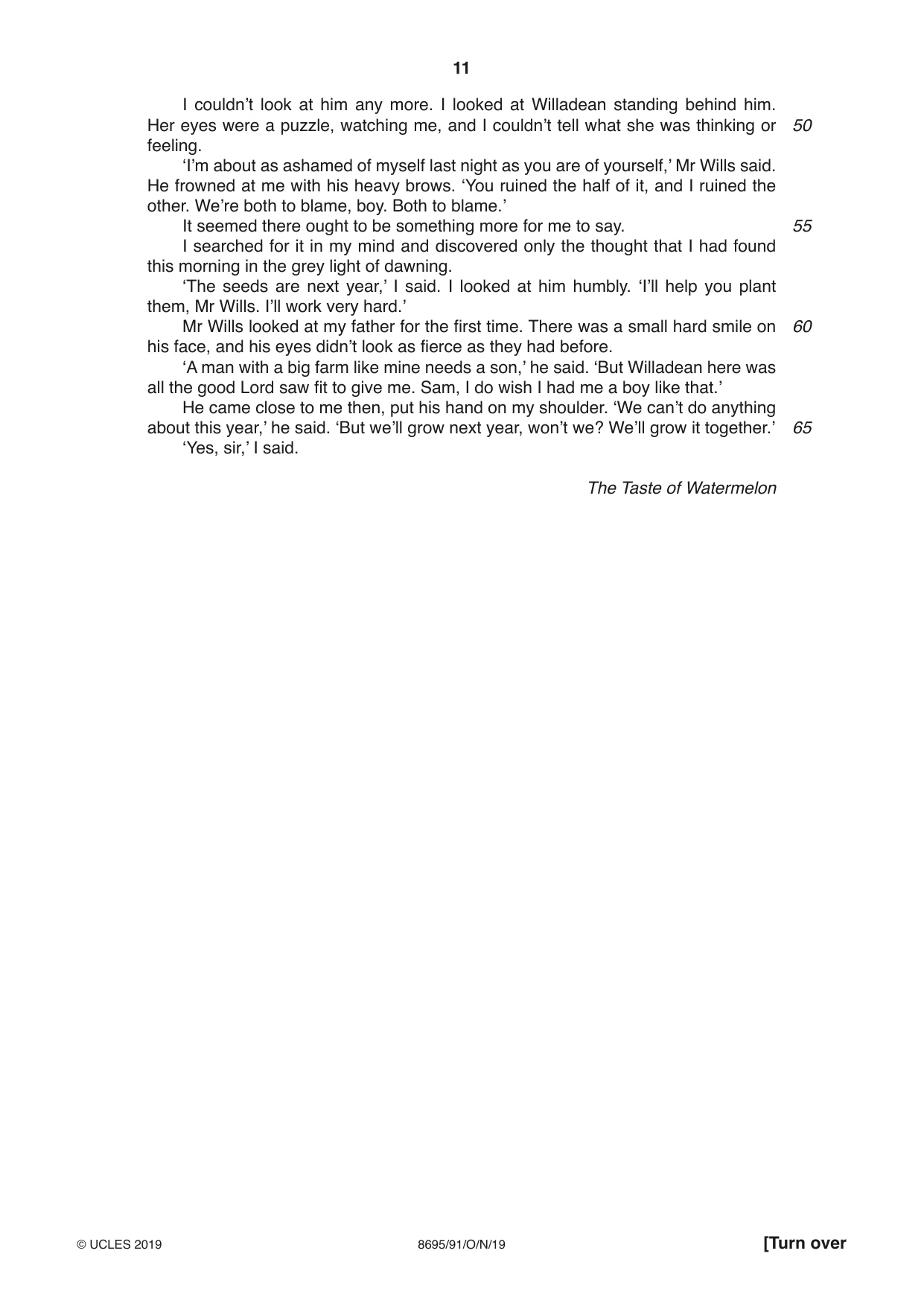
11 8695/91/O/N/19 © UCLES 2019 [Turn over I couldn’t look at him any more. I looked at Willadean standing behind him. Her eyes were a puzzle, watching me, and I couldn’t tell what she was thinking or feeling. ‘I’m about as ashamed of myself last night as you are of yourself,’ Mr Wills said. He frowned at me with his heavy brows. ‘You ruined the half of it, and I ruined the other. We’re both to blame, boy. Both to blame.’ It seemed there ought to be something more for me to say. I searched for it in my mind and discovered only the thought that I had found this morning in the grey light of dawning. ‘The seeds are next year,’ I said. I looked at him humbly. ‘I’ll help you plant them, Mr Wills. I’ll work very hard.’ Mr Wills looked at my father for the first time. There was a small hard smile on his face, and his eyes didn’t look as fierce as they had before. ‘A man with a big farm like mine needs a son,’ he said. ‘But Willadean here was all the good Lord saw fit to give me. Sam, I do wish I had me a boy like that.’ He came close to me then, put his hand on my shoulder. ‘We can’t do anything about this year,’ he said. ‘But we’ll grow next year, won’t we? We’ll grow it together.’ ‘Yes, sir,’ I said. The Taste of Watermelon 50 55 60 65
Question paper, page 12
12 8695/91/O/N/19 © UCLES 2019 Section C: Drama WOLE SOYINKA: Death and the King’s Horseman 7 Either (a) In what ways, and with what dramatic effects, does Soyinka present the relationship between Elesin and the Praise-Singer in Death and the King’s Horseman? Or (b) Comment closely on the ways in which Soyinka presents contrasts between Yoruban and European values in the following extract. You should pay careful attention to both language and action. Pilkings: I think you’d better leave. Content removed due to copyright restrictions.
Question paper, page 13
13 8695/91/O/N/19 © UCLES 2019 [Turn over He has sent the women ahead, so let them in. Scene 5 Content removed due to copyright restrictions.
Question paper, page 14
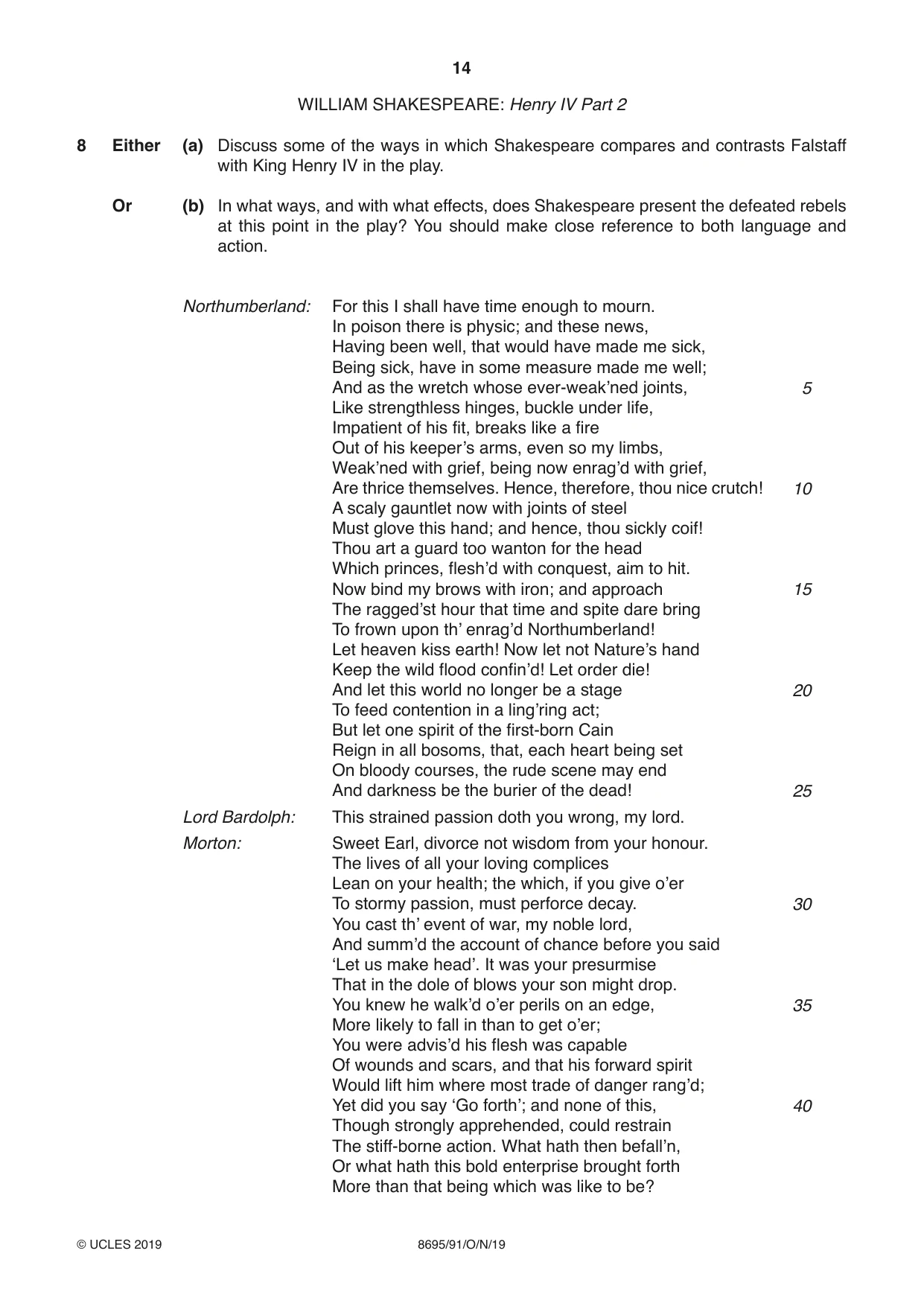
14 8695/91/O/N/19 © UCLES 2019 WILLIAM SHAKESPEARE: Henry IV Part 2 8 Either (a) Discuss some of the ways in which Shakespeare compares and contrasts Falstaff with King Henry IV in the play. Or (b) In what ways, and with what effects, does Shakespeare present the defeated rebels at this point in the play? You should make close reference to both language and action. Northumberland: For this I shall have time enough to mourn. In poison there is physic; and these news, Having been well, that would have made me sick, Being sick, have in some measure made me well; And as the wretch whose ever-weak’ned joints, Like strengthless hinges, buckle under life, Impatient of his fit, breaks like a fire Out of his keeper’s arms, even so my limbs, Weak’ned with grief, being now enrag’d with grief, Are thrice themselves. Hence, therefore, thou nice crutch! A scaly gauntlet now with joints of steel Must glove this hand; and hence, thou sickly coif! Thou art a guard too wanton for the head Which princes, flesh’d with conquest, aim to hit. Now bind my brows with iron; and approach The ragged’st hour that time and spite dare bring To frown upon th’ enrag’d Northumberland! Let heaven kiss earth! Now let not Nature’s hand Keep the wild flood confin’d! Let order die! And let this world no longer be a stage To feed contention in a ling’ring act; But let one spirit of the first-born Cain Reign in all bosoms, that, each heart being set On bloody courses, the rude scene may end And darkness be the burier of the dead! Lord Bardolph: This strained passion doth you wrong, my lord. Morton: Sweet Earl, divorce not wisdom from your honour. The lives of all your loving complices Lean on your health; the which, if you give o’er To stormy passion, must perforce decay. You cast th’ event of war, my noble lord, And summ’d the account of chance before you said ‘Let us make head’. It was your presurmise That in the dole of blows your son might drop. You knew he walk’d o’er perils on an edge, More likely to fall in than to get o’er; You were advis’d his flesh was capable Of wounds and scars, and that his forward spirit Would lift him where most trade of danger rang’d; Yet did you say ‘Go forth’; and none of this, Though strongly apprehended, could restrain The stiff-borne action. What hath then befall’n, Or what hath this bold enterprise brought forth More than that being which was like to be? 5 10 15 20 25 30 35 40
Question paper, page 15
15 8695/91/O/N/19 © UCLES 2019 [Turn over Lord Bardolph: We all that are engaged to this loss Knew that we ventured on such dangerous seas That if we wrought out life ’twas ten to one; And yet we ventur’d, for the gain propos’d Chok’d the respect of likely peril fear’d; And since we are o’erset, venture again. Come, we will all put forth, body and goods. Act 1, Scene 1 45 50
Question paper, page 16
16 8695/91/O/N/19 © UCLES 2019 BRIAN FRIEL: Philadelphia, Here I Come! 9 Either (a) How, and with what dramatic effects, does Friel present Gar’s hopes and doubts about the future in the play? Or (b) In what ways, and with what dramatic effects, does Friel present Gar’s relationship with Kate at this point in the play? You should pay close attention to both language and action. [PUBLIC suddenly stops dancing, switches – almost knocks – off the record-player, pulls a wallet out of his hip pocket and produces a snap. Content removed due to copyright restrictions.
Question paper, page 17
17 8695/91/O/N/19 © UCLES 2019 [He tries to kiss her again and she avoids him.] Episode 1 Content removed due to copyright restrictions.
Question paper, page 18
18 8695/91/O/N/19 © UCLES 2019 BLANK PAGE
Question paper, page 19
19 8695/91/O/N/19 © UCLES 2019 BLANK PAGE
Question paper, page 20
20 8695/91/O/N/19 © UCLES 2019 BLANK PAGE Permission to reproduce items where third-party owned material protected by copyright is included has been sought and cleared where possible. Every reasonable effort has been made by the publisher (UCLES) to trace copyright holders, but if any items requiring clearance have unwittingly been included, the publisher will be pleased to make amends at the earliest possible opportunity. To avoid the issue of disclosure of answer-related information to candidates, all copyright acknowledgements are reproduced online in the Cambridge Assessment International Education Copyright Acknowledgements Booklet. This is produced for each series of examinations and is freely available to download at www.cambridgeinternational.org after the live examination series. Cambridge Assessment International Education is part of the Cambridge Assessment Group. Cambridge Assessment is the brand name of the University of Cambridge Local Examinations Syndicate (UCLES), which itself is a department of the University of Cambridge.
Mark scheme, page 1
This document consists of 6 printed pages. © UCLES 2019 [Turn over Cambridge Assessment International Education Cambridge International Advanced Subsidiary Level LANGUAGE AND LITERATURE IN ENGLISH 8695/91 Paper 9 Poetry, Prose and Drama October/November 2019 MARK SCHEME Maximum Mark: 50 Published This mark scheme is published as an aid to teachers and candidates, to indicate the requirements of the examination. It shows the basis on which Examiners were instructed to award marks. It does not indicate the details of the discussions that took place at an Examiners’ meeting before marking began, which would have considered the acceptability of alternative answers. Mark schemes should be read in conjunction with the question paper and the Principal Examiner Report for Teachers. Cambridge International will not enter into discussions about these mark schemes. Cambridge International is publishing the mark schemes for the October/November 2019 series for most Cambridge IGCSE™, Cambridge International A and AS Level components and some Cambridge O Level components.
Mark scheme, page 2
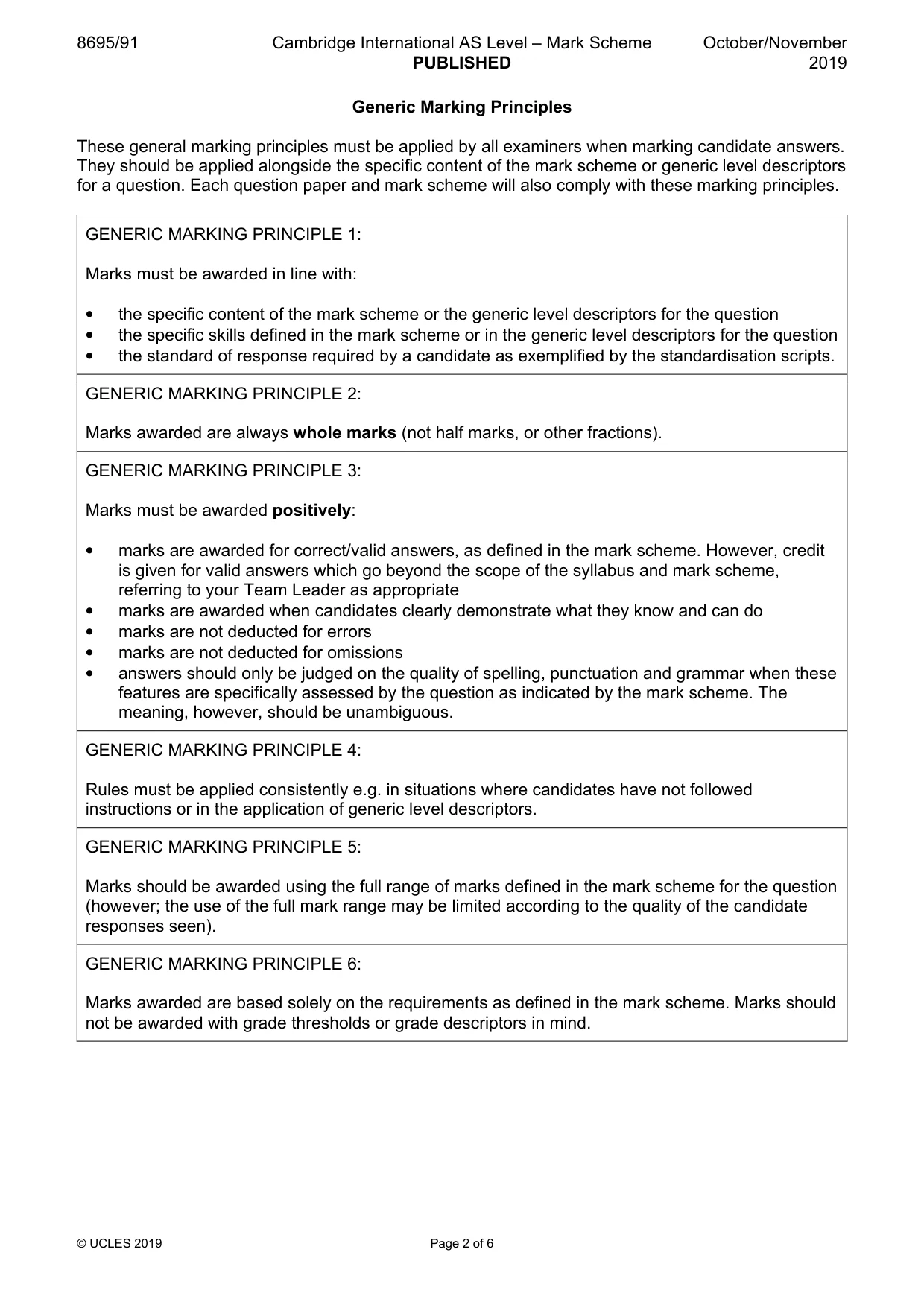
8695/91 Cambridge International AS Level – Mark Scheme PUBLISHED October/November 2019 © UCLES 2019 Page 2 of 6 Generic Marking Principles These general marking principles must be applied by all examiners when marking candidate answers. They should be applied alongside the specific content of the mark scheme or generic level descriptors for a question. Each question paper and mark scheme will also comply with these marking principles. GENERIC MARKING PRINCIPLE 1: Marks must be awarded in line with: • the specific content of the mark scheme or the generic level descriptors for the question • the specific skills defined in the mark scheme or in the generic level descriptors for the question • the standard of response required by a candidate as exemplified by the standardisation scripts. GENERIC MARKING PRINCIPLE 2: Marks awarded are always whole marks (not half marks, or other fractions). GENERIC MARKING PRINCIPLE 3: Marks must be awarded positively: • marks are awarded for correct/valid answers, as defined in the mark scheme. However, credit is given for valid answers which go beyond the scope of the syllabus and mark scheme, referring to your Team Leader as appropriate • marks are awarded when candidates clearly demonstrate what they know and can do • marks are not deducted for errors • marks are not deducted for omissions • answers should only be judged on the quality of spelling, punctuation and grammar when these features are specifically assessed by the question as indicated by the mark scheme. The meaning, however, should be unambiguous. GENERIC MARKING PRINCIPLE 4: Rules must be applied consistently e.g. in situations where candidates have not followed instructions or in the application of generic level descriptors. GENERIC MARKING PRINCIPLE 5: Marks should be awarded using the full range of marks defined in the mark scheme for the question (however; the use of the full mark range may be limited according to the quality of the candidate responses seen). GENERIC MARKING PRINCIPLE 6: Marks awarded are based solely on the requirements as defined in the mark scheme. Marks should not be awarded with grade thresholds or grade descriptors in mind.
Mark scheme, page 3
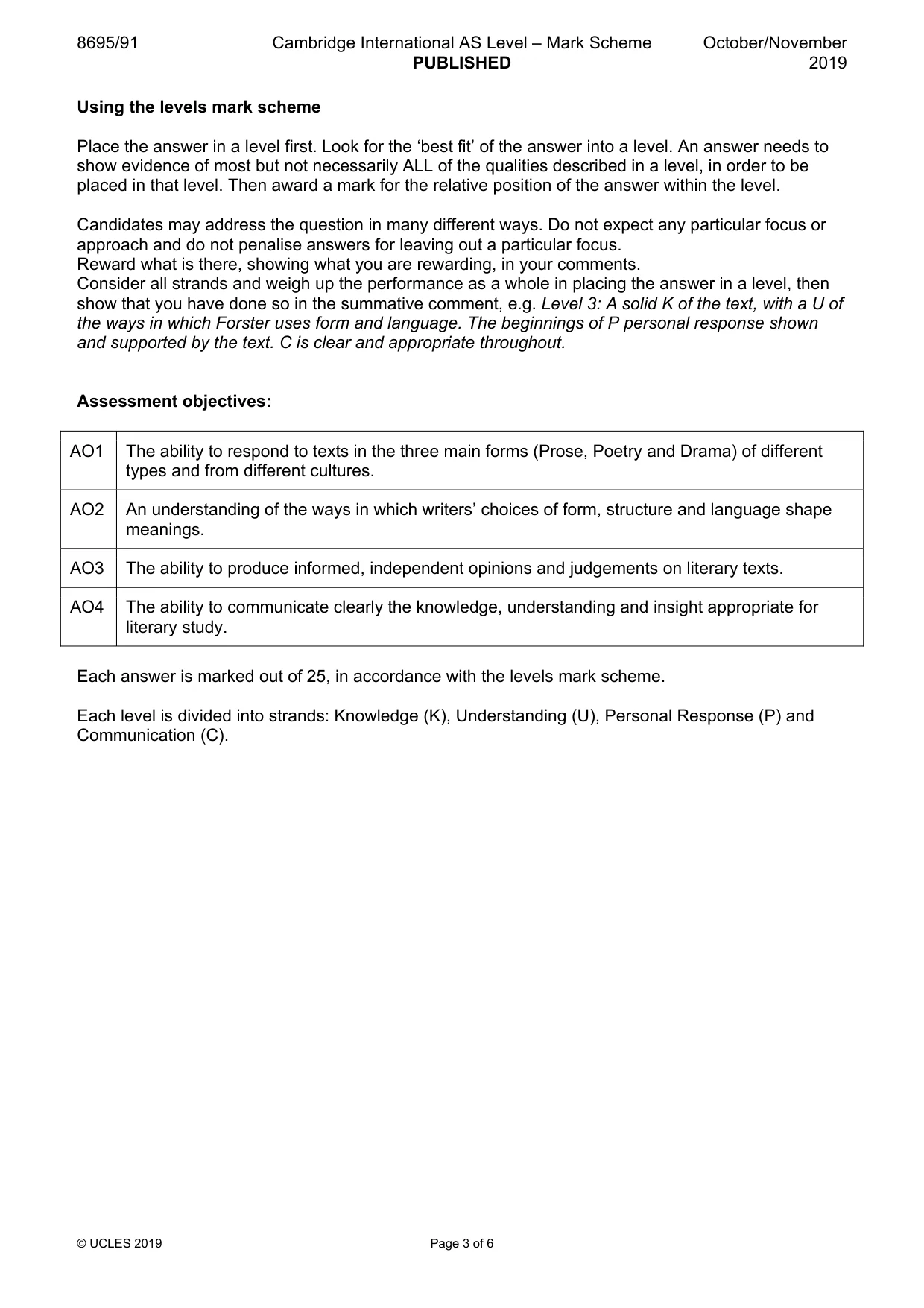
8695/91 Cambridge International AS Level – Mark Scheme PUBLISHED October/November 2019 © UCLES 2019 Page 3 of 6 Using the levels mark scheme Place the answer in a level first. Look for the ‘best fit’ of the answer into a level. An answer needs to show evidence of most but not necessarily ALL of the qualities described in a level, in order to be placed in that level. Then award a mark for the relative position of the answer within the level. Candidates may address the question in many different ways. Do not expect any particular focus or approach and do not penalise answers for leaving out a particular focus. Reward what is there, showing what you are rewarding, in your comments. Consider all strands and weigh up the performance as a whole in placing the answer in a level, then show that you have done so in the summative comment, e.g. Level 3: A solid K of the text, with a U of the ways in which Forster uses form and language. The beginnings of P personal response shown and supported by the text. C is clear and appropriate throughout. Assessment objectives: AO1 The ability to respond to texts in the three main forms (Prose, Poetry and Drama) of different types and from different cultures. AO2 An understanding of the ways in which writers’ choices of form, structure and language shape meanings. AO3 The ability to produce informed, independent opinions and judgements on literary texts. AO4 The ability to communicate clearly the knowledge, understanding and insight appropriate for literary study. Each answer is marked out of 25, in accordance with the levels mark scheme. Each level is divided into strands: Knowledge (K), Understanding (U), Personal Response (P) and Communication (C).
Mark scheme, page 4
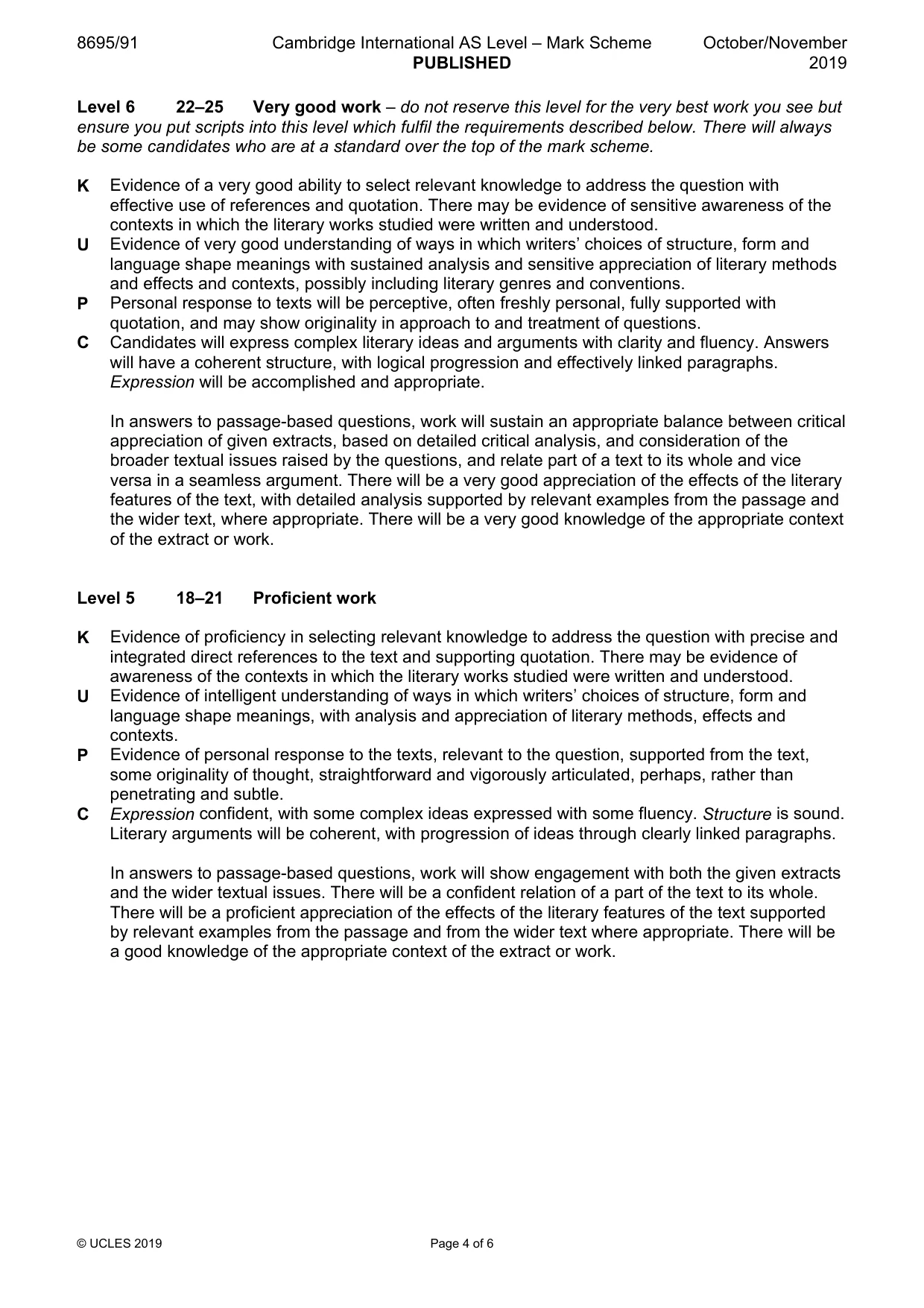
8695/91 Cambridge International AS Level – Mark Scheme PUBLISHED October/November 2019 © UCLES 2019 Page 4 of 6 Level 6 22–25 Very good work – do not reserve this level for the very best work you see but ensure you put scripts into this level which fulfil the requirements described below. There will always be some candidates who are at a standard over the top of the mark scheme. K Evidence of a very good ability to select relevant knowledge to address the question with effective use of references and quotation. There may be evidence of sensitive awareness of the contexts in which the literary works studied were written and understood. U Evidence of very good understanding of ways in which writers’ choices of structure, form and language shape meanings with sustained analysis and sensitive appreciation of literary methods and effects and contexts, possibly including literary genres and conventions. P Personal response to texts will be perceptive, often freshly personal, fully supported with quotation, and may show originality in approach to and treatment of questions. C Candidates will express complex literary ideas and arguments with clarity and fluency. Answers will have a coherent structure, with logical progression and effectively linked paragraphs. Expression will be accomplished and appropriate. In answers to passage-based questions, work will sustain an appropriate balance between critical appreciation of given extracts, based on detailed critical analysis, and consideration of the broader textual issues raised by the questions, and relate part of a text to its whole and vice versa in a seamless argument. There will be a very good appreciation of the effects of the literary features of the text, with detailed analysis supported by relevant examples from the passage and the wider text, where appropriate. There will be a very good knowledge of the appropriate context of the extract or work. Level 5 18–21 Proficient work K Evidence of proficiency in selecting relevant knowledge to address the question with precise and integrated direct references to the text and supporting quotation. There may be evidence of awareness of the contexts in which the literary works studied were written and understood. U Evidence of intelligent understanding of ways in which writers’ choices of structure, form and language shape meanings, with analysis and appreciation of literary methods, effects and contexts. P Evidence of personal response to the texts, relevant to the question, supported from the text, some originality of thought, straightforward and vigorously articulated, perhaps, rather than penetrating and subtle. C Expression confident, with some complex ideas expressed with some fluency. Structure is sound. Literary arguments will be coherent, with progression of ideas through clearly linked paragraphs. In answers to passage-based questions, work will show engagement with both the given extracts and the wider textual issues. There will be a confident relation of a part of the text to its whole. There will be a proficient appreciation of the effects of the literary features of the text supported by relevant examples from the passage and from the wider text where appropriate. There will be a good knowledge of the appropriate context of the extract or work.
Mark scheme, page 5
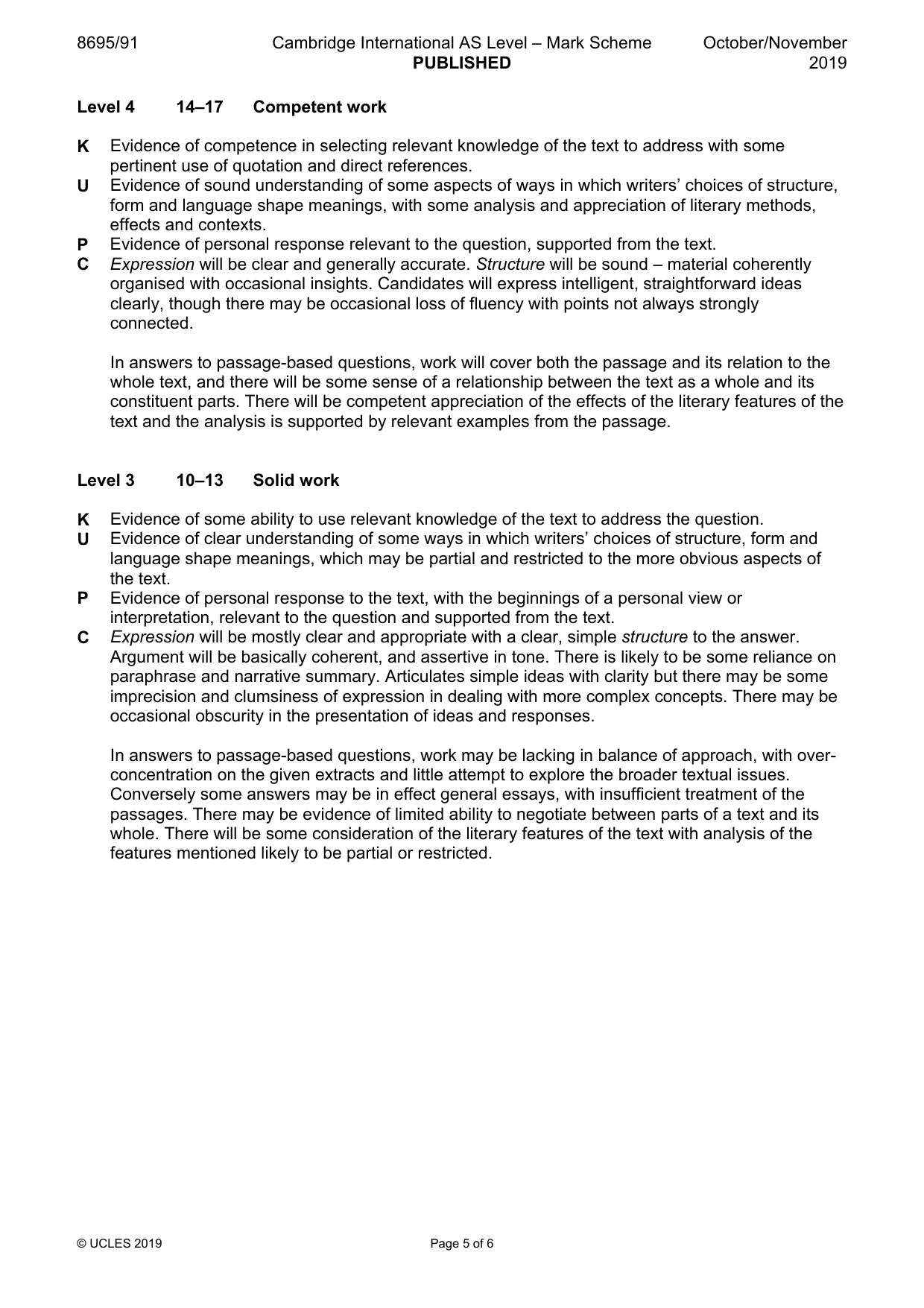
8695/91 Cambridge International AS Level – Mark Scheme PUBLISHED October/November 2019 © UCLES 2019 Page 5 of 6 Level 4 14–17 Competent work K Evidence of competence in selecting relevant knowledge of the text to address with some pertinent use of quotation and direct references. U Evidence of sound understanding of some aspects of ways in which writers’ choices of structure, form and language shape meanings, with some analysis and appreciation of literary methods, effects and contexts. P Evidence of personal response relevant to the question, supported from the text. C Expression will be clear and generally accurate. Structure will be sound – material coherently organised with occasional insights. Candidates will express intelligent, straightforward ideas clearly, though there may be occasional loss of fluency with points not always strongly connected. In answers to passage-based questions, work will cover both the passage and its relation to the whole text, and there will be some sense of a relationship between the text as a whole and its constituent parts. There will be competent appreciation of the effects of the literary features of the text and the analysis is supported by relevant examples from the passage. Level 3 10–13 Solid work K Evidence of some ability to use relevant knowledge of the text to address the question. U Evidence of clear understanding of some ways in which writers’ choices of structure, form and language shape meanings, which may be partial and restricted to the more obvious aspects of the text. P Evidence of personal response to the text, with the beginnings of a personal view or interpretation, relevant to the question and supported from the text. C Expression will be mostly clear and appropriate with a clear, simple structure to the answer. Argument will be basically coherent, and assertive in tone. There is likely to be some reliance on paraphrase and narrative summary. Articulates simple ideas with clarity but there may be some imprecision and clumsiness of expression in dealing with more complex concepts. There may be occasional obscurity in the presentation of ideas and responses. In answers to passage-based questions, work may be lacking in balance of approach, with over- concentration on the given extracts and little attempt to explore the broader textual issues. Conversely some answers may be in effect general essays, with insufficient treatment of the passages. There may be evidence of limited ability to negotiate between parts of a text and its whole. There will be some consideration of the literary features of the text with analysis of the features mentioned likely to be partial or restricted.
Mark scheme, page 6
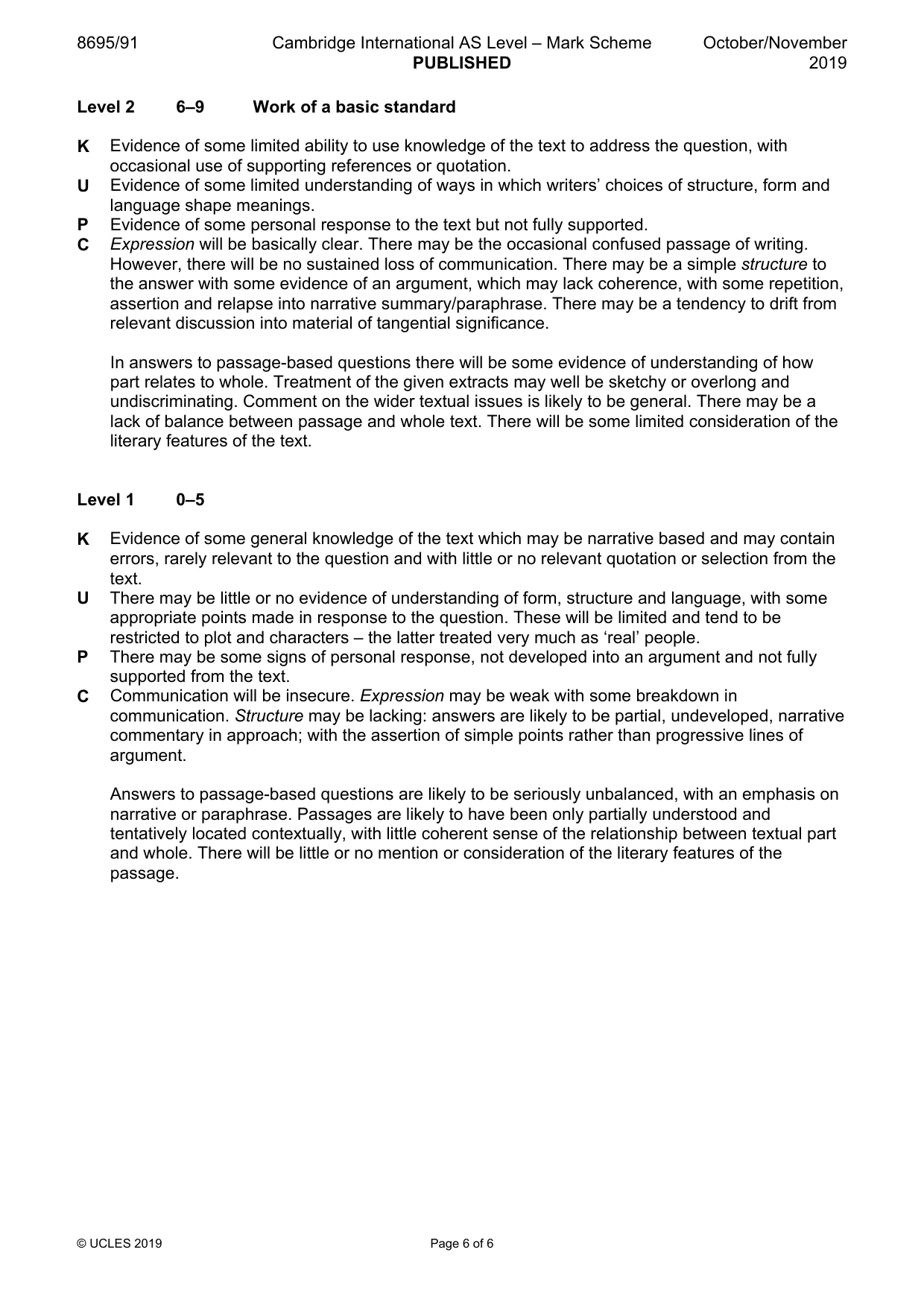
8695/91 Cambridge International AS Level – Mark Scheme PUBLISHED October/November 2019 © UCLES 2019 Page 6 of 6 Level 2 6–9 Work of a basic standard K Evidence of some limited ability to use knowledge of the text to address the question, with occasional use of supporting references or quotation. U Evidence of some limited understanding of ways in which writers’ choices of structure, form and language shape meanings. P Evidence of some personal response to the text but not fully supported. C Expression will be basically clear. There may be the occasional confused passage of writing. However, there will be no sustained loss of communication. There may be a simple structure to the answer with some evidence of an argument, which may lack coherence, with some repetition, assertion and relapse into narrative summary/paraphrase. There may be a tendency to drift from relevant discussion into material of tangential significance. In answers to passage-based questions there will be some evidence of understanding of how part relates to whole. Treatment of the given extracts may well be sketchy or overlong and undiscriminating. Comment on the wider textual issues is likely to be general. There may be a lack of balance between passage and whole text. There will be some limited consideration of the literary features of the text. Level 1 0–5 K Evidence of some general knowledge of the text which may be narrative based and may contain errors, rarely relevant to the question and with little or no relevant quotation or selection from the text. U There may be little or no evidence of understanding of form, structure and language, with some appropriate points made in response to the question. These will be limited and tend to be restricted to plot and characters – the latter treated very much as ‘real’ people. P There may be some signs of personal response, not developed into an argument and not fully supported from the text. C Communication will be insecure. Expression may be weak with some breakdown in communication. Structure may be lacking: answers are likely to be partial, undeveloped, narrative commentary in approach; with the assertion of simple points rather than progressive lines of argument. Answers to passage-based questions are likely to be seriously unbalanced, with an emphasis on narrative or paraphrase. Passages are likely to have been only partially understood and tentatively located contextually, with little coherent sense of the relationship between textual part and whole. There will be little or no mention or consideration of the literary features of the passage.
What you needed in this session
Cambridge’s own grade thresholds for 2019 Oct/Nov, Paper 9 · Variant 1. A higher threshold means an easier paper — the bar moves with how the cohort did.