Cambridge A Level English - Language and Literature (AS Level only, from 2016) 8695 — 2018 May/June Paper 9 · Variant 1
8695/91/M/J/18 · 50 marks · ≈56 min
The question paper and its mark scheme, free to read here and free to download. This is Cambridge’s own paper, exactly as it was sat.
Question paper20 pages





Mark scheme6 pages
Answers below. Sit the paper first if you are practising.
Paper as text
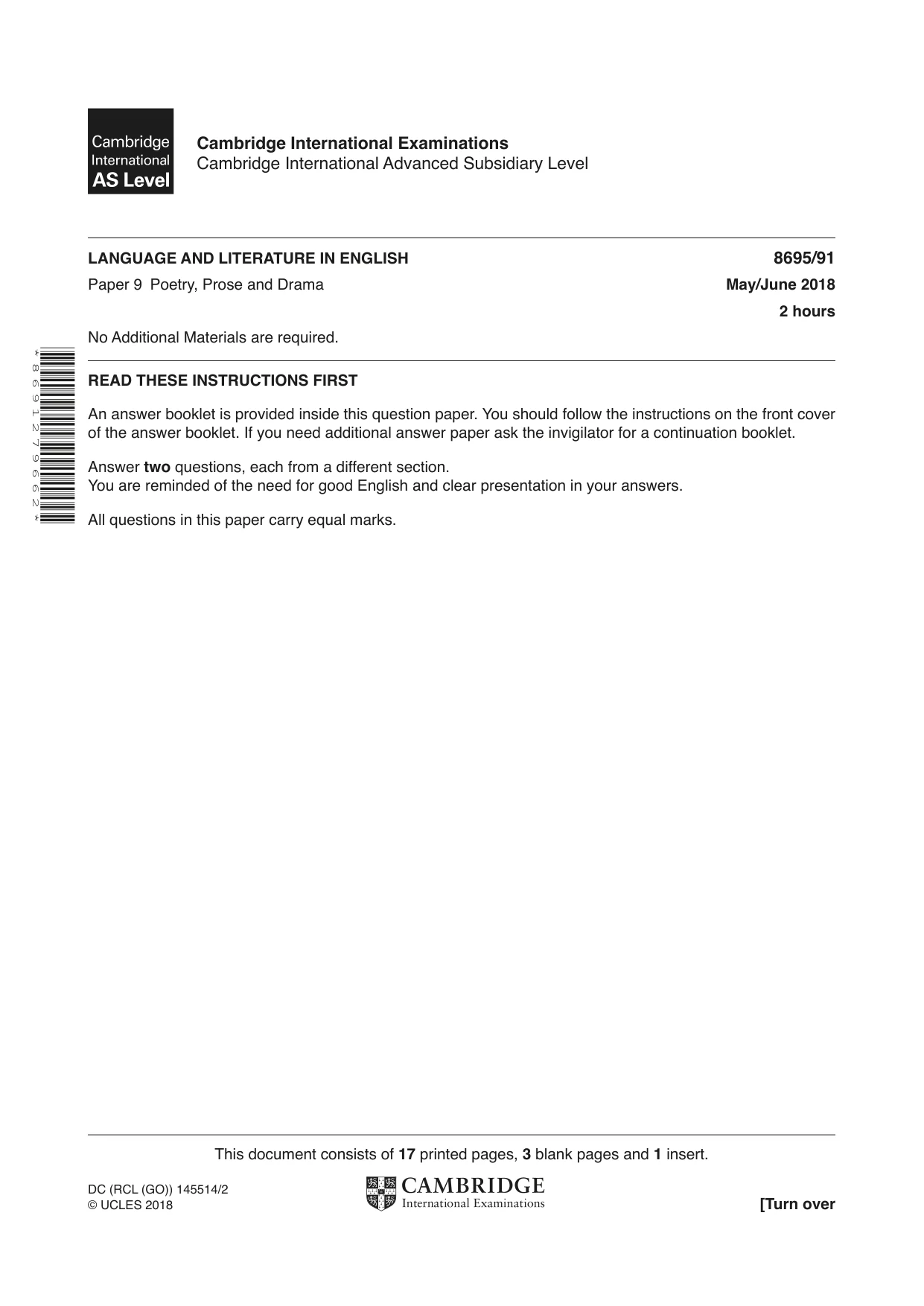
Question paper, page 1
This document consists of 17 printed pages, 3 blank pages and 1 insert. DC (RCL (GO)) 145514/2 © UCLES 2018 [Turn over Cambridge International Examinations Cambridge International Advanced Subsidiary Level * 8 6 9 1 2 7 9 6 6 2 * LANGUAGE AND LITERATURE IN ENGLISH 8695/91 Paper 9 Poetry, Prose and Drama May/June 2018 2 hours No Additional Materials are required. READ THESE INSTRUCTIONS FIRST An answer booklet is provided inside this question paper. You should follow the instructions on the front cover of the answer booklet. If you need additional answer paper ask the invigilator for a continuation booklet. Answer two questions, each from a different section. You are reminded of the need for good English and clear presentation in your answers. All questions in this paper carry equal marks.
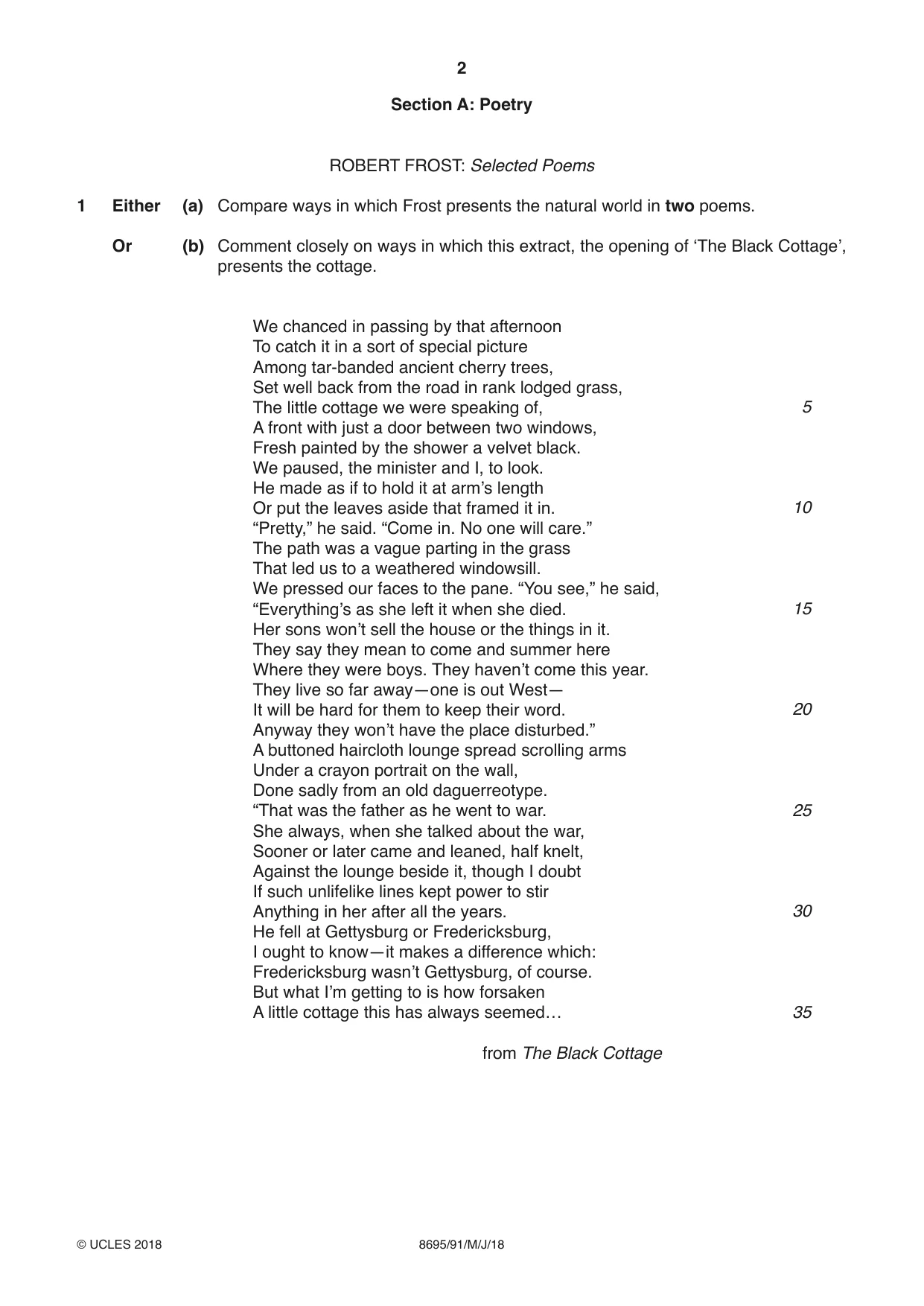
Question paper, page 2
2 8695/91/M/J/18 © UCLES 2018 Section A: Poetry ROBERT FROST: Selected Poems 1 Either (a) Compare ways in which Frost presents the natural world in two poems. Or (b) Comment closely on ways in which this extract, the opening of ‘The Black Cottage’, presents the cottage. We chanced in passing by that afternoon To catch it in a sort of special picture Among tar-banded ancient cherry trees, Set well back from the road in rank lodged grass, The little cottage we were speaking of, A front with just a door between two windows, Fresh painted by the shower a velvet black. We paused, the minister and I, to look. He made as if to hold it at arm’s length Or put the leaves aside that framed it in. “Pretty,” he said. “Come in. No one will care.” The path was a vague parting in the grass That led us to a weathered windowsill. We pressed our faces to the pane. “You see,” he said, “Everything’s as she left it when she died. Her sons won’t sell the house or the things in it. They say they mean to come and summer here Where they were boys. They haven’t come this year. They live so far away—one is out West— It will be hard for them to keep their word. Anyway they won’t have the place disturbed.” A buttoned haircloth lounge spread scrolling arms Under a crayon portrait on the wall, Done sadly from an old daguerreotype. “That was the father as he went to war. She always, when she talked about the war, Sooner or later came and leaned, half knelt, Against the lounge beside it, though I doubt If such unlifelike lines kept power to stir Anything in her after all the years. He fell at Gettysburg or Fredericksburg, I ought to know—it makes a difference which: Fredericksburg wasn’t Gettysburg, of course. But what I’m getting to is how forsaken A little cottage this has always seemed… from The Black Cottage 5 10 15 20 25 30 35
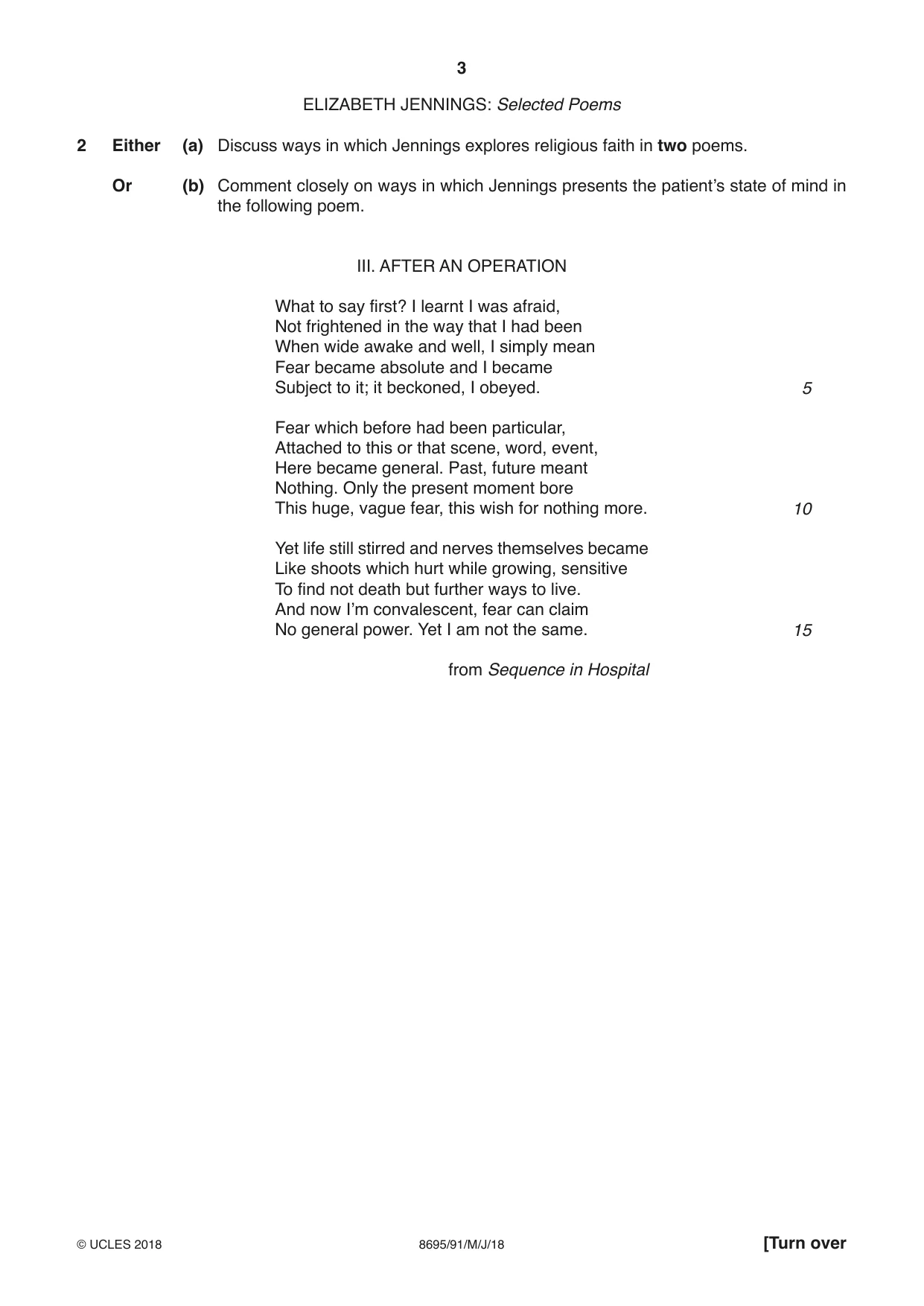
Question paper, page 3
3 8695/91/M/J/18 © UCLES 2018 [Turn over ELIZABETH JENNINGS: Selected Poems 2 Either (a) Discuss ways in which Jennings explores religious faith in two poems. Or (b) Comment closely on ways in which Jennings presents the patient’s state of mind in the following poem. III. AFTER AN OPERATION What to say first? I learnt I was afraid, Not frightened in the way that I had been When wide awake and well, I simply mean Fear became absolute and I became Subject to it; it beckoned, I obeyed. Fear which before had been particular, Attached to this or that scene, word, event, Here became general. Past, future meant Nothing. Only the present moment bore This huge, vague fear, this wish for nothing more. Yet life still stirred and nerves themselves became Like shoots which hurt while growing, sensitive To find not death but further ways to live. And now I’m convalescent, fear can claim No general power. Yet I am not the same. from Sequence in Hospital 5 10 15
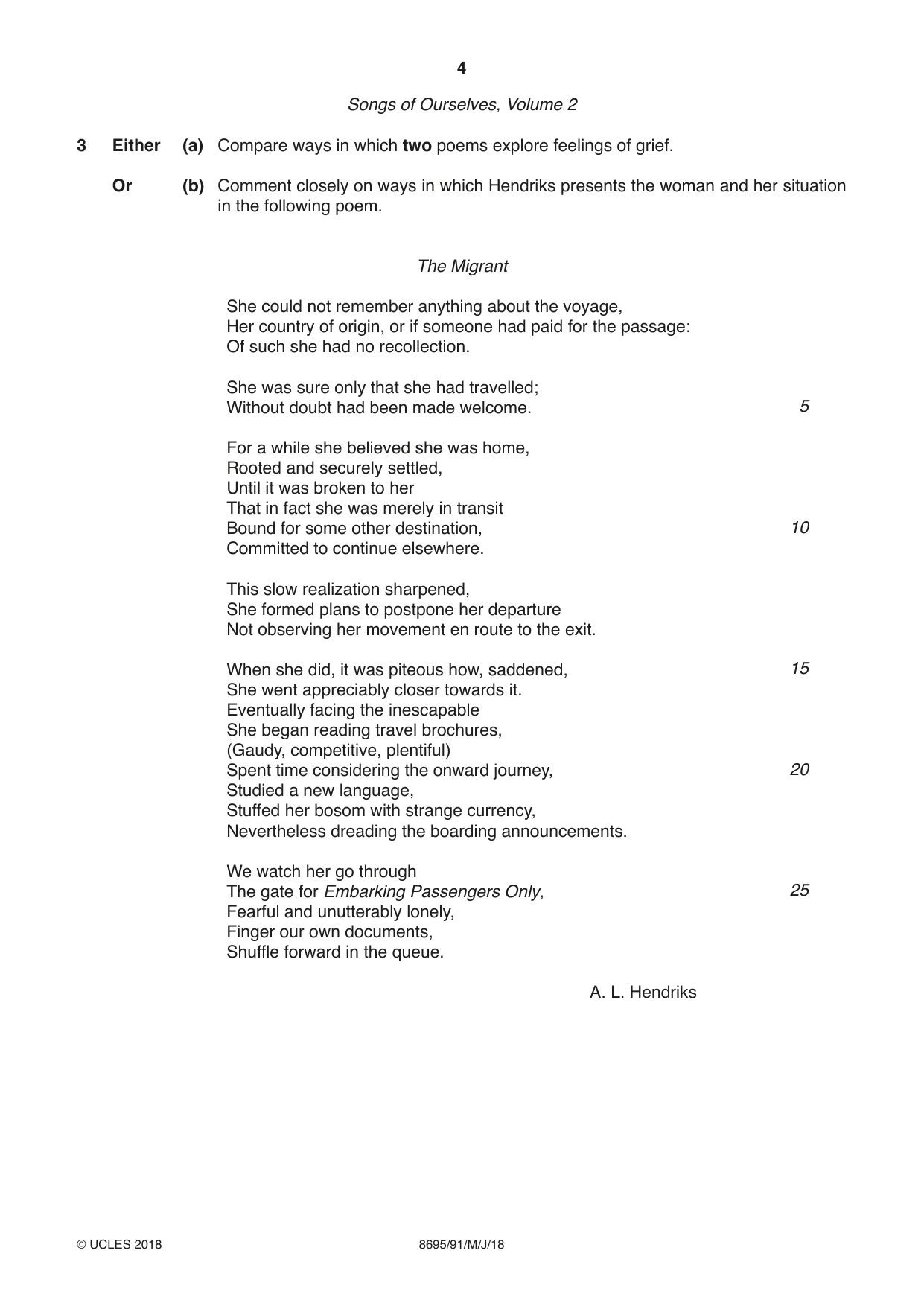
Question paper, page 4
4 8695/91/M/J/18 © UCLES 2018 Songs of Ourselves, Volume 2 3 Either (a) Compare ways in which two poems explore feelings of grief. Or (b) Comment closely on ways in which Hendriks presents the woman and her situation in the following poem. The Migrant She could not remember anything about the voyage, Her country of origin, or if someone had paid for the passage: Of such she had no recollection. She was sure only that she had travelled; Without doubt had been made welcome. For a while she believed she was home, Rooted and securely settled, Until it was broken to her That in fact she was merely in transit Bound for some other destination, Committed to continue elsewhere. This slow realization sharpened, She formed plans to postpone her departure Not observing her movement en route to the exit. When she did, it was piteous how, saddened, She went appreciably closer towards it. Eventually facing the inescapable She began reading travel brochures, (Gaudy, competitive, plentiful) Spent time considering the onward journey, Studied a new language, Stuffed her bosom with strange currency, Nevertheless dreading the boarding announcements. We watch her go through The gate for Embarking Passengers Only, Fearful and unutterably lonely, Finger our own documents, Shuffle forward in the queue. A. L. Hendriks 5 10 15 20 25
Question paper, page 5
5 8695/91/M/J/18 © UCLES 2018 [Turn over Turn over for Section B.
Question paper, page 6
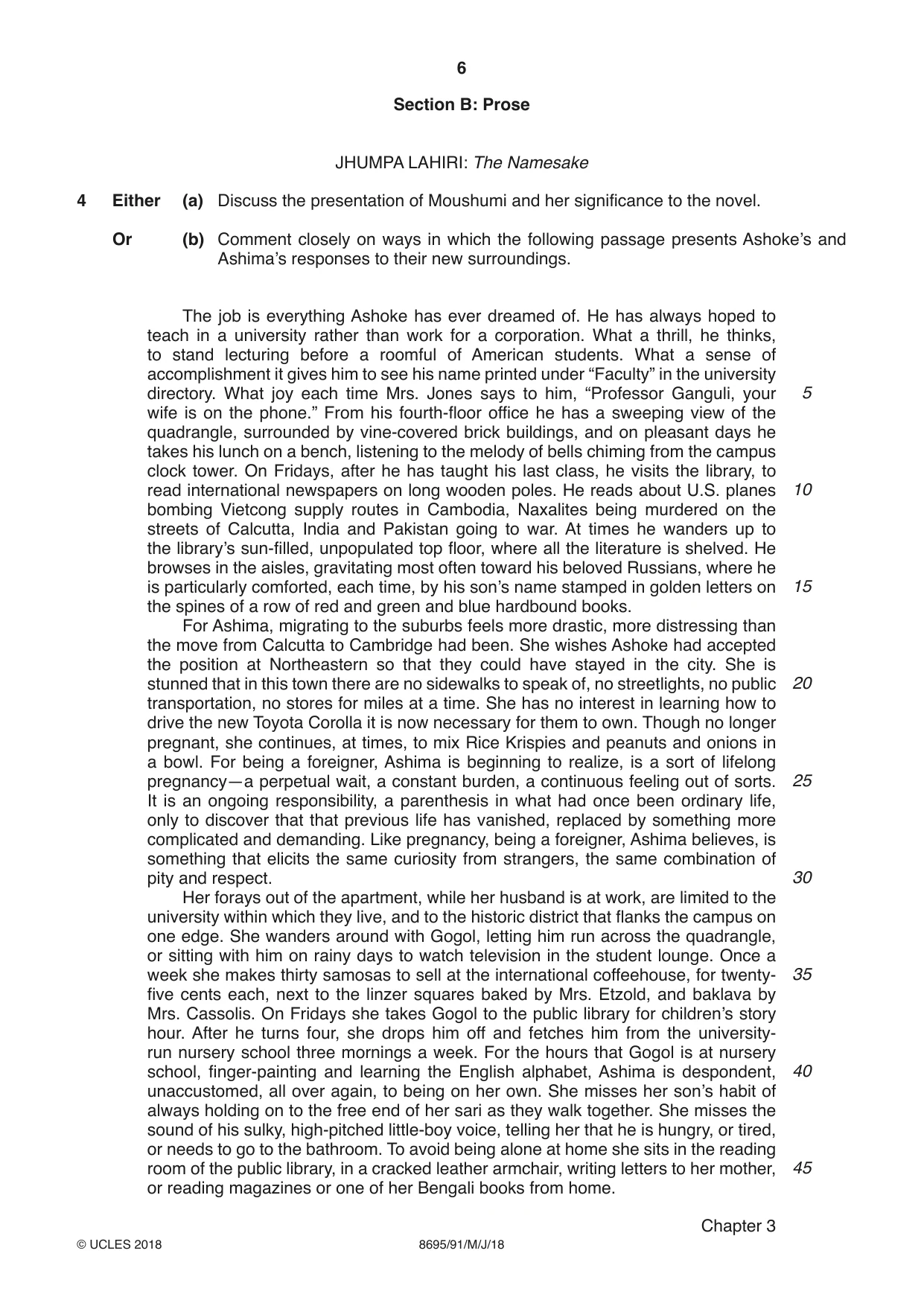
6 8695/91/M/J/18 © UCLES 2018 Section B: Prose JHUMPA LAHIRI: The Namesake 4 Either (a) Discuss the presentation of Moushumi and her significance to the novel. Or (b) Comment closely on ways in which the following passage presents Ashoke’s and Ashima’s responses to their new surroundings. The job is everything Ashoke has ever dreamed of. He has always hoped to teach in a university rather than work for a corporation. What a thrill, he thinks, to stand lecturing before a roomful of American students. What a sense of accomplishment it gives him to see his name printed under “Faculty” in the university directory. What joy each time Mrs. Jones says to him, “Professor Ganguli, your wife is on the phone.” From his fourth-floor office he has a sweeping view of the quadrangle, surrounded by vine-covered brick buildings, and on pleasant days he takes his lunch on a bench, listening to the melody of bells chiming from the campus clock tower. On Fridays, after he has taught his last class, he visits the library, to read international newspapers on long wooden poles. He reads about U.S. planes bombing Vietcong supply routes in Cambodia, Naxalites being murdered on the streets of Calcutta, India and Pakistan going to war. At times he wanders up to the library’s sun-filled, unpopulated top floor, where all the literature is shelved. He browses in the aisles, gravitating most often toward his beloved Russians, where he is particularly comforted, each time, by his son’s name stamped in golden letters on the spines of a row of red and green and blue hardbound books. For Ashima, migrating to the suburbs feels more drastic, more distressing than the move from Calcutta to Cambridge had been. She wishes Ashoke had accepted the position at Northeastern so that they could have stayed in the city. She is stunned that in this town there are no sidewalks to speak of, no streetlights, no public transportation, no stores for miles at a time. She has no interest in learning how to drive the new Toyota Corolla it is now necessary for them to own. Though no longer pregnant, she continues, at times, to mix Rice Krispies and peanuts and onions in a bowl. For being a foreigner, Ashima is beginning to realize, is a sort of lifelong pregnancy—a perpetual wait, a constant burden, a continuous feeling out of sorts. It is an ongoing responsibility, a parenthesis in what had once been ordinary life, only to discover that that previous life has vanished, replaced by something more complicated and demanding. Like pregnancy, being a foreigner, Ashima believes, is something that elicits the same curiosity from strangers, the same combination of pity and respect. Her forays out of the apartment, while her husband is at work, are limited to the university within which they live, and to the historic district that flanks the campus on one edge. She wanders around with Gogol, letting him run across the quadrangle, or sitting with him on rainy days to watch television in the student lounge. Once a week she makes thirty samosas to sell at the international coffeehouse, for twenty- five cents each, next to the linzer squares baked by Mrs. Etzold, and baklava by Mrs. Cassolis. On Fridays she takes Gogol to the public library for children’s story hour. After he turns four, she drops him off and fetches him from the university- run nursery school three mornings a week. For the hours that Gogol is at nursery school, finger-painting and learning the English alphabet, Ashima is despondent, unaccustomed, all over again, to being on her own. She misses her son’s habit of always holding on to the free end of her sari as they walk together. She misses the sound of his sulky, high-pitched little-boy voice, telling her that he is hungry, or tired, or needs to go to the bathroom. To avoid being alone at home she sits in the reading room of the public library, in a cracked leather armchair, writing letters to her mother, or reading magazines or one of her Bengali books from home. Chapter 3 5 10 15 20 25 30 35 40 45
Question paper, page 7
7 8695/91/M/J/18 © UCLES 2018 [Turn over Turn over for Question 5.
Question paper, page 8
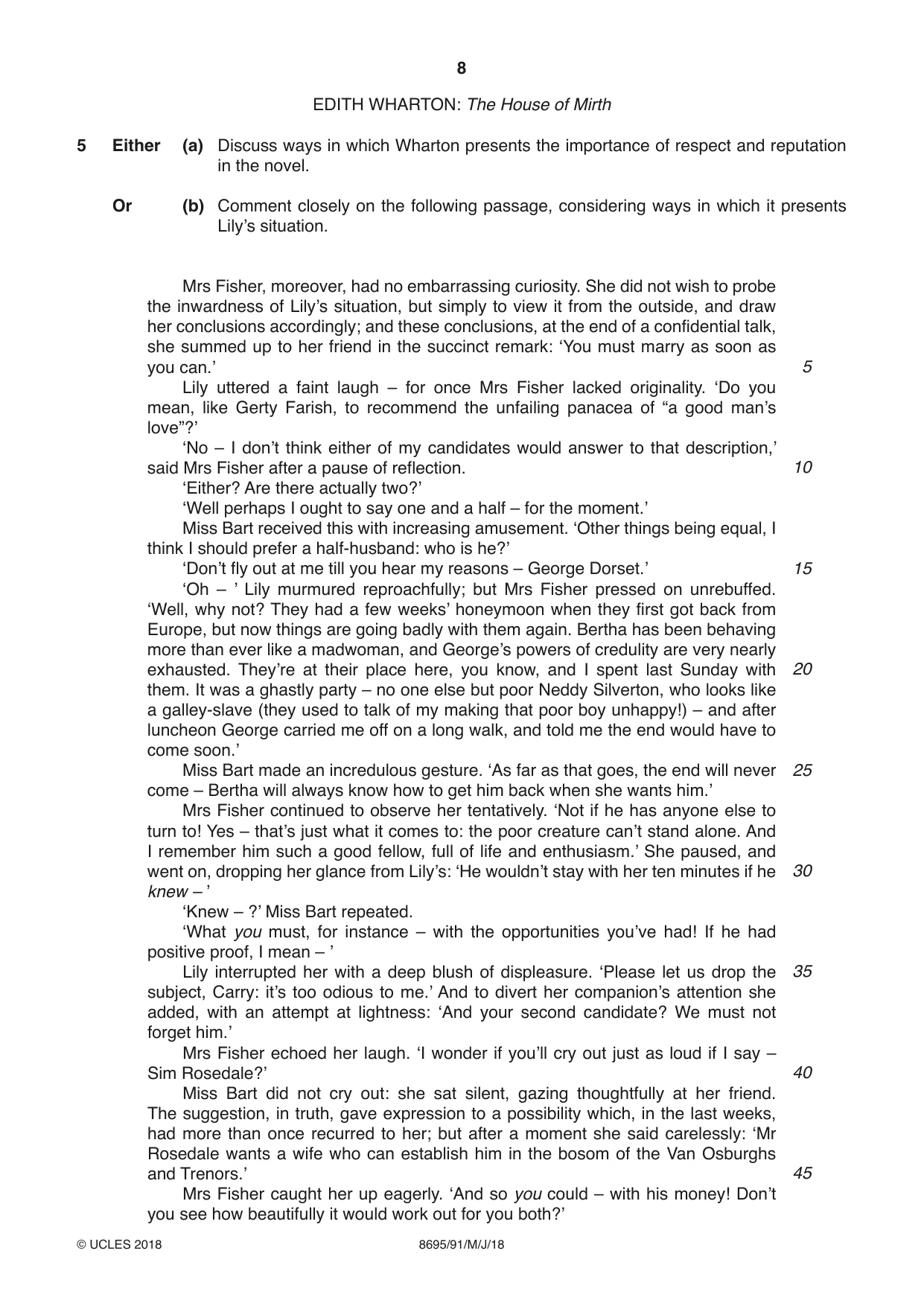
8 8695/91/M/J/18 © UCLES 2018 EDITH WHARTON: The House of Mirth 5 Either (a) Discuss ways in which Wharton presents the importance of respect and reputation in the novel. Or (b) Comment closely on the following passage, considering ways in which it presents Lily’s situation. Mrs Fisher, moreover, had no embarrassing curiosity. She did not wish to probe the inwardness of Lily’s situation, but simply to view it from the outside, and draw her conclusions accordingly; and these conclusions, at the end of a confidential talk, she summed up to her friend in the succinct remark: ‘You must marry as soon as you can.’ Lily uttered a faint laugh – for once Mrs Fisher lacked originality. ‘Do you mean, like Gerty Farish, to recommend the unfailing panacea of “a good man’s love”?’ ‘No – I don’t think either of my candidates would answer to that description,’ said Mrs Fisher after a pause of reflection. ‘Either? Are there actually two?’ ‘Well perhaps I ought to say one and a half – for the moment.’ Miss Bart received this with increasing amusement. ‘Other things being equal, I think I should prefer a half-husband: who is he?’ ‘Don’t fly out at me till you hear my reasons – George Dorset.’ ‘Oh – ’ Lily murmured reproachfully; but Mrs Fisher pressed on unrebuffed. ‘Well, why not? They had a few weeks’ honeymoon when they first got back from Europe, but now things are going badly with them again. Bertha has been behaving more than ever like a madwoman, and George’s powers of credulity are very nearly exhausted. They’re at their place here, you know, and I spent last Sunday with them. It was a ghastly party – no one else but poor Neddy Silverton, who looks like a galley-slave (they used to talk of my making that poor boy unhappy!) – and after luncheon George carried me off on a long walk, and told me the end would have to come soon.’ Miss Bart made an incredulous gesture. ‘As far as that goes, the end will never come – Bertha will always know how to get him back when she wants him.’ Mrs Fisher continued to observe her tentatively. ‘Not if he has anyone else to turn to! Yes – that’s just what it comes to: the poor creature can’t stand alone. And I remember him such a good fellow, full of life and enthusiasm.’ She paused, and went on, dropping her glance from Lily’s: ‘He wouldn’t stay with her ten minutes if he knew – ’ ‘Knew – ?’ Miss Bart repeated. ‘What you must, for instance – with the opportunities you’ve had! If he had positive proof, I mean – ’ Lily interrupted her with a deep blush of displeasure. ‘Please let us drop the subject, Carry: it’s too odious to me.’ And to divert her companion’s attention she added, with an attempt at lightness: ‘And your second candidate? We must not forget him.’ Mrs Fisher echoed her laugh. ‘I wonder if you’ll cry out just as loud if I say – Sim Rosedale?’ Miss Bart did not cry out: she sat silent, gazing thoughtfully at her friend. The suggestion, in truth, gave expression to a possibility which, in the last weeks, had more than once recurred to her; but after a moment she said carelessly: ‘Mr Rosedale wants a wife who can establish him in the bosom of the Van Osburghs and Trenors.’ Mrs Fisher caught her up eagerly. ‘And so you could – with his money! Don’t you see how beautifully it would work out for you both?’ 5 10 15 20 25 30 35 40 45
Question paper, page 9
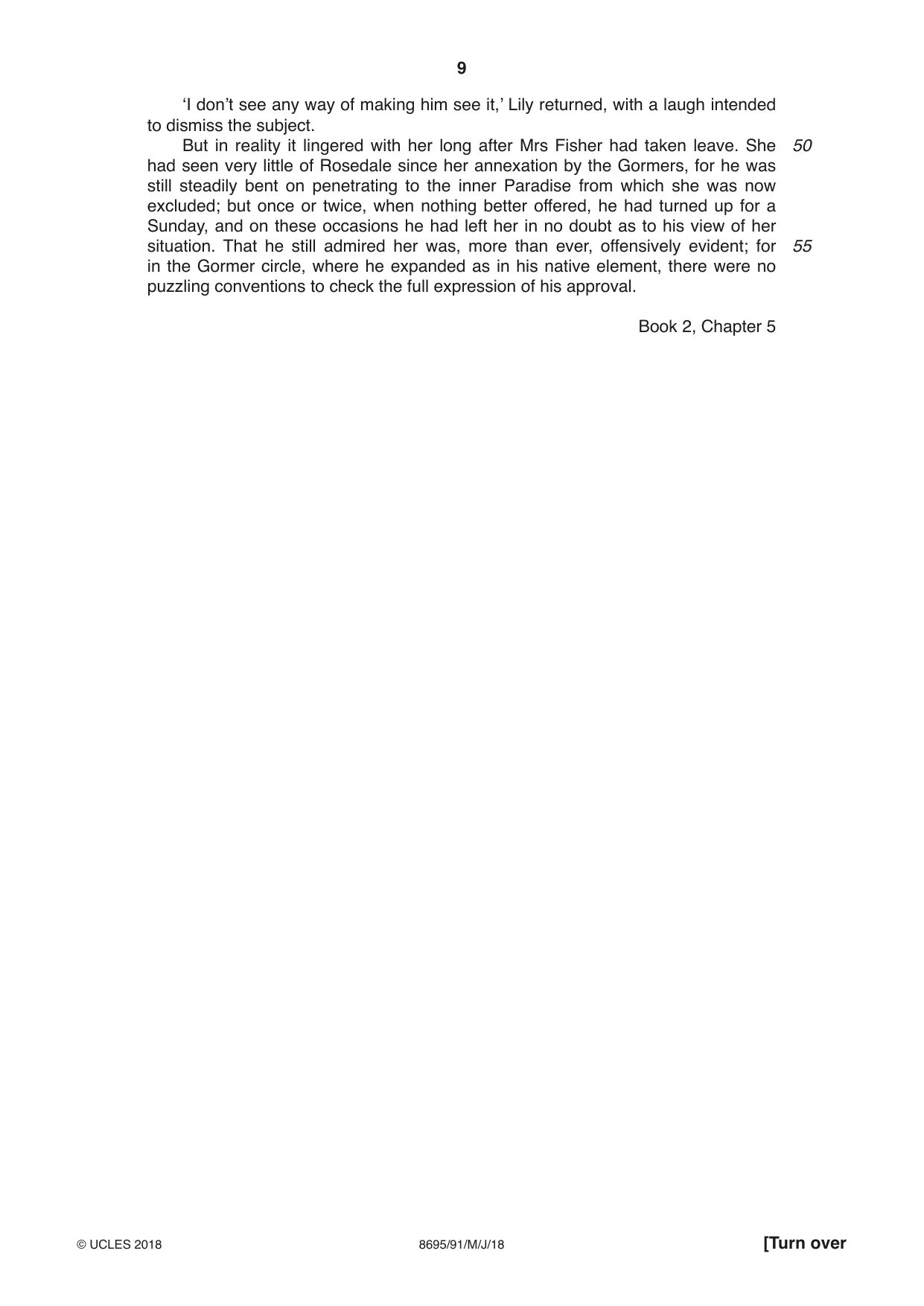
9 8695/91/M/J/18 © UCLES 2018 [Turn over ‘I don’t see any way of making him see it,’ Lily returned, with a laugh intended to dismiss the subject. But in reality it lingered with her long after Mrs Fisher had taken leave. She had seen very little of Rosedale since her annexation by the Gormers, for he was still steadily bent on penetrating to the inner Paradise from which she was now excluded; but once or twice, when nothing better offered, he had turned up for a Sunday, and on these occasions he had left her in no doubt as to his view of her situation. That he still admired her was, more than ever, offensively evident; for in the Gormer circle, where he expanded as in his native element, there were no puzzling conventions to check the full expression of his approval. Book 2, Chapter 5 50 55
Question paper, page 10
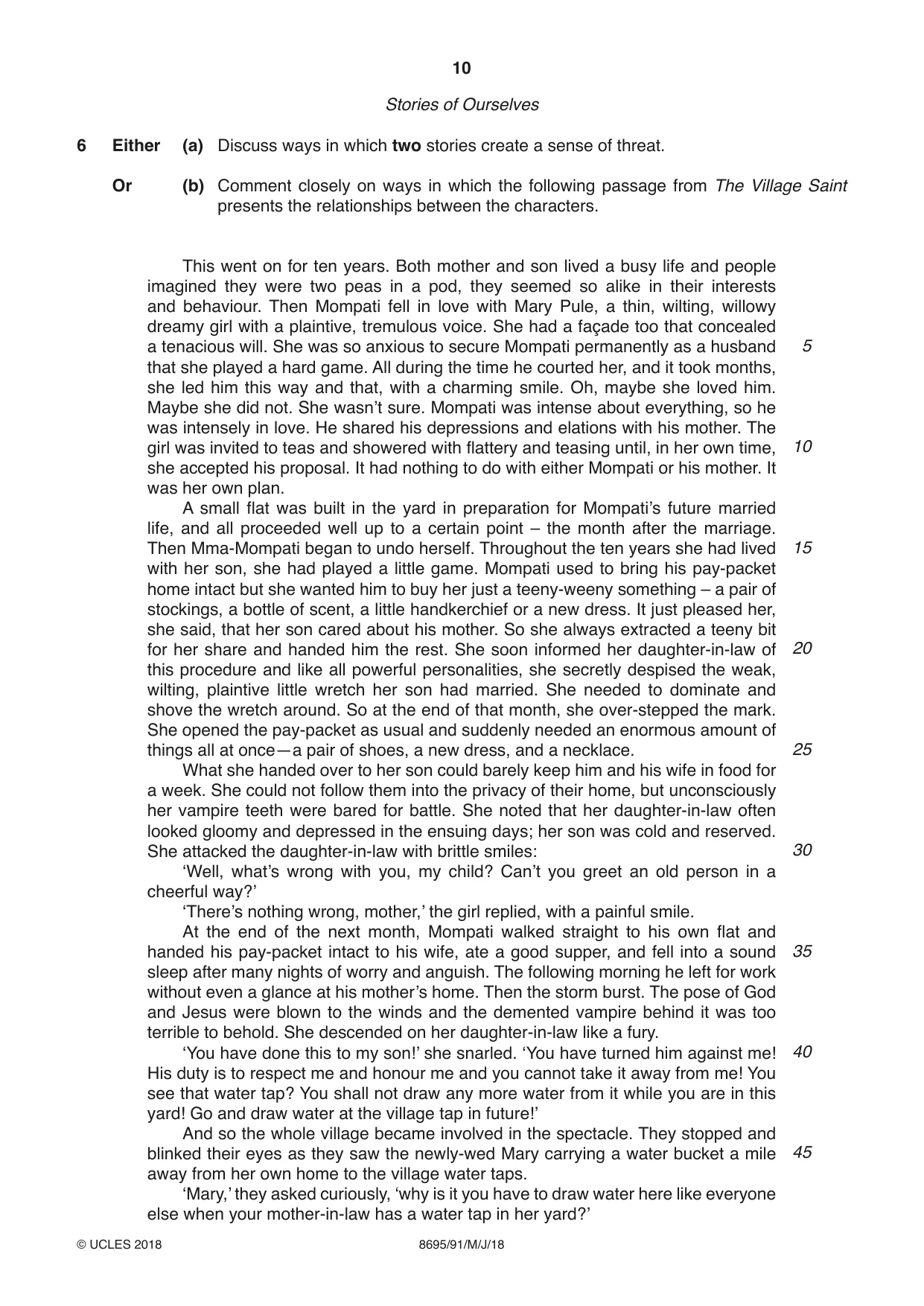
10 8695/91/M/J/18 © UCLES 2018 Stories of Ourselves 6 Either (a) Discuss ways in which two stories create a sense of threat. Or (b) Comment closely on ways in which the following passage from The Village Saint presents the relationships between the characters. This went on for ten years. Both mother and son lived a busy life and people imagined they were two peas in a pod, they seemed so alike in their interests and behaviour. Then Mompati fell in love with Mary Pule, a thin, wilting, willowy dreamy girl with a plaintive, tremulous voice. She had a façade too that concealed a tenacious will. She was so anxious to secure Mompati permanently as a husband that she played a hard game. All during the time he courted her, and it took months, she led him this way and that, with a charming smile. Oh, maybe she loved him. Maybe she did not. She wasn’t sure. Mompati was intense about everything, so he was intensely in love. He shared his depressions and elations with his mother. The girl was invited to teas and showered with flattery and teasing until, in her own time, she accepted his proposal. It had nothing to do with either Mompati or his mother. It was her own plan. A small flat was built in the yard in preparation for Mompati’s future married life, and all proceeded well up to a certain point – the month after the marriage. Then Mma-Mompati began to undo herself. Throughout the ten years she had lived with her son, she had played a little game. Mompati used to bring his pay-packet home intact but she wanted him to buy her just a teeny-weeny something – a pair of stockings, a bottle of scent, a little handkerchief or a new dress. It just pleased her, she said, that her son cared about his mother. So she always extracted a teeny bit for her share and handed him the rest. She soon informed her daughter-in-law of this procedure and like all powerful personalities, she secretly despised the weak, wilting, plaintive little wretch her son had married. She needed to dominate and shove the wretch around. So at the end of that month, she over-stepped the mark. She opened the pay-packet as usual and suddenly needed an enormous amount of things all at once—a pair of shoes, a new dress, and a necklace. What she handed over to her son could barely keep him and his wife in food for a week. She could not follow them into the privacy of their home, but unconsciously her vampire teeth were bared for battle. She noted that her daughter-in-law often looked gloomy and depressed in the ensuing days; her son was cold and reserved. She attacked the daughter-in-law with brittle smiles: ‘Well, what’s wrong with you, my child? Can’t you greet an old person in a cheerful way?’ ‘There’s nothing wrong, mother,’ the girl replied, with a painful smile. At the end of the next month, Mompati walked straight to his own flat and handed his pay-packet intact to his wife, ate a good supper, and fell into a sound sleep after many nights of worry and anguish. The following morning he left for work without even a glance at his mother’s home. Then the storm burst. The pose of God and Jesus were blown to the winds and the demented vampire behind it was too terrible to behold. She descended on her daughter-in-law like a fury. ‘You have done this to my son!’ she snarled. ‘You have turned him against me! His duty is to respect me and honour me and you cannot take it away from me! You see that water tap? You shall not draw any more water from it while you are in this yard! Go and draw water at the village tap in future!’ And so the whole village became involved in the spectacle. They stopped and blinked their eyes as they saw the newly-wed Mary carrying a water bucket a mile away from her own home to the village water taps. ‘Mary,’ they asked curiously, ‘why is it you have to draw water here like everyone else when your mother-in-law has a water tap in her yard?’ 5 10 15 20 25 30 35 40 45
Question paper, page 11
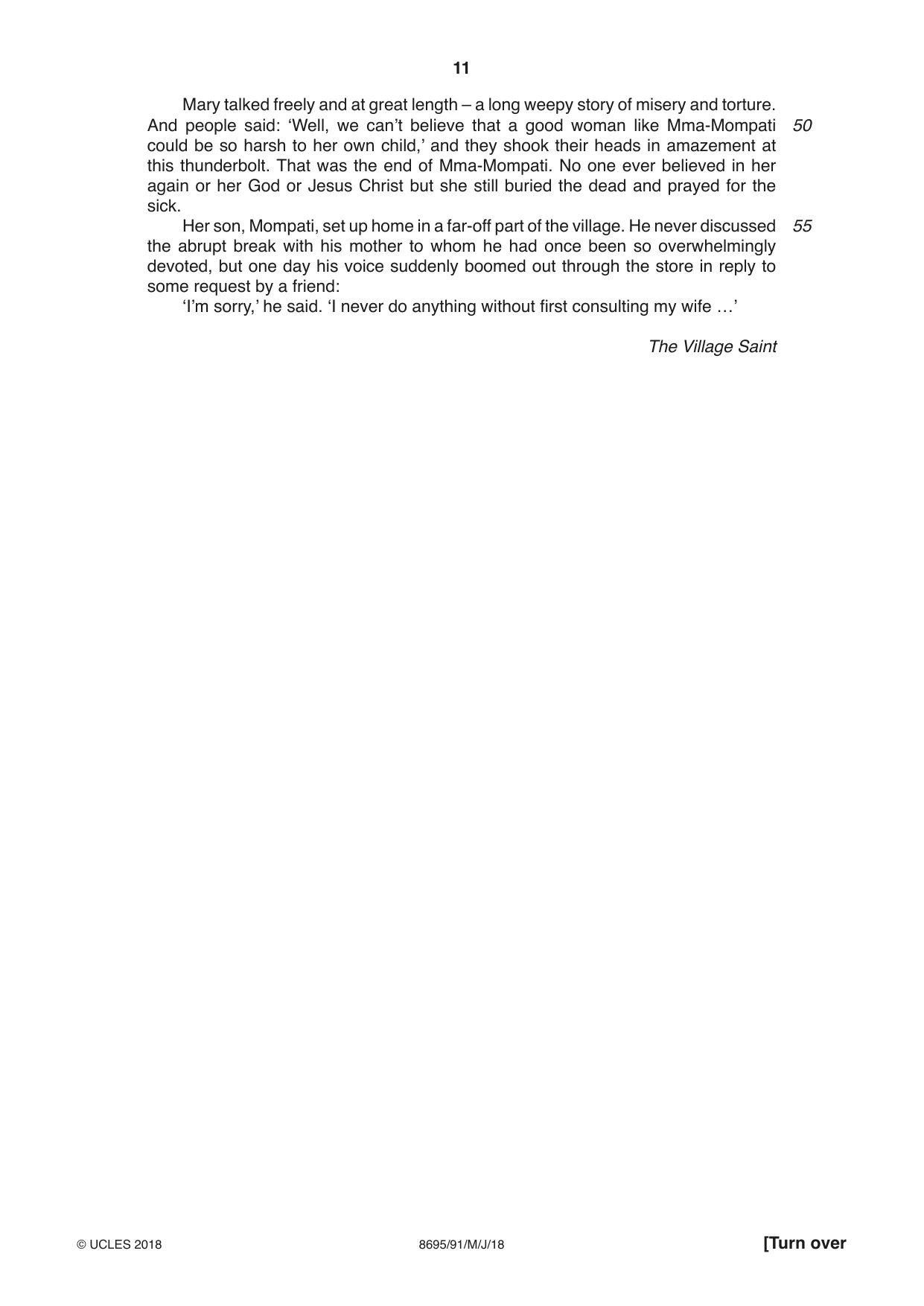
11 8695/91/M/J/18 © UCLES 2018 [Turn over Mary talked freely and at great length – a long weepy story of misery and torture. And people said: ‘Well, we can’t believe that a good woman like Mma-Mompati could be so harsh to her own child,’ and they shook their heads in amazement at this thunderbolt. That was the end of Mma-Mompati. No one ever believed in her again or her God or Jesus Christ but she still buried the dead and prayed for the sick. Her son, Mompati, set up home in a far-off part of the village. He never discussed the abrupt break with his mother to whom he had once been so overwhelmingly devoted, but one day his voice suddenly boomed out through the store in reply to some request by a friend: ‘I’m sorry,’ he said. ‘I never do anything without first consulting my wife …’ The Village Saint 50 55
Question paper, page 12
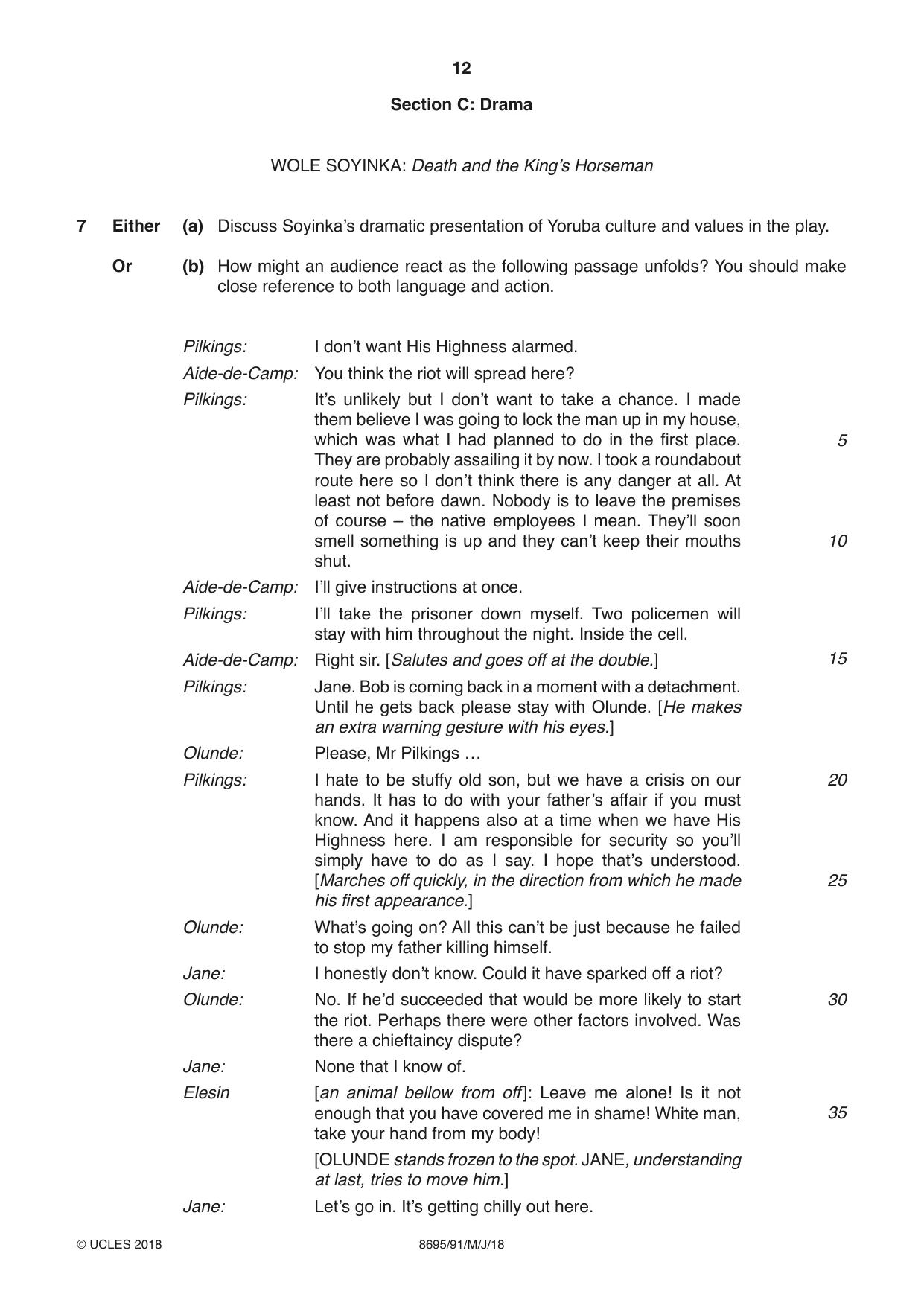
12 8695/91/M/J/18 © UCLES 2018 Section C: Drama WOLE SOYINKA: Death and the King’s Horseman 7 Either (a) Discuss Soyinka’s dramatic presentation of Yoruba culture and values in the play. Or (b) How might an audience react as the following passage unfolds? You should make close reference to both language and action. Pilkings: I don’t want His Highness alarmed. Aide-de-Camp: You think the riot will spread here? Pilkings: It’s unlikely but I don’t want to take a chance. I made them believe I was going to lock the man up in my house, which was what I had planned to do in the first place. They are probably assailing it by now. I took a roundabout route here so I don’t think there is any danger at all. At least not before dawn. Nobody is to leave the premises of course – the native employees I mean. They’ll soon smell something is up and they can’t keep their mouths shut. Aide-de-Camp: I’ll give instructions at once. Pilkings: I’ll take the prisoner down myself. Two policemen will stay with him throughout the night. Inside the cell. Aide-de-Camp: Right sir. [Salutes and goes off at the double.] Pilkings: Jane. Bob is coming back in a moment with a detachment. Until he gets back please stay with Olunde. [He makes an extra warning gesture with his eyes.] Olunde: Please, Mr Pilkings … Pilkings: I hate to be stuffy old son, but we have a crisis on our hands. It has to do with your father’s affair if you must know. And it happens also at a time when we have His Highness here. I am responsible for security so you’ll simply have to do as I say. I hope that’s understood. [Marches off quickly, in the direction from which he made his first appearance.] Olunde: What’s going on? All this can’t be just because he failed to stop my father killing himself. Jane: I honestly don’t know. Could it have sparked off a riot? Olunde: No. If he’d succeeded that would be more likely to start the riot. Perhaps there were other factors involved. Was there a chieftaincy dispute? Jane: None that I know of. Elesin [an animal bellow from off]: Leave me alone! Is it not enough that you have covered me in shame! White man, take your hand from my body! [OLUNDE stands frozen to the spot. JANE, understanding at last, tries to move him.] Jane: Let’s go in. It’s getting chilly out here. 5 10 15 20 25 30 35
Question paper, page 13
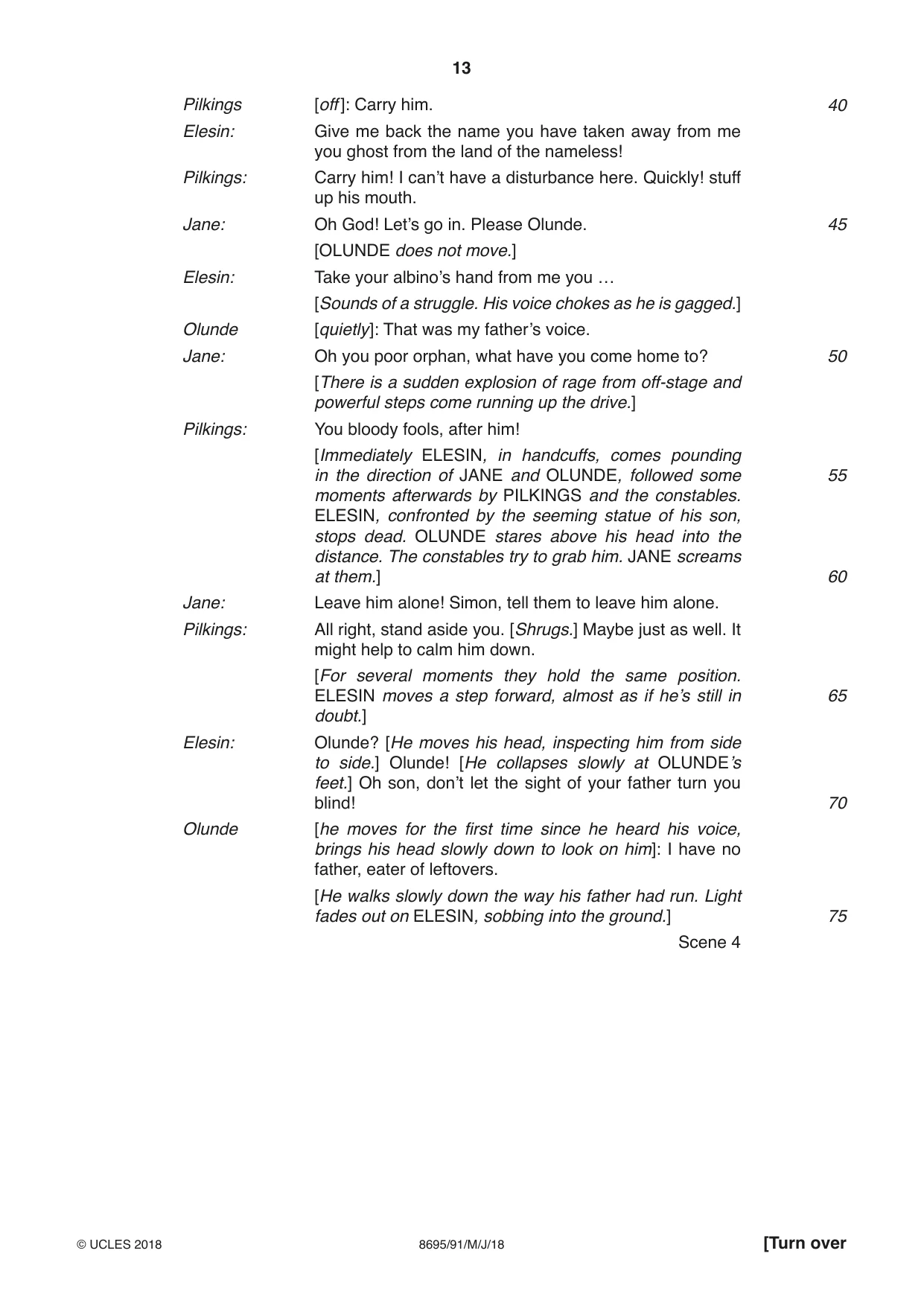
13 8695/91/M/J/18 © UCLES 2018 [Turn over Pilkings [off]: Carry him. Elesin: Give me back the name you have taken away from me you ghost from the land of the nameless! Pilkings: Carry him! I can’t have a disturbance here. Quickly! stuff up his mouth. Jane: Oh God! Let’s go in. Please Olunde. [OLUNDE does not move.] Elesin: Take your albino’s hand from me you … [Sounds of a struggle. His voice chokes as he is gagged.] Olunde [quietly]: That was my father’s voice. Jane: Oh you poor orphan, what have you come home to? [There is a sudden explosion of rage from off-stage and powerful steps come running up the drive.] Pilkings: You bloody fools, after him! [Immediately ELESIN, in handcuffs, comes pounding in the direction of JANE and OLUNDE, followed some moments afterwards by PILKINGS and the constables. ELESIN, confronted by the seeming statue of his son, stops dead. OLUNDE stares above his head into the distance. The constables try to grab him. JANE screams at them.] Jane: Leave him alone! Simon, tell them to leave him alone. Pilkings: All right, stand aside you. [Shrugs.] Maybe just as well. It might help to calm him down. [For several moments they hold the same position. ELESIN moves a step forward, almost as if he’s still in doubt.] Elesin: Olunde? [He moves his head, inspecting him from side to side.] Olunde! [He collapses slowly at OLUNDE’s feet.] Oh son, don’t let the sight of your father turn you blind! Olunde [he moves for the first time since he heard his voice, brings his head slowly down to look on him]: I have no father, eater of leftovers. [He walks slowly down the way his father had run. Light fades out on ELESIN, sobbing into the ground.] Scene 4 40 45 50 55 60 65 70 75
Question paper, page 14
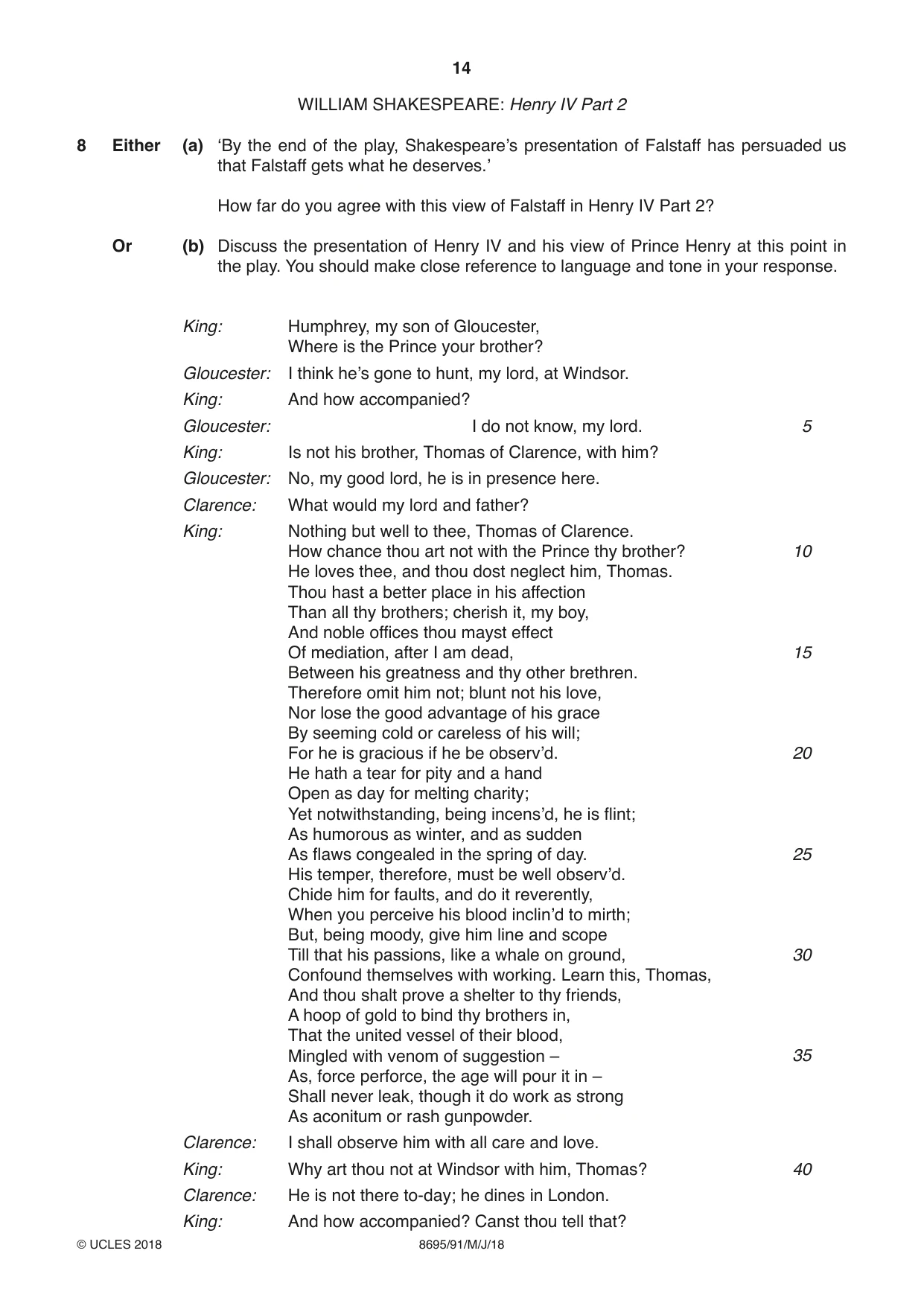
14 8695/91/M/J/18 © UCLES 2018 WILLIAM SHAKESPEARE: Henry IV Part 2 8 Either (a) ‘By the end of the play, Shakespeare’s presentation of Falstaff has persuaded us that Falstaff gets what he deserves.’ How far do you agree with this view of Falstaff in Henry IV Part 2? Or (b) Discuss the presentation of Henry IV and his view of Prince Henry at this point in the play. You should make close reference to language and tone in your response. King: Humphrey, my son of Gloucester, Where is the Prince your brother? Gloucester: I think he’s gone to hunt, my lord, at Windsor. King: And how accompanied? Gloucester: I do not know, my lord. King: Is not his brother, Thomas of Clarence, with him? Gloucester: No, my good lord, he is in presence here. Clarence: What would my lord and father? King: Nothing but well to thee, Thomas of Clarence. How chance thou art not with the Prince thy brother? He loves thee, and thou dost neglect him, Thomas. Thou hast a better place in his affection Than all thy brothers; cherish it, my boy, And noble offices thou mayst effect Of mediation, after I am dead, Between his greatness and thy other brethren. Therefore omit him not; blunt not his love, Nor lose the good advantage of his grace By seeming cold or careless of his will; For he is gracious if he be observ’d. He hath a tear for pity and a hand Open as day for melting charity; Yet notwithstanding, being incens’d, he is flint; As humorous as winter, and as sudden As flaws congealed in the spring of day. His temper, therefore, must be well observ’d. Chide him for faults, and do it reverently, When you perceive his blood inclin’d to mirth; But, being moody, give him line and scope Till that his passions, like a whale on ground, Confound themselves with working. Learn this, Thomas, And thou shalt prove a shelter to thy friends, A hoop of gold to bind thy brothers in, That the united vessel of their blood, Mingled with venom of suggestion – As, force perforce, the age will pour it in – Shall never leak, though it do work as strong As aconitum or rash gunpowder. Clarence: I shall observe him with all care and love. King: Why art thou not at Windsor with him, Thomas? Clarence: He is not there to-day; he dines in London. King: And how accompanied? Canst thou tell that? 5 10 15 20 25 30 35 40
Question paper, page 15
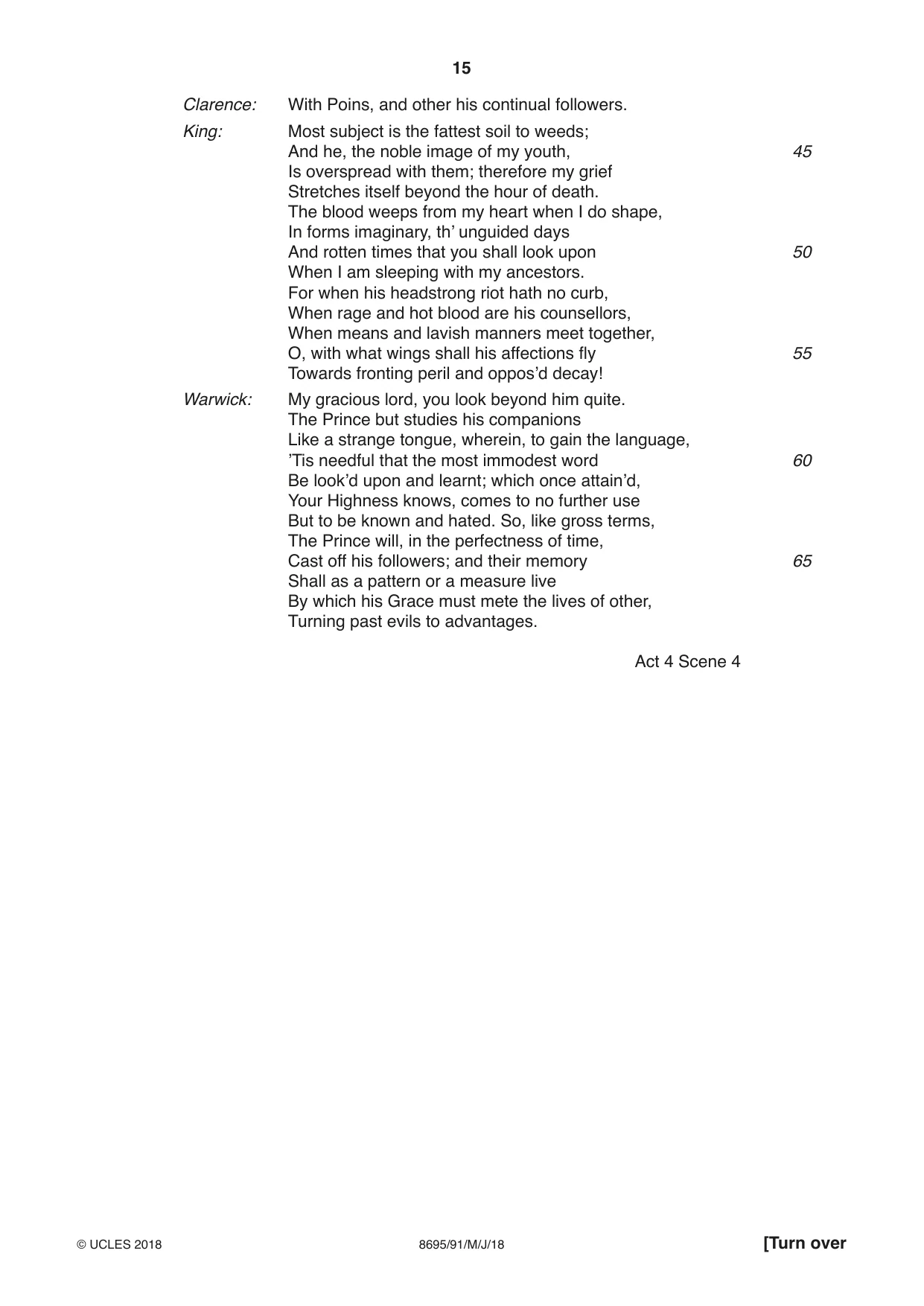
15 8695/91/M/J/18 © UCLES 2018 [Turn over Clarence: With Poins, and other his continual followers. King: Most subject is the fattest soil to weeds; And he, the noble image of my youth, Is overspread with them; therefore my grief Stretches itself beyond the hour of death. The blood weeps from my heart when I do shape, In forms imaginary, th’ unguided days And rotten times that you shall look upon When I am sleeping with my ancestors. For when his headstrong riot hath no curb, When rage and hot blood are his counsellors, When means and lavish manners meet together, O, with what wings shall his affections fly Towards fronting peril and oppos’d decay! Warwick: My gracious lord, you look beyond him quite. The Prince but studies his companions Like a strange tongue, wherein, to gain the language, ’Tis needful that the most immodest word Be look’d upon and learnt; which once attain’d, Your Highness knows, comes to no further use But to be known and hated. So, like gross terms, The Prince will, in the perfectness of time, Cast off his followers; and their memory Shall as a pattern or a measure live By which his Grace must mete the lives of other, Turning past evils to advantages. Act 4 Scene 4 45 50 55 60 65
Question paper, page 16
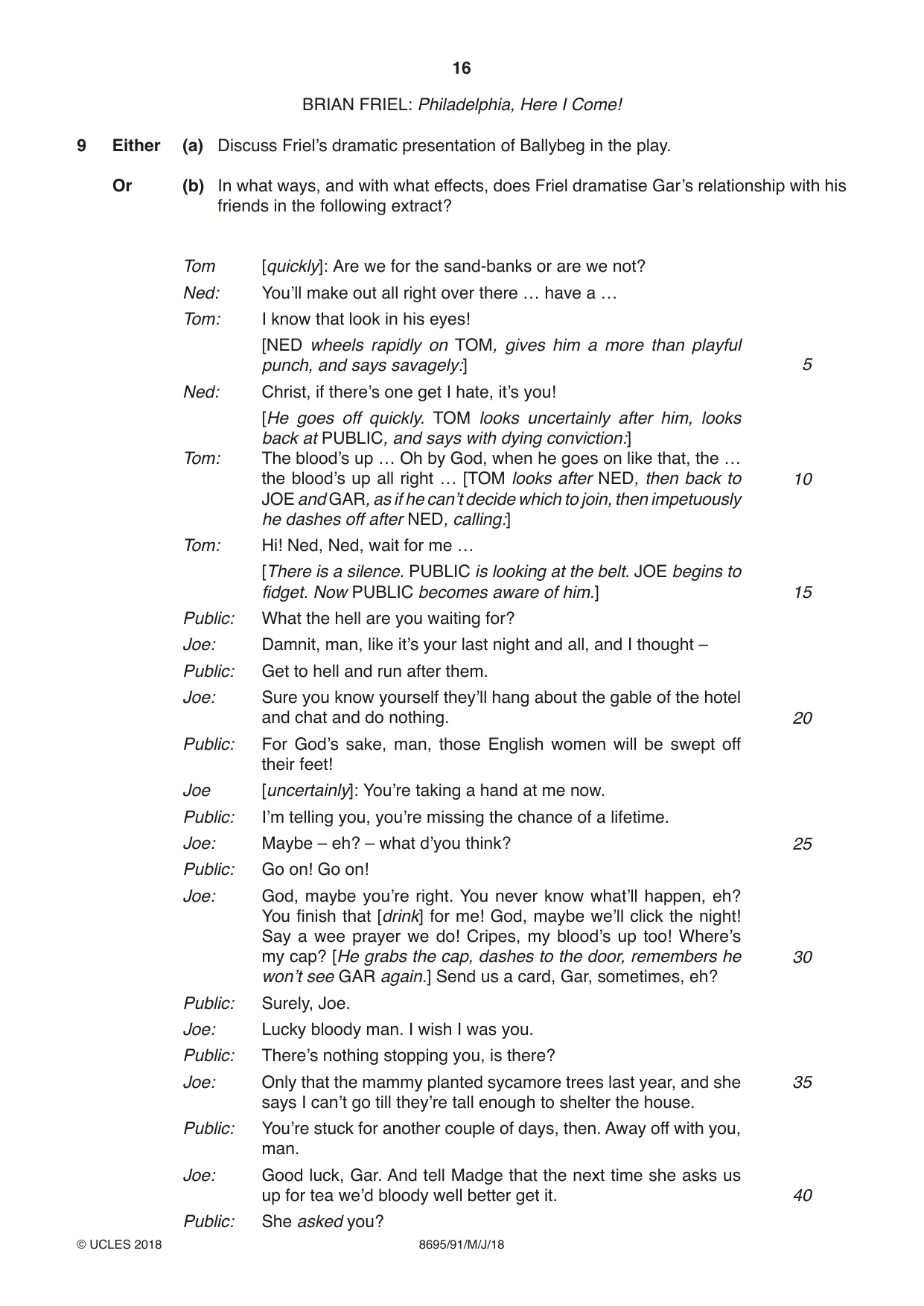
16 8695/91/M/J/18 © UCLES 2018 BRIAN FRIEL: Philadelphia, Here I Come! 9 Either (a) Discuss Friel’s dramatic presentation of Ballybeg in the play. Or (b) In what ways, and with what effects, does Friel dramatise Gar’s relationship with his friends in the following extract? Tom [quickly]: Are we for the sand-banks or are we not? Ned: You’ll make out all right over there … have a … Tom: I know that look in his eyes! [NED wheels rapidly on TOM, gives him a more than playful punch, and says savagely:] Ned: Christ, if there’s one get I hate, it’s you! [He goes off quickly. TOM looks uncertainly after him, looks back at PUBLIC, and says with dying conviction:] Tom: The blood’s up … Oh by God, when he goes on like that, the … the blood’s up all right … [TOM looks after NED, then back to JOE and GAR, as if he can’t decide which to join, then impetuously he dashes off after NED, calling:] Tom: Hi! Ned, Ned, wait for me … [There is a silence. PUBLIC is looking at the belt. JOE begins to fidget. Now PUBLIC becomes aware of him.] Public: What the hell are you waiting for? Joe: Damnit, man, like it’s your last night and all, and I thought – Public: Get to hell and run after them. Joe: Sure you know yourself they’ll hang about the gable of the hotel and chat and do nothing. Public: For God’s sake, man, those English women will be swept off their feet! Joe [uncertainly]: You’re taking a hand at me now. Public: I’m telling you, you’re missing the chance of a lifetime. Joe: Maybe – eh? – what d’you think? Public: Go on! Go on! Joe: God, maybe you’re right. You never know what’ll happen, eh? You finish that [drink] for me! God, maybe we’ll click the night! Say a wee prayer we do! Cripes, my blood’s up too! Where’s my cap? [He grabs the cap, dashes to the door, remembers he won’t see GAR again.] Send us a card, Gar, sometimes, eh? Public: Surely, Joe. Joe: Lucky bloody man. I wish I was you. Public: There’s nothing stopping you, is there? Joe: Only that the mammy planted sycamore trees last year, and she says I can’t go till they’re tall enough to shelter the house. Public: You’re stuck for another couple of days, then. Away off with you, man. Joe: Good luck, Gar. And tell Madge that the next time she asks us up for tea we’d bloody well better get it. Public: She asked you? 5 10 15 20 25 30 35 40
Question paper, page 17
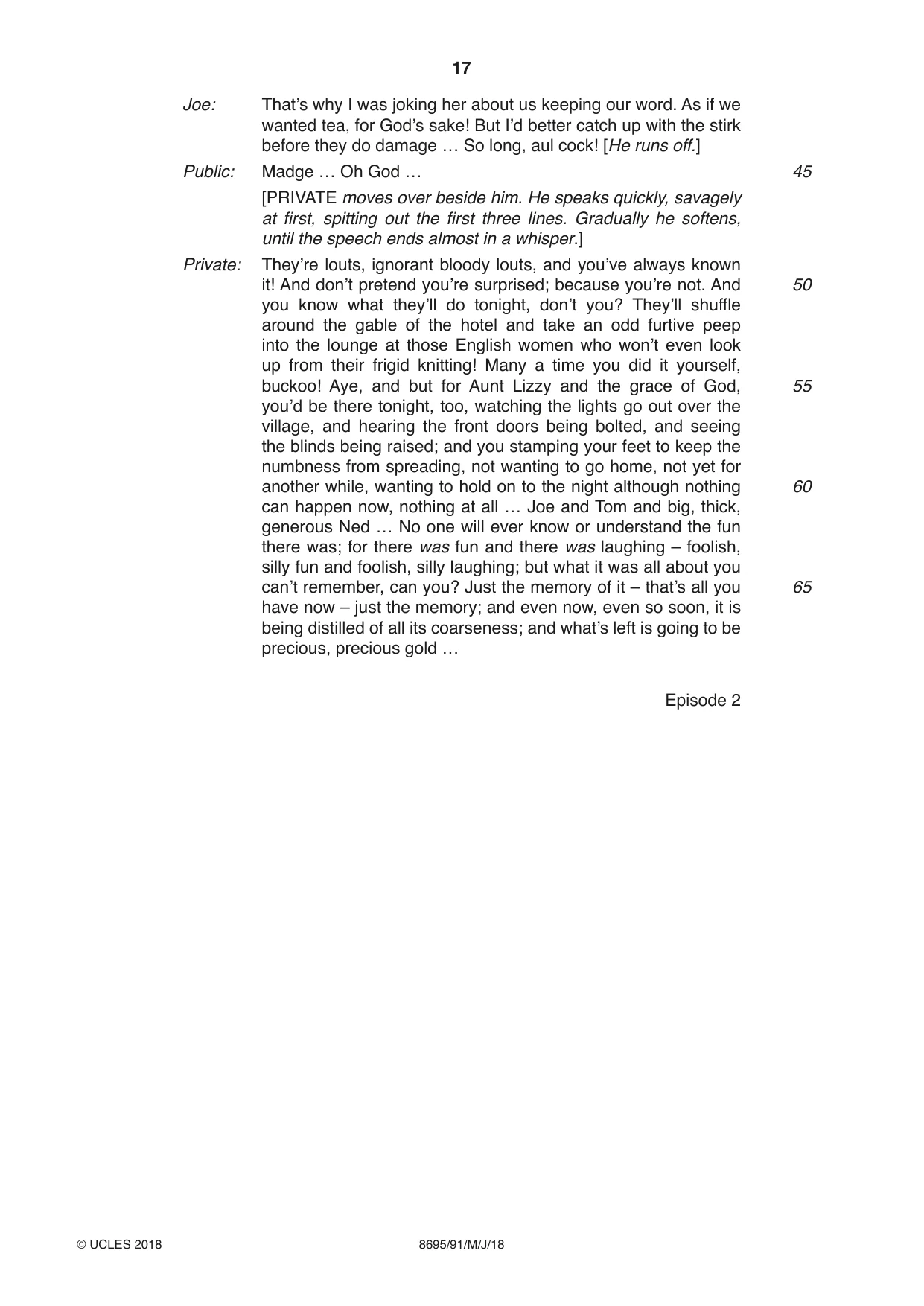
17 8695/91/M/J/18 © UCLES 2018 Joe: That’s why I was joking her about us keeping our word. As if we wanted tea, for God’s sake! But I’d better catch up with the stirk before they do damage … So long, aul cock! [He runs off.] Public: Madge … Oh God … [PRIVATE moves over beside him. He speaks quickly, savagely at first, spitting out the first three lines. Gradually he softens, until the speech ends almost in a whisper.] Private: They’re louts, ignorant bloody louts, and you’ve always known it! And don’t pretend you’re surprised; because you’re not. And you know what they’ll do tonight, don’t you? They’ll shuffle around the gable of the hotel and take an odd furtive peep into the lounge at those English women who won’t even look up from their frigid knitting! Many a time you did it yourself, buckoo! Aye, and but for Aunt Lizzy and the grace of God, you’d be there tonight, too, watching the lights go out over the village, and hearing the front doors being bolted, and seeing the blinds being raised; and you stamping your feet to keep the numbness from spreading, not wanting to go home, not yet for another while, wanting to hold on to the night although nothing can happen now, nothing at all … Joe and Tom and big, thick, generous Ned … No one will ever know or understand the fun there was; for there was fun and there was laughing – foolish, silly fun and foolish, silly laughing; but what it was all about you can’t remember, can you? Just the memory of it – that’s all you have now – just the memory; and even now, even so soon, it is being distilled of all its coarseness; and what’s left is going to be precious, precious gold … Episode 2 45 50 55 60 65
Question paper, page 18
18 8695/91/M/J/18 © UCLES 2018 BLANK PAGE
Question paper, page 19
19 8695/91/M/J/18 © UCLES 2018 BLANK PAGE
Question paper, page 20
20 8695/91/M/J/18 © UCLES 2018 Permission to reproduce items where third-party owned material protected by copyright is included has been sought and cleared where possible. Every reasonable effort has been made by the publisher (UCLES) to trace copyright holders, but if any items requiring clearance have unwittingly been included, the publisher will be pleased to make amends at the earliest possible opportunity. To avoid the issue of disclosure of answer-related information to candidates, all copyright acknowledgements are reproduced online in the Cambridge International Examinations Copyright Acknowledgements Booklet. This is produced for each series of examinations and is freely available to download at www.cie.org.uk after the live examination series. Cambridge International Examinations is part of the Cambridge Assessment Group. Cambridge Assessment is the brand name of University of Cambridge Local Examinations Syndicate (UCLES), which is itself a department of the University of Cambridge. BLANK PAGE
Mark scheme, page 1
IGCSE™ is a registered trademark. This document consists of 6 printed pages. © UCLES 2018 [Turn over Cambridge Assessment International Education Cambridge International Advanced Subsidiary Level LANGUAGE AND LITERATURE IN ENGLISH 8695/91 Paper 9 Poetry, Prose and Drama May/June 2018 MARK SCHEME Maximum Mark: 50 Published This mark scheme is published as an aid to teachers and candidates, to indicate the requirements of the examination. It shows the basis on which Examiners were instructed to award marks. It does not indicate the details of the discussions that took place at an Examiners’ meeting before marking began, which would have considered the acceptability of alternative answers. Mark schemes should be read in conjunction with the question paper and the Principal Examiner Report for Teachers. Cambridge International will not enter into discussions about these mark schemes. Cambridge International is publishing the mark schemes for the May/June 2018 series for most Cambridge IGCSE™, Cambridge International A and AS Level and Cambridge Pre-U components, and some Cambridge O Level components.
Mark scheme, page 2
8695/91 Cambridge International AS Level – Mark Scheme PUBLISHED May/June 2018 © UCLES 2018 Page 2 of 6 Generic Marking Principles These general marking principles must be applied by all examiners when marking candidate answers. They should be applied alongside the specific content of the mark scheme or generic level descriptors for a question. Each question paper and mark scheme will also comply with these marking principles. GENERIC MARKING PRINCIPLE 1: Marks must be awarded in line with: • the specific content of the mark scheme or the generic level descriptors for the question • the specific skills defined in the mark scheme or in the generic level descriptors for the question • the standard of response required by a candidate as exemplified by the standardisation scripts. GENERIC MARKING PRINCIPLE 2: Marks awarded are always whole marks (not half marks, or other fractions). GENERIC MARKING PRINCIPLE 3: Marks must be awarded positively: • marks are awarded for correct/valid answers, as defined in the mark scheme. However, credit is given for valid answers which go beyond the scope of the syllabus and mark scheme, referring to your Team Leader as appropriate • marks are awarded when candidates clearly demonstrate what they know and can do • marks are not deducted for errors • marks are not deducted for omissions • answers should only be judged on the quality of spelling, punctuation and grammar when these features are specifically assessed by the question as indicated by the mark scheme. The meaning, however, should be unambiguous. GENERIC MARKING PRINCIPLE 4: Rules must be applied consistently e.g. in situations where candidates have not followed instructions or in the application of generic level descriptors. GENERIC MARKING PRINCIPLE 5: Marks should be awarded using the full range of marks defined in the mark scheme for the question (however; the use of the full mark range may be limited according to the quality of the candidate responses seen). GENERIC MARKING PRINCIPLE 6: Marks awarded are based solely on the requirements as defined in the mark scheme. Marks should not be awarded with grade thresholds or grade descriptors in mind.
Mark scheme, page 3
8695/91 Cambridge International AS Level – Mark Scheme PUBLISHED May/June 2018 © UCLES 2018 Page 3 of 6 Using the mark levels Place the answer in a level first. Look for the ‘best fit’ of the answer into a level. An answer needs to show evidence of most but not necessarily ALL of the qualities described in a level, in order to be placed in that level. Then award a mark for the relative position of the answer within the level. Candidates may address the question in many different ways. Do not expect any particular focus or approach and do not penalise answers for leaving out a particular focus. Reward what is there, showing what you are rewarding, in your comments. Consider all strands and weigh up the performance as a whole in placing the answer in a level, then show that you have done so in the summative comment: e.g. Solid K of texts, limited evidence of U and mostly narrative, evidence of P with some, good personal response and generally clear C throughout. Assessment Objectives: AO1 The ability to respond to texts in the three main forms (Prose, Poetry and Drama) of different types and from different cultures. AO2 An understanding of the ways in which writers’ choices of form, structure and language shape meanings. AO3 The ability to produce informed, independent opinions and judgements on literary texts. AO4 The ability to communicate clearly the knowledge, understanding and insight appropriate for literary study. Each answer is marked out of 25, in accordance with the General Marking Criteria below. Each band is divided into strands corresponding to the Assessment Objectives – Knowledge, Understanding, Personal Response, Communication.
Mark scheme, page 4
8695/91 Cambridge International AS Level – Mark Scheme PUBLISHED May/June 2018 © UCLES 2018 Page 4 of 6 Level 6 22–25 Very good work – do not reserve this level for the very best work you see but ensure you put scripts into this level which fulfil the requirements described below. There will always be some candidates who are at a standard over the top of the mark scheme. K Evidence of a very good ability to select relevant knowledge to address the question with effective use of references and quotation. There may be evidence of sensitive awareness of the contexts in which the literary works studied were written and understood. U Evidence of very good understanding of ways in which writers’ choices of structure, form and language shape meanings with sustained analysis and sensitive appreciation of literary methods and effects and contexts, possibly including literary genres and conventions. P Personal response to texts will be perceptive, often freshly personal, fully supported with quotation, and may show originality in approach to and treatment of questions. C Candidates will express complex literary ideas and arguments with clarity and fluency. Answers will have a coherent structure, with logical progression and effectively linked paragraphs. Expression will be accomplished and appropriate. In answers to passage-based questions, work will sustain an appropriate balance between critical appreciation of given extracts, based on detailed critical analysis, and consideration of the broader textual issues raised by the questions, and relate part of a text to its whole and vice versa in a seamless argument. There will be a very good appreciation of the effects of the literary features of the text, with detailed analysis supported by relevant examples from the passage and the wider text, where appropriate. There will be a very good knowledge of the appropriate context of the extract or work. Level 5 18–21 Proficient work K Evidence of proficiency in selecting relevant knowledge to address the question with precise and integrated direct references to the text and supporting quotation. There may be evidence of awareness of the contexts in which the literary works studied were written and understood. U Evidence of intelligent understanding of ways in which writers’ choices of structure, form and language shape meanings, with analysis and appreciation of literary methods, effects and contexts. P Evidence of personal response to the texts, relevant to the question, supported from the text, some originality of thought, straightforward and vigorously articulated, perhaps, rather than penetrating and subtle. C Expression confident, with some complex ideas expressed with some fluency. Structure is sound. Literary arguments will be coherent, with progression of ideas through clearly linked paragraphs. In answers to passage-based questions, work will show engagement with both the given extracts and the wider textual issues. There will be a confident relation of a part of the text to its whole. There will be a proficient appreciation of the effects of the literary features of the text supported by relevant examples from the passage and from the wider text where appropriate. There will be a good knowledge of the appropriate context of the extract or work.
Mark scheme, page 5
8695/91 Cambridge International AS Level – Mark Scheme PUBLISHED May/June 2018 © UCLES 2018 Page 5 of 6 Level 4 14–17 Competent work K Evidence of competence in selecting relevant knowledge of the text to address with some pertinent use of quotation and direct references. U Evidence of sound understanding of some aspects of ways in which writers’ choices of structure, form and language shape meanings, with some analysis and appreciation of literary methods, effects, and contexts. P Evidence of personal response relevant to the question, supported from the text. C Expression will be clear and generally accurate. Structure will be sound – material coherently organised with occasional insights. Candidates will express intelligent, straightforward ideas clearly, though there may be occasional loss of fluency with points not always strongly connected. In answers to passage-based questions, work will cover both the passage and its relation to the whole text, and there will be some sense of a relationship between the text as a whole and its constituent parts. There will be competent appreciation of the effects of the literary features of the text and the analysis is supported by relevant examples from the passage. Level 3 10–13 Solid work K Evidence of some ability to use relevant knowledge of the text to address the question. U Evidence of clear understanding of some ways in which writers’ choices of structure, form and language shape meanings, which may be partial and restricted to the more obvious aspects of the text. P Evidence of personal response to the text, with the beginnings of a personal view or interpretation, relevant to the question and supported from the text. C Expression will be mostly clear and appropriate with a clear, simple structure to the answer. Argument will be basically coherent, and assertive in tone. There is likely to be some reliance on paraphrase and narrative summary. Articulates simple ideas with clarity but there may be some imprecision and clumsiness of expression in dealing with more complex concepts. There may be occasional obscurity in the presentation of ideas and responses. In answers to passage-based questions, work may be lacking in balance of approach, with over-concentration on the given extracts and little attempt to explore the broader textual issues. Conversely some answers may be in effect general essays, with insufficient treatment of the passages. There may be evidence of limited ability to negotiate between parts of a text and its whole. There will be some consideration of the literary features of the text with analysis of the features mentioned likely to be partial or restricted.
Mark scheme, page 6
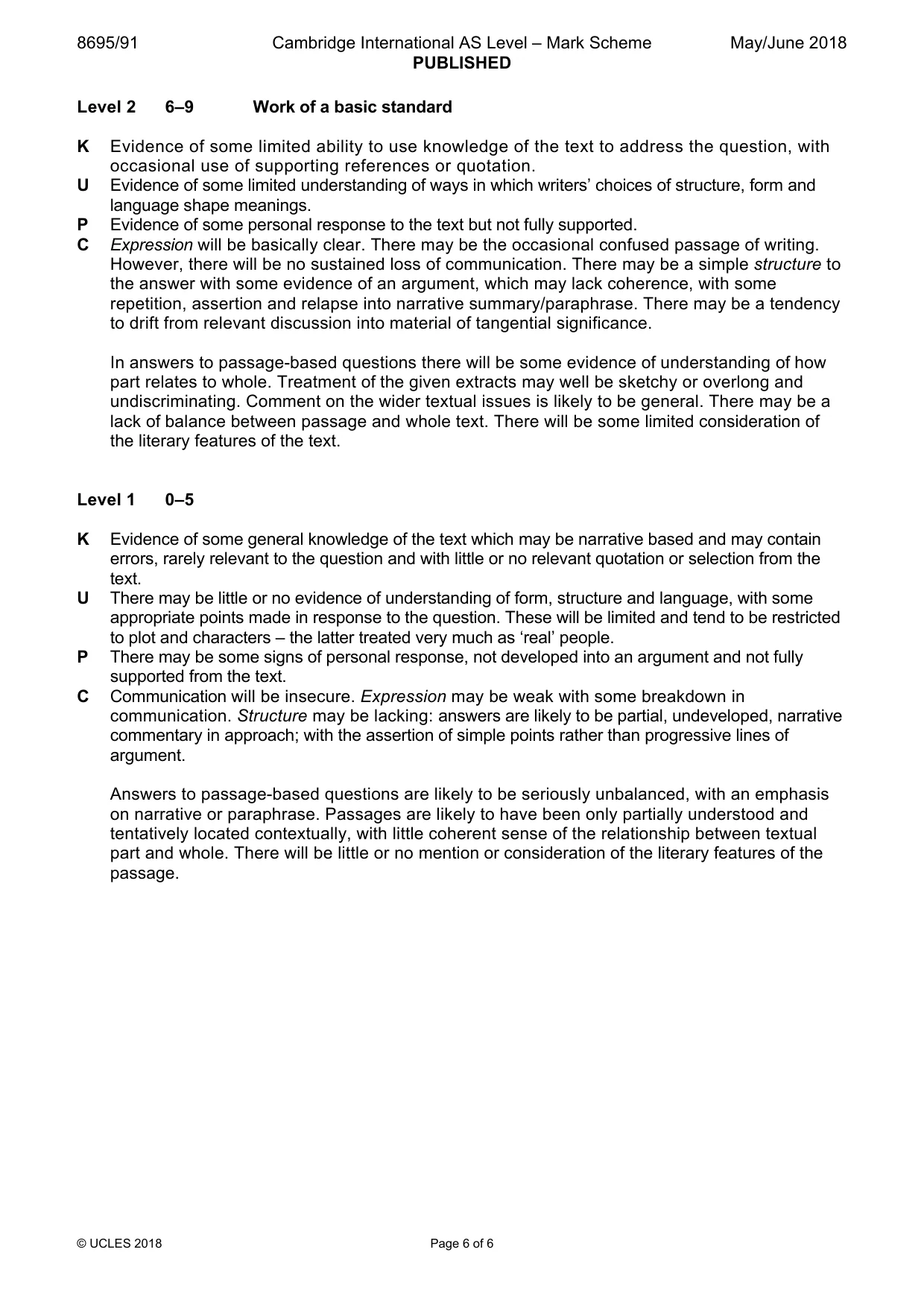
8695/91 Cambridge International AS Level – Mark Scheme PUBLISHED May/June 2018 © UCLES 2018 Page 6 of 6 Level 2 6–9 Work of a basic standard K Evidence of some limited ability to use knowledge of the text to address the question, with occasional use of supporting references or quotation. U Evidence of some limited understanding of ways in which writers’ choices of structure, form and language shape meanings. P Evidence of some personal response to the text but not fully supported. C Expression will be basically clear. There may be the occasional confused passage of writing. However, there will be no sustained loss of communication. There may be a simple structure to the answer with some evidence of an argument, which may lack coherence, with some repetition, assertion and relapse into narrative summary/paraphrase. There may be a tendency to drift from relevant discussion into material of tangential significance. In answers to passage-based questions there will be some evidence of understanding of how part relates to whole. Treatment of the given extracts may well be sketchy or overlong and undiscriminating. Comment on the wider textual issues is likely to be general. There may be a lack of balance between passage and whole text. There will be some limited consideration of the literary features of the text. Level 1 0–5 K Evidence of some general knowledge of the text which may be narrative based and may contain errors, rarely relevant to the question and with little or no relevant quotation or selection from the text. U There may be little or no evidence of understanding of form, structure and language, with some appropriate points made in response to the question. These will be limited and tend to be restricted to plot and characters – the latter treated very much as ‘real’ people. P There may be some signs of personal response, not developed into an argument and not fully supported from the text. C Communication will be insecure. Expression may be weak with some breakdown in communication. Structure may be lacking: answers are likely to be partial, undeveloped, narrative commentary in approach; with the assertion of simple points rather than progressive lines of argument. Answers to passage-based questions are likely to be seriously unbalanced, with an emphasis on narrative or paraphrase. Passages are likely to have been only partially understood and tentatively located contextually, with little coherent sense of the relationship between textual part and whole. There will be little or no mention or consideration of the literary features of the passage.
What you needed in this session
Cambridge’s own grade thresholds for 2018 May/June, Paper 9 · Variant 1. A higher threshold means an easier paper — the bar moves with how the cohort did.