Cambridge A Level English - Language and Literature (AS Level only, from 2016) 8695 — 2017 May/June Paper 9 · Variant 1
8695/91/M/J/17 · 50 marks · ≈56 min
The question paper and its mark scheme, free to read here and free to download. This is Cambridge’s own paper, exactly as it was sat.
Question paper16 pages

Mark scheme5 pages
Answers below. Sit the paper first if you are practising.
Paper as text
Question paper, page 1
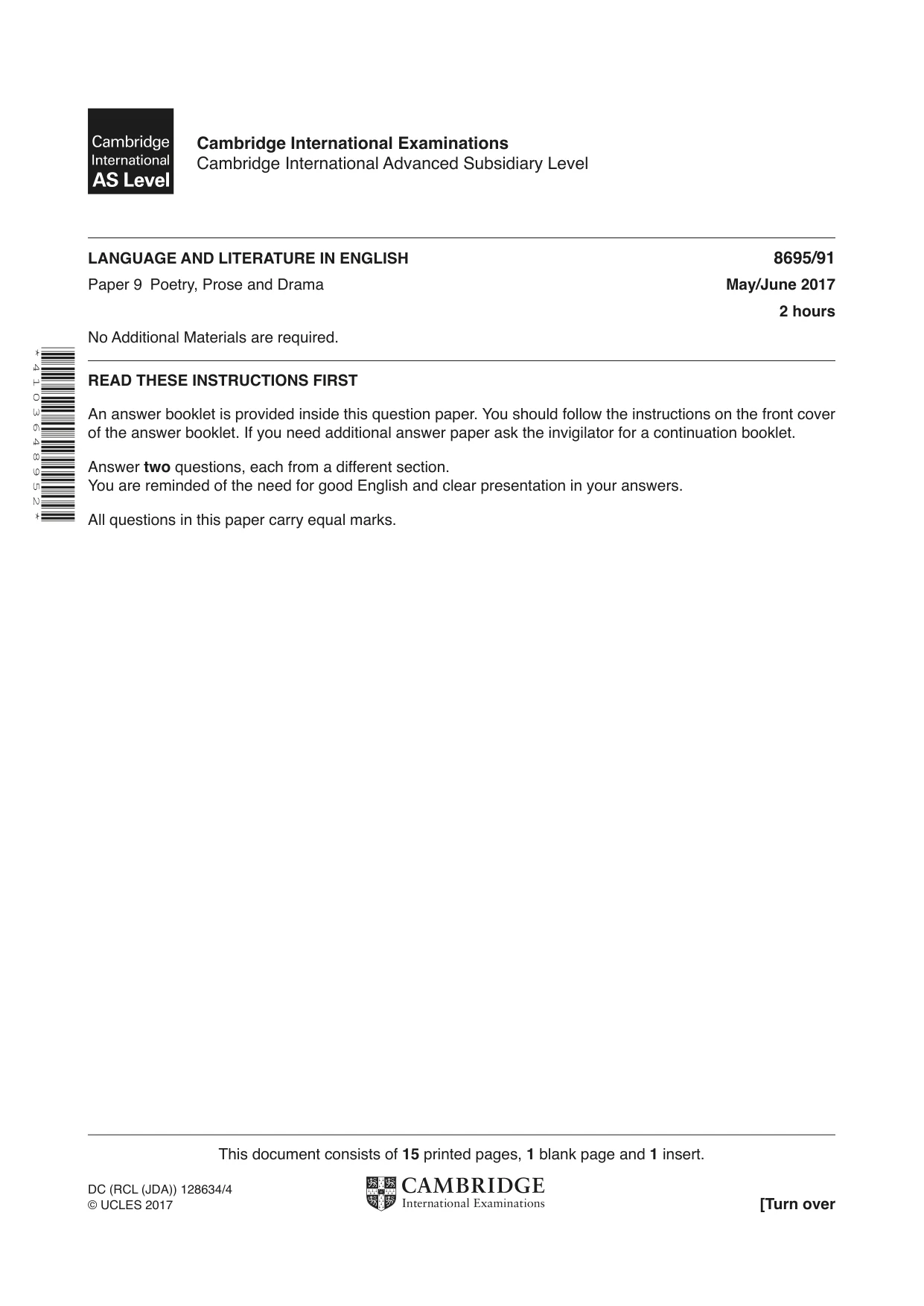
This document consists of 15 printed pages, 1 blank page and 1 insert. DC (RCL (JDA)) 128634/4 © UCLES 2017 [Turn over Cambridge International Examinations Cambridge International Advanced Subsidiary Level * 4 1 0 3 6 4 8 9 5 2 * LANGUAGE AND LITERATURE IN ENGLISH 8695/91 Paper 9 Poetry, Prose and Drama May/June 2017 2 hours No Additional Materials are required. READ THESE INSTRUCTIONS FIRST An answer booklet is provided inside this question paper. You should follow the instructions on the front cover of the answer booklet. If you need additional answer paper ask the invigilator for a continuation booklet. Answer two questions, each from a different section. You are reminded of the need for good English and clear presentation in your answers. All questions in this paper carry equal marks.
Question paper, page 2
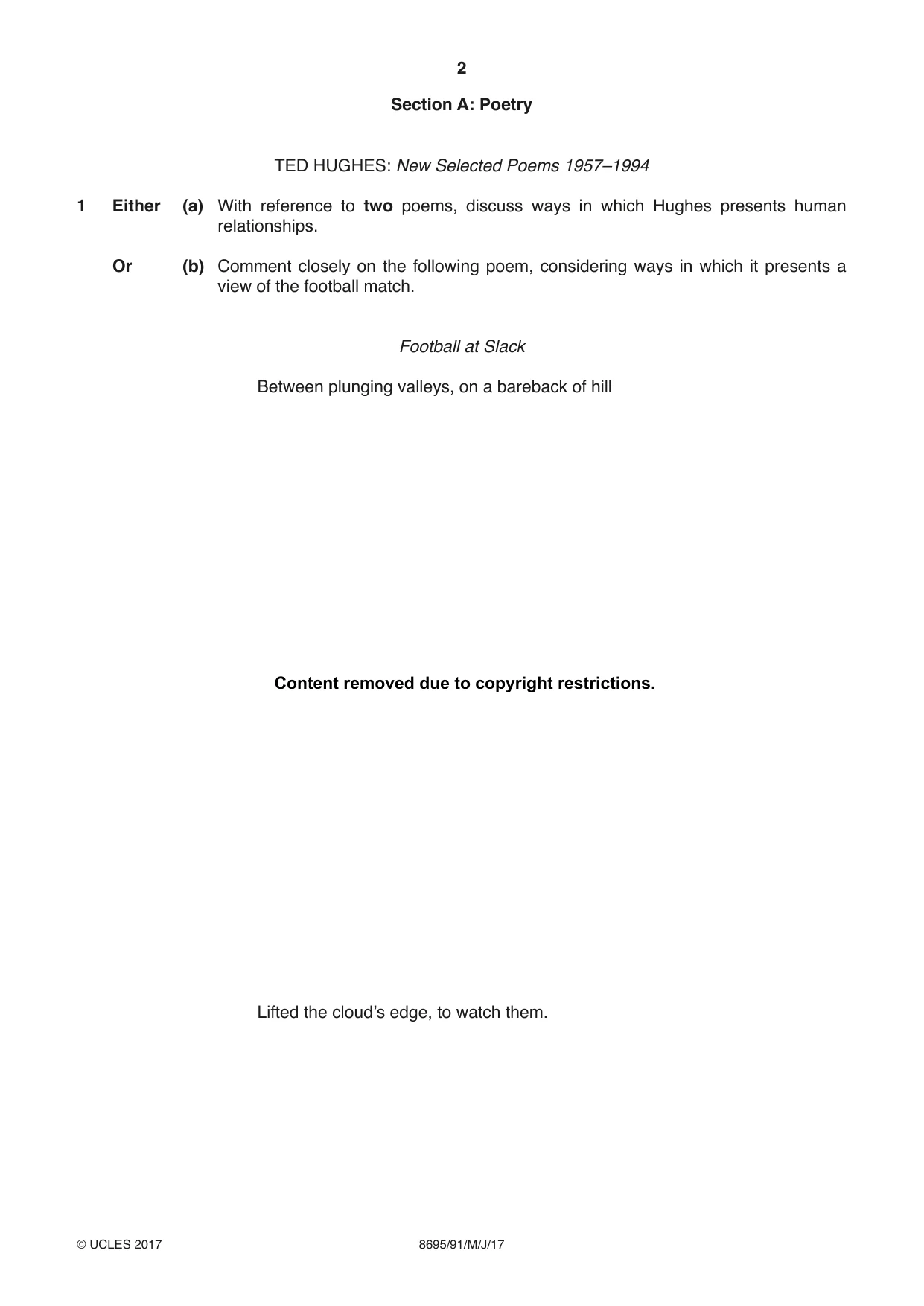
2 8695/91/M/J/17 © UCLES 2017 Section A: Poetry TED HUGHES: New Selected Poems 1957–1994 1 Either (a) With reference to two poems, discuss ways in which Hughes presents human relationships. Or (b) Comment closely on the following poem, considering ways in which it presents a view of the football match. Football at Slack Between plunging valleys, on a bareback of hill Lifted the cloud’s edge, to watch them. Content removed due to copyright restrictions.
Question paper, page 3
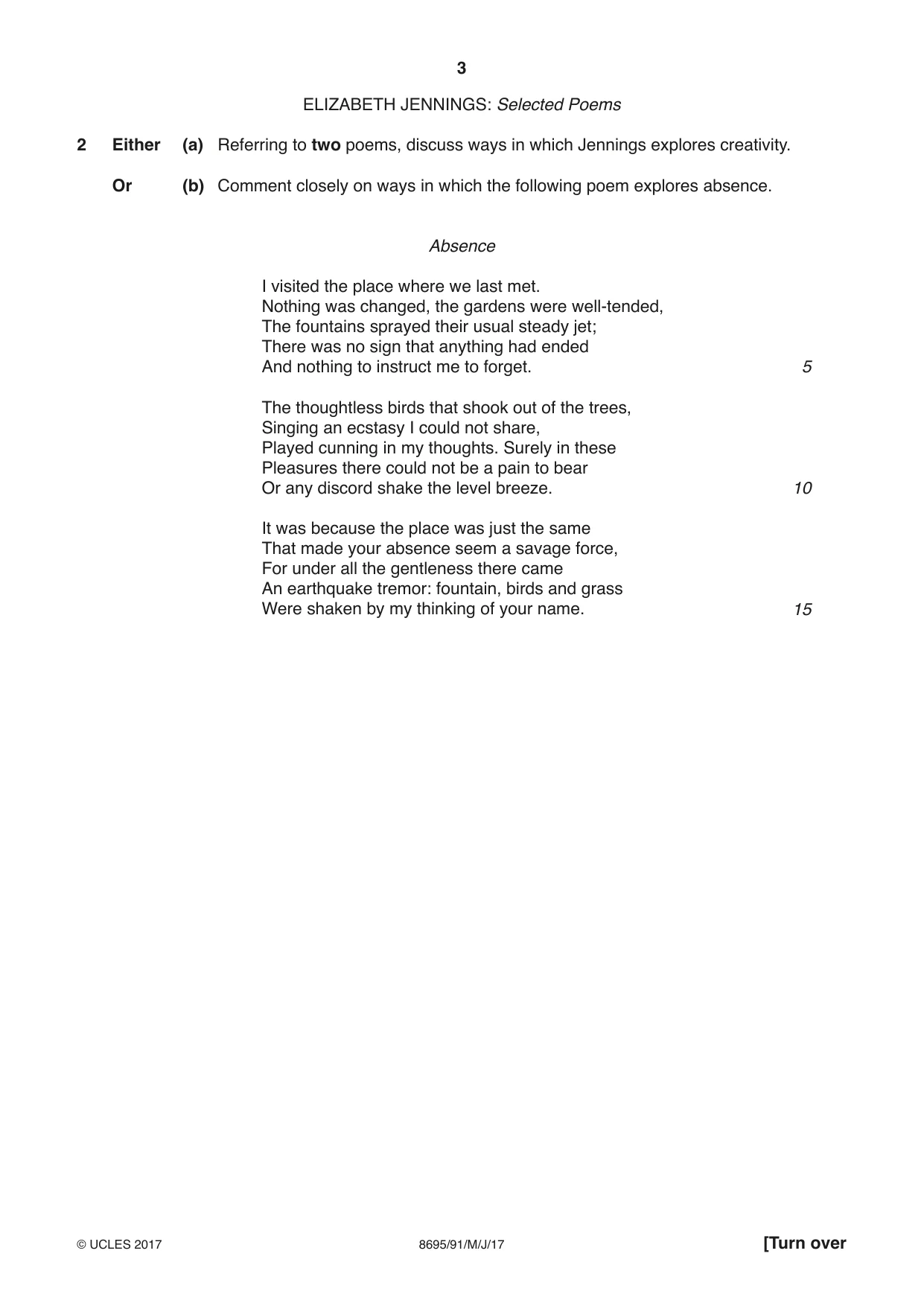
3 8695/91/M/J/17 © UCLES 2017 [Turn over ELIZABETH JENNINGS: Selected Poems 2 Either (a) Referring to two poems, discuss ways in which Jennings explores creativity. Or (b) Comment closely on ways in which the following poem explores absence. Absence I visited the place where we last met. Nothing was changed, the gardens were well-tended, The fountains sprayed their usual steady jet; There was no sign that anything had ended And nothing to instruct me to forget. The thoughtless birds that shook out of the trees, Singing an ecstasy I could not share, Played cunning in my thoughts. Surely in these Pleasures there could not be a pain to bear Or any discord shake the level breeze. It was because the place was just the same That made your absence seem a savage force, For under all the gentleness there came An earthquake tremor: fountain, birds and grass Were shaken by my thinking of your name. 5 10 15
Question paper, page 4
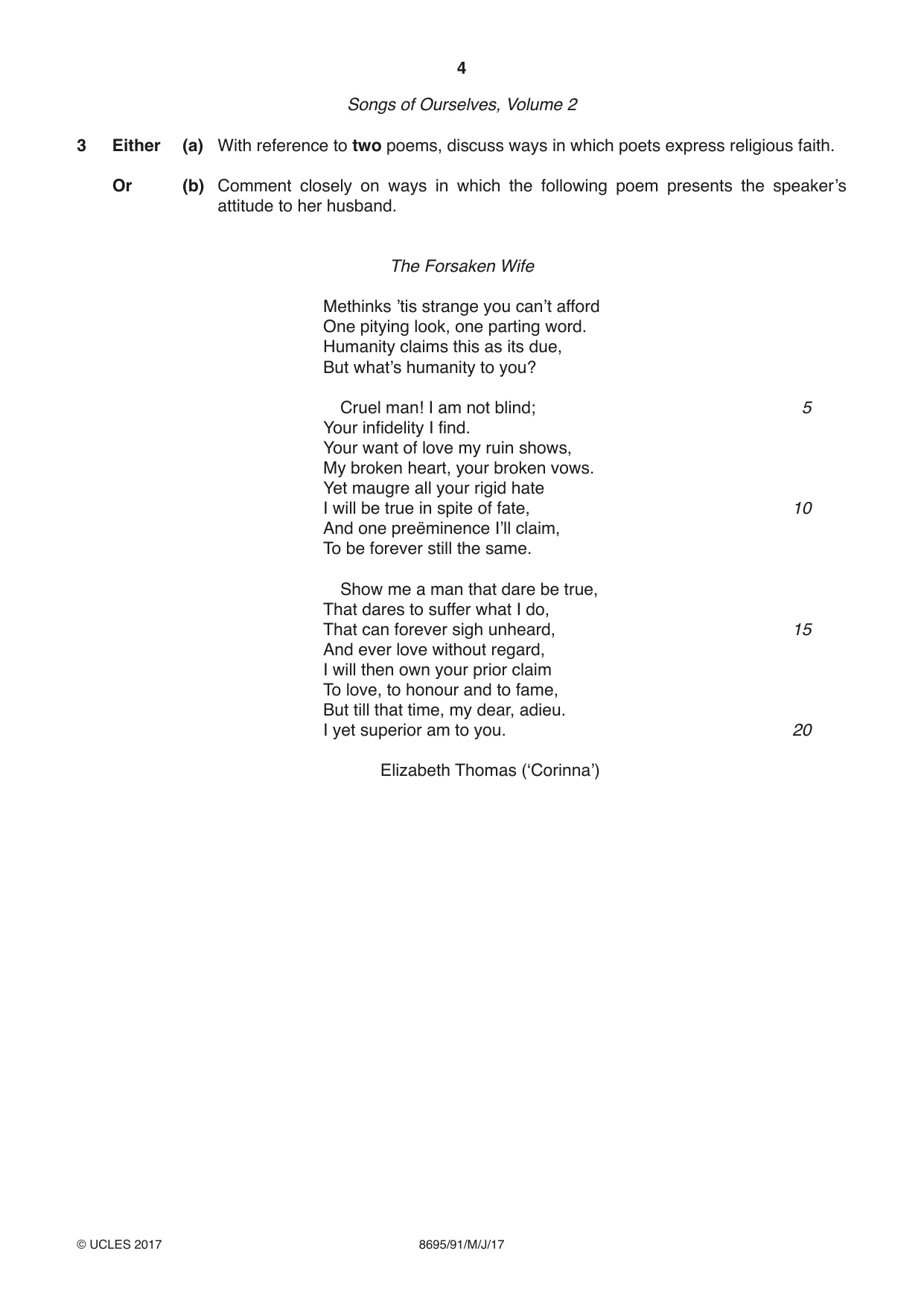
4 8695/91/M/J/17 © UCLES 2017 Songs of Ourselves, Volume 2 3 Either (a) With reference to two poems, discuss ways in which poets express religious faith. Or (b) Comment closely on ways in which the following poem presents the speaker’s attitude to her husband. The Forsaken Wife Methinks ’tis strange you can’t afford One pitying look, one parting word. Humanity claims this as its due, But what’s humanity to you? Cruel man! I am not blind; Your infidelity I find. Your want of love my ruin shows, My broken heart, your broken vows. Yet maugre all your rigid hate I will be true in spite of fate, And one preëminence I’ll claim, To be forever still the same. Show me a man that dare be true, That dares to suffer what I do, That can forever sigh unheard, And ever love without regard, I will then own your prior claim To love, to honour and to fame, But till that time, my dear, adieu. I yet superior am to you. Elizabeth Thomas (‘Corinna’) 5 10 15 20
Question paper, page 5
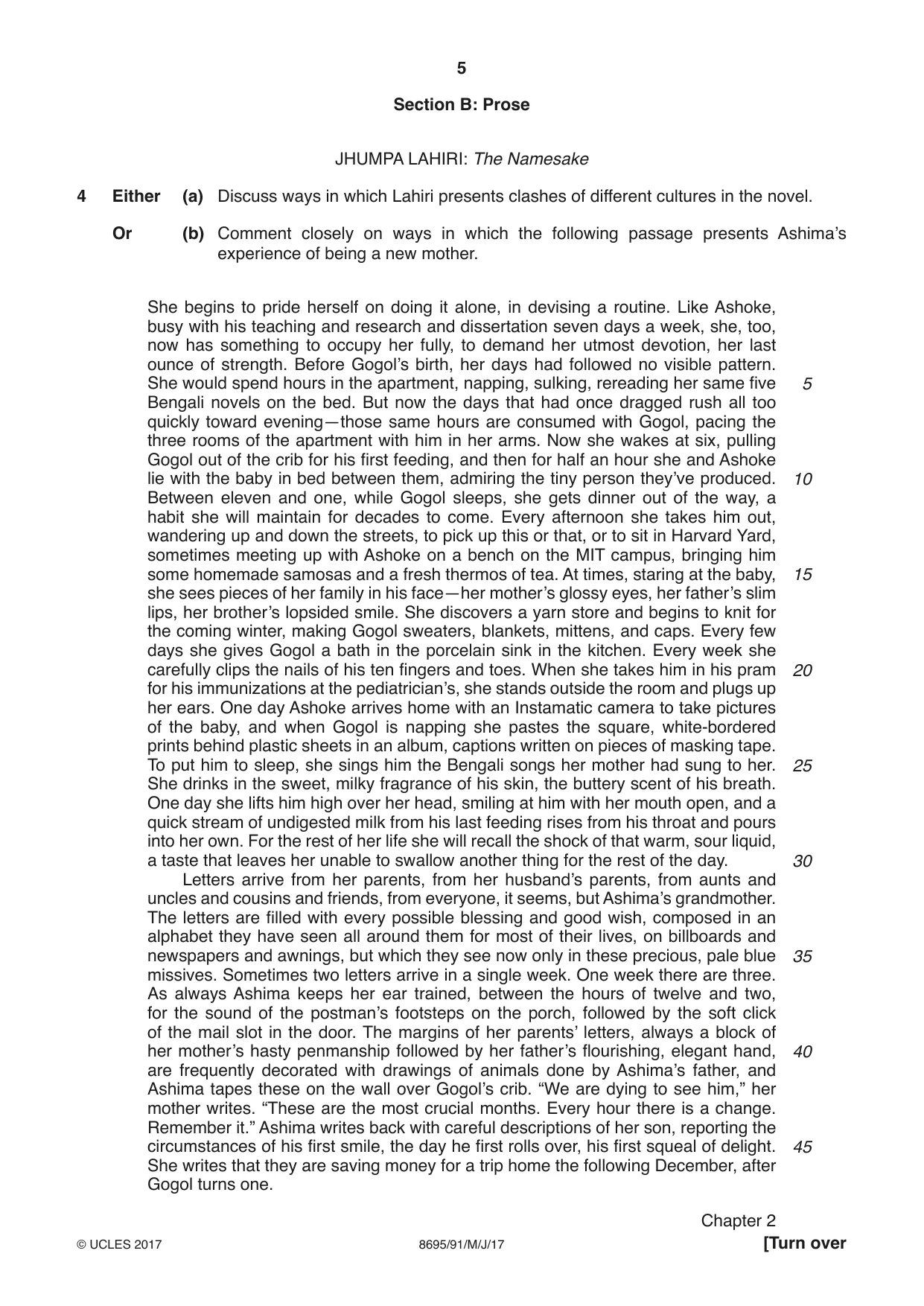
5 8695/91/M/J/17 © UCLES 2017 [Turn over Section B: Prose JHUMPA LAHIRI: The Namesake 4 Either (a) Discuss ways in which Lahiri presents clashes of different cultures in the novel. Or (b) Comment closely on ways in which the following passage presents Ashima’s experience of being a new mother. She begins to pride herself on doing it alone, in devising a routine. Like Ashoke, busy with his teaching and research and dissertation seven days a week, she, too, now has something to occupy her fully, to demand her utmost devotion, her last ounce of strength. Before Gogol’s birth, her days had followed no visible pattern. She would spend hours in the apartment, napping, sulking, rereading her same five Bengali novels on the bed. But now the days that had once dragged rush all too quickly toward evening—those same hours are consumed with Gogol, pacing the three rooms of the apartment with him in her arms. Now she wakes at six, pulling Gogol out of the crib for his first feeding, and then for half an hour she and Ashoke lie with the baby in bed between them, admiring the tiny person they’ve produced. Between eleven and one, while Gogol sleeps, she gets dinner out of the way, a habit she will maintain for decades to come. Every afternoon she takes him out, wandering up and down the streets, to pick up this or that, or to sit in Harvard Yard, sometimes meeting up with Ashoke on a bench on the MIT campus, bringing him some homemade samosas and a fresh thermos of tea. At times, staring at the baby, she sees pieces of her family in his face—her mother’s glossy eyes, her father’s slim lips, her brother’s lopsided smile. She discovers a yarn store and begins to knit for the coming winter, making Gogol sweaters, blankets, mittens, and caps. Every few days she gives Gogol a bath in the porcelain sink in the kitchen. Every week she carefully clips the nails of his ten fingers and toes. When she takes him in his pram for his immunizations at the pediatrician’s, she stands outside the room and plugs up her ears. One day Ashoke arrives home with an Instamatic camera to take pictures of the baby, and when Gogol is napping she pastes the square, white-bordered prints behind plastic sheets in an album, captions written on pieces of masking tape. To put him to sleep, she sings him the Bengali songs her mother had sung to her. She drinks in the sweet, milky fragrance of his skin, the buttery scent of his breath. One day she lifts him high over her head, smiling at him with her mouth open, and a quick stream of undigested milk from his last feeding rises from his throat and pours into her own. For the rest of her life she will recall the shock of that warm, sour liquid, a taste that leaves her unable to swallow another thing for the rest of the day. Letters arrive from her parents, from her husband’s parents, from aunts and uncles and cousins and friends, from everyone, it seems, but Ashima’s grandmother. The letters are filled with every possible blessing and good wish, composed in an alphabet they have seen all around them for most of their lives, on billboards and newspapers and awnings, but which they see now only in these precious, pale blue missives. Sometimes two letters arrive in a single week. One week there are three. As always Ashima keeps her ear trained, between the hours of twelve and two, for the sound of the postman’s footsteps on the porch, followed by the soft click of the mail slot in the door. The margins of her parents’ letters, always a block of her mother’s hasty penmanship followed by her father’s flourishing, elegant hand, are frequently decorated with drawings of animals done by Ashima’s father, and Ashima tapes these on the wall over Gogol’s crib. “We are dying to see him,” her mother writes. “These are the most crucial months. Every hour there is a change. Remember it.” Ashima writes back with careful descriptions of her son, reporting the circumstances of his first smile, the day he first rolls over, his first squeal of delight. She writes that they are saving money for a trip home the following December, after Gogol turns one. Chapter 2 5 10 15 20 25 30 35 40 45
Question paper, page 6
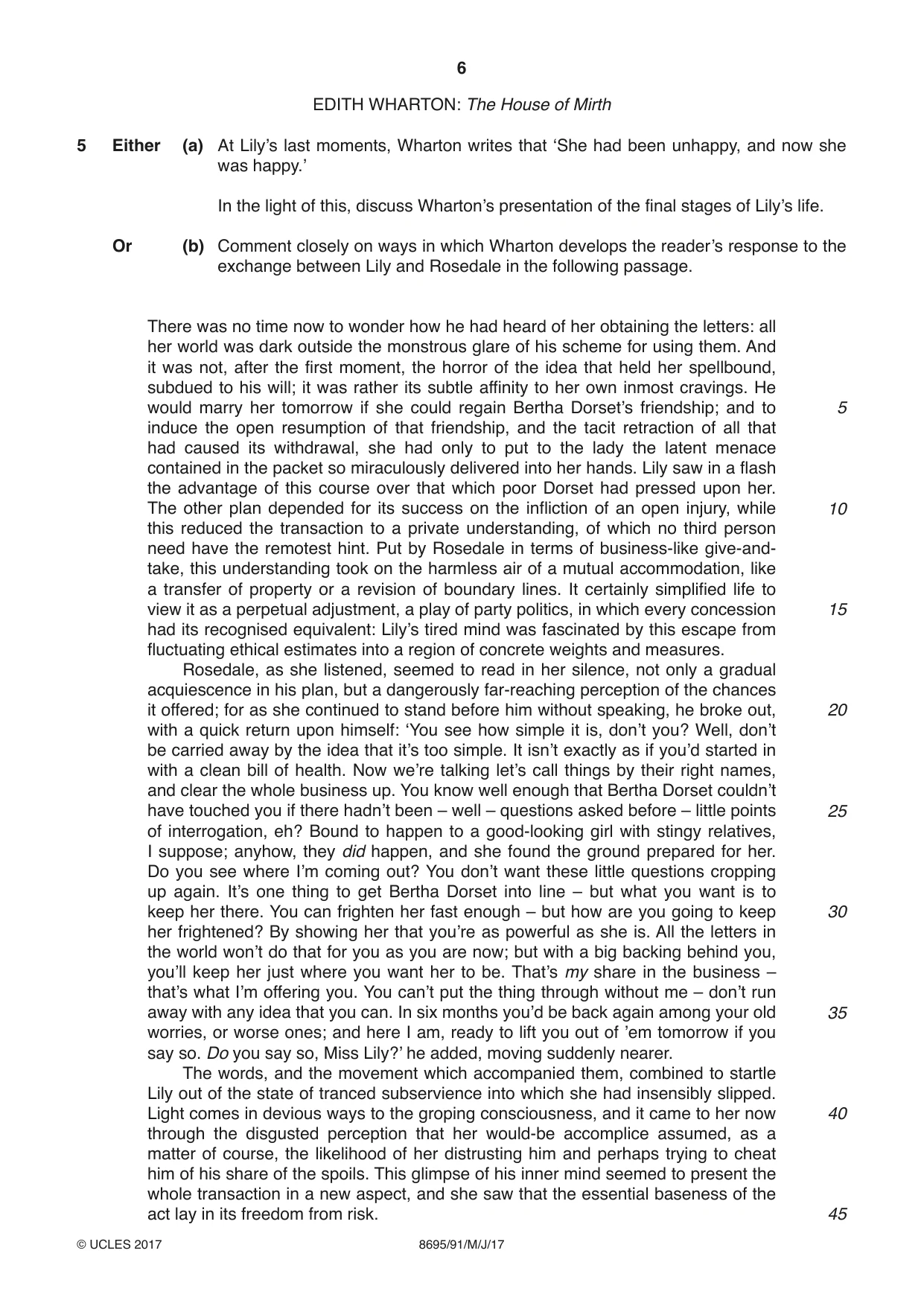
6 8695/91/M/J/17 © UCLES 2017 EDITH WHARTON: The House of Mirth 5 Either (a) At Lily’s last moments, Wharton writes that ‘She had been unhappy, and now she was happy.’ In the light of this, discuss Wharton’s presentation of the final stages of Lily’s life. Or (b) Comment closely on ways in which Wharton develops the reader’s response to the exchange between Lily and Rosedale in the following passage. There was no time now to wonder how he had heard of her obtaining the letters: all her world was dark outside the monstrous glare of his scheme for using them. And it was not, after the first moment, the horror of the idea that held her spellbound, subdued to his will; it was rather its subtle affinity to her own inmost cravings. He would marry her tomorrow if she could regain Bertha Dorset’s friendship; and to induce the open resumption of that friendship, and the tacit retraction of all that had caused its withdrawal, she had only to put to the lady the latent menace contained in the packet so miraculously delivered into her hands. Lily saw in a flash the advantage of this course over that which poor Dorset had pressed upon her. The other plan depended for its success on the infliction of an open injury, while this reduced the transaction to a private understanding, of which no third person need have the remotest hint. Put by Rosedale in terms of business-like give-and- take, this understanding took on the harmless air of a mutual accommodation, like a transfer of property or a revision of boundary lines. It certainly simplified life to view it as a perpetual adjustment, a play of party politics, in which every concession had its recognised equivalent: Lily’s tired mind was fascinated by this escape from fluctuating ethical estimates into a region of concrete weights and measures. Rosedale, as she listened, seemed to read in her silence, not only a gradual acquiescence in his plan, but a dangerously far-reaching perception of the chances it offered; for as she continued to stand before him without speaking, he broke out, with a quick return upon himself: ‘You see how simple it is, don’t you? Well, don’t be carried away by the idea that it’s too simple. It isn’t exactly as if you’d started in with a clean bill of health. Now we’re talking let’s call things by their right names, and clear the whole business up. You know well enough that Bertha Dorset couldn’t have touched you if there hadn’t been – well – questions asked before – little points of interrogation, eh? Bound to happen to a good-looking girl with stingy relatives, I suppose; anyhow, they did happen, and she found the ground prepared for her. Do you see where I’m coming out? You don’t want these little questions cropping up again. It’s one thing to get Bertha Dorset into line – but what you want is to keep her there. You can frighten her fast enough – but how are you going to keep her frightened? By showing her that you’re as powerful as she is. All the letters in the world won’t do that for you as you are now; but with a big backing behind you, you’ll keep her just where you want her to be. That’s my share in the business – that’s what I’m offering you. You can’t put the thing through without me – don’t run away with any idea that you can. In six months you’d be back again among your old worries, or worse ones; and here I am, ready to lift you out of ’em tomorrow if you say so. Do you say so, Miss Lily?’ he added, moving suddenly nearer. The words, and the movement which accompanied them, combined to startle Lily out of the state of tranced subservience into which she had insensibly slipped. Light comes in devious ways to the groping consciousness, and it came to her now through the disgusted perception that her would-be accomplice assumed, as a matter of course, the likelihood of her distrusting him and perhaps trying to cheat him of his share of the spoils. This glimpse of his inner mind seemed to present the whole transaction in a new aspect, and she saw that the essential baseness of the act lay in its freedom from risk. 5 10 15 20 25 30 35 40 45
Question paper, page 7
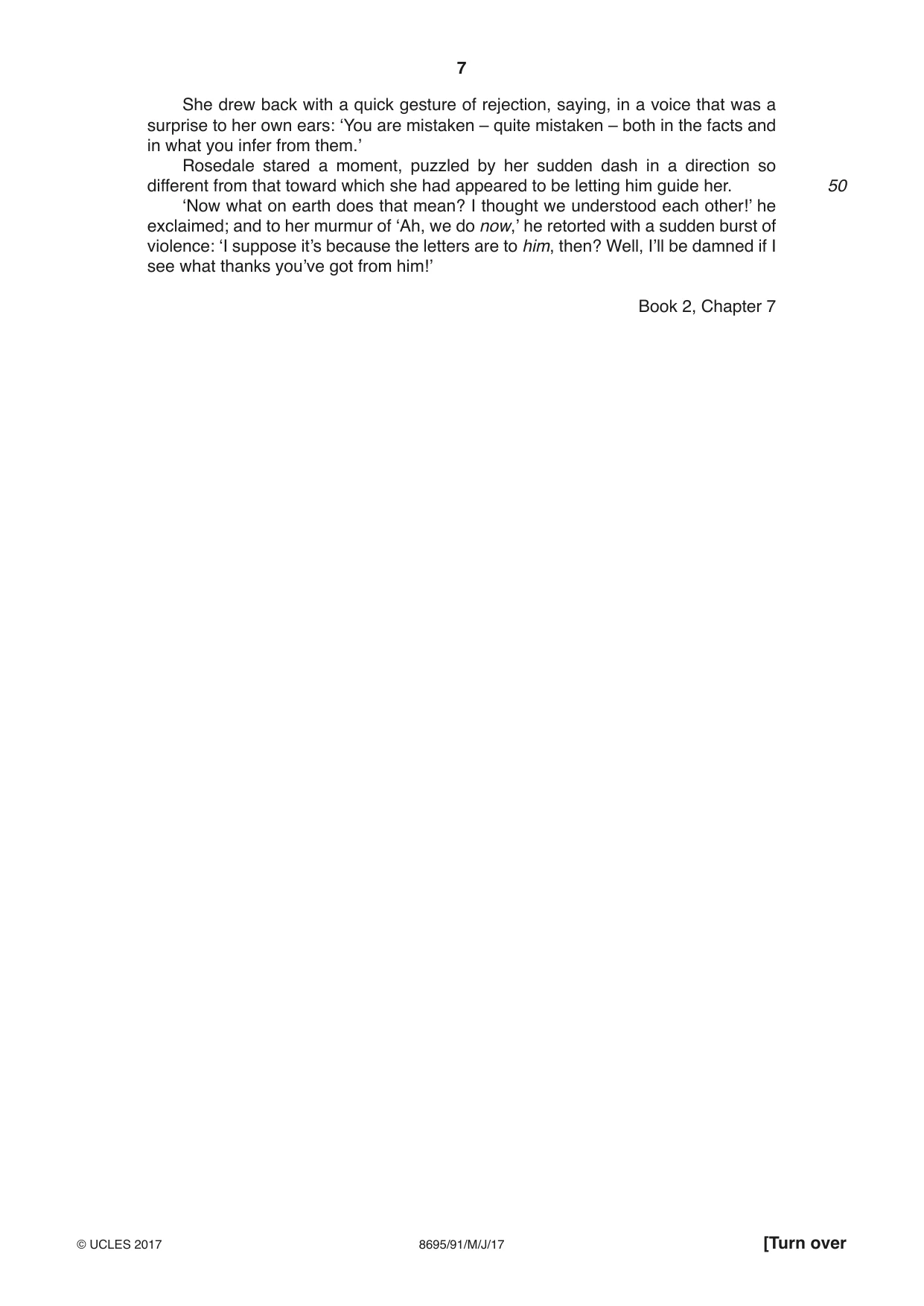
7 8695/91/M/J/17 © UCLES 2017 [Turn over She drew back with a quick gesture of rejection, saying, in a voice that was a surprise to her own ears: ‘You are mistaken – quite mistaken – both in the facts and in what you infer from them.’ Rosedale stared a moment, puzzled by her sudden dash in a direction so different from that toward which she had appeared to be letting him guide her. ‘Now what on earth does that mean? I thought we understood each other!’ he exclaimed; and to her murmur of ‘Ah, we do now,’ he retorted with a sudden burst of violence: ‘I suppose it’s because the letters are to him, then? Well, I’ll be damned if I see what thanks you’ve got from him!’ Book 2, Chapter 7 50
Question paper, page 8
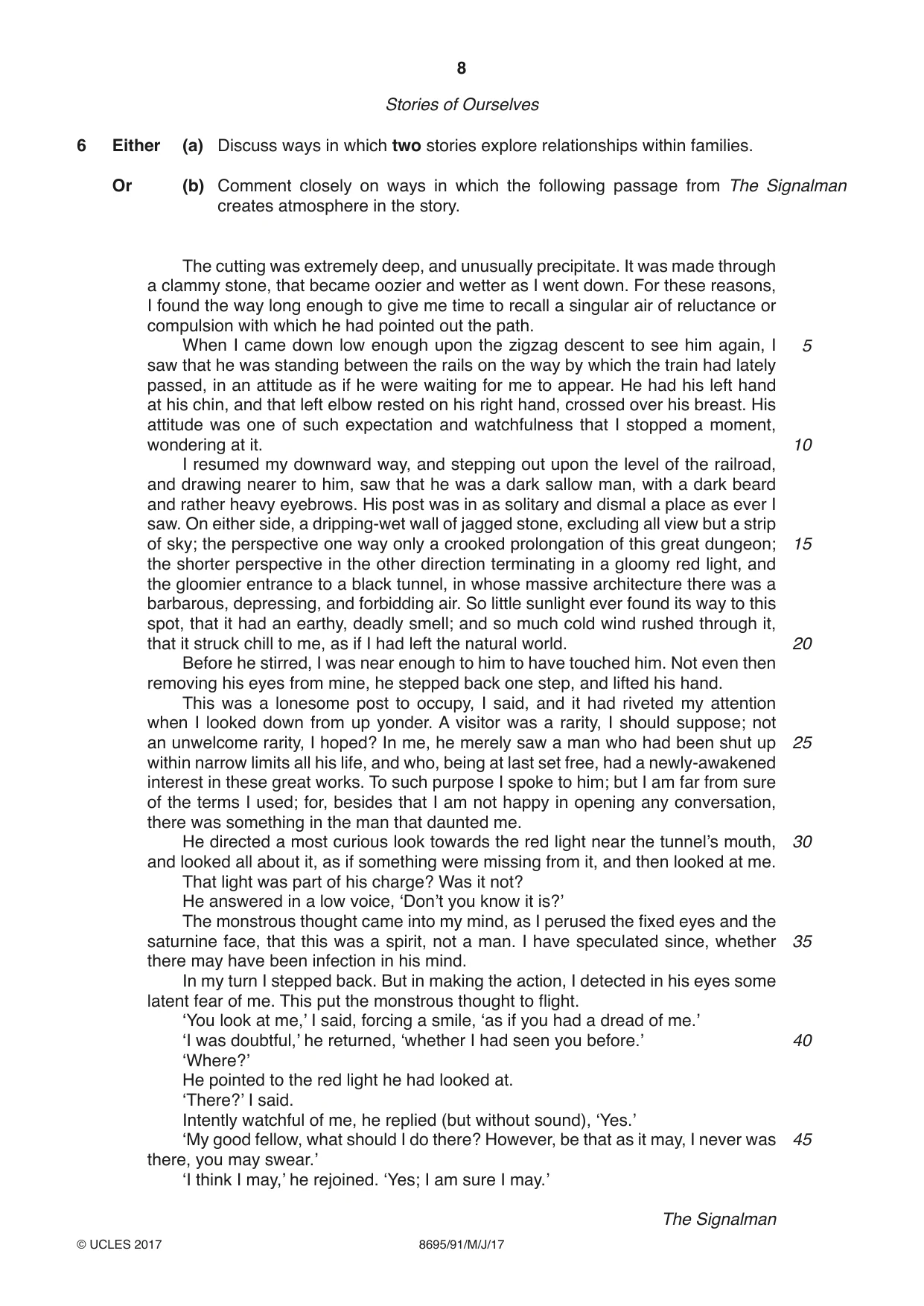
8 8695/91/M/J/17 © UCLES 2017 Stories of Ourselves 6 Either (a) Discuss ways in which two stories explore relationships within families. Or (b) Comment closely on ways in which the following passage from The Signalman creates atmosphere in the story. The cutting was extremely deep, and unusually precipitate. It was made through a clammy stone, that became oozier and wetter as I went down. For these reasons, I found the way long enough to give me time to recall a singular air of reluctance or compulsion with which he had pointed out the path. When I came down low enough upon the zigzag descent to see him again, I saw that he was standing between the rails on the way by which the train had lately passed, in an attitude as if he were waiting for me to appear. He had his left hand at his chin, and that left elbow rested on his right hand, crossed over his breast. His attitude was one of such expectation and watchfulness that I stopped a moment, wondering at it. I resumed my downward way, and stepping out upon the level of the railroad, and drawing nearer to him, saw that he was a dark sallow man, with a dark beard and rather heavy eyebrows. His post was in as solitary and dismal a place as ever I saw. On either side, a dripping-wet wall of jagged stone, excluding all view but a strip of sky; the perspective one way only a crooked prolongation of this great dungeon; the shorter perspective in the other direction terminating in a gloomy red light, and the gloomier entrance to a black tunnel, in whose massive architecture there was a barbarous, depressing, and forbidding air. So little sunlight ever found its way to this spot, that it had an earthy, deadly smell; and so much cold wind rushed through it, that it struck chill to me, as if I had left the natural world. Before he stirred, I was near enough to him to have touched him. Not even then removing his eyes from mine, he stepped back one step, and lifted his hand. This was a lonesome post to occupy, I said, and it had riveted my attention when I looked down from up yonder. A visitor was a rarity, I should suppose; not an unwelcome rarity, I hoped? In me, he merely saw a man who had been shut up within narrow limits all his life, and who, being at last set free, had a newly-awakened interest in these great works. To such purpose I spoke to him; but I am far from sure of the terms I used; for, besides that I am not happy in opening any conversation, there was something in the man that daunted me. He directed a most curious look towards the red light near the tunnel’s mouth, and looked all about it, as if something were missing from it, and then looked at me. That light was part of his charge? Was it not? He answered in a low voice, ‘Don’t you know it is?’ The monstrous thought came into my mind, as I perused the fixed eyes and the saturnine face, that this was a spirit, not a man. I have speculated since, whether there may have been infection in his mind. In my turn I stepped back. But in making the action, I detected in his eyes some latent fear of me. This put the monstrous thought to flight. ‘You look at me,’ I said, forcing a smile, ‘as if you had a dread of me.’ ‘I was doubtful,’ he returned, ‘whether I had seen you before.’ ‘Where?’ He pointed to the red light he had looked at. ‘There?’ I said. Intently watchful of me, he replied (but without sound), ‘Yes.’ ‘My good fellow, what should I do there? However, be that as it may, I never was there, you may swear.’ ‘I think I may,’ he rejoined. ‘Yes; I am sure I may.’ The Signalman 5 10 15 20 25 30 35 40 45
Question paper, page 9
9 8695/91/M/J/17 © UCLES 2017 [Turn over Turn over for Section C.
Question paper, page 10
10 8695/91/M/J/17 © UCLES 2017 Section C: Drama AMA ATA AIDOO: The Dilemma of a Ghost and Anowa 7 Either (a) Discuss Aidoo’s dramatic presentation of customs, traditions and their consequences in both of these plays. Or (b) With close attention to detail, discuss the dramatic significance of the following extract at this point in the play’s action. [Enter THE-MOUTH-THAT-EATS-SALT-AND-PEPPER.] Content removed due to copyright restrictions.
Question paper, page 11
11 8695/91/M/J/17 © UCLES 2017 [Turn over [As lights go out, a blending of the atentenben with any ordinary drum.] Phase 1, Anowa Content removed due to copyright restrictions.
Question paper, page 12
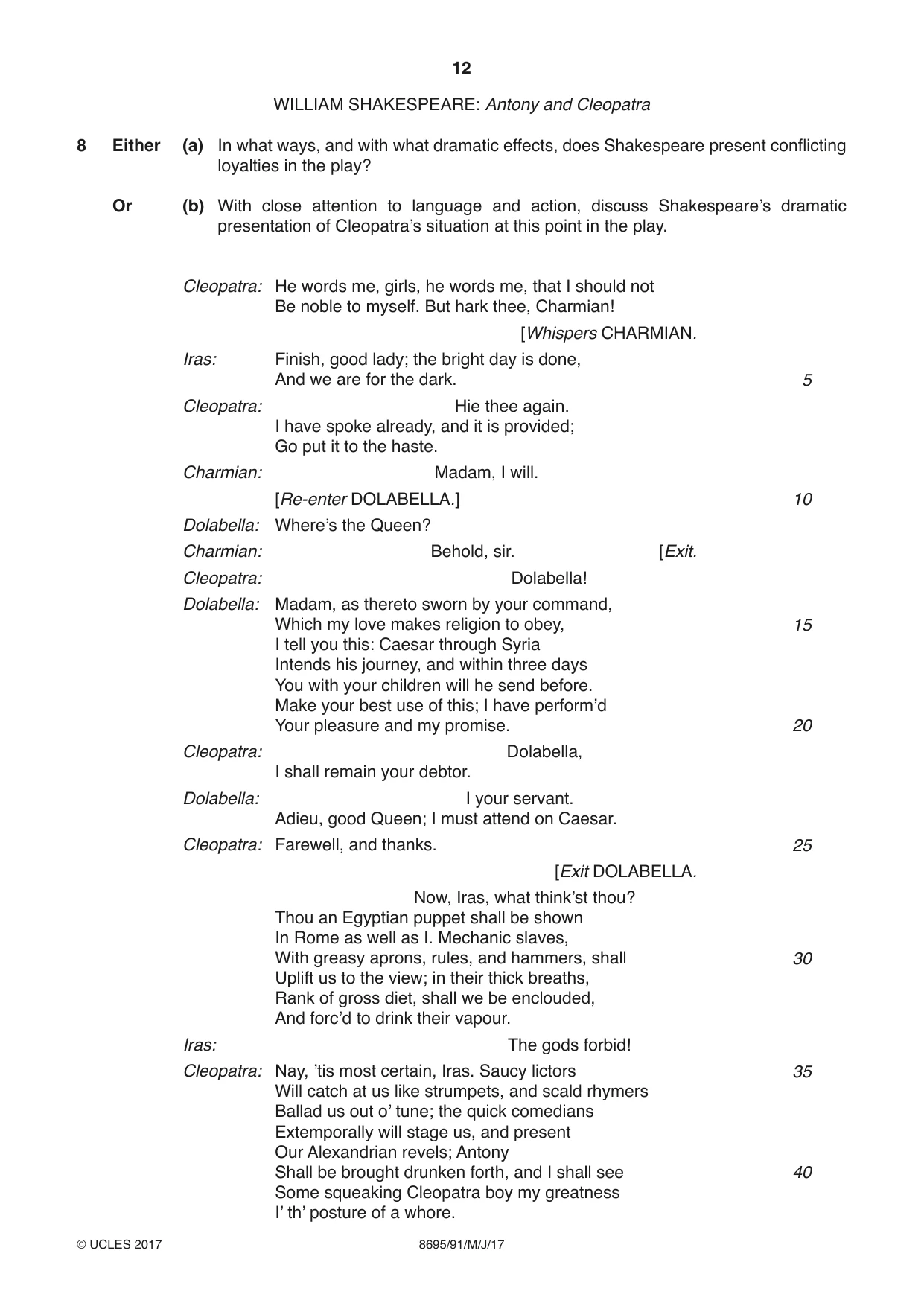
12 8695/91/M/J/17 © UCLES 2017 WILLIAM SHAKESPEARE: Antony and Cleopatra 8 Either (a) In what ways, and with what dramatic effects, does Shakespeare present conflicting loyalties in the play? Or (b) With close attention to language and action, discuss Shakespeare’s dramatic presentation of Cleopatra’s situation at this point in the play. Cleopatra: He words me, girls, he words me, that I should not Be noble to myself. But hark thee, Charmian! [Whispers CHARMIAN. Iras: Finish, good lady; the bright day is done, And we are for the dark. Cleopatra: Hie thee again. I have spoke already, and it is provided; Go put it to the haste. Charmian: Madam, I will. [Re-enter DOLABELLA.] Dolabella: Where’s the Queen? Charmian: Behold, sir. [Exit. Cleopatra: Dolabella! Dolabella: Madam, as thereto sworn by your command, Which my love makes religion to obey, I tell you this: Caesar through Syria Intends his journey, and within three days You with your children will he send before. Make your best use of this; I have perform’d Your pleasure and my promise. Cleopatra: Dolabella, I shall remain your debtor. Dolabella: I your servant. Adieu, good Queen; I must attend on Caesar. Cleopatra: Farewell, and thanks. [Exit DOLABELLA. Now, Iras, what think’st thou? Thou an Egyptian puppet shall be shown In Rome as well as I. Mechanic slaves, With greasy aprons, rules, and hammers, shall Uplift us to the view; in their thick breaths, Rank of gross diet, shall we be enclouded, And forc’d to drink their vapour. Iras: The gods forbid! Cleopatra: Nay, ’tis most certain, Iras. Saucy lictors Will catch at us like strumpets, and scald rhymers Ballad us out o’ tune; the quick comedians Extemporally will stage us, and present Our Alexandrian revels; Antony Shall be brought drunken forth, and I shall see Some squeaking Cleopatra boy my greatness I’ th’ posture of a whore. 5 10 15 20 25 30 35 40
Question paper, page 13
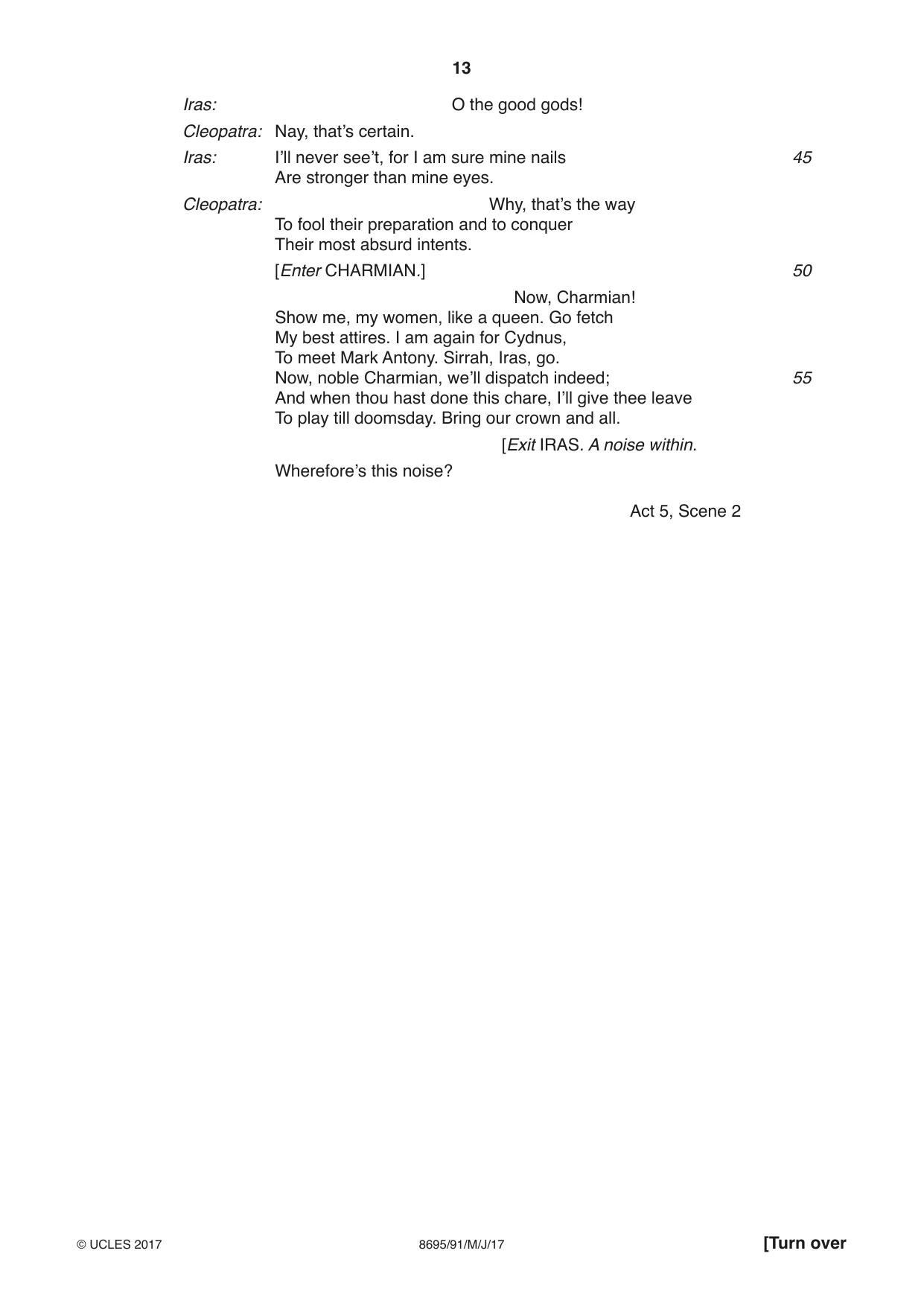
13 8695/91/M/J/17 © UCLES 2017 [Turn over Iras: O the good gods! Cleopatra: Nay, that’s certain. Iras: I’ll never see’t, for I am sure mine nails Are stronger than mine eyes. Cleopatra: Why, that’s the way To fool their preparation and to conquer Their most absurd intents. [Enter CHARMIAN.] Now, Charmian! Show me, my women, like a queen. Go fetch My best attires. I am again for Cydnus, To meet Mark Antony. Sirrah, Iras, go. Now, noble Charmian, we’ll dispatch indeed; And when thou hast done this chare, I’ll give thee leave To play till doomsday. Bring our crown and all. [Exit IRAS. A noise within. Wherefore’s this noise? Act 5, Scene 2 45 50 55
Question paper, page 14
14 8695/91/M/J/17 © UCLES 2017 BRIAN FRIEL: Philadelphia, Here I Come! 9 Either (a) In what ways, and with what dramatic effects, does Friel create comedy in Philadelphia, Here I Come! ? Or (b) With close reference to detail of language in the following passage, discuss Friel’s dramatic presentation of Gar’s inner life at this point in the play. [PUBLIC skips into the air.] Content removed due to copyright restrictions.
Question paper, page 15
15 8695/91/M/J/17 © UCLES 2017 Ah reckon. Yessir. Episode 1 Content removed due to copyright restrictions.
Question paper, page 16
16 8695/91/M/J/17 © UCLES 2017 BLANK PAGE Permission to reproduce items where third-party owned material protected by copyright is included has been sought and cleared where possible. Every reasonable effort has been made by the publisher (UCLES) to trace copyright holders, but if any items requiring clearance have unwittingly been included, the publisher will be pleased to make amends at the earliest possible opportunity. To avoid the issue of disclosure of answer-related information to candidates, all copyright acknowledgements are reproduced online in the Cambridge International Examinations Copyright Acknowledgements Booklet. This is produced for each series of examinations and is freely available to download at www.cie.org.uk after the live examination series. Cambridge International Examinations is part of the Cambridge Assessment Group. Cambridge Assessment is the brand name of University of Cambridge Local Examinations Syndicate (UCLES), which is itself a department of the University of Cambridge.
Mark scheme, page 1
® IGCSE is a registered trademark. This document consists of 5 printed pages. © UCLES 2017 [Turn over Cambridge International Examinations Cambridge International Advanced Subsidiary Level LANGUAGE AND LITERATURE IN ENGLISH 8695/91 Paper 9 Poetry, Prose and Drama May/June 2017 MARK SCHEME Maximum Mark: 50 Published This mark scheme is published as an aid to teachers and candidates, to indicate the requirements of the examination. It shows the basis on which Examiners were instructed to award marks. It does not indicate the details of the discussions that took place at an Examiners’ meeting before marking began, which would have considered the acceptability of alternative answers. Mark schemes should be read in conjunction with the question paper and the Principal Examiner Report for Teachers. Cambridge will not enter into discussions about these mark schemes. Cambridge is publishing the mark schemes for the May/June 2017 series for most Cambridge IGCSE®, Cambridge International A and AS Level and Cambridge Pre-U components, and some Cambridge O Level components.
Mark scheme, page 2
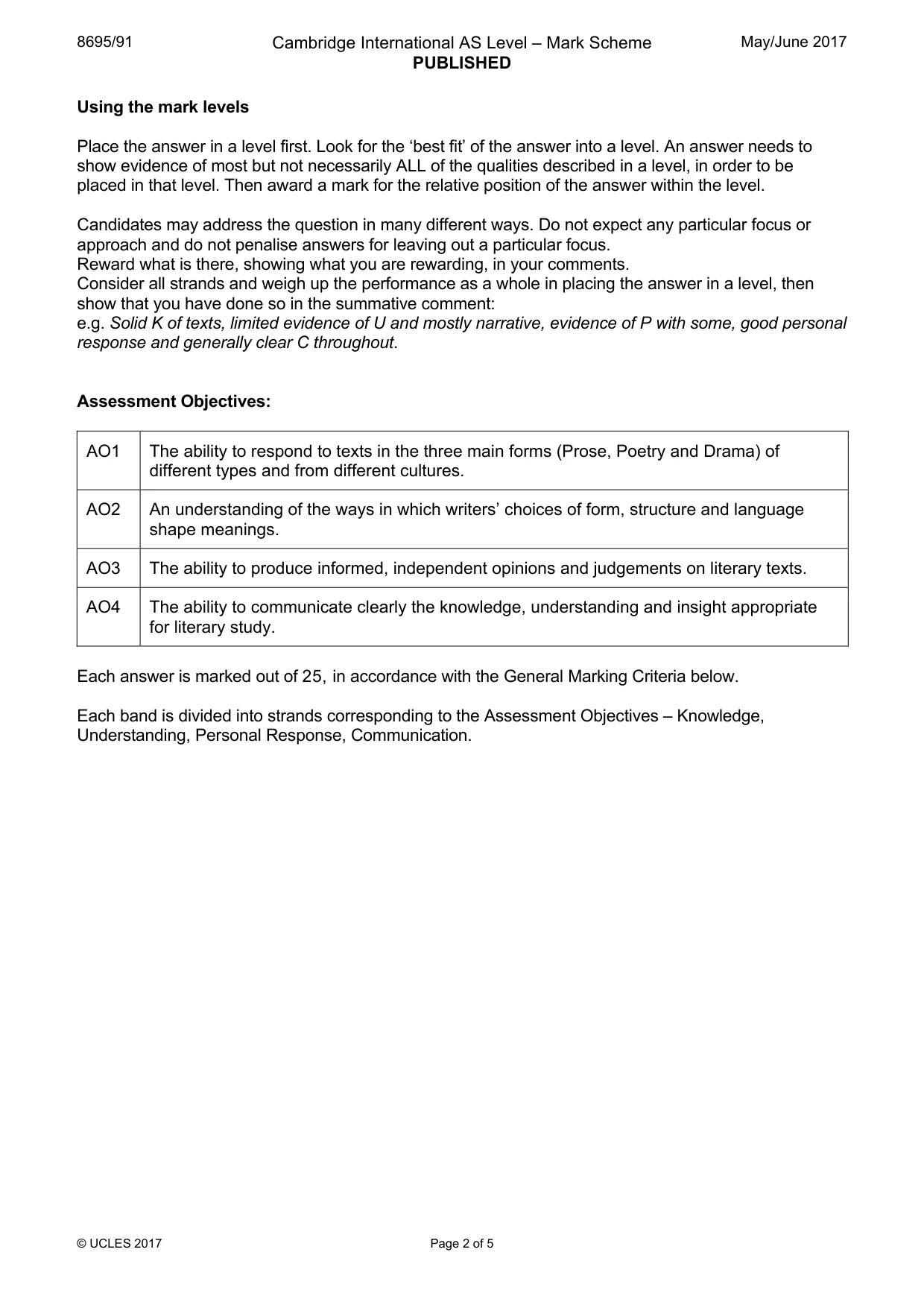
8695/91 Cambridge International AS Level – Mark Scheme PUBLISHED May/June 2017 © UCLES 2017 Page 2 of 5 Using the mark levels Place the answer in a level first. Look for the ‘best fit’ of the answer into a level. An answer needs to show evidence of most but not necessarily ALL of the qualities described in a level, in order to be placed in that level. Then award a mark for the relative position of the answer within the level. Candidates may address the question in many different ways. Do not expect any particular focus or approach and do not penalise answers for leaving out a particular focus. Reward what is there, showing what you are rewarding, in your comments. Consider all strands and weigh up the performance as a whole in placing the answer in a level, then show that you have done so in the summative comment: e.g. Solid K of texts, limited evidence of U and mostly narrative, evidence of P with some, good personal response and generally clear C throughout. Assessment Objectives: AO1 The ability to respond to texts in the three main forms (Prose, Poetry and Drama) of different types and from different cultures. AO2 An understanding of the ways in which writers’ choices of form, structure and language shape meanings. AO3 The ability to produce informed, independent opinions and judgements on literary texts. AO4 The ability to communicate clearly the knowledge, understanding and insight appropriate for literary study. Each answer is marked out of 25, in accordance with the General Marking Criteria below. Each band is divided into strands corresponding to the Assessment Objectives – Knowledge, Understanding, Personal Response, Communication.
Mark scheme, page 3
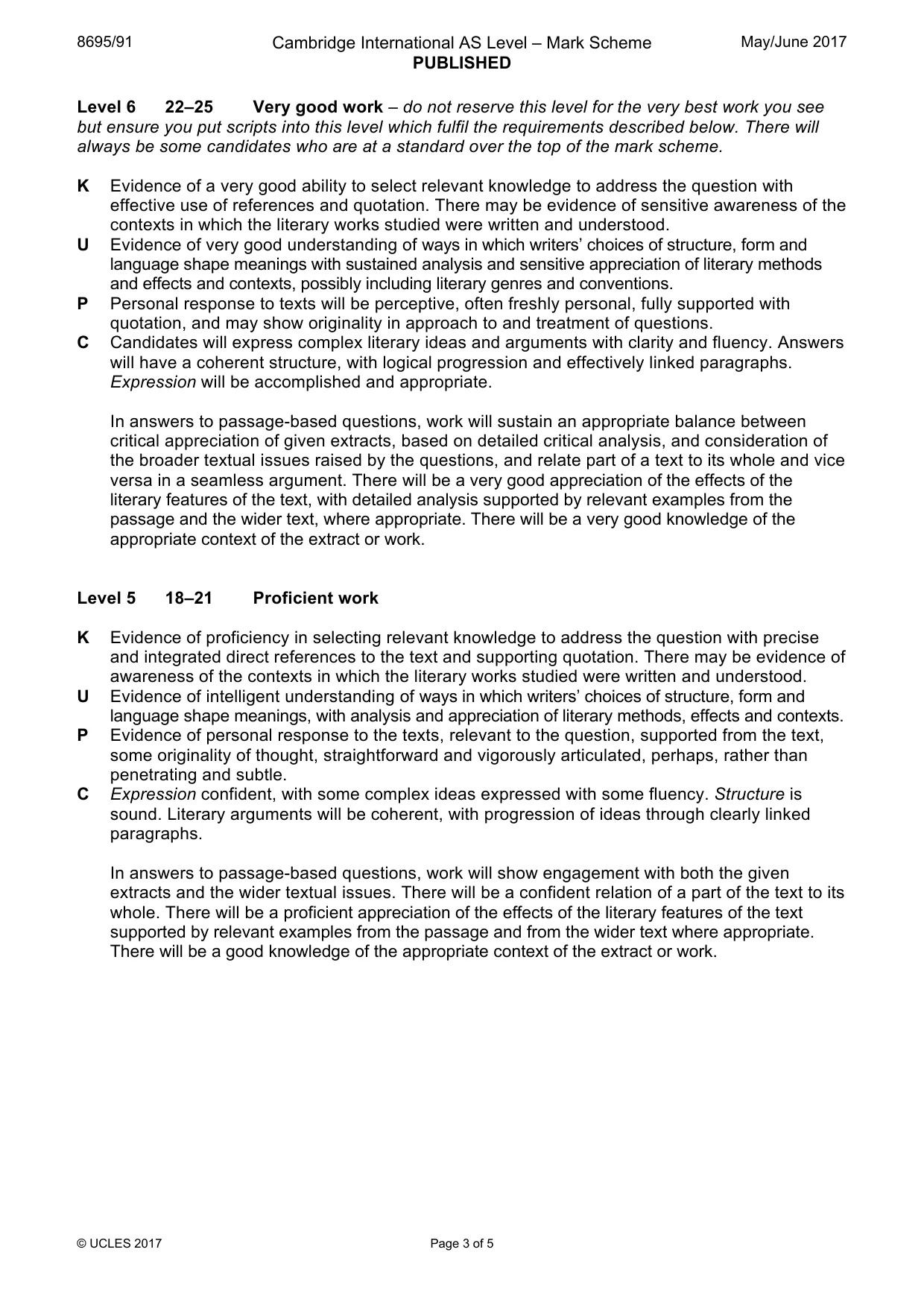
8695/91 Cambridge International AS Level – Mark Scheme PUBLISHED May/June 2017 © UCLES 2017 Page 3 of 5 Level 6 22–25 Very good work – do not reserve this level for the very best work you see but ensure you put scripts into this level which fulfil the requirements described below. There will always be some candidates who are at a standard over the top of the mark scheme. K Evidence of a very good ability to select relevant knowledge to address the question with effective use of references and quotation. There may be evidence of sensitive awareness of the contexts in which the literary works studied were written and understood. U Evidence of very good understanding of ways in which writers’ choices of structure, form and language shape meanings with sustained analysis and sensitive appreciation of literary methods and effects and contexts, possibly including literary genres and conventions. P Personal response to texts will be perceptive, often freshly personal, fully supported with quotation, and may show originality in approach to and treatment of questions. C Candidates will express complex literary ideas and arguments with clarity and fluency. Answers will have a coherent structure, with logical progression and effectively linked paragraphs. Expression will be accomplished and appropriate. In answers to passage-based questions, work will sustain an appropriate balance between critical appreciation of given extracts, based on detailed critical analysis, and consideration of the broader textual issues raised by the questions, and relate part of a text to its whole and vice versa in a seamless argument. There will be a very good appreciation of the effects of the literary features of the text, with detailed analysis supported by relevant examples from the passage and the wider text, where appropriate. There will be a very good knowledge of the appropriate context of the extract or work. Level 5 18–21 Proficient work K Evidence of proficiency in selecting relevant knowledge to address the question with precise and integrated direct references to the text and supporting quotation. There may be evidence of awareness of the contexts in which the literary works studied were written and understood. U Evidence of intelligent understanding of ways in which writers’ choices of structure, form and language shape meanings, with analysis and appreciation of literary methods, effects and contexts. P Evidence of personal response to the texts, relevant to the question, supported from the text, some originality of thought, straightforward and vigorously articulated, perhaps, rather than penetrating and subtle. C Expression confident, with some complex ideas expressed with some fluency. Structure is sound. Literary arguments will be coherent, with progression of ideas through clearly linked paragraphs. In answers to passage-based questions, work will show engagement with both the given extracts and the wider textual issues. There will be a confident relation of a part of the text to its whole. There will be a proficient appreciation of the effects of the literary features of the text supported by relevant examples from the passage and from the wider text where appropriate. There will be a good knowledge of the appropriate context of the extract or work.
Mark scheme, page 4
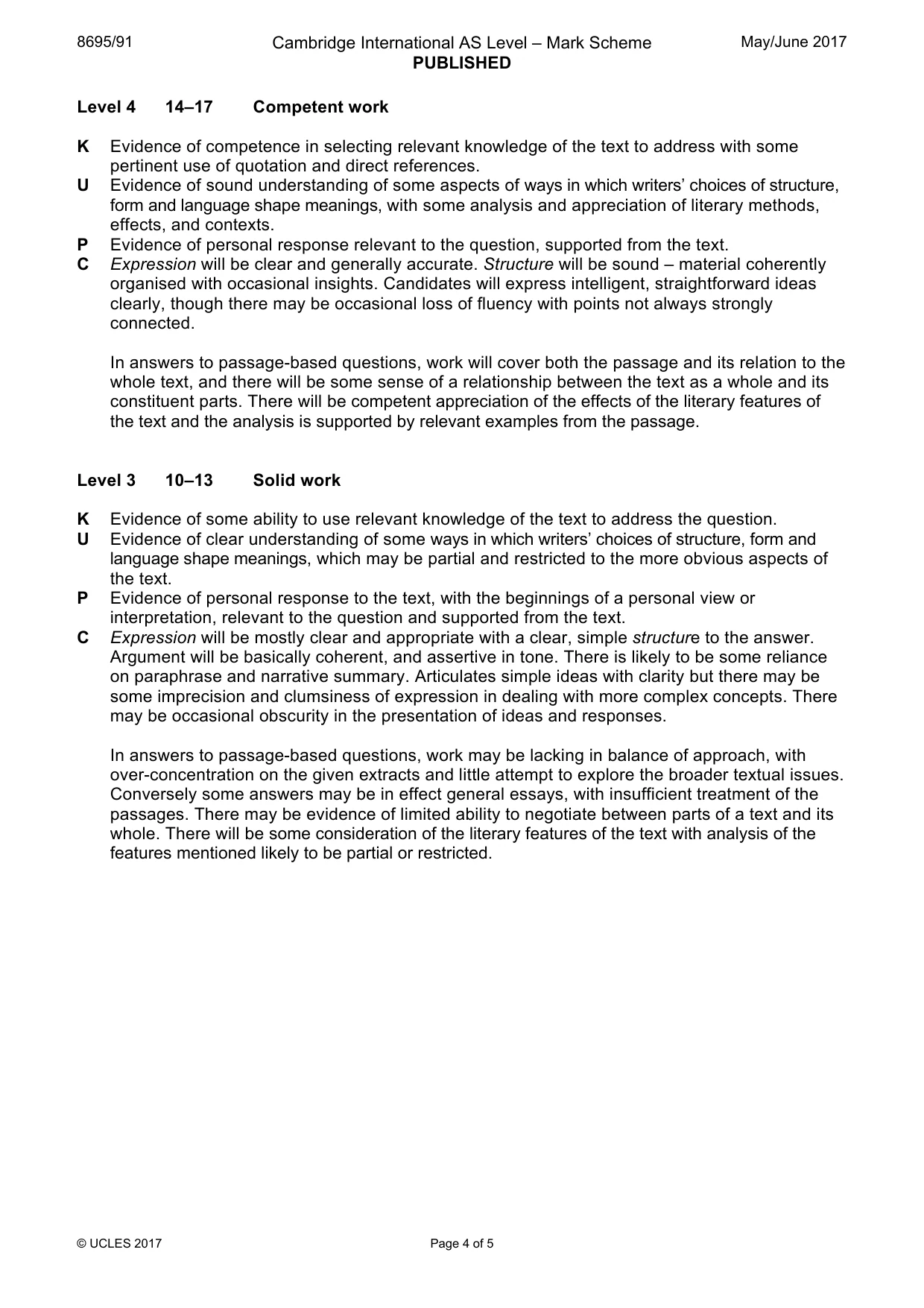
8695/91 Cambridge International AS Level – Mark Scheme PUBLISHED May/June 2017 © UCLES 2017 Page 4 of 5 Level 4 14–17 Competent work K Evidence of competence in selecting relevant knowledge of the text to address with some pertinent use of quotation and direct references. U Evidence of sound understanding of some aspects of ways in which writers’ choices of structure, form and language shape meanings, with some analysis and appreciation of literary methods, effects, and contexts. P Evidence of personal response relevant to the question, supported from the text. C Expression will be clear and generally accurate. Structure will be sound – material coherently organised with occasional insights. Candidates will express intelligent, straightforward ideas clearly, though there may be occasional loss of fluency with points not always strongly connected. In answers to passage-based questions, work will cover both the passage and its relation to the whole text, and there will be some sense of a relationship between the text as a whole and its constituent parts. There will be competent appreciation of the effects of the literary features of the text and the analysis is supported by relevant examples from the passage. Level 3 10–13 Solid work K Evidence of some ability to use relevant knowledge of the text to address the question. U Evidence of clear understanding of some ways in which writers’ choices of structure, form and language shape meanings, which may be partial and restricted to the more obvious aspects of the text. P Evidence of personal response to the text, with the beginnings of a personal view or interpretation, relevant to the question and supported from the text. C Expression will be mostly clear and appropriate with a clear, simple structure to the answer. Argument will be basically coherent, and assertive in tone. There is likely to be some reliance on paraphrase and narrative summary. Articulates simple ideas with clarity but there may be some imprecision and clumsiness of expression in dealing with more complex concepts. There may be occasional obscurity in the presentation of ideas and responses. In answers to passage-based questions, work may be lacking in balance of approach, with over-concentration on the given extracts and little attempt to explore the broader textual issues. Conversely some answers may be in effect general essays, with insufficient treatment of the passages. There may be evidence of limited ability to negotiate between parts of a text and its whole. There will be some consideration of the literary features of the text with analysis of the features mentioned likely to be partial or restricted.
Mark scheme, page 5
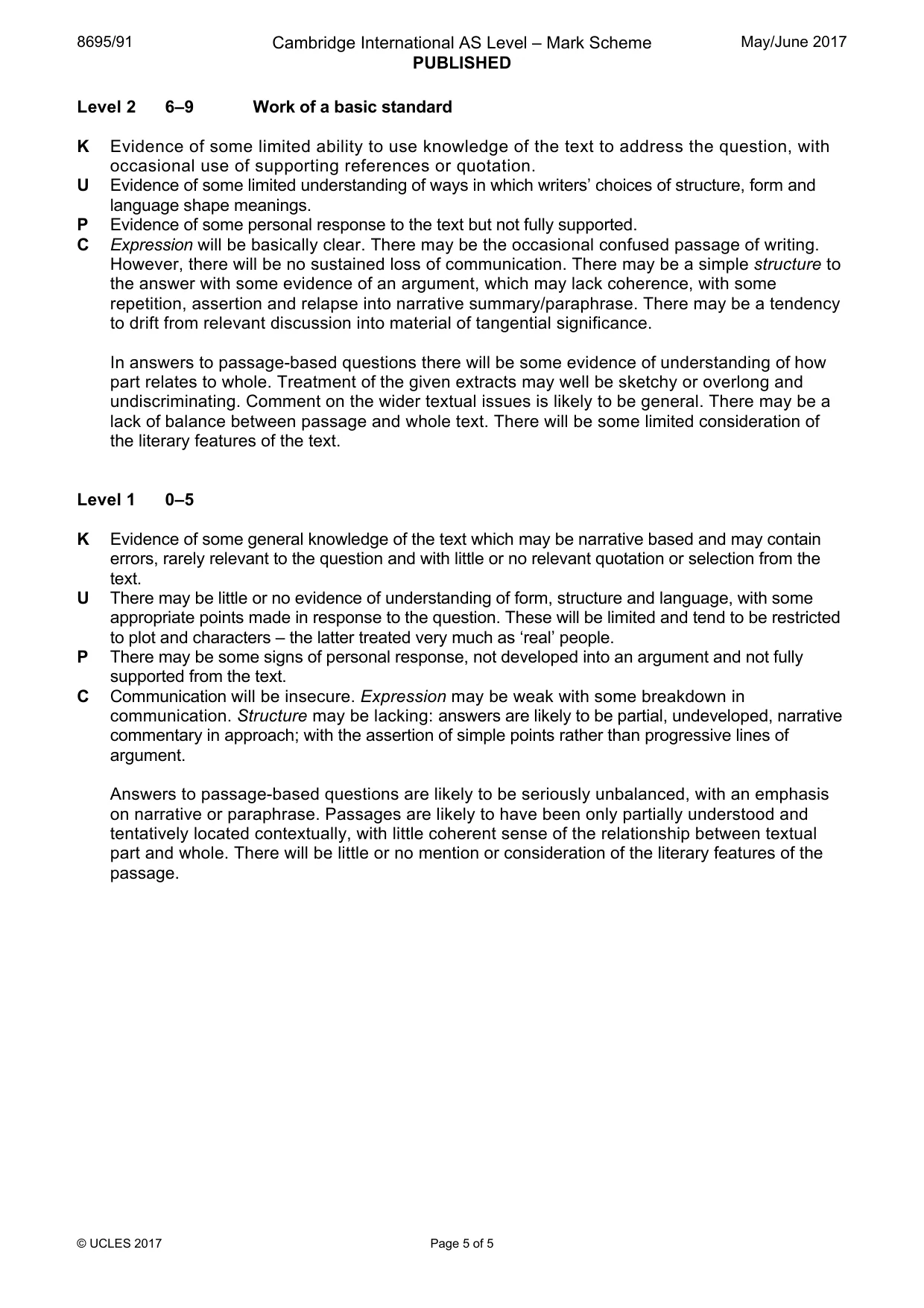
8695/91 Cambridge International AS Level – Mark Scheme PUBLISHED May/June 2017 © UCLES 2017 Page 5 of 5 Level 2 6–9 Work of a basic standard K Evidence of some limited ability to use knowledge of the text to address the question, with occasional use of supporting references or quotation. U Evidence of some limited understanding of ways in which writers’ choices of structure, form and language shape meanings. P Evidence of some personal response to the text but not fully supported. C Expression will be basically clear. There may be the occasional confused passage of writing. However, there will be no sustained loss of communication. There may be a simple structure to the answer with some evidence of an argument, which may lack coherence, with some repetition, assertion and relapse into narrative summary/paraphrase. There may be a tendency to drift from relevant discussion into material of tangential significance. In answers to passage-based questions there will be some evidence of understanding of how part relates to whole. Treatment of the given extracts may well be sketchy or overlong and undiscriminating. Comment on the wider textual issues is likely to be general. There may be a lack of balance between passage and whole text. There will be some limited consideration of the literary features of the text. Level 1 0–5 K Evidence of some general knowledge of the text which may be narrative based and may contain errors, rarely relevant to the question and with little or no relevant quotation or selection from the text. U There may be little or no evidence of understanding of form, structure and language, with some appropriate points made in response to the question. These will be limited and tend to be restricted to plot and characters – the latter treated very much as ‘real’ people. P There may be some signs of personal response, not developed into an argument and not fully supported from the text. C Communication will be insecure. Expression may be weak with some breakdown in communication. Structure may be lacking: answers are likely to be partial, undeveloped, narrative commentary in approach; with the assertion of simple points rather than progressive lines of argument. Answers to passage-based questions are likely to be seriously unbalanced, with an emphasis on narrative or paraphrase. Passages are likely to have been only partially understood and tentatively located contextually, with little coherent sense of the relationship between textual part and whole. There will be little or no mention or consideration of the literary features of the passage.
What you needed in this session
Cambridge’s own grade thresholds for 2017 May/June, Paper 9 · Variant 1. A higher threshold means an easier paper — the bar moves with how the cohort did.