Cambridge A Level English - Language and Literature (AS Level only, from 2016) 8695 — 2018 Oct/Nov Paper 9 · Variant 1
8695/91/O/N/18 · 50 marks · ≈56 min
The question paper and its mark scheme, free to read here and free to download. This is Cambridge’s own paper, exactly as it was sat.
Question paper20 pages



Mark scheme6 pages
Answers below. Sit the paper first if you are practising.
Paper as text
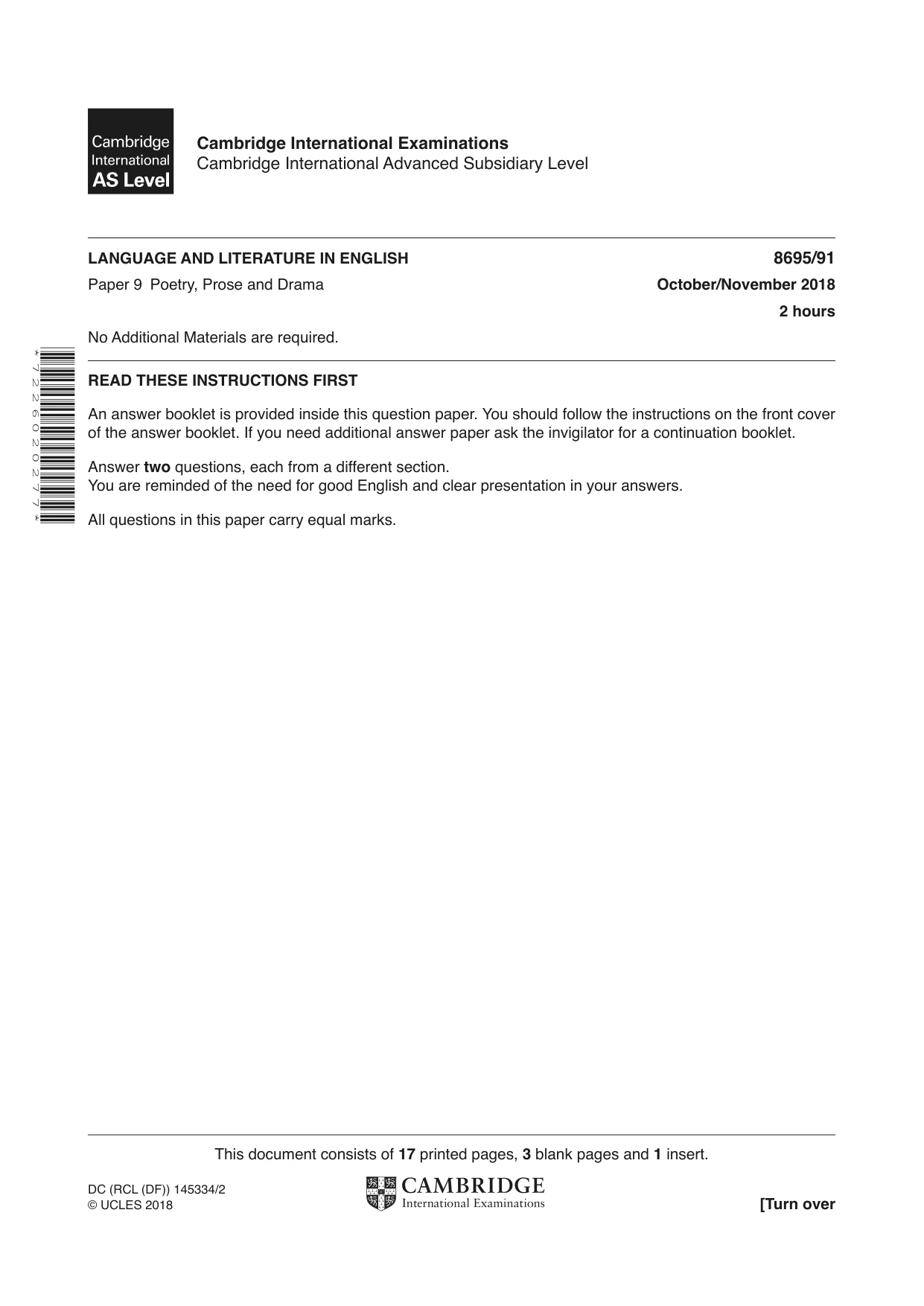
Question paper, page 1
This document consists of 17 printed pages, 3 blank pages and 1 insert. DC (RCL (DF)) 145334/2 © UCLES 2018 [Turn over Cambridge International Examinations Cambridge International Advanced Subsidiary Level * 7 2 2 6 0 2 0 2 7 7 * LANGUAGE AND LITERATURE IN ENGLISH 8695/91 Paper 9 Poetry, Prose and Drama October/November 2018 2 hours No Additional Materials are required. READ THESE INSTRUCTIONS FIRST An answer booklet is provided inside this question paper. You should follow the instructions on the front cover of the answer booklet. If you need additional answer paper ask the invigilator for a continuation booklet. Answer two questions, each from a different section. You are reminded of the need for good English and clear presentation in your answers. All questions in this paper carry equal marks.
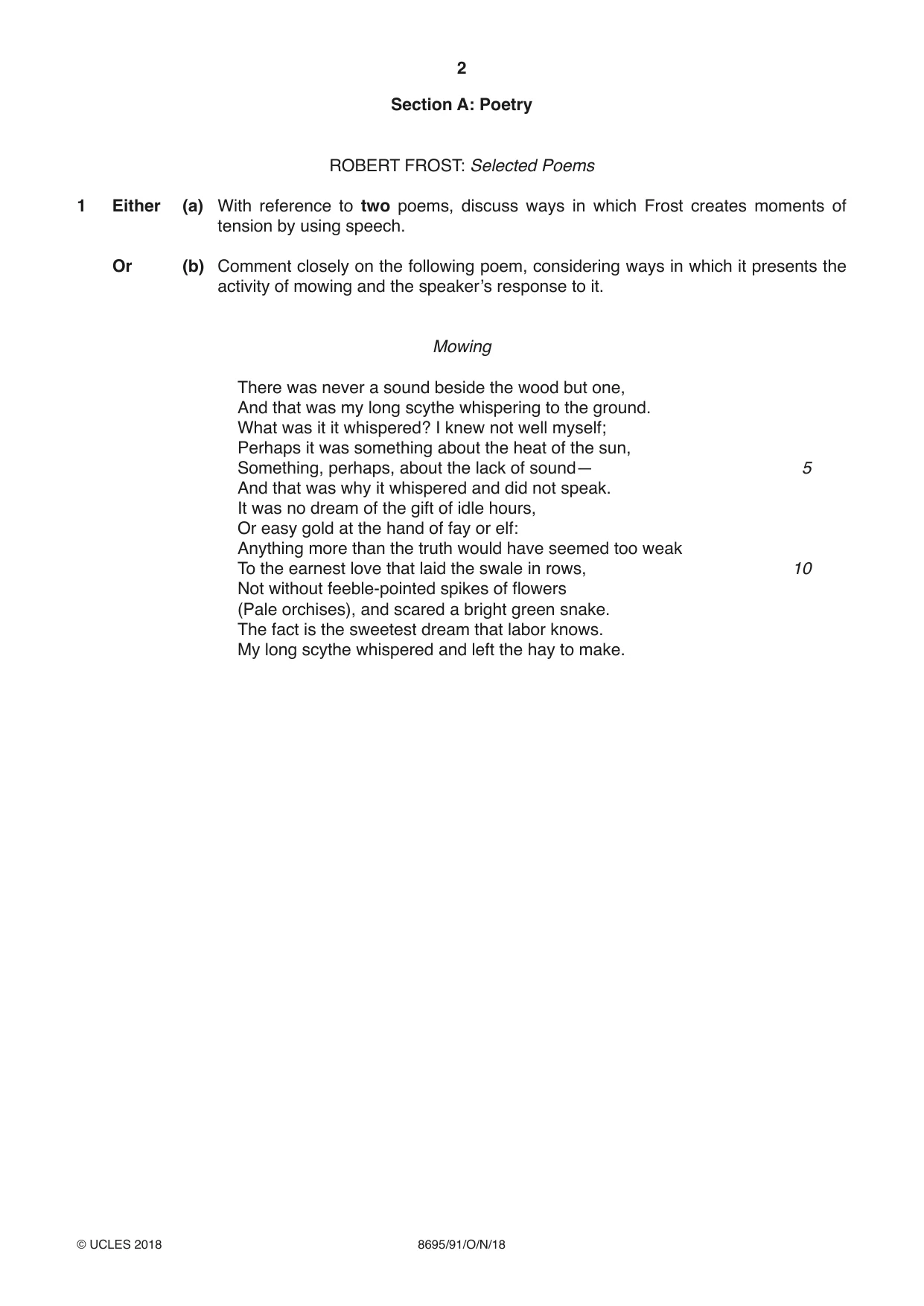
Question paper, page 2
2 8695/91/O/N/18 © UCLES 2018 Section A: Poetry ROBERT FROST: Selected Poems 1 Either (a) With reference to two poems, discuss ways in which Frost creates moments of tension by using speech. Or (b) Comment closely on the following poem, considering ways in which it presents the activity of mowing and the speaker’s response to it. Mowing There was never a sound beside the wood but one, And that was my long scythe whispering to the ground. What was it it whispered? I knew not well myself; Perhaps it was something about the heat of the sun, Something, perhaps, about the lack of sound— And that was why it whispered and did not speak. It was no dream of the gift of idle hours, Or easy gold at the hand of fay or elf: Anything more than the truth would have seemed too weak To the earnest love that laid the swale in rows, Not without feeble-pointed spikes of flowers (Pale orchises), and scared a bright green snake. The fact is the sweetest dream that labor knows. My long scythe whispered and left the hay to make. 5 10
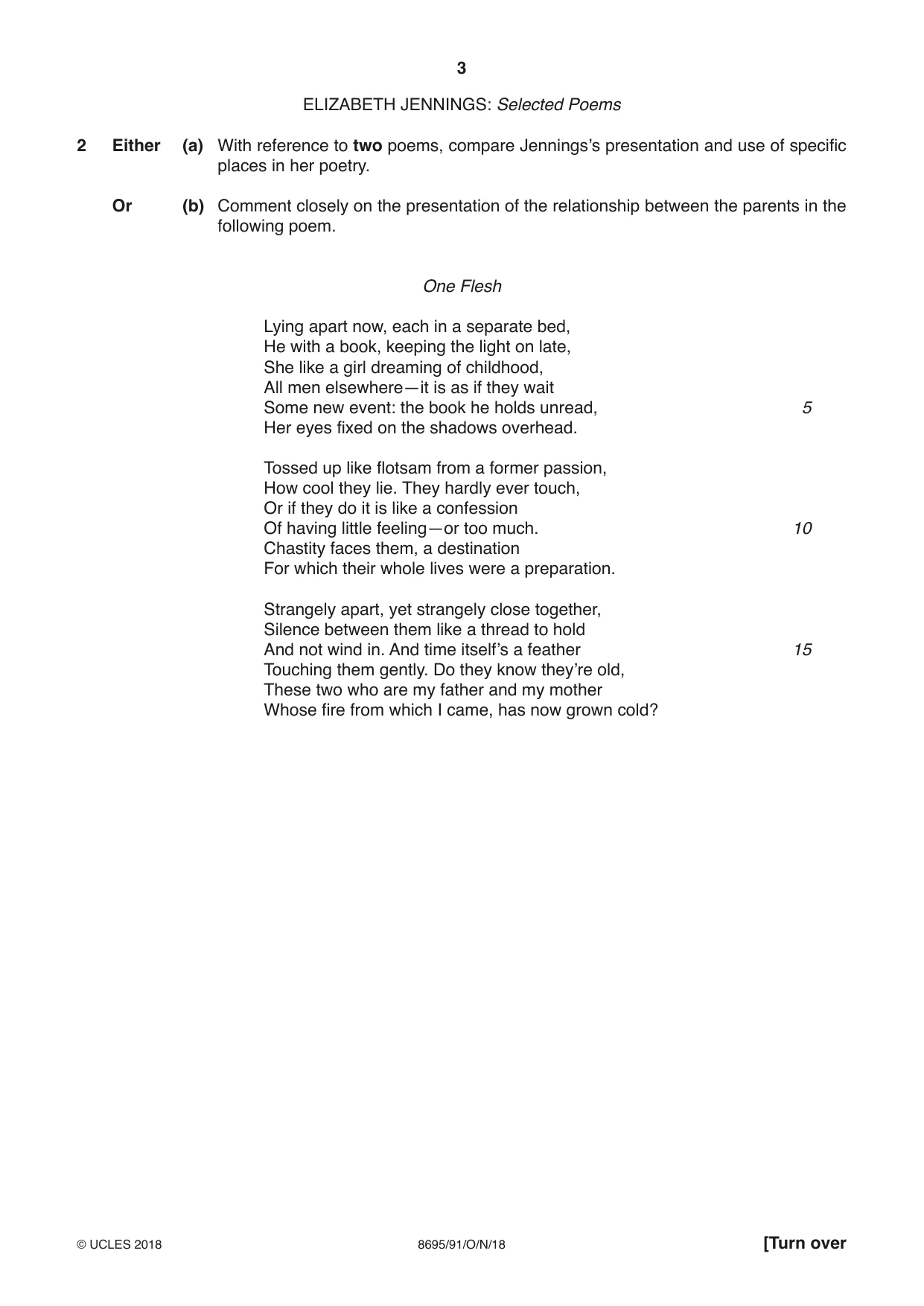
Question paper, page 3
3 8695/91/O/N/18 © UCLES 2018 [Turn over ELIZABETH JENNINGS: Selected Poems 2 Either (a) With reference to two poems, compare Jennings’s presentation and use of specific places in her poetry. Or (b) Comment closely on the presentation of the relationship between the parents in the following poem. One Flesh Lying apart now, each in a separate bed, He with a book, keeping the light on late, She like a girl dreaming of childhood, All men elsewhere—it is as if they wait Some new event: the book he holds unread, Her eyes fixed on the shadows overhead. Tossed up like flotsam from a former passion, How cool they lie. They hardly ever touch, Or if they do it is like a confession Of having little feeling—or too much. Chastity faces them, a destination For which their whole lives were a preparation. Strangely apart, yet strangely close together, Silence between them like a thread to hold And not wind in. And time itself’s a feather Touching them gently. Do they know they’re old, These two who are my father and my mother Whose fire from which I came, has now grown cold? 5 10 15
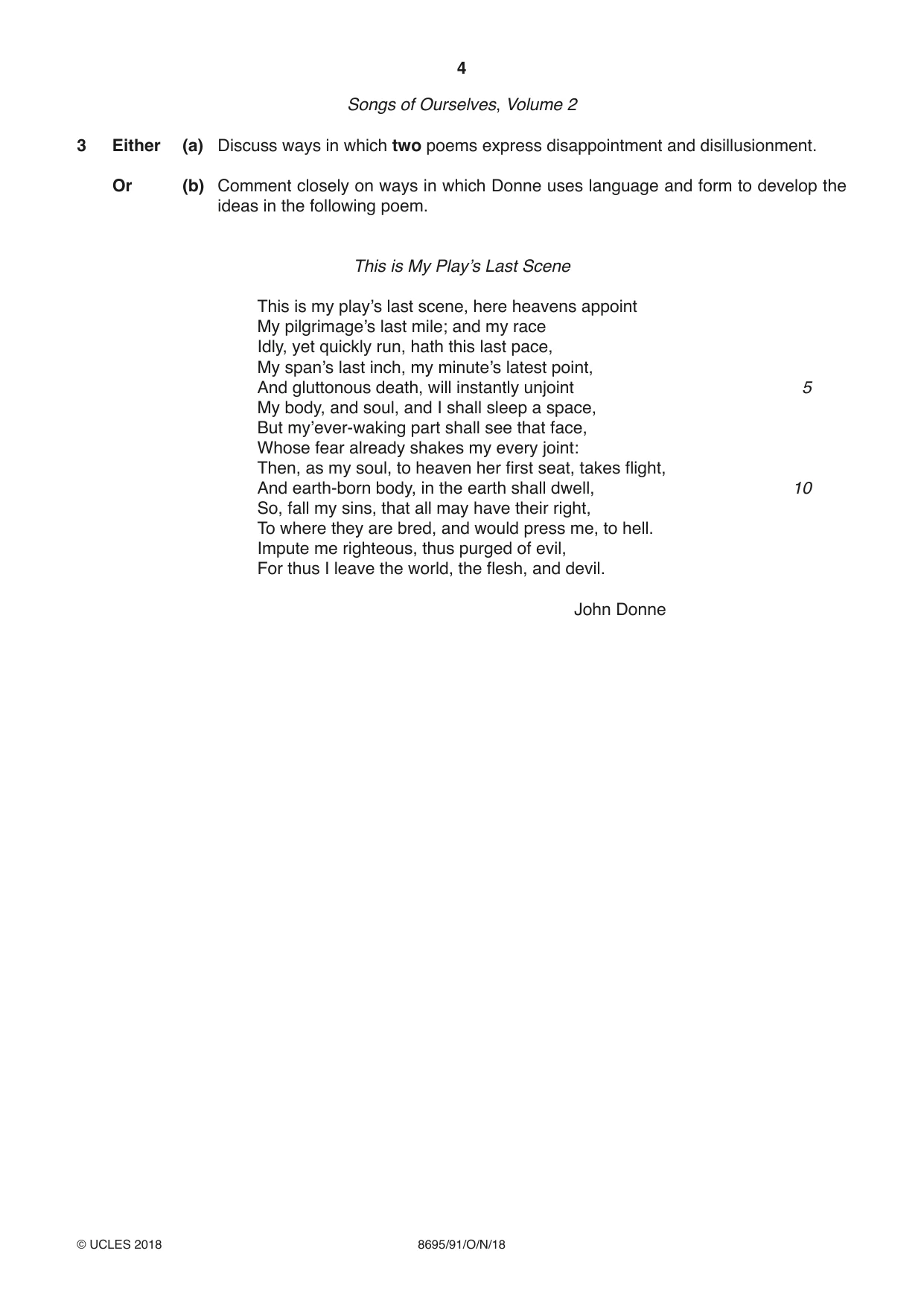
Question paper, page 4
4 8695/91/O/N/18 © UCLES 2018 Songs of Ourselves, Volume 2 3 Either (a) Discuss ways in which two poems express disappointment and disillusionment. Or (b) Comment closely on ways in which Donne uses language and form to develop the ideas in the following poem. This is My Play’s Last Scene This is my play’s last scene, here heavens appoint My pilgrimage’s last mile; and my race Idly, yet quickly run, hath this last pace, My span’s last inch, my minute’s latest point, And gluttonous death, will instantly unjoint My body, and soul, and I shall sleep a space, But my’ever-waking part shall see that face, Whose fear already shakes my every joint: Then, as my soul, to heaven her first seat, takes flight, And earth-born body, in the earth shall dwell, So, fall my sins, that all may have their right, To where they are bred, and would press me, to hell. Impute me righteous, thus purged of evil, For thus I leave the world, the flesh, and devil. John Donne 5 10
Question paper, page 5
5 8695/91/O/N/18 © UCLES 2018 [Turn over Turn over for Section B.
Question paper, page 6
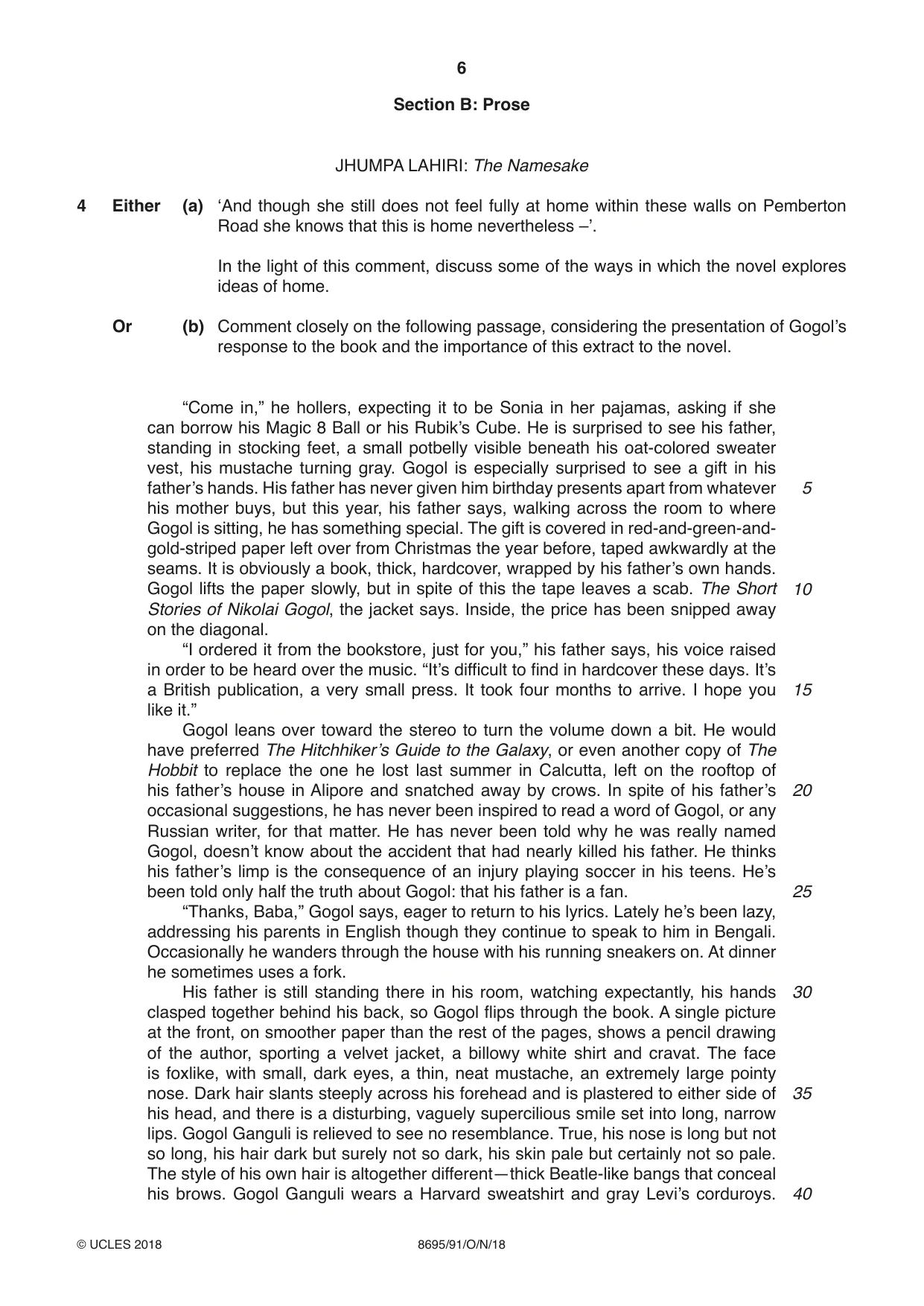
6 8695/91/O/N/18 © UCLES 2018 Section B: Prose JHUMPA LAHIRI: The Namesake 4 Either (a) ‘And though she still does not feel fully at home within these walls on Pemberton Road she knows that this is home nevertheless –’. In the light of this comment, discuss some of the ways in which the novel explores ideas of home. Or (b) Comment closely on the following passage, considering the presentation of Gogol’s response to the book and the importance of this extract to the novel. “Come in,” he hollers, expecting it to be Sonia in her pajamas, asking if she can borrow his Magic 8 Ball or his Rubik’s Cube. He is surprised to see his father, standing in stocking feet, a small potbelly visible beneath his oat-colored sweater vest, his mustache turning gray. Gogol is especially surprised to see a gift in his father’s hands. His father has never given him birthday presents apart from whatever his mother buys, but this year, his father says, walking across the room to where Gogol is sitting, he has something special. The gift is covered in red-and-green-and- gold-striped paper left over from Christmas the year before, taped awkwardly at the seams. It is obviously a book, thick, hardcover, wrapped by his father’s own hands. Gogol lifts the paper slowly, but in spite of this the tape leaves a scab. The Short Stories of Nikolai Gogol, the jacket says. Inside, the price has been snipped away on the diagonal. “I ordered it from the bookstore, just for you,” his father says, his voice raised in order to be heard over the music. “It’s difficult to find in hardcover these days. It’s a British publication, a very small press. It took four months to arrive. I hope you like it.” Gogol leans over toward the stereo to turn the volume down a bit. He would have preferred The Hitchhiker’s Guide to the Galaxy, or even another copy of The Hobbit to replace the one he lost last summer in Calcutta, left on the rooftop of his father’s house in Alipore and snatched away by crows. In spite of his father’s occasional suggestions, he has never been inspired to read a word of Gogol, or any Russian writer, for that matter. He has never been told why he was really named Gogol, doesn’t know about the accident that had nearly killed his father. He thinks his father’s limp is the consequence of an injury playing soccer in his teens. He’s been told only half the truth about Gogol: that his father is a fan. “Thanks, Baba,” Gogol says, eager to return to his lyrics. Lately he’s been lazy, addressing his parents in English though they continue to speak to him in Bengali. Occasionally he wanders through the house with his running sneakers on. At dinner he sometimes uses a fork. His father is still standing there in his room, watching expectantly, his hands clasped together behind his back, so Gogol flips through the book. A single picture at the front, on smoother paper than the rest of the pages, shows a pencil drawing of the author, sporting a velvet jacket, a billowy white shirt and cravat. The face is foxlike, with small, dark eyes, a thin, neat mustache, an extremely large pointy nose. Dark hair slants steeply across his forehead and is plastered to either side of his head, and there is a disturbing, vaguely supercilious smile set into long, narrow lips. Gogol Ganguli is relieved to see no resemblance. True, his nose is long but not so long, his hair dark but surely not so dark, his skin pale but certainly not so pale. The style of his own hair is altogether different—thick Beatle-like bangs that conceal his brows. Gogol Ganguli wears a Harvard sweatshirt and gray Levi’s corduroys. 5 10 15 20 25 30 35 40
Question paper, page 7
7 8695/91/O/N/18 © UCLES 2018 [Turn over He has worn a tie once in his life, to attend a friend’s bar mitzvah. No, he concludes confidently, there is no resemblance at all. For by now, he’s come to hate questions pertaining to his name, hates having constantly to explain. He hates having to tell people that it doesn’t mean anything “in Indian.” Chapter 4 45
Question paper, page 8
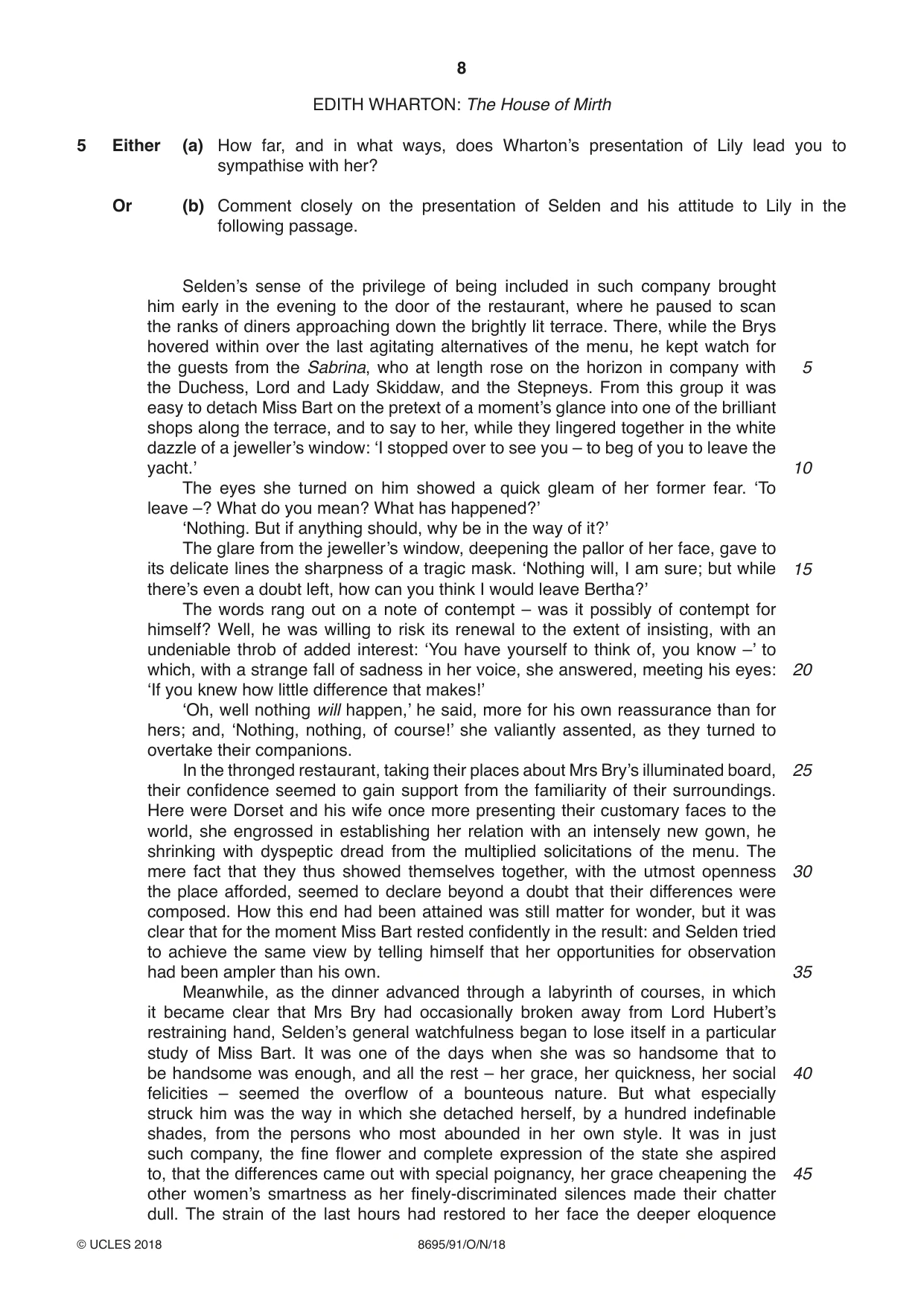
8 8695/91/O/N/18 © UCLES 2018 EDITH WHARTON: The House of Mirth 5 Either (a) How far, and in what ways, does Wharton’s presentation of Lily lead you to sympathise with her? Or (b) Comment closely on the presentation of Selden and his attitude to Lily in the following passage. Selden’s sense of the privilege of being included in such company brought him early in the evening to the door of the restaurant, where he paused to scan the ranks of diners approaching down the brightly lit terrace. There, while the Brys hovered within over the last agitating alternatives of the menu, he kept watch for the guests from the Sabrina, who at length rose on the horizon in company with the Duchess, Lord and Lady Skiddaw, and the Stepneys. From this group it was easy to detach Miss Bart on the pretext of a moment’s glance into one of the brilliant shops along the terrace, and to say to her, while they lingered together in the white dazzle of a jeweller’s window: ‘I stopped over to see you – to beg of you to leave the yacht.’ The eyes she turned on him showed a quick gleam of her former fear. ‘To leave –? What do you mean? What has happened?’ ‘Nothing. But if anything should, why be in the way of it?’ The glare from the jeweller’s window, deepening the pallor of her face, gave to its delicate lines the sharpness of a tragic mask. ‘Nothing will, I am sure; but while there’s even a doubt left, how can you think I would leave Bertha?’ The words rang out on a note of contempt – was it possibly of contempt for himself? Well, he was willing to risk its renewal to the extent of insisting, with an undeniable throb of added interest: ‘You have yourself to think of, you know –’ to which, with a strange fall of sadness in her voice, she answered, meeting his eyes: ‘If you knew how little difference that makes!’ ‘Oh, well nothing will happen,’ he said, more for his own reassurance than for hers; and, ‘Nothing, nothing, of course!’ she valiantly assented, as they turned to overtake their companions. In the thronged restaurant, taking their places about Mrs Bry’s illuminated board, their confidence seemed to gain support from the familiarity of their surroundings. Here were Dorset and his wife once more presenting their customary faces to the world, she engrossed in establishing her relation with an intensely new gown, he shrinking with dyspeptic dread from the multiplied solicitations of the menu. The mere fact that they thus showed themselves together, with the utmost openness the place afforded, seemed to declare beyond a doubt that their differences were composed. How this end had been attained was still matter for wonder, but it was clear that for the moment Miss Bart rested confidently in the result: and Selden tried to achieve the same view by telling himself that her opportunities for observation had been ampler than his own. Meanwhile, as the dinner advanced through a labyrinth of courses, in which it became clear that Mrs Bry had occasionally broken away from Lord Hubert’s restraining hand, Selden’s general watchfulness began to lose itself in a particular study of Miss Bart. It was one of the days when she was so handsome that to be handsome was enough, and all the rest – her grace, her quickness, her social felicities – seemed the overflow of a bounteous nature. But what especially struck him was the way in which she detached herself, by a hundred indefinable shades, from the persons who most abounded in her own style. It was in just such company, the fine flower and complete expression of the state she aspired to, that the differences came out with special poignancy, her grace cheapening the other women’s smartness as her finely-discriminated silences made their chatter dull. The strain of the last hours had restored to her face the deeper eloquence 5 10 15 20 25 30 35 40 45
Question paper, page 9
9 8695/91/O/N/18 © UCLES 2018 [Turn over which Selden had lately missed in it, and the bravery of her words to him still fluttered in her voice and eyes. Yes, she was matchless – it was the one word for her; and he could give his admiration the freer play because so little personal feeling remained in it. Book 2, Chapter 3 50
Question paper, page 10
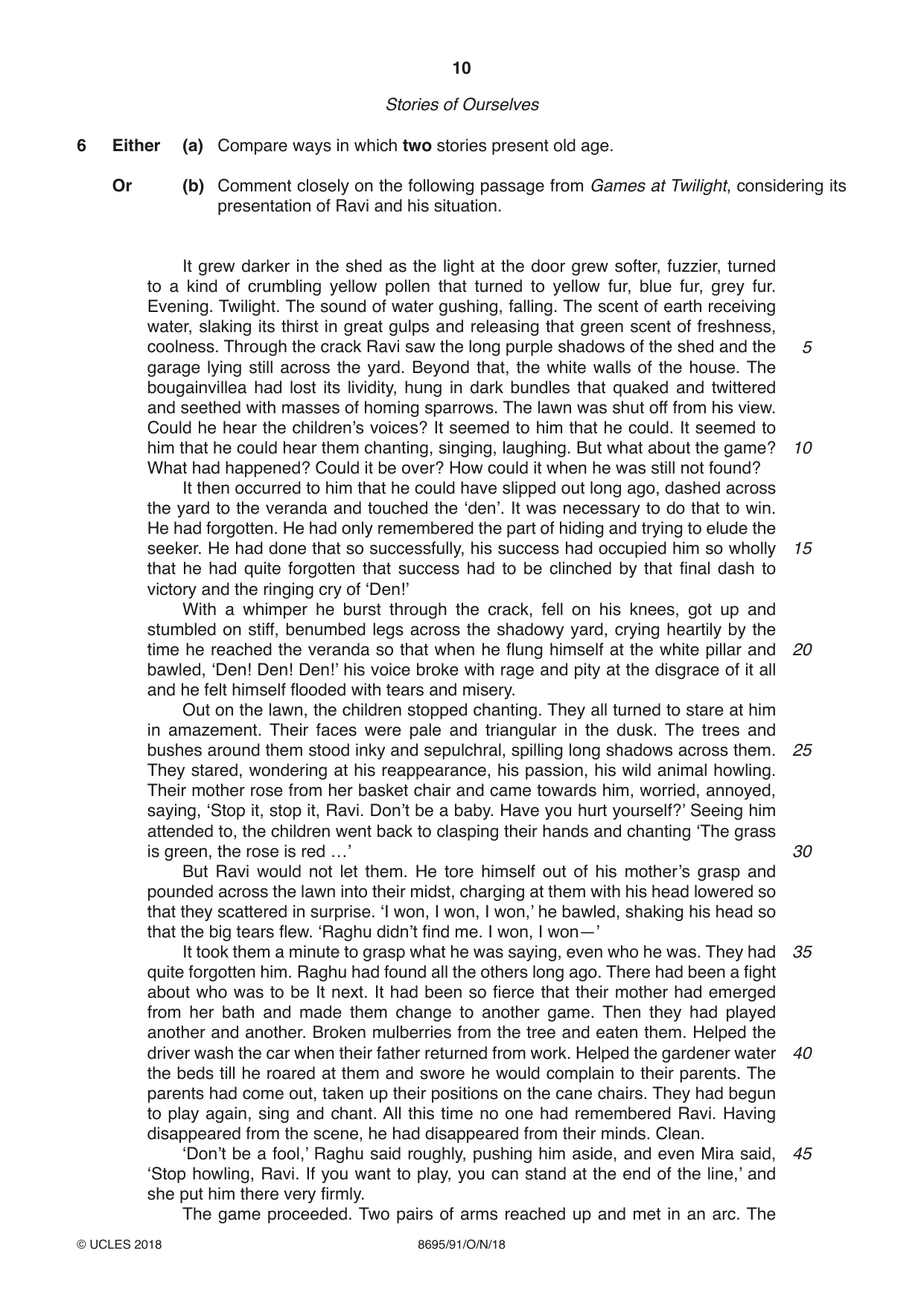
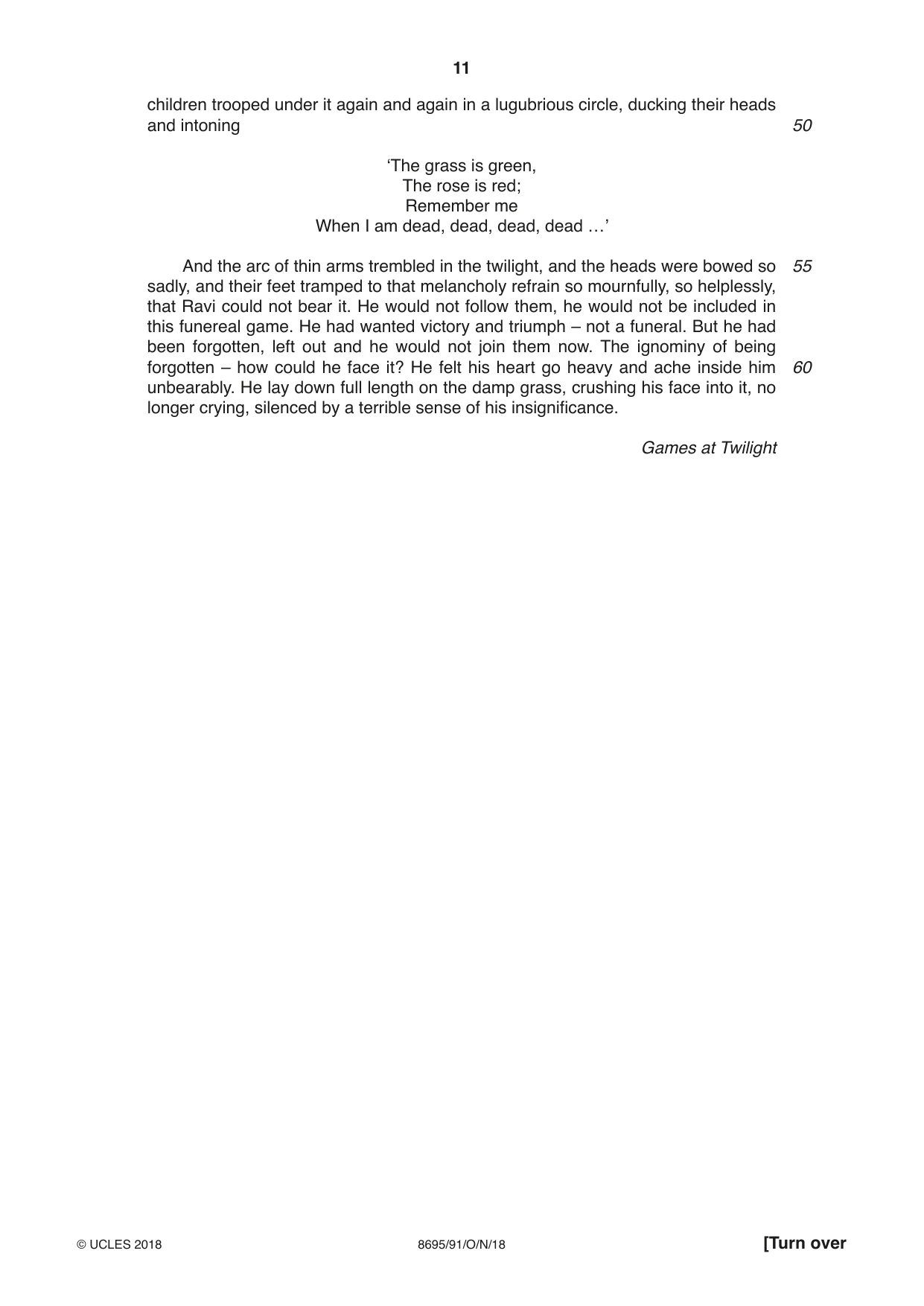
10 8695/91/O/N/18 © UCLES 2018 Stories of Ourselves 6 Either (a) Compare ways in which two stories present old age. Or (b) Comment closely on the following passage from Games at Twilight, considering its presentation of Ravi and his situation. It grew darker in the shed as the light at the door grew softer, fuzzier, turned to a kind of crumbling yellow pollen that turned to yellow fur, blue fur, grey fur. Evening. Twilight. The sound of water gushing, falling. The scent of earth receiving water, slaking its thirst in great gulps and releasing that green scent of freshness, coolness. Through the crack Ravi saw the long purple shadows of the shed and the garage lying still across the yard. Beyond that, the white walls of the house. The bougainvillea had lost its lividity, hung in dark bundles that quaked and twittered and seethed with masses of homing sparrows. The lawn was shut off from his view. Could he hear the children’s voices? It seemed to him that he could. It seemed to him that he could hear them chanting, singing, laughing. But what about the game? What had happened? Could it be over? How could it when he was still not found? It then occurred to him that he could have slipped out long ago, dashed across the yard to the veranda and touched the ‘den’. It was necessary to do that to win. He had forgotten. He had only remembered the part of hiding and trying to elude the seeker. He had done that so successfully, his success had occupied him so wholly that he had quite forgotten that success had to be clinched by that final dash to victory and the ringing cry of ‘Den!’ With a whimper he burst through the crack, fell on his knees, got up and stumbled on stiff, benumbed legs across the shadowy yard, crying heartily by the time he reached the veranda so that when he flung himself at the white pillar and bawled, ‘Den! Den! Den!’ his voice broke with rage and pity at the disgrace of it all and he felt himself flooded with tears and misery. Out on the lawn, the children stopped chanting. They all turned to stare at him in amazement. Their faces were pale and triangular in the dusk. The trees and bushes around them stood inky and sepulchral, spilling long shadows across them. They stared, wondering at his reappearance, his passion, his wild animal howling. Their mother rose from her basket chair and came towards him, worried, annoyed, saying, ‘Stop it, stop it, Ravi. Don’t be a baby. Have you hurt yourself?’ Seeing him attended to, the children went back to clasping their hands and chanting ‘The grass is green, the rose is red …’ But Ravi would not let them. He tore himself out of his mother’s grasp and pounded across the lawn into their midst, charging at them with his head lowered so that they scattered in surprise. ‘I won, I won, I won,’ he bawled, shaking his head so that the big tears flew. ‘Raghu didn’t find me. I won, I won—’ It took them a minute to grasp what he was saying, even who he was. They had quite forgotten him. Raghu had found all the others long ago. There had been a fight about who was to be It next. It had been so fierce that their mother had emerged from her bath and made them change to another game. Then they had played another and another. Broken mulberries from the tree and eaten them. Helped the driver wash the car when their father returned from work. Helped the gardener water the beds till he roared at them and swore he would complain to their parents. The parents had come out, taken up their positions on the cane chairs. They had begun to play again, sing and chant. All this time no one had remembered Ravi. Having disappeared from the scene, he had disappeared from their minds. Clean. ‘Don’t be a fool,’ Raghu said roughly, pushing him aside, and even Mira said, ‘Stop howling, Ravi. If you want to play, you can stand at the end of the line,’ and she put him there very firmly. The game proceeded. Two pairs of arms reached up and met in an arc. The 5 10 15 20 25 30 35 40 45
Question paper, page 11
11 8695/91/O/N/18 © UCLES 2018 [Turn over children trooped under it again and again in a lugubrious circle, ducking their heads and intoning ‘The grass is green, The rose is red; Remember me When I am dead, dead, dead, dead …’ And the arc of thin arms trembled in the twilight, and the heads were bowed so sadly, and their feet tramped to that melancholy refrain so mournfully, so helplessly, that Ravi could not bear it. He would not follow them, he would not be included in this funereal game. He had wanted victory and triumph – not a funeral. But he had been forgotten, left out and he would not join them now. The ignominy of being forgotten – how could he face it? He felt his heart go heavy and ache inside him unbearably. He lay down full length on the damp grass, crushing his face into it, no longer crying, silenced by a terrible sense of his insignificance. Games at Twilight 50 55 60
Question paper, page 12
12 8695/91/O/N/18 © UCLES 2018 Section C: Drama WOLE SOYINKA: Death and the King’s Horseman 7 Either (a) In what ways, and with what effects, does Soyinka explore tensions between duty and selfishness in the play? Or (b) With close reference to detail of language and action, discuss Soyinka’s presentation of colonial rule in the following extract. [Awkward silence. The drumming increases in volume. JANE gets up suddenly, restless.] Content removed due to copyright restrictions
Question paper, page 13
13 8695/91/O/N/18 © UCLES 2018 [Turn over Pilkings [between gritted teeth]: Er … forget what I said just now. The holy water is not nonsense. I was talking nonsense. Scene 2 Content removed due to copyright restrictions
Question paper, page 14
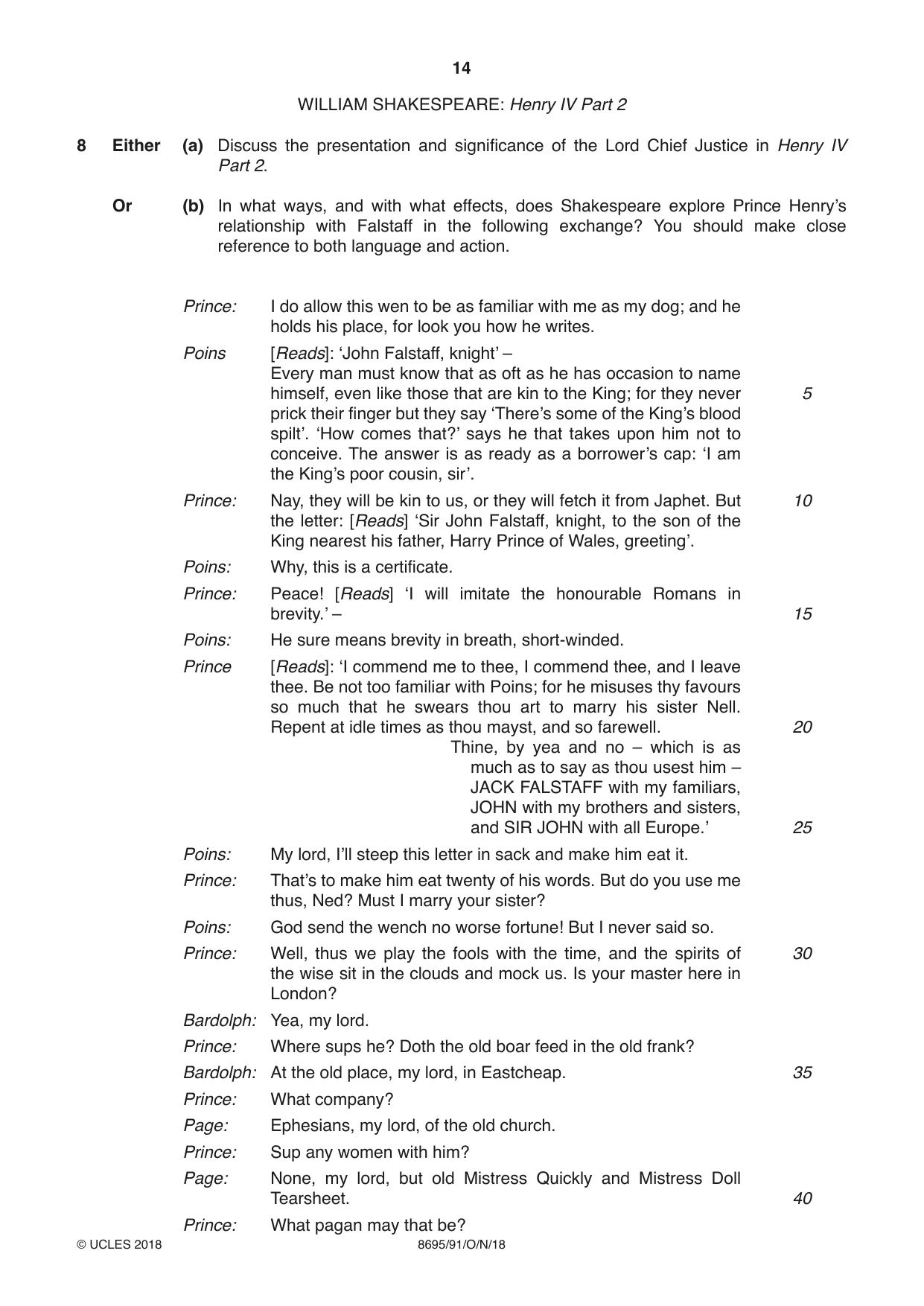
14 8695/91/O/N/18 © UCLES 2018 WILLIAM SHAKESPEARE: Henry IV Part 2 8 Either (a) Discuss the presentation and significance of the Lord Chief Justice in Henry IV Part 2. Or (b) In what ways, and with what effects, does Shakespeare explore Prince Henry’s relationship with Falstaff in the following exchange? You should make close reference to both language and action. Prince: I do allow this wen to be as familiar with me as my dog; and he holds his place, for look you how he writes. Poins [Reads]: ‘John Falstaff, knight’ – Every man must know that as oft as he has occasion to name himself, even like those that are kin to the King; for they never prick their finger but they say ‘There’s some of the King’s blood spilt’. ‘How comes that?’ says he that takes upon him not to conceive. The answer is as ready as a borrower’s cap: ‘I am the King’s poor cousin, sir’. Prince: Nay, they will be kin to us, or they will fetch it from Japhet. But the letter: [Reads] ‘Sir John Falstaff, knight, to the son of the King nearest his father, Harry Prince of Wales, greeting’. Poins: Why, this is a certificate. Prince: Peace! [Reads] ‘I will imitate the honourable Romans in brevity.’ – Poins: He sure means brevity in breath, short-winded. Prince [Reads]: ‘I commend me to thee, I commend thee, and I leave thee. Be not too familiar with Poins; for he misuses thy favours so much that he swears thou art to marry his sister Nell. Repent at idle times as thou mayst, and so farewell. Th ine, by yea and no – which is as much as to say as thou usest him – JACK FALSTAFF with my familiars, JOHN with my brothers and sisters, and SIR JOHN with all Europe.’ Poins: My lord, I’ll steep this letter in sack and make him eat it. Prince: That’s to make him eat twenty of his words. But do you use me thus, Ned? Must I marry your sister? Poins: God send the wench no worse fortune! But I never said so. Prince: Well, thus we play the fools with the time, and the spirits of the wise sit in the clouds and mock us. Is your master here in London? Bardolph: Yea, my lord. Prince: Where sups he? Doth the old boar feed in the old frank? Bardolph: At the old place, my lord, in Eastcheap. Prince: What company? Page: Ephesians, my lord, of the old church. Prince: Sup any women with him? Page: None, my lord, but old Mistress Quickly and Mistress Doll Tearsheet. Prince: What pagan may that be? 5 10 15 20 25 30 35 40
Question paper, page 15
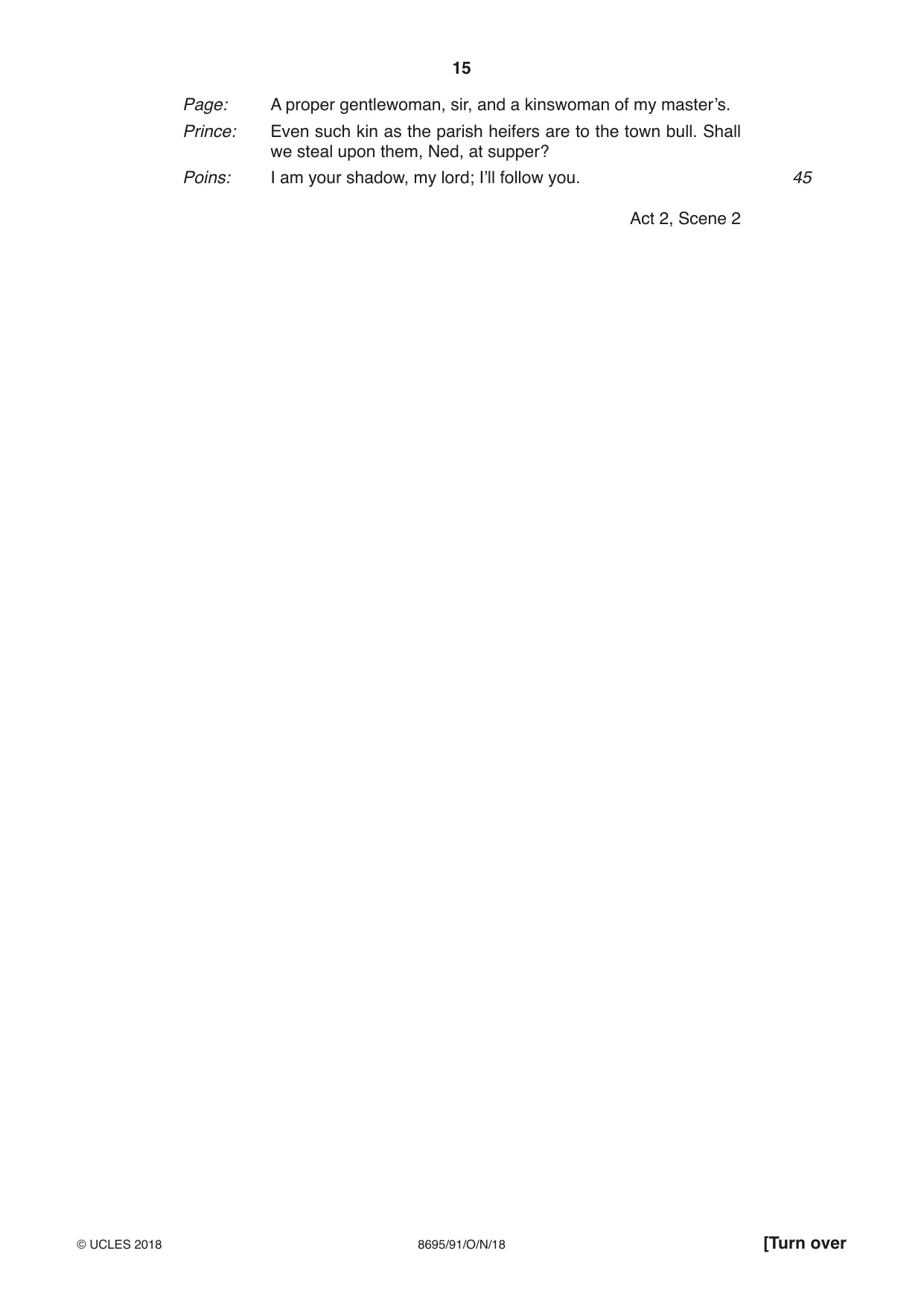
15 8695/91/O/N/18 © UCLES 2018 [Turn over Page: A proper gentlewoman, sir, and a kinswoman of my master’s. Prince: Even such kin as the parish heifers are to the town bull. Shall we steal upon them, Ned, at supper? Poins: I am your shadow, my lord; I’ll follow you. Act 2, Scene 2 45
Question paper, page 16
16 8695/91/O/N/18 © UCLES 2018 BRIAN FRIEL: Philadelphia, Here I Come! 9 Either (a) In what ways, and with what effects, does Friel’s structuring of the play contribute to your understanding of Gar’s changing state of mind? Or (b) How, and with what dramatic effects, does Friel present the attractions of a new life in America in the following extract? You should pay close attention to both language and action. Lizzy [to PUBLIC]: And that’s why I say to you: America’s Gawd’s own country. Ben? Content removed due to copyright restrictions
Question paper, page 17
17 8695/91/O/N/18 © UCLES 2018 Private [softly, with happy anguish]: God … my God … Oh my God … [Black out.] Episode 2 Content removed due to copyright restrictions
Question paper, page 18
18 8695/91/O/N/18 © UCLES 2018 BLANK PAGE
Question paper, page 19
19 8695/91/O/N/18 © UCLES 2018 BLANK PAGE
Question paper, page 20
20 8695/91/O/N/18 © UCLES 2018 BLANK PAGE Permission to reproduce items where third-party owned material protected by copyright is included has been sought and cleared where possible. Every reasonable effort has been made by the publisher (UCLES) to trace copyright holders, but if any items requiring clearance have unwittingly been included, the publisher will be pleased to make amends at the earliest possible opportunity. To avoid the issue of disclosure of answer-related information to candidates, all copyright acknowledgements are reproduced online in the Cambridge International Examinations Copyright Acknowledgements Booklet. This is produced for each series of examinations and is freely available to download at www.cie.org.uk after the live examination series. Cambridge International Examinations is part of the Cambridge Assessment Group. Cambridge Assessment is the brand name of University of Cambridge Local Examinations Syndicate (UCLES), which is itself a department of the University of Cambridge.
Mark scheme, page 1
This document consists of 6 printed pages. © UCLES 2018 [Turn over Cambridge Assessment International Education Cambridge International Advanced Subsidiary Level LANGUAGE AND LITERATURE IN ENGLISH 8695/91 Paper 9 Poetry, Prose and Drama October/November 2018 MARK SCHEME Maximum Mark: 50 Published This mark scheme is published as an aid to teachers and candidates, to indicate the requirements of the examination. It shows the basis on which Examiners were instructed to award marks. It does not indicate the details of the discussions that took place at an Examiners’ meeting before marking began, which would have considered the acceptability of alternative answers. Mark schemes should be read in conjunction with the question paper and the Principal Examiner Report for Teachers. Cambridge International will not enter into discussions about these mark schemes. Cambridge International is publishing the mark schemes for the October/November 2018 series for most Cambridge IGCSE™, Cambridge International A and AS Level components and some Cambridge O Level components.
Mark scheme, page 2
8695/91 Cambridge International AS Level – Mark Scheme PUBLISHED October/November 2018 © UCLES 2018 Page 2 of 6 Generic Marking Principles These general marking principles must be applied by all examiners when marking candidate answers. They should be applied alongside the specific content of the mark scheme or generic level descriptors for a question. Each question paper and mark scheme will also comply with these marking principles. GENERIC MARKING PRINCIPLE 1: Marks must be awarded in line with: • the specific content of the mark scheme or the generic level descriptors for the question • the specific skills defined in the mark scheme or in the generic level descriptors for the question • the standard of response required by a candidate as exemplified by the standardisation scripts. GENERIC MARKING PRINCIPLE 2: Marks awarded are always whole marks (not half marks, or other fractions). GENERIC MARKING PRINCIPLE 3: Marks must be awarded positively: • marks are awarded for correct/valid answers, as defined in the mark scheme. However, credit is given for valid answers which go beyond the scope of the syllabus and mark scheme, referring to your Team Leader as appropriate • marks are awarded when candidates clearly demonstrate what they know and can do • marks are not deducted for errors • marks are not deducted for omissions • answers should only be judged on the quality of spelling, punctuation and grammar when these features are specifically assessed by the question as indicated by the mark scheme. The meaning, however, should be unambiguous. GENERIC MARKING PRINCIPLE 4: Rules must be applied consistently e.g. in situations where candidates have not followed instructions or in the application of generic level descriptors. GENERIC MARKING PRINCIPLE 5: Marks should be awarded using the full range of marks defined in the mark scheme for the question (however; the use of the full mark range may be limited according to the quality of the candidate responses seen). GENERIC MARKING PRINCIPLE 6: Marks awarded are based solely on the requirements as defined in the mark scheme. Marks should not be awarded with grade thresholds or grade descriptors in mind.
Mark scheme, page 3
8695/91 Cambridge International AS Level – Mark Scheme PUBLISHED October/November 2018 © UCLES 2018 Page 3 of 6 Introduction For general administrative guidance, see Notes for Examiners Handbook. Assessment objectives: AO1 The ability to respond to texts in the three main forms (Prose, Poetry and Drama) of different types and from different cultures. AO2 An understanding of the ways in which writers’ choices of form, structure and language shape meanings. AO3 The ability to produce informed, independent opinions and judgements on literary texts. AO4 The ability to communicate clearly the knowledge, understanding and insight appropriate for literary study. Each answer is marked out of 25, in accordance with the levels mark scheme. Each level is divided into strands: Knowledge (K), Understanding (U), Personal Response (P) and Communication (C). Using the levels mark scheme Place the answer in a level first. Look for the “best fit” of the answer into a level. An answer needs to show evidence of most but not necessarily all of the qualities described in a level, in order to be placed in that level. Then award a mark for the relative position of the answer within the level. Candidates may address the question in many different ways. Do not expect any particular focus or approach and do not penalise answers for leaving out a particular focus. Reward what is there, showing what you are rewarding, in your comments. Consider all strands and weigh up the performance as a whole in placing the answer in a level, then show that you have done so in the summative comment, e.g. Sound K of texts, some evidence of U but mostly narrative, occasional evidence of P, mainly clear C. Principles of Annotation Annotating English Literature scripts has the following purposes: • to follow best practice in assessing English Literature essays • to record the comments and developing thought of the examiner doing the work of assessment • to facilitate the summative comments and overall mark given to an essay. The annotations made on scripts become public property following marking and may be cited as evidence in case of appeal. Annotations are therefore vital, not just in ensuring the mark given is what the student deserves, but also in making the marking process demonstrably clear to any potential reader.
Mark scheme, page 4
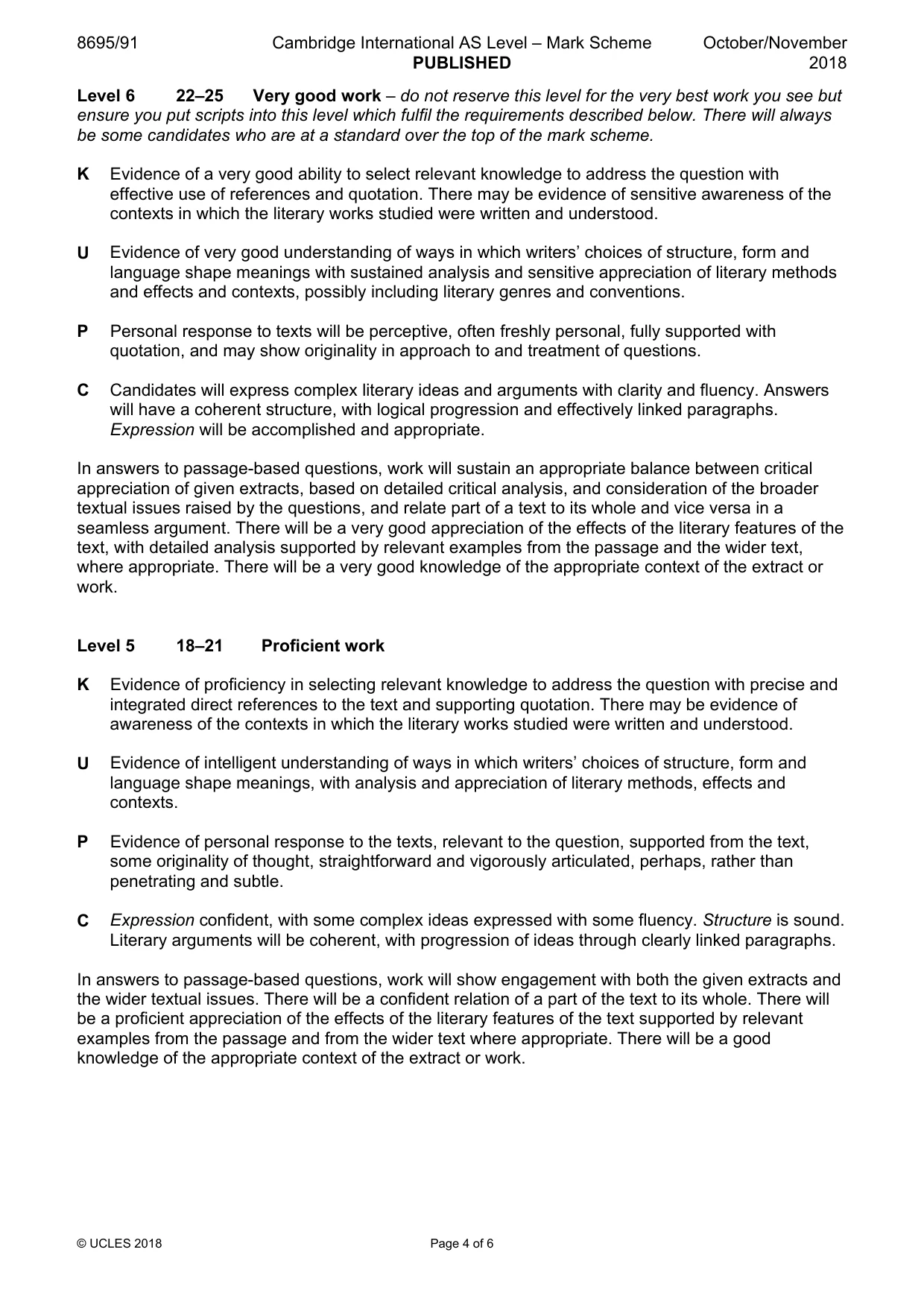
8695/91 Cambridge International AS Level – Mark Scheme PUBLISHED October/November 2018 © UCLES 2018 Page 4 of 6 Level 6 22–25 Very good work – do not reserve this level for the very best work you see but ensure you put scripts into this level which fulfil the requirements described below. There will always be some candidates who are at a standard over the top of the mark scheme. K Evidence of a very good ability to select relevant knowledge to address the question with effective use of references and quotation. There may be evidence of sensitive awareness of the contexts in which the literary works studied were written and understood. U Evidence of very good understanding of ways in which writers’ choices of structure, form and language shape meanings with sustained analysis and sensitive appreciation of literary methods and effects and contexts, possibly including literary genres and conventions. P Personal response to texts will be perceptive, often freshly personal, fully supported with quotation, and may show originality in approach to and treatment of questions. C Candidates will express complex literary ideas and arguments with clarity and fluency. Answers will have a coherent structure, with logical progression and effectively linked paragraphs. Expression will be accomplished and appropriate. In answers to passage-based questions, work will sustain an appropriate balance between critical appreciation of given extracts, based on detailed critical analysis, and consideration of the broader textual issues raised by the questions, and relate part of a text to its whole and vice versa in a seamless argument. There will be a very good appreciation of the effects of the literary features of the text, with detailed analysis supported by relevant examples from the passage and the wider text, where appropriate. There will be a very good knowledge of the appropriate context of the extract or work. Level 5 18–21 Proficient work K Evidence of proficiency in selecting relevant knowledge to address the question with precise and integrated direct references to the text and supporting quotation. There may be evidence of awareness of the contexts in which the literary works studied were written and understood. U Evidence of intelligent understanding of ways in which writers’ choices of structure, form and language shape meanings, with analysis and appreciation of literary methods, effects and contexts. P Evidence of personal response to the texts, relevant to the question, supported from the text, some originality of thought, straightforward and vigorously articulated, perhaps, rather than penetrating and subtle. C Expression confident, with some complex ideas expressed with some fluency. Structure is sound. Literary arguments will be coherent, with progression of ideas through clearly linked paragraphs. In answers to passage-based questions, work will show engagement with both the given extracts and the wider textual issues. There will be a confident relation of a part of the text to its whole. There will be a proficient appreciation of the effects of the literary features of the text supported by relevant examples from the passage and from the wider text where appropriate. There will be a good knowledge of the appropriate context of the extract or work.
Mark scheme, page 5
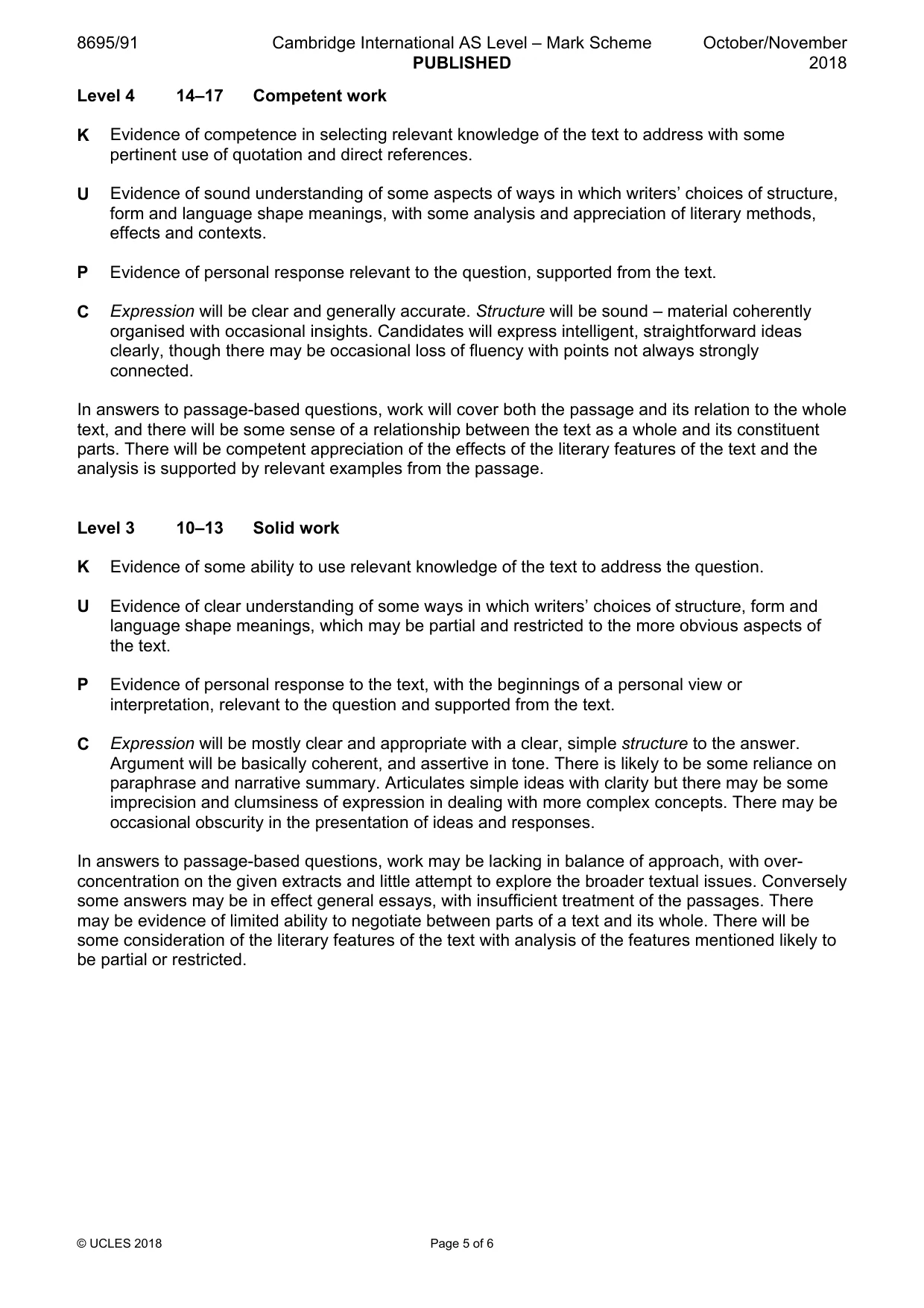
8695/91 Cambridge International AS Level – Mark Scheme PUBLISHED October/November 2018 © UCLES 2018 Page 5 of 6 Level 4 14–17 Competent work K Evidence of competence in selecting relevant knowledge of the text to address with some pertinent use of quotation and direct references. U Evidence of sound understanding of some aspects of ways in which writers’ choices of structure, form and language shape meanings, with some analysis and appreciation of literary methods, effects and contexts. P Evidence of personal response relevant to the question, supported from the text. C Expression will be clear and generally accurate. Structure will be sound – material coherently organised with occasional insights. Candidates will express intelligent, straightforward ideas clearly, though there may be occasional loss of fluency with points not always strongly connected. In answers to passage-based questions, work will cover both the passage and its relation to the whole text, and there will be some sense of a relationship between the text as a whole and its constituent parts. There will be competent appreciation of the effects of the literary features of the text and the analysis is supported by relevant examples from the passage. Level 3 10–13 Solid work K Evidence of some ability to use relevant knowledge of the text to address the question. U Evidence of clear understanding of some ways in which writers’ choices of structure, form and language shape meanings, which may be partial and restricted to the more obvious aspects of the text. P Evidence of personal response to the text, with the beginnings of a personal view or interpretation, relevant to the question and supported from the text. C Expression will be mostly clear and appropriate with a clear, simple structure to the answer. Argument will be basically coherent, and assertive in tone. There is likely to be some reliance on paraphrase and narrative summary. Articulates simple ideas with clarity but there may be some imprecision and clumsiness of expression in dealing with more complex concepts. There may be occasional obscurity in the presentation of ideas and responses. In answers to passage-based questions, work may be lacking in balance of approach, with over- concentration on the given extracts and little attempt to explore the broader textual issues. Conversely some answers may be in effect general essays, with insufficient treatment of the passages. There may be evidence of limited ability to negotiate between parts of a text and its whole. There will be some consideration of the literary features of the text with analysis of the features mentioned likely to be partial or restricted.
Mark scheme, page 6
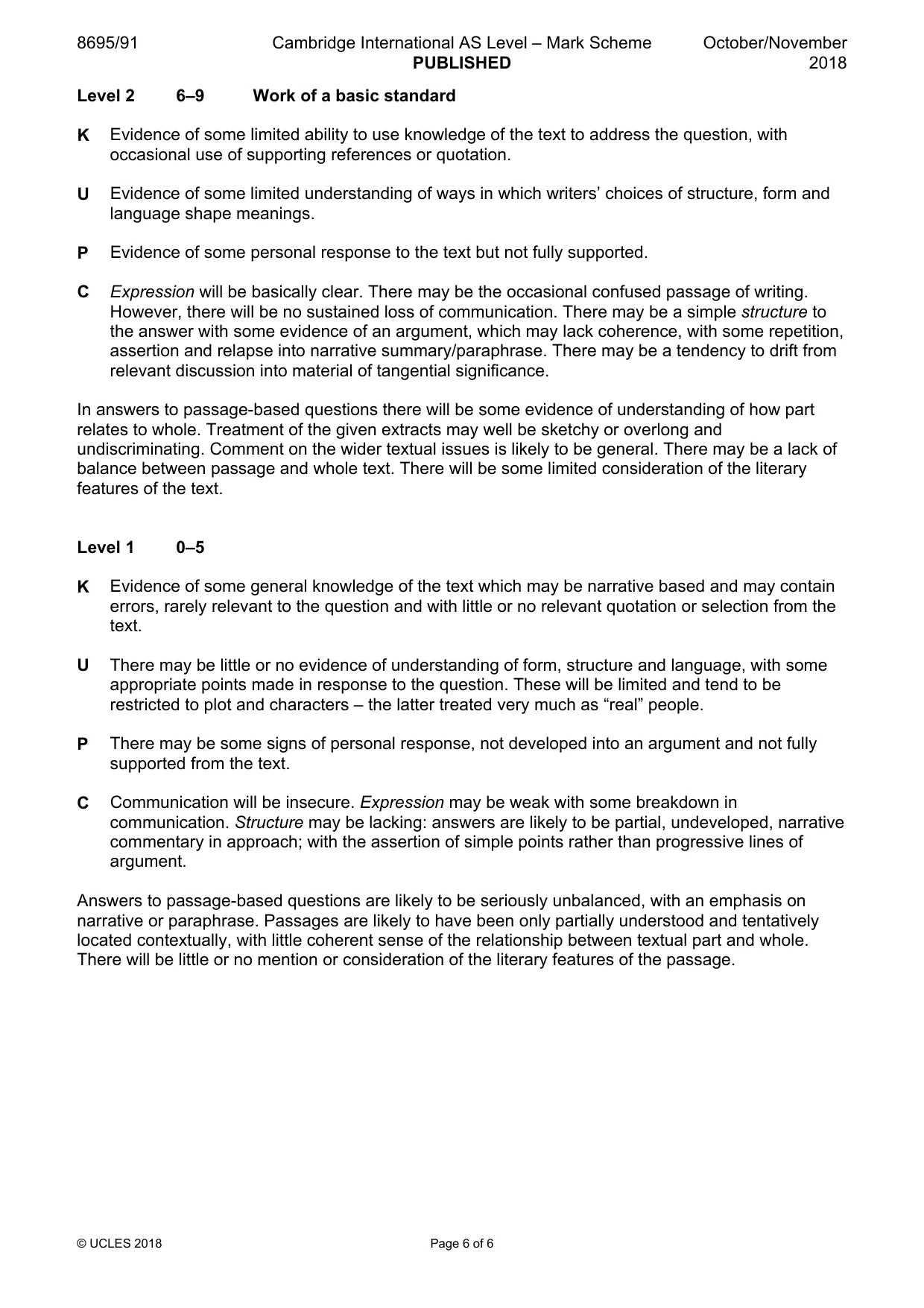
8695/91 Cambridge International AS Level – Mark Scheme PUBLISHED October/November 2018 © UCLES 2018 Page 6 of 6 Level 2 6–9 Work of a basic standard K Evidence of some limited ability to use knowledge of the text to address the question, with occasional use of supporting references or quotation. U Evidence of some limited understanding of ways in which writers’ choices of structure, form and language shape meanings. P Evidence of some personal response to the text but not fully supported. C Expression will be basically clear. There may be the occasional confused passage of writing. However, there will be no sustained loss of communication. There may be a simple structure to the answer with some evidence of an argument, which may lack coherence, with some repetition, assertion and relapse into narrative summary/paraphrase. There may be a tendency to drift from relevant discussion into material of tangential significance. In answers to passage-based questions there will be some evidence of understanding of how part relates to whole. Treatment of the given extracts may well be sketchy or overlong and undiscriminating. Comment on the wider textual issues is likely to be general. There may be a lack of balance between passage and whole text. There will be some limited consideration of the literary features of the text. Level 1 0–5 K Evidence of some general knowledge of the text which may be narrative based and may contain errors, rarely relevant to the question and with little or no relevant quotation or selection from the text. U There may be little or no evidence of understanding of form, structure and language, with some appropriate points made in response to the question. These will be limited and tend to be restricted to plot and characters – the latter treated very much as “real” people. P There may be some signs of personal response, not developed into an argument and not fully supported from the text. C Communication will be insecure. Expression may be weak with some breakdown in communication. Structure may be lacking: answers are likely to be partial, undeveloped, narrative commentary in approach; with the assertion of simple points rather than progressive lines of argument. Answers to passage-based questions are likely to be seriously unbalanced, with an emphasis on narrative or paraphrase. Passages are likely to have been only partially understood and tentatively located contextually, with little coherent sense of the relationship between textual part and whole. There will be little or no mention or consideration of the literary features of the passage.
What you needed in this session
Cambridge’s own grade thresholds for 2018 Oct/Nov, Paper 9 · Variant 1. A higher threshold means an easier paper — the bar moves with how the cohort did.