Cambridge A Level English - Language and Literature (AS Level only, from 2016) 8695 — 2019 May/June Paper 9 · Variant 1
8695/91/M/J/19 · 50 marks · ≈56 min
The question paper and its mark scheme, free to read here and free to download. This is Cambridge’s own paper, exactly as it was sat.
Question paper20 pages





Mark scheme6 pages
Answers below. Sit the paper first if you are practising.
Paper as text
Question paper, page 1
This document consists of 17 printed pages, 3 blank pages and 1 Insert. DC (RCL (GO)) 165919/2 © UCLES 2019 [Turn over Cambridge Assessment International Education Cambridge International Advanced Subsidiary Level LANGUAGE AND LITERATURE IN ENGLISH 8695/91 Paper 9 Poetry, Prose and Drama May/June 2019 2 hours No Additional Materials are required. READ THESE INSTRUCTIONS FIRST An answer booklet is provided inside this question paper. You should follow the instructions on the front cover of the answer booklet. If you need additional answer paper ask the invigilator for a continuation booklet. Answer two questions, each from a different section. You are reminded of the need for good English and clear presentation in your answers. All questions in this paper carry equal marks. * 8 9 8 5 0 4 9 3 3 6 *
Question paper, page 2
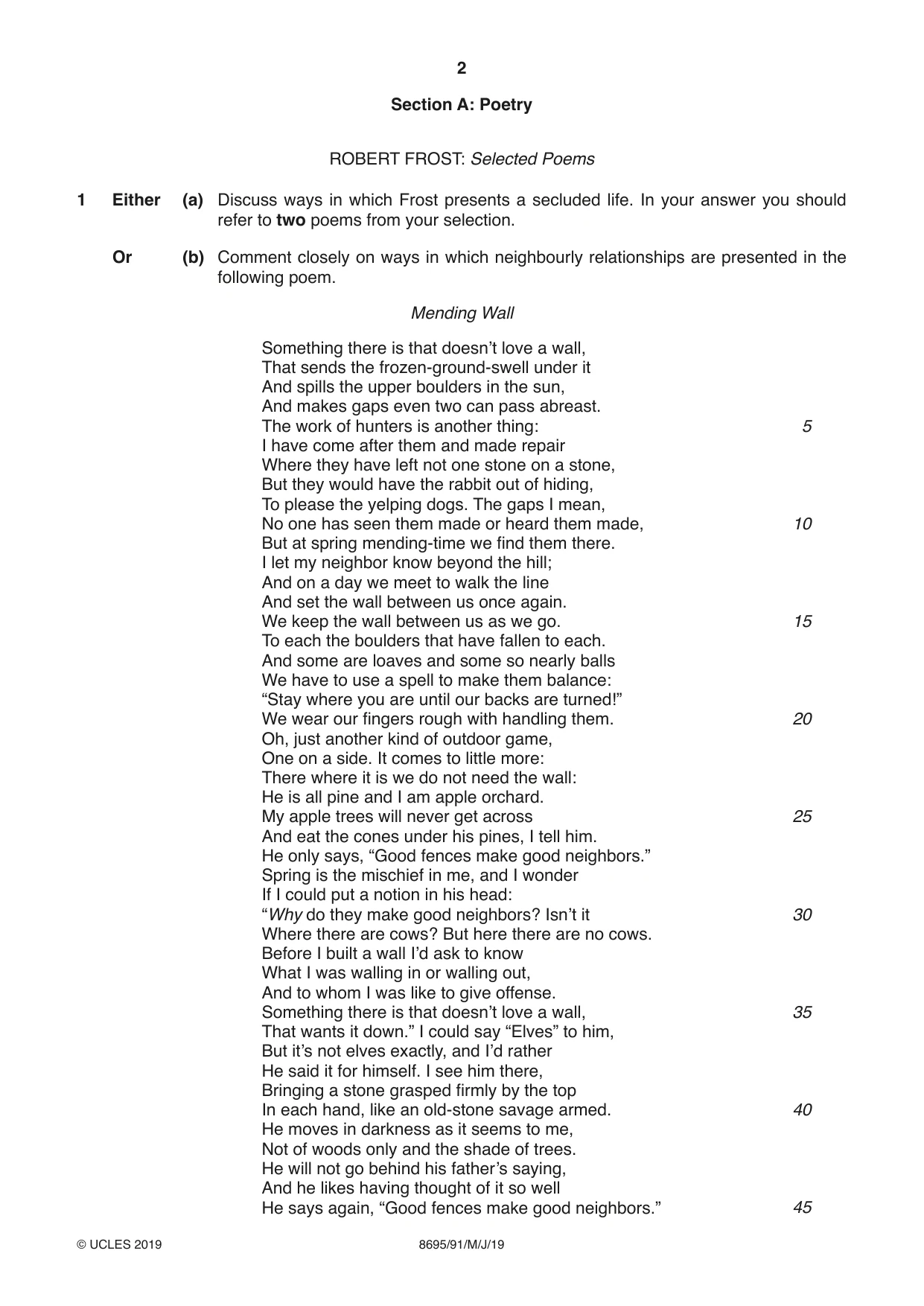
2 8695/91/M/J/19 © UCLES 2019 Section A: Poetry ROBERT FROST: Selected Poems 1 Either (a) Discuss ways in which Frost presents a secluded life. In your answer you should refer to two poems from your selection. Or (b) Comment closely on ways in which neighbourly relationships are presented in the following poem. Mending Wall Something there is that doesn’t love a wall, That sends the frozen-ground-swell under it And spills the upper boulders in the sun, And makes gaps even two can pass abreast. The work of hunters is another thing: I have come after them and made repair Where they have left not one stone on a stone, But they would have the rabbit out of hiding, To please the yelping dogs. The gaps I mean, No one has seen them made or heard them made, But at spring mending-time we find them there. I let my neighbor know beyond the hill; And on a day we meet to walk the line And set the wall between us once again. We keep the wall between us as we go. To each the boulders that have fallen to each. And some are loaves and some so nearly balls We have to use a spell to make them balance: “Stay where you are until our backs are turned!” We wear our fingers rough with handling them. Oh, just another kind of outdoor game, One on a side. It comes to little more: There where it is we do not need the wall: He is all pine and I am apple orchard. My apple trees will never get across And eat the cones under his pines, I tell him. He only says, “Good fences make good neighbors.” Spring is the mischief in me, and I wonder If I could put a notion in his head: “Why do they make good neighbors? Isn’t it Where there are cows? But here there are no cows. Before I built a wall I’d ask to know What I was walling in or walling out, And to whom I was like to give offense. Something there is that doesn’t love a wall, That wants it down.” I could say “Elves” to him, But it’s not elves exactly, and I’d rather He said it for himself. I see him there, Bringing a stone grasped firmly by the top In each hand, like an old-stone savage armed. He moves in darkness as it seems to me, Not of woods only and the shade of trees. He will not go behind his father’s saying, And he likes having thought of it so well He says again, “Good fences make good neighbors.” 5 10 15 20 25 30 35 40 45
Question paper, page 3
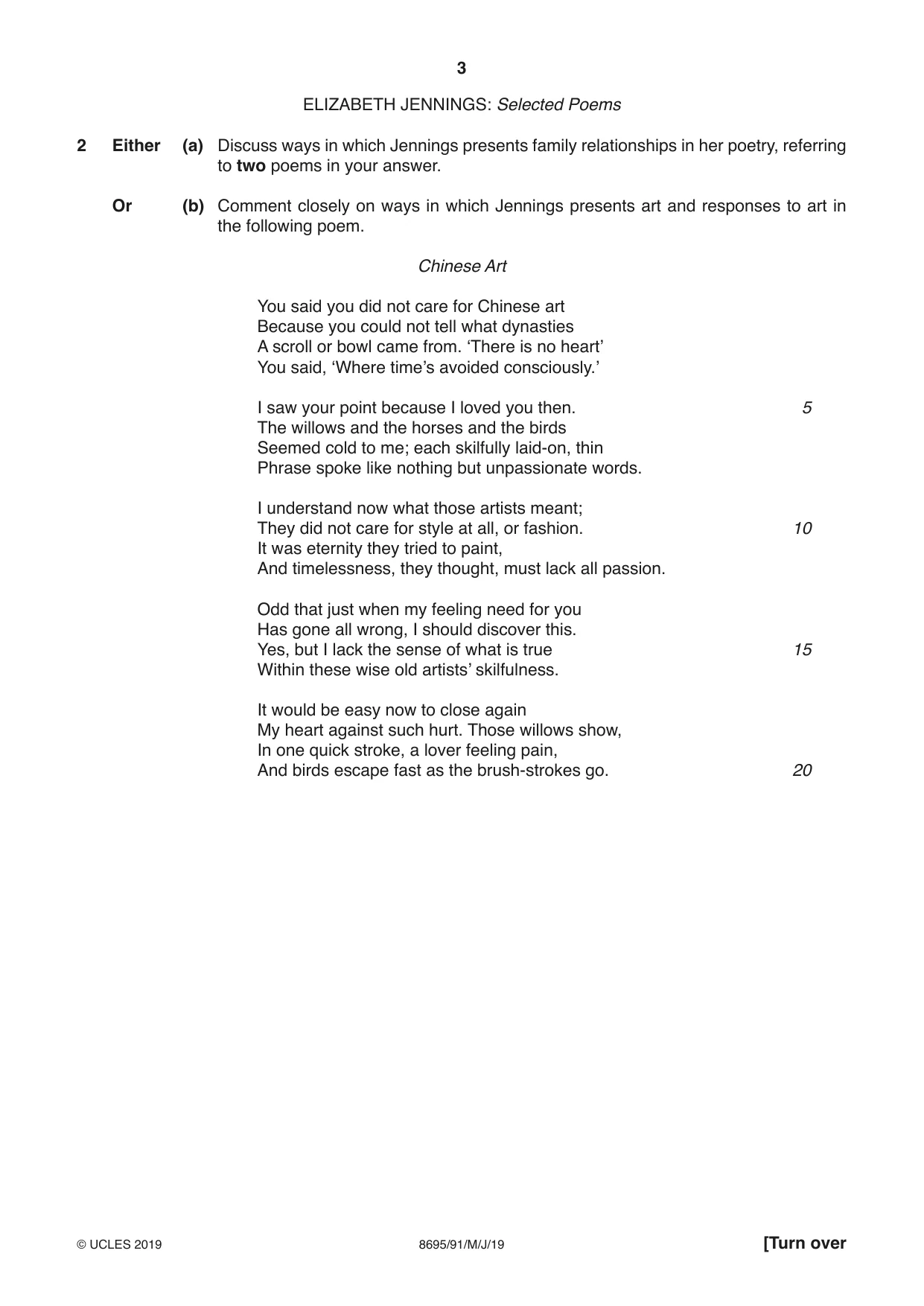
3 8695/91/M/J/19 © UCLES 2019 [Turn over ELIZABETH JENNINGS: Selected Poems 2 Either (a) Discuss ways in which Jennings presents family relationships in her poetry, referring to two poems in your answer. Or (b) Comment closely on ways in which Jennings presents art and responses to art in the following poem. Chinese Art You said you did not care for Chinese art Because you could not tell what dynasties A scroll or bowl came from. ‘There is no heart’ You said, ‘Where time’s avoided consciously.’ I saw your point because I loved you then. The willows and the horses and the birds Seemed cold to me; each skilfully laid-on, thin Phrase spoke like nothing but unpassionate words. I understand now what those artists meant; They did not care for style at all, or fashion. It was eternity they tried to paint, And timelessness, they thought, must lack all passion. Odd that just when my feeling need for you Has gone all wrong, I should discover this. Yes, but I lack the sense of what is true Within these wise old artists’ skilfulness. It would be easy now to close again My heart against such hurt. Those willows show, In one quick stroke, a lover feeling pain, And birds escape fast as the brush-strokes go. 5 10 15 20
Question paper, page 4
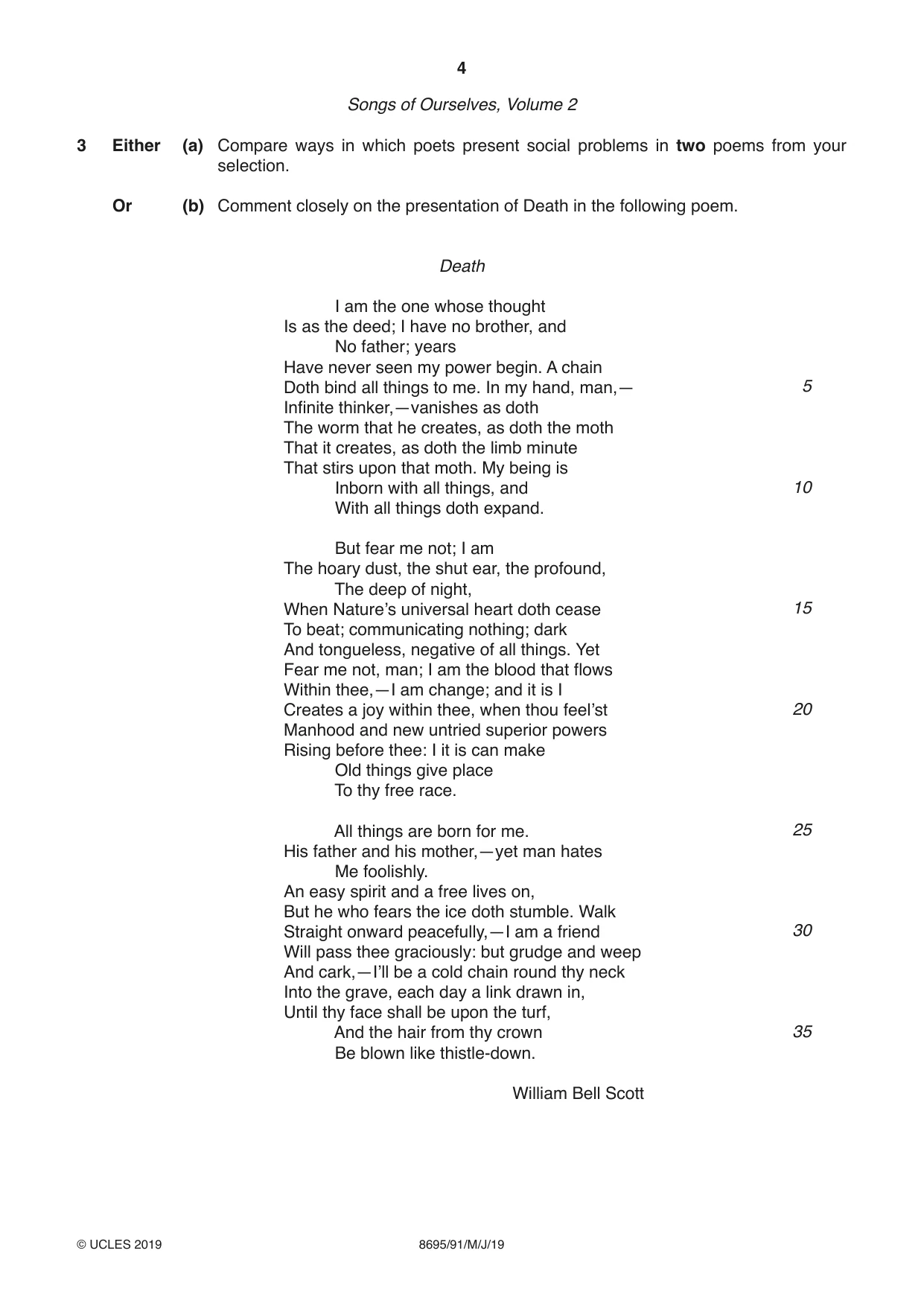
4 8695/91/M/J/19 © UCLES 2019 Songs of Ourselves, Volume 2 3 Either (a) Compare ways in which poets present social problems in two poems from your selection. Or (b) Comment closely on the presentation of Death in the following poem. Death I am the one whose thought Is as the deed; I have no brother, and No father; years Have never seen my power begin. A chain Doth bind all things to me. In my hand, man,— Infinite thinker,—vanishes as doth The worm that he creates, as doth the moth That it creates, as doth the limb minute That stirs upon that moth. My being is Inborn with all things, and With all things doth expand. But fear me not; I am The hoary dust, the shut ear, the profound, The deep of night, When Nature’s universal heart doth cease To beat; communicating nothing; dark And tongueless, negative of all things. Yet Fear me not, man; I am the blood that flows Within thee,—I am change; and it is I Creates a joy within thee, when thou feel’st Manhood and new untried superior powers Rising before thee: I it is can make Old things give place To thy free race. All things are born for me. His father and his mother,—yet man hates Me foolishly. An easy spirit and a free lives on, But he who fears the ice doth stumble. Walk Straight onward peacefully,—I am a friend Will pass thee graciously: but grudge and weep And cark,—I’ll be a cold chain round thy neck Into the grave, each day a link drawn in, Until thy face shall be upon the turf, And the hair from thy crown Be blown like thistle-down. William Bell Scott 5 10 15 20 25 30 35
Question paper, page 5
5 8695/91/M/J/19 © UCLES 2019 [Turn over Turn over for Section B.
Question paper, page 6
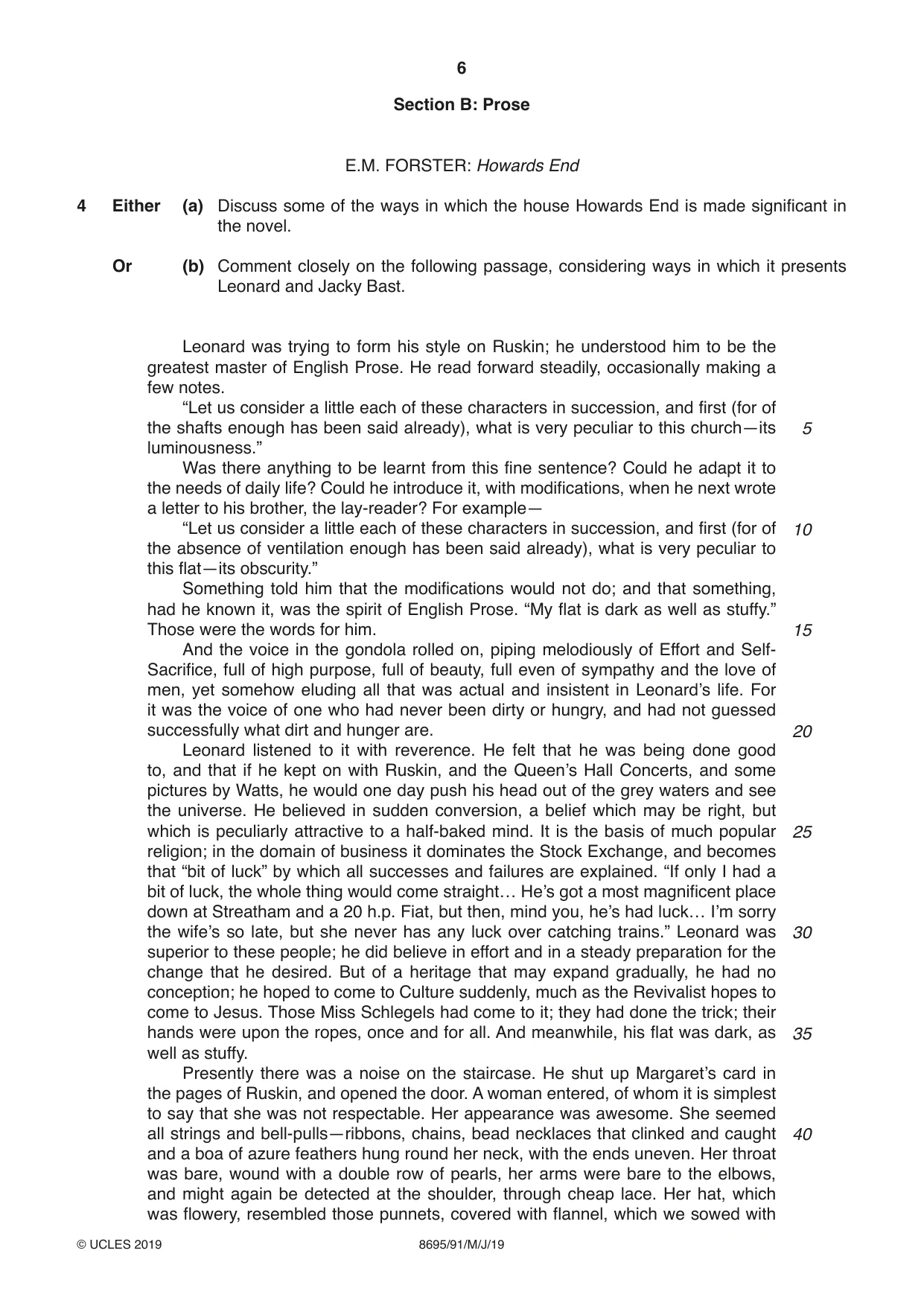
6 8695/91/M/J/19 © UCLES 2019 Section B: Prose E.M. FORSTER: Howards End 4 Either (a) Discuss some of the ways in which the house Howards End is made significant in the novel. Or (b) Comment closely on the following passage, considering ways in which it presents Leonard and Jacky Bast. Leonard was trying to form his style on Ruskin; he understood him to be the greatest master of English Prose. He read forward steadily, occasionally making a few notes. “Let us consider a little each of these characters in succession, and first (for of the shafts enough has been said already), what is very peculiar to this church—its luminousness.” Was there anything to be learnt from this fine sentence? Could he adapt it to the needs of daily life? Could he introduce it, with modifications, when he next wrote a letter to his brother, the lay-reader? For example— “Let us consider a little each of these characters in succession, and first (for of the absence of ventilation enough has been said already), what is very peculiar to this flat—its obscurity.” Something told him that the modifications would not do; and that something, had he known it, was the spirit of English Prose. “My flat is dark as well as stuffy.” Those were the words for him. And the voice in the gondola rolled on, piping melodiously of Effort and Self- Sacrifice, full of high purpose, full of beauty, full even of sympathy and the love of men, yet somehow eluding all that was actual and insistent in Leonard’s life. For it was the voice of one who had never been dirty or hungry, and had not guessed successfully what dirt and hunger are. Leonard listened to it with reverence. He felt that he was being done good to, and that if he kept on with Ruskin, and the Queen’s Hall Concerts, and some pictures by Watts, he would one day push his head out of the grey waters and see the universe. He believed in sudden conversion, a belief which may be right, but which is peculiarly attractive to a half-baked mind. It is the basis of much popular religion; in the domain of business it dominates the Stock Exchange, and becomes that “bit of luck” by which all successes and failures are explained. “If only I had a bit of luck, the whole thing would come straight… He’s got a most magnificent place down at Streatham and a 20 h.p. Fiat, but then, mind you, he’s had luck… I’m sorry the wife’s so late, but she never has any luck over catching trains.” Leonard was superior to these people; he did believe in effort and in a steady preparation for the change that he desired. But of a heritage that may expand gradually, he had no conception; he hoped to come to Culture suddenly, much as the Revivalist hopes to come to Jesus. Those Miss Schlegels had come to it; they had done the trick; their hands were upon the ropes, once and for all. And meanwhile, his flat was dark, as well as stuffy. Presently there was a noise on the staircase. He shut up Margaret’s card in the pages of Ruskin, and opened the door. A woman entered, of whom it is simplest to say that she was not respectable. Her appearance was awesome. She seemed all strings and bell-pulls—ribbons, chains, bead necklaces that clinked and caught and a boa of azure feathers hung round her neck, with the ends uneven. Her throat was bare, wound with a double row of pearls, her arms were bare to the elbows, and might again be detected at the shoulder, through cheap lace. Her hat, which was flowery, resembled those punnets, covered with flannel, which we sowed with 5 10 15 20 25 30 35 40
Question paper, page 7
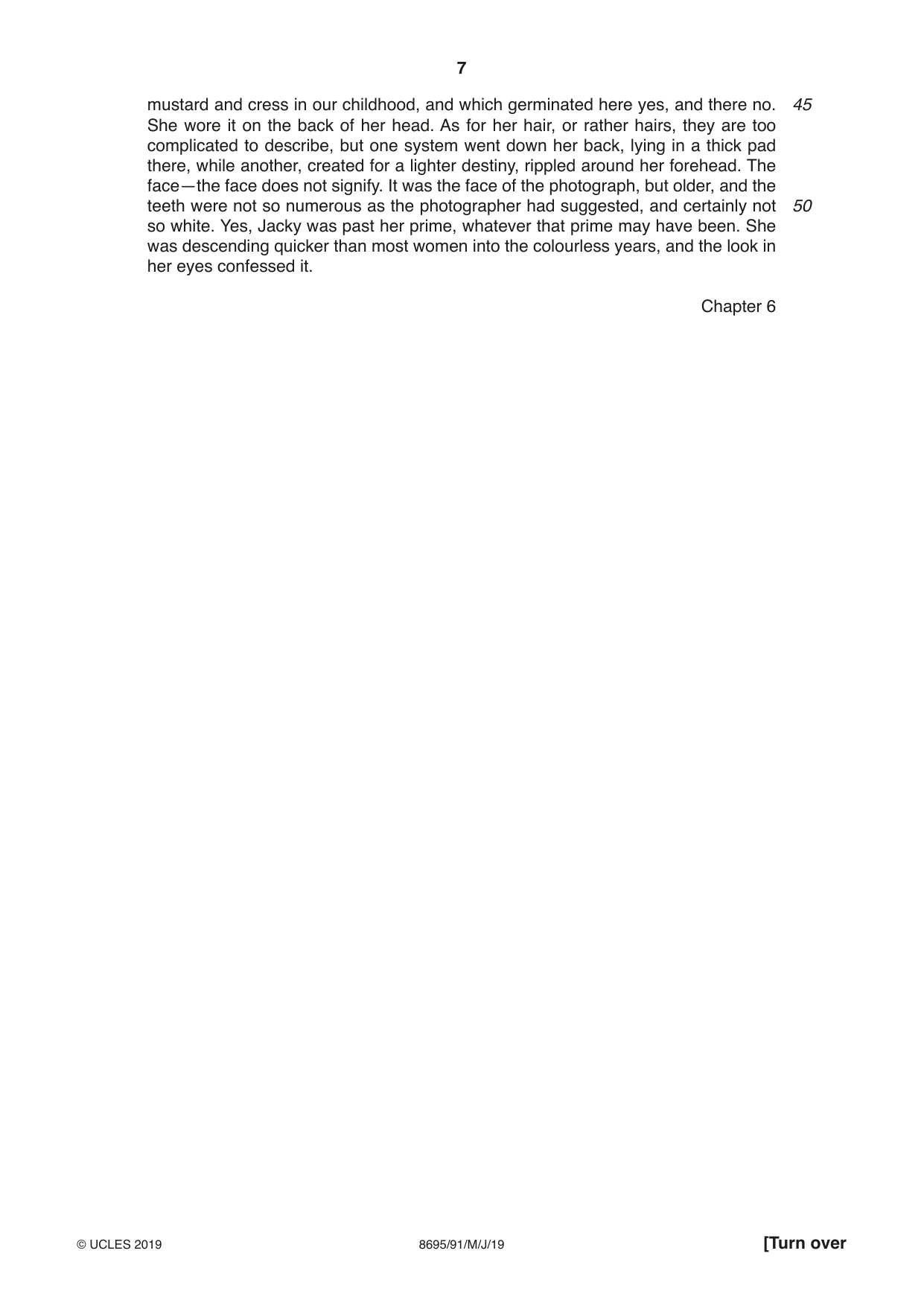
7 8695/91/M/J/19 © UCLES 2019 [Turn over mustard and cress in our childhood, and which germinated here yes, and there no. She wore it on the back of her head. As for her hair, or rather hairs, they are too complicated to describe, but one system went down her back, lying in a thick pad there, while another, created for a lighter destiny, rippled around her forehead. The face—the face does not signify. It was the face of the photograph, but older, and the teeth were not so numerous as the photographer had suggested, and certainly not so white. Yes, Jacky was past her prime, whatever that prime may have been. She was descending quicker than most women into the colourless years, and the look in her eyes confessed it. Chapter 6 45 50
Question paper, page 8
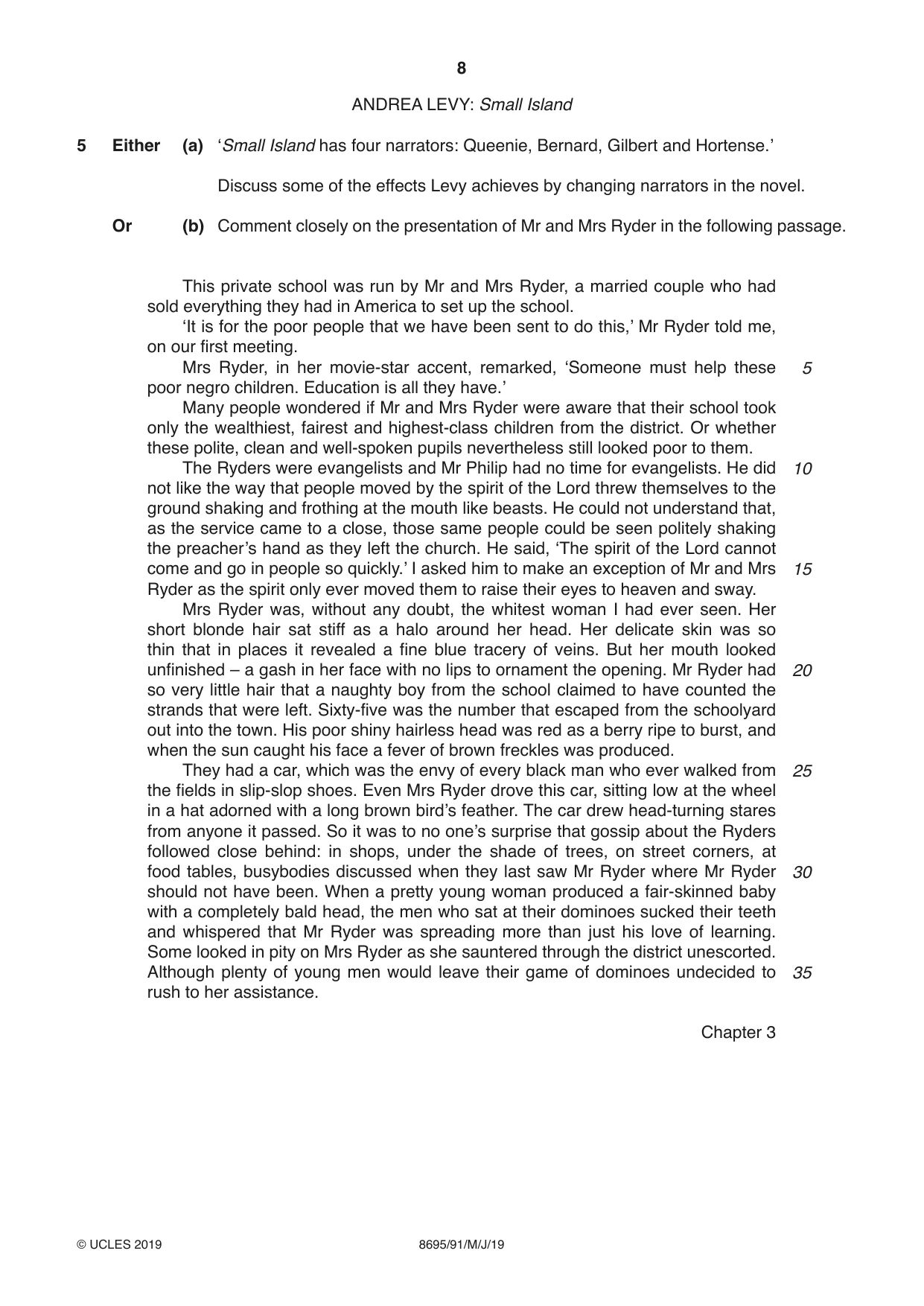
8 8695/91/M/J/19 © UCLES 2019 ANDREA LEVY: Small Island 5 Either (a) ‘Small Island has four narrators: Queenie, Bernard, Gilbert and Hortense.’ Discuss some of the effects Levy achieves by changing narrators in the novel. Or (b) Comment closely on the presentation of Mr and Mrs Ryder in the following passage. This private school was run by Mr and Mrs Ryder, a married couple who had sold everything they had in America to set up the school. ‘It is for the poor people that we have been sent to do this,’ Mr Ryder told me, on our first meeting. Mrs Ryder, in her movie-star accent, remarked, ‘Someone must help these poor negro children. Education is all they have.’ Many people wondered if Mr and Mrs Ryder were aware that their school took only the wealthiest, fairest and highest-class children from the district. Or whether these polite, clean and well-spoken pupils nevertheless still looked poor to them. The Ryders were evangelists and Mr Philip had no time for evangelists. He did not like the way that people moved by the spirit of the Lord threw themselves to the ground shaking and frothing at the mouth like beasts. He could not understand that, as the service came to a close, those same people could be seen politely shaking the preacher’s hand as they left the church. He said, ‘The spirit of the Lord cannot come and go in people so quickly.’ I asked him to make an exception of Mr and Mrs Ryder as the spirit only ever moved them to raise their eyes to heaven and sway. Mrs Ryder was, without any doubt, the whitest woman I had ever seen. Her short blonde hair sat stiff as a halo around her head. Her delicate skin was so thin that in places it revealed a fine blue tracery of veins. But her mouth looked unfinished – a gash in her face with no lips to ornament the opening. Mr Ryder had so very little hair that a naughty boy from the school claimed to have counted the strands that were left. Sixty-five was the number that escaped from the schoolyard out into the town. His poor shiny hairless head was red as a berry ripe to burst, and when the sun caught his face a fever of brown freckles was produced. They had a car, which was the envy of every black man who ever walked from the fields in slip-slop shoes. Even Mrs Ryder drove this car, sitting low at the wheel in a hat adorned with a long brown bird’s feather. The car drew head-turning stares from anyone it passed. So it was to no one’s surprise that gossip about the Ryders followed close behind: in shops, under the shade of trees, on street corners, at food tables, busybodies discussed when they last saw Mr Ryder where Mr Ryder should not have been. When a pretty young woman produced a fair-skinned baby with a completely bald head, the men who sat at their dominoes sucked their teeth and whispered that Mr Ryder was spreading more than just his love of learning. Some looked in pity on Mrs Ryder as she sauntered through the district unescorted. Although plenty of young men would leave their game of dominoes undecided to rush to her assistance. Chapter 3 5 10 15 20 25 30 35
Question paper, page 9
9 8695/91/M/J/19 © UCLES 2019 [Turn over Turn over for Question 6.
Question paper, page 10
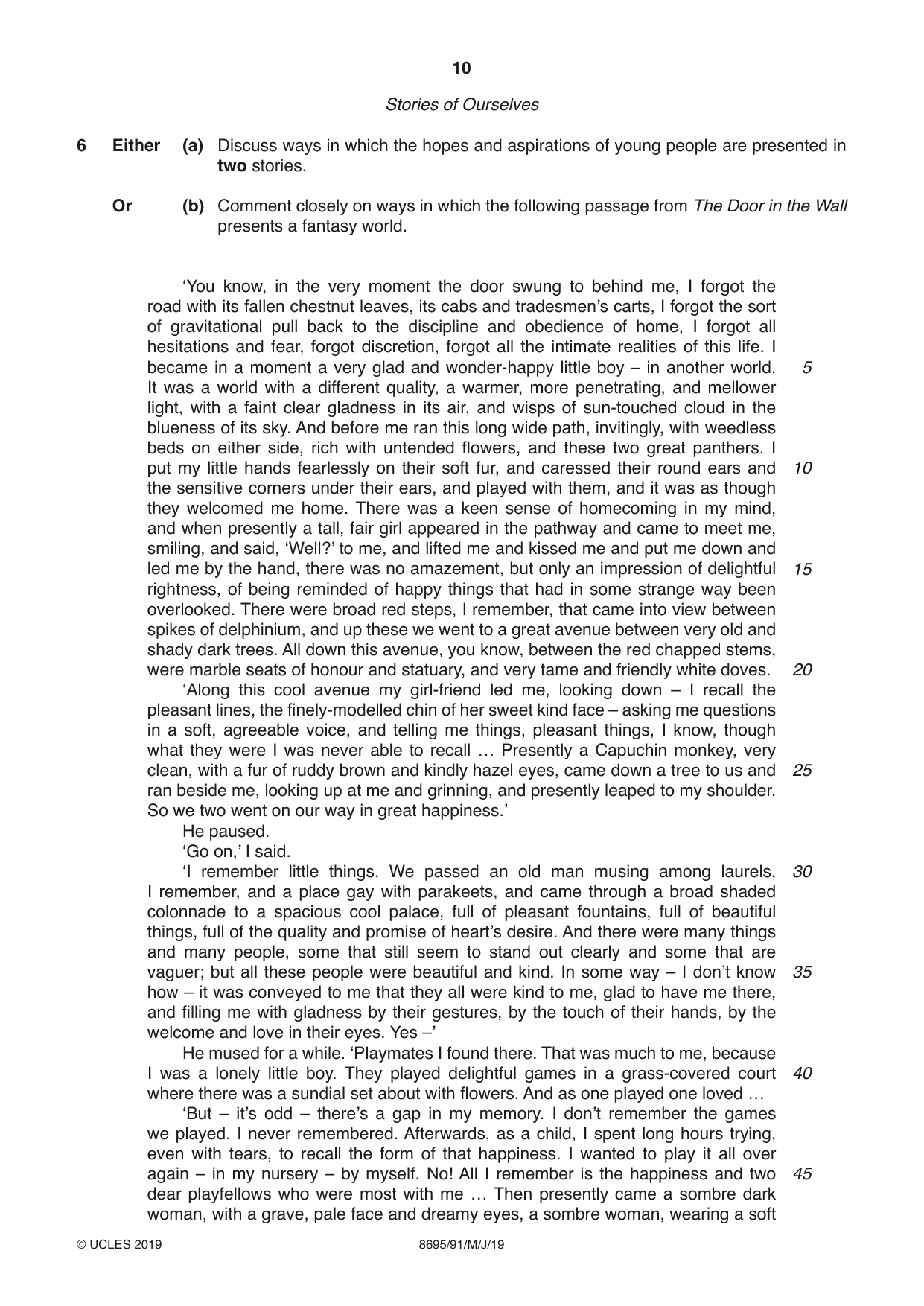
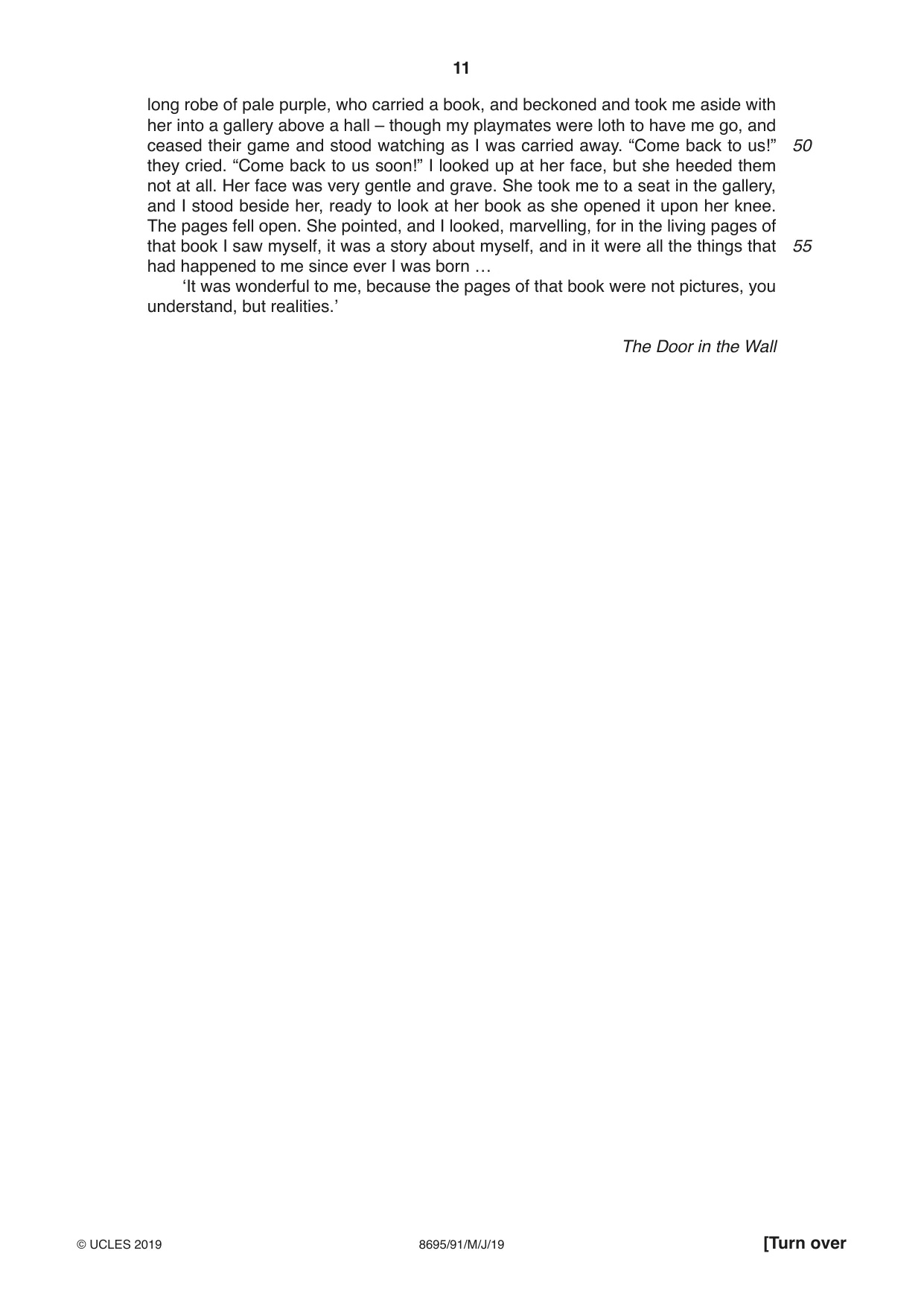
10 8695/91/M/J/19 © UCLES 2019 Stories of Ourselves 6 Either (a) Discuss ways in which the hopes and aspirations of young people are presented in two stories. Or (b) Comment closely on ways in which the following passage from The Door in the Wall presents a fantasy world. ‘You know, in the very moment the door swung to behind me, I forgot the road with its fallen chestnut leaves, its cabs and tradesmen’s carts, I forgot the sort of gravitational pull back to the discipline and obedience of home, I forgot all hesitations and fear, forgot discretion, forgot all the intimate realities of this life. I became in a moment a very glad and wonder-happy little boy – in another world. It was a world with a different quality, a warmer, more penetrating, and mellower light, with a faint clear gladness in its air, and wisps of sun-touched cloud in the blueness of its sky. And before me ran this long wide path, invitingly, with weedless beds on either side, rich with untended flowers, and these two great panthers. I put my little hands fearlessly on their soft fur, and caressed their round ears and the sensitive corners under their ears, and played with them, and it was as though they welcomed me home. There was a keen sense of homecoming in my mind, and when presently a tall, fair girl appeared in the pathway and came to meet me, smiling, and said, ‘Well?’ to me, and lifted me and kissed me and put me down and led me by the hand, there was no amazement, but only an impression of delightful rightness, of being reminded of happy things that had in some strange way been overlooked. There were broad red steps, I remember, that came into view between spikes of delphinium, and up these we went to a great avenue between very old and shady dark trees. All down this avenue, you know, between the red chapped stems, were marble seats of honour and statuary, and very tame and friendly white doves. ‘Along this cool avenue my girl-friend led me, looking down – I recall the pleasant lines, the finely-modelled chin of her sweet kind face – asking me questions in a soft, agreeable voice, and telling me things, pleasant things, I know, though what they were I was never able to recall … Presently a Capuchin monkey, very clean, with a fur of ruddy brown and kindly hazel eyes, came down a tree to us and ran beside me, looking up at me and grinning, and presently leaped to my shoulder. So we two went on our way in great happiness.’ He paused. ‘Go on,’ I said. ‘I remember little things. We passed an old man musing among laurels, I remember, and a place gay with parakeets, and came through a broad shaded colonnade to a spacious cool palace, full of pleasant fountains, full of beautiful things, full of the quality and promise of heart’s desire. And there were many things and many people, some that still seem to stand out clearly and some that are vaguer; but all these people were beautiful and kind. In some way – I don’t know how – it was conveyed to me that they all were kind to me, glad to have me there, and filling me with gladness by their gestures, by the touch of their hands, by the welcome and love in their eyes. Yes –’ He mused for a while. ‘Playmates I found there. That was much to me, because I was a lonely little boy. They played delightful games in a grass-covered court where there was a sundial set about with flowers. And as one played one loved … ‘But – it’s odd – there’s a gap in my memory. I don’t remember the games we played. I never remembered. Afterwards, as a child, I spent long hours trying, even with tears, to recall the form of that happiness. I wanted to play it all over again – in my nursery – by myself. No! All I remember is the happiness and two dear playfellows who were most with me … Then presently came a sombre dark woman, with a grave, pale face and dreamy eyes, a sombre woman, wearing a soft 5 10 15 20 25 30 35 40 45
Question paper, page 11
11 8695/91/M/J/19 © UCLES 2019 [Turn over long robe of pale purple, who carried a book, and beckoned and took me aside with her into a gallery above a hall – though my playmates were loth to have me go, and ceased their game and stood watching as I was carried away. “Come back to us!” they cried. “Come back to us soon!” I looked up at her face, but she heeded them not at all. Her face was very gentle and grave. She took me to a seat in the gallery, and I stood beside her, ready to look at her book as she opened it upon her knee. The pages fell open. She pointed, and I looked, marvelling, for in the living pages of that book I saw myself, it was a story about myself, and in it were all the things that had happened to me since ever I was born … ‘It was wonderful to me, because the pages of that book were not pictures, you understand, but realities.’ The Door in the Wall 50 55
Question paper, page 12
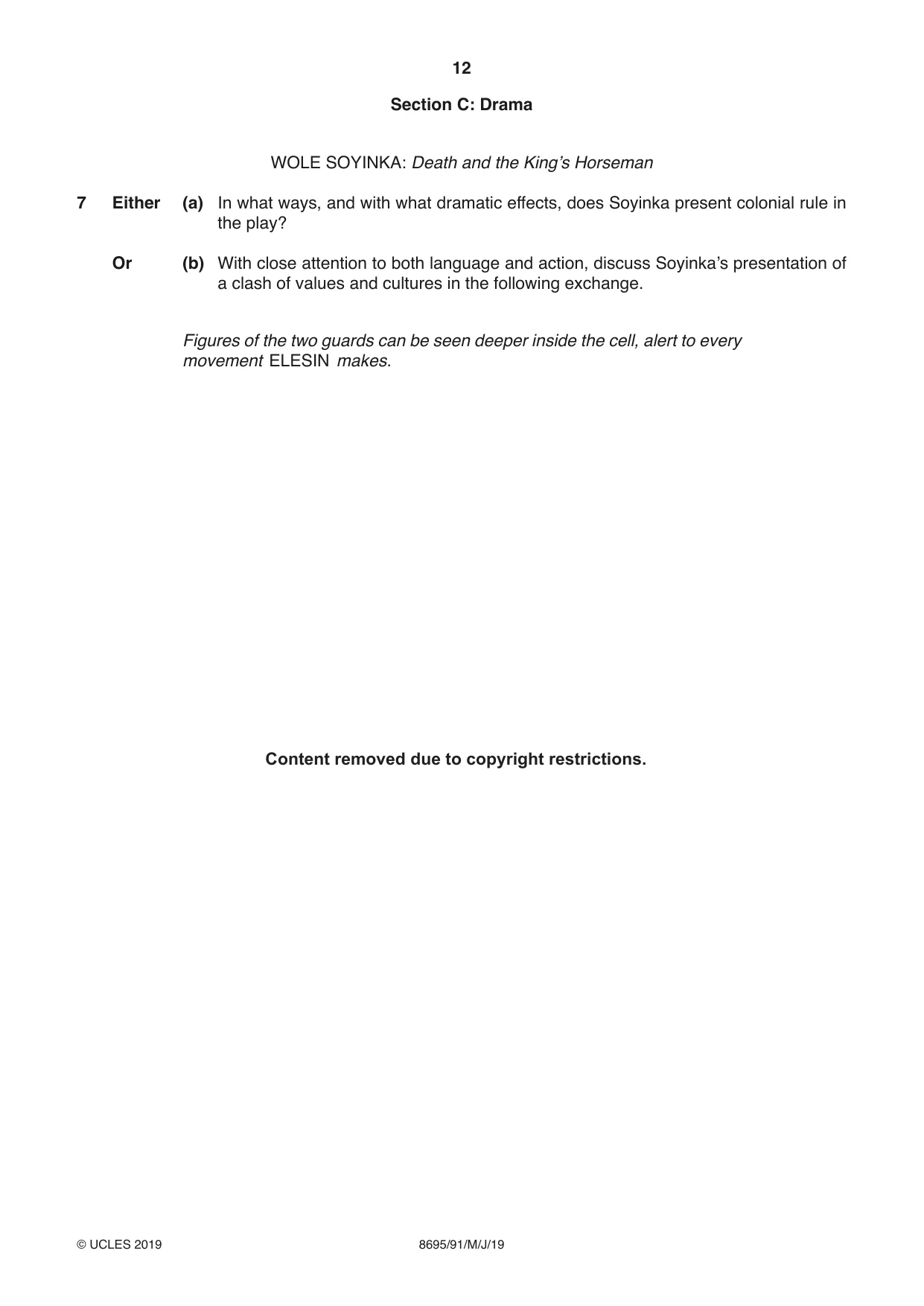
12 8695/91/M/J/19 © UCLES 2019 Section C: Drama WOLE SOYINKA: Death and the King’s Horseman 7 Either (a) In what ways, and with what dramatic effects, does Soyinka present colonial rule in the play? Or (b) With close attention to both language and action, discuss Soyinka’s presentation of a clash of values and cultures in the following exchange. Figures of the two guards can be seen deeper inside the cell, alert to every movement ELESIN makes. Content removed due to copyright restrictions.
Question paper, page 13
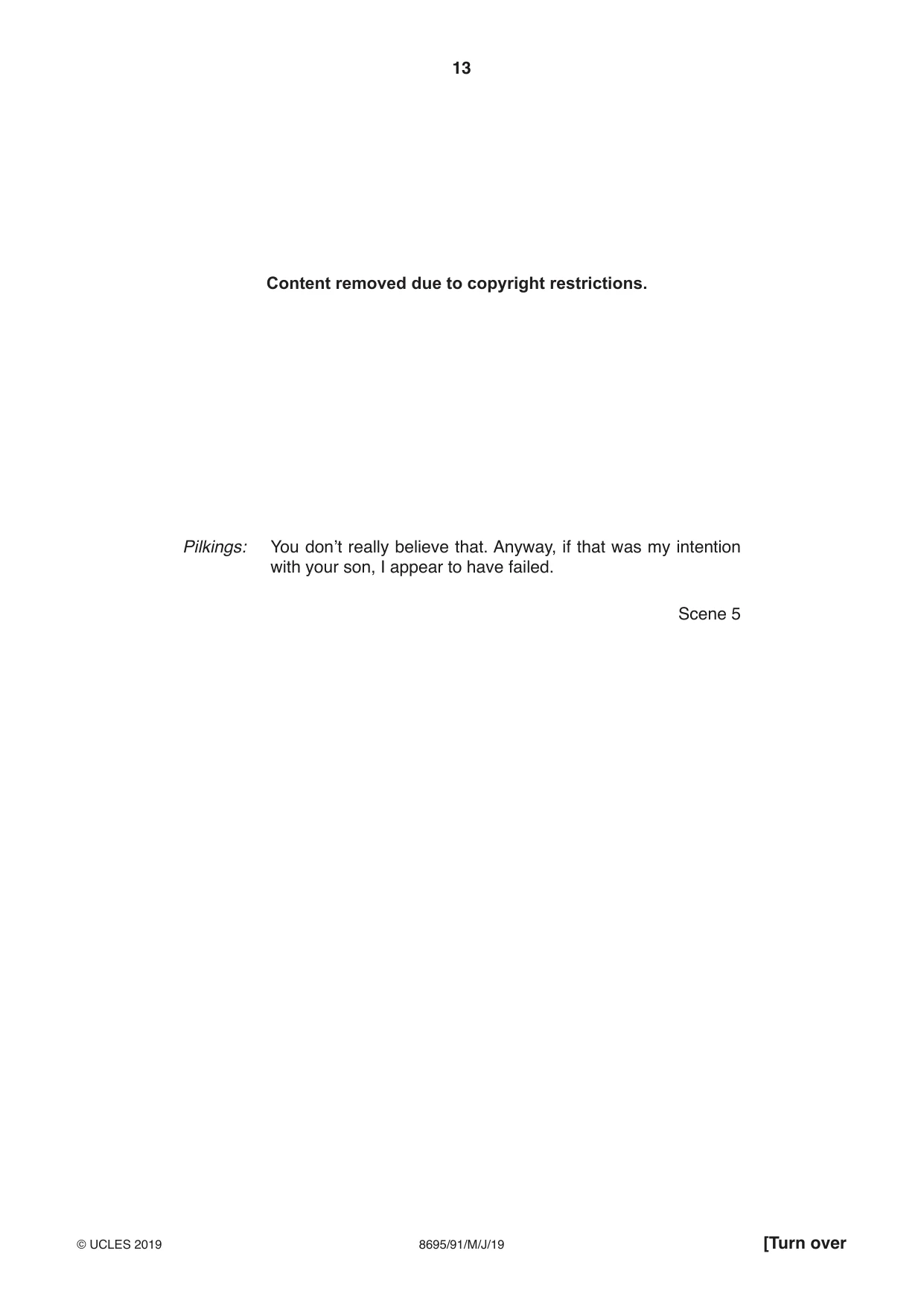
13 8695/91/M/J/19 © UCLES 2019 [Turn over Pilkings: You don’t really believe that. Anyway, if that was my intention with your son, I appear to have failed. Scene 5 Content removed due to copyright restrictions.
Question paper, page 14
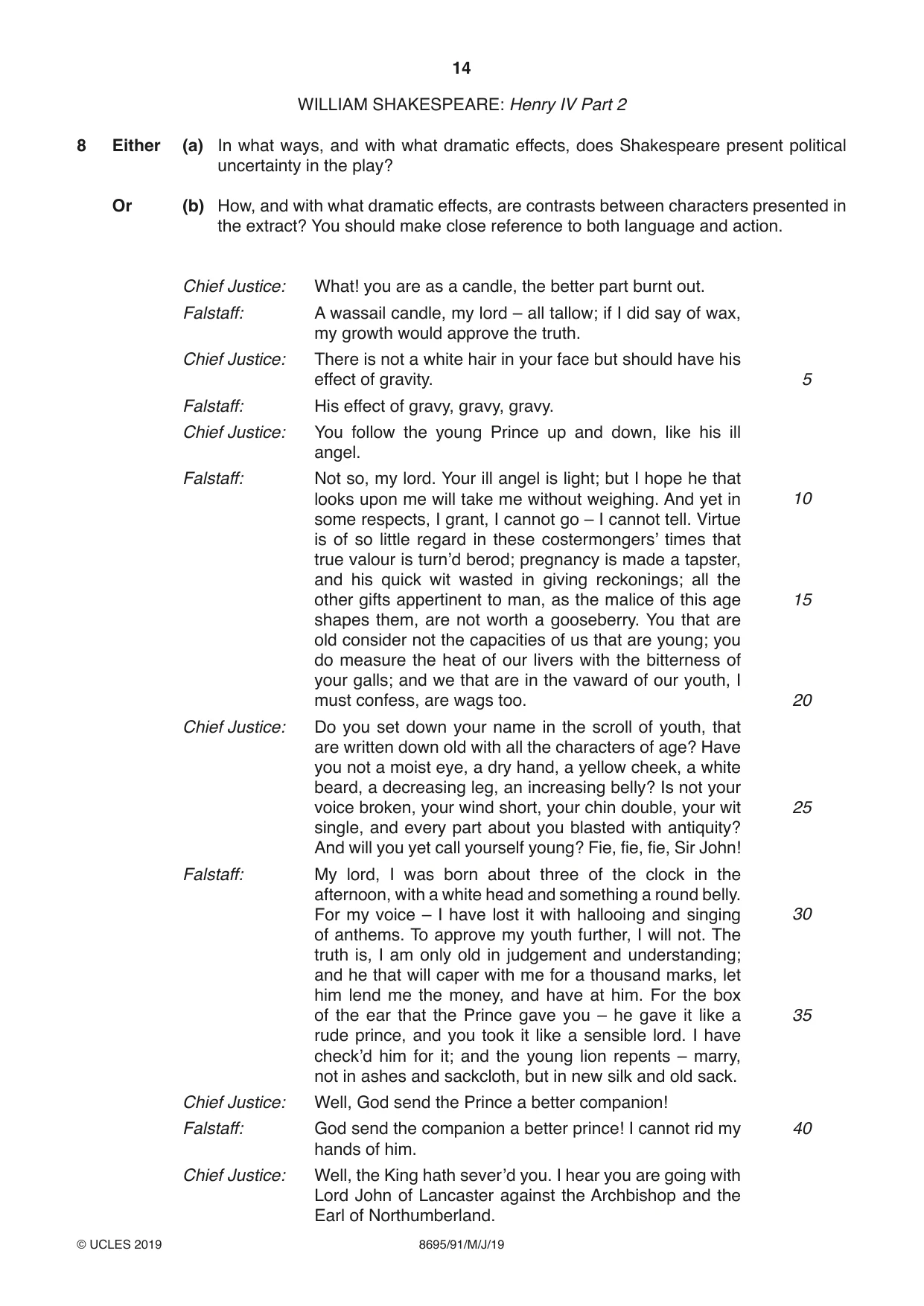
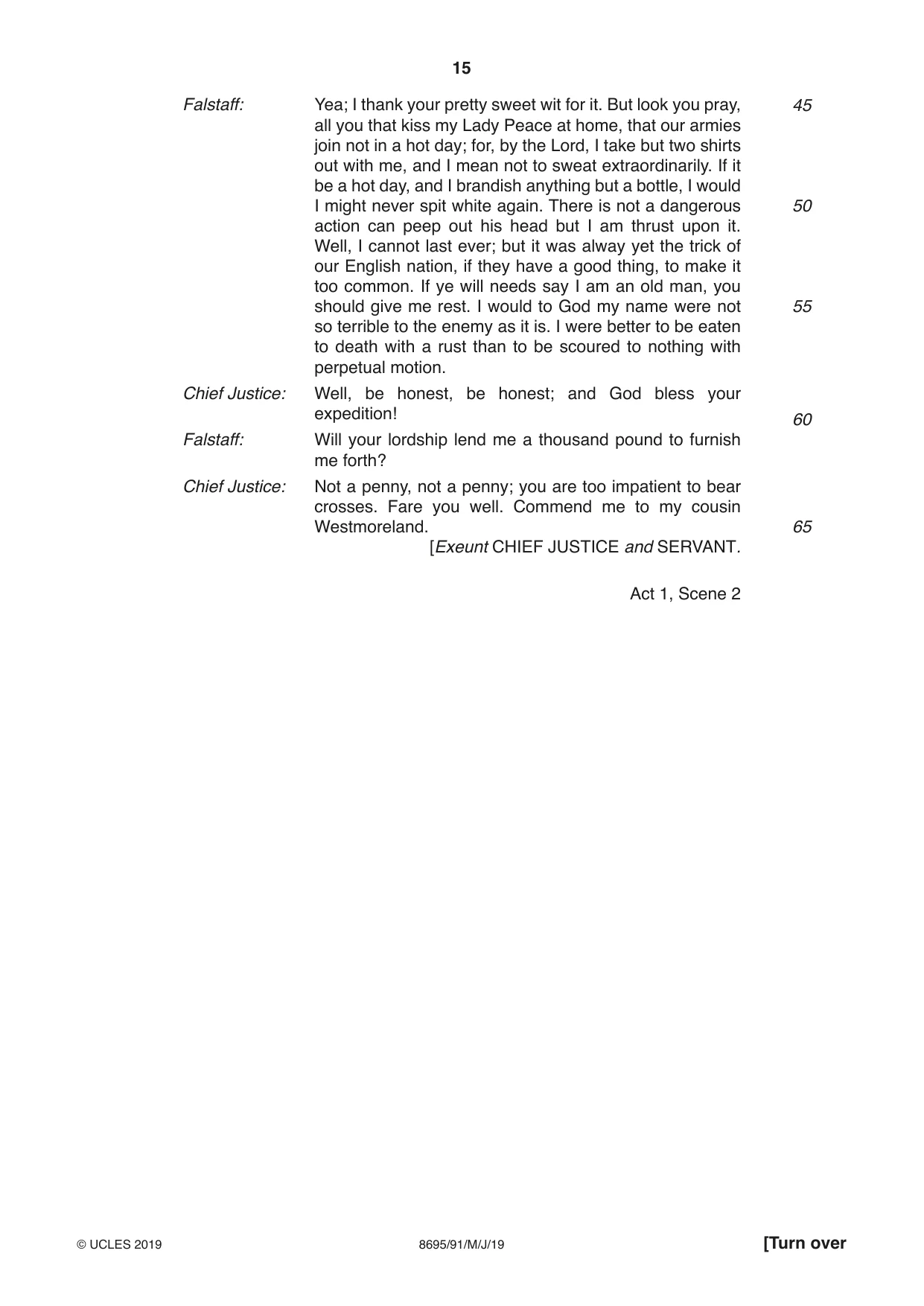
14 8695/91/M/J/19 © UCLES 2019 WILLIAM SHAKESPEARE: Henry IV Part 2 8 Either (a) In what ways, and with what dramatic effects, does Shakespeare present political uncertainty in the play? Or (b) How, and with what dramatic effects, are contrasts between characters presented in the extract? You should make close reference to both language and action. Chief Justice: What! you are as a candle, the better part burnt out. Falstaff: A wassail candle, my lord – all tallow; if I did say of wax, my growth would approve the truth. Chief Justice: There is not a white hair in your face but should have his effect of gravity. Falstaff: His effect of gravy, gravy, gravy. Chief Justice: You follow the young Prince up and down, like his ill angel. Falstaff: Not so, my lord. Your ill angel is light; but I hope he that looks upon me will take me without weighing. And yet in some respects, I grant, I cannot go – I cannot tell. Virtue is of so little regard in these costermongers’ times that true valour is turn’d berod; pregnancy is made a tapster, and his quick wit wasted in giving reckonings; all the other gifts appertinent to man, as the malice of this age shapes them, are not worth a gooseberry. You that are old consider not the capacities of us that are young; you do measure the heat of our livers with the bitterness of your galls; and we that are in the vaward of our youth, I must confess, are wags too. Chief Justice: Do you set down your name in the scroll of youth, that are written down old with all the characters of age? Have you not a moist eye, a dry hand, a yellow cheek, a white beard, a decreasing leg, an increasing belly? Is not your voice broken, your wind short, your chin double, your wit single, and every part about you blasted with antiquity? And will you yet call yourself young? Fie, fie, fie, Sir John! Falstaff: My lord, I was born about three of the clock in the afternoon, with a white head and something a round belly. For my voice – I have lost it with hallooing and singing of anthems. To approve my youth further, I will not. The truth is, I am only old in judgement and understanding; and he that will caper with me for a thousand marks, let him lend me the money, and have at him. For the box of the ear that the Prince gave you – he gave it like a rude prince, and you took it like a sensible lord. I have check’d him for it; and the young lion repents – marry, not in ashes and sackcloth, but in new silk and old sack. Chief Justice: Well, God send the Prince a better companion! Falstaff: God send the companion a better prince! I cannot rid my hands of him. Chief Justice: Well, the King hath sever’d you. I hear you are going with Lord John of Lancaster against the Archbishop and the Earl of Northumberland. 5 10 15 20 25 30 35 40
Question paper, page 15
15 8695/91/M/J/19 © UCLES 2019 [Turn over Falstaff: Yea; I thank your pretty sweet wit for it. But look you pray, all you that kiss my Lady Peace at home, that our armies join not in a hot day; for, by the Lord, I take but two shirts out with me, and I mean not to sweat extraordinarily. If it be a hot day, and I brandish anything but a bottle, I would I might never spit white again. There is not a dangerous action can peep out his head but I am thrust upon it. Well, I cannot last ever; but it was alway yet the trick of our English nation, if they have a good thing, to make it too common. If ye will needs say I am an old man, you should give me rest. I would to God my name were not so terrible to the enemy as it is. I were better to be eaten to death with a rust than to be scoured to nothing with perpetual motion. Chief Justice: Well, be honest, be honest; and God bless your expedition! Falstaff: Will your lordship lend me a thousand pound to furnish me forth? Chief Justice: Not a penny, not a penny; you are too impatient to bear crosses. Fare you well. Commend me to my cousin Westmoreland. [Exeunt CHIEF JUSTICE and SERVANT. Act 1, Scene 2 45 50 55 60 65
Question paper, page 16
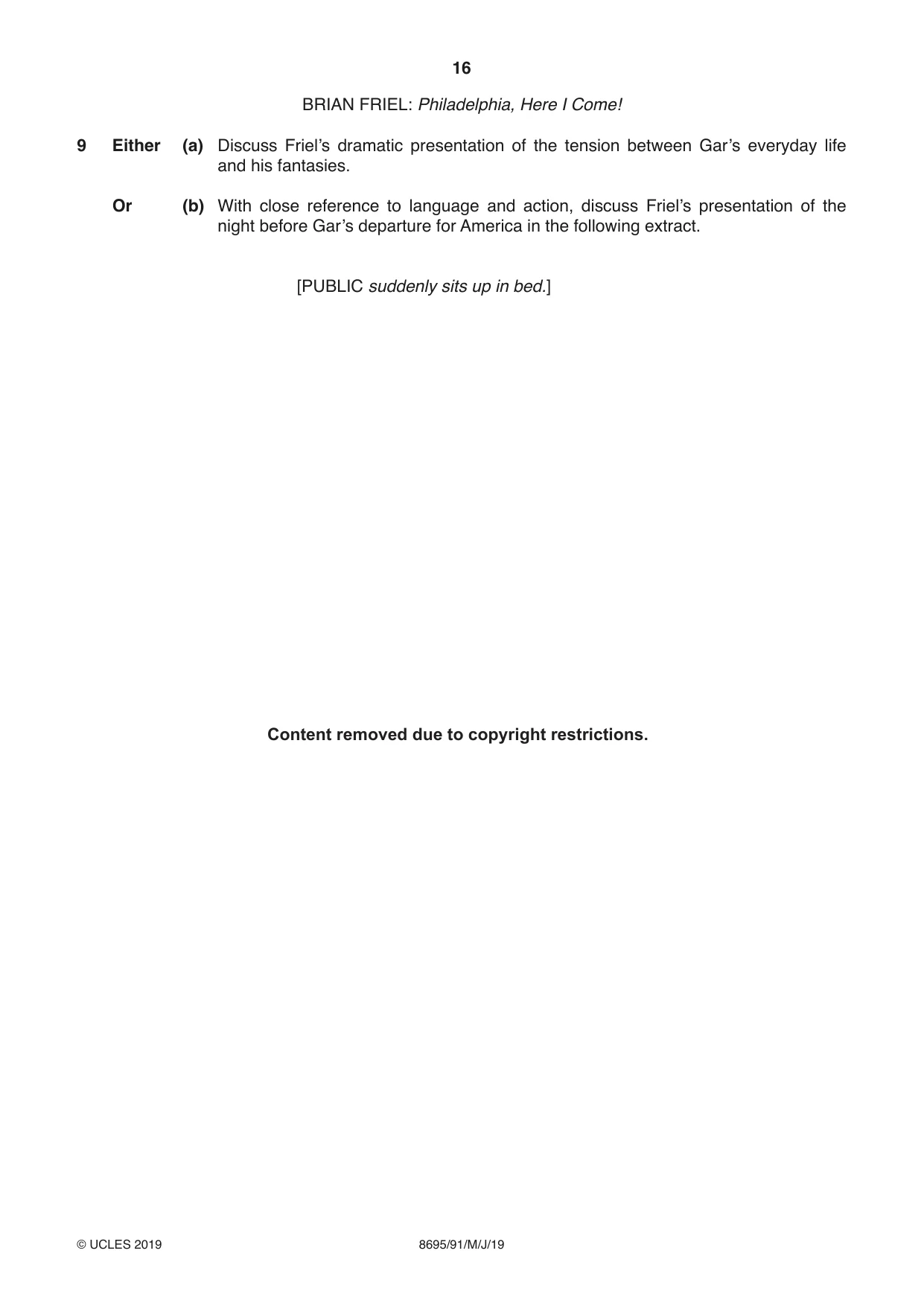
16 8695/91/M/J/19 © UCLES 2019 BRIAN FRIEL: Philadelphia, Here I Come! 9 Either (a) Discuss Friel’s dramatic presentation of the tension between Gar’s everyday life and his fantasies. Or (b) With close reference to language and action, discuss Friel’s presentation of the night before Gar’s departure for America in the following extract. [PUBLIC suddenly sits up in bed.] Content removed due to copyright restrictions.
Question paper, page 17
17 8695/91/M/J/19 © UCLES 2019 Canon: I wouldn’t say die yet – not yet I wouldn’t. [Slow curtain.] Episode 3, Part 1 Content removed due to copyright restrictions.
Question paper, page 18
18 8695/91/M/J/19 © UCLES 2019 BLANK PAGE
Question paper, page 19
19 8695/91/M/J/19 © UCLES 2019 BLANK PAGE
Question paper, page 20
20 8695/91/M/J/19 © UCLES 2019 Permission to reproduce items where third-party owned material protected by copyright is included has been sought and cleared where possible. Every reasonable effort has been made by the publisher (UCLES) to trace copyright holders, but if any items requiring clearance have unwittingly been included, the publisher will be pleased to make amends at the earliest possible opportunity. To avoid the issue of disclosure of answer-related information to candidates, all copyright acknowledgements are reproduced online in the Cambridge Assessment International Education Copyright Acknowledgements Booklet. This is produced for each series of examinations and is freely available to download at www.cambridgeinternational.org after the live examination series. Cambridge Assessment International Education is part of the Cambridge Assessment Group. Cambridge Assessment is the brand name of the University of Cambridge Local Examinations Syndicate (UCLES), which itself is a department of the University of Cambridge. BLANK PAGE
Mark scheme, page 1
This document consists of 6 printed pages. © UCLES 2019 [Turn over Cambridge Assessment International Education Cambridge International Advanced Subsidiary Level LANGUAGE AND LITERATURE IN ENGLISH 8695/91 Paper 9 Poetry, Prose and Drama May/June 2019 MARK SCHEME Maximum Mark: 50 Published This mark scheme is published as an aid to teachers and candidates, to indicate the requirements of the examination. It shows the basis on which Examiners were instructed to award marks. It does not indicate the details of the discussions that took place at an Examiners’ meeting before marking began, which would have considered the acceptability of alternative answers. Mark schemes should be read in conjunction with the question paper and the Principal Examiner Report for Teachers. Cambridge International will not enter into discussions about these mark schemes. Cambridge International is publishing the mark schemes for the May/June 2019 series for most Cambridge IGCSE™, Cambridge International A and AS Level and Cambridge Pre-U components, and some Cambridge O Level components.
Mark scheme, page 2
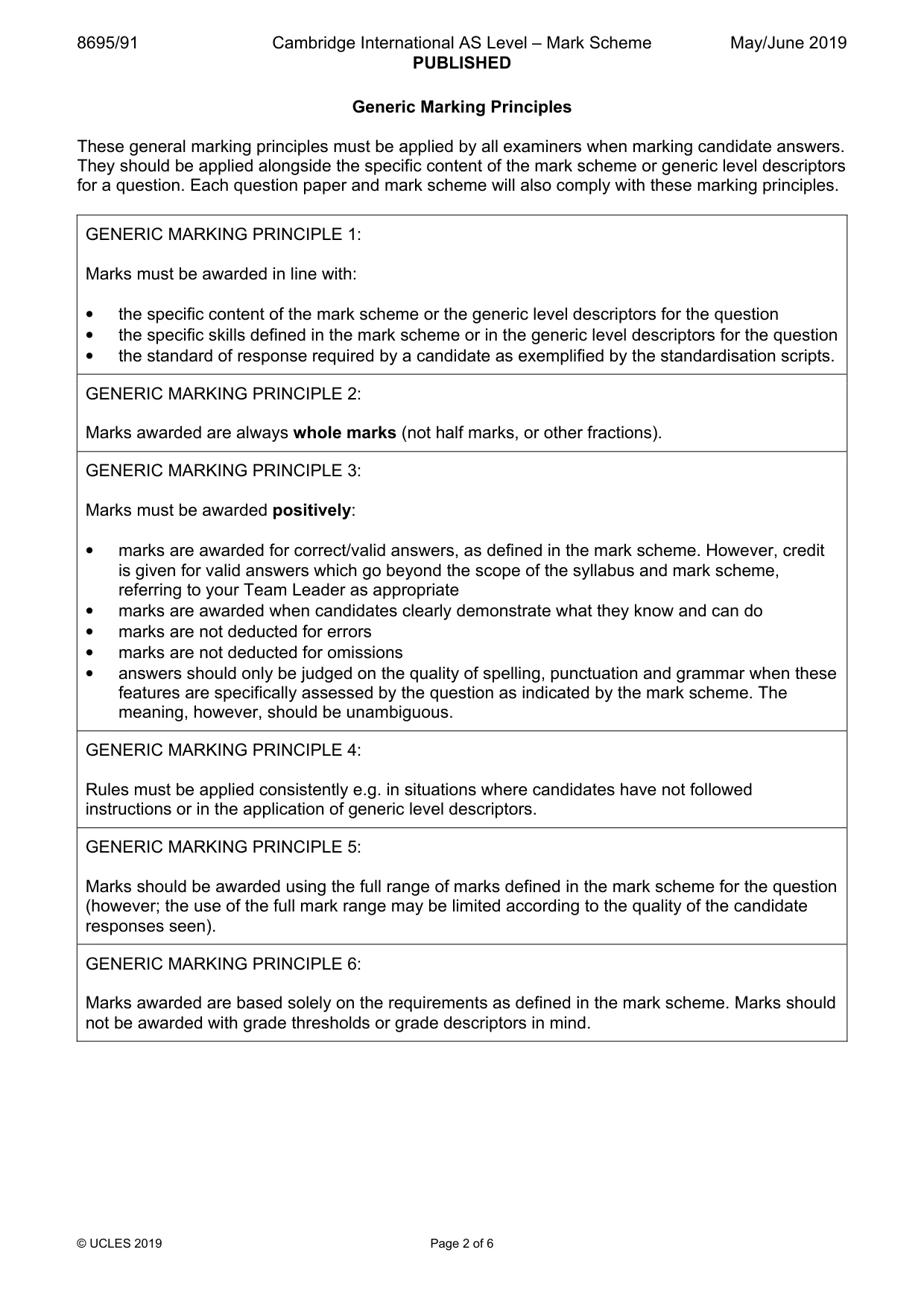
8695/91 Cambridge International AS Level – Mark Scheme PUBLISHED May/June 2019 © UCLES 2019 Page 2 of 6 Generic Marking Principles These general marking principles must be applied by all examiners when marking candidate answers. They should be applied alongside the specific content of the mark scheme or generic level descriptors for a question. Each question paper and mark scheme will also comply with these marking principles. GENERIC MARKING PRINCIPLE 1: Marks must be awarded in line with: • the specific content of the mark scheme or the generic level descriptors for the question • the specific skills defined in the mark scheme or in the generic level descriptors for the question • the standard of response required by a candidate as exemplified by the standardisation scripts. GENERIC MARKING PRINCIPLE 2: Marks awarded are always whole marks (not half marks, or other fractions). GENERIC MARKING PRINCIPLE 3: Marks must be awarded positively: • marks are awarded for correct/valid answers, as defined in the mark scheme. However, credit is given for valid answers which go beyond the scope of the syllabus and mark scheme, referring to your Team Leader as appropriate • marks are awarded when candidates clearly demonstrate what they know and can do • marks are not deducted for errors • marks are not deducted for omissions • answers should only be judged on the quality of spelling, punctuation and grammar when these features are specifically assessed by the question as indicated by the mark scheme. The meaning, however, should be unambiguous. GENERIC MARKING PRINCIPLE 4: Rules must be applied consistently e.g. in situations where candidates have not followed instructions or in the application of generic level descriptors. GENERIC MARKING PRINCIPLE 5: Marks should be awarded using the full range of marks defined in the mark scheme for the question (however; the use of the full mark range may be limited according to the quality of the candidate responses seen). GENERIC MARKING PRINCIPLE 6: Marks awarded are based solely on the requirements as defined in the mark scheme. Marks should not be awarded with grade thresholds or grade descriptors in mind.
Mark scheme, page 3
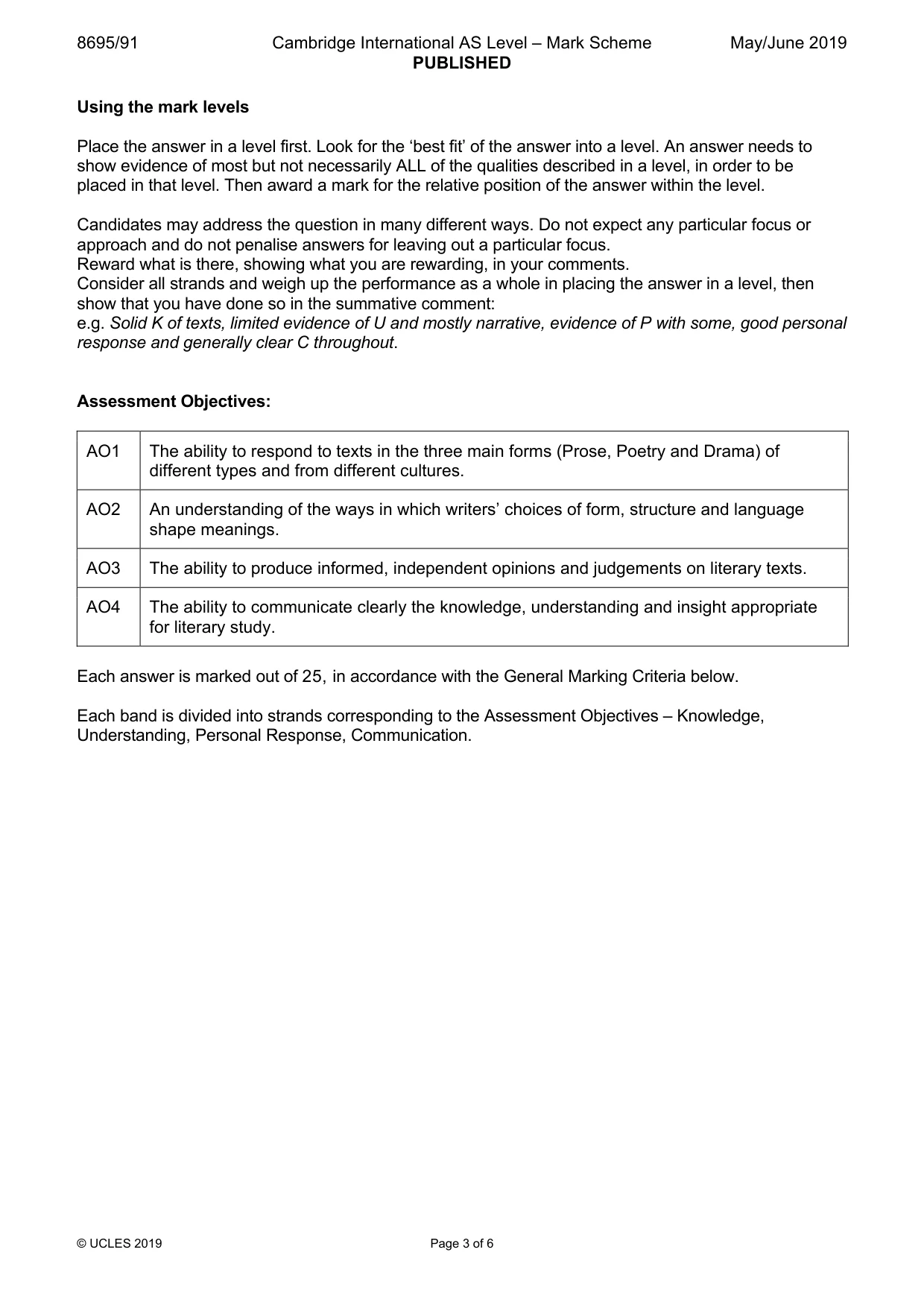
8695/91 Cambridge International AS Level – Mark Scheme PUBLISHED May/June 2019 © UCLES 2019 Page 3 of 6 Using the mark levels Place the answer in a level first. Look for the ‘best fit’ of the answer into a level. An answer needs to show evidence of most but not necessarily ALL of the qualities described in a level, in order to be placed in that level. Then award a mark for the relative position of the answer within the level. Candidates may address the question in many different ways. Do not expect any particular focus or approach and do not penalise answers for leaving out a particular focus. Reward what is there, showing what you are rewarding, in your comments. Consider all strands and weigh up the performance as a whole in placing the answer in a level, then show that you have done so in the summative comment: e.g. Solid K of texts, limited evidence of U and mostly narrative, evidence of P with some, good personal response and generally clear C throughout. Assessment Objectives: AO1 The ability to respond to texts in the three main forms (Prose, Poetry and Drama) of different types and from different cultures. AO2 An understanding of the ways in which writers’ choices of form, structure and language shape meanings. AO3 The ability to produce informed, independent opinions and judgements on literary texts. AO4 The ability to communicate clearly the knowledge, understanding and insight appropriate for literary study. Each answer is marked out of 25, in accordance with the General Marking Criteria below. Each band is divided into strands corresponding to the Assessment Objectives – Knowledge, Understanding, Personal Response, Communication.
Mark scheme, page 4
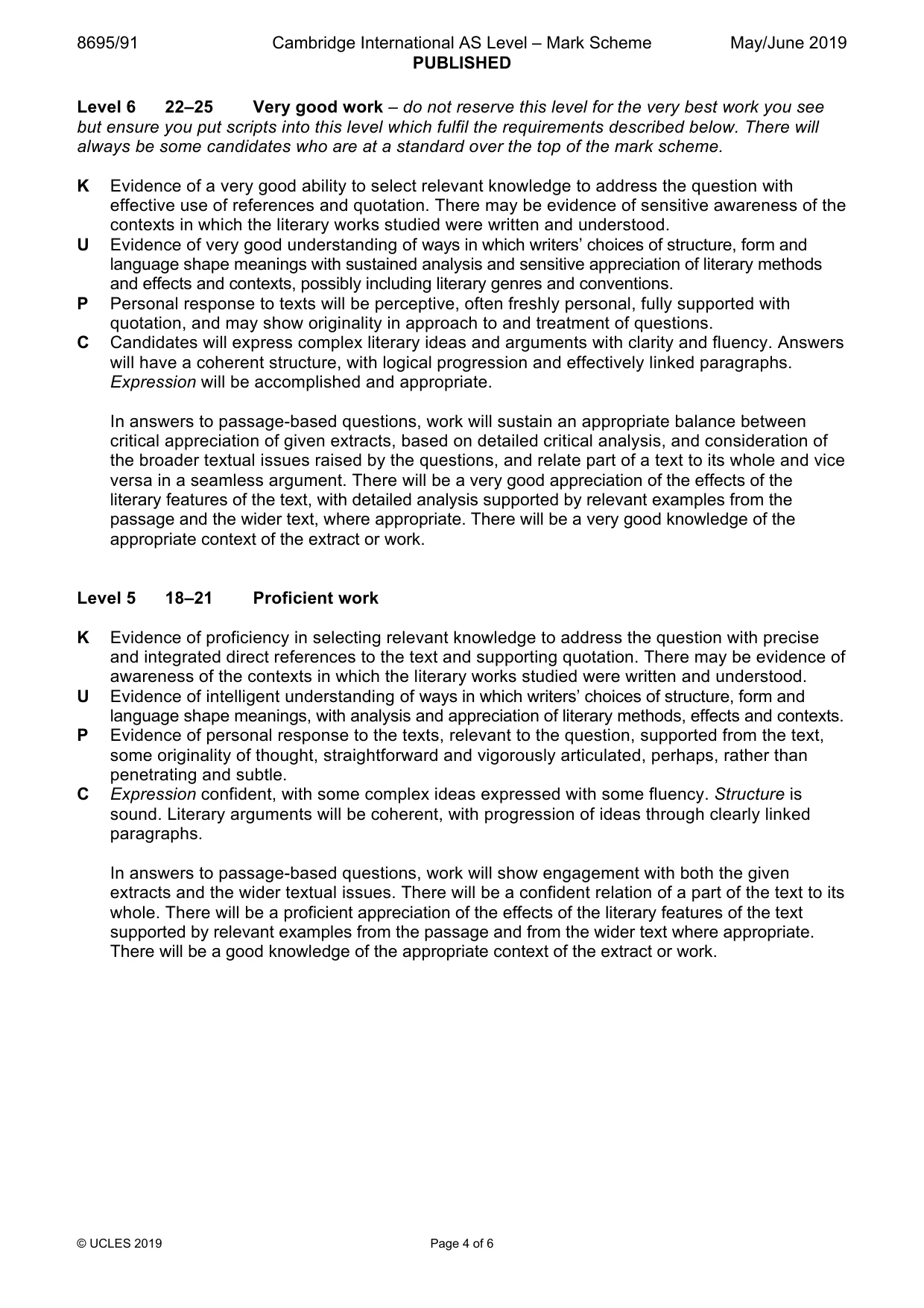
8695/91 Cambridge International AS Level – Mark Scheme PUBLISHED May/June 2019 © UCLES 2019 Page 4 of 6 Level 6 22–25 Very good work – do not reserve this level for the very best work you see but ensure you put scripts into this level which fulfil the requirements described below. There will always be some candidates who are at a standard over the top of the mark scheme. K Evidence of a very good ability to select relevant knowledge to address the question with effective use of references and quotation. There may be evidence of sensitive awareness of the contexts in which the literary works studied were written and understood. U Evidence of very good understanding of ways in which writers’ choices of structure, form and language shape meanings with sustained analysis and sensitive appreciation of literary methods and effects and contexts, possibly including literary genres and conventions. P Personal response to texts will be perceptive, often freshly personal, fully supported with quotation, and may show originality in approach to and treatment of questions. C Candidates will express complex literary ideas and arguments with clarity and fluency. Answers will have a coherent structure, with logical progression and effectively linked paragraphs. Expression will be accomplished and appropriate. In answers to passage-based questions, work will sustain an appropriate balance between critical appreciation of given extracts, based on detailed critical analysis, and consideration of the broader textual issues raised by the questions, and relate part of a text to its whole and vice versa in a seamless argument. There will be a very good appreciation of the effects of the literary features of the text, with detailed analysis supported by relevant examples from the passage and the wider text, where appropriate. There will be a very good knowledge of the appropriate context of the extract or work. Level 5 18–21 Proficient work K Evidence of proficiency in selecting relevant knowledge to address the question with precise and integrated direct references to the text and supporting quotation. There may be evidence of awareness of the contexts in which the literary works studied were written and understood. U Evidence of intelligent understanding of ways in which writers’ choices of structure, form and language shape meanings, with analysis and appreciation of literary methods, effects and contexts. P Evidence of personal response to the texts, relevant to the question, supported from the text, some originality of thought, straightforward and vigorously articulated, perhaps, rather than penetrating and subtle. C Expression confident, with some complex ideas expressed with some fluency. Structure is sound. Literary arguments will be coherent, with progression of ideas through clearly linked paragraphs. In answers to passage-based questions, work will show engagement with both the given extracts and the wider textual issues. There will be a confident relation of a part of the text to its whole. There will be a proficient appreciation of the effects of the literary features of the text supported by relevant examples from the passage and from the wider text where appropriate. There will be a good knowledge of the appropriate context of the extract or work.
Mark scheme, page 5
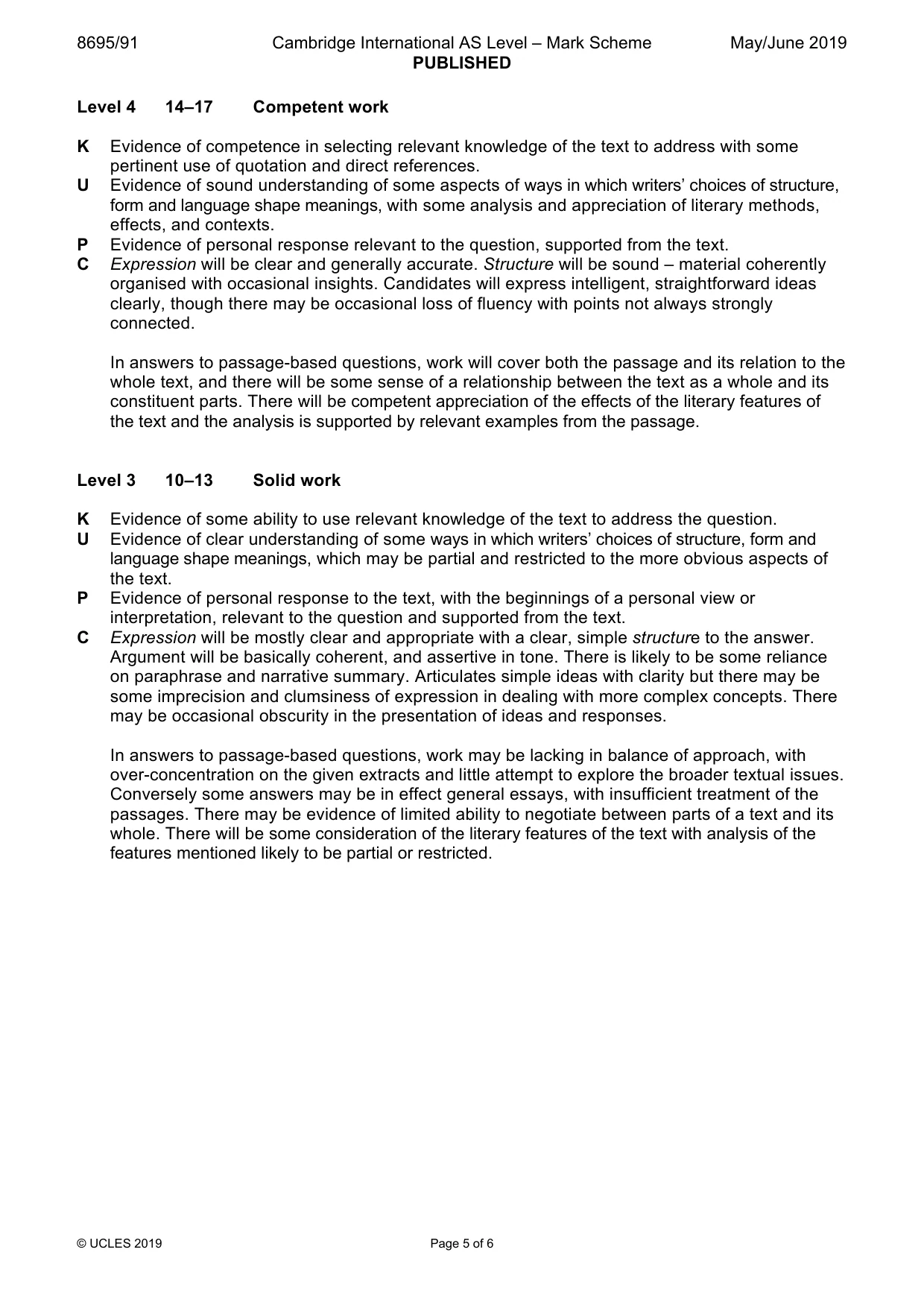
8695/91 Cambridge International AS Level – Mark Scheme PUBLISHED May/June 2019 © UCLES 2019 Page 5 of 6 Level 4 14–17 Competent work K Evidence of competence in selecting relevant knowledge of the text to address with some pertinent use of quotation and direct references. U Evidence of sound understanding of some aspects of ways in which writers’ choices of structure, form and language shape meanings, with some analysis and appreciation of literary methods, effects, and contexts. P Evidence of personal response relevant to the question, supported from the text. C Expression will be clear and generally accurate. Structure will be sound – material coherently organised with occasional insights. Candidates will express intelligent, straightforward ideas clearly, though there may be occasional loss of fluency with points not always strongly connected. In answers to passage-based questions, work will cover both the passage and its relation to the whole text, and there will be some sense of a relationship between the text as a whole and its constituent parts. There will be competent appreciation of the effects of the literary features of the text and the analysis is supported by relevant examples from the passage. Level 3 10–13 Solid work K Evidence of some ability to use relevant knowledge of the text to address the question. U Evidence of clear understanding of some ways in which writers’ choices of structure, form and language shape meanings, which may be partial and restricted to the more obvious aspects of the text. P Evidence of personal response to the text, with the beginnings of a personal view or interpretation, relevant to the question and supported from the text. C Expression will be mostly clear and appropriate with a clear, simple structure to the answer. Argument will be basically coherent, and assertive in tone. There is likely to be some reliance on paraphrase and narrative summary. Articulates simple ideas with clarity but there may be some imprecision and clumsiness of expression in dealing with more complex concepts. There may be occasional obscurity in the presentation of ideas and responses. In answers to passage-based questions, work may be lacking in balance of approach, with over-concentration on the given extracts and little attempt to explore the broader textual issues. Conversely some answers may be in effect general essays, with insufficient treatment of the passages. There may be evidence of limited ability to negotiate between parts of a text and its whole. There will be some consideration of the literary features of the text with analysis of the features mentioned likely to be partial or restricted.
Mark scheme, page 6
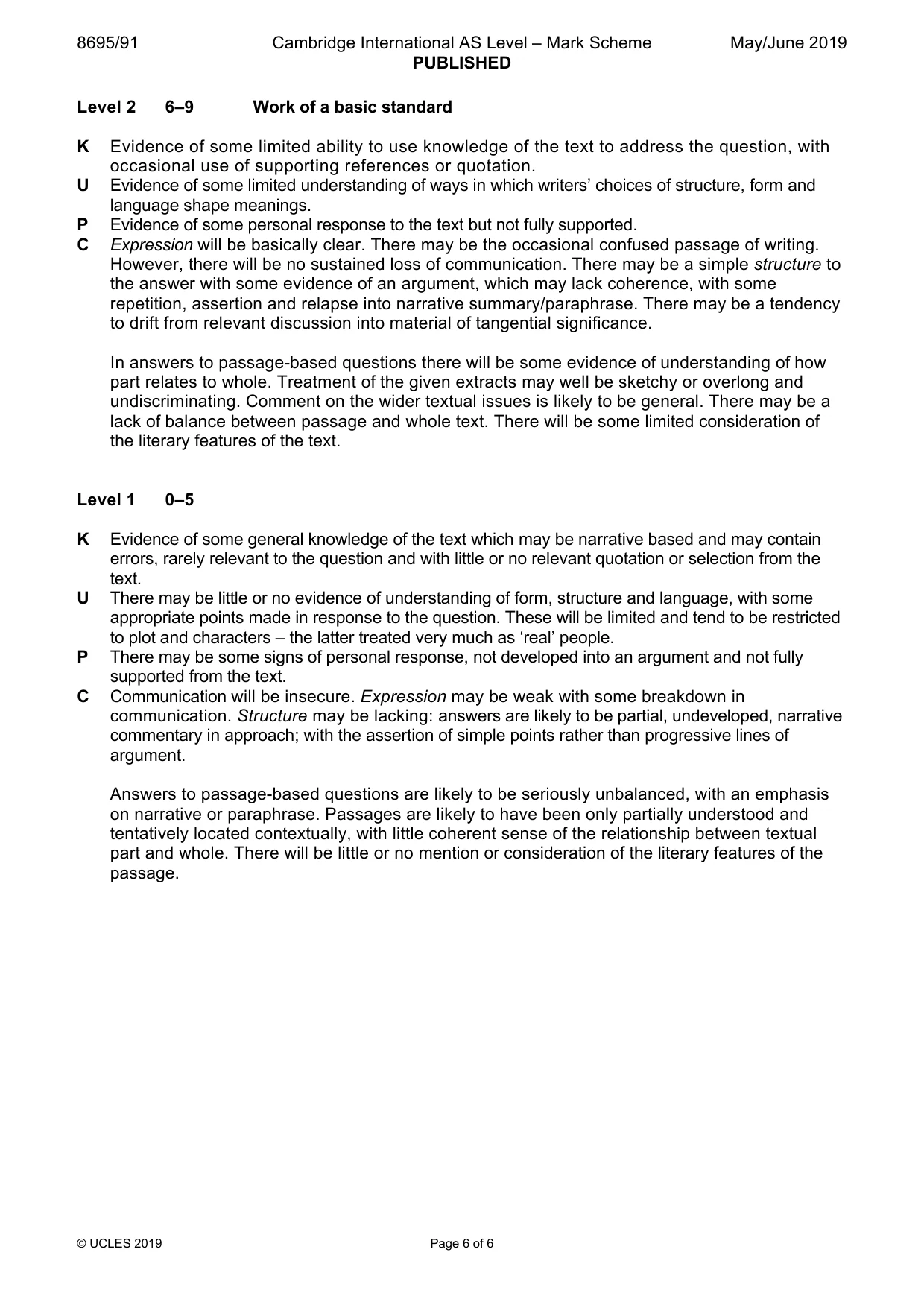
8695/91 Cambridge International AS Level – Mark Scheme PUBLISHED May/June 2019 © UCLES 2019 Page 6 of 6 Level 2 6–9 Work of a basic standard K Evidence of some limited ability to use knowledge of the text to address the question, with occasional use of supporting references or quotation. U Evidence of some limited understanding of ways in which writers’ choices of structure, form and language shape meanings. P Evidence of some personal response to the text but not fully supported. C Expression will be basically clear. There may be the occasional confused passage of writing. However, there will be no sustained loss of communication. There may be a simple structure to the answer with some evidence of an argument, which may lack coherence, with some repetition, assertion and relapse into narrative summary/paraphrase. There may be a tendency to drift from relevant discussion into material of tangential significance. In answers to passage-based questions there will be some evidence of understanding of how part relates to whole. Treatment of the given extracts may well be sketchy or overlong and undiscriminating. Comment on the wider textual issues is likely to be general. There may be a lack of balance between passage and whole text. There will be some limited consideration of the literary features of the text. Level 1 0–5 K Evidence of some general knowledge of the text which may be narrative based and may contain errors, rarely relevant to the question and with little or no relevant quotation or selection from the text. U There may be little or no evidence of understanding of form, structure and language, with some appropriate points made in response to the question. These will be limited and tend to be restricted to plot and characters – the latter treated very much as ‘real’ people. P There may be some signs of personal response, not developed into an argument and not fully supported from the text. C Communication will be insecure. Expression may be weak with some breakdown in communication. Structure may be lacking: answers are likely to be partial, undeveloped, narrative commentary in approach; with the assertion of simple points rather than progressive lines of argument. Answers to passage-based questions are likely to be seriously unbalanced, with an emphasis on narrative or paraphrase. Passages are likely to have been only partially understood and tentatively located contextually, with little coherent sense of the relationship between textual part and whole. There will be little or no mention or consideration of the literary features of the passage.
What you needed in this session
Cambridge’s own grade thresholds for 2019 May/June, Paper 9 · Variant 1. A higher threshold means an easier paper — the bar moves with how the cohort did.