Cambridge A Level English - Language and Literature (AS Level only, from 2016) 8695 — 2020 May/June Paper 9 · Variant 1
8695/91/M/J/20
The question paper and its mark scheme, free to read here and free to download. This is Cambridge’s own paper, exactly as it was sat.
Question paper20 pages



Mark scheme6 pages
Answers below. Sit the paper first if you are practising.
Paper as text
Question paper, page 1
DC (RCL/GO) 181987/2 © UCLES 2020 [Turn over This document has 20 pages. Blank pages are indicated. LANGUAGE AND LITERATURE IN ENGLISH 8695/91 Paper 9 Poetry, Prose and Drama May/June 2020 2 hours You must answer on the enclosed answer booklet. You will need: Answer booklet (enclosed) INSTRUCTIONS ● Answer two questions, each from a different section. ● Follow the instructions on the front cover of the answer booklet. If you need additional answer paper, ask the invigilator for a continuation booklet. ● You are reminded of the need for good English and clear presentation in your answers. INFORMATION ● The total mark for this paper is 50. ● All questions are worth equal marks. Cambridge International AS Level * 7 2 7 3 2 1 8 4 7 0 * Cambridge International AS Level
Question paper, page 2
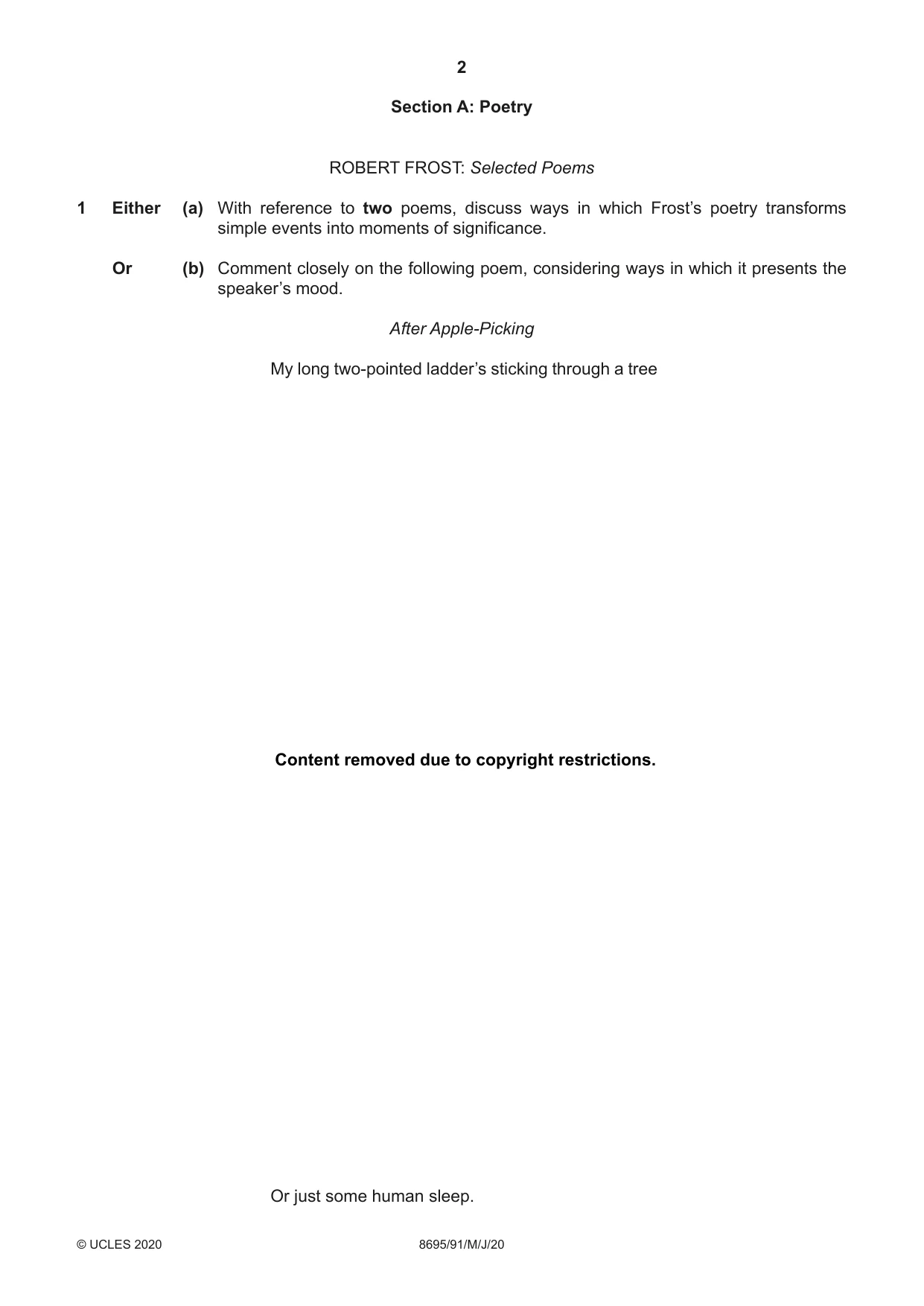
2 8695/91/M/J/20 © UCLES 2020 Section A: Poetry ROBERT FROST: Selected Poems 1 Either (a) With reference to two poems, discuss ways in which Frost’s poetry transforms simple events into moments of significance. Or (b) Comment closely on the following poem, considering ways in which it presents the speaker’s mood. After Apple-Picking My long two-pointed ladder’s sticking through a tree Or just some human sleep. Content removed due to copyright restrictions.
Question paper, page 3
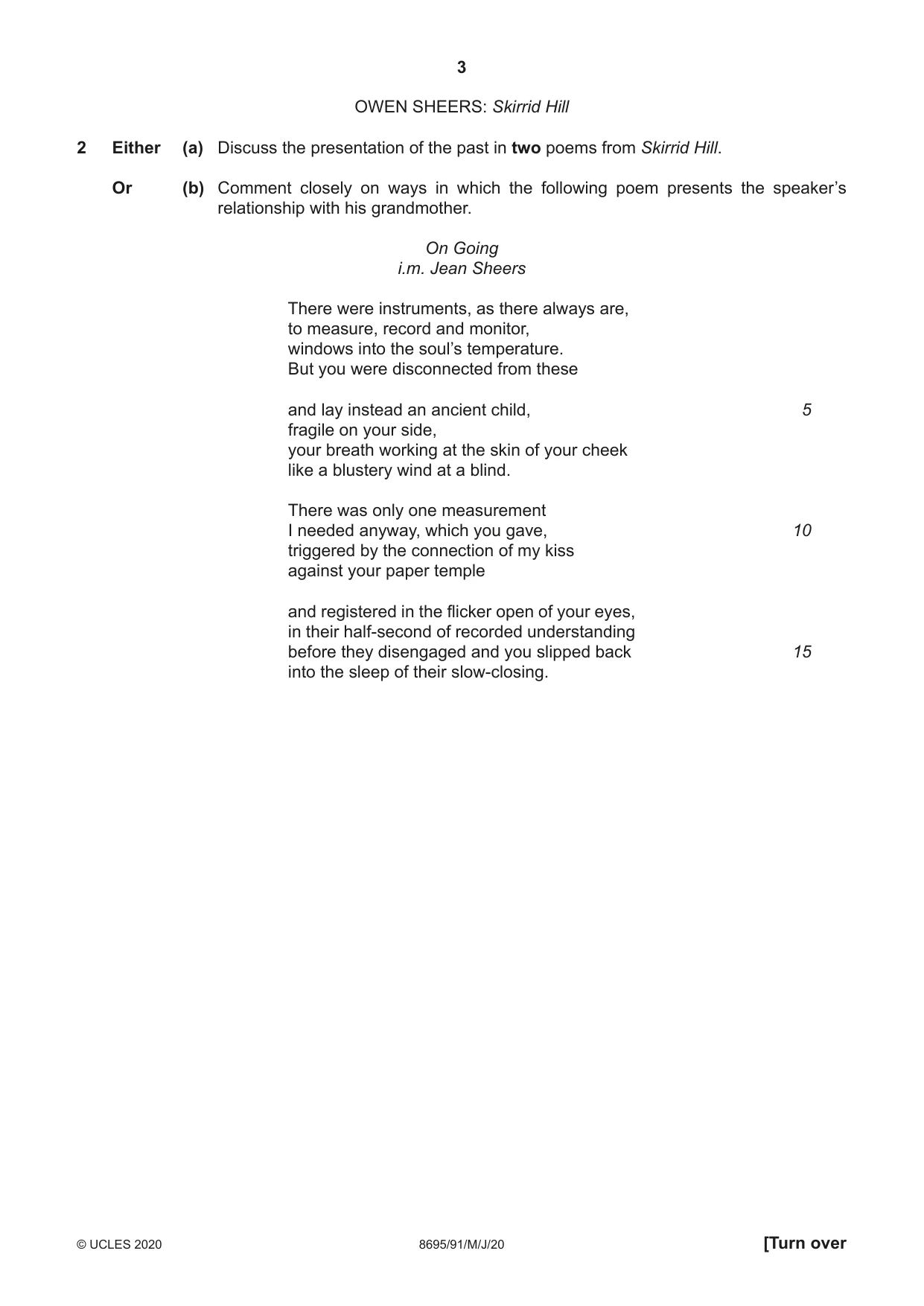
3 8695/91/M/J/20 © UCLES 2020 [Turn over OWEN SHEERS: Skirrid Hill 2 Either (a) Discuss the presentation of the past in two poems from Skirrid Hill. Or (b) Comment closely on ways in which the following poem presents the speaker’s relationship with his grandmother. On Going i.m. Jean Sheers There were instruments, as there always are, to measure, record and monitor, windows into the soul’s temperature. But you were disconnected from these and lay instead an ancient child, fragile on your side, your breath working at the skin of your cheek like a blustery wind at a blind. There was only one measurement I needed anyway, which you gave, triggered by the connection of my kiss against your paper temple and registered in the flicker open of your eyes, in their half-second of recorded understanding before they disengaged and you slipped back into the sleep of their slow-closing. 5 10 15
Question paper, page 4
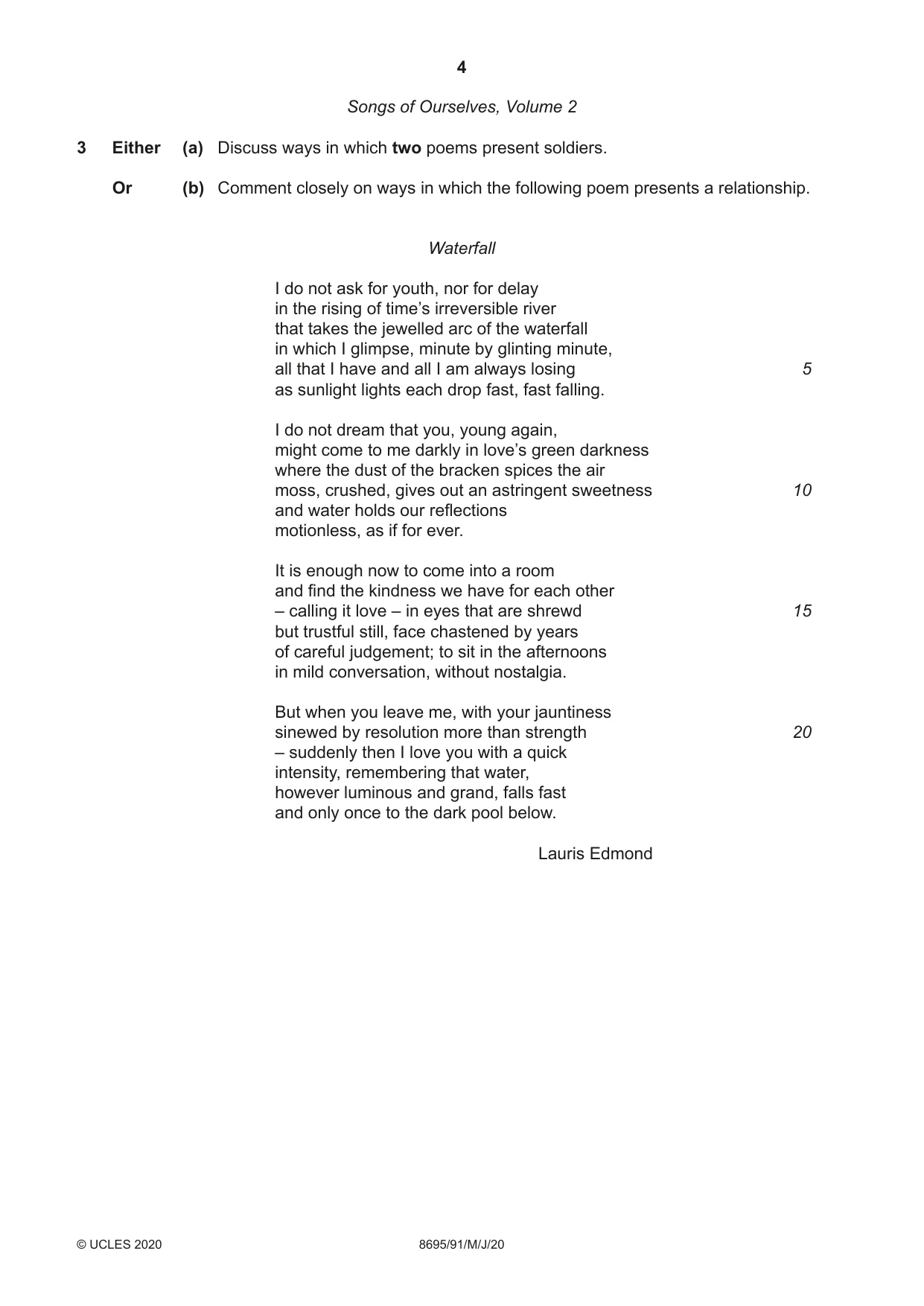
4 8695/91/M/J/20 © UCLES 2020 Songs of Ourselves, Volume 2 3 Either (a) Discuss ways in which two poems present soldiers. Or (b) Comment closely on ways in which the following poem presents a relationship. Waterfall I do not ask for youth, nor for delay in the rising of time’s irreversible river that takes the jewelled arc of the waterfall in which I glimpse, minute by glinting minute, all that I have and all I am always losing as sunlight lights each drop fast, fast falling. I do not dream that you, young again, might come to me darkly in love’s green darkness where the dust of the bracken spices the air moss, crushed, gives out an astringent sweetness and water holds our reflections motionless, as if for ever. It is enough now to come into a room and find the kindness we have for each other – calling it love – in eyes that are shrewd but trustful still, face chastened by years of careful judgement; to sit in the afternoons in mild conversation, without nostalgia. But when you leave me, with your jauntiness sinewed by resolution more than strength – suddenly then I love you with a quick intensity, remembering that water, however luminous and grand, falls fast and only once to the dark pool below. Lauris Edmond 5 10 15 20
Question paper, page 5
5 8695/91/M/J/20 © UCLES 2020 [Turn over Turn over for Section B.
Question paper, page 6
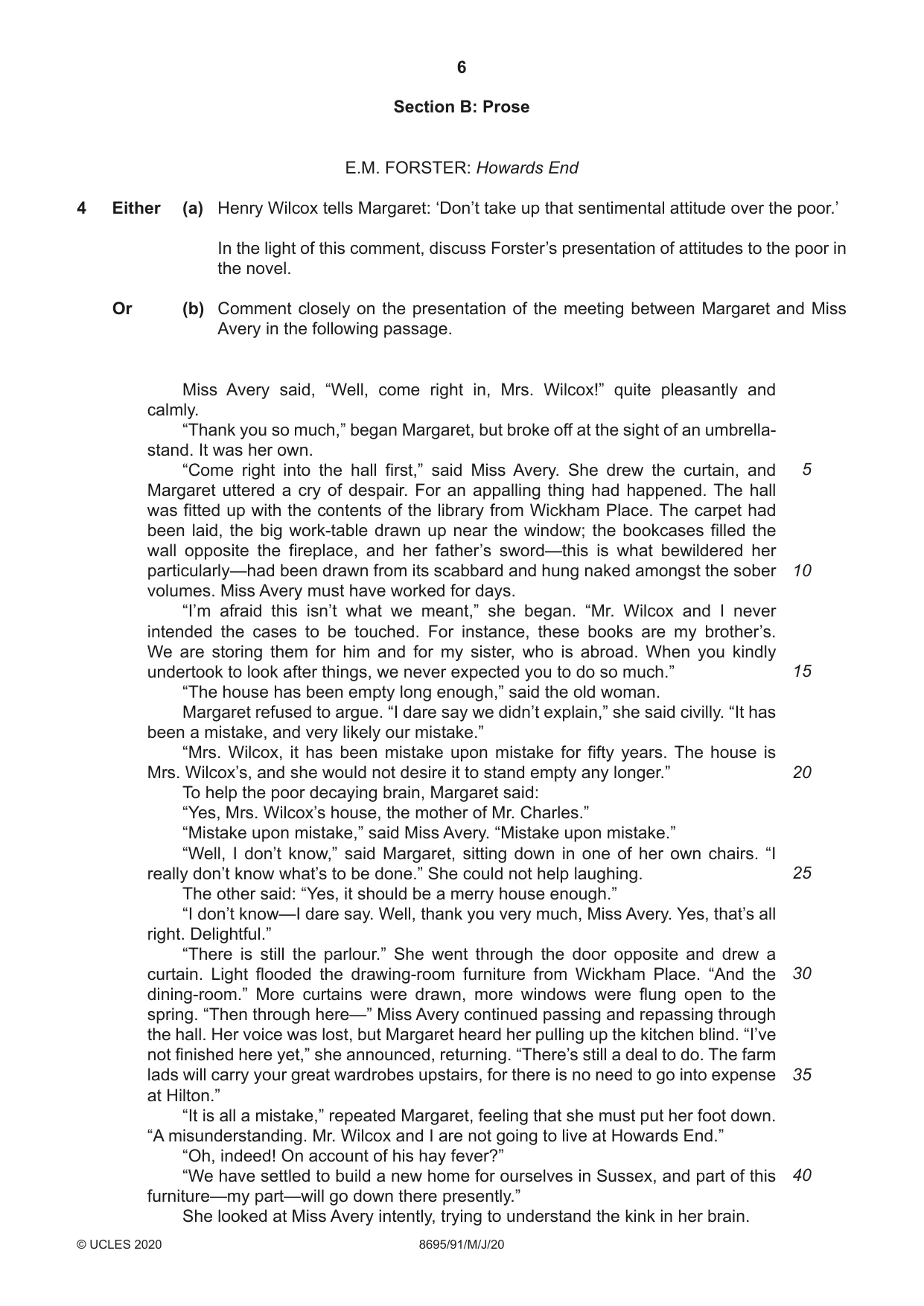
6 8695/91/M/J/20 © UCLES 2020 Section B: Prose E.M. FORSTER: Howards End 4 Either (a) Henry Wilcox tells Margaret: ‘Don’t take up that sentimental attitude over the poor.’ In the light of this comment, discuss Forster’s presentation of attitudes to the poor in the novel. Or (b) Comment closely on the presentation of the meeting between Margaret and Miss Avery in the following passage. Miss Avery said, “Well, come right in, Mrs. Wilcox!” quite pleasantly and calmly. “Thank you so much,” began Margaret, but broke off at the sight of an umbrella- stand. It was her own. “Come right into the hall first,” said Miss Avery. She drew the curtain, and Margaret uttered a cry of despair. For an appalling thing had happened. The hall was fitted up with the contents of the library from Wickham Place. The carpet had been laid, the big work-table drawn up near the window; the bookcases filled the wall opposite the fireplace, and her father’s sword—this is what bewildered her particularly—had been drawn from its scabbard and hung naked amongst the sober volumes. Miss Avery must have worked for days. “I’m afraid this isn’t what we meant,” she began. “Mr. Wilcox and I never intended the cases to be touched. For instance, these books are my brother’s. We are storing them for him and for my sister, who is abroad. When you kindly undertook to look after things, we never expected you to do so much.” “The house has been empty long enough,” said the old woman. Margaret refused to argue. “I dare say we didn’t explain,” she said civilly. “It has been a mistake, and very likely our mistake.” “Mrs. Wilcox, it has been mistake upon mistake for fifty years. The house is Mrs. Wilcox’s, and she would not desire it to stand empty any longer.” To help the poor decaying brain, Margaret said: “Yes, Mrs. Wilcox’s house, the mother of Mr. Charles.” “Mistake upon mistake,” said Miss Avery. “Mistake upon mistake.” “Well, I don’t know,” said Margaret, sitting down in one of her own chairs. “I really don’t know what’s to be done.” She could not help laughing. The other said: “Yes, it should be a merry house enough.” “I don’t know—I dare say. Well, thank you very much, Miss Avery. Yes, that’s all right. Delightful.” “There is still the parlour.” She went through the door opposite and drew a curtain. Light flooded the drawing-room furniture from Wickham Place. “And the dining-room.” More curtains were drawn, more windows were flung open to the spring. “Then through here—” Miss Avery continued passing and repassing through the hall. Her voice was lost, but Margaret heard her pulling up the kitchen blind. “I’ve not finished here yet,” she announced, returning. “There’s still a deal to do. The farm lads will carry your great wardrobes upstairs, for there is no need to go into expense at Hilton.” “It is all a mistake,” repeated Margaret, feeling that she must put her foot down. “A misunderstanding. Mr. Wilcox and I are not going to live at Howards End.” “Oh, indeed! On account of his hay fever?” “We have settled to build a new home for ourselves in Sussex, and part of this furniture—my part—will go down there presently.” She looked at Miss Avery intently, trying to understand the kink in her brain. 5 10 15 20 25 30 35 40
Question paper, page 7
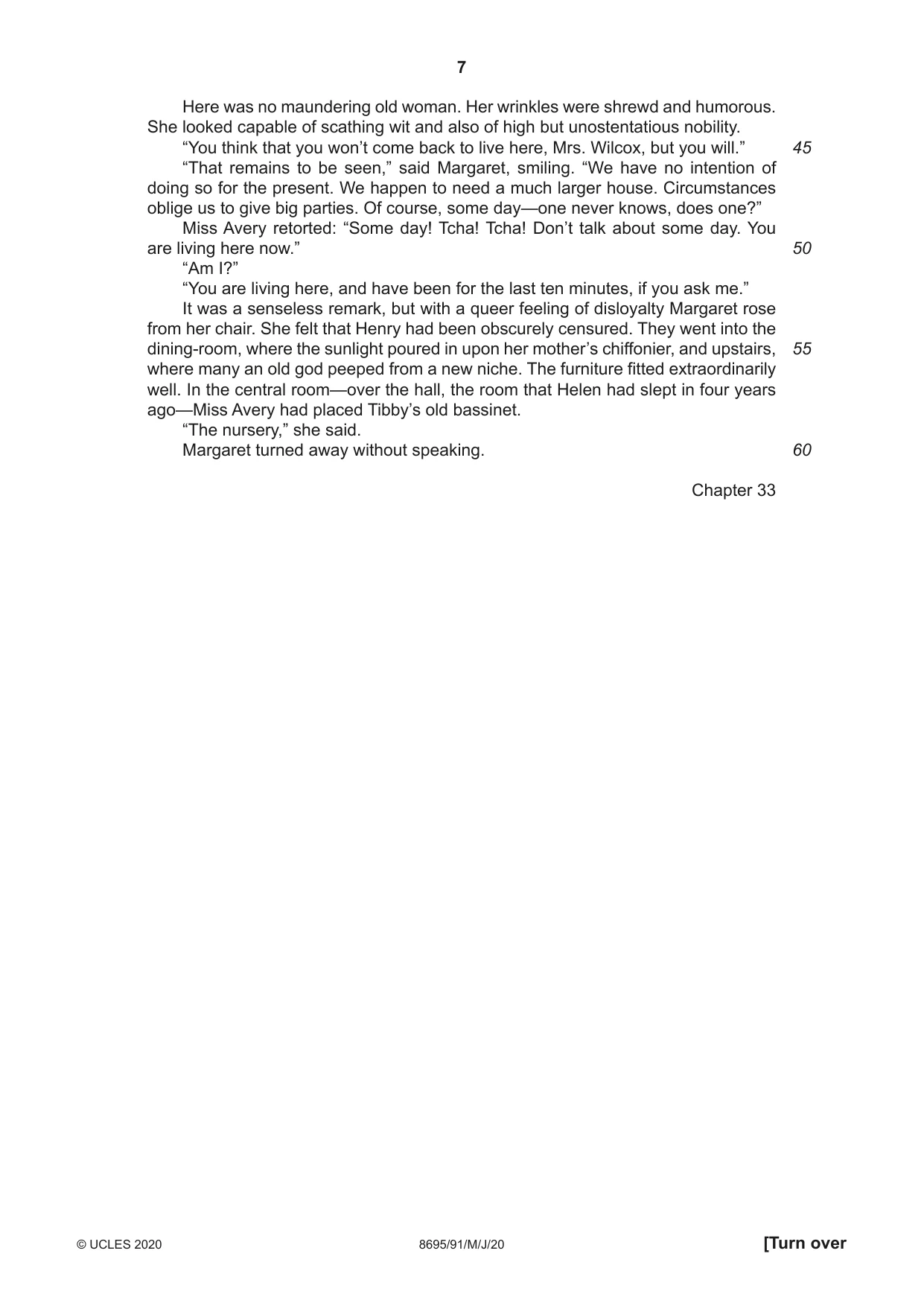
7 8695/91/M/J/20 © UCLES 2020 [Turn over Here was no maundering old woman. Her wrinkles were shrewd and humorous. She looked capable of scathing wit and also of high but unostentatious nobility. “You think that you won’t come back to live here, Mrs. Wilcox, but you will.” “That remains to be seen,” said Margaret, smiling. “We have no intention of doing so for the present. We happen to need a much larger house. Circumstances oblige us to give big parties. Of course, some day—one never knows, does one?” Miss Avery retorted: “Some day! Tcha! Tcha! Don’t talk about some day. You are living here now.” “Am I?” “You are living here, and have been for the last ten minutes, if you ask me.” It was a senseless remark, but with a queer feeling of disloyalty Margaret rose from her chair. She felt that Henry had been obscurely censured. They went into the dining-room, where the sunlight poured in upon her mother’s chiffonier, and upstairs, where many an old god peeped from a new niche. The furniture fitted extraordinarily well. In the central room—over the hall, the room that Helen had slept in four years ago—Miss Avery had placed Tibby’s old bassinet. “The nursery,” she said. Margaret turned away without speaking. Chapter 33 45 50 55 60
Question paper, page 8
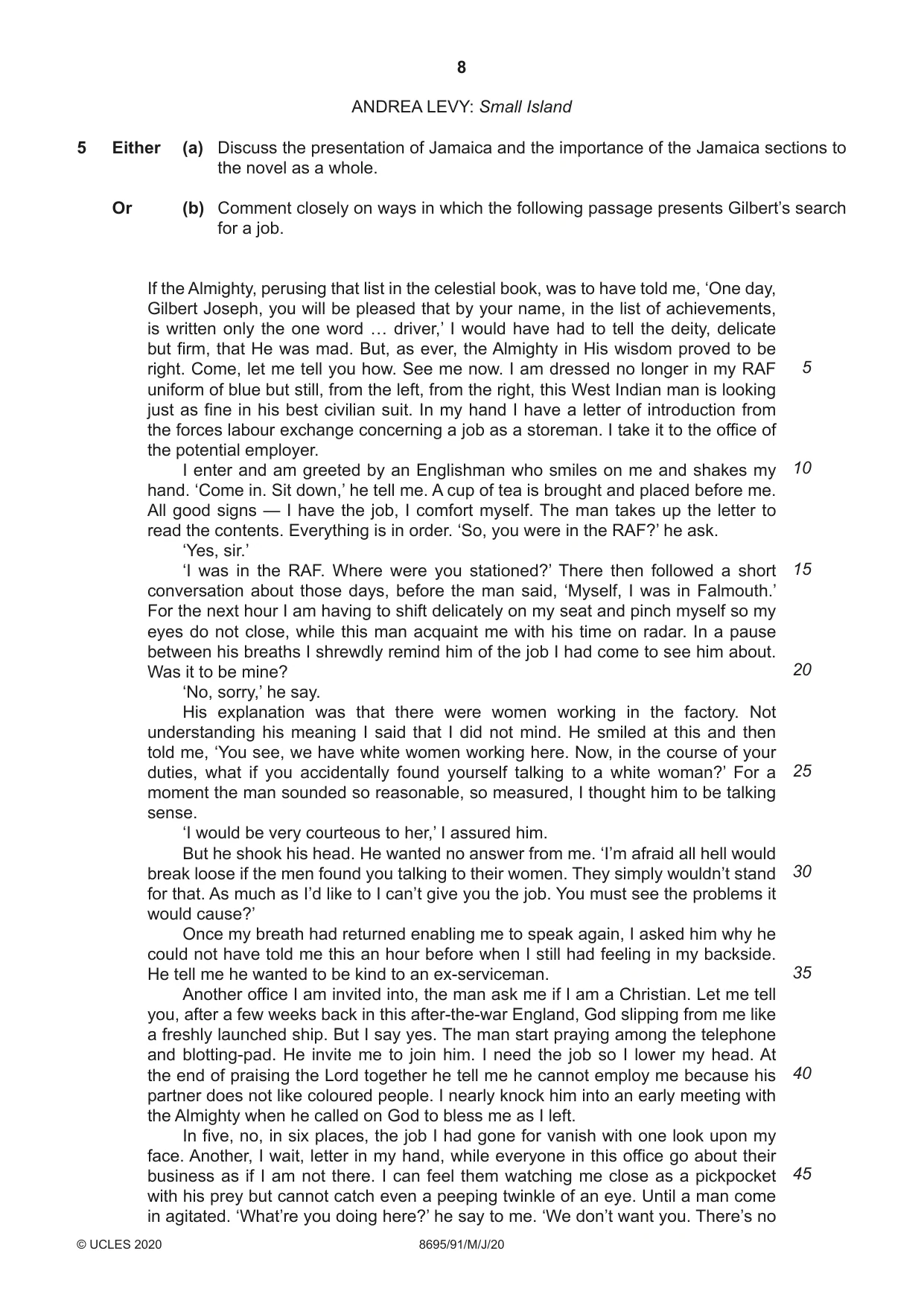
8 8695/91/M/J/20 © UCLES 2020 ANDREA LEVY: Small Island 5 Either (a) Discuss the presentation of Jamaica and the importance of the Jamaica sections to the novel as a whole. Or (b) Comment closely on ways in which the following passage presents Gilbert’s search for a job. If the Almighty, perusing that list in the celestial book, was to have told me, ‘One day, Gilbert Joseph, you will be pleased that by your name, in the list of achievements, is written only the one word … driver,’ I would have had to tell the deity, delicate but firm, that He was mad. But, as ever, the Almighty in His wisdom proved to be right. Come, let me tell you how. See me now. I am dressed no longer in my RAF uniform of blue but still, from the left, from the right, this West Indian man is looking just as fine in his best civilian suit. In my hand I have a letter of introduction from the forces labour exchange concerning a job as a storeman. I take it to the office of the potential employer. I enter and am greeted by an Englishman who smiles on me and shakes my hand. ‘Come in. Sit down,’ he tell me. A cup of tea is brought and placed before me. All good signs — I have the job, I comfort myself. The man takes up the letter to read the contents. Everything is in order. ‘So, you were in the RAF?’ he ask. ‘Yes, sir.’ ‘I was in the RAF. Where were you stationed?’ There then followed a short conversation about those days, before the man said, ‘Myself, I was in Falmouth.’ For the next hour I am having to shift delicately on my seat and pinch myself so my eyes do not close, while this man acquaint me with his time on radar. In a pause between his breaths I shrewdly remind him of the job I had come to see him about. Was it to be mine? ‘No, sorry,’ he say. His explanation was that there were women working in the factory. Not understanding his meaning I said that I did not mind. He smiled at this and then told me, ‘You see, we have white women working here. Now, in the course of your duties, what if you accidentally found yourself talking to a white woman?’ For a moment the man sounded so reasonable, so measured, I thought him to be talking sense. ‘I would be very courteous to her,’ I assured him. But he shook his head. He wanted no answer from me. ‘I’m afraid all hell would break loose if the men found you talking to their women. They simply wouldn’t stand for that. As much as I’d like to I can’t give you the job. You must see the problems it would cause?’ Once my breath had returned enabling me to speak again, I asked him why he could not have told me this an hour before when I still had feeling in my backside. He tell me he wanted to be kind to an ex-serviceman. Another office I am invited into, the man ask me if I am a Christian. Let me tell you, after a few weeks back in this after-the-war England, God slipping from me like a freshly launched ship. But I say yes. The man start praying among the telephone and blotting-pad. He invite me to join him. I need the job so I lower my head. At the end of praising the Lord together he tell me he cannot employ me because his partner does not like coloured people. I nearly knock him into an early meeting with the Almighty when he called on God to bless me as I left. In five, no, in six places, the job I had gone for vanish with one look upon my face. Another, I wait, letter in my hand, while everyone in this office go about their business as if I am not there. I can feel them watching me close as a pickpocket with his prey but cannot catch even a peeping twinkle of an eye. Until a man come in agitated. ‘What’re you doing here?’ he say to me. ‘We don’t want you. There’s no 5 10 15 20 25 30 35 40 45
Question paper, page 9
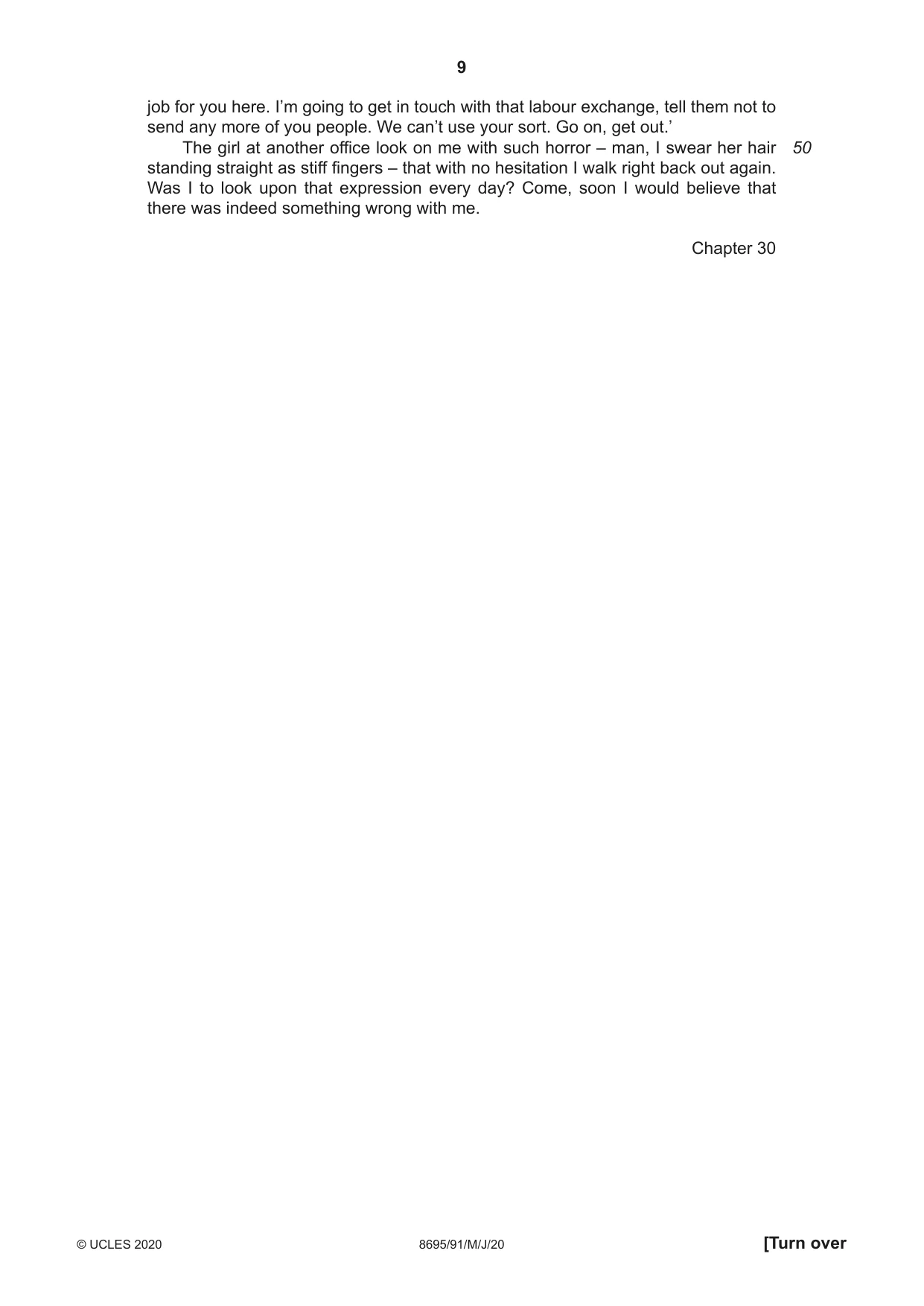
9 8695/91/M/J/20 © UCLES 2020 [Turn over job for you here. I’m going to get in touch with that labour exchange, tell them not to send any more of you people. We can’t use your sort. Go on, get out.’ The girl at another office look on me with such horror – man, I swear her hair standing straight as stiff fingers – that with no hesitation I walk right back out again. Was I to look upon that expression every day? Come, soon I would believe that there was indeed something wrong with me. Chapter 30 50
Question paper, page 10
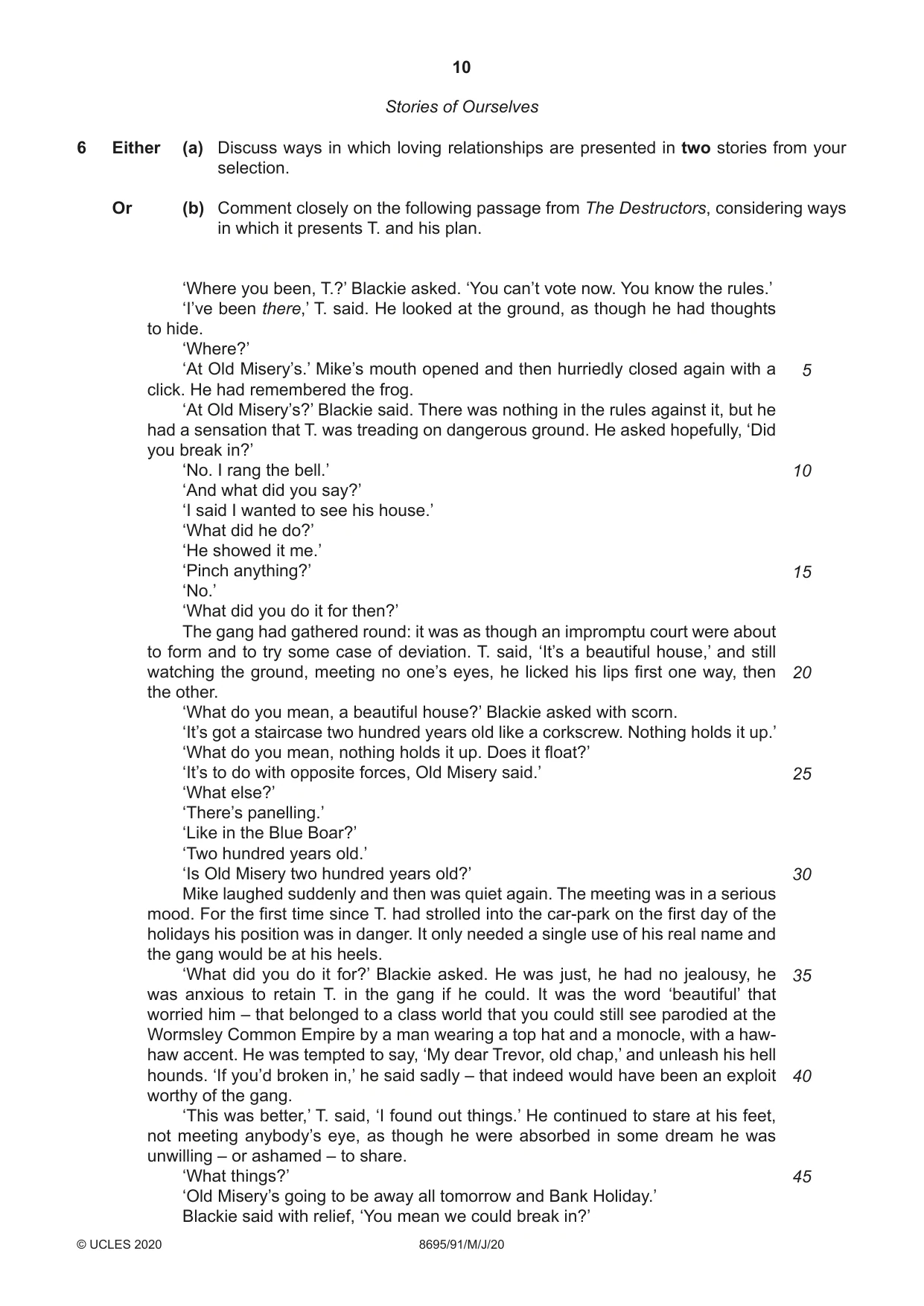
10 8695/91/M/J/20 © UCLES 2020 Stories of Ourselves 6 Either (a) Discuss ways in which loving relationships are presented in two stories from your selection. Or (b) Comment closely on the following passage from The Destructors, considering ways in which it presents T. and his plan. ‘Where you been, T.?’ Blackie asked. ‘You can’t vote now. You know the rules.’ ‘I’ve been there,’ T. said. He looked at the ground, as though he had thoughts to hide. ‘Where?’ ‘At Old Misery’s.’ Mike’s mouth opened and then hurriedly closed again with a click. He had remembered the frog. ‘At Old Misery’s?’ Blackie said. There was nothing in the rules against it, but he had a sensation that T. was treading on dangerous ground. He asked hopefully, ‘Did you break in?’ ‘No. I rang the bell.’ ‘And what did you say?’ ‘I said I wanted to see his house.’ ‘What did he do?’ ‘He showed it me.’ ‘Pinch anything?’ ‘No.’ ‘What did you do it for then?’ The gang had gathered round: it was as though an impromptu court were about to form and to try some case of deviation. T. said, ‘It’s a beautiful house,’ and still watching the ground, meeting no one’s eyes, he licked his lips first one way, then the other. ‘What do you mean, a beautiful house?’ Blackie asked with scorn. ‘It’s got a staircase two hundred years old like a corkscrew. Nothing holds it up.’ ‘What do you mean, nothing holds it up. Does it float?’ ‘It’s to do with opposite forces, Old Misery said.’ ‘What else?’ ‘There’s panelling.’ ‘Like in the Blue Boar?’ ‘Two hundred years old.’ ‘Is Old Misery two hundred years old?’ Mike laughed suddenly and then was quiet again. The meeting was in a serious mood. For the first time since T. had strolled into the car-park on the first day of the holidays his position was in danger. It only needed a single use of his real name and the gang would be at his heels. ‘What did you do it for?’ Blackie asked. He was just, he had no jealousy, he was anxious to retain T. in the gang if he could. It was the word ‘beautiful’ that worried him – that belonged to a class world that you could still see parodied at the Wormsley Common Empire by a man wearing a top hat and a monocle, with a haw- haw accent. He was tempted to say, ‘My dear Trevor, old chap,’ and unleash his hell hounds. ‘If you’d broken in,’ he said sadly – that indeed would have been an exploit worthy of the gang. ‘This was better,’ T. said, ‘I found out things.’ He continued to stare at his feet, not meeting anybody’s eye, as though he were absorbed in some dream he was unwilling – or ashamed – to share. ‘What things?’ ‘Old Misery’s going to be away all tomorrow and Bank Holiday.’ Blackie said with relief, ‘You mean we could break in?’ 5 10 15 20 25 30 35 40 45
Question paper, page 11
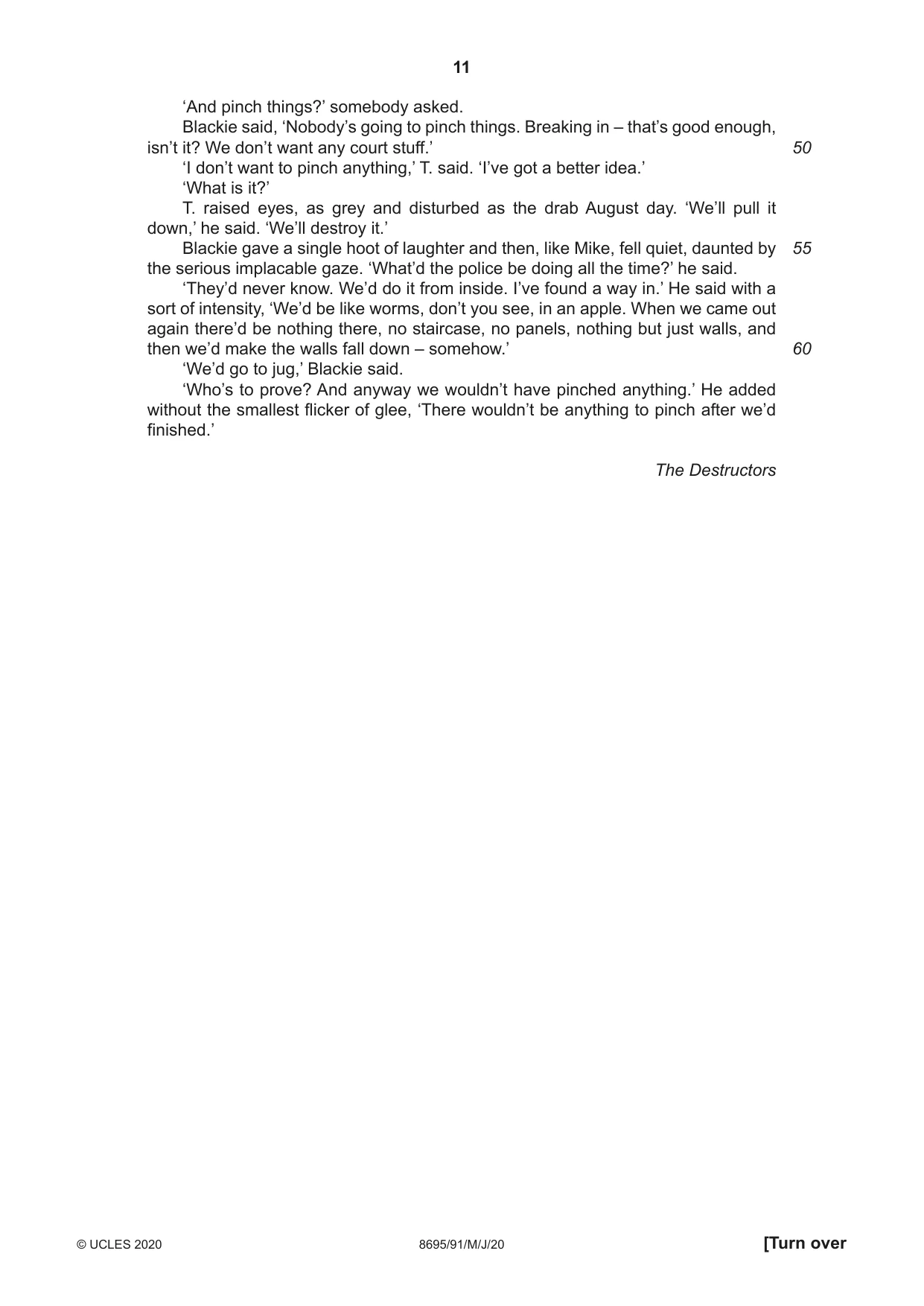
11 8695/91/M/J/20 © UCLES 2020 [Turn over ‘And pinch things?’ somebody asked. Blackie said, ‘Nobody’s going to pinch things. Breaking in – that’s good enough, isn’t it? We don’t want any court stuff.’ ‘I don’t want to pinch anything,’ T. said. ‘I’ve got a better idea.’ ‘What is it?’ T. raised eyes, as grey and disturbed as the drab August day. ‘We’ll pull it down,’ he said. ‘We’ll destroy it.’ Blackie gave a single hoot of laughter and then, like Mike, fell quiet, daunted by the serious implacable gaze. ‘What’d the police be doing all the time?’ he said. ‘They’d never know. We’d do it from inside. I’ve found a way in.’ He said with a sort of intensity, ‘We’d be like worms, don’t you see, in an apple. When we came out again there’d be nothing there, no staircase, no panels, nothing but just walls, and then we’d make the walls fall down – somehow.’ ‘We’d go to jug,’ Blackie said. ‘Who’s to prove? And anyway we wouldn’t have pinched anything.’ He added without the smallest flicker of glee, ‘There wouldn’t be anything to pinch after we’d finished.’ The Destructors 50 55 60
Question paper, page 12
12 8695/91/M/J/20 © UCLES 2020 Section C: Drama ARTHUR MILLER: All My Sons 7 Either (a) In what ways, and with what dramatic effects, does Miller present the influence of the past on the present? Or (b) With close reference to detail of language and action, discuss Miller’s dramatic presentation of rising tension in the following extract. Chris [calling after them]: Thanks for driving him! Content removed due to copyright restrictions.
Question paper, page 13
13 8695/91/M/J/20 © UCLES 2020 [Turn over [He allows her to seat him, looking at her.] Act 2 Content removed due to copyright restrictions.
Question paper, page 14
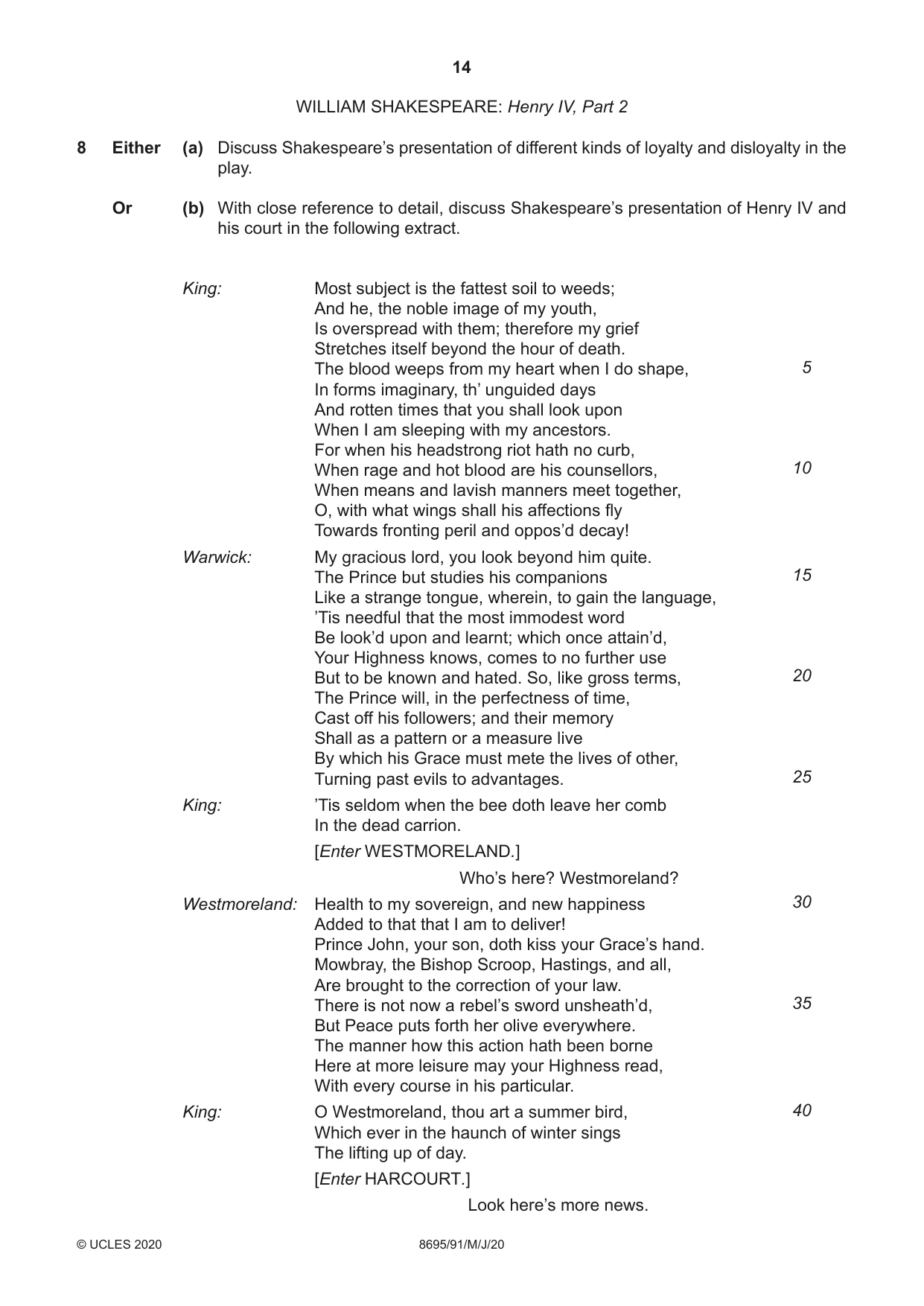
14 8695/91/M/J/20 © UCLES 2020 WILLIAM SHAKESPEARE: Henry IV, Part 2 8 Either (a) Discuss Shakespeare’s presentation of different kinds of loyalty and disloyalty in the play. Or (b) With close reference to detail, discuss Shakespeare’s presentation of Henry IV and his court in the following extract. King: Most subject is the fattest soil to weeds; And he, the noble image of my youth, Is overspread with them; therefore my grief Stretches itself beyond the hour of death. The blood weeps from my heart when I do shape, In forms imaginary, th’ unguided days And rotten times that you shall look upon When I am sleeping with my ancestors. For when his headstrong riot hath no curb, When rage and hot blood are his counsellors, When means and lavish manners meet together, O, with what wings shall his affections fly Towards fronting peril and oppos’d decay! Warwick: My gracious lord, you look beyond him quite. The Prince but studies his companions Like a strange tongue, wherein, to gain the language, ’Tis needful that the most immodest word Be look’d upon and learnt; which once attain’d, Your Highness knows, comes to no further use But to be known and hated. So, like gross terms, The Prince will, in the perfectness of time, Cast off his followers; and their memory Shall as a pattern or a measure live By which his Grace must mete the lives of other, Turning past evils to advantages. King: ’Tis seldom when the bee doth leave her comb In the dead carrion. [Enter WESTMORELAND.] Who’s here? Westmoreland? Westmoreland: Health to my sovereign, and new happiness Added to that that I am to deliver! Prince John, your son, doth kiss your Grace’s hand. Mowbray, the Bishop Scroop, Hastings, and all, Are brought to the correction of your law. There is not now a rebel’s sword unsheath’d, But Peace puts forth her olive everywhere. The manner how this action hath been borne Here at more leisure may your Highness read, With every course in his particular. King: O Westmoreland, thou art a summer bird, Which ever in the haunch of winter sings The lifting up of day. [Enter HARCOURT.] Look here’s more news. 5 10 15 20 25 30 35 40
Question paper, page 15
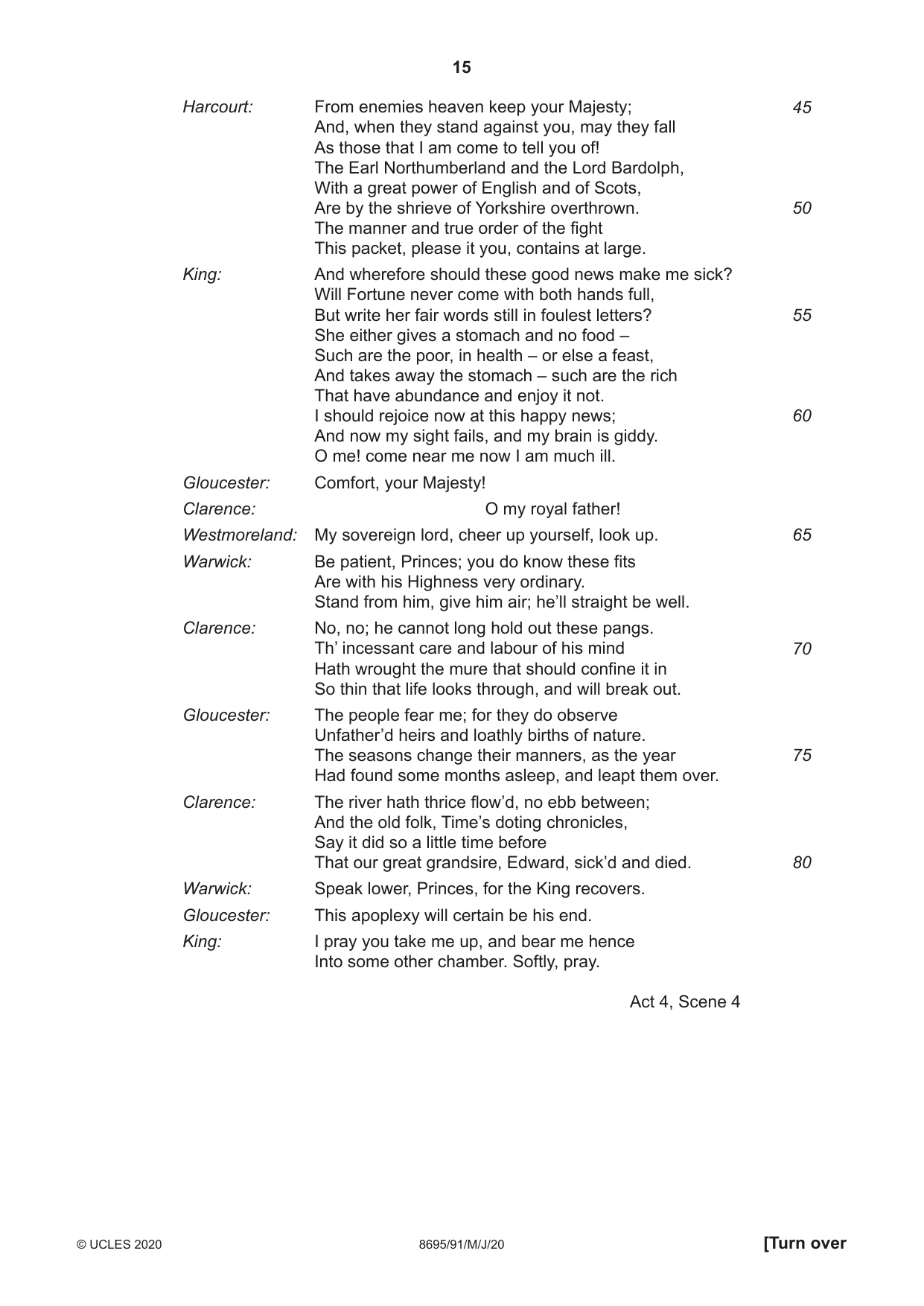
15 8695/91/M/J/20 © UCLES 2020 [Turn over Harcourt: From enemies heaven keep your Majesty; And, when they stand against you, may they fall As those that I am come to tell you of! The Earl Northumberland and the Lord Bardolph, With a great power of English and of Scots, Are by the shrieve of Yorkshire overthrown. The manner and true order of the fight This packet, please it you, contains at large. King: And wherefore should these good news make me sick? Will Fortune never come with both hands full, But write her fair words still in foulest letters? She either gives a stomach and no food – Such are the poor, in health – or else a feast, And takes away the stomach – such are the rich That have abundance and enjoy it not. I should rejoice now at this happy news; And now my sight fails, and my brain is giddy. O me! come near me now I am much ill. Gloucester: Comfort, your Majesty! Clarence: O my royal father! Westmoreland: My sovereign lord, cheer up yourself, look up. Warwick: Be patient, Princes; you do know these fits Are with his Highness very ordinary. Stand from him, give him air; he’ll straight be well. Clarence: No, no; he cannot long hold out these pangs. Th’ incessant care and labour of his mind Hath wrought the mure that should confine it in So thin that life looks through, and will break out. Gloucester: The people fear me; for they do observe Unfather’d heirs and loathly births of nature. The seasons change their manners, as the year Had found some months asleep, and leapt them over. Clarence: The river hath thrice flow’d, no ebb between; And the old folk, Time’s doting chronicles, Say it did so a little time before That our great grandsire, Edward, sick’d and died. Warwick: Speak lower, Princes, for the King recovers. Gloucester: This apoplexy will certain be his end. King: I pray you take me up, and bear me hence Into some other chamber. Softly, pray. Act 4, Scene 4 45 50 55 60 65 70 75 80
Question paper, page 16
16 8695/91/M/J/20 © UCLES 2020 WOLE SOYINKA: Death and the King’s Horseman 9 Either (a) How, and with what dramatic effects, does Soyinka present the role and obligations of the King’s Horseman in the play? Or (b) In what ways, and with what dramatic effects, does Soyinka present a contrast between two cultures in the following extract? You should pay close attention to both language and action. [A figure emerges from the shadows, a young black man dressed in a sober western suit. Content removed due to copyright restrictions.
Question paper, page 17
17 8695/91/M/J/20 © UCLES 2020 Life should never be thrown deliberately away. Scene 4 Content removed due to copyright restrictions.
Question paper, page 18
18 8695/91/M/J/20 © UCLES 2020 BLANK PAGE
Question paper, page 19
19 8695/91/M/J/20 © UCLES 2020 BLANK PAGE
Question paper, page 20
20 8695/91/M/J/20 © UCLES 2020 Permission to reproduce items where third-party owned material protected by copyright is included has been sought and cleared where possible. Every reasonable effort has been made by the publisher (UCLES) to trace copyright holders, but if any items requiring clearance have unwittingly been included, the publisher will be pleased to make amends at the earliest possible opportunity. To avoid the issue of disclosure of answer-related information to candidates, all copyright acknowledgements are reproduced online in the Cambridge Assessment International Education Copyright Acknowledgements Booklet. This is produced for each series of examinations and is freely available to download at www.cambridgeinternational.org after the live examination series. Cambridge Assessment International Education is part of the Cambridge Assessment Group. Cambridge Assessment is the brand name of the University of Cambridge Local Examinations Syndicate (UCLES), which itself is a department of the University of Cambridge. BLANK PAGE
Mark scheme, page 1
This document consists of 6 printed pages. © UCLES 2020 [Turn over Cambridge International AS Level LANGUAGE AND LITERATURE IN ENGLISH 8695/91 Paper 9 Poetry, Prose and Drama May/June 2020 MARK SCHEME Maximum Mark: 50 Published Students did not sit exam papers in the June 2020 series due to the Covid-19 global pandemic. This mark scheme is published to support teachers and students and should be read together with the question paper. It shows the requirements of the exam. The answer column of the mark scheme shows the proposed basis on which Examiners would award marks for this exam. Where appropriate, this column also provides the most likely acceptable alternative responses expected from students. Examiners usually review the mark scheme after they have seen student responses and update the mark scheme if appropriate. In the June series, Examiners were unable to consider the acceptability of alternative responses, as there were no student responses to consider. Mark schemes should usually be read together with the Principal Examiner Report for Teachers. However, because students did not sit exam papers, there is no Principal Examiner Report for Teachers for the June 2020 series. Cambridge International will not enter into discussions about these mark schemes. Cambridge International is publishing the mark schemes for the June 2020 series for most Cambridge IGCSE™ and Cambridge International A & AS Level components, and some Cambridge O Level components.
Mark scheme, page 2
8695/91 Cambridge International AS Level – Mark Scheme PUBLISHED May/June 2020 © UCLES 2020 Page 2 of 6 Generic Marking Principles These general marking principles must be applied by all examiners when marking candidate answers. They should be applied alongside the specific content of the mark scheme or generic level descriptors for a question. Each question paper and mark scheme will also comply with these marking principles. GENERIC MARKING PRINCIPLE 1: Marks must be awarded in line with: • the specific content of the mark scheme or the generic level descriptors for the question • the specific skills defined in the mark scheme or in the generic level descriptors for the question • the standard of response required by a candidate as exemplified by the standardisation scripts. GENERIC MARKING PRINCIPLE 2: Marks awarded are always whole marks (not half marks, or other fractions). GENERIC MARKING PRINCIPLE 3: Marks must be awarded positively: • marks are awarded for correct/valid answers, as defined in the mark scheme. However, credit is given for valid answers which go beyond the scope of the syllabus and mark scheme, referring to your Team Leader as appropriate • marks are awarded when candidates clearly demonstrate what they know and can do • marks are not deducted for errors • marks are not deducted for omissions • answers should only be judged on the quality of spelling, punctuation and grammar when these features are specifically assessed by the question as indicated by the mark scheme. The meaning, however, should be unambiguous. GENERIC MARKING PRINCIPLE 4: Rules must be applied consistently e.g. in situations where candidates have not followed instructions or in the application of generic level descriptors. GENERIC MARKING PRINCIPLE 5: Marks should be awarded using the full range of marks defined in the mark scheme for the question (however; the use of the full mark range may be limited according to the quality of the candidate responses seen). GENERIC MARKING PRINCIPLE 6: Marks awarded are based solely on the requirements as defined in the mark scheme. Marks should not be awarded with grade thresholds or grade descriptors in mind.
Mark scheme, page 3
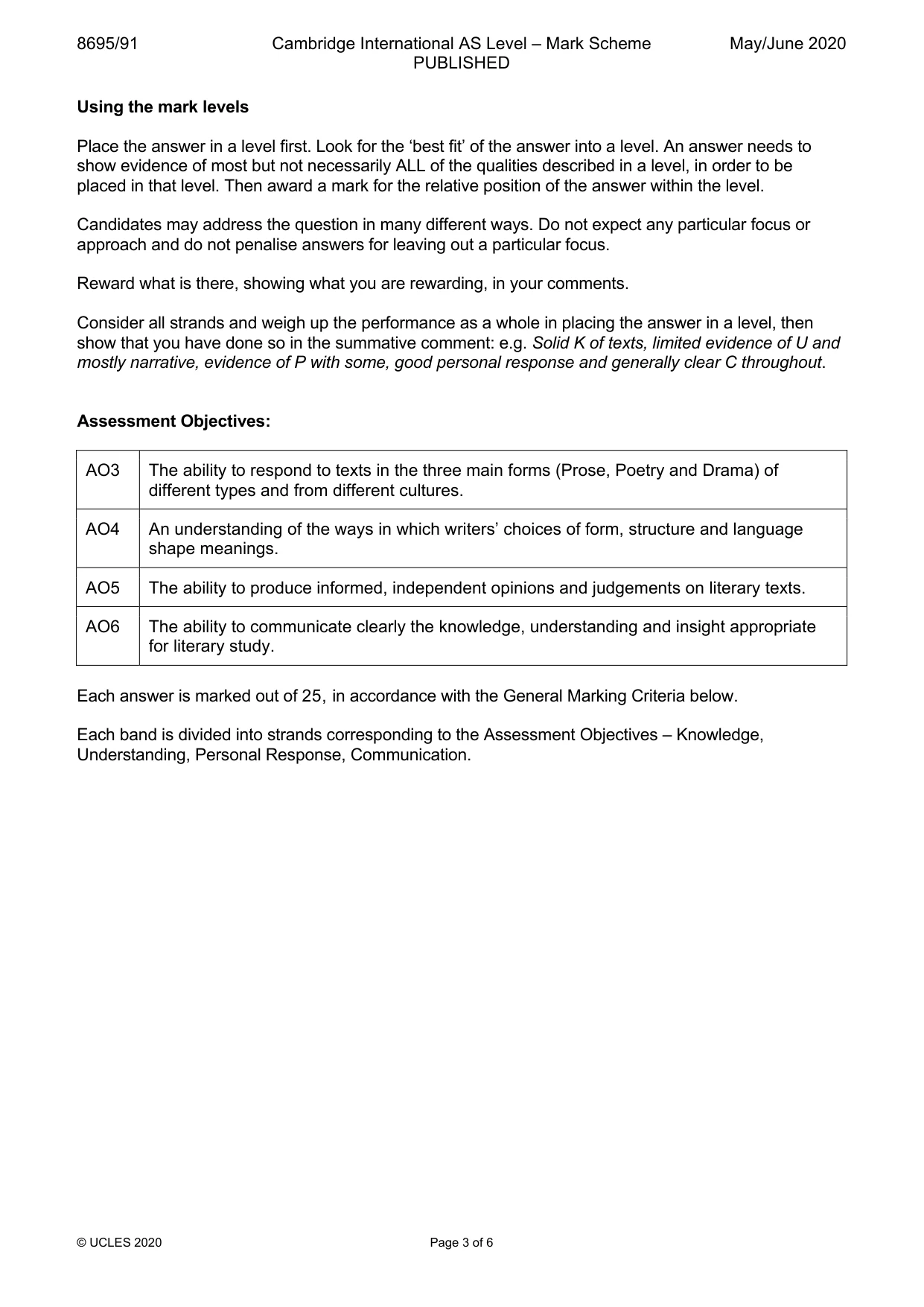
8695/91 Cambridge International AS Level – Mark Scheme PUBLISHED May/June 2020 © UCLES 2020 Page 3 of 6 Using the mark levels Place the answer in a level first. Look for the ‘best fit’ of the answer into a level. An answer needs to show evidence of most but not necessarily ALL of the qualities described in a level, in order to be placed in that level. Then award a mark for the relative position of the answer within the level. Candidates may address the question in many different ways. Do not expect any particular focus or approach and do not penalise answers for leaving out a particular focus. Reward what is there, showing what you are rewarding, in your comments. Consider all strands and weigh up the performance as a whole in placing the answer in a level, then show that you have done so in the summative comment: e.g. Solid K of texts, limited evidence of U and mostly narrative, evidence of P with some, good personal response and generally clear C throughout. Assessment Objectives: AO3 The ability to respond to texts in the three main forms (Prose, Poetry and Drama) of different types and from different cultures. AO4 An understanding of the ways in which writers’ choices of form, structure and language shape meanings. AO5 The ability to produce informed, independent opinions and judgements on literary texts. AO6 The ability to communicate clearly the knowledge, understanding and insight appropriate for literary study. Each answer is marked out of 25, in accordance with the General Marking Criteria below. Each band is divided into strands corresponding to the Assessment Objectives – Knowledge, Understanding, Personal Response, Communication.
Mark scheme, page 4
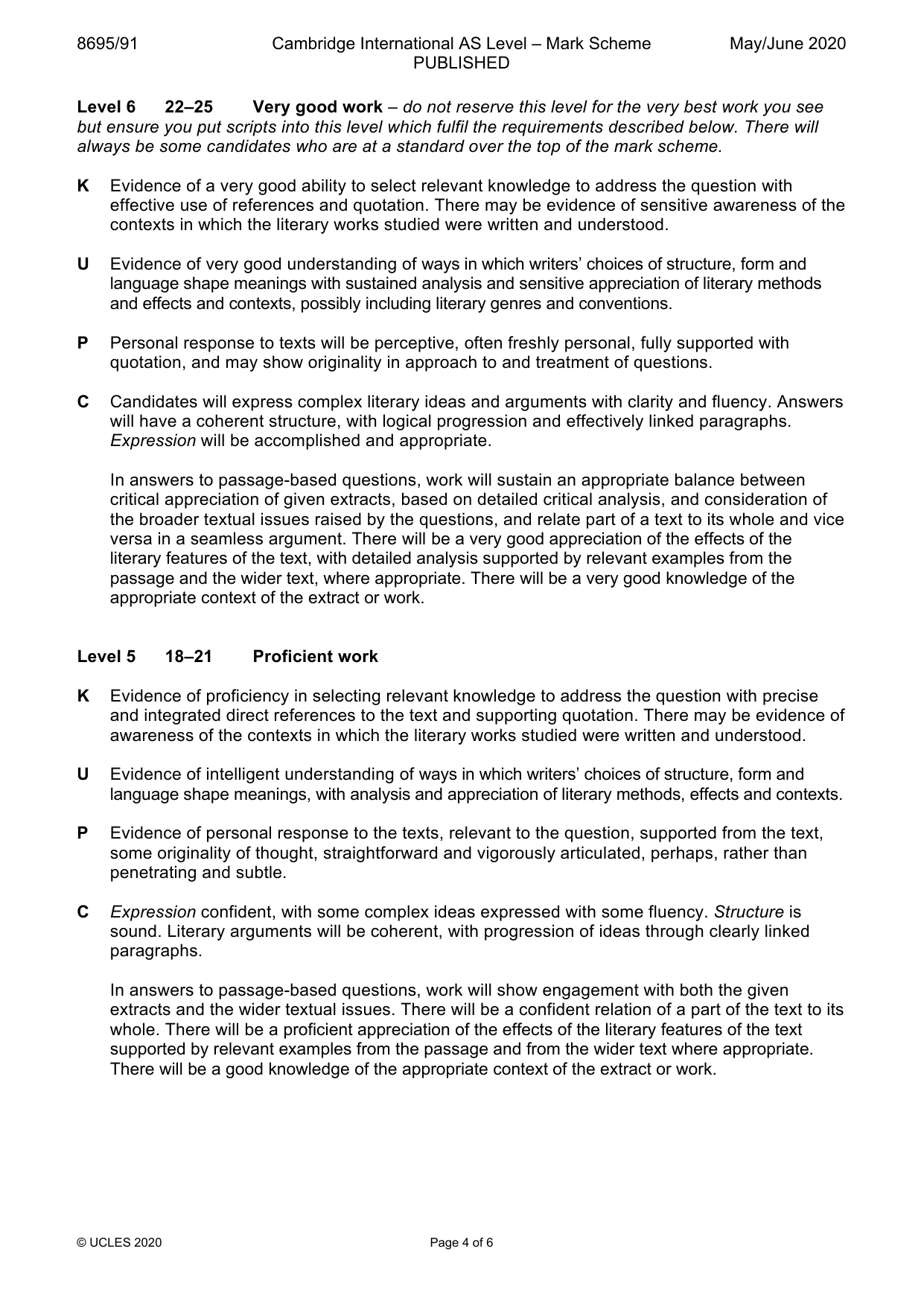
8695/91 Cambridge International AS Level – Mark Scheme PUBLISHED May/June 2020 © UCLES 2020 Page 4 of 6 Level 6 22–25 Very good work – do not reserve this level for the very best work you see but ensure you put scripts into this level which fulfil the requirements described below. There will always be some candidates who are at a standard over the top of the mark scheme. K Evidence of a very good ability to select relevant knowledge to address the question with effective use of references and quotation. There may be evidence of sensitive awareness of the contexts in which the literary works studied were written and understood. U Evidence of very good understanding of ways in which writers’ choices of structure, form and language shape meanings with sustained analysis and sensitive appreciation of literary methods and effects and contexts, possibly including literary genres and conventions. P Personal response to texts will be perceptive, often freshly personal, fully supported with quotation, and may show originality in approach to and treatment of questions. C Candidates will express complex literary ideas and arguments with clarity and fluency. Answers will have a coherent structure, with logical progression and effectively linked paragraphs. Expression will be accomplished and appropriate. In answers to passage-based questions, work will sustain an appropriate balance between critical appreciation of given extracts, based on detailed critical analysis, and consideration of the broader textual issues raised by the questions, and relate part of a text to its whole and vice versa in a seamless argument. There will be a very good appreciation of the effects of the literary features of the text, with detailed analysis supported by relevant examples from the passage and the wider text, where appropriate. There will be a very good knowledge of the appropriate context of the extract or work. Level 5 18–21 Proficient work K Evidence of proficiency in selecting relevant knowledge to address the question with precise and integrated direct references to the text and supporting quotation. There may be evidence of awareness of the contexts in which the literary works studied were written and understood. U Evidence of intelligent understanding of ways in which writers’ choices of structure, form and language shape meanings, with analysis and appreciation of literary methods, effects and contexts. P Evidence of personal response to the texts, relevant to the question, supported from the text, some originality of thought, straightforward and vigorously articulated, perhaps, rather than penetrating and subtle. C Expression confident, with some complex ideas expressed with some fluency. Structure is sound. Literary arguments will be coherent, with progression of ideas through clearly linked paragraphs. In answers to passage-based questions, work will show engagement with both the given extracts and the wider textual issues. There will be a confident relation of a part of the text to its whole. There will be a proficient appreciation of the effects of the literary features of the text supported by relevant examples from the passage and from the wider text where appropriate. There will be a good knowledge of the appropriate context of the extract or work.
Mark scheme, page 5
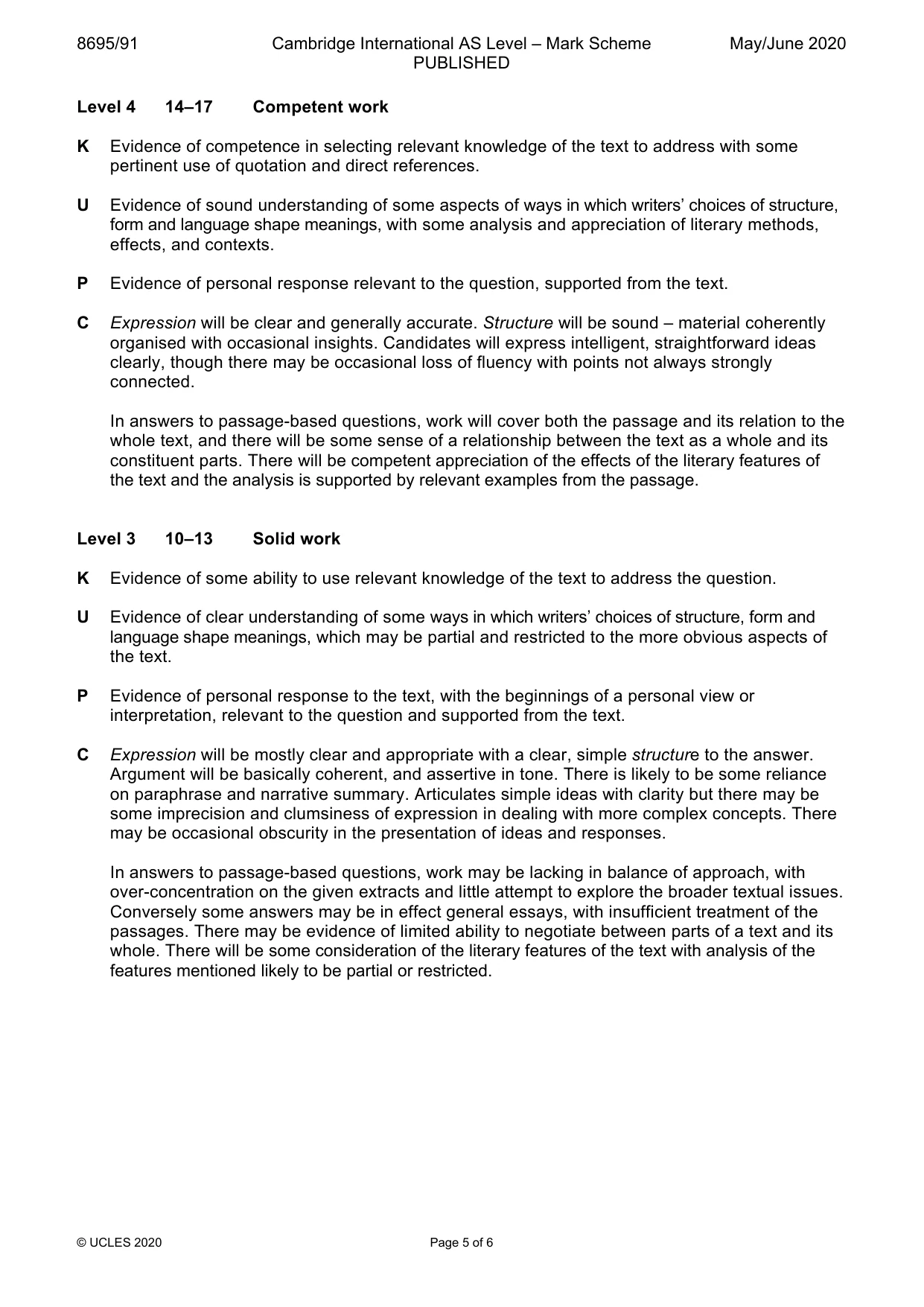
8695/91 Cambridge International AS Level – Mark Scheme PUBLISHED May/June 2020 © UCLES 2020 Page 5 of 6 Level 4 14–17 Competent work K Evidence of competence in selecting relevant knowledge of the text to address with some pertinent use of quotation and direct references. U Evidence of sound understanding of some aspects of ways in which writers’ choices of structure, form and language shape meanings, with some analysis and appreciation of literary methods, effects, and contexts. P Evidence of personal response relevant to the question, supported from the text. C Expression will be clear and generally accurate. Structure will be sound – material coherently organised with occasional insights. Candidates will express intelligent, straightforward ideas clearly, though there may be occasional loss of fluency with points not always strongly connected. In answers to passage-based questions, work will cover both the passage and its relation to the whole text, and there will be some sense of a relationship between the text as a whole and its constituent parts. There will be competent appreciation of the effects of the literary features of the text and the analysis is supported by relevant examples from the passage. Level 3 10–13 Solid work K Evidence of some ability to use relevant knowledge of the text to address the question. U Evidence of clear understanding of some ways in which writers’ choices of structure, form and language shape meanings, which may be partial and restricted to the more obvious aspects of the text. P Evidence of personal response to the text, with the beginnings of a personal view or interpretation, relevant to the question and supported from the text. C Expression will be mostly clear and appropriate with a clear, simple structure to the answer. Argument will be basically coherent, and assertive in tone. There is likely to be some reliance on paraphrase and narrative summary. Articulates simple ideas with clarity but there may be some imprecision and clumsiness of expression in dealing with more complex concepts. There may be occasional obscurity in the presentation of ideas and responses. In answers to passage-based questions, work may be lacking in balance of approach, with over-concentration on the given extracts and little attempt to explore the broader textual issues. Conversely some answers may be in effect general essays, with insufficient treatment of the passages. There may be evidence of limited ability to negotiate between parts of a text and its whole. There will be some consideration of the literary features of the text with analysis of the features mentioned likely to be partial or restricted.
Mark scheme, page 6
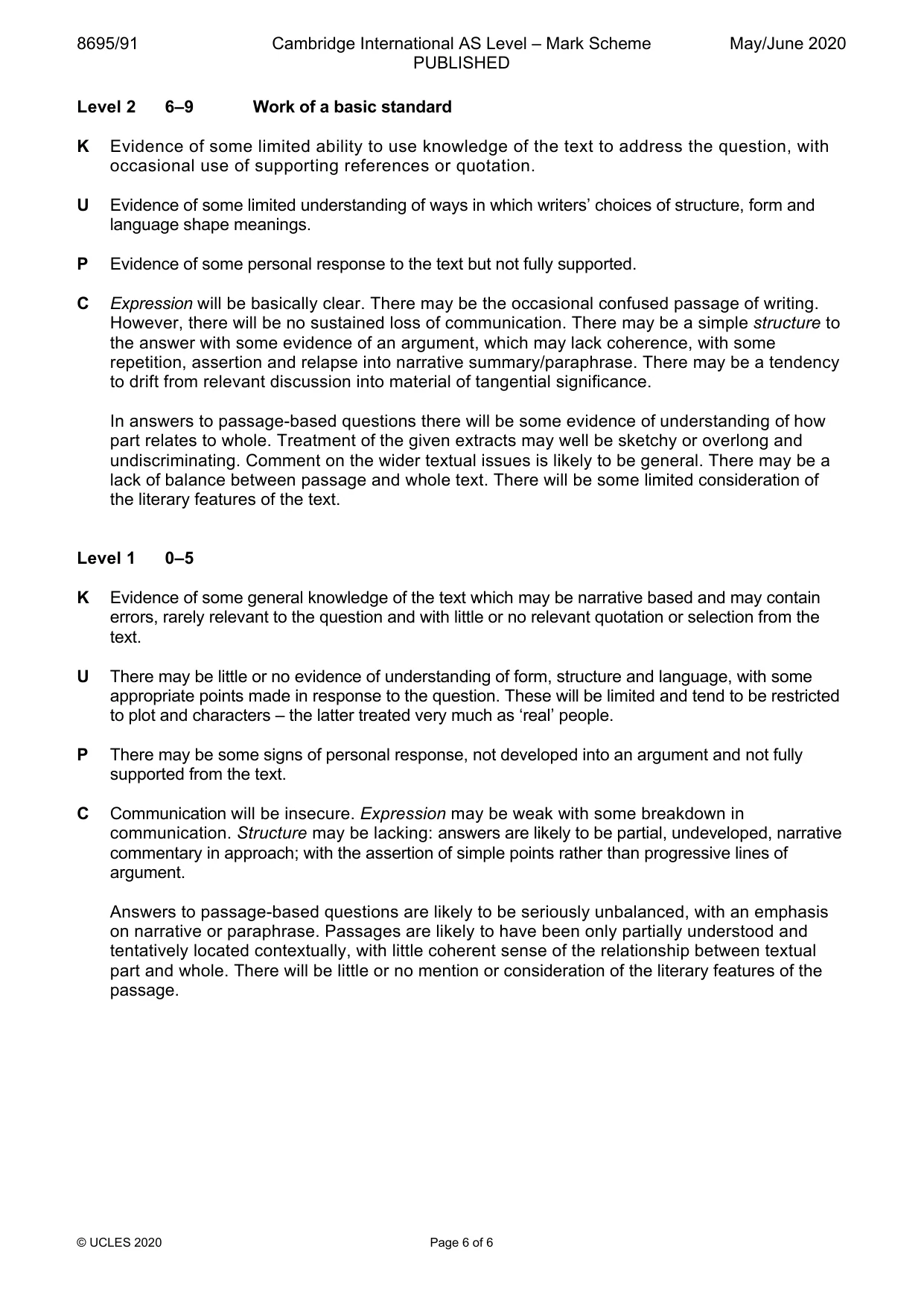
8695/91 Cambridge International AS Level – Mark Scheme PUBLISHED May/June 2020 © UCLES 2020 Page 6 of 6 Level 2 6–9 Work of a basic standard K Evidence of some limited ability to use knowledge of the text to address the question, with occasional use of supporting references or quotation. U Evidence of some limited understanding of ways in which writers’ choices of structure, form and language shape meanings. P Evidence of some personal response to the text but not fully supported. C Expression will be basically clear. There may be the occasional confused passage of writing. However, there will be no sustained loss of communication. There may be a simple structure to the answer with some evidence of an argument, which may lack coherence, with some repetition, assertion and relapse into narrative summary/paraphrase. There may be a tendency to drift from relevant discussion into material of tangential significance. In answers to passage-based questions there will be some evidence of understanding of how part relates to whole. Treatment of the given extracts may well be sketchy or overlong and undiscriminating. Comment on the wider textual issues is likely to be general. There may be a lack of balance between passage and whole text. There will be some limited consideration of the literary features of the text. Level 1 0–5 K Evidence of some general knowledge of the text which may be narrative based and may contain errors, rarely relevant to the question and with little or no relevant quotation or selection from the text. U There may be little or no evidence of understanding of form, structure and language, with some appropriate points made in response to the question. These will be limited and tend to be restricted to plot and characters – the latter treated very much as ‘real’ people. P There may be some signs of personal response, not developed into an argument and not fully supported from the text. C Communication will be insecure. Expression may be weak with some breakdown in communication. Structure may be lacking: answers are likely to be partial, undeveloped, narrative commentary in approach; with the assertion of simple points rather than progressive lines of argument. Answers to passage-based questions are likely to be seriously unbalanced, with an emphasis on narrative or paraphrase. Passages are likely to have been only partially understood and tentatively located contextually, with little coherent sense of the relationship between textual part and whole. There will be little or no mention or consideration of the literary features of the passage.