Cambridge A Level English - Language and Literature (AS Level only, from 2016) 8695 — 2017 Oct/Nov Paper 9 · Variant 2
8695/92/O/N/17 · 50 marks · ≈56 min
The question paper and its mark scheme, free to read here and free to download. This is Cambridge’s own paper, exactly as it was sat.
Question paper20 pages



Mark scheme5 pages
Answers below. Sit the paper first if you are practising.
Paper as text
Question paper, page 1
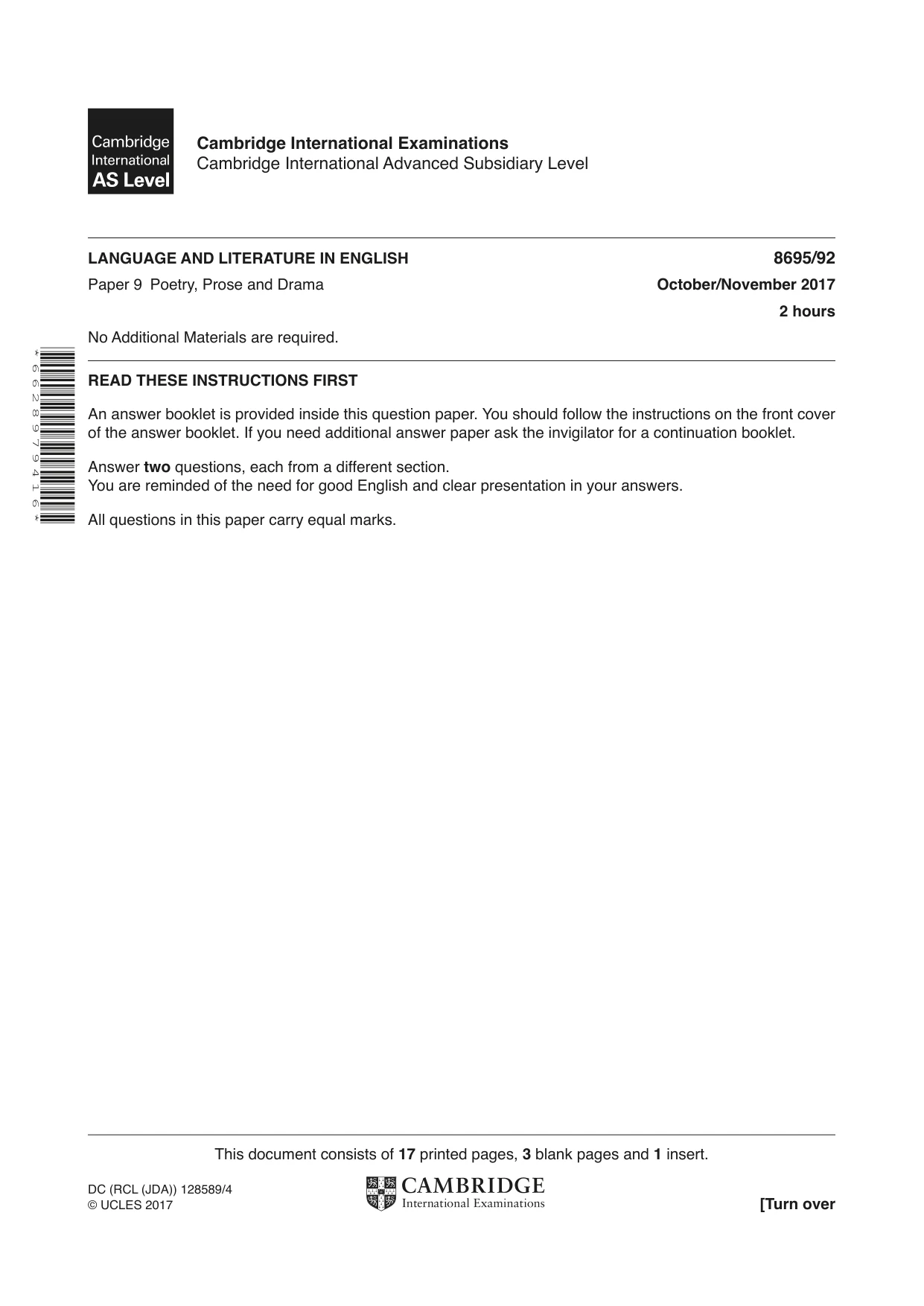
This document consists of 17 printed pages, 3 blank pages and 1 insert. DC (RCL (JDA)) 128589/4 © UCLES 2017 [Turn over Cambridge International Examinations Cambridge International Advanced Subsidiary Level * 6 6 2 8 9 7 9 4 1 6 * LANGUAGE AND LITERATURE IN ENGLISH 8695/92 Paper 9 Poetry, Prose and Drama October/November 2017 2 hours No Additional Materials are required. READ THESE INSTRUCTIONS FIRST An answer booklet is provided inside this question paper. You should follow the instructions on the front cover of the answer booklet. If you need additional answer paper ask the invigilator for a continuation booklet. Answer two questions, each from a different section. You are reminded of the need for good English and clear presentation in your answers. All questions in this paper carry equal marks.
Question paper, page 2
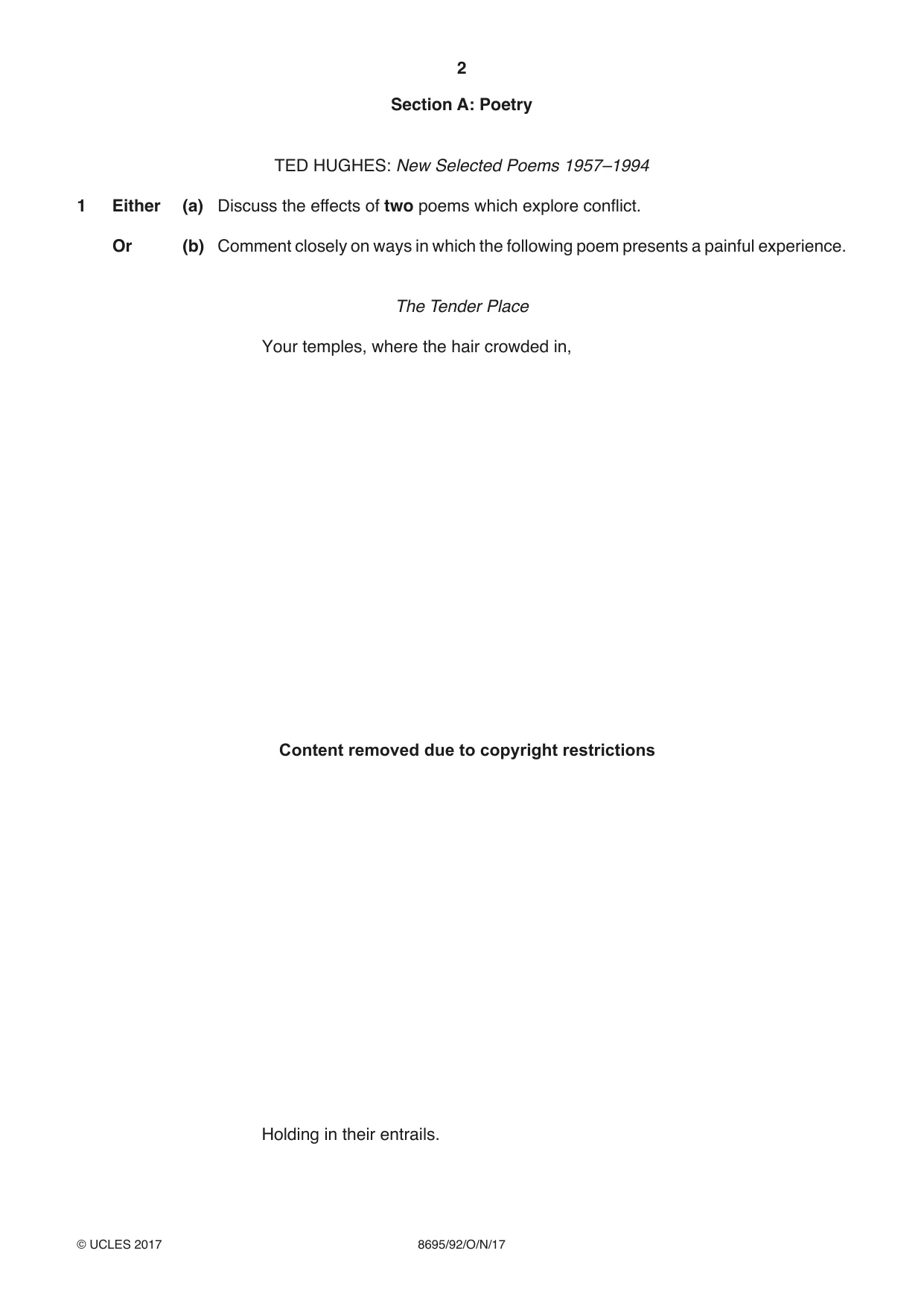
2 8695/92/O/N/17 © UCLES 2017 Section A: Poetry TED HUGHES: New Selected Poems 1957–1994 1 Either (a) Discuss the effects of two poems which explore conflict. Or (b) Comment closely on ways in which the following poem presents a painful experience. The Tender Place Your temples, where the hair crowded in, Content removed due to copyright restrictions Holding in their entrails.
Question paper, page 3
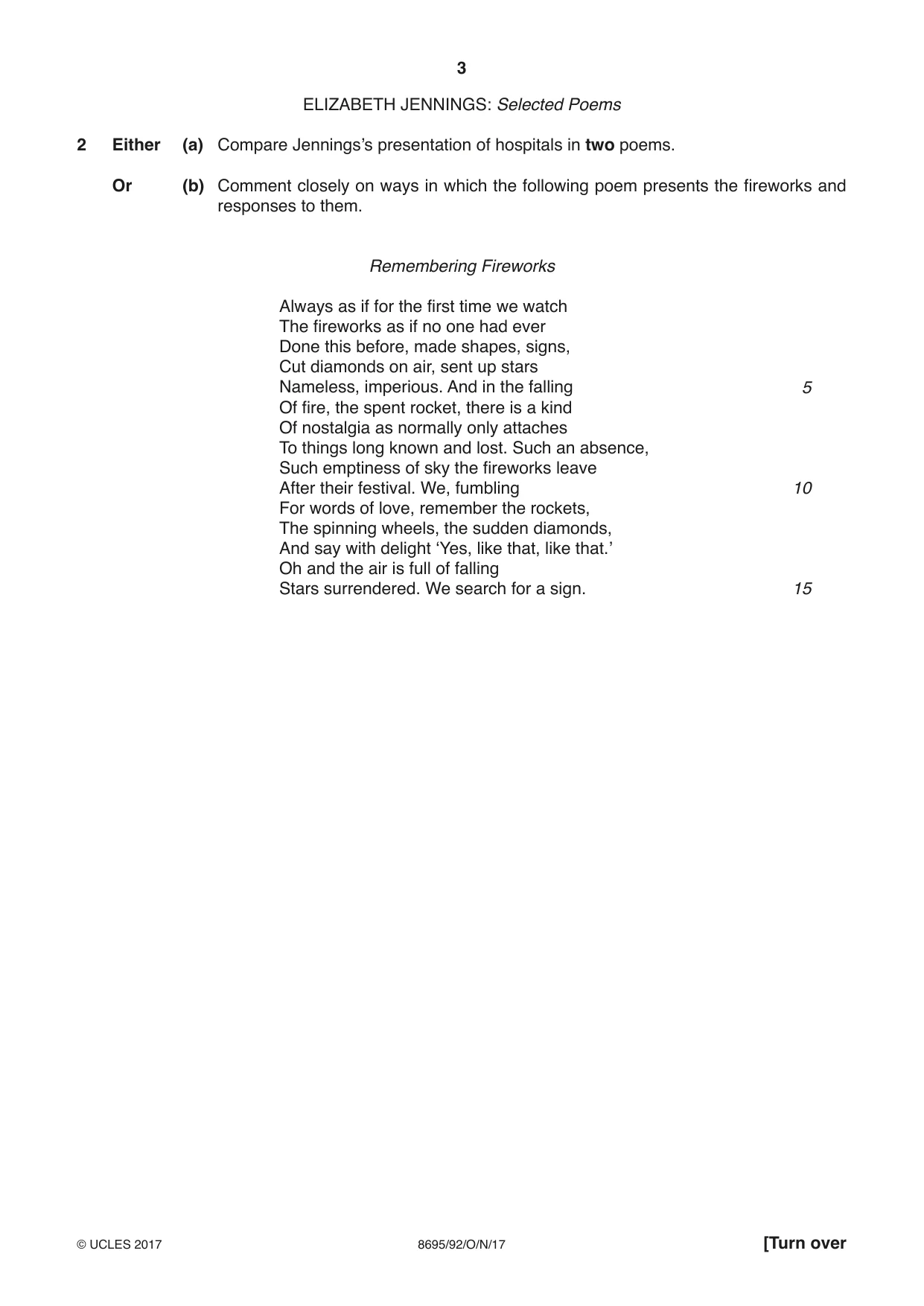
3 8695/92/O/N/17 © UCLES 2017 [Turn over ELIZABETH JENNINGS: Selected Poems 2 Either (a) Compare Jennings’s presentation of hospitals in two poems. Or (b) Comment closely on ways in which the following poem presents the fireworks and responses to them. Remembering Fireworks Always as if for the first time we watch The fireworks as if no one had ever Done this before, made shapes, signs, Cut diamonds on air, sent up stars Nameless, imperious. And in the falling Of fire, the spent rocket, there is a kind Of nostalgia as normally only attaches To things long known and lost. Such an absence, Such emptiness of sky the fireworks leave After their festival. We, fumbling For words of love, remember the rockets, The spinning wheels, the sudden diamonds, And say with delight ‘Yes, like that, like that.’ Oh and the air is full of falling Stars surrendered. We search for a sign. 5 10 15
Question paper, page 4
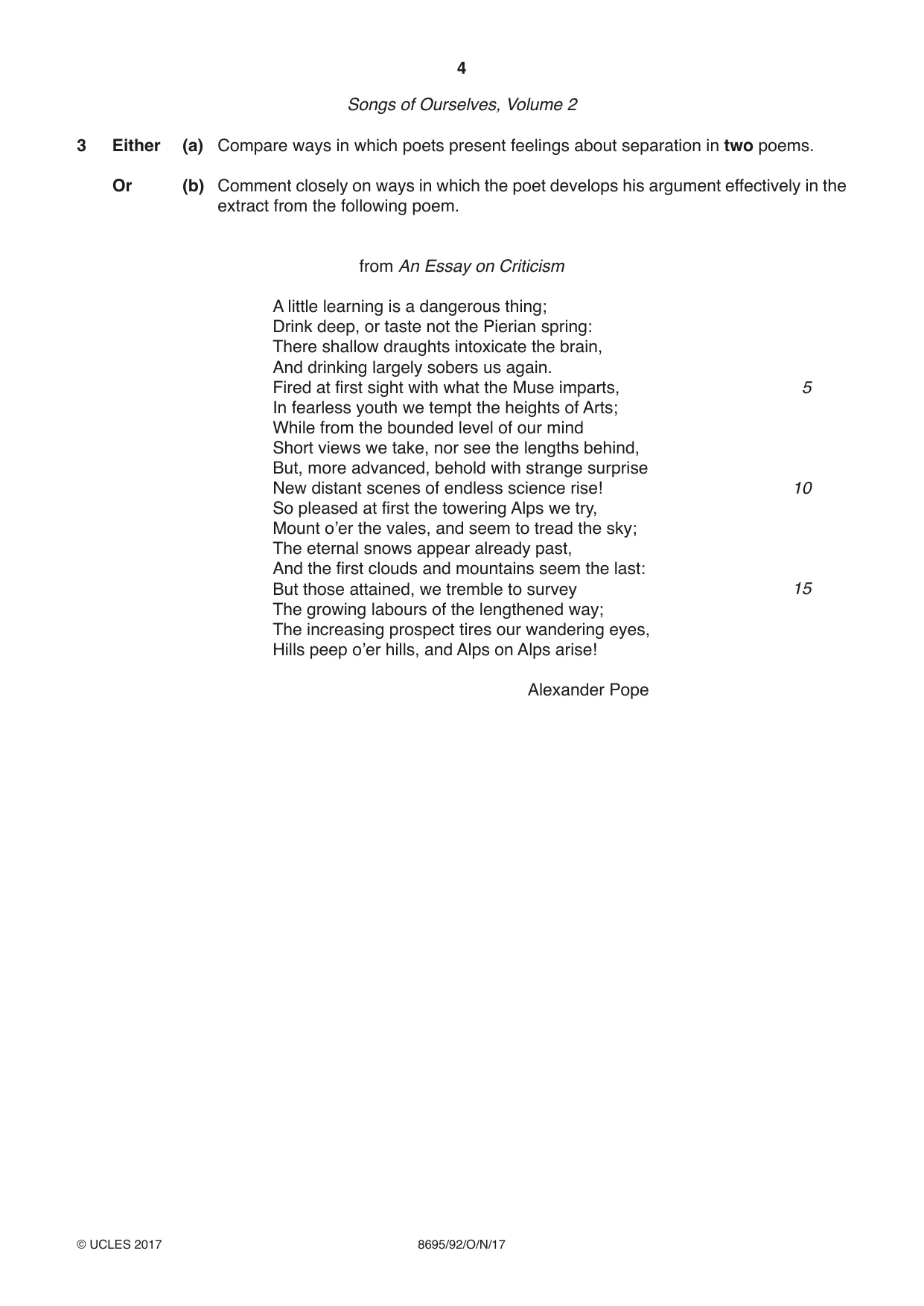
4 8695/92/O/N/17 © UCLES 2017 Songs of Ourselves, Volume 2 3 Either (a) Compare ways in which poets present feelings about separation in two poems. Or (b) Comment closely on ways in which the poet develops his argument effectively in the extract from the following poem. from An Essay on Criticism A little learning is a dangerous thing; Drink deep, or taste not the Pierian spring: There shallow draughts intoxicate the brain, And drinking largely sobers us again. Fired at first sight with what the Muse imparts, In fearless youth we tempt the heights of Arts; While from the bounded level of our mind Short views we take, nor see the lengths behind, But, more advanced, behold with strange surprise New distant scenes of endless science rise! So pleased at first the towering Alps we try, Mount o’er the vales, and seem to tread the sky; The eternal snows appear already past, And the first clouds and mountains seem the last: But those attained, we tremble to survey The growing labours of the lengthened way; The increasing prospect tires our wandering eyes, Hills peep o’er hills, and Alps on Alps arise! Alexander Pope 5 10 15
Question paper, page 5
5 8695/92/O/N/17 © UCLES 2017 [Turn over Turn over for Section B.
Question paper, page 6
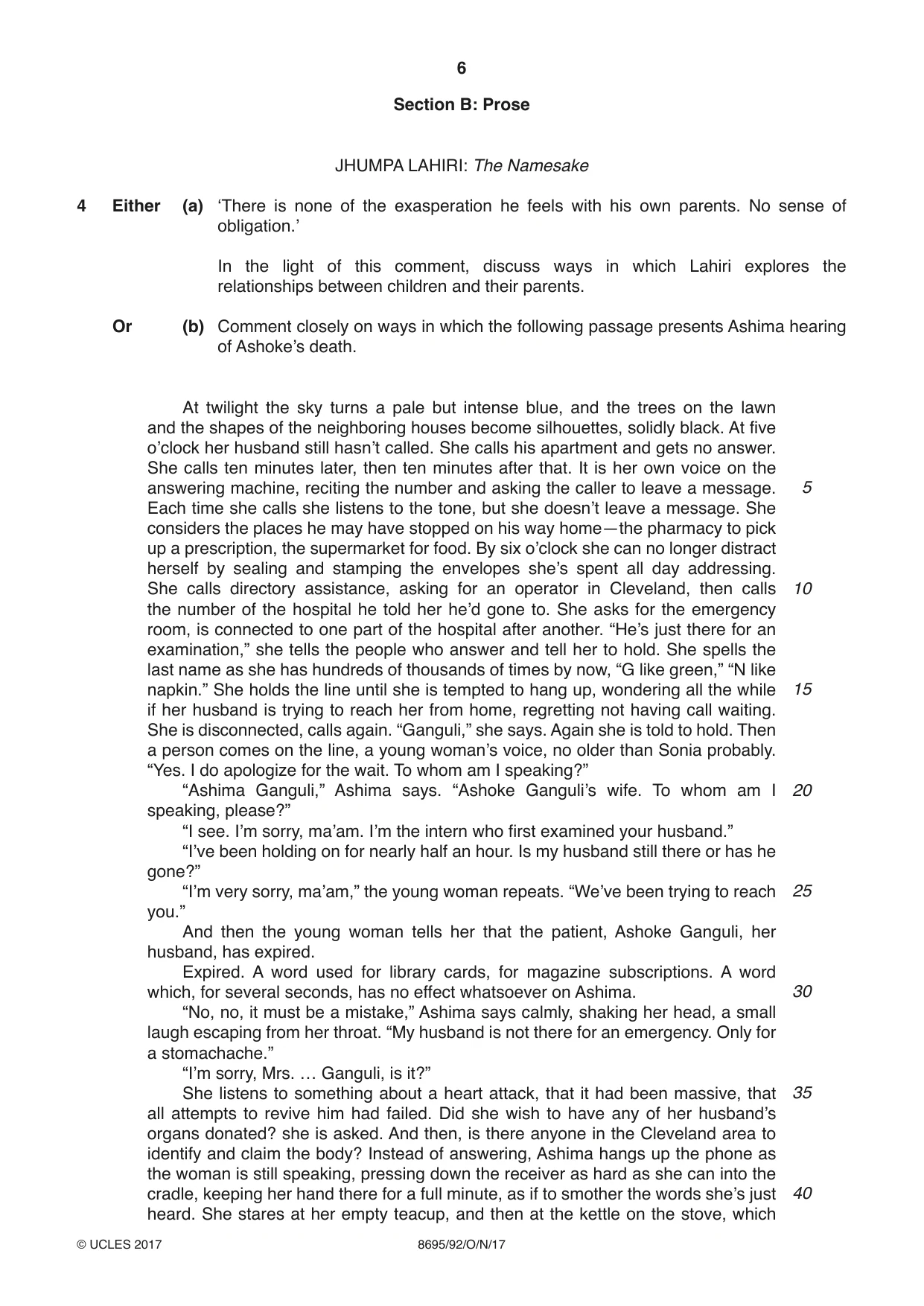
6 8695/92/O/N/17 © UCLES 2017 Section B: Prose JHUMPA LAHIRI: The Namesake 4 Either (a) ‘There is none of the exasperation he feels with his own parents. No sense of obligation.’ In the light of this comment, discuss ways in which Lahiri explores the relationships between children and their parents. Or (b) Comment closely on ways in which the following passage presents Ashima hearing of Ashoke’s death. At twilight the sky turns a pale but intense blue, and the trees on the lawn and the shapes of the neighboring houses become silhouettes, solidly black. At five o’clock her husband still hasn’t called. She calls his apartment and gets no answer. She calls ten minutes later, then ten minutes after that. It is her own voice on the answering machine, reciting the number and asking the caller to leave a message. Each time she calls she listens to the tone, but she doesn’t leave a message. She considers the places he may have stopped on his way home—the pharmacy to pick up a prescription, the supermarket for food. By six o’clock she can no longer distract herself by sealing and stamping the envelopes she’s spent all day addressing. She calls directory assistance, asking for an operator in Cleveland, then calls the number of the hospital he told her he’d gone to. She asks for the emergency room, is connected to one part of the hospital after another. “He’s just there for an examination,” she tells the people who answer and tell her to hold. She spells the last name as she has hundreds of thousands of times by now, “G like green,” “N like napkin.” She holds the line until she is tempted to hang up, wondering all the while if her husband is trying to reach her from home, regretting not having call waiting. She is disconnected, calls again. “Ganguli,” she says. Again she is told to hold. Then a person comes on the line, a young woman’s voice, no older than Sonia probably. “Yes. I do apologize for the wait. To whom am I speaking?” “Ashima Ganguli,” Ashima says. “Ashoke Ganguli’s wife. To whom am I speaking, please?” “I see. I’m sorry, ma’am. I’m the intern who first examined your husband.” “I’ve been holding on for nearly half an hour. Is my husband still there or has he gone?” “I’m very sorry, ma’am,” the young woman repeats. “We’ve been trying to reach you.” And then the young woman tells her that the patient, Ashoke Ganguli, her husband, has expired. Expired. A word used for library cards, for magazine subscriptions. A word which, for several seconds, has no effect whatsoever on Ashima. “No, no, it must be a mistake,” Ashima says calmly, shaking her head, a small laugh escaping from her throat. “My husband is not there for an emergency. Only for a stomachache.” “I’m sorry, Mrs. … Ganguli, is it?” She listens to something about a heart attack, that it had been massive, that all attempts to revive him had failed. Did she wish to have any of her husband’s organs donated? she is asked. And then, is there anyone in the Cleveland area to identify and claim the body? Instead of answering, Ashima hangs up the phone as the woman is still speaking, pressing down the receiver as hard as she can into the cradle, keeping her hand there for a full minute, as if to smother the words she’s just heard. She stares at her empty teacup, and then at the kettle on the stove, which 5 10 15 20 25 30 35 40
Question paper, page 7
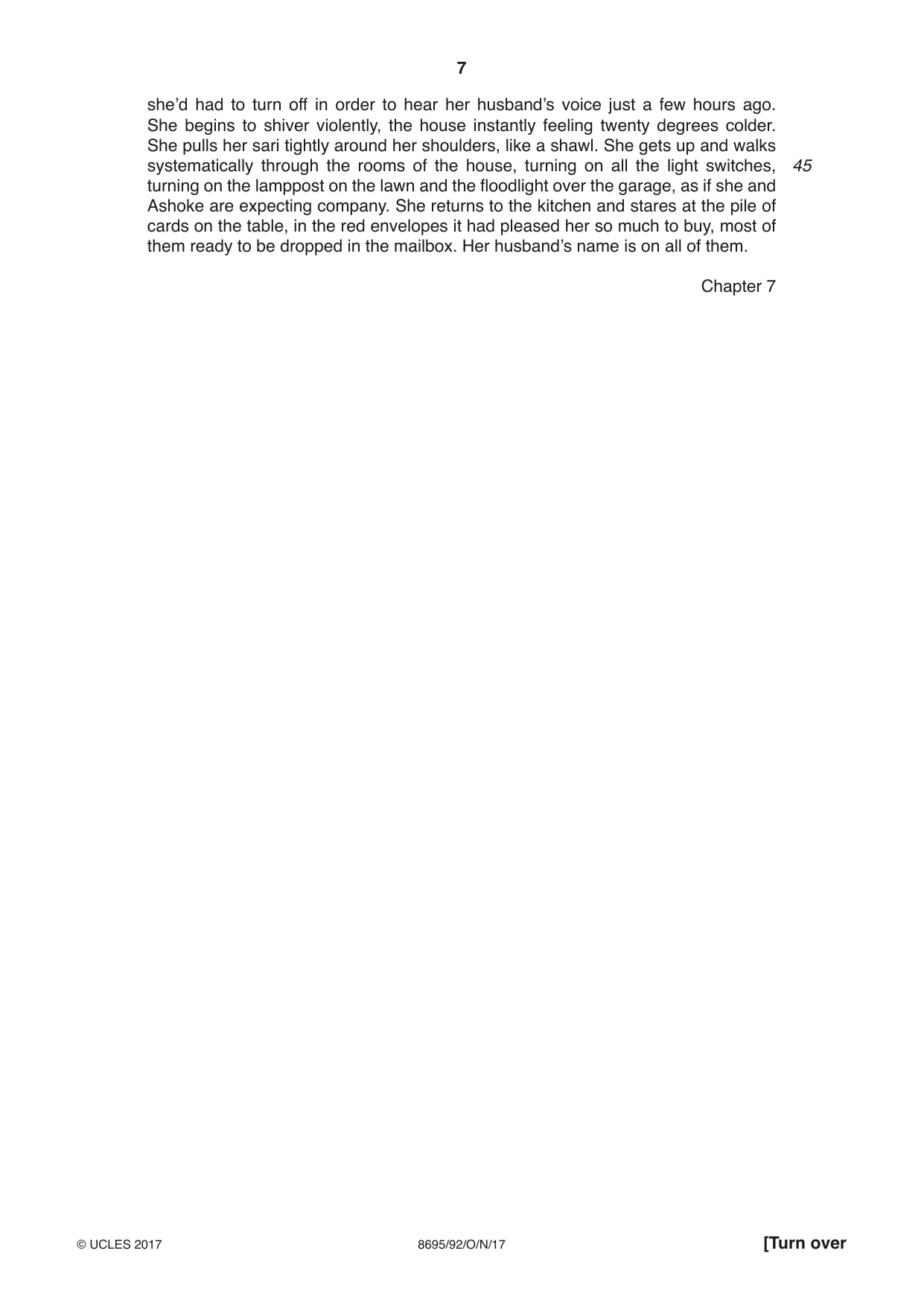
7 8695/92/O/N/17 © UCLES 2017 [Turn over she’d had to turn off in order to hear her husband’s voice just a few hours ago. She begins to shiver violently, the house instantly feeling twenty degrees colder. She pulls her sari tightly around her shoulders, like a shawl. She gets up and walks systematically through the rooms of the house, turning on all the light switches, turning on the lamppost on the lawn and the floodlight over the garage, as if she and Ashoke are expecting company. She returns to the kitchen and stares at the pile of cards on the table, in the red envelopes it had pleased her so much to buy, most of them ready to be dropped in the mailbox. Her husband’s name is on all of them. Chapter 7 45
Question paper, page 8
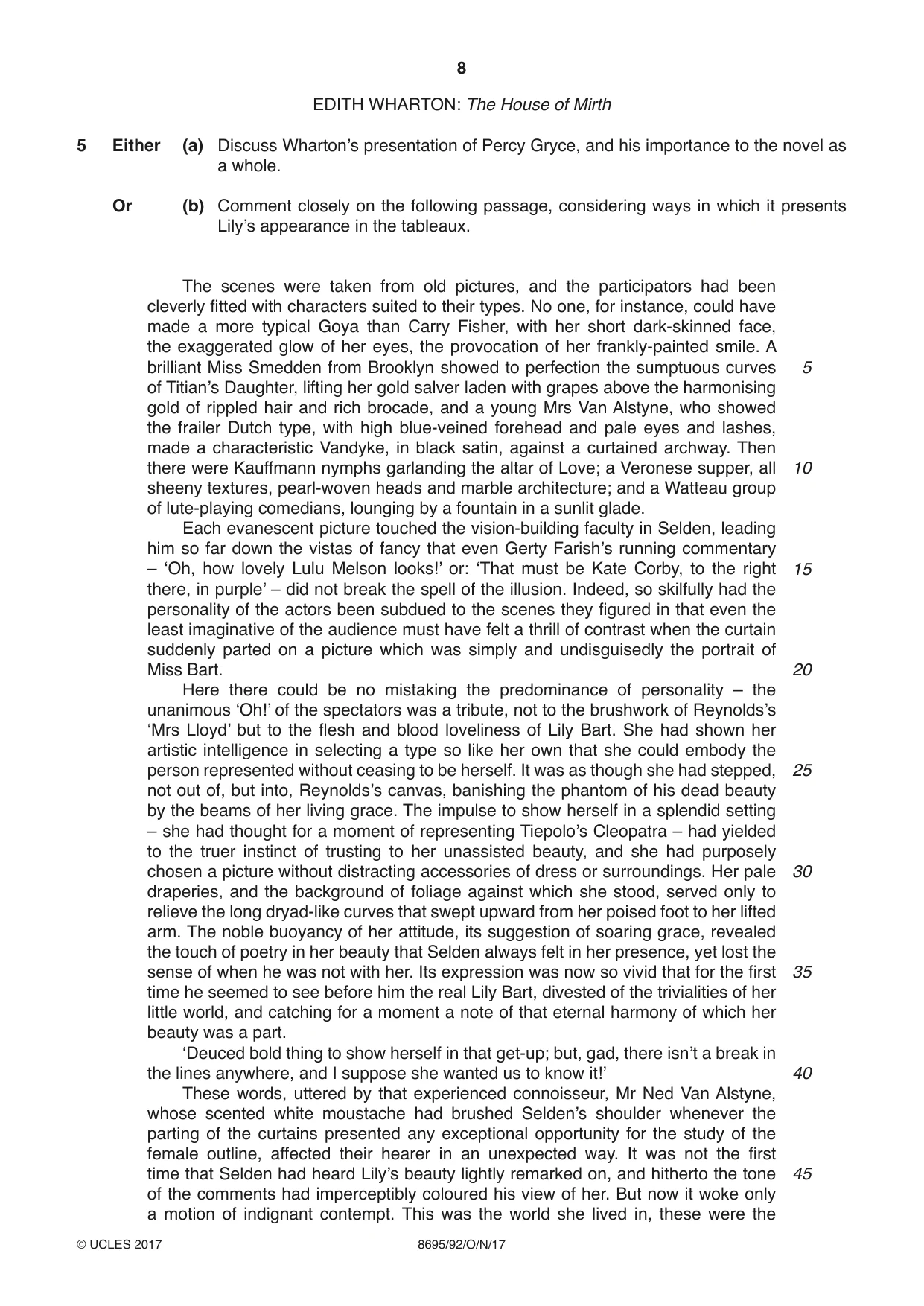
8 8695/92/O/N/17 © UCLES 2017 EDITH WHARTON: The House of Mirth 5 Either (a) Discuss Wharton’s presentation of Percy Gryce, and his importance to the novel as a whole. Or (b) Comment closely on the following passage, considering ways in which it presents Lily’s appearance in the tableaux. The scenes were taken from old pictures, and the participators had been cleverly fitted with characters suited to their types. No one, for instance, could have made a more typical Goya than Carry Fisher, with her short dark-skinned face, the exaggerated glow of her eyes, the provocation of her frankly-painted smile. A brilliant Miss Smedden from Brooklyn showed to perfection the sumptuous curves of Titian’s Daughter, lifting her gold salver laden with grapes above the harmonising gold of rippled hair and rich brocade, and a young Mrs Van Alstyne, who showed the frailer Dutch type, with high blue-veined forehead and pale eyes and lashes, made a characteristic Vandyke, in black satin, against a curtained archway. Then there were Kauffmann nymphs garlanding the altar of Love; a Veronese supper, all sheeny textures, pearl-woven heads and marble architecture; and a Watteau group of lute-playing comedians, lounging by a fountain in a sunlit glade. Each evanescent picture touched the vision-building faculty in Selden, leading him so far down the vistas of fancy that even Gerty Farish’s running commentary – ‘Oh, how lovely Lulu Melson looks!’ or: ‘That must be Kate Corby, to the right there, in purple’ – did not break the spell of the illusion. Indeed, so skilfully had the personality of the actors been subdued to the scenes they figured in that even the least imaginative of the audience must have felt a thrill of contrast when the curtain suddenly parted on a picture which was simply and undisguisedly the portrait of Miss Bart. Here there could be no mistaking the predominance of personality – the unanimous ‘Oh!’ of the spectators was a tribute, not to the brushwork of Reynolds’s ‘Mrs Lloyd’ but to the flesh and blood loveliness of Lily Bart. She had shown her artistic intelligence in selecting a type so like her own that she could embody the person represented without ceasing to be herself. It was as though she had stepped, not out of, but into, Reynolds’s canvas, banishing the phantom of his dead beauty by the beams of her living grace. The impulse to show herself in a splendid setting – she had thought for a moment of representing Tiepolo’s Cleopatra – had yielded to the truer instinct of trusting to her unassisted beauty, and she had purposely chosen a picture without distracting accessories of dress or surroundings. Her pale draperies, and the background of foliage against which she stood, served only to relieve the long dryad-like curves that swept upward from her poised foot to her lifted arm. The noble buoyancy of her attitude, its suggestion of soaring grace, revealed the touch of poetry in her beauty that Selden always felt in her presence, yet lost the sense of when he was not with her. Its expression was now so vivid that for the first time he seemed to see before him the real Lily Bart, divested of the trivialities of her little world, and catching for a moment a note of that eternal harmony of which her beauty was a part. ‘Deuced bold thing to show herself in that get-up; but, gad, there isn’t a break in the lines anywhere, and I suppose she wanted us to know it!’ These words, uttered by that experienced connoisseur, Mr Ned Van Alstyne, whose scented white moustache had brushed Selden’s shoulder whenever the parting of the curtains presented any exceptional opportunity for the study of the female outline, affected their hearer in an unexpected way. It was not the first time that Selden had heard Lily’s beauty lightly remarked on, and hitherto the tone of the comments had imperceptibly coloured his view of her. But now it woke only a motion of indignant contempt. This was the world she lived in, these were the 5 10 15 20 25 30 35 40 45
Question paper, page 9
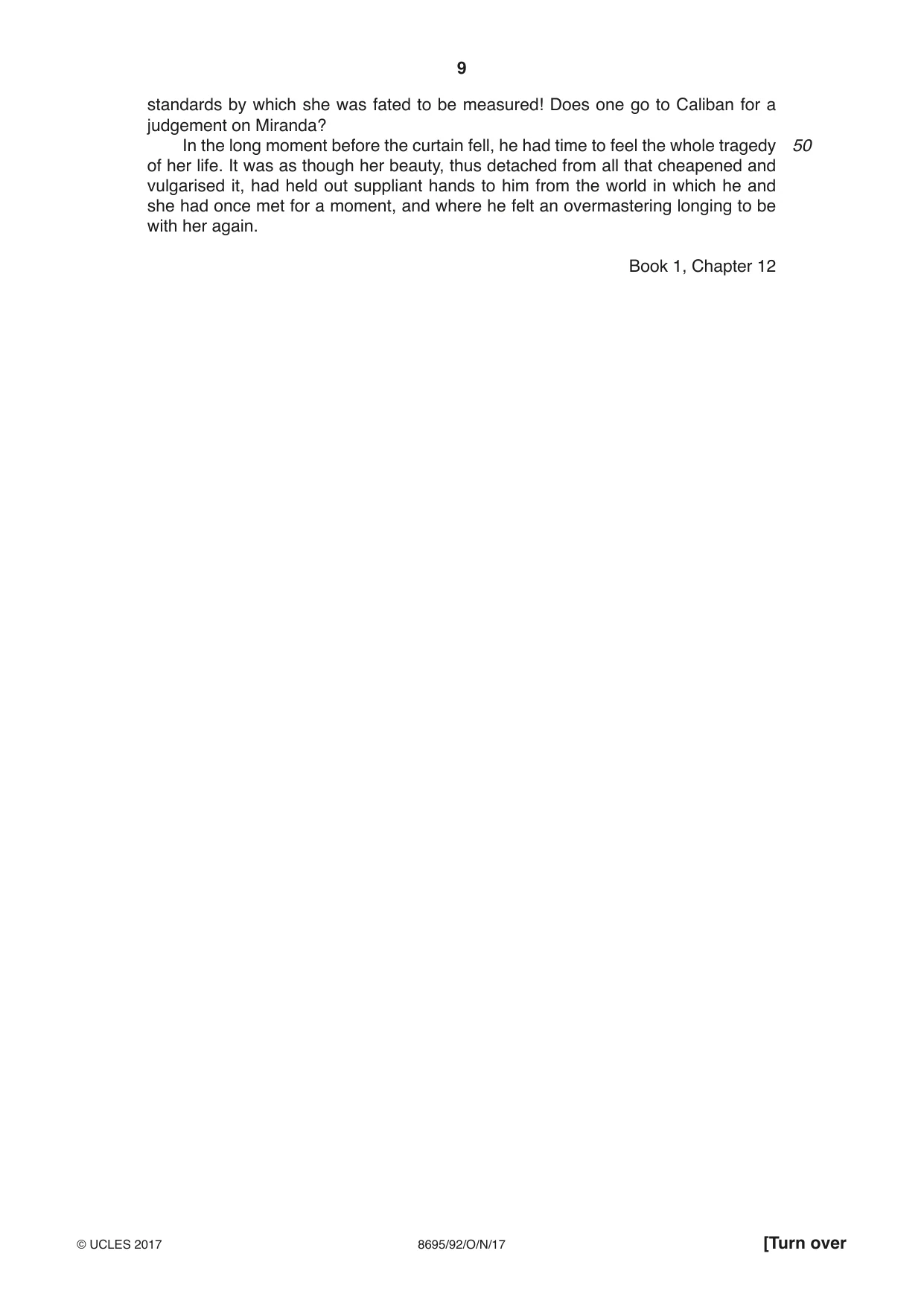
9 8695/92/O/N/17 © UCLES 2017 [Turn over standards by which she was fated to be measured! Does one go to Caliban for a judgement on Miranda? In the long moment before the curtain fell, he had time to feel the whole tragedy of her life. It was as though her beauty, thus detached from all that cheapened and vulgarised it, had held out suppliant hands to him from the world in which he and she had once met for a moment, and where he felt an overmastering longing to be with her again. Book 1, Chapter 12 50
Question paper, page 10
10 8695/92/O/N/17 © UCLES 2017 Stories of Ourselves 6 Either (a) Compare ways in which writers present characters making important discoveries in two stories. Or (b) Comment closely on the presentation of the relationship between Royal and his wife in the following passage from Five-Twenty. Most evenings, weather permitting, the Natwicks sat on the front veranda to watch the traffic. During the day the stream flowed, but towards five it began to thicken, it sometimes jammed solid like: the semi-trailers and refrigeration units, the decent old-style sedans, the mini-cars, the bombs, the Holdens and the Holdens. She didn’t know most of the names. Royal did, he was a man, though never ever mechanical himself. She liked him to tell her about the vehicles, or listen to him take part in conversation with anyone who stopped at the fence. He could hold his own, on account of he was more educated, and an invalid has time to think. They used to sit side by side on the tiled veranda, him in his wheelchair she had got him after the arthritis took over, her in the old cane. The old cane chair wasn’t hardly presentable any more; she had torn her winter cardy on a nail and laddered several pair of stockings. You hadn’t the heart to get rid of it, though. They brought it with them from Sarsaparilla after they sold the business. And now they could sit in comfort to watch the traffic, the big steel insects of nowadays, which put the wind up her at times. Royal said, ‘I reckon we’re a shingle short to’uv ended up on the Parramatta Road.’ ‘You said we’d still see life,’ she reminded, ‘even if we lost the use of our legs.’ ‘But look at the traffic! Worse every year. And air. Rot a man’s lungs quicker than the cigarettes. You should’uv headed me off. You who’s supposed to be practical!’ ‘I thought it was what you wanted,’ she said, keeping it soft; she had never been one to crow. ‘Anyway, I already lost the use of me legs.’ As if she was to blame for that too. She was so shocked the chair sort of jumped. It made her blood run cold to hear the metal feet screak against the little draught- board tiles. ‘Well, I ’aven’t!’ she protested. ‘I got me legs, and will be able to get from ’ere to anywhere and bring ’ome the shopping. While I got me strength.’ She tried never to upset him by any show of emotion, but now she was so upset herself. They watched the traffic in the evenings, as the orange light was stacked up in thick slabs, and the neon signs were coming on. ‘See that bloke down there in the parti-coloured Holden?’ ‘Which?’ she asked. ‘The one level with our own gate.’ ‘The pink and brown?’ She couldn’t take all that interest tonight, only you must never stop humouring a sick man. ‘Yairs. Pink. Fancy a man in a pink car!’ ‘Dusty pink is fashionable.’ She knew that for sure. ‘But a man!’ ‘Perhaps his wife chose it. Perhaps he’s got a domineering wife.’ Royal laughed low. ‘Looks the sort of coot who might like to be domineered, and if that’s what he wants, it’s none of our business, is it?’ 5 10 15 20 25 30 35 40 45
Question paper, page 11
11 8695/92/O/N/17 © UCLES 2017 [Turn over She laughed to keep him company. They were such mates, everybody said. And it was true. She didn’t know what she would do if Royal passed on first. That evening the traffic had jammed. Some of the drivers began tooting. Some of them stuck their heads out, and yarned to one another. But the man in the pink- and-brown Holden just sat. He didn’t look to either side. Come to think of it, she had noticed him pass before. Yes. Though he wasn’t in no way a noticeable man. Yes. She looked at her watch. ‘Five-twenty,’ she said. ‘I seen that man in the pink-and-brown before. He’s pretty regular. Looks like a business executive.’ Royal cleared his throat and spat. It didn’t make the edge of the veranda. Better not to notice it, because he’d only create if she did. She’d get out the watering-can after she had pushed him inside. ‘Business executives!’ she heard. ‘They’re afraid people are gunner think they’re poor class without they execute. In our day nobody was ashamed to do. Isn’t that about right, eh?’ She didn’t answer because she knew she wasn’t meant to. ‘Funny sort of head that cove’s got. Like it was half squashed. Silly-lookun bloody head!’ ‘Could have been born with it,’ she suggested. ‘Can’t help what you’re born with. Like your religion.’ Five-Twenty 50 55 60
Question paper, page 12
12 8695/92/O/N/17 © UCLES 2017 Section C: Drama AMA ATA AIDOO: The Dilemma of a Ghost and Anowa 7 Either (a) In what ways, and with what effects, does Aidoo present the relationship between characters and the societies in which they grew up? Or (b) What, in your view, is the dramatic significance of the following extract at this point in the play? You should refer closely to both language and action. [ANOWA enters unnoticed and stands at the door. Content removed due to copyright restrictions
Question paper, page 13
13 8695/92/O/N/17 © UCLES 2017 [Turn over Content removed due to copyright restrictions Anowa, Phase 3 be a woman? [Then she remembers the children.] Panyin! Stop fanning that chair.
Question paper, page 14
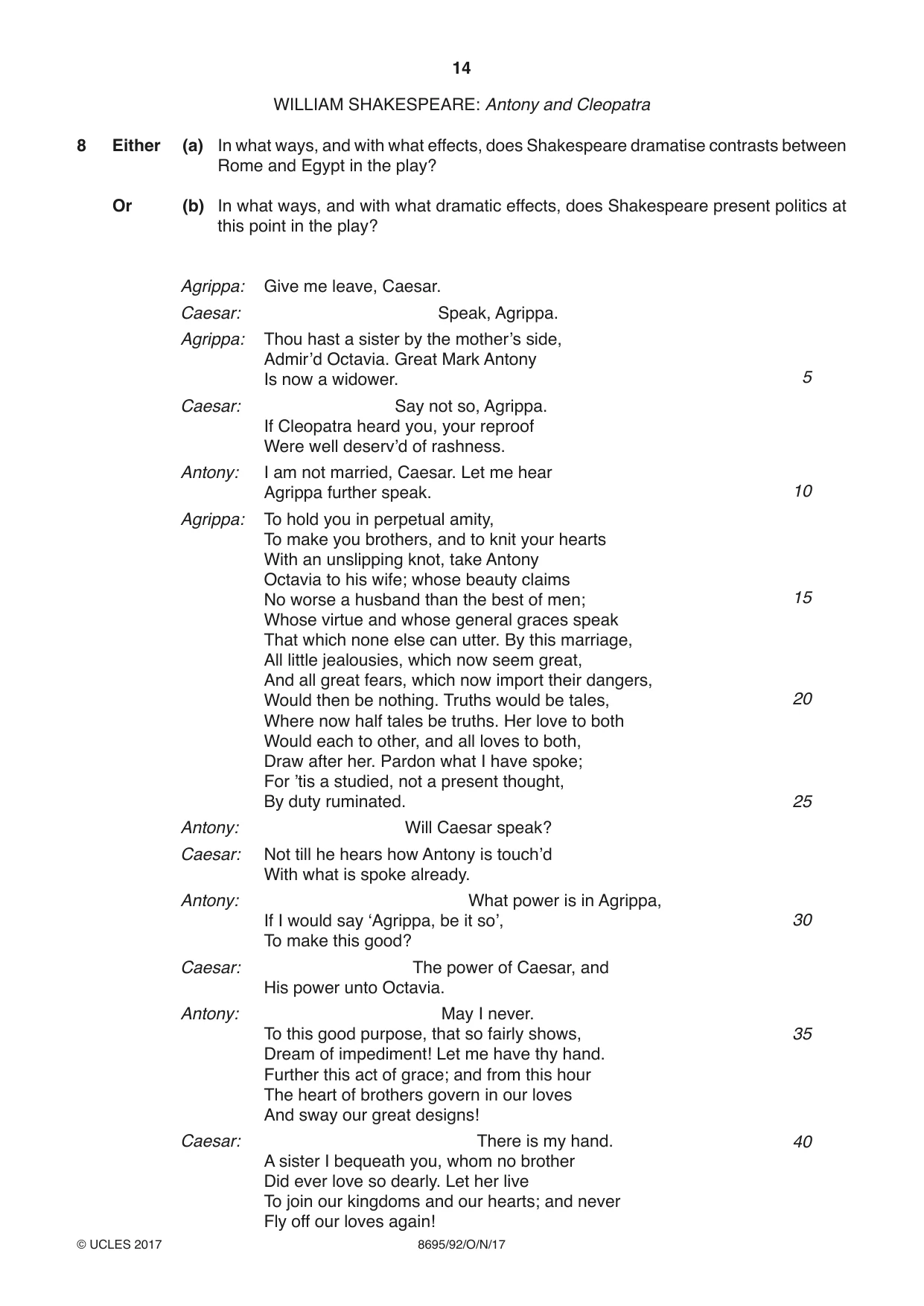
14 8695/92/O/N/17 © UCLES 2017 WILLIAM SHAKESPEARE: Antony and Cleopatra 8 Either (a) In what ways, and with what effects, does Shakespeare dramatise contrasts between Rome and Egypt in the play? Or (b) In what ways, and with what dramatic effects, does Shakespeare present politics at this point in the play? Agrippa: Give me leave, Caesar. Caesar: Speak, Agrippa. Agrippa: Thou hast a sister by the mother’s side, Admir’d Octavia. Great Mark Antony Is now a widower. Caesar: Say not so, Agrippa. If Cleopatra heard you, your reproof Were well deserv’d of rashness. Antony: I am not married, Caesar. Let me hear Agrippa further speak. Agrippa: To hold you in perpetual amity, To make you brothers, and to knit your hearts With an unslipping knot, take Antony Octavia to his wife; whose beauty claims No worse a husband than the best of men; Whose virtue and whose general graces speak That which none else can utter. By this marriage, All little jealousies, which now seem great, And all great fears, which now import their dangers, Would then be nothing. Truths would be tales, Where now half tales be truths. Her love to both Would each to other, and all loves to both, Draw after her. Pardon what I have spoke; For ’tis a studied, not a present thought, By duty ruminated. Antony: Will Caesar speak? Caesar: Not till he hears how Antony is touch’d With what is spoke already. Antony: What power is in Agrippa, If I would say ‘Agrippa, be it so’, To make this good? Caesar: The power of Caesar, and His power unto Octavia. Antony: May I never. To this good purpose, that so fairly shows, Dream of impediment! Let me have thy hand. Further this act of grace; and from this hour The heart of brothers govern in our loves And sway our great designs! Caesar: There is my hand. A sister I bequeath you, whom no brother Did ever love so dearly. Let her live To join our kingdoms and our hearts; and never Fly off our loves again! 5 10 15 20 25 30 35 40
Question paper, page 15
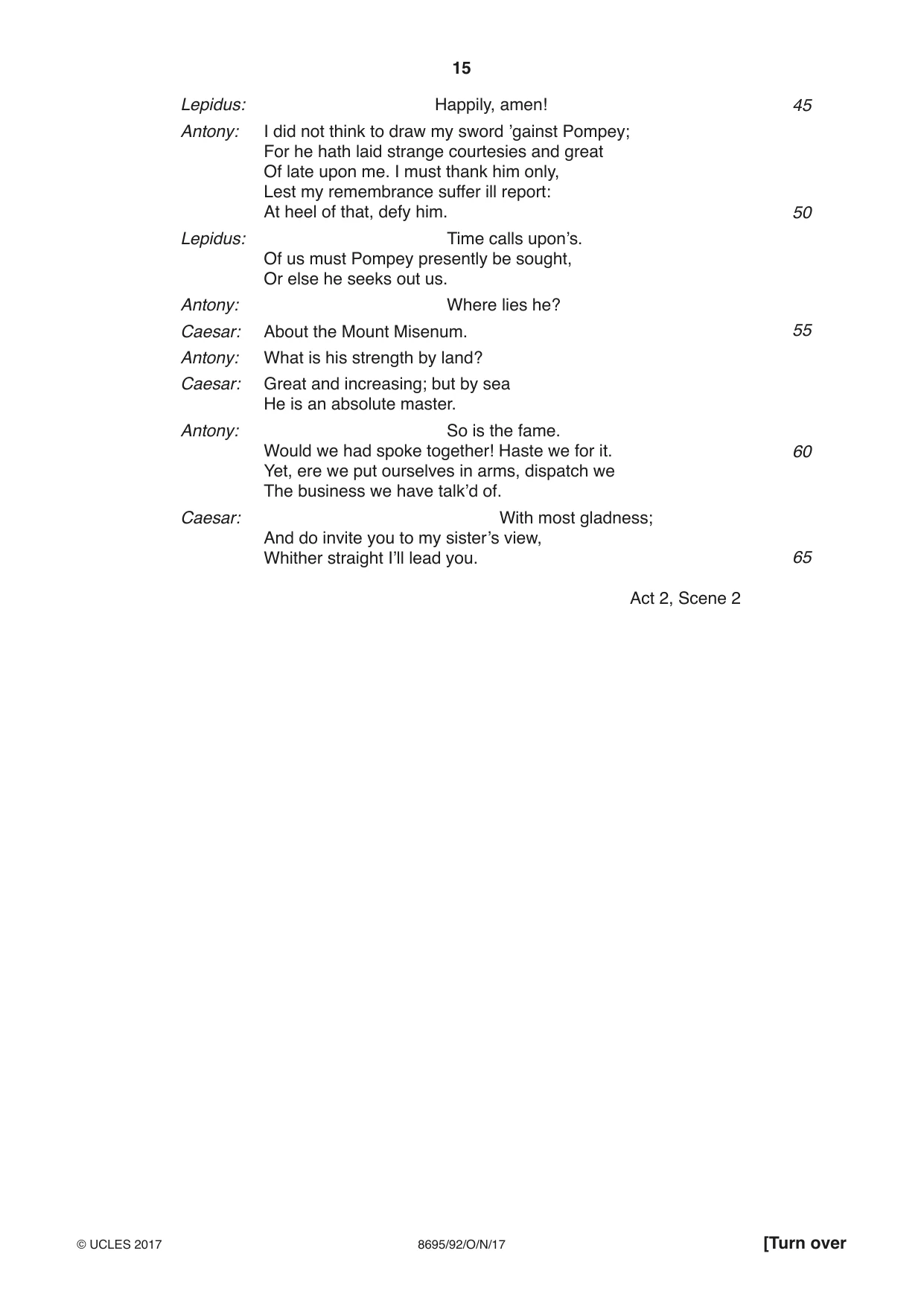
15 8695/92/O/N/17 © UCLES 2017 Lepidus: Happily, amen! Antony: I did not think to draw my sword ’gainst Pompey; For he hath laid strange courtesies and great Of late upon me. I must thank him only, Lest my remembrance suffer ill report: At heel of that, defy him. Lepidus: Time calls upon’s. Of us must Pompey presently be sought, Or else he seeks out us. Antony: Where lies he? Caesar: About the Mount Misenum. Antony: What is his strength by land? Caesar: Great and increasing; but by sea He is an absolute master. Antony: So is the fame. Would we had spoke together! Haste we for it. Yet, ere we put ourselves in arms, dispatch we The business we have talk’d of. Caesar: With most gladness; And do invite you to my sister’s view, Whither straight I’ll lead you. Act 2, Scene 2 45 50 55 60 65 [Turn over
Question paper, page 16
16 8695/92/O/N/17 © UCLES 2017 BRIAN FRIEL: Philadelphia, Here I Come! 9 Either (a) Discuss the presentation and dramatic significance of the Sweeneys in the play as a whole. Or (b) In what ways, and with what dramatic effects, does Friel present Gar’s fantasy life in the following extract? You should make close reference to both language and action. Private: What the hell had you to go and ask that for! Snap, boy, snap! Content removed due to copyright restrictions
Question paper, page 17
17 8695/92/O/N/17 © UCLES 2017 Content removed due to copyright restrictions Yah-ooooo. Episode 3
Question paper, page 18
18 8695/92/O/N/17 © UCLES 2017 BLANK PAGE
Question paper, page 19
19 8695/92/O/N/17 © UCLES 2017 BLANK PAGE
Question paper, page 20
20 8695/92/O/N/17 © UCLES 2017 Permission to reproduce items where third-party owned material protected by copyright is included has been sought and cleared where possible. Every reasonable effort has been made by the publisher (UCLES) to trace copyright holders, but if any items requiring clearance have unwittingly been included, the publisher will be pleased to make amends at the earliest possible opportunity. To avoid the issue of disclosure of answer-related information to candidates, all copyright acknowledgements are reproduced online in the Cambridge International Examinations Copyright Acknowledgements Booklet. This is produced for each series of examinations and is freely available to download at www.cie.org.uk after the live examination series. Cambridge International Examinations is part of the Cambridge Assessment Group. Cambridge Assessment is the brand name of University of Cambridge Local Examinations Syndicate (UCLES), which is itself a department of the University of Cambridge. BLANK PAGE
Mark scheme, page 1
® IGCSE is a registered trademark. This document consists of 5 printed pages. © UCLES 2017 [Turn over Cambridge Assessment International Education Cambridge International Advanced Subsidiary Level LANGUAGE AND LITERATURE IN ENGLISH 8695/92 Paper 9 Poetry, Prose and Drama October/November 2017 MARK SCHEME Maximum Mark: 50 Published This mark scheme is published as an aid to teachers and candidates, to indicate the requirements of the examination. It shows the basis on which Examiners were instructed to award marks. It does not indicate the details of the discussions that took place at an Examiners’ meeting before marking began, which would have considered the acceptability of alternative answers. Mark schemes should be read in conjunction with the question paper and the Principal Examiner Report for Teachers. Cambridge International will not enter into discussions about these mark schemes. Cambridge International is publishing the mark schemes for the October/November 2017 series for most Cambridge IGCSE®, Cambridge International A and AS Level components and some Cambridge O Level components.
Mark scheme, page 2
8695/92 Cambridge International AS Level – Mark Scheme PUBLISHED October/November 2017 © UCLES 2017 Page 2 of 5 Introduction For general administrative guidance, see Notes for Examiners Handbook. Assessment objectives AO1 The ability to respond to texts in the three main forms (Prose, Poetry and Drama) of different types and from different cultures. AO2 An understanding of the ways in which writers’ choices of form, structure and language shape meanings. AO3 The ability to produce informed, independent opinions and judgements on literary texts. AO4 The ability to communicate clearly the knowledge, understanding and insight appropriate for literary study. Each answer is marked out of 25, in accordance with the levels mark scheme. Each level is divided into strands: Knowledge (K), Understanding (U), Personal Response (P) and Communication (C). Using the levels mark scheme Place the answer in a level first. Look for the “best fit” of the answer into a level. An answer needs to show evidence of most but not necessarily all of the qualities described in a level, in order to be placed in that level. Then award a mark for the relative position of the answer within the level. Candidates may address the question in many different ways. Do not expect any particular focus or approach and do not penalise answers for leaving out a particular focus. Reward what is there, showing what you are rewarding, in your comments. Consider all strands and weigh up the performance as a whole in placing the answer in a level, then show that you have done so in the summative comment, e.g. Sound K of texts, some evidence of U but mostly narrative, occasional evidence of P, mainly clear C. Principles of Annotation Annotating English Literature scripts has the following purposes: • to follow best practice in assessing English Literature essays • to record the comments and developing thought of the examiner doing the work of assessment • to facilitate the summative comments and overall mark given to an essay. The annotations made on scripts become public property following marking and may be cited as evidence in case of appeal. Annotations are therefore vital, not just in ensuring the mark given is what the student deserves, but also in making the marking process demonstrably clear to any potential reader.
Mark scheme, page 3
8695/92 Cambridge International AS Level – Mark Scheme PUBLISHED October/November 2017 © UCLES 2017 Page 3 of 5 Level 6 22–25 Very good work – do not reserve this level for the very best work you see but ensure you put scripts into this level which fulfil the requirements described below. There will always be some candidates who are at a standard over the top of the mark scheme. K Evidence of a very good ability to select relevant knowledge to address the question with effective use of references and quotation. There may be evidence of sensitive awareness of the contexts in which the literary works studied were written and understood. U Evidence of very good understanding of ways in which writers’ choices of structure, form and language shape meanings with sustained analysis and sensitive appreciation of literary methods and effects and contexts, possibly including literary genres and conventions. P Personal response to texts will be perceptive, often freshly personal, fully supported with quotation, and may show originality in approach to and treatment of questions. C Candidates will express complex literary ideas and arguments with clarity and fluency. Answers will have a coherent structure, with logical progression and effectively linked paragraphs. Expression will be accomplished and appropriate. In answers to passage-based questions, work will sustain an appropriate balance between critical appreciation of given extracts, based on detailed critical analysis, and consideration of the broader textual issues raised by the questions, and relate part of a text to its whole and vice versa in a seamless argument. There will be a very good appreciation of the effects of the literary features of the text, with detailed analysis supported by relevant examples from the passage and the wider text, where appropriate. There will be a very good knowledge of the appropriate context of the extract or work. Level 5 18–21 Proficient work K Evidence of proficiency in selecting relevant knowledge to address the question with precise and integrated direct references to the text and supporting quotation. There may be evidence of awareness of the contexts in which the literary works studied were written and understood. U Evidence of intelligent understanding of ways in which writers’ choices of structure, form and language shape meanings, with analysis and appreciation of literary methods, effects and contexts. P Evidence of personal response to the texts, relevant to the question, supported from the text, some originality of thought, straightforward and vigorously articulated, perhaps, rather than penetrating and subtle. C Expression confident, with some complex ideas expressed with some fluency. Structure is sound. Literary arguments will be coherent, with progression of ideas through clearly linked paragraphs. In answers to passage-based questions, work will show engagement with both the given extracts and the wider textual issues. There will be a confident relation of a part of the text to its whole. There will be a proficient appreciation of the effects of the literary features of the text supported by relevant examples from the passage and from the wider text where appropriate. There will be a good knowledge of the appropriate context of the extract or work.
Mark scheme, page 4
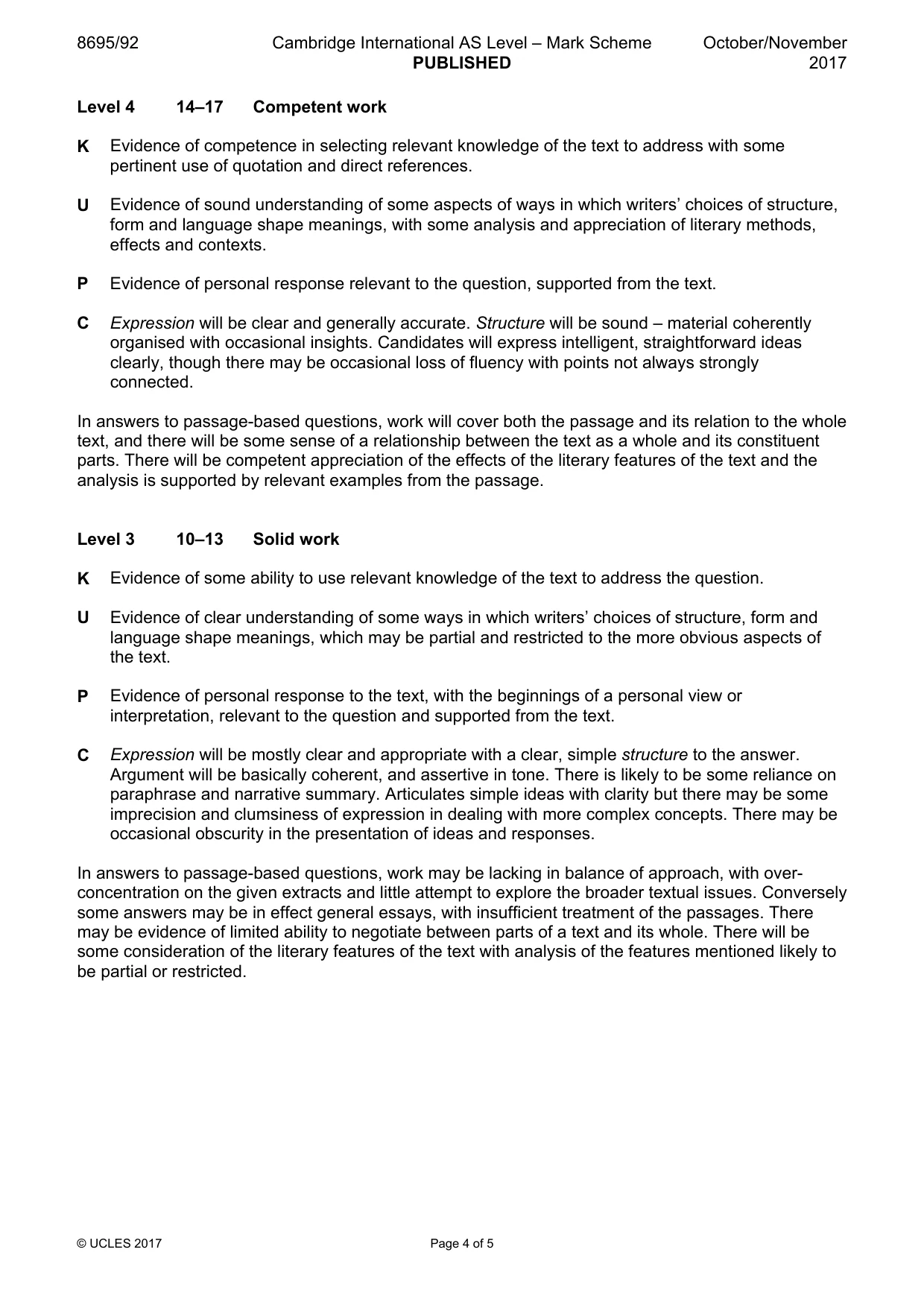
8695/92 Cambridge International AS Level – Mark Scheme PUBLISHED October/November 2017 © UCLES 2017 Page 4 of 5 Level 4 14–17 Competent work K Evidence of competence in selecting relevant knowledge of the text to address with some pertinent use of quotation and direct references. U Evidence of sound understanding of some aspects of ways in which writers’ choices of structure, form and language shape meanings, with some analysis and appreciation of literary methods, effects and contexts. P Evidence of personal response relevant to the question, supported from the text. C Expression will be clear and generally accurate. Structure will be sound – material coherently organised with occasional insights. Candidates will express intelligent, straightforward ideas clearly, though there may be occasional loss of fluency with points not always strongly connected. In answers to passage-based questions, work will cover both the passage and its relation to the whole text, and there will be some sense of a relationship between the text as a whole and its constituent parts. There will be competent appreciation of the effects of the literary features of the text and the analysis is supported by relevant examples from the passage. Level 3 10–13 Solid work K Evidence of some ability to use relevant knowledge of the text to address the question. U Evidence of clear understanding of some ways in which writers’ choices of structure, form and language shape meanings, which may be partial and restricted to the more obvious aspects of the text. P Evidence of personal response to the text, with the beginnings of a personal view or interpretation, relevant to the question and supported from the text. C Expression will be mostly clear and appropriate with a clear, simple structure to the answer. Argument will be basically coherent, and assertive in tone. There is likely to be some reliance on paraphrase and narrative summary. Articulates simple ideas with clarity but there may be some imprecision and clumsiness of expression in dealing with more complex concepts. There may be occasional obscurity in the presentation of ideas and responses. In answers to passage-based questions, work may be lacking in balance of approach, with over- concentration on the given extracts and little attempt to explore the broader textual issues. Conversely some answers may be in effect general essays, with insufficient treatment of the passages. There may be evidence of limited ability to negotiate between parts of a text and its whole. There will be some consideration of the literary features of the text with analysis of the features mentioned likely to be partial or restricted.
Mark scheme, page 5
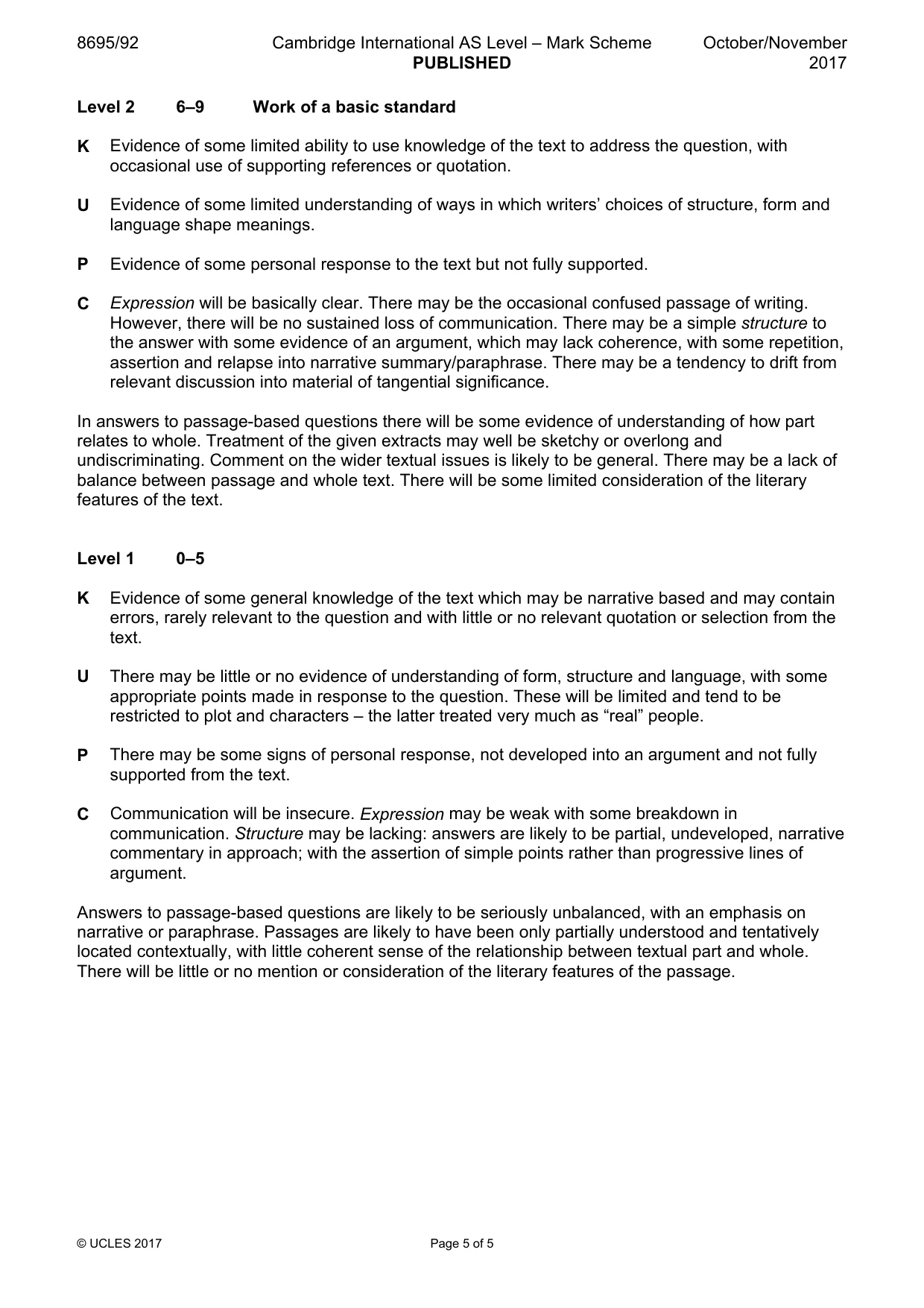
8695/92 Cambridge International AS Level – Mark Scheme PUBLISHED October/November 2017 © UCLES 2017 Page 5 of 5 Level 2 6–9 Work of a basic standard K Evidence of some limited ability to use knowledge of the text to address the question, with occasional use of supporting references or quotation. U Evidence of some limited understanding of ways in which writers’ choices of structure, form and language shape meanings. P Evidence of some personal response to the text but not fully supported. C Expression will be basically clear. There may be the occasional confused passage of writing. However, there will be no sustained loss of communication. There may be a simple structure to the answer with some evidence of an argument, which may lack coherence, with some repetition, assertion and relapse into narrative summary/paraphrase. There may be a tendency to drift from relevant discussion into material of tangential significance. In answers to passage-based questions there will be some evidence of understanding of how part relates to whole. Treatment of the given extracts may well be sketchy or overlong and undiscriminating. Comment on the wider textual issues is likely to be general. There may be a lack of balance between passage and whole text. There will be some limited consideration of the literary features of the text. Level 1 0–5 K Evidence of some general knowledge of the text which may be narrative based and may contain errors, rarely relevant to the question and with little or no relevant quotation or selection from the text. U There may be little or no evidence of understanding of form, structure and language, with some appropriate points made in response to the question. These will be limited and tend to be restricted to plot and characters – the latter treated very much as “real” people. P There may be some signs of personal response, not developed into an argument and not fully supported from the text. C Communication will be insecure. Expression may be weak with some breakdown in communication. Structure may be lacking: answers are likely to be partial, undeveloped, narrative commentary in approach; with the assertion of simple points rather than progressive lines of argument. Answers to passage-based questions are likely to be seriously unbalanced, with an emphasis on narrative or paraphrase. Passages are likely to have been only partially understood and tentatively located contextually, with little coherent sense of the relationship between textual part and whole. There will be little or no mention or consideration of the literary features of the passage.
What you needed in this session
Cambridge’s own grade thresholds for 2017 Oct/Nov, Paper 9 · Variant 2. A higher threshold means an easier paper — the bar moves with how the cohort did.