Cambridge A Level English - Language and Literature (AS Level only, from 2016) 8695 — 2017 Oct/Nov Paper 9 · Variant 1
8695/91/O/N/17 · 50 marks · ≈56 min
The question paper and its mark scheme, free to read here and free to download. This is Cambridge’s own paper, exactly as it was sat.
Question paper16 pages
Mark scheme5 pages
Answers below. Sit the paper first if you are practising.
Paper as text
Question paper, page 1
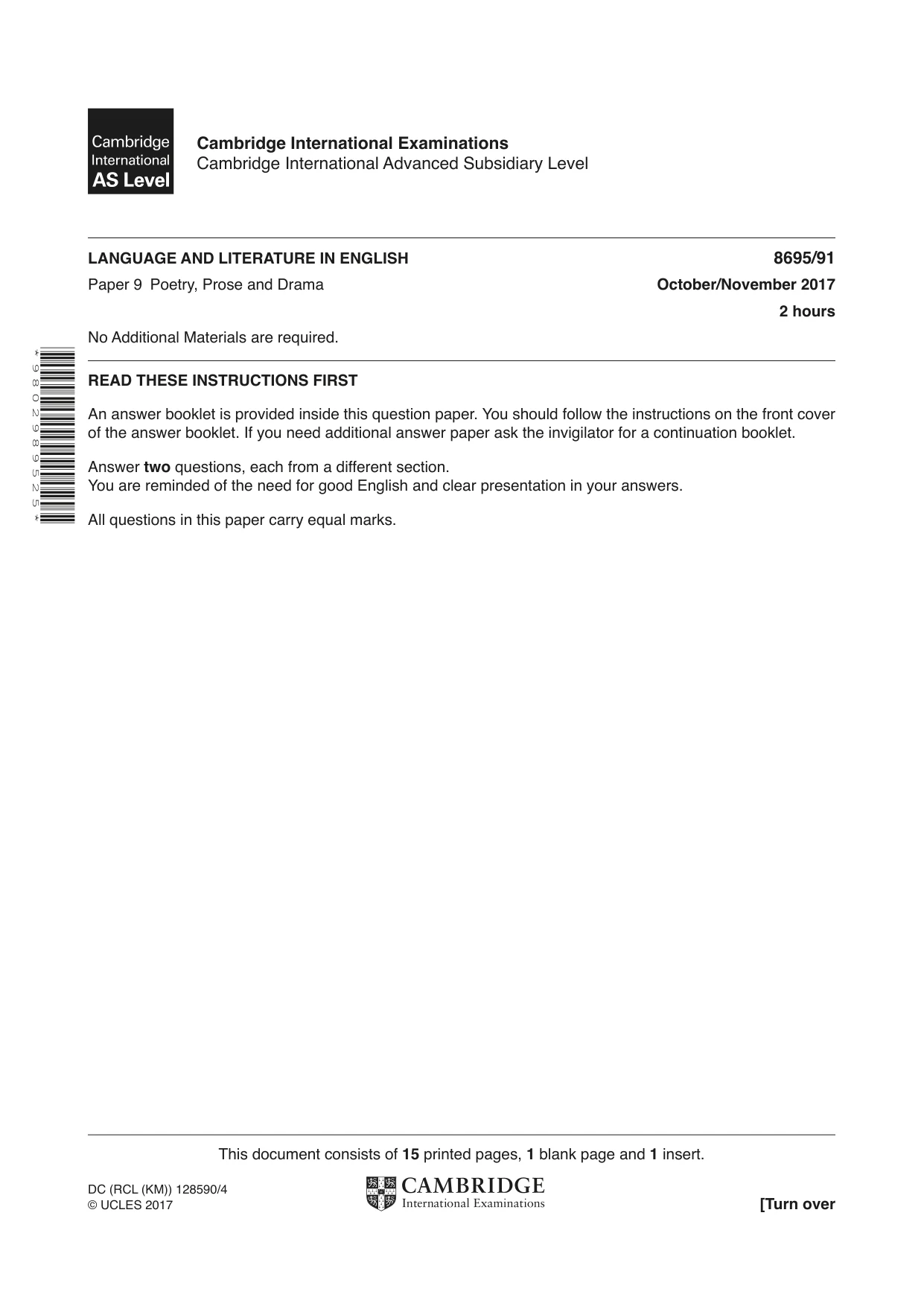
This document consists of 15 printed pages, 1 blank page and 1 insert. DC (RCL (KM)) 128590/4 © UCLES 2017 [Turn over Cambridge International Examinations Cambridge International Advanced Subsidiary Level * 9 8 0 2 9 8 9 5 2 5 * LANGUAGE AND LITERATURE IN ENGLISH 8695/91 Paper 9 Poetry, Prose and Drama October/November 2017 2 hours No Additional Materials are required. READ THESE INSTRUCTIONS FIRST An answer booklet is provided inside this question paper. You should follow the instructions on the front cover of the answer booklet. If you need additional answer paper ask the invigilator for a continuation booklet. Answer two questions, each from a different section. You are reminded of the need for good English and clear presentation in your answers. All questions in this paper carry equal marks.
Question paper, page 2
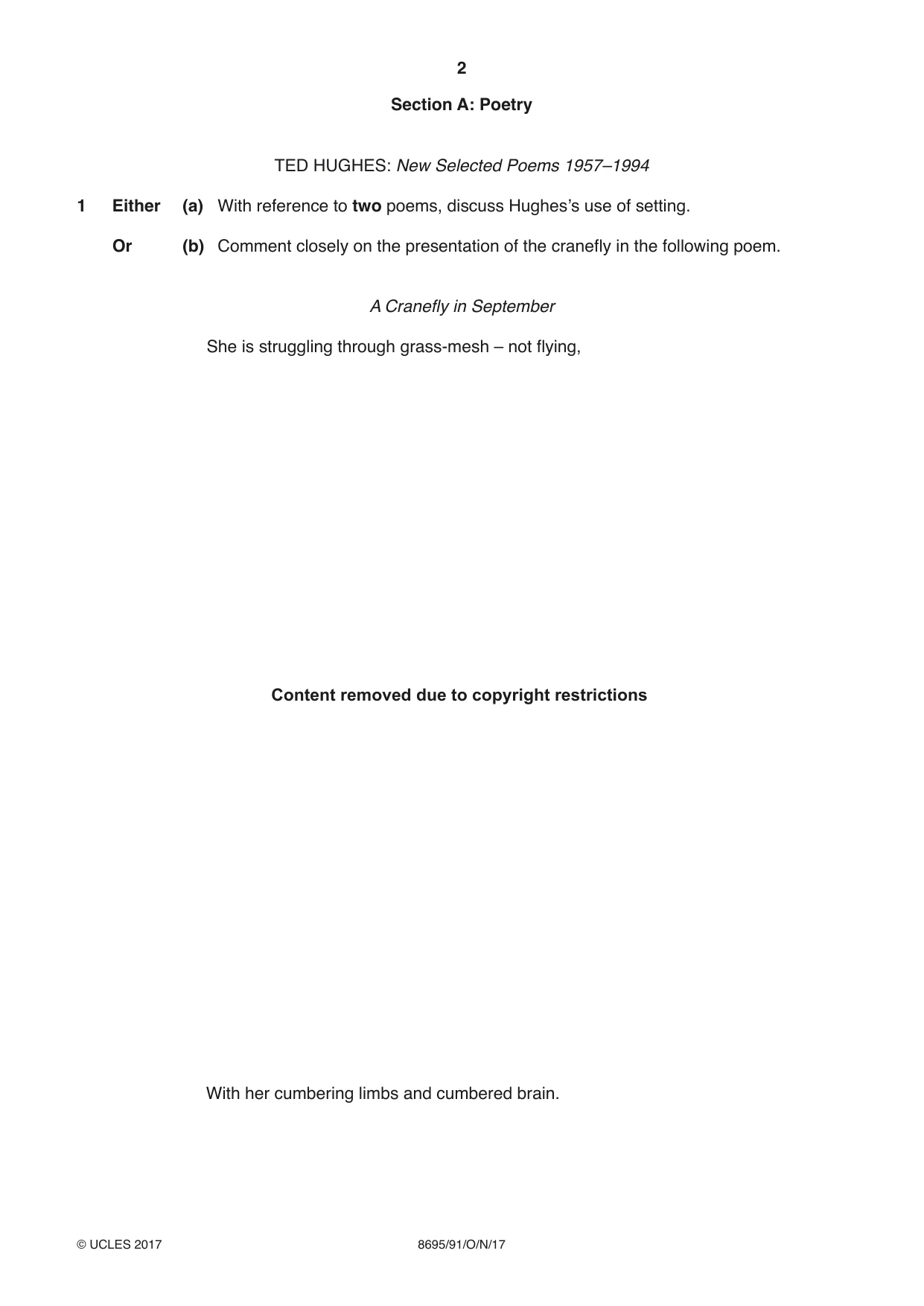
2 8695/91/O/N/17 © UCLES 2017 Section A: Poetry TED HUGHES: New Selected Poems 1957–1994 1 Either (a) With reference to two poems, discuss Hughes’s use of setting. Or (b) Comment closely on the presentation of the cranefly in the following poem. A Cranefly in September She is struggling through grass-mesh – not flying, Content removed due to copyright restrictions With her cumbering limbs and cumbered brain.
Question paper, page 3
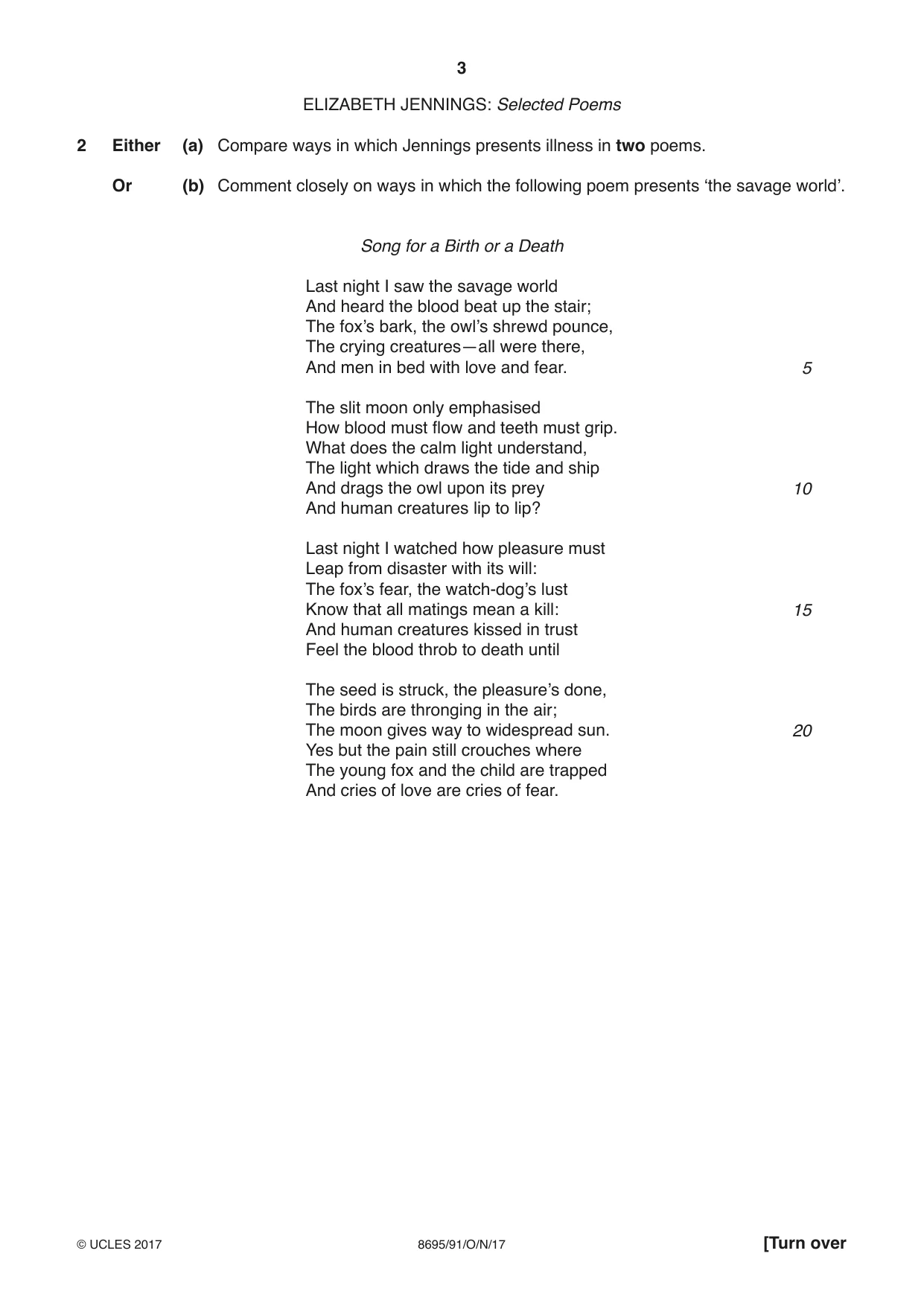
3 8695/91/O/N/17 © UCLES 2017 [Turn over ELIZABETH JENNINGS: Selected Poems 2 Either (a) Compare ways in which Jennings presents illness in two poems. Or (b) Comment closely on ways in which the following poem presents ‘the savage world’. Song for a Birth or a Death Last night I saw the savage world And heard the blood beat up the stair; The fox’s bark, the owl’s shrewd pounce, The crying creatures—all were there, And men in bed with love and fear. The slit moon only emphasised How blood must flow and teeth must grip. What does the calm light understand, The light which draws the tide and ship And drags the owl upon its prey And human creatures lip to lip? Last night I watched how pleasure must Leap from disaster with its will: The fox’s fear, the watch-dog’s lust Know that all matings mean a kill: And human creatures kissed in trust Feel the blood throb to death until The seed is struck, the pleasure’s done, The birds are thronging in the air; The moon gives way to widespread sun. Yes but the pain still crouches where The young fox and the child are trapped And cries of love are cries of fear. 5 10 15 20
Question paper, page 4
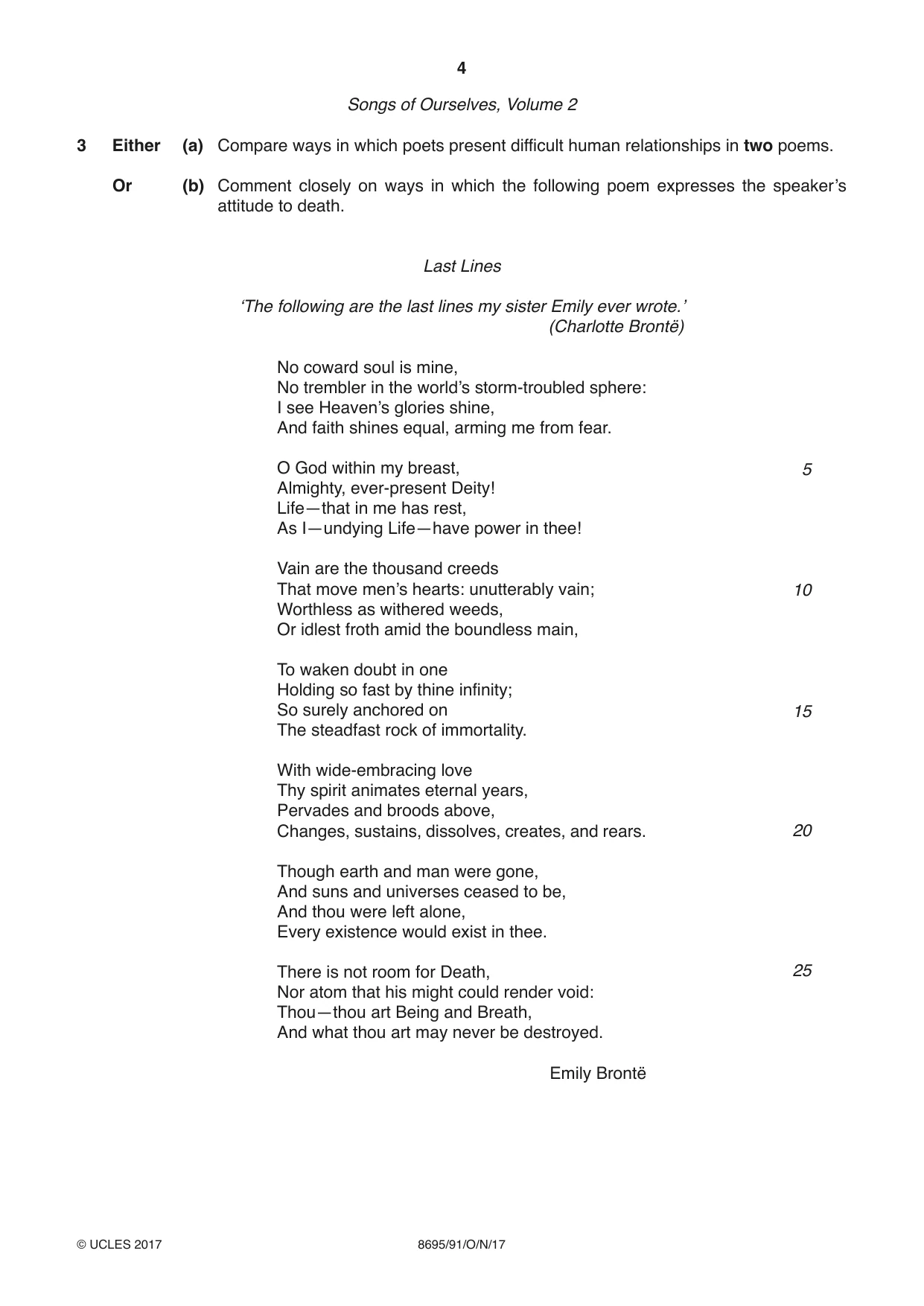
4 8695/91/O/N/17 © UCLES 2017 Songs of Ourselves, Volume 2 3 Either (a) Compare ways in which poets present difficult human relationships in two poems. Or (b) Comment closely on ways in which the following poem expresses the speaker’s attitude to death. Last Lines ‘The following are the last lines my sister Emily ever wrote.’ (Charlotte Brontë) No coward soul is mine, No trembler in the world’s storm-troubled sphere: I see Heaven’s glories shine, And faith shines equal, arming me from fear. O God within my breast, Almighty, ever-present Deity! Life—that in me has rest, As I—undying Life—have power in thee! Vain are the thousand creeds That move men’s hearts: unutterably vain; Worthless as withered weeds, Or idlest froth amid the boundless main, To waken doubt in one Holding so fast by thine infinity; So surely anchored on The steadfast rock of immortality. With wide-embracing love Thy spirit animates eternal years, Pervades and broods above, Changes, sustains, dissolves, creates, and rears. Though earth and man were gone, And suns and universes ceased to be, And thou were left alone, Every existence would exist in thee. There is not room for Death, Nor atom that his might could render void: Thou—thou art Being and Breath, And what thou art may never be destroyed. Emily Brontë 5 10 15 20 25
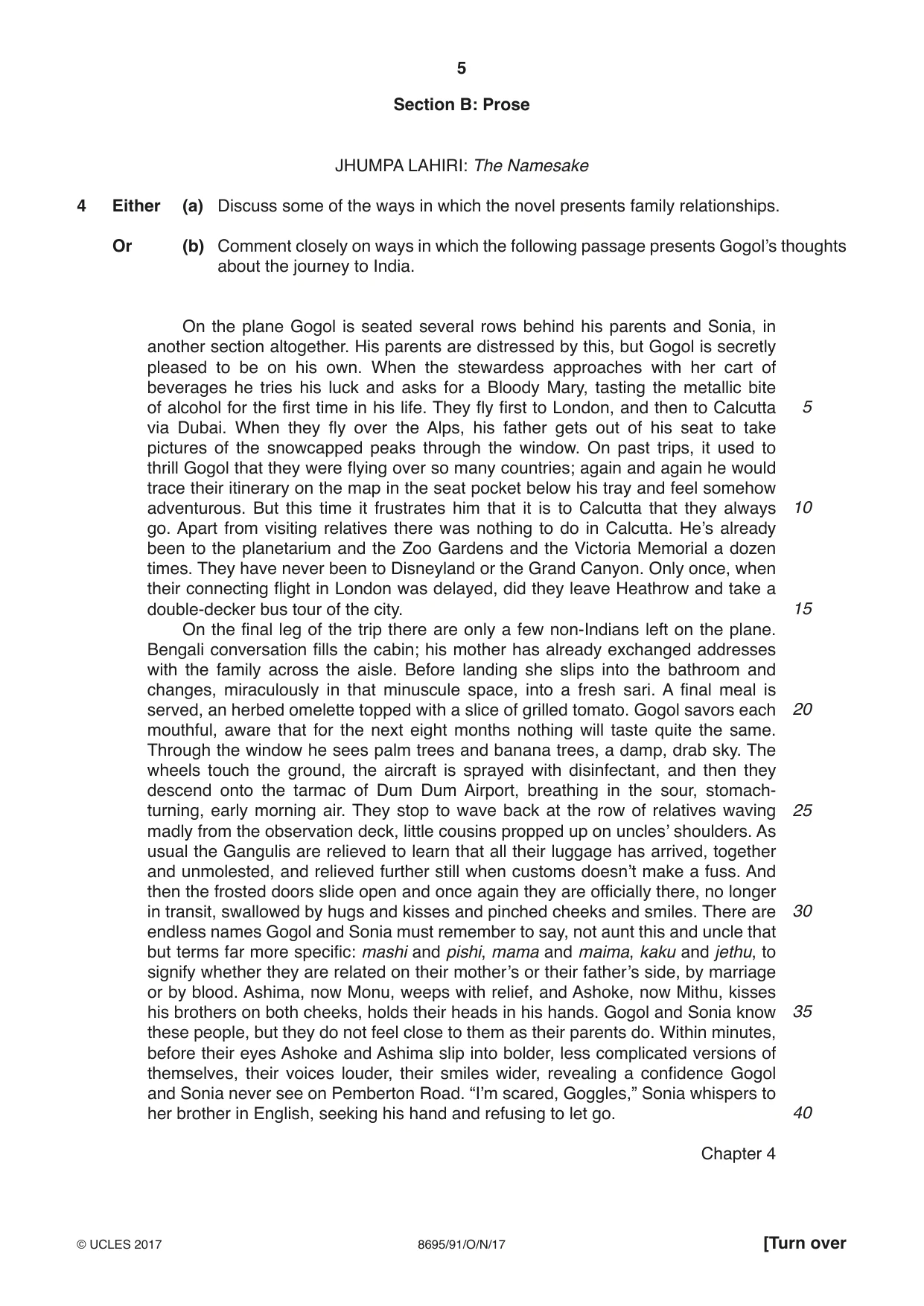
Question paper, page 5
5 8695/91/O/N/17 © UCLES 2017 [Turn over Section B: Prose JHUMPA LAHIRI: The Namesake 4 Either (a) Discuss some of the ways in which the novel presents family relationships. Or (b) Comment closely on ways in which the following passage presents Gogol’s thoughts about the journey to India. On the plane Gogol is seated several rows behind his parents and Sonia, in another section altogether. His parents are distressed by this, but Gogol is secretly pleased to be on his own. When the stewardess approaches with her cart of beverages he tries his luck and asks for a Bloody Mary, tasting the metallic bite of alcohol for the first time in his life. They fly first to London, and then to Calcutta via Dubai. When they fly over the Alps, his father gets out of his seat to take pictures of the snowcapped peaks through the window. On past trips, it used to thrill Gogol that they were flying over so many countries; again and again he would trace their itinerary on the map in the seat pocket below his tray and feel somehow adventurous. But this time it frustrates him that it is to Calcutta that they always go. Apart from visiting relatives there was nothing to do in Calcutta. He’s already been to the planetarium and the Zoo Gardens and the Victoria Memorial a dozen times. They have never been to Disneyland or the Grand Canyon. Only once, when their connecting flight in London was delayed, did they leave Heathrow and take a double-decker bus tour of the city. On the final leg of the trip there are only a few non-Indians left on the plane. Bengali conversation fills the cabin; his mother has already exchanged addresses with the family across the aisle. Before landing she slips into the bathroom and changes, miraculously in that minuscule space, into a fresh sari. A final meal is served, an herbed omelette topped with a slice of grilled tomato. Gogol savors each mouthful, aware that for the next eight months nothing will taste quite the same. Through the window he sees palm trees and banana trees, a damp, drab sky. The wheels touch the ground, the aircraft is sprayed with disinfectant, and then they descend onto the tarmac of Dum Dum Airport, breathing in the sour, stomach- turning, early morning air. They stop to wave back at the row of relatives waving madly from the observation deck, little cousins propped up on uncles’ shoulders. As usual the Gangulis are relieved to learn that all their luggage has arrived, together and unmolested, and relieved further still when customs doesn’t make a fuss. And then the frosted doors slide open and once again they are officially there, no longer in transit, swallowed by hugs and kisses and pinched cheeks and smiles. There are endless names Gogol and Sonia must remember to say, not aunt this and uncle that but terms far more specific: mashi and pishi, mama and maima, kaku and jethu, to signify whether they are related on their mother’s or their father’s side, by marriage or by blood. Ashima, now Monu, weeps with relief, and Ashoke, now Mithu, kisses his brothers on both cheeks, holds their heads in his hands. Gogol and Sonia know these people, but they do not feel close to them as their parents do. Within minutes, before their eyes Ashoke and Ashima slip into bolder, less complicated versions of themselves, their voices louder, their smiles wider, revealing a confidence Gogol and Sonia never see on Pemberton Road. “I’m scared, Goggles,” Sonia whispers to her brother in English, seeking his hand and refusing to let go. Chapter 4 5 10 15 20 25 30 35 40
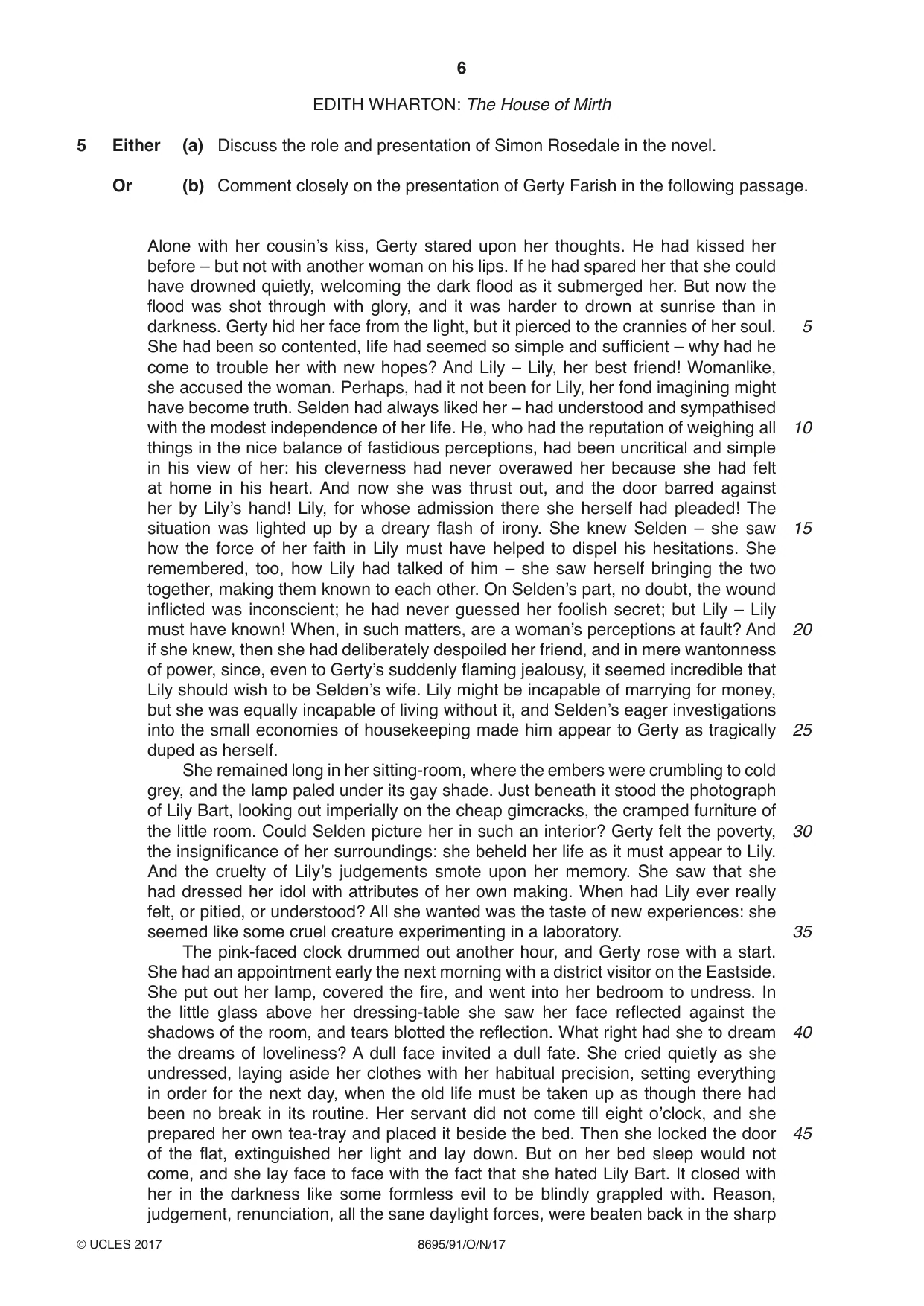
Question paper, page 6
6 8695/91/O/N/17 © UCLES 2017 EDITH WHARTON: The House of Mirth 5 Either (a) Discuss the role and presentation of Simon Rosedale in the novel. Or (b) Comment closely on the presentation of Gerty Farish in the following passage. Alone with her cousin’s kiss, Gerty stared upon her thoughts. He had kissed her before – but not with another woman on his lips. If he had spared her that she could have drowned quietly, welcoming the dark flood as it submerged her. But now the flood was shot through with glory, and it was harder to drown at sunrise than in darkness. Gerty hid her face from the light, but it pierced to the crannies of her soul. She had been so contented, life had seemed so simple and sufficient – why had he come to trouble her with new hopes? And Lily – Lily, her best friend! Womanlike, she accused the woman. Perhaps, had it not been for Lily, her fond imagining might have become truth. Selden had always liked her – had understood and sympathised with the modest independence of her life. He, who had the reputation of weighing all things in the nice balance of fastidious perceptions, had been uncritical and simple in his view of her: his cleverness had never overawed her because she had felt at home in his heart. And now she was thrust out, and the door barred against her by Lily’s hand! Lily, for whose admission there she herself had pleaded! The situation was lighted up by a dreary flash of irony. She knew Selden – she saw how the force of her faith in Lily must have helped to dispel his hesitations. She remembered, too, how Lily had talked of him – she saw herself bringing the two together, making them known to each other. On Selden’s part, no doubt, the wound inflicted was inconscient; he had never guessed her foolish secret; but Lily – Lily must have known! When, in such matters, are a woman’s perceptions at fault? And if she knew, then she had deliberately despoiled her friend, and in mere wantonness of power, since, even to Gerty’s suddenly flaming jealousy, it seemed incredible that Lily should wish to be Selden’s wife. Lily might be incapable of marrying for money, but she was equally incapable of living without it, and Selden’s eager investigations into the small economies of housekeeping made him appear to Gerty as tragically duped as herself. She remained long in her sitting-room, where the embers were crumbling to cold grey, and the lamp paled under its gay shade. Just beneath it stood the photograph of Lily Bart, looking out imperially on the cheap gimcracks, the cramped furniture of the little room. Could Selden picture her in such an interior? Gerty felt the poverty, the insignificance of her surroundings: she beheld her life as it must appear to Lily. And the cruelty of Lily’s judgements smote upon her memory. She saw that she had dressed her idol with attributes of her own making. When had Lily ever really felt, or pitied, or understood? All she wanted was the taste of new experiences: she seemed like some cruel creature experimenting in a laboratory. The pink-faced clock drummed out another hour, and Gerty rose with a start. She had an appointment early the next morning with a district visitor on the Eastside. She put out her lamp, covered the fire, and went into her bedroom to undress. In the little glass above her dressing-table she saw her face reflected against the shadows of the room, and tears blotted the reflection. What right had she to dream the dreams of loveliness? A dull face invited a dull fate. She cried quietly as she undressed, laying aside her clothes with her habitual precision, setting everything in order for the next day, when the old life must be taken up as though there had been no break in its routine. Her servant did not come till eight o’clock, and she prepared her own tea-tray and placed it beside the bed. Then she locked the door of the flat, extinguished her light and lay down. But on her bed sleep would not come, and she lay face to face with the fact that she hated Lily Bart. It closed with her in the darkness like some formless evil to be blindly grappled with. Reason, judgement, renunciation, all the sane daylight forces, were beaten back in the sharp 5 10 15 20 25 30 35 40 45
Question paper, page 7
7 8695/91/O/N/17 © UCLES 2017 [Turn over struggle for self-preservation. She wanted happiness – wanted it as fiercely as Lily did, but without Lily’s power of obtaining it. And in her conscious impotence she lay shivering, and hated her friend. Book 1, Chapter 14 50
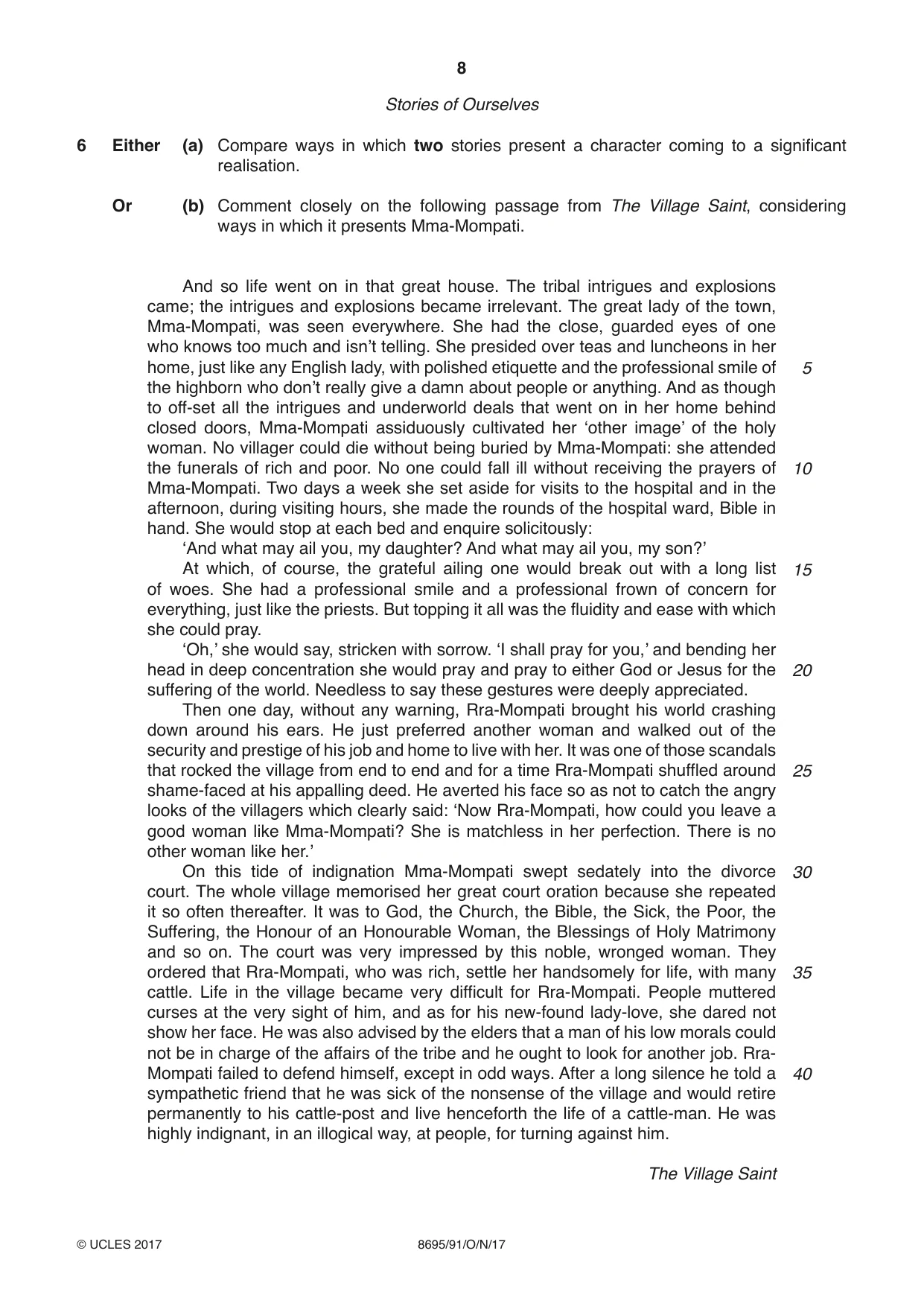
Question paper, page 8
8 8695/91/O/N/17 © UCLES 2017 Stories of Ourselves 6 Either (a) Compare ways in which two stories present a character coming to a significant realisation. Or (b) Comment closely on the following passage from The Village Saint, considering ways in which it presents Mma-Mompati. And so life went on in that great house. The tribal intrigues and explosions came; the intrigues and explosions became irrelevant. The great lady of the town, Mma-Mompati, was seen everywhere. She had the close, guarded eyes of one who knows too much and isn’t telling. She presided over teas and luncheons in her home, just like any English lady, with polished etiquette and the professional smile of the highborn who don’t really give a damn about people or anything. And as though to off-set all the intrigues and underworld deals that went on in her home behind closed doors, Mma-Mompati assiduously cultivated her ‘other image’ of the holy woman. No villager could die without being buried by Mma-Mompati: she attended the funerals of rich and poor. No one could fall ill without receiving the prayers of Mma-Mompati. Two days a week she set aside for visits to the hospital and in the afternoon, during visiting hours, she made the rounds of the hospital ward, Bible in hand. She would stop at each bed and enquire solicitously: ‘And what may ail you, my daughter? And what may ail you, my son?’ At which, of course, the grateful ailing one would break out with a long list of woes. She had a professional smile and a professional frown of concern for everything, just like the priests. But topping it all was the fluidity and ease with which she could pray. ‘Oh,’ she would say, stricken with sorrow. ‘I shall pray for you,’ and bending her head in deep concentration she would pray and pray to either God or Jesus for the suffering of the world. Needless to say these gestures were deeply appreciated. Then one day, without any warning, Rra-Mompati brought his world crashing down around his ears. He just preferred another woman and walked out of the security and prestige of his job and home to live with her. It was one of those scandals that rocked the village from end to end and for a time Rra-Mompati shuffled around shame-faced at his appalling deed. He averted his face so as not to catch the angry looks of the villagers which clearly said: ‘Now Rra-Mompati, how could you leave a good woman like Mma-Mompati? She is matchless in her perfection. There is no other woman like her.’ On this tide of indignation Mma-Mompati swept sedately into the divorce court. The whole village memorised her great court oration because she repeated it so often thereafter. It was to God, the Church, the Bible, the Sick, the Poor, the Suffering, the Honour of an Honourable Woman, the Blessings of Holy Matrimony and so on. The court was very impressed by this noble, wronged woman. They ordered that Rra-Mompati, who was rich, settle her handsomely for life, with many cattle. Life in the village became very difficult for Rra-Mompati. People muttered curses at the very sight of him, and as for his new-found lady-love, she dared not show her face. He was also advised by the elders that a man of his low morals could not be in charge of the affairs of the tribe and he ought to look for another job. Rra- Mompati failed to defend himself, except in odd ways. After a long silence he told a sympathetic friend that he was sick of the nonsense of the village and would retire permanently to his cattle-post and live henceforth the life of a cattle-man. He was highly indignant, in an illogical way, at people, for turning against him. The Village Saint 5 10 15 20 25 30 35 40
Question paper, page 9
9 8695/91/O/N/17 © UCLES 2017 [Turn over Turn over for Section C.
Question paper, page 10
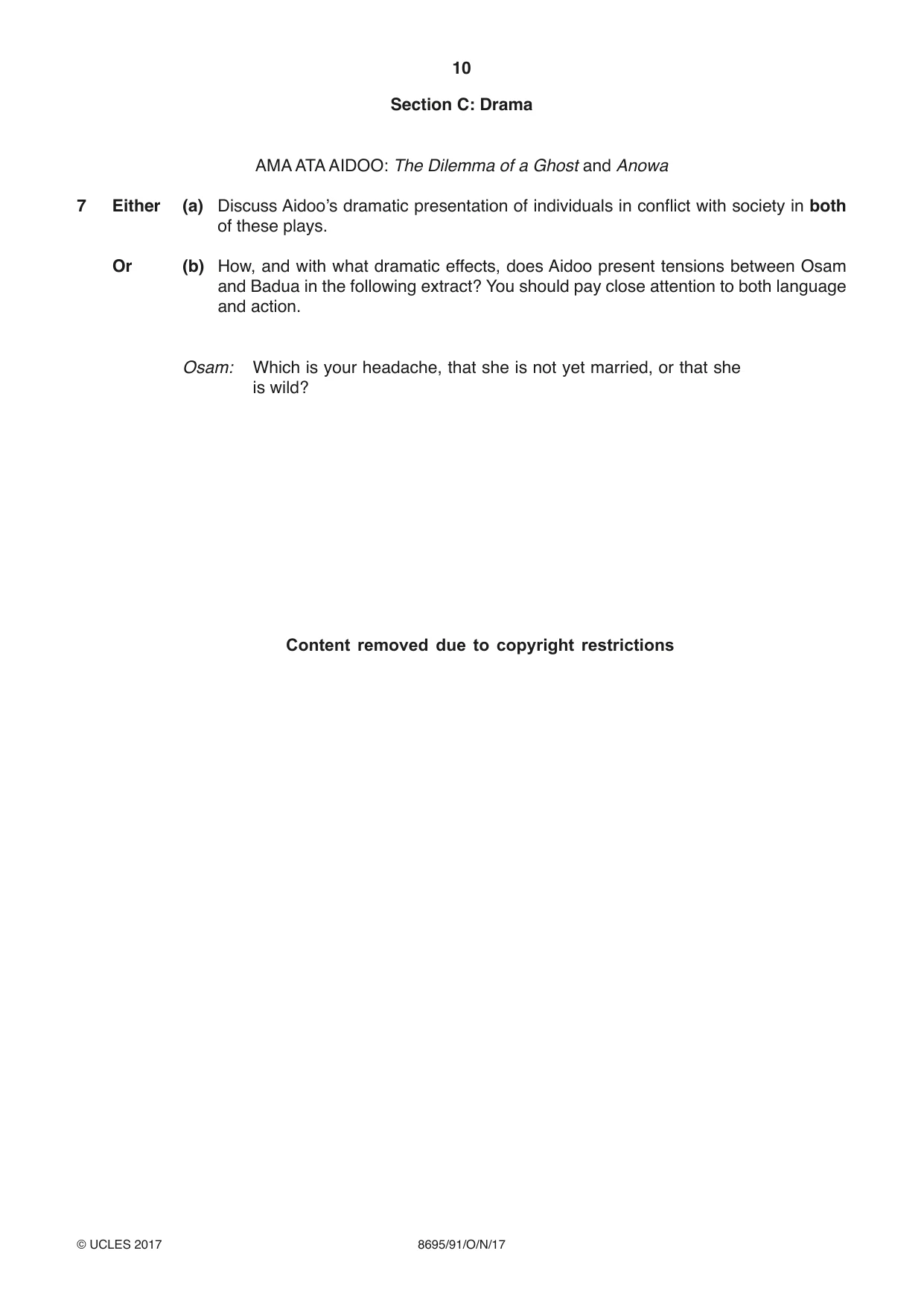
10 8695/91/O/N/17 © UCLES 2017 Section C: Drama AMA ATA AIDOO: The Dilemma of a Ghost and Anowa 7 Either (a) Discuss Aidoo’s dramatic presentation of individuals in conflict with society in both of these plays. Or (b) How, and with what dramatic effects, does Aidoo present tensions between Osam and Badua in the following extract? You should pay close attention to both language and action. Osam: Which is your headache, that she is not yet married, or that she is wild? Content removed due to copyright restrictions
Question paper, page 11
11 8695/91/O/N/17 © UCLES 2017 [Turn over Content removed due to copyright restrictions [OSAM nods his head and exclaims, Oh … oh! ] Anowa, Phase 1
Question paper, page 12
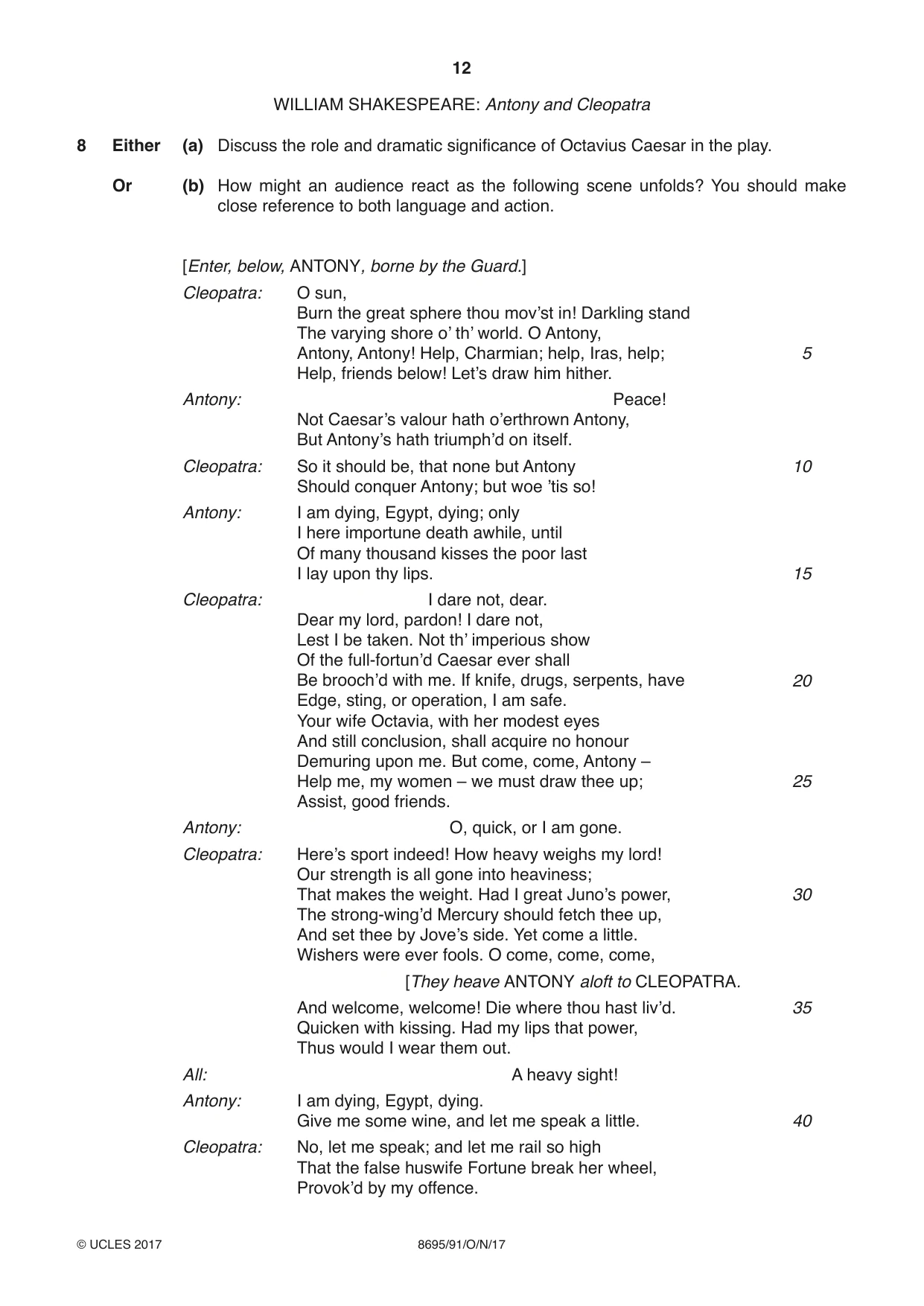
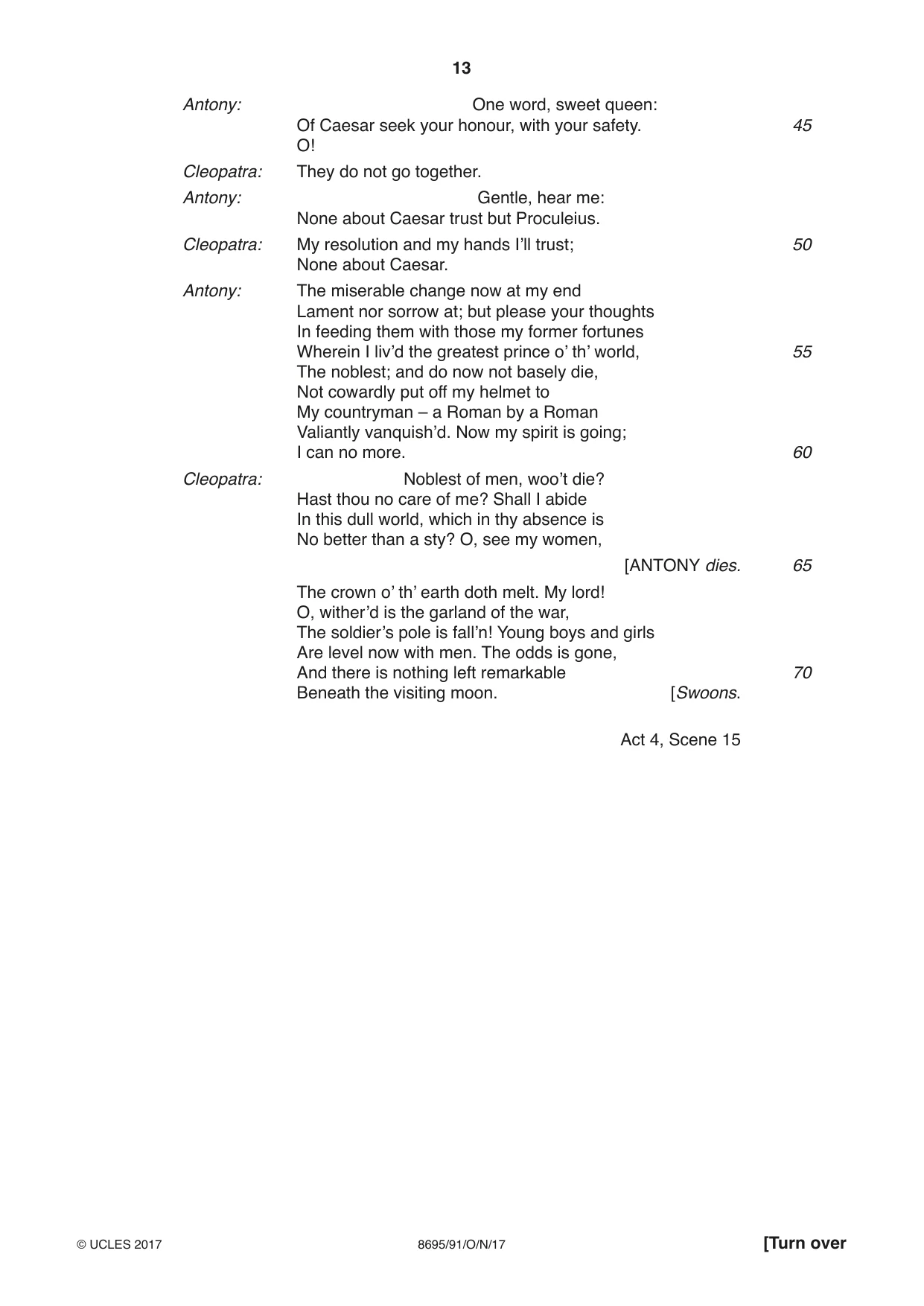
12 8695/91/O/N/17 © UCLES 2017 WILLIAM SHAKESPEARE: Antony and Cleopatra 8 Either (a) Discuss the role and dramatic significance of Octavius Caesar in the play. Or (b) How might an audience react as the following scene unfolds? You should make close reference to both language and action. [Enter, below, ANTONY, borne by the Guard.] Cleopatra: O sun, Burn the great sphere thou mov’st in! Darkling stand The varying shore o’ th’ world. O Antony, Antony, Antony! Help, Charmian; help, Iras, help; Help, friends below! Let’s draw him hither. Antony: Peace! Not Caesar’s valour hath o’erthrown Antony, But Antony’s hath triumph’d on itself. Cleopatra: So it should be, that none but Antony Should conquer Antony; but woe ’tis so! Antony: I am dying, Egypt, dying; only I here importune death awhile, until Of many thousand kisses the poor last I lay upon thy lips. Cleopatra: I dare not, dear. Dear my lord, pardon! I dare not, Lest I be taken. Not th’ imperious show Of the full-fortun’d Caesar ever shall Be brooch’d with me. If knife, drugs, serpents, have Edge, sting, or operation, I am safe. Your wife Octavia, with her modest eyes And still conclusion, shall acquire no honour Demuring upon me. But come, come, Antony – Help me, my women – we must draw thee up; Assist, good friends. Antony: O, quick, or I am gone. Cleopatra: Here’s sport indeed! How heavy weighs my lord! Our strength is all gone into heaviness; That makes the weight. Had I great Juno’s power, The strong-wing’d Mercury should fetch thee up, And set thee by Jove’s side. Yet come a little. Wishers were ever fools. O come, come, come, [They heave ANTONY aloft to CLEOPATRA. And welcome, welcome! Die where thou hast liv’d. Quicken with kissing. Had my lips that power, Thus would I wear them out. All: A heavy sight! Antony: I am dying, Egypt, dying. Give me some wine, and let me speak a little. Cleopatra: No, let me speak; and let me rail so high That the false huswife Fortune break her wheel, Provok’d by my offence. 5 10 15 20 25 30 35 40
Question paper, page 13
13 8695/91/O/N/17 © UCLES 2017 [Turn over Antony: One word, sweet queen: Of Caesar seek your honour, with your safety. O! Cleopatra: They do not go together. Antony: Gentle, hear me: None about Caesar trust but Proculeius. Cleopatra: My resolution and my hands I’ll trust; None about Caesar. Antony: The miserable change now at my end Lament nor sorrow at; but please your thoughts In feeding them with those my former fortunes Wherein I liv’d the greatest prince o’ th’ world, The noblest; and do now not basely die, Not cowardly put off my helmet to My countryman – a Roman by a Roman Valiantly vanquish’d. Now my spirit is going; I can no more. Cleopatra: Noblest of men, woo’t die? Hast thou no care of me? Shall I abide In this dull world, which in thy absence is No better than a sty? O, see my women, [ANTONY dies. The crown o’ th’ earth doth melt. My lord! O, wither’d is the garland of the war, The soldier’s pole is fall’n! Young boys and girls Are level now with men. The odds is gone, And there is nothing left remarkable Beneath the visiting moon. [Swoons. Act 4, Scene 15 45 50 55 60 65 70
Question paper, page 14
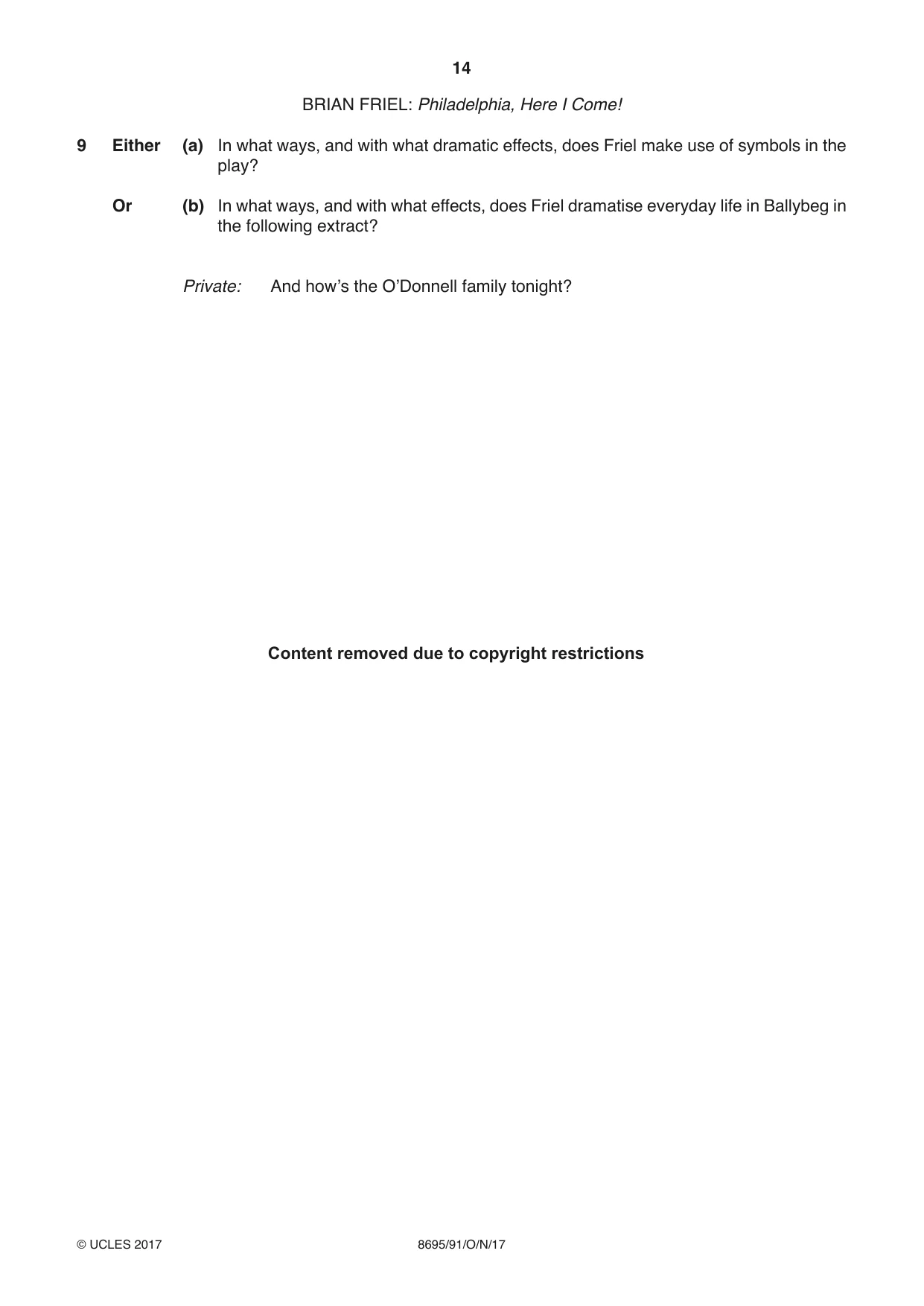
14 8695/91/O/N/17 © UCLES 2017 BRIAN FRIEL: Philadelphia, Here I Come! 9 Either (a) In what ways, and with what dramatic effects, does Friel make use of symbols in the play? Or (b) In what ways, and with what effects, does Friel dramatise everyday life in Ballybeg in the following extract? Private: And how’s the O’Donnell family tonight? Content removed due to copyright restrictions
Question paper, page 15
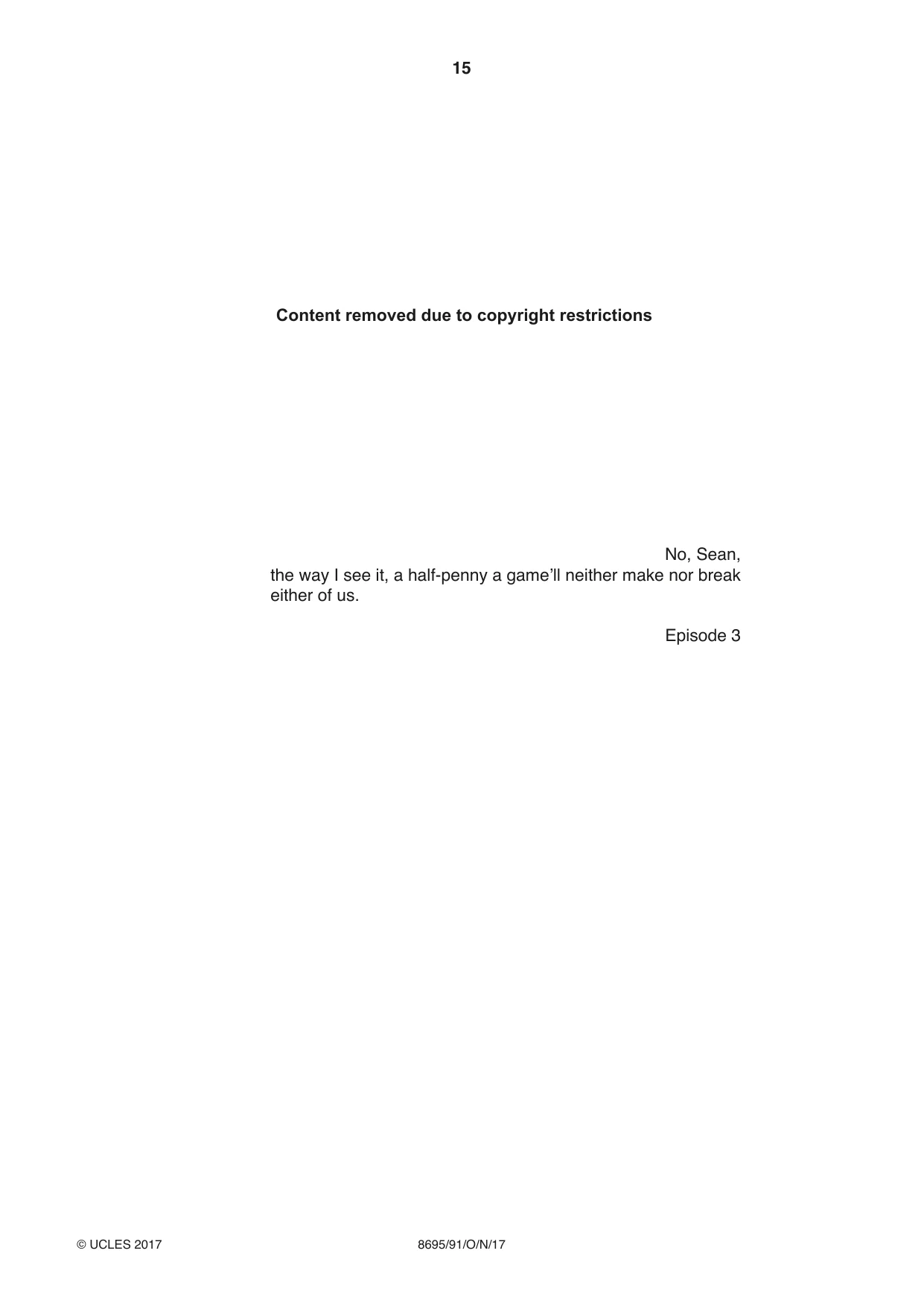
15 8695/91/O/N/17 © UCLES 2017 Content removed due to copyright restrictions Canon: The thin end of the wedge, eh, as the Bishop says? No, Sean, the way I see it, a half-penny a game’ll neither make nor break either of us. Episode 3
Question paper, page 16
16 8695/91/O/N/17 © UCLES 2017 BLANK PAGE Permission to reproduce items where third-party owned material protected by copyright is included has been sought and cleared where possible. Every reasonable effort has been made by the publisher (UCLES) to trace copyright holders, but if any items requiring clearance have unwittingly been included, the publisher will be pleased to make amends at the earliest possible opportunity. To avoid the issue of disclosure of answer-related information to candidates, all copyright acknowledgements are reproduced online in the Cambridge International Examinations Copyright Acknowledgements Booklet. This is produced for each series of examinations and is freely available to download at www.cie.org.uk after the live examination series. Cambridge International Examinations is part of the Cambridge Assessment Group. Cambridge Assessment is the brand name of University of Cambridge Local Examinations Syndicate (UCLES), which is itself a department of the University of Cambridge.
Mark scheme, page 1
® IGCSE is a registered trademark. This document consists of 5 printed pages. © UCLES 2017 [Turn over Cambridge Assessment International Education Cambridge International Advanced Subsidiary Level LANGUAGE AND LITERATURE IN ENGLISH 8695/91 Paper 9 Poetry, Prose and Drama October/November 2017 MARK SCHEME Maximum Mark: 50 Published This mark scheme is published as an aid to teachers and candidates, to indicate the requirements of the examination. It shows the basis on which Examiners were instructed to award marks. It does not indicate the details of the discussions that took place at an Examiners’ meeting before marking began, which would have considered the acceptability of alternative answers. Mark schemes should be read in conjunction with the question paper and the Principal Examiner Report for Teachers. Cambridge International will not enter into discussions about these mark schemes. Cambridge International is publishing the mark schemes for the October/November 2017 series for most Cambridge IGCSE®, Cambridge International A and AS Level components and some Cambridge O Level components.
Mark scheme, page 2
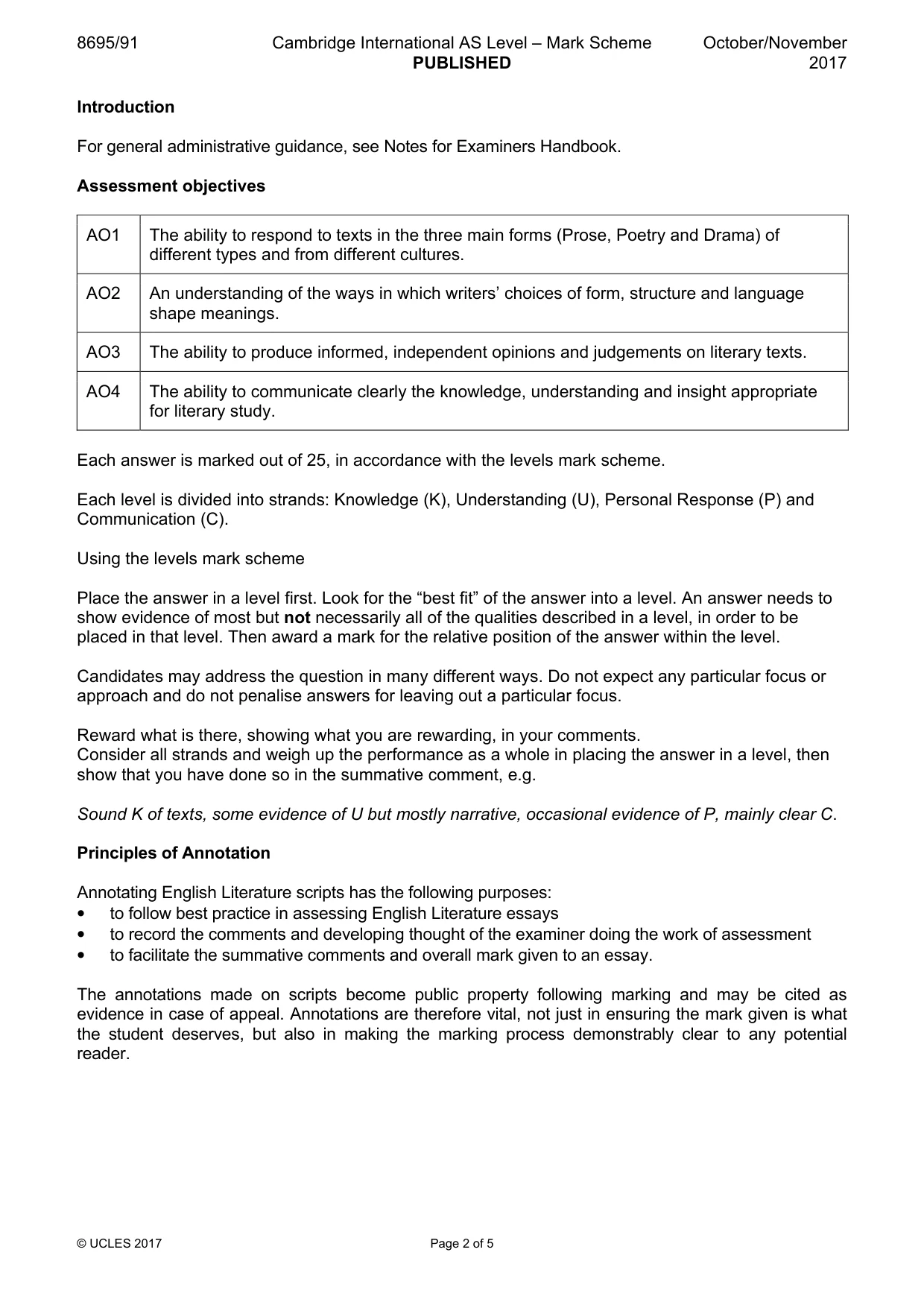
8695/91 Cambridge International AS Level – Mark Scheme PUBLISHED October/November 2017 © UCLES 2017 Page 2 of 5 Introduction For general administrative guidance, see Notes for Examiners Handbook. Assessment objectives AO1 The ability to respond to texts in the three main forms (Prose, Poetry and Drama) of different types and from different cultures. AO2 An understanding of the ways in which writers’ choices of form, structure and language shape meanings. AO3 The ability to produce informed, independent opinions and judgements on literary texts. AO4 The ability to communicate clearly the knowledge, understanding and insight appropriate for literary study. Each answer is marked out of 25, in accordance with the levels mark scheme. Each level is divided into strands: Knowledge (K), Understanding (U), Personal Response (P) and Communication (C). Using the levels mark scheme Place the answer in a level first. Look for the “best fit” of the answer into a level. An answer needs to show evidence of most but not necessarily all of the qualities described in a level, in order to be placed in that level. Then award a mark for the relative position of the answer within the level. Candidates may address the question in many different ways. Do not expect any particular focus or approach and do not penalise answers for leaving out a particular focus. Reward what is there, showing what you are rewarding, in your comments. Consider all strands and weigh up the performance as a whole in placing the answer in a level, then show that you have done so in the summative comment, e.g. Sound K of texts, some evidence of U but mostly narrative, occasional evidence of P, mainly clear C. Principles of Annotation Annotating English Literature scripts has the following purposes: • to follow best practice in assessing English Literature essays • to record the comments and developing thought of the examiner doing the work of assessment • to facilitate the summative comments and overall mark given to an essay. The annotations made on scripts become public property following marking and may be cited as evidence in case of appeal. Annotations are therefore vital, not just in ensuring the mark given is what the student deserves, but also in making the marking process demonstrably clear to any potential reader.
Mark scheme, page 3
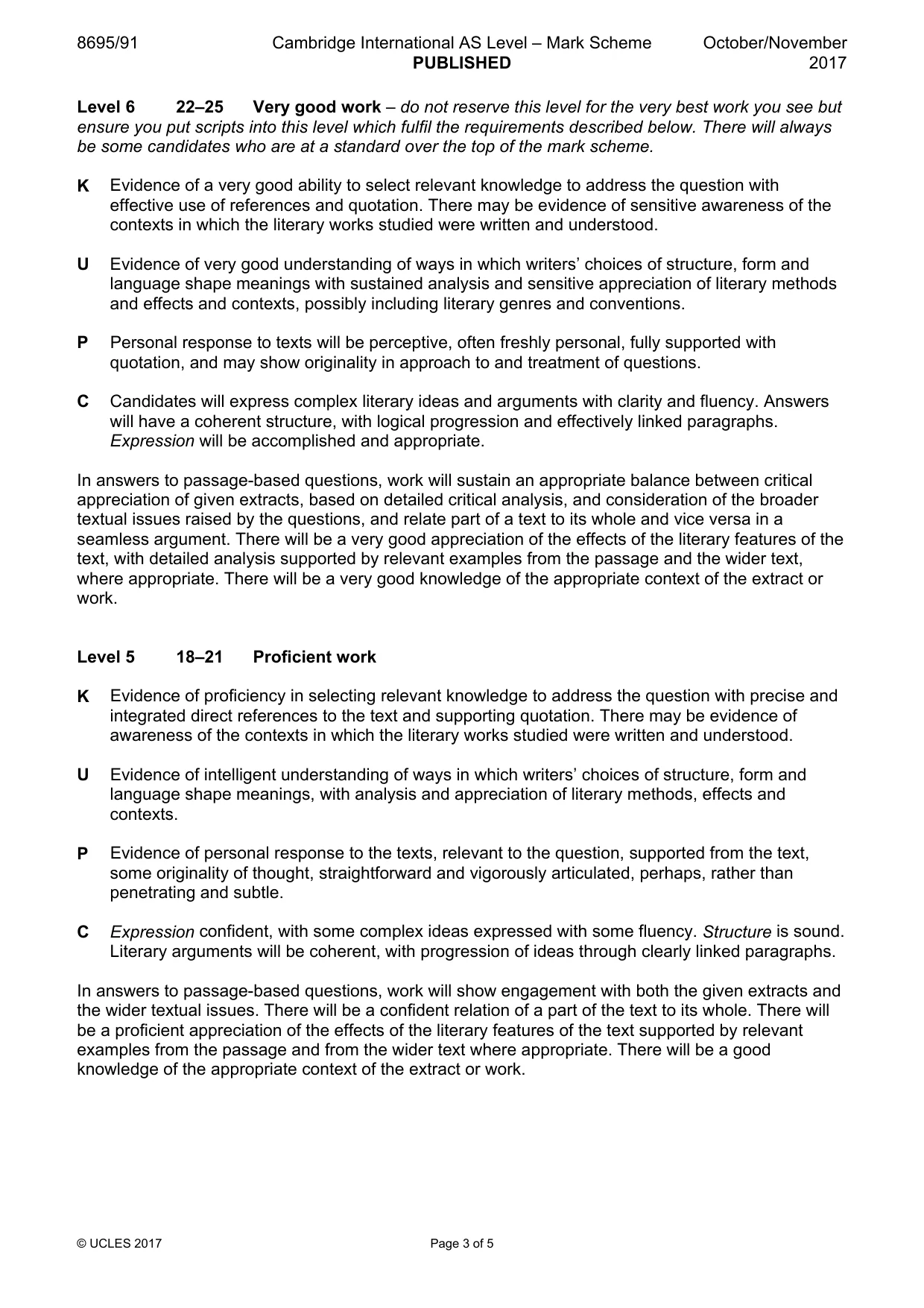
8695/91 Cambridge International AS Level – Mark Scheme PUBLISHED October/November 2017 © UCLES 2017 Page 3 of 5 Level 6 22–25 Very good work – do not reserve this level for the very best work you see but ensure you put scripts into this level which fulfil the requirements described below. There will always be some candidates who are at a standard over the top of the mark scheme. K Evidence of a very good ability to select relevant knowledge to address the question with effective use of references and quotation. There may be evidence of sensitive awareness of the contexts in which the literary works studied were written and understood. U Evidence of very good understanding of ways in which writers’ choices of structure, form and language shape meanings with sustained analysis and sensitive appreciation of literary methods and effects and contexts, possibly including literary genres and conventions. P Personal response to texts will be perceptive, often freshly personal, fully supported with quotation, and may show originality in approach to and treatment of questions. C Candidates will express complex literary ideas and arguments with clarity and fluency. Answers will have a coherent structure, with logical progression and effectively linked paragraphs. Expression will be accomplished and appropriate. In answers to passage-based questions, work will sustain an appropriate balance between critical appreciation of given extracts, based on detailed critical analysis, and consideration of the broader textual issues raised by the questions, and relate part of a text to its whole and vice versa in a seamless argument. There will be a very good appreciation of the effects of the literary features of the text, with detailed analysis supported by relevant examples from the passage and the wider text, where appropriate. There will be a very good knowledge of the appropriate context of the extract or work. Level 5 18–21 Proficient work K Evidence of proficiency in selecting relevant knowledge to address the question with precise and integrated direct references to the text and supporting quotation. There may be evidence of awareness of the contexts in which the literary works studied were written and understood. U Evidence of intelligent understanding of ways in which writers’ choices of structure, form and language shape meanings, with analysis and appreciation of literary methods, effects and contexts. P Evidence of personal response to the texts, relevant to the question, supported from the text, some originality of thought, straightforward and vigorously articulated, perhaps, rather than penetrating and subtle. C Expression confident, with some complex ideas expressed with some fluency. Structure is sound. Literary arguments will be coherent, with progression of ideas through clearly linked paragraphs. In answers to passage-based questions, work will show engagement with both the given extracts and the wider textual issues. There will be a confident relation of a part of the text to its whole. There will be a proficient appreciation of the effects of the literary features of the text supported by relevant examples from the passage and from the wider text where appropriate. There will be a good knowledge of the appropriate context of the extract or work.
Mark scheme, page 4
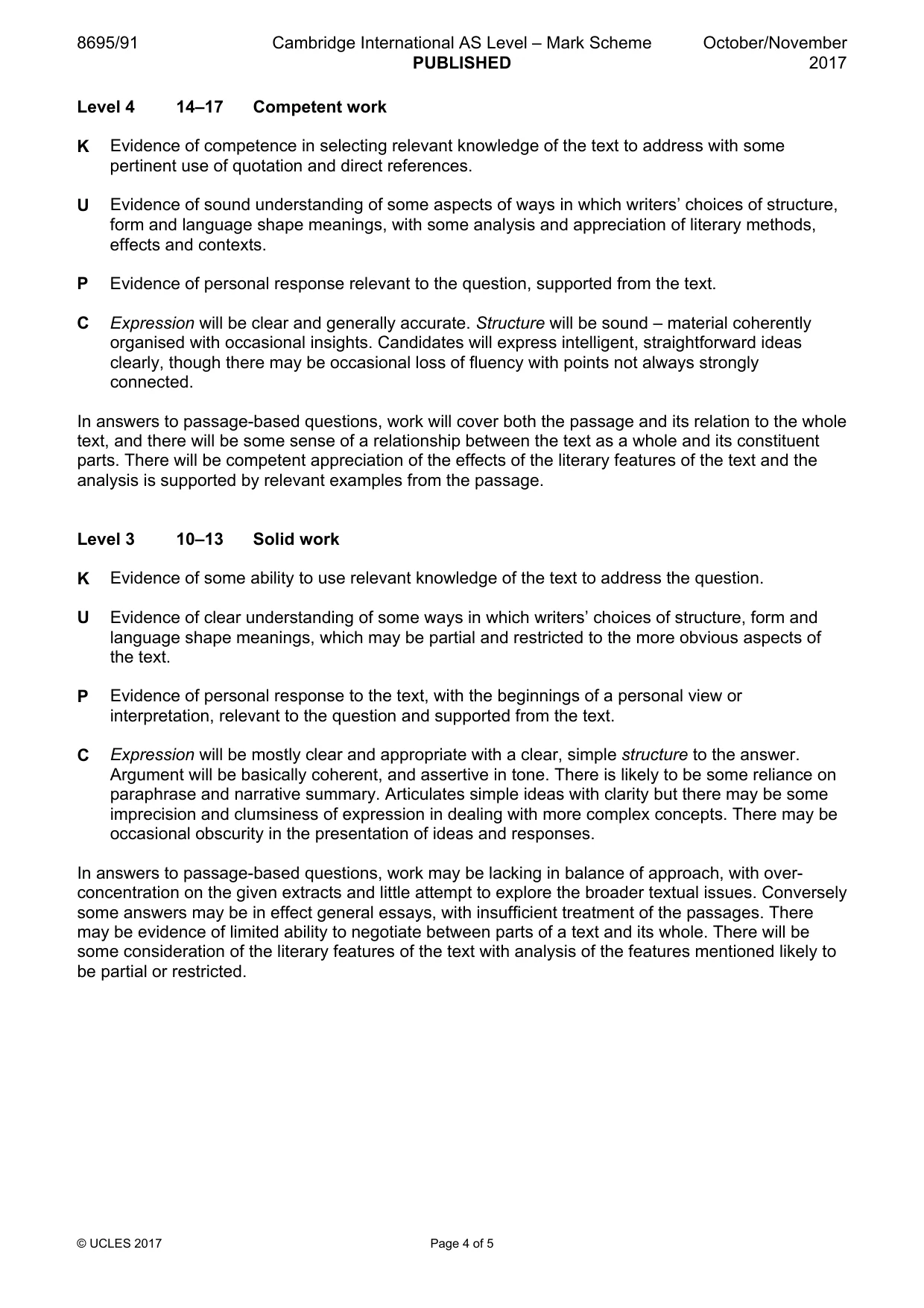
8695/91 Cambridge International AS Level – Mark Scheme PUBLISHED October/November 2017 © UCLES 2017 Page 4 of 5 Level 4 14–17 Competent work K Evidence of competence in selecting relevant knowledge of the text to address with some pertinent use of quotation and direct references. U Evidence of sound understanding of some aspects of ways in which writers’ choices of structure, form and language shape meanings, with some analysis and appreciation of literary methods, effects and contexts. P Evidence of personal response relevant to the question, supported from the text. C Expression will be clear and generally accurate. Structure will be sound – material coherently organised with occasional insights. Candidates will express intelligent, straightforward ideas clearly, though there may be occasional loss of fluency with points not always strongly connected. In answers to passage-based questions, work will cover both the passage and its relation to the whole text, and there will be some sense of a relationship between the text as a whole and its constituent parts. There will be competent appreciation of the effects of the literary features of the text and the analysis is supported by relevant examples from the passage. Level 3 10–13 Solid work K Evidence of some ability to use relevant knowledge of the text to address the question. U Evidence of clear understanding of some ways in which writers’ choices of structure, form and language shape meanings, which may be partial and restricted to the more obvious aspects of the text. P Evidence of personal response to the text, with the beginnings of a personal view or interpretation, relevant to the question and supported from the text. C Expression will be mostly clear and appropriate with a clear, simple structure to the answer. Argument will be basically coherent, and assertive in tone. There is likely to be some reliance on paraphrase and narrative summary. Articulates simple ideas with clarity but there may be some imprecision and clumsiness of expression in dealing with more complex concepts. There may be occasional obscurity in the presentation of ideas and responses. In answers to passage-based questions, work may be lacking in balance of approach, with over- concentration on the given extracts and little attempt to explore the broader textual issues. Conversely some answers may be in effect general essays, with insufficient treatment of the passages. There may be evidence of limited ability to negotiate between parts of a text and its whole. There will be some consideration of the literary features of the text with analysis of the features mentioned likely to be partial or restricted.
Mark scheme, page 5
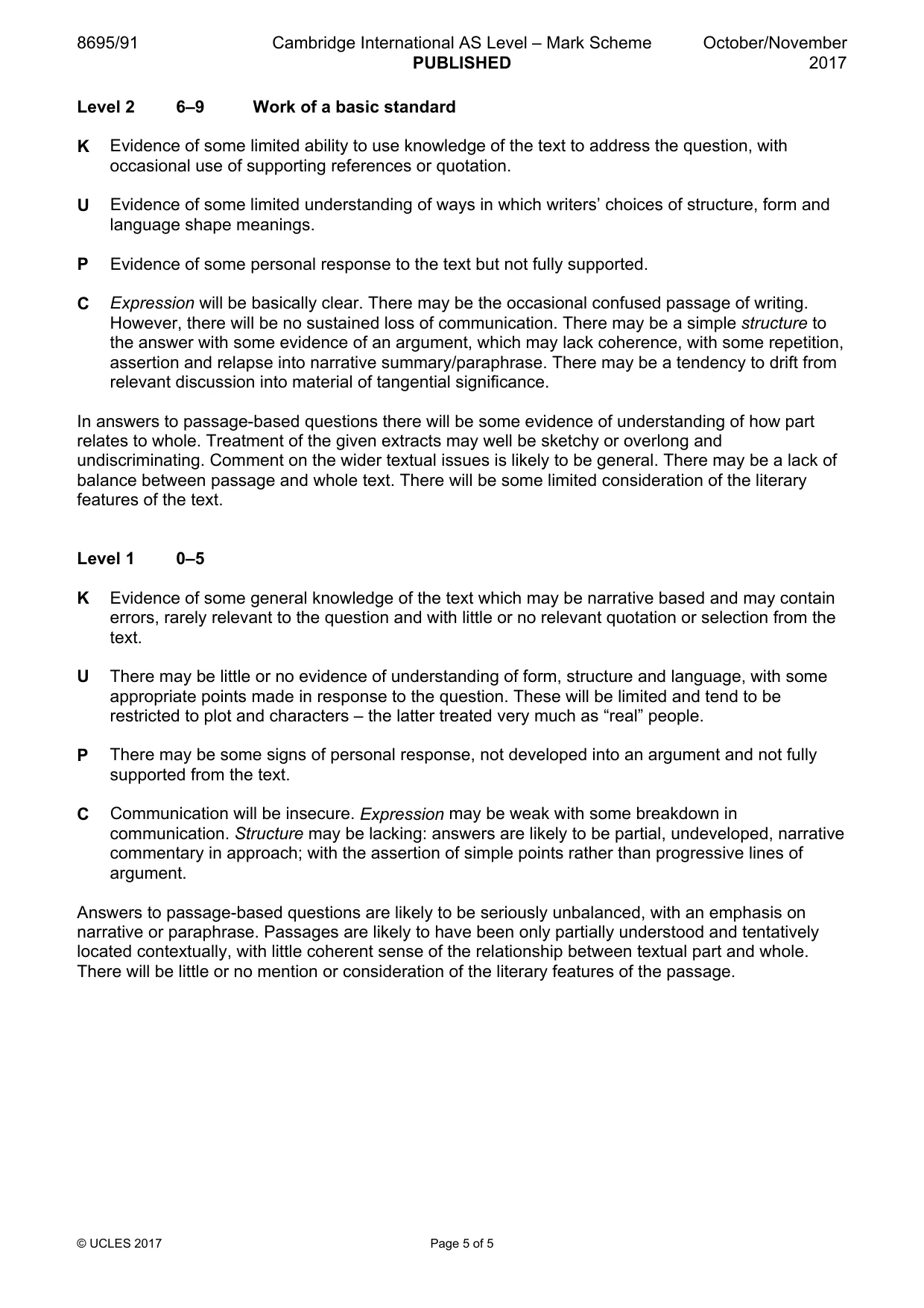
8695/91 Cambridge International AS Level – Mark Scheme PUBLISHED October/November 2017 © UCLES 2017 Page 5 of 5 Level 2 6–9 Work of a basic standard K Evidence of some limited ability to use knowledge of the text to address the question, with occasional use of supporting references or quotation. U Evidence of some limited understanding of ways in which writers’ choices of structure, form and language shape meanings. P Evidence of some personal response to the text but not fully supported. C Expression will be basically clear. There may be the occasional confused passage of writing. However, there will be no sustained loss of communication. There may be a simple structure to the answer with some evidence of an argument, which may lack coherence, with some repetition, assertion and relapse into narrative summary/paraphrase. There may be a tendency to drift from relevant discussion into material of tangential significance. In answers to passage-based questions there will be some evidence of understanding of how part relates to whole. Treatment of the given extracts may well be sketchy or overlong and undiscriminating. Comment on the wider textual issues is likely to be general. There may be a lack of balance between passage and whole text. There will be some limited consideration of the literary features of the text. Level 1 0–5 K Evidence of some general knowledge of the text which may be narrative based and may contain errors, rarely relevant to the question and with little or no relevant quotation or selection from the text. U There may be little or no evidence of understanding of form, structure and language, with some appropriate points made in response to the question. These will be limited and tend to be restricted to plot and characters – the latter treated very much as “real” people. P There may be some signs of personal response, not developed into an argument and not fully supported from the text. C Communication will be insecure. Expression may be weak with some breakdown in communication. Structure may be lacking: answers are likely to be partial, undeveloped, narrative commentary in approach; with the assertion of simple points rather than progressive lines of argument. Answers to passage-based questions are likely to be seriously unbalanced, with an emphasis on narrative or paraphrase. Passages are likely to have been only partially understood and tentatively located contextually, with little coherent sense of the relationship between textual part and whole. There will be little or no mention or consideration of the literary features of the passage.
What you needed in this session
Cambridge’s own grade thresholds for 2017 Oct/Nov, Paper 9 · Variant 1. A higher threshold means an easier paper — the bar moves with how the cohort did.