Cambridge A Level English - Language and Literature (AS Level only, from 2016) 8695 — 2016 Oct/Nov Paper 9 · Variant 3
8695/93/O/N/16 · 50 marks · ≈56 min
The question paper and its mark scheme, free to read here and free to download. This is Cambridge’s own paper, exactly as it was sat.
Question paper20 pages



Mark scheme5 pages
Answers below. Sit the paper first if you are practising.
Paper as text
Question paper, page 1
This document consists of 17 printed pages, 3 blank pages and 1 insert. DC (RCL (JDA)) 107166/3 © UCLES 2016 [Turn over Cambridge International Examinations Cambridge International Advanced Subsidiary and Advanced Level * 6 9 9 4 1 3 3 2 9 1 * LANGUAGE AND LITERATURE IN ENGLISH 8695/93 Paper 9 Poetry, Prose and Drama October/November 2016 2 hours No Additional Materials are required. READ THESE INSTRUCTIONS FIRST An answer booklet is provided inside this question paper. You should follow the instructions on the front cover of the answer booklet. If you need additional answer paper ask the invigilator for a continuation booklet. Answer two questions, each from a different section. You are reminded of the need for good English and clear presentation in your answers. All questions in this paper carry equal marks.
Question paper, page 2
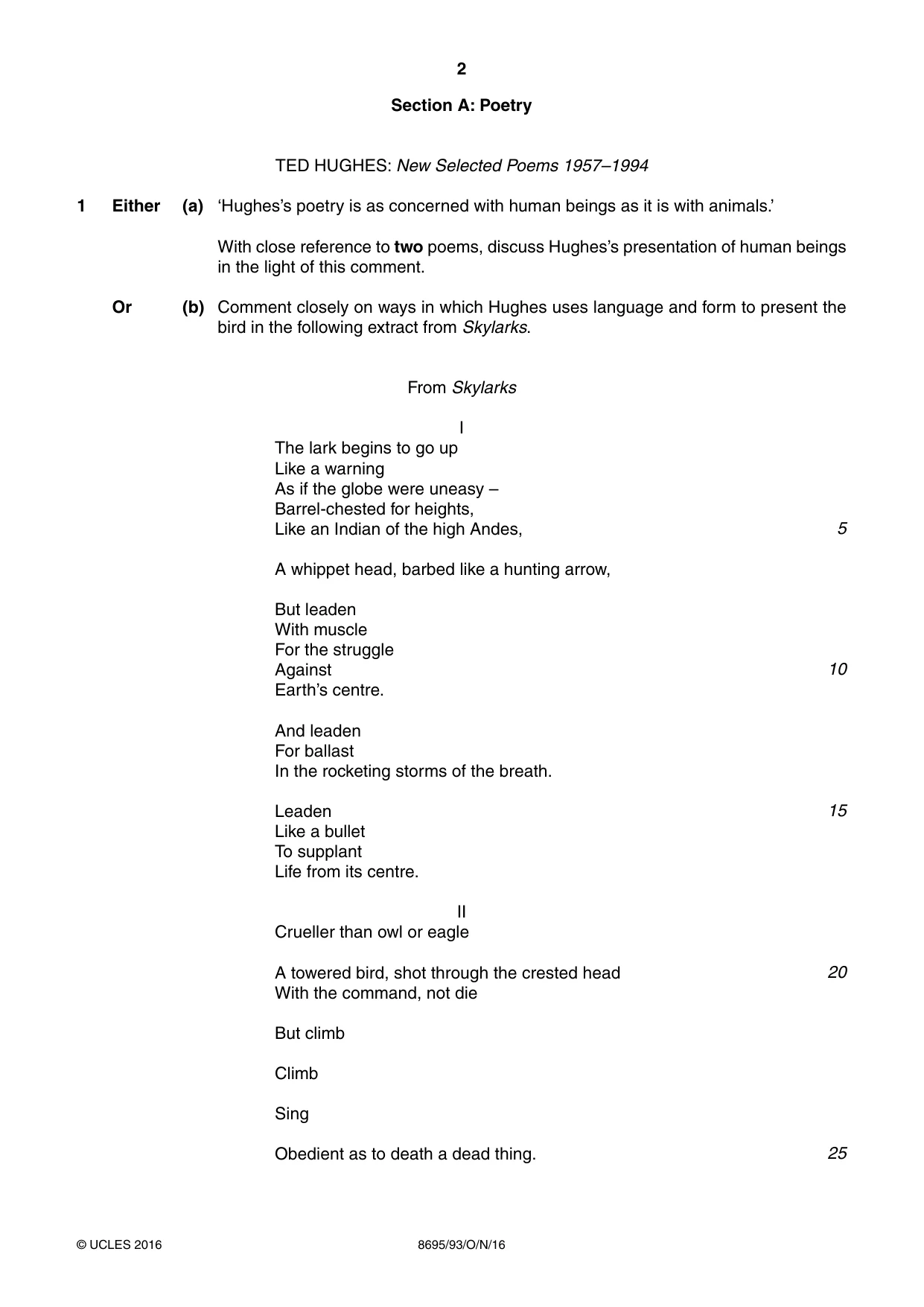
2 8695/93/O/N/16 © UCLES 2016 Section A: Poetry TED HUGHES: New Selected Poems 1957–1994 1 Either (a) ‘Hughes’s poetry is as concerned with human beings as it is with animals.’ With close reference to two poems, discuss Hughes’s presentation of human beings in the light of this comment. Or (b) Comment closely on ways in which Hughes uses language and form to present the bird in the following extract from Skylarks. From Skylarks I The lark begins to go up Like a warning As if the globe were uneasy – Barrel-chested for heights, Like an Indian of the high Andes, A whippet head, barbed like a hunting arrow, But leaden With muscle For the struggle Against Earth’s centre. And leaden For ballast In the rocketing storms of the breath. Leaden Like a bullet To supplant Life from its centre. II Crueller than owl or eagle A towered bird, shot through the crested head With the command, not die But climb Climb Sing Obedient as to death a dead thing. 5 10 15 20 25
Question paper, page 3
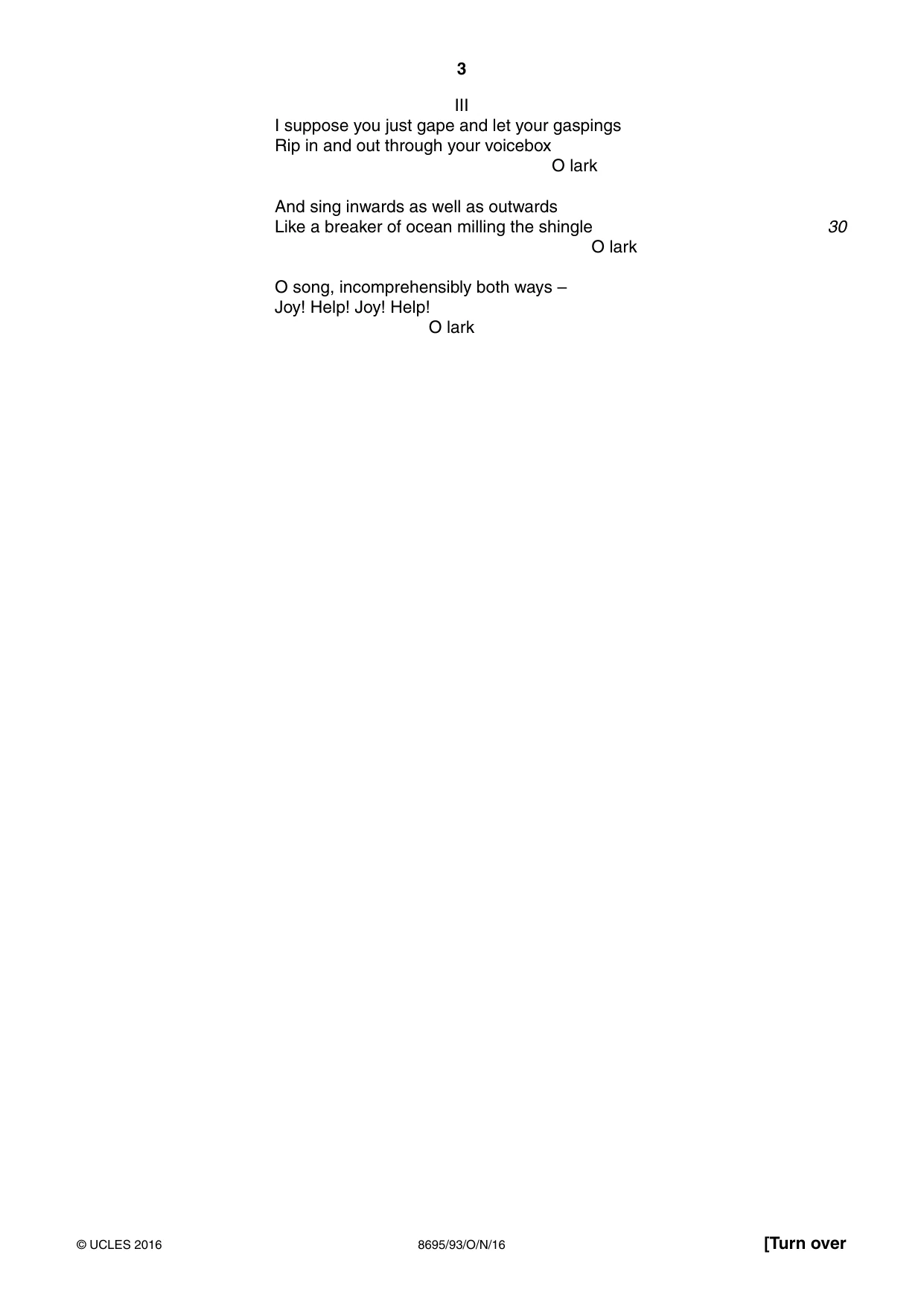
3 8695/93/O/N/16 © UCLES 2016 [Turn over III I suppose you just gape and let your gaspings Rip in and out through your voicebox O lark And sing inwards as well as outwards Like a breaker of ocean milling the shingle O lark O song, incomprehensibly both ways – Joy! Help! Joy! Help! O lark 30
Question paper, page 4
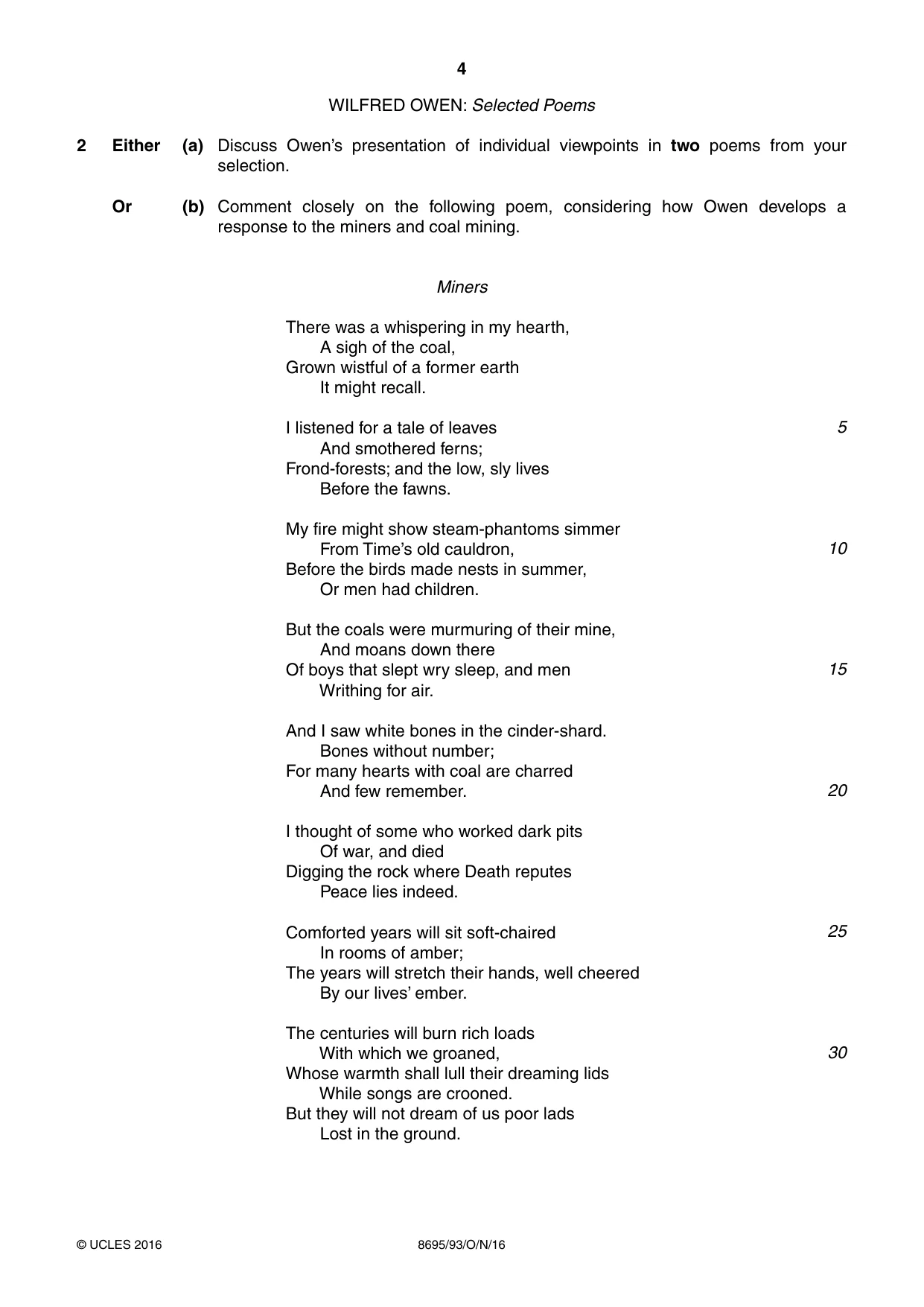
4 8695/93/O/N/16 © UCLES 2016 WILFRED OWEN: Selected Poems 2 Either (a) Discuss Owen’s presentation of individual viewpoints in two poems from your selection. Or (b) Comment closely on the following poem, considering how Owen develops a response to the miners and coal mining. Miners There was a whispering in my hearth, A sigh of the coal, Grown wistful of a former earth It might recall. I listened for a tale of leaves And smothered ferns; Frond-forests; and the low, sly lives Before the fawns. My fire might show steam-phantoms simmer From Time’s old cauldron, Before the birds made nests in summer, Or men had children. But the coals were murmuring of their mine, And moans down there Of boys that slept wry sleep, and men Writhing for air. And I saw white bones in the cinder-shard. Bones without number; For many hearts with coal are charred And few remember. I thought of some who worked dark pits Of war, and died Digging the rock where Death reputes Peace lies indeed. Comforted years will sit soft-chaired In rooms of amber; The years will stretch their hands, well cheered By our lives’ ember. The centuries will burn rich loads With which we groaned, Whose warmth shall lull their dreaming lids While songs are crooned. But they will not dream of us poor lads Lost in the ground. 5 10 15 20 25 30
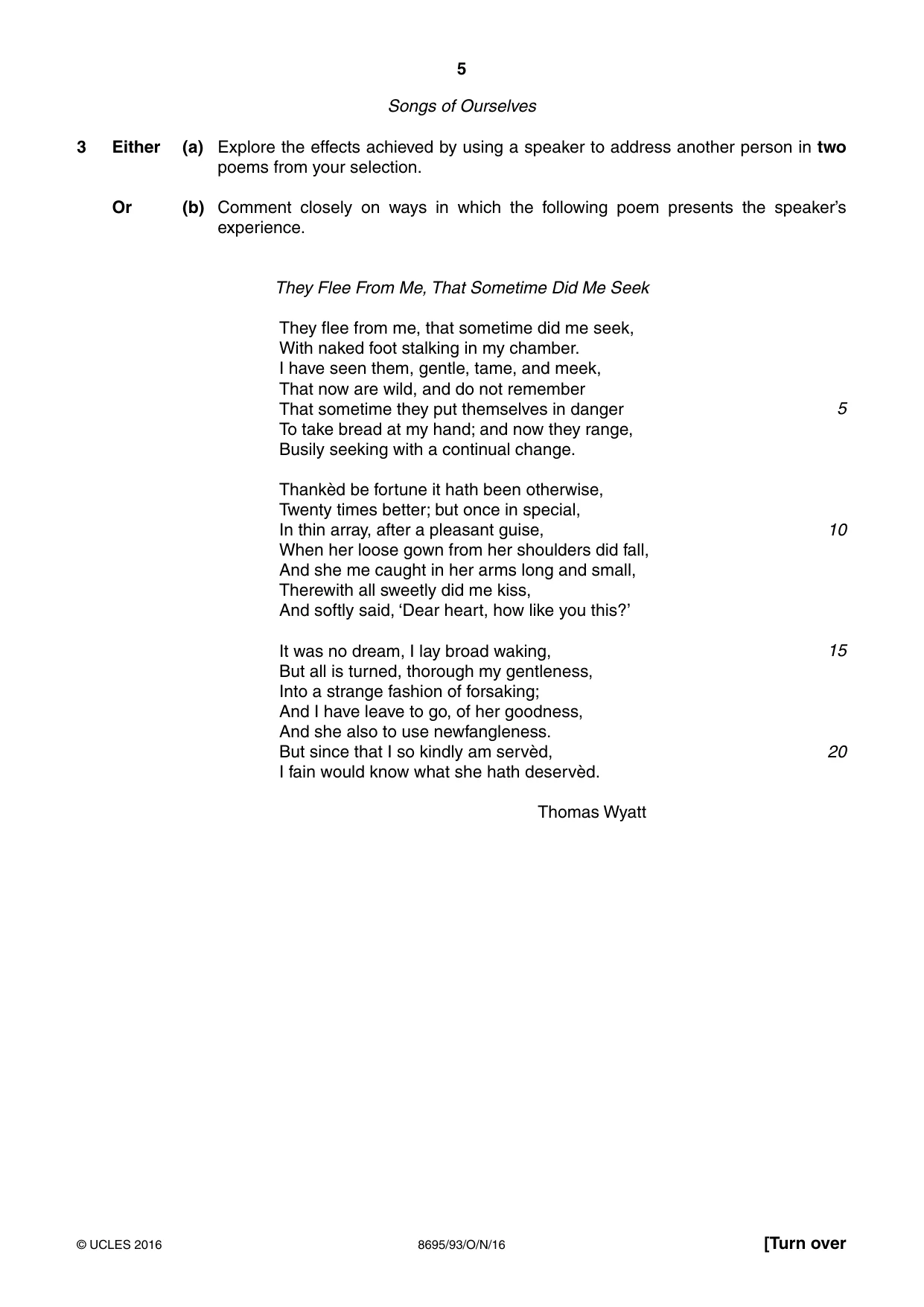
Question paper, page 5
5 8695/93/O/N/16 © UCLES 2016 [Turn over Songs of Ourselves 3 Either (a) Explore the effects achieved by using a speaker to address another person in two poems from your selection. Or (b) Comment closely on ways in which the following poem presents the speaker’s experience. They Flee From Me, That Sometime Did Me Seek They flee from me, that sometime did me seek, With naked foot stalking in my chamber. I have seen them, gentle, tame, and meek, That now are wild, and do not remember That sometime they put themselves in danger To take bread at my hand; and now they range, Busily seeking with a continual change. Thankèd be fortune it hath been otherwise, Twenty times better; but once in special, In thin array, after a pleasant guise, When her loose gown from her shoulders did fall, And she me caught in her arms long and small, Therewith all sweetly did me kiss, And softly said, ‘Dear heart, how like you this?’ It was no dream, I lay broad waking, But all is turned, thorough my gentleness, Into a strange fashion of forsaking; And I have leave to go, of her goodness, And she also to use newfangleness. But since that I so kindly am servèd, I fain would know what she hath deservèd. Thomas Wyatt 5 10 15 20
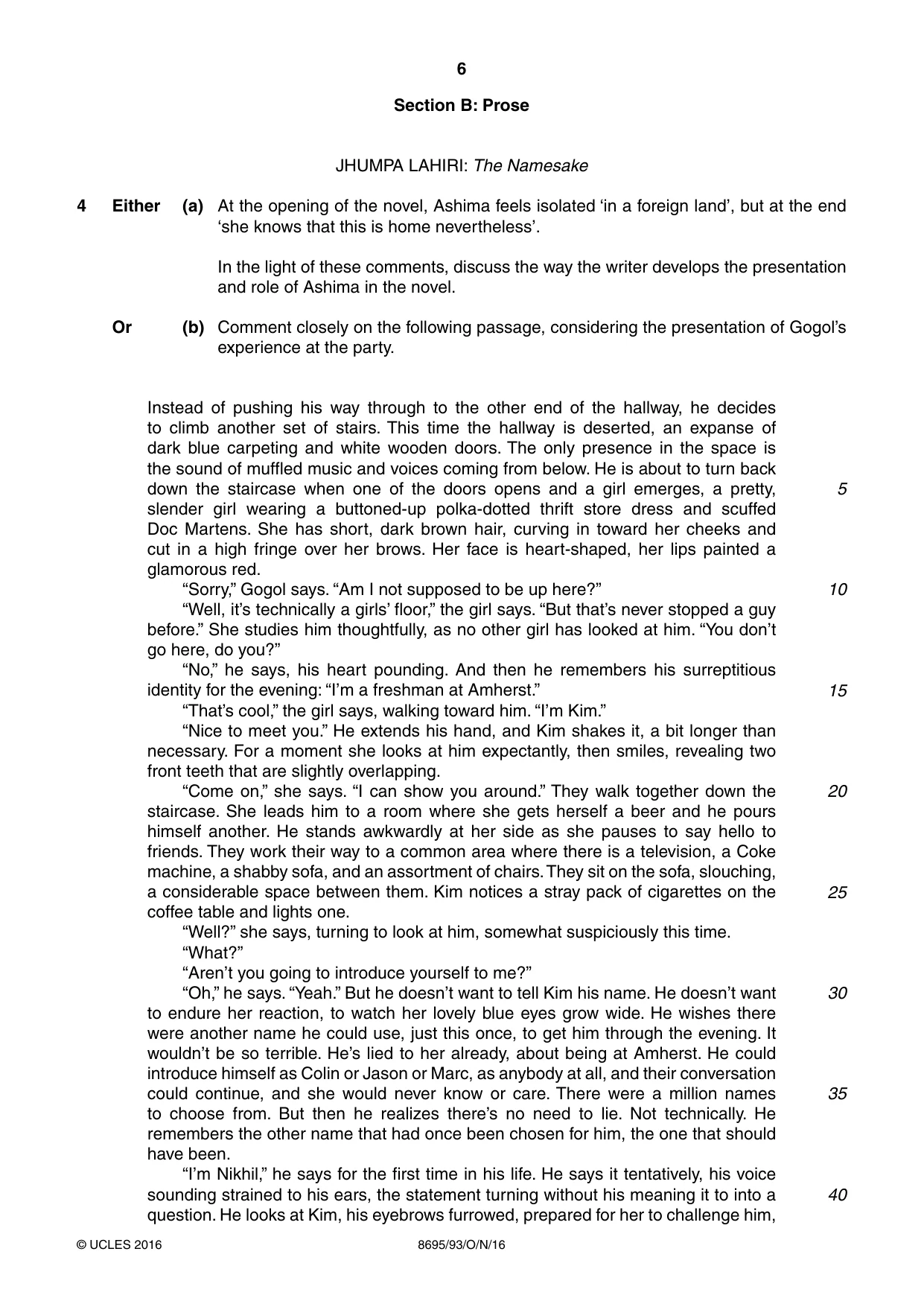
Question paper, page 6
6 8695/93/O/N/16 © UCLES 2016 Section B: Prose JHUMPA LAHIRI: The Namesake 4 Either (a) At the opening of the novel, Ashima feels isolated ‘in a foreign land’, but at the end ‘she knows that this is home nevertheless’. In the light of these comments, discuss the way the writer develops the presentation and role of Ashima in the novel. Or (b) Comment closely on the following passage, considering the presentation of Gogol’s experience at the party. Instead of pushing his way through to the other end of the hallway, he decides to climb another set of stairs. This time the hallway is deserted, an expanse of dark blue carpeting and white wooden doors. The only presence in the space is the sound of muffled music and voices coming from below. He is about to turn back down the staircase when one of the doors opens and a girl emerges, a pretty, slender girl wearing a buttoned-up polka-dotted thrift store dress and scuffed Doc Martens. She has short, dark brown hair, curving in toward her cheeks and cut in a high fringe over her brows. Her face is heart-shaped, her lips painted a glamorous red. “Sorry,” Gogol says. “Am I not supposed to be up here?” “Well, it’s technically a girls’ floor,” the girl says. “But that’s never stopped a guy before.” She studies him thoughtfully, as no other girl has looked at him. “You don’t go here, do you?” “No,” he says, his heart pounding. And then he remembers his surreptitious identity for the evening: “I’m a freshman at Amherst.” “That’s cool,” the girl says, walking toward him. “I’m Kim.” “Nice to meet you.” He extends his hand, and Kim shakes it, a bit longer than necessary. For a moment she looks at him expectantly, then smiles, revealing two front teeth that are slightly overlapping. “Come on,” she says. “I can show you around.” They walk together down the staircase. She leads him to a room where she gets herself a beer and he pours himself another. He stands awkwardly at her side as she pauses to say hello to friends. They work their way to a common area where there is a television, a Coke machine, a shabby sofa, and an assortment of chairs. They sit on the sofa, slouching, a considerable space between them. Kim notices a stray pack of cigarettes on the coffee table and lights one. “Well?” she says, turning to look at him, somewhat suspiciously this time. “What?” “Aren’t you going to introduce yourself to me?” “Oh,” he says. “Yeah.” But he doesn’t want to tell Kim his name. He doesn’t want to endure her reaction, to watch her lovely blue eyes grow wide. He wishes there were another name he could use, just this once, to get him through the evening. It wouldn’t be so terrible. He’s lied to her already, about being at Amherst. He could introduce himself as Colin or Jason or Marc, as anybody at all, and their conversation could continue, and she would never know or care. There were a million names to choose from. But then he realizes there’s no need to lie. Not technically. He remembers the other name that had once been chosen for him, the one that should have been. “I’m Nikhil,” he says for the first time in his life. He says it tentatively, his voice sounding strained to his ears, the statement turning without his meaning it to into a question. He looks at Kim, his eyebrows furrowed, prepared for her to challenge him, 5 10 15 20 25 30 35 40
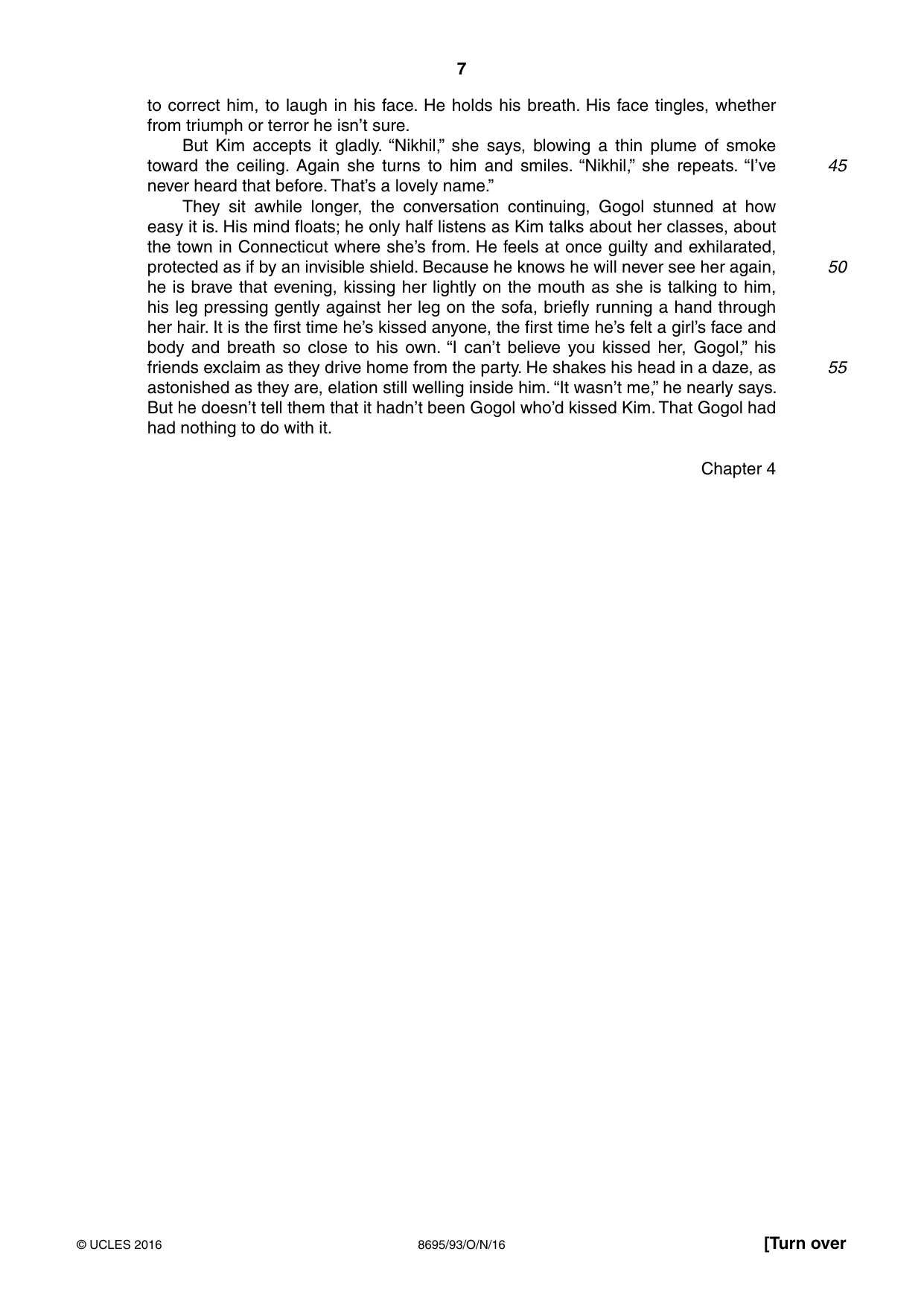
Question paper, page 7
7 8695/93/O/N/16 © UCLES 2016 [Turn over to correct him, to laugh in his face. He holds his breath. His face tingles, whether from triumph or terror he isn’t sure. But Kim accepts it gladly. “Nikhil,” she says, blowing a thin plume of smoke toward the ceiling. Again she turns to him and smiles. “Nikhil,” she repeats. “I’ve never heard that before. That’s a lovely name.” They sit awhile longer, the conversation continuing, Gogol stunned at how easy it is. His mind floats; he only half listens as Kim talks about her classes, about the town in Connecticut where she’s from. He feels at once guilty and exhilarated, protected as if by an invisible shield. Because he knows he will never see her again, he is brave that evening, kissing her lightly on the mouth as she is talking to him, his leg pressing gently against her leg on the sofa, briefly running a hand through her hair. It is the first time he’s kissed anyone, the first time he’s felt a girl’s face and body and breath so close to his own. “I can’t believe you kissed her, Gogol,” his friends exclaim as they drive home from the party. He shakes his head in a daze, as astonished as they are, elation still welling inside him. “It wasn’t me,” he nearly says. But he doesn’t tell them that it hadn’t been Gogol who’d kissed Kim. That Gogol had had nothing to do with it. Chapter 4 45 50 55
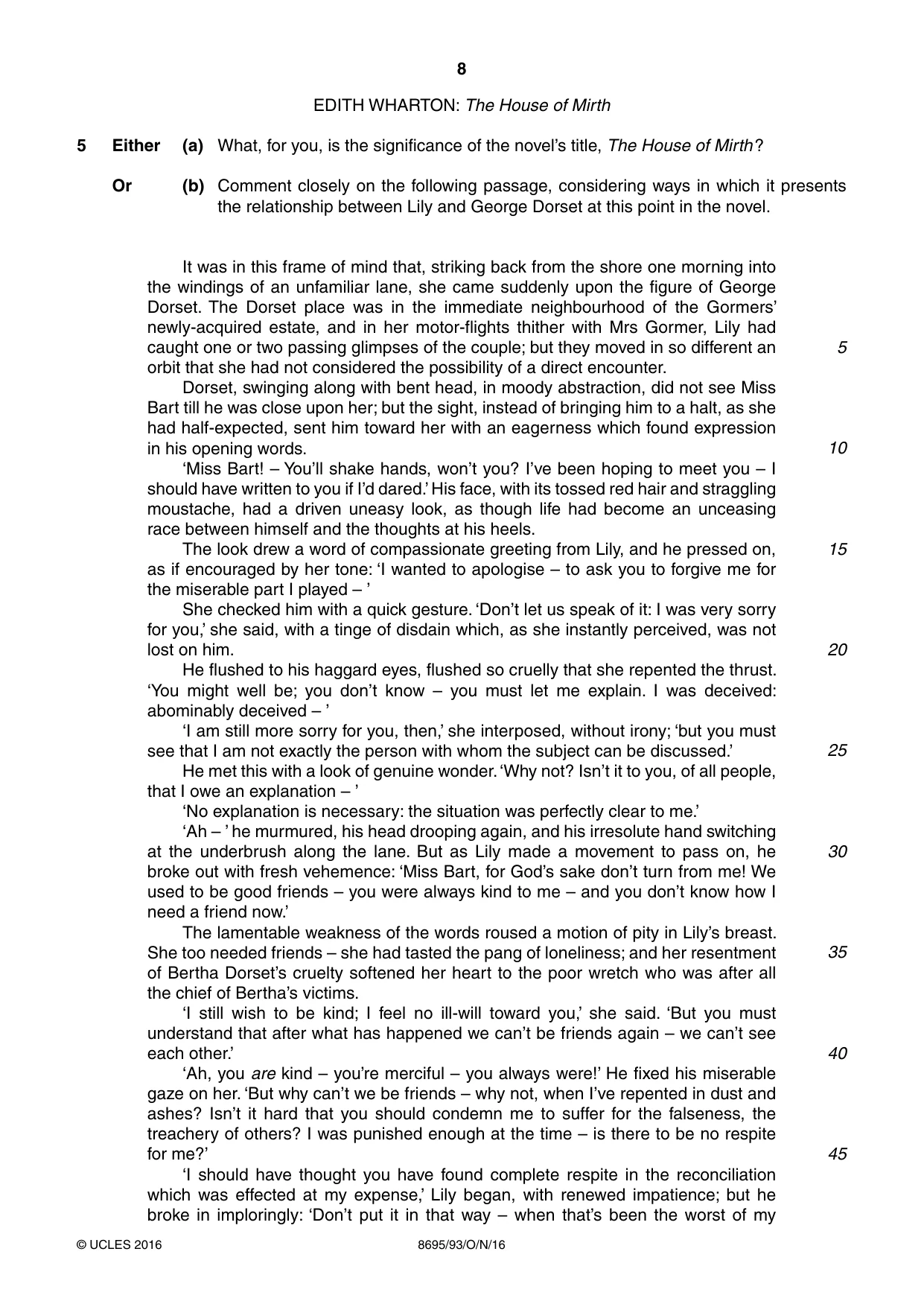
Question paper, page 8
8 8695/93/O/N/16 © UCLES 2016 EDITH WHARTON: The House of Mirth 5 Either (a) What, for you, is the significance of the novel’s title, The House of Mirth ? Or (b) Comment closely on the following passage, considering ways in which it presents the relationship between Lily and George Dorset at this point in the novel. It was in this frame of mind that, striking back from the shore one morning into the windings of an unfamiliar lane, she came suddenly upon the figure of George Dorset. The Dorset place was in the immediate neighbourhood of the Gormers’ newly-acquired estate, and in her motor-flights thither with Mrs Gormer, Lily had caught one or two passing glimpses of the couple; but they moved in so different an orbit that she had not considered the possibility of a direct encounter. Dorset, swinging along with bent head, in moody abstraction, did not see Miss Bart till he was close upon her; but the sight, instead of bringing him to a halt, as she had half-expected, sent him toward her with an eagerness which found expression in his opening words. ‘Miss Bart! – You’ll shake hands, won’t you? I’ve been hoping to meet you – I should have written to you if I’d dared.’ His face, with its tossed red hair and straggling moustache, had a driven uneasy look, as though life had become an unceasing race between himself and the thoughts at his heels. The look drew a word of compassionate greeting from Lily, and he pressed on, as if encouraged by her tone: ‘I wanted to apologise – to ask you to forgive me for the miserable part I played – ’ She checked him with a quick gesture. ‘Don’t let us speak of it: I was very sorry for you,’ she said, with a tinge of disdain which, as she instantly perceived, was not lost on him. He flushed to his haggard eyes, flushed so cruelly that she repented the thrust. ‘You might well be; you don’t know – you must let me explain. I was deceived: abominably deceived – ’ ‘I am still more sorry for you, then,’ she interposed, without irony; ‘but you must see that I am not exactly the person with whom the subject can be discussed.’ He met this with a look of genuine wonder. ‘Why not? Isn’t it to you, of all people, that I owe an explanation – ’ ‘No explanation is necessary: the situation was perfectly clear to me.’ ‘Ah – ’ he murmured, his head drooping again, and his irresolute hand switching at the underbrush along the lane. But as Lily made a movement to pass on, he broke out with fresh vehemence: ‘Miss Bart, for God’s sake don’t turn from me! We used to be good friends – you were always kind to me – and you don’t know how I need a friend now.’ The lamentable weakness of the words roused a motion of pity in Lily’s breast. She too needed friends – she had tasted the pang of loneliness; and her resentment of Bertha Dorset’s cruelty softened her heart to the poor wretch who was after all the chief of Bertha’s victims. ‘I still wish to be kind; I feel no ill-will toward you,’ she said. ‘But you must understand that after what has happened we can’t be friends again – we can’t see each other.’ ‘Ah, you are kind – you’re merciful – you always were!’ He fixed his miserable gaze on her. ‘But why can’t we be friends – why not, when I’ve repented in dust and ashes? Isn’t it hard that you should condemn me to suffer for the falseness, the treachery of others? I was punished enough at the time – is there to be no respite for me?’ ‘I should have thought you have found complete respite in the reconciliation which was effected at my expense,’ Lily began, with renewed impatience; but he broke in imploringly: ‘Don’t put it in that way – when that’s been the worst of my 5 10 15 20 25 30 35 40 45
Question paper, page 9
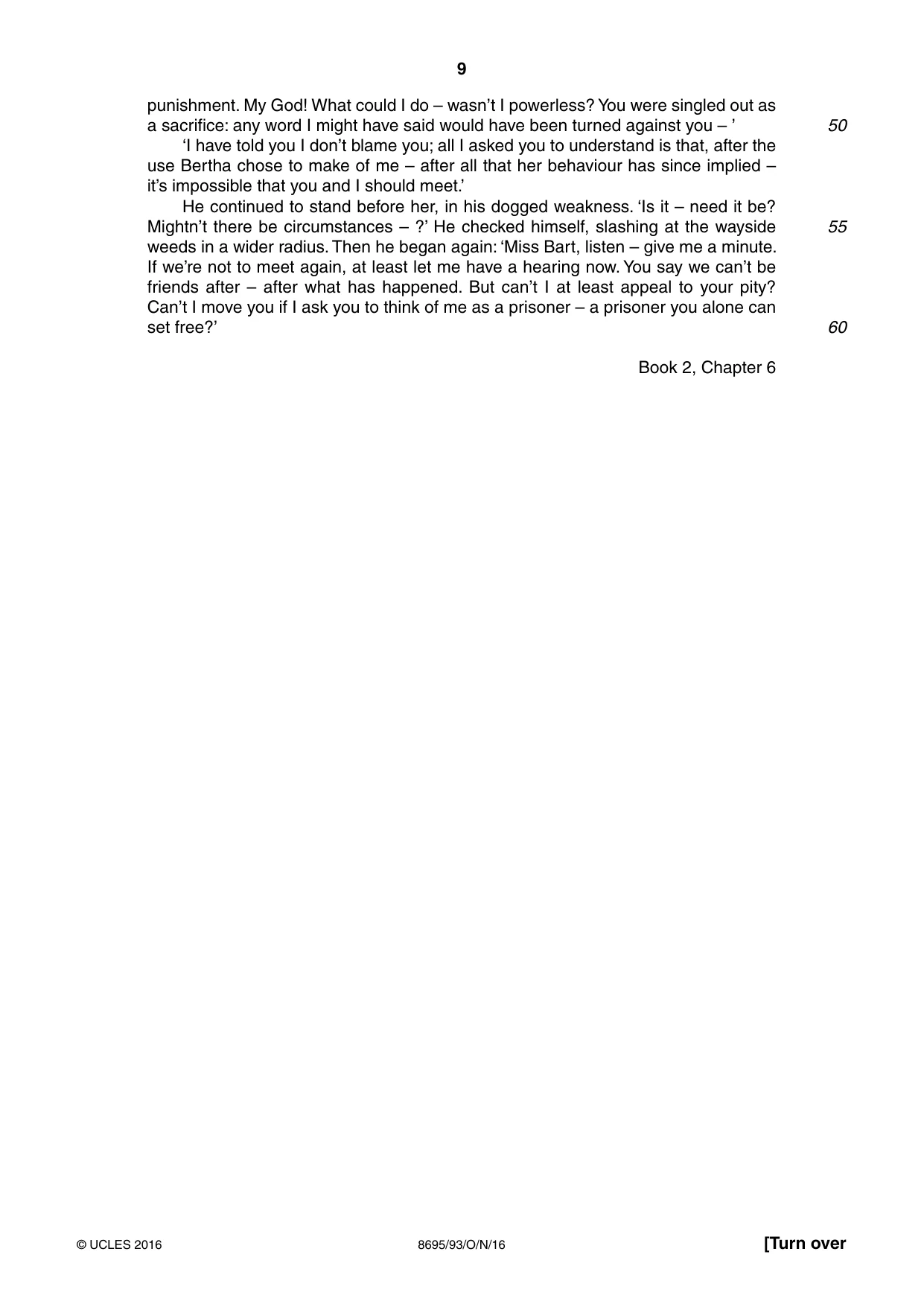
9 8695/93/O/N/16 © UCLES 2016 [Turn over punishment. My God! What could I do – wasn’t I powerless? You were singled out as a sacrifice: any word I might have said would have been turned against you – ’ ‘I have told you I don’t blame you; all I asked you to understand is that, after the use Bertha chose to make of me – after all that her behaviour has since implied – it’s impossible that you and I should meet.’ He continued to stand before her, in his dogged weakness. ‘Is it – need it be? Mightn’t there be circumstances – ?’ He checked himself, slashing at the wayside weeds in a wider radius. Then he began again: ‘Miss Bart, listen – give me a minute. If we’re not to meet again, at least let me have a hearing now. You say we can’t be friends after – after what has happened. But can’t I at least appeal to your pity? Can’t I move you if I ask you to think of me as a prisoner – a prisoner you alone can set free?’ Book 2, Chapter 6 50 55 60
Question paper, page 10
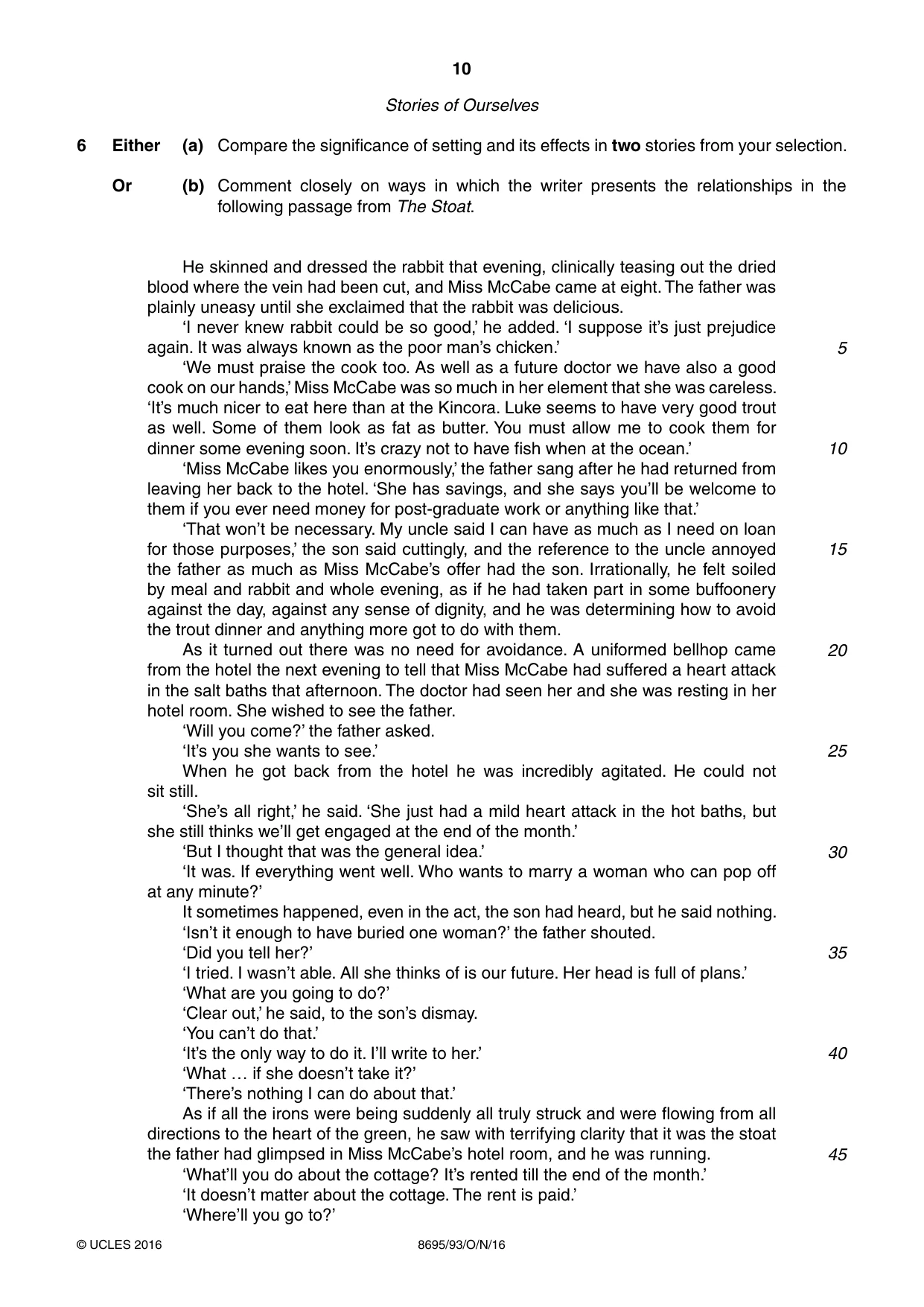
10 8695/93/O/N/16 © UCLES 2016 Stories of Ourselves 6 Either (a) Compare the significance of setting and its effects in two stories from your selection. Or (b) Comment closely on ways in which the writer presents the relationships in the following passage from The Stoat. He skinned and dressed the rabbit that evening, clinically teasing out the dried blood where the vein had been cut, and Miss McCabe came at eight. The father was plainly uneasy until she exclaimed that the rabbit was delicious. ‘I never knew rabbit could be so good,’ he added. ‘I suppose it’s just prejudice again. It was always known as the poor man’s chicken.’ ‘We must praise the cook too. As well as a future doctor we have also a good cook on our hands,’ Miss McCabe was so much in her element that she was careless. ‘It’s much nicer to eat here than at the Kincora. Luke seems to have very good trout as well. Some of them look as fat as butter. You must allow me to cook them for dinner some evening soon. It’s crazy not to have fish when at the ocean.’ ‘Miss McCabe likes you enormously,’ the father sang after he had returned from leaving her back to the hotel. ‘She has savings, and she says you’ll be welcome to them if you ever need money for post-graduate work or anything like that.’ ‘That won’t be necessary. My uncle said I can have as much as I need on loan for those purposes,’ the son said cuttingly, and the reference to the uncle annoyed the father as much as Miss McCabe’s offer had the son. Irrationally, he felt soiled by meal and rabbit and whole evening, as if he had taken part in some buffoonery against the day, against any sense of dignity, and he was determining how to avoid the trout dinner and anything more got to do with them. As it turned out there was no need for avoidance. A uniformed bellhop came from the hotel the next evening to tell that Miss McCabe had suffered a heart attack in the salt baths that afternoon. The doctor had seen her and she was resting in her hotel room. She wished to see the father. ‘Will you come?’ the father asked. ‘It’s you she wants to see.’ When he got back from the hotel he was incredibly agitated. He could not sit still. ‘She’s all right,’ he said. ‘She just had a mild heart attack in the hot baths, but she still thinks we’ll get engaged at the end of the month.’ ‘But I thought that was the general idea.’ ‘It was. If everything went well. Who wants to marry a woman who can pop off at any minute?’ It sometimes happened, even in the act, the son had heard, but he said nothing. ‘Isn’t it enough to have buried one woman?’ the father shouted. ‘Did you tell her?’ ‘I tried. I wasn’t able. All she thinks of is our future. Her head is full of plans.’ ‘What are you going to do?’ ‘Clear out,’ he said, to the son’s dismay. ‘You can’t do that.’ ‘It’s the only way to do it. I’ll write to her.’ ‘What … if she doesn’t take it?’ ‘There’s nothing I can do about that.’ As if all the irons were being suddenly all truly struck and were flowing from all directions to the heart of the green, he saw with terrifying clarity that it was the stoat the father had glimpsed in Miss McCabe’s hotel room, and he was running. ‘What’ll you do about the cottage? It’s rented till the end of the month.’ ‘It doesn’t matter about the cottage. The rent is paid.’ ‘Where’ll you go to?’ 5 10 15 20 25 30 35 40 45
Question paper, page 11
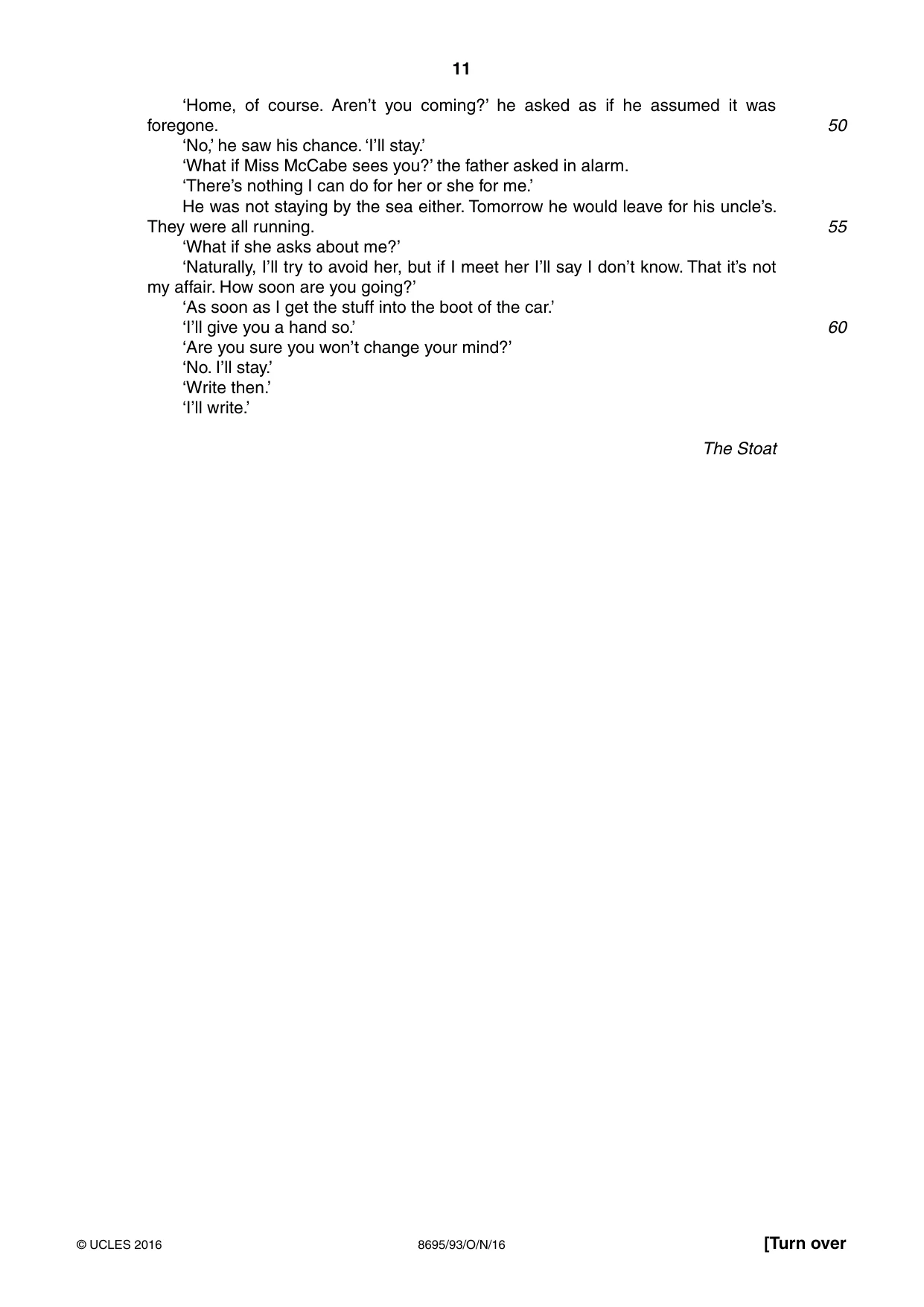
11 8695/93/O/N/16 © UCLES 2016 [Turn over ‘Home, of course. Aren’t you coming?’ he asked as if he assumed it was foregone. ‘No,’ he saw his chance. ‘I’ll stay.’ ‘What if Miss McCabe sees you?’ the father asked in alarm. ‘There’s nothing I can do for her or she for me.’ He was not staying by the sea either. Tomorrow he would leave for his uncle’s. They were all running. ‘What if she asks about me?’ ‘Naturally, I’ll try to avoid her, but if I meet her I’ll say I don’t know. That it’s not my affair. How soon are you going?’ ‘As soon as I get the stuff into the boot of the car.’ ‘I’ll give you a hand so.’ ‘Are you sure you won’t change your mind?’ ‘No. I’ll stay.’ ‘Write then.’ ‘I’ll write.’ The Stoat 50 55 60
Question paper, page 12
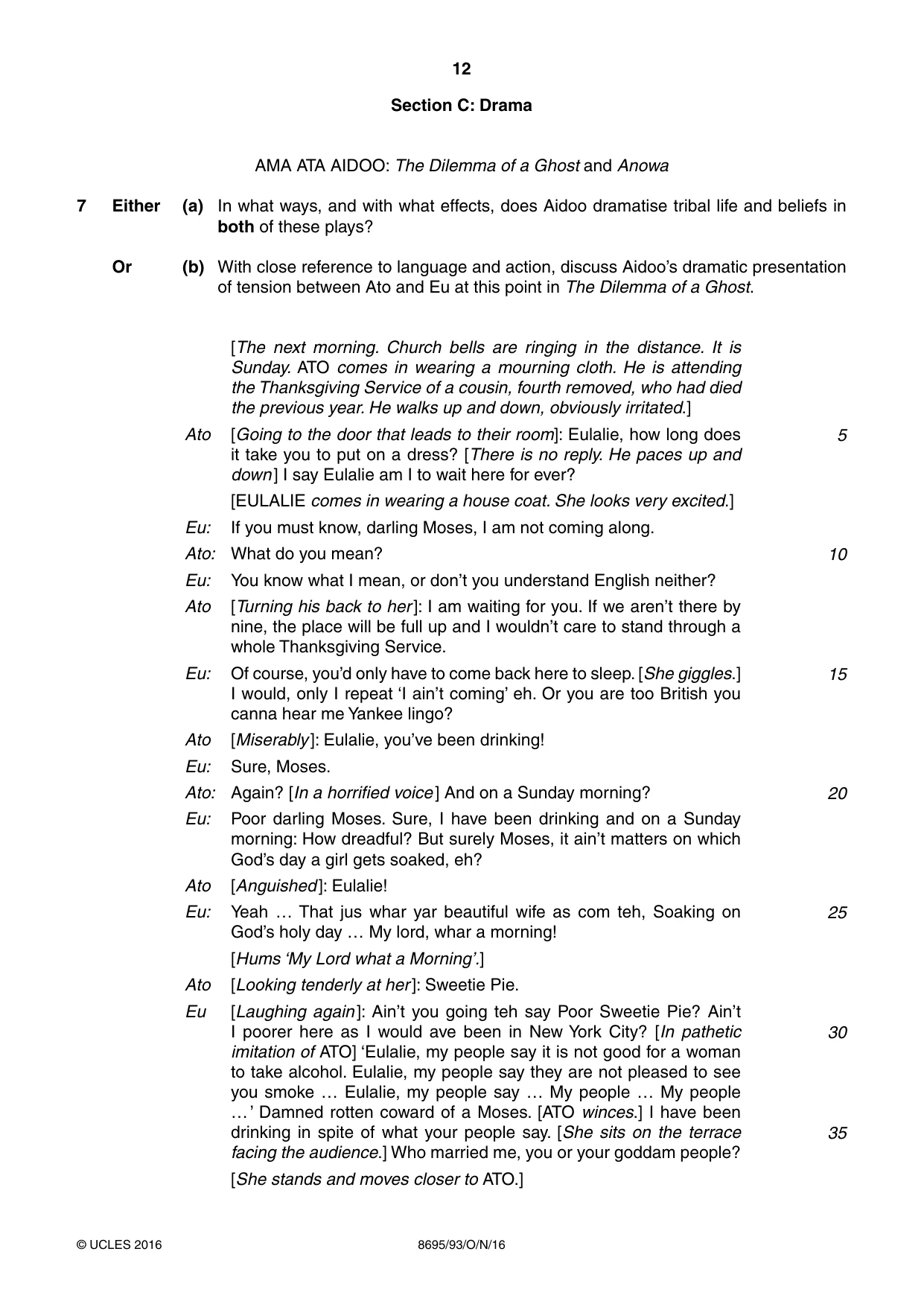
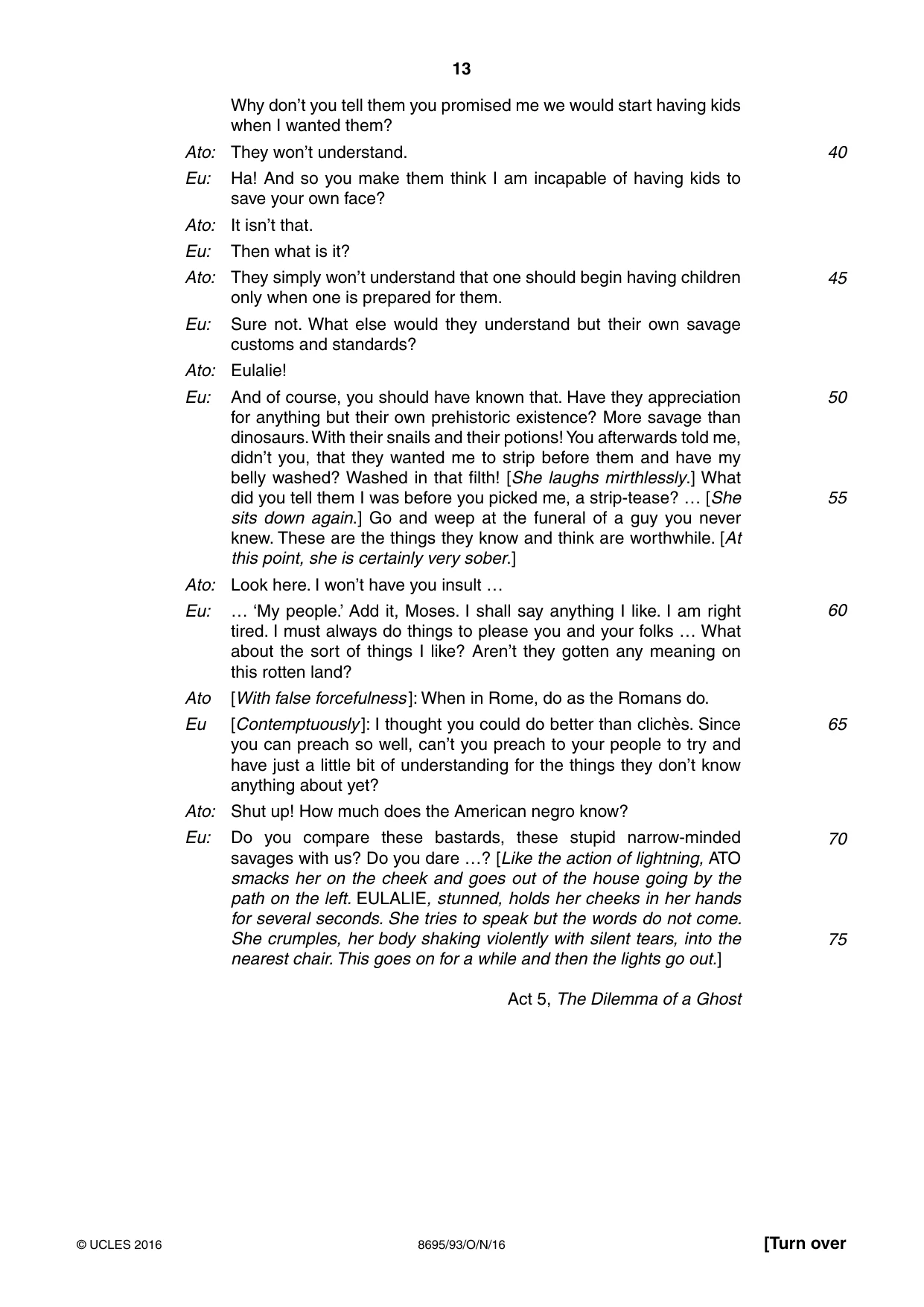
12 8695/93/O/N/16 © UCLES 2016 Section C: Drama AMA ATA AIDOO: The Dilemma of a Ghost and Anowa 7 Either (a) In what ways, and with what effects, does Aidoo dramatise tribal life and beliefs in both of these plays? Or (b) With close reference to language and action, discuss Aidoo’s dramatic presentation of tension between Ato and Eu at this point in The Dilemma of a Ghost. [The next morning. Church bells are ringing in the distance. It is Sunday. ATO comes in wearing a mourning cloth. He is attending the Thanksgiving Service of a cousin, fourth removed, who had died the previous year. He walks up and down, obviously irritated.] Ato [Going to the door that leads to their room]: Eulalie, how long does it take you to put on a dress? [There is no reply. He paces up and down ] I say Eulalie am I to wait here for ever? [EULALIE comes in wearing a house coat. She looks very excited.] Eu: If you must know, darling Moses, I am not coming along. Ato: What do you mean? Eu: You know what I mean, or don’t you understand English neither? Ato [Turning his back to her ]: I am waiting for you. If we aren’t there by nine, the place will be full up and I wouldn’t care to stand through a whole Thanksgiving Service. Eu: Of course, you’d only have to come back here to sleep. [She giggles.] I would, only I repeat ‘I ain’t coming’ eh. Or you are too British you canna hear me Yankee lingo? Ato [Miserably ]: Eulalie, you’ve been drinking! Eu: Sure, Moses. Ato: Again? [In a horrified voice ] And on a Sunday morning? Eu: Poor darling Moses. Sure, I have been drinking and on a Sunday morning: How dreadful? But surely Moses, it ain’t matters on which God’s day a girl gets soaked, eh? Ato [Anguished ]: Eulalie! Eu: Yeah … That jus whar yar beautiful wife as com teh, Soaking on God’s holy day … My lord, whar a morning! [Hums ‘My Lord what a Morning’.] Ato [Looking tenderly at her ]: Sweetie Pie. Eu [Laughing again ]: Ain’t you going teh say Poor Sweetie Pie? Ain’t I poorer here as I would ave been in New York City? [In pathetic imitation of ATO] ‘Eulalie, my people say it is not good for a woman to take alcohol. Eulalie, my people say they are not pleased to see you smoke … Eulalie, my people say … My people … My people … ’ Damned rotten coward of a Moses. [ATO winces.] I have been drinking in spite of what your people say. [She sits on the terrace facing the audience.] Who married me, you or your goddam people? [She stands and moves closer to ATO.] 5 10 15 20 25 30 35
Question paper, page 13
13 8695/93/O/N/16 © UCLES 2016 [Turn over Why don’t you tell them you promised me we would start having kids when I wanted them? Ato: They won’t understand. Eu: Ha! And so you make them think I am incapable of having kids to save your own face? Ato: It isn’t that. Eu: Then what is it? Ato: They simply won’t understand that one should begin having children only when one is prepared for them. Eu: Sure not. What else would they understand but their own savage customs and standards? Ato: Eulalie! Eu: And of course, you should have known that. Have they appreciation for anything but their own prehistoric existence? More savage than dinosaurs. With their snails and their potions! You afterwards told me, didn’t you, that they wanted me to strip before them and have my belly washed? Washed in that filth! [She laughs mirthlessly.] What did you tell them I was before you picked me, a strip-tease? … [She sits down again.] Go and weep at the funeral of a guy you never knew. These are the things they know and think are worthwhile. [At this point, she is certainly very sober.] Ato: Look here. I won’t have you insult … Eu: … ‘My people.’ Add it, Moses. I shall say anything I like. I am right tired. I must always do things to please you and your folks … What about the sort of things I like? Aren’t they gotten any meaning on this rotten land? Ato [With false forcefulness ]: When in Rome, do as the Romans do. Eu [Contemptuously ]: I thought you could do better than clichès. Since you can preach so well, can’t you preach to your people to try and have just a little bit of understanding for the things they don’t know anything about yet? Ato: Shut up! How much does the American negro know? Eu: Do you compare these bastards, these stupid narrow-minded savages with us? Do you dare …? [Like the action of lightning, ATO smacks her on the cheek and goes out of the house going by the path on the left. EULALIE, stunned, holds her cheeks in her hands for several seconds. She tries to speak but the words do not come. She crumples, her body shaking violently with silent tears, into the nearest chair. This goes on for a while and then the lights go out.] Act 5, The Dilemma of a Ghost 40 45 50 55 60 65 70 75
Question paper, page 14
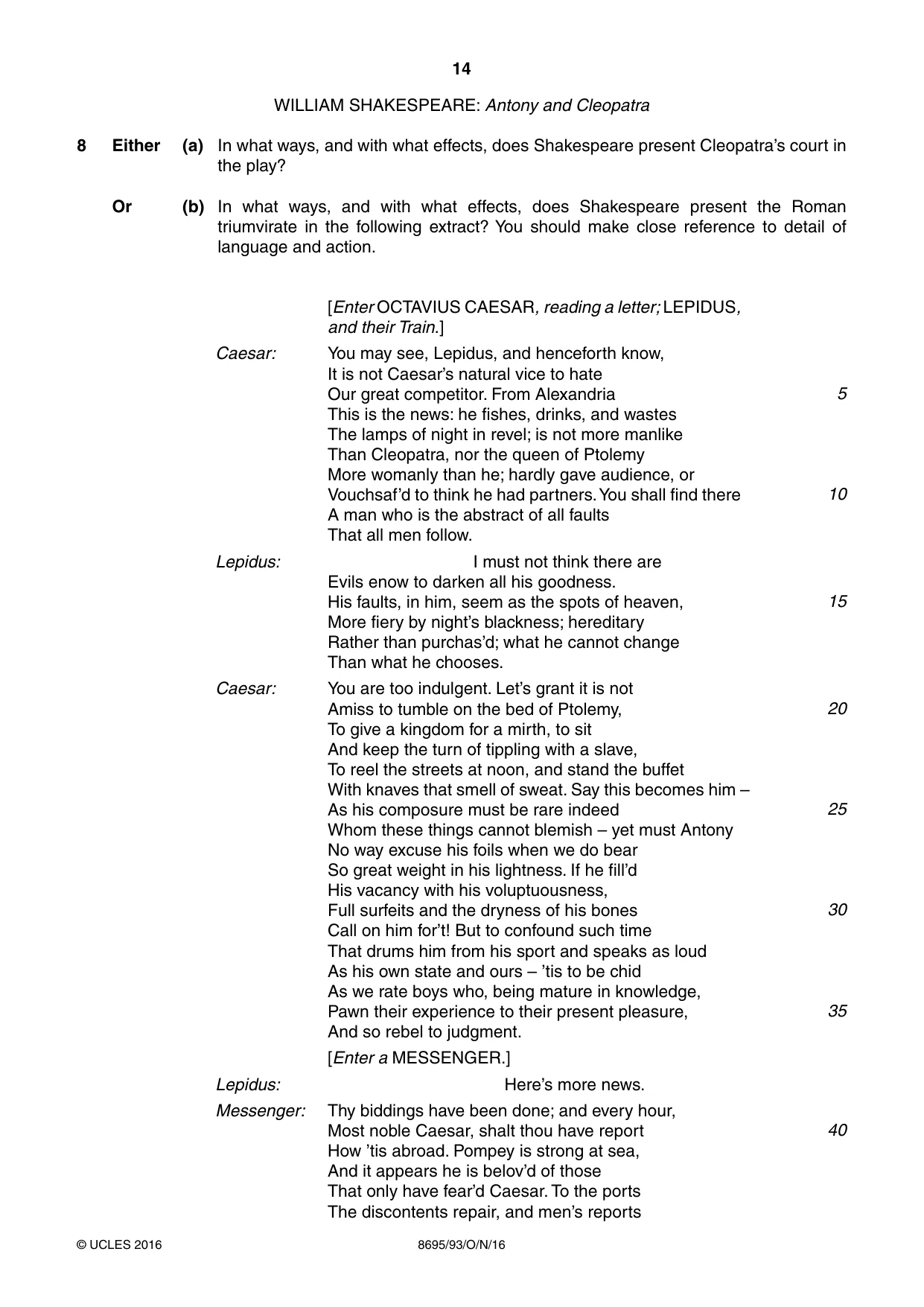
14 8695/93/O/N/16 © UCLES 2016 WILLIAM SHAKESPEARE: Antony and Cleopatra 8 Either (a) In what ways, and with what effects, does Shakespeare present Cleopatra’s court in the play? Or (b) In what ways, and with what effects, does Shakespeare present the Roman triumvirate in the following extract? You should make close reference to detail of language and action. [Enter OCTAVIUS CAESAR, reading a letter; LEPIDUS, and their Train.] Caesar: You may see, Lepidus, and henceforth know, It is not Caesar’s natural vice to hate Our great competitor. From Alexandria This is the news: he fishes, drinks, and wastes The lamps of night in revel; is not more manlike Than Cleopatra, nor the queen of Ptolemy More womanly than he; hardly gave audience, or Vouchsaf’d to think he had partners. You shall find there A man who is the abstract of all faults That all men follow. Lepidus: I must not think there are Evils enow to darken all his goodness. His faults, in him, seem as the spots of heaven, More fiery by night’s blackness; hereditary Rather than purchas’d; what he cannot change Than what he chooses. Caesar: You are too indulgent. Let’s grant it is not Amiss to tumble on the bed of Ptolemy, To give a kingdom for a mirth, to sit And keep the turn of tippling with a slave, To reel the streets at noon, and stand the buffet With knaves that smell of sweat. Say this becomes him – As his composure must be rare indeed Whom these things cannot blemish – yet must Antony No way excuse his foils when we do bear So great weight in his lightness. If he fill’d His vacancy with his voluptuousness, Full surfeits and the dryness of his bones Call on him for’t! But to confound such time That drums him from his sport and speaks as loud As his own state and ours – ’tis to be chid As we rate boys who, being mature in knowledge, Pawn their experience to their present pleasure, And so rebel to judgment. [Enter a MESSENGER.] Lepidus: Here’s more news. Messenger: Thy biddings have been done; and every hour, Most noble Caesar, shalt thou have report How ’tis abroad. Pompey is strong at sea, And it appears he is belov’d of those That only have fear’d Caesar. To the ports The discontents repair, and men’s reports 5 10 15 20 25 30 35 40
Question paper, page 15
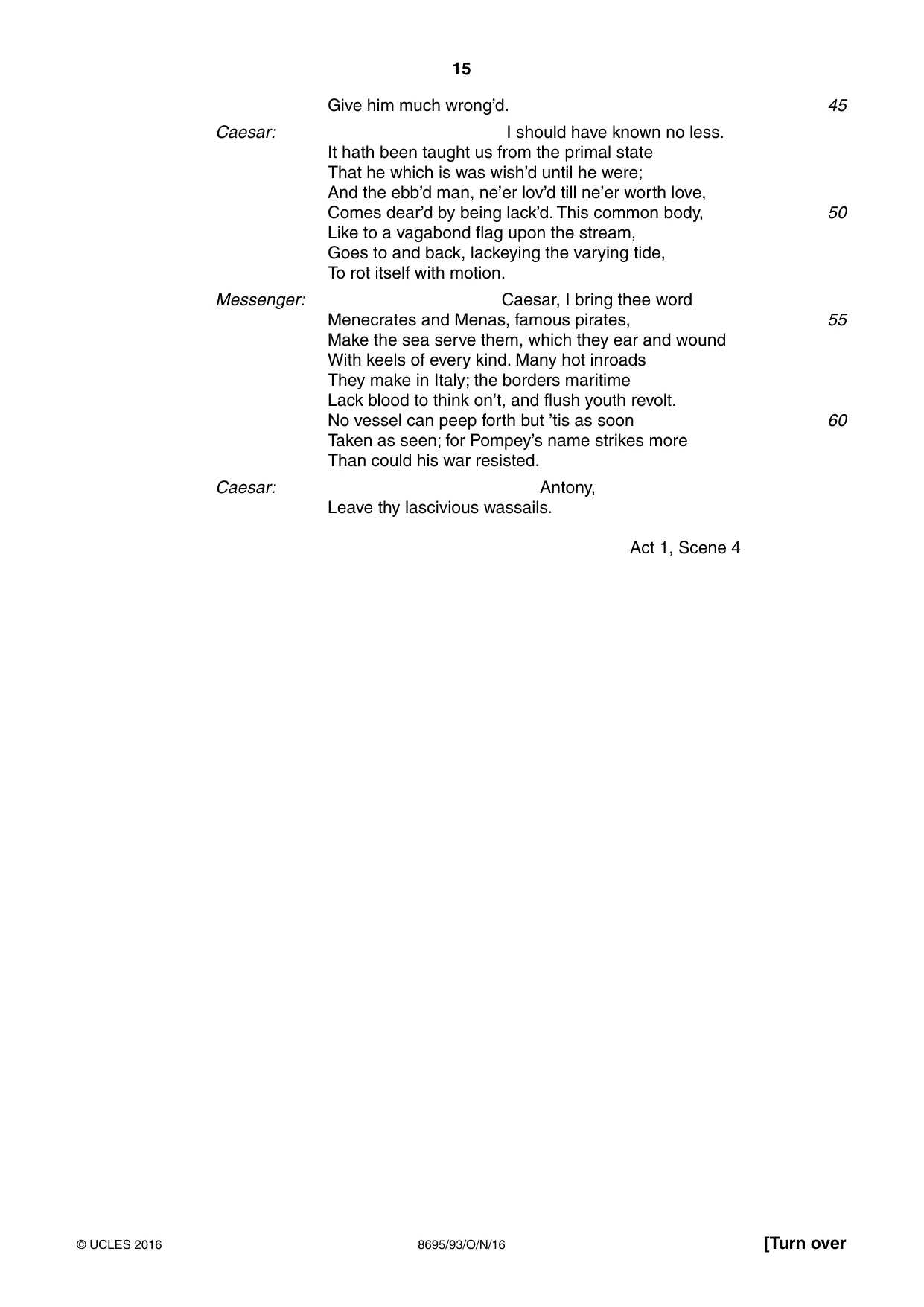
15 8695/93/O/N/16 © UCLES 2016 [Turn over Give him much wrong’d. Caesar: I should have known no less. It hath been taught us from the primal state That he which is was wish’d until he were; And the ebb’d man, ne’er lov’d till ne’er worth love, Comes dear’d by being lack’d. This common body, Like to a vagabond flag upon the stream, Goes to and back, lackeying the varying tide, To rot itself with motion. Messenger: Caesar, I bring thee word Menecrates and Menas, famous pirates, Make the sea serve them, which they ear and wound With keels of every kind. Many hot inroads They make in Italy; the borders maritime Lack blood to think on’t, and flush youth revolt. No vessel can peep forth but ’tis as soon Taken as seen; for Pompey’s name strikes more Than could his war resisted. Caesar: Antony, Leave thy lascivious wassails. Act 1, Scene 4 45 50 55 60
Question paper, page 16
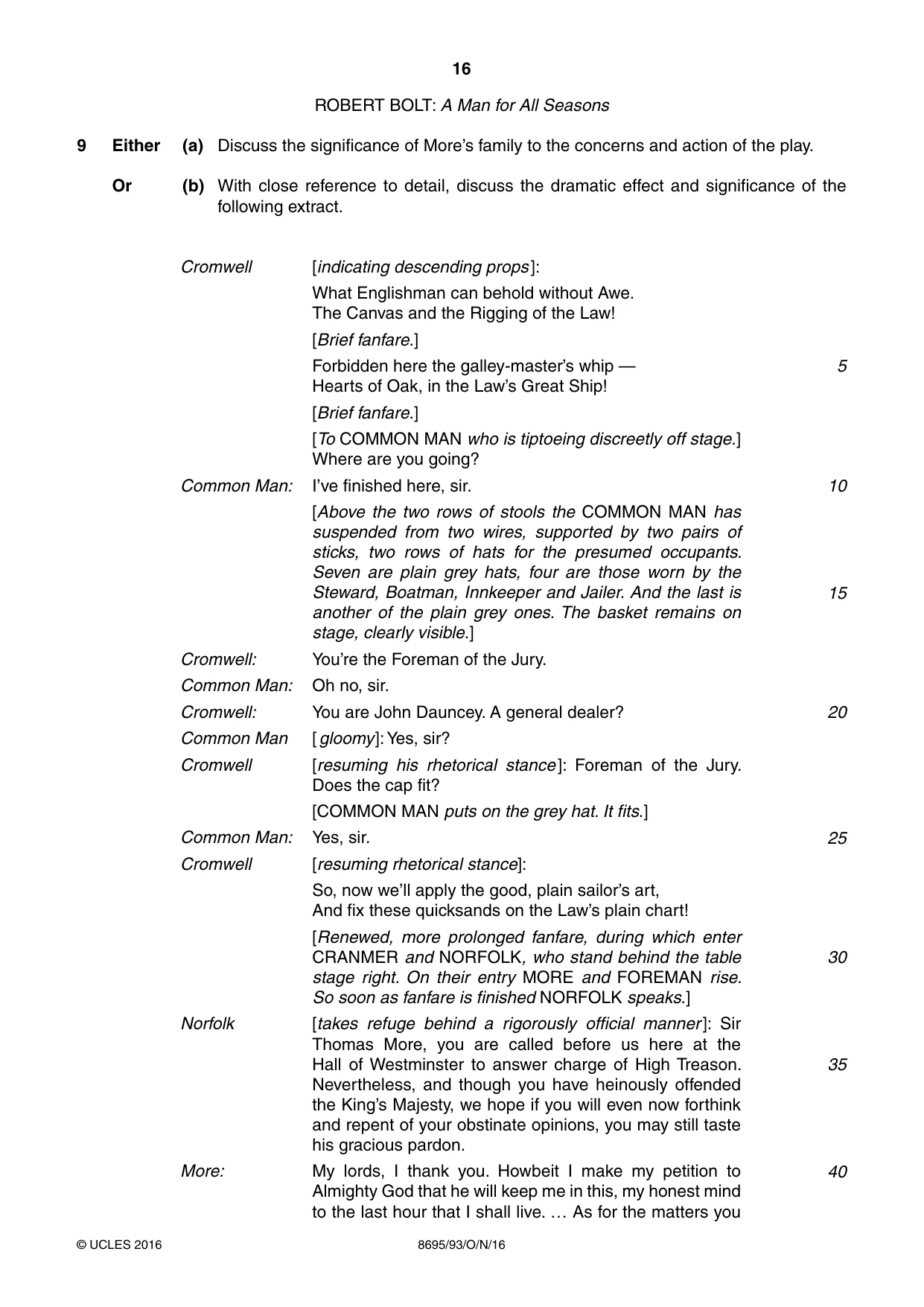
16 8695/93/O/N/16 © UCLES 2016 ROBERT BOLT: A Man for All Seasons 9 Either (a) Discuss the significance of More’s family to the concerns and action of the play. Or (b) With close reference to detail, discuss the dramatic effect and significance of the following extract. Cromwell [indicating descending props ]: What Englishman can behold without Awe. The Canvas and the Rigging of the Law! [Brief fanfare.] Forbidden here the galley-master’s whip — Hearts of Oak, in the Law’s Great Ship! [Brief fanfare.] [To COMMON MAN who is tiptoeing discreetly off stage.] Where are you going? Common Man: I’ve finished here, sir. [Above the two rows of stools the COMMON MAN has suspended from two wires, supported by two pairs of sticks, two rows of hats for the presumed occupants. Seven are plain grey hats, four are those worn by the Steward, Boatman, Innkeeper and Jailer. And the last is another of the plain grey ones. The basket remains on stage, clearly visible.] Cromwell: You’re the Foreman of the Jury. Common Man: Oh no, sir. Cromwell: You are John Dauncey. A general dealer? Common Man [ gloomy ]: Yes, sir? Cromwell [resuming his rhetorical stance ]: Foreman of the Jury. Does the cap fit? [COMMON MAN puts on the grey hat. It fits.] Common Man: Yes, sir. Cromwell [resuming rhetorical stance]: So, now we’ll apply the good, plain sailor’s art, And fix these quicksands on the Law’s plain chart! [Renewed, more prolonged fanfare, during which enter CRANMER and NORFOLK, who stand behind the table stage right. On their entry MORE and FOREMAN rise. So soon as fanfare is finished NORFOLK speaks.] Norfolk [takes refuge behind a rigorously official manner ]: Sir Thomas More, you are called before us here at the Hall of Westminster to answer charge of High Treason. Nevertheless, and though you have heinously offended the King’s Majesty, we hope if you will even now forthink and repent of your obstinate opinions, you may still taste his gracious pardon. More: My lords, I thank you. Howbeit I make my petition to Almighty God that he will keep me in this, my honest mind to the last hour that I shall live. … As for the matters you 5 10 15 20 25 30 35 40
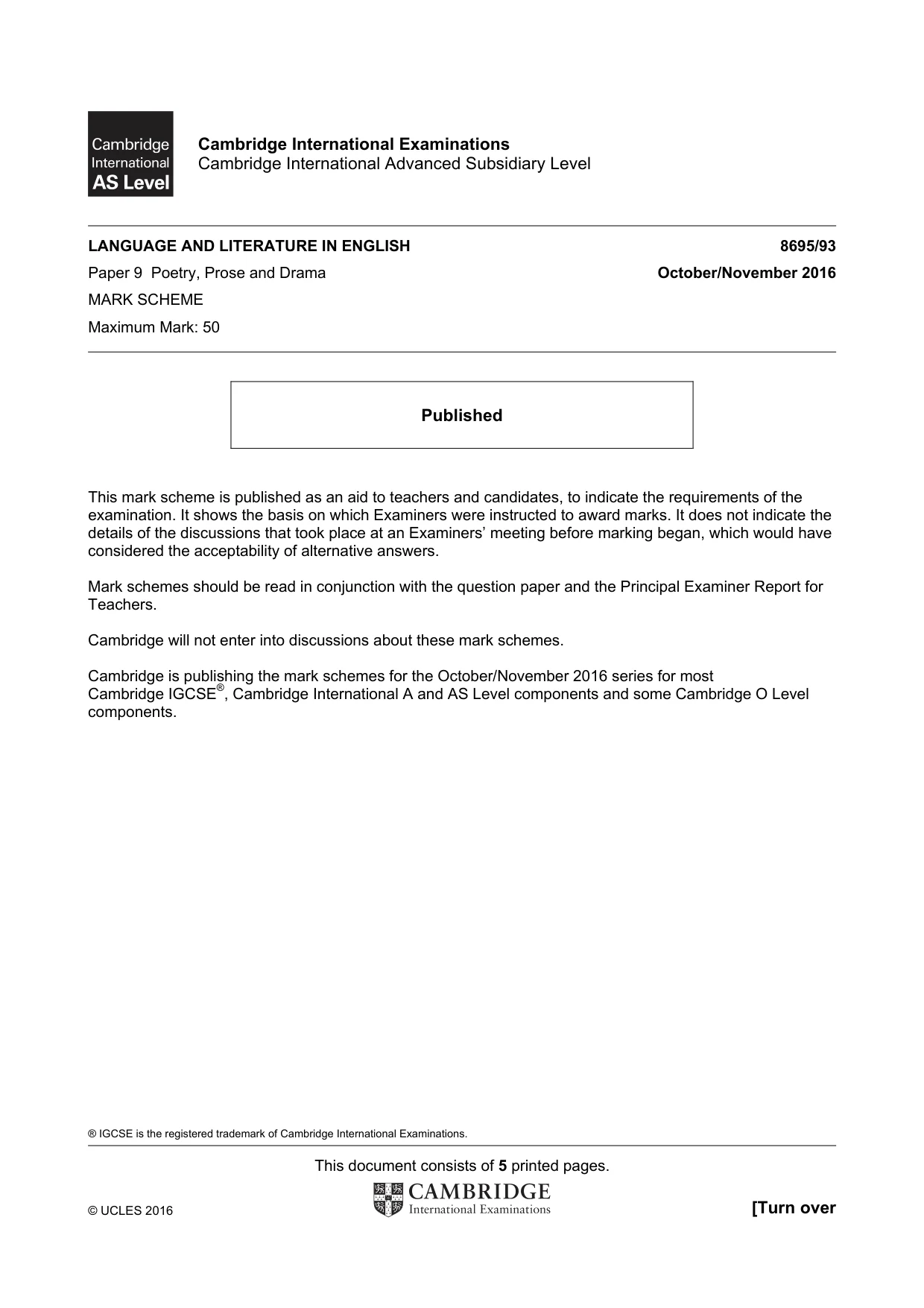
Question paper, page 17
17 8695/93/O/N/16 © UCLES 2016 may charge me with, I fear, from my present weakness, that neither my wit nor my memory will serve to make sufficient answers. … I should be glad to sit down. Norfolk: Be seated. Master Secretary Cromwell, have you the charge? Cromwell: I have, my lord. Norfolk: Then read the charge. Cromwell [approaching MORE, behind him, with papers; informally ]: It is the same charge, Sir Thomas, that was brought against Bishop Fisher. … [As one who catches himself up punctiliously.] The late Bishop Fisher I should have said. More [tonelessly ]: ‘Late’? Cromwell: Bishop Fisher was executed this morning. [MORE’s face expresses violent shock, then grief; he turns his head away from CROMWELL who is observing him clinically.] Act 2 45 50 55
Question paper, page 18
18 8695/93/O/N/16 © UCLES 2016 BLANK PAGE
Question paper, page 19
19 8695/93/O/N/16 © UCLES 2016 BLANK PAGE
Question paper, page 20
20 8695/93/O/N/16 © UCLES 2016 Permission to reproduce items where third-party owned material protected by copyright is included has been sought and cleared where possible. Every reasonable effort has been made by the publisher (UCLES) to trace copyright holders, but if any items requiring clearance have unwittingly been included, the publisher will be pleased to make amends at the earliest possible opportunity. To avoid the issue of disclosure of answer-related information to candidates, all copyright acknowledgements are reproduced online in the Cambridge International Examinations Copyright Acknowledgements Booklet. This is produced for each series of examinations and is freely available to download at www.cie.org.uk after the live examination series. Cambridge International Examinations is part of the Cambridge Assessment Group. Cambridge Assessment is the brand name of University of Cambridge Local Examinations Syndicate (UCLES), which is itself a department of the University of Cambridge. BLANK PAGE
Mark scheme, page 1
® IGCSE is the registered trademark of Cambridge International Examinations. This document consists of 5 printed pages. © UCLES 2016 [Turn over Cambridge International Examinations Cambridge International Advanced Subsidiary Level LANGUAGE AND LITERATURE IN ENGLISH 8695/93 Paper 9 Poetry, Prose and Drama October/November 2016 MARK SCHEME Maximum Mark: 50 Published This mark scheme is published as an aid to teachers and candidates, to indicate the requirements of the examination. It shows the basis on which Examiners were instructed to award marks. It does not indicate the details of the discussions that took place at an Examiners’ meeting before marking began, which would have considered the acceptability of alternative answers. Mark schemes should be read in conjunction with the question paper and the Principal Examiner Report for Teachers. Cambridge will not enter into discussions about these mark schemes. Cambridge is publishing the mark schemes for the October/November 2016 series for most Cambridge IGCSE®, Cambridge International A and AS Level components and some Cambridge O Level components.
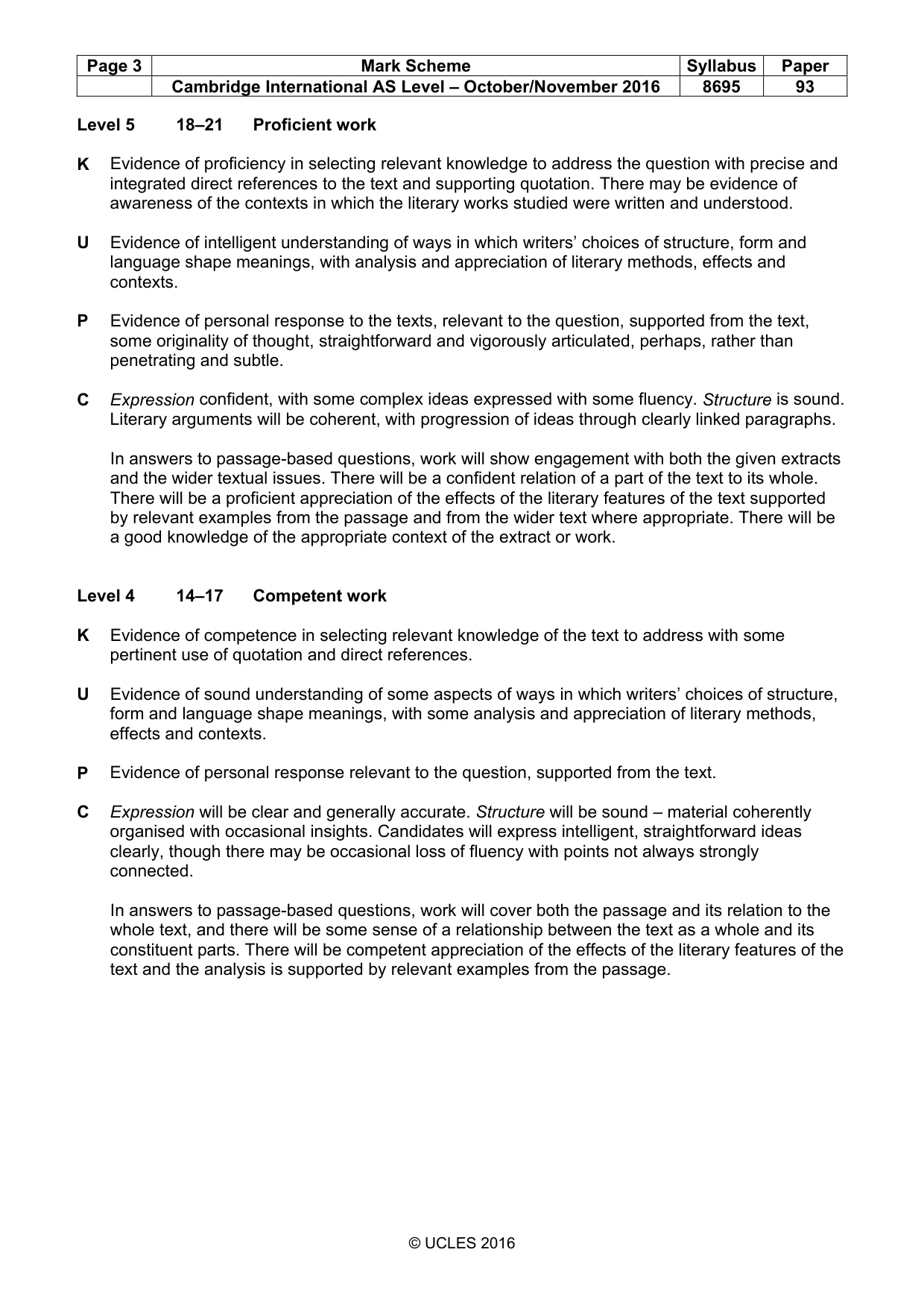
Mark scheme, page 2
Page 2 Mark Scheme Syllabus Paper Cambridge International AS Level – October/November 2016 8695 93 © UCLES 2016 Using the mark levels Place the answer in a level first. Look for the “best fit” of the answer into a level. An answer needs to show evidence of most but not necessarily ALL of the qualities described in a level, in order to be placed in that level. Then award a mark for the relative position of the answer within the level. Candidates may address the question in many different ways. Do not expect any particular focus or approach and do not penalise answers for leaving out a particular focus. Reward what is there, showing what you are rewarding, in your comments. Consider all strands and weigh up the performance as a whole in placing the answer in a level, then show that you have done so in the summative comment, e.g. Sound K of texts, some evidence of U but mostly narrative, occasional evidence of P, mainly clear C. Assessment Objectives: • Ability to respond to texts in the three main forms (Prose, Poetry and Drama) of different types and from different cultures; • Understanding of the ways in which writers’ choices of form, structure and language shape meanings; • Ability to produce informed independent opinions and judgements on literary texts; • Ability to communicate clearly the knowledge, understanding and insight appropriate to literary study. Each answer is marked out of 25, in accordance with the General Marking Criteria below. Each level is divided into strands corresponding to the Assessment Objectives – Knowledge, Understanding, Personal Response, Communication. Level 6 22–25 Very good work – do not reserve this level for the very best work you see but ensure you put scripts into this level which fulfil the requirements described below. There will always be some candidates who are at a standard over the top of the mark scheme. K Evidence of a very good ability to select relevant knowledge to address the question with effective use of references and quotation. There may be evidence of sensitive awareness of the contexts in which the literary works studied were written and understood. U Evidence of very good understanding of ways in which writers’ choices of structure, form and language shape meanings with sustained analysis and sensitive appreciation of literary methods and effects and contexts, possibly including literary genres and conventions. P Personal response to texts will be perceptive, often freshly personal, fully supported with quotation, and may show originality in approach to and treatment of questions. C Candidates will express complex literary ideas and arguments with clarity and fluency. Answers will have a coherent structure, with logical progression and effectively linked paragraphs. Expression will be accomplished and appropriate. In answers to passage-based questions, work will sustain an appropriate balance between critical appreciation of given extracts, based on detailed critical analysis, and consideration of the broader textual issues raised by the questions, and relate part of a text to its whole and vice versa in a seamless argument. There will be a very good appreciation of the effects of the literary features of the text, with detailed analysis supported by relevant examples from the passage and the wider text, where appropriate. There will be a very good knowledge of the appropriate context of the extract or work.
Mark scheme, page 3
Page 3 Mark Scheme Syllabus Paper Cambridge International AS Level – October/November 2016 8695 93 © UCLES 2016 Level 5 18–21 Proficient work K Evidence of proficiency in selecting relevant knowledge to address the question with precise and integrated direct references to the text and supporting quotation. There may be evidence of awareness of the contexts in which the literary works studied were written and understood. U Evidence of intelligent understanding of ways in which writers’ choices of structure, form and language shape meanings, with analysis and appreciation of literary methods, effects and contexts. P Evidence of personal response to the texts, relevant to the question, supported from the text, some originality of thought, straightforward and vigorously articulated, perhaps, rather than penetrating and subtle. C Expression confident, with some complex ideas expressed with some fluency. Structure is sound. Literary arguments will be coherent, with progression of ideas through clearly linked paragraphs. In answers to passage-based questions, work will show engagement with both the given extracts and the wider textual issues. There will be a confident relation of a part of the text to its whole. There will be a proficient appreciation of the effects of the literary features of the text supported by relevant examples from the passage and from the wider text where appropriate. There will be a good knowledge of the appropriate context of the extract or work. Level 4 14–17 Competent work K Evidence of competence in selecting relevant knowledge of the text to address with some pertinent use of quotation and direct references. U Evidence of sound understanding of some aspects of ways in which writers’ choices of structure, form and language shape meanings, with some analysis and appreciation of literary methods, effects and contexts. P Evidence of personal response relevant to the question, supported from the text. C Expression will be clear and generally accurate. Structure will be sound – material coherently organised with occasional insights. Candidates will express intelligent, straightforward ideas clearly, though there may be occasional loss of fluency with points not always strongly connected. In answers to passage-based questions, work will cover both the passage and its relation to the whole text, and there will be some sense of a relationship between the text as a whole and its constituent parts. There will be competent appreciation of the effects of the literary features of the text and the analysis is supported by relevant examples from the passage.
Mark scheme, page 4
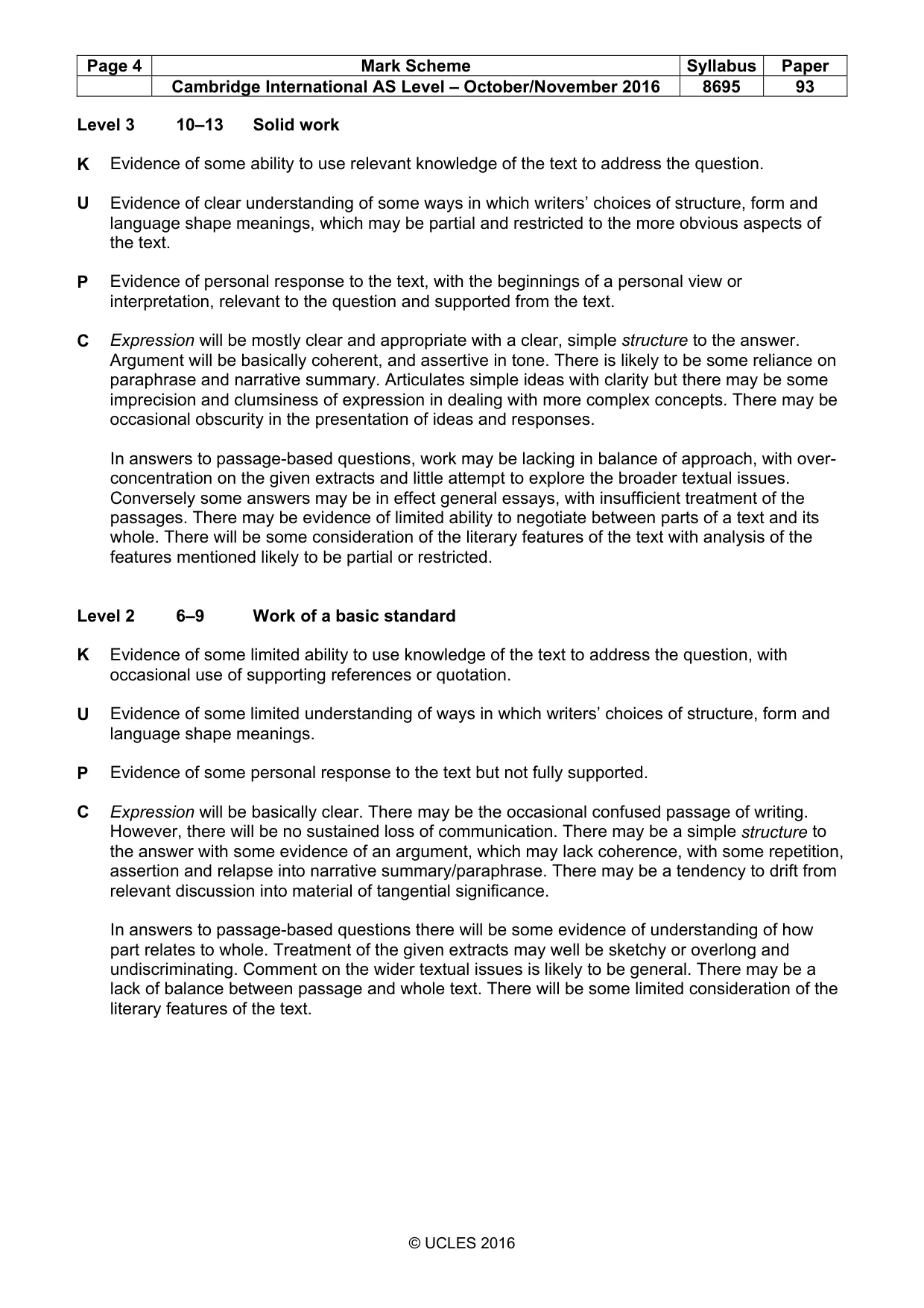
Page 4 Mark Scheme Syllabus Paper Cambridge International AS Level – October/November 2016 8695 93 © UCLES 2016 Level 3 10–13 Solid work K Evidence of some ability to use relevant knowledge of the text to address the question. U Evidence of clear understanding of some ways in which writers’ choices of structure, form and language shape meanings, which may be partial and restricted to the more obvious aspects of the text. P Evidence of personal response to the text, with the beginnings of a personal view or interpretation, relevant to the question and supported from the text. C Expression will be mostly clear and appropriate with a clear, simple structure to the answer. Argument will be basically coherent, and assertive in tone. There is likely to be some reliance on paraphrase and narrative summary. Articulates simple ideas with clarity but there may be some imprecision and clumsiness of expression in dealing with more complex concepts. There may be occasional obscurity in the presentation of ideas and responses. In answers to passage-based questions, work may be lacking in balance of approach, with over- concentration on the given extracts and little attempt to explore the broader textual issues. Conversely some answers may be in effect general essays, with insufficient treatment of the passages. There may be evidence of limited ability to negotiate between parts of a text and its whole. There will be some consideration of the literary features of the text with analysis of the features mentioned likely to be partial or restricted. Level 2 6–9 Work of a basic standard K Evidence of some limited ability to use knowledge of the text to address the question, with occasional use of supporting references or quotation. U Evidence of some limited understanding of ways in which writers’ choices of structure, form and language shape meanings. P Evidence of some personal response to the text but not fully supported. C Expression will be basically clear. There may be the occasional confused passage of writing. However, there will be no sustained loss of communication. There may be a simple structure to the answer with some evidence of an argument, which may lack coherence, with some repetition, assertion and relapse into narrative summary/paraphrase. There may be a tendency to drift from relevant discussion into material of tangential significance. In answers to passage-based questions there will be some evidence of understanding of how part relates to whole. Treatment of the given extracts may well be sketchy or overlong and undiscriminating. Comment on the wider textual issues is likely to be general. There may be a lack of balance between passage and whole text. There will be some limited consideration of the literary features of the text.
Mark scheme, page 5
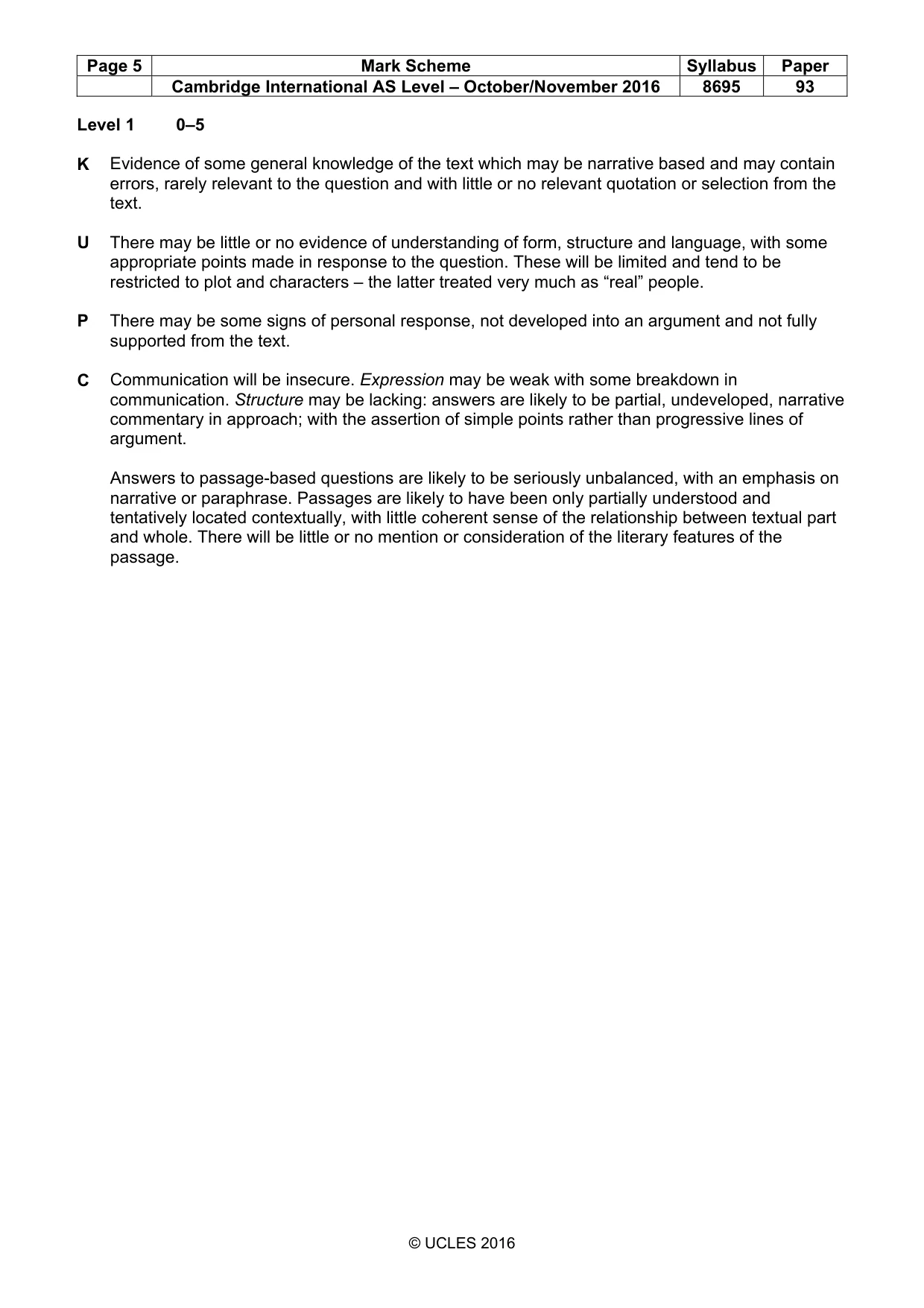
Page 5 Mark Scheme Syllabus Paper Cambridge International AS Level – October/November 2016 8695 93 © UCLES 2016 Level 1 0–5 K Evidence of some general knowledge of the text which may be narrative based and may contain errors, rarely relevant to the question and with little or no relevant quotation or selection from the text. U There may be little or no evidence of understanding of form, structure and language, with some appropriate points made in response to the question. These will be limited and tend to be restricted to plot and characters – the latter treated very much as “real” people. P There may be some signs of personal response, not developed into an argument and not fully supported from the text. C Communication will be insecure. Expression may be weak with some breakdown in communication. Structure may be lacking: answers are likely to be partial, undeveloped, narrative commentary in approach; with the assertion of simple points rather than progressive lines of argument. Answers to passage-based questions are likely to be seriously unbalanced, with an emphasis on narrative or paraphrase. Passages are likely to have been only partially understood and tentatively located contextually, with little coherent sense of the relationship between textual part and whole. There will be little or no mention or consideration of the literary features of the passage.
What you needed in this session
Cambridge’s own grade thresholds for 2016 Oct/Nov, Paper 9 · Variant 3. A higher threshold means an easier paper — the bar moves with how the cohort did.