Cambridge A Level English - Language and Literature (AS Level only, from 2016) 8695 — 2016 Oct/Nov Paper 9 · Variant 1
8695/91/O/N/16 · 50 marks · ≈56 min
The question paper and its mark scheme, free to read here and free to download. This is Cambridge’s own paper, exactly as it was sat.
Question paper20 pages



Mark scheme5 pages
Answers below. Sit the paper first if you are practising.
Paper as text
Question paper, page 1
This document consists of 17 printed pages, 3 blank pages and 1 insert. DC (RCL (KM)) 107903/2 © UCLES 2016 [Turn over Cambridge International Examinations Cambridge International Advanced Subsidiary and Advanced Level * 7 3 2 4 0 0 6 4 2 3 * LANGUAGE AND LITERATURE IN ENGLISH 8695/91 Paper 9 Poetry, Prose and Drama October/November 2016 2 hours No Additional Materials are required. READ THESE INSTRUCTIONS FIRST An answer booklet is provided inside this question paper. You should follow the instructions on the front cover of the answer booklet. If you need additional answer paper ask the invigilator for a continuation booklet. Answer two questions, each from a different section. You are reminded of the need for good English and clear presentation in your answers. All questions in this paper carry equal marks.
Question paper, page 2
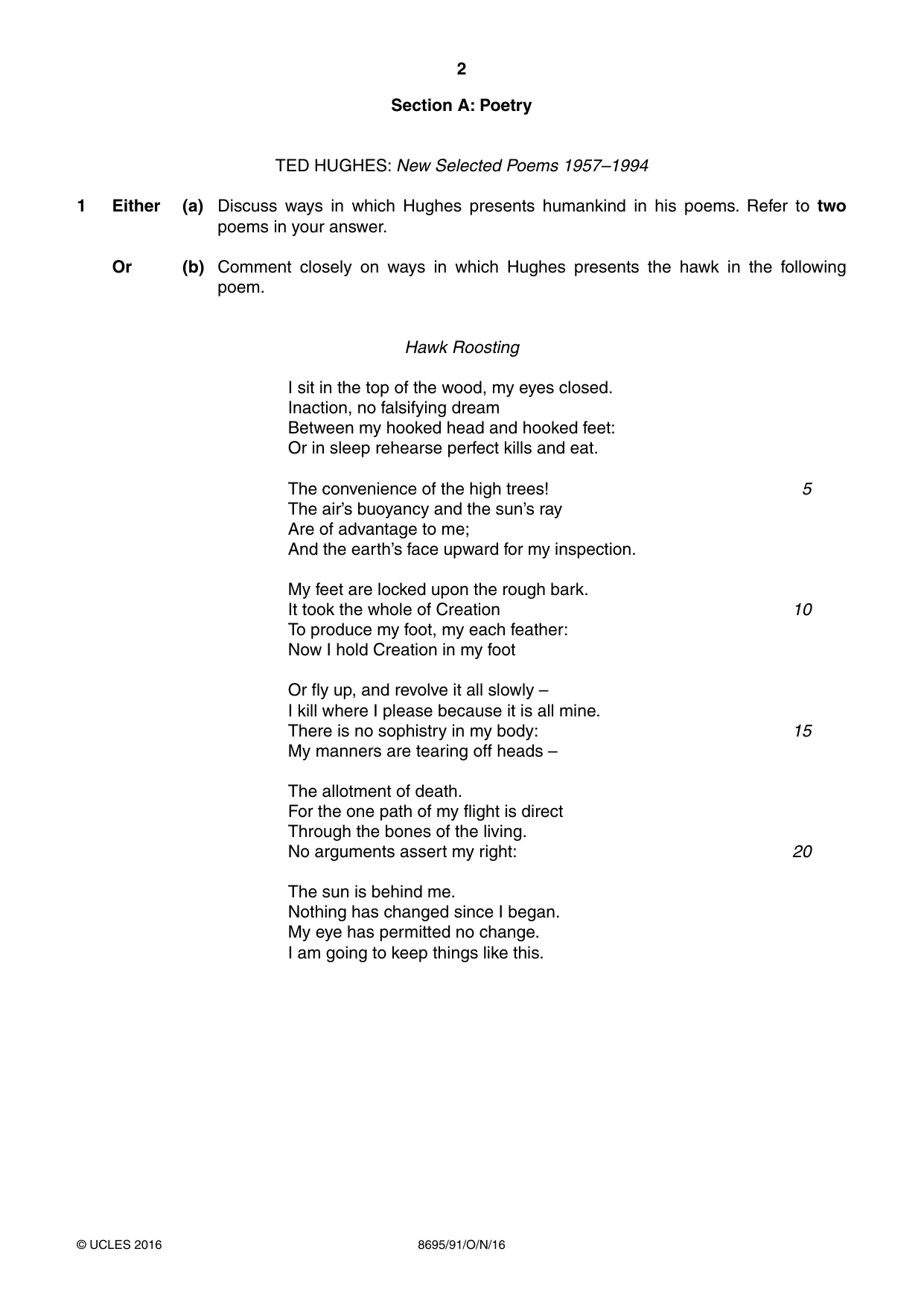
2 8695/91/O/N/16 © UCLES 2016 Section A: Poetry TED HUGHES: New Selected Poems 1957–1994 1 Either (a) Discuss ways in which Hughes presents humankind in his poems. Refer to two poems in your answer. Or (b) Comment closely on ways in which Hughes presents the hawk in the following poem. Hawk Roosting I sit in the top of the wood, my eyes closed. Inaction, no falsifying dream Between my hooked head and hooked feet: Or in sleep rehearse perfect kills and eat. The convenience of the high trees! The air’s buoyancy and the sun’s ray Are of advantage to me; And the earth’s face upward for my inspection. My feet are locked upon the rough bark. It took the whole of Creation To produce my foot, my each feather: Now I hold Creation in my foot Or fly up, and revolve it all slowly – I kill where I please because it is all mine. There is no sophistry in my body: My manners are tearing off heads – The allotment of death. For the one path of my flight is direct Through the bones of the living. No arguments assert my right: The sun is behind me. Nothing has changed since I began. My eye has permitted no change. I am going to keep things like this. 5 10 15 20
Question paper, page 3
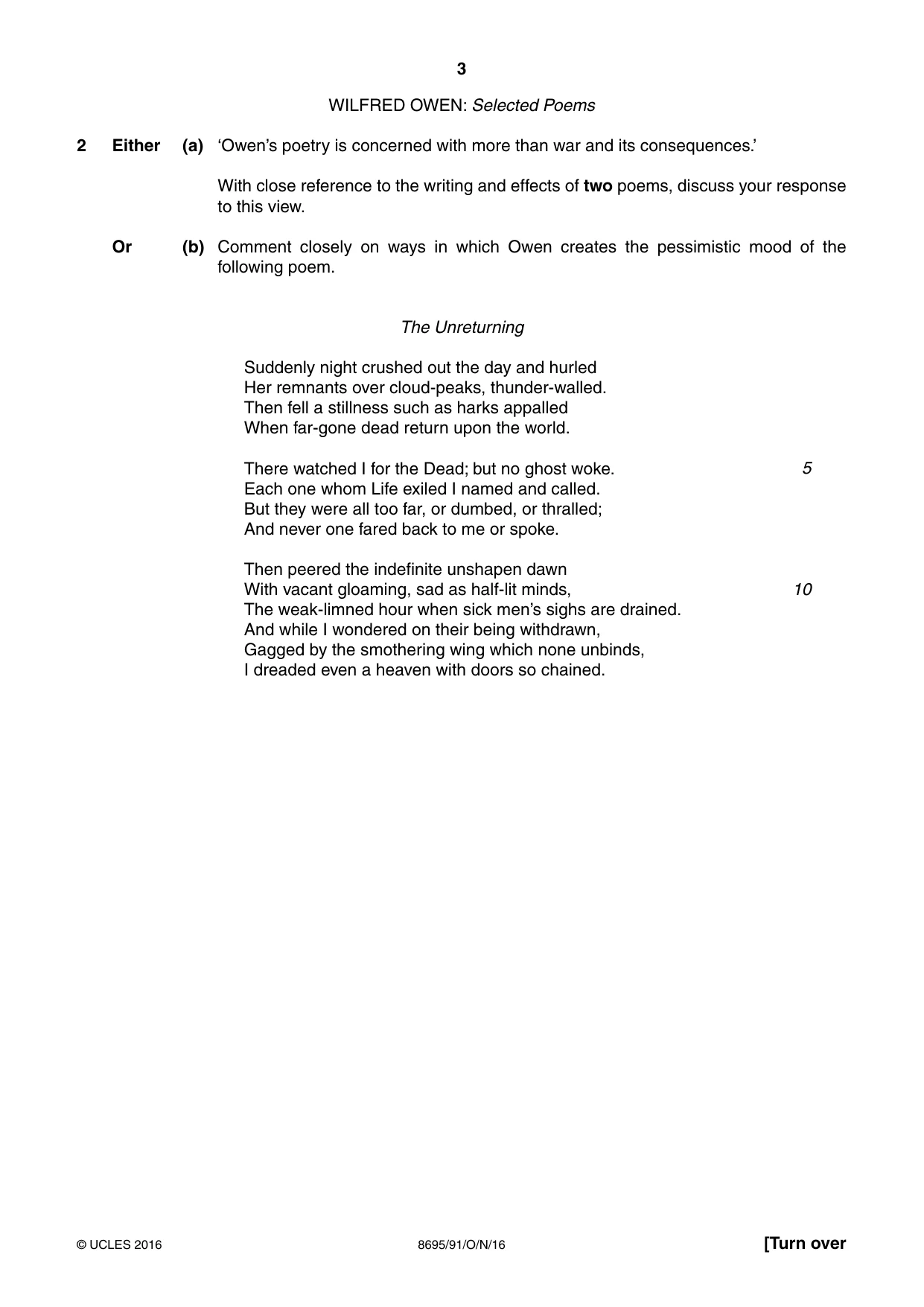
3 8695/91/O/N/16 © UCLES 2016 [Turn over WILFRED OWEN: Selected Poems 2 Either (a) ‘Owen’s poetry is concerned with more than war and its consequences.’ With close reference to the writing and effects of two poems, discuss your response to this view. Or (b) Comment closely on ways in which Owen creates the pessimistic mood of the following poem. The Unreturning Suddenly night crushed out the day and hurled Her remnants over cloud-peaks, thunder-walled. Then fell a stillness such as harks appalled When far-gone dead return upon the world. There watched I for the Dead; but no ghost woke. Each one whom Life exiled I named and called. But they were all too far, or dumbed, or thralled; And never one fared back to me or spoke. Then peered the indefinite unshapen dawn With vacant gloaming, sad as half-lit minds, The weak-limned hour when sick men’s sighs are drained. And while I wondered on their being withdrawn, Gagged by the smothering wing which none unbinds, I dreaded even a heaven with doors so chained. 5 10
Question paper, page 4
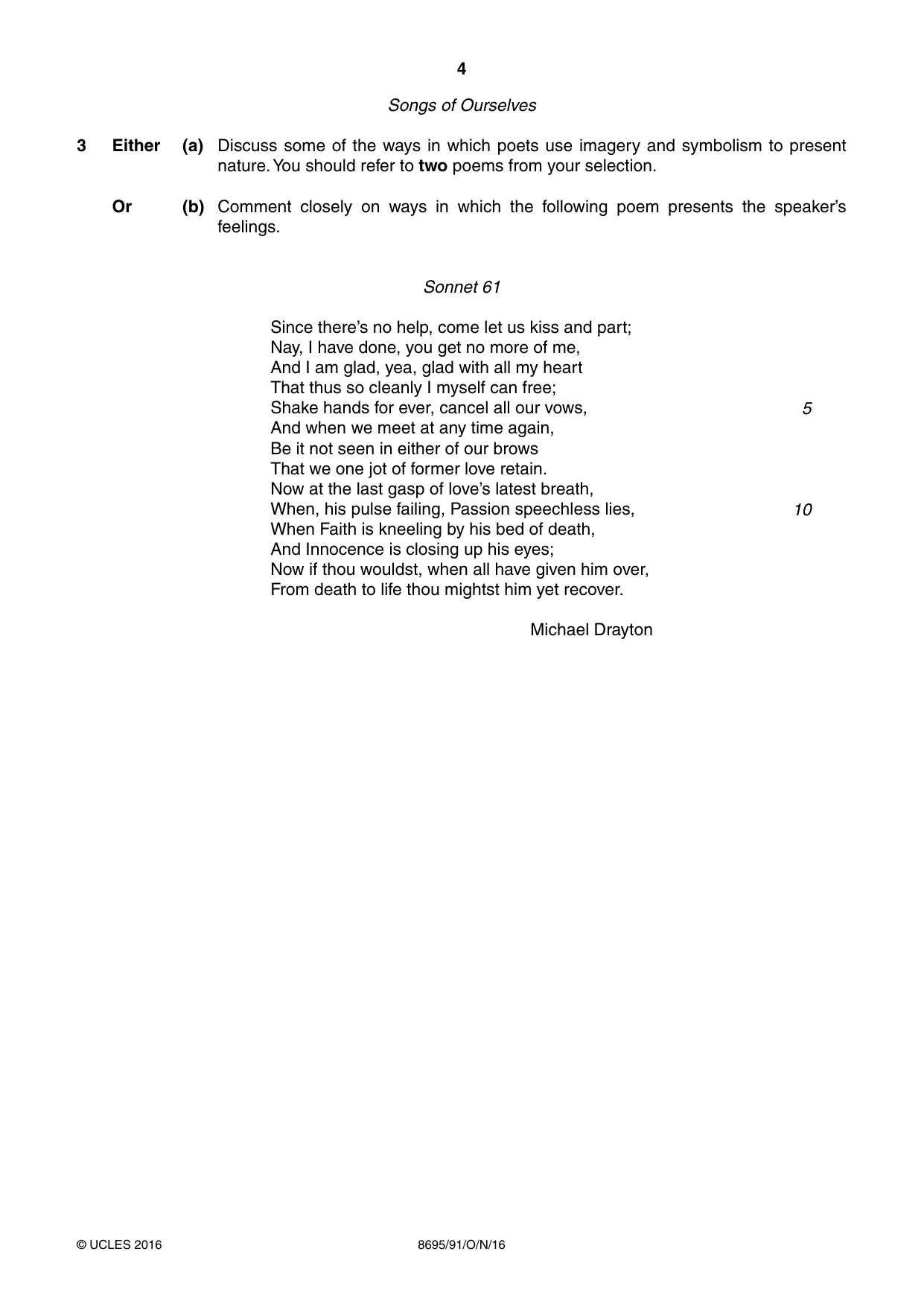
4 8695/91/O/N/16 © UCLES 2016 Songs of Ourselves 3 Either (a) Discuss some of the ways in which poets use imagery and symbolism to present nature. You should refer to two poems from your selection. Or (b) Comment closely on ways in which the following poem presents the speaker’s feelings. Sonnet 61 Since there’s no help, come let us kiss and part; Nay, I have done, you get no more of me, And I am glad, yea, glad with all my heart That thus so cleanly I myself can free; Shake hands for ever, cancel all our vows, And when we meet at any time again, Be it not seen in either of our brows That we one jot of former love retain. Now at the last gasp of love’s latest breath, When, his pulse failing, Passion speechless lies, When Faith is kneeling by his bed of death, And Innocence is closing up his eyes; Now if thou wouldst, when all have given him over, From death to life thou mightst him yet recover. Michael Drayton 5 10
Question paper, page 5
5 8695/91/O/N/16 © UCLES 2016 [Turn over Turn over for Section B
Question paper, page 6
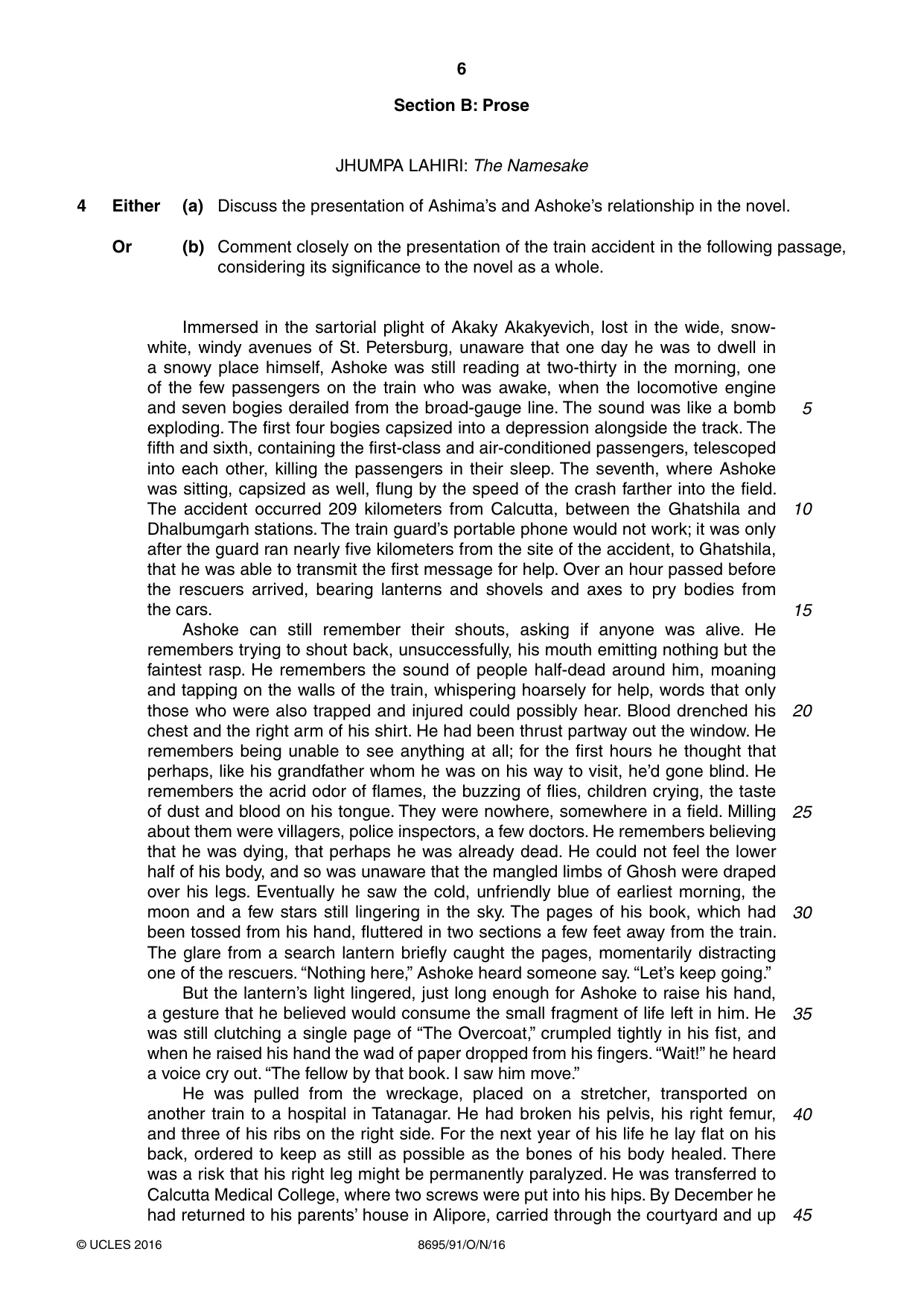
6 8695/91/O/N/16 © UCLES 2016 Section B: Prose JHUMPA LAHIRI: The Namesake 4 Either (a) Discuss the presentation of Ashima’s and Ashoke’s relationship in the novel. Or (b) Comment closely on the presentation of the train accident in the following passage, considering its significance to the novel as a whole. Immersed in the sartorial plight of Akaky Akakyevich, lost in the wide, snow- white, windy avenues of St. Petersburg, unaware that one day he was to dwell in a snowy place himself, Ashoke was still reading at two-thirty in the morning, one of the few passengers on the train who was awake, when the locomotive engine and seven bogies derailed from the broad-gauge line. The sound was like a bomb exploding. The first four bogies capsized into a depression alongside the track. The fifth and sixth, containing the first-class and air-conditioned passengers, telescoped into each other, killing the passengers in their sleep. The seventh, where Ashoke was sitting, capsized as well, flung by the speed of the crash farther into the field. The accident occurred 209 kilometers from Calcutta, between the Ghatshila and Dhalbumgarh stations. The train guard’s portable phone would not work; it was only after the guard ran nearly five kilometers from the site of the accident, to Ghatshila, that he was able to transmit the first message for help. Over an hour passed before the rescuers arrived, bearing lanterns and shovels and axes to pry bodies from the cars. Ashoke can still remember their shouts, asking if anyone was alive. He remembers trying to shout back, unsuccessfully, his mouth emitting nothing but the faintest rasp. He remembers the sound of people half-dead around him, moaning and tapping on the walls of the train, whispering hoarsely for help, words that only those who were also trapped and injured could possibly hear. Blood drenched his chest and the right arm of his shirt. He had been thrust partway out the window. He remembers being unable to see anything at all; for the first hours he thought that perhaps, like his grandfather whom he was on his way to visit, he’d gone blind. He remembers the acrid odor of flames, the buzzing of flies, children crying, the taste of dust and blood on his tongue. They were nowhere, somewhere in a field. Milling about them were villagers, police inspectors, a few doctors. He remembers believing that he was dying, that perhaps he was already dead. He could not feel the lower half of his body, and so was unaware that the mangled limbs of Ghosh were draped over his legs. Eventually he saw the cold, unfriendly blue of earliest morning, the moon and a few stars still lingering in the sky. The pages of his book, which had been tossed from his hand, fluttered in two sections a few feet away from the train. The glare from a search lantern briefly caught the pages, momentarily distracting one of the rescuers. “Nothing here,” Ashoke heard someone say. “Let’s keep going.” But the lantern’s light lingered, just long enough for Ashoke to raise his hand, a gesture that he believed would consume the small fragment of life left in him. He was still clutching a single page of “The Overcoat,” crumpled tightly in his fist, and when he raised his hand the wad of paper dropped from his fingers. “Wait!” he heard a voice cry out. “The fellow by that book. I saw him move.” He was pulled from the wreckage, placed on a stretcher, transported on another train to a hospital in Tatanagar. He had broken his pelvis, his right femur, and three of his ribs on the right side. For the next year of his life he lay flat on his back, ordered to keep as still as possible as the bones of his body healed. There was a risk that his right leg might be permanently paralyzed. He was transferred to Calcutta Medical College, where two screws were put into his hips. By December he had returned to his parents’ house in Alipore, carried through the courtyard and up 5 10 15 20 25 30 35 40 45
Question paper, page 7
7 8695/91/O/N/16 © UCLES 2016 [Turn over the red clay stairs like a corpse, hoisted on the shoulders of his four brothers. Three times a day he was spoon-fed. He urinated and defecated into a tin pan. Doctors and visitors came and went. Even his blind grandfather from Jamshedpur paid a visit. His family had saved the newspaper accounts. In a photograph, he observed the train smashed to shards, piled jaggedly against the sky, security guards sitting on the unclaimed belongings. He learned that fishplates and bolts had been found several feet from the main track, giving rise to the suspicion, never subsequently confirmed, of sabotage. That bodies had been mutilated beyond recognition. “Holiday-Makers’ Tryst with Death,” the Times of India had written. Chapter 1 50
Question paper, page 8
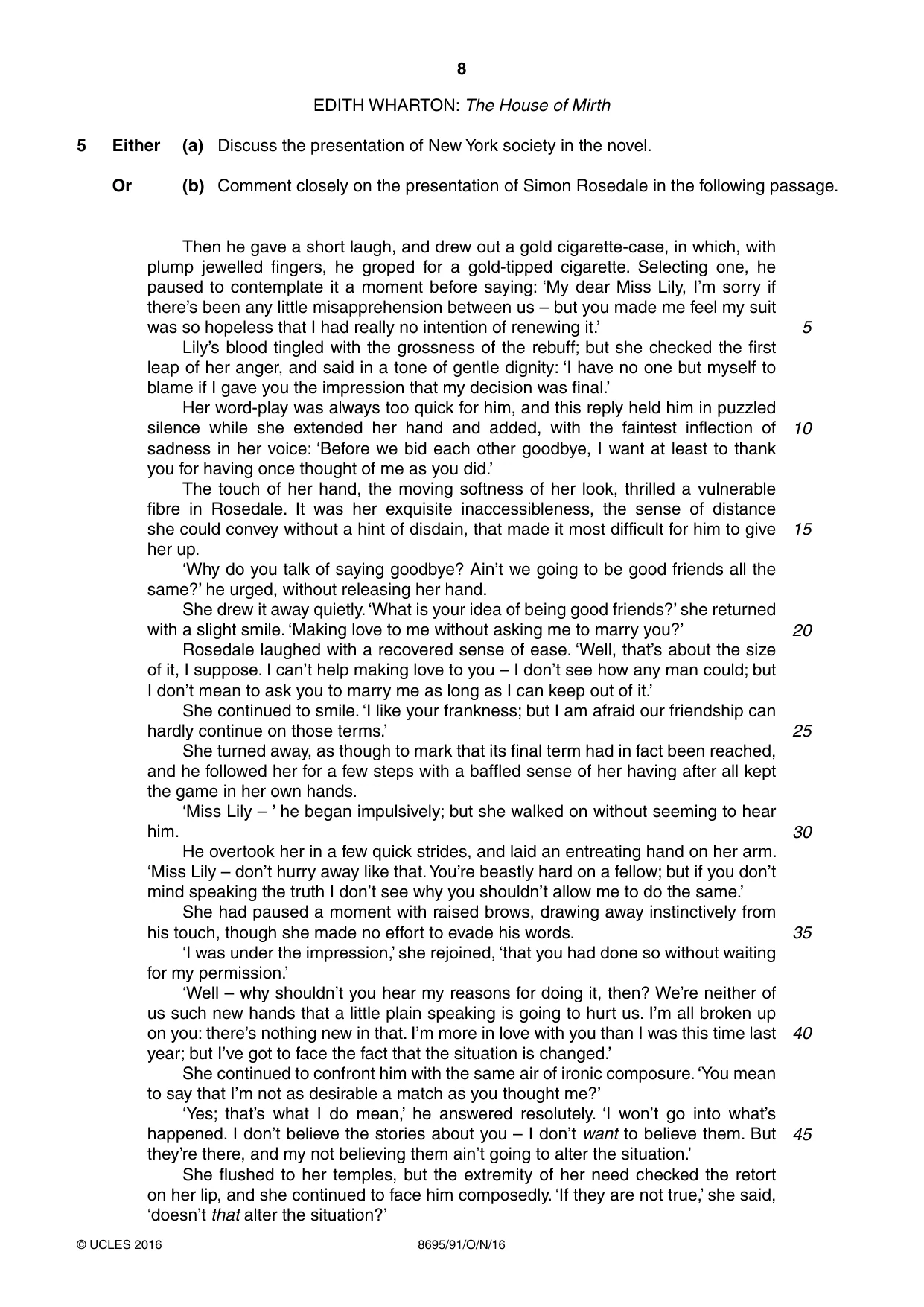
8 8695/91/O/N/16 © UCLES 2016 EDITH WHARTON: The House of Mirth 5 Either (a) Discuss the presentation of New York society in the novel. Or (b) Comment closely on the presentation of Simon Rosedale in the following passage. Then he gave a short laugh, and drew out a gold cigarette-case, in which, with plump jewelled fingers, he groped for a gold-tipped cigarette. Selecting one, he paused to contemplate it a moment before saying: ‘My dear Miss Lily, I’m sorry if there’s been any little misapprehension between us – but you made me feel my suit was so hopeless that I had really no intention of renewing it.’ Lily’s blood tingled with the grossness of the rebuff; but she checked the first leap of her anger, and said in a tone of gentle dignity: ‘I have no one but myself to blame if I gave you the impression that my decision was final.’ Her word-play was always too quick for him, and this reply held him in puzzled silence while she extended her hand and added, with the faintest inflection of sadness in her voice: ‘Before we bid each other goodbye, I want at least to thank you for having once thought of me as you did.’ The touch of her hand, the moving softness of her look, thrilled a vulnerable fibre in Rosedale. It was her exquisite inaccessibleness, the sense of distance she could convey without a hint of disdain, that made it most difficult for him to give her up. ‘Why do you talk of saying goodbye? Ain’t we going to be good friends all the same?’ he urged, without releasing her hand. She drew it away quietly. ‘What is your idea of being good friends?’ she returned with a slight smile. ‘Making love to me without asking me to marry you?’ Rosedale laughed with a recovered sense of ease. ‘Well, that’s about the size of it, I suppose. I can’t help making love to you – I don’t see how any man could; but I don’t mean to ask you to marry me as long as I can keep out of it.’ She continued to smile. ‘I like your frankness; but I am afraid our friendship can hardly continue on those terms.’ She turned away, as though to mark that its final term had in fact been reached, and he followed her for a few steps with a baffled sense of her having after all kept the game in her own hands. ‘Miss Lily – ’ he began impulsively; but she walked on without seeming to hear him. He overtook her in a few quick strides, and laid an entreating hand on her arm. ‘Miss Lily – don’t hurry away like that. You’re beastly hard on a fellow; but if you don’t mind speaking the truth I don’t see why you shouldn’t allow me to do the same.’ She had paused a moment with raised brows, drawing away instinctively from his touch, though she made no effort to evade his words. ‘I was under the impression,’ she rejoined, ‘that you had done so without waiting for my permission.’ ‘Well – why shouldn’t you hear my reasons for doing it, then? We’re neither of us such new hands that a little plain speaking is going to hurt us. I’m all broken up on you: there’s nothing new in that. I’m more in love with you than I was this time last year; but I’ve got to face the fact that the situation is changed.’ She continued to confront him with the same air of ironic composure. ‘You mean to say that I’m not as desirable a match as you thought me?’ ‘Yes; that’s what I do mean,’ he answered resolutely. ‘I won’t go into what’s happened. I don’t believe the stories about you – I don’t want to believe them. But they’re there, and my not believing them ain’t going to alter the situation.’ She flushed to her temples, but the extremity of her need checked the retort on her lip, and she continued to face him composedly. ‘If they are not true,’ she said, ‘doesn’t that alter the situation?’ 5 10 15 20 25 30 35 40 45
Question paper, page 9
9 8695/91/O/N/16 © UCLES 2016 [Turn over He met this with a steady gaze of his small stock-taking eyes, which made her feel herself no more than some superfine human merchandise. ‘I believe it does in novels; but I’m certain it don’t in real life. You know that as well as I do: if we’re speaking the truth, let’s speak the whole truth. Last year I was wild to marry you, and you wouldn’t look at me: this year – well, you appear to be willing. Now, what has changed in the interval? Your situation, that’s all. Then you thought you could do better; now – ’ ‘You think you can?’ broke from her ironically. ‘Why, yes, I do: in one way, that is.’ Book 2, Chapter 7 50 55
Question paper, page 10
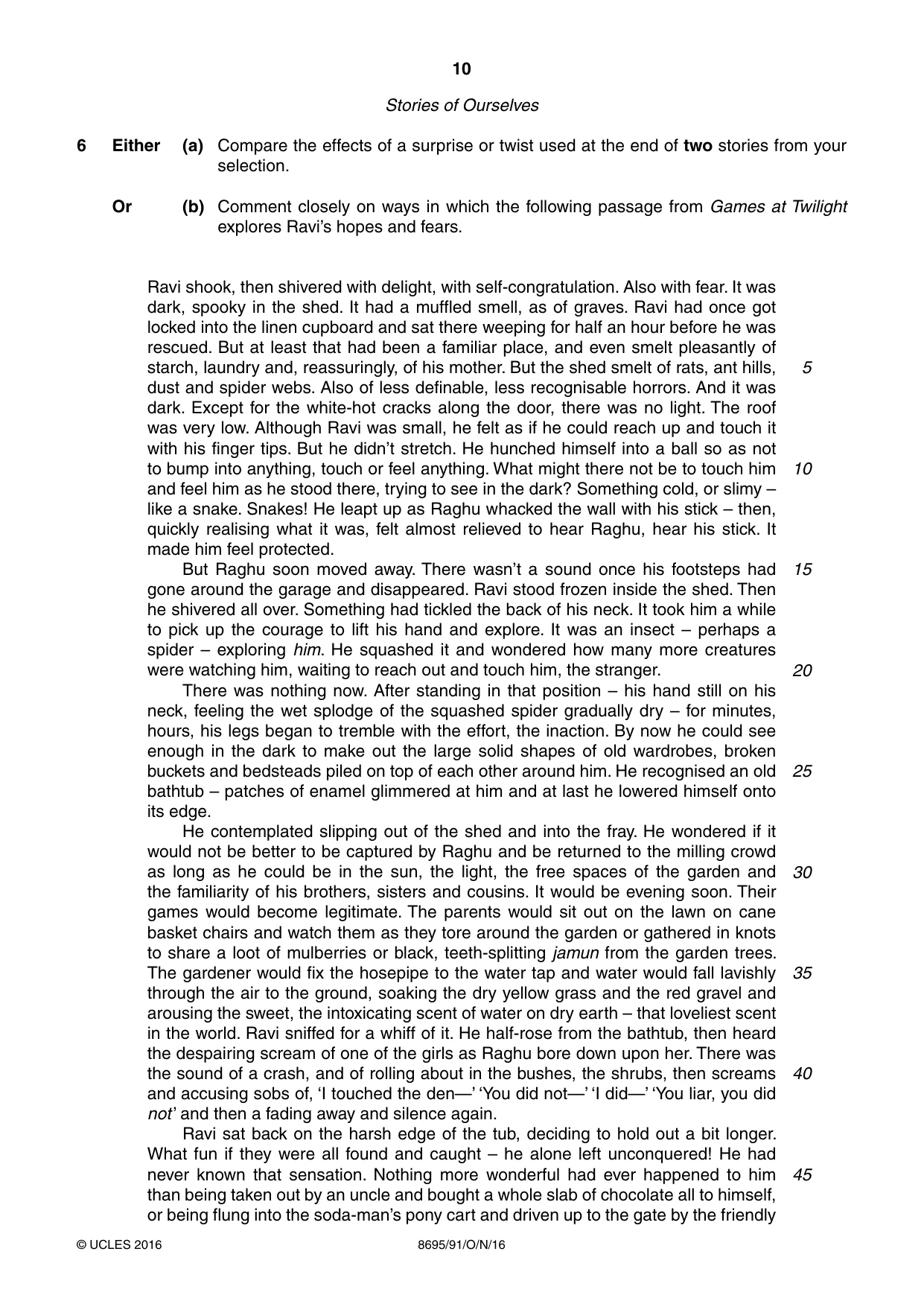
10 8695/91/O/N/16 © UCLES 2016 Stories of Ourselves 6 Either (a) Compare the effects of a surprise or twist used at the end of two stories from your selection. Or (b) Comment closely on ways in which the following passage from Games at Twilight explores Ravi’s hopes and fears. Ravi shook, then shivered with delight, with self-congratulation. Also with fear. It was dark, spooky in the shed. It had a muffled smell, as of graves. Ravi had once got locked into the linen cupboard and sat there weeping for half an hour before he was rescued. But at least that had been a familiar place, and even smelt pleasantly of starch, laundry and, reassuringly, of his mother. But the shed smelt of rats, ant hills, dust and spider webs. Also of less definable, less recognisable horrors. And it was dark. Except for the white-hot cracks along the door, there was no light. The roof was very low. Although Ravi was small, he felt as if he could reach up and touch it with his finger tips. But he didn’t stretch. He hunched himself into a ball so as not to bump into anything, touch or feel anything. What might there not be to touch him and feel him as he stood there, trying to see in the dark? Something cold, or slimy – like a snake. Snakes! He leapt up as Raghu whacked the wall with his stick – then, quickly realising what it was, felt almost relieved to hear Raghu, hear his stick. It made him feel protected. But Raghu soon moved away. There wasn’t a sound once his footsteps had gone around the garage and disappeared. Ravi stood frozen inside the shed. Then he shivered all over. Something had tickled the back of his neck. It took him a while to pick up the courage to lift his hand and explore. It was an insect – perhaps a spider – exploring him. He squashed it and wondered how many more creatures were watching him, waiting to reach out and touch him, the stranger. There was nothing now. After standing in that position – his hand still on his neck, feeling the wet splodge of the squashed spider gradually dry – for minutes, hours, his legs began to tremble with the effort, the inaction. By now he could see enough in the dark to make out the large solid shapes of old wardrobes, broken buckets and bedsteads piled on top of each other around him. He recognised an old bathtub – patches of enamel glimmered at him and at last he lowered himself onto its edge. He contemplated slipping out of the shed and into the fray. He wondered if it would not be better to be captured by Raghu and be returned to the milling crowd as long as he could be in the sun, the light, the free spaces of the garden and the familiarity of his brothers, sisters and cousins. It would be evening soon. Their games would become legitimate. The parents would sit out on the lawn on cane basket chairs and watch them as they tore around the garden or gathered in knots to share a loot of mulberries or black, teeth-splitting jamun from the garden trees. The gardener would fix the hosepipe to the water tap and water would fall lavishly through the air to the ground, soaking the dry yellow grass and the red gravel and arousing the sweet, the intoxicating scent of water on dry earth – that loveliest scent in the world. Ravi sniffed for a whiff of it. He half-rose from the bathtub, then heard the despairing scream of one of the girls as Raghu bore down upon her. There was the sound of a crash, and of rolling about in the bushes, the shrubs, then screams and accusing sobs of, ‘I touched the den—’ ‘You did not—’ ‘I did—’ ‘You liar, you did not ’ and then a fading away and silence again. Ravi sat back on the harsh edge of the tub, deciding to hold out a bit longer. What fun if they were all found and caught – he alone left unconquered! He had never known that sensation. Nothing more wonderful had ever happened to him than being taken out by an uncle and bought a whole slab of chocolate all to himself, or being flung into the soda-man’s pony cart and driven up to the gate by the friendly 5 10 15 20 25 30 35 40 45
Question paper, page 11
11 8695/91/O/N/16 © UCLES 2016 [Turn over 50 driver with the red beard and pointed ears. To defeat Raghu – that hirsute, hoarse- voiced football champion – and to be the winner in a circle of older, bigger, luckier children – that would be thrilling beyond imagination. He hugged his knees together and smiled to himself almost shyly at the thought of so much victory, such laurels. Games at Twilight
Question paper, page 12
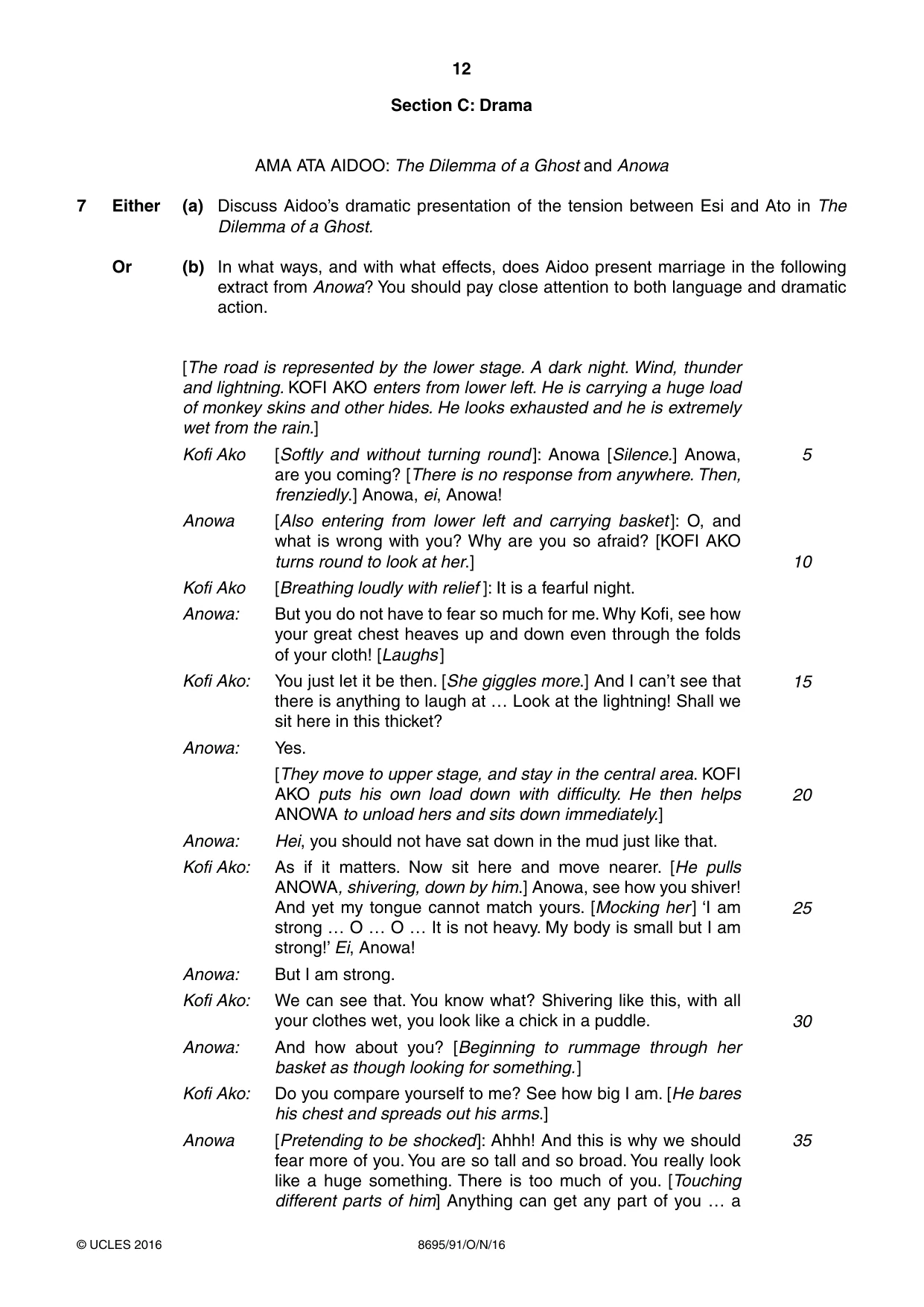
12 8695/91/O/N/16 © UCLES 2016 Section C: Drama AMA ATA AIDOO: The Dilemma of a Ghost and Anowa 7 Either (a) Discuss Aidoo’s dramatic presentation of the tension between Esi and Ato in The Dilemma of a Ghost. Or (b) In what ways, and with what effects, does Aidoo present marriage in the following extract from Anowa? You should pay close attention to both language and dramatic action. [The road is represented by the lower stage. A dark night. Wind, thunder and lightning. KOFI AKO enters from lower left. He is carrying a huge load of monkey skins and other hides. He looks exhausted and he is extremely wet from the rain.] Kofi Ako [Softly and without turning round ]: Anowa [Silence.] Anowa, are you coming? [There is no response from anywhere. Then, frenziedly.] Anowa, ei, Anowa! Anowa [Also entering from lower left and carrying basket ]: O, and what is wrong with you? Why are you so afraid? [KOFI AKO turns round to look at her.] Kofi Ako [Breathing loudly with relief ]: It is a fearful night. Anowa: But you do not have to fear so much for me. Why Kofi, see how your great chest heaves up and down even through the folds of your cloth! [Laughs ] Kofi Ako: You just let it be then. [She giggles more.] And I can’t see that there is anything to laugh at … Look at the lightning! Shall we sit here in this thicket? Anowa: Yes. [They move to upper stage, and stay in the central area. KOFI AKO puts his own load down with difficulty. He then helps ANOWA to unload hers and sits down immediately.] Anowa: Hei, you should not have sat down in the mud just like that. Kofi Ako: As if it matters. Now sit here and move nearer. [He pulls ANOWA, shivering, down by him.] Anowa, see how you shiver! And yet my tongue cannot match yours. [Mocking her ] ‘I am strong … O … O … It is not heavy. My body is small but I am strong!’ Ei, Anowa! Anowa: But I am strong. Kofi Ako: We can see that. You know what? Shivering like this, with all your clothes wet, you look like a chick in a puddle. Anowa: And how about you? [Beginning to rummage through her basket as though looking for something. ] Kofi Ako: Do you compare yourself to me? See how big I am. [He bares his chest and spreads out his arms.] Anowa [Pretending to be shocked ]: Ahhh! And this is why we should fear more of you. You are so tall and so broad. You really look like a huge something. There is too much of you. [Touching different parts of him] Anything can get any part of you … a 5 10 15 20 25 30 35
Question paper, page 13
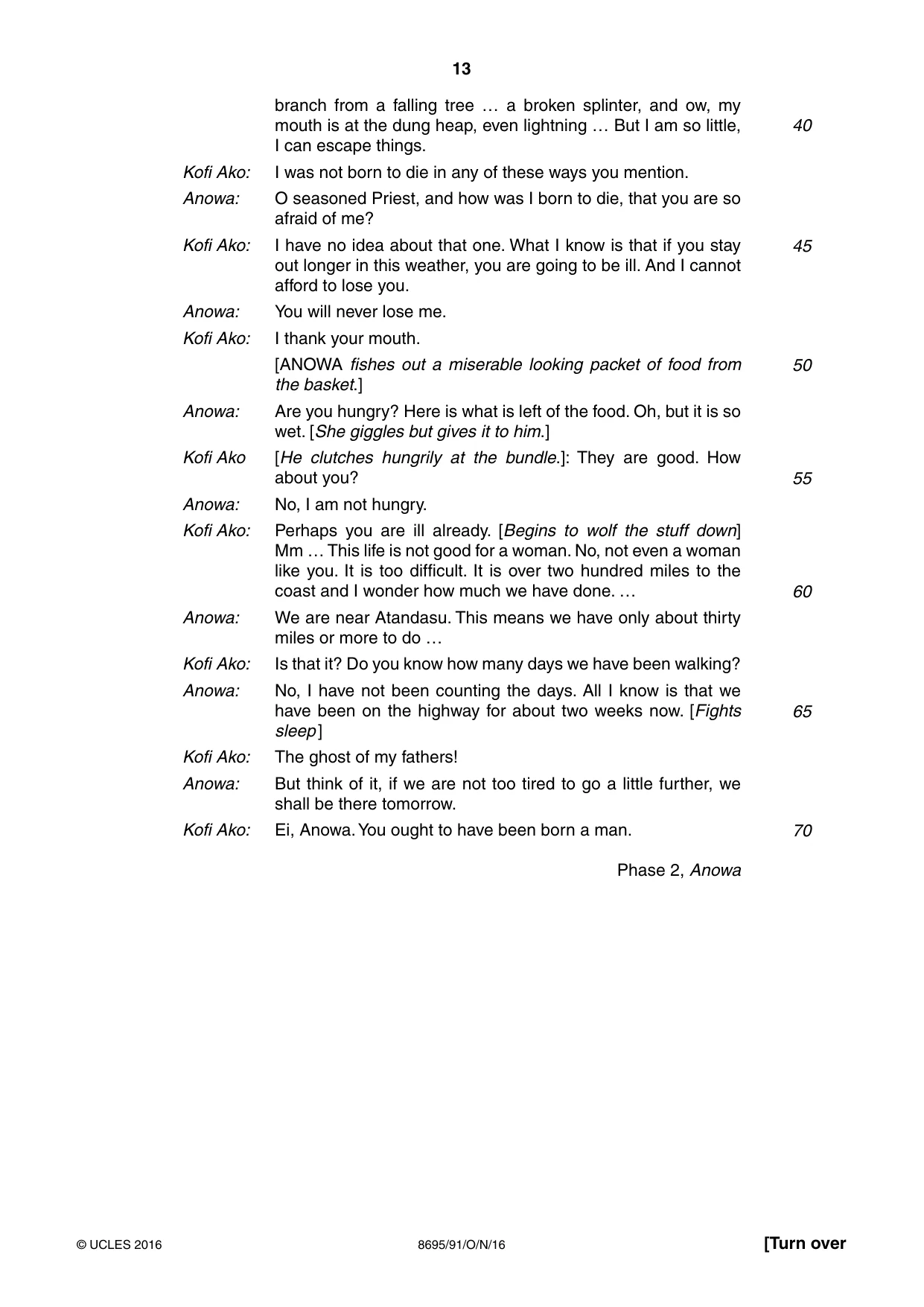
13 8695/91/O/N/16 © UCLES 2016 [Turn over branch from a falling tree … a broken splinter, and ow, my mouth is at the dung heap, even lightning … But I am so little, I can escape things. Kofi Ako: I was not born to die in any of these ways you mention. Anowa: O seasoned Priest, and how was I born to die, that you are so afraid of me? Kofi Ako: I have no idea about that one. What I know is that if you stay out longer in this weather, you are going to be ill. And I cannot afford to lose you. Anowa: You will never lose me. Kofi Ako: I thank your mouth. [ANOWA fishes out a miserable looking packet of food from the basket.] Anowa: Are you hungry? Here is what is left of the food. Oh, but it is so wet. [She giggles but gives it to him.] Kofi Ako [He clutches hungrily at the bundle.]: They are good. How about you? Anowa: No, I am not hungry. Kofi Ako: Perhaps you are ill already. [Begins to wolf the stuff down] Mm … This life is not good for a woman. No, not even a woman like you. It is too difficult. It is over two hundred miles to the coast and I wonder how much we have done. … Anowa: We are near Atandasu. This means we have only about thirty miles or more to do … Kofi Ako: Is that it? Do you know how many days we have been walking? Anowa: No, I have not been counting the days. All I know is that we have been on the highway for about two weeks now. [Fights sleep ] Kofi Ako: The ghost of my fathers! Anowa: But think of it, if we are not too tired to go a little further, we shall be there tomorrow. Kofi Ako: Ei, Anowa. You ought to have been born a man. Phase 2, Anowa 40 45 50 55 60 65 70
Question paper, page 14
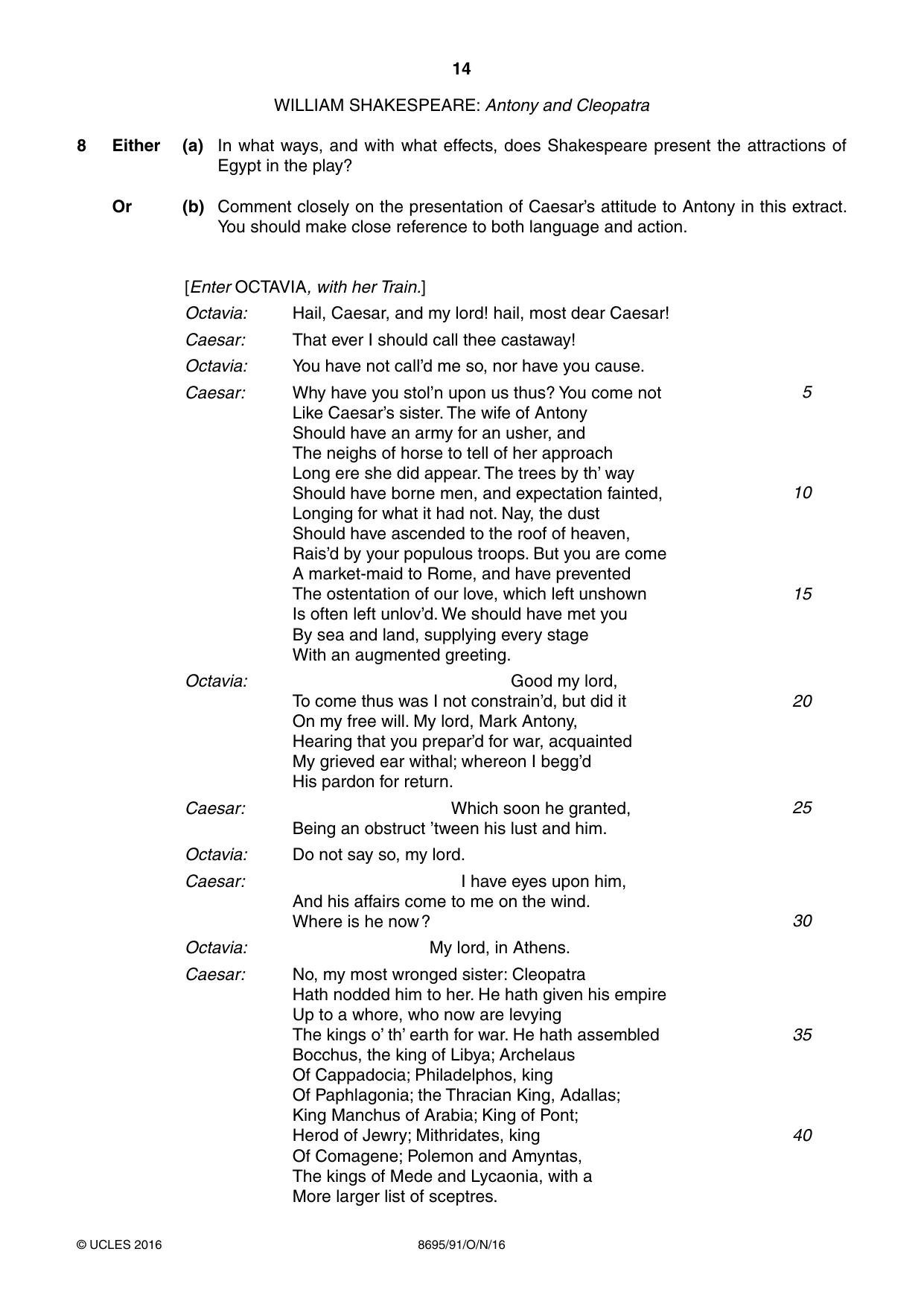
14 8695/91/O/N/16 © UCLES 2016 WILLIAM SHAKESPEARE: Antony and Cleopatra 8 Either (a) In what ways, and with what effects, does Shakespeare present the attractions of Egypt in the play? Or (b) Comment closely on the presentation of Caesar’s attitude to Antony in this extract. You should make close reference to both language and action. [Enter OCTAVIA, with her Train.] Octavia: Hail, Caesar, and my lord! hail, most dear Caesar! Caesar: That ever I should call thee castaway! Octavia: You have not call’d me so, nor have you cause. Caesar: Why have you stol’n upon us thus? You come not Like Caesar’s sister. The wife of Antony Should have an army for an usher, and The neighs of horse to tell of her approach Long ere she did appear. The trees by th’ way Should have borne men, and expectation fainted, Longing for what it had not. Nay, the dust Should have ascended to the roof of heaven, Rais’d by your populous troops. But you are come A market-maid to Rome, and have prevented The ostentation of our love, which left unshown Is often left unlov’d. We should have met you By sea and land, supplying every stage With an augmented greeting. Octavia: Good my lord, To come thus was I not constrain’d, but did it On my free will. My lord, Mark Antony, Hearing that you prepar’d for war, acquainted My grieved ear withal; whereon I begg’d His pardon for return. Caesar: Which soon he granted, Being an obstruct ’tween his lust and him. Octavia: Do not say so, my lord. Caesar: I have eyes upon him, And his affairs come to me on the wind. Where is he now ? Octavia: My lord, in Athens. Caesar: No, my most wronged sister: Cleopatra Hath nodded him to her. He hath given his empire Up to a whore, who now are levying The kings o’ th’ earth for war. He hath assembled Bocchus, the king of Libya; Archelaus Of Cappadocia; Philadelphos, king Of Paphlagonia; the Thracian King, Adallas; King Manchus of Arabia; King of Pont; Herod of Jewry; Mithridates, king Of Comagene; Polemon and Amyntas, The kings of Mede and Lycaonia, with a More larger list of sceptres. 5 10 15 20 25 30 35 40
Question paper, page 15
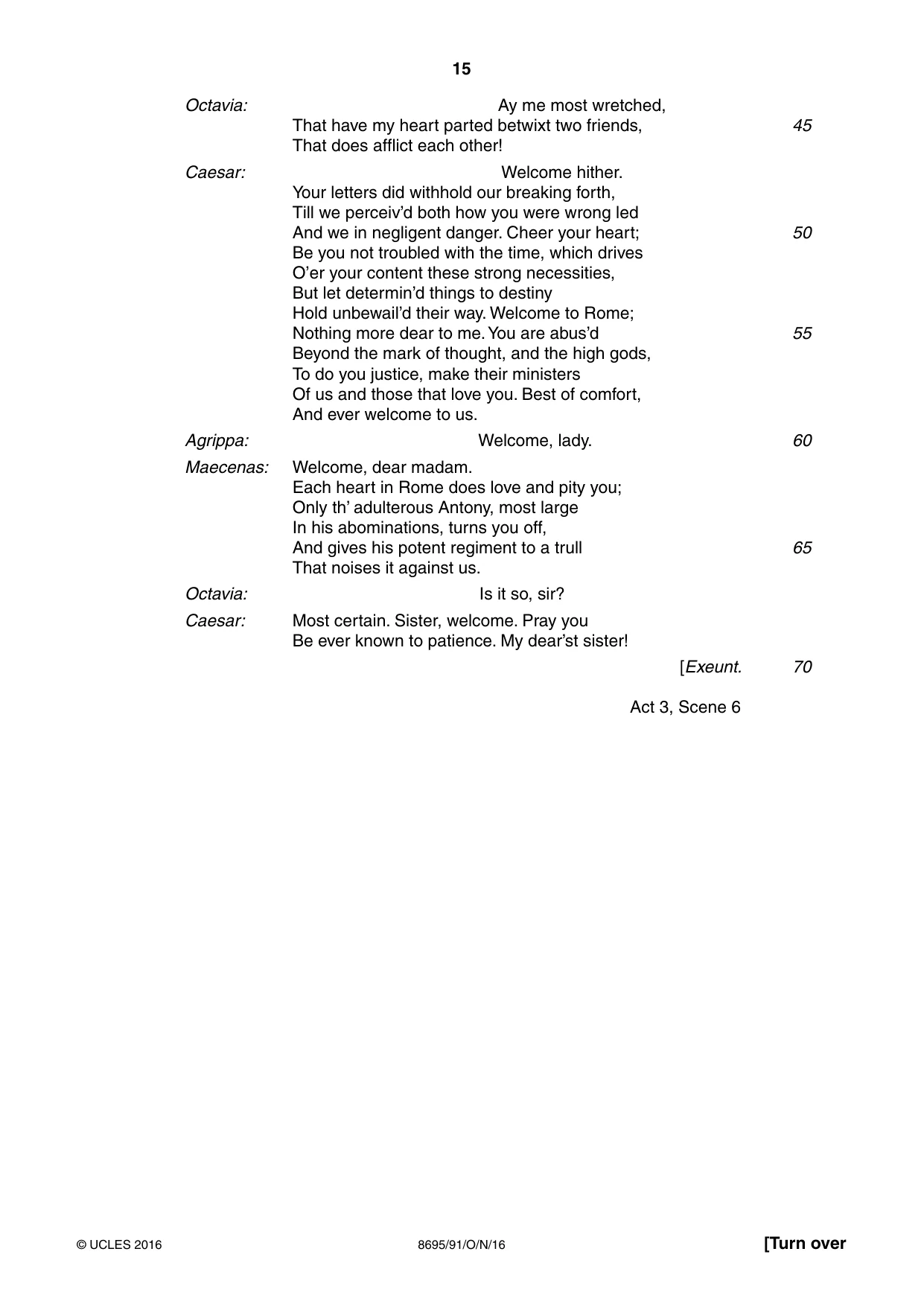
15 8695/91/O/N/16 © UCLES 2016 [Turn over Octavia: Ay me most wretched, That have my heart parted betwixt two friends, That does afflict each other! Caesar: Welcome hither. Your letters did withhold our breaking forth, Till we perceiv’d both how you were wrong led And we in negligent danger. Cheer your heart; Be you not troubled with the time, which drives O’er your content these strong necessities, But let determin’d things to destiny Hold unbewail’d their way. Welcome to Rome; Nothing more dear to me. You are abus’d Beyond the mark of thought, and the high gods, To do you justice, make their ministers Of us and those that love you. Best of comfort, And ever welcome to us. Agrippa: Welcome, lady. Maecenas: Welcome, dear madam. Each heart in Rome does love and pity you; Only th’ adulterous Antony, most large In his abominations, turns you off, And gives his potent regiment to a trull That noises it against us. Octavia: Is it so, sir? Caesar: Most certain. Sister, welcome. Pray you Be ever known to patience. My dear’st sister! [Exeunt. Act 3, Scene 6 45 50 55 60 65 70
Question paper, page 16
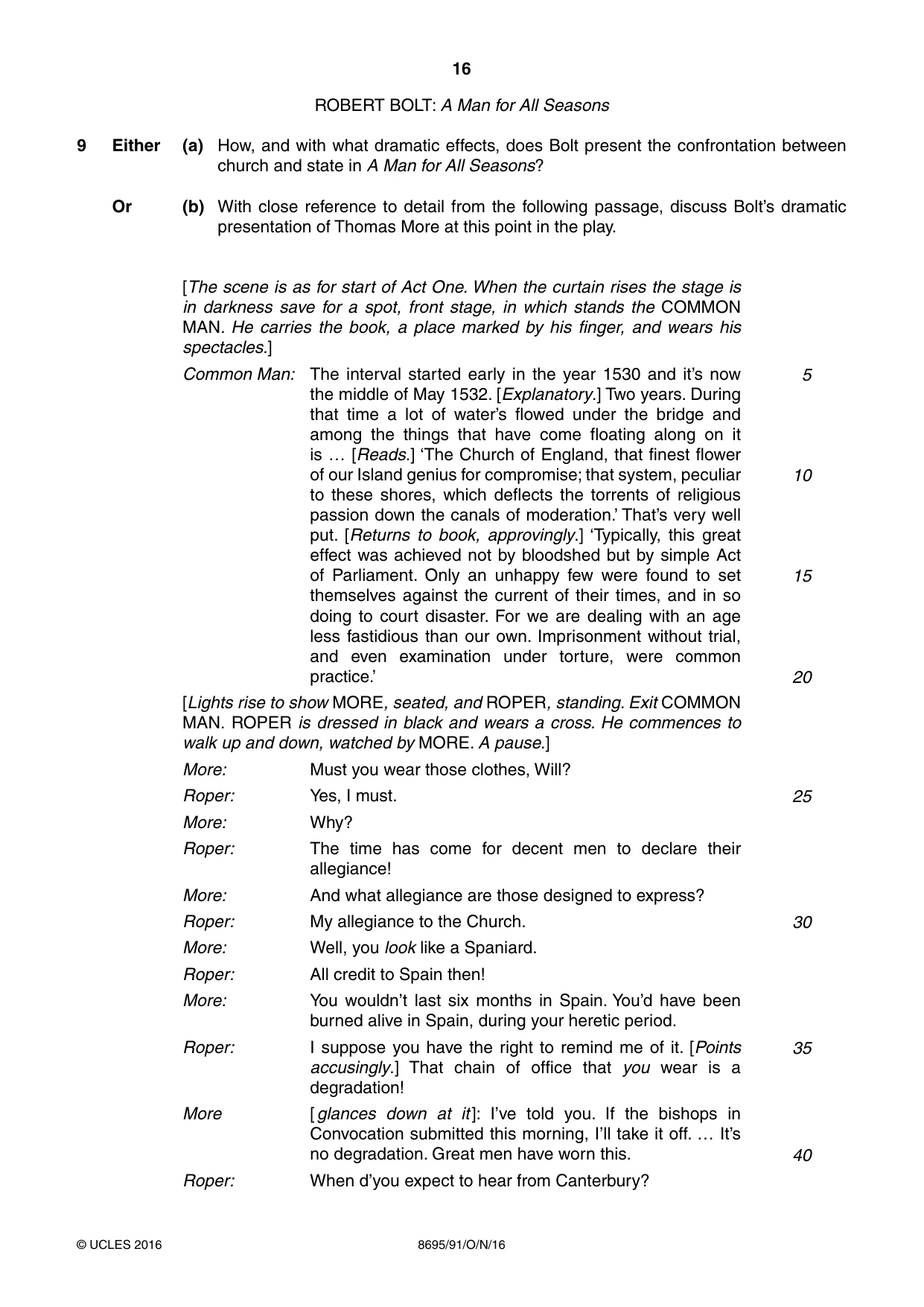
16 8695/91/O/N/16 © UCLES 2016 ROBERT BOLT: A Man for All Seasons 9 Either (a) How, and with what dramatic effects, does Bolt present the confrontation between church and state in A Man for All Seasons? Or (b) With close reference to detail from the following passage, discuss Bolt’s dramatic presentation of Thomas More at this point in the play. [The scene is as for start of Act One. When the curtain rises the stage is in darkness save for a spot, front stage, in which stands the COMMON MAN. He carries the book, a place marked by his finger, and wears his spectacles.] Common Man: The interval started early in the year 1530 and it’s now the middle of May 1532. [Explanatory.] Two years. During that time a lot of water’s flowed under the bridge and among the things that have come floating along on it is … [Reads.] ‘The Church of England, that finest flower of our Island genius for compromise; that system, peculiar to these shores, which deflects the torrents of religious passion down the canals of moderation.’ That’s very well put. [Returns to book, approvingly.] ‘Typically, this great effect was achieved not by bloodshed but by simple Act of Parliament. Only an unhappy few were found to set themselves against the current of their times, and in so doing to court disaster. For we are dealing with an age less fastidious than our own. Imprisonment without trial, and even examination under torture, were common practice.’ [Lights rise to show MORE, seated, and ROPER, standing. Exit COMMON MAN. ROPER is dressed in black and wears a cross. He commences to walk up and down, watched by MORE. A pause.] More: Must you wear those clothes, Will? Roper: Yes, I must. More: Why? Roper: The time has come for decent men to declare their allegiance! More: And what allegiance are those designed to express? Roper: My allegiance to the Church. More: Well, you look like a Spaniard. Roper: All credit to Spain then! More: You wouldn’t last six months in Spain. You’d have been burned alive in Spain, during your heretic period. Roper: I suppose you have the right to remind me of it. [Points accusingly.] That chain of office that you wear is a degradation! More [ glances down at it ]: I’ve told you. If the bishops in Convocation submitted this morning, I’ll take it off. … It’s no degradation. Great men have worn this. Roper: When d’you expect to hear from Canterbury? 5 10 15 20 25 30 35 40
Question paper, page 17
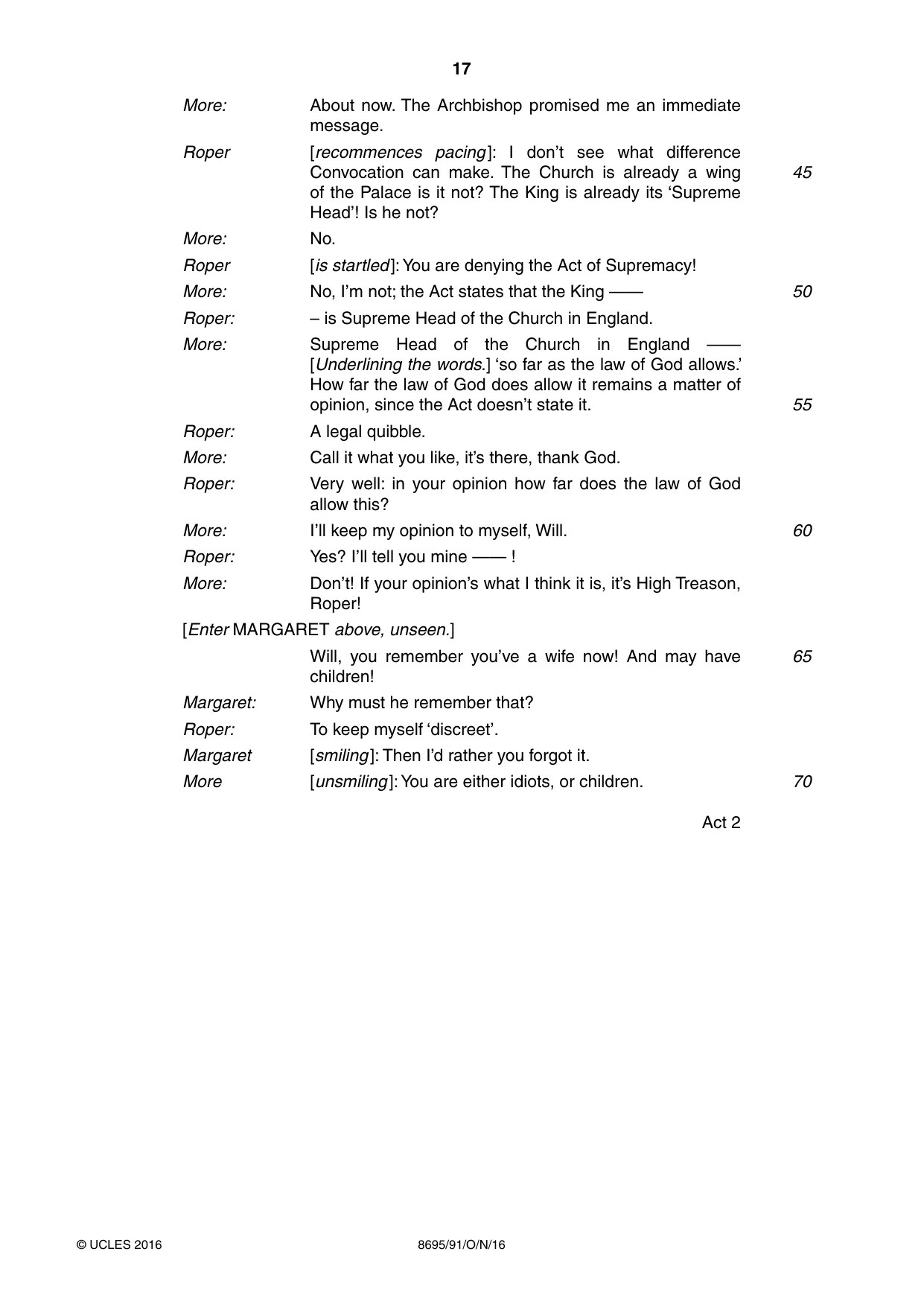
17 8695/91/O/N/16 © UCLES 2016 More: About now. The Archbishop promised me an immediate message. Roper [recommences pacing ]: I don’t see what difference Convocation can make. The Church is already a wing of the Palace is it not? The King is already its ‘Supreme Head’! Is he not? More: No. Roper [is startled ]: You are denying the Act of Supremacy! More: No, I’m not; the Act states that the King —— Roper: – is Supreme Head of the Church in England. More: Supreme Head of the Church in England —— [Underlining the words.] ‘so far as the law of God allows.’ How far the law of God does allow it remains a matter of opinion, since the Act doesn’t state it. Roper: A legal quibble. More: Call it what you like, it’s there, thank God. Roper: Very well: in your opinion how far does the law of God allow this? More: I’ll keep my opinion to myself, Will. Roper: Yes? I’ll tell you mine —— ! More: Don’t! If your opinion’s what I think it is, it’s High Treason, Roper! [Enter MARGARET above, unseen.] Will, you remember you’ve a wife now! And may have children! Margaret: Why must he remember that? Roper: To keep myself ‘discreet’. Margaret [smiling ]: Then I’d rather you forgot it. More [unsmiling ]: You are either idiots, or children. Act 2 45 50 55 60 65 70
Question paper, page 18
18 8695/91/O/N/16 © UCLES 2016 BLANK PAGE
Question paper, page 19
19 8695/91/O/N/16 © UCLES 2016 BLANK PAGE
Question paper, page 20
20 8695/91/O/N/16 © UCLES 2016 BLANK PAGE Permission to reproduce items where third-party owned material protected by copyright is included has been sought and cleared where possible. Every reasonable effort has been made by the publisher (UCLES) to trace copyright holders, but if any items requiring clearance have unwittingly been included, the publisher will be pleased to make amends at the earliest possible opportunity. To avoid the issue of disclosure of answer-related information to candidates, all copyright acknowledgements are reproduced online in the Cambridge International Examinations Copyright Acknowledgements Booklet. This is produced for each series of examinations and is freely available to download at www.cie.org.uk after the live examination series. Cambridge International Examinations is part of the Cambridge Assessment Group. Cambridge Assessment is the brand name of University of Cambridge Local Examinations Syndicate (UCLES), which is itself a department of the University of Cambridge.
Mark scheme, page 1
® IGCSE is the registered trademark of Cambridge International Examinations. This document consists of 5 printed pages. © UCLES 2016 [Turn over Cambridge International Examinations Cambridge International Advanced Subsidiary Level LANGUAGE AND LITERATURE IN ENGLISH 8695/91 Paper 9 Poetry, Prose and Drama October/November 2016 MARK SCHEME Maximum Mark: 50 Published This mark scheme is published as an aid to teachers and candidates, to indicate the requirements of the examination. It shows the basis on which Examiners were instructed to award marks. It does not indicate the details of the discussions that took place at an Examiners’ meeting before marking began, which would have considered the acceptability of alternative answers. Mark schemes should be read in conjunction with the question paper and the Principal Examiner Report for Teachers. Cambridge will not enter into discussions about these mark schemes. Cambridge is publishing the mark schemes for the October/November 2016 series for most Cambridge IGCSE®, Cambridge International A and AS Level components and some Cambridge O Level components.
Mark scheme, page 2
Page 2 Mark Scheme Syllabus Paper Cambridge International AS Level – October/November 2016 8695 91 © UCLES 2016 Using the mark levels Place the answer in a level first. Look for the “best fit” of the answer into a level. An answer needs to show evidence of most but not necessarily ALL of the qualities described in a level, in order to be placed in that level. Then award a mark for the relative position of the answer within the level. Candidates may address the question in many different ways. Do not expect any particular focus or approach and do not penalise answers for leaving out a particular focus. Reward what is there, showing what you are rewarding, in your comments. Consider all strands and weigh up the performance as a whole in placing the answer in a level, then show that you have done so in the summative comment, e.g. Sound K of texts, some evidence of U but mostly narrative, occasional evidence of P, mainly clear C. Assessment Objectives: • Ability to respond to texts in the three main forms (Prose, Poetry and Drama) of different types and from different cultures; • Understanding of the ways in which writers’ choices of form, structure and language shape meanings; • Ability to produce informed independent opinions and judgements on literary texts; • Ability to communicate clearly the knowledge, understanding and insight appropriate to literary study. Each answer is marked out of 25, in accordance with the General Marking Criteria below. Each level is divided into strands corresponding to the Assessment Objectives – Knowledge, Understanding, Personal Response, Communication. Level 6 22–25 Very good work – do not reserve this level for the very best work you see but ensure you put scripts into this level which fulfil the requirements described below. There will always be some candidates who are at a standard over the top of the mark scheme. K Evidence of a very good ability to select relevant knowledge to address the question with effective use of references and quotation. There may be evidence of sensitive awareness of the contexts in which the literary works studied were written and understood. U Evidence of very good understanding of ways in which writers’ choices of structure, form and language shape meanings with sustained analysis and sensitive appreciation of literary methods and effects and contexts, possibly including literary genres and conventions. P Personal response to texts will be perceptive, often freshly personal, fully supported with quotation, and may show originality in approach to and treatment of questions. C Candidates will express complex literary ideas and arguments with clarity and fluency. Answers will have a coherent structure, with logical progression and effectively linked paragraphs. Expression will be accomplished and appropriate. In answers to passage-based questions, work will sustain an appropriate balance between critical appreciation of given extracts, based on detailed critical analysis, and consideration of the broader textual issues raised by the questions, and relate part of a text to its whole and vice versa in a seamless argument. There will be a very good appreciation of the effects of the literary features of the text, with detailed analysis supported by relevant examples from the passage and the wider text, where appropriate. There will be a very good knowledge of the appropriate context of the extract or work.
Mark scheme, page 3
Page 3 Mark Scheme Syllabus Paper Cambridge International AS Level – October/November 2016 8695 91 © UCLES 2016 Level 5 18–21 Proficient work K Evidence of proficiency in selecting relevant knowledge to address the question with precise and integrated direct references to the text and supporting quotation. There may be evidence of awareness of the contexts in which the literary works studied were written and understood. U Evidence of intelligent understanding of ways in which writers’ choices of structure, form and language shape meanings, with analysis and appreciation of literary methods, effects and contexts. P Evidence of personal response to the texts, relevant to the question, supported from the text, some originality of thought, straightforward and vigorously articulated, perhaps, rather than penetrating and subtle. C Expression confident, with some complex ideas expressed with some fluency. Structure is sound. Literary arguments will be coherent, with progression of ideas through clearly linked paragraphs. In answers to passage-based questions, work will show engagement with both the given extracts and the wider textual issues. There will be a confident relation of a part of the text to its whole. There will be a proficient appreciation of the effects of the literary features of the text supported by relevant examples from the passage and from the wider text where appropriate. There will be a good knowledge of the appropriate context of the extract or work. Level 4 14–17 Competent work K Evidence of competence in selecting relevant knowledge of the text to address with some pertinent use of quotation and direct references. U Evidence of sound understanding of some aspects of ways in which writers’ choices of structure, form and language shape meanings, with some analysis and appreciation of literary methods, effects and contexts. P Evidence of personal response relevant to the question, supported from the text. C Expression will be clear and generally accurate. Structure will be sound – material coherently organised with occasional insights. Candidates will express intelligent, straightforward ideas clearly, though there may be occasional loss of fluency with points not always strongly connected. In answers to passage-based questions, work will cover both the passage and its relation to the whole text, and there will be some sense of a relationship between the text as a whole and its constituent parts. There will be competent appreciation of the effects of the literary features of the text and the analysis is supported by relevant examples from the passage.
Mark scheme, page 4
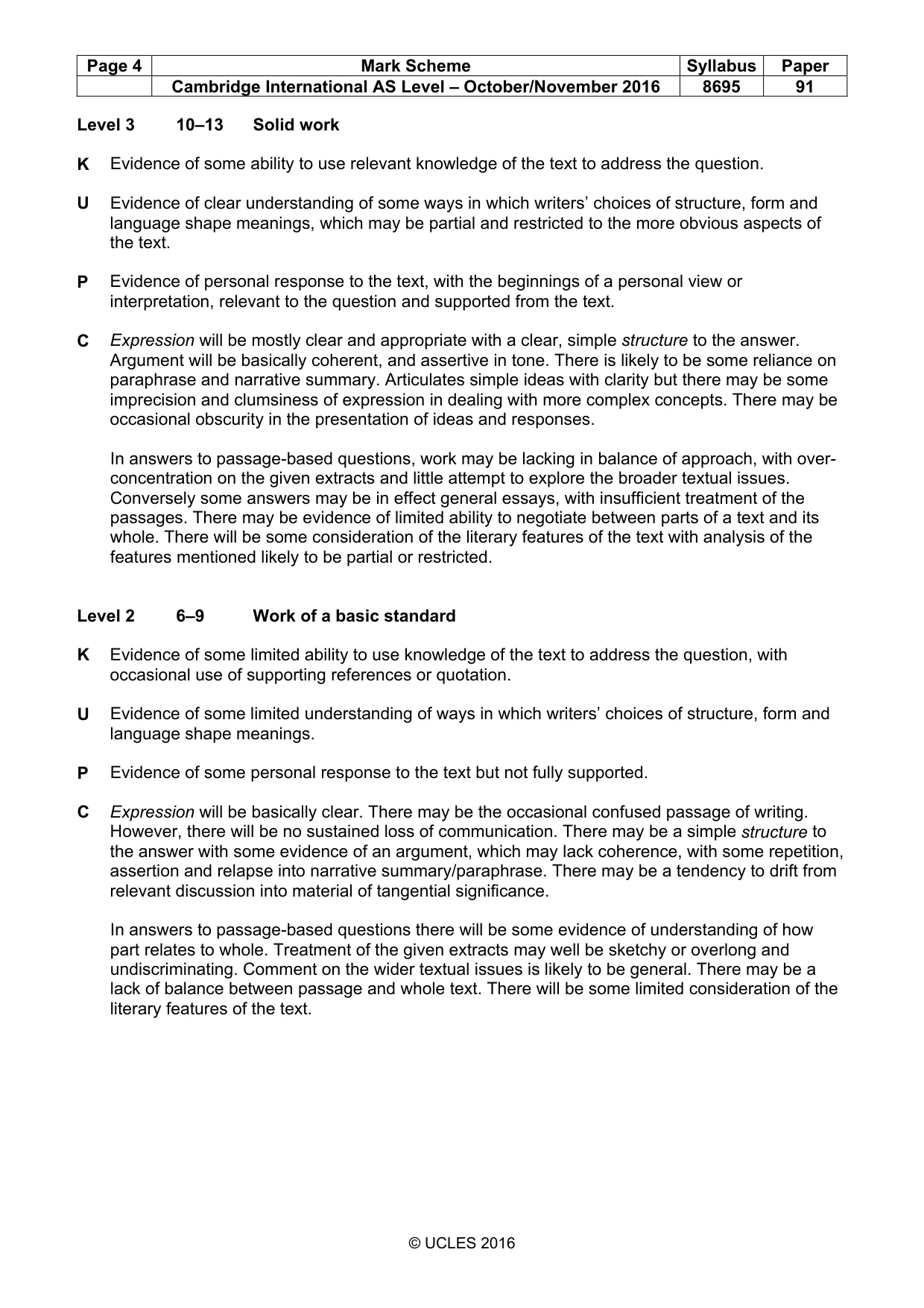
Page 4 Mark Scheme Syllabus Paper Cambridge International AS Level – October/November 2016 8695 91 © UCLES 2016 Level 3 10–13 Solid work K Evidence of some ability to use relevant knowledge of the text to address the question. U Evidence of clear understanding of some ways in which writers’ choices of structure, form and language shape meanings, which may be partial and restricted to the more obvious aspects of the text. P Evidence of personal response to the text, with the beginnings of a personal view or interpretation, relevant to the question and supported from the text. C Expression will be mostly clear and appropriate with a clear, simple structure to the answer. Argument will be basically coherent, and assertive in tone. There is likely to be some reliance on paraphrase and narrative summary. Articulates simple ideas with clarity but there may be some imprecision and clumsiness of expression in dealing with more complex concepts. There may be occasional obscurity in the presentation of ideas and responses. In answers to passage-based questions, work may be lacking in balance of approach, with over- concentration on the given extracts and little attempt to explore the broader textual issues. Conversely some answers may be in effect general essays, with insufficient treatment of the passages. There may be evidence of limited ability to negotiate between parts of a text and its whole. There will be some consideration of the literary features of the text with analysis of the features mentioned likely to be partial or restricted. Level 2 6–9 Work of a basic standard K Evidence of some limited ability to use knowledge of the text to address the question, with occasional use of supporting references or quotation. U Evidence of some limited understanding of ways in which writers’ choices of structure, form and language shape meanings. P Evidence of some personal response to the text but not fully supported. C Expression will be basically clear. There may be the occasional confused passage of writing. However, there will be no sustained loss of communication. There may be a simple structure to the answer with some evidence of an argument, which may lack coherence, with some repetition, assertion and relapse into narrative summary/paraphrase. There may be a tendency to drift from relevant discussion into material of tangential significance. In answers to passage-based questions there will be some evidence of understanding of how part relates to whole. Treatment of the given extracts may well be sketchy or overlong and undiscriminating. Comment on the wider textual issues is likely to be general. There may be a lack of balance between passage and whole text. There will be some limited consideration of the literary features of the text.
Mark scheme, page 5
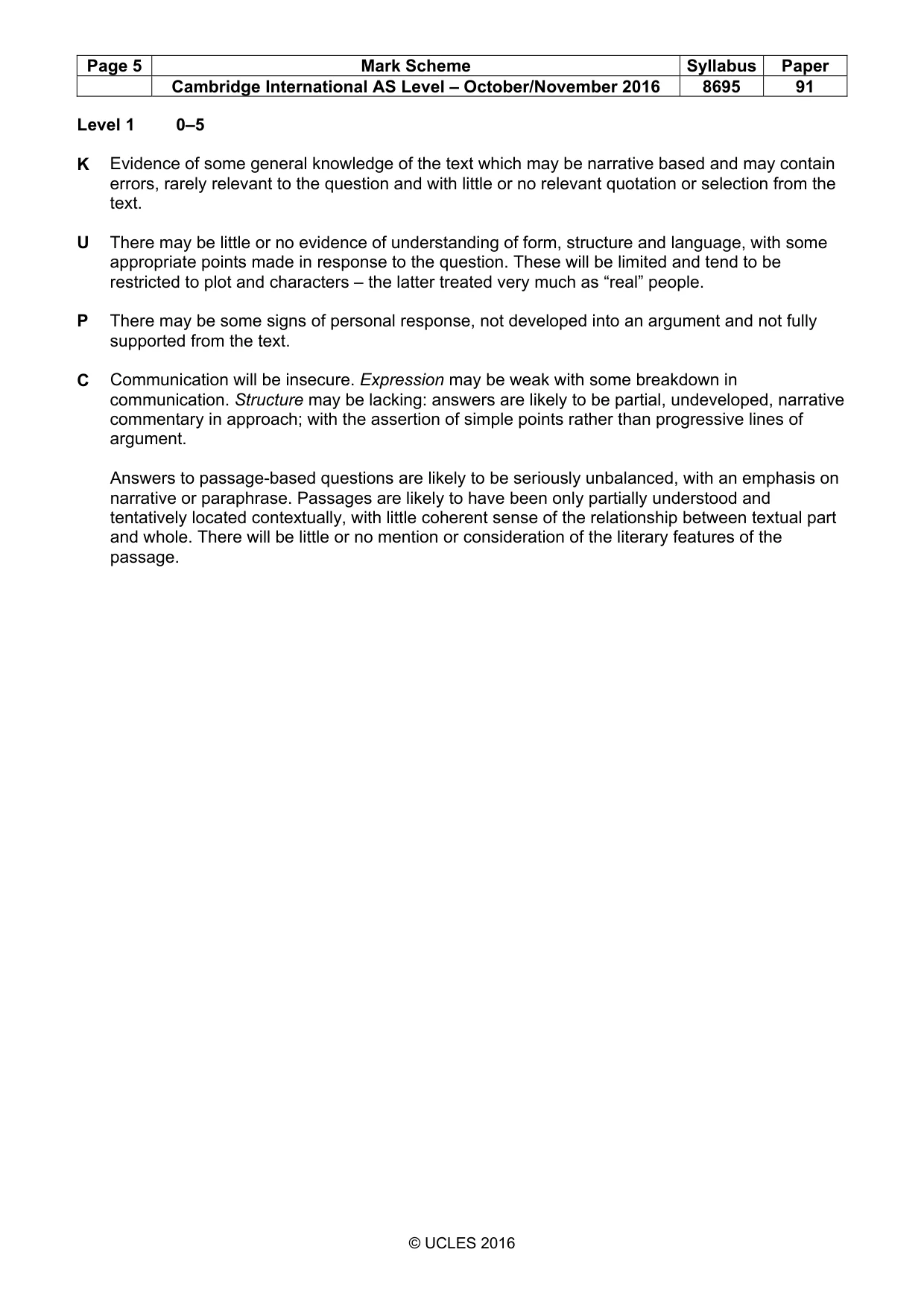
Page 5 Mark Scheme Syllabus Paper Cambridge International AS Level – October/November 2016 8695 91 © UCLES 2016 Level 1 0–5 K Evidence of some general knowledge of the text which may be narrative based and may contain errors, rarely relevant to the question and with little or no relevant quotation or selection from the text. U There may be little or no evidence of understanding of form, structure and language, with some appropriate points made in response to the question. These will be limited and tend to be restricted to plot and characters – the latter treated very much as “real” people. P There may be some signs of personal response, not developed into an argument and not fully supported from the text. C Communication will be insecure. Expression may be weak with some breakdown in communication. Structure may be lacking: answers are likely to be partial, undeveloped, narrative commentary in approach; with the assertion of simple points rather than progressive lines of argument. Answers to passage-based questions are likely to be seriously unbalanced, with an emphasis on narrative or paraphrase. Passages are likely to have been only partially understood and tentatively located contextually, with little coherent sense of the relationship between textual part and whole. There will be little or no mention or consideration of the literary features of the passage.
What you needed in this session
Cambridge’s own grade thresholds for 2016 Oct/Nov, Paper 9 · Variant 1. A higher threshold means an easier paper — the bar moves with how the cohort did.