Cambridge A Level English - Language and Literature (AS Level only, from 2016) 8695 — 2016 Oct/Nov Paper 9 · Variant 2
8695/92/O/N/16 · 50 marks · ≈56 min
The question paper and its mark scheme, free to read here and free to download. This is Cambridge’s own paper, exactly as it was sat.
Question paper20 pages


Mark scheme5 pages
Answers below. Sit the paper first if you are practising.
Paper as text
Question paper, page 1
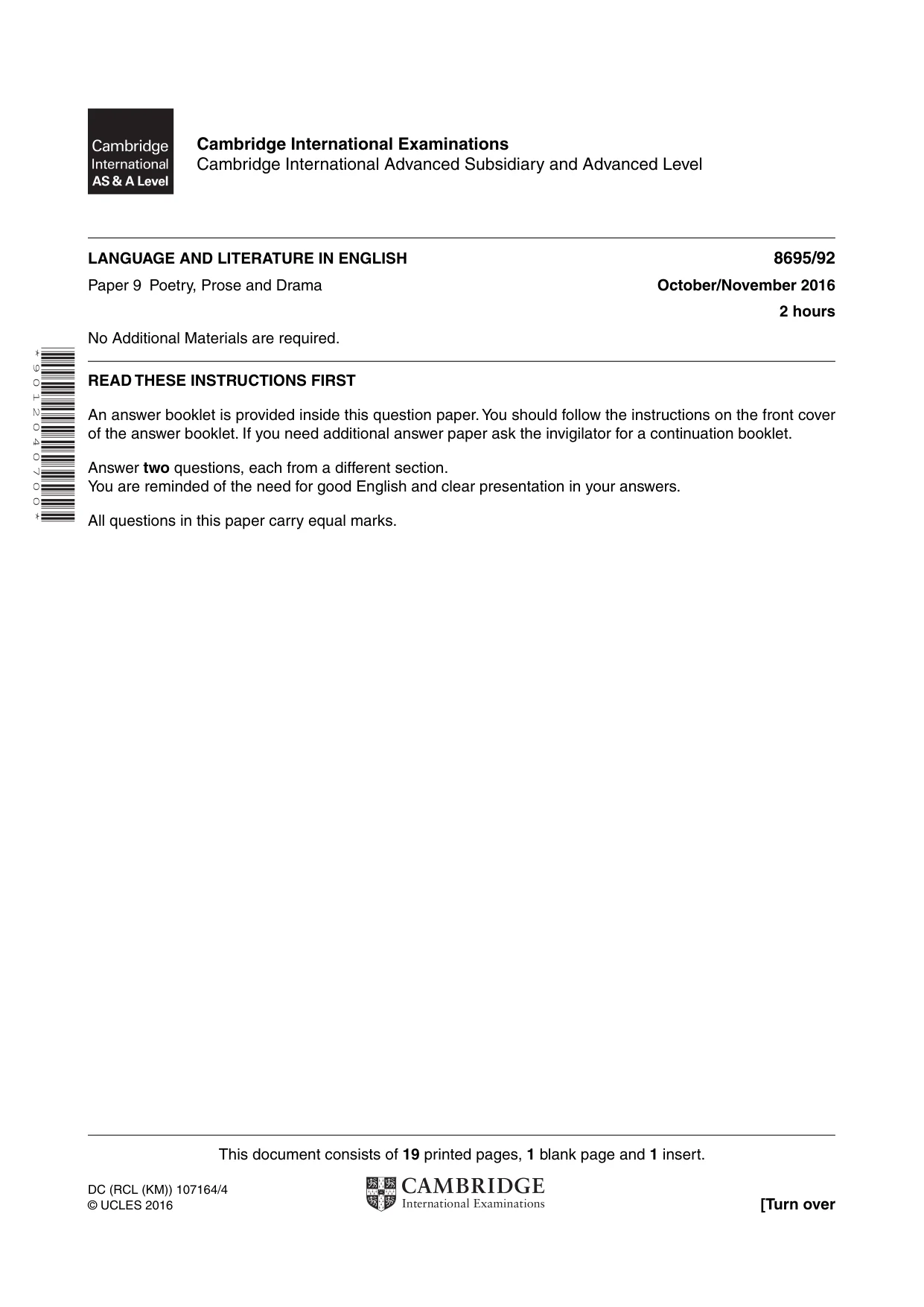
This document consists of 19 printed pages, 1 blank page and 1 insert. DC (RCL (KM)) 107164/4 © UCLES 2016 [Turn over Cambridge International Examinations Cambridge International Advanced Subsidiary and Advanced Level * 9 0 1 2 0 4 0 7 0 0 * LANGUAGE AND LITERATURE IN ENGLISH 8695/92 Paper 9 Poetry, Prose and Drama October/November 2016 2 hours No Additional Materials are required. READ THESE INSTRUCTIONS FIRST An answer booklet is provided inside this question paper. You should follow the instructions on the front cover of the answer booklet. If you need additional answer paper ask the invigilator for a continuation booklet. Answer two questions, each from a different section. You are reminded of the need for good English and clear presentation in your answers. All questions in this paper carry equal marks.
Question paper, page 2
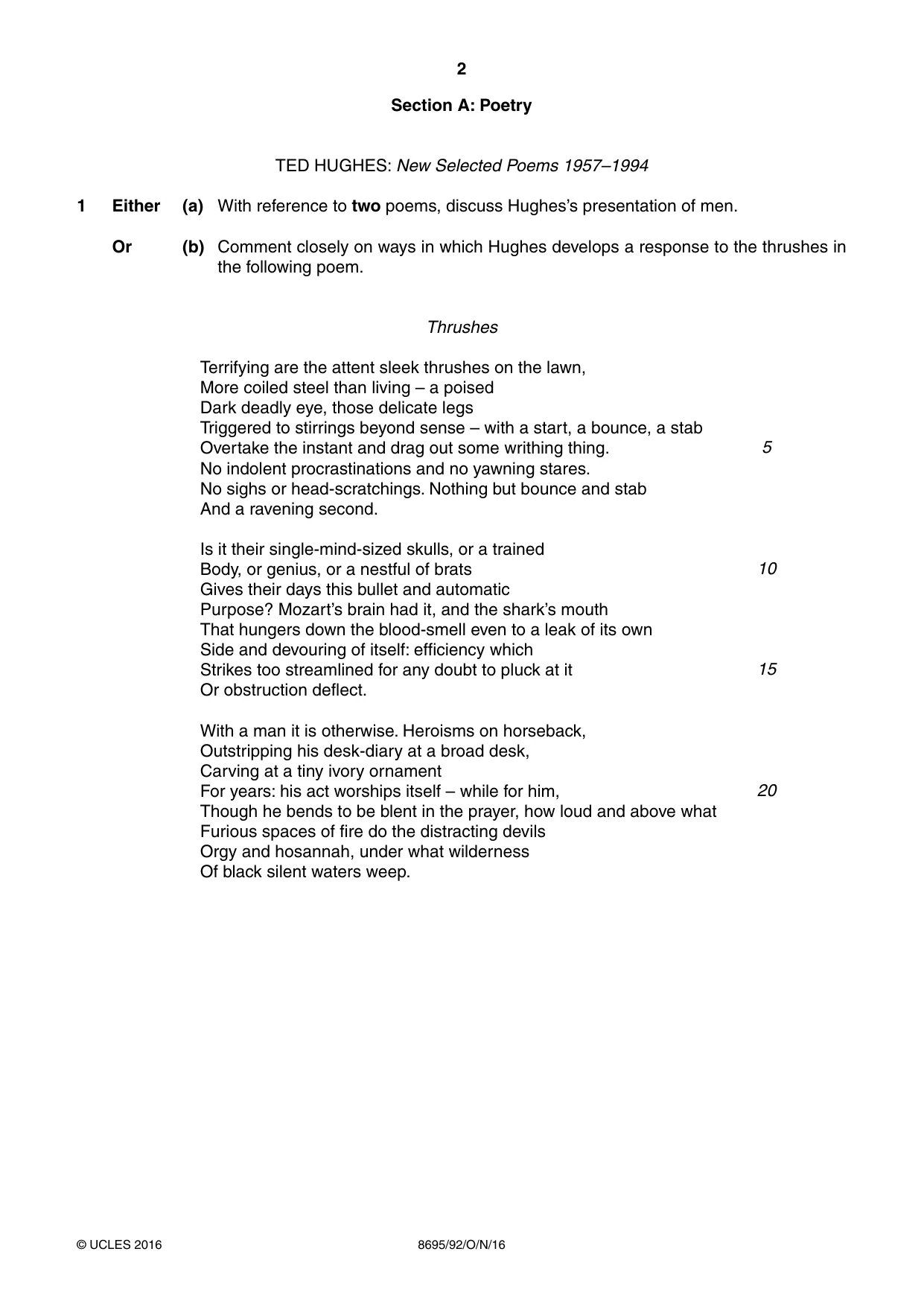
2 8695/92/O/N/16 © UCLES 2016 Section A: Poetry TED HUGHES: New Selected Poems 1957–1994 1 Either (a) With reference to two poems, discuss Hughes’s presentation of men. Or (b) Comment closely on ways in which Hughes develops a response to the thrushes in the following poem. Thrushes Terrifying are the attent sleek thrushes on the lawn, More coiled steel than living – a poised Dark deadly eye, those delicate legs Triggered to stirrings beyond sense – with a start, a bounce, a stab Overtake the instant and drag out some writhing thing. No indolent procrastinations and no yawning stares. No sighs or head-scratchings. Nothing but bounce and stab And a ravening second. Is it their single-mind-sized skulls, or a trained Body, or genius, or a nestful of brats Gives their days this bullet and automatic Purpose? Mozart’s brain had it, and the shark’s mouth That hungers down the blood-smell even to a leak of its own Side and devouring of itself: efficiency which Strikes too streamlined for any doubt to pluck at it Or obstruction deflect. With a man it is otherwise. Heroisms on horseback, Outstripping his desk-diary at a broad desk, Carving at a tiny ivory ornament For years: his act worships itself – while for him, Though he bends to be blent in the prayer, how loud and above what Furious spaces of fire do the distracting devils Orgy and hosannah, under what wilderness Of black silent waters weep. 5 10 15 20
Question paper, page 3
3 8695/92/O/N/16 © UCLES 2016 [Turn over Turn to page 4 for Question 2
Question paper, page 4
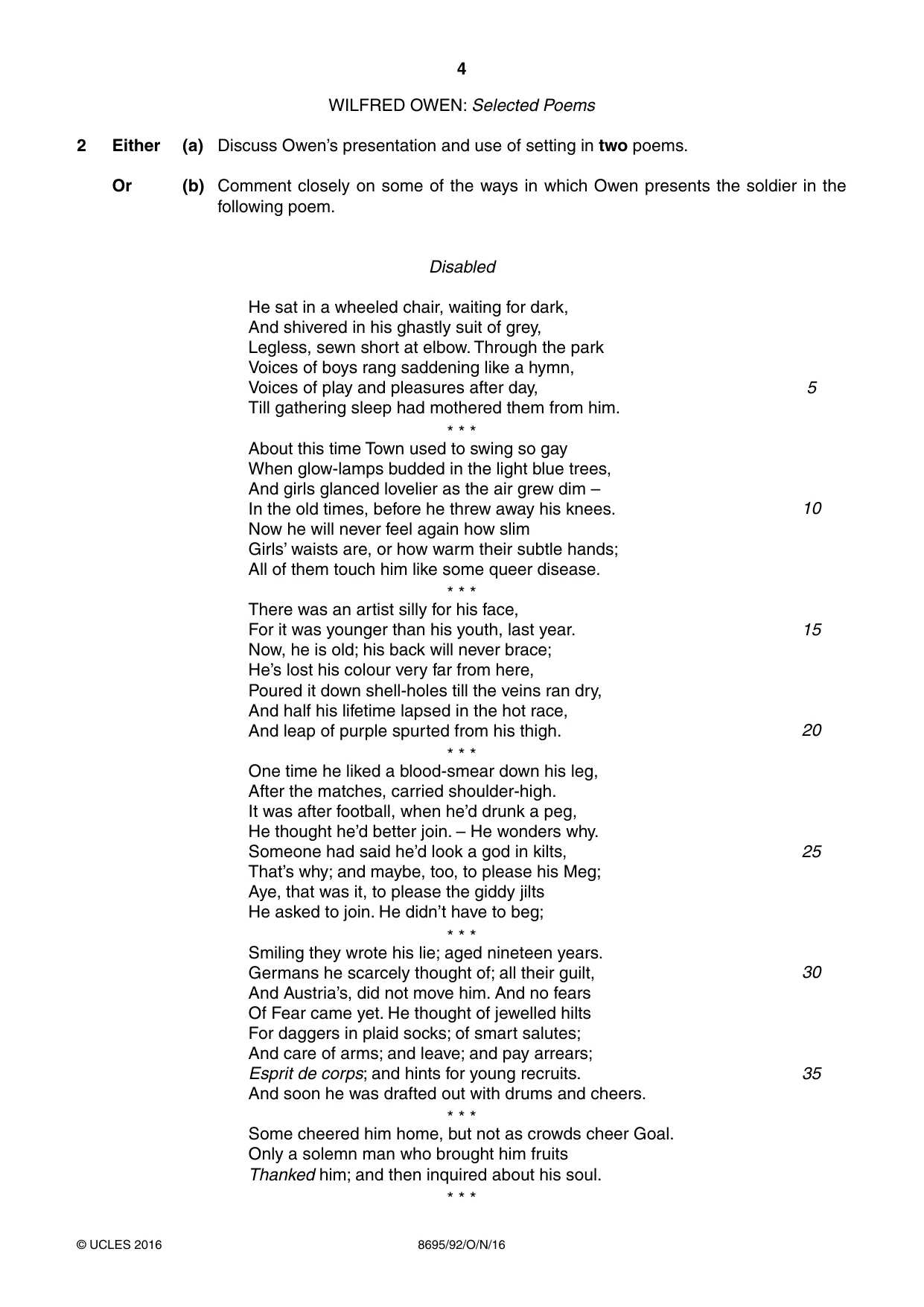
4 8695/92/O/N/16 © UCLES 2016 WILFRED OWEN: Selected Poems 2 Either (a) Discuss Owen’s presentation and use of setting in two poems. Or (b) Comment closely on some of the ways in which Owen presents the soldier in the following poem. Disabled He sat in a wheeled chair, waiting for dark, And shivered in his ghastly suit of grey, Legless, sewn short at elbow. Through the park Voices of boys rang saddening like a hymn, Voices of play and pleasures after day, Till gathering sleep had mothered them from him. * * * About this time Town used to swing so gay When glow-lamps budded in the light blue trees, And girls glanced lovelier as the air grew dim – In the old times, before he threw away his knees. Now he will never feel again how slim Girls’ waists are, or how warm their subtle hands; All of them touch him like some queer disease. * * * There was an artist silly for his face, For it was younger than his youth, last year. Now, he is old; his back will never brace; He’s lost his colour very far from here, Poured it down shell-holes till the veins ran dry, And half his lifetime lapsed in the hot race, And leap of purple spurted from his thigh. * * * One time he liked a blood-smear down his leg, After the matches, carried shoulder-high. It was after football, when he’d drunk a peg, He thought he’d better join. – He wonders why. Someone had said he’d look a god in kilts, That’s why; and maybe, too, to please his Meg; Aye, that was it, to please the giddy jilts He asked to join. He didn’t have to beg; * * * Smiling they wrote his lie; aged nineteen years. Germans he scarcely thought of; all their guilt, And Austria’s, did not move him. And no fears Of Fear came yet. He thought of jewelled hilts For daggers in plaid socks; of smart salutes; And care of arms; and leave; and pay arrears; Esprit de corps; and hints for young recruits. And soon he was drafted out with drums and cheers. * * * Some cheered him home, but not as crowds cheer Goal. Only a solemn man who brought him fruits Thanked him; and then inquired about his soul. * * * 5 10 15 20 25 30 35
Question paper, page 5
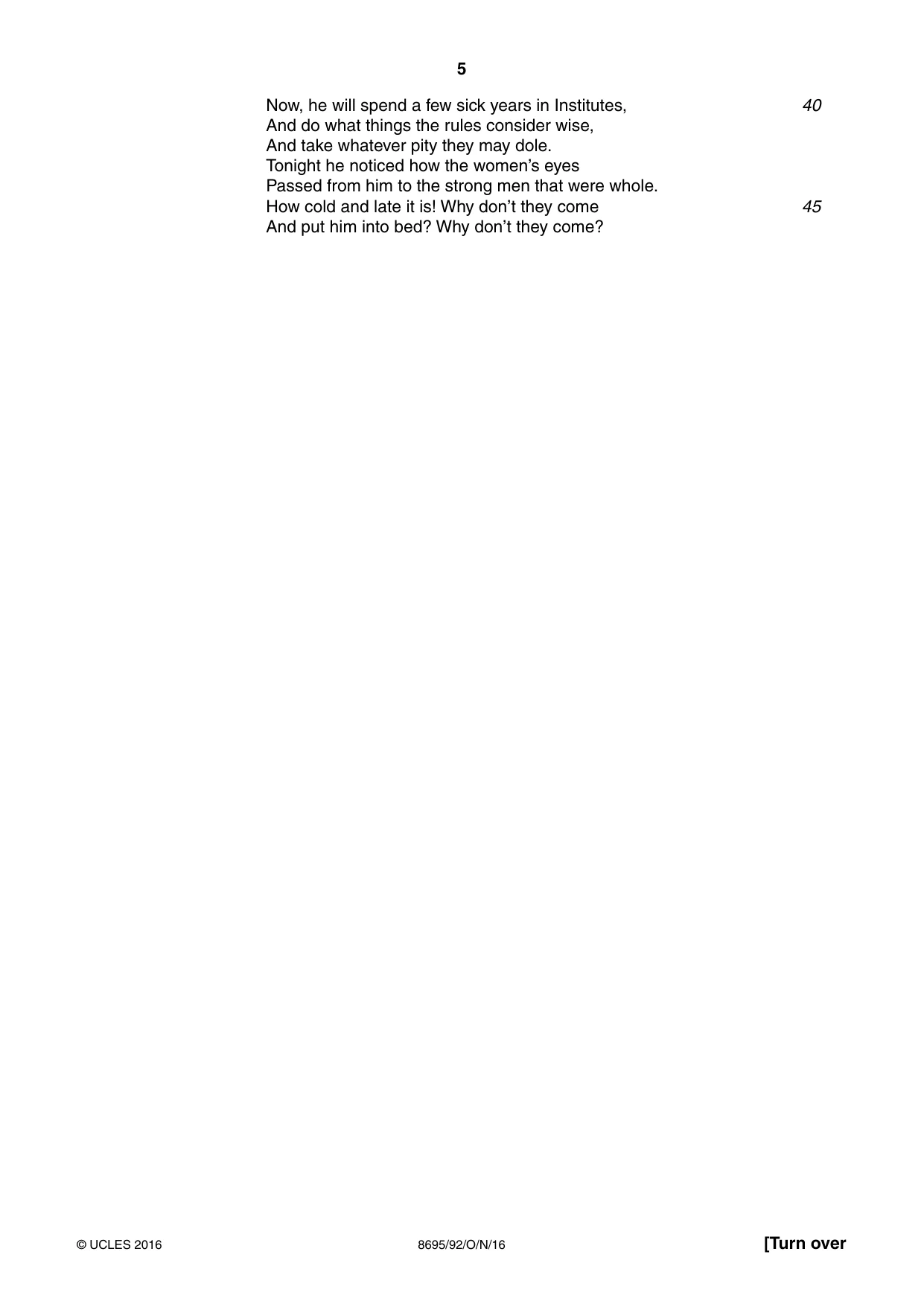
5 8695/92/O/N/16 © UCLES 2016 [Turn over Now, he will spend a few sick years in Institutes, And do what things the rules consider wise, And take whatever pity they may dole. Tonight he noticed how the women’s eyes Passed from him to the strong men that were whole. How cold and late it is! Why don’t they come And put him into bed? Why don’t they come? 40 45
Question paper, page 6
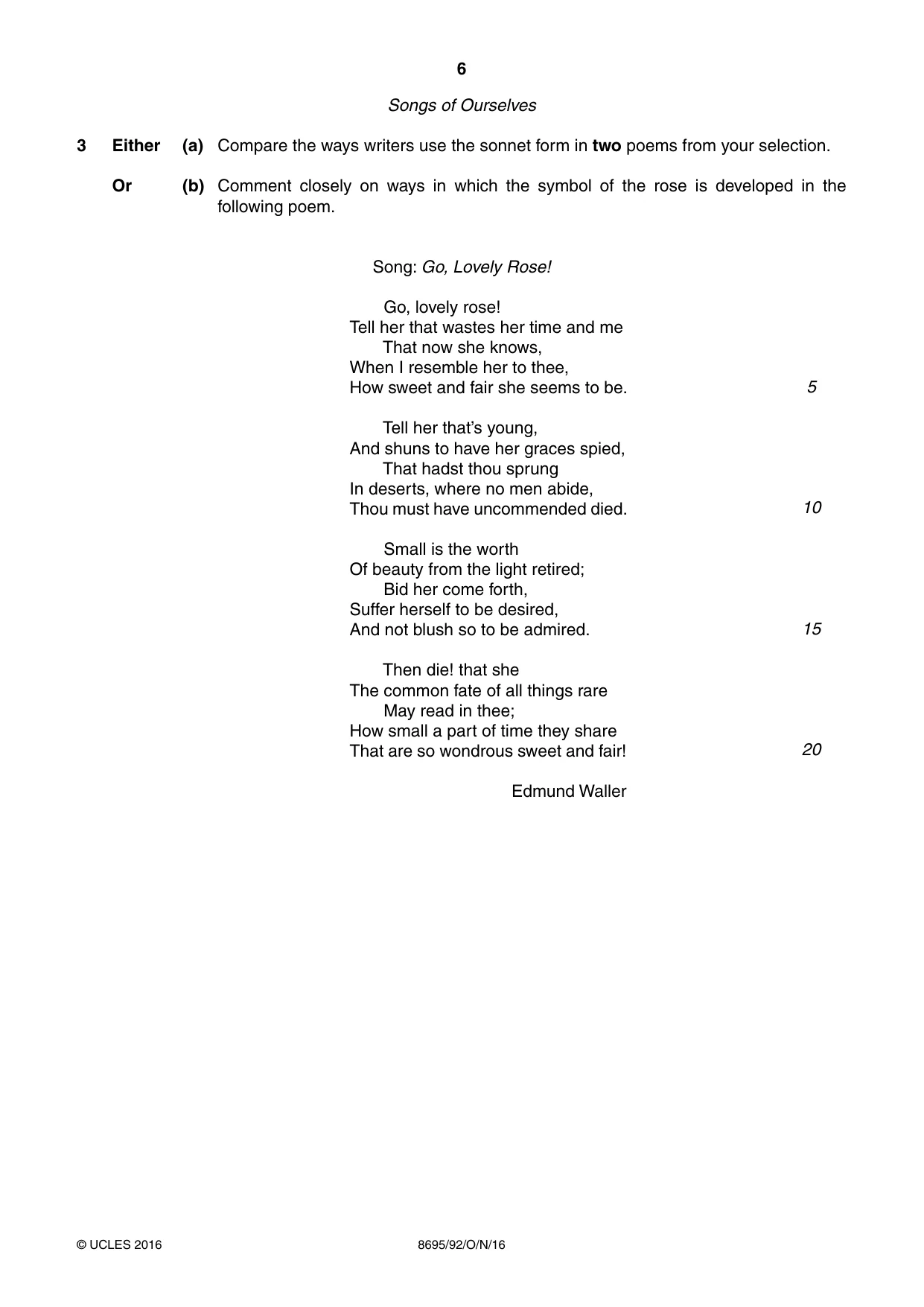
6 8695/92/O/N/16 © UCLES 2016 Songs of Ourselves 3 Either (a) Compare the ways writers use the sonnet form in two poems from your selection. Or (b) Comment closely on ways in which the symbol of the rose is developed in the following poem. Song: Go, Lovely Rose! Go, lovely rose! Tell her that wastes her time and me That now she knows, When I resemble her to thee, How sweet and fair she seems to be. Tell her that’s young, And shuns to have her graces spied, That hadst thou sprung In deserts, where no men abide, Thou must have uncommended died. Small is the worth Of beauty from the light retired; Bid her come forth, Suffer herself to be desired, And not blush so to be admired. Then die! that she The common fate of all things rare May read in thee; How small a part of time they share That are so wondrous sweet and fair! Edmund Waller 5 10 15 20
Question paper, page 7
7 8695/92/O/N/16 © UCLES 2016 [Turn over Turn to page 8 for Question 4
Question paper, page 8
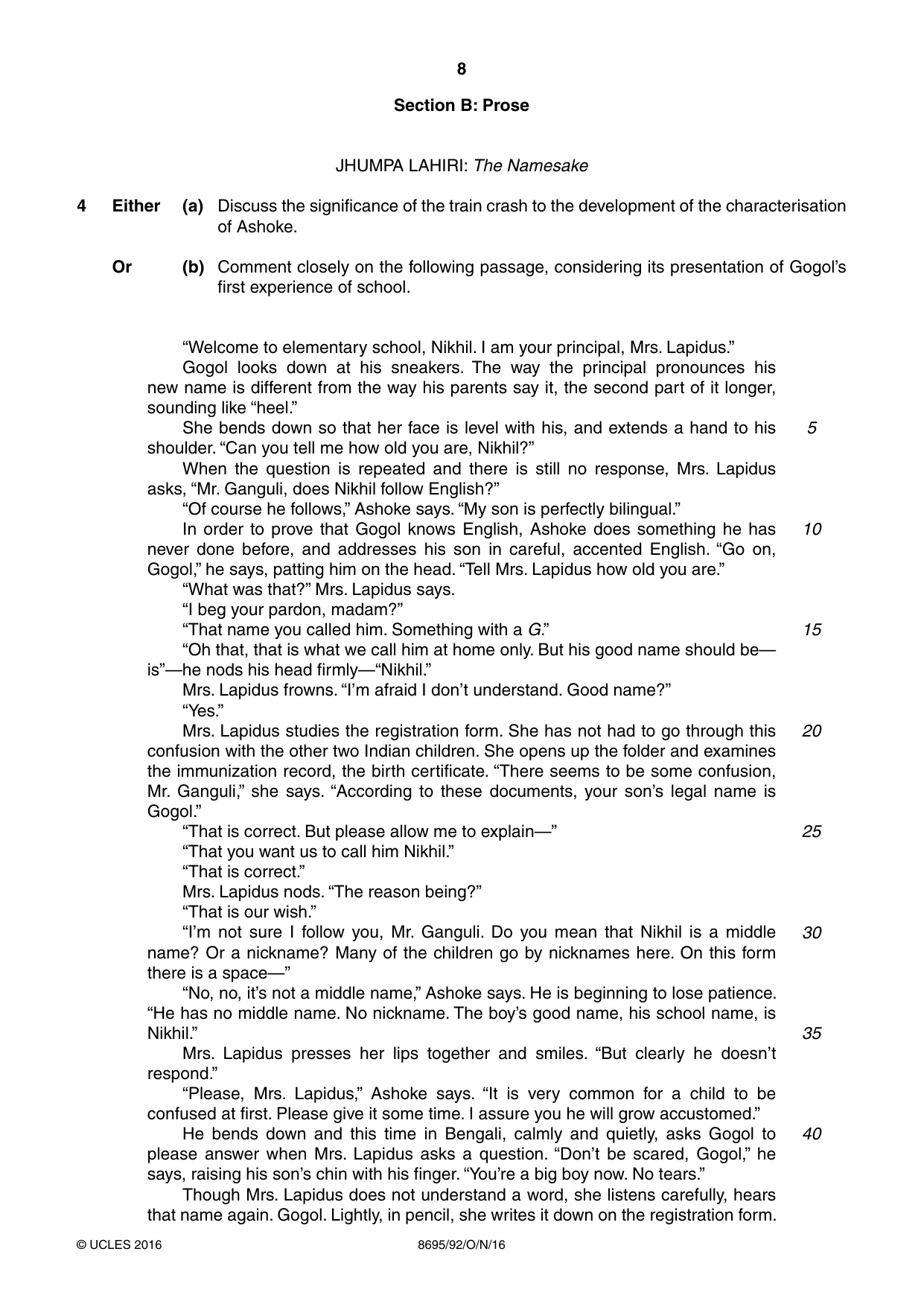
8 8695/92/O/N/16 © UCLES 2016 Section B: Prose JHUMPA LAHIRI: The Namesake 4 Either (a) Discuss the significance of the train crash to the development of the characterisation of Ashoke. Or (b) Comment closely on the following passage, considering its presentation of Gogol’s first experience of school. “Welcome to elementary school, Nikhil. I am your principal, Mrs. Lapidus.” Gogol looks down at his sneakers. The way the principal pronounces his new name is different from the way his parents say it, the second part of it longer, sounding like “heel.” She bends down so that her face is level with his, and extends a hand to his shoulder. “Can you tell me how old you are, Nikhil?” When the question is repeated and there is still no response, Mrs. Lapidus asks, “Mr. Ganguli, does Nikhil follow English?” “Of course he follows,” Ashoke says. “My son is perfectly bilingual.” In order to prove that Gogol knows English, Ashoke does something he has never done before, and addresses his son in careful, accented English. “Go on, Gogol,” he says, patting him on the head. “Tell Mrs. Lapidus how old you are.” “What was that?” Mrs. Lapidus says. “I beg your pardon, madam?” “That name you called him. Something with a G.” “Oh that, that is what we call him at home only. But his good name should be— is”—he nods his head firmly—“Nikhil.” Mrs. Lapidus frowns. “I’m afraid I don’t understand. Good name?” “Yes.” Mrs. Lapidus studies the registration form. She has not had to go through this confusion with the other two Indian children. She opens up the folder and examines the immunization record, the birth certificate. “There seems to be some confusion, Mr. Ganguli,” she says. “According to these documents, your son’s legal name is Gogol.” “That is correct. But please allow me to explain—” “That you want us to call him Nikhil.” “That is correct.” Mrs. Lapidus nods. “The reason being?” “That is our wish.” “I’m not sure I follow you, Mr. Ganguli. Do you mean that Nikhil is a middle name? Or a nickname? Many of the children go by nicknames here. On this form there is a space—” “No, no, it’s not a middle name,” Ashoke says. He is beginning to lose patience. “He has no middle name. No nickname. The boy’s good name, his school name, is Nikhil.” Mrs. Lapidus presses her lips together and smiles. “But clearly he doesn’t respond.” “Please, Mrs. Lapidus,” Ashoke says. “It is very common for a child to be confused at first. Please give it some time. I assure you he will grow accustomed.” He bends down and this time in Bengali, calmly and quietly, asks Gogol to please answer when Mrs. Lapidus asks a question. “Don’t be scared, Gogol,” he says, raising his son’s chin with his finger. “You’re a big boy now. No tears.” Though Mrs. Lapidus does not understand a word, she listens carefully, hears that name again. Gogol. Lightly, in pencil, she writes it down on the registration form. 5 10 15 20 25 30 35 40
Question paper, page 9
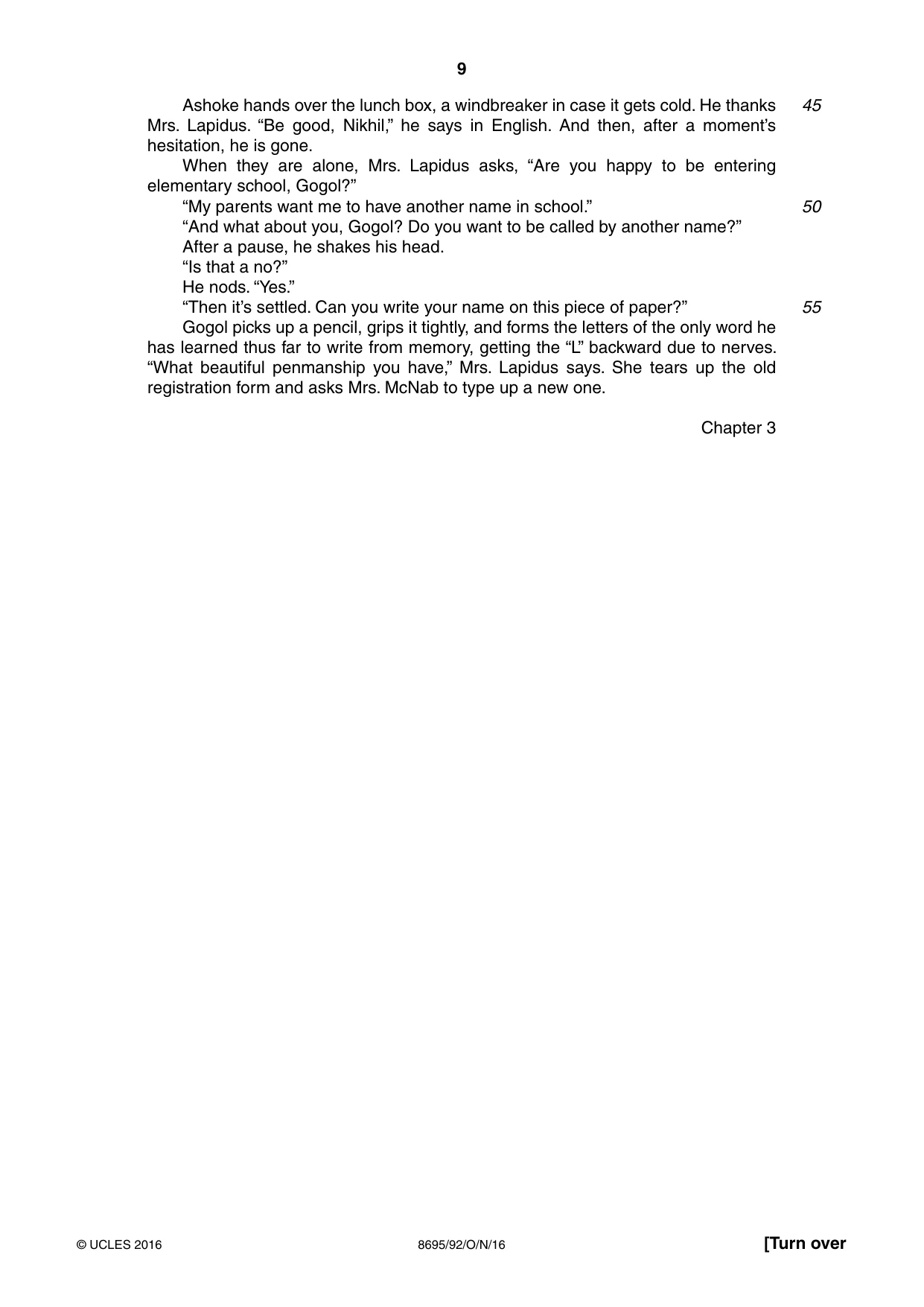
9 8695/92/O/N/16 © UCLES 2016 [Turn over Ashoke hands over the lunch box, a windbreaker in case it gets cold. He thanks Mrs. Lapidus. “Be good, Nikhil,” he says in English. And then, after a moment’s hesitation, he is gone. When they are alone, Mrs. Lapidus asks, “Are you happy to be entering elementary school, Gogol?” “My parents want me to have another name in school.” “And what about you, Gogol? Do you want to be called by another name?” After a pause, he shakes his head. “Is that a no?” He nods. “Yes.” “Then it’s settled. Can you write your name on this piece of paper?” Gogol picks up a pencil, grips it tightly, and forms the letters of the only word he has learned thus far to write from memory, getting the “L” backward due to nerves. “What beautiful penmanship you have,” Mrs. Lapidus says. She tears up the old registration form and asks Mrs. McNab to type up a new one. Chapter 3 45 50 55
Question paper, page 10
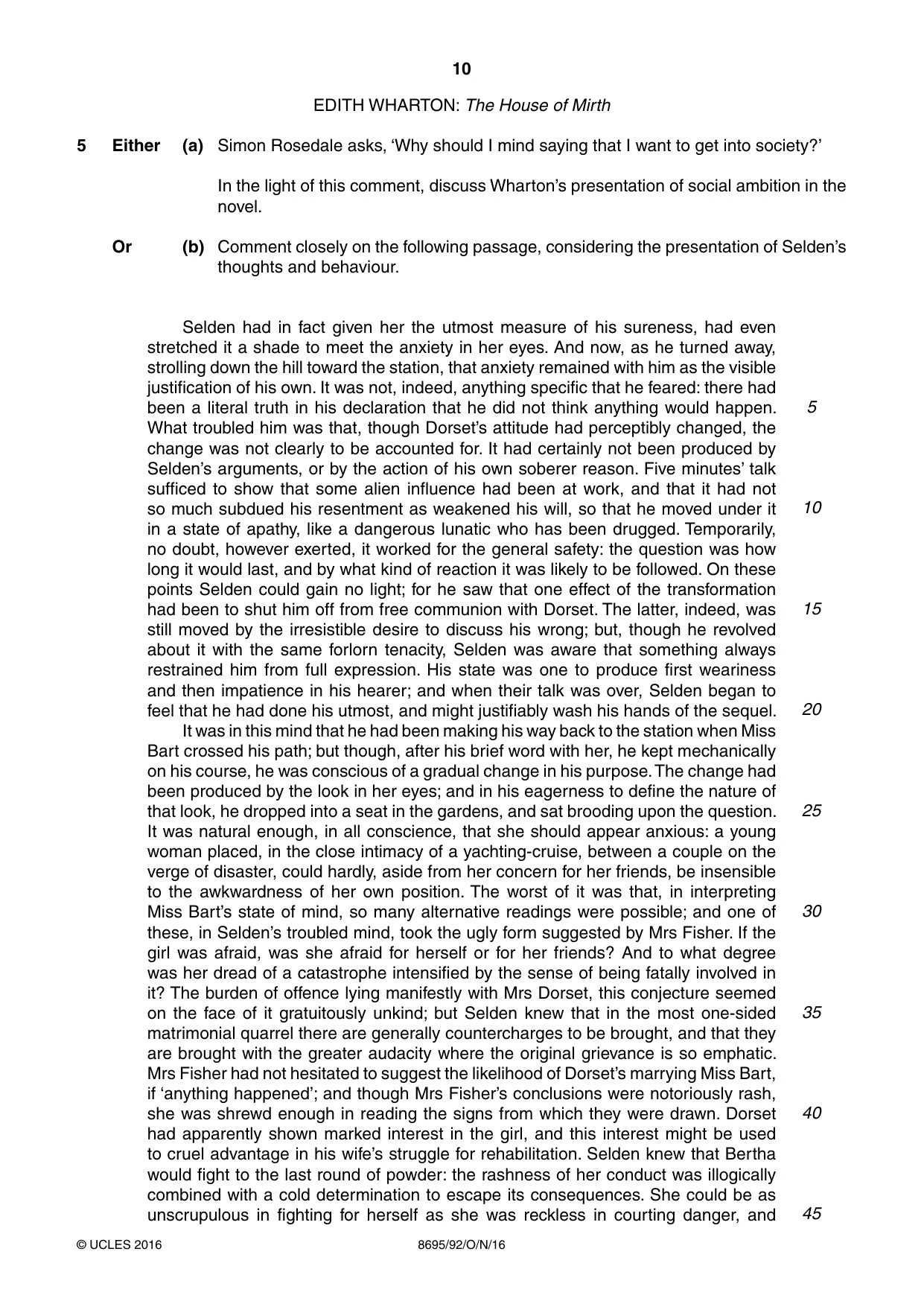
10 8695/92/O/N/16 © UCLES 2016 EDITH WHARTON: The House of Mirth 5 Either (a) Simon Rosedale asks, ‘Why should I mind saying that I want to get into society?’ In the light of this comment, discuss Wharton’s presentation of social ambition in the novel. Or (b) Comment closely on the following passage, considering the presentation of Selden’s thoughts and behaviour. Selden had in fact given her the utmost measure of his sureness, had even stretched it a shade to meet the anxiety in her eyes. And now, as he turned away, strolling down the hill toward the station, that anxiety remained with him as the visible justification of his own. It was not, indeed, anything specific that he feared: there had been a literal truth in his declaration that he did not think anything would happen. What troubled him was that, though Dorset’s attitude had perceptibly changed, the change was not clearly to be accounted for. It had certainly not been produced by Selden’s arguments, or by the action of his own soberer reason. Five minutes’ talk sufficed to show that some alien influence had been at work, and that it had not so much subdued his resentment as weakened his will, so that he moved under it in a state of apathy, like a dangerous lunatic who has been drugged. Temporarily, no doubt, however exerted, it worked for the general safety: the question was how long it would last, and by what kind of reaction it was likely to be followed. On these points Selden could gain no light; for he saw that one effect of the transformation had been to shut him off from free communion with Dorset. The latter, indeed, was still moved by the irresistible desire to discuss his wrong; but, though he revolved about it with the same forlorn tenacity, Selden was aware that something always restrained him from full expression. His state was one to produce first weariness and then impatience in his hearer; and when their talk was over, Selden began to feel that he had done his utmost, and might justifiably wash his hands of the sequel. It was in this mind that he had been making his way back to the station when Miss Bart crossed his path; but though, after his brief word with her, he kept mechanically on his course, he was conscious of a gradual change in his purpose. The change had been produced by the look in her eyes; and in his eagerness to define the nature of that look, he dropped into a seat in the gardens, and sat brooding upon the question. It was natural enough, in all conscience, that she should appear anxious: a young woman placed, in the close intimacy of a yachting-cruise, between a couple on the verge of disaster, could hardly, aside from her concern for her friends, be insensible to the awkwardness of her own position. The worst of it was that, in interpreting Miss Bart’s state of mind, so many alternative readings were possible; and one of these, in Selden’s troubled mind, took the ugly form suggested by Mrs Fisher. If the girl was afraid, was she afraid for herself or for her friends? And to what degree was her dread of a catastrophe intensified by the sense of being fatally involved in it? The burden of offence lying manifestly with Mrs Dorset, this conjecture seemed on the face of it gratuitously unkind; but Selden knew that in the most one-sided matrimonial quarrel there are generally countercharges to be brought, and that they are brought with the greater audacity where the original grievance is so emphatic. Mrs Fisher had not hesitated to suggest the likelihood of Dorset’s marrying Miss Bart, if ‘anything happened’; and though Mrs Fisher’s conclusions were notoriously rash, she was shrewd enough in reading the signs from which they were drawn. Dorset had apparently shown marked interest in the girl, and this interest might be used to cruel advantage in his wife’s struggle for rehabilitation. Selden knew that Bertha would fight to the last round of powder: the rashness of her conduct was illogically combined with a cold determination to escape its consequences. She could be as unscrupulous in fighting for herself as she was reckless in courting danger, and 5 10 15 20 25 30 35 40 45
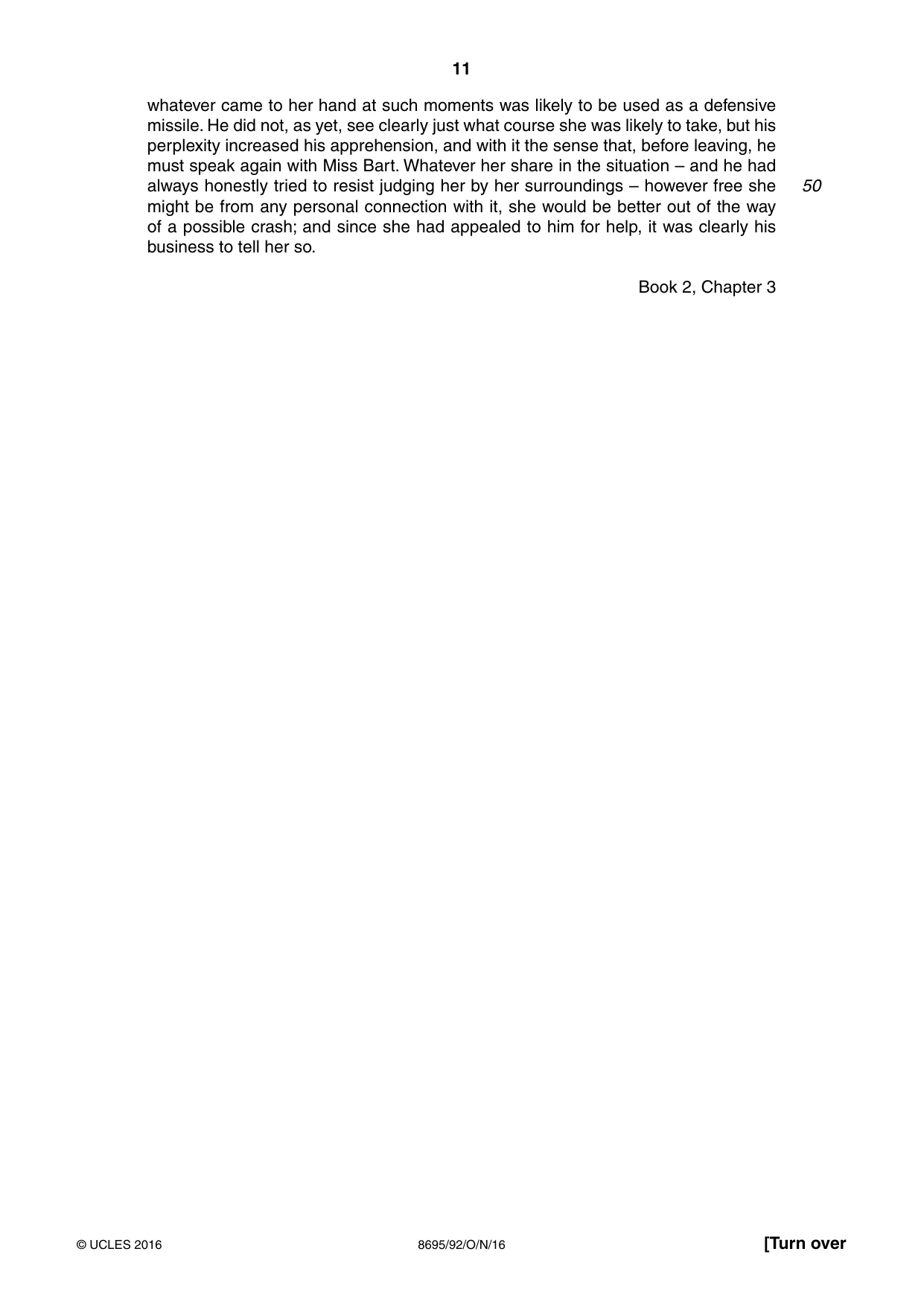
Question paper, page 11
11 8695/92/O/N/16 © UCLES 2016 [Turn over whatever came to her hand at such moments was likely to be used as a defensive missile. He did not, as yet, see clearly just what course she was likely to take, but his perplexity increased his apprehension, and with it the sense that, before leaving, he must speak again with Miss Bart. Whatever her share in the situation – and he had always honestly tried to resist judging her by her surroundings – however free she might be from any personal connection with it, she would be better out of the way of a possible crash; and since she had appealed to him for help, it was clearly his business to tell her so. Book 2, Chapter 3 50
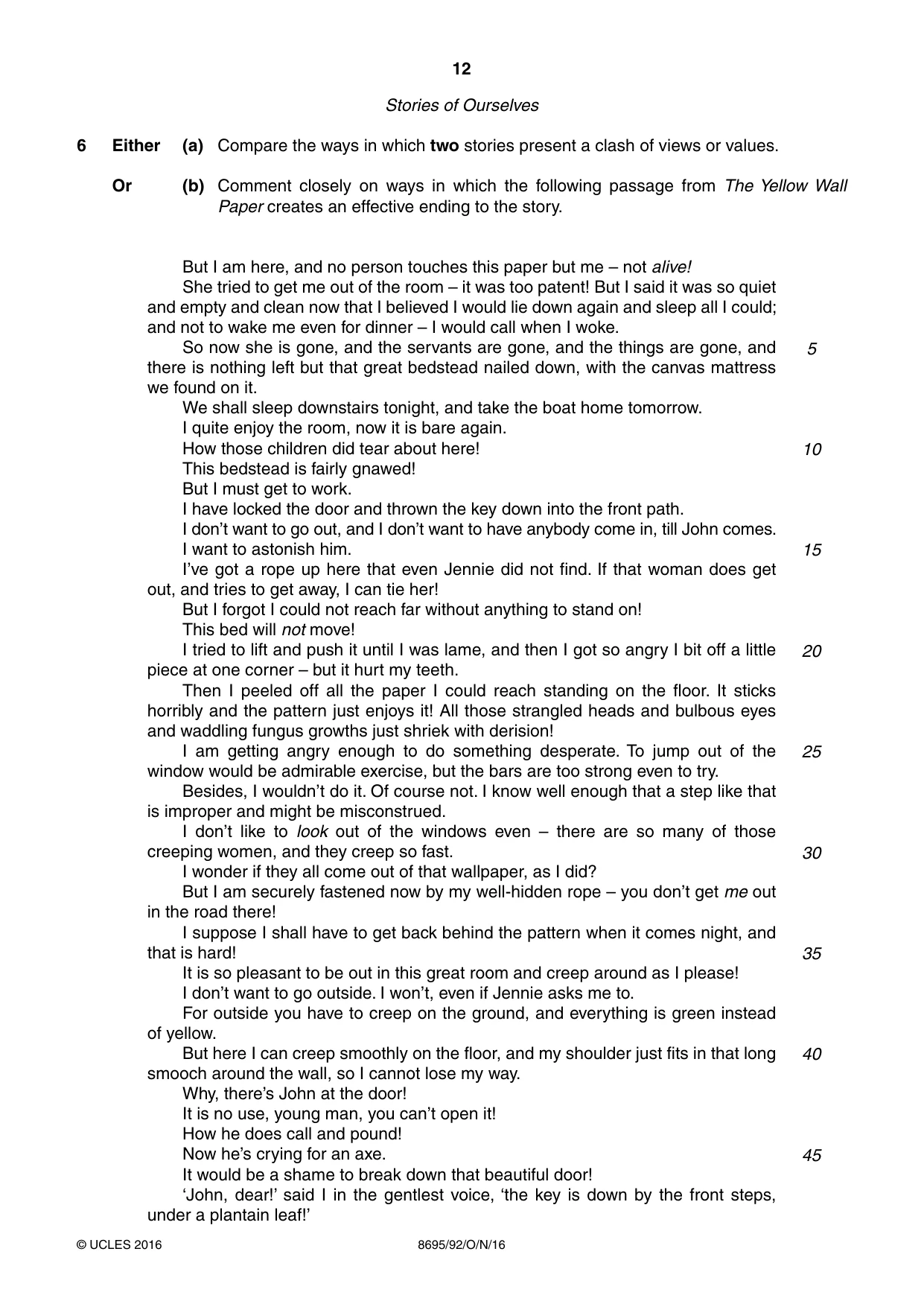
Question paper, page 12
12 8695/92/O/N/16 © UCLES 2016 Stories of Ourselves 6 Either (a) Compare the ways in which two stories present a clash of views or values. Or (b) Comment closely on ways in which the following passage from The Yellow Wall Paper creates an effective ending to the story. But I am here, and no person touches this paper but me – not alive! She tried to get me out of the room – it was too patent! But I said it was so quiet and empty and clean now that I believed I would lie down again and sleep all I could; and not to wake me even for dinner – I would call when I woke. So now she is gone, and the servants are gone, and the things are gone, and there is nothing left but that great bedstead nailed down, with the canvas mattress we found on it. We shall sleep downstairs tonight, and take the boat home tomorrow. I quite enjoy the room, now it is bare again. How those children did tear about here! This bedstead is fairly gnawed! But I must get to work. I have locked the door and thrown the key down into the front path. I don’t want to go out, and I don’t want to have anybody come in, till John comes. I want to astonish him. I’ve got a rope up here that even Jennie did not find. If that woman does get out, and tries to get away, I can tie her! But I forgot I could not reach far without anything to stand on! This bed will not move! I tried to lift and push it until I was lame, and then I got so angry I bit off a little piece at one corner – but it hurt my teeth. Then I peeled off all the paper I could reach standing on the floor. It sticks horribly and the pattern just enjoys it! All those strangled heads and bulbous eyes and waddling fungus growths just shriek with derision! I am getting angry enough to do something desperate. To jump out of the window would be admirable exercise, but the bars are too strong even to try. Besides, I wouldn’t do it. Of course not. I know well enough that a step like that is improper and might be misconstrued. I don’t like to look out of the windows even – there are so many of those creeping women, and they creep so fast. I wonder if they all come out of that wallpaper, as I did? But I am securely fastened now by my well-hidden rope – you don’t get me out in the road there! I suppose I shall have to get back behind the pattern when it comes night, and that is hard! It is so pleasant to be out in this great room and creep around as I please! I don’t want to go outside. I won’t, even if Jennie asks me to. For outside you have to creep on the ground, and everything is green instead of yellow. But here I can creep smoothly on the floor, and my shoulder just fits in that long smooch around the wall, so I cannot lose my way. Why, there’s John at the door! It is no use, young man, you can’t open it! How he does call and pound! Now he’s crying for an axe. It would be a shame to break down that beautiful door! ‘John, dear!’ said I in the gentlest voice, ‘the key is down by the front steps, under a plantain leaf!’ 5 10 15 20 25 30 35 40 45
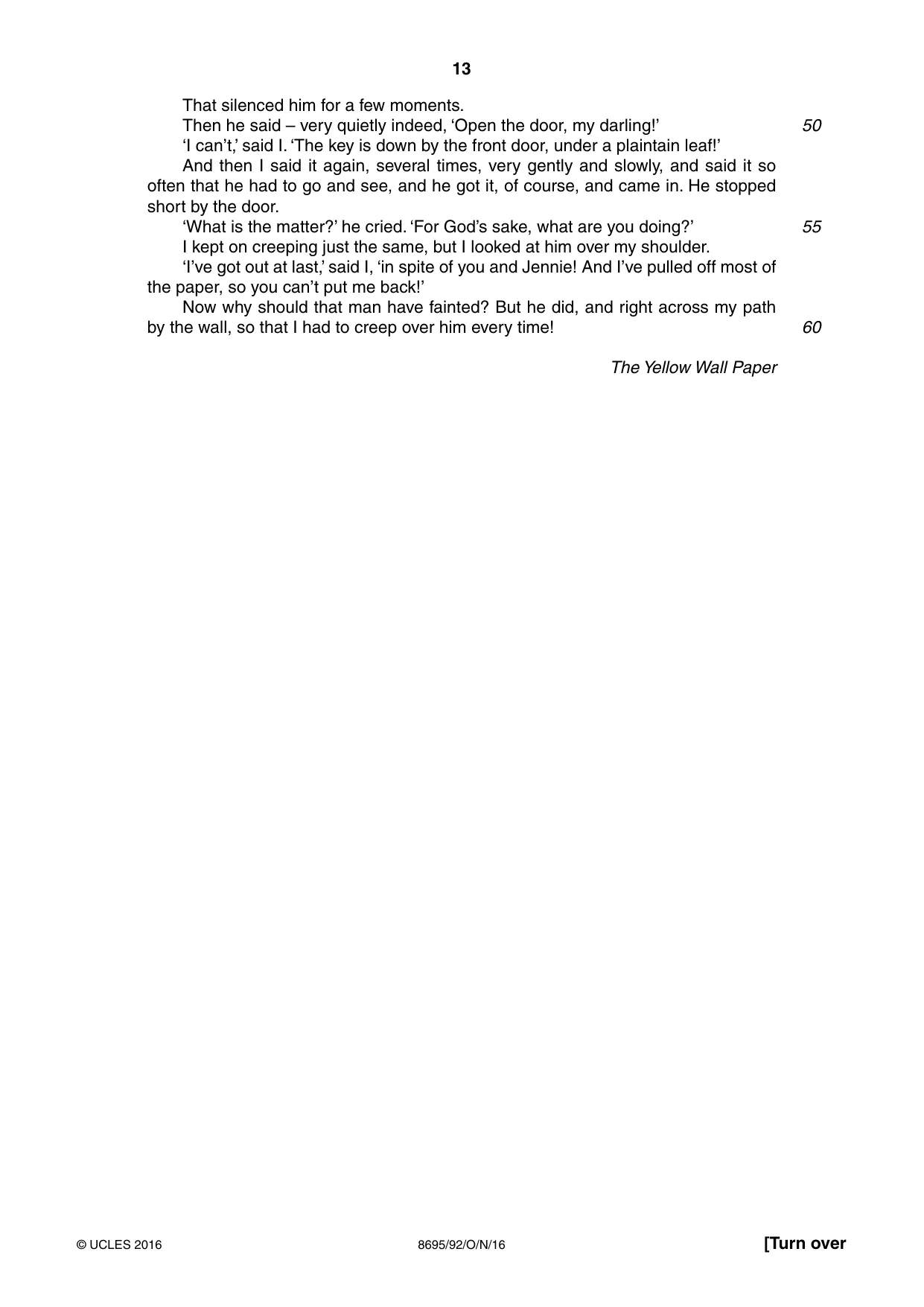
Question paper, page 13
13 8695/92/O/N/16 © UCLES 2016 [Turn over That silenced him for a few moments. Then he said – very quietly indeed, ‘Open the door, my darling!’ ‘I can’t,’ said I. ‘The key is down by the front door, under a plaintain leaf!’ And then I said it again, several times, very gently and slowly, and said it so often that he had to go and see, and he got it, of course, and came in. He stopped short by the door. ‘What is the matter?’ he cried. ‘For God’s sake, what are you doing?’ I kept on creeping just the same, but I looked at him over my shoulder. ‘I’ve got out at last,’ said I, ‘in spite of you and Jennie! And I’ve pulled off most of the paper, so you can’t put me back!’ Now why should that man have fainted? But he did, and right across my path by the wall, so that I had to creep over him every time! The Yellow Wall Paper 50 55 60
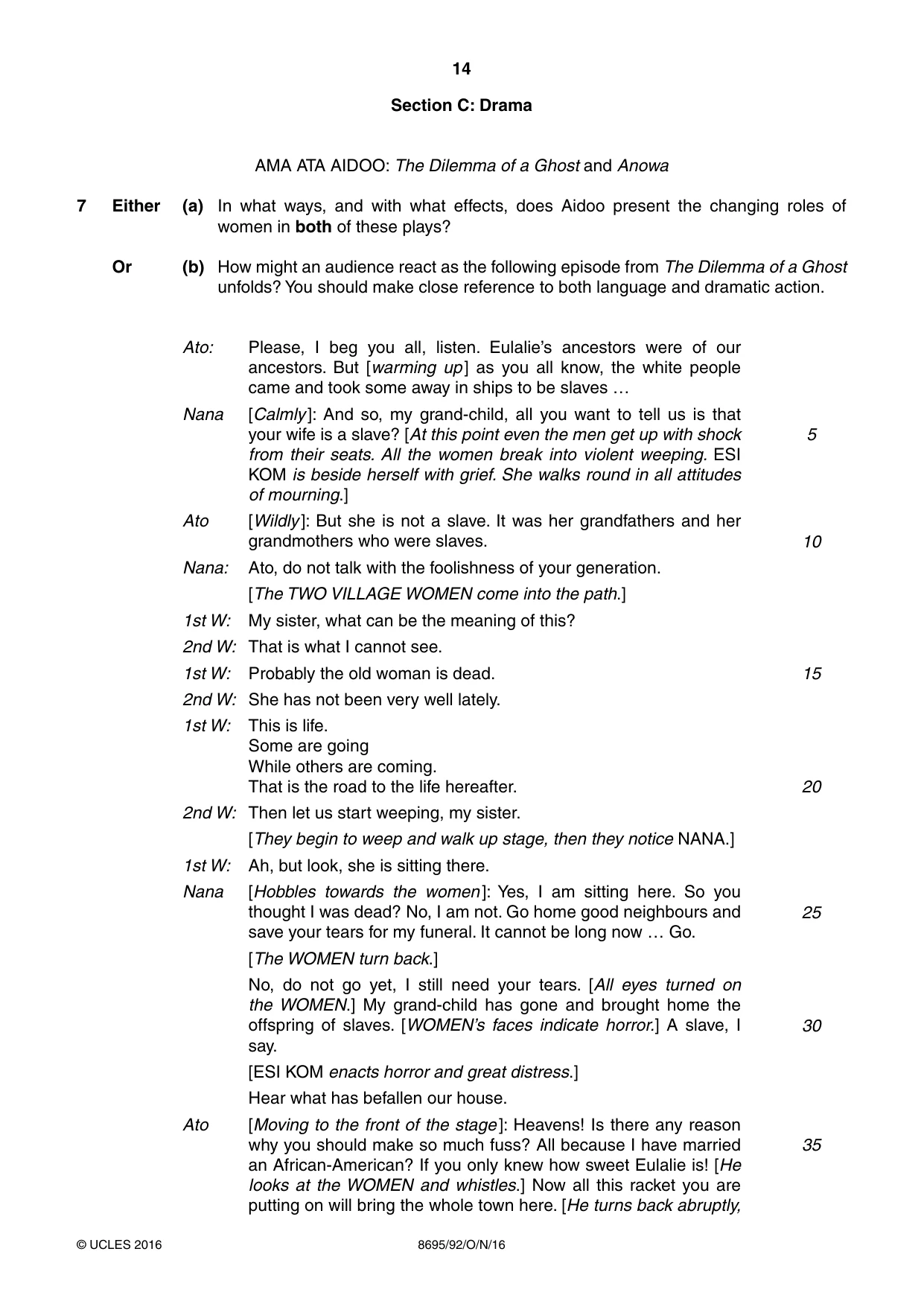
Question paper, page 14
14 8695/92/O/N/16 © UCLES 2016 Section C: Drama AMA ATA AIDOO: The Dilemma of a Ghost and Anowa 7 Either (a) In what ways, and with what effects, does Aidoo present the changing roles of women in both of these plays? Or (b) How might an audience react as the following episode from The Dilemma of a Ghost unfolds? You should make close reference to both language and dramatic action. Ato: Please, I beg you all, listen. Eulalie’s ancestors were of our ancestors. But [warming up ] as you all know, the white people came and took some away in ships to be slaves … Nana [Calmly ]: And so, my grand-child, all you want to tell us is that your wife is a slave? [At this point even the men get up with shock from their seats. All the women break into violent weeping. ESI KOM is beside herself with grief. She walks round in all attitudes of mourning.] Ato [Wildly ]: But she is not a slave. It was her grandfathers and her grandmothers who were slaves. Nana: Ato, do not talk with the foolishness of your generation. [The TWO VILLAGE WOMEN come into the path.] 1st W: My sister, what can be the meaning of this? 2nd W: That is what I cannot see. 1st W: Probably the old woman is dead. 2nd W: She has not been very well lately. 1st W: This is life. Some are going While others are coming. That is the road to the life hereafter. 2nd W: Then let us start weeping, my sister. [They begin to weep and walk up stage, then they notice NANA.] 1st W: Ah, but look, she is sitting there. Nana [Hobbles towards the women ]: Yes, I am sitting here. So you thought I was dead? No, I am not. Go home good neighbours and save your tears for my funeral. It cannot be long now … Go. [The WOMEN turn back.] No, do not go yet, I still need your tears. [All eyes turned on the WOMEN.] My grand-child has gone and brought home the offspring of slaves. [WOMEN’s faces indicate horror.] A slave, I say. [ESI KOM enacts horror and great distress.] Hear what has befallen our house. Ato [Moving to the front of the stage ]: Heavens! Is there any reason why you should make so much fuss? All because I have married an African-American? If you only knew how sweet Eulalie is! [He looks at the WOMEN and whistles.] Now all this racket you are putting on will bring the whole town here. [He turns back abruptly, 5 10 15 20 25 30 35
Question paper, page 15
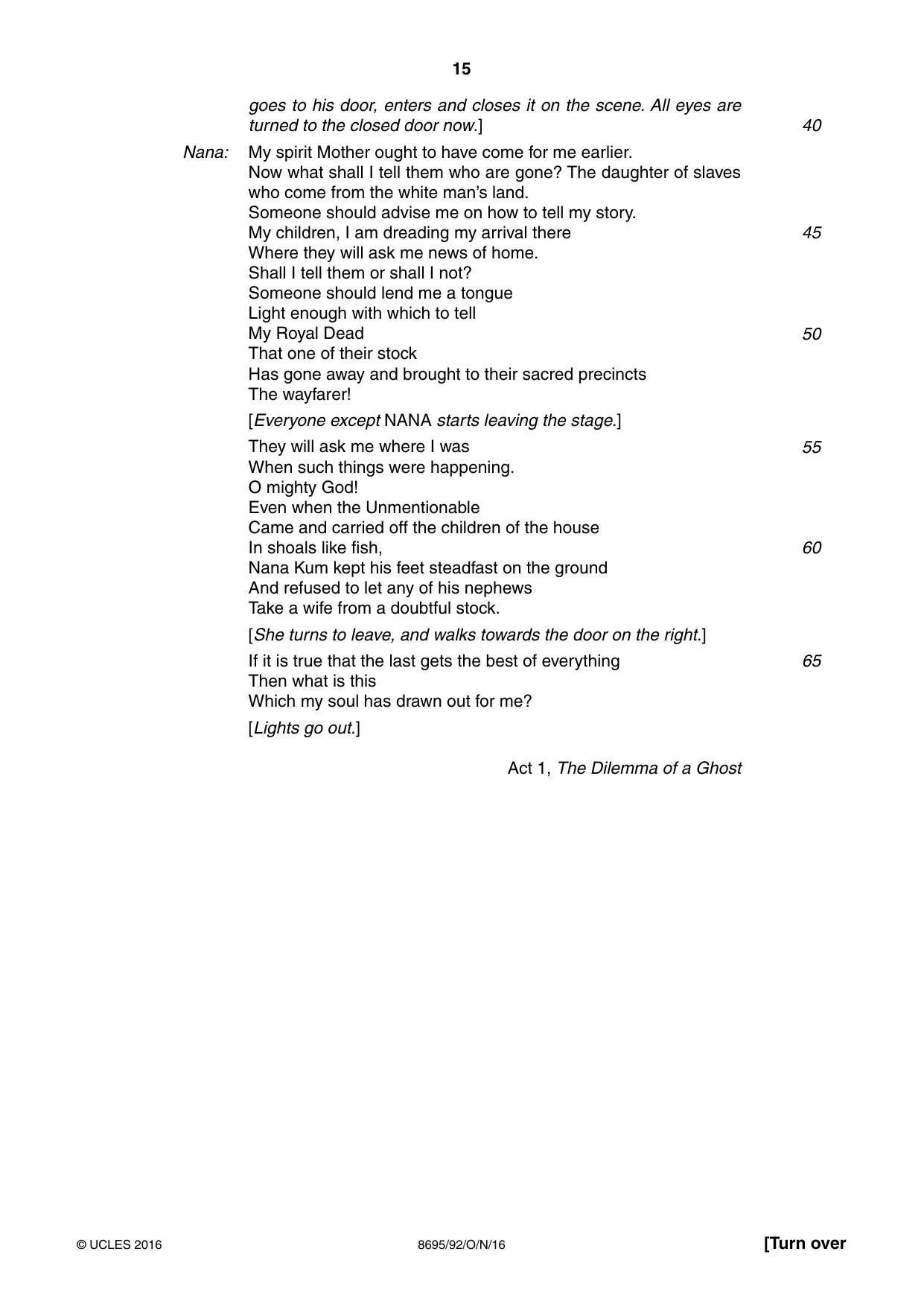
15 8695/92/O/N/16 © UCLES 2016 [Turn over goes to his door, enters and closes it on the scene. All eyes are turned to the closed door now.] Nana: My spirit Mother ought to have come for me earlier. Now what shall I tell them who are gone? The daughter of slaves who come from the white man’s land. Someone should advise me on how to tell my story. My children, I am dreading my arrival there Where they will ask me news of home. Shall I tell them or shall I not? Someone should lend me a tongue Light enough with which to tell My Royal Dead That one of their stock Has gone away and brought to their sacred precincts The wayfarer! [Everyone except NANA starts leaving the stage.] They will ask me where I was When such things were happening. O mighty God! Even when the Unmentionable Came and carried off the children of the house In shoals like fish, Nana Kum kept his feet steadfast on the ground And refused to let any of his nephews Take a wife from a doubtful stock. [She turns to leave, and walks towards the door on the right.] If it is true that the last gets the best of everything Then what is this Which my soul has drawn out for me? [Lights go out.] Act 1, The Dilemma of a Ghost 40 45 50 55 60 65
Question paper, page 16
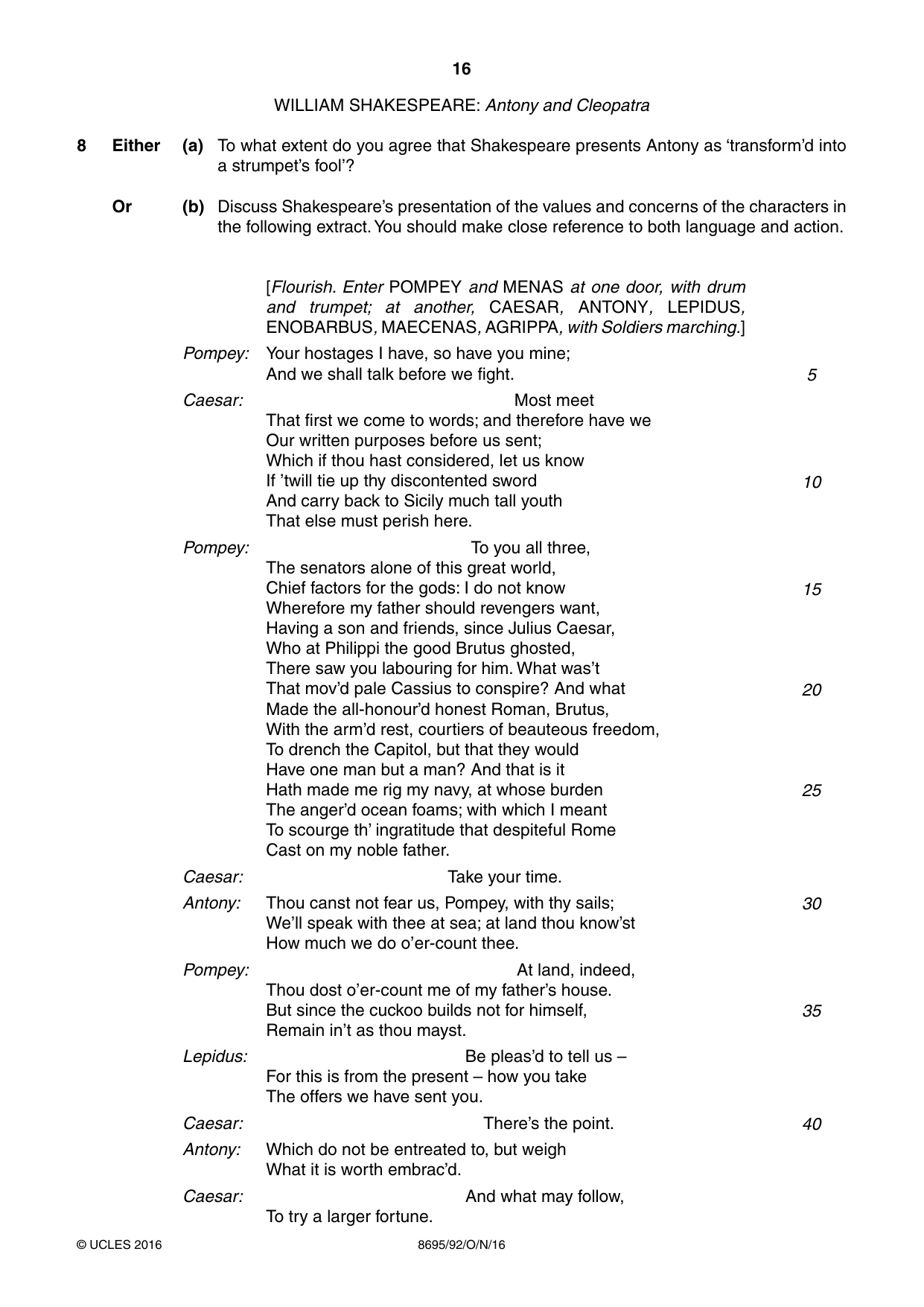
16 8695/92/O/N/16 © UCLES 2016 WILLIAM SHAKESPEARE: Antony and Cleopatra 8 Either (a) To what extent do you agree that Shakespeare presents Antony as ‘transform’d into a strumpet’s fool’? Or (b) Discuss Shakespeare’s presentation of the values and concerns of the characters in the following extract. You should make close reference to both language and action. [Flourish. Enter POMPEY and MENAS at one door, with drum and trumpet; at another, CAESAR, ANTONY, LEPIDUS, ENOBARBUS, MAECENAS, AGRIPPA, with Soldiers marching.] Pompey: Your hostages I have, so have you mine; And we shall talk before we fight. Caesar: Most meet That first we come to words; and therefore have we Our written purposes before us sent; Which if thou hast considered, let us know If ’twill tie up thy discontented sword And carry back to Sicily much tall youth That else must perish here. Pompey: To you all three, The senators alone of this great world, Chief factors for the gods: I do not know Wherefore my father should revengers want, Having a son and friends, since Julius Caesar, Who at Philippi the good Brutus ghosted, There saw you labouring for him. What was’t That mov’d pale Cassius to conspire? And what Made the all-honour’d honest Roman, Brutus, With the arm’d rest, courtiers of beauteous freedom, To drench the Capitol, but that they would Have one man but a man? And that is it Hath made me rig my navy, at whose burden The anger’d ocean foams; with which I meant To scourge th’ ingratitude that despiteful Rome Cast on my noble father. Caesar: Take your time. Antony: Thou canst not fear us, Pompey, with thy sails; We’ll speak with thee at sea; at land thou know’st How much we do o’er-count thee. Pompey: At land, indeed, Thou dost o’er-count me of my father’s house. But since the cuckoo builds not for himself, Remain in’t as thou mayst. Lepidus: Be pleas’d to tell us – For this is from the present – how you take The offers we have sent you. Caesar: There’s the point. Antony: Which do not be entreated to, but weigh What it is worth embrac’d. Caesar: And what may follow, To try a larger fortune. 5 10 15 20 25 30 35 40
Question paper, page 17
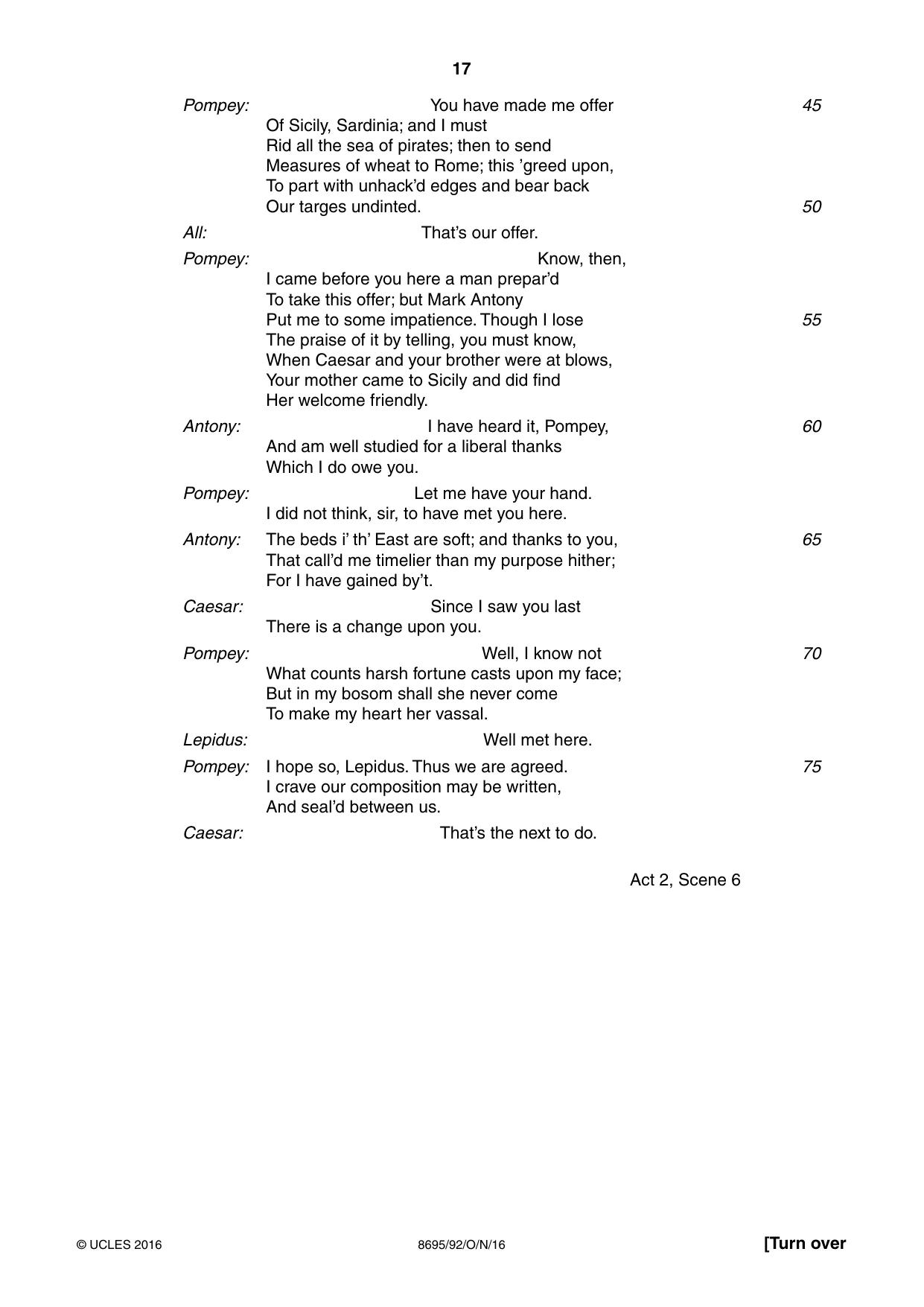
17 8695/92/O/N/16 © UCLES 2016 [Turn over Pompey: You have made me offer Of Sicily, Sardinia; and I must Rid all the sea of pirates; then to send Measures of wheat to Rome; this ’greed upon, To part with unhack’d edges and bear back Our targes undinted. All: That’s our offer. Pompey: Know, then, I came before you here a man prepar’d To take this offer; but Mark Antony Put me to some impatience. Though I lose The praise of it by telling, you must know, When Caesar and your brother were at blows, Your mother came to Sicily and did find Her welcome friendly. Antony: I have heard it, Pompey, And am well studied for a liberal thanks Which I do owe you. Pompey: Let me have your hand. I did not think, sir, to have met you here. Antony: The beds i’ th’ East are soft; and thanks to you, That call’d me timelier than my purpose hither; For I have gained by’t. Caesar: Since I saw you last There is a change upon you. Pompey: Well, I know not What counts harsh fortune casts upon my face; But in my bosom shall she never come To make my heart her vassal. Lepidus: Well met here. Pompey: I hope so, Lepidus. Thus we are agreed. I crave our composition may be written, And seal’d between us. Caesar: That’s the next to do. Act 2, Scene 6 45 50 55 60 65 70 75
Question paper, page 18
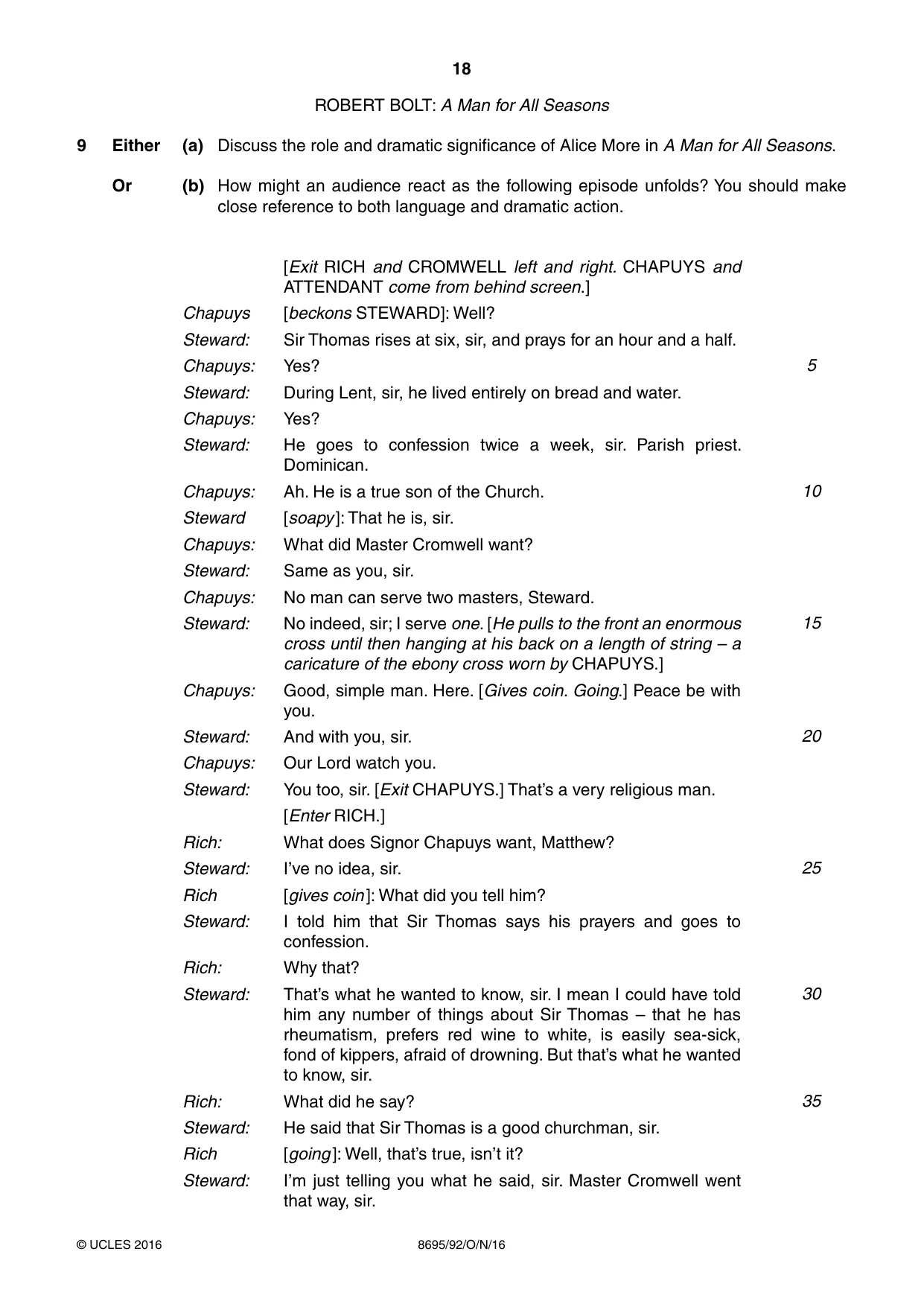
18 8695/92/O/N/16 © UCLES 2016 ROBERT BOLT: A Man for All Seasons 9 Either (a) Discuss the role and dramatic significance of Alice More in A Man for All Seasons. Or (b) How might an audience react as the following episode unfolds? You should make close reference to both language and dramatic action. [Exit RICH and CROMWELL left and right. CHAPUYS and ATTENDANT come from behind screen.] Chapuys [beckons STEWARD]: Well? Steward: Sir Thomas rises at six, sir, and prays for an hour and a half. Chapuys: Yes? Steward: During Lent, sir, he lived entirely on bread and water. Chapuys: Yes? Steward: He goes to confession twice a week, sir. Parish priest. Dominican. Chapuys: Ah. He is a true son of the Church. Steward [soapy ]: That he is, sir. Chapuys: What did Master Cromwell want? Steward: Same as you, sir. Chapuys: No man can serve two masters, Steward. Steward: No indeed, sir; I serve one. [He pulls to the front an enormous cross until then hanging at his back on a length of string – a caricature of the ebony cross worn by CHAPUYS.] Chapuys: Good, simple man. Here. [Gives coin. Going.] Peace be with you. Steward: And with you, sir. Chapuys: Our Lord watch you. Steward: You too, sir. [Exit CHAPUYS.] That’s a very religious man. [Enter RICH.] Rich: What does Signor Chapuys want, Matthew? Steward: I’ve no idea, sir. Rich [gives coin ]: What did you tell him? Steward: I told him that Sir Thomas says his prayers and goes to confession. Rich: Why that? Steward: That’s what he wanted to know, sir. I mean I could have told him any number of things about Sir Thomas – that he has rheumatism, prefers red wine to white, is easily sea-sick, fond of kippers, afraid of drowning. But that’s what he wanted to know, sir. Rich: What did he say? Steward: He said that Sir Thomas is a good churchman, sir. Rich [going ]: Well, that’s true, isn’t it? Steward: I’m just telling you what he said, sir. Master Cromwell went that way, sir. 5 10 15 20 25 30 35
Question paper, page 19
19 8695/92/O/N/16 © UCLES 2016 Rich [furious ]: Did I ask you which way Master Cromwell went? [Exit RICH opposite.] Steward [to audience, thoughtfully ]: The great thing’s not to get out of your depth. … What I can tell them’s common knowledge! But now they’ve given money for it and everyone wants value for his money. They’ll make a secret of it now to prove they’ve not been bilked. … They’ll make it a secret by making it dangerous. … Mm. … Oh, when I can’t touch the bottom I’ll go deaf, blind and dumb. [Holds out coins.] And that’s more than I earn in a fortnight! Act 1 40 45
Question paper, page 20
20 8695/92/O/N/16 © UCLES 2016 BLANK PAGE Permission to reproduce items where third-party owned material protected by copyright is included has been sought and cleared where possible. Every reasonable effort has been made by the publisher (UCLES) to trace copyright holders, but if any items requiring clearance have unwittingly been included, the publisher will be pleased to make amends at the earliest possible opportunity. To avoid the issue of disclosure of answer-related information to candidates, all copyright acknowledgements are reproduced online in the Cambridge International Examinations Copyright Acknowledgements Booklet. This is produced for each series of examinations and is freely available to download at www.cie.org.uk after the live examination series. Cambridge International Examinations is part of the Cambridge Assessment Group. Cambridge Assessment is the brand name of University of Cambridge Local Examinations Syndicate (UCLES), which is itself a department of the University of Cambridge.
Mark scheme, page 1
® IGCSE is the registered trademark of Cambridge International Examinations. This document consists of 5 printed pages. © UCLES 2016 [Turn over Cambridge International Examinations Cambridge International Advanced Subsidiary Level LANGUAGE AND LITERATURE IN ENGLISH 8695/92 Paper 9 Poetry, Prose and Drama October/November 2016 MARK SCHEME Maximum Mark: 50 Published This mark scheme is published as an aid to teachers and candidates, to indicate the requirements of the examination. It shows the basis on which Examiners were instructed to award marks. It does not indicate the details of the discussions that took place at an Examiners’ meeting before marking began, which would have considered the acceptability of alternative answers. Mark schemes should be read in conjunction with the question paper and the Principal Examiner Report for Teachers. Cambridge will not enter into discussions about these mark schemes. Cambridge is publishing the mark schemes for the October/November 2016 series for most Cambridge IGCSE®, Cambridge International A and AS Level components and some Cambridge O Level components.
Mark scheme, page 2
Page 2 Mark Scheme Syllabus Paper Cambridge International AS Level – October/November 2016 8695 92 © UCLES 2016 Using the mark levels Place the answer in a level first. Look for the “best fit” of the answer into a level. An answer needs to show evidence of most but not necessarily ALL of the qualities described in a level, in order to be placed in that level. Then award a mark for the relative position of the answer within the level. Candidates may address the question in many different ways. Do not expect any particular focus or approach and do not penalise answers for leaving out a particular focus. Reward what is there, showing what you are rewarding, in your comments. Consider all strands and weigh up the performance as a whole in placing the answer in a level, then show that you have done so in the summative comment, e.g. Sound K of texts, some evidence of U but mostly narrative, occasional evidence of P, mainly clear C. Assessment Objectives: • Ability to respond to texts in the three main forms (Prose, Poetry and Drama) of different types and from different cultures; • Understanding of the ways in which writers’ choices of form, structure and language shape meanings; • Ability to produce informed independent opinions and judgements on literary texts; • Ability to communicate clearly the knowledge, understanding and insight appropriate to literary study. Each answer is marked out of 25, in accordance with the General Marking Criteria below. Each level is divided into strands corresponding to the Assessment Objectives – Knowledge, Understanding, Personal Response, Communication. Level 6 22–25 Very good work – do not reserve this level for the very best work you see but ensure you put scripts into this level which fulfil the requirements described below. There will always be some candidates who are at a standard over the top of the mark scheme. K Evidence of a very good ability to select relevant knowledge to address the question with effective use of references and quotation. There may be evidence of sensitive awareness of the contexts in which the literary works studied were written and understood. U Evidence of very good understanding of ways in which writers’ choices of structure, form and language shape meanings with sustained analysis and sensitive appreciation of literary methods and effects and contexts, possibly including literary genres and conventions. P Personal response to texts will be perceptive, often freshly personal, fully supported with quotation, and may show originality in approach to and treatment of questions. C Candidates will express complex literary ideas and arguments with clarity and fluency. Answers will have a coherent structure, with logical progression and effectively linked paragraphs. Expression will be accomplished and appropriate. In answers to passage-based questions, work will sustain an appropriate balance between critical appreciation of given extracts, based on detailed critical analysis, and consideration of the broader textual issues raised by the questions, and relate part of a text to its whole and vice versa in a seamless argument. There will be a very good appreciation of the effects of the literary features of the text, with detailed analysis supported by relevant examples from the passage and the wider text, where appropriate. There will be a very good knowledge of the appropriate context of the extract or work.
Mark scheme, page 3
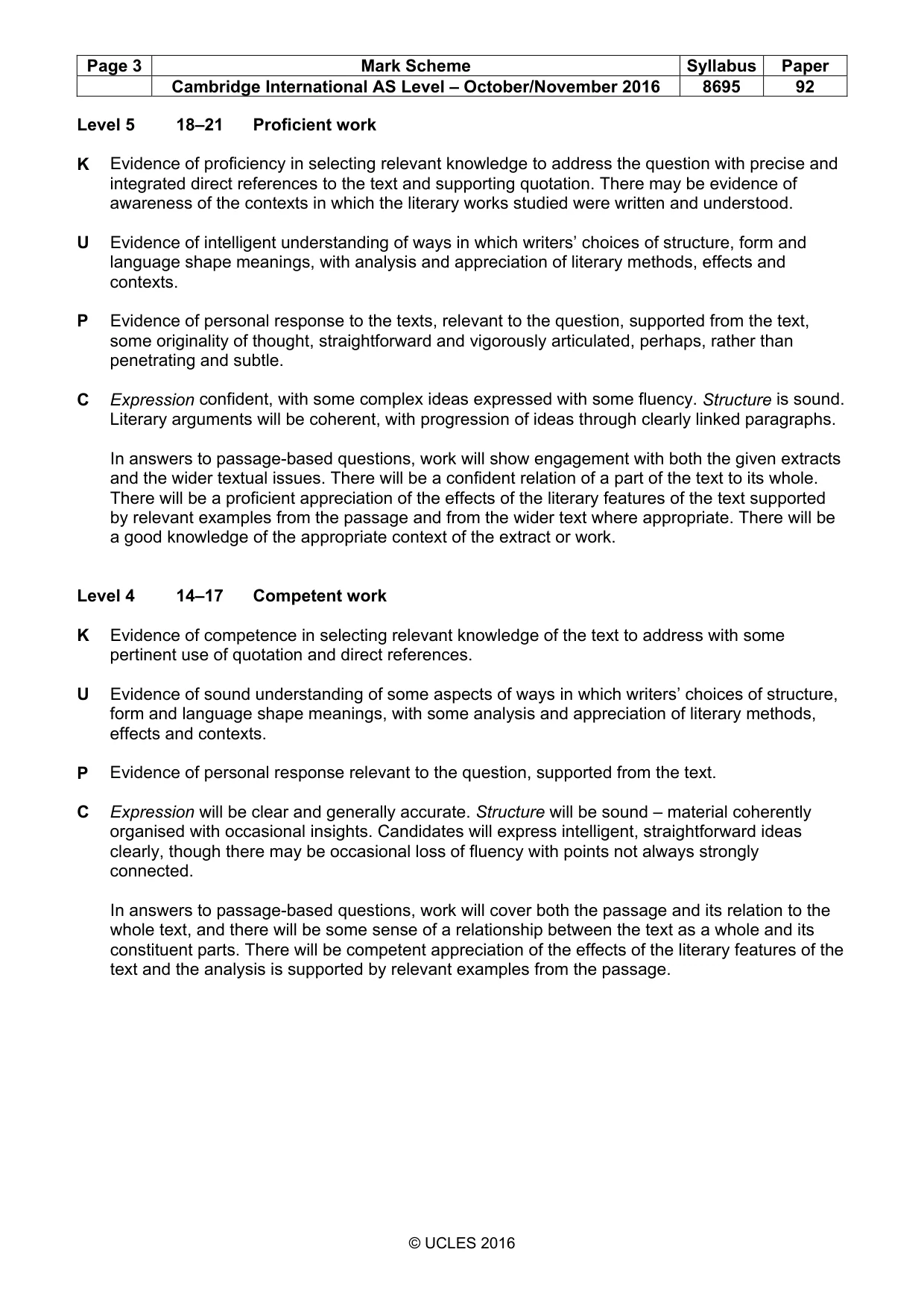
Page 3 Mark Scheme Syllabus Paper Cambridge International AS Level – October/November 2016 8695 92 © UCLES 2016 Level 5 18–21 Proficient work K Evidence of proficiency in selecting relevant knowledge to address the question with precise and integrated direct references to the text and supporting quotation. There may be evidence of awareness of the contexts in which the literary works studied were written and understood. U Evidence of intelligent understanding of ways in which writers’ choices of structure, form and language shape meanings, with analysis and appreciation of literary methods, effects and contexts. P Evidence of personal response to the texts, relevant to the question, supported from the text, some originality of thought, straightforward and vigorously articulated, perhaps, rather than penetrating and subtle. C Expression confident, with some complex ideas expressed with some fluency. Structure is sound. Literary arguments will be coherent, with progression of ideas through clearly linked paragraphs. In answers to passage-based questions, work will show engagement with both the given extracts and the wider textual issues. There will be a confident relation of a part of the text to its whole. There will be a proficient appreciation of the effects of the literary features of the text supported by relevant examples from the passage and from the wider text where appropriate. There will be a good knowledge of the appropriate context of the extract or work. Level 4 14–17 Competent work K Evidence of competence in selecting relevant knowledge of the text to address with some pertinent use of quotation and direct references. U Evidence of sound understanding of some aspects of ways in which writers’ choices of structure, form and language shape meanings, with some analysis and appreciation of literary methods, effects and contexts. P Evidence of personal response relevant to the question, supported from the text. C Expression will be clear and generally accurate. Structure will be sound – material coherently organised with occasional insights. Candidates will express intelligent, straightforward ideas clearly, though there may be occasional loss of fluency with points not always strongly connected. In answers to passage-based questions, work will cover both the passage and its relation to the whole text, and there will be some sense of a relationship between the text as a whole and its constituent parts. There will be competent appreciation of the effects of the literary features of the text and the analysis is supported by relevant examples from the passage.
Mark scheme, page 4
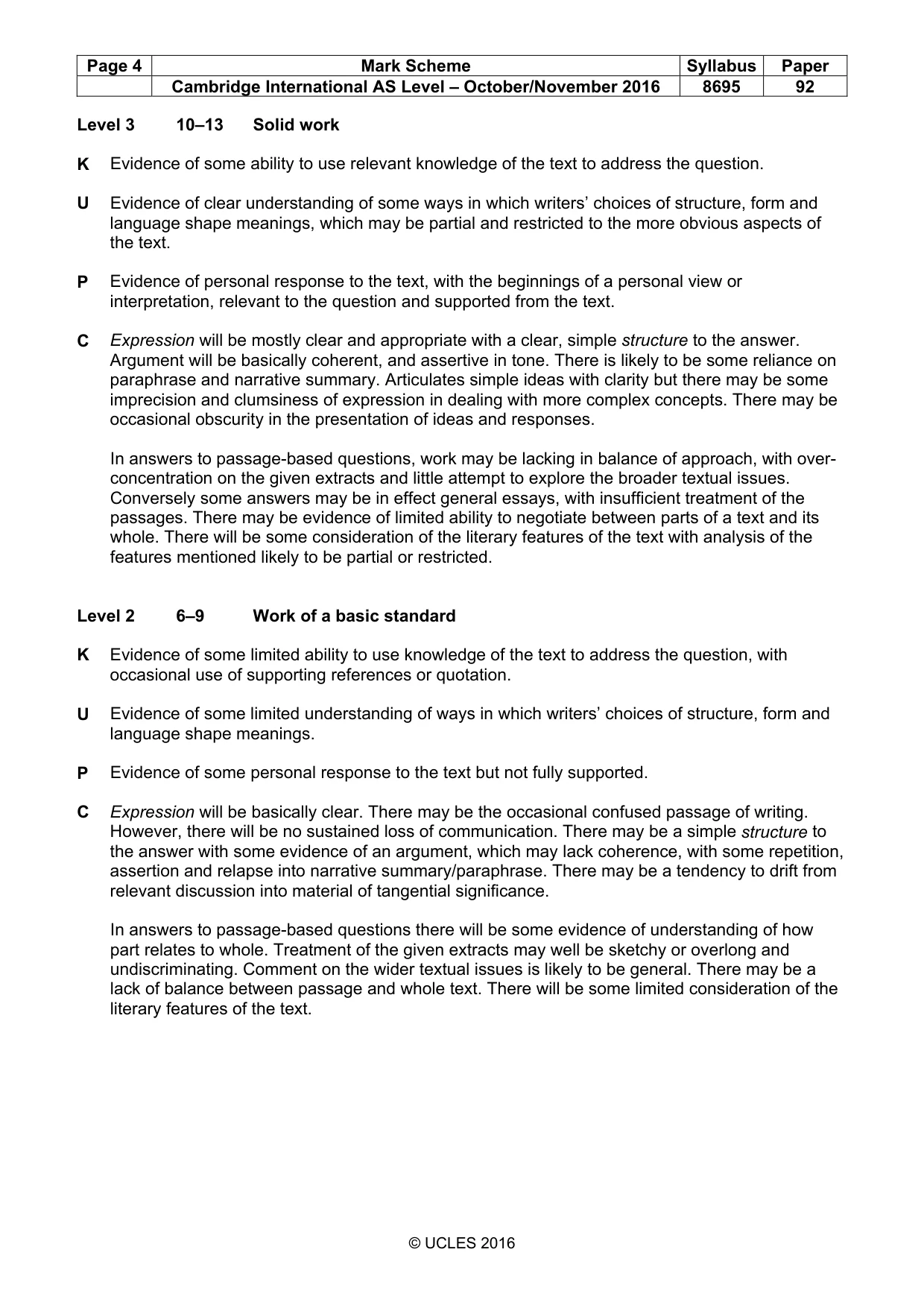
Page 4 Mark Scheme Syllabus Paper Cambridge International AS Level – October/November 2016 8695 92 © UCLES 2016 Level 3 10–13 Solid work K Evidence of some ability to use relevant knowledge of the text to address the question. U Evidence of clear understanding of some ways in which writers’ choices of structure, form and language shape meanings, which may be partial and restricted to the more obvious aspects of the text. P Evidence of personal response to the text, with the beginnings of a personal view or interpretation, relevant to the question and supported from the text. C Expression will be mostly clear and appropriate with a clear, simple structure to the answer. Argument will be basically coherent, and assertive in tone. There is likely to be some reliance on paraphrase and narrative summary. Articulates simple ideas with clarity but there may be some imprecision and clumsiness of expression in dealing with more complex concepts. There may be occasional obscurity in the presentation of ideas and responses. In answers to passage-based questions, work may be lacking in balance of approach, with over- concentration on the given extracts and little attempt to explore the broader textual issues. Conversely some answers may be in effect general essays, with insufficient treatment of the passages. There may be evidence of limited ability to negotiate between parts of a text and its whole. There will be some consideration of the literary features of the text with analysis of the features mentioned likely to be partial or restricted. Level 2 6–9 Work of a basic standard K Evidence of some limited ability to use knowledge of the text to address the question, with occasional use of supporting references or quotation. U Evidence of some limited understanding of ways in which writers’ choices of structure, form and language shape meanings. P Evidence of some personal response to the text but not fully supported. C Expression will be basically clear. There may be the occasional confused passage of writing. However, there will be no sustained loss of communication. There may be a simple structure to the answer with some evidence of an argument, which may lack coherence, with some repetition, assertion and relapse into narrative summary/paraphrase. There may be a tendency to drift from relevant discussion into material of tangential significance. In answers to passage-based questions there will be some evidence of understanding of how part relates to whole. Treatment of the given extracts may well be sketchy or overlong and undiscriminating. Comment on the wider textual issues is likely to be general. There may be a lack of balance between passage and whole text. There will be some limited consideration of the literary features of the text.
Mark scheme, page 5
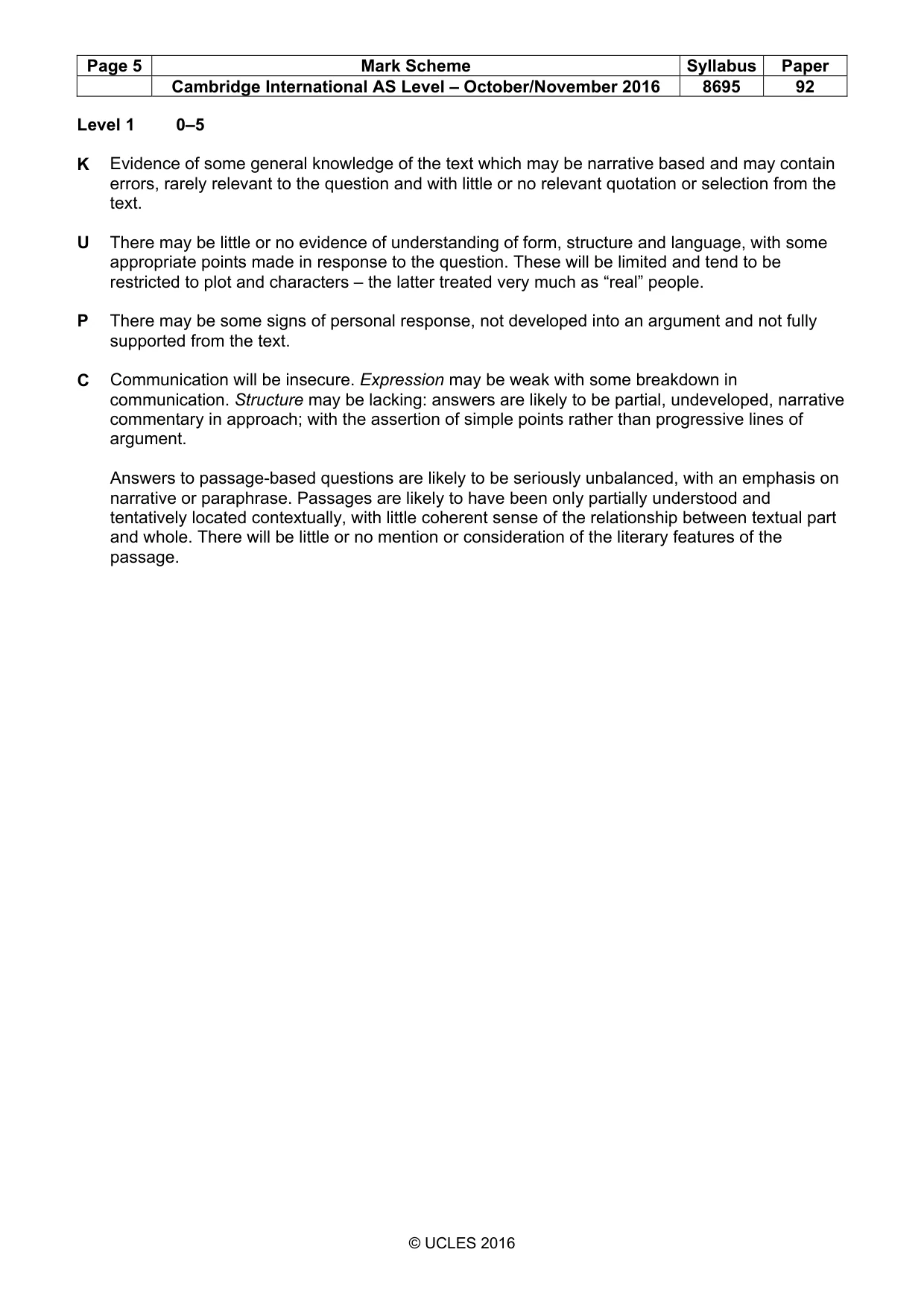
Page 5 Mark Scheme Syllabus Paper Cambridge International AS Level – October/November 2016 8695 92 © UCLES 2016 Level 1 0–5 K Evidence of some general knowledge of the text which may be narrative based and may contain errors, rarely relevant to the question and with little or no relevant quotation or selection from the text. U There may be little or no evidence of understanding of form, structure and language, with some appropriate points made in response to the question. These will be limited and tend to be restricted to plot and characters – the latter treated very much as “real” people. P There may be some signs of personal response, not developed into an argument and not fully supported from the text. C Communication will be insecure. Expression may be weak with some breakdown in communication. Structure may be lacking: answers are likely to be partial, undeveloped, narrative commentary in approach; with the assertion of simple points rather than progressive lines of argument. Answers to passage-based questions are likely to be seriously unbalanced, with an emphasis on narrative or paraphrase. Passages are likely to have been only partially understood and tentatively located contextually, with little coherent sense of the relationship between textual part and whole. There will be little or no mention or consideration of the literary features of the passage.
What you needed in this session
Cambridge’s own grade thresholds for 2016 Oct/Nov, Paper 9 · Variant 2. A higher threshold means an easier paper — the bar moves with how the cohort did.