Cambridge A Level English - Language and Literature (AS Level only, from 2016) 8695 — 2015 Oct/Nov Paper 9 · Variant 3
8695/93/O/N/15 · 50 marks · ≈56 min
The question paper and its mark scheme, free to read here and free to download. This is Cambridge’s own paper, exactly as it was sat.
Question paper16 pages

Mark scheme5 pages
Answers below. Sit the paper first if you are practising.
Paper as text
Question paper, page 1
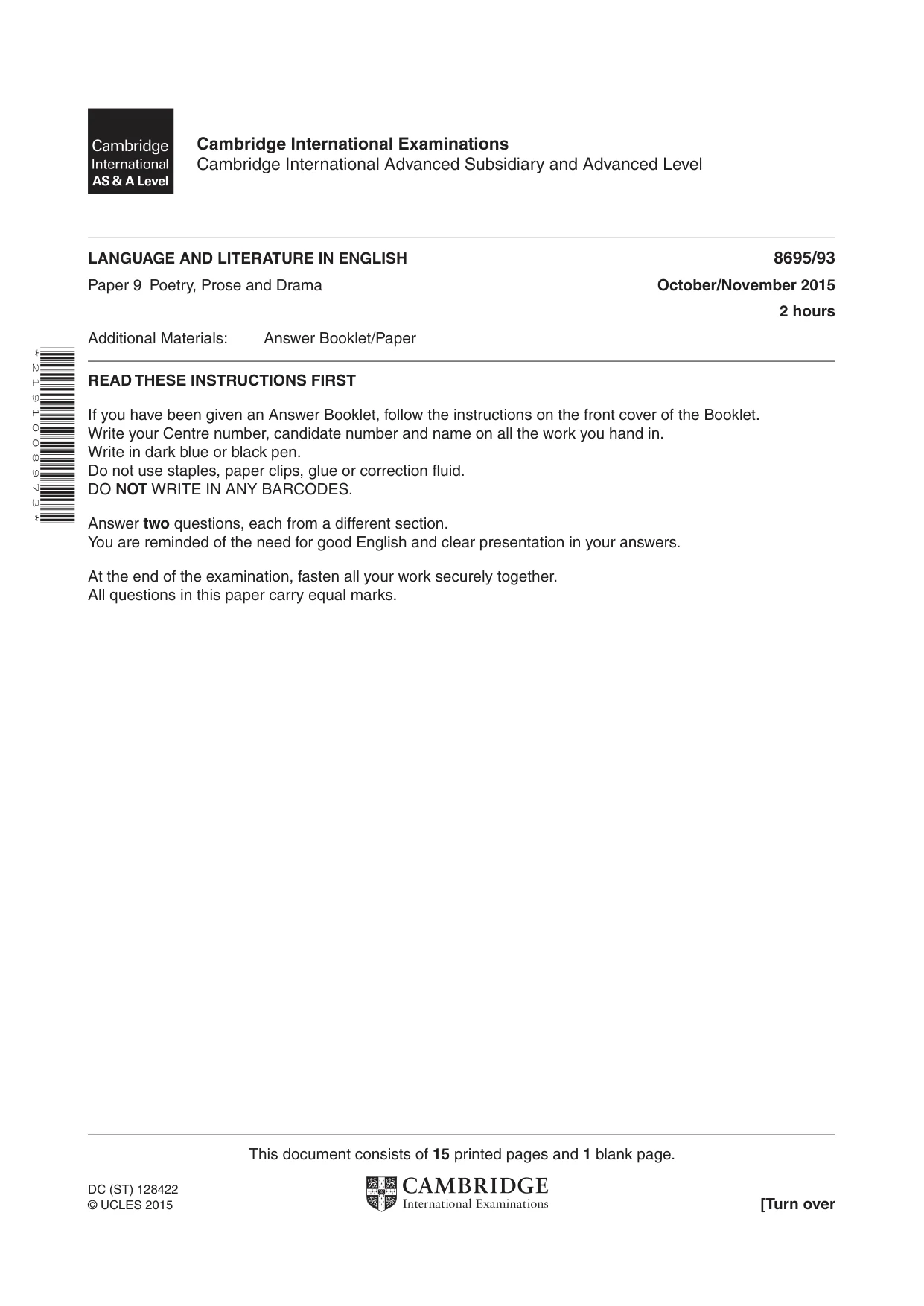
This document consists of 15 printed pages and 1 blank page. DC (ST) 128422 © UCLES 2015 [Turn over Cambridge International Examinations Cambridge International Advanced Subsidiary and Advanced Level * 2 1 9 1 0 0 8 9 7 3 * LANGUAGE AND LITERATURE IN ENGLISH 8695/93 Paper 9 Poetry, Prose and Drama October/November 2015 2 hours Additional Materials: Answer Booklet/Paper READ THESE INSTRUCTIONS FIRST If you have been given an Answer Booklet, follow the instructions on the front cover of the Booklet. Write your Centre number, candidate number and name on all the work you hand in. Write in dark blue or black pen. Do not use staples, paper clips, glue or correction fluid. DO NOT WRITE IN ANY BARCODES. Answer two questions, each from a different section. You are reminded of the need for good English and clear presentation in your answers. At the end of the examination, fasten all your work securely together. All questions in this paper carry equal marks.
Question paper, page 2
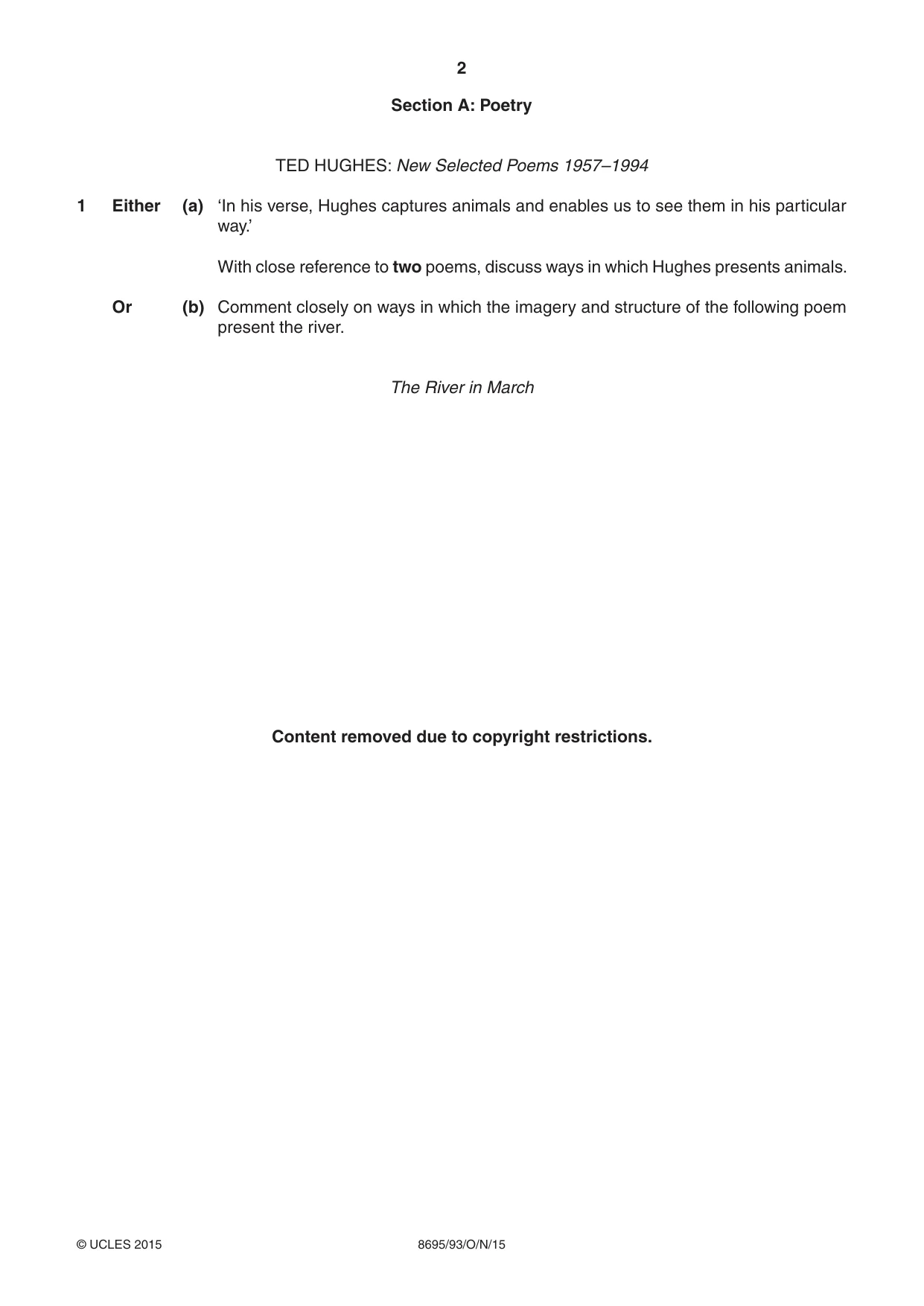
2 8695/93/O/N/15 © UCLES 2015 Section A: Poetry TED HUGHES: New Selected Poems 1957–1994 1 Either (a) ‘In his verse, Hughes captures animals and enables us to see them in his particular way.’ With close reference to two poems, discuss ways in which Hughes presents animals. Or (b) Comment closely on ways in which the imagery and structure of the following poem present the river. The River in March Content removed due to copyright restrictions.
Question paper, page 3
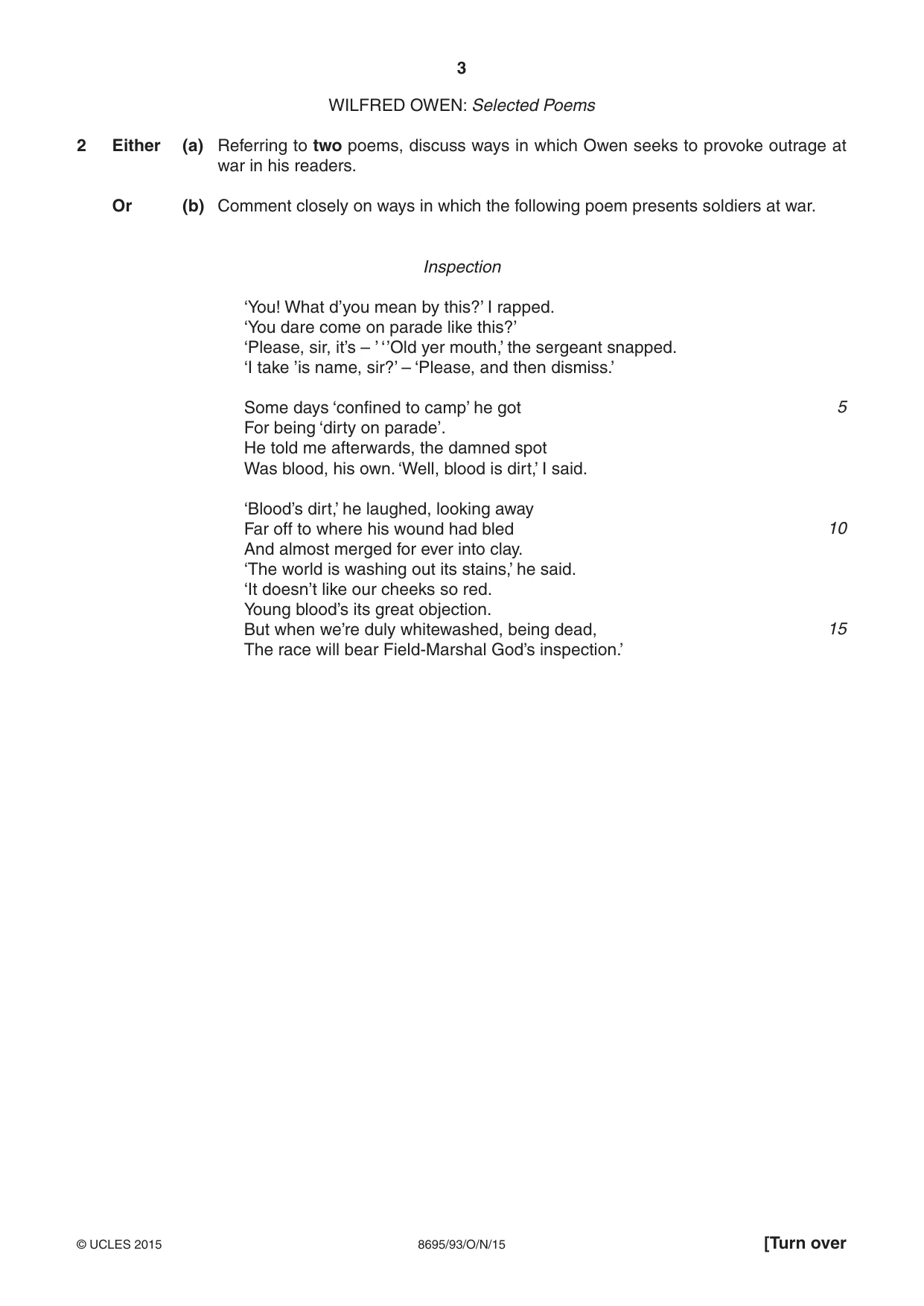
3 8695/93/O/N/15 © UCLES 2015 [Turn over WILFRED OWEN: Selected Poems 2 Either (a) Referring to two poems, discuss ways in which Owen seeks to provoke outrage at war in his readers. Or (b) Comment closely on ways in which the following poem presents soldiers at war. Inspection ‘You! What d’you mean by this?’ I rapped. ‘You dare come on parade like this?’ ‘Please, sir, it’s – ’ ‘ ’Old yer mouth,’ the sergeant snapped. ‘I take ’is name, sir?’ – ‘Please, and then dismiss.’ Some days ‘confined to camp’ he got For being ‘dirty on parade’. He told me afterwards, the damned spot Was blood, his own. ‘Well, blood is dirt,’ I said. ‘Blood’s dirt,’ he laughed, looking away Far off to where his wound had bled And almost merged for ever into clay. ‘The world is washing out its stains,’ he said. ‘It doesn’t like our cheeks so red. Young blood’s its great objection. But when we’re duly whitewashed, being dead, The race will bear Field-Marshal God’s inspection.’ 5 10 15
Question paper, page 4
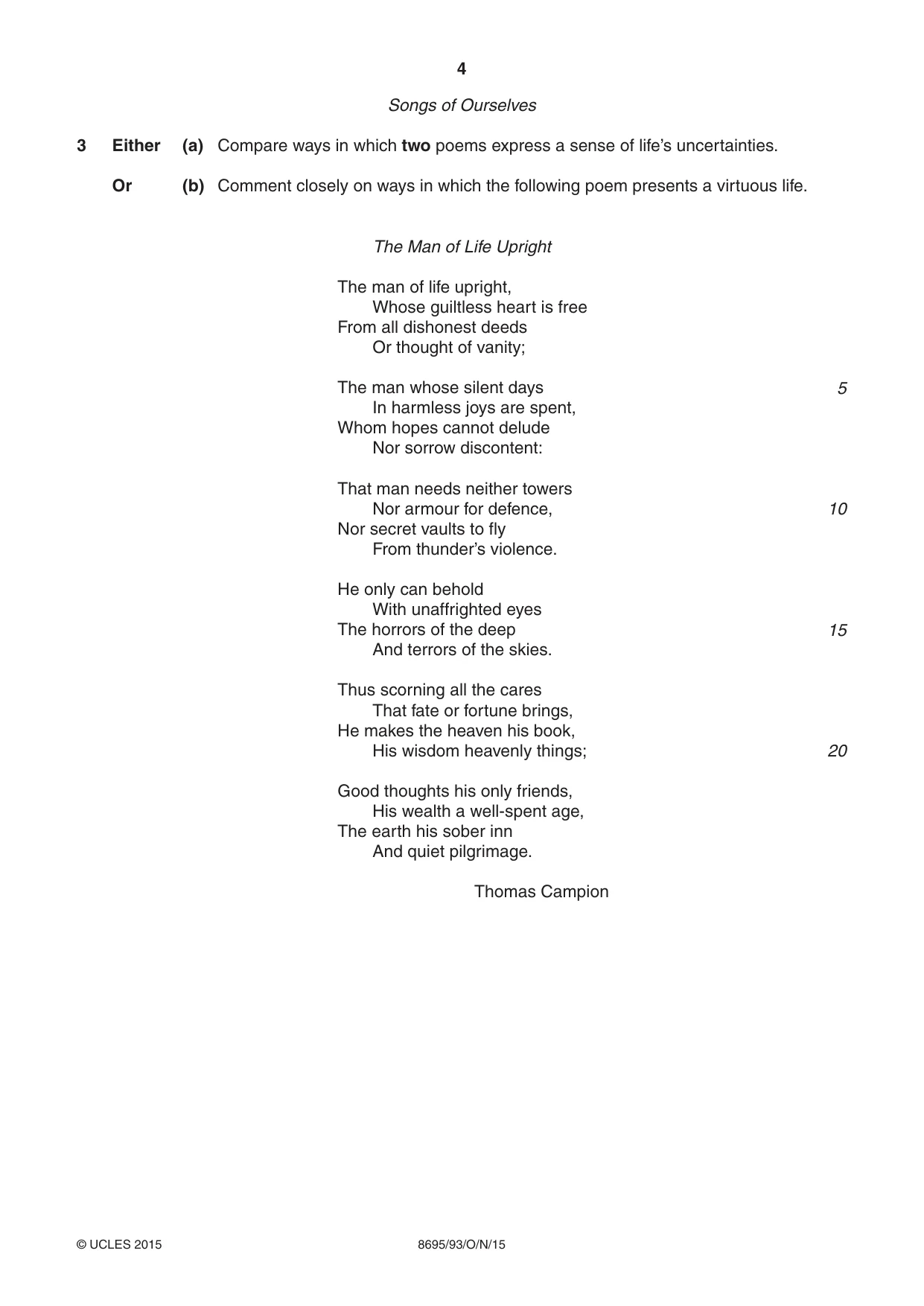
4 8695/93/O/N/15 © UCLES 2015 Songs of Ourselves 3 Either (a) Compare ways in which two poems express a sense of life’s uncertainties. Or (b) Comment closely on ways in which the following poem presents a virtuous life. The Man of Life Upright The man of life upright, Whose guiltless heart is free From all dishonest deeds Or thought of vanity; The man whose silent days In harmless joys are spent, Whom hopes cannot delude Nor sorrow discontent: That man needs neither towers Nor armour for defence, Nor secret vaults to fly From thunder’s violence. He only can behold With unaffrighted eyes The horrors of the deep And terrors of the skies. Thus scorning all the cares That fate or fortune brings, He makes the heaven his book, His wisdom heavenly things; Good thoughts his only friends, His wealth a well-spent age, The earth his sober inn And quiet pilgrimage. Thomas Campion 5 10 15 20
Question paper, page 5
5 8695/93/O/N/15 © UCLES 2015 [Turn over Turn to page 6 for Question 4
Question paper, page 6
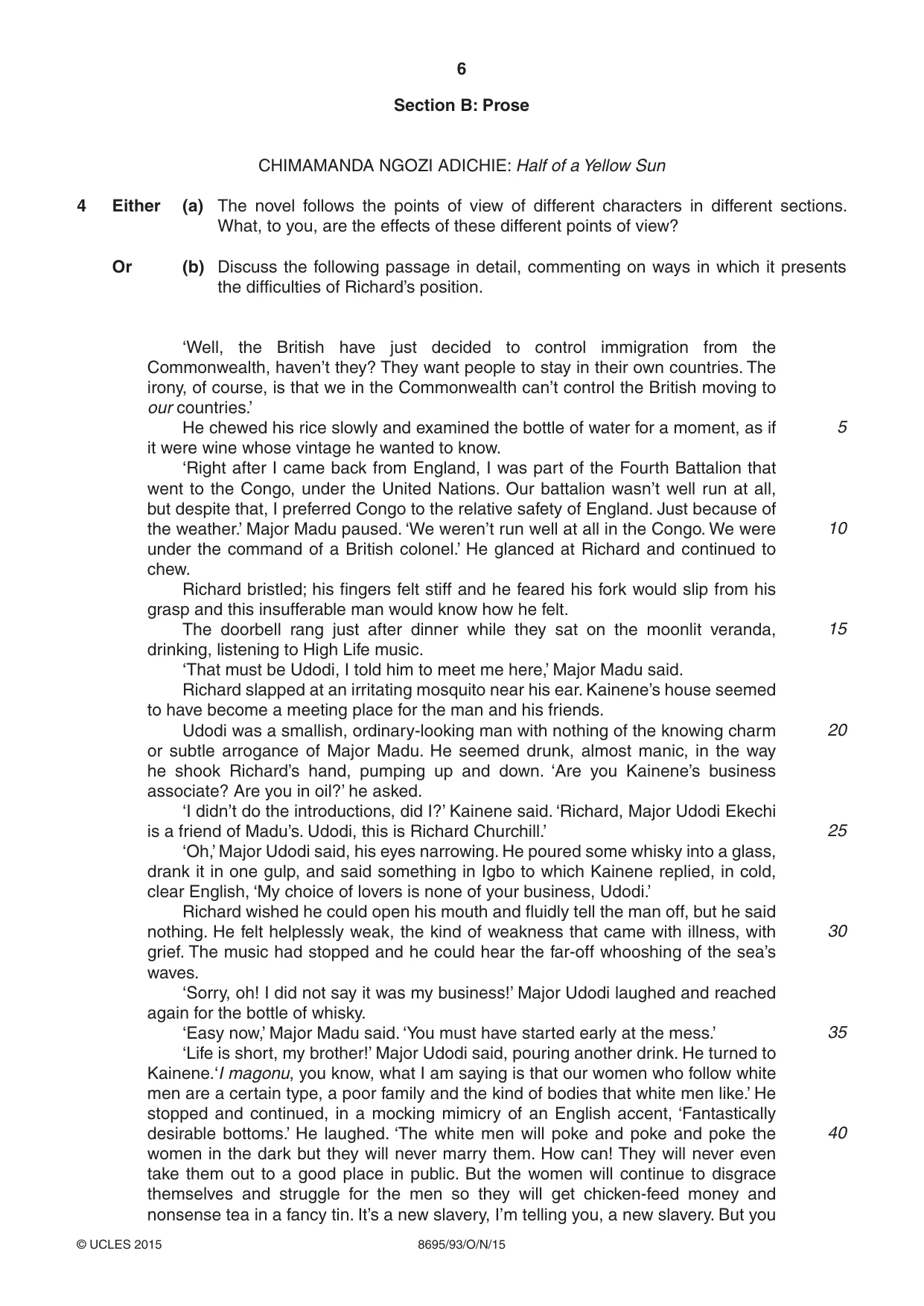
6 8695/93/O/N/15 © UCLES 2015 Section B: Prose CHIMAMANDA NGOZI ADICHIE: Half of a Yellow Sun 4 Either (a) The novel follows the points of view of different characters in different sections. What, to you, are the effects of these different points of view? Or (b) Discuss the following passage in detail, commenting on ways in which it presents the difficulties of Richard’s position. ‘Well, the British have just decided to control immigration from the Commonwealth, haven’t they? They want people to stay in their own countries. The irony, of course, is that we in the Commonwealth can’t control the British moving to our countries.’ He chewed his rice slowly and examined the bottle of water for a moment, as if it were wine whose vintage he wanted to know. ‘Right after I came back from England, I was part of the Fourth Battalion that went to the Congo, under the United Nations. Our battalion wasn’t well run at all, but despite that, I preferred Congo to the relative safety of England. Just because of the weather.’ Major Madu paused. ‘We weren’t run well at all in the Congo. We were under the command of a British colonel.’ He glanced at Richard and continued to chew. Richard bristled; his fingers felt stiff and he feared his fork would slip from his grasp and this insufferable man would know how he felt. The doorbell rang just after dinner while they sat on the moonlit veranda, drinking, listening to High Life music. ‘That must be Udodi, I told him to meet me here,’ Major Madu said. Richard slapped at an irritating mosquito near his ear. Kainene’s house seemed to have become a meeting place for the man and his friends. Udodi was a smallish, ordinary-looking man with nothing of the knowing charm or subtle arrogance of Major Madu. He seemed drunk, almost manic, in the way he shook Richard’s hand, pumping up and down. ‘Are you Kainene’s business associate? Are you in oil?’ he asked. ‘I didn’t do the introductions, did I?’ Kainene said. ‘Richard, Major Udodi Ekechi is a friend of Madu’s. Udodi, this is Richard Churchill.’ ‘Oh,’ Major Udodi said, his eyes narrowing. He poured some whisky into a glass, drank it in one gulp, and said something in Igbo to which Kainene replied, in cold, clear English, ‘My choice of lovers is none of your business, Udodi.’ Richard wished he could open his mouth and fluidly tell the man off, but he said nothing. He felt helplessly weak, the kind of weakness that came with illness, with grief. The music had stopped and he could hear the far-off whooshing of the sea’s waves. ‘Sorry, oh! I did not say it was my business!’ Major Udodi laughed and reached again for the bottle of whisky. ‘Easy now,’ Major Madu said. ‘You must have started early at the mess.’ ‘Life is short, my brother!’ Major Udodi said, pouring another drink. He turned to Kainene.‘I magonu, you know, what I am saying is that our women who follow white men are a certain type, a poor family and the kind of bodies that white men like.’ He stopped and continued, in a mocking mimicry of an English accent, ‘Fantastically desirable bottoms.’ He laughed. ‘The white men will poke and poke and poke the women in the dark but they will never marry them. How can! They will never even take them out to a good place in public. But the women will continue to disgrace themselves and struggle for the men so they will get chicken-feed money and nonsense tea in a fancy tin. It’s a new slavery, I’m telling you, a new slavery. But you 5 10 15 20 25 30 35 40
Question paper, page 7
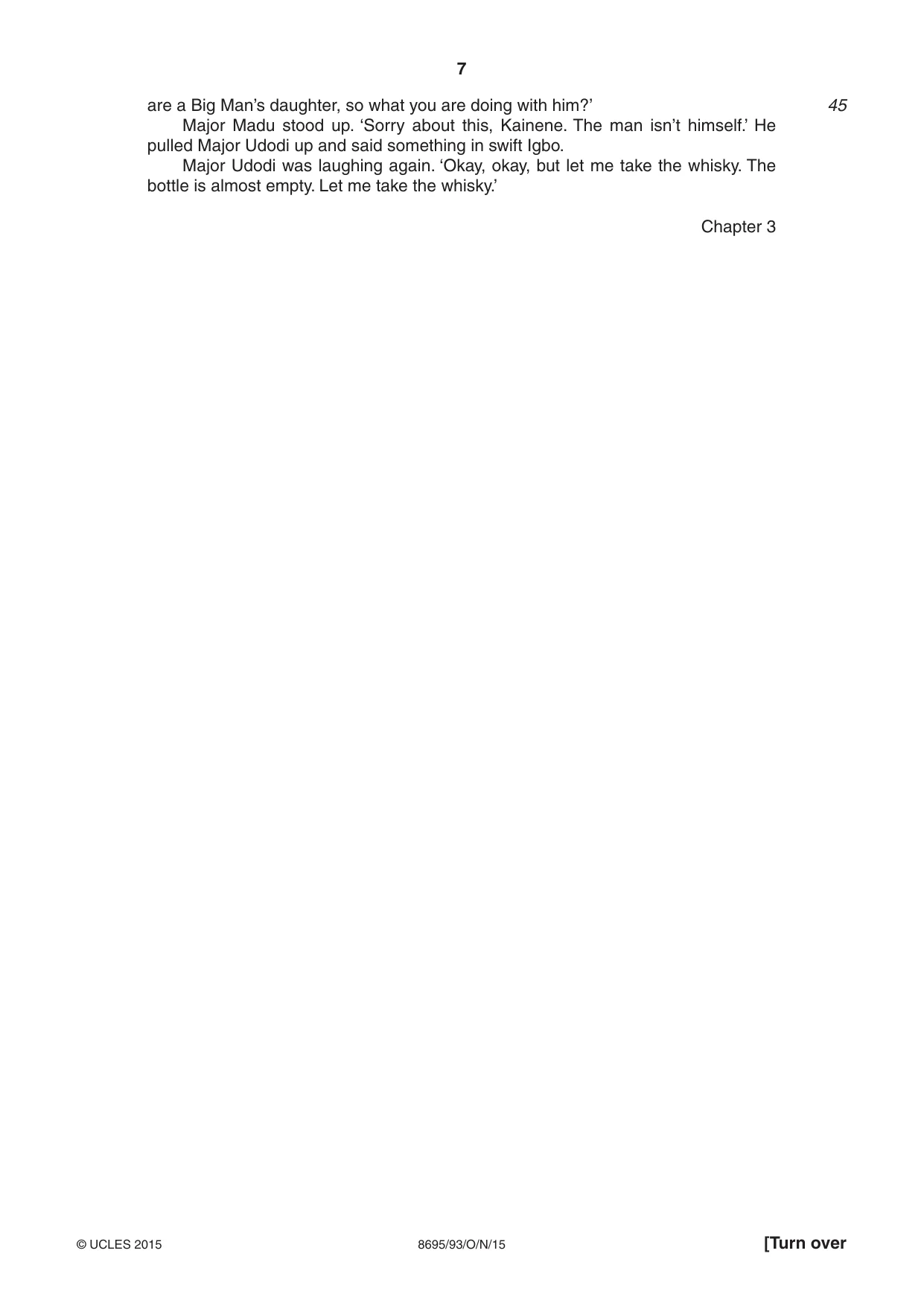
7 8695/93/O/N/15 © UCLES 2015 [Turn over are a Big Man’s daughter, so what you are doing with him?’ Major Madu stood up. ‘Sorry about this, Kainene. The man isn’t himself.’ He pulled Major Udodi up and said something in swift Igbo. Major Udodi was laughing again. ‘Okay, okay, but let me take the whisky. The bottle is almost empty. Let me take the whisky.’ Chapter 3 45
Question paper, page 8
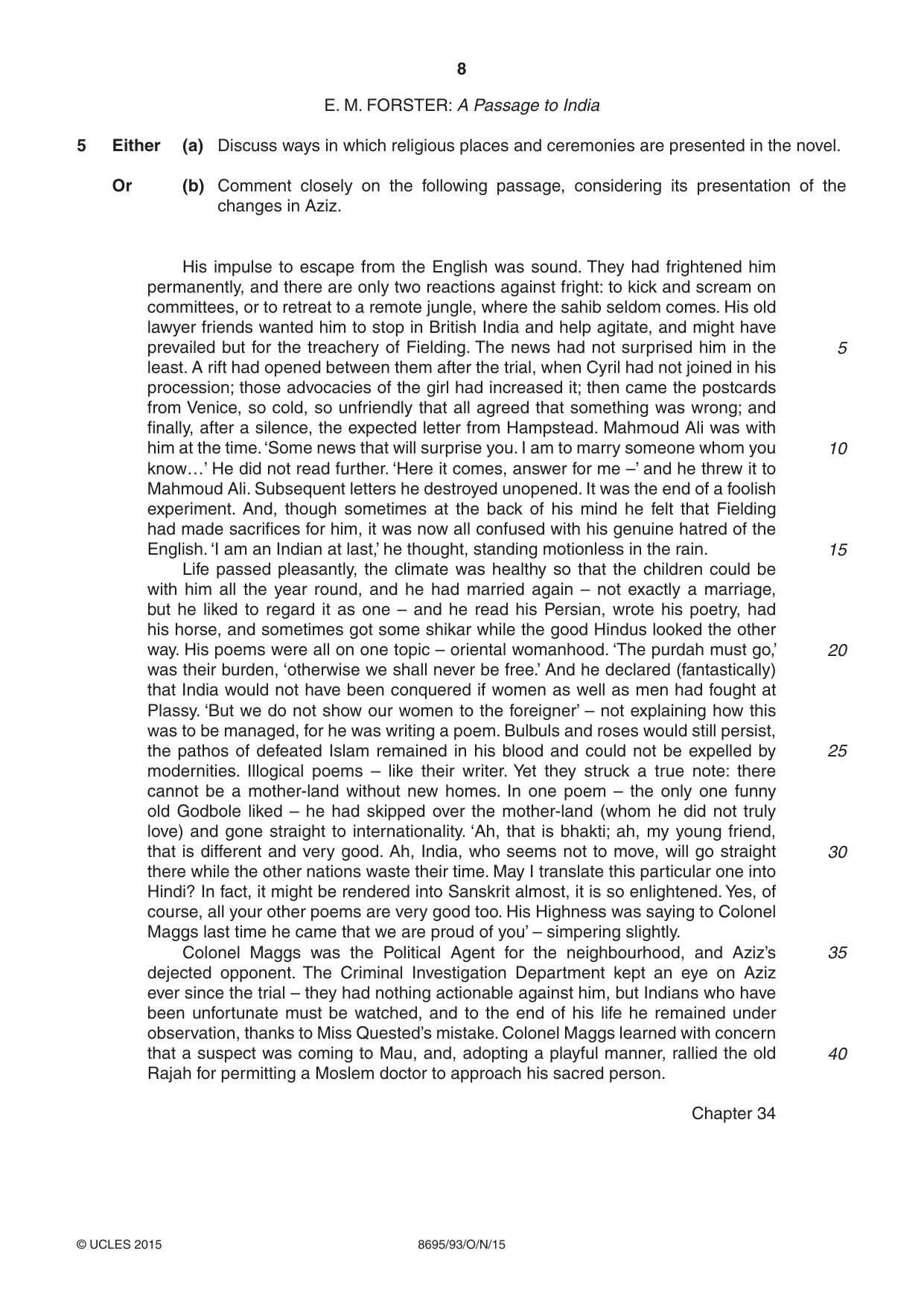
8 8695/93/O/N/15 © UCLES 2015 E. M. FORSTER: A Passage to India 5 Either (a) Discuss ways in which religious places and ceremonies are presented in the novel. Or (b) Comment closely on the following passage, considering its presentation of the changes in Aziz. His impulse to escape from the English was sound. They had frightened him permanently, and there are only two reactions against fright: to kick and scream on committees, or to retreat to a remote jungle, where the sahib seldom comes. His old lawyer friends wanted him to stop in British India and help agitate, and might have prevailed but for the treachery of Fielding. The news had not surprised him in the least. A rift had opened between them after the trial, when Cyril had not joined in his procession; those advocacies of the girl had increased it; then came the postcards from Venice, so cold, so unfriendly that all agreed that something was wrong; and finally, after a silence, the expected letter from Hampstead. Mahmoud Ali was with him at the time. ‘Some news that will surprise you. I am to marry someone whom you know…’ He did not read further. ‘Here it comes, answer for me –’ and he threw it to Mahmoud Ali. Subsequent letters he destroyed unopened. It was the end of a foolish experiment. And, though sometimes at the back of his mind he felt that Fielding had made sacrifices for him, it was now all confused with his genuine hatred of the English. ‘I am an Indian at last,’ he thought, standing motionless in the rain. Life passed pleasantly, the climate was healthy so that the children could be with him all the year round, and he had married again – not exactly a marriage, but he liked to regard it as one – and he read his Persian, wrote his poetry, had his horse, and sometimes got some shikar while the good Hindus looked the other way. His poems were all on one topic – oriental womanhood. ‘The purdah must go,’ was their burden, ‘otherwise we shall never be free.’ And he declared (fantastically) that India would not have been conquered if women as well as men had fought at Plassy. ‘But we do not show our women to the foreigner’ – not explaining how this was to be managed, for he was writing a poem. Bulbuls and roses would still persist, the pathos of defeated Islam remained in his blood and could not be expelled by modernities. Illogical poems – like their writer. Yet they struck a true note: there cannot be a mother-land without new homes. In one poem – the only one funny old Godbole liked – he had skipped over the mother-land (whom he did not truly love) and gone straight to internationality. ‘Ah, that is bhakti; ah, my young friend, that is different and very good. Ah, India, who seems not to move, will go straight there while the other nations waste their time. May I translate this particular one into Hindi? In fact, it might be rendered into Sanskrit almost, it is so enlightened. Yes, of course, all your other poems are very good too. His Highness was saying to Colonel Maggs last time he came that we are proud of you’ – simpering slightly. Colonel Maggs was the Political Agent for the neighbourhood, and Aziz’s dejected opponent. The Criminal Investigation Department kept an eye on Aziz ever since the trial – they had nothing actionable against him, but Indians who have been unfortunate must be watched, and to the end of his life he remained under observation, thanks to Miss Quested’s mistake. Colonel Maggs learned with concern that a suspect was coming to Mau, and, adopting a playful manner, rallied the old Rajah for permitting a Moslem doctor to approach his sacred person. Chapter 34 5 10 15 20 25 30 35 40
Question paper, page 9
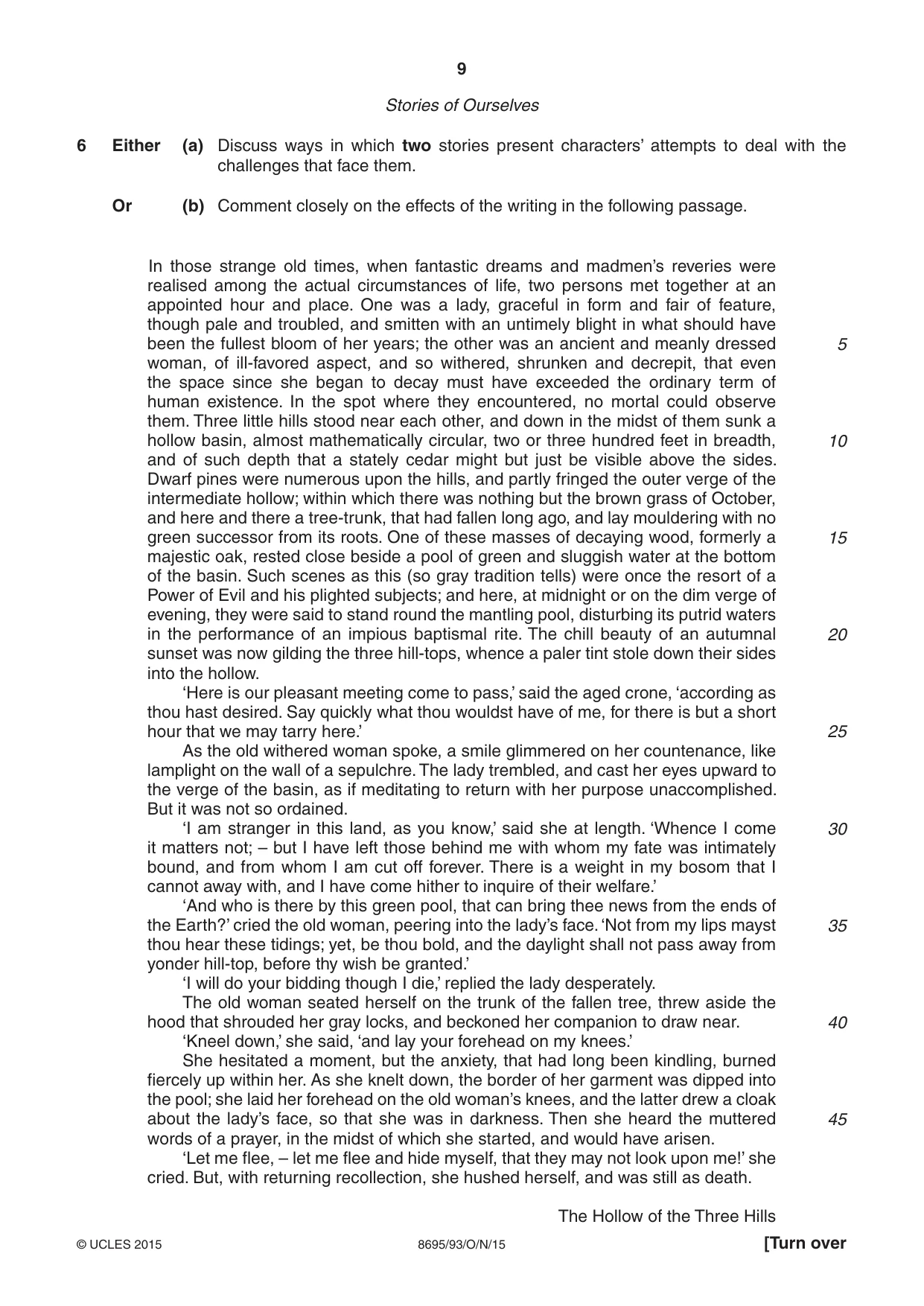
9 8695/93/O/N/15 © UCLES 2015 [Turn over Stories of Ourselves 6 Either (a) Discuss ways in which two stories present characters’ attempts to deal with the challenges that face them. Or (b) Comment closely on the effects of the writing in the following passage. In those strange old times, when fantastic dreams and madmen’s reveries were realised among the actual circumstances of life, two persons met together at an appointed hour and place. One was a lady, graceful in form and fair of feature, though pale and troubled, and smitten with an untimely blight in what should have been the fullest bloom of her years; the other was an ancient and meanly dressed woman, of ill-favored aspect, and so withered, shrunken and decrepit, that even the space since she began to decay must have exceeded the ordinary term of human existence. In the spot where they encountered, no mortal could observe them. Three little hills stood near each other, and down in the midst of them sunk a hollow basin, almost mathematically circular, two or three hundred feet in breadth, and of such depth that a stately cedar might but just be visible above the sides. Dwarf pines were numerous upon the hills, and partly fringed the outer verge of the intermediate hollow; within which there was nothing but the brown grass of October, and here and there a tree-trunk, that had fallen long ago, and lay mouldering with no green successor from its roots. One of these masses of decaying wood, formerly a majestic oak, rested close beside a pool of green and sluggish water at the bottom of the basin. Such scenes as this (so gray tradition tells) were once the resort of a Power of Evil and his plighted subjects; and here, at midnight or on the dim verge of evening, they were said to stand round the mantling pool, disturbing its putrid waters in the performance of an impious baptismal rite. The chill beauty of an autumnal sunset was now gilding the three hill-tops, whence a paler tint stole down their sides into the hollow. ‘Here is our pleasant meeting come to pass,’ said the aged crone, ‘according as thou hast desired. Say quickly what thou wouldst have of me, for there is but a short hour that we may tarry here.’ As the old withered woman spoke, a smile glimmered on her countenance, like lamplight on the wall of a sepulchre. The lady trembled, and cast her eyes upward to the verge of the basin, as if meditating to return with her purpose unaccomplished. But it was not so ordained. ‘I am stranger in this land, as you know,’ said she at length. ‘Whence I come it matters not; – but I have left those behind me with whom my fate was intimately bound, and from whom I am cut off forever. There is a weight in my bosom that I cannot away with, and I have come hither to inquire of their welfare.’ ‘And who is there by this green pool, that can bring thee news from the ends of the Earth?’ cried the old woman, peering into the lady’s face. ‘Not from my lips mayst thou hear these tidings; yet, be thou bold, and the daylight shall not pass away from yonder hill-top, before thy wish be granted.’ ‘I will do your bidding though I die,’ replied the lady desperately. The old woman seated herself on the trunk of the fallen tree, threw aside the hood that shrouded her gray locks, and beckoned her companion to draw near. ‘Kneel down,’ she said, ‘and lay your forehead on my knees.’ She hesitated a moment, but the anxiety, that had long been kindling, burned fiercely up within her. As she knelt down, the border of her garment was dipped into the pool; she laid her forehead on the old woman’s knees, and the latter drew a cloak about the lady’s face, so that she was in darkness. Then she heard the muttered words of a prayer, in the midst of which she started, and would have arisen. ‘Let me flee, – let me flee and hide myself, that they may not look upon me!’ she cried. But, with returning recollection, she hushed herself, and was still as death. The Hollow of the Three Hills 5 10 15 20 25 30 35 40 45
Question paper, page 10
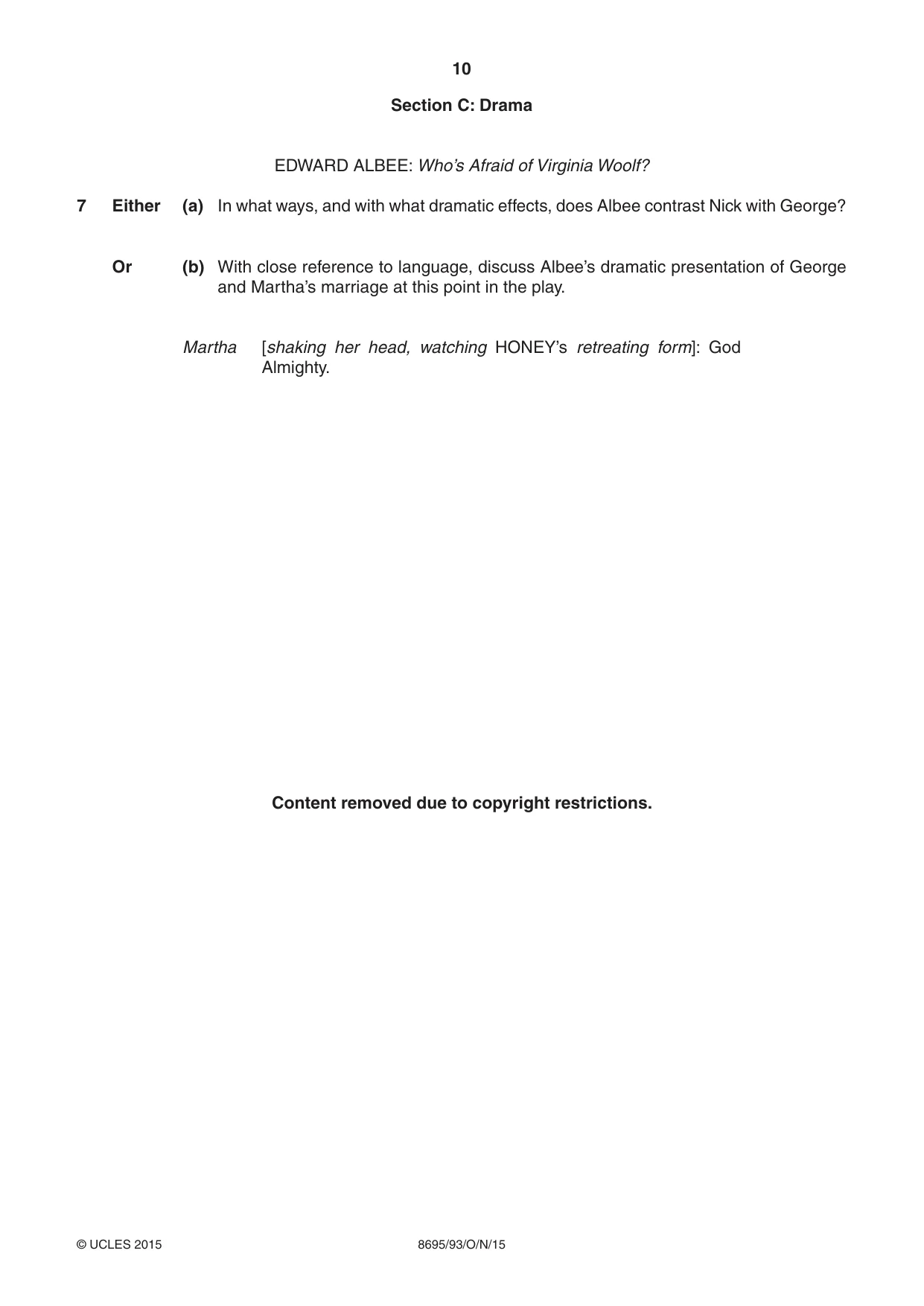
10 8695/93/O/N/15 © UCLES 2015 Section C: Drama EDWARD ALBEE: Who’s Afraid of Virginia Woolf? 7 Either (a) In what ways, and with what dramatic effects, does Albee contrast Nick with George? Or (b) With close reference to language, discuss Albee’s dramatic presentation of George and Martha’s marriage at this point in the play. Martha [shaking her head, watching HONEY’s retreating form]: God Almighty. Content removed due to copyright restrictions.
Question paper, page 11
11 8695/93/O/N/15 © UCLES 2015 [Turn over [A silence.] Act 2 Content removed due to copyright restrictions.
Question paper, page 12
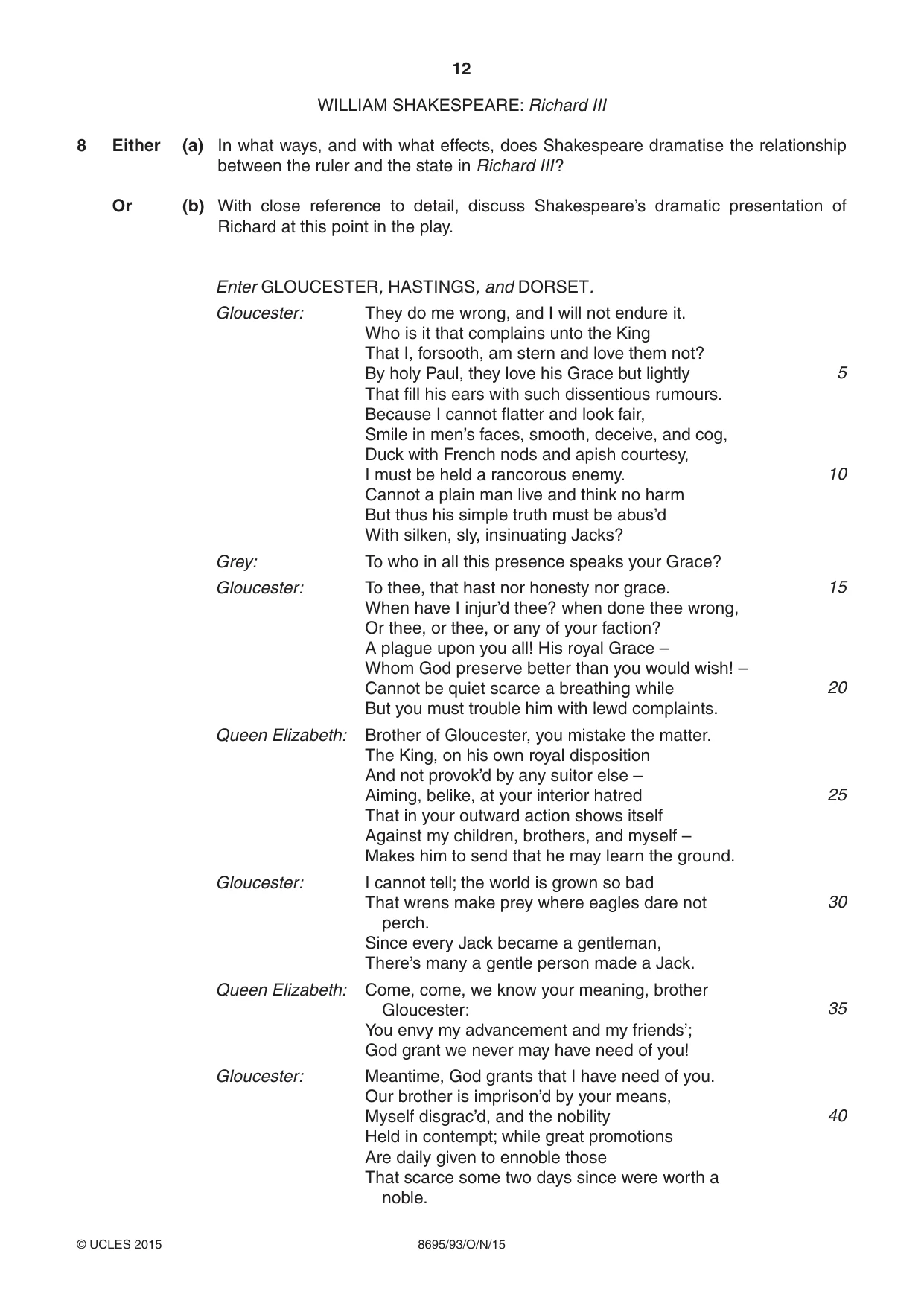
12 8695/93/O/N/15 © UCLES 2015 WILLIAM SHAKESPEARE: Richard III 8 Either (a) In what ways, and with what effects, does Shakespeare dramatise the relationship between the ruler and the state in Richard III ? Or (b) With close reference to detail, discuss Shakespeare’s dramatic presentation of Richard at this point in the play. Enter GLOUCESTER, HASTINGS, and DORSET. Gloucester: They do me wrong, and I will not endure it. Who is it that complains unto the King That I, forsooth, am stern and love them not? By holy Paul, they love his Grace but lightly That fill his ears with such dissentious rumours. Because I cannot flatter and look fair, Smile in men’s faces, smooth, deceive, and cog, Duck with French nods and apish courtesy, I must be held a rancorous enemy. Cannot a plain man live and think no harm But thus his simple truth must be abus’d With silken, sly, insinuating Jacks? Grey: To who in all this presence speaks your Grace? Gloucester: To thee, that hast nor honesty nor grace. When have I injur’d thee? when done thee wrong, Or thee, or thee, or any of your faction? A plague upon you all! His royal Grace – Whom God preserve better than you would wish! – Cannot be quiet scarce a breathing while But you must trouble him with lewd complaints. Queen Elizabeth: Brother of Gloucester, you mistake the matter. The King, on his own royal disposition And not provok’d by any suitor else – Aiming, belike, at your interior hatred That in your outward action shows itself Against my children, brothers, and myself – Makes him to send that he may learn the ground. Gloucester: I cannot tell; the world is grown so bad That wrens make prey where eagles dare not perch. Since every Jack became a gentleman, There’s many a gentle person made a Jack. Queen Elizabeth: Come, come, we know your meaning, brother Gloucester: You envy my advancement and my friends’; God grant we never may have need of you! Gloucester: Meantime, God grants that I have need of you. Our brother is imprison’d by your means, Myself disgrac’d, and the nobility Held in contempt; while great promotions Are daily given to ennoble those That scarce some two days since were worth a noble. 5 10 15 20 25 30 35 40
Question paper, page 13
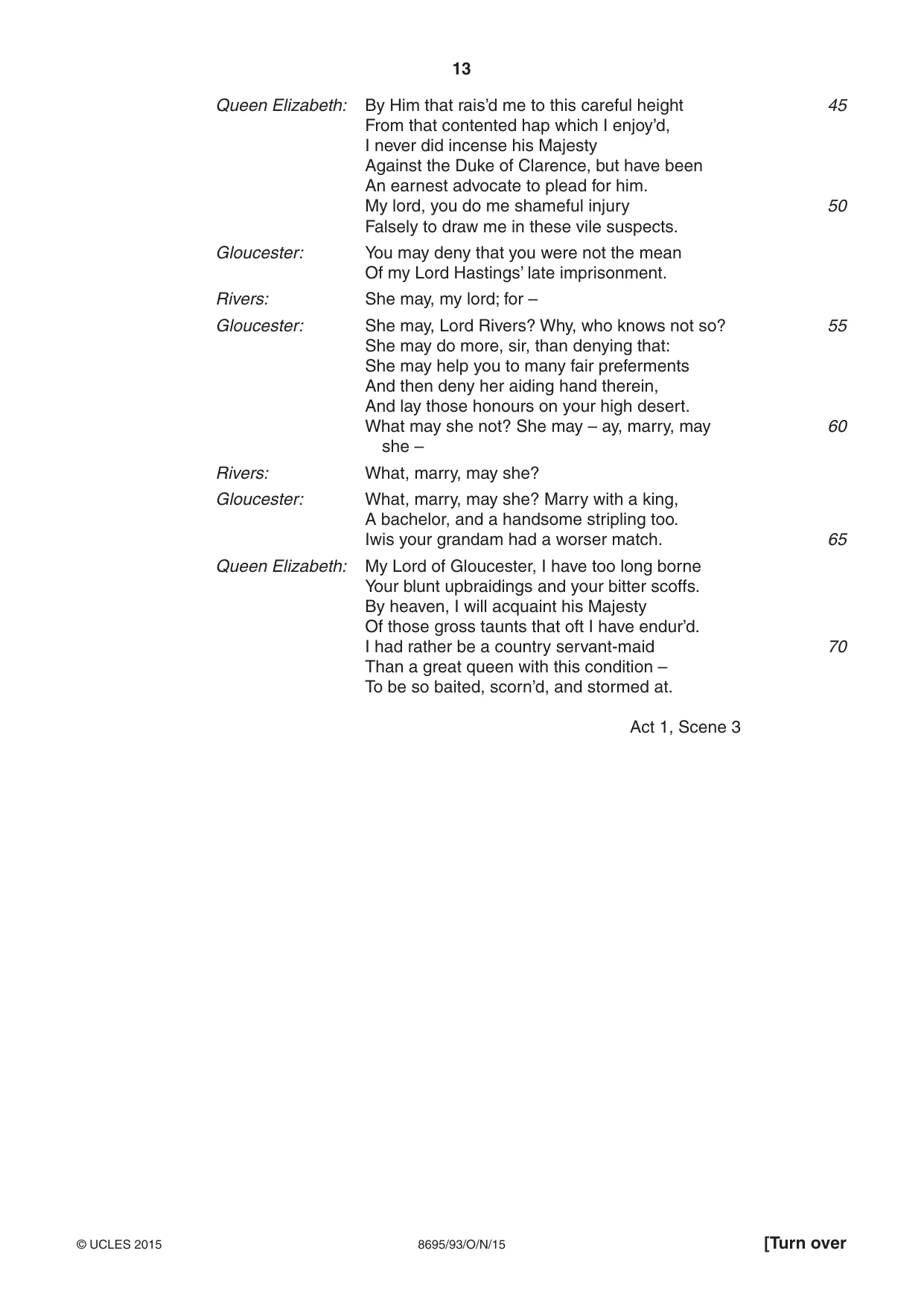
13 8695/93/O/N/15 © UCLES 2015 [Turn over Queen Elizabeth: By Him that rais’d me to this careful height From that contented hap which I enjoy’d, I never did incense his Majesty Against the Duke of Clarence, but have been An earnest advocate to plead for him. My lord, you do me shameful injury Falsely to draw me in these vile suspects. Gloucester: You may deny that you were not the mean Of my Lord Hastings’ late imprisonment. Rivers: She may, my lord; for – Gloucester: She may, Lord Rivers? Why, who knows not so? She may do more, sir, than denying that: She may help you to many fair preferments And then deny her aiding hand therein, And lay those honours on your high desert. What may she not? She may – ay, marry, may she – Rivers: What, marry, may she? Gloucester: What, marry, may she? Marry with a king, A bachelor, and a handsome stripling too. Iwis your grandam had a worser match. Queen Elizabeth: My Lord of Gloucester, I have too long borne Your blunt upbraidings and your bitter scoffs. By heaven, I will acquaint his Majesty Of those gross taunts that oft I have endur’d. I had rather be a country servant-maid Than a great queen with this condition – To be so baited, scorn’d, and stormed at. Act 1, Scene 3 45 50 55 60 65 70
Question paper, page 14
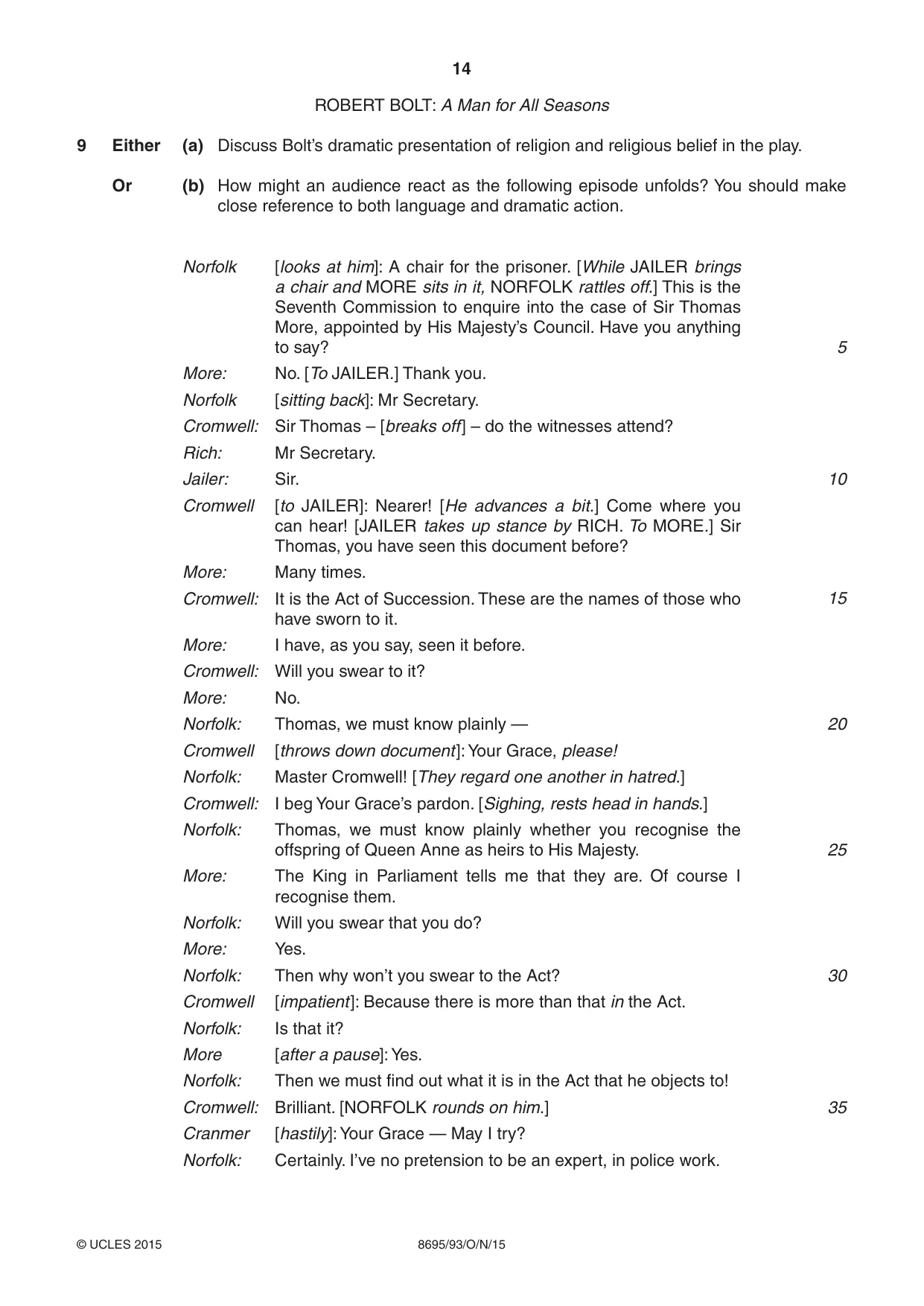
14 8695/93/O/N/15 © UCLES 2015 ROBERT BOLT: A Man for All Seasons 9 Either (a) Discuss Bolt’s dramatic presentation of religion and religious belief in the play. Or (b) How might an audience react as the following episode unfolds? You should make close reference to both language and dramatic action. Norfolk [looks at him]: A chair for the prisoner. [While JAILER brings a chair and MORE sits in it, NORFOLK rattles off.] This is the Seventh Commission to enquire into the case of Sir Thomas More, appointed by His Majesty’s Council. Have you anything to say? More: No. [To JAILER.] Thank you. Norfolk [sitting back]: Mr Secretary. Cromwell: Sir Thomas – [breaks off ] – do the witnesses attend? Rich: Mr Secretary. Jailer: Sir. Cromwell [to JAILER]: Nearer! [He advances a bit.] Come where you can hear! [JAILER takes up stance by RICH. To MORE.] Sir Thomas, you have seen this document before? More: Many times. Cromwell: It is the Act of Succession. These are the names of those who have sworn to it. More: I have, as you say, seen it before. Cromwell: Will you swear to it? More: No. Norfolk: Thomas, we must know plainly — Cromwell [throws down document ]: Your Grace, please! Norfolk: Master Cromwell! [They regard one another in hatred.] Cromwell: I beg Your Grace’s pardon. [Sighing, rests head in hands.] Norfolk: Thomas, we must know plainly whether you recognise the offspring of Queen Anne as heirs to His Majesty. More: The King in Parliament tells me that they are. Of course I recognise them. Norfolk: Will you swear that you do? More: Yes. Norfolk: Then why won’t you swear to the Act? Cromwell [impatient ]: Because there is more than that in the Act. Norfolk: Is that it? More [after a pause]: Yes. Norfolk: Then we must find out what it is in the Act that he objects to! Cromwell: Brilliant. [NORFOLK rounds on him.] Cranmer [hastily]: Your Grace — May I try? Norfolk: Certainly. I’ve no pretension to be an expert, in police work. 5 10 15 20 25 30 35
Question paper, page 15
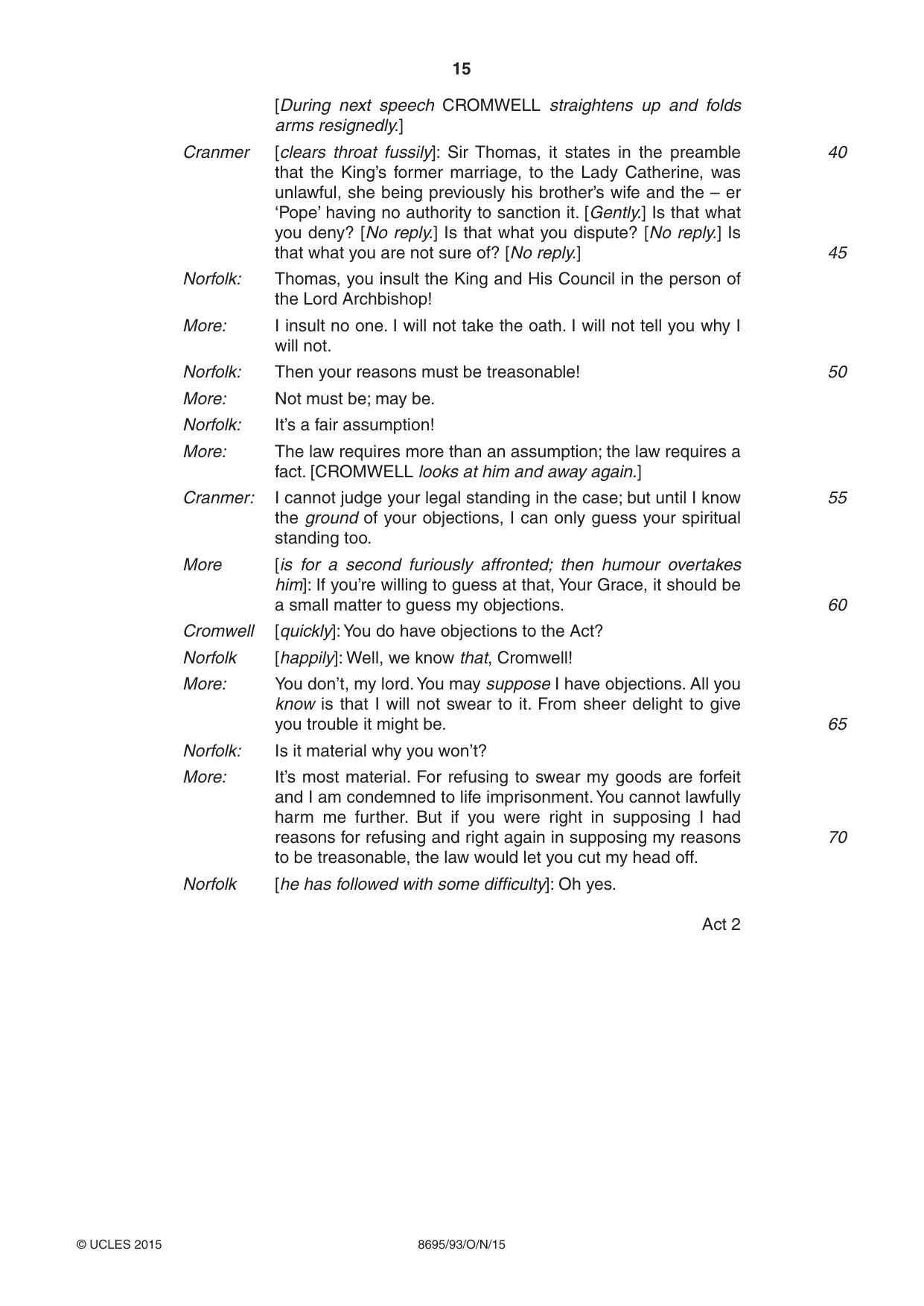
15 8695/93/O/N/15 © UCLES 2015 [During next speech CROMWELL straightens up and folds arms resignedly.] Cranmer [clears throat fussily]: Sir Thomas, it states in the preamble that the King’s former marriage, to the Lady Catherine, was unlawful, she being previously his brother’s wife and the – er ‘Pope’ having no authority to sanction it. [Gently.] Is that what you deny? [No reply.] Is that what you dispute? [No reply.] Is that what you are not sure of? [No reply.] Norfolk: Thomas, you insult the King and His Council in the person of the Lord Archbishop! More: I insult no one. I will not take the oath. I will not tell you why I will not. Norfolk: Then your reasons must be treasonable! More: Not must be; may be. Norfolk: It’s a fair assumption! More: The law requires more than an assumption; the law requires a fact. [CROMWELL looks at him and away again.] Cranmer: I cannot judge your legal standing in the case; but until I know the ground of your objections, I can only guess your spiritual standing too. More [is for a second furiously affronted; then humour overtakes him]: If you’re willing to guess at that, Your Grace, it should be a small matter to guess my objections. Cromwell [quickly]: You do have objections to the Act? Norfolk [happily]: Well, we know that, Cromwell! More: You don’t, my lord. You may suppose I have objections. All you know is that I will not swear to it. From sheer delight to give you trouble it might be. Norfolk: Is it material why you won’t? More: It’s most material. For refusing to swear my goods are forfeit and I am condemned to life imprisonment. You cannot lawfully harm me further. But if you were right in supposing I had reasons for refusing and right again in supposing my reasons to be treasonable, the law would let you cut my head off. Norfolk [he has followed with some difficulty]: Oh yes. Act 2 40 45 50 55 60 65 70
Question paper, page 16
16 8695/93/O/N/15 © UCLES 2015 BLANK PAGE Permission to reproduce items where third-party owned material protected by copyright is included has been sought and cleared where possible. Every reasonable effort has been made by the publisher (UCLES) to trace copyright holders, but if any items requiring clearance have unwittingly been included, the publisher will be pleased to make amends at the earliest possible opportunity. To avoid the issue of disclosure of answer-related information to candidates, all copyright acknowledgements are reproduced online in the Cambridge International Examinations Copyright Acknowledgements Booklet. This is produced for each series of examinations and is freely available to download at www.cie.org.uk after the live examination series. Cambridge International Examinations is part of the Cambridge Assessment Group. Cambridge Assessment is the brand name of University of Cambridge Local Examinations Syndicate (UCLES), which is itself a department of the University of Cambridge.
Mark scheme, page 1
® IGCSE is the registered trademark of Cambridge International Examinations. CAMBRIDGE INTERNATIONAL EXAMINATIONS Cambridge International Advanced Subsidiary and Advanced Level MARK SCHEME for the October/November 2015 series 8695 LANGUAGE AND LITERATURE IN ENGLISH 8695/93 Paper 3 (Poetry, Prose and Drama), maximum raw mark 50 This mark scheme is published as an aid to teachers and candidates, to indicate the requirements of the examination. It shows the basis on which Examiners were instructed to award marks. It does not indicate the details of the discussions that took place at an Examiners’ meeting before marking began, which would have considered the acceptability of alternative answers. Mark schemes should be read in conjunction with the question paper and the Principal Examiner Report for Teachers. Cambridge will not enter into discussions about these mark schemes. Cambridge is publishing the mark schemes for the October/November 2015 series for most Cambridge IGCSE®, Cambridge International A and AS Level components and some Cambridge O Level components.
Mark scheme, page 2
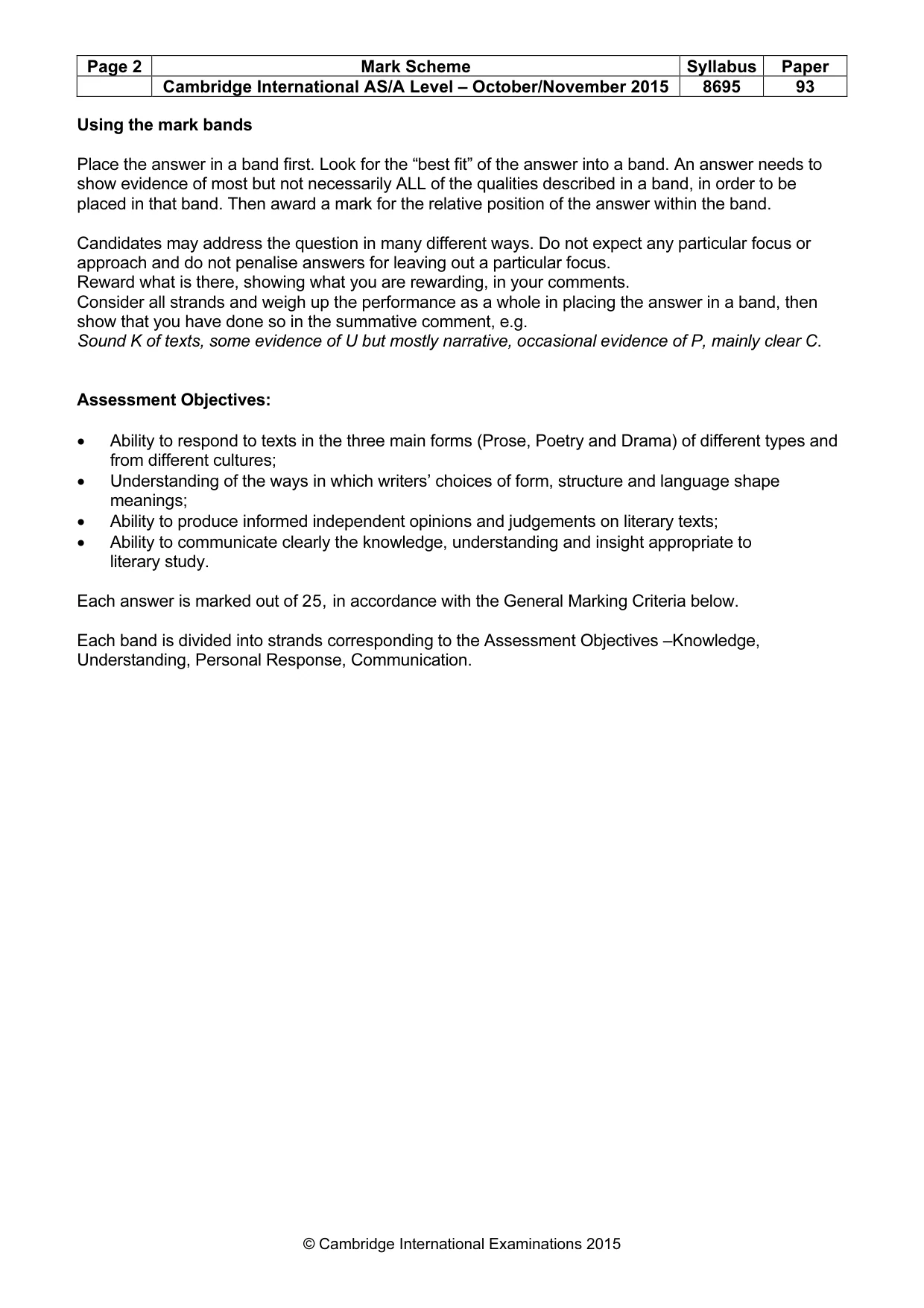
Page 2 Mark Scheme Syllabus Paper Cambridge International AS/A Level – October/November 2015 8695 93 © Cambridge International Examinations 2015 Using the mark bands Place the answer in a band first. Look for the “best fit” of the answer into a band. An answer needs to show evidence of most but not necessarily ALL of the qualities described in a band, in order to be placed in that band. Then award a mark for the relative position of the answer within the band. Candidates may address the question in many different ways. Do not expect any particular focus or approach and do not penalise answers for leaving out a particular focus. Reward what is there, showing what you are rewarding, in your comments. Consider all strands and weigh up the performance as a whole in placing the answer in a band, then show that you have done so in the summative comment, e.g. Sound K of texts, some evidence of U but mostly narrative, occasional evidence of P, mainly clear C. Assessment Objectives: • Ability to respond to texts in the three main forms (Prose, Poetry and Drama) of different types and from different cultures; • Understanding of the ways in which writers’ choices of form, structure and language shape meanings; • Ability to produce informed independent opinions and judgements on literary texts; • Ability to communicate clearly the knowledge, understanding and insight appropriate to literary study. Each answer is marked out of 25, in accordance with the General Marking Criteria below. Each band is divided into strands corresponding to the Assessment Objectives –Knowledge, Understanding, Personal Response, Communication.
Mark scheme, page 3
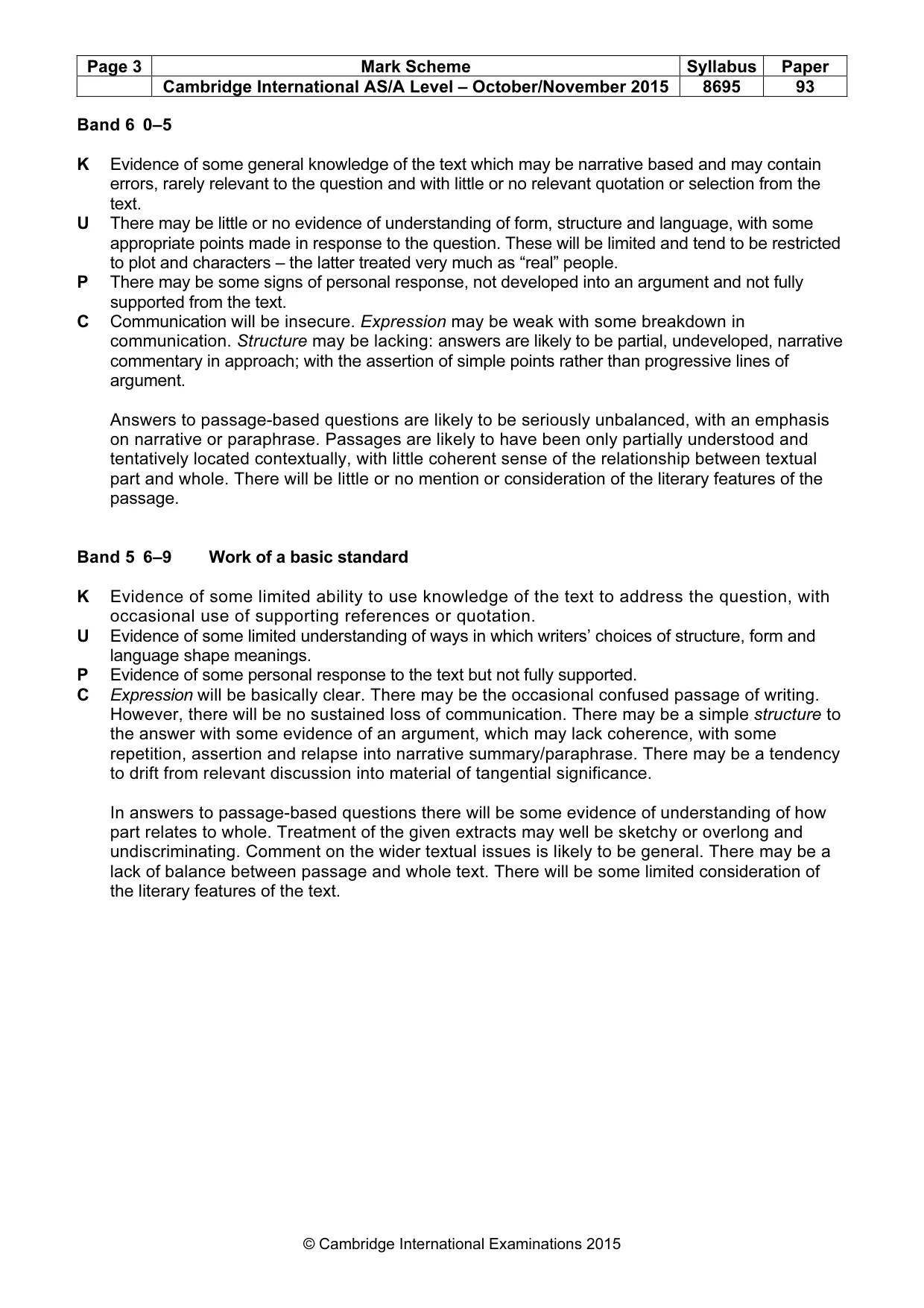
Page 3 Mark Scheme Syllabus Paper Cambridge International AS/A Level – October/November 2015 8695 93 © Cambridge International Examinations 2015 Band 6 0–5 K Evidence of some general knowledge of the text which may be narrative based and may contain errors, rarely relevant to the question and with little or no relevant quotation or selection from the text. U There may be little or no evidence of understanding of form, structure and language, with some appropriate points made in response to the question. These will be limited and tend to be restricted to plot and characters – the latter treated very much as “real” people. P There may be some signs of personal response, not developed into an argument and not fully supported from the text. C Communication will be insecure. Expression may be weak with some breakdown in communication. Structure may be lacking: answers are likely to be partial, undeveloped, narrative commentary in approach; with the assertion of simple points rather than progressive lines of argument. Answers to passage-based questions are likely to be seriously unbalanced, with an emphasis on narrative or paraphrase. Passages are likely to have been only partially understood and tentatively located contextually, with little coherent sense of the relationship between textual part and whole. There will be little or no mention or consideration of the literary features of the passage. Band 5 6–9 Work of a basic standard K Evidence of some limited ability to use knowledge of the text to address the question, with occasional use of supporting references or quotation. U Evidence of some limited understanding of ways in which writers’ choices of structure, form and language shape meanings. P Evidence of some personal response to the text but not fully supported. C Expression will be basically clear. There may be the occasional confused passage of writing. However, there will be no sustained loss of communication. There may be a simple structure to the answer with some evidence of an argument, which may lack coherence, with some repetition, assertion and relapse into narrative summary/paraphrase. There may be a tendency to drift from relevant discussion into material of tangential significance. In answers to passage-based questions there will be some evidence of understanding of how part relates to whole. Treatment of the given extracts may well be sketchy or overlong and undiscriminating. Comment on the wider textual issues is likely to be general. There may be a lack of balance between passage and whole text. There will be some limited consideration of the literary features of the text.
Mark scheme, page 4
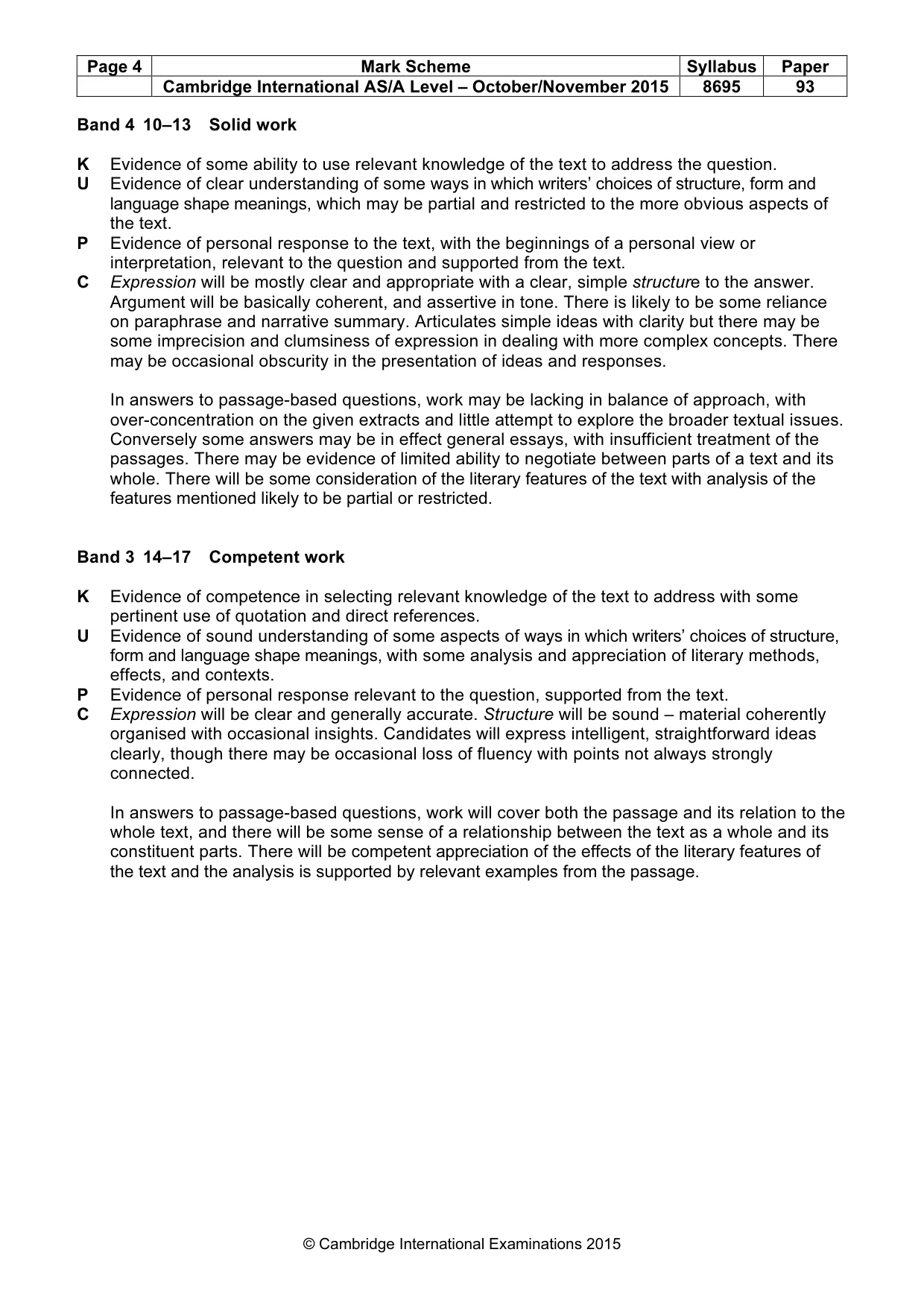
Page 4 Mark Scheme Syllabus Paper Cambridge International AS/A Level – October/November 2015 8695 93 © Cambridge International Examinations 2015 Band 4 10–13 Solid work K Evidence of some ability to use relevant knowledge of the text to address the question. U Evidence of clear understanding of some ways in which writers’ choices of structure, form and language shape meanings, which may be partial and restricted to the more obvious aspects of the text. P Evidence of personal response to the text, with the beginnings of a personal view or interpretation, relevant to the question and supported from the text. C Expression will be mostly clear and appropriate with a clear, simple structure to the answer. Argument will be basically coherent, and assertive in tone. There is likely to be some reliance on paraphrase and narrative summary. Articulates simple ideas with clarity but there may be some imprecision and clumsiness of expression in dealing with more complex concepts. There may be occasional obscurity in the presentation of ideas and responses. In answers to passage-based questions, work may be lacking in balance of approach, with over-concentration on the given extracts and little attempt to explore the broader textual issues. Conversely some answers may be in effect general essays, with insufficient treatment of the passages. There may be evidence of limited ability to negotiate between parts of a text and its whole. There will be some consideration of the literary features of the text with analysis of the features mentioned likely to be partial or restricted. Band 3 14–17 Competent work K Evidence of competence in selecting relevant knowledge of the text to address with some pertinent use of quotation and direct references. U Evidence of sound understanding of some aspects of ways in which writers’ choices of structure, form and language shape meanings, with some analysis and appreciation of literary methods, effects, and contexts. P Evidence of personal response relevant to the question, supported from the text. C Expression will be clear and generally accurate. Structure will be sound – material coherently organised with occasional insights. Candidates will express intelligent, straightforward ideas clearly, though there may be occasional loss of fluency with points not always strongly connected. In answers to passage-based questions, work will cover both the passage and its relation to the whole text, and there will be some sense of a relationship between the text as a whole and its constituent parts. There will be competent appreciation of the effects of the literary features of the text and the analysis is supported by relevant examples from the passage.
Mark scheme, page 5
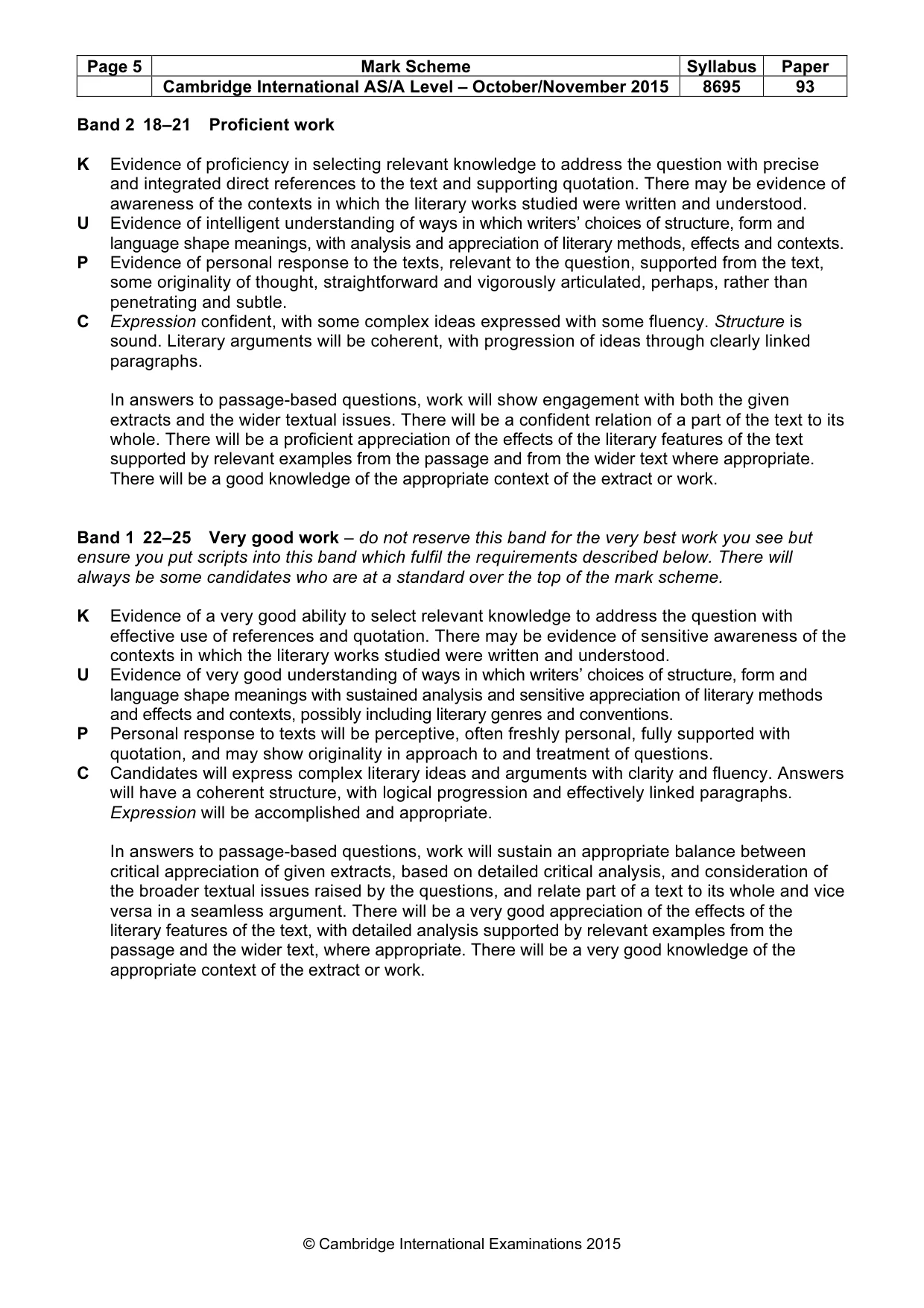
Page 5 Mark Scheme Syllabus Paper Cambridge International AS/A Level – October/November 2015 8695 93 © Cambridge International Examinations 2015 Band 2 18–21 Proficient work K Evidence of proficiency in selecting relevant knowledge to address the question with precise and integrated direct references to the text and supporting quotation. There may be evidence of awareness of the contexts in which the literary works studied were written and understood. U Evidence of intelligent understanding of ways in which writers’ choices of structure, form and language shape meanings, with analysis and appreciation of literary methods, effects and contexts. P Evidence of personal response to the texts, relevant to the question, supported from the text, some originality of thought, straightforward and vigorously articulated, perhaps, rather than penetrating and subtle. C Expression confident, with some complex ideas expressed with some fluency. Structure is sound. Literary arguments will be coherent, with progression of ideas through clearly linked paragraphs. In answers to passage-based questions, work will show engagement with both the given extracts and the wider textual issues. There will be a confident relation of a part of the text to its whole. There will be a proficient appreciation of the effects of the literary features of the text supported by relevant examples from the passage and from the wider text where appropriate. There will be a good knowledge of the appropriate context of the extract or work. Band 1 22–25 Very good work – do not reserve this band for the very best work you see but ensure you put scripts into this band which fulfil the requirements described below. There will always be some candidates who are at a standard over the top of the mark scheme. K Evidence of a very good ability to select relevant knowledge to address the question with effective use of references and quotation. There may be evidence of sensitive awareness of the contexts in which the literary works studied were written and understood. U Evidence of very good understanding of ways in which writers’ choices of structure, form and language shape meanings with sustained analysis and sensitive appreciation of literary methods and effects and contexts, possibly including literary genres and conventions. P Personal response to texts will be perceptive, often freshly personal, fully supported with quotation, and may show originality in approach to and treatment of questions. C Candidates will express complex literary ideas and arguments with clarity and fluency. Answers will have a coherent structure, with logical progression and effectively linked paragraphs. Expression will be accomplished and appropriate. In answers to passage-based questions, work will sustain an appropriate balance between critical appreciation of given extracts, based on detailed critical analysis, and consideration of the broader textual issues raised by the questions, and relate part of a text to its whole and vice versa in a seamless argument. There will be a very good appreciation of the effects of the literary features of the text, with detailed analysis supported by relevant examples from the passage and the wider text, where appropriate. There will be a very good knowledge of the appropriate context of the extract or work.
What you needed in this session
Cambridge’s own grade thresholds for 2015 Oct/Nov, Paper 9 · Variant 3. A higher threshold means an easier paper — the bar moves with how the cohort did.