Cambridge A Level English - Language and Literature (AS Level only, from 2016) 8695 — 2015 Oct/Nov Paper 9 · Variant 2
8695/92/O/N/15 · 50 marks · ≈56 min
The question paper and its mark scheme, free to read here and free to download. This is Cambridge’s own paper, exactly as it was sat.
Question paper16 pages

Mark scheme5 pages
Answers below. Sit the paper first if you are practising.
Paper as text
Question paper, page 1
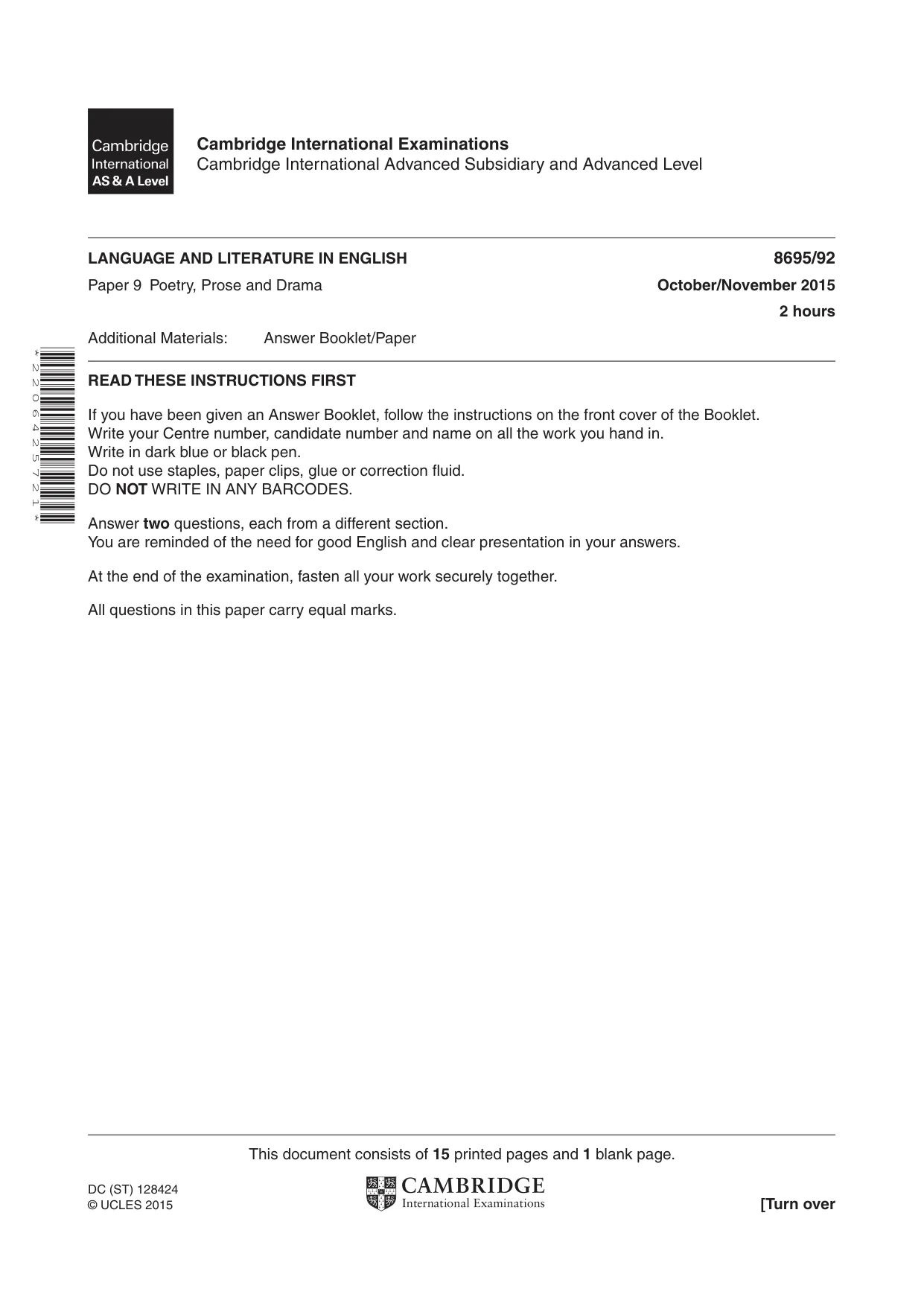
This document consists of 15 printed pages and 1 blank page. DC (ST) 128424 © UCLES 2015 [Turn over Cambridge International Examinations Cambridge International Advanced Subsidiary and Advanced Level * 2 2 0 6 4 2 5 7 2 1 * LANGUAGE AND LITERATURE IN ENGLISH 8695/92 Paper 9 Poetry, Prose and Drama October/November 2015 2 hours Additional Materials: Answer Booklet/Paper READ THESE INSTRUCTIONS FIRST If you have been given an Answer Booklet, follow the instructions on the front cover of the Booklet. Write your Centre number, candidate number and name on all the work you hand in. Write in dark blue or black pen. Do not use staples, paper clips, glue or correction fluid. DO NOT WRITE IN ANY BARCODES. Answer two questions, each from a different section. You are reminded of the need for good English and clear presentation in your answers. At the end of the examination, fasten all your work securely together. All questions in this paper carry equal marks.
Question paper, page 2
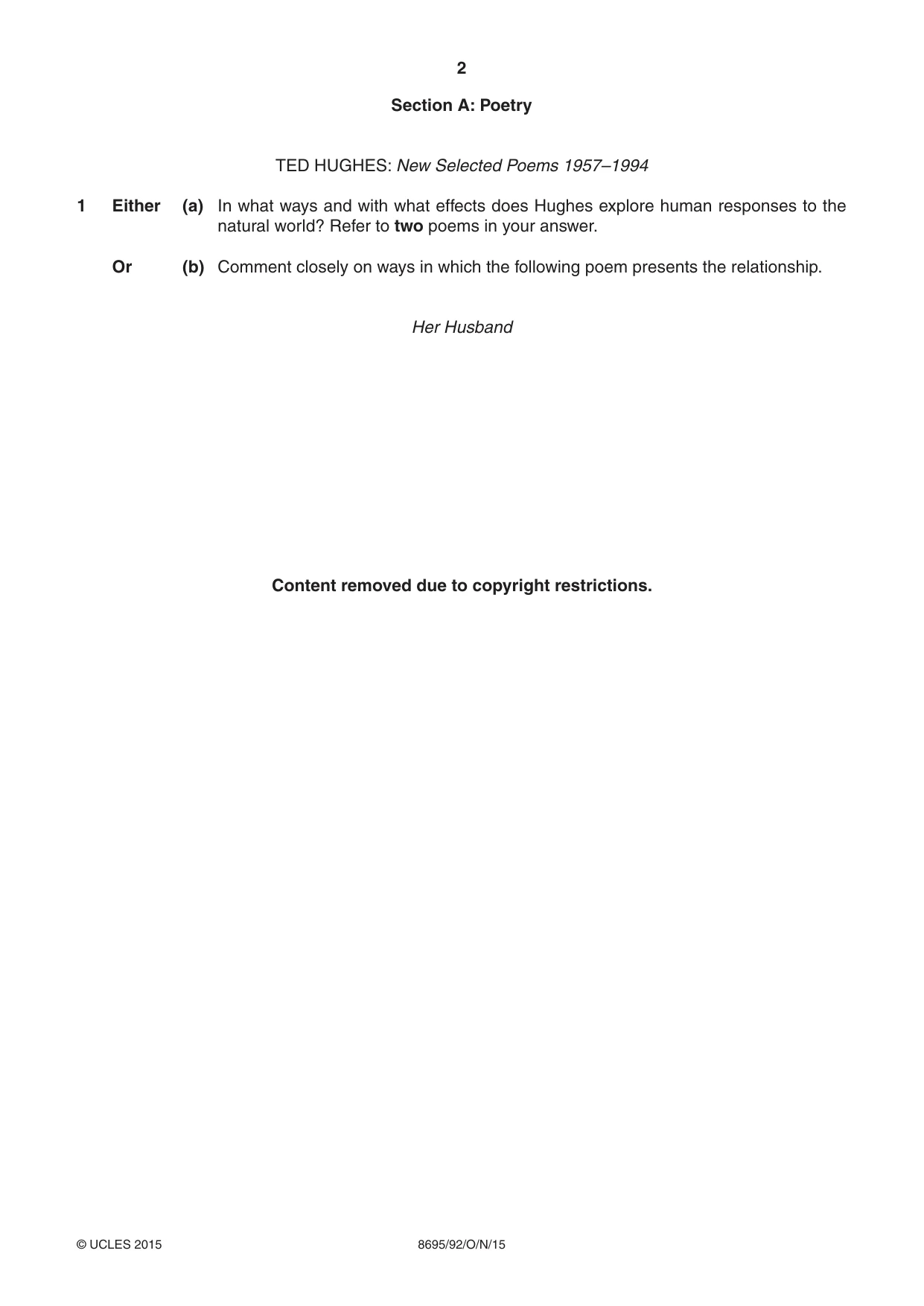
2 8695/92/O/N/15 © UCLES 2015 Section A: Poetry TED HUGHES: New Selected Poems 1957–1994 1 Either (a) In what ways and with what effects does Hughes explore human responses to the natural world? Refer to two poems in your answer. Or (b) Comment closely on ways in which the following poem presents the relationship. Her Husband Content removed due to copyright restrictions.
Question paper, page 3
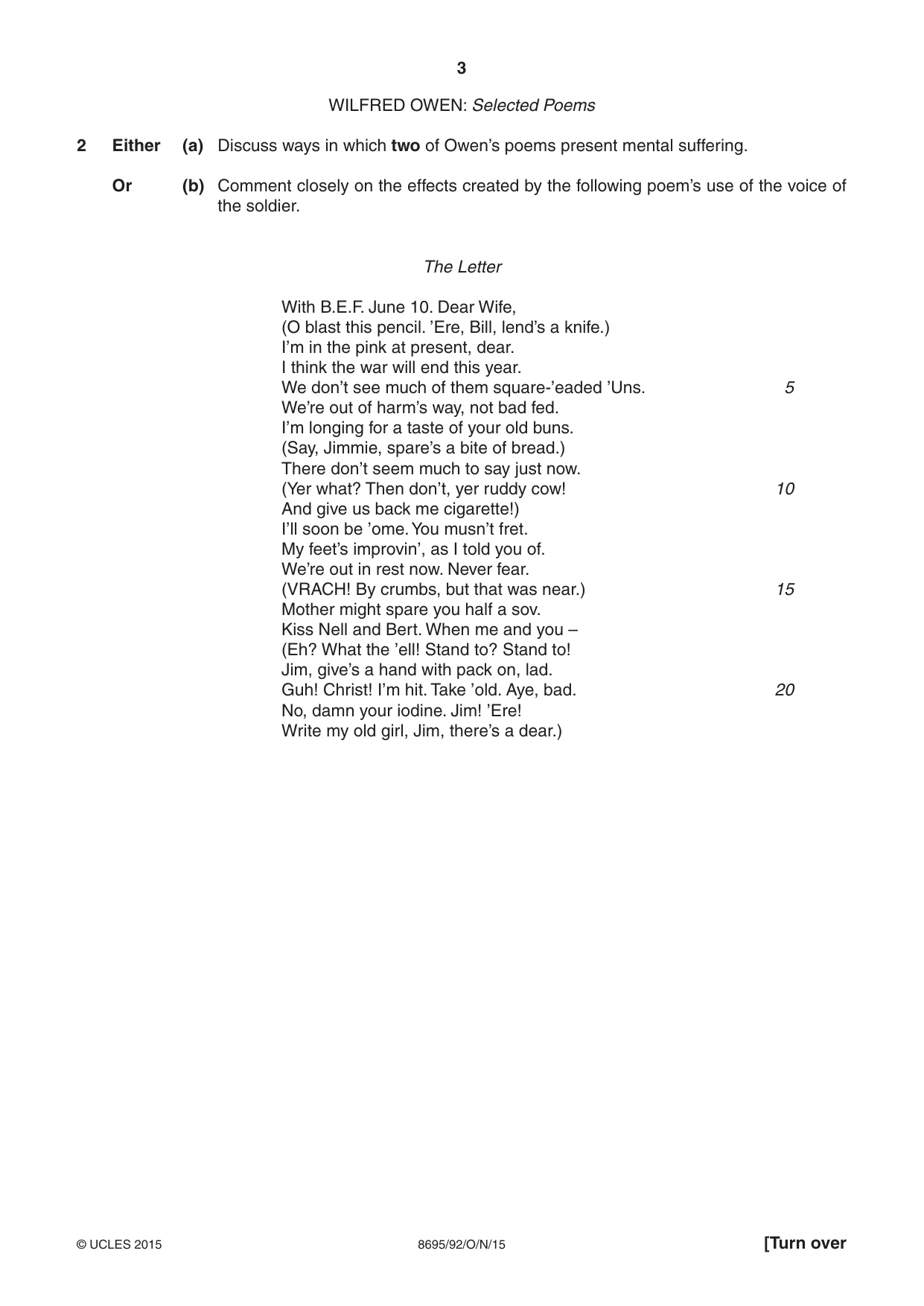
3 8695/92/O/N/15 © UCLES 2015 [Turn over WILFRED OWEN: Selected Poems 2 Either (a) Discuss ways in which two of Owen’s poems present mental suffering. Or (b) Comment closely on the effects created by the following poem’s use of the voice of the soldier. The Letter With B.E.F. June 10. Dear Wife, (O blast this pencil. ’Ere, Bill, lend’s a knife.) I’m in the pink at present, dear. I think the war will end this year. We don’t see much of them square-’eaded ’Uns. 5 We’re out of harm’s way, not bad fed. I’m longing for a taste of your old buns. (Say, Jimmie, spare’s a bite of bread.) There don’t seem much to say just now. (Yer what? Then don’t, yer ruddy cow! 10 And give us back me cigarette!) I’ll soon be ’ome. You musn’t fret. My feet’s improvin’, as I told you of. We’re out in rest now. Never fear. (VRACH! By crumbs, but that was near.) 15 Mother might spare you half a sov. Kiss Nell and Bert. When me and you – (Eh? What the ’ell! Stand to? Stand to! Jim, give’s a hand with pack on, lad. Guh! Christ! I’m hit. Take ’old. Aye, bad. 20 No, damn your iodine. Jim! ’Ere! Write my old girl, Jim, there’s a dear.)
Question paper, page 4
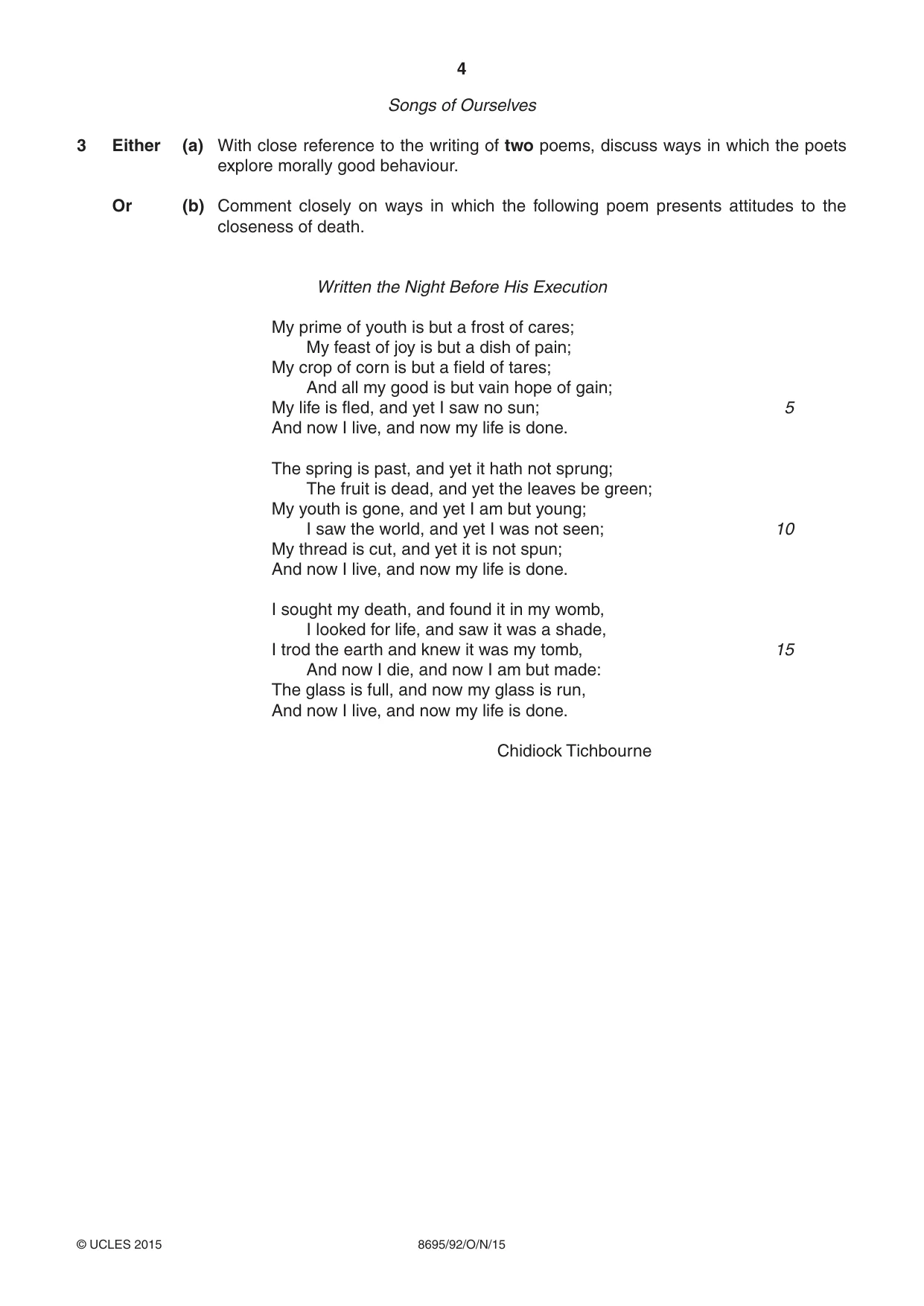
4 8695/92/O/N/15 © UCLES 2015 Songs of Ourselves 3 Either (a) With close reference to the writing of two poems, discuss ways in which the poets explore morally good behaviour. Or (b) Comment closely on ways in which the following poem presents attitudes to the closeness of death. Written the Night Before His Execution My prime of youth is but a frost of cares; My feast of joy is but a dish of pain; My crop of corn is but a field of tares; And all my good is but vain hope of gain; My life is fled, and yet I saw no sun; 5 And now I live, and now my life is done. The spring is past, and yet it hath not sprung; The fruit is dead, and yet the leaves be green; My youth is gone, and yet I am but young; I saw the world, and yet I was not seen; 10 My thread is cut, and yet it is not spun; And now I live, and now my life is done. I sought my death, and found it in my womb, I looked for life, and saw it was a shade, I trod the earth and knew it was my tomb, 15 And now I die, and now I am but made: The glass is full, and now my glass is run, And now I live, and now my life is done. Chidiock Tichbourne
Question paper, page 5
5 8695/92/O/N/15 © UCLES 2015 [Turn over Section B: Prose CHIMAMANDA NGOZI ADICHIE: Half of a Yellow Sun 4 Either (a) The sections of the novel alternate between ‘The Early Sixties’ and ‘The Late Sixties’. What do you think are the effects of these shifts in time? Or (b) Comment closely on the following passage, considering ways in which it presents the tension between Richard and Madu. The stew that was served at lunch had too much crayfish; Kainene would not have liked it and she would have leaned towards him and said so. After lunch, Richard and Madu went out to sit on the veranda. The rain had stopped, and the leaves of the plants down below looked greener. ‘The foreigners say that one million died,’ Madu said. ‘That can’t be.’ Richard waited. He was not sure he wanted to have one of those conversations so many Biafrans had now, passing kernels of blame to others, oiling their own faces with a valour they had never had. He wanted to remember how he and Kainene had often stood here and looked down at the silver swimming pool. ‘It can’t be just one million.’ Madu sipped his beer. ‘Will you go back to England?’ The question annoyed him. ‘No.’ ‘You’ll stay in Nsukka?’ ‘Yes. I’m joining the new Institute for African Studies.’ ‘Are you writing anything?’ ‘No.’ Madu placed his glass of beer down; water droplets clustered on it like tiny see- through pebbles. ‘I don’t understand how we have found out nothing about Kainene, I don’t understand it at all,’ Madu said. Richard did not like the sound of we, did not know who Madu included in it. He got up and walked across the balcony and looked down at the drained pool; the floor was made of polished, whitish stone, visible through the thin sheet of rainwater. He turned back to Madu. ‘You love her, don’t you?’ he asked. ‘Of course I love her.’ ‘Did you ever touch her?’ Madu’s laugh was short and harsh. ‘Did you ever touch her?’ Richard asked again, and Madu was suddenly responsible for Kainene’s disappearance. ‘Did you ever touch her?’ Madu got up. Richard reached out and grasped his arm. Come back, he wanted to say, come back here and tell me if you ever laid your filthy black hand on her. Madu shrugged Richard’s hand off. Richard hit him across the face and felt his hand begin to throb. ‘You idiot,’ Madu said, surprised, staggering slightly. Richard saw Madu’s arm raised, saw the swift, blurred movement of a coming punch. It landed on his nose, and the pain exploded all over his face and his body felt very light as it sank down to the floor. When he touched his nose, there was blood on his fingers. ‘You idiot,’ Madu said again. Richard could not get up. He pulled out his handkerchief; his hands trembled and he got some of the blood on his shirt. Madu watched him for a moment and then bent down and held his face between wide palms and examined his nose closely. Richard could smell the crayfish on Madu’s breath. ‘I didn’t break it,’ Madu said, and straightened up. Richard dabbed at his nose. Darkness descended on him, and when it lifted, he knew that he would never see Kainene again and that his life would always be like a candlelit room; he would see things only in shadow, only in half glimpses. Chapter 36 5 10 15 20 25 30 35 40 45
Question paper, page 6
6 8695/92/O/N/15 © UCLES 2015 E.M. FORSTER: A Passage to India 5 Either (a) Discuss the importance to the novel of Mrs Moore’s Christianity and the way it is challenged by events. Or (b) Comment closely on the presentation of the Collector and his views in the following passage. The Collector had watched the arrest from the interior of the waiting-room, and throwing open its perforated doors of zinc he was now revealed like a god in a shrine. When Fielding entered, the doors clapped to, and were guarded by a servant, while a punkah, to mark the importance of the moment, flapped dirty petticoats over their heads. The Collector could not speak at first. His face was white, fanatical, and rather beautiful – the expression that all English faces were to wear at Chandrapore for many days. Always brave and unselfish, he was now fused by some white and generous heat; he would have killed himself, obviously, if he had thought it right to do so. He spoke at last. ‘The worst thing in my whole career has happened,’ he said. ‘Miss Quested has been insulted in one of the Marabar Caves.’ ‘Oh no, oh no, no,’ gasped the other, feeling sickish. ‘She escaped – by God’s grace.’ ‘Oh no, no, but not Aziz … not Aziz …’ He nodded. ‘Absolutely impossible, grotesque.’ ‘I called you to preserve you from the odium that would attach to you if you were seen accompanying him to the Police Station,’ said Turton, paying no attention to his protest, indeed scarcely hearing it. He repeated ‘Oh no’ like a fool. He couldn’t frame other words. He felt that a mass of madness had arisen and tried to overwhelm them all; it had to be shoved back into its pit somehow, and he didn’t know how to do it, because he did not understand madness; he had always gone ahead sensibly and quietly until a difficulty came right. ‘Who lodges this infamous charge?’ he asked, pulling himself together. ‘Miss Derek and – the victim herself …’ He nearly broke down, unable to repeat the girl’s name. ‘Miss Quested herself definitely accuses him of–’ He nodded, and turned his face away. ‘Then she’s mad.’ ‘I cannot pass that last remark,’ said the Collector, waking up to the knowledge that they differed, and trembling with fury. ‘You will withdraw it instantly. It is the type of remark you have permitted yourself to make ever since you came to Chandrapore.’ ‘I’m excessively sorry, sir; I certainly withdraw it unconditionally.’ For the man was half mad himself. ‘Pray, Mr Fielding, what induced you to speak to me in such a tone?’ ‘The news gave me a very great shock, so I must ask you to forgive me. I cannot believe that Dr Aziz is guilty.’ He slammed his hand on the table. ‘That – that is a repetition of your insult in an aggravated form.’ ‘If I may venture to say so, no,’ said Fielding, also going white, but sticking to his point. ‘I make no reflection on the good faith of the two ladies, but the charge they are bringing against Aziz rests upon some mistake, and five minutes will clear it up. The man’s manner is perfectly natural; besides, I know him to be incapable of infamy.’ ‘It does indeed rest upon a mistake,’ came the thin, biting voice of the other. ‘It does indeed. I have had twenty-five years’ experience of this country’ – he paused, and ‘twenty-five years’ seemed to fill the waiting-room with their staleness and 5 10 15 20 25 30 35 40 45
Question paper, page 7
7 8695/92/O/N/15 © UCLES 2015 [Turn over ungenerosity – ‘and during those twenty-five years I have never known anything but disaster result when English people and Indians attempt to be intimate socially. Intercourse, yes. Courtesy, by all means. Intimacy – never, never. The whole weight of my authority is against it. I have been in charge at Chandrapore for six years, and if everything has gone smoothly, if there has been mutual respect and esteem, it is because both peoples kept to this simple rule. Newcomers set our traditions aside, and in an instant what you see happens, the work of years is undone, and the good name of my District ruined for a generation. Chapter 17 50 55
Question paper, page 8
8 8695/92/O/N/15 © UCLES 2015 Stories of Ourselves 6 Either (a) Discuss ways in which two stories explore how characters deal with their past. Or (b) Comment closely on the writing in the following passage, considering its effects as the climax of the story. Conradin shut his lips tight, but the Woman ransacked his bedroom till she found the carefully hidden key, and forthwith marched down to the shed to complete her discovery. It was a cold afternoon, and Conradin had been bidden to keep to the house. From the furthest window of the dining-room the door of the shed could just be seen beyond the corner of the shrubbery, and there Conradin stationed himself. He saw the Woman enter, and then he imagined her opening the door of the sacred hutch and peering down with her short-sighted eyes into the thick straw bed where his god lay hidden. Perhaps she would prod at the straw in her clumsy impatience. And Conradin fervently breathed his prayer for the last time. But he knew as he prayed that he did not believe. He knew that the Woman would come out presently with that pursed smile he loathed so well on her face, and that in an hour or two the gardener would carry away his wonderful god, a god no longer, but a simple brown ferret in a hutch. And he knew that the Woman would triumph always as she triumphed now, and that he would grow ever more sickly under her pestering and domineering and superior wisdom, till one day nothing would matter much more with him, and the doctor would be proved right. And in the sting and misery of his defeat, he began to chant loudly and defiantly the hymn of his threatened idol: Sredni Vashtar went forth, His thoughts were red thoughts and his teeth were white. His enemies called for peace, but he brought them death. Sredni Vashtar the Beautiful. And then of a sudden he stopped his chanting and drew closer to the window- pane. The door of the shed still stood ajar as it had been left, and the minutes were slipping by. They were long minutes, but they slipped by nevertheless. He watched the starlings running and flying in little parties across the lawn; he counted them over and over again, with one eye always on that swinging door. A sour-faced maid came in to lay the table for tea, and still Conradin stood and waited and watched. Hope had crept by inches into his heart, and now a look of triumph began to blaze in his eyes that had only known the wistful patience of defeat. Under his breath, with a furtive exultation, he began once again the paean of victory and devastation. And presently his eyes were rewarded: out through that doorway came a long, low, yellow-and-brown beast, with eyes a-blink at the waning daylight, and dark wet stains around the fur of jaws and throat. Conradin dropped on his knees. The great polecat-ferret made its way down to a small brook at the foot of the garden, drank for a moment, then crossed a little plank bridge and was lost to sight in the bushes. Such was the passing of Sredni Vashtar. ‘Tea is ready,’ said the sour-faced maid; ‘where is the mistress?’ ‘She went down to the shed some time ago,’ said Conradin. And while the maid went to summon her mistress to tea, Conradin fished a toasting-fork out of the sideboard drawer and proceeded to toast himself a piece of bread. And during the toasting of it and the buttering of it with much butter and the slow enjoyment of eating it, Conradin listened to the noises and silences which fell in quick spasms beyond the dining-room door. The loud foolish screaming of the maid, the answering chorus of wondering ejaculations from the kitchen region, the scuttering footsteps and hurried embassies for outside help, and then, after a lull, the scared sobbings and the shuffling tread of those who bore a heavy burden into the house. 5 10 15 20 25 30 35 40 45
Question paper, page 9
9 8695/92/O/N/15 © UCLES 2015 [Turn over ‘Whoever will break it to the poor child? I couldn’t for the life of me!’ exclaimed a shrill voice. And while they debated the matter among themselves, Conradin made himself another piece of toast. Sredni Vashtar 50
Question paper, page 10
10 8695/92/O/N/15 © UCLES 2015 Section C: Drama EDWARD ALBEE: Who’s Afraid of Virginia Woolf? 7 Either (a) Discuss the dramatic presentation of illusions and their destruction in the play. Or (b) Comment closely on the following passage, paying particular attention to Albee’s dramatic presentation of Martha at this point in the play. Honey [pouting ]: Well … all right. [Suddenly she giggles insanely, subsides. To GEORGE] … When is your son? [Giggles again.] Content removed due to copyright restrictions.
Question paper, page 11
11 8695/92/O/N/15 © UCLES 2015 [Turn over Martha: You rose to the occasion … good. Real good. Act 1 Content removed due to copyright restrictions.
Question paper, page 12
12 8695/92/O/N/15 © UCLES 2015 WILLIAM SHAKESPEARE: Richard III 8 Either (a) How, and with what effects, does Shakespeare present Richard as two-faced in the play? Or (b) Comment closely on the following passage, paying particular attention to ways in which Shakespeare presents tension between Richard and Anne. Gloucester: I did not kill your husband. Anne: Why, then he is alive. Gloucester: Nay, he is dead, and slain by Edward’s hands. Anne: In thy foul throat thou liest: Queen Margaret saw Thy murd’rous falchion smoking in his blood; The which thou once didst bend against her breast, But that thy brothers beat aside the point. Gloucester: I was provoked by her sland’rous tongue That laid their guilt upon my guiltless shoulders. Anne: Thou wast provoked by thy bloody mind, That never dream’st on aught but butcheries. Didst thou not kill this king? Gloucester: I grant ye. Anne: Dost grant me, hedgehog? Then, God grant me too Thou mayst be damned for that wicked deed! O, he was gentle, mild, and virtuous! Gloucester: The better for the King of Heaven, that hath him. Anne: He is in heaven, where thou shalt never come. Gloucester: Let him thank me that holp to send him thither, For he was fitter for that place than earth. Anne: And thou unfit for any place but hell. Gloucester: Yes, one place else, if you will hear me name it. Anne: Some dungeon. Gloucester: Your bed-chamber. Anne: Ill rest betide the chamber where thou liest! Gloucester: So will it, madam, till I lie with you. Anne: I hope so. Gloucester: I know so. But, gentle Lady Anne, To leave this keen encounter of our wits, And fall something into a slower method – Is not the causer of the timeless deaths Of these Plantagenets, Henry and Edward, As blameful as the executioner? Anne: Thou wast the cause and most accurs’d effect. Gloucester: Your beauty was the cause of that effect – Your beauty that did haunt me in my sleep To undertake the death of all the world So I might live one hour in your sweet bosom. Anne: If I thought that, I tell thee, homicide, These nails should rend that beauty from my cheeks. Gloucester: These eyes could not endure that beauty’s wreck; You should not blemish it if I stood by. As all the world is cheered by the sun, So I by that; it is my day, my life. Anne: Black night o’ershade thy day, and death thy life! Gloucester: Curse not thyself, fair creature; thou art both. Anne: I would I were, to be reveng’d on thee. 5 10 15 20 25 30 35 40 45
Question paper, page 13
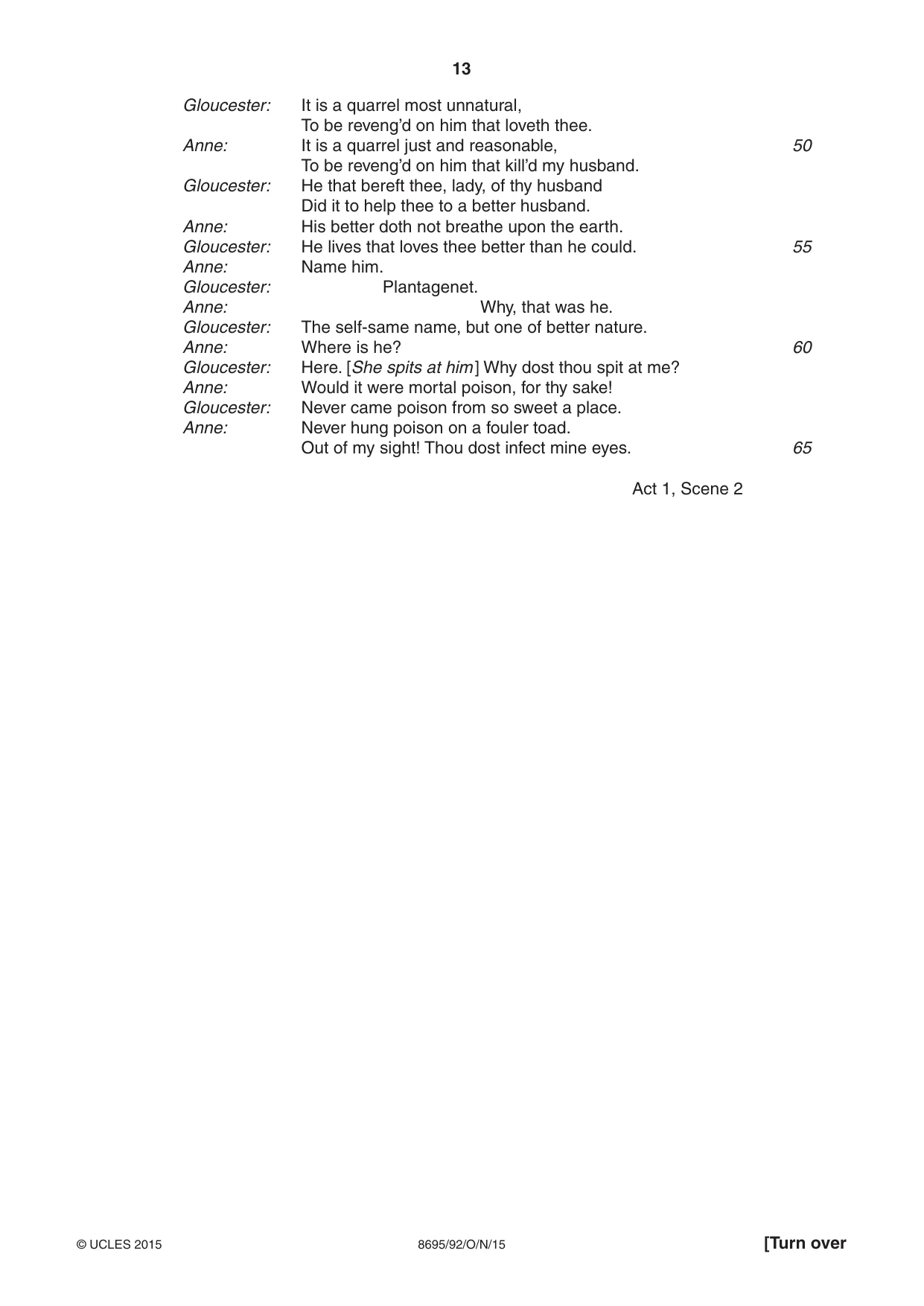
13 8695/92/O/N/15 © UCLES 2015 [Turn over Gloucester: It is a quarrel most unnatural, To be reveng’d on him that loveth thee. Anne: It is a quarrel just and reasonable, To be reveng’d on him that kill’d my husband. Gloucester: He that bereft thee, lady, of thy husband Did it to help thee to a better husband. Anne: His better doth not breathe upon the earth. Gloucester: He lives that loves thee better than he could. Anne: Name him. Gloucester: Plantagenet. Anne: Why, that was he. Gloucester: The self-same name, but one of better nature. Anne: Where is he? Gloucester: Here. [She spits at him ] Why dost thou spit at me? Anne: Would it were mortal poison, for thy sake! Gloucester: Never came poison from so sweet a place. Anne: Never hung poison on a fouler toad. Out of my sight! Thou dost infect mine eyes. Act 1, Scene 2 50 55 60 65
Question paper, page 14
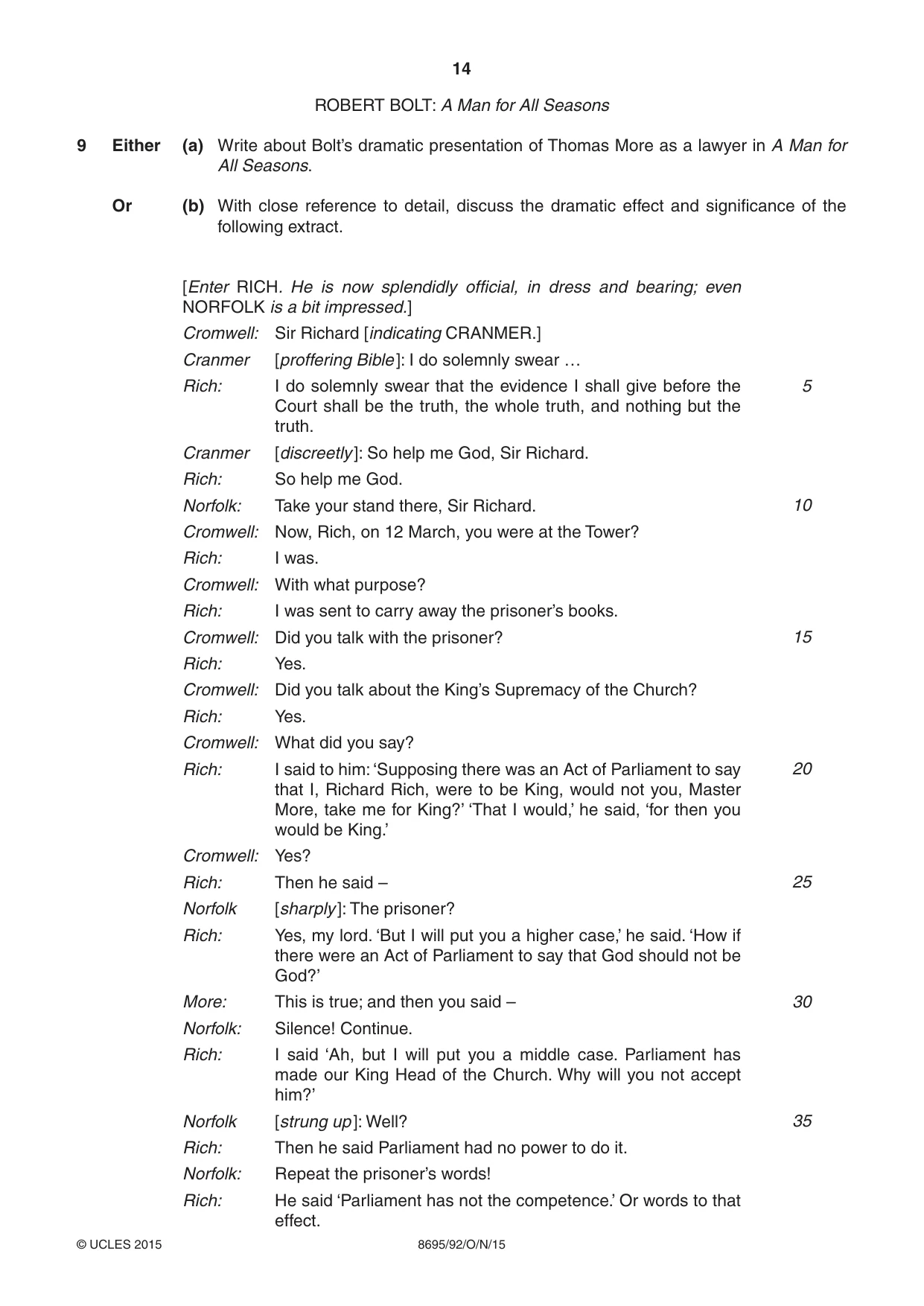
14 8695/92/O/N/15 © UCLES 2015 ROBERT BOLT: A Man for All Seasons 9 Either (a) Write about Bolt’s dramatic presentation of Thomas More as a lawyer in A Man for All Seasons. Or (b) With close reference to detail, discuss the dramatic effect and significance of the following extract. [Enter RICH. He is now splendidly official, in dress and bearing; even NORFOLK is a bit impressed.] Cromwell: Sir Richard [indicating CRANMER.] Cranmer [proffering Bible ]: I do solemnly swear … Rich: I do solemnly swear that the evidence I shall give before the Court shall be the truth, the whole truth, and nothing but the truth. Cranmer [discreetly ]: So help me God, Sir Richard. Rich: So help me God. Norfolk: Take your stand there, Sir Richard. Cromwell: Now, Rich, on 12 March, you were at the Tower? Rich: I was. Cromwell: With what purpose? Rich: I was sent to carry away the prisoner’s books. Cromwell: Did you talk with the prisoner? Rich: Yes. Cromwell: Did you talk about the King’s Supremacy of the Church? Rich: Yes. Cromwell: What did you say? Rich: I said to him: ‘Supposing there was an Act of Parliament to say that I, Richard Rich, were to be King, would not you, Master More, take me for King?’ ‘That I would,’ he said, ‘for then you would be King.’ Cromwell: Yes? Rich: Then he said – Norfolk [sharply ]: The prisoner? Rich: Yes, my lord. ‘But I will put you a higher case,’ he said. ‘How if there were an Act of Parliament to say that God should not be God?’ More: This is true; and then you said – Norfolk: Silence! Continue. Rich: I said ‘Ah, but I will put you a middle case. Parliament has made our King Head of the Church. Why will you not accept him?’ Norfolk [strung up ]: Well? Rich: Then he said Parliament had no power to do it. Norfolk: Repeat the prisoner’s words! Rich: He said ‘Parliament has not the competence.’ Or words to that effect. 5 10 15 20 25 30 35
Question paper, page 15
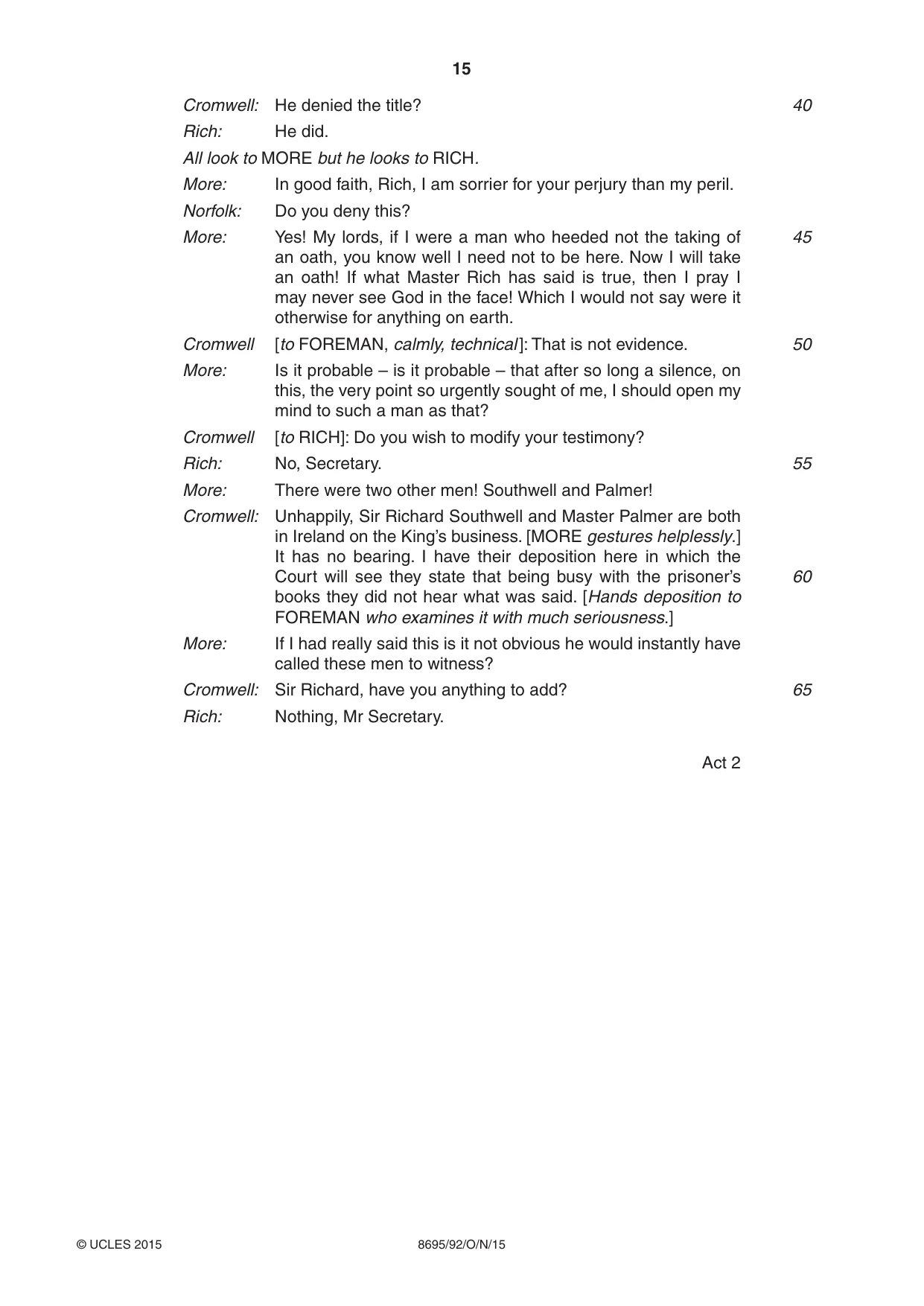
15 8695/92/O/N/15 © UCLES 2015 Cromwell: He denied the title? Rich: He did. All look to MORE but he looks to RICH. More: In good faith, Rich, I am sorrier for your perjury than my peril. Norfolk: Do you deny this? More: Yes! My lords, if I were a man who heeded not the taking of an oath, you know well I need not to be here. Now I will take an oath! If what Master Rich has said is true, then I pray I may never see God in the face! Which I would not say were it otherwise for anything on earth. Cromwell [to FOREMAN, calmly, technical ]: That is not evidence. More: Is it probable – is it probable – that after so long a silence, on this, the very point so urgently sought of me, I should open my mind to such a man as that? Cromwell [to RICH]: Do you wish to modify your testimony? Rich: No, Secretary. More: There were two other men! Southwell and Palmer! Cromwell: Unhappily, Sir Richard Southwell and Master Palmer are both in Ireland on the King’s business. [MORE gestures helplessly.] It has no bearing. I have their deposition here in which the Court will see they state that being busy with the prisoner’s books they did not hear what was said. [Hands deposition to FOREMAN who examines it with much seriousness.] More: If I had really said this is it not obvious he would instantly have called these men to witness? Cromwell: Sir Richard, have you anything to add? Rich: Nothing, Mr Secretary. Act 2 40 45 50 55 60 65
Question paper, page 16
16 8695/92/O/N/15 © UCLES 2015 BLANK PAGE Permission to reproduce items where third-party owned material protected by copyright is included has been sought and cleared where possible. Every reasonable effort has been made by the publisher (UCLES) to trace copyright holders, but if any items requiring clearance have unwittingly been included, the publisher will be pleased to make amends at the earliest possible opportunity. To avoid the issue of disclosure of answer-related information to candidates, all copyright acknowledgements are reproduced online in the Cambridge International Examinations Copyright Acknowledgements Booklet. This is produced for each series of examinations and is freely available to download at www.cie.org.uk after the live examination series. Cambridge International Examinations is part of the Cambridge Assessment Group. Cambridge Assessment is the brand name of University of Cambridge Local Examinations Syndicate (UCLES), which is itself a department of the University of Cambridge.
Mark scheme, page 1
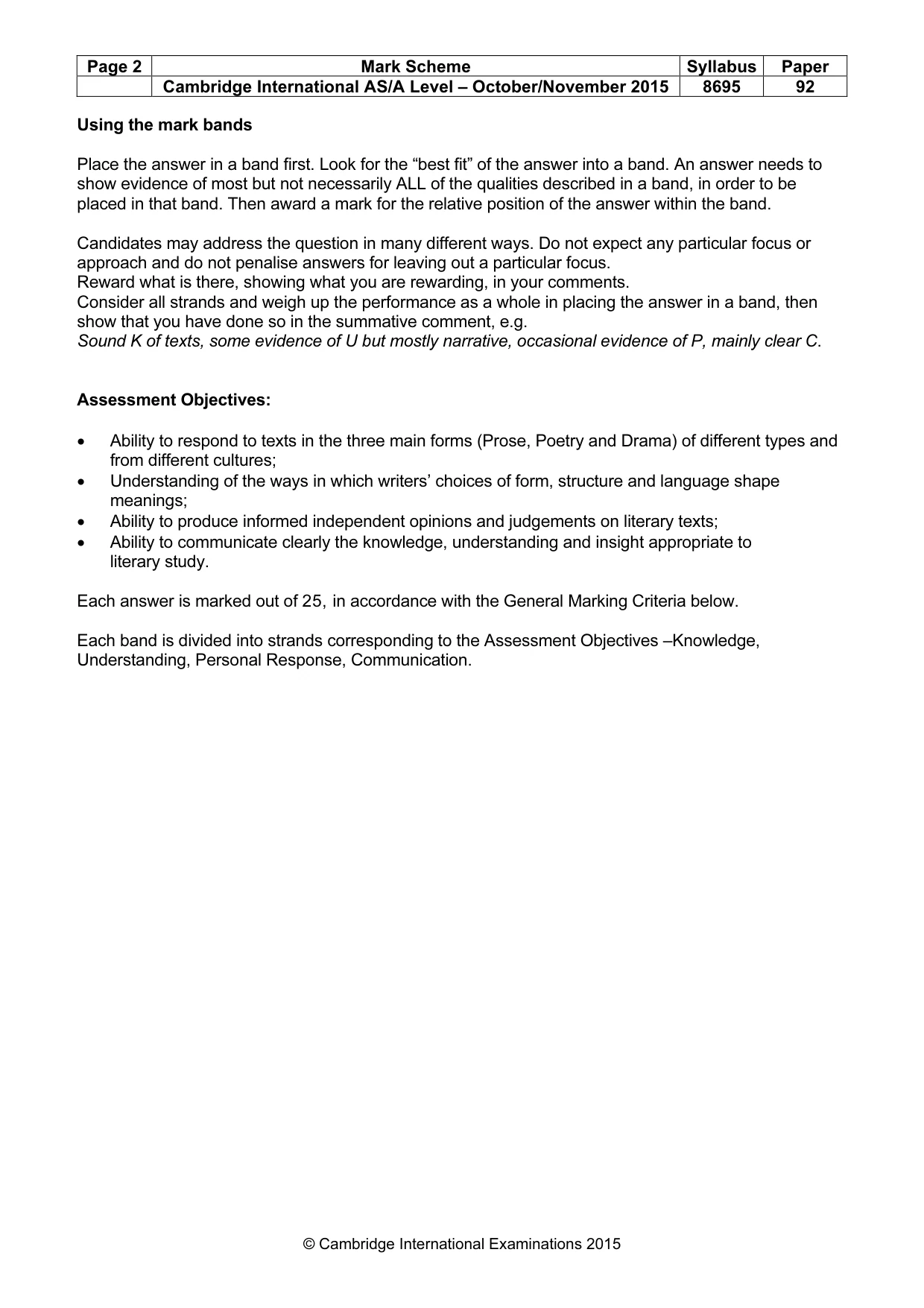
® IGCSE is the registered trademark of Cambridge International Examinations. CAMBRIDGE INTERNATIONAL EXAMINATIONS Cambridge International Advanced Subsidiary and Advanced Level MARK SCHEME for the October/November 2015 series 8695 LANGUAGE AND LITERATURE IN ENGLISH 8695/92 Paper 3 (Poetry, Prose and Drama), maximum raw mark 50 This mark scheme is published as an aid to teachers and candidates, to indicate the requirements of the examination. It shows the basis on which Examiners were instructed to award marks. It does not indicate the details of the discussions that took place at an Examiners’ meeting before marking began, which would have considered the acceptability of alternative answers. Mark schemes should be read in conjunction with the question paper and the Principal Examiner Report for Teachers. Cambridge will not enter into discussions about these mark schemes. Cambridge is publishing the mark schemes for the October/November 2015 series for most Cambridge IGCSE®, Cambridge International A and AS Level components and some Cambridge O Level components.
Mark scheme, page 2
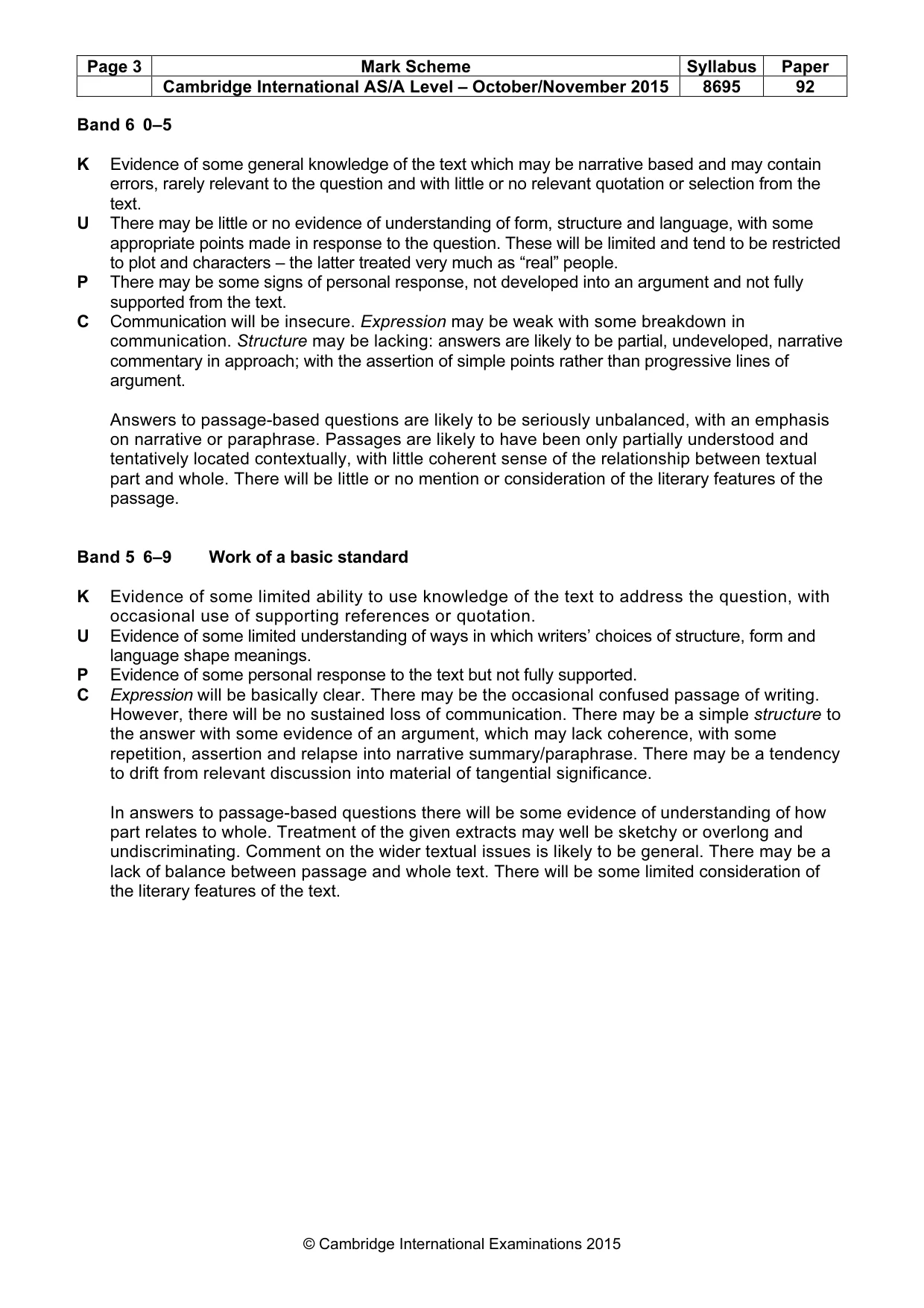
Page 2 Mark Scheme Syllabus Paper Cambridge International AS/A Level – October/November 2015 8695 92 © Cambridge International Examinations 2015 Using the mark bands Place the answer in a band first. Look for the “best fit” of the answer into a band. An answer needs to show evidence of most but not necessarily ALL of the qualities described in a band, in order to be placed in that band. Then award a mark for the relative position of the answer within the band. Candidates may address the question in many different ways. Do not expect any particular focus or approach and do not penalise answers for leaving out a particular focus. Reward what is there, showing what you are rewarding, in your comments. Consider all strands and weigh up the performance as a whole in placing the answer in a band, then show that you have done so in the summative comment, e.g. Sound K of texts, some evidence of U but mostly narrative, occasional evidence of P, mainly clear C. Assessment Objectives: • Ability to respond to texts in the three main forms (Prose, Poetry and Drama) of different types and from different cultures; • Understanding of the ways in which writers’ choices of form, structure and language shape meanings; • Ability to produce informed independent opinions and judgements on literary texts; • Ability to communicate clearly the knowledge, understanding and insight appropriate to literary study. Each answer is marked out of 25, in accordance with the General Marking Criteria below. Each band is divided into strands corresponding to the Assessment Objectives –Knowledge, Understanding, Personal Response, Communication.
Mark scheme, page 3
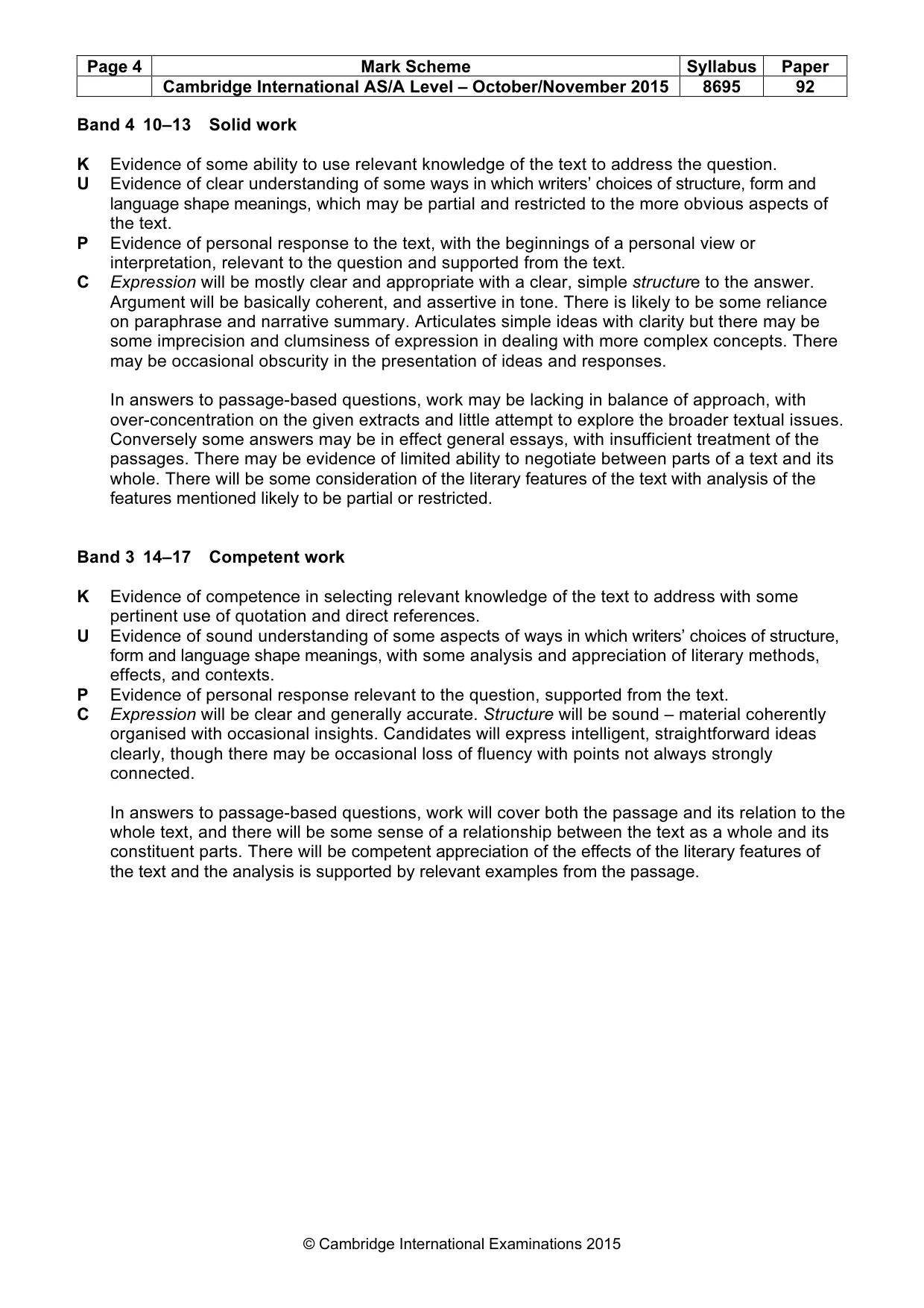
Page 3 Mark Scheme Syllabus Paper Cambridge International AS/A Level – October/November 2015 8695 92 © Cambridge International Examinations 2015 Band 6 0–5 K Evidence of some general knowledge of the text which may be narrative based and may contain errors, rarely relevant to the question and with little or no relevant quotation or selection from the text. U There may be little or no evidence of understanding of form, structure and language, with some appropriate points made in response to the question. These will be limited and tend to be restricted to plot and characters – the latter treated very much as “real” people. P There may be some signs of personal response, not developed into an argument and not fully supported from the text. C Communication will be insecure. Expression may be weak with some breakdown in communication. Structure may be lacking: answers are likely to be partial, undeveloped, narrative commentary in approach; with the assertion of simple points rather than progressive lines of argument. Answers to passage-based questions are likely to be seriously unbalanced, with an emphasis on narrative or paraphrase. Passages are likely to have been only partially understood and tentatively located contextually, with little coherent sense of the relationship between textual part and whole. There will be little or no mention or consideration of the literary features of the passage. Band 5 6–9 Work of a basic standard K Evidence of some limited ability to use knowledge of the text to address the question, with occasional use of supporting references or quotation. U Evidence of some limited understanding of ways in which writers’ choices of structure, form and language shape meanings. P Evidence of some personal response to the text but not fully supported. C Expression will be basically clear. There may be the occasional confused passage of writing. However, there will be no sustained loss of communication. There may be a simple structure to the answer with some evidence of an argument, which may lack coherence, with some repetition, assertion and relapse into narrative summary/paraphrase. There may be a tendency to drift from relevant discussion into material of tangential significance. In answers to passage-based questions there will be some evidence of understanding of how part relates to whole. Treatment of the given extracts may well be sketchy or overlong and undiscriminating. Comment on the wider textual issues is likely to be general. There may be a lack of balance between passage and whole text. There will be some limited consideration of the literary features of the text.
Mark scheme, page 4
Page 4 Mark Scheme Syllabus Paper Cambridge International AS/A Level – October/November 2015 8695 92 © Cambridge International Examinations 2015 Band 4 10–13 Solid work K Evidence of some ability to use relevant knowledge of the text to address the question. U Evidence of clear understanding of some ways in which writers’ choices of structure, form and language shape meanings, which may be partial and restricted to the more obvious aspects of the text. P Evidence of personal response to the text, with the beginnings of a personal view or interpretation, relevant to the question and supported from the text. C Expression will be mostly clear and appropriate with a clear, simple structure to the answer. Argument will be basically coherent, and assertive in tone. There is likely to be some reliance on paraphrase and narrative summary. Articulates simple ideas with clarity but there may be some imprecision and clumsiness of expression in dealing with more complex concepts. There may be occasional obscurity in the presentation of ideas and responses. In answers to passage-based questions, work may be lacking in balance of approach, with over-concentration on the given extracts and little attempt to explore the broader textual issues. Conversely some answers may be in effect general essays, with insufficient treatment of the passages. There may be evidence of limited ability to negotiate between parts of a text and its whole. There will be some consideration of the literary features of the text with analysis of the features mentioned likely to be partial or restricted. Band 3 14–17 Competent work K Evidence of competence in selecting relevant knowledge of the text to address with some pertinent use of quotation and direct references. U Evidence of sound understanding of some aspects of ways in which writers’ choices of structure, form and language shape meanings, with some analysis and appreciation of literary methods, effects, and contexts. P Evidence of personal response relevant to the question, supported from the text. C Expression will be clear and generally accurate. Structure will be sound – material coherently organised with occasional insights. Candidates will express intelligent, straightforward ideas clearly, though there may be occasional loss of fluency with points not always strongly connected. In answers to passage-based questions, work will cover both the passage and its relation to the whole text, and there will be some sense of a relationship between the text as a whole and its constituent parts. There will be competent appreciation of the effects of the literary features of the text and the analysis is supported by relevant examples from the passage.
Mark scheme, page 5
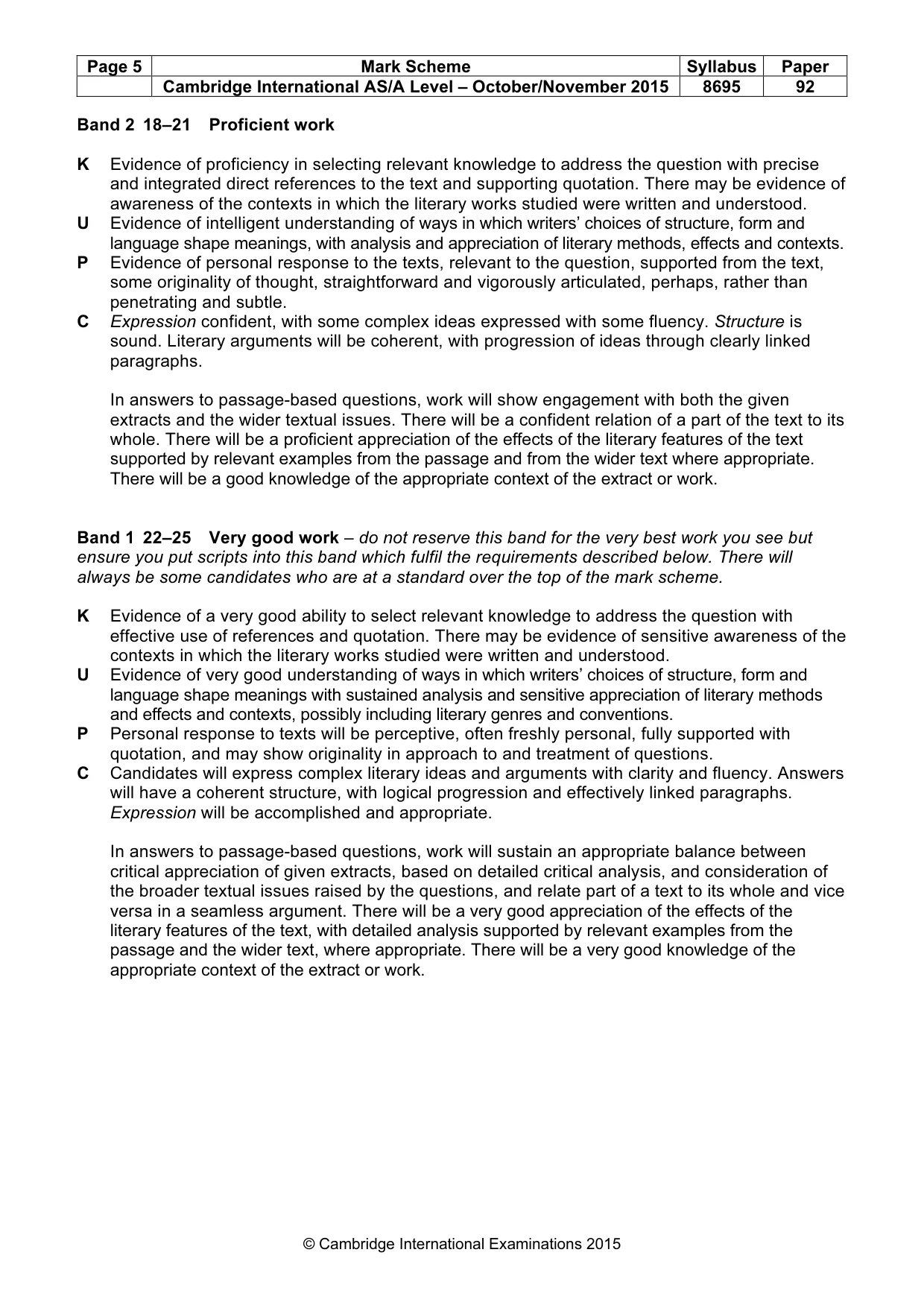
Page 5 Mark Scheme Syllabus Paper Cambridge International AS/A Level – October/November 2015 8695 92 © Cambridge International Examinations 2015 Band 2 18–21 Proficient work K Evidence of proficiency in selecting relevant knowledge to address the question with precise and integrated direct references to the text and supporting quotation. There may be evidence of awareness of the contexts in which the literary works studied were written and understood. U Evidence of intelligent understanding of ways in which writers’ choices of structure, form and language shape meanings, with analysis and appreciation of literary methods, effects and contexts. P Evidence of personal response to the texts, relevant to the question, supported from the text, some originality of thought, straightforward and vigorously articulated, perhaps, rather than penetrating and subtle. C Expression confident, with some complex ideas expressed with some fluency. Structure is sound. Literary arguments will be coherent, with progression of ideas through clearly linked paragraphs. In answers to passage-based questions, work will show engagement with both the given extracts and the wider textual issues. There will be a confident relation of a part of the text to its whole. There will be a proficient appreciation of the effects of the literary features of the text supported by relevant examples from the passage and from the wider text where appropriate. There will be a good knowledge of the appropriate context of the extract or work. Band 1 22–25 Very good work – do not reserve this band for the very best work you see but ensure you put scripts into this band which fulfil the requirements described below. There will always be some candidates who are at a standard over the top of the mark scheme. K Evidence of a very good ability to select relevant knowledge to address the question with effective use of references and quotation. There may be evidence of sensitive awareness of the contexts in which the literary works studied were written and understood. U Evidence of very good understanding of ways in which writers’ choices of structure, form and language shape meanings with sustained analysis and sensitive appreciation of literary methods and effects and contexts, possibly including literary genres and conventions. P Personal response to texts will be perceptive, often freshly personal, fully supported with quotation, and may show originality in approach to and treatment of questions. C Candidates will express complex literary ideas and arguments with clarity and fluency. Answers will have a coherent structure, with logical progression and effectively linked paragraphs. Expression will be accomplished and appropriate. In answers to passage-based questions, work will sustain an appropriate balance between critical appreciation of given extracts, based on detailed critical analysis, and consideration of the broader textual issues raised by the questions, and relate part of a text to its whole and vice versa in a seamless argument. There will be a very good appreciation of the effects of the literary features of the text, with detailed analysis supported by relevant examples from the passage and the wider text, where appropriate. There will be a very good knowledge of the appropriate context of the extract or work.
What you needed in this session
Cambridge’s own grade thresholds for 2015 Oct/Nov, Paper 9 · Variant 2. A higher threshold means an easier paper — the bar moves with how the cohort did.