Cambridge A Level English - Language and Literature (AS Level only, from 2016) 8695 — 2015 Oct/Nov Paper 9 · Variant 1
8695/91/O/N/15 · 50 marks · ≈56 min
The question paper and its mark scheme, free to read here and free to download. This is Cambridge’s own paper, exactly as it was sat.
Question paper20 pages





Mark scheme5 pages
Answers below. Sit the paper first if you are practising.
Paper as text
Question paper, page 1
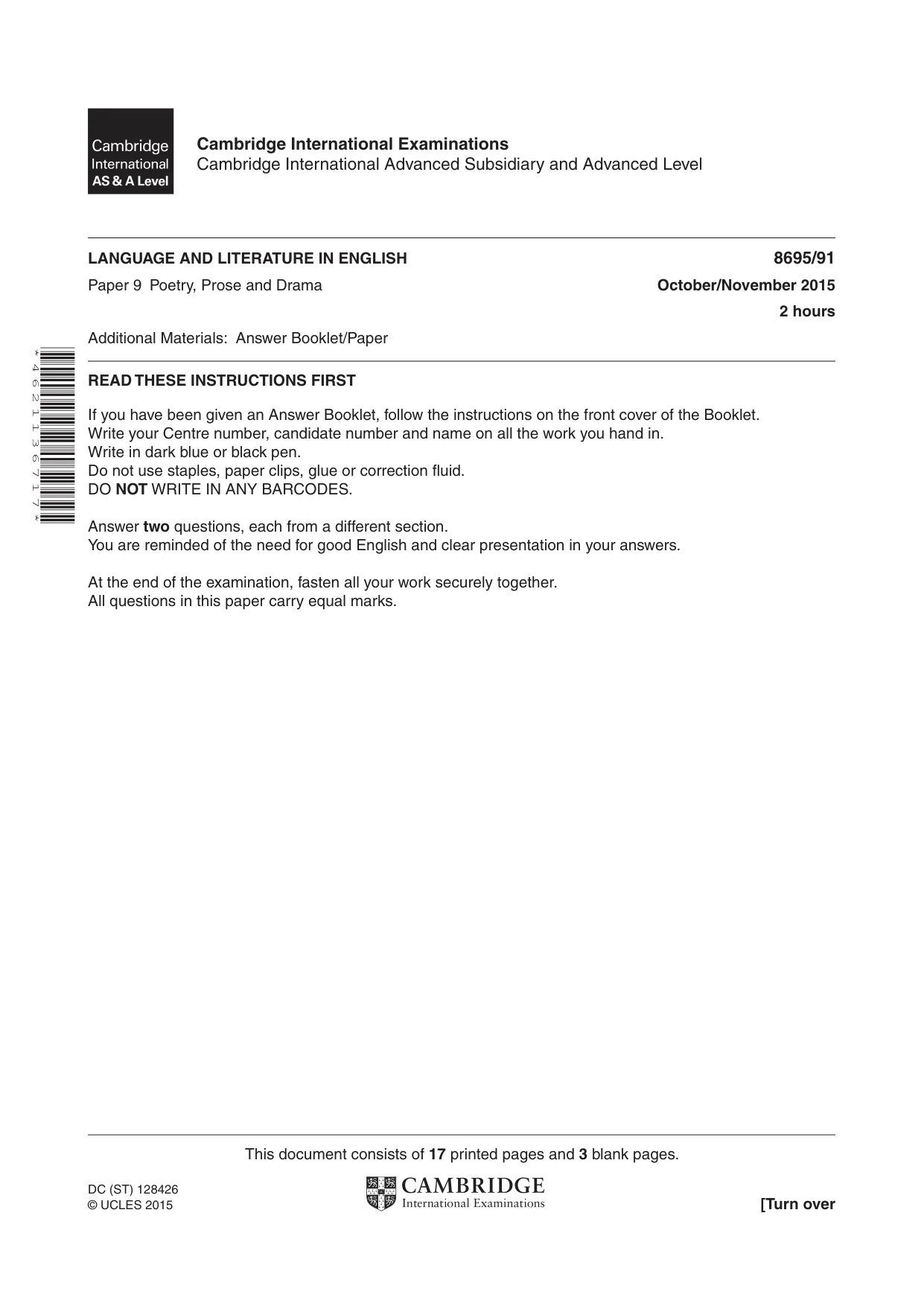
This document consists of 17 printed pages and 3 blank pages. DC (ST) 128426 © UCLES 2015 [Turn over Cambridge International Examinations Cambridge International Advanced Subsidiary and Advanced Level * 4 6 2 1 1 3 6 7 1 7 * LANGUAGE AND LITERATURE IN ENGLISH 8695/91 Paper 9 Poetry, Prose and Drama October/November 2015 2 hours Additional Materials: Answer Booklet/Paper READ THESE INSTRUCTIONS FIRST If you have been given an Answer Booklet, follow the instructions on the front cover of the Booklet. Write your Centre number, candidate number and name on all the work you hand in. Write in dark blue or black pen. Do not use staples, paper clips, glue or correction fluid. DO NOT WRITE IN ANY BARCODES. Answer two questions, each from a different section. You are reminded of the need for good English and clear presentation in your answers. At the end of the examination, fasten all your work securely together. All questions in this paper carry equal marks.
Question paper, page 2
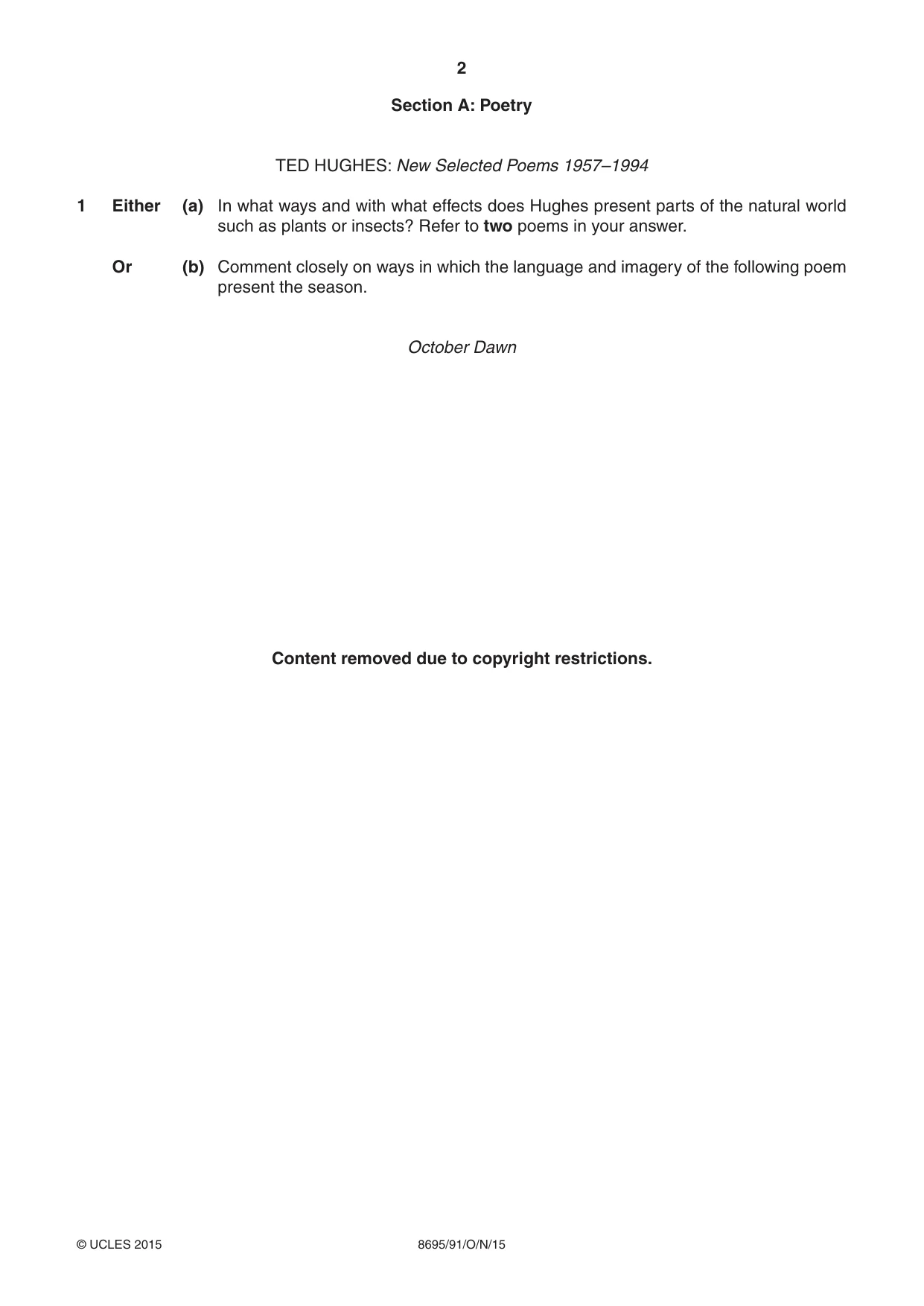
2 8695/91/O/N/15 © UCLES 2015 Section A: Poetry TED HUGHES: New Selected Poems 1957–1994 1 Either (a) In what ways and with what effects does Hughes present parts of the natural world such as plants or insects? Refer to two poems in your answer. Or (b) Comment closely on ways in which the language and imagery of the following poem present the season. October Dawn Content removed due to copyright restrictions.
Question paper, page 3
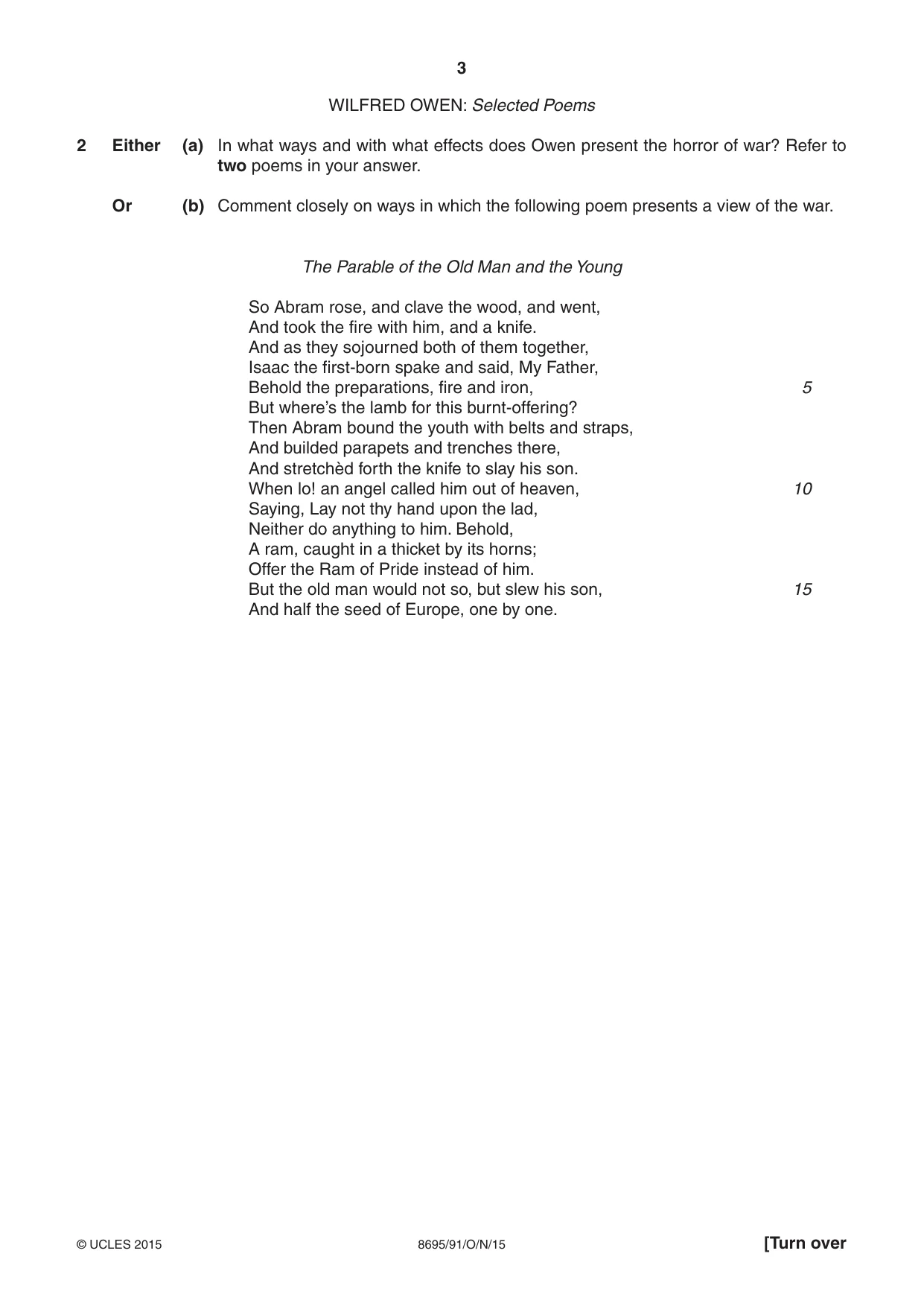
3 8695/91/O/N/15 © UCLES 2015 [Turn over 5 10 15 WILFRED OWEN: Selected Poems 2 Either (a) In what ways and with what effects does Owen present the horror of war? Refer to two poems in your answer. Or (b) Comment closely on ways in which the following poem presents a view of the war. The Parable of the Old Man and the Young So Abram rose, and clave the wood, and went, And took the fire with him, and a knife. And as they sojourned both of them together, Isaac the first-born spake and said, My Father, Behold the preparations, fire and iron, But where’s the lamb for this burnt-offering? Then Abram bound the youth with belts and straps, And builded parapets and trenches there, And stretchèd forth the knife to slay his son. When lo! an angel called him out of heaven, Saying, Lay not thy hand upon the lad, Neither do anything to him. Behold, A ram, caught in a thicket by its horns; Offer the Ram of Pride instead of him. But the old man would not so, but slew his son, And half the seed of Europe, one by one.
Question paper, page 4
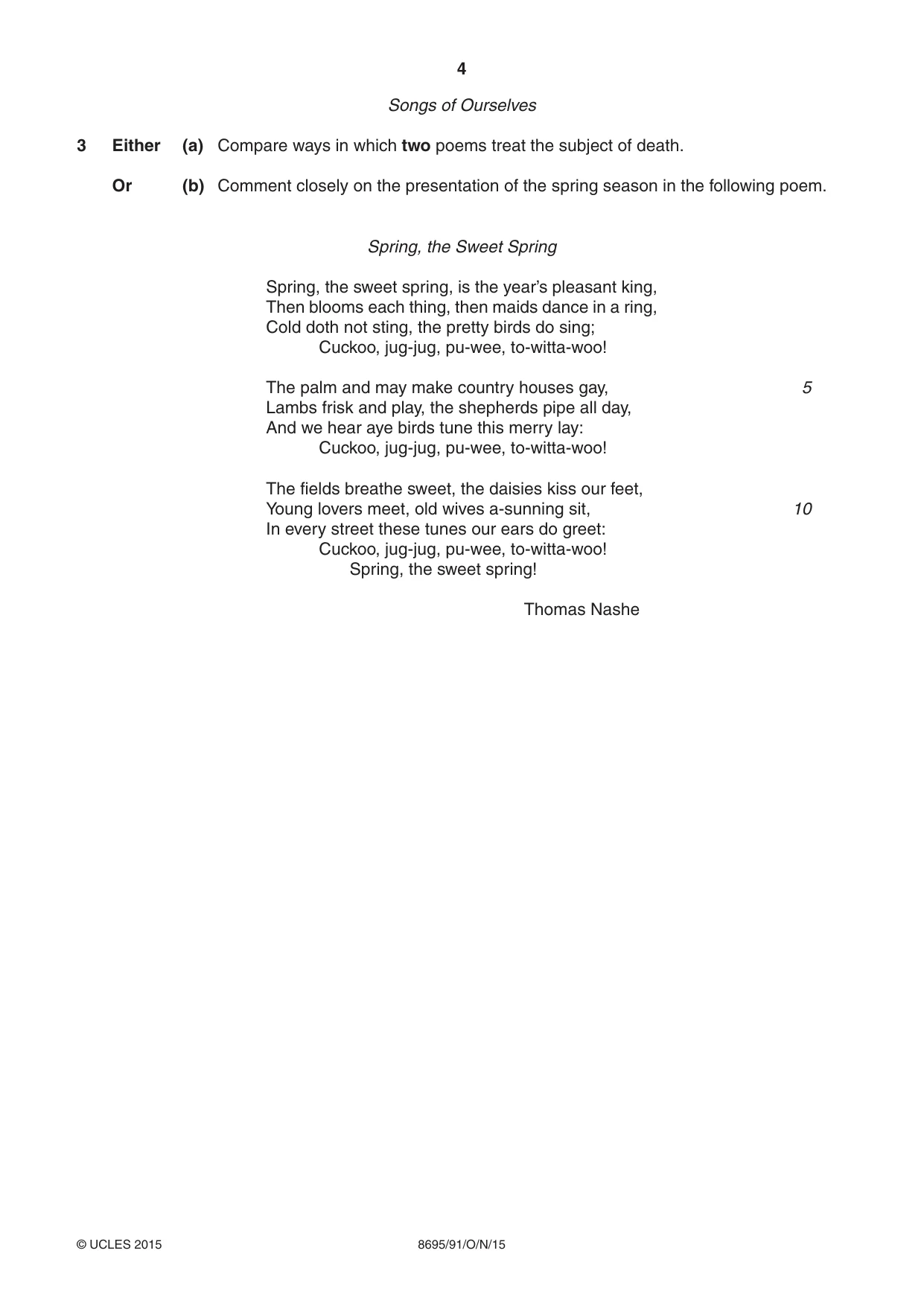
4 8695/91/O/N/15 © UCLES 2015 Songs of Ourselves 3 Either (a) Compare ways in which two poems treat the subject of death. Or (b) Comment closely on the presentation of the spring season in the following poem. Spring, the Sweet Spring Spring, the sweet spring, is the year’s pleasant king, Then blooms each thing, then maids dance in a ring, Cold doth not sting, the pretty birds do sing; Cuckoo, jug-jug, pu-wee, to-witta-woo! The palm and may make country houses gay, Lambs frisk and play, the shepherds pipe all day, And we hear aye birds tune this merry lay: Cuckoo, jug-jug, pu-wee, to-witta-woo! The fields breathe sweet, the daisies kiss our feet, Young lovers meet, old wives a-sunning sit, In every street these tunes our ears do greet: Cuckoo, jug-jug, pu-wee, to-witta-woo! Spring, the sweet spring! Thomas Nashe 5 10
Question paper, page 5
5 8695/91/O/N/15 © UCLES 2015 [Turn over Turn over for Question 4
Question paper, page 6
6 8695/91/O/N/15 © UCLES 2015 Section B: Prose CHIMAMANDA NGOZI ADICHIE: Half of a Yellow Sun 4 Either (a) In what ways and with what effects does the novel deal with different kinds of loyalty? Or (b) Discuss the following passage in detail, commenting on ways in which it presents the coup and Madu’s escape. ‘You remember my friend Ibrahim? From Sandhurst?’ Madu asked finally. Kainene nodded. ‘Ibrahim saved my life. He told me about the coup that morning. He was not directly involved, but most of them – the Northern officers – knew about it. He drove me to his cousin’s house, but I didn’t really understand until he asked his cousin to take me to the backyard, where he kept his domestic animals. I slept in the chicken house for two days.’ ‘No! Ekwuzina! ’ ‘And do you know that soldiers came to search his cousin’s house to look for me? Everybody knew how close Ibrahim and I were, and they suspected he helped me escape. They didn’t check the chicken house, though.’ Colonel Madu paused, nodding and looking into the distance. ‘I did not know how bad chicken shit smelt until I slept in it for three days. On the third day, Ibrahim sent me some kaftans and money through a small boy and asked me to leave right away. I dressed as a Fulani nomad and walked through the smaller villages because Ibrahim said that artillery soldiers had set up blocks on all the major roads in Kaduna. I was lucky to find a lorry driver, an Igbo man from Ohafia, who took me to Kafanchan. My cousin lives there. You know Onunkwo, don’t you?’ Madu did not wait for Kainene to respond. ‘He is the station master at the railway, and he told me that Northern soldiers had sealed off Makurdi Bridge. That bridge is a grave. They searched every single vehicle, they delayed passenger trains for up to eight hours, and they shot all the Igbo soldiers they discovered there and threw the bodies over. Many of the soldiers wore disguises, but they used their boots to find them.’ ‘What?’ Kainene leaned forwards. ‘Boots.’ Madu glanced at his shoes. ‘You know we soldiers wear boots all the time so they examined the feet of each man, and any Igbo man whose feet were clean and uncracked by harmattan, they took away and shot. They also examined their foreheads for signs of their skin being lighter from wearing a soldier’s beret.’ Madu shook his head. ‘Onunkwo advised me to wait for some days. He did not think I would make it across the bridge because they would recognize me easily under any disguise. So I stayed ten days in a village near Kafanchan. Onunkwo found me different houses to stay in. It was not safe to stay with him. Finally, he said he had found a driver, a good man from Nnewi, who would hide me in the water tank of his goods train. The man gave me a fireman’s suit to wear and I climbed into the tank. I had water up to my chin. Each time the train jerked, some of the water entered my nose. When we got to the bridge, the soldiers searched the train thoroughly. I heard footsteps on the lid of the tank and thought it was all over. But they did not open it and we passed. It was only then I knew that I was alive and I would survive. I came back to Umunnachi to find Adaobi wearing black.’ Kainene kept looking at Madu long after he finished speaking. There was another stretch of silence, which made Richard uncomfortable because he was not sure how to react, what expression to have. ‘Igbo soldiers and Northern soldiers can never live in the same barracks after this. It is impossible, impossible,’ Colonel Madu said. He had a glassy sheen in his eyes. ‘And Gowon cannot be head of state. They cannot impose Gowon on us as 5 10 15 20 25 30 35 40 45
Question paper, page 7
7 8695/91/O/N/15 © UCLES 2015 [Turn over head of state. It is not how things are done. There are others who are senior to him.’ ‘What are you going to do now?’ Kainene asked. Madu did not seem to hear her. ‘So many of us are gone,’ he said. ‘So many solid, good men – Udodi, Iloputaife, Okunweze, Okafor – and these were men who believed in Nigeria and didn’t care for tribe. After all, Udodi spoke better Hausa than he spoke Igbo, and look how they slaughtered him.’ He stood up and began to pace the room. ‘The problem was the ethnic balance policy. I was part of the commission that told our GOC that we should scrap it, that it was polarizing the army, that they should stop promoting Northerners who were not qualified. But our GOC said no, our British GOC.’ Madu turned and glanced at Richard. Chapter 9 50 55
Question paper, page 8
8 8695/91/O/N/15 © UCLES 2015 E.M. FORSTER: A Passage to India 5 Either (a) Discuss Forster’s presentation of Adela Quested’s experience of India. Or (b) Comment closely on ways in which the following passage presents Godbole. ‘Godbole!’ The old fellow put his hands together, and looked sly and charming. ‘Is Aziz innocent or guilty?’ ‘That is for the court to decide. The verdict will be in strict accordance with the evidence, I make no doubt.’ ‘Yes, yes, but your personal opinion. Here’s a man we both like, generally esteemed; he lives here quietly doing his work. Well, what’s one to make of it? Would he or would he not do such a thing?’ ‘Ah, that is rather a different question from your previous one, and also more difficult; I mean difficult in our philosophy. Dr Aziz is a most worthy young man, I have a great regard for him; but I think you are asking me whether the individual can commit good actions or evil actions, and that is rather difficult for us.’ He spoke without emotion and in short tripping syllables. ‘I ask you: did he do it or not? Is that plain? I know he didn’t, and from that I start. I mean to get at the true explanation in a couple of days. My last notion is that it’s the guide who went round with them. Malice on Miss Quested’s part – it couldn’t be that, though Hamidullah thinks so. She has certainly had some appalling experience. But you tell me, oh no – because good and evil are the same.’ ‘No, not exactly, please, according to our philosophy. Because nothing can be performed in isolation. All perform a good action, when one is performed, and when an evil action is performed, all perform it. To illustrate my meaning, let me take the case in point as an example. I am informed that an evil action was performed in the Marabar Hills, and that a highly esteemed English lady is now seriously ill in consequence. My answer to that is this: that action was performed by Dr Aziz.’ He stopped and sucked in his thin cheeks. ‘It was performed by the guide.’ He stopped again. ‘It was performed by you.’ Now he had an air of daring and of coyness. ‘It was performed by me.’ He looked shyly down the sleeve of his own coat. ‘And by my students. It was even performed by the lady herself. When evil occurs, it expresses the whole of the universe. Similarly when good occurs.’ ‘And similarly when suffering occurs, and so on and so forth, and everything is anything and nothing something,’ he muttered in his irritation, for he needed the solid ground. ‘Excuse me, you are now again changing the basis of our discussion. We were discussing good and evil. Suffering is merely a matter for the individual. If a young lady has sun-stroke, that is a matter of no significance to the universe. Oh no, not at all. Oh no, not the least. It is an isolated matter, it only concerns herself. If she thought her head did not ache, she would not be ill, and that would end it. But it is far otherwise in the case of good and evil. They are not what we think them, they are what they are, and each of us has contributed to both.’ ‘You’re preaching that evil and good are the same.’ ‘Oh no, excuse me once again. Good and evil are different, as their names imply. But, in my own humble opinion, they are both of them aspects of my Lord. He is present in the one, absent in the other, and the difference between presence and absence is great, as great as my feeble mind can grasp. Yet absence implies presence, absence is not non-existence, and we are therefore entitled to repeat, “Come, come, come, come.” ’ And in the same breath, as if to cancel any beauty his words might have contained, he added, ‘But did you have time to visit any of the interesting Marabar antiquities?’ Fielding was silent, trying to meditate and rest his brain. Chapter 19 5 10 15 20 25 30 35 40 45
Question paper, page 9
9 8695/91/O/N/15 © UCLES 2015 [Turn over Turn over for Question 6
Question paper, page 10
10 8695/91/O/N/15 © UCLES 2015 Stories of Ourselves 6 Either (a) Discuss ways in which the writers of two short stories present characters’ strong feelings. Or (b) Comment closely on ways in which the following passage presents the human race. Subservient Populations For instance, recent landings on their moon, much publicised by the geographical groupings that made them and followed breathlessly by the inhabitants of the whole planet, were by no means the first achieved by the said groupings. No, the first ‘moon landings’ were made in secret, in service of one grouping’s dominance in war over another, and the slavish populations knew nothing about them. A great many of the devices and machines used by the war departments are continuously under test in all parts of the earth and are always being glimpsed or even seen fully by inhabitants who report them to the authorities. But some of these devices are similar (in appearance, at least) to machines of extra-terrestrial origin. Citizens reporting ‘flying saucers’ – to use one of their descriptive phrases – may as well have seen the latest of their own grouping’s machines on test as one of our observation craft or observation craft from the Jupiter family. Such a citizen will find that after reaching a certain level in the hierarchies of officialdom, silence will blanket him and his observations – he will in various ways be repulsed, ridiculed or even threatened. As usually happens, a council of highly placed officials was recently ordered to take evidence and report on the by now innumerable sightings of ‘unidentified flying objects’, but this council finished its deliberations with public words that left the situation exactly as it was before. The official report nowhere stated that there was a minority report by some of its own number. This is the level of behaviour in their public representatives that is tolerated by them. Large numbers, everywhere on the planet, see craft like ours, or like other planets’ craft or war machines from their own or other geographical areas. But such is the atmosphere created by the war departments that dominate everything that these individuals are regarded as mentally inadequate or deluded. Until one of them has actually seen a machine or a spacecraft, he tends to believe that anyone who claims he has is deranged. Knowing this, when he does see something, he often does not say so. But so many individuals now have seen things for themselves that there are everywhere all kinds of dissident or sullen subgroupings. These are of all ages and they cut across the largest and most widespread subculture of them all, that of the young of the species who have grown up in a society of total war-preparedness, who are naturally reluctant to face a future that can only mean early death or maiming and who react in the way mentioned earlier, with a disinclination to take part in the administration of their various societies. The older ones seem much more able to delude themselves, to use words like peace when engaged in warlike behaviour, to identify with their geographical areas. The young ones are clear-minded, more easily see the planet as a single organism, but are also more passive and hopeless. We put forward the suggestion that the greater, or at least more purposive, energy of the older ones may be because of their comparative narrowness and identification with smaller ideas. We are now able to explain why the young we met on the night we landed moved away. Some had already had the experience of insisting to the authorities that they had seen strange machines and objects of various kinds and of being discouraged or threatened. They would be prepared to publicise what they had seen in their own news sheets or to spread it by word of mouth; but, unlike their elders, most of them seem unable to understand the extent to which they are subjugated to the needs of war, they would never put themselves in a position where their authorities could capture or question them. But the older ones of the area who had seen our previous 5 10 15 20 25 30 35 40 45
Question paper, page 11
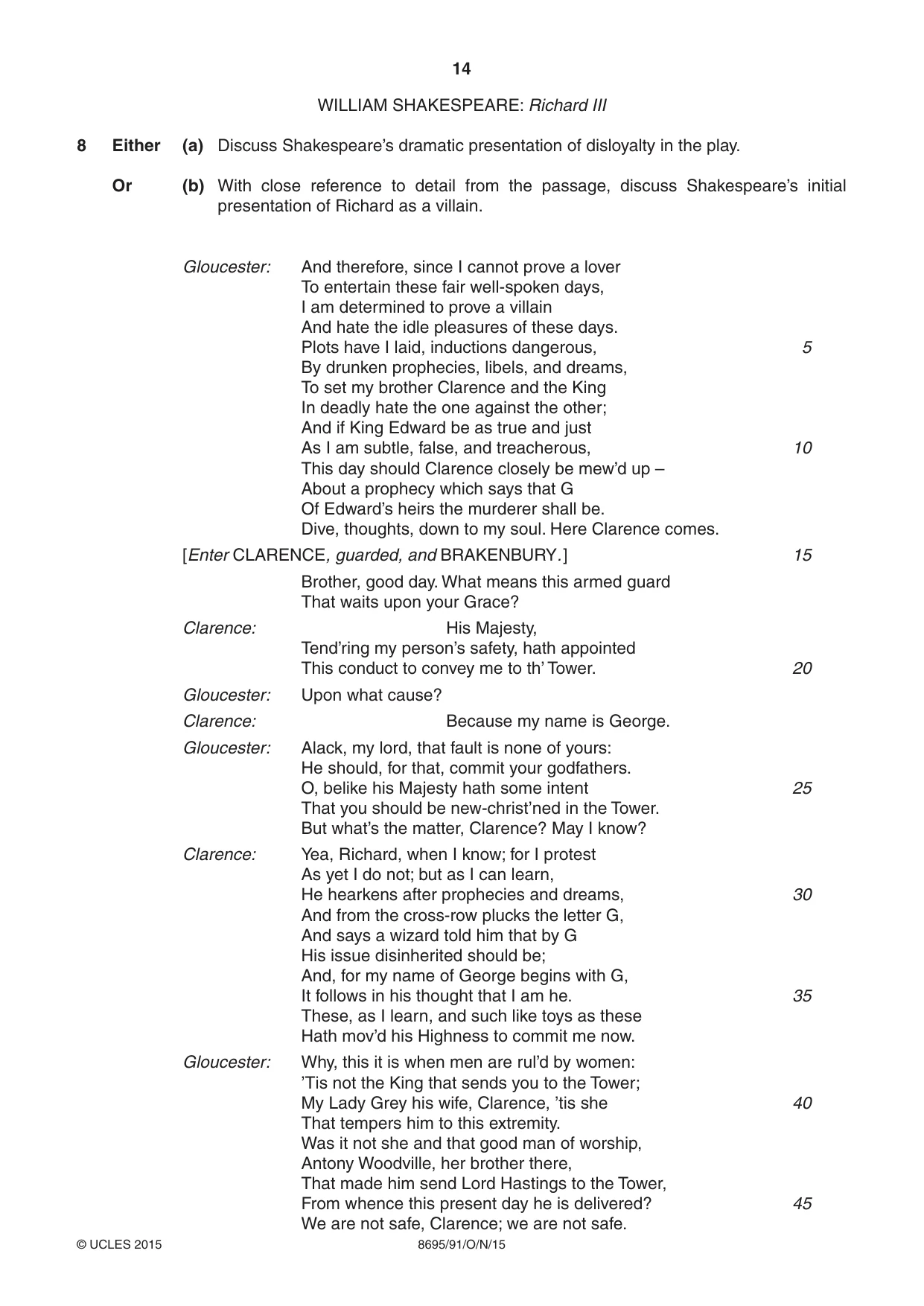
11 8695/91/O/N/15 © UCLES 2015 [Turn over 12 craft, which had all landed there, had evolved a different attitude. Some had reported what they had seen and had been discouraged. One or two, persisting, had been described as mad and had been threatened with incarceration. But, on the whole, they had taken the attitude of the authorities as a directive to mind their own business. Discussing it among themselves, they had agreed to keep watch on their own account, not saying too much about what they saw. In this group are two spies, who report to the war departments on what is seen and on the reactions of their fellow agriculturalists. Report on the Threatened City 50
Question paper, page 12
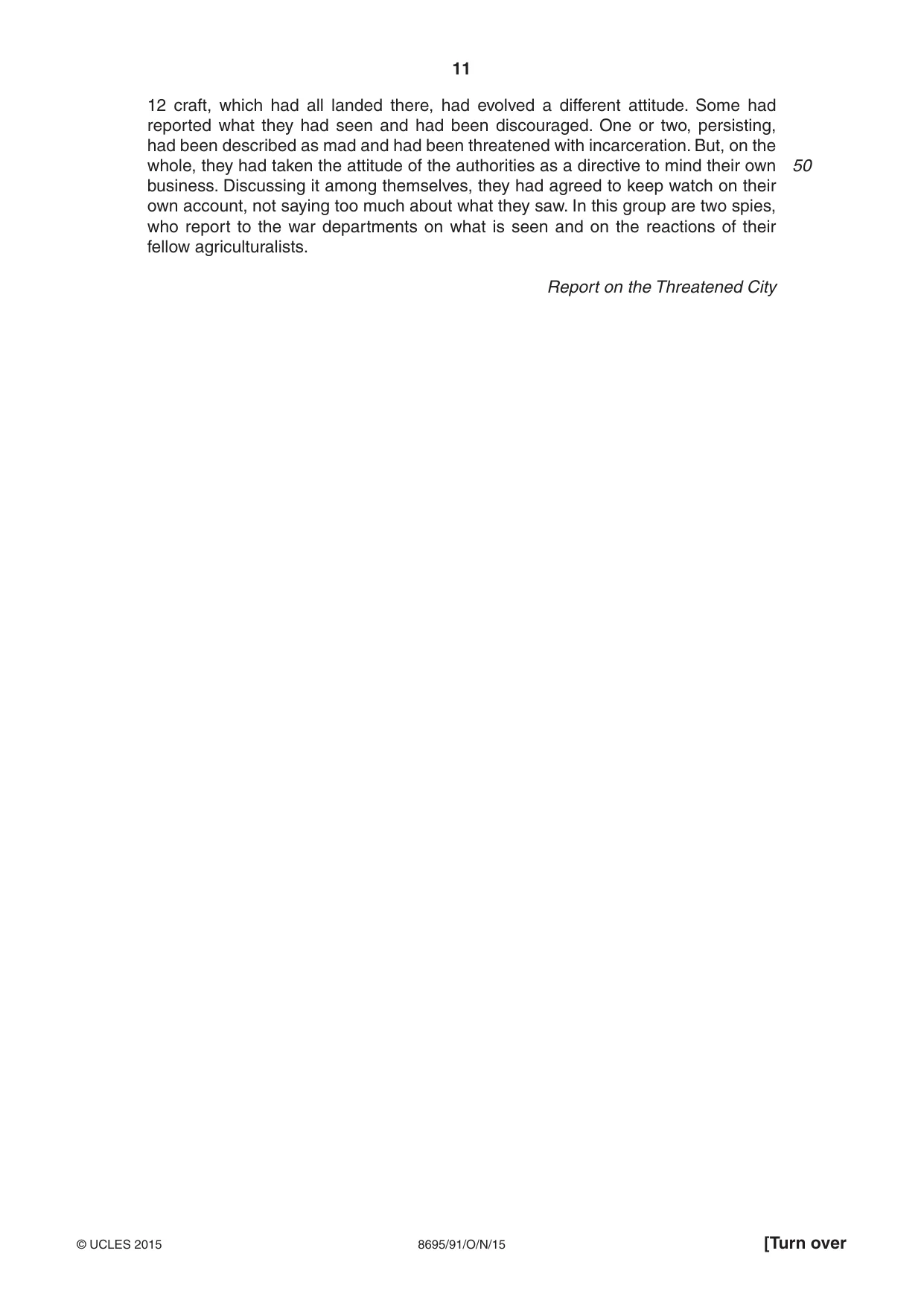
12 8695/91/O/N/15 © UCLES 2015 Section C: Drama EDWARD ALBEE: Who’s Afraid of Virginia Woolf? 7 Either (a) Discuss the role and significance of Honey for the action of the play as a whole. Or (b) With close reference to detail, discuss Albee’s creation of dramatic tension between the characters at this point in the play. George [composure seemingly recovered, but there is a great nervous intensity ]: Well! That’s one game. What shall we do now, hunh? Content removed due to copyright restrictions.
Question paper, page 13
13 8695/91/O/N/15 © UCLES 2015 [Turn over George: No. Act 2 Content removed due to copyright restrictions.
Question paper, page 14
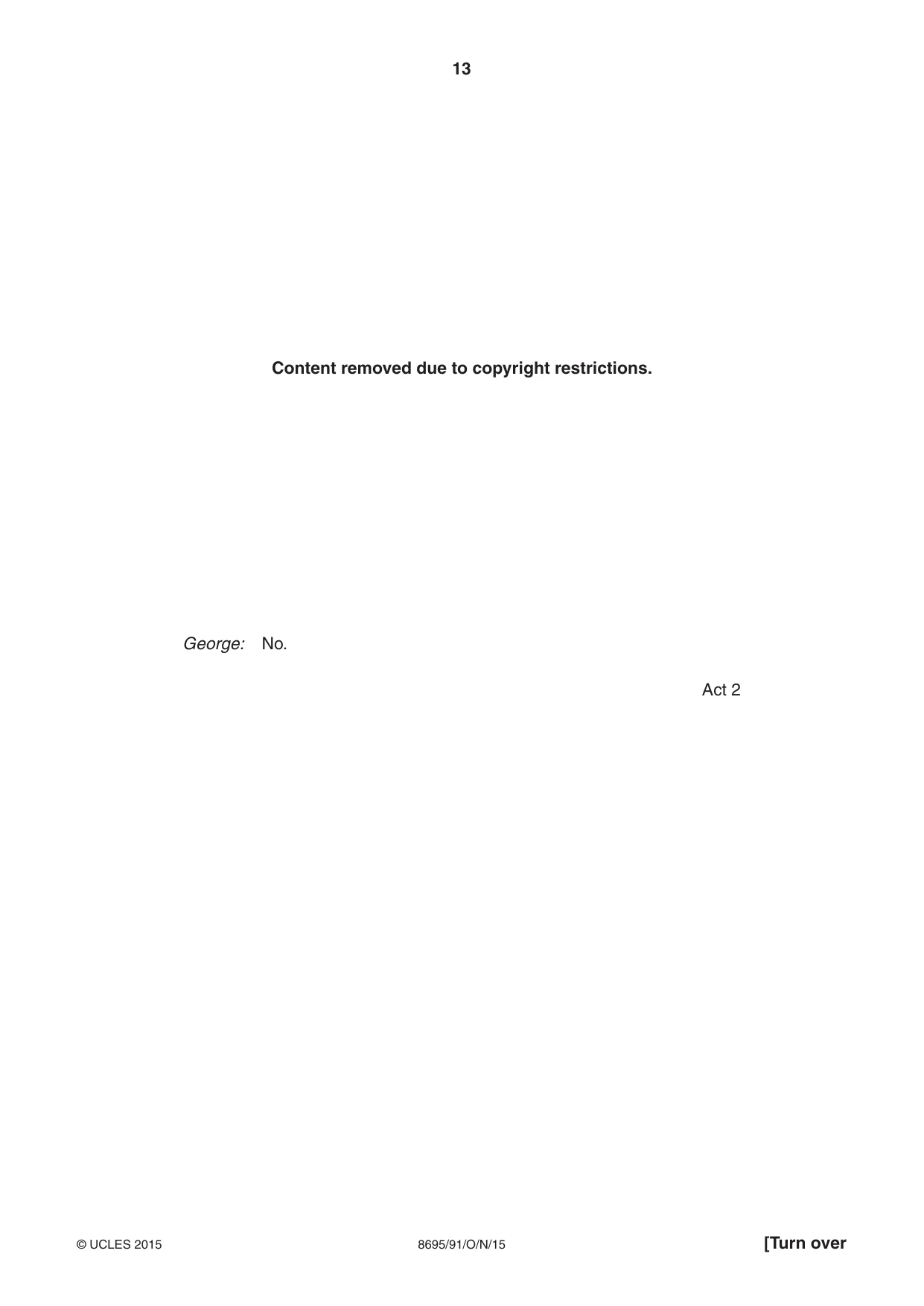
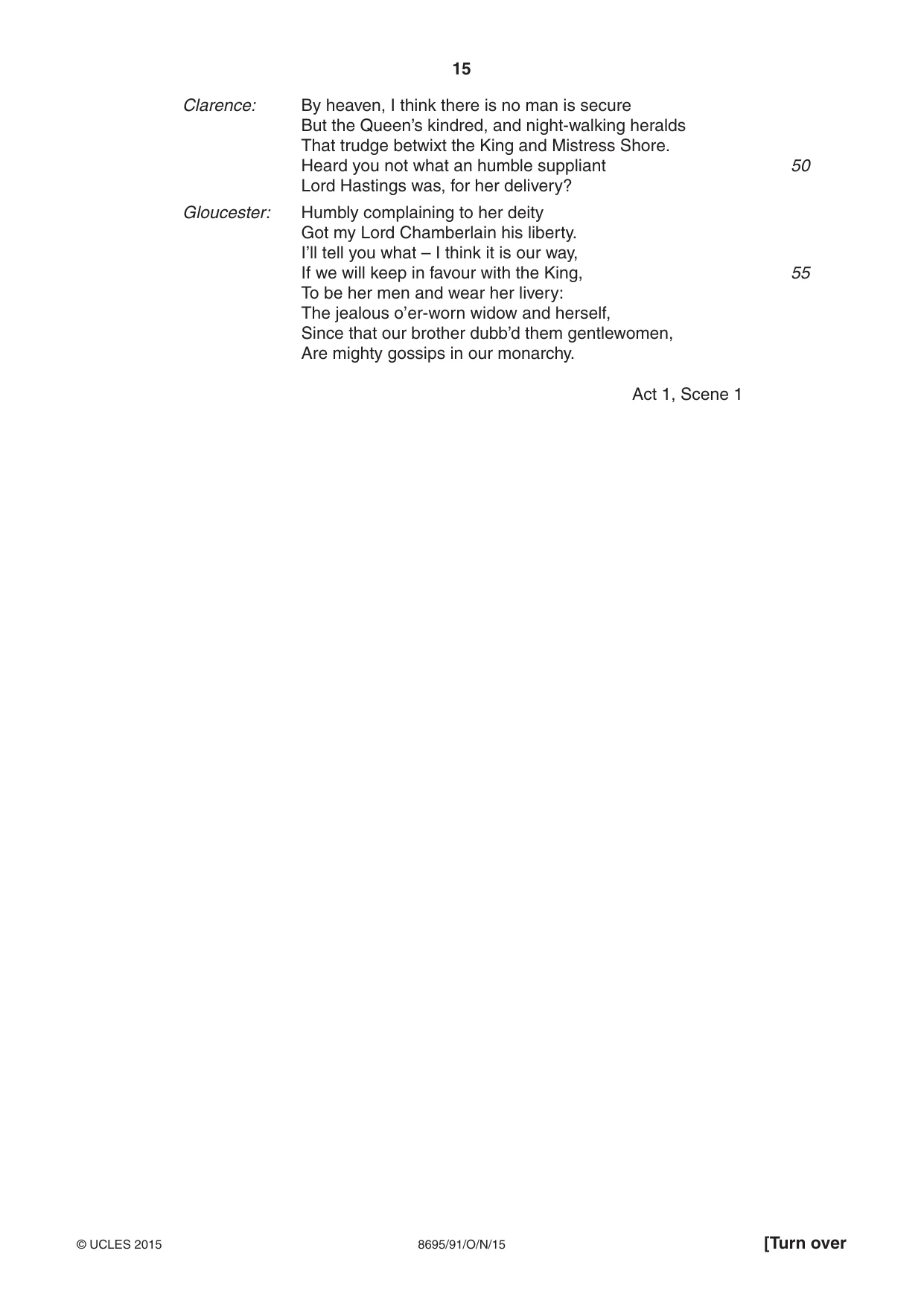
14 8695/91/O/N/15 © UCLES 2015 WILLIAM SHAKESPEARE: Richard III 8 Either (a) Discuss Shakespeare’s dramatic presentation of disloyalty in the play. Or (b) With close reference to detail from the passage, discuss Shakespeare’s initial presentation of Richard as a villain. Gloucester: And therefore, since I cannot prove a lover To entertain these fair well-spoken days, I am determined to prove a villain And hate the idle pleasures of these days. Plots have I laid, inductions dangerous, By drunken prophecies, libels, and dreams, To set my brother Clarence and the King In deadly hate the one against the other; And if King Edward be as true and just As I am subtle, false, and treacherous, This day should Clarence closely be mew’d up – About a prophecy which says that G Of Edward’s heirs the murderer shall be. Dive, thoughts, down to my soul. Here Clarence comes. [Enter CLARENCE, guarded, and BRAKENBURY. ] Brother, good day. What means this armed guard That waits upon your Grace? Clarence: His Majesty, Tend’ring my person’s safety, hath appointed This conduct to convey me to th’ Tower. Gloucester: Upon what cause? Clarence: Because my name is George. Gloucester: Alack, my lord, that fault is none of yours: He should, for that, commit your godfathers. O, belike his Majesty hath some intent That you should be new-christ’ned in the Tower. But what’s the matter, Clarence? May I know? Clarence: Yea, Richard, when I know; for I protest As yet I do not; but as I can learn, He hearkens after prophecies and dreams, And from the cross-row plucks the letter G, And says a wizard told him that by G His issue disinherited should be; And, for my name of George begins with G, It follows in his thought that I am he. These, as I learn, and such like toys as these Hath mov’d his Highness to commit me now. Gloucester: Why, this it is when men are rul’d by women: ’Tis not the King that sends you to the Tower; My Lady Grey his wife, Clarence, ’tis she That tempers him to this extremity. Was it not she and that good man of worship, Antony Woodville, her brother there, That made him send Lord Hastings to the Tower, From whence this present day he is delivered? We are not safe, Clarence; we are not safe. 5 10 15 20 25 30 35 40 45
Question paper, page 15
15 8695/91/O/N/15 © UCLES 2015 [Turn over Clarence: By heaven, I think there is no man is secure But the Queen’s kindred, and night-walking heralds That trudge betwixt the King and Mistress Shore. Heard you not what an humble suppliant Lord Hastings was, for her delivery? Gloucester: Humbly complaining to her deity Got my Lord Chamberlain his liberty. I’ll tell you what – I think it is our way, If we will keep in favour with the King, To be her men and wear her livery: The jealous o’er-worn widow and herself, Since that our brother dubb’d them gentlewomen, Are mighty gossips in our monarchy. Act 1, Scene 1 50 55
Question paper, page 16
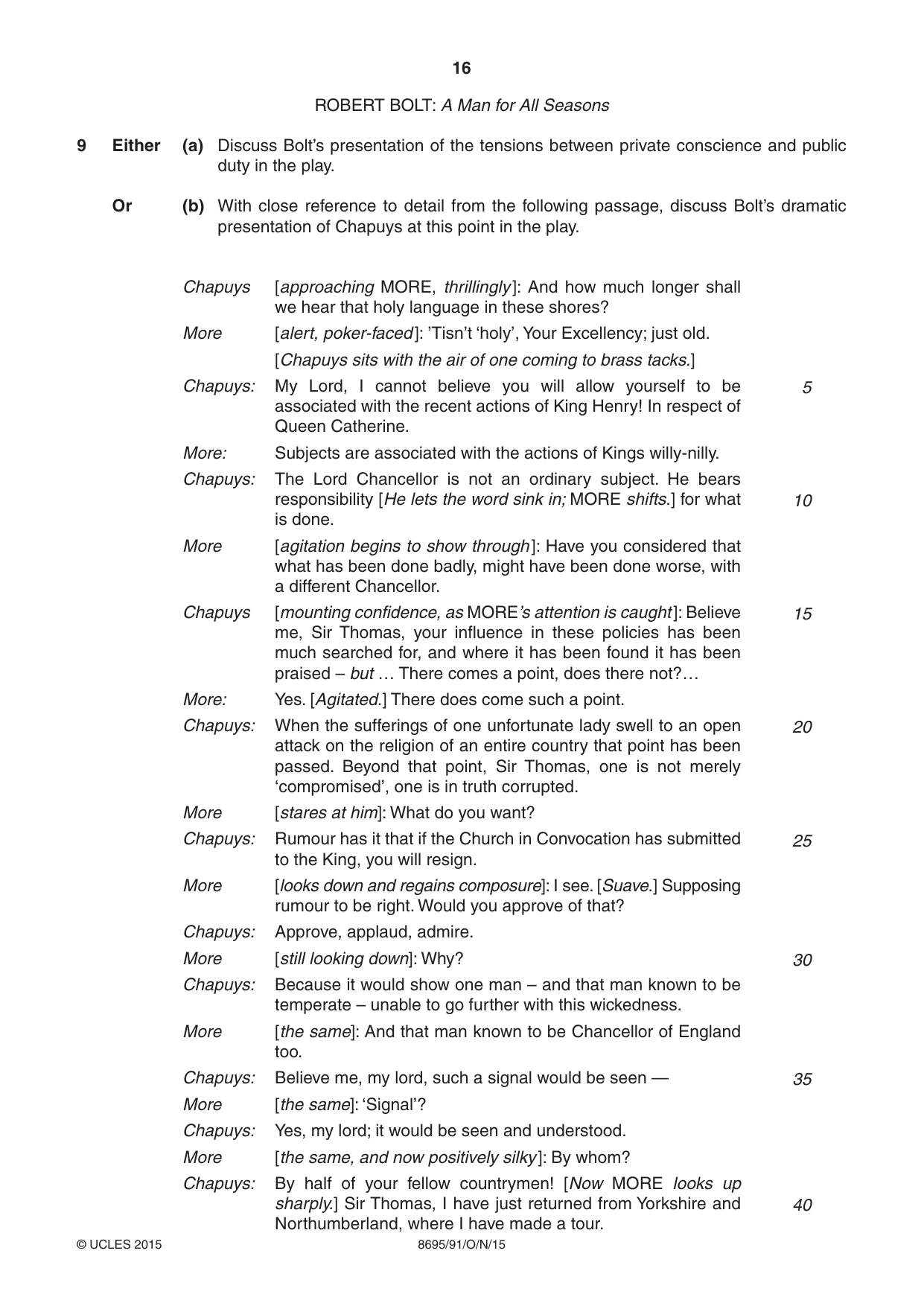
16 8695/91/O/N/15 © UCLES 2015 ROBERT BOLT: A Man for All Seasons 9 Either (a) Discuss Bolt’s presentation of the tensions between private conscience and public duty in the play. Or (b) With close reference to detail from the following passage, discuss Bolt’s dramatic presentation of Chapuys at this point in the play. Chapuys [approaching MORE, thrillingly ]: And how much longer shall we hear that holy language in these shores? More [alert, poker-faced ]: ’Tisn’t ‘holy’, Your Excellency; just old. [Chapuys sits with the air of one coming to brass tacks.] Chapuys: My Lord, I cannot believe you will allow yourself to be associated with the recent actions of King Henry! In respect of Queen Catherine. More: Subjects are associated with the actions of Kings willy-nilly. Chapuys: The Lord Chancellor is not an ordinary subject. He bears responsibility [He lets the word sink in; MORE shifts.] for what is done. More [agitation begins to show through ]: Have you considered that what has been done badly, might have been done worse, with a different Chancellor. Chapuys [mounting confidence, as MORE’s attention is caught ]: Believe me, Sir Thomas, your influence in these policies has been much searched for, and where it has been found it has been praised – but … There comes a point, does there not?… More: Yes. [Agitated.] There does come such a point. Chapuys: When the sufferings of one unfortunate lady swell to an open attack on the religion of an entire country that point has been passed. Beyond that point, Sir Thomas, one is not merely ‘compromised’, one is in truth corrupted. More [stares at him]: What do you want? Chapuys: Rumour has it that if the Church in Convocation has submitted to the King, you will resign. More [looks down and regains composure]: I see. [Suave.] Supposing rumour to be right. Would you approve of that? Chapuys: Approve, applaud, admire. More [still looking down]: Why? Chapuys: Because it would show one man – and that man known to be temperate – unable to go further with this wickedness. More [the same]: And that man known to be Chancellor of England too. Chapuys: Believe me, my lord, such a signal would be seen — More [the same]: ‘Signal’? Chapuys: Yes, my lord; it would be seen and understood. More [the same, and now positively silky ]: By whom? Chapuys: By half of your fellow countrymen! [Now MORE looks up sharply.] Sir Thomas, I have just returned from Yorkshire and Northumberland, where I have made a tour. 5 10 15 20 25 30 35 40
Question paper, page 17
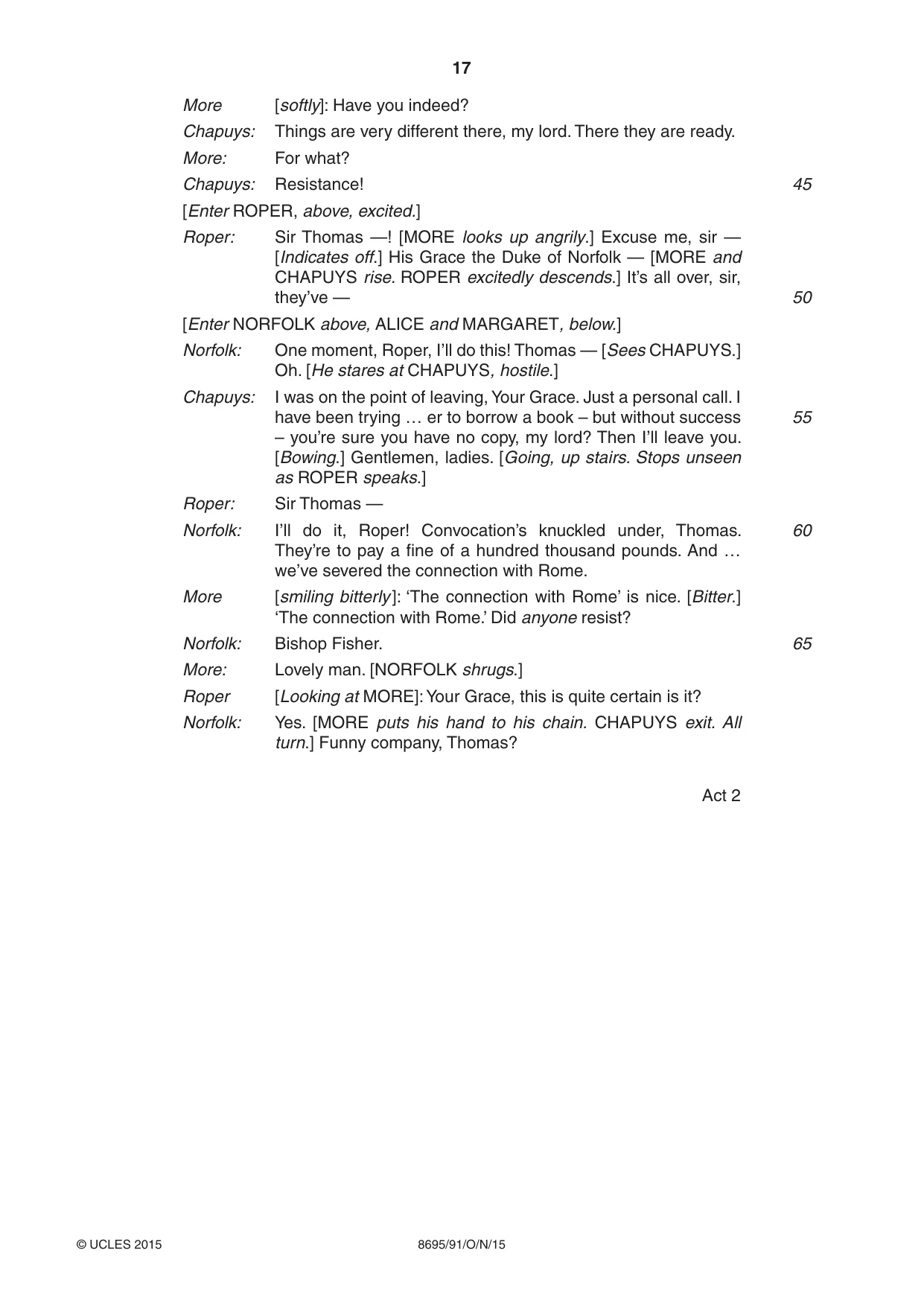
17 8695/91/O/N/15 © UCLES 2015 More [softly]: Have you indeed? Chapuys: Things are very different there, my lord. There they are ready. More: For what? Chapuys: Resistance! [Enter ROPER, above, excited.] Roper: Sir Thomas —! [MORE looks up angrily.] Excuse me, sir — [Indicates off.] His Grace the Duke of Norfolk — [MORE and CHAPUYS rise. ROPER excitedly descends.] It’s all over, sir, they’ve — [Enter NORFOLK above, ALICE and MARGARET, below.] Norfolk: One moment, Roper, I’ll do this! Thomas — [Sees CHAPUYS.] Oh. [He stares at CHAPUYS, hostile.] Chapuys: I was on the point of leaving, Your Grace. Just a personal call. I have been trying … er to borrow a book – but without success – you’re sure you have no copy, my lord? Then I’ll leave you. [Bowing.] Gentlemen, ladies. [Going, up stairs. Stops unseen as ROPER speaks.] Roper: Sir Thomas — Norfolk: I’ll do it, Roper! Convocation’s knuckled under, Thomas. They’re to pay a fine of a hundred thousand pounds. And … we’ve severed the connection with Rome. More [smiling bitterly ]: ‘The connection with Rome’ is nice. [Bitter.] ‘The connection with Rome.’ Did anyone resist? Norfolk: Bishop Fisher. More: Lovely man. [NORFOLK shrugs.] Roper [Looking at MORE]: Your Grace, this is quite certain is it? Norfolk: Yes. [MORE puts his hand to his chain. CHAPUYS exit. All turn.] Funny company, Thomas? Act 2 45 50 55 60 65
Question paper, page 18
18 8695/91/O/N/15 © UCLES 2015 BLANK PAGE
Question paper, page 19
19 8695/91/O/N/15 © UCLES 2015 BLANK PAGE
Question paper, page 20
20 8695/91/O/N/15 © UCLES 2015 BLANK PAGE Permission to reproduce items where third-party owned material protected by copyright is included has been sought and cleared where possible. Every reasonable effort has been made by the publisher (UCLES) to trace copyright holders, but if any items requiring clearance have unwittingly been included, the publisher will be pleased to make amends at the earliest possible opportunity. To avoid the issue of disclosure of answer-related information to candidates, all copyright acknowledgements are reproduced online in the Cambridge International Examinations Copyright Acknowledgements Booklet. This is produced for each series of examinations and is freely available to download at www.cie.org.uk after the live examination series. Cambridge International Examinations is part of the Cambridge Assessment Group. Cambridge Assessment is the brand name of University of Cambridge Local Examinations Syndicate (UCLES), which is itself a department of the University of Cambridge.
Mark scheme, page 1
® IGCSE is the registered trademark of Cambridge International Examinations. CAMBRIDGE INTERNATIONAL EXAMINATIONS Cambridge International Advanced Subsidiary and Advanced Level MARK SCHEME for the October/November 2015 series 8695 LANGUAGE AND LITERATURE IN ENGLISH 8695/91 Paper 3 (Poetry, Prose and Drama), maximum raw mark 50 This mark scheme is published as an aid to teachers and candidates, to indicate the requirements of the examination. It shows the basis on which Examiners were instructed to award marks. It does not indicate the details of the discussions that took place at an Examiners’ meeting before marking began, which would have considered the acceptability of alternative answers. Mark schemes should be read in conjunction with the question paper and the Principal Examiner Report for Teachers. Cambridge will not enter into discussions about these mark schemes. Cambridge is publishing the mark schemes for the October/November 2015 series for most Cambridge IGCSE®, Cambridge International A and AS Level components and some Cambridge O Level components.
Mark scheme, page 2
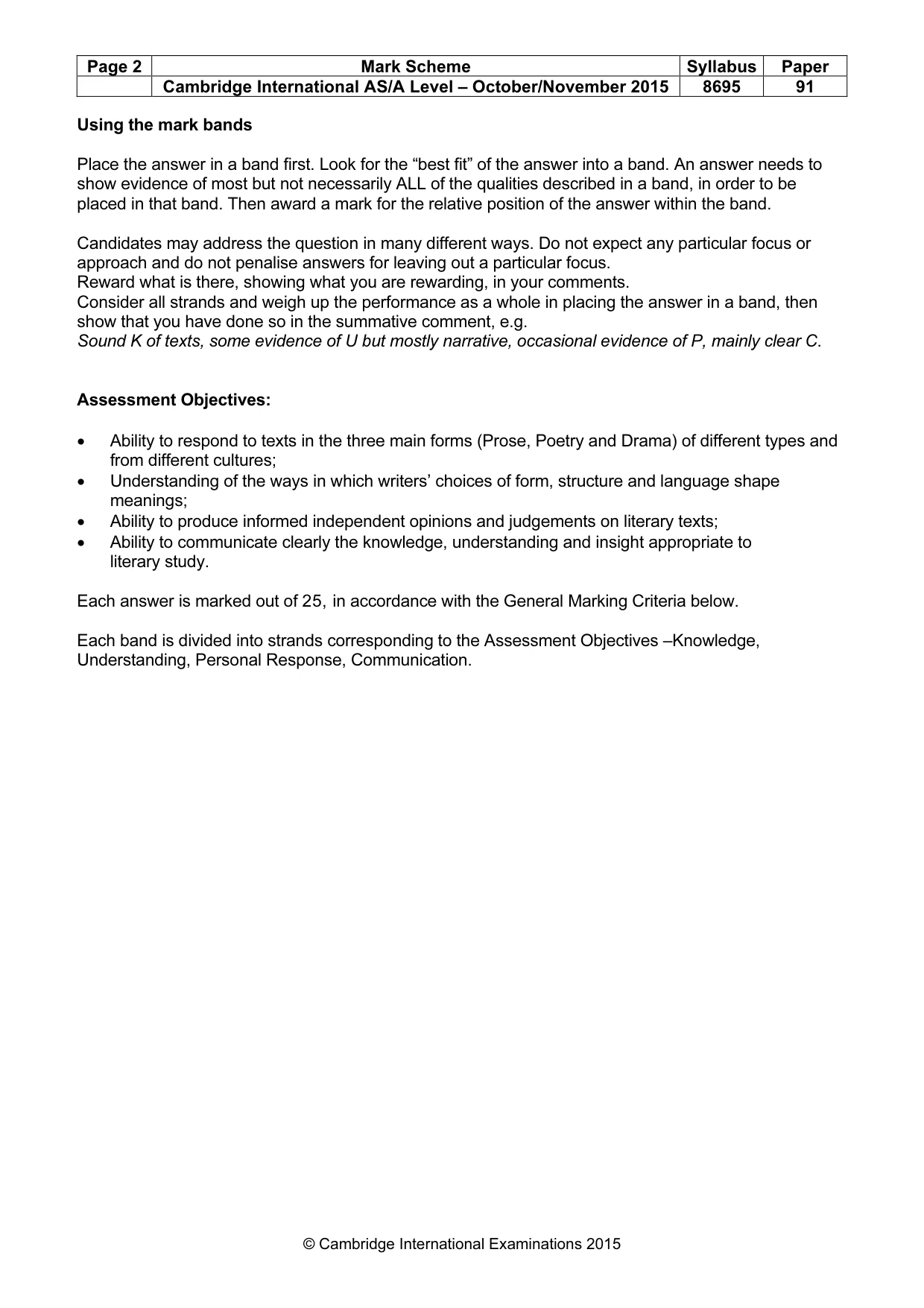
Page 2 Mark Scheme Syllabus Paper Cambridge International AS/A Level – October/November 2015 8695 91 © Cambridge International Examinations 2015 Using the mark bands Place the answer in a band first. Look for the “best fit” of the answer into a band. An answer needs to show evidence of most but not necessarily ALL of the qualities described in a band, in order to be placed in that band. Then award a mark for the relative position of the answer within the band. Candidates may address the question in many different ways. Do not expect any particular focus or approach and do not penalise answers for leaving out a particular focus. Reward what is there, showing what you are rewarding, in your comments. Consider all strands and weigh up the performance as a whole in placing the answer in a band, then show that you have done so in the summative comment, e.g. Sound K of texts, some evidence of U but mostly narrative, occasional evidence of P, mainly clear C. Assessment Objectives: • Ability to respond to texts in the three main forms (Prose, Poetry and Drama) of different types and from different cultures; • Understanding of the ways in which writers’ choices of form, structure and language shape meanings; • Ability to produce informed independent opinions and judgements on literary texts; • Ability to communicate clearly the knowledge, understanding and insight appropriate to literary study. Each answer is marked out of 25, in accordance with the General Marking Criteria below. Each band is divided into strands corresponding to the Assessment Objectives –Knowledge, Understanding, Personal Response, Communication.
Mark scheme, page 3
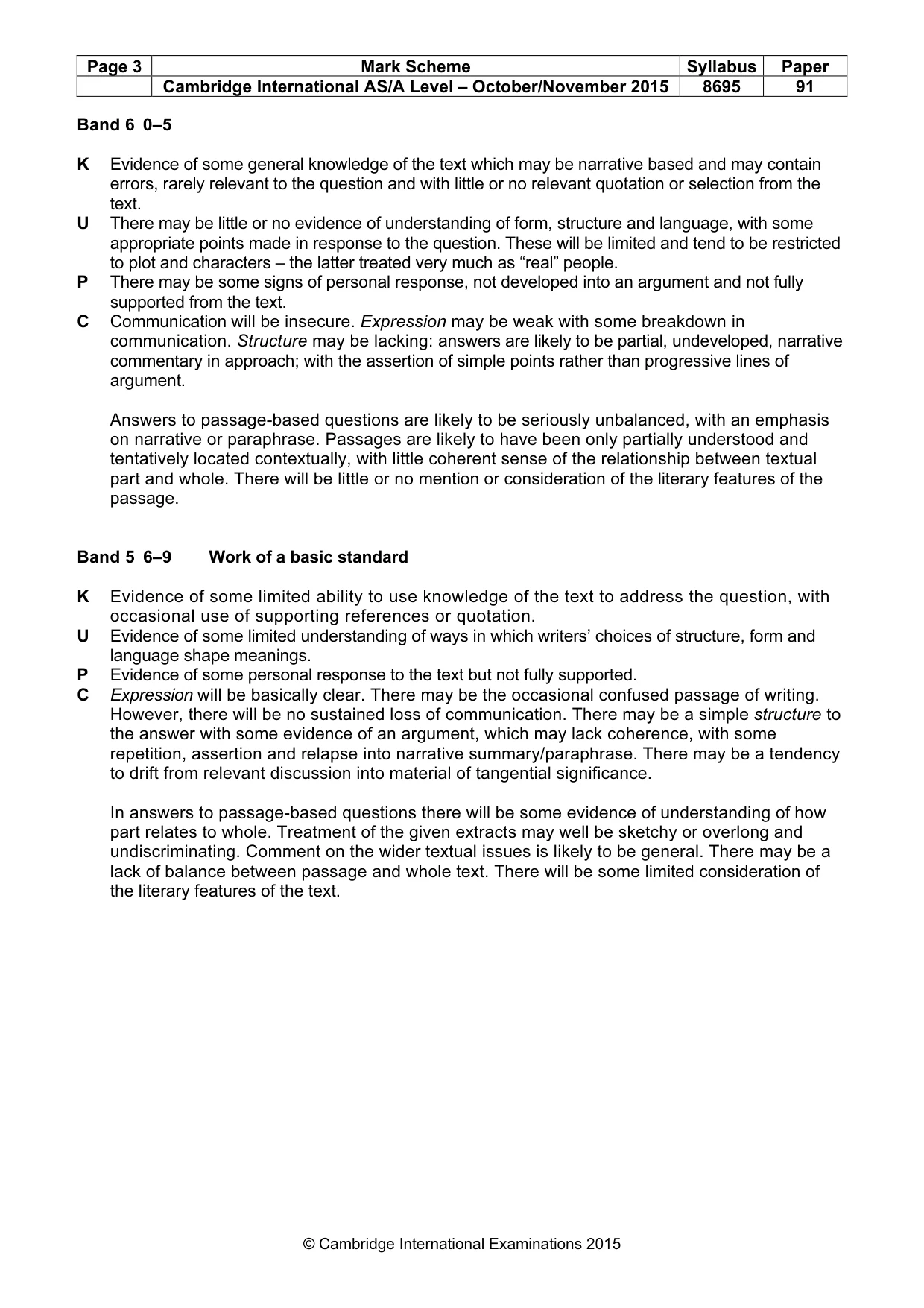
Page 3 Mark Scheme Syllabus Paper Cambridge International AS/A Level – October/November 2015 8695 91 © Cambridge International Examinations 2015 Band 6 0–5 K Evidence of some general knowledge of the text which may be narrative based and may contain errors, rarely relevant to the question and with little or no relevant quotation or selection from the text. U There may be little or no evidence of understanding of form, structure and language, with some appropriate points made in response to the question. These will be limited and tend to be restricted to plot and characters – the latter treated very much as “real” people. P There may be some signs of personal response, not developed into an argument and not fully supported from the text. C Communication will be insecure. Expression may be weak with some breakdown in communication. Structure may be lacking: answers are likely to be partial, undeveloped, narrative commentary in approach; with the assertion of simple points rather than progressive lines of argument. Answers to passage-based questions are likely to be seriously unbalanced, with an emphasis on narrative or paraphrase. Passages are likely to have been only partially understood and tentatively located contextually, with little coherent sense of the relationship between textual part and whole. There will be little or no mention or consideration of the literary features of the passage. Band 5 6–9 Work of a basic standard K Evidence of some limited ability to use knowledge of the text to address the question, with occasional use of supporting references or quotation. U Evidence of some limited understanding of ways in which writers’ choices of structure, form and language shape meanings. P Evidence of some personal response to the text but not fully supported. C Expression will be basically clear. There may be the occasional confused passage of writing. However, there will be no sustained loss of communication. There may be a simple structure to the answer with some evidence of an argument, which may lack coherence, with some repetition, assertion and relapse into narrative summary/paraphrase. There may be a tendency to drift from relevant discussion into material of tangential significance. In answers to passage-based questions there will be some evidence of understanding of how part relates to whole. Treatment of the given extracts may well be sketchy or overlong and undiscriminating. Comment on the wider textual issues is likely to be general. There may be a lack of balance between passage and whole text. There will be some limited consideration of the literary features of the text.
Mark scheme, page 4
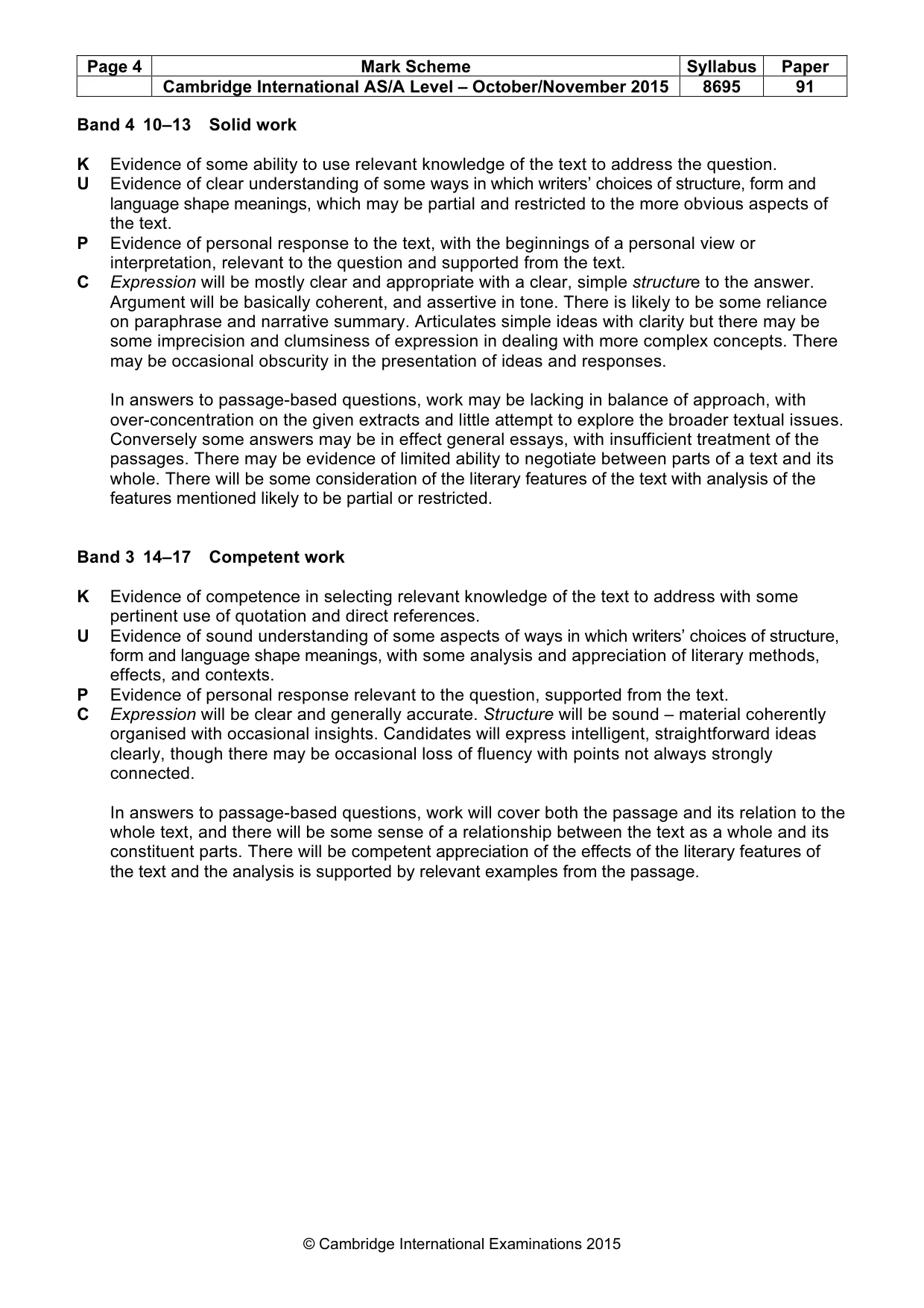
Page 4 Mark Scheme Syllabus Paper Cambridge International AS/A Level – October/November 2015 8695 91 © Cambridge International Examinations 2015 Band 4 10–13 Solid work K Evidence of some ability to use relevant knowledge of the text to address the question. U Evidence of clear understanding of some ways in which writers’ choices of structure, form and language shape meanings, which may be partial and restricted to the more obvious aspects of the text. P Evidence of personal response to the text, with the beginnings of a personal view or interpretation, relevant to the question and supported from the text. C Expression will be mostly clear and appropriate with a clear, simple structure to the answer. Argument will be basically coherent, and assertive in tone. There is likely to be some reliance on paraphrase and narrative summary. Articulates simple ideas with clarity but there may be some imprecision and clumsiness of expression in dealing with more complex concepts. There may be occasional obscurity in the presentation of ideas and responses. In answers to passage-based questions, work may be lacking in balance of approach, with over-concentration on the given extracts and little attempt to explore the broader textual issues. Conversely some answers may be in effect general essays, with insufficient treatment of the passages. There may be evidence of limited ability to negotiate between parts of a text and its whole. There will be some consideration of the literary features of the text with analysis of the features mentioned likely to be partial or restricted. Band 3 14–17 Competent work K Evidence of competence in selecting relevant knowledge of the text to address with some pertinent use of quotation and direct references. U Evidence of sound understanding of some aspects of ways in which writers’ choices of structure, form and language shape meanings, with some analysis and appreciation of literary methods, effects, and contexts. P Evidence of personal response relevant to the question, supported from the text. C Expression will be clear and generally accurate. Structure will be sound – material coherently organised with occasional insights. Candidates will express intelligent, straightforward ideas clearly, though there may be occasional loss of fluency with points not always strongly connected. In answers to passage-based questions, work will cover both the passage and its relation to the whole text, and there will be some sense of a relationship between the text as a whole and its constituent parts. There will be competent appreciation of the effects of the literary features of the text and the analysis is supported by relevant examples from the passage.
Mark scheme, page 5
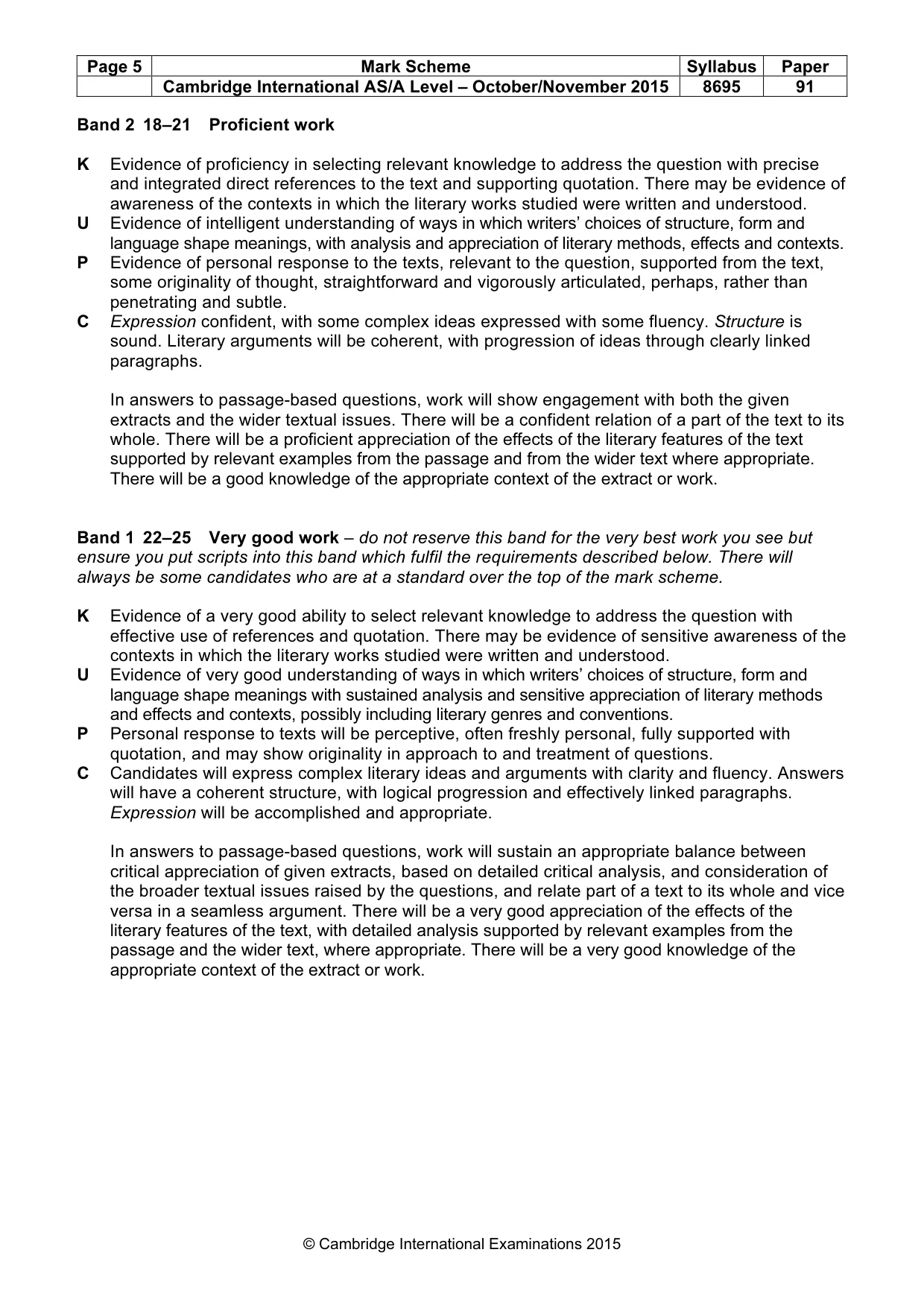
Page 5 Mark Scheme Syllabus Paper Cambridge International AS/A Level – October/November 2015 8695 91 © Cambridge International Examinations 2015 Band 2 18–21 Proficient work K Evidence of proficiency in selecting relevant knowledge to address the question with precise and integrated direct references to the text and supporting quotation. There may be evidence of awareness of the contexts in which the literary works studied were written and understood. U Evidence of intelligent understanding of ways in which writers’ choices of structure, form and language shape meanings, with analysis and appreciation of literary methods, effects and contexts. P Evidence of personal response to the texts, relevant to the question, supported from the text, some originality of thought, straightforward and vigorously articulated, perhaps, rather than penetrating and subtle. C Expression confident, with some complex ideas expressed with some fluency. Structure is sound. Literary arguments will be coherent, with progression of ideas through clearly linked paragraphs. In answers to passage-based questions, work will show engagement with both the given extracts and the wider textual issues. There will be a confident relation of a part of the text to its whole. There will be a proficient appreciation of the effects of the literary features of the text supported by relevant examples from the passage and from the wider text where appropriate. There will be a good knowledge of the appropriate context of the extract or work. Band 1 22–25 Very good work – do not reserve this band for the very best work you see but ensure you put scripts into this band which fulfil the requirements described below. There will always be some candidates who are at a standard over the top of the mark scheme. K Evidence of a very good ability to select relevant knowledge to address the question with effective use of references and quotation. There may be evidence of sensitive awareness of the contexts in which the literary works studied were written and understood. U Evidence of very good understanding of ways in which writers’ choices of structure, form and language shape meanings with sustained analysis and sensitive appreciation of literary methods and effects and contexts, possibly including literary genres and conventions. P Personal response to texts will be perceptive, often freshly personal, fully supported with quotation, and may show originality in approach to and treatment of questions. C Candidates will express complex literary ideas and arguments with clarity and fluency. Answers will have a coherent structure, with logical progression and effectively linked paragraphs. Expression will be accomplished and appropriate. In answers to passage-based questions, work will sustain an appropriate balance between critical appreciation of given extracts, based on detailed critical analysis, and consideration of the broader textual issues raised by the questions, and relate part of a text to its whole and vice versa in a seamless argument. There will be a very good appreciation of the effects of the literary features of the text, with detailed analysis supported by relevant examples from the passage and the wider text, where appropriate. There will be a very good knowledge of the appropriate context of the extract or work.
What you needed in this session
Cambridge’s own grade thresholds for 2015 Oct/Nov, Paper 9 · Variant 1. A higher threshold means an easier paper — the bar moves with how the cohort did.