Cambridge A Level English - Language and Literature (AS Level only, from 2016) 8695 — 2015 May/June Paper 9 · Variant 3
8695/93/M/J/15 · 50 marks · ≈56 min
The question paper and its mark scheme, free to read here and free to download. This is Cambridge’s own paper, exactly as it was sat.
Question paper20 pages



Mark scheme5 pages
Answers below. Sit the paper first if you are practising.
Paper as text
Question paper, page 1
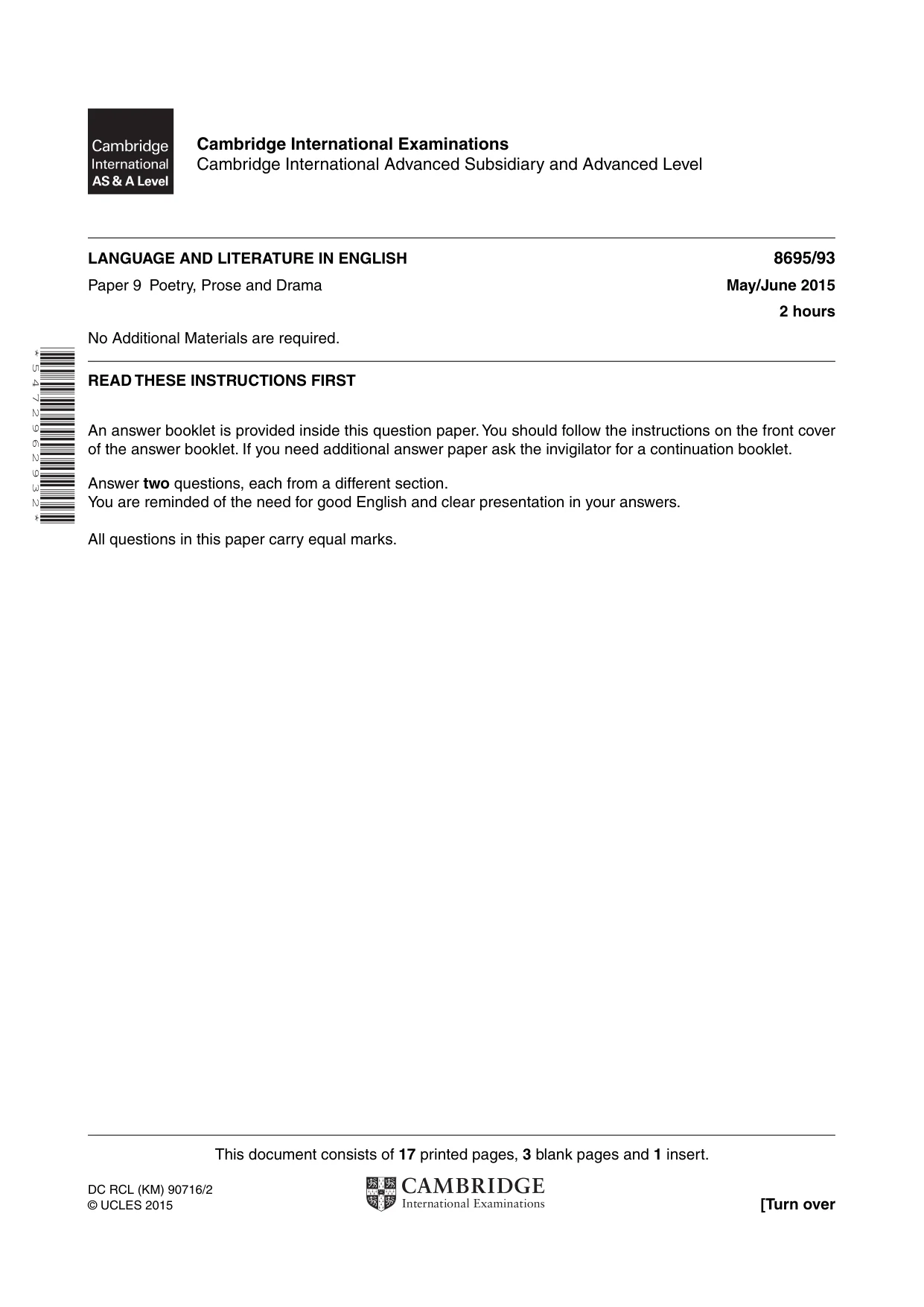
This document consists of 17 printed pages, 3 blank pages and 1 insert. DC RCL (KM) 90716/2 © UCLES 2015 [Turn over Cambridge International Examinations Cambridge International Advanced Subsidiary and Advanced Level * 5 4 7 2 9 6 2 9 3 2 * LANGUAGE AND LITERATURE IN ENGLISH 8695/93 Paper 9 Poetry, Prose and Drama May/June 2015 2 hours No Additional Materials are required. READ THESE INSTRUCTIONS FIRST An answer booklet is provided inside this question paper. You should follow the instructions on the front cover of the answer booklet. If you need additional answer paper ask the invigilator for a continuation booklet. Answer two questions, each from a different section. You are reminded of the need for good English and clear presentation in your answers. All questions in this paper carry equal marks.
Question paper, page 2
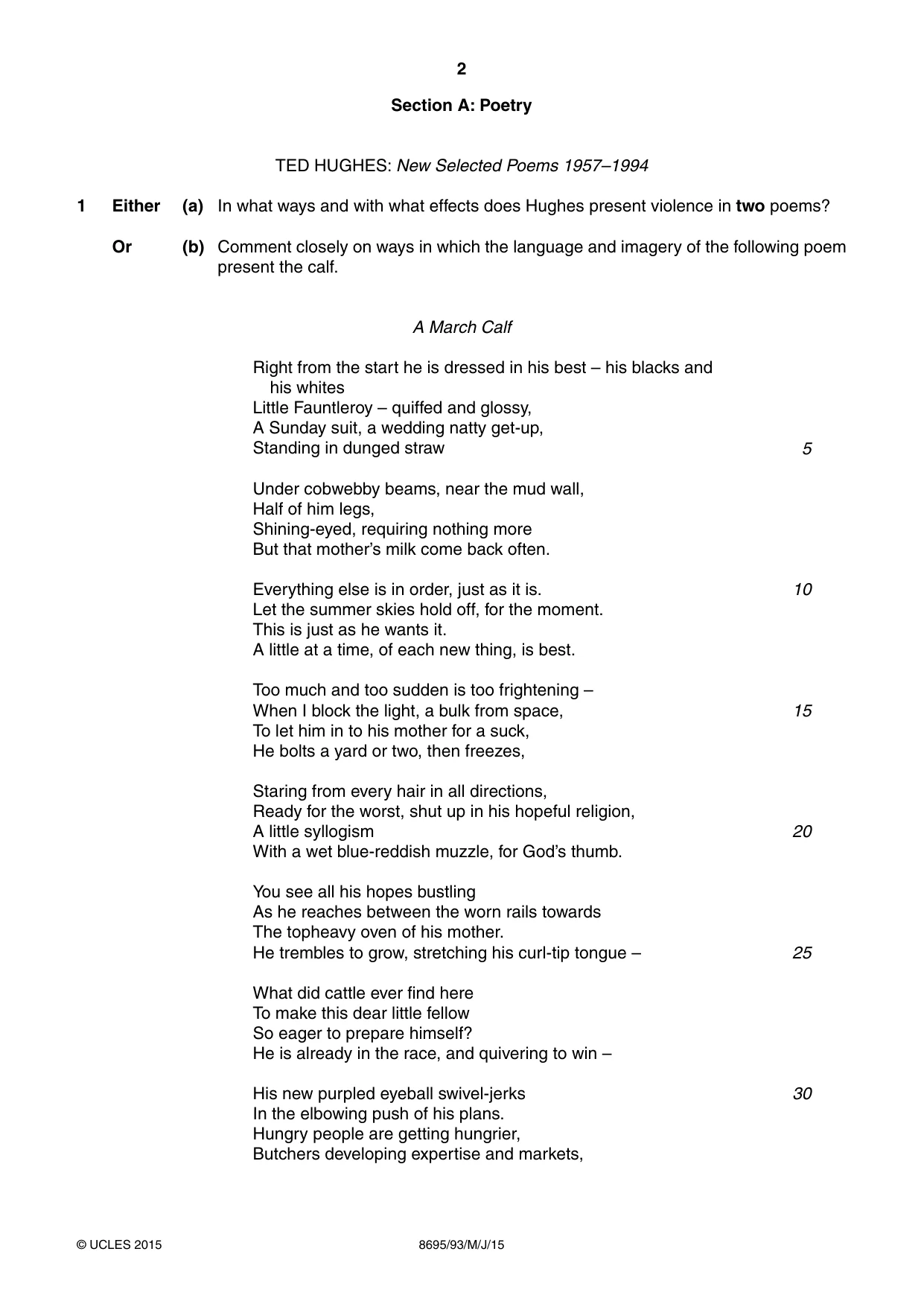
2 8695/93/M/J/15 © UCLES 2015 Section A: Poetry TED HUGHES: New Selected Poems 1957–1994 1 Either (a) In what ways and with what effects does Hughes present violence in two poems? Or (b) Comment closely on ways in which the language and imagery of the following poem present the calf. A March Calf Right from the start he is dressed in his best – his blacks and his whites Little Fauntleroy – quiffed and glossy, A Sunday suit, a wedding natty get-up, Standing in dunged straw Under cobwebby beams, near the mud wall, Half of him legs, Shining-eyed, requiring nothing more But that mother’s milk come back often. Everything else is in order, just as it is. Let the summer skies hold off, for the moment. This is just as he wants it. A little at a time, of each new thing, is best. Too much and too sudden is too frightening – When I block the light, a bulk from space, To let him in to his mother for a suck, He bolts a yard or two, then freezes, Staring from every hair in all directions, Ready for the worst, shut up in his hopeful religion, A little syllogism With a wet blue-reddish muzzle, for God’s thumb. You see all his hopes bustling As he reaches between the worn rails towards The topheavy oven of his mother. He trembles to grow, stretching his curl-tip tongue – What did cattle ever find here To make this dear little fellow So eager to prepare himself? He is already in the race, and quivering to win – His new purpled eyeball swivel-jerks In the elbowing push of his plans. Hungry people are getting hungrier, Butchers developing expertise and markets, 5 10 15 20 25 30
Question paper, page 3
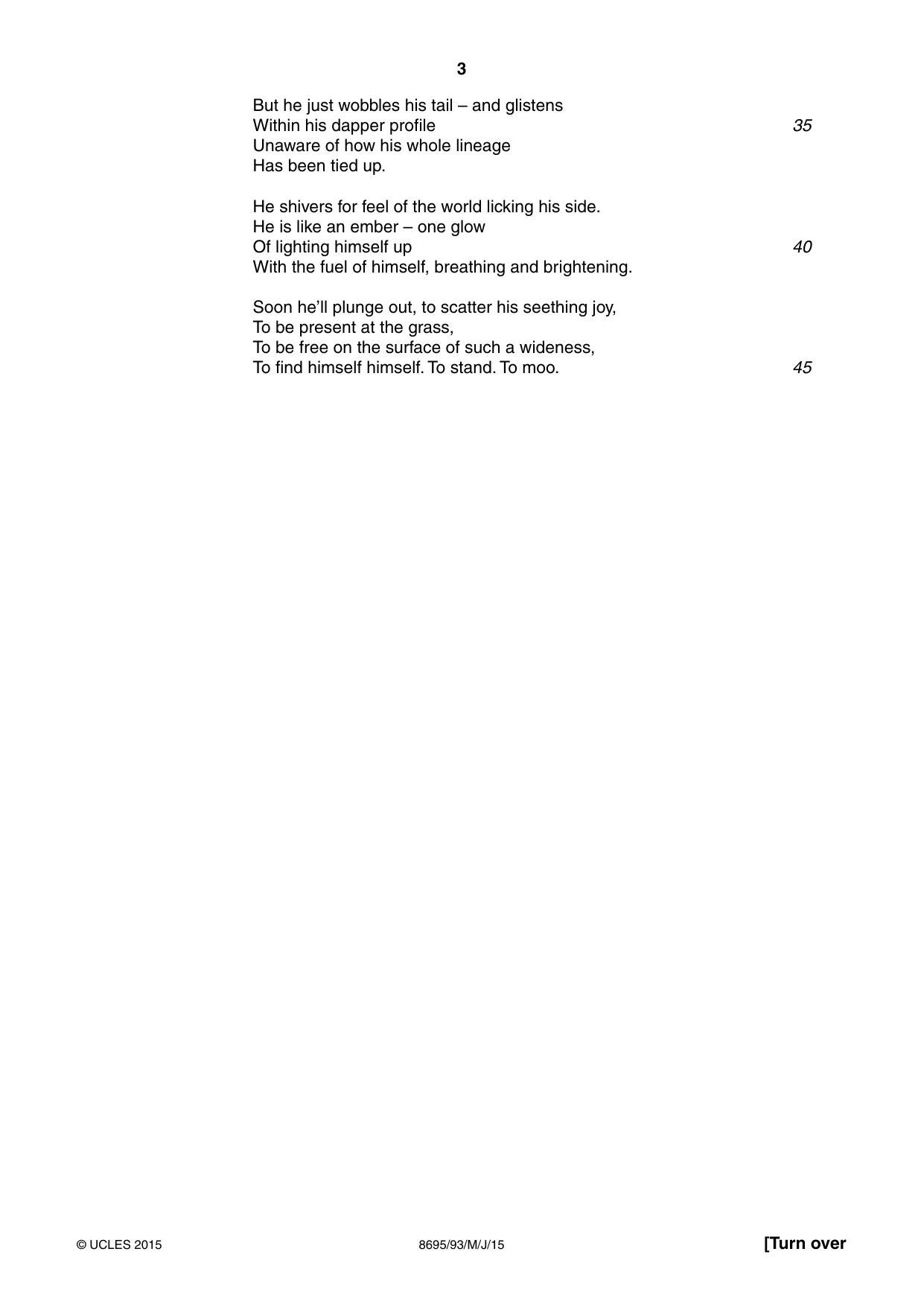
3 8695/93/M/J/15 © UCLES 2015 [Turn over But he just wobbles his tail – and glistens Within his dapper profile Unaware of how his whole lineage Has been tied up. He shivers for feel of the world licking his side. He is like an ember – one glow Of lighting himself up With the fuel of himself, breathing and brightening. Soon he’ll plunge out, to scatter his seething joy, To be present at the grass, To be free on the surface of such a wideness, To find himself himself. To stand. To moo. 35 40 45
Question paper, page 4
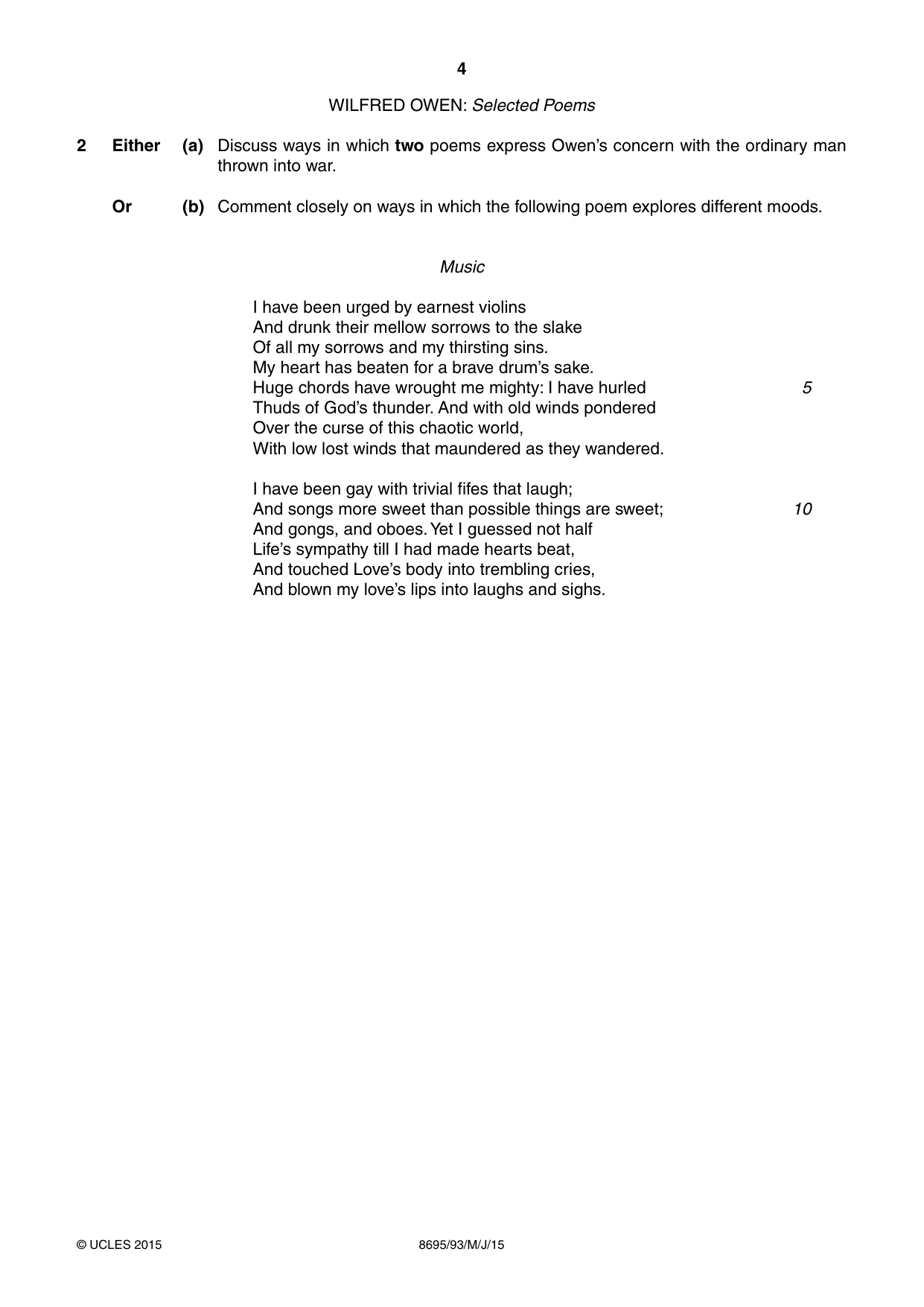
4 8695/93/M/J/15 © UCLES 2015 WILFRED OWEN: Selected Poems 2 Either (a) Discuss ways in which two poems express Owen’s concern with the ordinary man thrown into war. Or (b) Comment closely on ways in which the following poem explores different moods. Music I have been urged by earnest violins And drunk their mellow sorrows to the slake Of all my sorrows and my thirsting sins. My heart has beaten for a brave drum’s sake. Huge chords have wrought me mighty: I have hurled Thuds of God’s thunder. And with old winds pondered Over the curse of this chaotic world, With low lost winds that maundered as they wandered. I have been gay with trivial fifes that laugh; And songs more sweet than possible things are sweet; And gongs, and oboes. Yet I guessed not half Life’s sympathy till I had made hearts beat, And touched Love’s body into trembling cries, And blown my love’s lips into laughs and sighs. 5 10
Question paper, page 5
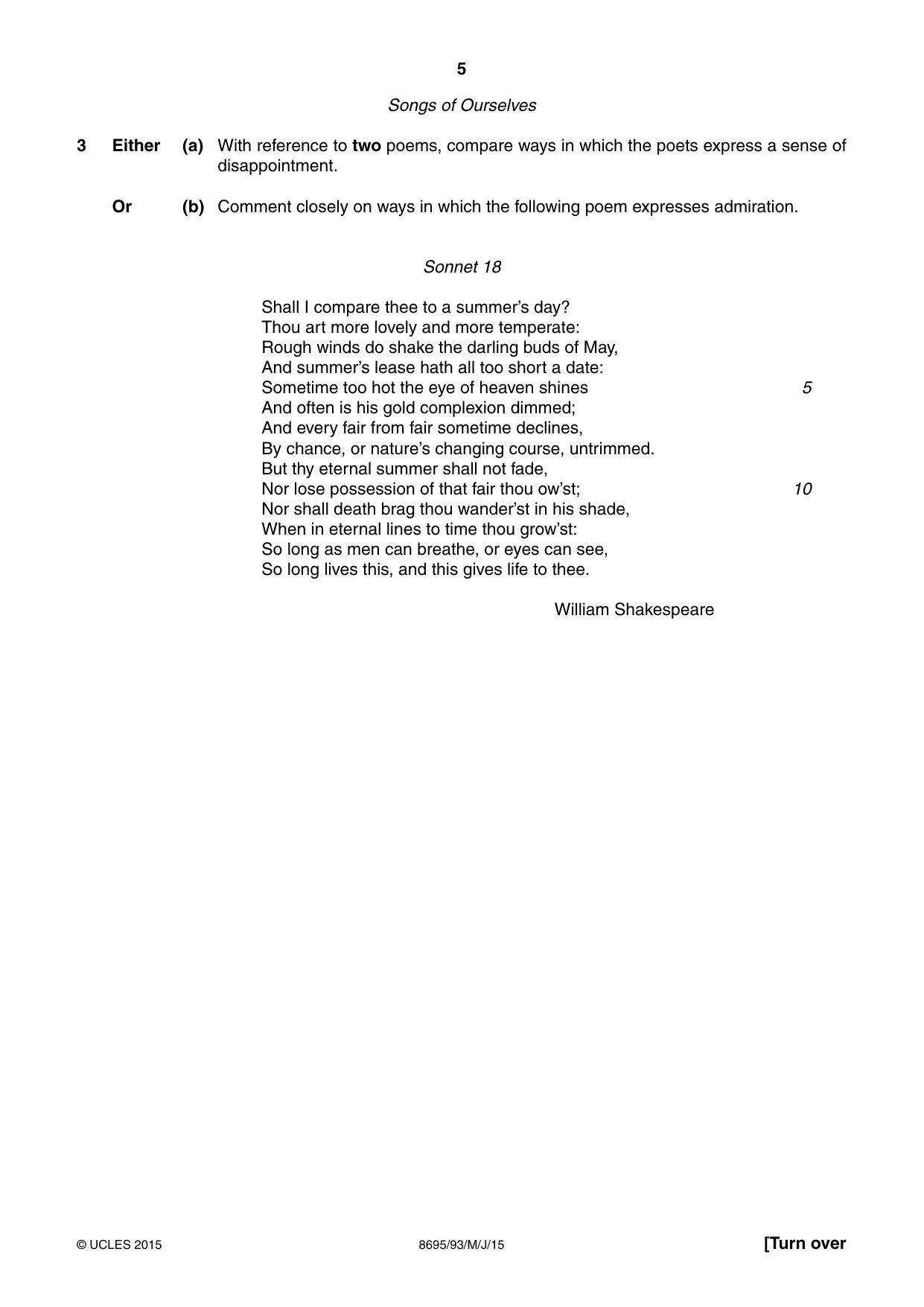
5 8695/93/M/J/15 © UCLES 2015 [Turn over Songs of Ourselves 3 Either (a) With reference to two poems, compare ways in which the poets express a sense of disappointment. Or (b) Comment closely on ways in which the following poem expresses admiration. Sonnet 18 Shall I compare thee to a summer’s day? Thou art more lovely and more temperate: Rough winds do shake the darling buds of May, And summer’s lease hath all too short a date: Sometime too hot the eye of heaven shines And often is his gold complexion dimmed; And every fair from fair sometime declines, By chance, or nature’s changing course, untrimmed. But thy eternal summer shall not fade, Nor lose possession of that fair thou ow’st; Nor shall death brag thou wander’st in his shade, When in eternal lines to time thou grow’st: So long as men can breathe, or eyes can see, So long lives this, and this gives life to thee. William Shakespeare 5 10
Question paper, page 6
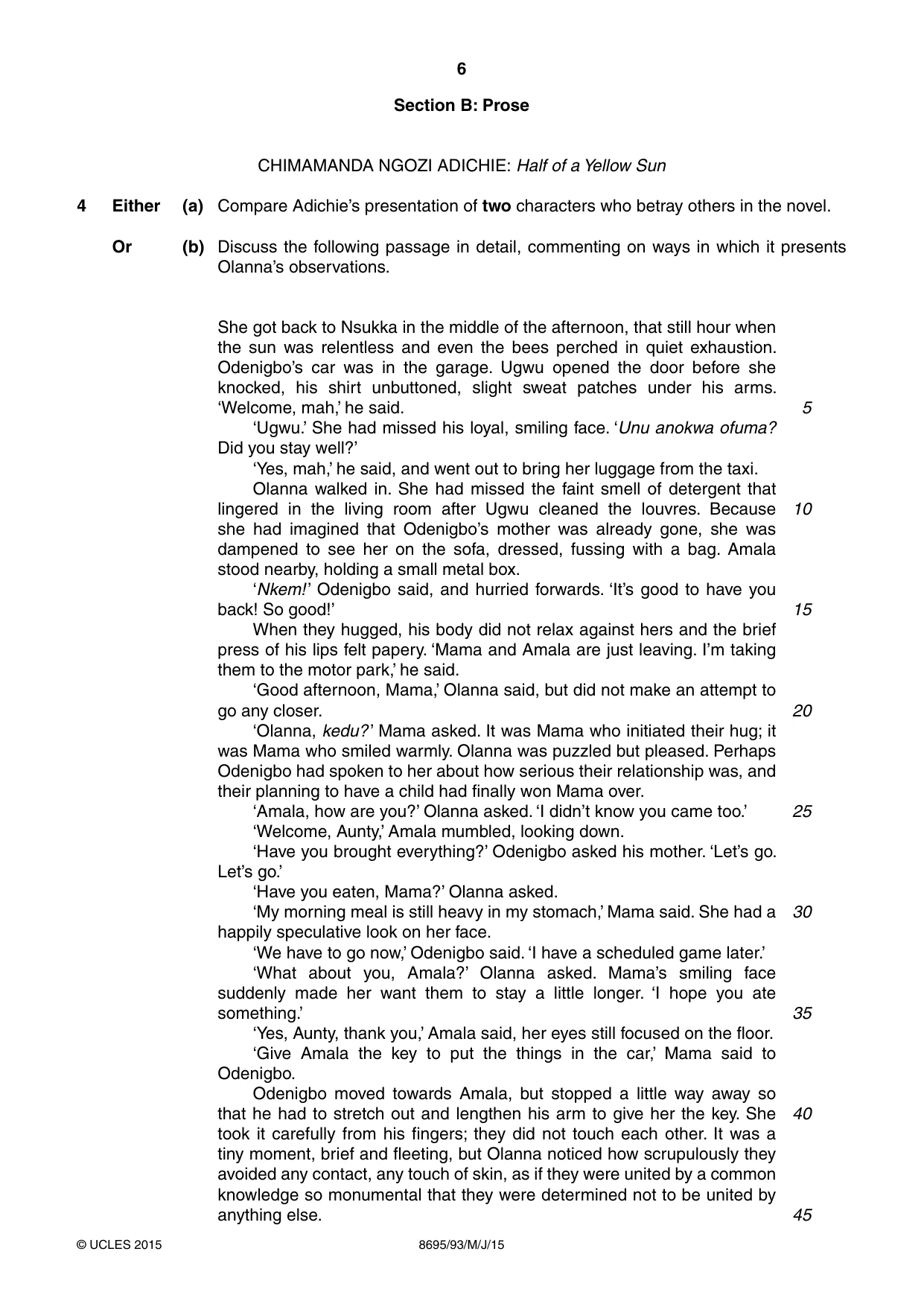
6 8695/93/M/J/15 © UCLES 2015 Section B: Prose CHIMAMANDA NGOZI ADICHIE: Half of a Yellow Sun 4 Either (a) Compare Adichie’s presentation of two characters who betray others in the novel. Or (b) Discuss the following passage in detail, commenting on ways in which it presents Olanna’s observations. She got back to Nsukka in the middle of the afternoon, that still hour when the sun was relentless and even the bees perched in quiet exhaustion. Odenigbo’s car was in the garage. Ugwu opened the door before she knocked, his shirt unbuttoned, slight sweat patches under his arms. ‘Welcome, mah,’ he said. ‘Ugwu.’ She had missed his loyal, smiling face. ‘Unu anokwa ofuma? Did you stay well?’ ‘Yes, mah,’ he said, and went out to bring her luggage from the taxi. Olanna walked in. She had missed the faint smell of detergent that lingered in the living room after Ugwu cleaned the louvres. Because she had imagined that Odenigbo’s mother was already gone, she was dampened to see her on the sofa, dressed, fussing with a bag. Amala stood nearby, holding a small metal box. ‘Nkem! ’ Odenigbo said, and hurried forwards. ‘It’s good to have you back! So good!’ When they hugged, his body did not relax against hers and the brief press of his lips felt papery. ‘Mama and Amala are just leaving. I’m taking them to the motor park,’ he said. ‘Good afternoon, Mama,’ Olanna said, but did not make an attempt to go any closer. ‘Olanna, kedu? ’ Mama asked. It was Mama who initiated their hug; it was Mama who smiled warmly. Olanna was puzzled but pleased. Perhaps Odenigbo had spoken to her about how serious their relationship was, and their planning to have a child had finally won Mama over. ‘Amala, how are you?’ Olanna asked. ‘I didn’t know you came too.’ ‘Welcome, Aunty,’ Amala mumbled, looking down. ‘Have you brought everything?’ Odenigbo asked his mother. ‘Let’s go. Let’s go.’ ‘Have you eaten, Mama?’ Olanna asked. ‘My morning meal is still heavy in my stomach,’ Mama said. She had a happily speculative look on her face. ‘We have to go now,’ Odenigbo said. ‘I have a scheduled game later.’ ‘What about you, Amala?’ Olanna asked. Mama’s smiling face suddenly made her want them to stay a little longer. ‘I hope you ate something.’ ‘Yes, Aunty, thank you,’ Amala said, her eyes still focused on the floor. ‘Give Amala the key to put the things in the car,’ Mama said to Odenigbo. Odenigbo moved towards Amala, but stopped a little way away so that he had to stretch out and lengthen his arm to give her the key. She took it carefully from his fingers; they did not touch each other. It was a tiny moment, brief and fleeting, but Olanna noticed how scrupulously they avoided any contact, any touch of skin, as if they were united by a common knowledge so monumental that they were determined not to be united by anything else. 5 10 15 20 25 30 35 40 45
Question paper, page 7
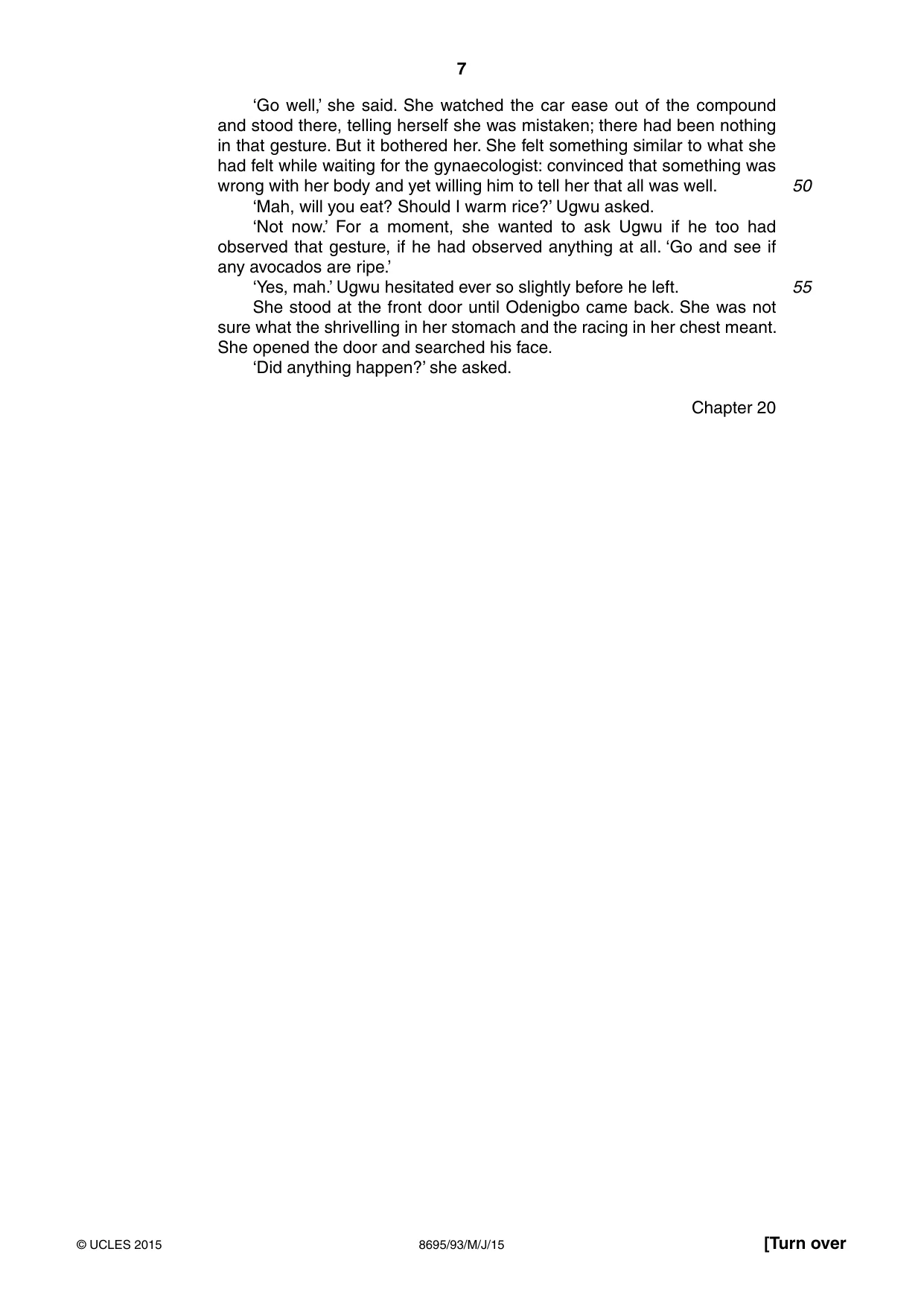
7 8695/93/M/J/15 © UCLES 2015 [Turn over ‘Go well,’ she said. She watched the car ease out of the compound and stood there, telling herself she was mistaken; there had been nothing in that gesture. But it bothered her. She felt something similar to what she had felt while waiting for the gynaecologist: convinced that something was wrong with her body and yet willing him to tell her that all was well. ‘Mah, will you eat? Should I warm rice?’ Ugwu asked. ‘Not now.’ For a moment, she wanted to ask Ugwu if he too had observed that gesture, if he had observed anything at all. ‘Go and see if any avocados are ripe.’ ‘Yes, mah.’ Ugwu hesitated ever so slightly before he left. She stood at the front door until Odenigbo came back. She was not sure what the shrivelling in her stomach and the racing in her chest meant. She opened the door and searched his face. ‘Did anything happen?’ she asked. Chapter 20 50 55
Question paper, page 8
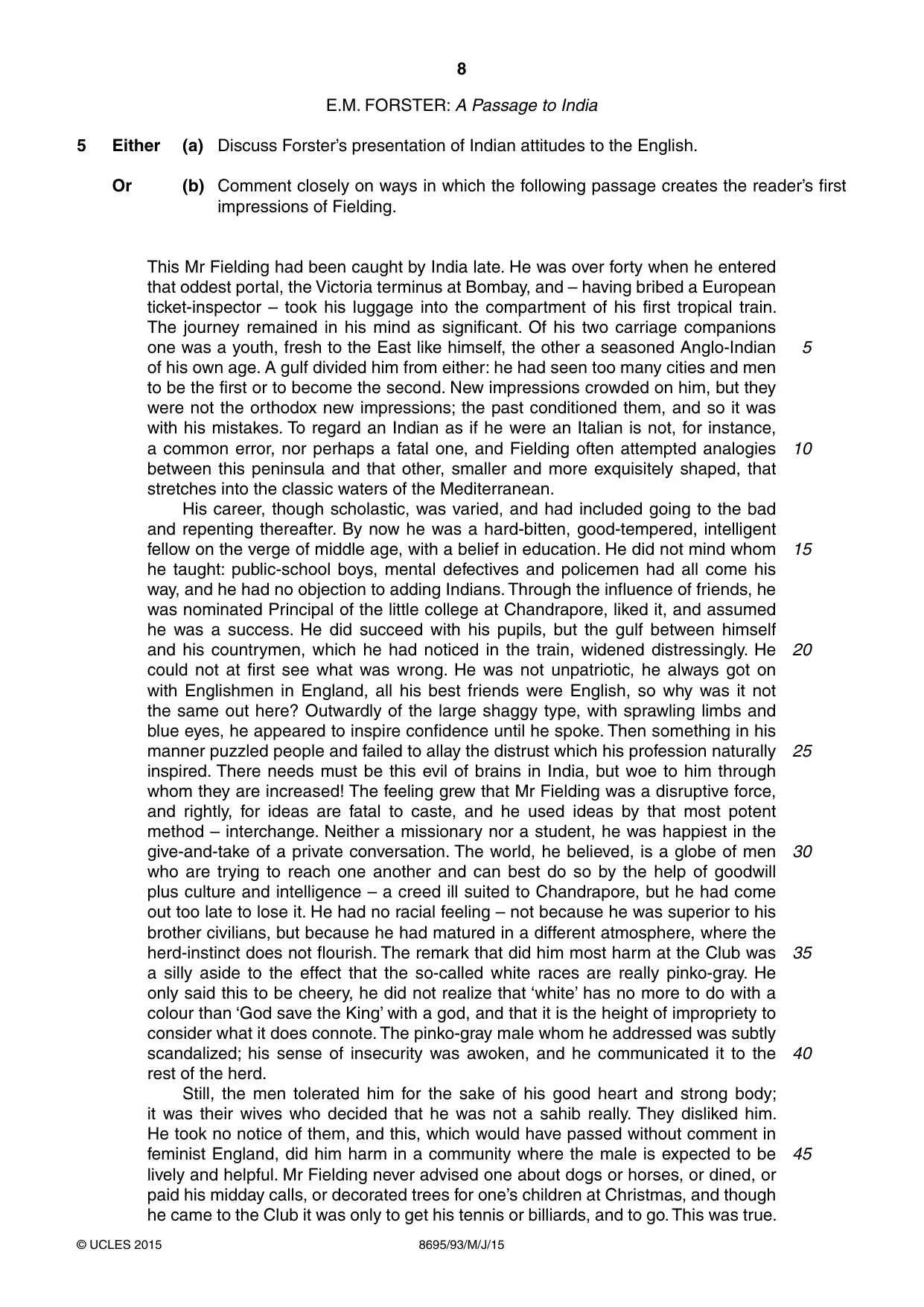
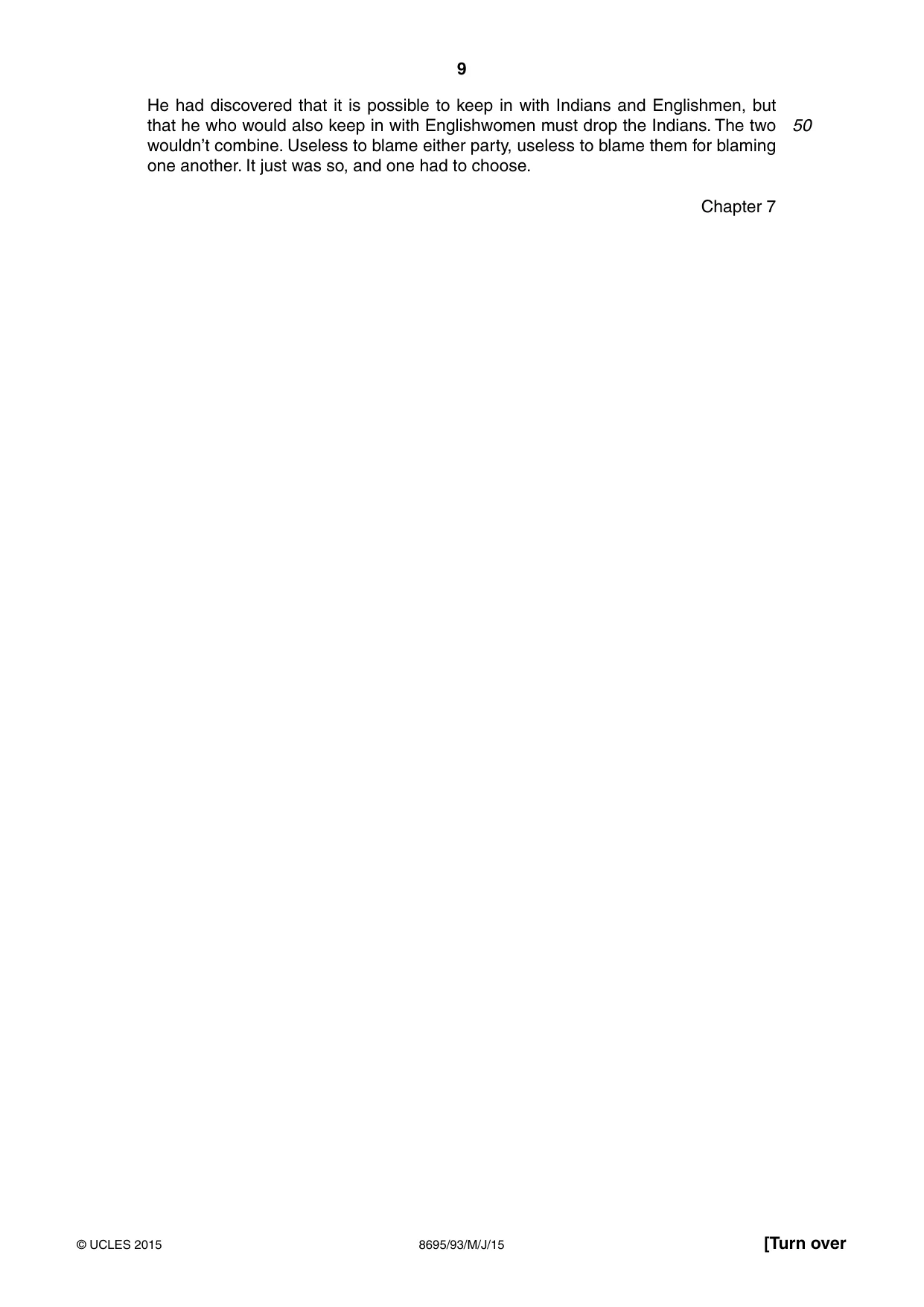
8 8695/93/M/J/15 © UCLES 2015 E.M. FORSTER: A Passage to India 5 Either (a) Discuss Forster’s presentation of Indian attitudes to the English. Or (b) Comment closely on ways in which the following passage creates the reader’s first impressions of Fielding. This Mr Fielding had been caught by India late. He was over forty when he entered that oddest portal, the Victoria terminus at Bombay, and – having bribed a European ticket-inspector – took his luggage into the compartment of his first tropical train. The journey remained in his mind as significant. Of his two carriage companions one was a youth, fresh to the East like himself, the other a seasoned Anglo-Indian of his own age. A gulf divided him from either: he had seen too many cities and men to be the first or to become the second. New impressions crowded on him, but they were not the orthodox new impressions; the past conditioned them, and so it was with his mistakes. To regard an Indian as if he were an Italian is not, for instance, a common error, nor perhaps a fatal one, and Fielding often attempted analogies between this peninsula and that other, smaller and more exquisitely shaped, that stretches into the classic waters of the Mediterranean. His career, though scholastic, was varied, and had included going to the bad and repenting thereafter. By now he was a hard-bitten, good-tempered, intelligent fellow on the verge of middle age, with a belief in education. He did not mind whom he taught: public-school boys, mental defectives and policemen had all come his way, and he had no objection to adding Indians. Through the influence of friends, he was nominated Principal of the little college at Chandrapore, liked it, and assumed he was a success. He did succeed with his pupils, but the gulf between himself and his countrymen, which he had noticed in the train, widened distressingly. He could not at first see what was wrong. He was not unpatriotic, he always got on with Englishmen in England, all his best friends were English, so why was it not the same out here? Outwardly of the large shaggy type, with sprawling limbs and blue eyes, he appeared to inspire confidence until he spoke. Then something in his manner puzzled people and failed to allay the distrust which his profession naturally inspired. There needs must be this evil of brains in India, but woe to him through whom they are increased! The feeling grew that Mr Fielding was a disruptive force, and rightly, for ideas are fatal to caste, and he used ideas by that most potent method – interchange. Neither a missionary nor a student, he was happiest in the give-and-take of a private conversation. The world, he believed, is a globe of men who are trying to reach one another and can best do so by the help of goodwill plus culture and intelligence – a creed ill suited to Chandrapore, but he had come out too late to lose it. He had no racial feeling – not because he was superior to his brother civilians, but because he had matured in a different atmosphere, where the herd-instinct does not flourish. The remark that did him most harm at the Club was a silly aside to the effect that the so-called white races are really pinko-gray. He only said this to be cheery, he did not realize that ‘white’ has no more to do with a colour than ‘God save the King’ with a god, and that it is the height of impropriety to consider what it does connote. The pinko-gray male whom he addressed was subtly scandalized; his sense of insecurity was awoken, and he communicated it to the rest of the herd. Still, the men tolerated him for the sake of his good heart and strong body; it was their wives who decided that he was not a sahib really. They disliked him. He took no notice of them, and this, which would have passed without comment in feminist England, did him harm in a community where the male is expected to be lively and helpful. Mr Fielding never advised one about dogs or horses, or dined, or paid his midday calls, or decorated trees for one’s children at Christmas, and though he came to the Club it was only to get his tennis or billiards, and to go. This was true. 5 10 15 20 25 30 35 40 45
Question paper, page 9
9 8695/93/M/J/15 © UCLES 2015 [Turn over He had discovered that it is possible to keep in with Indians and Englishmen, but that he who would also keep in with Englishwomen must drop the Indians. The two wouldn’t combine. Useless to blame either party, useless to blame them for blaming one another. It just was so, and one had to choose. Chapter 7 50
Question paper, page 10
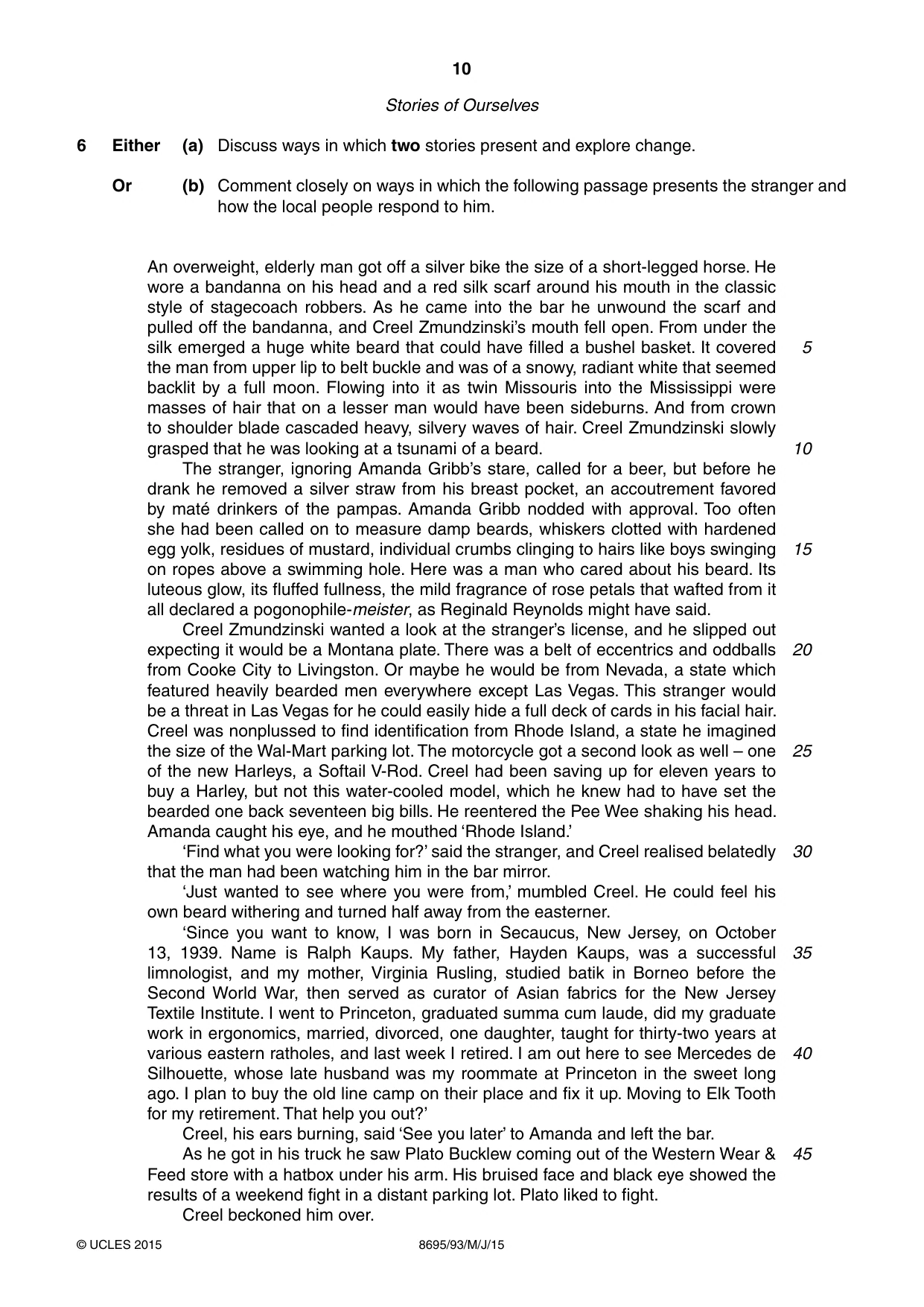
10 8695/93/M/J/15 © UCLES 2015 Stories of Ourselves 6 Either (a) Discuss ways in which two stories present and explore change. Or (b) Comment closely on ways in which the following passage presents the stranger and how the local people respond to him. An overweight, elderly man got off a silver bike the size of a short-legged horse. He wore a bandanna on his head and a red silk scarf around his mouth in the classic style of stagecoach robbers. As he came into the bar he unwound the scarf and pulled off the bandanna, and Creel Zmundzinski’s mouth fell open. From under the silk emerged a huge white beard that could have filled a bushel basket. It covered the man from upper lip to belt buckle and was of a snowy, radiant white that seemed backlit by a full moon. Flowing into it as twin Missouris into the Mississippi were masses of hair that on a lesser man would have been sideburns. And from crown to shoulder blade cascaded heavy, silvery waves of hair. Creel Zmundzinski slowly grasped that he was looking at a tsunami of a beard. The stranger, ignoring Amanda Gribb’s stare, called for a beer, but before he drank he removed a silver straw from his breast pocket, an accoutrement favored by maté drinkers of the pampas. Amanda Gribb nodded with approval. Too often she had been called on to measure damp beards, whiskers clotted with hardened egg yolk, residues of mustard, individual crumbs clinging to hairs like boys swinging on ropes above a swimming hole. Here was a man who cared about his beard. Its luteous glow, its fluffed fullness, the mild fragrance of rose petals that wafted from it all declared a pogonophile-meister, as Reginald Reynolds might have said. Creel Zmundzinski wanted a look at the stranger’s license, and he slipped out expecting it would be a Montana plate. There was a belt of eccentrics and oddballs from Cooke City to Livingston. Or maybe he would be from Nevada, a state which featured heavily bearded men everywhere except Las Vegas. This stranger would be a threat in Las Vegas for he could easily hide a full deck of cards in his facial hair. Creel was nonplussed to find identification from Rhode Island, a state he imagined the size of the Wal-Mart parking lot. The motorcycle got a second look as well – one of the new Harleys, a Softail V-Rod. Creel had been saving up for eleven years to buy a Harley, but not this water-cooled model, which he knew had to have set the bearded one back seventeen big bills. He reentered the Pee Wee shaking his head. Amanda caught his eye, and he mouthed ‘Rhode Island.’ ‘Find what you were looking for?’ said the stranger, and Creel realised belatedly that the man had been watching him in the bar mirror. ‘Just wanted to see where you were from,’ mumbled Creel. He could feel his own beard withering and turned half away from the easterner. ‘Since you want to know, I was born in Secaucus, New Jersey, on October 13, 1939. Name is Ralph Kaups. My father, Hayden Kaups, was a successful limnologist, and my mother, Virginia Rusling, studied batik in Borneo before the Second World War, then served as curator of Asian fabrics for the New Jersey Textile Institute. I went to Princeton, graduated summa cum laude, did my graduate work in ergonomics, married, divorced, one daughter, taught for thirty-two years at various eastern ratholes, and last week I retired. I am out here to see Mercedes de Silhouette, whose late husband was my roommate at Princeton in the sweet long ago. I plan to buy the old line camp on their place and fix it up. Moving to Elk Tooth for my retirement. That help you out?’ Creel, his ears burning, said ‘See you later’ to Amanda and left the bar. As he got in his truck he saw Plato Bucklew coming out of the Western Wear & Feed store with a hatbox under his arm. His bruised face and black eye showed the results of a weekend fight in a distant parking lot. Plato liked to fight. Creel beckoned him over. 5 10 15 20 25 30 35 40 45
Question paper, page 11
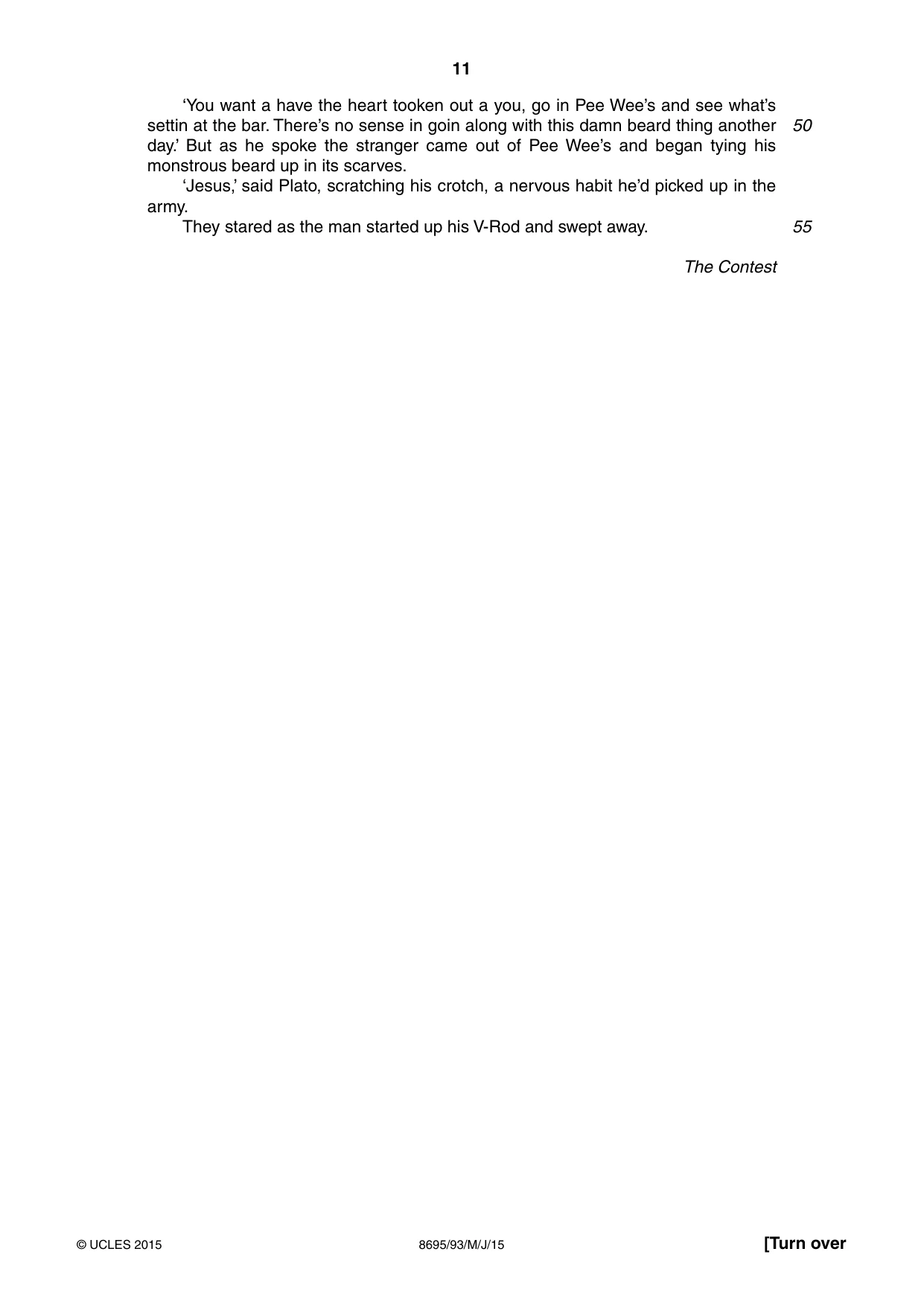
11 8695/93/M/J/15 © UCLES 2015 [Turn over ‘You want a have the heart tooken out a you, go in Pee Wee’s and see what’s settin at the bar. There’s no sense in goin along with this damn beard thing another day.’ But as he spoke the stranger came out of Pee Wee’s and began tying his monstrous beard up in its scarves. ‘Jesus,’ said Plato, scratching his crotch, a nervous habit he’d picked up in the army. They stared as the man started up his V-Rod and swept away. The Contest 50 55
Question paper, page 12
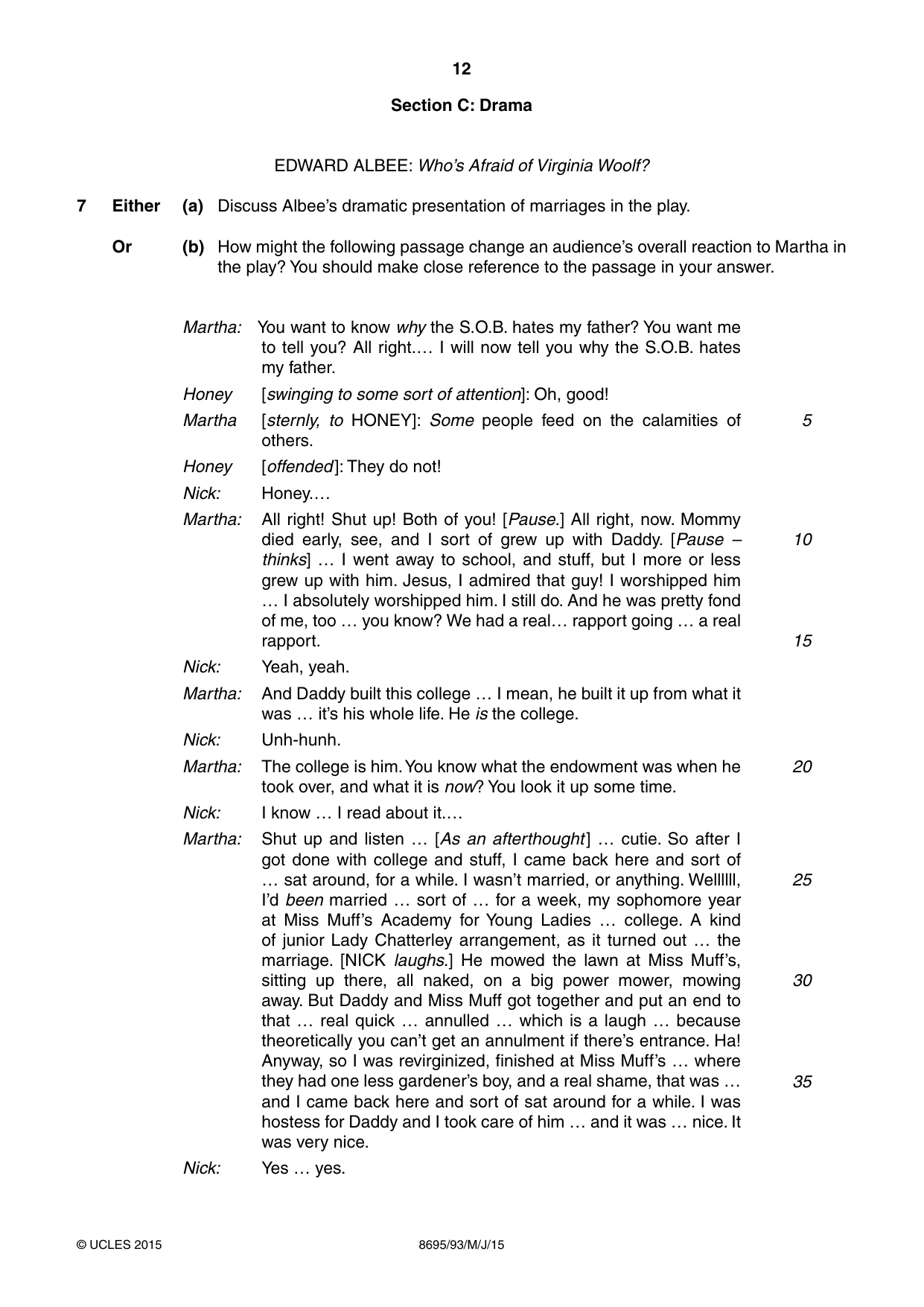
12 8695/93/M/J/15 © UCLES 2015 Section C: Drama EDWARD ALBEE: Who’s Afraid of Virginia Woolf? 7 Either (a) Discuss Albee’s dramatic presentation of marriages in the play. Or (b) How might the following passage change an audience’s overall reaction to Martha in the play? You should make close reference to the passage in your answer. Martha: You want to know why the S.O.B. hates my father? You want me to tell you? All right.… I will now tell you why the S.O.B. hates my father. Honey [swinging to some sort of attention]: Oh, good! Martha [sternly, to HONEY]: Some people feed on the calamities of others. Honey [offended ]: They do not! Nick: Honey.… Martha: All right! Shut up! Both of you! [Pause.] All right, now. Mommy died early, see, and I sort of grew up with Daddy. [Pause – thinks] … I went away to school, and stuff, but I more or less grew up with him. Jesus, I admired that guy! I worshipped him … I absolutely worshipped him. I still do. And he was pretty fond of me, too … you know? We had a real… rapport going … a real rapport. Nick: Yeah, yeah. Martha: And Daddy built this college … I mean, he built it up from what it was … it’s his whole life. He is the college. Nick: Unh-hunh. Martha: The college is him. You know what the endowment was when he took over, and what it is now? You look it up some time. Nick: I know … I read about it.… Martha: Shut up and listen … [As an afterthought ] … cutie. So after I got done with college and stuff, I came back here and sort of … sat around, for a while. I wasn’t married, or anything. Wellllll, I’d been married … sort of … for a week, my sophomore year at Miss Muff’s Academy for Young Ladies … college. A kind of junior Lady Chatterley arrangement, as it turned out … the marriage. [NICK laughs.] He mowed the lawn at Miss Muff’s, sitting up there, all naked, on a big power mower, mowing away. But Daddy and Miss Muff got together and put an end to that … real quick … annulled … which is a laugh … because theoretically you can’t get an annulment if there’s entrance. Ha! Anyway, so I was revirginized, finished at Miss Muff’s … where they had one less gardener’s boy, and a real shame, that was … and I came back here and sort of sat around for a while. I was hostess for Daddy and I took care of him … and it was … nice. It was very nice. Nick: Yes … yes. 5 10 15 20 25 30 35
Question paper, page 13
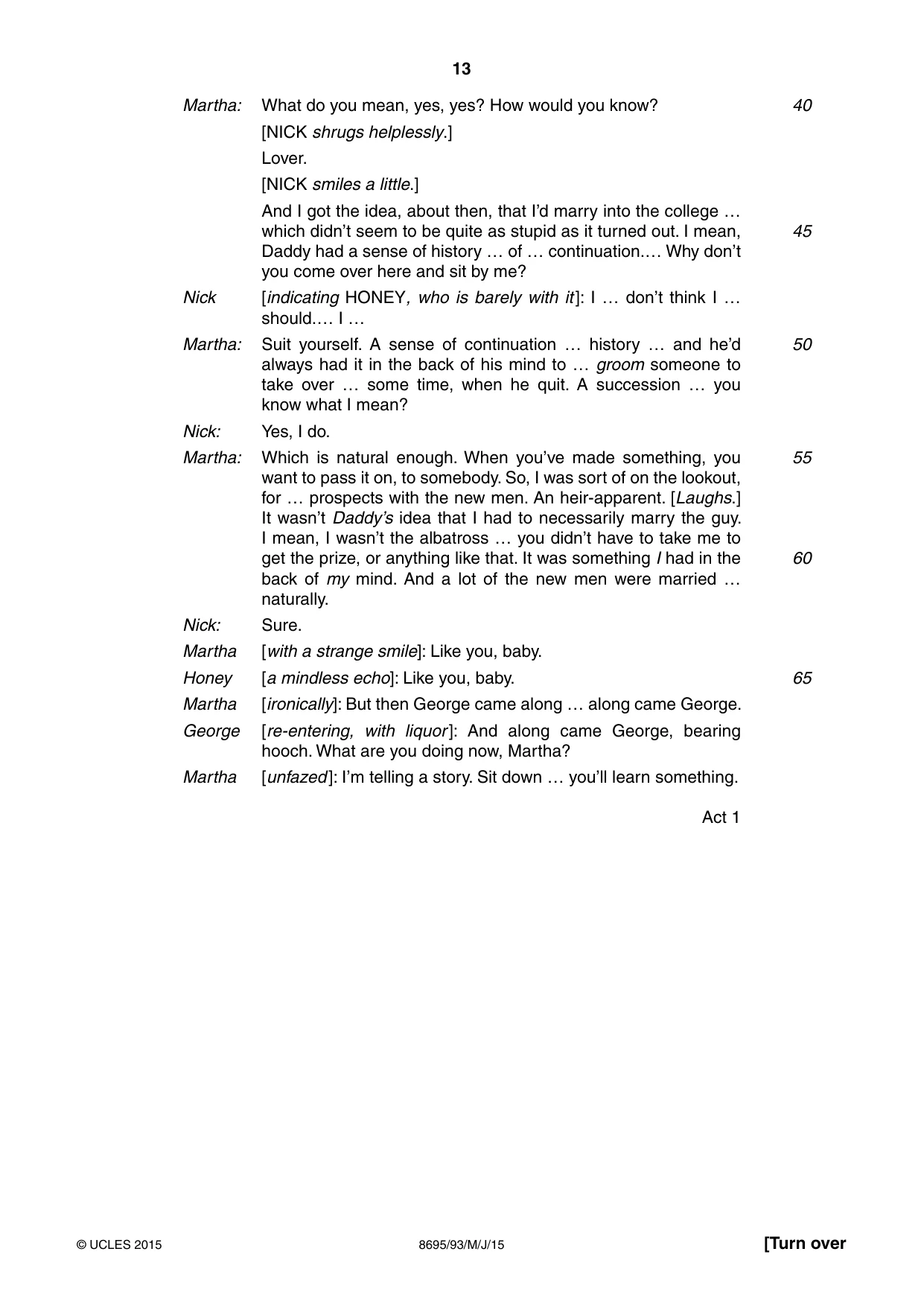
13 8695/93/M/J/15 © UCLES 2015 [Turn over Martha: What do you mean, yes, yes? How would you know? [NICK shrugs helplessly.] Lover. [NICK smiles a little.] And I got the idea, about then, that I’d marry into the college … which didn’t seem to be quite as stupid as it turned out. I mean, Daddy had a sense of history … of … continuation.… Why don’t you come over here and sit by me? Nick [indicating HONEY, who is barely with it ]: I … don’t think I … should.… I … Martha: Suit yourself. A sense of continuation … history … and he’d always had it in the back of his mind to … groom someone to take over … some time, when he quit. A succession … you know what I mean? Nick: Yes, I do. Martha: Which is natural enough. When you’ve made something, you want to pass it on, to somebody. So, I was sort of on the lookout, for … prospects with the new men. An heir-apparent. [Laughs.] It wasn’t Daddy’s idea that I had to necessarily marry the guy. I mean, I wasn’t the albatross … you didn’t have to take me to get the prize, or anything like that. It was something I had in the back of my mind. And a lot of the new men were married … naturally. Nick: Sure. Martha [with a strange smile]: Like you, baby. Honey [a mindless echo]: Like you, baby. Martha [ironically]: But then George came along … along came George. George [re-entering, with liquor ]: And along came George, bearing hooch. What are you doing now, Martha? Martha [unfazed ]: I’m telling a story. Sit down … you’ll learn something. Act 1 40 45 50 55 60 65
Question paper, page 14
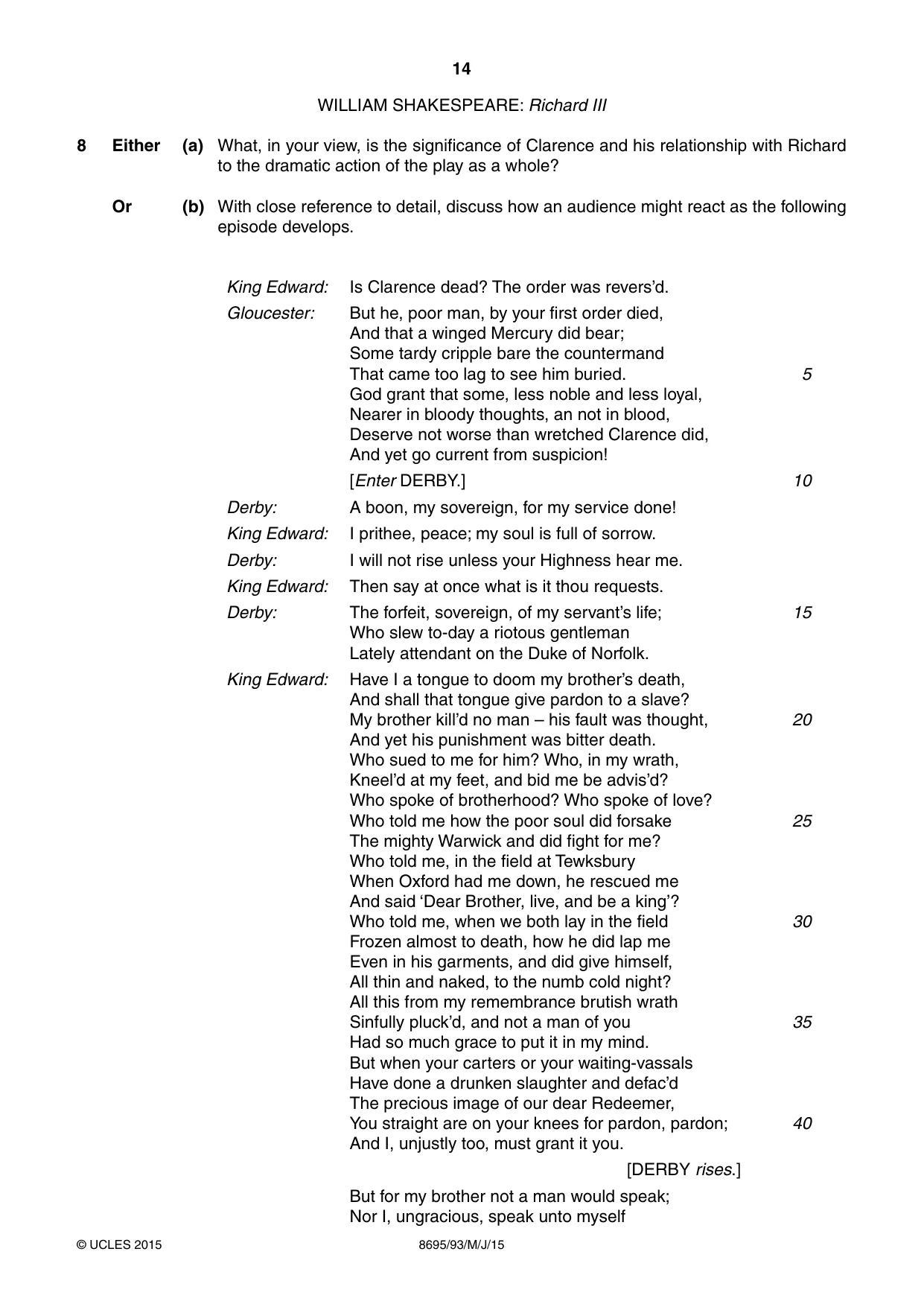
14 8695/93/M/J/15 © UCLES 2015 WILLIAM SHAKESPEARE: Richard III 8 Either (a) What, in your view, is the significance of Clarence and his relationship with Richard to the dramatic action of the play as a whole? Or (b) With close reference to detail, discuss how an audience might react as the following episode develops. King Edward: Is Clarence dead? The order was revers’d. Gloucester: But he, poor man, by your first order died, And that a winged Mercury did bear; Some tardy cripple bare the countermand That came too lag to see him buried. God grant that some, less noble and less loyal, Nearer in bloody thoughts, an not in blood, Deserve not worse than wretched Clarence did, And yet go current from suspicion! [Enter DERBY.] Derby: A boon, my sovereign, for my service done! King Edward: I prithee, peace; my soul is full of sorrow. Derby: I will not rise unless your Highness hear me. King Edward: Then say at once what is it thou requests. Derby: The forfeit, sovereign, of my servant’s life; Who slew to-day a riotous gentleman Lately attendant on the Duke of Norfolk. King Edward: Have I a tongue to doom my brother’s death, And shall that tongue give pardon to a slave? My brother kill’d no man – his fault was thought, And yet his punishment was bitter death. Who sued to me for him? Who, in my wrath, Kneel’d at my feet, and bid me be advis’d? Who spoke of brotherhood? Who spoke of love? Who told me how the poor soul did forsake The mighty Warwick and did fight for me? Who told me, in the field at Tewksbury When Oxford had me down, he rescued me And said ‘Dear Brother, live, and be a king’? Who told me, when we both lay in the field Frozen almost to death, how he did lap me Even in his garments, and did give himself, All thin and naked, to the numb cold night? All this from my remembrance brutish wrath Sinfully pluck’d, and not a man of you Had so much grace to put it in my mind. But when your carters or your waiting-vassals Have done a drunken slaughter and defac’d The precious image of our dear Redeemer, You straight are on your knees for pardon, pardon; And I, unjustly too, must grant it you. [DERBY rises.] But for my brother not a man would speak; Nor I, ungracious, speak unto myself 5 10 15 20 25 30 35 40
Question paper, page 15
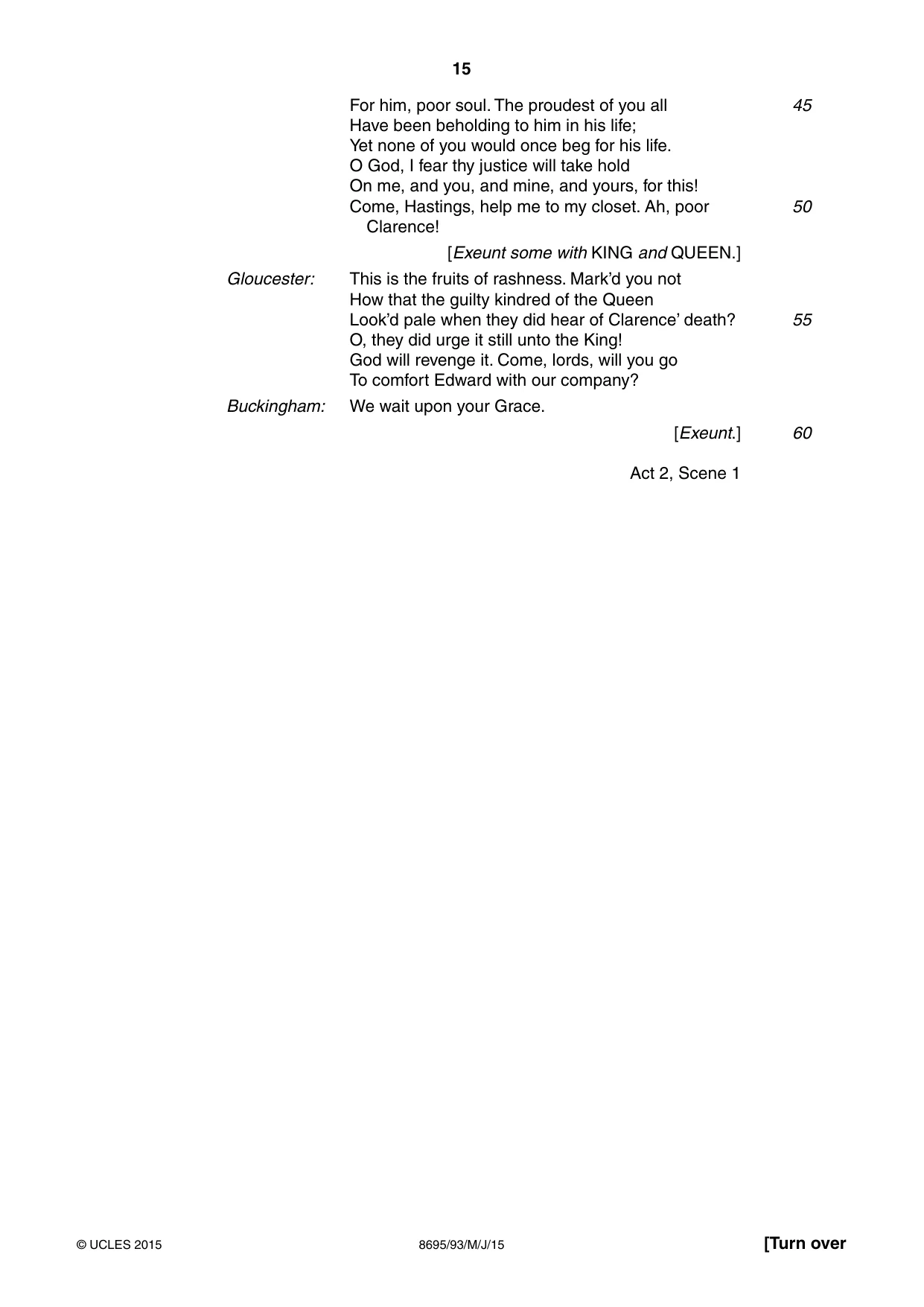
15 8695/93/M/J/15 © UCLES 2015 [Turn over For him, poor soul. The proudest of you all Have been beholding to him in his life; Yet none of you would once beg for his life. O God, I fear thy justice will take hold On me, and you, and mine, and yours, for this! Come, Hastings, help me to my closet. Ah, poor Clarence! [Exeunt some with KING and QUEEN.] Gloucester: This is the fruits of rashness. Mark’d you not How that the guilty kindred of the Queen Look’d pale when they did hear of Clarence’ death? O, they did urge it still unto the King! God will revenge it. Come, lords, will you go To comfort Edward with our company? Buckingham: We wait upon your Grace. [Exeunt.] Act 2, Scene 1 45 50 55 60
Question paper, page 16
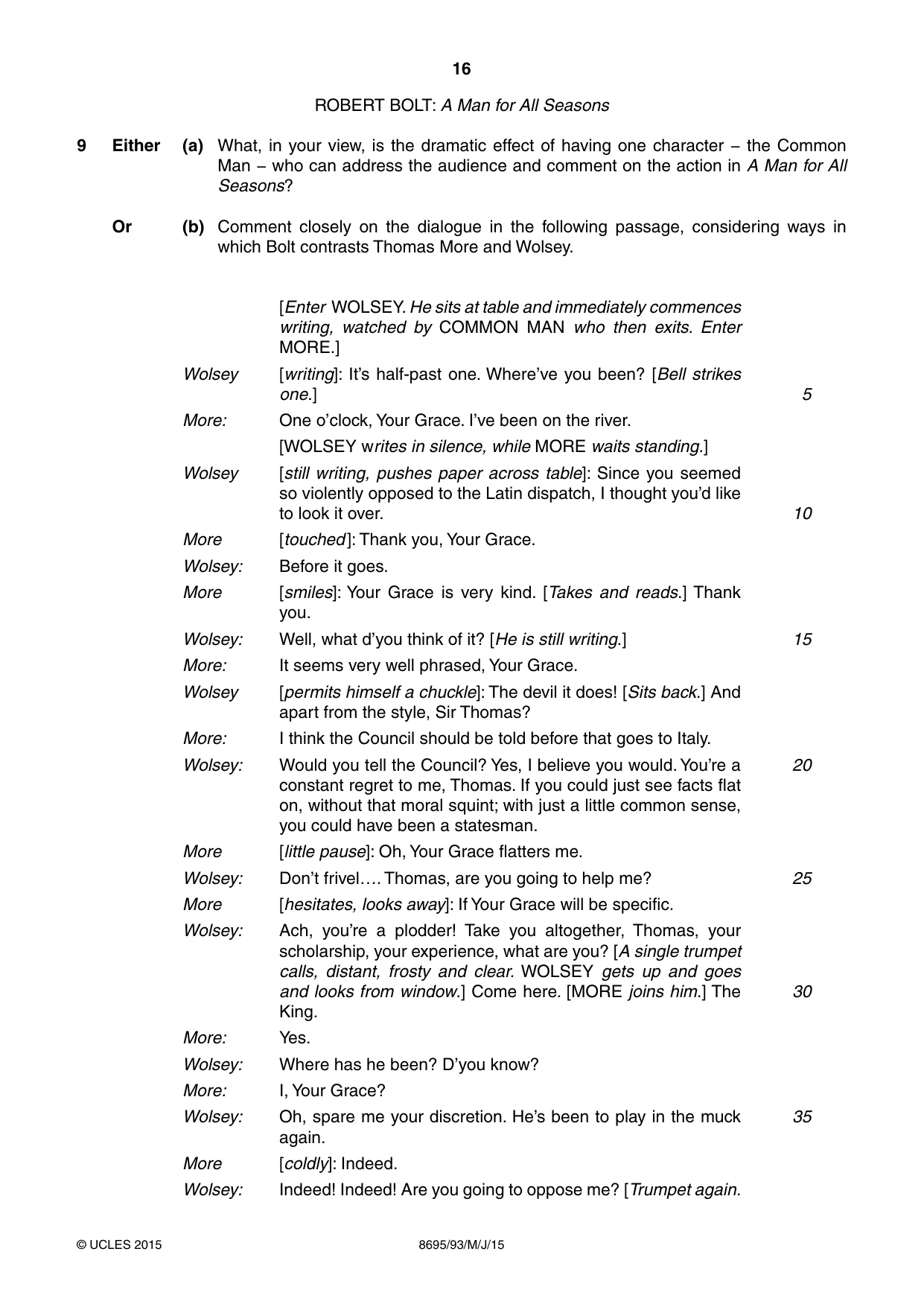
16 8695/93/M/J/15 © UCLES 2015 ROBERT BOLT: A Man for All Seasons 9 Either (a) What, in your view, is the dramatic effect of having one character − the Common Man − who can address the audience and comment on the action in A Man for All Seasons? Or (b) Comment closely on the dialogue in the following passage, considering ways in which Bolt contrasts Thomas More and Wolsey. [Enter WOLSEY. He sits at table and immediately commences writing, watched by COMMON MAN who then exits. Enter MORE.] Wolsey [writing]: It’s half-past one. Where’ve you been? [Bell strikes one.] More: One o’clock, Your Grace. I’ve been on the river. [WOLSEY writes in silence, while MORE waits standing.] Wolsey [still writing, pushes paper across table]: Since you seemed so violently opposed to the Latin dispatch, I thought you’d like to look it over. More [touched ]: Thank you, Your Grace. Wolsey: Before it goes. More [smiles]: Your Grace is very kind. [Takes and reads.] Thank you. Wolsey: Well, what d’you think of it? [He is still writing.] More: It seems very well phrased, Your Grace. Wolsey [permits himself a chuckle]: The devil it does! [Sits back.] And apart from the style, Sir Thomas? More: I think the Council should be told before that goes to Italy. Wolsey: Would you tell the Council? Yes, I believe you would. You’re a constant regret to me, Thomas. If you could just see facts flat on, without that moral squint; with just a little common sense, you could have been a statesman. More [little pause]: Oh, Your Grace flatters me. Wolsey: Don’t frivel…. Thomas, are you going to help me? More [hesitates, looks away]: If Your Grace will be specific. Wolsey: Ach, you’re a plodder! Take you altogether, Thomas, your scholarship, your experience, what are you? [A single trumpet calls, distant, frosty and clear. WOLSEY gets up and goes and looks from window.] Come here. [MORE joins him.] The King. More: Yes. Wolsey: Where has he been? D’you know? More: I, Your Grace? Wolsey: Oh, spare me your discretion. He’s been to play in the muck again. More [coldly]: Indeed. Wolsey: Indeed! Indeed! Are you going to oppose me? [Trumpet again. 5 10 15 20 25 30 35
Question paper, page 17
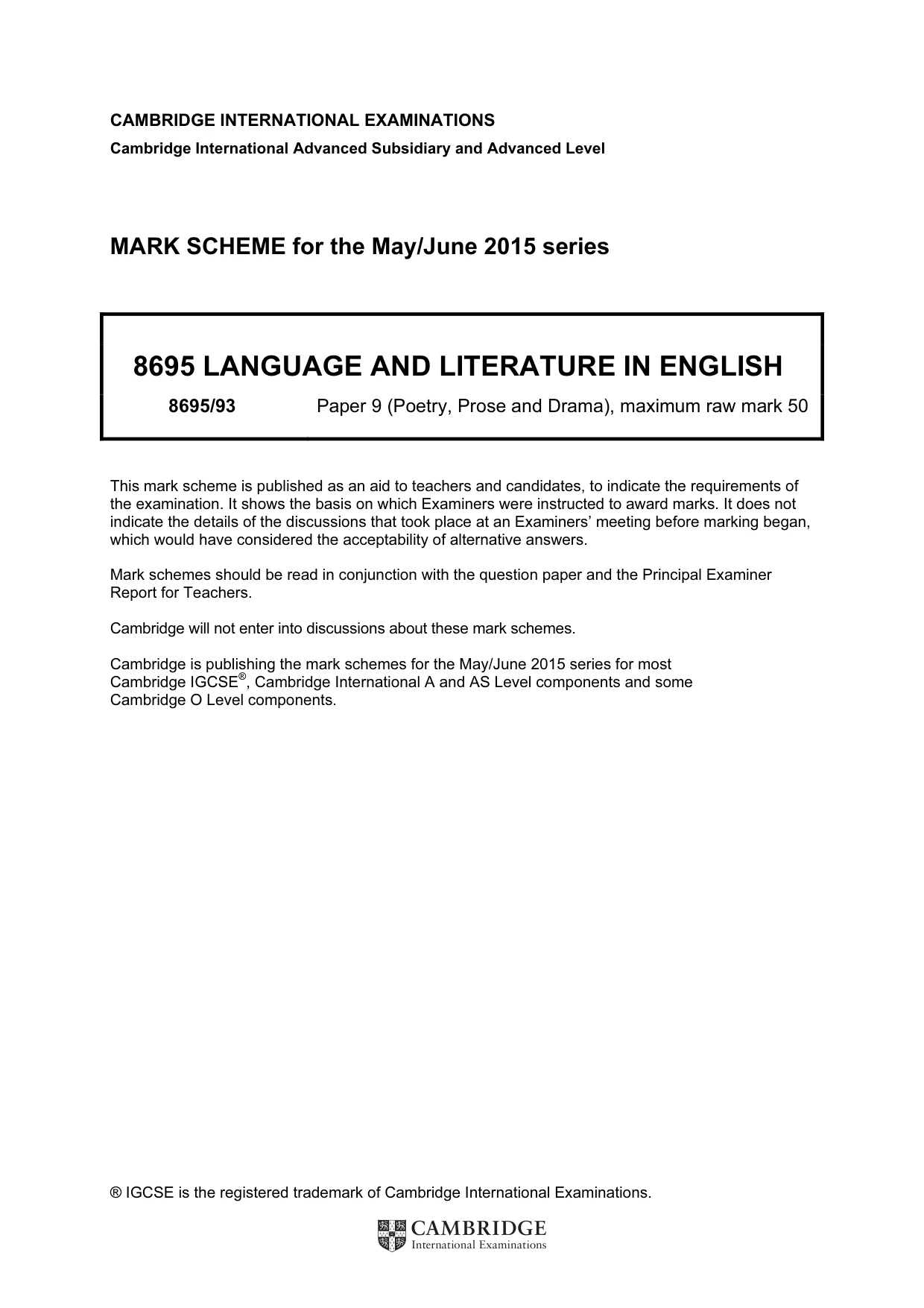
17 8695/93/M/J/15 © UCLES 2015 WOLSEY visibly relaxes.] He’s gone in. … [Leaves window.] All right, we’ll plod. The King wants a son; what are you going to do about it? More [dry murmur]: I’m very sure the King needs no advice from me on what to do about it. Wolsey [from behind grips his shoulder fiercely]: Thomas, we’re alone. I give you my word. There’s no one here. More: I didn’t suppose there was, Your Grace. Wolsey: Oh. [Goes to table, sits, signs MORE to sit. MORE unsuspectingly obeys. Then, deliberately loud.] Do you favour a change of dynasty, Sir Thomas? D’you think two Tudors is sufficient? More [starting up in horrified alarm]: – For God’s sake, Your Grace—! Wolsey: Then the King needs a son; I repeat what are you going to do about it? More [steadily]: I pray for it daily. Act 1 40 45 50
Question paper, page 18
18 8695/93/M/J/15 © UCLES 2015 BLANK PAGE
Question paper, page 19
19 8695/93/M/J/15 © UCLES 2015 BLANK PAGE
Question paper, page 20
20 8695/93/M/J/15 © UCLES 2015 BLANK PAGE Permission to reproduce items where third-party owned material protected by copyright is included has been sought and cleared where possible. Every reasonable effort has been made by the publisher (UCLES) to trace copyright holders, but if any items requiring clearance have unwittingly been included, the publisher will be pleased to make amends at the earliest possible opportunity. To avoid the issue of disclosure of answer-related information to candidates, all copyright acknowledgements are reproduced online in the Cambridge International Examinations Copyright Acknowledgements Booklet. This is produced for each series of examinations and is freely available to download at www.cie.org.uk after the live examination series. Cambridge International Examinations is part of the Cambridge Assessment Group. Cambridge Assessment is the brand name of University of Cambridge Local Examinations Syndicate (UCLES), which is itself a department of the University of Cambridge.
Mark scheme, page 1
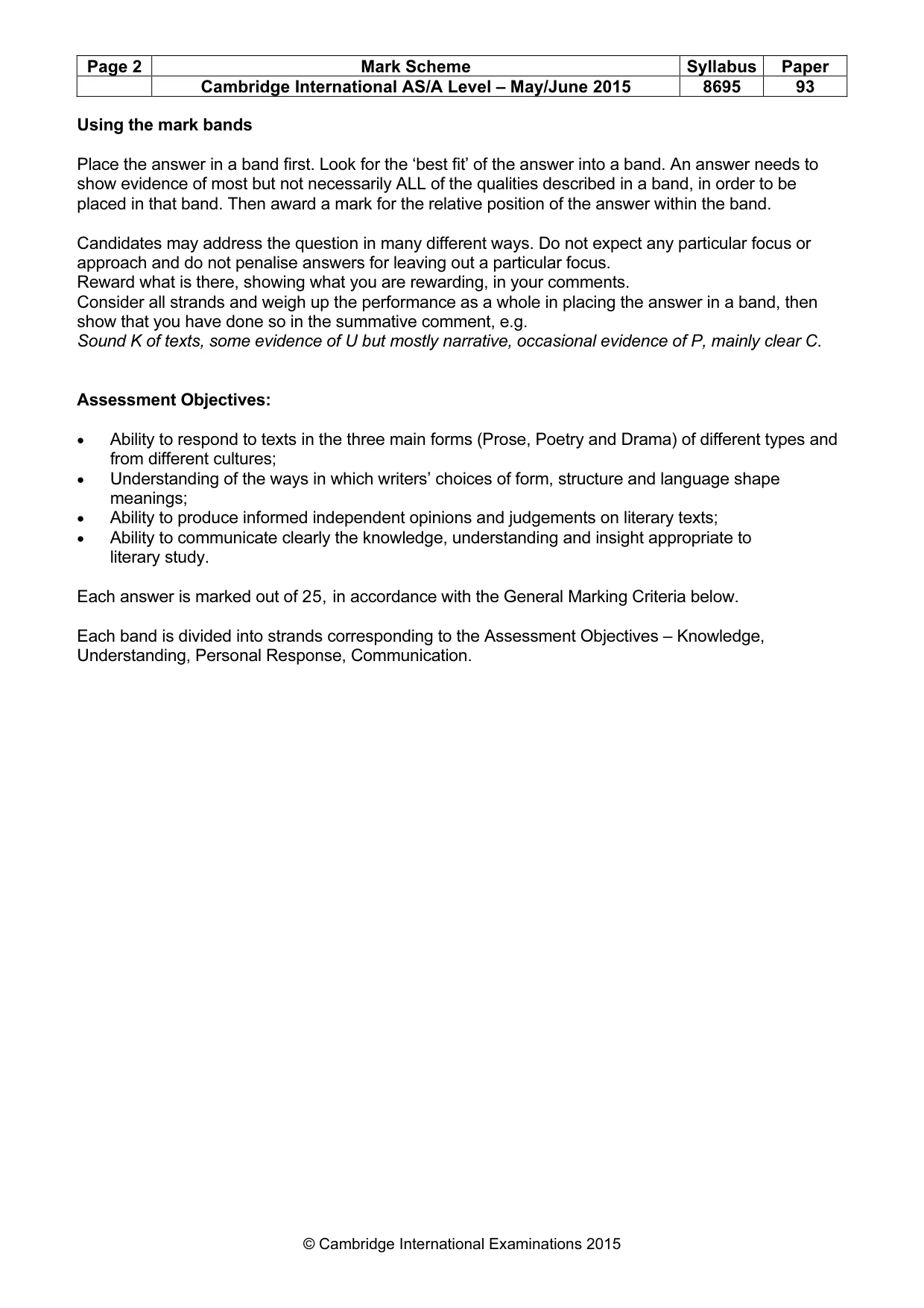
® IGCSE is the registered trademark of Cambridge International Examinations. CAMBRIDGE INTERNATIONAL EXAMINATIONS Cambridge International Advanced Subsidiary and Advanced Level MARK SCHEME for the May/June 2015 series 8695 LANGUAGE AND LITERATURE IN ENGLISH 8695/93 Paper 9 (Poetry, Prose and Drama), maximum raw mark 50 This mark scheme is published as an aid to teachers and candidates, to indicate the requirements of the examination. It shows the basis on which Examiners were instructed to award marks. It does not indicate the details of the discussions that took place at an Examiners’ meeting before marking began, which would have considered the acceptability of alternative answers. Mark schemes should be read in conjunction with the question paper and the Principal Examiner Report for Teachers. Cambridge will not enter into discussions about these mark schemes. Cambridge is publishing the mark schemes for the May/June 2015 series for most Cambridge IGCSE®, Cambridge International A and AS Level components and some Cambridge O Level components.
Mark scheme, page 2
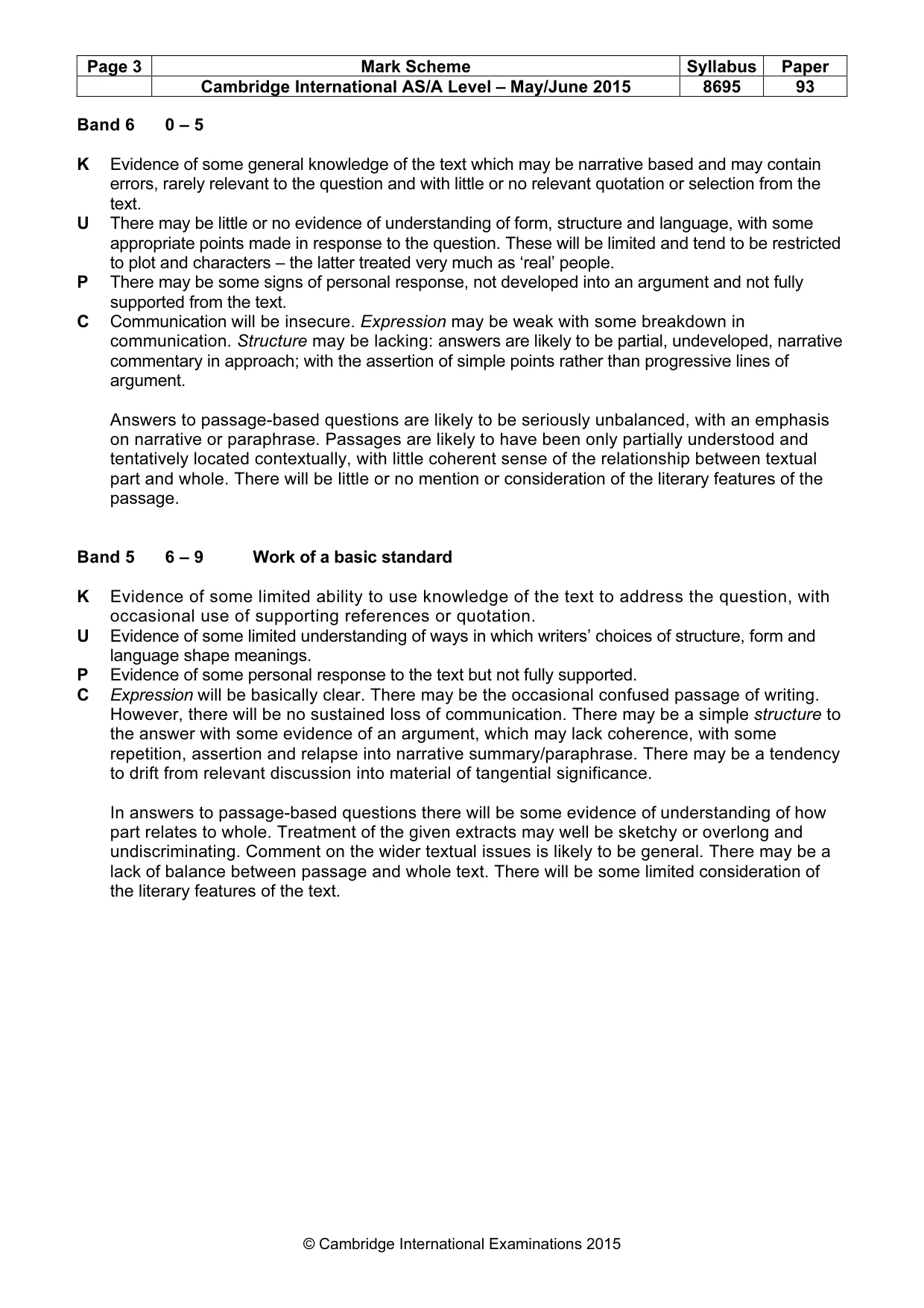
Page 2 Mark Scheme Syllabus Paper Cambridge International AS/A Level – May/June 2015 8695 93 © Cambridge International Examinations 2015 Using the mark bands Place the answer in a band first. Look for the ‘best fit’ of the answer into a band. An answer needs to show evidence of most but not necessarily ALL of the qualities described in a band, in order to be placed in that band. Then award a mark for the relative position of the answer within the band. Candidates may address the question in many different ways. Do not expect any particular focus or approach and do not penalise answers for leaving out a particular focus. Reward what is there, showing what you are rewarding, in your comments. Consider all strands and weigh up the performance as a whole in placing the answer in a band, then show that you have done so in the summative comment, e.g. Sound K of texts, some evidence of U but mostly narrative, occasional evidence of P, mainly clear C. Assessment Objectives: • Ability to respond to texts in the three main forms (Prose, Poetry and Drama) of different types and from different cultures; • Understanding of the ways in which writers’ choices of form, structure and language shape meanings; • Ability to produce informed independent opinions and judgements on literary texts; • Ability to communicate clearly the knowledge, understanding and insight appropriate to literary study. Each answer is marked out of 25, in accordance with the General Marking Criteria below. Each band is divided into strands corresponding to the Assessment Objectives – Knowledge, Understanding, Personal Response, Communication.
Mark scheme, page 3
Page 3 Mark Scheme Syllabus Paper Cambridge International AS/A Level – May/June 2015 8695 93 © Cambridge International Examinations 2015 Band 6 0 – 5 K Evidence of some general knowledge of the text which may be narrative based and may contain errors, rarely relevant to the question and with little or no relevant quotation or selection from the text. U There may be little or no evidence of understanding of form, structure and language, with some appropriate points made in response to the question. These will be limited and tend to be restricted to plot and characters – the latter treated very much as ‘real’ people. P There may be some signs of personal response, not developed into an argument and not fully supported from the text. C Communication will be insecure. Expression may be weak with some breakdown in communication. Structure may be lacking: answers are likely to be partial, undeveloped, narrative commentary in approach; with the assertion of simple points rather than progressive lines of argument. Answers to passage-based questions are likely to be seriously unbalanced, with an emphasis on narrative or paraphrase. Passages are likely to have been only partially understood and tentatively located contextually, with little coherent sense of the relationship between textual part and whole. There will be little or no mention or consideration of the literary features of the passage. Band 5 6 – 9 Work of a basic standard K Evidence of some limited ability to use knowledge of the text to address the question, with occasional use of supporting references or quotation. U Evidence of some limited understanding of ways in which writers’ choices of structure, form and language shape meanings. P Evidence of some personal response to the text but not fully supported. C Expression will be basically clear. There may be the occasional confused passage of writing. However, there will be no sustained loss of communication. There may be a simple structure to the answer with some evidence of an argument, which may lack coherence, with some repetition, assertion and relapse into narrative summary/paraphrase. There may be a tendency to drift from relevant discussion into material of tangential significance. In answers to passage-based questions there will be some evidence of understanding of how part relates to whole. Treatment of the given extracts may well be sketchy or overlong and undiscriminating. Comment on the wider textual issues is likely to be general. There may be a lack of balance between passage and whole text. There will be some limited consideration of the literary features of the text.
Mark scheme, page 4
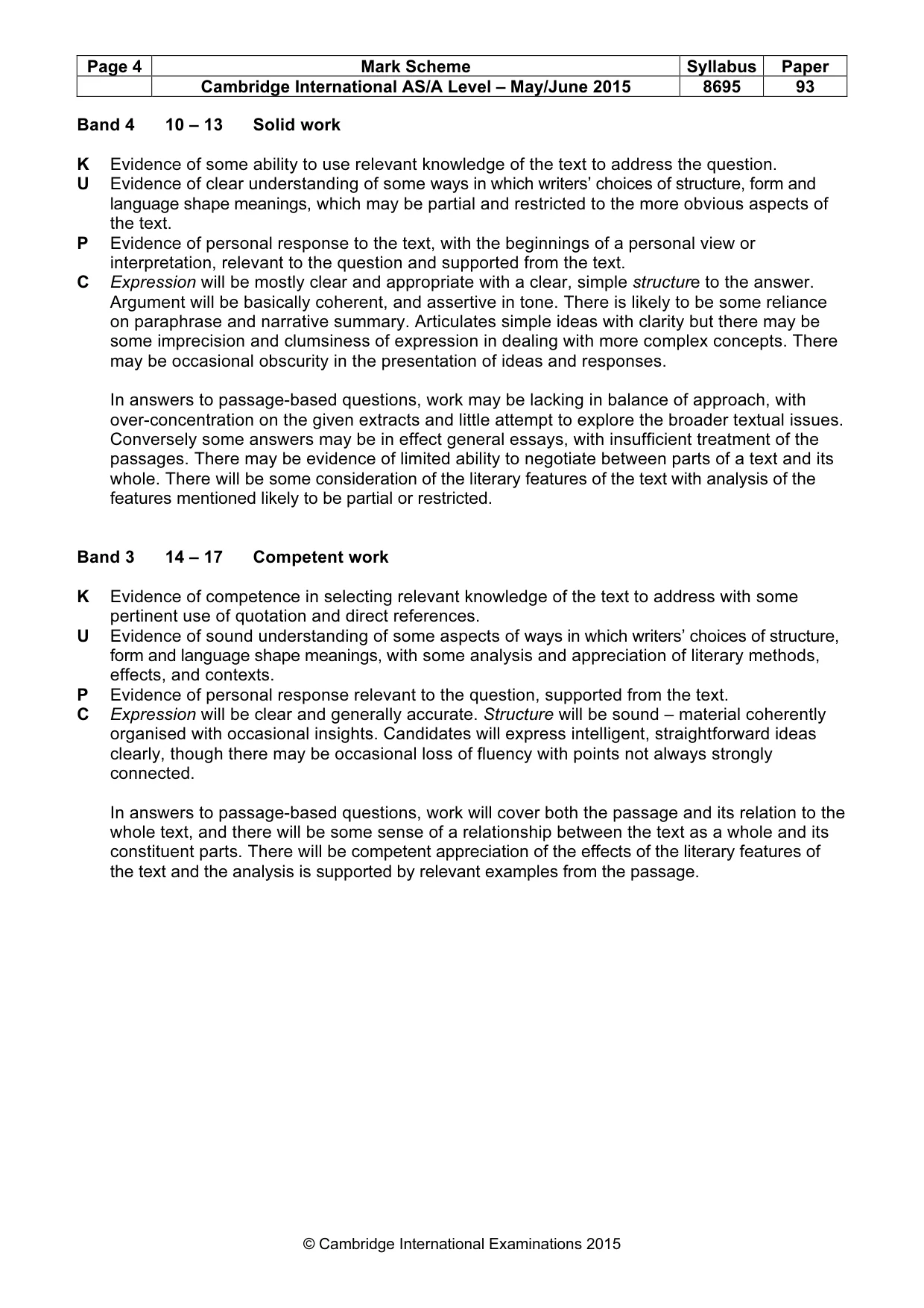
Page 4 Mark Scheme Syllabus Paper Cambridge International AS/A Level – May/June 2015 8695 93 © Cambridge International Examinations 2015 Band 4 10 – 13 Solid work K Evidence of some ability to use relevant knowledge of the text to address the question. U Evidence of clear understanding of some ways in which writers’ choices of structure, form and language shape meanings, which may be partial and restricted to the more obvious aspects of the text. P Evidence of personal response to the text, with the beginnings of a personal view or interpretation, relevant to the question and supported from the text. C Expression will be mostly clear and appropriate with a clear, simple structure to the answer. Argument will be basically coherent, and assertive in tone. There is likely to be some reliance on paraphrase and narrative summary. Articulates simple ideas with clarity but there may be some imprecision and clumsiness of expression in dealing with more complex concepts. There may be occasional obscurity in the presentation of ideas and responses. In answers to passage-based questions, work may be lacking in balance of approach, with over-concentration on the given extracts and little attempt to explore the broader textual issues. Conversely some answers may be in effect general essays, with insufficient treatment of the passages. There may be evidence of limited ability to negotiate between parts of a text and its whole. There will be some consideration of the literary features of the text with analysis of the features mentioned likely to be partial or restricted. Band 3 14 – 17 Competent work K Evidence of competence in selecting relevant knowledge of the text to address with some pertinent use of quotation and direct references. U Evidence of sound understanding of some aspects of ways in which writers’ choices of structure, form and language shape meanings, with some analysis and appreciation of literary methods, effects, and contexts. P Evidence of personal response relevant to the question, supported from the text. C Expression will be clear and generally accurate. Structure will be sound – material coherently organised with occasional insights. Candidates will express intelligent, straightforward ideas clearly, though there may be occasional loss of fluency with points not always strongly connected. In answers to passage-based questions, work will cover both the passage and its relation to the whole text, and there will be some sense of a relationship between the text as a whole and its constituent parts. There will be competent appreciation of the effects of the literary features of the text and the analysis is supported by relevant examples from the passage.
Mark scheme, page 5
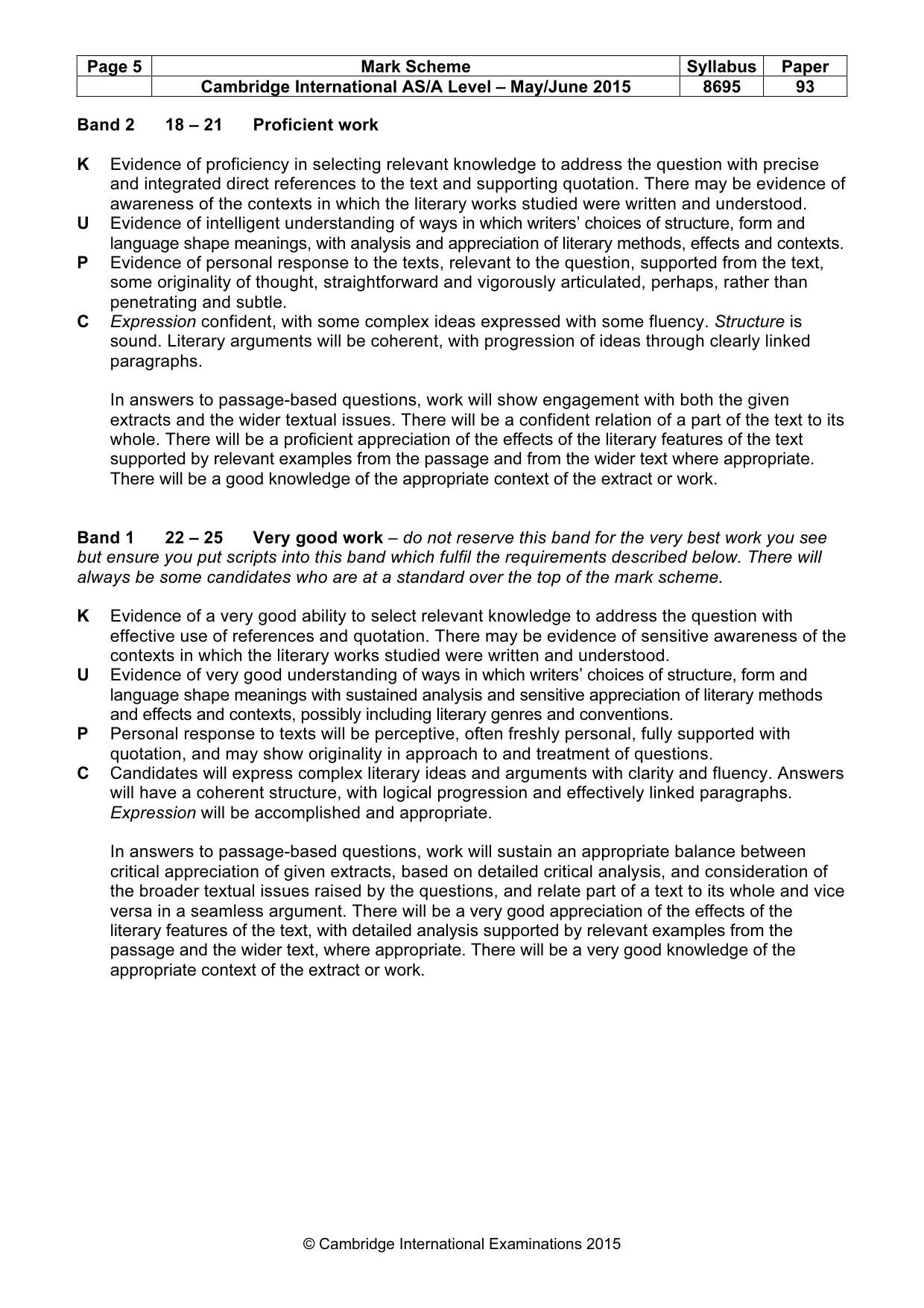
Page 5 Mark Scheme Syllabus Paper Cambridge International AS/A Level – May/June 2015 8695 93 © Cambridge International Examinations 2015 Band 2 18 – 21 Proficient work K Evidence of proficiency in selecting relevant knowledge to address the question with precise and integrated direct references to the text and supporting quotation. There may be evidence of awareness of the contexts in which the literary works studied were written and understood. U Evidence of intelligent understanding of ways in which writers’ choices of structure, form and language shape meanings, with analysis and appreciation of literary methods, effects and contexts. P Evidence of personal response to the texts, relevant to the question, supported from the text, some originality of thought, straightforward and vigorously articulated, perhaps, rather than penetrating and subtle. C Expression confident, with some complex ideas expressed with some fluency. Structure is sound. Literary arguments will be coherent, with progression of ideas through clearly linked paragraphs. In answers to passage-based questions, work will show engagement with both the given extracts and the wider textual issues. There will be a confident relation of a part of the text to its whole. There will be a proficient appreciation of the effects of the literary features of the text supported by relevant examples from the passage and from the wider text where appropriate. There will be a good knowledge of the appropriate context of the extract or work. Band 1 22 – 25 Very good work – do not reserve this band for the very best work you see but ensure you put scripts into this band which fulfil the requirements described below. There will always be some candidates who are at a standard over the top of the mark scheme. K Evidence of a very good ability to select relevant knowledge to address the question with effective use of references and quotation. There may be evidence of sensitive awareness of the contexts in which the literary works studied were written and understood. U Evidence of very good understanding of ways in which writers’ choices of structure, form and language shape meanings with sustained analysis and sensitive appreciation of literary methods and effects and contexts, possibly including literary genres and conventions. P Personal response to texts will be perceptive, often freshly personal, fully supported with quotation, and may show originality in approach to and treatment of questions. C Candidates will express complex literary ideas and arguments with clarity and fluency. Answers will have a coherent structure, with logical progression and effectively linked paragraphs. Expression will be accomplished and appropriate. In answers to passage-based questions, work will sustain an appropriate balance between critical appreciation of given extracts, based on detailed critical analysis, and consideration of the broader textual issues raised by the questions, and relate part of a text to its whole and vice versa in a seamless argument. There will be a very good appreciation of the effects of the literary features of the text, with detailed analysis supported by relevant examples from the passage and the wider text, where appropriate. There will be a very good knowledge of the appropriate context of the extract or work.
What you needed in this session
Cambridge’s own grade thresholds for 2015 May/June, Paper 9 · Variant 3. A higher threshold means an easier paper — the bar moves with how the cohort did.