Cambridge A Level English - Language and Literature (AS Level only, from 2016) 8695 — 2015 May/June Paper 9 · Variant 1
8695/91/M/J/15 · 50 marks · ≈56 min
The question paper and its mark scheme, free to read here and free to download. This is Cambridge’s own paper, exactly as it was sat.
Question paper20 pages




Mark scheme4 pages
Answers below. Sit the paper first if you are practising.
Paper as text
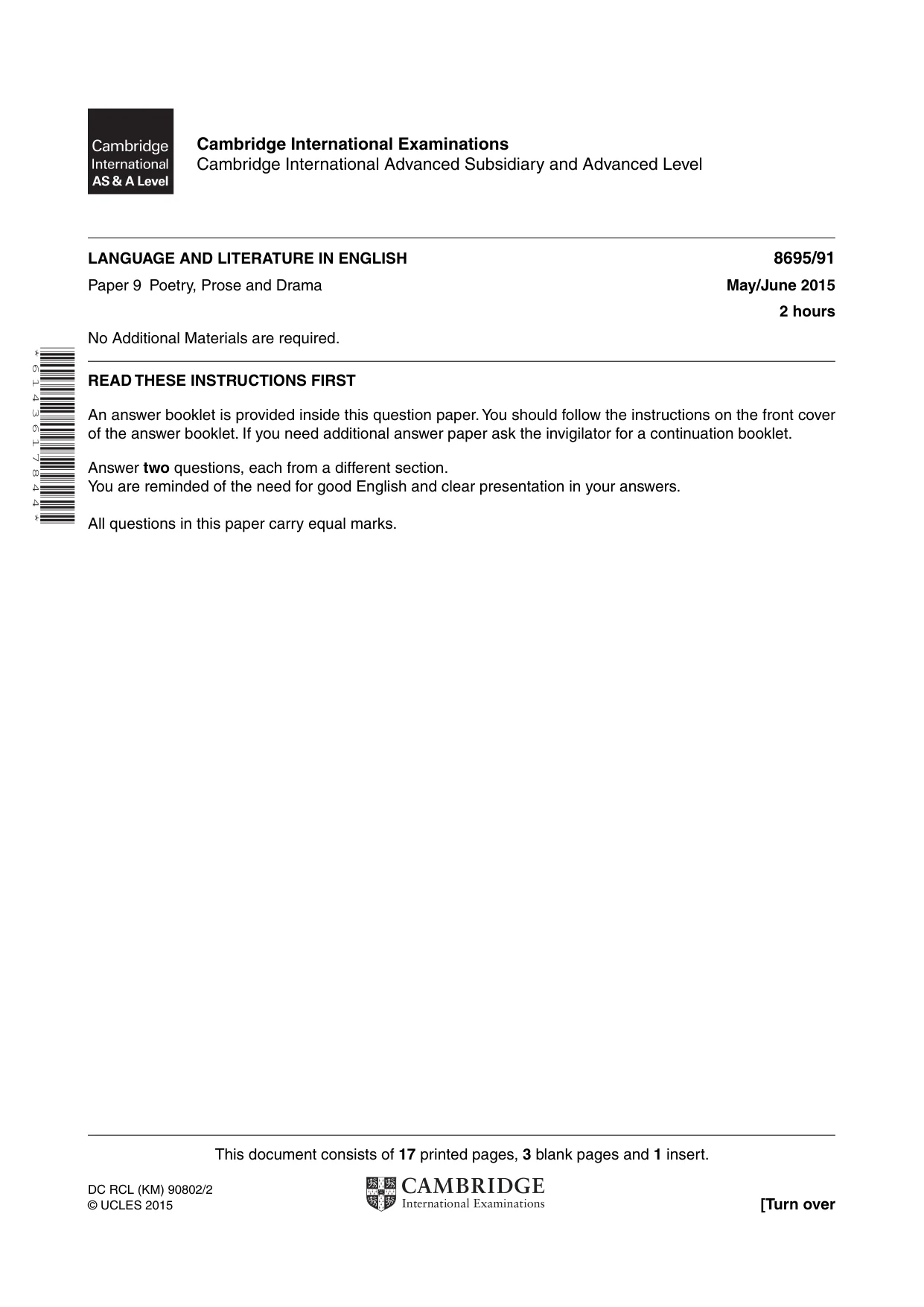
Question paper, page 1
This document consists of 17 printed pages, 3 blank pages and 1 insert. DC RCL (KM) 90802/2 © UCLES 2015 [Turn over Cambridge International Examinations Cambridge International Advanced Subsidiary and Advanced Level * 6 1 4 3 6 1 7 8 4 4 * LANGUAGE AND LITERATURE IN ENGLISH 8695/91 Paper 9 Poetry, Prose and Drama May/June 2015 2 hours No Additional Materials are required. READ THESE INSTRUCTIONS FIRST An answer booklet is provided inside this question paper. You should follow the instructions on the front cover of the answer booklet. If you need additional answer paper ask the invigilator for a continuation booklet. Answer two questions, each from a different section. You are reminded of the need for good English and clear presentation in your answers. All questions in this paper carry equal marks.
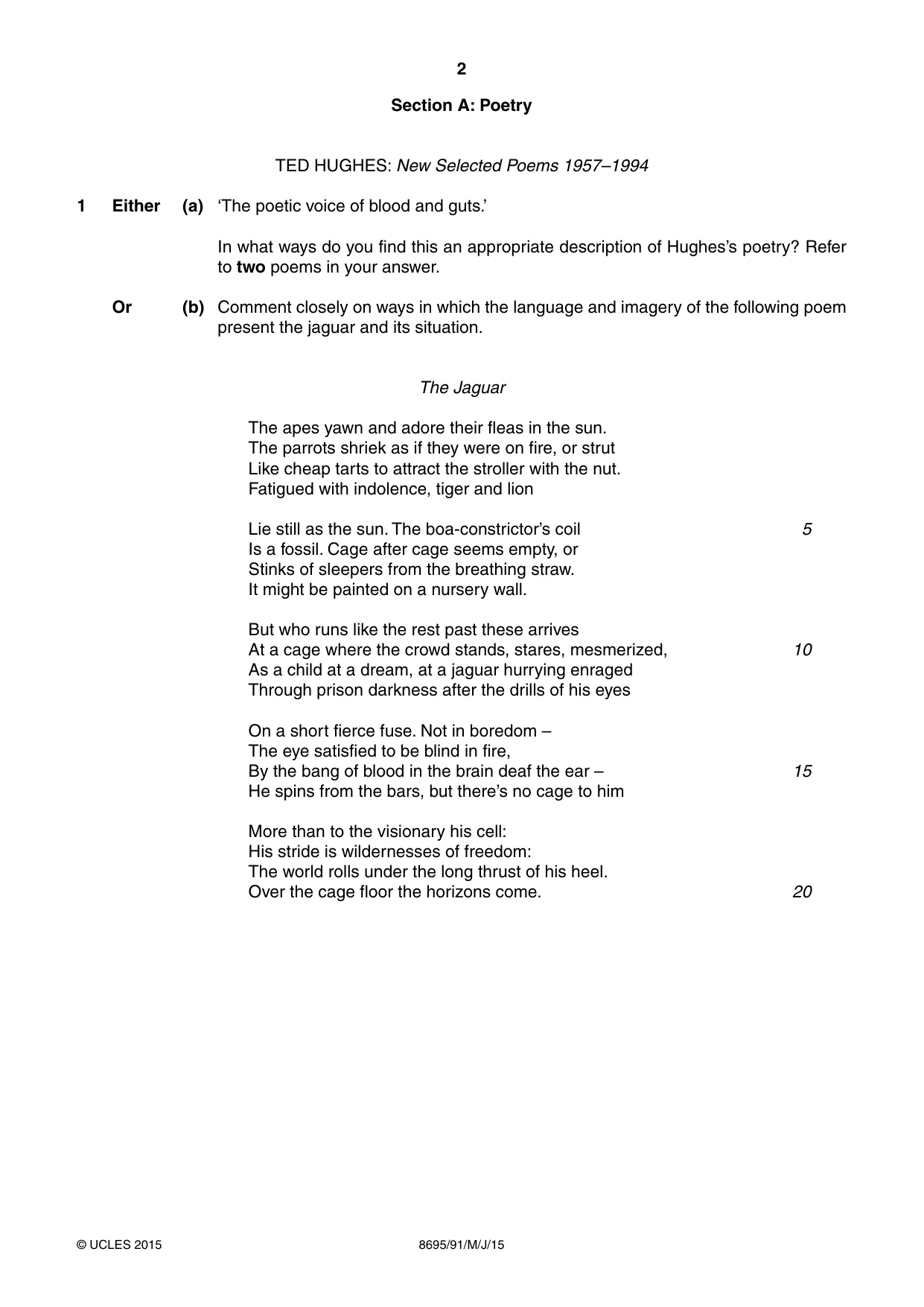
Question paper, page 2
2 8695/91/M/J/15 © UCLES 2015 Section A: Poetry TED HUGHES: New Selected Poems 1957–1994 1 Either (a) ‘The poetic voice of blood and guts.’ In what ways do you find this an appropriate description of Hughes’s poetry? Refer to two poems in your answer. Or (b) Comment closely on ways in which the language and imagery of the following poem present the jaguar and its situation. The Jaguar The apes yawn and adore their fleas in the sun. The parrots shriek as if they were on fire, or strut Like cheap tarts to attract the stroller with the nut. Fatigued with indolence, tiger and lion Lie still as the sun. The boa-constrictor’s coil Is a fossil. Cage after cage seems empty, or Stinks of sleepers from the breathing straw. It might be painted on a nursery wall. But who runs like the rest past these arrives At a cage where the crowd stands, stares, mesmerized, As a child at a dream, at a jaguar hurrying enraged Through prison darkness after the drills of his eyes On a short fierce fuse. Not in boredom – The eye satisfied to be blind in fire, By the bang of blood in the brain deaf the ear – He spins from the bars, but there’s no cage to him More than to the visionary his cell: His stride is wildernesses of freedom: The world rolls under the long thrust of his heel. Over the cage floor the horizons come. 5 10 15 20
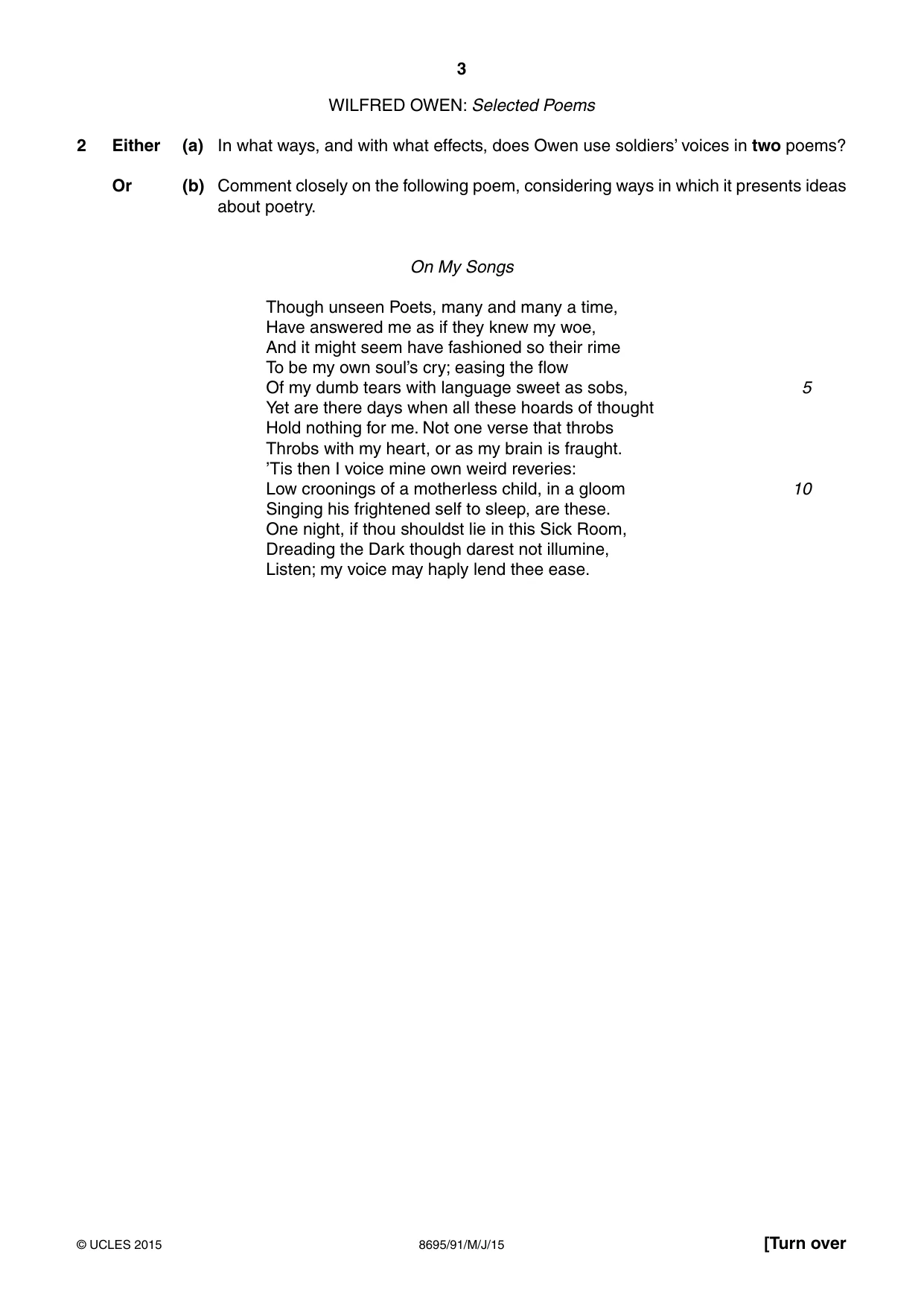
Question paper, page 3
3 8695/91/M/J/15 © UCLES 2015 [Turn over WILFRED OWEN: Selected Poems 2 Either (a) In what ways, and with what effects, does Owen use soldiers’ voices in two poems? Or (b) Comment closely on the following poem, considering ways in which it presents ideas about poetry. On My Songs Though unseen Poets, many and many a time, Have answered me as if they knew my woe, And it might seem have fashioned so their rime To be my own soul’s cry; easing the flow Of my dumb tears with language sweet as sobs, Yet are there days when all these hoards of thought Hold nothing for me. Not one verse that throbs Throbs with my heart, or as my brain is fraught. ’Tis then I voice mine own weird reveries: Low croonings of a motherless child, in a gloom Singing his frightened self to sleep, are these. One night, if thou shouldst lie in this Sick Room, Dreading the Dark though darest not illumine, Listen; my voice may haply lend thee ease. 5 10
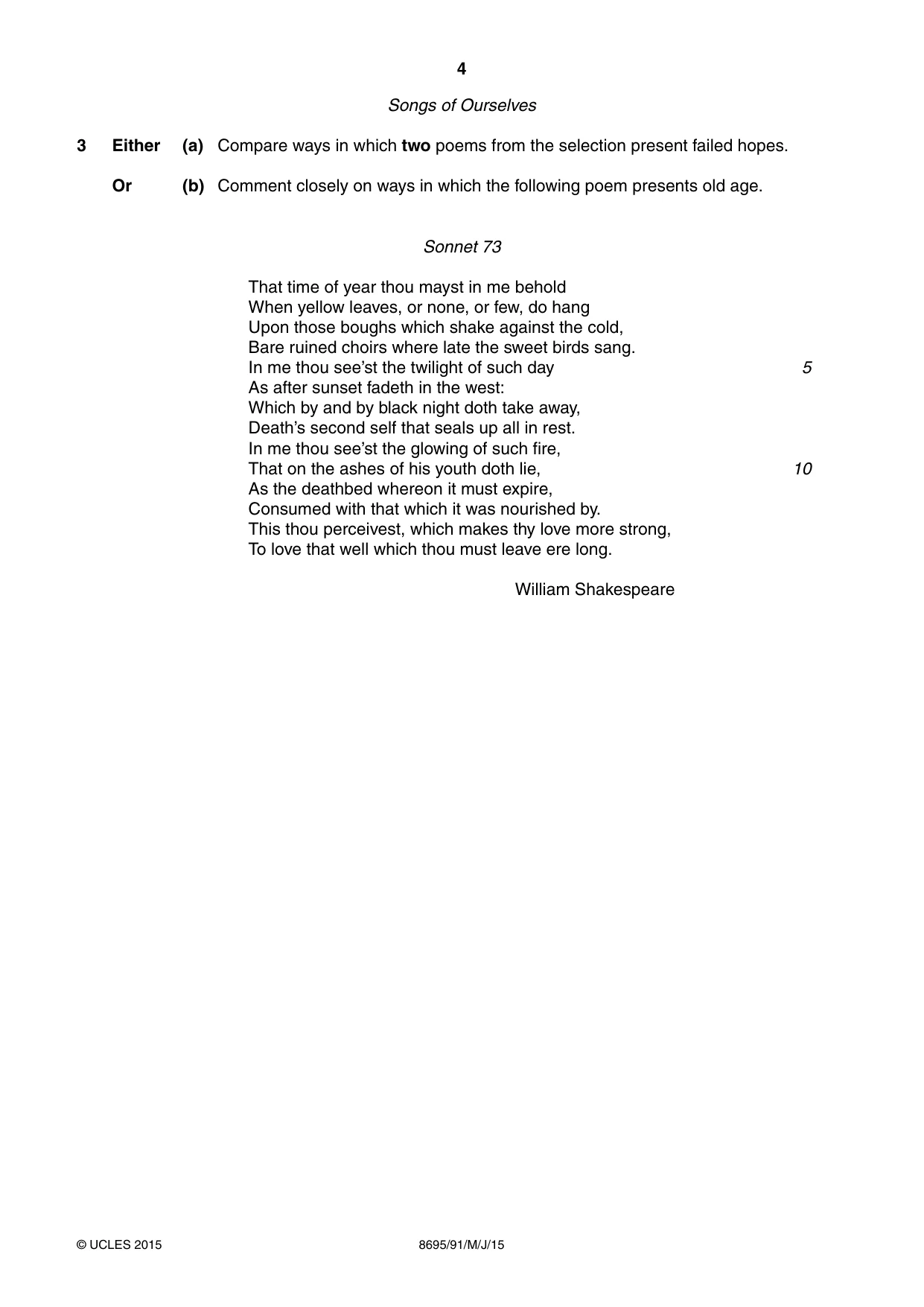
Question paper, page 4
4 8695/91/M/J/15 © UCLES 2015 Songs of Ourselves 3 Either (a) Compare ways in which two poems from the selection present failed hopes. Or (b) Comment closely on ways in which the following poem presents old age. Sonnet 73 That time of year thou mayst in me behold When yellow leaves, or none, or few, do hang Upon those boughs which shake against the cold, Bare ruined choirs where late the sweet birds sang. In me thou see’st the twilight of such day As after sunset fadeth in the west: Which by and by black night doth take away, Death’s second self that seals up all in rest. In me thou see’st the glowing of such fire, That on the ashes of his youth doth lie, As the deathbed whereon it must expire, Consumed with that which it was nourished by. This thou perceivest, which makes thy love more strong, To love that well which thou must leave ere long. William Shakespeare 5 10
Question paper, page 5
5 8695/91/M/J/15 © UCLES 2015 [Turn over Turn to page 6 for Question 4
Question paper, page 6
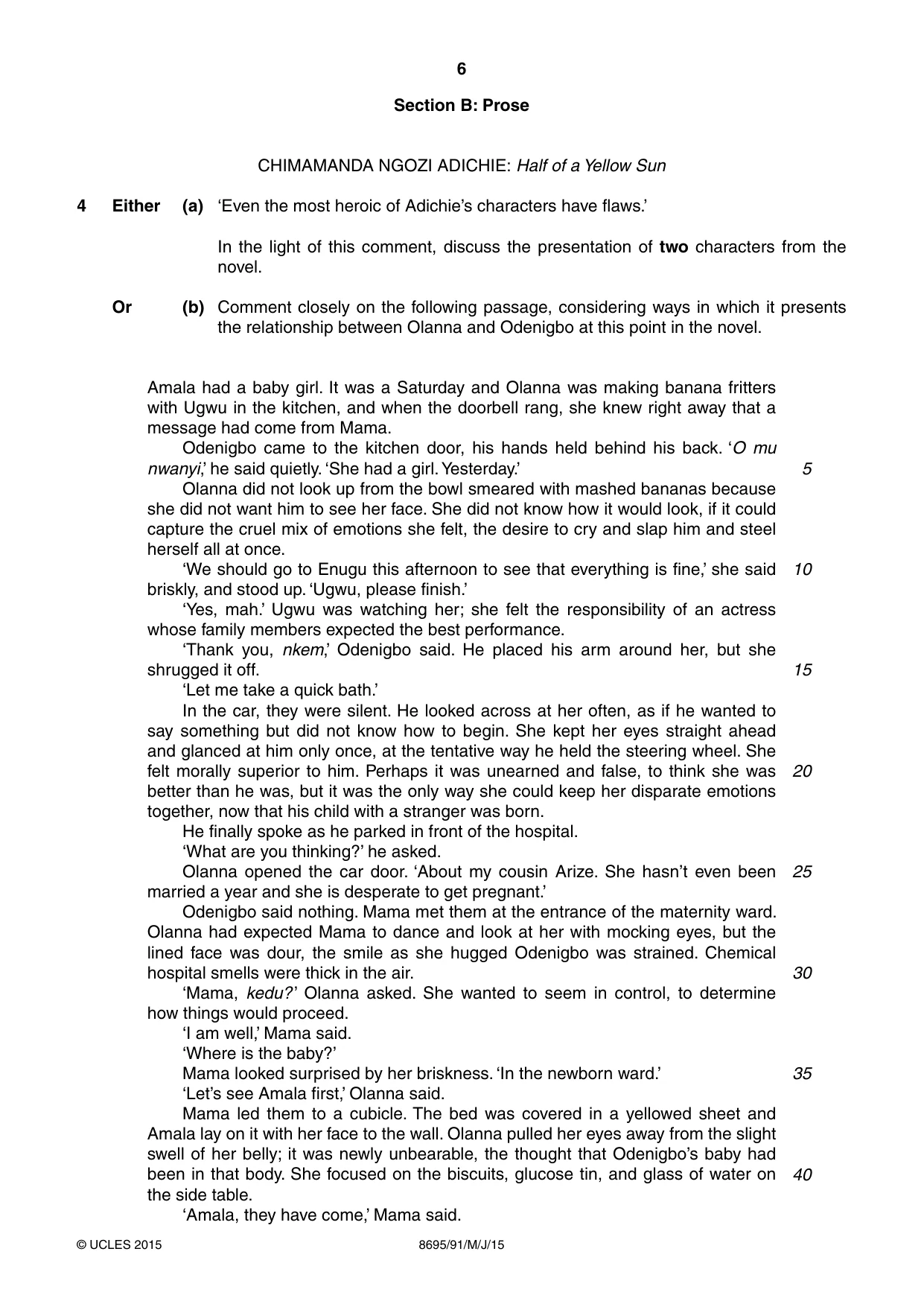
6 8695/91/M/J/15 © UCLES 2015 Section B: Prose CHIMAMANDA NGOZI ADICHIE: Half of a Yellow Sun 4 Either (a) ‘Even the most heroic of Adichie’s characters have flaws.’ In the light of this comment, discuss the presentation of two characters from the novel. Or (b) Comment closely on the following passage, considering ways in which it presents the relationship between Olanna and Odenigbo at this point in the novel. Amala had a baby girl. It was a Saturday and Olanna was making banana fritters with Ugwu in the kitchen, and when the doorbell rang, she knew right away that a message had come from Mama. Odenigbo came to the kitchen door, his hands held behind his back. ‘O mu nwanyi,’ he said quietly. ‘She had a girl. Yesterday.’ Olanna did not look up from the bowl smeared with mashed bananas because she did not want him to see her face. She did not know how it would look, if it could capture the cruel mix of emotions she felt, the desire to cry and slap him and steel herself all at once. ‘We should go to Enugu this afternoon to see that everything is fine,’ she said briskly, and stood up. ‘Ugwu, please finish.’ ‘Yes, mah.’ Ugwu was watching her; she felt the responsibility of an actress whose family members expected the best performance. ‘Thank you, nkem,’ Odenigbo said. He placed his arm around her, but she shrugged it off. ‘Let me take a quick bath.’ In the car, they were silent. He looked across at her often, as if he wanted to say something but did not know how to begin. She kept her eyes straight ahead and glanced at him only once, at the tentative way he held the steering wheel. She felt morally superior to him. Perhaps it was unearned and false, to think she was better than he was, but it was the only way she could keep her disparate emotions together, now that his child with a stranger was born. He finally spoke as he parked in front of the hospital. ‘What are you thinking?’ he asked. Olanna opened the car door. ‘About my cousin Arize. She hasn’t even been married a year and she is desperate to get pregnant.’ Odenigbo said nothing. Mama met them at the entrance of the maternity ward. Olanna had expected Mama to dance and look at her with mocking eyes, but the lined face was dour, the smile as she hugged Odenigbo was strained. Chemical hospital smells were thick in the air. ‘Mama, kedu? ’ Olanna asked. She wanted to seem in control, to determine how things would proceed. ‘I am well,’ Mama said. ‘Where is the baby?’ Mama looked surprised by her briskness. ‘In the newborn ward.’ ‘Let’s see Amala first,’ Olanna said. Mama led them to a cubicle. The bed was covered in a yellowed sheet and Amala lay on it with her face to the wall. Olanna pulled her eyes away from the slight swell of her belly; it was newly unbearable, the thought that Odenigbo’s baby had been in that body. She focused on the biscuits, glucose tin, and glass of water on the side table. ‘Amala, they have come,’ Mama said. 5 10 15 20 25 30 35 40
Question paper, page 7
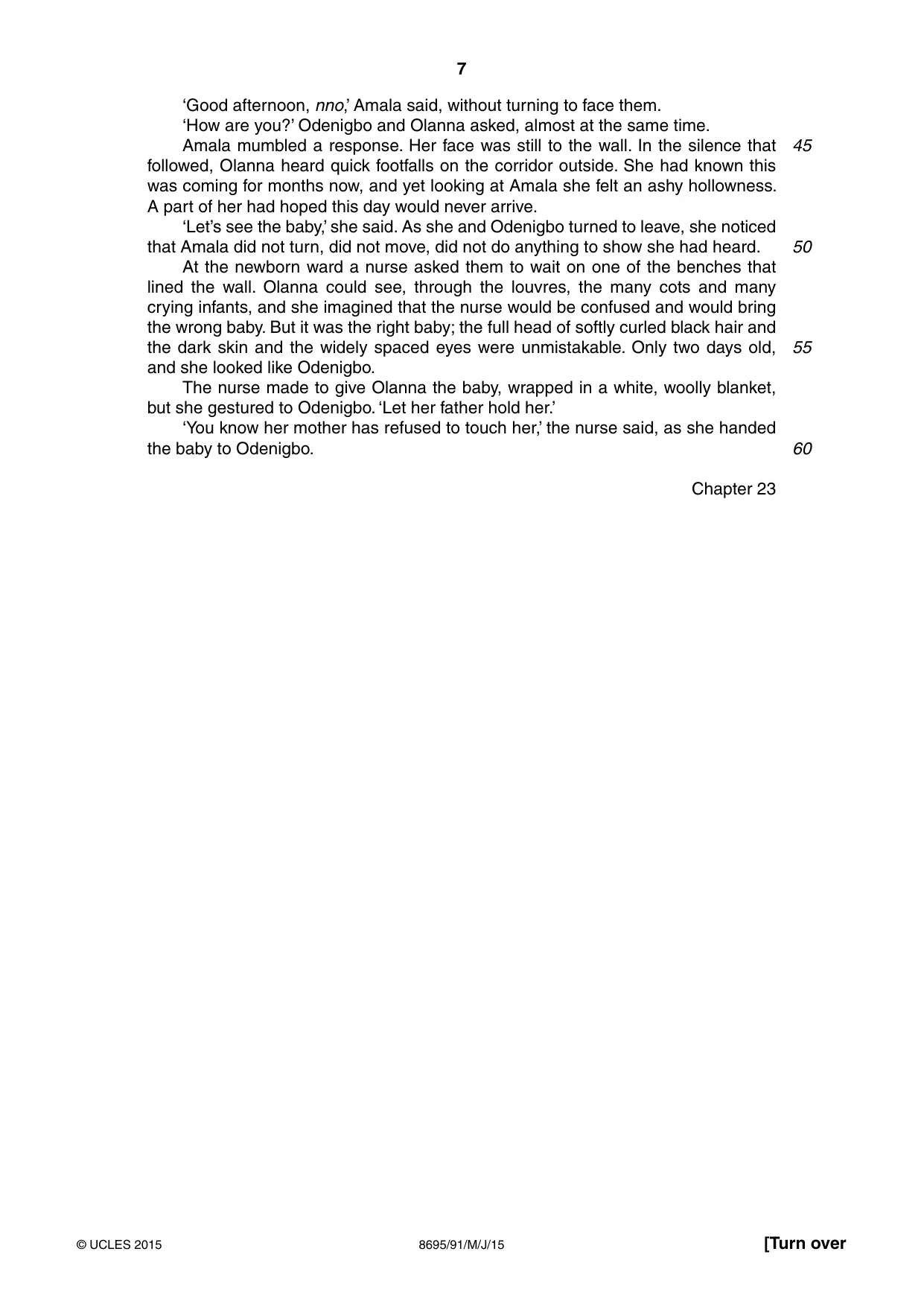
7 8695/91/M/J/15 © UCLES 2015 [Turn over ‘Good afternoon, nno,’ Amala said, without turning to face them. ‘How are you?’ Odenigbo and Olanna asked, almost at the same time. Amala mumbled a response. Her face was still to the wall. In the silence that followed, Olanna heard quick footfalls on the corridor outside. She had known this was coming for months now, and yet looking at Amala she felt an ashy hollowness. A part of her had hoped this day would never arrive. ‘Let’s see the baby,’ she said. As she and Odenigbo turned to leave, she noticed that Amala did not turn, did not move, did not do anything to show she had heard. At the newborn ward a nurse asked them to wait on one of the benches that lined the wall. Olanna could see, through the louvres, the many cots and many crying infants, and she imagined that the nurse would be confused and would bring the wrong baby. But it was the right baby; the full head of softly curled black hair and the dark skin and the widely spaced eyes were unmistakable. Only two days old, and she looked like Odenigbo. The nurse made to give Olanna the baby, wrapped in a white, woolly blanket, but she gestured to Odenigbo. ‘Let her father hold her.’ ‘You know her mother has refused to touch her,’ the nurse said, as she handed the baby to Odenigbo. Chapter 23 45 50 55 60
Question paper, page 8
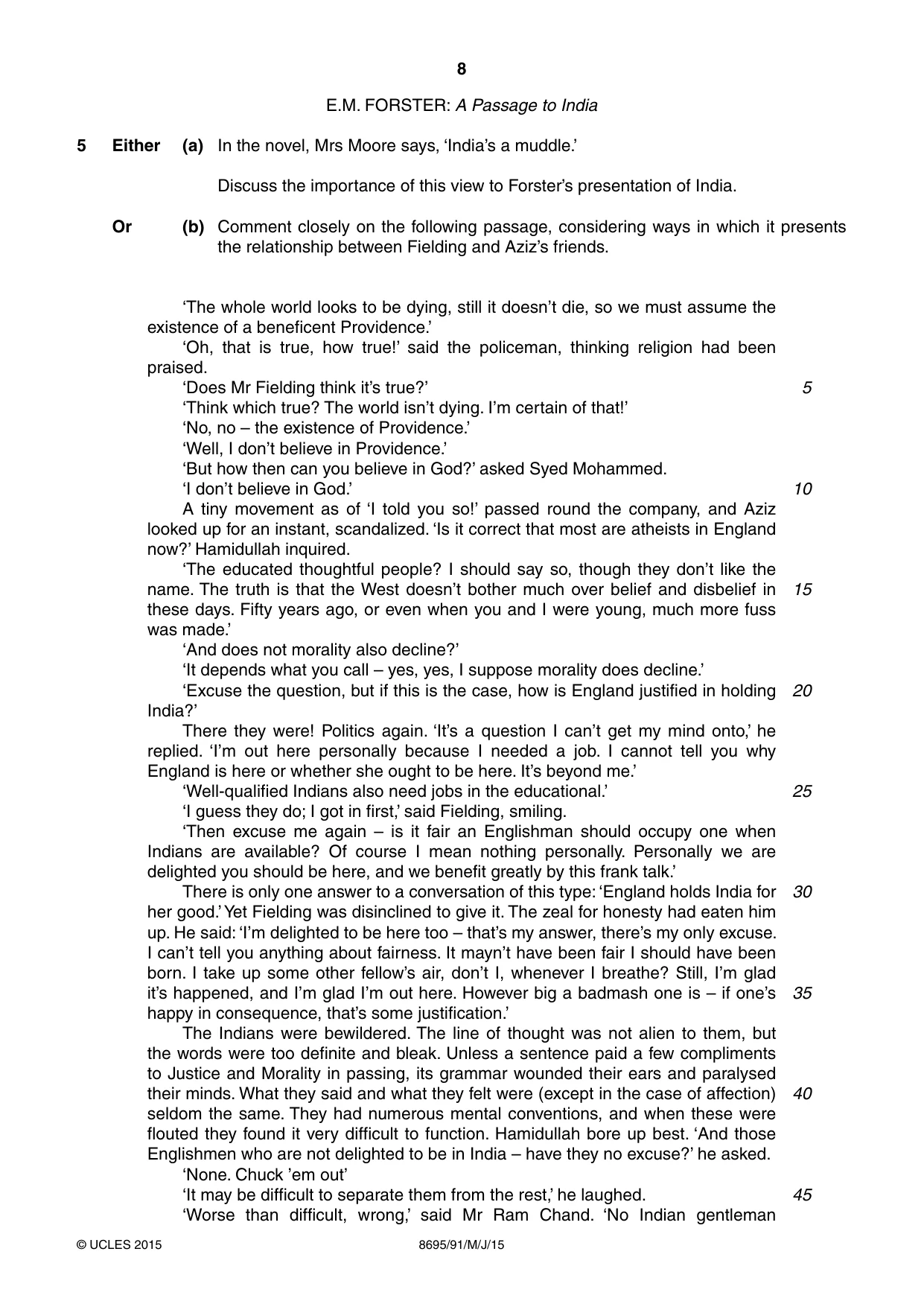
8 8695/91/M/J/15 © UCLES 2015 E.M. FORSTER: A Passage to India 5 Either (a) In the novel, Mrs Moore says, ‘India’s a muddle.’ Discuss the importance of this view to Forster’s presentation of India. Or (b) Comment closely on the following passage, considering ways in which it presents the relationship between Fielding and Aziz’s friends. ‘The whole world looks to be dying, still it doesn’t die, so we must assume the existence of a beneficent Providence.’ ‘Oh, that is true, how true!’ said the policeman, thinking religion had been praised. ‘Does Mr Fielding think it’s true?’ ‘Think which true? The world isn’t dying. I’m certain of that!’ ‘No, no – the existence of Providence.’ ‘Well, I don’t believe in Providence.’ ‘But how then can you believe in God?’ asked Syed Mohammed. ‘I don’t believe in God.’ A tiny movement as of ‘I told you so!’ passed round the company, and Aziz looked up for an instant, scandalized. ‘Is it correct that most are atheists in England now?’ Hamidullah inquired. ‘The educated thoughtful people? I should say so, though they don’t like the name. The truth is that the West doesn’t bother much over belief and disbelief in these days. Fifty years ago, or even when you and I were young, much more fuss was made.’ ‘And does not morality also decline?’ ‘It depends what you call – yes, yes, I suppose morality does decline.’ ‘Excuse the question, but if this is the case, how is England justified in holding India?’ There they were! Politics again. ‘It’s a question I can’t get my mind onto,’ he replied. ‘I’m out here personally because I needed a job. I cannot tell you why England is here or whether she ought to be here. It’s beyond me.’ ‘Well-qualified Indians also need jobs in the educational.’ ‘I guess they do; I got in first,’ said Fielding, smiling. ‘Then excuse me again – is it fair an Englishman should occupy one when Indians are available? Of course I mean nothing personally. Personally we are delighted you should be here, and we benefit greatly by this frank talk.’ There is only one answer to a conversation of this type: ‘England holds India for her good.’ Yet Fielding was disinclined to give it. The zeal for honesty had eaten him up. He said: ‘I’m delighted to be here too – that’s my answer, there’s my only excuse. I can’t tell you anything about fairness. It mayn’t have been fair I should have been born. I take up some other fellow’s air, don’t I, whenever I breathe? Still, I’m glad it’s happened, and I’m glad I’m out here. However big a badmash one is – if one’s happy in consequence, that’s some justification.’ The Indians were bewildered. The line of thought was not alien to them, but the words were too definite and bleak. Unless a sentence paid a few compliments to Justice and Morality in passing, its grammar wounded their ears and paralysed their minds. What they said and what they felt were (except in the case of affection) seldom the same. They had numerous mental conventions, and when these were flouted they found it very difficult to function. Hamidullah bore up best. ‘And those Englishmen who are not delighted to be in India – have they no excuse?’ he asked. ‘None. Chuck ’em out’ ‘It may be difficult to separate them from the rest,’ he laughed. ‘Worse than difficult, wrong,’ said Mr Ram Chand. ‘No Indian gentleman 5 10 15 20 25 30 35 40 45
Question paper, page 9
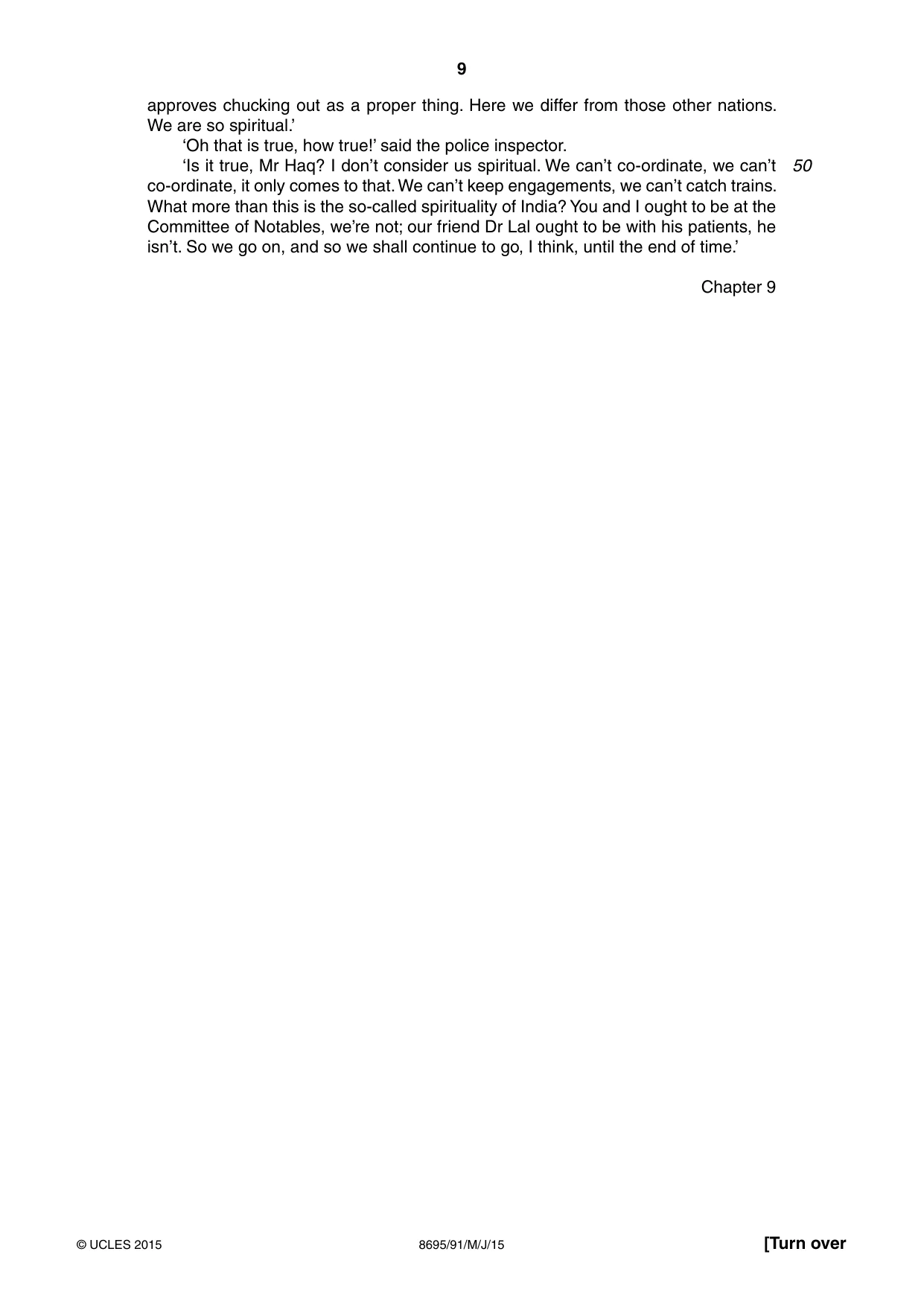
9 8695/91/M/J/15 © UCLES 2015 [Turn over approves chucking out as a proper thing. Here we differ from those other nations. We are so spiritual.’ ‘Oh that is true, how true!’ said the police inspector. ‘Is it true, Mr Haq? I don’t consider us spiritual. We can’t co-ordinate, we can’t co-ordinate, it only comes to that. We can’t keep engagements, we can’t catch trains. What more than this is the so-called spirituality of India? You and I ought to be at the Committee of Notables, we’re not; our friend Dr Lal ought to be with his patients, he isn’t. So we go on, and so we shall continue to go, I think, until the end of time.’ Chapter 9 50
Question paper, page 10
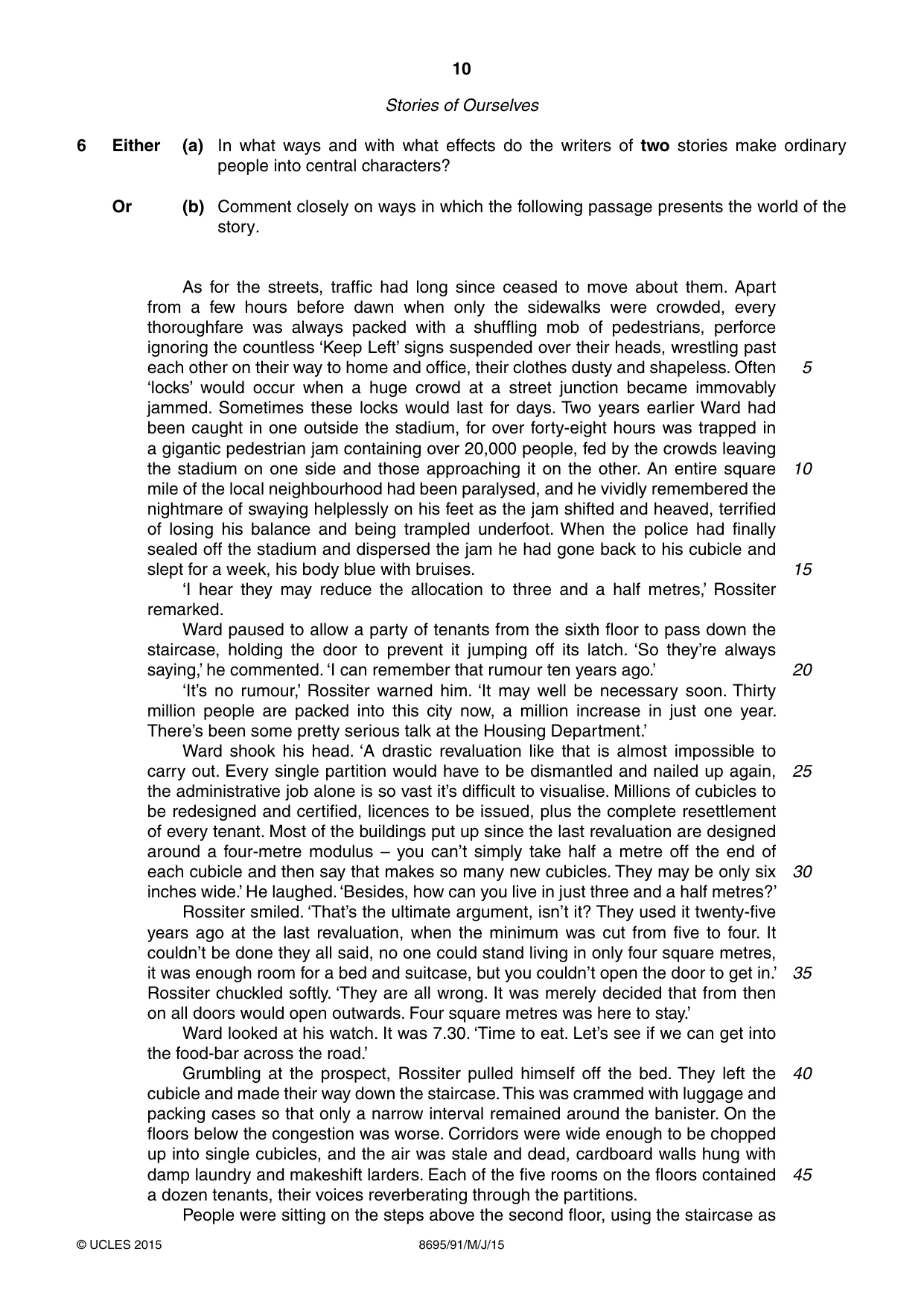
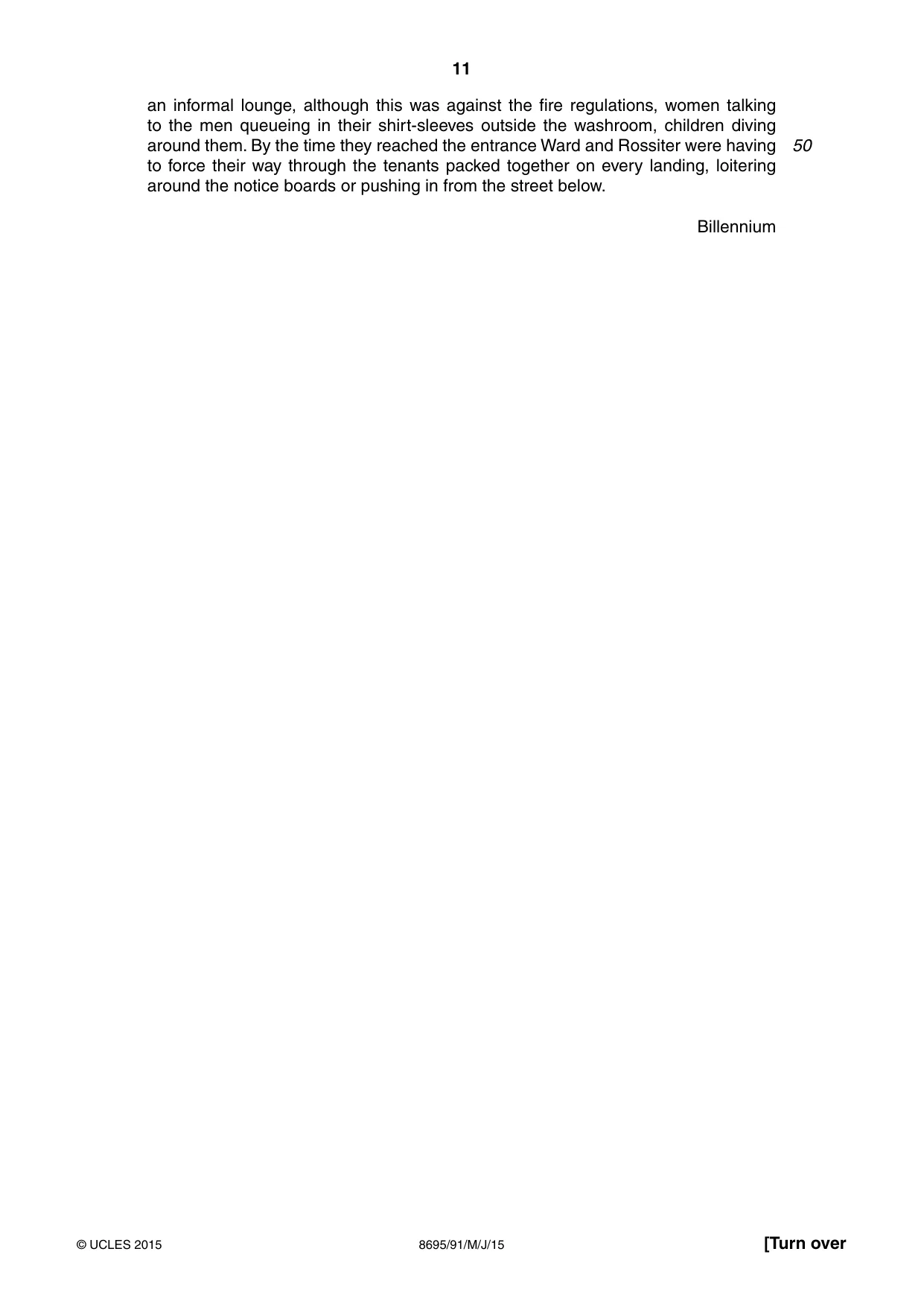
10 8695/91/M/J/15 © UCLES 2015 Stories of Ourselves 6 Either (a) In what ways and with what effects do the writers of two stories make ordinary people into central characters? Or (b) Comment closely on ways in which the following passage presents the world of the story. As for the streets, traffic had long since ceased to move about them. Apart from a few hours before dawn when only the sidewalks were crowded, every thoroughfare was always packed with a shuffling mob of pedestrians, perforce ignoring the countless ‘Keep Left’ signs suspended over their heads, wrestling past each other on their way to home and office, their clothes dusty and shapeless. Often ‘locks’ would occur when a huge crowd at a street junction became immovably jammed. Sometimes these locks would last for days. Two years earlier Ward had been caught in one outside the stadium, for over forty-eight hours was trapped in a gigantic pedestrian jam containing over 20,000 people, fed by the crowds leaving the stadium on one side and those approaching it on the other. An entire square mile of the local neighbourhood had been paralysed, and he vividly remembered the nightmare of swaying helplessly on his feet as the jam shifted and heaved, terrified of losing his balance and being trampled underfoot. When the police had finally sealed off the stadium and dispersed the jam he had gone back to his cubicle and slept for a week, his body blue with bruises. ‘I hear they may reduce the allocation to three and a half metres,’ Rossiter remarked. Ward paused to allow a party of tenants from the sixth floor to pass down the staircase, holding the door to prevent it jumping off its latch. ‘So they’re always saying,’ he commented. ‘I can remember that rumour ten years ago.’ ‘It’s no rumour,’ Rossiter warned him. ‘It may well be necessary soon. Thirty million people are packed into this city now, a million increase in just one year. There’s been some pretty serious talk at the Housing Department.’ Ward shook his head. ‘A drastic revaluation like that is almost impossible to carry out. Every single partition would have to be dismantled and nailed up again, the administrative job alone is so vast it’s difficult to visualise. Millions of cubicles to be redesigned and certified, licences to be issued, plus the complete resettlement of every tenant. Most of the buildings put up since the last revaluation are designed around a four-metre modulus – you can’t simply take half a metre off the end of each cubicle and then say that makes so many new cubicles. They may be only six inches wide.’ He laughed. ‘Besides, how can you live in just three and a half metres?’ Rossiter smiled. ‘That’s the ultimate argument, isn’t it? They used it twenty-five years ago at the last revaluation, when the minimum was cut from five to four. It couldn’t be done they all said, no one could stand living in only four square metres, it was enough room for a bed and suitcase, but you couldn’t open the door to get in.’ Rossiter chuckled softly. ‘They are all wrong. It was merely decided that from then on all doors would open outwards. Four square metres was here to stay.’ Ward looked at his watch. It was 7.30. ‘Time to eat. Let’s see if we can get into the food-bar across the road.’ Grumbling at the prospect, Rossiter pulled himself off the bed. They left the cubicle and made their way down the staircase. This was crammed with luggage and packing cases so that only a narrow interval remained around the banister. On the floors below the congestion was worse. Corridors were wide enough to be chopped up into single cubicles, and the air was stale and dead, cardboard walls hung with damp laundry and makeshift larders. Each of the five rooms on the floors contained a dozen tenants, their voices reverberating through the partitions. People were sitting on the steps above the second floor, using the staircase as 5 10 15 20 25 30 35 40 45
Question paper, page 11
11 8695/91/M/J/15 © UCLES 2015 [Turn over an informal lounge, although this was against the fire regulations, women talking to the men queueing in their shirt-sleeves outside the washroom, children diving around them. By the time they reached the entrance Ward and Rossiter were having to force their way through the tenants packed together on every landing, loitering around the notice boards or pushing in from the street below. Billennium 50
Question paper, page 12
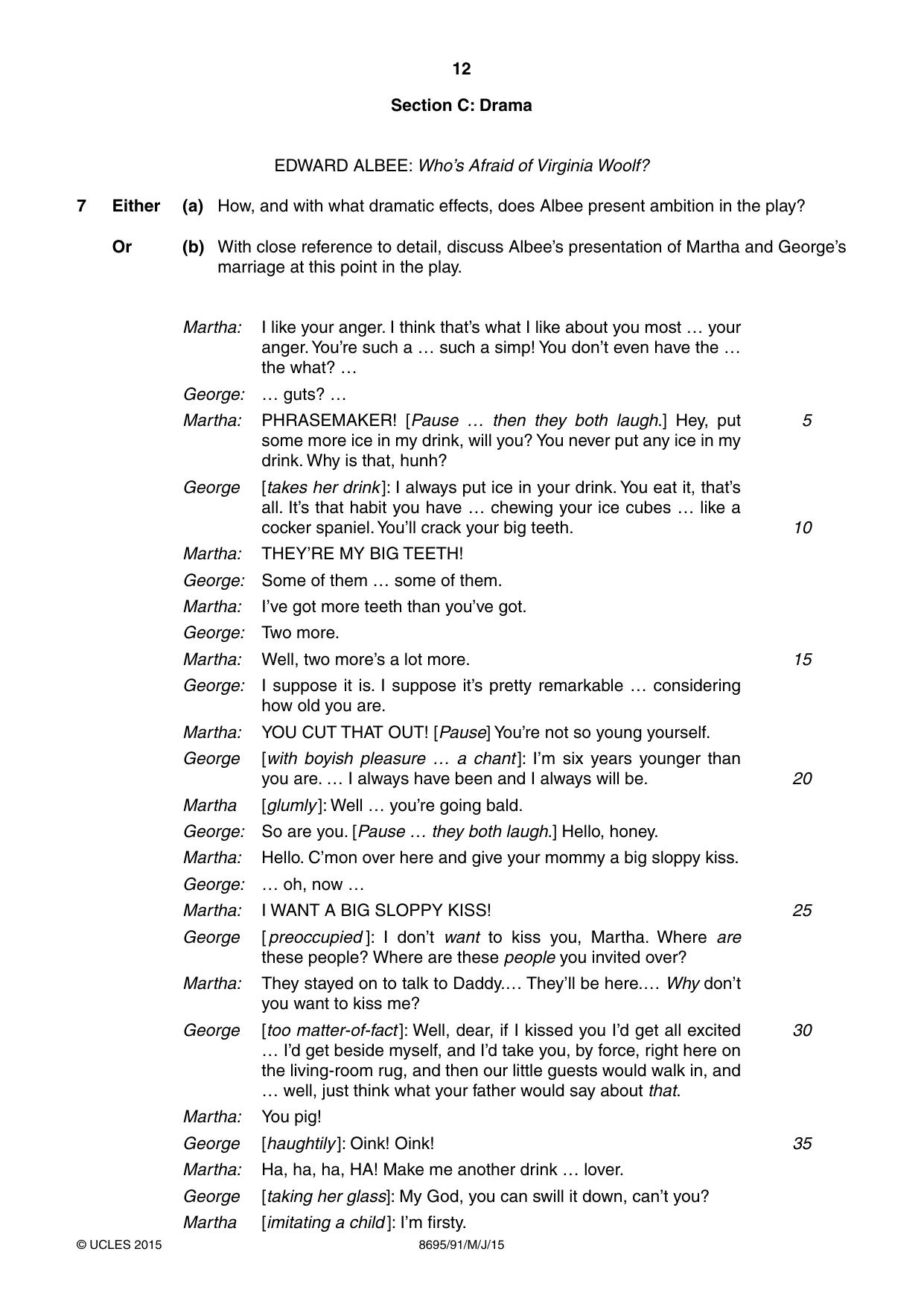
12 8695/91/M/J/15 © UCLES 2015 Section C: Drama EDWARD ALBEE: Who’s Afraid of Virginia Woolf? 7 Either (a) How, and with what dramatic effects, does Albee present ambition in the play? Or (b) With close reference to detail, discuss Albee’s presentation of Martha and George’s marriage at this point in the play. Martha: I like your anger. I think that’s what I like about you most … your anger. You’re such a … such a simp! You don’t even have the … the what? … George: … guts? … Martha: PHRASEMAKER! [Pause … then they both laugh.] Hey, put some more ice in my drink, will you? You never put any ice in my drink. Why is that, hunh? George [takes her drink ]: I always put ice in your drink. You eat it, that’s all. It’s that habit you have … chewing your ice cubes … like a cocker spaniel. You’ll crack your big teeth. Martha: THEY’RE MY BIG TEETH! George: Some of them … some of them. Martha: I’ve got more teeth than you’ve got. George: Two more. Martha: Well, two more’s a lot more. George: I suppose it is. I suppose it’s pretty remarkable … considering how old you are. Martha: YOU CUT THAT OUT! [Pause] You’re not so young yourself. George [with boyish pleasure … a chant ]: I’m six years younger than you are. … I always have been and I always will be. Martha [glumly ]: Well … you’re going bald. George: So are you. [Pause … they both laugh.] Hello, honey. Martha: Hello. C’mon over here and give your mommy a big sloppy kiss. George: … oh, now … Martha: I WANT A BIG SLOPPY KISS! George [ preoccupied ]: I don’t want to kiss you, Martha. Where are these people? Where are these people you invited over? Martha: They stayed on to talk to Daddy.… They’ll be here.… Why don’t you want to kiss me? George [too matter-of-fact ]: Well, dear, if I kissed you I’d get all excited … I’d get beside myself, and I’d take you, by force, right here on the living-room rug, and then our little guests would walk in, and … well, just think what your father would say about that. Martha: You pig! George [haughtily ]: Oink! Oink! Martha: Ha, ha, ha, HA! Make me another drink … lover. George [taking her glass]: My God, you can swill it down, can’t you? Martha [imitating a child ]: I’m firsty. 5 10 15 20 25 30 35
Question paper, page 13
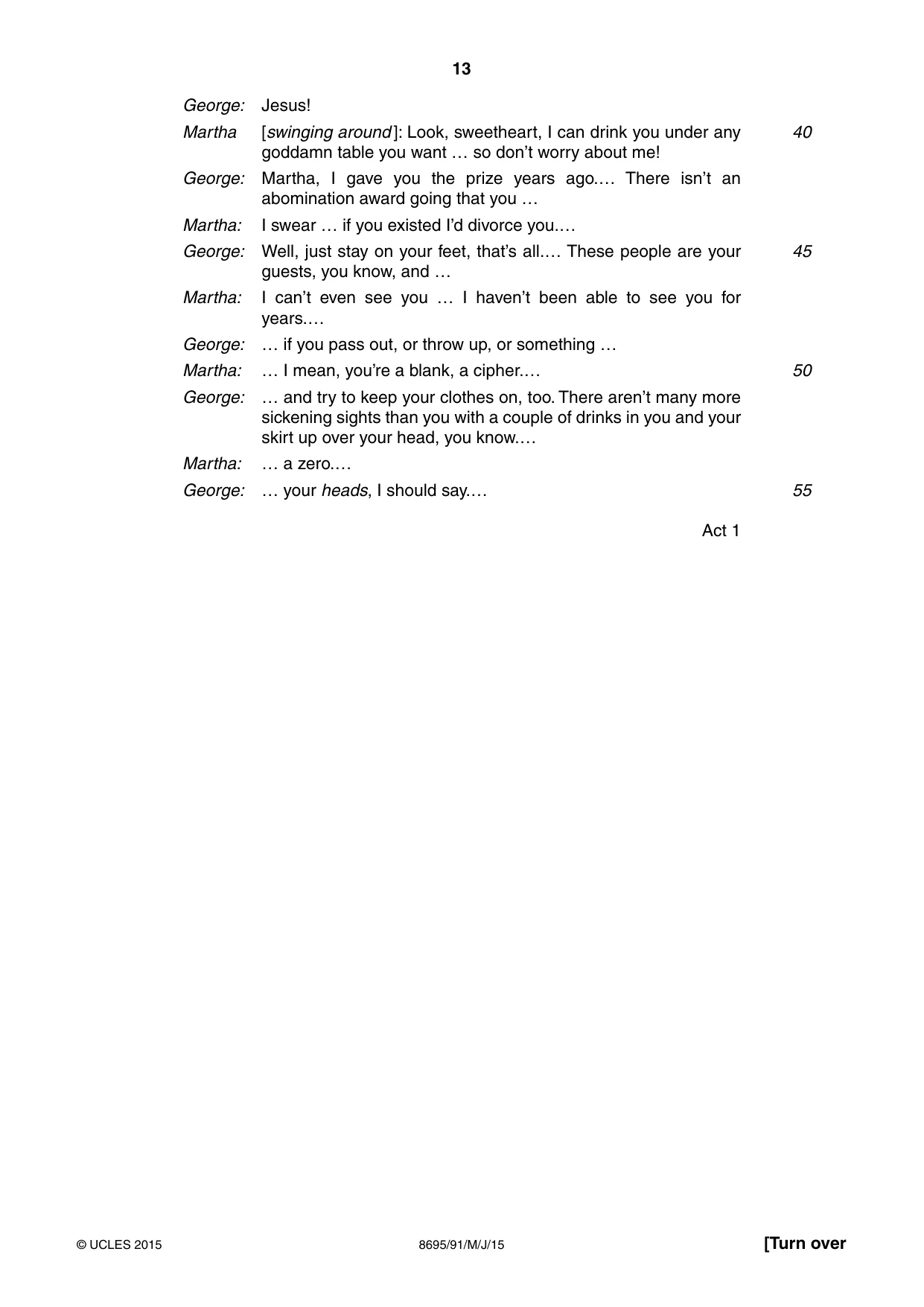
13 8695/91/M/J/15 © UCLES 2015 [Turn over George: Jesus! Martha [swinging around ]: Look, sweetheart, I can drink you under any goddamn table you want … so don’t worry about me! George: Martha, I gave you the prize years ago.… There isn’t an abomination award going that you … Martha: I swear … if you existed I’d divorce you.… George: Well, just stay on your feet, that’s all.… These people are your guests, you know, and … Martha: I can’t even see you … I haven’t been able to see you for years.… George: … if you pass out, or throw up, or something … Martha: … I mean, you’re a blank, a cipher.… George: … and try to keep your clothes on, too. There aren’t many more sickening sights than you with a couple of drinks in you and your skirt up over your head, you know.… Martha: … a zero.… George: … your heads, I should say.… Act 1 40 45 50 55
Question paper, page 14
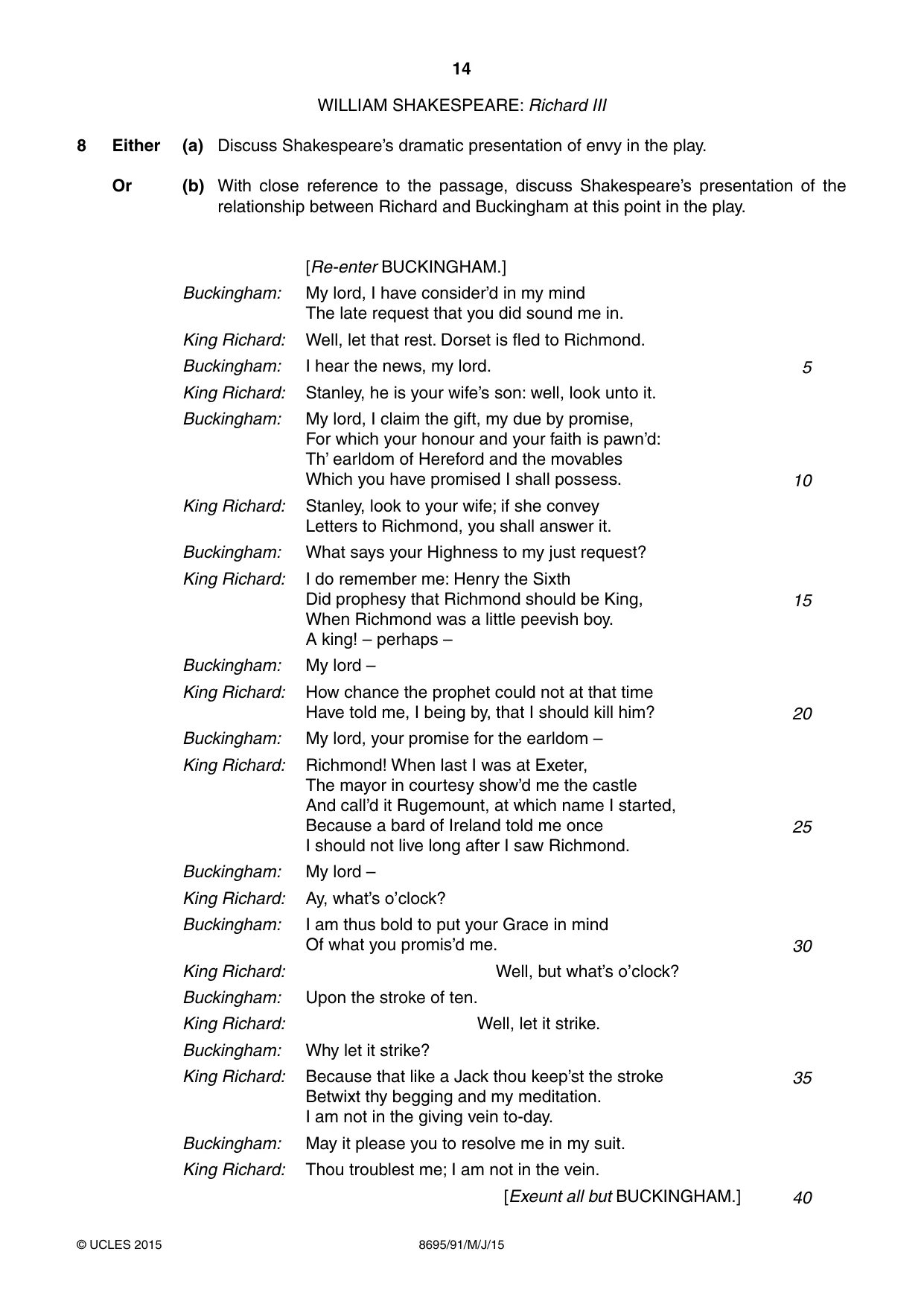
14 8695/91/M/J/15 © UCLES 2015 WILLIAM SHAKESPEARE: Richard III 8 Either (a) Discuss Shakespeare’s dramatic presentation of envy in the play. Or (b) With close reference to the passage, discuss Shakespeare’s presentation of the relationship between Richard and Buckingham at this point in the play. [Re-enter BUCKINGHAM.] Buckingham: My lord, I have consider’d in my mind The late request that you did sound me in. King Richard: Well, let that rest. Dorset is fled to Richmond. Buckingham: I hear the news, my lord. King Richard: Stanley, he is your wife’s son: well, look unto it. Buckingham: My lord, I claim the gift, my due by promise, For which your honour and your faith is pawn’d: Th’ earldom of Hereford and the movables Which you have promised I shall possess. King Richard: Stanley, look to your wife; if she convey Letters to Richmond, you shall answer it. Buckingham: What says your Highness to my just request? King Richard: I do remember me: Henry the Sixth Did prophesy that Richmond should be King, When Richmond was a little peevish boy. A king! – perhaps – Buckingham: My lord – King Richard: How chance the prophet could not at that time Have told me, I being by, that I should kill him? Buckingham: My lord, your promise for the earldom – King Richard: Richmond! When last I was at Exeter, The mayor in courtesy show’d me the castle And call’d it Rugemount, at which name I started, Because a bard of Ireland told me once I should not live long after I saw Richmond. Buckingham: My lord – King Richard: Ay, what’s o’clock? Buckingham: I am thus bold to put your Grace in mind Of what you promis’d me. King Richard: Well, but what’s o’clock? Buckingham: Upon the stroke of ten. King Richard: Well, let it strike. Buckingham: Why let it strike? King Richard: Because that like a Jack thou keep’st the stroke Betwixt thy begging and my meditation. I am not in the giving vein to-day. Buckingham: May it please you to resolve me in my suit. King Richard: Thou troublest me; I am not in the vein. [Exeunt all but BUCKINGHAM.] 5 10 15 20 25 30 35 40
Question paper, page 15
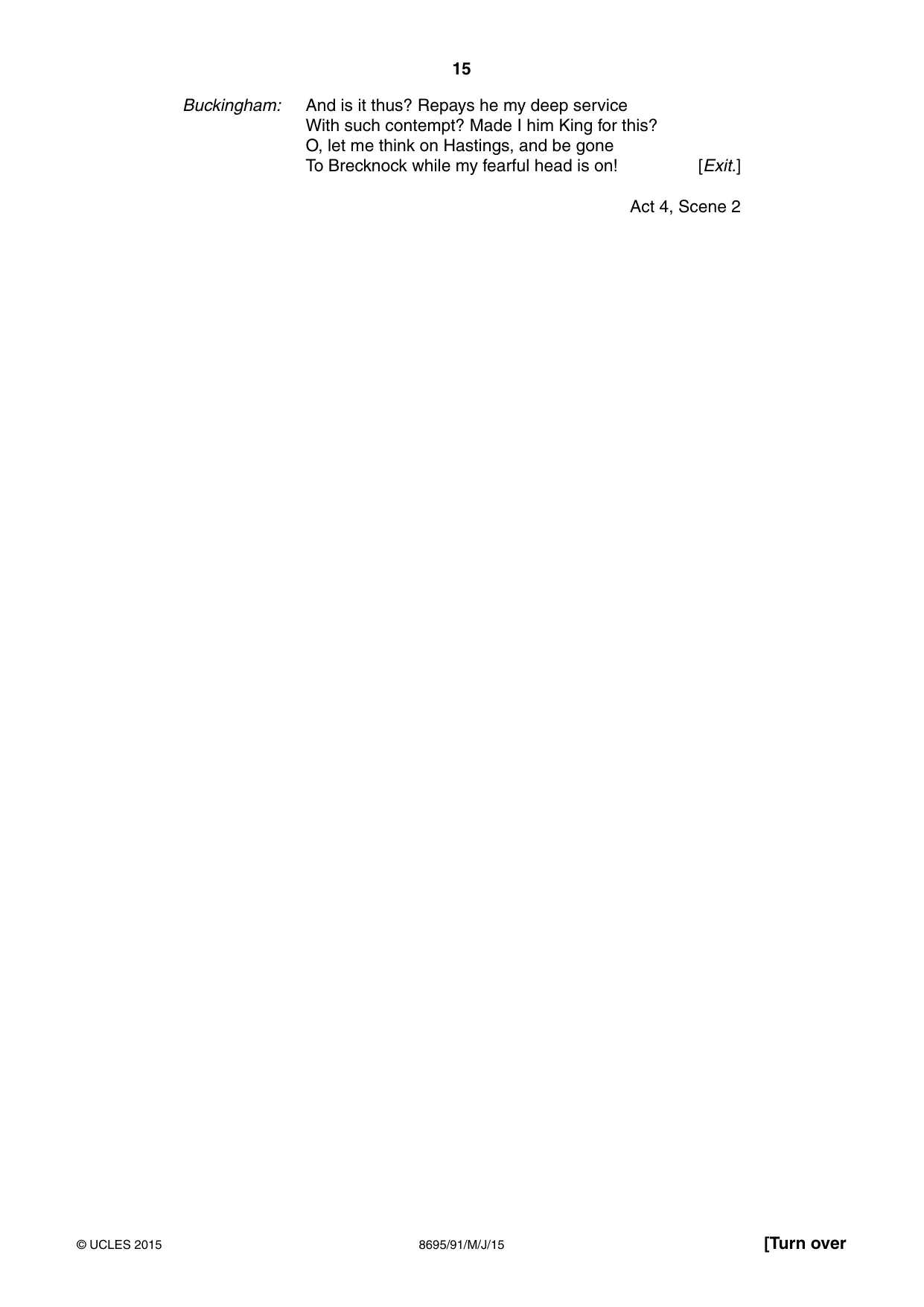
15 8695/91/M/J/15 © UCLES 2015 [Turn over Buckingham: And is it thus? Repays he my deep service With such contempt? Made I him King for this? O, let me think on Hastings, and be gone To Brecknock while my fearful head is on! [Exit.] Act 4, Scene 2
Question paper, page 16
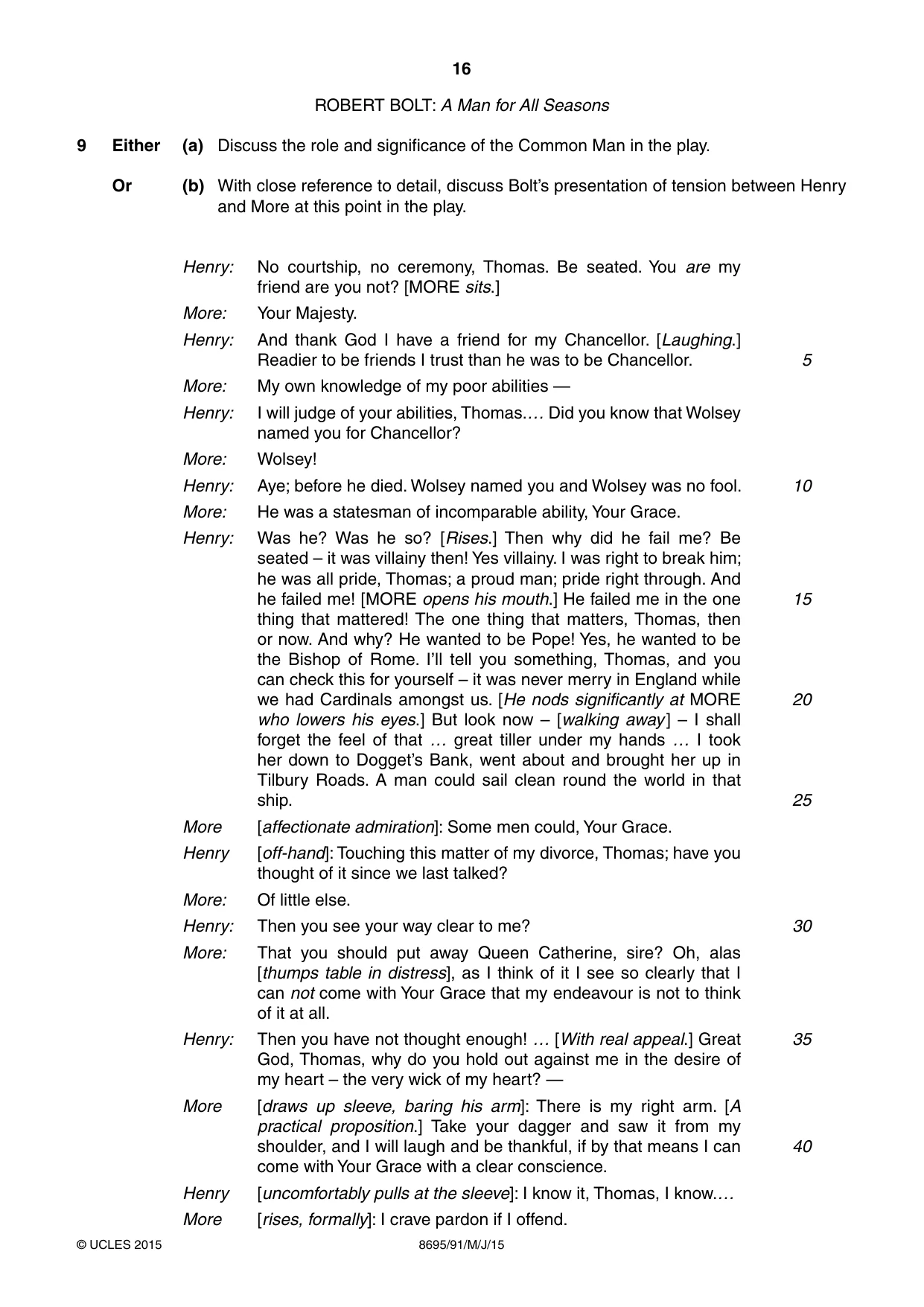
16 8695/91/M/J/15 © UCLES 2015 ROBERT BOLT: A Man for All Seasons 9 Either (a) Discuss the role and significance of the Common Man in the play. Or (b) With close reference to detail, discuss Bolt’s presentation of tension between Henry and More at this point in the play. Henry: No courtship, no ceremony, Thomas. Be seated. You are my friend are you not? [MORE sits.] More: Your Majesty. Henry: And thank God I have a friend for my Chancellor. [Laughing.] Readier to be friends I trust than he was to be Chancellor. More: My own knowledge of my poor abilities — Henry: I will judge of your abilities, Thomas.… Did you know that Wolsey named you for Chancellor? More: Wolsey! Henry: Aye; before he died. Wolsey named you and Wolsey was no fool. More: He was a statesman of incomparable ability, Your Grace. Henry: Was he? Was he so? [Rises.] Then why did he fail me? Be seated – it was villainy then! Yes villainy. I was right to break him; he was all pride, Thomas; a proud man; pride right through. And he failed me! [MORE opens his mouth.] He failed me in the one thing that mattered! The one thing that matters, Thomas, then or now. And why? He wanted to be Pope! Yes, he wanted to be the Bishop of Rome. I’ll tell you something, Thomas, and you can check this for yourself – it was never merry in England while we had Cardinals amongst us. [He nods significantly at MORE who lowers his eyes.] But look now – [walking away ] – I shall forget the feel of that … great tiller under my hands … I took her down to Dogget’s Bank, went about and brought her up in Tilbury Roads. A man could sail clean round the world in that ship. More [affectionate admiration]: Some men could, Your Grace. Henry [off-hand]: Touching this matter of my divorce, Thomas; have you thought of it since we last talked? More: Of little else. Henry: Then you see your way clear to me? More: That you should put away Queen Catherine, sire? Oh, alas [thumps table in distress], as I think of it I see so clearly that I can not come with Your Grace that my endeavour is not to think of it at all. Henry: Then you have not thought enough! … [With real appeal.] Great God, Thomas, why do you hold out against me in the desire of my heart – the very wick of my heart? — More [draws up sleeve, baring his arm]: There is my right arm. [A practical proposition.] Take your dagger and saw it from my shoulder, and I will laugh and be thankful, if by that means I can come with Your Grace with a clear conscience. Henry [uncomfortably pulls at the sleeve]: I know it, Thomas, I know.… More [rises, formally]: I crave pardon if I offend. 5 10 15 20 25 30 35 40
Question paper, page 17
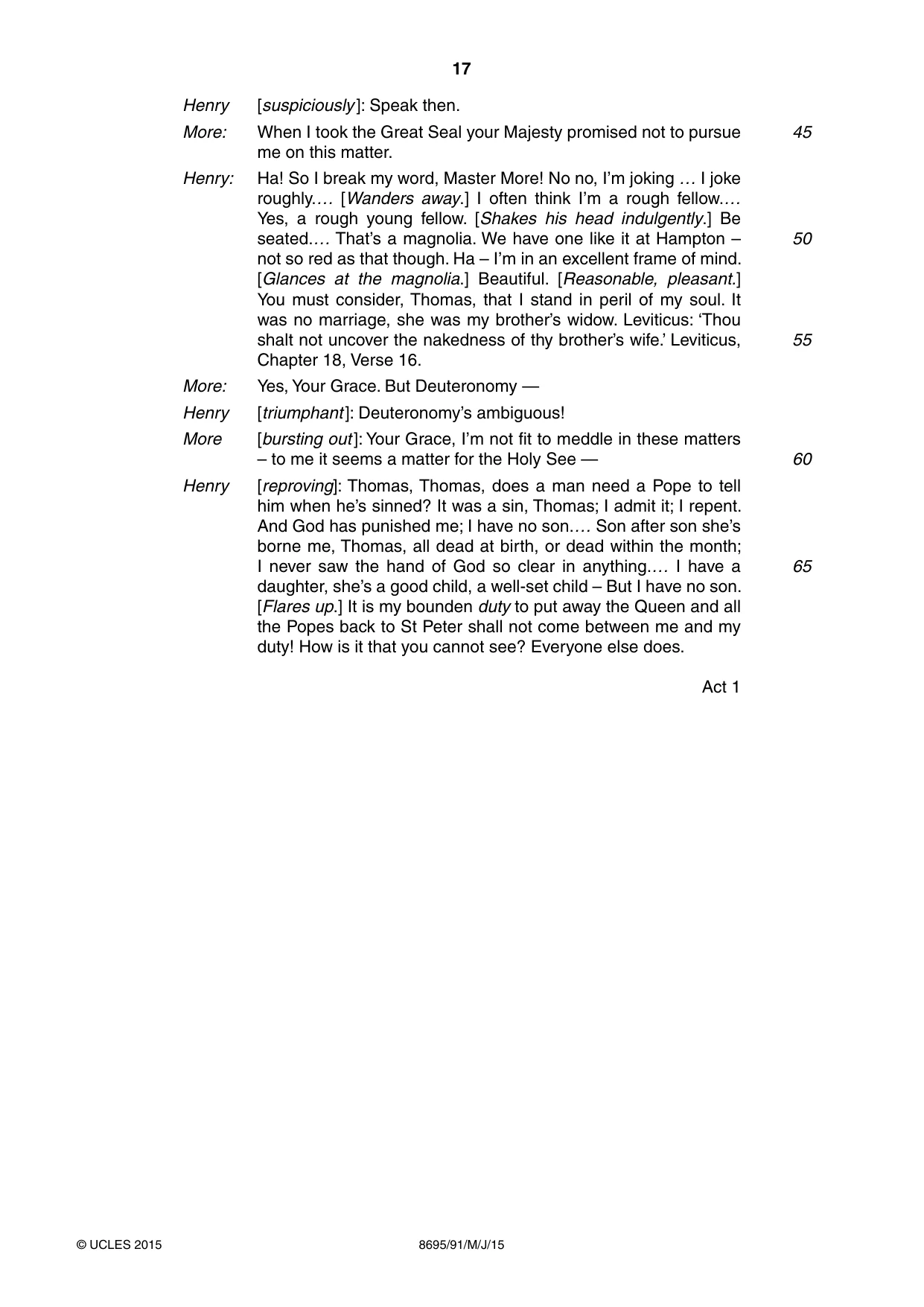
17 8695/91/M/J/15 © UCLES 2015 Henry [suspiciously ]: Speak then. More: When I took the Great Seal your Majesty promised not to pursue me on this matter. Henry: Ha! So I break my word, Master More! No no, I’m joking … I joke roughly.… [Wanders away.] I often think I’m a rough fellow.… Yes, a rough young fellow. [Shakes his head indulgently.] Be seated.… That’s a magnolia. We have one like it at Hampton – not so red as that though. Ha – I’m in an excellent frame of mind. [Glances at the magnolia.] Beautiful. [Reasonable, pleasant.] You must consider, Thomas, that I stand in peril of my soul. It was no marriage, she was my brother’s widow. Leviticus: ‘Thou shalt not uncover the nakedness of thy brother’s wife.’ Leviticus, Chapter 18, Verse 16. More: Yes, Your Grace. But Deuteronomy — Henry [triumphant ]: Deuteronomy’s ambiguous! More [bursting out ]: Your Grace, I’m not fit to meddle in these matters – to me it seems a matter for the Holy See — Henry [reproving]: Thomas, Thomas, does a man need a Pope to tell him when he’s sinned? It was a sin, Thomas; I admit it; I repent. And God has punished me; I have no son.… Son after son she’s borne me, Thomas, all dead at birth, or dead within the month; I never saw the hand of God so clear in anything.… I have a daughter, she’s a good child, a well-set child – But I have no son. [Flares up.] It is my bounden duty to put away the Queen and all the Popes back to St Peter shall not come between me and my duty! How is it that you cannot see? Everyone else does. Act 1 45 50 55 60 65
Question paper, page 18
18 8695/91/M/J/15 © UCLES 2015 BLANK PAGE
Question paper, page 19
19 8695/91/M/J/15 © UCLES 2015 BLANK PAGE
Question paper, page 20
20 8695/91/M/J/15 © UCLES 2015 BLANK PAGE Permission to reproduce items where third-party owned material protected by copyright is included has been sought and cleared where possible. Every reasonable effort has been made by the publisher (UCLES) to trace copyright holders, but if any items requiring clearance have unwittingly been included, the publisher will be pleased to make amends at the earliest possible opportunity. To avoid the issue of disclosure of answer-related information to candidates, all copyright acknowledgements are reproduced online in the Cambridge International Examinations Copyright Acknowledgements Booklet. This is produced for each series of examinations and is freely available to download at www.cie.org.uk after the live examination series. Cambridge International Examinations is part of the Cambridge Assessment Group. Cambridge Assessment is the brand name of University of Cambridge Local Examinations Syndicate (UCLES), which is itself a department of the University of Cambridge.
Mark scheme, page 1
® IGCSE is the registered trademark of Cambridge International Examinations. CAMBRIDGE INTERNATIONAL EXAMINATIONS Cambridge International Advanced Subsidiary and Advanced Level MARK SCHEME for the May/June 2015 series 8695 LANGUAGE AND LITERATURE IN ENGLISH 8695/91 Paper 9 (Poetry, Prose and Drama), maximum raw mark 50 This mark scheme is published as an aid to teachers and candidates, to indicate the requirements of the examination. It shows the basis on which Examiners were instructed to award marks. It does not indicate the details of the discussions that took place at an Examiners’ meeting before marking began, which would have considered the acceptability of alternative answers. Mark schemes should be read in conjunction with the question paper and the Principal Examiner Report for Teachers. Cambridge will not enter into discussions about these mark schemes. Cambridge is publishing the mark schemes for the May/June 2015 series for most Cambridge IGCSE®, Cambridge International A and AS Level components and some Cambridge O Level components.
Mark scheme, page 2
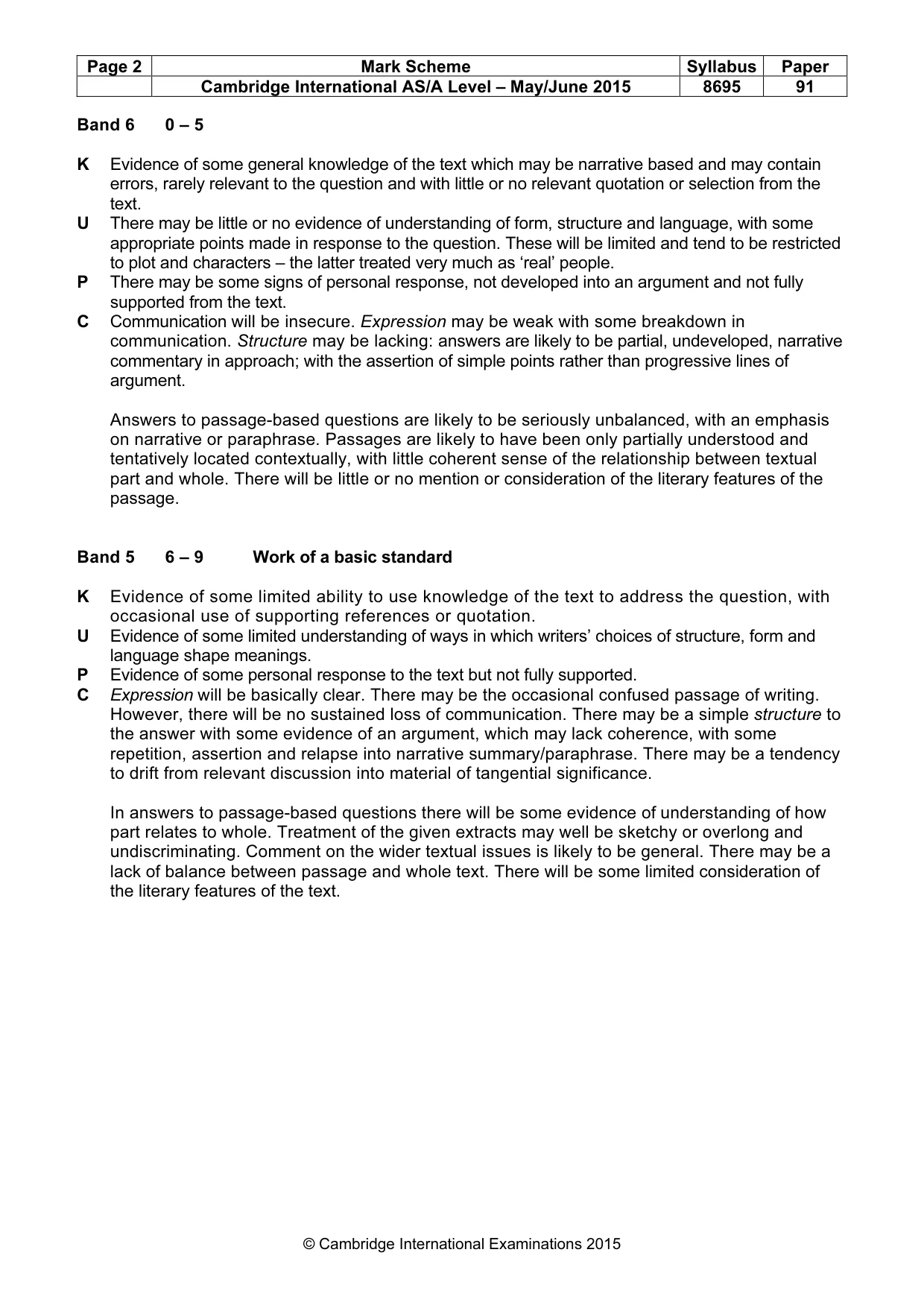
Page 2 Mark Scheme Syllabus Paper Cambridge International AS/A Level – May/June 2015 8695 91 © Cambridge International Examinations 2015 Band 6 0 – 5 K Evidence of some general knowledge of the text which may be narrative based and may contain errors, rarely relevant to the question and with little or no relevant quotation or selection from the text. U There may be little or no evidence of understanding of form, structure and language, with some appropriate points made in response to the question. These will be limited and tend to be restricted to plot and characters – the latter treated very much as ‘real’ people. P There may be some signs of personal response, not developed into an argument and not fully supported from the text. C Communication will be insecure. Expression may be weak with some breakdown in communication. Structure may be lacking: answers are likely to be partial, undeveloped, narrative commentary in approach; with the assertion of simple points rather than progressive lines of argument. Answers to passage-based questions are likely to be seriously unbalanced, with an emphasis on narrative or paraphrase. Passages are likely to have been only partially understood and tentatively located contextually, with little coherent sense of the relationship between textual part and whole. There will be little or no mention or consideration of the literary features of the passage. Band 5 6 – 9 Work of a basic standard K Evidence of some limited ability to use knowledge of the text to address the question, with occasional use of supporting references or quotation. U Evidence of some limited understanding of ways in which writers’ choices of structure, form and language shape meanings. P Evidence of some personal response to the text but not fully supported. C Expression will be basically clear. There may be the occasional confused passage of writing. However, there will be no sustained loss of communication. There may be a simple structure to the answer with some evidence of an argument, which may lack coherence, with some repetition, assertion and relapse into narrative summary/paraphrase. There may be a tendency to drift from relevant discussion into material of tangential significance. In answers to passage-based questions there will be some evidence of understanding of how part relates to whole. Treatment of the given extracts may well be sketchy or overlong and undiscriminating. Comment on the wider textual issues is likely to be general. There may be a lack of balance between passage and whole text. There will be some limited consideration of the literary features of the text.
Mark scheme, page 3
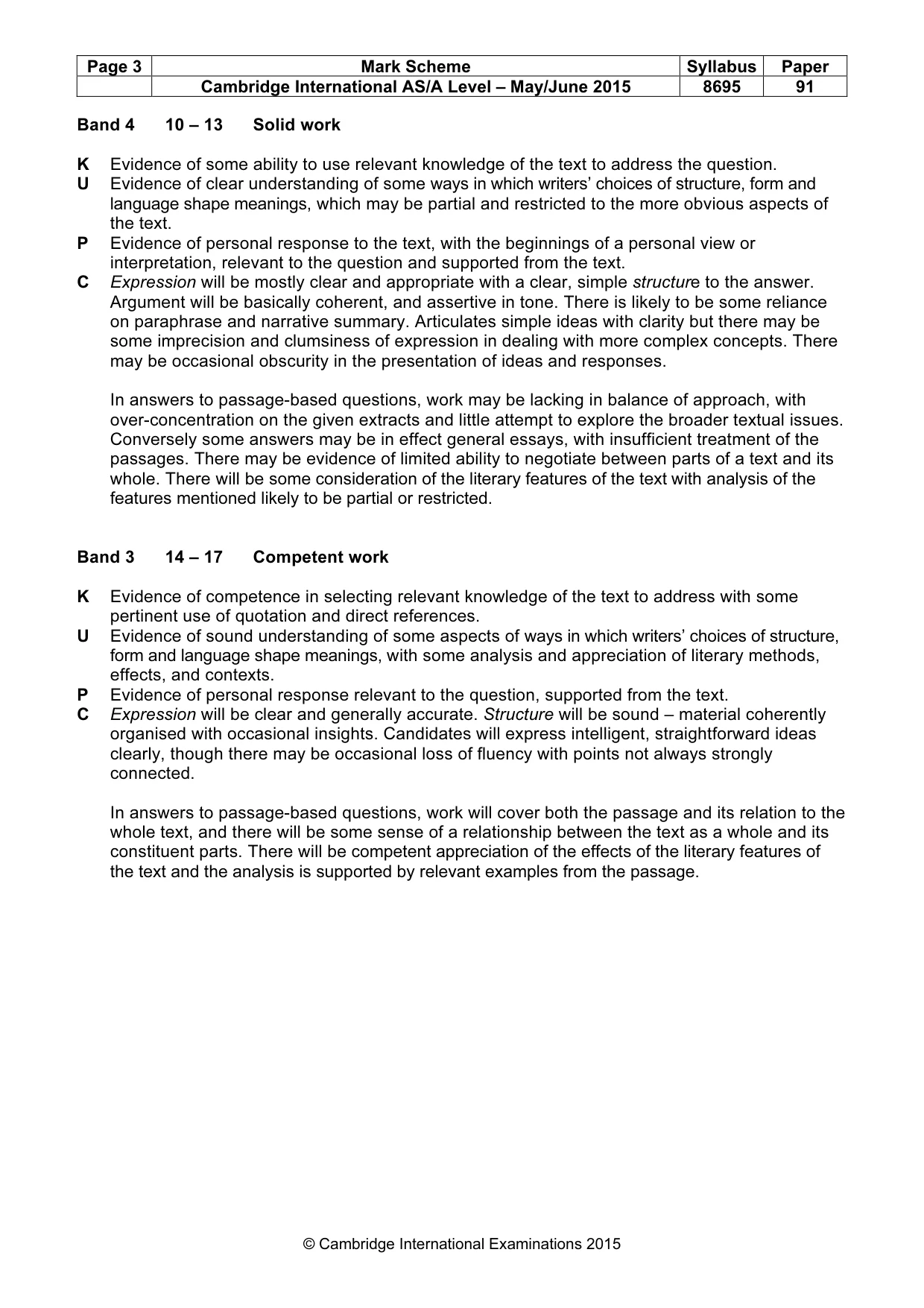
Page 3 Mark Scheme Syllabus Paper Cambridge International AS/A Level – May/June 2015 8695 91 © Cambridge International Examinations 2015 Band 4 10 – 13 Solid work K Evidence of some ability to use relevant knowledge of the text to address the question. U Evidence of clear understanding of some ways in which writers’ choices of structure, form and language shape meanings, which may be partial and restricted to the more obvious aspects of the text. P Evidence of personal response to the text, with the beginnings of a personal view or interpretation, relevant to the question and supported from the text. C Expression will be mostly clear and appropriate with a clear, simple structure to the answer. Argument will be basically coherent, and assertive in tone. There is likely to be some reliance on paraphrase and narrative summary. Articulates simple ideas with clarity but there may be some imprecision and clumsiness of expression in dealing with more complex concepts. There may be occasional obscurity in the presentation of ideas and responses. In answers to passage-based questions, work may be lacking in balance of approach, with over-concentration on the given extracts and little attempt to explore the broader textual issues. Conversely some answers may be in effect general essays, with insufficient treatment of the passages. There may be evidence of limited ability to negotiate between parts of a text and its whole. There will be some consideration of the literary features of the text with analysis of the features mentioned likely to be partial or restricted. Band 3 14 – 17 Competent work K Evidence of competence in selecting relevant knowledge of the text to address with some pertinent use of quotation and direct references. U Evidence of sound understanding of some aspects of ways in which writers’ choices of structure, form and language shape meanings, with some analysis and appreciation of literary methods, effects, and contexts. P Evidence of personal response relevant to the question, supported from the text. C Expression will be clear and generally accurate. Structure will be sound – material coherently organised with occasional insights. Candidates will express intelligent, straightforward ideas clearly, though there may be occasional loss of fluency with points not always strongly connected. In answers to passage-based questions, work will cover both the passage and its relation to the whole text, and there will be some sense of a relationship between the text as a whole and its constituent parts. There will be competent appreciation of the effects of the literary features of the text and the analysis is supported by relevant examples from the passage.
Mark scheme, page 4
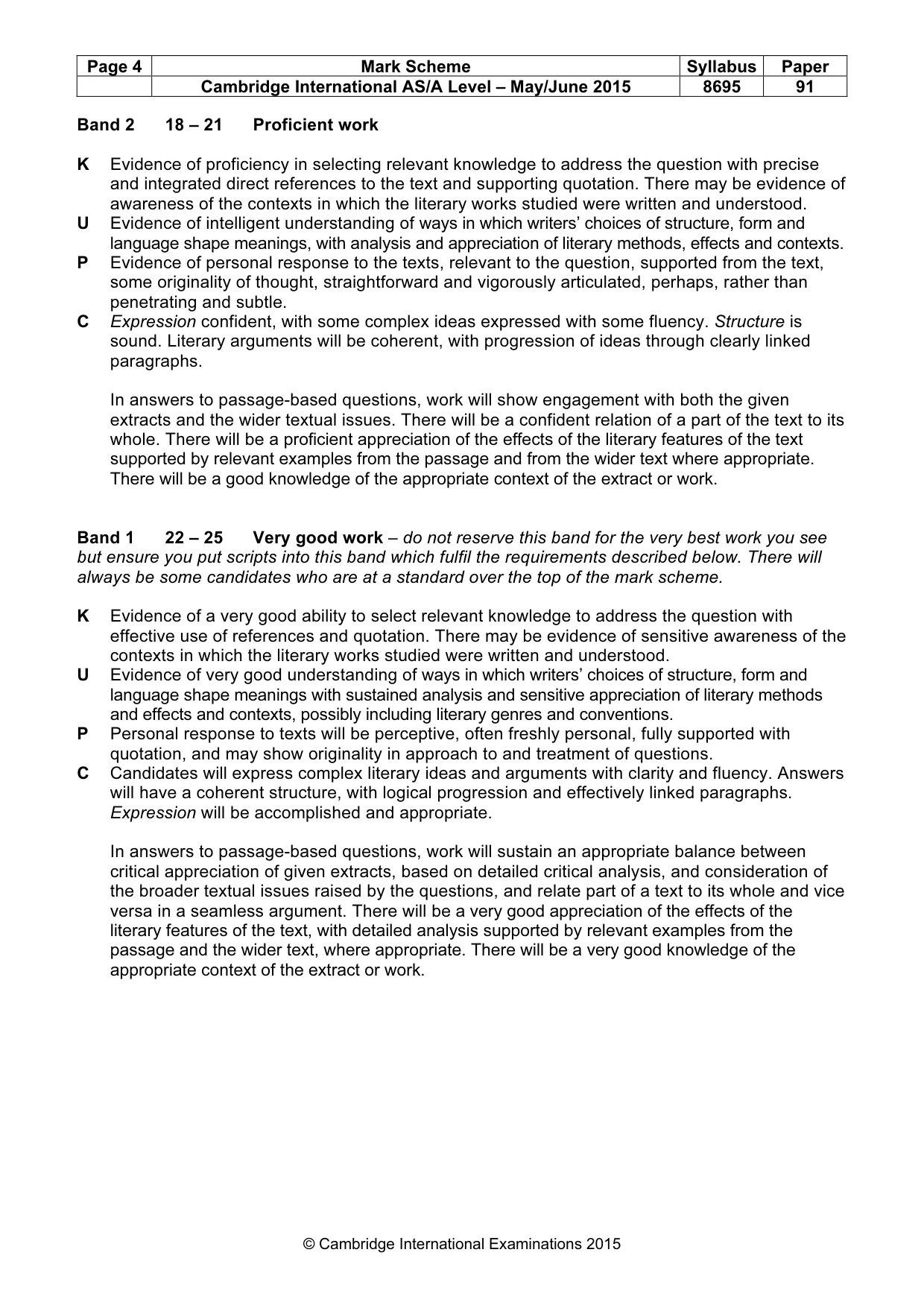
Page 4 Mark Scheme Syllabus Paper Cambridge International AS/A Level – May/June 2015 8695 91 © Cambridge International Examinations 2015 Band 2 18 – 21 Proficient work K Evidence of proficiency in selecting relevant knowledge to address the question with precise and integrated direct references to the text and supporting quotation. There may be evidence of awareness of the contexts in which the literary works studied were written and understood. U Evidence of intelligent understanding of ways in which writers’ choices of structure, form and language shape meanings, with analysis and appreciation of literary methods, effects and contexts. P Evidence of personal response to the texts, relevant to the question, supported from the text, some originality of thought, straightforward and vigorously articulated, perhaps, rather than penetrating and subtle. C Expression confident, with some complex ideas expressed with some fluency. Structure is sound. Literary arguments will be coherent, with progression of ideas through clearly linked paragraphs. In answers to passage-based questions, work will show engagement with both the given extracts and the wider textual issues. There will be a confident relation of a part of the text to its whole. There will be a proficient appreciation of the effects of the literary features of the text supported by relevant examples from the passage and from the wider text where appropriate. There will be a good knowledge of the appropriate context of the extract or work. Band 1 22 – 25 Very good work – do not reserve this band for the very best work you see but ensure you put scripts into this band which fulfil the requirements described below. There will always be some candidates who are at a standard over the top of the mark scheme. K Evidence of a very good ability to select relevant knowledge to address the question with effective use of references and quotation. There may be evidence of sensitive awareness of the contexts in which the literary works studied were written and understood. U Evidence of very good understanding of ways in which writers’ choices of structure, form and language shape meanings with sustained analysis and sensitive appreciation of literary methods and effects and contexts, possibly including literary genres and conventions. P Personal response to texts will be perceptive, often freshly personal, fully supported with quotation, and may show originality in approach to and treatment of questions. C Candidates will express complex literary ideas and arguments with clarity and fluency. Answers will have a coherent structure, with logical progression and effectively linked paragraphs. Expression will be accomplished and appropriate. In answers to passage-based questions, work will sustain an appropriate balance between critical appreciation of given extracts, based on detailed critical analysis, and consideration of the broader textual issues raised by the questions, and relate part of a text to its whole and vice versa in a seamless argument. There will be a very good appreciation of the effects of the literary features of the text, with detailed analysis supported by relevant examples from the passage and the wider text, where appropriate. There will be a very good knowledge of the appropriate context of the extract or work.
What you needed in this session
Cambridge’s own grade thresholds for 2015 May/June, Paper 9 · Variant 1. A higher threshold means an easier paper — the bar moves with how the cohort did.