Cambridge A Level English - Language and Literature (AS Level only, from 2016) 8695 — 2015 May/June Paper 9 · Variant 2
8695/92/M/J/15 · 50 marks · ≈56 min
The question paper and its mark scheme, free to read here and free to download. This is Cambridge’s own paper, exactly as it was sat.
Question paper16 pages


Mark scheme5 pages
Answers below. Sit the paper first if you are practising.
Paper as text
Question paper, page 1
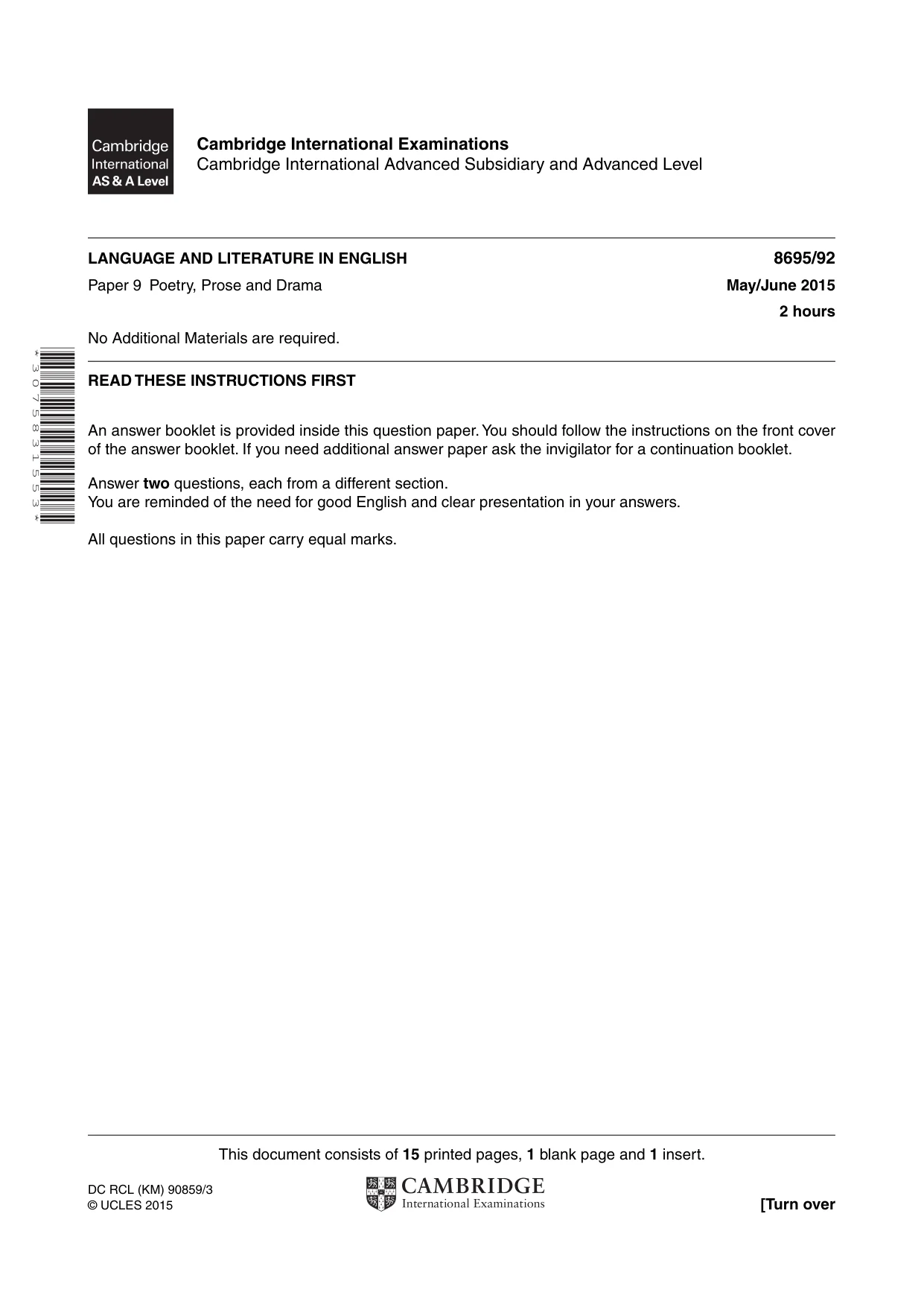
This document consists of 15 printed pages, 1 blank page and 1 insert. DC RCL (KM) 90859/3 © UCLES 2015 [Turn over Cambridge International Examinations Cambridge International Advanced Subsidiary and Advanced Level * 3 0 7 5 8 3 1 5 5 3 * LANGUAGE AND LITERATURE IN ENGLISH 8695/92 Paper 9 Poetry, Prose and Drama May/June 2015 2 hours No Additional Materials are required. READ THESE INSTRUCTIONS FIRST An answer booklet is provided inside this question paper. You should follow the instructions on the front cover of the answer booklet. If you need additional answer paper ask the invigilator for a continuation booklet. Answer two questions, each from a different section. You are reminded of the need for good English and clear presentation in your answers. All questions in this paper carry equal marks.
Question paper, page 2
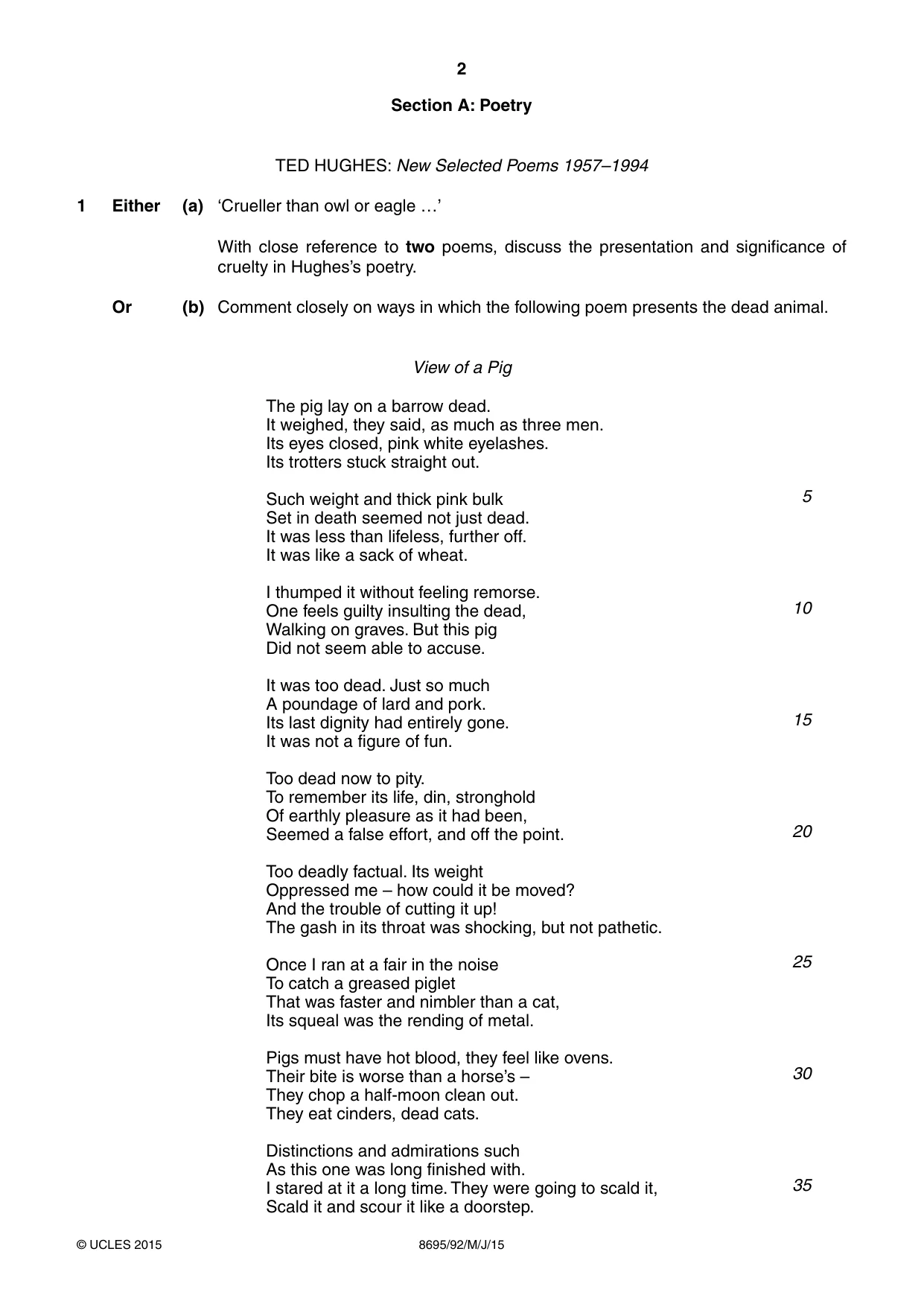
2 8695/92/M/J/15 © UCLES 2015 Section A: Poetry TED HUGHES: New Selected Poems 1957–1994 1 Either (a) ‘Crueller than owl or eagle …’ With close reference to two poems, discuss the presentation and significance of cruelty in Hughes’s poetry. Or (b) Comment closely on ways in which the following poem presents the dead animal. View of a Pig The pig lay on a barrow dead. It weighed, they said, as much as three men. Its eyes closed, pink white eyelashes. Its trotters stuck straight out. Such weight and thick pink bulk Set in death seemed not just dead. It was less than lifeless, further off. It was like a sack of wheat. I thumped it without feeling remorse. One feels guilty insulting the dead, Walking on graves. But this pig Did not seem able to accuse. It was too dead. Just so much A poundage of lard and pork. Its last dignity had entirely gone. It was not a figure of fun. Too dead now to pity. To remember its life, din, stronghold Of earthly pleasure as it had been, Seemed a false effort, and off the point. Too deadly factual. Its weight Oppressed me – how could it be moved? And the trouble of cutting it up! The gash in its throat was shocking, but not pathetic. Once I ran at a fair in the noise To catch a greased piglet That was faster and nimbler than a cat, Its squeal was the rending of metal. Pigs must have hot blood, they feel like ovens. Their bite is worse than a horse’s – They chop a half-moon clean out. They eat cinders, dead cats. Distinctions and admirations such As this one was long finished with. I stared at it a long time. They were going to scald it, Scald it and scour it like a doorstep. 5 10 15 20 25 30 35
Question paper, page 3
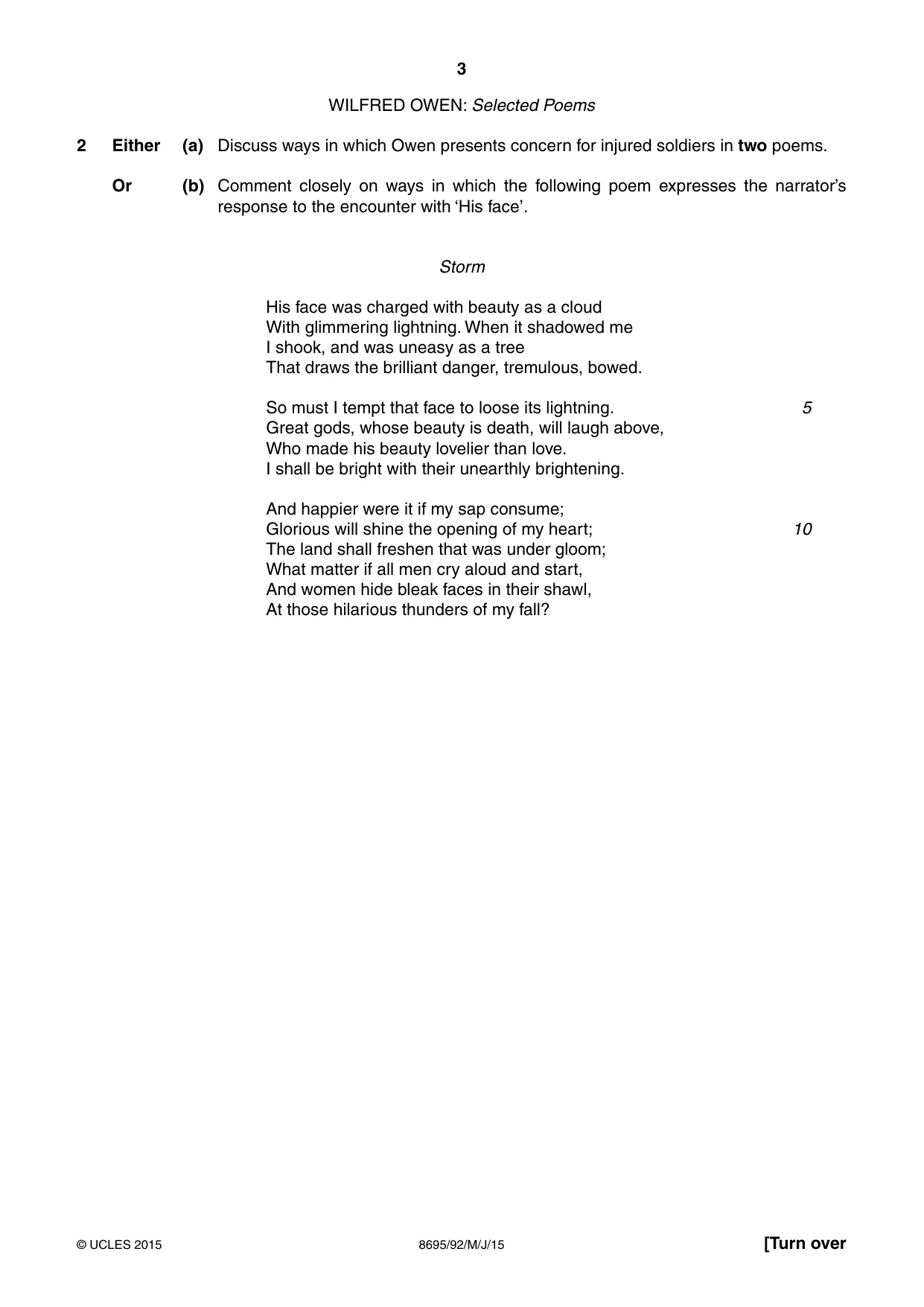
3 8695/92/M/J/15 © UCLES 2015 [Turn over WILFRED OWEN: Selected Poems 2 Either (a) Discuss ways in which Owen presents concern for injured soldiers in two poems. Or (b) Comment closely on ways in which the following poem expresses the narrator’s response to the encounter with ‘His face’. Storm His face was charged with beauty as a cloud With glimmering lightning. When it shadowed me I shook, and was uneasy as a tree That draws the brilliant danger, tremulous, bowed. So must I tempt that face to loose its lightning. Great gods, whose beauty is death, will laugh above, Who made his beauty lovelier than love. I shall be bright with their unearthly brightening. And happier were it if my sap consume; Glorious will shine the opening of my heart; The land shall freshen that was under gloom; What matter if all men cry aloud and start, And women hide bleak faces in their shawl, At those hilarious thunders of my fall? 5 10
Question paper, page 4
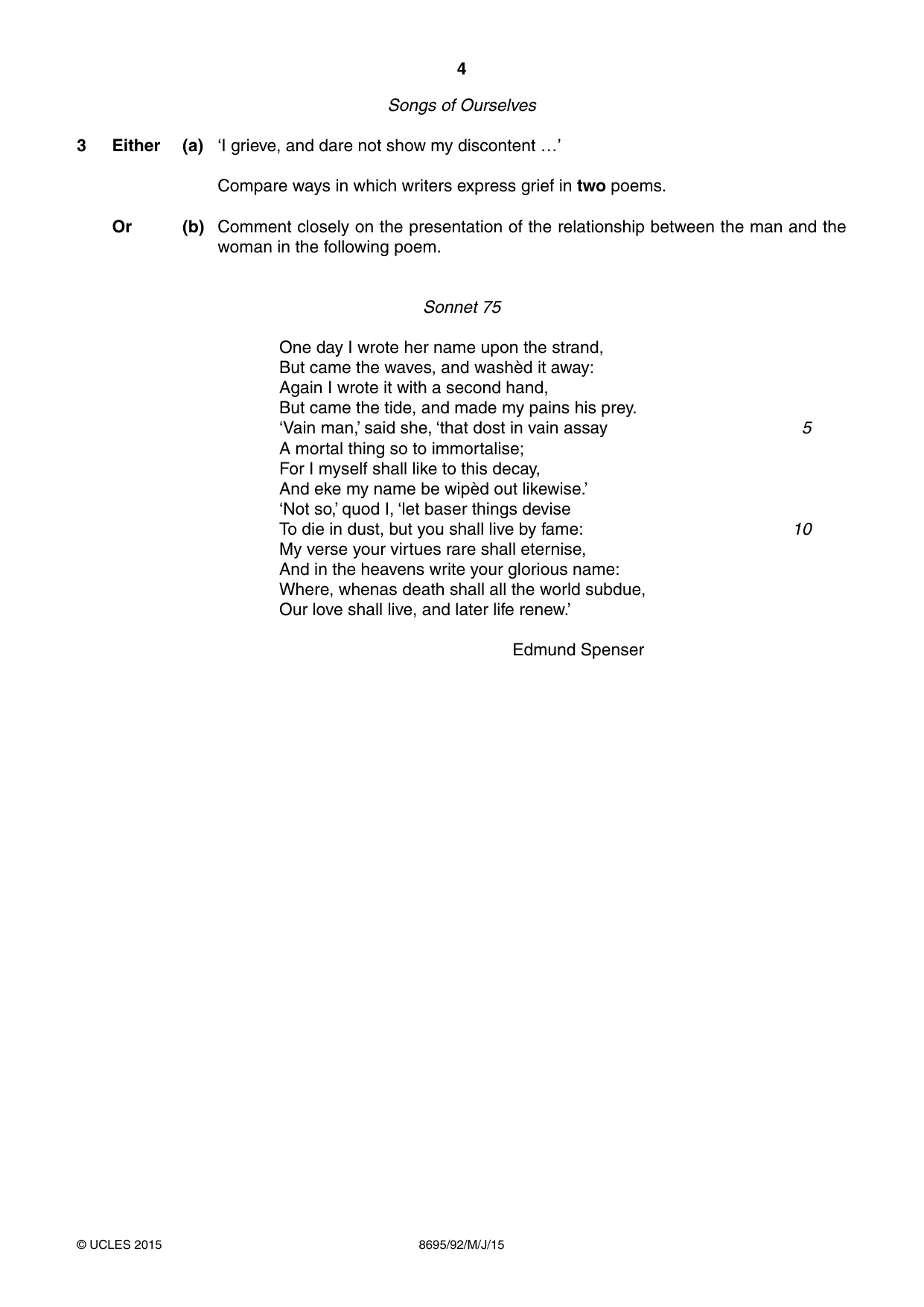
4 8695/92/M/J/15 © UCLES 2015 Songs of Ourselves 3 Either (a) ‘I grieve, and dare not show my discontent …’ Compare ways in which writers express grief in two poems. Or (b) Comment closely on the presentation of the relationship between the man and the woman in the following poem. Sonnet 75 One day I wrote her name upon the strand, But came the waves, and washèd it away: Again I wrote it with a second hand, But came the tide, and made my pains his prey. ‘Vain man,’ said she, ‘that dost in vain assay A mortal thing so to immortalise; For I myself shall like to this decay, And eke my name be wipèd out likewise.’ ‘Not so,’ quod I, ‘let baser things devise To die in dust, but you shall live by fame: My verse your virtues rare shall eternise, And in the heavens write your glorious name: Where, whenas death shall all the world subdue, Our love shall live, and later life renew.’ Edmund Spenser 5 10
Question paper, page 5
5 8695/92/M/J/15 © UCLES 2015 [Turn over Turn to page 6 for Section B
Question paper, page 6
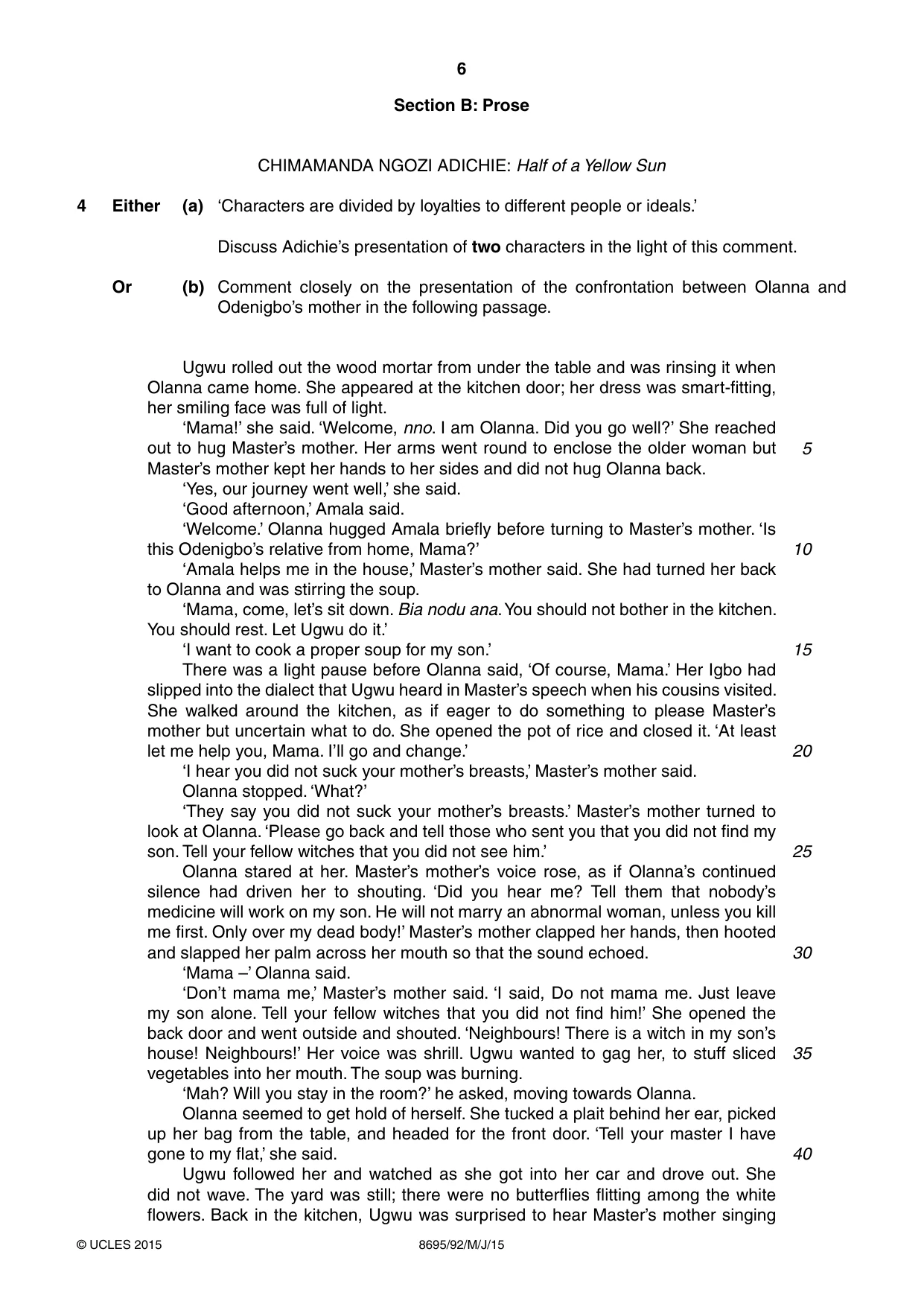
6 8695/92/M/J/15 © UCLES 2015 Section B: Prose CHIMAMANDA NGOZI ADICHIE: Half of a Yellow Sun 4 Either (a) ‘Characters are divided by loyalties to different people or ideals.’ Discuss Adichie’s presentation of two characters in the light of this comment. Or (b) Comment closely on the presentation of the confrontation between Olanna and Odenigbo’s mother in the following passage. Ugwu rolled out the wood mortar from under the table and was rinsing it when Olanna came home. She appeared at the kitchen door; her dress was smart-fitting, her smiling face was full of light. ‘Mama!’ she said. ‘Welcome, nno. I am Olanna. Did you go well?’ She reached out to hug Master’s mother. Her arms went round to enclose the older woman but Master’s mother kept her hands to her sides and did not hug Olanna back. ‘Yes, our journey went well,’ she said. ‘Good afternoon,’ Amala said. ‘Welcome.’ Olanna hugged Amala briefly before turning to Master’s mother. ‘Is this Odenigbo’s relative from home, Mama?’ ‘Amala helps me in the house,’ Master’s mother said. She had turned her back to Olanna and was stirring the soup. ‘Mama, come, let’s sit down. Bia nodu ana. You should not bother in the kitchen. You should rest. Let Ugwu do it.’ ‘I want to cook a proper soup for my son.’ There was a light pause before Olanna said, ‘Of course, Mama.’ Her Igbo had slipped into the dialect that Ugwu heard in Master’s speech when his cousins visited. She walked around the kitchen, as if eager to do something to please Master’s mother but uncertain what to do. She opened the pot of rice and closed it. ‘At least let me help you, Mama. I’ll go and change.’ ‘I hear you did not suck your mother’s breasts,’ Master’s mother said. Olanna stopped. ‘What?’ ‘They say you did not suck your mother’s breasts.’ Master’s mother turned to look at Olanna. ‘Please go back and tell those who sent you that you did not find my son. Tell your fellow witches that you did not see him.’ Olanna stared at her. Master’s mother’s voice rose, as if Olanna’s continued silence had driven her to shouting. ‘Did you hear me? Tell them that nobody’s medicine will work on my son. He will not marry an abnormal woman, unless you kill me first. Only over my dead body!’ Master’s mother clapped her hands, then hooted and slapped her palm across her mouth so that the sound echoed. ‘Mama –’ Olanna said. ‘Don’t mama me,’ Master’s mother said. ‘I said, Do not mama me. Just leave my son alone. Tell your fellow witches that you did not find him!’ She opened the back door and went outside and shouted. ‘Neighbours! There is a witch in my son’s house! Neighbours!’ Her voice was shrill. Ugwu wanted to gag her, to stuff sliced vegetables into her mouth. The soup was burning. ‘Mah? Will you stay in the room?’ he asked, moving towards Olanna. Olanna seemed to get hold of herself. She tucked a plait behind her ear, picked up her bag from the table, and headed for the front door. ‘Tell your master I have gone to my flat,’ she said. Ugwu followed her and watched as she got into her car and drove out. She did not wave. The yard was still; there were no butterflies flitting among the white flowers. Back in the kitchen, Ugwu was surprised to hear Master’s mother singing 5 10 15 20 25 30 35 40
Question paper, page 7
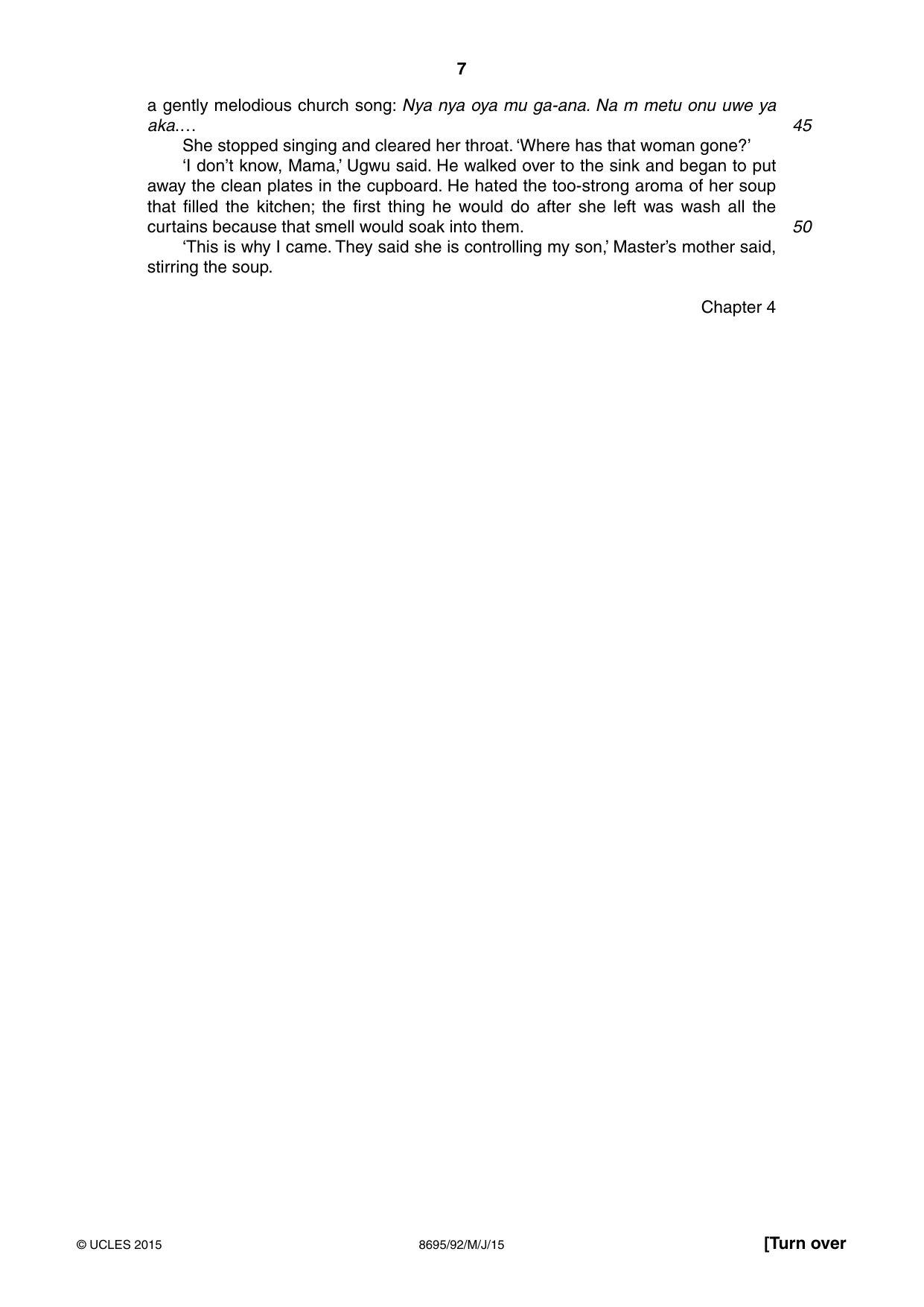
7 8695/92/M/J/15 © UCLES 2015 [Turn over a gently melodious church song: Nya nya oya mu ga-ana. Na m metu onu uwe ya aka.… She stopped singing and cleared her throat. ‘Where has that woman gone?’ ‘I don’t know, Mama,’ Ugwu said. He walked over to the sink and began to put away the clean plates in the cupboard. He hated the too-strong aroma of her soup that filled the kitchen; the first thing he would do after she left was wash all the curtains because that smell would soak into them. ‘This is why I came. They said she is controlling my son,’ Master’s mother said, stirring the soup. Chapter 4 45 50
Question paper, page 8
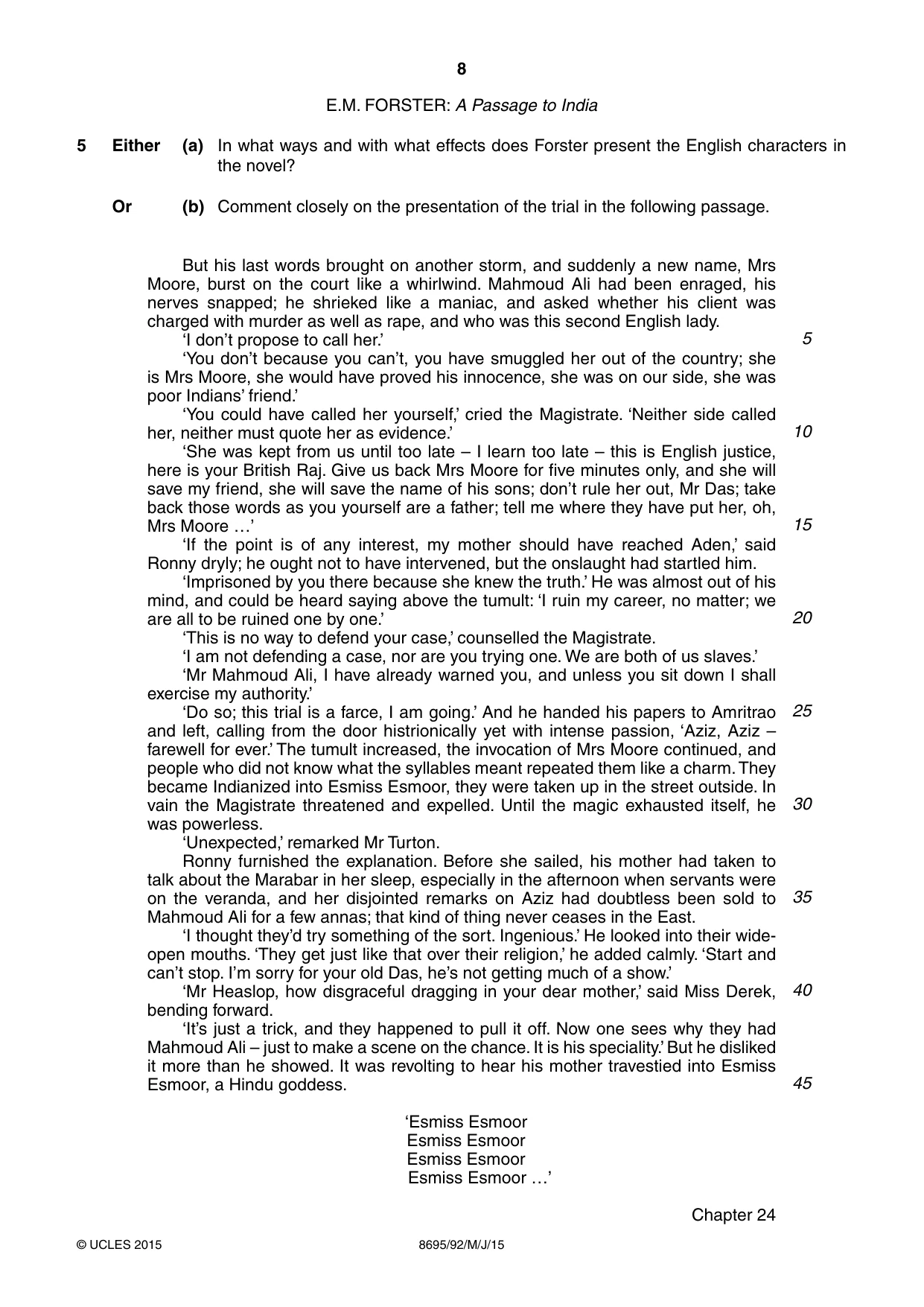
8 8695/92/M/J/15 © UCLES 2015 E.M. FORSTER: A Passage to India 5 Either (a) In what ways and with what effects does Forster present the English characters in the novel? Or (b) Comment closely on the presentation of the trial in the following passage. But his last words brought on another storm, and suddenly a new name, Mrs Moore, burst on the court like a whirlwind. Mahmoud Ali had been enraged, his nerves snapped; he shrieked like a maniac, and asked whether his client was charged with murder as well as rape, and who was this second English lady. ‘I don’t propose to call her.’ ‘You don’t because you can’t, you have smuggled her out of the country; she is Mrs Moore, she would have proved his innocence, she was on our side, she was poor Indians’ friend.’ ‘You could have called her yourself,’ cried the Magistrate. ‘Neither side called her, neither must quote her as evidence.’ ‘She was kept from us until too late – I learn too late – this is English justice, here is your British Raj. Give us back Mrs Moore for five minutes only, and she will save my friend, she will save the name of his sons; don’t rule her out, Mr Das; take back those words as you yourself are a father; tell me where they have put her, oh, Mrs Moore …’ ‘If the point is of any interest, my mother should have reached Aden,’ said Ronny dryly; he ought not to have intervened, but the onslaught had startled him. ‘Imprisoned by you there because she knew the truth.’ He was almost out of his mind, and could be heard saying above the tumult: ‘I ruin my career, no matter; we are all to be ruined one by one.’ ‘This is no way to defend your case,’ counselled the Magistrate. ‘I am not defending a case, nor are you trying one. We are both of us slaves.’ ‘Mr Mahmoud Ali, I have already warned you, and unless you sit down I shall exercise my authority.’ ‘Do so; this trial is a farce, I am going.’ And he handed his papers to Amritrao and left, calling from the door histrionically yet with intense passion, ‘Aziz, Aziz – farewell for ever.’ The tumult increased, the invocation of Mrs Moore continued, and people who did not know what the syllables meant repeated them like a charm. They became Indianized into Esmiss Esmoor, they were taken up in the street outside. In vain the Magistrate threatened and expelled. Until the magic exhausted itself, he was powerless. ‘Unexpected,’ remarked Mr Turton. Ronny furnished the explanation. Before she sailed, his mother had taken to talk about the Marabar in her sleep, especially in the afternoon when servants were on the veranda, and her disjointed remarks on Aziz had doubtless been sold to Mahmoud Ali for a few annas; that kind of thing never ceases in the East. ‘I thought they’d try something of the sort. Ingenious.’ He looked into their wide- open mouths. ‘They get just like that over their religion,’ he added calmly. ‘Start and can’t stop. I’m sorry for your old Das, he’s not getting much of a show.’ ‘Mr Heaslop, how disgraceful dragging in your dear mother,’ said Miss Derek, bending forward. ‘It’s just a trick, and they happened to pull it off. Now one sees why they had Mahmoud Ali – just to make a scene on the chance. It is his speciality.’ But he disliked it more than he showed. It was revolting to hear his mother travestied into Esmiss Esmoor, a Hindu goddess. ‘Esmiss Esmoor Esmiss Esmoor Esmiss Esmoor Esmiss Esmoor …’ Chapter 24 5 10 15 20 25 30 35 40 45
Question paper, page 9
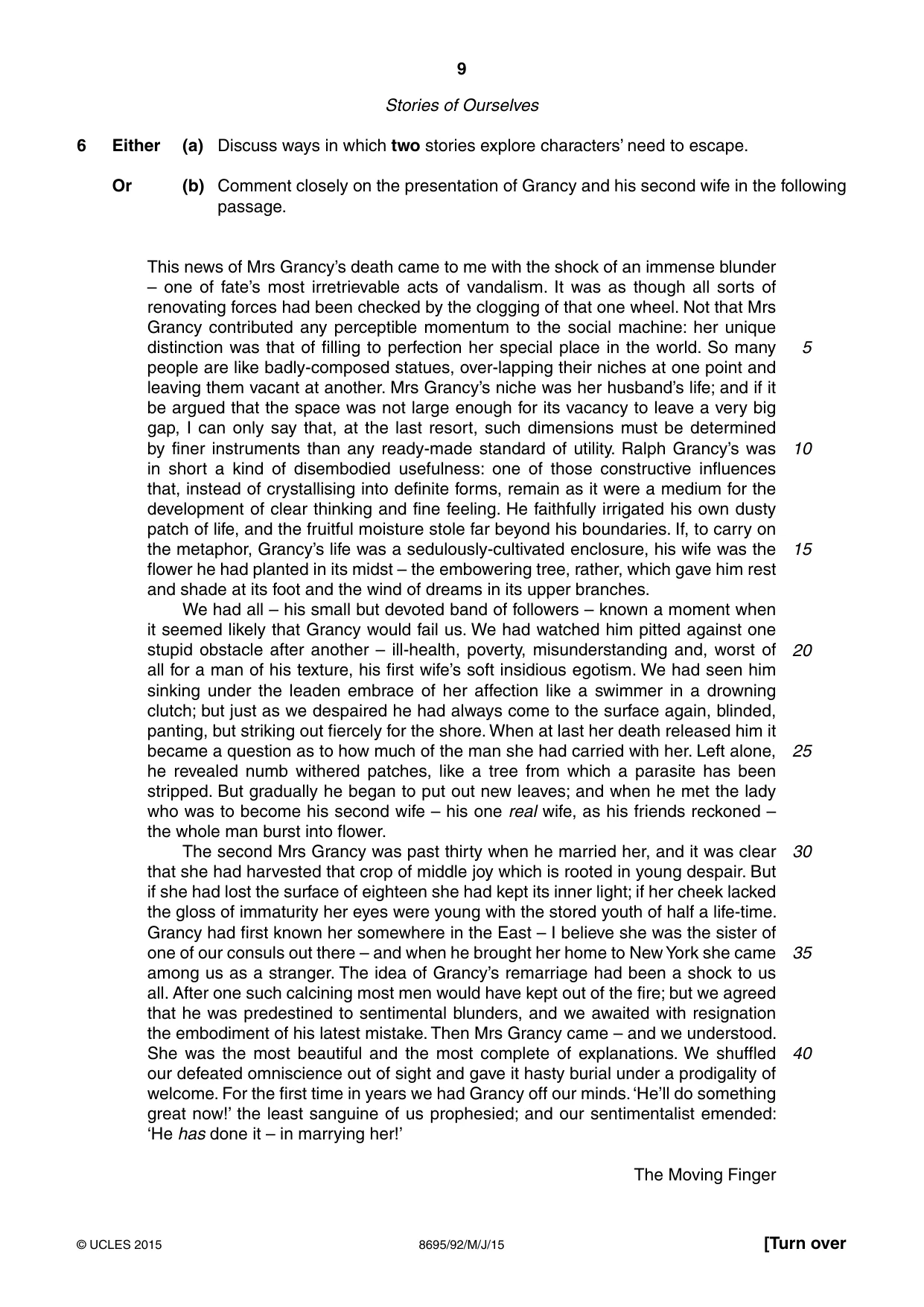
9 8695/92/M/J/15 © UCLES 2015 [Turn over Stories of Ourselves 6 Either (a) Discuss ways in which two stories explore characters’ need to escape. Or (b) Comment closely on the presentation of Grancy and his second wife in the following passage. This news of Mrs Grancy’s death came to me with the shock of an immense blunder – one of fate’s most irretrievable acts of vandalism. It was as though all sorts of renovating forces had been checked by the clogging of that one wheel. Not that Mrs Grancy contributed any perceptible momentum to the social machine: her unique distinction was that of filling to perfection her special place in the world. So many people are like badly-composed statues, over-lapping their niches at one point and leaving them vacant at another. Mrs Grancy’s niche was her husband’s life; and if it be argued that the space was not large enough for its vacancy to leave a very big gap, I can only say that, at the last resort, such dimensions must be determined by finer instruments than any ready-made standard of utility. Ralph Grancy’s was in short a kind of disembodied usefulness: one of those constructive influences that, instead of crystallising into definite forms, remain as it were a medium for the development of clear thinking and fine feeling. He faithfully irrigated his own dusty patch of life, and the fruitful moisture stole far beyond his boundaries. If, to carry on the metaphor, Grancy’s life was a sedulously-cultivated enclosure, his wife was the flower he had planted in its midst – the embowering tree, rather, which gave him rest and shade at its foot and the wind of dreams in its upper branches. We had all – his small but devoted band of followers – known a moment when it seemed likely that Grancy would fail us. We had watched him pitted against one stupid obstacle after another – ill-health, poverty, misunderstanding and, worst of all for a man of his texture, his first wife’s soft insidious egotism. We had seen him sinking under the leaden embrace of her affection like a swimmer in a drowning clutch; but just as we despaired he had always come to the surface again, blinded, panting, but striking out fiercely for the shore. When at last her death released him it became a question as to how much of the man she had carried with her. Left alone, he revealed numb withered patches, like a tree from which a parasite has been stripped. But gradually he began to put out new leaves; and when he met the lady who was to become his second wife – his one real wife, as his friends reckoned – the whole man burst into flower. The second Mrs Grancy was past thirty when he married her, and it was clear that she had harvested that crop of middle joy which is rooted in young despair. But if she had lost the surface of eighteen she had kept its inner light; if her cheek lacked the gloss of immaturity her eyes were young with the stored youth of half a life-time. Grancy had first known her somewhere in the East – I believe she was the sister of one of our consuls out there – and when he brought her home to New York she came among us as a stranger. The idea of Grancy’s remarriage had been a shock to us all. After one such calcining most men would have kept out of the fire; but we agreed that he was predestined to sentimental blunders, and we awaited with resignation the embodiment of his latest mistake. Then Mrs Grancy came – and we understood. She was the most beautiful and the most complete of explanations. We shuffled our defeated omniscience out of sight and gave it hasty burial under a prodigality of welcome. For the first time in years we had Grancy off our minds. ‘He’ll do something great now!’ the least sanguine of us prophesied; and our sentimentalist emended: ‘He has done it – in marrying her!’ The Moving Finger 5 10 15 20 25 30 35 40
Question paper, page 10
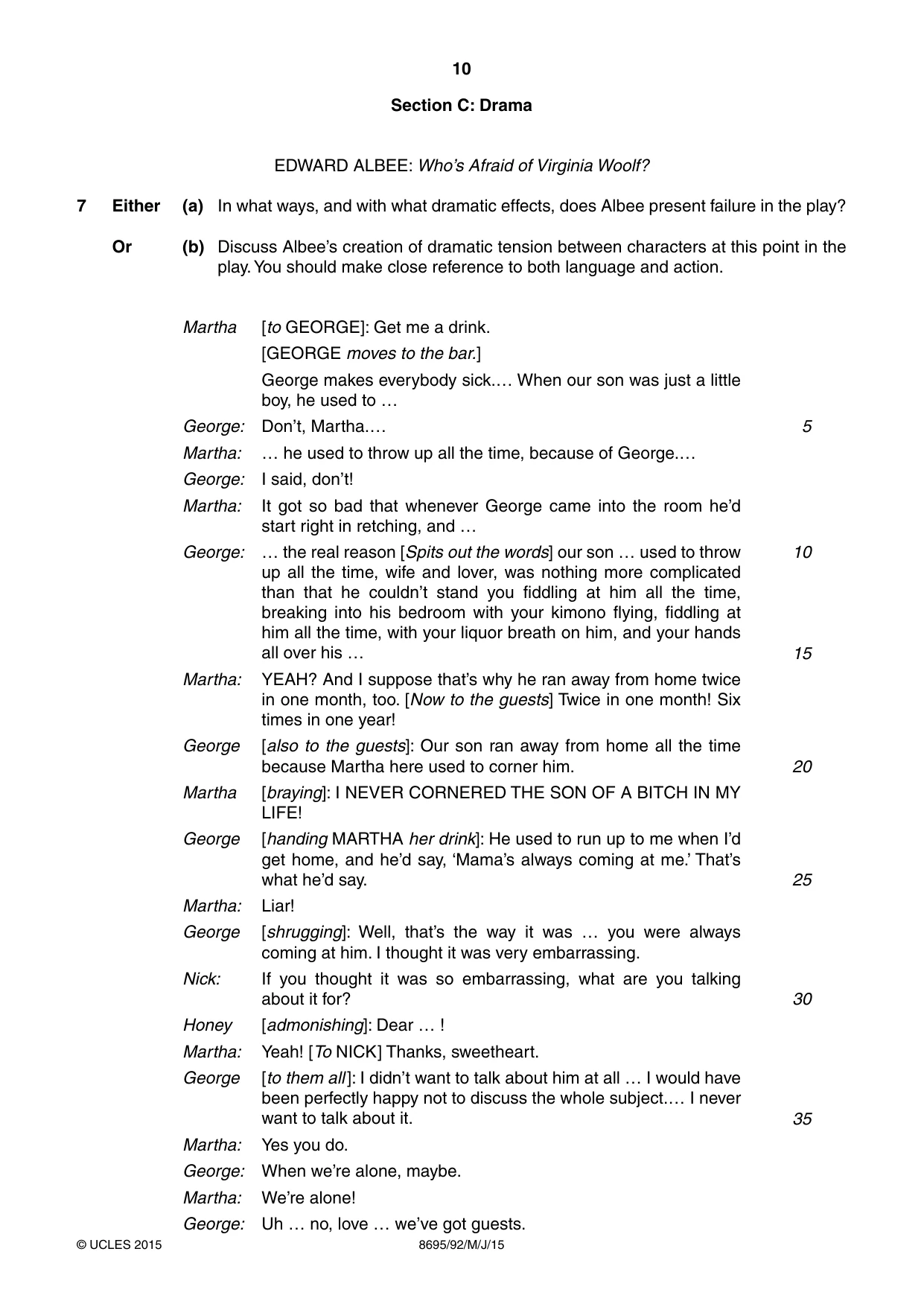
10 8695/92/M/J/15 © UCLES 2015 Section C: Drama EDWARD ALBEE: Who’s Afraid of Virginia Woolf? 7 Either (a) In what ways, and with what dramatic effects, does Albee present failure in the play? Or (b) Discuss Albee’s creation of dramatic tension between characters at this point in the play. You should make close reference to both language and action. Martha [to GEORGE]: Get me a drink. [GEORGE moves to the bar.] George makes everybody sick.… When our son was just a little boy, he used to … George: Don’t, Martha.… Martha: … he used to throw up all the time, because of George.… George: I said, don’t! Martha: It got so bad that whenever George came into the room he’d start right in retching, and … George: … the real reason [Spits out the words] our son … used to throw up all the time, wife and lover, was nothing more complicated than that he couldn’t stand you fiddling at him all the time, breaking into his bedroom with your kimono flying, fiddling at him all the time, with your liquor breath on him, and your hands all over his … Martha: YEAH? And I suppose that’s why he ran away from home twice in one month, too. [Now to the guests] Twice in one month! Six times in one year! George [also to the guests]: Our son ran away from home all the time because Martha here used to corner him. Martha [braying]: I NEVER CORNERED THE SON OF A BITCH IN MY LIFE! George [handing MARTHA her drink]: He used to run up to me when I’d get home, and he’d say, ‘Mama’s always coming at me.’ That’s what he’d say. Martha: Liar! George [shrugging]: Well, that’s the way it was … you were always coming at him. I thought it was very embarrassing. Nick: If you thought it was so embarrassing, what are you talking about it for? Honey [admonishing]: Dear … ! Martha: Yeah! [To NICK ] Thanks, sweetheart. George [to them all ]: I didn’t want to talk about him at all … I would have been perfectly happy not to discuss the whole subject.… I never want to talk about it. Martha: Yes you do. George: When we’re alone, maybe. Martha: We’re alone! George: Uh … no, love … we’ve got guests. 5 10 15 20 25 30 35
Question paper, page 11
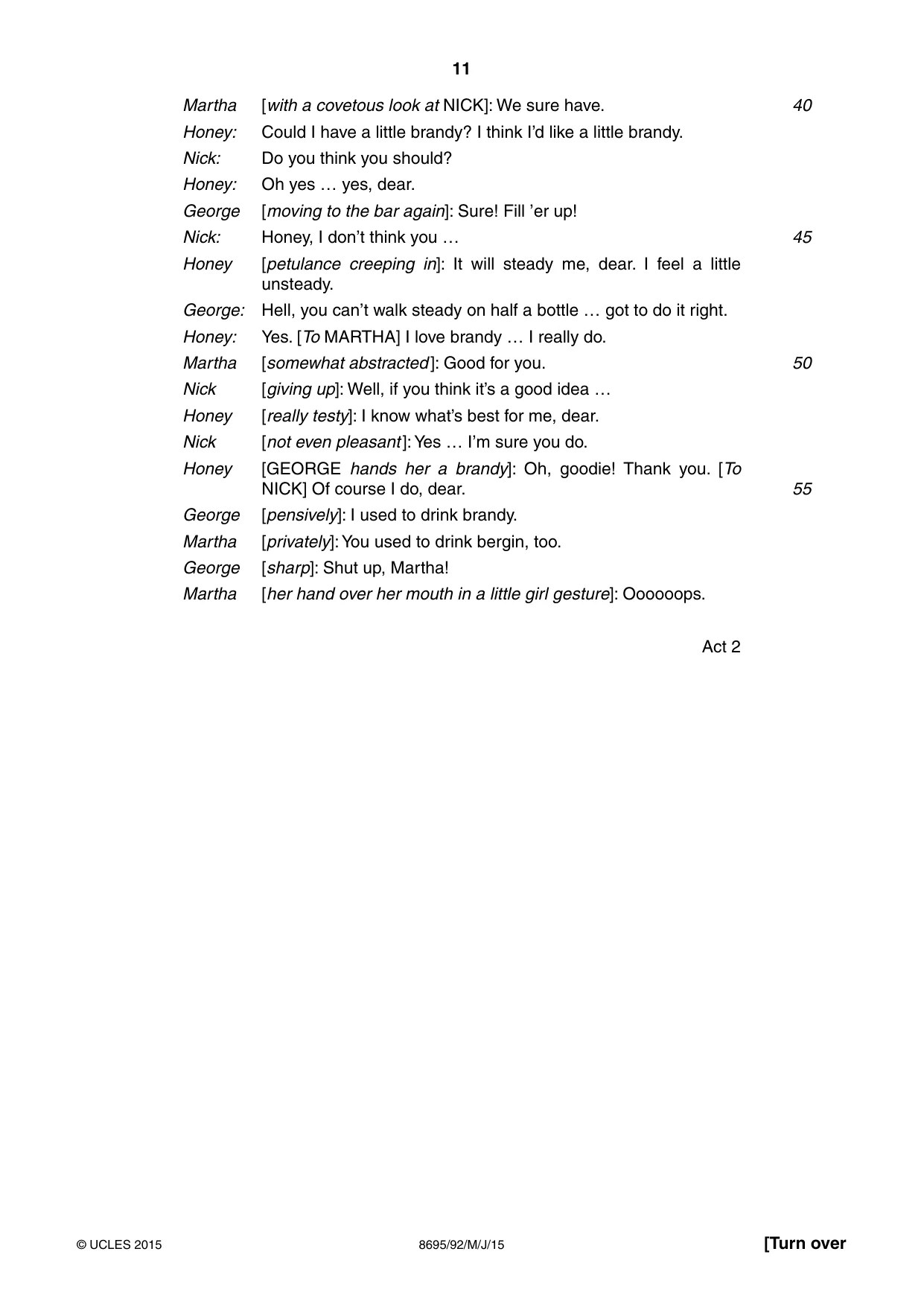
11 8695/92/M/J/15 © UCLES 2015 [Turn over Martha [with a covetous look at NICK]: We sure have. Honey: Could I have a little brandy? I think I’d like a little brandy. Nick: Do you think you should? Honey: Oh yes … yes, dear. George [moving to the bar again]: Sure! Fill ’er up! Nick: Honey, I don’t think you … Honey [petulance creeping in]: It will steady me, dear. I feel a little unsteady. George: Hell, you can’t walk steady on half a bottle … got to do it right. Honey: Yes. [To MARTHA] I love brandy … I really do. Martha [somewhat abstracted ]: Good for you. Nick [giving up]: Well, if you think it’s a good idea … Honey [really testy]: I know what’s best for me, dear. Nick [not even pleasant ]: Yes … I’m sure you do. Honey [GEORGE hands her a brandy]: Oh, goodie! Thank you. [To NICK] Of course I do, dear. George [pensively]: I used to drink brandy. Martha [privately]: You used to drink bergin, too. George [sharp]: Shut up, Martha! Martha [her hand over her mouth in a little girl gesture]: Oooooops. Act 2 40 45 50 55
Question paper, page 12
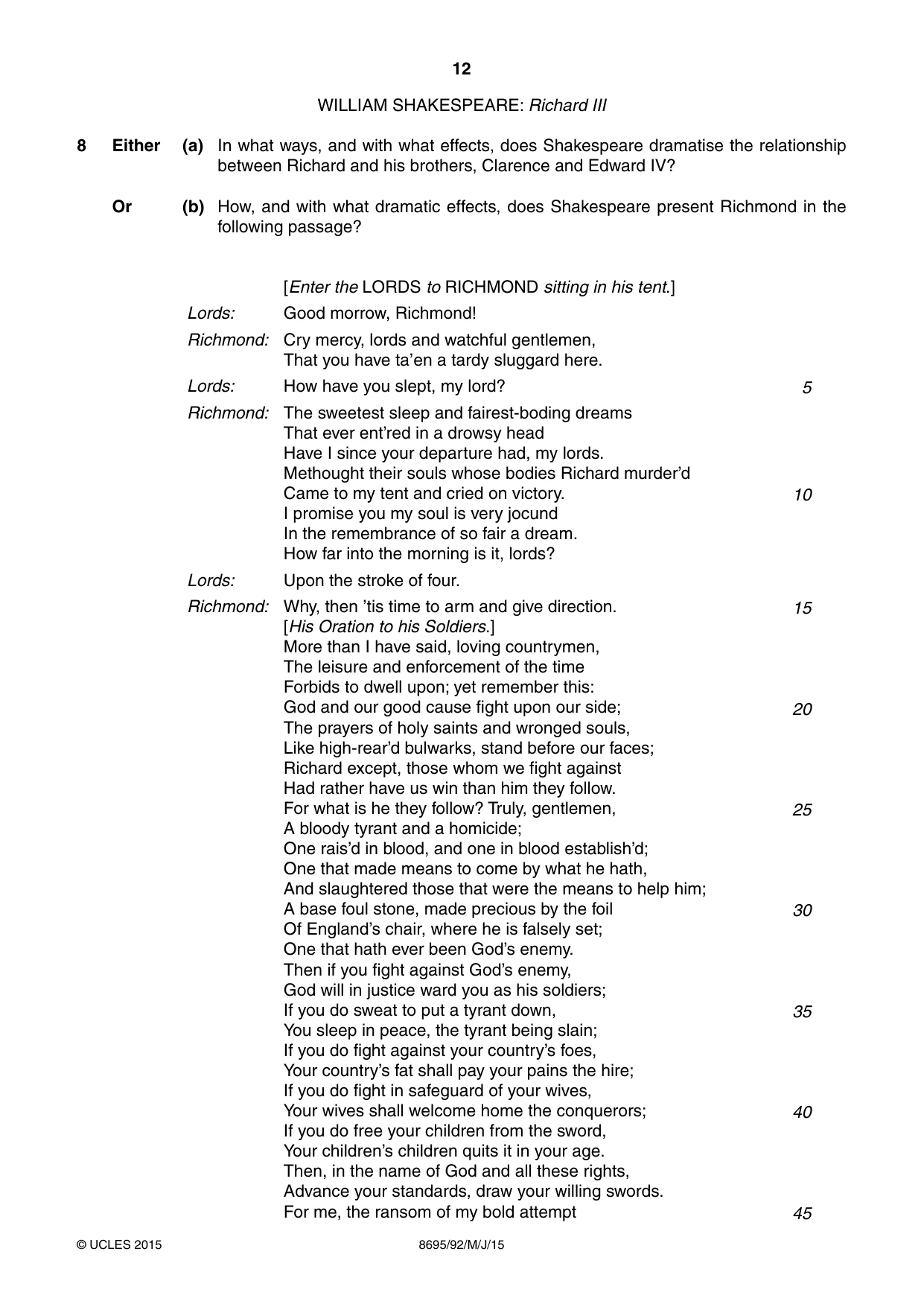
12 8695/92/M/J/15 © UCLES 2015 WILLIAM SHAKESPEARE: Richard III 8 Either (a) In what ways, and with what effects, does Shakespeare dramatise the relationship between Richard and his brothers, Clarence and Edward IV? Or (b) How, and with what dramatic effects, does Shakespeare present Richmond in the following passage? [Enter the LORDS to RICHMOND sitting in his tent.] Lords: Good morrow, Richmond! Richmond: Cry mercy, lords and watchful gentlemen, That you have ta’en a tardy sluggard here. Lords: How have you slept, my lord? Richmond: The sweetest sleep and fairest-boding dreams That ever ent’red in a drowsy head Have I since your departure had, my lords. Methought their souls whose bodies Richard murder’d Came to my tent and cried on victory. I promise you my soul is very jocund In the remembrance of so fair a dream. How far into the morning is it, lords? Lords: Upon the stroke of four. Richmond: Why, then ’tis time to arm and give direction. [His Oration to his Soldiers.] More than I have said, loving countrymen, The leisure and enforcement of the time Forbids to dwell upon; yet remember this: God and our good cause fight upon our side; The prayers of holy saints and wronged souls, Like high-rear’d bulwarks, stand before our faces; Richard except, those whom we fight against Had rather have us win than him they follow. For what is he they follow? Truly, gentlemen, A bloody tyrant and a homicide; One rais’d in blood, and one in blood establish’d; One that made means to come by what he hath, And slaughtered those that were the means to help him; A base foul stone, made precious by the foil Of England’s chair, where he is falsely set; One that hath ever been God’s enemy. Then if you fight against God’s enemy, God will in justice ward you as his soldiers; If you do sweat to put a tyrant down, You sleep in peace, the tyrant being slain; If you do fight against your country’s foes, Your country’s fat shall pay your pains the hire; If you do fight in safeguard of your wives, Your wives shall welcome home the conquerors; If you do free your children from the sword, Your children’s children quits it in your age. Then, in the name of God and all these rights, Advance your standards, draw your willing swords. For me, the ransom of my bold attempt 5 10 15 20 25 30 35 40 45
Question paper, page 13
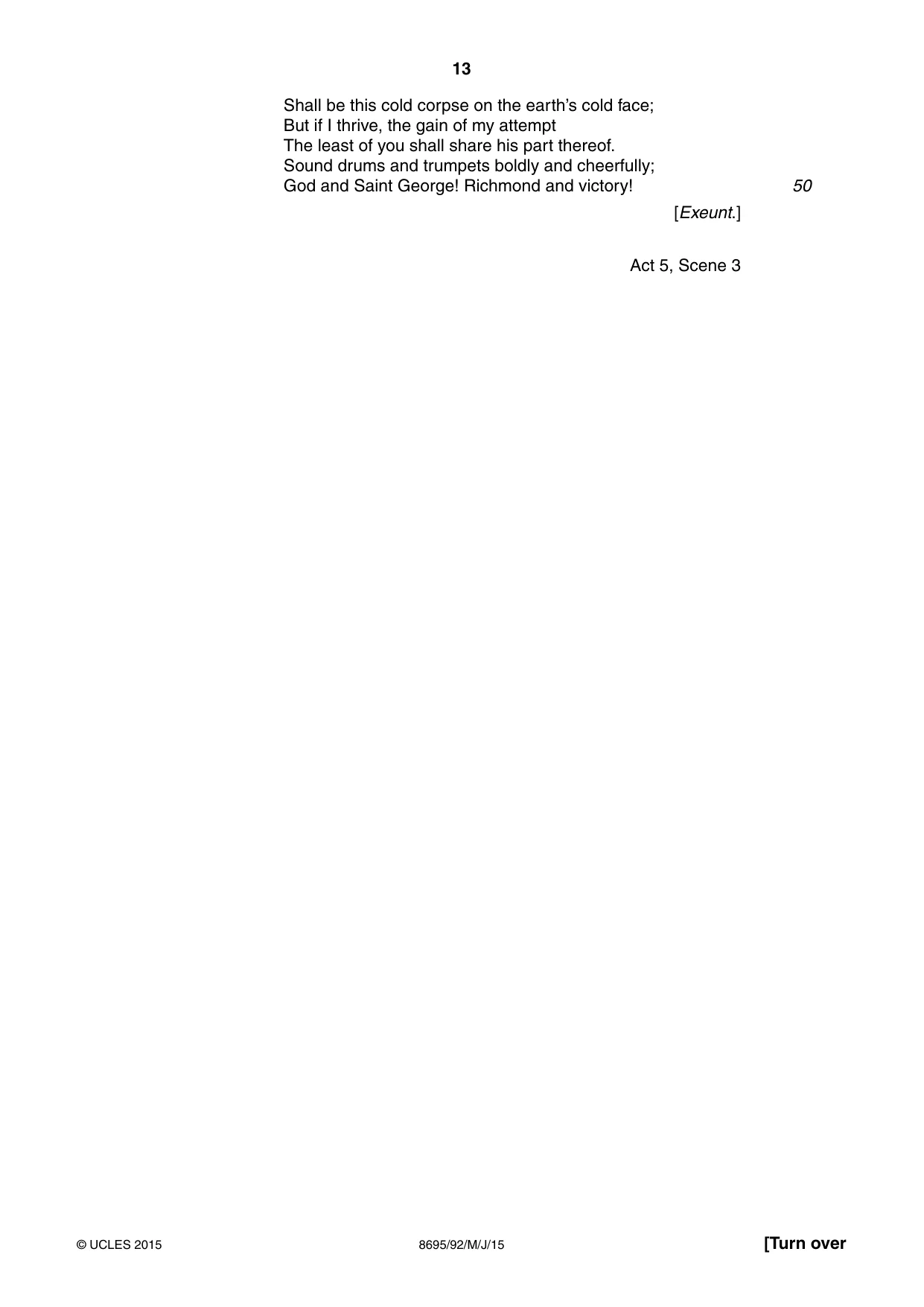
13 8695/92/M/J/15 © UCLES 2015 [Turn over Shall be this cold corpse on the earth’s cold face; But if I thrive, the gain of my attempt The least of you shall share his part thereof. Sound drums and trumpets boldly and cheerfully; God and Saint George! Richmond and victory! [Exeunt.] Act 5, Scene 3 50
Question paper, page 14
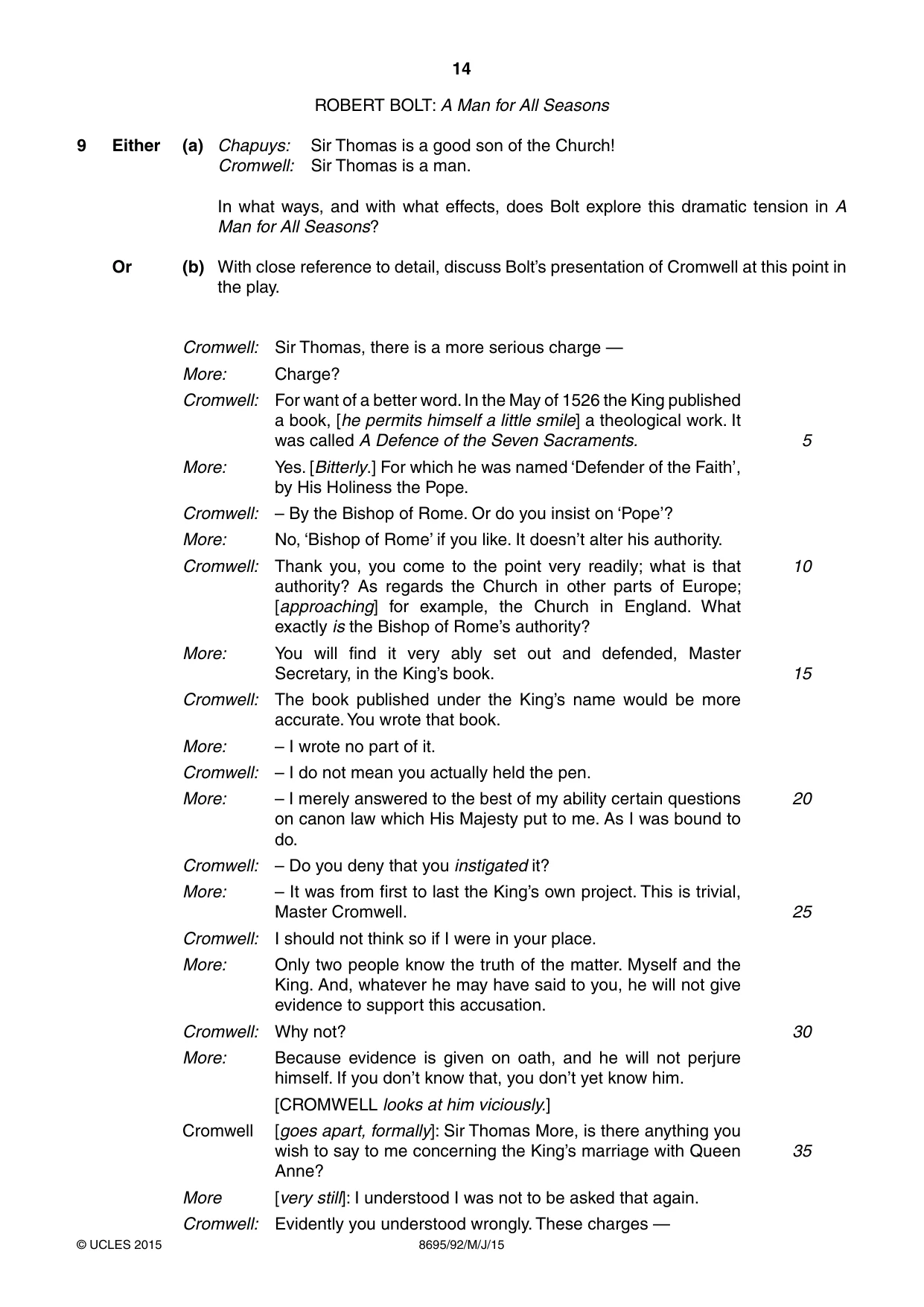
14 8695/92/M/J/15 © UCLES 2015 ROBERT BOLT: A Man for All Seasons 9 Either (a) Chapuys: Sir Thomas is a good son of the Church! Cromwell: Sir Thomas is a man. In what ways, and with what effects, does Bolt explore this dramatic tension in A Man for All Seasons? Or (b) With close reference to detail, discuss Bolt’s presentation of Cromwell at this point in the play. Cromwell: Sir Thomas, there is a more serious charge — More: Charge? Cromwell: For want of a better word. In the May of 1526 the King published a book, [he permits himself a little smile] a theological work. It was called A Defence of the Seven Sacraments. More: Yes. [Bitterly.] For which he was named ‘Defender of the Faith’, by His Holiness the Pope. Cromwell: – By the Bishop of Rome. Or do you insist on ‘Pope’? More: No, ‘Bishop of Rome’ if you like. It doesn’t alter his authority. Cromwell: Thank you, you come to the point very readily; what is that authority? As regards the Church in other parts of Europe; [approaching] for example, the Church in England. What exactly is the Bishop of Rome’s authority? More: You will find it very ably set out and defended, Master Secretary, in the King’s book. Cromwell: The book published under the King’s name would be more accurate. You wrote that book. More: – I wrote no part of it. Cromwell: – I do not mean you actually held the pen. More: – I merely answered to the best of my ability certain questions on canon law which His Majesty put to me. As I was bound to do. Cromwell: – Do you deny that you instigated it? More: – It was from first to last the King’s own project. This is trivial, Master Cromwell. Cromwell: I should not think so if I were in your place. More: Only two people know the truth of the matter. Myself and the King. And, whatever he may have said to you, he will not give evidence to support this accusation. Cromwell: Why not? More: Because evidence is given on oath, and he will not perjure himself. If you don’t know that, you don’t yet know him. [CROMWELL looks at him viciously.] Cromwell [goes apart, formally]: Sir Thomas More, is there anything you wish to say to me concerning the King’s marriage with Queen Anne? More [very still]: I understood I was not to be asked that again. Cromwell: Evidently you understood wrongly. These charges — 5 10 15 20 25 30 35
Question paper, page 15
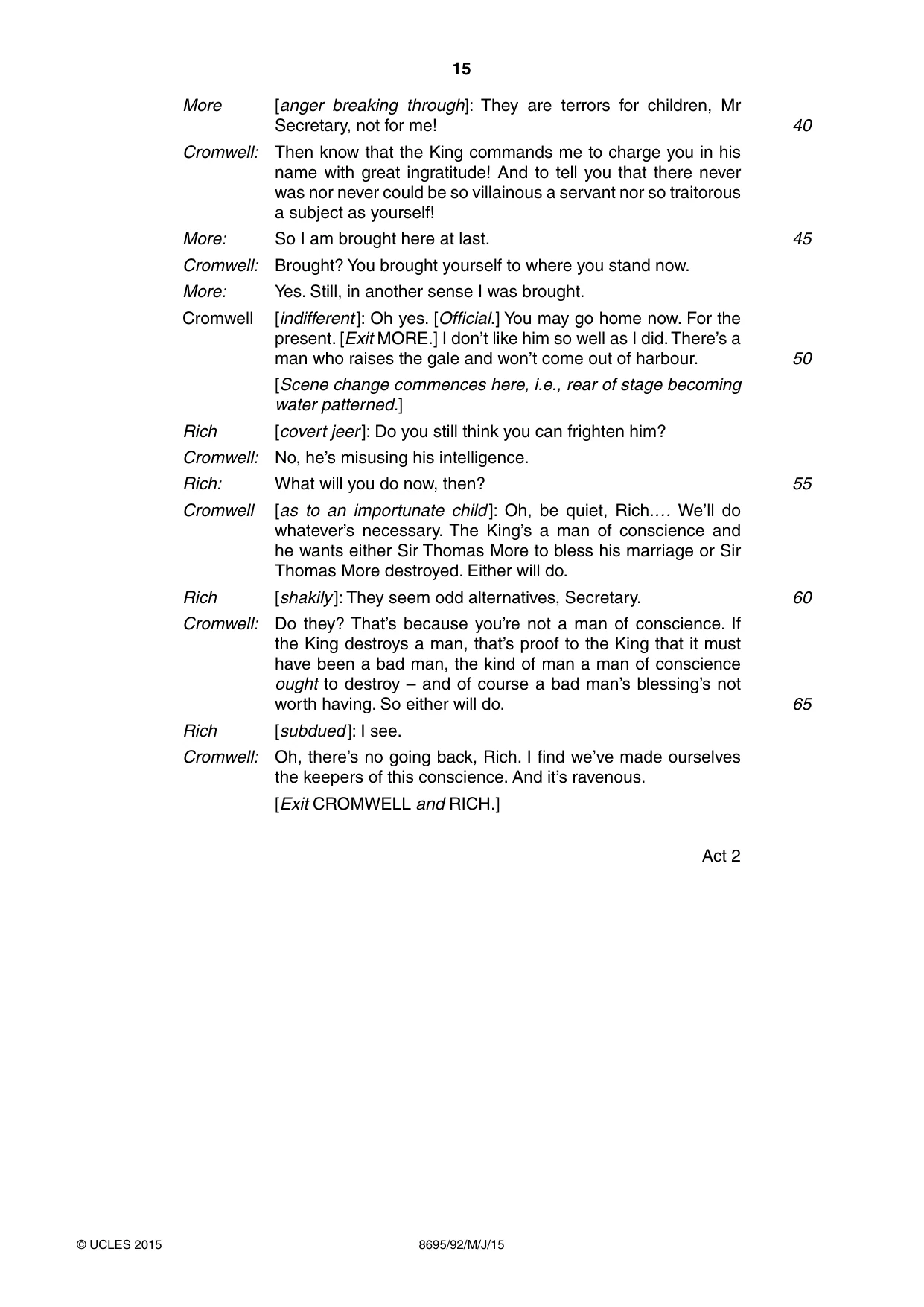
15 8695/92/M/J/15 © UCLES 2015 More [anger breaking through]: They are terrors for children, Mr Secretary, not for me! Cromwell: Then know that the King commands me to charge you in his name with great ingratitude! And to tell you that there never was nor never could be so villainous a servant nor so traitorous a subject as yourself! More: So I am brought here at last. Cromwell: Brought? You brought yourself to where you stand now. More: Yes. Still, in another sense I was brought. Cromwell [indifferent ]: Oh yes. [Official.] You may go home now. For the present. [Exit MORE.] I don’t like him so well as I did. There’s a man who raises the gale and won’t come out of harbour. [Scene change commences here, i.e., rear of stage becoming water patterned.] Rich [covert jeer ]: Do you still think you can frighten him? Cromwell: No, he’s misusing his intelligence. Rich: What will you do now, then? Cromwell [as to an importunate child ]: Oh, be quiet, Rich.… We’ll do whatever’s necessary. The King’s a man of conscience and he wants either Sir Thomas More to bless his marriage or Sir Thomas More destroyed. Either will do. Rich [shakily ]: They seem odd alternatives, Secretary. Cromwell: Do they? That’s because you’re not a man of conscience. If the King destroys a man, that’s proof to the King that it must have been a bad man, the kind of man a man of conscience ought to destroy – and of course a bad man’s blessing’s not worth having. So either will do. Rich [subdued ]: I see. Cromwell: Oh, there’s no going back, Rich. I find we’ve made ourselves the keepers of this conscience. And it’s ravenous. [Exit CROMWELL and RICH.] Act 2 40 45 50 55 60 65
Question paper, page 16
16 8695/92/M/J/15 © UCLES 2015 BLANK PAGE Permission to reproduce items where third-party owned material protected by copyright is included has been sought and cleared where possible. Every reasonable effort has been made by the publisher (UCLES) to trace copyright holders, but if any items requiring clearance have unwittingly been included, the publisher will be pleased to make amends at the earliest possible opportunity. To avoid the issue of disclosure of answer-related information to candidates, all copyright acknowledgements are reproduced online in the Cambridge International Examinations Copyright Acknowledgements Booklet. This is produced for each series of examinations and is freely available to download at www.cie.org.uk after the live examination series. Cambridge International Examinations is part of the Cambridge Assessment Group. Cambridge Assessment is the brand name of University of Cambridge Local Examinations Syndicate (UCLES), which is itself a department of the University of Cambridge.
Mark scheme, page 1
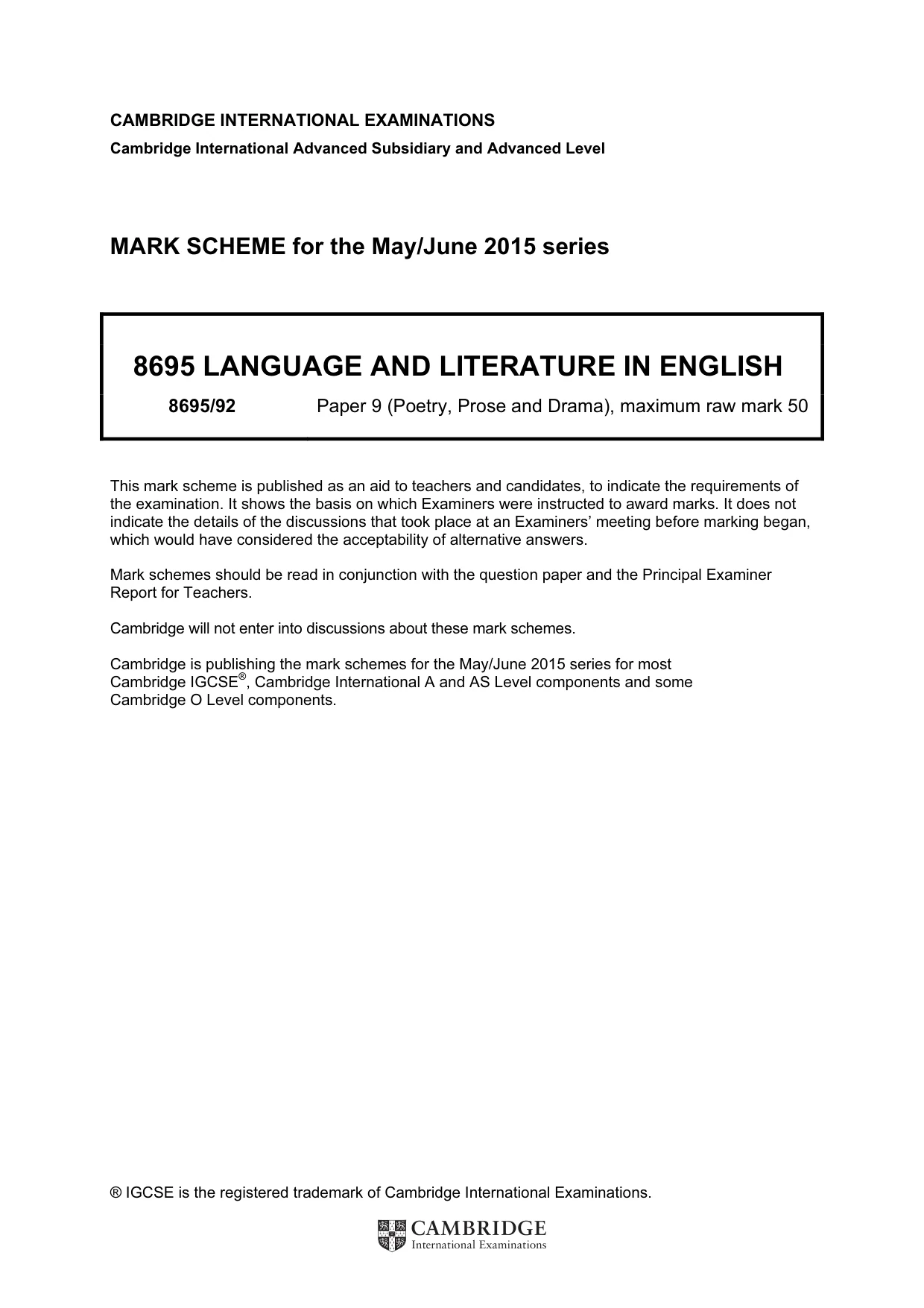
® IGCSE is the registered trademark of Cambridge International Examinations. CAMBRIDGE INTERNATIONAL EXAMINATIONS Cambridge International Advanced Subsidiary and Advanced Level MARK SCHEME for the May/June 2015 series 8695 LANGUAGE AND LITERATURE IN ENGLISH 8695/92 Paper 9 (Poetry, Prose and Drama), maximum raw mark 50 This mark scheme is published as an aid to teachers and candidates, to indicate the requirements of the examination. It shows the basis on which Examiners were instructed to award marks. It does not indicate the details of the discussions that took place at an Examiners’ meeting before marking began, which would have considered the acceptability of alternative answers. Mark schemes should be read in conjunction with the question paper and the Principal Examiner Report for Teachers. Cambridge will not enter into discussions about these mark schemes. Cambridge is publishing the mark schemes for the May/June 2015 series for most Cambridge IGCSE®, Cambridge International A and AS Level components and some Cambridge O Level components.
Mark scheme, page 2
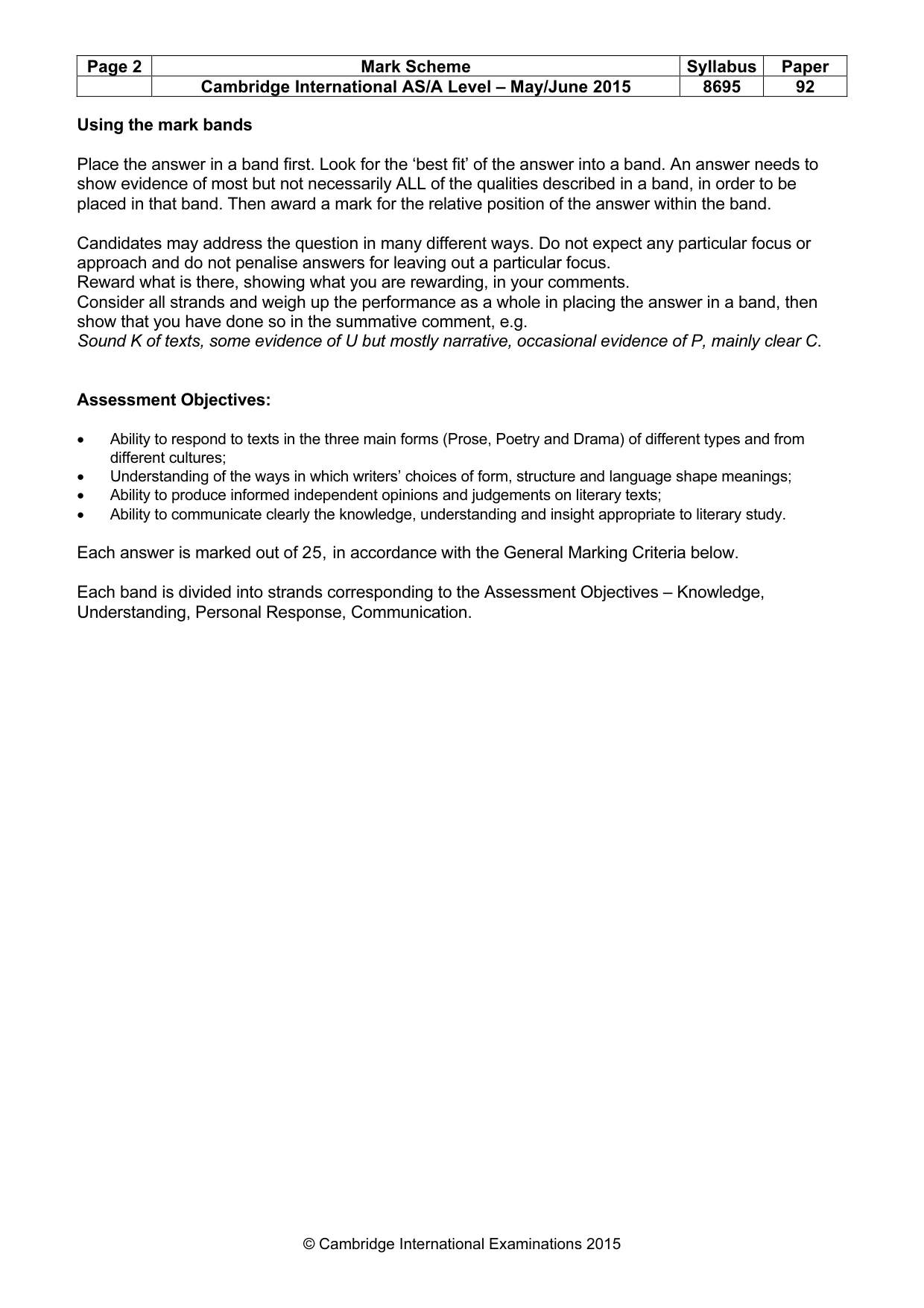
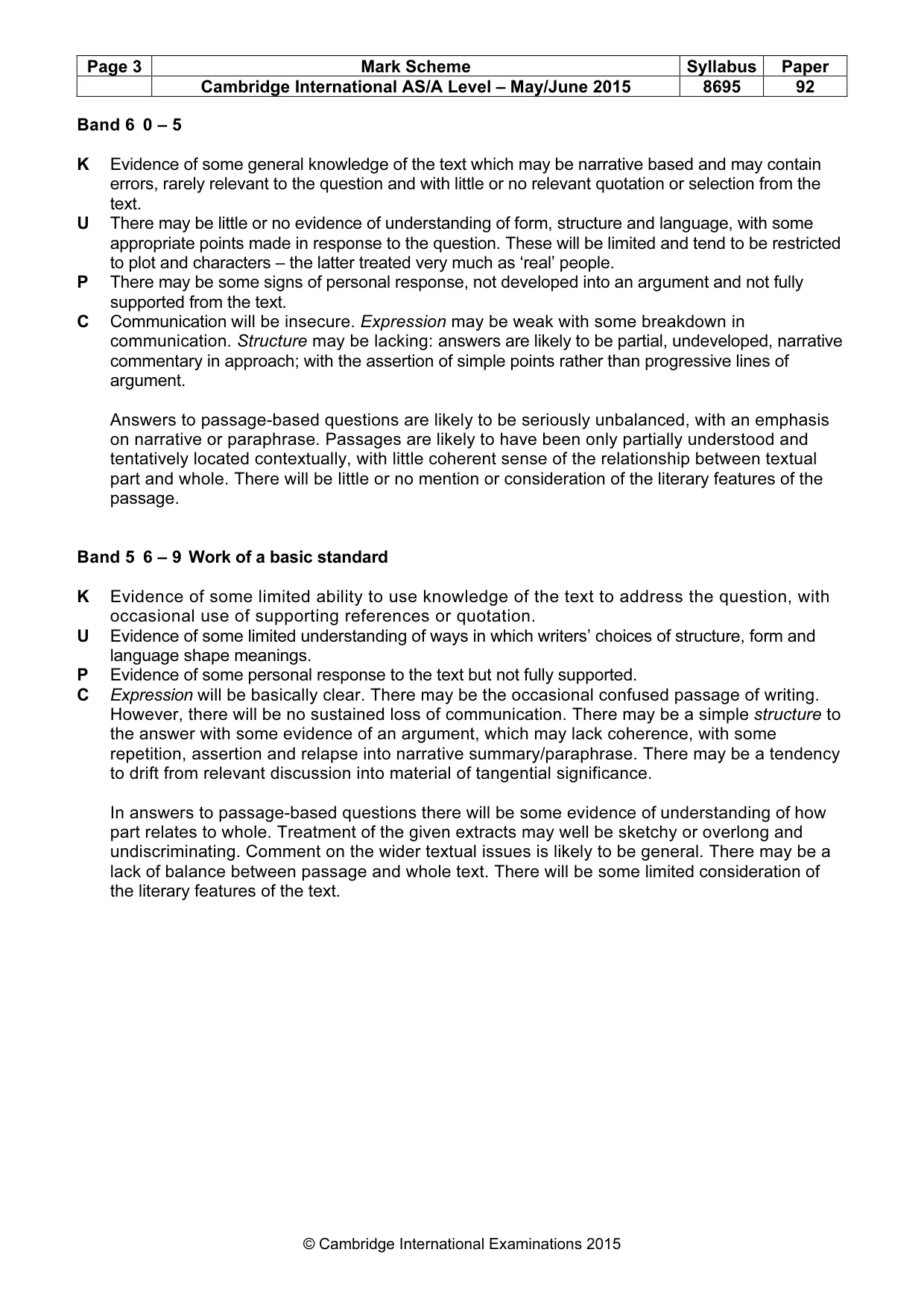
Page 2 Mark Scheme Syllabus Paper Cambridge International AS/A Level – May/June 2015 8695 92 © Cambridge International Examinations 2015 Using the mark bands Place the answer in a band first. Look for the ‘best fit’ of the answer into a band. An answer needs to show evidence of most but not necessarily ALL of the qualities described in a band, in order to be placed in that band. Then award a mark for the relative position of the answer within the band. Candidates may address the question in many different ways. Do not expect any particular focus or approach and do not penalise answers for leaving out a particular focus. Reward what is there, showing what you are rewarding, in your comments. Consider all strands and weigh up the performance as a whole in placing the answer in a band, then show that you have done so in the summative comment, e.g. Sound K of texts, some evidence of U but mostly narrative, occasional evidence of P, mainly clear C. Assessment Objectives: • Ability to respond to texts in the three main forms (Prose, Poetry and Drama) of different types and from different cultures; • Understanding of the ways in which writers’ choices of form, structure and language shape meanings; • Ability to produce informed independent opinions and judgements on literary texts; • Ability to communicate clearly the knowledge, understanding and insight appropriate to literary study. Each answer is marked out of 25, in accordance with the General Marking Criteria below. Each band is divided into strands corresponding to the Assessment Objectives – Knowledge, Understanding, Personal Response, Communication.
Mark scheme, page 3
Page 3 Mark Scheme Syllabus Paper Cambridge International AS/A Level – May/June 2015 8695 92 © Cambridge International Examinations 2015 Band 6 0 – 5 K Evidence of some general knowledge of the text which may be narrative based and may contain errors, rarely relevant to the question and with little or no relevant quotation or selection from the text. U There may be little or no evidence of understanding of form, structure and language, with some appropriate points made in response to the question. These will be limited and tend to be restricted to plot and characters – the latter treated very much as ‘real’ people. P There may be some signs of personal response, not developed into an argument and not fully supported from the text. C Communication will be insecure. Expression may be weak with some breakdown in communication. Structure may be lacking: answers are likely to be partial, undeveloped, narrative commentary in approach; with the assertion of simple points rather than progressive lines of argument. Answers to passage-based questions are likely to be seriously unbalanced, with an emphasis on narrative or paraphrase. Passages are likely to have been only partially understood and tentatively located contextually, with little coherent sense of the relationship between textual part and whole. There will be little or no mention or consideration of the literary features of the passage. Band 5 6 – 9 Work of a basic standard K Evidence of some limited ability to use knowledge of the text to address the question, with occasional use of supporting references or quotation. U Evidence of some limited understanding of ways in which writers’ choices of structure, form and language shape meanings. P Evidence of some personal response to the text but not fully supported. C Expression will be basically clear. There may be the occasional confused passage of writing. However, there will be no sustained loss of communication. There may be a simple structure to the answer with some evidence of an argument, which may lack coherence, with some repetition, assertion and relapse into narrative summary/paraphrase. There may be a tendency to drift from relevant discussion into material of tangential significance. In answers to passage-based questions there will be some evidence of understanding of how part relates to whole. Treatment of the given extracts may well be sketchy or overlong and undiscriminating. Comment on the wider textual issues is likely to be general. There may be a lack of balance between passage and whole text. There will be some limited consideration of the literary features of the text.
Mark scheme, page 4
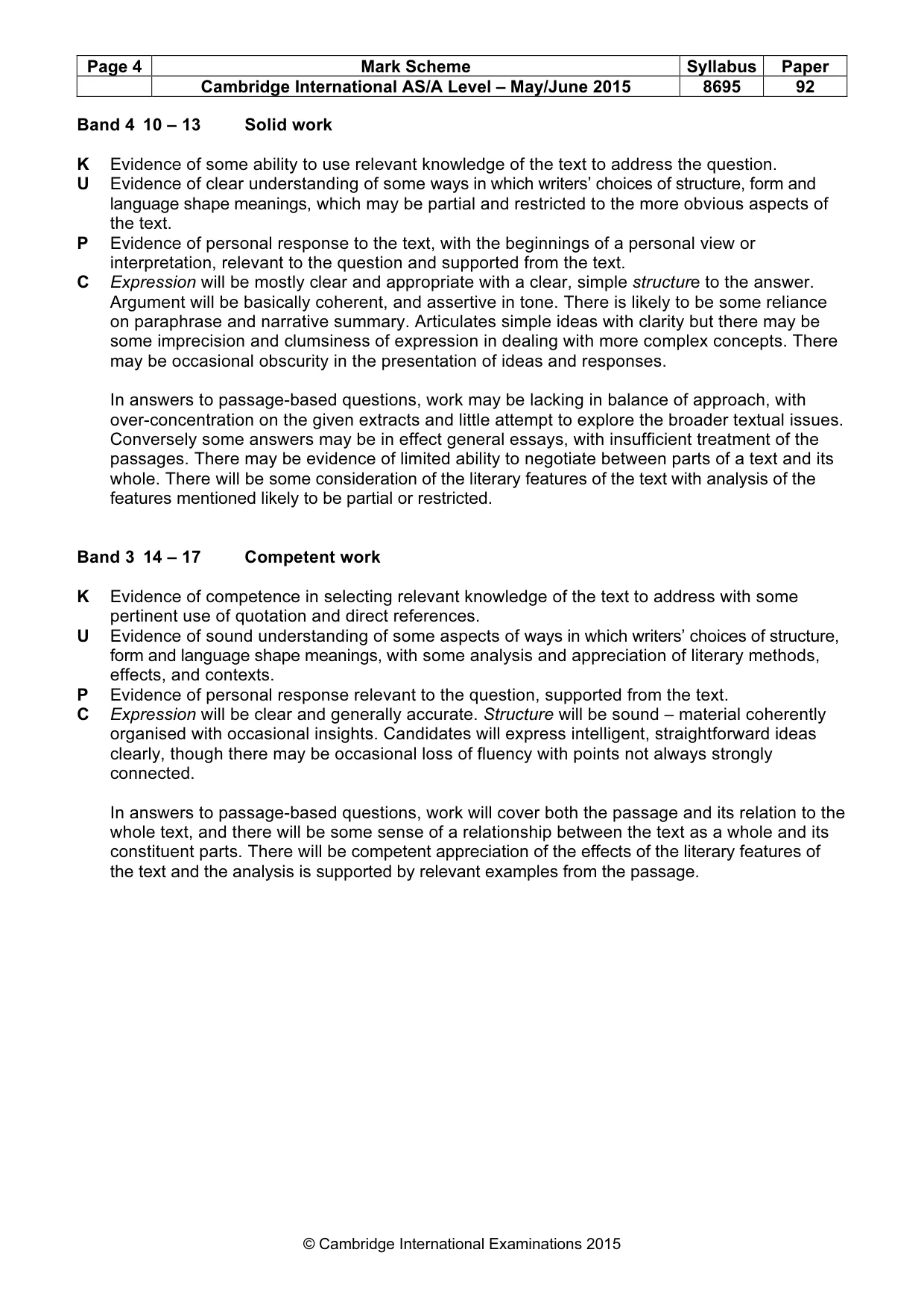
Page 4 Mark Scheme Syllabus Paper Cambridge International AS/A Level – May/June 2015 8695 92 © Cambridge International Examinations 2015 Band 4 10 – 13 Solid work K Evidence of some ability to use relevant knowledge of the text to address the question. U Evidence of clear understanding of some ways in which writers’ choices of structure, form and language shape meanings, which may be partial and restricted to the more obvious aspects of the text. P Evidence of personal response to the text, with the beginnings of a personal view or interpretation, relevant to the question and supported from the text. C Expression will be mostly clear and appropriate with a clear, simple structure to the answer. Argument will be basically coherent, and assertive in tone. There is likely to be some reliance on paraphrase and narrative summary. Articulates simple ideas with clarity but there may be some imprecision and clumsiness of expression in dealing with more complex concepts. There may be occasional obscurity in the presentation of ideas and responses. In answers to passage-based questions, work may be lacking in balance of approach, with over-concentration on the given extracts and little attempt to explore the broader textual issues. Conversely some answers may be in effect general essays, with insufficient treatment of the passages. There may be evidence of limited ability to negotiate between parts of a text and its whole. There will be some consideration of the literary features of the text with analysis of the features mentioned likely to be partial or restricted. Band 3 14 – 17 Competent work K Evidence of competence in selecting relevant knowledge of the text to address with some pertinent use of quotation and direct references. U Evidence of sound understanding of some aspects of ways in which writers’ choices of structure, form and language shape meanings, with some analysis and appreciation of literary methods, effects, and contexts. P Evidence of personal response relevant to the question, supported from the text. C Expression will be clear and generally accurate. Structure will be sound – material coherently organised with occasional insights. Candidates will express intelligent, straightforward ideas clearly, though there may be occasional loss of fluency with points not always strongly connected. In answers to passage-based questions, work will cover both the passage and its relation to the whole text, and there will be some sense of a relationship between the text as a whole and its constituent parts. There will be competent appreciation of the effects of the literary features of the text and the analysis is supported by relevant examples from the passage.
Mark scheme, page 5
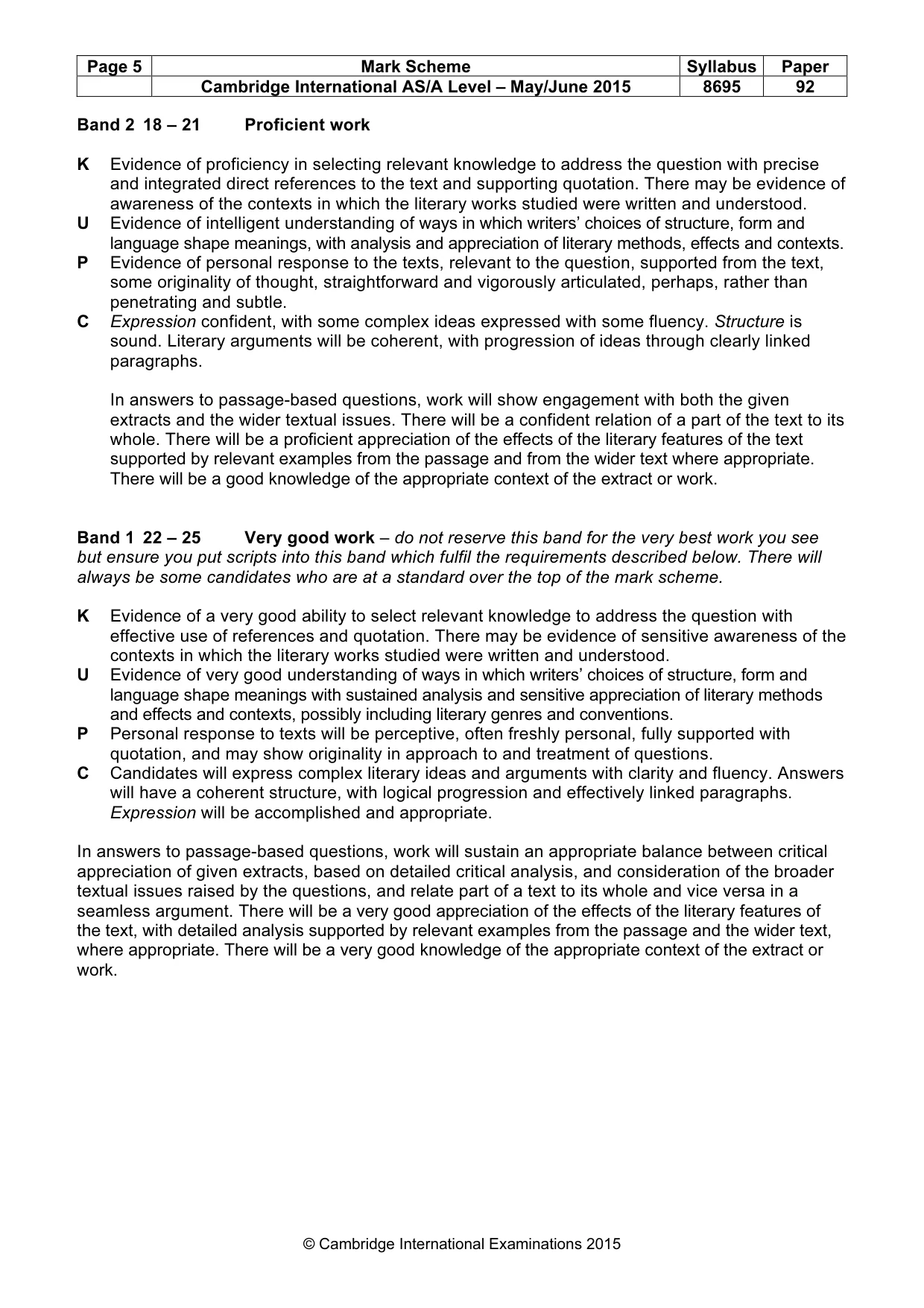
Page 5 Mark Scheme Syllabus Paper Cambridge International AS/A Level – May/June 2015 8695 92 © Cambridge International Examinations 2015 Band 2 18 – 21 Proficient work K Evidence of proficiency in selecting relevant knowledge to address the question with precise and integrated direct references to the text and supporting quotation. There may be evidence of awareness of the contexts in which the literary works studied were written and understood. U Evidence of intelligent understanding of ways in which writers’ choices of structure, form and language shape meanings, with analysis and appreciation of literary methods, effects and contexts. P Evidence of personal response to the texts, relevant to the question, supported from the text, some originality of thought, straightforward and vigorously articulated, perhaps, rather than penetrating and subtle. C Expression confident, with some complex ideas expressed with some fluency. Structure is sound. Literary arguments will be coherent, with progression of ideas through clearly linked paragraphs. In answers to passage-based questions, work will show engagement with both the given extracts and the wider textual issues. There will be a confident relation of a part of the text to its whole. There will be a proficient appreciation of the effects of the literary features of the text supported by relevant examples from the passage and from the wider text where appropriate. There will be a good knowledge of the appropriate context of the extract or work. Band 1 22 – 25 Very good work – do not reserve this band for the very best work you see but ensure you put scripts into this band which fulfil the requirements described below. There will always be some candidates who are at a standard over the top of the mark scheme. K Evidence of a very good ability to select relevant knowledge to address the question with effective use of references and quotation. There may be evidence of sensitive awareness of the contexts in which the literary works studied were written and understood. U Evidence of very good understanding of ways in which writers’ choices of structure, form and language shape meanings with sustained analysis and sensitive appreciation of literary methods and effects and contexts, possibly including literary genres and conventions. P Personal response to texts will be perceptive, often freshly personal, fully supported with quotation, and may show originality in approach to and treatment of questions. C Candidates will express complex literary ideas and arguments with clarity and fluency. Answers will have a coherent structure, with logical progression and effectively linked paragraphs. Expression will be accomplished and appropriate. In answers to passage-based questions, work will sustain an appropriate balance between critical appreciation of given extracts, based on detailed critical analysis, and consideration of the broader textual issues raised by the questions, and relate part of a text to its whole and vice versa in a seamless argument. There will be a very good appreciation of the effects of the literary features of the text, with detailed analysis supported by relevant examples from the passage and the wider text, where appropriate. There will be a very good knowledge of the appropriate context of the extract or work.
What you needed in this session
Cambridge’s own grade thresholds for 2015 May/June, Paper 9 · Variant 2. A higher threshold means an easier paper — the bar moves with how the cohort did.