Cambridge A Level English - Language and Literature (AS Level only, from 2016) 8695 — 2014 Oct/Nov Paper 9 · Variant 3
8695/93/O/N/14 · 50 marks · ≈56 min
The question paper and its mark scheme, free to read here and free to download. This is Cambridge’s own paper, exactly as it was sat.
Question paper16 pages

Mark scheme5 pages
Answers below. Sit the paper first if you are practising.
Paper as text
Question paper, page 1
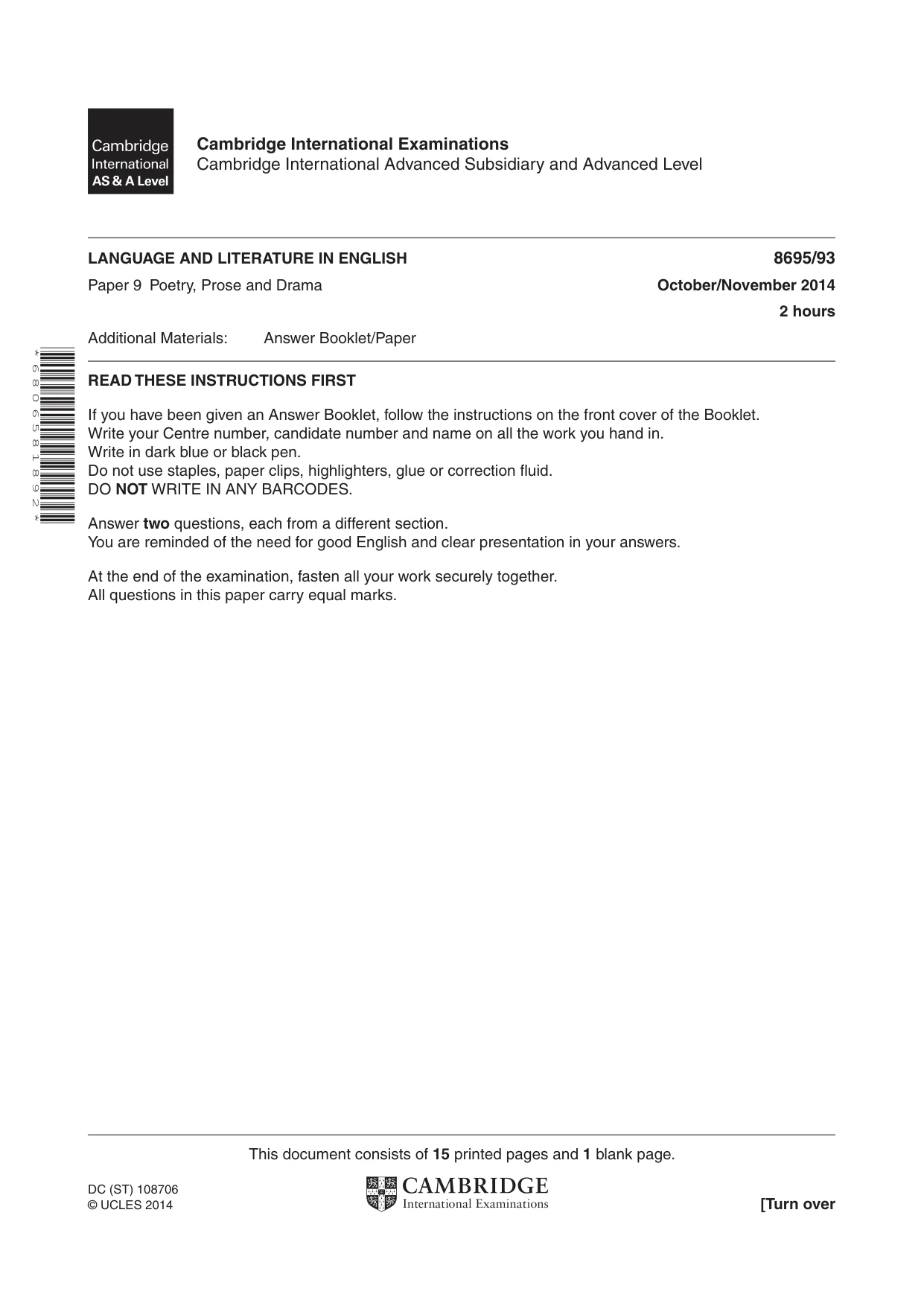
This document consists of 15 printed pages and 1 blank page. DC (ST) 108706 © UCLES 2014 [Turn over Cambridge International Examinations Cambridge International Advanced Subsidiary and Advanced Level * 6 8 0 6 5 8 1 8 9 2 * LANGUAGE AND LITERATURE IN ENGLISH 8695/93 Paper 9 Poetry, Prose and Drama October/November 2014 2 hours Additional Materials: Answer Booklet/Paper READ THESE INSTRUCTIONS FIRST If you have been given an Answer Booklet, follow the instructions on the front cover of the Booklet. Write your Centre number, candidate number and name on all the work you hand in. Write in dark blue or black pen. Do not use staples, paper clips, highlighters, glue or correction fluid. DO NOT WRITE IN ANY BARCODES. Answer two questions, each from a different section. You are reminded of the need for good English and clear presentation in your answers. At the end of the examination, fasten all your work securely together. All questions in this paper carry equal marks.
Question paper, page 2
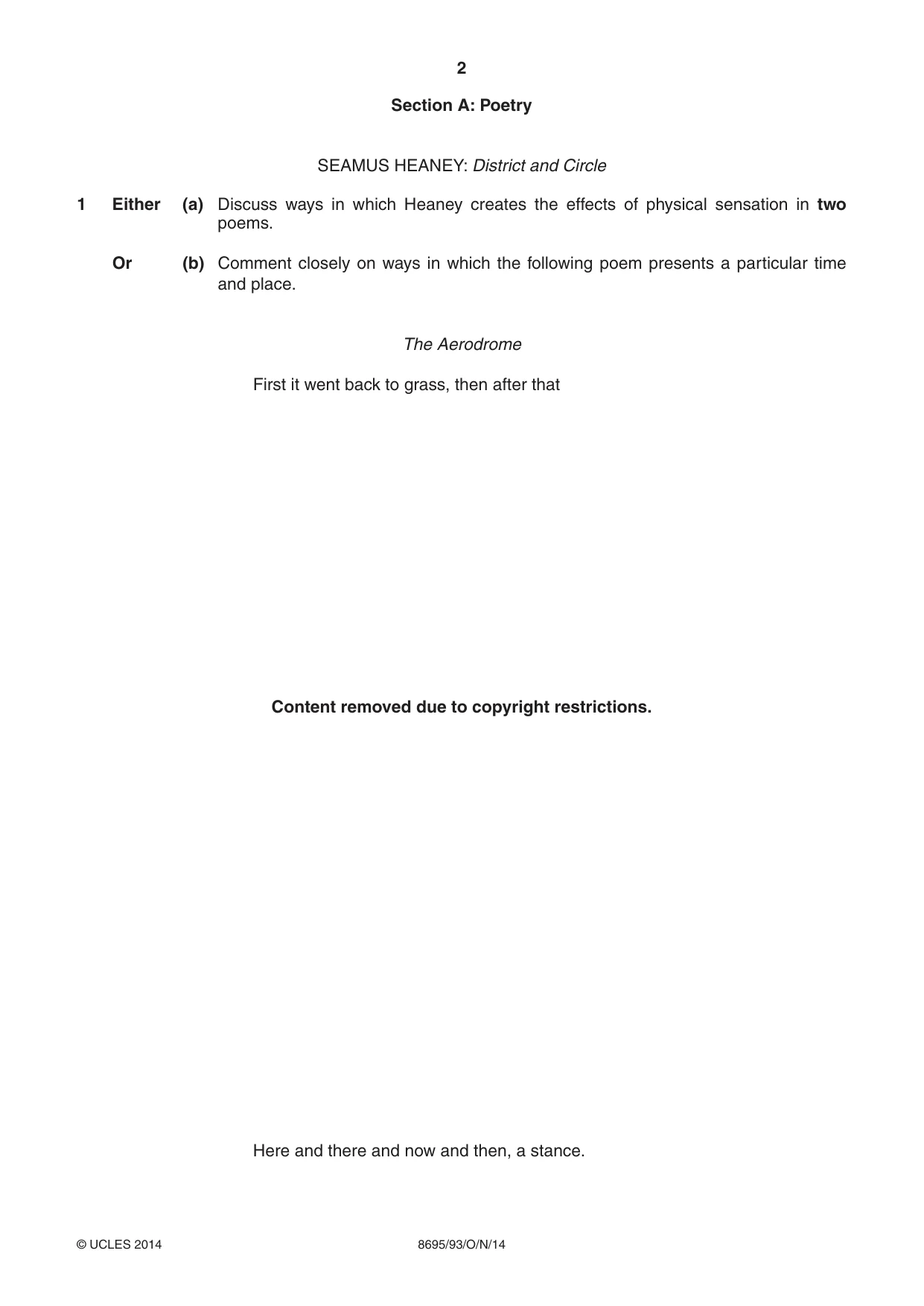
2 8695/93/O/N/14 © UCLES 2014 Section A: Poetry SEAMUS HEANEY: District and Circle 1 Either (a) Discuss ways in which Heaney creates the effects of physical sensation in two poems. Or (b) Comment closely on ways in which the following poem presents a particular time and place. The Aerodrome First it went back to grass, then after that Here and there and now and then, a stance. Content removed due to copyright restrictions.
Question paper, page 3
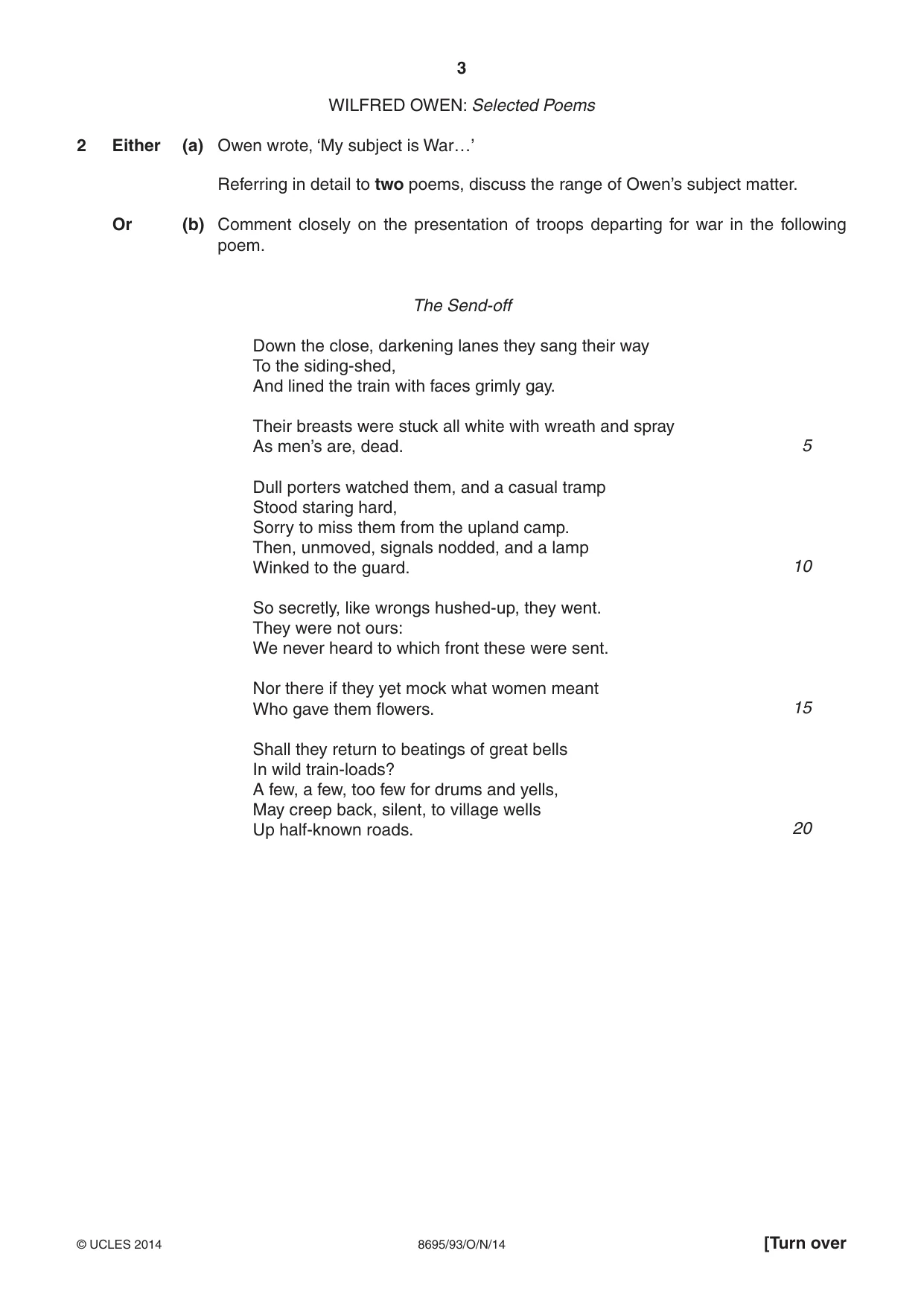
3 8695/93/O/N/14 © UCLES 2014 [Turn over WILFRED OWEN: Selected Poems 2 Either (a) Owen wrote, ‘My subject is War…’ Referring in detail to two poems, discuss the range of Owen’s subject matter. Or (b) Comment closely on the presentation of troops departing for war in the following poem. The Send-off Down the close, darkening lanes they sang their way To the siding-shed, And lined the train with faces grimly gay. Their breasts were stuck all white with wreath and spray As men’s are, dead. Dull porters watched them, and a casual tramp Stood staring hard, Sorry to miss them from the upland camp. Then, unmoved, signals nodded, and a lamp Winked to the guard. So secretly, like wrongs hushed-up, they went. They were not ours: We never heard to which front these were sent. Nor there if they yet mock what women meant Who gave them flowers. Shall they return to beatings of great bells In wild train-loads? A few, a few, too few for drums and yells, May creep back, silent, to village wells Up half-known roads. 5 10 15 20
Question paper, page 4
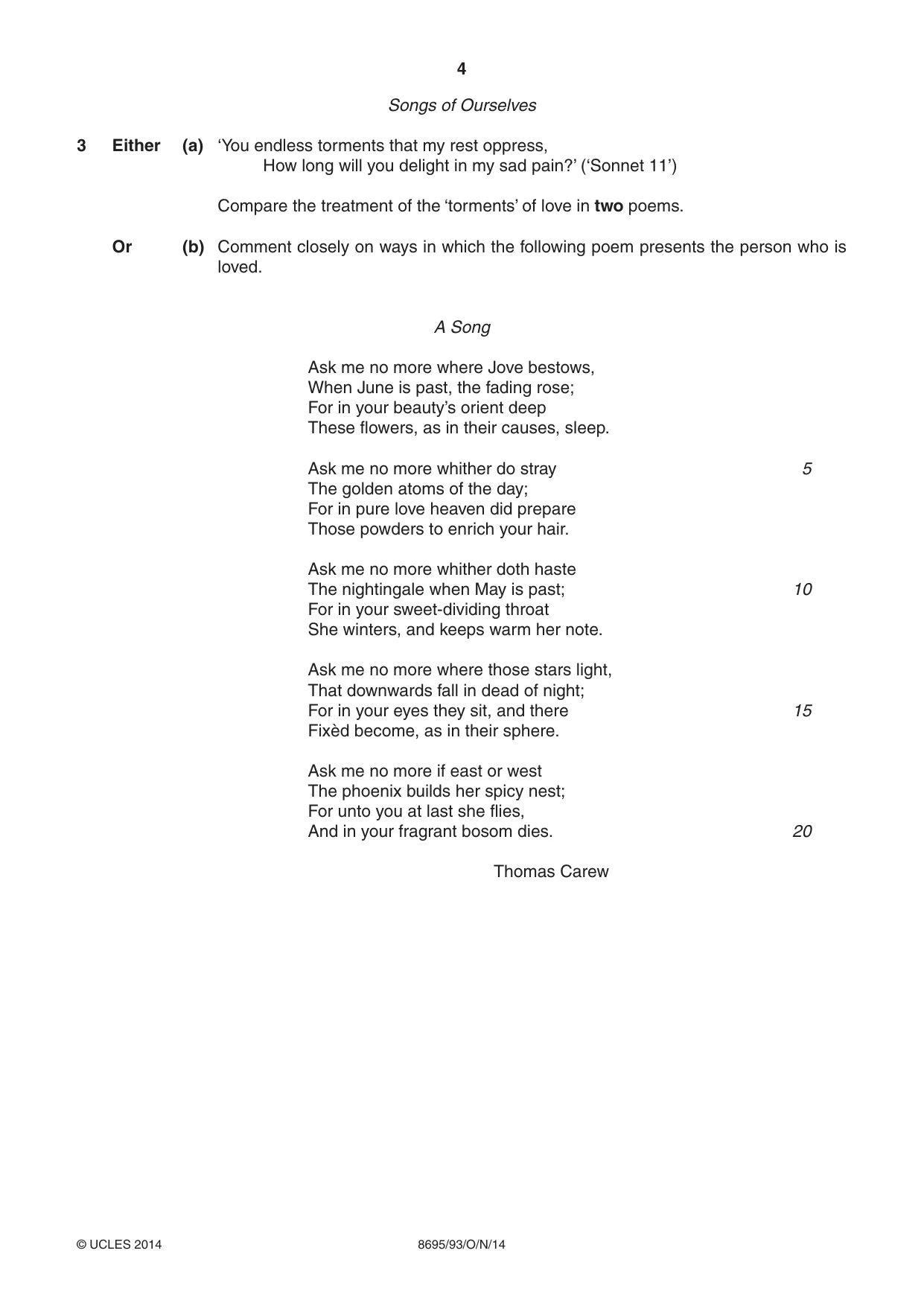
4 8695/93/O/N/14 © UCLES 2014 Songs of Ourselves 3 Either (a) ‘You endless torments that my rest oppress, How long will you delight in my sad pain?’ (‘Sonnet 11’) Compare the treatment of the ‘torments’ of love in two poems. Or (b) Comment closely on ways in which the following poem presents the person who is loved. A Song Ask me no more where Jove bestows, When June is past, the fading rose; For in your beauty’s orient deep These flowers, as in their causes, sleep. Ask me no more whither do stray The golden atoms of the day; For in pure love heaven did prepare Those powders to enrich your hair. Ask me no more whither doth haste The nightingale when May is past; For in your sweet-dividing throat She winters, and keeps warm her note. Ask me no more where those stars light, That downwards fall in dead of night; For in your eyes they sit, and there Fixèd become, as in their sphere. Ask me no more if east or west The phoenix builds her spicy nest; For unto you at last she flies, And in your fragrant bosom dies. Thomas Carew 5 10 15 20
Question paper, page 5
5 8695/93/O/N/14 © UCLES 2014 [Turn over Turn to page 6 for Question 4
Question paper, page 6
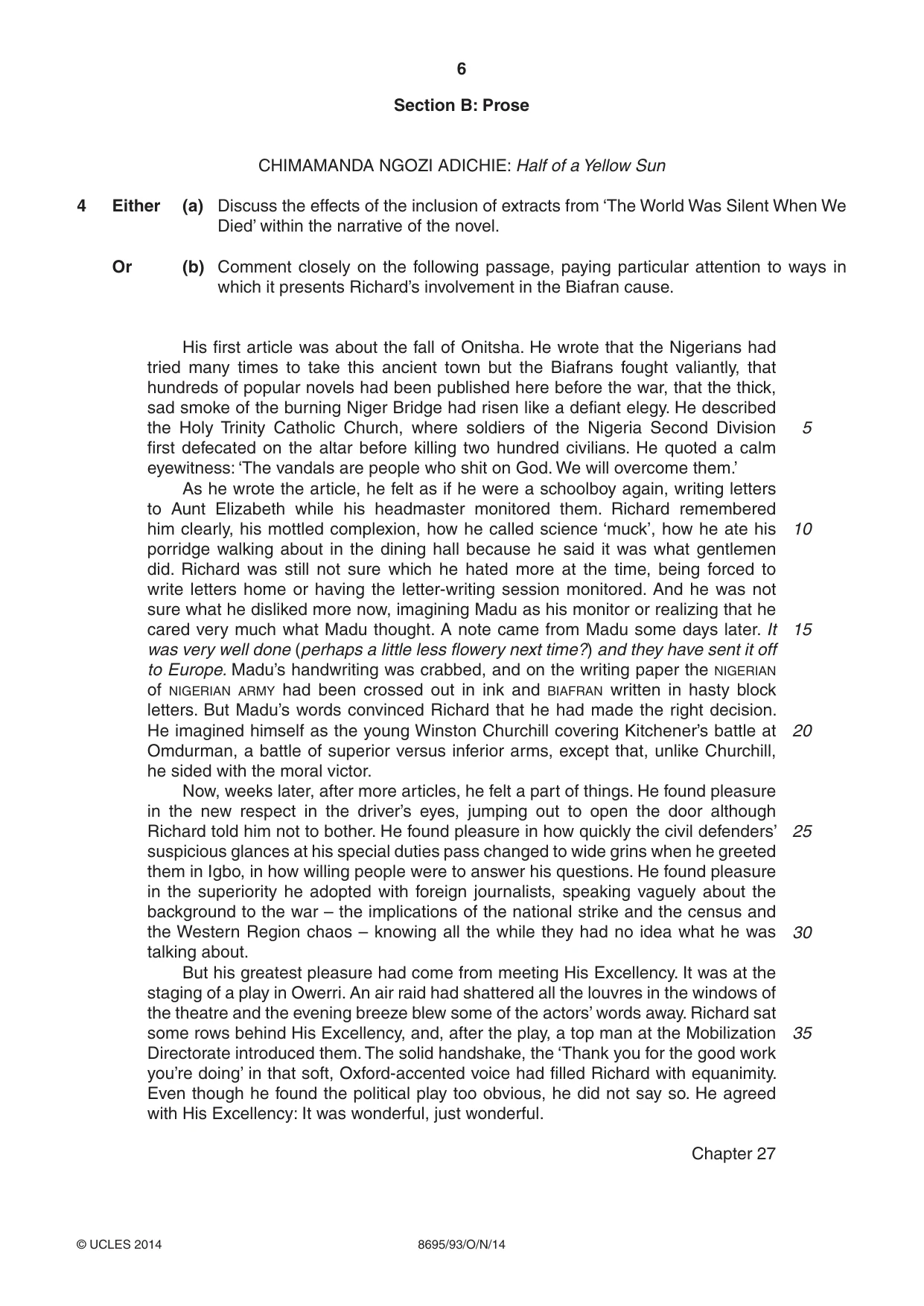
6 8695/93/O/N/14 © UCLES 2014 Section B: Prose CHIMAMANDA NGOZI ADICHIE: Half of a Yellow Sun 4 Either (a) Discuss the effects of the inclusion of extracts from ‘The World Was Silent When We Died’ within the narrative of the novel. Or (b) Comment closely on the following passage, paying particular attention to ways in which it presents Richard’s involvement in the Biafran cause. His first article was about the fall of Onitsha. He wrote that the Nigerians had tried many times to take this ancient town but the Biafrans fought valiantly, that hundreds of popular novels had been published here before the war, that the thick, sad smoke of the burning Niger Bridge had risen like a defiant elegy. He described the Holy Trinity Catholic Church, where soldiers of the Nigeria Second Division first defecated on the altar before killing two hundred civilians. He quoted a calm eyewitness: ‘The vandals are people who shit on God. We will overcome them.’ As he wrote the article, he felt as if he were a schoolboy again, writing letters to Aunt Elizabeth while his headmaster monitored them. Richard remembered him clearly, his mottled complexion, how he called science ‘muck’, how he ate his porridge walking about in the dining hall because he said it was what gentlemen did. Richard was still not sure which he hated more at the time, being forced to write letters home or having the letter-writing session monitored. And he was not sure what he disliked more now, imagining Madu as his monitor or realizing that he cared very much what Madu thought. A note came from Madu some days later. It was very well done (perhaps a little less flowery next time?) and they have sent it off to Europe. Madu’s handwriting was crabbed, and on the writing paper the nigerian of nigerian army had been crossed out in ink and biafran written in hasty block letters. But Madu’s words convinced Richard that he had made the right decision. He imagined himself as the young Winston Churchill covering Kitchener’s battle at Omdurman, a battle of superior versus inferior arms, except that, unlike Churchill, he sided with the moral victor. Now, weeks later, after more articles, he felt a part of things. He found pleasure in the new respect in the driver’s eyes, jumping out to open the door although Richard told him not to bother. He found pleasure in how quickly the civil defenders’ suspicious glances at his special duties pass changed to wide grins when he greeted them in Igbo, in how willing people were to answer his questions. He found pleasure in the superiority he adopted with foreign journalists, speaking vaguely about the background to the war – the implications of the national strike and the census and the Western Region chaos – knowing all the while they had no idea what he was talking about. But his greatest pleasure had come from meeting His Excellency. It was at the staging of a play in Owerri. An air raid had shattered all the louvres in the windows of the theatre and the evening breeze blew some of the actors’ words away. Richard sat some rows behind His Excellency, and, after the play, a top man at the Mobilization Directorate introduced them. The solid handshake, the ‘Thank you for the good work you’re doing’ in that soft, Oxford-accented voice had filled Richard with equanimity. Even though he found the political play too obvious, he did not say so. He agreed with His Excellency: It was wonderful, just wonderful. Chapter 27 5 10 15 20 25 30 35
Question paper, page 7
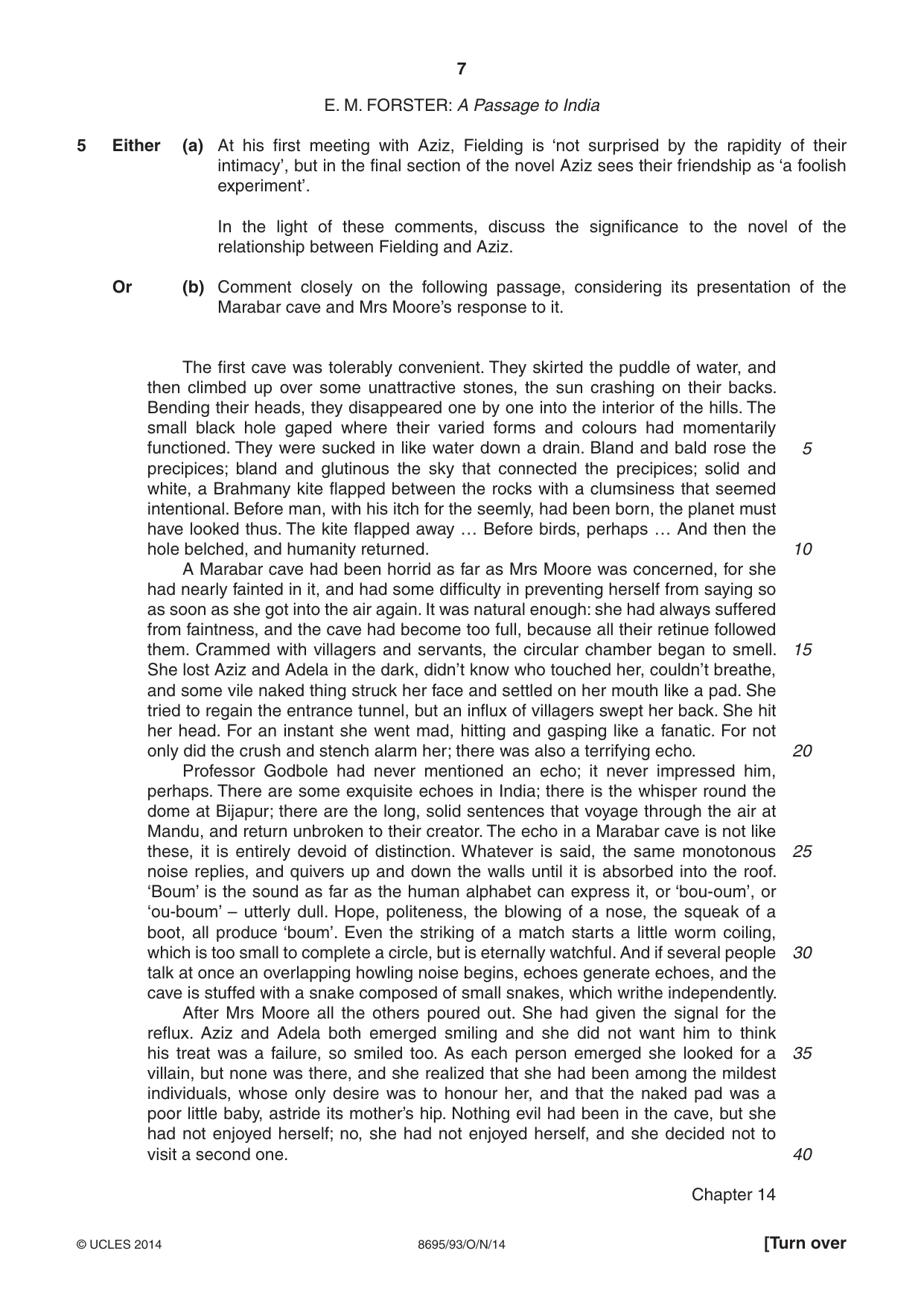
7 8695/93/O/N/14 © UCLES 2014 [Turn over E. M. FORSTER: A Passage to India 5 Either (a) At his first meeting with Aziz, Fielding is ‘not surprised by the rapidity of their intimacy’, but in the final section of the novel Aziz sees their friendship as ‘a foolish experiment’. In the light of these comments, discuss the significance to the novel of the relationship between Fielding and Aziz. Or (b) Comment closely on the following passage, considering its presentation of the Marabar cave and Mrs Moore’s response to it. The first cave was tolerably convenient. They skirted the puddle of water, and then climbed up over some unattractive stones, the sun crashing on their backs. Bending their heads, they disappeared one by one into the interior of the hills. The small black hole gaped where their varied forms and colours had momentarily functioned. They were sucked in like water down a drain. Bland and bald rose the precipices; bland and glutinous the sky that connected the precipices; solid and white, a Brahmany kite flapped between the rocks with a clumsiness that seemed intentional. Before man, with his itch for the seemly, had been born, the planet must have looked thus. The kite flapped away … Before birds, perhaps … And then the hole belched, and humanity returned. A Marabar cave had been horrid as far as Mrs Moore was concerned, for she had nearly fainted in it, and had some difficulty in preventing herself from saying so as soon as she got into the air again. It was natural enough: she had always suffered from faintness, and the cave had become too full, because all their retinue followed them. Crammed with villagers and servants, the circular chamber began to smell. She lost Aziz and Adela in the dark, didn’t know who touched her, couldn’t breathe, and some vile naked thing struck her face and settled on her mouth like a pad. She tried to regain the entrance tunnel, but an influx of villagers swept her back. She hit her head. For an instant she went mad, hitting and gasping like a fanatic. For not only did the crush and stench alarm her; there was also a terrifying echo. Professor Godbole had never mentioned an echo; it never impressed him, perhaps. There are some exquisite echoes in India; there is the whisper round the dome at Bijapur; there are the long, solid sentences that voyage through the air at Mandu, and return unbroken to their creator. The echo in a Marabar cave is not like these, it is entirely devoid of distinction. Whatever is said, the same monotonous noise replies, and quivers up and down the walls until it is absorbed into the roof. ‘Boum’ is the sound as far as the human alphabet can express it, or ‘bou-oum’, or ‘ou-boum’ – utterly dull. Hope, politeness, the blowing of a nose, the squeak of a boot, all produce ‘boum’. Even the striking of a match starts a little worm coiling, which is too small to complete a circle, but is eternally watchful. And if several people talk at once an overlapping howling noise begins, echoes generate echoes, and the cave is stuffed with a snake composed of small snakes, which writhe independently. After Mrs Moore all the others poured out. She had given the signal for the reflux. Aziz and Adela both emerged smiling and she did not want him to think his treat was a failure, so smiled too. As each person emerged she looked for a villain, but none was there, and she realized that she had been among the mildest individuals, whose only desire was to honour her, and that the naked pad was a poor little baby, astride its mother’s hip. Nothing evil had been in the cave, but she had not enjoyed herself; no, she had not enjoyed herself, and she decided not to visit a second one. Chapter 14 5 10 15 20 25 30 35 40
Question paper, page 8
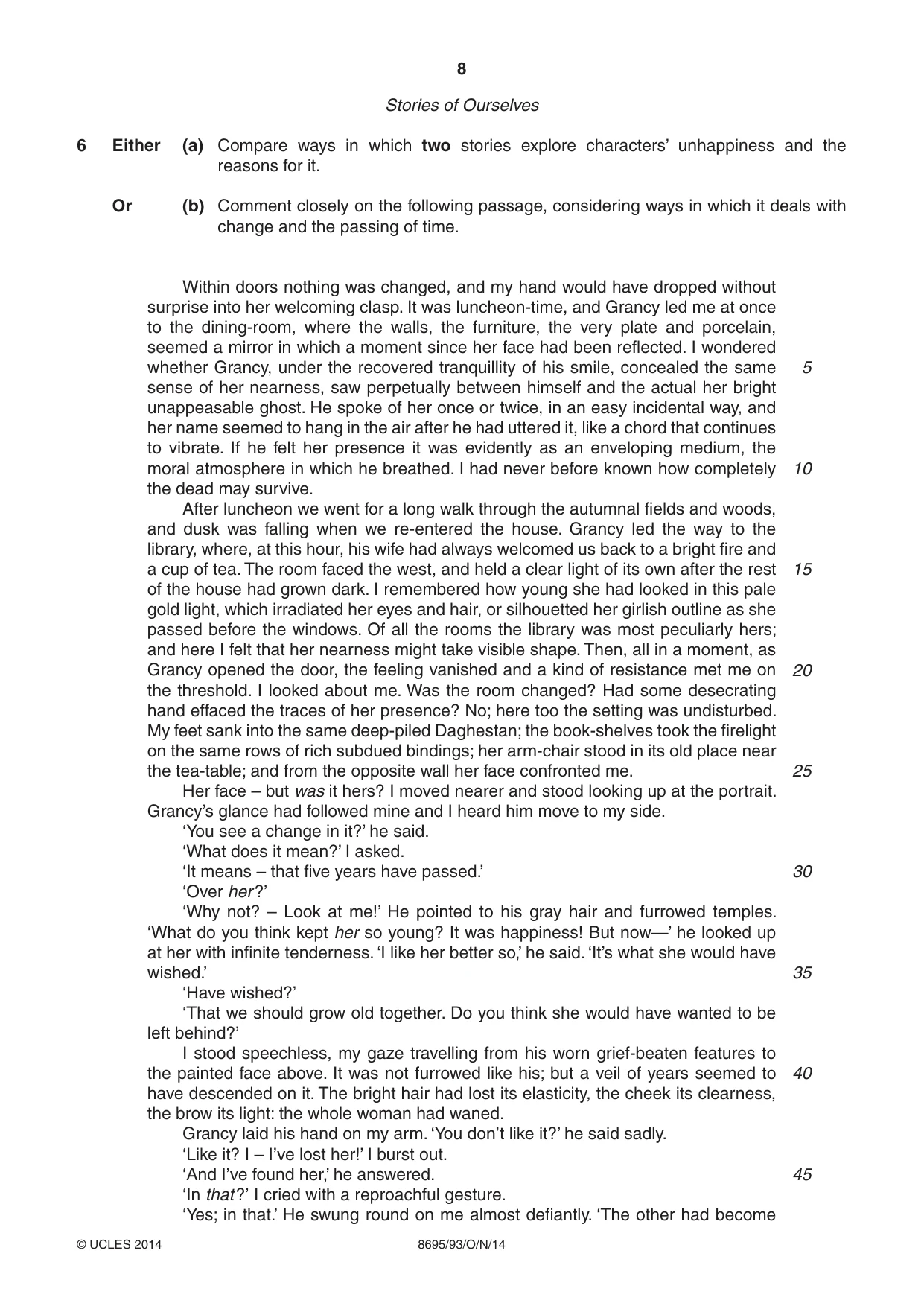
8 8695/93/O/N/14 © UCLES 2014 Stories of Ourselves 6 Either (a) Compare ways in which two stories explore characters’ unhappiness and the reasons for it. Or (b) Comment closely on the following passage, considering ways in which it deals with change and the passing of time. Within doors nothing was changed, and my hand would have dropped without surprise into her welcoming clasp. It was luncheon-time, and Grancy led me at once to the dining-room, where the walls, the furniture, the very plate and porcelain, seemed a mirror in which a moment since her face had been reflected. I wondered whether Grancy, under the recovered tranquillity of his smile, concealed the same sense of her nearness, saw perpetually between himself and the actual her bright unappeasable ghost. He spoke of her once or twice, in an easy incidental way, and her name seemed to hang in the air after he had uttered it, like a chord that continues to vibrate. If he felt her presence it was evidently as an enveloping medium, the moral atmosphere in which he breathed. I had never before known how completely the dead may survive. After luncheon we went for a long walk through the autumnal fields and woods, and dusk was falling when we re-entered the house. Grancy led the way to the library, where, at this hour, his wife had always welcomed us back to a bright fire and a cup of tea. The room faced the west, and held a clear light of its own after the rest of the house had grown dark. I remembered how young she had looked in this pale gold light, which irradiated her eyes and hair, or silhouetted her girlish outline as she passed before the windows. Of all the rooms the library was most peculiarly hers; and here I felt that her nearness might take visible shape. Then, all in a moment, as Grancy opened the door, the feeling vanished and a kind of resistance met me on the threshold. I looked about me. Was the room changed? Had some desecrating hand effaced the traces of her presence? No; here too the setting was undisturbed. My feet sank into the same deep-piled Daghestan; the book-shelves took the firelight on the same rows of rich subdued bindings; her arm-chair stood in its old place near the tea-table; and from the opposite wall her face confronted me. Her face – but was it hers? I moved nearer and stood looking up at the portrait. Grancy’s glance had followed mine and I heard him move to my side. ‘You see a change in it?’ he said. ‘What does it mean?’ I asked. ‘It means – that five years have passed.’ ‘Over her ?’ ‘Why not? – Look at me!’ He pointed to his gray hair and furrowed temples. ‘What do you think kept her so young? It was happiness! But now—’ he looked up at her with infinite tenderness. ‘I like her better so,’ he said. ‘It’s what she would have wished.’ ‘Have wished?’ ‘That we should grow old together. Do you think she would have wanted to be left behind?’ I stood speechless, my gaze travelling from his worn grief-beaten features to the painted face above. It was not furrowed like his; but a veil of years seemed to have descended on it. The bright hair had lost its elasticity, the cheek its clearness, the brow its light: the whole woman had waned. Grancy laid his hand on my arm. ‘You don’t like it?’ he said sadly. ‘Like it? I – I’ve lost her!’ I burst out. ‘And I’ve found her,’ he answered. ‘In that ?’ I cried with a reproachful gesture. ‘Yes; in that.’ He swung round on me almost defiantly. ‘The other had become 5 10 15 20 25 30 35 40 45
Question paper, page 9
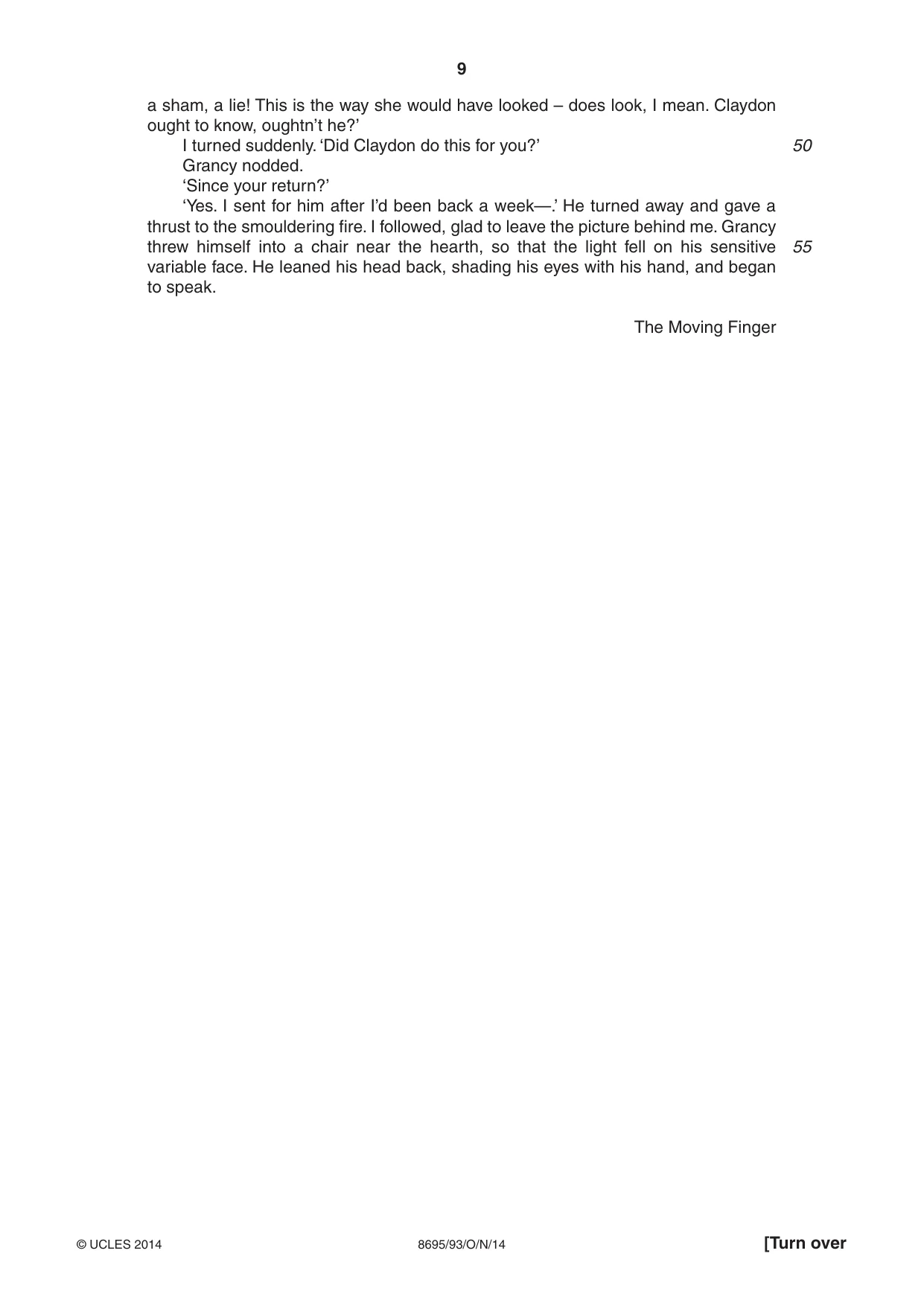
9 8695/93/O/N/14 © UCLES 2014 [Turn over a sham, a lie! This is the way she would have looked – does look, I mean. Claydon ought to know, oughtn’t he?’ I turned suddenly. ‘Did Claydon do this for you?’ Grancy nodded. ‘Since your return?’ ‘Yes. I sent for him after I’d been back a week—.’ He turned away and gave a thrust to the smouldering fire. I followed, glad to leave the picture behind me. Grancy threw himself into a chair near the hearth, so that the light fell on his sensitive variable face. He leaned his head back, shading his eyes with his hand, and began to speak. The Moving Finger 50 55
Question paper, page 10
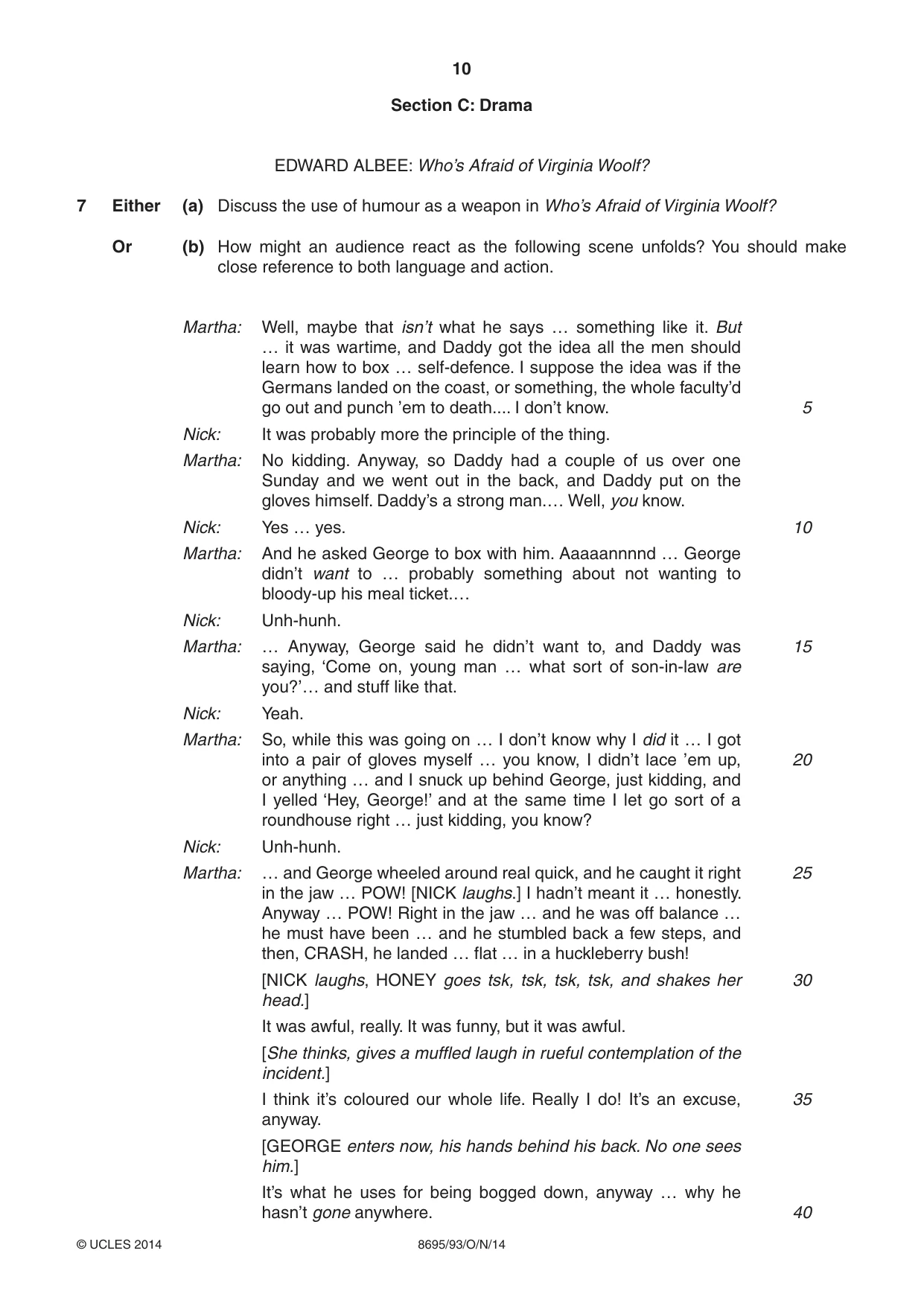
10 8695/93/O/N/14 © UCLES 2014 Section C: Drama EDWARD ALBEE: Who’s Afraid of Virginia Woolf? 7 Either (a) Discuss the use of humour as a weapon in Who’s Afraid of Virginia Woolf? Or (b) How might an audience react as the following scene unfolds? You should make close reference to both language and action. Martha: Well, maybe that isn’t what he says … something like it. But … it was wartime, and Daddy got the idea all the men should learn how to box … self-defence. I suppose the idea was if the Germans landed on the coast, or something, the whole faculty’d go out and punch ’em to death… I don’t know. Nick: It was probably more the principle of the thing. Martha: No kidding. Anyway, so Daddy had a couple of us over one Sunday and we went out in the back, and Daddy put on the gloves himself. Daddy’s a strong man.… Well, you know. Nick: Yes … yes. Martha: And he asked George to box with him. Aaaaannnnd … George didn’t want to … probably something about not wanting to bloody-up his meal ticket.… Nick: Unh-hunh. Martha: … Anyway, George said he didn’t want to, and Daddy was saying, ‘Come on, young man … what sort of son-in-law are you?’… and stuff like that. Nick: Yeah. Martha: So, while this was going on … I don’t know why I did it … I got into a pair of gloves myself … you know, I didn’t lace ’em up, or anything … and I snuck up behind George, just kidding, and I yelled ‘Hey, George!’ and at the same time I let go sort of a roundhouse right … just kidding, you know? Nick: Unh-hunh. Martha: … and George wheeled around real quick, and he caught it right in the jaw … POW! [NICK laughs.] I hadn’t meant it … honestly. Anyway … POW! Right in the jaw … and he was off balance … he must have been … and he stumbled back a few steps, and then, CRASH, he landed … flat … in a huckleberry bush! [NICK laughs, HONEY goes tsk, tsk, tsk, tsk, and shakes her head.] It was awful, really. It was funny, but it was awful. [She thinks, gives a muffled laugh in rueful contemplation of the incident.] I think it’s coloured our whole life. Really I do! It’s an excuse, anyway. [GEORGE enters now, his hands behind his back. No one sees him.] It’s what he uses for being bogged down, anyway … why he hasn’t gone anywhere. 5 10 15 20 25 30 35 40
Question paper, page 11
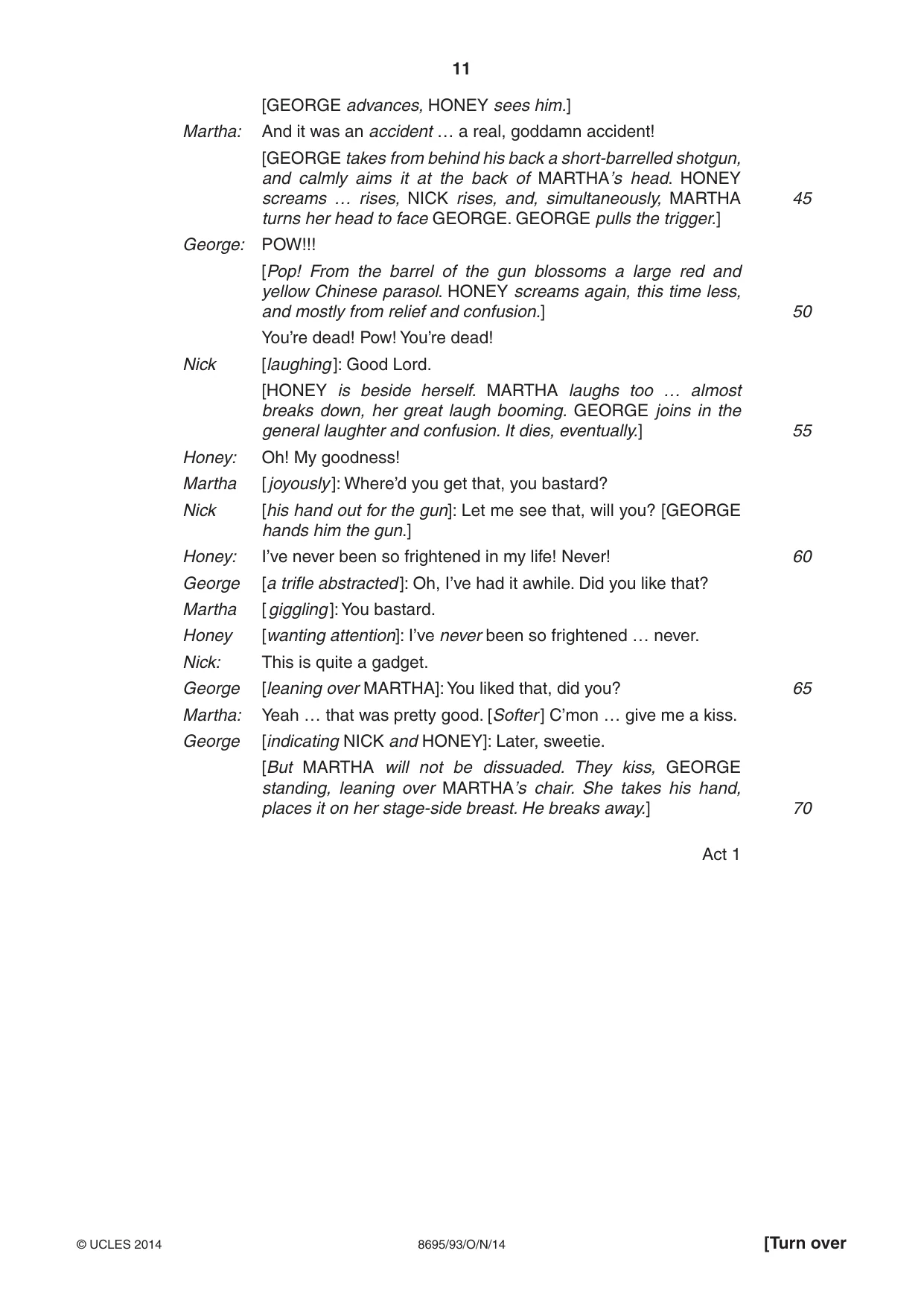
11 8695/93/O/N/14 © UCLES 2014 [Turn over [GEORGE advances, HONEY sees him.] Martha: And it was an accident … a real, goddamn accident! [GEORGE takes from behind his back a short-barrelled shotgun, and calmly aims it at the back of MARTHA’s head. HONEY screams … rises, NICK rises, and, simultaneously, MARTHA turns her head to face GEORGE. GEORGE pulls the trigger.] George: POW!!! [Pop! From the barrel of the gun blossoms a large red and yellow Chinese parasol. HONEY screams again, this time less, and mostly from relief and confusion.] You’re dead! Pow! You’re dead! Nick [laughing ]: Good Lord. [HONEY is beside herself. MARTHA laughs too … almost breaks down, her great laugh booming. GEORGE joins in the general laughter and confusion. It dies, eventually.] Honey: Oh! My goodness! Martha [ joyously ]: Where’d you get that, you bastard? Nick [his hand out for the gun]: Let me see that, will you? [GEORGE hands him the gun.] Honey: I’ve never been so frightened in my life! Never! George [a trifle abstracted ]: Oh, I’ve had it awhile. Did you like that? Martha [ giggling ]: You bastard. Honey [wanting attention]: I’ve never been so frightened … never. Nick: This is quite a gadget. George [leaning over MARTHA]: You liked that, did you? Martha: Yeah … that was pretty good. [Softer ] C’mon … give me a kiss. George [indicating NICK and HONEY]: Later, sweetie. [But MARTHA will not be dissuaded. They kiss, GEORGE standing, leaning over MARTHA’s chair. She takes his hand, places it on her stage-side breast. He breaks away.] Act 1 45 50 55 60 65 70
Question paper, page 12
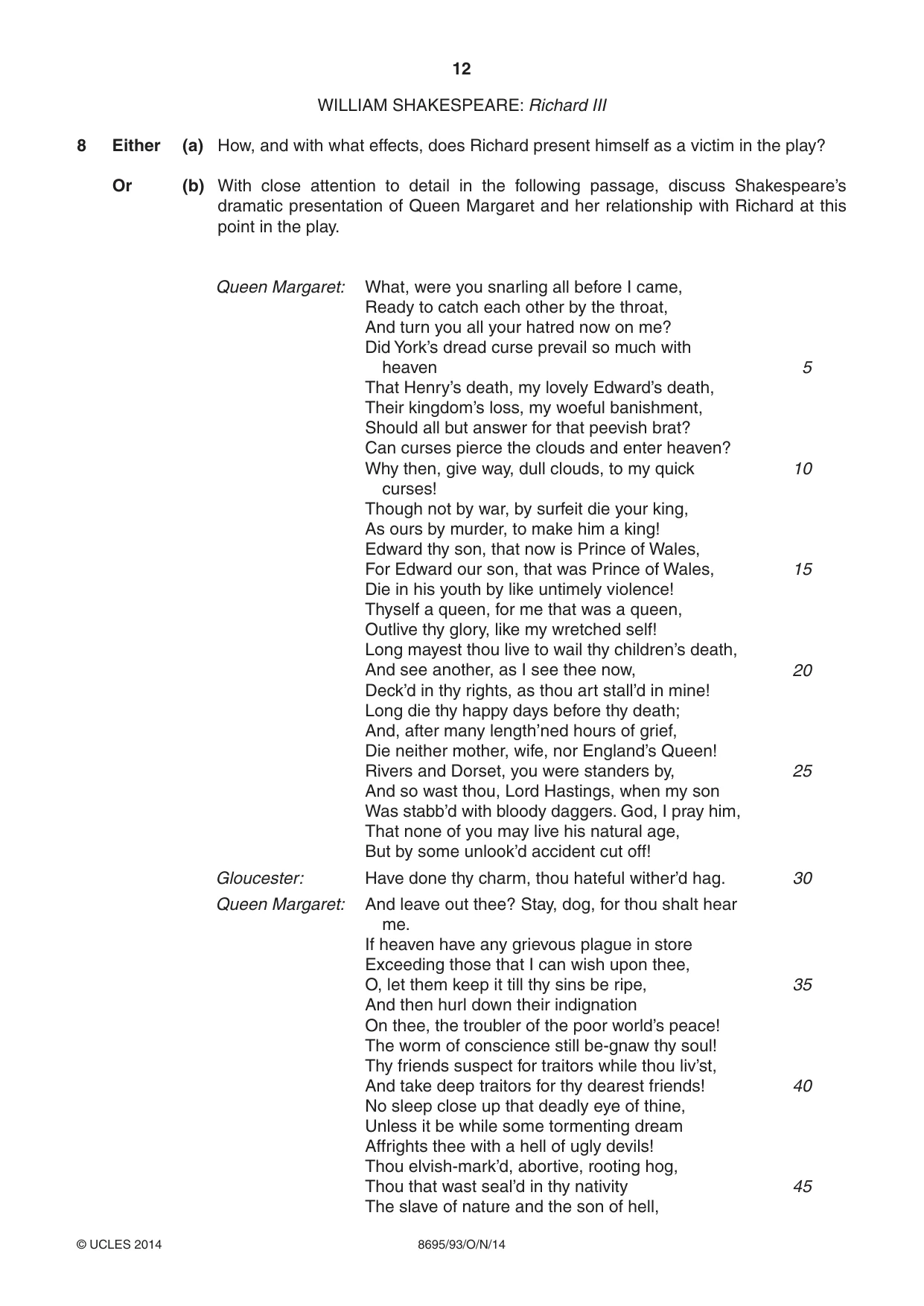
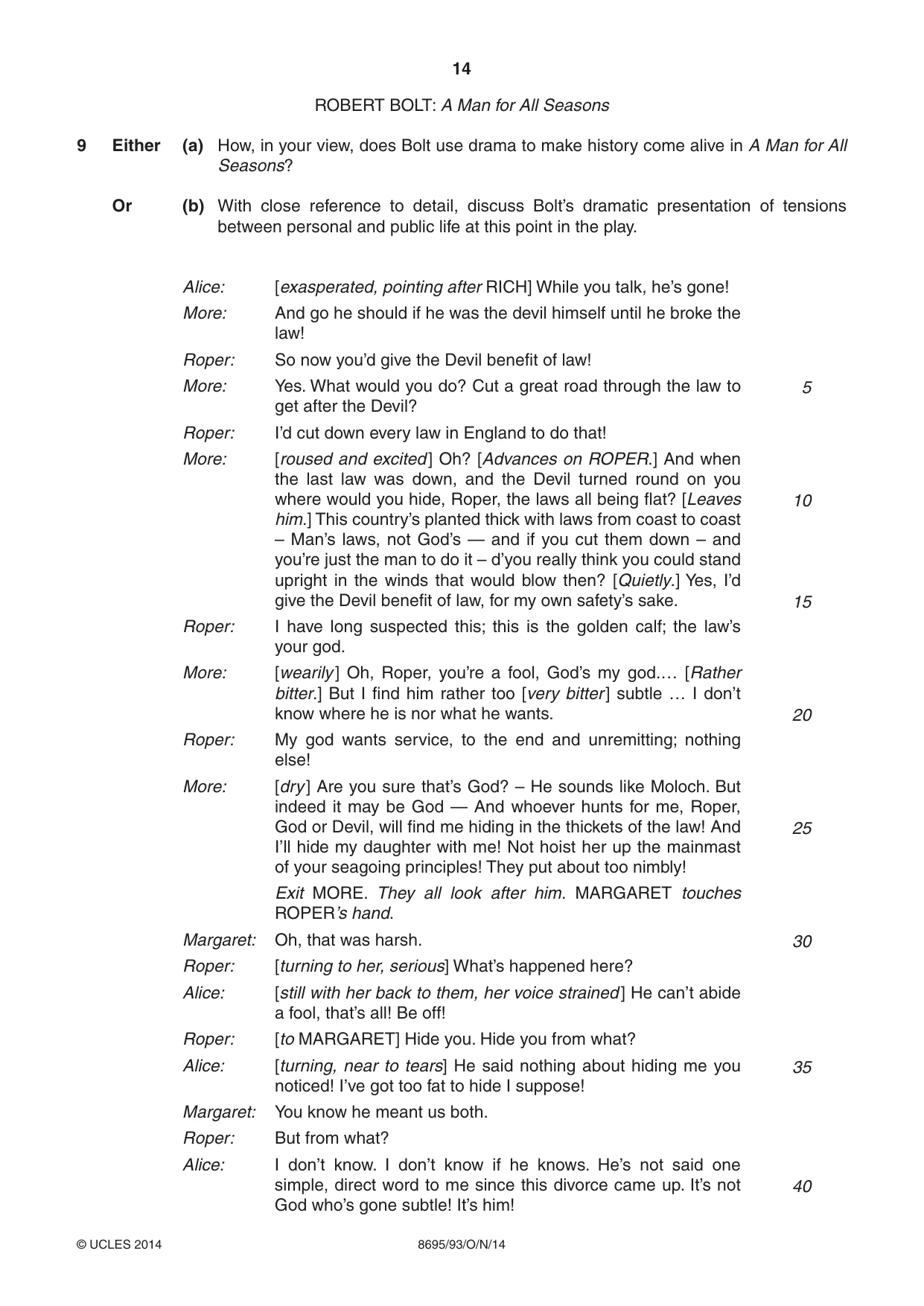
12 8695/93/O/N/14 © UCLES 2014 WILLIAM SHAKESPEARE: Richard III 8 Either (a) How, and with what effects, does Richard present himself as a victim in the play? Or (b) With close attention to detail in the following passage, discuss Shakespeare’s dramatic presentation of Queen Margaret and her relationship with Richard at this point in the play. Queen Margaret: What, were you snarling all before I came, Ready to catch each other by the throat, And turn you all your hatred now on me? Did York’s dread curse prevail so much with heaven That Henry’s death, my lovely Edward’s death, Their kingdom’s loss, my woeful banishment, Should all but answer for that peevish brat? Can curses pierce the clouds and enter heaven? Why then, give way, dull clouds, to my quick curses! Though not by war, by surfeit die your king, As ours by murder, to make him a king! Edward thy son, that now is Prince of Wales, For Edward our son, that was Prince of Wales, Die in his youth by like untimely violence! Thyself a queen, for me that was a queen, Outlive thy glory, like my wretched self! Long mayest thou live to wail thy children’s death, And see another, as I see thee now, Deck’d in thy rights, as thou art stall’d in mine! Long die thy happy days before thy death; And, after many length’ned hours of grief, Die neither mother, wife, nor England’s Queen! Rivers and Dorset, you were standers by, And so wast thou, Lord Hastings, when my son Was stabb’d with bloody daggers. God, I pray him, That none of you may live his natural age, But by some unlook’d accident cut off! Gloucester: Have done thy charm, thou hateful wither’d hag. Queen Margaret: And leave out thee? Stay, dog, for thou shalt hear me. If heaven have any grievous plague in store Exceeding those that I can wish upon thee, O, let them keep it till thy sins be ripe, And then hurl down their indignation On thee, the troubler of the poor world’s peace! The worm of conscience still be-gnaw thy soul! Thy friends suspect for traitors while thou liv’st, And take deep traitors for thy dearest friends! No sleep close up that deadly eye of thine, Unless it be while some tormenting dream Affrights thee with a hell of ugly devils! Thou elvish-mark’d, abortive, rooting hog, Thou that wast seal’d in thy nativity The slave of nature and the son of hell, 5 10 15 20 25 30 35 40 45
Question paper, page 13
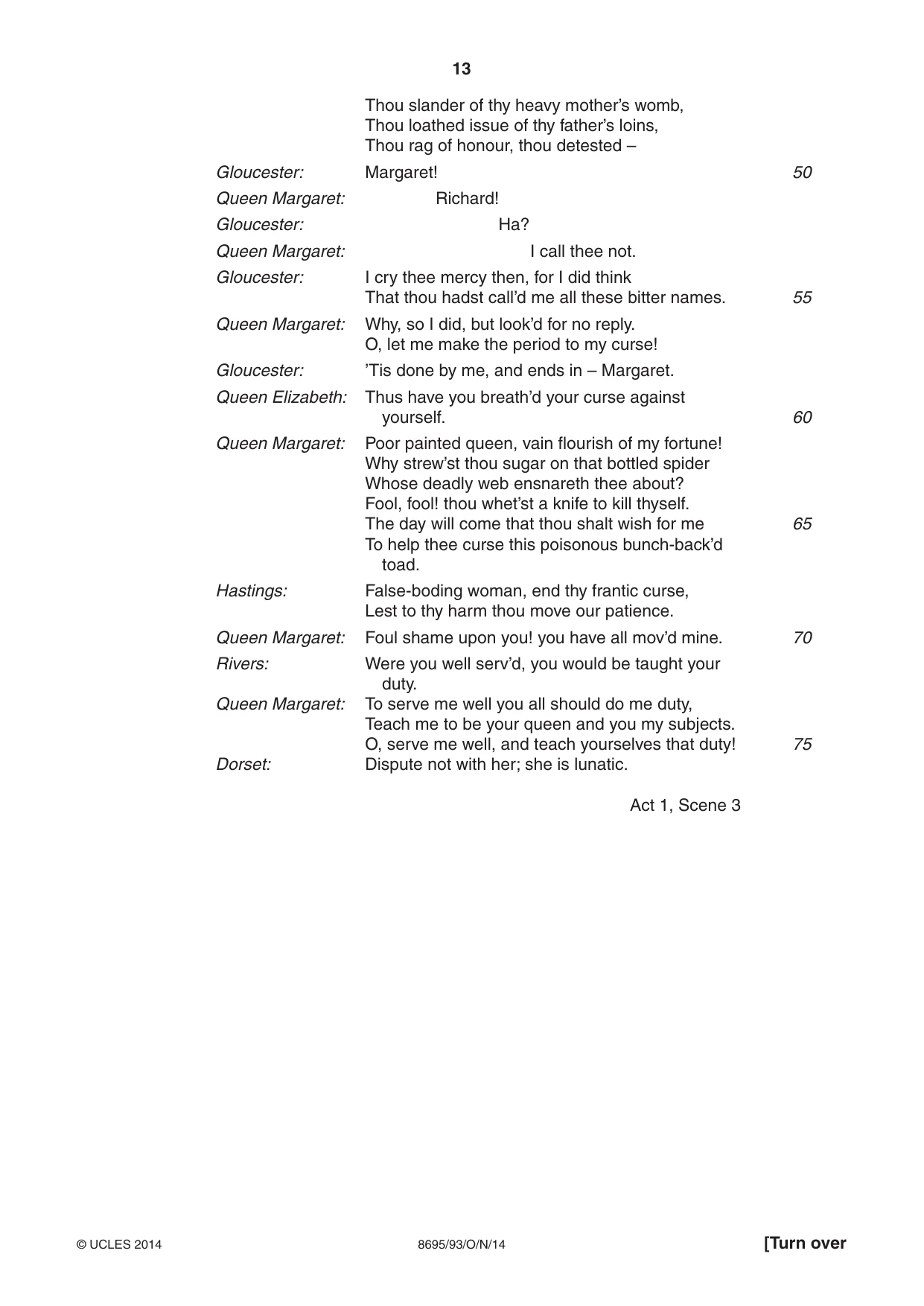
13 8695/93/O/N/14 © UCLES 2014 [Turn over Thou slander of thy heavy mother’s womb, Thou loathed issue of thy father’s loins, Thou rag of honour, thou detested – Gloucester: Margaret! Queen Margaret: Richard! Gloucester: Ha? Queen Margaret: I call thee not. Gloucester: I cry thee mercy then, for I did think That thou hadst call’d me all these bitter names. Queen Margaret: Why, so I did, but look’d for no reply. O, let me make the period to my curse! Gloucester: ’Tis done by me, and ends in – Margaret. Queen Elizabeth: Thus have you breath’d your curse against yourself. Queen Margaret: Poor painted queen, vain flourish of my fortune! Why strew’st thou sugar on that bottled spider Whose deadly web ensnareth thee about? Fool, fool! thou whet’st a knife to kill thyself. The day will come that thou shalt wish for me To help thee curse this poisonous bunch-back’d toad. Hastings: False-boding woman, end thy frantic curse, Lest to thy harm thou move our patience. Queen Margaret: Foul shame upon you! you have all mov’d mine. Rivers: Were you well serv’d, you would be taught your duty. Queen Margaret: To serve me well you all should do me duty, Teach me to be your queen and you my subjects. O, serve me well, and teach yourselves that duty! Dorset: Dispute not with her; she is lunatic. Act 1, Scene 3 50 55 60 65 70 75
Question paper, page 14
14 8695/93/O/N/14 © UCLES 2014 ROBERT BOLT: A Man for All Seasons 9 Either (a) How, in your view, does Bolt use drama to make history come alive in A Man for All Seasons? Or (b) With close reference to detail, discuss Bolt’s dramatic presentation of tensions between personal and public life at this point in the play. Alice: [exasperated, pointing after RICH] While you talk, he’s gone! More: And go he should if he was the devil himself until he broke the law! Roper: So now you’d give the Devil benefit of law! More: Yes. What would you do? Cut a great road through the law to get after the Devil? Roper: I’d cut down every law in England to do that! More: [roused and excited ] Oh? [Advances on ROPER.] And when the last law was down, and the Devil turned round on you where would you hide, Roper, the laws all being flat? [Leaves him.] This country’s planted thick with laws from coast to coast – Man’s laws, not God’s — and if you cut them down – and you’re just the man to do it – d’you really think you could stand upright in the winds that would blow then? [Quietly.] Yes, I’d give the Devil benefit of law, for my own safety’s sake. Roper: I have long suspected this; this is the golden calf; the law’s your god. More: [wearily ] Oh, Roper, you’re a fool, God’s my god.… [Rather bitter.] But I find him rather too [very bitter ] subtle … I don’t know where he is nor what he wants. Roper: My god wants service, to the end and unremitting; nothing else! More: [dry ] Are you sure that’s God? – He sounds like Moloch. But indeed it may be God — And whoever hunts for me, Roper, God or Devil, will find me hiding in the thickets of the law! And I’ll hide my daughter with me! Not hoist her up the mainmast of your seagoing principles! They put about too nimbly! Exit MORE. They all look after him. MARGARET touches ROPER’s hand. Margaret: Oh, that was harsh. Roper: [turning to her, serious] What’s happened here? Alice: [still with her back to them, her voice strained ] He can’t abide a fool, that’s all! Be off! Roper: [to MARGARET] Hide you. Hide you from what? Alice: [turning, near to tears] He said nothing about hiding me you noticed! I’ve got too fat to hide I suppose! Margaret: You know he meant us both. Roper: But from what? Alice: I don’t know. I don’t know if he knows. He’s not said one simple, direct word to me since this divorce came up. It’s not God who’s gone subtle! It’s him! 5 10 15 20 25 30 35 40
Question paper, page 15
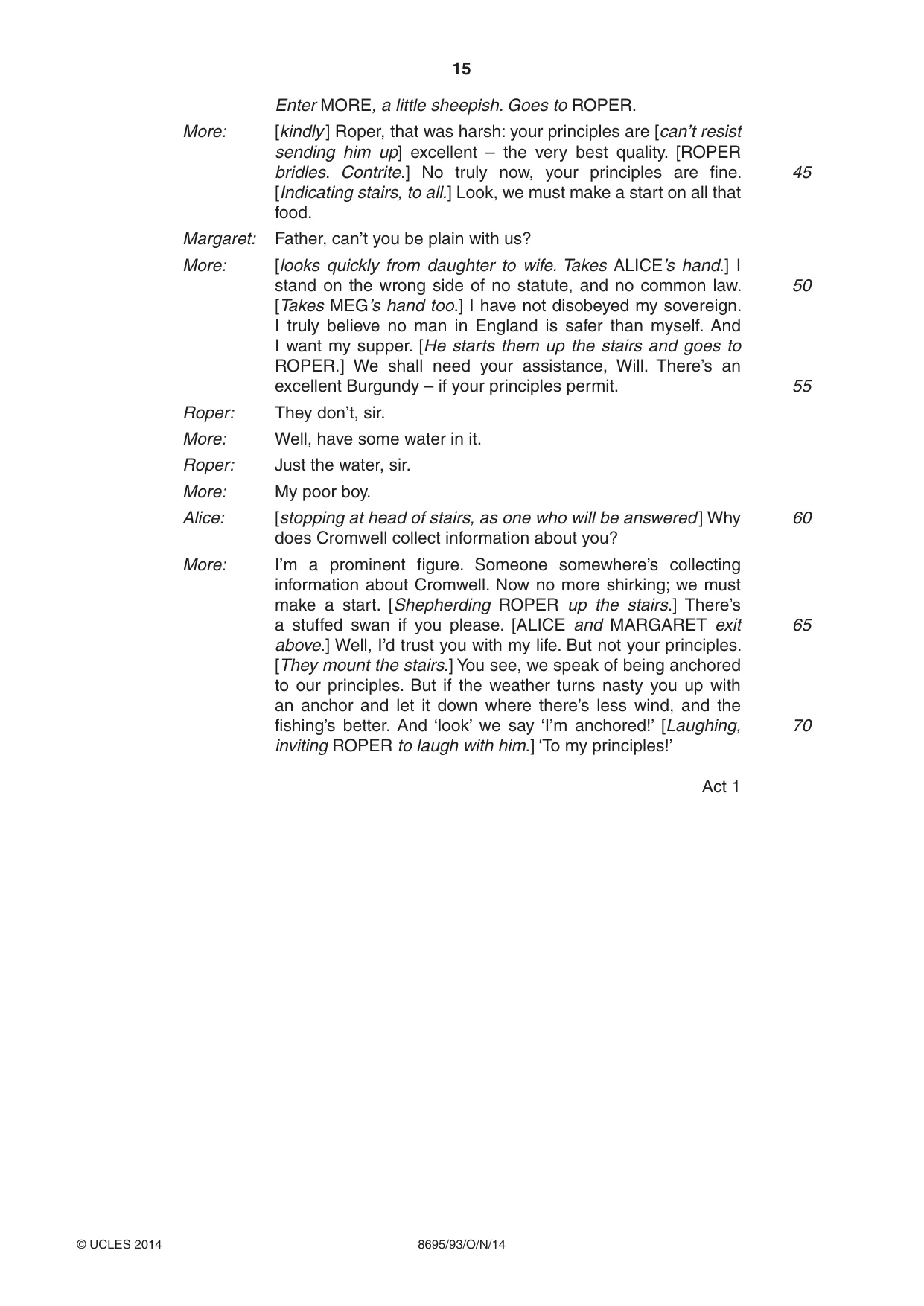
15 8695/93/O/N/14 © UCLES 2014 Enter MORE, a little sheepish. Goes to ROPER. More: [kindly ] Roper, that was harsh: your principles are [can’t resist sending him up] excellent – the very best quality. [ROPER bridles. Contrite.] No truly now, your principles are fine. [Indicating stairs, to all.] Look, we must make a start on all that food. Margaret: Father, can’t you be plain with us? More: [looks quickly from daughter to wife. Takes ALICE’s hand.] I stand on the wrong side of no statute, and no common law. [Takes MEG’s hand too.] I have not disobeyed my sovereign. I truly believe no man in England is safer than myself. And I want my supper. [He starts them up the stairs and goes to ROPER.] We shall need your assistance, Will. There’s an excellent Burgundy – if your principles permit. Roper: They don’t, sir. More: Well, have some water in it. Roper: Just the water, sir. More: My poor boy. Alice: [stopping at head of stairs, as one who will be answered ] Why does Cromwell collect information about you? More: I’m a prominent figure. Someone somewhere’s collecting information about Cromwell. Now no more shirking; we must make a start. [Shepherding ROPER up the stairs.] There’s a stuffed swan if you please. [ALICE and MARGARET exit above.] Well, I’d trust you with my life. But not your principles. [They mount the stairs.] You see, we speak of being anchored to our principles. But if the weather turns nasty you up with an anchor and let it down where there’s less wind, and the fishing’s better. And ‘look’ we say ‘I’m anchored!’ [Laughing, inviting ROPER to laugh with him.] ‘To my principles!’ Act 1 45 50 55 60 65 70
Question paper, page 16
16 8695/93/O/N/14 © UCLES 2014 Copyright Acknowledgements: Question 1b © Seamus Heaney; The Aerodrome from District and Circle; Faber & Faber; 2006. Question 4b © Chimamanda Ngozi Adichie; Half of a Yellow Sun; Harper Collins; 2006. Question 5b © E M Forster; A Passage To India; Penguin Books Ltd; 1979. Question 7 © From Who’s Afraid of Virginia Woolf? by Edward Albee. © Albee 1962; Published by Jonathan Cape. Reprinted by permission of the Random House Group Ltd. Question 9 © A Man for All Seasons by Robert Bolt. Reprinted by permission of Pearson Education. Permission to reproduce items where third-party owned material protected by copyright is included has been sought and cleared where possible. Every reasonable effort has been made by the publisher (UCLES) to trace copyright holders, but if any items requiring clearance have unwittingly been included, the publisher will be pleased to make amends at the earliest possible opportunity. Cambridge International Examinations is part of the Cambridge Assessment Group. Cambridge Assessment is the brand name of University of Cambridge Local Examinations Syndicate (UCLES), which is itself a department of the University of Cambridge. BLANK PAGE
Mark scheme, page 1
® IGCSE is the registered trademark of Cambridge International Examinations. CAMBRIDGE INTERNATIONAL EXAMINATIONS Cambridge International Advanced Subsidiary and Advanced Level MARK SCHEME for the October/November 2014 series 8695 LANGUAGE AND LITERATURE IN ENGLISH 8695/93 Paper 9 (Poetry, Prose and Drama), maximum raw mark 50 This mark scheme is published as an aid to teachers and candidates, to indicate the requirements of the examination. It shows the basis on which Examiners were instructed to award marks. It does not indicate the details of the discussions that took place at an Examiners’ meeting before marking began, which would have considered the acceptability of alternative answers. Mark schemes should be read in conjunction with the question paper and the Principal Examiner Report for Teachers. Cambridge will not enter into discussions about these mark schemes. Cambridge is publishing the mark schemes for the October/November 2014 series for most Cambridge IGCSE®, Cambridge International A and AS Level components and some Cambridge O Level components.
Mark scheme, page 2
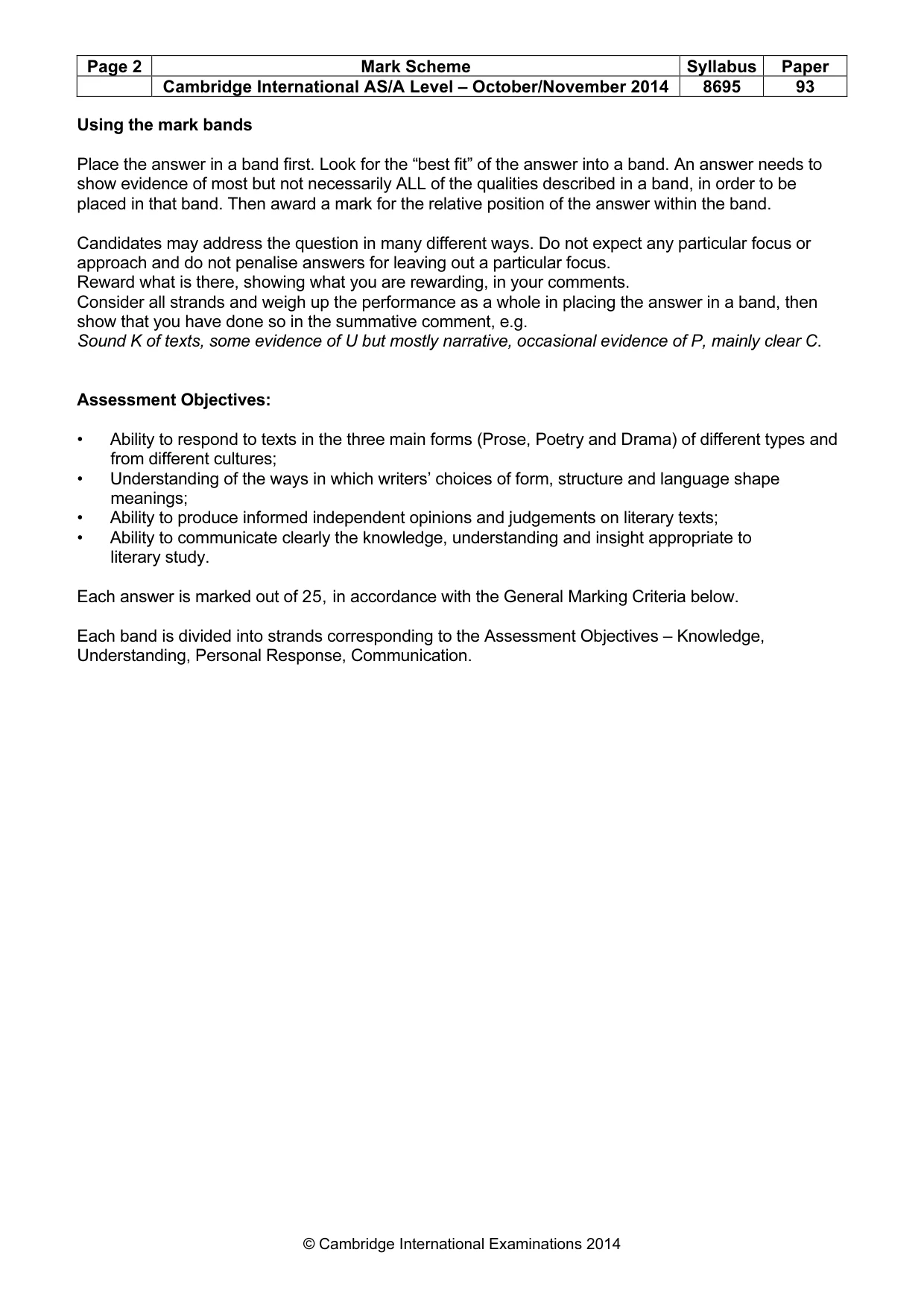
Page 2 Mark Scheme Syllabus Paper Cambridge International AS/A Level – October/November 2014 8695 93 © Cambridge International Examinations 2014 Using the mark bands Place the answer in a band first. Look for the “best fit” of the answer into a band. An answer needs to show evidence of most but not necessarily ALL of the qualities described in a band, in order to be placed in that band. Then award a mark for the relative position of the answer within the band. Candidates may address the question in many different ways. Do not expect any particular focus or approach and do not penalise answers for leaving out a particular focus. Reward what is there, showing what you are rewarding, in your comments. Consider all strands and weigh up the performance as a whole in placing the answer in a band, then show that you have done so in the summative comment, e.g. Sound K of texts, some evidence of U but mostly narrative, occasional evidence of P, mainly clear C. Assessment Objectives: • Ability to respond to texts in the three main forms (Prose, Poetry and Drama) of different types and from different cultures; • Understanding of the ways in which writers’ choices of form, structure and language shape meanings; • Ability to produce informed independent opinions and judgements on literary texts; • Ability to communicate clearly the knowledge, understanding and insight appropriate to literary study. Each answer is marked out of 25, in accordance with the General Marking Criteria below. Each band is divided into strands corresponding to the Assessment Objectives – Knowledge, Understanding, Personal Response, Communication.
Mark scheme, page 3
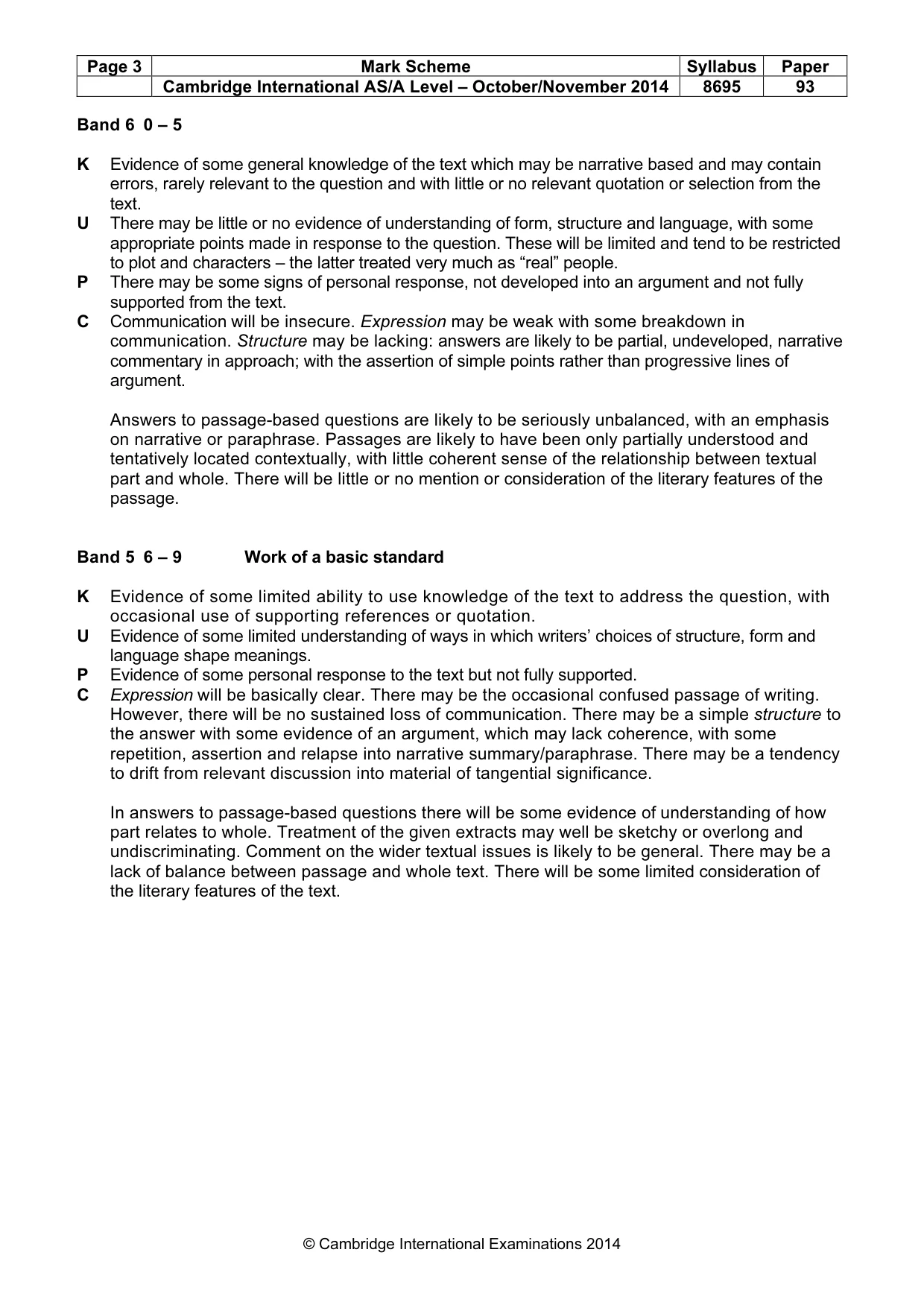
Page 3 Mark Scheme Syllabus Paper Cambridge International AS/A Level – October/November 2014 8695 93 © Cambridge International Examinations 2014 Band 6 0 – 5 K Evidence of some general knowledge of the text which may be narrative based and may contain errors, rarely relevant to the question and with little or no relevant quotation or selection from the text. U There may be little or no evidence of understanding of form, structure and language, with some appropriate points made in response to the question. These will be limited and tend to be restricted to plot and characters – the latter treated very much as “real” people. P There may be some signs of personal response, not developed into an argument and not fully supported from the text. C Communication will be insecure. Expression may be weak with some breakdown in communication. Structure may be lacking: answers are likely to be partial, undeveloped, narrative commentary in approach; with the assertion of simple points rather than progressive lines of argument. Answers to passage-based questions are likely to be seriously unbalanced, with an emphasis on narrative or paraphrase. Passages are likely to have been only partially understood and tentatively located contextually, with little coherent sense of the relationship between textual part and whole. There will be little or no mention or consideration of the literary features of the passage. Band 5 6 – 9 Work of a basic standard K Evidence of some limited ability to use knowledge of the text to address the question, with occasional use of supporting references or quotation. U Evidence of some limited understanding of ways in which writers’ choices of structure, form and language shape meanings. P Evidence of some personal response to the text but not fully supported. C Expression will be basically clear. There may be the occasional confused passage of writing. However, there will be no sustained loss of communication. There may be a simple structure to the answer with some evidence of an argument, which may lack coherence, with some repetition, assertion and relapse into narrative summary/paraphrase. There may be a tendency to drift from relevant discussion into material of tangential significance. In answers to passage-based questions there will be some evidence of understanding of how part relates to whole. Treatment of the given extracts may well be sketchy or overlong and undiscriminating. Comment on the wider textual issues is likely to be general. There may be a lack of balance between passage and whole text. There will be some limited consideration of the literary features of the text.
Mark scheme, page 4
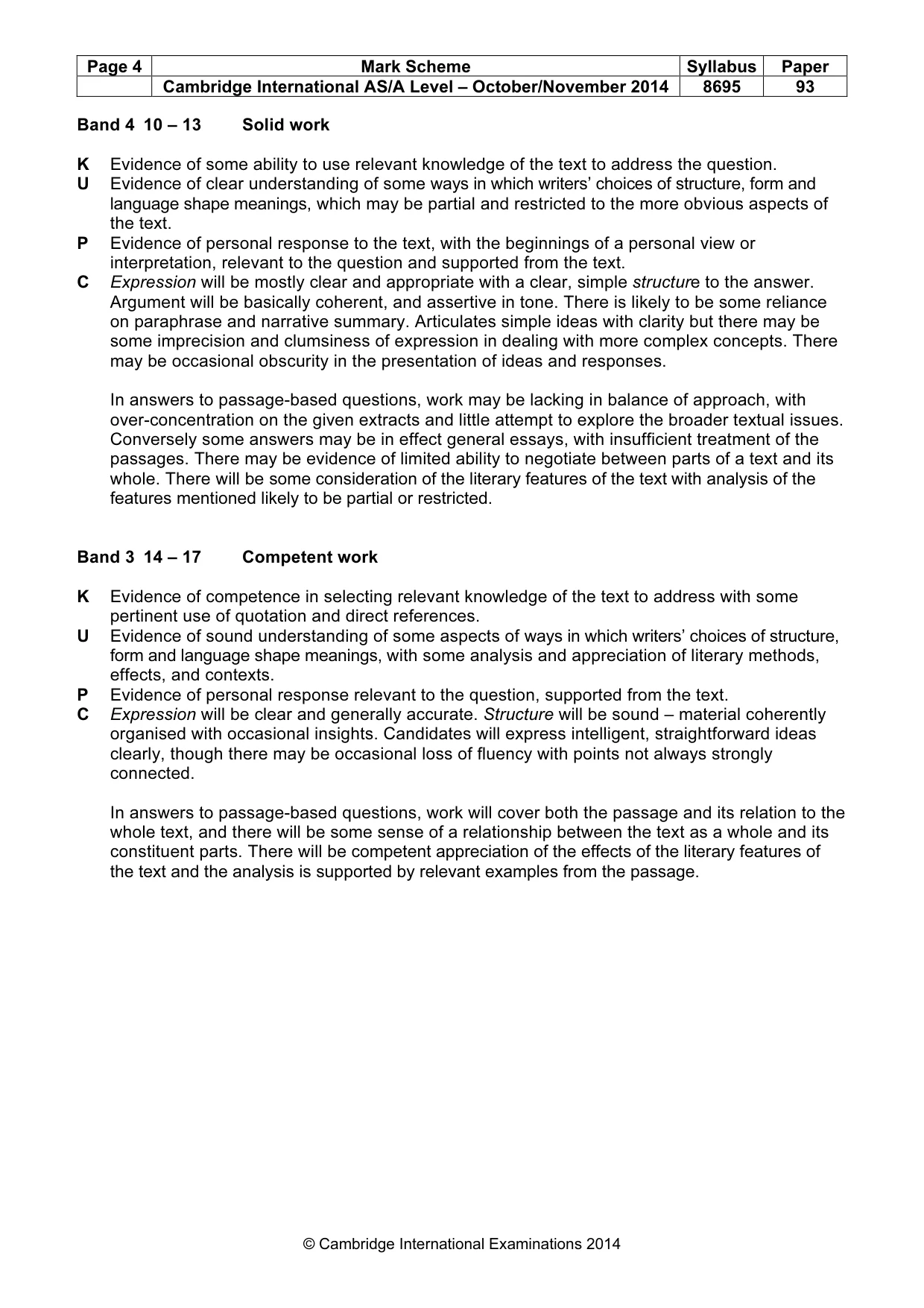
Page 4 Mark Scheme Syllabus Paper Cambridge International AS/A Level – October/November 2014 8695 93 © Cambridge International Examinations 2014 Band 4 10 – 13 Solid work K Evidence of some ability to use relevant knowledge of the text to address the question. U Evidence of clear understanding of some ways in which writers’ choices of structure, form and language shape meanings, which may be partial and restricted to the more obvious aspects of the text. P Evidence of personal response to the text, with the beginnings of a personal view or interpretation, relevant to the question and supported from the text. C Expression will be mostly clear and appropriate with a clear, simple structure to the answer. Argument will be basically coherent, and assertive in tone. There is likely to be some reliance on paraphrase and narrative summary. Articulates simple ideas with clarity but there may be some imprecision and clumsiness of expression in dealing with more complex concepts. There may be occasional obscurity in the presentation of ideas and responses. In answers to passage-based questions, work may be lacking in balance of approach, with over-concentration on the given extracts and little attempt to explore the broader textual issues. Conversely some answers may be in effect general essays, with insufficient treatment of the passages. There may be evidence of limited ability to negotiate between parts of a text and its whole. There will be some consideration of the literary features of the text with analysis of the features mentioned likely to be partial or restricted. Band 3 14 – 17 Competent work K Evidence of competence in selecting relevant knowledge of the text to address with some pertinent use of quotation and direct references. U Evidence of sound understanding of some aspects of ways in which writers’ choices of structure, form and language shape meanings, with some analysis and appreciation of literary methods, effects, and contexts. P Evidence of personal response relevant to the question, supported from the text. C Expression will be clear and generally accurate. Structure will be sound – material coherently organised with occasional insights. Candidates will express intelligent, straightforward ideas clearly, though there may be occasional loss of fluency with points not always strongly connected. In answers to passage-based questions, work will cover both the passage and its relation to the whole text, and there will be some sense of a relationship between the text as a whole and its constituent parts. There will be competent appreciation of the effects of the literary features of the text and the analysis is supported by relevant examples from the passage.
Mark scheme, page 5
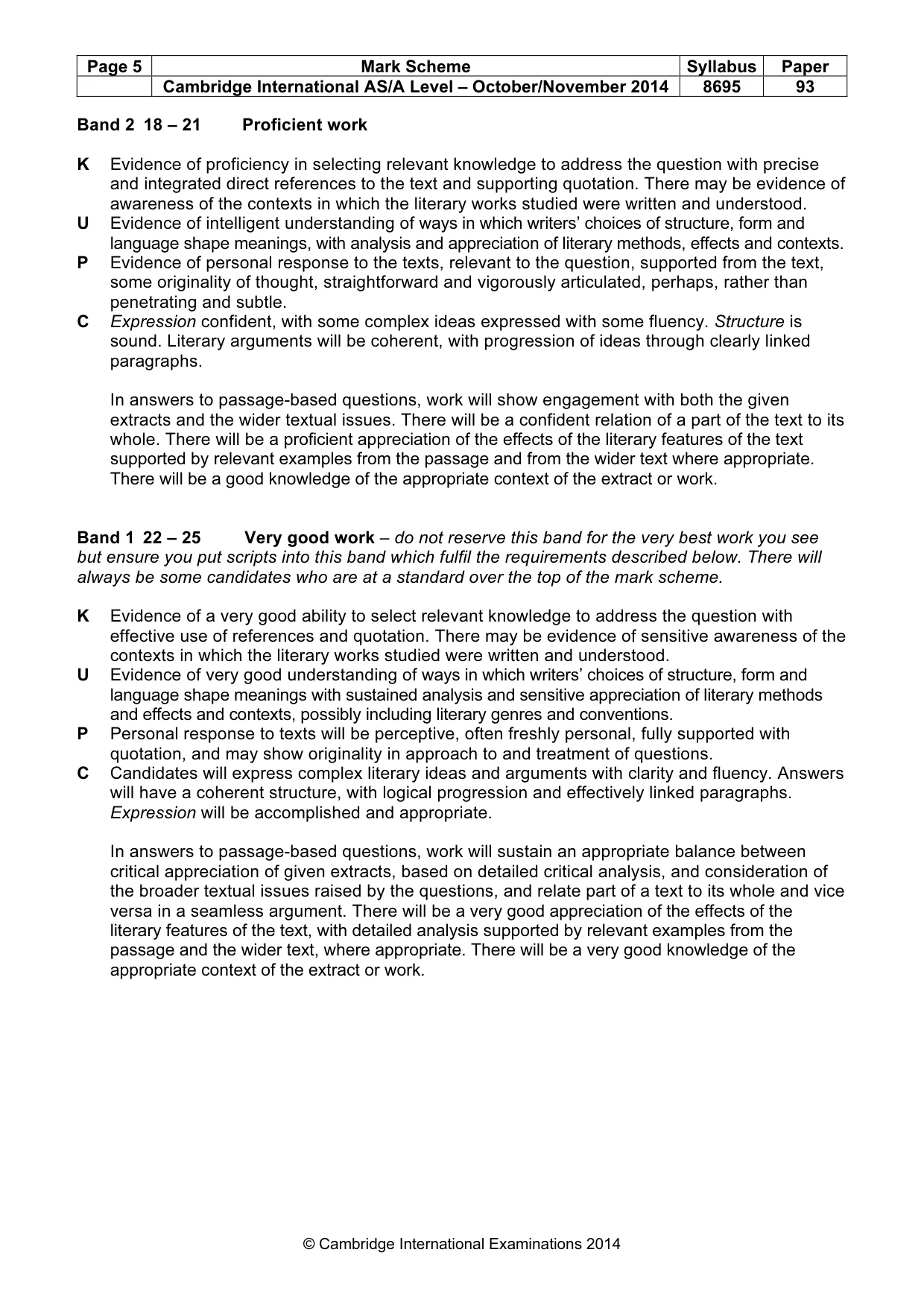
Page 5 Mark Scheme Syllabus Paper Cambridge International AS/A Level – October/November 2014 8695 93 © Cambridge International Examinations 2014 Band 2 18 – 21 Proficient work K Evidence of proficiency in selecting relevant knowledge to address the question with precise and integrated direct references to the text and supporting quotation. There may be evidence of awareness of the contexts in which the literary works studied were written and understood. U Evidence of intelligent understanding of ways in which writers’ choices of structure, form and language shape meanings, with analysis and appreciation of literary methods, effects and contexts. P Evidence of personal response to the texts, relevant to the question, supported from the text, some originality of thought, straightforward and vigorously articulated, perhaps, rather than penetrating and subtle. C Expression confident, with some complex ideas expressed with some fluency. Structure is sound. Literary arguments will be coherent, with progression of ideas through clearly linked paragraphs. In answers to passage-based questions, work will show engagement with both the given extracts and the wider textual issues. There will be a confident relation of a part of the text to its whole. There will be a proficient appreciation of the effects of the literary features of the text supported by relevant examples from the passage and from the wider text where appropriate. There will be a good knowledge of the appropriate context of the extract or work. Band 1 22 – 25 Very good work – do not reserve this band for the very best work you see but ensure you put scripts into this band which fulfil the requirements described below. There will always be some candidates who are at a standard over the top of the mark scheme. K Evidence of a very good ability to select relevant knowledge to address the question with effective use of references and quotation. There may be evidence of sensitive awareness of the contexts in which the literary works studied were written and understood. U Evidence of very good understanding of ways in which writers’ choices of structure, form and language shape meanings with sustained analysis and sensitive appreciation of literary methods and effects and contexts, possibly including literary genres and conventions. P Personal response to texts will be perceptive, often freshly personal, fully supported with quotation, and may show originality in approach to and treatment of questions. C Candidates will express complex literary ideas and arguments with clarity and fluency. Answers will have a coherent structure, with logical progression and effectively linked paragraphs. Expression will be accomplished and appropriate. In answers to passage-based questions, work will sustain an appropriate balance between critical appreciation of given extracts, based on detailed critical analysis, and consideration of the broader textual issues raised by the questions, and relate part of a text to its whole and vice versa in a seamless argument. There will be a very good appreciation of the effects of the literary features of the text, with detailed analysis supported by relevant examples from the passage and the wider text, where appropriate. There will be a very good knowledge of the appropriate context of the extract or work.
What you needed in this session
Cambridge’s own grade thresholds for 2014 Oct/Nov, Paper 9 · Variant 3. A higher threshold means an easier paper — the bar moves with how the cohort did.