Cambridge A Level English - Language and Literature (AS Level only, from 2016) 8695 — 2014 Oct/Nov Paper 9 · Variant 2
8695/92/O/N/14 · 50 marks · ≈56 min
The question paper and its mark scheme, free to read here and free to download. This is Cambridge’s own paper, exactly as it was sat.
Question paper20 pages




Mark scheme5 pages
Answers below. Sit the paper first if you are practising.
Paper as text
Question paper, page 1
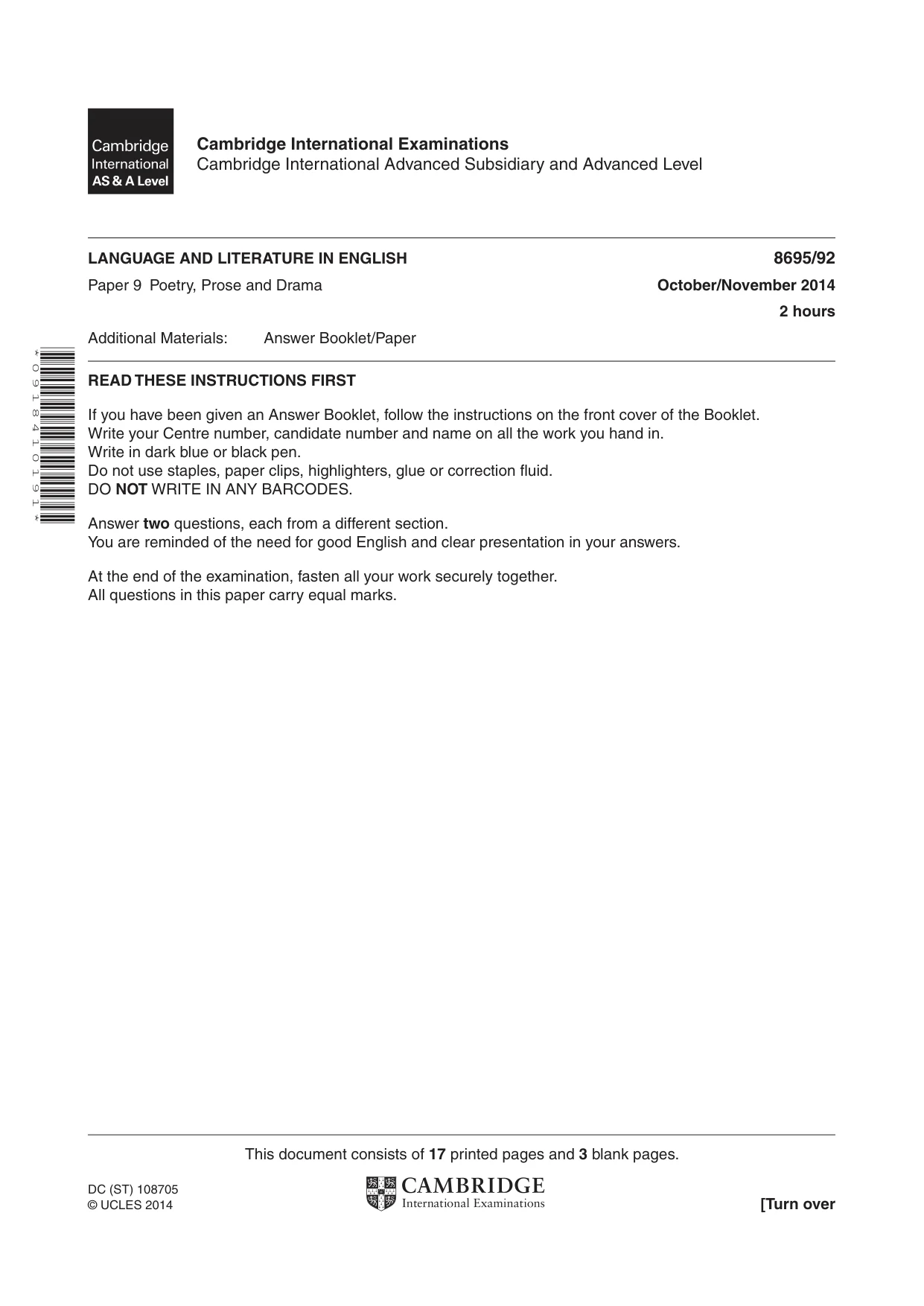
This document consists of 17 printed pages and 3 blank pages. DC (ST) 108705 © UCLES 2014 [Turn over Cambridge International Examinations Cambridge International Advanced Subsidiary and Advanced Level * 0 9 1 8 4 1 0 1 9 1 * LANGUAGE AND LITERATURE IN ENGLISH 8695/92 Paper 9 Poetry, Prose and Drama October/November 2014 2 hours Additional Materials: Answer Booklet/Paper READ THESE INSTRUCTIONS FIRST If you have been given an Answer Booklet, follow the instructions on the front cover of the Booklet. Write your Centre number, candidate number and name on all the work you hand in. Write in dark blue or black pen. Do not use staples, paper clips, highlighters, glue or correction fluid. DO NOT WRITE IN ANY BARCODES. Answer two questions, each from a different section. You are reminded of the need for good English and clear presentation in your answers. At the end of the examination, fasten all your work securely together. All questions in this paper carry equal marks.
Question paper, page 2
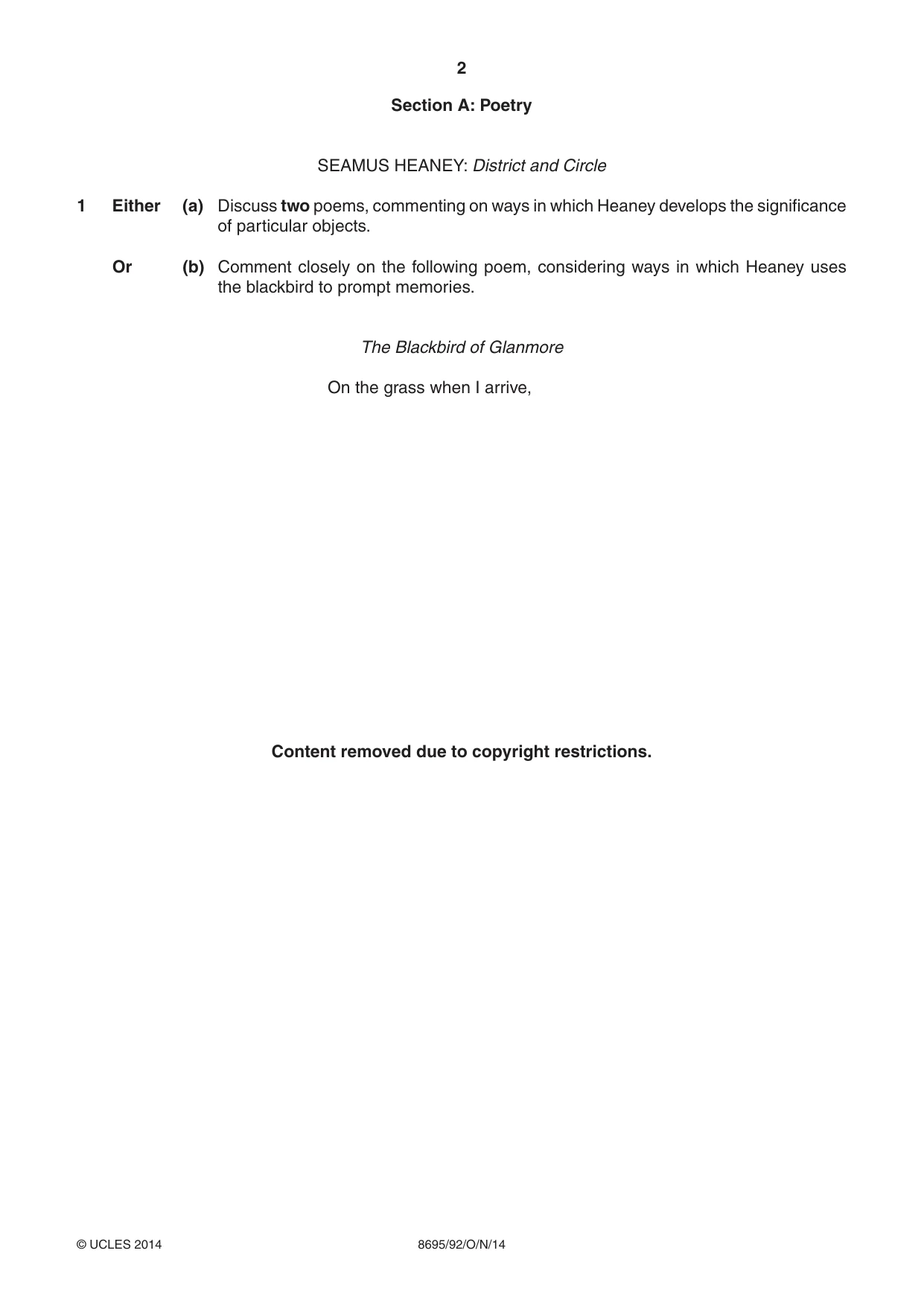
2 8695/92/O/N/14 © UCLES 2014 Section A: Poetry SEAMUS HEANEY: District and Circle 1 Either (a) Discuss two poems, commenting on ways in which Heaney develops the significance of particular objects. Or (b) Comment closely on the following poem, considering ways in which Heaney uses the blackbird to prompt memories. The Blackbird of Glanmore On the grass when I arrive, Content removed due to copyright restrictions.
Question paper, page 3
3 8695/92/O/N/14 © UCLES 2014 [Turn over In the ivy when I leave. Content removed due to copyright restrictions.
Question paper, page 4
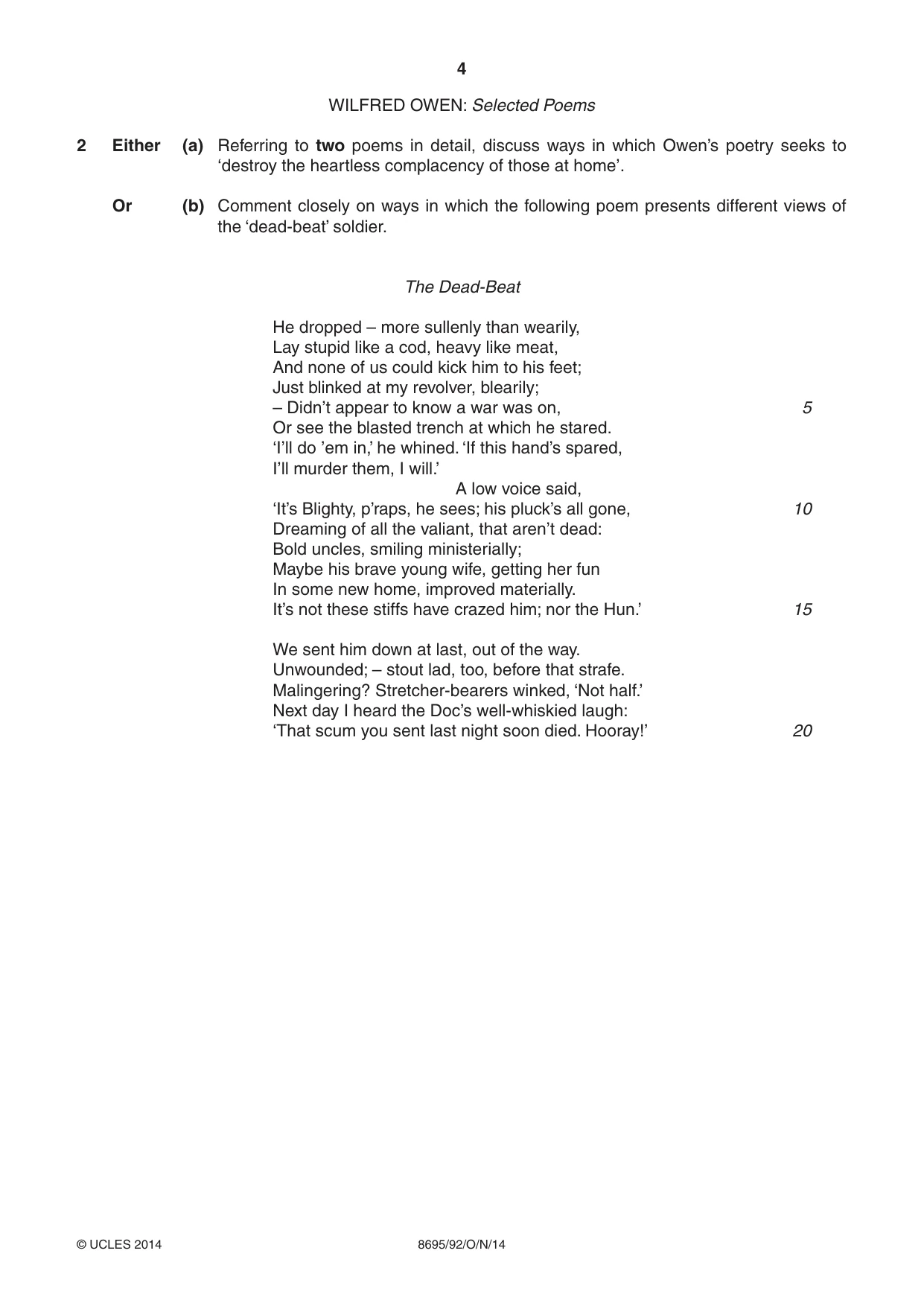
4 8695/92/O/N/14 © UCLES 2014 WILFRED OWEN: Selected Poems 2 Either (a) Referring to two poems in detail, discuss ways in which Owen’s poetry seeks to ‘destroy the heartless complacency of those at home’. Or (b) Comment closely on ways in which the following poem presents different views of the ‘dead-beat’ soldier. The Dead-Beat He dropped – more sullenly than wearily, Lay stupid like a cod, heavy like meat, And none of us could kick him to his feet; Just blinked at my revolver, blearily; – Didn’t appear to know a war was on, Or see the blasted trench at which he stared. ‘I’ll do ’em in,’ he whined. ‘If this hand’s spared, I’ll murder them, I will.’ A low voice said, ‘It’s Blighty, p’raps, he sees; his pluck’s all gone, Dreaming of all the valiant, that aren’t dead: Bold uncles, smiling ministerially; Maybe his brave young wife, getting her fun In some new home, improved materially. It’s not these stiffs have crazed him; nor the Hun.’ We sent him down at last, out of the way. Unwounded; – stout lad, too, before that strafe. Malingering? Stretcher-bearers winked, ‘Not half.’ Next day I heard the Doc’s well-whiskied laugh: ‘That scum you sent last night soon died. Hooray!’ 5 10 15 20
Question paper, page 5
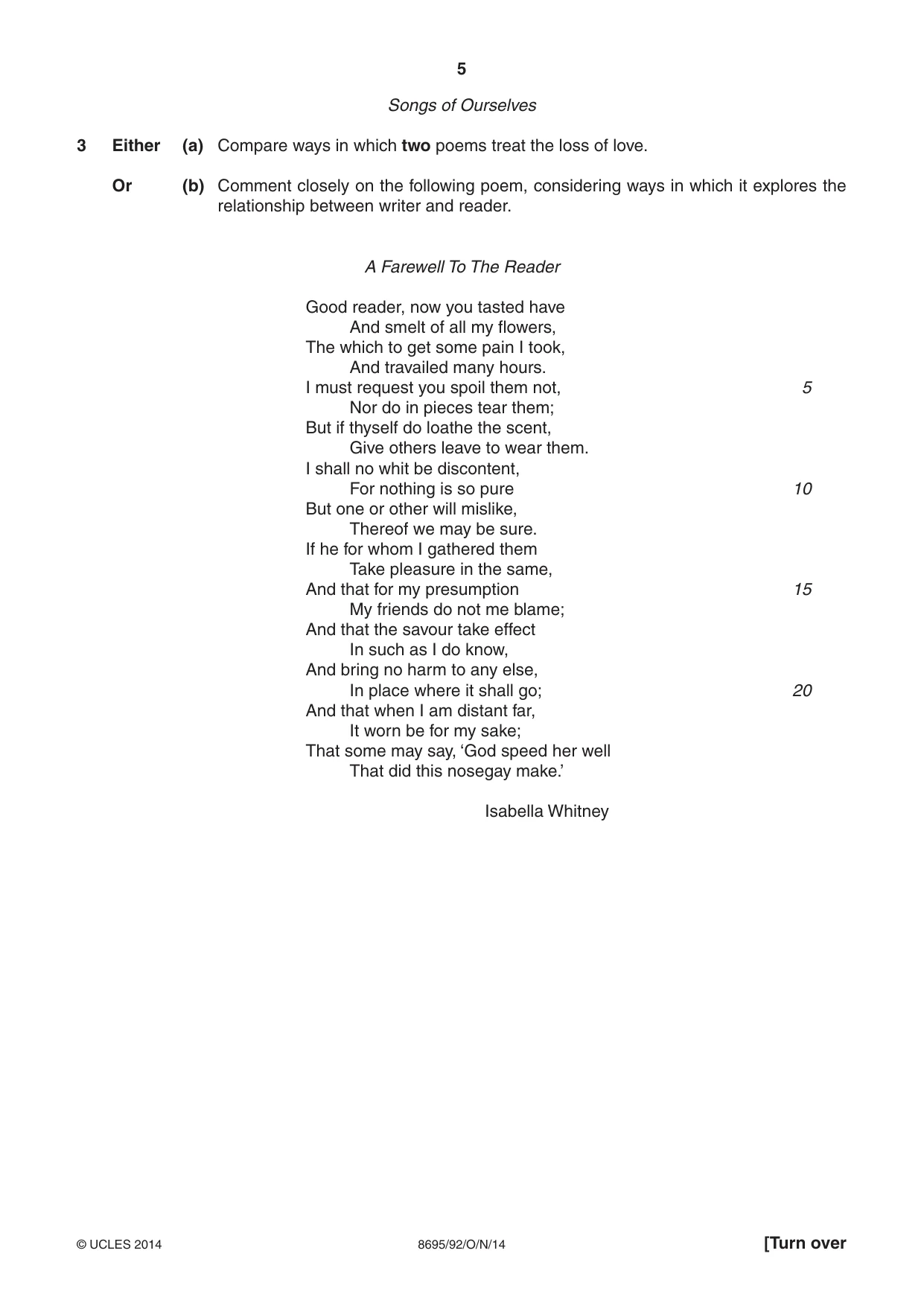
5 8695/92/O/N/14 © UCLES 2014 [Turn over Songs of Ourselves 3 Either (a) Compare ways in which two poems treat the loss of love. Or (b) Comment closely on the following poem, considering ways in which it explores the relationship between writer and reader. A Farewell To The Reader Good reader, now you tasted have And smelt of all my flowers, The which to get some pain I took, And travailed many hours. I must request you spoil them not, Nor do in pieces tear them; But if thyself do loathe the scent, Give others leave to wear them. I shall no whit be discontent, For nothing is so pure But one or other will mislike, Thereof we may be sure. If he for whom I gathered them Take pleasure in the same, And that for my presumption My friends do not me blame; And that the savour take effect In such as I do know, And bring no harm to any else, In place where it shall go; And that when I am distant far, It worn be for my sake; That some may say, ‘God speed her well That did this nosegay make.’ Isabella Whitney 5 10 15 20
Question paper, page 6
6 8695/92/O/N/14 © UCLES 2014 Section B: Prose CHIMAMANDA NGOZI ADICHIE: Half of a Yellow Sun 4 Either (a) ‘ “The World Was Silent When We Died. It is a good title.” ’ Discuss the significance to the novel of the title for Richard’s book. Or (b) Comment closely on the following passage, considering ways in which it presents Ugwu’s growing unease. Ugwu shivered. A shadow hung over the house. Content removed due to copyright restrictions.
Question paper, page 7
7 8695/92/O/N/14 © UCLES 2014 [Turn over One baby had been stung and almost died. Chapter 19 Content removed due to copyright restrictions.
Question paper, page 8
8 8695/92/O/N/14 © UCLES 2014 E.M. FORSTER: A Passage to India 5 Either (a) ‘The caves are more than the place where Aziz is said to have assaulted Miss Quested.’ What do you consider to be the significance to the novel of the Marabar Caves? Or (b) Comment closely on the presentation of the argument between Fielding and Aziz in the following passage, considering its significance as the ending of the novel. Aziz grew more excited. He rose in his stirrups and pulled at his horse’s head in the hope it would rear. Then he should feel in a battle. He cried: ‘Clear out, all you Turtons and Burtons. We wanted to know you ten years back – now it’s too late. If we see you and sit on your committees, it’s for political reasons, don’t you make any mistake.’ His horse did rear. ‘Clear out, clear out, I say. Why are we put to so much suffering? We used to blame you, now we blame ourselves, we grow wiser. Until England is in difficulties we keep silent, but in the next European war – aha, aha! Then is our time.’ He paused, and the scenery, though it smiled, fell like a gravestone on any human hope. They cantered past a temple to Hanuman – God so loved the world that he took monkey’s flesh upon him – and past a Saivite temple, which invited to lust, but under the semblance of eternity, its obscenities bearing no relation to those of our flesh and blood. They splashed through butterflies and frogs; great trees with leaves like plates rose among the brushwood. The divisions of daily life were returning, the shrine had almost shut. ‘Who do you want instead of the English? The Japanese?’ jeered Fielding, drawing rein. ‘No, the Afghans. My own ancestors.’ ‘Oh, your Hindu friends will like that, won’t they?’ ‘It will be arranged – a conference of oriental statesmen.’ ‘It will indeed be arranged.’ ‘Old story of “We will rob every man and rape every woman from Peshawar to Calcutta”, I suppose, which you get some nobody to repeat and then quote every week in the Pioneer in order to frighten us into retaining you! We know!’ Still he couldn’t quite fit in Afghans at Mau, and, finding he was in a corner, made his horse rear again until he remembered that he had, or ought to have, a mother-land. Then he shouted: ‘India shall be a nation! No foreigners of any sort! Hindu and Moslem and Sikh and all shall be one! Hurrah! Hurrah for India! Hurrah! Hurrah!’ India a nation! What an apotheosis! Last comer to the drab nineteenth-century sisterhood! Waddling in at this hour of the world to take her seat! She, whose only peer was the Holy Roman Empire, she shall rank with Guatemala and Belgium perhaps! Fielding mocked again. And Aziz in an awful rage danced this way and that, not knowing what to do, and cried: ‘Down with the English anyhow. That’s certain. Clear out, you fellows, double quick, I say. We may hate one another, but we hate you most. If I don’t make you go, Ahmed will, Karim will, if it’s fifty or five hundred years we shall get rid of you, yes, we shall drive every blasted Englishman into the sea, and then’ – he rode against him furiously – ‘and then,’ he concluded, half kissing him, ‘you and I shall be friends.’ ‘Why can’t we be friends now?’ said the other, holding him affectionately. ‘It’s what I want. It’s what you want.’ But the horses didn’t want it – they swerved apart; the earth didn’t want it, sending up rocks through which riders must pass single-file; the temples, the tank, the jail, the palace, the birds, the carrion, the Guest House, that came into view as they issued from the gap and saw Mau beneath: they didn’t want it, they said in their hundred voices, ‘No, not yet,’ and the sky said, ‘No, not there.’ Chapter 37 5 10 15 20 25 30 35 40
Question paper, page 9
9 8695/92/O/N/14 © UCLES 2014 [Turn over Turn to page 10 for Question 6
Question paper, page 10
10 8695/92/O/N/14 © UCLES 2014 Stories of Ourselves 6 Either (a) Compare ways in which two stories present fear. Or (b) Comment closely on ways in which the following passage presents the relationship between the mother and her son. One day she kept me home. She said, ‘No school for you today. I just sick of tying your shoe-laces for you. Today you go have to learn that!’ I didn’t think she was being fair. After all, in the country none of us wore shoes and I wasn’t used to them. That day she beat me and beat me and made me tie knot after knot and in the end I still couldn’t tie my shoe-laces. For years afterwards it was a great shame to me that I couldn’t do a simple thing like that, just as how I couldn’t peel an orange. But about the shoes I made up a little trick. I never made my mother buy shoes the correct size. I pretended that those shoes hurt, and I made her get me shoes a size or two bigger. Once the attendant had tied the laces up for me, I never undid them, and merely slipped my feet in and out of the shoes. To keep them on my feet, I stuck paper in the toes. To hear my mother talk, you would think I was a freak. Nearly every little boy she knew was better and more intelligent. There was one boy she knew who helped his mother paint her house. There was another boy who could mend his own shoes. There was still another boy who at the age of thirteen was earning a good twenty dollars a month, while I was just idling and living off her blood. Still, there were surprising glimpses of kindness. There was the time, for instance, when I was cleaning some tumblers for her one Saturday morning. I dropped a tumbler and it broke. Before I could do anything about it my mother saw what had happened. She said, ‘How you break it?’ I said, ‘It just slip off. It smooth smooth.’ She said, ‘Is a lot of nonsense drinking from glass. They break up so easy.’ And that was all. I got worried about my mother’s health. She was never worried about mine. She thought that there was no illness in the world a stiff dose of hot Epsom Salts couldn’t cure. That was a penance I had to endure once a month. It completely ruined my weekend. And if there was something she couldn’t understand, she sent me to the Health Officer in Tragarete Road. That was an awful place. You waited and waited and waited before you went in to see the doctor. Before you had time to say, ‘Doctor, I have a pain’—he would be writing out a prescription for you. And again you had to wait for the medicine. All the Health Office medicines were the same. Water and pink sediment half an inch thick. Hat used to say of the Health Office, ‘The Government taking up faith healing.’ My mother considered the Health Office a good place for me to go to. I would go there at eight in the morning and return any time after two in the afternoon. It kept me out of mischief, and it cost only twenty-four cents a year. But you mustn’t get the impression that I was a saint all the time. I wasn’t. I used to have odd fits where I just couldn’t take an order from anybody, particularly my mother. I used to feel that I would dishonour myself for life if I took anybody’s orders. And life is a funny thing, really. I sometimes got these fits just when my mother was anxious to be nice to me. The day after Hat rescued me from drowning at Docksite I wrote an essay for my schoolmaster on the subject, ‘A Day at the Seaside’. I don’t think any schoolmaster ever got an essay like that. I talked about how I was nearly drowned and how calmly I was facing death, with my mind absolutely calm, thinking, ‘Well, boy, this is the end.’ The teacher was so pleased he gave me ten marks out of twelve. 5 10 15 20 25 30 35 40 45
Question paper, page 11
11 8695/92/O/N/14 © UCLES 2014 [Turn over He said, ‘I think you are a genius.’ When I went home I told my mother, ‘That essay I write today, I get ten out of twelve for it.’ My mother said, ‘How you so bold-face to lie brave brave so in front of my face? You want me give you a slap to turn your face?’ In the end I convinced her. She melted at once. She sat down in the hammock and said. ‘Come and sit down by me, son.’ Just then the crazy fit came on me. I got very angry for no reason at all and I said, ‘No, I not going to sit by you.’ She laughed and coaxed, And the angrier she made me. Slowly the friendliness died away. It had become a struggle between two wills. I was prepared to drown rather than dishonour myself by obeying. ‘I ask you to come and sit down here.’ ‘I not sitting down.’ ‘Take off your belt.’ I took it off and gave it to her. She belted me soundly, and my nose bled, but still I didn’t sit in the hammock. At times like these I used to cry, without meaning it, ‘If my father was alive you wouldn’t be behaving like this.’ The Enemy 50 55 60 65
Question paper, page 12
12 8695/92/O/N/14 © UCLES 2014 Section C: Drama EDWARD ALBEE: Who’s Afraid of Virginia Woolf? 7 Either (a) In what ways, and with what effects, does Albee dramatise changes in the relationship between Nick and Honey during the course of the play? Or (b) Comment closely on the following passage, paying particular attention to Albee’s dramatic presentation of George at this point in the play. Martha [to NICK]: Georgie-boy, here, says you’re terrifying. Why are you terrifying? Nick [with a small smile]: I didn’t know I was. Honey [a little thickly]: It’s because of your chromosomes, dear. Nick: Oh, the chromosome business.… Martha [to NICK]: What’s all this about chromosomes? Nick: Well, chromosomes are … Martha: I know what chromosomes are, sweetie, I love ’em. Nick: Oh.… Well, then. George: Martha eats them … for breakfast … she sprinkles them on her cereal. [To MARTHA, now] It’s very simple, Martha, this young man is working on a system whereby chromosomes can be altered … well not all by himself – he probably has one or two co-conspirators – the genetic make-up of a sperm cell changed, reordered … to order, actually … for hair and eye colour, stature, potency … I imagine … hairiness, features, health … and mind. Most important … Mind. All imbalances will be corrected, sifted out … propensity for various diseases will be gone, longevity assured. We will have a race of men … test-tube-bred … incubator-born … superb and sublime. Martha [impressed ]: Hunh! Honey: How exciting! George: But! Everyone will tend to be rather the same.… Alike. Everyone … and I’m sure I’m not wrong here … will tend to look like this young man here. Martha: That’s not a bad idea. Nick [impatient ]: All right, now.… George: It will, on the surface of it, be all rather pretty … quite jolly. But of course there will be a dank side to it, too. A certain amount of regulation will be necessary … uh … for the experiment to succeed. A certain number of sperm tubes will have to be cut. Martha: Hunh! … George: Millions upon millions of them … millions of tiny little slicing operations that will leave just the smallest scar, on the underside of the scrotum [MARTHA laughs.] but which will assure the sterility of the imperfect … the ugly, the stupid … the … unfit. Nick [grimly]: Now look … ! George: … with this, we will have, in time, a race of glorious men. 5 10 15 20 25 30 35
Question paper, page 13
13 8695/92/O/N/14 © UCLES 2014 [Turn over Martha: Hunh! George: I suspect we will not have much music, much painting, but we will have a civilization of men, smooth, blond, and right at the middleweight limit. Martha: Awww.… George: … a race of scientists and mathematicians, each dedicated to and working for the greater glory of the super-civilization. Martha: Goody. George: There will be a certain … loss of liberty, I imagine, as a result of this experiment … but diversity will no longer be the goal. Cultures and races will eventually vanish … the ants will take over the world. Nick: Are you finished? George [ignoring him]: And I, naturally, am rather opposed to all this. Act 1 40 45 50
Question paper, page 14
14 8695/92/O/N/14 © UCLES 2014 WILLIAM SHAKESPEARE: Richard III 8 Either (a) Discuss the presentation and dramatic significance of Queen Margaret for the play as a whole. Or (b) How, and with what effects, does Shakespeare dramatise Richard’s state of mind at this point in the play? You should make close reference to both language and action. [The GHOSTS vanish. RICHARD starts out of his dream.] King Richard: Give me another horse. Bind up my wounds. Have mercy, Jesu! Soft! I did but dream. O coward conscience, how dost thou afflict me! The lights burn blue. It is now dead midnight. Cold fearful drops stand on my trembling flesh. What do I fear? Myself? There’s none else by. Richard loves Richard; that is, I am I. Is there a murderer here? No – yes, I am. Then fly. What, from myself? Great reason why – Lest I revenge. What, myself upon myself! Alack, I love myself. Wherefore? For any good. That I myself have done unto myself? O, no! Alas, I rather hate myself For hateful deeds committed by myself! I am a villain; yet I lie, I am not. Fool, of thyself speak well. Fool, do not flatter. My conscience hath a thousand several tongues, And every tongue brings in a several tale, And every tale condemns me for a villain. Perjury, perjury, in the high’st degree; Murder, stern murder, in the dir’st degree; All several sins, all us’d in each degree, Throng to the bar, crying all ‘Guilty! guilty!’ I shall despair. There is no creature loves me; And if I die no soul will pity me: And wherefore should they, since that I myself Find in myself no pity to myself? Methought the souls of all that I had murder’d Came to my tent, and every one did threat To-morrow’s vengeance on the head of Richard. [Enter RATCLIFF.] Ratcliff: My lord! King Richard: Zounds, who is there? Ratcliff: Ratcliff, my lord; ’tis I. The early village-cock Hath twice done salutation to the morn; Your friends are up and buckle on their armour. King Richard: O Ratcliff, I have dream’d a fearful dream! What think’st thou – will our friends prove all true? Ratcliff: No doubt, my lord. King Richard: O Ratcliff, I fear, I fear. Ratcliff: Nay, good my lord, be not afraid of shadows. King Richard: By the apostle Paul, shadows to-night Have struck more terror to the soul of Richard 5 10 15 20 25 30 35 40
Question paper, page 15
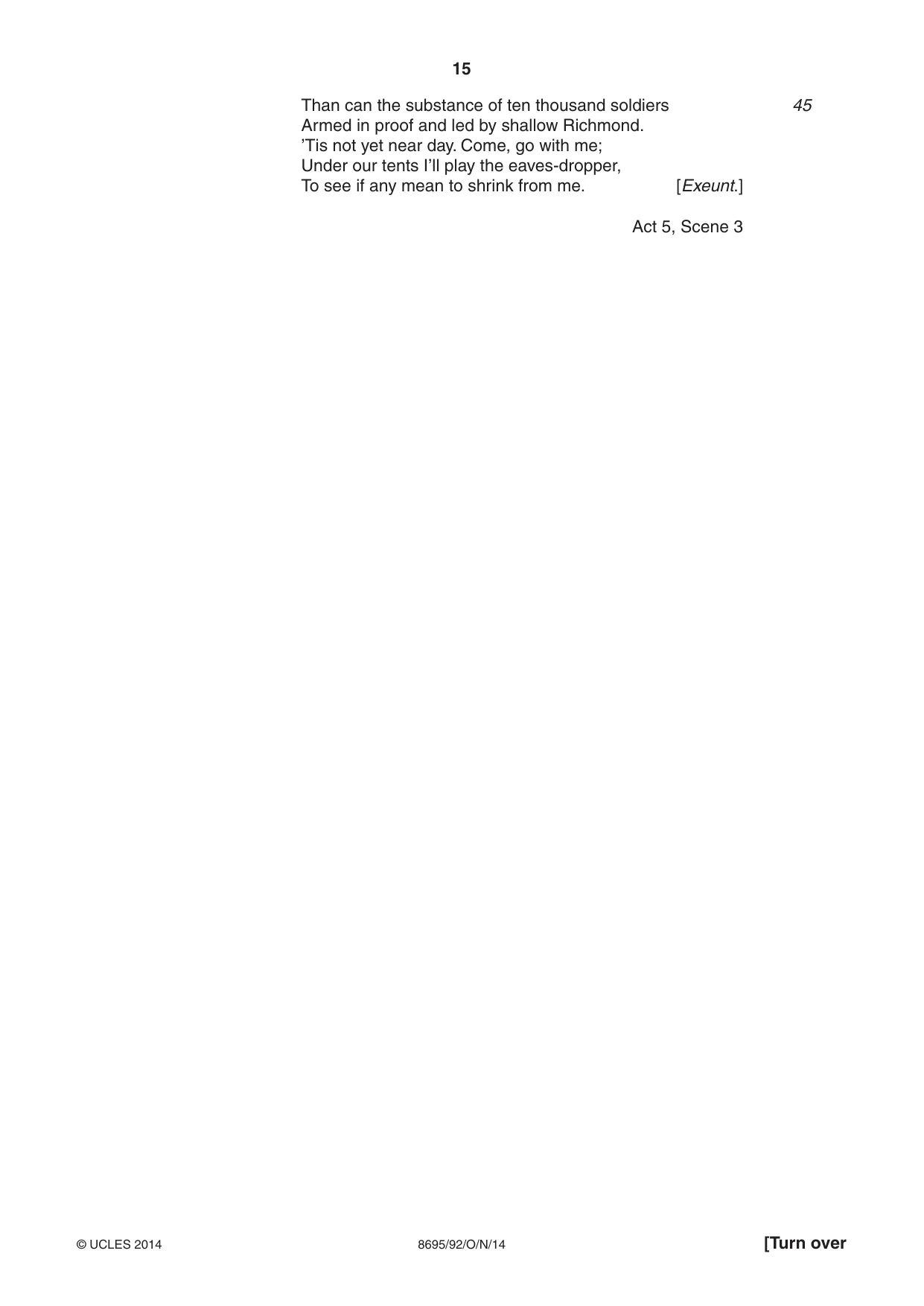
15 8695/92/O/N/14 © UCLES 2014 [Turn over Than can the substance of ten thousand soldiers Armed in proof and led by shallow Richmond. ’Tis not yet near day. Come, go with me; Under our tents I’ll play the eaves-dropper, To see if any mean to shrink from me. [Exeunt.] Act 5, Scene 3 45
Question paper, page 16
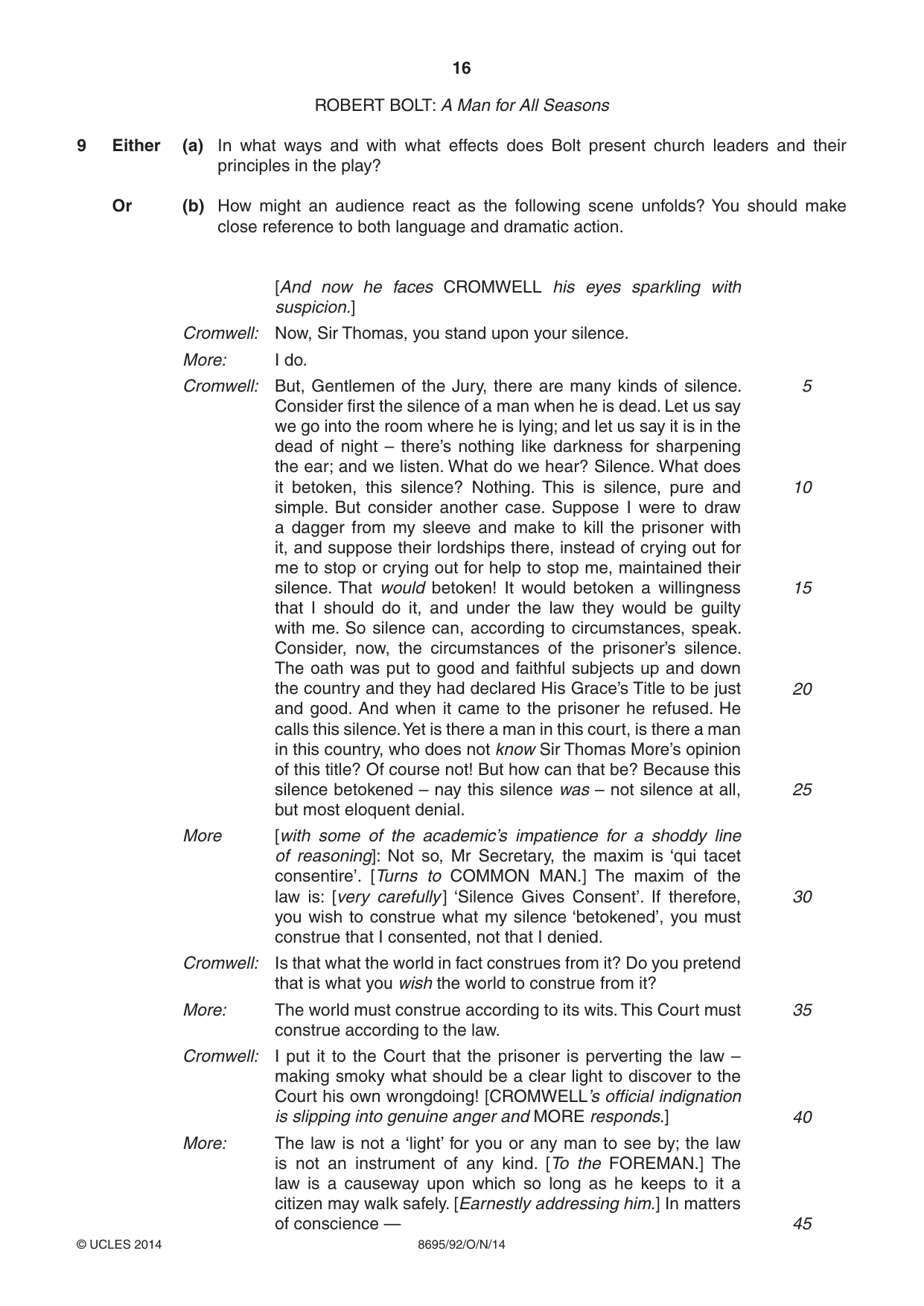
16 8695/92/O/N/14 © UCLES 2014 ROBERT BOLT: A Man for All Seasons 9 Either (a) In what ways and with what effects does Bolt present church leaders and their principles in the play? Or (b) How might an audience react as the following scene unfolds? You should make close reference to both language and dramatic action. [And now he faces CROMWELL his eyes sparkling with suspicion.] Cromwell: Now, Sir Thomas, you stand upon your silence. More: I do. Cromwell: But, Gentlemen of the Jury, there are many kinds of silence. Consider first the silence of a man when he is dead. Let us say we go into the room where he is lying; and let us say it is in the dead of night – there’s nothing like darkness for sharpening the ear; and we listen. What do we hear? Silence. What does it betoken, this silence? Nothing. This is silence, pure and simple. But consider another case. Suppose I were to draw a dagger from my sleeve and make to kill the prisoner with it, and suppose their lordships there, instead of crying out for me to stop or crying out for help to stop me, maintained their silence. That would betoken! It would betoken a willingness that I should do it, and under the law they would be guilty with me. So silence can, according to circumstances, speak. Consider, now, the circumstances of the prisoner’s silence. The oath was put to good and faithful subjects up and down the country and they had declared His Grace’s Title to be just and good. And when it came to the prisoner he refused. He calls this silence. Yet is there a man in this court, is there a man in this country, who does not know Sir Thomas More’s opinion of this title? Of course not! But how can that be? Because this silence betokened – nay this silence was – not silence at all, but most eloquent denial. More [with some of the academic’s impatience for a shoddy line of reasoning]: Not so, Mr Secretary, the maxim is ‘qui tacet consentire’. [Turns to COMMON MAN.] The maxim of the law is: [very carefully ] ‘Silence Gives Consent’. If therefore, you wish to construe what my silence ‘betokened’, you must construe that I consented, not that I denied. Cromwell: Is that what the world in fact construes from it? Do you pretend that is what you wish the world to construe from it? More: The world must construe according to its wits. This Court must construe according to the law. Cromwell: I put it to the Court that the prisoner is perverting the law – making smoky what should be a clear light to discover to the Court his own wrongdoing! [CROMWELL’s official indignation is slipping into genuine anger and MORE responds.] More: The law is not a ‘light’ for you or any man to see by; the law is not an instrument of any kind. [To the FOREMAN.] The law is a causeway upon which so long as he keeps to it a citizen may walk safely. [Earnestly addressing him.] In matters of conscience — 5 10 15 20 25 30 35 40 45
Question paper, page 17
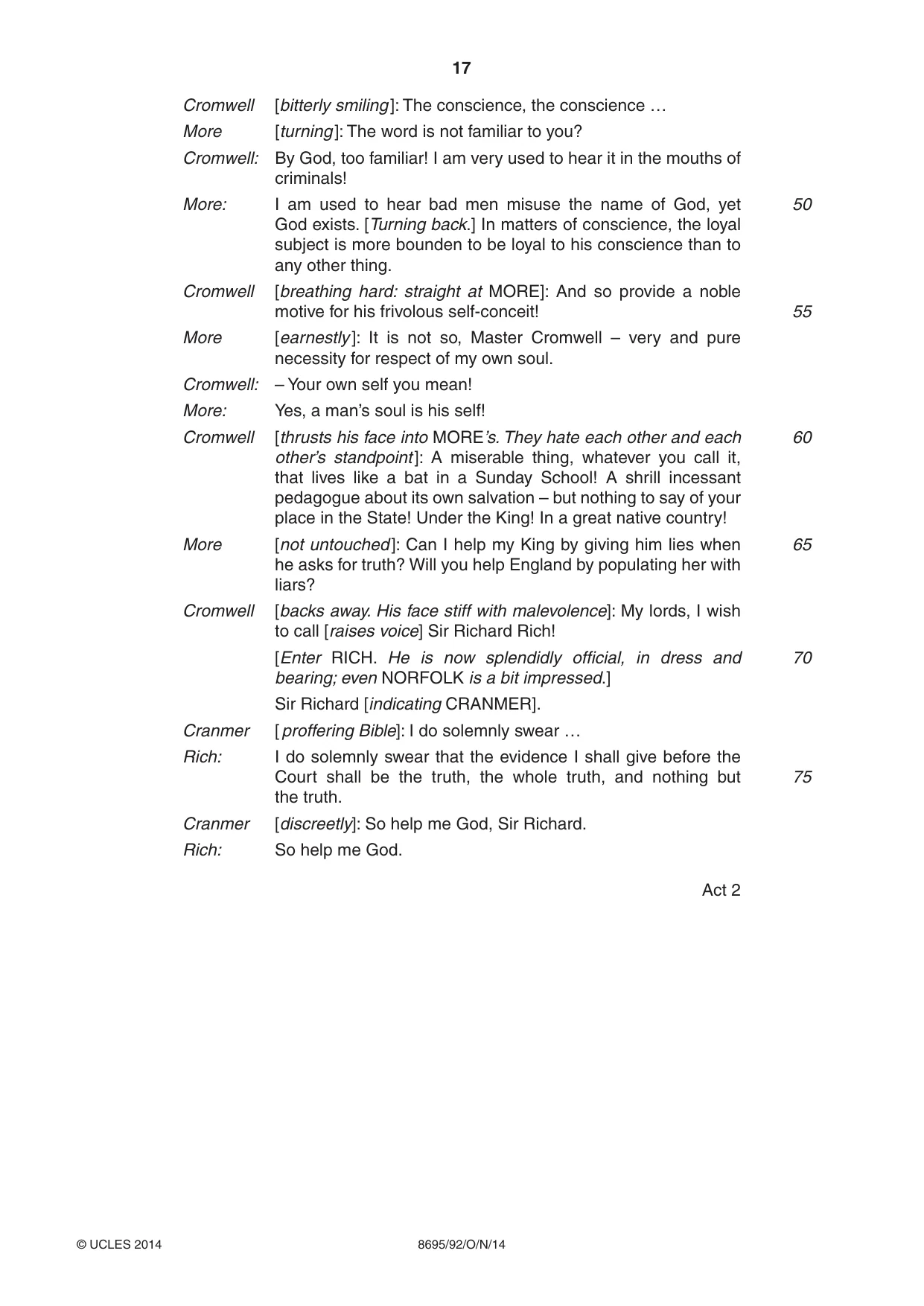
17 8695/92/O/N/14 © UCLES 2014 Cromwell [bitterly smiling ]: The conscience, the conscience … More [turning ]: The word is not familiar to you? Cromwell: By God, too familiar! I am very used to hear it in the mouths of criminals! More: I am used to hear bad men misuse the name of God, yet God exists. [Turning back.] In matters of conscience, the loyal subject is more bounden to be loyal to his conscience than to any other thing. Cromwell [breathing hard: straight at MORE]: And so provide a noble motive for his frivolous self-conceit! More [earnestly ]: It is not so, Master Cromwell – very and pure necessity for respect of my own soul. Cromwell: – Your own self you mean! More: Yes, a man’s soul is his self! Cromwell [thrusts his face into MORE’s. They hate each other and each other’s standpoint ]: A miserable thing, whatever you call it, that lives like a bat in a Sunday School! A shrill incessant pedagogue about its own salvation – but nothing to say of your place in the State! Under the King! In a great native country! More [not untouched ]: Can I help my King by giving him lies when he asks for truth? Will you help England by populating her with liars? Cromwell [backs away. His face stiff with malevolence]: My lords, I wish to call [raises voice] Sir Richard Rich! [Enter RICH. He is now splendidly official, in dress and bearing; even NORFOLK is a bit impressed.] Sir Richard [indicating CRANMER]. Cranmer [ proffering Bible]: I do solemnly swear … Rich: I do solemnly swear that the evidence I shall give before the Court shall be the truth, the whole truth, and nothing but the truth. Cranmer [discreetly]: So help me God, Sir Richard. Rich: So help me God. Act 2 50 55 60 65 70 75
Question paper, page 18
18 8695/92/O/N/14 © UCLES 2014 BLANK PAGE
Question paper, page 19
19 8695/92/O/N/14 © UCLES 2014 BLANK PAGE
Question paper, page 20
20 8695/92/O/N/14 © UCLES 2014 Copyright Acknowledgements: Question 1b Question 4b Question 5b Question 6b Question 7b Question 9b © Seamus Heaney; The Blackbird of Glanmore from District and Circle; Faber & Faber; 2006. © Chimamanda Ngozi Adichie; Half of a Yellow Sun; Harper Collins; 2006. © E M Forster; A Passage To India; Penguin Books Ltd; 1979. © The Enemy by V S Naipaul, reprinted from ‘The Night Watchman’s Occurrence Book’ from A FLAG ON THE ISLAND, © 1967, copyright renewed 1995 by V S Naipaul. © From Who’s Afraid of Virginia Woolf? by Edward Albee. © Albee 1962; Published by Jonathan Cape. Reprinted by permission of the Random House Group Ltd. © A Man for All Seasons by Robert Bolt. Reprinted by permission of Pearson Education. Permission to reproduce items where third-party owned material protected by copyright is included has been sought and cleared where possible. Every reasonable effort has been made by the publisher (UCLES) to trace copyright holders, but if any items requiring clearance have unwittingly been included, the publisher will be pleased to make amends at the earliest possible opportunity. Cambridge International Examinations is part of the Cambridge Assessment Group. Cambridge Assessment is the brand name of University of Cambridge Local Examinations Syndicate (UCLES), which is itself a department of the University of Cambridge. BLANK PAGE
Mark scheme, page 1
® IGCSE is the registered trademark of Cambridge International Examinations. CAMBRIDGE INTERNATIONAL EXAMINATIONS Cambridge International Advanced Subsidiary and Advanced Level MARK SCHEME for the October/November 2014 series 8695 LANGUAGE AND LITERATURE IN ENGLISH 8695/92 Paper 9 (Poetry, Prose and Drama), maximum raw mark 50 This mark scheme is published as an aid to teachers and candidates, to indicate the requirements of the examination. It shows the basis on which Examiners were instructed to award marks. It does not indicate the details of the discussions that took place at an Examiners’ meeting before marking began, which would have considered the acceptability of alternative answers. Mark schemes should be read in conjunction with the question paper and the Principal Examiner Report for Teachers. Cambridge will not enter into discussions about these mark schemes. Cambridge is publishing the mark schemes for the October/November 2014 series for most Cambridge IGCSE®, Cambridge International A and AS Level components and some Cambridge O Level components.
Mark scheme, page 2
Page 2 Mark Scheme Syllabus Paper Cambridge International AS/A Level – October/November 2014 8695 92 © Cambridge International Examinations 2014 Using the mark bands Place the answer in a band first. Look for the “best fit” of the answer into a band. An answer needs to show evidence of most but not necessarily ALL of the qualities described in a band, in order to be placed in that band. Then award a mark for the relative position of the answer within the band. Candidates may address the question in many different ways. Do not expect any particular focus or approach and do not penalise answers for leaving out a particular focus. Reward what is there, showing what you are rewarding, in your comments. Consider all strands and weigh up the performance as a whole in placing the answer in a band, then show that you have done so in the summative comment, e.g. Sound K of texts, some evidence of U but mostly narrative, occasional evidence of P, mainly clear C. Assessment Objectives: • Ability to respond to texts in the three main forms (Prose, Poetry and Drama) of different types and from different cultures; • Understanding of the ways in which writers’ choices of form, structure and language shape meanings; • Ability to produce informed independent opinions and judgements on literary texts; • Ability to communicate clearly the knowledge, understanding and insight appropriate to literary study. Each answer is marked out of 25, in accordance with the General Marking Criteria below. Each band is divided into strands corresponding to the Assessment Objectives – Knowledge, Understanding, Personal Response, Communication.
Mark scheme, page 3
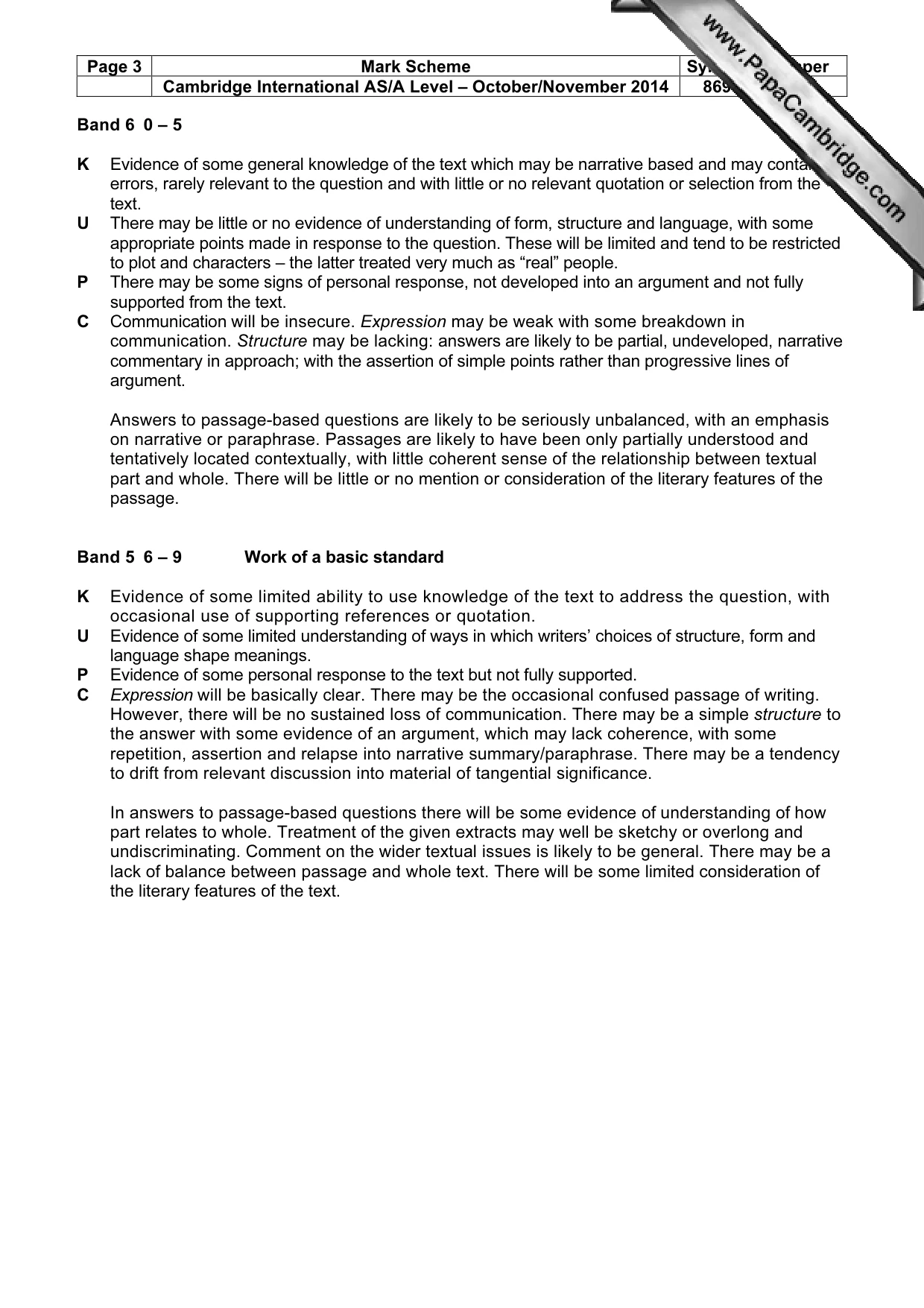
Page 3 Mark Scheme Syllabus Paper Cambridge International AS/A Level – October/November 2014 8695 92 © Cambridge International Examinations 2014 Band 6 0 – 5 K Evidence of some general knowledge of the text which may be narrative based and may contain errors, rarely relevant to the question and with little or no relevant quotation or selection from the text. U There may be little or no evidence of understanding of form, structure and language, with some appropriate points made in response to the question. These will be limited and tend to be restricted to plot and characters – the latter treated very much as “real” people. P There may be some signs of personal response, not developed into an argument and not fully supported from the text. C Communication will be insecure. Expression may be weak with some breakdown in communication. Structure may be lacking: answers are likely to be partial, undeveloped, narrative commentary in approach; with the assertion of simple points rather than progressive lines of argument. Answers to passage-based questions are likely to be seriously unbalanced, with an emphasis on narrative or paraphrase. Passages are likely to have been only partially understood and tentatively located contextually, with little coherent sense of the relationship between textual part and whole. There will be little or no mention or consideration of the literary features of the passage. Band 5 6 – 9 Work of a basic standard K Evidence of some limited ability to use knowledge of the text to address the question, with occasional use of supporting references or quotation. U Evidence of some limited understanding of ways in which writers’ choices of structure, form and language shape meanings. P Evidence of some personal response to the text but not fully supported. C Expression will be basically clear. There may be the occasional confused passage of writing. However, there will be no sustained loss of communication. There may be a simple structure to the answer with some evidence of an argument, which may lack coherence, with some repetition, assertion and relapse into narrative summary/paraphrase. There may be a tendency to drift from relevant discussion into material of tangential significance. In answers to passage-based questions there will be some evidence of understanding of how part relates to whole. Treatment of the given extracts may well be sketchy or overlong and undiscriminating. Comment on the wider textual issues is likely to be general. There may be a lack of balance between passage and whole text. There will be some limited consideration of the literary features of the text.
Mark scheme, page 4
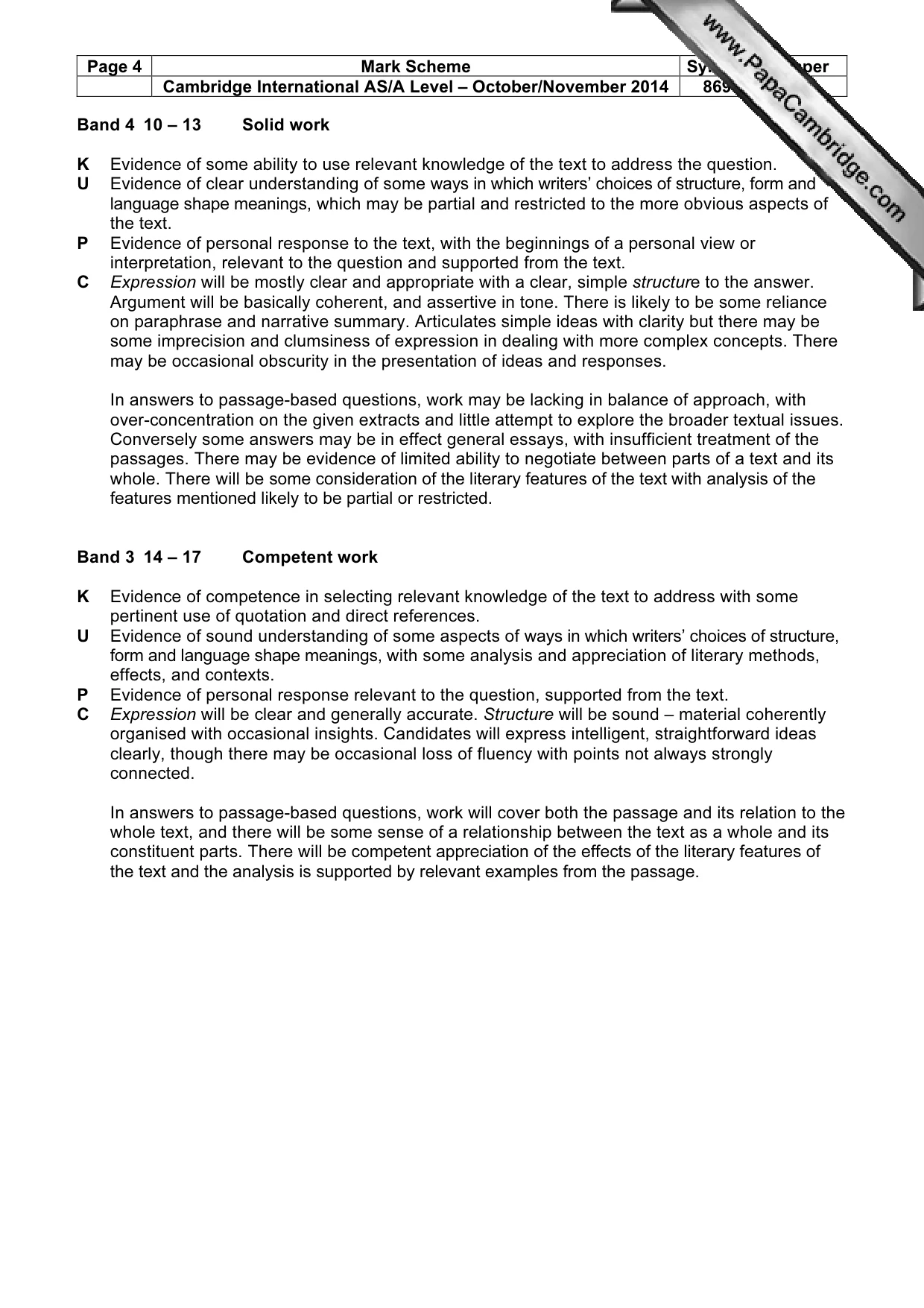
Page 4 Mark Scheme Syllabus Paper Cambridge International AS/A Level – October/November 2014 8695 92 © Cambridge International Examinations 2014 Band 4 10 – 13 Solid work K Evidence of some ability to use relevant knowledge of the text to address the question. U Evidence of clear understanding of some ways in which writers’ choices of structure, form and language shape meanings, which may be partial and restricted to the more obvious aspects of the text. P Evidence of personal response to the text, with the beginnings of a personal view or interpretation, relevant to the question and supported from the text. C Expression will be mostly clear and appropriate with a clear, simple structure to the answer. Argument will be basically coherent, and assertive in tone. There is likely to be some reliance on paraphrase and narrative summary. Articulates simple ideas with clarity but there may be some imprecision and clumsiness of expression in dealing with more complex concepts. There may be occasional obscurity in the presentation of ideas and responses. In answers to passage-based questions, work may be lacking in balance of approach, with over-concentration on the given extracts and little attempt to explore the broader textual issues. Conversely some answers may be in effect general essays, with insufficient treatment of the passages. There may be evidence of limited ability to negotiate between parts of a text and its whole. There will be some consideration of the literary features of the text with analysis of the features mentioned likely to be partial or restricted. Band 3 14 – 17 Competent work K Evidence of competence in selecting relevant knowledge of the text to address with some pertinent use of quotation and direct references. U Evidence of sound understanding of some aspects of ways in which writers’ choices of structure, form and language shape meanings, with some analysis and appreciation of literary methods, effects, and contexts. P Evidence of personal response relevant to the question, supported from the text. C Expression will be clear and generally accurate. Structure will be sound – material coherently organised with occasional insights. Candidates will express intelligent, straightforward ideas clearly, though there may be occasional loss of fluency with points not always strongly connected. In answers to passage-based questions, work will cover both the passage and its relation to the whole text, and there will be some sense of a relationship between the text as a whole and its constituent parts. There will be competent appreciation of the effects of the literary features of the text and the analysis is supported by relevant examples from the passage.
Mark scheme, page 5
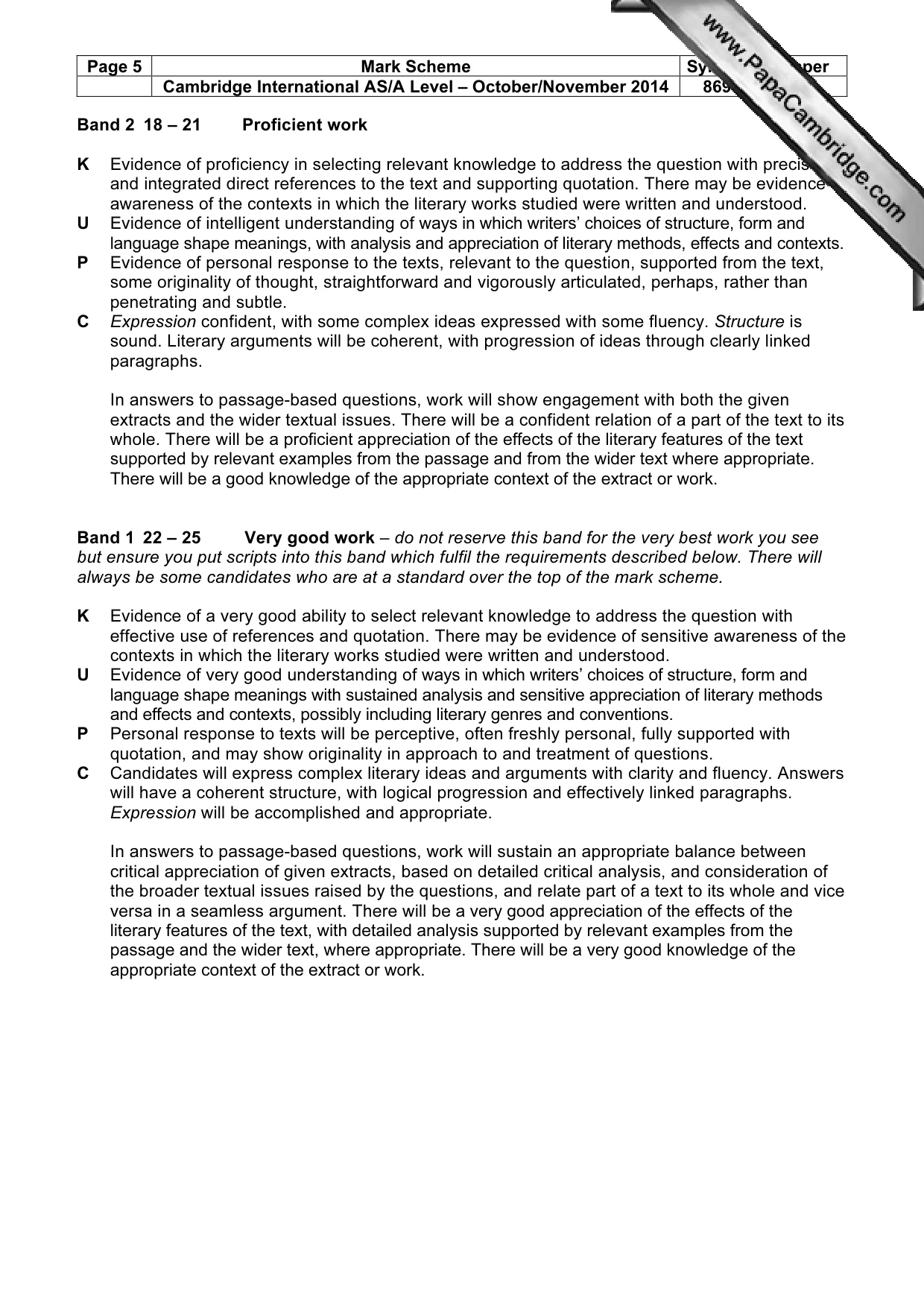
Page 5 Mark Scheme Syllabus Paper Cambridge International AS/A Level – October/November 2014 8695 92 © Cambridge International Examinations 2014 Band 2 18 – 21 Proficient work K Evidence of proficiency in selecting relevant knowledge to address the question with precise and integrated direct references to the text and supporting quotation. There may be evidence of awareness of the contexts in which the literary works studied were written and understood. U Evidence of intelligent understanding of ways in which writers’ choices of structure, form and language shape meanings, with analysis and appreciation of literary methods, effects and contexts. P Evidence of personal response to the texts, relevant to the question, supported from the text, some originality of thought, straightforward and vigorously articulated, perhaps, rather than penetrating and subtle. C Expression confident, with some complex ideas expressed with some fluency. Structure is sound. Literary arguments will be coherent, with progression of ideas through clearly linked paragraphs. In answers to passage-based questions, work will show engagement with both the given extracts and the wider textual issues. There will be a confident relation of a part of the text to its whole. There will be a proficient appreciation of the effects of the literary features of the text supported by relevant examples from the passage and from the wider text where appropriate. There will be a good knowledge of the appropriate context of the extract or work. Band 1 22 – 25 Very good work – do not reserve this band for the very best work you see but ensure you put scripts into this band which fulfil the requirements described below. There will always be some candidates who are at a standard over the top of the mark scheme. K Evidence of a very good ability to select relevant knowledge to address the question with effective use of references and quotation. There may be evidence of sensitive awareness of the contexts in which the literary works studied were written and understood. U Evidence of very good understanding of ways in which writers’ choices of structure, form and language shape meanings with sustained analysis and sensitive appreciation of literary methods and effects and contexts, possibly including literary genres and conventions. P Personal response to texts will be perceptive, often freshly personal, fully supported with quotation, and may show originality in approach to and treatment of questions. C Candidates will express complex literary ideas and arguments with clarity and fluency. Answers will have a coherent structure, with logical progression and effectively linked paragraphs. Expression will be accomplished and appropriate. In answers to passage-based questions, work will sustain an appropriate balance between critical appreciation of given extracts, based on detailed critical analysis, and consideration of the broader textual issues raised by the questions, and relate part of a text to its whole and vice versa in a seamless argument. There will be a very good appreciation of the effects of the literary features of the text, with detailed analysis supported by relevant examples from the passage and the wider text, where appropriate. There will be a very good knowledge of the appropriate context of the extract or work.
What you needed in this session
Cambridge’s own grade thresholds for 2014 Oct/Nov, Paper 9 · Variant 2. A higher threshold means an easier paper — the bar moves with how the cohort did.