Cambridge A Level English - Language and Literature (AS Level only, from 2016) 8695 — 2014 Oct/Nov Paper 9 · Variant 1
8695/91/O/N/14 · 50 marks · ≈56 min
The question paper and its mark scheme, free to read here and free to download. This is Cambridge’s own paper, exactly as it was sat.
Question paper20 pages



Mark scheme5 pages
Answers below. Sit the paper first if you are practising.
Paper as text
Question paper, page 1
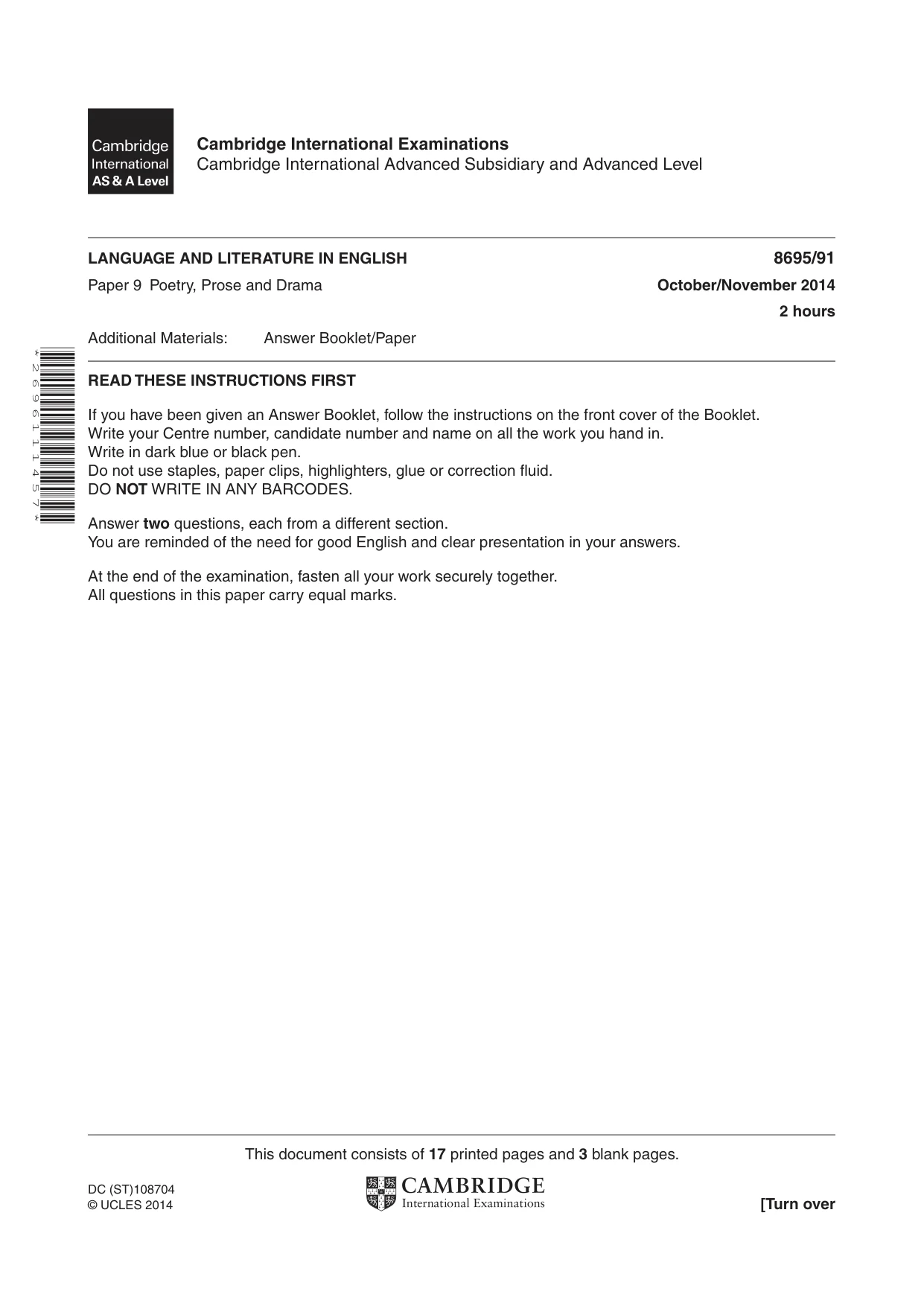
This document consists of 17 printed pages and 3 blank pages. DC (ST)108704 © UCLES 2014 [Turn over Cambridge International Examinations Cambridge International Advanced Subsidiary and Advanced Level * 2 6 9 6 1 1 1 4 5 7 * LANGUAGE AND LITERATURE IN ENGLISH 8695/91 Paper 9 Poetry, Prose and Drama October/November 2014 2 hours Additional Materials: Answer Booklet/Paper READ THESE INSTRUCTIONS FIRST If you have been given an Answer Booklet, follow the instructions on the front cover of the Booklet. Write your Centre number, candidate number and name on all the work you hand in. Write in dark blue or black pen. Do not use staples, paper clips, highlighters, glue or correction fluid. DO NOT WRITE IN ANY BARCODES. Answer two questions, each from a different section. You are reminded of the need for good English and clear presentation in your answers. At the end of the examination, fasten all your work securely together. All questions in this paper carry equal marks.
Question paper, page 2
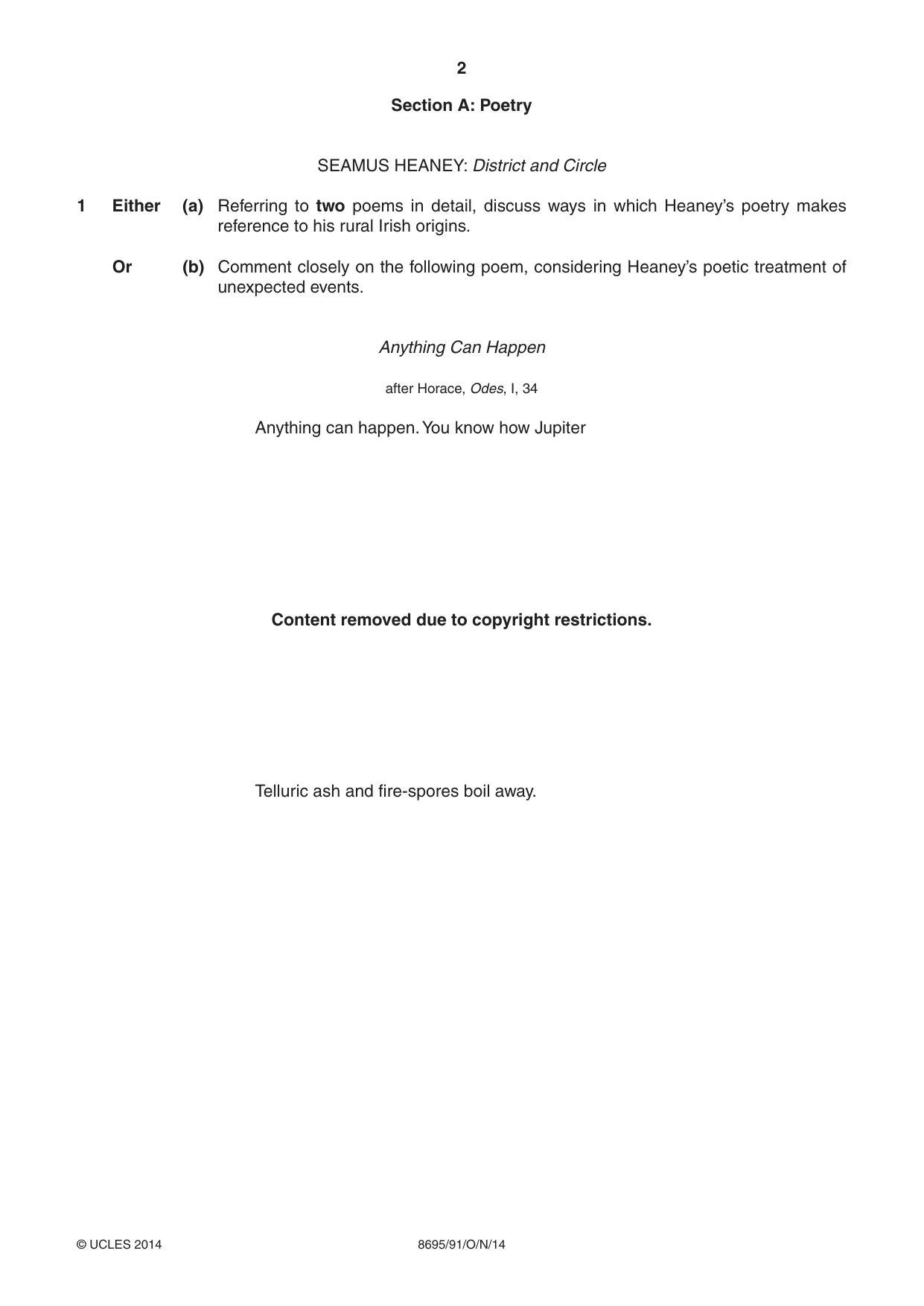
2 8695/91/O/N/14 © UCLES 2014 Section A: Poetry SEAMUS HEANEY: District and Circle 1 Either (a) Referring to two poems in detail, discuss ways in which Heaney’s poetry makes reference to his rural Irish origins. Or (b) Comment closely on the following poem, considering Heaney’s poetic treatment of unexpected events. Anything Can Happen after Horace, Odes, I, 34 Anything can happen. You know how Jupiter Telluric ash and fire-spores boil away. Content removed due to copyright restrictions.
Question paper, page 3
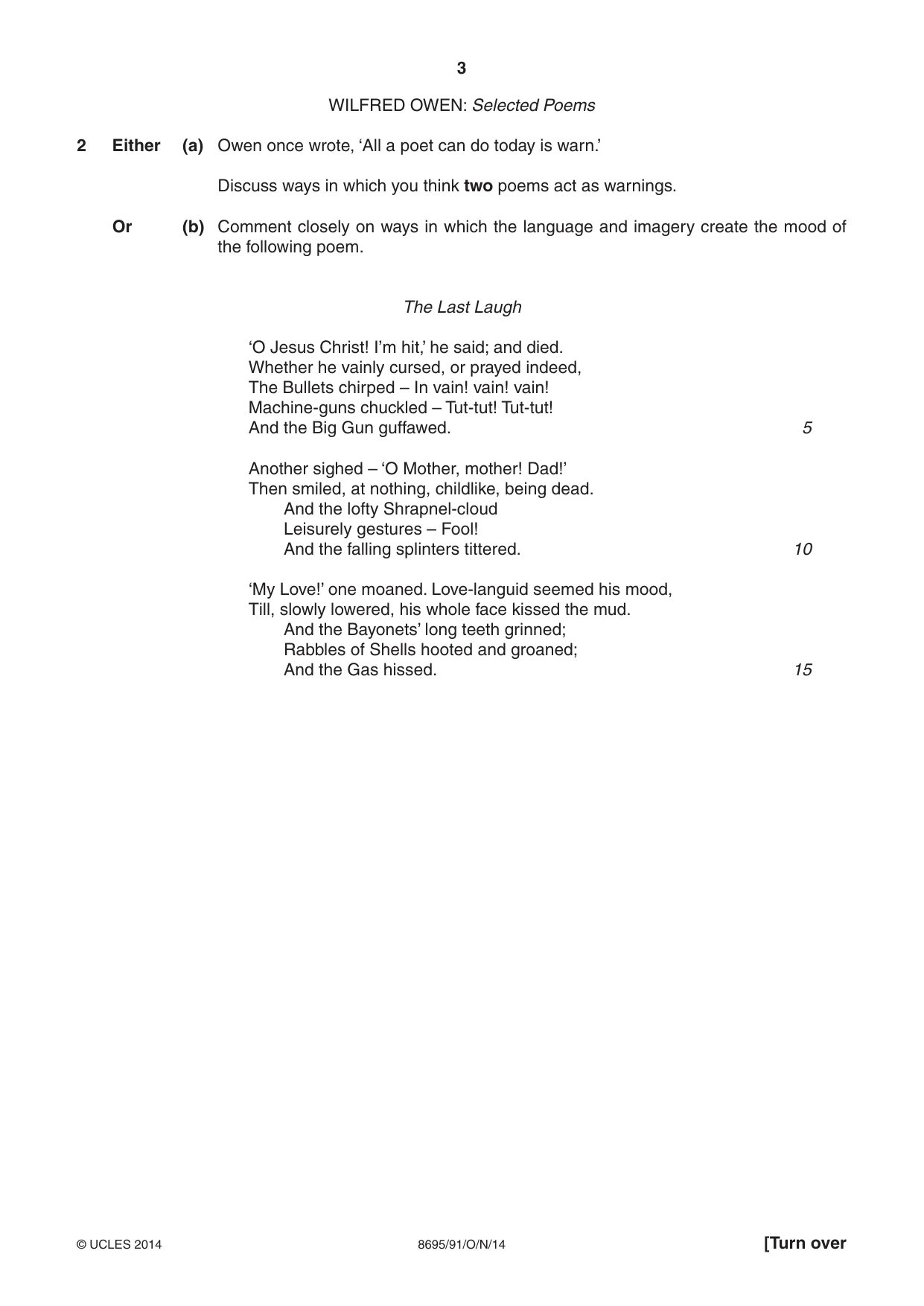
3 8695/91/O/N/14 © UCLES 2014 [Turn over WILFRED OWEN: Selected Poems 2 Either (a) Owen once wrote, ‘All a poet can do today is warn.’ Discuss ways in which you think two poems act as warnings. Or (b) Comment closely on ways in which the language and imagery create the mood of the following poem. The Last Laugh ‘O Jesus Christ! I’m hit,’ he said; and died. Whether he vainly cursed, or prayed indeed, The Bullets chirped – In vain! vain! vain! Machine-guns chuckled – Tut-tut! Tut-tut! And the Big Gun guffawed. Another sighed – ‘O Mother, mother! Dad!’ Then smiled, at nothing, childlike, being dead. And the lofty Shrapnel-cloud Leisurely gestures – Fool! And the falling splinters tittered. ‘My Love!’ one moaned. Love-languid seemed his mood, Till, slowly lowered, his whole face kissed the mud. And the Bayonets’ long teeth grinned; Rabbles of Shells hooted and groaned; And the Gas hissed. 5 10 15
Question paper, page 4
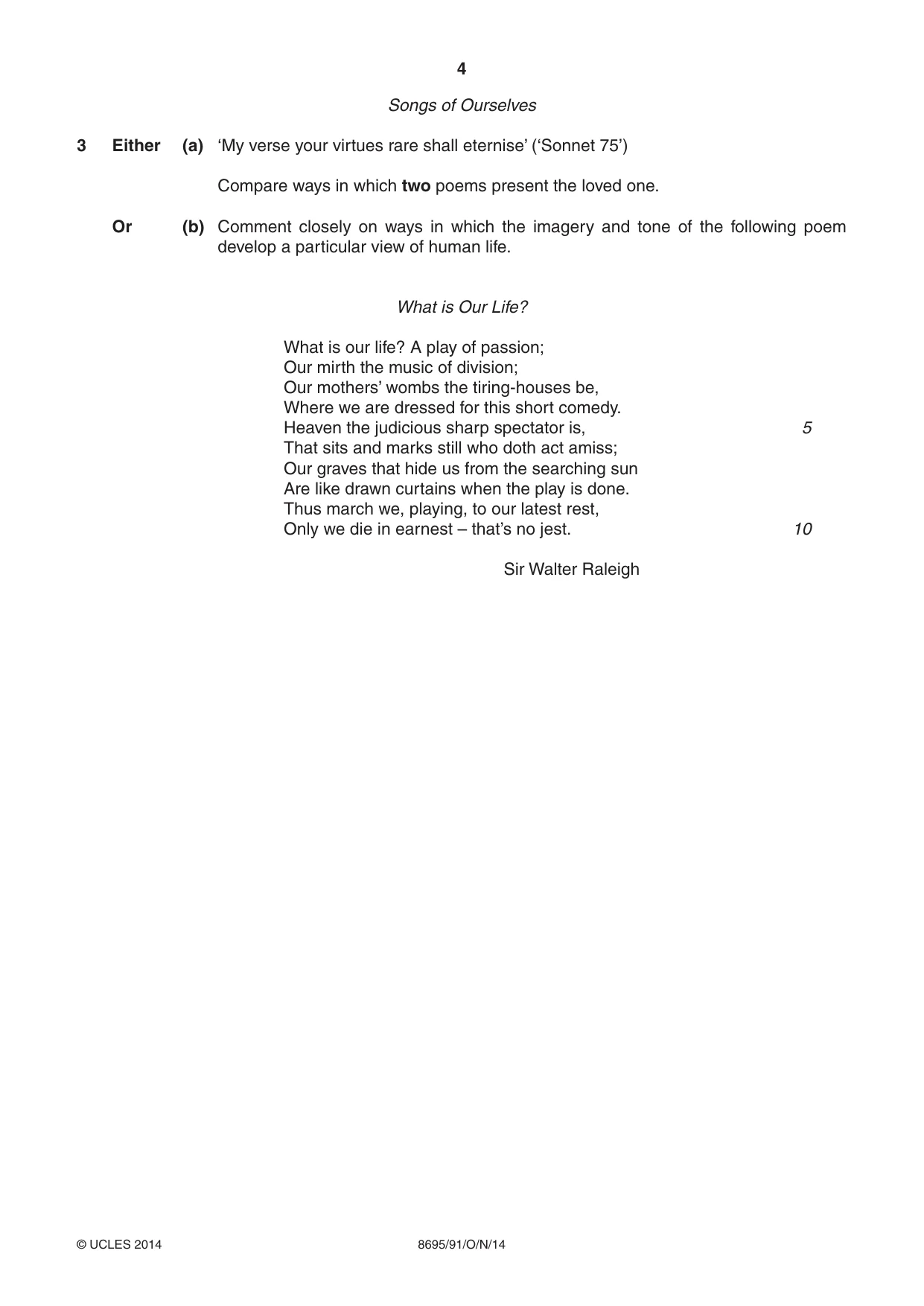
4 8695/91/O/N/14 © UCLES 2014 Songs of Ourselves 3 Either (a) ‘My verse your virtues rare shall eternise’ (‘Sonnet 75’) Compare ways in which two poems present the loved one. Or (b) Comment closely on ways in which the imagery and tone of the following poem develop a particular view of human life. What is Our Life? What is our life? A play of passion; Our mirth the music of division; Our mothers’ wombs the tiring-houses be, Where we are dressed for this short comedy. Heaven the judicious sharp spectator is, That sits and marks still who doth act amiss; Our graves that hide us from the searching sun Are like drawn curtains when the play is done. Thus march we, playing, to our latest rest, Only we die in earnest – that’s no jest. Sir Walter Raleigh 5 10
Question paper, page 5
5 8695/91/O/N/14 © UCLES 2014 [Turn over Turn to page 6 for Question 4
Question paper, page 6
6 8695/91/O/N/14 © UCLES 2014 Section B: Prose CHIMAMANDA NGOZI ADICHIE: Half of a Yellow Sun 4 Either (a) ‘ “The story isn’t my story to tell, really.” Ugwu nodded. He had never thought that it was.’ In what ways does Adichie’s novel explore the idea of whose story it is? Or (b) Comment closely on the following passage, paying particular attention to ways in which it presents the American journalists. Richard disliked him. He disliked his washed-out green eyes and his red- freckled face. Content removed due to copyright restrictions.
Question paper, page 7
7 8695/91/O/N/14 © UCLES 2014 [Turn over ‘Yes.’ Richard paused. Chapter 30 Content removed due to copyright restrictions.
Question paper, page 8
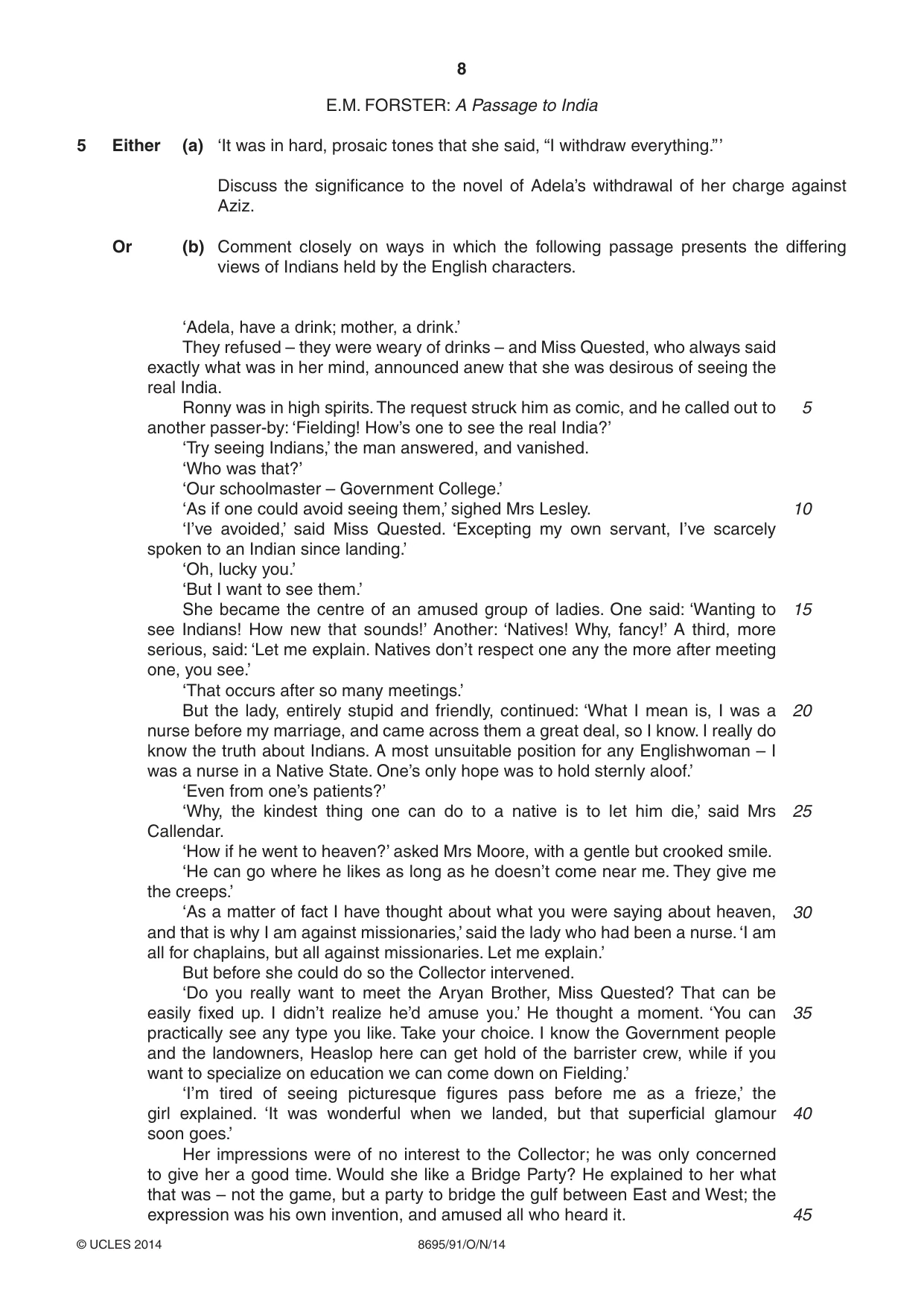
8 8695/91/O/N/14 © UCLES 2014 E.M. FORSTER: A Passage to India 5 Either (a) ‘It was in hard, prosaic tones that she said, “I withdraw everything.” ’ Discuss the significance to the novel of Adela’s withdrawal of her charge against Aziz. Or (b) Comment closely on ways in which the following passage presents the differing views of Indians held by the English characters. ‘Adela, have a drink; mother, a drink.’ They refused – they were weary of drinks – and Miss Quested, who always said exactly what was in her mind, announced anew that she was desirous of seeing the real India. Ronny was in high spirits. The request struck him as comic, and he called out to another passer-by: ‘Fielding! How’s one to see the real India?’ ‘Try seeing Indians,’ the man answered, and vanished. ‘Who was that?’ ‘Our schoolmaster – Government College.’ ‘As if one could avoid seeing them,’ sighed Mrs Lesley. ‘I’ve avoided,’ said Miss Quested. ‘Excepting my own servant, I’ve scarcely spoken to an Indian since landing.’ ‘Oh, lucky you.’ ‘But I want to see them.’ She became the centre of an amused group of ladies. One said: ‘Wanting to see Indians! How new that sounds!’ Another: ‘Natives! Why, fancy!’ A third, more serious, said: ‘Let me explain. Natives don’t respect one any the more after meeting one, you see.’ ‘That occurs after so many meetings.’ But the lady, entirely stupid and friendly, continued: ‘What I mean is, I was a nurse before my marriage, and came across them a great deal, so I know. I really do know the truth about Indians. A most unsuitable position for any Englishwoman – I was a nurse in a Native State. One’s only hope was to hold sternly aloof.’ ‘Even from one’s patients?’ ‘Why, the kindest thing one can do to a native is to let him die,’ said Mrs Callendar. ‘How if he went to heaven?’ asked Mrs Moore, with a gentle but crooked smile. ‘He can go where he likes as long as he doesn’t come near me. They give me the creeps.’ ‘As a matter of fact I have thought about what you were saying about heaven, and that is why I am against missionaries,’ said the lady who had been a nurse. ‘I am all for chaplains, but all against missionaries. Let me explain.’ But before she could do so the Collector intervened. ‘Do you really want to meet the Aryan Brother, Miss Quested? That can be easily fixed up. I didn’t realize he’d amuse you.’ He thought a moment. ‘You can practically see any type you like. Take your choice. I know the Government people and the landowners, Heaslop here can get hold of the barrister crew, while if you want to specialize on education we can come down on Fielding.’ ‘I’m tired of seeing picturesque figures pass before me as a frieze,’ the girl explained. ‘It was wonderful when we landed, but that superficial glamour soon goes.’ Her impressions were of no interest to the Collector; he was only concerned to give her a good time. Would she like a Bridge Party? He explained to her what that was – not the game, but a party to bridge the gulf between East and West; the expression was his own invention, and amused all who heard it. 5 10 15 20 25 30 35 40 45
Question paper, page 9
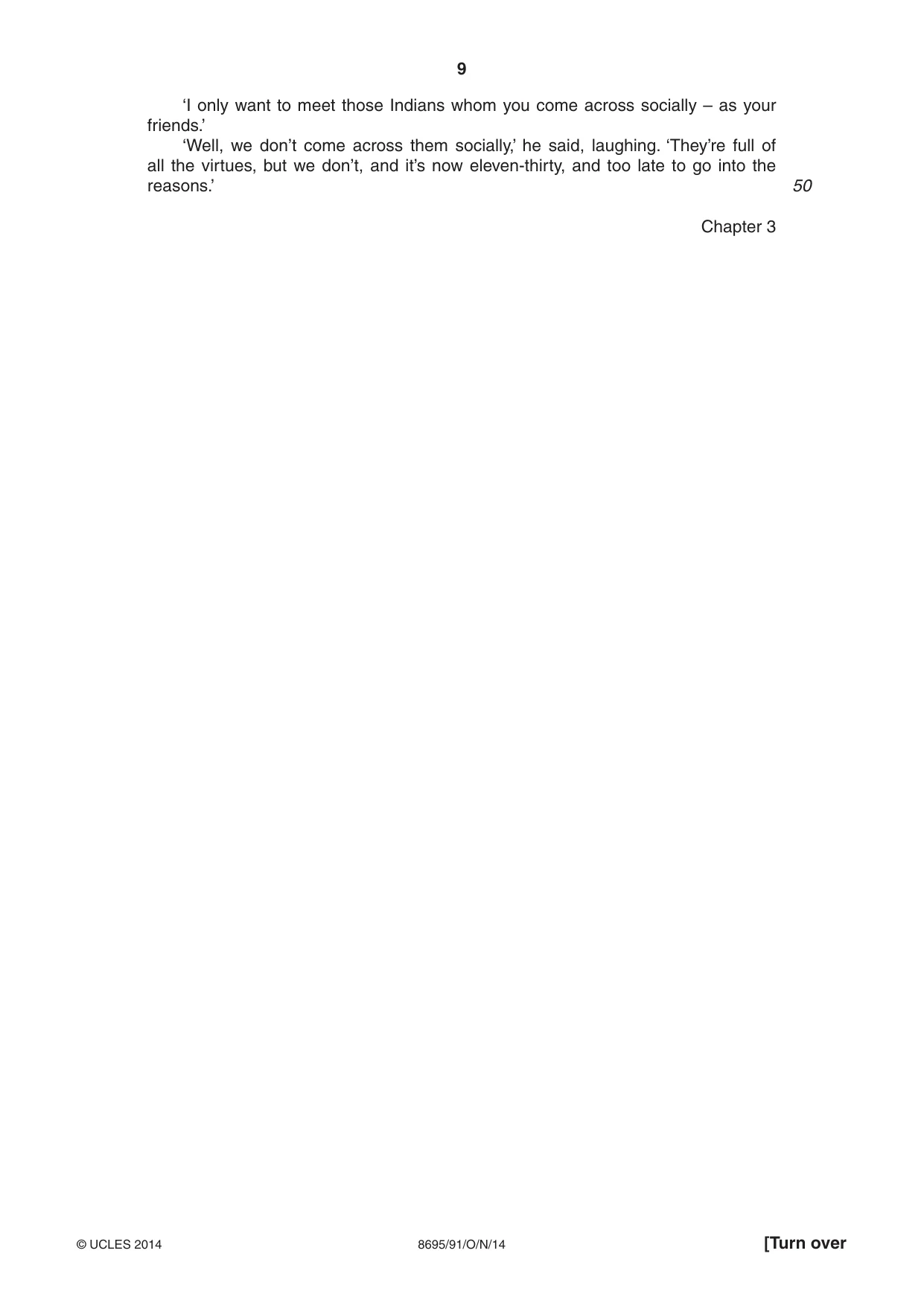
9 8695/91/O/N/14 © UCLES 2014 [Turn over ‘I only want to meet those Indians whom you come across socially – as your friends.’ ‘Well, we don’t come across them socially,’ he said, laughing. ‘They’re full of all the virtues, but we don’t, and it’s now eleven-thirty, and too late to go into the reasons.’ Chapter 3 50
Question paper, page 10
10 8695/91/O/N/14 © UCLES 2014 Stories of Ourselves 6 Either (a) Compare ways in which two stories portray a particular character’s state of mind. Or (b) Comment closely on the following passage, considering ways in which it presents Mr Mitra’s responses to the shraddh ceremony. A narrow, tiled, clean corridor, going past forty-six and forty-seven, led to the main door to forty-nine, which was open. He’d Content removed due to copyright restrictions.
Question paper, page 11
11 8695/91/O/N/14 © UCLES 2014 [Turn over known more about her academic record, one or two charming anecdotes to do with her success at school, her decent first-class degree, and about her husband, Gautam Poddar, diversifying into new areas of business, than about her. Real Time
Question paper, page 12
12 8695/91/O/N/14 © UCLES 2014 Section C: Drama EDWARD ALBEE: Who’s Afraid of Virginia Woolf? 7 Either (a) What are the dramatic effects of George and Martha choosing to dissect their relationship in front of Nick and Honey? Or (b) With close reference to detail, discuss the dramatic significance of this moment, the first time that Nick and George are alone together. George: It’s just a private joke between li’l ol’ Martha and me. [They sit.] So? [Pause] So … you’re in the Math Department, eh? Nick: No … uh, no. George: Martha said you were. I think that’s what she said. [Not too friendly] What made you decide to be a teacher? Nick: Oh … well, the same things that … uh … motivated you, I imagine. George: What were they? Nick [formal ]: Pardon? George: I said, what were they? What were the things that motivated me? Nick [laughing uneasily]: Well … I’m sure I don’t know. George: You just finished saying that the things that motivated you were the same things that motivated me. Nick [with a little pique]: I said I imagined they were. George [offhand ]: Did you? [Pause] Well.… [Pause] You like it here? Nick [looking about the room]: Yes … it’s … it’s fine. George: I mean the University. Nick: Oh.… I thought you meant … George: Yes … I can see you did. [Pause] I meant the University. Nick: Well, I … I like it … fine. [As GEORGE just stares at him] Just fine. [Same] You … you’ve been here quite a long time, haven’t you? George [absently, as if he had not heard ]: What? Oh … yes. Ever since I married … uh, What’s-her-name … uh, Martha. Even before that. [Pause] For ever. [To himself ] Dashed hopes, and good intentions. Good, better, best, bested. [Back to NICk] How do you like that for a declension, young man? Eh? Nick: Sir, I’m sorry if we … George [with an edge in his voice]: You didn’t answer my question. Nick: Sir? George: Don’t you condescend to me! [Toying with him] I asked you how you liked that for a declension: Good; better; best; bested. Hm? Well? Nick [with some distaste]: I really don’t know what to say. George [feigned incredulousness]: You really don’t know what to say? Nick [snapping it out ]: All right … what do you want me to say? Do 5 10 15 20 25 30 35
Question paper, page 13
13 8695/91/O/N/14 © UCLES 2014 [Turn over you want me to say it’s funny, so you can contradict me and say it’s sad? Or do you want me to say it’s sad so you can turn around and say no, it’s funny. You can play that damn little game any way you want to, you know! George [feigned awe]: Very good! Very good! Nick [even angrier than before]: And when my wife comes back, I think we’ll just … George [sincere]: Now, now … calm down, my boy. Just … calm … down. [Pause] All right? [Pause] You want another drink? Here, give me your glass. Nick: I still have one. I do think that when my wife comes downstairs … George: Here … I’ll freshen it. Give me your glass. [Takes it.] Nick: What I mean is … you two … you and your wife … seem to be having some sort of a … George: Martha and I are having … nothing. Martha and I are merely … exercising … that’s all … we’re merely walking what’s left of our wits. Don’t pay any attention to it. Nick [undecided ]: Still … George [an abrupt change of pace]: Well, now … let’s sit down and talk, hunh? Nick [cool again]: It’s just that I don’t like to … become involved … [An afterthought.] uh … in other people’s affairs. George [comforting a child ]: Well, you’ll get over that … small college and all. Musical beds is the faculty sport around here. Nick: Sir? George: I said, musical beds is the faculty … Never mind. I wish you wouldn’t go ‘Sir’ like that … not with the question-mark at the end of it. You know? Sir? I know it’s meant to be a sign of respect for your [Winces] elders … but … uh … the way you do it.… Uh … Sir? … Madam? Nick [with a small, noncommittal smile]: No disrespect intended. Act 1 40 45 50 55 60 65
Question paper, page 14
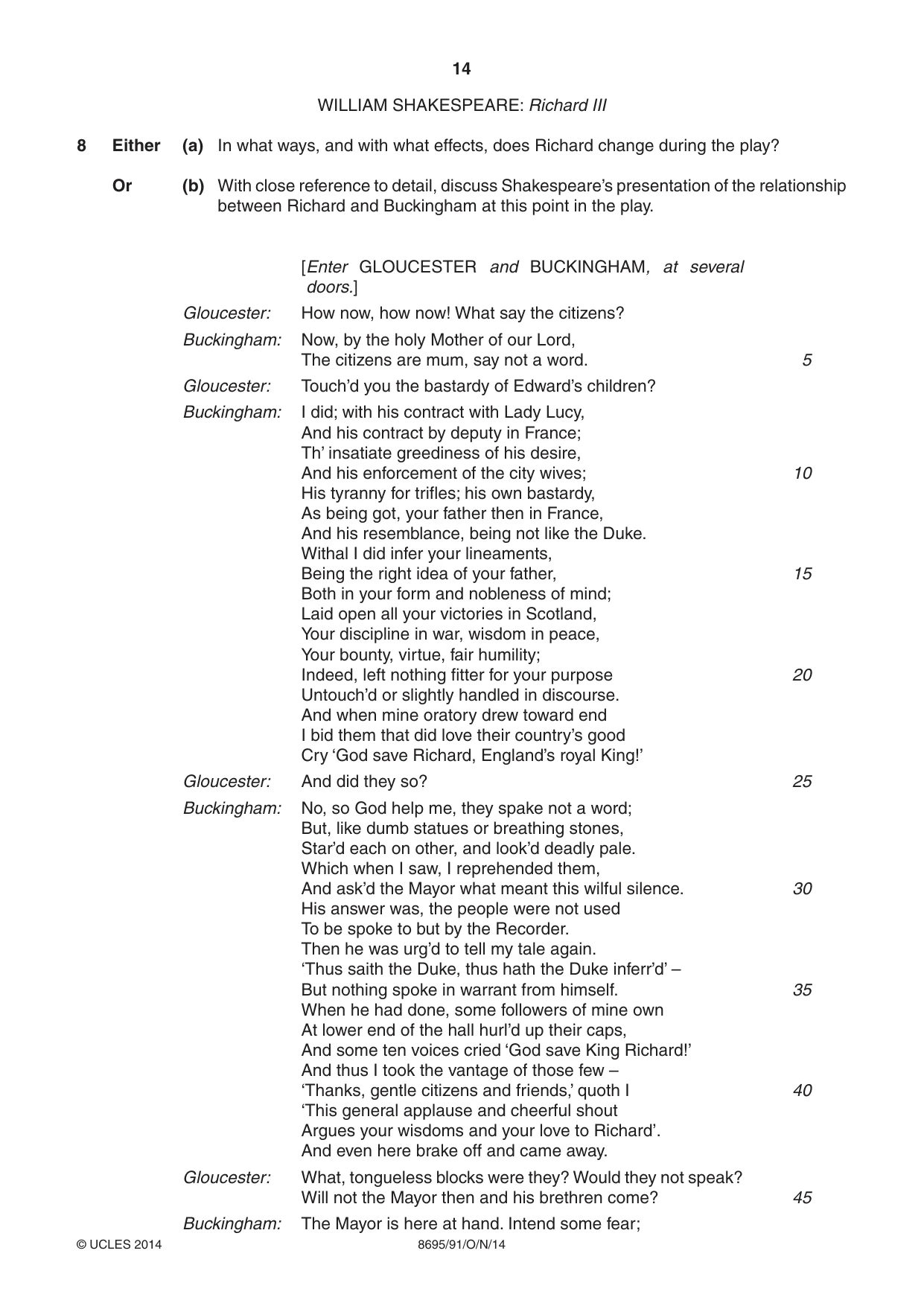
14 8695/91/O/N/14 © UCLES 2014 WILLIAM SHAkESPEARE: Richard III 8 Either (a) In what ways, and with what effects, does Richard change during the play? Or (b) With close reference to detail, discuss Shakespeare’s presentation of the relationship between Richard and Buckingham at this point in the play. [ Enter GLOUCESTER and BUCkINGHAM, at several doors.] Gloucester: How now, how now! What say the citizens? Buckingham: Now, by the holy Mother of our Lord, The citizens are mum, say not a word. Gloucester: Touch’d you the bastardy of Edward’s children? Buckingham: I did; with his contract with Lady Lucy, And his contract by deputy in France; Th’ insatiate greediness of his desire, And his enforcement of the city wives; His tyranny for trifles; his own bastardy, As being got, your father then in France, And his resemblance, being not like the Duke. Withal I did infer your lineaments, Being the right idea of your father, Both in your form and nobleness of mind; Laid open all your victories in Scotland, Your discipline in war, wisdom in peace, Your bounty, virtue, fair humility; Indeed, left nothing fitter for your purpose Untouch’d or slightly handled in discourse. And when mine oratory drew toward end I bid them that did love their country’s good Cry ‘God save Richard, England’s royal king!’ Gloucester: And did they so? Buckingham: No, so God help me, they spake not a word; But, like dumb statues or breathing stones, Star’d each on other, and look’d deadly pale. Which when I saw, I reprehended them, And ask’d the Mayor what meant this wilful silence. His answer was, the people were not used To be spoke to but by the Recorder. Then he was urg’d to tell my tale again. ‘Thus saith the Duke, thus hath the Duke inferr’d’ – But nothing spoke in warrant from himself. When he had done, some followers of mine own At lower end of the hall hurl’d up their caps, And some ten voices cried ‘God save king Richard!’ And thus I took the vantage of those few – ‘Thanks, gentle citizens and friends,’ quoth I ‘This general applause and cheerful shout Argues your wisdoms and your love to Richard’. And even here brake off and came away. Gloucester: What, tongueless blocks were they? Would they not speak? Will not the Mayor then and his brethren come? Buckingham: The Mayor is here at hand. Intend some fear; 5 10 15 20 25 30 35 40 45
Question paper, page 15
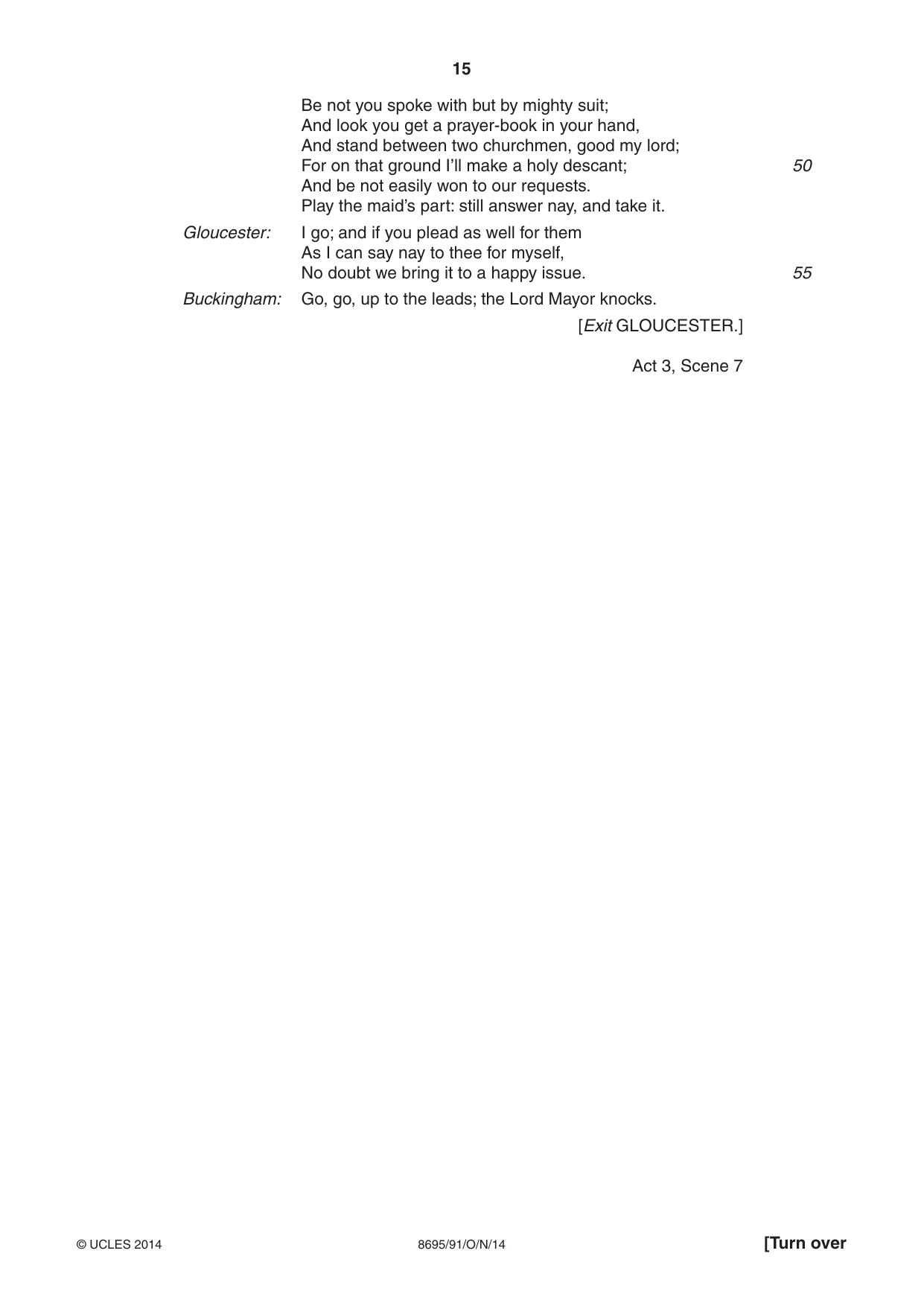
15 8695/91/O/N/14 © UCLES 2014 [Turn over Be not you spoke with but by mighty suit; And look you get a prayer-book in your hand, And stand between two churchmen, good my lord; For on that ground I’ll make a holy descant; And be not easily won to our requests. Play the maid’s part: still answer nay, and take it. Gloucester: I go; and if you plead as well for them As I can say nay to thee for myself, No doubt we bring it to a happy issue. Buckingham: Go, go, up to the leads; the Lord Mayor knocks. [Exit GLOUCESTER.] Act 3, Scene 7 50 55
Question paper, page 16
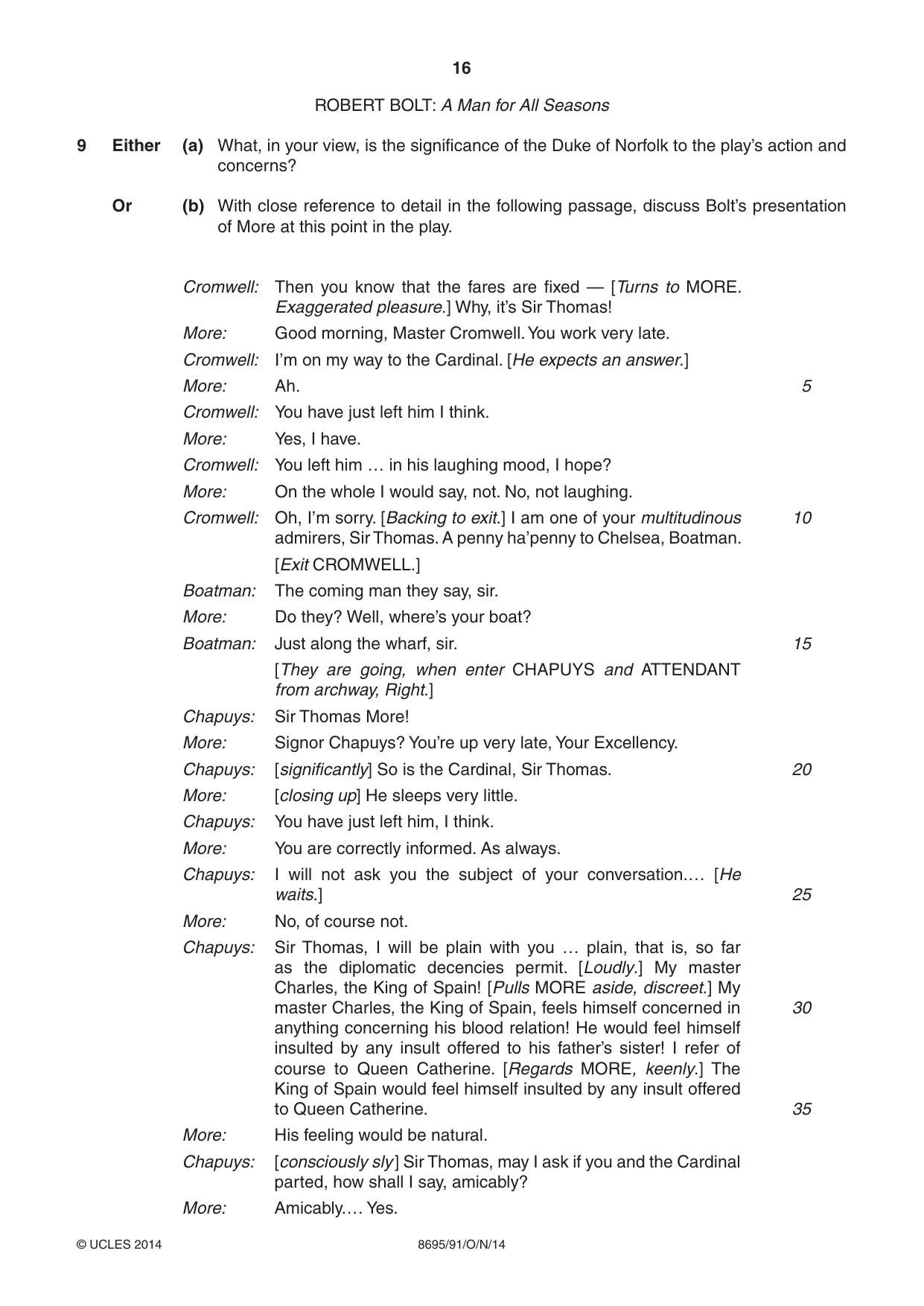
16 8695/91/O/N/14 © UCLES 2014 ROBERT BOLT: A Man for All Seasons 9 Either (a) What, in your view, is the significance of the Duke of Norfolk to the play’s action and concerns? Or (b) With close reference to detail in the following passage, discuss Bolt’s presentation of More at this point in the play. Cromwell: Then you know that the fares are fixed — [Turns to MORE. Exaggerated pleasure.] Why, it’s Sir Thomas! More: Good morning, Master Cromwell. You work very late. Cromwell: I’m on my way to the Cardinal. [He expects an answer.] More: Ah. Cromwell: You have just left him I think. More: Yes, I have. Cromwell: You left him … in his laughing mood, I hope? More: On the whole I would say, not. No, not laughing. Cromwell: Oh, I’m sorry. [Backing to exit.] I am one of your multitudinous admirers, Sir Thomas. A penny ha’penny to Chelsea, Boatman. [Exit CROMWELL.] Boatman: The coming man they say, sir. More: Do they? Well, where’s your boat? Boatman: Just along the wharf, sir. [They are going, when enter CHAPUYS and ATTENDANT from archway, Right.] Chapuys: Sir Thomas More! More: Signor Chapuys? You’re up very late, Your Excellency. Chapuys: [significantly] So is the Cardinal, Sir Thomas. More: [closing up] He sleeps very little. Chapuys: You have just left him, I think. More: You are correctly informed. As always. Chapuys: I will not ask you the subject of your conversation.… [He waits.] More: No, of course not. Chapuys: Sir Thomas, I will be plain with you … plain, that is, so far as the diplomatic decencies permit. [Loudly.] My master Charles, the king of Spain! [Pulls MORE aside, discreet.] My master Charles, the king of Spain, feels himself concerned in anything concerning his blood relation! He would feel himself insulted by any insult offered to his father’s sister! I refer of course to Queen Catherine. [Regards MORE, keenly.] The king of Spain would feel himself insulted by any insult offered to Queen Catherine. More: His feeling would be natural. Chapuys: [consciously sly ] Sir Thomas, may I ask if you and the Cardinal parted, how shall I say, amicably? More: Amicably.… Yes. 5 10 15 20 25 30 35
Question paper, page 17
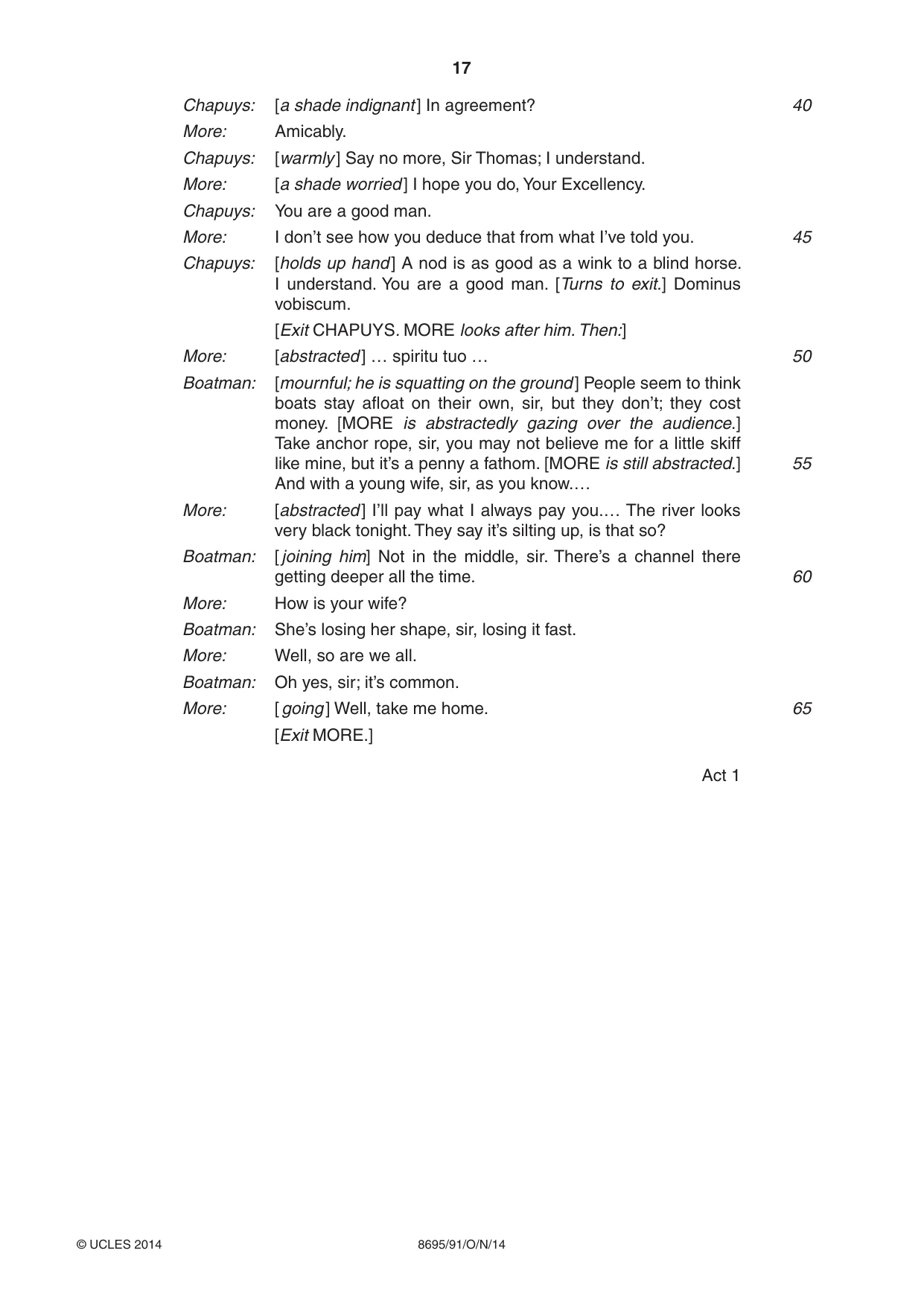
17 8695/91/O/N/14 © UCLES 2014 Chapuys: [a shade indignant ] In agreement? More: Amicably. Chapuys: [warmly ] Say no more, Sir Thomas; I understand. More: [a shade worried ] I hope you do, Your Excellency. Chapuys: You are a good man. More: I don’t see how you deduce that from what I’ve told you. Chapuys: [holds up hand ] A nod is as good as a wink to a blind horse. I understand. You are a good man. [Turns to exit.] Dominus vobiscum. [Exit CHAPUYS. MORE looks after him. Then:] More: [abstracted ] … spiritu tuo … Boatman: [mournful; he is squatting on the ground ] People seem to think boats stay afloat on their own, sir, but they don’t; they cost money. [MORE is abstractedly gazing over the audience.] Take anchor rope, sir, you may not believe me for a little skiff like mine, but it’s a penny a fathom. [MORE is still abstracted.] And with a young wife, sir, as you know.… More: [abstracted ] I’ll pay what I always pay you.… The river looks very black tonight. They say it’s silting up, is that so? Boatman: [ joining him] Not in the middle, sir. There’s a channel there getting deeper all the time. More: How is your wife? Boatman: She’s losing her shape, sir, losing it fast. More: Well, so are we all. Boatman: Oh yes, sir; it’s common. More: [ going ] Well, take me home. [Exit MORE.] Act 1 40 45 50 55 60 65
Question paper, page 18
18 8695/91/O/N/14 © UCLES 2014 BLANK PAGE
Question paper, page 19
19 8695/91/O/N/14 © UCLES 2014 BLANK PAGE
Question paper, page 20
20 8695/91/O/N/14 © UCLES 2014 BLANK PAGE Copyright Acknowledgements: Question 1b © Seamus Heaney; Anything Can Happen from District and Circle; Faber & Faber; 2006. Question 4b © Chimamanda Ngozi Adichie; Half of a Yellow Sun; Harper Collins; 2006. Question 5b © E M Forster; A Passage To India; Penguin Books Ltd; 1979. Question 6b © ‘Real Time’ from REAL TIME by Amit Chaudhuri, reprinted with permission from Pan Macmillan. © Amit Chaudhuri, 2002. Question 7b From Who’s Afraid of Virginia Woolf by Edward Albee. © Albee 1962; Published by Jonathan Cape. Reprinted by permission of the Random House Group Ltd. Question 9b © A Man for All Seasons by Robert Bolt. Reprinted by permission of Pearson Education. Permission to reproduce items where third-party owned material protected by copyright is included has been sought and cleared where possible. Every reasonable effort has been made by the publisher (UCLES) to trace copyright holders, but if any items requiring clearance have unwittingly been included, the publisher will be pleased to make amends at the earliest possible opportunity. Cambridge International Examinations is part of the Cambridge Assessment Group. Cambridge Assessment is the brand name of University of Cambridge Local Examinations Syndicate (UCLES), which is itself a department of the University of Cambridge.
Mark scheme, page 1
® IGCSE is the registered trademark of Cambridge International Examinations. CAMBRIDGE INTERNATIONAL EXAMINATIONS Cambridge International Advanced Subsidiary and Advanced Level MARK SCHEME for the October/November 2014 series 8695 LANGUAGE AND LITERATURE IN ENGLISH 8695/91 Paper 9 (Poetry, Prose and Drama), maximum raw mark 50 This mark scheme is published as an aid to teachers and candidates, to indicate the requirements of the examination. It shows the basis on which Examiners were instructed to award marks. It does not indicate the details of the discussions that took place at an Examiners’ meeting before marking began, which would have considered the acceptability of alternative answers. Mark schemes should be read in conjunction with the question paper and the Principal Examiner Report for Teachers. Cambridge will not enter into discussions about these mark schemes. Cambridge is publishing the mark schemes for the October/November 2014 series for most Cambridge IGCSE®, Cambridge International A and AS Level components and some Cambridge O Level components.
Mark scheme, page 2
Page 2 Mark Scheme Syllabus Paper Cambridge International AS/A Level – October/November 2014 8695 91 © Cambridge International Examinations 2014 Using the mark bands Place the answer in a band first. Look for the “best fit” of the answer into a band. An answer needs to show evidence of most but not necessarily ALL of the qualities described in a band, in order to be placed in that band. Then award a mark for the relative position of the answer within the band. Candidates may address the question in many different ways. Do not expect any particular focus or approach and do not penalise answers for leaving out a particular focus. Reward what is there, showing what you are rewarding, in your comments. Consider all strands and weigh up the performance as a whole in placing the answer in a band, then show that you have done so in the summative comment, e.g. Sound K of texts, some evidence of U but mostly narrative, occasional evidence of P, mainly clear C. Assessment Objectives: • Ability to respond to texts in the three main forms (Prose, Poetry and Drama) of different types and from different cultures; • Understanding of the ways in which writers’ choices of form, structure and language shape meanings; • Ability to produce informed independent opinions and judgements on literary texts; • Ability to communicate clearly the knowledge, understanding and insight appropriate to literary study. Each answer is marked out of 25, in accordance with the General Marking Criteria below. Each band is divided into strands corresponding to the Assessment Objectives – Knowledge, Understanding, Personal Response, Communication.
Mark scheme, page 3
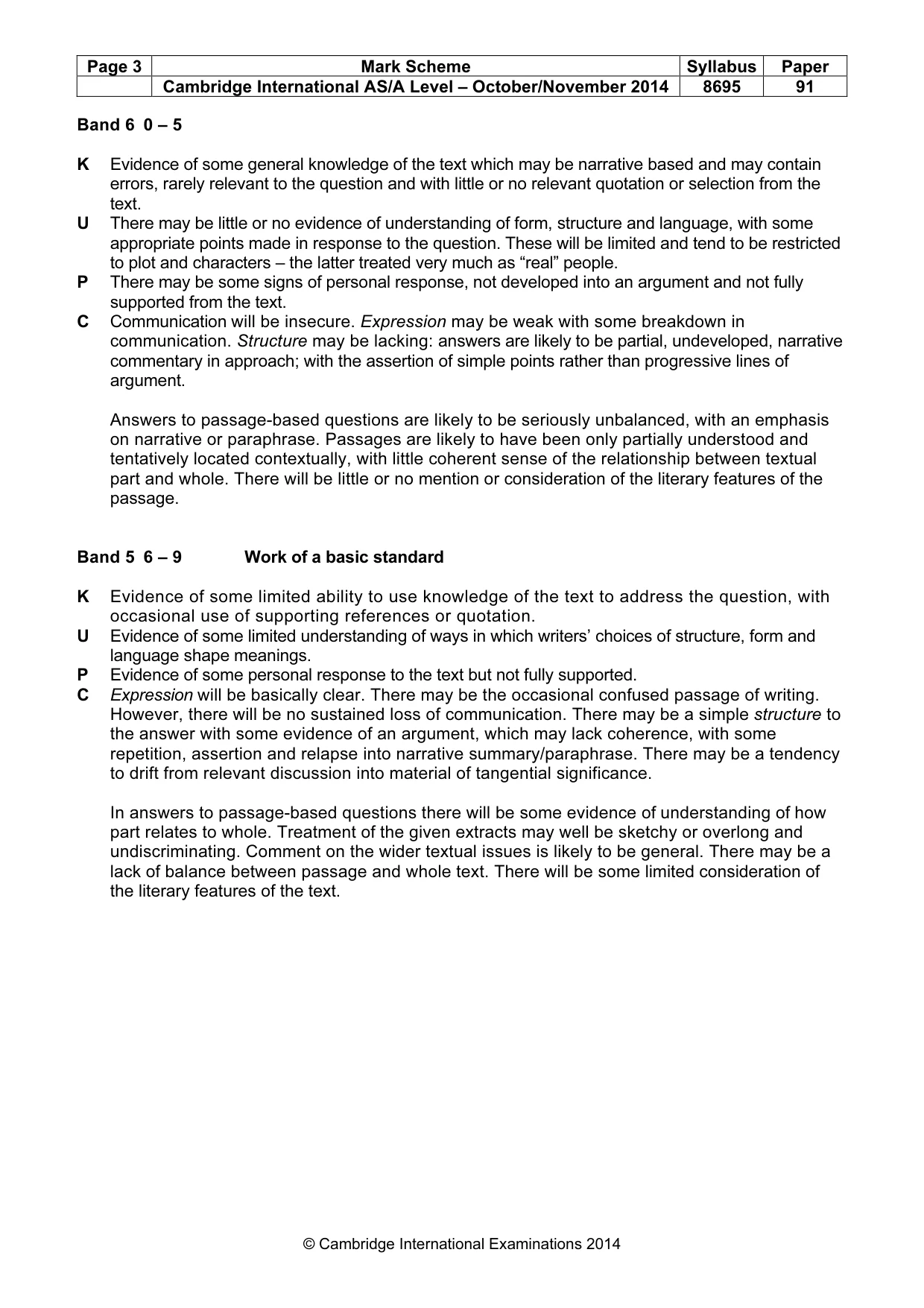
Page 3 Mark Scheme Syllabus Paper Cambridge International AS/A Level – October/November 2014 8695 91 © Cambridge International Examinations 2014 Band 6 0 – 5 K Evidence of some general knowledge of the text which may be narrative based and may contain errors, rarely relevant to the question and with little or no relevant quotation or selection from the text. U There may be little or no evidence of understanding of form, structure and language, with some appropriate points made in response to the question. These will be limited and tend to be restricted to plot and characters – the latter treated very much as “real” people. P There may be some signs of personal response, not developed into an argument and not fully supported from the text. C Communication will be insecure. Expression may be weak with some breakdown in communication. Structure may be lacking: answers are likely to be partial, undeveloped, narrative commentary in approach; with the assertion of simple points rather than progressive lines of argument. Answers to passage-based questions are likely to be seriously unbalanced, with an emphasis on narrative or paraphrase. Passages are likely to have been only partially understood and tentatively located contextually, with little coherent sense of the relationship between textual part and whole. There will be little or no mention or consideration of the literary features of the passage. Band 5 6 – 9 Work of a basic standard K Evidence of some limited ability to use knowledge of the text to address the question, with occasional use of supporting references or quotation. U Evidence of some limited understanding of ways in which writers’ choices of structure, form and language shape meanings. P Evidence of some personal response to the text but not fully supported. C Expression will be basically clear. There may be the occasional confused passage of writing. However, there will be no sustained loss of communication. There may be a simple structure to the answer with some evidence of an argument, which may lack coherence, with some repetition, assertion and relapse into narrative summary/paraphrase. There may be a tendency to drift from relevant discussion into material of tangential significance. In answers to passage-based questions there will be some evidence of understanding of how part relates to whole. Treatment of the given extracts may well be sketchy or overlong and undiscriminating. Comment on the wider textual issues is likely to be general. There may be a lack of balance between passage and whole text. There will be some limited consideration of the literary features of the text.
Mark scheme, page 4
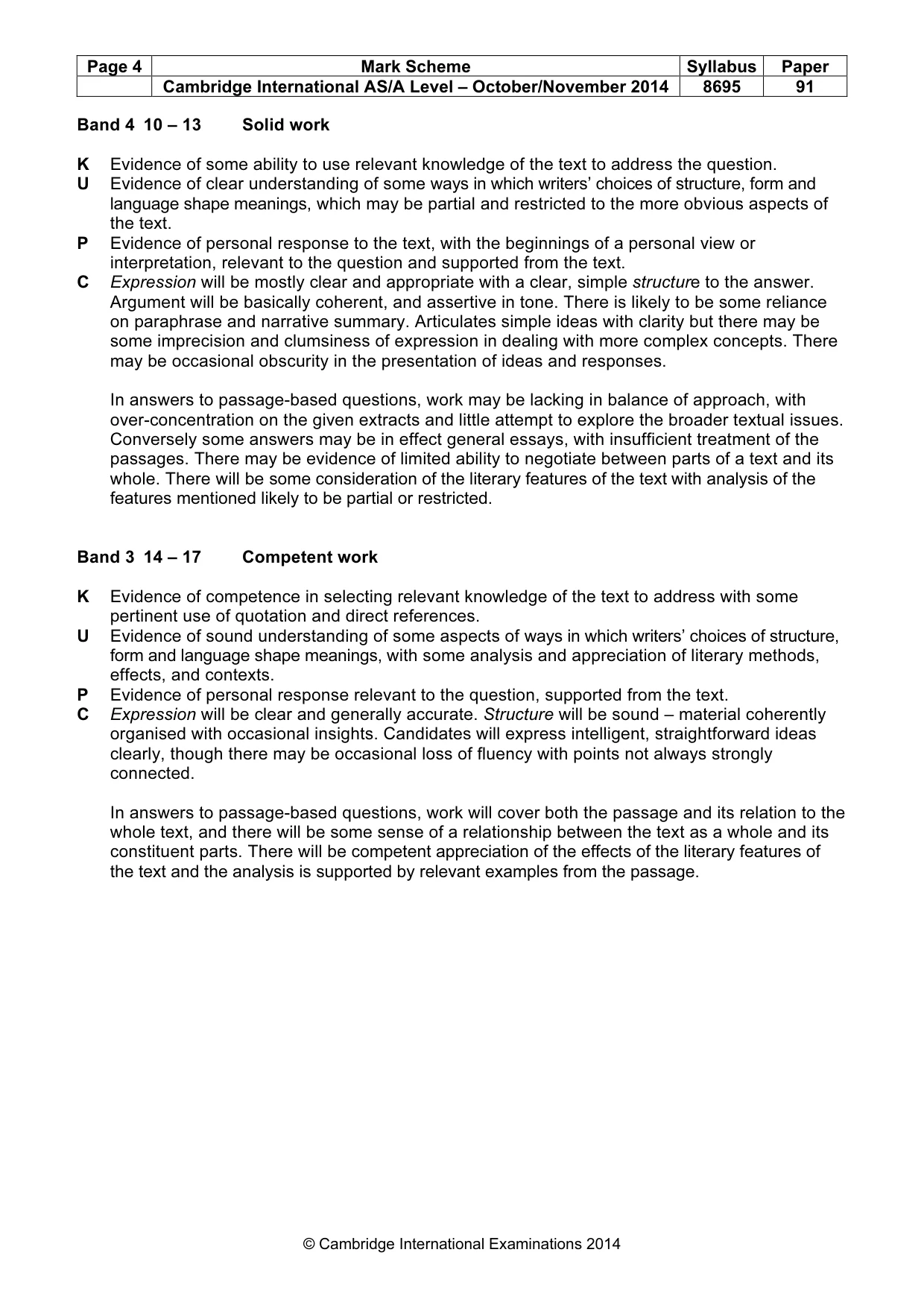
Page 4 Mark Scheme Syllabus Paper Cambridge International AS/A Level – October/November 2014 8695 91 © Cambridge International Examinations 2014 Band 4 10 – 13 Solid work K Evidence of some ability to use relevant knowledge of the text to address the question. U Evidence of clear understanding of some ways in which writers’ choices of structure, form and language shape meanings, which may be partial and restricted to the more obvious aspects of the text. P Evidence of personal response to the text, with the beginnings of a personal view or interpretation, relevant to the question and supported from the text. C Expression will be mostly clear and appropriate with a clear, simple structure to the answer. Argument will be basically coherent, and assertive in tone. There is likely to be some reliance on paraphrase and narrative summary. Articulates simple ideas with clarity but there may be some imprecision and clumsiness of expression in dealing with more complex concepts. There may be occasional obscurity in the presentation of ideas and responses. In answers to passage-based questions, work may be lacking in balance of approach, with over-concentration on the given extracts and little attempt to explore the broader textual issues. Conversely some answers may be in effect general essays, with insufficient treatment of the passages. There may be evidence of limited ability to negotiate between parts of a text and its whole. There will be some consideration of the literary features of the text with analysis of the features mentioned likely to be partial or restricted. Band 3 14 – 17 Competent work K Evidence of competence in selecting relevant knowledge of the text to address with some pertinent use of quotation and direct references. U Evidence of sound understanding of some aspects of ways in which writers’ choices of structure, form and language shape meanings, with some analysis and appreciation of literary methods, effects, and contexts. P Evidence of personal response relevant to the question, supported from the text. C Expression will be clear and generally accurate. Structure will be sound – material coherently organised with occasional insights. Candidates will express intelligent, straightforward ideas clearly, though there may be occasional loss of fluency with points not always strongly connected. In answers to passage-based questions, work will cover both the passage and its relation to the whole text, and there will be some sense of a relationship between the text as a whole and its constituent parts. There will be competent appreciation of the effects of the literary features of the text and the analysis is supported by relevant examples from the passage.
Mark scheme, page 5
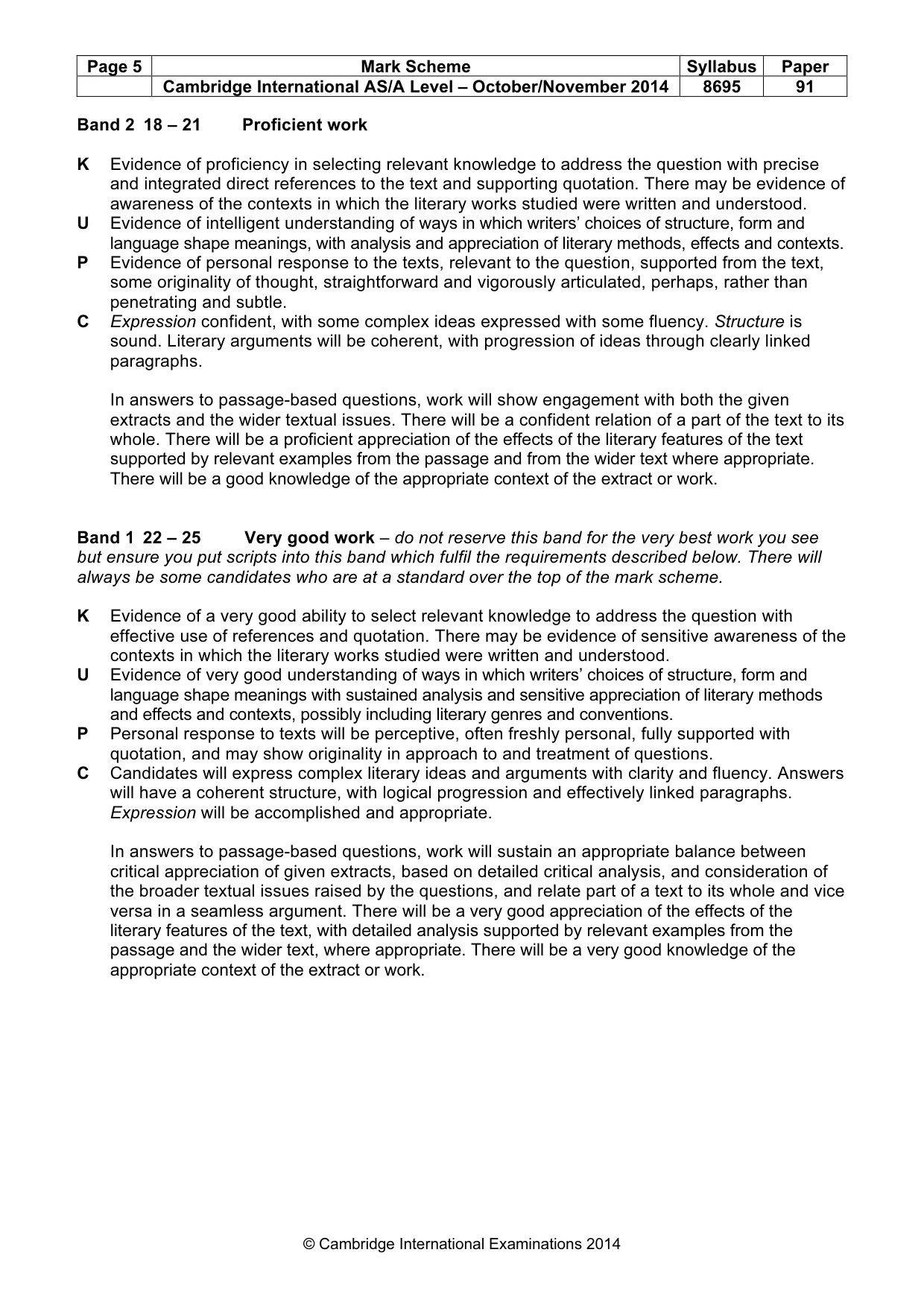
Page 5 Mark Scheme Syllabus Paper Cambridge International AS/A Level – October/November 2014 8695 91 © Cambridge International Examinations 2014 Band 2 18 – 21 Proficient work K Evidence of proficiency in selecting relevant knowledge to address the question with precise and integrated direct references to the text and supporting quotation. There may be evidence of awareness of the contexts in which the literary works studied were written and understood. U Evidence of intelligent understanding of ways in which writers’ choices of structure, form and language shape meanings, with analysis and appreciation of literary methods, effects and contexts. P Evidence of personal response to the texts, relevant to the question, supported from the text, some originality of thought, straightforward and vigorously articulated, perhaps, rather than penetrating and subtle. C Expression confident, with some complex ideas expressed with some fluency. Structure is sound. Literary arguments will be coherent, with progression of ideas through clearly linked paragraphs. In answers to passage-based questions, work will show engagement with both the given extracts and the wider textual issues. There will be a confident relation of a part of the text to its whole. There will be a proficient appreciation of the effects of the literary features of the text supported by relevant examples from the passage and from the wider text where appropriate. There will be a good knowledge of the appropriate context of the extract or work. Band 1 22 – 25 Very good work – do not reserve this band for the very best work you see but ensure you put scripts into this band which fulfil the requirements described below. There will always be some candidates who are at a standard over the top of the mark scheme. K Evidence of a very good ability to select relevant knowledge to address the question with effective use of references and quotation. There may be evidence of sensitive awareness of the contexts in which the literary works studied were written and understood. U Evidence of very good understanding of ways in which writers’ choices of structure, form and language shape meanings with sustained analysis and sensitive appreciation of literary methods and effects and contexts, possibly including literary genres and conventions. P Personal response to texts will be perceptive, often freshly personal, fully supported with quotation, and may show originality in approach to and treatment of questions. C Candidates will express complex literary ideas and arguments with clarity and fluency. Answers will have a coherent structure, with logical progression and effectively linked paragraphs. Expression will be accomplished and appropriate. In answers to passage-based questions, work will sustain an appropriate balance between critical appreciation of given extracts, based on detailed critical analysis, and consideration of the broader textual issues raised by the questions, and relate part of a text to its whole and vice versa in a seamless argument. There will be a very good appreciation of the effects of the literary features of the text, with detailed analysis supported by relevant examples from the passage and the wider text, where appropriate. There will be a very good knowledge of the appropriate context of the extract or work.
What you needed in this session
Cambridge’s own grade thresholds for 2014 Oct/Nov, Paper 9 · Variant 1. A higher threshold means an easier paper — the bar moves with how the cohort did.