Cambridge A Level English - Language and Literature (AS Level only, from 2016) 8695 — 2014 May/June Paper 9 · Variant 3
8695/93/M/J/14 · 50 marks · ≈56 min
The question paper and its mark scheme, free to read here and free to download. This is Cambridge’s own paper, exactly as it was sat.
Question paper20 pages



Mark scheme5 pages
Answers below. Sit the paper first if you are practising.
Paper as text
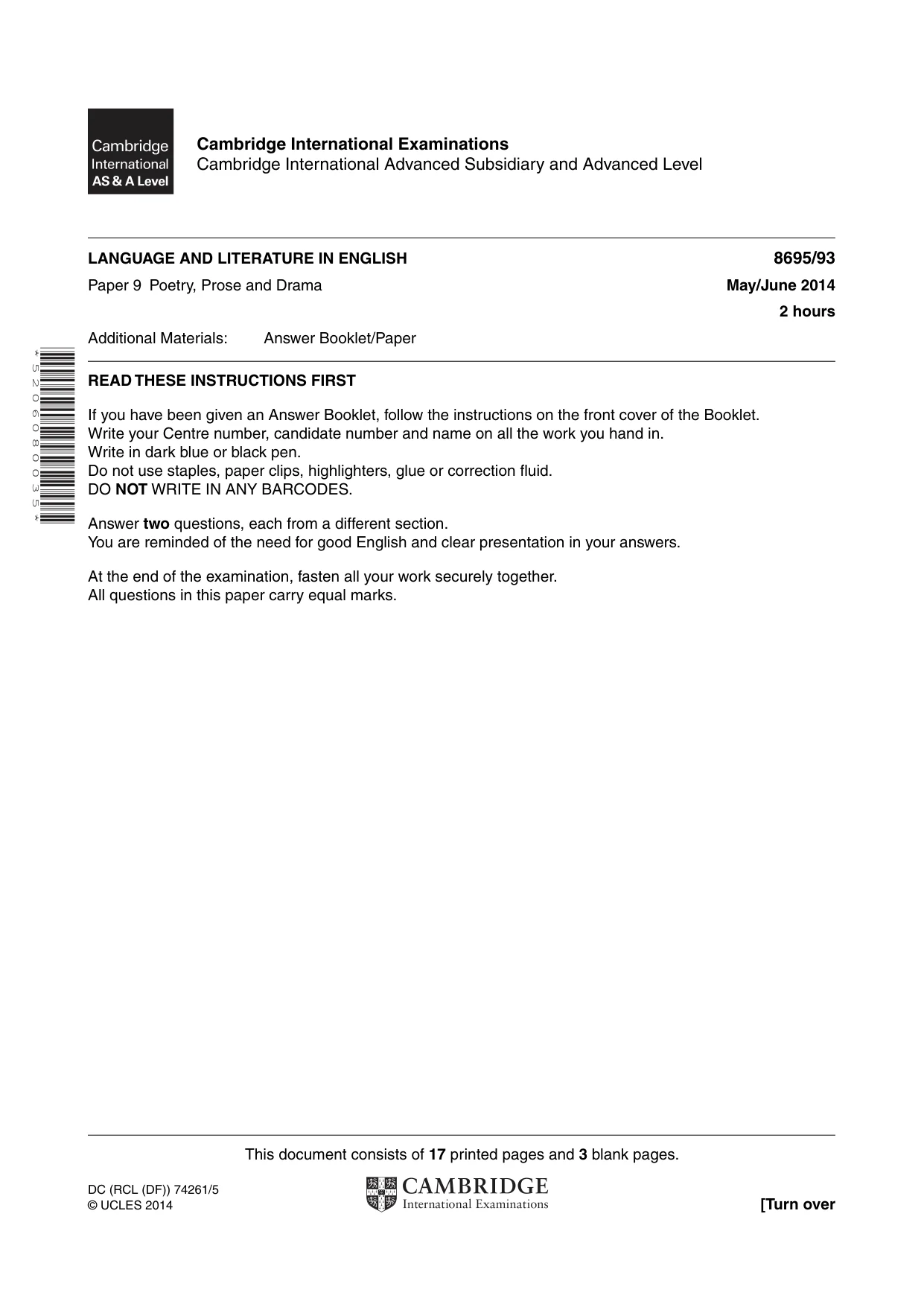
Question paper, page 1
This document consists of 17 printed pages and 3 blank pages. DC (RCL (DF)) 74261/5 © UCLES 2014 [Turn over Cambridge International Examinations Cambridge International Advanced Subsidiary and Advanced Level * 5 2 0 6 0 8 0 0 3 5 * LANGUAGE AND LITERATURE IN ENGLISH 8695/93 Paper 9 Poetry, Prose and Drama May/June 2014 2 hours Additional Materials: Answer Booklet/Paper READ THESE INSTRUCTIONS FIRST If you have been given an Answer Booklet, follow the instructions on the front cover of the Booklet. Write your Centre number, candidate number and name on all the work you hand in. Write in dark blue or black pen. Do not use staples, paper clips, highlighters, glue or correction fluid. DO NOT WRITE IN ANY BARCODES. Answer two questions, each from a different section. You are reminded of the need for good English and clear presentation in your answers. At the end of the examination, fasten all your work securely together. All questions in this paper carry equal marks.
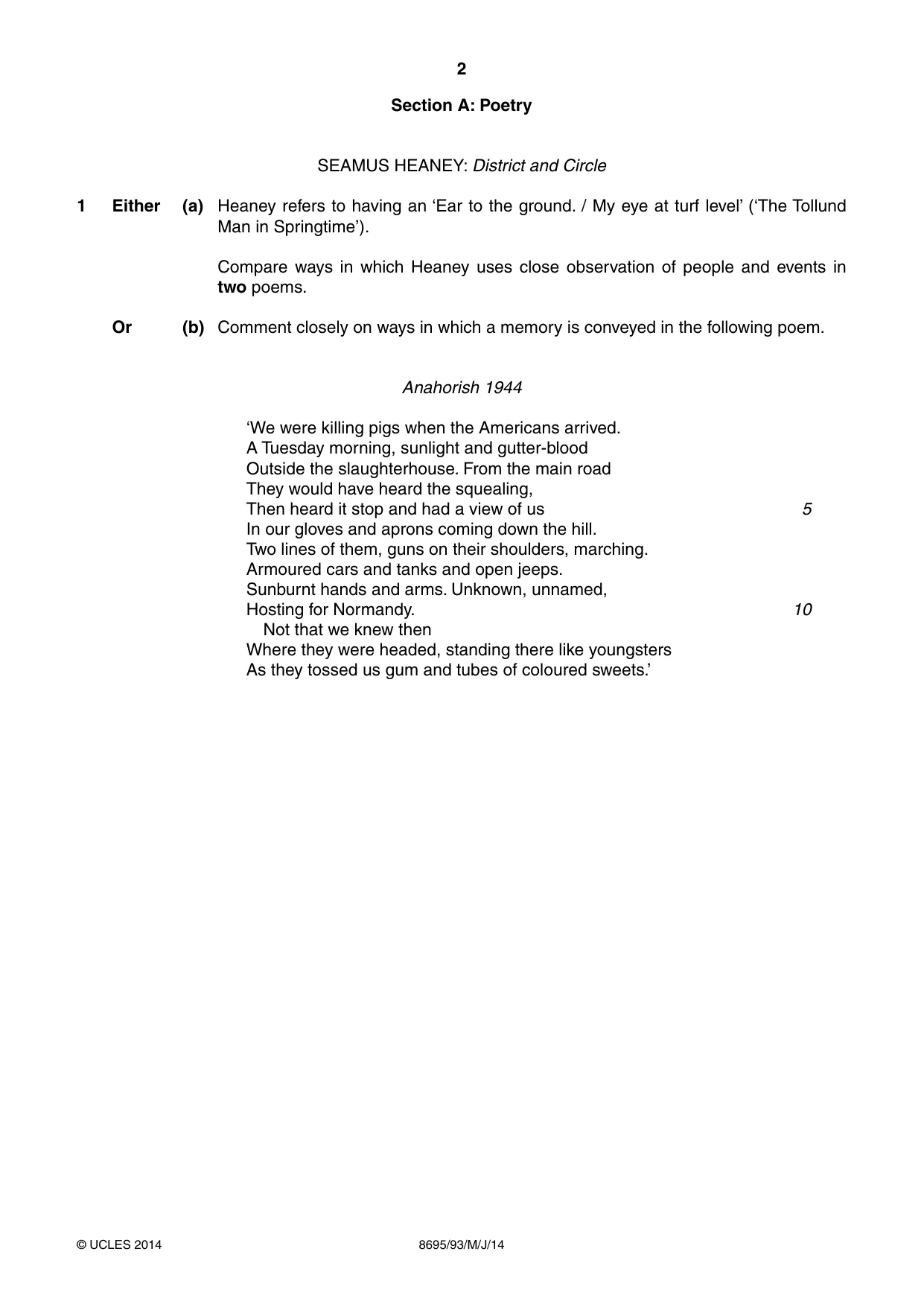
Question paper, page 2
2 8695/93/M/J/14 © UCLES 2014 Section A: Poetry SEAMUS HEANEY: District and Circle 1 Either (a) Heaney refers to having an ‘Ear to the ground. / My eye at turf level’ (‘The Tollund Man in Springtime’). Compare ways in which Heaney uses close observation of people and events in two poems. Or (b) Comment closely on ways in which a memory is conveyed in the following poem. Anahorish 1944 ‘We were killing pigs when the Americans arrived. A Tuesday morning, sunlight and gutter-blood Outside the slaughterhouse. From the main road They would have heard the squealing, Then heard it stop and had a view of us In our gloves and aprons coming down the hill. Two lines of them, guns on their shoulders, marching. Armoured cars and tanks and open jeeps. Sunburnt hands and arms. Unknown, unnamed, Hosting for Normandy. Not that we knew then Where they were headed, standing there like youngsters As they tossed us gum and tubes of coloured sweets.’ 5 10
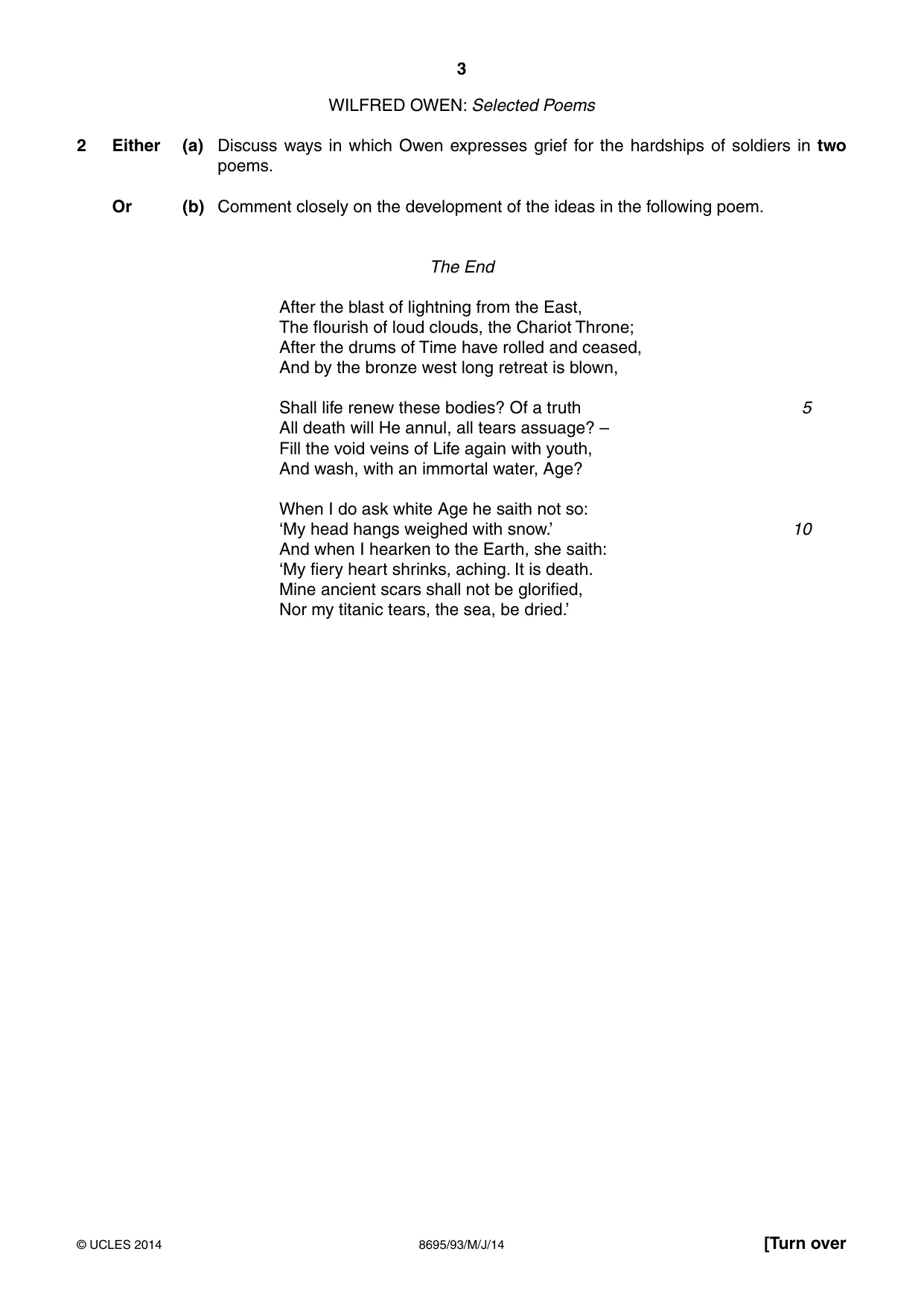
Question paper, page 3
3 8695/93/M/J/14 © UCLES 2014 [Turn over WILFRED OWEN: Selected Poems 2 Either (a) Discuss ways in which Owen expresses grief for the hardships of soldiers in two poems. Or (b) Comment closely on the development of the ideas in the following poem. The End After the blast of lightning from the East, The flourish of loud clouds, the Chariot Throne; After the drums of Time have rolled and ceased, And by the bronze west long retreat is blown, Shall life renew these bodies? Of a truth All death will He annul, all tears assuage? – Fill the void veins of Life again with youth, And wash, with an immortal water, Age? When I do ask white Age he saith not so: ‘My head hangs weighed with snow.’ And when I hearken to the Earth, she saith: ‘My fiery heart shrinks, aching. It is death. Mine ancient scars shall not be glorified, Nor my titanic tears, the sea, be dried.’ 5 10
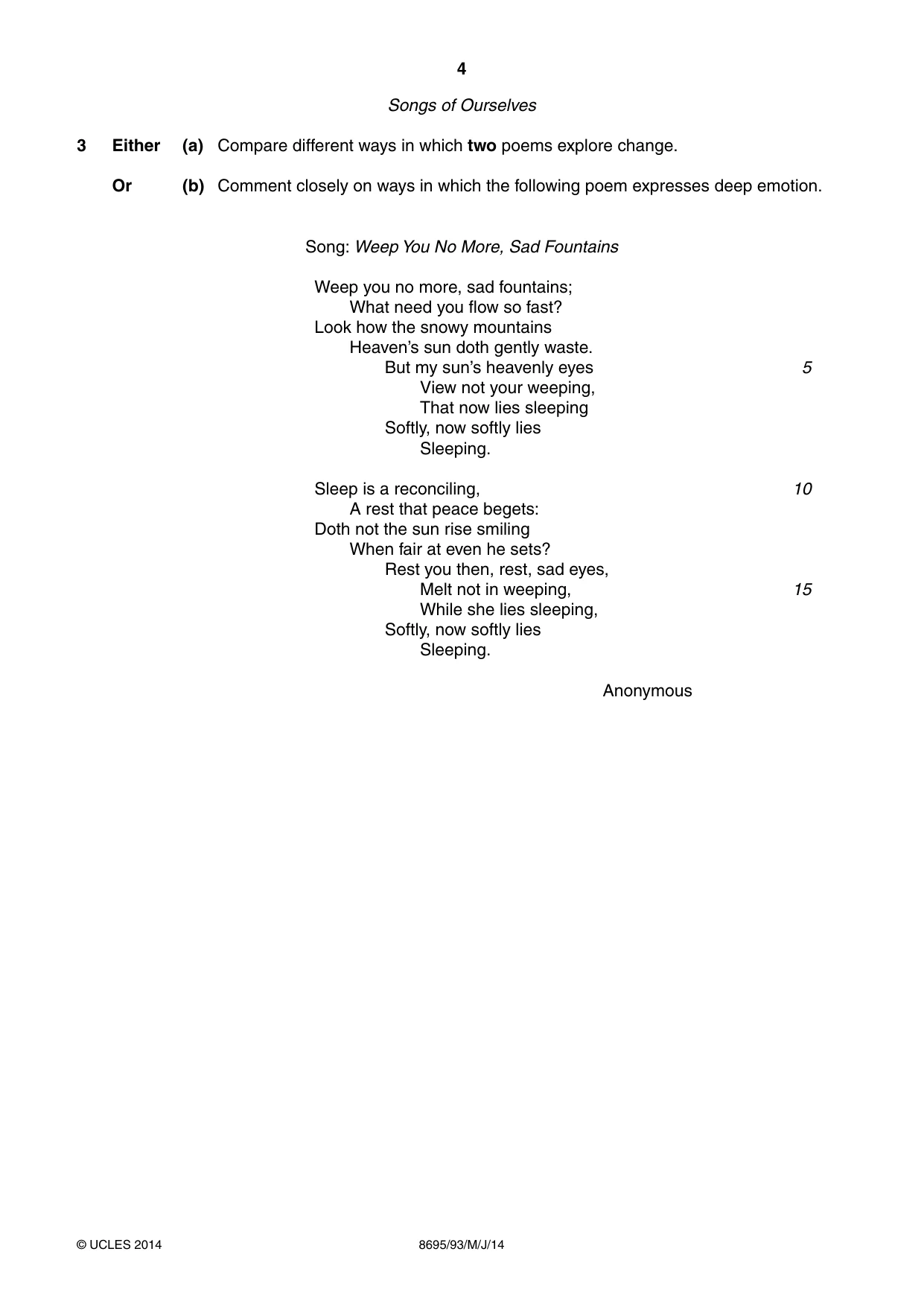
Question paper, page 4
4 8695/93/M/J/14 © UCLES 2014 Songs of Ourselves 3 Either (a) Compare different ways in which two poems explore change. Or (b) Comment closely on ways in which the following poem expresses deep emotion. Song: Weep You No More, Sad Fountains Weep you no more, sad fountains; What need you flow so fast? Look how the snowy mountains Heaven’s sun doth gently waste. But my sun’s heavenly eyes View not your weeping, That now lies sleeping Softly, now softly lies Sleeping. Sleep is a reconciling, A rest that peace begets: Doth not the sun rise smiling When fair at even he sets? Rest you then, rest, sad eyes, Melt not in weeping, While she lies sleeping, Softly, now softly lies Sleeping. Anonymous 5 10 15
Question paper, page 5
5 8695/93/M/J/14 © UCLES 2014 [Turn over Turn to page 6 for Question 4
Question paper, page 6
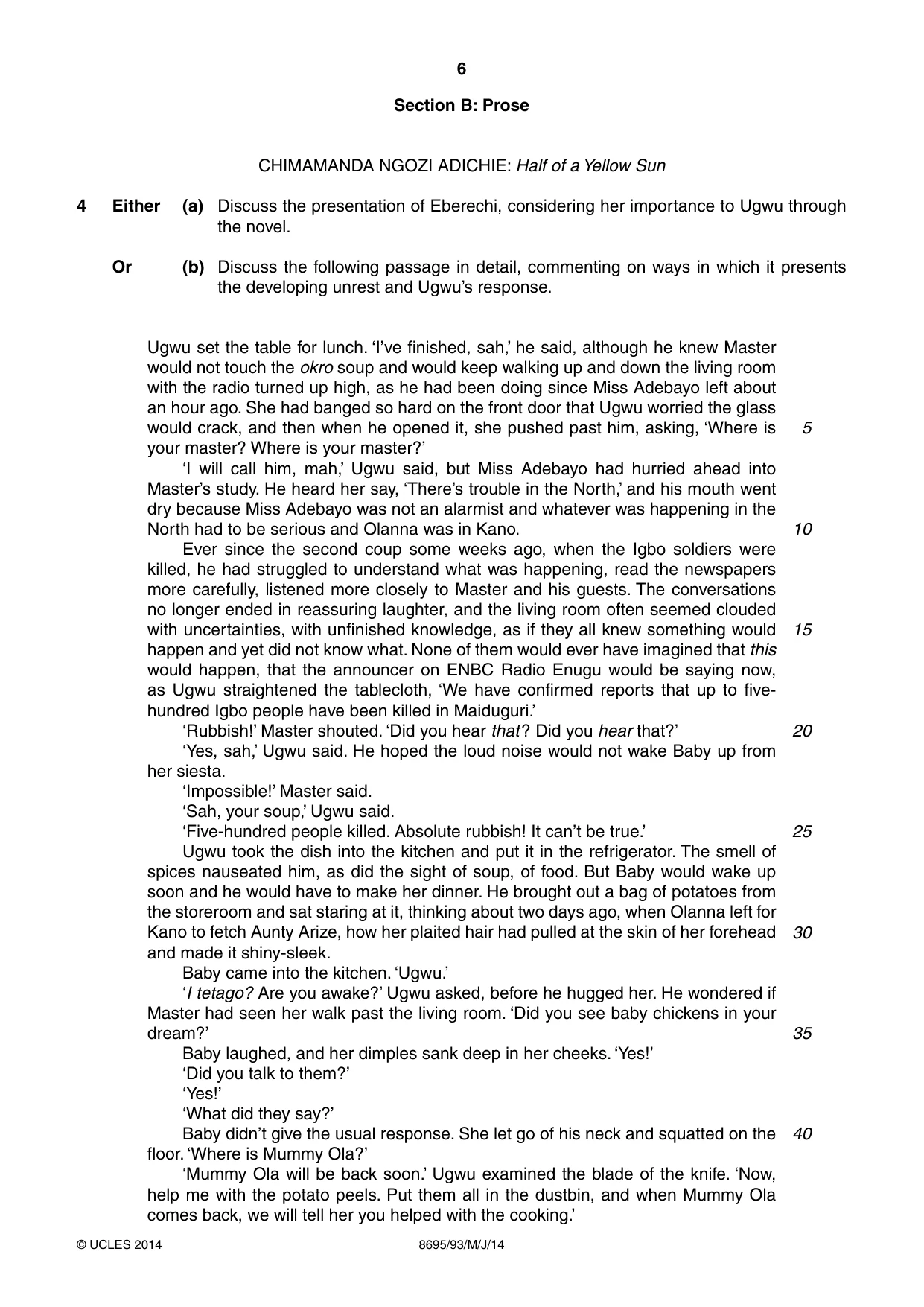
6 8695/93/M/J/14 © UCLES 2014 Section B: Prose CHIMAMANDA NGOZI ADICHIE: Half of a Yellow Sun 4 Either (a) Discuss the presentation of Eberechi, considering her importance to Ugwu through the novel. Or (b) Discuss the following passage in detail, commenting on ways in which it presents the developing unrest and Ugwu’s response. Ugwu set the table for lunch. ‘I’ve finished, sah,’ he said, although he knew Master would not touch the okro soup and would keep walking up and down the living room with the radio turned up high, as he had been doing since Miss Adebayo left about an hour ago. She had banged so hard on the front door that Ugwu worried the glass would crack, and then when he opened it, she pushed past him, asking, ‘Where is your master? Where is your master?’ ‘I will call him, mah,’ Ugwu said, but Miss Adebayo had hurried ahead into Master’s study. He heard her say, ‘There’s trouble in the North,’ and his mouth went dry because Miss Adebayo was not an alarmist and whatever was happening in the North had to be serious and Olanna was in Kano. Ever since the second coup some weeks ago, when the Igbo soldiers were killed, he had struggled to understand what was happening, read the newspapers more carefully, listened more closely to Master and his guests. The conversations no longer ended in reassuring laughter, and the living room often seemed clouded with uncertainties, with unfinished knowledge, as if they all knew something would happen and yet did not know what. None of them would ever have imagined that this would happen, that the announcer on ENBC Radio Enugu would be saying now, as Ugwu straightened the tablecloth, ‘We have confirmed reports that up to five- hundred Igbo people have been killed in Maiduguri.’ ‘Rubbish!’ Master shouted. ‘Did you hear that ? Did you hear that?’ ‘Yes, sah,’ Ugwu said. He hoped the loud noise would not wake Baby up from her siesta. ‘Impossible!’ Master said. ‘Sah, your soup,’ Ugwu said. ‘Five-hundred people killed. Absolute rubbish! It can’t be true.’ Ugwu took the dish into the kitchen and put it in the refrigerator. The smell of spices nauseated him, as did the sight of soup, of food. But Baby would wake up soon and he would have to make her dinner. He brought out a bag of potatoes from the storeroom and sat staring at it, thinking about two days ago, when Olanna left for Kano to fetch Aunty Arize, how her plaited hair had pulled at the skin of her forehead and made it shiny-sleek. Baby came into the kitchen. ‘Ugwu.’ ‘I tetago? Are you awake?’ Ugwu asked, before he hugged her. He wondered if Master had seen her walk past the living room. ‘Did you see baby chickens in your dream?’ Baby laughed, and her dimples sank deep in her cheeks. ‘Yes!’ ‘Did you talk to them?’ ‘Yes!’ ‘What did they say?’ Baby didn’t give the usual response. She let go of his neck and squatted on the floor. ‘Where is Mummy Ola?’ ‘Mummy Ola will be back soon.’ Ugwu examined the blade of the knife. ‘Now, help me with the potato peels. Put them all in the dustbin, and when Mummy Ola comes back, we will tell her you helped with the cooking.’ 5 10 15 20 25 30 35 40
Question paper, page 7
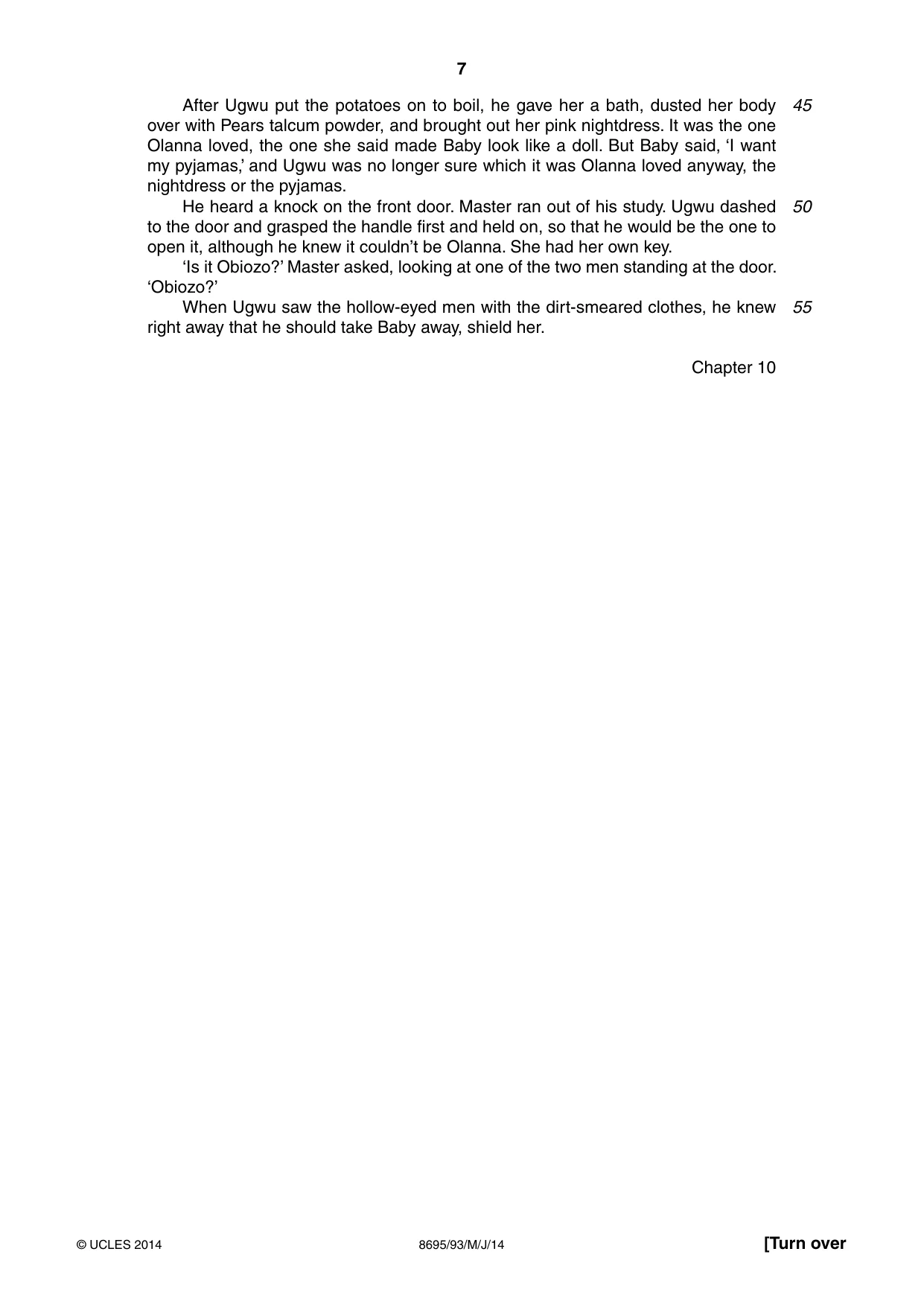
7 8695/93/M/J/14 © UCLES 2014 [Turn over After Ugwu put the potatoes on to boil, he gave her a bath, dusted her body over with Pears talcum powder, and brought out her pink nightdress. It was the one Olanna loved, the one she said made Baby look like a doll. But Baby said, ‘I want my pyjamas,’ and Ugwu was no longer sure which it was Olanna loved anyway, the nightdress or the pyjamas. He heard a knock on the front door. Master ran out of his study. Ugwu dashed to the door and grasped the handle first and held on, so that he would be the one to open it, although he knew it couldn’t be Olanna. She had her own key. ‘Is it Obiozo?’ Master asked, looking at one of the two men standing at the door. ‘Obiozo?’ When Ugwu saw the hollow-eyed men with the dirt-smeared clothes, he knew right away that he should take Baby away, shield her. Chapter 10 45 50 55
Question paper, page 8
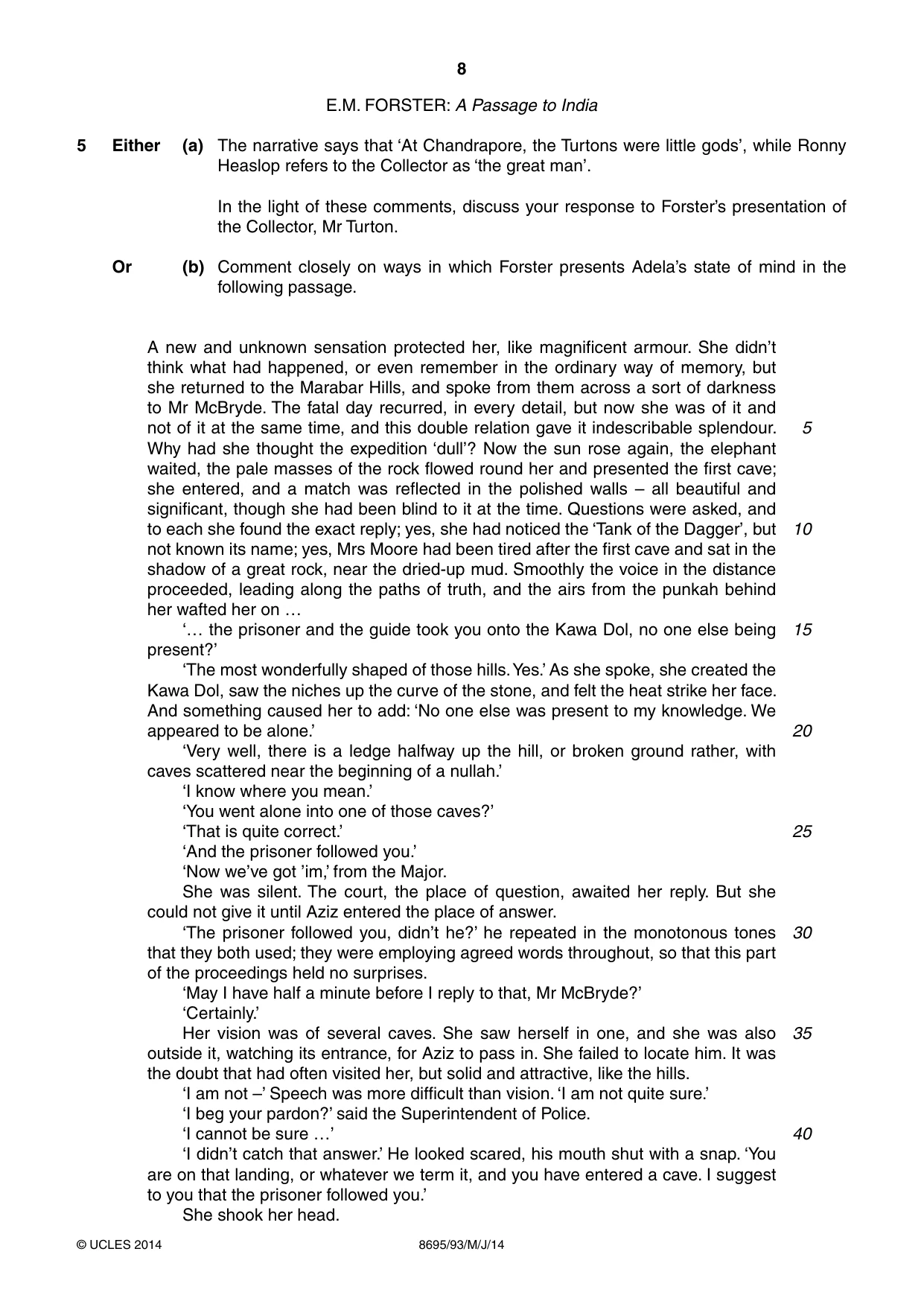
8 8695/93/M/J/14 © UCLES 2014 E.M. FORSTER: A Passage to India 5 Either (a) The narrative says that ‘At Chandrapore, the Turtons were little gods’, while Ronny Heaslop refers to the Collector as ‘the great man’. In the light of these comments, discuss your response to Forster’s presentation of the Collector, Mr Turton. Or (b) Comment closely on ways in which Forster presents Adela’s state of mind in the following passage. A new and unknown sensation protected her, like magnificent armour. She didn’t think what had happened, or even remember in the ordinary way of memory, but she returned to the Marabar Hills, and spoke from them across a sort of darkness to Mr McBryde. The fatal day recurred, in every detail, but now she was of it and not of it at the same time, and this double relation gave it indescribable splendour. Why had she thought the expedition ‘dull’? Now the sun rose again, the elephant waited, the pale masses of the rock flowed round her and presented the first cave; she entered, and a match was reflected in the polished walls – all beautiful and significant, though she had been blind to it at the time. Questions were asked, and to each she found the exact reply; yes, she had noticed the ‘Tank of the Dagger’, but not known its name; yes, Mrs Moore had been tired after the first cave and sat in the shadow of a great rock, near the dried-up mud. Smoothly the voice in the distance proceeded, leading along the paths of truth, and the airs from the punkah behind her wafted her on … ‘… the prisoner and the guide took you onto the Kawa Dol, no one else being present?’ ‘The most wonderfully shaped of those hills. Yes.’ As she spoke, she created the Kawa Dol, saw the niches up the curve of the stone, and felt the heat strike her face. And something caused her to add: ‘No one else was present to my knowledge. We appeared to be alone.’ ‘Very well, there is a ledge halfway up the hill, or broken ground rather, with caves scattered near the beginning of a nullah.’ ‘I know where you mean.’ ‘You went alone into one of those caves?’ ‘That is quite correct.’ ‘And the prisoner followed you.’ ‘Now we’ve got ’im,’ from the Major. She was silent. The court, the place of question, awaited her reply. But she could not give it until Aziz entered the place of answer. ‘The prisoner followed you, didn’t he?’ he repeated in the monotonous tones that they both used; they were employing agreed words throughout, so that this part of the proceedings held no surprises. ‘May I have half a minute before I reply to that, Mr McBryde?’ ‘Certainly.’ Her vision was of several caves. She saw herself in one, and she was also outside it, watching its entrance, for Aziz to pass in. She failed to locate him. It was the doubt that had often visited her, but solid and attractive, like the hills. ‘I am not –’ Speech was more difficult than vision. ‘I am not quite sure.’ ‘I beg your pardon?’ said the Superintendent of Police. ‘I cannot be sure …’ ‘I didn’t catch that answer.’ He looked scared, his mouth shut with a snap. ‘You are on that landing, or whatever we term it, and you have entered a cave. I suggest to you that the prisoner followed you.’ She shook her head. 5 10 15 20 25 30 35 40
Question paper, page 9
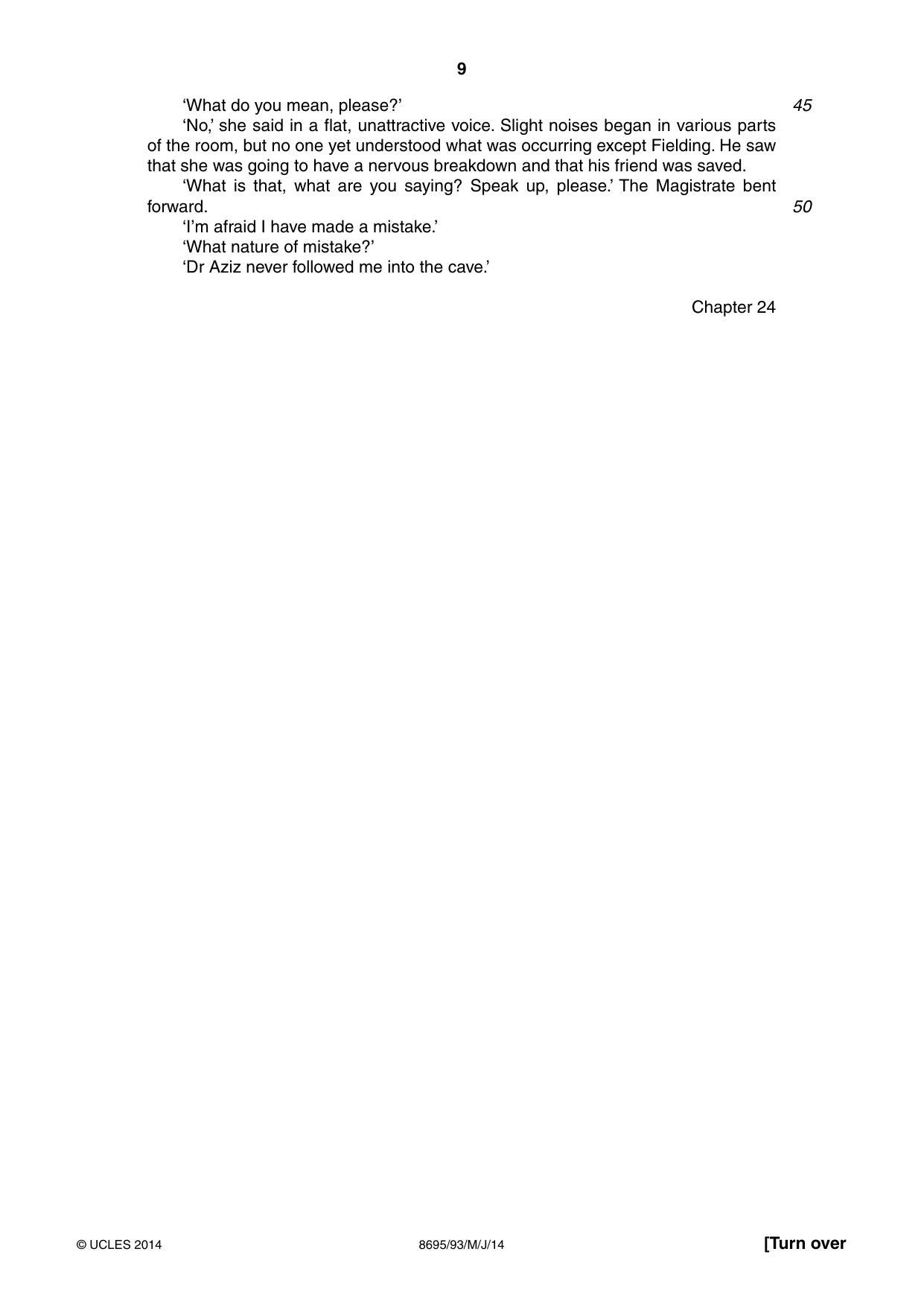
9 8695/93/M/J/14 © UCLES 2014 [Turn over ‘What do you mean, please?’ ‘No,’ she said in a flat, unattractive voice. Slight noises began in various parts of the room, but no one yet understood what was occurring except Fielding. He saw that she was going to have a nervous breakdown and that his friend was saved. ‘What is that, what are you saying? Speak up, please.’ The Magistrate bent forward. ‘I’m afraid I have made a mistake.’ ‘What nature of mistake?’ ‘Dr Aziz never followed me into the cave.’ Chapter 24 45 50
Question paper, page 10
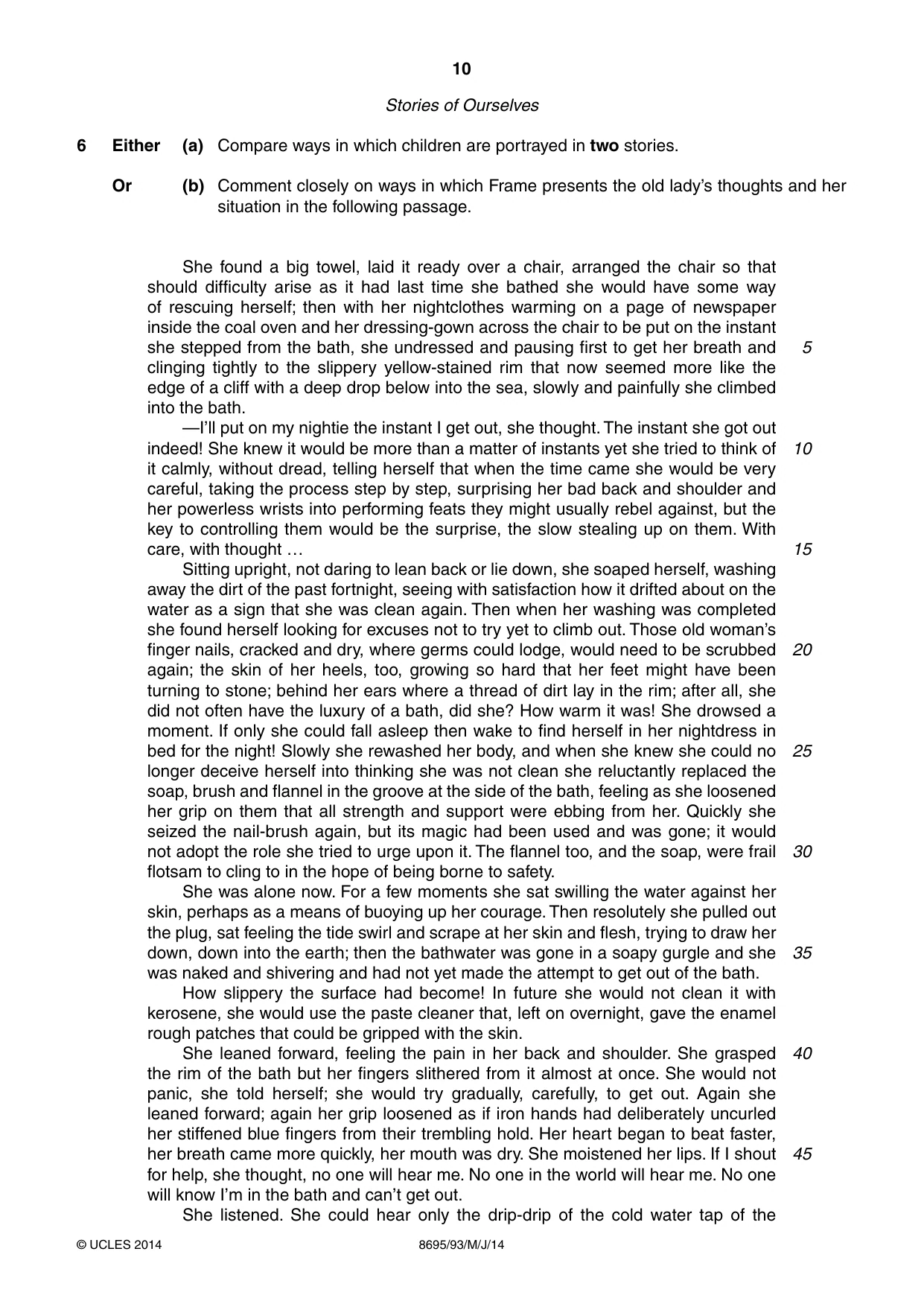
10 8695/93/M/J/14 © UCLES 2014 Stories of Ourselves 6 Either (a) Compare ways in which children are portrayed in two stories. Or (b) Comment closely on ways in which Frame presents the old lady’s thoughts and her situation in the following passage. She found a big towel, laid it ready over a chair, arranged the chair so that should difficulty arise as it had last time she bathed she would have some way of rescuing herself; then with her nightclothes warming on a page of newspaper inside the coal oven and her dressing-gown across the chair to be put on the instant she stepped from the bath, she undressed and pausing first to get her breath and clinging tightly to the slippery yellow-stained rim that now seemed more like the edge of a cliff with a deep drop below into the sea, slowly and painfully she climbed into the bath. —I’ll put on my nightie the instant I get out, she thought. The instant she got out indeed! She knew it would be more than a matter of instants yet she tried to think of it calmly, without dread, telling herself that when the time came she would be very careful, taking the process step by step, surprising her bad back and shoulder and her powerless wrists into performing feats they might usually rebel against, but the key to controlling them would be the surprise, the slow stealing up on them. With care, with thought … Sitting upright, not daring to lean back or lie down, she soaped herself, washing away the dirt of the past fortnight, seeing with satisfaction how it drifted about on the water as a sign that she was clean again. Then when her washing was completed she found herself looking for excuses not to try yet to climb out. Those old woman’s finger nails, cracked and dry, where germs could lodge, would need to be scrubbed again; the skin of her heels, too, growing so hard that her feet might have been turning to stone; behind her ears where a thread of dirt lay in the rim; after all, she did not often have the luxury of a bath, did she? How warm it was! She drowsed a moment. If only she could fall asleep then wake to find herself in her nightdress in bed for the night! Slowly she rewashed her body, and when she knew she could no longer deceive herself into thinking she was not clean she reluctantly replaced the soap, brush and flannel in the groove at the side of the bath, feeling as she loosened her grip on them that all strength and support were ebbing from her. Quickly she seized the nail-brush again, but its magic had been used and was gone; it would not adopt the role she tried to urge upon it. The flannel too, and the soap, were frail flotsam to cling to in the hope of being borne to safety. She was alone now. For a few moments she sat swilling the water against her skin, perhaps as a means of buoying up her courage. Then resolutely she pulled out the plug, sat feeling the tide swirl and scrape at her skin and flesh, trying to draw her down, down into the earth; then the bathwater was gone in a soapy gurgle and she was naked and shivering and had not yet made the attempt to get out of the bath. How slippery the surface had become! In future she would not clean it with kerosene, she would use the paste cleaner that, left on overnight, gave the enamel rough patches that could be gripped with the skin. She leaned forward, feeling the pain in her back and shoulder. She grasped the rim of the bath but her fingers slithered from it almost at once. She would not panic, she told herself; she would try gradually, carefully, to get out. Again she leaned forward; again her grip loosened as if iron hands had deliberately uncurled her stiffened blue fingers from their trembling hold. Her heart began to beat faster, her breath came more quickly, her mouth was dry. She moistened her lips. If I shout for help, she thought, no one will hear me. No one in the world will hear me. No one will know I’m in the bath and can’t get out. She listened. She could hear only the drip-drip of the cold water tap of the 5 10 15 20 25 30 35 40 45
Question paper, page 11
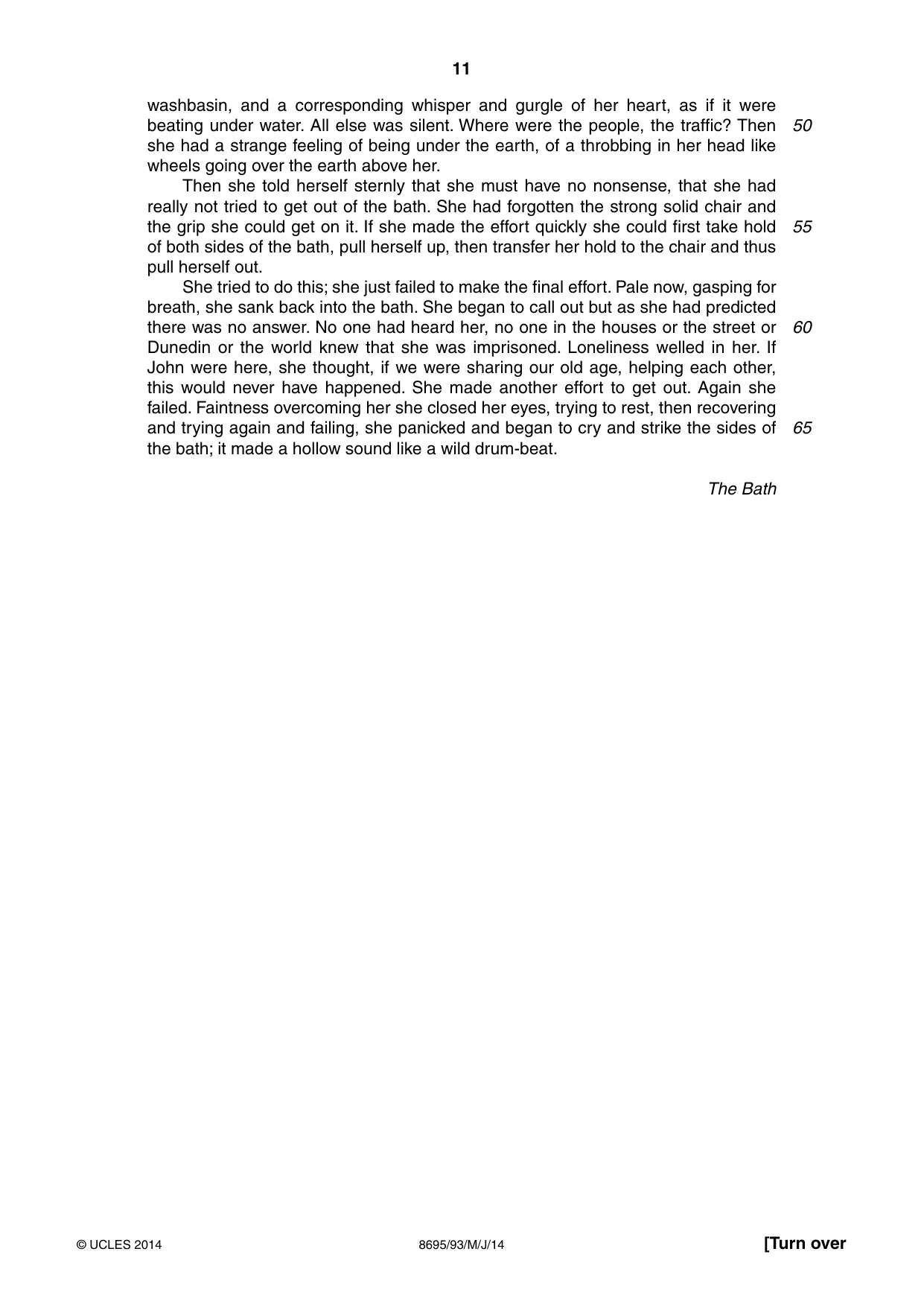
11 8695/93/M/J/14 © UCLES 2014 [Turn over washbasin, and a corresponding whisper and gurgle of her heart, as if it were beating under water. All else was silent. Where were the people, the traffic? Then she had a strange feeling of being under the earth, of a throbbing in her head like wheels going over the earth above her. Then she told herself sternly that she must have no nonsense, that she had really not tried to get out of the bath. She had forgotten the strong solid chair and the grip she could get on it. If she made the effort quickly she could first take hold of both sides of the bath, pull herself up, then transfer her hold to the chair and thus pull herself out. She tried to do this; she just failed to make the final effort. Pale now, gasping for breath, she sank back into the bath. She began to call out but as she had predicted there was no answer. No one had heard her, no one in the houses or the street or Dunedin or the world knew that she was imprisoned. Loneliness welled in her. If John were here, she thought, if we were sharing our old age, helping each other, this would never have happened. She made another effort to get out. Again she failed. Faintness overcoming her she closed her eyes, trying to rest, then recovering and trying again and failing, she panicked and began to cry and strike the sides of the bath; it made a hollow sound like a wild drum-beat. The Bath 50 55 60 65
Question paper, page 12
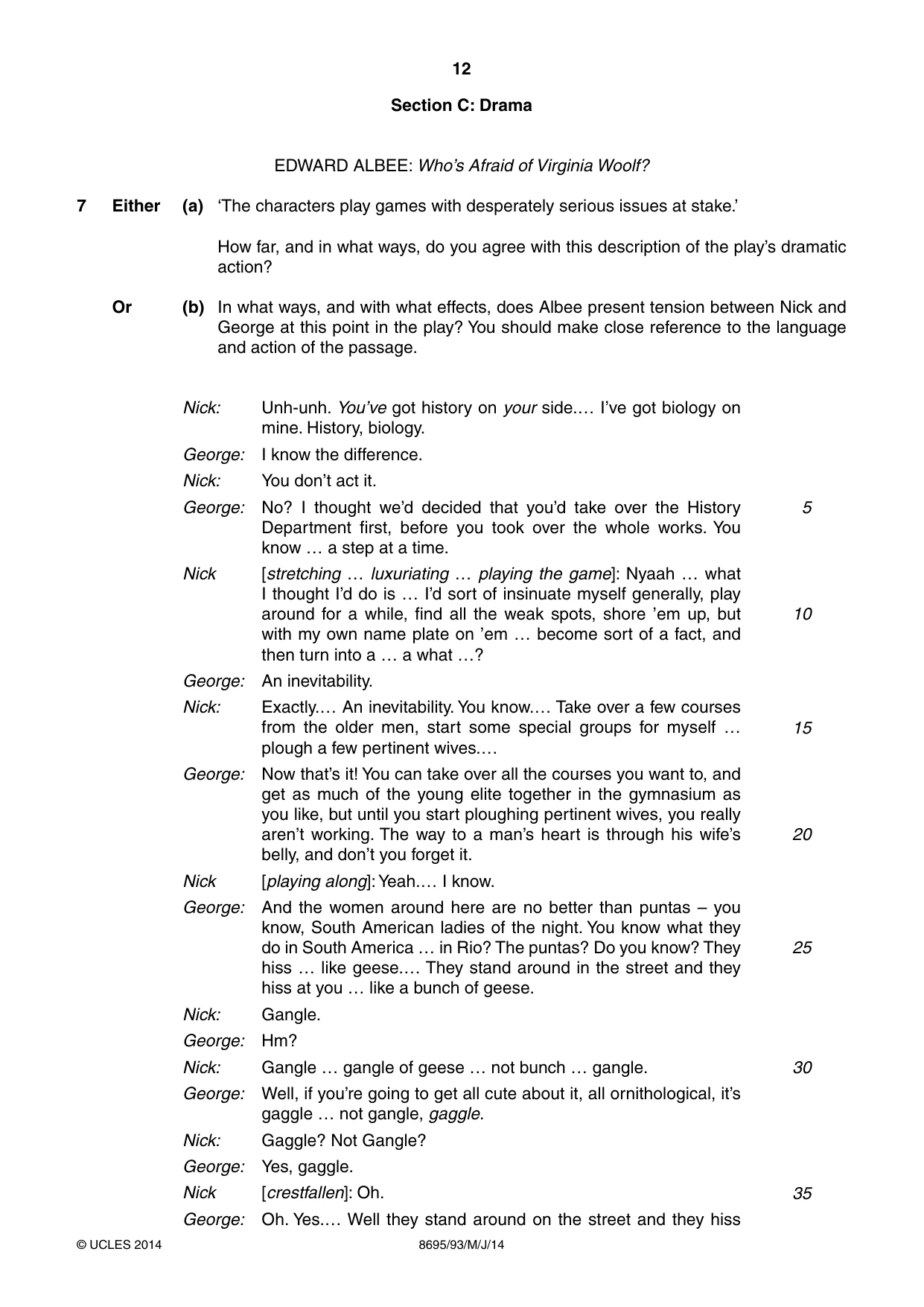
12 8695/93/M/J/14 © UCLES 2014 Section C: Drama EDWARD ALBEE: Who’s Afraid of Virginia Woolf? 7 Either (a) ‘The characters play games with desperately serious issues at stake.’ How far, and in what ways, do you agree with this description of the play’s dramatic action? Or (b) In what ways, and with what effects, does Albee present tension between Nick and George at this point in the play? You should make close reference to the language and action of the passage. Nick: Unh-unh. You’ve got history on your side.… I’ve got biology on mine. History, biology. George: I know the difference. Nick: You don’t act it. George: No? I thought we’d decided that you’d take over the History Department first, before you took over the whole works. You know … a step at a time. Nick [stretching … luxuriating … playing the game]: Nyaah … what I thought I’d do is … I’d sort of insinuate myself generally, play around for a while, find all the weak spots, shore ’em up, but with my own name plate on ’em … become sort of a fact, and then turn into a … a what …? George: An inevitability. Nick: Exactly.… An inevitability. You know.… Take over a few courses from the older men, start some special groups for myself … plough a few pertinent wives.… George: Now that’s it! You can take over all the courses you want to, and get as much of the young elite together in the gymnasium as you like, but until you start ploughing pertinent wives, you really aren’t working. The way to a man’s heart is through his wife’s belly, and don’t you forget it. Nick [playing along]: Yeah.… I know. George: And the women around here are no better than puntas – you know, South American ladies of the night. You know what they do in South America … in Rio? The puntas? Do you know? They hiss … like geese.… They stand around in the street and they hiss at you … like a bunch of geese. Nick: Gangle. George: Hm? Nick: Gangle … gangle of geese … not bunch … gangle. George: Well, if you’re going to get all cute about it, all ornithological, it’s gaggle … not gangle, gaggle. Nick: Gaggle? Not Gangle? George: Yes, gaggle. Nick [crestfallen]: Oh. George: Oh. Yes.… Well they stand around on the street and they hiss 5 10 15 20 25 30 35
Question paper, page 13
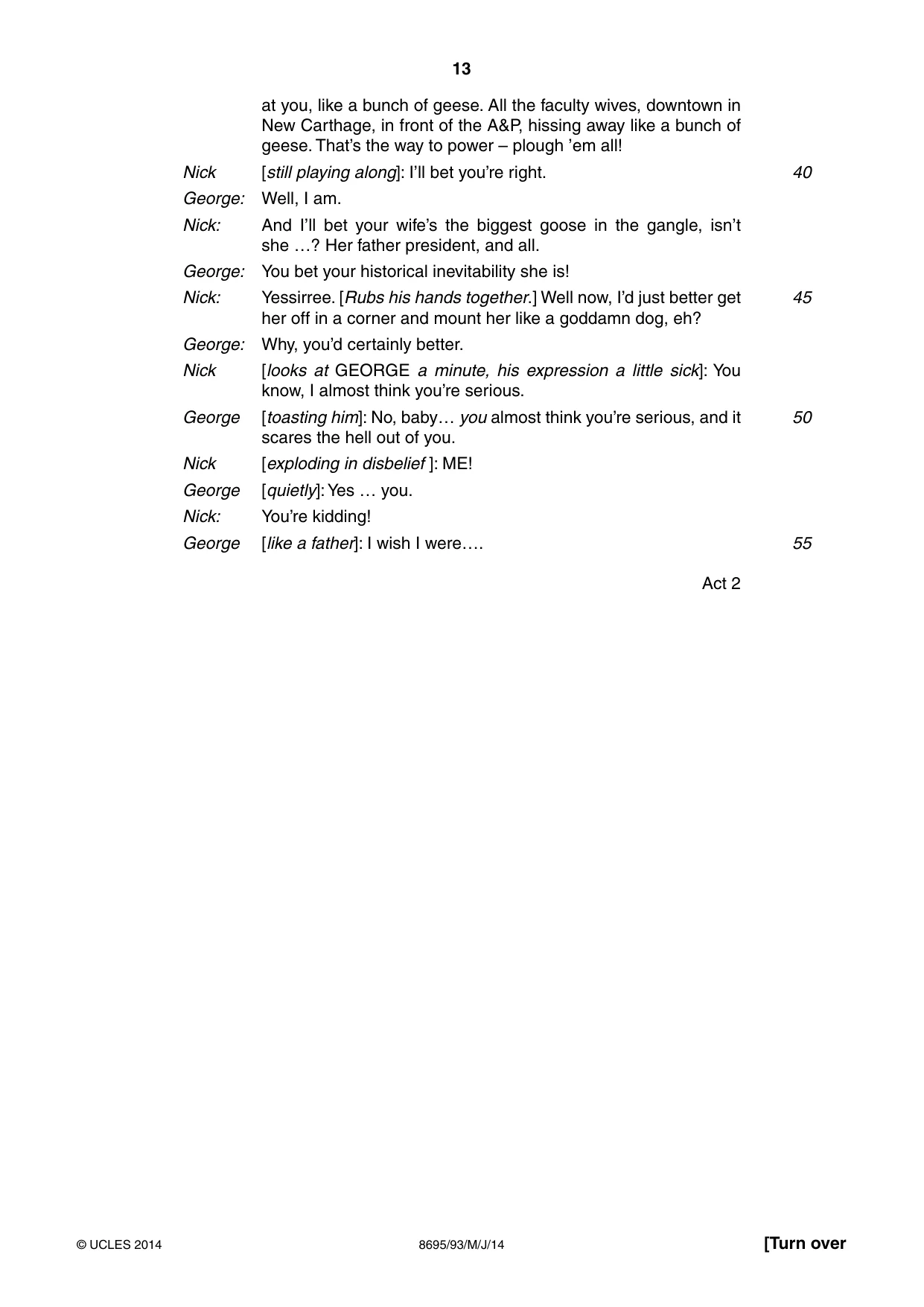
13 8695/93/M/J/14 © UCLES 2014 [Turn over at you, like a bunch of geese. All the faculty wives, downtown in New Carthage, in front of the A&P, hissing away like a bunch of geese. That’s the way to power – plough ’em all! Nick [still playing along]: I’ll bet you’re right. George: Well, I am. Nick: And I’ll bet your wife’s the biggest goose in the gangle, isn’t she …? Her father president, and all. George: You bet your historical inevitability she is! Nick: Yessirree. [Rubs his hands together.] Well now, I’d just better get her off in a corner and mount her like a goddamn dog, eh? George: Why, you’d certainly better. Nick [looks at GEORGE a minute, his expression a little sick]: You know, I almost think you’re serious. George [toasting him]: No, baby… you almost think you’re serious, and it scares the hell out of you. Nick [exploding in disbelief ]: ME! George [quietly]: Yes … you. Nick: You’re kidding! George [like a father]: I wish I were…. Act 2 40 45 50 55
Question paper, page 14
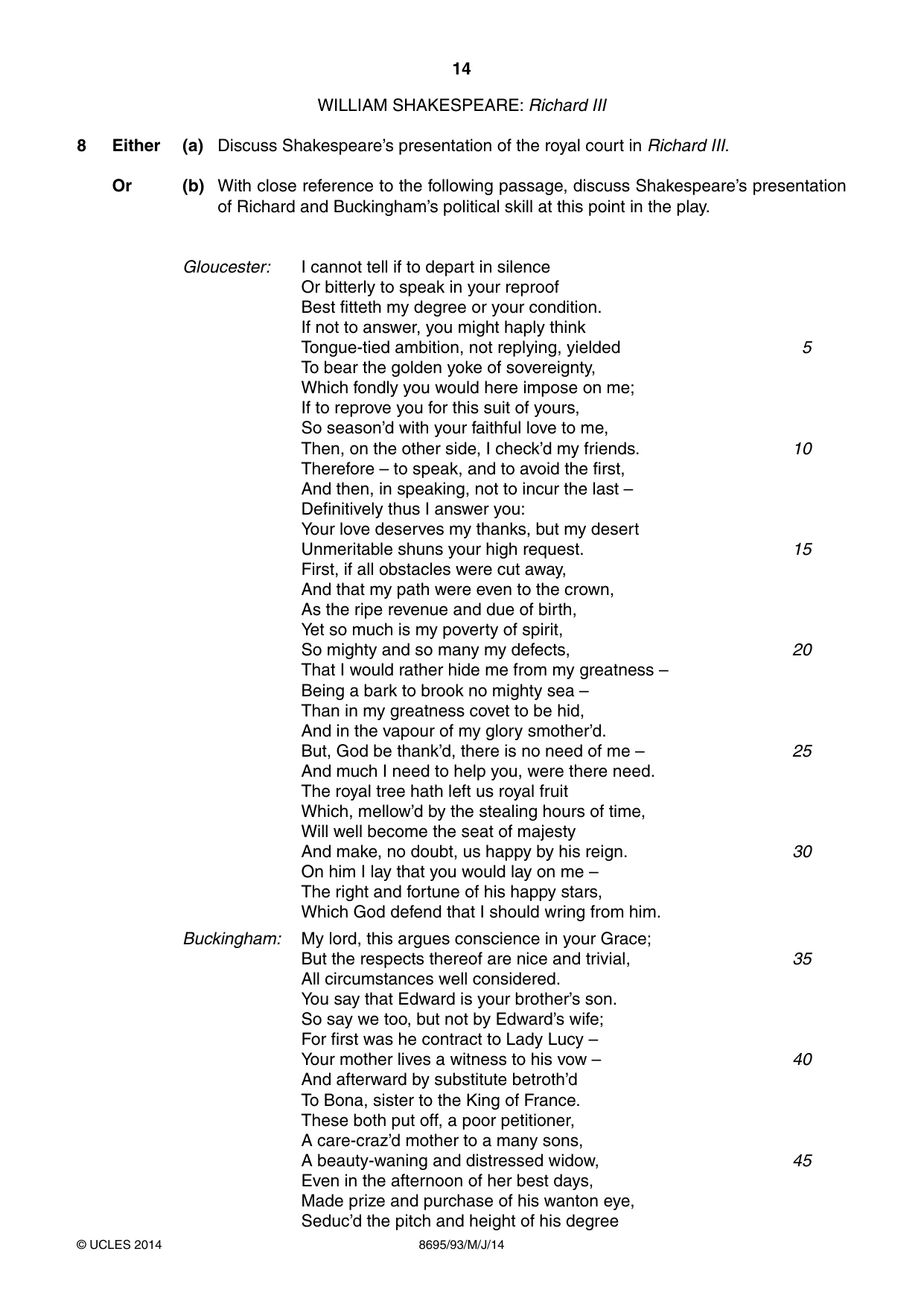
14 8695/93/M/J/14 © UCLES 2014 WILLIAM SHAKESPEARE: Richard III 8 Either (a) Discuss Shakespeare’s presentation of the royal court in Richard III. Or (b) With close reference to the following passage, discuss Shakespeare’s presentation of Richard and Buckingham’s political skill at this point in the play. Gloucester: I cannot tell if to depart in silence Or bitterly to speak in your reproof Best fitteth my degree or your condition. If not to answer, you might haply think Tongue-tied ambition, not replying, yielded To bear the golden yoke of sovereignty, Which fondly you would here impose on me; If to reprove you for this suit of yours, So season’d with your faithful love to me, Then, on the other side, I check’d my friends. Therefore – to speak, and to avoid the first, And then, in speaking, not to incur the last – Definitively thus I answer you: Your love deserves my thanks, but my desert Unmeritable shuns your high request. First, if all obstacles were cut away, And that my path were even to the crown, As the ripe revenue and due of birth, Yet so much is my poverty of spirit, So mighty and so many my defects, That I would rather hide me from my greatness – Being a bark to brook no mighty sea – Than in my greatness covet to be hid, And in the vapour of my glory smother’d. But, God be thank’d, there is no need of me – And much I need to help you, were there need. The royal tree hath left us royal fruit Which, mellow’d by the stealing hours of time, Will well become the seat of majesty And make, no doubt, us happy by his reign. On him I lay that you would lay on me – The right and fortune of his happy stars, Which God defend that I should wring from him. Buckingham: My lord, this argues conscience in your Grace; But the respects thereof are nice and trivial, All circumstances well considered. You say that Edward is your brother’s son. So say we too, but not by Edward’s wife; For first was he contract to Lady Lucy – Your mother lives a witness to his vow – And afterward by substitute betroth’d To Bona, sister to the King of France. These both put off, a poor petitioner, A care-craz’d mother to a many sons, A beauty-waning and distressed widow, Even in the afternoon of her best days, Made prize and purchase of his wanton eye, Seduc’d the pitch and height of his degree 5 10 15 20 25 30 35 40 45
Question paper, page 15
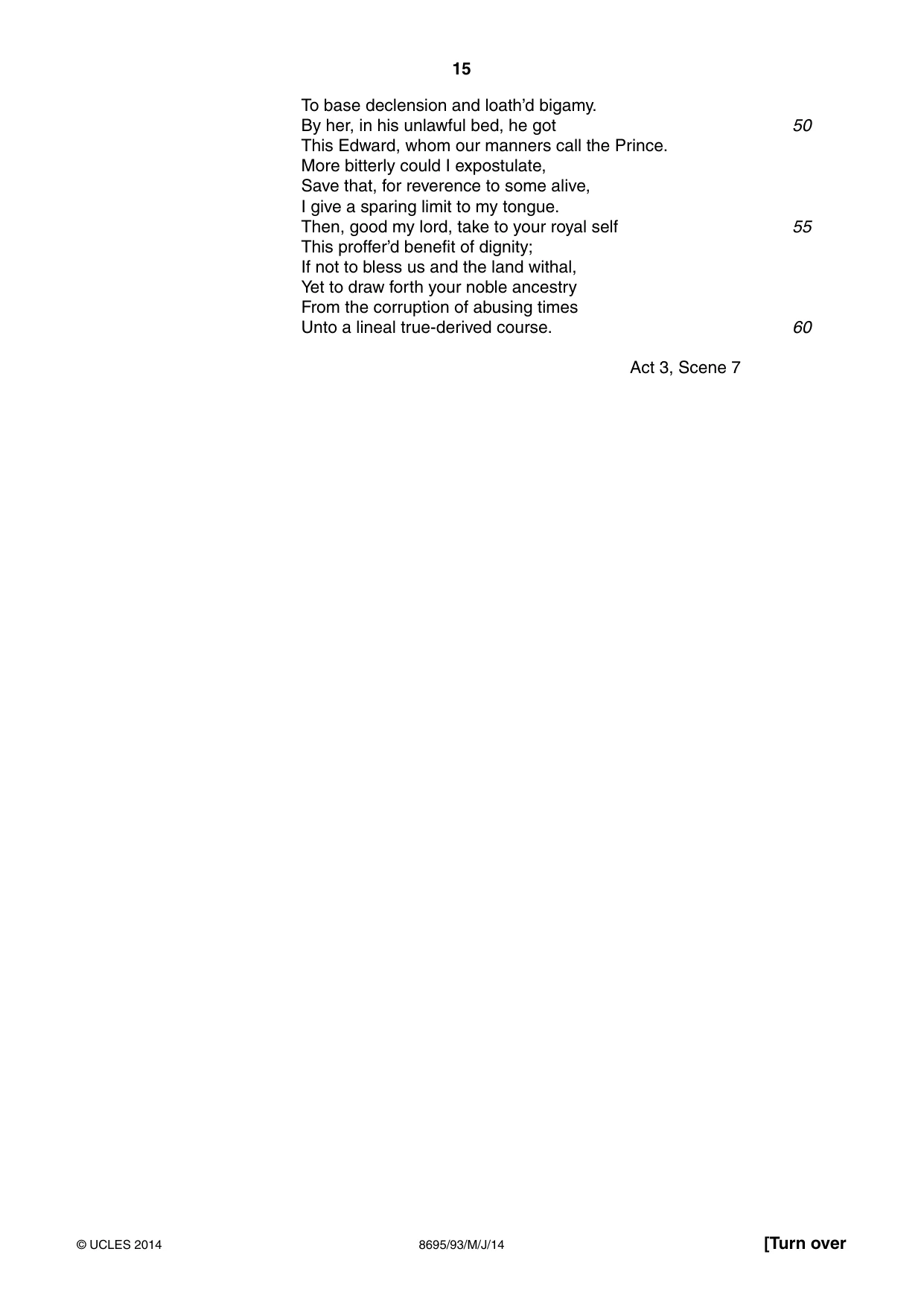
15 8695/93/M/J/14 © UCLES 2014 [Turn over To base declension and loath’d bigamy. By her, in his unlawful bed, he got This Edward, whom our manners call the Prince. More bitterly could I expostulate, Save that, for reverence to some alive, I give a sparing limit to my tongue. Then, good my lord, take to your royal self This proffer’d benefit of dignity; If not to bless us and the land withal, Yet to draw forth your noble ancestry From the corruption of abusing times Unto a lineal true-derived course. Act 3, Scene 7 50 55 60
Question paper, page 16
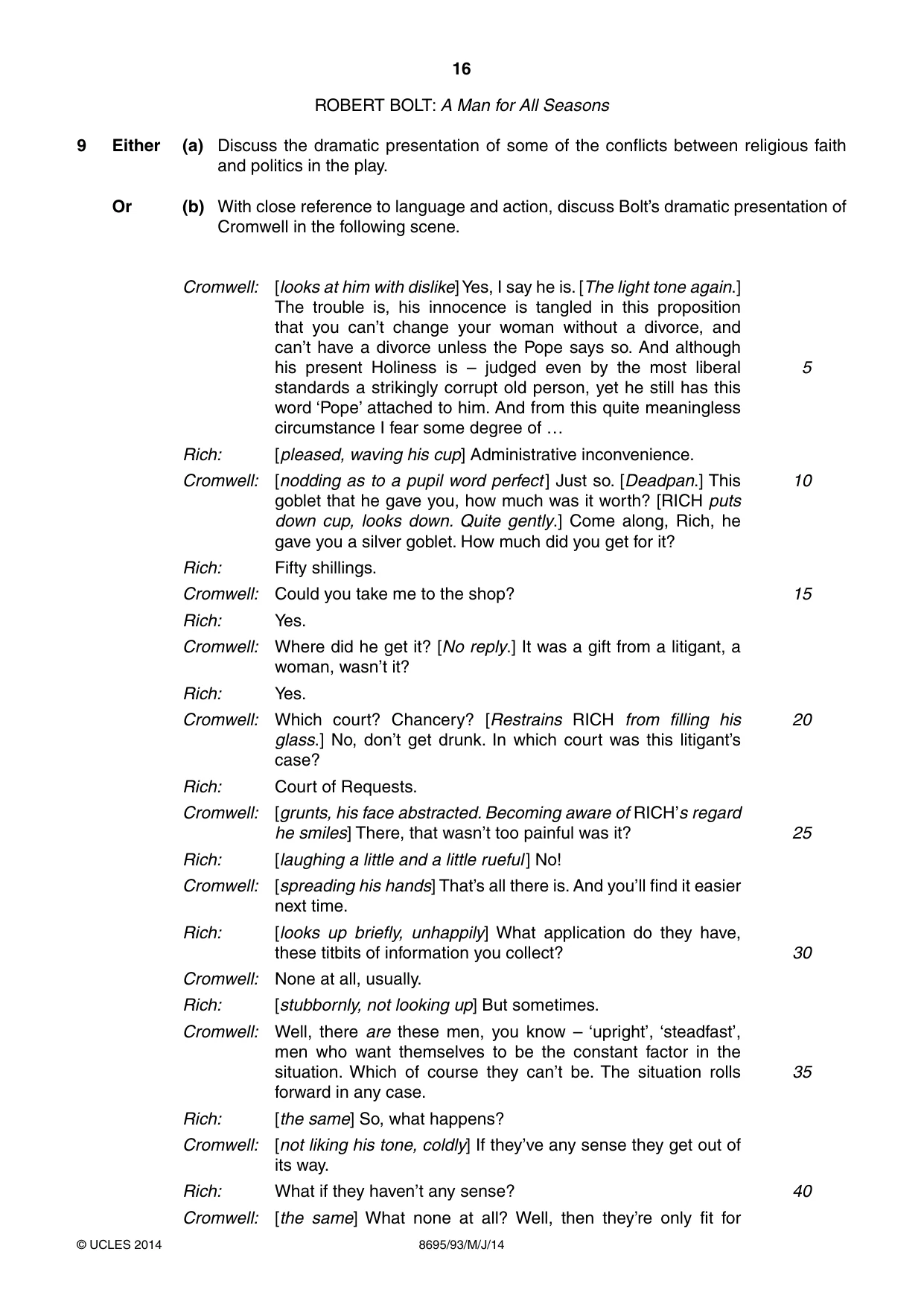
16 8695/93/M/J/14 © UCLES 2014 ROBERT BOLT: A Man for All Seasons 9 Either (a) Discuss the dramatic presentation of some of the conflicts between religious faith and politics in the play. Or (b) With close reference to language and action, discuss Bolt’s dramatic presentation of Cromwell in the following scene. Cromwell: [looks at him with dislike] Yes, I say he is. [The light tone again.] The trouble is, his innocence is tangled in this proposition that you can’t change your woman without a divorce, and can’t have a divorce unless the Pope says so. And although his present Holiness is – judged even by the most liberal standards a strikingly corrupt old person, yet he still has this word ‘Pope’ attached to him. And from this quite meaningless circumstance I fear some degree of … Rich: [ pleased, waving his cup] Administrative inconvenience. Cromwell: [nodding as to a pupil word perfect ] Just so. [Deadpan.] This goblet that he gave you, how much was it worth? [RICH puts down cup, looks down. Quite gently.] Come along, Rich, he gave you a silver goblet. How much did you get for it? Rich: Fifty shillings. Cromwell: Could you take me to the shop? Rich: Yes. Cromwell: Where did he get it? [No reply.] It was a gift from a litigant, a woman, wasn’t it? Rich: Yes. Cromwell: Which court? Chancery? [Restrains RICH from filling his glass.] No, don’t get drunk. In which court was this litigant’s case? Rich: Court of Requests. Cromwell: [grunts, his face abstracted. Becoming aware of RICH’s regard he smiles] There, that wasn’t too painful was it? Rich: [laughing a little and a little rueful ] No! Cromwell: [spreading his hands] That’s all there is. And you’ll find it easier next time. Rich: [looks up briefly, unhappily] What application do they have, these titbits of information you collect? Cromwell: None at all, usually. Rich: [stubbornly, not looking up] But sometimes. Cromwell: Well, there are these men, you know – ‘upright’, ‘steadfast’, men who want themselves to be the constant factor in the situation. Which of course they can’t be. The situation rolls forward in any case. Rich: [the same] So, what happens? Cromwell: [not liking his tone, coldly] If they’ve any sense they get out of its way. Rich: What if they haven’t any sense? Cromwell: [the same] What none at all? Well, then they’re only fit for 5 10 15 20 25 30 35 40
Question paper, page 17
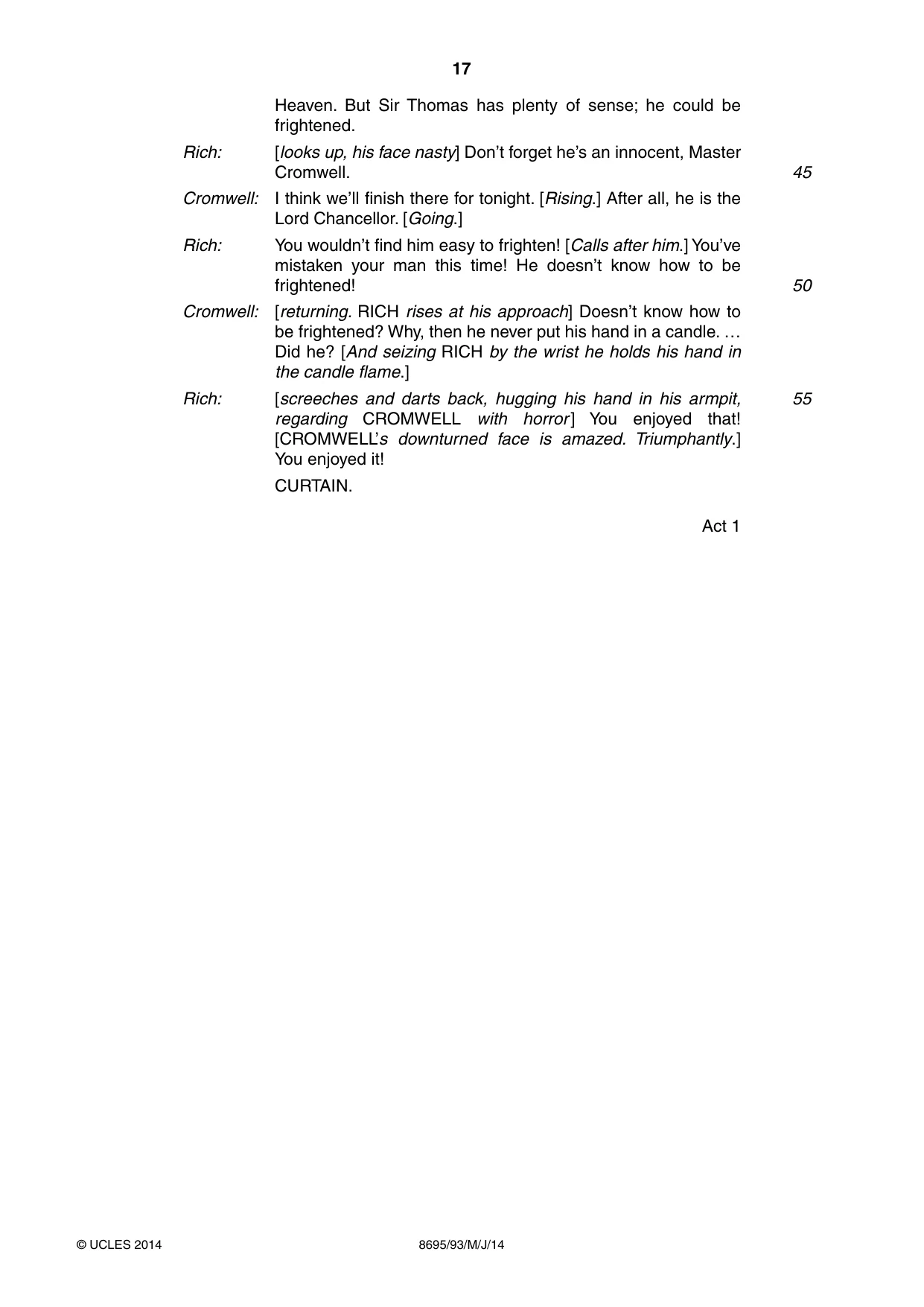
17 8695/93/M/J/14 © UCLES 2014 Heaven. But Sir Thomas has plenty of sense; he could be frightened. Rich: [looks up, his face nasty] Don’t forget he’s an innocent, Master Cromwell. Cromwell: I think we’ll finish there for tonight. [Rising.] After all, he is the Lord Chancellor. [Going.] Rich: You wouldn’t find him easy to frighten! [Calls after him.] You’ve mistaken your man this time! He doesn’t know how to be frightened! Cromwell: [returning. RICH rises at his approach] Doesn’t know how to be frightened? Why, then he never put his hand in a candle. … Did he? [And seizing RICH by the wrist he holds his hand in the candle flame.] Rich: [screeches and darts back, hugging his hand in his armpit, regarding CROMWELL with horror ] You enjoyed that! [CROMWELL’s downturned face is amazed. Triumphantly.] You enjoyed it! CURTAIN. Act 1 45 50 55
Question paper, page 18
18 8695/93/M/J/14 © UCLES 2014 BLANK PAGE
Question paper, page 19
19 8695/93/M/J/14 © UCLES 2014 BLANK PAGE
Question paper, page 20
20 8695/93/M/J/14 © UCLES 2014 Copyright Acknowledgements: Question 1 © Seamus Heaney; Anahorish 1944, from District and Circle; Faber & Faber Ltd; 2006. Question 4 © Chimamanda Ngozi Adichie; Half of a Yellow Sun; HarperCollins; 2006. Question 5 © E M Forster; A Passage to India; The Provost and Scholars of King’s College, Cambridge and The Society of Authors. Question 6 © The Bath by Janet Frame, © 1983, Janet Frame Literary Trust. Reproduced by permission of The Wylie Agency. All rights reserved. Question 7 © From Who’s Afraid of Virginia Woolf? by Edward Albee. Published by Jonathan Cape. Reprinted by permission of the Random House Group Ltd. Question 9 © A Man for All Seasons by Robert Bolt. Reprinted by permission of Pearson Education. Permission to reproduce items where third-party owned material protected by copyright is included has been sought and cleared where possible. Every reasonable effort has been made by the publisher (UCLES) to trace copyright holders, but if any items requiring clearance have unwittingly been included, the publisher will be pleased to make amends at the earliest possible opportunity. Cambridge International Examinations is part of the Cambridge Assessment Group. Cambridge Assessment is the brand name of University of Cambridge Local Examinations Syndicate (UCLES), which is itself a department of the University of Cambridge. BLANK PAGE
Mark scheme, page 1
CAMBRIDGE INTERNATIONAL EXAMINATIONS GCE Advanced Subsidiary Level and GCE Advanced Level MARK SCHEME for the May/June 2014 series 8695 LANGUAGE AND LITERATURE IN ENGLISH 8695/93 Paper 9 (Poetry, Prose and Drama), maximum raw mark 50 This mark scheme is published as an aid to teachers and candidates, to indicate the requirements of the examination. It shows the basis on which Examiners were instructed to award marks. It does not indicate the details of the discussions that took place at an Examiners’ meeting before marking began, which would have considered the acceptability of alternative answers. Mark schemes should be read in conjunction with the question paper and the Principal Examiner Report for Teachers. Cambridge will not enter into discussions about these mark schemes. Cambridge is publishing the mark schemes for the May/June 2014 series for most IGCSE, GCE Advanced Level and Advanced Subsidiary Level components and some Ordinary Level components.
Mark scheme, page 2
Page 2 Mark Scheme Syllabus Paper GCE AS/A LEVEL – May/June 2014 8695 93 © Cambridge International Examinations 2014 Using the mark bands Place the answer in a band first. Look for the ‘best fit’ of the answer into a band. An answer needs to show evidence of most but not necessarily ALL of the qualities described in a band, in order to be placed in that band. Then award a mark for the relative position of the answer within the band. Candidates may address the question in many different ways. Do not expect any particular focus or approach and do not penalise answers for leaving out a particular focus. Reward what is there, showing what you are rewarding, in your comments. Consider all strands and weigh up the performance as a whole in placing the answer in a band, then show that you have done so in the summative comment, e.g. Sound K of texts, some evidence of U but mostly narrative, occasional evidence of P, mainly clear C. Assessment Objectives: • Ability to respond to texts in the three main forms (Prose, Poetry and Drama) of different types and from different cultures; • Understanding of the ways in which writers’ choices of form, structure and language shape meanings; • Ability to produce informed independent opinions and judgements on literary texts; • Ability to communicate clearly the knowledge, understanding and insight appropriate to literary study. Each answer is marked out of 25, in accordance with the General Marking Criteria below. Each band is divided into strands corresponding to the Assessment Objectives – Knowledge, Understanding, Personal Response, Communication.
Mark scheme, page 3
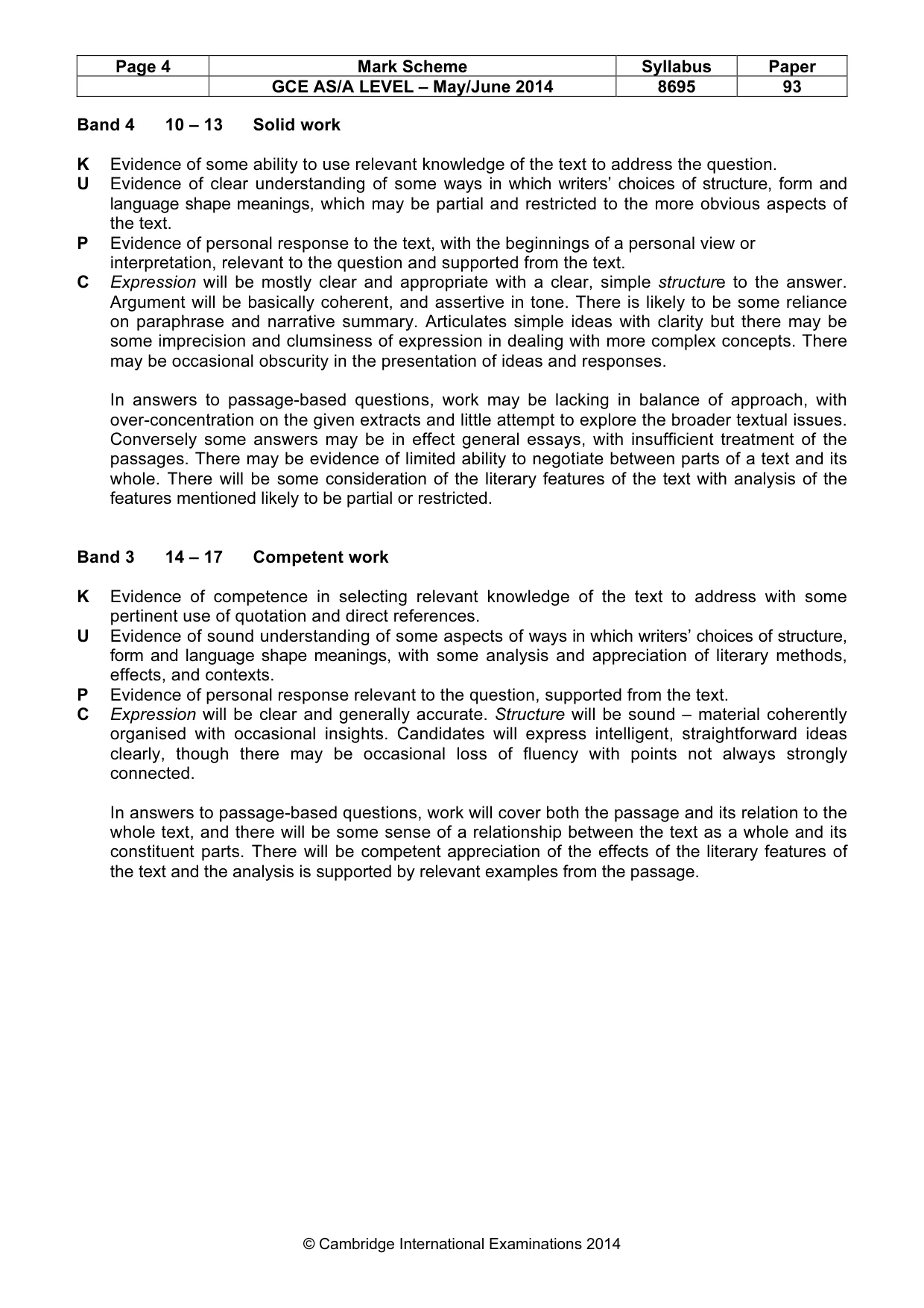
Page 3 Mark Scheme Syllabus Paper GCE AS/A LEVEL – May/June 2014 8695 93 © Cambridge International Examinations 2014 Band 6 0 – 5 K Evidence of some general knowledge of the text which may be narrative based and may contain errors, rarely relevant to the question and with little or no relevant quotation or selection from the text. U There may be little or no evidence of understanding of form, structure and language, with some appropriate points made in response to the question. These will be limited and tend to be restricted to plot and characters – the latter treated very much as ‘real’ people. P There may be some signs of personal response, not developed into an argument and not fully supported from the text. C Communication will be insecure. Expression may be weak with some breakdown in communication. Structure may be lacking: answers are likely to be partial, undeveloped, narrative commentary in approach; with the assertion of simple points rather than progressive lines of argument. Answers to passage-based questions are likely to be seriously unbalanced, with an emphasis on narrative or paraphrase. Passages are likely to have been only partially understood and tentatively located contextually, with little coherent sense of the relationship between textual part and whole. There will be little or no mention or consideration of the literary features of the passage. Band 5 6 – 9 Work of a basic standard K Evidence of some limited ability to use knowledge of the text to address the question, with occasional use of supporting references or quotation. U Evidence of some limited understanding of ways in which writers’ choices of structure, form and language shape meanings. P Evidence of some personal response to the text but not fully supported. C Expression will be basically clear. There may be the occasional confused passage of writing. However, there will be no sustained loss of communication. There may be a simple structure to the answer with some evidence of an argument, which may lack coherence, with some repetition, assertion and relapse into narrative summary/paraphrase. There may be a tendency to drift from relevant discussion into material of tangential significance. In answers to passage-based questions there will be some evidence of understanding of how part relates to whole. Treatment of the given extracts may well be sketchy or overlong and undiscriminating. Comment on the wider textual issues is likely to be general. There may be a lack of balance between passage and whole text. There will be some limited consideration of the literary features of the text.
Mark scheme, page 4
Page 4 Mark Scheme Syllabus Paper GCE AS/A LEVEL – May/June 2014 8695 93 © Cambridge International Examinations 2014 Band 4 10 – 13 Solid work K Evidence of some ability to use relevant knowledge of the text to address the question. U Evidence of clear understanding of some ways in which writers’ choices of structure, form and language shape meanings, which may be partial and restricted to the more obvious aspects of the text. P Evidence of personal response to the text, with the beginnings of a personal view or interpretation, relevant to the question and supported from the text. C Expression will be mostly clear and appropriate with a clear, simple structure to the answer. Argument will be basically coherent, and assertive in tone. There is likely to be some reliance on paraphrase and narrative summary. Articulates simple ideas with clarity but there may be some imprecision and clumsiness of expression in dealing with more complex concepts. There may be occasional obscurity in the presentation of ideas and responses. In answers to passage-based questions, work may be lacking in balance of approach, with over-concentration on the given extracts and little attempt to explore the broader textual issues. Conversely some answers may be in effect general essays, with insufficient treatment of the passages. There may be evidence of limited ability to negotiate between parts of a text and its whole. There will be some consideration of the literary features of the text with analysis of the features mentioned likely to be partial or restricted. Band 3 14 – 17 Competent work K Evidence of competence in selecting relevant knowledge of the text to address with some pertinent use of quotation and direct references. U Evidence of sound understanding of some aspects of ways in which writers’ choices of structure, form and language shape meanings, with some analysis and appreciation of literary methods, effects, and contexts. P Evidence of personal response relevant to the question, supported from the text. C Expression will be clear and generally accurate. Structure will be sound – material coherently organised with occasional insights. Candidates will express intelligent, straightforward ideas clearly, though there may be occasional loss of fluency with points not always strongly connected. In answers to passage-based questions, work will cover both the passage and its relation to the whole text, and there will be some sense of a relationship between the text as a whole and its constituent parts. There will be competent appreciation of the effects of the literary features of the text and the analysis is supported by relevant examples from the passage.
Mark scheme, page 5
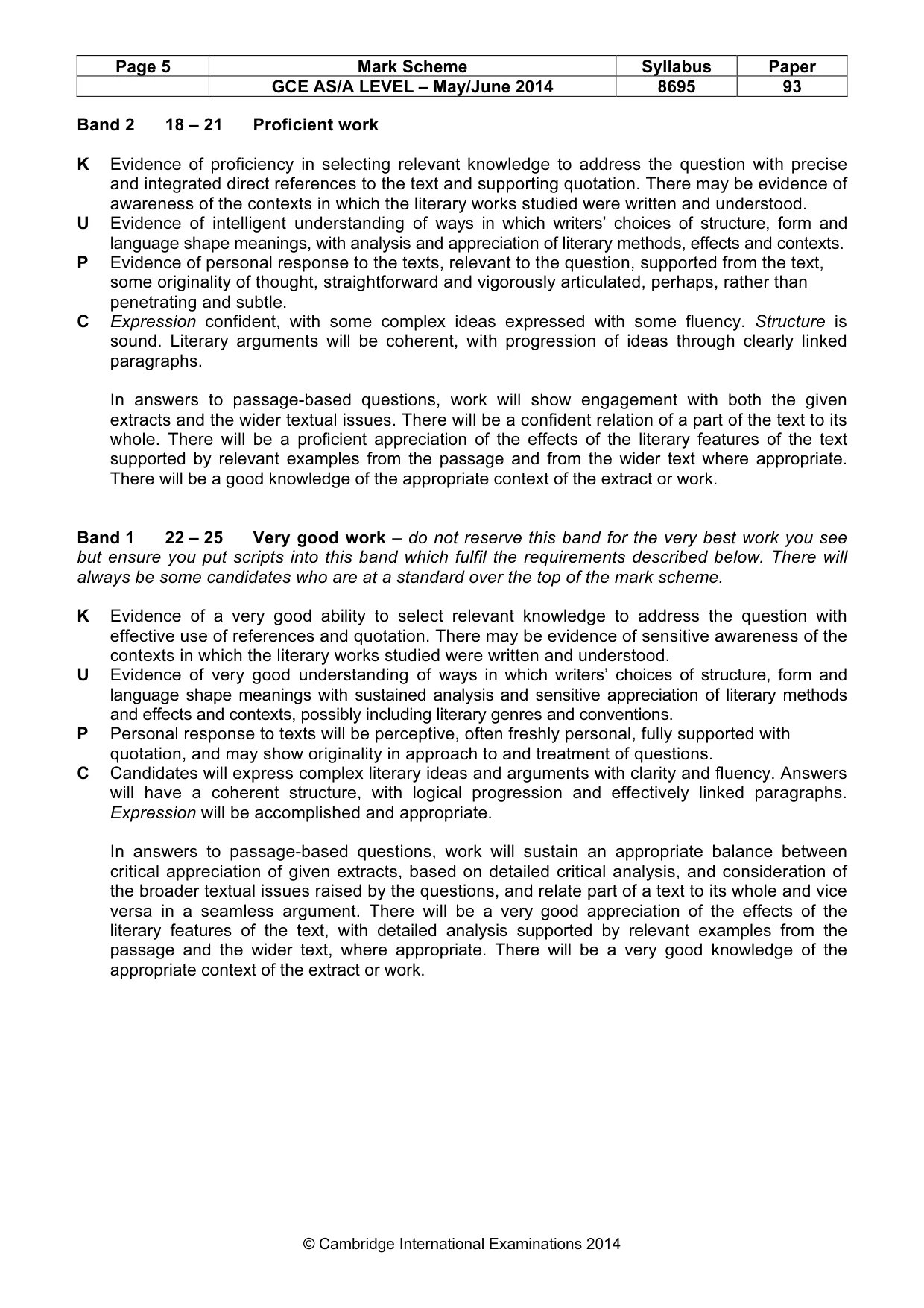
Page 5 Mark Scheme Syllabus Paper GCE AS/A LEVEL – May/June 2014 8695 93 © Cambridge International Examinations 2014 Band 2 18 – 21 Proficient work K Evidence of proficiency in selecting relevant knowledge to address the question with precise and integrated direct references to the text and supporting quotation. There may be evidence of awareness of the contexts in which the literary works studied were written and understood. U Evidence of intelligent understanding of ways in which writers’ choices of structure, form and language shape meanings, with analysis and appreciation of literary methods, effects and contexts. P Evidence of personal response to the texts, relevant to the question, supported from the text, some originality of thought, straightforward and vigorously articulated, perhaps, rather than penetrating and subtle. C Expression confident, with some complex ideas expressed with some fluency. Structure is sound. Literary arguments will be coherent, with progression of ideas through clearly linked paragraphs. In answers to passage-based questions, work will show engagement with both the given extracts and the wider textual issues. There will be a confident relation of a part of the text to its whole. There will be a proficient appreciation of the effects of the literary features of the text supported by relevant examples from the passage and from the wider text where appropriate. There will be a good knowledge of the appropriate context of the extract or work. Band 1 22 – 25 Very good work – do not reserve this band for the very best work you see but ensure you put scripts into this band which fulfil the requirements described below. There will always be some candidates who are at a standard over the top of the mark scheme. K Evidence of a very good ability to select relevant knowledge to address the question with effective use of references and quotation. There may be evidence of sensitive awareness of the contexts in which the literary works studied were written and understood. U Evidence of very good understanding of ways in which writers’ choices of structure, form and language shape meanings with sustained analysis and sensitive appreciation of literary methods and effects and contexts, possibly including literary genres and conventions. P Personal response to texts will be perceptive, often freshly personal, fully supported with quotation, and may show originality in approach to and treatment of questions. C Candidates will express complex literary ideas and arguments with clarity and fluency. Answers will have a coherent structure, with logical progression and effectively linked paragraphs. Expression will be accomplished and appropriate. In answers to passage-based questions, work will sustain an appropriate balance between critical appreciation of given extracts, based on detailed critical analysis, and consideration of the broader textual issues raised by the questions, and relate part of a text to its whole and vice versa in a seamless argument. There will be a very good appreciation of the effects of the literary features of the text, with detailed analysis supported by relevant examples from the passage and the wider text, where appropriate. There will be a very good knowledge of the appropriate context of the extract or work.
What you needed in this session
Cambridge’s own grade thresholds for 2014 May/June, Paper 9 · Variant 3. A higher threshold means an easier paper — the bar moves with how the cohort did.