Cambridge A Level English - Language and Literature (AS Level only, from 2016) 8695 — 2014 May/June Paper 9 · Variant 2
8695/92/M/J/14 · 50 marks · ≈56 min
The question paper and its mark scheme, free to read here and free to download. This is Cambridge’s own paper, exactly as it was sat.
Question paper16 pages


Mark scheme5 pages
Answers below. Sit the paper first if you are practising.
Paper as text
Question paper, page 1
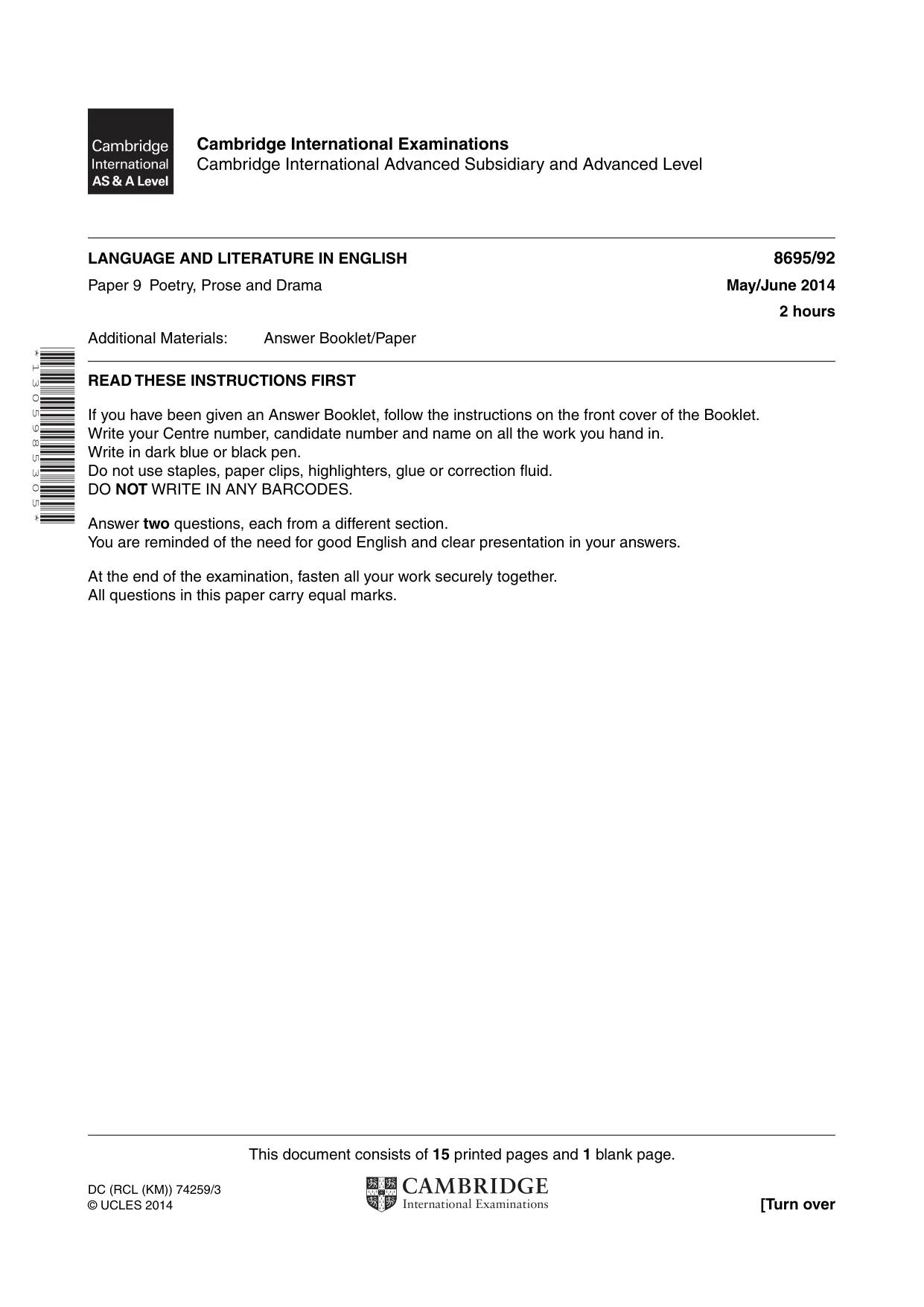
This document consists of 15 printed pages and 1 blank page. DC (RCL (KM)) 74259/3 © UCLES 2014 [Turn over Cambridge International Examinations Cambridge International Advanced Subsidiary and Advanced Level * 1 3 0 5 9 8 5 3 0 5 * LANGUAGE AND LITERATURE IN ENGLISH 8695/92 Paper 9 Poetry, Prose and Drama May/June 2014 2 hours Additional Materials: Answer Booklet/Paper READ THESE INSTRUCTIONS FIRST If you have been given an Answer Booklet, follow the instructions on the front cover of the Booklet. Write your Centre number, candidate number and name on all the work you hand in. Write in dark blue or black pen. Do not use staples, paper clips, highlighters, glue or correction fluid. DO NOT WRITE IN ANY BARCODES. Answer two questions, each from a different section. You are reminded of the need for good English and clear presentation in your answers. At the end of the examination, fasten all your work securely together. All questions in this paper carry equal marks.
Question paper, page 2
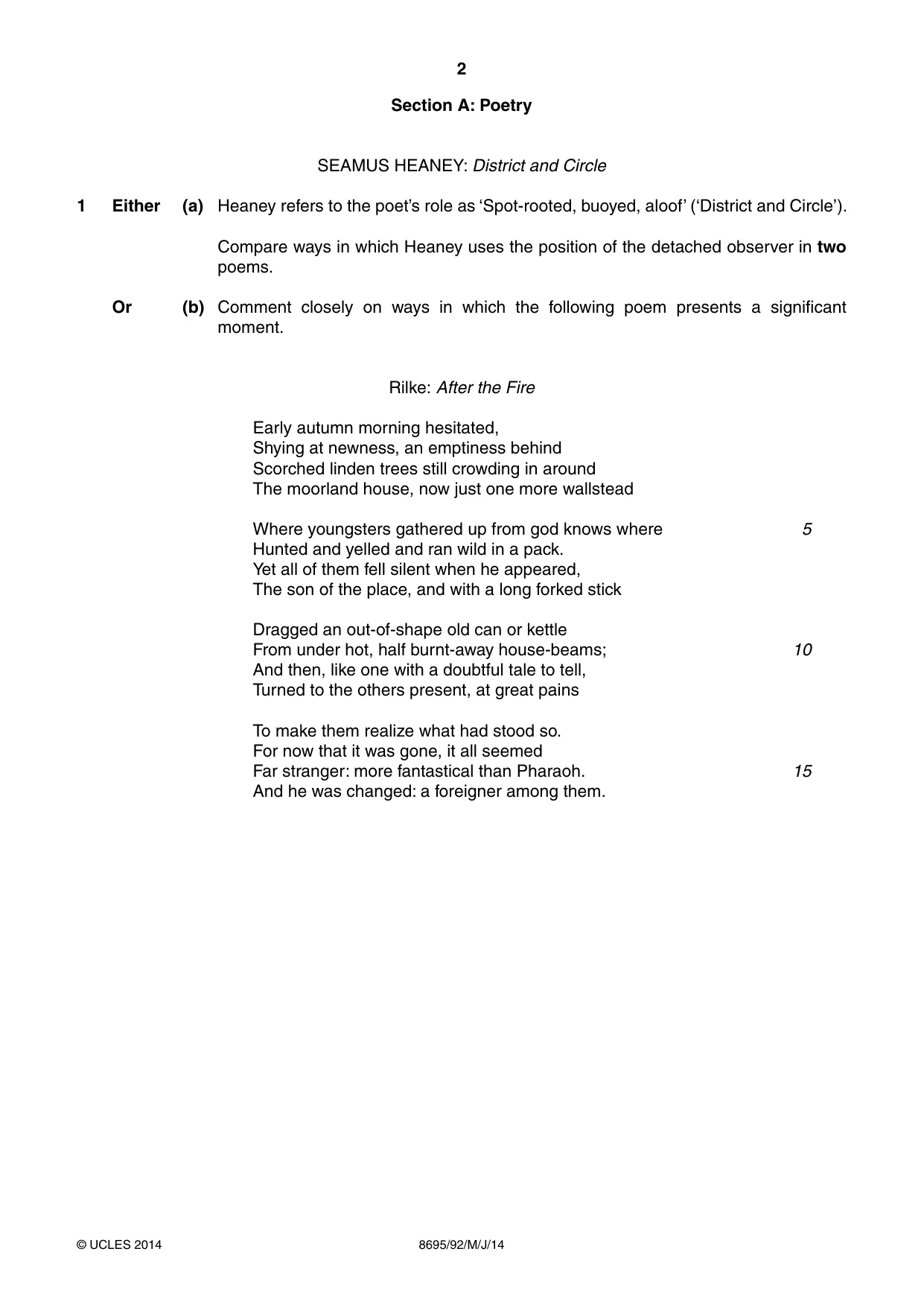
2 8695/92/M/J/14 © UCLES 2014 Section A: Poetry SEAMUS HEANEY: District and Circle 1 Either (a) Heaney refers to the poet’s role as ‘Spot-rooted, buoyed, aloof’ (‘District and Circle’). Compare ways in which Heaney uses the position of the detached observer in two poems. Or (b) Comment closely on ways in which the following poem presents a significant moment. Rilke: After the Fire Early autumn morning hesitated, Shying at newness, an emptiness behind Scorched linden trees still crowding in around The moorland house, now just one more wallstead Where youngsters gathered up from god knows where Hunted and yelled and ran wild in a pack. Yet all of them fell silent when he appeared, The son of the place, and with a long forked stick Dragged an out-of-shape old can or kettle From under hot, half burnt-away house-beams; And then, like one with a doubtful tale to tell, Turned to the others present, at great pains To make them realize what had stood so. For now that it was gone, it all seemed Far stranger: more fantastical than Pharaoh. And he was changed: a foreigner among them. 5 10 15
Question paper, page 3
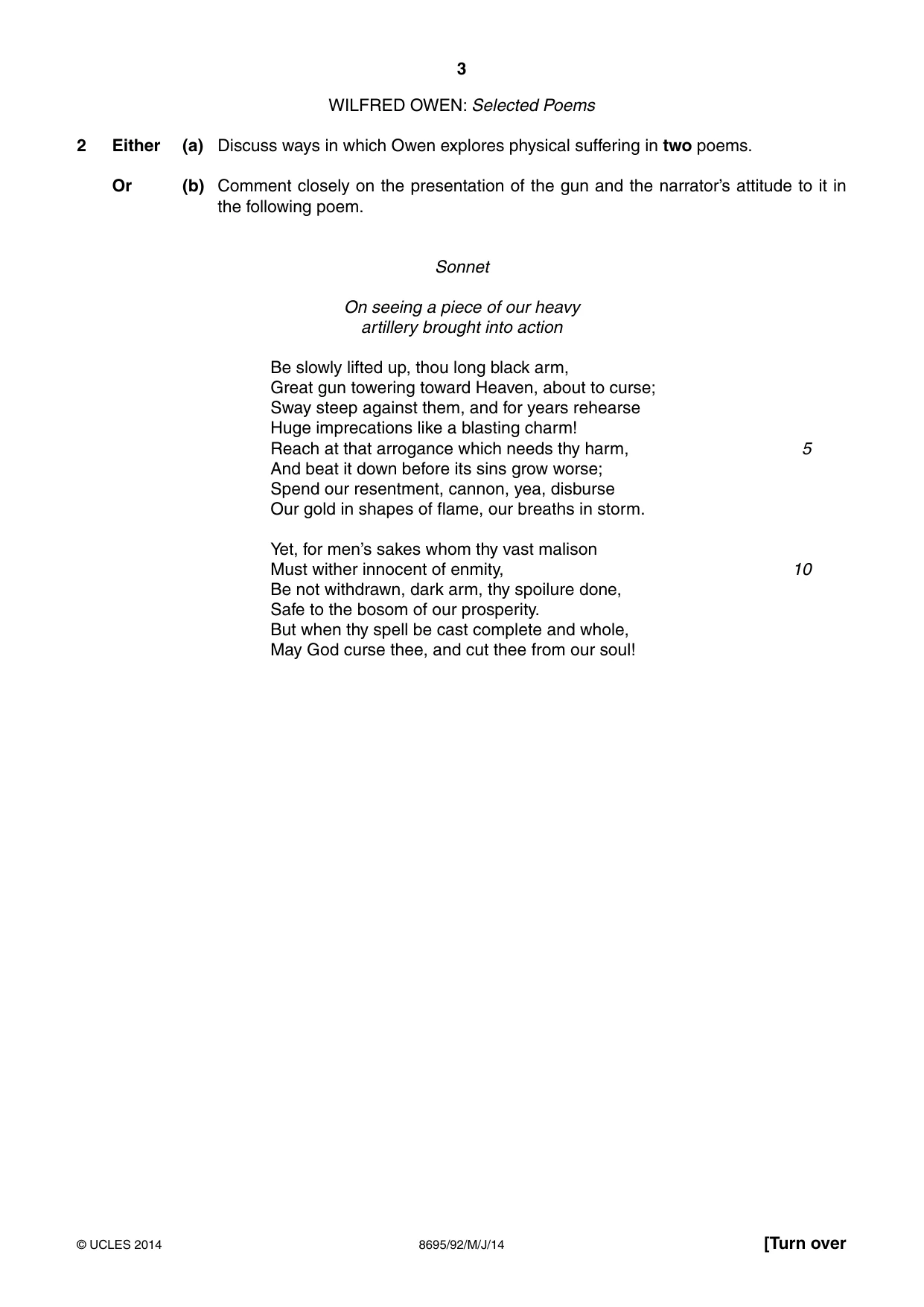
3 8695/92/M/J/14 © UCLES 2014 [Turn over WILFRED OWEN: Selected Poems 2 Either (a) Discuss ways in which Owen explores physical suffering in two poems. Or (b) Comment closely on the presentation of the gun and the narrator’s attitude to it in the following poem. Sonnet On seeing a piece of our heavy artillery brought into action Be slowly lifted up, thou long black arm, Great gun towering toward Heaven, about to curse; Sway steep against them, and for years rehearse Huge imprecations like a blasting charm! Reach at that arrogance which needs thy harm, And beat it down before its sins grow worse; Spend our resentment, cannon, yea, disburse Our gold in shapes of flame, our breaths in storm. Yet, for men’s sakes whom thy vast malison Must wither innocent of enmity, Be not withdrawn, dark arm, thy spoilure done, Safe to the bosom of our prosperity. But when thy spell be cast complete and whole, May God curse thee, and cut thee from our soul! 5 10
Question paper, page 4
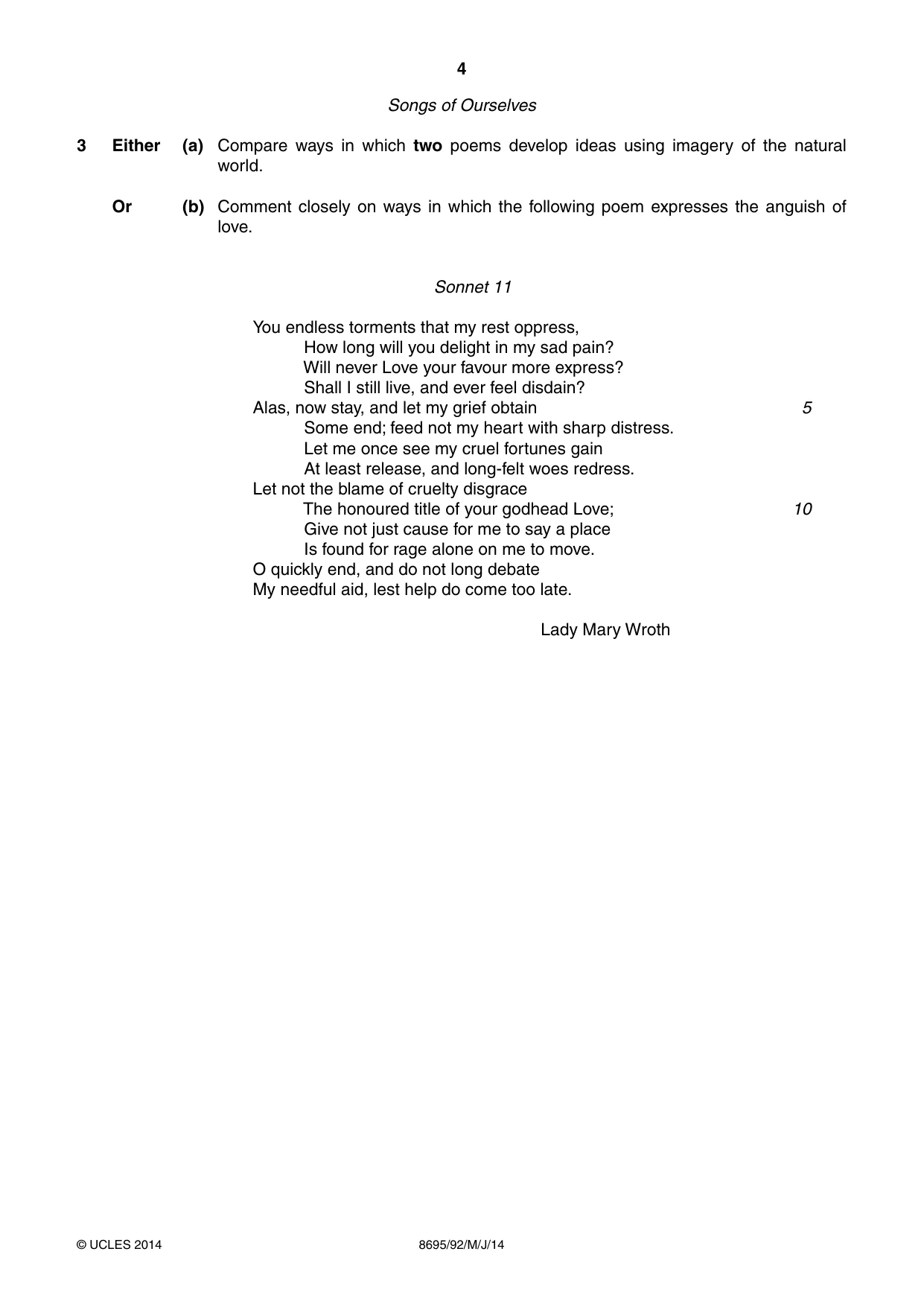
4 8695/92/M/J/14 © UCLES 2014 Songs of Ourselves 3 Either (a) Compare ways in which two poems develop ideas using imagery of the natural world. Or (b) Comment closely on ways in which the following poem expresses the anguish of love. Sonnet 11 You endless torments that my rest oppress, How long will you delight in my sad pain? Will never Love your favour more express? Shall I still live, and ever feel disdain? Alas, now stay, and let my grief obtain Some end; feed not my heart with sharp distress. Let me once see my cruel fortunes gain At least release, and long-felt woes redress. Let not the blame of cruelty disgrace The honoured title of your godhead Love; Give not just cause for me to say a place Is found for rage alone on me to move. O quickly end, and do not long debate My needful aid, lest help do come too late. Lady Mary Wroth 5 10
Question paper, page 5
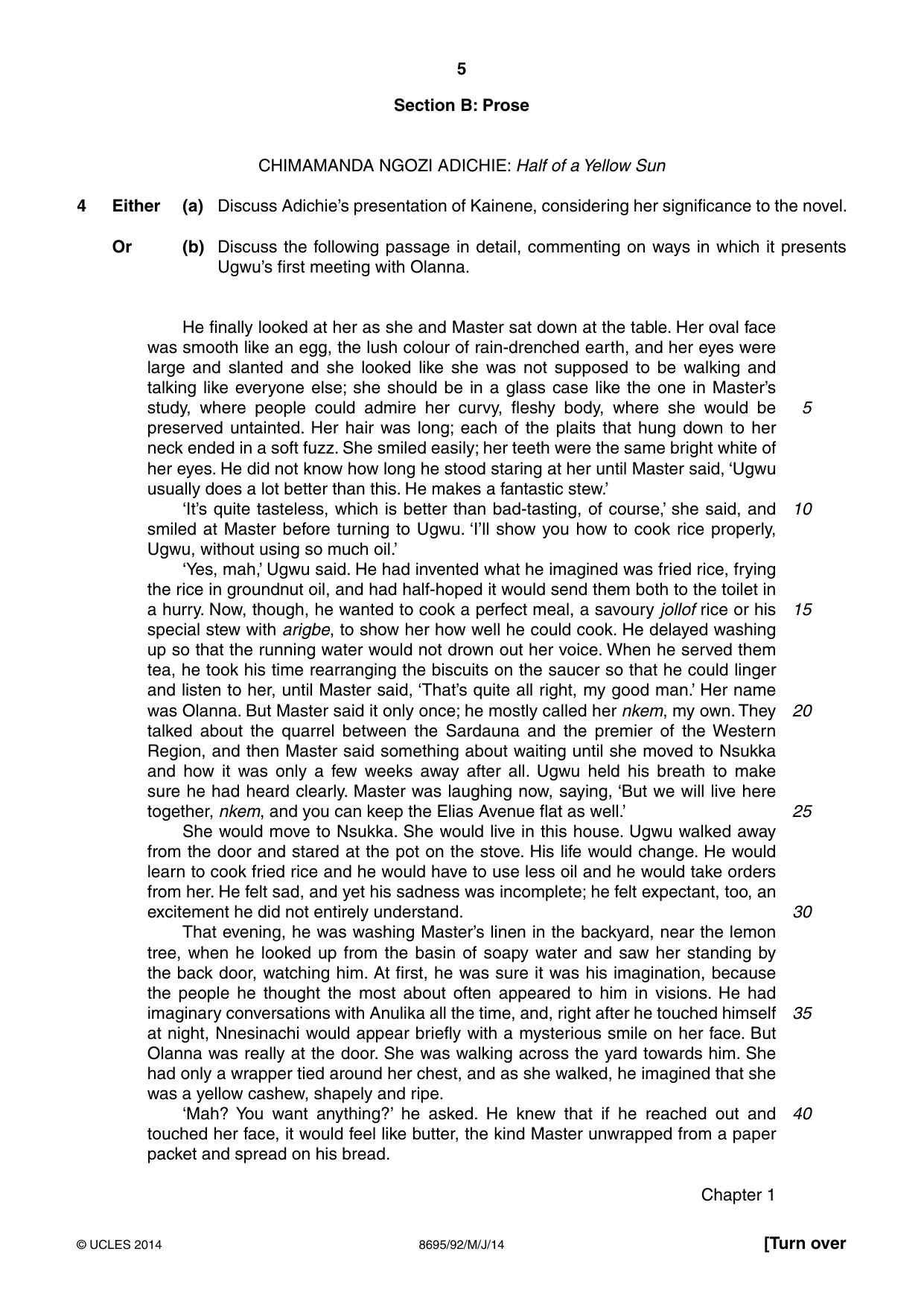
5 8695/92/M/J/14 © UCLES 2014 [Turn over Section B: Prose CHIMAMANDA NGOZI ADICHIE: Half of a Yellow Sun 4 Either (a) Discuss Adichie’s presentation of Kainene, considering her significance to the novel. Or (b) Discuss the following passage in detail, commenting on ways in which it presents Ugwu’s first meeting with Olanna. He finally looked at her as she and Master sat down at the table. Her oval face was smooth like an egg, the lush colour of rain-drenched earth, and her eyes were large and slanted and she looked like she was not supposed to be walking and talking like everyone else; she should be in a glass case like the one in Master’s study, where people could admire her curvy, fleshy body, where she would be preserved untainted. Her hair was long; each of the plaits that hung down to her neck ended in a soft fuzz. She smiled easily; her teeth were the same bright white of her eyes. He did not know how long he stood staring at her until Master said, ‘Ugwu usually does a lot better than this. He makes a fantastic stew.’ ‘It’s quite tasteless, which is better than bad-tasting, of course,’ she said, and smiled at Master before turning to Ugwu. ‘I’ll show you how to cook rice properly, Ugwu, without using so much oil.’ ‘Yes, mah,’ Ugwu said. He had invented what he imagined was fried rice, frying the rice in groundnut oil, and had half-hoped it would send them both to the toilet in a hurry. Now, though, he wanted to cook a perfect meal, a savoury jollof rice or his special stew with arigbe, to show her how well he could cook. He delayed washing up so that the running water would not drown out her voice. When he served them tea, he took his time rearranging the biscuits on the saucer so that he could linger and listen to her, until Master said, ‘That’s quite all right, my good man.’ Her name was Olanna. But Master said it only once; he mostly called her nkem, my own. They talked about the quarrel between the Sardauna and the premier of the Western Region, and then Master said something about waiting until she moved to Nsukka and how it was only a few weeks away after all. Ugwu held his breath to make sure he had heard clearly. Master was laughing now, saying, ‘But we will live here together, nkem, and you can keep the Elias Avenue flat as well.’ She would move to Nsukka. She would live in this house. Ugwu walked away from the door and stared at the pot on the stove. His life would change. He would learn to cook fried rice and he would have to use less oil and he would take orders from her. He felt sad, and yet his sadness was incomplete; he felt expectant, too, an excitement he did not entirely understand. That evening, he was washing Master’s linen in the backyard, near the lemon tree, when he looked up from the basin of soapy water and saw her standing by the back door, watching him. At first, he was sure it was his imagination, because the people he thought the most about often appeared to him in visions. He had imaginary conversations with Anulika all the time, and, right after he touched himself at night, Nnesinachi would appear briefly with a mysterious smile on her face. But Olanna was really at the door. She was walking across the yard towards him. She had only a wrapper tied around her chest, and as she walked, he imagined that she was a yellow cashew, shapely and ripe. ‘Mah? You want anything?’ he asked. He knew that if he reached out and touched her face, it would feel like butter, the kind Master unwrapped from a paper packet and spread on his bread. Chapter 1 5 10 15 20 25 30 35 40
Question paper, page 6
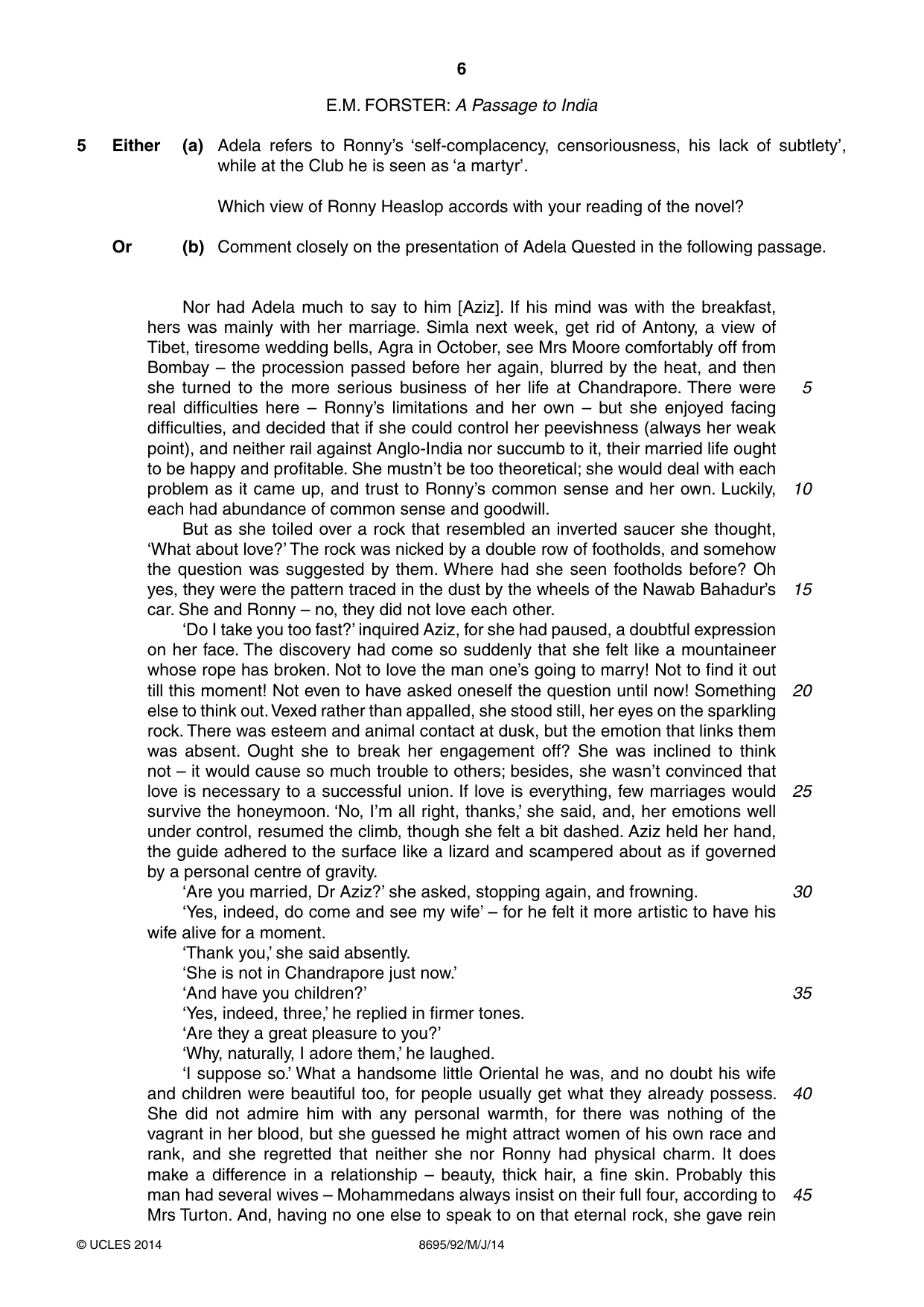
6 8695/92/M/J/14 © UCLES 2014 E.M. FORSTER: A Passage to India 5 Either (a) Adela refers to Ronny’s ‘self-complacency, censoriousness, his lack of subtlety’, while at the Club he is seen as ‘a martyr’. Which view of Ronny Heaslop accords with your reading of the novel? Or (b) Comment closely on the presentation of Adela Quested in the following passage. Nor had Adela much to say to him [Aziz]. If his mind was with the breakfast, hers was mainly with her marriage. Simla next week, get rid of Antony, a view of Tibet, tiresome wedding bells, Agra in October, see Mrs Moore comfortably off from Bombay – the procession passed before her again, blurred by the heat, and then she turned to the more serious business of her life at Chandrapore. There were real difficulties here – Ronny’s limitations and her own – but she enjoyed facing difficulties, and decided that if she could control her peevishness (always her weak point), and neither rail against Anglo-India nor succumb to it, their married life ought to be happy and profitable. She mustn’t be too theoretical; she would deal with each problem as it came up, and trust to Ronny’s common sense and her own. Luckily, each had abundance of common sense and goodwill. But as she toiled over a rock that resembled an inverted saucer she thought, ‘What about love?’ The rock was nicked by a double row of footholds, and somehow the question was suggested by them. Where had she seen footholds before? Oh yes, they were the pattern traced in the dust by the wheels of the Nawab Bahadur’s car. She and Ronny – no, they did not love each other. ‘Do I take you too fast?’ inquired Aziz, for she had paused, a doubtful expression on her face. The discovery had come so suddenly that she felt like a mountaineer whose rope has broken. Not to love the man one’s going to marry! Not to find it out till this moment! Not even to have asked oneself the question until now! Something else to think out. Vexed rather than appalled, she stood still, her eyes on the sparkling rock. There was esteem and animal contact at dusk, but the emotion that links them was absent. Ought she to break her engagement off? She was inclined to think not – it would cause so much trouble to others; besides, she wasn’t convinced that love is necessary to a successful union. If love is everything, few marriages would survive the honeymoon. ‘No, I’m all right, thanks,’ she said, and, her emotions well under control, resumed the climb, though she felt a bit dashed. Aziz held her hand, the guide adhered to the surface like a lizard and scampered about as if governed by a personal centre of gravity. ‘Are you married, Dr Aziz?’ she asked, stopping again, and frowning. ‘Yes, indeed, do come and see my wife’ – for he felt it more artistic to have his wife alive for a moment. ‘Thank you,’ she said absently. ‘She is not in Chandrapore just now.’ ‘And have you children?’ ‘Yes, indeed, three,’ he replied in firmer tones. ‘Are they a great pleasure to you?’ ‘Why, naturally, I adore them,’ he laughed. ‘I suppose so.’ What a handsome little Oriental he was, and no doubt his wife and children were beautiful too, for people usually get what they already possess. She did not admire him with any personal warmth, for there was nothing of the vagrant in her blood, but she guessed he might attract women of his own race and rank, and she regretted that neither she nor Ronny had physical charm. It does make a difference in a relationship – beauty, thick hair, a fine skin. Probably this man had several wives – Mohammedans always insist on their full four, according to Mrs Turton. And, having no one else to speak to on that eternal rock, she gave rein 5 10 15 20 25 30 35 40 45
Question paper, page 7
7 8695/92/M/J/14 © UCLES 2014 [Turn over to the subject of marriage and said in her honest, decent, inquisitive way: ‘Have you one wife or more than one?’ Chapter 15
Question paper, page 8
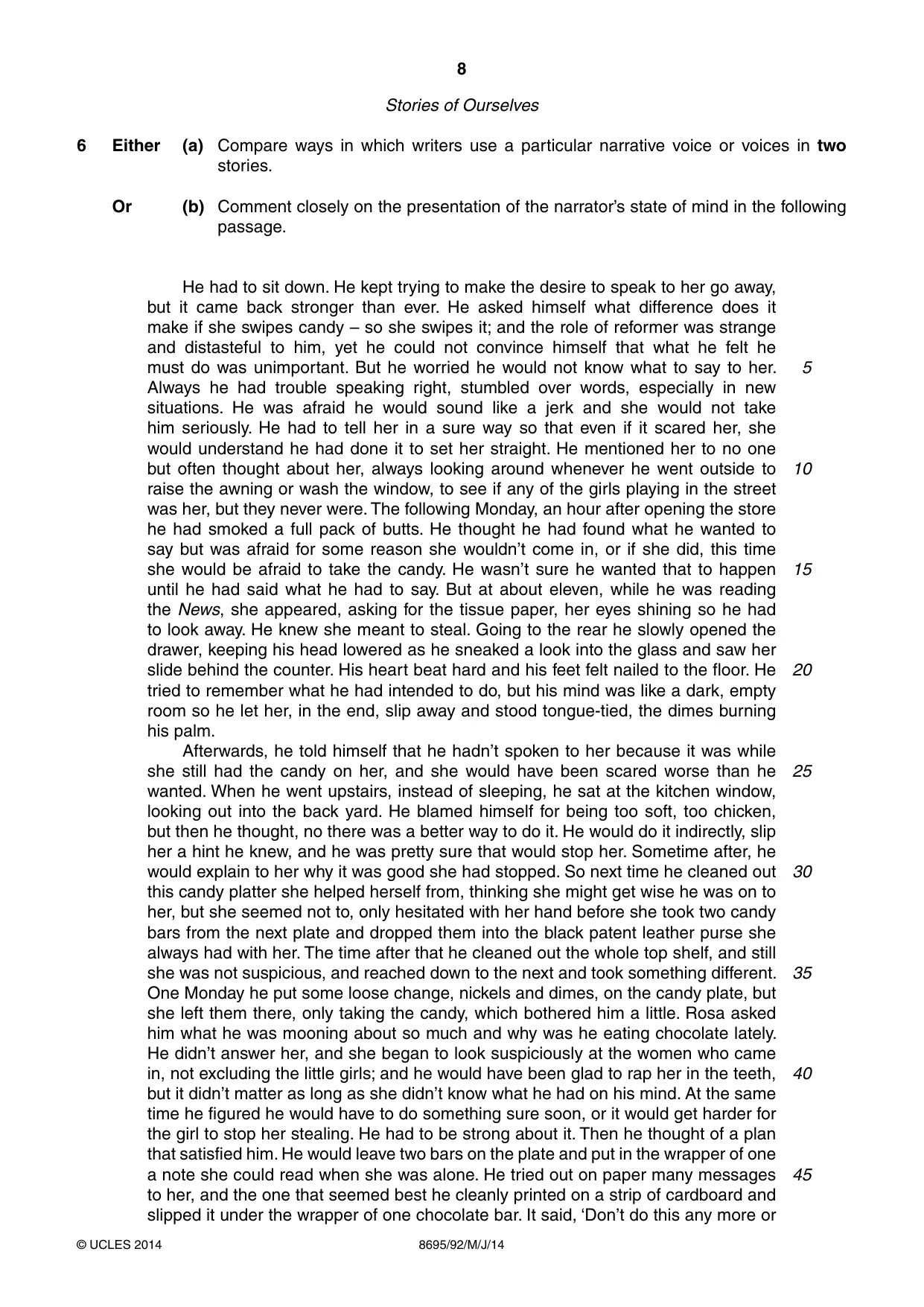
8 8695/92/M/J/14 © UCLES 2014 Stories of Ourselves 6 Either (a) Compare ways in which writers use a particular narrative voice or voices in two stories. Or (b) Comment closely on the presentation of the narrator’s state of mind in the following passage. He had to sit down. He kept trying to make the desire to speak to her go away, but it came back stronger than ever. He asked himself what difference does it make if she swipes candy – so she swipes it; and the role of reformer was strange and distasteful to him, yet he could not convince himself that what he felt he must do was unimportant. But he worried he would not know what to say to her. Always he had trouble speaking right, stumbled over words, especially in new situations. He was afraid he would sound like a jerk and she would not take him seriously. He had to tell her in a sure way so that even if it scared her, she would understand he had done it to set her straight. He mentioned her to no one but often thought about her, always looking around whenever he went outside to raise the awning or wash the window, to see if any of the girls playing in the street was her, but they never were. The following Monday, an hour after opening the store he had smoked a full pack of butts. He thought he had found what he wanted to say but was afraid for some reason she wouldn’t come in, or if she did, this time she would be afraid to take the candy. He wasn’t sure he wanted that to happen until he had said what he had to say. But at about eleven, while he was reading the News, she appeared, asking for the tissue paper, her eyes shining so he had to look away. He knew she meant to steal. Going to the rear he slowly opened the drawer, keeping his head lowered as he sneaked a look into the glass and saw her slide behind the counter. His heart beat hard and his feet felt nailed to the floor. He tried to remember what he had intended to do, but his mind was like a dark, empty room so he let her, in the end, slip away and stood tongue-tied, the dimes burning his palm. Afterwards, he told himself that he hadn’t spoken to her because it was while she still had the candy on her, and she would have been scared worse than he wanted. When he went upstairs, instead of sleeping, he sat at the kitchen window, looking out into the back yard. He blamed himself for being too soft, too chicken, but then he thought, no there was a better way to do it. He would do it indirectly, slip her a hint he knew, and he was pretty sure that would stop her. Sometime after, he would explain to her why it was good she had stopped. So next time he cleaned out this candy platter she helped herself from, thinking she might get wise he was on to her, but she seemed not to, only hesitated with her hand before she took two candy bars from the next plate and dropped them into the black patent leather purse she always had with her. The time after that he cleaned out the whole top shelf, and still she was not suspicious, and reached down to the next and took something different. One Monday he put some loose change, nickels and dimes, on the candy plate, but she left them there, only taking the candy, which bothered him a little. Rosa asked him what he was mooning about so much and why was he eating chocolate lately. He didn’t answer her, and she began to look suspiciously at the women who came in, not excluding the little girls; and he would have been glad to rap her in the teeth, but it didn’t matter as long as she didn’t know what he had on his mind. At the same time he figured he would have to do something sure soon, or it would get harder for the girl to stop her stealing. He had to be strong about it. Then he thought of a plan that satisfied him. He would leave two bars on the plate and put in the wrapper of one a note she could read when she was alone. He tried out on paper many messages to her, and the one that seemed best he cleanly printed on a strip of cardboard and slipped it under the wrapper of one chocolate bar. It said, ‘Don’t do this any more or 5 10 15 20 25 30 35 40 45
Question paper, page 9
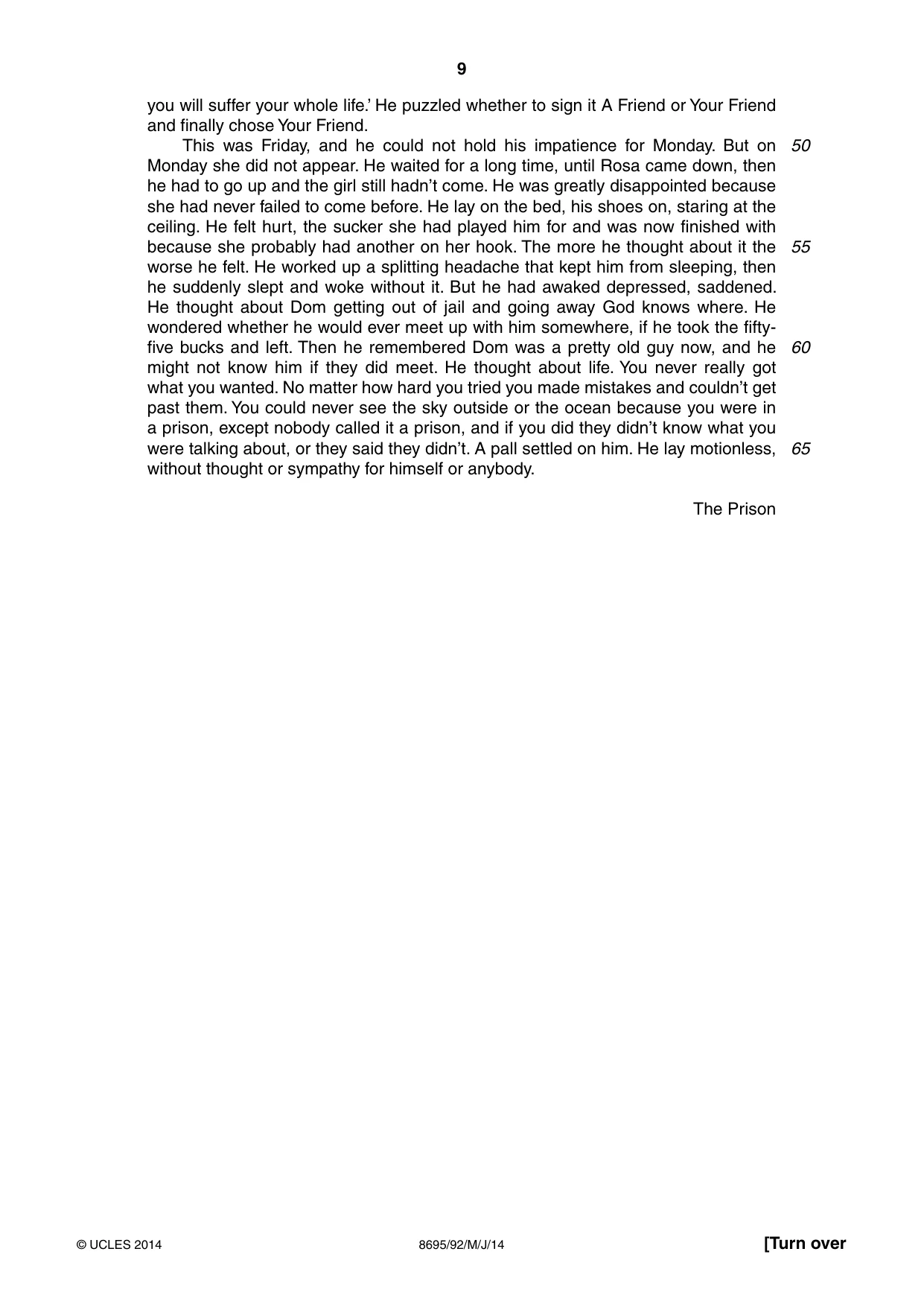
9 8695/92/M/J/14 © UCLES 2014 [Turn over you will suffer your whole life.’ He puzzled whether to sign it A Friend or Your Friend and finally chose Your Friend. This was Friday, and he could not hold his impatience for Monday. But on Monday she did not appear. He waited for a long time, until Rosa came down, then he had to go up and the girl still hadn’t come. He was greatly disappointed because she had never failed to come before. He lay on the bed, his shoes on, staring at the ceiling. He felt hurt, the sucker she had played him for and was now finished with because she probably had another on her hook. The more he thought about it the worse he felt. He worked up a splitting headache that kept him from sleeping, then he suddenly slept and woke without it. But he had awaked depressed, saddened. He thought about Dom getting out of jail and going away God knows where. He wondered whether he would ever meet up with him somewhere, if he took the fifty- five bucks and left. Then he remembered Dom was a pretty old guy now, and he might not know him if they did meet. He thought about life. You never really got what you wanted. No matter how hard you tried you made mistakes and couldn’t get past them. You could never see the sky outside or the ocean because you were in a prison, except nobody called it a prison, and if you did they didn’t know what you were talking about, or they said they didn’t. A pall settled on him. He lay motionless, without thought or sympathy for himself or anybody. The Prison 50 55 60 65
Question paper, page 10
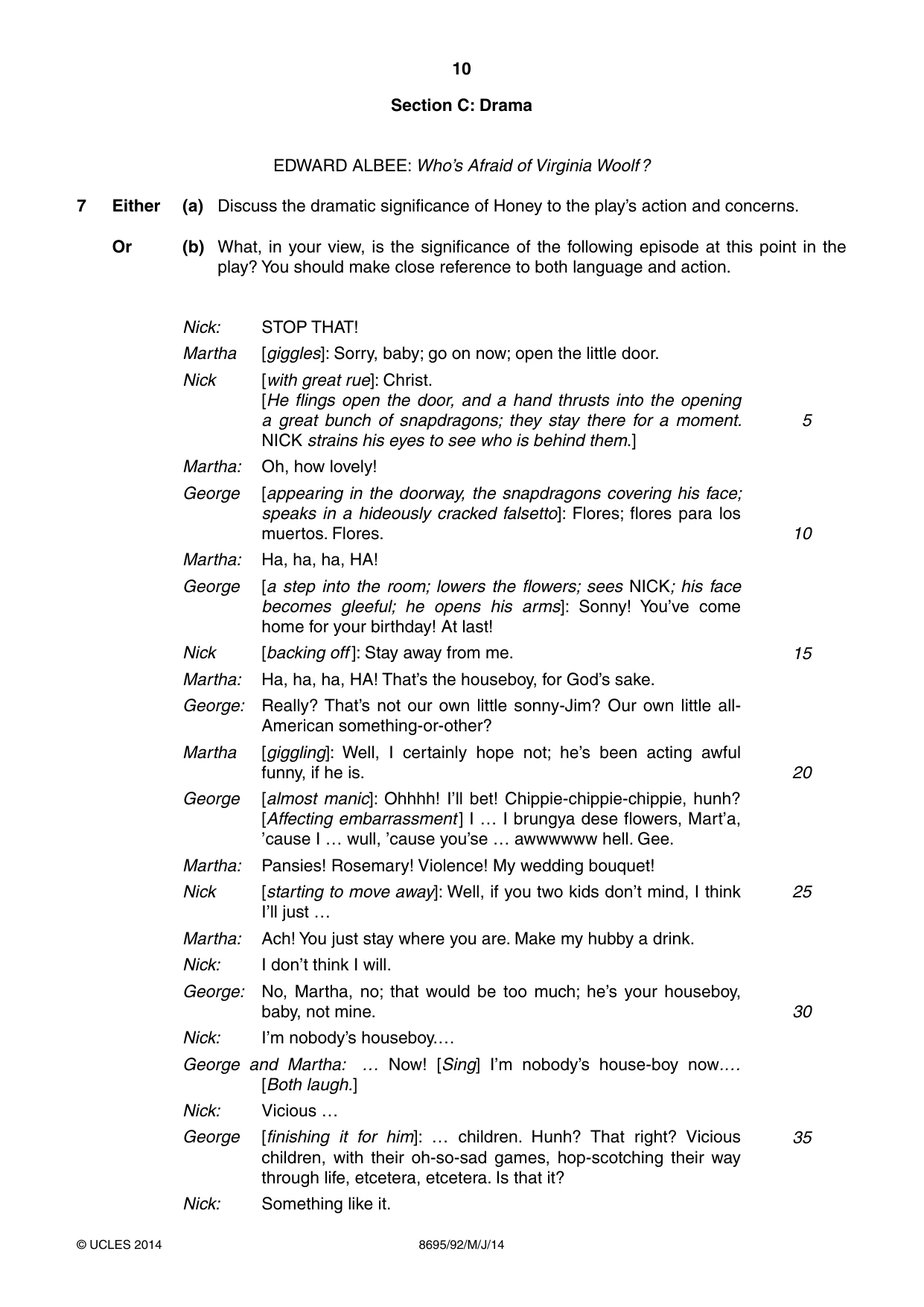
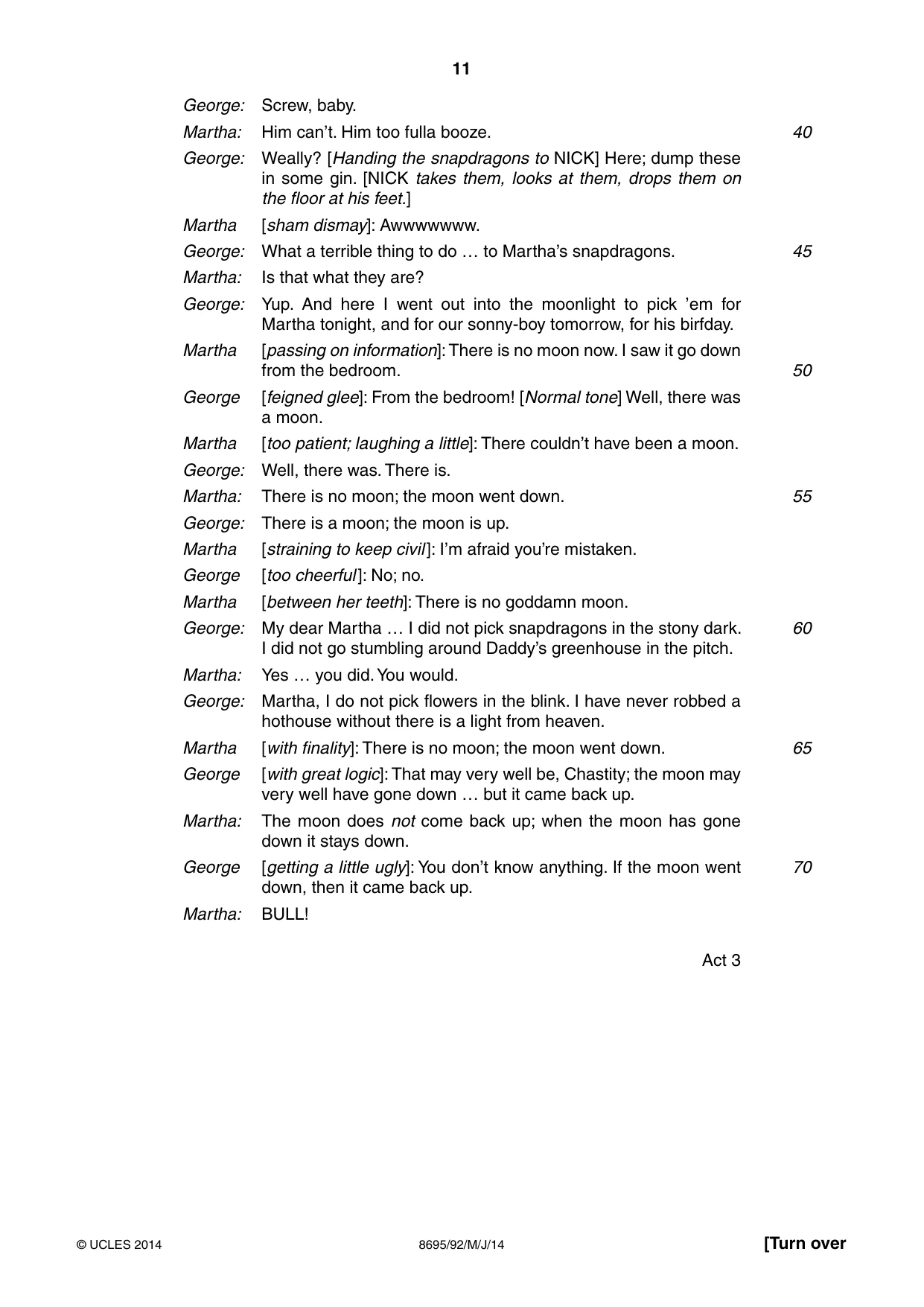
10 8695/92/M/J/14 © UCLES 2014 Section C: Drama EDWARD ALBEE: Who’s Afraid of Virginia Woolf ? 7 Either (a) Discuss the dramatic significance of Honey to the play’s action and concerns. Or (b) What, in your view, is the significance of the following episode at this point in the play? You should make close reference to both language and action. Nick: STOP THAT! Martha [giggles]: Sorry, baby; go on now; open the little door. Nick [with great rue]: Christ. [He flings open the door, and a hand thrusts into the opening a great bunch of snapdragons; they stay there for a moment. NICK strains his eyes to see who is behind them.] Martha: Oh, how lovely! George [appearing in the doorway, the snapdragons covering his face; speaks in a hideously cracked falsetto]: Flores; flores para los muertos. Flores. Martha: Ha, ha, ha, HA! George [a step into the room; lowers the flowers; sees NICK; his face becomes gleeful; he opens his arms]: Sonny! You’ve come home for your birthday! At last! Nick [backing off ]: Stay away from me. Martha: Ha, ha, ha, HA! That’s the houseboy, for God’s sake. George: Really? That’s not our own little sonny-Jim? Our own little all- American something-or-other? Martha [giggling]: Well, I certainly hope not; he’s been acting awful funny, if he is. George [almost manic]: Ohhhh! I’ll bet! Chippie-chippie-chippie, hunh? [Affecting embarrassment ] I … I brungya dese flowers, Mart’a, ’cause I … wull, ’cause you’se … awwwwww hell. Gee. Martha: Pansies! Rosemary! Violence! My wedding bouquet! Nick [starting to move away]: Well, if you two kids don’t mind, I think I’ll just … Martha: Ach! You just stay where you are. Make my hubby a drink. Nick: I don’t think I will. George: No, Martha, no; that would be too much; he’s your houseboy, baby, not mine. Nick: I’m nobody’s houseboy.… George and Martha: … Now! [Sing] I’m nobody’s house-boy now.… [Both laugh.] Nick: Vicious … George [finishing it for him]: … children. Hunh? That right? Vicious children, with their oh-so-sad games, hop-scotching their way through life, etcetera, etcetera. Is that it? Nick: Something like it. 5 10 15 20 25 30 35
Question paper, page 11
11 8695/92/M/J/14 © UCLES 2014 [Turn over George: Screw, baby. Martha: Him can’t. Him too fulla booze. George: Weally? [Handing the snapdragons to NICK] Here; dump these in some gin. [NICK takes them, looks at them, drops them on the floor at his feet.] Martha [sham dismay]: Awwwwwww. George: What a terrible thing to do … to Martha’s snapdragons. Martha: Is that what they are? George: Yup. And here I went out into the moonlight to pick ’em for Martha tonight, and for our sonny-boy tomorrow, for his birfday. Martha [passing on information]: There is no moon now. I saw it go down from the bedroom. George [feigned glee]: From the bedroom! [Normal tone] Well, there was a moon. Martha [too patient; laughing a little]: There couldn’t have been a moon. George: Well, there was. There is. Martha: There is no moon; the moon went down. George: There is a moon; the moon is up. Martha [straining to keep civil ]: I’m afraid you’re mistaken. George [too cheerful ]: No; no. Martha [between her teeth]: There is no goddamn moon. George: My dear Martha … I did not pick snapdragons in the stony dark. I did not go stumbling around Daddy’s greenhouse in the pitch. Martha: Yes … you did. You would. George: Martha, I do not pick flowers in the blink. I have never robbed a hothouse without there is a light from heaven. Martha [with finality]: There is no moon; the moon went down. George [with great logic]: That may very well be, Chastity; the moon may very well have gone down … but it came back up. Martha: The moon does not come back up; when the moon has gone down it stays down. George [getting a little ugly]: You don’t know anything. If the moon went down, then it came back up. Martha: BULL! Act 3 40 45 50 55 60 65 70
Question paper, page 12
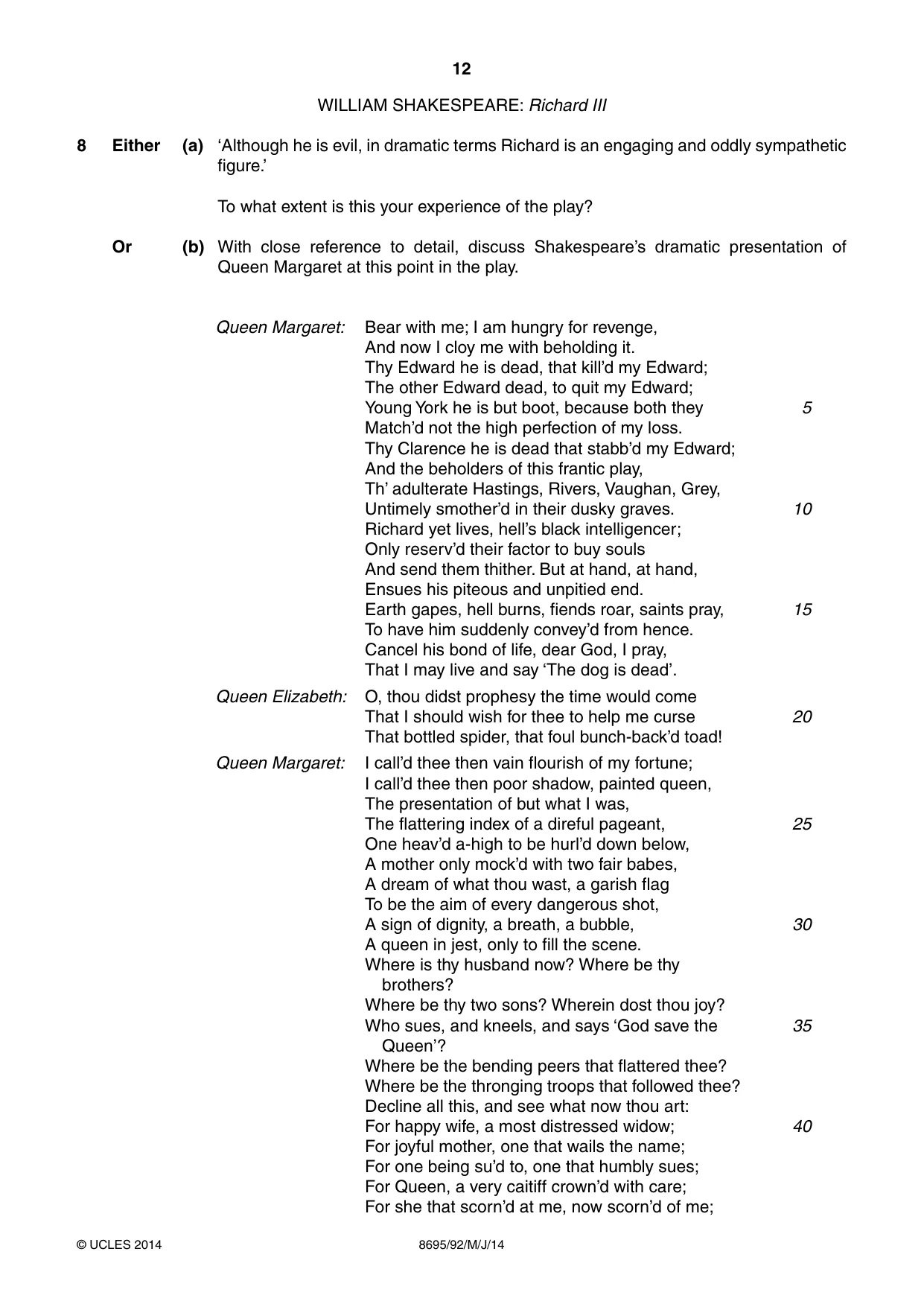
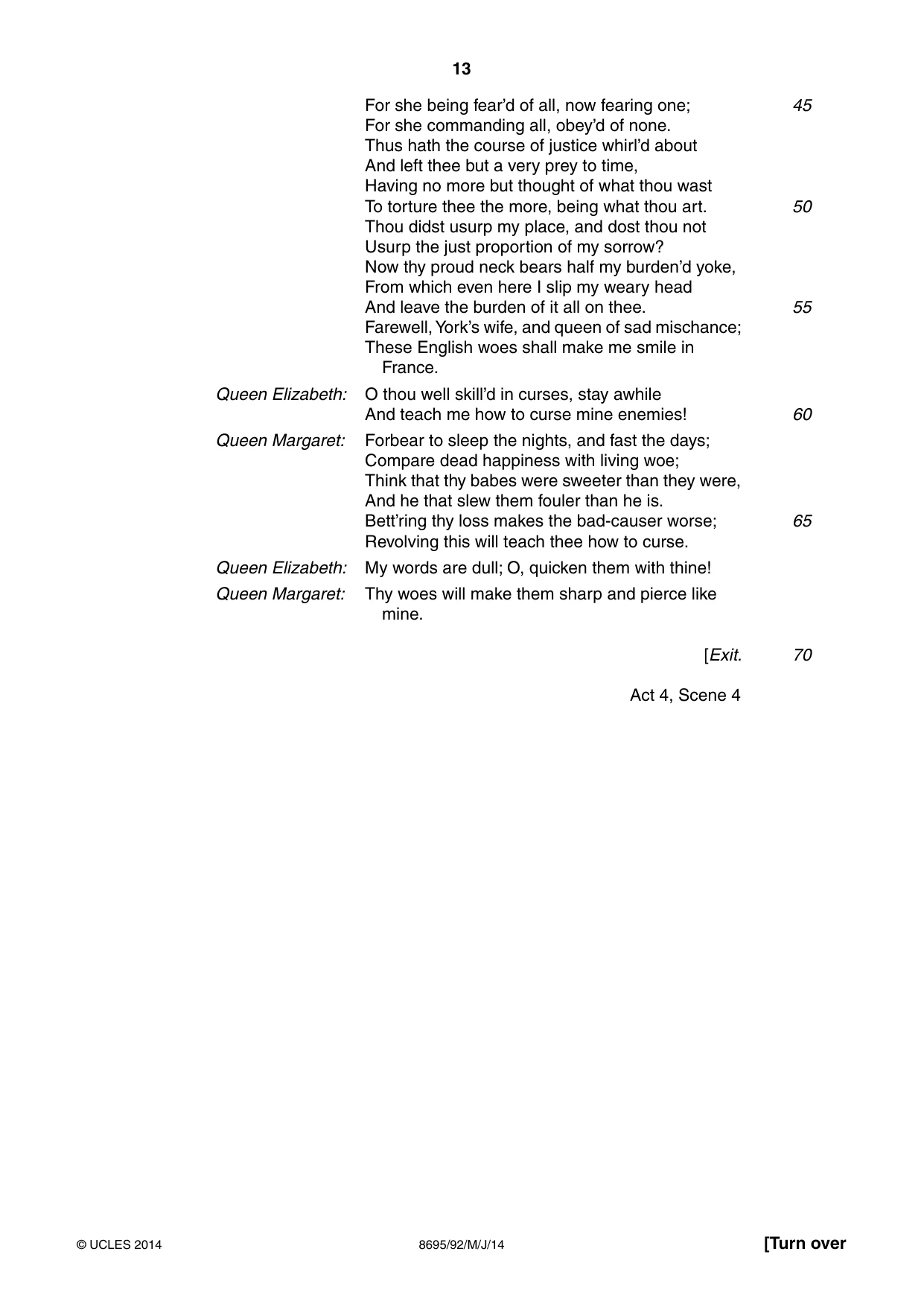
12 8695/92/M/J/14 © UCLES 2014 WILLIAM SHAKESPEARE: Richard III 8 Either (a) ‘Although he is evil, in dramatic terms Richard is an engaging and oddly sympathetic figure.’ To what extent is this your experience of the play? Or (b) With close reference to detail, discuss Shakespeare’s dramatic presentation of Queen Margaret at this point in the play. Queen Margaret: Bear with me; I am hungry for revenge, And now I cloy me with beholding it. Thy Edward he is dead, that kill’d my Edward; The other Edward dead, to quit my Edward; Young York he is but boot, because both they Match’d not the high perfection of my loss. Thy Clarence he is dead that stabb’d my Edward; And the beholders of this frantic play, Th’ adulterate Hastings, Rivers, Vaughan, Grey, Untimely smother’d in their dusky graves. Richard yet lives, hell’s black intelligencer; Only reserv’d their factor to buy souls And send them thither. But at hand, at hand, Ensues his piteous and unpitied end. Earth gapes, hell burns, fiends roar, saints pray, To have him suddenly convey’d from hence. Cancel his bond of life, dear God, I pray, That I may live and say ‘The dog is dead’. Queen Elizabeth: O, thou didst prophesy the time would come That I should wish for thee to help me curse That bottled spider, that foul bunch-back’d toad! Queen Margaret: I call’d thee then vain flourish of my fortune; I call’d thee then poor shadow, painted queen, The presentation of but what I was, The flattering index of a direful pageant, One heav’d a-high to be hurl’d down below, A mother only mock’d with two fair babes, A dream of what thou wast, a garish flag To be the aim of every dangerous shot, A sign of dignity, a breath, a bubble, A queen in jest, only to fill the scene. Where is thy husband now? Where be thy brothers? Where be thy two sons? Wherein dost thou joy? Who sues, and kneels, and says ‘God save the Queen’? Where be the bending peers that flattered thee? Where be the thronging troops that followed thee? Decline all this, and see what now thou art: For happy wife, a most distressed widow; For joyful mother, one that wails the name; For one being su’d to, one that humbly sues; For Queen, a very caitiff crown’d with care; For she that scorn’d at me, now scorn’d of me; 5 10 15 20 25 30 35 40
Question paper, page 13
13 8695/92/M/J/14 © UCLES 2014 [Turn over For she being fear’d of all, now fearing one; For she commanding all, obey’d of none. Thus hath the course of justice whirl’d about And left thee but a very prey to time, Having no more but thought of what thou wast To torture thee the more, being what thou art. Thou didst usurp my place, and dost thou not Usurp the just proportion of my sorrow? Now thy proud neck bears half my burden’d yoke, From which even here I slip my weary head And leave the burden of it all on thee. Farewell, York’s wife, and queen of sad mischance; These English woes shall make me smile in France. Queen Elizabeth: O thou well skill’d in curses, stay awhile And teach me how to curse mine enemies! Queen Margaret: Forbear to sleep the nights, and fast the days; Compare dead happiness with living woe; Think that thy babes were sweeter than they were, And he that slew them fouler than he is. Bett’ring thy loss makes the bad-causer worse; Revolving this will teach thee how to curse. Queen Elizabeth: My words are dull; O, quicken them with thine! Queen Margaret: Thy woes will make them sharp and pierce like mine. [Exit. Act 4, Scene 4 45 50 55 60 65 70
Question paper, page 14
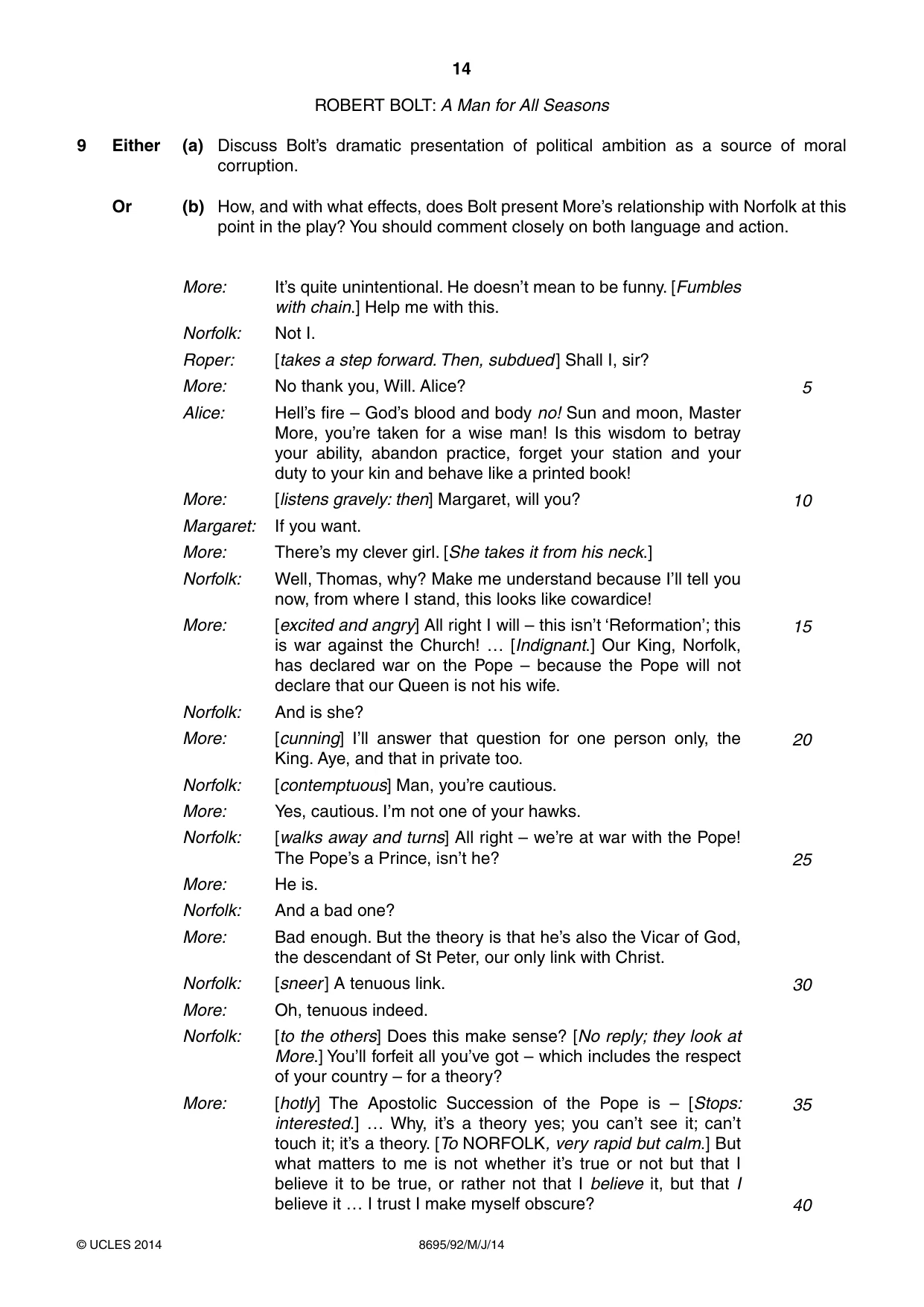
14 8695/92/M/J/14 © UCLES 2014 ROBERT BOLT: A Man for All Seasons 9 Either (a) Discuss Bolt’s dramatic presentation of political ambition as a source of moral corruption. Or (b) How, and with what effects, does Bolt present More’s relationship with Norfolk at this point in the play? You should comment closely on both language and action. More: It’s quite unintentional. He doesn’t mean to be funny. [Fumbles with chain.] Help me with this. Norfolk: Not I. Roper: [takes a step forward. Then, subdued ] Shall I, sir? More: No thank you, Will. Alice? Alice: Hell’s fire – God’s blood and body no! Sun and moon, Master More, you’re taken for a wise man! Is this wisdom to betray your ability, abandon practice, forget your station and your duty to your kin and behave like a printed book! More: [listens gravely: then] Margaret, will you? Margaret: If you want. More: There’s my clever girl. [She takes it from his neck.] Norfolk: Well, Thomas, why? Make me understand because I’ll tell you now, from where I stand, this looks like cowardice! More: [excited and angry] All right I will – this isn’t ‘Reformation’; this is war against the Church! … [Indignant.] Our King, Norfolk, has declared war on the Pope – because the Pope will not declare that our Queen is not his wife. Norfolk: And is she? More: [cunning] I’ll answer that question for one person only, the King. Aye, and that in private too. Norfolk: [contemptuous] Man, you’re cautious. More: Yes, cautious. I’m not one of your hawks. Norfolk: [walks away and turns] All right – we’re at war with the Pope! The Pope’s a Prince, isn’t he? More: He is. Norfolk: And a bad one? More: Bad enough. But the theory is that he’s also the Vicar of God, the descendant of St Peter, our only link with Christ. Norfolk: [sneer ] A tenuous link. More: Oh, tenuous indeed. Norfolk: [to the others] Does this make sense? [No reply; they look at More.] You’ll forfeit all you’ve got – which includes the respect of your country – for a theory? More: [hotly] The Apostolic Succession of the Pope is – [Stops: interested.] … Why, it’s a theory yes; you can’t see it; can’t touch it; it’s a theory. [To NORFOLK, very rapid but calm.] But what matters to me is not whether it’s true or not but that I believe it to be true, or rather not that I believe it, but that I believe it … I trust I make myself obscure? 5 10 15 20 25 30 35 40
Question paper, page 15
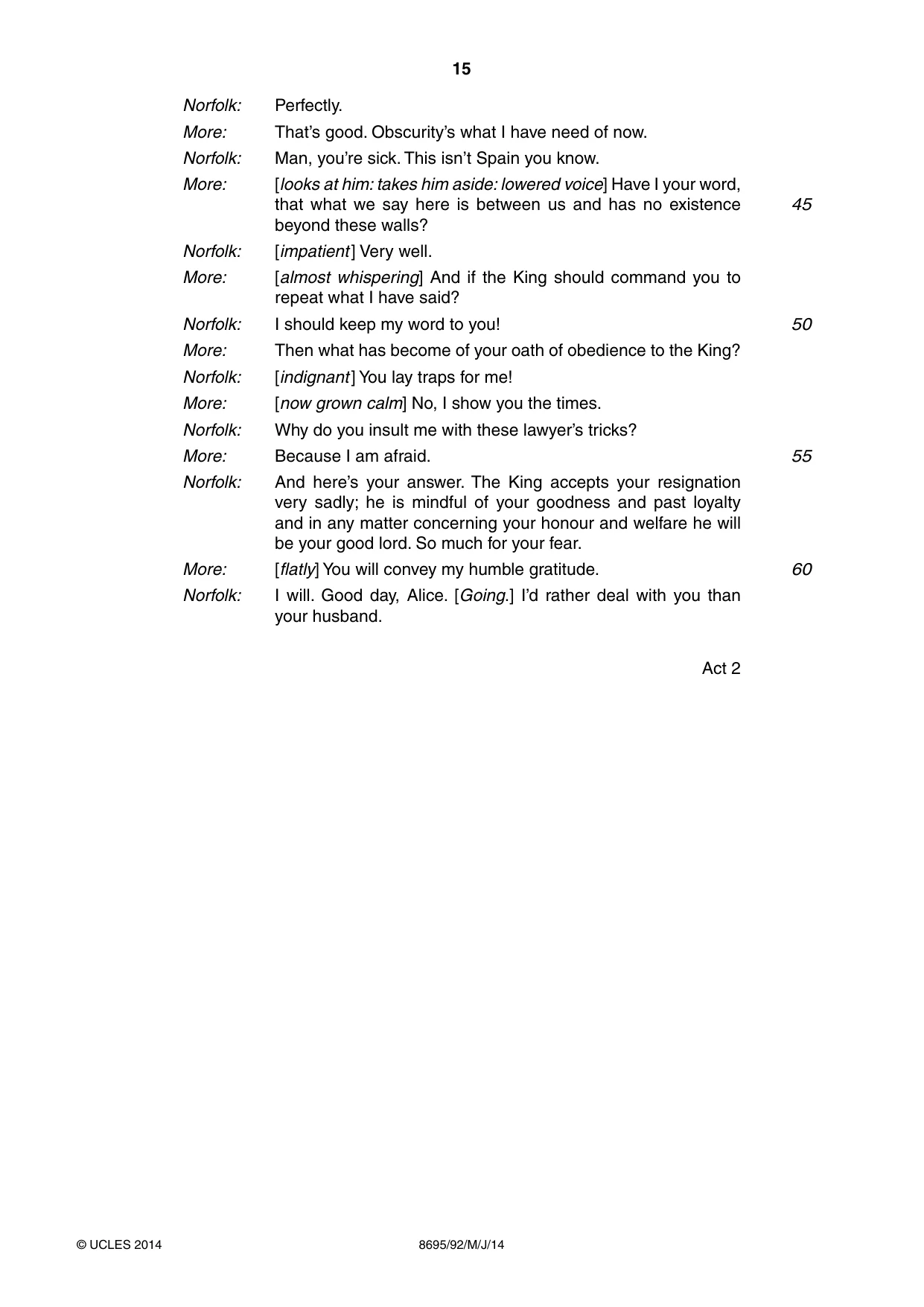
15 8695/92/M/J/14 © UCLES 2014 Norfolk: Perfectly. More: That’s good. Obscurity’s what I have need of now. Norfolk: Man, you’re sick. This isn’t Spain you know. More: [looks at him: takes him aside: lowered voice] Have I your word, that what we say here is between us and has no existence beyond these walls? Norfolk: [impatient ] Very well. More: [almost whispering] And if the King should command you to repeat what I have said? Norfolk: I should keep my word to you! More: Then what has become of your oath of obedience to the King? Norfolk: [indignant ] You lay traps for me! More: [now grown calm] No, I show you the times. Norfolk: Why do you insult me with these lawyer’s tricks? More: Because I am afraid. Norfolk: And here’s your answer. The King accepts your resignation very sadly; he is mindful of your goodness and past loyalty and in any matter concerning your honour and welfare he will be your good lord. So much for your fear. More: [flatly] You will convey my humble gratitude. Norfolk: I will. Good day, Alice. [Going.] I’d rather deal with you than your husband. Act 2 45 50 55 60
Question paper, page 16
16 8695/92/M/J/14 © UCLES 2014 Copyright Acknowledgments: Question 1 © Seamus Heaney; Rilke; After the Fire, from District and Circle; Faber & Faber Ltd; 2006. Question 4 © Chimamanda Ngozi Adichie; Half of a Yellow Sun; HarperCollins; 2006. Question 5 © E M Forster; A Passage to India; The Provost and Scholars of King’s College, Cambridge and The Society of Authors. Question 6 © Bernard Malamud; The Prison, in Stories of Ourselves; Cambridge University Press 2008. Question 7 © Who’s Afraid of Virginia Woolf by Edward Albee. Published by Jonathan Cape. Reprinted by permission of the Random House Group Ltd. Question 9 © A Man for All Seasons by Robert Bolt. Reprinted by permission of Pearson Education. Permission to reproduce items where third-party owned material protected by copyright is included has been sought and cleared where possible. Every reasonable effort has been made by the publisher (UCLES) to trace copyright holders, but if any items requiring clearance have unwittingly been included, the publisher will be pleased to make amends at the earliest possible opportunity. Cambridge International Examinations is part of the Cambridge Assessment Group. Cambridge Assessment is the brand name of University of Cambridge Local Examinations Syndicate (UCLES), which is itself a department of the University of Cambridge. BLANK PAGE
Mark scheme, page 1
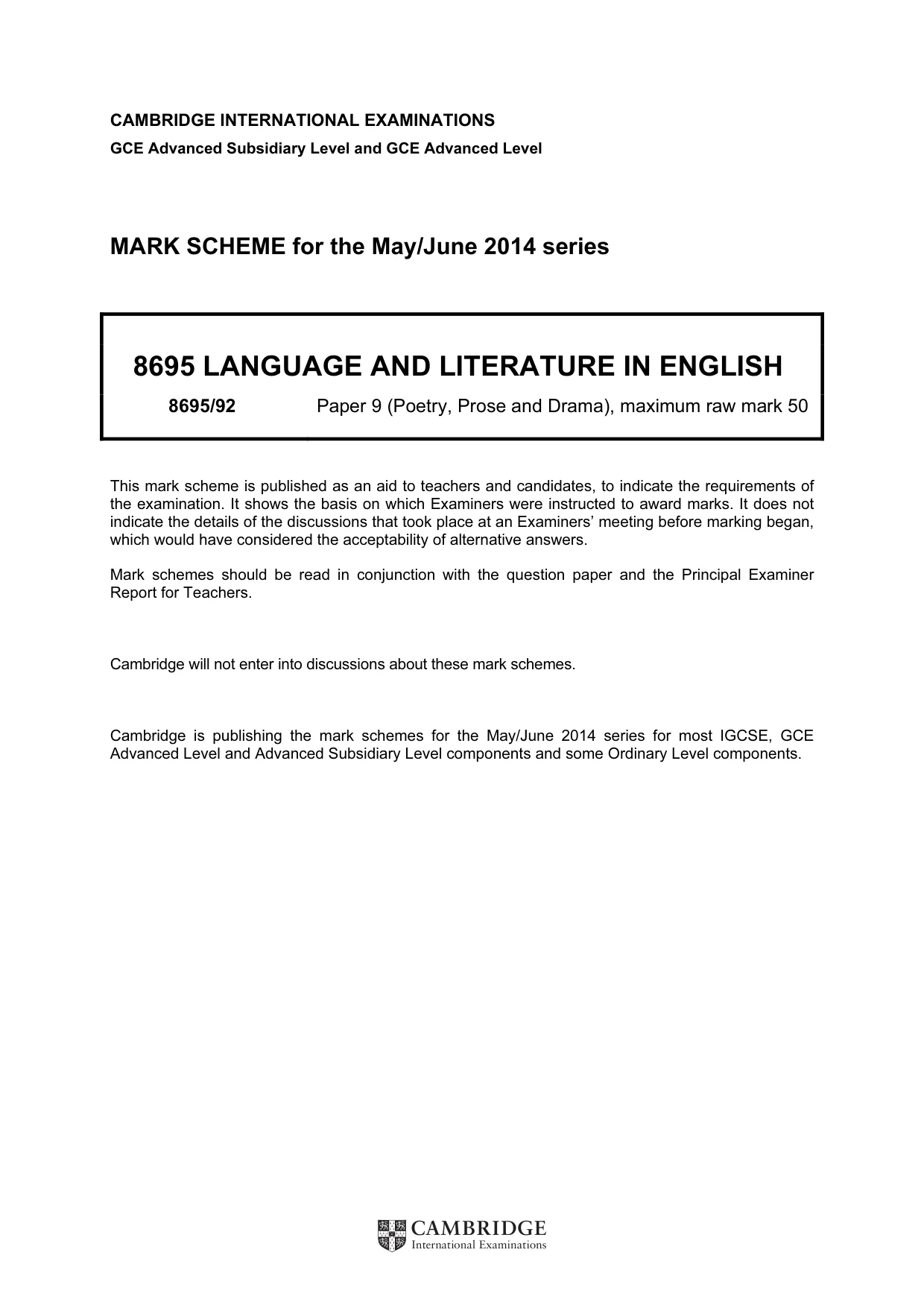
CAMBRIDGE INTERNATIONAL EXAMINATIONS GCE Advanced Subsidiary Level and GCE Advanced Level MARK SCHEME for the May/June 2014 series 8695 LANGUAGE AND LITERATURE IN ENGLISH 8695/92 Paper 9 (Poetry, Prose and Drama), maximum raw mark 50 This mark scheme is published as an aid to teachers and candidates, to indicate the requirements of the examination. It shows the basis on which Examiners were instructed to award marks. It does not indicate the details of the discussions that took place at an Examiners’ meeting before marking began, which would have considered the acceptability of alternative answers. Mark schemes should be read in conjunction with the question paper and the Principal Examiner Report for Teachers. Cambridge will not enter into discussions about these mark schemes. Cambridge is publishing the mark schemes for the May/June 2014 series for most IGCSE, GCE Advanced Level and Advanced Subsidiary Level components and some Ordinary Level components.
Mark scheme, page 2
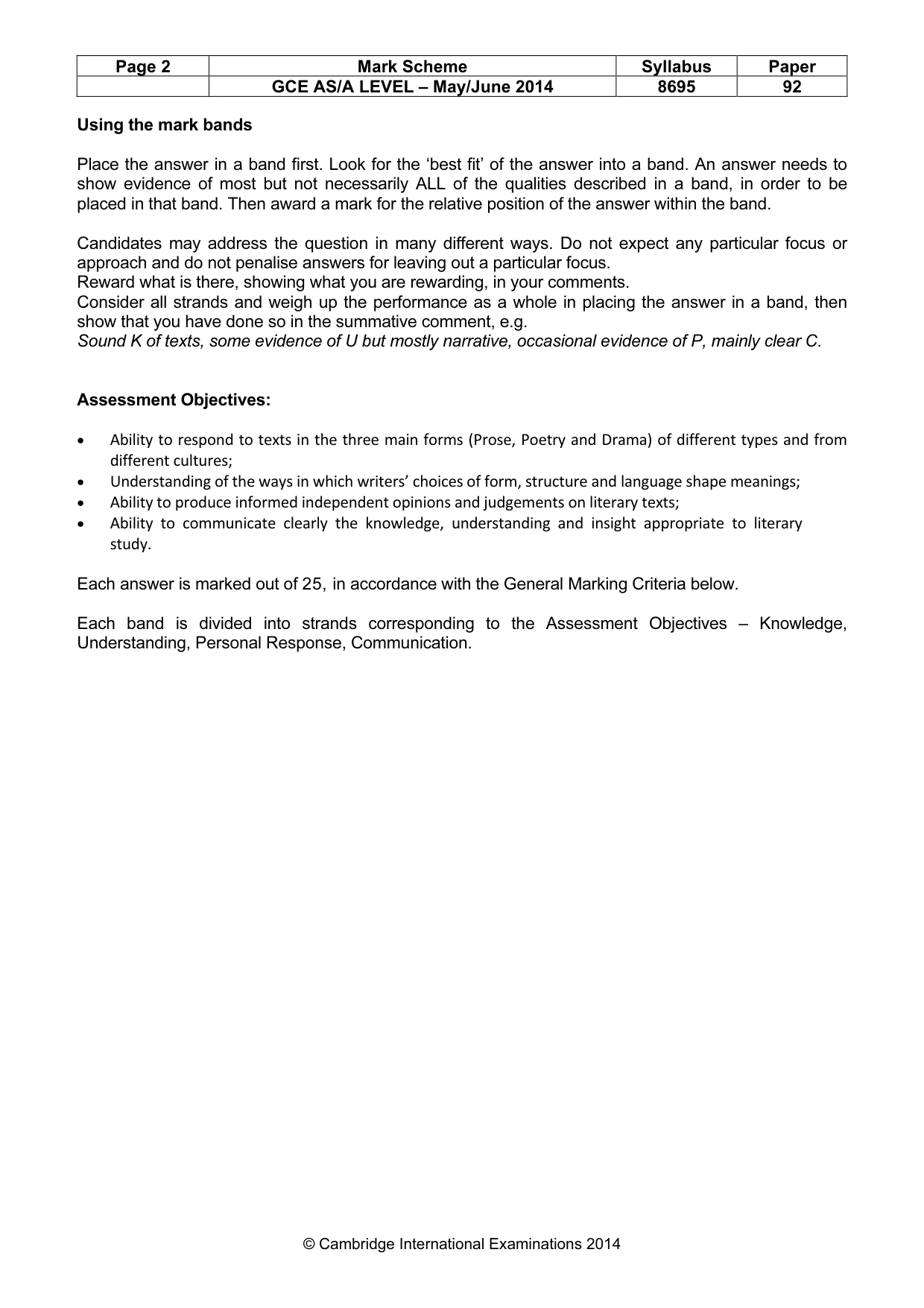
Page 2 Mark Scheme Syllabus Paper GCE AS/A LEVEL – May/June 2014 8695 92 © Cambridge International Examinations 2014 Using the mark bands Place the answer in a band first. Look for the ‘best fit’ of the answer into a band. An answer needs to show evidence of most but not necessarily ALL of the qualities described in a band, in order to be placed in that band. Then award a mark for the relative position of the answer within the band. Candidates may address the question in many different ways. Do not expect any particular focus or approach and do not penalise answers for leaving out a particular focus. Reward what is there, showing what you are rewarding, in your comments. Consider all strands and weigh up the performance as a whole in placing the answer in a band, then show that you have done so in the summative comment, e.g. Sound K of texts, some evidence of U but mostly narrative, occasional evidence of P, mainly clear C. Assessment Objectives: • Ability to respond to texts in the three main forms (Prose, Poetry and Drama) of different types and from different cultures; • Understanding of the ways in which writers’ choices of form, structure and language shape meanings; • Ability to produce informed independent opinions and judgements on literary texts; • Ability to communicate clearly the knowledge, understanding and insight appropriate to literary study. Each answer is marked out of 25, in accordance with the General Marking Criteria below. Each band is divided into strands corresponding to the Assessment Objectives – Knowledge, Understanding, Personal Response, Communication.
Mark scheme, page 3
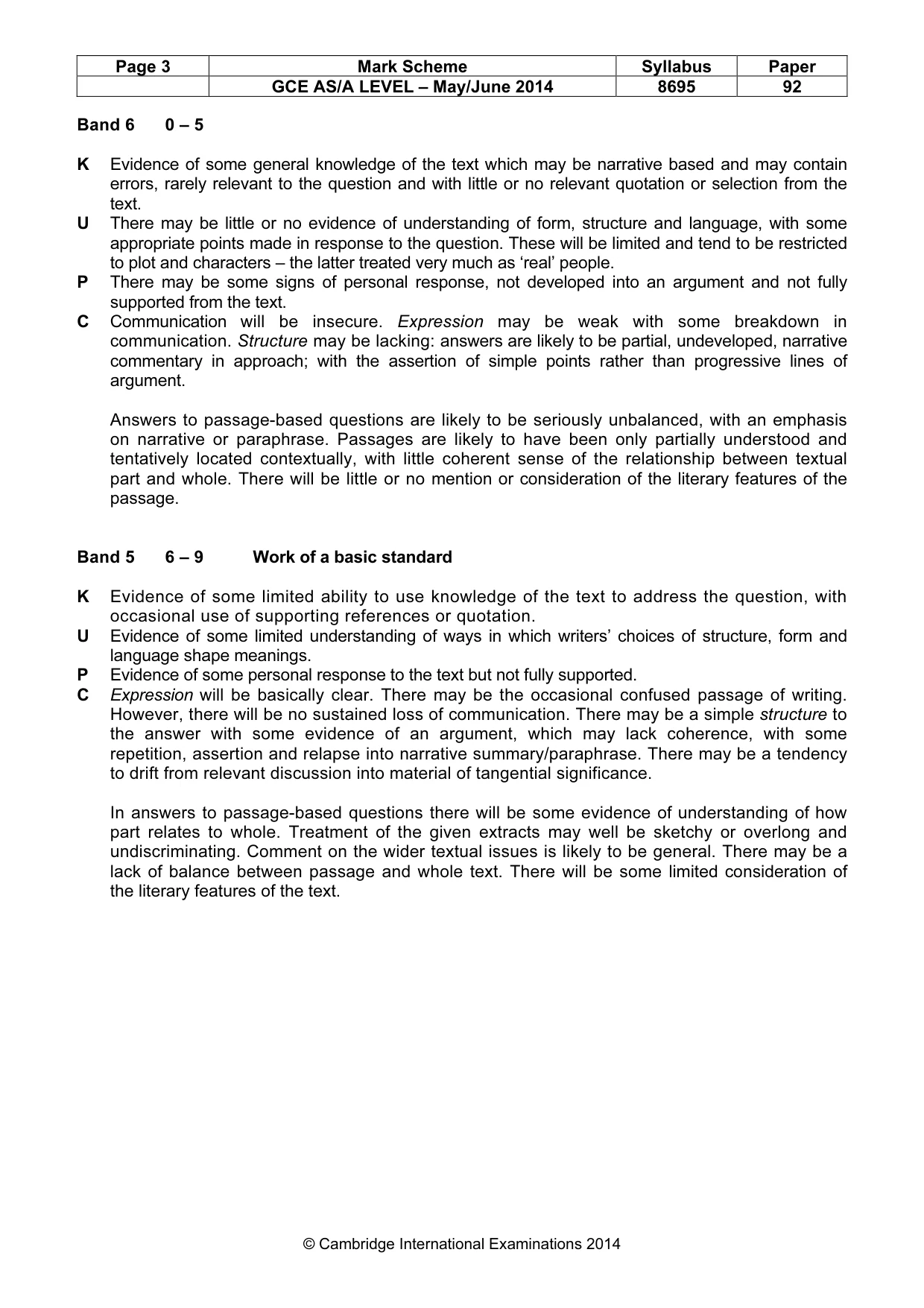
Page 3 Mark Scheme Syllabus Paper GCE AS/A LEVEL – May/June 2014 8695 92 © Cambridge International Examinations 2014 Band 6 0 – 5 K Evidence of some general knowledge of the text which may be narrative based and may contain errors, rarely relevant to the question and with little or no relevant quotation or selection from the text. U There may be little or no evidence of understanding of form, structure and language, with some appropriate points made in response to the question. These will be limited and tend to be restricted to plot and characters – the latter treated very much as ‘real’ people. P There may be some signs of personal response, not developed into an argument and not fully supported from the text. C Communication will be insecure. Expression may be weak with some breakdown in communication. Structure may be lacking: answers are likely to be partial, undeveloped, narrative commentary in approach; with the assertion of simple points rather than progressive lines of argument. Answers to passage-based questions are likely to be seriously unbalanced, with an emphasis on narrative or paraphrase. Passages are likely to have been only partially understood and tentatively located contextually, with little coherent sense of the relationship between textual part and whole. There will be little or no mention or consideration of the literary features of the passage. Band 5 6 – 9 Work of a basic standard K Evidence of some limited ability to use knowledge of the text to address the question, with occasional use of supporting references or quotation. U Evidence of some limited understanding of ways in which writers’ choices of structure, form and language shape meanings. P Evidence of some personal response to the text but not fully supported. C Expression will be basically clear. There may be the occasional confused passage of writing. However, there will be no sustained loss of communication. There may be a simple structure to the answer with some evidence of an argument, which may lack coherence, with some repetition, assertion and relapse into narrative summary/paraphrase. There may be a tendency to drift from relevant discussion into material of tangential significance. In answers to passage-based questions there will be some evidence of understanding of how part relates to whole. Treatment of the given extracts may well be sketchy or overlong and undiscriminating. Comment on the wider textual issues is likely to be general. There may be a lack of balance between passage and whole text. There will be some limited consideration of the literary features of the text.
Mark scheme, page 4
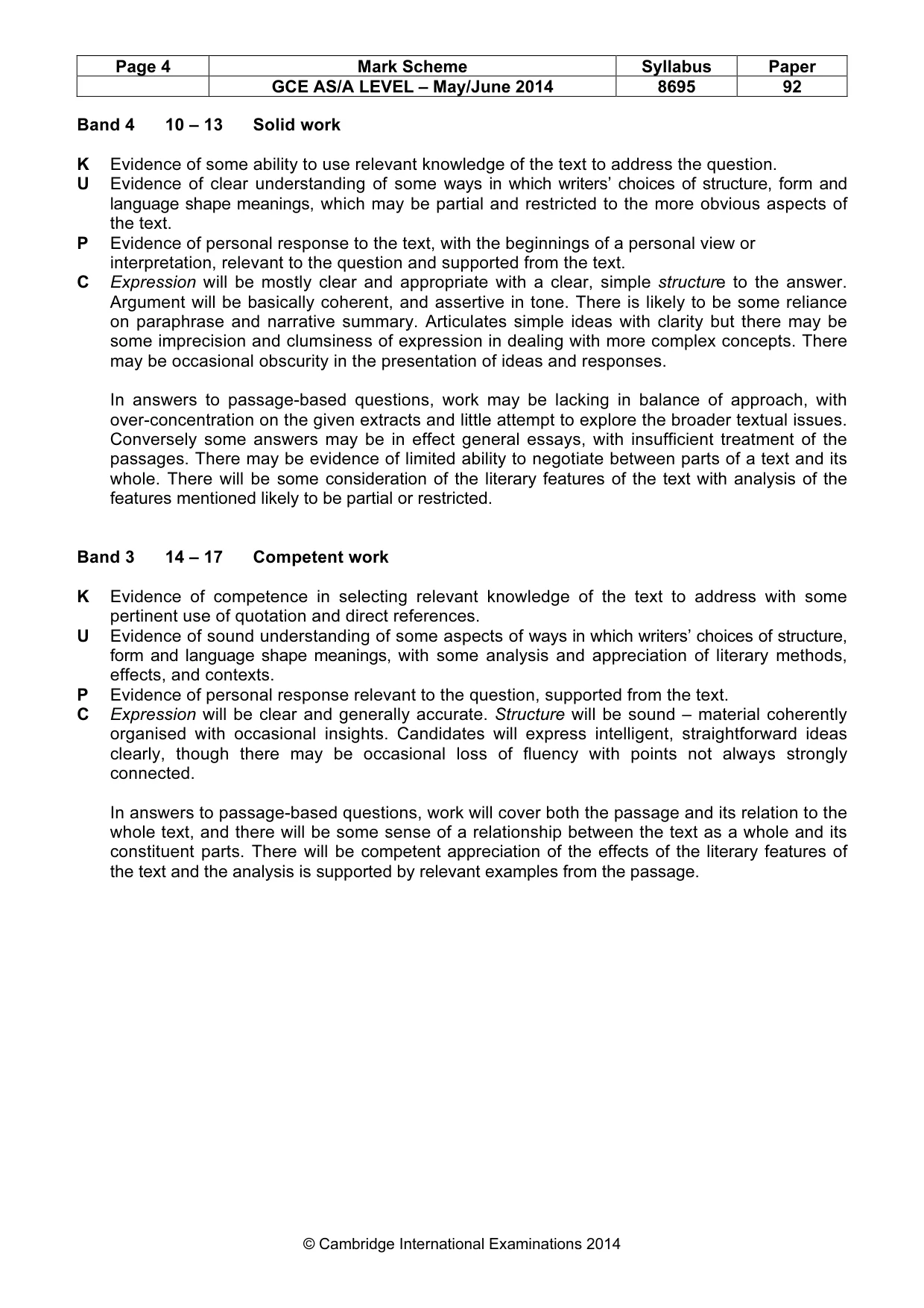
Page 4 Mark Scheme Syllabus Paper GCE AS/A LEVEL – May/June 2014 8695 92 © Cambridge International Examinations 2014 Band 4 10 – 13 Solid work K Evidence of some ability to use relevant knowledge of the text to address the question. U Evidence of clear understanding of some ways in which writers’ choices of structure, form and language shape meanings, which may be partial and restricted to the more obvious aspects of the text. P Evidence of personal response to the text, with the beginnings of a personal view or interpretation, relevant to the question and supported from the text. C Expression will be mostly clear and appropriate with a clear, simple structure to the answer. Argument will be basically coherent, and assertive in tone. There is likely to be some reliance on paraphrase and narrative summary. Articulates simple ideas with clarity but there may be some imprecision and clumsiness of expression in dealing with more complex concepts. There may be occasional obscurity in the presentation of ideas and responses. In answers to passage-based questions, work may be lacking in balance of approach, with over-concentration on the given extracts and little attempt to explore the broader textual issues. Conversely some answers may be in effect general essays, with insufficient treatment of the passages. There may be evidence of limited ability to negotiate between parts of a text and its whole. There will be some consideration of the literary features of the text with analysis of the features mentioned likely to be partial or restricted. Band 3 14 – 17 Competent work K Evidence of competence in selecting relevant knowledge of the text to address with some pertinent use of quotation and direct references. U Evidence of sound understanding of some aspects of ways in which writers’ choices of structure, form and language shape meanings, with some analysis and appreciation of literary methods, effects, and contexts. P Evidence of personal response relevant to the question, supported from the text. C Expression will be clear and generally accurate. Structure will be sound – material coherently organised with occasional insights. Candidates will express intelligent, straightforward ideas clearly, though there may be occasional loss of fluency with points not always strongly connected. In answers to passage-based questions, work will cover both the passage and its relation to the whole text, and there will be some sense of a relationship between the text as a whole and its constituent parts. There will be competent appreciation of the effects of the literary features of the text and the analysis is supported by relevant examples from the passage.
Mark scheme, page 5
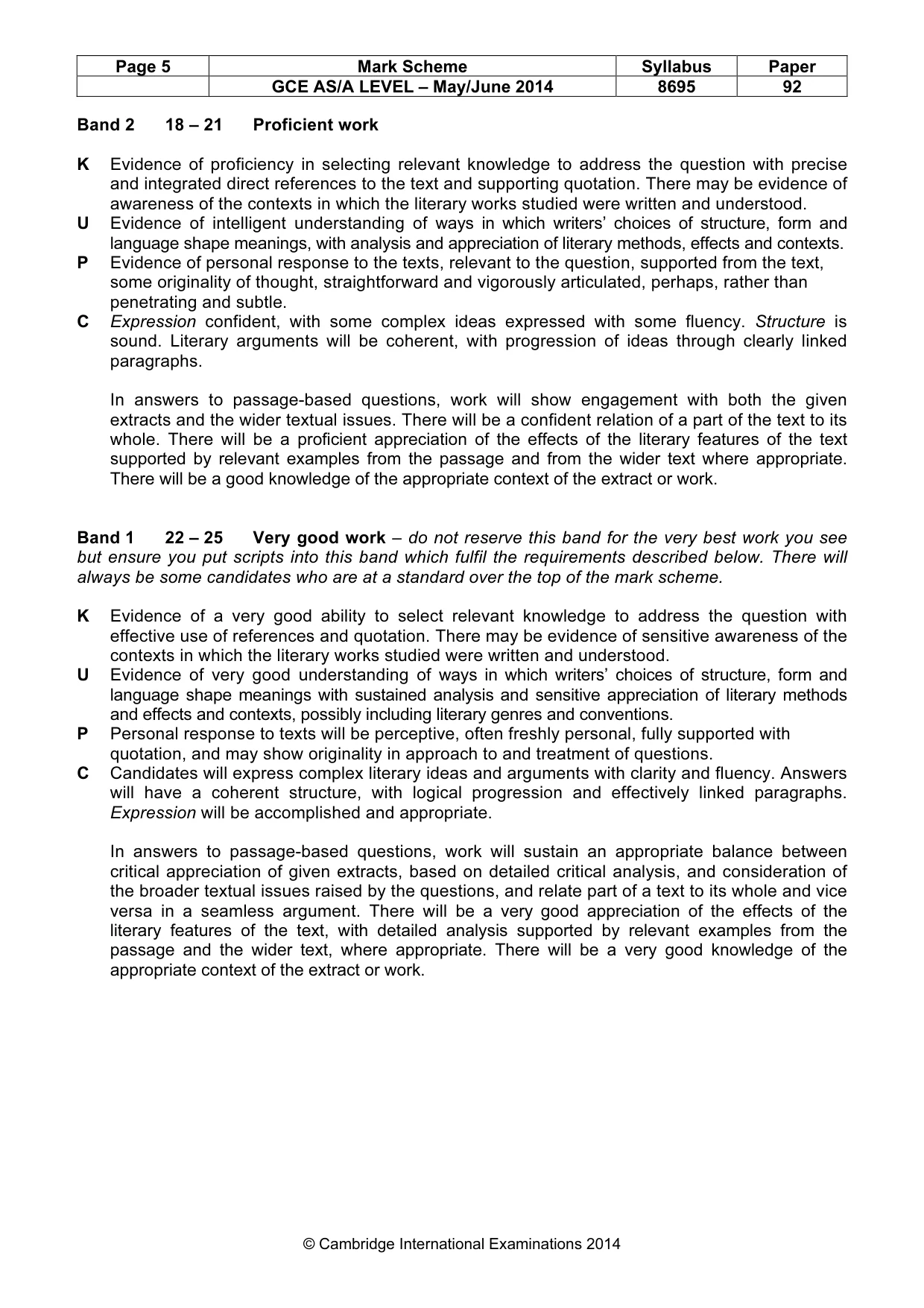
Page 5 Mark Scheme Syllabus Paper GCE AS/A LEVEL – May/June 2014 8695 92 © Cambridge International Examinations 2014 Band 2 18 – 21 Proficient work K Evidence of proficiency in selecting relevant knowledge to address the question with precise and integrated direct references to the text and supporting quotation. There may be evidence of awareness of the contexts in which the literary works studied were written and understood. U Evidence of intelligent understanding of ways in which writers’ choices of structure, form and language shape meanings, with analysis and appreciation of literary methods, effects and contexts. P Evidence of personal response to the texts, relevant to the question, supported from the text, some originality of thought, straightforward and vigorously articulated, perhaps, rather than penetrating and subtle. C Expression confident, with some complex ideas expressed with some fluency. Structure is sound. Literary arguments will be coherent, with progression of ideas through clearly linked paragraphs. In answers to passage-based questions, work will show engagement with both the given extracts and the wider textual issues. There will be a confident relation of a part of the text to its whole. There will be a proficient appreciation of the effects of the literary features of the text supported by relevant examples from the passage and from the wider text where appropriate. There will be a good knowledge of the appropriate context of the extract or work. Band 1 22 – 25 Very good work – do not reserve this band for the very best work you see but ensure you put scripts into this band which fulfil the requirements described below. There will always be some candidates who are at a standard over the top of the mark scheme. K Evidence of a very good ability to select relevant knowledge to address the question with effective use of references and quotation. There may be evidence of sensitive awareness of the contexts in which the literary works studied were written and understood. U Evidence of very good understanding of ways in which writers’ choices of structure, form and language shape meanings with sustained analysis and sensitive appreciation of literary methods and effects and contexts, possibly including literary genres and conventions. P Personal response to texts will be perceptive, often freshly personal, fully supported with quotation, and may show originality in approach to and treatment of questions. C Candidates will express complex literary ideas and arguments with clarity and fluency. Answers will have a coherent structure, with logical progression and effectively linked paragraphs. Expression will be accomplished and appropriate. In answers to passage-based questions, work will sustain an appropriate balance between critical appreciation of given extracts, based on detailed critical analysis, and consideration of the broader textual issues raised by the questions, and relate part of a text to its whole and vice versa in a seamless argument. There will be a very good appreciation of the effects of the literary features of the text, with detailed analysis supported by relevant examples from the passage and the wider text, where appropriate. There will be a very good knowledge of the appropriate context of the extract or work.
What you needed in this session
Cambridge’s own grade thresholds for 2014 May/June, Paper 9 · Variant 2. A higher threshold means an easier paper — the bar moves with how the cohort did.