Cambridge A Level English - Language and Literature (AS Level only, from 2016) 8695 — 2014 May/June Paper 9 · Variant 1
8695/91/M/J/14 · 50 marks · ≈56 min
The question paper and its mark scheme, free to read here and free to download. This is Cambridge’s own paper, exactly as it was sat.
Question paper20 pages



Mark scheme5 pages
Answers below. Sit the paper first if you are practising.
Paper as text
Question paper, page 1
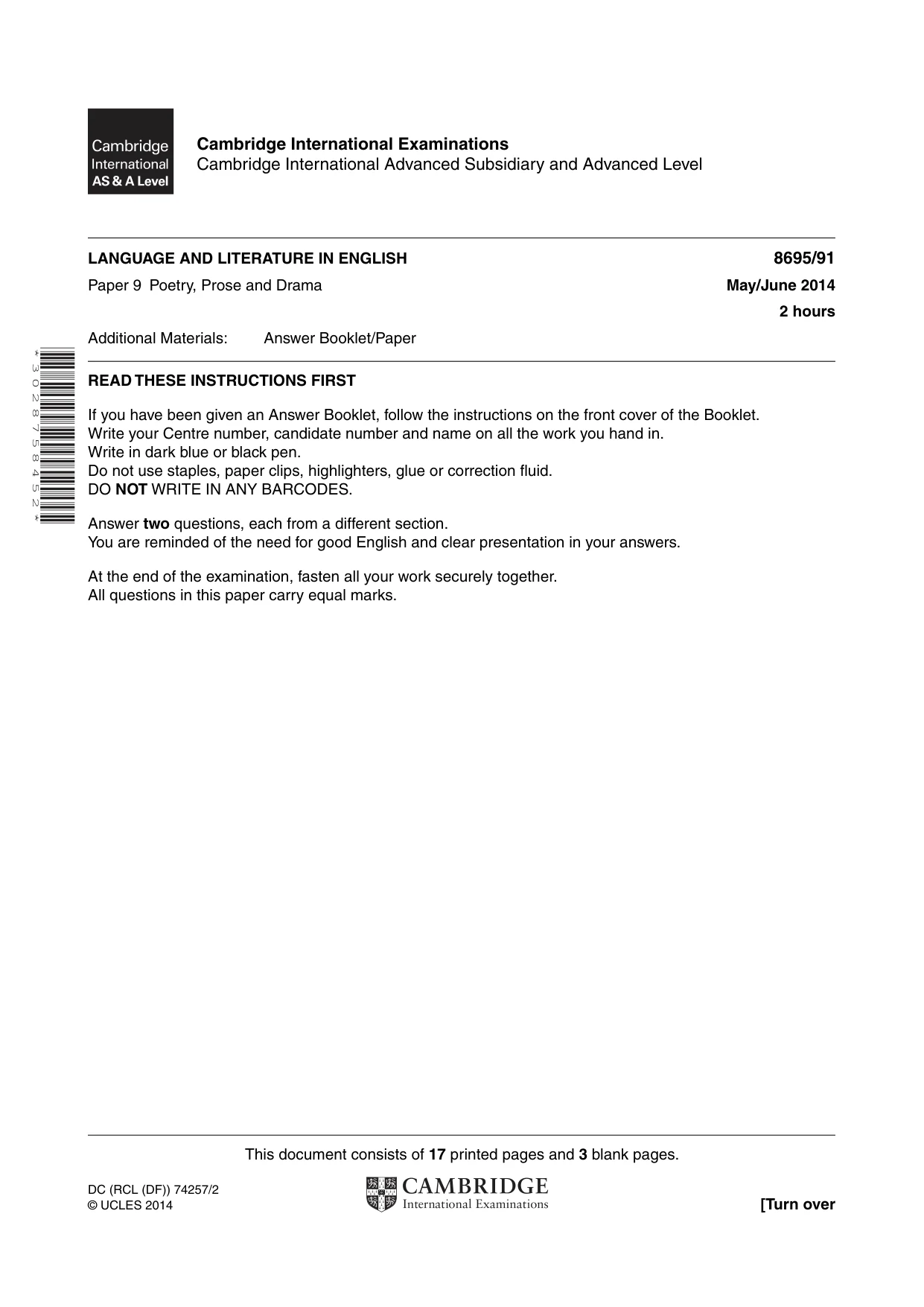
This document consists of 17 printed pages and 3 blank pages. DC (RCL (DF)) 74257/2 © UCLES 2014 [Turn over Cambridge International Examinations Cambridge International Advanced Subsidiary and Advanced Level * 3 0 2 8 7 5 8 4 5 2 * LANGUAGE AND LITERATURE IN ENGLISH 8695/91 Paper 9 Poetry, Prose and Drama May/June 2014 2 hours Additional Materials: Answer Booklet/Paper READ THESE INSTRUCTIONS FIRST If you have been given an Answer Booklet, follow the instructions on the front cover of the Booklet. Write your Centre number, candidate number and name on all the work you hand in. Write in dark blue or black pen. Do not use staples, paper clips, highlighters, glue or correction fluid. DO NOT WRITE IN ANY BARCODES. Answer two questions, each from a different section. You are reminded of the need for good English and clear presentation in your answers. At the end of the examination, fasten all your work securely together. All questions in this paper carry equal marks.
Question paper, page 2
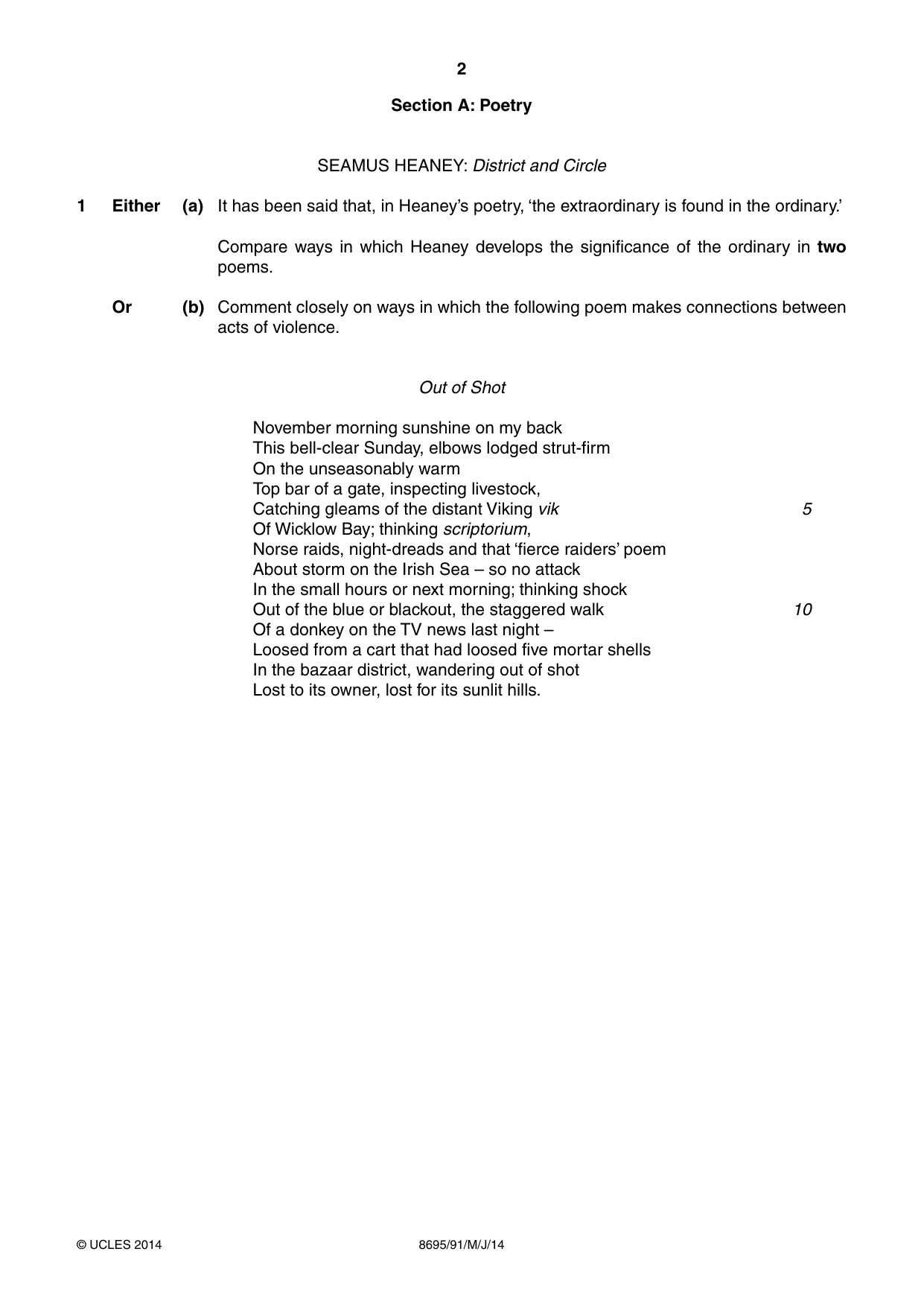
2 8695/91/M/J/14 © UCLES 2014 Section A: Poetry SEAMUS HEANEY: District and Circle 1 Either (a) It has been said that, in Heaney’s poetry, ‘the extraordinary is found in the ordinary.’ Compare ways in which Heaney develops the significance of the ordinary in two poems. Or (b) Comment closely on ways in which the following poem makes connections between acts of violence. Out of Shot November morning sunshine on my back This bell-clear Sunday, elbows lodged strut-firm On the unseasonably warm Top bar of a gate, inspecting livestock, Catching gleams of the distant Viking vik Of Wicklow Bay; thinking scriptorium, Norse raids, night-dreads and that ‘fierce raiders’ poem About storm on the Irish Sea – so no attack In the small hours or next morning; thinking shock Out of the blue or blackout, the staggered walk Of a donkey on the TV news last night – Loosed from a cart that had loosed five mortar shells In the bazaar district, wandering out of shot Lost to its owner, lost for its sunlit hills. 5 10
Question paper, page 3
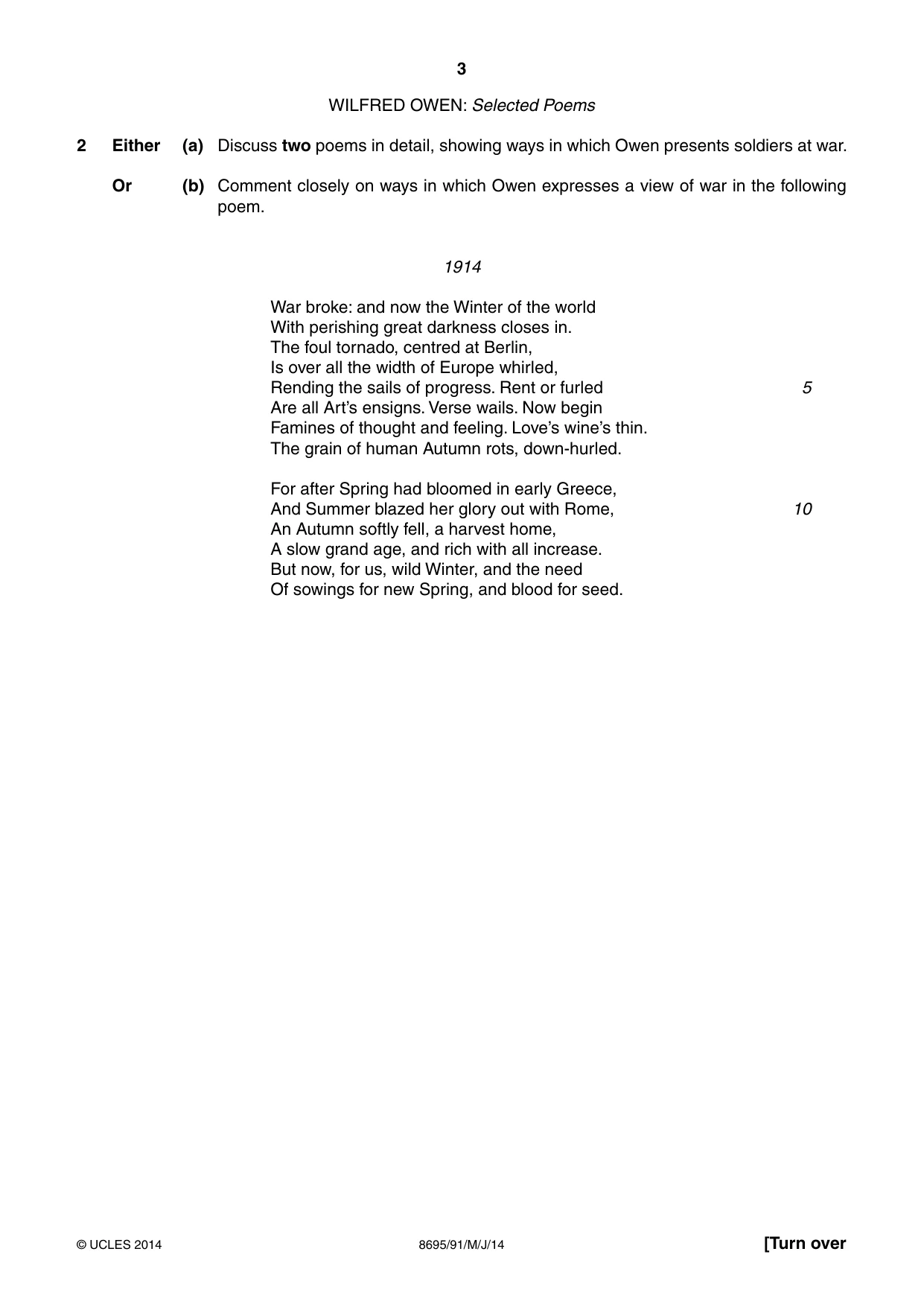
3 8695/91/M/J/14 © UCLES 2014 [Turn over WILFRED OWEN: Selected Poems 2 Either (a) Discuss two poems in detail, showing ways in which Owen presents soldiers at war. Or (b) Comment closely on ways in which Owen expresses a view of war in the following poem. 1914 War broke: and now the Winter of the world With perishing great darkness closes in. The foul tornado, centred at Berlin, Is over all the width of Europe whirled, Rending the sails of progress. Rent or furled Are all Art’s ensigns. Verse wails. Now begin Famines of thought and feeling. Love’s wine’s thin. The grain of human Autumn rots, down-hurled. For after Spring had bloomed in early Greece, And Summer blazed her glory out with Rome, An Autumn softly fell, a harvest home, A slow grand age, and rich with all increase. But now, for us, wild Winter, and the need Of sowings for new Spring, and blood for seed. 5 10
Question paper, page 4
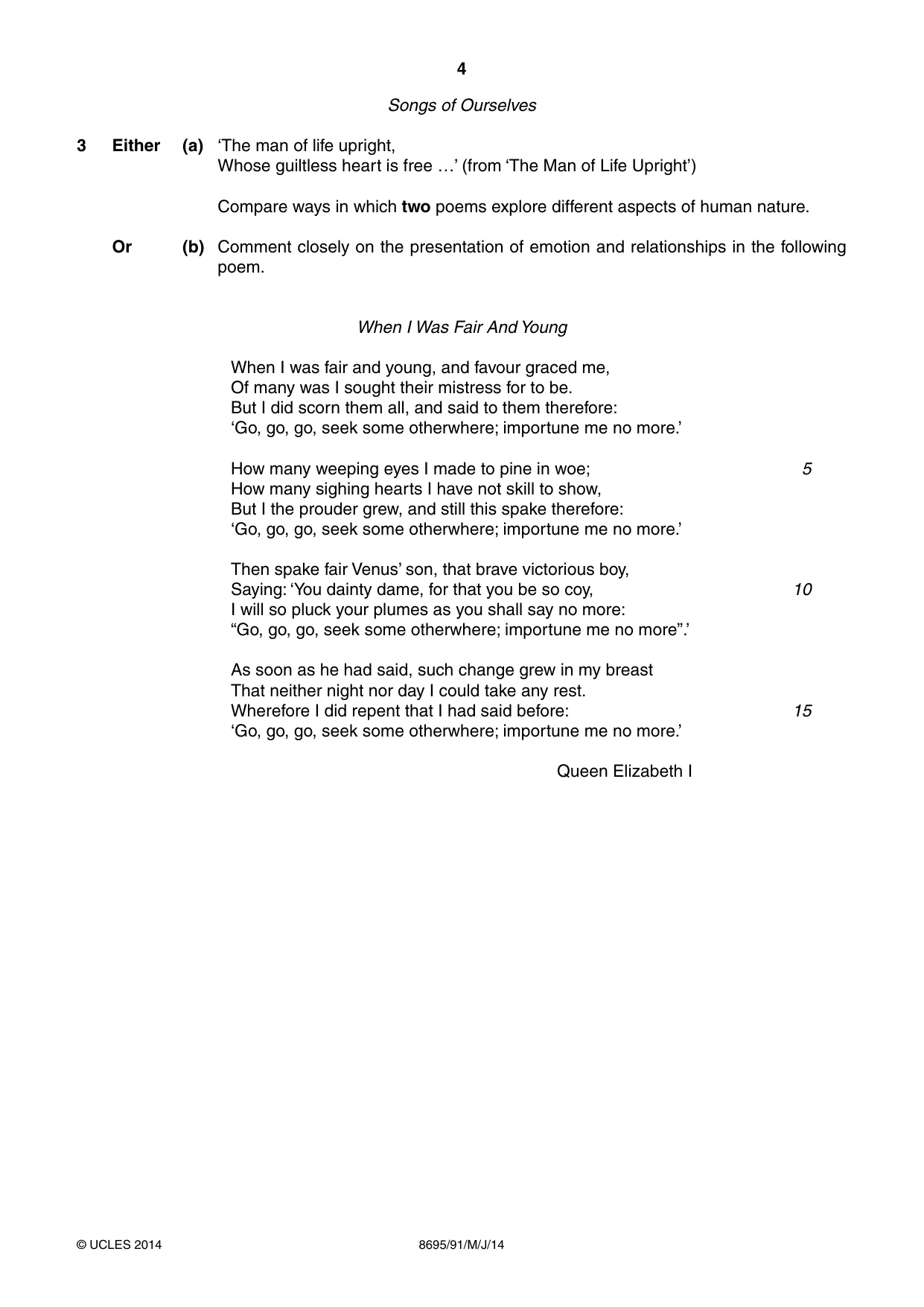
4 8695/91/M/J/14 © UCLES 2014 Songs of Ourselves 3 Either (a) ‘The man of life upright, Whose guiltless heart is free …’ (from ‘The Man of Life Upright’) Compare ways in which two poems explore different aspects of human nature. Or (b) Comment closely on the presentation of emotion and relationships in the following poem. When I Was Fair And Young When I was fair and young, and favour graced me, Of many was I sought their mistress for to be. But I did scorn them all, and said to them therefore: ‘Go, go, go, seek some otherwhere; importune me no more.’ How many weeping eyes I made to pine in woe; How many sighing hearts I have not skill to show, But I the prouder grew, and still this spake therefore: ‘Go, go, go, seek some otherwhere; importune me no more.’ Then spake fair Venus’ son, that brave victorious boy, Saying: ‘You dainty dame, for that you be so coy, I will so pluck your plumes as you shall say no more: “Go, go, go, seek some otherwhere; importune me no more”.’ As soon as he had said, such change grew in my breast That neither night nor day I could take any rest. Wherefore I did repent that I had said before: ‘Go, go, go, seek some otherwhere; importune me no more.’ Queen Elizabeth I 5 10 15
Question paper, page 5
5 8695/91/M/J/14 © UCLES 2014 [Turn over Turn to page 6 for Question 4
Question paper, page 6
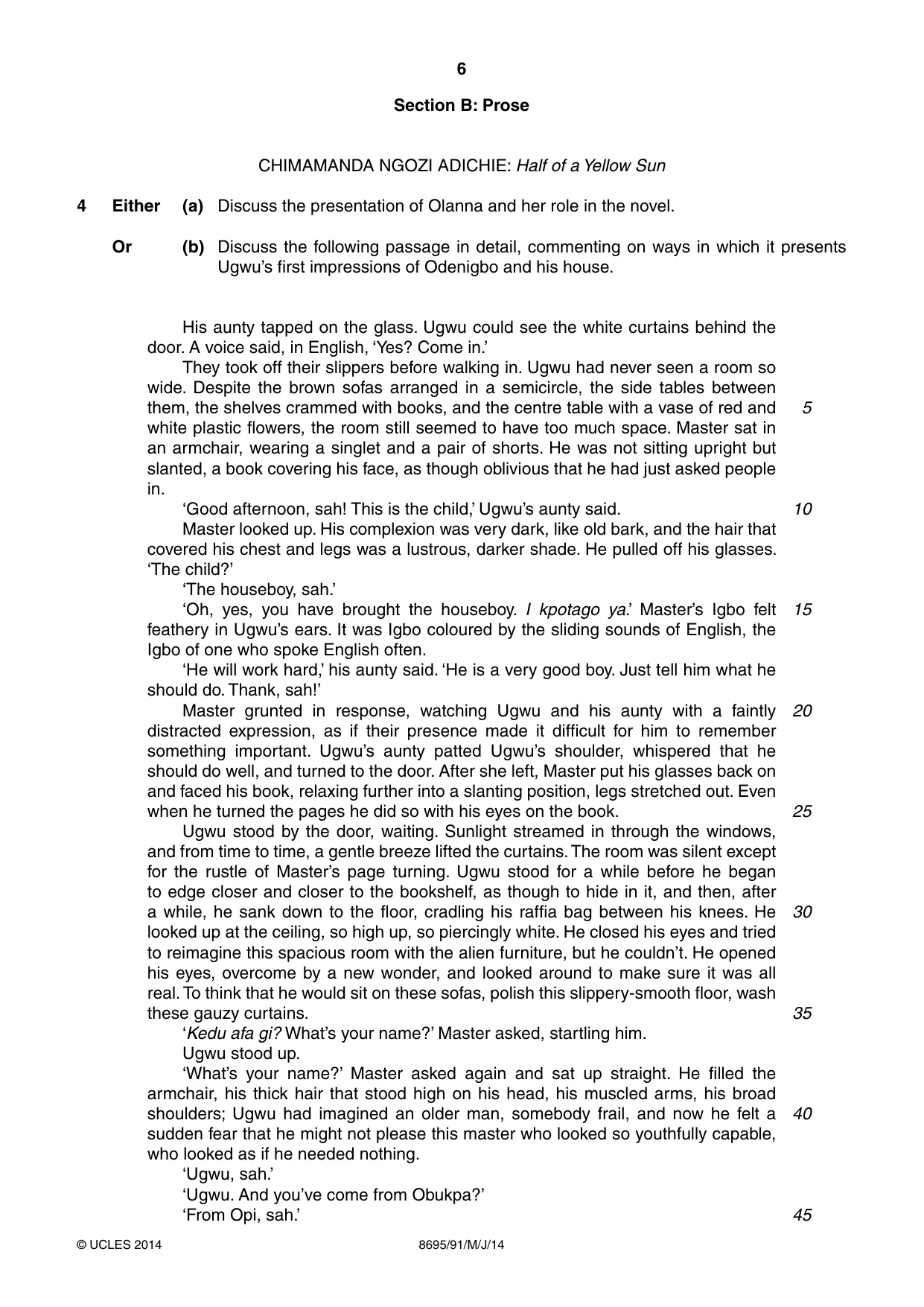
6 8695/91/M/J/14 © UCLES 2014 Section B: Prose CHIMAMANDA NGOZI ADICHIE: Half of a Yellow Sun 4 Either (a) Discuss the presentation of Olanna and her role in the novel. Or (b) Discuss the following passage in detail, commenting on ways in which it presents Ugwu’s first impressions of Odenigbo and his house. His aunty tapped on the glass. Ugwu could see the white curtains behind the door. A voice said, in English, ‘Yes? Come in.’ They took off their slippers before walking in. Ugwu had never seen a room so wide. Despite the brown sofas arranged in a semicircle, the side tables between them, the shelves crammed with books, and the centre table with a vase of red and white plastic flowers, the room still seemed to have too much space. Master sat in an armchair, wearing a singlet and a pair of shorts. He was not sitting upright but slanted, a book covering his face, as though oblivious that he had just asked people in. ‘Good afternoon, sah! This is the child,’ Ugwu’s aunty said. Master looked up. His complexion was very dark, like old bark, and the hair that covered his chest and legs was a lustrous, darker shade. He pulled off his glasses. ‘The child?’ ‘The houseboy, sah.’ ‘Oh, yes, you have brought the houseboy. I kpotago ya.’ Master’s Igbo felt feathery in Ugwu’s ears. It was Igbo coloured by the sliding sounds of English, the Igbo of one who spoke English often. ‘He will work hard,’ his aunty said. ‘He is a very good boy. Just tell him what he should do. Thank, sah!’ Master grunted in response, watching Ugwu and his aunty with a faintly distracted expression, as if their presence made it difficult for him to remember something important. Ugwu’s aunty patted Ugwu’s shoulder, whispered that he should do well, and turned to the door. After she left, Master put his glasses back on and faced his book, relaxing further into a slanting position, legs stretched out. Even when he turned the pages he did so with his eyes on the book. Ugwu stood by the door, waiting. Sunlight streamed in through the windows, and from time to time, a gentle breeze lifted the curtains. The room was silent except for the rustle of Master’s page turning. Ugwu stood for a while before he began to edge closer and closer to the bookshelf, as though to hide in it, and then, after a while, he sank down to the floor, cradling his raffia bag between his knees. He looked up at the ceiling, so high up, so piercingly white. He closed his eyes and tried to reimagine this spacious room with the alien furniture, but he couldn’t. He opened his eyes, overcome by a new wonder, and looked around to make sure it was all real. To think that he would sit on these sofas, polish this slippery-smooth floor, wash these gauzy curtains. ‘Kedu afa gi? What’s your name?’ Master asked, startling him. Ugwu stood up. ‘What’s your name?’ Master asked again and sat up straight. He filled the armchair, his thick hair that stood high on his head, his muscled arms, his broad shoulders; Ugwu had imagined an older man, somebody frail, and now he felt a sudden fear that he might not please this master who looked so youthfully capable, who looked as if he needed nothing. ‘Ugwu, sah.’ ‘Ugwu. And you’ve come from Obukpa?’ ‘From Opi, sah.’ 5 10 15 20 25 30 35 40 45
Question paper, page 7
7 8695/91/M/J/14 © UCLES 2014 [Turn over ‘You could be anything from twelve to thirty.’ Master narrowed his eyes. ‘Probably thirteen.’ He said thirteen in English. ‘Yes, sah.’ Master turned back to his book. Ugwu stood there. Master flipped past some pages and looked up. ‘Ngwa, go to the kitchen; there should be something you can eat in the fridge.’ ‘Yes, sah.’ Chapter 1 50
Question paper, page 8
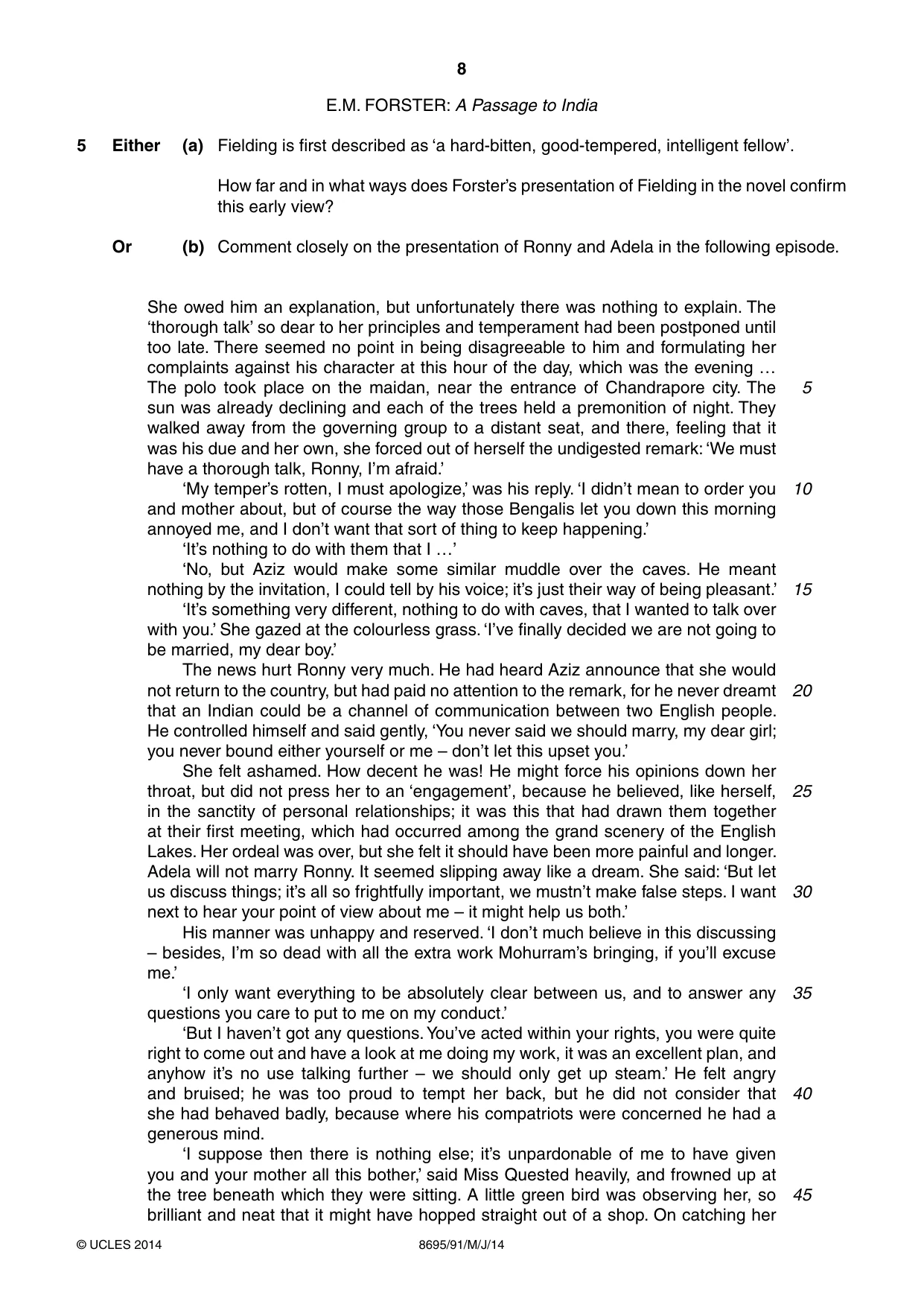
8 8695/91/M/J/14 © UCLES 2014 E.M. FORSTER: A Passage to India 5 Either (a) Fielding is first described as ‘a hard-bitten, good-tempered, intelligent fellow’. How far and in what ways does Forster’s presentation of Fielding in the novel confirm this early view? Or (b) Comment closely on the presentation of Ronny and Adela in the following episode. She owed him an explanation, but unfortunately there was nothing to explain. The ‘thorough talk’ so dear to her principles and temperament had been postponed until too late. There seemed no point in being disagreeable to him and formulating her complaints against his character at this hour of the day, which was the evening … The polo took place on the maidan, near the entrance of Chandrapore city. The sun was already declining and each of the trees held a premonition of night. They walked away from the governing group to a distant seat, and there, feeling that it was his due and her own, she forced out of herself the undigested remark: ‘We must have a thorough talk, Ronny, I’m afraid.’ ‘My temper’s rotten, I must apologize,’ was his reply. ‘I didn’t mean to order you and mother about, but of course the way those Bengalis let you down this morning annoyed me, and I don’t want that sort of thing to keep happening.’ ‘It’s nothing to do with them that I …’ ‘No, but Aziz would make some similar muddle over the caves. He meant nothing by the invitation, I could tell by his voice; it’s just their way of being pleasant.’ ‘It’s something very different, nothing to do with caves, that I wanted to talk over with you.’ She gazed at the colourless grass. ‘I’ve finally decided we are not going to be married, my dear boy.’ The news hurt Ronny very much. He had heard Aziz announce that she would not return to the country, but had paid no attention to the remark, for he never dreamt that an Indian could be a channel of communication between two English people. He controlled himself and said gently, ‘You never said we should marry, my dear girl; you never bound either yourself or me – don’t let this upset you.’ She felt ashamed. How decent he was! He might force his opinions down her throat, but did not press her to an ‘engagement’, because he believed, like herself, in the sanctity of personal relationships; it was this that had drawn them together at their first meeting, which had occurred among the grand scenery of the English Lakes. Her ordeal was over, but she felt it should have been more painful and longer. Adela will not marry Ronny. It seemed slipping away like a dream. She said: ‘But let us discuss things; it’s all so frightfully important, we mustn’t make false steps. I want next to hear your point of view about me – it might help us both.’ His manner was unhappy and reserved. ‘I don’t much believe in this discussing – besides, I’m so dead with all the extra work Mohurram’s bringing, if you’ll excuse me.’ ‘I only want everything to be absolutely clear between us, and to answer any questions you care to put to me on my conduct.’ ‘But I haven’t got any questions. You’ve acted within your rights, you were quite right to come out and have a look at me doing my work, it was an excellent plan, and anyhow it’s no use talking further – we should only get up steam.’ He felt angry and bruised; he was too proud to tempt her back, but he did not consider that she had behaved badly, because where his compatriots were concerned he had a generous mind. ‘I suppose then there is nothing else; it’s unpardonable of me to have given you and your mother all this bother,’ said Miss Quested heavily, and frowned up at the tree beneath which they were sitting. A little green bird was observing her, so brilliant and neat that it might have hopped straight out of a shop. On catching her 5 10 15 20 25 30 35 40 45
Question paper, page 9
9 8695/91/M/J/14 © UCLES 2014 [Turn over eye it closed its own, gave a small skip and prepared to go to bed. Some Indian wild bird. ‘Yes, nothing else,’ she repeated, feeling that a profound and passionate speech ought to have been delivered by one or both of them. ‘We’ve been awfully British over it, but I suppose that’s all right.’ Chapter 8 50
Question paper, page 10
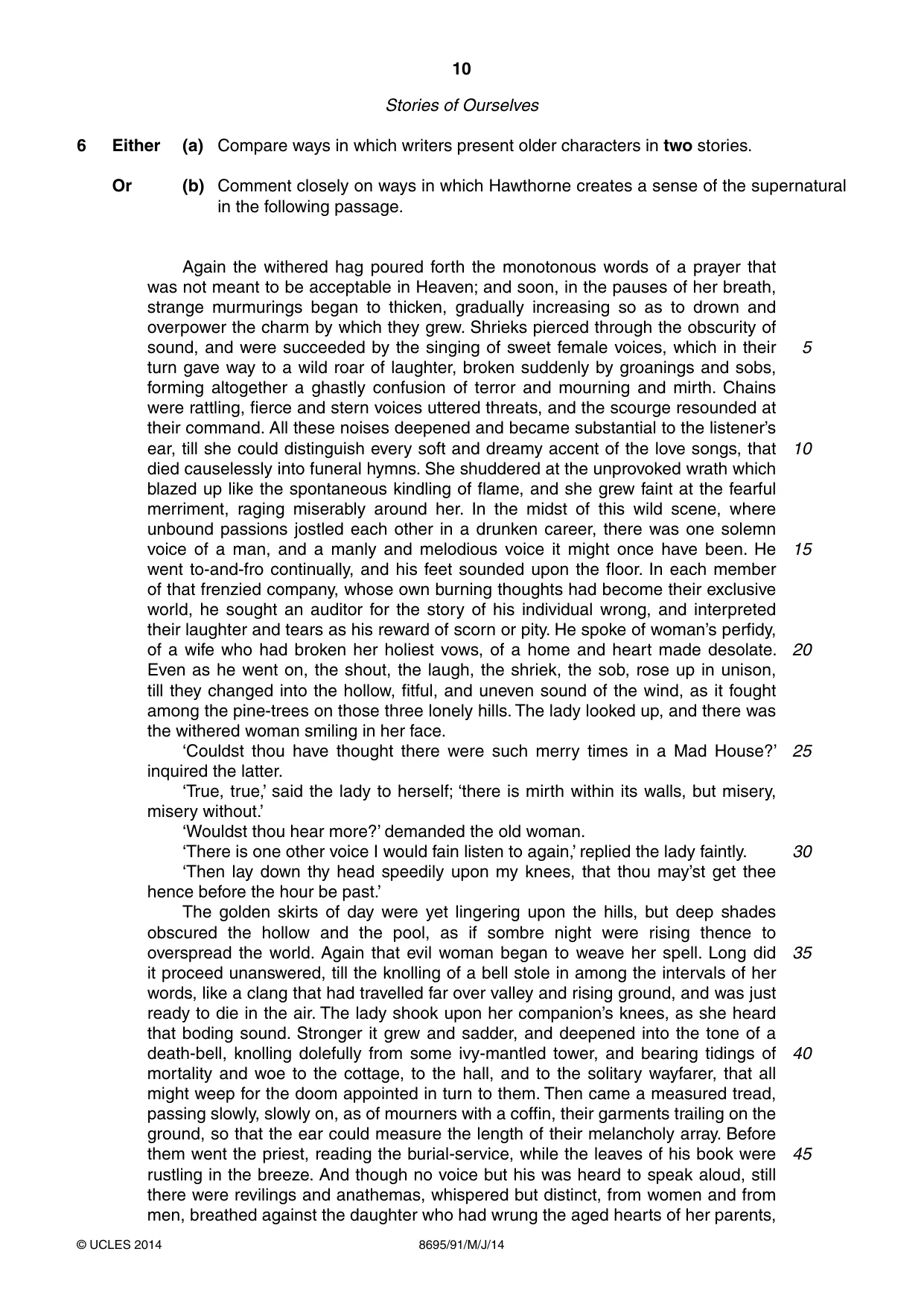
10 8695/91/M/J/14 © UCLES 2014 Stories of Ourselves 6 Either (a) Compare ways in which writers present older characters in two stories. Or (b) Comment closely on ways in which Hawthorne creates a sense of the supernatural in the following passage. Again the withered hag poured forth the monotonous words of a prayer that was not meant to be acceptable in Heaven; and soon, in the pauses of her breath, strange murmurings began to thicken, gradually increasing so as to drown and overpower the charm by which they grew. Shrieks pierced through the obscurity of sound, and were succeeded by the singing of sweet female voices, which in their turn gave way to a wild roar of laughter, broken suddenly by groanings and sobs, forming altogether a ghastly confusion of terror and mourning and mirth. Chains were rattling, fierce and stern voices uttered threats, and the scourge resounded at their command. All these noises deepened and became substantial to the listener’s ear, till she could distinguish every soft and dreamy accent of the love songs, that died causelessly into funeral hymns. She shuddered at the unprovoked wrath which blazed up like the spontaneous kindling of flame, and she grew faint at the fearful merriment, raging miserably around her. In the midst of this wild scene, where unbound passions jostled each other in a drunken career, there was one solemn voice of a man, and a manly and melodious voice it might once have been. He went to-and-fro continually, and his feet sounded upon the floor. In each member of that frenzied company, whose own burning thoughts had become their exclusive world, he sought an auditor for the story of his individual wrong, and interpreted their laughter and tears as his reward of scorn or pity. He spoke of woman’s perfidy, of a wife who had broken her holiest vows, of a home and heart made desolate. Even as he went on, the shout, the laugh, the shriek, the sob, rose up in unison, till they changed into the hollow, fitful, and uneven sound of the wind, as it fought among the pine-trees on those three lonely hills. The lady looked up, and there was the withered woman smiling in her face. ‘Couldst thou have thought there were such merry times in a Mad House?’ inquired the latter. ‘True, true,’ said the lady to herself; ‘there is mirth within its walls, but misery, misery without.’ ‘Wouldst thou hear more?’ demanded the old woman. ‘There is one other voice I would fain listen to again,’ replied the lady faintly. ‘Then lay down thy head speedily upon my knees, that thou may’st get thee hence before the hour be past.’ The golden skirts of day were yet lingering upon the hills, but deep shades obscured the hollow and the pool, as if sombre night were rising thence to overspread the world. Again that evil woman began to weave her spell. Long did it proceed unanswered, till the knolling of a bell stole in among the intervals of her words, like a clang that had travelled far over valley and rising ground, and was just ready to die in the air. The lady shook upon her companion’s knees, as she heard that boding sound. Stronger it grew and sadder, and deepened into the tone of a death-bell, knolling dolefully from some ivy-mantled tower, and bearing tidings of mortality and woe to the cottage, to the hall, and to the solitary wayfarer, that all might weep for the doom appointed in turn to them. Then came a measured tread, passing slowly, slowly on, as of mourners with a coffin, their garments trailing on the ground, so that the ear could measure the length of their melancholy array. Before them went the priest, reading the burial-service, while the leaves of his book were rustling in the breeze. And though no voice but his was heard to speak aloud, still there were revilings and anathemas, whispered but distinct, from women and from men, breathed against the daughter who had wrung the aged hearts of her parents, 5 10 15 20 25 30 35 40 45
Question paper, page 11
11 8695/91/M/J/14 © UCLES 2014 [Turn over – the wife who had betrayed the trusting fondness of her husband, – the mother who had sinned against natural affection, and left her child to die. The sweeping sound of the funeral train faded away like a thin vapour, and the wind, that just before had seemed to shake the coffin-pall, moaned sadly round the verge of the Hollow between three Hills. But when the old woman stirred the kneeling lady, she lifted not her head. ‘Here has been a sweet hour’s sport!’ said the withered crone, chuckling to herself. The Hollow of the Three Hills 50 55
Question paper, page 12
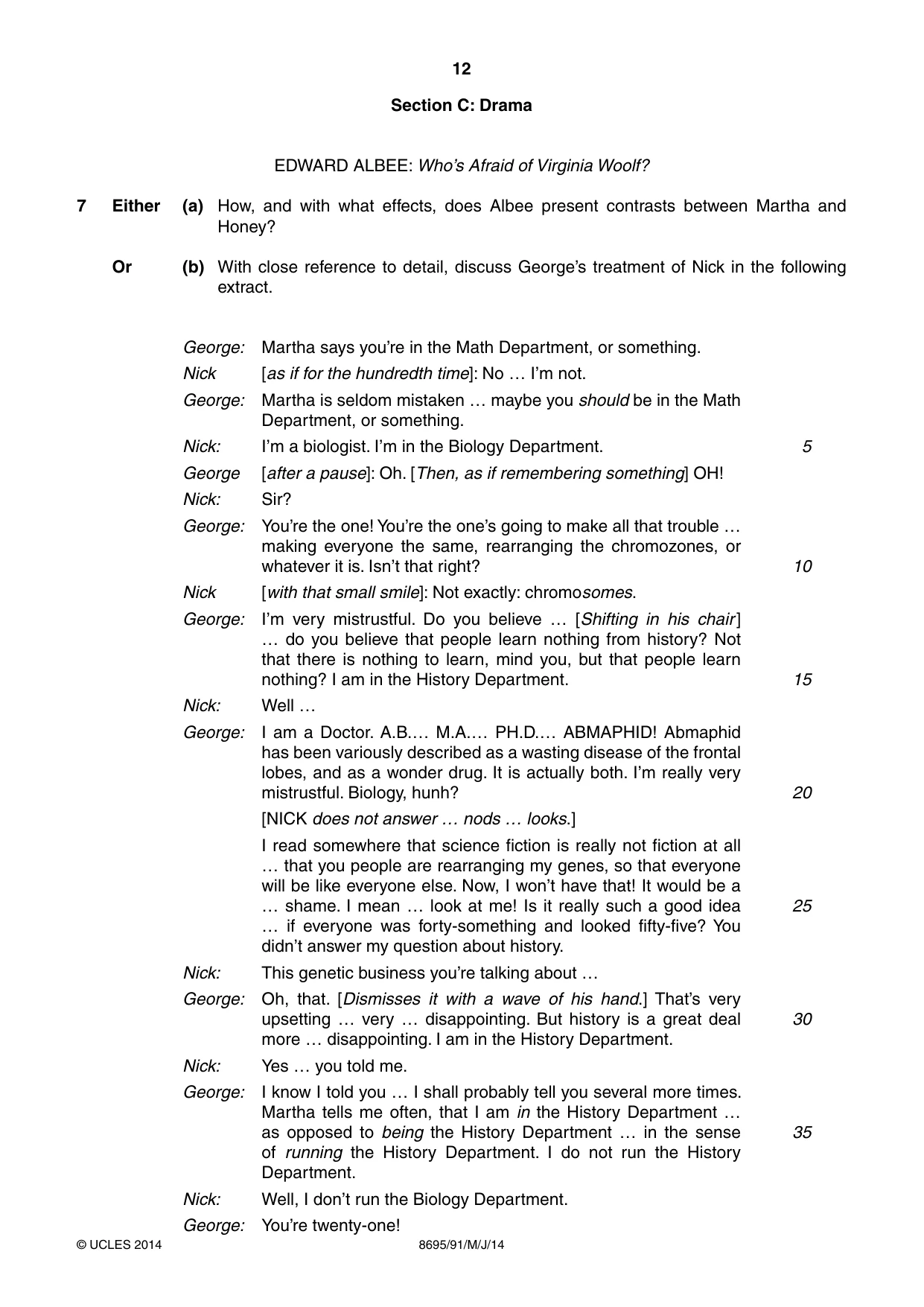
12 8695/91/M/J/14 © UCLES 2014 Section C: Drama EDWARD ALBEE: Who’s Afraid of Virginia Woolf? 7 Either (a) How, and with what effects, does Albee present contrasts between Martha and Honey? Or (b) With close reference to detail, discuss George’s treatment of Nick in the following extract. George: Martha says you’re in the Math Department, or something. Nick [as if for the hundredth time]: No … I’m not. George: Martha is seldom mistaken … maybe you should be in the Math Department, or something. Nick: I’m a biologist. I’m in the Biology Department. George [after a pause]: Oh. [Then, as if remembering something] OH! Nick: Sir? George: You’re the one! You’re the one’s going to make all that trouble … making everyone the same, rearranging the chromozones, or whatever it is. Isn’t that right? Nick [with that small smile]: Not exactly: chromosomes. George: I’m very mistrustful. Do you believe … [Shifting in his chair ] … do you believe that people learn nothing from history? Not that there is nothing to learn, mind you, but that people learn nothing? I am in the History Department. Nick: Well … George: I am a Doctor. A.B.… M.A.… PH.D.… ABMAPHID! Abmaphid has been variously described as a wasting disease of the frontal lobes, and as a wonder drug. It is actually both. I’m really very mistrustful. Biology, hunh? [NICK does not answer … nods … looks.] I read somewhere that science fiction is really not fiction at all … that you people are rearranging my genes, so that everyone will be like everyone else. Now, I won’t have that! It would be a … shame. I mean … look at me! Is it really such a good idea … if everyone was forty-something and looked fifty-five? You didn’t answer my question about history. Nick: This genetic business you’re talking about … George: Oh, that. [Dismisses it with a wave of his hand.] That’s very upsetting … very … disappointing. But history is a great deal more … disappointing. I am in the History Department. Nick: Yes … you told me. George: I know I told you … I shall probably tell you several more times. Martha tells me often, that I am in the History Department … as opposed to being the History Department … in the sense of running the History Department. I do not run the History Department. Nick: Well, I don’t run the Biology Department. George: You’re twenty-one! 5 10 15 20 25 30 35
Question paper, page 13
13 8695/91/M/J/14 © UCLES 2014 [Turn over Nick: Twenty-eight. George: Twenty-eight! Perhaps when you’re forty-something and look fifty-five, you will run the History Department.… Nick: … Biology.… George: … the Biology Department. I did run the History Department, for four years, during the war, but that was because everybody was away. Then … everybody came back … because nobody got killed. That’s New England for you. Isn’t that amazing? Not one single man in this whole place got his head shot off. That’s pretty irrational. [Broods.] Your wife doesn’t have any hips … has she … does she? Nick: What? George: I don’t mean to suggest that I’m hip-happy.… I’m not one of those thirty-six, twenty-two, seventy-eight men. No-siree … not me. Everything in proportion. I was implying that your wife is … slim-hipped. Nick: Yes … she is. George [looking at the ceiling]: What are they doing up there? I assume that’s where they are. Nick [false heartiness]: You know women. George [gives NICK a long stare, of feigned incredulity … then his attention moves]: Not one son-of-a-bitch got killed. Of course, nobody bombed Washington. No … that’s not fair. You have any kids? Nick: Uh … no … not yet. [Pause] You? George [a kind of challenge]: That’s for me to know and you to find out. Act 1 40 45 50 55 60 65
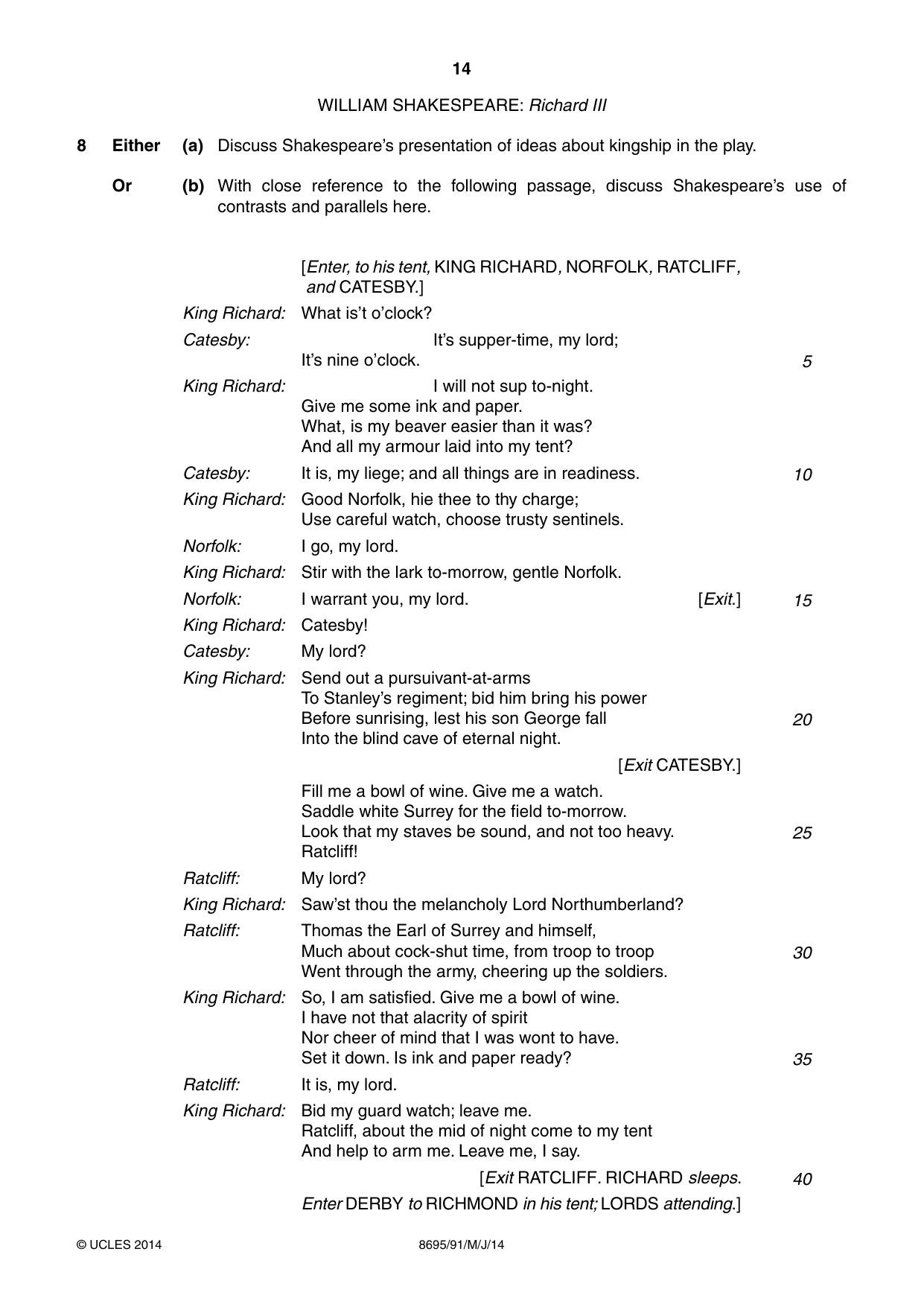
Question paper, page 14
14 8695/91/M/J/14 © UCLES 2014 WILLIAM SHAKESPEARE: Richard III 8 Either (a) Discuss Shakespeare’s presentation of ideas about kingship in the play. Or (b) With close reference to the following passage, discuss Shakespeare’s use of contrasts and parallels here. [ Enter, to his tent, KING RICHARD, NORFOLK, RATCLIFF, and CATESBY.] King Richard: What is’t o’clock? Catesby: It’s supper-time, my lord; It’s nine o’clock. King Richard: I will not sup to-night. Give me some ink and paper. What, is my beaver easier than it was? And all my armour laid into my tent? Catesby: It is, my liege; and all things are in readiness. King Richard: Good Norfolk, hie thee to thy charge; Use careful watch, choose trusty sentinels. Norfolk: I go, my lord. King Richard: Stir with the lark to-morrow, gentle Norfolk. Norfolk: I warrant you, my lord. [Exit.] King Richard: Catesby! Catesby: My lord? King Richard: Send out a pursuivant-at-arms To Stanley’s regiment; bid him bring his power Before sunrising, lest his son George fall Into the blind cave of eternal night. [Exit CATESBY.] Fill me a bowl of wine. Give me a watch. Saddle white Surrey for the field to-morrow. Look that my staves be sound, and not too heavy. Ratcliff! Ratcliff: My lord? King Richard: Saw’st thou the melancholy Lord Northumberland? Ratcliff: Thomas the Earl of Surrey and himself, Much about cock-shut time, from troop to troop Went through the army, cheering up the soldiers. King Richard: So, I am satisfied. Give me a bowl of wine. I have not that alacrity of spirit Nor cheer of mind that I was wont to have. Set it down. Is ink and paper ready? Ratcliff: It is, my lord. King Richard: Bid my guard watch; leave me. Ratcliff, about the mid of night come to my tent And help to arm me. Leave me, I say. [Exit RATCLIFF. RICHARD sleeps. Enter DERBY to RICHMOND in his tent; LORDS attending.] 5 10 15 20 25 30 35 40
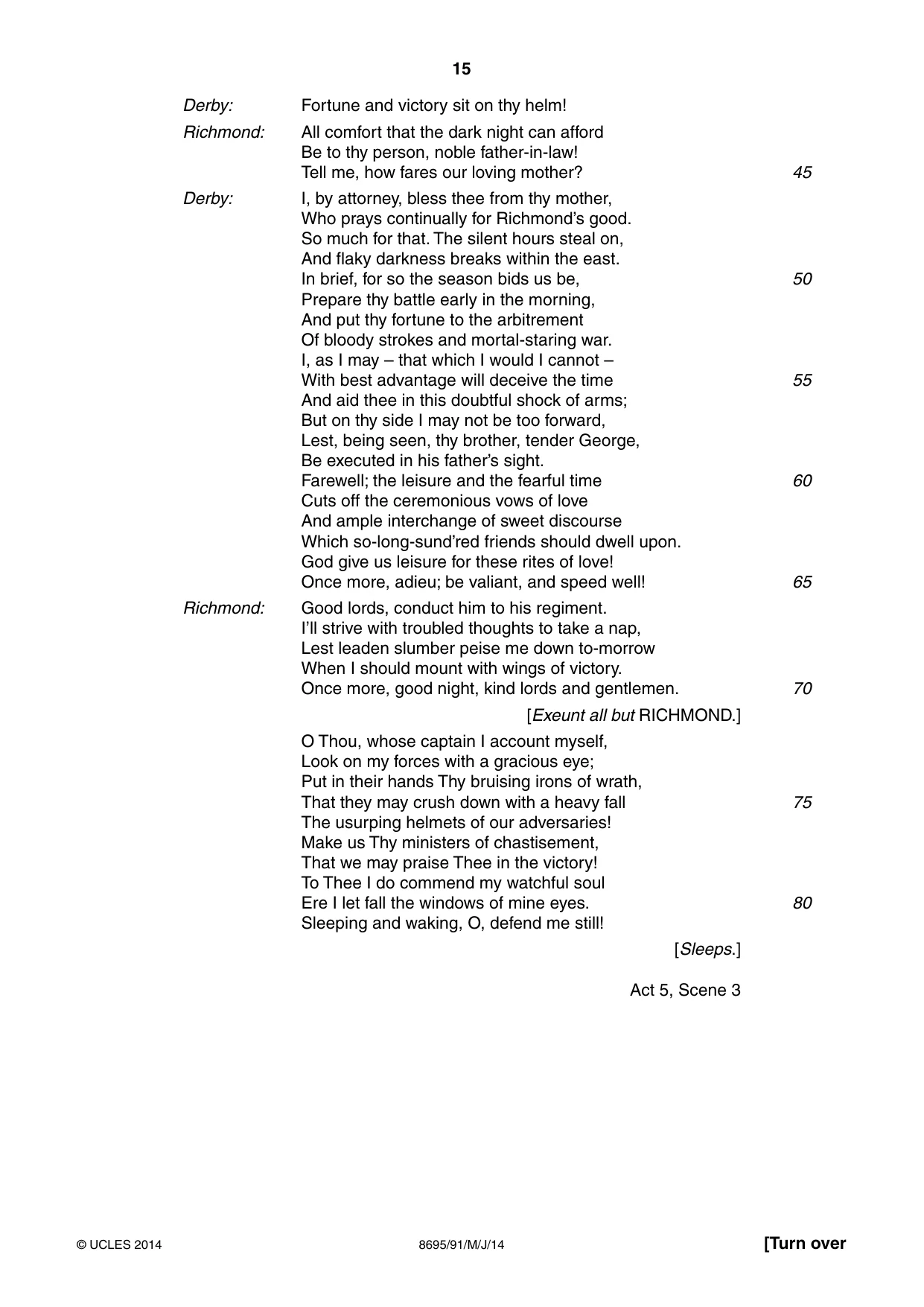
Question paper, page 15
15 8695/91/M/J/14 © UCLES 2014 [Turn over Derby: Fortune and victory sit on thy helm! Richmond: All comfort that the dark night can afford Be to thy person, noble father-in-law! Tell me, how fares our loving mother? Derby: I, by attorney, bless thee from thy mother, Who prays continually for Richmond’s good. So much for that. The silent hours steal on, And flaky darkness breaks within the east. In brief, for so the season bids us be, Prepare thy battle early in the morning, And put thy fortune to the arbitrement Of bloody strokes and mortal-staring war. I, as I may – that which I would I cannot – With best advantage will deceive the time And aid thee in this doubtful shock of arms; But on thy side I may not be too forward, Lest, being seen, thy brother, tender George, Be executed in his father’s sight. Farewell; the leisure and the fearful time Cuts off the ceremonious vows of love And ample interchange of sweet discourse Which so-long-sund’red friends should dwell upon. God give us leisure for these rites of love! Once more, adieu; be valiant, and speed well! Richmond: Good lords, conduct him to his regiment. I’ll strive with troubled thoughts to take a nap, Lest leaden slumber peise me down to-morrow When I should mount with wings of victory. Once more, good night, kind lords and gentlemen. [Exeunt all but RICHMOND.] O Thou, whose captain I account myself, Look on my forces with a gracious eye; Put in their hands Thy bruising irons of wrath, That they may crush down with a heavy fall The usurping helmets of our adversaries! Make us Thy ministers of chastisement, That we may praise Thee in the victory! To Thee I do commend my watchful soul Ere I let fall the windows of mine eyes. Sleeping and waking, O, defend me still! [Sleeps.] Act 5, Scene 3 45 50 55 60 65 70 75 80
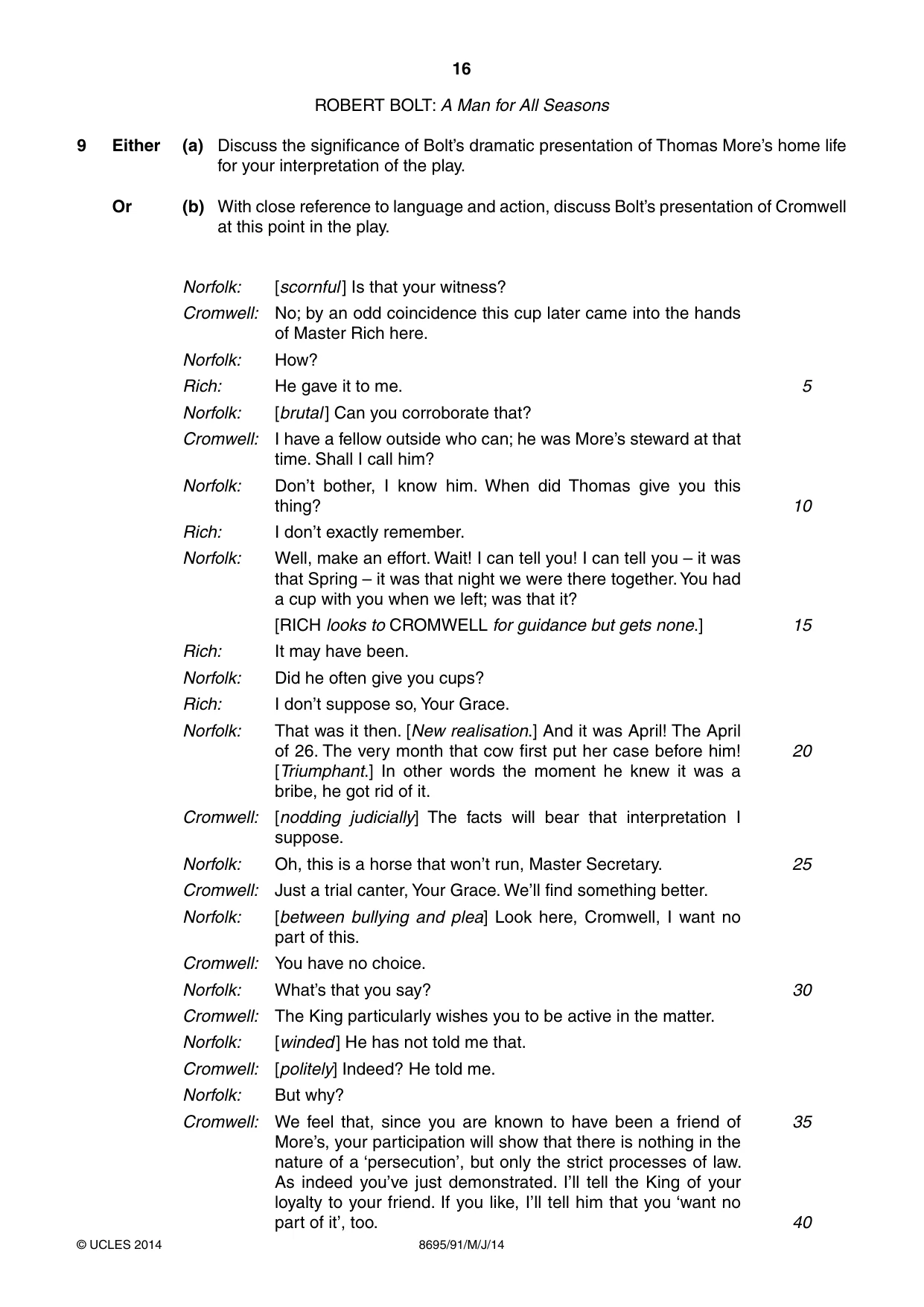
Question paper, page 16
16 8695/91/M/J/14 © UCLES 2014 ROBERT BOLT: A Man for All Seasons 9 Either (a) Discuss the significance of Bolt’s dramatic presentation of Thomas More’s home life for your interpretation of the play. Or (b) With close reference to language and action, discuss Bolt’s presentation of Cromwell at this point in the play. Norfolk: [scornful ] Is that your witness? Cromwell: No; by an odd coincidence this cup later came into the hands of Master Rich here. Norfolk: How? Rich: He gave it to me. Norfolk: [brutal ] Can you corroborate that? Cromwell: I have a fellow outside who can; he was More’s steward at that time. Shall I call him? Norfolk: Don’t bother, I know him. When did Thomas give you this thing? Rich: I don’t exactly remember. Norfolk: Well, make an effort. Wait! I can tell you! I can tell you – it was that Spring – it was that night we were there together. You had a cup with you when we left; was that it? [RICH looks to CROMWELL for guidance but gets none.] Rich: It may have been. Norfolk: Did he often give you cups? Rich: I don’t suppose so, Your Grace. Norfolk: That was it then. [New realisation.] And it was April! The April of 26. The very month that cow first put her case before him! [Triumphant.] In other words the moment he knew it was a bribe, he got rid of it. Cromwell: [nodding judicially] The facts will bear that interpretation I suppose. Norfolk: Oh, this is a horse that won’t run, Master Secretary. Cromwell: Just a trial canter, Your Grace. We’ll find something better. Norfolk: [between bullying and plea] Look here, Cromwell, I want no part of this. Cromwell: You have no choice. Norfolk: What’s that you say? Cromwell: The King particularly wishes you to be active in the matter. Norfolk: [winded ] He has not told me that. Cromwell: [politely] Indeed? He told me. Norfolk: But why? Cromwell: We feel that, since you are known to have been a friend of More’s, your participation will show that there is nothing in the nature of a ‘persecution’, but only the strict processes of law. As indeed you’ve just demonstrated. I’ll tell the King of your loyalty to your friend. If you like, I’ll tell him that you ‘want no part of it’, too. 5 10 15 20 25 30 35 40
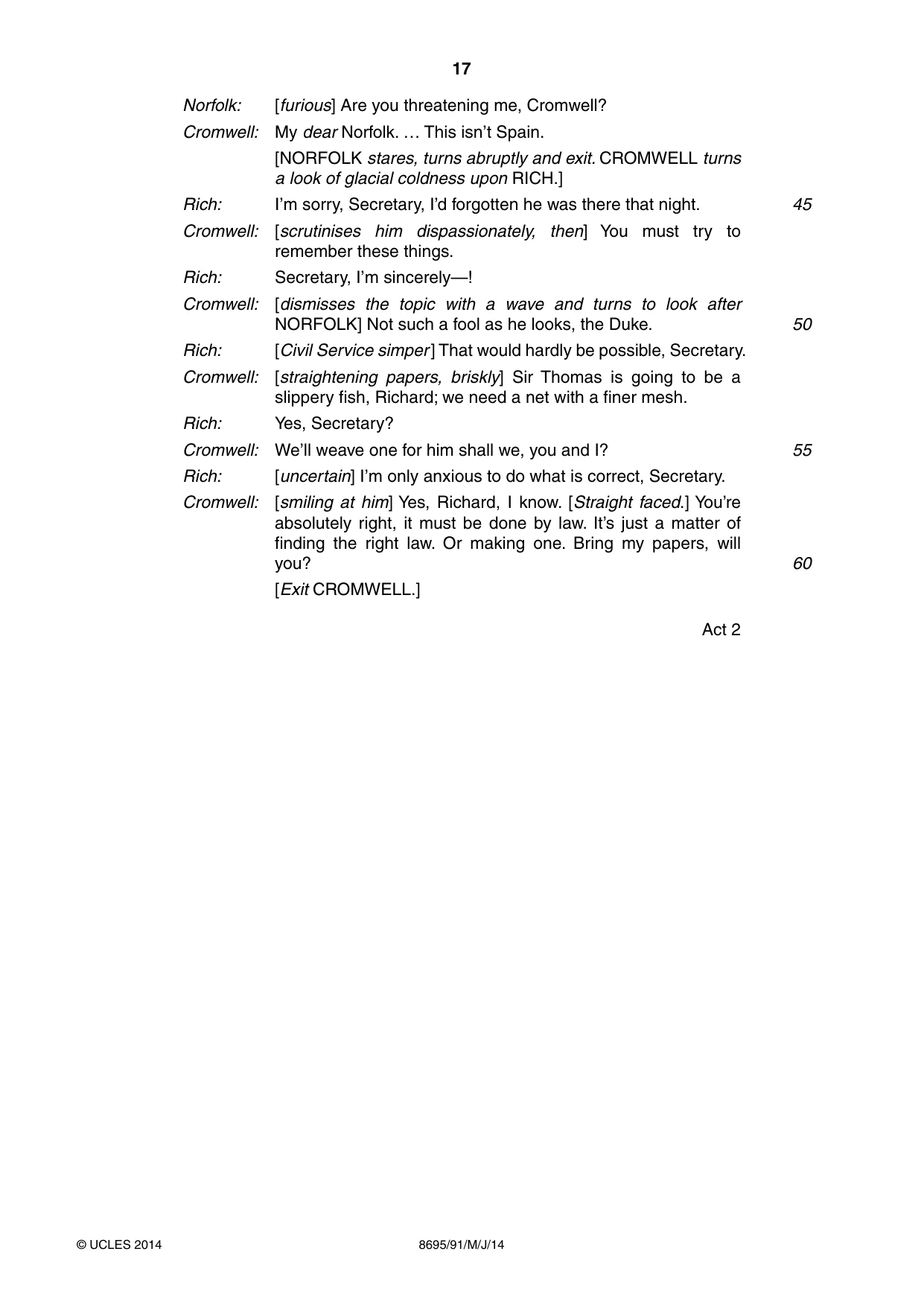
Question paper, page 17
17 8695/91/M/J/14 © UCLES 2014 Norfolk: [furious] Are you threatening me, Cromwell? Cromwell: My dear Norfolk. … This isn’t Spain. [NORFOLK stares, turns abruptly and exit. CROMWELL turns a look of glacial coldness upon RICH.] Rich: I’m sorry, Secretary, I’d forgotten he was there that night. Cromwell: [scrutinises him dispassionately, then] You must try to remember these things. Rich: Secretary, I’m sincerely—! Cromwell: [dismisses the topic with a wave and turns to look after NORFOLK] Not such a fool as he looks, the Duke. Rich: [Civil Service simper ] That would hardly be possible, Secretary. Cromwell: [straightening papers, briskly] Sir Thomas is going to be a slippery fish, Richard; we need a net with a finer mesh. Rich: Yes, Secretary? Cromwell: We’ll weave one for him shall we, you and I? Rich: [uncertain] I’m only anxious to do what is correct, Secretary. Cromwell: [smiling at him] Yes, Richard, I know. [Straight faced.] You’re absolutely right, it must be done by law. It’s just a matter of finding the right law. Or making one. Bring my papers, will you? [Exit CROMWELL.] Act 2 45 50 55 60
Question paper, page 18
18 8695/91/M/J/14 © UCLES 2014 BLANK PAGE
Question paper, page 19
19 8695/91/M/J/14 © UCLES 2014 BLANK PAGE
Question paper, page 20
20 8695/91/M/J/14 © UCLES 2014 Copyright Acknowledgements: Question 1 © Seamus Heaney; Out of Shot, from District and Circle; Faber & Faber Ltd; 2006. Question 4 © Chimamanda Ngozi Adichie; Half of a Yellow Sun; HarperCollins; 2006. Question 5 © E M Forster; A Passage to India; The Provost and Scholars of King's College, Cambridge and The Society of Authors. Question 7 © From Who’s Afraid of Virginia Woolf by Edward Albee. Published by Jonathan Cape. Reprinted by permission of the Random House Group Ltd. Question 9 © A Man for All Seasons by Robert Bolt. Reprinted by permission of Pearson Education. Permission to reproduce items where third-party owned material protected by copyright is included has been sought and cleared where possible. Every reasonable effort has been made by the publisher (UCLES) to trace copyright holders, but if any items requiring clearance have unwittingly been included, the publisher will be pleased to make amends at the earliest possible opportunity. University of Cambridge International Examinations is part of the Cambridge Assessment Group. Cambridge Assessment is the brand name of University of Cambridge Local Examinations Syndicate (UCLES), which is itself a department of the University of Cambridge. BLANK PAGE
Mark scheme, page 1
CAMBRIDGE INTERNATIONAL EXAMINATIONS GCE Advanced Subsidiary Level and GCE Advanced Level MARK SCHEME for the May/June 2014 series 8695 LANGUAGE AND LITERATURE IN ENGLISH 8695/91 Paper 9 (Poetry, Prose and Drama), maximum raw mark 50 This mark scheme is published as an aid to teachers and candidates, to indicate the requirements of the examination. It shows the basis on which Examiners were instructed to award marks. It does not indicate the details of the discussions that took place at an Examiners’ meeting before marking began, which would have considered the acceptability of alternative answers. Mark schemes should be read in conjunction with the question paper and the Principal Examiner Report for Teachers. Cambridge will not enter into discussions about these mark schemes. Cambridge is publishing the mark schemes for the May/June 2014 series for most IGCSE, GCE Advanced Level and Advanced Subsidiary Level components and some Ordinary Level components.
Mark scheme, page 2
Page 2 Mark Scheme Syllabus Paper GCE AS/A LEVEL – May/June 2014 8695 91 © Cambridge International Examinations 2014 Using the mark bands Place the answer in a band first. Look for the ‘best fit’ of the answer into a band. An answer needs to show evidence of most but not necessarily ALL of the qualities described in a band, in order to be placed in that band. Then award a mark for the relative position of the answer within the band. Candidates may address the question in many different ways. Do not expect any particular focus or approach and do not penalise answers for leaving out a particular focus. Reward what is there, showing what you are rewarding, in your comments. Consider all strands and weigh up the performance as a whole in placing the answer in a band, then show that you have done so in the summative comment, e.g. Sound K of texts, some evidence of U but mostly narrative, occasional evidence of P, mainly clear C. Assessment Objectives: • Ability to respond to texts in the three main forms (Prose, Poetry and Drama) of different types and from different cultures; • Understanding of the ways in which writers’ choices of form, structure and language shape meanings; • Ability to produce informed independent opinions and judgements on literary texts; • Ability to communicate clearly the knowledge, understanding and insight appropriate to literary study. Each answer is marked out of 25, in accordance with the General Marking Criteria below. Each band is divided into strands corresponding to the Assessment Objectives – Knowledge, Understanding, Personal Response, Communication.
Mark scheme, page 3
Page 3 Mark Scheme Syllabus Paper GCE AS/A LEVEL – May/June 2014 8695 91 © Cambridge International Examinations 2014 Band 6 0 – 5 K Evidence of some general knowledge of the text which may be narrative based and may contain errors, rarely relevant to the question and with little or no relevant quotation or selection from the text. U There may be little or no evidence of understanding of form, structure and language, with some appropriate points made in response to the question. These will be limited and tend to be restricted to plot and characters – the latter treated very much as ‘real’ people. P There may be some signs of personal response, not developed into an argument and not fully supported from the text. C Communication will be insecure. Expression may be weak with some breakdown in communication. Structure may be lacking: answers are likely to be partial, undeveloped, narrative commentary in approach; with the assertion of simple points rather than progressive lines of argument. Answers to passage-based questions are likely to be seriously unbalanced, with an emphasis on narrative or paraphrase. Passages are likely to have been only partially understood and tentatively located contextually, with little coherent sense of the relationship between textual part and whole. There will be little or no mention or consideration of the literary features of the passage. Band 5 6 – 9 Work of a basic standard K Evidence of some limited ability to use knowledge of the text to address the question, with occasional use of supporting references or quotation. U Evidence of some limited understanding of ways in which writers’ choices of structure, form and language shape meanings. P Evidence of some personal response to the text but not fully supported. C Expression will be basically clear. There may be the occasional confused passage of writing. However, there will be no sustained loss of communication. There may be a simple structure to the answer with some evidence of an argument, which may lack coherence, with some repetition, assertion and relapse into narrative summary/paraphrase. There may be a tendency to drift from relevant discussion into material of tangential significance. In answers to passage-based questions there will be some evidence of understanding of how part relates to whole. Treatment of the given extracts may well be sketchy or overlong and undiscriminating. Comment on the wider textual issues is likely to be general. There may be a lack of balance between passage and whole text. There will be some limited consideration of the literary features of the text.
Mark scheme, page 4
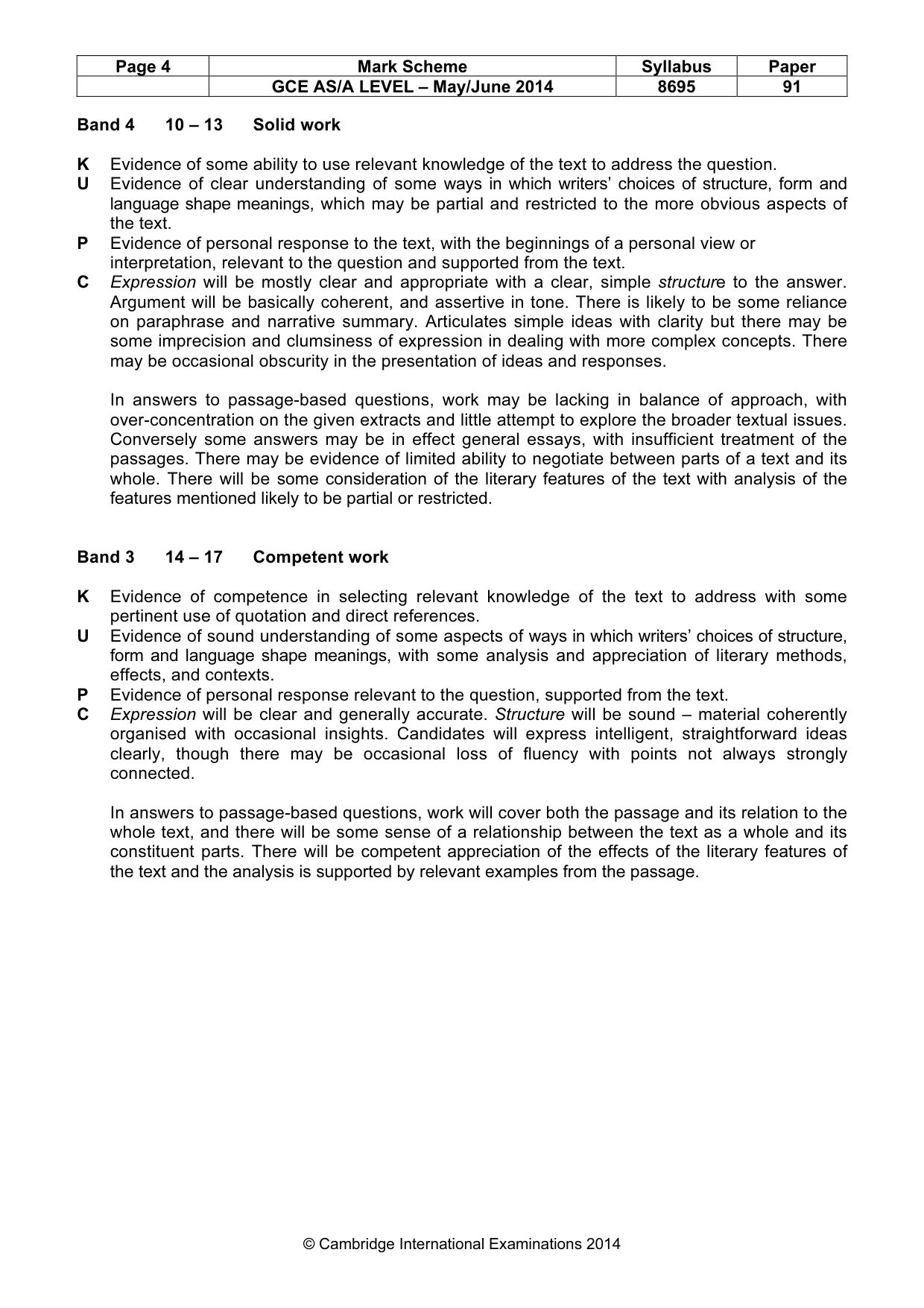
Page 4 Mark Scheme Syllabus Paper GCE AS/A LEVEL – May/June 2014 8695 91 © Cambridge International Examinations 2014 Band 4 10 – 13 Solid work K Evidence of some ability to use relevant knowledge of the text to address the question. U Evidence of clear understanding of some ways in which writers’ choices of structure, form and language shape meanings, which may be partial and restricted to the more obvious aspects of the text. P Evidence of personal response to the text, with the beginnings of a personal view or interpretation, relevant to the question and supported from the text. C Expression will be mostly clear and appropriate with a clear, simple structure to the answer. Argument will be basically coherent, and assertive in tone. There is likely to be some reliance on paraphrase and narrative summary. Articulates simple ideas with clarity but there may be some imprecision and clumsiness of expression in dealing with more complex concepts. There may be occasional obscurity in the presentation of ideas and responses. In answers to passage-based questions, work may be lacking in balance of approach, with over-concentration on the given extracts and little attempt to explore the broader textual issues. Conversely some answers may be in effect general essays, with insufficient treatment of the passages. There may be evidence of limited ability to negotiate between parts of a text and its whole. There will be some consideration of the literary features of the text with analysis of the features mentioned likely to be partial or restricted. Band 3 14 – 17 Competent work K Evidence of competence in selecting relevant knowledge of the text to address with some pertinent use of quotation and direct references. U Evidence of sound understanding of some aspects of ways in which writers’ choices of structure, form and language shape meanings, with some analysis and appreciation of literary methods, effects, and contexts. P Evidence of personal response relevant to the question, supported from the text. C Expression will be clear and generally accurate. Structure will be sound – material coherently organised with occasional insights. Candidates will express intelligent, straightforward ideas clearly, though there may be occasional loss of fluency with points not always strongly connected. In answers to passage-based questions, work will cover both the passage and its relation to the whole text, and there will be some sense of a relationship between the text as a whole and its constituent parts. There will be competent appreciation of the effects of the literary features of the text and the analysis is supported by relevant examples from the passage.
Mark scheme, page 5
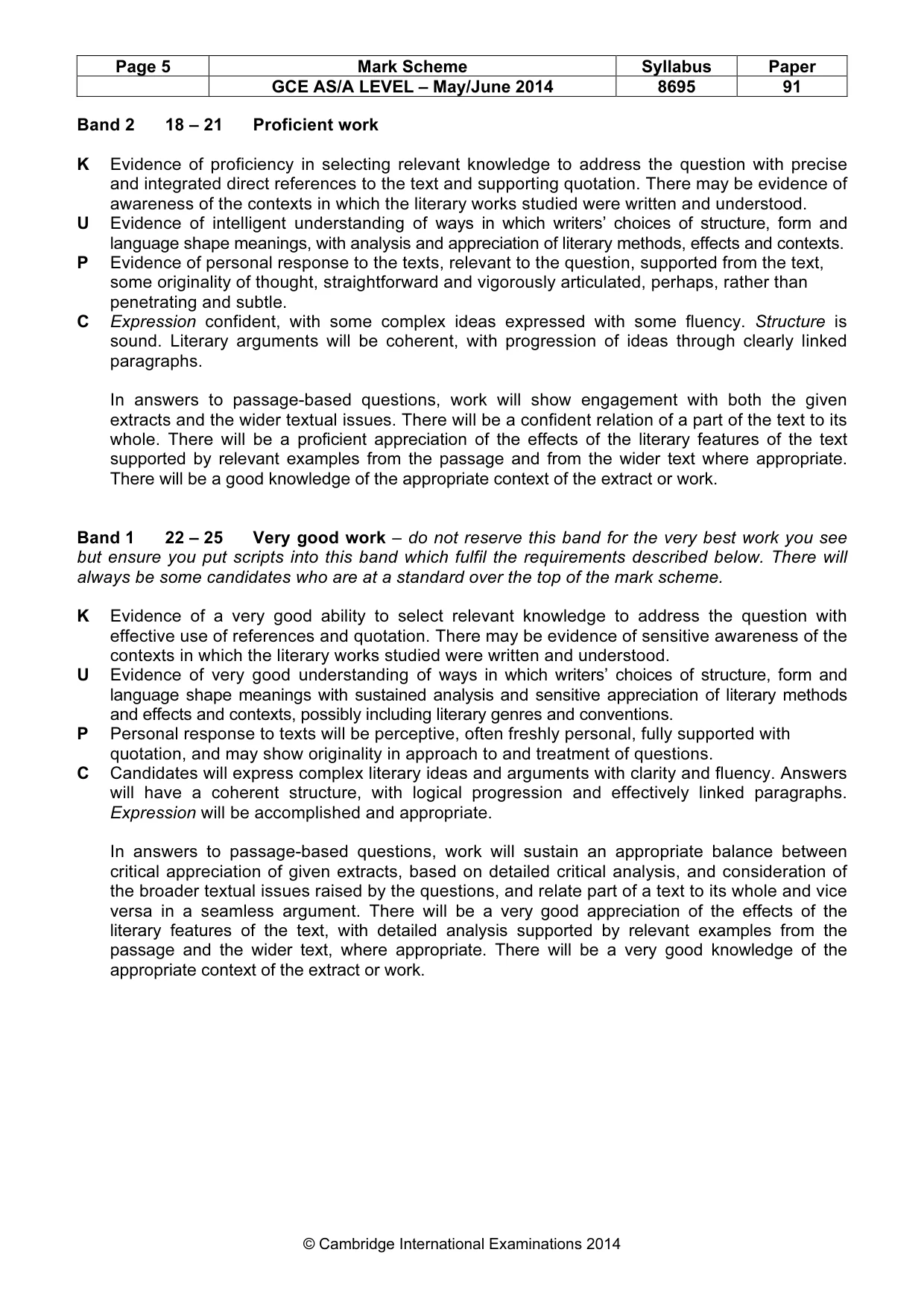
Page 5 Mark Scheme Syllabus Paper GCE AS/A LEVEL – May/June 2014 8695 91 © Cambridge International Examinations 2014 Band 2 18 – 21 Proficient work K Evidence of proficiency in selecting relevant knowledge to address the question with precise and integrated direct references to the text and supporting quotation. There may be evidence of awareness of the contexts in which the literary works studied were written and understood. U Evidence of intelligent understanding of ways in which writers’ choices of structure, form and language shape meanings, with analysis and appreciation of literary methods, effects and contexts. P Evidence of personal response to the texts, relevant to the question, supported from the text, some originality of thought, straightforward and vigorously articulated, perhaps, rather than penetrating and subtle. C Expression confident, with some complex ideas expressed with some fluency. Structure is sound. Literary arguments will be coherent, with progression of ideas through clearly linked paragraphs. In answers to passage-based questions, work will show engagement with both the given extracts and the wider textual issues. There will be a confident relation of a part of the text to its whole. There will be a proficient appreciation of the effects of the literary features of the text supported by relevant examples from the passage and from the wider text where appropriate. There will be a good knowledge of the appropriate context of the extract or work. Band 1 22 – 25 Very good work – do not reserve this band for the very best work you see but ensure you put scripts into this band which fulfil the requirements described below. There will always be some candidates who are at a standard over the top of the mark scheme. K Evidence of a very good ability to select relevant knowledge to address the question with effective use of references and quotation. There may be evidence of sensitive awareness of the contexts in which the literary works studied were written and understood. U Evidence of very good understanding of ways in which writers’ choices of structure, form and language shape meanings with sustained analysis and sensitive appreciation of literary methods and effects and contexts, possibly including literary genres and conventions. P Personal response to texts will be perceptive, often freshly personal, fully supported with quotation, and may show originality in approach to and treatment of questions. C Candidates will express complex literary ideas and arguments with clarity and fluency. Answers will have a coherent structure, with logical progression and effectively linked paragraphs. Expression will be accomplished and appropriate. In answers to passage-based questions, work will sustain an appropriate balance between critical appreciation of given extracts, based on detailed critical analysis, and consideration of the broader textual issues raised by the questions, and relate part of a text to its whole and vice versa in a seamless argument. There will be a very good appreciation of the effects of the literary features of the text, with detailed analysis supported by relevant examples from the passage and the wider text, where appropriate. There will be a very good knowledge of the appropriate context of the extract or work.
What you needed in this session
Cambridge’s own grade thresholds for 2014 May/June, Paper 9 · Variant 1. A higher threshold means an easier paper — the bar moves with how the cohort did.