Cambridge A Level English - Language and Literature (AS Level only, from 2016) 8695 — 2013 Oct/Nov Paper 9 · Variant 3
8695/93/O/N/13 · 50 marks · ≈56 min
The question paper and its mark scheme, free to read here and free to download. This is Cambridge’s own paper, exactly as it was sat.
Question paper16 pages


Mark scheme5 pages
Answers below. Sit the paper first if you are practising.
Paper as text
Question paper, page 1
This document consists of 15 printed pages and 1 blank page. DC (NF) 91843/1 © UCLES 2013 [Turn over UNIVERSITY OF CAMBRIDGE INTERNATIONAL EXAMINATIONS General Certificate of Education Advanced Subsidiary Level and Advanced Level * 9 1 1 8 2 2 9 9 4 8 * LANGUAGE AND LITERATURE IN ENGLISH 8695/93 Paper 9 Poetry, Prose and Drama October/November 2013 2 hours Additional Materials: Answer Booklet/Paper READ THESE INSTRUCTIONS FIRST If you have been given an Answer Booklet, follow the instructions on the front cover of the Booklet. Write your Centre number, candidate number and name on all the work you hand in. Write in dark blue or black pen. Do not use staples, paper clips, highlighters, glue or correction fluid. Answer two questions, each from a different section. You are reminded of the need for good English and clear presentation in your answers. At the end of the examination, fasten all your work securely together. All questions in this paper carry equal marks.
Question paper, page 2
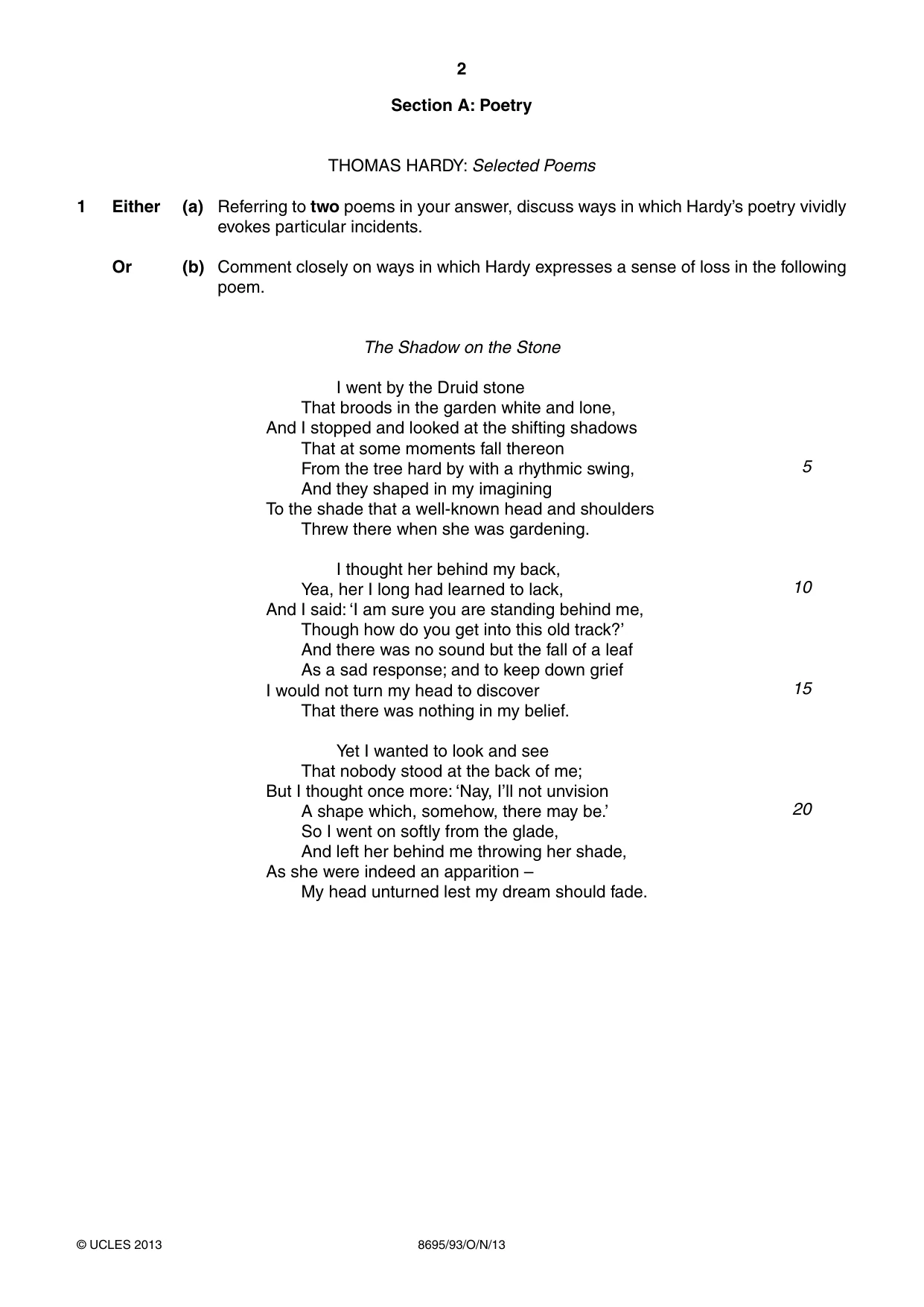
2 8695/93/O/N/13 © UCLES 2013 Section A: Poetry THOMAS HARDY: Selected Poems 1 Either (a) Referring to two poems in your answer, discuss ways in which Hardy’s poetry vividly evokes particular incidents. Or (b) Comment closely on ways in which Hardy expresses a sense of loss in the following poem. The Shadow on the Stone I went by the Druid stone That broods in the garden white and lone, And I stopped and looked at the shifting shadows That at some moments fall thereon From the tree hard by with a rhythmic swing, And they shaped in my imagining To the shade that a well-known head and shoulders Threw there when she was gardening. I thought her behind my back, Yea, her I long had learned to lack, And I said: ‘I am sure you are standing behind me, Though how do you get into this old track?’ And there was no sound but the fall of a leaf As a sad response; and to keep down grief I would not turn my head to discover That there was nothing in my belief. Yet I wanted to look and see That nobody stood at the back of me; But I thought once more: ‘Nay, I’ll not unvision A shape which, somehow, there may be.’ So I went on softly from the glade, And left her behind me throwing her shade, As she were indeed an apparition – My head unturned lest my dream should fade. 5 10 15 20
Question paper, page 3
3 8695/93/O/N/13 © UCLES 2013 [Turn over SEAMUS HEANEY: District and Circle 2 Either (a) Discuss ways in which Heaney uses different settings in two poems. Or (b) Comment closely on the following extract, discussing ways in which Heaney suggests possibilities of renewal and hope. Through every check and scan I carried with me A bunch of Tollund rushes – roots and all – Bagged in their own bog-damp. In an old stairwell Broom cupboard where I had hoped they’d stay Damp until transplanted, they went musty. 5 Every green-skinned stalk turned friable, The drowned-mouse fibres withered and the whole Limp, soggy cluster lost its frank bouquet Of weed leaf and turf mould. Dust in my palm And in my nostrils dust, should I shake it off 10 Or mix it in with spit in pollen’s name And my own? As a man would, cutting turf, I straightened, spat on my hands, felt benefit And spirited myself into the street. from The Tollund Man in Springtime Content removed due to copyright restrictions.
Question paper, page 4
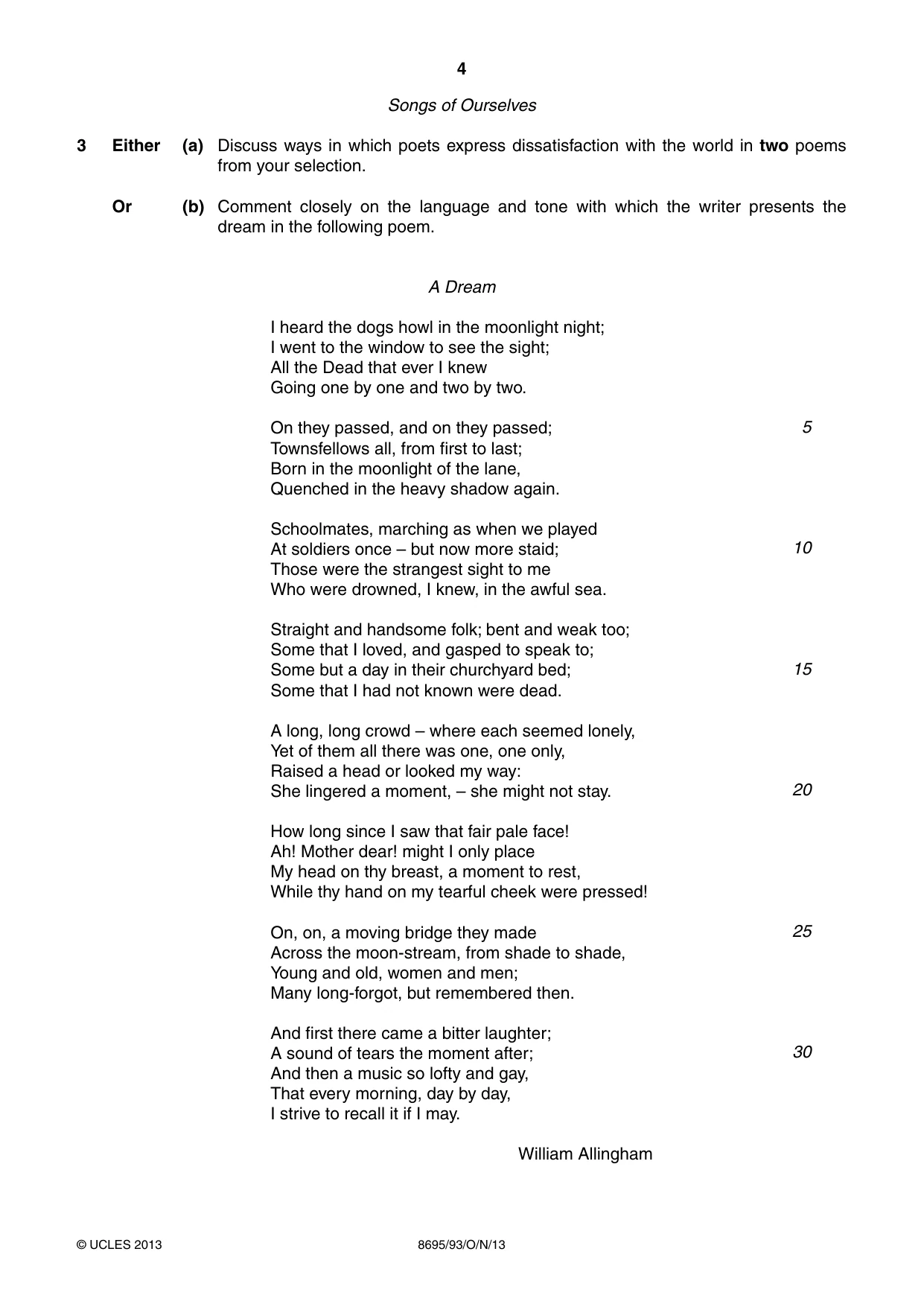
4 8695/93/O/N/13 © UCLES 2013 Songs of Ourselves 3 Either (a) Discuss ways in which poets express dissatisfaction with the world in two poems from your selection. Or (b) Comment closely on the language and tone with which the writer presents the dream in the following poem. A Dream I heard the dogs howl in the moonlight night; I went to the window to see the sight; All the Dead that ever I knew Going one by one and two by two. On they passed, and on they passed; Townsfellows all, from first to last; Born in the moonlight of the lane, Quenched in the heavy shadow again. Schoolmates, marching as when we played At soldiers once – but now more staid; Those were the strangest sight to me Who were drowned, I knew, in the awful sea. Straight and handsome folk; bent and weak too; Some that I loved, and gasped to speak to; Some but a day in their churchyard bed; Some that I had not known were dead. A long, long crowd – where each seemed lonely, Yet of them all there was one, one only, Raised a head or looked my way: She lingered a moment, – she might not stay. How long since I saw that fair pale face! Ah! Mother dear! might I only place My head on thy breast, a moment to rest, While thy hand on my tearful cheek were pressed! On, on, a moving bridge they made Across the moon-stream, from shade to shade, Young and old, women and men; Many long-forgot, but remembered then. And first there came a bitter laughter; A sound of tears the moment after; And then a music so lofty and gay, That every morning, day by day, I strive to recall it if I may. William Allingham 5 10 15 20 25 30
Question paper, page 5
5 8695/93/O/N/13 © UCLES 2013 [Turn over Turn to Page 6 for Question 4
Question paper, page 6
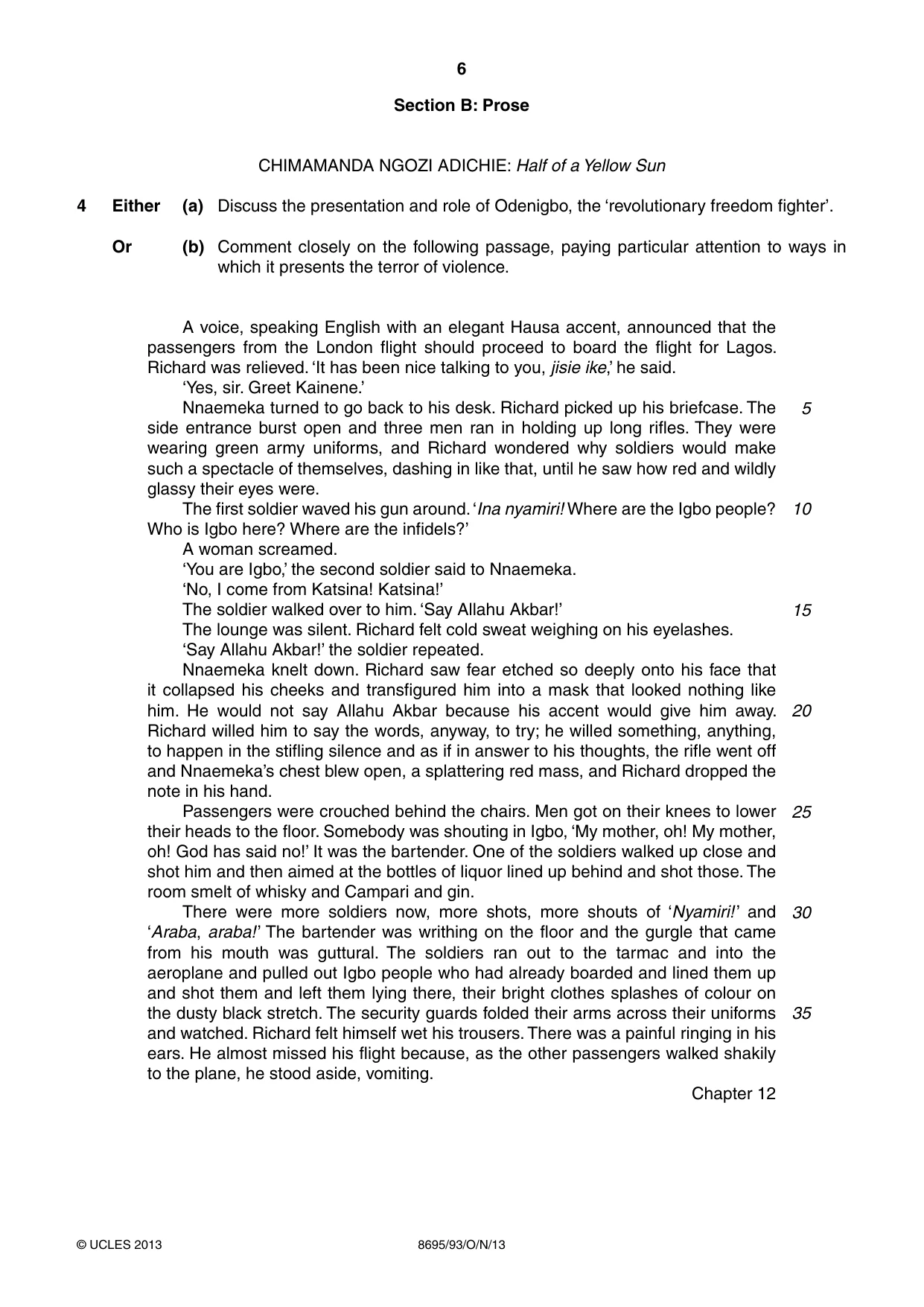
6 8695/93/O/N/13 © UCLES 2013 Section B: Prose CHIMAMANDA NGOZI ADICHIE: Half of a Yellow Sun 4 Either (a) Discuss the presentation and role of Odenigbo, the ‘revolutionary freedom fighter’. Or (b) Comment closely on the following passage, paying particular attention to ways in which it presents the terror of violence. A voice, speaking English with an elegant Hausa accent, announced that the passengers from the London flight should proceed to board the flight for Lagos. Richard was relieved. ‘It has been nice talking to you, jisie ike,’ he said. ‘Yes, sir. Greet Kainene.’ Nnaemeka turned to go back to his desk. Richard picked up his briefcase. The side entrance burst open and three men ran in holding up long rifles. They were wearing green army uniforms, and Richard wondered why soldiers would make such a spectacle of themselves, dashing in like that, until he saw how red and wildly glassy their eyes were. The first soldier waved his gun around. ‘Ina nyamiri! Where are the Igbo people? Who is Igbo here? Where are the infidels?’ A woman screamed. ‘You are Igbo,’ the second soldier said to Nnaemeka. ‘No, I come from Katsina! Katsina!’ The soldier walked over to him. ‘Say Allahu Akbar!’ The lounge was silent. Richard felt cold sweat weighing on his eyelashes. ‘Say Allahu Akbar!’ the soldier repeated. Nnaemeka knelt down. Richard saw fear etched so deeply onto his face that it collapsed his cheeks and transfigured him into a mask that looked nothing like him. He would not say Allahu Akbar because his accent would give him away. Richard willed him to say the words, anyway, to try; he willed something, anything, to happen in the stifling silence and as if in answer to his thoughts, the rifle went off and Nnaemeka’s chest blew open, a splattering red mass, and Richard dropped the note in his hand. Passengers were crouched behind the chairs. Men got on their knees to lower their heads to the floor. Somebody was shouting in Igbo, ‘My mother, oh! My mother, oh! God has said no!’ It was the bartender. One of the soldiers walked up close and shot him and then aimed at the bottles of liquor lined up behind and shot those. The room smelt of whisky and Campari and gin. There were more soldiers now, more shots, more shouts of ‘Nyamiri! ’ and ‘Araba, araba! ’ The bartender was writhing on the floor and the gurgle that came from his mouth was guttural. The soldiers ran out to the tarmac and into the aeroplane and pulled out Igbo people who had already boarded and lined them up and shot them and left them lying there, their bright clothes splashes of colour on the dusty black stretch. The security guards folded their arms across their uniforms and watched. Richard felt himself wet his trousers. There was a painful ringing in his ears. He almost missed his flight because, as the other passengers walked shakily to the plane, he stood aside, vomiting. Chapter 12 5 10 15 20 25 30 35
Question paper, page 7
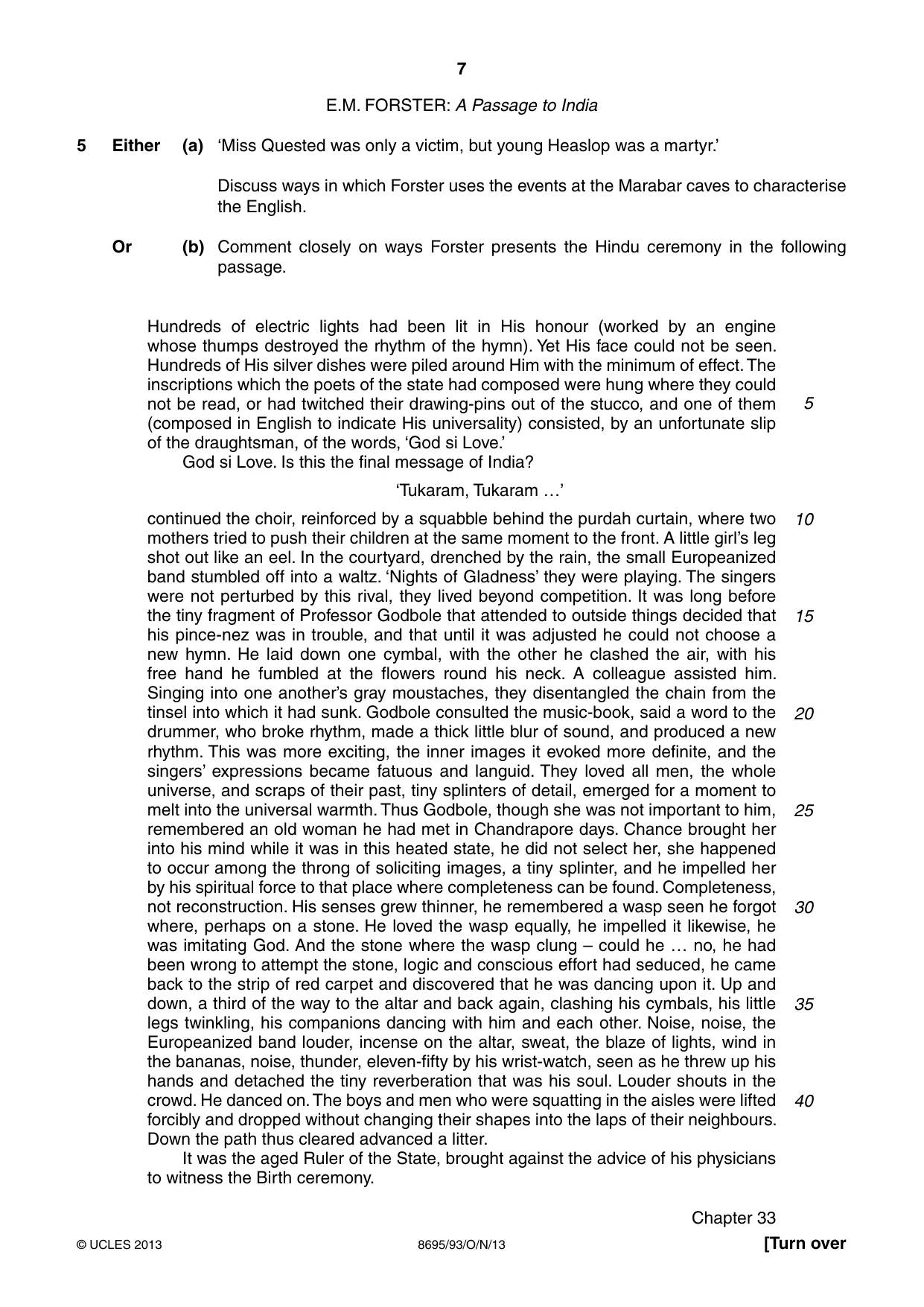
7 8695/93/O/N/13 © UCLES 2013 [Turn over E.M. FORSTER: A Passage to India 5 Either (a) ‘Miss Quested was only a victim, but young Heaslop was a martyr.’ Discuss ways in which Forster uses the events at the Marabar caves to characterise the English. Or (b) Comment closely on ways Forster presents the Hindu ceremony in the following passage. Hundreds of electric lights had been lit in His honour (worked by an engine whose thumps destroyed the rhythm of the hymn). Yet His face could not be seen. Hundreds of His silver dishes were piled around Him with the minimum of effect. The inscriptions which the poets of the state had composed were hung where they could not be read, or had twitched their drawing-pins out of the stucco, and one of them (composed in English to indicate His universality) consisted, by an unfortunate slip of the draughtsman, of the words, ‘God si Love.’ God si Love. Is this the final message of India? ‘Tukaram, Tukaram …’ continued the choir, reinforced by a squabble behind the purdah curtain, where two mothers tried to push their children at the same moment to the front. A little girl’s leg shot out like an eel. In the courtyard, drenched by the rain, the small Europeanized band stumbled off into a waltz. ‘Nights of Gladness’ they were playing. The singers were not perturbed by this rival, they lived beyond competition. It was long before the tiny fragment of Professor Godbole that attended to outside things decided that his pince-nez was in trouble, and that until it was adjusted he could not choose a new hymn. He laid down one cymbal, with the other he clashed the air, with his free hand he fumbled at the flowers round his neck. A colleague assisted him. Singing into one another’s gray moustaches, they disentangled the chain from the tinsel into which it had sunk. Godbole consulted the music-book, said a word to the drummer, who broke rhythm, made a thick little blur of sound, and produced a new rhythm. This was more exciting, the inner images it evoked more definite, and the singers’ expressions became fatuous and languid. They loved all men, the whole universe, and scraps of their past, tiny splinters of detail, emerged for a moment to melt into the universal warmth. Thus Godbole, though she was not important to him, remembered an old woman he had met in Chandrapore days. Chance brought her into his mind while it was in this heated state, he did not select her, she happened to occur among the throng of soliciting images, a tiny splinter, and he impelled her by his spiritual force to that place where completeness can be found. Completeness, not reconstruction. His senses grew thinner, he remembered a wasp seen he forgot where, perhaps on a stone. He loved the wasp equally, he impelled it likewise, he was imitating God. And the stone where the wasp clung – could he … no, he had been wrong to attempt the stone, logic and conscious effort had seduced, he came back to the strip of red carpet and discovered that he was dancing upon it. Up and down, a third of the way to the altar and back again, clashing his cymbals, his little legs twinkling, his companions dancing with him and each other. Noise, noise, the Europeanized band louder, incense on the altar, sweat, the blaze of lights, wind in the bananas, noise, thunder, eleven-fifty by his wrist-watch, seen as he threw up his hands and detached the tiny reverberation that was his soul. Louder shouts in the crowd. He danced on. The boys and men who were squatting in the aisles were lifted forcibly and dropped without changing their shapes into the laps of their neighbours. Down the path thus cleared advanced a litter. It was the aged Ruler of the State, brought against the advice of his physicians to witness the Birth ceremony. Chapter 33 5 10 15 20 25 30 35 40
Question paper, page 8
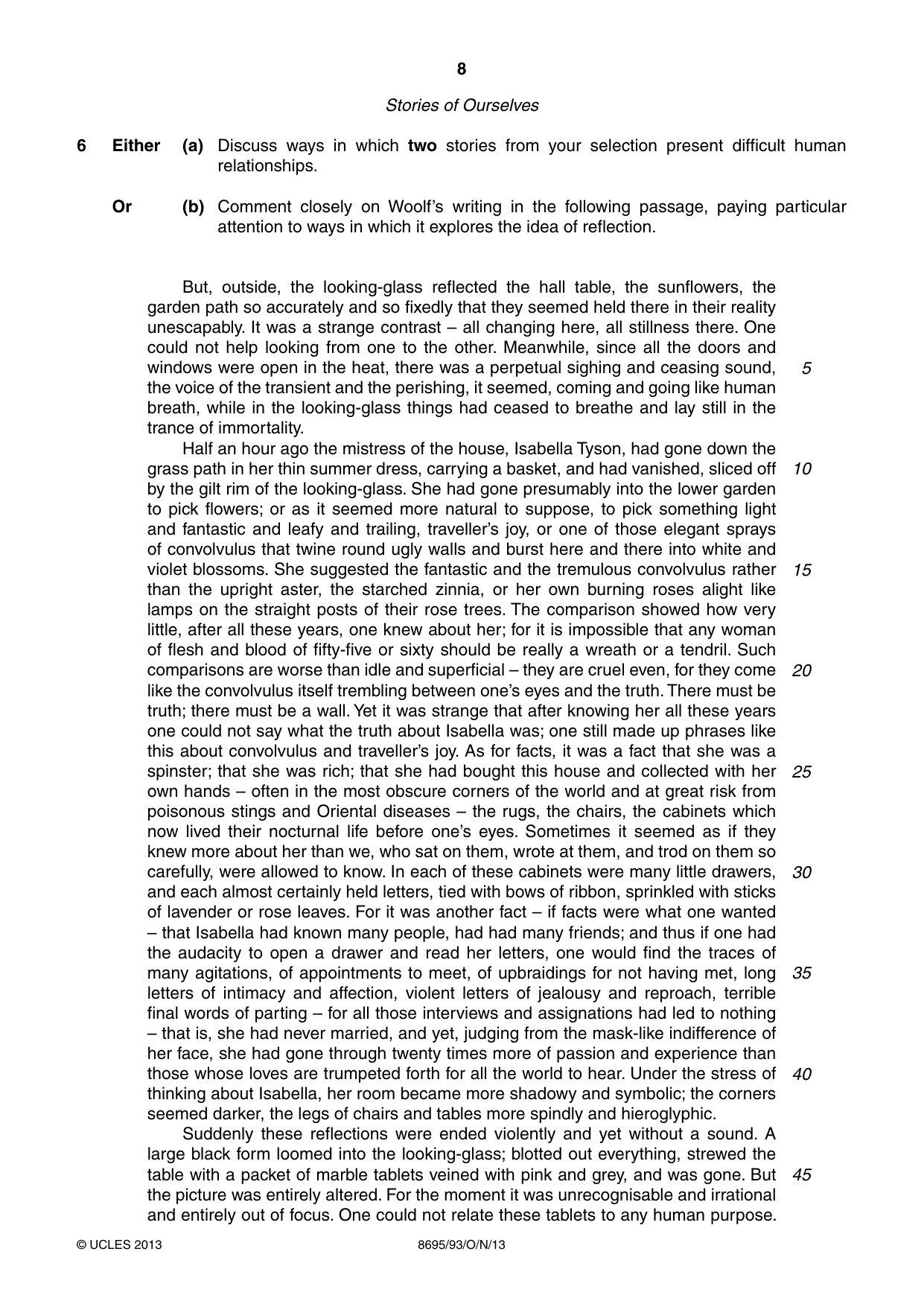
8 8695/93/O/N/13 © UCLES 2013 Stories of Ourselves 6 Either (a) Discuss ways in which two stories from your selection present difficult human relationships. Or (b) Comment closely on Woolf’s writing in the following passage, paying particular attention to ways in which it explores the idea of reflection. But, outside, the looking-glass reflected the hall table, the sunflowers, the garden path so accurately and so fixedly that they seemed held there in their reality unescapably. It was a strange contrast – all changing here, all stillness there. One could not help looking from one to the other. Meanwhile, since all the doors and windows were open in the heat, there was a perpetual sighing and ceasing sound, the voice of the transient and the perishing, it seemed, coming and going like human breath, while in the looking-glass things had ceased to breathe and lay still in the trance of immortality. Half an hour ago the mistress of the house, Isabella Tyson, had gone down the grass path in her thin summer dress, carrying a basket, and had vanished, sliced off by the gilt rim of the looking-glass. She had gone presumably into the lower garden to pick flowers; or as it seemed more natural to suppose, to pick something light and fantastic and leafy and trailing, traveller’s joy, or one of those elegant sprays of convolvulus that twine round ugly walls and burst here and there into white and violet blossoms. She suggested the fantastic and the tremulous convolvulus rather than the upright aster, the starched zinnia, or her own burning roses alight like lamps on the straight posts of their rose trees. The comparison showed how very little, after all these years, one knew about her; for it is impossible that any woman of flesh and blood of fifty-five or sixty should be really a wreath or a tendril. Such comparisons are worse than idle and superficial – they are cruel even, for they come like the convolvulus itself trembling between one’s eyes and the truth. There must be truth; there must be a wall. Yet it was strange that after knowing her all these years one could not say what the truth about Isabella was; one still made up phrases like this about convolvulus and traveller’s joy. As for facts, it was a fact that she was a spinster; that she was rich; that she had bought this house and collected with her own hands – often in the most obscure corners of the world and at great risk from poisonous stings and Oriental diseases – the rugs, the chairs, the cabinets which now lived their nocturnal life before one’s eyes. Sometimes it seemed as if they knew more about her than we, who sat on them, wrote at them, and trod on them so carefully, were allowed to know. In each of these cabinets were many little drawers, and each almost certainly held letters, tied with bows of ribbon, sprinkled with sticks of lavender or rose leaves. For it was another fact – if facts were what one wanted – that Isabella had known many people, had had many friends; and thus if one had the audacity to open a drawer and read her letters, one would find the traces of many agitations, of appointments to meet, of upbraidings for not having met, long letters of intimacy and affection, violent letters of jealousy and reproach, terrible final words of parting – for all those interviews and assignations had led to nothing – that is, she had never married, and yet, judging from the mask-like indifference of her face, she had gone through twenty times more of passion and experience than those whose loves are trumpeted forth for all the world to hear. Under the stress of thinking about Isabella, her room became more shadowy and symbolic; the corners seemed darker, the legs of chairs and tables more spindly and hieroglyphic. Suddenly these reflections were ended violently and yet without a sound. A large black form loomed into the looking-glass; blotted out everything, strewed the table with a packet of marble tablets veined with pink and grey, and was gone. But the picture was entirely altered. For the moment it was unrecognisable and irrational and entirely out of focus. One could not relate these tablets to any human purpose. 5 10 15 20 25 30 35 40 45
Question paper, page 9
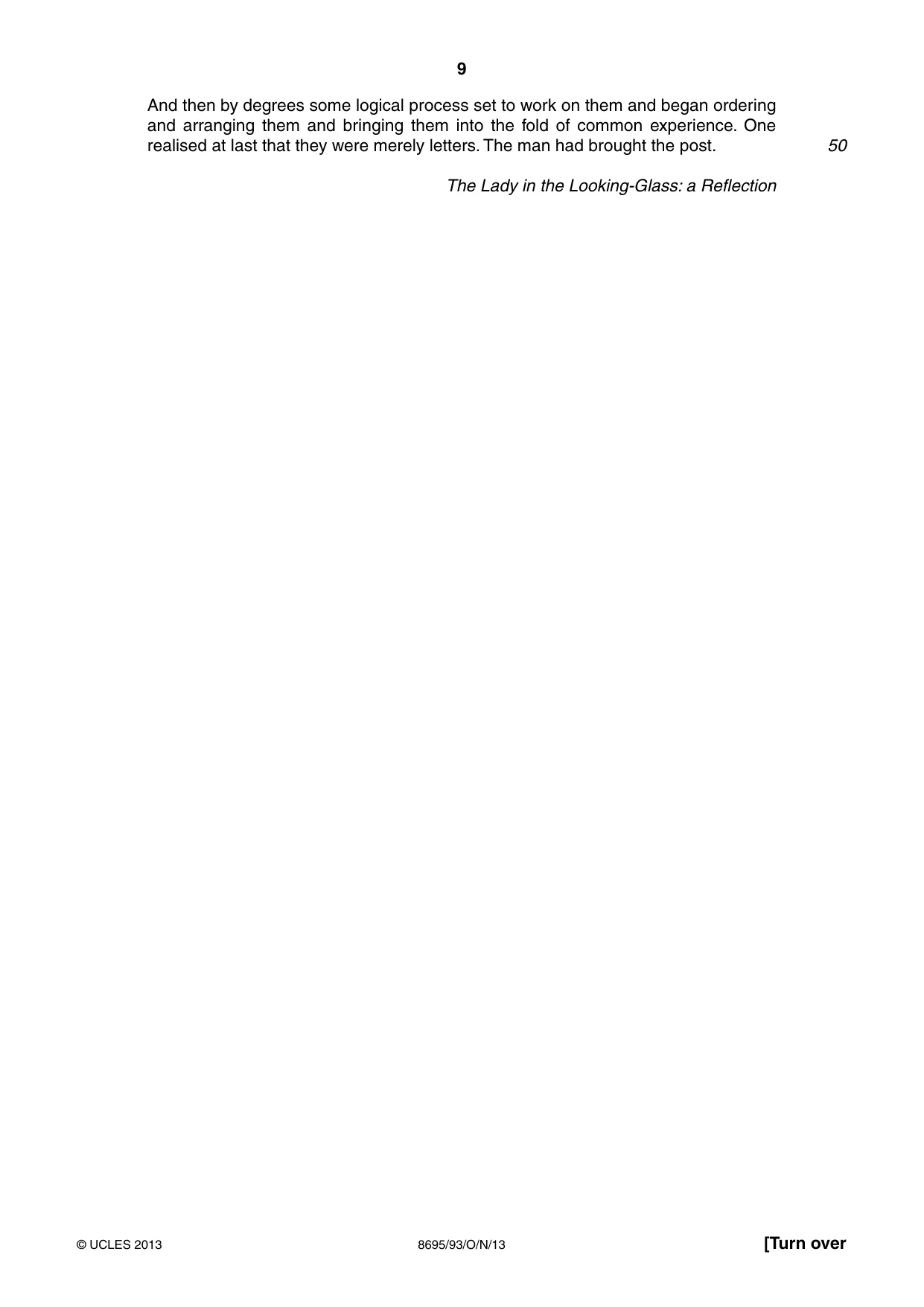
9 8695/93/O/N/13 © UCLES 2013 [Turn over And then by degrees some logical process set to work on them and began ordering and arranging them and bringing them into the fold of common experience. One realised at last that they were merely letters. The man had brought the post. The Lady in the Looking-Glass: a Reflection 50
Question paper, page 10
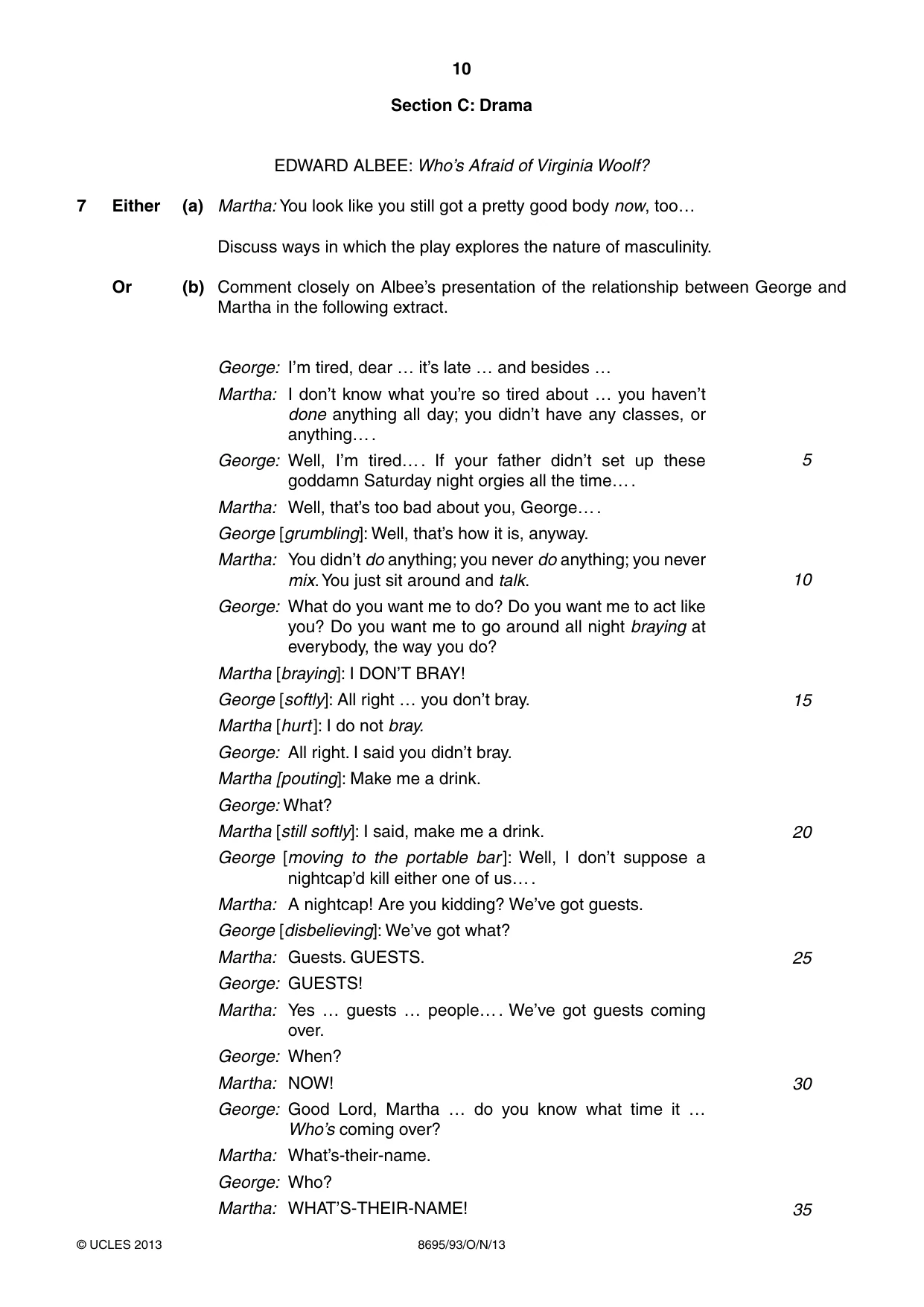
10 8695/93/O/N/13 © UCLES 2013 Section C: Drama EDWARD ALBEE: Who’s Afraid of Virginia Woolf? 7 Either (a) Martha: You look like you still got a pretty good body now, too… Discuss ways in which the play explores the nature of masculinity. Or (b) Comment closely on Albee’s presentation of the relationship between George and Martha in the following extract. George: I’m tired, dear … it’s late … and besides … Martha: I don’t know what you’re so tired about … you haven’t done anything all day; you didn’t have any classes, or anything… . George: Well, I’m tired… . If your father didn’t set up these goddamn Saturday night orgies all the time… . Martha: Well, that’s too bad about you, George… . George [grumbling]: Well, that’s how it is, anyway. Martha: You didn’t do anything; you never do anything; you never mix. You just sit around and talk. George: What do you want me to do? Do you want me to act like you? Do you want me to go around all night braying at everybody, the way you do? Martha [braying]: I DON’T BRAY! George [softly]: All right … you don’t bray. Martha [hurt ]: I do not bray. George: All right. I said you didn’t bray. Martha [pouting]: Make me a drink. George: What? Martha [still softly]: I said, make me a drink. George [moving to the portable bar ]: Well, I don’t suppose a nightcap’d kill either one of us… . Martha: A nightcap! Are you kidding? We’ve got guests. George [disbelieving]: We’ve got what? Martha: Guests. GUESTS. George: GUESTS! Martha: Yes … guests … people… . We’ve got guests coming over. George: When? Martha: NOW! George: Good Lord, Martha … do you know what time it … Who’s coming over? Martha: What’s-their-name. George: Who? Martha: WHAT’S-THEIR-NAME! 5 10 15 20 25 30 35
Question paper, page 11
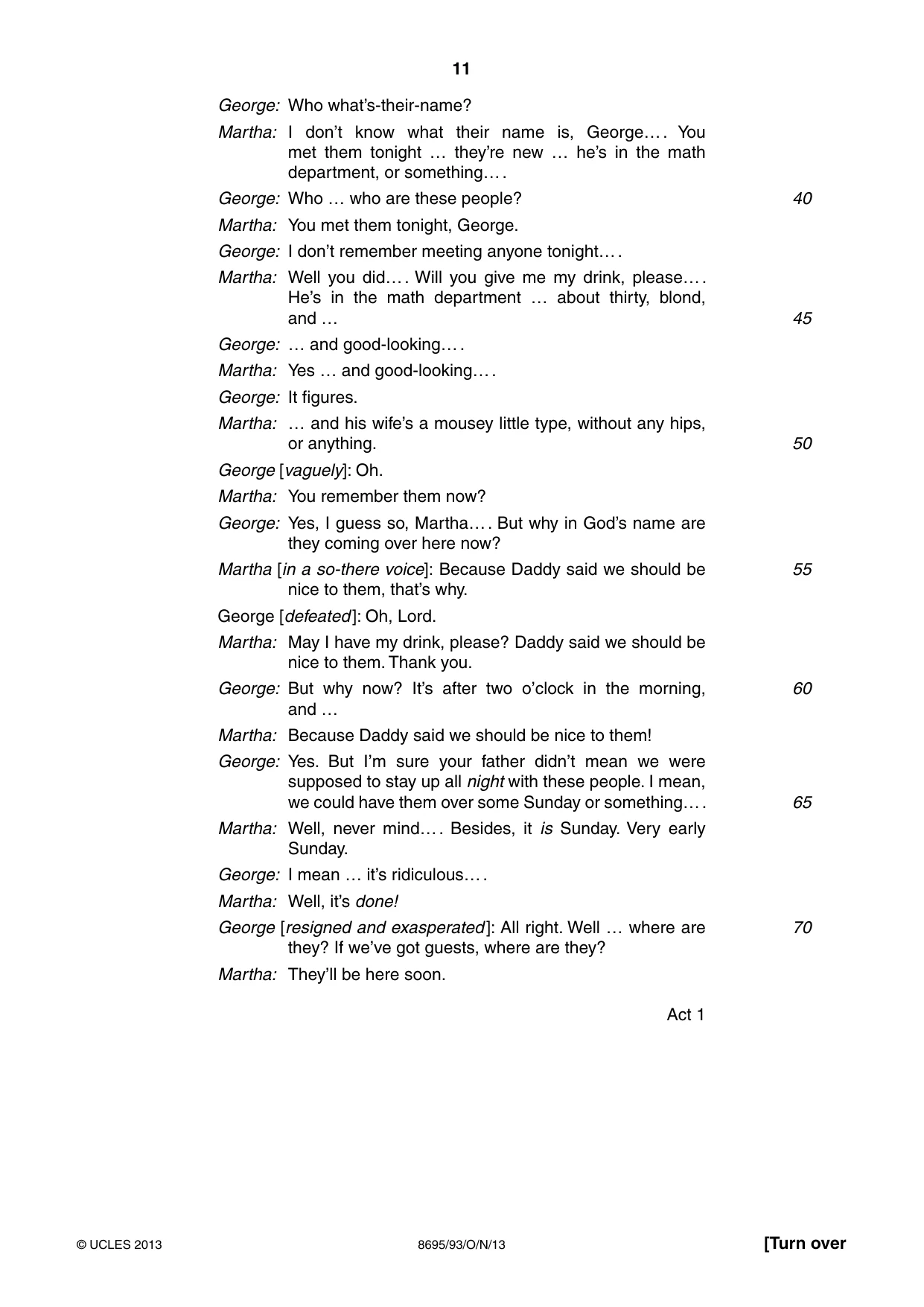
11 8695/93/O/N/13 © UCLES 2013 [Turn over George: Who what’s-their-name? Martha: I don’t know what their name is, George… . You met them tonight … they’re new … he’s in the math department, or something… . George: Who … who are these people? Martha: You met them tonight, George. George: I don’t remember meeting anyone tonight… . Martha: Well you did… . Will you give me my drink, please… . He’s in the math department … about thirty, blond, and … George: … and good-looking… . Martha: Yes … and good-looking… . George: It figures. Martha: … and his wife’s a mousey little type, without any hips, or anything. George [vaguely]: Oh. Martha: You remember them now? George: Yes, I guess so, Martha… . But why in God’s name are they coming over here now? Martha [in a so-there voice]: Because Daddy said we should be nice to them, that’s why. George [defeated ]: Oh, Lord. Martha: May I have my drink, please? Daddy said we should be nice to them. Thank you. George: But why now? It’s after two o’clock in the morning, and … Martha: Because Daddy said we should be nice to them! George: Yes. But I’m sure your father didn’t mean we were supposed to stay up all night with these people. I mean, we could have them over some Sunday or something… . Martha: Well, never mind… . Besides, it is Sunday. Very early Sunday. George: I mean … it’s ridiculous… . Martha: Well, it’s done! George [resigned and exasperated ]: All right. Well … where are they? If we’ve got guests, where are they? Martha: They’ll be here soon. Act 1 40 45 50 55 60 65 70
Question paper, page 12
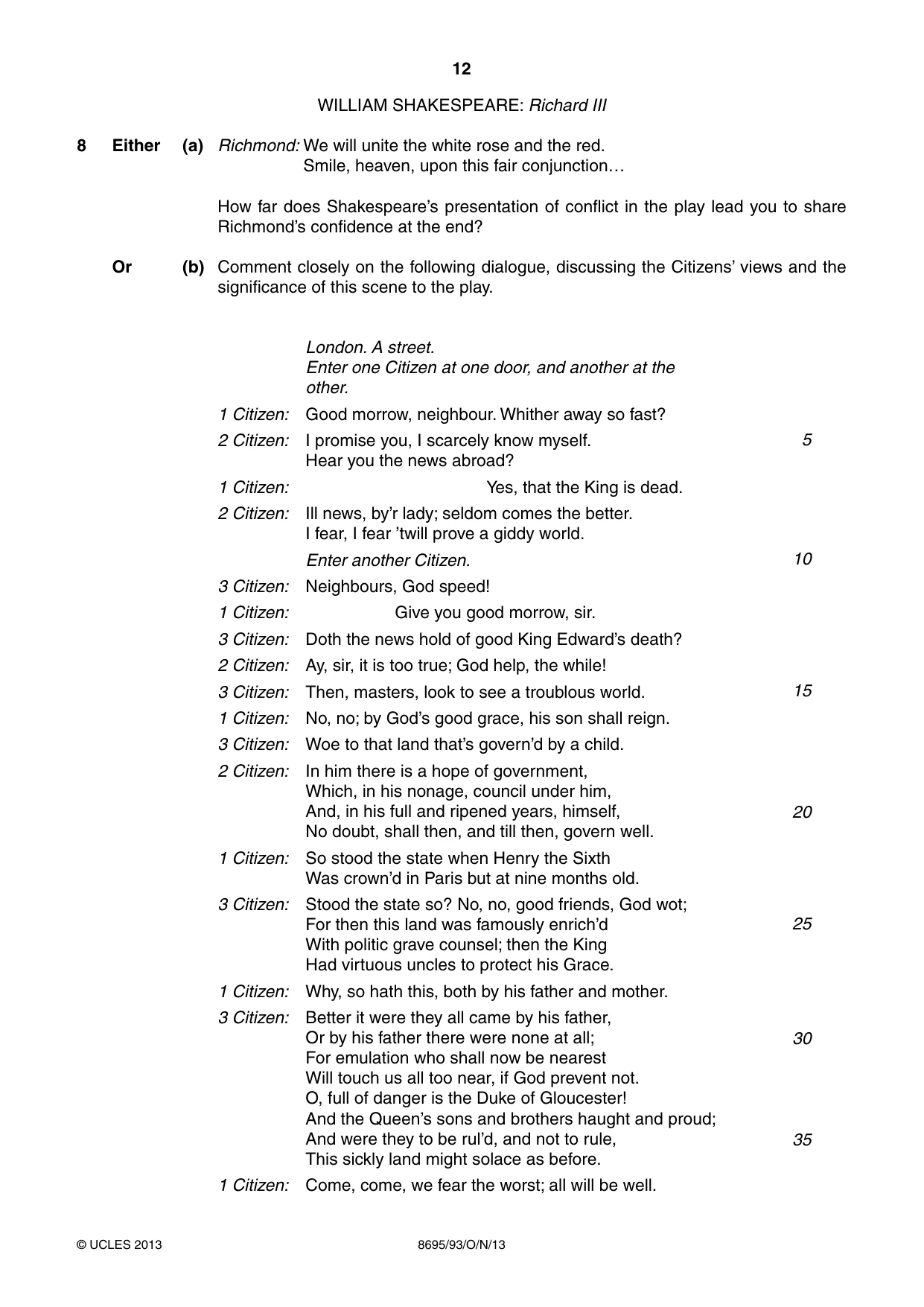
12 8695/93/O/N/13 © UCLES 2013 WILLIAM SHAKESPEARE: Richard III 8 Either (a) Richmond: We will unite the white rose and the red. Smile, heaven, upon this fair conjunction… How far does Shakespeare’s presentation of conflict in the play lead you to share Richmond’s confidence at the end? Or (b) Comment closely on the following dialogue, discussing the Citizens’ views and the significance of this scene to the play. London. A street. Enter one Citizen at one door, and another at the other. 1 Citizen: Good morrow, neighbour. Whither away so fast? 2 Citizen: I promise you, I scarcely know myself. Hear you the news abroad? 1 Citizen: Yes, that the King is dead. 2 Citizen: Ill news, by’r lady; seldom comes the better. I fear, I fear ’twill prove a giddy world. Enter another Citizen. 3 Citizen: Neighbours, God speed! 1 Citizen: Give you good morrow, sir. 3 Citizen: Doth the news hold of good King Edward’s death? 2 Citizen: Ay, sir, it is too true; God help, the while! 3 Citizen: Then, masters, look to see a troublous world. 1 Citizen: No, no; by God’s good grace, his son shall reign. 3 Citizen: Woe to that land that’s govern’d by a child. 2 Citizen: In him there is a hope of government, Which, in his nonage, council under him, And, in his full and ripened years, himself, No doubt, shall then, and till then, govern well. 1 Citizen: So stood the state when Henry the Sixth Was crown’d in Paris but at nine months old. 3 Citizen: Stood the state so? No, no, good friends, God wot; For then this land was famously enrich’d With politic grave counsel; then the King Had virtuous uncles to protect his Grace. 1 Citizen: Why, so hath this, both by his father and mother. 3 Citizen: Better it were they all came by his father, Or by his father there were none at all; For emulation who shall now be nearest Will touch us all too near, if God prevent not. O, full of danger is the Duke of Gloucester! And the Queen’s sons and brothers haught and proud; And were they to be rul’d, and not to rule, This sickly land might solace as before. 1 Citizen: Come, come, we fear the worst; all will be well. 5 10 15 20 25 30 35
Question paper, page 13
13 8695/93/O/N/13 © UCLES 2013 [Turn over 3 Citizen: When clouds are seen, wise men put on their cloaks; When great leaves fall, then winter is at hand; When the sun sets, who doth not look for night? Untimely storms make men expect a dearth. All may be well; but, if God sort it so, ’Tis more than we deserve or I expect. 2 Citizen: Truly, the hearts of men are full of fear. You cannot reason almost with a man That looks not heavily and full of dread. 3 Citizen: Before the days of change, still is it so; By a divine instinct men’s minds mistrust Ensuing danger; as by proof we see The water swell before a boist’rous storm. But leave it all to God. Whither away? 2 Citizen: Marry, we were sent for to the justices. 3 Citizen: And so was I; I’ll bear you company. [Exeunt. Act 2, Scene 3 40 45 50
Question paper, page 14
14 8695/93/O/N/13 © UCLES 2013 TENNESSEE WILLIAMS: A Streetcar Named Desire 9 Either (a) Blanche: I don’t tell the truth. I tell what ought to be the truth. Discuss ways in which the play explores illusion and reality. Or (b) Comment closely on the contrasts of the following passage, discussing the effects Williams creates. It is some weeks later. STELLA is packing BLANCHE’S things. Sound of water can be heard running in the bathroom. The portières are partly open on the poker players – STANLEY, STEVE, MITCH, and PABLO – who sit around the table in the kitchen. The atmosphere of the kitchen is now the same raw, lurid one of the disastrous poker night. The building is framed by the sky of turquoise. STELLA has been crying as she arranges the flowery dresses in the open trunk. [EUNICE comes down the steps from her flat above and enters the kitchen. There is another burst from the poker table.] Stanley: Drew to an inside straight and made it, by God. Pablo: Maldita sea tu suerto! Stanley: Put it in English, greaseball. Pablo: I am cursing your goddam luck. Stanley [prodigiously elated]: You know what luck is? Luck is believing you’re lucky. Take at Salerno. I believed I was lucky. I figured that 4 out of 5 would not come through but I would … and I did. I put that down as a rule. To hold front position in this rat-race you’ve got to believe you are lucky. Mitch: You … you … you. … Brag … brag … bull … bull. [STELLA goes into the bedroom and starts folding a dress.] Stanley: What’s the matter with him? Eunice [walking past the table]: I always did say that men are callous things with no feelings, but this does beat anything. Making pigs of yourselves. [She comes through the portières into the bedroom.] Stanley: What’s the matter with her? Stella: How is my baby? Eunice: Sleeping like a little angel. Brought you some grapes. [She puts them on a stool and lowers her voice.] Blanche? Stella: Bathing. Eunice: How is she? Stella: She wouldn’t eat anything but asked for a drink. 5 10 15 20 25 30 35 40 Content removed due to copyright restrictions.
Question paper, page 15
15 8695/93/O/N/13 © UCLES 2013 Eunice: What did you tell her? Stella: I – just told her that – we’d made arrangements for her to rest in the country. She’s got it mixed in her mind with Shep Huntleigh. [BLANCHE opens the bathroom door slightly.] Blanche: Stella. Stella: Yes, Blanche? Blanche: If anyone calls while I’m bathing take the number and tell them I’ll call right back. Stella: Yes. Blanche: That cool yellow silk – the bouclé. See if it’s crushed. If it’s not too crushed I’ll wear it and on the lapel that silver and turquoise pin in the shape of a seahorse. You will find them in the heart-shaped box I keep my accessories in. And Stella … Try and locate a bunch of artificial violets in that box, too, to pin with the seahorse on the lapel of the jacket. [She closes the door. STELLA turns to EUNICE.] Stella: I don’t know if I did the right thing. Eunice: What else could you do? Stella: I couldn’t believe her story and go on living with Stanley. Eunice: Don’t ever believe it. Life has got to go on. No matter what happens, you’ve got to keep on going. [The bathroom door opens a little.] Blanche [looking out ]: Is the coast clear? Stella: Yes, Blanche. [To EUNICE.] Tell her how well she’s looking. Blanche: Please close the curtains before I come out. Stella: They’re closed. Stanley: – How many for you. Pablo: Two – Steve: – Three. Scene 11 45 50 55 60 65 70 Content removed due to copyright restrictions.
Question paper, page 16
16 8695/93/O/N/13 © UCLES 2013 BLANK PAGE Copyright Acknowledgements: Question 2b © Seamus Heaney; The Tollund Man, in Springtime, from District and Circle; Faber and Faber Ltd; 2006. Question 4b © Chimamanda Ngozi Adichie; Half of a Yellow Sun; Reproduced by permission of HarperCollins Publishers; 2006. Question 5b © E. M. Forster; A Passage to India; Penguin Books Ltd; 1979. Question 7b © Edward Albee; Who’s Afraid of Virginia Woolf? ; Penguin Books Ltd.; 1967. Question 9b A Streetcar Named Desire by Tennessee Williams. Copyright © 1947 by The University of The South. Reprinted by permission of Georges Borchardt, Inc. for the Estate of Tennessee Williams. Permission to reproduce items where third-party owned material protected by copyright is included has been sought and cleared where possible. Every reasonable effort has been made by the publisher (UCLES) to trace copyright holders, but if any items requiring clearance have unwittingly been included, the publisher will be pleased to make amends at the earliest possible opportunity. University of Cambridge International Examinations is part of the Cambridge Assessment Group. Cambridge Assessment is the brand name of University of Cambridge Local Examinations Syndicate (UCLES), which is itself a department of the University of Cambridge.
Mark scheme, page 1
CAMBRIDGE INTERNATIONAL EXAMINATIONS GCE Advanced Subsidiary Level and GCE Advanced Level MARK SCHEME for the October/November 2013 series 8695 LANGUAGE AND LITERATURE IN ENGLISH 8695/93 Paper 9 (Poetry, Prose, Drama), maximum raw mark 50 This mark scheme is published as an aid to teachers and candidates, to indicate the requirements of the examination. It shows the basis on which Examiners were instructed to award marks. It does not indicate the details of the discussions that took place at an Examiners’ meeting before marking began, which would have considered the acceptability of alternative answers. Mark schemes should be read in conjunction with the question paper and the Principal Examiner Report for Teachers. Cambridge will not enter into discussions about these mark schemes. Cambridge is publishing the mark schemes for the October/November 2013 series for most IGCSE, GCE Advanced Level and Advanced Subsidiary Level components and some Ordinary Level components.
Mark scheme, page 2
Page 2 Mark Scheme Syllabus Paper GCE A LEVEL – October/November 2013 8695 93 © Cambridge International Examinations 2013 Using the mark bands Place the answer in a band first. Look for the “best fit” of the answer into a band. An answer needs to show evidence of most but not necessarily ALL of the qualities described in a band, in order to be placed in that band. Then award a mark for the relative position of the answer within the band. Candidates may address the question in many different ways. Do not expect any particular focus or approach and do not penalise answers for leaving out a particular focus. Reward what is there, showing what you are rewarding, in your comments. Consider all strands and weigh up the performance as a whole in placing the answer in a band, then show that you have done so in the summative comment, e.g. Sound K of texts, some evidence of U but mostly narrative, occasional evidence of P, mainly clear C. Assessment Objectives: • Ability to respond to texts in the three main forms (Prose, Poetry and Drama) of different types and from different cultures; • Understanding of the ways in which writers’ choices of form, structure and language shape meanings; • Ability to produce informed independent opinions and judgements on literary texts; • Ability to communicate clearly the knowledge, understanding and insight appropriate to literary study. Each answer is marked out of 25, in accordance with the General Marking Criteria below. Each band is divided into strands corresponding to the Assessment Objectives –Knowledge, Understanding, Personal Response, Communication.
Mark scheme, page 3
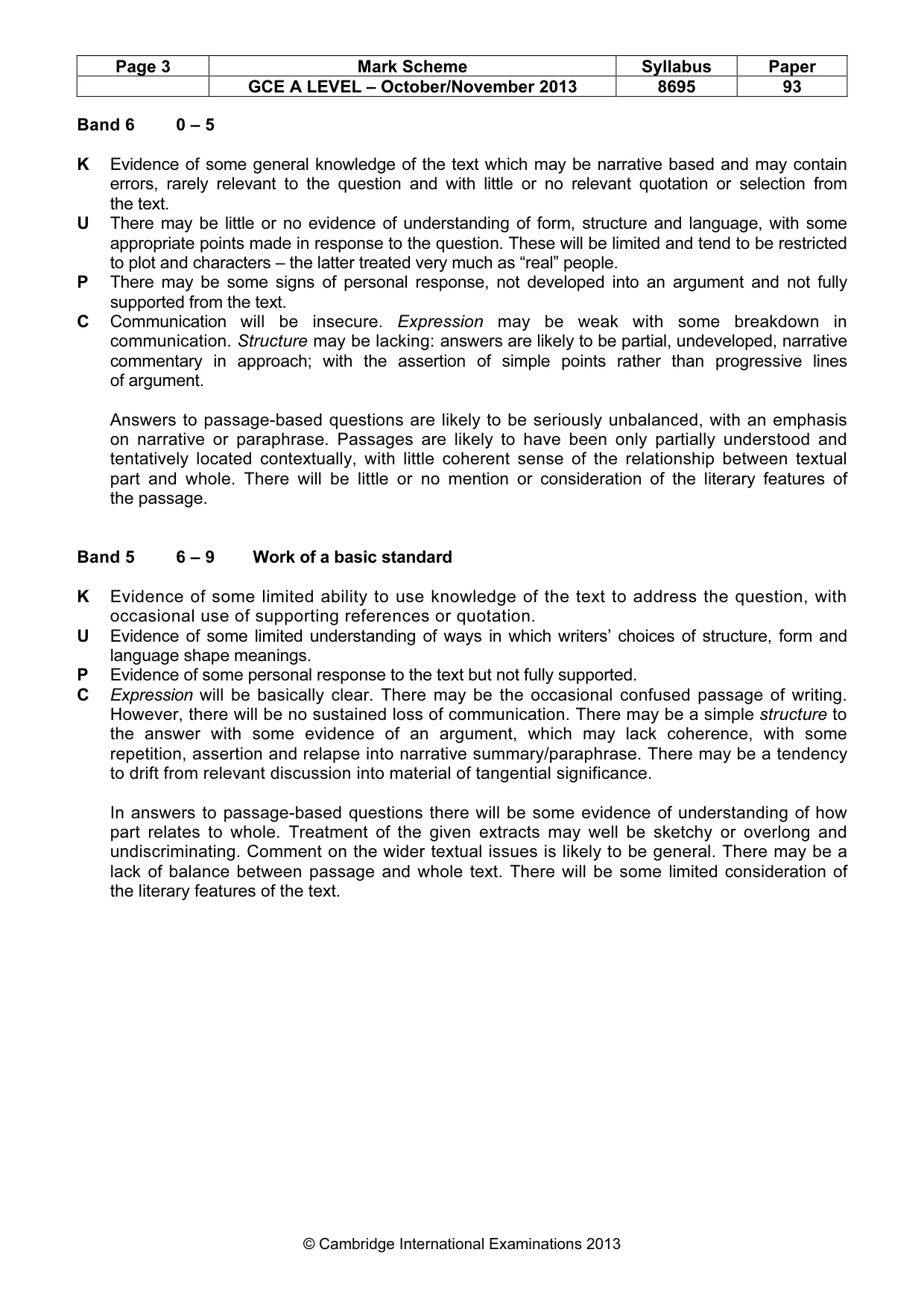
Page 3 Mark Scheme Syllabus Paper GCE A LEVEL – October/November 2013 8695 93 © Cambridge International Examinations 2013 Band 6 0 – 5 K Evidence of some general knowledge of the text which may be narrative based and may contain errors, rarely relevant to the question and with little or no relevant quotation or selection from the text. U There may be little or no evidence of understanding of form, structure and language, with some appropriate points made in response to the question. These will be limited and tend to be restricted to plot and characters – the latter treated very much as “real” people. P There may be some signs of personal response, not developed into an argument and not fully supported from the text. C Communication will be insecure. Expression may be weak with some breakdown in communication. Structure may be lacking: answers are likely to be partial, undeveloped, narrative commentary in approach; with the assertion of simple points rather than progressive lines of argument. Answers to passage-based questions are likely to be seriously unbalanced, with an emphasis on narrative or paraphrase. Passages are likely to have been only partially understood and tentatively located contextually, with little coherent sense of the relationship between textual part and whole. There will be little or no mention or consideration of the literary features of the passage. Band 5 6 – 9 Work of a basic standard K Evidence of some limited ability to use knowledge of the text to address the question, with occasional use of supporting references or quotation. U Evidence of some limited understanding of ways in which writers’ choices of structure, form and language shape meanings. P Evidence of some personal response to the text but not fully supported. C Expression will be basically clear. There may be the occasional confused passage of writing. However, there will be no sustained loss of communication. There may be a simple structure to the answer with some evidence of an argument, which may lack coherence, with some repetition, assertion and relapse into narrative summary/paraphrase. There may be a tendency to drift from relevant discussion into material of tangential significance. In answers to passage-based questions there will be some evidence of understanding of how part relates to whole. Treatment of the given extracts may well be sketchy or overlong and undiscriminating. Comment on the wider textual issues is likely to be general. There may be a lack of balance between passage and whole text. There will be some limited consideration of the literary features of the text.
Mark scheme, page 4
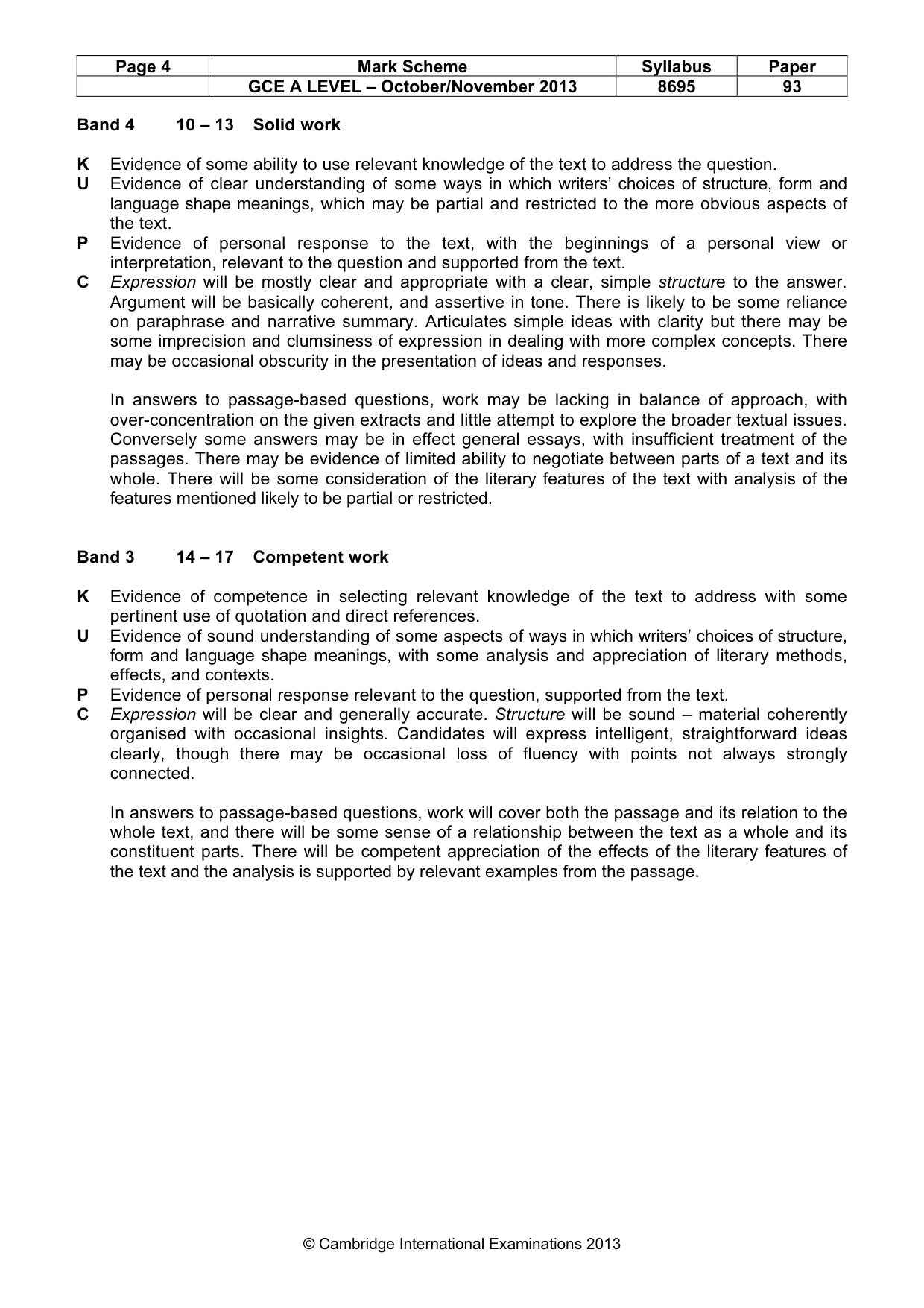
Page 4 Mark Scheme Syllabus Paper GCE A LEVEL – October/November 2013 8695 93 © Cambridge International Examinations 2013 Band 4 10 – 13 Solid work K Evidence of some ability to use relevant knowledge of the text to address the question. U Evidence of clear understanding of some ways in which writers’ choices of structure, form and language shape meanings, which may be partial and restricted to the more obvious aspects of the text. P Evidence of personal response to the text, with the beginnings of a personal view or interpretation, relevant to the question and supported from the text. C Expression will be mostly clear and appropriate with a clear, simple structure to the answer. Argument will be basically coherent, and assertive in tone. There is likely to be some reliance on paraphrase and narrative summary. Articulates simple ideas with clarity but there may be some imprecision and clumsiness of expression in dealing with more complex concepts. There may be occasional obscurity in the presentation of ideas and responses. In answers to passage-based questions, work may be lacking in balance of approach, with over-concentration on the given extracts and little attempt to explore the broader textual issues. Conversely some answers may be in effect general essays, with insufficient treatment of the passages. There may be evidence of limited ability to negotiate between parts of a text and its whole. There will be some consideration of the literary features of the text with analysis of the features mentioned likely to be partial or restricted. Band 3 14 – 17 Competent work K Evidence of competence in selecting relevant knowledge of the text to address with some pertinent use of quotation and direct references. U Evidence of sound understanding of some aspects of ways in which writers’ choices of structure, form and language shape meanings, with some analysis and appreciation of literary methods, effects, and contexts. P Evidence of personal response relevant to the question, supported from the text. C Expression will be clear and generally accurate. Structure will be sound – material coherently organised with occasional insights. Candidates will express intelligent, straightforward ideas clearly, though there may be occasional loss of fluency with points not always strongly connected. In answers to passage-based questions, work will cover both the passage and its relation to the whole text, and there will be some sense of a relationship between the text as a whole and its constituent parts. There will be competent appreciation of the effects of the literary features of the text and the analysis is supported by relevant examples from the passage.
Mark scheme, page 5
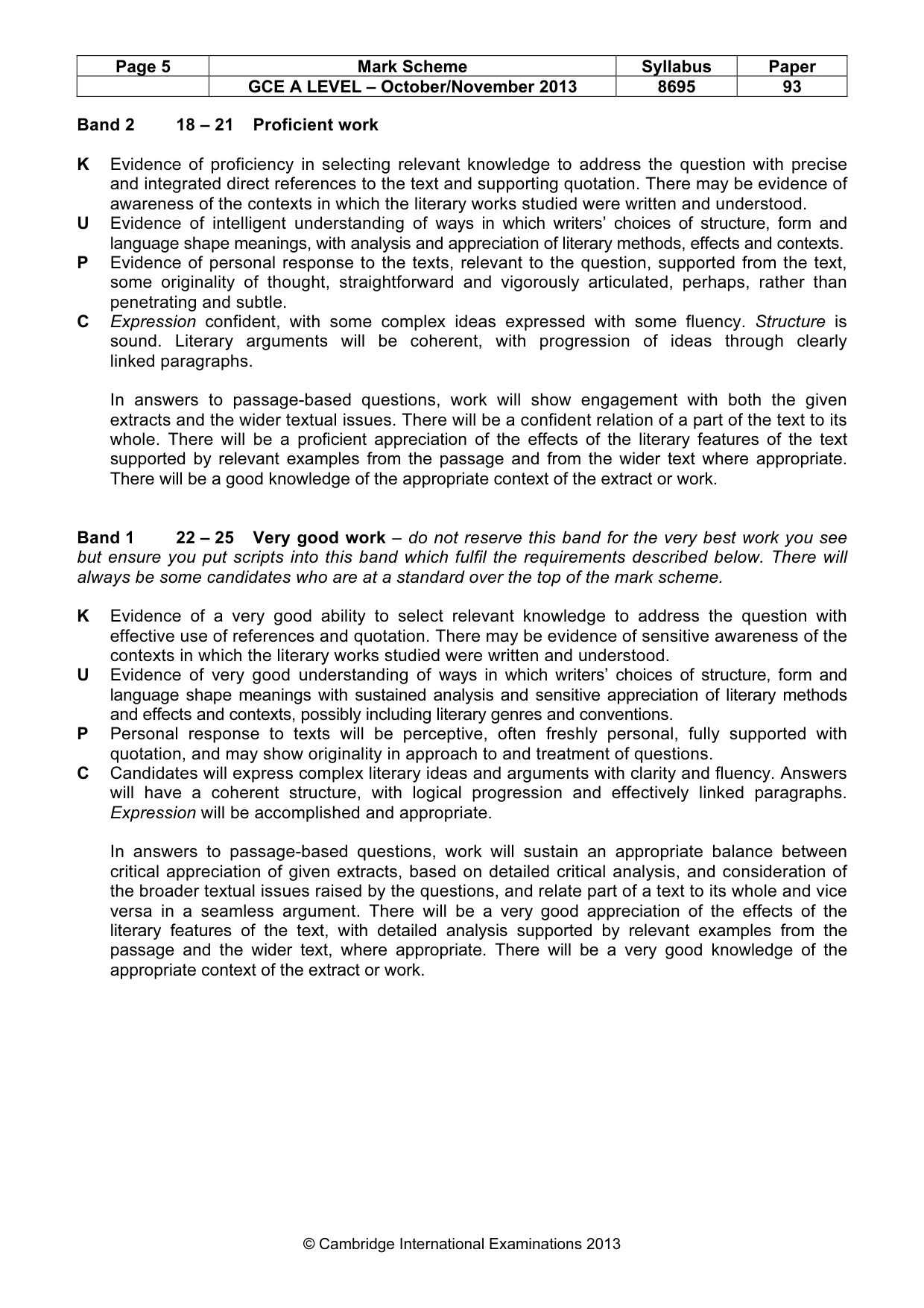
Page 5 Mark Scheme Syllabus Paper GCE A LEVEL – October/November 2013 8695 93 © Cambridge International Examinations 2013 Band 2 18 – 21 Proficient work K Evidence of proficiency in selecting relevant knowledge to address the question with precise and integrated direct references to the text and supporting quotation. There may be evidence of awareness of the contexts in which the literary works studied were written and understood. U Evidence of intelligent understanding of ways in which writers’ choices of structure, form and language shape meanings, with analysis and appreciation of literary methods, effects and contexts. P Evidence of personal response to the texts, relevant to the question, supported from the text, some originality of thought, straightforward and vigorously articulated, perhaps, rather than penetrating and subtle. C Expression confident, with some complex ideas expressed with some fluency. Structure is sound. Literary arguments will be coherent, with progression of ideas through clearly linked paragraphs. In answers to passage-based questions, work will show engagement with both the given extracts and the wider textual issues. There will be a confident relation of a part of the text to its whole. There will be a proficient appreciation of the effects of the literary features of the text supported by relevant examples from the passage and from the wider text where appropriate. There will be a good knowledge of the appropriate context of the extract or work. Band 1 22 – 25 Very good work – do not reserve this band for the very best work you see but ensure you put scripts into this band which fulfil the requirements described below. There will always be some candidates who are at a standard over the top of the mark scheme. K Evidence of a very good ability to select relevant knowledge to address the question with effective use of references and quotation. There may be evidence of sensitive awareness of the contexts in which the literary works studied were written and understood. U Evidence of very good understanding of ways in which writers’ choices of structure, form and language shape meanings with sustained analysis and sensitive appreciation of literary methods and effects and contexts, possibly including literary genres and conventions. P Personal response to texts will be perceptive, often freshly personal, fully supported with quotation, and may show originality in approach to and treatment of questions. C Candidates will express complex literary ideas and arguments with clarity and fluency. Answers will have a coherent structure, with logical progression and effectively linked paragraphs. Expression will be accomplished and appropriate. In answers to passage-based questions, work will sustain an appropriate balance between critical appreciation of given extracts, based on detailed critical analysis, and consideration of the broader textual issues raised by the questions, and relate part of a text to its whole and vice versa in a seamless argument. There will be a very good appreciation of the effects of the literary features of the text, with detailed analysis supported by relevant examples from the passage and the wider text, where appropriate. There will be a very good knowledge of the appropriate context of the extract or work.
What you needed in this session
Cambridge’s own grade thresholds for 2013 Oct/Nov, Paper 9 · Variant 3. A higher threshold means an easier paper — the bar moves with how the cohort did.