Cambridge A Level English - Language and Literature (AS Level only, from 2016) 8695 — 2013 Oct/Nov Paper 9 · Variant 2
8695/92/O/N/13 · 50 marks · ≈56 min
The question paper and its mark scheme, free to read here and free to download. This is Cambridge’s own paper, exactly as it was sat.
Question paper20 pages



Mark scheme5 pages
Answers below. Sit the paper first if you are practising.
Paper as text
Question paper, page 1
This document consists of 17 printed pages and 3 blank pages. DC (LK) 91841/1 © UCLES 2013 [Turn over UNIVERSITY OF CAMBRIDGE INTERNATIONAL EXAMINATIONS General Certificate of Education Advanced Subsidiary Level and Advanced Level * 9 7 6 1 7 6 5 4 2 3 * LANGUAGE AND LITERATURE IN ENGLISH 8695/92 Paper 9 Poetry, Prose and Drama October/November 2013 2 hours Additional Materials: Answer Booklet/Paper READ THESE INSTRUCTIONS FIRST If you have been given an Answer Booklet, follow the instructions on the front cover of the Booklet. Write your Centre number, candidate number and name on all the work you hand in. Write in dark blue or black pen. Do not use staples, paper clips, highlighters, glue or correction fluid. Answer two questions, each from a different section. You are reminded of the need for good English and clear presentation in your answers. At the end of the examination, fasten all your work securely together. All questions in this paper carry equal marks.
Question paper, page 2
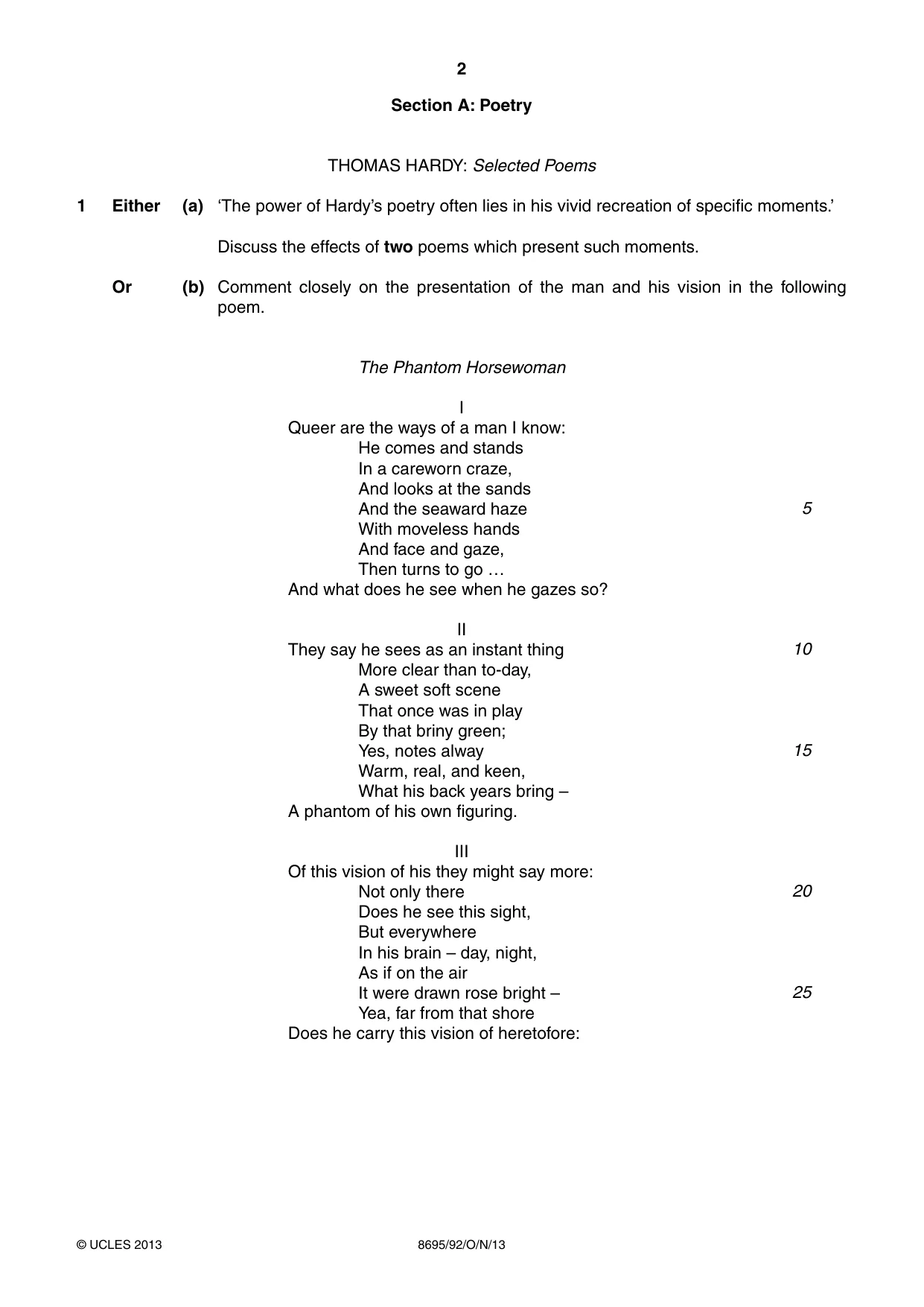
2 8695/92/O/N/13 © UCLES 2013 Section A: Poetry THOMAS HARDY: Selected Poems 1 Either (a) ‘The power of Hardy’s poetry often lies in his vivid recreation of specific moments.’ Discuss the effects of two poems which present such moments. Or (b) Comment closely on the presentation of the man and his vision in the following poem. The Phantom Horsewoman I Queer are the ways of a man I know: He comes and stands In a careworn craze, And looks at the sands And the seaward haze With moveless hands And face and gaze, Then turns to go … And what does he see when he gazes so? II They say he sees as an instant thing More clear than to-day, A sweet soft scene That once was in play By that briny green; Yes, notes alway Warm, real, and keen, What his back years bring – A phantom of his own figuring. III Of this vision of his they might say more: Not only there Does he see this sight, But everywhere In his brain – day, night, As if on the air It were drawn rose bright – Yea, far from that shore Does he carry this vision of heretofore: 5 10 15 20 25
Question paper, page 3
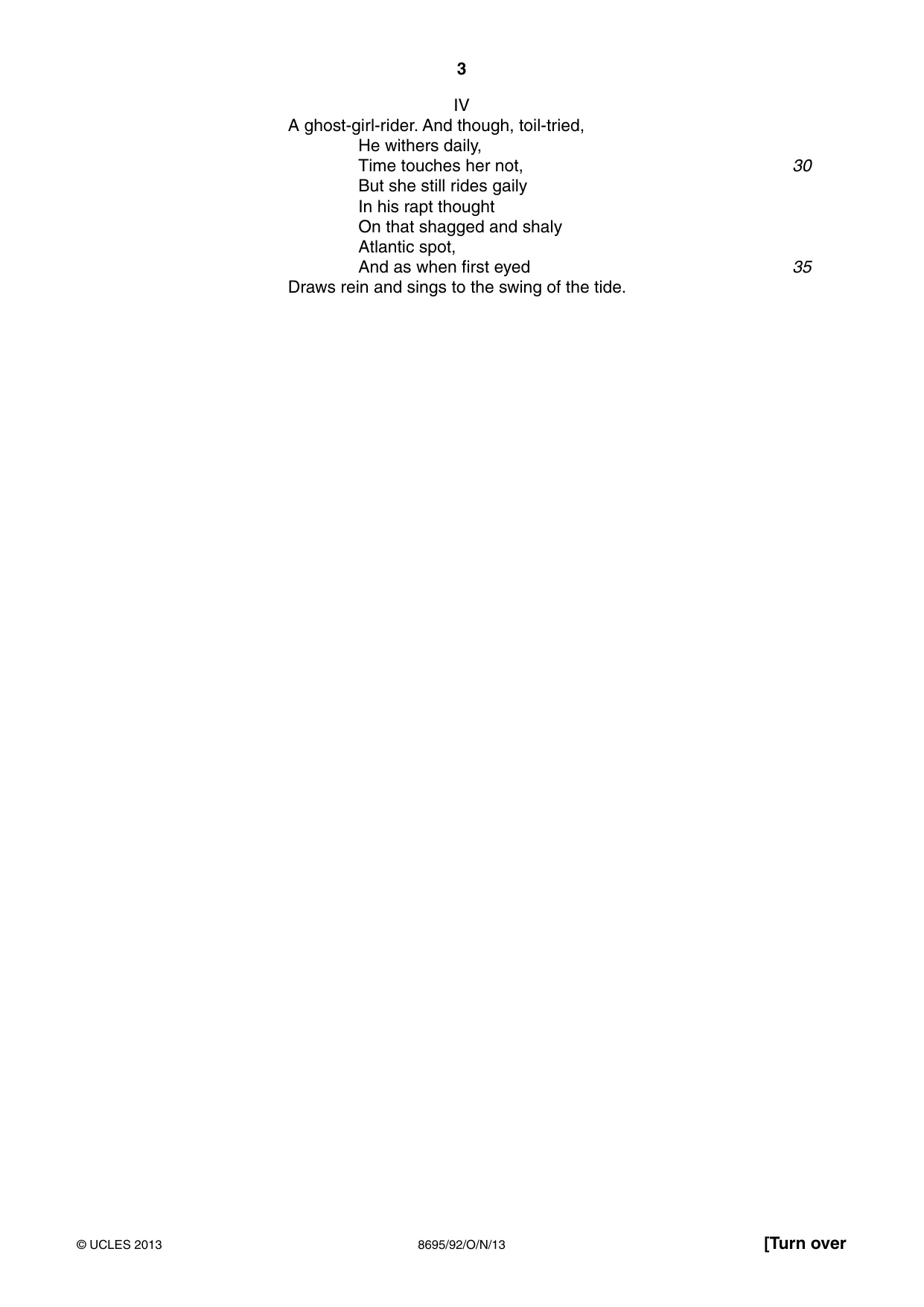
3 8695/92/O/N/13 © UCLES 2013 [Turn over IV A ghost-girl-rider. And though, toil-tried, He withers daily, Time touches her not, But she still rides gaily In his rapt thought On that shagged and shaly Atlantic spot, And as when first eyed Draws rein and sings to the swing of the tide. 30 35
Question paper, page 4
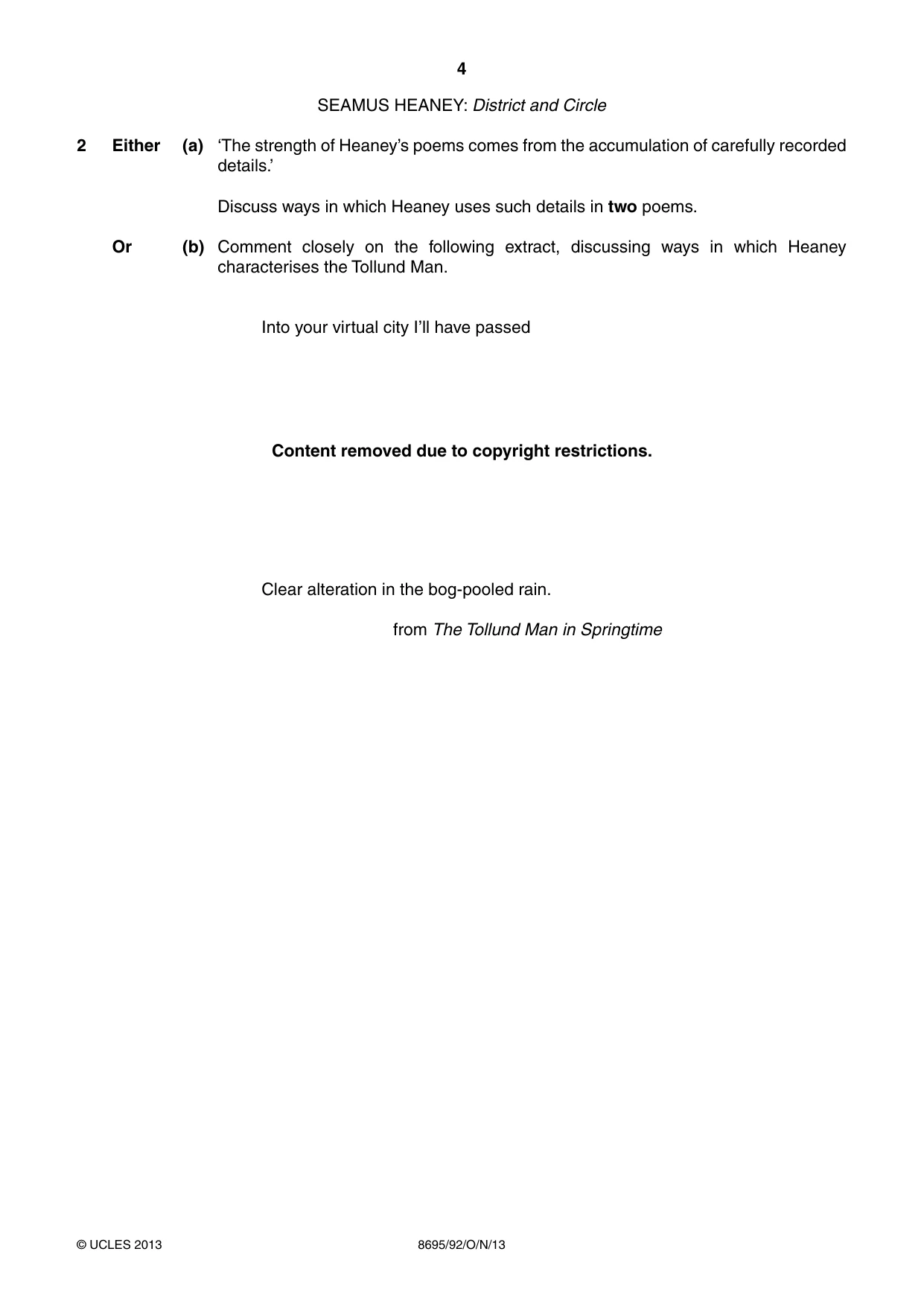
4 8695/92/O/N/13 © UCLES 2013 SEAMUS HEANEY: District and Circle 2 Either (a) ‘The strength of Heaney’s poems comes from the accumulation of carefully recorded details.’ Discuss ways in which Heaney uses such details in two poems. Or (b) Comment closely on the following extract, discussing ways in which Heaney characterises the Tollund Man. Into your virtual city I’ll have passed Unregistered by scans, screens, hidden eyes, Lapping myself in time, an absorbed face Coming and going, neither god nor ghost, Not at odds or at one, but simply lost To you and yours, out under seeding grass And trickles of kesh water, sphagnum moss, Dead bracken on the spreadfield, red as rust. I reawoke to revel in the spirit They strengthened when they chose to put me down For their own good. And to a sixth-sensed threat: Panicked snipe offshooting into twilight, Then going awry, larks quietened in the sun, Clear alteration in the bog-pooled rain. from The Tollund Man in Springtime 5 10 Content removed due to copyright restrictions.
Question paper, page 5
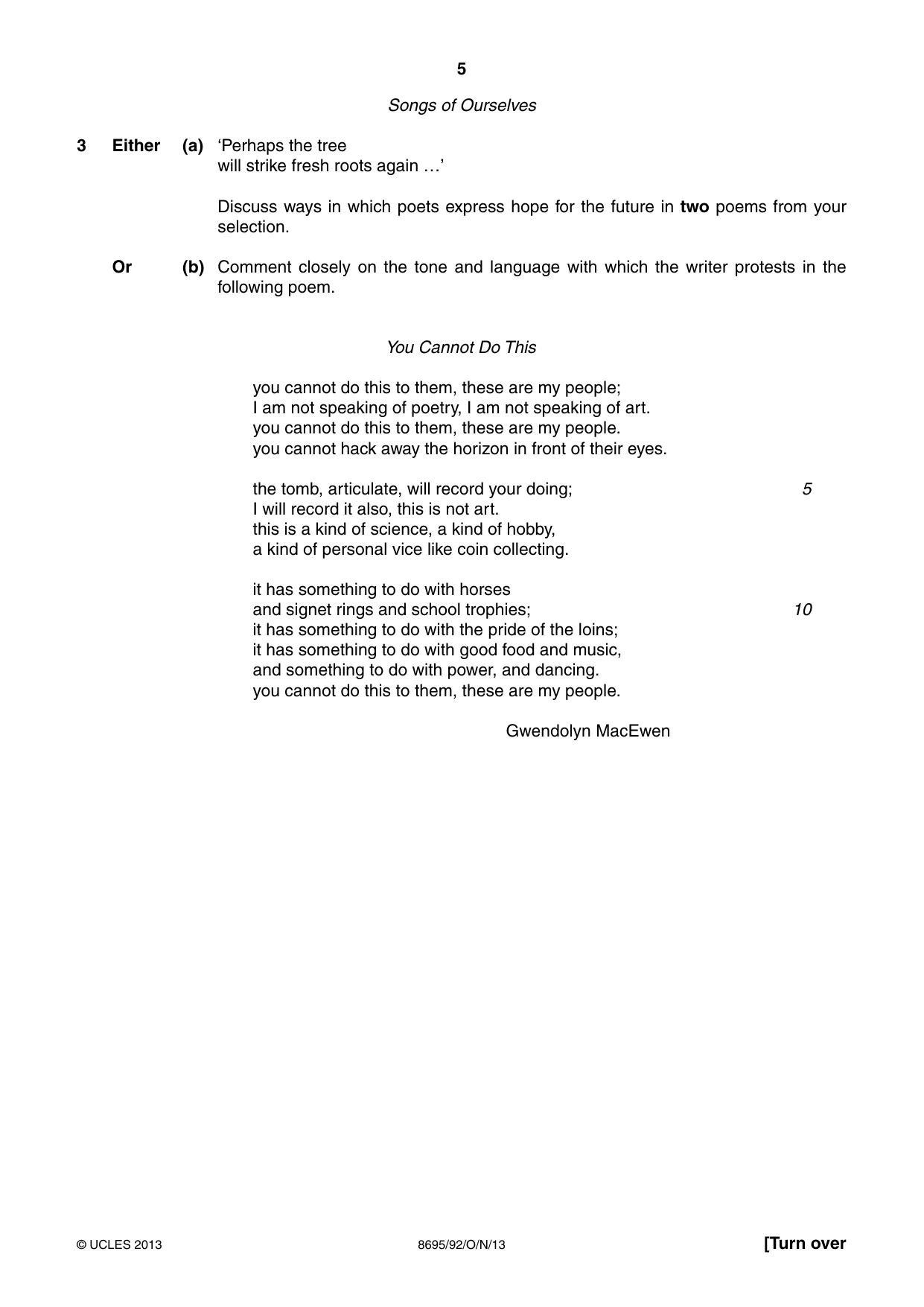
5 8695/92/O/N/13 © UCLES 2013 [Turn over Songs of Ourselves 3 Either (a) ‘Perhaps the tree will strike fresh roots again …’ Discuss ways in which poets express hope for the future in two poems from your selection. Or (b) Comment closely on the tone and language with which the writer protests in the following poem. You Cannot Do This you cannot do this to them, these are my people; I am not speaking of poetry, I am not speaking of art. you cannot do this to them, these are my people. you cannot hack away the horizon in front of their eyes. the tomb, articulate, will record your doing; I will record it also, this is not art. this is a kind of science, a kind of hobby, a kind of personal vice like coin collecting. it has something to do with horses and signet rings and school trophies; it has something to do with the pride of the loins; it has something to do with good food and music, and something to do with power, and dancing. you cannot do this to them, these are my people. Gwendolyn MacEwen 5 10
Question paper, page 6
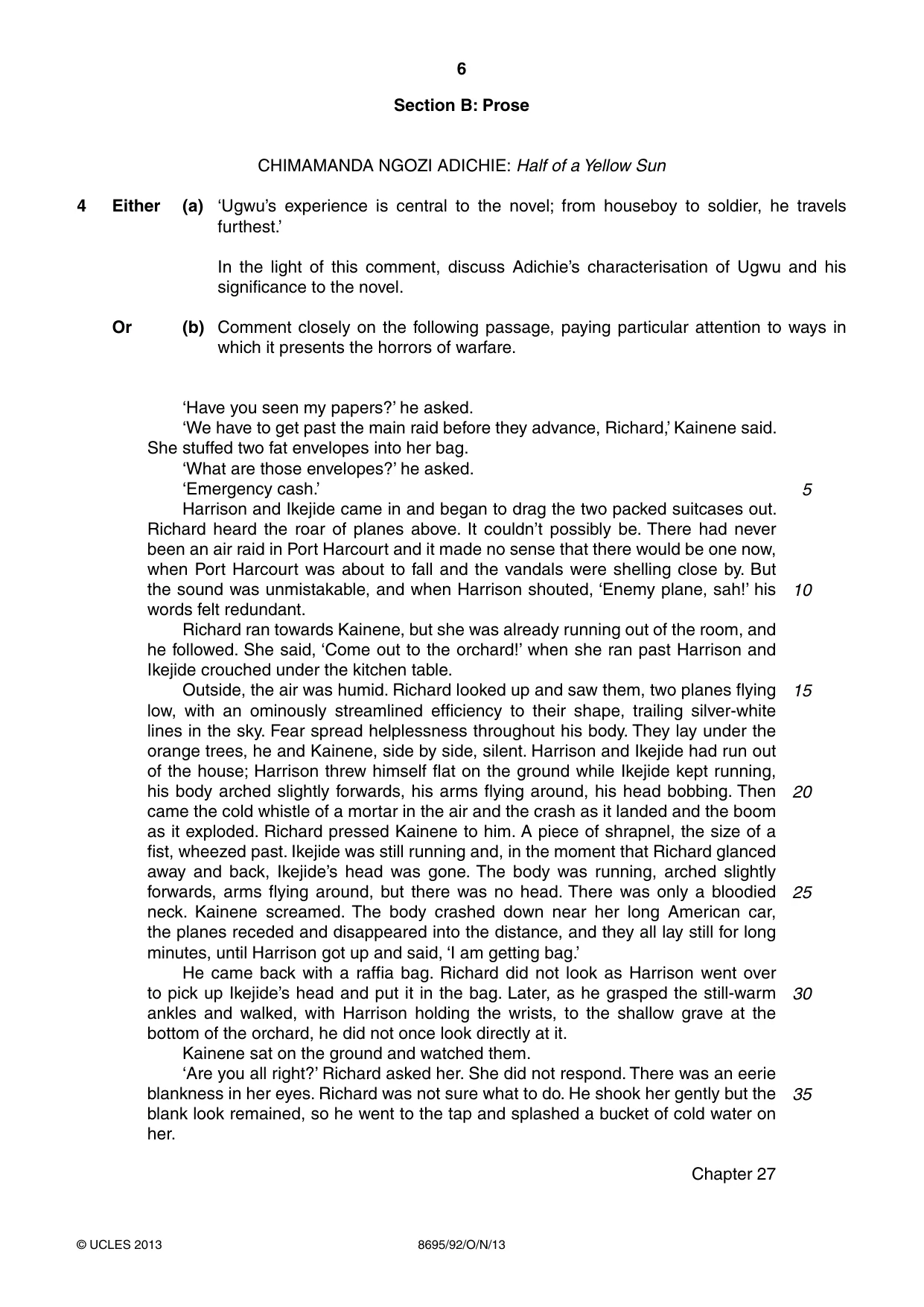
6 8695/92/O/N/13 © UCLES 2013 Section B: Prose CHIMAMANDA NGOZI ADICHIE: Half of a Yellow Sun 4 Either (a) ‘Ugwu’s experience is central to the novel; from houseboy to soldier, he travels furthest.’ In the light of this comment, discuss Adichie’s characterisation of Ugwu and his significance to the novel. Or (b) Comment closely on the following passage, paying particular attention to ways in which it presents the horrors of warfare. ‘Have you seen my papers?’ he asked. ‘We have to get past the main raid before they advance, Richard,’ Kainene said. She stuffed two fat envelopes into her bag. ‘What are those envelopes?’ he asked. ‘Emergency cash.’ Harrison and Ikejide came in and began to drag the two packed suitcases out. Richard heard the roar of planes above. It couldn’t possibly be. There had never been an air raid in Port Harcourt and it made no sense that there would be one now, when Port Harcourt was about to fall and the vandals were shelling close by. But the sound was unmistakable, and when Harrison shouted, ‘Enemy plane, sah!’ his words felt redundant. Richard ran towards Kainene, but she was already running out of the room, and he followed. She said, ‘Come out to the orchard!’ when she ran past Harrison and Ikejide crouched under the kitchen table. Outside, the air was humid. Richard looked up and saw them, two planes flying low, with an ominously streamlined efficiency to their shape, trailing silver-white lines in the sky. Fear spread helplessness throughout his body. They lay under the orange trees, he and Kainene, side by side, silent. Harrison and Ikejide had run out of the house; Harrison threw himself flat on the ground while Ikejide kept running, his body arched slightly forwards, his arms flying around, his head bobbing. Then came the cold whistle of a mortar in the air and the crash as it landed and the boom as it exploded. Richard pressed Kainene to him. A piece of shrapnel, the size of a fist, wheezed past. Ikejide was still running and, in the moment that Richard glanced away and back, Ikejide’s head was gone. The body was running, arched slightly forwards, arms flying around, but there was no head. There was only a bloodied neck. Kainene screamed. The body crashed down near her long American car, the planes receded and disappeared into the distance, and they all lay still for long minutes, until Harrison got up and said, ‘I am getting bag.’ He came back with a raffia bag. Richard did not look as Harrison went over to pick up Ikejide’s head and put it in the bag. Later, as he grasped the still-warm ankles and walked, with Harrison holding the wrists, to the shallow grave at the bottom of the orchard, he did not once look directly at it. Kainene sat on the ground and watched them. ‘Are you all right?’ Richard asked her. She did not respond. There was an eerie blankness in her eyes. Richard was not sure what to do. He shook her gently but the blank look remained, so he went to the tap and splashed a bucket of cold water on her. Chapter 27 5 10 15 20 25 30 35
Question paper, page 7
7 8695/92/O/N/13 © UCLES 2013 [Turn over Turn to Page 8 for Question 5
Question paper, page 8
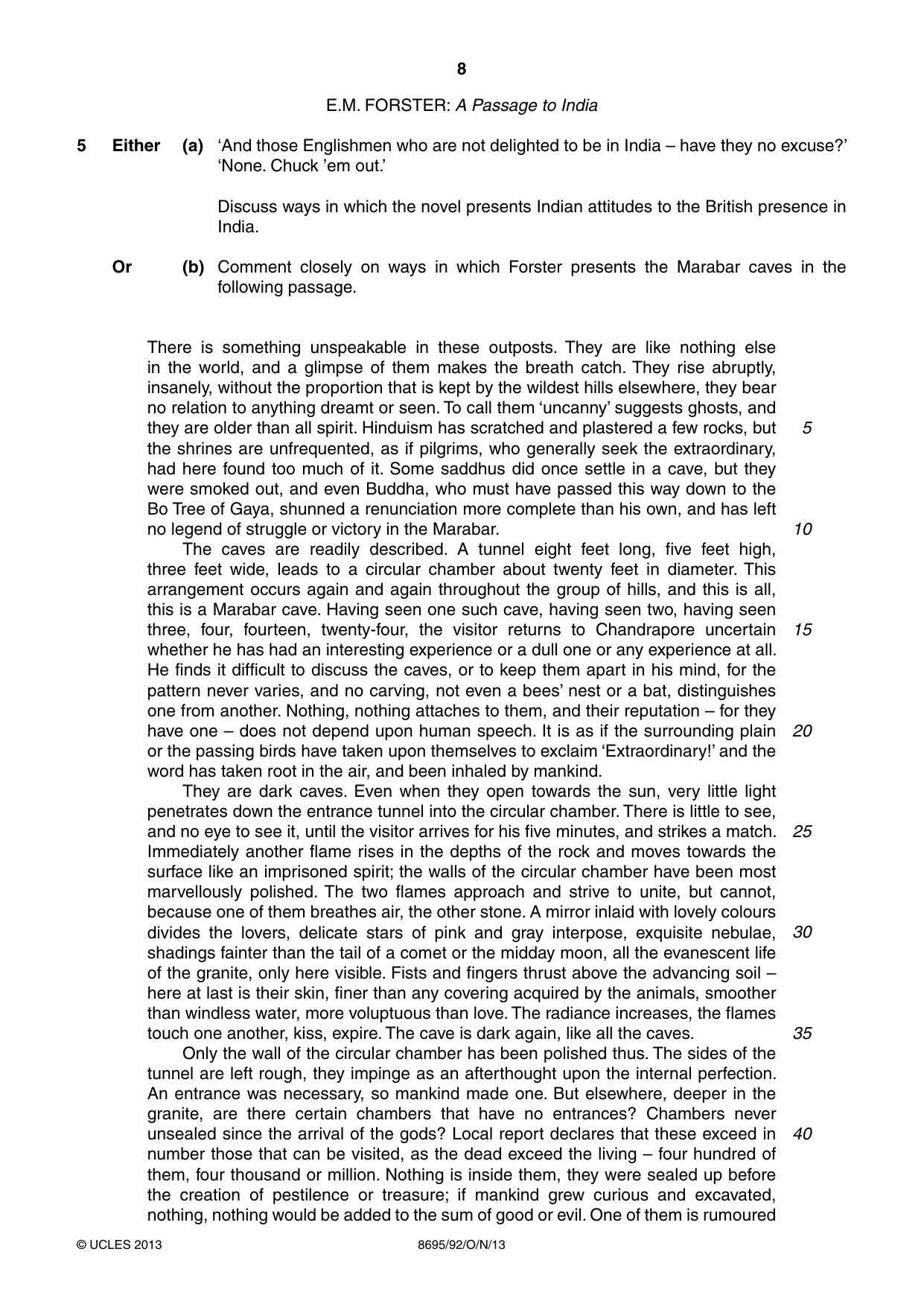
8 8695/92/O/N/13 © UCLES 2013 E.M. FORSTER: A Passage to India 5 Either (a) ‘And those Englishmen who are not delighted to be in India – have they no excuse?’ ‘None. Chuck ’em out.’ Discuss ways in which the novel presents Indian attitudes to the British presence in India. Or (b) Comment closely on ways in which Forster presents the Marabar caves in the following passage. There is something unspeakable in these outposts. They are like nothing else in the world, and a glimpse of them makes the breath catch. They rise abruptly, insanely, without the proportion that is kept by the wildest hills elsewhere, they bear no relation to anything dreamt or seen. To call them ‘uncanny’ suggests ghosts, and they are older than all spirit. Hinduism has scratched and plastered a few rocks, but the shrines are unfrequented, as if pilgrims, who generally seek the extraordinary, had here found too much of it. Some saddhus did once settle in a cave, but they were smoked out, and even Buddha, who must have passed this way down to the Bo Tree of Gaya, shunned a renunciation more complete than his own, and has left no legend of struggle or victory in the Marabar. The caves are readily described. A tunnel eight feet long, five feet high, three feet wide, leads to a circular chamber about twenty feet in diameter. This arrangement occurs again and again throughout the group of hills, and this is all, this is a Marabar cave. Having seen one such cave, having seen two, having seen three, four, fourteen, twenty-four, the visitor returns to Chandrapore uncertain whether he has had an interesting experience or a dull one or any experience at all. He finds it difficult to discuss the caves, or to keep them apart in his mind, for the pattern never varies, and no carving, not even a bees’ nest or a bat, distinguishes one from another. Nothing, nothing attaches to them, and their reputation – for they have one – does not depend upon human speech. It is as if the surrounding plain or the passing birds have taken upon themselves to exclaim ‘Extraordinary!’ and the word has taken root in the air, and been inhaled by mankind. They are dark caves. Even when they open towards the sun, very little light penetrates down the entrance tunnel into the circular chamber. There is little to see, and no eye to see it, until the visitor arrives for his five minutes, and strikes a match. Immediately another flame rises in the depths of the rock and moves towards the surface like an imprisoned spirit; the walls of the circular chamber have been most marvellously polished. The two flames approach and strive to unite, but cannot, because one of them breathes air, the other stone. A mirror inlaid with lovely colours divides the lovers, delicate stars of pink and gray interpose, exquisite nebulae, shadings fainter than the tail of a comet or the midday moon, all the evanescent life of the granite, only here visible. Fists and fingers thrust above the advancing soil – here at last is their skin, finer than any covering acquired by the animals, smoother than windless water, more voluptuous than love. The radiance increases, the flames touch one another, kiss, expire. The cave is dark again, like all the caves. Only the wall of the circular chamber has been polished thus. The sides of the tunnel are left rough, they impinge as an afterthought upon the internal perfection. An entrance was necessary, so mankind made one. But elsewhere, deeper in the granite, are there certain chambers that have no entrances? Chambers never unsealed since the arrival of the gods? Local report declares that these exceed in number those that can be visited, as the dead exceed the living – four hundred of them, four thousand or million. Nothing is inside them, they were sealed up before the creation of pestilence or treasure; if mankind grew curious and excavated, nothing, nothing would be added to the sum of good or evil. One of them is rumoured 5 10 15 20 25 30 35 40
Question paper, page 9
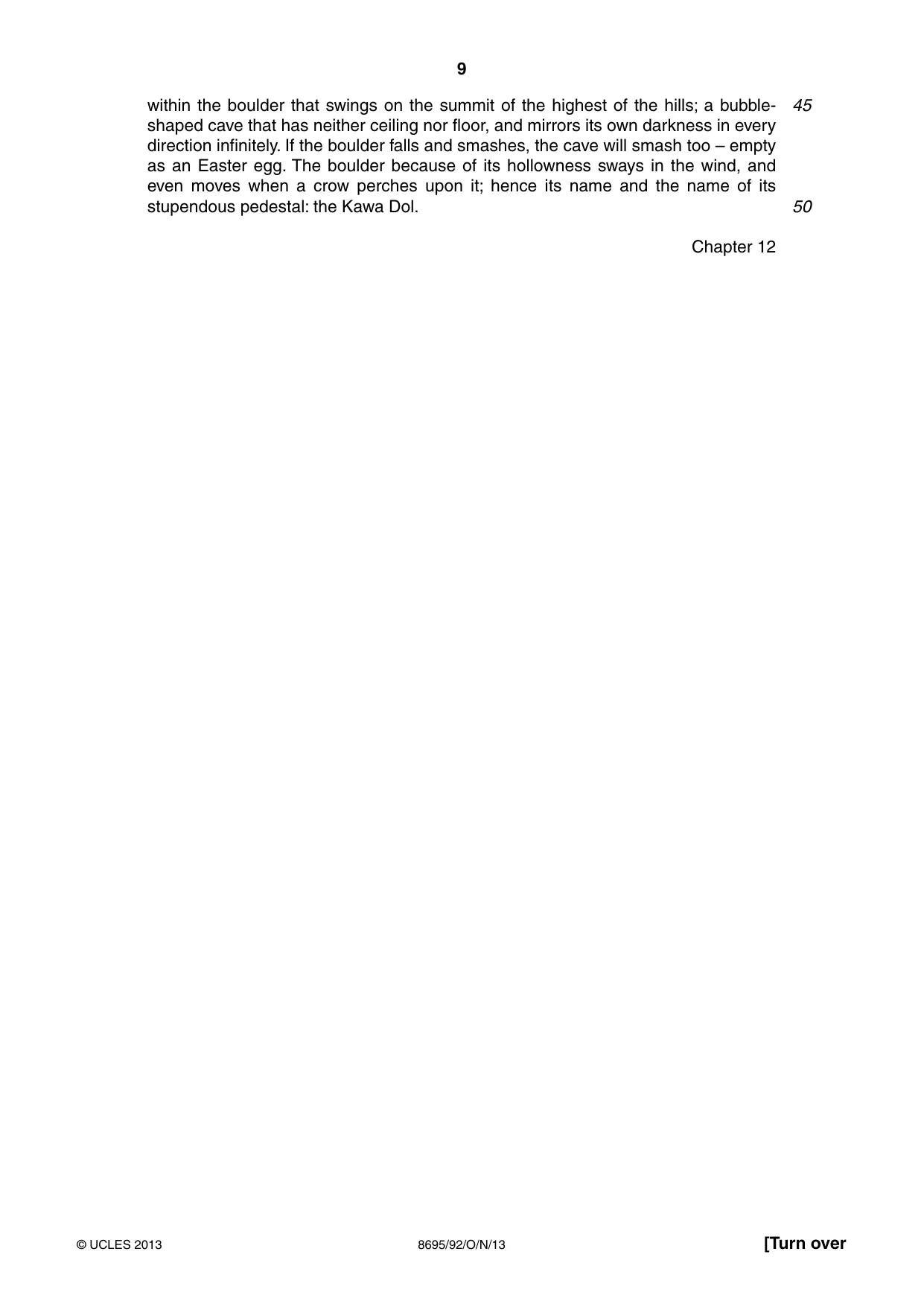
9 8695/92/O/N/13 © UCLES 2013 [Turn over within the boulder that swings on the summit of the highest of the hills; a bubble- shaped cave that has neither ceiling nor floor, and mirrors its own darkness in every direction infinitely. If the boulder falls and smashes, the cave will smash too – empty as an Easter egg. The boulder because of its hollowness sways in the wind, and even moves when a crow perches upon it; hence its name and the name of its stupendous pedestal: the Kawa Dol. Chapter 12 45 50
Question paper, page 10
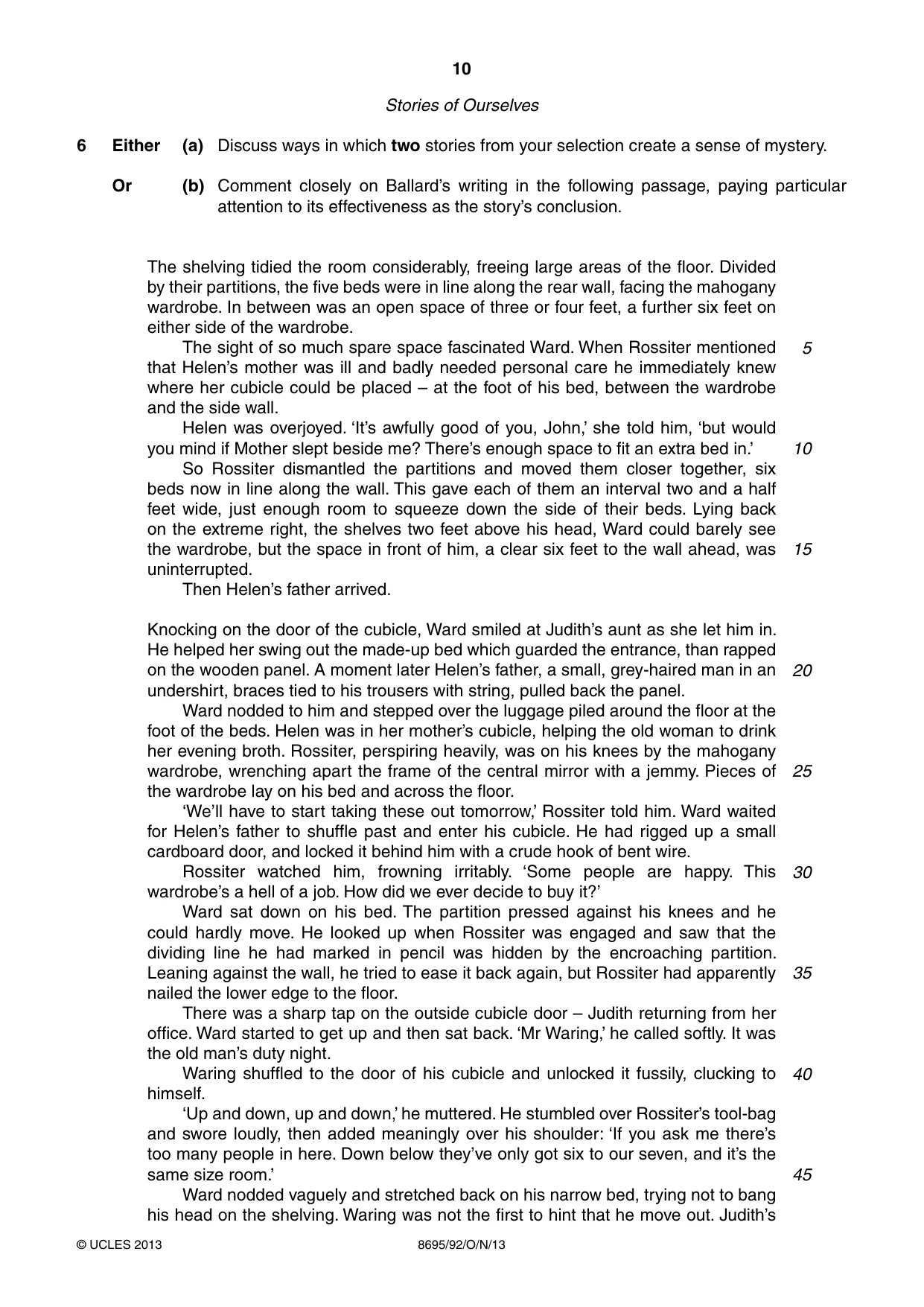
10 8695/92/O/N/13 © UCLES 2013 Stories of Ourselves 6 Either (a) Discuss ways in which two stories from your selection create a sense of mystery. Or (b) Comment closely on Ballard’s writing in the following passage, paying particular attention to its effectiveness as the story’s conclusion. The shelving tidied the room considerably, freeing large areas of the floor. Divided by their partitions, the five beds were in line along the rear wall, facing the mahogany wardrobe. In between was an open space of three or four feet, a further six feet on either side of the wardrobe. The sight of so much spare space fascinated Ward. When Rossiter mentioned that Helen’s mother was ill and badly needed personal care he immediately knew where her cubicle could be placed – at the foot of his bed, between the wardrobe and the side wall. Helen was overjoyed. ‘It’s awfully good of you, John,’ she told him, ‘but would you mind if Mother slept beside me? There’s enough space to fit an extra bed in.’ So Rossiter dismantled the partitions and moved them closer together, six beds now in line along the wall. This gave each of them an interval two and a half feet wide, just enough room to squeeze down the side of their beds. Lying back on the extreme right, the shelves two feet above his head, Ward could barely see the wardrobe, but the space in front of him, a clear six feet to the wall ahead, was uninterrupted. Then Helen’s father arrived. Knocking on the door of the cubicle, Ward smiled at Judith’s aunt as she let him in. He helped her swing out the made-up bed which guarded the entrance, than rapped on the wooden panel. A moment later Helen’s father, a small, grey-haired man in an undershirt, braces tied to his trousers with string, pulled back the panel. Ward nodded to him and stepped over the luggage piled around the floor at the foot of the beds. Helen was in her mother’s cubicle, helping the old woman to drink her evening broth. Rossiter, perspiring heavily, was on his knees by the mahogany wardrobe, wrenching apart the frame of the central mirror with a jemmy. Pieces of the wardrobe lay on his bed and across the floor. ‘We’ll have to start taking these out tomorrow,’ Rossiter told him. Ward waited for Helen’s father to shuffle past and enter his cubicle. He had rigged up a small cardboard door, and locked it behind him with a crude hook of bent wire. Rossiter watched him, frowning irritably. ‘Some people are happy. This wardrobe’s a hell of a job. How did we ever decide to buy it?’ Ward sat down on his bed. The partition pressed against his knees and he could hardly move. He looked up when Rossiter was engaged and saw that the dividing line he had marked in pencil was hidden by the encroaching partition. Leaning against the wall, he tried to ease it back again, but Rossiter had apparently nailed the lower edge to the floor. There was a sharp tap on the outside cubicle door – Judith returning from her office. Ward started to get up and then sat back. ‘Mr Waring,’ he called softly. It was the old man’s duty night. Waring shuffled to the door of his cubicle and unlocked it fussily, clucking to himself. ‘Up and down, up and down,’ he muttered. He stumbled over Rossiter’s tool-bag and swore loudly, then added meaningly over his shoulder: ‘If you ask me there’s too many people in here. Down below they’ve only got six to our seven, and it’s the same size room.’ Ward nodded vaguely and stretched back on his narrow bed, trying not to bang his head on the shelving. Waring was not the first to hint that he move out. Judith’s 5 10 15 20 25 30 35 40 45
Question paper, page 11
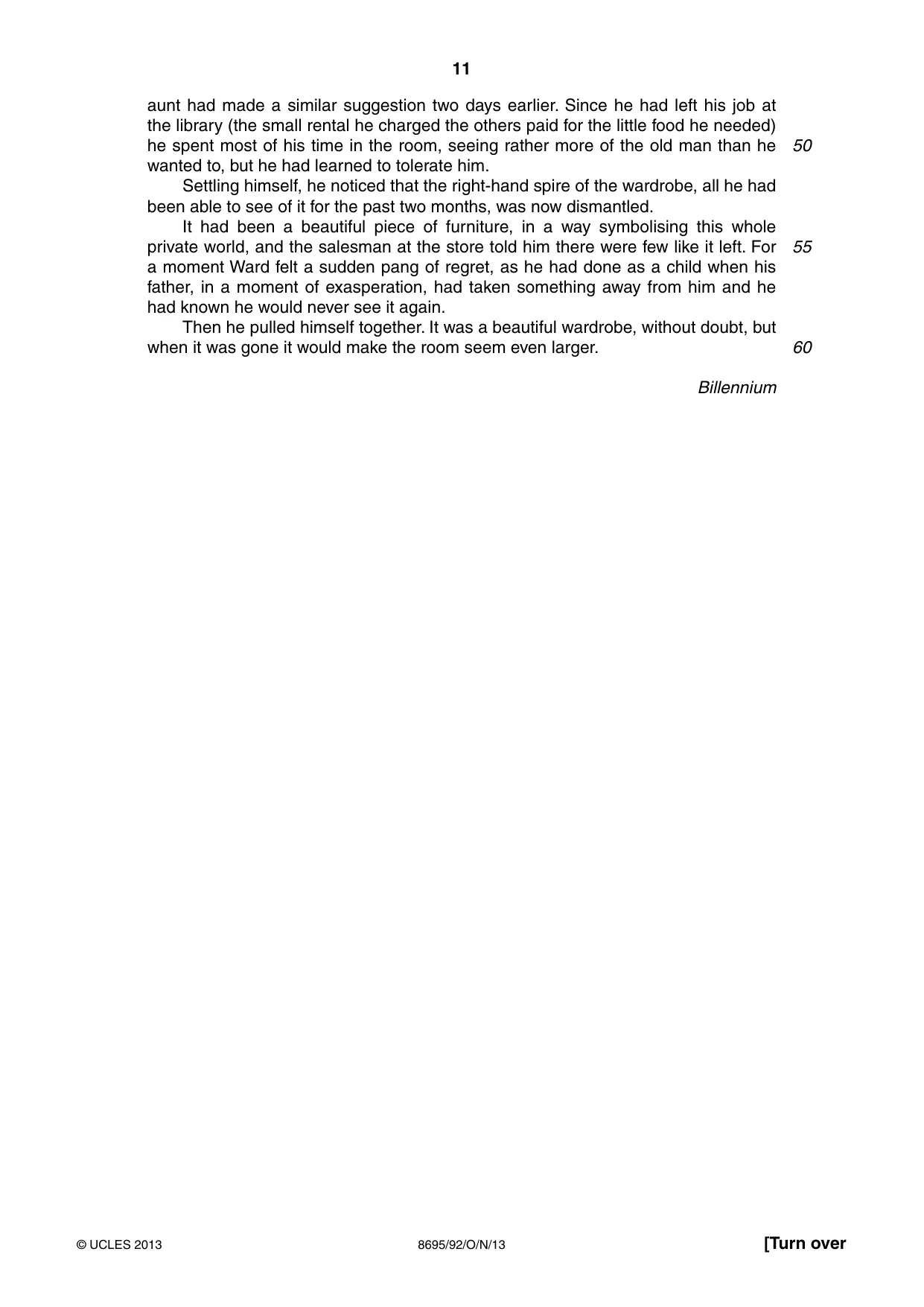
11 8695/92/O/N/13 © UCLES 2013 [Turn over aunt had made a similar suggestion two days earlier. Since he had left his job at the library (the small rental he charged the others paid for the little food he needed) he spent most of his time in the room, seeing rather more of the old man than he wanted to, but he had learned to tolerate him. Settling himself, he noticed that the right-hand spire of the wardrobe, all he had been able to see of it for the past two months, was now dismantled. It had been a beautiful piece of furniture, in a way symbolising this whole private world, and the salesman at the store told him there were few like it left. For a moment Ward felt a sudden pang of regret, as he had done as a child when his father, in a moment of exasperation, had taken something away from him and he had known he would never see it again. Then he pulled himself together. It was a beautiful wardrobe, without doubt, but when it was gone it would make the room seem even larger. Billennium 50 55 60
Question paper, page 12
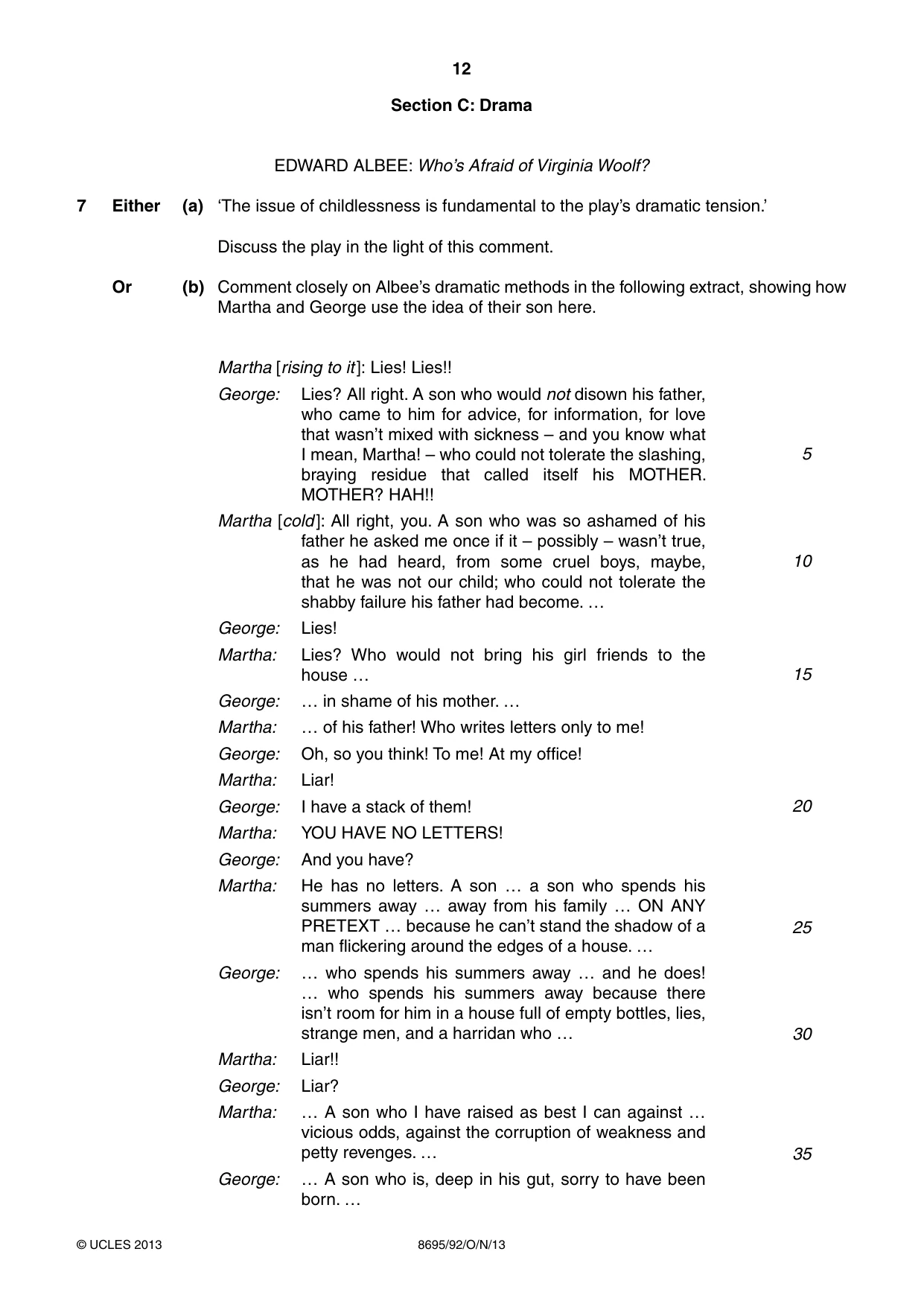
12 8695/92/O/N/13 © UCLES 2013 Section C: Drama EDWARD ALBEE: Who’s Afraid of Virginia Woolf? 7 Either (a) ‘The issue of childlessness is fundamental to the play’s dramatic tension.’ Discuss the play in the light of this comment. Or (b) Comment closely on Albee’s dramatic methods in the following extract, showing how Martha and George use the idea of their son here. Martha [rising to it ]: Lies! Lies!! George: Lies? All right. A son who would not disown his father, who came to him for advice, for information, for love that wasn’t mixed with sickness – and you know what I mean, Martha! – who could not tolerate the slashing, braying residue that called itself his MOTHER. MOTHER? HAH!! Martha [cold ]: All right, you. A son who was so ashamed of his father he asked me once if it – possibly – wasn’t true, as he had heard, from some cruel boys, maybe, that he was not our child; who could not tolerate the shabby failure his father had become. … George: Lies! Martha: Lies? Who would not bring his girl friends to the house … George: … in shame of his mother. … Martha: … of his father! Who writes letters only to me! George: Oh, so you think! To me! At my office! Martha: Liar! George: I have a stack of them! Martha: YOU HAVE NO LETTERS! George: And you have? Martha: He has no letters. A son … a son who spends his summers away … away from his family … ON ANY PRETEXT … because he can’t stand the shadow of a man flickering around the edges of a house. … George: … who spends his summers away … and he does! … who spends his summers away because there isn’t room for him in a house full of empty bottles, lies, strange men, and a harridan who … Martha: Liar!! George: Liar? Martha: … A son who I have raised as best I can against … vicious odds, against the corruption of weakness and petty revenges. … George: … A son who is, deep in his gut, sorry to have been born. … 5 10 15 20 25 30 35
Question paper, page 13
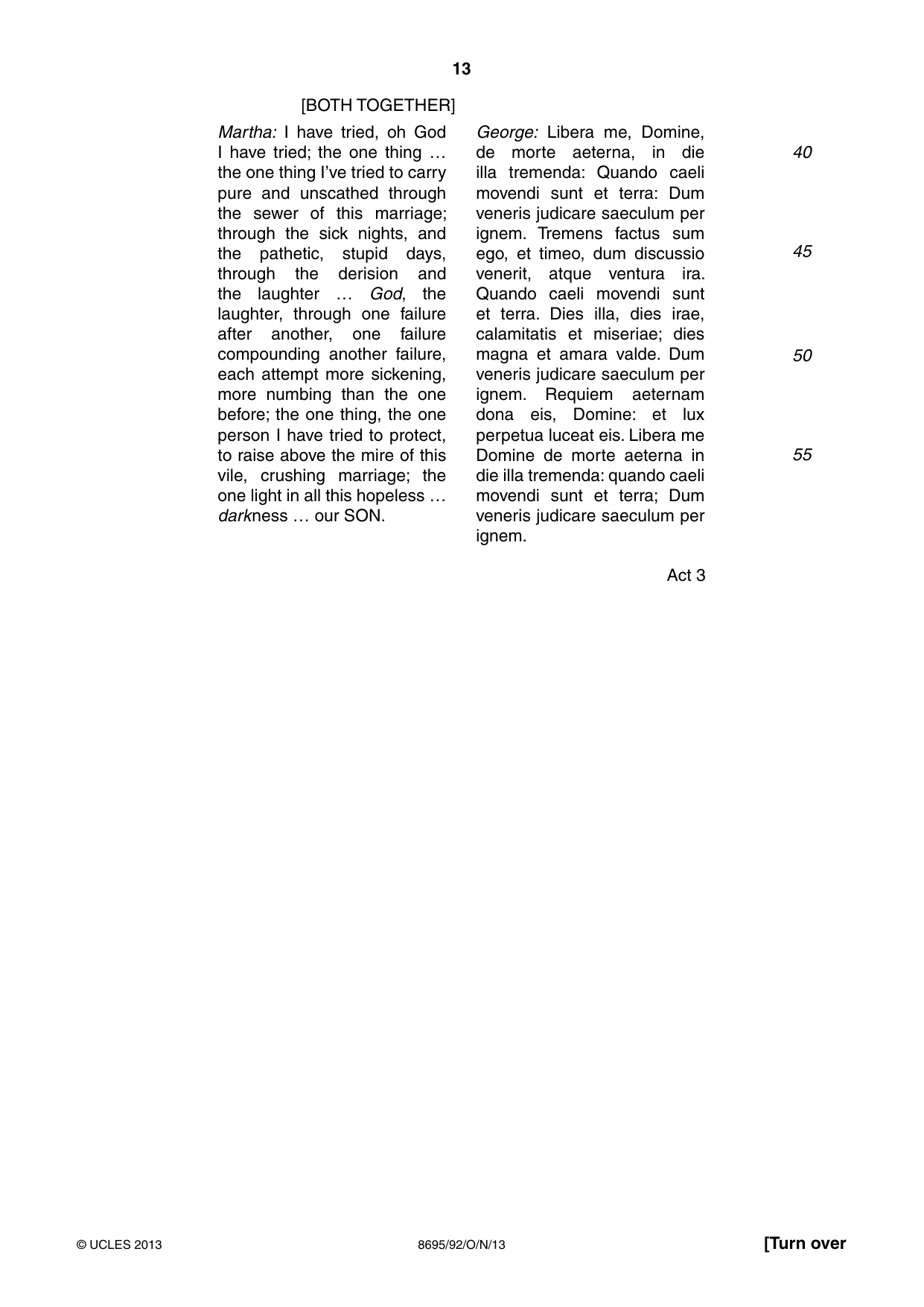
13 8695/92/O/N/13 © UCLES 2013 [Turn over [BOTH TOGETHER] Act 3 40 45 50 55 Martha: I have tried, oh God I have tried; the one thing … the one thing I’ve tried to carry pure and unscathed through the sewer of this marriage; through the sick nights, and the pathetic, stupid days, through the derision and the laughter … God, the laughter, through one failure after another, one failure compounding another failure, each attempt more sickening, more numbing than the one before; the one thing, the one person I have tried to protect, to raise above the mire of this vile, crushing marriage; the one light in all this hopeless … darkness … our SON. George: Libera me, Domine, de morte aeterna, in die illa tremenda: Quando caeli movendi sunt et terra: Dum veneris judicare saeculum per ignem. Tremens factus sum ego, et timeo, dum discussio venerit, atque ventura ira. Quando caeli movendi sunt et terra. Dies illa, dies irae, calamitatis et miseriae; dies magna et amara valde. Dum veneris judicare saeculum per ignem. Requiem aeternam dona eis, Domine: et lux perpetua luceat eis. Libera me Domine de morte aeterna in die illa tremenda: quando caeli movendi sunt et terra; Dum veneris judicare saeculum per ignem.
Question paper, page 14
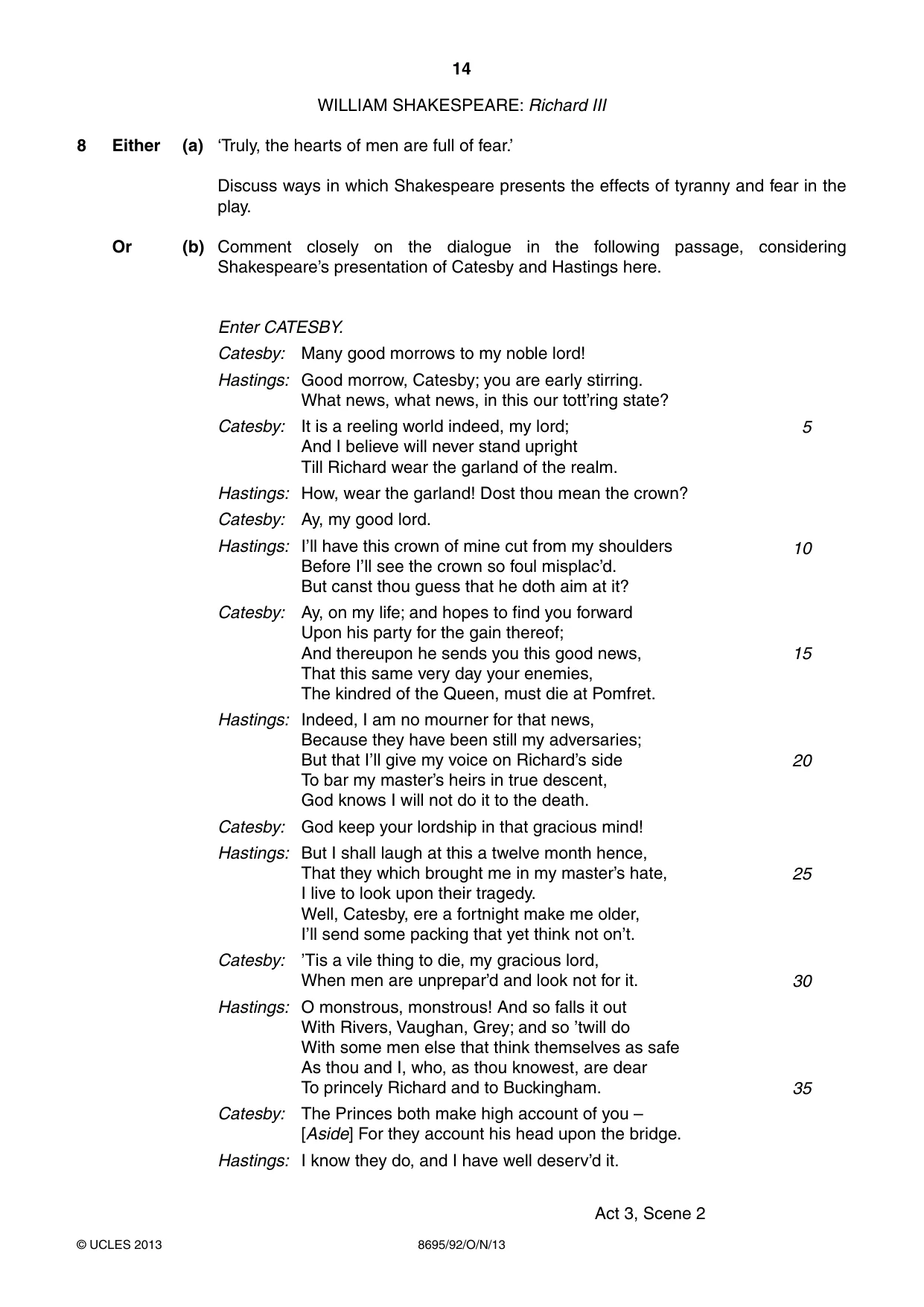
14 8695/92/O/N/13 © UCLES 2013 WILLIAM SHAKESPEARE: Richard III 8 Either (a) ‘Truly, the hearts of men are full of fear.’ Discuss ways in which Shakespeare presents the effects of tyranny and fear in the play. Or (b) Comment closely on the dialogue in the following passage, considering Shakespeare’s presentation of Catesby and Hastings here. Enter CATESBY. Catesby: Many good morrows to my noble lord! Hastings: Good morrow, Catesby; you are early stirring. What news, what news, in this our tott’ring state? Catesby: It is a reeling world indeed, my lord; And I believe will never stand upright Till Richard wear the garland of the realm. Hastings: How, wear the garland! Dost thou mean the crown? Catesby: Ay, my good lord. Hastings: I’ll have this crown of mine cut from my shoulders Before I’ll see the crown so foul misplac’d. But canst thou guess that he doth aim at it? Catesby: Ay, on my life; and hopes to find you forward Upon his party for the gain thereof; And thereupon he sends you this good news, That this same very day your enemies, The kindred of the Queen, must die at Pomfret. Hastings: Indeed, I am no mourner for that news, Because they have been still my adversaries; But that I’ll give my voice on Richard’s side To bar my master’s heirs in true descent, God knows I will not do it to the death. Catesby: God keep your lordship in that gracious mind! Hastings: But I shall laugh at this a twelve month hence, That they which brought me in my master’s hate, I live to look upon their tragedy. Well, Catesby, ere a fortnight make me older, I’ll send some packing that yet think not on’t. Catesby: ’Tis a vile thing to die, my gracious lord, When men are unprepar’d and look not for it. Hastings: O monstrous, monstrous! And so falls it out With Rivers, Vaughan, Grey; and so ’twill do With some men else that think themselves as safe As thou and I, who, as thou knowest, are dear To princely Richard and to Buckingham. Catesby: The Princes both make high account of you – [Aside] For they account his head upon the bridge. Hastings: I know they do, and I have well deserv’d it. Act 3, Scene 2 5 10 15 20 25 30 35
Question paper, page 15
15 8695/92/O/N/13 © UCLES 2013 [Turn over Turn to Page 16 for Question 9
Question paper, page 16
16 8695/92/O/N/13 © UCLES 2013 TENNESSEE WILLIAMS: A Streetcar Named Desire 9 Either (a) Stella: She’s got it mixed in her mind with Shep Huntleigh. Discuss Williams’s presentation of Blanche’s imagination and make-believe in the play. Or (b) Comment closely on ways in which Williams develops the tension between Blanche and Stanley in the following passage. [He goes to the bureau in the bedroom and crouches to remove something from the bottom drawer.] Content removed due to copyright restrictions.
Question paper, page 17
17 8695/92/O/N/13 © UCLES 2013 Blanche: Don’t come in here! Scene 10 Content removed due to copyright restrictions.
Question paper, page 18
18 8695/92/O/N/13 © UCLES 2013 BLANK PAGE
Question paper, page 19
19 8695/92/O/N/13 © UCLES 2013 BLANK PAGE
Question paper, page 20
20 8695/92/O/N/13 © UCLES 2013 BLANK PAGE Copyright Acknowledgements: Question 2b © Seamus Heaney; The Tollund Man in Springtime, from District and Circle; Faber & Faber Ltd; 2006. Question 3b © Gwendolyn MacEwen; You Cannot Do This, in Songs of Ourselves; Foundation Books; 2005. Question 4b © Chimamanda Ngozi Adichie; Half of a Yellow Sun; Reproduced by permission of HarperCollins; 2006. Question 5b © E.M. Forster; A Passage to India; The Provost and Scholars of Kings College, Cambridge. Question 6b © J. G. Ballard; Billennium, in Stories of Ourselves; Cambridge University Press India; 2008. Question 7b © Edward Albee; Who’s Afraid of Virginia Woolf?; Penguin Books Ltd; 1967. Question 9b © A Streetcar Named Desire by Tennessee Williams. Copyright © 1947 by The University of The South. Reprinted by permission of Georges Borchardt, Inc. for the Estate of Tennessee Williams. Permission to reproduce items where third-party owned material protected by copyright is included has been sought and cleared where possible. Every reasonable effort has been made by the publisher (UCLES) to trace copyright holders, but if any items requiring clearance have unwittingly been included, the publisher will be pleased to make amends at the earliest possible opportunity. University of Cambridge International Examinations is part of the Cambridge Assessment Group. Cambridge Assessment is the brand name of University of Cambridge Local Examinations Syndicate (UCLES), which is itself a department of the University of Cambridge.
Mark scheme, page 1
CAMBRIDGE INTERNATIONAL EXAMINATIONS GCE Advanced Subsidiary Level and GCE Advanced Level MARK SCHEME for the October/November 2013 series 8695 LANGUAGE AND LITERATURE IN ENGLISH 8695/92 Paper 9 (Poetry, Prose, Drama), maximum raw mark 50 This mark scheme is published as an aid to teachers and candidates, to indicate the requirements of the examination. It shows the basis on which Examiners were instructed to award marks. It does not indicate the details of the discussions that took place at an Examiners’ meeting before marking began, which would have considered the acceptability of alternative answers. Mark schemes should be read in conjunction with the question paper and the Principal Examiner Report for Teachers. Cambridge will not enter into discussions about these mark schemes. Cambridge is publishing the mark schemes for the October/November 2013 series for most IGCSE, GCE Advanced Level and Advanced Subsidiary Level components and some Ordinary Level components.
Mark scheme, page 2
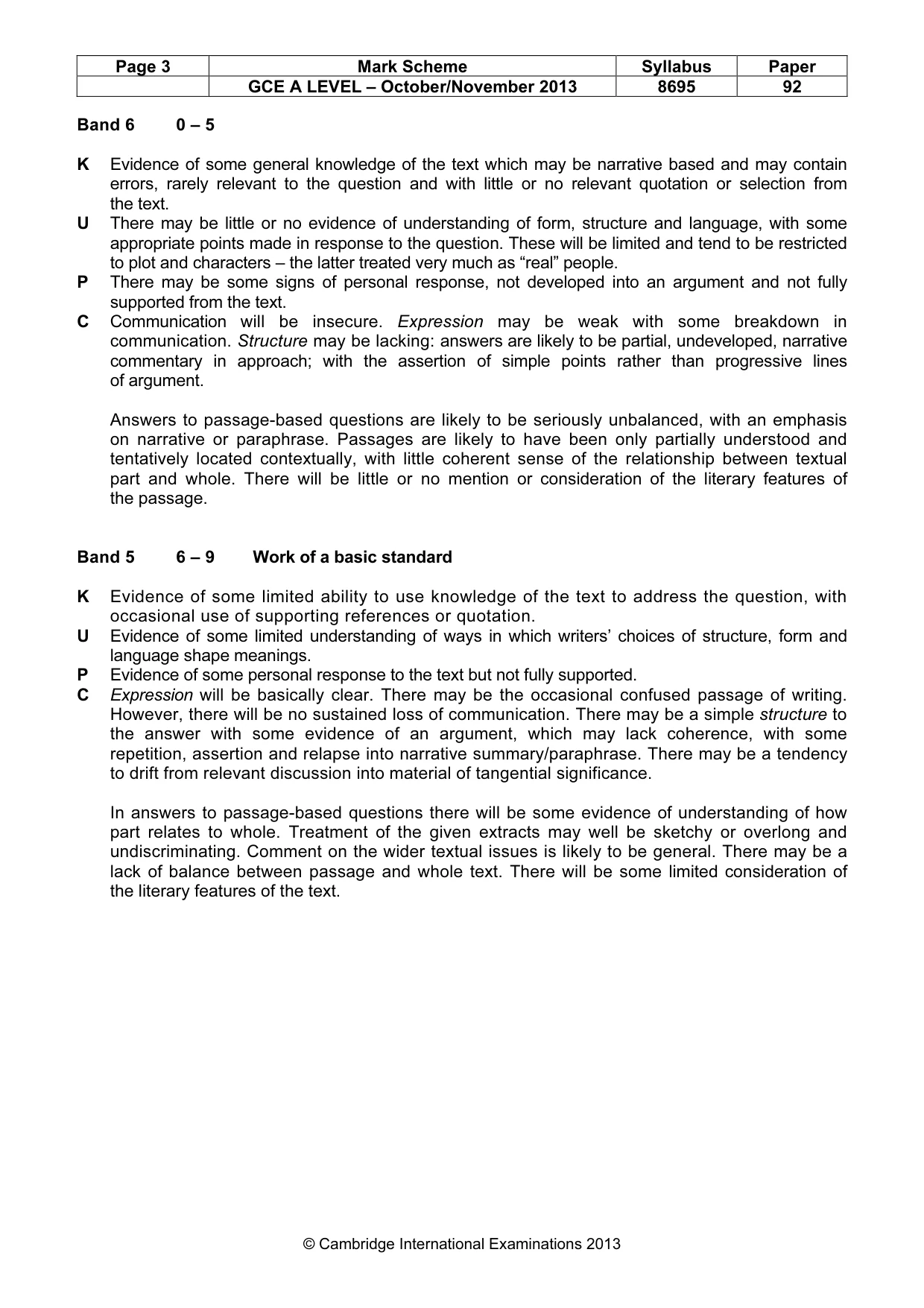
Page 2 Mark Scheme Syllabus Paper GCE A LEVEL – October/November 2013 8695 92 © Cambridge International Examinations 2013 Using the mark bands Place the answer in a band first. Look for the “best fit” of the answer into a band. An answer needs to show evidence of most but not necessarily ALL of the qualities described in a band, in order to be placed in that band. Then award a mark for the relative position of the answer within the band. Candidates may address the question in many different ways. Do not expect any particular focus or approach and do not penalise answers for leaving out a particular focus. Reward what is there, showing what you are rewarding, in your comments. Consider all strands and weigh up the performance as a whole in placing the answer in a band, then show that you have done so in the summative comment, e.g. Sound K of texts, some evidence of U but mostly narrative, occasional evidence of P, mainly clear C. Assessment Objectives: • Ability to respond to texts in the three main forms (Prose, Poetry and Drama) of different types and from different cultures; • Understanding of the ways in which writers’ choices of form, structure and language shape meanings; • Ability to produce informed independent opinions and judgements on literary texts; • Ability to communicate clearly the knowledge, understanding and insight appropriate to literary study. Each answer is marked out of 25, in accordance with the General Marking Criteria below. Each band is divided into strands corresponding to the Assessment Objectives –Knowledge, Understanding, Personal Response, Communication.
Mark scheme, page 3
Page 3 Mark Scheme Syllabus Paper GCE A LEVEL – October/November 2013 8695 92 © Cambridge International Examinations 2013 Band 6 0 – 5 K Evidence of some general knowledge of the text which may be narrative based and may contain errors, rarely relevant to the question and with little or no relevant quotation or selection from the text. U There may be little or no evidence of understanding of form, structure and language, with some appropriate points made in response to the question. These will be limited and tend to be restricted to plot and characters – the latter treated very much as “real” people. P There may be some signs of personal response, not developed into an argument and not fully supported from the text. C Communication will be insecure. Expression may be weak with some breakdown in communication. Structure may be lacking: answers are likely to be partial, undeveloped, narrative commentary in approach; with the assertion of simple points rather than progressive lines of argument. Answers to passage-based questions are likely to be seriously unbalanced, with an emphasis on narrative or paraphrase. Passages are likely to have been only partially understood and tentatively located contextually, with little coherent sense of the relationship between textual part and whole. There will be little or no mention or consideration of the literary features of the passage. Band 5 6 – 9 Work of a basic standard K Evidence of some limited ability to use knowledge of the text to address the question, with occasional use of supporting references or quotation. U Evidence of some limited understanding of ways in which writers’ choices of structure, form and language shape meanings. P Evidence of some personal response to the text but not fully supported. C Expression will be basically clear. There may be the occasional confused passage of writing. However, there will be no sustained loss of communication. There may be a simple structure to the answer with some evidence of an argument, which may lack coherence, with some repetition, assertion and relapse into narrative summary/paraphrase. There may be a tendency to drift from relevant discussion into material of tangential significance. In answers to passage-based questions there will be some evidence of understanding of how part relates to whole. Treatment of the given extracts may well be sketchy or overlong and undiscriminating. Comment on the wider textual issues is likely to be general. There may be a lack of balance between passage and whole text. There will be some limited consideration of the literary features of the text.
Mark scheme, page 4
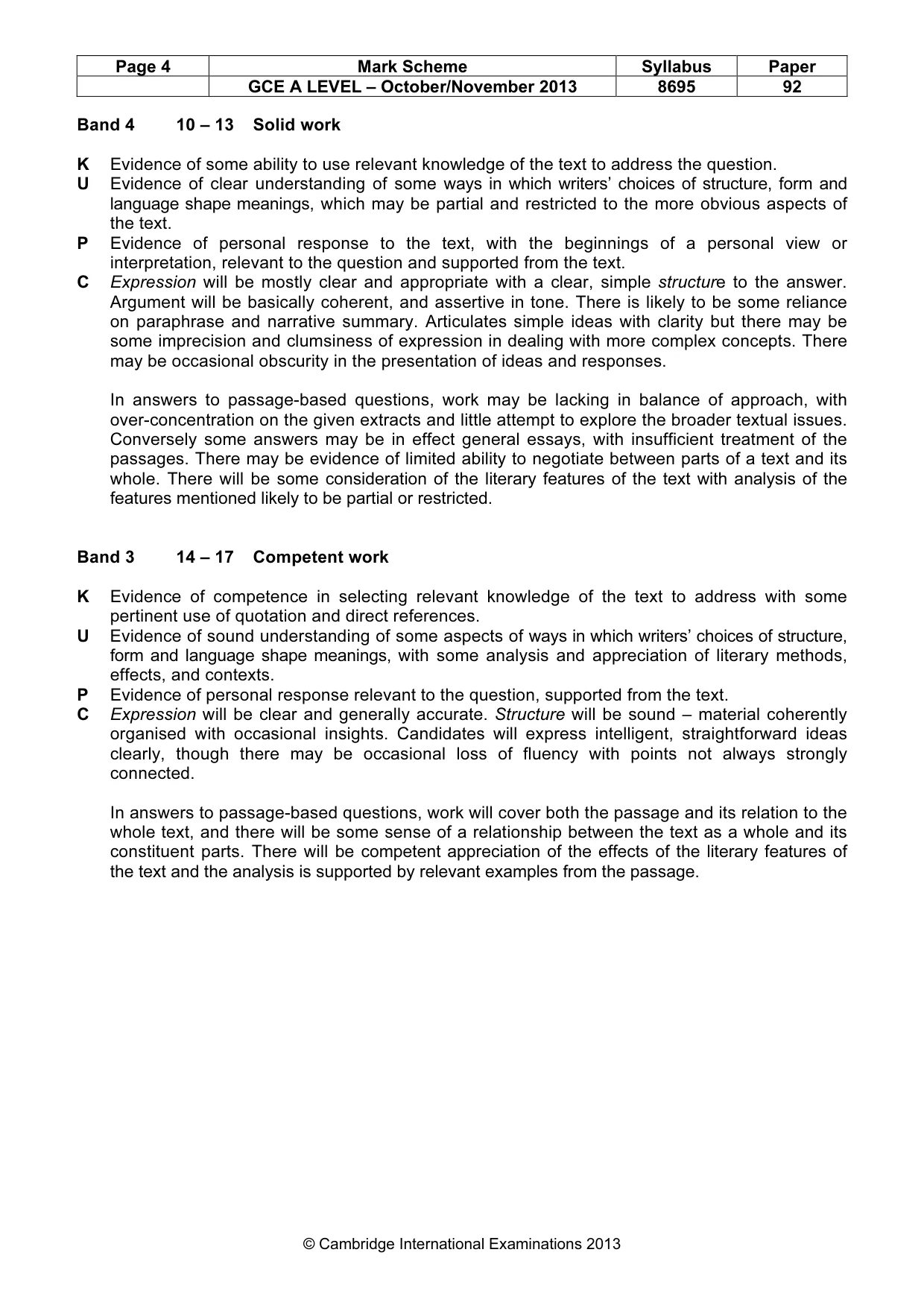
Page 4 Mark Scheme Syllabus Paper GCE A LEVEL – October/November 2013 8695 92 © Cambridge International Examinations 2013 Band 4 10 – 13 Solid work K Evidence of some ability to use relevant knowledge of the text to address the question. U Evidence of clear understanding of some ways in which writers’ choices of structure, form and language shape meanings, which may be partial and restricted to the more obvious aspects of the text. P Evidence of personal response to the text, with the beginnings of a personal view or interpretation, relevant to the question and supported from the text. C Expression will be mostly clear and appropriate with a clear, simple structure to the answer. Argument will be basically coherent, and assertive in tone. There is likely to be some reliance on paraphrase and narrative summary. Articulates simple ideas with clarity but there may be some imprecision and clumsiness of expression in dealing with more complex concepts. There may be occasional obscurity in the presentation of ideas and responses. In answers to passage-based questions, work may be lacking in balance of approach, with over-concentration on the given extracts and little attempt to explore the broader textual issues. Conversely some answers may be in effect general essays, with insufficient treatment of the passages. There may be evidence of limited ability to negotiate between parts of a text and its whole. There will be some consideration of the literary features of the text with analysis of the features mentioned likely to be partial or restricted. Band 3 14 – 17 Competent work K Evidence of competence in selecting relevant knowledge of the text to address with some pertinent use of quotation and direct references. U Evidence of sound understanding of some aspects of ways in which writers’ choices of structure, form and language shape meanings, with some analysis and appreciation of literary methods, effects, and contexts. P Evidence of personal response relevant to the question, supported from the text. C Expression will be clear and generally accurate. Structure will be sound – material coherently organised with occasional insights. Candidates will express intelligent, straightforward ideas clearly, though there may be occasional loss of fluency with points not always strongly connected. In answers to passage-based questions, work will cover both the passage and its relation to the whole text, and there will be some sense of a relationship between the text as a whole and its constituent parts. There will be competent appreciation of the effects of the literary features of the text and the analysis is supported by relevant examples from the passage.
Mark scheme, page 5
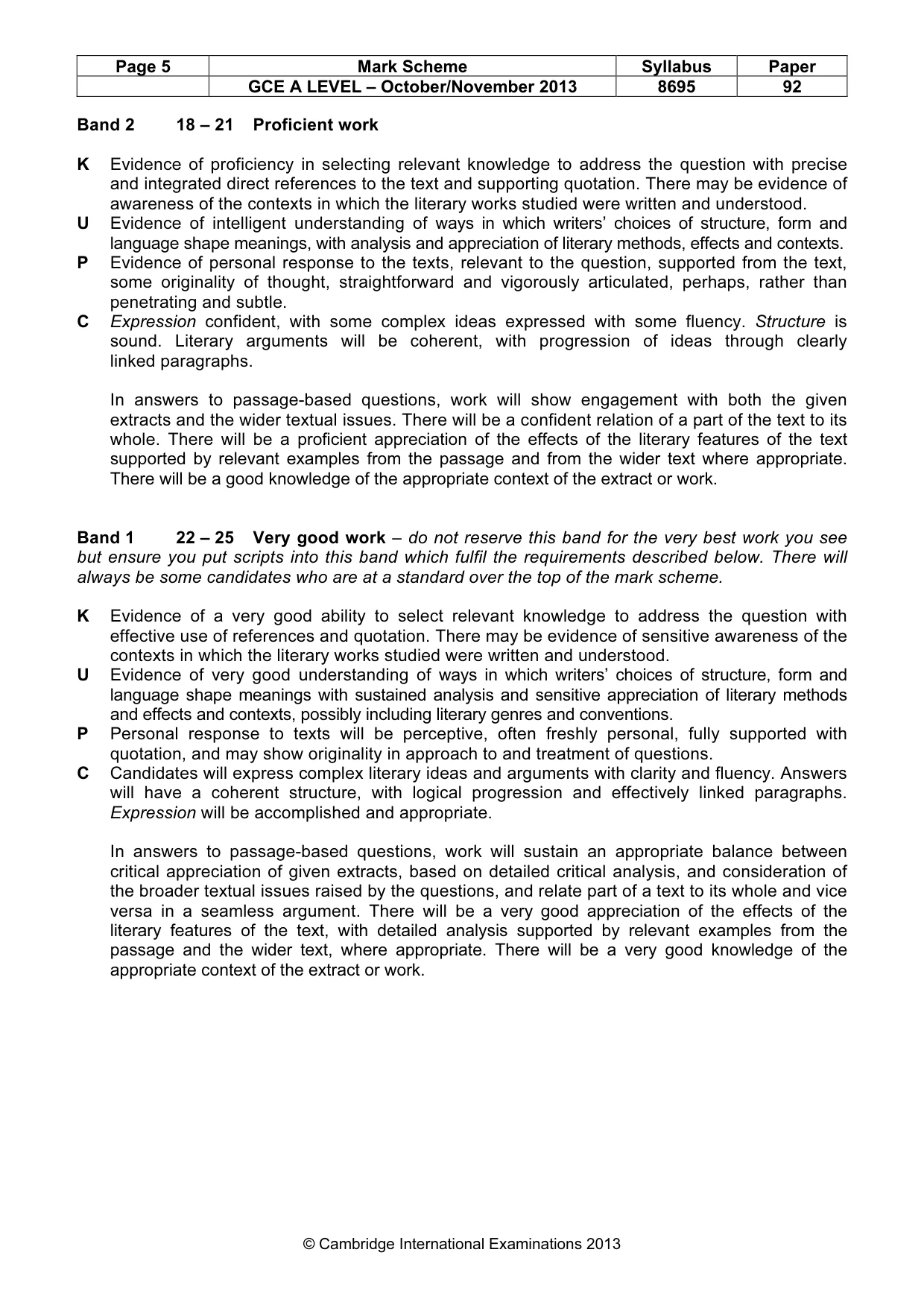
Page 5 Mark Scheme Syllabus Paper GCE A LEVEL – October/November 2013 8695 92 © Cambridge International Examinations 2013 Band 2 18 – 21 Proficient work K Evidence of proficiency in selecting relevant knowledge to address the question with precise and integrated direct references to the text and supporting quotation. There may be evidence of awareness of the contexts in which the literary works studied were written and understood. U Evidence of intelligent understanding of ways in which writers’ choices of structure, form and language shape meanings, with analysis and appreciation of literary methods, effects and contexts. P Evidence of personal response to the texts, relevant to the question, supported from the text, some originality of thought, straightforward and vigorously articulated, perhaps, rather than penetrating and subtle. C Expression confident, with some complex ideas expressed with some fluency. Structure is sound. Literary arguments will be coherent, with progression of ideas through clearly linked paragraphs. In answers to passage-based questions, work will show engagement with both the given extracts and the wider textual issues. There will be a confident relation of a part of the text to its whole. There will be a proficient appreciation of the effects of the literary features of the text supported by relevant examples from the passage and from the wider text where appropriate. There will be a good knowledge of the appropriate context of the extract or work. Band 1 22 – 25 Very good work – do not reserve this band for the very best work you see but ensure you put scripts into this band which fulfil the requirements described below. There will always be some candidates who are at a standard over the top of the mark scheme. K Evidence of a very good ability to select relevant knowledge to address the question with effective use of references and quotation. There may be evidence of sensitive awareness of the contexts in which the literary works studied were written and understood. U Evidence of very good understanding of ways in which writers’ choices of structure, form and language shape meanings with sustained analysis and sensitive appreciation of literary methods and effects and contexts, possibly including literary genres and conventions. P Personal response to texts will be perceptive, often freshly personal, fully supported with quotation, and may show originality in approach to and treatment of questions. C Candidates will express complex literary ideas and arguments with clarity and fluency. Answers will have a coherent structure, with logical progression and effectively linked paragraphs. Expression will be accomplished and appropriate. In answers to passage-based questions, work will sustain an appropriate balance between critical appreciation of given extracts, based on detailed critical analysis, and consideration of the broader textual issues raised by the questions, and relate part of a text to its whole and vice versa in a seamless argument. There will be a very good appreciation of the effects of the literary features of the text, with detailed analysis supported by relevant examples from the passage and the wider text, where appropriate. There will be a very good knowledge of the appropriate context of the extract or work.
What you needed in this session
Cambridge’s own grade thresholds for 2013 Oct/Nov, Paper 9 · Variant 2. A higher threshold means an easier paper — the bar moves with how the cohort did.