Cambridge A Level English - Language and Literature (AS Level only, from 2016) 8695 — 2013 Oct/Nov Paper 9 · Variant 1
8695/91/O/N/13 · 50 marks · ≈56 min
The question paper and its mark scheme, free to read here and free to download. This is Cambridge’s own paper, exactly as it was sat.
Question paper16 pages
Mark scheme5 pages
Answers below. Sit the paper first if you are practising.
Paper as text
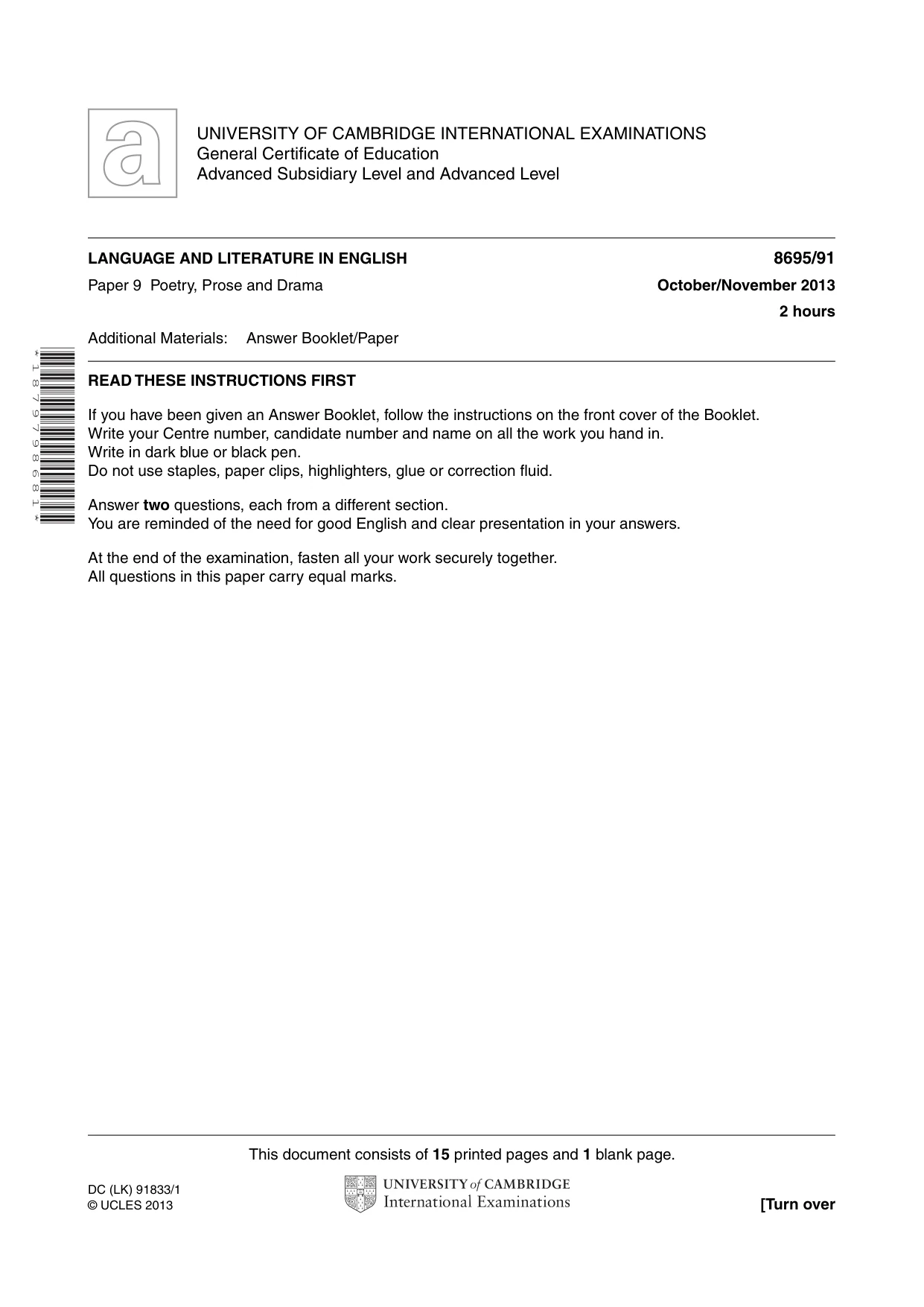
Question paper, page 1
This document consists of 15 printed pages and 1 blank page. DC (LK) 91833/1 © UCLES 2013 [Turn over UNIVERSITY OF CAMBRIDGE INTERNATIONAL EXAMINATIONS General Certificate of Education Advanced Subsidiary Level and Advanced Level * 1 8 7 9 7 9 8 6 8 1 * LANGUAGE AND LITERATURE IN ENGLISH 8695/91 Paper 9 Poetry, Prose and Drama October/November 2013 2 hours Additional Materials: Answer Booklet/Paper READ THESE INSTRUCTIONS FIRST If you have been given an Answer Booklet, follow the instructions on the front cover of the Booklet. Write your Centre number, candidate number and name on all the work you hand in. Write in dark blue or black pen. Do not use staples, paper clips, highlighters, glue or correction fluid. Answer two questions, each from a different section. You are reminded of the need for good English and clear presentation in your answers. At the end of the examination, fasten all your work securely together. All questions in this paper carry equal marks.
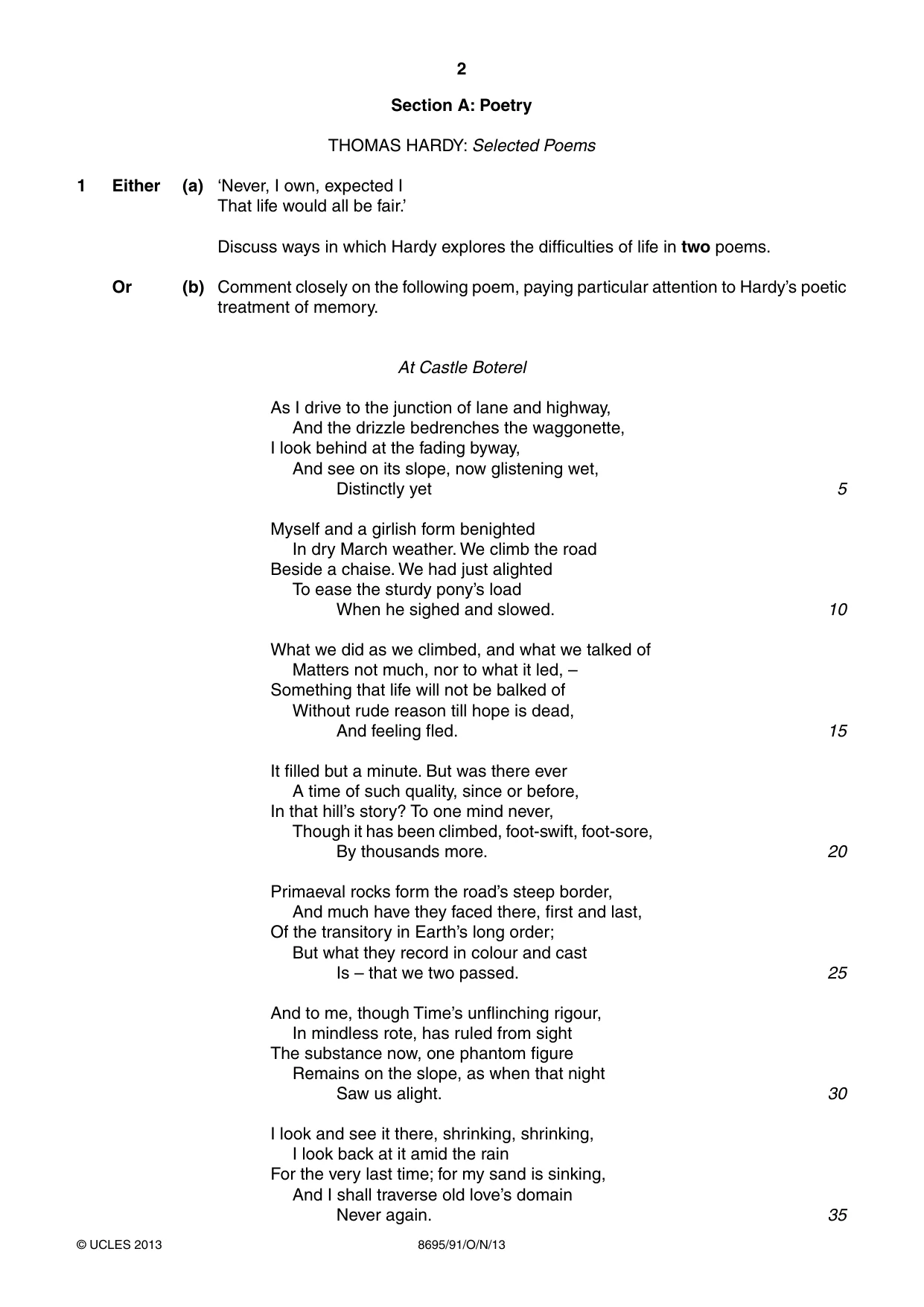
Question paper, page 2
2 8695/91/O/N/13 © UCLES 2013 Section A: Poetry THOMAS HARDY: Selected Poems 1 Either (a) ‘Never, I own, expected I That life would all be fair.’ Discuss ways in which Hardy explores the difficulties of life in two poems. Or (b) Comment closely on the following poem, paying particular attention to Hardy’s poetic treatment of memory. At Castle Boterel As I drive to the junction of lane and highway, And the drizzle bedrenches the waggonette, I look behind at the fading byway, And see on its slope, now glistening wet, Distinctly yet Myself and a girlish form benighted In dry March weather. We climb the road Beside a chaise. We had just alighted To ease the sturdy pony’s load When he sighed and slowed. What we did as we climbed, and what we talked of Matters not much, nor to what it led, – Something that life will not be balked of Without rude reason till hope is dead, And feeling fled. It filled but a minute. But was there ever A time of such quality, since or before, In that hill’s story? To one mind never, Though it has been climbed, foot-swift, foot-sore, By thousands more. Primaeval rocks form the road’s steep border, And much have they faced there, first and last, Of the transitory in Earth’s long order; But what they record in colour and cast Is – that we two passed. And to me, though Time’s unflinching rigour, In mindless rote, has ruled from sight The substance now, one phantom figure Remains on the slope, as when that night Saw us alight. I look and see it there, shrinking, shrinking, I look back at it amid the rain For the very last time; for my sand is sinking, And I shall traverse old love’s domain Never again. 5 10 15 20 25 30 35
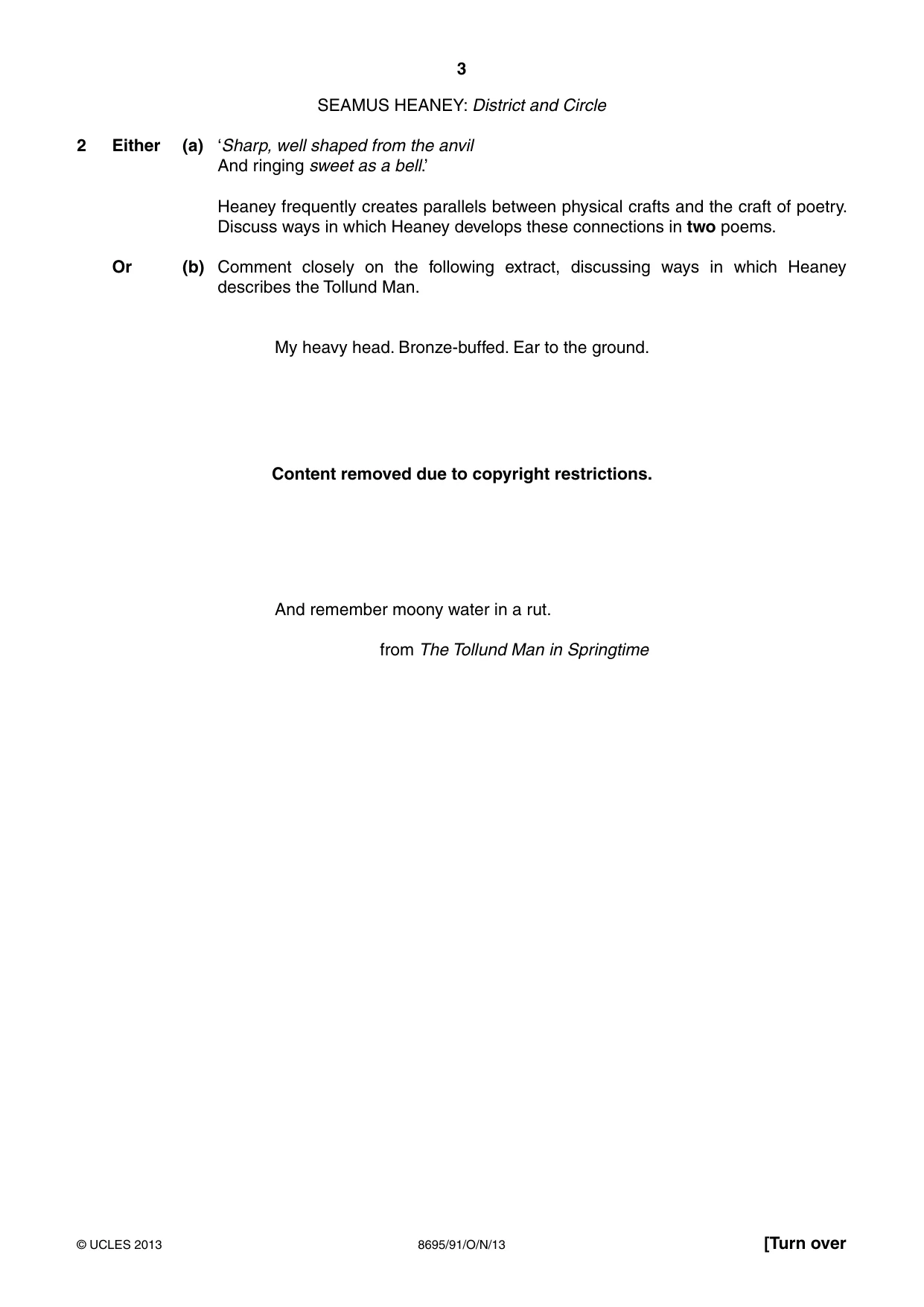
Question paper, page 3
3 8695/91/O/N/13 © UCLES 2013 [Turn over 5 10 SEAMUS HEANEY: District and Circle 2 Either (a) ‘Sharp, well shaped from the anvil And ringing sweet as a bell.’ Heaney frequently creates parallels between physical crafts and the craft of poetry. Discuss ways in which Heaney develops these connections in two poems. Or (b) Comment closely on the following extract, discussing ways in which Heaney describes the Tollund Man. My heavy head. Bronze-buffed. Ear to the ground. My eye at turf level. Its snailskin lid. My cushioned cheek and brow. My phantom hand And arm and leg and shoulder that felt pillowed As fleshily as when the bog pith weighed To mould me to itself and it to me Between when I was buried and unburied. Between what happened and was meant to be. On show for years while all that lay in wait Still waited. Disembodied. Far renowned. Faith placed in me, me faithless as a stone The harrow turned up when the crop was sown. Out in the Danish night I’d hear soft wind And remember moony water in a rut. from The Tollund Man in Springtime Content removed due to copyright restrictions.
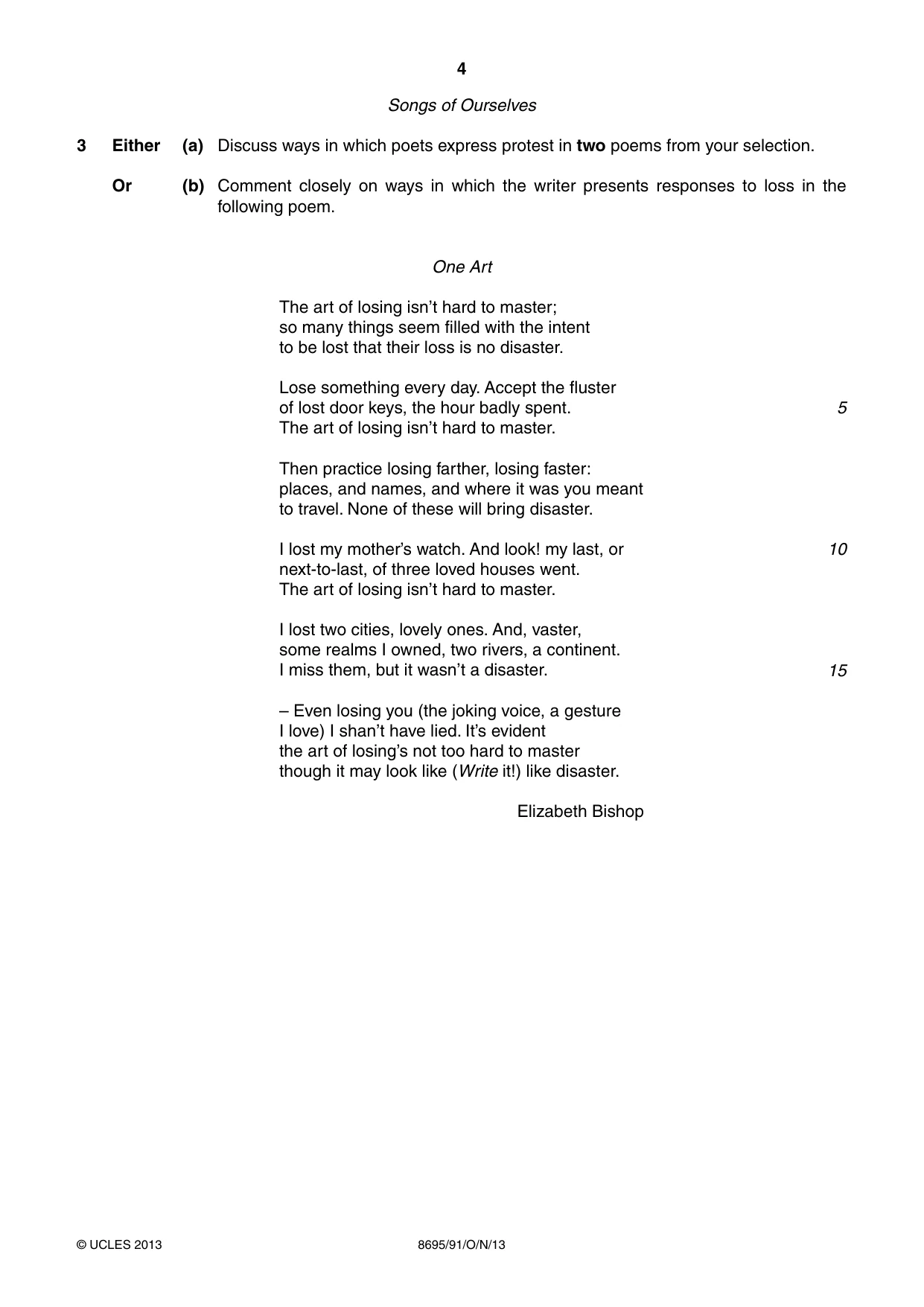
Question paper, page 4
4 8695/91/O/N/13 © UCLES 2013 Songs of Ourselves 3 Either (a) Discuss ways in which poets express protest in two poems from your selection. Or (b) Comment closely on ways in which the writer presents responses to loss in the following poem. One Art The art of losing isn’t hard to master; so many things seem filled with the intent to be lost that their loss is no disaster. Lose something every day. Accept the fluster of lost door keys, the hour badly spent. The art of losing isn’t hard to master. Then practice losing farther, losing faster: places, and names, and where it was you meant to travel. None of these will bring disaster. I lost my mother’s watch. And look! my last, or next-to-last, of three loved houses went. The art of losing isn’t hard to master. I lost two cities, lovely ones. And, vaster, some realms I owned, two rivers, a continent. I miss them, but it wasn’t a disaster. – Even losing you (the joking voice, a gesture I love) I shan’t have lied. It’s evident the art of losing’s not too hard to master though it may look like (Write it!) like disaster. Elizabeth Bishop 5 10 15
Question paper, page 5
5 8695/91/O/N/13 © UCLES 2013 [Turn over Section B: Prose CHIMAMANDA NGOZI ADICHIE: Half of a Yellow Sun 4 Either (a) ‘“Abu m onye Biafra,” Richard said. The man laughed… “Eh, a white man who is saying that he is a Biafran!”’ Discuss the role and significance of Richard in the novel. Or (b) Comment closely on the following passage, paying particular attention to ways in which it presents the effects of war on individuals. ‘Let’s go!’ Ugwu called out, wiping his bloodied hands on his trousers. The others thumped him on the back and called him ‘Target Destroyer!’ as they trooped to headquarters to hand in their cables. ‘You learn this from that book you read?’ they teased. Success hauled him up above the ground. He floated through the following days as they played Biafran whot and drank gin and waited for the next operation. He lay face up on the ground while High-Tech rolled up some wee- wee, the leaves crisply dried, in old paper and they smoked together. He preferred Mars cigarettes; the wee-wee made him feel disjointed, created a thin slice of space between his legs and hips. They didn’t bother to hide their smoking because the commander was happy and the news was hope-filled now that Biafra had recaptured Owerri from the vandals. Rules relaxed; they could go out to the bar near the expressway. ‘It’s a long walk,’ somebody said, and High-Tech laughed and said, ‘We will commandeer a car, of course.’ When High-Tech laughed, Ugwu remembered he was a child. Only thirteen. Among nine men he looked incongruously small, Ugwu thought, as they walked along. The sound of rubber slippers echoed on the silent road. Two of them were barefoot. They waited awhile before a dusty Volkswagen Beetle drove towards them and then spread across the road and blocked it. The car stopped, and a few of them banged on the bonnet. ‘Get out! Bloody civilians!’ The man who was driving looked stern, as if determined to show that he could not be intimidated. Beside him, his wife began to cry and plead. ‘Please, we are going to look for our son.’ A soldier was violently hitting the bonnet of the car. ‘We need this for an operation!’ ‘Please, please, we are going to look for our son. They told us he was seen in the refugee camp.’ The woman stared at High-Tech for a while, her brows furrowed. Perhaps she thought he might be her son. ‘We are dying for you and you are here driving a pleasure car?’ a soldier asked, pulling her out of the car. Her husband climbed out himself, but still stood by the car. His fist was tight with the key inside. ‘This is wrong, officers. You have no right to take this car. I have my pass. I am working for our government.’ One of the soldiers slapped him. The man staggered and the soldier slapped him again and again and again and he crashed to the ground and the key slipped out of his hand. ‘It is enough!’ Ugwu said. Another soldier touched the man’s neck and wrist to make sure he was breathing. The wife was bent over her husband as the soldiers squashed into the car and drove to the bar. Chapter 29 5 10 15 20 25 30 35 40
Question paper, page 6
6 8695/91/O/N/13 © UCLES 2013 E.M. FORSTER: A Passage to India 5 Either (a) ‘Courtesy, by all means. Intimacy – never, never… if there has been mutual respect and esteem, it is because both peoples kept to this simple rule.’ Discuss Forster’s presentation of the relationships between the English and the Indians in the light of this comment. Or (b) Comment closely on the following passage, discussing ways in which Forster presents the festival and Aziz’s response to it. All culminated in the dance of the milkmaidens before Krishna, and in the still greater dance of Krishna before the milkmaidens, when the music and the musicians swirled through the dark blue robes of the actors into their tinsel crowns, and all became one. The Rajah and his guests would then forget that this was a dramatic performance, and would worship the actors. Nothing of the sort could occur today, because death interrupts. It interrupted less here than in Europe, its pathos was less poignant, its irony less cruel. There were two claimants to the throne, unfortunately, who were in the palace now and suspected what had happened, yet they made no trouble, because religion is a living force to the Hindus, and can at certain moments fling down everything that is petty and temporary in their natures. The festival flowed on, wild and sincere, and all men loved each other, and avoided by instinct whatever could cause inconvenience or pain. Aziz could not understand this, any more than an average Christian could. He was puzzled that Mau should suddenly be purged from suspicion and self-seeking. Although he was an outsider, and excluded from their rites, they were always particularly charming to him at this time; he and his household received small courtesies and presents, just because he was outside. He had nothing to do all day, except to send the embrocation over to the Guest House, and towards sunset he remembered it, and looked round his house for a local palliative, for the dispensary was shut. He found a tin of ointment belonging to Mohammed Latif, who was unwilling it should be removed, for magic words had been spoken over it while it was being boiled down, but Aziz promised that he would bring it back after application to the stings; he wanted an excuse for a ride. The procession was beginning to form as he passed the palace. A large crowd watched the loading of the State palanquin, the prow of which protruded in the form of a silver dragon’s head through the lofty half-opened door. Gods, big and little, were getting aboard. He averted his eyes, for he never knew how much he was supposed to see, and nearly collided with the Minister of Education. ‘Ah, you might make me late’ – meaning that the touch of a non-Hindu would necessitate another bath; the words were spoken without moral heat. ‘Sorry,’ said Aziz. The other smiled, and again mentioned the Guest House party, and, when he heard that Fielding’s wife was not Miss Quested, after all, remarked: ‘Ah, no, he married the sister of Mr Heaslop. Ah, exactly, I have known that for over a year’ – also without heat. ‘Why did you not tell me? Your silence plunged me into a pretty pickle.’ Godbole, who had never been known to tell anyone anything, smiled again, and said in deprecating tones: ‘Never be angry with me. I am, as far as my limitations permit, your true friend; besides, it is my holy festival.’ Aziz always felt like a baby in that strange presence, a baby who unexpectedly receives a toy. He smiled also, and turned his horse into a lane, for the crush increased. The Sweepers’ Band was arriving. Playing on sieves and other emblems of their profession, they marched straight at the gate of the palace with the air of a victorious army. All other music was silent, for this was ritually the moment of the Despised and Rejected; the God could not issue from His temple until the unclean sweepers played their tune, they were the spot of filth without which the spirit cannot cohere. For an instant the scene was magnificent. 5 10 15 20 25 30 35 40
Question paper, page 7
7 8695/91/O/N/13 © UCLES 2013 [Turn over The doors were thrown open, and the whole court was seen inside, barefoot and dressed in white robes; in the fairway stood the Ark of the Lord, covered with cloth of gold and flanked by peacock fans and by stiff circular banners of crimson. It was full to the brim with statuettes and flowers. As it rose from the earth on the shoulders of its bearers, the friendly sun of the monsoons shone forth and flooded the world with colour, so that the yellow tigers painted on the palace walls seemed to spring, and pink and gray skeins of cloud to link up the upper sky. The palanquin moved … The lane was full of State elephants, who would follow it, their howdahs empty out of humility. Aziz did not pay attention to these sanctities, for they had no connection with his own; he felt bored, slightly cynical, like his own dear Emperor Babur, who came down from the north and found in Hindustan no good fruit, no fresh water or witty conversation, not even a friend. Chapter 36 45 50 55
Question paper, page 8
8 8695/91/O/N/13 © UCLES 2013 Stories of Ourselves 6 Either (a) ‘…waiting, waiting, for one moment of inattention, weakness, pain, to claim her for ever.’ Discuss ways in which two stories from your selection treat the subject of death. Or (b) Comment closely on Carver’s writing in the following passage, paying particular attention to ways in which it explores the narrator’s state of mind. My son wrote from New Hampshire that it was essential he go back to Europe. His life hung in the balance, he said. He was graduating at the end of summer session, but he couldn’t stand to live in America a day longer after that. This was a materialist society, and he simply couldn’t take it anymore. People over here, in the U.S., couldn’t hold a conversation unless money figured in it some way, and he was sick of it. He wasn’t a Yuppie, and didn’t want to become a Yuppie. That wasn’t his thing. He’d get out of my hair, he said, if he could just borrow enough from me, this one last time, to buy a ticket to Germany. I didn’t hear anything from my former wife. I didn’t have to. We both knew how things stood there. My mother wrote that she was having to do without support hose and wasn’t able to have her hair tinted. She’d thought this would be the year she could put some money back for the rainy days ahead, but it wasn’t working out that way. She could see it wasn’t in the cards. ‘How are you?’ she wanted to know. ‘How’s everybody else? I hope you’re okay.’ I put more checks in the mail. Then I held my breath and waited. While I was waiting, I had this dream one night. Two dreams, really. I dreamt them on the same night. In the first dream, my dad was alive once more, and he was giving me a ride on his shoulders. I was this little kid, maybe five or six years old. Get up here, he said, and he took me by the hands and swung me onto his shoulders. I was high off the ground, but I wasn’t afraid. He was holding on to me. We were holding on to each other. Then he began to move down the sidewalk. I brought my hands up from his shoulders and put them around his forehead. Don’t muss my hair, he said. You can let go, he said, I’ve got you. You won’t fall. When he said that, I became aware of the strong grip of his hands around my ankles. Then I did let go. I turned loose and held my arms out on either side of me. I kept them out there like that for balance. My dad went on walking while I rode on his shoulders. I pretended he was an elephant. I don’t know where we were going. Maybe we were going to the store, or else to the park so he could push me in the swing. I woke up then, got out of bed, and used the bathroom. It was starting to get light out, and it was only an hour or so until I had to get up. I thought about making coffee and getting dressed. But then I decided to go back to bed. I didn’t plan to sleep, though. I thought I’d just lie there for a while with my hands behind my neck and watch it turn light out and maybe think about my dad a little, since I hadn’t thought about him in a long time. He just wasn’t a part of my life any longer, waking or sleeping. Anyway, I got back in bed. But it couldn’t have been more than a minute before I fell asleep once more, and when I did I got into this other dream. My former wife was in it, though she wasn’t my former wife in the dream. She was still my wife. My kids were in it, too. They were little, and they were eating potato chips. In my dream, I thought I could smell the potato chips and hear them being eaten. We were on a blanket, and we were close to some water. There was a sense of satisfaction and well-being in the dream. Then, suddenly, I found myself in the company of some other people – people I didn’t know – and the next thing that happened was that I was kicking the window out of my son’s car and threatening his life, as I did once, a long time ago. He was inside the car as my shoe smashed through the glass. That’s 5 10 15 20 25 30 35 40 45
Question paper, page 9
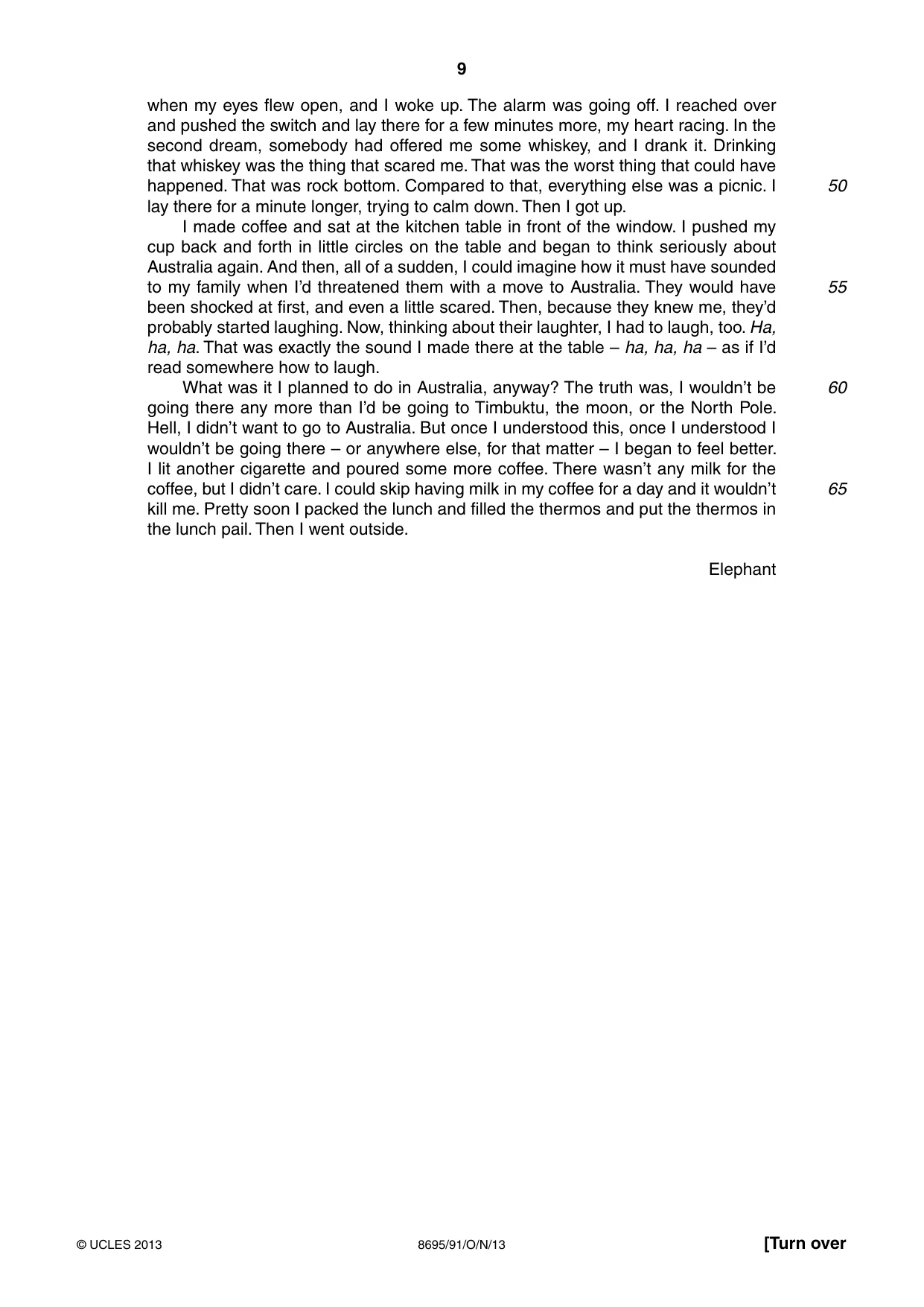
9 8695/91/O/N/13 © UCLES 2013 [Turn over when my eyes flew open, and I woke up. The alarm was going off. I reached over and pushed the switch and lay there for a few minutes more, my heart racing. In the second dream, somebody had offered me some whiskey, and I drank it. Drinking that whiskey was the thing that scared me. That was the worst thing that could have happened. That was rock bottom. Compared to that, everything else was a picnic. I lay there for a minute longer, trying to calm down. Then I got up. I made coffee and sat at the kitchen table in front of the window. I pushed my cup back and forth in little circles on the table and began to think seriously about Australia again. And then, all of a sudden, I could imagine how it must have sounded to my family when I’d threatened them with a move to Australia. They would have been shocked at first, and even a little scared. Then, because they knew me, they’d probably started laughing. Now, thinking about their laughter, I had to laugh, too. Ha, ha, ha. That was exactly the sound I made there at the table – ha, ha, ha – as if I’d read somewhere how to laugh. What was it I planned to do in Australia, anyway? The truth was, I wouldn’t be going there any more than I’d be going to Timbuktu, the moon, or the North Pole. Hell, I didn’t want to go to Australia. But once I understood this, once I understood I wouldn’t be going there – or anywhere else, for that matter – I began to feel better. I lit another cigarette and poured some more coffee. There wasn’t any milk for the coffee, but I didn’t care. I could skip having milk in my coffee for a day and it wouldn’t kill me. Pretty soon I packed the lunch and filled the thermos and put the thermos in the lunch pail. Then I went outside. Elephant 50 55 60 65
Question paper, page 10
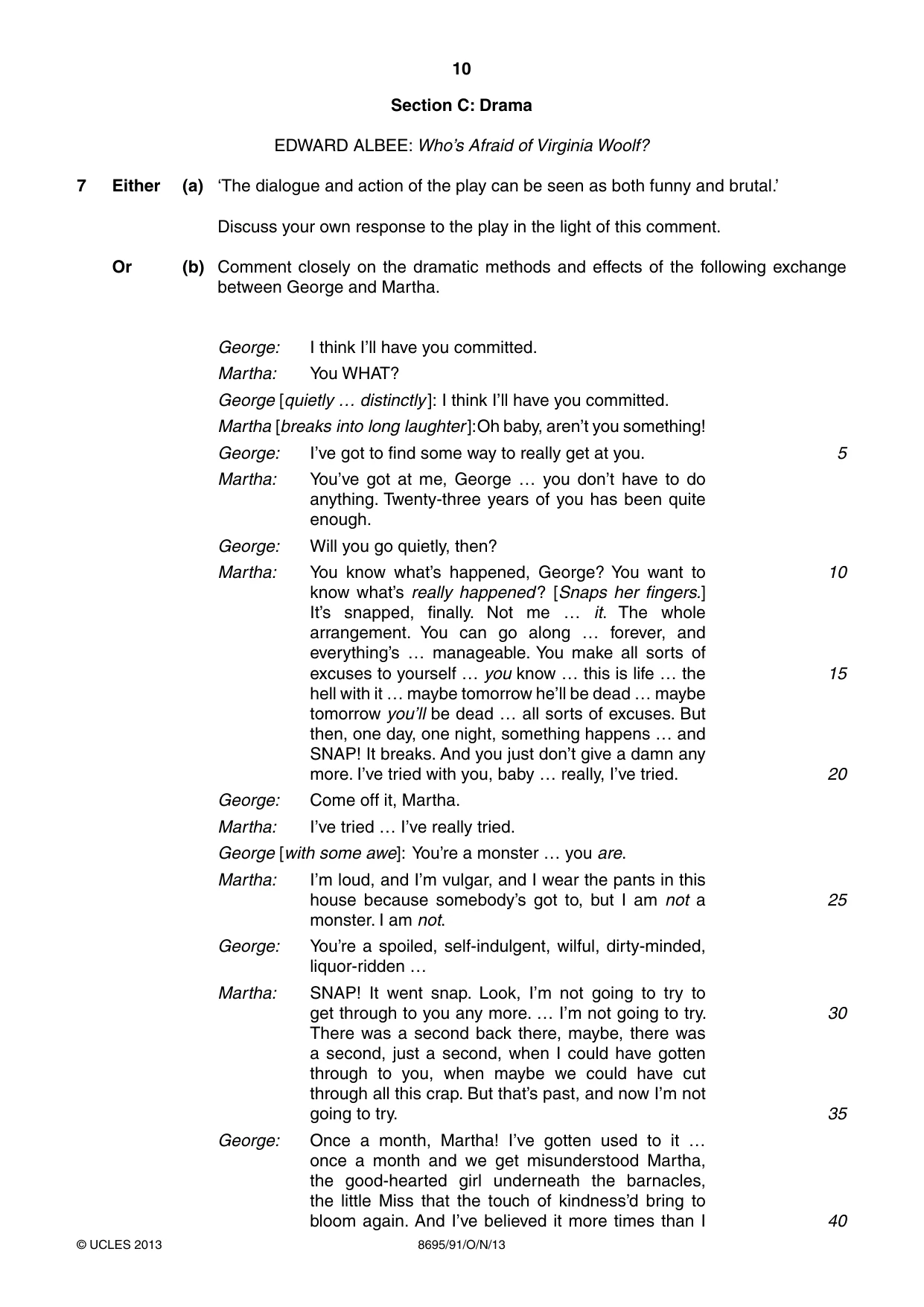
10 8695/91/O/N/13 © UCLES 2013 Section C: Drama EDWARD ALBEE: Who’s Afraid of Virginia Woolf? 7 Either (a) ‘The dialogue and action of the play can be seen as both funny and brutal.’ Discuss your own response to the play in the light of this comment. Or (b) Comment closely on the dramatic methods and effects of the following exchange between George and Martha. George: I think I’ll have you committed. Martha: You WHAT? George [quietly … distinctly ]: I think I’ll have you committed. Martha [breaks into long laughter ]: Oh baby, aren’t you something! George: I’ve got to find some way to really get at you. Martha: You’ve got at me, George … you don’t have to do anything. Twenty-three years of you has been quite enough. George: Will you go quietly, then? Martha: You know what’s happened, George? You want to know what’s really happened ? [Snaps her fingers.] It’s snapped, finally. Not me … it. The whole arrangement. You can go along … forever, and everything’s … manageable. You make all sorts of excuses to yourself … you know … this is life … the hell with it … maybe tomorrow he’ll be dead … maybe tomorrow you’ll be dead … all sorts of excuses. But then, one day, one night, something happens … and SNAP! It breaks. And you just don’t give a damn any more. I’ve tried with you, baby … really, I’ve tried. George: Come off it, Martha. Martha: I’ve tried … I’ve really tried. George [with some awe]: You’re a monster … you are. Martha: I’m loud, and I’m vulgar, and I wear the pants in this house because somebody’s got to, but I am not a monster. I am not. George: You’re a spoiled, self-indulgent, wilful, dirty-minded, liquor-ridden … Martha: SNAP! It went snap. Look, I’m not going to try to get through to you any more. … I’m not going to try. There was a second back there, maybe, there was a second, just a second, when I could have gotten through to you, when maybe we could have cut through all this crap. But that’s past, and now I’m not going to try. George: Once a month, Martha! I’ve gotten used to it … once a month and we get misunderstood Martha, the good-hearted girl underneath the barnacles, the little Miss that the touch of kindness’d bring to bloom again. And I’ve believed it more times than I 5 10 15 20 25 30 35 40
Question paper, page 11
11 8695/91/O/N/13 © UCLES 2013 [Turn over want to remember, because I don’t want to think I’m that much of a sucker. I don’t believe you … I just don’t believe you. There is no moment … there is no moment any more when we could … come together. Martha [armed again]: Well, maybe you’re right, baby. You can’t come together with nothing, and you’re nothing! SNAP! It went snap tonight at Daddy’s party. [Dripping contempt, but there is fury and loss under it.] I sat there at Daddy’s party, and I watched you … I watched you sitting there, and I watched the younger men around you, the men who were going to go somewhere. And I sat there and I watched you, and you weren’t there! And it snapped! It finally snapped! And I’m going to howl it out, and I’m not going to give a damn what I do, and I’m going to make the damned biggest explosion you ever heard. George [very pointedly ]: You try it and I’ll beat you at your own game. Martha [hopefully ]: Is that a threat, George? Hunh? George: That’s a threat, Martha. Martha [fake-spits at him ]: You’re going to get it, baby. George: Be careful, Martha … I’ll rip you to pieces. Martha: You aren’t man enough … you haven’t got the guts. George: Total war? Martha: Total. [Silence. They both seem relieved … elated.] Act 2 45 50 55 60 65
Question paper, page 12
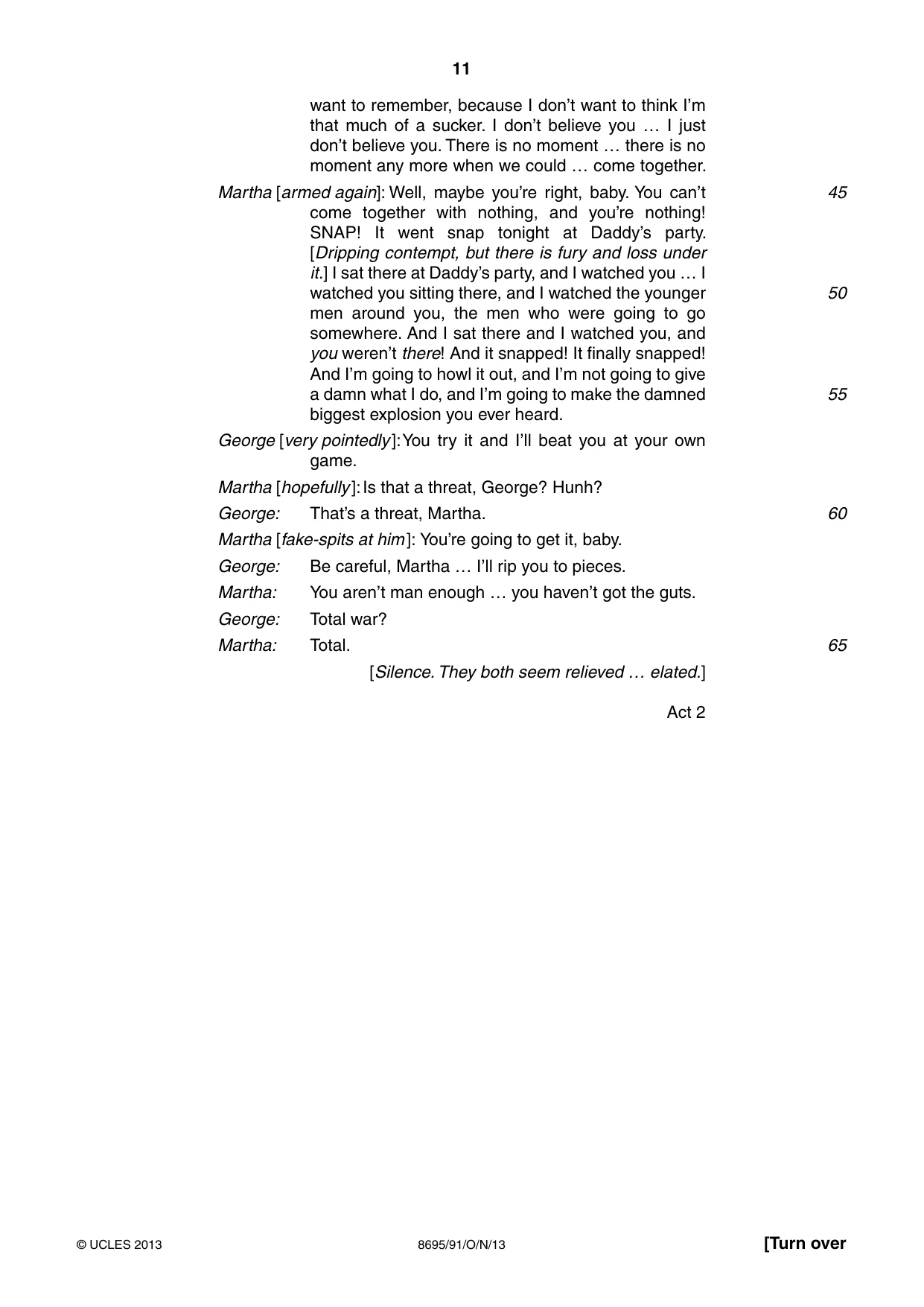
12 8695/91/O/N/13 © UCLES 2013 WILLIAM SHAKESPEARE: Richard III 8 Either (a) Hastings refers to the ‘tott’ring state’. Discuss ways in which Shakespeare presents a nation in political turmoil. Or (b) Comment closely on the following extract, discussing ways in which Shakespeare shapes an audience’s response to Clarence. Gloucester: I do the wrong, and first begin to brawl. The secret mischiefs that I set abroach I lay unto the grievous charge of others. Clarence, who I indeed have cast in darkness, I do beweep to many simple gulls; Namely, to Derby, Hastings, Buckingham; And tell them ’tis the Queen and her allies That stir the King against the Duke my brother. Now they believe it, and withal whet me To be reveng’d on Rivers, Dorset, Grey; But then I sigh and, with a piece of Scripture, Tell them that God bids us do good for evil. And thus I clothe my naked villainy With odd old ends stol’n forth of holy writ, And seem a saint when most I play the devil. [Enter two MURDERERS. But, soft, here come my executioners. How now, my hardy stout resolved mates! Are you now going to dispatch this thing? 1 Murderer: We are, my lord, and come to have the warrant, That we may be admitted where he is. Gloucester: Well thought upon; I have it here about me. [Gives the warrant. When you have done, repair to Crosby Place. But, sirs, be sudden in the execution, Withal obdurate, do not hear him plead; For Clarence is well-spoken, and perhaps May move your hearts to pity, if you mark him. 1 Murderer: Tut, tut, my lord, we will not stand to prate; Talkers are no good doers. Be assur’d We go to use our hands and not our tongues. Gloucester: Your eyes drop millstones when fools’ eyes fall tears. I like you, lads; about your business straight; Go, go, dispatch. 1 Murderer: We will, my noble lord. [Exeunt. SCENE IV. London. The Tower. [Enter CLARENCE and KEEPER. Keeper: Why looks your Grace so heavily to-day? Clarence: O, I have pass’d a miserable night, 5 10 15 20 25 30 35 40
Question paper, page 13
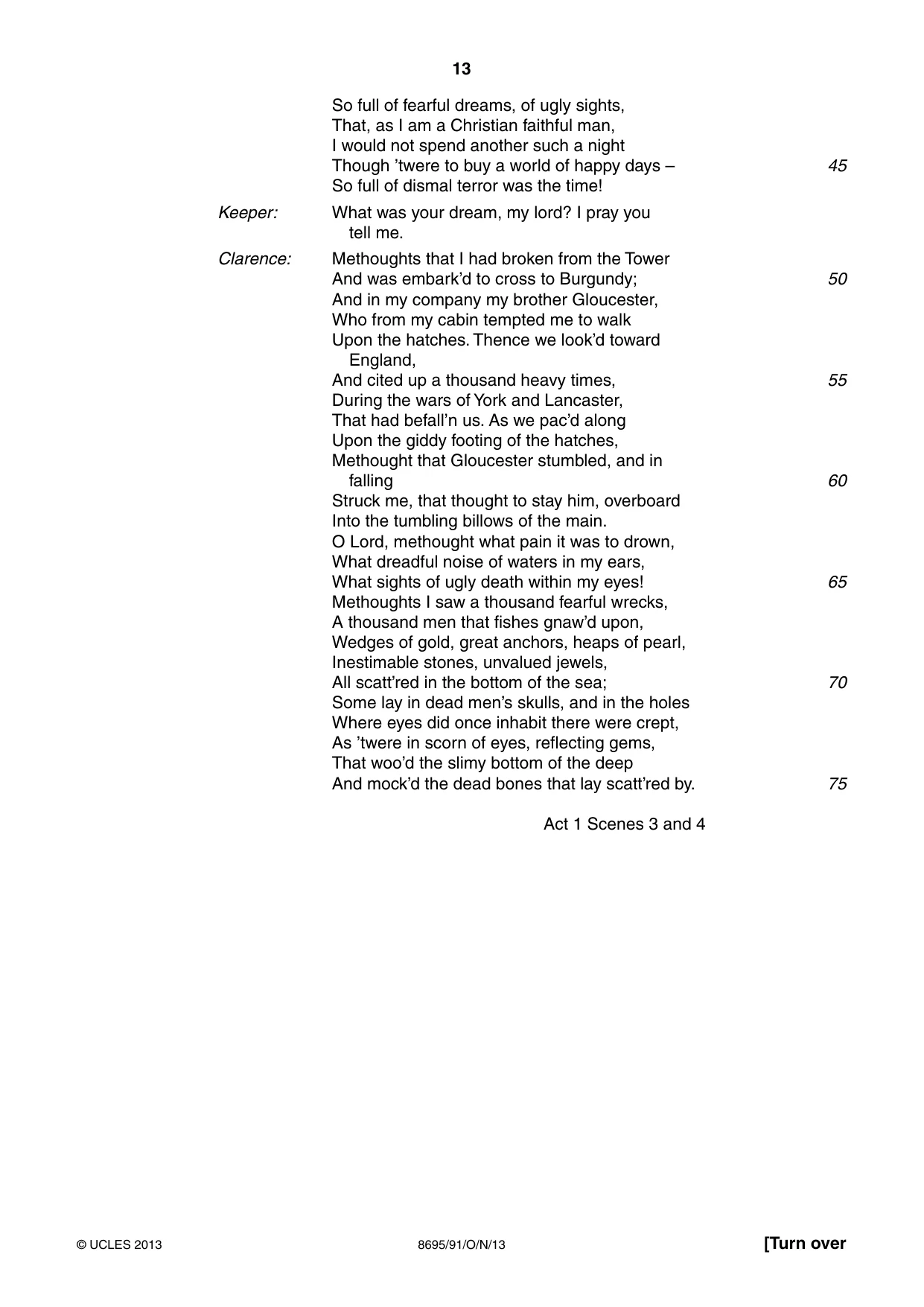
13 8695/91/O/N/13 © UCLES 2013 [Turn over So full of fearful dreams, of ugly sights, That, as I am a Christian faithful man, I would not spend another such a night Though ’twere to buy a world of happy days – So full of dismal terror was the time! Keeper: What was your dream, my lord? I pray you tell me. Clarence: Methoughts that I had broken from the Tower And was embark’d to cross to Burgundy; And in my company my brother Gloucester, Who from my cabin tempted me to walk Upon the hatches. Thence we look’d toward England, And cited up a thousand heavy times, During the wars of York and Lancaster, That had befall’n us. As we pac’d along Upon the giddy footing of the hatches, Methought that Gloucester stumbled, and in falling Struck me, that thought to stay him, overboard Into the tumbling billows of the main. O Lord, methought what pain it was to drown, What dreadful noise of waters in my ears, What sights of ugly death within my eyes! Methoughts I saw a thousand fearful wrecks, A thousand men that fishes gnaw’d upon, Wedges of gold, great anchors, heaps of pearl, Inestimable stones, unvalued jewels, All scatt’red in the bottom of the sea; Some lay in dead men’s skulls, and in the holes Where eyes did once inhabit there were crept, As ’twere in scorn of eyes, reflecting gems, That woo’d the slimy bottom of the deep And mock’d the dead bones that lay scatt’red by. Act 1 Scenes 3 and 4 45 50 55 60 65 70 75
Question paper, page 14
14 8695/91/O/N/13 © UCLES 2013 TENNESSEE WILLIAMS: A Streetcar Named Desire 9 Either (a) ‘BLANCHE: Has anyone ever told you that you look like a young prince out of the Arabian Nights?’ Discuss the importance of Blanche’s fantasies to the play as a whole. Or (b) Comment closely on Williams’s dramatic methods and their effects in the following passage. [Lurid reflections appear on the walls around BLANCHE. Content removed due to copyright restrictions.
Question paper, page 15
15 8695/91/O/N/13 © UCLES 2013 [He takes another step. She smashes a bottle on the table and faces him, clutching the broken top.] Scene 10 Content removed due to copyright restrictions.
Question paper, page 16
16 8695/91/O/N/13 © UCLES 2013 Copyright Acknowledgements: Question 2b Question 3b Question 4b Question 5b Question 6b Question 7b Question 9b © Seamus Heaney; The Tollund Man, in Springtime, from District and Circle; Faber & Faber Ltd; 2006. © Elizabeth Bishop; One Art, in Songs of Ourselves; Foundation Books; 2005. © Chimamanda Ngozi Adichie; Half of a Yellow Sun; Reproduced by permission of HarperCollins; 2006. © E M Forster; A Passage to India; The Provost and Scholars of Kings College, Cambridge. © Raymond Carver; Elephant, in Stories of Ourselves; Foundation Books / Cambridge University Press India; 2008. © Edward Albee; Who’s Afraid of Virginia Woolf?; Penguin Books Ltd; 1967. © A Streetcar Named Desire by Tennessee Williams. Copyright © 1947 by The University of The South. Reprinted by permission of Georges Borchardt, Inc. for the Estate of Tennessee Williams. Permission to reproduce items where third-party owned material protected by copyright is included has been sought and cleared where possible. Every reasonable effort has been made by the publisher (UCLES) to trace copyright holders, but if any items requiring clearance have unwittingly been included, the publisher will be pleased to make amends at the earliest possible opportunity. University of Cambridge International Examinations is part of the Cambridge Assessment Group. Cambridge Assessment is the brand name of University of Cambridge Local Examinations Syndicate (UCLES), which is itself a department of the University of Cambridge. BLANK PAGE
Mark scheme, page 1
CAMBRIDGE INTERNATIONAL EXAMINATIONS GCE Advanced Subsidiary Level and GCE Advanced Level MARK SCHEME for the October/November 2013 series 8695 LANGUAGE AND LITERATURE IN ENGLISH 8695/91 Paper 9 (Poetry, Prose, Drama), maximum raw mark 50 This mark scheme is published as an aid to teachers and candidates, to indicate the requirements of the examination. It shows the basis on which Examiners were instructed to award marks. It does not indicate the details of the discussions that took place at an Examiners’ meeting before marking began, which would have considered the acceptability of alternative answers. Mark schemes should be read in conjunction with the question paper and the Principal Examiner Report for Teachers. Cambridge will not enter into discussions about these mark schemes. Cambridge is publishing the mark schemes for the October/November 2013 series for most IGCSE, GCE Advanced Level and Advanced Subsidiary Level components and some Ordinary Level components.
Mark scheme, page 2
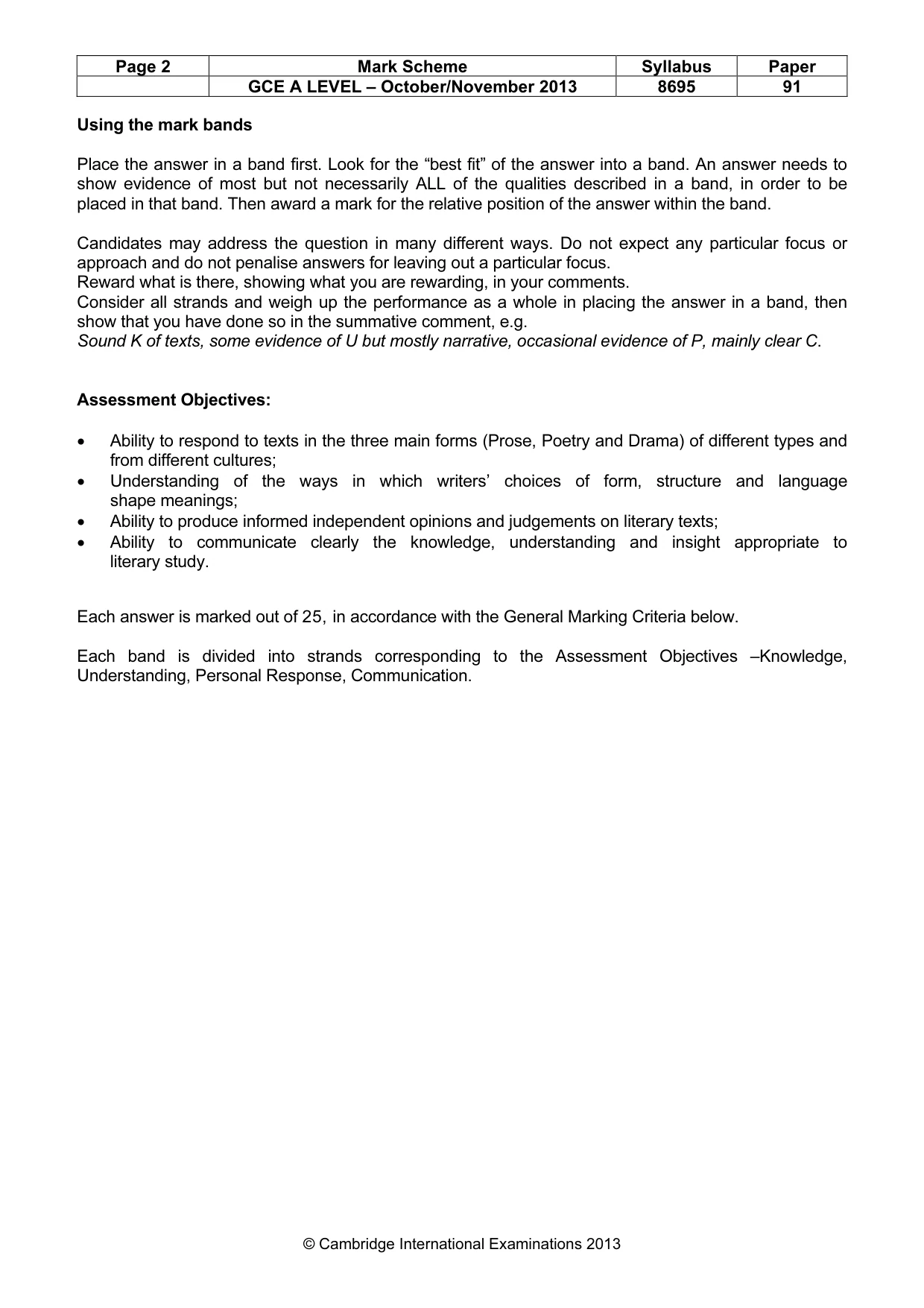
Page 2 Mark Scheme Syllabus Paper GCE A LEVEL – October/November 2013 8695 91 © Cambridge International Examinations 2013 Using the mark bands Place the answer in a band first. Look for the “best fit” of the answer into a band. An answer needs to show evidence of most but not necessarily ALL of the qualities described in a band, in order to be placed in that band. Then award a mark for the relative position of the answer within the band. Candidates may address the question in many different ways. Do not expect any particular focus or approach and do not penalise answers for leaving out a particular focus. Reward what is there, showing what you are rewarding, in your comments. Consider all strands and weigh up the performance as a whole in placing the answer in a band, then show that you have done so in the summative comment, e.g. Sound K of texts, some evidence of U but mostly narrative, occasional evidence of P, mainly clear C. Assessment Objectives: • Ability to respond to texts in the three main forms (Prose, Poetry and Drama) of different types and from different cultures; • Understanding of the ways in which writers’ choices of form, structure and language shape meanings; • Ability to produce informed independent opinions and judgements on literary texts; • Ability to communicate clearly the knowledge, understanding and insight appropriate to literary study. Each answer is marked out of 25, in accordance with the General Marking Criteria below. Each band is divided into strands corresponding to the Assessment Objectives –Knowledge, Understanding, Personal Response, Communication.
Mark scheme, page 3
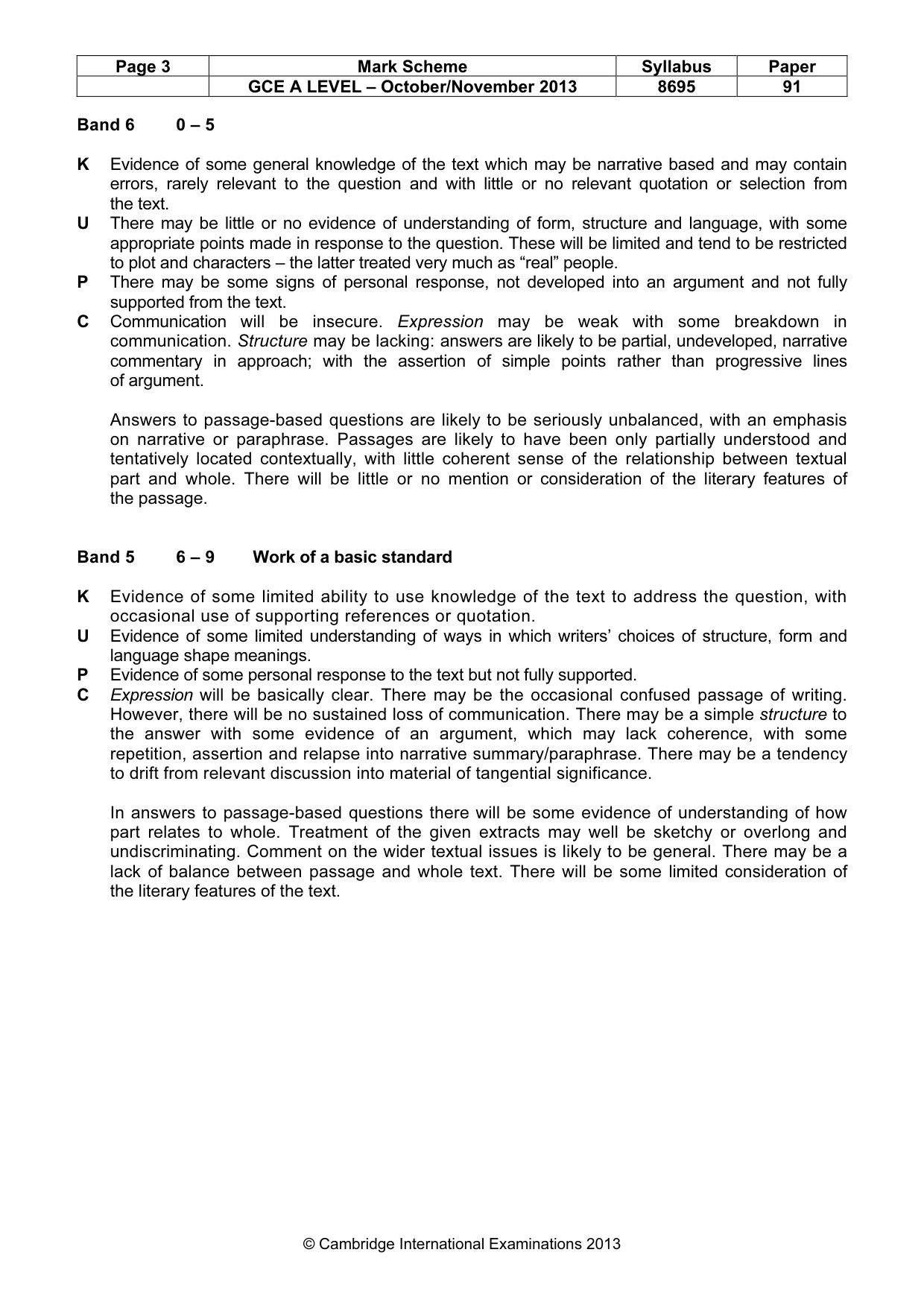
Page 3 Mark Scheme Syllabus Paper GCE A LEVEL – October/November 2013 8695 91 © Cambridge International Examinations 2013 Band 6 0 – 5 K Evidence of some general knowledge of the text which may be narrative based and may contain errors, rarely relevant to the question and with little or no relevant quotation or selection from the text. U There may be little or no evidence of understanding of form, structure and language, with some appropriate points made in response to the question. These will be limited and tend to be restricted to plot and characters – the latter treated very much as “real” people. P There may be some signs of personal response, not developed into an argument and not fully supported from the text. C Communication will be insecure. Expression may be weak with some breakdown in communication. Structure may be lacking: answers are likely to be partial, undeveloped, narrative commentary in approach; with the assertion of simple points rather than progressive lines of argument. Answers to passage-based questions are likely to be seriously unbalanced, with an emphasis on narrative or paraphrase. Passages are likely to have been only partially understood and tentatively located contextually, with little coherent sense of the relationship between textual part and whole. There will be little or no mention or consideration of the literary features of the passage. Band 5 6 – 9 Work of a basic standard K Evidence of some limited ability to use knowledge of the text to address the question, with occasional use of supporting references or quotation. U Evidence of some limited understanding of ways in which writers’ choices of structure, form and language shape meanings. P Evidence of some personal response to the text but not fully supported. C Expression will be basically clear. There may be the occasional confused passage of writing. However, there will be no sustained loss of communication. There may be a simple structure to the answer with some evidence of an argument, which may lack coherence, with some repetition, assertion and relapse into narrative summary/paraphrase. There may be a tendency to drift from relevant discussion into material of tangential significance. In answers to passage-based questions there will be some evidence of understanding of how part relates to whole. Treatment of the given extracts may well be sketchy or overlong and undiscriminating. Comment on the wider textual issues is likely to be general. There may be a lack of balance between passage and whole text. There will be some limited consideration of the literary features of the text.
Mark scheme, page 4
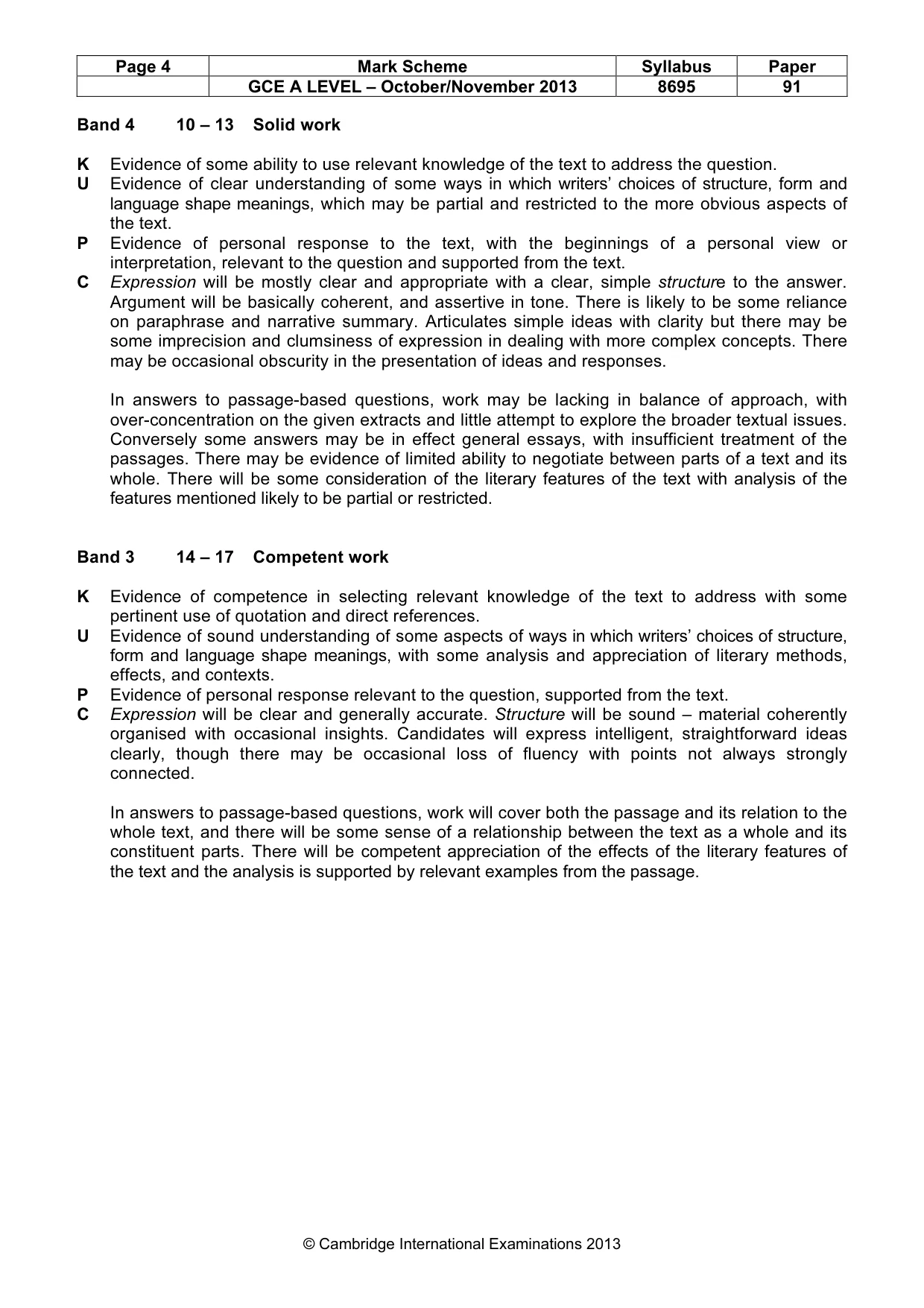
Page 4 Mark Scheme Syllabus Paper GCE A LEVEL – October/November 2013 8695 91 © Cambridge International Examinations 2013 Band 4 10 – 13 Solid work K Evidence of some ability to use relevant knowledge of the text to address the question. U Evidence of clear understanding of some ways in which writers’ choices of structure, form and language shape meanings, which may be partial and restricted to the more obvious aspects of the text. P Evidence of personal response to the text, with the beginnings of a personal view or interpretation, relevant to the question and supported from the text. C Expression will be mostly clear and appropriate with a clear, simple structure to the answer. Argument will be basically coherent, and assertive in tone. There is likely to be some reliance on paraphrase and narrative summary. Articulates simple ideas with clarity but there may be some imprecision and clumsiness of expression in dealing with more complex concepts. There may be occasional obscurity in the presentation of ideas and responses. In answers to passage-based questions, work may be lacking in balance of approach, with over-concentration on the given extracts and little attempt to explore the broader textual issues. Conversely some answers may be in effect general essays, with insufficient treatment of the passages. There may be evidence of limited ability to negotiate between parts of a text and its whole. There will be some consideration of the literary features of the text with analysis of the features mentioned likely to be partial or restricted. Band 3 14 – 17 Competent work K Evidence of competence in selecting relevant knowledge of the text to address with some pertinent use of quotation and direct references. U Evidence of sound understanding of some aspects of ways in which writers’ choices of structure, form and language shape meanings, with some analysis and appreciation of literary methods, effects, and contexts. P Evidence of personal response relevant to the question, supported from the text. C Expression will be clear and generally accurate. Structure will be sound – material coherently organised with occasional insights. Candidates will express intelligent, straightforward ideas clearly, though there may be occasional loss of fluency with points not always strongly connected. In answers to passage-based questions, work will cover both the passage and its relation to the whole text, and there will be some sense of a relationship between the text as a whole and its constituent parts. There will be competent appreciation of the effects of the literary features of the text and the analysis is supported by relevant examples from the passage.
Mark scheme, page 5
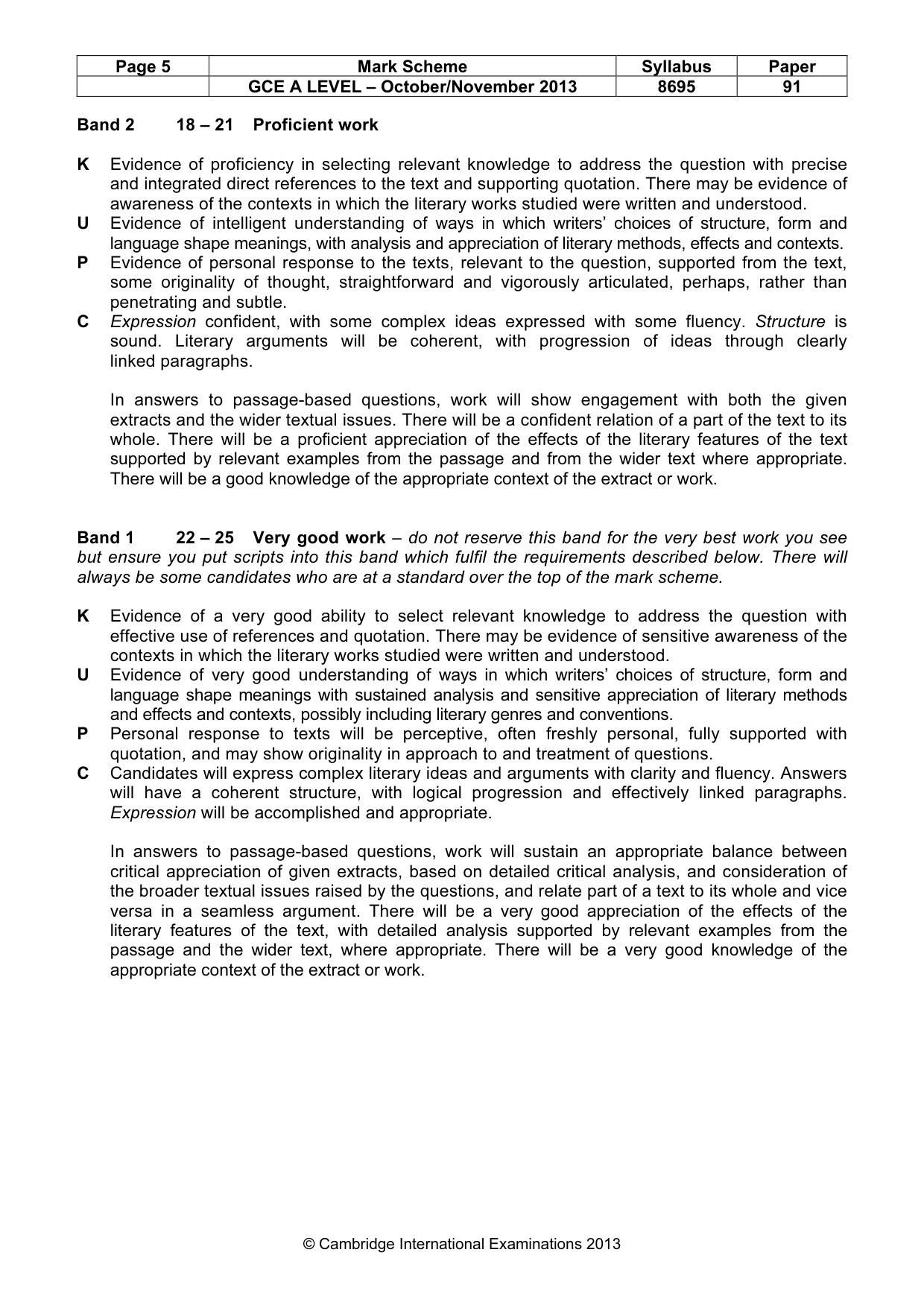
Page 5 Mark Scheme Syllabus Paper GCE A LEVEL – October/November 2013 8695 91 © Cambridge International Examinations 2013 Band 2 18 – 21 Proficient work K Evidence of proficiency in selecting relevant knowledge to address the question with precise and integrated direct references to the text and supporting quotation. There may be evidence of awareness of the contexts in which the literary works studied were written and understood. U Evidence of intelligent understanding of ways in which writers’ choices of structure, form and language shape meanings, with analysis and appreciation of literary methods, effects and contexts. P Evidence of personal response to the texts, relevant to the question, supported from the text, some originality of thought, straightforward and vigorously articulated, perhaps, rather than penetrating and subtle. C Expression confident, with some complex ideas expressed with some fluency. Structure is sound. Literary arguments will be coherent, with progression of ideas through clearly linked paragraphs. In answers to passage-based questions, work will show engagement with both the given extracts and the wider textual issues. There will be a confident relation of a part of the text to its whole. There will be a proficient appreciation of the effects of the literary features of the text supported by relevant examples from the passage and from the wider text where appropriate. There will be a good knowledge of the appropriate context of the extract or work. Band 1 22 – 25 Very good work – do not reserve this band for the very best work you see but ensure you put scripts into this band which fulfil the requirements described below. There will always be some candidates who are at a standard over the top of the mark scheme. K Evidence of a very good ability to select relevant knowledge to address the question with effective use of references and quotation. There may be evidence of sensitive awareness of the contexts in which the literary works studied were written and understood. U Evidence of very good understanding of ways in which writers’ choices of structure, form and language shape meanings with sustained analysis and sensitive appreciation of literary methods and effects and contexts, possibly including literary genres and conventions. P Personal response to texts will be perceptive, often freshly personal, fully supported with quotation, and may show originality in approach to and treatment of questions. C Candidates will express complex literary ideas and arguments with clarity and fluency. Answers will have a coherent structure, with logical progression and effectively linked paragraphs. Expression will be accomplished and appropriate. In answers to passage-based questions, work will sustain an appropriate balance between critical appreciation of given extracts, based on detailed critical analysis, and consideration of the broader textual issues raised by the questions, and relate part of a text to its whole and vice versa in a seamless argument. There will be a very good appreciation of the effects of the literary features of the text, with detailed analysis supported by relevant examples from the passage and the wider text, where appropriate. There will be a very good knowledge of the appropriate context of the extract or work.
What you needed in this session
Cambridge’s own grade thresholds for 2013 Oct/Nov, Paper 9 · Variant 1. A higher threshold means an easier paper — the bar moves with how the cohort did.