Cambridge A Level English - Language and Literature (AS Level only, from 2016) 8695 — 2013 May/June Paper 9 · Variant 3
8695/93/M/J/13 · 50 marks · ≈56 min
The question paper and its mark scheme, free to read here and free to download. This is Cambridge’s own paper, exactly as it was sat.
Question paper20 pages




Mark scheme5 pages
Answers below. Sit the paper first if you are practising.
Paper as text
Question paper, page 1
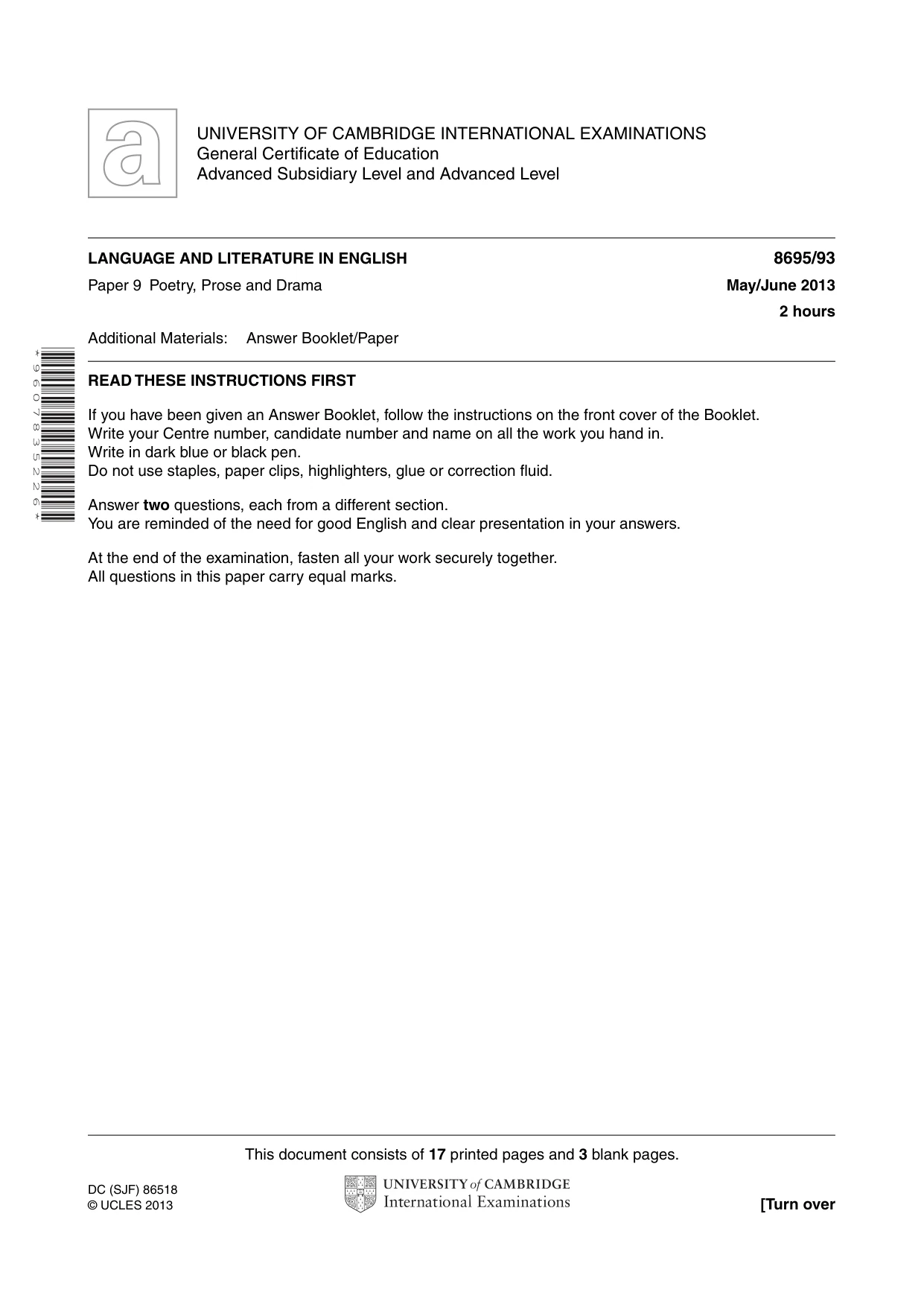
This document consists of 17 printed pages and 3 blank pages. DC (SJF) 86518 © UCLES 2013 [Turn over UNIVERSITY OF CAMBRIDGE INTERNATIONAL EXAMINATIONS General Certificate of Education Advanced Subsidiary Level and Advanced Level * 9 6 0 7 8 3 5 2 2 6 * LANGUAGE AND LITERATURE IN ENGLISH 8695/93 Paper 9 Poetry, Prose and Drama May/June 2013 2 hours Additional Materials: Answer Booklet/Paper READ THESE INSTRUCTIONS FIRST If you have been given an Answer Booklet, follow the instructions on the front cover of the Booklet. Write your Centre number, candidate number and name on all the work you hand in. Write in dark blue or black pen. Do not use staples, paper clips, highlighters, glue or correction fluid. Answer two questions, each from a different section. You are reminded of the need for good English and clear presentation in your answers. At the end of the examination, fasten all your work securely together. All questions in this paper carry equal marks.
Question paper, page 2
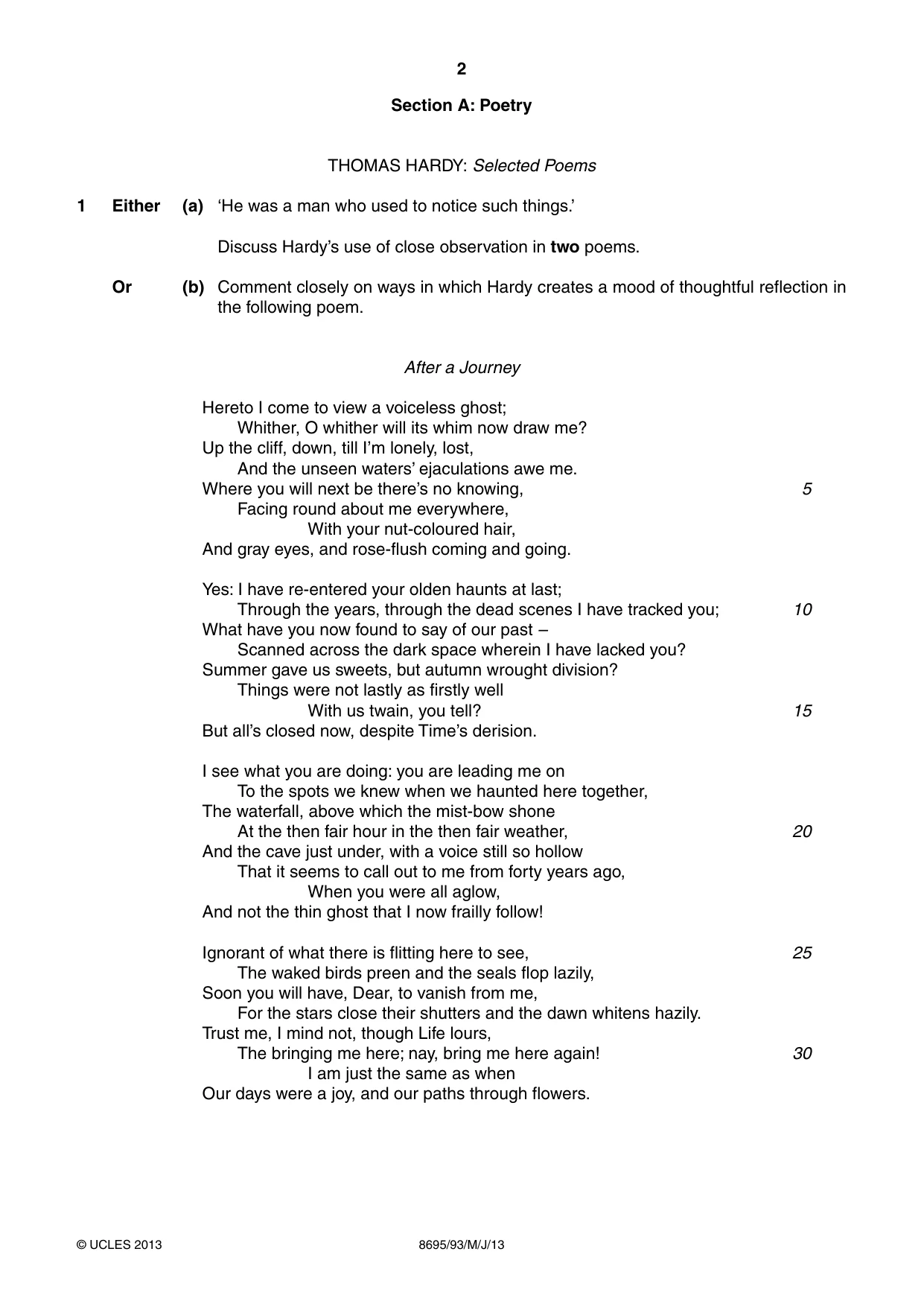
2 8695/93/M/J/13 © UCLES 2013 Section A: Poetry THOMAS HARDY: Selected Poems 1 Either (a) ‘He was a man who used to notice such things.’ Discuss Hardy’s use of close observation in two poems. Or (b) Comment closely on ways in which Hardy creates a mood of thoughtful reflection in the following poem. After a Journey Hereto I come to view a voiceless ghost; Whither, O whither will its whim now draw me? Up the cliff, down, till I’m lonely, lost, And the unseen waters’ ejaculations awe me. Where you will next be there’s no knowing, 5 Facing round about me everywhere, With your nut-coloured hair, And gray eyes, and rose-flush coming and going. Yes: I have re-entered your olden haunts at last; Through the years, through the dead scenes I have tracked you; 10 What have you now found to say of our past – Scanned across the dark space wherein I have lacked you? Summer gave us sweets, but autumn wrought division? Things were not lastly as firstly well With us twain, you tell? 15 But all’s closed now, despite Time’s derision. I see what you are doing: you are leading me on To the spots we knew when we haunted here together, The waterfall, above which the mist-bow shone At the then fair hour in the then fair weather, 20 And the cave just under, with a voice still so hollow That it seems to call out to me from forty years ago, When you were all aglow, And not the thin ghost that I now frailly follow! Ignorant of what there is flitting here to see, 25 The waked birds preen and the seals flop lazily, Soon you will have, Dear, to vanish from me, For the stars close their shutters and the dawn whitens hazily. Trust me, I mind not, though Life lours, The bringing me here; nay, bring me here again! 30 I am just the same as when Our days were a joy, and our paths through flowers.
Question paper, page 3
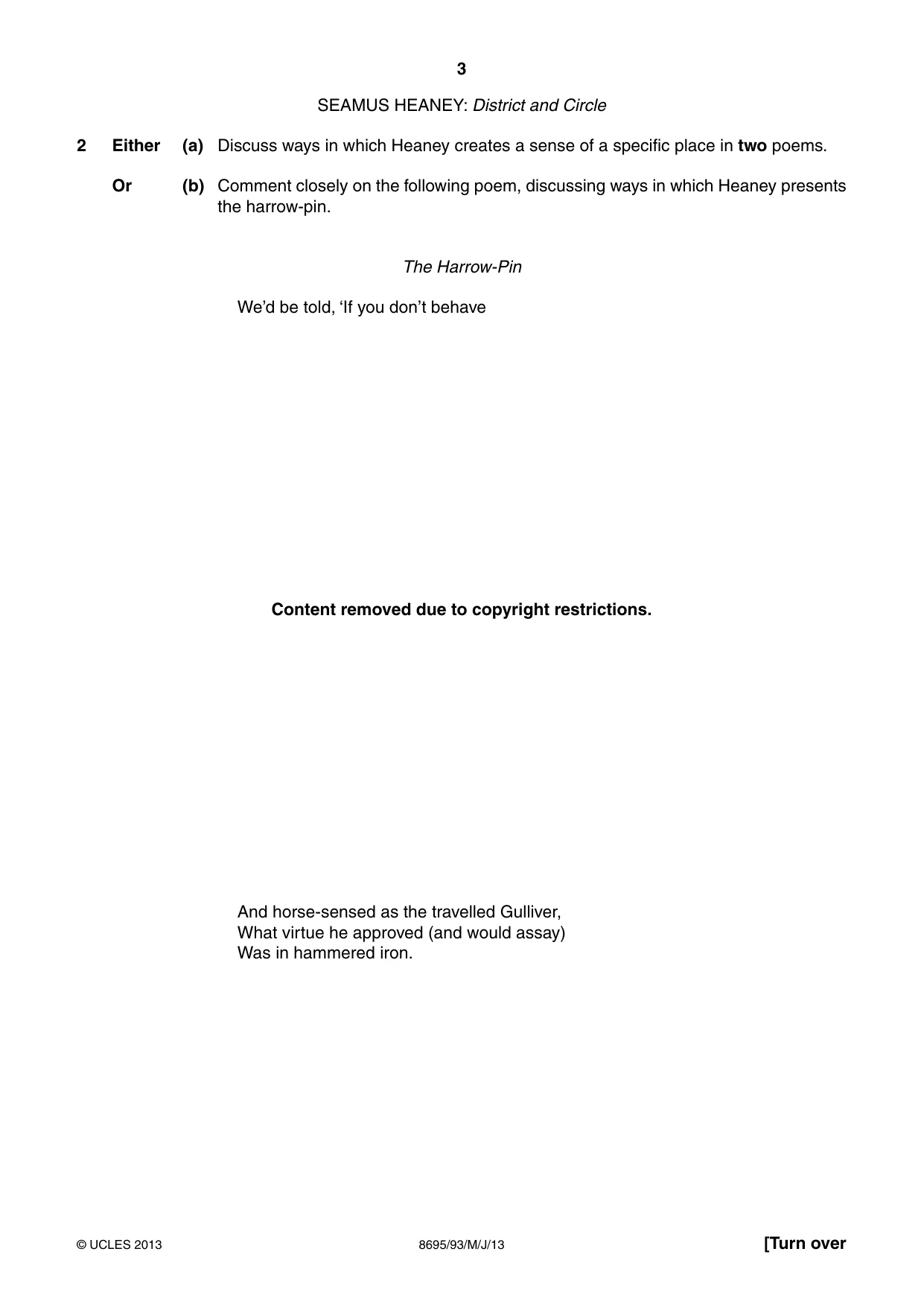
3 8695/93/M/J/13 © UCLES 2013 [Turn over SEAMUS HEANEY: District and Circle 2 Either (a) Discuss ways in which Heaney creates a sense of a specific place in two poems. Or (b) Comment closely on the following poem, discussing ways in which Heaney presents the harrow-pin. The Harrow-Pin We’d be told, ‘If you don’t behave Content removed due to copyright restrictions. And horse-sensed as the travelled Gulliver, What virtue he approved (and would assay) Was in hammered iron.
Question paper, page 4
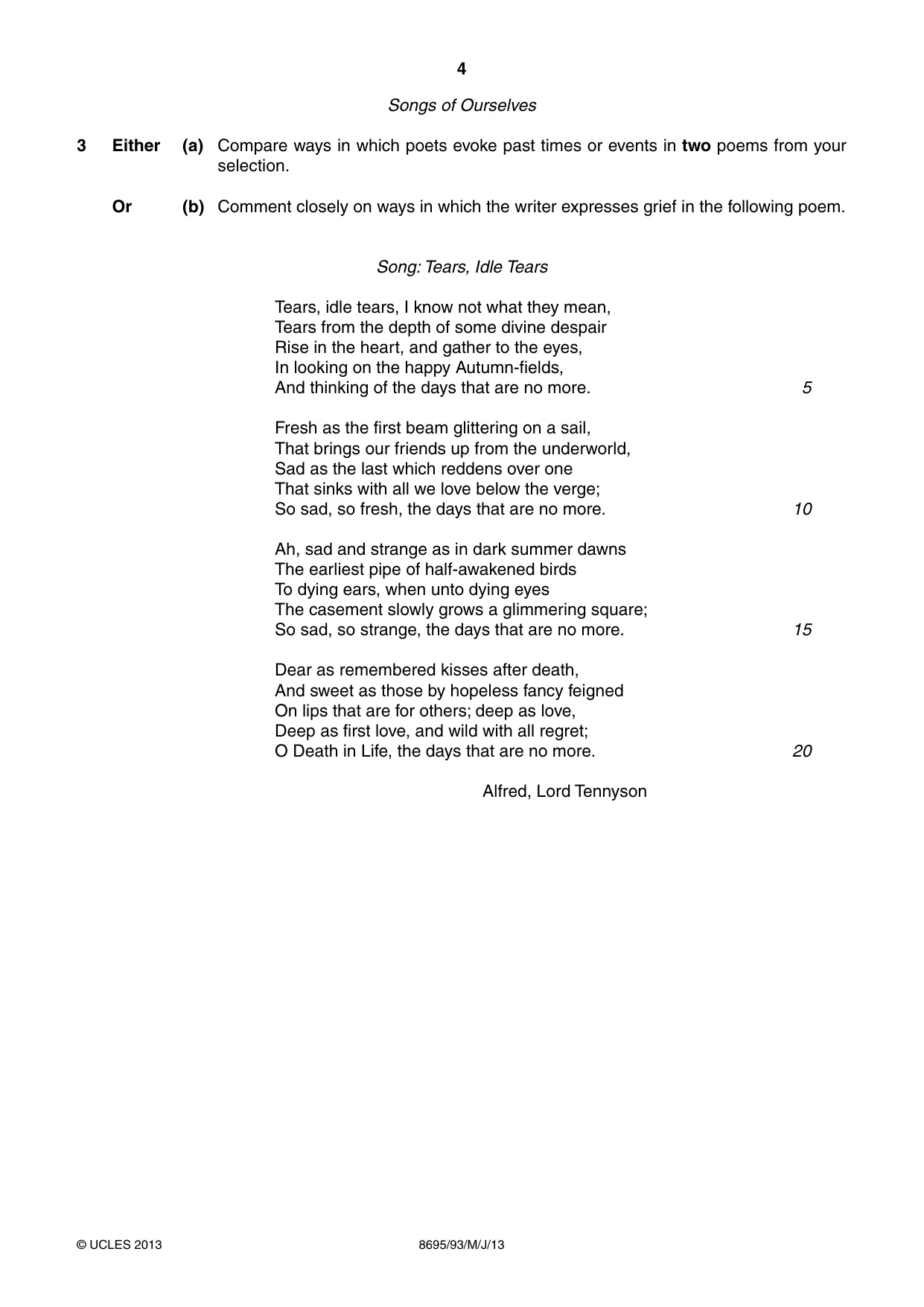
4 8695/93/M/J/13 © UCLES 2013 Songs of Ourselves 3 Either (a) Compare ways in which poets evoke past times or events in two poems from your selection. Or (b) Comment closely on ways in which the writer expresses grief in the following poem. Song: Tears, Idle Tears Tears, idle tears, I know not what they mean, Tears from the depth of some divine despair Rise in the heart, and gather to the eyes, In looking on the happy Autumn-fields, And thinking of the days that are no more. 5 Fresh as the first beam glittering on a sail, That brings our friends up from the underworld, Sad as the last which reddens over one That sinks with all we love below the verge; So sad, so fresh, the days that are no more. 10 Ah, sad and strange as in dark summer dawns The earliest pipe of half-awakened birds To dying ears, when unto dying eyes The casement slowly grows a glimmering square; So sad, so strange, the days that are no more. 15 Dear as remembered kisses after death, And sweet as those by hopeless fancy feigned On lips that are for others; deep as love, Deep as first love, and wild with all regret; O Death in Life, the days that are no more. 20 Alfred, Lord Tennyson
Question paper, page 5
5 8695/93/M/J/13 © UCLES 2013 [Turn over Turn to page 6 for Question 4
Question paper, page 6
6 8695/93/M/J/13 © UCLES 2013 Section B: Prose CHIMAMANDA NGOZI ADICHIE: Half of a Yellow Sun 4 Either (a) Adichie says that she ‘wanted to write about love and war’. Discuss some of the effects Adichie creates with this combination. Or (b) Discuss the following passage in detail, paying particular attention to ways in which it presents the characters’ responses to Kainene’s disappearance. ‘Is Kainene back?’ Odenigbo asked. Content removed due to copyright restrictions.
Question paper, page 7
7 8695/93/M/J/13 © UCLES 2013 [Turn over Content removed due to copyright restrictions. As she drove them home, she hummed steadily under her breath. Chapter 33
Question paper, page 8
8 8695/93/M/J/13 © UCLES 2013 E.M. FORSTER: A Passage to India 5 Either (a) Discuss Forster’s presentation of the wives of the English officials, and their contribution to the novel. Or (b) Discuss the following passage in detail, commenting on its presentation of the relationship between Fielding and Aziz at this point in the novel. ‘If the weather lifts, we want to see your torchlight procession from the water this evening,’ he pursued. ‘I wrote to Godbole about it, but he has taken no notice; it’s a place of the dead.’ ‘Perhaps your letter never reached the Minister in question.’ ‘Will there by any objection to English people watching the procession?’ ‘I know nothing at all about the religion here. I should never think of watching it myself.’ ‘We had a very different reception both at Mudkul and Deora, they were kindness itself at Deora, the Maharajah and Maharani wanted us to see everything.’ ‘You should never have left them.’ ‘Jump in, Ralph’ – they had reached the carriage. ‘Jump in, Mr Quested, and Mr Fielding.’ ‘Who on earth is Mr Quested?’ ‘Do I mispronounce that well-known name? Is he not your wife’s brother?’ ‘Who on earth do you suppose I’ve married?’ ‘I’m only Ralph Moore,’ said the boy, blushing, and at that moment there fell another pailful of the rain, and made a mist round their feet. Aziz tried to withdraw, but it was too late. ‘Quested? Quested? Don’t you know that my wife was Mrs Moore’s daughter?’ He trembled, and went purplish gray; he hated the news, hated hearing the name Moore. ‘Perhaps this explains your odd attitude?’ ‘And pray what is wrong with my attitude?’ ‘The preposterous letter you allowed Mahmoud Ali to write for you.’ ‘This is a very useless conversation, I consider.’ ‘How ever did you make such a mistake?’ said Fielding, more friendly than before, but scathing and scornful. ‘It’s almost unbelievable. I should think I wrote you half a dozen times, mentioning my wife by name. Miss Quested! What an extraordinary notion!’ From his smile, Aziz guessed that Stella was beautiful. ‘Miss Quested is our best friend, she introduced us, but … what an amazing notion. Aziz, we must thrash this misunderstanding out later on. It is clearly some devilry of Mahmoud Ali’s. He knows perfectly well I married Miss Moore. He called her “Heaslop’s sister” in his insolent letter to me.’ The name woke furies in him. ‘So she is, and here is Heaslop’s brother, and you his brother-in-law, and good-bye.’ Shame turned into a rage that brought back his self-respect. ‘What does it matter to me who you marry? Don’t trouble me here at Mau is all I ask. I do not want you, I do not want one of you in my private life, with my dying breath I say it. Yes, yes, I made a foolish blunder; despise me and feel cold. I thought you married my enemy. I never read your letter. Mahmoud Ali deceived me. I thought you’d stolen my money, but’ – he clapped his hands together, and his children gathered round him – ‘it’s as if you stole it. I forgive Mahmoud Ali all things, because he loved me.’ Then pausing, while the rain exploded like pistols, he said, ‘My heart is for my own people henceforward,’ and turned away. Cyril followed him through the mud, apologizing, laughing a little, wanting to argue and reconstruct, pointing out with irrefragable logic that he had married, not Heaslop’s betrothed, but Heaslop’s sister. What difference did it make at this hour of the day? He had built his life on a mistake, but he had built it. Speaking in Urdu, that the children might understand, he said: ‘Please do not follow us, whomever you marry. I wish no Englishman or Englishwoman to be my friend.’ 5 10 15 20 25 30 35 40 45
Question paper, page 9
9 8695/93/M/J/13 © UCLES 2013 [Turn over He returned to the house excited and happy. It had been an uneasy, uncanny moment when Mrs Moore’s name was mentioned, stirring memories. ‘Esmiss Esmoor …’ – as though she was coming to help him. She had always been so good, and that youth whom he had scarcely looked at was her son, Ralph Moore, Stella and Ralph, whom he had promised to be kind to, and Stella had married Cyril. Chapter 35 50
Question paper, page 10
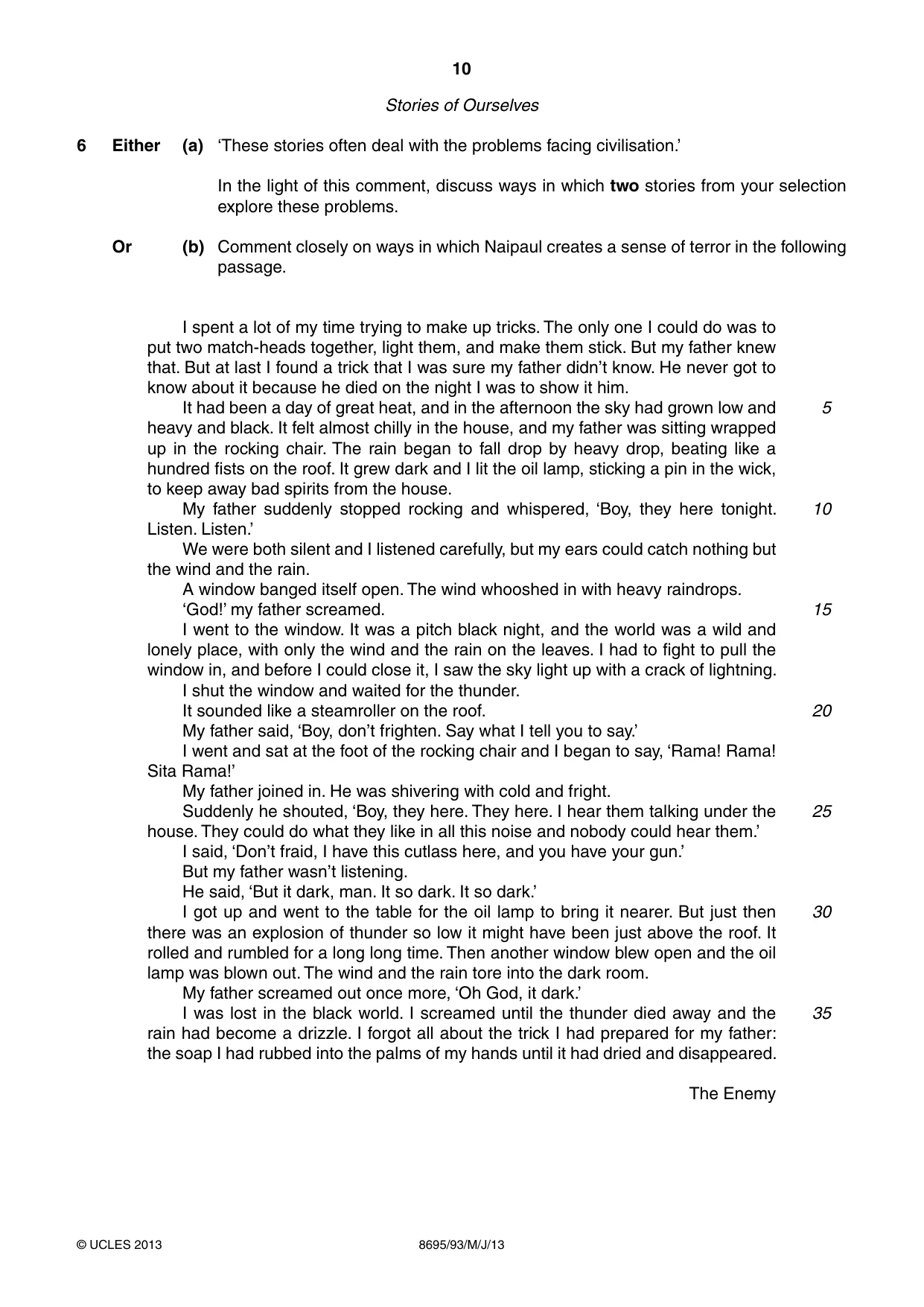
10 8695/93/M/J/13 © UCLES 2013 Stories of Ourselves 6 Either (a) ‘These stories often deal with the problems facing civilisation.’ In the light of this comment, discuss ways in which two stories from your selection explore these problems. Or (b) Comment closely on ways in which Naipaul creates a sense of terror in the following passage. I spent a lot of my time trying to make up tricks. The only one I could do was to put two match-heads together, light them, and make them stick. But my father knew that. But at last I found a trick that I was sure my father didn’t know. He never got to know about it because he died on the night I was to show it him. It had been a day of great heat, and in the afternoon the sky had grown low and heavy and black. It felt almost chilly in the house, and my father was sitting wrapped up in the rocking chair. The rain began to fall drop by heavy drop, beating like a hundred fists on the roof. It grew dark and I lit the oil lamp, sticking a pin in the wick, to keep away bad spirits from the house. My father suddenly stopped rocking and whispered, ‘Boy, they here tonight. Listen. Listen.’ We were both silent and I listened carefully, but my ears could catch nothing but the wind and the rain. A window banged itself open. The wind whooshed in with heavy raindrops. ‘God!’ my father screamed. I went to the window. It was a pitch black night, and the world was a wild and lonely place, with only the wind and the rain on the leaves. I had to fight to pull the window in, and before I could close it, I saw the sky light up with a crack of lightning. I shut the window and waited for the thunder. It sounded like a steamroller on the roof. My father said, ‘Boy, don’t frighten. Say what I tell you to say.’ I went and sat at the foot of the rocking chair and I began to say, ‘Rama! Rama! Sita Rama!’ My father joined in. He was shivering with cold and fright. Suddenly he shouted, ‘Boy, they here. They here. I hear them talking under the house. They could do what they like in all this noise and nobody could hear them.’ I said, ‘Don’t fraid, I have this cutlass here, and you have your gun.’ But my father wasn’t listening. He said, ‘But it dark, man. It so dark. It so dark.’ I got up and went to the table for the oil lamp to bring it nearer. But just then there was an explosion of thunder so low it might have been just above the roof. It rolled and rumbled for a long long time. Then another window blew open and the oil lamp was blown out. The wind and the rain tore into the dark room. My father screamed out once more, ‘Oh God, it dark.’ I was lost in the black world. I screamed until the thunder died away and the rain had become a drizzle. I forgot all about the trick I had prepared for my father: the soap I had rubbed into the palms of my hands until it had dried and disappeared. The Enemy 5 10 15 20 25 30 35
Question paper, page 11
11 8695/93/M/J/13 © UCLES 2013 [Turn over Turn to page 12 for Question 7
Question paper, page 12
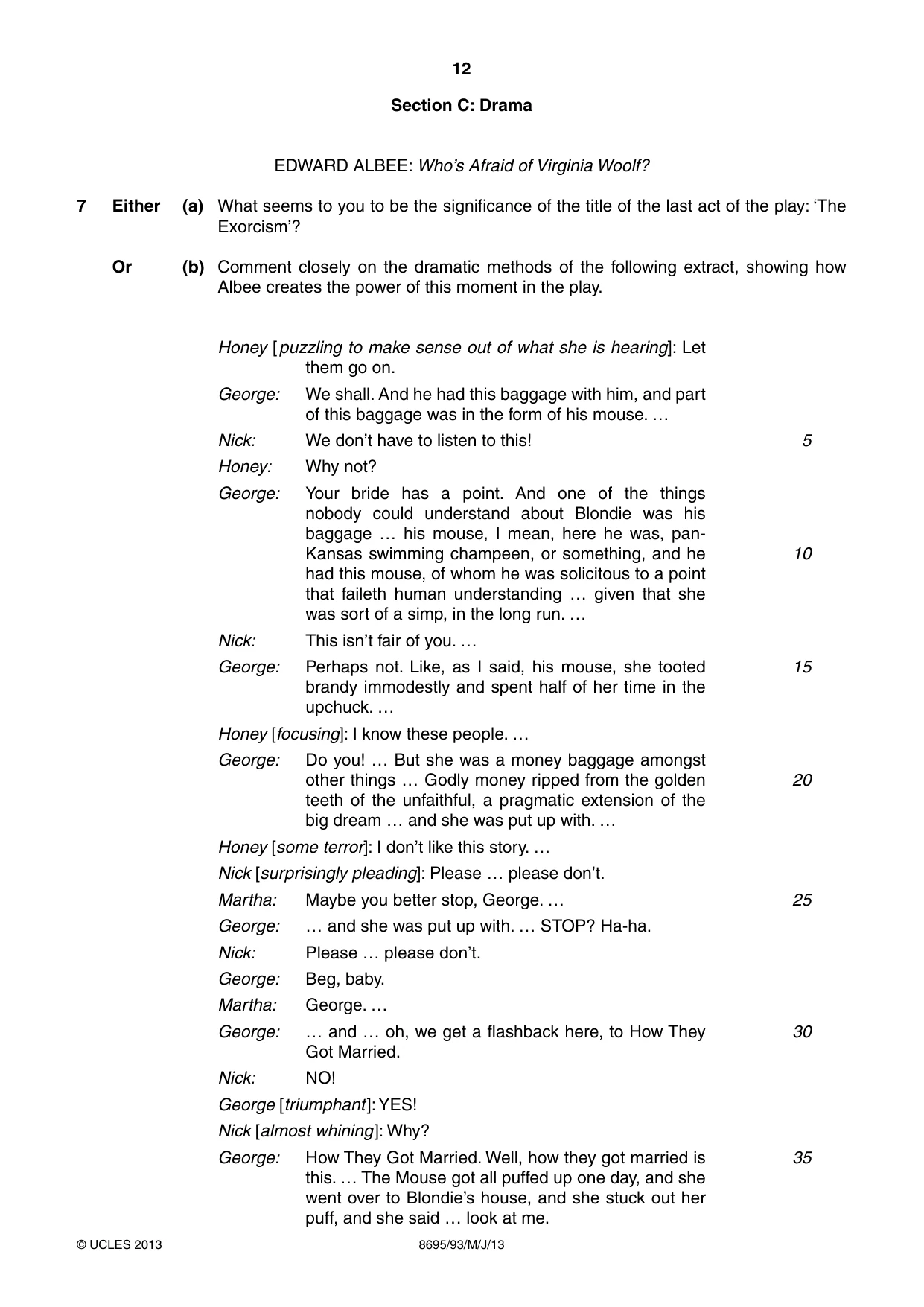
12 8695/93/M/J/13 © UCLES 2013 Section C: Drama EDWARD ALBEE: Who’s Afraid of Virginia Woolf? 7 Either (a) What seems to you to be the significance of the title of the last act of the play: ‘The Exorcism’? Or (b) Comment closely on the dramatic methods of the following extract, showing how Albee creates the power of this moment in the play. Honey [puzzling to make sense out of what she is hearing] : Let them go on. George: We shall. And he had this baggage with him, and part of this baggage was in the form of his mouse. … Nick: We don’t have to listen to this! Honey: Why not? George: Your bride has a point. And one of the things nobody could understand about Blondie was his baggage … his mouse, I mean, here he was, pan- Kansas swimming champeen, or something, and he had this mouse, of whom he was solicitous to a point that faileth human understanding … given that she was sort of a simp, in the long run. … Nick: This isn’t fair of you. … George: Perhaps not. Like, as I said, his mouse, she tooted brandy immodestly and spent half of her time in the upchuck. … Honey [focusing] : I know these people. … George: Do you! … But she was a money baggage amongst other things … Godly money ripped from the golden teeth of the unfaithful, a pragmatic extension of the big dream … and she was put up with. … Honey [some terror] : I don’t like this story. … Nick [surprisingly pleading] : Please … please don’t. Martha: Maybe you better stop, George. … George: … and she was put up with. … STOP? Ha-ha. Nick: Please … please don’t. George: Beg, baby. Martha: George. … George: … and … oh, we get a flashback here, to How They Got Married. Nick: NO! George [triumphant] : YES! Nick [almost whining] : Why? George: How They Got Married. Well, how they got married is this. … The Mouse got all puffed up one day, and she went over to Blondie’s house, and she stuck out her puff, and she said … look at me. 5 10 15 20 25 30 35
Question paper, page 13
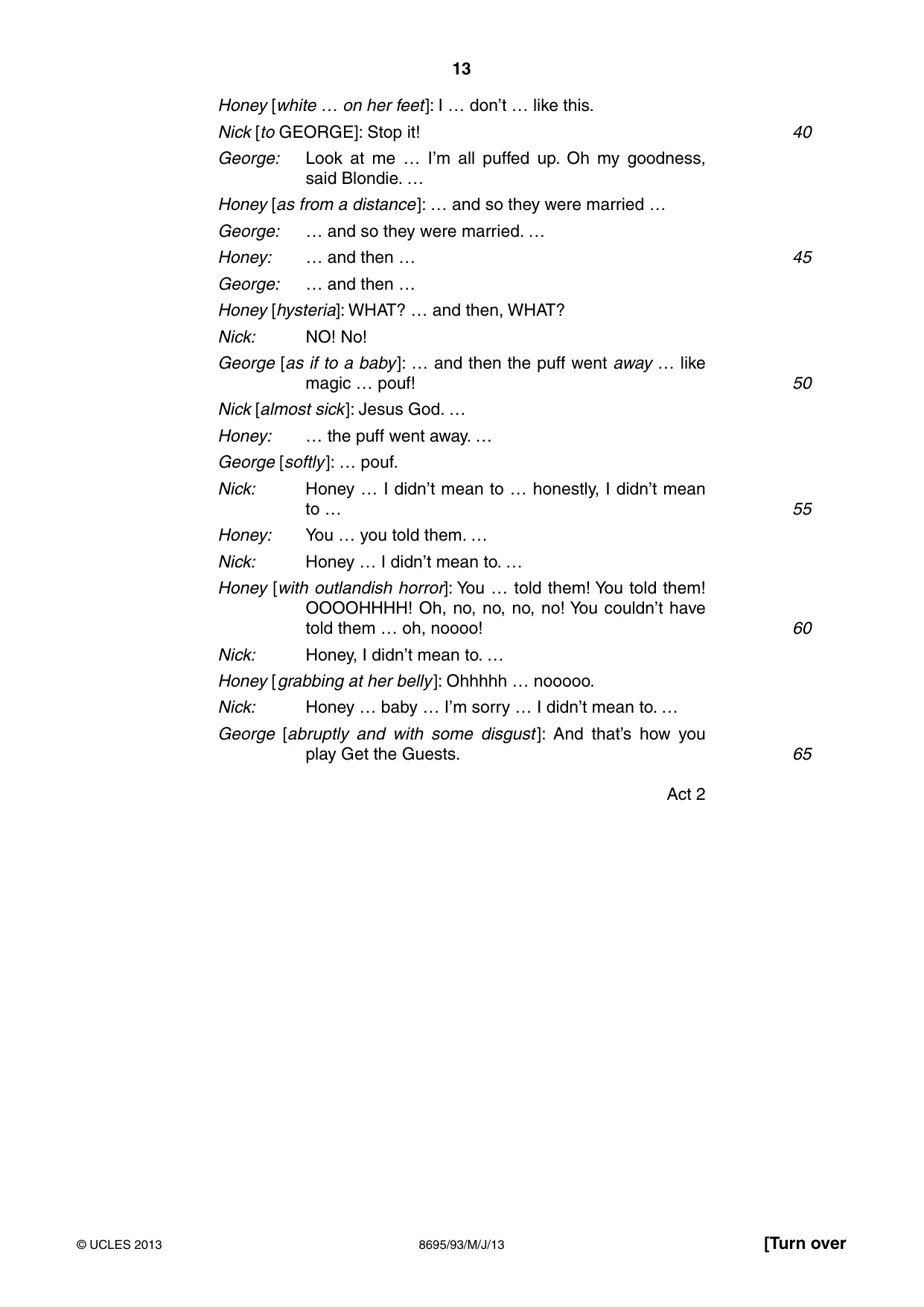
13 8695/93/M/J/13 © UCLES 2013 [Turn over Honey [white … on her feet] : I … don’t … like this. Nick [to GEORGE] : Stop it! George: Look at me … I’m all puffed up. Oh my goodness, said Blondie. … Honey [as from a distance] : … and so they were married … George: … and so they were married. … Honey: … and then … George: … and then … Honey [hysteria] : WHAT? … and then, WHAT? Nick: NO! No! George [as if to a baby] : … and then the puff went away … like magic … pouf! Nick [almost sick] : Jesus God. … Honey: … the puff went away. … George [softly] : … pouf. Nick: Honey … I didn’t mean to … honestly, I didn’t mean to … Honey: You … you told them. … Nick: Honey … I didn’t mean to. … Honey [with outlandish horror] : You … told them! You told them! OOOOHHHH! Oh, no, no, no, no! You couldn’t have told them … oh, noooo! Nick: Honey, I didn’t mean to. … Honey [grabbing at her belly] : Ohhhhh … nooooo. Nick: Honey … baby … I’m sorry … I didn’t mean to. … George [abruptly and with some disgust] : And that’s how you play Get the Guests. Act 2 40 45 50 55 60 65
Question paper, page 14
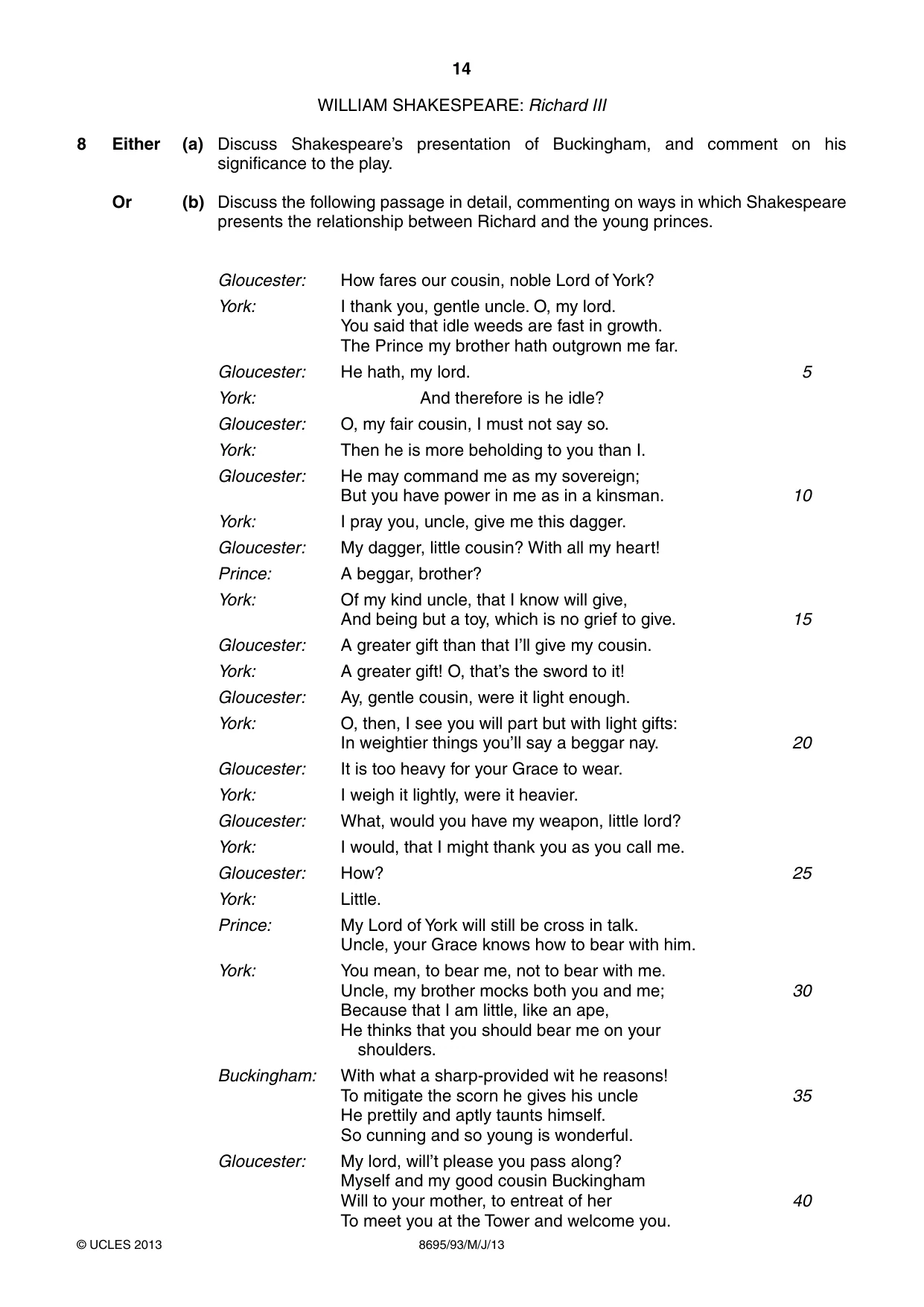
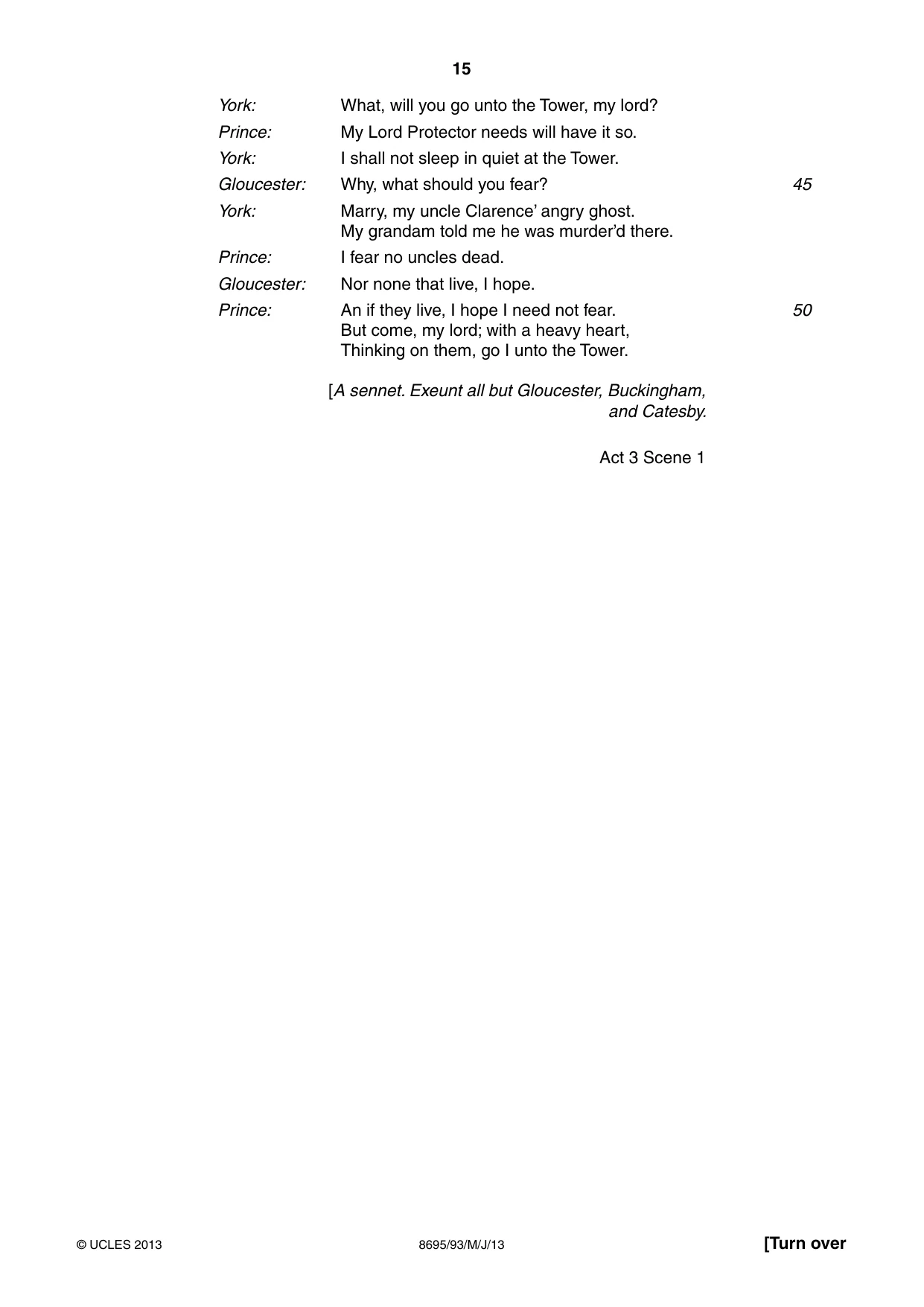
14 8695/93/M/J/13 © UCLES 2013 WILLIAM SHAKESPEARE: Richard III 8 Either (a) Discuss Shakespeare’s presentation of Buckingham, and comment on his significance to the play. Or (b) Discuss the following passage in detail, commenting on ways in which Shakespeare presents the relationship between Richard and the young princes. Gloucester: How fares our cousin, noble Lord of York? York: I thank you, gentle uncle. O, my lord. You said that idle weeds are fast in growth. The Prince my brother hath outgrown me far. Gloucester: He hath, my lord. York: And therefore is he idle? Gloucester: O, my fair cousin, I must not say so. York: Then he is more beholding to you than I. Gloucester: He may command me as my sovereign; But you have power in me as in a kinsman. York: I pray you, uncle, give me this dagger. Gloucester: My dagger, little cousin? With all my heart! Prince: A beggar, brother? York: Of my kind uncle, that I know will give, And being but a toy, which is no grief to give. Gloucester: A greater gift than that I’ll give my cousin. York: A greater gift! O, that’s the sword to it! Gloucester: Ay, gentle cousin, were it light enough. York: O, then, I see you will part but with light gifts: In weightier things you’ll say a beggar nay. Gloucester: It is too heavy for your Grace to wear. York: I weigh it lightly, were it heavier. Gloucester: What, would you have my weapon, little lord? York: I would, that I might thank you as you call me. Gloucester: How? York: Little. Prince: My Lord of York will still be cross in talk. Uncle, your Grace knows how to bear with him. York: You mean, to bear me, not to bear with me. Uncle, my brother mocks both you and me; Because that I am little, like an ape, He thinks that you should bear me on your shoulders. Buckingham: With what a sharp-provided wit he reasons! To mitigate the scorn he gives his uncle He prettily and aptly taunts himself. So cunning and so young is wonderful. Gloucester: My lord, will’t please you pass along? Myself and my good cousin Buckingham Will to your mother, to entreat of her To meet you at the Tower and welcome you. 5 10 15 20 25 30 35 40
Question paper, page 15
15 8695/93/M/J/13 © UCLES 2013 [Turn over York: What, will you go unto the Tower, my lord? Prince: My Lord Protector needs will have it so. York: I shall not sleep in quiet at the Tower. Gloucester: Why, what should you fear? York: Marry, my uncle Clarence’ angry ghost. My grandam told me he was murder’d there. Prince: I fear no uncles dead. Gloucester: Nor none that live, I hope. Prince: An if they live, I hope I need not fear. But come, my lord; with a heavy heart, Thinking on them, go I unto the Tower. [A sennet. Exeunt all but Gloucester, Buckingham, and Catesby. Act 3 Scene 1 45 50
Question paper, page 16
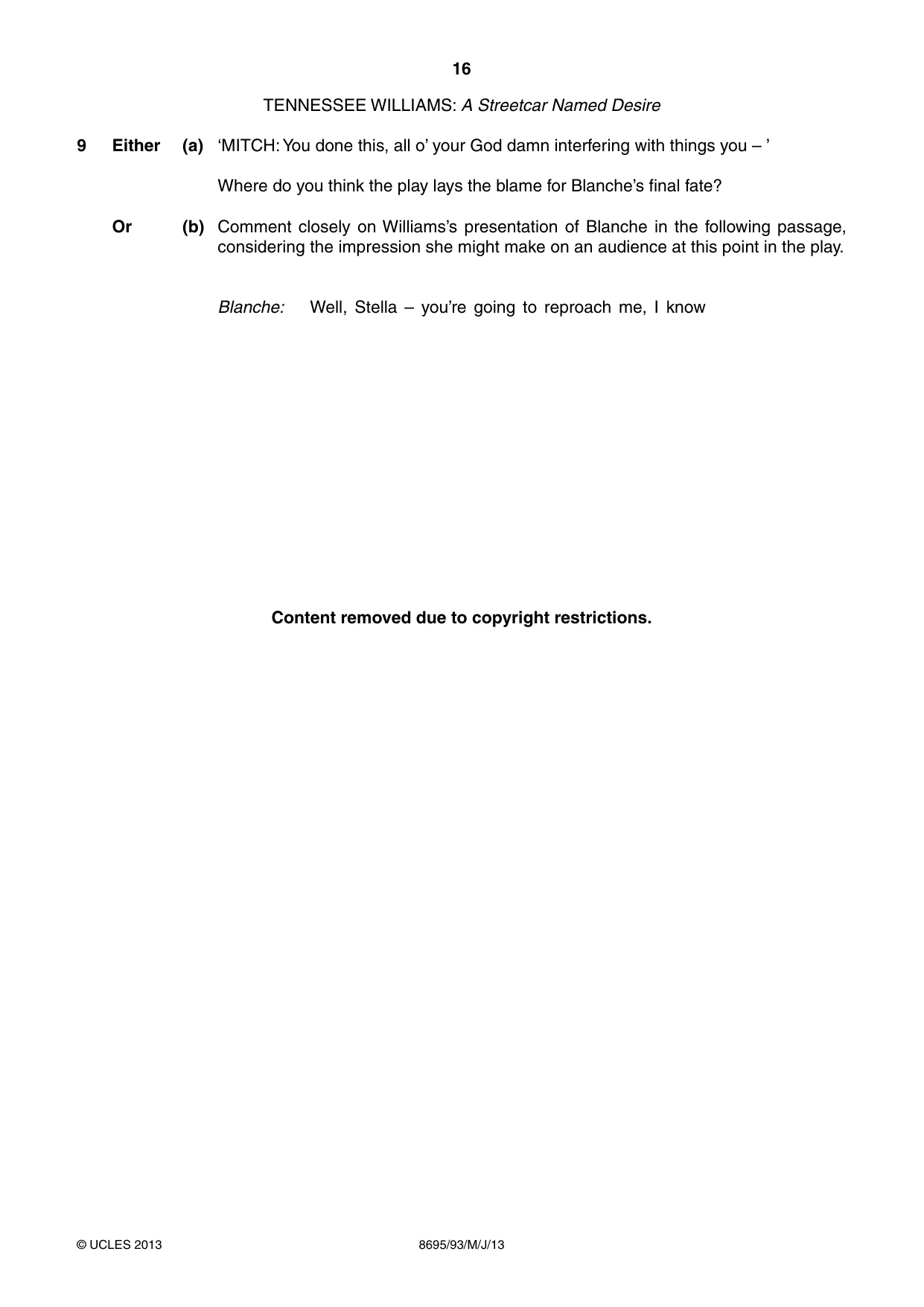
16 8695/93/M/J/13 © UCLES 2013 TENNESSEE WILLIAMS: A Streetcar Named Desire 9 Either (a) ‘MITCH: You done this, all o’ your God damn interfering with things you – ’ Where do you think the play lays the blame for Blanche’s final fate? Or (b) Comment closely on Williams’s presentation of Blanche in the following passage, considering the impression she might make on an audience at this point in the play. Blanche: Well, Stella – you’re going to reproach me, I know Content removed due to copyright restrictions.
Question paper, page 17
17 8695/93/M/J/13 © UCLES 2013 Content removed due to copyright restrictions. Stella [springing]: Blanche! You be still! That’s enough! [She starts out.] Scene 1 65
Question paper, page 18
18 8695/93/M/J/13 © UCLES 2013 BLANK PAGE
Question paper, page 19
19 8695/93/M/J/13 © UCLES 2013 BLANK PAGE
Question paper, page 20
20 8695/93/M/J/13 © UCLES 2013 BLANK PAGE Copyright Acknowledgements: Question 2b © Seamus Heaney; The Harrow Pin, from District and Circle; Faber & Faber Ltd; 2006. Question 4b © Chimamanda Ngozi Adichie; Half of a Yellow Sun; Reproduced by permission of HarperCollins; 2006. Question 5b © E M Forster; A Passage to India; The Provost and Scholars of Kings College, Cambridge. Question 6b © V S Naipaul; The Enemy, in Stories of Ourselves; Foundation Books / Cambridge University Press India; 2008. Question 7b © Edward Albee; Who’s Afraid of Virginia Woolf?; Penguin Books Ltd; 1967. Question 9b © A Streetcar Named Desire by Tennessee Williams. Copyright © 1947 by The University of The South. Reprinted by permission of Georges Borchardt, Inc. for the Estate of Tennessee Williams. Permission to reproduce items where third-party owned material protected by copyright is included has been sought and cleared where possible. Every reasonable effort has been made by the publisher (UCLES) to trace copyright holders, but if any items requiring clearance have unwittingly been included, the publisher will be pleased to make amends at the earliest possible opportunity. University of Cambridge International Examinations is part of the Cambridge Assessment Group. Cambridge Assessment is the brand name of University of Cambridge Local Examinations Syndicate (UCLES), which is itself a department of the University of Cambridge.
Mark scheme, page 1
CAMBRIDGE INTERNATIONAL EXAMINATIONS GCE Advanced Subsidiary Level and GCE Advanced Level MARK SCHEME for the May/June 2013 series 8695 LANGUAGE AND LITERATURE IN ENGLISH 8695/93 Paper 9 (Poetry, Prose and Drama), maximum raw mark 50 This mark scheme is published as an aid to teachers and candidates, to indicate the requirements of the examination. It shows the basis on which Examiners were instructed to award marks. It does not indicate the details of the discussions that took place at an Examiners’ meeting before marking began, which would have considered the acceptability of alternative answers. Mark schemes should be read in conjunction with the question paper and the Principal Examiner Report for Teachers. Cambridge will not enter into discussions about these mark schemes. Cambridge is publishing the mark schemes for the May/June 2013 series for most IGCSE, GCE Advanced Level and Advanced Subsidiary Level components and some Ordinary Level components.
Mark scheme, page 2
Page 2 Mark Scheme Syllabus Paper GCE AS/A LEVEL – May/June 2013 8695 93 © Cambridge International Examinations 2013 Using the mark bands Place the answer in a band first. Look for the ‘best fit’ of the answer into a band. An answer needs to show evidence of most but not necessarily ALL of the qualities described in a band, in order to be placed in that band. Then award a mark for the relative position of the answer within the band. Candidates may address the question in many different ways. Do not expect any particular focus or approach and do not penalise answers for leaving out a particular focus. Reward what is there, showing what you are rewarding, in your comments. Consider all strands and weigh up the performance as a whole in placing the answer in a band, then show that you have done so in the summative comment, e.g. Sound K of texts, some evidence of U but mostly narrative, occasional evidence of P, mainly clear C. Assessment Objectives: • Ability to respond to texts in the three main forms (Prose, Poetry and Drama) of different types and from different cultures; • Understanding of the ways in which writers’ choices of form, structure and language shape meanings; • Ability to produce informed independent opinions and judgements on literary texts; • Ability to communicate clearly the knowledge, understanding and insight appropriate to literary study. Each answer is marked out of 25, in accordance with the General Marking Criteria below. Each band is divided into strands corresponding to the Assessment Objectives – Knowledge, Understanding, Personal Response, Communication.
Mark scheme, page 3
Page 3 Mark Scheme Syllabus Paper GCE AS/A LEVEL – May/June 2013 8695 93 © Cambridge International Examinations 2013 Band 6 0 – 5 K Evidence of some general knowledge of the text which may be narrative based and may contain errors, rarely relevant to the question and with little or no relevant quotation or selection from the text. U There may be little or no evidence of understanding of form, structure and language, with some appropriate points made in response to the question. These will be limited and tend to be restricted to plot and characters – the latter treated very much as ‘real’ people. P There may be some signs of personal response, not developed into an argument and not fully supported from the text. C Communication will be insecure. Expression may be weak with some breakdown in communication. Structure may be lacking: answers are likely to be partial, undeveloped, narrative commentary in approach; with the assertion of simple points rather than progressive lines of argument. Answers to passage-based questions are likely to be seriously unbalanced, with an emphasis on narrative or paraphrase. Passages are likely to have been only partially understood and tentatively located contextually, with little coherent sense of the relationship between textual part and whole. There will be little or no mention or consideration of the literary features of the passage. Band 5 6 – 9 Work of a basic standard K Evidence of some limited ability to use knowledge of the text to address the question, with occasional use of supporting references or quotation. U Evidence of some limited understanding of ways in which writers’ choices of structure, form and language shape meanings. P Evidence of some personal response to the text but not fully supported. C Expression will be basically clear. There may be the occasional confused passage of writing. However, there will be no sustained loss of communication. There may be a simple structure to the answer with some evidence of an argument, which may lack coherence, with some repetition, assertion and relapse into narrative summary/paraphrase. There may be a tendency to drift from relevant discussion into material of tangential significance. In answers to passage-based questions there will be some evidence of understanding of how part relates to whole. Treatment of the given extracts may well be sketchy or overlong and undiscriminating. Comment on the wider textual issues is likely to be general. There may be a lack of balance between passage and whole text. There will be some limited consideration of the literary features of the text.
Mark scheme, page 4
Page 4 Mark Scheme Syllabus Paper GCE AS/A LEVEL – May/June 2013 8695 93 © Cambridge International Examinations 2013 Band 4 10 – 13 Solid work K Evidence of some ability to use relevant knowledge of the text to address the question. U Evidence of clear understanding of some ways in which writers’ choices of structure, form and language shape meanings, which may be partial and restricted to the more obvious aspects of the text. P Evidence of personal response to the text, with the beginnings of a personal view or interpretation, relevant to the question and supported from the text. C Expression will be mostly clear and appropriate with a clear, simple structure to the answer. Argument will be basically coherent, and assertive in tone. There is likely to be some reliance on paraphrase and narrative summary. Articulates simple ideas with clarity but there may be some imprecision and clumsiness of expression in dealing with more complex concepts. There may be occasional obscurity in the presentation of ideas and responses. In answers to passage-based questions, work may be lacking in balance of approach, with over-concentration on the given extracts and little attempt to explore the broader textual issues. Conversely some answers may be in effect general essays, with insufficient treatment of the passages. There may be evidence of limited ability to negotiate between parts of a text and its whole. There will be some consideration of the literary features of the text with analysis of the features mentioned likely to be partial or restricted. Band 3 14 – 17 Competent work K Evidence of competence in selecting relevant knowledge of the text to address with some pertinent use of quotation and direct references. U Evidence of sound understanding of some aspects of ways in which writers’ choices of structure, form and language shape meanings, with some analysis and appreciation of literary methods, effects, and contexts. P Evidence of personal response relevant to the question, supported from the text. C Expression will be clear and generally accurate. Structure will be sound – material coherently organised with occasional insights. Candidates will express intelligent, straightforward ideas clearly, though there may be occasional loss of fluency with points not always strongly connected. In answers to passage-based questions, work will cover both the passage and its relation to the whole text, and there will be some sense of a relationship between the text as a whole and its constituent parts. There will be competent appreciation of the effects of the literary features of the text and the analysis is supported by relevant examples from the passage.
Mark scheme, page 5
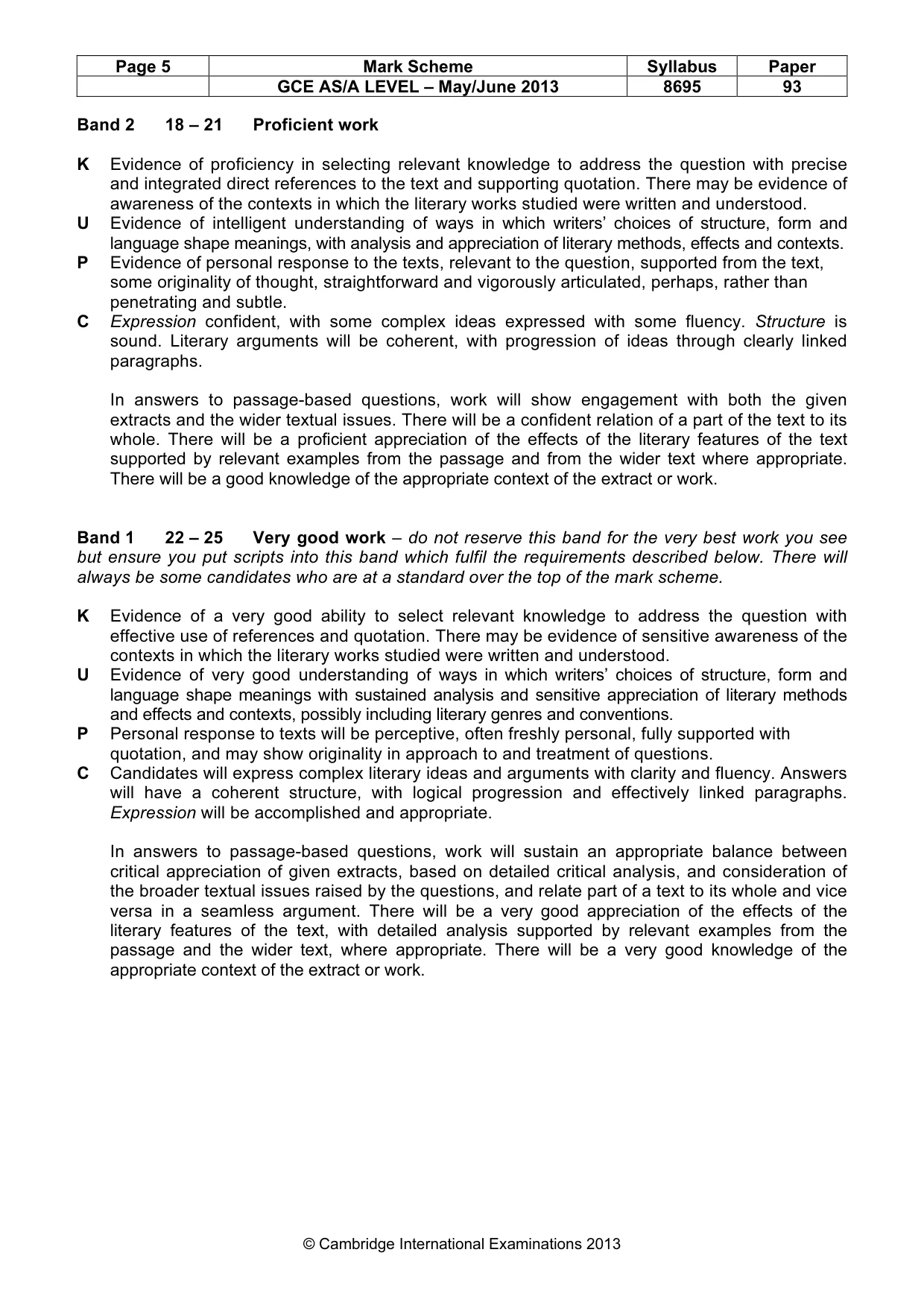
Page 5 Mark Scheme Syllabus Paper GCE AS/A LEVEL – May/June 2013 8695 93 © Cambridge International Examinations 2013 Band 2 18 – 21 Proficient work K Evidence of proficiency in selecting relevant knowledge to address the question with precise and integrated direct references to the text and supporting quotation. There may be evidence of awareness of the contexts in which the literary works studied were written and understood. U Evidence of intelligent understanding of ways in which writers’ choices of structure, form and language shape meanings, with analysis and appreciation of literary methods, effects and contexts. P Evidence of personal response to the texts, relevant to the question, supported from the text, some originality of thought, straightforward and vigorously articulated, perhaps, rather than penetrating and subtle. C Expression confident, with some complex ideas expressed with some fluency. Structure is sound. Literary arguments will be coherent, with progression of ideas through clearly linked paragraphs. In answers to passage-based questions, work will show engagement with both the given extracts and the wider textual issues. There will be a confident relation of a part of the text to its whole. There will be a proficient appreciation of the effects of the literary features of the text supported by relevant examples from the passage and from the wider text where appropriate. There will be a good knowledge of the appropriate context of the extract or work. Band 1 22 – 25 Very good work – do not reserve this band for the very best work you see but ensure you put scripts into this band which fulfil the requirements described below. There will always be some candidates who are at a standard over the top of the mark scheme. K Evidence of a very good ability to select relevant knowledge to address the question with effective use of references and quotation. There may be evidence of sensitive awareness of the contexts in which the literary works studied were written and understood. U Evidence of very good understanding of ways in which writers’ choices of structure, form and language shape meanings with sustained analysis and sensitive appreciation of literary methods and effects and contexts, possibly including literary genres and conventions. P Personal response to texts will be perceptive, often freshly personal, fully supported with quotation, and may show originality in approach to and treatment of questions. C Candidates will express complex literary ideas and arguments with clarity and fluency. Answers will have a coherent structure, with logical progression and effectively linked paragraphs. Expression will be accomplished and appropriate. In answers to passage-based questions, work will sustain an appropriate balance between critical appreciation of given extracts, based on detailed critical analysis, and consideration of the broader textual issues raised by the questions, and relate part of a text to its whole and vice versa in a seamless argument. There will be a very good appreciation of the effects of the literary features of the text, with detailed analysis supported by relevant examples from the passage and the wider text, where appropriate. There will be a very good knowledge of the appropriate context of the extract or work.
What you needed in this session
Cambridge’s own grade thresholds for 2013 May/June, Paper 9 · Variant 3. A higher threshold means an easier paper — the bar moves with how the cohort did.