Cambridge A Level English - Language and Literature (AS Level only, from 2016) 8695 — 2013 May/June Paper 9 · Variant 2
8695/92/M/J/13 · 50 marks · ≈56 min
The question paper and its mark scheme, free to read here and free to download. This is Cambridge’s own paper, exactly as it was sat.
Question paper20 pages




Mark scheme5 pages
Answers below. Sit the paper first if you are practising.
Paper as text
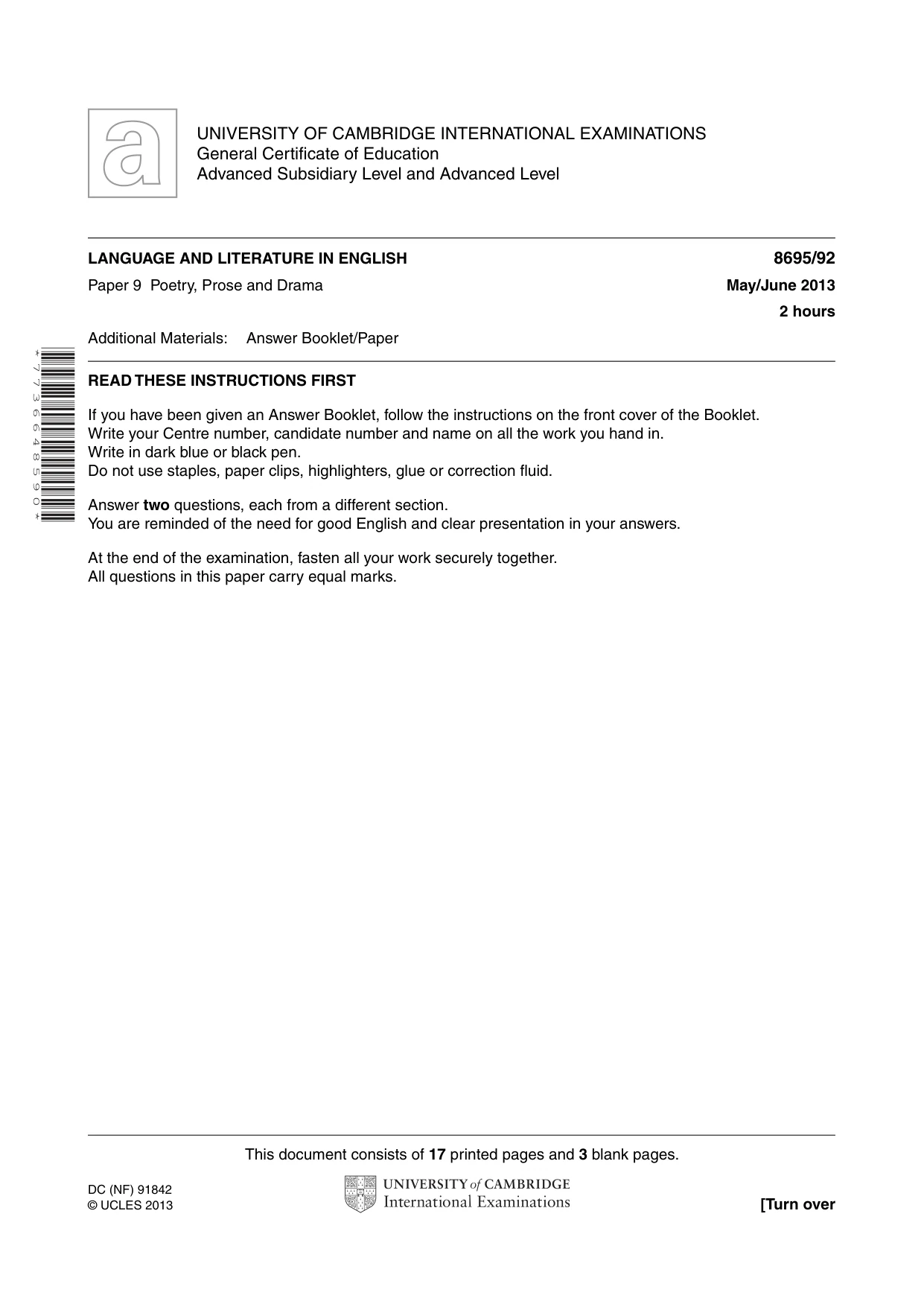
Question paper, page 1
This document consists of 17 printed pages and 3 blank pages. DC (NF) 91842 © UCLES 2013 [Turn over UNIVERSITY OF CAMBRIDGE INTERNATIONAL EXAMINATIONS General Certificate of Education Advanced Subsidiary Level and Advanced Level * 7 7 3 6 6 4 8 5 9 0 * LANGUAGE AND LITERATURE IN ENGLISH 8695/92 Paper 9 Poetry, Prose and Drama May/June 2013 2 hours Additional Materials: Answer Booklet/Paper READ THESE INSTRUCTIONS FIRST If you have been given an Answer Booklet, follow the instructions on the front cover of the Booklet. Write your Centre number, candidate number and name on all the work you hand in. Write in dark blue or black pen. Do not use staples, paper clips, highlighters, glue or correction fluid. Answer two questions, each from a different section. You are reminded of the need for good English and clear presentation in your answers. At the end of the examination, fasten all your work securely together. All questions in this paper carry equal marks.
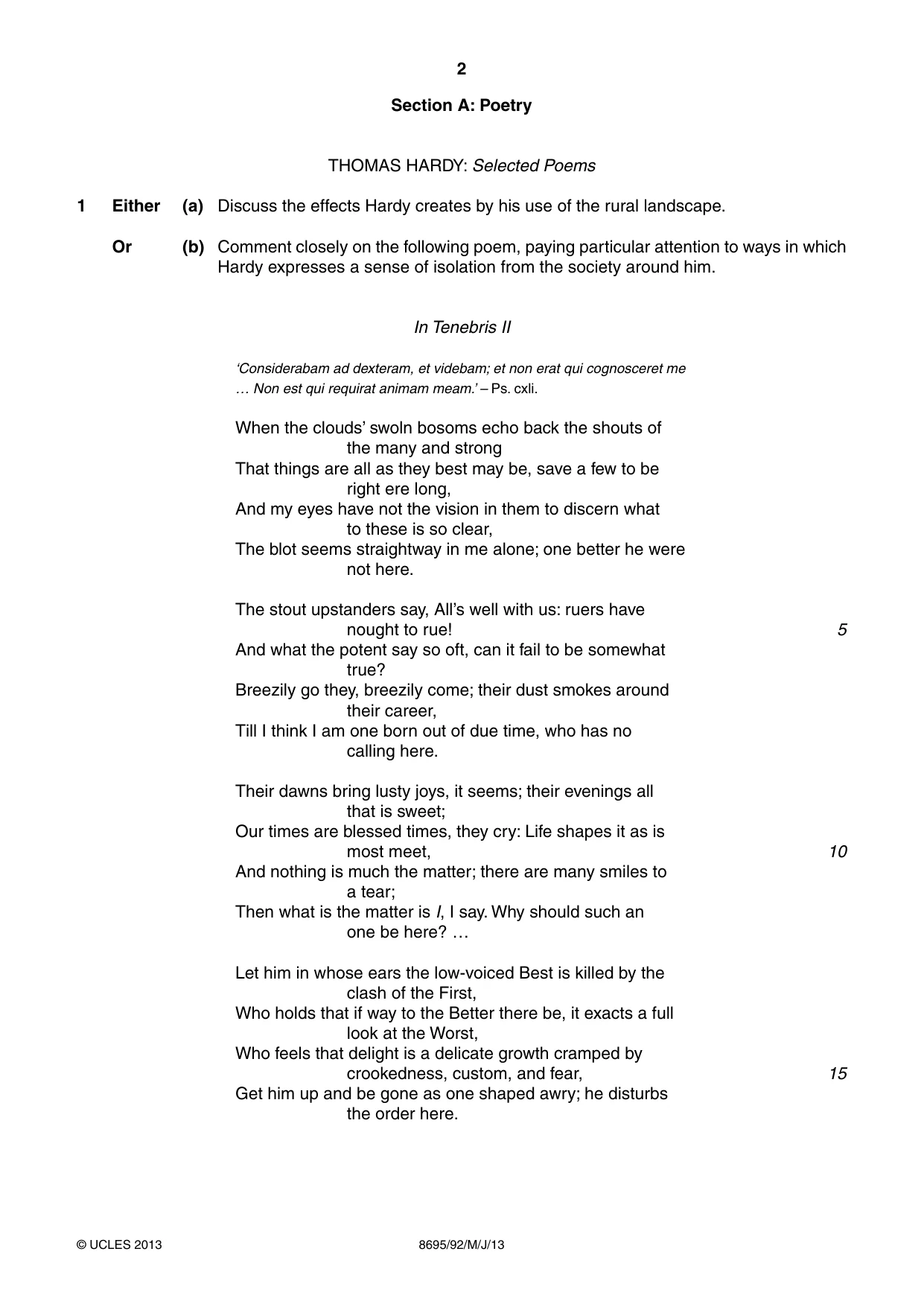
Question paper, page 2
2 8695/92/M/J/13 © UCLES 2013 Section A: Poetry THOMAS HARDY: Selected Poems 1 Either (a) Discuss the effects Hardy creates by his use of the rural landscape. Or (b) Comment closely on the following poem, paying particular attention to ways in which Hardy expresses a sense of isolation from the society around him. In Tenebris II ‘Considerabam ad dexteram, et videbam; et non erat qui cognosceret me … Non est qui requirat animam meam.’ – Ps. cxli. When the clouds’ swoln bosoms echo back the shouts of the many and strong That things are all as they best may be, save a few to be right ere long, And my eyes have not the vision in them to discern what to these is so clear, The blot seems straightway in me alone; one better he were not here. The stout upstanders say, All’s well with us: ruers have nought to rue! 5 And what the potent say so oft, can it fail to be somewhat true? Breezily go they, breezily come; their dust smokes around their career, Till I think I am one born out of due time, who has no calling here. Their dawns bring lusty joys, it seems; their evenings all that is sweet; Our times are blessed times, they cry: Life shapes it as is most meet, 10 And nothing is much the matter; there are many smiles to a tear; Then what is the matter is I, I say. Why should such an one be here? … Let him in whose ears the low-voiced Best is killed by the clash of the First, Who holds that if way to the Better there be, it exacts a full look at the Worst, Who feels that delight is a delicate growth cramped by crookedness, custom, and fear, 15 Get him up and be gone as one shaped awry; he disturbs the order here.
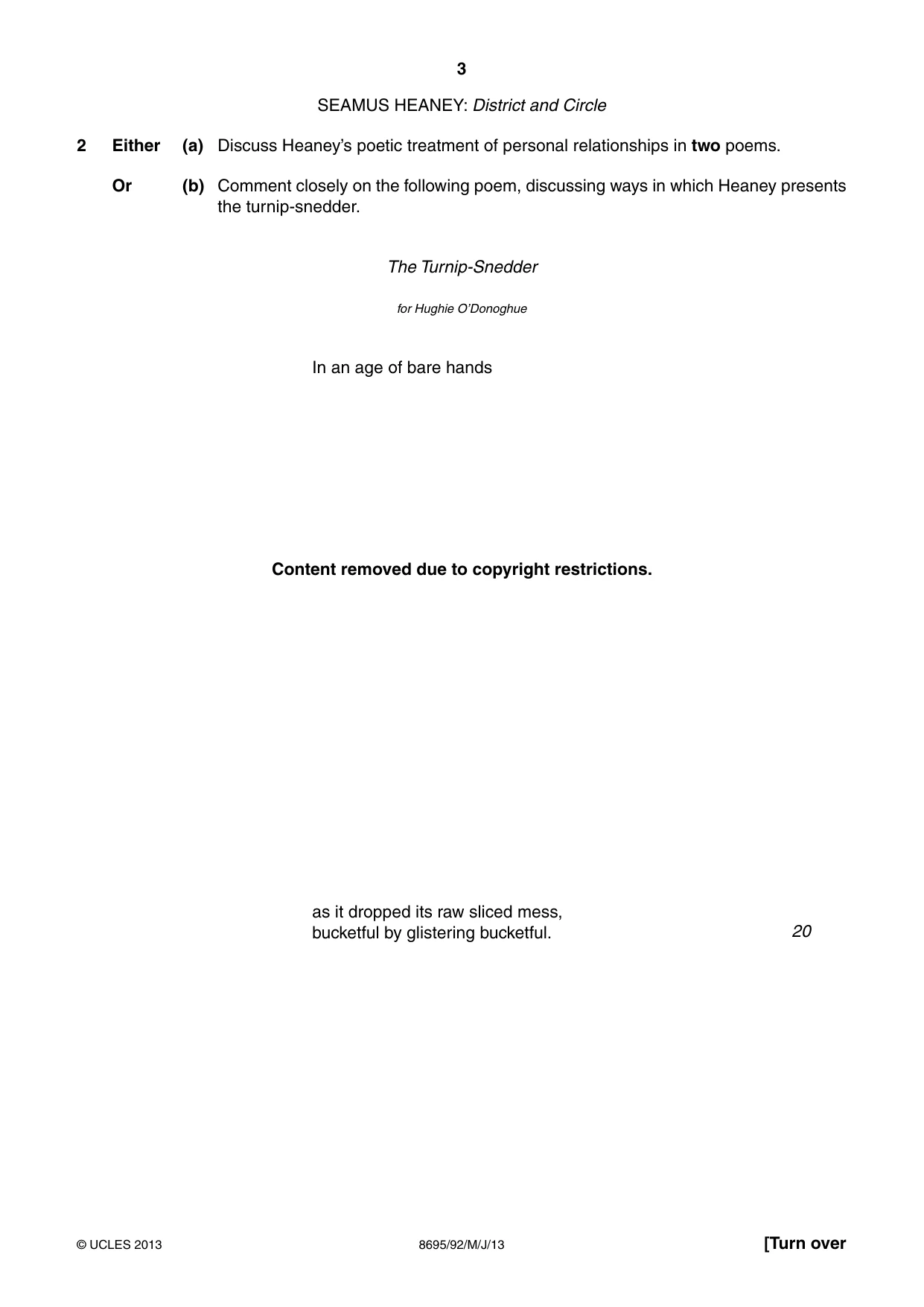
Question paper, page 3
3 8695/92/M/J/13 © UCLES 2013 [Turn over SEAMUS HEANEY: District and Circle 2 Either (a) Discuss Heaney’s poetic treatment of personal relationships in two poems. Or (b) Comment closely on the following poem, discussing ways in which Heaney presents the turnip-snedder. The Turnip-Snedder for Hughie O’Donoghue In an age of bare hands Content removed due to copyright restrictions. as it dropped its raw sliced mess, bucketful by glistering bucketful. 20
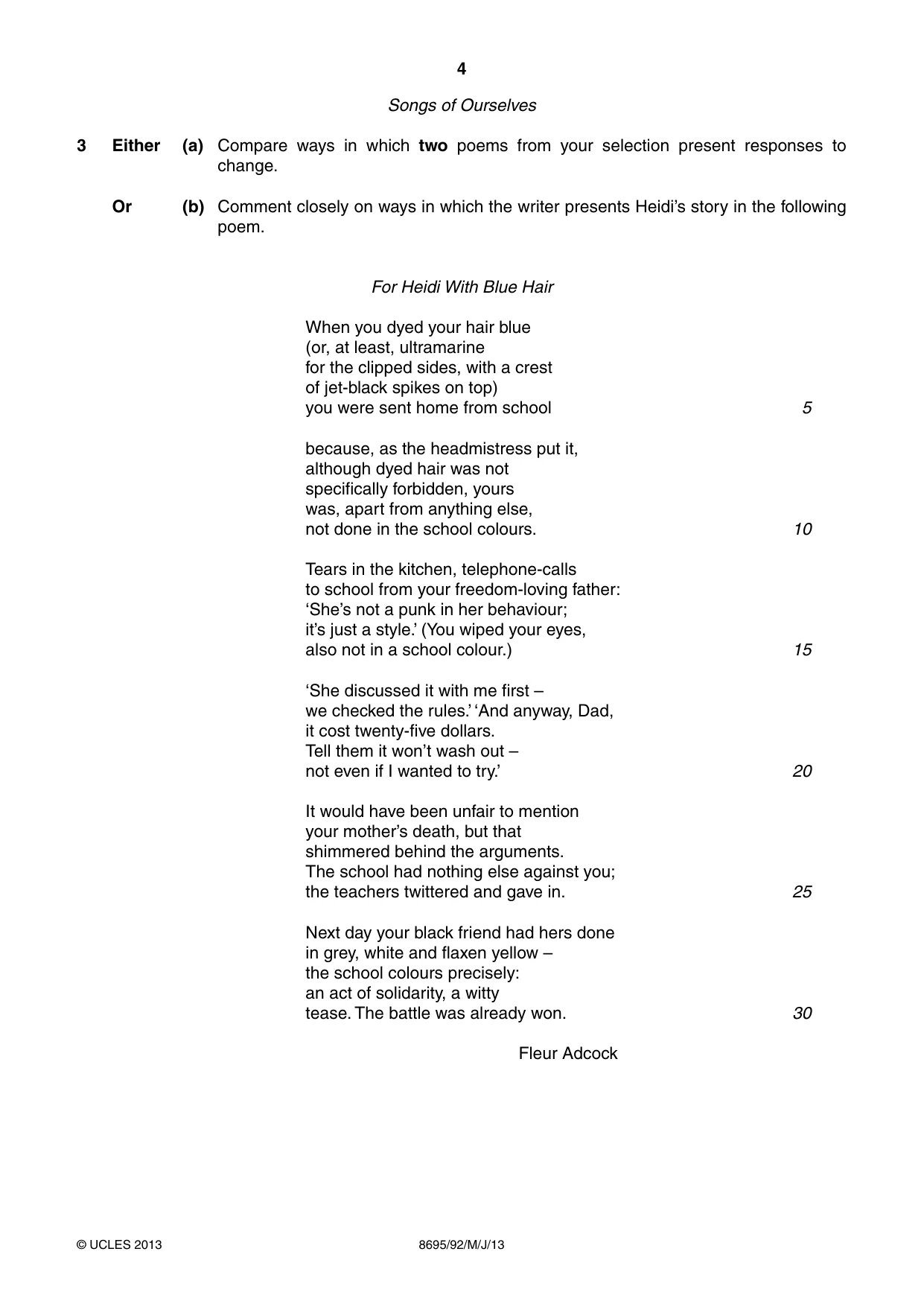
Question paper, page 4
4 8695/92/M/J/13 © UCLES 2013 Songs of Ourselves 3 Either (a) Compare ways in which two poems from your selection present responses to change. Or (b) Comment closely on ways in which the writer presents Heidi’s story in the following poem. For Heidi With Blue Hair When you dyed your hair blue (or, at least, ultramarine for the clipped sides, with a crest of jet-black spikes on top) you were sent home from school 5 because, as the headmistress put it, although dyed hair was not specifically forbidden, yours was, apart from anything else, not done in the school colours. 10 Tears in the kitchen, telephone-calls to school from your freedom-loving father: ‘She’s not a punk in her behaviour; it’s just a style.’ (You wiped your eyes, also not in a school colour.) 15 ‘She discussed it with me first – we checked the rules.’ ‘And anyway, Dad, it cost twenty-five dollars. Tell them it won’t wash out – not even if I wanted to try.’ 20 It would have been unfair to mention your mother’s death, but that shimmered behind the arguments. The school had nothing else against you; the teachers twittered and gave in. 25 Next day your black friend had hers done in grey, white and flaxen yellow – the school colours precisely: an act of solidarity, a witty tease. The battle was already won. 30 Fleur Adcock
Question paper, page 5
5 8695/92/M/J/13 © UCLES 2013 [Turn over Turn to page 6 for Question 4
Question paper, page 6
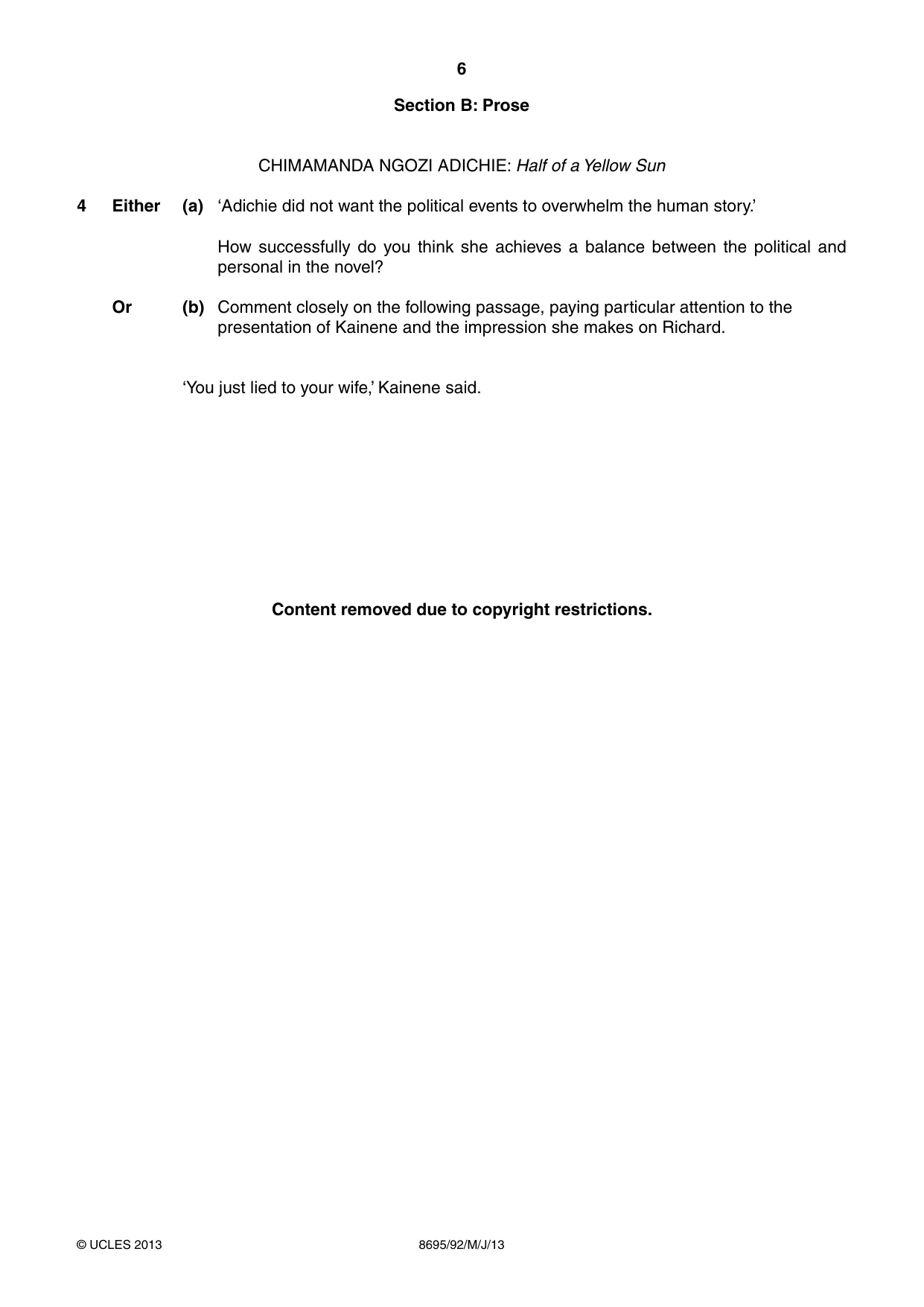
6 8695/92/M/J/13 © UCLES 2013 Section B: Prose CHIMAMANDA NGOZI ADICHIE: Half of a Yellow Sun 4 Either (a) ‘Adichie did not want the political events to overwhelm the human story.’ How successfully do you think she achieves a balance between the political and personal in the novel? Or (b) Comment closely on the following passage, paying particular attention to the presentation of Kainene and the impression she makes on Richard. ‘You just lied to your wife,’ Kainene said. Content removed due to copyright restrictions.
Question paper, page 7
7 8695/92/M/J/13 © UCLES 2013 [Turn over Content removed due to copyright restrictions. ‘How lovely to meet you,’ Kainene said and half-raised her glass towards Susan. Chapter 3
Question paper, page 8
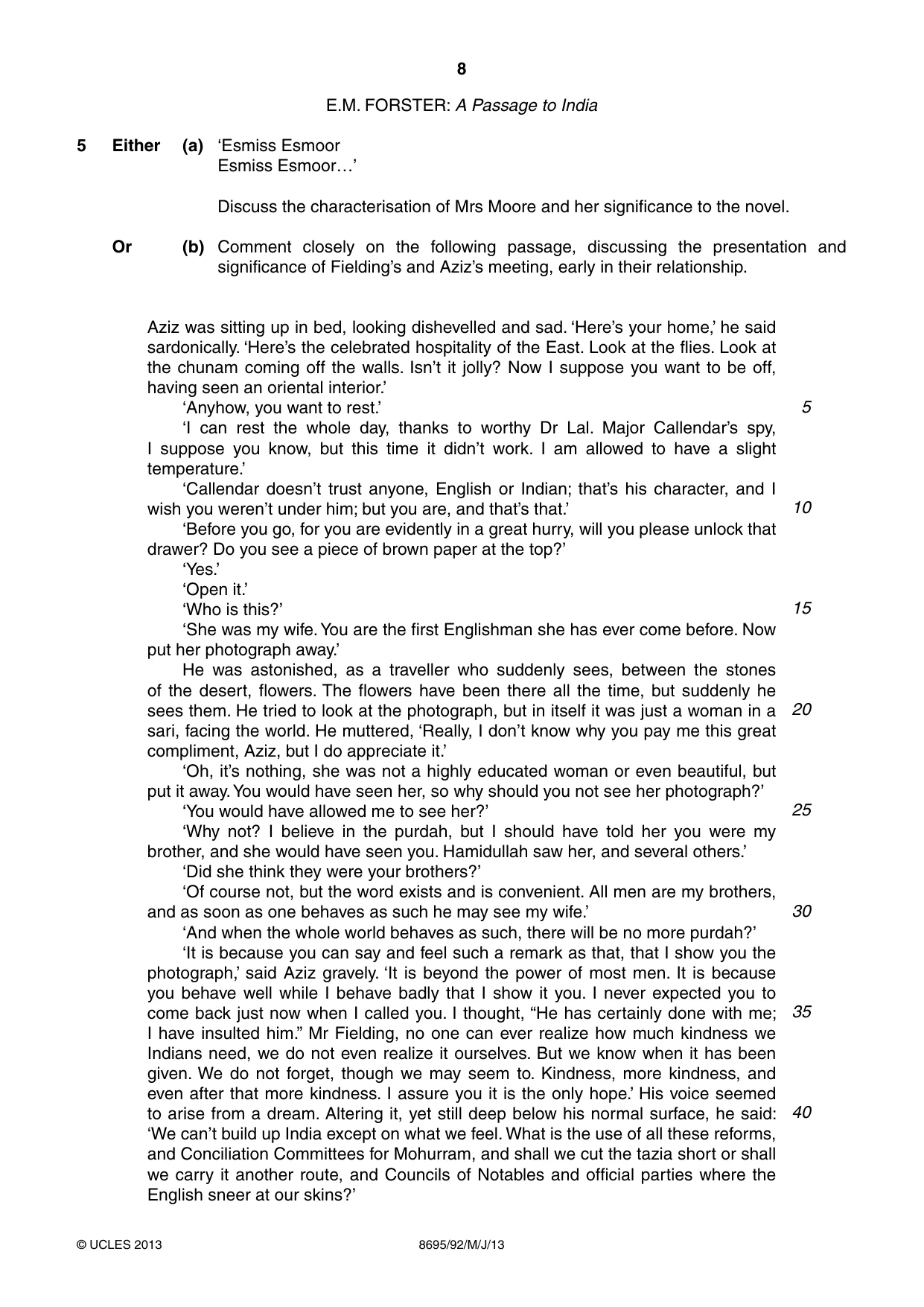
8 8695/92/M/J/13 © UCLES 2013 E.M. FORSTER: A Passage to India 5 Either (a) ‘Esmiss Esmoor Esmiss Esmoor…’ Discuss the characterisation of Mrs Moore and her significance to the novel. Or (b) Comment closely on the following passage, discussing the presentation and significance of Fielding’s and Aziz’s meeting, early in their relationship. Aziz was sitting up in bed, looking dishevelled and sad. ‘Here’s your home,’ he said sardonically. ‘Here’s the celebrated hospitality of the East. Look at the flies. Look at the chunam coming off the walls. Isn’t it jolly? Now I suppose you want to be off, having seen an oriental interior.’ ‘Anyhow, you want to rest.’ ‘I can rest the whole day, thanks to worthy Dr Lal. Major Callendar’s spy, I suppose you know, but this time it didn’t work. I am allowed to have a slight temperature.’ ‘Callendar doesn’t trust anyone, English or Indian; that’s his character, and I wish you weren’t under him; but you are, and that’s that.’ ‘Before you go, for you are evidently in a great hurry, will you please unlock that drawer? Do you see a piece of brown paper at the top?’ ‘Yes.’ ‘Open it.’ ‘Who is this?’ ‘She was my wife. You are the first Englishman she has ever come before. Now put her photograph away.’ He was astonished, as a traveller who suddenly sees, between the stones of the desert, flowers. The flowers have been there all the time, but suddenly he sees them. He tried to look at the photograph, but in itself it was just a woman in a sari, facing the world. He muttered, ‘Really, I don’t know why you pay me this great compliment, Aziz, but I do appreciate it.’ ‘Oh, it’s nothing, she was not a highly educated woman or even beautiful, but put it away. You would have seen her, so why should you not see her photograph?’ ‘You would have allowed me to see her?’ ‘Why not? I believe in the purdah, but I should have told her you were my brother, and she would have seen you. Hamidullah saw her, and several others.’ ‘Did she think they were your brothers?’ ‘Of course not, but the word exists and is convenient. All men are my brothers, and as soon as one behaves as such he may see my wife.’ ‘And when the whole world behaves as such, there will be no more purdah?’ ‘It is because you can say and feel such a remark as that, that I show you the photograph,’ said Aziz gravely. ‘It is beyond the power of most men. It is because you behave well while I behave badly that I show it you. I never expected you to come back just now when I called you. I thought, “He has certainly done with me; I have insulted him.” Mr Fielding, no one can ever realize how much kindness we Indians need, we do not even realize it ourselves. But we know when it has been given. We do not forget, though we may seem to. Kindness, more kindness, and even after that more kindness. I assure you it is the only hope.’ His voice seemed to arise from a dream. Altering it, yet still deep below his normal surface, he said: ‘We can’t build up India except on what we feel. What is the use of all these reforms, and Conciliation Committees for Mohurram, and shall we cut the tazia short or shall we carry it another route, and Councils of Notables and official parties where the English sneer at our skins?’ 5 10 15 20 25 30 35 40
Question paper, page 9
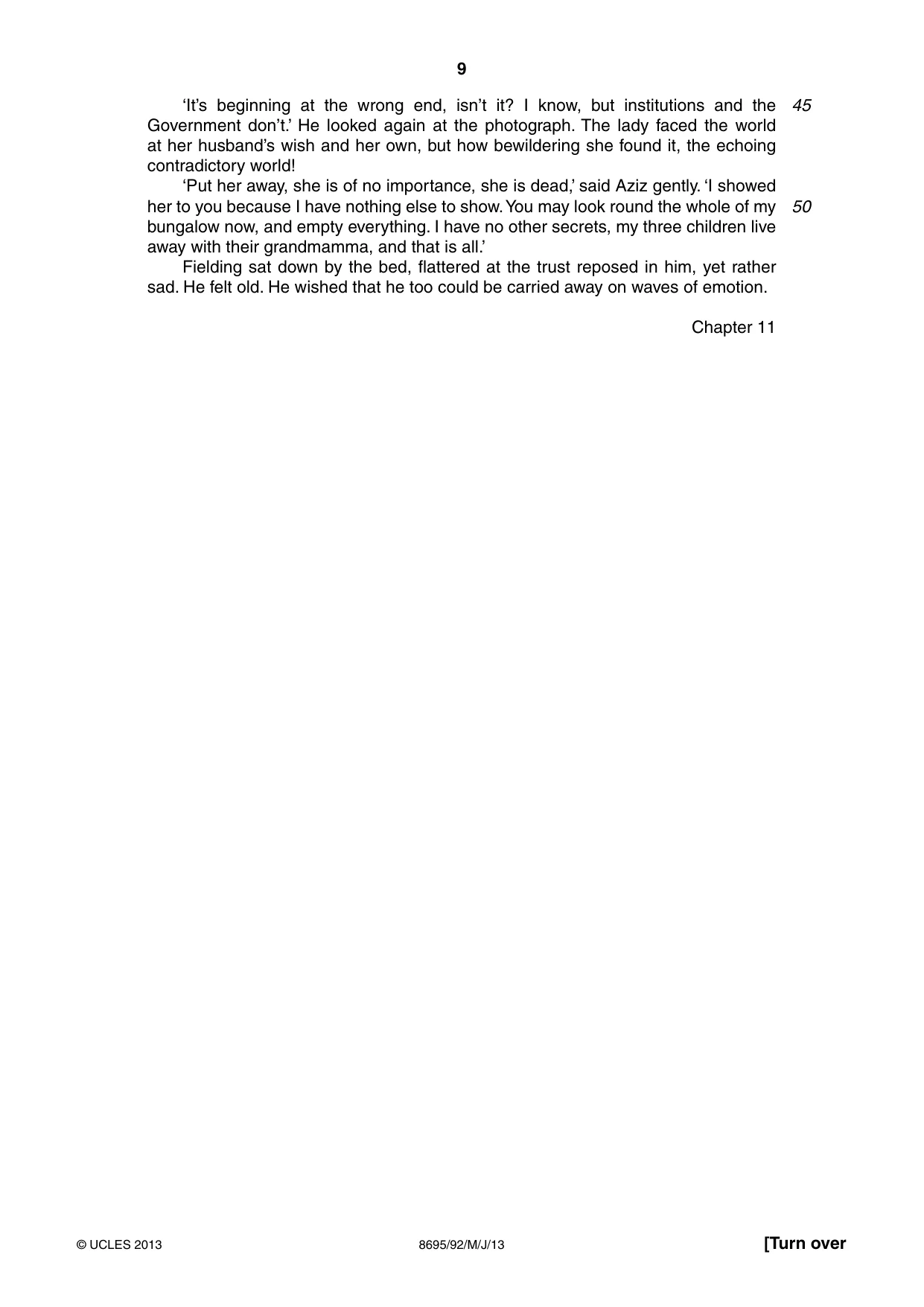
9 8695/92/M/J/13 © UCLES 2013 [Turn over ‘It’s beginning at the wrong end, isn’t it? I know, but institutions and the Government don’t.’ He looked again at the photograph. The lady faced the world at her husband’s wish and her own, but how bewildering she found it, the echoing contradictory world! ‘Put her away, she is of no importance, she is dead,’ said Aziz gently. ‘I showed her to you because I have nothing else to show. You may look round the whole of my bungalow now, and empty everything. I have no other secrets, my three children live away with their grandmamma, and that is all.’ Fielding sat down by the bed, flattered at the trust reposed in him, yet rather sad. He felt old. He wished that he too could be carried away on waves of emotion. Chapter 11 45 50
Question paper, page 10
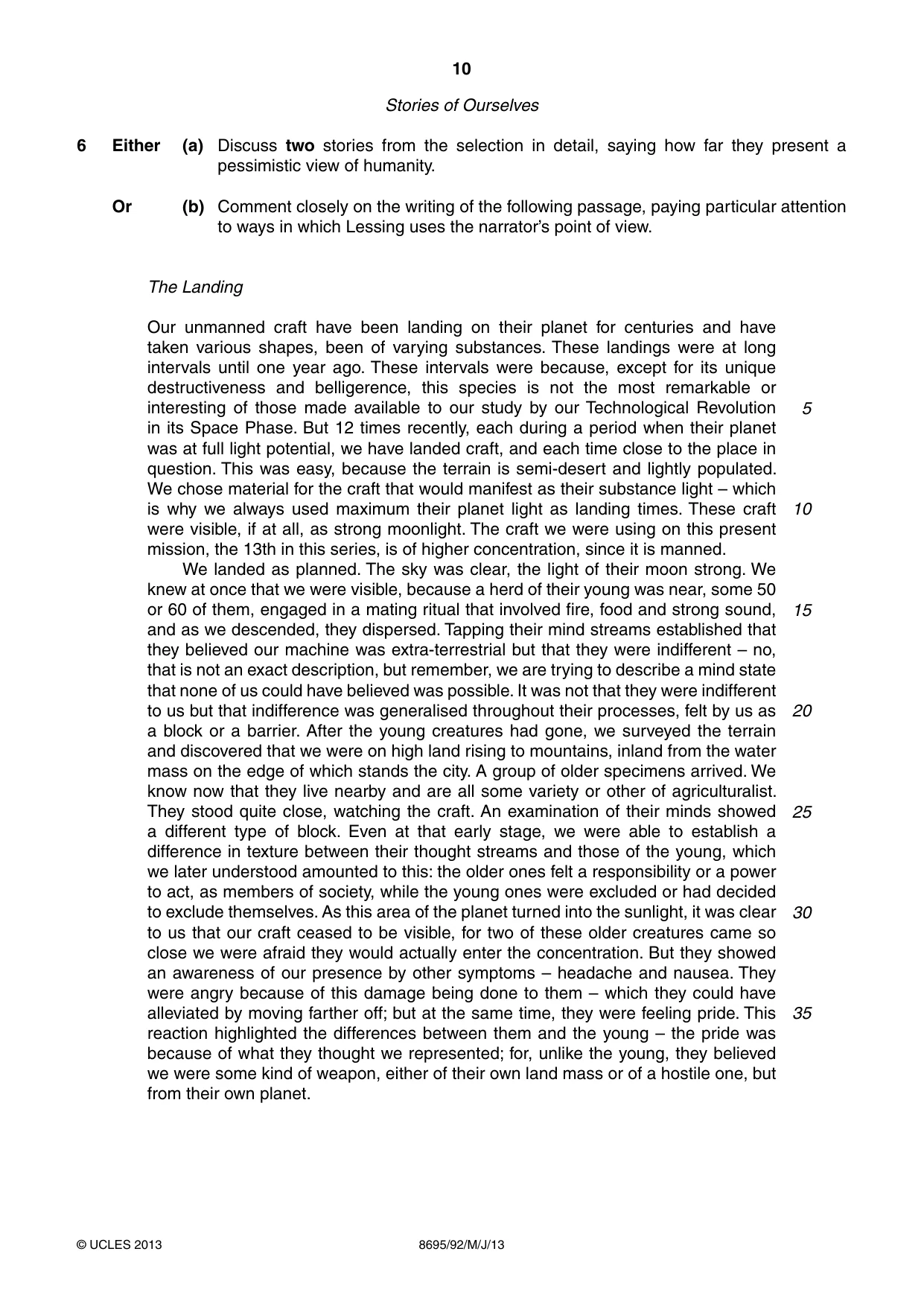
10 8695/92/M/J/13 © UCLES 2013 Stories of Ourselves 6 Either (a) Discuss two stories from the selection in detail, saying how far they present a pessimistic view of humanity. Or (b) Comment closely on the writing of the following passage, paying particular attention to ways in which Lessing uses the narrator’s point of view. The Landing Our unmanned craft have been landing on their planet for centuries and have taken various shapes, been of varying substances. These landings were at long intervals until one year ago. These intervals were because, except for its unique destructiveness and belligerence, this species is not the most remarkable or interesting of those made available to our study by our Technological Revolution in its Space Phase. But 12 times recently, each during a period when their planet was at full light potential, we have landed craft, and each time close to the place in question. This was easy, because the terrain is semi-desert and lightly populated. We chose material for the craft that would manifest as their substance light – which is why we always used maximum their planet light as landing times. These craft were visible, if at all, as strong moonlight. The craft we were using on this present mission, the 13th in this series, is of higher concentration, since it is manned. We landed as planned. The sky was clear, the light of their moon strong. We knew at once that we were visible, because a herd of their young was near, some 50 or 60 of them, engaged in a mating ritual that involved fire, food and strong sound, and as we descended, they dispersed. Tapping their mind streams established that they believed our machine was extra-terrestrial but that they were indifferent – no, that is not an exact description, but remember, we are trying to describe a mind state that none of us could have believed was possible. It was not that they were indifferent to us but that indifference was generalised throughout their processes, felt by us as a block or a barrier. After the young creatures had gone, we surveyed the terrain and discovered that we were on high land rising to mountains, inland from the water mass on the edge of which stands the city. A group of older specimens arrived. We know now that they live nearby and are all some variety or other of agriculturalist. They stood quite close, watching the craft. An examination of their minds showed a different type of block. Even at that early stage, we were able to establish a difference in texture between their thought streams and those of the young, which we later understood amounted to this: the older ones felt a responsibility or a power to act, as members of society, while the young ones were excluded or had decided to exclude themselves. As this area of the planet turned into the sunlight, it was clear to us that our craft ceased to be visible, for two of these older creatures came so close we were afraid they would actually enter the concentration. But they showed an awareness of our presence by other symptoms – headache and nausea. They were angry because of this damage being done to them – which they could have alleviated by moving farther off; but at the same time, they were feeling pride. This reaction highlighted the differences between them and the young – the pride was because of what they thought we represented; for, unlike the young, they believed we were some kind of weapon, either of their own land mass or of a hostile one, but from their own planet. 5 10 15 20 25 30 35
Question paper, page 11
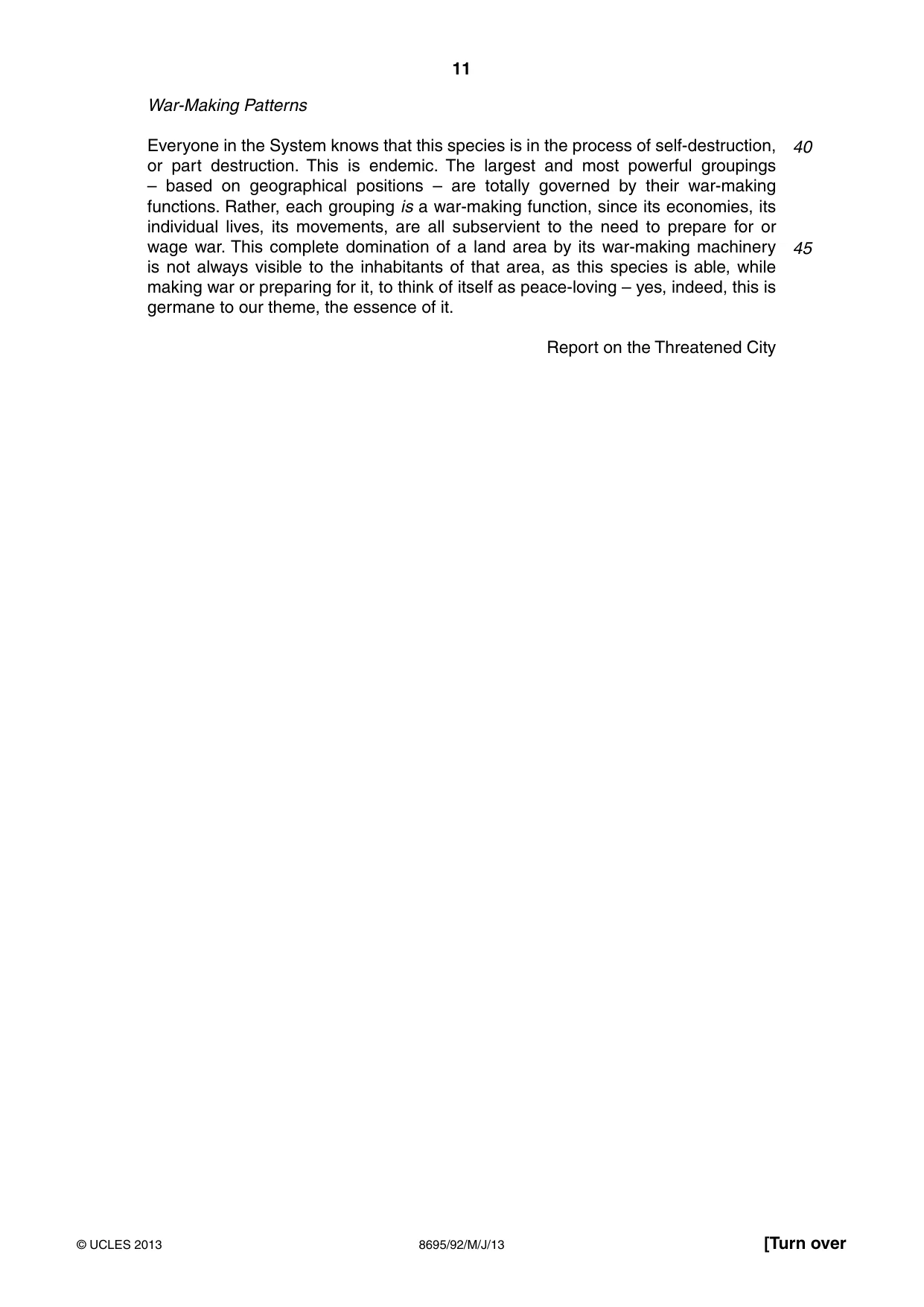
11 8695/92/M/J/13 © UCLES 2013 [Turn over War-Making Patterns Everyone in the System knows that this species is in the process of self-destruction, or part destruction. This is endemic. The largest and most powerful groupings – based on geographical positions – are totally governed by their war-making functions. Rather, each grouping is a war-making function, since its economies, its individual lives, its movements, are all subservient to the need to prepare for or wage war. This complete domination of a land area by its war-making machinery is not always visible to the inhabitants of that area, as this species is able, while making war or preparing for it, to think of itself as peace-loving – yes, indeed, this is germane to our theme, the essence of it. Report on the Threatened City 40 45
Question paper, page 12
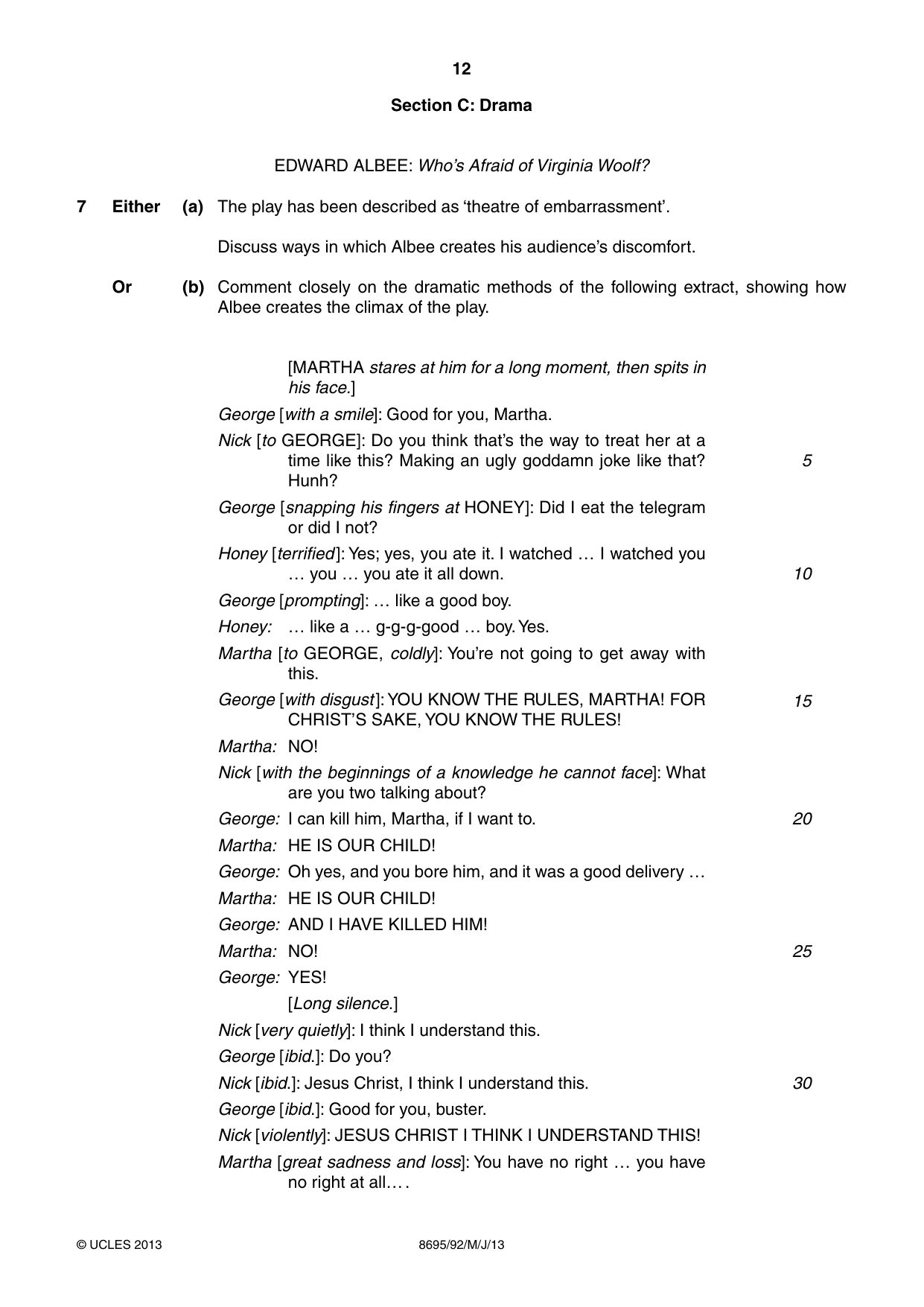
12 8695/92/M/J/13 © UCLES 2013 Section C: Drama EDWARD ALBEE: Who’s Afraid of Virginia Woolf? 7 Either (a) The play has been described as ‘theatre of embarrassment’. Discuss ways in which Albee creates his audience’s discomfort. Or (b) Comment closely on the dramatic methods of the following extract, showing how Albee creates the climax of the play. [MARTHA stares at him for a long moment, then spits in his face.] George [with a smile]: Good for you, Martha. Nick [to GEORGE]: Do you think that’s the way to treat her at a time like this? Making an ugly goddamn joke like that? Hunh? George [snapping his fingers at HONEY]: Did I eat the telegram or did I not? Honey [terrified ]: Yes; yes, you ate it. I watched … I watched you … you … you ate it all down. George [prompting]: … like a good boy. Honey: … like a … g-g-g-good … boy. Yes. Martha [to GEORGE, coldly]: You’re not going to get away with this. George [with disgust ]: YOU KNOW THE RULES, MARTHA! FOR CHRIST’S SAKE, YOU KNOW THE RULES! Martha: NO! Nick [with the beginnings of a knowledge he cannot face]: What are you two talking about? George: I can kill him, Martha, if I want to. Martha: HE IS OUR CHILD! George: Oh yes, and you bore him, and it was a good delivery … Martha: HE IS OUR CHILD! George: AND I HAVE KILLED HIM! Martha: NO! George: YES! [Long silence.] Nick [very quietly]: I think I understand this. George [ibid.]: Do you? Nick [ibid.]: Jesus Christ, I think I understand this. George [ibid.]: Good for you, buster. Nick [violently]: JESUS CHRIST I THINK I UNDERSTAND THIS! Martha [great sadness and loss]: You have no right … you have no right at all… . 5 10 15 20 25 30
Question paper, page 13
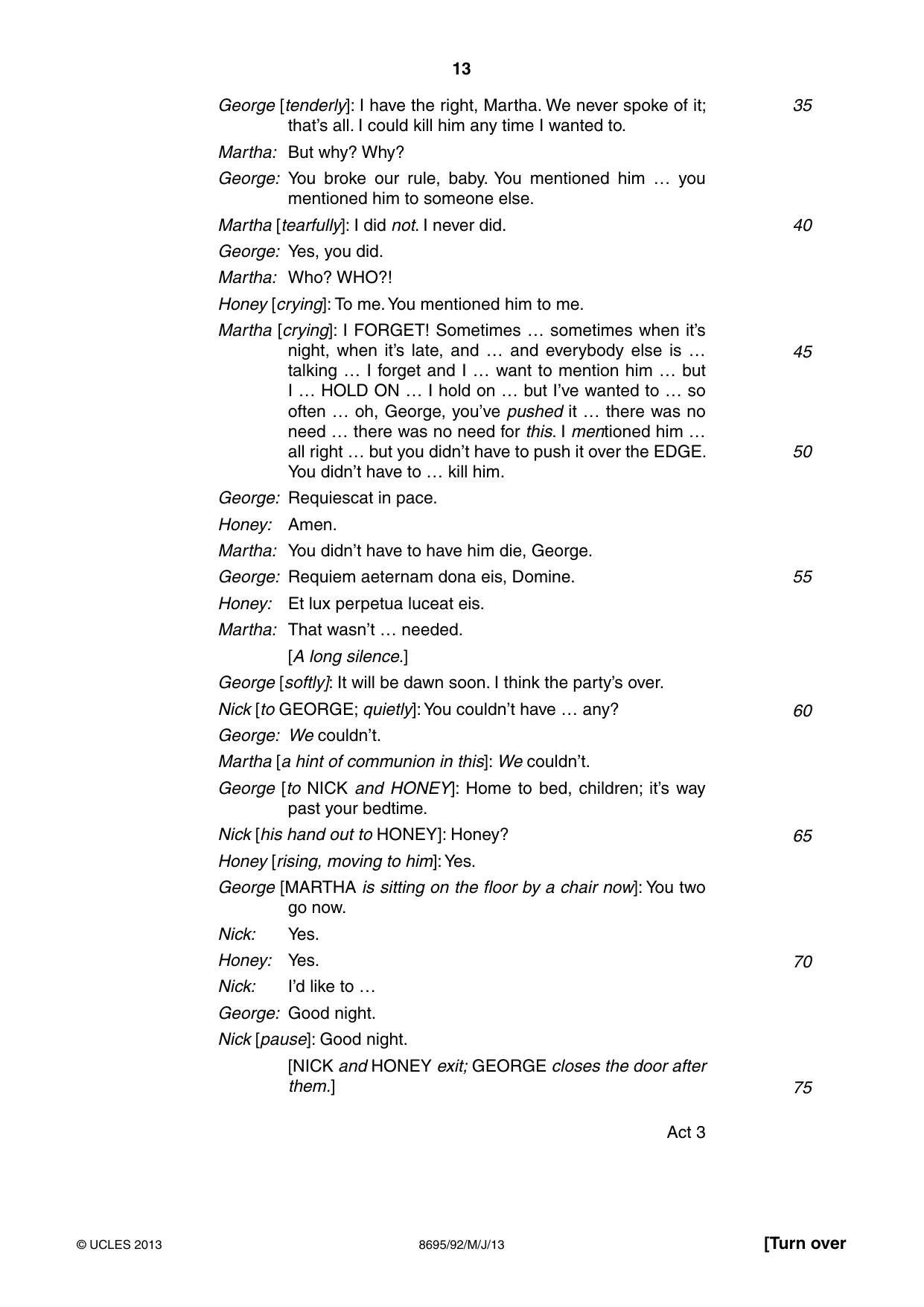
13 8695/92/M/J/13 © UCLES 2013 [Turn over George [tenderly]: I have the right, Martha. We never spoke of it; that’s all. I could kill him any time I wanted to. Martha: But why? Why? George: You broke our rule, baby. You mentioned him … you mentioned him to someone else. Martha [tearfully]: I did not. I never did. George: Yes, you did. Martha: Who? WHO?! Honey [crying]: To me. You mentioned him to me. Martha [crying]: I FORGET! Sometimes … sometimes when it’s night, when it’s late, and … and everybody else is … talking … I forget and I … want to mention him … but I … HOLD ON … I hold on … but I’ve wanted to … so often … oh, George, you’ve pushed it … there was no need … there was no need for this. I mentioned him … all right … but you didn’t have to push it over the EDGE. You didn’t have to … kill him. George: Requiescat in pace. Honey: Amen. Martha: You didn’t have to have him die, George. George: Requiem aeternam dona eis, Domine. Honey: Et lux perpetua luceat eis. Martha: That wasn’t … needed. [A long silence.] George [softly]: It will be dawn soon. I think the party’s over. Nick [to GEORGE; quietly]: You couldn’t have … any? George: We couldn’t. Martha [a hint of communion in this]: We couldn’t. George [to NICK and HONEY]: Home to bed, children; it’s way past your bedtime. Nick [his hand out to HONEY]: Honey? Honey [rising, moving to him]: Yes. George [MARTHA is sitting on the floor by a chair now]: You two go now. Nick: Yes. Honey: Yes. Nick: I’d like to … George: Good night. Nick [pause]: Good night. [NICK and HONEY exit; GEORGE closes the door after them.] Act 3 35 40 45 50 55 60 65 70 75
Question paper, page 14
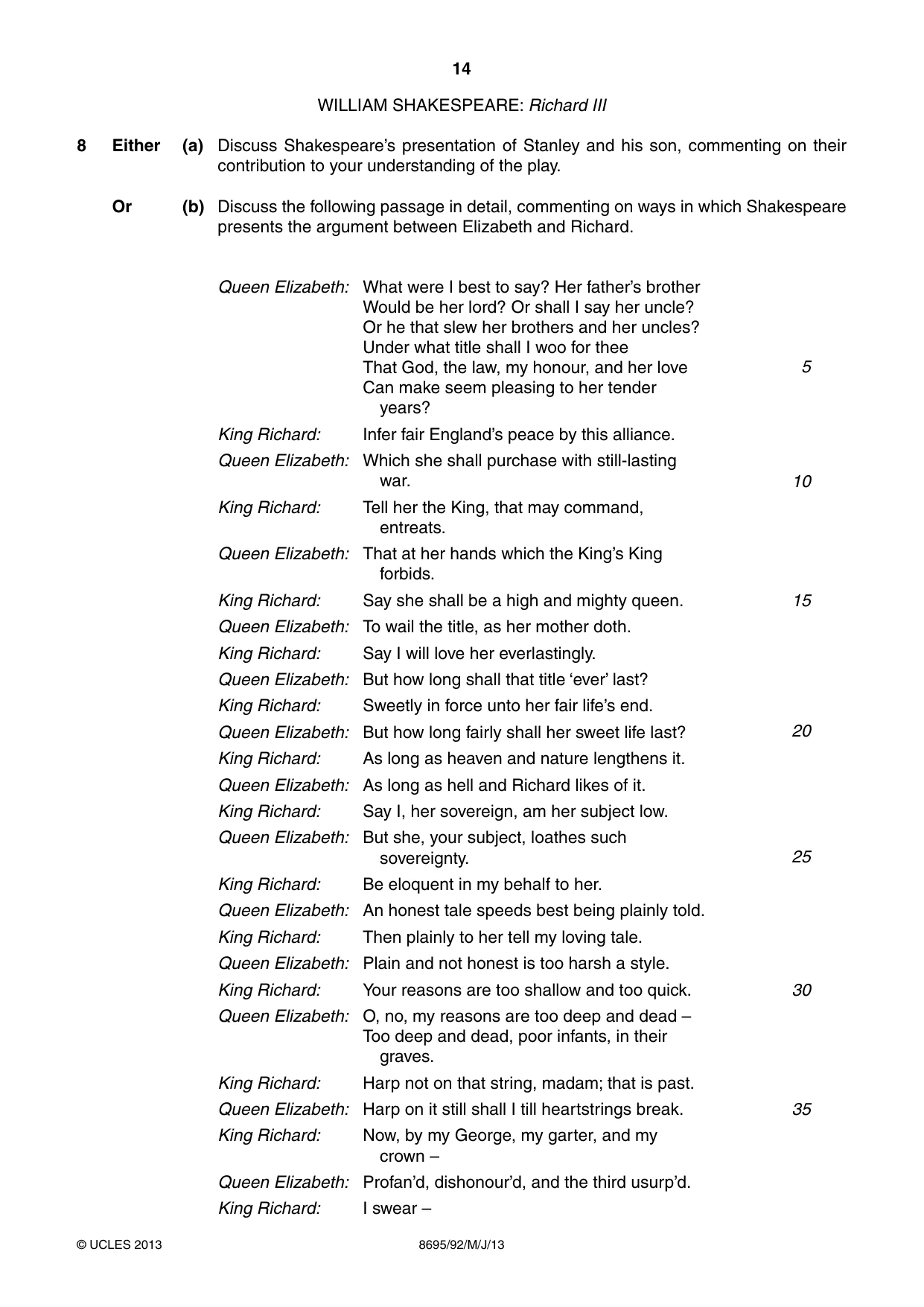
14 8695/92/M/J/13 © UCLES 2013 WILLIAM SHAKESPEARE: Richard III 8 Either (a) Discuss Shakespeare’s presentation of Stanley and his son, commenting on their contribution to your understanding of the play. Or (b) Discuss the following passage in detail, commenting on ways in which Shakespeare presents the argument between Elizabeth and Richard. Queen Elizabeth: What were I best to say? Her father’s brother Would be her lord? Or shall I say her uncle? Or he that slew her brothers and her uncles? Under what title shall I woo for thee That God, the law, my honour, and her love Can make seem pleasing to her tender years? King Richard: Infer fair England’s peace by this alliance. Queen Elizabeth: Which she shall purchase with still-lasting war. King Richard: Tell her the King, that may command, entreats. Queen Elizabeth: That at her hands which the King’s King forbids. King Richard: Say she shall be a high and mighty queen. Queen Elizabeth: To wail the title, as her mother doth. King Richard: Say I will love her everlastingly. Queen Elizabeth: But how long shall that title ‘ever’ last? King Richard: Sweetly in force unto her fair life’s end. Queen Elizabeth: But how long fairly shall her sweet life last? King Richard: As long as heaven and nature lengthens it. Queen Elizabeth: As long as hell and Richard likes of it. King Richard: Say I, her sovereign, am her subject low. Queen Elizabeth: But she, your subject, loathes such sovereignty. King Richard: Be eloquent in my behalf to her. Queen Elizabeth: An honest tale speeds best being plainly told. King Richard: Then plainly to her tell my loving tale. Queen Elizabeth: Plain and not honest is too harsh a style. King Richard: Your reasons are too shallow and too quick. Queen Elizabeth: O, no, my reasons are too deep and dead – Too deep and dead, poor infants, in their graves. King Richard: Harp not on that string, madam; that is past. Queen Elizabeth: Harp on it still shall I till heartstrings break. King Richard: Now, by my George, my garter, and my crown – Queen Elizabeth: Profan’d, dishonour’d, and the third usurp’d. King Richard: I swear – 5 10 15 20 25 30 35
Question paper, page 15
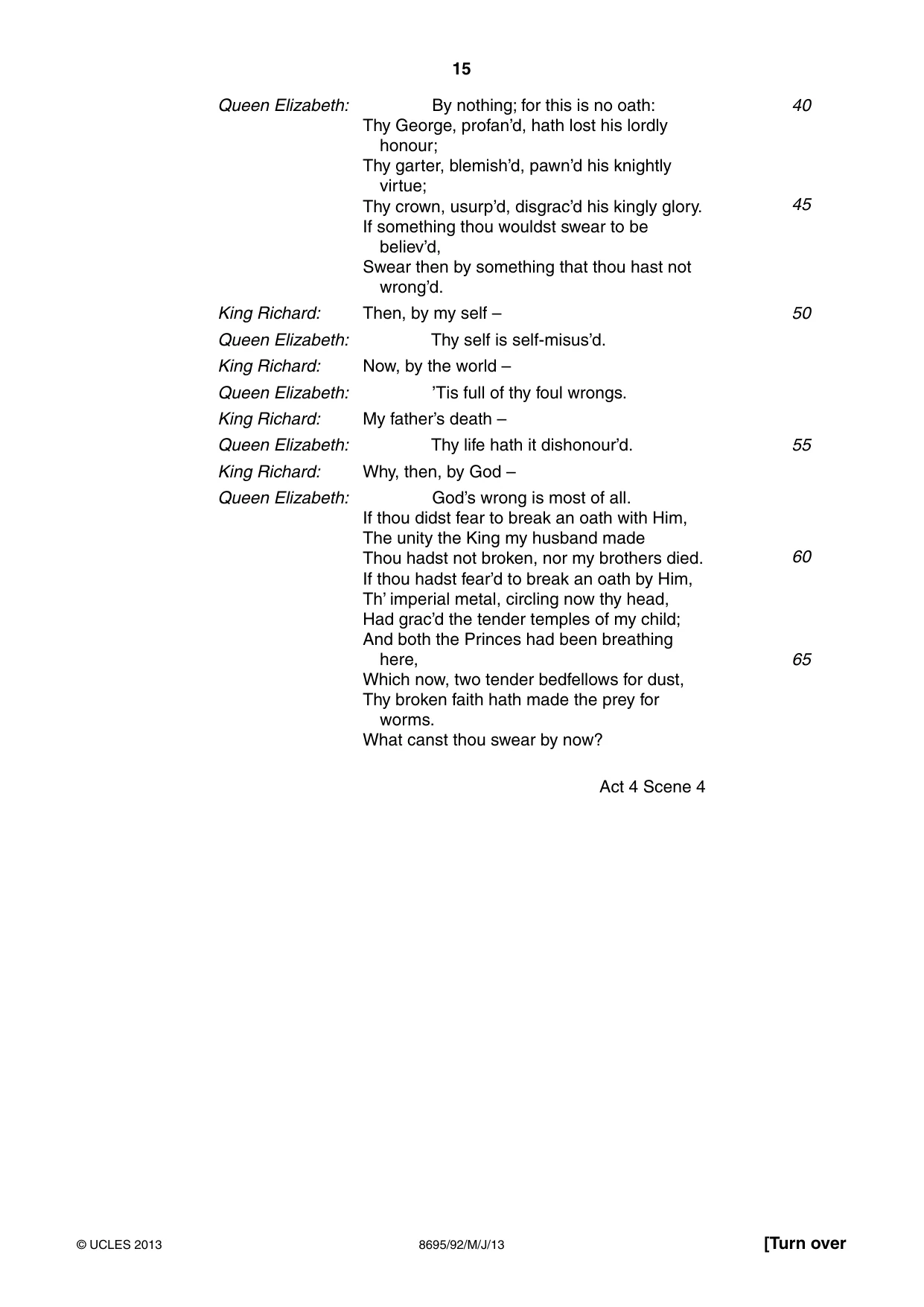
15 8695/92/M/J/13 © UCLES 2013 [Turn over Queen Elizabeth: By nothing; for this is no oath: Thy George, profan’d, hath lost his lordly honour; Thy garter, blemish’d, pawn’d his knightly virtue; Thy crown, usurp’d, disgrac’d his kingly glory. If something thou wouldst swear to be believ’d, Swear then by something that thou hast not wrong’d. King Richard: Then, by my self – Queen Elizabeth: Thy self is self-misus’d. King Richard: Now, by the world – Queen Elizabeth: ’Tis full of thy foul wrongs. King Richard: My father’s death – Queen Elizabeth: Thy life hath it dishonour’d. King Richard: Why, then, by God – Queen Elizabeth: God’s wrong is most of all. If thou didst fear to break an oath with Him, The unity the King my husband made Thou hadst not broken, nor my brothers died. If thou hadst fear’d to break an oath by Him, Th’ imperial metal, circling now thy head, Had grac’d the tender temples of my child; And both the Princes had been breathing here, Which now, two tender bedfellows for dust, Thy broken faith hath made the prey for worms. What canst thou swear by now? Act 4 Scene 4 40 45 50 55 60 65
Question paper, page 16
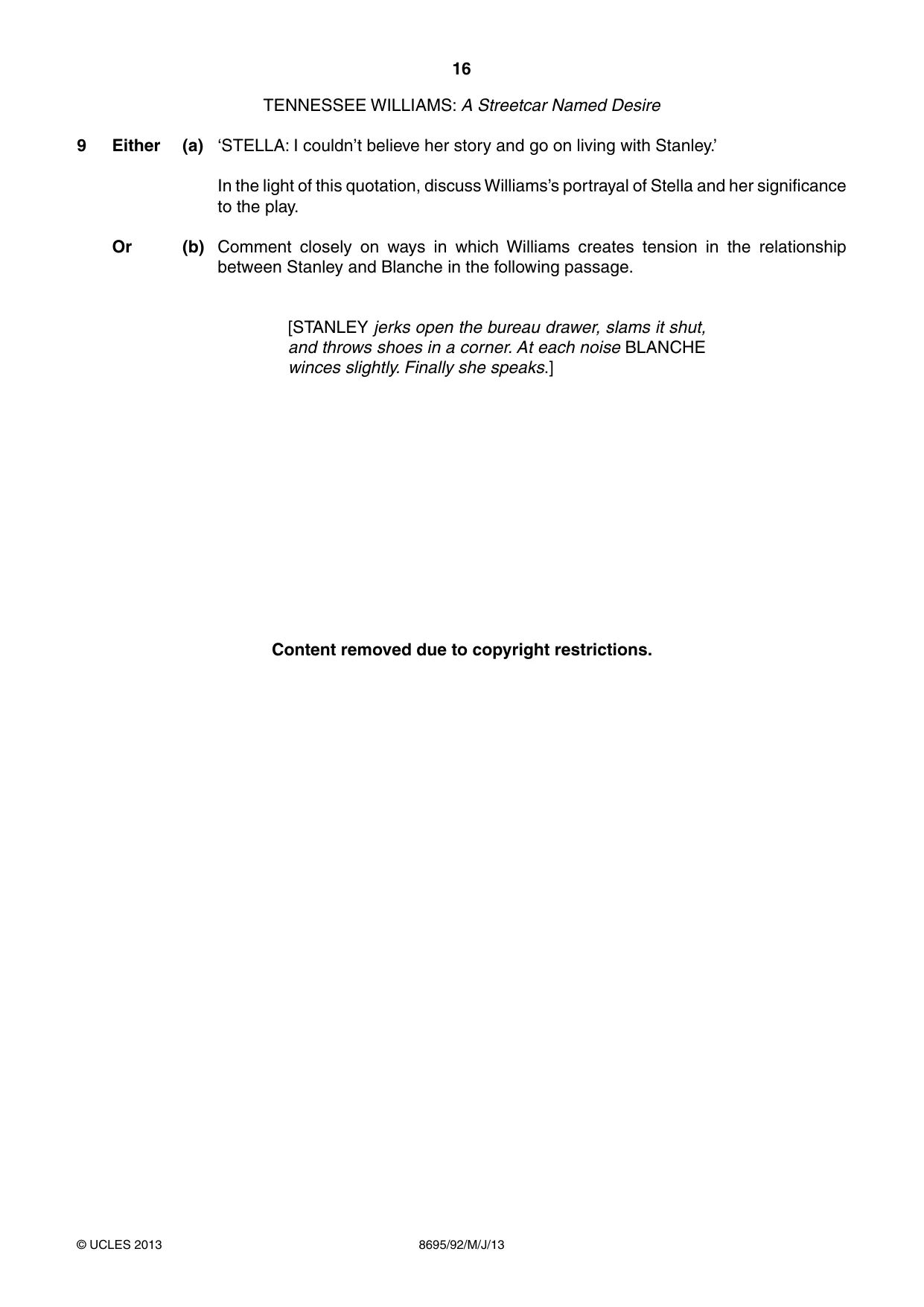
16 8695/92/M/J/13 © UCLES 2013 TENNESSEE WILLIAMS: A Streetcar Named Desire 9 Either (a) ‘STELLA: I couldn’t believe her story and go on living with Stanley.’ In the light of this quotation, discuss Williams’s portrayal of Stella and her significance to the play. Or (b) Comment closely on ways in which Williams creates tension in the relationship between Stanley and Blanche in the following passage. [STANLEY jerks open the bureau drawer, slams it shut, and throws shoes in a corner. At each noise BLANCHE winces slightly. Finally she speaks.] Content removed due to copyright restrictions.
Question paper, page 17
17 8695/92/M/J/13 © UCLES 2013 Content removed due to copyright restrictions. [He goes out. BLANCHE rises from her chair. She seems faint; looks about her with an expression of almost panic.] Scene 5 60
Question paper, page 18
18 8695/92/M/J/13 © UCLES 2013 BLANK PAGE
Question paper, page 19
19 8695/92/M/J/13 © UCLES 2013 BLANK PAGE
Question paper, page 20
20 8695/92/M/J/13 © UCLES 2013 BLANK PAGE Copyright Acknowledgements: Question 2b © Seamus Heaney; The Turnip Snedder, from District and Circle; Faber & Faber Ltd; 2006. Question 3b © Fleur Adcock; Heidi with Blue Hair ; in Songs of Ourselves; Foundation Books / Cambridge University Press India; 2005. Question 4b © Chimamanda Ngozi Adichie; Half of a Yellow Sun; Reproduced by permission of HarperCollins; 2006. Question 5b © E M Forster; A Passage to India; The Provost and Scholars of Kings College, Cambridge. Question 6b Report on the Threatened City © Doris Lessing. Reprinted by kind permission of Jonathan Clowes Ltd, London, on behalf of Doris Lessing. Question 7b © Edward Albee; Who’s Afraid of Virginia Woolf?; Penguin Books Ltd; 1967. Question 9b © A Streetcar Named Desire by Tennessee Williams. Copyright © 1947 by The University of The South. Reprinted by permission of Georges Borchardt, Inc. for the Estate of Tennessee Williams. Permission to reproduce items where third-party owned material protected by copyright is included has been sought and cleared where possible. Every reasonable effort has been made by the publisher (UCLES) to trace copyright holders, but if any items requiring clearance have unwittingly been included, the publisher will be pleased to make amends at the earliest possible opportunity. University of Cambridge International Examinations is part of the Cambridge Assessment Group. Cambridge Assessment is the brand name of University of Cambridge Local Examinations Syndicate (UCLES), which is itself a department of the University of Cambridge.
Mark scheme, page 1
CAMBRIDGE INTERNATIONAL EXAMINATIONS GCE Advanced Subsidiary Level and GCE Advanced Level MARK SCHEME for the May/June 2013 series 8695 LANGUAGE AND LITERATURE IN ENGLISH 8695/92 Paper 9 (Poetry, Prose and Drama), maximum raw mark 50 This mark scheme is published as an aid to teachers and candidates, to indicate the requirements of the examination. It shows the basis on which Examiners were instructed to award marks. It does not indicate the details of the discussions that took place at an Examiners’ meeting before marking began, which would have considered the acceptability of alternative answers. Mark schemes should be read in conjunction with the question paper and the Principal Examiner Report for Teachers. Cambridge will not enter into discussions about these mark schemes. Cambridge is publishing the mark schemes for the May/June 2013 series for most IGCSE, GCE Advanced Level and Advanced Subsidiary Level components and some Ordinary Level components.
Mark scheme, page 2
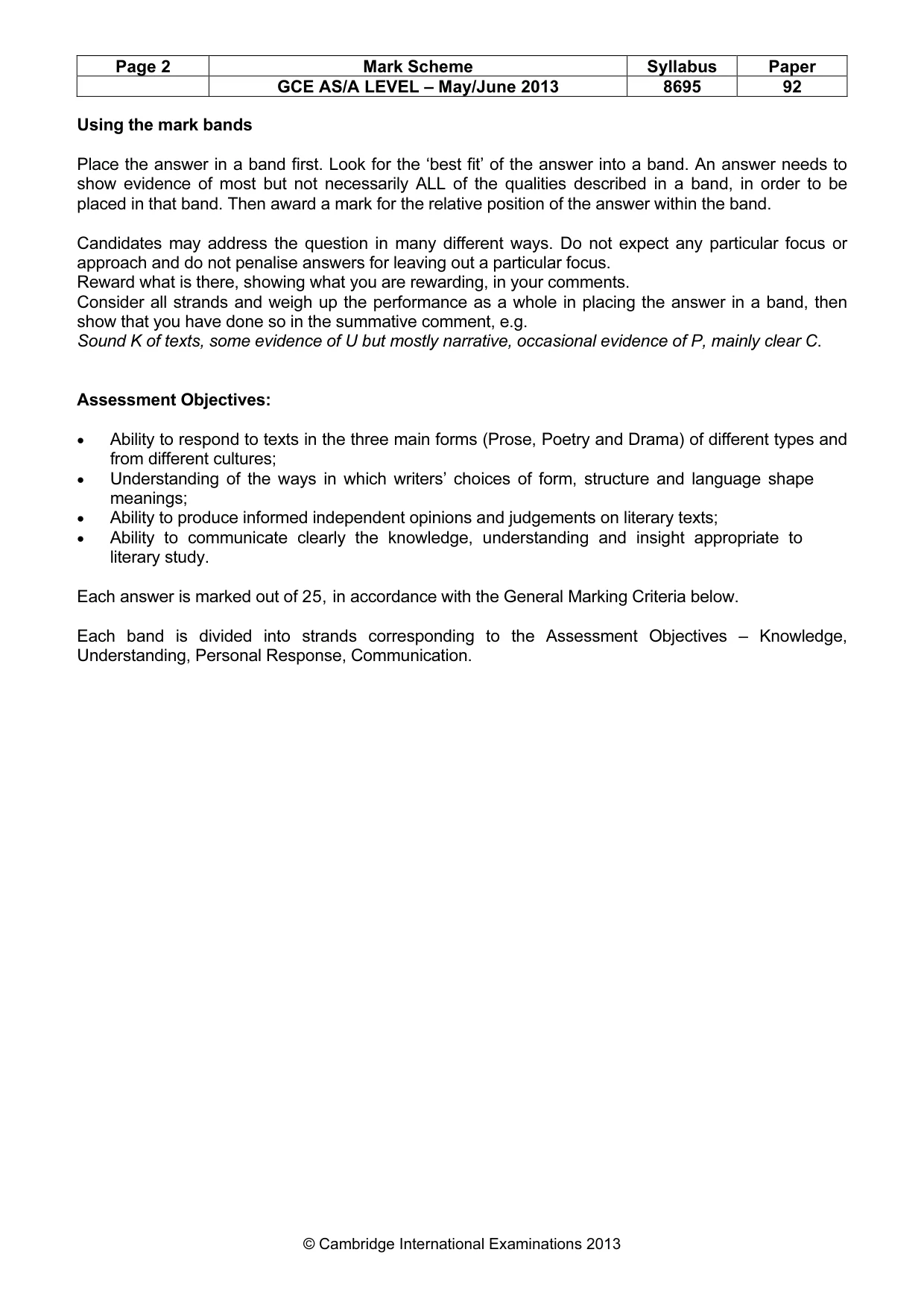
Page 2 Mark Scheme Syllabus Paper GCE AS/A LEVEL – May/June 2013 8695 92 © Cambridge International Examinations 2013 Using the mark bands Place the answer in a band first. Look for the ‘best fit’ of the answer into a band. An answer needs to show evidence of most but not necessarily ALL of the qualities described in a band, in order to be placed in that band. Then award a mark for the relative position of the answer within the band. Candidates may address the question in many different ways. Do not expect any particular focus or approach and do not penalise answers for leaving out a particular focus. Reward what is there, showing what you are rewarding, in your comments. Consider all strands and weigh up the performance as a whole in placing the answer in a band, then show that you have done so in the summative comment, e.g. Sound K of texts, some evidence of U but mostly narrative, occasional evidence of P, mainly clear C. Assessment Objectives: • Ability to respond to texts in the three main forms (Prose, Poetry and Drama) of different types and from different cultures; • Understanding of the ways in which writers’ choices of form, structure and language shape meanings; • Ability to produce informed independent opinions and judgements on literary texts; • Ability to communicate clearly the knowledge, understanding and insight appropriate to literary study. Each answer is marked out of 25, in accordance with the General Marking Criteria below. Each band is divided into strands corresponding to the Assessment Objectives – Knowledge, Understanding, Personal Response, Communication.
Mark scheme, page 3
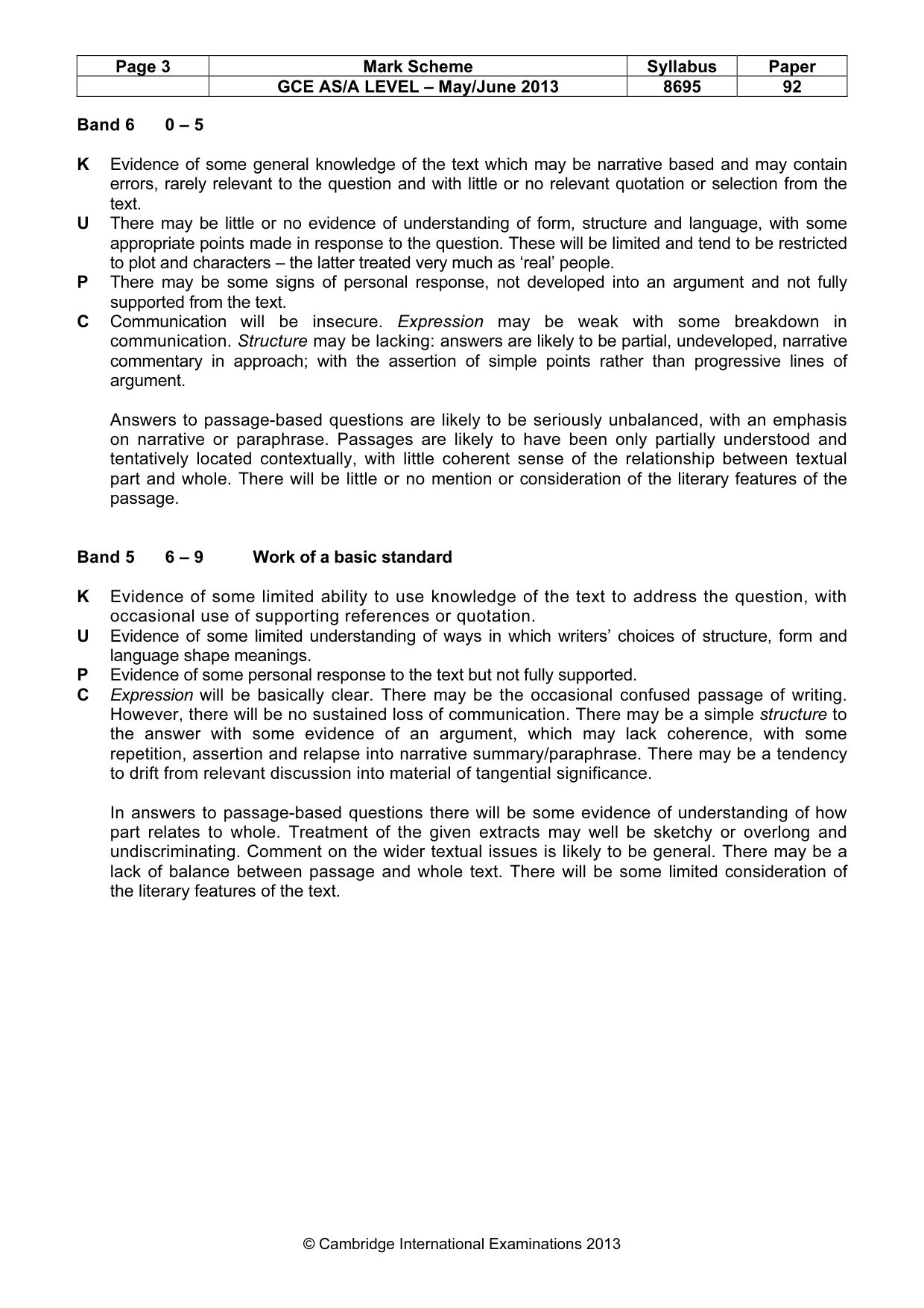
Page 3 Mark Scheme Syllabus Paper GCE AS/A LEVEL – May/June 2013 8695 92 © Cambridge International Examinations 2013 Band 6 0 – 5 K Evidence of some general knowledge of the text which may be narrative based and may contain errors, rarely relevant to the question and with little or no relevant quotation or selection from the text. U There may be little or no evidence of understanding of form, structure and language, with some appropriate points made in response to the question. These will be limited and tend to be restricted to plot and characters – the latter treated very much as ‘real’ people. P There may be some signs of personal response, not developed into an argument and not fully supported from the text. C Communication will be insecure. Expression may be weak with some breakdown in communication. Structure may be lacking: answers are likely to be partial, undeveloped, narrative commentary in approach; with the assertion of simple points rather than progressive lines of argument. Answers to passage-based questions are likely to be seriously unbalanced, with an emphasis on narrative or paraphrase. Passages are likely to have been only partially understood and tentatively located contextually, with little coherent sense of the relationship between textual part and whole. There will be little or no mention or consideration of the literary features of the passage. Band 5 6 – 9 Work of a basic standard K Evidence of some limited ability to use knowledge of the text to address the question, with occasional use of supporting references or quotation. U Evidence of some limited understanding of ways in which writers’ choices of structure, form and language shape meanings. P Evidence of some personal response to the text but not fully supported. C Expression will be basically clear. There may be the occasional confused passage of writing. However, there will be no sustained loss of communication. There may be a simple structure to the answer with some evidence of an argument, which may lack coherence, with some repetition, assertion and relapse into narrative summary/paraphrase. There may be a tendency to drift from relevant discussion into material of tangential significance. In answers to passage-based questions there will be some evidence of understanding of how part relates to whole. Treatment of the given extracts may well be sketchy or overlong and undiscriminating. Comment on the wider textual issues is likely to be general. There may be a lack of balance between passage and whole text. There will be some limited consideration of the literary features of the text.
Mark scheme, page 4
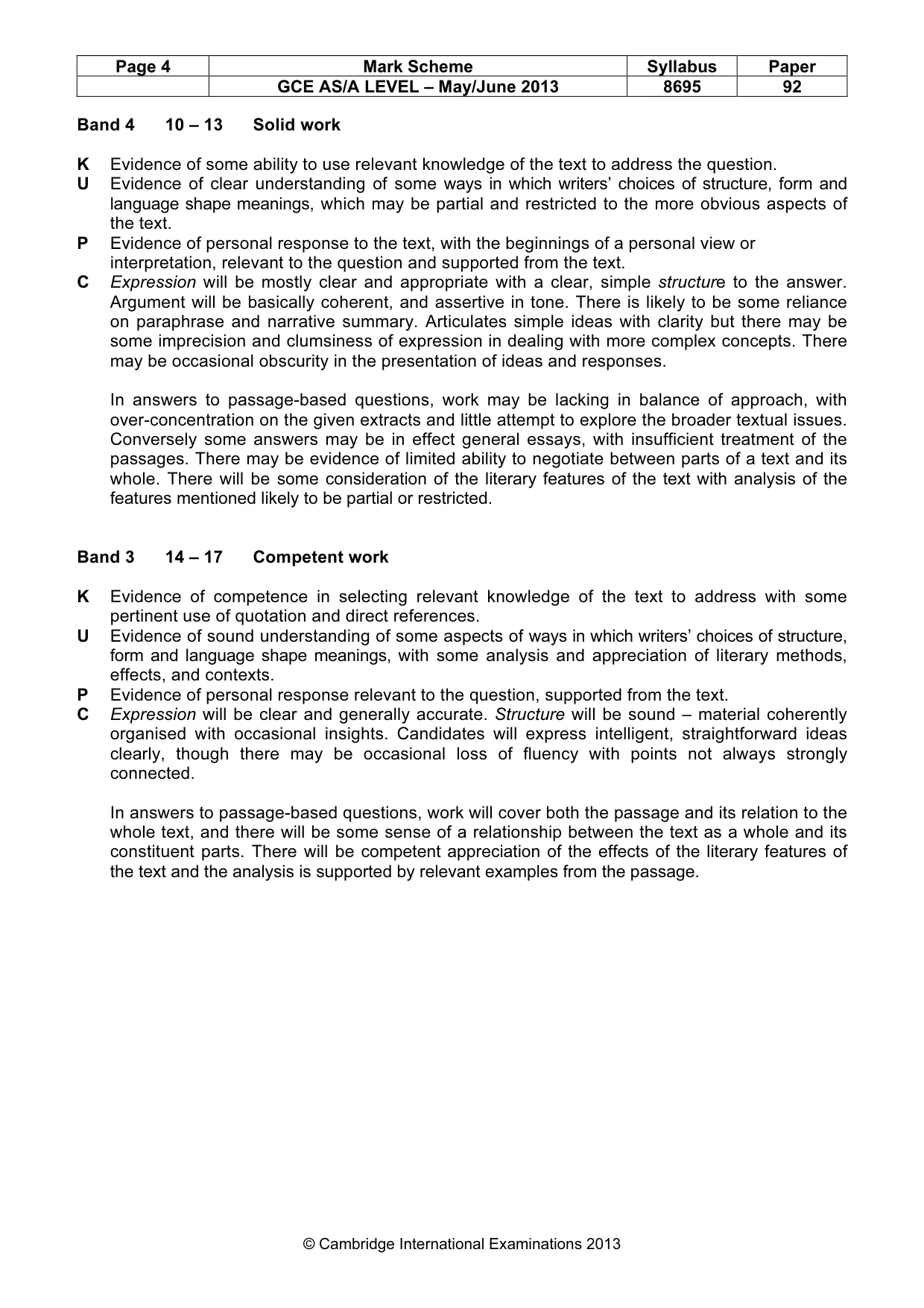
Page 4 Mark Scheme Syllabus Paper GCE AS/A LEVEL – May/June 2013 8695 92 © Cambridge International Examinations 2013 Band 4 10 – 13 Solid work K Evidence of some ability to use relevant knowledge of the text to address the question. U Evidence of clear understanding of some ways in which writers’ choices of structure, form and language shape meanings, which may be partial and restricted to the more obvious aspects of the text. P Evidence of personal response to the text, with the beginnings of a personal view or interpretation, relevant to the question and supported from the text. C Expression will be mostly clear and appropriate with a clear, simple structure to the answer. Argument will be basically coherent, and assertive in tone. There is likely to be some reliance on paraphrase and narrative summary. Articulates simple ideas with clarity but there may be some imprecision and clumsiness of expression in dealing with more complex concepts. There may be occasional obscurity in the presentation of ideas and responses. In answers to passage-based questions, work may be lacking in balance of approach, with over-concentration on the given extracts and little attempt to explore the broader textual issues. Conversely some answers may be in effect general essays, with insufficient treatment of the passages. There may be evidence of limited ability to negotiate between parts of a text and its whole. There will be some consideration of the literary features of the text with analysis of the features mentioned likely to be partial or restricted. Band 3 14 – 17 Competent work K Evidence of competence in selecting relevant knowledge of the text to address with some pertinent use of quotation and direct references. U Evidence of sound understanding of some aspects of ways in which writers’ choices of structure, form and language shape meanings, with some analysis and appreciation of literary methods, effects, and contexts. P Evidence of personal response relevant to the question, supported from the text. C Expression will be clear and generally accurate. Structure will be sound – material coherently organised with occasional insights. Candidates will express intelligent, straightforward ideas clearly, though there may be occasional loss of fluency with points not always strongly connected. In answers to passage-based questions, work will cover both the passage and its relation to the whole text, and there will be some sense of a relationship between the text as a whole and its constituent parts. There will be competent appreciation of the effects of the literary features of the text and the analysis is supported by relevant examples from the passage.
Mark scheme, page 5
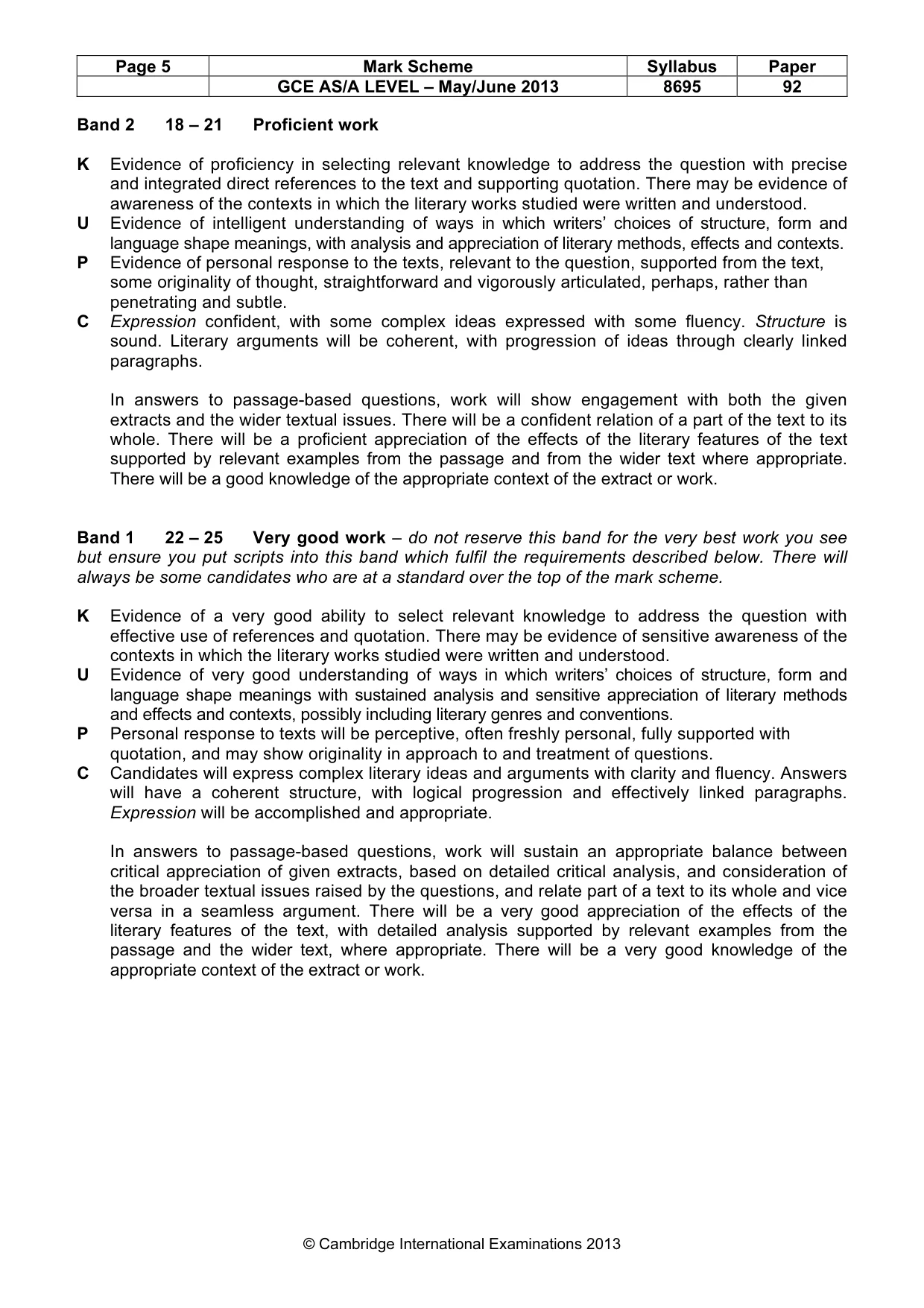
Page 5 Mark Scheme Syllabus Paper GCE AS/A LEVEL – May/June 2013 8695 92 © Cambridge International Examinations 2013 Band 2 18 – 21 Proficient work K Evidence of proficiency in selecting relevant knowledge to address the question with precise and integrated direct references to the text and supporting quotation. There may be evidence of awareness of the contexts in which the literary works studied were written and understood. U Evidence of intelligent understanding of ways in which writers’ choices of structure, form and language shape meanings, with analysis and appreciation of literary methods, effects and contexts. P Evidence of personal response to the texts, relevant to the question, supported from the text, some originality of thought, straightforward and vigorously articulated, perhaps, rather than penetrating and subtle. C Expression confident, with some complex ideas expressed with some fluency. Structure is sound. Literary arguments will be coherent, with progression of ideas through clearly linked paragraphs. In answers to passage-based questions, work will show engagement with both the given extracts and the wider textual issues. There will be a confident relation of a part of the text to its whole. There will be a proficient appreciation of the effects of the literary features of the text supported by relevant examples from the passage and from the wider text where appropriate. There will be a good knowledge of the appropriate context of the extract or work. Band 1 22 – 25 Very good work – do not reserve this band for the very best work you see but ensure you put scripts into this band which fulfil the requirements described below. There will always be some candidates who are at a standard over the top of the mark scheme. K Evidence of a very good ability to select relevant knowledge to address the question with effective use of references and quotation. There may be evidence of sensitive awareness of the contexts in which the literary works studied were written and understood. U Evidence of very good understanding of ways in which writers’ choices of structure, form and language shape meanings with sustained analysis and sensitive appreciation of literary methods and effects and contexts, possibly including literary genres and conventions. P Personal response to texts will be perceptive, often freshly personal, fully supported with quotation, and may show originality in approach to and treatment of questions. C Candidates will express complex literary ideas and arguments with clarity and fluency. Answers will have a coherent structure, with logical progression and effectively linked paragraphs. Expression will be accomplished and appropriate. In answers to passage-based questions, work will sustain an appropriate balance between critical appreciation of given extracts, based on detailed critical analysis, and consideration of the broader textual issues raised by the questions, and relate part of a text to its whole and vice versa in a seamless argument. There will be a very good appreciation of the effects of the literary features of the text, with detailed analysis supported by relevant examples from the passage and the wider text, where appropriate. There will be a very good knowledge of the appropriate context of the extract or work.
What you needed in this session
Cambridge’s own grade thresholds for 2013 May/June, Paper 9 · Variant 2. A higher threshold means an easier paper — the bar moves with how the cohort did.