Cambridge A Level English - Language and Literature (AS Level only, from 2016) 8695 — 2013 May/June Paper 9 · Variant 1
8695/91/M/J/13 · 50 marks · ≈56 min
The question paper and its mark scheme, free to read here and free to download. This is Cambridge’s own paper, exactly as it was sat.
Question paper16 pages
Mark scheme5 pages
Answers below. Sit the paper first if you are practising.
Paper as text
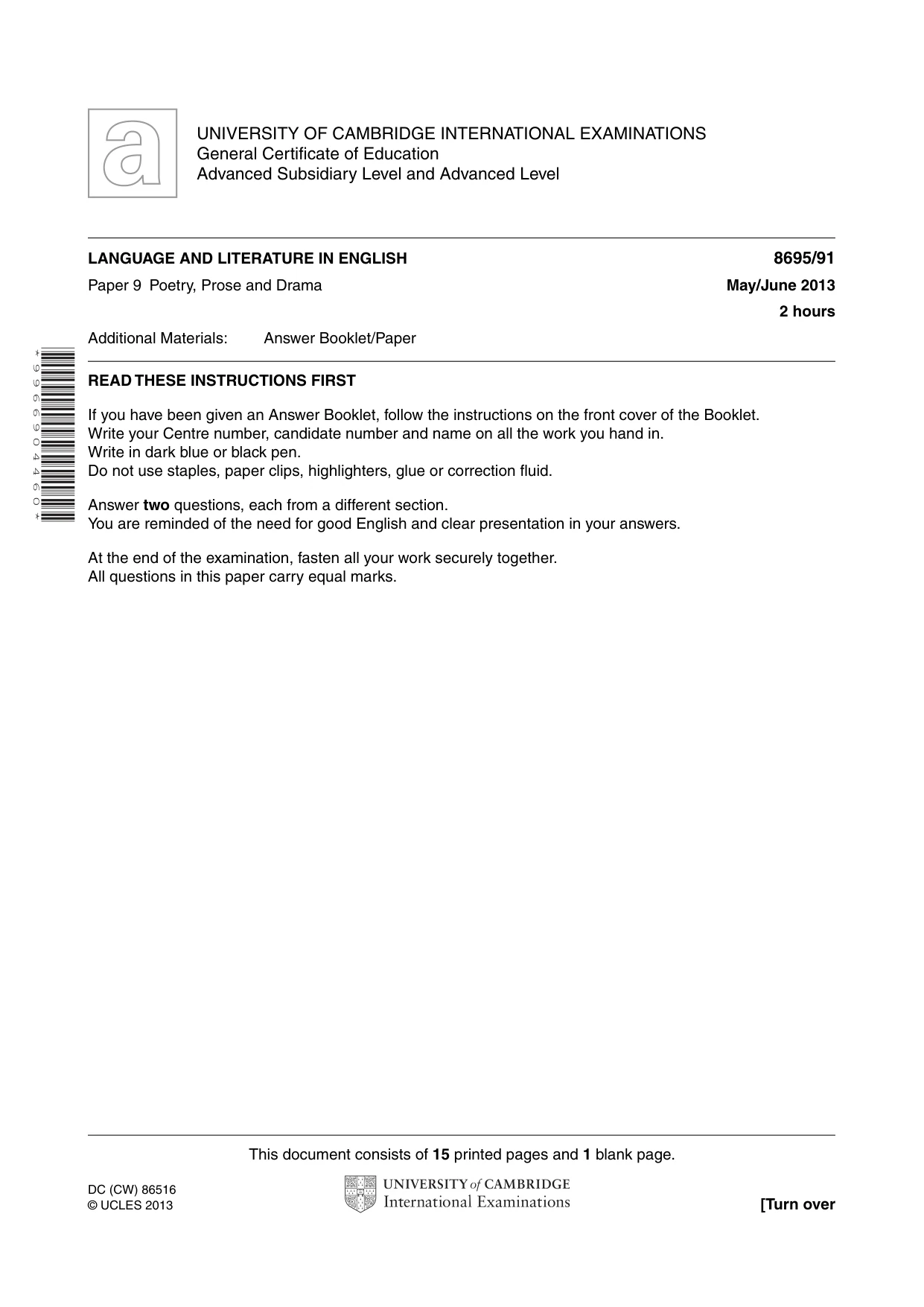
Question paper, page 1
This document consists of 15 printed pages and 1 blank page. DC (CW) 86516 © UCLES 2013 [Turn over UNIVERSITY OF CAMBRIDGE INTERNATIONAL EXAMINATIONS General Certificate of Education Advanced Subsidiary Level and Advanced Level * 9 9 6 6 9 0 4 4 6 0 * LANGUAGE AND LITERATURE IN ENGLISH 8695/91 Paper 9 Poetry, Prose and Drama May/June 2013 2 hours Additional Materials: Answer Booklet/Paper READ THESE INSTRUCTIONS FIRST If you have been given an Answer Booklet, follow the instructions on the front cover of the Booklet. Write your Centre number, candidate number and name on all the work you hand in. Write in dark blue or black pen. Do not use staples, paper clips, highlighters, glue or correction fluid. Answer two questions, each from a different section. You are reminded of the need for good English and clear presentation in your answers. At the end of the examination, fasten all your work securely together. All questions in this paper carry equal marks.
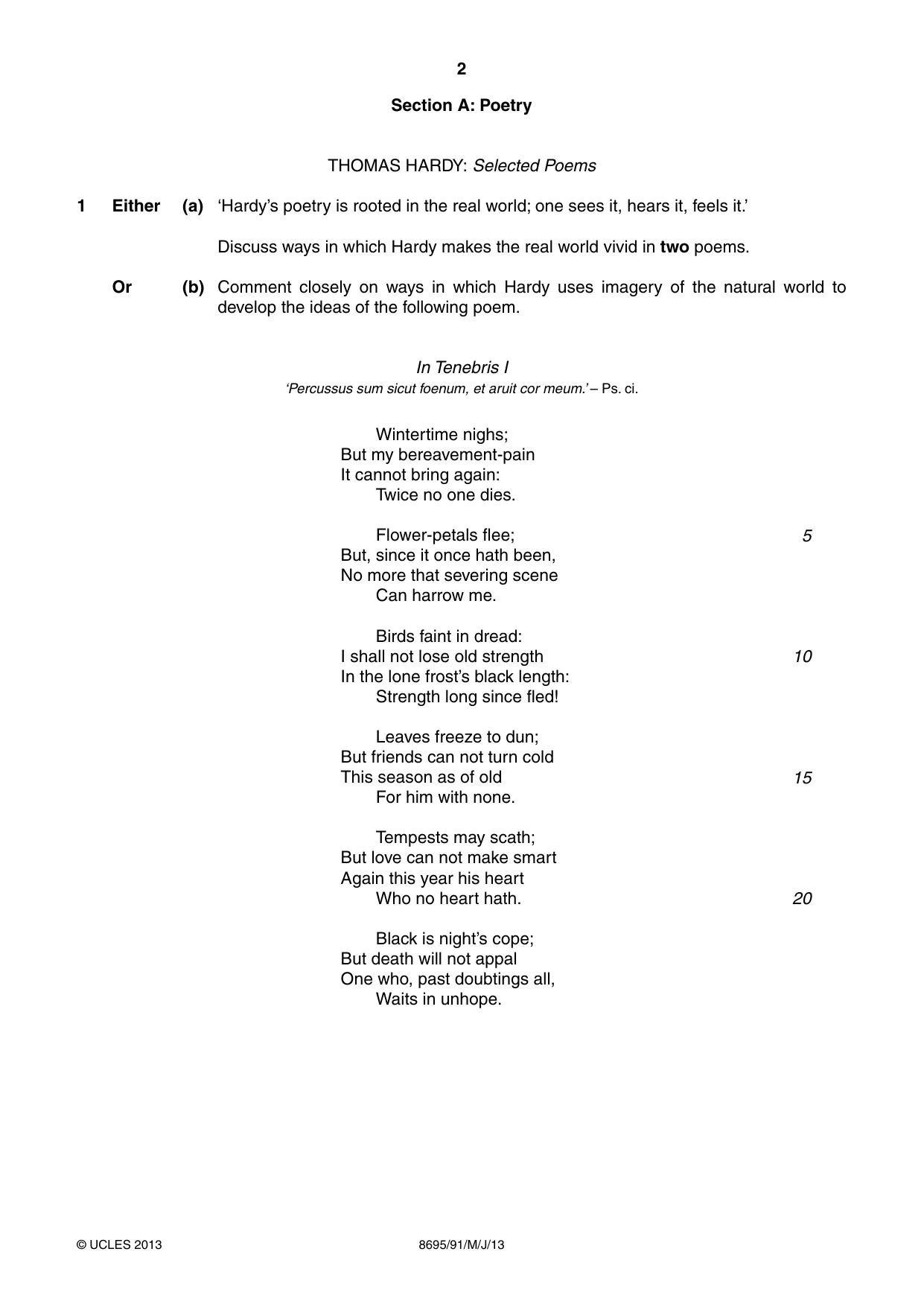
Question paper, page 2
2 8695/91/M/J/13 © UCLES 2013 Section A: Poetry THOMAS HARDY: Selected Poems 1 Either (a) ‘Hardy’s poetry is rooted in the real world; one sees it, hears it, feels it.’ Discuss ways in which Hardy makes the real world vivid in two poems. Or (b) Comment closely on ways in which Hardy uses imagery of the natural world to develop the ideas of the following poem. In Tenebris I ‘Percussus sum sicut foenum, et aruit cor meum.’ – Ps. ci. Wintertime nighs; But my bereavement-pain It cannot bring again: Twice no one dies. Flower-petals flee; But, since it once hath been, No more that severing scene Can harrow me. Birds faint in dread: I shall not lose old strength In the lone frost’s black length: Strength long since fled! Leaves freeze to dun; But friends can not turn cold This season as of old For him with none. Tempests may scath; But love can not make smart Again this year his heart Who no heart hath. Black is night’s cope; But death will not appal One who, past doubtings all, Waits in unhope. 5 10 15 20
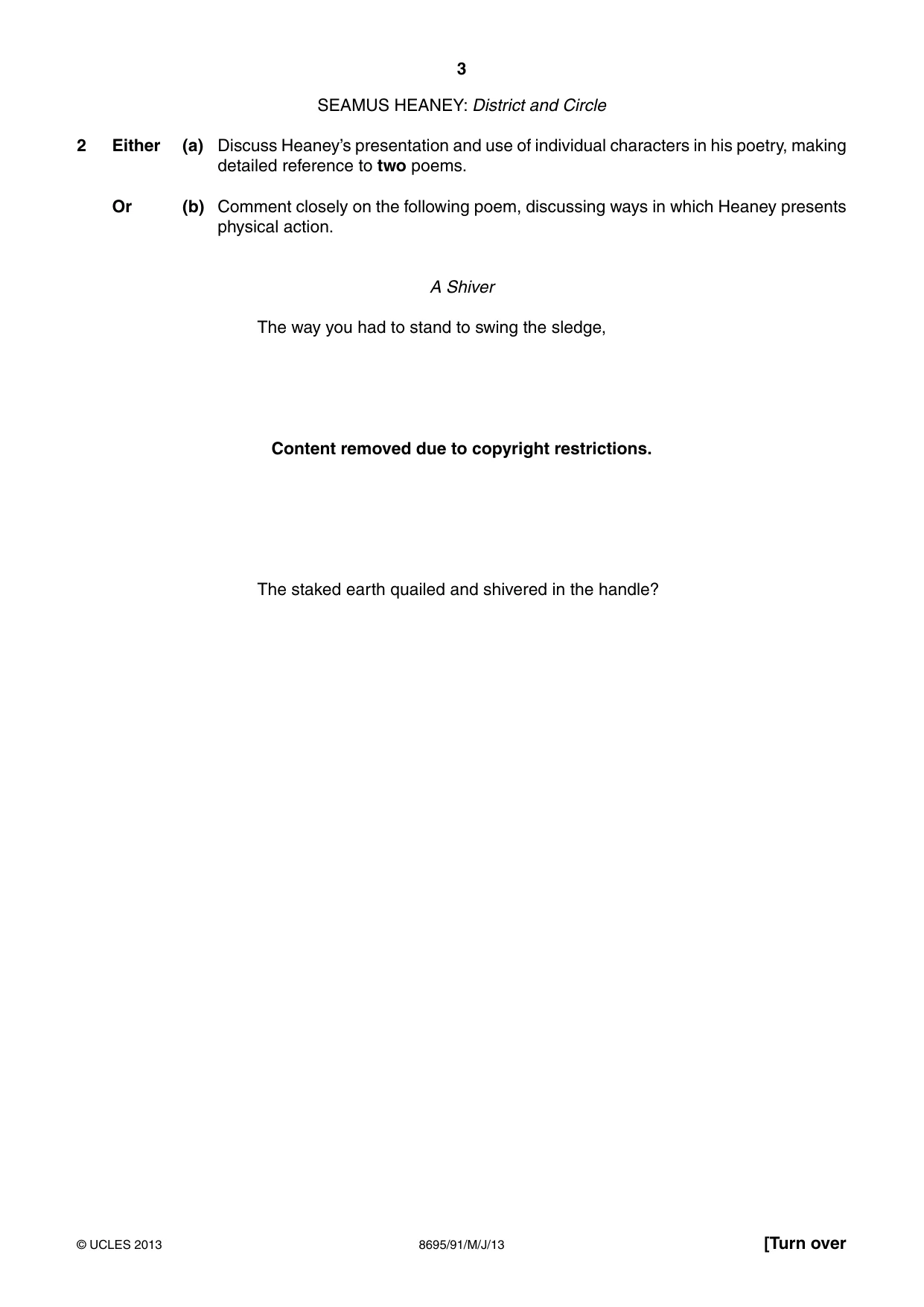
Question paper, page 3
3 8695/91/M/J/13 © UCLES 2013 [Turn over SEAMUS HEANEY: District and Circle 2 Either (a) Discuss Heaney’s presentation and use of individual characters in his poetry, making detailed reference to two poems. Or (b) Comment closely on the following poem, discussing ways in which Heaney presents physical action. A Shiver The way you had to stand to swing the sledge, Content removed due to copyright restrictions. The staked earth quailed and shivered in the handle?
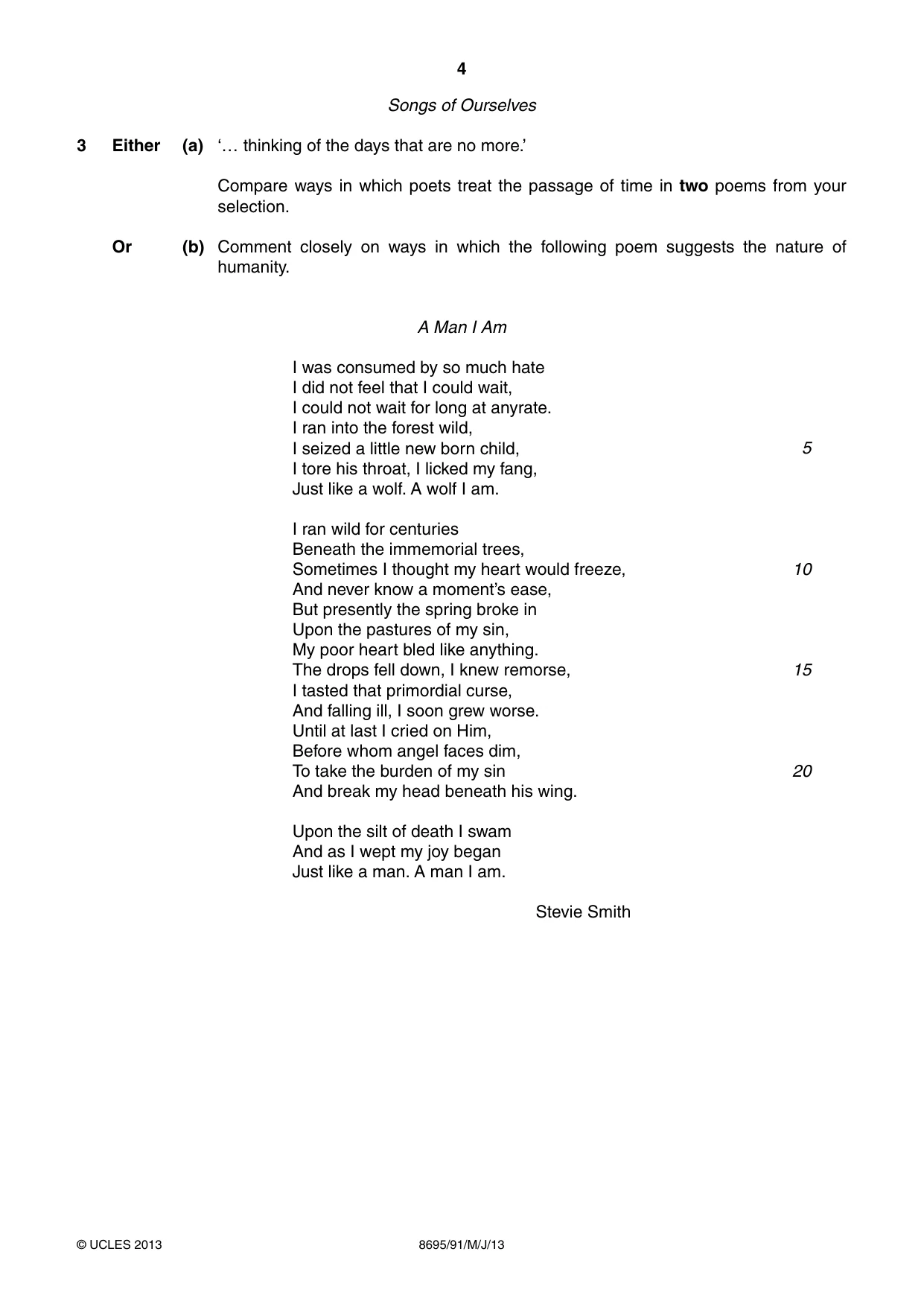
Question paper, page 4
4 8695/91/M/J/13 © UCLES 2013 Songs of Ourselves 3 Either (a) ‘… thinking of the days that are no more.’ Compare ways in which poets treat the passage of time in two poems from your selection. Or (b) Comment closely on ways in which the following poem suggests the nature of humanity. A Man I Am I was consumed by so much hate I did not feel that I could wait, I could not wait for long at anyrate. I ran into the forest wild, I seized a little new born child, I tore his throat, I licked my fang, Just like a wolf. A wolf I am. I ran wild for centuries Beneath the immemorial trees, Sometimes I thought my heart would freeze, And never know a moment’s ease, But presently the spring broke in Upon the pastures of my sin, My poor heart bled like anything. The drops fell down, I knew remorse, I tasted that primordial curse, And falling ill, I soon grew worse. Until at last I cried on Him, Before whom angel faces dim, To take the burden of my sin And break my head beneath his wing. Upon the silt of death I swam And as I wept my joy began Just like a man. A man I am. Stevie Smith 5 10 15 20
Question paper, page 5
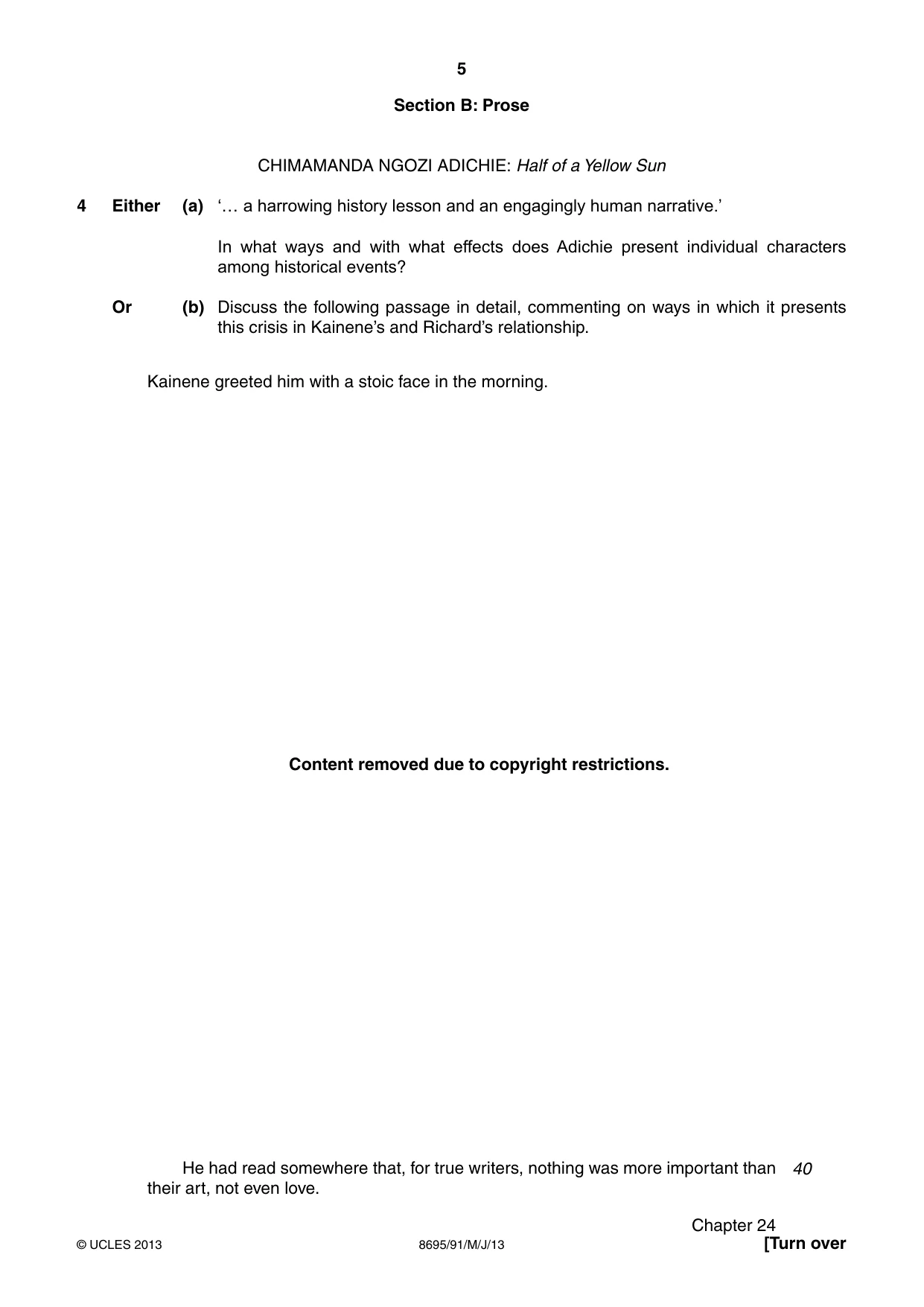
5 8695/91/M/J/13 © UCLES 2013 [Turn over Section B: Prose CHIMAMANDA NGOZI ADICHIE: Half of a Yellow Sun 4 Either (a) ‘… a harrowing history lesson and an engagingly human narrative.’ In what ways and with what effects does Adichie present individual characters among historical events? Or (b) Discuss the following passage in detail, commenting on ways in which it presents this crisis in Kainene’s and Richard’s relationship. Kainene greeted him with a stoic face in the morning. Content removed due to copyright restrictions. He had read somewhere that, for true writers, nothing was more important than their art, not even love. Chapter 24 40
Question paper, page 6
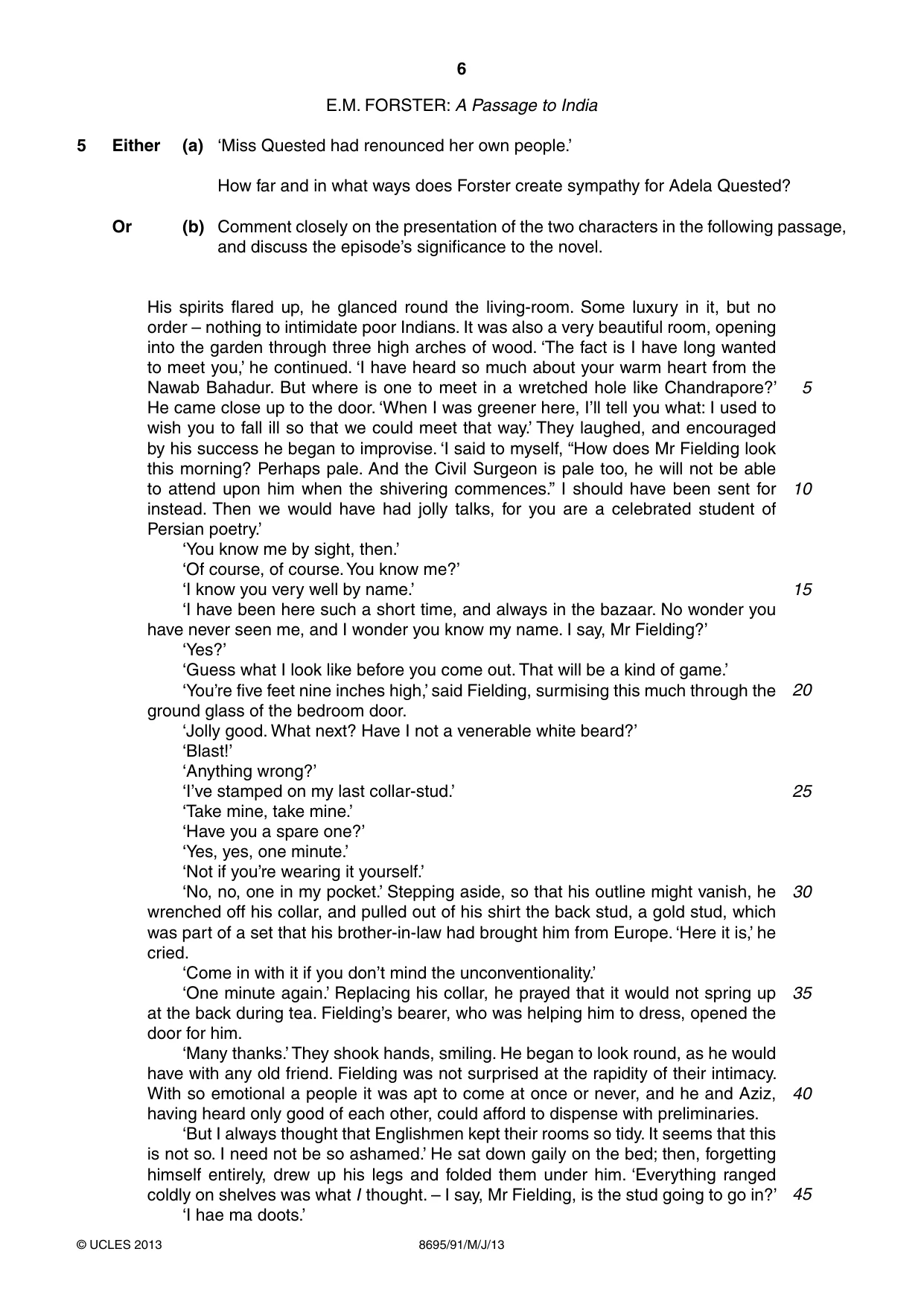
6 8695/91/M/J/13 © UCLES 2013 E.M. FORSTER: A Passage to India 5 Either (a) ‘Miss Quested had renounced her own people.’ How far and in what ways does Forster create sympathy for Adela Quested? Or (b) Comment closely on the presentation of the two characters in the following passage, and discuss the episode’s significance to the novel. His spirits flared up, he glanced round the living-room. Some luxury in it, but no order – nothing to intimidate poor Indians. It was also a very beautiful room, opening into the garden through three high arches of wood. ‘The fact is I have long wanted to meet you,’ he continued. ‘I have heard so much about your warm heart from the Nawab Bahadur. But where is one to meet in a wretched hole like Chandrapore?’ He came close up to the door. ‘When I was greener here, I’ll tell you what: I used to wish you to fall ill so that we could meet that way.’ They laughed, and encouraged by his success he began to improvise. ‘I said to myself, “How does Mr Fielding look this morning? Perhaps pale. And the Civil Surgeon is pale too, he will not be able to attend upon him when the shivering commences.” I should have been sent for instead. Then we would have had jolly talks, for you are a celebrated student of Persian poetry.’ ‘You know me by sight, then.’ ‘Of course, of course. You know me?’ ‘I know you very well by name.’ ‘I have been here such a short time, and always in the bazaar. No wonder you have never seen me, and I wonder you know my name. I say, Mr Fielding?’ ‘Yes?’ ‘Guess what I look like before you come out. That will be a kind of game.’ ‘You’re five feet nine inches high,’ said Fielding, surmising this much through the ground glass of the bedroom door. ‘Jolly good. What next? Have I not a venerable white beard?’ ‘Blast!’ ‘Anything wrong?’ ‘I’ve stamped on my last collar-stud.’ ‘Take mine, take mine.’ ‘Have you a spare one?’ ‘Yes, yes, one minute.’ ‘Not if you’re wearing it yourself.’ ‘No, no, one in my pocket.’ Stepping aside, so that his outline might vanish, he wrenched off his collar, and pulled out of his shirt the back stud, a gold stud, which was part of a set that his brother-in-law had brought him from Europe. ‘Here it is,’ he cried. ‘Come in with it if you don’t mind the unconventionality.’ ‘One minute again.’ Replacing his collar, he prayed that it would not spring up at the back during tea. Fielding’s bearer, who was helping him to dress, opened the door for him. ‘Many thanks.’ They shook hands, smiling. He began to look round, as he would have with any old friend. Fielding was not surprised at the rapidity of their intimacy. With so emotional a people it was apt to come at once or never, and he and Aziz, having heard only good of each other, could afford to dispense with preliminaries. ‘But I always thought that Englishmen kept their rooms so tidy. It seems that this is not so. I need not be so ashamed.’ He sat down gaily on the bed; then, forgetting himself entirely, drew up his legs and folded them under him. ‘Everything ranged coldly on shelves was what I thought. – I say, Mr Fielding, is the stud going to go in?’ ‘I hae ma doots.’ 5 10 15 20 25 30 35 40 45
Question paper, page 7
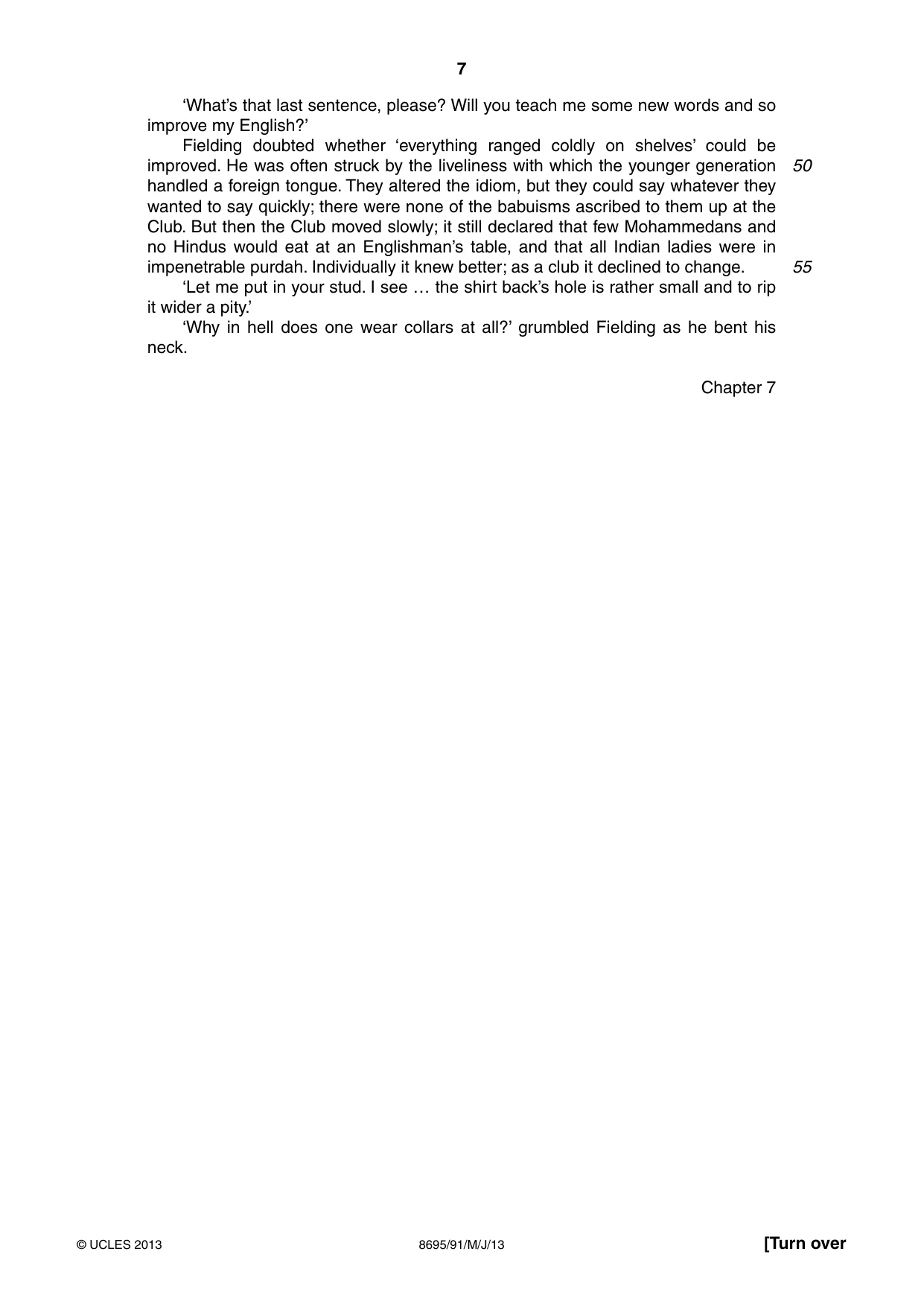
7 8695/91/M/J/13 © UCLES 2013 [Turn over ‘What’s that last sentence, please? Will you teach me some new words and so improve my English?’ Fielding doubted whether ‘everything ranged coldly on shelves’ could be improved. He was often struck by the liveliness with which the younger generation handled a foreign tongue. They altered the idiom, but they could say whatever they wanted to say quickly; there were none of the babuisms ascribed to them up at the Club. But then the Club moved slowly; it still declared that few Mohammedans and no Hindus would eat at an Englishman’s table, and that all Indian ladies were in impenetrable purdah. Individually it knew better; as a club it declined to change. ‘Let me put in your stud. I see … the shirt back’s hole is rather small and to rip it wider a pity.’ ‘Why in hell does one wear collars at all?’ grumbled Fielding as he bent his neck. Chapter 7 50 55
Question paper, page 8
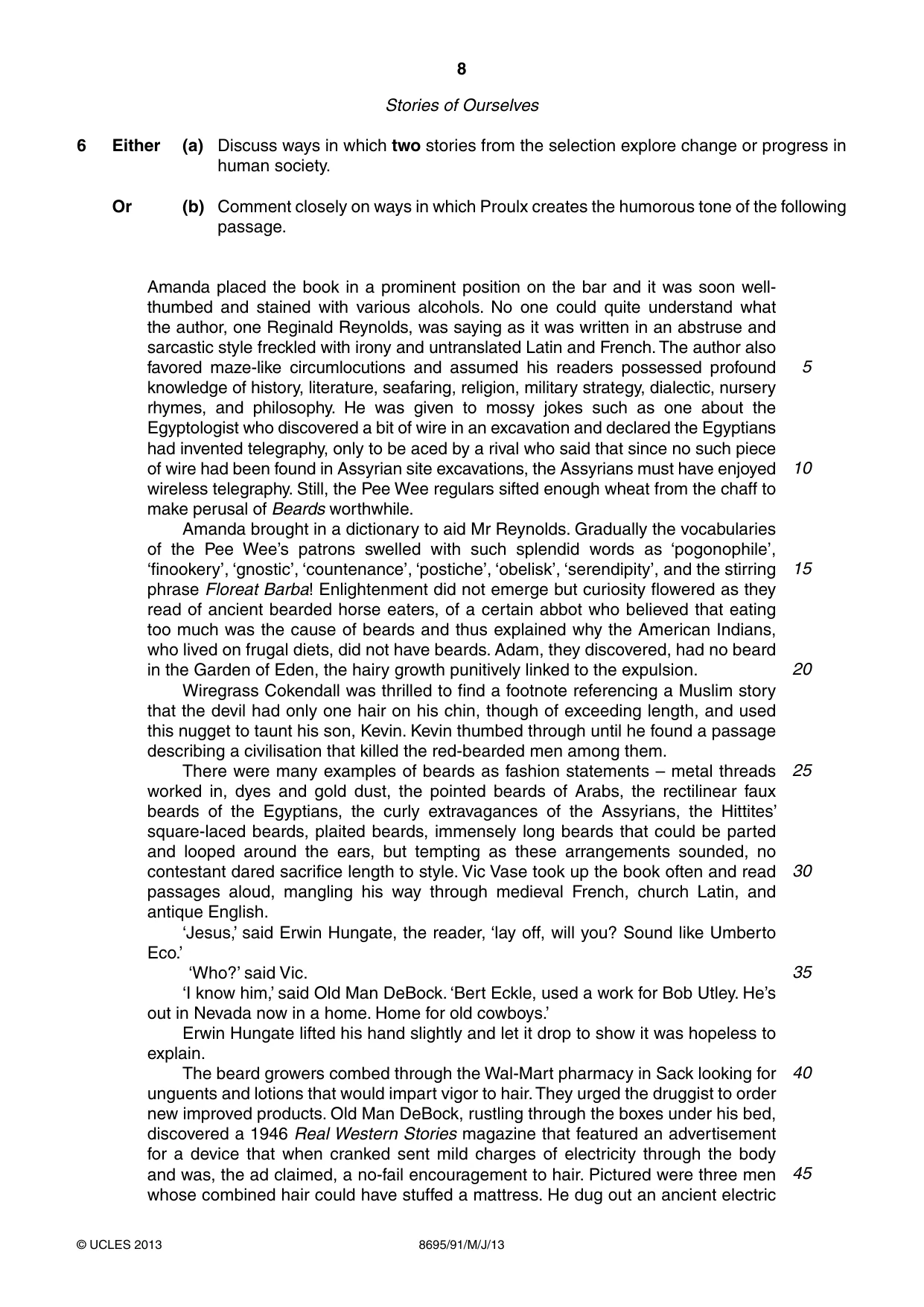
8 8695/91/M/J/13 © UCLES 2013 Stories of Ourselves 6 Either (a) Discuss ways in which two stories from the selection explore change or progress in human society. Or (b) Comment closely on ways in which Proulx creates the humorous tone of the following passage. Amanda placed the book in a prominent position on the bar and it was soon well- thumbed and stained with various alcohols. No one could quite understand what the author, one Reginald Reynolds, was saying as it was written in an abstruse and sarcastic style freckled with irony and untranslated Latin and French. The author also favored maze-like circumlocutions and assumed his readers possessed profound knowledge of history, literature, seafaring, religion, military strategy, dialectic, nursery rhymes, and philosophy. He was given to mossy jokes such as one about the Egyptologist who discovered a bit of wire in an excavation and declared the Egyptians had invented telegraphy, only to be aced by a rival who said that since no such piece of wire had been found in Assyrian site excavations, the Assyrians must have enjoyed wireless telegraphy. Still, the Pee Wee regulars sifted enough wheat from the chaff to make perusal of Beards worthwhile. Amanda brought in a dictionary to aid Mr Reynolds. Gradually the vocabularies of the Pee Wee’s patrons swelled with such splendid words as ‘pogonophile’, ‘finookery’, ‘gnostic’, ‘countenance’, ‘postiche’, ‘obelisk’, ‘serendipity’, and the stirring phrase Floreat Barba! Enlightenment did not emerge but curiosity flowered as they read of ancient bearded horse eaters, of a certain abbot who believed that eating too much was the cause of beards and thus explained why the American Indians, who lived on frugal diets, did not have beards. Adam, they discovered, had no beard in the Garden of Eden, the hairy growth punitively linked to the expulsion. Wiregrass Cokendall was thrilled to find a footnote referencing a Muslim story that the devil had only one hair on his chin, though of exceeding length, and used this nugget to taunt his son, Kevin. Kevin thumbed through until he found a passage describing a civilisation that killed the red-bearded men among them. There were many examples of beards as fashion statements – metal threads worked in, dyes and gold dust, the pointed beards of Arabs, the rectilinear faux beards of the Egyptians, the curly extravagances of the Assyrians, the Hittites’ square-laced beards, plaited beards, immensely long beards that could be parted and looped around the ears, but tempting as these arrangements sounded, no contestant dared sacrifice length to style. Vic Vase took up the book often and read passages aloud, mangling his way through medieval French, church Latin, and antique English. ‘Jesus,’ said Erwin Hungate, the reader, ‘lay off, will you? Sound like Umberto Eco.’ ‘Who?’ said Vic. ‘I know him,’ said Old Man DeBock. ‘Bert Eckle, used a work for Bob Utley. He’s out in Nevada now in a home. Home for old cowboys.’ Erwin Hungate lifted his hand slightly and let it drop to show it was hopeless to explain. The beard growers combed through the Wal-Mart pharmacy in Sack looking for unguents and lotions that would impart vigor to hair. They urged the druggist to order new improved products. Old Man DeBock, rustling through the boxes under his bed, discovered a 1946 Real Western Stories magazine that featured an advertisement for a device that when cranked sent mild charges of electricity through the body and was, the ad claimed, a no-fail encouragement to hair. Pictured were three men whose combined hair could have stuffed a mattress. He dug out an ancient electric 5 10 15 20 25 30 35 40 45
Question paper, page 9
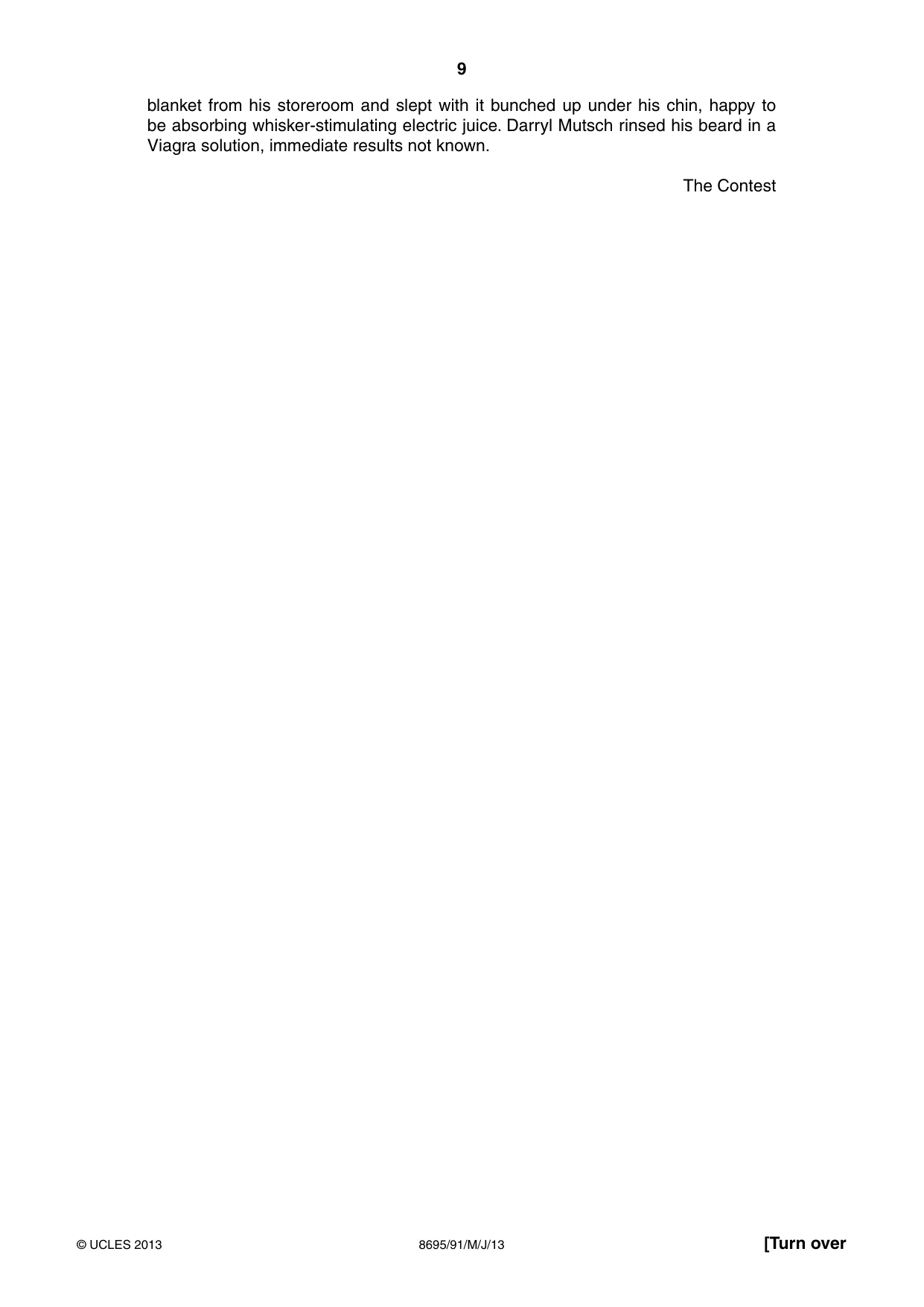
9 8695/91/M/J/13 © UCLES 2013 [Turn over blanket from his storeroom and slept with it bunched up under his chin, happy to be absorbing whisker-stimulating electric juice. Darryl Mutsch rinsed his beard in a Viagra solution, immediate results not known. The Contest
Question paper, page 10
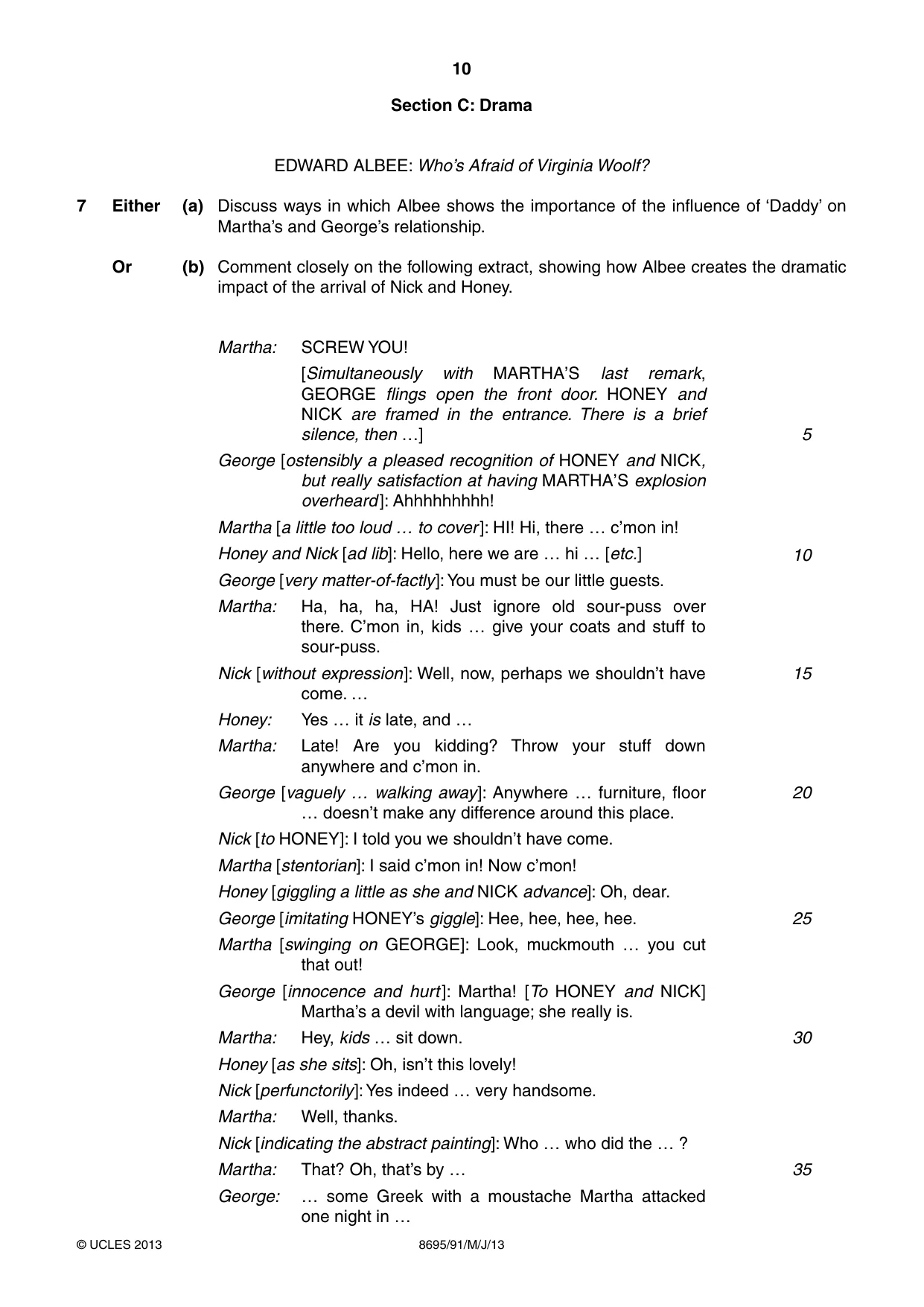
10 8695/91/M/J/13 © UCLES 2013 Section C: Drama EDWARD ALBEE: Who’s Afraid of Virginia Woolf? 7 Either (a) Discuss ways in which Albee shows the importance of the influence of ‘Daddy’ on Martha’s and George’s relationship. Or (b) Comment closely on the following extract, showing how Albee creates the dramatic impact of the arrival of Nick and Honey. Martha: SCREW YOU! [Simultaneously with MARTHA’S last remark, GEORGE flings open the front door. HONEY and NICK are framed in the entrance. There is a brief silence, then …] George [ostensibly a pleased recognition of HONEY and NICK, but really satisfaction at having MARTHA’S explosion overheard ]: Ahhhhhhhhh! Martha [a little too loud … to cover ]: HI! Hi, there … c’mon in! Honey and Nick [ad lib]: Hello, here we are … hi … [etc.] George [very matter-of-factly]: You must be our little guests. Martha: Ha, ha, ha, HA! Just ignore old sour-puss over there. C’mon in, kids … give your coats and stuff to sour-puss. Nick [without expression]: Well, now, perhaps we shouldn’t have come. … Honey: Yes … it is late, and … Martha: Late! Are you kidding? Throw your stuff down anywhere and c’mon in. George [vaguely … walking away]: Anywhere … furniture, floor … doesn’t make any difference around this place. Nick [to HONEY]: I told you we shouldn’t have come. Martha [stentorian]: I said c’mon in! Now c’mon! Honey [giggling a little as she and NICK advance]: Oh, dear. George [imitating HONEY’s giggle]: Hee, hee, hee, hee. Martha [swinging on GEORGE]: Look, muckmouth … you cut that out! George [innocence and hurt ]: Martha! [To HONEY and NICK] Martha’s a devil with language; she really is. Martha: Hey, kids … sit down. Honey [as she sits]: Oh, isn’t this lovely! Nick [perfunctorily]: Yes indeed … very handsome. Martha: Well, thanks. Nick [indicating the abstract painting]: Who … who did the … ? Martha: That? Oh, that’s by … George: … some Greek with a moustache Martha attacked one night in … 5 10 15 20 25 30 35
Question paper, page 11
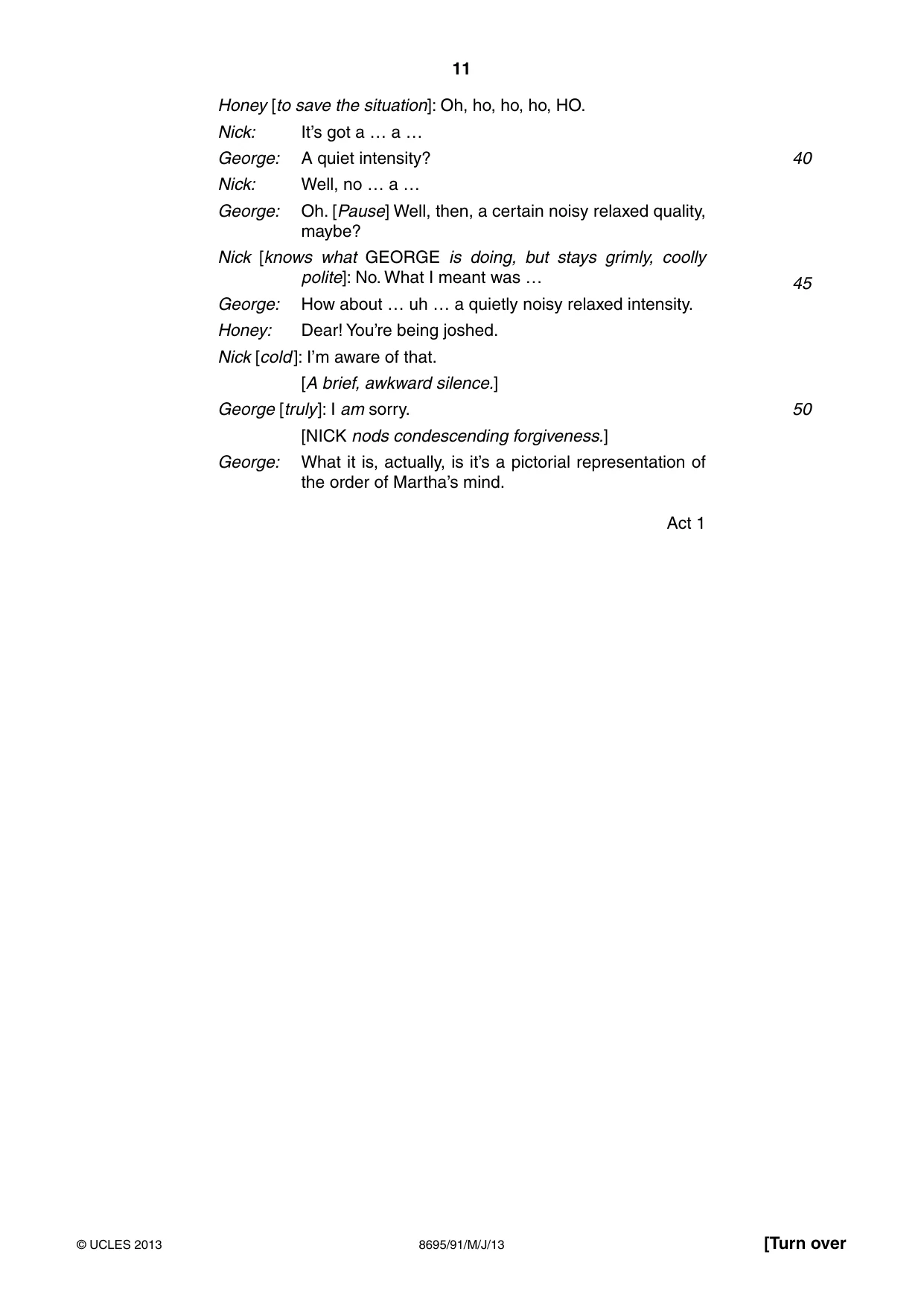
11 8695/91/M/J/13 © UCLES 2013 [Turn over Honey [to save the situation]: Oh, ho, ho, ho, HO. Nick: It’s got a … a … George: A quiet intensity? Nick: Well, no … a … George: Oh. [Pause] Well, then, a certain noisy relaxed quality, maybe? Nick [knows what GEORGE is doing, but stays grimly, coolly polite]: No. What I meant was … George: How about … uh … a quietly noisy relaxed intensity. Honey: Dear! You’re being joshed. Nick [cold ]: I’m aware of that. [A brief, awkward silence.] George [truly]: I am sorry. [NICK nods condescending forgiveness.] George: What it is, actually, is it’s a pictorial representation of the order of Martha’s mind. Act 1 40 45 50
Question paper, page 12
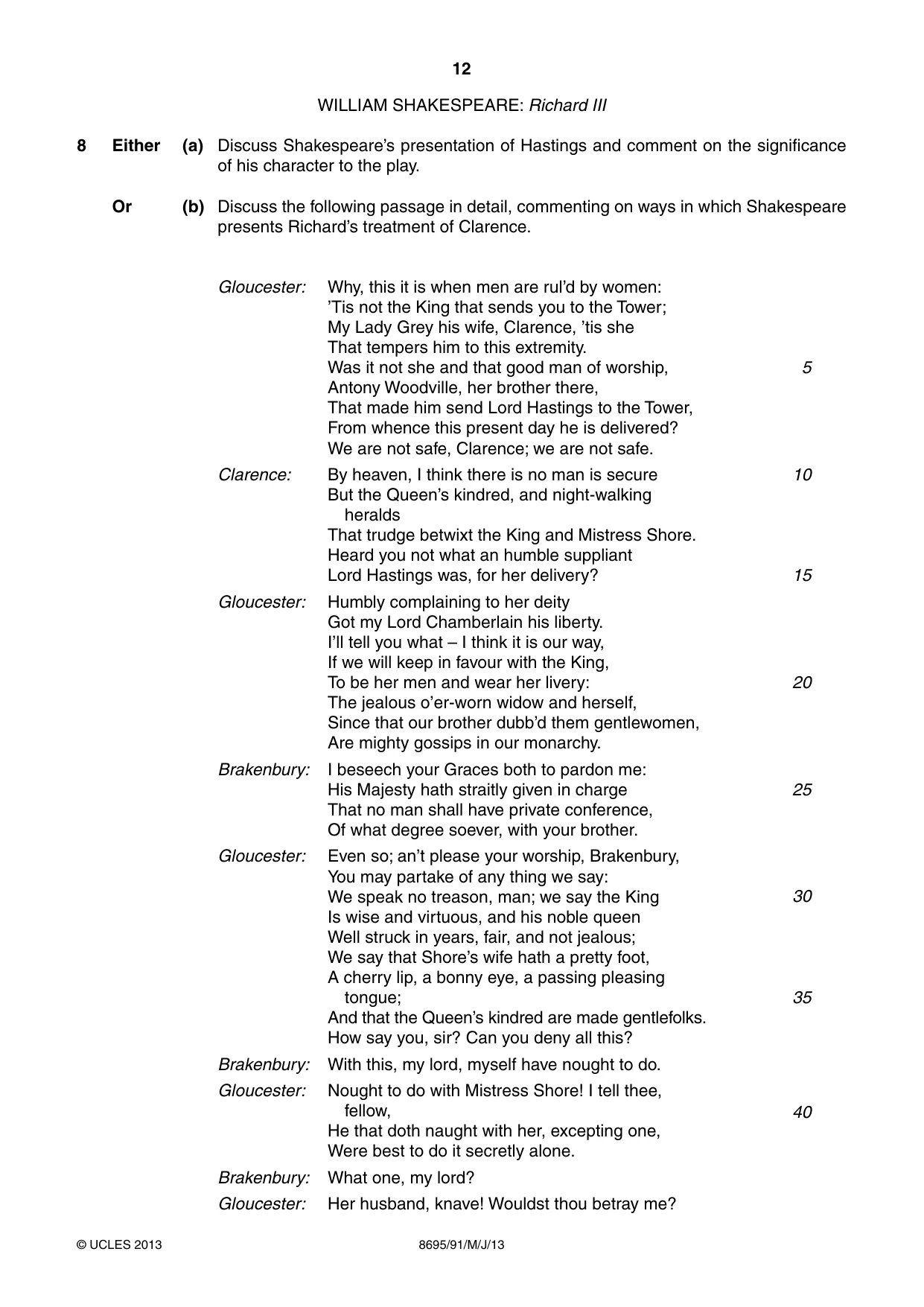
12 8695/91/M/J/13 © UCLES 2013 WILLIAM SHAKESPEARE: Richard III 8 Either (a) Discuss Shakespeare’s presentation of Hastings and comment on the significance of his character to the play. Or (b) Discuss the following passage in detail, commenting on ways in which Shakespeare presents Richard’s treatment of Clarence. Gloucester: Why, this it is when men are rul’d by women: ’Tis not the King that sends you to the Tower; My Lady Grey his wife, Clarence, ’tis she That tempers him to this extremity. Was it not she and that good man of worship, Antony Woodville, her brother there, That made him send Lord Hastings to the Tower, From whence this present day he is delivered? We are not safe, Clarence; we are not safe. Clarence: By heaven, I think there is no man is secure But the Queen’s kindred, and night-walking heralds That trudge betwixt the King and Mistress Shore. Heard you not what an humble suppliant Lord Hastings was, for her delivery? Gloucester: Humbly complaining to her deity Got my Lord Chamberlain his liberty. I’ll tell you what – I think it is our way, If we will keep in favour with the King, To be her men and wear her livery: The jealous o’er-worn widow and herself, Since that our brother dubb’d them gentlewomen, Are mighty gossips in our monarchy. Brakenbury: I beseech your Graces both to pardon me: His Majesty hath straitly given in charge That no man shall have private conference, Of what degree soever, with your brother. Gloucester: Even so; an’t please your worship, Brakenbury, You may partake of any thing we say: We speak no treason, man; we say the King Is wise and virtuous, and his noble queen Well struck in years, fair, and not jealous; We say that Shore’s wife hath a pretty foot, A cherry lip, a bonny eye, a passing pleasing tongue; And that the Queen’s kindred are made gentlefolks. How say you, sir? Can you deny all this? Brakenbury: With this, my lord, myself have nought to do. Gloucester: Nought to do with Mistress Shore! I tell thee, fellow, He that doth naught with her, excepting one, Were best to do it secretly alone. Brakenbury: What one, my lord? Gloucester: Her husband, knave! Wouldst thou betray me? 5 10 15 20 25 30 35 40
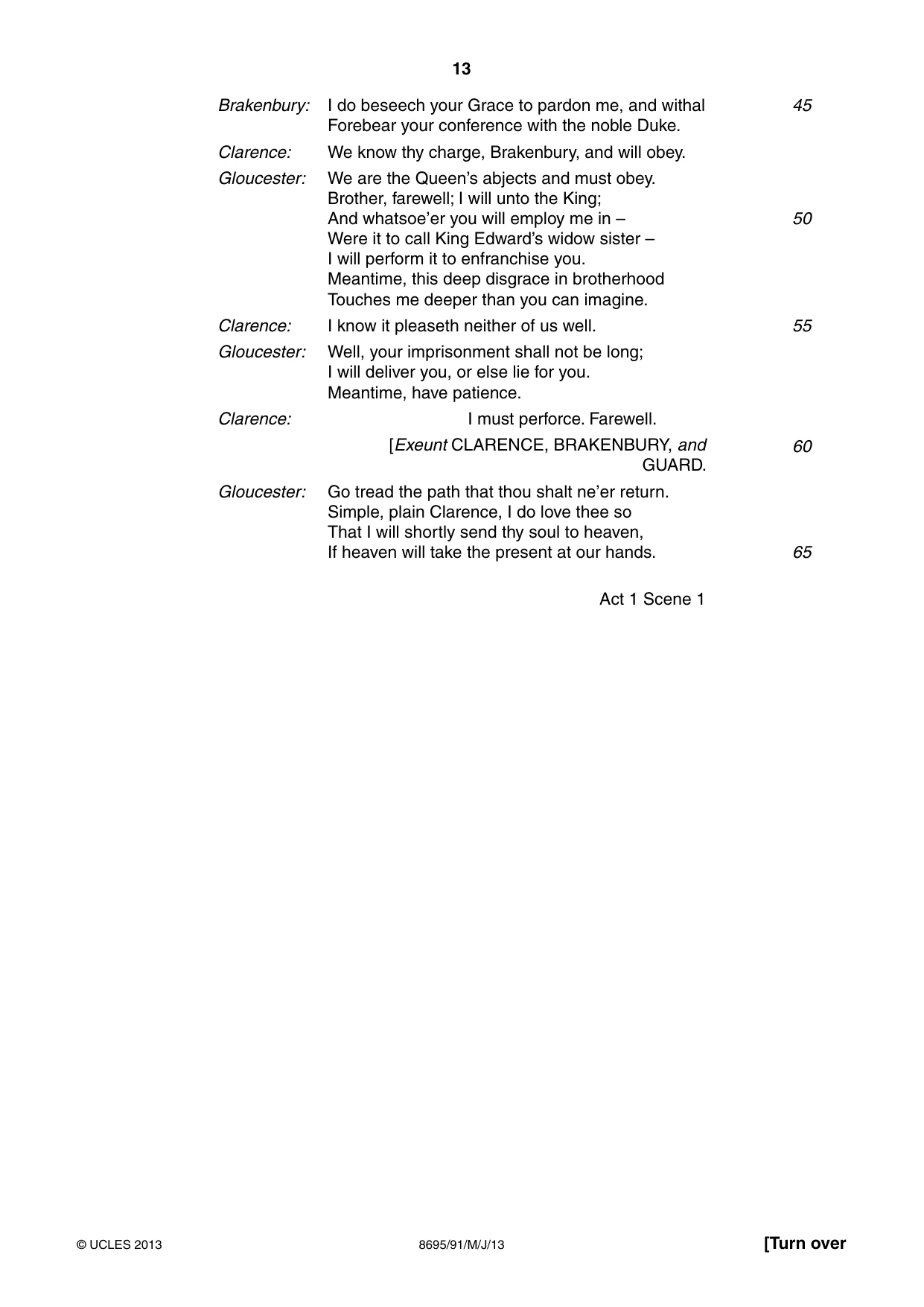
Question paper, page 13
13 8695/91/M/J/13 © UCLES 2013 [Turn over Brakenbury: I do beseech your Grace to pardon me, and withal Forebear your conference with the noble Duke. Clarence: We know thy charge, Brakenbury, and will obey. Gloucester: We are the Queen’s abjects and must obey. Brother, farewell; I will unto the King; And whatsoe’er you will employ me in – Were it to call King Edward’s widow sister – I will perform it to enfranchise you. Meantime, this deep disgrace in brotherhood Touches me deeper than you can imagine. Clarence: I know it pleaseth neither of us well. Gloucester: Well, your imprisonment shall not be long; I will deliver you, or else lie for you. Meantime, have patience. Clarence: I must perforce. Farewell. [Exeunt CLARENCE, BRAKENBURY, and GUARD. Gloucester: Go tread the path that thou shalt ne’er return. Simple, plain Clarence, I do love thee so That I will shortly send thy soul to heaven, If heaven will take the present at our hands. Act 1 Scene 1 45 50 55 60 65
Question paper, page 14
14 8695/91/M/J/13 © UCLES 2013 TENNESSEE WILLIAMS: A Streetcar Named Desire 9 Either (a) ‘You’re not clean enough to bring in the house with my mother.’ How far does the play lead you to sympathise with Mitch’s final words to Blanche? Or (b) Comment closely on the dramatic methods used by Williams to create sympathy for Blanche in the following passage. Blanche: What’s going on here? Content removed due to copyright restrictions.
Question paper, page 15
15 8695/91/M/J/13 © UCLES 2013 Content removed due to copyright restrictions. porch. The gravity of their profession is exaggerated – the unmistakable aura of the state institution with its cynical detachment. The DOCTOR rings the doorbell. The murmur of the game is interrupted.] Scene 11 60
Question paper, page 16
16 8695/91/M/J/13 © UCLES 2013 BLANK PAGE Copyright Acknowledgements: Question 2b © Seamus Heaney; A Shiver, from District and Circle; Faber & Faber Ltd; 2006. Question 3b © Stevie Smith; A Man I Am, in Songs of Ourselves; Foundation Books/Cambridge University Press India; 2005. Question 4b © Chimamanda Ngozi Adichie; Half of a Yellow Sun; Reproduced by permission of HarperCollins; 2006. Question 5b © E M Forster; A Passage to India; The Provost and Scholars of Kings College, Cambridge. Question 6b © A Proulx; The Contest, in Stories of Ourselves; Foundation Books/Cambridge University Press India; 2008. Question 7b © Edward Albee; Who’s Afraid of Virginia Woolf?; Published by Jonathan Cape. Reprinted by permission of The Random House Group Ltd. 1967. Question 9b © A Streetcar Named Desire by Tennessee Williams. Copyright © 1947 by The University of The South. Reprinted by permission of Georges Borchardt, Inc. for the Estate of Tennessee Williams. Permission to reproduce items where third-party owned material protected by copyright is included has been sought and cleared where possible. Every reasonable effort has been made by the publisher (UCLES) to trace copyright holders, but if any items requiring clearance have unwittingly been included, the publisher will be pleased to make amends at the earliest possible opportunity. University of Cambridge International Examinations is part of the Cambridge Assessment Group. Cambridge Assessment is the brand name of University of Cambridge Local Examinations Syndicate (UCLES), which is itself a department of the University of Cambridge.
Mark scheme, page 1
CAMBRIDGE INTERNATIONAL EXAMINATIONS GCE Advanced Subsidiary Level and GCE Advanced Level MARK SCHEME for the May/June 2013 series 8695 LANGUAGE AND LITERATURE IN ENGLISH 8695/91 Paper 9 (Poetry, Prose and Drama), maximum raw mark 50 This mark scheme is published as an aid to teachers and candidates, to indicate the requirements of the examination. It shows the basis on which Examiners were instructed to award marks. It does not indicate the details of the discussions that took place at an Examiners’ meeting before marking began, which would have considered the acceptability of alternative answers. Mark schemes should be read in conjunction with the question paper and the Principal Examiner Report for Teachers. Cambridge will not enter into discussions about these mark schemes. Cambridge is publishing the mark schemes for the May/June 2013 series for most IGCSE, GCE Advanced Level and Advanced Subsidiary Level components and some Ordinary Level components.
Mark scheme, page 2
Page 2 Mark Scheme Syllabus Paper GCE AS/A LEVEL – May/June 2013 8695 91 © Cambridge International Examinations 2013 Using the mark bands Place the answer in a band first. Look for the ‘best fit’ of the answer into a band. An answer needs to show evidence of most but not necessarily ALL of the qualities described in a band, in order to be placed in that band. Then award a mark for the relative position of the answer within the band. Candidates may address the question in many different ways. Do not expect any particular focus or approach and do not penalise answers for leaving out a particular focus. Reward what is there, showing what you are rewarding, in your comments. Consider all strands and weigh up the performance as a whole in placing the answer in a band, then show that you have done so in the summative comment, e.g. Sound K of texts, some evidence of U but mostly narrative, occasional evidence of P, mainly clear C. Assessment Objectives: • Ability to respond to texts in the three main forms (Prose, Poetry and Drama) of different types and from different cultures; • Understanding of the ways in which writers’ choices of form, structure and language shape meanings; • Ability to produce informed independent opinions and judgements on literary texts; • Ability to communicate clearly the knowledge, understanding and insight appropriate to literary study. Each answer is marked out of 25, in accordance with the General Marking Criteria below. Each band is divided into strands corresponding to the Assessment Objectives – Knowledge, Understanding, Personal Response, Communication.
Mark scheme, page 3
Page 3 Mark Scheme Syllabus Paper GCE AS/A LEVEL – May/June 2013 8695 91 © Cambridge International Examinations 2013 Band 6 0 – 5 K Evidence of some general knowledge of the text which may be narrative based and may contain errors, rarely relevant to the question and with little or no relevant quotation or selection from the text. U There may be little or no evidence of understanding of form, structure and language, with some appropriate points made in response to the question. These will be limited and tend to be restricted to plot and characters – the latter treated very much as ‘real’ people. P There may be some signs of personal response, not developed into an argument and not fully supported from the text. C Communication will be insecure. Expression may be weak with some breakdown in communication. Structure may be lacking: answers are likely to be partial, undeveloped, narrative commentary in approach; with the assertion of simple points rather than progressive lines of argument. Answers to passage-based questions are likely to be seriously unbalanced, with an emphasis on narrative or paraphrase. Passages are likely to have been only partially understood and tentatively located contextually, with little coherent sense of the relationship between textual part and whole. There will be little or no mention or consideration of the literary features of the passage. Band 5 6 – 9 Work of a basic standard K Evidence of some limited ability to use knowledge of the text to address the question, with occasional use of supporting references or quotation. U Evidence of some limited understanding of ways in which writers’ choices of structure, form and language shape meanings. P Evidence of some personal response to the text but not fully supported. C Expression will be basically clear. There may be the occasional confused passage of writing. However, there will be no sustained loss of communication. There may be a simple structure to the answer with some evidence of an argument, which may lack coherence, with some repetition, assertion and relapse into narrative summary/paraphrase. There may be a tendency to drift from relevant discussion into material of tangential significance. In answers to passage-based questions there will be some evidence of understanding of how part relates to whole. Treatment of the given extracts may well be sketchy or overlong and undiscriminating. Comment on the wider textual issues is likely to be general. There may be a lack of balance between passage and whole text. There will be some limited consideration of the literary features of the text.
Mark scheme, page 4
Page 4 Mark Scheme Syllabus Paper GCE AS/A LEVEL – May/June 2013 8695 91 © Cambridge International Examinations 2013 Band 4 10 – 13 Solid work K Evidence of some ability to use relevant knowledge of the text to address the question. U Evidence of clear understanding of some ways in which writers’ choices of structure, form and language shape meanings, which may be partial and restricted to the more obvious aspects of the text. P Evidence of personal response to the text, with the beginnings of a personal view or interpretation, relevant to the question and supported from the text. C Expression will be mostly clear and appropriate with a clear, simple structure to the answer. Argument will be basically coherent, and assertive in tone. There is likely to be some reliance on paraphrase and narrative summary. Articulates simple ideas with clarity but there may be some imprecision and clumsiness of expression in dealing with more complex concepts. There may be occasional obscurity in the presentation of ideas and responses. In answers to passage-based questions, work may be lacking in balance of approach, with over-concentration on the given extracts and little attempt to explore the broader textual issues. Conversely some answers may be in effect general essays, with insufficient treatment of the passages. There may be evidence of limited ability to negotiate between parts of a text and its whole. There will be some consideration of the literary features of the text with analysis of the features mentioned likely to be partial or restricted. Band 3 14 – 17 Competent work K Evidence of competence in selecting relevant knowledge of the text to address with some pertinent use of quotation and direct references. U Evidence of sound understanding of some aspects of ways in which writers’ choices of structure, form and language shape meanings, with some analysis and appreciation of literary methods, effects, and contexts. P Evidence of personal response relevant to the question, supported from the text. C Expression will be clear and generally accurate. Structure will be sound – material coherently organised with occasional insights. Candidates will express intelligent, straightforward ideas clearly, though there may be occasional loss of fluency with points not always strongly connected. In answers to passage-based questions, work will cover both the passage and its relation to the whole text, and there will be some sense of a relationship between the text as a whole and its constituent parts. There will be competent appreciation of the effects of the literary features of the text and the analysis is supported by relevant examples from the passage.
Mark scheme, page 5
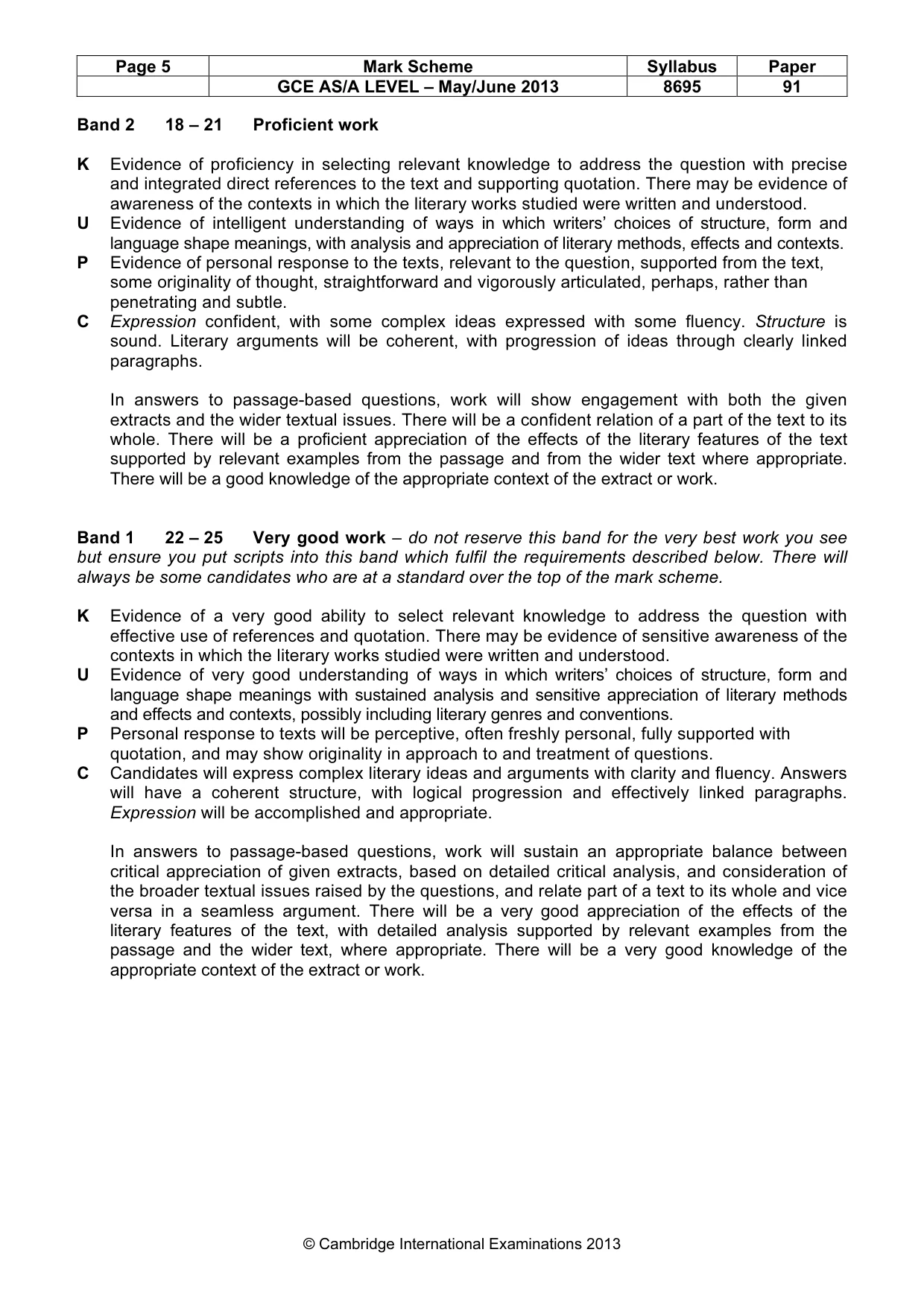
Page 5 Mark Scheme Syllabus Paper GCE AS/A LEVEL – May/June 2013 8695 91 © Cambridge International Examinations 2013 Band 2 18 – 21 Proficient work K Evidence of proficiency in selecting relevant knowledge to address the question with precise and integrated direct references to the text and supporting quotation. There may be evidence of awareness of the contexts in which the literary works studied were written and understood. U Evidence of intelligent understanding of ways in which writers’ choices of structure, form and language shape meanings, with analysis and appreciation of literary methods, effects and contexts. P Evidence of personal response to the texts, relevant to the question, supported from the text, some originality of thought, straightforward and vigorously articulated, perhaps, rather than penetrating and subtle. C Expression confident, with some complex ideas expressed with some fluency. Structure is sound. Literary arguments will be coherent, with progression of ideas through clearly linked paragraphs. In answers to passage-based questions, work will show engagement with both the given extracts and the wider textual issues. There will be a confident relation of a part of the text to its whole. There will be a proficient appreciation of the effects of the literary features of the text supported by relevant examples from the passage and from the wider text where appropriate. There will be a good knowledge of the appropriate context of the extract or work. Band 1 22 – 25 Very good work – do not reserve this band for the very best work you see but ensure you put scripts into this band which fulfil the requirements described below. There will always be some candidates who are at a standard over the top of the mark scheme. K Evidence of a very good ability to select relevant knowledge to address the question with effective use of references and quotation. There may be evidence of sensitive awareness of the contexts in which the literary works studied were written and understood. U Evidence of very good understanding of ways in which writers’ choices of structure, form and language shape meanings with sustained analysis and sensitive appreciation of literary methods and effects and contexts, possibly including literary genres and conventions. P Personal response to texts will be perceptive, often freshly personal, fully supported with quotation, and may show originality in approach to and treatment of questions. C Candidates will express complex literary ideas and arguments with clarity and fluency. Answers will have a coherent structure, with logical progression and effectively linked paragraphs. Expression will be accomplished and appropriate. In answers to passage-based questions, work will sustain an appropriate balance between critical appreciation of given extracts, based on detailed critical analysis, and consideration of the broader textual issues raised by the questions, and relate part of a text to its whole and vice versa in a seamless argument. There will be a very good appreciation of the effects of the literary features of the text, with detailed analysis supported by relevant examples from the passage and the wider text, where appropriate. There will be a very good knowledge of the appropriate context of the extract or work.
What you needed in this session
Cambridge’s own grade thresholds for 2013 May/June, Paper 9 · Variant 1. A higher threshold means an easier paper — the bar moves with how the cohort did.