Cambridge A Level English - Language and Literature (AS Level only, from 2016) 8695 — 2012 Oct/Nov Paper 9 · Variant 3
8695/93/O/N/12 · 50 marks · ≈56 min
The question paper and its mark scheme, free to read here and free to download. This is Cambridge’s own paper, exactly as it was sat.
Question paper17 pages


Mark scheme5 pages
Answers below. Sit the paper first if you are practising.
Paper as text
Question paper, page 1
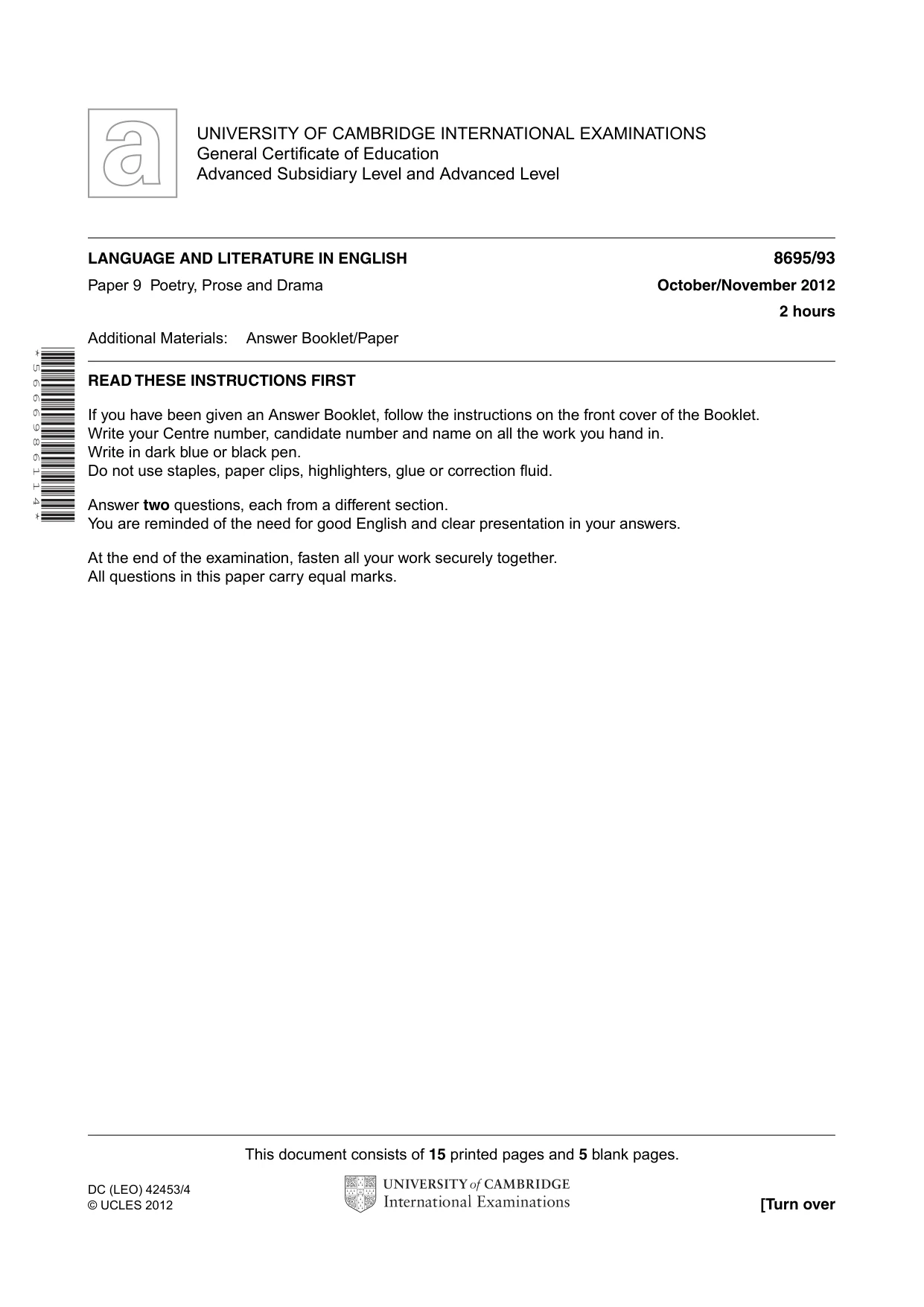
This document consists of 15 printed pages and 5 blank pages. DC (LEO) 42453/4 © UCLES 2012 [Turn over UNIVERSITY OF CAMBRIDGE INTERNATIONAL EXAMINATIONS General Certificate of Education Advanced Subsidiary Level and Advanced Level * 5 6 6 6 9 8 6 1 1 4 * LANGUAGE AND LITERATURE IN ENGLISH 8695/93 Paper 9 Poetry, Prose and Drama October/November 2012 2 hours Additional Materials: Answer Booklet/Paper READ THESE INSTRUCTIONS FIRST If you have been given an Answer Booklet, follow the instructions on the front cover of the Booklet. Write your Centre number, candidate number and name on all the work you hand in. Write in dark blue or black pen. Do not use staples, paper clips, highlighters, glue or correction fluid. Answer two questions, each from a different section. You are reminded of the need for good English and clear presentation in your answers. At the end of the examination, fasten all your work securely together. All questions in this paper carry equal marks.
Question paper, page 2
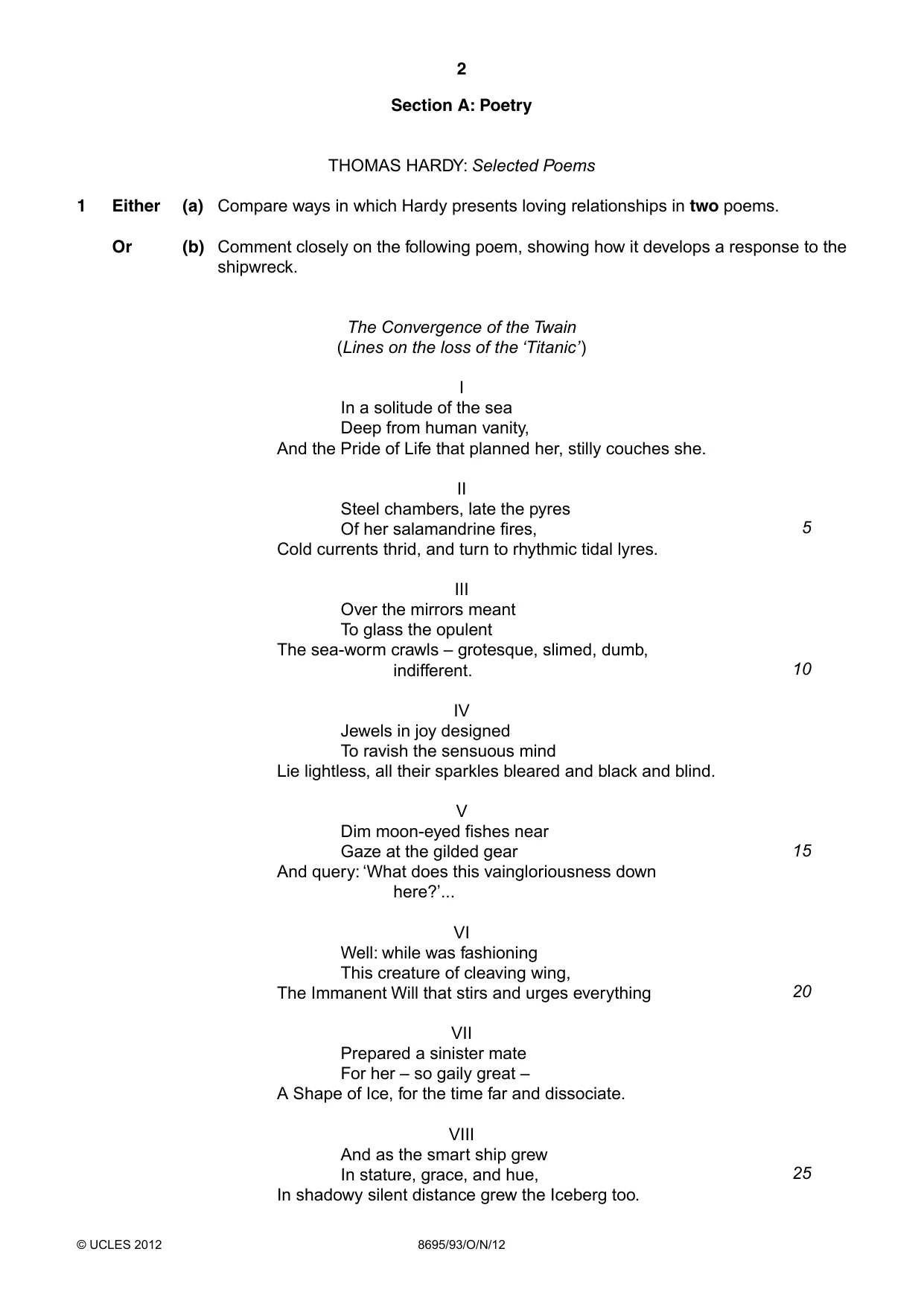
2 8695/93/O/N/12 © UCLES 2012 Section A: Poetry THOMAS HARDY: Selected Poems 1 Either (a) Compare ways in which Hardy presents loving relationships in two poems. Or (b) Comment closely on the following poem, showing how it develops a response to the shipwreck. The Convergence of the Twain (Lines on the loss of the ‘Titanic’ ) I In a solitude of the sea Deep from human vanity, And the Pride of Life that planned her, stilly couches she. II Steel chambers, late the pyres Of her salamandrine fires, Cold currents thrid, and turn to rhythmic tidal lyres. III Over the mirrors meant To glass the opulent The sea-worm crawls – grotesque, slimed, dumb, indifferent. IV Jewels in joy designed To ravish the sensuous mind Lie lightless, all their sparkles bleared and black and blind. V Dim moon-eyed fishes near Gaze at the gilded gear And query: ‘What does this vaingloriousness down here?’... VI Well: while was fashioning This creature of cleaving wing, The Immanent Will that stirs and urges everything VII Prepared a sinister mate For her – so gaily great – A Shape of Ice, for the time far and dissociate. VIII And as the smart ship grew In stature, grace, and hue, In shadowy silent distance grew the Iceberg too. 5 10 15 20 25
Question paper, page 3
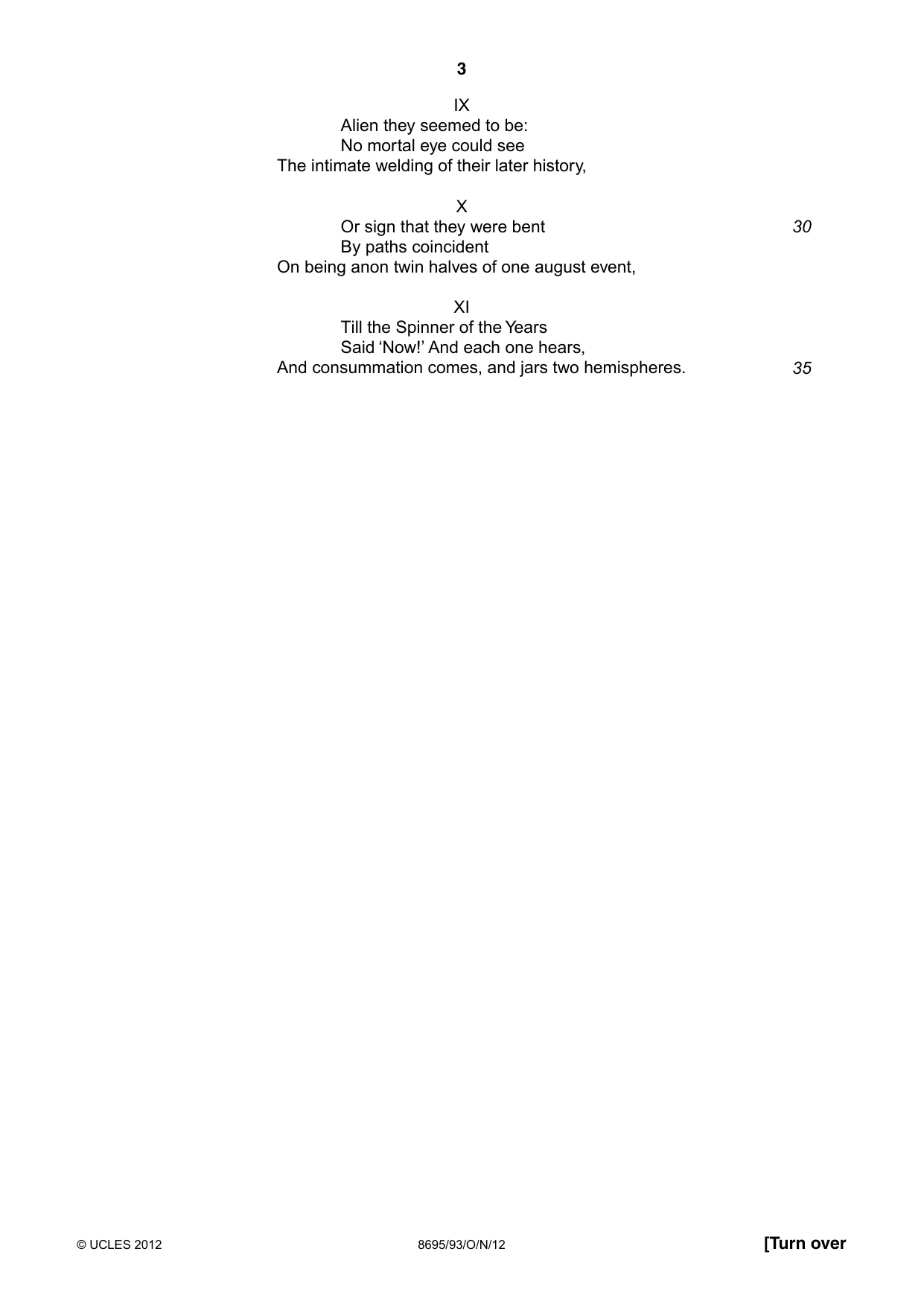
3 8695/93/O/N/12 © UCLES 2012 [Turn over IX Alien they seemed to be: No mortal eye could see The intimate welding of their later history, X Or sign that they were bent By paths coincident On being anon twin halves of one august event, XI Till the Spinner of the Years Said ‘Now!’ And each one hears, And consummation comes, and jars two hemispheres. 30 35
Question paper, page 4
4 8695/93/O/N/12 © UCLES 2012 SEAMUS HEANEY: District and Circle 2 Either (a) Discuss the importance and treatment of childhood memories in Heaney’s poetry. Or (b) Comment closely on the following poem, paying particular attention to the effects of its language and structure. The Nod Content removed due to copyright restrictions.
Question paper, page 5
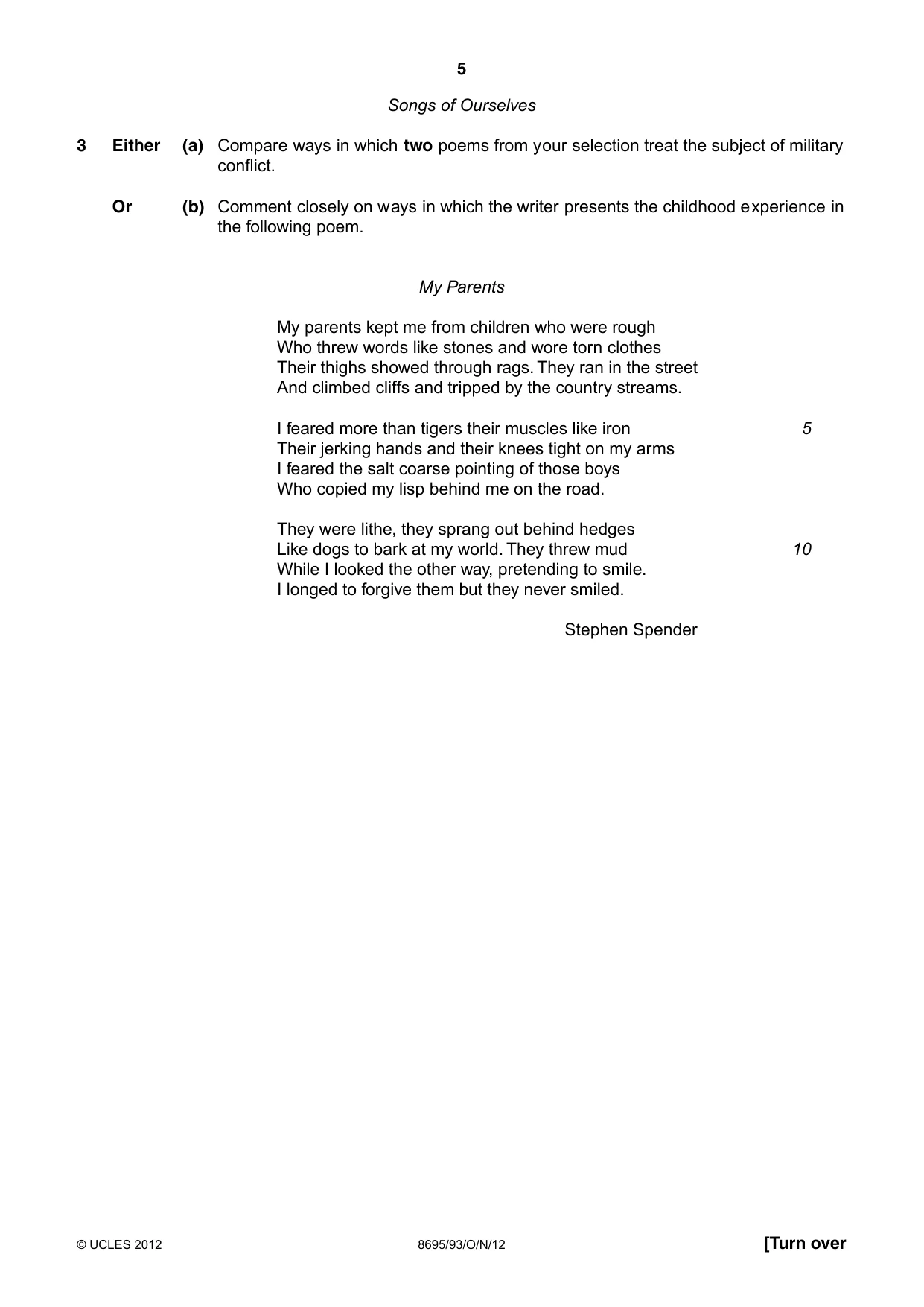
5 8695/93/O/N/12 © UCLES 2012 [Turn over Songs of Ourselves 3 Either (a) Compare ways in which two poems from your selection treat the subject of military conflict. Or (b) Comment closely on ways in which the writer presents the childhood experience in the following poem. My Parents My parents kept me from children who were rough Who threw words like stones and wore torn clothes Their thighs showed through rags. They ran in the street And climbed cliffs and tripped by the country streams. I feared more than tigers their muscles like iron Their jerking hands and their knees tight on my arms I feared the salt coarse pointing of those boys Who copied my lisp behind me on the road. They were lithe, they sprang out behind hedges Like dogs to bark at my world. They threw mud While I looked the other way, pretending to smile. I longed to forgive them but they never smiled. Stephen Spender 5 10
Question paper, page 6
6 8695/93/O/N/12 © UCLES 2012 BLANK PAGE
Question paper, page 7
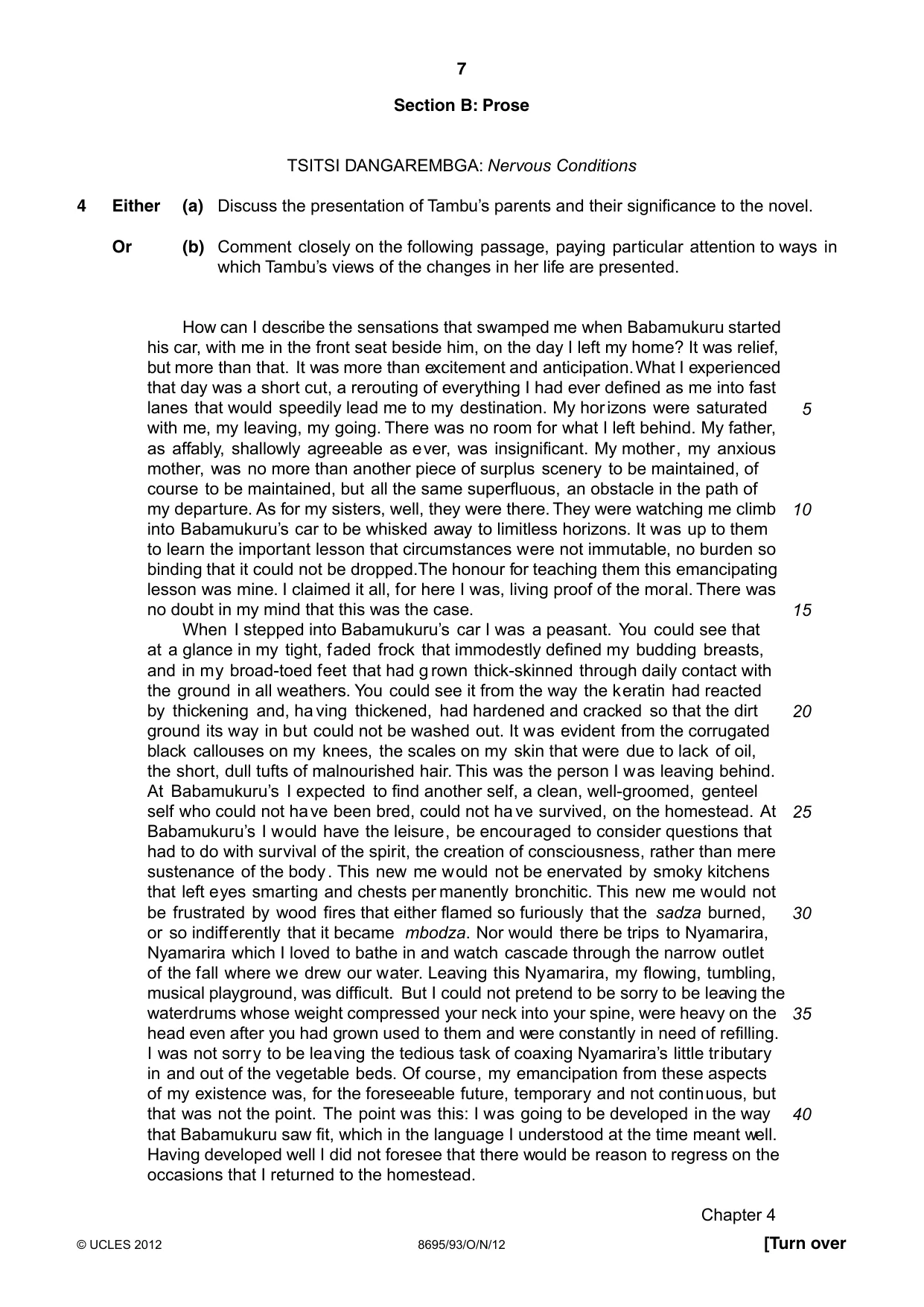
7 8695/93/O/N/12 © UCLES 2012 [Turn over Section B: Prose TSITSI DANGAREMBGA: Nervous Conditions 4 Either (a) Discuss the presentation of Tambu’s parents and their significance to the novel. Or (b) Comment closely on the following passage, paying particular attention to ways in which Tambu’s views of the changes in her life are presented. How can I describe the sensations that swamped me when Babamukuru started his car, with me in the front seat beside him, on the day I left my home? It was relief, but more than that. It was more than excitement and anticipation. What I experienced that day was a short cut, a rerouting of everything I had ever defined as me into fast lanes that would speedily lead me to my destination. My horizons were saturated with me, my leaving, my going. There was no room for what I left behind. My father, as affably, shallowly agreeable as ever, was insignificant. My mother, my anxious mother, was no more than another piece of surplus scenery to be maintained, of course to be maintained, but all the same superfluous, an obstacle in the path of my departure. As for my sisters, well, they were there. They were watching me climb into Babamukuru’s car to be whisked away to limitless horizons. It was up to them to learn the important lesson that circumstances were not immutable, no burden so binding that it could not be dropped. The honour for teaching them this emancipating lesson was mine. I claimed it all, for here I was, living proof of the moral. There was no doubt in my mind that this was the case. When I stepped into Babamukuru’s car I was a peasant. You could see that at a glance in my tight, faded frock that immodestly defined my budding breasts, and in my broad-toed feet that had g rown thick-skinned through daily contact with the ground in all weathers. You could see it from the way the keratin had reacted by thickening and, ha ving thickened, had hardened and cracked so that the dirt ground its way in but could not be washed out. It was evident from the corrugated black callouses on my knees, the scales on my skin that were due to lack of oil, the short, dull tufts of malnourished hair. This was the person I was leaving behind. At Babamukuru’s I expected to find another self, a clean, well-groomed, genteel self who could not have been bred, could not ha ve survived, on the homestead. At Babamukuru’s I would have the leisure, be encouraged to consider questions that had to do with survival of the spirit, the creation of consciousness, rather than mere sustenance of the body. This new me would not be enervated by smoky kitchens that left eyes smarting and chests per manently bronchitic. This new me would not be frustrated by wood fires that either flamed so furiously that the sadza burned, or so indifferently that it became mbodza. Nor would there be trips to Nyamarira, Nyamarira which I loved to bathe in and watch cascade through the narrow outlet of the fall where we drew our water. Leaving this Nyamarira, my flowing, tumbling, musical playground, was difficult. But I could not pretend to be sorry to be leaving the waterdrums whose weight compressed your neck into your spine, were heavy on the head even after you had grown used to them and were constantly in need of refilling. I was not sorry to be leaving the tedious task of coaxing Nyamarira’s little tributary in and out of the vegetable beds. Of course, my emancipation from these aspects of my existence was, for the foreseeable future, temporary and not continuous, but that was not the point. The point was this: I was going to be developed in the way that Babamukuru saw fit, which in the language I understood at the time meant well. Having developed well I did not foresee that there would be reason to regress on the occasions that I returned to the homestead. Chapter 4 5 10 15 20 25 30 35 40
Question paper, page 8
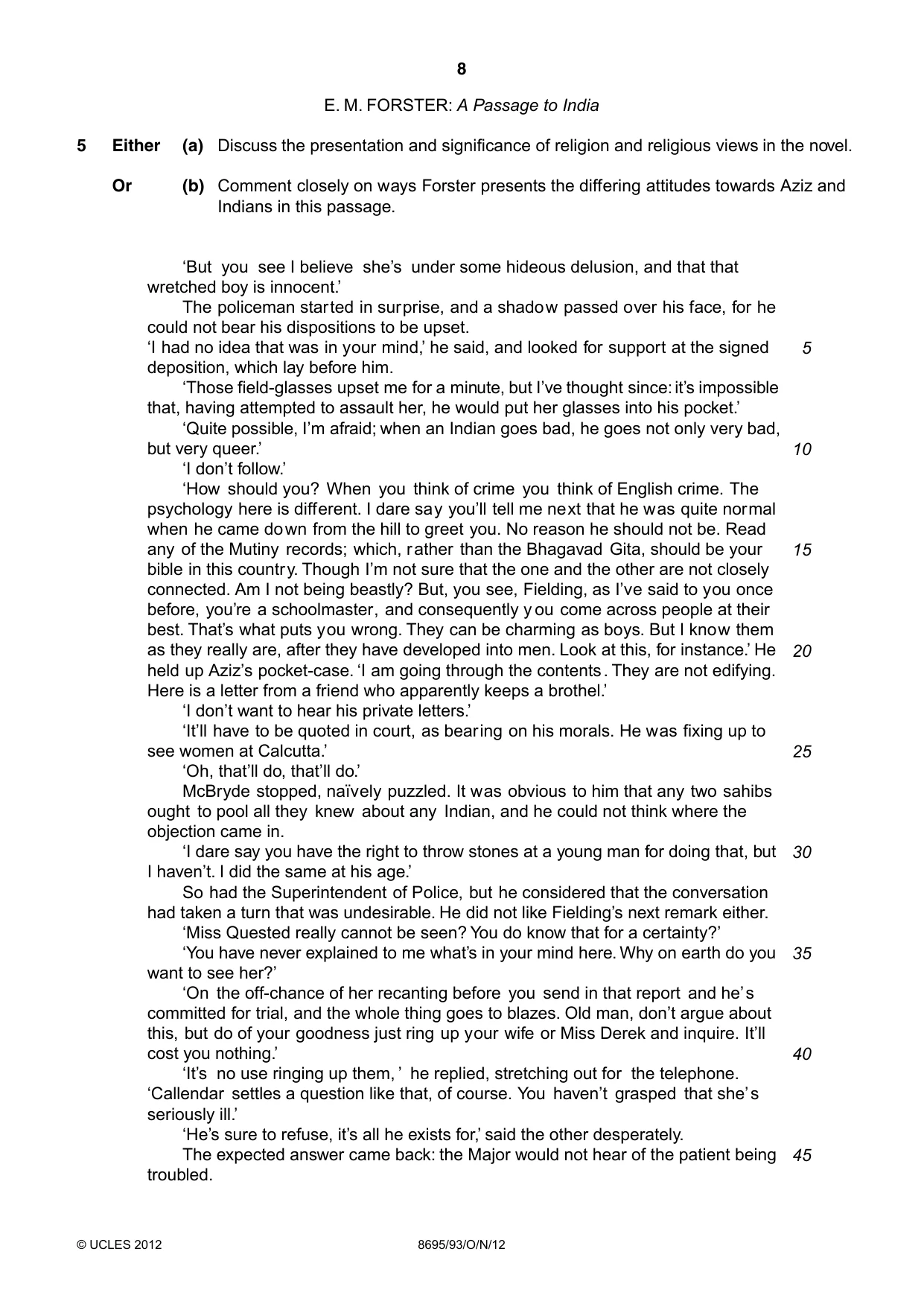
8 8695/93/O/N/12 © UCLES 2012 E. M. FORSTER: A Passage to India 5 Either (a) Discuss the presentation and significance of religion and religious views in the novel. Or (b) Comment closely on ways Forster presents the differing attitudes towards Aziz and Indians in this passage. ‘But you see I believe she’s under some hideous delusion, and that that wretched boy is innocent.’ The policeman started in surprise, and a shadow passed over his face, for he could not bear his dispositions to be upset. ‘I had no idea that was in your mind,’ he said, and looked for support at the signed deposition, which lay before him. ‘Those field-glasses upset me for a minute, but I’ve thought since: it’s impossible that, having attempted to assault her, he would put her glasses into his pocket.’ ‘Quite possible, I’m afraid; when an Indian goes bad, he goes not only very bad, but very queer.’ ‘I don’t follow.’ ‘How should you? When you think of crime you think of English crime. The psychology here is different. I dare say you’ll tell me next that he was quite normal when he came down from the hill to greet you. No reason he should not be. Read any of the Mutiny records; which, rather than the Bhagavad Gita, should be your bible in this country. Though I’m not sure that the one and the other are not closely connected. Am I not being beastly? But, you see, Fielding, as I’ve said to you once before, you’re a schoolmaster, and consequently y ou come across people at their best. That’s what puts you wrong. They can be charming as boys. But I know them as they really are, after they have developed into men. Look at this, for instance.’ He held up Aziz’s pocket-case. ‘I am going through the contents. They are not edifying. Here is a letter from a friend who apparently keeps a brothel.’ ‘I don’t want to hear his private letters.’ ‘It’ll have to be quoted in court, as bearing on his morals. He was fixing up to see women at Calcutta.’ ‘Oh, that’ll do, that’ll do.’ McBryde stopped, naïvely puzzled. It was obvious to him that any two sahibs ought to pool all they knew about any Indian, and he could not think where the objection came in. ‘I dare say you have the right to throw stones at a young man for doing that, but I haven’t. I did the same at his age.’ So had the Superintendent of Police, but he considered that the conversation had taken a turn that was undesirable. He did not like Fielding’s next remark either. ‘Miss Quested really cannot be seen? You do know that for a certainty?’ ‘You have never explained to me what’s in your mind here. Why on earth do you want to see her?’ ‘On the off-chance of her recanting before you send in that report and he’s committed for trial, and the whole thing goes to blazes. Old man, don’t argue about this, but do of your goodness just ring up your wife or Miss Derek and inquire. It’ll cost you nothing.’ ‘It’s no use ringing up them, ’ he replied, stretching out for the telephone. ‘Callendar settles a question like that, of course. You haven’t grasped that she’s seriously ill.’ ‘He’s sure to refuse, it’s all he exists for,’ said the other desperately. The expected answer came back: the Major would not hear of the patient being troubled. 5 10 15 20 25 30 35 40 45
Question paper, page 9
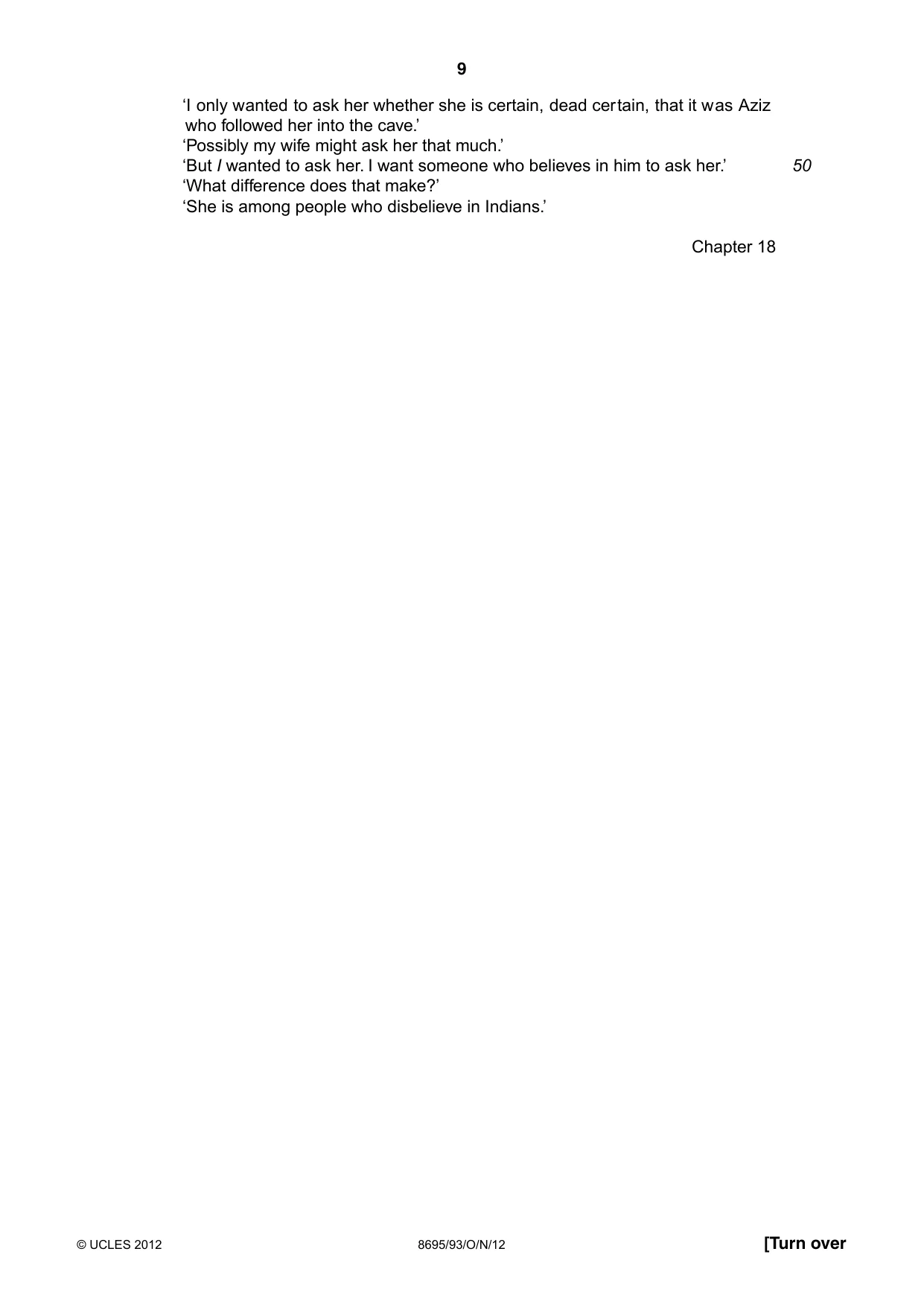
9 8695/93/O/N/12 © UCLES 2012 [Turn over ‘I only wanted to ask her whether she is certain, dead certain, that it was Aziz who followed her into the cave.’ ‘Possibly my wife might ask her that much.’ ‘But I wanted to ask her. I want someone who believes in him to ask her.’ ‘What difference does that make?’ ‘She is among people who disbelieve in Indians.’ Chapter 18 50
Question paper, page 10
10 8695/93/O/N/12 © UCLES 2012 Stories of Ourselves 6 Either (a) Compare the effectiveness of the openings of two different stories. Or (b) Comment closely on ways in which the writing of the following passage creates the atmosphere of the story. During the whole of a dull, dark, and soundless day in the autumn of the year, when the clouds hung oppressively low in the heavens, I had been passing alone, on horseback, through a singularly dreary tract of country; and at length found myself, as the shades of the evening drew on, within view of the melancholy House of Usher. I know not how it was – but, with the first glimpse of the b uilding, a sense of insufferable gloom pervaded my spirit. I say insufferable; for the feeling was unrelieved by any of that half-pleasurable, because poetic, sentiment, with which the mind usually receives even the sternest natural images of the desolate or terrible. I looked upon the scene before me – upon the mere house, and the simple landscape features of the domain – upon the bleak walls – upon the vacant eye-like windows – upon a few rank sedges – and upon a few white trunks of decayed trees – with an utter depression of soul which I can compare to no ear thly sensation more properly than to the afterdream of the reveller upon opium – the bitter lapse into everyday life – the hideous dropping off of the veil. There was an iciness, a sinking, a sickening of the heart – an unredeemed dreariness of thought which no goading of the imagination could torture into aught of the sublime. What was it – I paused to think – what was it that so unnerved me in the contemplation of the House of Usher? It was a mystery all insoluble; nor could I grapple with the shadowy fancies that crowded upon me as I pondered. I was forced to fall back upon the unsatisfactory conclusion, that while, beyond doubt, there are combinations of very simple natural objects which have the power of thus affecting us, still the analysis of this power lies among considerations beyond our depth. It was possible, I reflected, that a mere different arrangement of the particulars of the scene, of the details of the picture, would be sufficient to modify, or perhaps to annihilate its capacity for sorrowful impression; and, acting upon this idea, I reined my horse to the precipitous brink of a black and lurid tarn that lay in unruffled lustre by the dwelling, and gazed down – but with a shudder even more thrilling than before – upon the remodelled and inverted images of the gray sedge, and the ghastly tree-stems, and the vacant and eye-like windows. Nevertheless, in this mansion of gloom I now proposed to myself a sojourn of some weeks. Its proprietor, Roderick Usher, had been one of my boon companions in boyhood; but many years had elapsed since our last meeting. A letter, however, had lately reached me in a distant part of the country – a letter from him – which, in its wildly importunate nature, had admitted of no other than a personal reply. The MS. gave evidence of nervous agitation. The writer spoke of acute bodily illness – of a mental disorder which oppressed him – and of an earnest desire to see me , as his best, and indeed his only personal friend, with a view of attempting, by the cheerfulness of my society, some alleviation of his malady. It was the manner in which all this, and much more, was said – it was the apparent heart that went with his request – which allowed me no room for hesitation; and I accordingly obeyed forthwith what I still considered a very singular summons. The Fall of the House of Usher 5 10 15 20 25 30 35 40
Question paper, page 11
11 8695/93/O/N/12 © UCLES 2012 [Turn over BLANK PAGE Turn to Page 12 for Question 7
Question paper, page 12
12 8695/93/O/N/12 © UCLES 2012 Section C: Drama PETER SHAFFER: Equus 7 Either (a) Discuss Shaffer’s presentation of Alan’ s father, Frank, and his significance in the play. Or (b) Comment closely on the following passage, showing how Shaffer creates its dramatic impact. She lifts her sweater over her head: he watches – then unzips his. They each remove their shoes, their socks, and their jeans. Then they look at each other diagonally across the square, in which the light is gently increasing. Alan: You’re ... You’re very ... Jill: So are you... (pause) Come here. He goes to her . She comes to him. They meet in the middle, and hold each other, and embrace. Alan: (to Dysart) She put her mouth in mine. It was lovely! Oh, it was lovely! They burst into giggles. He lays her gently on the floor in the centre of the square, and bends over her eagerly. Suddenly the noise of Equus fills the place. Hooves smash on wood. Alan straightens up, rigid. He stares straight ahead of him over the prone body of the girl. Dysart: Yes, what happened then, Alan? Alan: (to Dysart: brutally) I put it in her! Dysart: Yes? Alan: (to Dysart) I put it in her. Dysart: You did? Alan: (to Dysart) Yes! Dysart: Was it easy? Alan: (to Dysart) Yes. Dysart: Describe it. Alan: (to Dysart) I told you. Dysart: More exactly. Alan: (to Dysart) I put it in her! Dysart: Did you? Alan: (to Dysart) All the way! Dysart: Did you, Alan? Alan: (to Dysart) All the way. I shoved it. I put it in her all the way. Dysart: Did you? Alan: (to Dysart) Yes! Dysart: Did you? Alan: (to Dysart) Yes! ... Yes! 5 10 15 20 25 30 35
Question paper, page 13
13 8695/93/O/N/12 © UCLES 2012 [Turn over Dysart: Give me the TRUTH! ... Did you? ... Honestly? Alan: (to Dysart) Get lost! He collapses, lying upstage on his face. Jill lies on her back motionless, her head do wnstage, her arms extended behind her. A pause. Dysart: (gently) What was it? You couldn’t? Though you wanted to very much? Alan: (to Dysart) I couldn’t ... see her. Dysart: What do you mean? Alan: (to Dysart) Only Him. Every time I kissed her – He was in the way. Dysart: Who? Alan turns on his back. Alan: (to Dysart) You know who! ... When I touched her, I felt Him. Under me ... His side, waiting for my hand ... His flanks ... I refused him. I looked. I looked right at her ... and I couldn’t do it. When I shut my eyes, I saw Him at once. The streaks on his belly ... (with more desperation) I couldn’t feel her flesh at all! I wanted the foam off his neck. His sweaty hide. Not flesh. Hide! Horse-hide! ... Then I couldn’t even kiss her. Jill sits up. Jill: What is it? Alan: (dodging her hand) No! Act 2, Scene 33 40 45 50 55 60
Question paper, page 14
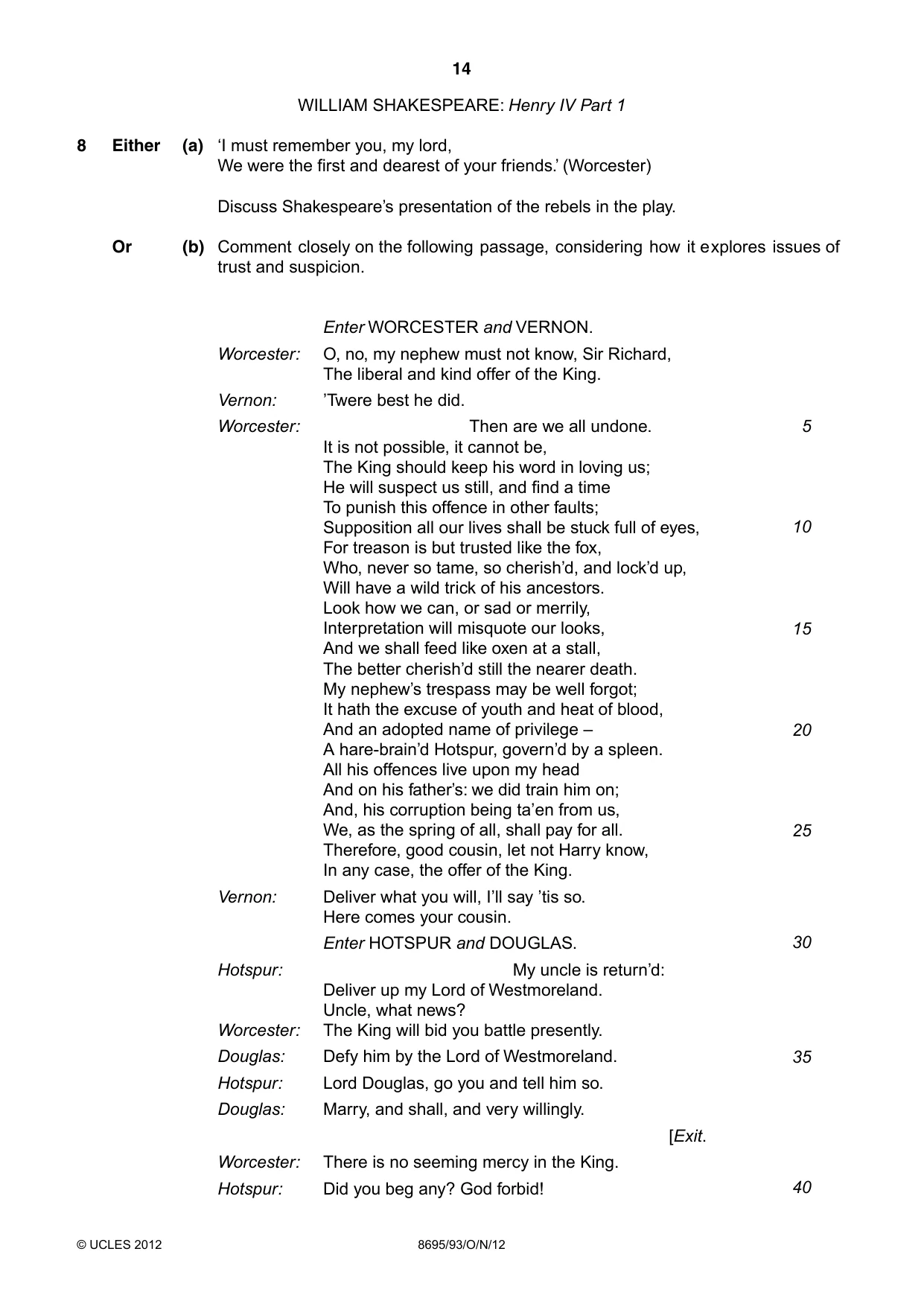
14 8695/93/O/N/12 © UCLES 2012 WILLIAM SHAKESPEARE: Henry IV Part 1 8 Either (a) ‘I must remember you, my lord, We were the first and dearest of your friends.’ (Worcester) Discuss Shakespeare’s presentation of the rebels in the play. Or (b) Comment closely on the following passage, considering how it explores issues of trust and suspicion. Enter WORCESTER and VERNON. Worcester: O, no, my nephew must not know, Sir Richard, The liberal and kind offer of the King. Vernon: ’Twere best he did. Worcester: Then are we all undone. It is not possible, it cannot be, The King should keep his word in loving us; He will suspect us still, and find a time To punish this offence in other faults; Supposition all our lives shall be stuck full of eyes, For treason is but trusted like the fox, Who, never so tame, so cherish’d, and lock’d up, Will have a wild trick of his ancestors. Look how we can, or sad or merrily, Interpretation will misquote our looks, And we shall feed like oxen at a stall, The better cherish’d still the nearer death. My nephew’s trespass may be well forgot; It hath the excuse of youth and heat of blood, And an adopted name of privilege – A hare-brain’d Hotspur, govern’d by a spleen. All his offences live upon my head And on his father’s: we did train him on; And, his corruption being ta’en from us, We, as the spring of all, shall pay for all. Therefore, good cousin, let not Harry know, In any case, the offer of the King. Vernon: Deliver what you will, I’ll say ’tis so. Here comes your cousin. Enter HOTSPUR and DOUGLAS. Hotspur: My uncle is return’d: Deliver up my Lord of Westmoreland. Uncle, what news? Worcester: The King will bid you battle presently. Douglas: Defy him by the Lord of Westmoreland. Hotspur: Lord Douglas, go you and tell him so. Douglas: Marry, and shall, and very willingly. [Exit. Worcester: There is no seeming mercy in the King. Hotspur: Did you beg any? God forbid! 5 10 15 20 25 30 35 40
Question paper, page 15
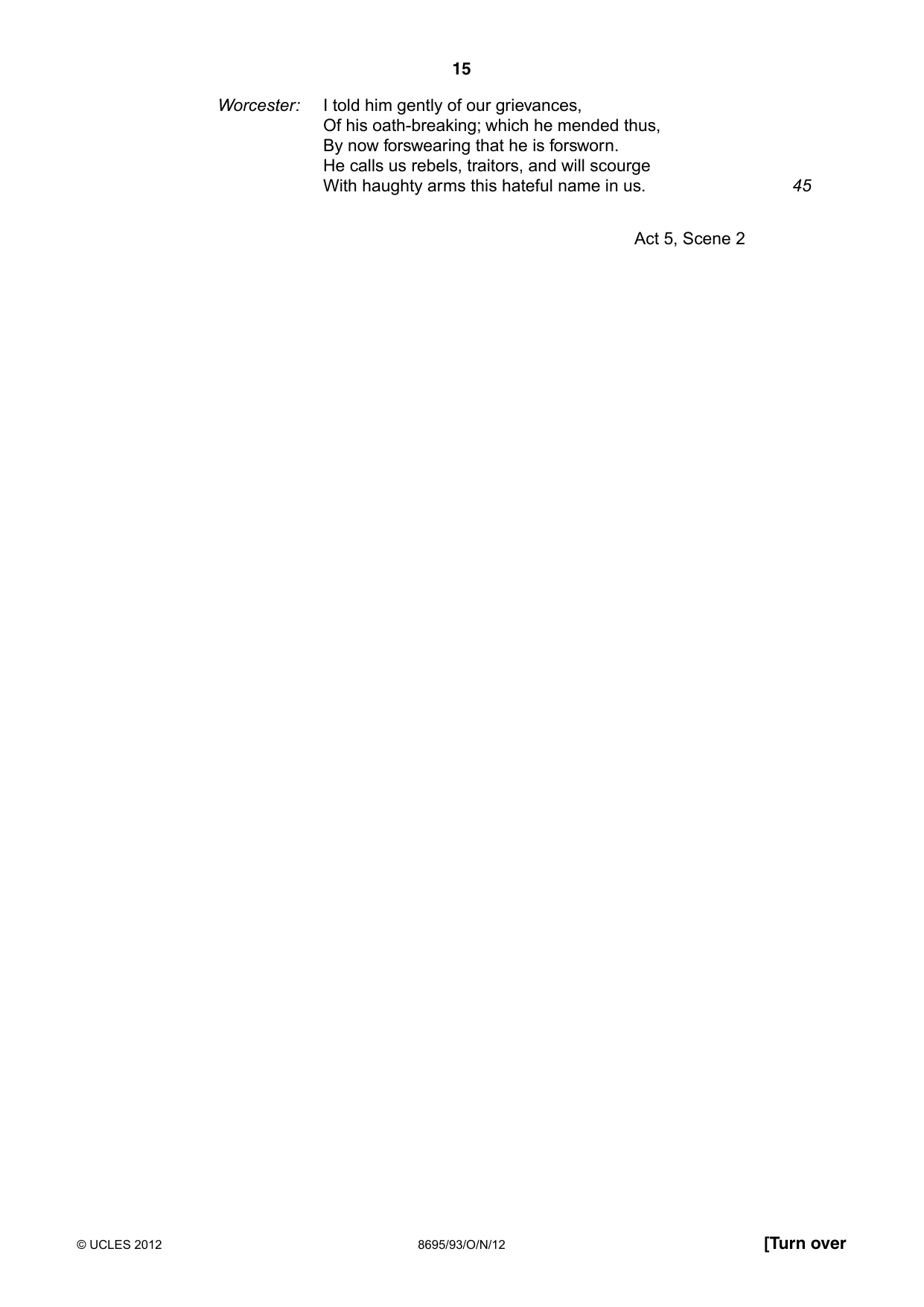
15 8695/93/O/N/12 © UCLES 2012 [Turn over Worcester: I told him gently of our grievances, Of his oath-breaking; which he mended thus, By now forswearing that he is forsworn. He calls us rebels, traitors, and will scourge With haughty arms this hateful name in us. Act 5, Scene 2 45
Question paper, page 16
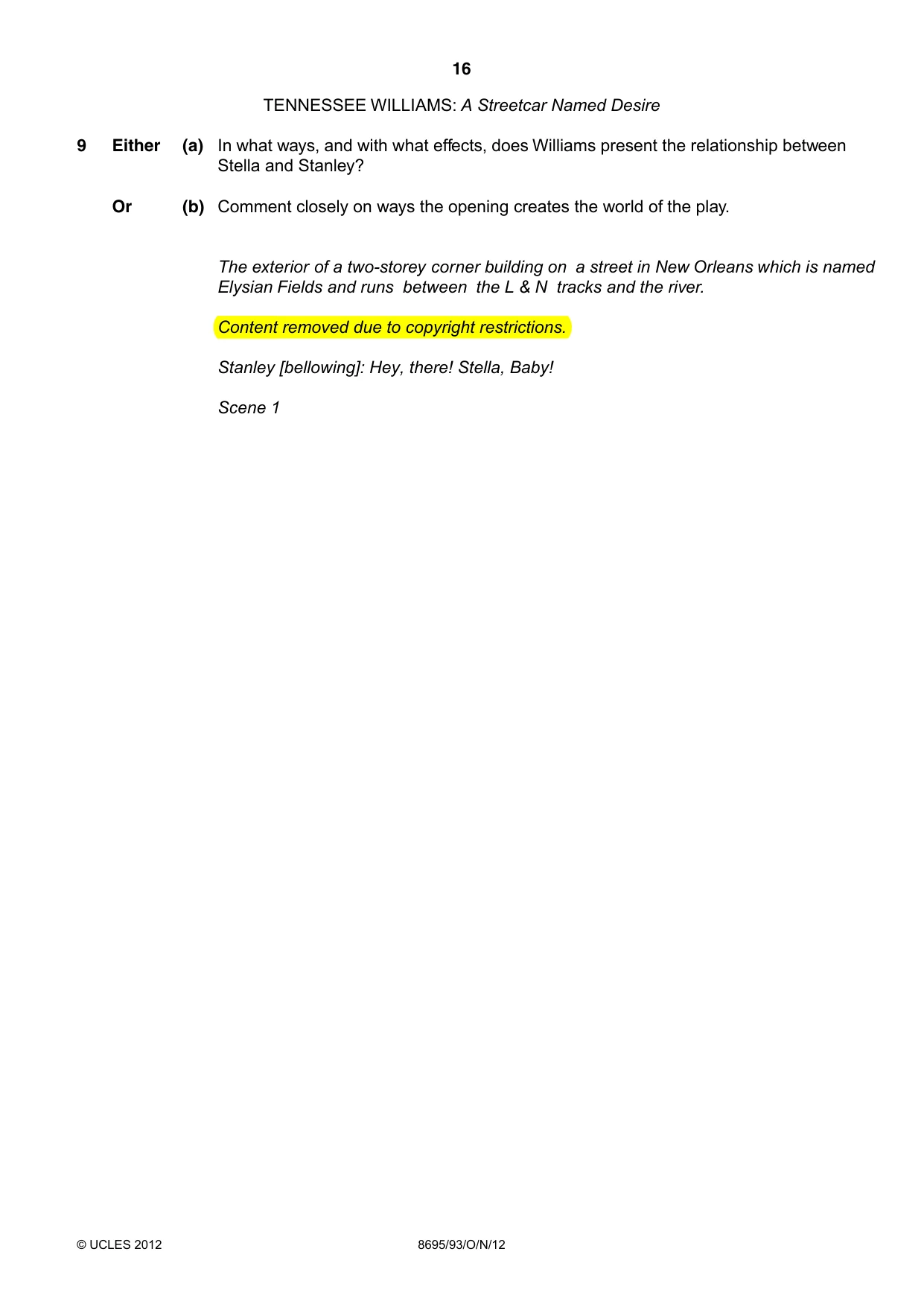
16 8695/93/O/N/12 © UCLES 2012 TENNESSEE WILLIAMS: A Streetcar Named Desire 9 Either (a) In what ways, and with what effects, does Williams present the relationship between Stella and Stanley? Or (b) Comment closely on ways the opening creates the world of the play. The exterior of a two-storey corner building on a street in New Orleans which is named Elysian Fields and runs between the L & N tracks and the river. Content removed due to copyright restrictions. Stanley [bellowing]: Hey, there! Stella, Baby! Scene 1
Question paper, page 17
20 8695/93/O/N/12 © UCLES 2012 BLANK PAGE` Copyright Acknowledgements: Question 2b © Seamus Heaney; The Nod from District and Circle ; Faber & Faber; 2006. Question 3b © Stephen Spender; My Parents from Songs of Ourselves ; Foundation Books; 2005. Question 4b © Tsitsi Dangarembga; Nervous Conditions ; Ayebia Publishing; 1988. Question 5b © E M Forster; A Passage to India ; Penguin Books Ltd; 1979. Question 7b © Peter Shaffer; Equus ; Longman; 1993. Question 9b © A Streetcar Named Desire by Tennessee Williams. Copyright © 1947 by The University of The South. Reprinted by permission of New Directions Publishing Corp. and Georges Borchardt, Inc. for the Estate of Tennessee Williams. Permission to reproduce items where third-party owned material protected by copyright is included has been sought and cleared where possible. Every reasonable effort has been made by the publisher (UCLES) to trace copyright holders, but if any items requiring clearance have unwittingly been included, the publisher will be pleased to make amends at the earliest possible opportunity. University of Cambridge International Examinations is part of the Cambridge Assessment Group. Cambridge Local Examinations Syndicate (UCLES), which is itself a department of the University of Cambridge.
Mark scheme, page 1
CAMBRIDGE INTERNATIONAL EXAMINATIONS GCE Advanced Subsidiary Level and GCE Advanced Level MARK SCHEME for the October/November 2012 series 8695 LANGUAGE AND LITERATURE IN ENGLISH 8695/93 Paper 9 (Poetry, Prose, Drama), maximum raw mark 50 This mark scheme is published as an aid to teachers and candidates, to indicate the requirements of the examination. It shows the basis on which Examiners were instructed to award marks. It does not indicate the details of the discussions that took place at an Examiners’ meeting before marking began, which would have considered the acceptability of alternative answers. Mark schemes should be read in conjunction with the question paper and the Principal Examiner Report for Teachers. Cambridge will not enter into discussions about these mark schemes. Cambridge is publishing the mark schemes for the October/November 2012 series for most IGCSE, GCE Advanced Level and Advanced Subsidiary Level components and some Ordinary Level components.
Mark scheme, page 2
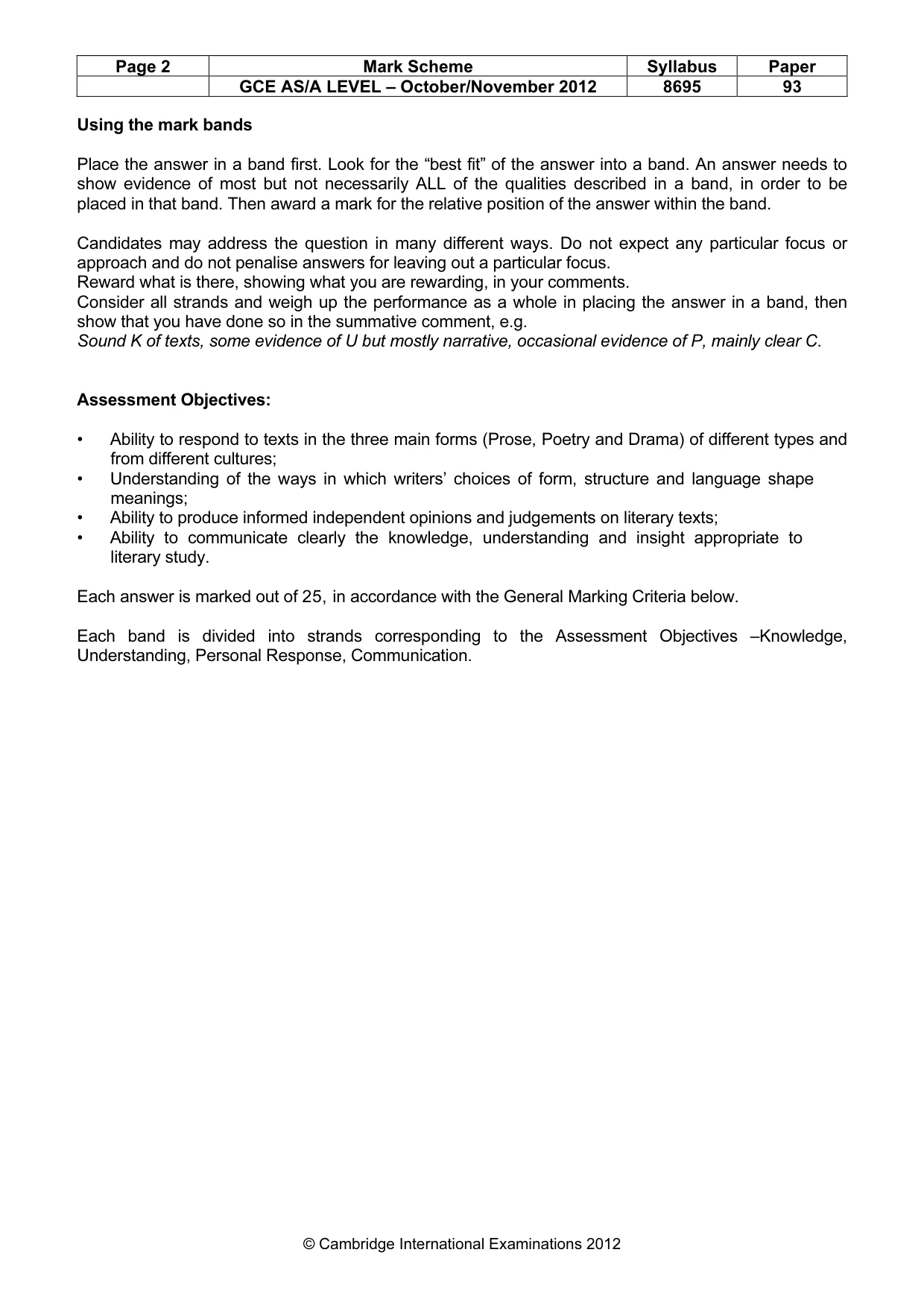
Page 2 Mark Scheme Syllabus Paper GCE AS/A LEVEL – October/November 2012 8695 93 © Cambridge International Examinations 2012 Using the mark bands Place the answer in a band first. Look for the “best fit” of the answer into a band. An answer needs to show evidence of most but not necessarily ALL of the qualities described in a band, in order to be placed in that band. Then award a mark for the relative position of the answer within the band. Candidates may address the question in many different ways. Do not expect any particular focus or approach and do not penalise answers for leaving out a particular focus. Reward what is there, showing what you are rewarding, in your comments. Consider all strands and weigh up the performance as a whole in placing the answer in a band, then show that you have done so in the summative comment, e.g. Sound K of texts, some evidence of U but mostly narrative, occasional evidence of P, mainly clear C. Assessment Objectives: • Ability to respond to texts in the three main forms (Prose, Poetry and Drama) of different types and from different cultures; • Understanding of the ways in which writers’ choices of form, structure and language shape meanings; • Ability to produce informed independent opinions and judgements on literary texts; • Ability to communicate clearly the knowledge, understanding and insight appropriate to literary study. Each answer is marked out of 25, in accordance with the General Marking Criteria below. Each band is divided into strands corresponding to the Assessment Objectives –Knowledge, Understanding, Personal Response, Communication.
Mark scheme, page 3
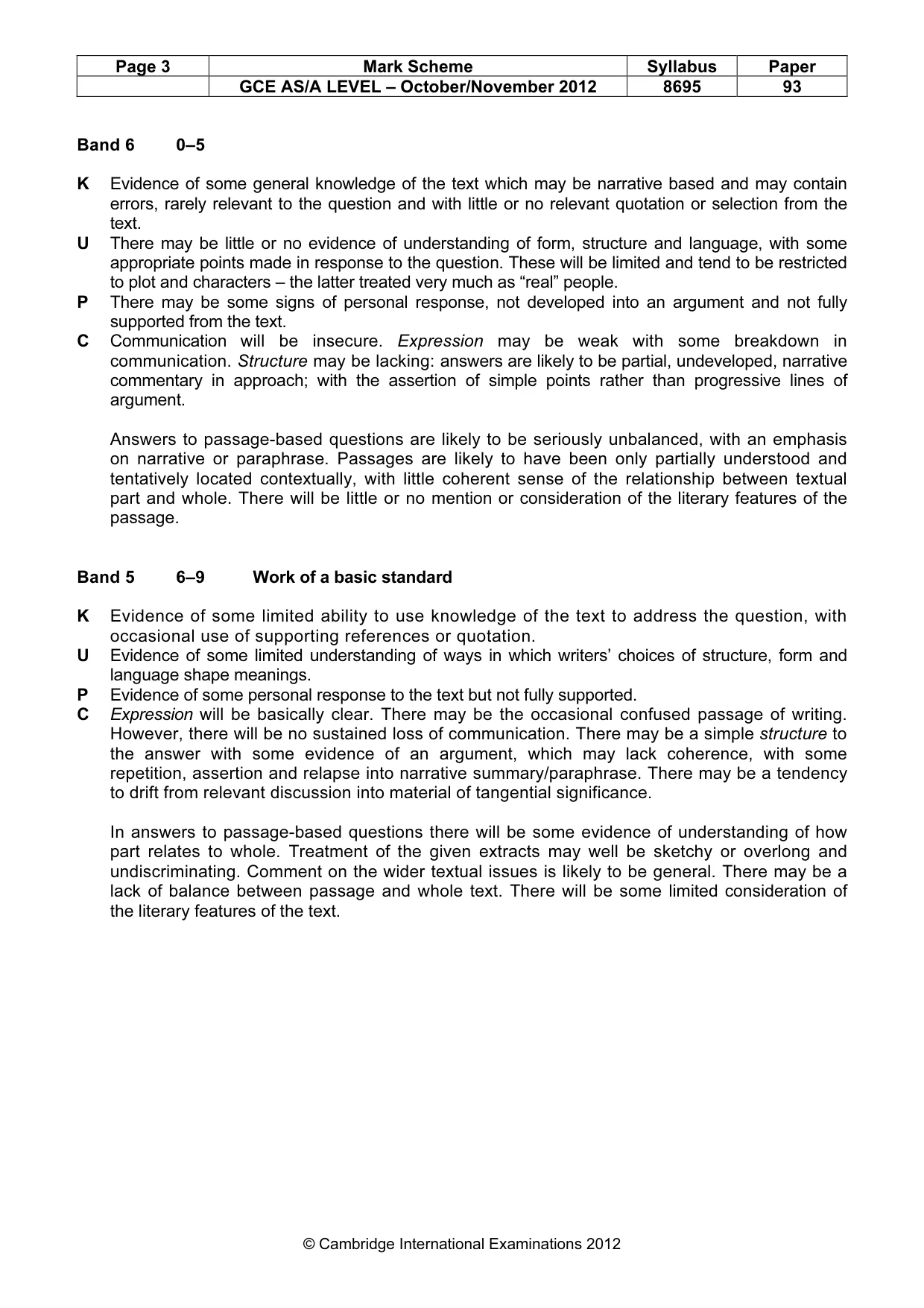
Page 3 Mark Scheme Syllabus Paper GCE AS/A LEVEL – October/November 2012 8695 93 © Cambridge International Examinations 2012 Band 6 0–5 K Evidence of some general knowledge of the text which may be narrative based and may contain errors, rarely relevant to the question and with little or no relevant quotation or selection from the text. U There may be little or no evidence of understanding of form, structure and language, with some appropriate points made in response to the question. These will be limited and tend to be restricted to plot and characters – the latter treated very much as “real” people. P There may be some signs of personal response, not developed into an argument and not fully supported from the text. C Communication will be insecure. Expression may be weak with some breakdown in communication. Structure may be lacking: answers are likely to be partial, undeveloped, narrative commentary in approach; with the assertion of simple points rather than progressive lines of argument. Answers to passage-based questions are likely to be seriously unbalanced, with an emphasis on narrative or paraphrase. Passages are likely to have been only partially understood and tentatively located contextually, with little coherent sense of the relationship between textual part and whole. There will be little or no mention or consideration of the literary features of the passage. Band 5 6–9 Work of a basic standard K Evidence of some limited ability to use knowledge of the text to address the question, with occasional use of supporting references or quotation. U Evidence of some limited understanding of ways in which writers’ choices of structure, form and language shape meanings. P Evidence of some personal response to the text but not fully supported. C Expression will be basically clear. There may be the occasional confused passage of writing. However, there will be no sustained loss of communication. There may be a simple structure to the answer with some evidence of an argument, which may lack coherence, with some repetition, assertion and relapse into narrative summary/paraphrase. There may be a tendency to drift from relevant discussion into material of tangential significance. In answers to passage-based questions there will be some evidence of understanding of how part relates to whole. Treatment of the given extracts may well be sketchy or overlong and undiscriminating. Comment on the wider textual issues is likely to be general. There may be a lack of balance between passage and whole text. There will be some limited consideration of the literary features of the text.
Mark scheme, page 4
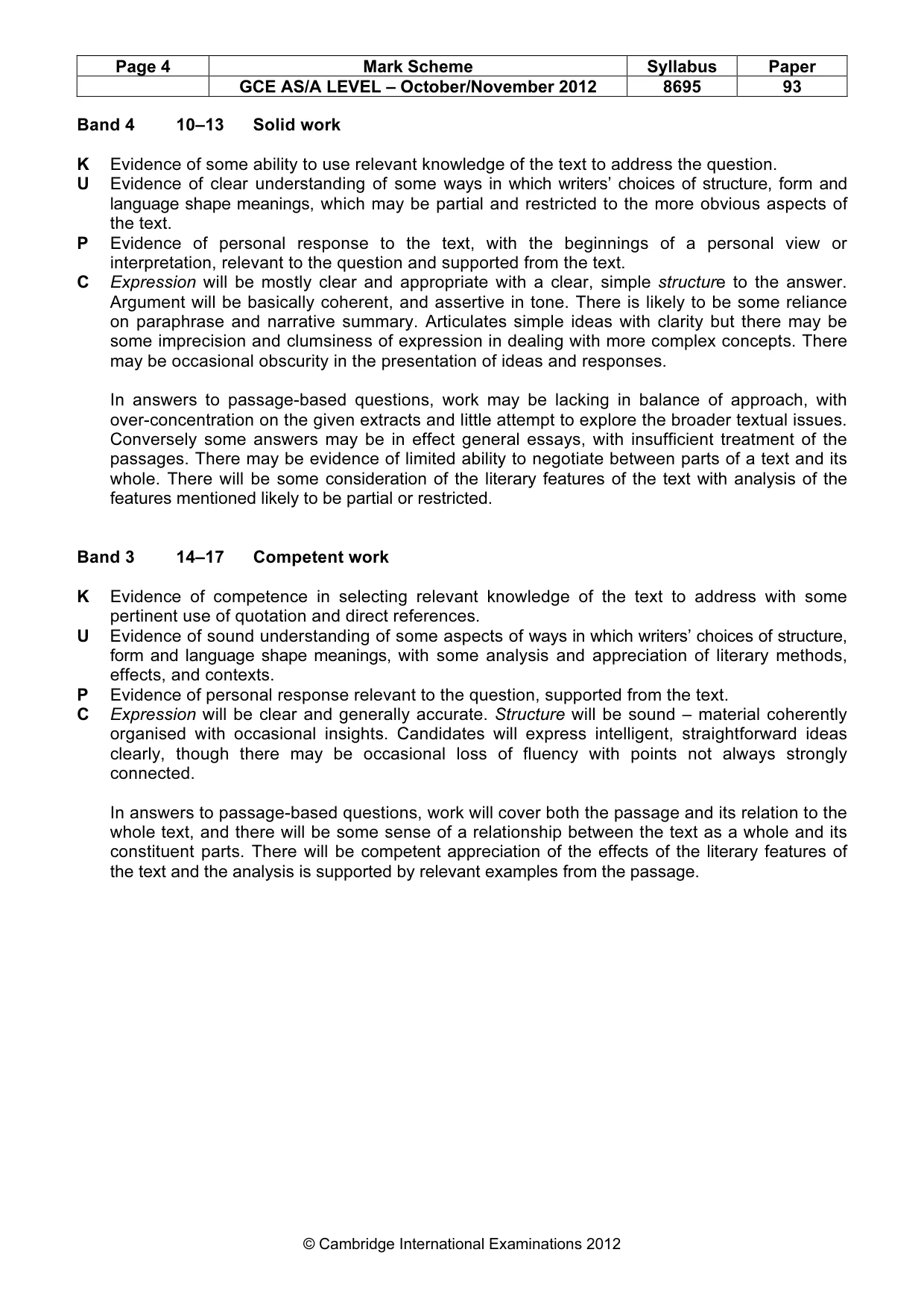
Page 4 Mark Scheme Syllabus Paper GCE AS/A LEVEL – October/November 2012 8695 93 © Cambridge International Examinations 2012 Band 4 10–13 Solid work K Evidence of some ability to use relevant knowledge of the text to address the question. U Evidence of clear understanding of some ways in which writers’ choices of structure, form and language shape meanings, which may be partial and restricted to the more obvious aspects of the text. P Evidence of personal response to the text, with the beginnings of a personal view or interpretation, relevant to the question and supported from the text. C Expression will be mostly clear and appropriate with a clear, simple structure to the answer. Argument will be basically coherent, and assertive in tone. There is likely to be some reliance on paraphrase and narrative summary. Articulates simple ideas with clarity but there may be some imprecision and clumsiness of expression in dealing with more complex concepts. There may be occasional obscurity in the presentation of ideas and responses. In answers to passage-based questions, work may be lacking in balance of approach, with over-concentration on the given extracts and little attempt to explore the broader textual issues. Conversely some answers may be in effect general essays, with insufficient treatment of the passages. There may be evidence of limited ability to negotiate between parts of a text and its whole. There will be some consideration of the literary features of the text with analysis of the features mentioned likely to be partial or restricted. Band 3 14–17 Competent work K Evidence of competence in selecting relevant knowledge of the text to address with some pertinent use of quotation and direct references. U Evidence of sound understanding of some aspects of ways in which writers’ choices of structure, form and language shape meanings, with some analysis and appreciation of literary methods, effects, and contexts. P Evidence of personal response relevant to the question, supported from the text. C Expression will be clear and generally accurate. Structure will be sound – material coherently organised with occasional insights. Candidates will express intelligent, straightforward ideas clearly, though there may be occasional loss of fluency with points not always strongly connected. In answers to passage-based questions, work will cover both the passage and its relation to the whole text, and there will be some sense of a relationship between the text as a whole and its constituent parts. There will be competent appreciation of the effects of the literary features of the text and the analysis is supported by relevant examples from the passage.
Mark scheme, page 5
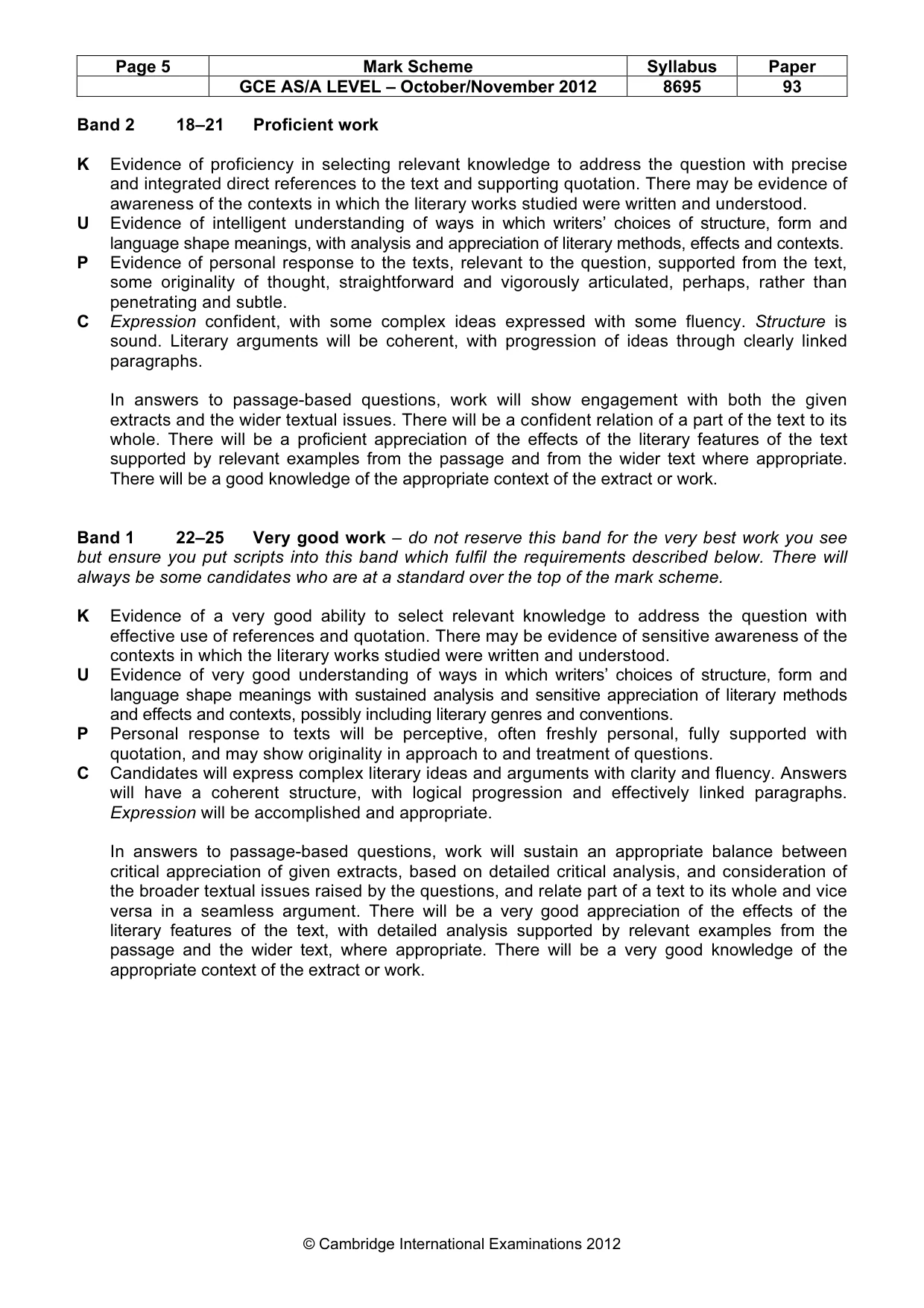
Page 5 Mark Scheme Syllabus Paper GCE AS/A LEVEL – October/November 2012 8695 93 © Cambridge International Examinations 2012 Band 2 18–21 Proficient work K Evidence of proficiency in selecting relevant knowledge to address the question with precise and integrated direct references to the text and supporting quotation. There may be evidence of awareness of the contexts in which the literary works studied were written and understood. U Evidence of intelligent understanding of ways in which writers’ choices of structure, form and language shape meanings, with analysis and appreciation of literary methods, effects and contexts. P Evidence of personal response to the texts, relevant to the question, supported from the text, some originality of thought, straightforward and vigorously articulated, perhaps, rather than penetrating and subtle. C Expression confident, with some complex ideas expressed with some fluency. Structure is sound. Literary arguments will be coherent, with progression of ideas through clearly linked paragraphs. In answers to passage-based questions, work will show engagement with both the given extracts and the wider textual issues. There will be a confident relation of a part of the text to its whole. There will be a proficient appreciation of the effects of the literary features of the text supported by relevant examples from the passage and from the wider text where appropriate. There will be a good knowledge of the appropriate context of the extract or work. Band 1 22–25 Very good work – do not reserve this band for the very best work you see but ensure you put scripts into this band which fulfil the requirements described below. There will always be some candidates who are at a standard over the top of the mark scheme. K Evidence of a very good ability to select relevant knowledge to address the question with effective use of references and quotation. There may be evidence of sensitive awareness of the contexts in which the literary works studied were written and understood. U Evidence of very good understanding of ways in which writers’ choices of structure, form and language shape meanings with sustained analysis and sensitive appreciation of literary methods and effects and contexts, possibly including literary genres and conventions. P Personal response to texts will be perceptive, often freshly personal, fully supported with quotation, and may show originality in approach to and treatment of questions. C Candidates will express complex literary ideas and arguments with clarity and fluency. Answers will have a coherent structure, with logical progression and effectively linked paragraphs. Expression will be accomplished and appropriate. In answers to passage-based questions, work will sustain an appropriate balance between critical appreciation of given extracts, based on detailed critical analysis, and consideration of the broader textual issues raised by the questions, and relate part of a text to its whole and vice versa in a seamless argument. There will be a very good appreciation of the effects of the literary features of the text, with detailed analysis supported by relevant examples from the passage and the wider text, where appropriate. There will be a very good knowledge of the appropriate context of the extract or work.
What you needed in this session
Cambridge’s own grade thresholds for 2012 Oct/Nov, Paper 9 · Variant 3. A higher threshold means an easier paper — the bar moves with how the cohort did.