Cambridge A Level English - Language and Literature (AS Level only, from 2016) 8695 — 2012 Oct/Nov Paper 9 · Variant 1
8695/91/O/N/12 · 50 marks · ≈56 min
The question paper and its mark scheme, free to read here and free to download. This is Cambridge’s own paper, exactly as it was sat.
Question paper14 pages

Mark scheme5 pages
Answers below. Sit the paper first if you are practising.
Paper as text
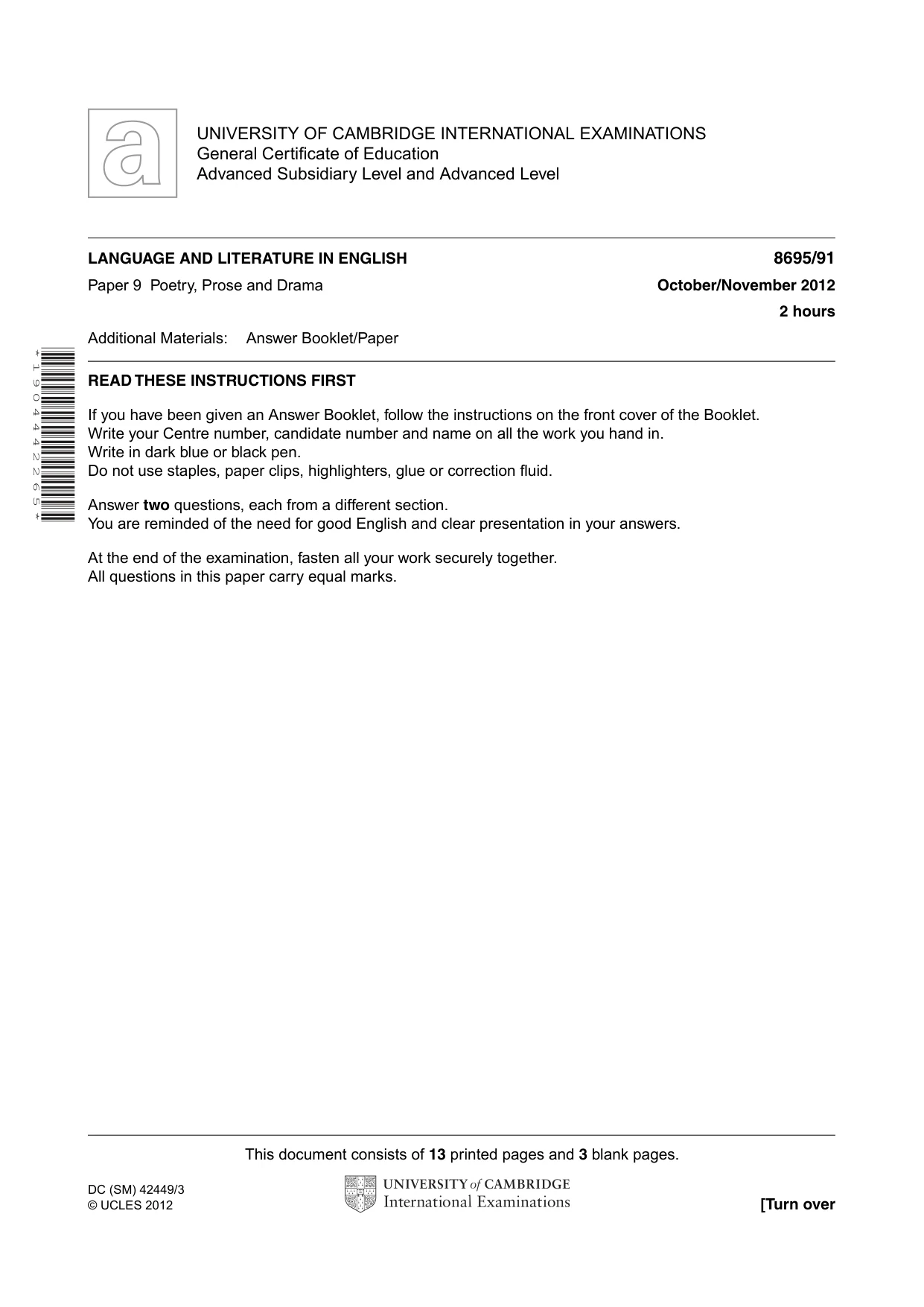
Question paper, page 1
This document consists of 13 printed pages and 3 blank pages. DC (SM) 42449/3 © UCLES 2012 [Turn over UNIVERSITY OF CAMBRIDGE INTERNATIONAL EXAMINATIONS General Certificate of Education Advanced Subsidiary Level and Advanced Level * 1 9 0 4 4 4 2 2 6 5 * LANGUAGE AND LITERATURE IN ENGLISH 8695/91 Paper 9 Poetry, Prose and Drama October/November 2012 2 hours Additional Materials: Answer Booklet/Paper READ THESE INSTRUCTIONS FIRST If you have been given an Answer Booklet, follow the instructions on the front cover of the Booklet. Write your Centre number, candidate number and name on all the work you hand in. Write in dark blue or black pen. Do not use staples, paper clips, highlighters, glue or correction fluid. Answer two questions, each from a different section. You are reminded of the need for good English and clear presentation in your answers. At the end of the examination, fasten all your work securely together. All questions in this paper carry equal marks.
Question paper, page 2
2 8695/91/O/N/12 © UCLES 2012 BLANK PAGE
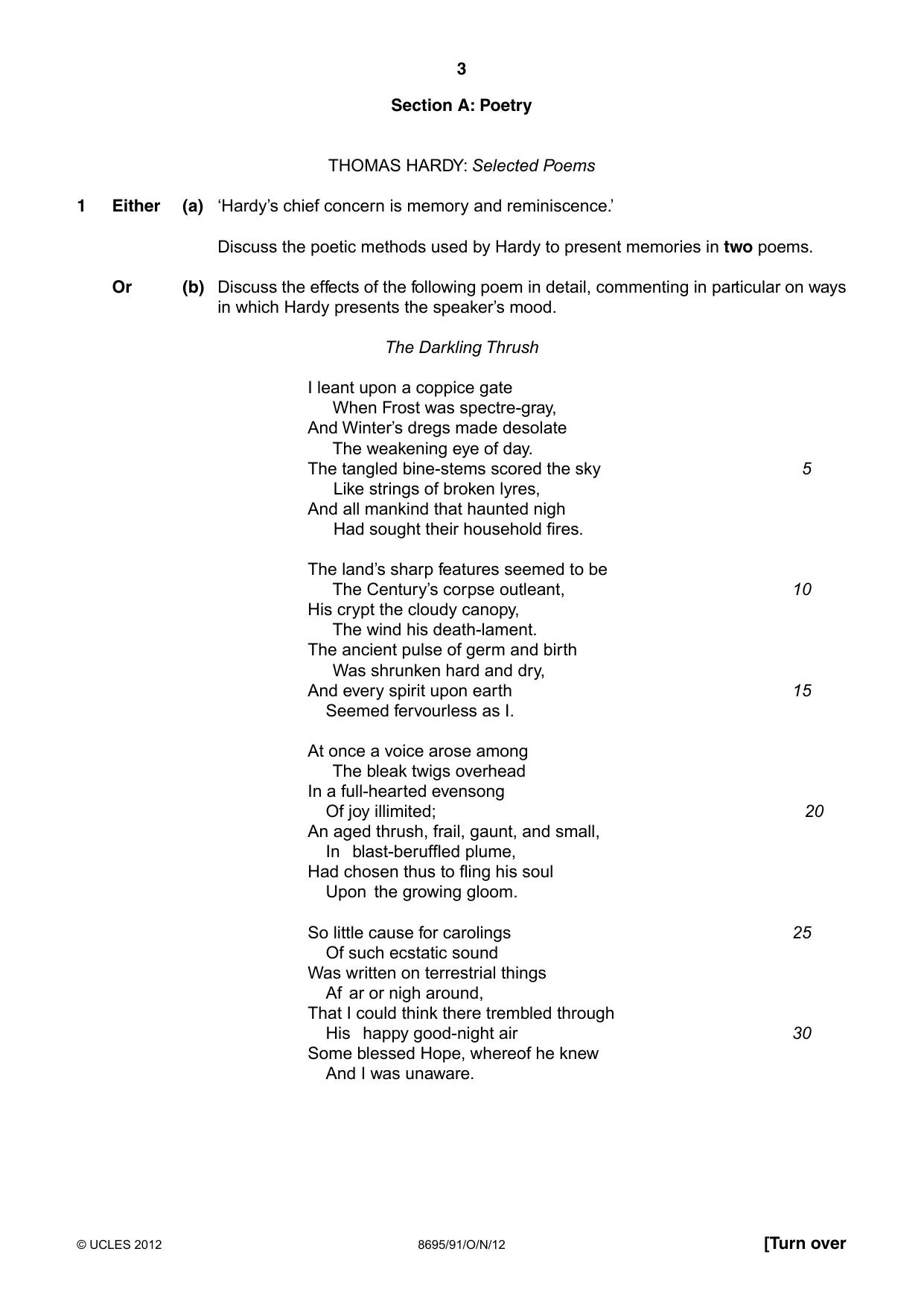
Question paper, page 3
3 8695/91/O/N/12 © UCLES 2012 [Turn over Section A: Poetry THOMAS HARDY: Selected Poems 1 Either (a) ‘Hardy’s chief concern is memory and reminiscence.’ Discuss the poetic methods used by Hardy to present memories in two poems. Or (b) Discuss the effects of the following poem in detail, commenting in particular on ways in which Hardy presents the speaker’s mood. The Darkling Thrush I leant upon a coppice gate When Frost was spectre-gray, And Winter’s dregs made desolate The weakening eye of day. The tangled bine-stems scored the sky 5 Like strings of broken lyres, And all mankind that haunted nigh Had sought their household fires. The land’s sharp features seemed to be The Century’s corpse outleant, 10 His crypt the cloudy canopy, The wind his death-lament. The ancient pulse of germ and birth Was shrunken hard and dry, And every spirit upon earth 15 Seemed fervourless as I. At once a voice arose among The bleak twigs overhead In a full-hearted evensong Of joy illimited; 20 An aged thrush, frail, gaunt, and small, In blast-beruffled plume, Had chosen thus to fling his soul Upon the growing gloom. So little cause for carolings 25 Of such ecstatic sound Was written on terrestrial things Af ar or nigh around, That I could think there trembled through His happy good-night air 30 Some blessed Hope, whereof he knew And I was unaware.
Question paper, page 4
4 8695/91/O/N/12 © UCLES 2012 SEAMUS HEANEY: District and Circle 2 Either (a) Discuss ways in which Heaney suggests the importance of physical work in his poetry. Refer to two poems in your answer. Or (b) Comment closely on how the language and tone of the following poem present the speaker’s experience. A Chow Content removed due to copyright restrictions.
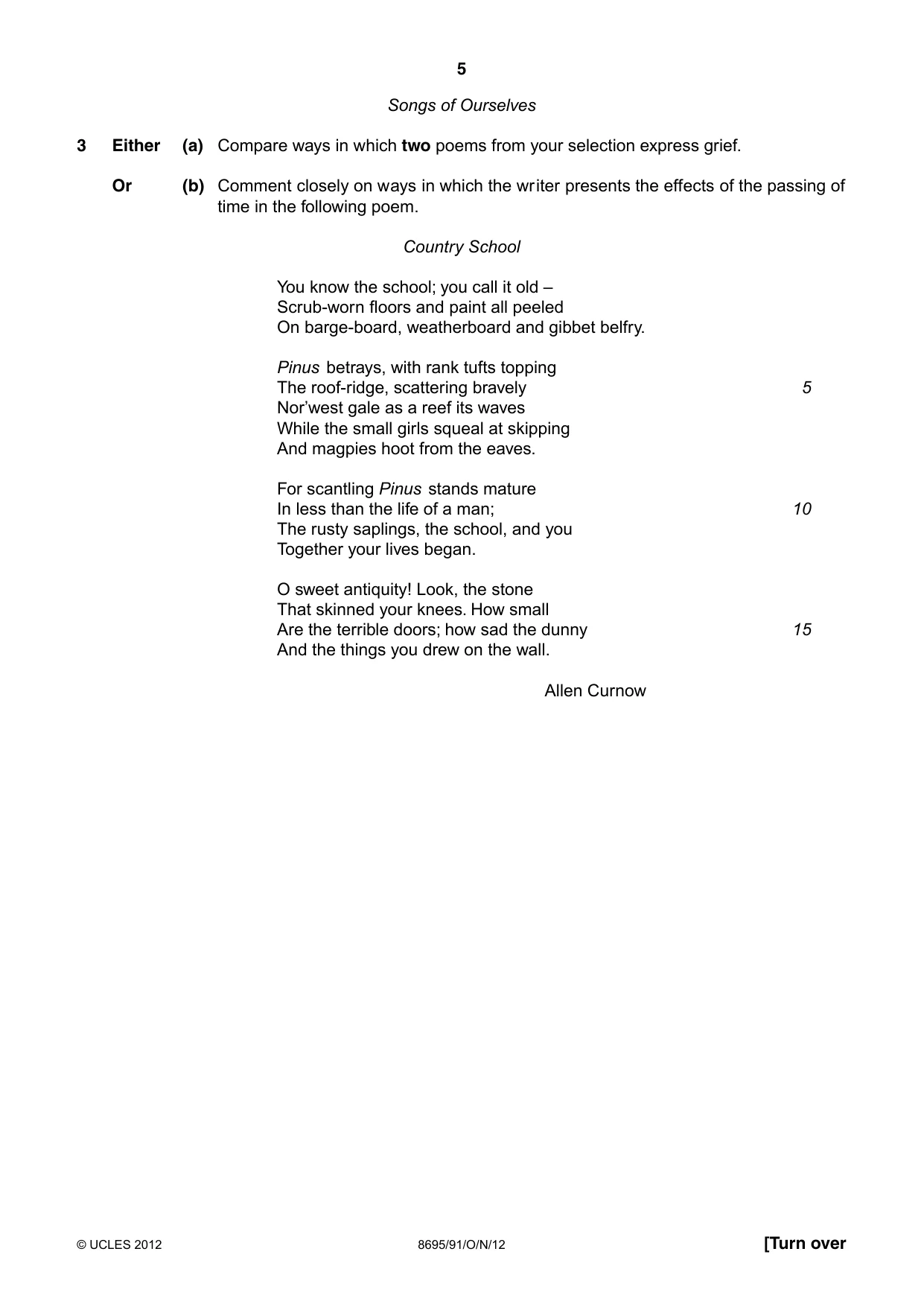
Question paper, page 5
5 8695/91/O/N/12 © UCLES 2012 [Turn over Songs of Ourselves 3 Either (a) Compare ways in which two poems from your selection express grief. Or (b) Comment closely on ways in which the writer presents the effects of the passing of time in the following poem. Country School You know the school; you call it old – Scrub-worn floors and paint all peeled On barge-board, weatherboard and gibbet belfry. Pinus betrays, with rank tufts topping The roof-ridge, scattering bravely 5 Nor’west gale as a reef its waves While the small girls squeal at skipping And magpies hoot from the eaves. For scantling Pinus stands mature In less than the life of a man; 10 The rusty saplings, the school, and you Together your lives began. O sweet antiquity! Look, the stone That skinned your knees. How small Are the terrible doors; how sad the dunny 15 And the things you drew on the wall. Allen Curnow
Question paper, page 6
6 8695/91/O/N/12 © UCLES 2012 Section B: Prose TSITSI DANGAREMBGA: Nervous Conditions 4 Either (a) Discuss the effects which Dangarembga creates with Tambu’s first person narration. Or (b) Comment closely on the following passage, paying particular attention to ways in which Dangarembga presents the relationship between Nhamo and Tambu. ‘Babamukuru says I am so bright I must be taken away to a good school and be given a good chance in life. So I shall go and live with Babamukuru at the mission. I shall no longer be Jeremiah’s son,’ he shouted, speaking my father’s name in such derogatory tones that for once I was up in arms on my father’s behalf. ‘I shall wear shoes and socks, and shorts with no holes in them, all brand new, bought for me by Babamukuru. He has the money. I will even have underwear – a vest and pants. I shall have a jersey in winter, and probably a blazer too. I shall stop using my hands to eat. I will use a knife and fork.’ I think a little jealousy was permissible, even healthy under the circumstances. Unfortunately, since I had stopped reacting to Nhamo a long time ago, so that all the annoying things he did had been building up for a long time, and since this time the irritation was too persistent to ignore, I was more than a little, less than healthily jealous. This was untactical of me because Nhamo carried on in the way that he did, describing himself in unqualified superlatives and suggesting that his good fortune was unquestionably deserved, a natural consequence of the fact that he was Nhamo, only in order to bait me . And eventually, my composure of the past few years, dating from the time we had fought on the football pitch at Sunday School, disintegrated into so many fine particles. I rose magnificently to the bait. ‘Ha! You are so stupid,’ I jeered. ‘If you are going to the mission to use a knife and fork, you will be disappointed. Didn’t you see Babamukuru eat with his hands? All of them – Maiguru and those proud children. They all ate with their hands.’ ‘Did you want them to embarrass us?’ he retorted. ‘If they had wanted knives and forks, where would we have taken them from? But in their own home they use them. Each one has his own plate with his own portion of food and his knife and fork. I saw it. That’s what happened when we went to eat in Salisbury at Maiguru’s brother’s house, the one who is a medical doctor . I asked Chido if they eat like that at home and he said yes.’ I could not argue with such concrete evidence so I attacked from another position. ‘You will still be our father’s son. You will still be my brother. And Netsai’s. Even if you don’t like it. So you had better stop being proud for nothing and be grateful to Babamukuru for helping you.’ ‘And you had better stop being jealous. Why are you jealous anyway?’ he retaliated, free to use all his ammunition now because I had begun the engagement. ‘Did you ever hear of a girl being taken away to school? You are lucky you even managed to go back to Rutivi. With me it’s different. I was meant to be educated.’ ‘I’m glad you are going,’ I said. ‘Your voice makes noise. It hurts my ears.’ ‘And you have eyes like a chameleon! I can see you are getting angry. You are going dark like one. Be careful, otherwise you will stay that way and people will run away from you in case you bite them. Be careful, be careful! In case you bite!’ I picked up a rock and flung it at him. Nhamo sat unper turbed, following the missile’s trajectory with exaggerated movements of his head. It landed harmlessly in the grass. He laughed. I dived for him, but he was up and running lightly towards the cattle kraal, laughing and chanting ‘Du-du-muduri, kache! Rwavi muduri kache! Tambu muduri, kache! Pound well while I am eating potatoes at the mission!’ I considered r unning after him to give him the thrashing he deserved, but judging his head-start, saw that I would not catch him. Besides, we were so evenly matched these days that he might have won a fight or I might have, but I had not fought for a long time and I was out of practice. Today it was better not to fight than not to win. I let him go, still very cross with him for saying such silly things. Chapter 3 5 10 15 20 25 30 35 40 45
Question paper, page 7
7 8695/91/O/N/12 © UCLES 2012 [Turn over E. M. FORSTER: A Passage to India 5 Either (a) Discuss Forster’s presentation of Professor Godbole and consider his significance to the novel. Or (b) Comment closely on ways Forster presents Ronny’s thoughts in the following passage. The death took subtler and more lasting shapes in Chandrapore. A legend sprang up that an Englishman had killed his mother for trying to save an Indian’s life – and there was just enough truth in this to cause annoyance to the authorities. Sometimes it was a cow that had been killed – or a crocodile with the tusks of a boar had crawled out of the Ganges. Nonsense of this type is more difficult to combat than a solid lie. It hides in rubbish-heaps and moves when no one is looking. At one period two distinct tombs containing Esmiss Esmoor’ s remains were reported: one by the tannery, the other up near the goods station. Mr McBryde visited them both and saw signs of the beginning of a cult – earthenware saucers and so on. Being an experienced official, he did nothing to irritate it, and after a week or so the rash died down. ‘There’s propaganda behind all this,’ he said, forgetting that a hundred years ago, when Europeans still made their home in the countryside and appealed to its imagination, they occasionally became local demons after death – not a whole god perhaps, but part of one, adding an epithet or gesture to what already existed, just as the gods contribute to the great gods, and they to the philosophic Brahm. Ronny reminded himself that his mother had left India at her own wish, but his conscience was not clear. He had behaved badly to her, and he had either to repent (which involved a mental overturn), or to persist in unkindness towards her. He chose the latter course. How tiresome she had been with her patronage of Aziz! What a bad influence upon Adela! And now she still gave trouble with r idiculous ‘tombs’, mixing herself up with natives. She could not help it, of course, but she had attempted similar exasperating expeditions in her lifetime, and he reckoned it against her. The young man had much to worry him – the heat, the local tension, the approaching visit of the Lieutenant-Governor, the problems of Adela – and threading them all together into a grotesque garland were these Indianizations of Mrs Moore. What does happen to one’s mother when she dies? Presumably she goes to heaven, anyhow she clears out. Ronny’s religion was of the sterilized public-school brand, which never goes bad, even in the tropics . Wherever he entered, mosque, cave or temple, he retained the spiritual outlook of the Fifth Form, and condemned as ‘weakening’ any attempt to understand them. Pulling himself together, he dismissed the matter from his mind. In due time he and his half-brother and -sister would put up a tablet to her in the Northamptonshire church where she had worshipped, recording the dates of her birth and death and the fact that she had been buried at sea. This would be sufficient. And Adela – she would have to depart too; he hoped she would have made the suggestion herself ere now. He really could not marry her – it would mean the end of his career. Poor lamentable Adela … She remained at Government College, by Fielding’s courtesy – unsuitable and humiliating, but no one would receive her at the Civil Station. He postponed all private talk until the award against her was decided. Aziz was suing her for damages in the sub-judge’ s court. Then he would ask her to release him. She had killed his love, and it had never been very robust; they would never have achieved betrothal but for the accident to the Nawab Bahadur’s car. She belonged to the callow academic period of his life which he had outgrown – Grasmere, serious talks and walks, that sort of thing. Chapter 28 5 10 15 20 25 30 35 40
Question paper, page 8
8 8695/91/O/N/12 © UCLES 2012 Stories of Ourselves 6 Either (a) Referring to two stories, discuss ways in which writers present characters’ relationships with different places. Or (b) Comment closely on ways the writing of the following passage presents the narrator’s experience. Mamaiji came out and settled in her chair on the veranda. Content removed due to copyright restrictions. Then briskly: ‘Don’t stop now, this week is very important.’He continued, slapping the table merrily at each word: ‘Every-single-white-hair-out.’ Of White Hairs and Cricket
Question paper, page 9
10 8695/91/O/N/12 © UCLES 2012 Section C: Drama PETER SHAFFER: Equus 7 Either (a) ‘He’s my son. I lie awake every night thinking about it.’ Discuss Shaffer’s presentation of Dora and her role in the play. Or (b) Comment closely on the ways the following passage presents Dysart and his methods. Alan rises and enters the square. He is subdued. Dysart: Good afternoon. Alan: Afternoon. Dysart: I’m sorry about our row yesterday. Alan: It was stupid. Dysart: It was. Alan: What I said, I mean. Dysart: How are you sleeping? Alan shrugs. You’re not feeling well, are you? Alan: All right. Dysart: Would you like to play a game? It could make you feel better. Alan: What kind? Dysart: It’s called Blink. You have to fix your eyes on something: say, that little stain over there on the wall – and I tap this pen on the desk. The first time I tap it, you close your eyes. The next time you open them. And so on. Close, open, close, open, till I say Stop. Alan: How can that make you feel better? Dysart: It relaxes you. You’ll feel as though you’re talking to me in your sleep. Alan: It’s stupid. Dysart: You don’t have to do it, if you don’t want to. Alan: I didn’t say I didn’t want to. Dysart: Well? Alan: I don’t mind. Dysart: Good. Sit down and start watching that stain. Put your hands by your sides, and open the fingers wide. He opens the left bench and Alan sits on the end of it. The thing is to feel comfortable, and relax absolutely … Are you looking at the stain? Alan: Yes. Dysart: Right. Now try and keep your mind as blank as possible. Alan: That’s not difficult. 5 10 15 20 25 30 35
Question paper, page 10
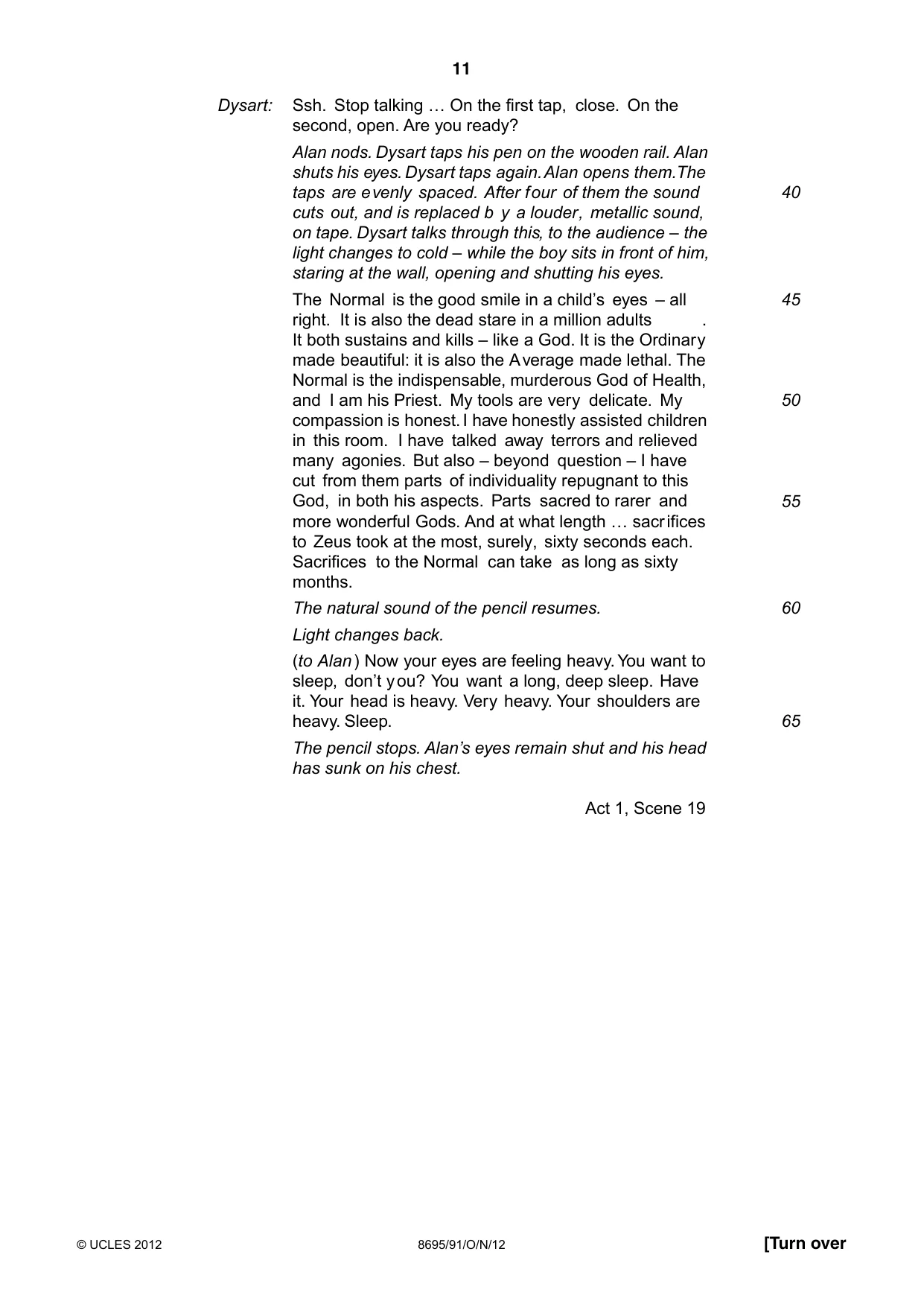
11 8695/91/O/N/12 © UCLES 2012 [Turn over Dysart: Ssh. Stop talking … On the first tap, close. On the second, open. Are you ready? Alan nods. Dysart taps his pen on the wooden rail. Alan shuts his eyes. Dysart taps again. Alan opens them. The taps are evenly spaced. After four of them the sound cuts out, and is replaced b y a louder, metallic sound, on tape. Dysart talks through this, to the audience – the light changes to cold – while the boy sits in front of him, staring at the wall, opening and shutting his eyes. The Normal is the good smile in a child’s eyes – all right. It is also the dead stare in a million adults . It both sustains and kills – like a God. It is the Ordinary made beautiful: it is also the Average made lethal. The Normal is the indispensable, murderous God of Health, and I am his Priest. My tools are very delicate. My compassion is honest. I have honestly assisted children in this room. I have talked away terrors and relieved many agonies. But also – beyond question – I have cut from them parts of individuality repugnant to this God, in both his aspects. Parts sacred to rarer and more wonderful Gods. And at what length … sacrifices to Zeus took at the most, surely, sixty seconds each. Sacrifices to the Normal can take as long as sixty months. The natural sound of the pencil resumes. Light changes back. (to Alan ) Now your eyes are feeling heavy. You want to sleep, don’t you? You want a long, deep sleep. Have it. Your head is heavy. Very heavy. Your shoulders are heavy. Sleep. The pencil stops. Alan’s eyes remain shut and his head has sunk on his chest. Act 1, Scene 19 40 45 50 55 60 65
Question paper, page 11
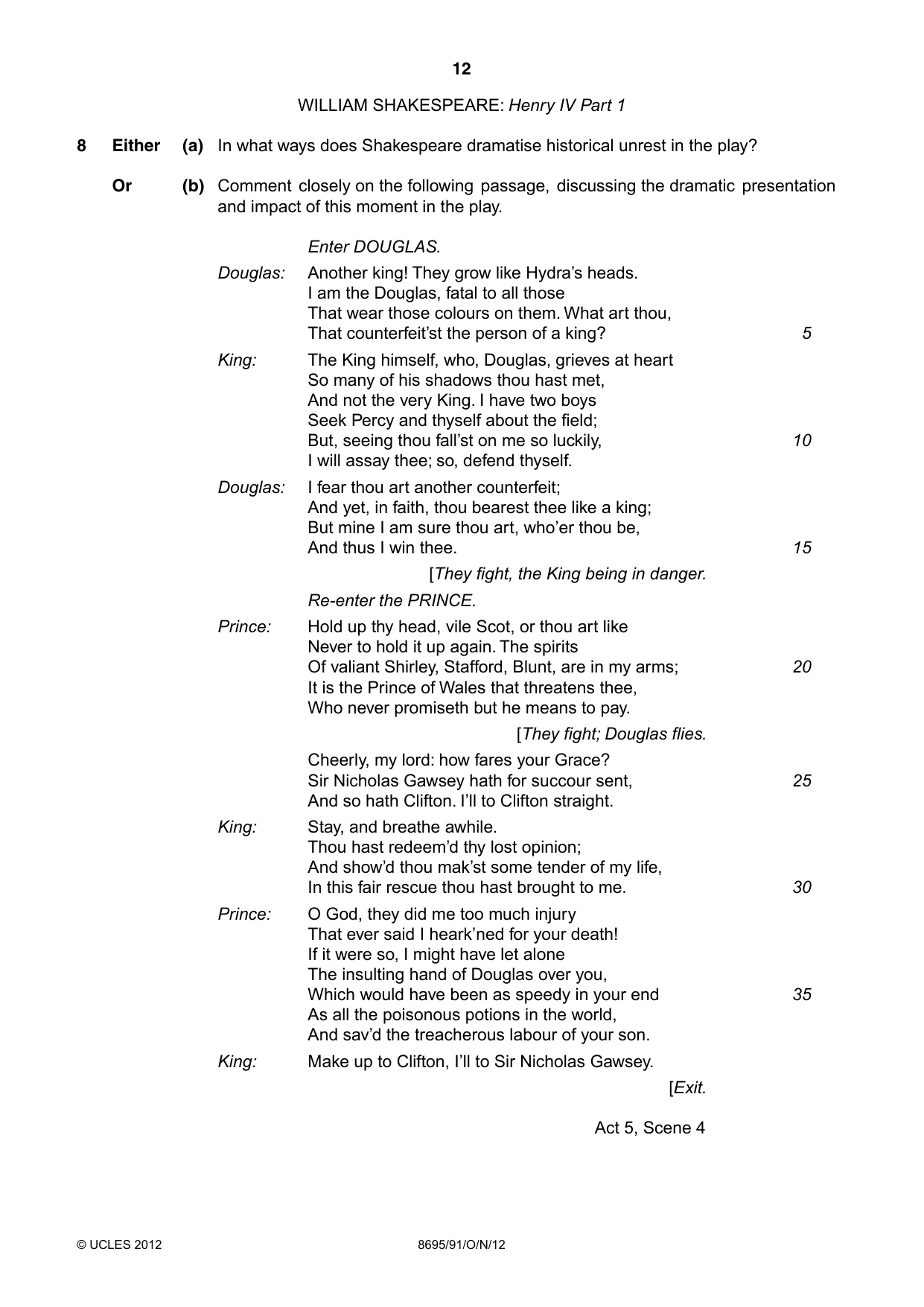
12 8695/91/O/N/12 © UCLES 2012 WILLIAM SHAKESPEARE: Henry IV Part 1 8 Either (a) In what ways does Shakespeare dramatise historical unrest in the play? Or (b) Comment closely on the following passage, discussing the dramatic presentation and impact of this moment in the play. Enter DOUGLAS. Douglas: Another king! They grow like Hydra’s heads. I am the Douglas, fatal to all those That wear those colours on them. What art thou, That counterfeit’st the person of a king? 5 King: The King himself, who, Douglas, grieves at heart So many of his shadows thou hast met, And not the very King. I have two boys Seek Percy and thyself about the field; But, seeing thou fall’st on me so luckily, 10 I will assay thee; so, defend thyself. Douglas: I fear thou art another counterfeit; And yet, in faith, thou bearest thee like a king; But mine I am sure thou art, who’er thou be, And thus I win thee. 15 [They fight, the King being in danger. Re-enter the PRINCE. Prince: Hold up thy head, vile Scot, or thou art like Never to hold it up again. The spirits Of valiant Shirley, Stafford, Blunt, are in my arms; 20 It is the Prince of Wales that threatens thee, Who never promiseth but he means to pay. [They fight; Douglas flies. Cheerly, my lord: how fares your Grace? Sir Nicholas Gawsey hath for succour sent, 25 And so hath Clifton. I’ll to Clifton straight. King: Stay, and breathe awhile. Thou hast redeem’d thy lost opinion; And show’d thou mak’st some tender of my life, In this fair rescue thou hast brought to me. 30 Prince: O God, they did me too much injury That ever said I heark’ned for your death! If it were so, I might have let alone The insulting hand of Douglas over you, Which would have been as speedy in your end 35 As all the poisonous potions in the world, And sav’d the treacherous labour of your son. King: Make up to Clifton, I’ll to Sir Nicholas Gawsey. [Exit. Act 5, Scene 4
Question paper, page 12
13 8695/91/O/N/12 © UCLES 2012 [Turn over BLANK PAGE Turn to Page 14 for Question 9
Question paper, page 13
14 8695/91/O/N/12 © UCLES 2012 TENNESSEE WILLIAMS: A Streetcar Named Desire 9 Either (a) ‘All the characters are guilty.’ Discuss the ways in which Williams presents the characters of the play in the light of this comment. Or (b) Comment closely on the following passage, considering ways in which Williams develops tension between Blanche and Stanley. Blanche: How do I look? Content removed due to copyright restrictions. Stanley: Your sister and I are having a little talk. Scene 2
Question paper, page 14
16 8695/91/O/N/12 © UCLES 2012 BLANK PAGE Copyright Acknowledgements: Question 2b © Seamus Heaney; A Chow from District and Circle ; Faber & Faber; 2006. Question 3b © Allen Curnow; Country School from Songs of Ourselves ; Foundation Books; 2005. Question 4b © Tsitsi Dangarembga; Nervous Conditions ; Ayebia Publishing; 1988. Question 5b © E M Forster; A Passage to India ; Penguin Books Ltd; 1979. Question 6b © Rohinton Mistry; Of White Hairs and Cricket from Stories of Ourselves ; Cambridge University Press; 2008. Question 7b © Peter Shaffer; Equus ; Longman; 1993. Question 9b © A Streetcar Named Desire by Tennessee Williams. Copyright © 1947 by The University of The South. Reprinted by permission of New Directions Publishing Corp. and Georges Borchardt, Inc. for the Estate of Tennessee Williams. Permission to reproduce items where third-party owned material protected by copyright is included has been sought and cleared where possible. Every reasonable effort has been made by the publisher (UCLES) to trace copyright holders, but if any items requiring clearance have unwittingly been included, the publisher will be pleased to make amends at the earliest possible opportunity. University of Cambridge International Examinations is part of the Cambridge Assessment Group. Cambridge Local Examinations Syndicate (UCLES), which is itself a department of the University of Cambridge.
Mark scheme, page 1
CAMBRIDGE INTERNATIONAL EXAMINATIONS GCE Advanced Subsidiary Level and GCE Advanced Level MARK SCHEME for the October/November 2012 series 8695 LANGUAGE AND LITERATURE IN ENGLISH 8695/91 Paper 9 (Poetry, Prose, Drama), maximum raw mark 50 This mark scheme is published as an aid to teachers and candidates, to indicate the requirements of the examination. It shows the basis on which Examiners were instructed to award marks. It does not indicate the details of the discussions that took place at an Examiners’ meeting before marking began, which would have considered the acceptability of alternative answers. Mark schemes should be read in conjunction with the question paper and the Principal Examiner Report for Teachers. Cambridge will not enter into discussions about these mark schemes. Cambridge is publishing the mark schemes for the October/November 2012 series for most IGCSE, GCE Advanced Level and Advanced Subsidiary Level components and some Ordinary Level components.
Mark scheme, page 2
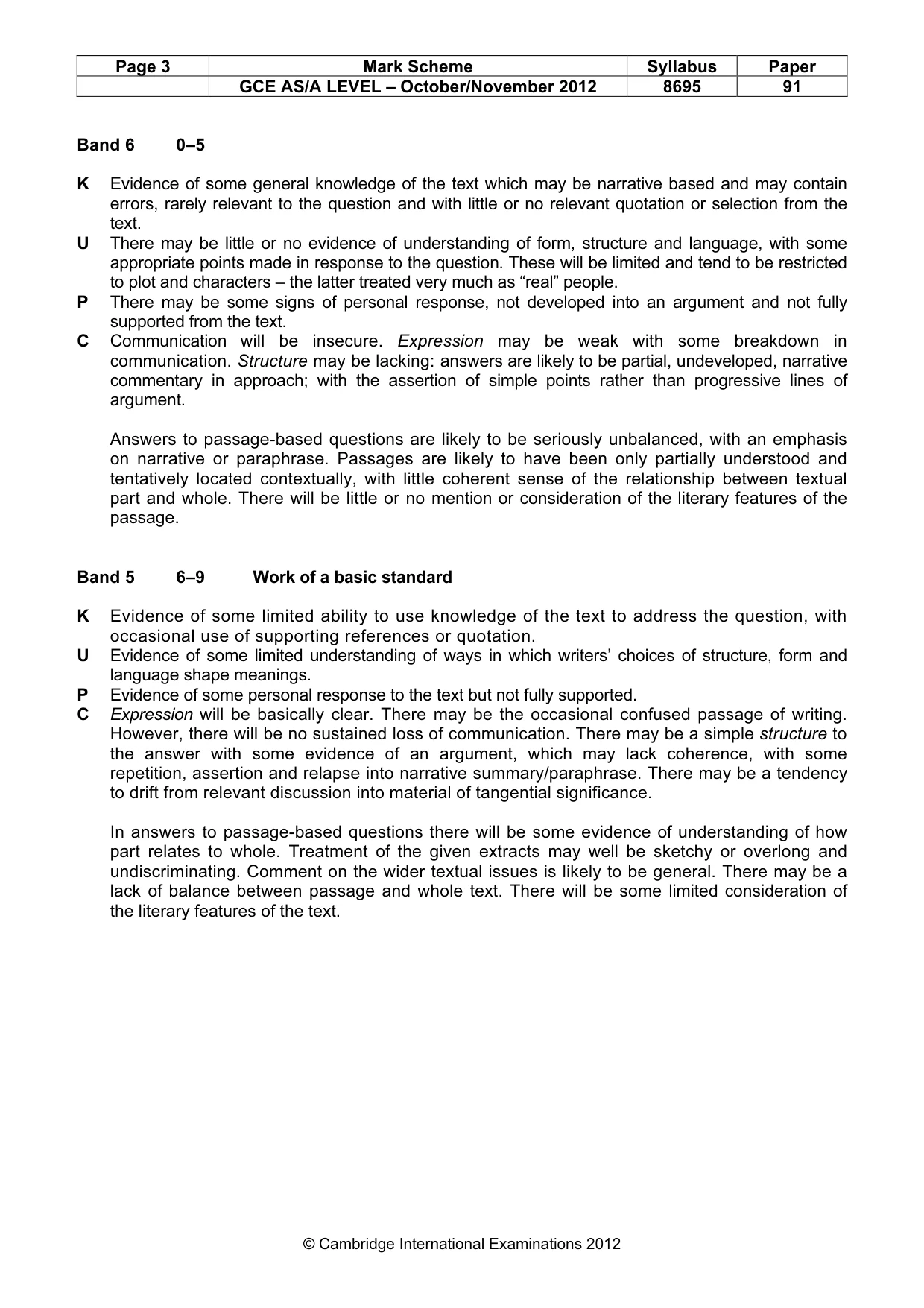
Page 2 Mark Scheme Syllabus Paper GCE AS/A LEVEL – October/November 2012 8695 91 © Cambridge International Examinations 2012 Using the mark bands Place the answer in a band first. Look for the “best fit” of the answer into a band. An answer needs to show evidence of most but not necessarily ALL of the qualities described in a band, in order to be placed in that band. Then award a mark for the relative position of the answer within the band. Candidates may address the question in many different ways. Do not expect any particular focus or approach and do not penalise answers for leaving out a particular focus. Reward what is there, showing what you are rewarding, in your comments. Consider all strands and weigh up the performance as a whole in placing the answer in a band, then show that you have done so in the summative comment, e.g. Sound K of texts, some evidence of U but mostly narrative, occasional evidence of P, mainly clear C. Assessment Objectives: • Ability to respond to texts in the three main forms (Prose, Poetry and Drama) of different types and from different cultures; • Understanding of the ways in which writers’ choices of form, structure and language shape meanings; • Ability to produce informed independent opinions and judgements on literary texts; • Ability to communicate clearly the knowledge, understanding and insight appropriate to literary study. Each answer is marked out of 25, in accordance with the General Marking Criteria below. Each band is divided into strands corresponding to the Assessment Objectives –Knowledge, Understanding, Personal Response, Communication.
Mark scheme, page 3
Page 3 Mark Scheme Syllabus Paper GCE AS/A LEVEL – October/November 2012 8695 91 © Cambridge International Examinations 2012 Band 6 0–5 K Evidence of some general knowledge of the text which may be narrative based and may contain errors, rarely relevant to the question and with little or no relevant quotation or selection from the text. U There may be little or no evidence of understanding of form, structure and language, with some appropriate points made in response to the question. These will be limited and tend to be restricted to plot and characters – the latter treated very much as “real” people. P There may be some signs of personal response, not developed into an argument and not fully supported from the text. C Communication will be insecure. Expression may be weak with some breakdown in communication. Structure may be lacking: answers are likely to be partial, undeveloped, narrative commentary in approach; with the assertion of simple points rather than progressive lines of argument. Answers to passage-based questions are likely to be seriously unbalanced, with an emphasis on narrative or paraphrase. Passages are likely to have been only partially understood and tentatively located contextually, with little coherent sense of the relationship between textual part and whole. There will be little or no mention or consideration of the literary features of the passage. Band 5 6–9 Work of a basic standard K Evidence of some limited ability to use knowledge of the text to address the question, with occasional use of supporting references or quotation. U Evidence of some limited understanding of ways in which writers’ choices of structure, form and language shape meanings. P Evidence of some personal response to the text but not fully supported. C Expression will be basically clear. There may be the occasional confused passage of writing. However, there will be no sustained loss of communication. There may be a simple structure to the answer with some evidence of an argument, which may lack coherence, with some repetition, assertion and relapse into narrative summary/paraphrase. There may be a tendency to drift from relevant discussion into material of tangential significance. In answers to passage-based questions there will be some evidence of understanding of how part relates to whole. Treatment of the given extracts may well be sketchy or overlong and undiscriminating. Comment on the wider textual issues is likely to be general. There may be a lack of balance between passage and whole text. There will be some limited consideration of the literary features of the text.
Mark scheme, page 4
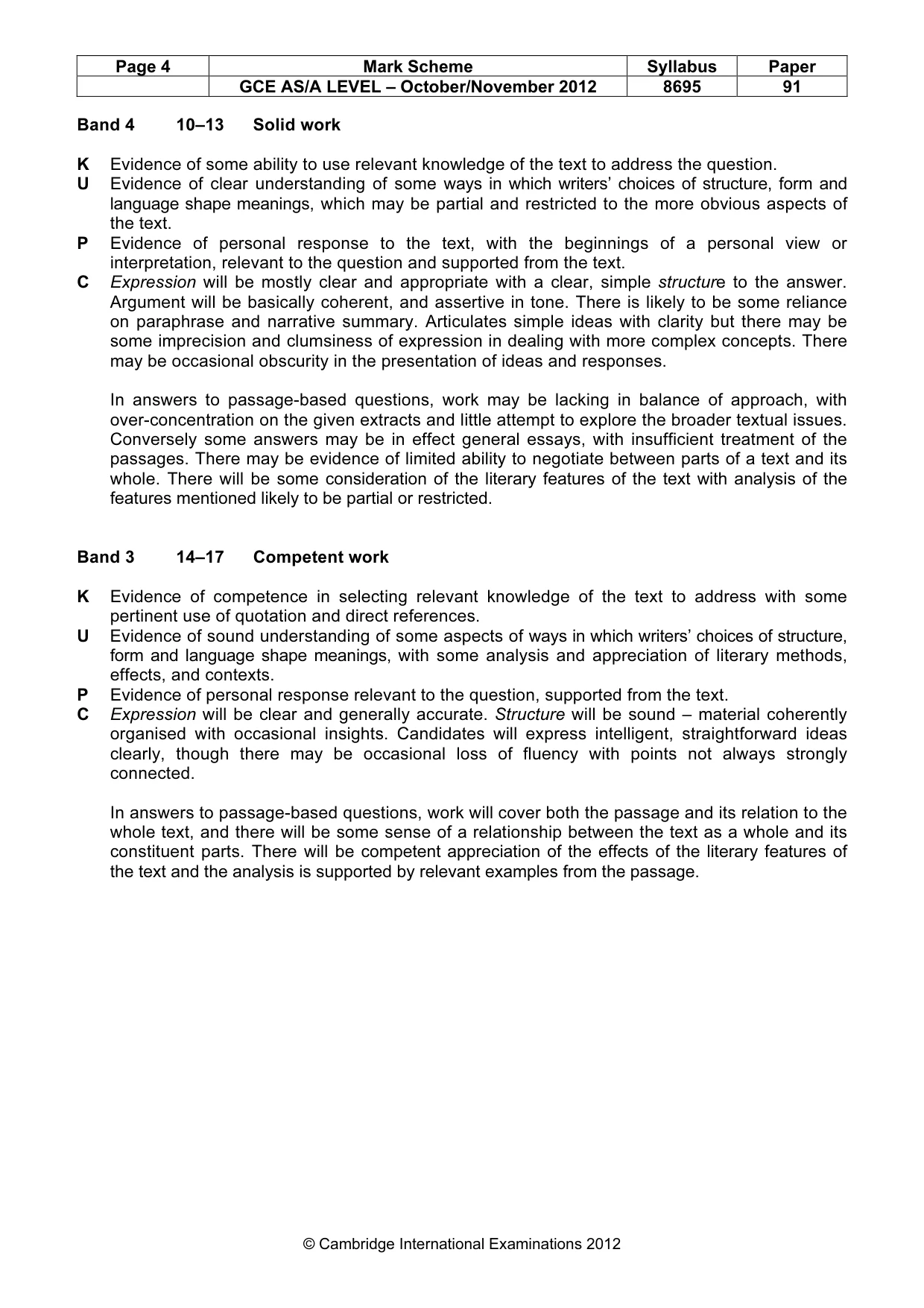
Page 4 Mark Scheme Syllabus Paper GCE AS/A LEVEL – October/November 2012 8695 91 © Cambridge International Examinations 2012 Band 4 10–13 Solid work K Evidence of some ability to use relevant knowledge of the text to address the question. U Evidence of clear understanding of some ways in which writers’ choices of structure, form and language shape meanings, which may be partial and restricted to the more obvious aspects of the text. P Evidence of personal response to the text, with the beginnings of a personal view or interpretation, relevant to the question and supported from the text. C Expression will be mostly clear and appropriate with a clear, simple structure to the answer. Argument will be basically coherent, and assertive in tone. There is likely to be some reliance on paraphrase and narrative summary. Articulates simple ideas with clarity but there may be some imprecision and clumsiness of expression in dealing with more complex concepts. There may be occasional obscurity in the presentation of ideas and responses. In answers to passage-based questions, work may be lacking in balance of approach, with over-concentration on the given extracts and little attempt to explore the broader textual issues. Conversely some answers may be in effect general essays, with insufficient treatment of the passages. There may be evidence of limited ability to negotiate between parts of a text and its whole. There will be some consideration of the literary features of the text with analysis of the features mentioned likely to be partial or restricted. Band 3 14–17 Competent work K Evidence of competence in selecting relevant knowledge of the text to address with some pertinent use of quotation and direct references. U Evidence of sound understanding of some aspects of ways in which writers’ choices of structure, form and language shape meanings, with some analysis and appreciation of literary methods, effects, and contexts. P Evidence of personal response relevant to the question, supported from the text. C Expression will be clear and generally accurate. Structure will be sound – material coherently organised with occasional insights. Candidates will express intelligent, straightforward ideas clearly, though there may be occasional loss of fluency with points not always strongly connected. In answers to passage-based questions, work will cover both the passage and its relation to the whole text, and there will be some sense of a relationship between the text as a whole and its constituent parts. There will be competent appreciation of the effects of the literary features of the text and the analysis is supported by relevant examples from the passage.
Mark scheme, page 5
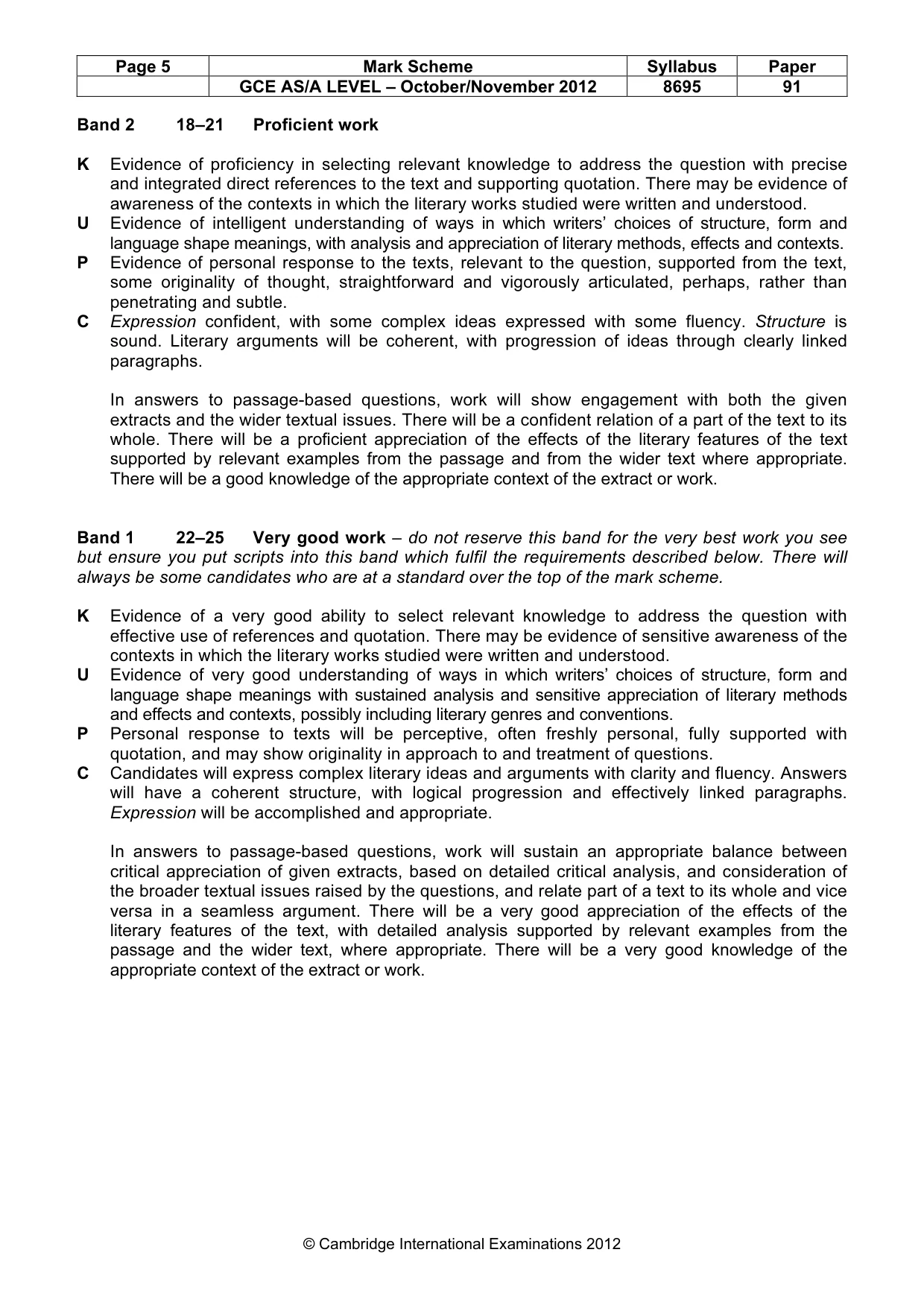
Page 5 Mark Scheme Syllabus Paper GCE AS/A LEVEL – October/November 2012 8695 91 © Cambridge International Examinations 2012 Band 2 18–21 Proficient work K Evidence of proficiency in selecting relevant knowledge to address the question with precise and integrated direct references to the text and supporting quotation. There may be evidence of awareness of the contexts in which the literary works studied were written and understood. U Evidence of intelligent understanding of ways in which writers’ choices of structure, form and language shape meanings, with analysis and appreciation of literary methods, effects and contexts. P Evidence of personal response to the texts, relevant to the question, supported from the text, some originality of thought, straightforward and vigorously articulated, perhaps, rather than penetrating and subtle. C Expression confident, with some complex ideas expressed with some fluency. Structure is sound. Literary arguments will be coherent, with progression of ideas through clearly linked paragraphs. In answers to passage-based questions, work will show engagement with both the given extracts and the wider textual issues. There will be a confident relation of a part of the text to its whole. There will be a proficient appreciation of the effects of the literary features of the text supported by relevant examples from the passage and from the wider text where appropriate. There will be a good knowledge of the appropriate context of the extract or work. Band 1 22–25 Very good work – do not reserve this band for the very best work you see but ensure you put scripts into this band which fulfil the requirements described below. There will always be some candidates who are at a standard over the top of the mark scheme. K Evidence of a very good ability to select relevant knowledge to address the question with effective use of references and quotation. There may be evidence of sensitive awareness of the contexts in which the literary works studied were written and understood. U Evidence of very good understanding of ways in which writers’ choices of structure, form and language shape meanings with sustained analysis and sensitive appreciation of literary methods and effects and contexts, possibly including literary genres and conventions. P Personal response to texts will be perceptive, often freshly personal, fully supported with quotation, and may show originality in approach to and treatment of questions. C Candidates will express complex literary ideas and arguments with clarity and fluency. Answers will have a coherent structure, with logical progression and effectively linked paragraphs. Expression will be accomplished and appropriate. In answers to passage-based questions, work will sustain an appropriate balance between critical appreciation of given extracts, based on detailed critical analysis, and consideration of the broader textual issues raised by the questions, and relate part of a text to its whole and vice versa in a seamless argument. There will be a very good appreciation of the effects of the literary features of the text, with detailed analysis supported by relevant examples from the passage and the wider text, where appropriate. There will be a very good knowledge of the appropriate context of the extract or work.
What you needed in this session
Cambridge’s own grade thresholds for 2012 Oct/Nov, Paper 9 · Variant 1. A higher threshold means an easier paper — the bar moves with how the cohort did.