Cambridge A Level English - Language and Literature (AS Level only, from 2016) 8695 — 2012 Oct/Nov Paper 9 · Variant 2
8695/92/O/N/12 · 50 marks · ≈56 min
The question paper and its mark scheme, free to read here and free to download. This is Cambridge’s own paper, exactly as it was sat.
Question paper15 pages


Mark scheme5 pages
Answers below. Sit the paper first if you are practising.
Paper as text
Question paper, page 1
This document consists of 14 printed pages and 2 blank pages. DC (SM) 42451/3 © UCLES 2012 [Turn over UNIVERSITY OF CAMBRIDGE INTERNATIONAL EXAMINATIONS General Certificate of Education Advanced Subsidiary Level and Advanced Level * 1 5 5 6 7 7 7 0 7 9 * LANGUAGE AND LITERATURE IN ENGLISH 8695/92 Paper 9 Poetry, Prose and Drama October/November 2012 2 hours Additional Materials: Answer Booklet/Paper READ THESE INSTRUCTIONS FIRST If you have been given an Answer Booklet, follow the instructions on the front cover of the Booklet. Write your Centre number, candidate number and name on all the work you hand in. Write in dark blue or black pen. Do not use staples, paper clips, highlighters, glue or correction fluid. Answer two questions, each from a different section. You are reminded of the need for good English and clear presentation in your answers. At the end of the examination, fasten all your work securely together. All questions in this paper carry equal marks.
Question paper, page 2
2 8695/92/O/N/12 © UCLES 2012 BLANK PAGE
Question paper, page 3
3 8695/92/O/N/12 © UCLES 2012 [Turn over Section A: Poetry THOMAS HARDY: Selected Poems 1 Either (a) ‘Hardy is much concerned with the difficulty of love.’ Referring to ways in which Hardy treats love in two poems in the selection, say how far you agree with this view. Or (b) Comment closely on the following poem, paying particular attention to ways in which Hardy presents the location and its importance. Beeny Cliff I O the opal and the sapphire of that wandering western sea, And the woman riding high above with bright hair flapping free – The woman whom I loved so, and who loyally loved me. II The pale mews plained below us, and the waves seemed far away In a nether sky, engrossed in saying their ceaseless babbling say, 5 As we laughed light-heartedly aloft on that clear-sunned March day. III A little cloud then cloaked us, and there flew an irised rain, And the Atlantic dyed its levels with a dull misfeatured stain, And then the sun burst out again, and purples prinked the main. IV – Still in all its chasmal beauty bulks old Beeny to the sky, 10 And shall she and I not go there once again now March is nigh, And the sweet things said in that March say anew there by and by? V What if still in chasmal beauty looms that wild weird western shore, The woman now is – elsewhere – whom the ambling pony bore, And nor knows nor cares for Beeny, and will laugh there nevermore. 15
Question paper, page 4
4 8695/92/O/N/12 © UCLES 2012 SEAMUS HEANEY: District and Circle 2 Either (a) ‘The language of Heaney’s poetry has a physical directness.’ In the light of this view, compare Heaney’s use of language in two poems. Or (b) Comment closely on the ways in which the following poem presents the woman’s funeral. The Lift Content removed due to copyright restrictions.
Question paper, page 5
5 8695/92/O/N/12 © UCLES 2012 [Turn over Songs of Ourselves 3 Either (a) Compare ways in which two poems from your selection express strong emotions. Or (b) Comment closely on ways in which the writer presents the relationship in the following poem. Because I Liked You Better Because I liked you better Than suits a man to say, It irked you, and I promised To throw the thought away. To put the world between us 5 We parted, stiff and dry; ‘Good-bye’, said you, ‘forget me.’ ‘I will, no fear’, said I. If here, where clover whitens The dead man’s knoll, you pass, 10 And no tall flower to meet you Starts in the trefoiled grass, Halt by the headstone naming The heart no longer stirred, And say the lad that loved you 15 Was one that kept his word. A. E. Housman
Question paper, page 6
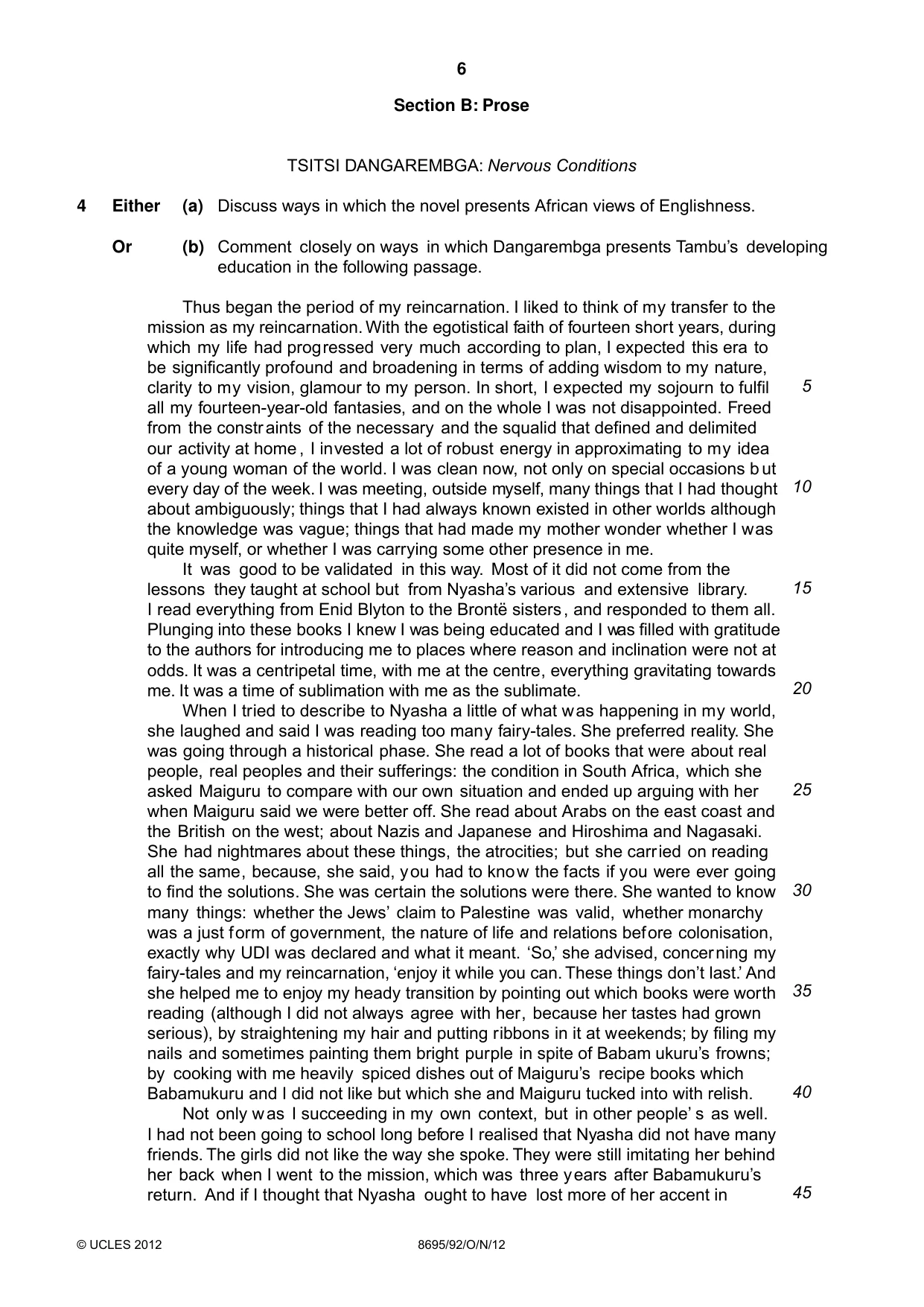
6 8695/92/O/N/12 © UCLES 2012 Section B: Prose TSITSI DANGAREMBGA: Nervous Conditions 4 Either (a) Discuss ways in which the novel presents African views of Englishness. Or (b) Comment closely on ways in which Dangarembga presents Tambu’s developing education in the following passage. Thus began the period of my reincarnation. I liked to think of my transfer to the mission as my reincarnation. With the egotistical faith of fourteen short years, during which my life had progressed very much according to plan, I expected this era to be significantly profound and broadening in terms of adding wisdom to my nature, clarity to my vision, glamour to my person. In short, I expected my sojourn to fulfil all my fourteen-year-old fantasies, and on the whole I was not disappointed. Freed from the constraints of the necessary and the squalid that defined and delimited our activity at home , I invested a lot of robust energy in approximating to my idea of a young woman of the world. I was clean now, not only on special occasions but every day of the week. I was meeting, outside myself, many things that I had thought about ambiguously; things that I had always known existed in other worlds although the knowledge was vague; things that had made my mother wonder whether I was quite myself, or whether I was carrying some other presence in me. It was good to be validated in this way. Most of it did not come from the lessons they taught at school but from Nyasha’s various and extensive library. I read everything from Enid Blyton to the Brontë sisters, and responded to them all. Plunging into these books I knew I was being educated and I was filled with gratitude to the authors for introducing me to places where reason and inclination were not at odds. It was a centripetal time, with me at the centre, everything gravitating towards me. It was a time of sublimation with me as the sublimate. When I tried to describe to Nyasha a little of what was happening in my world, she laughed and said I was reading too many fairy-tales. She preferred reality. She was going through a historical phase. She read a lot of books that were about real people, real peoples and their sufferings: the condition in South Africa, which she asked Maiguru to compare with our own situation and ended up arguing with her when Maiguru said we were better off. She read about Arabs on the east coast and the British on the west; about Nazis and Japanese and Hiroshima and Nagasaki. She had nightmares about these things, the atrocities; but she carried on reading all the same, because, she said, you had to know the facts if you were ever going to find the solutions. She was certain the solutions were there. She wanted to know many things: whether the Jews’ claim to Palestine was valid, whether monarchy was a just form of government, the nature of life and relations before colonisation, exactly why UDI was declared and what it meant. ‘So,’ she advised, concerning my fairy-tales and my reincarnation, ‘enjoy it while you can. These things don’t last.’ And she helped me to enjoy my heady transition by pointing out which books were worth reading (although I did not always agree with her, because her tastes had grown serious), by straightening my hair and putting ribbons in it at weekends; by filing my nails and sometimes painting them bright purple in spite of Babam ukuru’s frowns; by cooking with me heavily spiced dishes out of Maiguru’s recipe books which Babamukuru and I did not like but which she and Maiguru tucked into with relish. Not only was I succeeding in my own context, but in other people’ s as well. I had not been going to school long before I realised that Nyasha did not have many friends. The girls did not like the way she spoke. They were still imitating her behind her back when I went to the mission, which was three years after Babamukuru’s return. And if I thought that Nyasha ought to have lost more of her accent in 5 10 15 20 25 30 35 40 45
Question paper, page 7
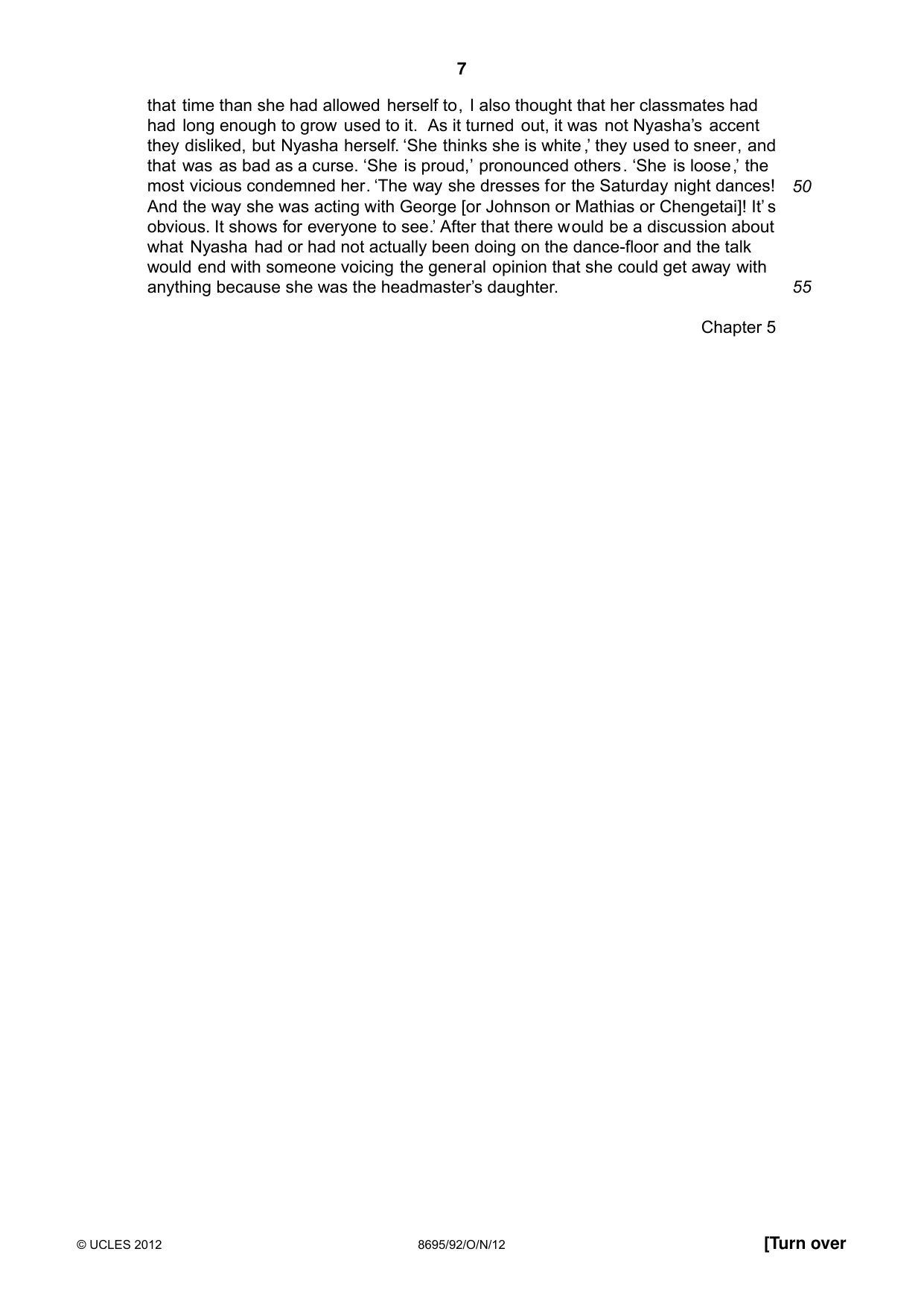
7 8695/92/O/N/12 © UCLES 2012 [Turn over that time than she had allowed herself to, I also thought that her classmates had had long enough to grow used to it. As it turned out, it was not Nyasha’s accent they disliked, but Nyasha herself. ‘She thinks she is white,’ they used to sneer, and that was as bad as a curse. ‘She is proud,’ pronounced others. ‘She is loose,’ the most vicious condemned her. ‘The way she dresses for the Saturday night dances! And the way she was acting with George [or Johnson or Mathias or Chengetai]! It’ s obvious. It shows for everyone to see.’ After that there would be a discussion about what Nyasha had or had not actually been doing on the dance-floor and the talk would end with someone voicing the general opinion that she could get away with anything because she was the headmaster’s daughter. Chapter 5 50 55
Question paper, page 8
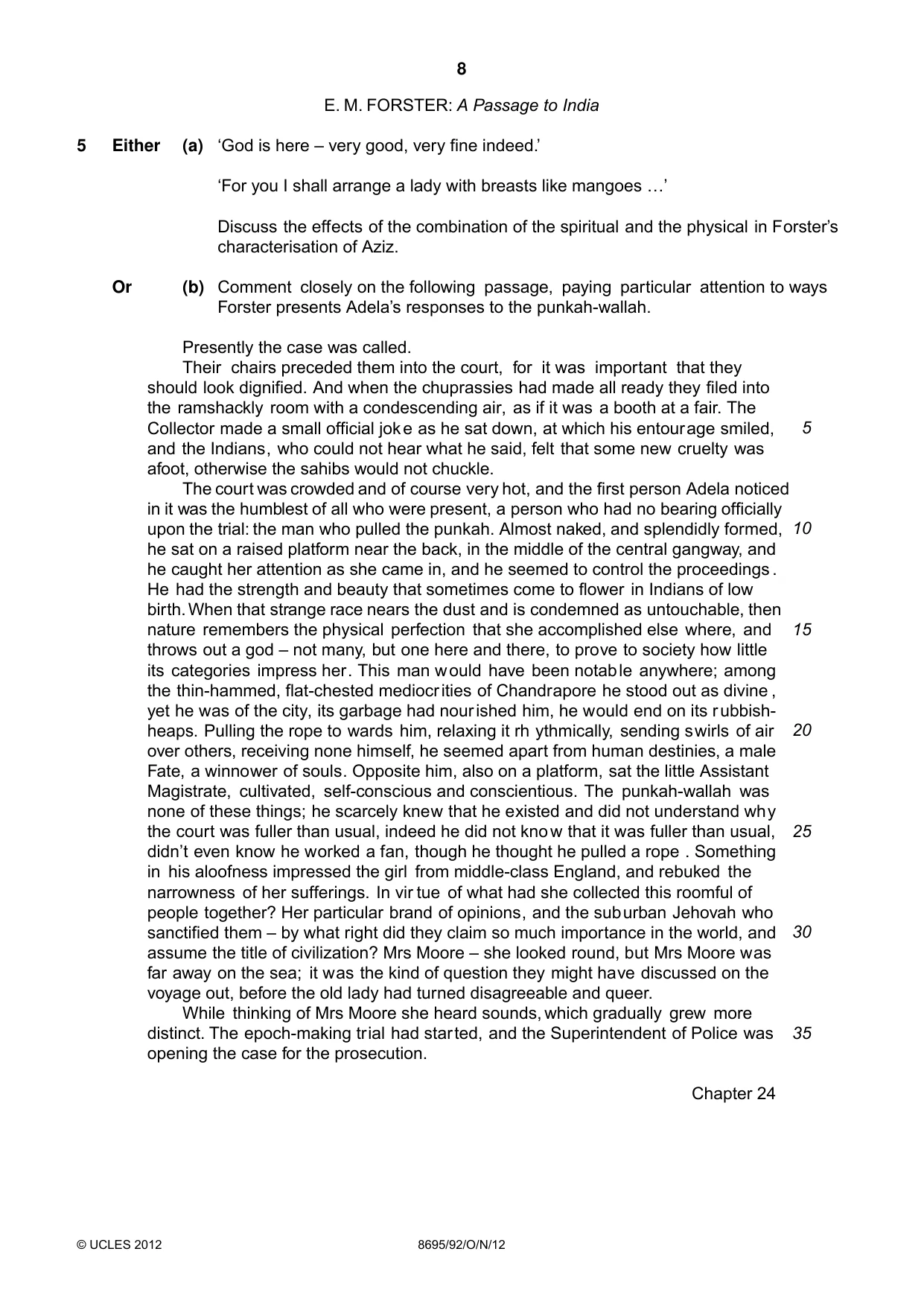
8 8695/92/O/N/12 © UCLES 2012 E. M. FORSTER: A Passage to India 5 Either (a) ‘God is here – very good, very fine indeed.’ ‘For you I shall arrange a lady with breasts like mangoes …’ Discuss the effects of the combination of the spiritual and the physical in Forster’s characterisation of Aziz. Or (b) Comment closely on the following passage, paying particular attention to ways Forster presents Adela’s responses to the punkah-wallah. Presently the case was called. Their chairs preceded them into the court, for it was important that they should look dignified. And when the chuprassies had made all ready they filed into the ramshackly room with a condescending air, as if it was a booth at a fair. The Collector made a small official joke as he sat down, at which his entourage smiled, and the Indians, who could not hear what he said, felt that some new cruelty was afoot, otherwise the sahibs would not chuckle. The court was crowded and of course very hot, and the first person Adela noticed in it was the humblest of all who were present, a person who had no bearing officially upon the trial: the man who pulled the punkah. Almost naked, and splendidly formed, he sat on a raised platform near the back, in the middle of the central gangway, and he caught her attention as she came in, and he seemed to control the proceedings . He had the strength and beauty that sometimes come to flower in Indians of low birth. When that strange race nears the dust and is condemned as untouchable, then nature remembers the physical perfection that she accomplished else where, and throws out a god – not many, but one here and there, to prove to society how little its categories impress her. This man would have been notable anywhere; among the thin-hammed, flat-chested mediocrities of Chandrapore he stood out as divine , yet he was of the city, its garbage had nourished him, he would end on its rubbish- heaps. Pulling the rope to wards him, relaxing it rh ythmically, sending swirls of air over others, receiving none himself, he seemed apart from human destinies, a male Fate, a winnower of souls. Opposite him, also on a platform, sat the little Assistant Magistrate, cultivated, self-conscious and conscientious. The punkah-wallah was none of these things; he scarcely knew that he existed and did not understand why the court was fuller than usual, indeed he did not know that it was fuller than usual, didn’t even know he worked a fan, though he thought he pulled a rope . Something in his aloofness impressed the girl from middle-class England, and rebuked the narrowness of her sufferings. In vir tue of what had she collected this roomful of people together? Her particular brand of opinions, and the suburban Jehovah who sanctified them – by what right did they claim so much importance in the world, and assume the title of civilization? Mrs Moore – she looked round, but Mrs Moore was far away on the sea; it was the kind of question they might have discussed on the voyage out, before the old lady had turned disagreeable and queer. While thinking of Mrs Moore she heard sounds, which gradually grew more distinct. The epoch-making trial had started, and the Superintendent of Police was opening the case for the prosecution. Chapter 24 5 10 15 20 25 30 35
Question paper, page 9
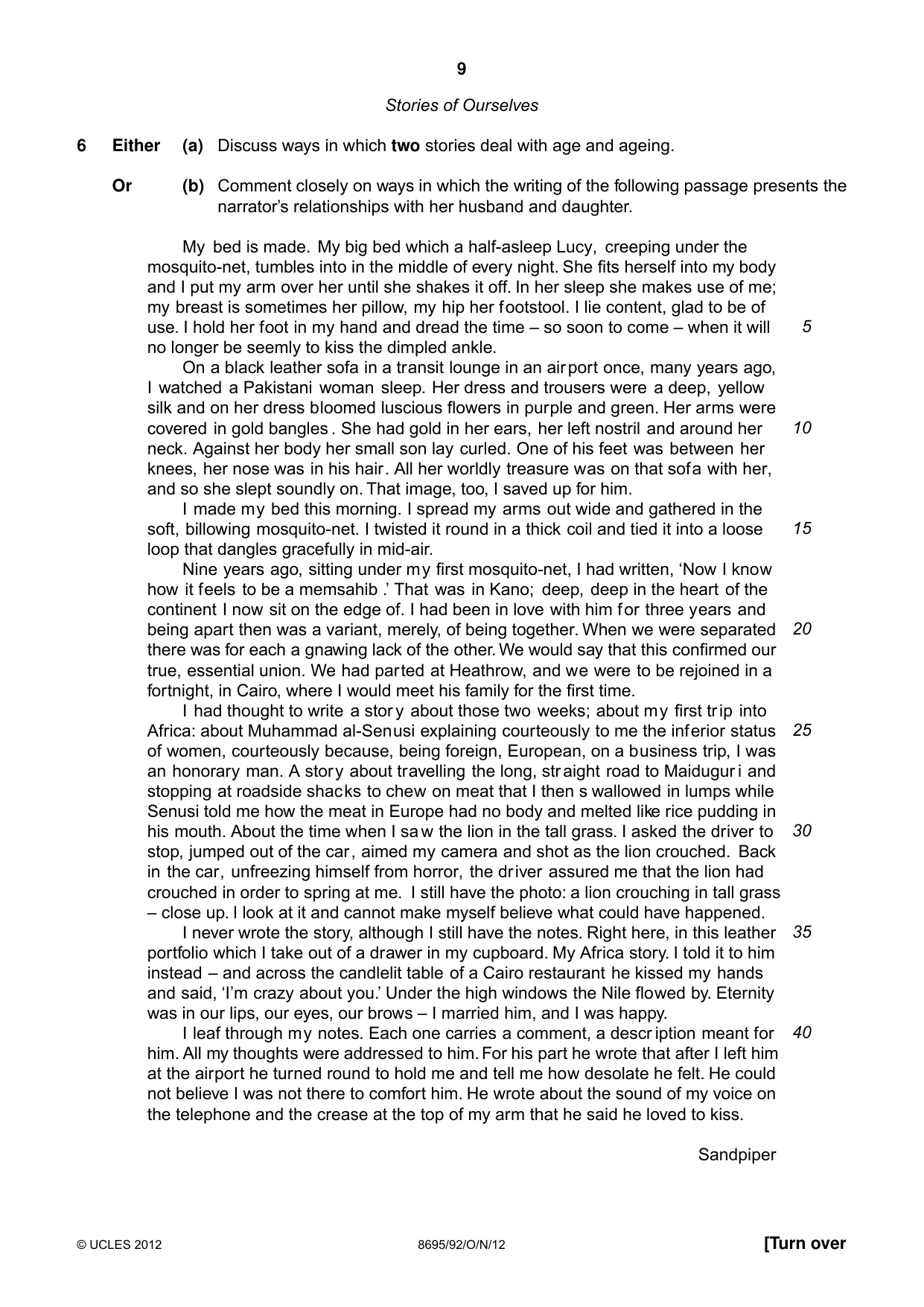
9 8695/92/O/N/12 © UCLES 2012 [Turn over Stories of Ourselves 6 Either (a) Discuss ways in which two stories deal with age and ageing. Or (b) Comment closely on ways in which the writing of the following passage presents the narrator’s relationships with her husband and daughter. My bed is made. My big bed which a half-asleep Lucy, creeping under the mosquito-net, tumbles into in the middle of every night. She fits herself into my body and I put my arm over her until she shakes it off. In her sleep she makes use of me; my breast is sometimes her pillow, my hip her footstool. I lie content, glad to be of use. I hold her foot in my hand and dread the time – so soon to come – when it will no longer be seemly to kiss the dimpled ankle. On a black leather sofa in a transit lounge in an airport once, many years ago, I watched a Pakistani woman sleep. Her dress and trousers were a deep, yellow silk and on her dress bloomed luscious flowers in purple and green. Her arms were covered in gold bangles . She had gold in her ears, her left nostril and around her neck. Against her body her small son lay curled. One of his feet was between her knees, her nose was in his hair. All her worldly treasure was on that sofa with her, and so she slept soundly on. That image, too, I saved up for him. I made my bed this morning. I spread my arms out wide and gathered in the soft, billowing mosquito-net. I twisted it round in a thick coil and tied it into a loose loop that dangles gracefully in mid-air. Nine years ago, sitting under my first mosquito-net, I had written, ‘Now I know how it feels to be a memsahib .’ That was in Kano; deep, deep in the heart of the continent I now sit on the edge of. I had been in love with him for three years and being apart then was a variant, merely, of being together. When we were separated there was for each a gnawing lack of the other. We would say that this confirmed our true, essential union. We had parted at Heathrow, and we were to be rejoined in a fortnight, in Cairo, where I would meet his family for the first time. I had thought to write a story about those two weeks; about my first trip into Africa: about Muhammad al-Senusi explaining courteously to me the inferior status of women, courteously because, being foreign, European, on a business trip, I was an honorary man. A story about travelling the long, straight road to Maidugur i and stopping at roadside shacks to chew on meat that I then s wallowed in lumps while Senusi told me how the meat in Europe had no body and melted like rice pudding in his mouth. About the time when I saw the lion in the tall grass. I asked the driver to stop, jumped out of the car, aimed my camera and shot as the lion crouched. Back in the car, unfreezing himself from horror, the driver assured me that the lion had crouched in order to spring at me. I still have the photo: a lion crouching in tall grass – close up. I look at it and cannot make myself believe what could have happened. I never wrote the story, although I still have the notes. Right here, in this leather portfolio which I take out of a drawer in my cupboard. My Africa story. I told it to him instead – and across the candlelit table of a Cairo restaurant he kissed my hands and said, ‘I’m crazy about you.’ Under the high windows the Nile flowed by. Eternity was in our lips, our eyes, our brows – I married him, and I was happy. I leaf through my notes. Each one carries a comment, a descr iption meant for him. All my thoughts were addressed to him. For his part he wrote that after I left him at the airport he turned round to hold me and tell me how desolate he felt. He could not believe I was not there to comfort him. He wrote about the sound of my voice on the telephone and the crease at the top of my arm that he said he loved to kiss. Sandpiper 5 10 15 20 25 30 35 40
Question paper, page 10
10 8695/92/O/N/12 © UCLES 2012 Section C: Drama PETER SHAFFER: Equus 7 Either (a) ‘Give me the TRUTH!’ (Dysart) Discuss ways in which the play questions the value of Dysart’s search for truth. Or (b) Comment closely on the language and action of the following extract, considering the significance of this passage in the play. Alan: Flankus begat Spankus. And Spankus begat Spunkus the Great, who lived three score years! Frank: It was all like that. I can’t remember the exact names, of course. Then suddenly he knelt down. Dysart: In front of the photograph? Frank: Yes. Right there at the foot of his bed. Alan (kneeling ): And Legwus begat Neckwus. And Neckwus begat Fleckwus, the King of Spit. And Fleckwus spoke out of his chinkle-chankle! He bows himself to the ground. Dysart: What? Frank: I’m sure that was the word. I’ve never forgotten it. Chinkle-chankle. Alan raises his head and extends his hands up in glory. Alan: And he said ‘Behold – I give you Equus, my only begotten son!’ Dysart: Equus? Frank: Yes. No doubt of that. He repeated that word several times. ‘Equus my only begotten son.’ Alan (reverently ): Ek. … wus! Dysart (suddenly understanding: almost ‘aside’ ): Ek. … Ek. … Frank (embarrassed ): And then … Dysart: Yes: what? Frank: He took a piece of string out of his pocket. Made up into a noose. And put it in his mouth. Alan bridles himself with in visible string, and pulls it back. And then with his other hand he picked up a coat hanger. A wooden coat hanger, and – and— Dysart: Began to beat himself? Alan, in mime, begins to thrash himself, increasing the strokes in speed and viciousness. Pause. Frank: You see why I couldn’t tell his mother . … Religion. Religion’s at the bottom of all this! Dysart: What did you do? 5 10 15 20 25 30 35
Question paper, page 11
11 8695/92/O/N/12 © UCLES 2012 [Turn over Frank: Nothing. I coughed – and went back downstairs. The boy starts guiltily – tears the string from his mouth – and scrambles back to bed. Dysart: Did you ever speak to him about it later? Even obliquely? Frank (unhappily ): I can’t speak of things like that, Doctor. It’s not in my nature. Dysart (kindly ): No. I see that. Frank: But I thought you ought to know. So I came. Dysart (warmly ): Yes. I’m very grateful to you. Thank you. Pause. Frank: Well, that’s it … Dysart: Is there anything else? Frank (even more embarrassed ): There is actually. One thing. Dysart: What’s that? Frank: On the night that he did it – that awful thing in the stable – Dysart: Yes? Frank: That very night, he was out with a girl. Dysart: How d’you know that? Frank: I just know. Dysart (puzzled ): Did he tell you? Frank: I can’t say any more. Dysart: I don’t quite understand. Frank: Everything said in here is confidential, you said. Dysart: Absolutely. Frank: Then ask him. Ask him about taking a girl out, that very night he did it. … (abruptly ) Goodbye, Doctor. He goes. Dysart looks after him. Frank resumes his seat. Act 1, Scene 14 40 45 50 55 60
Question paper, page 12
12 8695/92/O/N/12 © UCLES 2012 WILLIAM SHAKESPEARE: Henry IV Part 1 8 Either (a) What dramatic contribution do you believe the comic scenes make to the play? Or (b) Comment closely on the following passage, considering the ways it presents relationships among the rebels. Glendower: The moon shines fair; you may away by night; I’ll haste the writer, and withal Break with your wives of your departure hence. I am afraid my daughter will run mad, So much she doteth on her Mortimer. 5 [Exit. Mortimer: Fie, cousin Percy! how you cross my father! Hotspur: I cannot choose. Sometimes he angers me With telling me of the moldwarp and the ant, Of the dreamer Merlin and his prophecies, 10 And of a dragon and a finless fish, A clip-wing’d griffin and a moulten raven, A couching lion and a ramping cat, And such a deal of skimble-skamble stuff As puts me from my faith. I tell you what: 15 He held me last night at least nine hours In reckoning up the several devils’ names That were his lackeys. I cried ‘hum’ and ‘well, go to’ But mark’d him not a word. O, he is as tedious As a tired horse, a railing wife; 20 Worse than a smoky house; I had rather live With cheese and garlic in a windmill, far, Than feed on cates and have him talk to me In any summer house in Christendom. Mortimer: In faith, he is a worthy gentleman, 25 Exceedingly well read, and profited In strange concealments; valiant as a lion, And wondrous affable; and as bountiful As mines of India. Shall I tell you, cousin? He holds your temper in a high respect, 30 And curbs himself even of his natural scope When you come ’cross his humour; faith, he does. I warrant you that man is not alive Might so have tempted him as you have done Without the taste of danger and reproof; 35 But do not use it oft, let me entreat you. Worcester: In faith, my lord, you are too wilfulblame; And since your coming hither have done enough To put him quite besides his patience. You must needs learn, lord, to amend this fault; 40 Though sometimes it show greatness, courage, blood – And that’s the dearest grace it renders you – Yet oftentimes it doth present harsh rage, Defect of manners, want of government, Pride, haughtiness, opinion, and disdain; 45 The least of which, haunting a nobleman, Loseth men’s hearts, and leaves behind a stain
Question paper, page 13
13 8695/92/O/N/12 © UCLES 2012 [Turn over Upon the beauty of all parts besides, Beguiling them of commendation. Hotspur: Well, I am school’d; good manners be your speed! 50 Act 3, Scene 1
Question paper, page 14
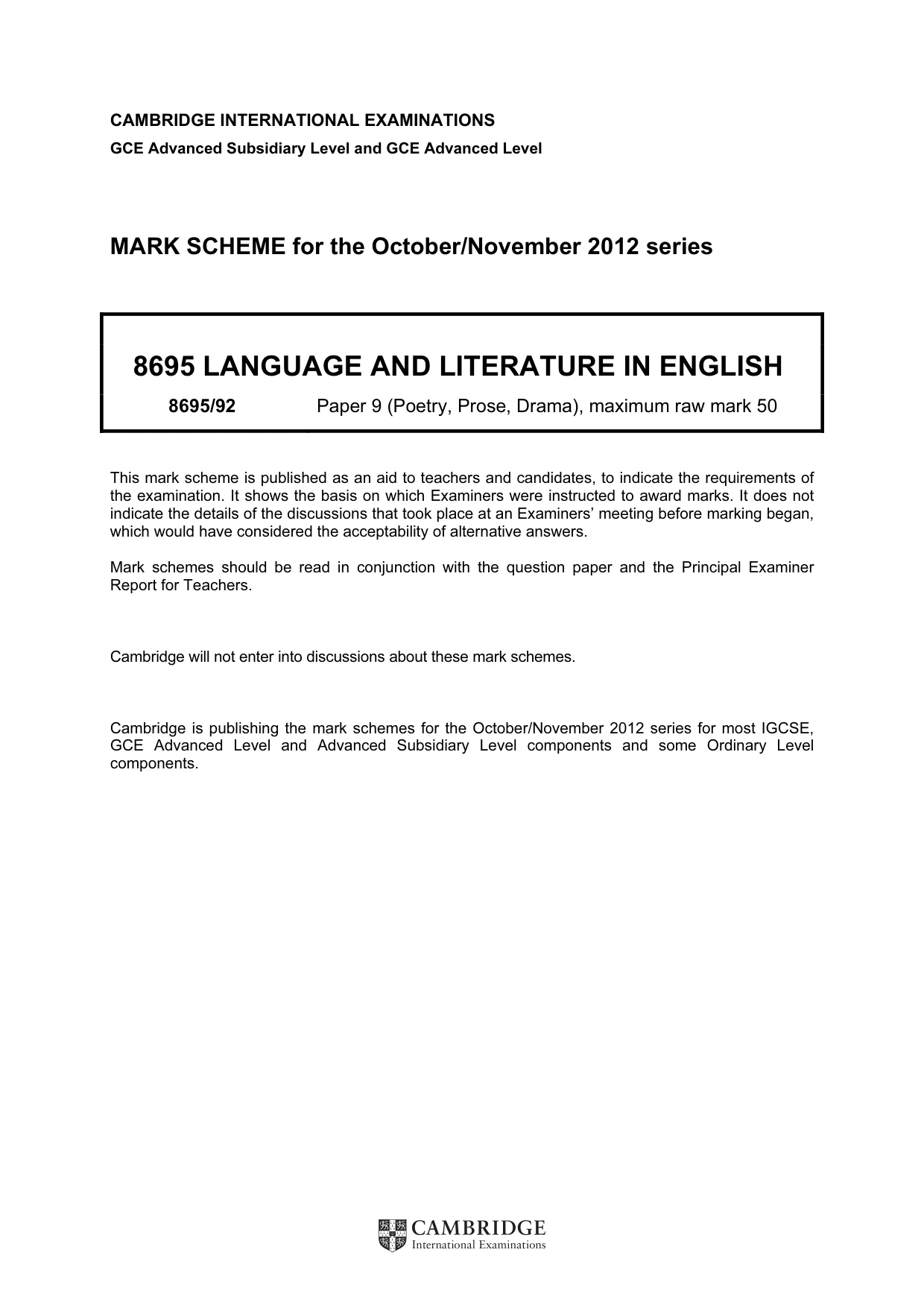
14 8695/92/O/N/12 © UCLES 2012 TENNESSEE WILLIAMS: A Streetcar Named Desire 9 Either (a) Discuss ways in which Williams makes dramatic use of class differences in the play. Or (b) Comment closely on the dialogue of the following passage, discussing how Williams presents Blanche’s response to Mitch’s disillusionment. Mitch [slowly and bitterly ]: I don’t mind you being older than what I thought. Content removed due to copyright restrictions. Blanche: Never inside, I didn’t lie in my heart. … Scene 9 25
Question paper, page 15
16 8695/92/O/N/12 © UCLES 2012 BLANK PAGE Copyright Acknowledgements: Question 2b © Seamus Heaney; The Lift from District and Circle ; Faber & Faber; 2006. Question 3b © A E Housman; Because I Liked You Better from Songs of Ourselves ; Foundation Books; 2005. Question 4b © Tsitsi Dangarembga; Nervous Conditions ; Ayebia Publishing; 1988. Question 5b © E M Forster; A Passage to India ; Penguin Books Ltd; 1979. Question 6b © Ahdaf Soueif; Sandpiper from Stories of Ourselves ; Cambridge University Press; 2008. Question 7b © Peter Shaffer; Equus ; Longman; 1993. Question 9b © A Streetcar Named Desire by Tennessee Williams. Copyright © 1947 by The University of The South. Reprinted by permission of New Directions Publishing Corp. and Georges Borchardt, Inc. for the Estate of Tennessee Williams. Permission to reproduce items where third-party owned material protected by copyright is included has been sought and cleared where possible. Every reasonable effort has been made by the publisher (UCLES) to trace copyright holders, but if any items requiring clearance have unwittingly been included, the publisher will be pleased to make amends at the earliest possible opportunity. University of Cambridge International Examinations is part of the Cambridge Assessment Group. Cambridge Local Examinations Syndicate (UCLES), which is itself a department of the University of Cambridge.
Mark scheme, page 1
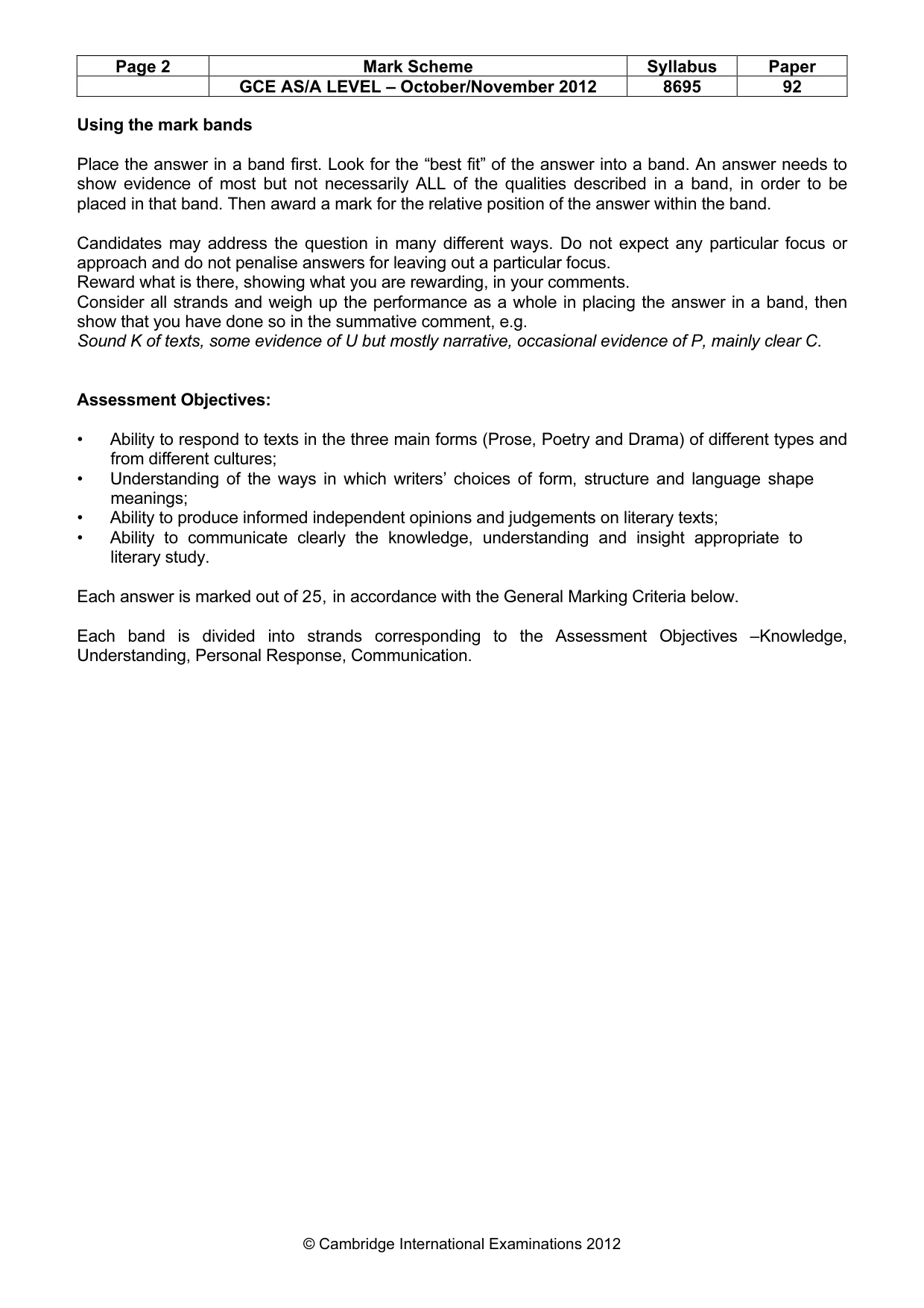
CAMBRIDGE INTERNATIONAL EXAMINATIONS GCE Advanced Subsidiary Level and GCE Advanced Level MARK SCHEME for the October/November 2012 series 8695 LANGUAGE AND LITERATURE IN ENGLISH 8695/92 Paper 9 (Poetry, Prose, Drama), maximum raw mark 50 This mark scheme is published as an aid to teachers and candidates, to indicate the requirements of the examination. It shows the basis on which Examiners were instructed to award marks. It does not indicate the details of the discussions that took place at an Examiners’ meeting before marking began, which would have considered the acceptability of alternative answers. Mark schemes should be read in conjunction with the question paper and the Principal Examiner Report for Teachers. Cambridge will not enter into discussions about these mark schemes. Cambridge is publishing the mark schemes for the October/November 2012 series for most IGCSE, GCE Advanced Level and Advanced Subsidiary Level components and some Ordinary Level components.
Mark scheme, page 2
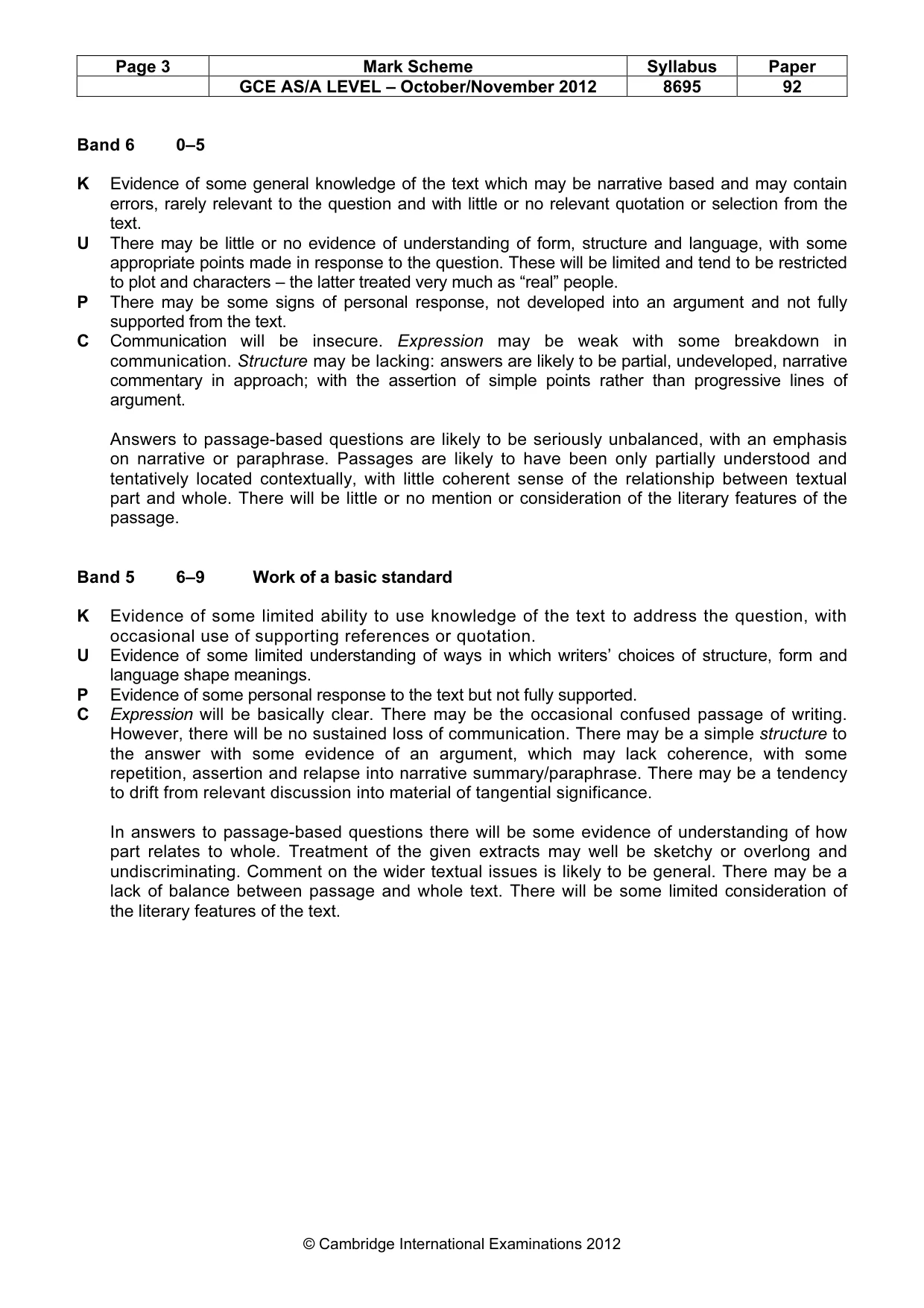
Page 2 Mark Scheme Syllabus Paper GCE AS/A LEVEL – October/November 2012 8695 92 © Cambridge International Examinations 2012 Using the mark bands Place the answer in a band first. Look for the “best fit” of the answer into a band. An answer needs to show evidence of most but not necessarily ALL of the qualities described in a band, in order to be placed in that band. Then award a mark for the relative position of the answer within the band. Candidates may address the question in many different ways. Do not expect any particular focus or approach and do not penalise answers for leaving out a particular focus. Reward what is there, showing what you are rewarding, in your comments. Consider all strands and weigh up the performance as a whole in placing the answer in a band, then show that you have done so in the summative comment, e.g. Sound K of texts, some evidence of U but mostly narrative, occasional evidence of P, mainly clear C. Assessment Objectives: • Ability to respond to texts in the three main forms (Prose, Poetry and Drama) of different types and from different cultures; • Understanding of the ways in which writers’ choices of form, structure and language shape meanings; • Ability to produce informed independent opinions and judgements on literary texts; • Ability to communicate clearly the knowledge, understanding and insight appropriate to literary study. Each answer is marked out of 25, in accordance with the General Marking Criteria below. Each band is divided into strands corresponding to the Assessment Objectives –Knowledge, Understanding, Personal Response, Communication.
Mark scheme, page 3
Page 3 Mark Scheme Syllabus Paper GCE AS/A LEVEL – October/November 2012 8695 92 © Cambridge International Examinations 2012 Band 6 0–5 K Evidence of some general knowledge of the text which may be narrative based and may contain errors, rarely relevant to the question and with little or no relevant quotation or selection from the text. U There may be little or no evidence of understanding of form, structure and language, with some appropriate points made in response to the question. These will be limited and tend to be restricted to plot and characters – the latter treated very much as “real” people. P There may be some signs of personal response, not developed into an argument and not fully supported from the text. C Communication will be insecure. Expression may be weak with some breakdown in communication. Structure may be lacking: answers are likely to be partial, undeveloped, narrative commentary in approach; with the assertion of simple points rather than progressive lines of argument. Answers to passage-based questions are likely to be seriously unbalanced, with an emphasis on narrative or paraphrase. Passages are likely to have been only partially understood and tentatively located contextually, with little coherent sense of the relationship between textual part and whole. There will be little or no mention or consideration of the literary features of the passage. Band 5 6–9 Work of a basic standard K Evidence of some limited ability to use knowledge of the text to address the question, with occasional use of supporting references or quotation. U Evidence of some limited understanding of ways in which writers’ choices of structure, form and language shape meanings. P Evidence of some personal response to the text but not fully supported. C Expression will be basically clear. There may be the occasional confused passage of writing. However, there will be no sustained loss of communication. There may be a simple structure to the answer with some evidence of an argument, which may lack coherence, with some repetition, assertion and relapse into narrative summary/paraphrase. There may be a tendency to drift from relevant discussion into material of tangential significance. In answers to passage-based questions there will be some evidence of understanding of how part relates to whole. Treatment of the given extracts may well be sketchy or overlong and undiscriminating. Comment on the wider textual issues is likely to be general. There may be a lack of balance between passage and whole text. There will be some limited consideration of the literary features of the text.
Mark scheme, page 4
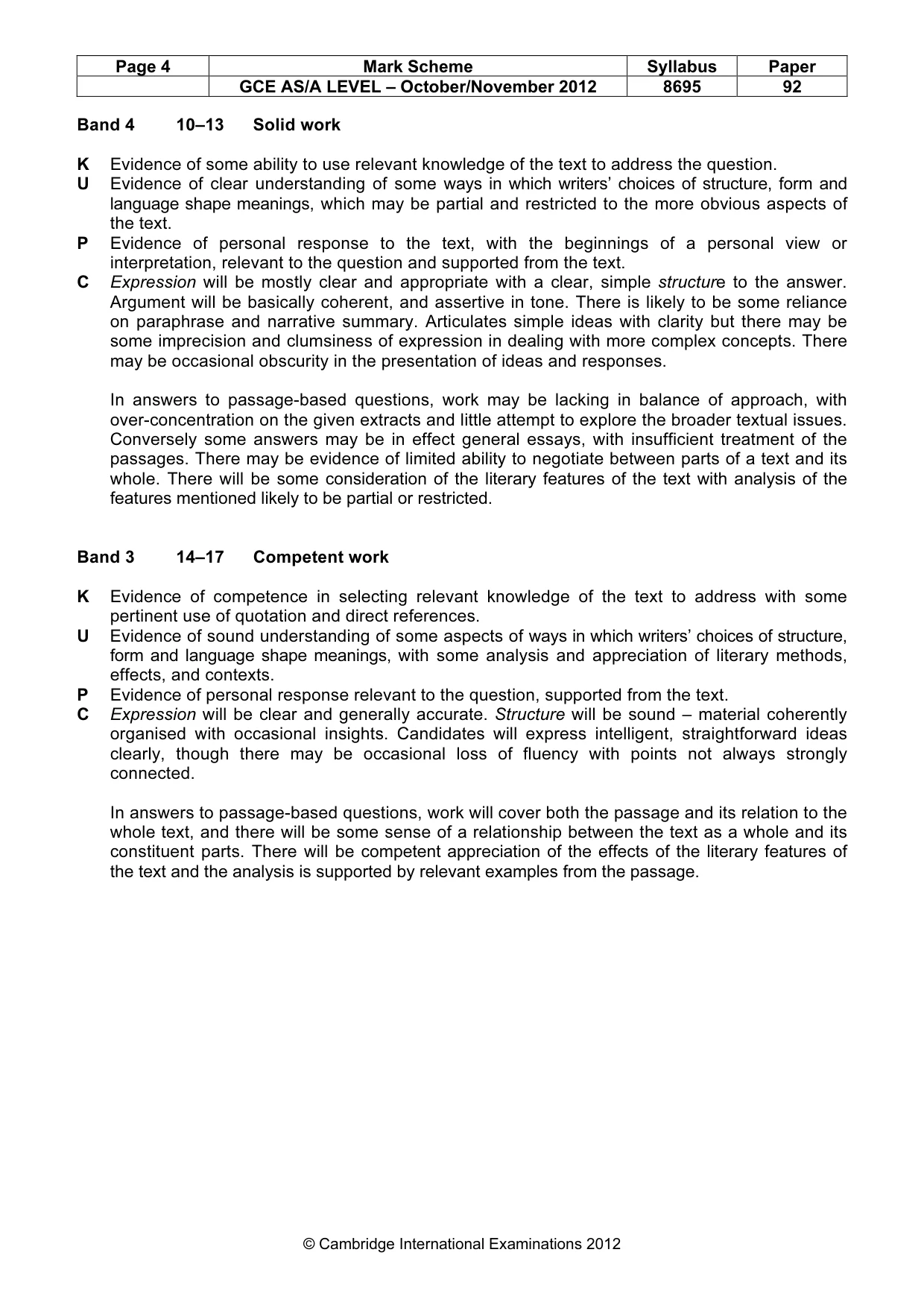
Page 4 Mark Scheme Syllabus Paper GCE AS/A LEVEL – October/November 2012 8695 92 © Cambridge International Examinations 2012 Band 4 10–13 Solid work K Evidence of some ability to use relevant knowledge of the text to address the question. U Evidence of clear understanding of some ways in which writers’ choices of structure, form and language shape meanings, which may be partial and restricted to the more obvious aspects of the text. P Evidence of personal response to the text, with the beginnings of a personal view or interpretation, relevant to the question and supported from the text. C Expression will be mostly clear and appropriate with a clear, simple structure to the answer. Argument will be basically coherent, and assertive in tone. There is likely to be some reliance on paraphrase and narrative summary. Articulates simple ideas with clarity but there may be some imprecision and clumsiness of expression in dealing with more complex concepts. There may be occasional obscurity in the presentation of ideas and responses. In answers to passage-based questions, work may be lacking in balance of approach, with over-concentration on the given extracts and little attempt to explore the broader textual issues. Conversely some answers may be in effect general essays, with insufficient treatment of the passages. There may be evidence of limited ability to negotiate between parts of a text and its whole. There will be some consideration of the literary features of the text with analysis of the features mentioned likely to be partial or restricted. Band 3 14–17 Competent work K Evidence of competence in selecting relevant knowledge of the text to address with some pertinent use of quotation and direct references. U Evidence of sound understanding of some aspects of ways in which writers’ choices of structure, form and language shape meanings, with some analysis and appreciation of literary methods, effects, and contexts. P Evidence of personal response relevant to the question, supported from the text. C Expression will be clear and generally accurate. Structure will be sound – material coherently organised with occasional insights. Candidates will express intelligent, straightforward ideas clearly, though there may be occasional loss of fluency with points not always strongly connected. In answers to passage-based questions, work will cover both the passage and its relation to the whole text, and there will be some sense of a relationship between the text as a whole and its constituent parts. There will be competent appreciation of the effects of the literary features of the text and the analysis is supported by relevant examples from the passage.
Mark scheme, page 5
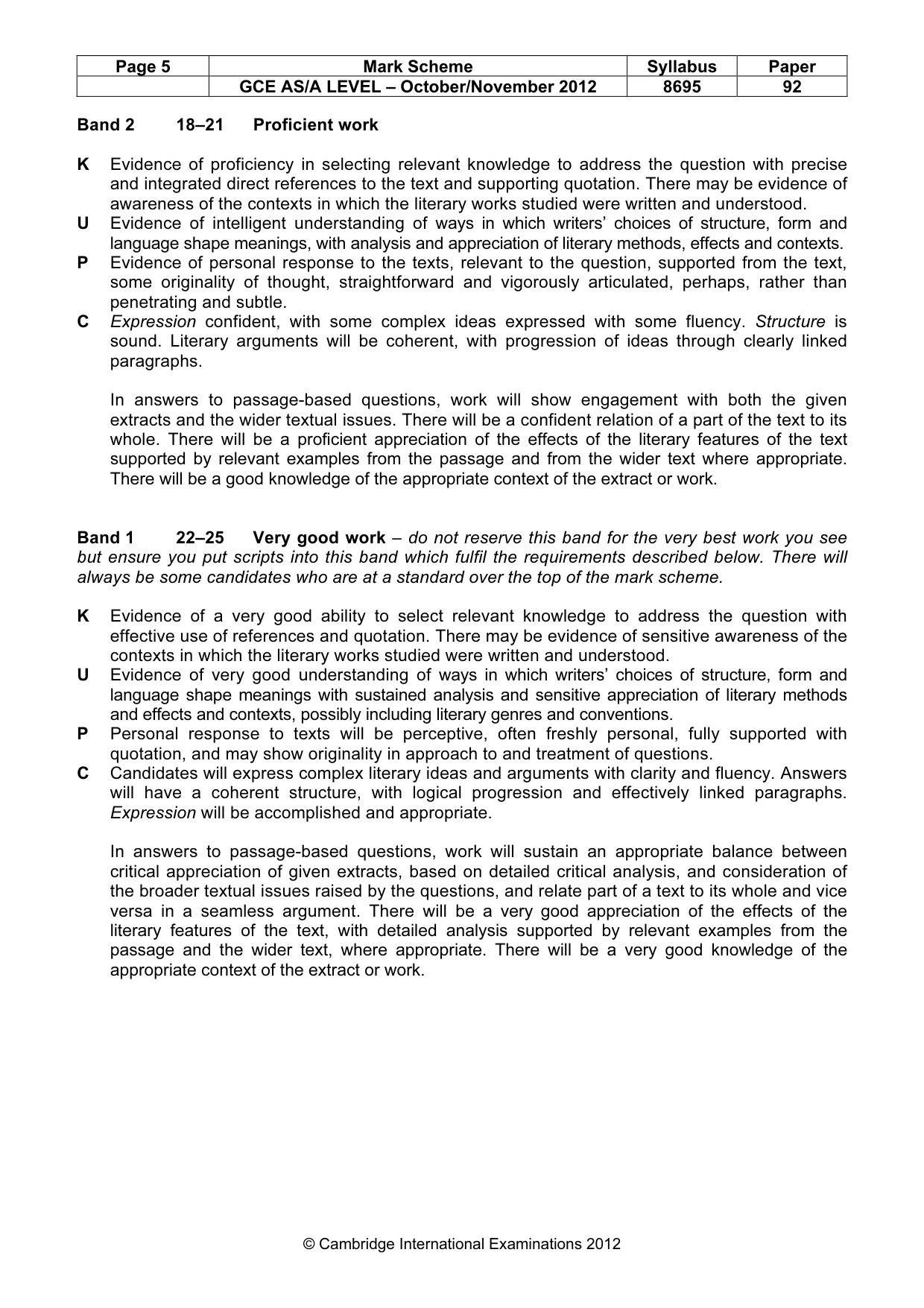
Page 5 Mark Scheme Syllabus Paper GCE AS/A LEVEL – October/November 2012 8695 92 © Cambridge International Examinations 2012 Band 2 18–21 Proficient work K Evidence of proficiency in selecting relevant knowledge to address the question with precise and integrated direct references to the text and supporting quotation. There may be evidence of awareness of the contexts in which the literary works studied were written and understood. U Evidence of intelligent understanding of ways in which writers’ choices of structure, form and language shape meanings, with analysis and appreciation of literary methods, effects and contexts. P Evidence of personal response to the texts, relevant to the question, supported from the text, some originality of thought, straightforward and vigorously articulated, perhaps, rather than penetrating and subtle. C Expression confident, with some complex ideas expressed with some fluency. Structure is sound. Literary arguments will be coherent, with progression of ideas through clearly linked paragraphs. In answers to passage-based questions, work will show engagement with both the given extracts and the wider textual issues. There will be a confident relation of a part of the text to its whole. There will be a proficient appreciation of the effects of the literary features of the text supported by relevant examples from the passage and from the wider text where appropriate. There will be a good knowledge of the appropriate context of the extract or work. Band 1 22–25 Very good work – do not reserve this band for the very best work you see but ensure you put scripts into this band which fulfil the requirements described below. There will always be some candidates who are at a standard over the top of the mark scheme. K Evidence of a very good ability to select relevant knowledge to address the question with effective use of references and quotation. There may be evidence of sensitive awareness of the contexts in which the literary works studied were written and understood. U Evidence of very good understanding of ways in which writers’ choices of structure, form and language shape meanings with sustained analysis and sensitive appreciation of literary methods and effects and contexts, possibly including literary genres and conventions. P Personal response to texts will be perceptive, often freshly personal, fully supported with quotation, and may show originality in approach to and treatment of questions. C Candidates will express complex literary ideas and arguments with clarity and fluency. Answers will have a coherent structure, with logical progression and effectively linked paragraphs. Expression will be accomplished and appropriate. In answers to passage-based questions, work will sustain an appropriate balance between critical appreciation of given extracts, based on detailed critical analysis, and consideration of the broader textual issues raised by the questions, and relate part of a text to its whole and vice versa in a seamless argument. There will be a very good appreciation of the effects of the literary features of the text, with detailed analysis supported by relevant examples from the passage and the wider text, where appropriate. There will be a very good knowledge of the appropriate context of the extract or work.
What you needed in this session
Cambridge’s own grade thresholds for 2012 Oct/Nov, Paper 9 · Variant 2. A higher threshold means an easier paper — the bar moves with how the cohort did.