Cambridge A Level English - Language and Literature (AS Level only, from 2016) 8695 — 2012 May/June Paper 9 · Variant 3
8695/93/M/J/12 · 50 marks · ≈56 min
The question paper and its mark scheme, free to read here and free to download. This is Cambridge’s own paper, exactly as it was sat.
Question paper17 pages




Mark scheme5 pages
Answers below. Sit the paper first if you are practising.
Paper as text
Question paper, page 1
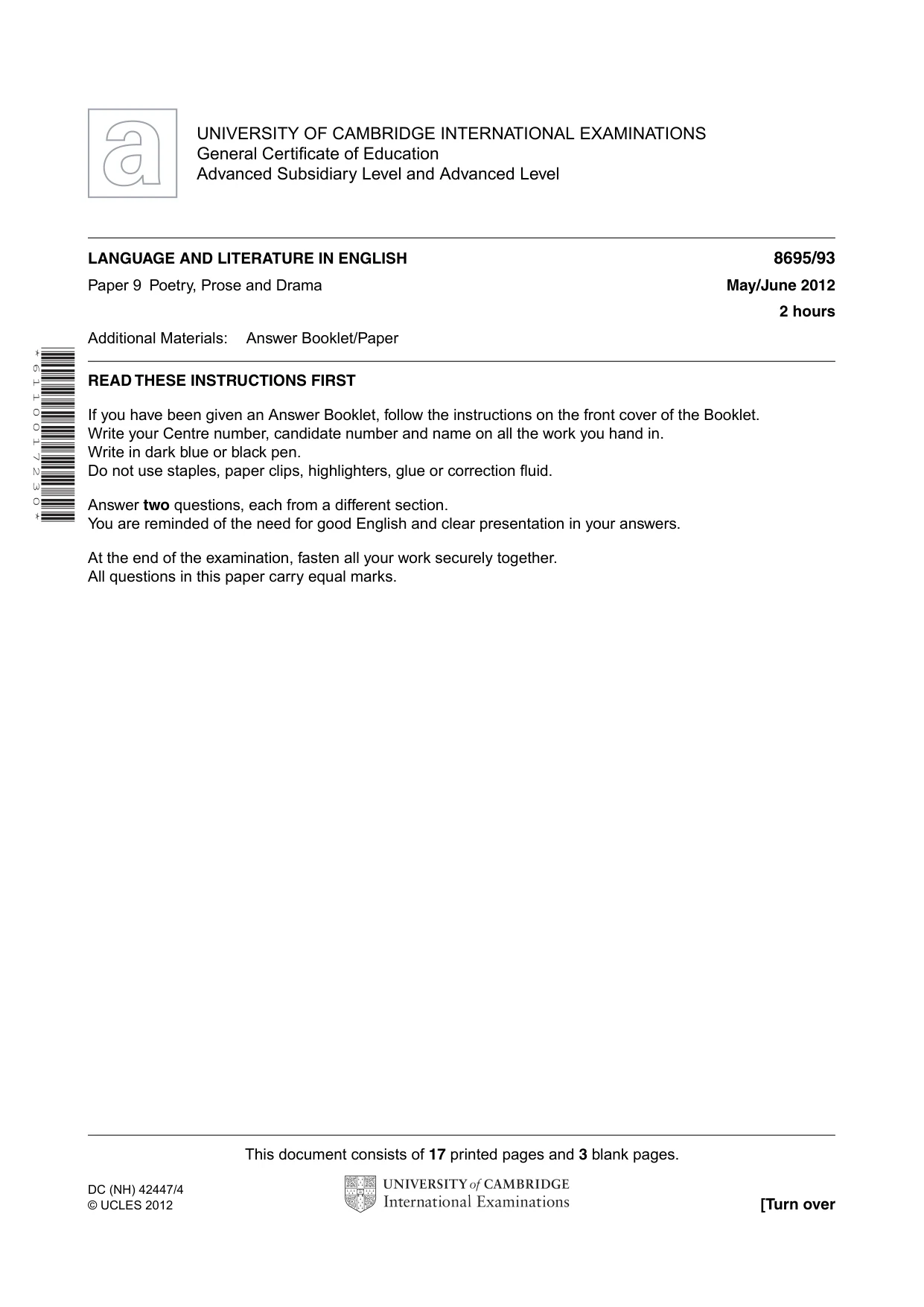
This document consists of 17 printed pages and 3 blank pages. DC (NH) 42447/4 © UCLES 2012 [Turn over UNIVERSITY OF CAMBRIDGE INTERNATIONAL EXAMINATIONS General Certificate of Education Advanced Subsidiary Level and Advanced Level * 6 1 1 0 0 1 7 2 3 0 * LANGUAGE AND LITERATURE IN ENGLISH 8695/93 Paper 9 Poetry, Prose and Drama May/June 2012 2 hours Additional Materials: Answer Booklet/Paper READ THESE INSTRUCTIONS FIRST If you have been given an Answer Booklet, follow the instructions on the front cover of the Booklet. Write your Centre number, candidate number and name on all the work you hand in. Write in dark blue or black pen. Do not use staples, paper clips, highlighters, glue or correction fluid. Answer two questions, each from a different section. You are reminded of the need for good English and clear presentation in your answers. At the end of the examination, fasten all your work securely together. All questions in this paper carry equal marks.
Question paper, page 2
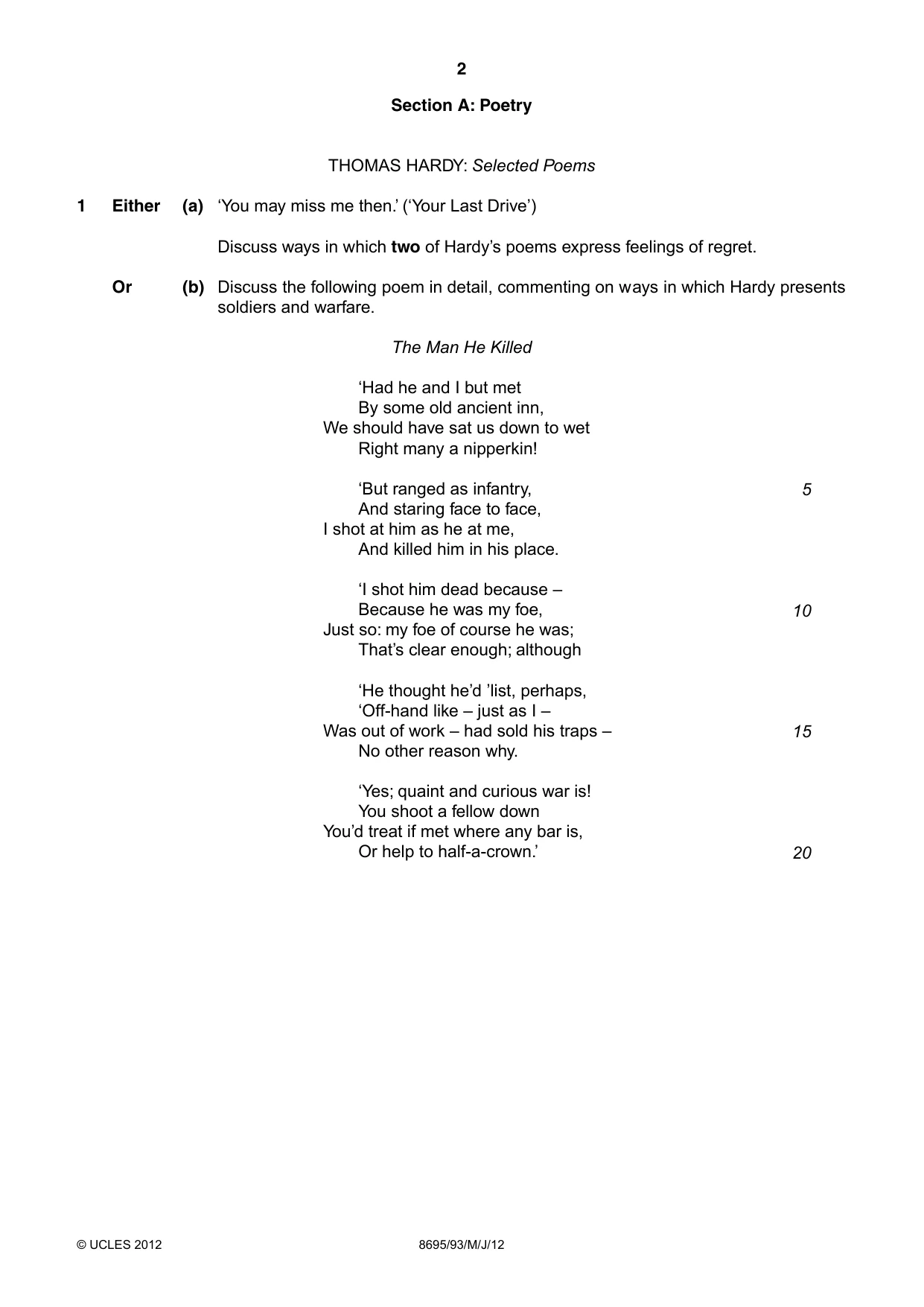
2 8695/93/M/J/12 © UCLES 2012 Section A: Poetry THOMAS HARDY: Selected Poems 1 Either (a) ‘You may miss me then.’ (‘Your Last Drive’) Discuss ways in which two of Hardy’s poems express feelings of regret. Or (b) Discuss the following poem in detail, commenting on ways in which Hardy presents soldiers and warfare. The Man He Killed ‘Had he and I but met By some old ancient inn, We should have sat us down to wet Right many a nipperkin! ‘But ranged as infantry, And staring face to face, I shot at him as he at me, And killed him in his place. ‘I shot him dead because – Because he was my foe, Just so: my foe of course he was; That’s clear enough; although ‘He thought he’d ’list, perhaps, ‘Off-hand like – just as I – Was out of work – had sold his traps – No other reason why. ‘Yes; quaint and curious war is! You shoot a fellow down You’d treat if met where any bar is, Or help to half-a-crown.’ 5 10 15 20
Question paper, page 3
3 8695/93/M/J/12 © UCLES 2012 [Turn over SEAMUS HEANEY: District and Circle 2 Either (a) Discuss ways in which Heaney deals with contemporary events in his poetry. Refer to two poems in your answer. Or (b) Discuss the following poem in detail, commenting on ways in which Heaney presents the qualities of ‘a suitable tool’. Poet to Blacksmith Content removed due to copyright restrictions.
Question paper, page 4
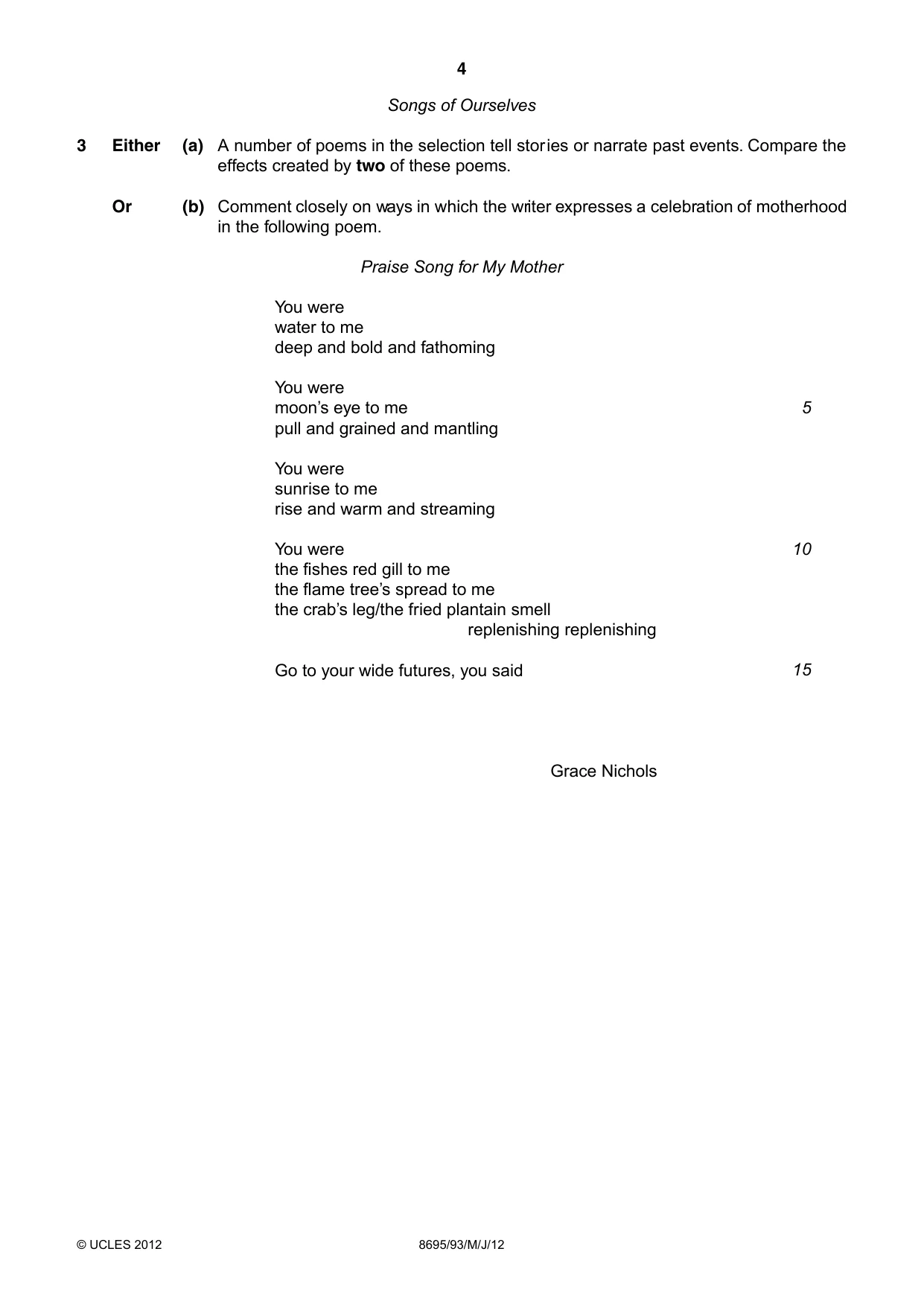
4 8695/93/M/J/12 © UCLES 2012 Songs of Ourselves 3 Either (a) A number of poems in the selection tell stories or narrate past events. Compare the effects created by two of these poems. Or (b) Comment closely on ways in which the writer expresses a celebration of motherhood in the following poem. Praise Song for My Mother You were water to me deep and bold and fathoming You were moon’s eye to me pull and grained and mantling You were sunrise to me rise and warm and streaming You were the fishes red gill to me the flame tree’s spread to me the crab’s leg/the fried plantain smell replenishing replenishing Go to your wide futures, you said Grace Nichols 5 10 15
Question paper, page 5
5 8695/93/M/J/12 © UCLES 2012 [Turn over Turn to page 6 for Question 4
Question paper, page 6
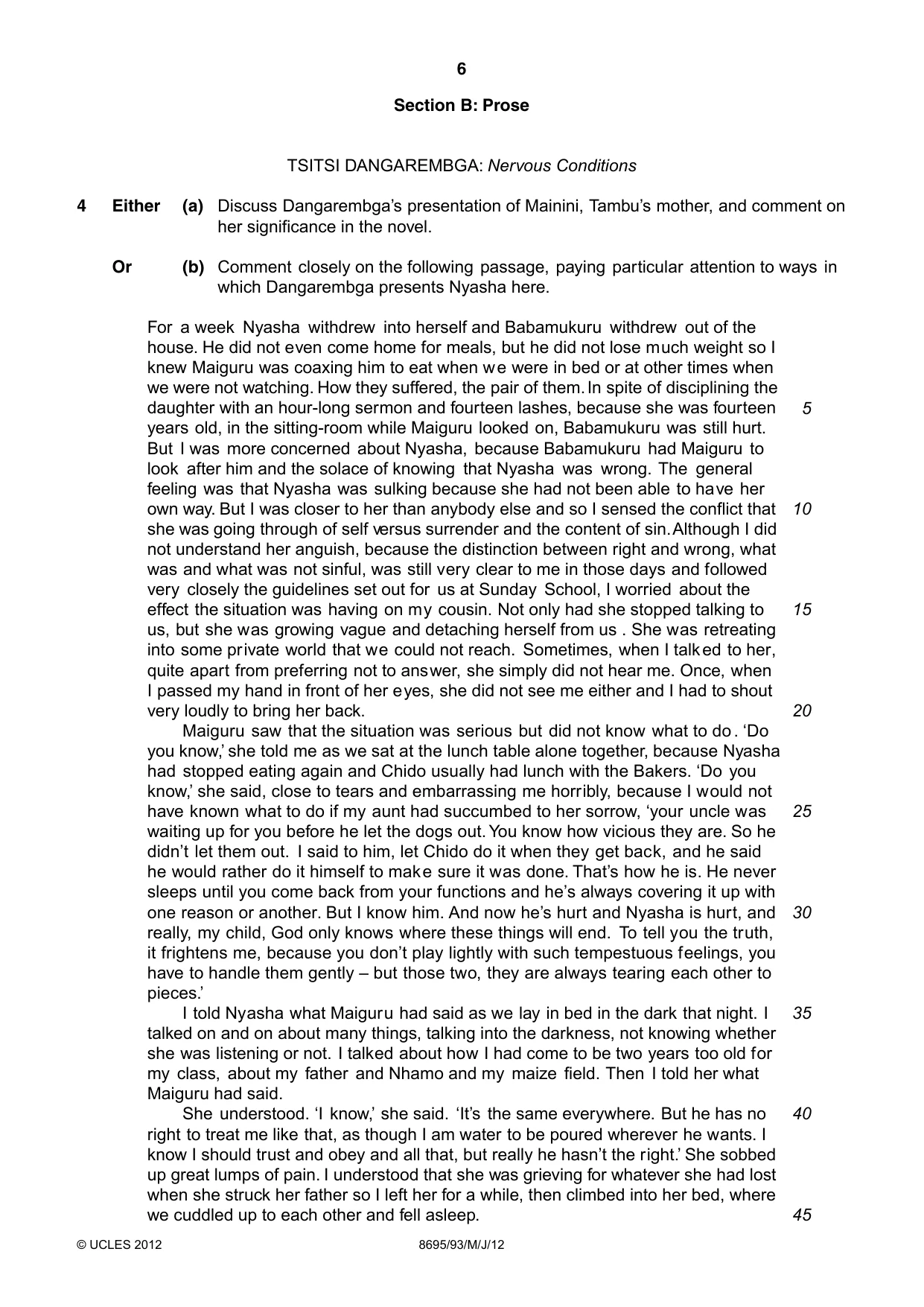
6 8695/93/M/J/12 © UCLES 2012 Section B: Prose TSITSI DANGAREMBGA: Nervous Conditions 4 Either (a) Discuss Dangarembga’s presentation of Mainini, Tambu’s mother, and comment on her significance in the novel. Or (b) Comment closely on the following passage, paying particular attention to ways in which Dangarembga presents Nyasha here. For a week Nyasha withdrew into herself and Babamukuru withdrew out of the house. He did not even come home for meals, but he did not lose much weight so I knew Maiguru was coaxing him to eat when we were in bed or at other times when we were not watching. How they suffered, the pair of them. In spite of disciplining the daughter with an hour-long sermon and fourteen lashes, because she was fourteen years old, in the sitting-room while Maiguru looked on, Babamukuru was still hurt. But I was more concerned about Nyasha, because Babamukuru had Maiguru to look after him and the solace of knowing that Nyasha was wrong. The general feeling was that Nyasha was sulking because she had not been able to have her own way. But I was closer to her than anybody else and so I sensed the conflict that she was going through of self versus surrender and the content of sin. Although I did not understand her anguish, because the distinction between right and wrong, what was and what was not sinful, was still very clear to me in those days and followed very closely the guidelines set out for us at Sunday School, I worried about the effect the situation was having on my cousin. Not only had she stopped talking to us, but she was growing vague and detaching herself from us . She was retreating into some private world that we could not reach. Sometimes, when I talked to her, quite apart from preferring not to answer, she simply did not hear me. Once, when I passed my hand in front of her eyes, she did not see me either and I had to shout very loudly to bring her back. Maiguru saw that the situation was serious but did not know what to do. ‘Do you know,’ she told me as we sat at the lunch table alone together, because Nyasha had stopped eating again and Chido usually had lunch with the Bakers. ‘Do you know,’ she said, close to tears and embarrassing me horribly, because I would not have known what to do if my aunt had succumbed to her sorrow, ‘your uncle was waiting up for you before he let the dogs out. You know how vicious they are. So he didn’t let them out. I said to him, let Chido do it when they get back, and he said he would rather do it himself to make sure it was done. That’s how he is. He never sleeps until you come back from your functions and he’s always covering it up with one reason or another. But I know him. And now he’s hurt and Nyasha is hurt, and really, my child, God only knows where these things will end. To tell you the truth, it frightens me, because you don’t play lightly with such tempestuous feelings, you have to handle them gently – but those two, they are always tearing each other to pieces.’ I told Nyasha what Maiguru had said as we lay in bed in the dark that night. I talked on and on about many things, talking into the darkness, not knowing whether she was listening or not. I talked about how I had come to be two years too old for my class, about my father and Nhamo and my maize field. Then I told her what Maiguru had said. She understood. ‘I know,’ she said. ‘It’s the same everywhere. But he has no right to treat me like that, as though I am water to be poured wherever he wants. I know I should trust and obey and all that, but really he hasn’t the right.’ She sobbed up great lumps of pain. I understood that she was grieving for whatever she had lost when she struck her father so I left her for a while, then climbed into her bed, where we cuddled up to each other and fell asleep. 5 10 15 20 25 30 35 40 45
Question paper, page 7
7 8695/93/M/J/12 © UCLES 2012 [Turn over Maiguru was not very pleased the next morning when she found us in bed together, but she could not mind that Nyasha was beginning to feel better and so nothing was said. I knew that Nyasha was all right because she said to me, with an attempt at her usual grin and typical exaggeration, ‘Thanks, Tambu. You saved my life.’ Chapter 6 50
Question paper, page 8
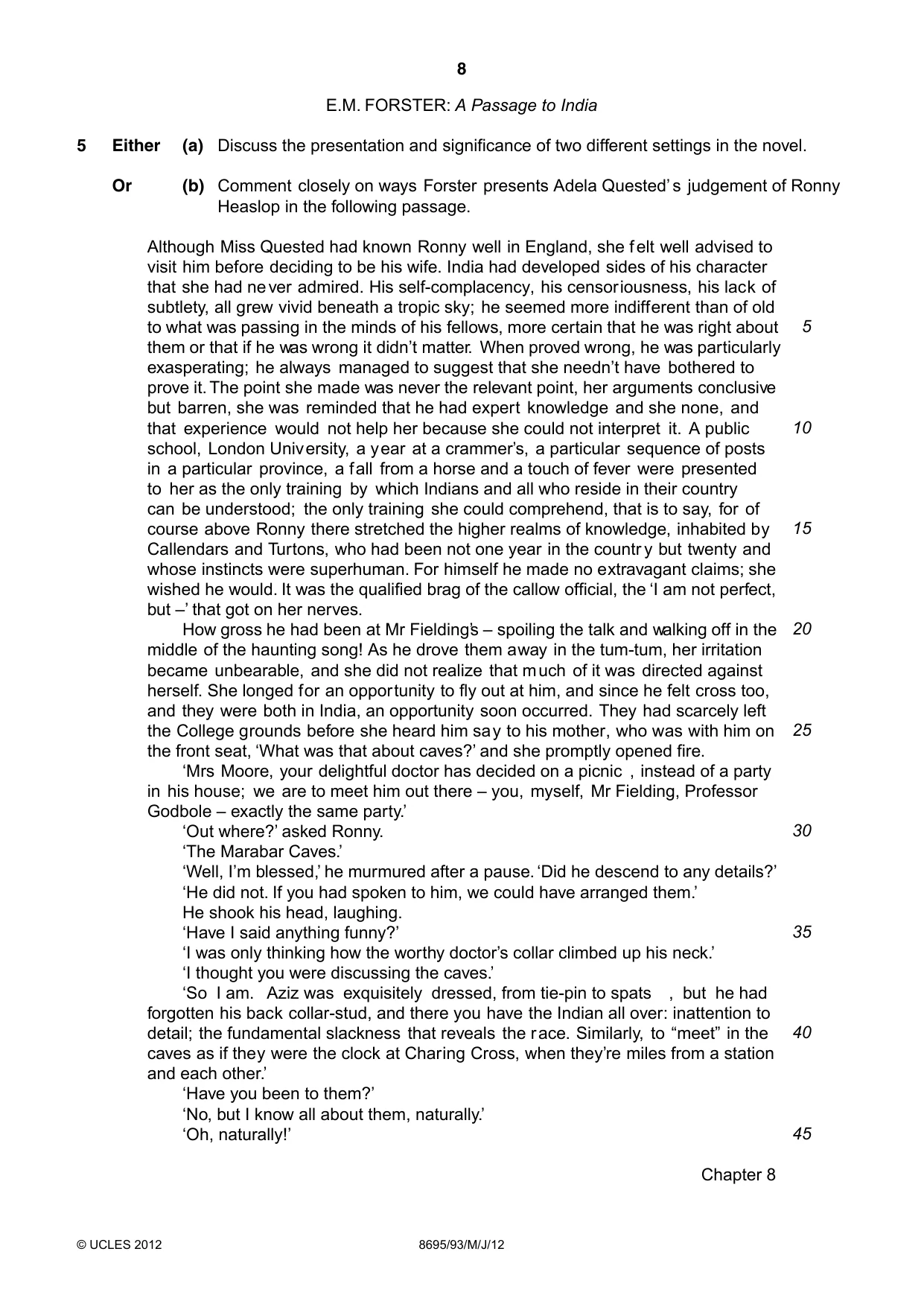
8 8695/93/M/J/12 © UCLES 2012 E.M. FORSTER: A Passage to India 5 Either (a) Discuss the presentation and significance of two different settings in the novel. Or (b) Comment closely on ways Forster presents Adela Quested’s judgement of Ronny Heaslop in the following passage. Although Miss Quested had known Ronny well in England, she felt well advised to visit him before deciding to be his wife. India had developed sides of his character that she had never admired. His self-complacency, his censoriousness, his lack of subtlety, all grew vivid beneath a tropic sky; he seemed more indifferent than of old to what was passing in the minds of his fellows, more certain that he was right about them or that if he was wrong it didn’t matter. When proved wrong, he was particularly exasperating; he always managed to suggest that she needn’t have bothered to prove it. The point she made was never the relevant point, her arguments conclusive but barren, she was reminded that he had expert knowledge and she none, and that experience would not help her because she could not interpret it. A public school, London University, a year at a crammer’s, a particular sequence of posts in a particular province, a fall from a horse and a touch of fever were presented to her as the only training by which Indians and all who reside in their country can be understood; the only training she could comprehend, that is to say, for of course above Ronny there stretched the higher realms of knowledge, inhabited by Callendars and Turtons, who had been not one year in the countr y but twenty and whose instincts were superhuman. For himself he made no extravagant claims; she wished he would. It was the qualified brag of the callow official, the ‘I am not perfect, but –’ that got on her nerves. How gross he had been at Mr Fielding’s – spoiling the talk and walking off in the middle of the haunting song! As he drove them away in the tum-tum, her irritation became unbearable, and she did not realize that much of it was directed against herself. She longed for an opportunity to fly out at him, and since he felt cross too, and they were both in India, an opportunity soon occurred. They had scarcely left the College grounds before she heard him say to his mother, who was with him on the front seat, ‘What was that about caves?’ and she promptly opened fire. ‘Mrs Moore, your delightful doctor has decided on a picnic , instead of a party in his house; we are to meet him out there – you, myself, Mr Fielding, Professor Godbole – exactly the same party.’ ‘Out where?’ asked Ronny. ‘The Marabar Caves.’ ‘Well, I’m blessed,’ he murmured after a pause. ‘Did he descend to any details?’ ‘He did not. If you had spoken to him, we could have arranged them.’ He shook his head, laughing. ‘Have I said anything funny?’ ‘I was only thinking how the worthy doctor’s collar climbed up his neck.’ ‘I thought you were discussing the caves.’ ‘So I am. Aziz was exquisitely dressed, from tie-pin to spats , but he had forgotten his back collar-stud, and there you have the Indian all over: inattention to detail; the fundamental slackness that reveals the race. Similarly, to “meet” in the caves as if they were the clock at Charing Cross, when they’re miles from a station and each other.’ ‘Have you been to them?’ ‘No, but I know all about them, naturally.’ ‘Oh, naturally!’ Chapter 8 5 10 15 20 25 30 35 40 45
Question paper, page 9
9 8695/93/M/J/12 © UCLES 2012 [Turn over Turn to page 10 for Question 6
Question paper, page 10
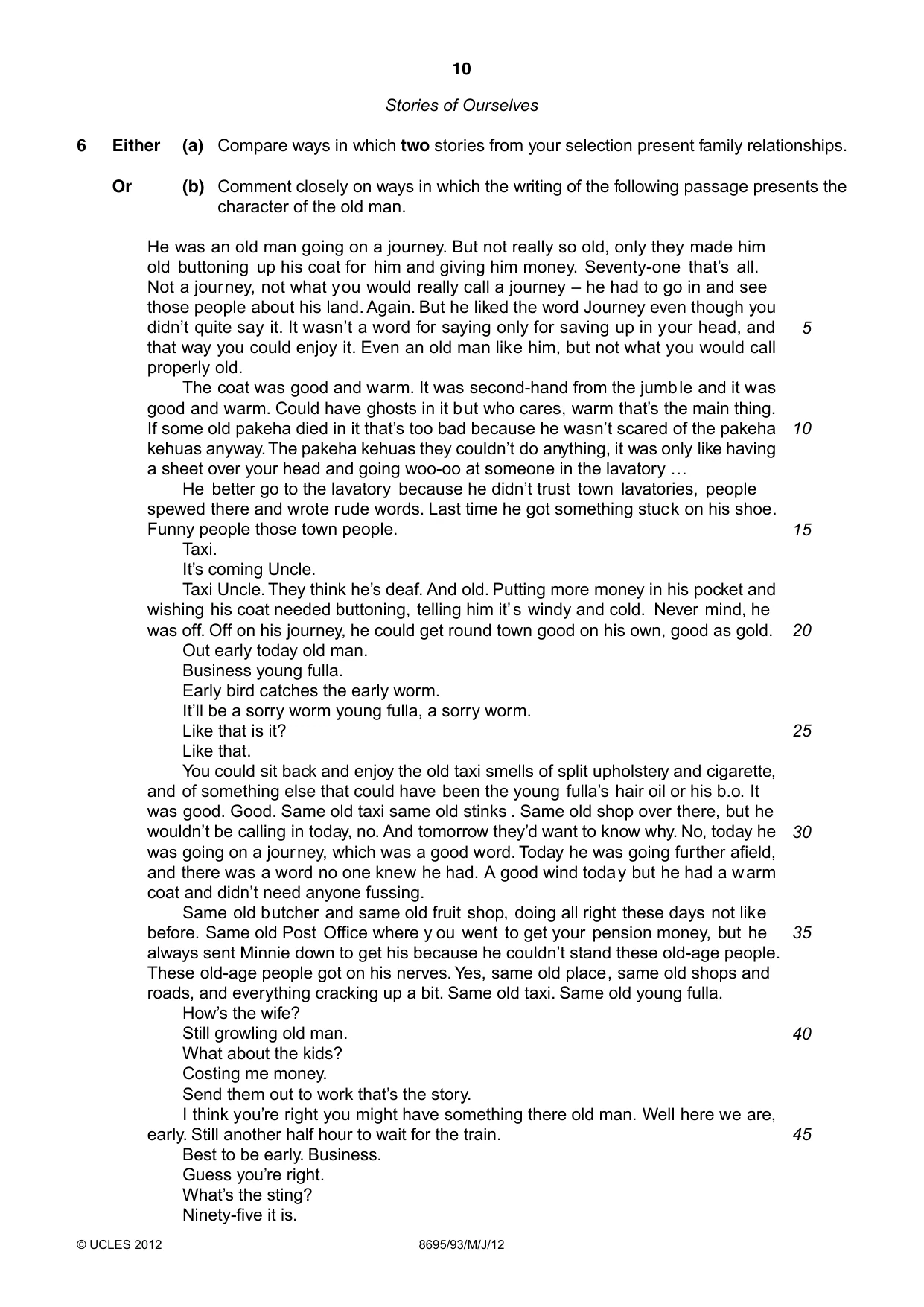
10 8695/93/M/J/12 © UCLES 2012 Stories of Ourselves 6 Either (a) Compare ways in which two stories from your selection present family relationships. Or (b) Comment closely on ways in which the writing of the following passage presents the character of the old man. He was an old man going on a journey. But not really so old, only they made him old buttoning up his coat for him and giving him money. Seventy-one that’s all. Not a journey, not what you would really call a journey – he had to go in and see those people about his land. Again. But he liked the word Journey even though you didn’t quite say it. It wasn’t a word for saying only for saving up in your head, and that way you could enjoy it. Even an old man like him, but not what you would call properly old. The coat was good and warm. It was second-hand from the jumble and it was good and warm. Could have ghosts in it but who cares, warm that’s the main thing. If some old pakeha died in it that’s too bad because he wasn’t scared of the pakeha kehuas anyway. The pakeha kehuas they couldn’t do anything, it was only like having a sheet over your head and going woo-oo at someone in the lavatory … He better go to the lavatory because he didn’t trust town lavatories, people spewed there and wrote rude words. Last time he got something stuck on his shoe. Funny people those town people. Taxi. It’s coming Uncle. Taxi Uncle. They think he’s deaf. And old. Putting more money in his pocket and wishing his coat needed buttoning, telling him it’s windy and cold. Never mind, he was off. Off on his journey, he could get round town good on his own, good as gold. Out early today old man. Business young fulla. Early bird catches the early worm. It’ll be a sorry worm young fulla, a sorry worm. Like that is it? Like that. You could sit back and enjoy the old taxi smells of split upholstery and cigarette, and of something else that could have been the young fulla’s hair oil or his b.o. It was good. Good. Same old taxi same old stinks . Same old shop over there, but he wouldn’t be calling in today, no. And tomorrow they’d want to know why. No, today he was going on a journey, which was a good word. Today he was going further afield, and there was a word no one knew he had. A good wind today but he had a warm coat and didn’t need anyone fussing. Same old butcher and same old fruit shop, doing all right these days not like before. Same old Post Office where y ou went to get your pension money, but he always sent Minnie down to get his because he couldn’t stand these old-age people. These old-age people got on his nerves. Yes, same old place, same old shops and roads, and everything cracking up a bit. Same old taxi. Same old young fulla. How’s the wife? Still growling old man. What about the kids? Costing me money. Send them out to work that’s the story. I think you’re right you might have something there old man. Well here we are, early. Still another half hour to wait for the train. Best to be early. Business. Guess you’re right. What’s the sting? Ninety-five it is. 5 10 15 20 25 30 35 40 45
Question paper, page 11
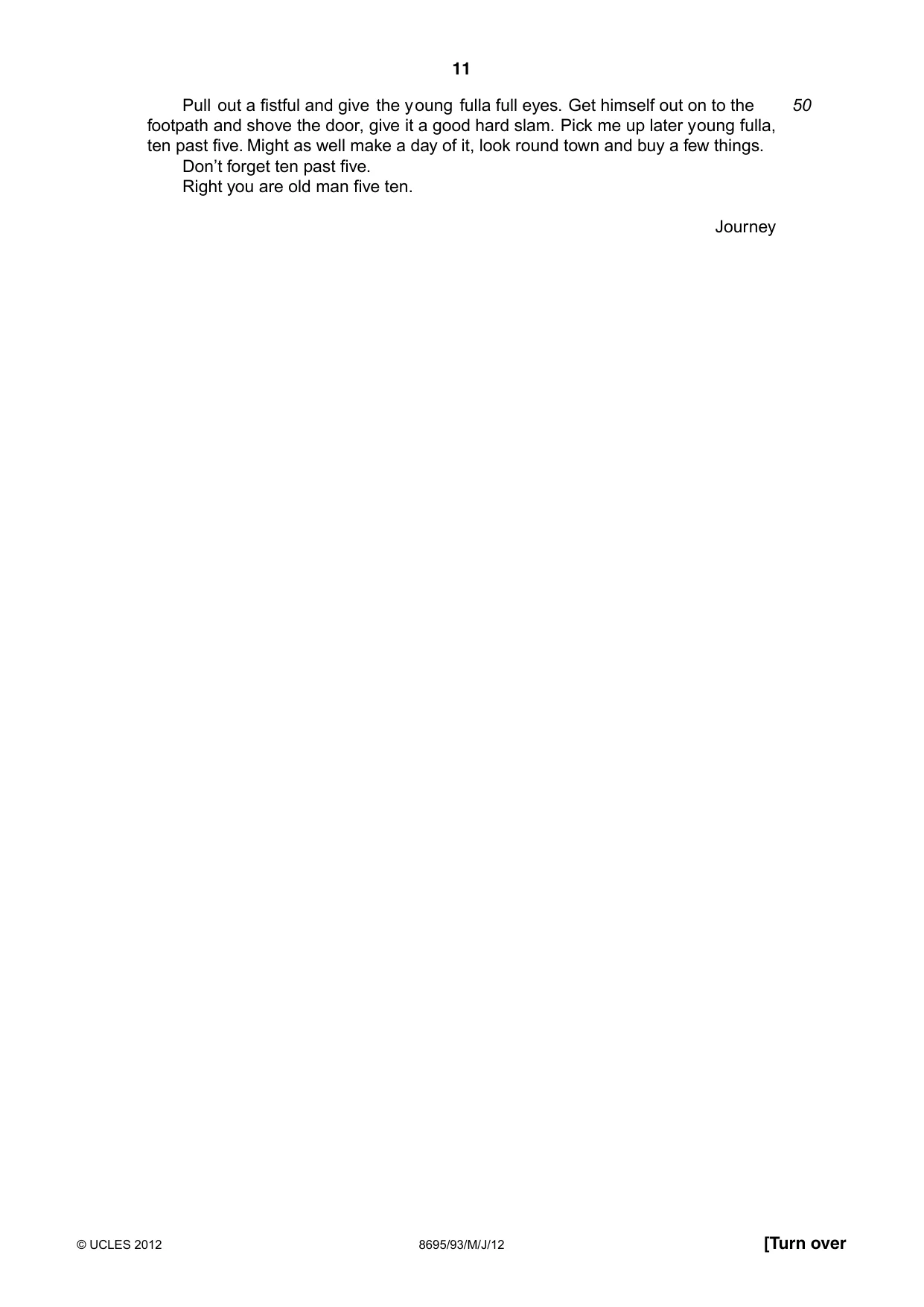
11 8695/93/M/J/12 © UCLES 2012 [Turn over Pull out a fistful and give the young fulla full eyes. Get himself out on to the footpath and shove the door, give it a good hard slam. Pick me up later young fulla, ten past five. Might as well make a day of it, look round town and buy a few things. Don’t forget ten past five. Right you are old man five ten. Journey 50
Question paper, page 12
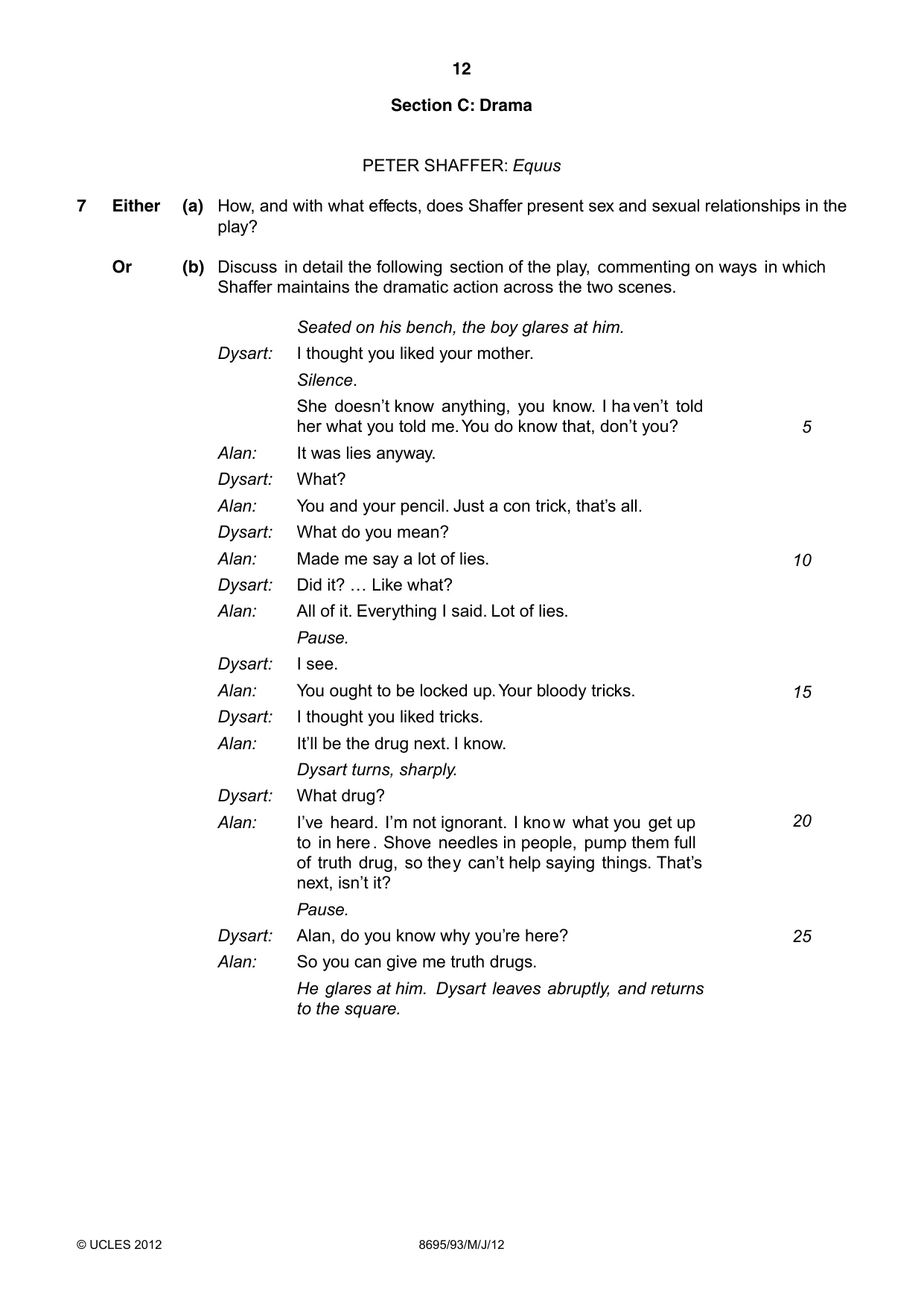
12 8695/93/M/J/12 © UCLES 2012 Section C: Drama PETER SHAFFER: Equus 7 Either (a) How, and with what effects, does Shaffer present sex and sexual relationships in the play? Or (b) Discuss in detail the following section of the play, commenting on ways in which Shaffer maintains the dramatic action across the two scenes. Seated on his bench, the boy glares at him. Dysart: I thought you liked your mother. Silence. She doesn’t know anything, you know. I haven’t told her what you told me. You do know that, don’t you? Alan: It was lies anyway. Dysart: What? Alan: You and your pencil. Just a con trick, that’s all. Dysart: What do you mean? Alan: Made me say a lot of lies. Dysart: Did it? … Like what? Alan: All of it. Everything I said. Lot of lies. Pause. Dysart: I see. Alan: You ought to be locked up. Your bloody tricks. Dysart: I thought you liked tricks. Alan: It’ll be the drug next. I know. Dysart turns, sharply. Dysart: What drug? Alan: I’ve heard. I’m not ignorant. I know what you get up to in here. Shove needles in people, pump them full of truth drug, so they can’t help saying things. That’s next, isn’t it? Pause. Dysart: Alan, do you know why you’re here? Alan: So you can give me truth drugs. He glares at him. Dysart leaves abruptly, and returns to the square. 5 10 15 20 25
Question paper, page 13
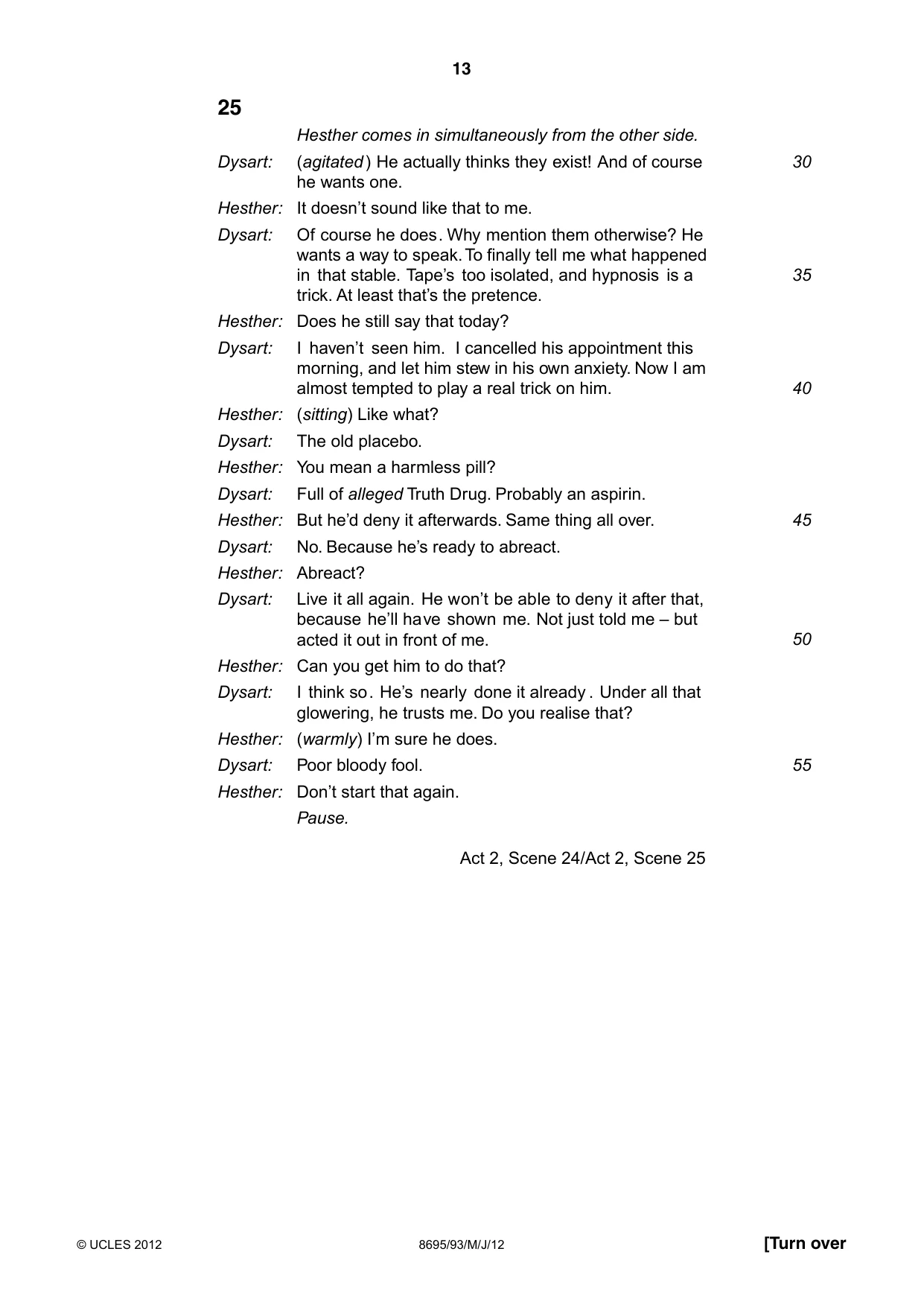
13 8695/93/M/J/12 © UCLES 2012 [Turn over 25 Hesther comes in simultaneously from the other side. Dysart: (agitated ) He actually thinks they exist! And of course he wants one. Hesther: It doesn’t sound like that to me. Dysart: Of course he does. Why mention them otherwise? He wants a way to speak. To finally tell me what happened in that stable. Tape’s too isolated, and hypnosis is a trick. At least that’s the pretence. Hesther: Does he still say that today? Dysart: I haven’t seen him. I cancelled his appointment this morning, and let him stew in his own anxiety. Now I am almost tempted to play a real trick on him. Hesther: (sitting) Like what? Dysart: The old placebo. Hesther: You mean a harmless pill? Dysart: Full of alleged Truth Drug. Probably an aspirin. Hesther: But he’d deny it afterwards. Same thing all over. Dysart: No. Because he’s ready to abreact. Hesther: Abreact? Dysart: Live it all again. He won’t be able to deny it after that, because he’ll have shown me. Not just told me – but acted it out in front of me. Hesther: Can you get him to do that? Dysart: I think so. He’s nearly done it already . Under all that glowering, he trusts me. Do you realise that? Hesther: (warmly) I’m sure he does. Dysart: Poor bloody fool. Hesther: Don’t start that again. Pause. Act 2, Scene 24/Act 2, Scene 25 30 35 40 45 50 55
Question paper, page 14
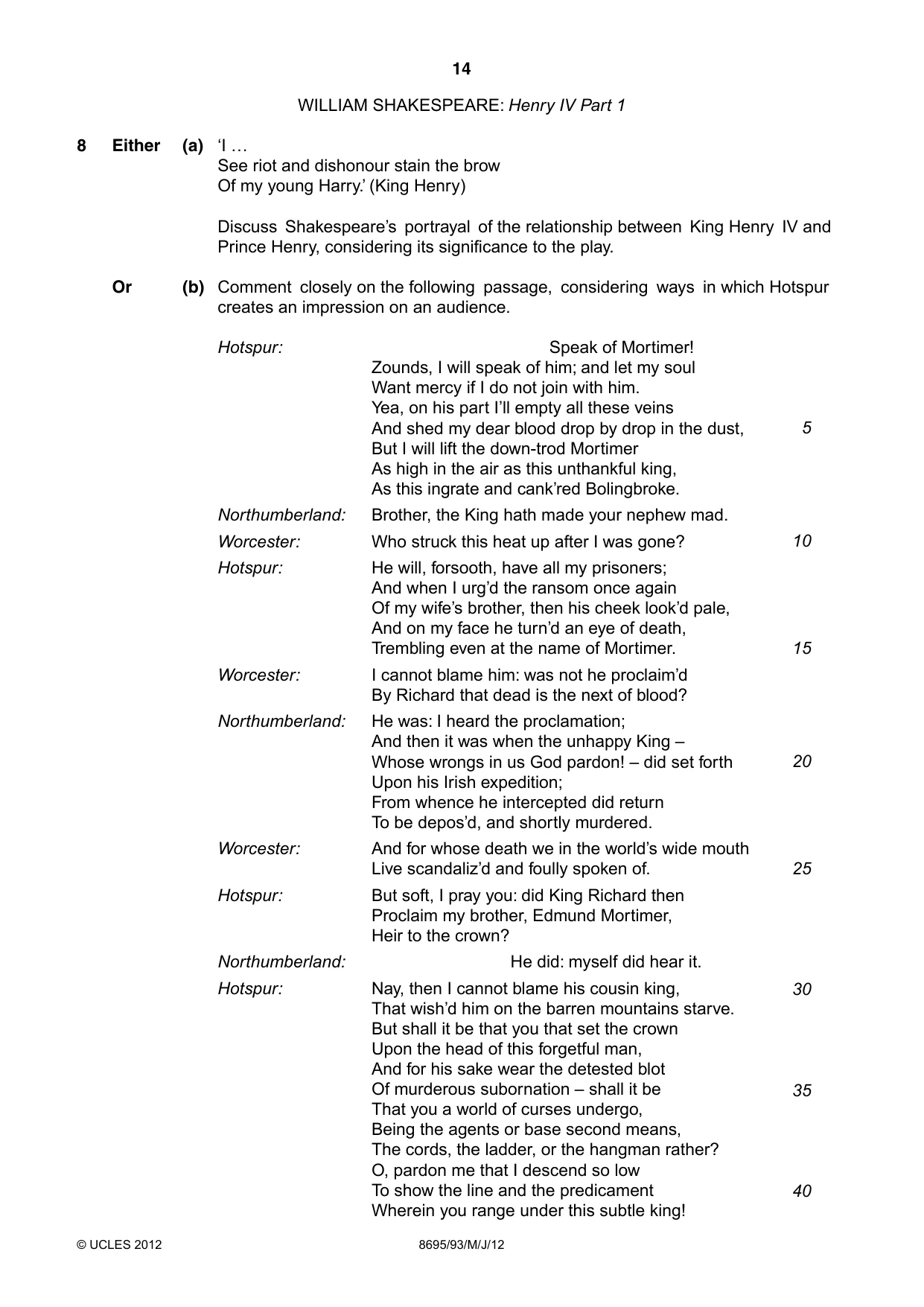
14 8695/93/M/J/12 © UCLES 2012 WILLIAM SHAKESPEARE: Henry IV Part 1 8 Either (a) ‘I … See riot and dishonour stain the brow Of my young Harry.’ (King Henry) Discuss Shakespeare’s portrayal of the relationship between King Henry IV and Prince Henry, considering its significance to the play. Or (b) Comment closely on the following passage, considering ways in which Hotspur creates an impression on an audience. Hotspur: Speak of Mortimer! Zounds, I will speak of him; and let my soul Want mercy if I do not join with him. Yea, on his part I’ll empty all these veins And shed my dear blood drop by drop in the dust, But I will lift the down-trod Mortimer As high in the air as this unthankful king, As this ingrate and cank’red Bolingbroke. Northumberland: Brother, the King hath made your nephew mad. Worcester: Who struck this heat up after I was gone? Hotspur: He will, forsooth, have all my prisoners; And when I urg’d the ransom once again Of my wife’s brother, then his cheek look’d pale, And on my face he turn’d an eye of death, Trembling even at the name of Mortimer. Worcester: I cannot blame him: was not he proclaim’d By Richard that dead is the next of blood? Northumberland: He was: I heard the proclamation; And then it was when the unhappy King – Whose wrongs in us God pardon! – did set forth Upon his Irish expedition; From whence he intercepted did return To be depos’d, and shortly murdered. Worcester: And for whose death we in the world’s wide mouth Live scandaliz’d and foully spoken of. Hotspur: But soft, I pray you: did King Richard then Proclaim my brother, Edmund Mortimer, Heir to the crown? Northumberland: He did: myself did hear it. Hotspur: Nay, then I cannot blame his cousin king, That wish’d him on the barren mountains starve. But shall it be that you that set the crown Upon the head of this forgetful man, And for his sake wear the detested blot Of murderous subornation – shall it be That you a world of curses undergo, Being the agents or base second means, The cords, the ladder, or the hangman rather? O, pardon me that I descend so low To show the line and the predicament Wherein you range under this subtle king! 5 10 15 20 25 30 35 40
Question paper, page 15
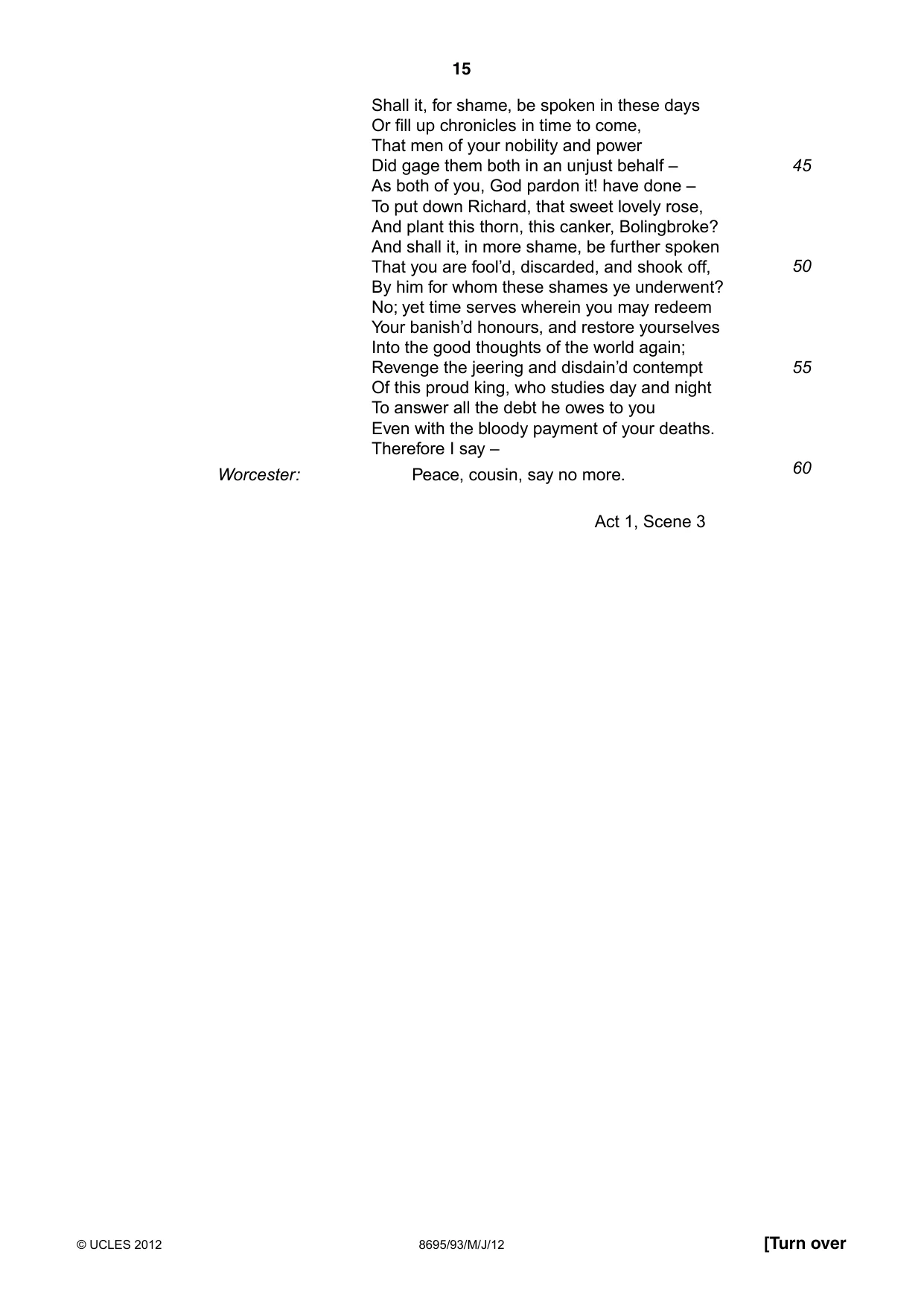
15 8695/93/M/J/12 © UCLES 2012 [Turn over Shall it, for shame, be spoken in these days Or fill up chronicles in time to come, That men of your nobility and power Did gage them both in an unjust behalf – As both of you, God pardon it! have done – To put down Richard, that sweet lovely rose, And plant this thorn, this canker, Bolingbroke? And shall it, in more shame, be further spoken That you are fool’d, discarded, and shook off, By him for whom these shames ye underwent? No; yet time serves wherein you may redeem Your banish’d honours, and restore yourselves Into the good thoughts of the world again; Revenge the jeering and disdain’d contempt Of this proud king, who studies day and night To answer all the debt he owes to you Even with the bloody payment of your deaths. Therefore I say – Worcester: Peace, cousin, say no more. Act 1, Scene 3 45 50 55 60
Question paper, page 16
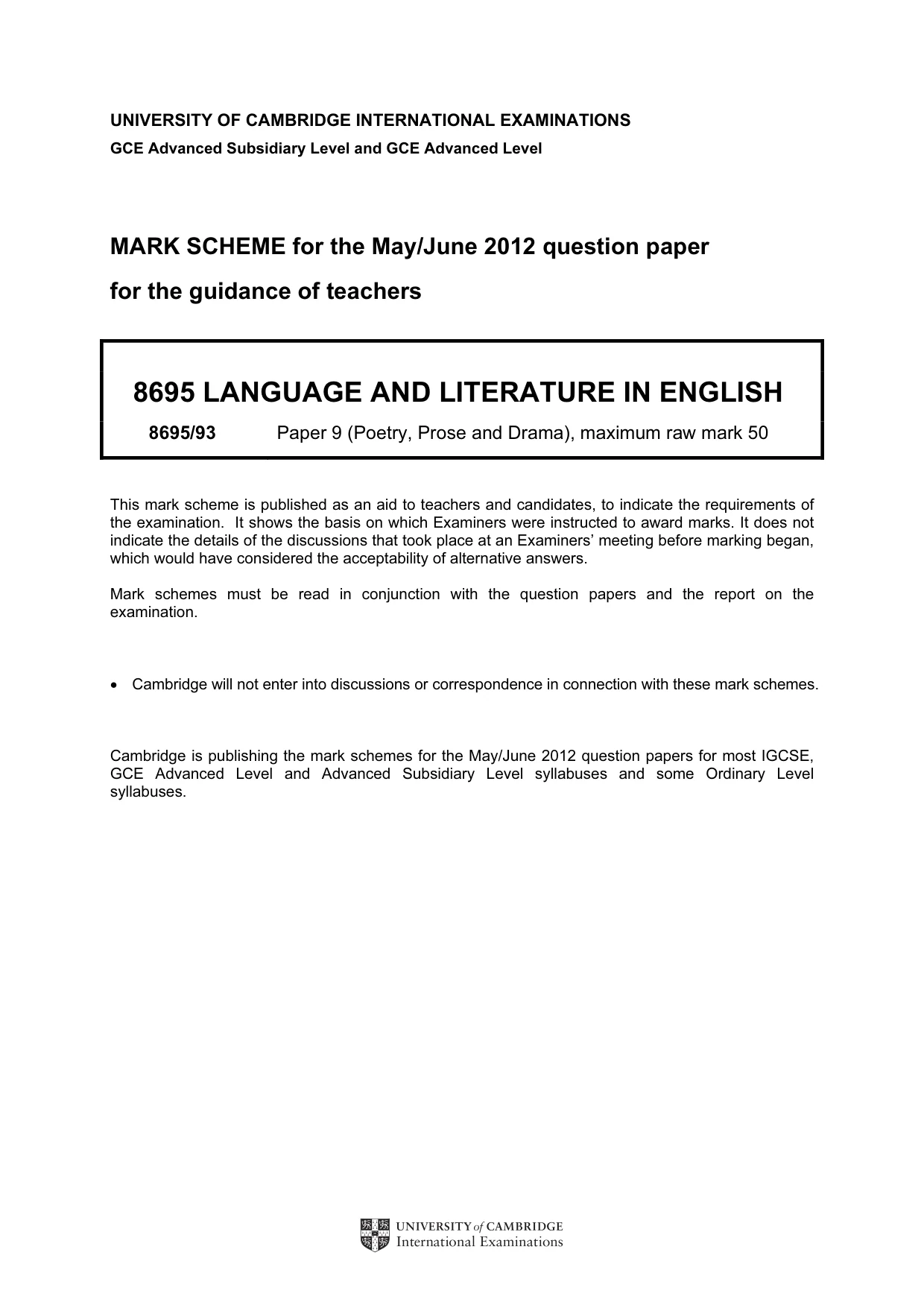
16 8695/93/M/J/12 © UCLES 2012 TENNESSEE WILLIAMS: A Streetcar Named Desire 9 Either (a) Discuss the contribution made to the play by Williams’s use of minor characters. Or (b) Comment closely on w ays the following passage presents Stella’s and Stanley’s different attitudes to Blanche. [STANLEY enters the kitchen from outside, leaving the door open on the perpetual ‘blue piano’ around the corner.] Content removed due to copyright restrictions. Stella: There weren’t any papers, she didn’t show any papers, I don’t care about papers. Scene 2
Question paper, page 17
20 8695/93/M/J/12 © UCLES 2012 BLANK PAGE Copyright Acknowledgements: Question 2b © Seamus Heaney; Poet to Blacksmith from District and Circle; Faber & Faber Ltd; 2006. Question 3b © Grace Nichols; Praise Song for My Mother from Songs of Ourselves; Foundation Books; 2005. Question 4b © Tsitsi Dangarembga; Nervous Conditions; Ayebia Publishing; 1988. Question 5b © E.M. Forster; A Passage to India; Penguin Books Ltd; 1979. Reprinted by permission of The Provost and Scholars of King's College. Cambridge. Question 6b © Patricia Grace; Journey from Stories of Ourselves; Cambridge University Press; 2008. Question 7b Peter Shaffer; Equus; Longman; 1993. Question 9b A Streetcar Named Desire by Tennessee Williams; Copyright © 1947 by The University of The South. Published by Penguin Books Ltd; 1983; Reprinted by permission of New Directions Publishing Corp. and Georges Bordchardt Inc. for The Estate of Tennessee Williams. Permission to reproduce items where third-party owned material protected by copyright is included has been sought and cleared where possible. Every reasonable effort has been made by the publisher (UCLES) to trace copyright holders, but if any items requiring clearance have unwittingly been included, the publisher will be pleased to make amends at the earliest possible opportunity.University of Cambridge International Examinations is part of the Cambridge Assessment Group. Cambridge Local Examinations Syndicate (UCLES), which is itself a department of the University of Cambridge.
Mark scheme, page 1
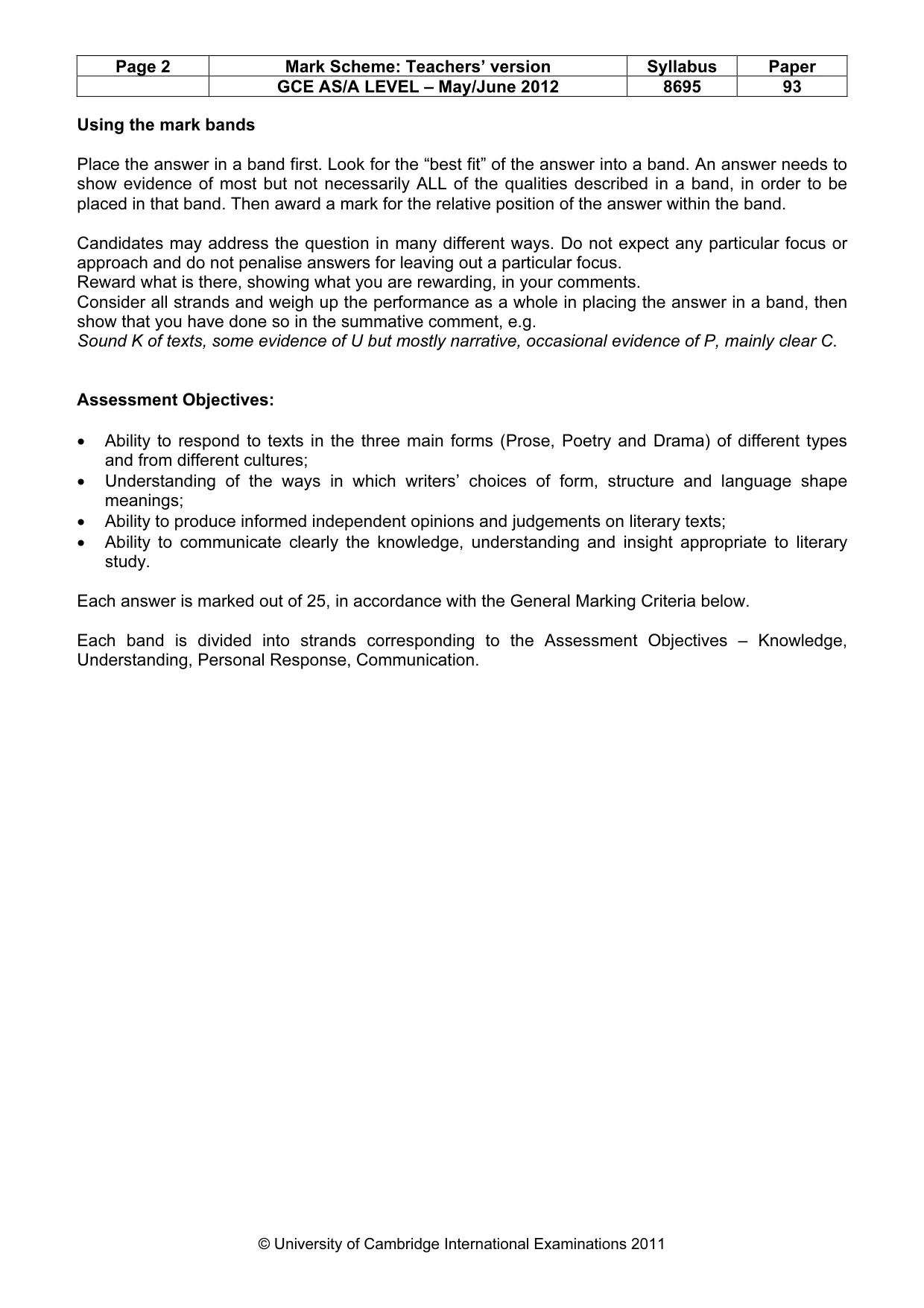
UNIVERSITY OF CAMBRIDGE INTERNATIONAL EXAMINATIONS GCE Advanced Subsidiary Level and GCE Advanced Level MARK SCHEME for the May/June 2012 question paper for the guidance of teachers 8695 LANGUAGE AND LITERATURE IN ENGLISH 8695/93 Paper 9 (Poetry, Prose and Drama), maximum raw mark 50 This mark scheme is published as an aid to teachers and candidates, to indicate the requirements of the examination. It shows the basis on which Examiners were instructed to award marks. It does not indicate the details of the discussions that took place at an Examiners’ meeting before marking began, which would have considered the acceptability of alternative answers. Mark schemes must be read in conjunction with the question papers and the report on the examination. • Cambridge will not enter into discussions or correspondence in connection with these mark schemes. Cambridge is publishing the mark schemes for the May/June 2012 question papers for most IGCSE, GCE Advanced Level and Advanced Subsidiary Level syllabuses and some Ordinary Level syllabuses.
Mark scheme, page 2
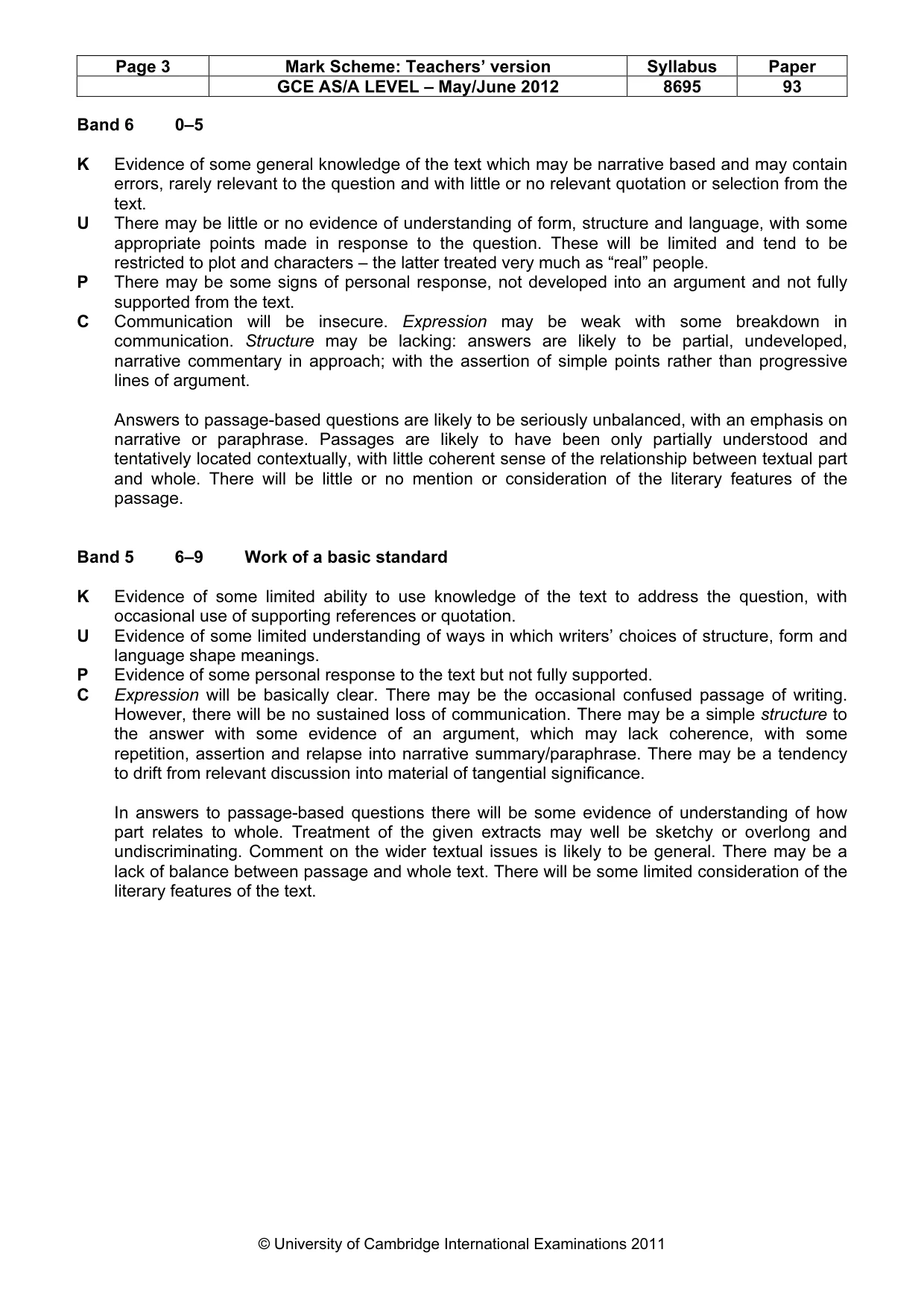
Page 2 Mark Scheme: Teachers’ version Syllabus Paper GCE AS/A LEVEL – May/June 2012 8695 93 © University of Cambridge International Examinations 2011 Using the mark bands Place the answer in a band first. Look for the “best fit” of the answer into a band. An answer needs to show evidence of most but not necessarily ALL of the qualities described in a band, in order to be placed in that band. Then award a mark for the relative position of the answer within the band. Candidates may address the question in many different ways. Do not expect any particular focus or approach and do not penalise answers for leaving out a particular focus. Reward what is there, showing what you are rewarding, in your comments. Consider all strands and weigh up the performance as a whole in placing the answer in a band, then show that you have done so in the summative comment, e.g. Sound K of texts, some evidence of U but mostly narrative, occasional evidence of P, mainly clear C. Assessment Objectives: • Ability to respond to texts in the three main forms (Prose, Poetry and Drama) of different types and from different cultures; • Understanding of the ways in which writers’ choices of form, structure and language shape meanings; • Ability to produce informed independent opinions and judgements on literary texts; • Ability to communicate clearly the knowledge, understanding and insight appropriate to literary study. Each answer is marked out of 25, in accordance with the General Marking Criteria below. Each band is divided into strands corresponding to the Assessment Objectives – Knowledge, Understanding, Personal Response, Communication.
Mark scheme, page 3
Page 3 Mark Scheme: Teachers’ version Syllabus Paper GCE AS/A LEVEL – May/June 2012 8695 93 © University of Cambridge International Examinations 2011 Band 6 0–5 K Evidence of some general knowledge of the text which may be narrative based and may contain errors, rarely relevant to the question and with little or no relevant quotation or selection from the text. U There may be little or no evidence of understanding of form, structure and language, with some appropriate points made in response to the question. These will be limited and tend to be restricted to plot and characters – the latter treated very much as “real” people. P There may be some signs of personal response, not developed into an argument and not fully supported from the text. C Communication will be insecure. Expression may be weak with some breakdown in communication. Structure may be lacking: answers are likely to be partial, undeveloped, narrative commentary in approach; with the assertion of simple points rather than progressive lines of argument. Answers to passage-based questions are likely to be seriously unbalanced, with an emphasis on narrative or paraphrase. Passages are likely to have been only partially understood and tentatively located contextually, with little coherent sense of the relationship between textual part and whole. There will be little or no mention or consideration of the literary features of the passage. Band 5 6–9 Work of a basic standard K Evidence of some limited ability to use knowledge of the text to address the question, with occasional use of supporting references or quotation. U Evidence of some limited understanding of ways in which writers’ choices of structure, form and language shape meanings. P Evidence of some personal response to the text but not fully supported. C Expression will be basically clear. There may be the occasional confused passage of writing. However, there will be no sustained loss of communication. There may be a simple structure to the answer with some evidence of an argument, which may lack coherence, with some repetition, assertion and relapse into narrative summary/paraphrase. There may be a tendency to drift from relevant discussion into material of tangential significance. In answers to passage-based questions there will be some evidence of understanding of how part relates to whole. Treatment of the given extracts may well be sketchy or overlong and undiscriminating. Comment on the wider textual issues is likely to be general. There may be a lack of balance between passage and whole text. There will be some limited consideration of the literary features of the text.
Mark scheme, page 4
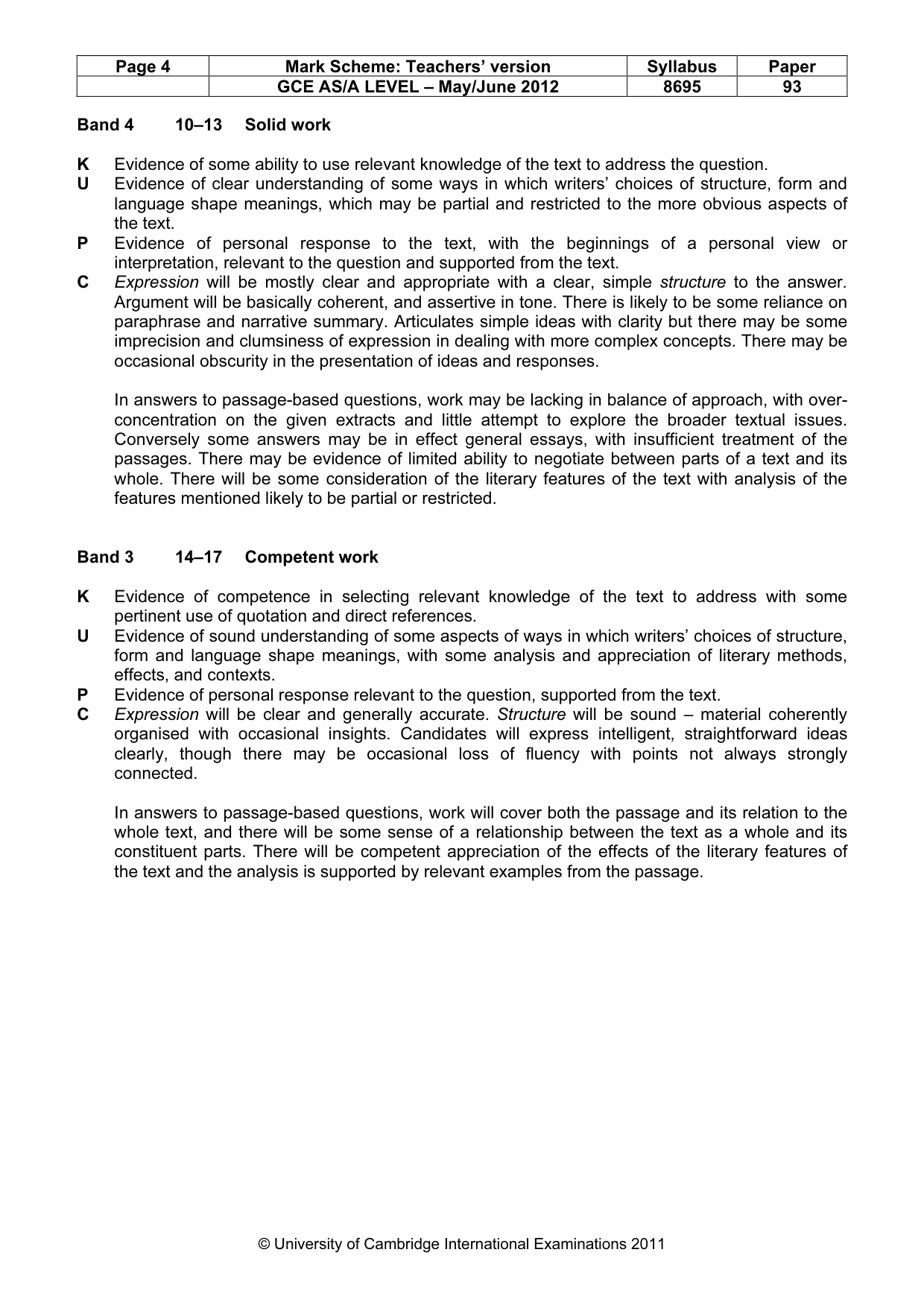
Page 4 Mark Scheme: Teachers’ version Syllabus Paper GCE AS/A LEVEL – May/June 2012 8695 93 © University of Cambridge International Examinations 2011 Band 4 10–13 Solid work K Evidence of some ability to use relevant knowledge of the text to address the question. U Evidence of clear understanding of some ways in which writers’ choices of structure, form and language shape meanings, which may be partial and restricted to the more obvious aspects of the text. P Evidence of personal response to the text, with the beginnings of a personal view or interpretation, relevant to the question and supported from the text. C Expression will be mostly clear and appropriate with a clear, simple structure to the answer. Argument will be basically coherent, and assertive in tone. There is likely to be some reliance on paraphrase and narrative summary. Articulates simple ideas with clarity but there may be some imprecision and clumsiness of expression in dealing with more complex concepts. There may be occasional obscurity in the presentation of ideas and responses. In answers to passage-based questions, work may be lacking in balance of approach, with over- concentration on the given extracts and little attempt to explore the broader textual issues. Conversely some answers may be in effect general essays, with insufficient treatment of the passages. There may be evidence of limited ability to negotiate between parts of a text and its whole. There will be some consideration of the literary features of the text with analysis of the features mentioned likely to be partial or restricted. Band 3 14–17 Competent work K Evidence of competence in selecting relevant knowledge of the text to address with some pertinent use of quotation and direct references. U Evidence of sound understanding of some aspects of ways in which writers’ choices of structure, form and language shape meanings, with some analysis and appreciation of literary methods, effects, and contexts. P Evidence of personal response relevant to the question, supported from the text. C Expression will be clear and generally accurate. Structure will be sound – material coherently organised with occasional insights. Candidates will express intelligent, straightforward ideas clearly, though there may be occasional loss of fluency with points not always strongly connected. In answers to passage-based questions, work will cover both the passage and its relation to the whole text, and there will be some sense of a relationship between the text as a whole and its constituent parts. There will be competent appreciation of the effects of the literary features of the text and the analysis is supported by relevant examples from the passage.
Mark scheme, page 5
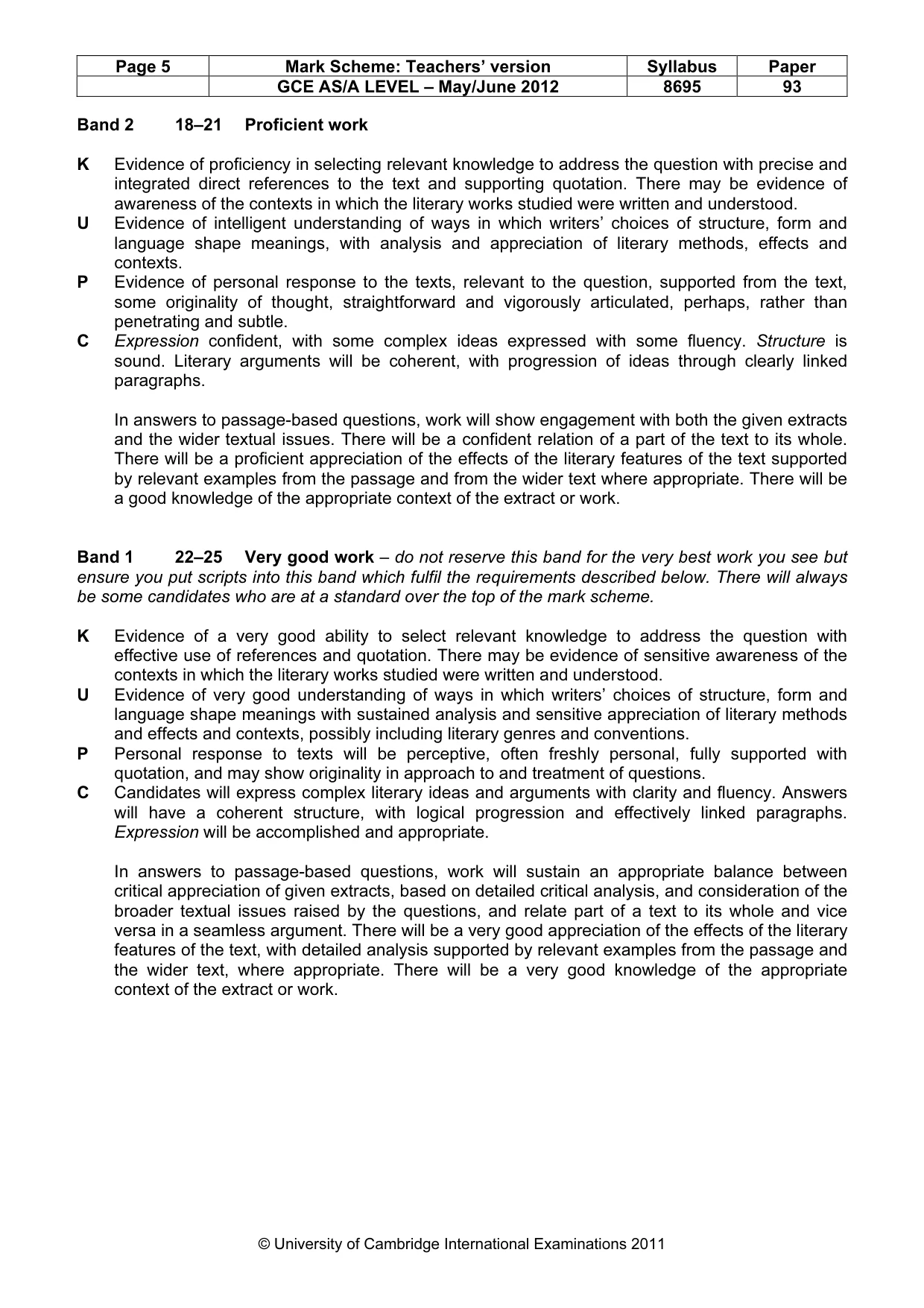
Page 5 Mark Scheme: Teachers’ version Syllabus Paper GCE AS/A LEVEL – May/June 2012 8695 93 © University of Cambridge International Examinations 2011 Band 2 18–21 Proficient work K Evidence of proficiency in selecting relevant knowledge to address the question with precise and integrated direct references to the text and supporting quotation. There may be evidence of awareness of the contexts in which the literary works studied were written and understood. U Evidence of intelligent understanding of ways in which writers’ choices of structure, form and language shape meanings, with analysis and appreciation of literary methods, effects and contexts. P Evidence of personal response to the texts, relevant to the question, supported from the text, some originality of thought, straightforward and vigorously articulated, perhaps, rather than penetrating and subtle. C Expression confident, with some complex ideas expressed with some fluency. Structure is sound. Literary arguments will be coherent, with progression of ideas through clearly linked paragraphs. In answers to passage-based questions, work will show engagement with both the given extracts and the wider textual issues. There will be a confident relation of a part of the text to its whole. There will be a proficient appreciation of the effects of the literary features of the text supported by relevant examples from the passage and from the wider text where appropriate. There will be a good knowledge of the appropriate context of the extract or work. Band 1 22–25 Very good work – do not reserve this band for the very best work you see but ensure you put scripts into this band which fulfil the requirements described below. There will always be some candidates who are at a standard over the top of the mark scheme. K Evidence of a very good ability to select relevant knowledge to address the question with effective use of references and quotation. There may be evidence of sensitive awareness of the contexts in which the literary works studied were written and understood. U Evidence of very good understanding of ways in which writers’ choices of structure, form and language shape meanings with sustained analysis and sensitive appreciation of literary methods and effects and contexts, possibly including literary genres and conventions. P Personal response to texts will be perceptive, often freshly personal, fully supported with quotation, and may show originality in approach to and treatment of questions. C Candidates will express complex literary ideas and arguments with clarity and fluency. Answers will have a coherent structure, with logical progression and effectively linked paragraphs. Expression will be accomplished and appropriate. In answers to passage-based questions, work will sustain an appropriate balance between critical appreciation of given extracts, based on detailed critical analysis, and consideration of the broader textual issues raised by the questions, and relate part of a text to its whole and vice versa in a seamless argument. There will be a very good appreciation of the effects of the literary features of the text, with detailed analysis supported by relevant examples from the passage and the wider text, where appropriate. There will be a very good knowledge of the appropriate context of the extract or work.
What you needed in this session
Cambridge’s own grade thresholds for 2012 May/June, Paper 9 · Variant 3. A higher threshold means an easier paper — the bar moves with how the cohort did.