Cambridge A Level English - Language and Literature (AS Level only, from 2016) 8695 — 2012 May/June Paper 9 · Variant 1
8695/91/M/J/12 · 50 marks · ≈56 min
The question paper and its mark scheme, free to read here and free to download. This is Cambridge’s own paper, exactly as it was sat.
Question paper17 pages

Mark scheme5 pages
Answers below. Sit the paper first if you are practising.
Paper as text
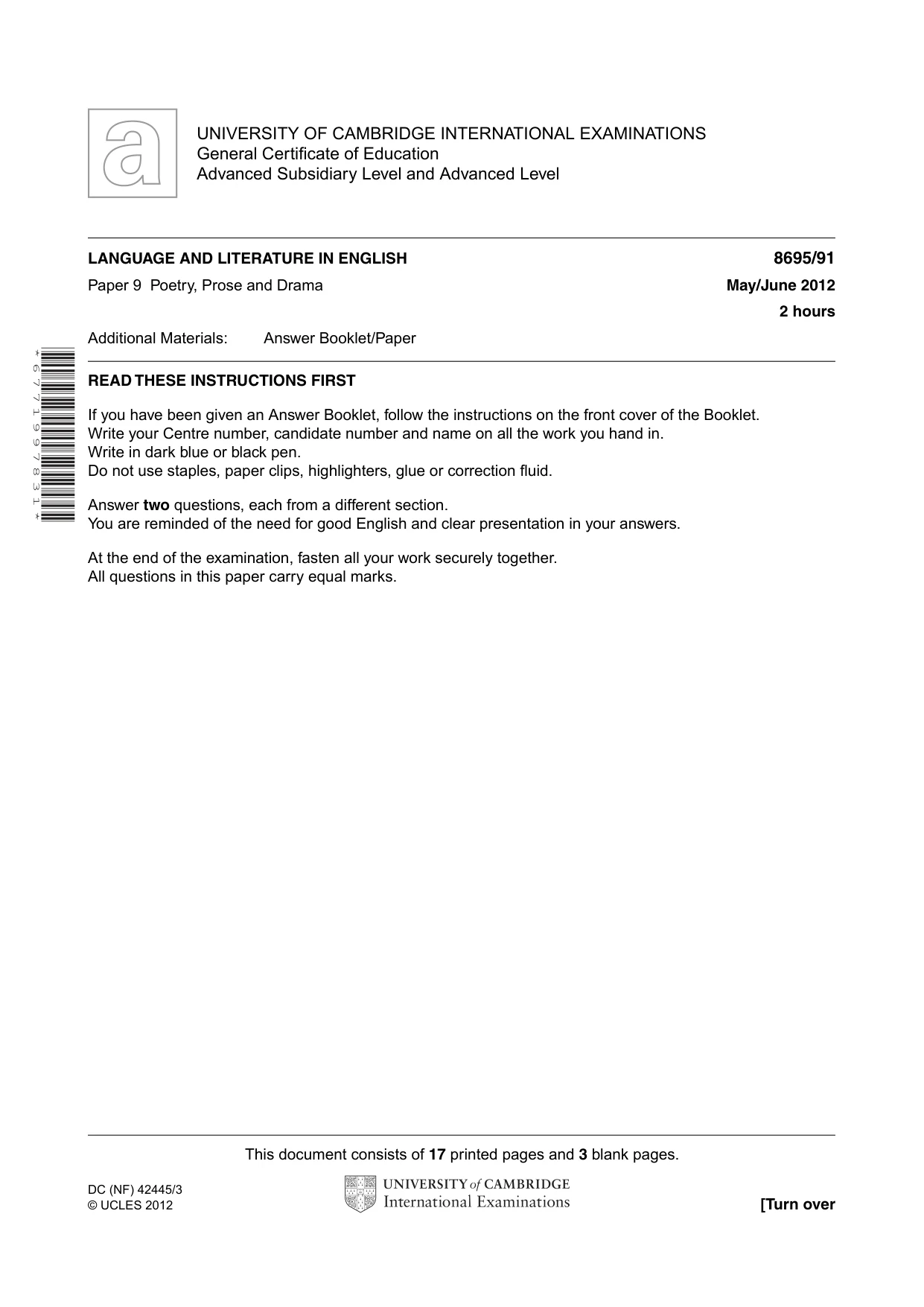
Question paper, page 1
This document consists of 17 printed pages and 3 blank pages. DC (NF) 42445/3 © UCLES 2012 [Turn over UNIVERSITY OF CAMBRIDGE INTERNATIONAL EXAMINATIONS General Certificate of Education Advanced Subsidiary Level and Advanced Level * 6 7 7 1 9 9 7 8 3 1 * LANGUAGE AND LITERATURE IN ENGLISH 8695/91 Paper 9 Poetry, Prose and Drama May/June 2012 2 hours Additional Materials: Answer Booklet/Paper READ THESE INSTRUCTIONS FIRST If you have been given an Answer Booklet, follow the instructions on the front cover of the Booklet. Write your Centre number, candidate number and name on all the work you hand in. Write in dark blue or black pen. Do not use staples, paper clips, highlighters, glue or correction fluid. Answer two questions, each from a different section. You are reminded of the need for good English and clear presentation in your answers. At the end of the examination, fasten all your work securely together. All questions in this paper carry equal marks.
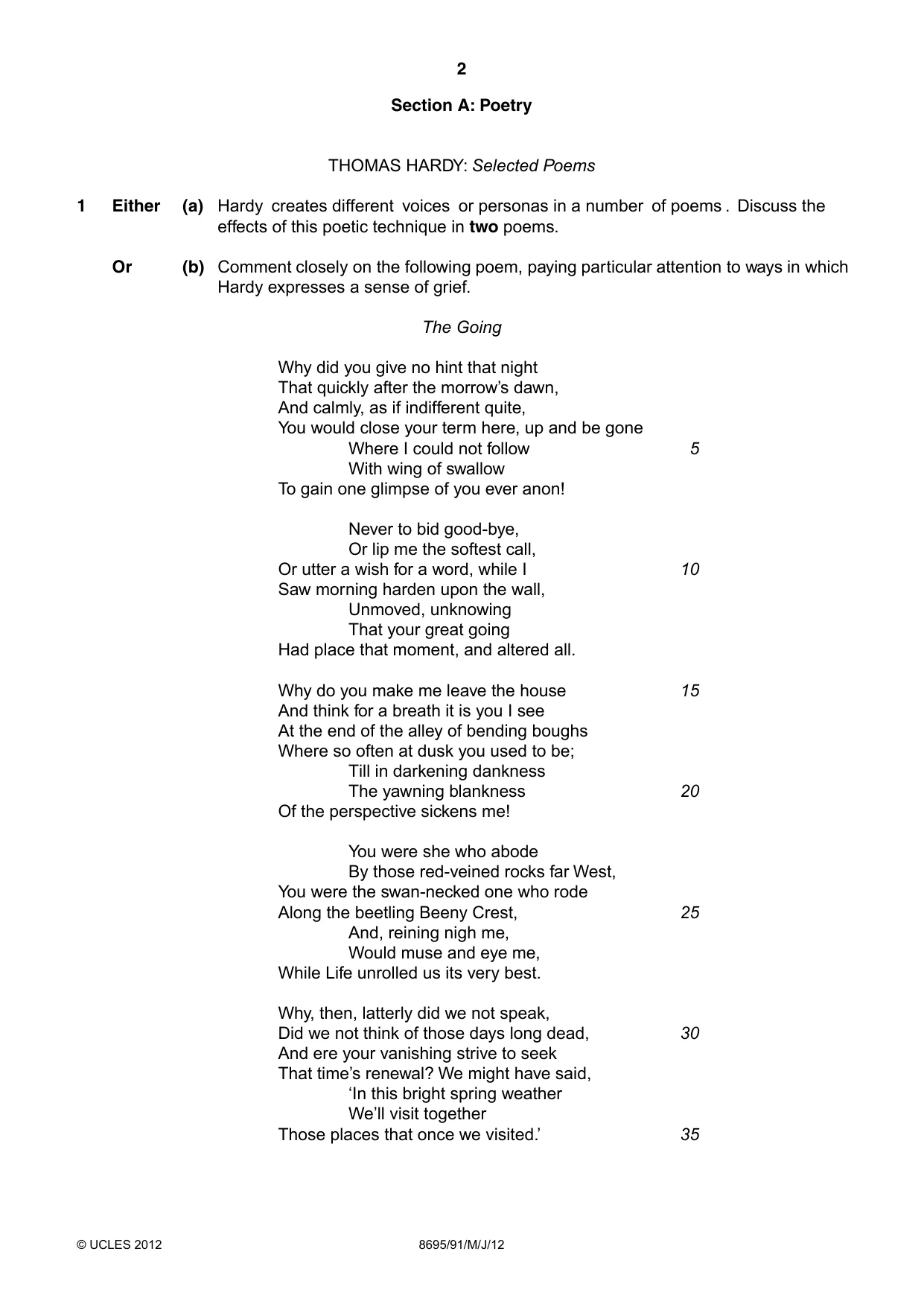
Question paper, page 2
2 8695/91/M/J/12 © UCLES 2012 Section A: Poetry THOMAS HARDY: Selected Poems 1 Either (a) Hardy creates different voices or personas in a number of poems . Discuss the effects of this poetic technique in two poems. Or (b) Comment closely on the following poem, paying particular attention to ways in which Hardy expresses a sense of grief. The Going Why did you give no hint that night That quickly after the morrow’s dawn, And calmly, as if indifferent quite, You would close your term here, up and be gone Where I could not follow 5 With wing of swallow To gain one glimpse of you ever anon! Never to bid good-bye, Or lip me the softest call, Or utter a wish for a word, while I 10 Saw morning harden upon the wall, Unmoved, unknowing That your great going Had place that moment, and altered all. Why do you make me leave the house 15 And think for a breath it is you I see At the end of the alley of bending boughs Where so often at dusk you used to be; Till in darkening dankness The yawning blankness 20 Of the perspective sickens me! You were she who abode By those red-veined rocks far West, You were the swan-necked one who rode Along the beetling Beeny Crest, 25 And, reining nigh me, Would muse and eye me, While Life unrolled us its very best. Why, then, latterly did we not speak, Did we not think of those days long dead, 30 And ere your vanishing strive to seek That time’s renewal? We might have said, ‘In this bright spring weather We’ll visit together Those places that once we visited.’ 35
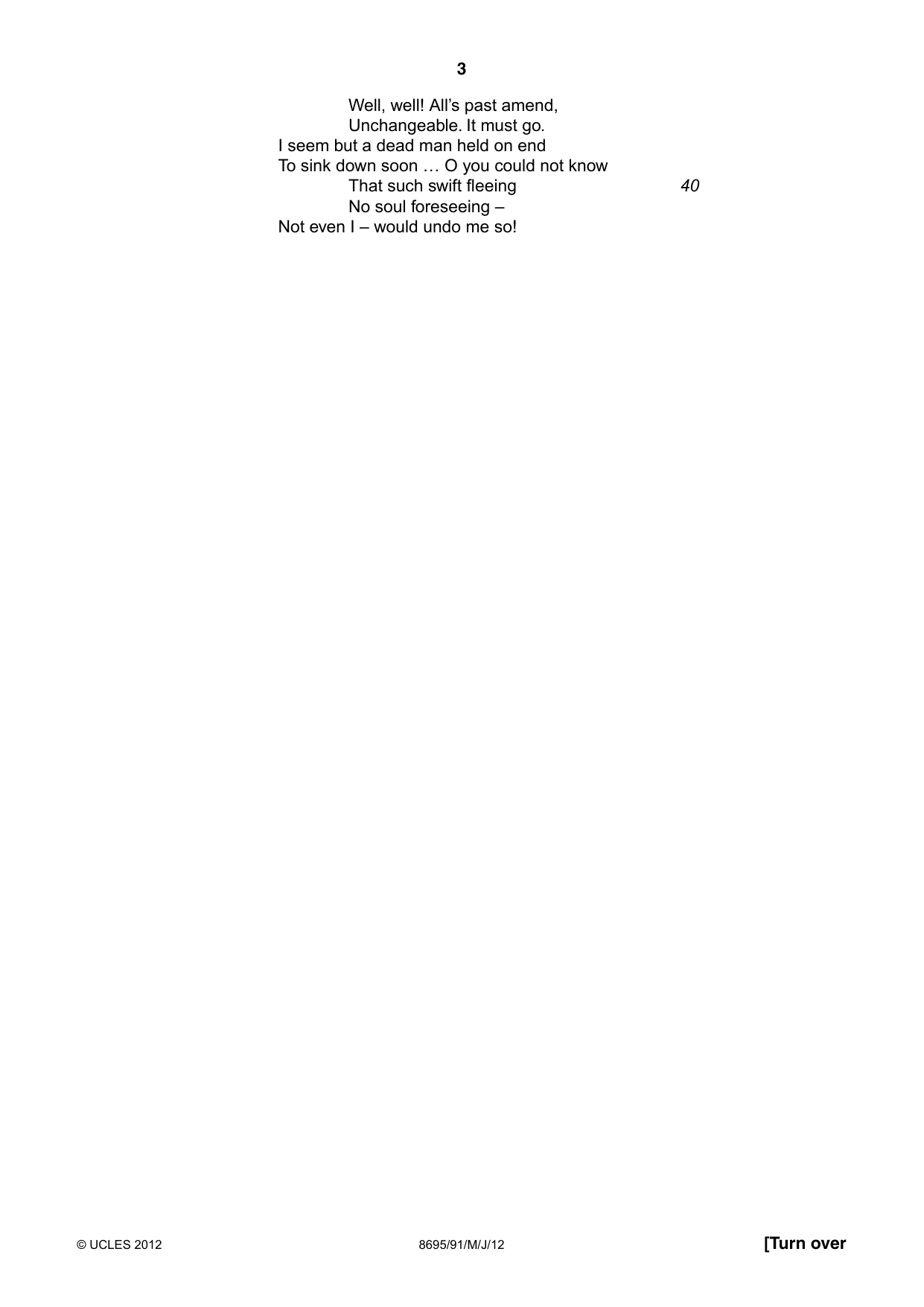
Question paper, page 3
3 8695/91/M/J/12 © UCLES 2012 [Turn over Well, well! All’s past amend, Unchangeable. It must go. I seem but a dead man held on end To sink down soon … O you could not know That such swift fleeing 40 No soul foreseeing – Not even I – would undo me so!
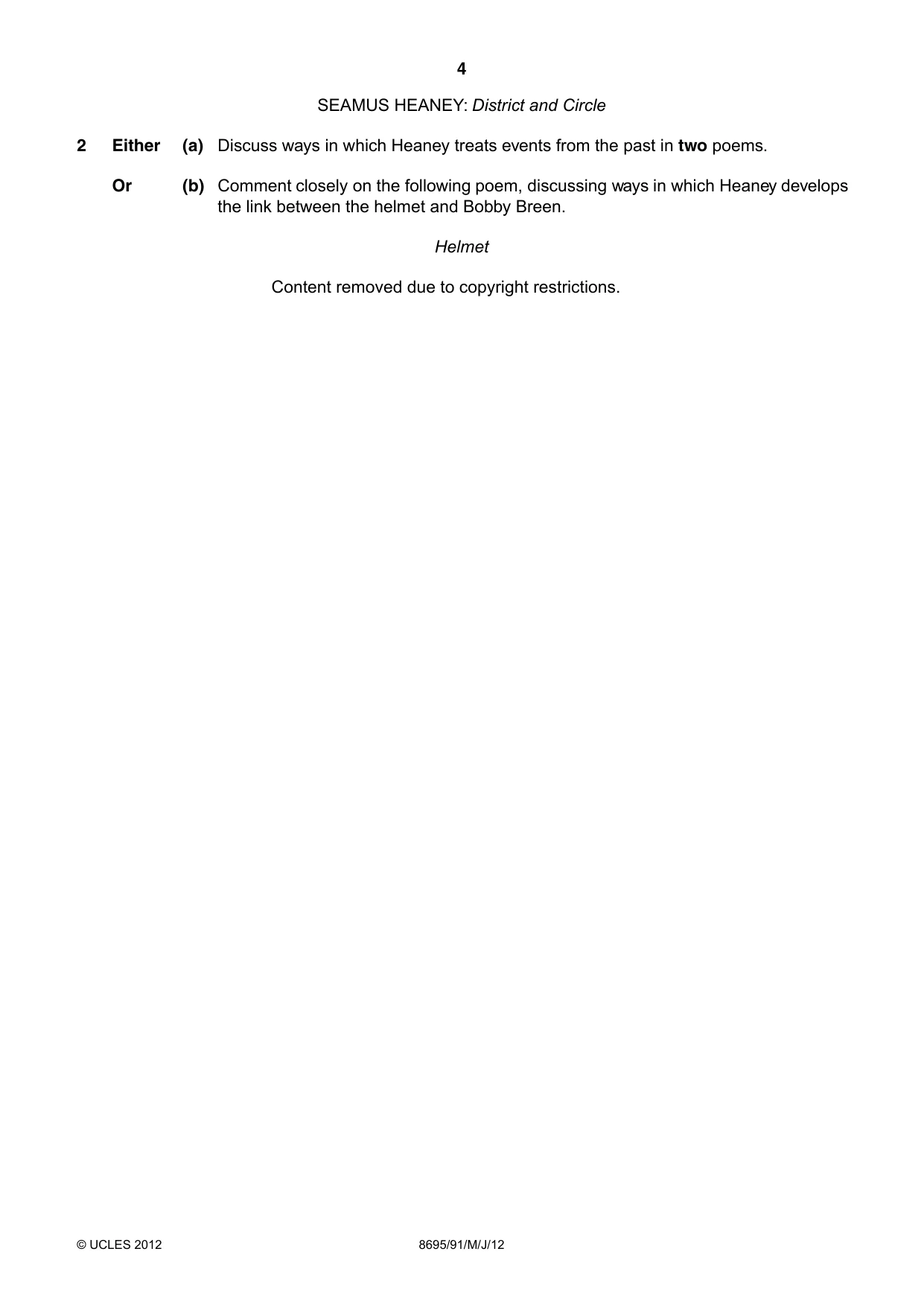
Question paper, page 4
4 8695/91/M/J/12 © UCLES 2012 SEAMUS HEANEY: District and Circle 2 Either (a) Discuss ways in which Heaney treats events from the past in two poems. Or (b) Comment closely on the following poem, discussing ways in which Heaney develops the link between the helmet and Bobby Breen. Helmet Content removed due to copyright restrictions.
Question paper, page 5
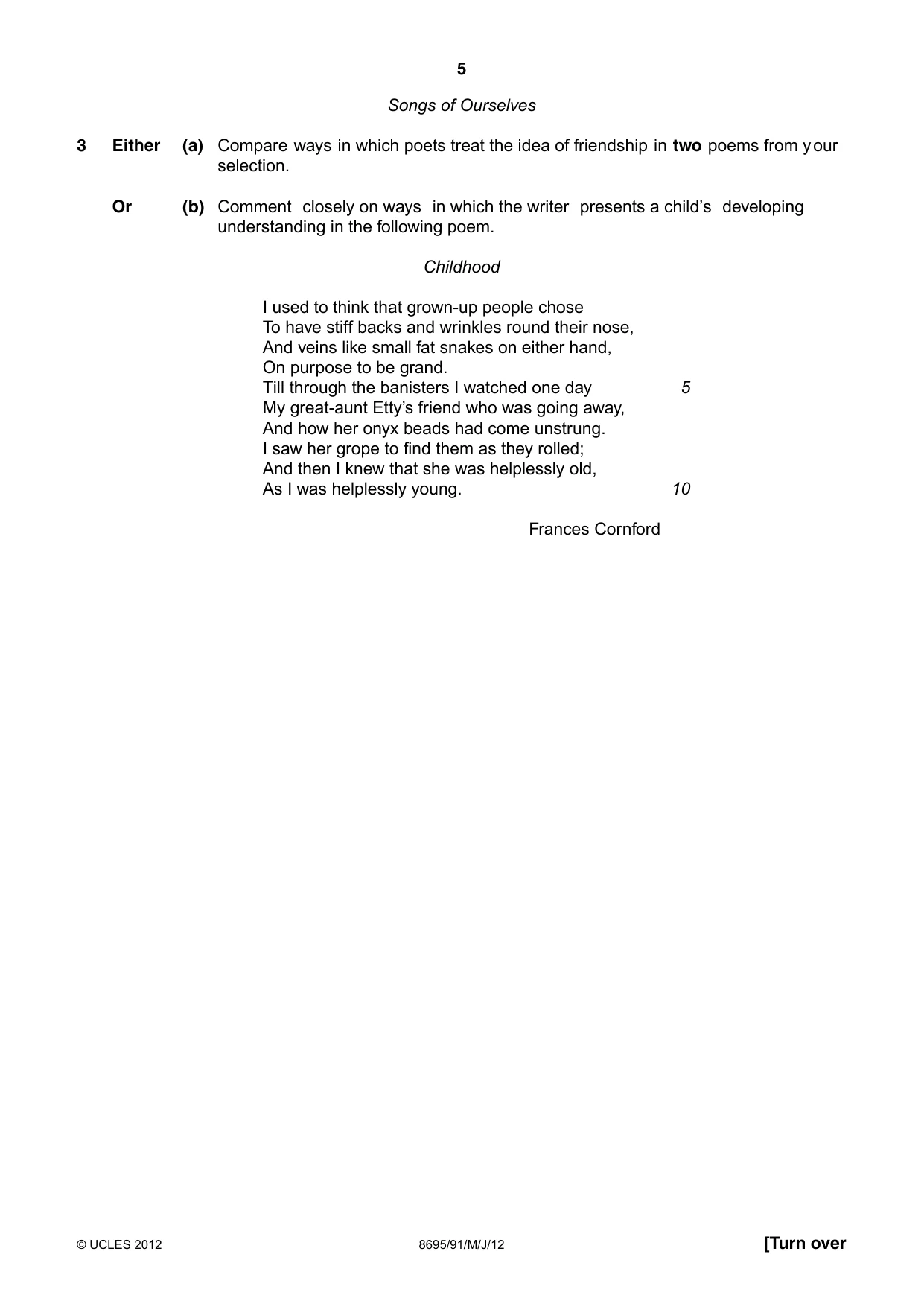
5 8695/91/M/J/12 © UCLES 2012 [Turn over Songs of Ourselves 3 Either (a) Compare ways in which poets treat the idea of friendship in two poems from your selection. Or (b) Comment closely on ways in which the writer presents a child’s developing understanding in the following poem. Childhood I used to think that grown-up people chose To have stiff backs and wrinkles round their nose, And veins like small fat snakes on either hand, On purpose to be grand. Till through the banisters I watched one day 5 My great-aunt Etty’s friend who was going away, And how her onyx beads had come unstrung. I saw her grope to find them as they rolled; And then I knew that she was helplessly old, As I was helplessly young. 10 Frances Cornford
Question paper, page 6
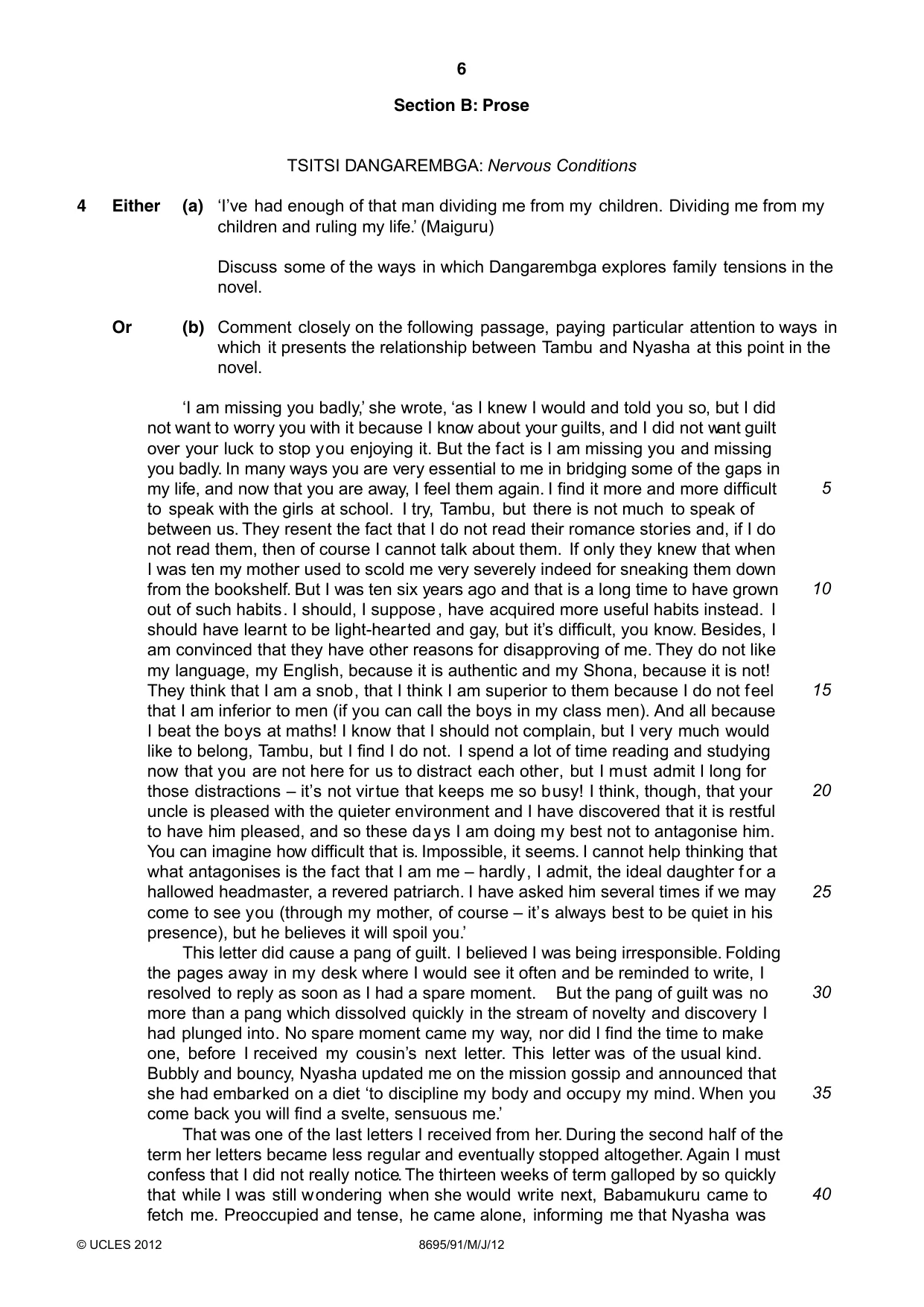
6 8695/91/M/J/12 © UCLES 2012 Section B: Prose TSITSI DANGAREMBGA: Nervous Conditions 4 Either (a) ‘I’ve had enough of that man dividing me from my children. Dividing me from my children and ruling my life.’ (Maiguru) Discuss some of the ways in which Dangarembga explores family tensions in the novel. Or (b) Comment closely on the following passage, paying particular attention to ways in which it presents the relationship between Tambu and Nyasha at this point in the novel. ‘I am missing you badly,’ she wrote, ‘as I knew I would and told you so, but I did not want to worry you with it because I know about your guilts, and I did not want guilt over your luck to stop you enjoying it. But the fact is I am missing you and missing you badly. In many ways you are very essential to me in bridging some of the gaps in my life, and now that you are away, I feel them again. I find it more and more difficult to speak with the girls at school. I try, Tambu, but there is not much to speak of between us. They resent the fact that I do not read their romance stories and, if I do not read them, then of course I cannot talk about them. If only they knew that when I was ten my mother used to scold me very severely indeed for sneaking them down from the bookshelf. But I was ten six years ago and that is a long time to have grown out of such habits. I should, I suppose, have acquired more useful habits instead. I should have learnt to be light-hearted and gay, but it’s difficult, you know. Besides, I am convinced that they have other reasons for disapproving of me. They do not like my language, my English, because it is authentic and my Shona, because it is not! They think that I am a snob, that I think I am superior to them because I do not feel that I am inferior to men (if you can call the boys in my class men). And all because I beat the boys at maths! I know that I should not complain, but I very much would like to belong, Tambu, but I find I do not. I spend a lot of time reading and studying now that you are not here for us to distract each other, but I must admit I long for those distractions – it’s not virtue that keeps me so busy! I think, though, that your uncle is pleased with the quieter environment and I have discovered that it is restful to have him pleased, and so these days I am doing my best not to antagonise him. You can imagine how difficult that is. Impossible, it seems. I cannot help thinking that what antagonises is the fact that I am me – hardly, I admit, the ideal daughter for a hallowed headmaster, a revered patriarch. I have asked him several times if we may come to see you (through my mother, of course – it’s always best to be quiet in his presence), but he believes it will spoil you.’ This letter did cause a pang of guilt. I believed I was being irresponsible. Folding the pages away in my desk where I would see it often and be reminded to write, I resolved to reply as soon as I had a spare moment. But the pang of guilt was no more than a pang which dissolved quickly in the stream of novelty and discovery I had plunged into. No spare moment came my way, nor did I find the time to make one, before I received my cousin’s next letter. This letter was of the usual kind. Bubbly and bouncy, Nyasha updated me on the mission gossip and announced that she had embarked on a diet ‘to discipline my body and occupy my mind. When you come back you will find a svelte, sensuous me.’ That was one of the last letters I received from her. During the second half of the term her letters became less regular and eventually stopped altogether. Again I must confess that I did not really notice. The thirteen weeks of term galloped by so quickly that while I was still wondering when she would write next, Babamukuru came to fetch me. Preoccupied and tense, he came alone, informing me that Nyasha was 5 10 15 20 25 30 35 40
Question paper, page 7
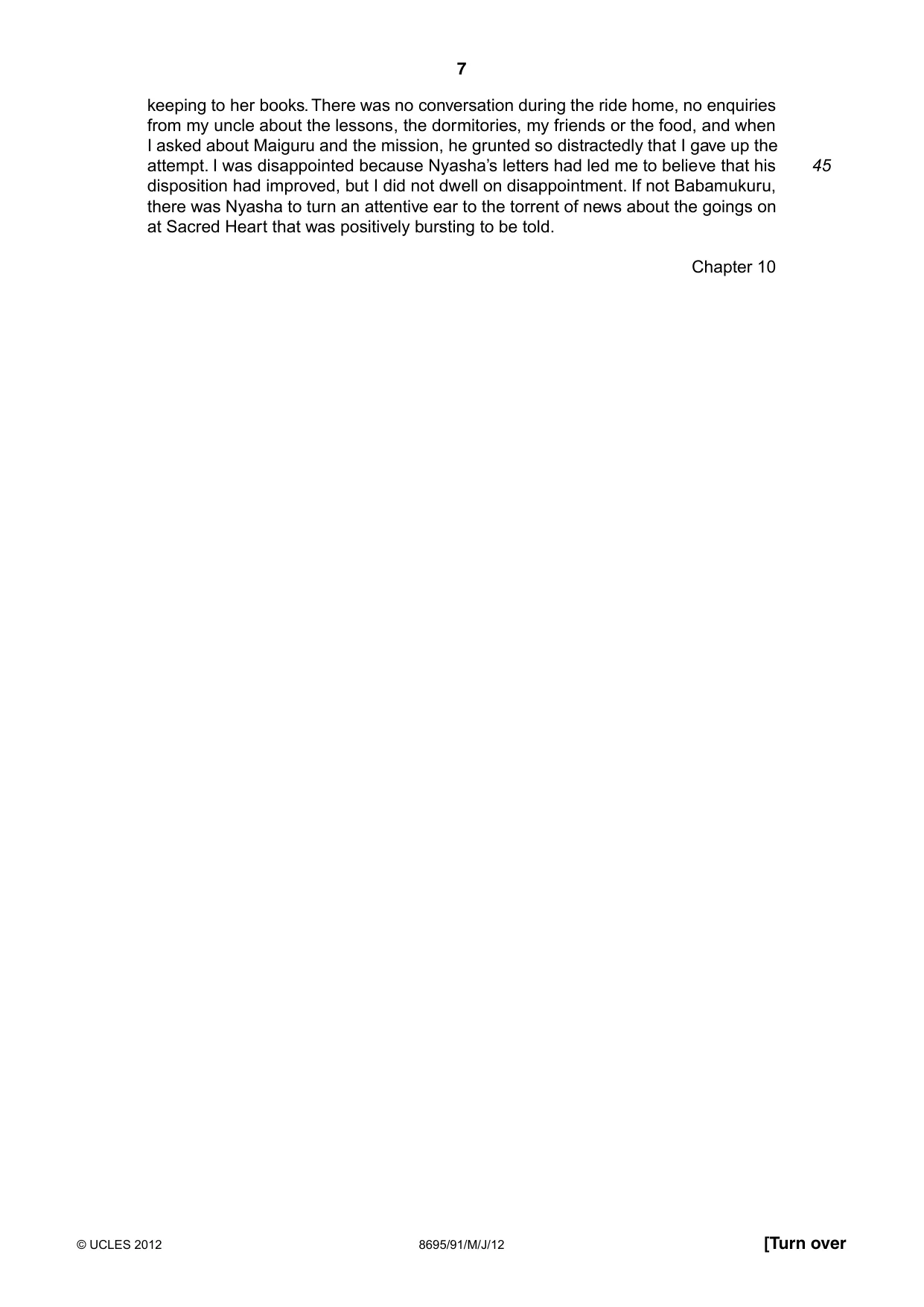
7 8695/91/M/J/12 © UCLES 2012 [Turn over keeping to her books. There was no conversation during the ride home, no enquiries from my uncle about the lessons, the dormitories, my friends or the food, and when I asked about Maiguru and the mission, he grunted so distractedly that I gave up the attempt. I was disappointed because Nyasha’s letters had led me to believe that his disposition had improved, but I did not dwell on disappointment. If not Babamukuru, there was Nyasha to turn an attentive ear to the torrent of news about the goings on at Sacred Heart that was positively bursting to be told. Chapter 10 45
Question paper, page 8
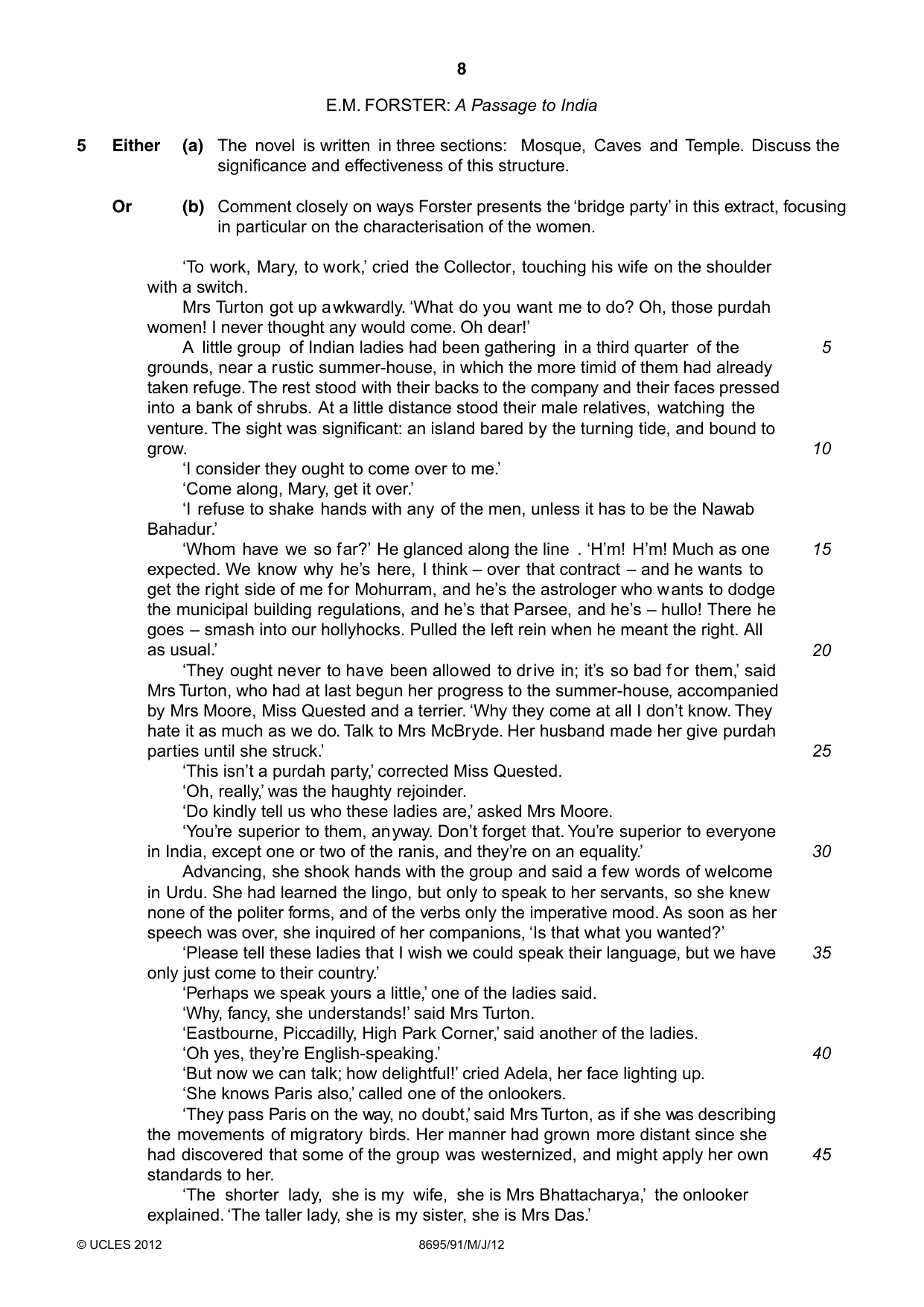
8 8695/91/M/J/12 © UCLES 2012 E.M. FORSTER: A Passage to India 5 Either (a) The novel is written in three sections: Mosque, Caves and Temple. Discuss the significance and effectiveness of this structure. Or (b) Comment closely on ways Forster presents the ‘bridge party’ in this extract, focusing in particular on the characterisation of the women. ‘To work, Mary, to work,’ cried the Collector, touching his wife on the shoulder with a switch. Mrs Turton got up awkwardly. ‘What do you want me to do? Oh, those purdah women! I never thought any would come. Oh dear!’ A little group of Indian ladies had been gathering in a third quarter of the grounds, near a rustic summer-house, in which the more timid of them had already taken refuge. The rest stood with their backs to the company and their faces pressed into a bank of shrubs. At a little distance stood their male relatives, watching the venture. The sight was significant: an island bared by the turning tide, and bound to grow. ‘I consider they ought to come over to me.’ ‘Come along, Mary, get it over.’ ‘I refuse to shake hands with any of the men, unless it has to be the Nawab Bahadur.’ ‘Whom have we so far?’ He glanced along the line . ‘H’m! H’m! Much as one expected. We know why he’s here, I think – over that contract – and he wants to get the right side of me for Mohurram, and he’s the astrologer who wants to dodge the municipal building regulations, and he’s that Parsee, and he’s – hullo! There he goes – smash into our hollyhocks. Pulled the left rein when he meant the right. All as usual.’ ‘They ought never to have been allowed to drive in; it’s so bad for them,’ said Mrs Turton, who had at last begun her progress to the summer-house, accompanied by Mrs Moore, Miss Quested and a terrier. ‘Why they come at all I don’t know. They hate it as much as we do. Talk to Mrs McBryde. Her husband made her give purdah parties until she struck.’ ‘This isn’t a purdah party,’ corrected Miss Quested. ‘Oh, really,’ was the haughty rejoinder. ‘Do kindly tell us who these ladies are,’ asked Mrs Moore. ‘You’re superior to them, anyway. Don’t forget that. You’re superior to everyone in India, except one or two of the ranis, and they’re on an equality.’ Advancing, she shook hands with the group and said a few words of welcome in Urdu. She had learned the lingo, but only to speak to her servants, so she knew none of the politer forms, and of the verbs only the imperative mood. As soon as her speech was over, she inquired of her companions, ‘Is that what you wanted?’ ‘Please tell these ladies that I wish we could speak their language, but we have only just come to their country.’ ‘Perhaps we speak yours a little,’ one of the ladies said. ‘Why, fancy, she understands!’ said Mrs Turton. ‘Eastbourne, Piccadilly, High Park Corner,’ said another of the ladies. ‘Oh yes, they’re English-speaking.’ ‘But now we can talk; how delightful!’ cried Adela, her face lighting up. ‘She knows Paris also,’ called one of the onlookers. ‘They pass Paris on the way, no doubt,’ said Mrs Turton, as if she was describing the movements of migratory birds. Her manner had grown more distant since she had discovered that some of the group was westernized, and might apply her own standards to her. ‘The shorter lady, she is my wife, she is Mrs Bhattacharya,’ the onlooker explained. ‘The taller lady, she is my sister, she is Mrs Das.’ 5 10 15 20 25 30 35 40 45
Question paper, page 9
9 8695/91/M/J/12 © UCLES 2012 [Turn over The shorter and the taller ladies both adjusted their saris, and smiled. There was a curious uncertainty about their gestures, as if they sought for a new formula which neither East nor West could provide. Chapter 5 50
Question paper, page 10
10 8695/91/M/J/12 © UCLES 2012 Stories of Ourselves 6 Either (a) Compare ways in which two stories from the selection portray the relationships between children and the adults around them. Or (b) Comment closely on the following passage, paying particular attention to ways in which the writing presents the development of the narrator’s feelings. I was exhilarated and at the same time very upset that the girl (whose name I didn’t even know) was involved in some way with the Maquis. It never occurred to me that she might be working for the other side: that possibility might have been suggested by my feigned ignorance, but that was an automatic reflex. You’ve no idea on how many levels one’s mind worked, in those days: isolated compartments of body and soul, with a lot of soft rubber in between. I was upset not only because her existence might suddenly be perilous, but also because she had not stopped just f or me, or for her feelings about me. In the end, I never knew how deeply involved she was, but I reckon it must have been on the simplest level of message-carrying, like a lot of kids and teenagers in those times . My position, on the main road, with the cover of the business, would have served the Resistance well. That was obvious. But I was not the one to make that sort of decision alone. Maybe my father did more than just give the maquisards ‘God’s credit’, as he used to call it; but if so, I never knew about it – and trust between father and son would mean nothing, in that case. The Germans – and, naturally, the Milice – started to furnish us with increased custom as the war dragged on and things became more and more difficult. Since many of our clients were paying us in blackmarket goods, the ‘honest’ cash of the occupiers was very welcome. One day, I was sitting in a café on a Sunday morning (the place in the tiny square this side of town), when a man in a peasant’ s overalls (but not, somehow, a peasant’s bearing), sat down next to me and said, ‘Try a nail or two. Otherwise we’ll be thinking you are collaborators.’ With that, he got up and left. My hands were shaking so much I spilt my drink. I imagined the other, mainly old, men in the café were looking at me. The wine tasted sour (it probably was). This was about a month after the girl had stopped to thank me. I decided to do something clownish, to make her stop again. My heart thumping like a drum all night, I rose early and started work before my father had shaved (we were ‘sleeping in’, that night, in the little rooms above the office). I had never missed her in the morning, but I wanted to be absolutely certain. The advantage of the morning encounter was that my father always did his paperwork until nine, and the thick net curtain across the office window obscured the view of the yard sufficiently to waylay any casual glance – even that of my father’s. At a quarter to seven, with the sun laying broad stripes across the white road, so that vehicles seemed to appear and disappear as they approached, I saw the girl in the distance … to my relief, I have to say (nothing can be relied on except death, and so forth). There was nobody else on the road. I stepped out into the middle with a bucket full of stones and earth and started to pour it into the pot-hole , the subject of our former exchange. I was so nervous I nearly dropped the bucket, for my arms were very weak all of a sudden, but I was already stamping the stuff down by the time she stopped. ‘You’ve no right to do that,’ she said. I paused in my work, and my prepared grin froze into what must have been rather a stupid-looking grimace. ‘You’ll be arrested for overstepping the mark. Les Allemands sont corrects.’ With that last familiar phrase, I knew she was ‘having me on’, and my grin restored itself. ‘It’s for you,’ I said. ‘I know,’ she replied. She giggled (no, not quite – but there is no other word to describe such a sprinkle of delightful, teasing merriment) and pedalled off . I was left gazing after her, empty bucket in hand, little stones caught in my boots. If a truck had not blared its horn, I fancy it would have run me over. Tyres 5 10 15 20 25 30 35 40 45
Question paper, page 11
11 8695/91/M/J/12 © UCLES 2012 [Turn over Turn to page 12 for Question 7.
Question paper, page 12
12 8695/91/M/J/12 © UCLES 2012 Section C: Drama PETER SHAFFER: Equus 7 Either (a) ‘Passion, you see, can be destroyed by a doctor. It cannot be created.’ (Dysart) Discuss ways in which Shaffer explores human passion in the play. Or (b) Comment closely on the dramatic methods of the following extract, showing how Shaffer varies the tone of the two scenes. He stabs out Nugget’s eyes. The horse stamps in agony. A great screaming begins to fill the theatre, growing ever louder. Alan dashes at the other two horses and blinds them too, stabbing over the rails. Their metal hooves join in the stamping. Relentlessly, as this happens, three more horses appear in cones of light: not naturalistic animals like the first three , but dreadful creatures out of nightmare. Their eyes flare – their nostrils flare – their mouths flare . They are archetypal images – judging, punishing, pitiless. They do not halt at the rail, but invade the square. As they trample at him, the boy leaps desperately at them, jumping high and naked in the dark, slashing at their heads with arms upraised. The screams increase. The other horses follow into the square. The whole place is filled with cannoning, blinded horses – and the boy dodging among them, avoiding their slashing hooves as best he can. Finally they plunge off into darkness and away out of sight. The noise dies abruptly, and all we hear is Alan yelling in hysteria as he collapses on the ground – stabbing at his own eyes with the invisible pick. Alan: Find me! … Find me! … Find me! … KILL ME! … KILL ME! … 35 The light changes quickly back to brightness. Dysart enters swiftly, hurls a blanket on the left bench, and rushes over to Alan. The boy is having convulsions on the floor. Dysart grabs his hands, forces them from his e yes, scoops him up in his arms and carries him over to the bench. Alan hurls his arms round Dysart and clings to him, gasping and kicking his legs in a dreadful frenzy. Dysart lays him down and presses his head back on the bench. He keeps talking – urgently talking – soothing the agony as he can. Dysart: Here … Here … Ssssh … Ssssh … Calm now … Lie back. Just lie back! Now breathe in deep. Very deep. In … Out … In … Out … That’s it. … In. Out … In … Out … 5 10 15 20 25 30 35
Question paper, page 13
13 8695/91/M/J/12 © UCLES 2012 [Turn over The boy’s breath is drawn into his body with a harsh rasping sound, which slowly grows less. Dysart puts the blanket over him. Keep it going … That’s a good boy … Very good boy … It’s all over now, Alan. It’s all over. He’ll go away now. You’ll never see him again, I promise. You’ll have no more bad dreams. No more awful nights. Think of that! … You are going to be well. I’m going to make you well, I promise you. … You’ll be here for a while, but I’ll be here too , so it won’t be so bad. Just trust me … He stands upright. The boy lies still. Sleep now. Have a good long sleep. You’ve earned it … Sleep. Just sleep … I’m going to make you well. He steps backwards into the centre of the square. The light brightens some more. A pause. Dysart: I’m lying to y ou, Alan. He won’t really go that easily . Just clop away from you like a nice old nag. Oh, no! When Equus leaves – if he leaves at all – it will be with your intestines in his teeth. And I don’t stock replacements … If you knew anything, you’d get up this minute and run from me fast as you could. Act 2 Scene 34 / Act 2 Scene 35 40 45 50 55
Question paper, page 14
14 8695/91/M/J/12 © UCLES 2012 WILLIAM SHAKESPEARE: Henry IV Part 1 8 Either (a) Discuss Shakespeare’s presentation of the relationship between Falstaff and Prince Hal and comment on its significance to the play. Or (b) Discuss in detail the following passage, commenting on ways in which Shakespeare presents the negotiations before battle. Enter SIR WALTER BLUNT. Blunt: I come with gracious offers from the King, If you vouchsafe me hearing and respect. Hotspur: Welcome, Sir Walter Blunt; and would to God You were of our determination! Some of us love you well; and even those some Envy your great deservings and good name, Because you are not of our quality, But stand against us like an enemy. Blunt: And God defend but still I should stand so, So long as out of limit and true rule You stand against anointed majesty! But, to my charge. The King hath sent to know The nature of your griefs; and whereupon You conjure from the breast of civil peace Such bold hostility, teaching his duteous land Audacious cruelty. If that the King Have any way your good deserts forgot, Which he confesseth to be manifold, He bids you name your griefs, and with all speed You shall have your desires with interest, And pardon absolute for yourself and these Herein misled by your suggestion. Hotspur: The King is kind; and well we know the King Knows at what time to promise, when to pay. My father and my uncle and myself Did give him that same royalty he wears; And when he was not six and twenty strong, Sick in the world’s regard, wretched and low, A poor unminded outlaw sneaking home, My father gave him welcome to the shore; And when he heard him swear and vow to God He came but to be Duke of Lancaster, To sue his livery and beg his peace, With tears of innocency and terms of zeal, My father, in kind heart and pity mov’d, Swore him assistance, and perform’d it too. Now when the lords and barons of the realm Perceiv’d Northumberland did lean to him, The more and less came in with cap and knee; Met him in boroughs, cities, villages; Attended him on bridges, stood in lanes, Laid gifts before him, proffer’d him their oaths, Gave him their heirs as pages, followed him Even at the heels in golden multitudes. He presently – as greatness knows itself – 5 10 15 20 25 30 35 40 45
Question paper, page 15
15 8695/91/M/J/12 © UCLES 2012 [Turn over Steps me a little higher than his vow Made to my father, while his blood was poor, Upon the naked shore at Ravenspurgh; And now, forsooth, takes on him to reform Some certain edicts, and some strait decrees That lie too heavy on the commonwealth; Cries out upon abuses, seems to weep Over his country’s wrongs; and by this face, This seeming brow of justice, did he win The hearts of all that he did angle for; Proceeded further: cut me off the heads Of all the favourites that the absent King In deputation left behind him here, When he was personal in the Irish war. Blunt: Tut, I came not to hear this. Act 4 Scene 3 50 55 60
Question paper, page 16
16 8695/91/M/J/12 © UCLES 2012 TENNESSEE WILLIAMS: A Streetcar Named Desire 9 Either (a) ‘I always did say that men are callous things with no feelings.’ Bearing Eunice’s comment in mind, discuss Williams’s portrayal of men in the play. Or (b) Comment closely on the methods used by Williams to create the dramatic atmosphere of the following passage. [A Vendor comes around the corner. She is a blind MEXICAN WOMAN in a dark shawl, Content removed due to copyright restrictions. The distant piano is slow and blue.] Scene 9
Question paper, page 17
20 8695/91/M/J/12 © UCLES 2012 BLANK PAGE Copyright Acknowledgements: Question 2b © Seamus Heaney; Helmet from District and Circle; Faber & Faber Ltd; 2006. Question 3b © Frances Cornford; Childhood from Songs of Ourselves; Foundation Books; 2005. Question 4b © Tsitsi Dangarembga; Nervous Conditions; Ayebia Publishing; 1988. Question 5b E M Forster; A Passage to India; Published by Penguin Books Ltd; 1979; Reproduced by permission of The Provost and Scholars of King's College, Cambridge. Question 6b Tyres from Shifts by Adam Thorpe, published by Vintage Books. Reprinted by permission of The Random House Group Ltd. Question 7b Peter Shaffer; Equus; Longman; 1993. Question 9b A Streetcar Named Desire by Tennessee Williams; Copyright © 1947 by The University of The South. Published by Penguin Books Ltd; 1983. Reprinted by permission of New Directions Publishing Corp and Georges Borchardt Inc. for The Estate of Tennessee Williams. Permission to reproduce items where third-party owned material protected by copyright is included has been sought and cleared where possible. Every reasonable effort has been made b y the publisher (UCLES) to trace copyright holders, but if any items requiring clearance have unwittingly been included, the publisher will be pleased to make amends at the earliest possible opportunity.University of Cambridge International Examinations is par t of the Cambr idge Assessment Group. Cambridge Local Examinations Syndicate (UCLES), which is itself a department of the University of Cambridge.
Mark scheme, page 1
UNIVERSITY OF CAMBRIDGE INTERNATIONAL EXAMINATIONS GCE Advanced Subsidiary Level and GCE Advanced Level MARK SCHEME for the May/June 2012 question paper for the guidance of teachers 8695 LANGUAGE AND LITERATURE IN ENGLISH 8695/91 Paper 9 (Poetry, Prose and Drama), maximum raw mark 50 This mark scheme is published as an aid to teachers and candidates, to indicate the requirements of the examination. It shows the basis on which Examiners were instructed to award marks. It does not indicate the details of the discussions that took place at an Examiners’ meeting before marking began, which would have considered the acceptability of alternative answers. Mark schemes must be read in conjunction with the question papers and the report on the examination. • Cambridge will not enter into discussions or correspondence in connection with these mark schemes. Cambridge is publishing the mark schemes for the May/June 2012 question papers for most IGCSE, GCE Advanced Level and Advanced Subsidiary Level syllabuses and some Ordinary Level syllabuses.
Mark scheme, page 2
Page 2 Mark Scheme: Teachers’ version Syllabus Paper GCE AS/A LEVEL – May/June 2012 8695 91 © University of Cambridge International Examinations 2011 Using the mark bands Place the answer in a band first. Look for the “best fit” of the answer into a band. An answer needs to show evidence of most but not necessarily ALL of the qualities described in a band, in order to be placed in that band. Then award a mark for the relative position of the answer within the band. Candidates may address the question in many different ways. Do not expect any particular focus or approach and do not penalise answers for leaving out a particular focus. Reward what is there, showing what you are rewarding, in your comments. Consider all strands and weigh up the performance as a whole in placing the answer in a band, then show that you have done so in the summative comment, e.g. Sound K of texts, some evidence of U but mostly narrative, occasional evidence of P, mainly clear C. Assessment Objectives: • Ability to respond to texts in the three main forms (Prose, Poetry and Drama) of different types and from different cultures; • Understanding of the ways in which writers’ choices of form, structure and language shape meanings; • Ability to produce informed independent opinions and judgements on literary texts; • Ability to communicate clearly the knowledge, understanding and insight appropriate to literary study. Each answer is marked out of 25, in accordance with the General Marking Criteria below. Each band is divided into strands corresponding to the Assessment Objectives – Knowledge, Understanding, Personal Response, Communication.
Mark scheme, page 3
Page 3 Mark Scheme: Teachers’ version Syllabus Paper GCE AS/A LEVEL – May/June 2012 8695 91 © University of Cambridge International Examinations 2011 Band 6 0–5 K Evidence of some general knowledge of the text which may be narrative based and may contain errors, rarely relevant to the question and with little or no relevant quotation or selection from the text. U There may be little or no evidence of understanding of form, structure and language, with some appropriate points made in response to the question. These will be limited and tend to be restricted to plot and characters – the latter treated very much as “real” people. P There may be some signs of personal response, not developed into an argument and not fully supported from the text. C Communication will be insecure. Expression may be weak with some breakdown in communication. Structure may be lacking: answers are likely to be partial, undeveloped, narrative commentary in approach; with the assertion of simple points rather than progressive lines of argument. Answers to passage-based questions are likely to be seriously unbalanced, with an emphasis on narrative or paraphrase. Passages are likely to have been only partially understood and tentatively located contextually, with little coherent sense of the relationship between textual part and whole. There will be little or no mention or consideration of the literary features of the passage. Band 5 6–9 Work of a basic standard K Evidence of some limited ability to use knowledge of the text to address the question, with occasional use of supporting references or quotation. U Evidence of some limited understanding of ways in which writers’ choices of structure, form and language shape meanings. P Evidence of some personal response to the text but not fully supported. C Expression will be basically clear. There may be the occasional confused passage of writing. However, there will be no sustained loss of communication. There may be a simple structure to the answer with some evidence of an argument, which may lack coherence, with some repetition, assertion and relapse into narrative summary/paraphrase. There may be a tendency to drift from relevant discussion into material of tangential significance. In answers to passage-based questions there will be some evidence of understanding of how part relates to whole. Treatment of the given extracts may well be sketchy or overlong and undiscriminating. Comment on the wider textual issues is likely to be general. There may be a lack of balance between passage and whole text. There will be some limited consideration of the literary features of the text.
Mark scheme, page 4
Page 4 Mark Scheme: Teachers’ version Syllabus Paper GCE AS/A LEVEL – May/June 2012 8695 91 © University of Cambridge International Examinations 2011 Band 4 10–13 Solid work K Evidence of some ability to use relevant knowledge of the text to address the question. U Evidence of clear understanding of some ways in which writers’ choices of structure, form and language shape meanings, which may be partial and restricted to the more obvious aspects of the text. P Evidence of personal response to the text, with the beginnings of a personal view or interpretation, relevant to the question and supported from the text. C Expression will be mostly clear and appropriate with a clear, simple structure to the answer. Argument will be basically coherent, and assertive in tone. There is likely to be some reliance on paraphrase and narrative summary. Articulates simple ideas with clarity but there may be some imprecision and clumsiness of expression in dealing with more complex concepts. There may be occasional obscurity in the presentation of ideas and responses. In answers to passage-based questions, work may be lacking in balance of approach, with over- concentration on the given extracts and little attempt to explore the broader textual issues. Conversely some answers may be in effect general essays, with insufficient treatment of the passages. There may be evidence of limited ability to negotiate between parts of a text and its whole. There will be some consideration of the literary features of the text with analysis of the features mentioned likely to be partial or restricted. Band 3 14–17 Competent work K Evidence of competence in selecting relevant knowledge of the text to address with some pertinent use of quotation and direct references. U Evidence of sound understanding of some aspects of ways in which writers’ choices of structure, form and language shape meanings, with some analysis and appreciation of literary methods, effects, and contexts. P Evidence of personal response relevant to the question, supported from the text. C Expression will be clear and generally accurate. Structure will be sound – material coherently organised with occasional insights. Candidates will express intelligent, straightforward ideas clearly, though there may be occasional loss of fluency with points not always strongly connected. In answers to passage-based questions, work will cover both the passage and its relation to the whole text, and there will be some sense of a relationship between the text as a whole and its constituent parts. There will be competent appreciation of the effects of the literary features of the text and the analysis is supported by relevant examples from the passage.
Mark scheme, page 5
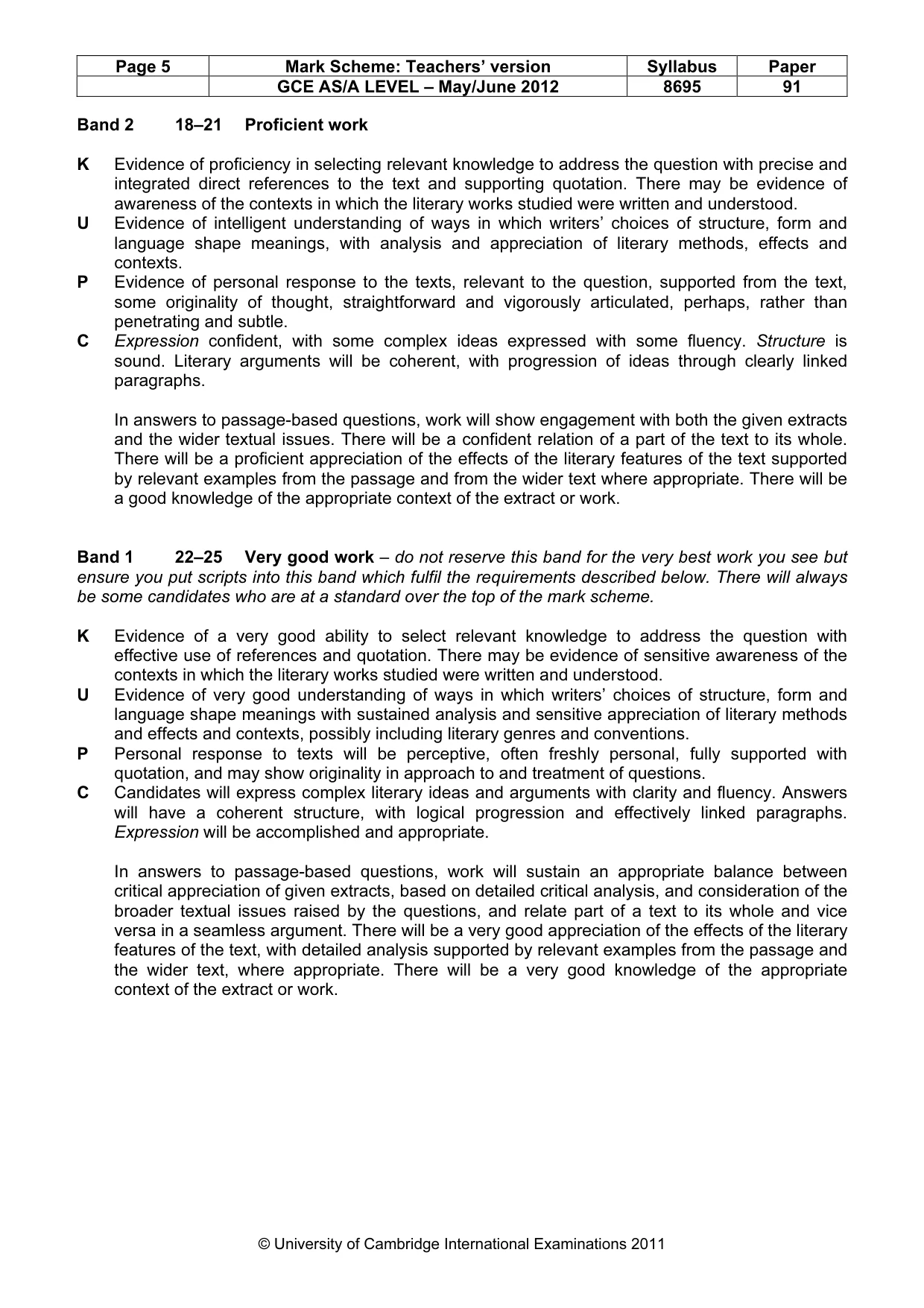
Page 5 Mark Scheme: Teachers’ version Syllabus Paper GCE AS/A LEVEL – May/June 2012 8695 91 © University of Cambridge International Examinations 2011 Band 2 18–21 Proficient work K Evidence of proficiency in selecting relevant knowledge to address the question with precise and integrated direct references to the text and supporting quotation. There may be evidence of awareness of the contexts in which the literary works studied were written and understood. U Evidence of intelligent understanding of ways in which writers’ choices of structure, form and language shape meanings, with analysis and appreciation of literary methods, effects and contexts. P Evidence of personal response to the texts, relevant to the question, supported from the text, some originality of thought, straightforward and vigorously articulated, perhaps, rather than penetrating and subtle. C Expression confident, with some complex ideas expressed with some fluency. Structure is sound. Literary arguments will be coherent, with progression of ideas through clearly linked paragraphs. In answers to passage-based questions, work will show engagement with both the given extracts and the wider textual issues. There will be a confident relation of a part of the text to its whole. There will be a proficient appreciation of the effects of the literary features of the text supported by relevant examples from the passage and from the wider text where appropriate. There will be a good knowledge of the appropriate context of the extract or work. Band 1 22–25 Very good work – do not reserve this band for the very best work you see but ensure you put scripts into this band which fulfil the requirements described below. There will always be some candidates who are at a standard over the top of the mark scheme. K Evidence of a very good ability to select relevant knowledge to address the question with effective use of references and quotation. There may be evidence of sensitive awareness of the contexts in which the literary works studied were written and understood. U Evidence of very good understanding of ways in which writers’ choices of structure, form and language shape meanings with sustained analysis and sensitive appreciation of literary methods and effects and contexts, possibly including literary genres and conventions. P Personal response to texts will be perceptive, often freshly personal, fully supported with quotation, and may show originality in approach to and treatment of questions. C Candidates will express complex literary ideas and arguments with clarity and fluency. Answers will have a coherent structure, with logical progression and effectively linked paragraphs. Expression will be accomplished and appropriate. In answers to passage-based questions, work will sustain an appropriate balance between critical appreciation of given extracts, based on detailed critical analysis, and consideration of the broader textual issues raised by the questions, and relate part of a text to its whole and vice versa in a seamless argument. There will be a very good appreciation of the effects of the literary features of the text, with detailed analysis supported by relevant examples from the passage and the wider text, where appropriate. There will be a very good knowledge of the appropriate context of the extract or work.
What you needed in this session
Cambridge’s own grade thresholds for 2012 May/June, Paper 9 · Variant 1. A higher threshold means an easier paper — the bar moves with how the cohort did.