Cambridge A Level English - Language and Literature (AS Level only, from 2016) 8695 — 2012 May/June Paper 9 · Variant 2
8695/92/M/J/12 · 50 marks · ≈56 min
The question paper and its mark scheme, free to read here and free to download. This is Cambridge’s own paper, exactly as it was sat.
Question paper17 pages



Mark scheme5 pages
Answers below. Sit the paper first if you are practising.
Paper as text
Question paper, page 1
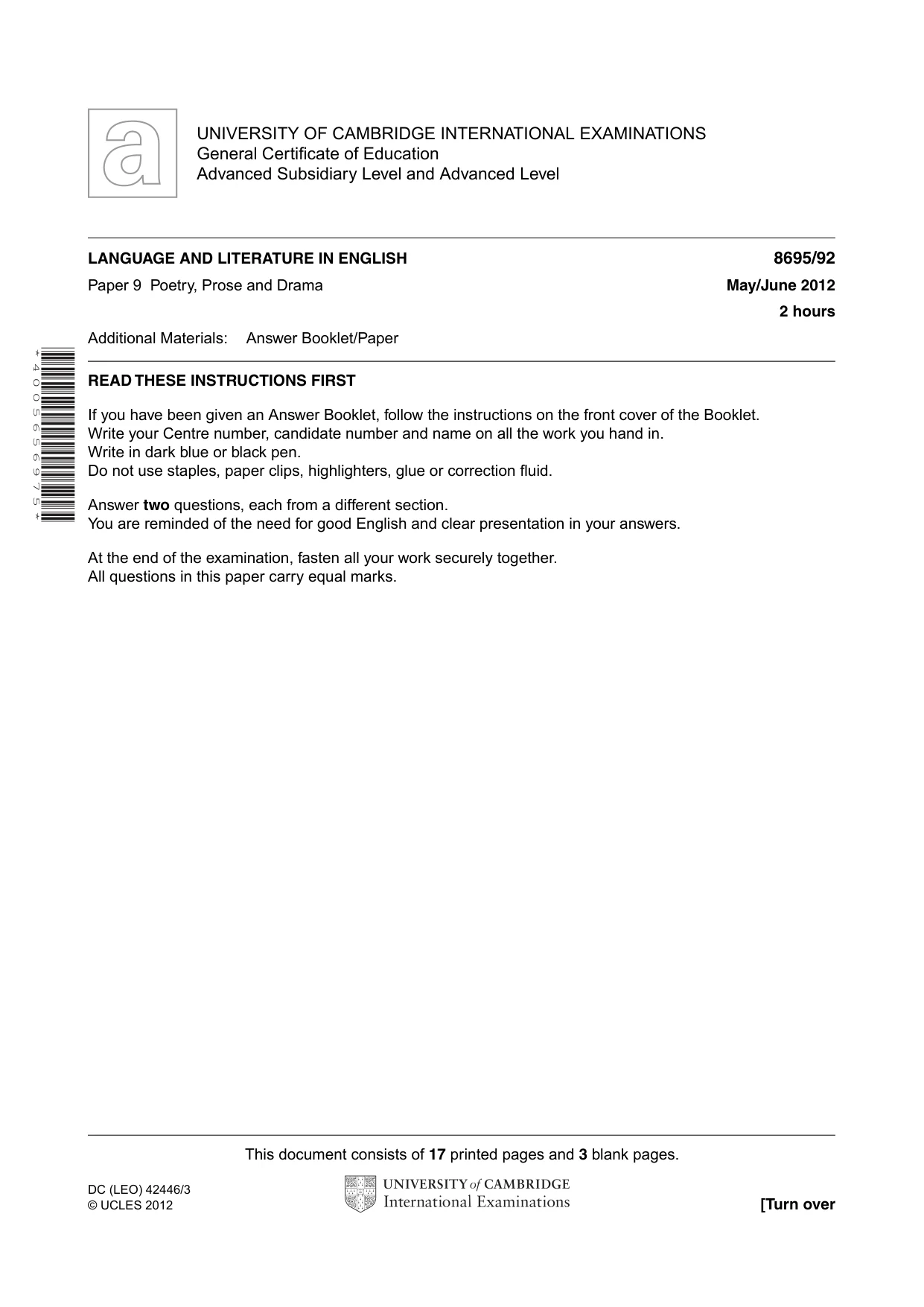
This document consists of 17 printed pages and 3 blank pages. DC (LEO) 42446/3 © UCLES 2012 [Turn over UNIVERSITY OF CAMBRIDGE INTERNATIONAL EXAMINATIONS General Certificate of Education Advanced Subsidiary Level and Advanced Level * 4 0 0 5 6 5 6 9 7 5 * LANGUAGE AND LITERATURE IN ENGLISH 8695/92 Paper 9 Poetry, Prose and Drama May/June 2012 2 hours Additional Materials: Answer Booklet/Paper READ THESE INSTRUCTIONS FIRST If you have been given an Answer Booklet, follow the instructions on the front cover of the Booklet. Write your Centre number, candidate number and name on all the work you hand in. Write in dark blue or black pen. Do not use staples, paper clips, highlighters, glue or correction fluid. Answer two questions, each from a different section. You are reminded of the need for good English and clear presentation in your answers. At the end of the examination, fasten all your work securely together. All questions in this paper carry equal marks.
Question paper, page 2
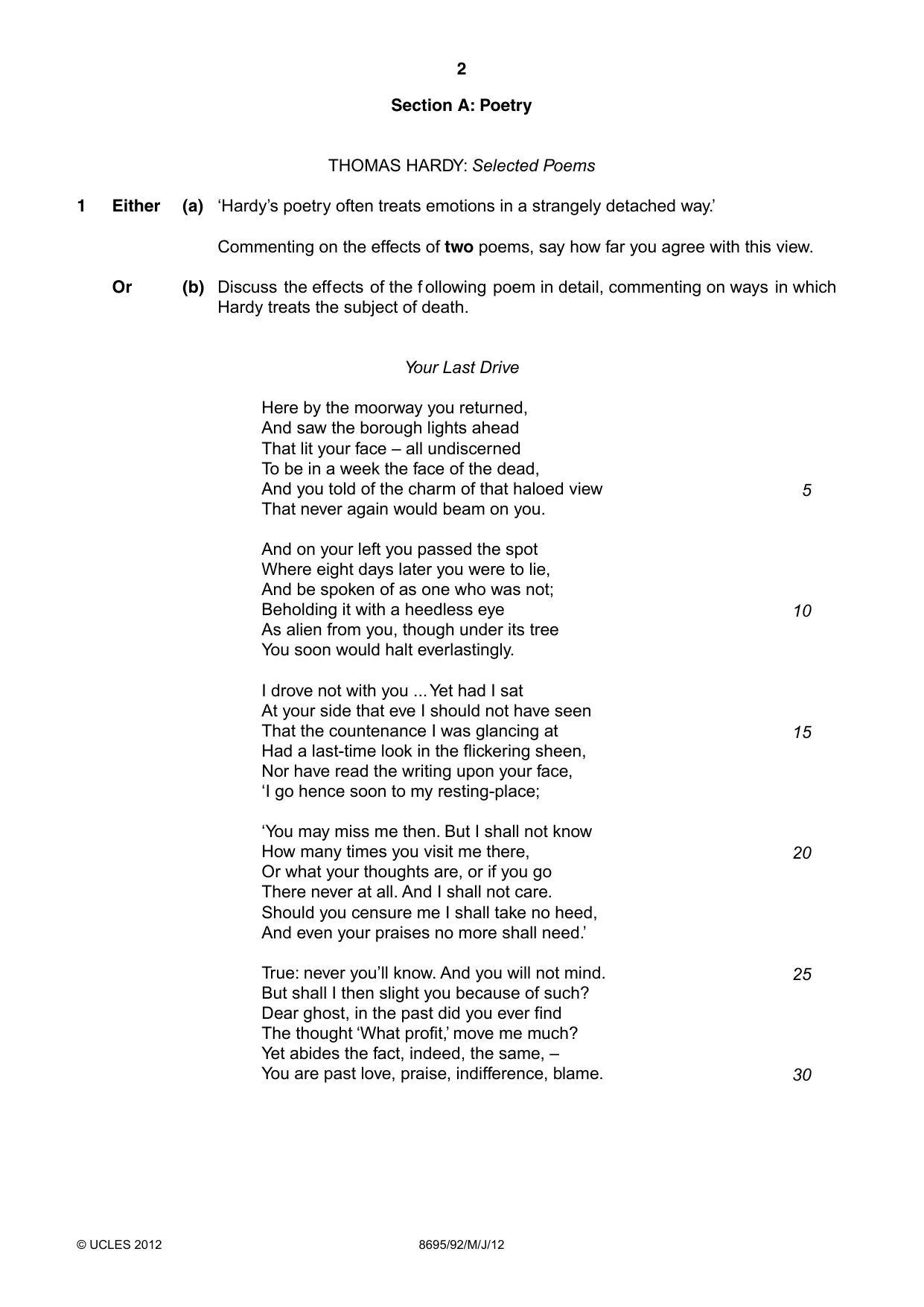
2 8695/92/M/J/12 © UCLES 2012 Section A: Poetry THOMAS HARDY: Selected Poems 1 Either (a) ‘Hardy’s poetry often treats emotions in a strangely detached way.’ Commenting on the effects of two poems, say how far you agree with this view. Or (b) Discuss the effects of the f ollowing poem in detail, commenting on ways in which Hardy treats the subject of death. Your Last Drive Here by the moorway you returned, And saw the borough lights ahead That lit your face – all undiscerned To be in a week the face of the dead, And you told of the charm of that haloed view That never again would beam on you. And on your left you passed the spot Where eight days later you were to lie, And be spoken of as one who was not; Beholding it with a heedless eye As alien from you, though under its tree You soon would halt everlastingly. I drove not with you ... Yet had I sat At your side that eve I should not have seen That the countenance I was glancing at Had a last-time look in the flickering sheen, Nor have read the writing upon your face, ‘I go hence soon to my resting-place; ‘You may miss me then. But I shall not know How many times you visit me there, Or what your thoughts are, or if you go There never at all. And I shall not care. Should you censure me I shall take no heed, And even your praises no more shall need.’ True: never you’ll know. And you will not mind. But shall I then slight you because of such? Dear ghost, in the past did you ever find The thought ‘What profit,’ move me much? Yet abides the fact, indeed, the same, – You are past love, praise, indifference, blame. 5 10 15 20 25 30
Question paper, page 3
3 8695/92/M/J/12 © UCLES 2012 [Turn over SEAMUS HEANEY: District and Circle 2 Either (a) ‘Heaney’s poetry springs directly from his historical and social world.’ Discuss the poetic methods and effects of two poems in the light of this comment. Or (b) Comment closely on the following poem, discussing ways in which Heaney presents memories of visits to Harry Boyle. A Clip Content removed due to copyright restrictions
Question paper, page 4
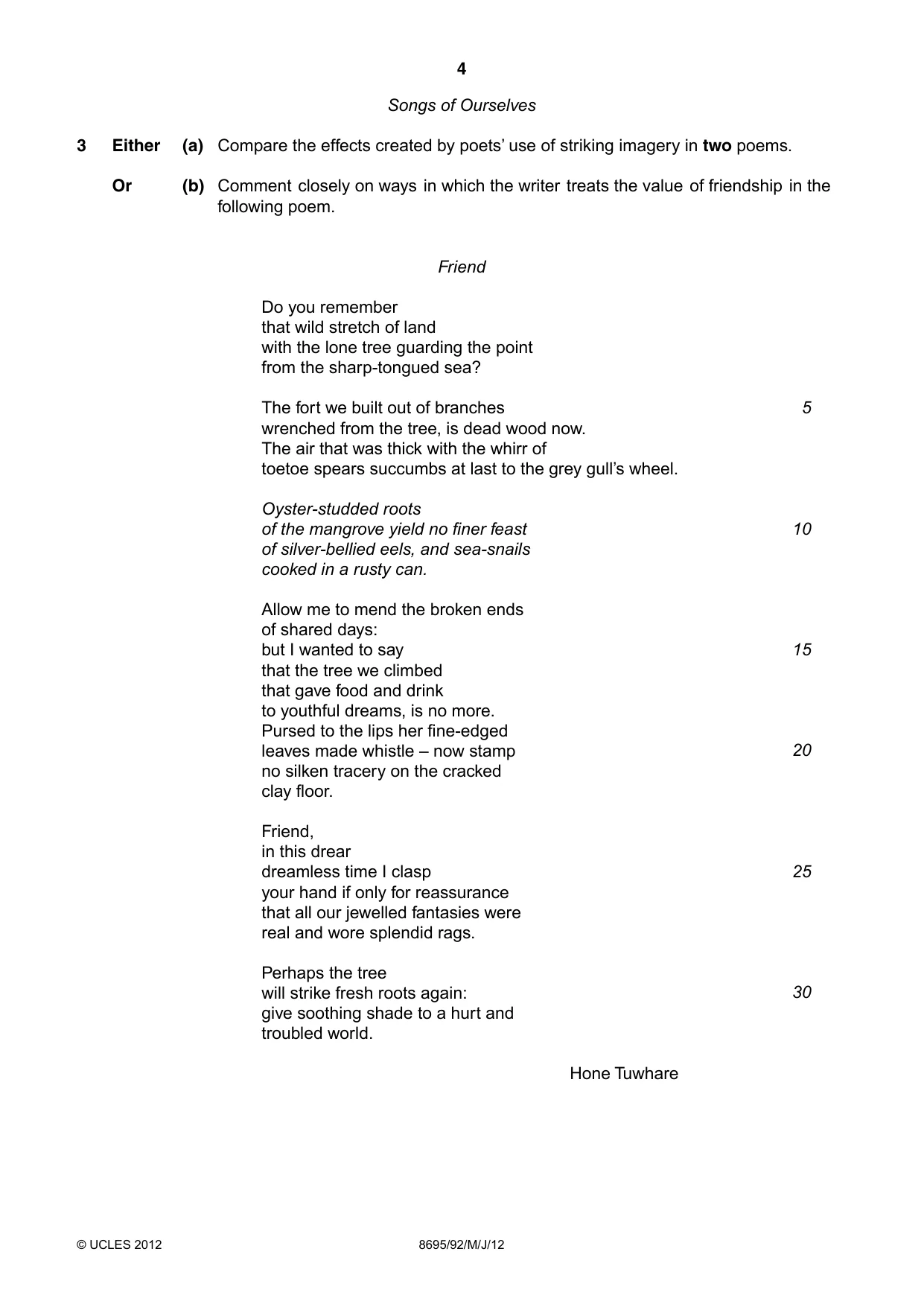
4 8695/92/M/J/12 © UCLES 2012 Songs of Ourselves 3 Either (a) Compare the effects created by poets’ use of striking imagery in two poems. Or (b) Comment closely on ways in which the writer treats the value of friendship in the following poem. Friend Do you remember that wild stretch of land with the lone tree guarding the point from the sharp-tongued sea? The fort we built out of branches wrenched from the tree, is dead wood now. The air that was thick with the whirr of toetoe spears succumbs at last to the grey gull’s wheel. Oyster-studded roots of the mangrove yield no finer feast of silver-bellied eels, and sea-snails cooked in a rusty can. Allow me to mend the broken ends of shared days: but I wanted to say that the tree we climbed that gave food and drink to youthful dreams, is no more. Pursed to the lips her fine-edged leaves made whistle – now stamp no silken tracery on the cracked clay floor. Friend, in this drear dreamless time I clasp your hand if only for reassurance that all our jewelled fantasies were real and wore splendid rags. Perhaps the tree will strike fresh roots again: give soothing shade to a hurt and troubled world. Hone Tuwhare 5 10 15 20 25 30
Question paper, page 5
5 8695/92/M/J/12 © UCLES 2012 [Turn over Turn to page 6 for Question 4
Question paper, page 6
6 8695/92/M/J/12 © UCLES 2012 Section B: Prose TSITSI DANGAREMBGA: Nervous Conditions 4 Either (a) Discuss ways in which Dangarembga presents men and male authority in the novel. Or (b) Comment closely on ways in which Dangarembga presents Tambu’s view of family relationships in the following passage. My mother’s family was very poor, poorer even than my own. At the time that my father took my mother, there were no cattle at all in my grandfather’s kraal. Because of this, some people had believed it was a blessing that the first two of my maternal grandparents’ children were girls. ‘Otherwise,’ they reasoned optimistically, ‘if he had had sons, how would those sons have taken wives? See now, the daughters will bring cattle, the cattle will enable the old man to work his fields, the family will prosper, and when the sons are of an age to marry, by then they will have accumulated their roora.’ The wise and the cynical disagreed. ‘Who knows?’ they dissented. ‘If there had been sons earlier, they would have helped the old man on the land. The family would have been better off than they are now. Besides’, they added significantly, ‘a man can’t be sure about daughters!’ Thus the debate continued in my mother’s village, way up in the north-west of the country, until my father, visiting a distant relative, saw my mother, impregnated her and was obliged to take her home with him. It was unfortunate that it happened this way because, under these circumstances , my grandfather could not claim a very high bride-price for his daughters and so my mother’s marriage did not improve her family’s condition very much. That was when my grandfather’s daughters gained a reputation f or being loose women. ‘At least the elder one did the respectable thing and went with her man,’ the villagers said. And then they clapped their hands in horror and shook their heads . ‘But look at that Lucia! Ha! There is nothing of a woman there. She sleeps with anybody and everybody, but she hasn’t borne a single child yet. She’s been bewitched. More likely she’s a witch herself.’ Thus poor Lucia was indicted for both her barrenness and her witchery; and so, when after nineteen years my mother sent word that she had lost her first surviving child and was going through a difficult pregnancy, my grandparents were only too happy to pack my aunt Lucia off to look after her sister. At the same time, Uncle Takesure, a distant cousin of Babamukuru’s, came down from Gandanzara to help on the land. I am not sure who propositioned whom, but in a very short time after Takesure’s coming Lucia was carrying his baby. Naturally, people said she had done it on purpose in order to snare a husband. But Lucia knew that Takesure had two wives at his home whom he did not like and that this was why, in spite of a strong aversion to labour, he had been so ready to come and help my father when Babamukuru suggested the arrangement. Until a very late stage Babamukuru continued to believe, in his uncomplicated way, that Takesure had come to help out on the homestead so that with the money my uncle paid him he would be able to finish off the payments on his second wife. The problem was only with the second one because her family kept reminding Takesure of the outstanding amounts, whereas his first wife’s family had allowed their reimbursement to lapse. But Babamukuru was mistaken. The truth of the matter was that Takesure wanted to get away. He did not like being a husband and Lucia knew that he neither wanted, nor could afford, nor was able to be one three times oVer. Takesure did not want to work either, but very correctly did not believe that my father would make him do that and so he agReed to come to the homestead, where he thought, I suppose, that burdens were relatively light. 5 10 15 20 25 30 35 40
Question paper, page 7
7 8695/92/M/J/12 © UCLES 2012 [Turn over Lucia, who had grown shrewd in her years of dealing with men, denied that the foetus was Takesure’s. She accredited it instead to my father, although this could not have been true. My father, doing his best not to offend Babamukuru, had sensibly not allowed himself to enjoy Lucia’s voluptuousness until after she had fallen pregnant. From this feat of self-control Lucia had deduced that my father had marginally more stamina than Takesure and for this reason would make a better father. Chapter 7 45 50
Question paper, page 8
8 8695/92/M/J/12 © UCLES 2012 E.M. FORSTER: A Passage to India 5 Either (a) ‘Why can’t we be friends now?’ How far would you agree that this question of friendship between the English and Indians is central to the novel? Or (b) Comment closely on ways in which Forster introduces the setting of the novel in the opening chapter. Except for the Marabar Caves – and they are twenty miles off – the city of Chandrapore presents nothing extraordinary. Edged rather than washed by the river Ganges, it trails for a couple of miles along the bank, scarcely distinguishable from the rubbish it deposits so freely . There are no bathing-steps on the river front, as the Ganges happens not to be holy here; indeed there is no river front, and bazaars shut out the wide and shifting panor ama of the stream. The streets are mean, the temples ineffective, and though a few fine houses exist they are hidden away in gardens or down alleys whose filth deters all but the invited guest. Chandrapore was never large or beautiful, but two hundred years ago it lay on the road between Upper India, then imperial, and the sea, and the fine houses date from that period. The zest for decoration stopped in the eighteenth century, nor was it ever democratic. In the bazaars there is no painting and scarcely any carving. The very wood seems made of mud, the inhabitants of mud moving. So abased, so monotonous is everything that meets the eye, that when the Ganges comes down it might be expected to wash the excrescence back into the soil. Houses do fall, people are drowned and left rotting, but the general outline of the town persists, swelling here, shrinking there, like some low but indestructible form of life. Inland, the prospect alters. There is an oval maidan, and a long sallow hospital. Houses belonging to Eur asians stand on the high g round by the railway station. Beyond the railway – which runs parallel to the river – the land sinks, then rises again rather steeply. On this second rise is laid out the little Civil Station, and viewed hence Chandrapore appears to be a totally different place. It is a city of gardens. It is no city, but a forest sparsely scattered with huts. It is a tropical pleasance, washed by a noble river. The toddy palms and neem trees and mangoes and peepul that were hidden behind the bazaars now become visible and in their turn hide the bazaars. They rise from the gardens whose ancient tanks nourish them, they burst out of stifling purlieus and unconsidered temples. Seeking light and air, and endowed with more strength than man or his works, they soar above the lower deposit to greet one another with branches and beckoning leaves, and to build a city for the birds. Especially after the rains do they screen what passes below, but at all times, even when scorched or leafless, they glorify the city to the English people who inhabit the rise, so that newcomers cannot believe it to be as meagre as it is described, and have to be driven down to acquire disillusionment. As for the Civil Station itself, it provokes no emotion. It charms not, neither does it repel. It is sensibly planned, with a red-brick Club on its brow, and further back a grocer’s and a cemetery, and the bungalows are disposed along roads that intersect at right angles. It has nothing hideous in it, and only the view is beautiful; it shares nothing with the city except the overarching sky. The sky too has its changes, but they are less marked than those of the vegetation and the river. Clouds map it up at times, but it is normally a dome of blending tints, and the main tint blue. By day the blue will pale down into white where it touches the white of the land, after sunset it has a new circumference – orange, melting upwards into tenderest purple. But the core of blue persists, and so it is by night. Then the stars hang like lamps from the immense vault. The distance between the earth and them is as nothing to the distance behind them; and that further distance, though beyond colour, last freed itself from blue. 5 10 15 20 25 30 35 40 45
Question paper, page 9
9 8695/92/M/J/12 © UCLES 2012 [Turn over The sky settles everything – not only climates and seasons, but when the earth shall be beautiful. By herself she can do little – only feeble outbursts of flowers. But when the sky chooses, glory can rain into the Chandrapore bazaars, or a benediction pass from horizon to horizon. The sky can do this because it is so strong and so enormous. Strength comes from the sun, infused in it daily, size from the prostrate earth. No mountains infringe on the curve. League after league the earth lies flat, heaves a little, is flat again. Only in the south, where a group of fists and fingers are thrust up through the soil, is the endless expanse interrupted. These fists and fingers are the Marabar Hills, containing the extraordinary caves. Chapter 1 50 55
Question paper, page 10
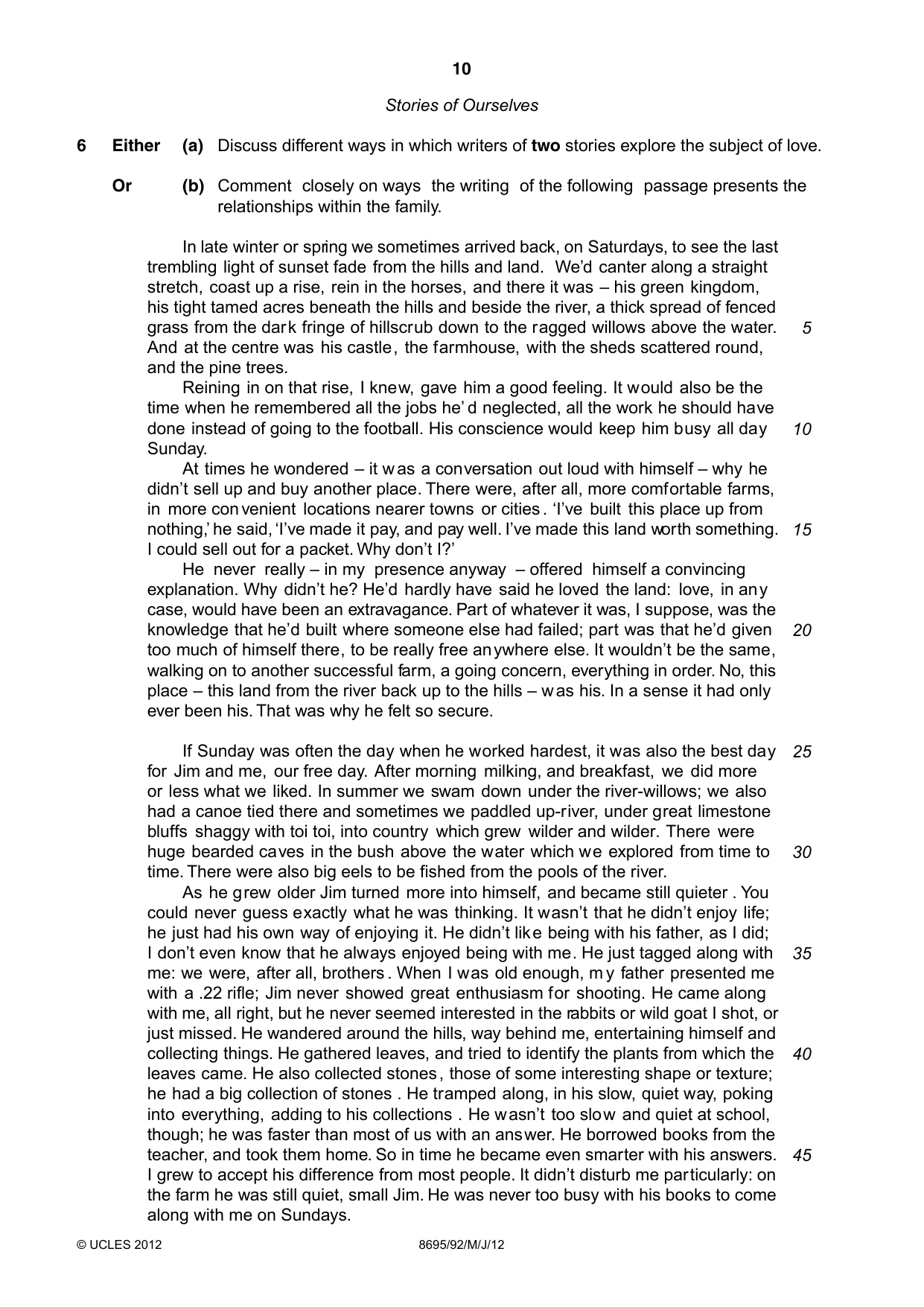
10 8695/92/M/J/12 © UCLES 2012 Stories of Ourselves 6 Either (a) Discuss different ways in which writers of two stories explore the subject of love. Or (b) Comment closely on ways the writing of the following passage presents the relationships within the family. In late winter or spring we sometimes arrived back, on Saturdays, to see the last trembling light of sunset fade from the hills and land. We’d canter along a straight stretch, coast up a rise, rein in the horses, and there it was – his green kingdom, his tight tamed acres beneath the hills and beside the river, a thick spread of fenced grass from the dark fringe of hillscrub down to the ragged willows above the water. And at the centre was his castle, the farmhouse, with the sheds scattered round, and the pine trees. Reining in on that rise, I knew, gave him a good feeling. It would also be the time when he remembered all the jobs he’ d neglected, all the work he should have done instead of going to the football. His conscience would keep him busy all day Sunday. At times he wondered – it was a conversation out loud with himself – why he didn’t sell up and buy another place. There were, after all, more comfortable farms, in more convenient locations nearer towns or cities. ‘I’ve built this place up from nothing,’ he said, ‘I’ve made it pay, and pay well. I’ve made this land worth something. I could sell out for a packet. Why don’t I?’ He never really – in my presence anyway – offered himself a convincing explanation. Why didn’t he? He’d hardly have said he loved the land: love, in any case, would have been an extravagance. Part of whatever it was, I suppose, was the knowledge that he’d built where someone else had failed; part was that he’d given too much of himself there, to be really free anywhere else. It wouldn’t be the same, walking on to another successful farm, a going concern, everything in order. No, this place – this land from the river back up to the hills – was his. In a sense it had only ever been his. That was why he felt so secure. If Sunday was often the day when he worked hardest, it was also the best day for Jim and me, our free day. After morning milking, and breakfast, we did more or less what we liked. In summer we swam down under the river-willows; we also had a canoe tied there and sometimes we paddled up-river, under great limestone bluffs shaggy with toi toi, into country which grew wilder and wilder. There were huge bearded caves in the bush above the water which we explored from time to time. There were also big eels to be fished from the pools of the river. As he grew older Jim turned more into himself, and became still quieter . You could never guess exactly what he was thinking. It wasn’t that he didn’t enjoy life; he just had his own way of enjoying it. He didn’t like being with his father, as I did; I don’t even know that he always enjoyed being with me. He just tagged along with me: we were, after all, brothers . When I was old enough, m y father presented me with a .22 rifle; Jim never showed great enthusiasm for shooting. He came along with me, all right, but he never seemed interested in the rabbits or wild goat I shot, or just missed. He wandered around the hills, way behind me, entertaining himself and collecting things. He gathered leaves, and tried to identify the plants from which the leaves came. He also collected stones, those of some interesting shape or texture; he had a big collection of stones . He tramped along, in his slow, quiet way, poking into everything, adding to his collections . He wasn’t too slow and quiet at school, though; he was faster than most of us with an answer. He borrowed books from the teacher, and took them home. So in time he became even smarter with his answers. I grew to accept his difference from most people. It didn’t disturb me particularly: on the farm he was still quiet, small Jim. He was never too busy with his books to come along with me on Sundays. 5 10 15 20 25 30 35 40 45
Question paper, page 11
11 8695/92/M/J/12 © UCLES 2012 [Turn over There was a night when Jim was going through some new stones he’d gathered. Usually, in the house, my father didn’t take much notice of Jim, his reading or his hobbies. He’d fought a losing battle for Jim, through the years, and now accepted his defeat. The People Before 50
Question paper, page 12
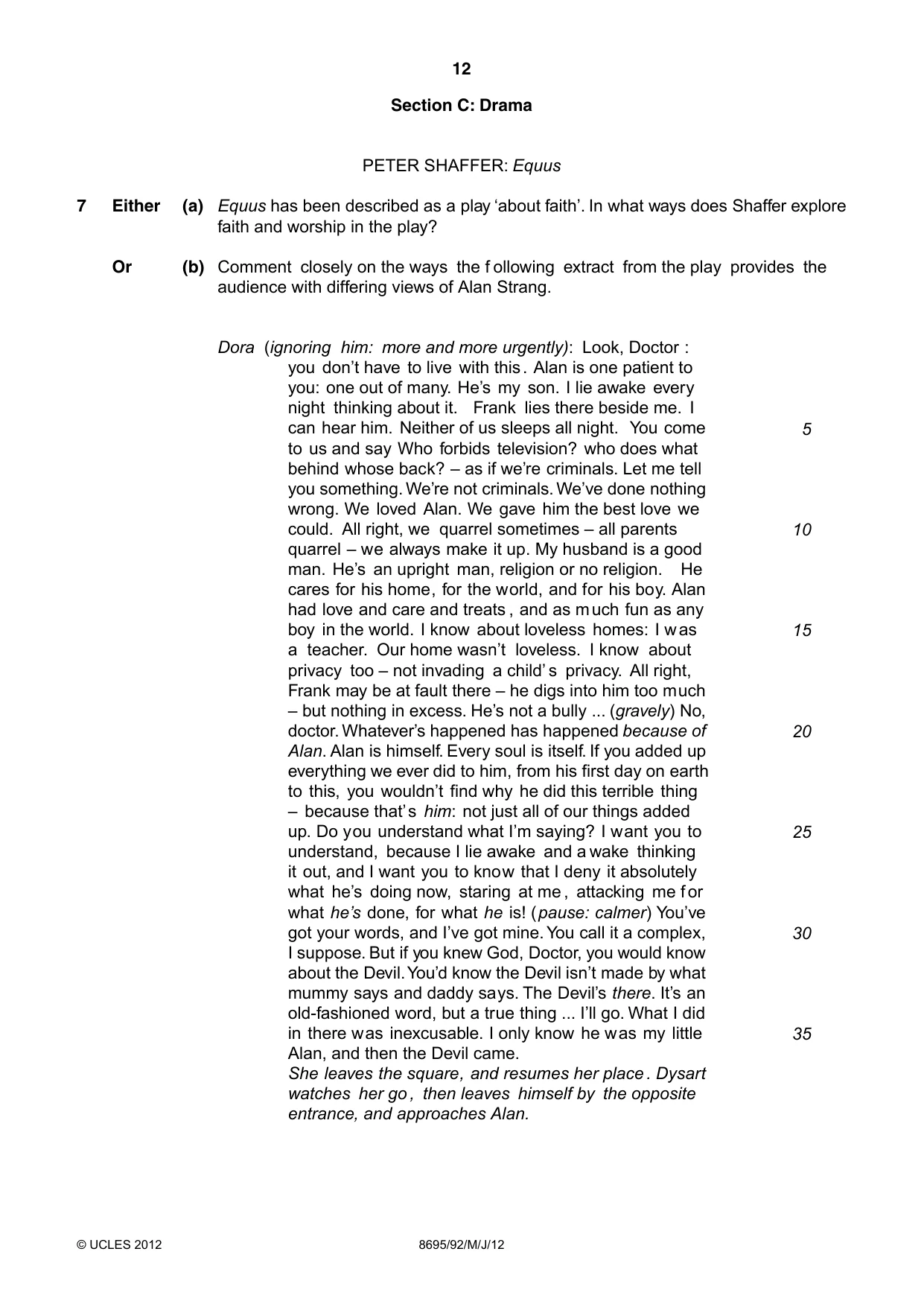
12 8695/92/M/J/12 © UCLES 2012 Section C: Drama PETER SHAFFER: Equus 7 Either (a) Equus has been described as a play ‘about faith’. In what ways does Shaffer explore faith and worship in the play? Or (b) Comment closely on the ways the f ollowing extract from the play provides the audience with differing views of Alan Strang. Dora (ignoring him: more and more urgently): Look, Doctor : you don’t have to live with this. Alan is one patient to you: one out of many. He’s my son. I lie awake every night thinking about it. Frank lies there beside me. I can hear him. Neither of us sleeps all night. You come to us and say Who forbids television? who does what behind whose back? – as if we’re criminals. Let me tell you something. We’re not criminals. We’ve done nothing wrong. We loved Alan. We gave him the best love we could. All right, we quarrel sometimes – all parents quarrel – we always make it up. My husband is a good man. He’s an upright man, religion or no religion. He cares for his home, for the world, and for his boy. Alan had love and care and treats , and as much fun as any boy in the world. I know about loveless homes: I was a teacher. Our home wasn’t loveless. I know about privacy too – not invading a child’ s privacy. All right, Frank may be at fault there – he digs into him too much – but nothing in excess. He’s not a bully ... (gravely) No, doctor. Whatever’s happened has happened because of Alan. Alan is himself. Every soul is itself. If you added up everything we ever did to him, from his first day on earth to this, you wouldn’t find why he did this terrible thing – because that’s him: not just all of our things added up. Do you understand what I’m saying? I want you to understand, because I lie awake and a wake thinking it out, and I want you to know that I deny it absolutely what he’s doing now, staring at me , attacking me for what he’s done, for what he is! (pause: calmer) You’ve got your words, and I’ve got mine. You call it a complex, I suppose. But if you knew God, Doctor, you would know about the Devil. You’d know the Devil isn’t made by what mummy says and daddy says. The Devil’s there. It’s an old-fashioned word, but a true thing ... I’ll go. What I did in there was inexcusable. I only know he was my little Alan, and then the Devil came. She leaves the square, and resumes her place . Dysart watches her go , then leaves himself by the opposite entrance, and approaches Alan. 5 10 15 20 25 30 35
Question paper, page 13
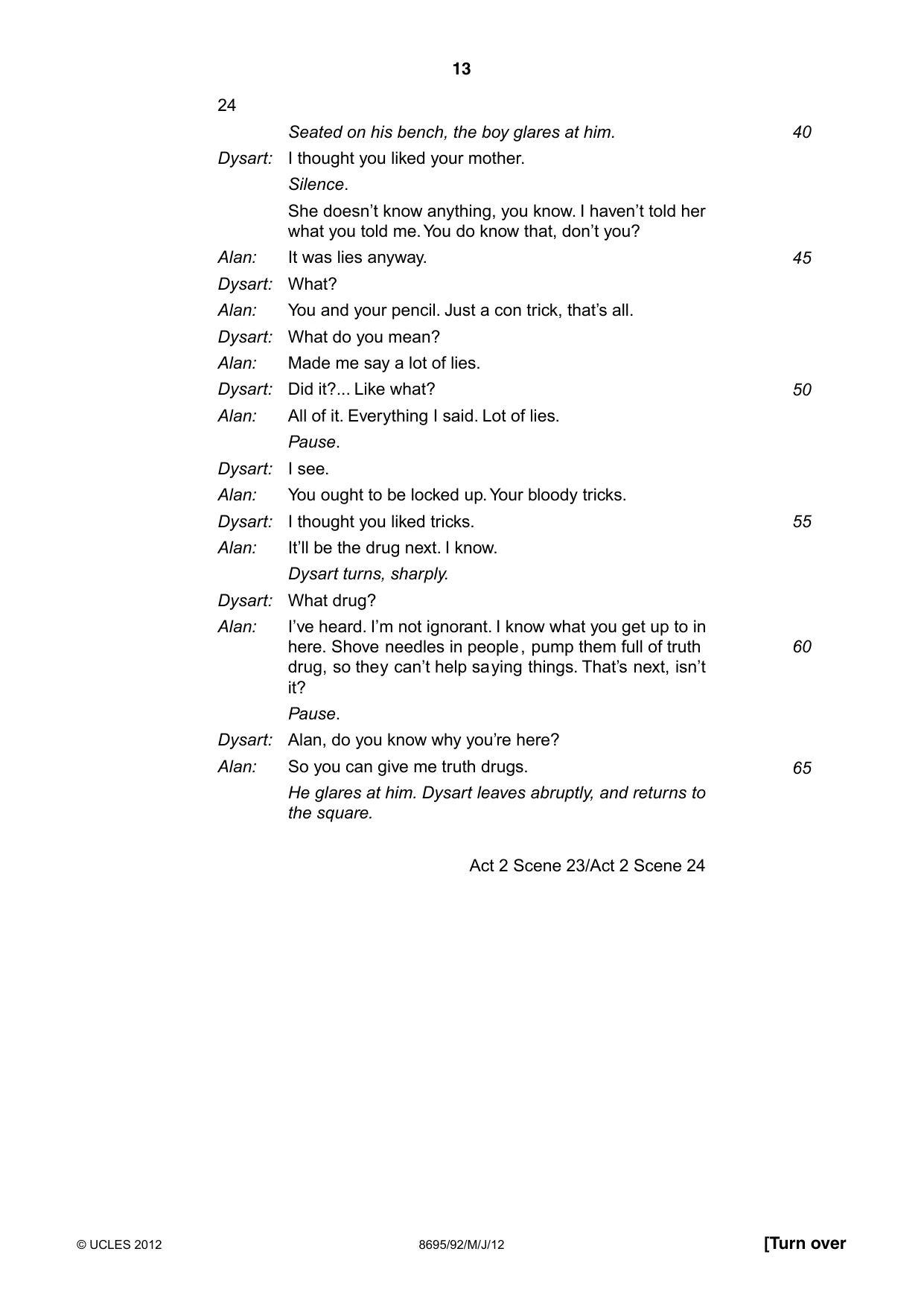
13 8695/92/M/J/12 © UCLES 2012 [Turn over 24 Seated on his bench, the boy glares at him. Dysart: I thought you liked your mother. Silence. She doesn’t know anything, you know. I haven’t told her what you told me. You do know that, don’t you? Alan: It was lies anyway. Dysart: What? Alan: You and your pencil. Just a con trick, that’s all. Dysart: What do you mean? Alan: Made me say a lot of lies. Dysart: Did it?... Like what? Alan: All of it. Everything I said. Lot of lies. Pause. Dysart: I see. Alan: You ought to be locked up. Your bloody tricks. Dysart: I thought you liked tricks. Alan: It’ll be the drug next. I know. Dysart turns, sharply. Dysart: What drug? Alan: I’ve heard. I’m not ignorant. I know what you get up to in here. Shove needles in people, pump them full of truth drug, so they can’t help saying things. That’s next, isn’t it? Pause. Dysart: Alan, do you know why you’re here? Alan: So you can give me truth drugs. He glares at him. Dysart leaves abruptly, and returns to the square. Act 2 Scene 23/Act 2 Scene 24 40 45 50 55 60 65
Question paper, page 14
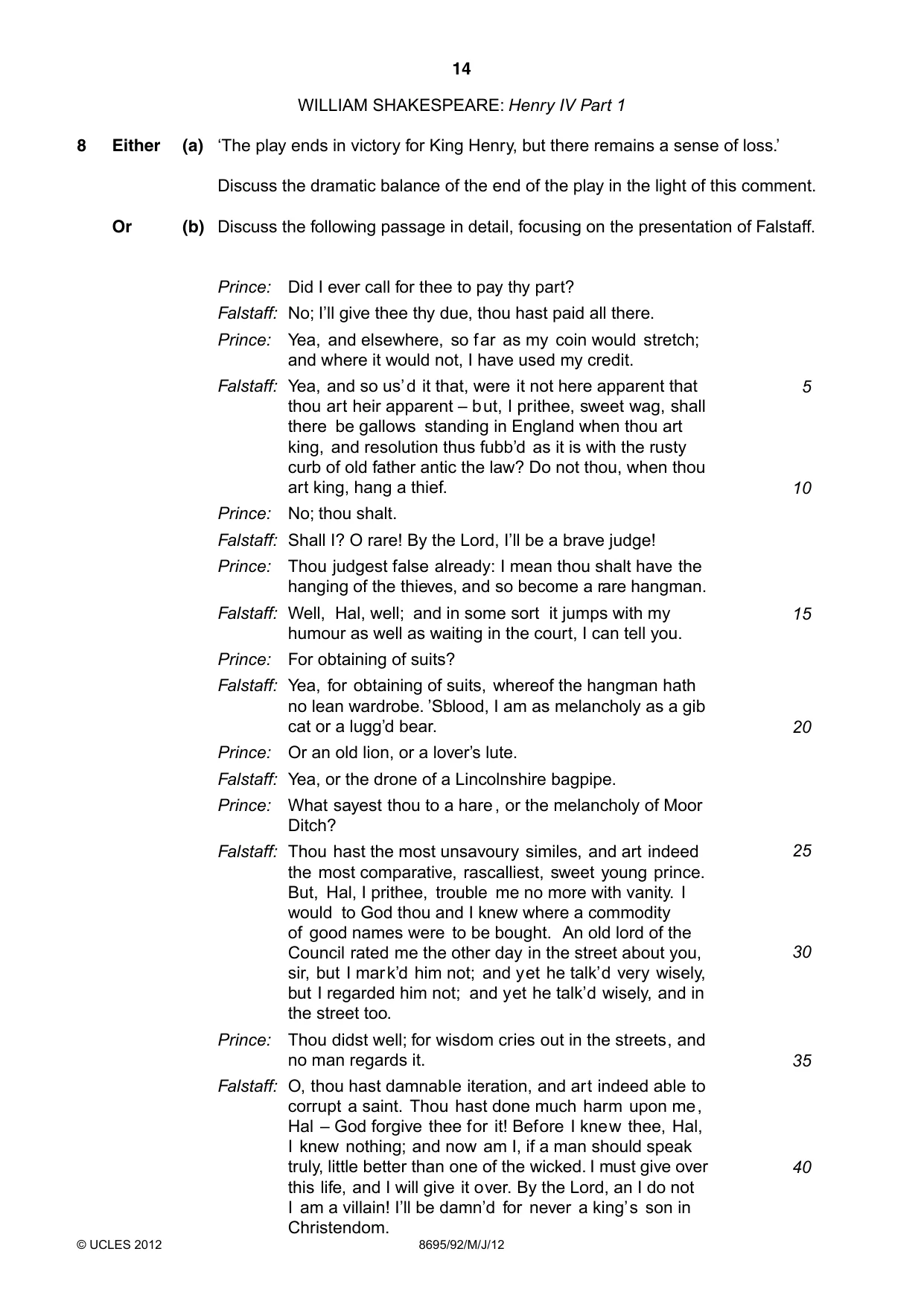
14 8695/92/M/J/12 © UCLES 2012 WILLIAM SHAKESPEARE: Henry IV Part 1 8 Either (a) ‘The play ends in victory for King Henry, but there remains a sense of loss.’ Discuss the dramatic balance of the end of the play in the light of this comment. Or (b) Discuss the following passage in detail, focusing on the presentation of Falstaff. Prince: Did I ever call for thee to pay thy part? Falstaff: No; I’ll give thee thy due, thou hast paid all there. Prince: Yea, and elsewhere, so far as my coin would stretch; and where it would not, I have used my credit. Falstaff: Yea, and so us’d it that, were it not here apparent that thou art heir apparent – but, I prithee, sweet wag, shall there be gallows standing in England when thou art king, and resolution thus fubb’d as it is with the rusty curb of old father antic the law? Do not thou, when thou art king, hang a thief. Prince: No; thou shalt. Falstaff: Shall I? O rare! By the Lord, I’ll be a brave judge! Prince: Thou judgest false already: I mean thou shalt have the hanging of the thieves, and so become a rare hangman. Falstaff: Well, Hal, well; and in some sort it jumps with my humour as well as waiting in the court, I can tell you. Prince: For obtaining of suits? Falstaff: Yea, for obtaining of suits, whereof the hangman hath no lean wardrobe. ’Sblood, I am as melancholy as a gib cat or a lugg’d bear. Prince: Or an old lion, or a lover’s lute. Falstaff: Yea, or the drone of a Lincolnshire bagpipe. Prince: What sayest thou to a hare, or the melancholy of Moor Ditch? Falstaff: Thou hast the most unsavoury similes, and art indeed the most comparative, rascalliest, sweet young prince. But, Hal, I prithee, trouble me no more with vanity. I would to God thou and I knew where a commodity of good names were to be bought. An old lord of the Council rated me the other day in the street about you, sir, but I mark’d him not; and yet he talk’d very wisely, but I regarded him not; and yet he talk’d wisely, and in the street too. Prince: Thou didst well; for wisdom cries out in the streets, and no man regards it. Falstaff: O, thou hast damnable iteration, and art indeed able to corrupt a saint. Thou hast done much harm upon me, Hal – God forgive thee for it! Before I knew thee, Hal, I knew nothing; and now am I, if a man should speak truly, little better than one of the wicked. I must give over this life, and I will give it over. By the Lord, an I do not I am a villain! I’ll be damn’d for never a king’s son in Christendom. 5 10 15 20 25 30 35 40
Question paper, page 15
15 8695/92/M/J/12 © UCLES 2012 [Turn over Prince: Where shall we take a purse to-morrow, Jack? Falstaff: Zounds, where thou wilt, lad: I’ll make one. An I do not, call me villain and baffle me. Prince: I see a good amendment of life in thee – from praying to purse-taking. Falstaff: Why, Hal, ’tis my vocation, Hal; ’tis no sin for a man to labour in his vocation. Act 1, Scene 2 45 50
Question paper, page 16
16 8695/92/M/J/12 © UCLES 2012 TENNESSEE WILLIAMS: A Streetcar Named Desire 9 Either (a) Williams has said that he exposes ‘a good many human weaknesses and brutalities’ in his plays. Discuss ways in which he does this in A Streetcar Named Desire. Or (b) Comment closely on ways the dialogue and action in the following passage develop the tension in the play. Blanche: Oh, I hope candles are going to glo w in his life Content removed due to copyright restrictions. Stanley: Ticket! Back to Laurel! On the Greyhound! Tuesday! Scene 8
Question paper, page 17
20 8695/92/M/J/12 © UCLES 2012 BLANK PAGE Copyright Acknowledgements: Question 2b © Seamus Heaney; A Clip from District and Circle ; Faber & Faber Ltd; 2006 Question 3b © Hone Tuwhare; Friend from Songs of Ourselves ; Foundation Books; 2005. © Estate of Hone Tuwhare; honetuwharepoetry@gmail.com. Question 4b © Tsitsi Dangarembga; Nervous Conditions ; Ayebia Publishing; 1988 Question 5b © EM Forster; A Passage to India ; Penguin Books Ltd; 1979. Reprinted by permission of The Provost and Scholars of King's College, Cambridge. Question 6b © Maurice Shadbolt; The People Before from Stories of Ourselves ; Cambridge University Press; 2008 Question 7b © Peter Shaffer; Equus ; Longman; 1993 Question 9b A Streetcar Named Desire by Tennessee Williams; Copyright © 1947 by The University of The South. Published by Penguin Books Ltd, 2005; Reprinted by permission of New Directions Publishing Corp. and Georges Borchardt Inc. for The Estate of Tennessee Williams. Permission to reproduce items where third-party owned material protected by copyright is included has been sought and cleared where possible. Every reasonable effort has been made b y the publisher (UCLES) to trace copyright holders, but if any items requiring clearance have unwittingly been included, the publisher will be pleased to make amends at the earliest possible opportunity. University of Cambridge International Examinations is part of the Cambridge Assessment Group Cambridge Local Examinations Syndicate (UCLES), which is itself a department of the University of Cambridge.
Mark scheme, page 1
UNIVERSITY OF CAMBRIDGE INTERNATIONAL EXAMINATIONS GCE Advanced Subsidiary Level and GCE Advanced Level MARK SCHEME for the May/June 2012 question paper for the guidance of teachers 8695 LANGUAGE AND LITERATURE IN ENGLISH 8695/92 Paper 9 (Poetry, Prose and Drama), maximum raw mark 50 This mark scheme is published as an aid to teachers and candidates, to indicate the requirements of the examination. It shows the basis on which Examiners were instructed to award marks. It does not indicate the details of the discussions that took place at an Examiners’ meeting before marking began, which would have considered the acceptability of alternative answers. Mark schemes must be read in conjunction with the question papers and the report on the examination. • Cambridge will not enter into discussions or correspondence in connection with these mark schemes. Cambridge is publishing the mark schemes for the May/June 2012 question papers for most IGCSE, GCE Advanced Level and Advanced Subsidiary Level syllabuses and some Ordinary Level syllabuses.
Mark scheme, page 2
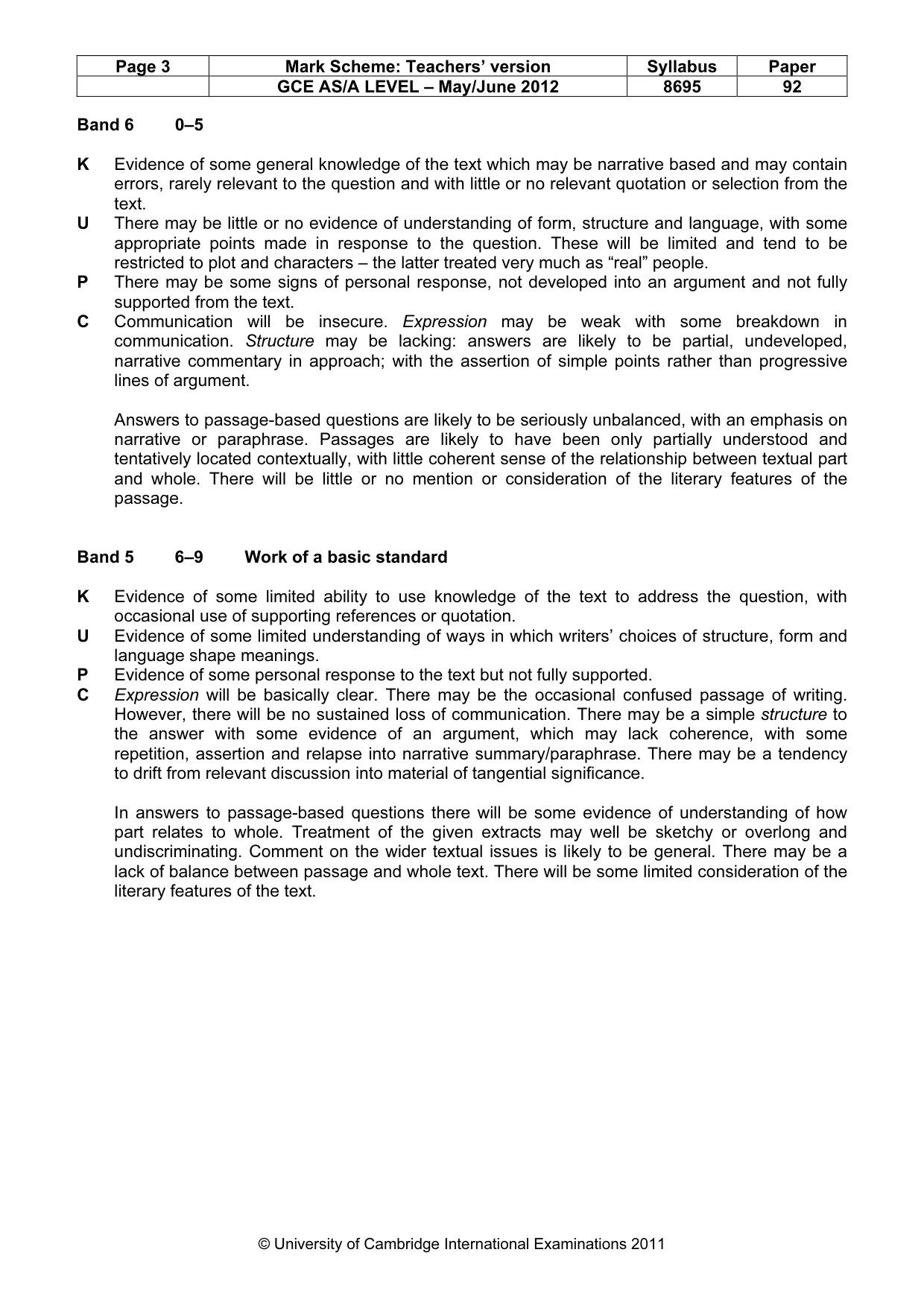
Page 2 Mark Scheme: Teachers’ version Syllabus Paper GCE AS/A LEVEL – May/June 2012 8695 92 © University of Cambridge International Examinations 2011 Using the mark bands Place the answer in a band first. Look for the “best fit” of the answer into a band. An answer needs to show evidence of most but not necessarily ALL of the qualities described in a band, in order to be placed in that band. Then award a mark for the relative position of the answer within the band. Candidates may address the question in many different ways. Do not expect any particular focus or approach and do not penalise answers for leaving out a particular focus. Reward what is there, showing what you are rewarding, in your comments. Consider all strands and weigh up the performance as a whole in placing the answer in a band, then show that you have done so in the summative comment, e.g. Sound K of texts, some evidence of U but mostly narrative, occasional evidence of P, mainly clear C. Assessment Objectives: • Ability to respond to texts in the three main forms (Prose, Poetry and Drama) of different types and from different cultures; • Understanding of the ways in which writers’ choices of form, structure and language shape meanings; • Ability to produce informed independent opinions and judgements on literary texts; • Ability to communicate clearly the knowledge, understanding and insight appropriate to literary study. Each answer is marked out of 25, in accordance with the General Marking Criteria below. Each band is divided into strands corresponding to the Assessment Objectives – Knowledge, Understanding, Personal Response, Communication.
Mark scheme, page 3
Page 3 Mark Scheme: Teachers’ version Syllabus Paper GCE AS/A LEVEL – May/June 2012 8695 92 © University of Cambridge International Examinations 2011 Band 6 0–5 K Evidence of some general knowledge of the text which may be narrative based and may contain errors, rarely relevant to the question and with little or no relevant quotation or selection from the text. U There may be little or no evidence of understanding of form, structure and language, with some appropriate points made in response to the question. These will be limited and tend to be restricted to plot and characters – the latter treated very much as “real” people. P There may be some signs of personal response, not developed into an argument and not fully supported from the text. C Communication will be insecure. Expression may be weak with some breakdown in communication. Structure may be lacking: answers are likely to be partial, undeveloped, narrative commentary in approach; with the assertion of simple points rather than progressive lines of argument. Answers to passage-based questions are likely to be seriously unbalanced, with an emphasis on narrative or paraphrase. Passages are likely to have been only partially understood and tentatively located contextually, with little coherent sense of the relationship between textual part and whole. There will be little or no mention or consideration of the literary features of the passage. Band 5 6–9 Work of a basic standard K Evidence of some limited ability to use knowledge of the text to address the question, with occasional use of supporting references or quotation. U Evidence of some limited understanding of ways in which writers’ choices of structure, form and language shape meanings. P Evidence of some personal response to the text but not fully supported. C Expression will be basically clear. There may be the occasional confused passage of writing. However, there will be no sustained loss of communication. There may be a simple structure to the answer with some evidence of an argument, which may lack coherence, with some repetition, assertion and relapse into narrative summary/paraphrase. There may be a tendency to drift from relevant discussion into material of tangential significance. In answers to passage-based questions there will be some evidence of understanding of how part relates to whole. Treatment of the given extracts may well be sketchy or overlong and undiscriminating. Comment on the wider textual issues is likely to be general. There may be a lack of balance between passage and whole text. There will be some limited consideration of the literary features of the text.
Mark scheme, page 4
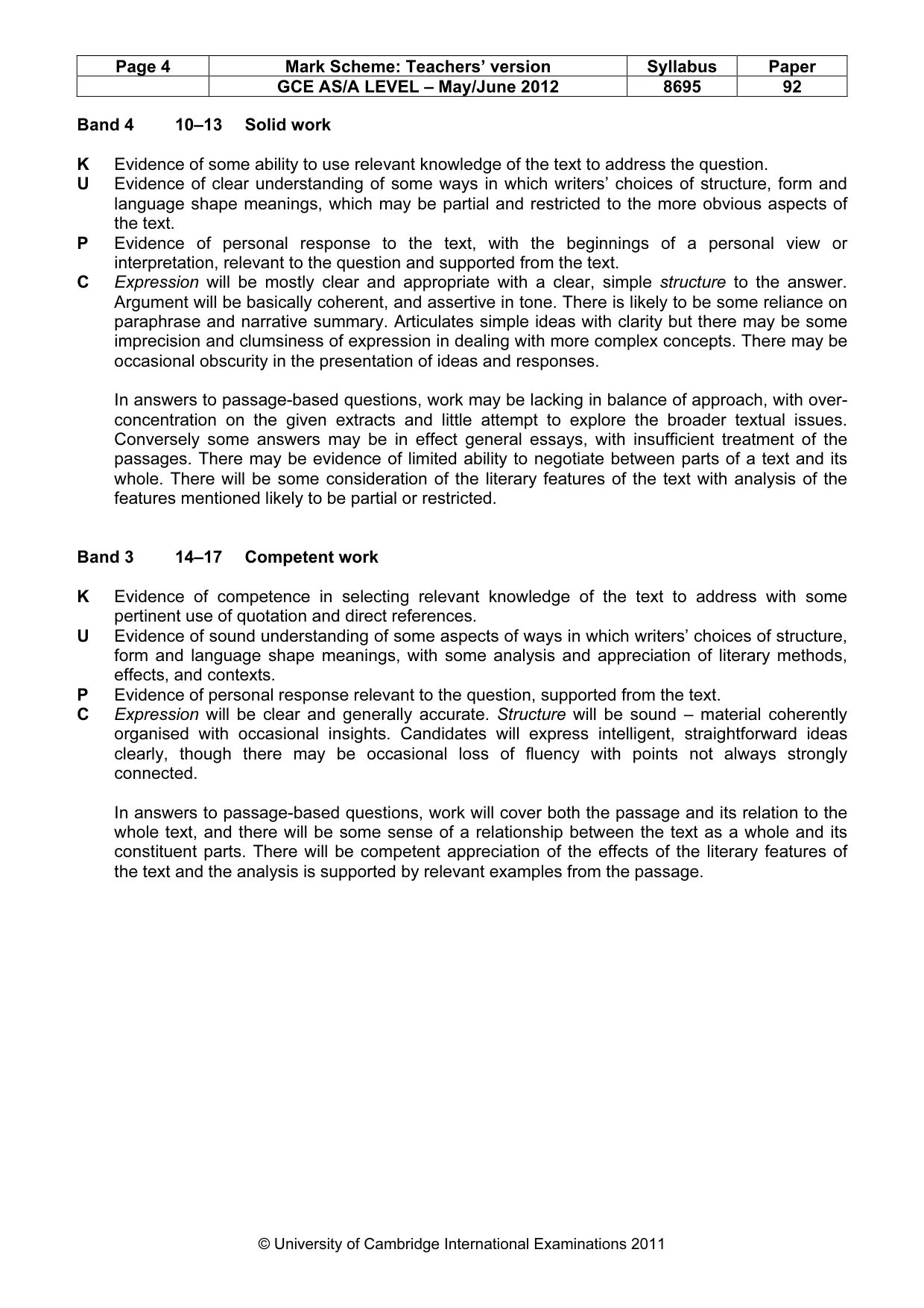
Page 4 Mark Scheme: Teachers’ version Syllabus Paper GCE AS/A LEVEL – May/June 2012 8695 92 © University of Cambridge International Examinations 2011 Band 4 10–13 Solid work K Evidence of some ability to use relevant knowledge of the text to address the question. U Evidence of clear understanding of some ways in which writers’ choices of structure, form and language shape meanings, which may be partial and restricted to the more obvious aspects of the text. P Evidence of personal response to the text, with the beginnings of a personal view or interpretation, relevant to the question and supported from the text. C Expression will be mostly clear and appropriate with a clear, simple structure to the answer. Argument will be basically coherent, and assertive in tone. There is likely to be some reliance on paraphrase and narrative summary. Articulates simple ideas with clarity but there may be some imprecision and clumsiness of expression in dealing with more complex concepts. There may be occasional obscurity in the presentation of ideas and responses. In answers to passage-based questions, work may be lacking in balance of approach, with over- concentration on the given extracts and little attempt to explore the broader textual issues. Conversely some answers may be in effect general essays, with insufficient treatment of the passages. There may be evidence of limited ability to negotiate between parts of a text and its whole. There will be some consideration of the literary features of the text with analysis of the features mentioned likely to be partial or restricted. Band 3 14–17 Competent work K Evidence of competence in selecting relevant knowledge of the text to address with some pertinent use of quotation and direct references. U Evidence of sound understanding of some aspects of ways in which writers’ choices of structure, form and language shape meanings, with some analysis and appreciation of literary methods, effects, and contexts. P Evidence of personal response relevant to the question, supported from the text. C Expression will be clear and generally accurate. Structure will be sound – material coherently organised with occasional insights. Candidates will express intelligent, straightforward ideas clearly, though there may be occasional loss of fluency with points not always strongly connected. In answers to passage-based questions, work will cover both the passage and its relation to the whole text, and there will be some sense of a relationship between the text as a whole and its constituent parts. There will be competent appreciation of the effects of the literary features of the text and the analysis is supported by relevant examples from the passage.
Mark scheme, page 5
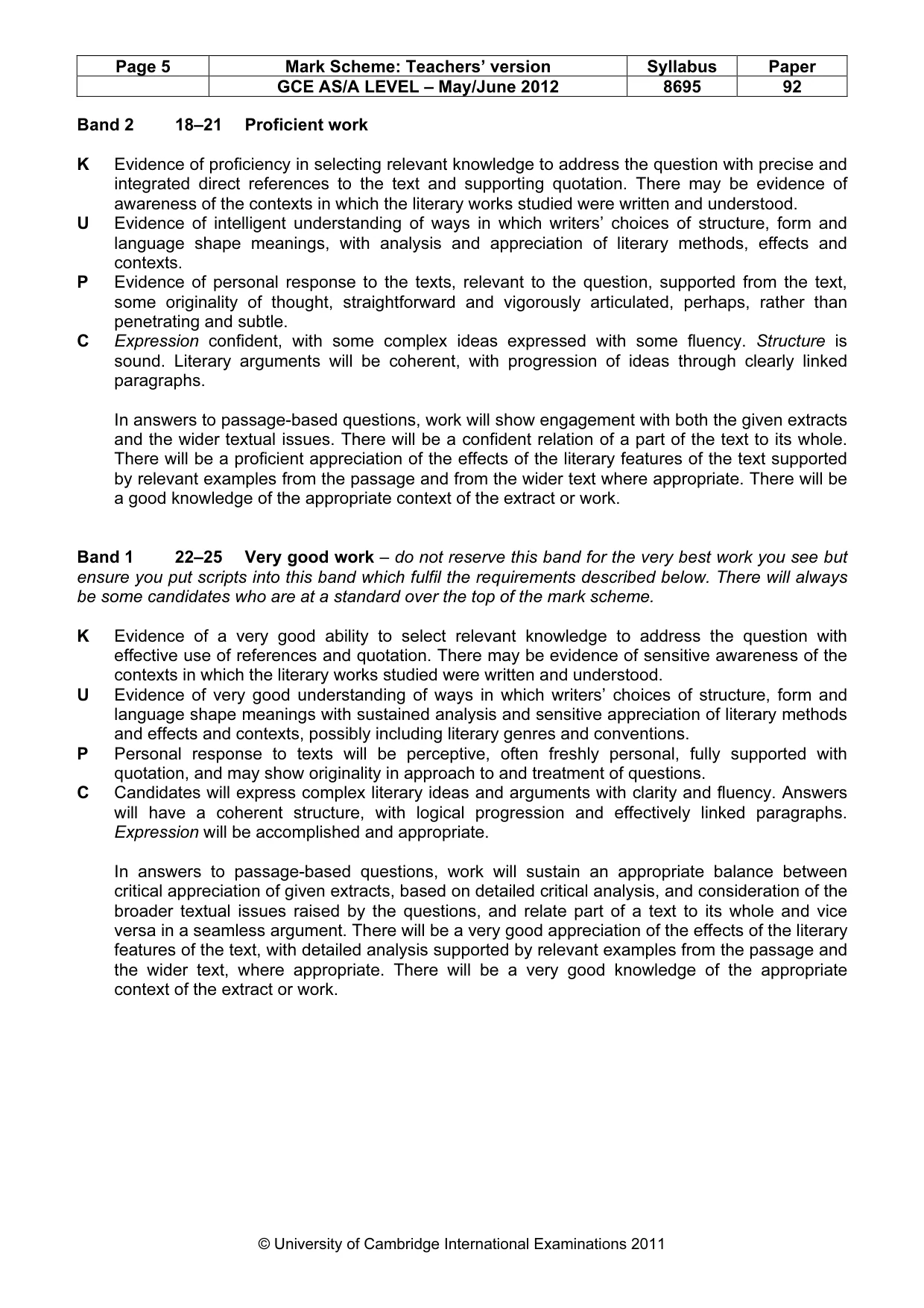
Page 5 Mark Scheme: Teachers’ version Syllabus Paper GCE AS/A LEVEL – May/June 2012 8695 92 © University of Cambridge International Examinations 2011 Band 2 18–21 Proficient work K Evidence of proficiency in selecting relevant knowledge to address the question with precise and integrated direct references to the text and supporting quotation. There may be evidence of awareness of the contexts in which the literary works studied were written and understood. U Evidence of intelligent understanding of ways in which writers’ choices of structure, form and language shape meanings, with analysis and appreciation of literary methods, effects and contexts. P Evidence of personal response to the texts, relevant to the question, supported from the text, some originality of thought, straightforward and vigorously articulated, perhaps, rather than penetrating and subtle. C Expression confident, with some complex ideas expressed with some fluency. Structure is sound. Literary arguments will be coherent, with progression of ideas through clearly linked paragraphs. In answers to passage-based questions, work will show engagement with both the given extracts and the wider textual issues. There will be a confident relation of a part of the text to its whole. There will be a proficient appreciation of the effects of the literary features of the text supported by relevant examples from the passage and from the wider text where appropriate. There will be a good knowledge of the appropriate context of the extract or work. Band 1 22–25 Very good work – do not reserve this band for the very best work you see but ensure you put scripts into this band which fulfil the requirements described below. There will always be some candidates who are at a standard over the top of the mark scheme. K Evidence of a very good ability to select relevant knowledge to address the question with effective use of references and quotation. There may be evidence of sensitive awareness of the contexts in which the literary works studied were written and understood. U Evidence of very good understanding of ways in which writers’ choices of structure, form and language shape meanings with sustained analysis and sensitive appreciation of literary methods and effects and contexts, possibly including literary genres and conventions. P Personal response to texts will be perceptive, often freshly personal, fully supported with quotation, and may show originality in approach to and treatment of questions. C Candidates will express complex literary ideas and arguments with clarity and fluency. Answers will have a coherent structure, with logical progression and effectively linked paragraphs. Expression will be accomplished and appropriate. In answers to passage-based questions, work will sustain an appropriate balance between critical appreciation of given extracts, based on detailed critical analysis, and consideration of the broader textual issues raised by the questions, and relate part of a text to its whole and vice versa in a seamless argument. There will be a very good appreciation of the effects of the literary features of the text, with detailed analysis supported by relevant examples from the passage and the wider text, where appropriate. There will be a very good knowledge of the appropriate context of the extract or work.
What you needed in this session
Cambridge’s own grade thresholds for 2012 May/June, Paper 9 · Variant 2. A higher threshold means an easier paper — the bar moves with how the cohort did.