Cambridge A Level English General Paper 8021 — 2023 May/June Paper 1 · Variant 2
8021/12/M/J/23 · 30 marks · ≈34 min
The question paper and its mark scheme, free to read here and free to download. This is Cambridge’s own paper, exactly as it was sat.
Question paper4 pages


Mark scheme17 pages
Answers below. Sit the paper first if you are practising.
Paper as text
Question paper, page 1
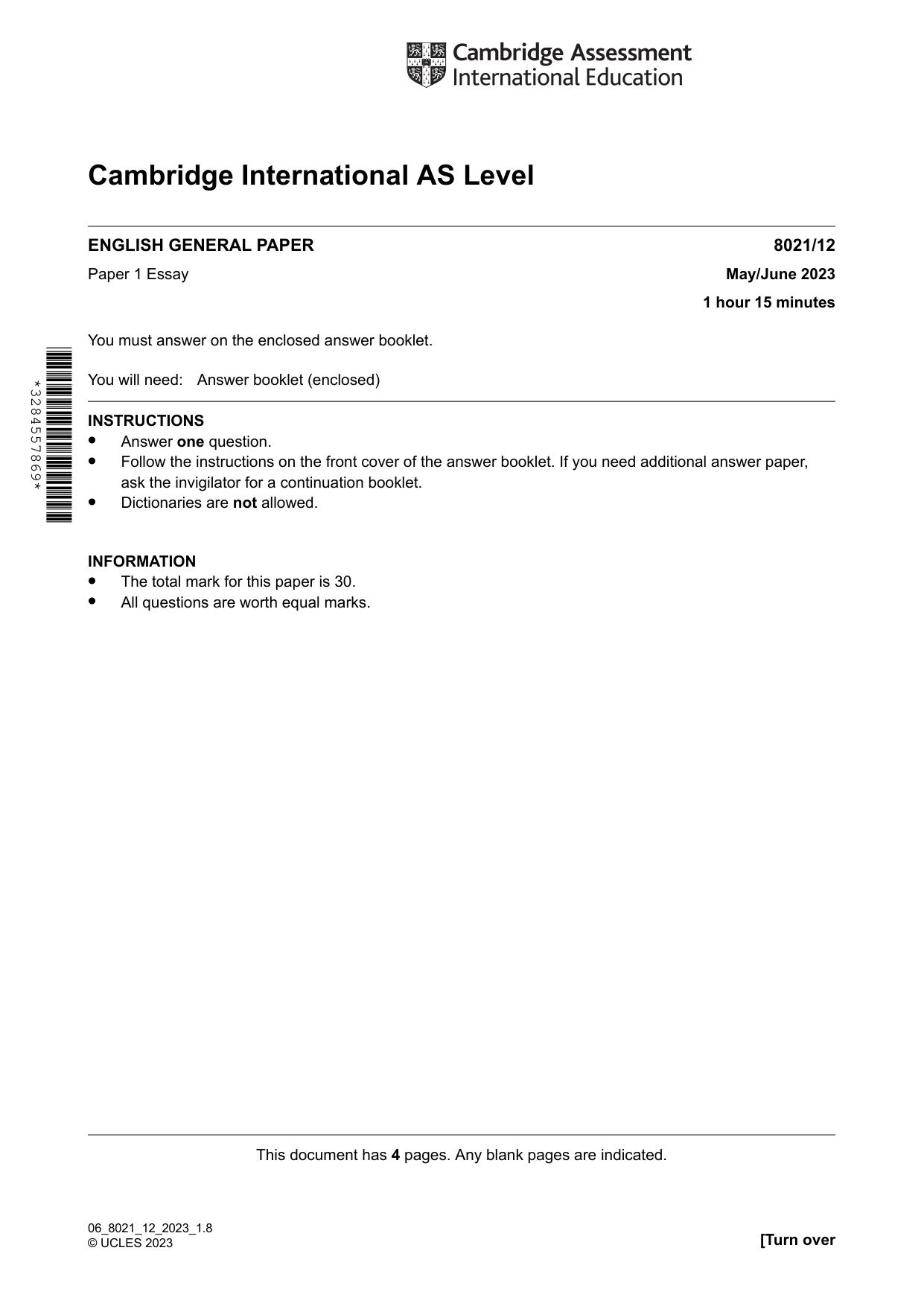
Cambridge International AS Level 8021/12 May/June 2023 1 hour 15 minutes ENGLISH GENERAL PAPER Paper 1 Essay You must answer on the enclosed answer booklet. You will need: Answer booklet (enclosed) INSTRUCTIONS • Answer one question. • Follow the instructions on the front cover of the answer booklet. If you need additional answer paper, ask the invigilator for a continuation booklet. • Dictionaries are not allowed. INFORMATION • The total mark for this paper is 30. • All questions are worth equal marks. This document has 4 pages. Any blank pages are indicated. [Turn over 06_8021_12_2023_1.8 © UCLES 2023 *3284557869*
Question paper, page 2
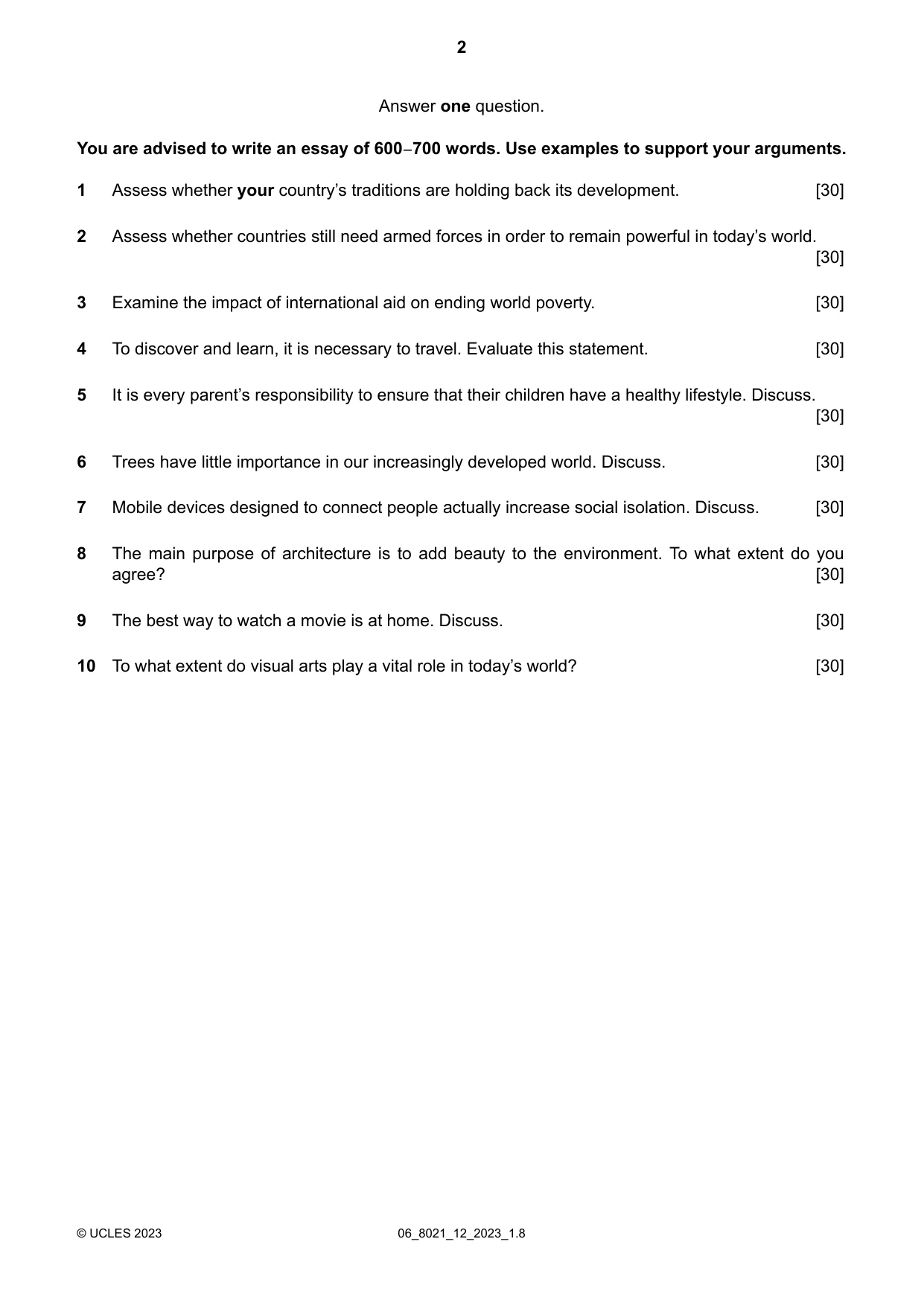
Answer one question. You are advised to write an essay of 600−700 words. Use examples to support your arguments. Assess whether your country’s traditions are holding back its development. [30] 1 Assess whether countries still need armed forces in order to remain powerful in today’s world. [30] 2 Examine the impact of international aid on ending world poverty. [30] 3 To discover and learn, it is necessary to travel. Evaluate this statement. [30] 4 It is every parent’s responsibility to ensure that their children have a healthy lifestyle. Discuss. [30] 5 Trees have little importance in our increasingly developed world. Discuss. [30] 6 Mobile devices designed to connect people actually increase social isolation. Discuss. [30] 7 The main purpose of architecture is to add beauty to the environment. To what extent do you agree? [30] 8 The best way to watch a movie is at home. Discuss. [30] 9 To what extent do visual arts play a vital role in today’s world? [30] 10 06_8021_12_2023_1.8 © UCLES 2023 2
Question paper, page 3
BLANK PAGE 06_8021_12_2023_1.8 © UCLES 2023 3
Question paper, page 4
BLANK PAGE Permission to reproduce items where third-party owned material protected by copyright is included has been sought and cleared where possible. Every reasonable effort has been made by the publisher (UCLES) to trace copyright holders, but if any items requiring clearance have unwittingly been included, the publisher will be pleased to make amends at the earliest possible opportunity. To avoid the issue of disclosure of answer-related information to candidates, all copyright acknowledgements are reproduced online in the Cambridge Assessment International Education Copyright Acknowledgements Booklet. This is produced for each series of examinations and is freely available to download at www.cambridgeinternational.org after the live examination series. Cambridge Assessment International Education is part of Cambridge Assessment. Cambridge Assessment is the brand name of the University of Cambridge Local Examinations Syndicate (UCLES), which is a department of the University of Cambridge. 06_8021_12_2023_1.8 © UCLES 2023 4
Mark scheme, page 1
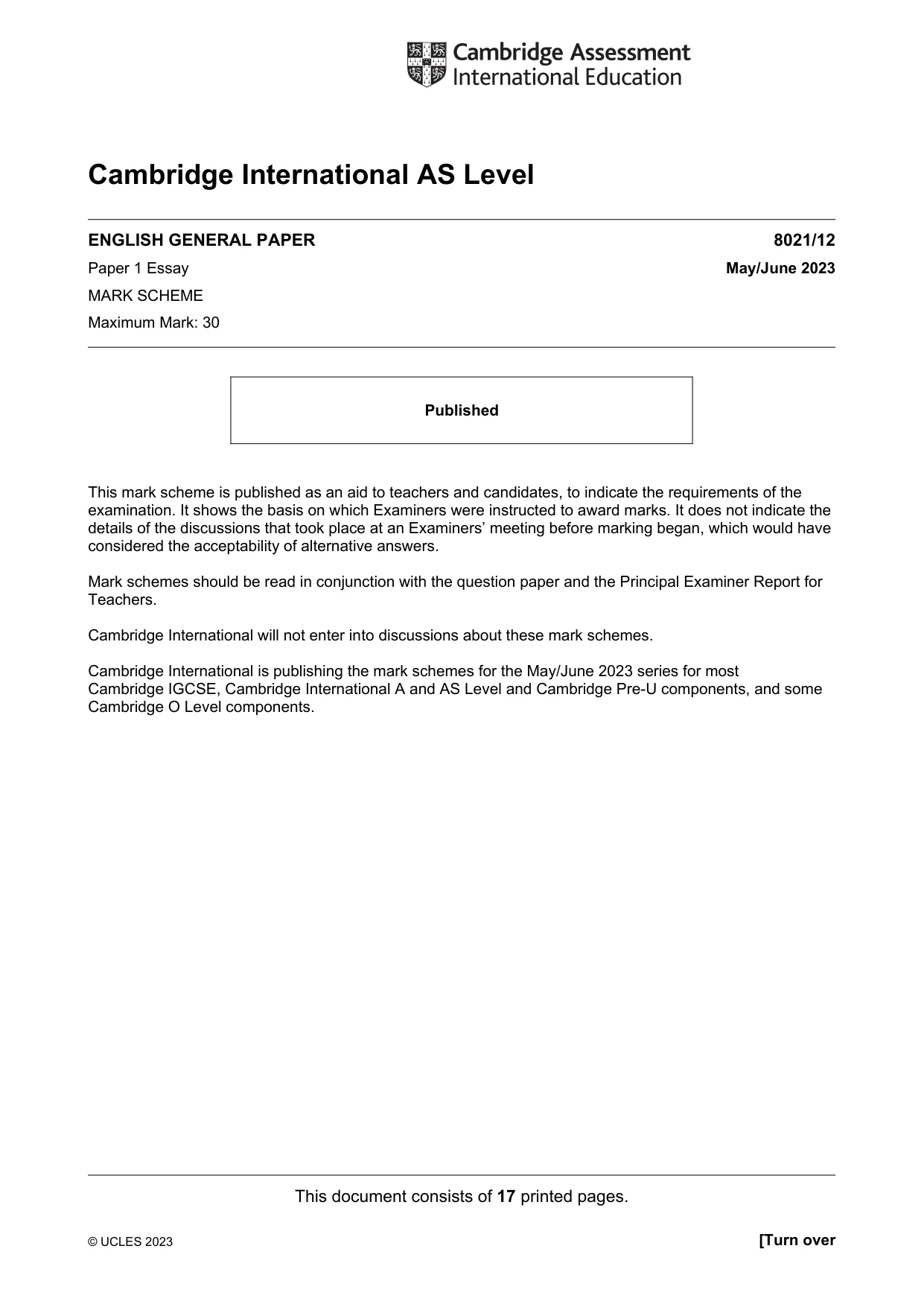
This document consists of 17 printed pages. © UCLES 2023 [Turn over Cambridge International AS Level ENGLISH GENERAL PAPER 8021/12 Paper 1 Essay May/June 2023 MARK SCHEME Maximum Mark: 30 Published This mark scheme is published as an aid to teachers and candidates, to indicate the requirements of the examination. It shows the basis on which Examiners were instructed to award marks. It does not indicate the details of the discussions that took place at an Examiners’ meeting before marking began, which would have considered the acceptability of alternative answers. Mark schemes should be read in conjunction with the question paper and the Principal Examiner Report for Teachers. Cambridge International will not enter into discussions about these mark schemes. Cambridge International is publishing the mark schemes for the May/June 2023 series for most Cambridge IGCSE, Cambridge International A and AS Level and Cambridge Pre-U components, and some Cambridge O Level components.
Mark scheme, page 2
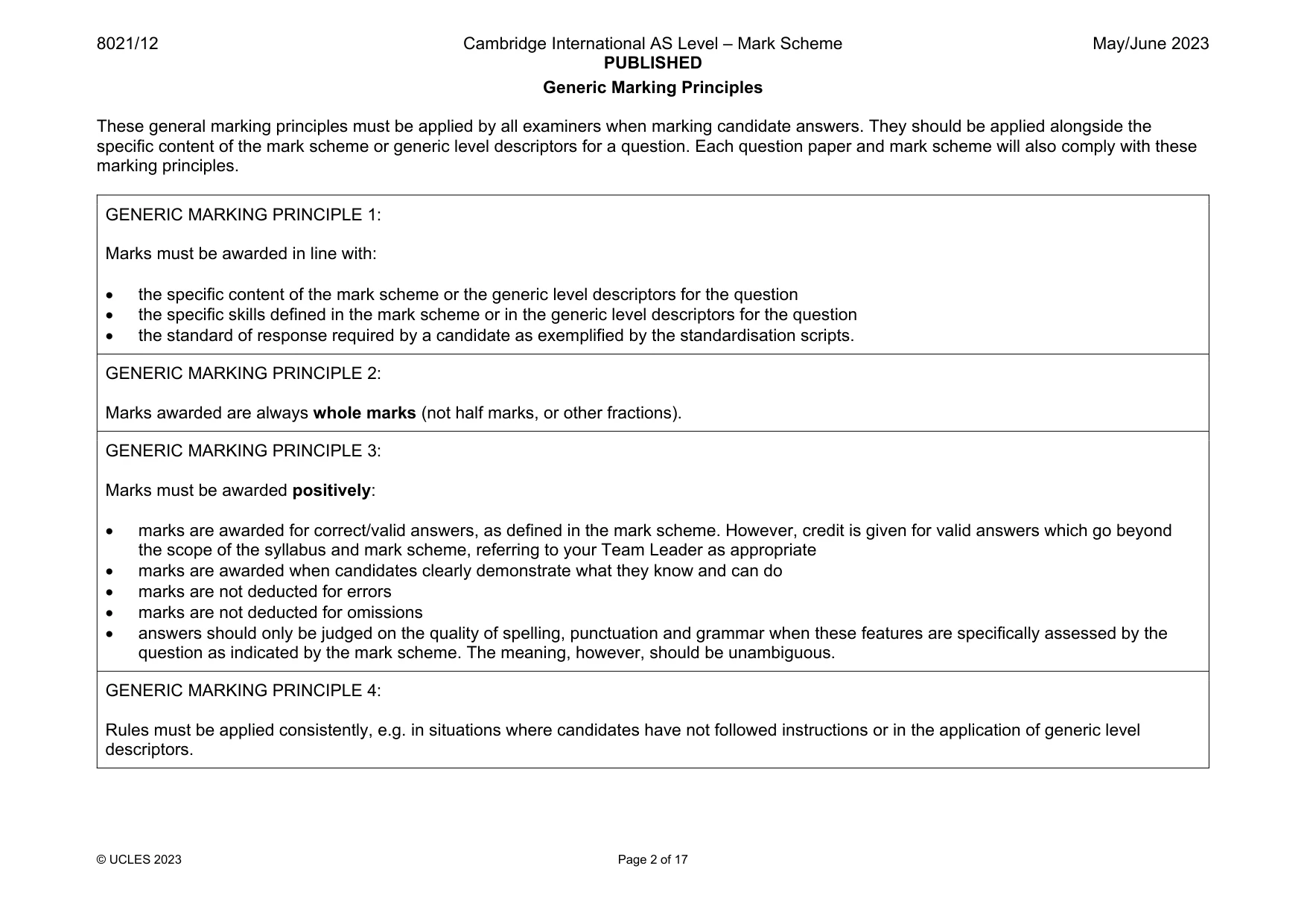
8021/12 Cambridge International AS Level – Mark Scheme PUBLISHED May/June 2023 © UCLES 2023 Page 2 of 17 Generic Marking Principles These general marking principles must be applied by all examiners when marking candidate answers. They should be applied alongside the specific content of the mark scheme or generic level descriptors for a question. Each question paper and mark scheme will also comply with these marking principles. GENERIC MARKING PRINCIPLE 1: Marks must be awarded in line with: the specific content of the mark scheme or the generic level descriptors for the question the specific skills defined in the mark scheme or in the generic level descriptors for the question the standard of response required by a candidate as exemplified by the standardisation scripts. GENERIC MARKING PRINCIPLE 2: Marks awarded are always whole marks (not half marks, or other fractions). GENERIC MARKING PRINCIPLE 3: Marks must be awarded positively: marks are awarded for correct/valid answers, as defined in the mark scheme. However, credit is given for valid answers which go beyond the scope of the syllabus and mark scheme, referring to your Team Leader as appropriate marks are awarded when candidates clearly demonstrate what they know and can do marks are not deducted for errors marks are not deducted for omissions answers should only be judged on the quality of spelling, punctuation and grammar when these features are specifically assessed by the question as indicated by the mark scheme. The meaning, however, should be unambiguous. GENERIC MARKING PRINCIPLE 4: Rules must be applied consistently, e.g. in situations where candidates have not followed instructions or in the application of generic level descriptors.
Mark scheme, page 3
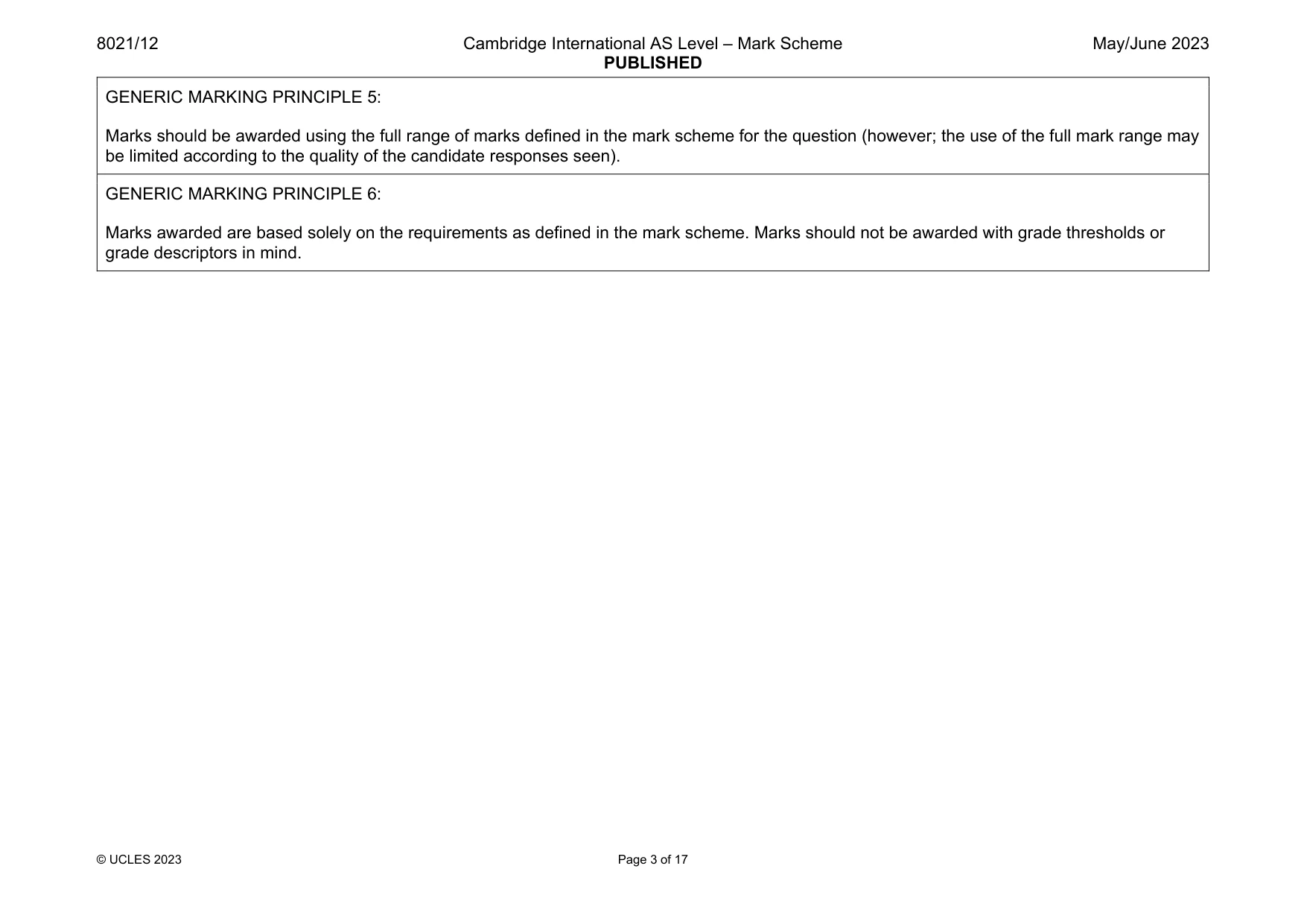
8021/12 Cambridge International AS Level – Mark Scheme PUBLISHED May/June 2023 © UCLES 2023 Page 3 of 17 GENERIC MARKING PRINCIPLE 5: Marks should be awarded using the full range of marks defined in the mark scheme for the question (however; the use of the full mark range may be limited according to the quality of the candidate responses seen). GENERIC MARKING PRINCIPLE 6: Marks awarded are based solely on the requirements as defined in the mark scheme. Marks should not be awarded with grade thresholds or grade descriptors in mind.
Mark scheme, page 4
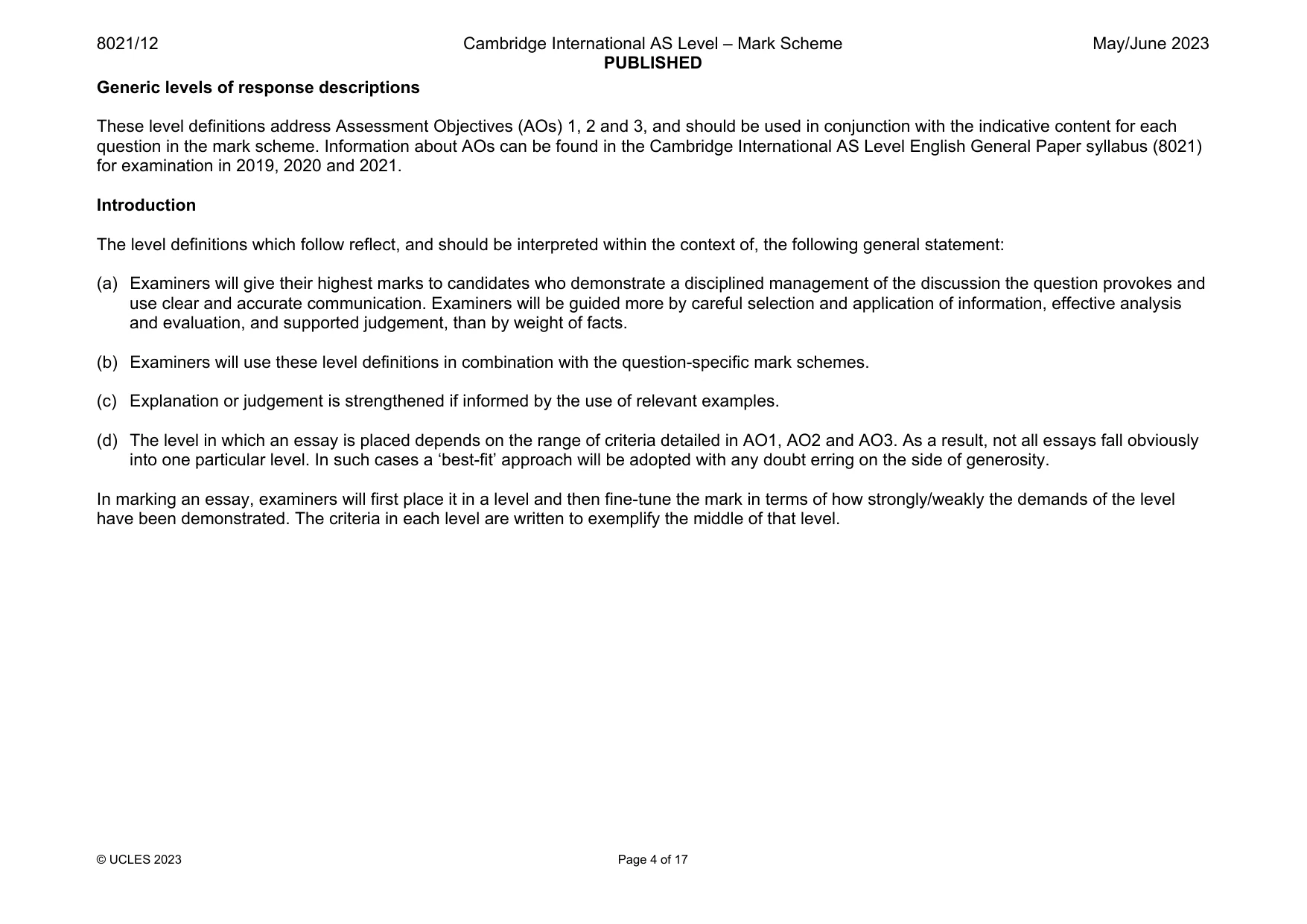
8021/12 Cambridge International AS Level – Mark Scheme PUBLISHED May/June 2023 © UCLES 2023 Page 4 of 17 Generic levels of response descriptions These level definitions address Assessment Objectives (AOs) 1, 2 and 3, and should be used in conjunction with the indicative content for each question in the mark scheme. Information about AOs can be found in the Cambridge International AS Level English General Paper syllabus (8021) for examination in 2019, 2020 and 2021. Introduction The level definitions which follow reflect, and should be interpreted within the context of, the following general statement: (a) Examiners will give their highest marks to candidates who demonstrate a disciplined management of the discussion the question provokes and use clear and accurate communication. Examiners will be guided more by careful selection and application of information, effective analysis and evaluation, and supported judgement, than by weight of facts. (b) Examiners will use these level definitions in combination with the question-specific mark schemes. (c) Explanation or judgement is strengthened if informed by the use of relevant examples. (d) The level in which an essay is placed depends on the range of criteria detailed in AO1, AO2 and AO3. As a result, not all essays fall obviously into one particular level. In such cases a ‘best-fit’ approach will be adopted with any doubt erring on the side of generosity. In marking an essay, examiners will first place it in a level and then fine-tune the mark in terms of how strongly/weakly the demands of the level have been demonstrated. The criteria in each level are written to exemplify the middle of that level.
Mark scheme, page 5
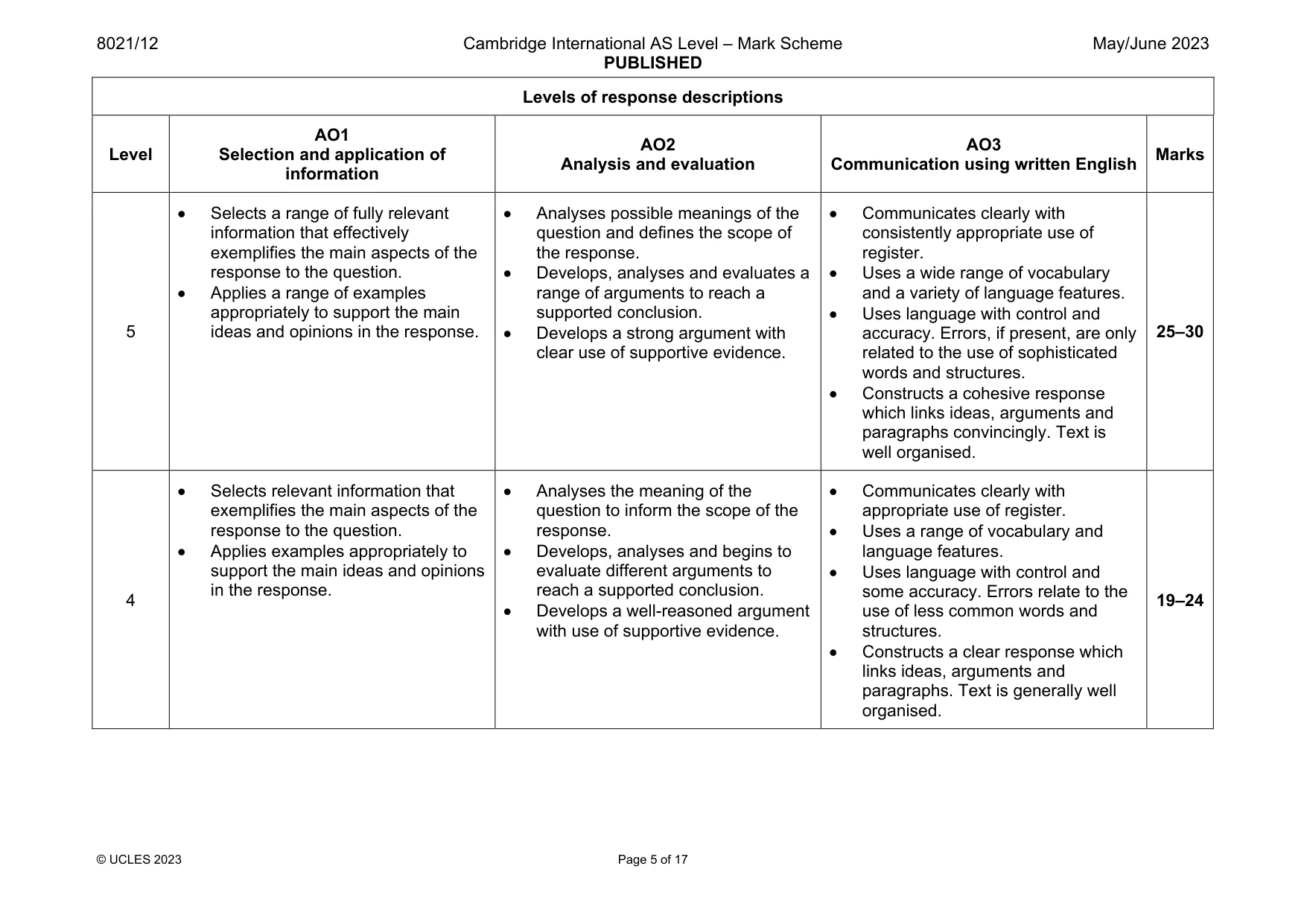
8021/12 Cambridge International AS Level – Mark Scheme PUBLISHED May/June 2023 © UCLES 2023 Page 5 of 17 Levels of response descriptions Level AO1 Selection and application of information AO2 Analysis and evaluation AO3 Communication using written English Marks 5 Selects a range of fully relevant information that effectively exemplifies the main aspects of the response to the question. Applies a range of examples appropriately to support the main ideas and opinions in the response. Analyses possible meanings of the question and defines the scope of the response. Develops, analyses and evaluates a range of arguments to reach a supported conclusion. Develops a strong argument with clear use of supportive evidence. Communicates clearly with consistently appropriate use of register. Uses a wide range of vocabulary and a variety of language features. Uses language with control and accuracy. Errors, if present, are only related to the use of sophisticated words and structures. Constructs a cohesive response which links ideas, arguments and paragraphs convincingly. Text is well organised. 25–30 4 Selects relevant information that exemplifies the main aspects of the response to the question. Applies examples appropriately to support the main ideas and opinions in the response. Analyses the meaning of the question to inform the scope of the response. Develops, analyses and begins to evaluate different arguments to reach a supported conclusion. Develops a well-reasoned argument with use of supportive evidence. Communicates clearly with appropriate use of register. Uses a range of vocabulary and language features. Uses language with control and some accuracy. Errors relate to the use of less common words and structures. Constructs a clear response which links ideas, arguments and paragraphs. Text is generally well organised. 19–24
Mark scheme, page 6
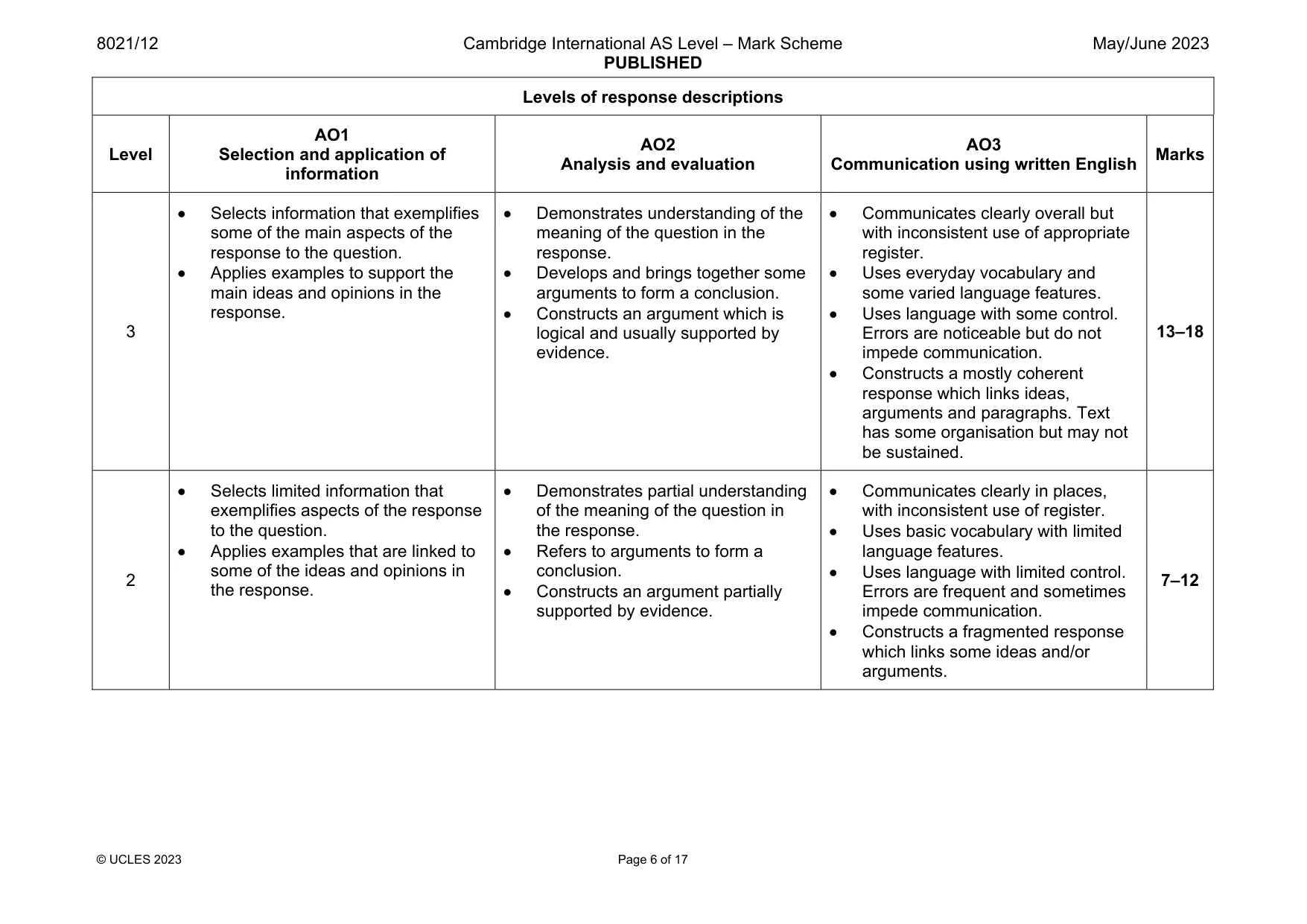
8021/12 Cambridge International AS Level – Mark Scheme PUBLISHED May/June 2023 © UCLES 2023 Page 6 of 17 Levels of response descriptions Level AO1 Selection and application of information AO2 Analysis and evaluation AO3 Communication using written English Marks 3 Selects information that exemplifies some of the main aspects of the response to the question. Applies examples to support the main ideas and opinions in the response. Demonstrates understanding of the meaning of the question in the response. Develops and brings together some arguments to form a conclusion. Constructs an argument which is logical and usually supported by evidence. Communicates clearly overall but with inconsistent use of appropriate register. Uses everyday vocabulary and some varied language features. Uses language with some control. Errors are noticeable but do not impede communication. Constructs a mostly coherent response which links ideas, arguments and paragraphs. Text has some organisation but may not be sustained. 13–18 2 Selects limited information that exemplifies aspects of the response to the question. Applies examples that are linked to some of the ideas and opinions in the response. Demonstrates partial understanding of the meaning of the question in the response. Refers to arguments to form a conclusion. Constructs an argument partially supported by evidence. Communicates clearly in places, with inconsistent use of register. Uses basic vocabulary with limited language features. Uses language with limited control. Errors are frequent and sometimes impede communication. Constructs a fragmented response which links some ideas and/or arguments. 7–12
Mark scheme, page 7
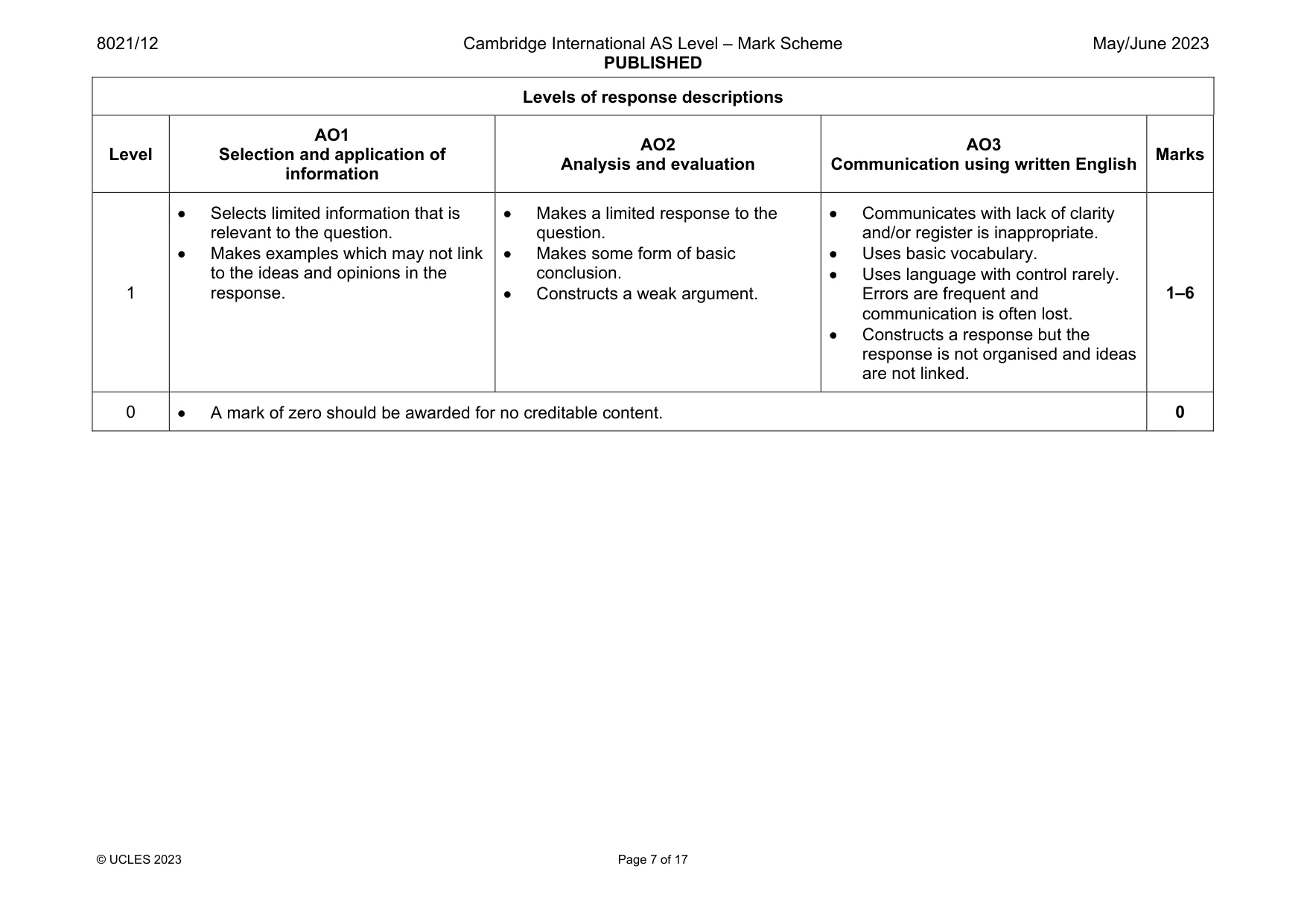
8021/12 Cambridge International AS Level – Mark Scheme PUBLISHED May/June 2023 © UCLES 2023 Page 7 of 17 Levels of response descriptions Level AO1 Selection and application of information AO2 Analysis and evaluation AO3 Communication using written English Marks 1 Selects limited information that is relevant to the question. Makes examples which may not link to the ideas and opinions in the response. Makes a limited response to the question. Makes some form of basic conclusion. Constructs a weak argument. Communicates with lack of clarity and/or register is inappropriate. Uses basic vocabulary. Uses language with control rarely. Errors are frequent and communication is often lost. Constructs a response but the response is not organised and ideas are not linked. 1–6 0 A mark of zero should be awarded for no creditable content. 0
Mark scheme, page 8
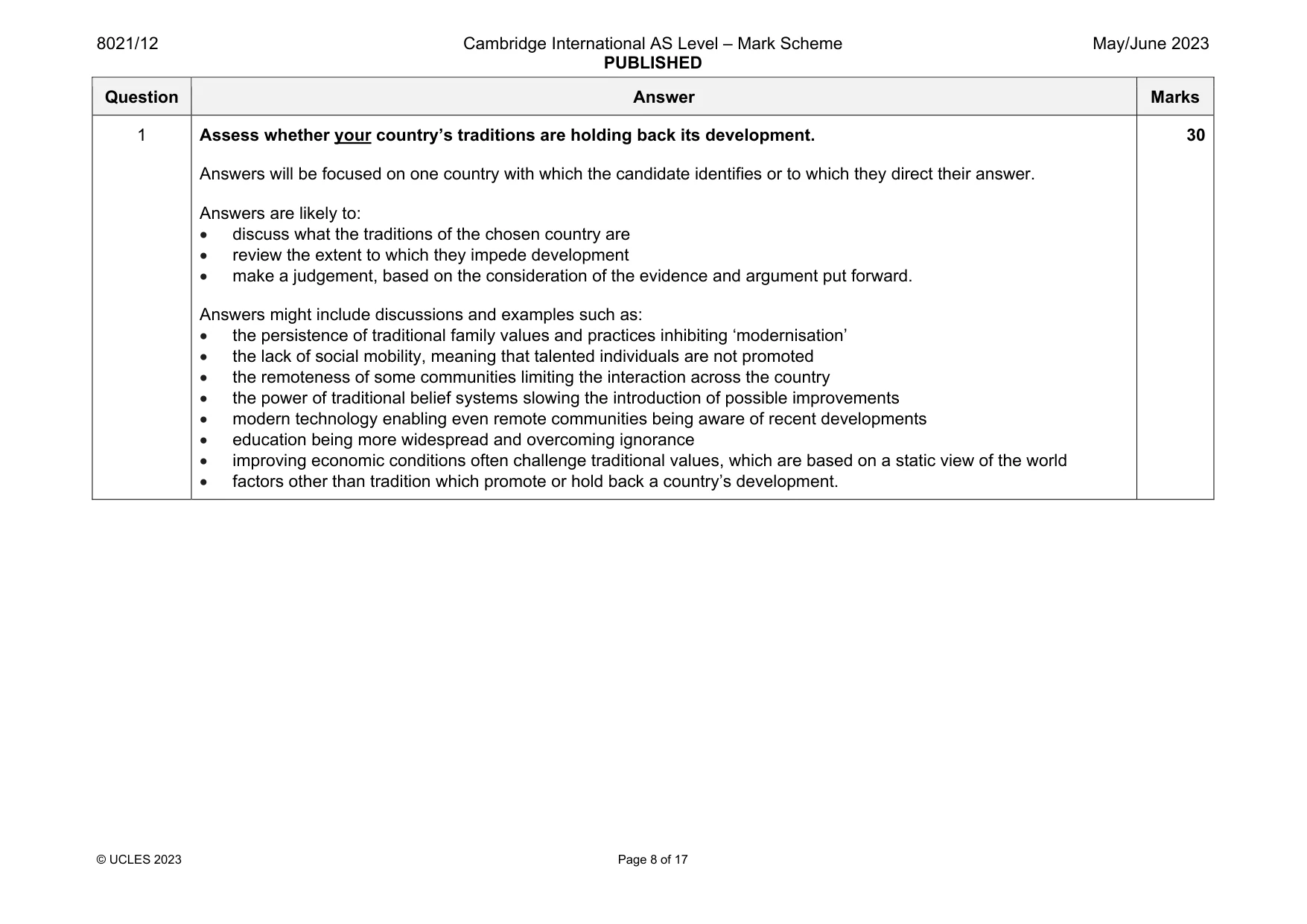
8021/12 Cambridge International AS Level – Mark Scheme PUBLISHED May/June 2023 © UCLES 2023 Page 8 of 17 Question Answer Marks 1 Assess whether your country’s traditions are holding back its development. Answers will be focused on one country with which the candidate identifies or to which they direct their answer. Answers are likely to: discuss what the traditions of the chosen country are review the extent to which they impede development make a judgement, based on the consideration of the evidence and argument put forward. Answers might include discussions and examples such as: the persistence of traditional family values and practices inhibiting ‘modernisation’ the lack of social mobility, meaning that talented individuals are not promoted the remoteness of some communities limiting the interaction across the country the power of traditional belief systems slowing the introduction of possible improvements modern technology enabling even remote communities being aware of recent developments education being more widespread and overcoming ignorance improving economic conditions often challenge traditional values, which are based on a static view of the world factors other than tradition which promote or hold back a country’s development. 30
Mark scheme, page 9
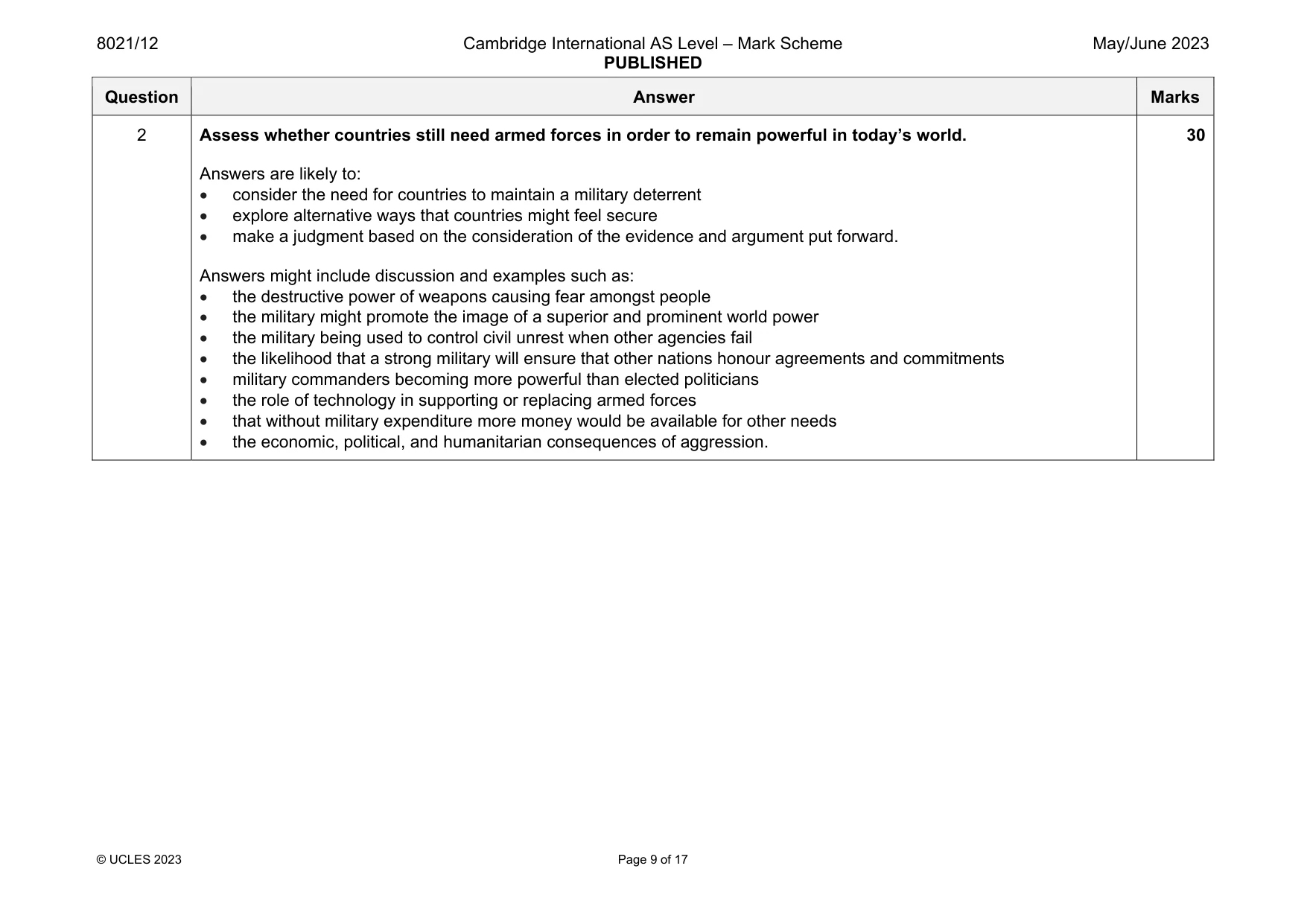
8021/12 Cambridge International AS Level – Mark Scheme PUBLISHED May/June 2023 © UCLES 2023 Page 9 of 17 Question Answer Marks 2 Assess whether countries still need armed forces in order to remain powerful in today’s world. Answers are likely to: consider the need for countries to maintain a military deterrent explore alternative ways that countries might feel secure make a judgment based on the consideration of the evidence and argument put forward. Answers might include discussion and examples such as: the destructive power of weapons causing fear amongst people the military might promote the image of a superior and prominent world power the military being used to control civil unrest when other agencies fail the likelihood that a strong military will ensure that other nations honour agreements and commitments military commanders becoming more powerful than elected politicians the role of technology in supporting or replacing armed forces that without military expenditure more money would be available for other needs the economic, political, and humanitarian consequences of aggression. 30
Mark scheme, page 10
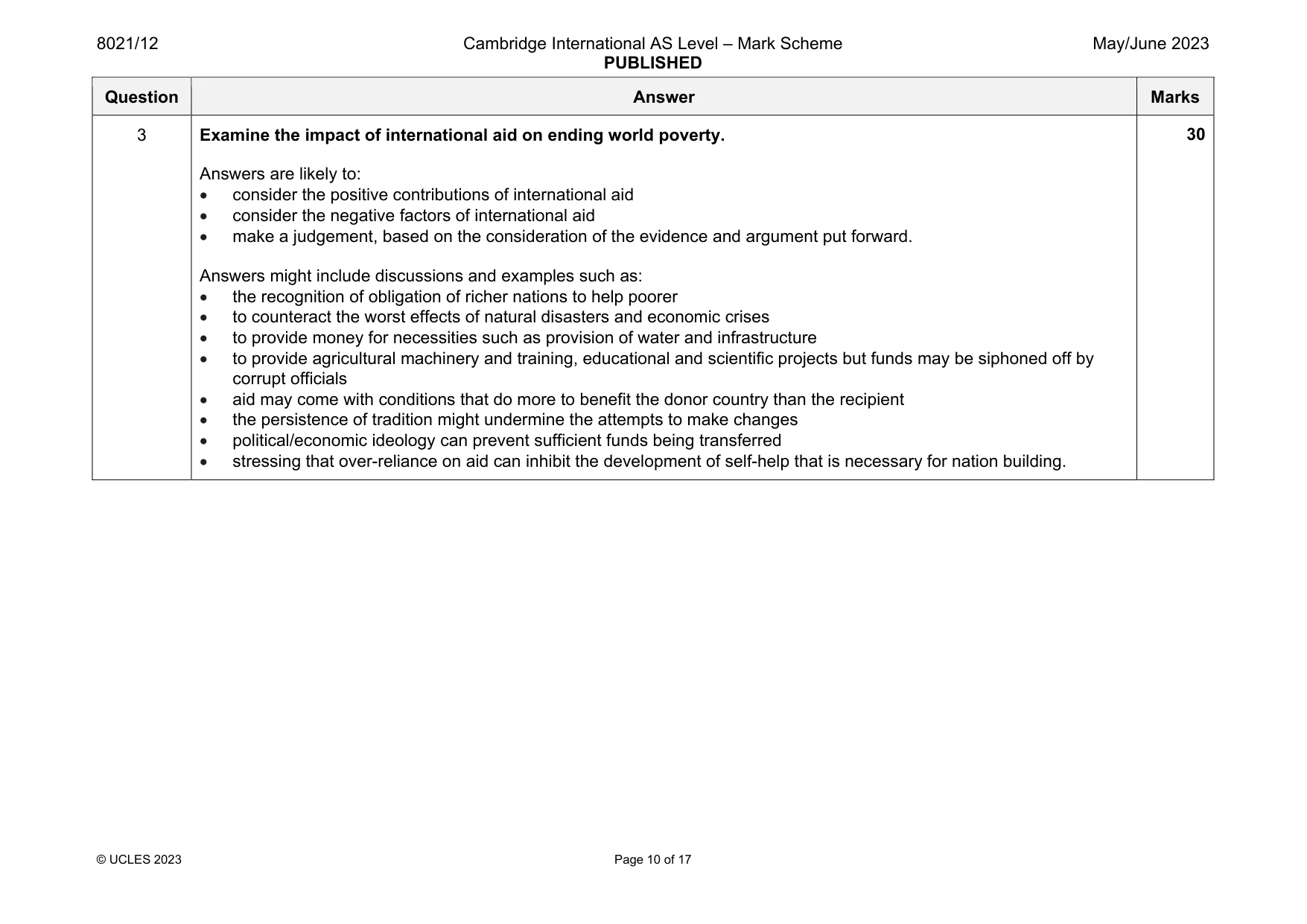
8021/12 Cambridge International AS Level – Mark Scheme PUBLISHED May/June 2023 © UCLES 2023 Page 10 of 17 Question Answer Marks 3 Examine the impact of international aid on ending world poverty. Answers are likely to: consider the positive contributions of international aid consider the negative factors of international aid make a judgement, based on the consideration of the evidence and argument put forward. Answers might include discussions and examples such as: the recognition of obligation of richer nations to help poorer to counteract the worst effects of natural disasters and economic crises to provide money for necessities such as provision of water and infrastructure to provide agricultural machinery and training, educational and scientific projects but funds may be siphoned off by corrupt officials aid may come with conditions that do more to benefit the donor country than the recipient the persistence of tradition might undermine the attempts to make changes political/economic ideology can prevent sufficient funds being transferred stressing that over-reliance on aid can inhibit the development of self-help that is necessary for nation building. 30
Mark scheme, page 11
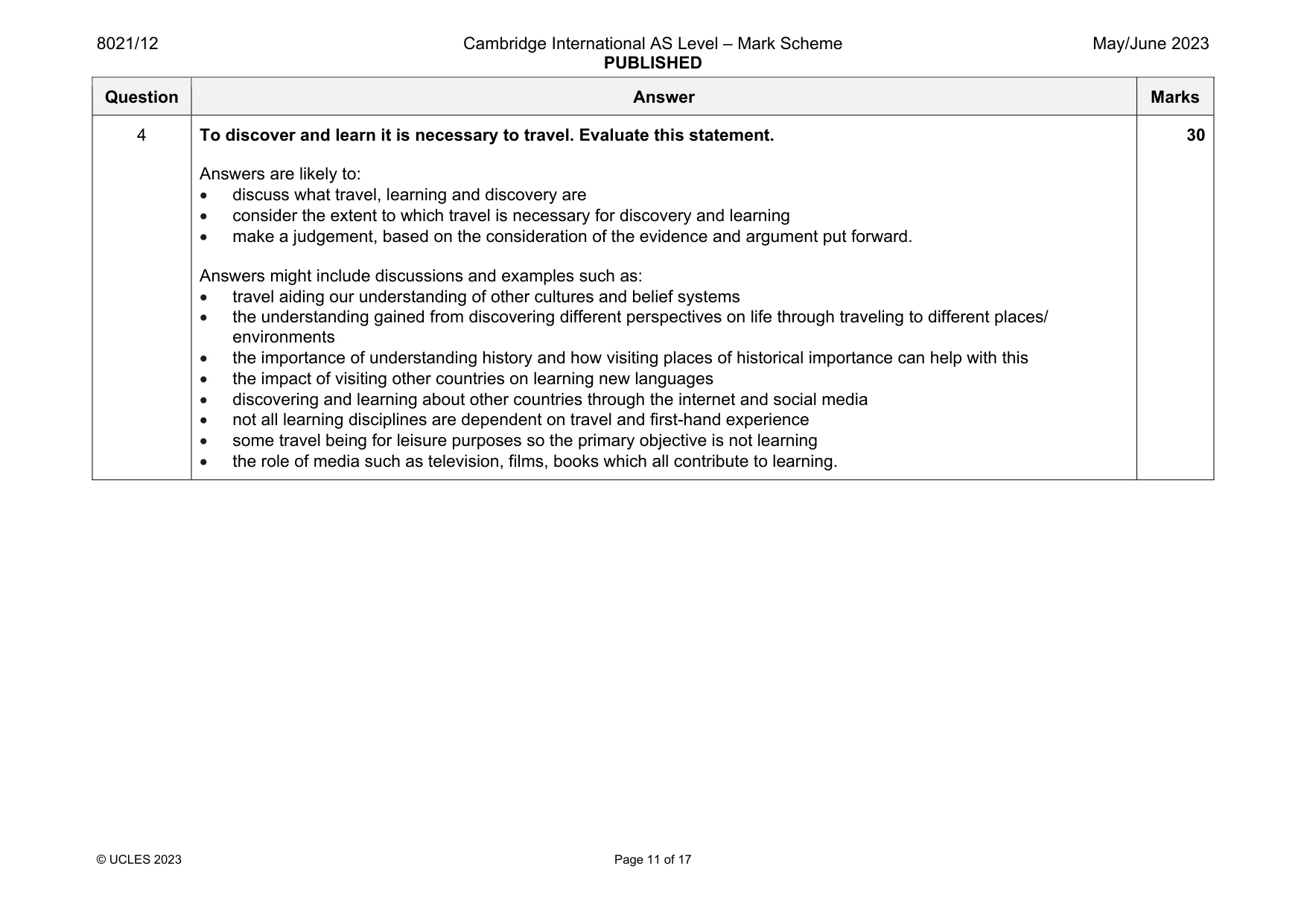
8021/12 Cambridge International AS Level – Mark Scheme PUBLISHED May/June 2023 © UCLES 2023 Page 11 of 17 Question Answer Marks 4 To discover and learn it is necessary to travel. Evaluate this statement. Answers are likely to: discuss what travel, learning and discovery are consider the extent to which travel is necessary for discovery and learning make a judgement, based on the consideration of the evidence and argument put forward. Answers might include discussions and examples such as: travel aiding our understanding of other cultures and belief systems the understanding gained from discovering different perspectives on life through traveling to different places/ environments the importance of understanding history and how visiting places of historical importance can help with this the impact of visiting other countries on learning new languages discovering and learning about other countries through the internet and social media not all learning disciplines are dependent on travel and first-hand experience some travel being for leisure purposes so the primary objective is not learning the role of media such as television, films, books which all contribute to learning. 30
Mark scheme, page 12
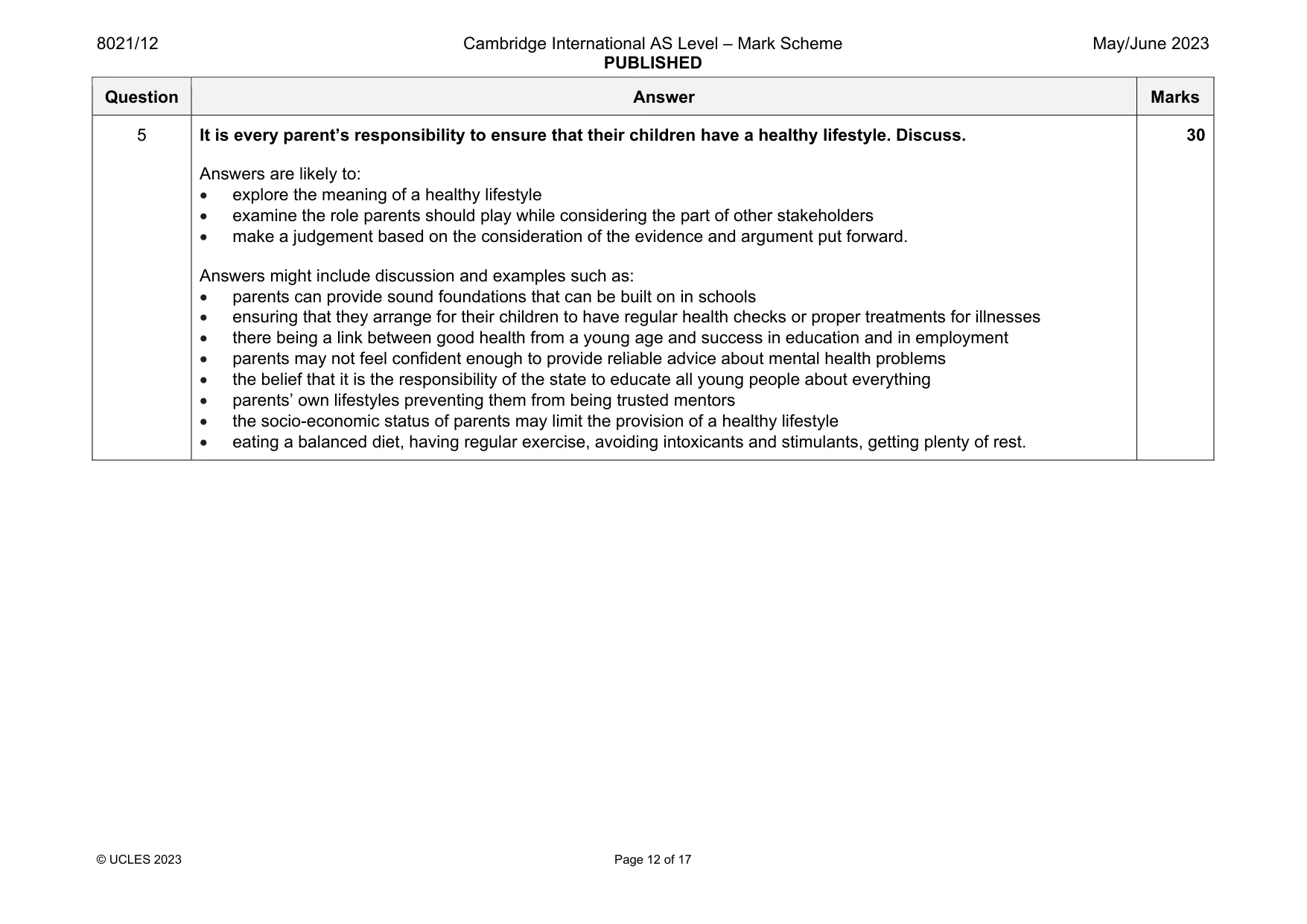
8021/12 Cambridge International AS Level – Mark Scheme PUBLISHED May/June 2023 © UCLES 2023 Page 12 of 17 Question Answer Marks 5 It is every parent’s responsibility to ensure that their children have a healthy lifestyle. Discuss. Answers are likely to: explore the meaning of a healthy lifestyle examine the role parents should play while considering the part of other stakeholders make a judgement based on the consideration of the evidence and argument put forward. Answers might include discussion and examples such as: parents can provide sound foundations that can be built on in schools ensuring that they arrange for their children to have regular health checks or proper treatments for illnesses there being a link between good health from a young age and success in education and in employment parents may not feel confident enough to provide reliable advice about mental health problems the belief that it is the responsibility of the state to educate all young people about everything parents’ own lifestyles preventing them from being trusted mentors the socio-economic status of parents may limit the provision of a healthy lifestyle eating a balanced diet, having regular exercise, avoiding intoxicants and stimulants, getting plenty of rest. 30
Mark scheme, page 13
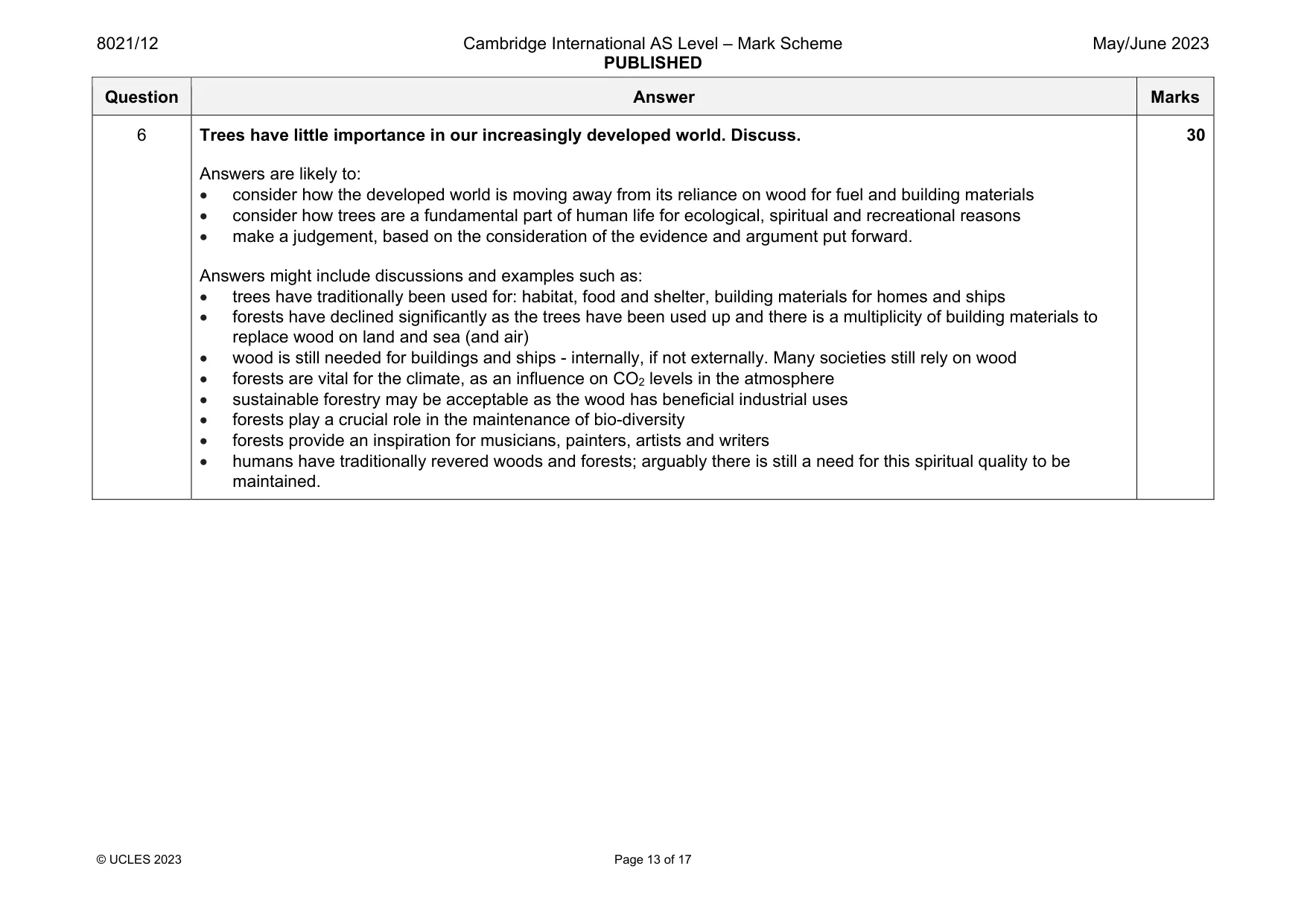
8021/12 Cambridge International AS Level – Mark Scheme PUBLISHED May/June 2023 © UCLES 2023 Page 13 of 17 Question Answer Marks 6 Trees have little importance in our increasingly developed world. Discuss. Answers are likely to: consider how the developed world is moving away from its reliance on wood for fuel and building materials consider how trees are a fundamental part of human life for ecological, spiritual and recreational reasons make a judgement, based on the consideration of the evidence and argument put forward. Answers might include discussions and examples such as: trees have traditionally been used for: habitat, food and shelter, building materials for homes and ships forests have declined significantly as the trees have been used up and there is a multiplicity of building materials to replace wood on land and sea (and air) wood is still needed for buildings and ships - internally, if not externally. Many societies still rely on wood forests are vital for the climate, as an influence on CO2 levels in the atmosphere sustainable forestry may be acceptable as the wood has beneficial industrial uses forests play a crucial role in the maintenance of bio-diversity forests provide an inspiration for musicians, painters, artists and writers humans have traditionally revered woods and forests; arguably there is still a need for this spiritual quality to be maintained. 30
Mark scheme, page 14
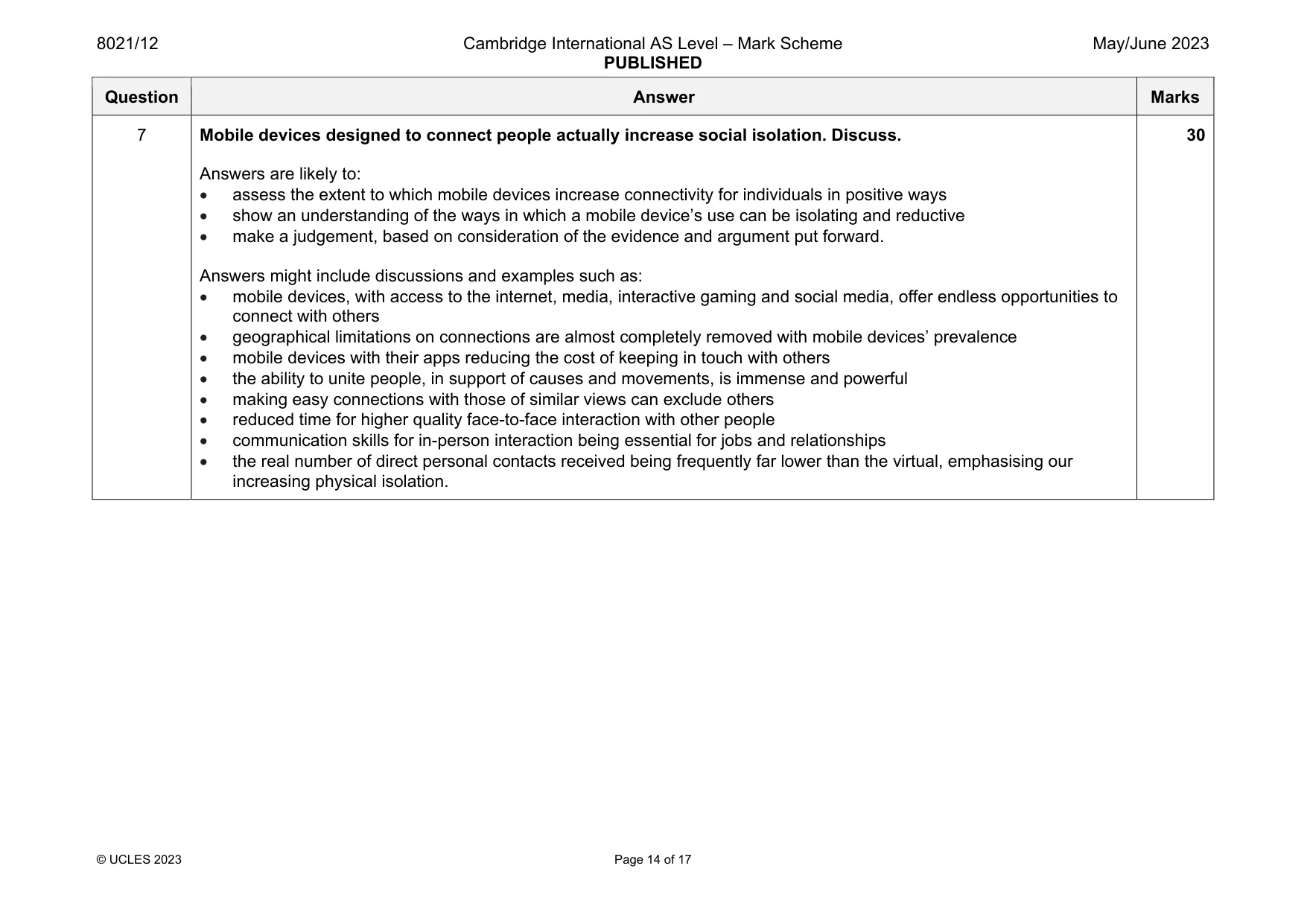
8021/12 Cambridge International AS Level – Mark Scheme PUBLISHED May/June 2023 © UCLES 2023 Page 14 of 17 Question Answer Marks 7 Mobile devices designed to connect people actually increase social isolation. Discuss. Answers are likely to: assess the extent to which mobile devices increase connectivity for individuals in positive ways show an understanding of the ways in which a mobile device’s use can be isolating and reductive make a judgement, based on consideration of the evidence and argument put forward. Answers might include discussions and examples such as: mobile devices, with access to the internet, media, interactive gaming and social media, offer endless opportunities to connect with others geographical limitations on connections are almost completely removed with mobile devices’ prevalence mobile devices with their apps reducing the cost of keeping in touch with others the ability to unite people, in support of causes and movements, is immense and powerful making easy connections with those of similar views can exclude others reduced time for higher quality face-to-face interaction with other people communication skills for in-person interaction being essential for jobs and relationships the real number of direct personal contacts received being frequently far lower than the virtual, emphasising our increasing physical isolation. 30
Mark scheme, page 15
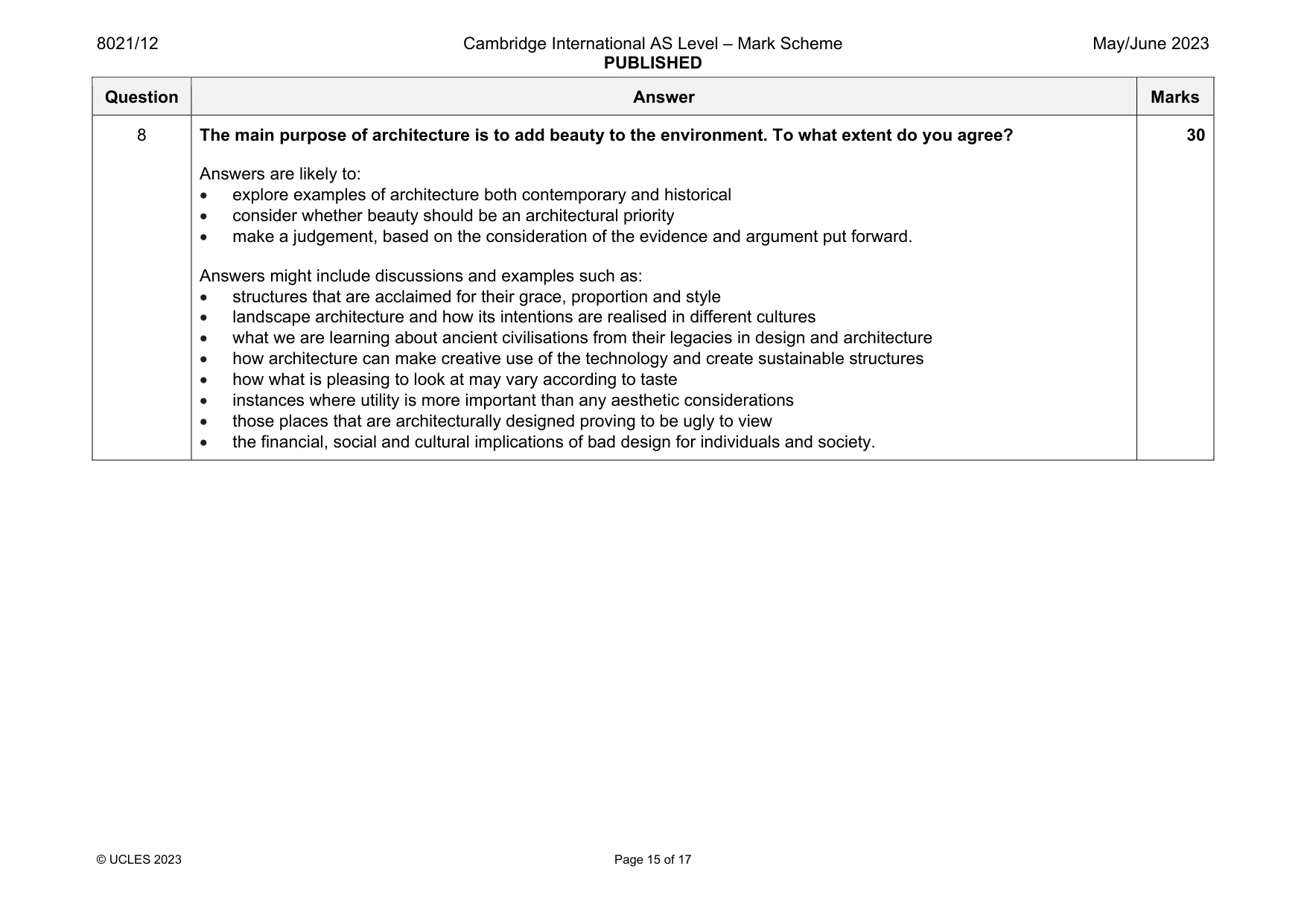
8021/12 Cambridge International AS Level – Mark Scheme PUBLISHED May/June 2023 © UCLES 2023 Page 15 of 17 Question Answer Marks 8 The main purpose of architecture is to add beauty to the environment. To what extent do you agree? Answers are likely to: explore examples of architecture both contemporary and historical consider whether beauty should be an architectural priority make a judgement, based on the consideration of the evidence and argument put forward. Answers might include discussions and examples such as: structures that are acclaimed for their grace, proportion and style landscape architecture and how its intentions are realised in different cultures what we are learning about ancient civilisations from their legacies in design and architecture how architecture can make creative use of the technology and create sustainable structures how what is pleasing to look at may vary according to taste instances where utility is more important than any aesthetic considerations those places that are architecturally designed proving to be ugly to view the financial, social and cultural implications of bad design for individuals and society. 30
Mark scheme, page 16
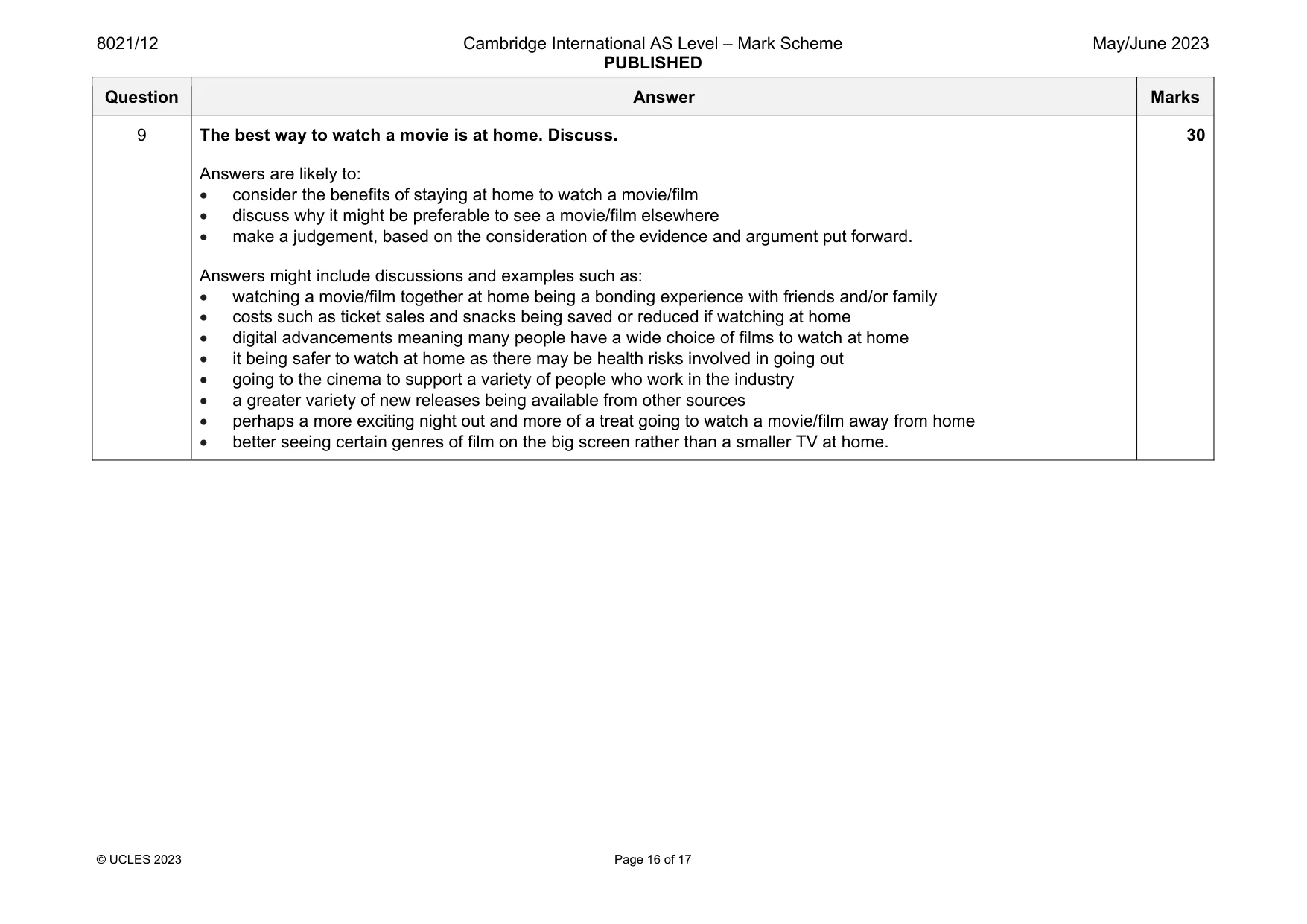
8021/12 Cambridge International AS Level – Mark Scheme PUBLISHED May/June 2023 © UCLES 2023 Page 16 of 17 Question Answer Marks 9 The best way to watch a movie is at home. Discuss. Answers are likely to: consider the benefits of staying at home to watch a movie/film discuss why it might be preferable to see a movie/film elsewhere make a judgement, based on the consideration of the evidence and argument put forward. Answers might include discussions and examples such as: watching a movie/film together at home being a bonding experience with friends and/or family costs such as ticket sales and snacks being saved or reduced if watching at home digital advancements meaning many people have a wide choice of films to watch at home it being safer to watch at home as there may be health risks involved in going out going to the cinema to support a variety of people who work in the industry a greater variety of new releases being available from other sources perhaps a more exciting night out and more of a treat going to watch a movie/film away from home better seeing certain genres of film on the big screen rather than a smaller TV at home. 30
Mark scheme, page 17
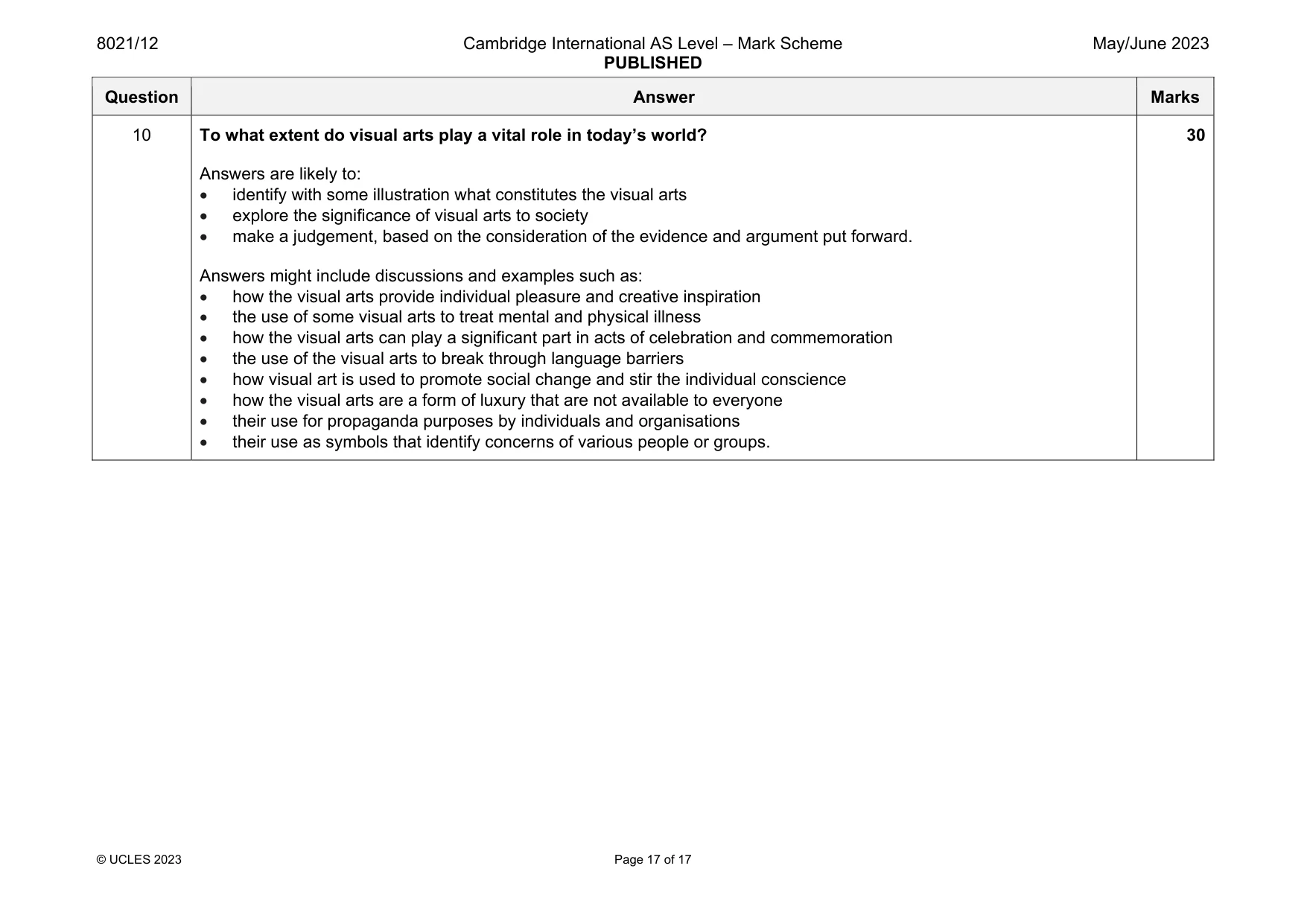
8021/12 Cambridge International AS Level – Mark Scheme PUBLISHED May/June 2023 © UCLES 2023 Page 17 of 17 Question Answer Marks 10 To what extent do visual arts play a vital role in today’s world? Answers are likely to: identify with some illustration what constitutes the visual arts explore the significance of visual arts to society make a judgement, based on the consideration of the evidence and argument put forward. Answers might include discussions and examples such as: how the visual arts provide individual pleasure and creative inspiration the use of some visual arts to treat mental and physical illness how the visual arts can play a significant part in acts of celebration and commemoration the use of the visual arts to break through language barriers how visual art is used to promote social change and stir the individual conscience how the visual arts are a form of luxury that are not available to everyone their use for propaganda purposes by individuals and organisations their use as symbols that identify concerns of various people or groups. 30
What you needed in this session
Cambridge’s own grade thresholds for 2023 May/June, Paper 1 · Variant 2. A higher threshold means an easier paper — the bar moves with how the cohort did.