Cambridge A Level English General Paper 8021 — 2025 Oct/Nov Paper 1 · Variant 2
8021/12/O/N/25 · 30 marks · 75 min
The question paper and its mark scheme, free to read here and free to download. This is Cambridge’s own paper, exactly as it was sat.
Question paper4 pages


Mark scheme17 pages
Answers below. Sit the paper first if you are practising.
Paper as text
Question paper, page 1
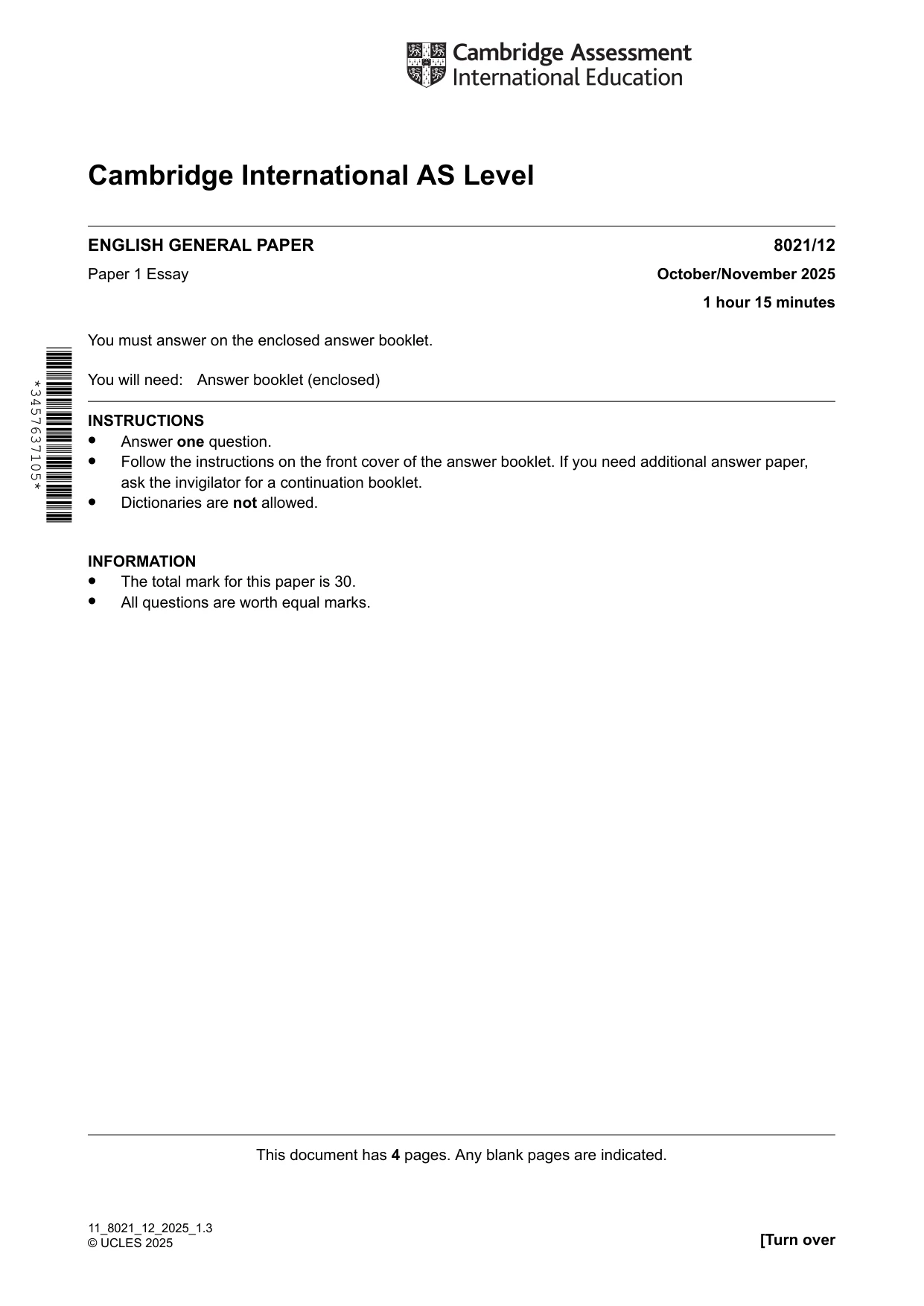
Cambridge International AS Level 8021/12 October/November 2025 1 hour 15 minutes ENGLISH GENERAL PAPER Paper 1 Essay You must answer on the enclosed answer booklet. You will need: Answer booklet (enclosed) INSTRUCTIONS • Answer one question. • Follow the instructions on the front cover of the answer booklet. If you need additional answer paper, ask the invigilator for a continuation booklet. • Dictionaries are not allowed. INFORMATION • The total mark for this paper is 30. • All questions are worth equal marks. This document has 4 pages. Any blank pages are indicated. [Turn over 11_8021_12_2025_1.3 © UCLES 2025 *3457637105*
Question paper, page 2
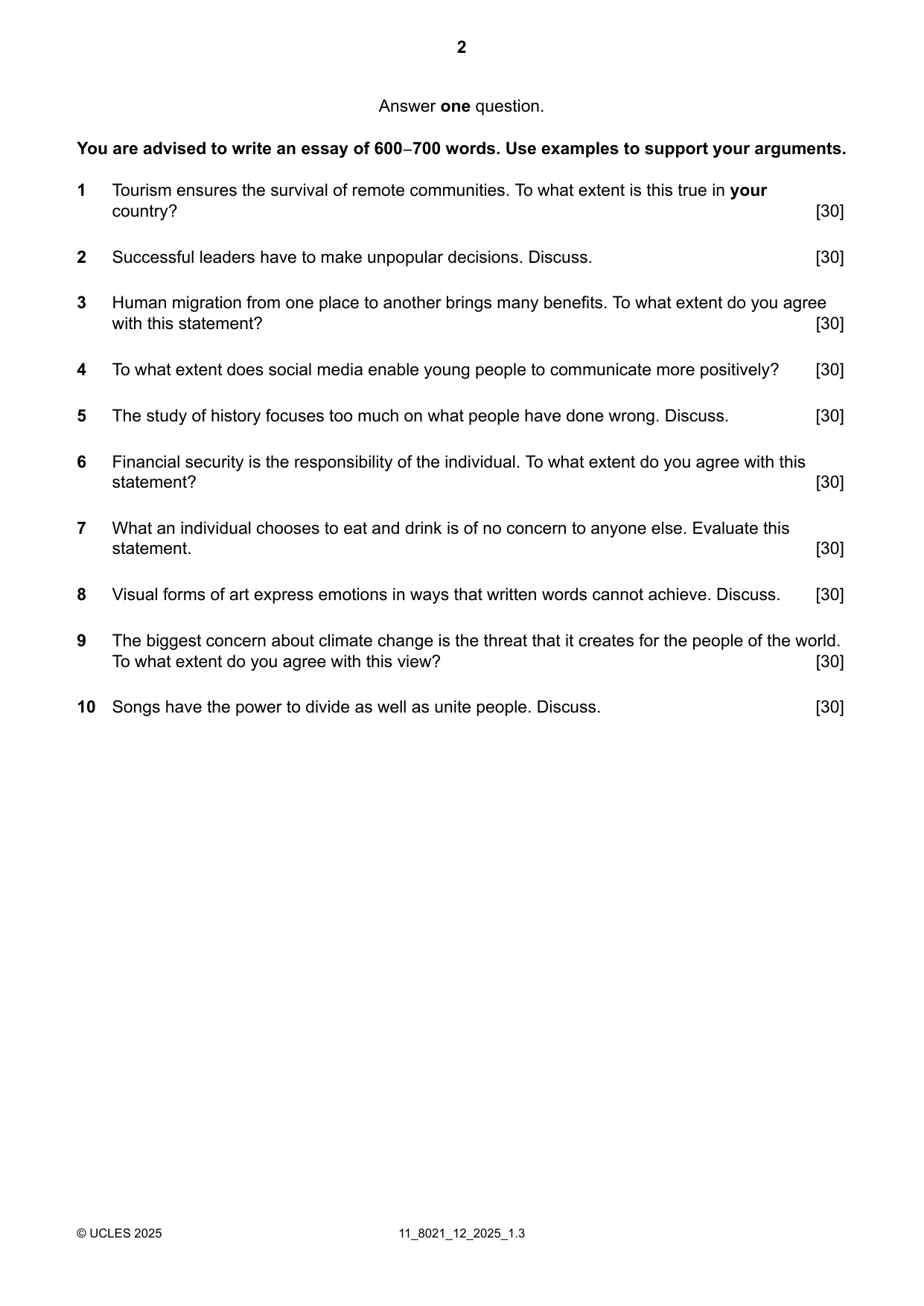
Answer one question. You are advised to write an essay of 600−700 words. Use examples to support your arguments. Tourism ensures the survival of remote communities. To what extent is this true in your country? [30] 1 Successful leaders have to make unpopular decisions. Discuss. [30] 2 Human migration from one place to another brings many benefits. To what extent do you agree with this statement? [30] 3 To what extent does social media enable young people to communicate more positively? [30] 4 The study of history focuses too much on what people have done wrong. Discuss. [30] 5 Financial security is the responsibility of the individual. To what extent do you agree with this statement? [30] 6 What an individual chooses to eat and drink is of no concern to anyone else. Evaluate this statement. [30] 7 Visual forms of art express emotions in ways that written words cannot achieve. Discuss. [30] 8 The biggest concern about climate change is the threat that it creates for the people of the world. To what extent do you agree with this view? [30] 9 Songs have the power to divide as well as unite people. Discuss. [30] 10 11_8021_12_2025_1.3 © UCLES 2025 2
Question paper, page 3
BLANK PAGE 11_8021_12_2025_1.3 © UCLES 2025 3
Question paper, page 4
BLANK PAGE Permission to reproduce items where third-party owned material protected by copyright is included has been sought and cleared where possible. Every reasonable effort has been made by the publisher (UCLES) to trace copyright holders, but if any items requiring clearance have unwittingly been included, the publisher will be pleased to make amends at the earliest possible opportunity. To avoid the issue of disclosure of answer-related information to candidates, all copyright acknowledgements are reproduced online in the Cambridge Assessment International Education Copyright Acknowledgements Booklet. This is produced for each series of examinations and is freely available to download at www.cambridgeinternational.org after the live examination series. Cambridge Assessment International Education is part of Cambridge Assessment. Cambridge Assessment is the brand name of the University of Cambridge Local Examinations Syndicate (UCLES), which is a department of the University of Cambridge. 11_8021_12_2025_1.3 © UCLES 2025 4
Mark scheme, page 1
This document consists of 17 printed pages. © Cambridge University Press & Assessment 2025 [Turn over Cambridge International AS Level ENGLISH GENERAL PAPER 8021/12 Paper 1 Essay October/November 2025 MARK SCHEME Maximum Mark: 30 Published This mark scheme is published as an aid to teachers and candidates, to indicate the requirements of the examination. It shows the basis on which Examiners were instructed to award marks. It does not indicate the details of the discussions that took place at an Examiners’ meeting before marking began, which would have considered the acceptability of alternative answers. Mark schemes should be read in conjunction with the question paper and the Principal Examiner Report for Teachers. Cambridge International will not enter into discussions about these mark schemes. Cambridge International is publishing the mark schemes for the October/November 2025 series for most Cambridge IGCSE, Cambridge International A and AS Level components, and some Cambridge O Level components.
Mark scheme, page 2
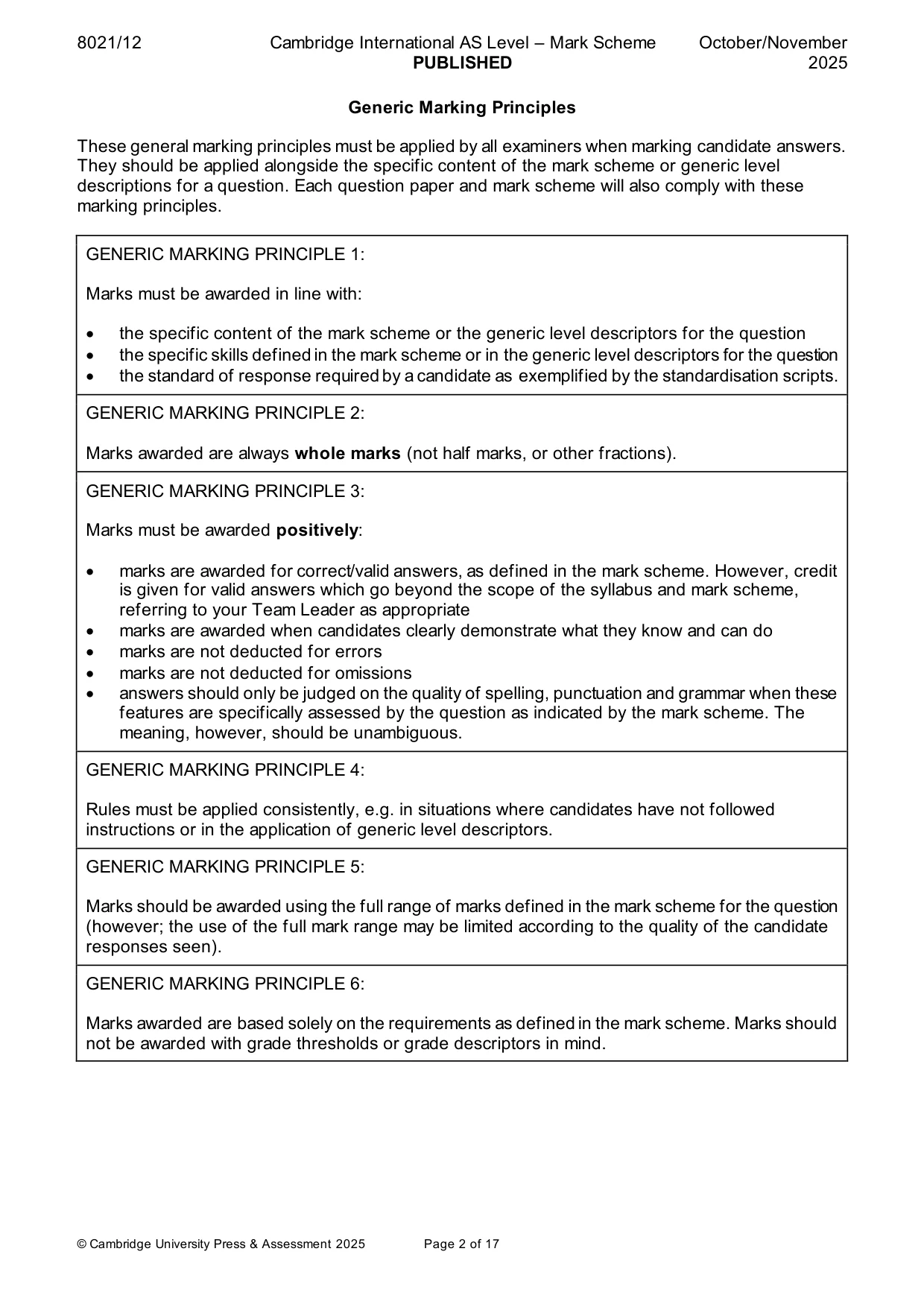
8021/12 Cambridge International AS Level – Mark Scheme PUBLISHED October/November 2025 © Cambridge University Press & Assessment 2025 Page 2 of 17 Generic Marking Principles These general marking principles must be applied by all examiners when marking candidate answers. They should be applied alongside the specific content of the mark scheme or generic level descriptions for a question. Each question paper and mark scheme will also comply with these marking principles. GENERIC MARKING PRINCIPLE 1: Marks must be awarded in line with: • the specific content of the mark scheme or the generic level descriptors for the question • the specific skills defined in the mark scheme or in the generic level descriptors for the question • the standard of response required by a candidate as exemplified by the standardisation scripts. GENERIC MARKING PRINCIPLE 2: Marks awarded are always whole marks (not half marks, or other fractions). GENERIC MARKING PRINCIPLE 3: Marks must be awarded positively: • marks are awarded for correct/valid answers, as defined in the mark scheme. However, credit is given for valid answers which go beyond the scope of the syllabus and mark scheme, referring to your Team Leader as appropriate • marks are awarded when candidates clearly demonstrate what they know and can do • marks are not deducted for errors • marks are not deducted for omissions • answers should only be judged on the quality of spelling, punctuation and grammar when these features are specifically assessed by the question as indicated by the mark scheme. The meaning, however, should be unambiguous. GENERIC MARKING PRINCIPLE 4: Rules must be applied consistently, e.g. in situations where candidates have not followed instructions or in the application of generic level descriptors. GENERIC MARKING PRINCIPLE 5: Marks should be awarded using the full range of marks defined in the mark scheme for the question (however; the use of the full mark range may be limited according to the quality of the candidate responses seen). GENERIC MARKING PRINCIPLE 6: Marks awarded are based solely on the requirements as defined in the mark scheme. Marks should not be awarded with grade thresholds or grade descriptors in mind.
Mark scheme, page 3
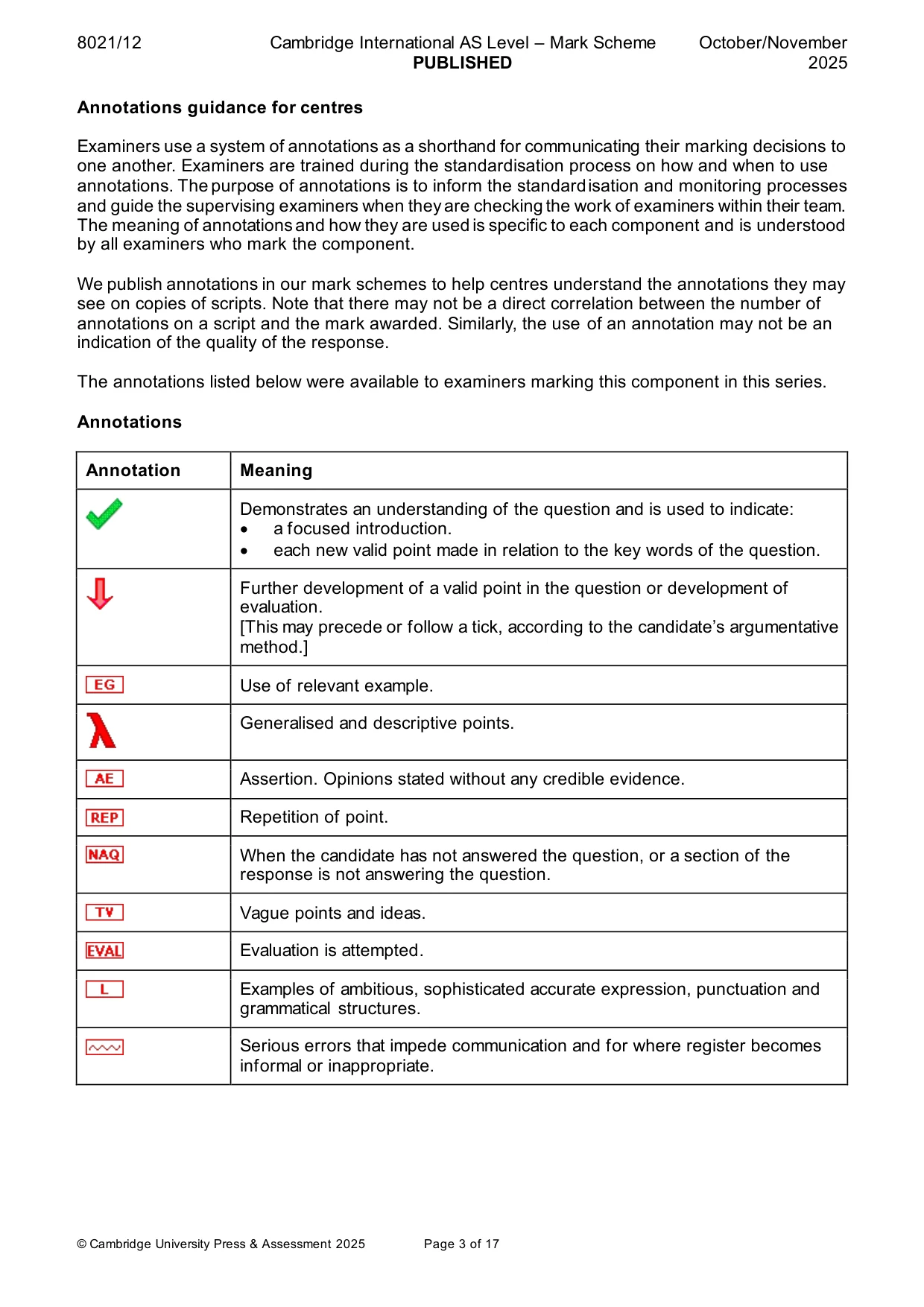
8021/12 Cambridge International AS Level – Mark Scheme PUBLISHED October/November 2025 © Cambridge University Press & Assessment 2025 Page 3 of 17 Annotations guidance for centres Examiners use a system of annotations as a shorthand for communicating their marking decisions to one another. Examiners are trained during the standardisation process on how and when to use annotations. The purpose of annotations is to inform the standardisation and monitoring processes and guide the supervising examiners when they are checking the work of examiners within their team. The meaning of annotations and how they are used is specific to each component and is understood by all examiners who mark the component. We publish annotations in our mark schemes to help centres understand the annotations they may see on copies of scripts. Note that there may not be a direct correlation between the number of annotations on a script and the mark awarded. Similarly, the use of an annotation may not be an indication of the quality of the response. The annotations listed below were available to examiners marking this component in this series. Annotations Annotation Meaning Demonstrates an understanding of the question and is used to indicate: • a focused introduction. • each new valid point made in relation to the key words of the question. Further development of a valid point in the question or development of evaluation. [This may precede or follow a tick, according to the candidate’s argumentative method.] Use of relevant example. Generalised and descriptive points. Assertion. Opinions stated without any credible evidence. Repetition of point. When the candidate has not answered the question, or a section of the response is not answering the question. Vague points and ideas. Evaluation is attempted. Examples of ambitious, sophisticated accurate expression, punctuation and grammatical structures. Serious errors that impede communication and for where register becomes informal or inappropriate.
Mark scheme, page 4
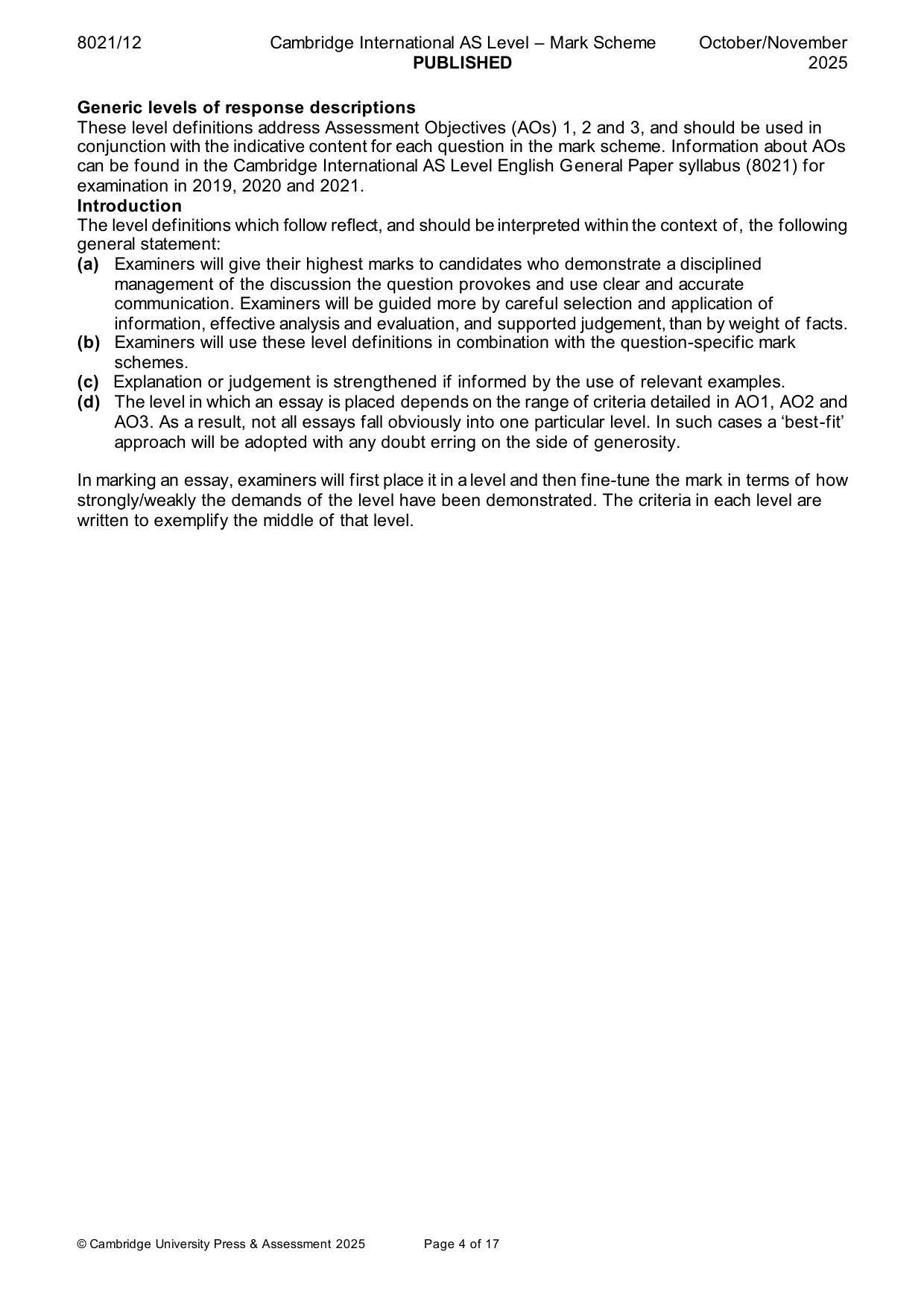
8021/12 Cambridge International AS Level – Mark Scheme PUBLISHED October/November 2025 © Cambridge University Press & Assessment 2025 Page 4 of 17 Generic levels of response descriptions These level definitions address Assessment Objectives (AOs) 1, 2 and 3, and should be used in conjunction with the indicative content for each question in the mark scheme. Information about AOs can be found in the Cambridge International AS Level English General Paper syllabus (8021) for examination in 2019, 2020 and 2021. Introduction The level definitions which follow reflect, and should be interpreted within the context of, the following general statement: (a) Examiners will give their highest marks to candidates who demonstrate a disciplined management of the discussion the question provokes and use clear and accurate communication. Examiners will be guided more by careful selection and application of information, effective analysis and evaluation, and supported judgement, than by weight of facts. (b) Examiners will use these level definitions in combination with the question-specific mark schemes. (c) Explanation or judgement is strengthened if informed by the use of relevant examples. (d) The level in which an essay is placed depends on the range of criteria detailed in AO1, AO2 and AO3. As a result, not all essays fall obviously into one particular level. In such cases a ‘best-fit’ approach will be adopted with any doubt erring on the side of generosity. In marking an essay, examiners will first place it in a level and then fine-tune the mark in terms of how strongly/weakly the demands of the level have been demonstrated. The criteria in each level are written to exemplify the middle of that level.
Mark scheme, page 5
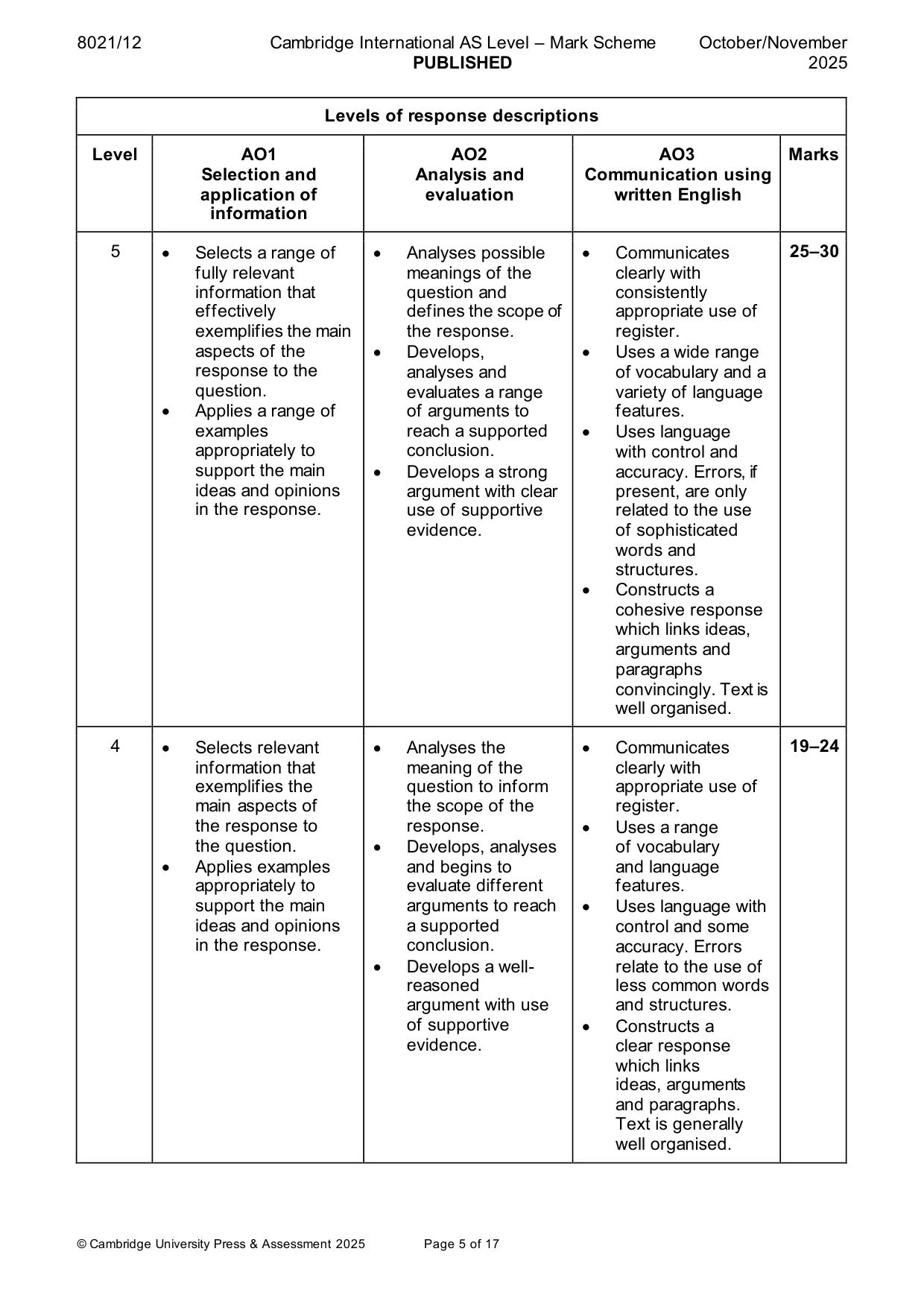
8021/12 Cambridge International AS Level – Mark Scheme PUBLISHED October/November 2025 © Cambridge University Press & Assessment 2025 Page 5 of 17 Levels of response descriptions Level AO1 Selection and application of information AO2 Analysis and evaluation AO3 Communication using written English Marks 5 • Selects a range of fully relevant information that effectively exemplifies the main aspects of the response to the question. • Applies a range of examples appropriately to support the main ideas and opinions in the response. • Analyses possible meanings of the question and defines the scope of the response. • Develops, analyses and evaluates a range of arguments to reach a supported conclusion. • Develops a strong argument with clear use of supportive evidence. • Communicates clearly with consistently appropriate use of register. • Uses a wide range of vocabulary and a variety of language features. • Uses language with control and accuracy. Errors, if present, are only related to the use of sophisticated words and structures. • Constructs a cohesive response which links ideas, arguments and paragraphs convincingly. Text is well organised. 25–30 4 • Selects relevant information that exemplifies the main aspects of the response to the question. • Applies examples appropriately to support the main ideas and opinions in the response. • Analyses the meaning of the question to inform the scope of the response. • Develops, analyses and begins to evaluate different arguments to reach a supported conclusion. • Develops a well- reasoned argument with use of supportive evidence. • Communicates clearly with appropriate use of register. • Uses a range of vocabulary and language features. • Uses language with control and some accuracy. Errors relate to the use of less common words and structures. • Constructs a clear response which links ideas, arguments and paragraphs. Text is generally well organised. 19–24
Mark scheme, page 6
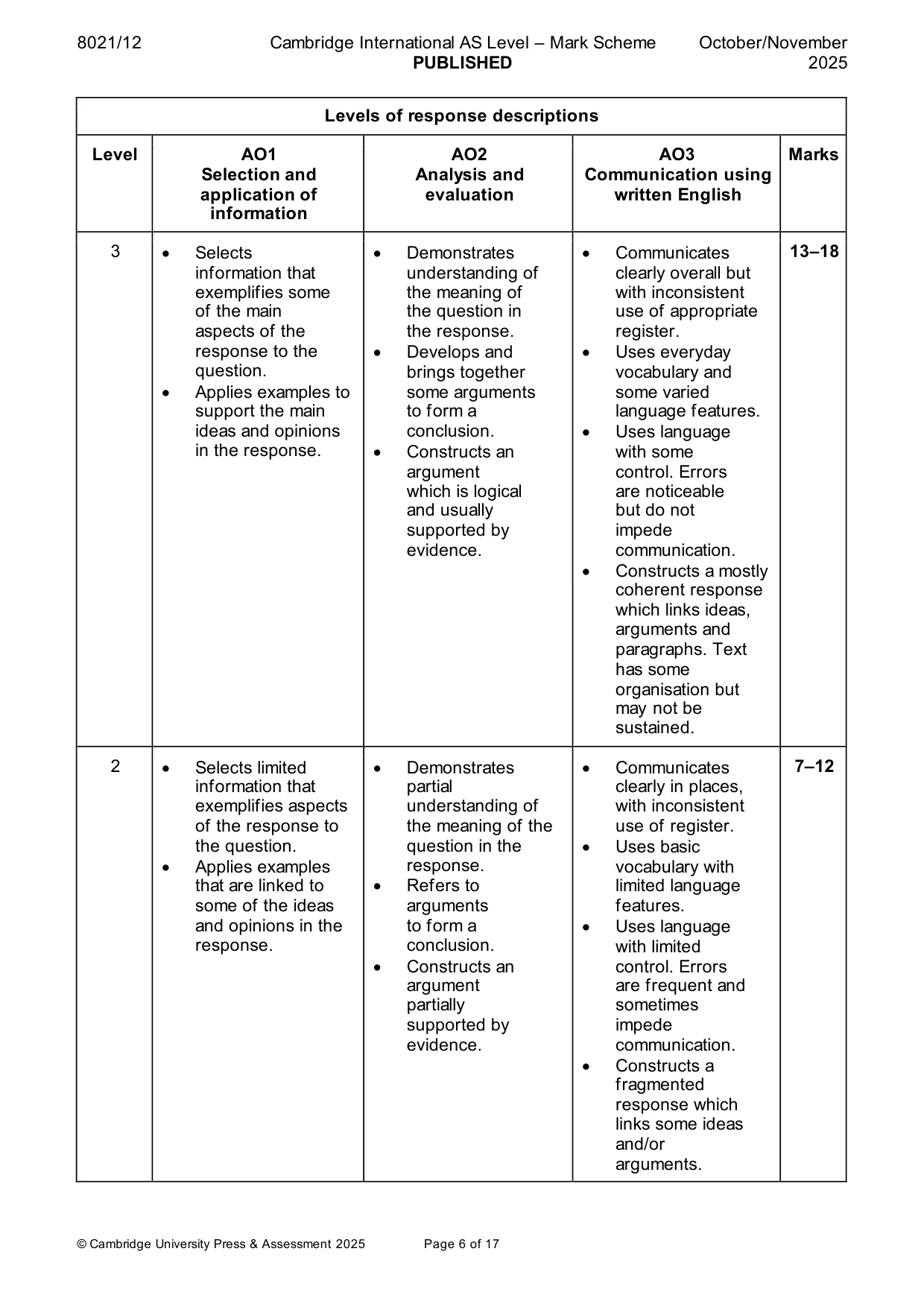
8021/12 Cambridge International AS Level – Mark Scheme PUBLISHED October/November 2025 © Cambridge University Press & Assessment 2025 Page 6 of 17 Levels of response descriptions Level AO1 Selection and application of information AO2 Analysis and evaluation AO3 Communication using written English Marks 3 • Selects information that exemplifies some of the main aspects of the response to the question. • Applies examples to support the main ideas and opinions in the response. • Demonstrates understanding of the meaning of the question in the response. • Develops and brings together some arguments to form a conclusion. • Constructs an argument which is logical and usually supported by evidence. • Communicates clearly overall but with inconsistent use of appropriate register. • Uses everyday vocabulary and some varied language features. • Uses language with some control. Errors are noticeable but do not impede communication. • Constructs a mostly coherent response which links ideas, arguments and paragraphs. Text has some organisation but may not be sustained. 13–18 2 • Selects limited information that exemplifies aspects of the response to the question. • Applies examples that are linked to some of the ideas and opinions in the response. • Demonstrates partial understanding of the meaning of the question in the response. • Refers to arguments to form a conclusion. • Constructs an argument partially supported by evidence. • Communicates clearly in places, with inconsistent use of register. • Uses basic vocabulary with limited language features. • Uses language with limited control. Errors are frequent and sometimes impede communication. • Constructs a fragmented response which links some ideas and/or arguments. 7–12
Mark scheme, page 7
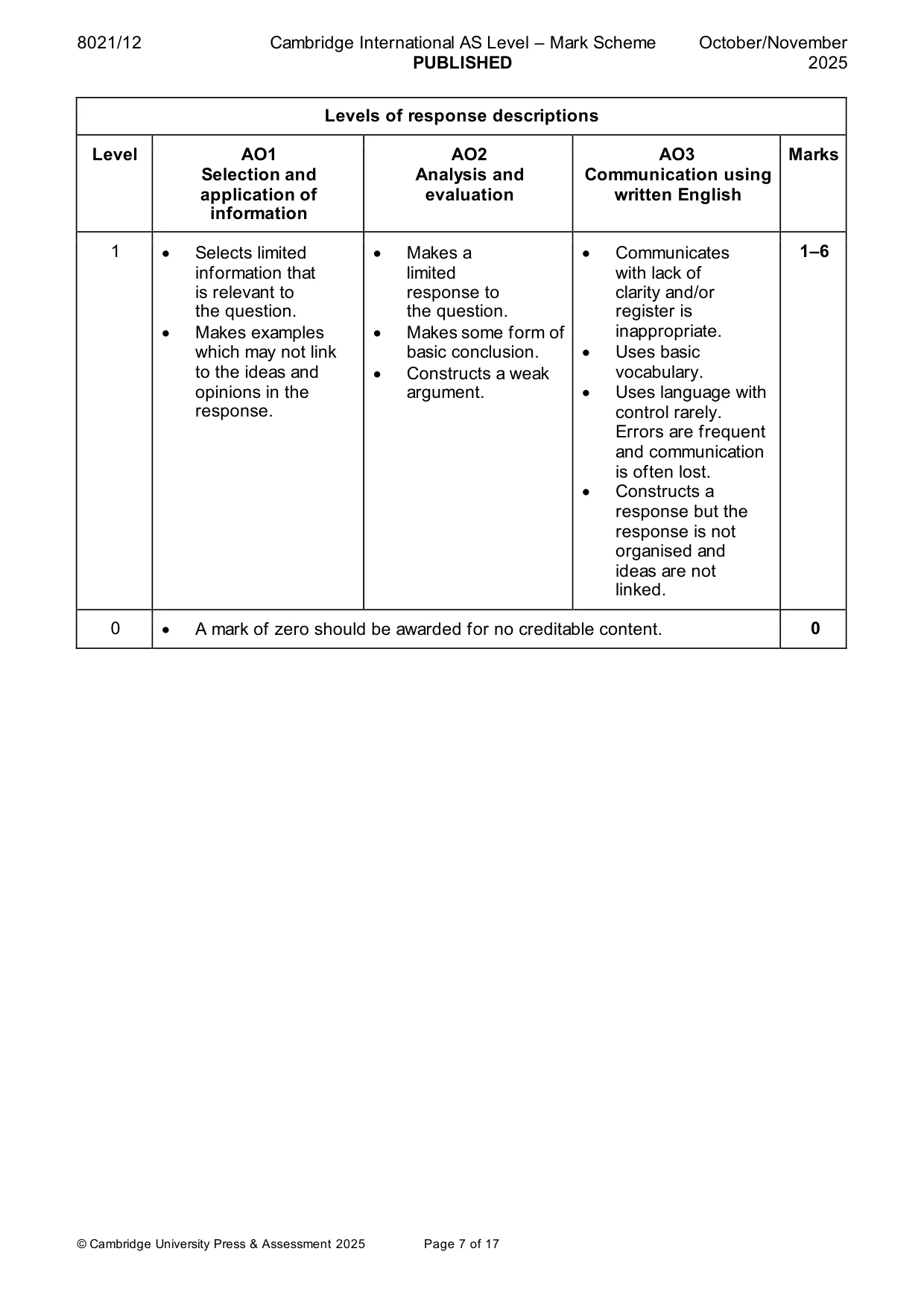
8021/12 Cambridge International AS Level – Mark Scheme PUBLISHED October/November 2025 © Cambridge University Press & Assessment 2025 Page 7 of 17 Levels of response descriptions Level AO1 Selection and application of information AO2 Analysis and evaluation AO3 Communication using written English Marks 1 • Selects limited information that is relevant to the question. • Makes examples which may not link to the ideas and opinions in the response. • Makes a limited response to the question. • Makes some form of basic conclusion. • Constructs a weak argument. • Communicates with lack of clarity and/or register is inappropriate. • Uses basic vocabulary. • Uses language with control rarely. Errors are frequent and communication is often lost. • Constructs a response but the response is not organised and ideas are not linked. 1–6 0 • A mark of zero should be awarded for no creditable content. 0
Mark scheme, page 8
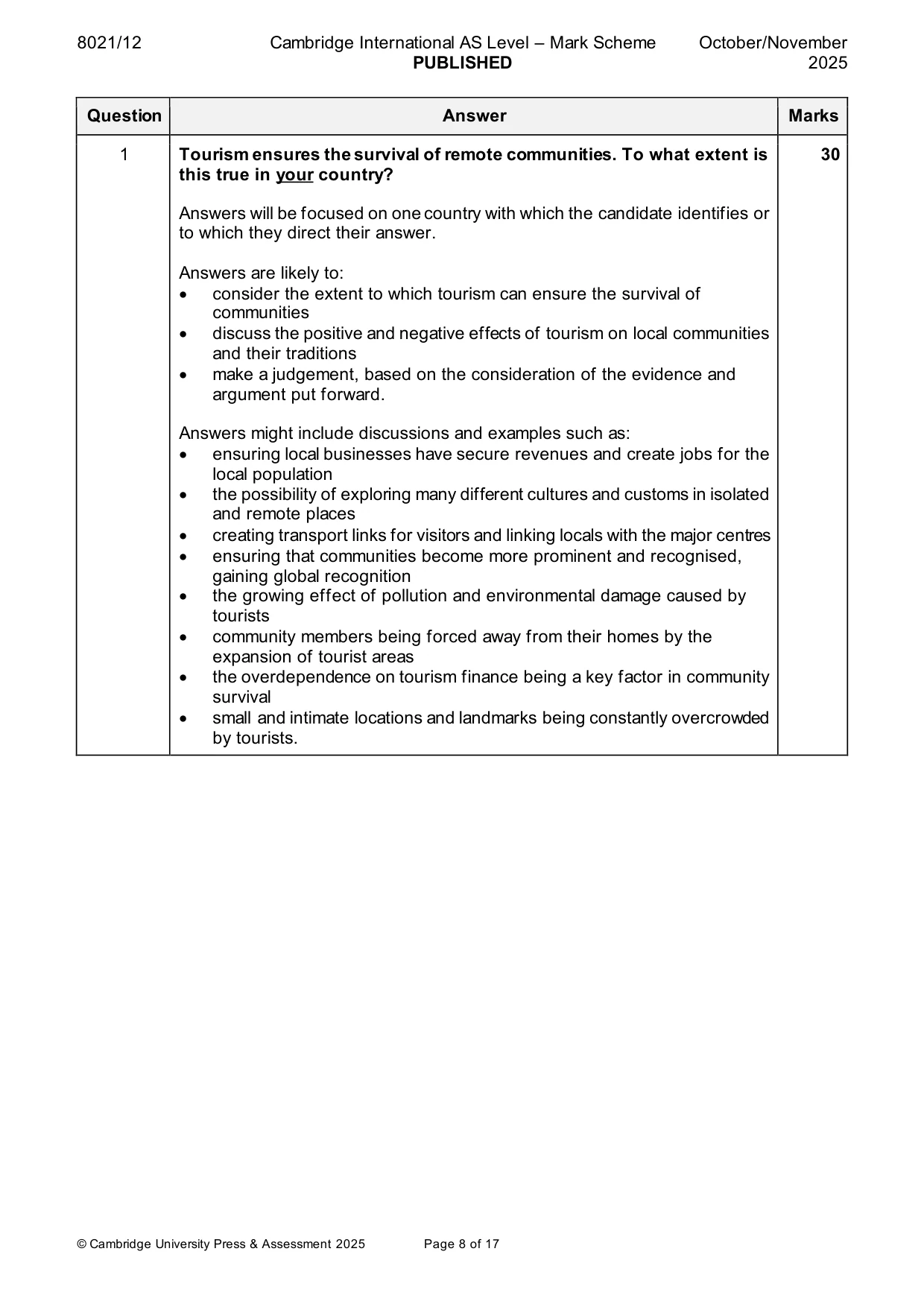
8021/12 Cambridge International AS Level – Mark Scheme PUBLISHED October/November 2025 © Cambridge University Press & Assessment 2025 Page 8 of 17 Question Answer Marks 1 Tourism ensures the survival of remote communities. To what extent is this true in your country? Answers will be focused on one country with which the candidate identifies or to which they direct their answer. Answers are likely to: • consider the extent to which tourism can ensure the survival of communities • discuss the positive and negative effects of tourism on local communities and their traditions • make a judgement, based on the consideration of the evidence and argument put forward. Answers might include discussions and examples such as: • ensuring local businesses have secure revenues and create jobs for the local population • the possibility of exploring many different cultures and customs in isolated and remote places • creating transport links for visitors and linking locals with the major centres • ensuring that communities become more prominent and recognised, gaining global recognition • the growing effect of pollution and environmental damage caused by tourists • community members being forced away from their homes by the expansion of tourist areas • the overdependence on tourism finance being a key factor in community survival • small and intimate locations and landmarks being constantly overcrowded by tourists. 30
Mark scheme, page 9
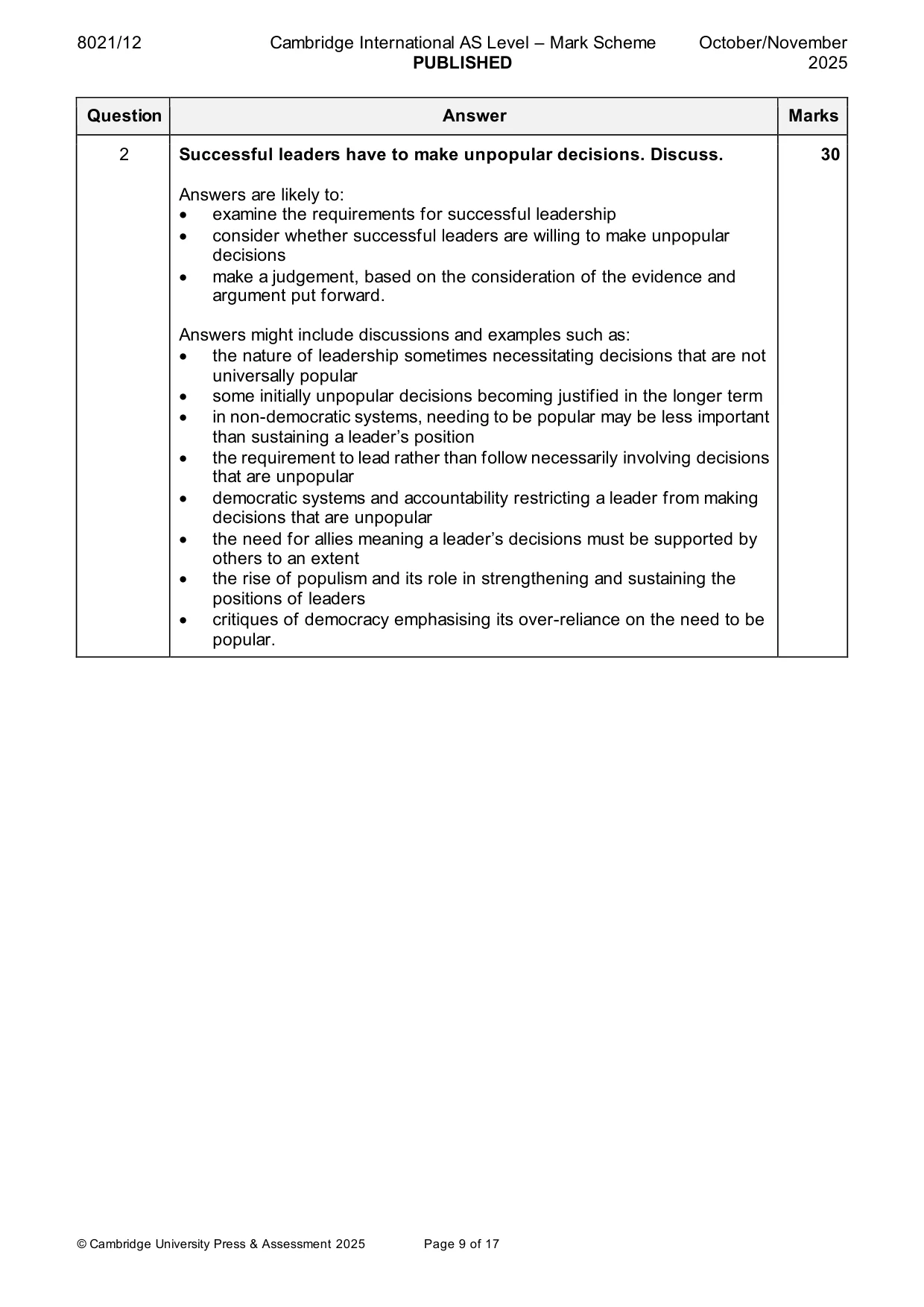
8021/12 Cambridge International AS Level – Mark Scheme PUBLISHED October/November 2025 © Cambridge University Press & Assessment 2025 Page 9 of 17 Question Answer Marks 2 Successful leaders have to make unpopular decisions. Discuss. Answers are likely to: • examine the requirements for successful leadership • consider whether successful leaders are willing to make unpopular decisions • make a judgement, based on the consideration of the evidence and argument put forward. Answers might include discussions and examples such as: • the nature of leadership sometimes necessitating decisions that are not universally popular • some initially unpopular decisions becoming justified in the longer term • in non-democratic systems, needing to be popular may be less important than sustaining a leader’s position • the requirement to lead rather than follow necessarily involving decisions that are unpopular • democratic systems and accountability restricting a leader from making decisions that are unpopular • the need for allies meaning a leader’s decisions must be supported by others to an extent • the rise of populism and its role in strengthening and sustaining the positions of leaders • critiques of democracy emphasising its over-reliance on the need to be popular. 30
Mark scheme, page 10
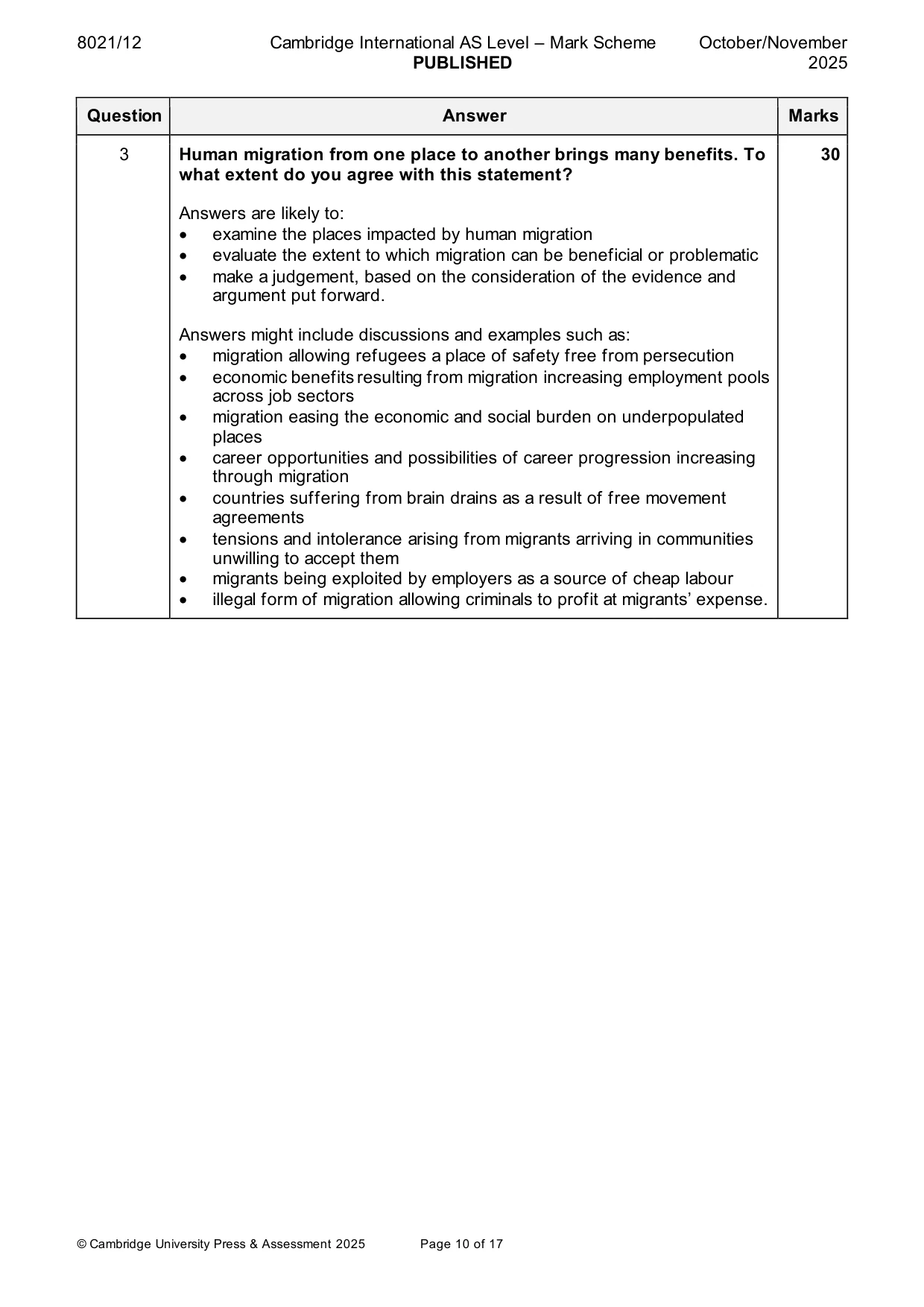
8021/12 Cambridge International AS Level – Mark Scheme PUBLISHED October/November 2025 © Cambridge University Press & Assessment 2025 Page 10 of 17 Question Answer Marks 3 Human migration from one place to another brings many benefits. To what extent do you agree with this statement? Answers are likely to: • examine the places impacted by human migration • evaluate the extent to which migration can be beneficial or problematic • make a judgement, based on the consideration of the evidence and argument put forward. Answers might include discussions and examples such as: • migration allowing refugees a place of safety free from persecution • economic benefits resulting from migration increasing employment pools across job sectors • migration easing the economic and social burden on underpopulated places • career opportunities and possibilities of career progression increasing through migration • countries suffering from brain drains as a result of free movement agreements • tensions and intolerance arising from migrants arriving in communities unwilling to accept them • migrants being exploited by employers as a source of cheap labour • illegal form of migration allowing criminals to profit at migrants’ expense. 30
Mark scheme, page 11
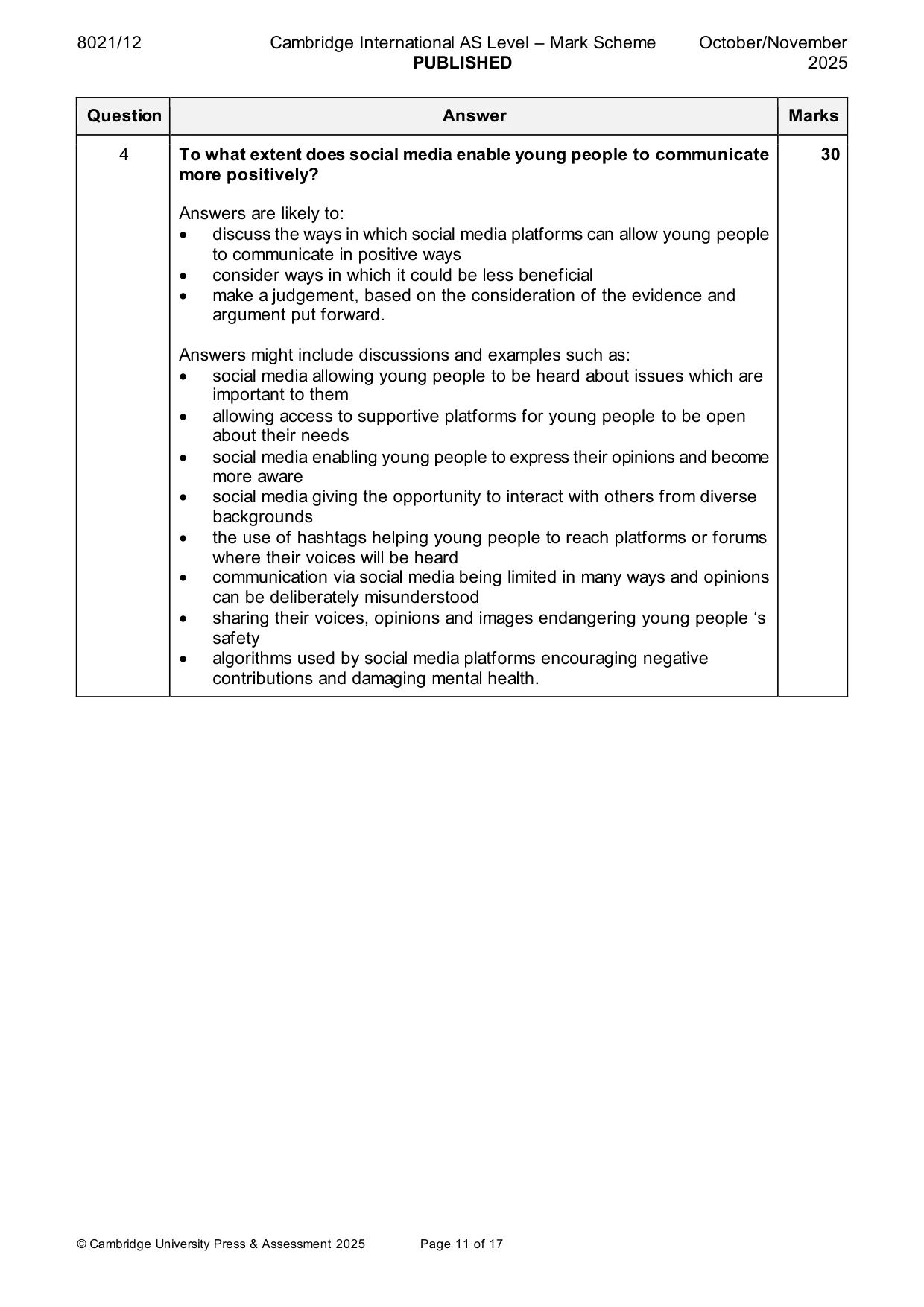
8021/12 Cambridge International AS Level – Mark Scheme PUBLISHED October/November 2025 © Cambridge University Press & Assessment 2025 Page 11 of 17 Question Answer Marks 4 To what extent does social media enable young people to communicate more positively? Answers are likely to: • discuss the ways in which social media platforms can allow young people to communicate in positive ways • consider ways in which it could be less beneficial • make a judgement, based on the consideration of the evidence and argument put forward. Answers might include discussions and examples such as: • social media allowing young people to be heard about issues which are important to them • allowing access to supportive platforms for young people to be open about their needs • social media enabling young people to express their opinions and become more aware • social media giving the opportunity to interact with others from diverse backgrounds • the use of hashtags helping young people to reach platforms or forums where their voices will be heard • communication via social media being limited in many ways and opinions can be deliberately misunderstood • sharing their voices, opinions and images endangering young people ‘s safety • algorithms used by social media platforms encouraging negative contributions and damaging mental health. 30
Mark scheme, page 12
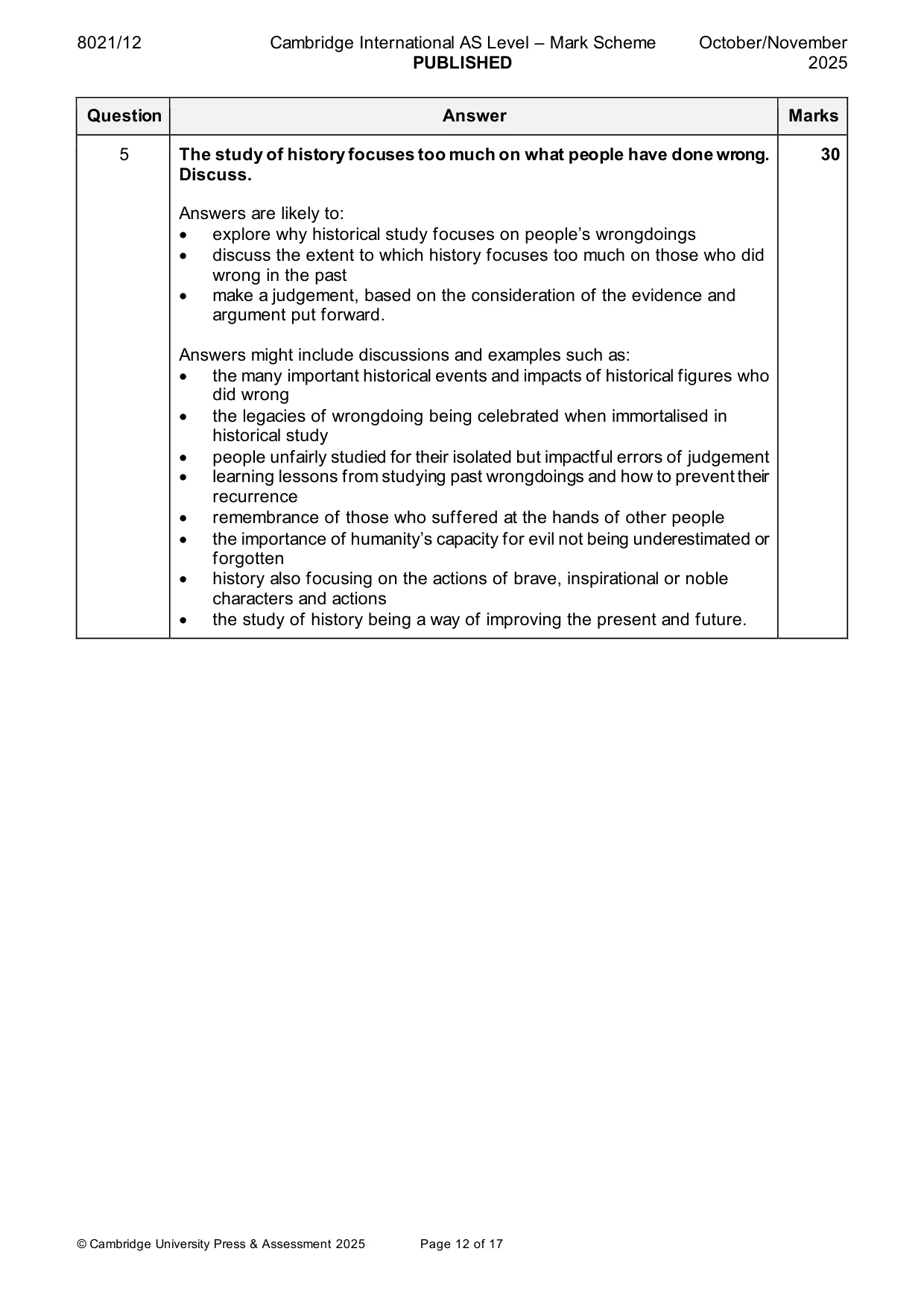
8021/12 Cambridge International AS Level – Mark Scheme PUBLISHED October/November 2025 © Cambridge University Press & Assessment 2025 Page 12 of 17 Question Answer Marks 5 The study of history focuses too much on what people have done wrong. Discuss. Answers are likely to: • explore why historical study focuses on people’s wrongdoings • discuss the extent to which history focuses too much on those who did wrong in the past • make a judgement, based on the consideration of the evidence and argument put forward. Answers might include discussions and examples such as: • the many important historical events and impacts of historical figures who did wrong • the legacies of wrongdoing being celebrated when immortalised in historical study • people unfairly studied for their isolated but impactful errors of judgement • learning lessons from studying past wrongdoings and how to prevent their recurrence • remembrance of those who suffered at the hands of other people • the importance of humanity’s capacity for evil not being underestimated or forgotten • history also focusing on the actions of brave, inspirational or noble characters and actions • the study of history being a way of improving the present and future. 30
Mark scheme, page 13
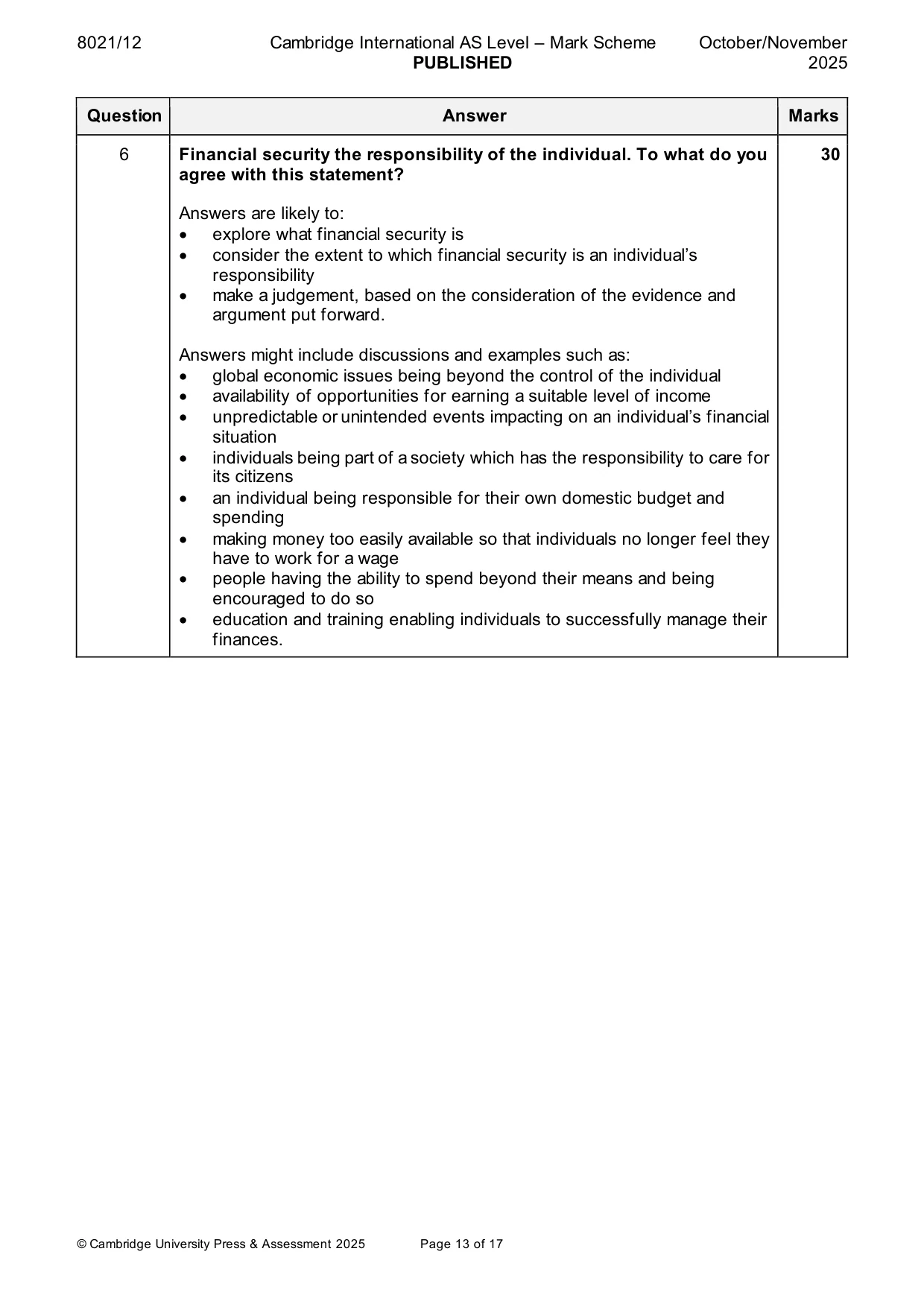
8021/12 Cambridge International AS Level – Mark Scheme PUBLISHED October/November 2025 © Cambridge University Press & Assessment 2025 Page 13 of 17 Question Answer Marks 6 Financial security the responsibility of the individual. To what do you agree with this statement? Answers are likely to: • explore what financial security is • consider the extent to which financial security is an individual’s responsibility • make a judgement, based on the consideration of the evidence and argument put forward. Answers might include discussions and examples such as: • global economic issues being beyond the control of the individual • availability of opportunities for earning a suitable level of income • unpredictable or unintended events impacting on an individual’s financial situation • individuals being part of a society which has the responsibility to care for its citizens • an individual being responsible for their own domestic budget and spending • making money too easily available so that individuals no longer feel they have to work for a wage • people having the ability to spend beyond their means and being encouraged to do so • education and training enabling individuals to successfully manage their finances. 30
Mark scheme, page 14
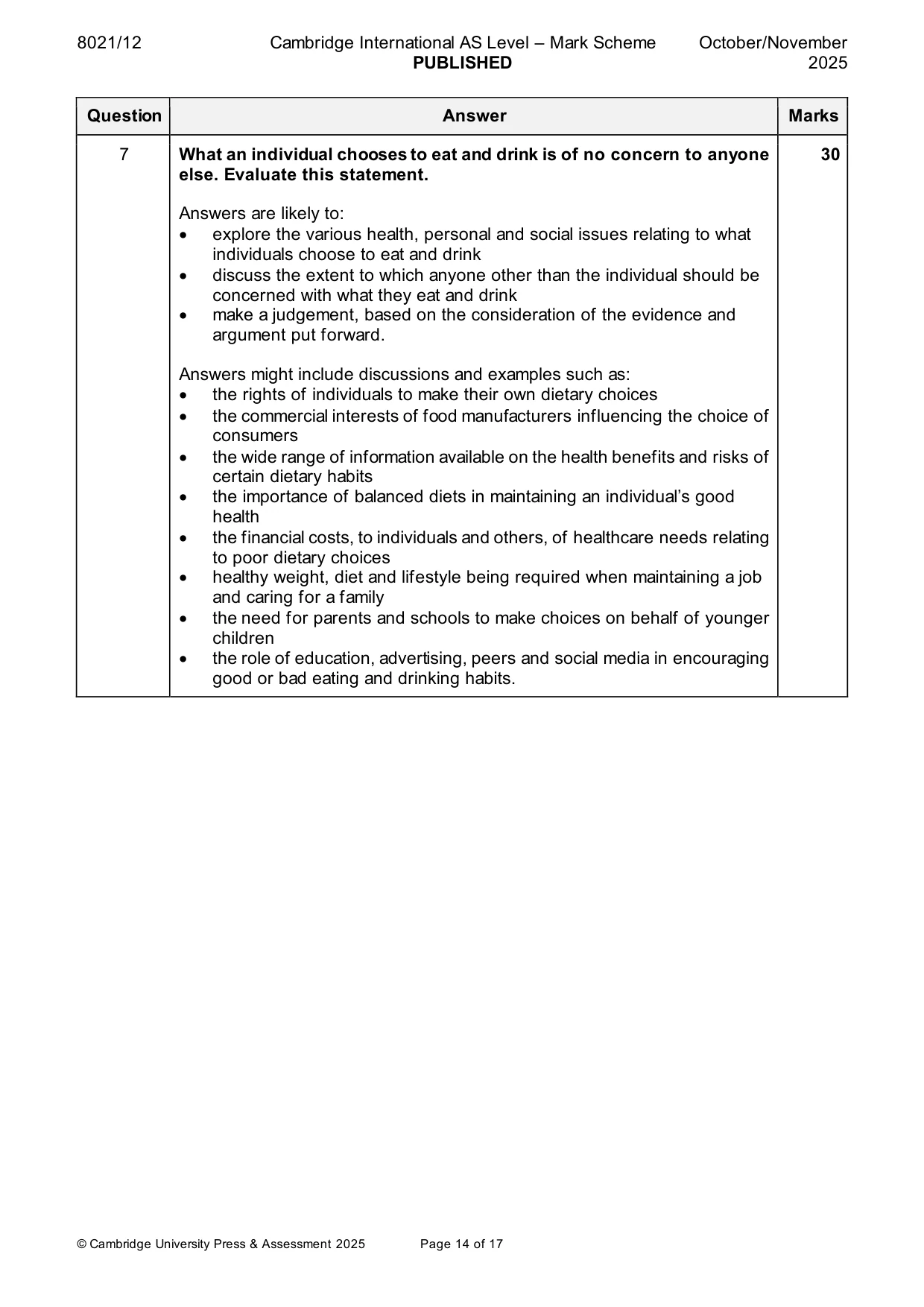
8021/12 Cambridge International AS Level – Mark Scheme PUBLISHED October/November 2025 © Cambridge University Press & Assessment 2025 Page 14 of 17 Question Answer Marks 7 What an individual chooses to eat and drink is of no concern to anyone else. Evaluate this statement. Answers are likely to: • explore the various health, personal and social issues relating to what individuals choose to eat and drink • discuss the extent to which anyone other than the individual should be concerned with what they eat and drink • make a judgement, based on the consideration of the evidence and argument put forward. Answers might include discussions and examples such as: • the rights of individuals to make their own dietary choices • the commercial interests of food manufacturers influencing the choice of consumers • the wide range of information available on the health benefits and risks of certain dietary habits • the importance of balanced diets in maintaining an individual’s good health • the financial costs, to individuals and others, of healthcare needs relating to poor dietary choices • healthy weight, diet and lifestyle being required when maintaining a job and caring for a family • the need for parents and schools to make choices on behalf of younger children • the role of education, advertising, peers and social media in encouraging good or bad eating and drinking habits. 30
Mark scheme, page 15
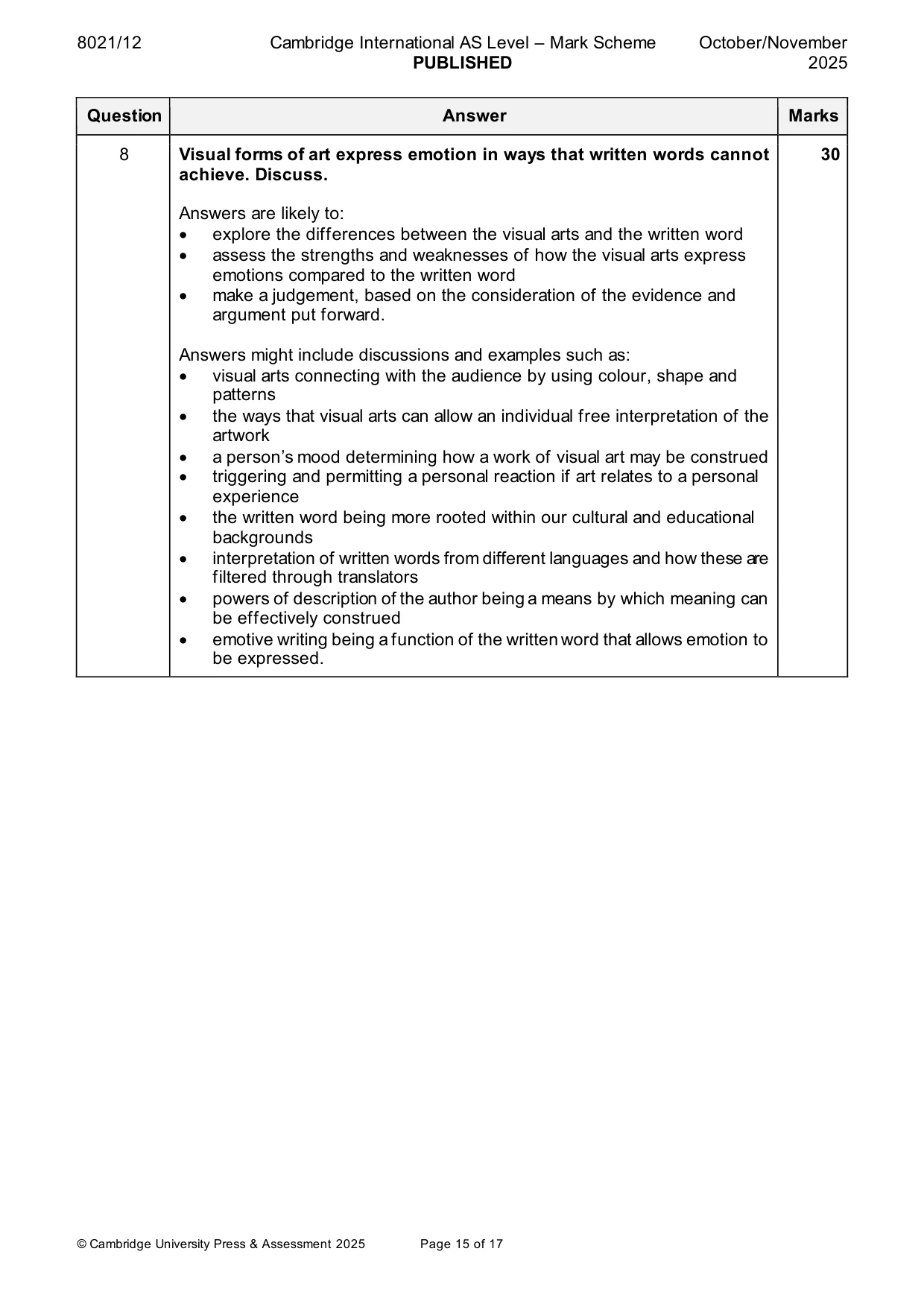
8021/12 Cambridge International AS Level – Mark Scheme PUBLISHED October/November 2025 © Cambridge University Press & Assessment 2025 Page 15 of 17 Question Answer Marks 8 Visual forms of art express emotion in ways that written words cannot achieve. Discuss. Answers are likely to: • explore the differences between the visual arts and the written word • assess the strengths and weaknesses of how the visual arts express emotions compared to the written word • make a judgement, based on the consideration of the evidence and argument put forward. Answers might include discussions and examples such as: • visual arts connecting with the audience by using colour, shape and patterns • the ways that visual arts can allow an individual free interpretation of the artwork • a person’s mood determining how a work of visual art may be construed • triggering and permitting a personal reaction if art relates to a personal experience • the written word being more rooted within our cultural and educational backgrounds • interpretation of written words from different languages and how these are filtered through translators • powers of description of the author being a means by which meaning can be effectively construed • emotive writing being a function of the written word that allows emotion to be expressed. 30
Mark scheme, page 16
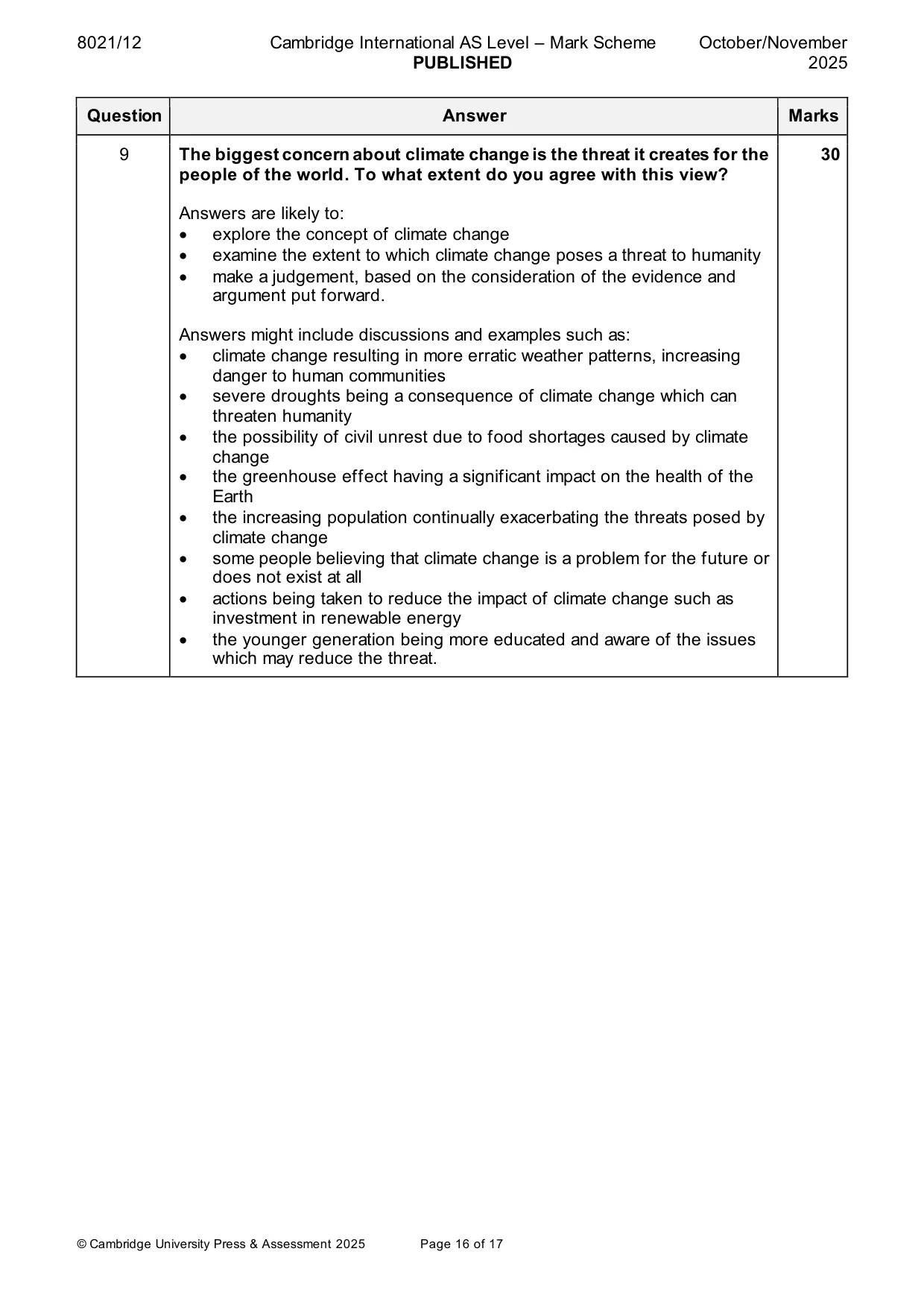
8021/12 Cambridge International AS Level – Mark Scheme PUBLISHED October/November 2025 © Cambridge University Press & Assessment 2025 Page 16 of 17 Question Answer Marks 9 The biggest concern about climate change is the threat it creates for the people of the world. To what extent do you agree with this view? Answers are likely to: • explore the concept of climate change • examine the extent to which climate change poses a threat to humanity • make a judgement, based on the consideration of the evidence and argument put forward. Answers might include discussions and examples such as: • climate change resulting in more erratic weather patterns, increasing danger to human communities • severe droughts being a consequence of climate change which can threaten humanity • the possibility of civil unrest due to food shortages caused by climate change • the greenhouse effect having a significant impact on the health of the Earth • the increasing population continually exacerbating the threats posed by climate change • some people believing that climate change is a problem for the future or does not exist at all • actions being taken to reduce the impact of climate change such as investment in renewable energy • the younger generation being more educated and aware of the issues which may reduce the threat. 30
Mark scheme, page 17
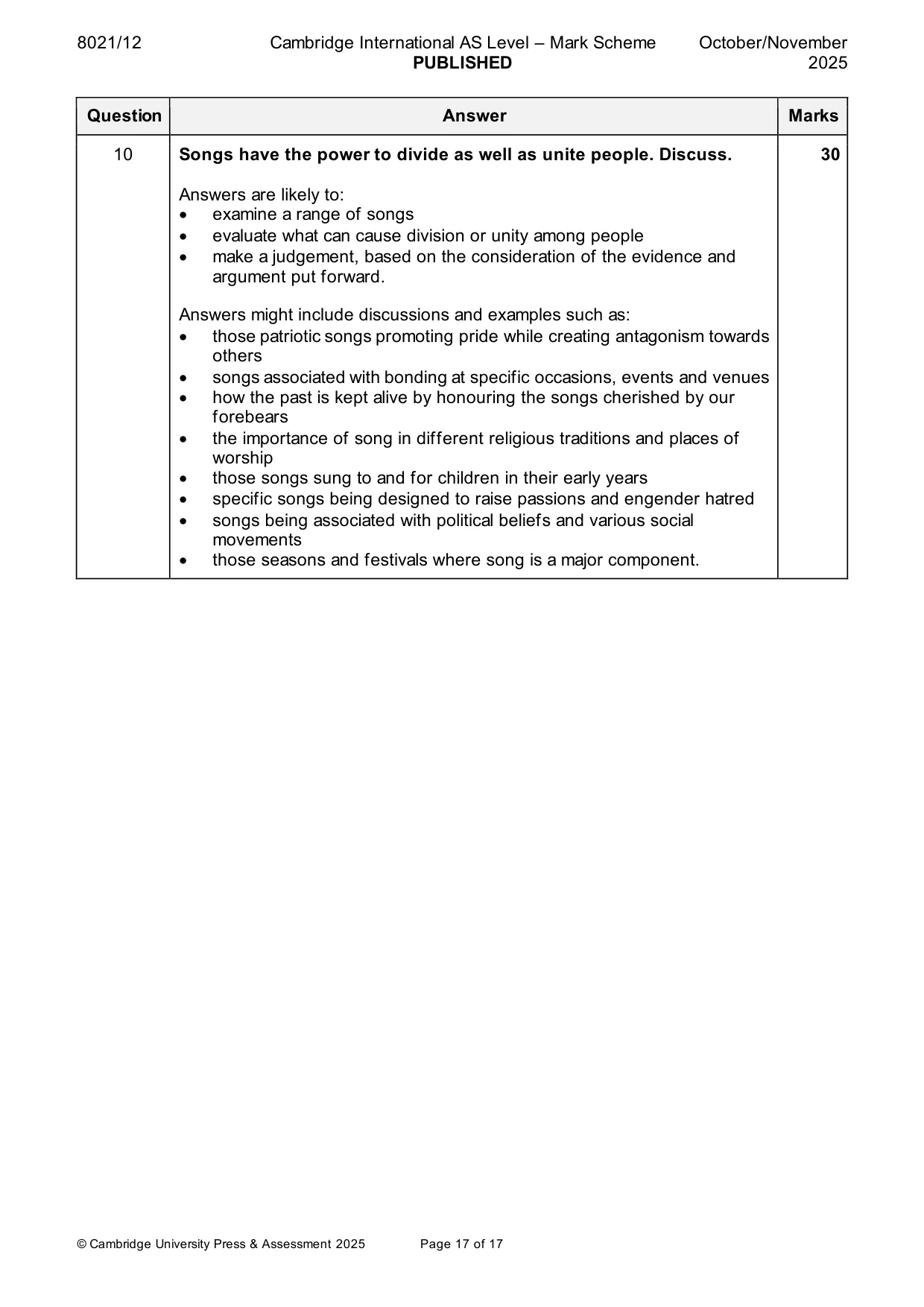
8021/12 Cambridge International AS Level – Mark Scheme PUBLISHED October/November 2025 © Cambridge University Press & Assessment 2025 Page 17 of 17 Question Answer Marks 10 Songs have the power to divide as well as unite people. Discuss. Answers are likely to: • examine a range of songs • evaluate what can cause division or unity among people • make a judgement, based on the consideration of the evidence and argument put forward. Answers might include discussions and examples such as: • those patriotic songs promoting pride while creating antagonism towards others • songs associated with bonding at specific occasions, events and venues • how the past is kept alive by honouring the songs cherished by our forebears • the importance of song in different religious traditions and places of worship • those songs sung to and for children in their early years • specific songs being designed to raise passions and engender hatred • songs being associated with political beliefs and various social movements • those seasons and festivals where song is a major component. 30
What you needed in this session
Cambridge’s own grade thresholds for 2025 Oct/Nov, Paper 1 · Variant 2. A higher threshold means an easier paper — the bar moves with how the cohort did.