Cambridge A Level English General Paper 8021 — 2024 Feb/March Paper 1 · Variant 2
8021/12/F/M/24 · 30 marks · ≈34 min
The question paper and its mark scheme, free to read here and free to download. This is Cambridge’s own paper, exactly as it was sat.
Question paper4 pages


Mark scheme18 pages
Answers below. Sit the paper first if you are practising.
Paper as text
Question paper, page 1
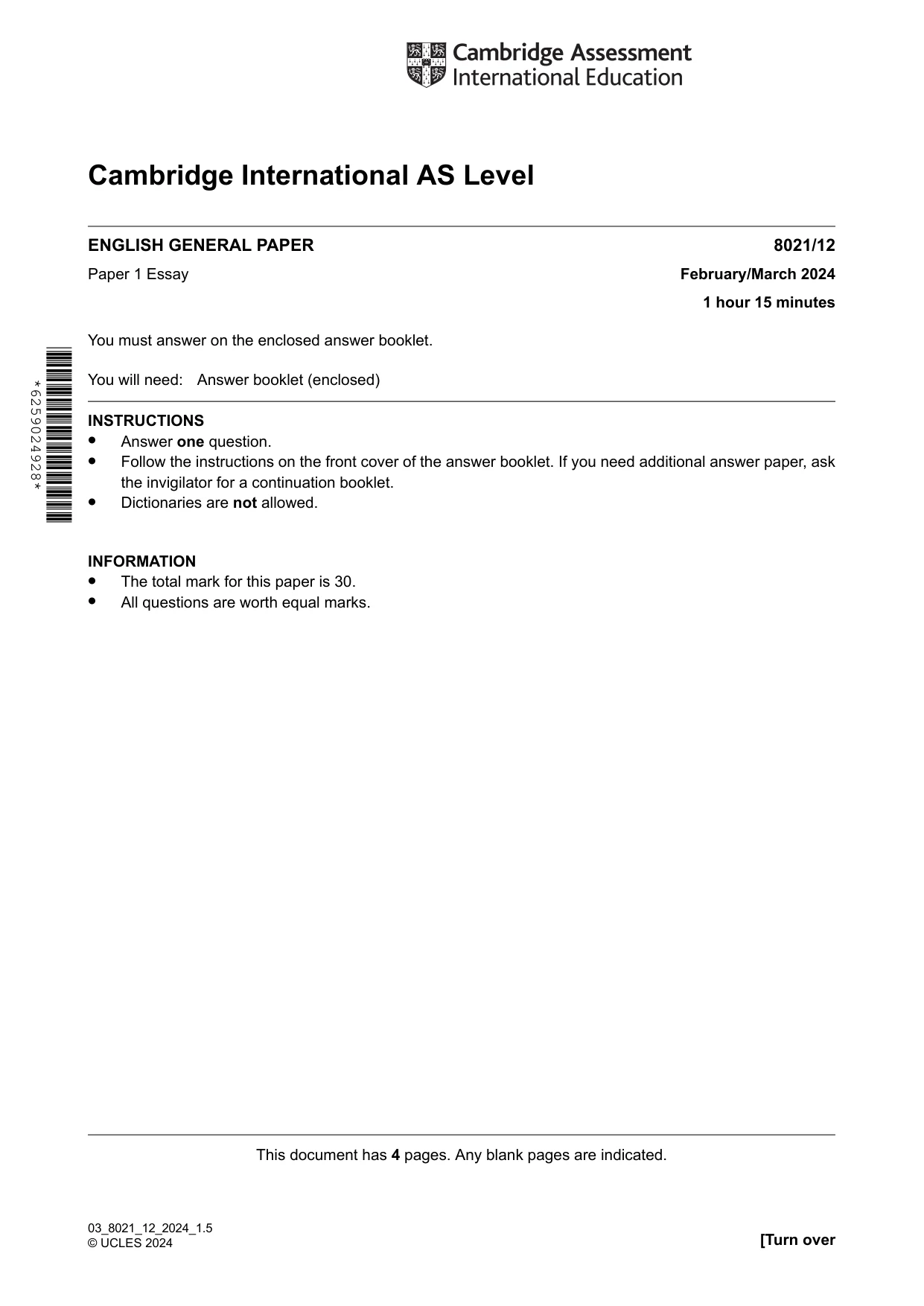
Cambridge International AS Level 8021/12 February/March 2024 1 hour 15 minutes ENGLISH GENERAL PAPER Paper 1 Essay You must answer on the enclosed answer booklet. You will need: Answer booklet (enclosed) INSTRUCTIONS • Answer one question. • Follow the instructions on the front cover of the answer booklet. If you need additional answer paper, ask the invigilator for a continuation booklet. • Dictionaries are not allowed. INFORMATION • The total mark for this paper is 30. • All questions are worth equal marks. This document has 4 pages. Any blank pages are indicated. [Turn over 03_8021_12_2024_1.5 © UCLES 2024 *6259024928*
Question paper, page 2
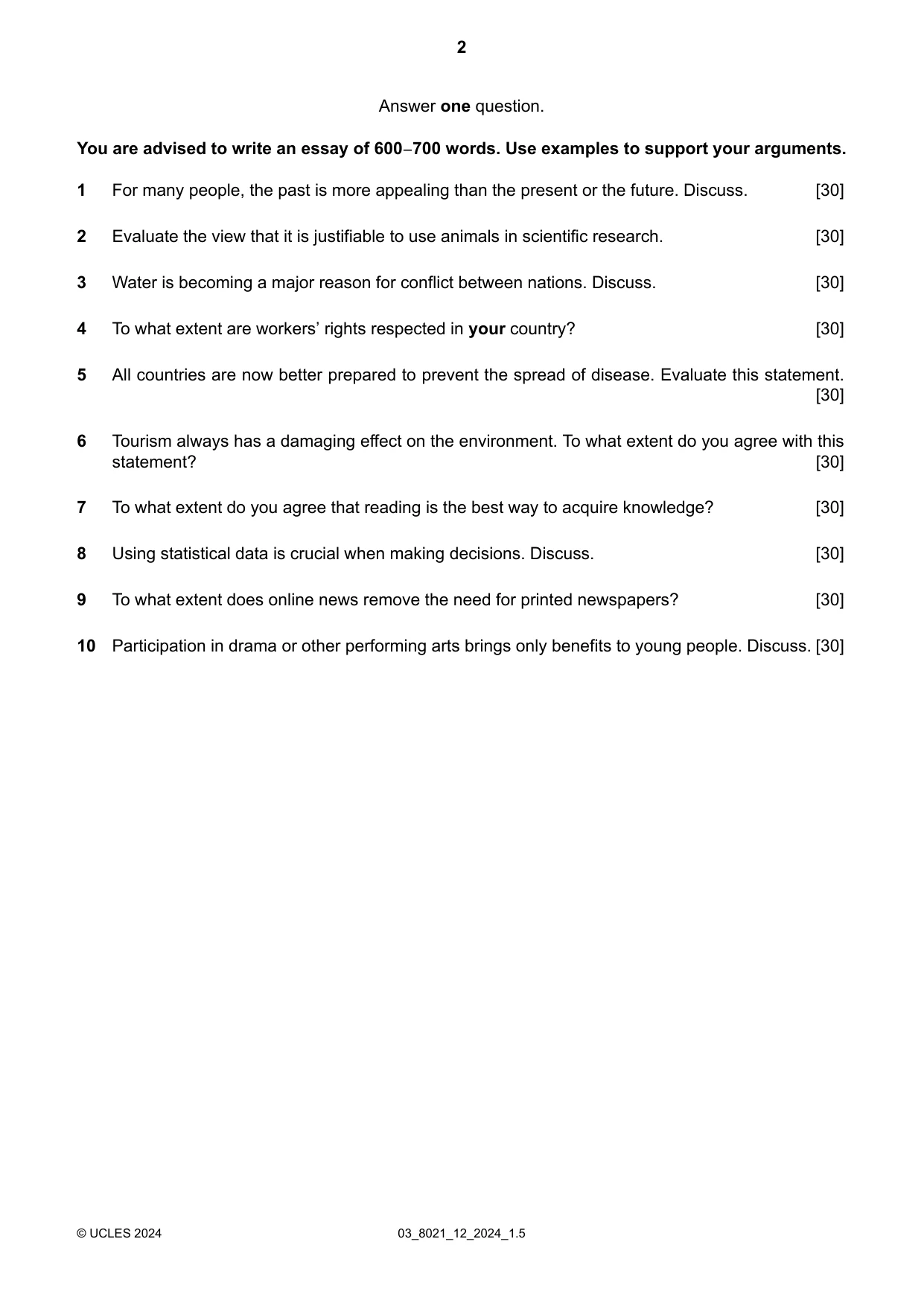
Answer one question. You are advised to write an essay of 600−700 words. Use examples to support your arguments. For many people, the past is more appealing than the present or the future. Discuss. [30] 1 Evaluate the view that it is justifiable to use animals in scientific research. [30] 2 Water is becoming a major reason for conflict between nations. Discuss. [30] 3 To what extent are workers’ rights respected in your country? [30] 4 All countries are now better prepared to prevent the spread of disease. Evaluate this statement. [30] 5 Tourism always has a damaging effect on the environment. To what extent do you agree with this statement? [30] 6 To what extent do you agree that reading is the best way to acquire knowledge? [30] 7 Using statistical data is crucial when making decisions. Discuss. [30] 8 To what extent does online news remove the need for printed newspapers? [30] 9 Participation in drama or other performing arts brings only benefits to young people. Discuss. [30] 10 03_8021_12_2024_1.5 © UCLES 2024 2
Question paper, page 3
BLANK PAGE 03_8021_12_2024_1.5 © UCLES 2024 3
Question paper, page 4
BLANK PAGE Permission to reproduce items where third-party owned material protected by copyright is included has been sought and cleared where possible. Every reasonable effort has been made by the publisher (UCLES) to trace copyright holders, but if any items requiring clearance have unwittingly been included, the publisher will be pleased to make amends at the earliest possible opportunity. To avoid the issue of disclosure of answer-related information to candidates, all copyright acknowledgements are reproduced online in the Cambridge Assessment International Education Copyright Acknowledgements Booklet. This is produced for each series of examinations and is freely available to download at www.cambridgeinternational.org after the live examination series. Cambridge Assessment International Education is part of Cambridge Assessment. Cambridge Assessment is the brand name of the University of Cambridge Local Examinations Syndicate (UCLES), which is a department of the University of Cambridge. 03_8021_12_2024_1.5 © UCLES 2024 4
Mark scheme, page 1
This document consists of 18 printed pages. © Cambridge University Press & Assessment 2024 [Turn over] Cambridge International AS Level ENGLISH GENERAL PAPER 8021/12 Paper 1 Essay February/March 2024 MARK SCHEME Maximum Mark: 30 Published This mark scheme is published as an aid to teachers and candidates, to indicate the requirements of the examination. It shows the basis on which Examiners were instructed to award marks. It does not indicate the details of the discussions that took place at an Examiners’ meeting before marking began, which would have considered the acceptability of alternative answers. Mark schemes should be read in conjunction with the question paper and the Principal Examiner Report for Teachers. Cambridge International will not enter into discussions about these mark schemes. Cambridge International is publishing the mark schemes for the February/March 2024 series for most Cambridge IGCSE, Cambridge International A and AS Level components, and some Cambridge O Level components.
Mark scheme, page 2
8021/12 Cambridge International AS Level – Mark Scheme PUBLISHED February/March 2024 © Cambridge University Press & Assessment 2024 Page 2 of 18 Generic Marking Principles These general marking principles must be applied by all examiners when marking candidate answers. They should be applied alongside the specific content of the mark scheme or generic level descriptions for a question. Each question paper and mark scheme will also comply with these marking principles. GENERIC MARKING PRINCIPLE 1: Marks must be awarded in line with: • the specific content of the mark scheme or the generic level descriptors for the question • the specific skills defined in the mark scheme or in the generic level descriptors for the question • the standard of response required by a candidate as exemplified by the standardisation scripts. GENERIC MARKING PRINCIPLE 2: Marks awarded are always whole marks (not half marks, or other fractions). GENERIC MARKING PRINCIPLE 3: Marks must be awarded positively: • marks are awarded for correct/valid answers, as defined in the mark scheme. However, credit is given for valid answers which go beyond the scope of the syllabus and mark scheme, referring to your Team Leader as appropriate • marks are awarded when candidates clearly demonstrate what they know and can do • marks are not deducted for errors • marks are not deducted for omissions • answers should only be judged on the quality of spelling, punctuation and grammar when these features are specifically assessed by the question as indicated by the mark scheme. The meaning, however, should be unambiguous. GENERIC MARKING PRINCIPLE 4: Rules must be applied consistently, e.g. in situations where candidates have not followed instructions or in the application of generic level descriptors.
Mark scheme, page 3
8021/12 Cambridge International AS Level – Mark Scheme PUBLISHED February/March 2024 © Cambridge University Press & Assessment 2024 Page 3 of 18 GENERIC MARKING PRINCIPLE 5: Marks should be awarded using the full range of marks defined in the mark scheme for the question (however; the use of the full mark range may be limited according to the quality of the candidate responses seen). GENERIC MARKING PRINCIPLE 6: Marks awarded are based solely on the requirements as defined in the mark scheme. Marks should not be awarded with grade thresholds or grade descriptors in mind.
Mark scheme, page 4
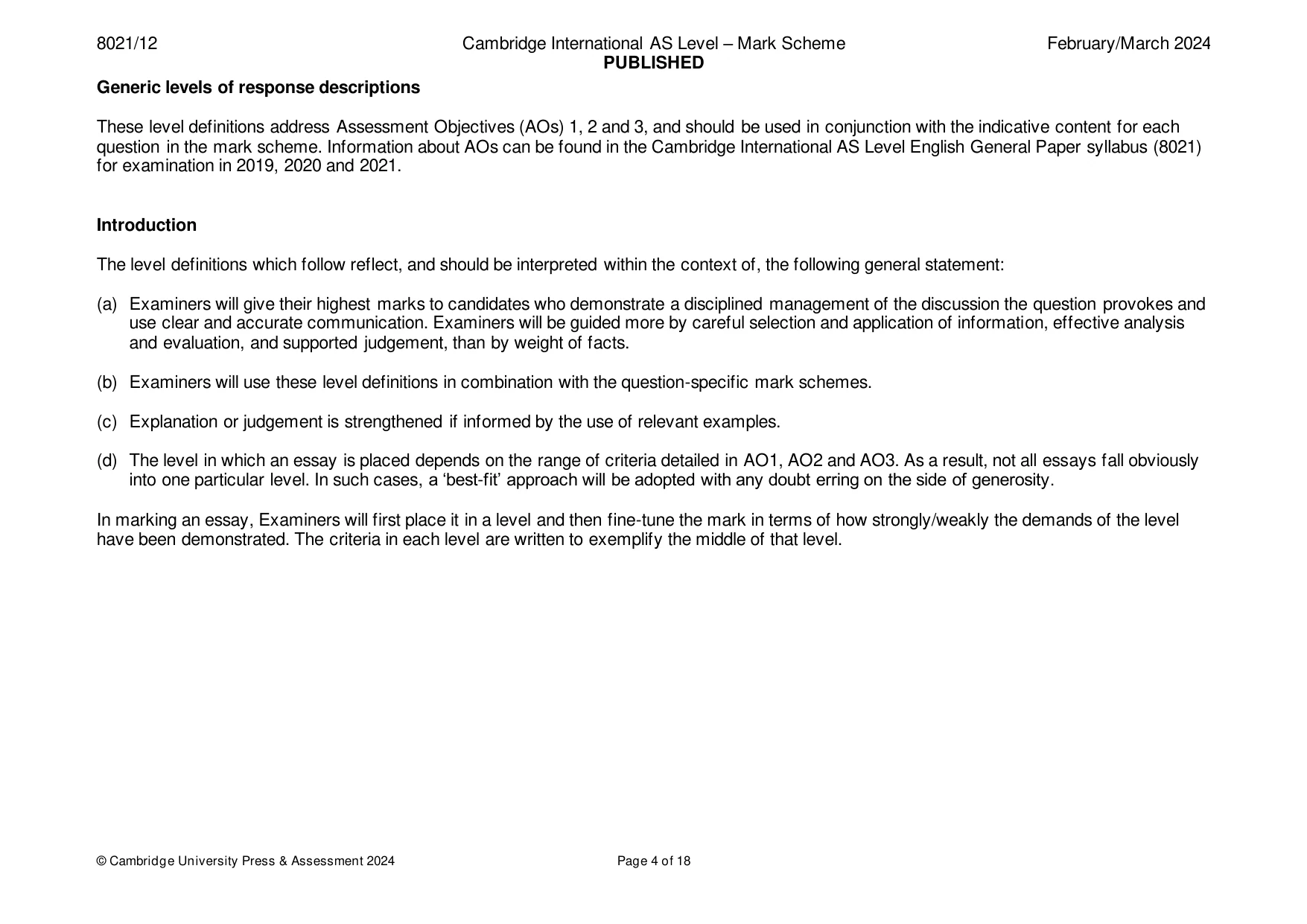
8021/12 Cambridge International AS Level – Mark Scheme PUBLISHED February/March 2024 © Cambridge University Press & Assessment 2024 Page 4 of 18 Generic levels of response descriptions These level definitions address Assessment Objectives (AOs) 1, 2 and 3, and should be used in conjunction with the indicative content for each question in the mark scheme. Information about AOs can be found in the Cambridge International AS Level English General Paper syllabus (8021) for examination in 2019, 2020 and 2021. Introduction The level definitions which follow reflect, and should be interpreted within the context of, the following general statement: (a) Examiners will give their highest marks to candidates who demonstrate a disciplined management of the discussion the question provokes and use clear and accurate communication. Examiners will be guided more by careful selection and application of information, effective analysis and evaluation, and supported judgement, than by weight of facts. (b) Examiners will use these level definitions in combination with the question-specific mark schemes. (c) Explanation or judgement is strengthened if informed by the use of relevant examples. (d) The level in which an essay is placed depends on the range of criteria detailed in AO1, AO2 and AO3. As a result, not all essays fall obviously into one particular level. In such cases, a ‘best-fit’ approach will be adopted with any doubt erring on the side of generosity. In marking an essay, Examiners will first place it in a level and then fine-tune the mark in terms of how strongly/weakly the demands of the level have been demonstrated. The criteria in each level are written to exemplify the middle of that level.
Mark scheme, page 5
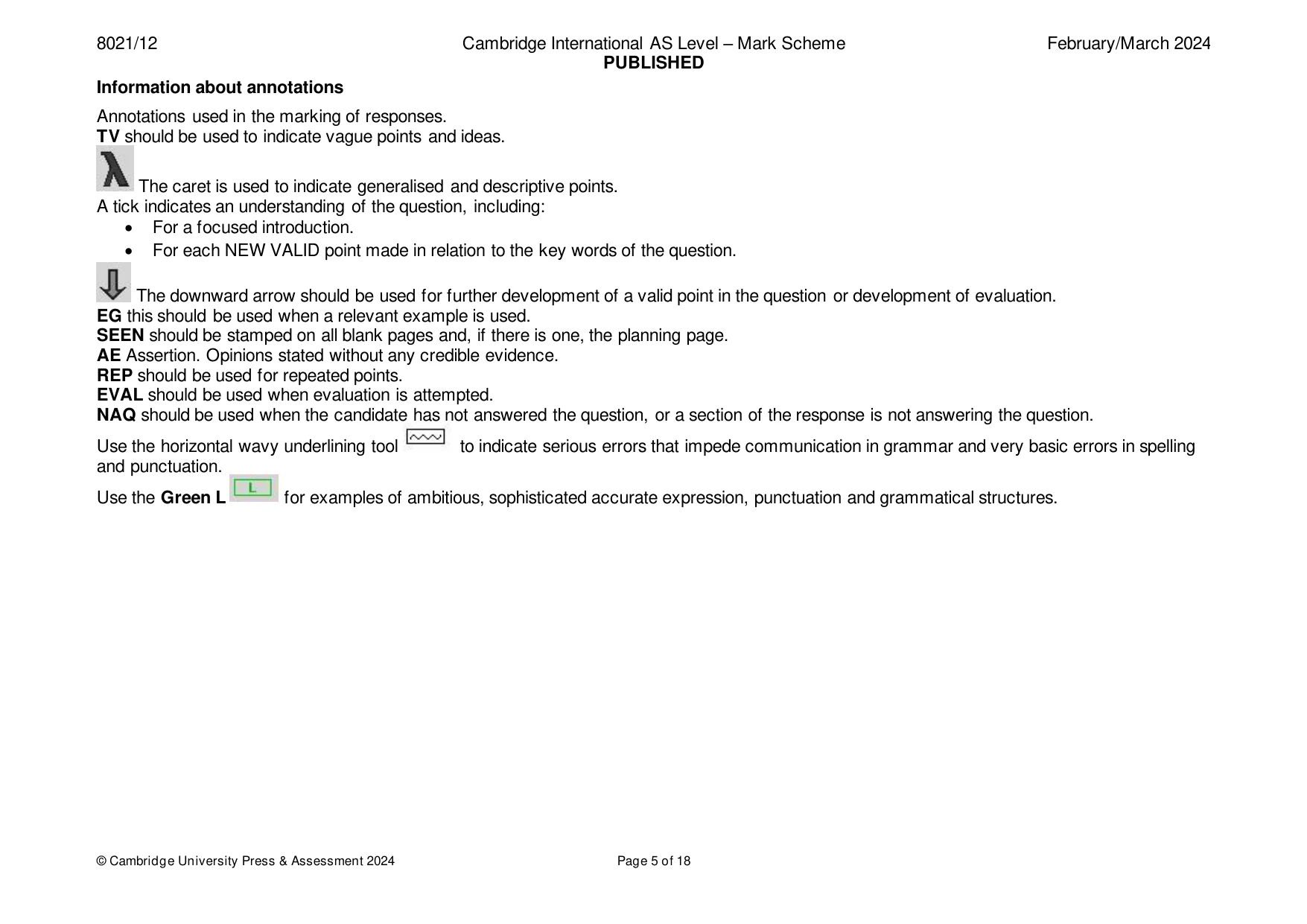
8021/12 Cambridge International AS Level – Mark Scheme PUBLISHED February/March 2024 © Cambridge University Press & Assessment 2024 Page 5 of 18 Information about annotations Annotations used in the marking of responses. TV should be used to indicate vague points and ideas. The caret is used to indicate generalised and descriptive points. A tick indicates an understanding of the question, including: • For a focused introduction. • For each NEW VALID point made in relation to the key words of the question. The downward arrow should be used for further development of a valid point in the question or development of evaluation. EG this should be used when a relevant example is used. SEEN should be stamped on all blank pages and, if there is one, the planning page. AE Assertion. Opinions stated without any credible evidence. REP should be used for repeated points. EVAL should be used when evaluation is attempted. NAQ should be used when the candidate has not answered the question, or a section of the response is not answering the question. Use the horizontal wavy underlining tool to indicate serious errors that impede communication in grammar and very basic errors in spelling and punctuation. Use the Green L for examples of ambitious, sophisticated accurate expression, punctuation and grammatical structures.
Mark scheme, page 6
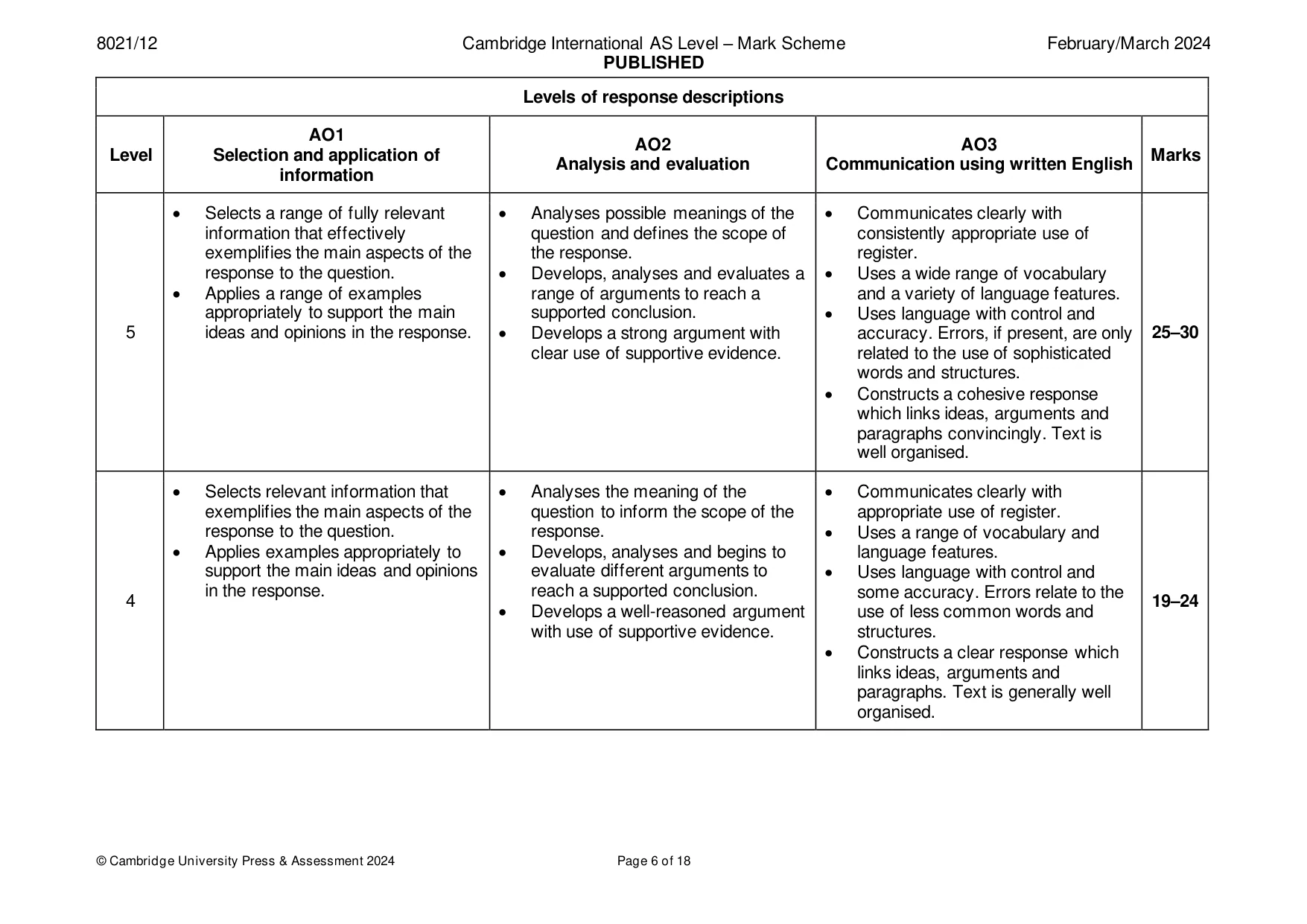
8021/12 Cambridge International AS Level – Mark Scheme PUBLISHED February/March 2024 © Cambridge University Press & Assessment 2024 Page 6 of 18 Levels of response descriptions Level AO1 Selection and application of information AO2 Analysis and evaluation AO3 Communication using written English Marks 5 • Selects a range of fully relevant information that effectively exemplifies the main aspects of the response to the question. • Applies a range of examples appropriately to support the main ideas and opinions in the response. • Analyses possible meanings of the question and defines the scope of the response. • Develops, analyses and evaluates a range of arguments to reach a supported conclusion. • Develops a strong argument with clear use of supportive evidence. • Communicates clearly with consistently appropriate use of register. • Uses a wide range of vocabulary and a variety of language features. • Uses language with control and accuracy. Errors, if present, are only related to the use of sophisticated words and structures. • Constructs a cohesive response which links ideas, arguments and paragraphs convincingly. Text is well organised. 25–30 4 • Selects relevant information that exemplifies the main aspects of the response to the question. • Applies examples appropriately to support the main ideas and opinions in the response. • Analyses the meaning of the question to inform the scope of the response. • Develops, analyses and begins to evaluate different arguments to reach a supported conclusion. • Develops a well-reasoned argument with use of supportive evidence. • Communicates clearly with appropriate use of register. • Uses a range of vocabulary and language features. • Uses language with control and some accuracy. Errors relate to the use of less common words and structures. • Constructs a clear response which links ideas, arguments and paragraphs. Text is generally well organised. 19–24
Mark scheme, page 7
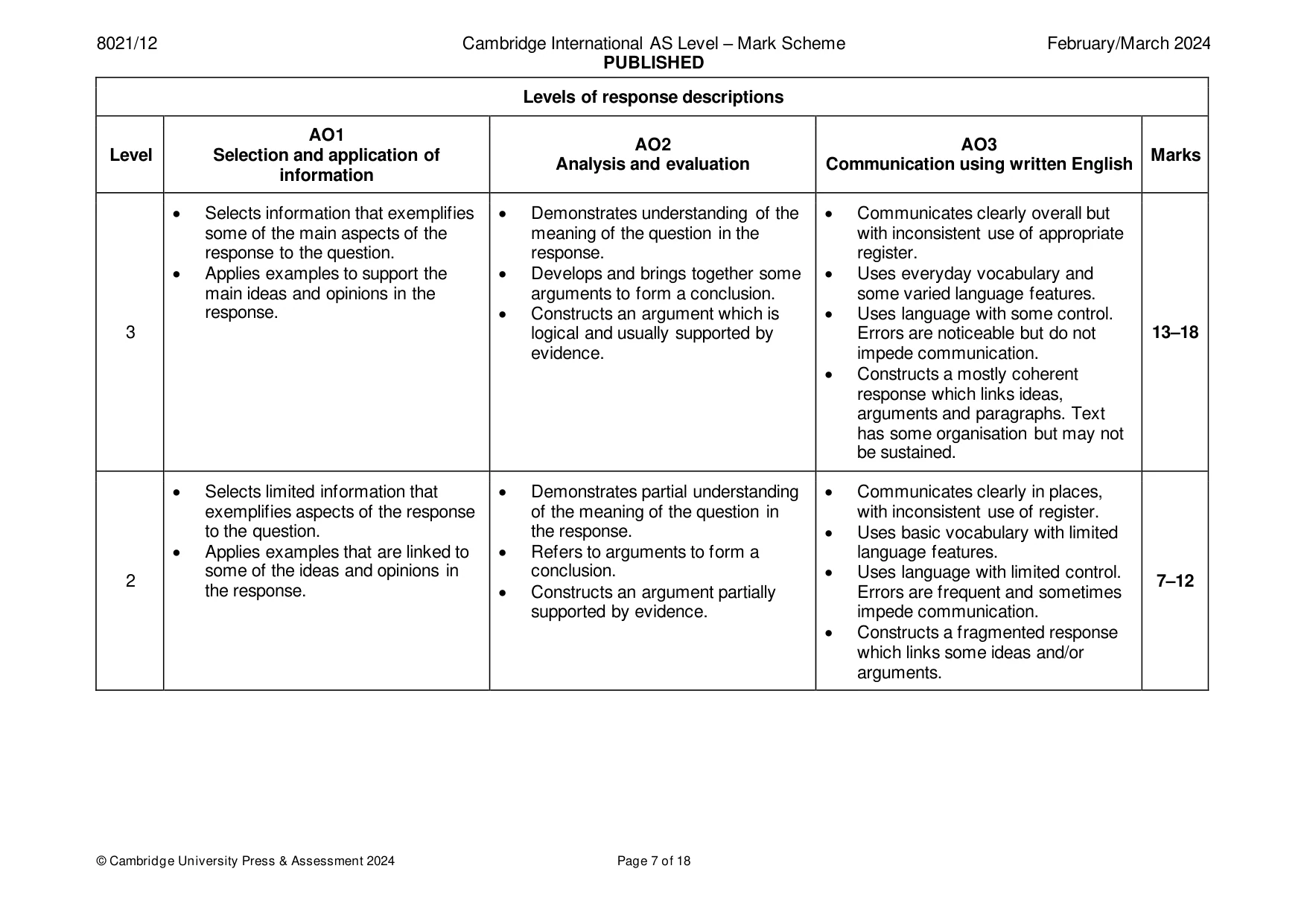
8021/12 Cambridge International AS Level – Mark Scheme PUBLISHED February/March 2024 © Cambridge University Press & Assessment 2024 Page 7 of 18 Levels of response descriptions Level AO1 Selection and application of information AO2 Analysis and evaluation AO3 Communication using written English Marks 3 • Selects information that exemplifies some of the main aspects of the response to the question. • Applies examples to support the main ideas and opinions in the response. • Demonstrates understanding of the meaning of the question in the response. • Develops and brings together some arguments to form a conclusion. • Constructs an argument which is logical and usually supported by evidence. • Communicates clearly overall but with inconsistent use of appropriate register. • Uses everyday vocabulary and some varied language features. • Uses language with some control. Errors are noticeable but do not impede communication. • Constructs a mostly coherent response which links ideas, arguments and paragraphs. Text has some organisation but may not be sustained. 13–18 2 • Selects limited information that exemplifies aspects of the response to the question. • Applies examples that are linked to some of the ideas and opinions in the response. • Demonstrates partial understanding of the meaning of the question in the response. • Refers to arguments to form a conclusion. • Constructs an argument partially supported by evidence. • Communicates clearly in places, with inconsistent use of register. • Uses basic vocabulary with limited language features. • Uses language with limited control. Errors are frequent and sometimes impede communication. • Constructs a fragmented response which links some ideas and/or arguments. 7–12
Mark scheme, page 8
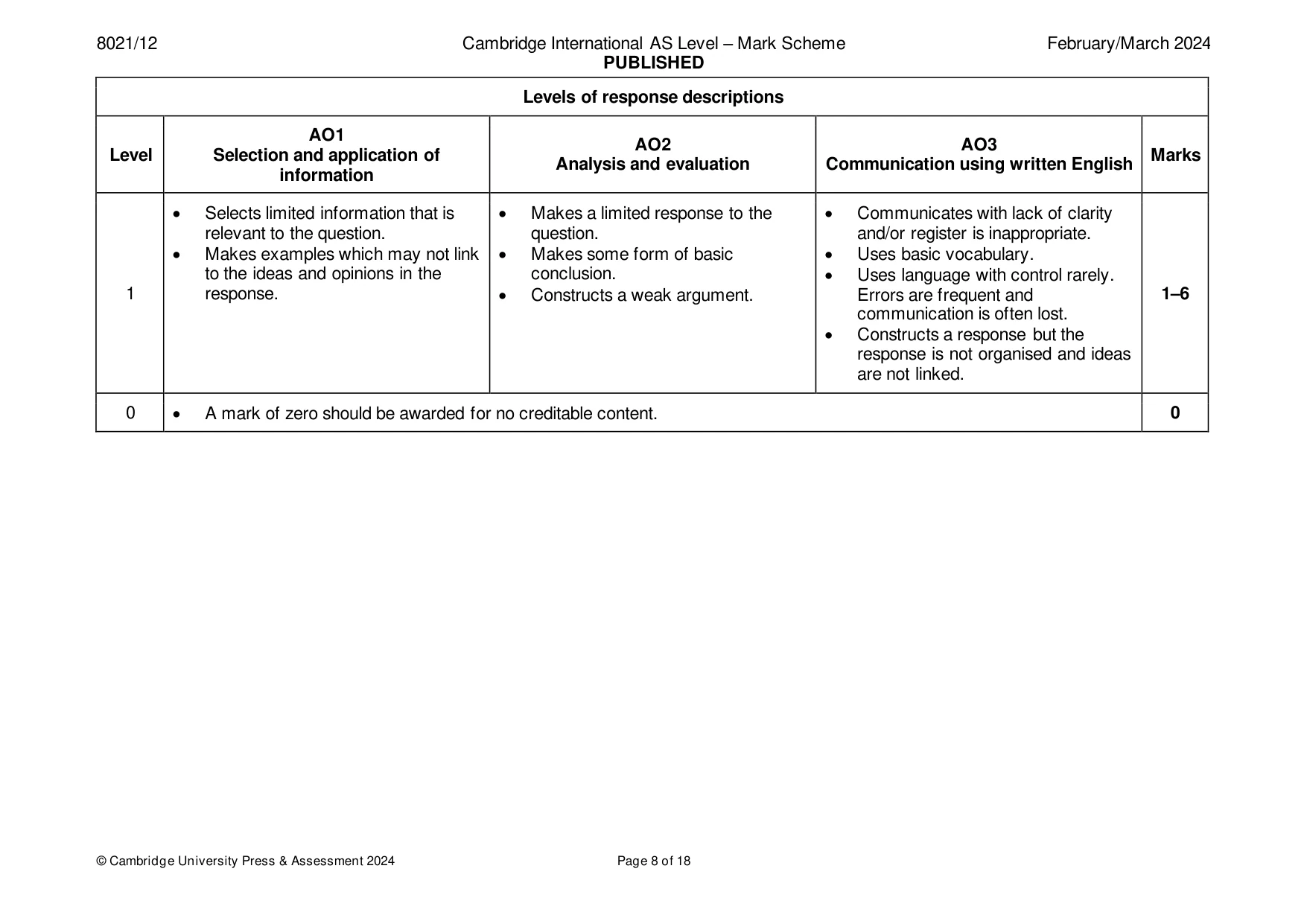
8021/12 Cambridge International AS Level – Mark Scheme PUBLISHED February/March 2024 © Cambridge University Press & Assessment 2024 Page 8 of 18 Levels of response descriptions Level AO1 Selection and application of information AO2 Analysis and evaluation AO3 Communication using written English Marks 1 • Selects limited information that is relevant to the question. • Makes examples which may not link to the ideas and opinions in the response. • Makes a limited response to the question. • Makes some form of basic conclusion. • Constructs a weak argument. • Communicates with lack of clarity and/or register is inappropriate. • Uses basic vocabulary. • Uses language with control rarely. Errors are frequent and communication is often lost. • Constructs a response but the response is not organised and ideas are not linked. 1–6 0 • A mark of zero should be awarded for no creditable content. 0
Mark scheme, page 9
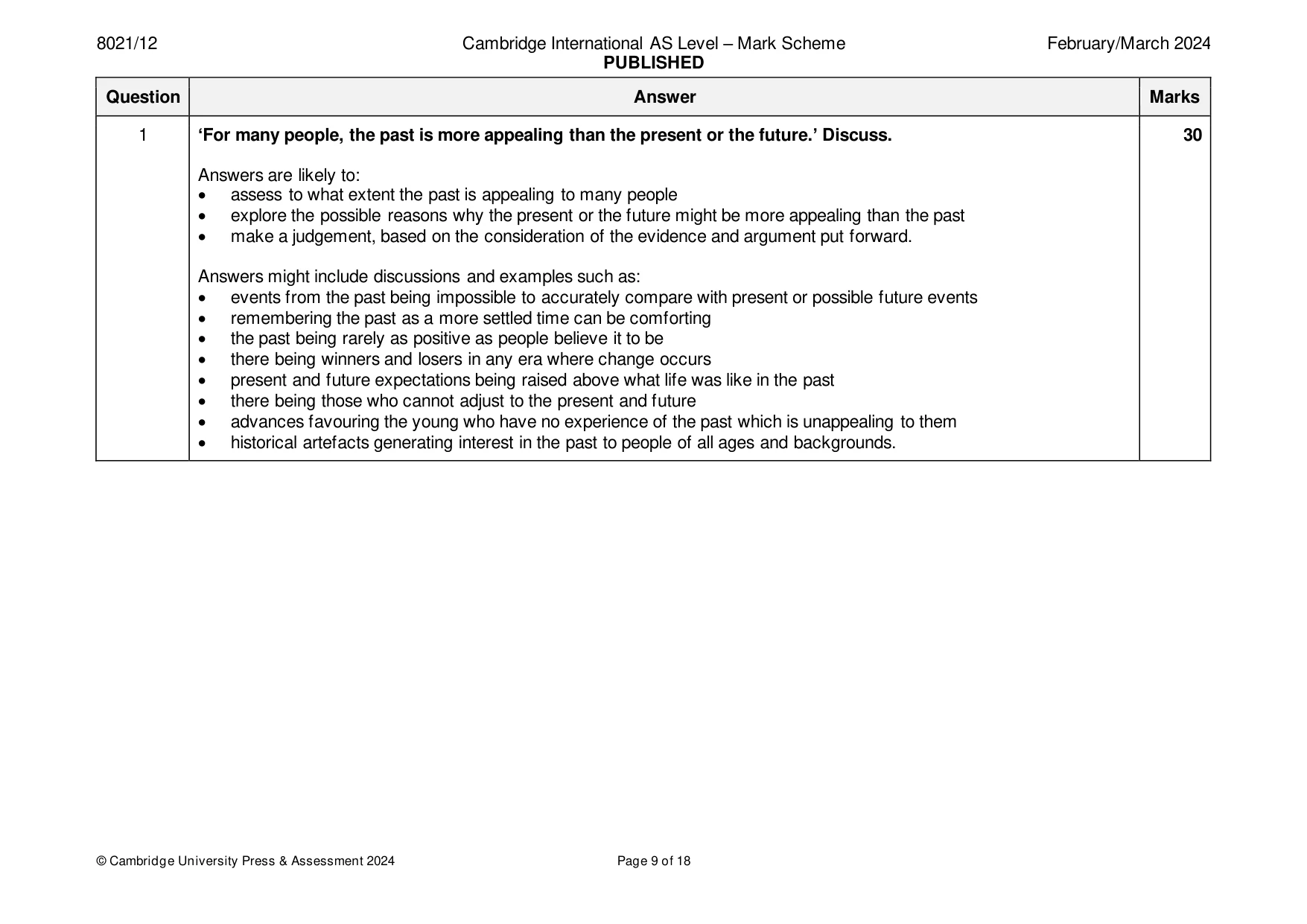
8021/12 Cambridge International AS Level – Mark Scheme PUBLISHED February/March 2024 © Cambridge University Press & Assessment 2024 Page 9 of 18 Question Answer Marks 1 ‘For many people, the past is more appealing than the present or the future.’ Discuss. Answers are likely to: • assess to what extent the past is appealing to many people • explore the possible reasons why the present or the future might be more appealing than the past • make a judgement, based on the consideration of the evidence and argument put forward. Answers might include discussions and examples such as: • events from the past being impossible to accurately compare with present or possible future events • remembering the past as a more settled time can be comforting • the past being rarely as positive as people believe it to be • there being winners and losers in any era where change occurs • present and future expectations being raised above what life was like in the past • there being those who cannot adjust to the present and future • advances favouring the young who have no experience of the past which is unappealing to them • historical artefacts generating interest in the past to people of all ages and backgrounds. 30
Mark scheme, page 10
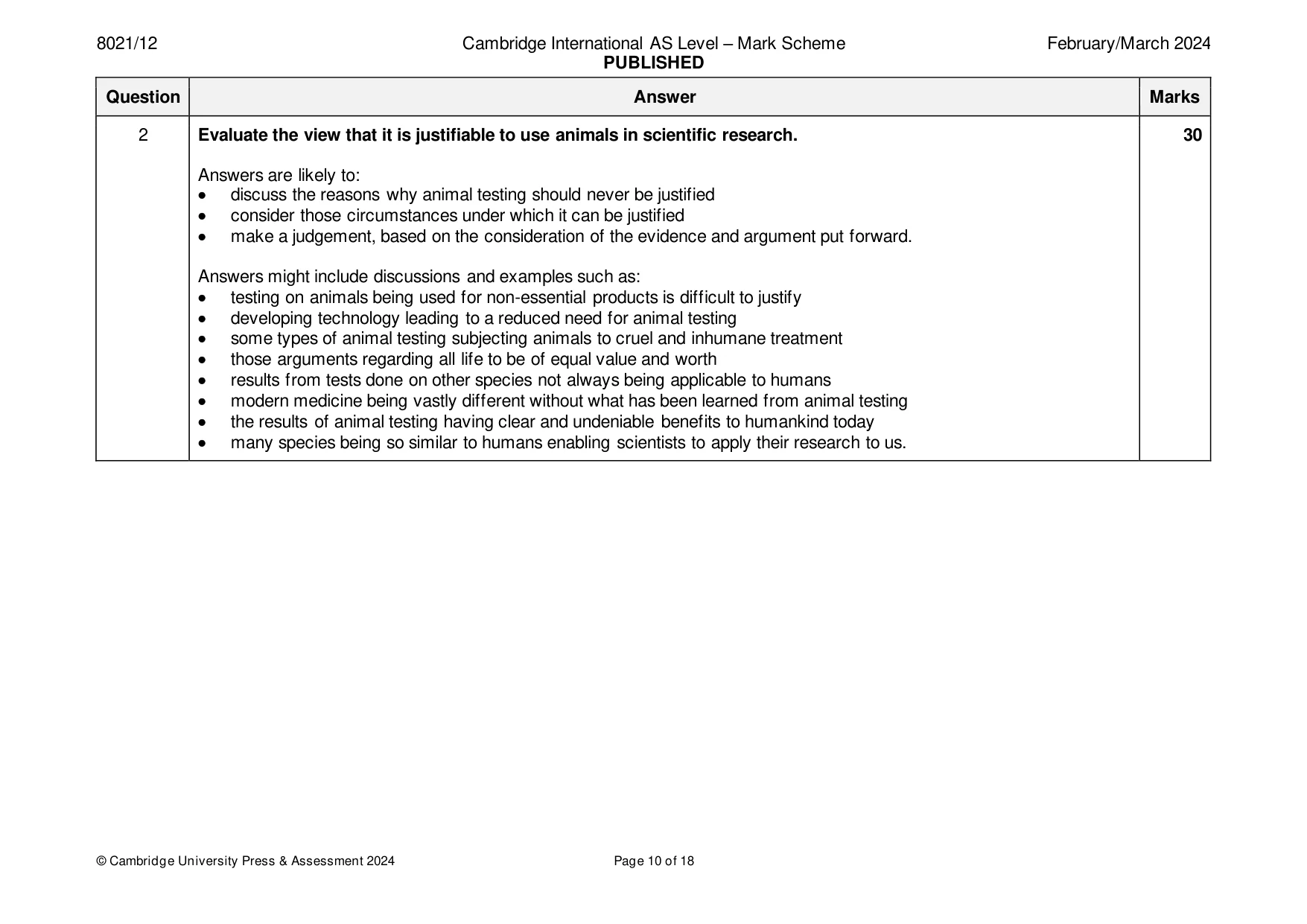
8021/12 Cambridge International AS Level – Mark Scheme PUBLISHED February/March 2024 © Cambridge University Press & Assessment 2024 Page 10 of 18 Question Answer Marks 2 Evaluate the view that it is justifiable to use animals in scientific research. Answers are likely to: • discuss the reasons why animal testing should never be justified • consider those circumstances under which it can be justified • make a judgement, based on the consideration of the evidence and argument put forward. Answers might include discussions and examples such as: • testing on animals being used for non-essential products is difficult to justify • developing technology leading to a reduced need for animal testing • some types of animal testing subjecting animals to cruel and inhumane treatment • those arguments regarding all life to be of equal value and worth • results from tests done on other species not always being applicable to humans • modern medicine being vastly different without what has been learned from animal testing • the results of animal testing having clear and undeniable benefits to humankind today • many species being so similar to humans enabling scientists to apply their research to us. 30
Mark scheme, page 11
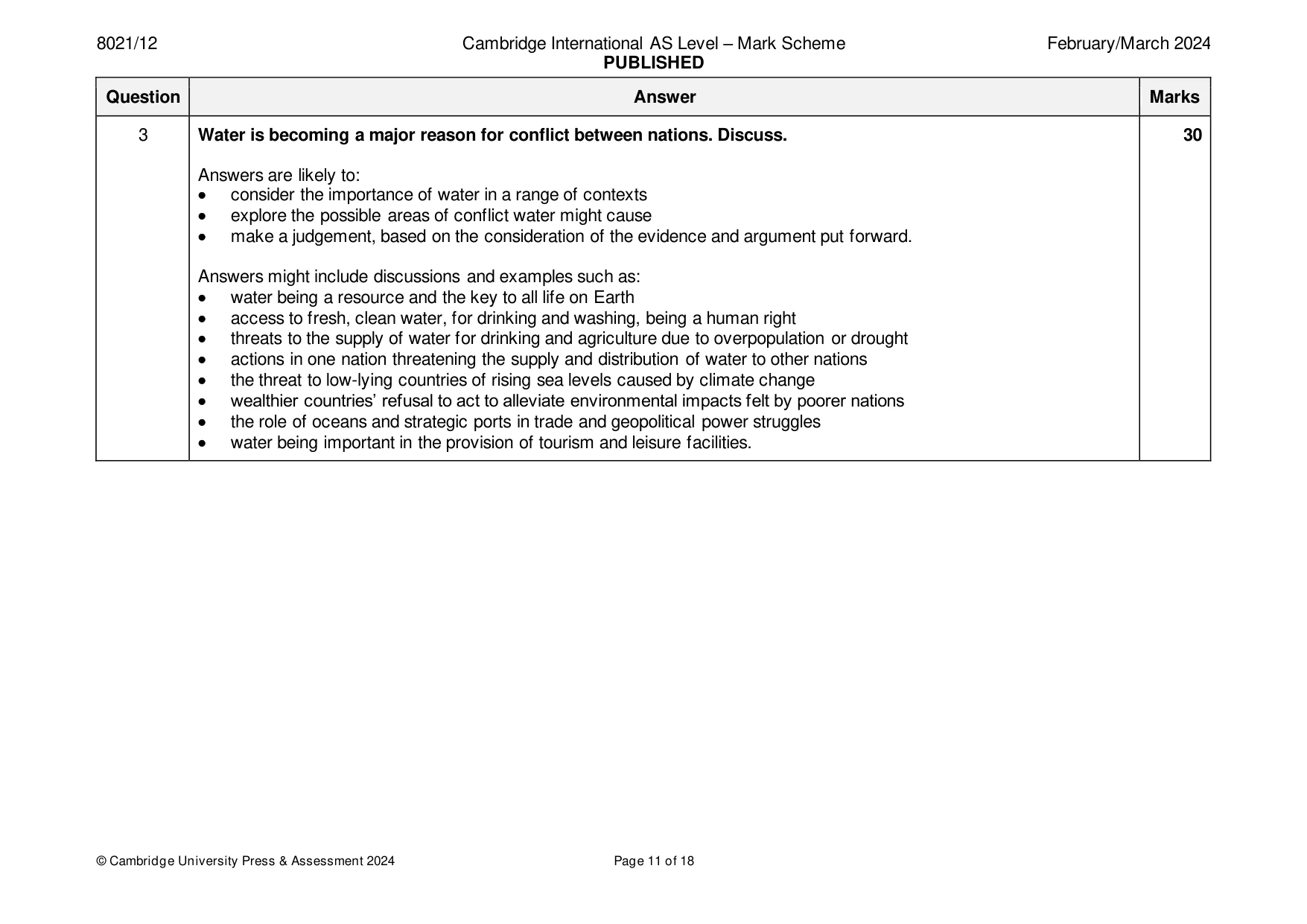
8021/12 Cambridge International AS Level – Mark Scheme PUBLISHED February/March 2024 © Cambridge University Press & Assessment 2024 Page 11 of 18 Question Answer Marks 3 Water is becoming a major reason for conflict between nations. Discuss. Answers are likely to: • consider the importance of water in a range of contexts • explore the possible areas of conflict water might cause • make a judgement, based on the consideration of the evidence and argument put forward. Answers might include discussions and examples such as: • water being a resource and the key to all life on Earth • access to fresh, clean water, for drinking and washing, being a human right • threats to the supply of water for drinking and agriculture due to overpopulation or drought • actions in one nation threatening the supply and distribution of water to other nations • the threat to low-lying countries of rising sea levels caused by climate change • wealthier countries’ refusal to act to alleviate environmental impacts felt by poorer nations • the role of oceans and strategic ports in trade and geopolitical power struggles • water being important in the provision of tourism and leisure facilities. 30
Mark scheme, page 12
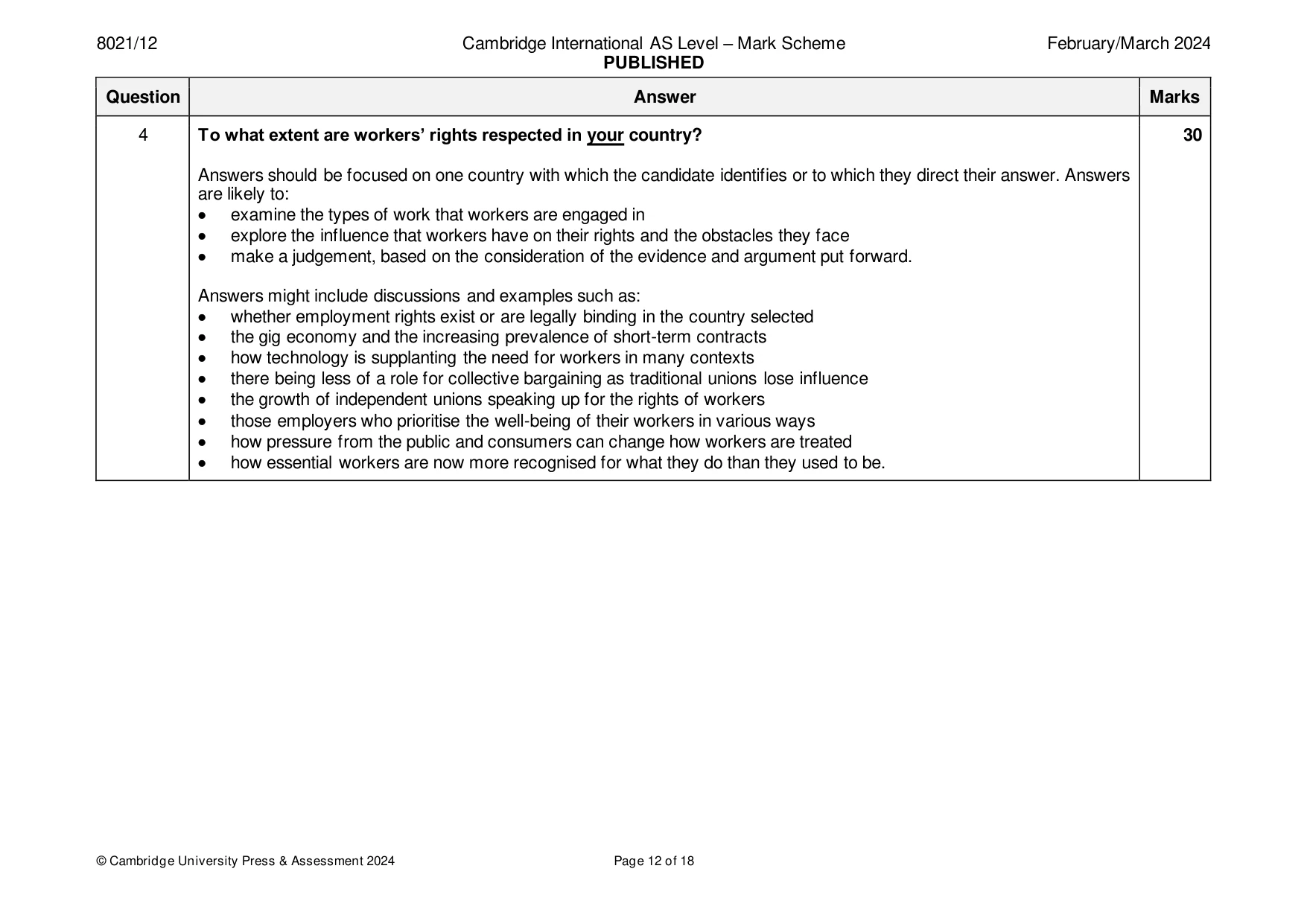
8021/12 Cambridge International AS Level – Mark Scheme PUBLISHED February/March 2024 © Cambridge University Press & Assessment 2024 Page 12 of 18 Question Answer Marks 4 To what extent are workers’ rights respected in your country? Answers should be focused on one country with which the candidate identifies or to which they direct their answer. Answers are likely to: • examine the types of work that workers are engaged in • explore the influence that workers have on their rights and the obstacles they face • make a judgement, based on the consideration of the evidence and argument put forward. Answers might include discussions and examples such as: • whether employment rights exist or are legally binding in the country selected • the gig economy and the increasing prevalence of short-term contracts • how technology is supplanting the need for workers in many contexts • there being less of a role for collective bargaining as traditional unions lose influence • the growth of independent unions speaking up for the rights of workers • those employers who prioritise the well-being of their workers in various ways • how pressure from the public and consumers can change how workers are treated • how essential workers are now more recognised for what they do than they used to be. 30
Mark scheme, page 13
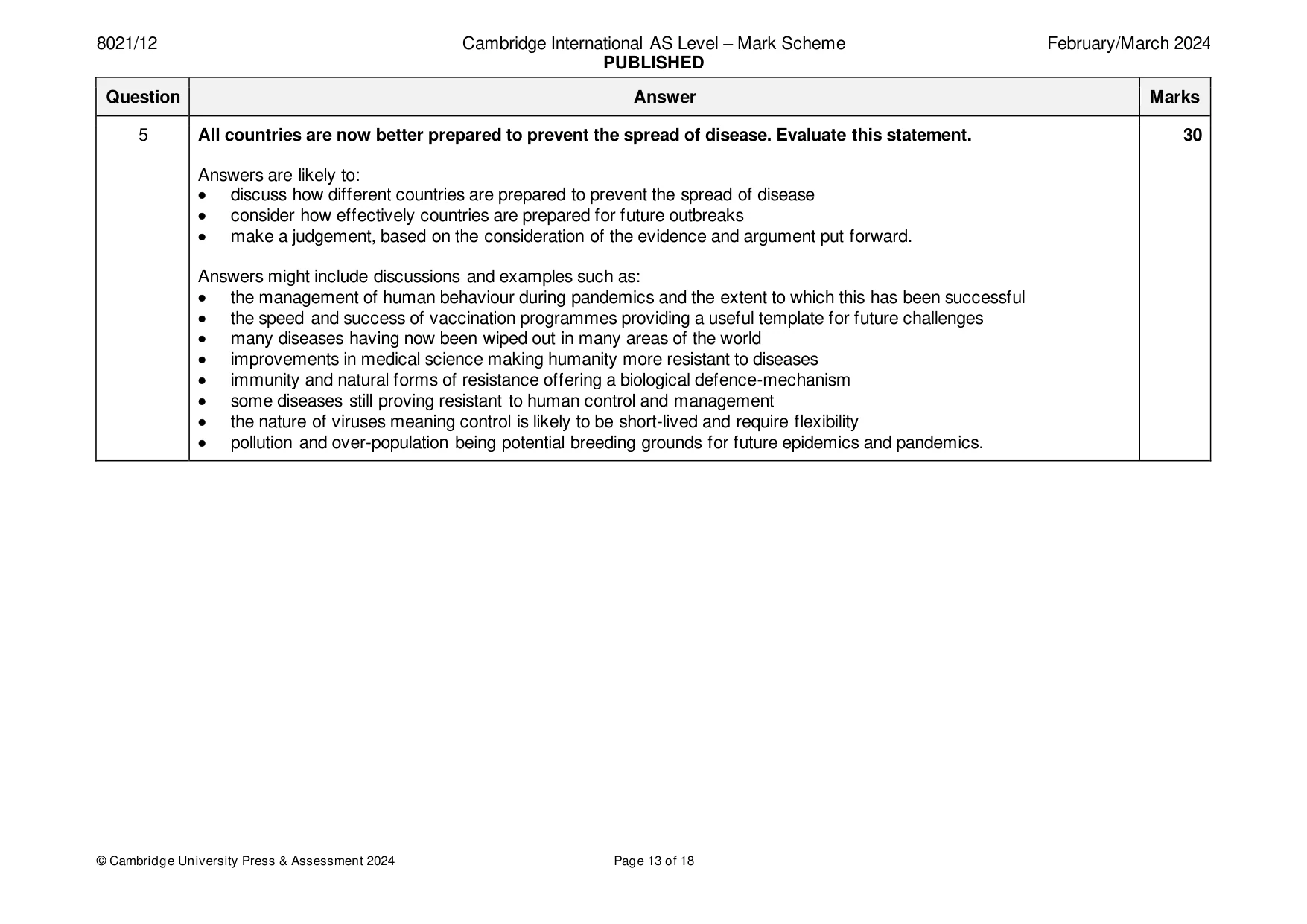
8021/12 Cambridge International AS Level – Mark Scheme PUBLISHED February/March 2024 © Cambridge University Press & Assessment 2024 Page 13 of 18 Question Answer Marks 5 All countries are now better prepared to prevent the spread of disease. Evaluate this statement. Answers are likely to: • discuss how different countries are prepared to prevent the spread of disease • consider how effectively countries are prepared for future outbreaks • make a judgement, based on the consideration of the evidence and argument put forward. Answers might include discussions and examples such as: • the management of human behaviour during pandemics and the extent to which this has been successful • the speed and success of vaccination programmes providing a useful template for future challenges • many diseases having now been wiped out in many areas of the world • improvements in medical science making humanity more resistant to diseases • immunity and natural forms of resistance offering a biological defence-mechanism • some diseases still proving resistant to human control and management • the nature of viruses meaning control is likely to be short-lived and require flexibility • pollution and over-population being potential breeding grounds for future epidemics and pandemics. 30
Mark scheme, page 14
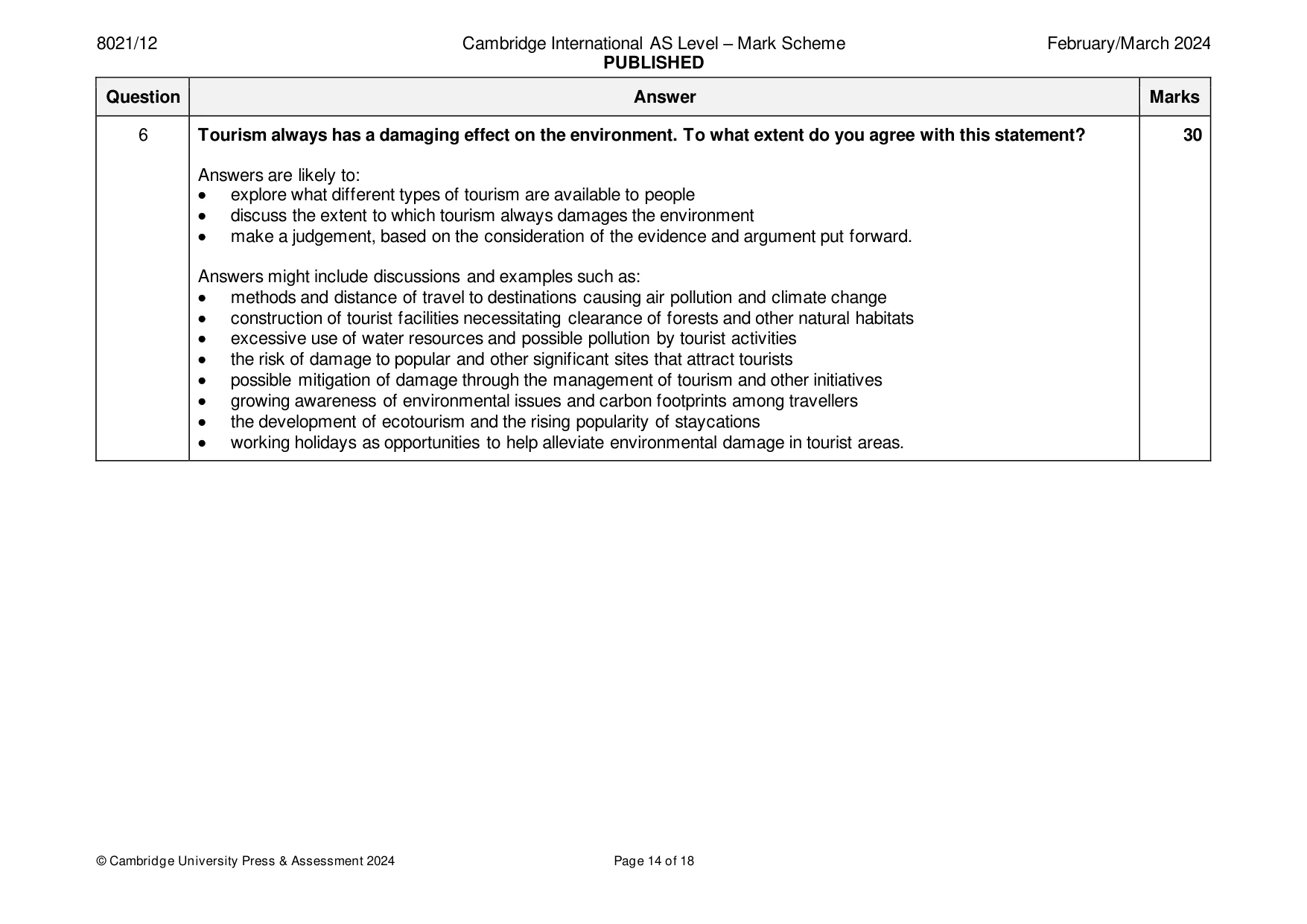
8021/12 Cambridge International AS Level – Mark Scheme PUBLISHED February/March 2024 © Cambridge University Press & Assessment 2024 Page 14 of 18 Question Answer Marks 6 Tourism always has a damaging effect on the environment. To what extent do you agree with this statement? Answers are likely to: • explore what different types of tourism are available to people • discuss the extent to which tourism always damages the environment • make a judgement, based on the consideration of the evidence and argument put forward. Answers might include discussions and examples such as: • methods and distance of travel to destinations causing air pollution and climate change • construction of tourist facilities necessitating clearance of forests and other natural habitats • excessive use of water resources and possible pollution by tourist activities • the risk of damage to popular and other significant sites that attract tourists • possible mitigation of damage through the management of tourism and other initiatives • growing awareness of environmental issues and carbon footprints among travellers • the development of ecotourism and the rising popularity of staycations • working holidays as opportunities to help alleviate environmental damage in tourist areas. 30
Mark scheme, page 15
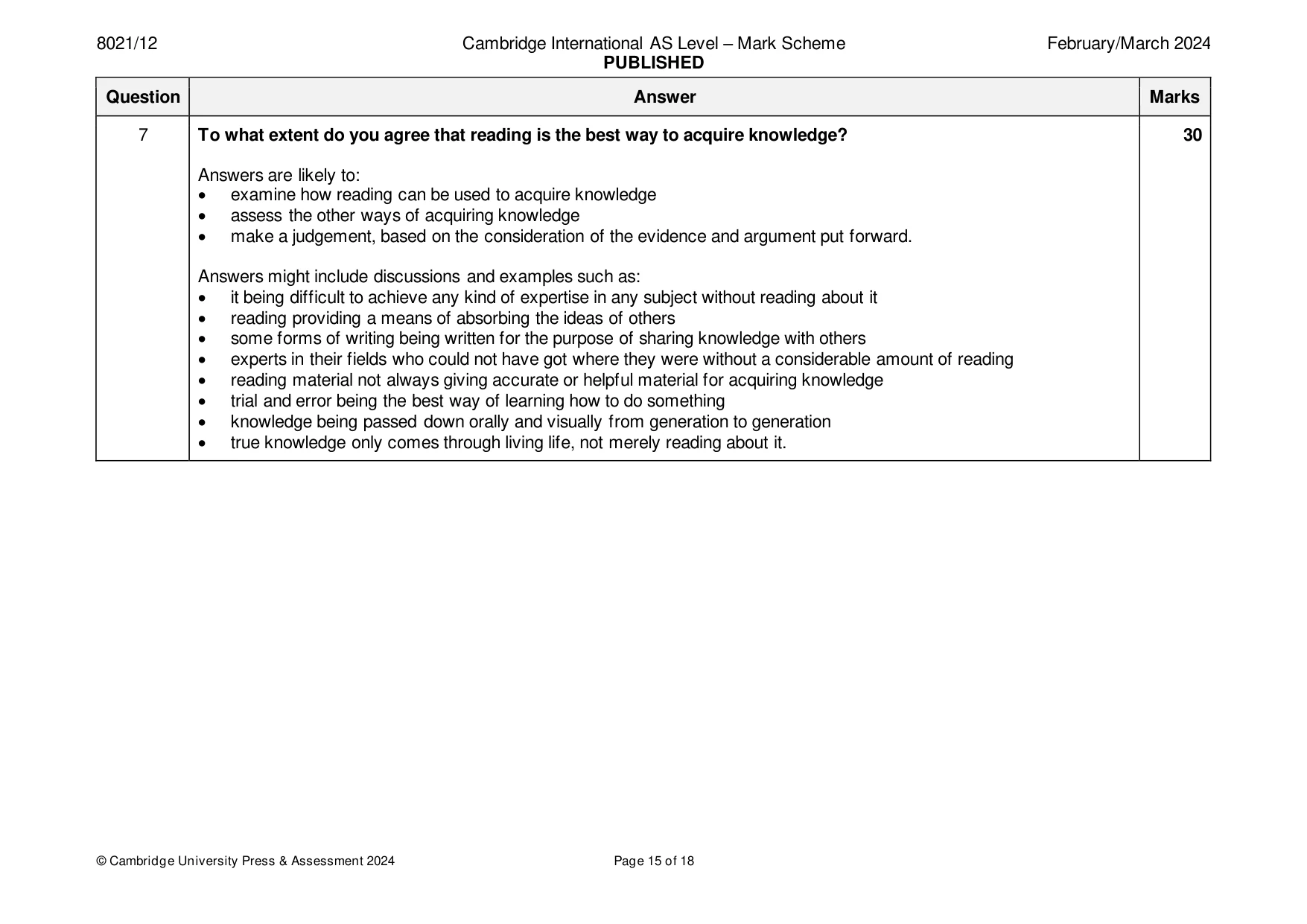
8021/12 Cambridge International AS Level – Mark Scheme PUBLISHED February/March 2024 © Cambridge University Press & Assessment 2024 Page 15 of 18 Question Answer Marks 7 To what extent do you agree that reading is the best way to acquire knowledge? Answers are likely to: • examine how reading can be used to acquire knowledge • assess the other ways of acquiring knowledge • make a judgement, based on the consideration of the evidence and argument put forward. Answers might include discussions and examples such as: • it being difficult to achieve any kind of expertise in any subject without reading about it • reading providing a means of absorbing the ideas of others • some forms of writing being written for the purpose of sharing knowledge with others • experts in their fields who could not have got where they were without a considerable amount of reading • reading material not always giving accurate or helpful material for acquiring knowledge • trial and error being the best way of learning how to do something • knowledge being passed down orally and visually from generation to generation • true knowledge only comes through living life, not merely reading about it. 30
Mark scheme, page 16
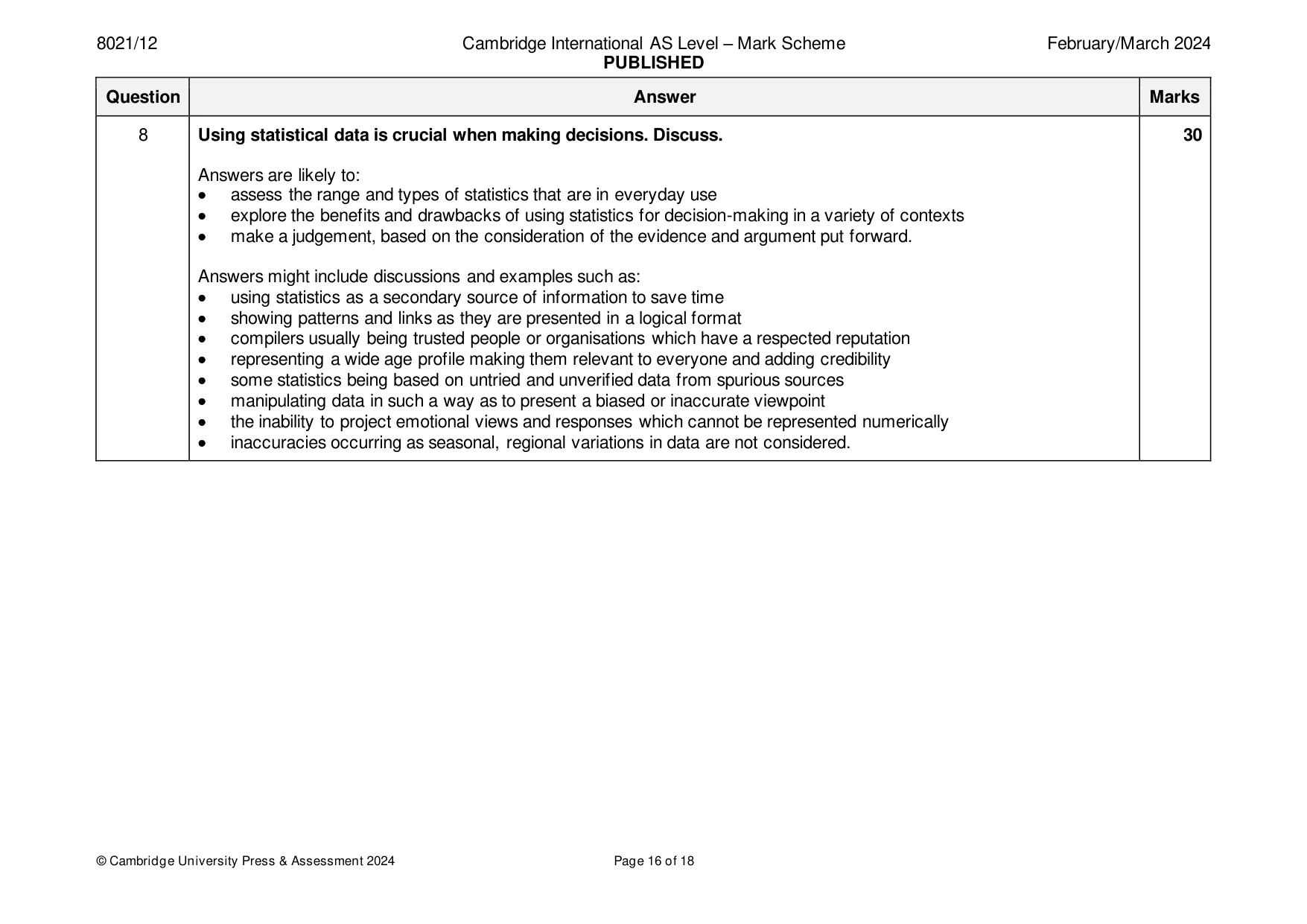
8021/12 Cambridge International AS Level – Mark Scheme PUBLISHED February/March 2024 © Cambridge University Press & Assessment 2024 Page 16 of 18 Question Answer Marks 8 Using statistical data is crucial when making decisions. Discuss. Answers are likely to: • assess the range and types of statistics that are in everyday use • explore the benefits and drawbacks of using statistics for decision-making in a variety of contexts • make a judgement, based on the consideration of the evidence and argument put forward. Answers might include discussions and examples such as: • using statistics as a secondary source of information to save time • showing patterns and links as they are presented in a logical format • compilers usually being trusted people or organisations which have a respected reputation • representing a wide age profile making them relevant to everyone and adding credibility • some statistics being based on untried and unverified data from spurious sources • manipulating data in such a way as to present a biased or inaccurate viewpoint • the inability to project emotional views and responses which cannot be represented numerically • inaccuracies occurring as seasonal, regional variations in data are not considered. 30
Mark scheme, page 17
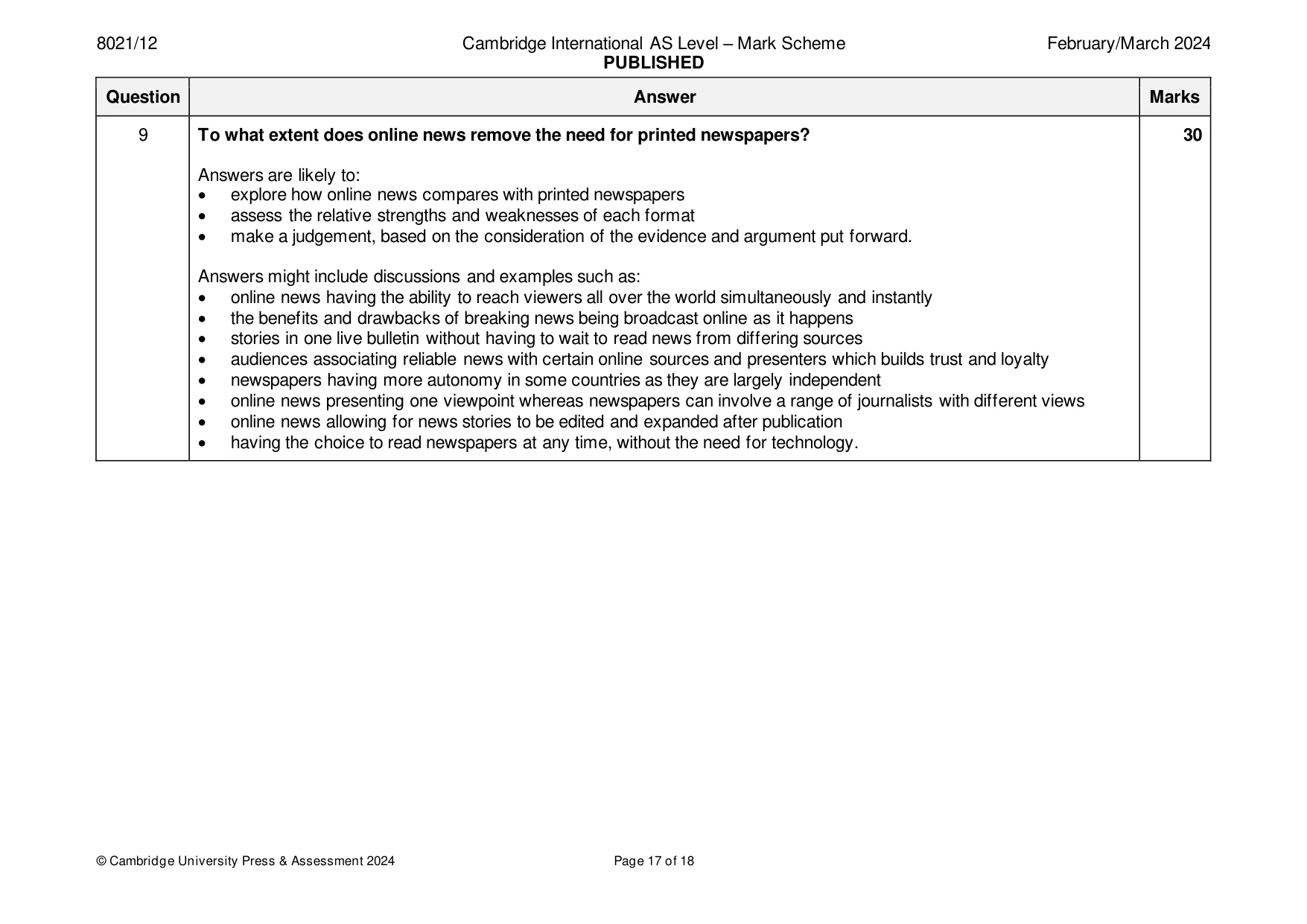
8021/12 Cambridge International AS Level – Mark Scheme PUBLISHED February/March 2024 © Cambridge University Press & Assessment 2024 Page 17 of 18 Question Answer Marks 9 To what extent does online news remove the need for printed newspapers? Answers are likely to: • explore how online news compares with printed newspapers • assess the relative strengths and weaknesses of each format • make a judgement, based on the consideration of the evidence and argument put forward. Answers might include discussions and examples such as: • online news having the ability to reach viewers all over the world simultaneously and instantly • the benefits and drawbacks of breaking news being broadcast online as it happens • stories in one live bulletin without having to wait to read news from differing sources • audiences associating reliable news with certain online sources and presenters which builds trust and loyalty • newspapers having more autonomy in some countries as they are largely independent • online news presenting one viewpoint whereas newspapers can involve a range of journalists with different views • online news allowing for news stories to be edited and expanded after publication • having the choice to read newspapers at any time, without the need for technology. 30
Mark scheme, page 18
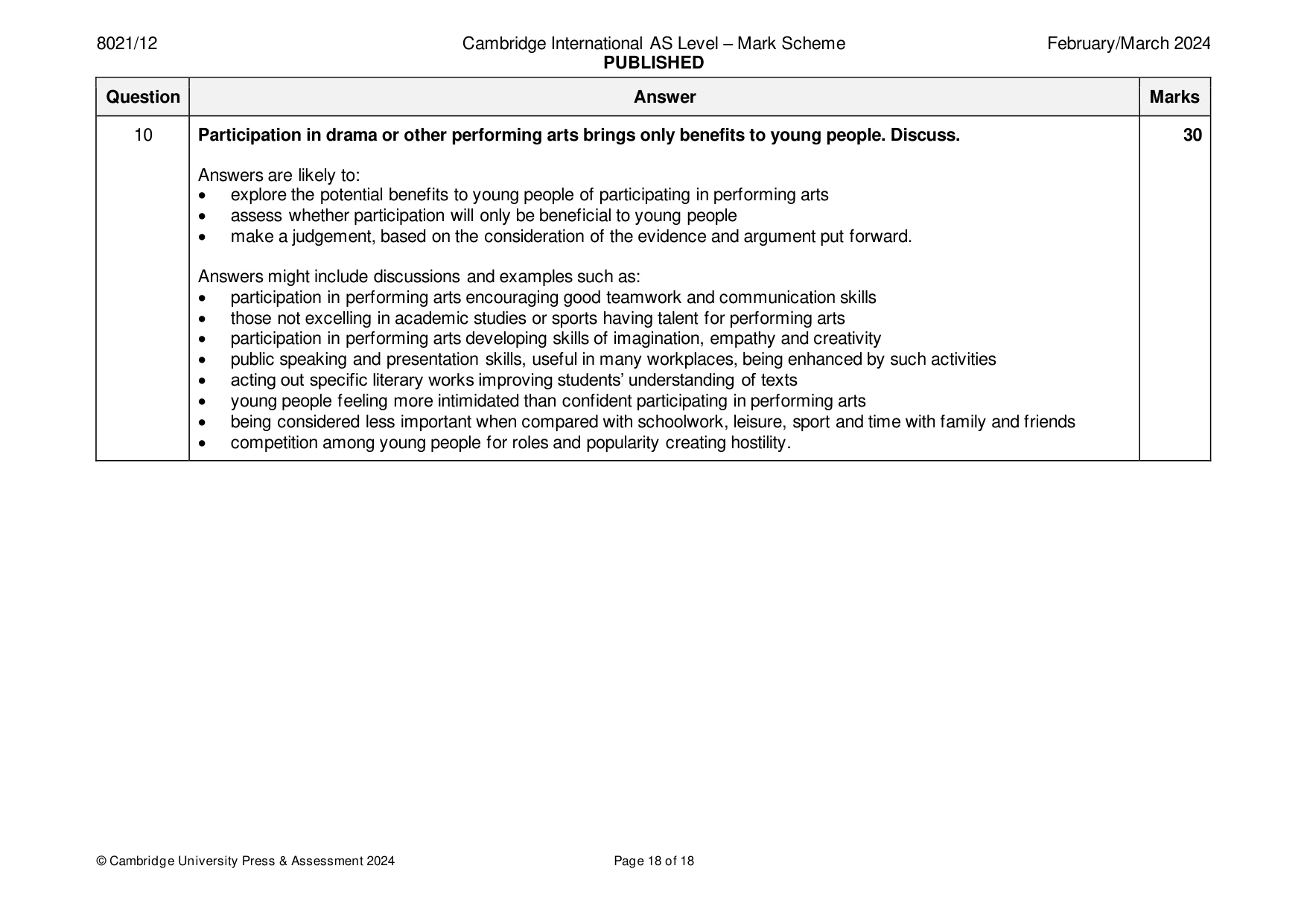
8021/12 Cambridge International AS Level – Mark Scheme PUBLISHED February/March 2024 © Cambridge University Press & Assessment 2024 Page 18 of 18 Question Answer Marks 10 Participation in drama or other performing arts brings only benefits to young people. Discuss. Answers are likely to: • explore the potential benefits to young people of participating in performing arts • assess whether participation will only be beneficial to young people • make a judgement, based on the consideration of the evidence and argument put forward. Answers might include discussions and examples such as: • participation in performing arts encouraging good teamwork and communication skills • those not excelling in academic studies or sports having talent for performing arts • participation in performing arts developing skills of imagination, empathy and creativity • public speaking and presentation skills, useful in many workplaces, being enhanced by such activities • acting out specific literary works improving students’ understanding of texts • young people feeling more intimidated than confident participating in performing arts • being considered less important when compared with schoolwork, leisure, sport and time with family and friends • competition among young people for roles and popularity creating hostility. 30
What you needed in this session
Cambridge’s own grade thresholds for 2024 Feb/March, Paper 1 · Variant 2. A higher threshold means an easier paper — the bar moves with how the cohort did.