Cambridge A Level English General Paper 8021 — 2023 May/June Paper 1 · Variant 3
8021/13/M/J/23 · 30 marks · ≈34 min
The question paper and its mark scheme, free to read here and free to download. This is Cambridge’s own paper, exactly as it was sat.
Question paper4 pages


Mark scheme16 pages
Answers below. Sit the paper first if you are practising.
Paper as text
Question paper, page 1
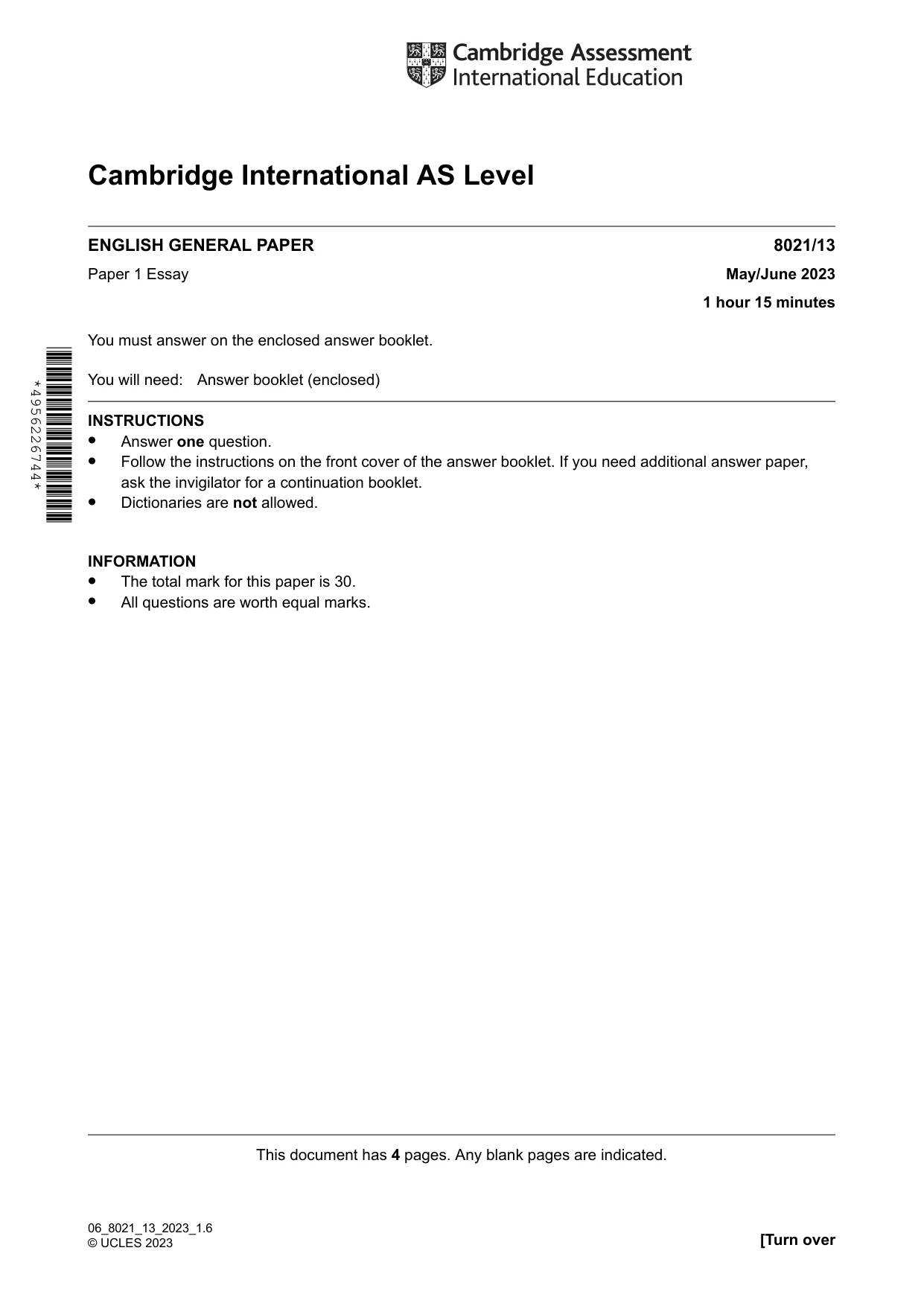
Cambridge International AS Level 8021/13 May/June 2023 1 hour 15 minutes ENGLISH GENERAL PAPER Paper 1 Essay You must answer on the enclosed answer booklet. You will need: Answer booklet (enclosed) INSTRUCTIONS • Answer one question. • Follow the instructions on the front cover of the answer booklet. If you need additional answer paper, ask the invigilator for a continuation booklet. • Dictionaries are not allowed. INFORMATION • The total mark for this paper is 30. • All questions are worth equal marks. This document has 4 pages. Any blank pages are indicated. [Turn over 06_8021_13_2023_1.6 © UCLES 2023 *4956226744*
Question paper, page 2
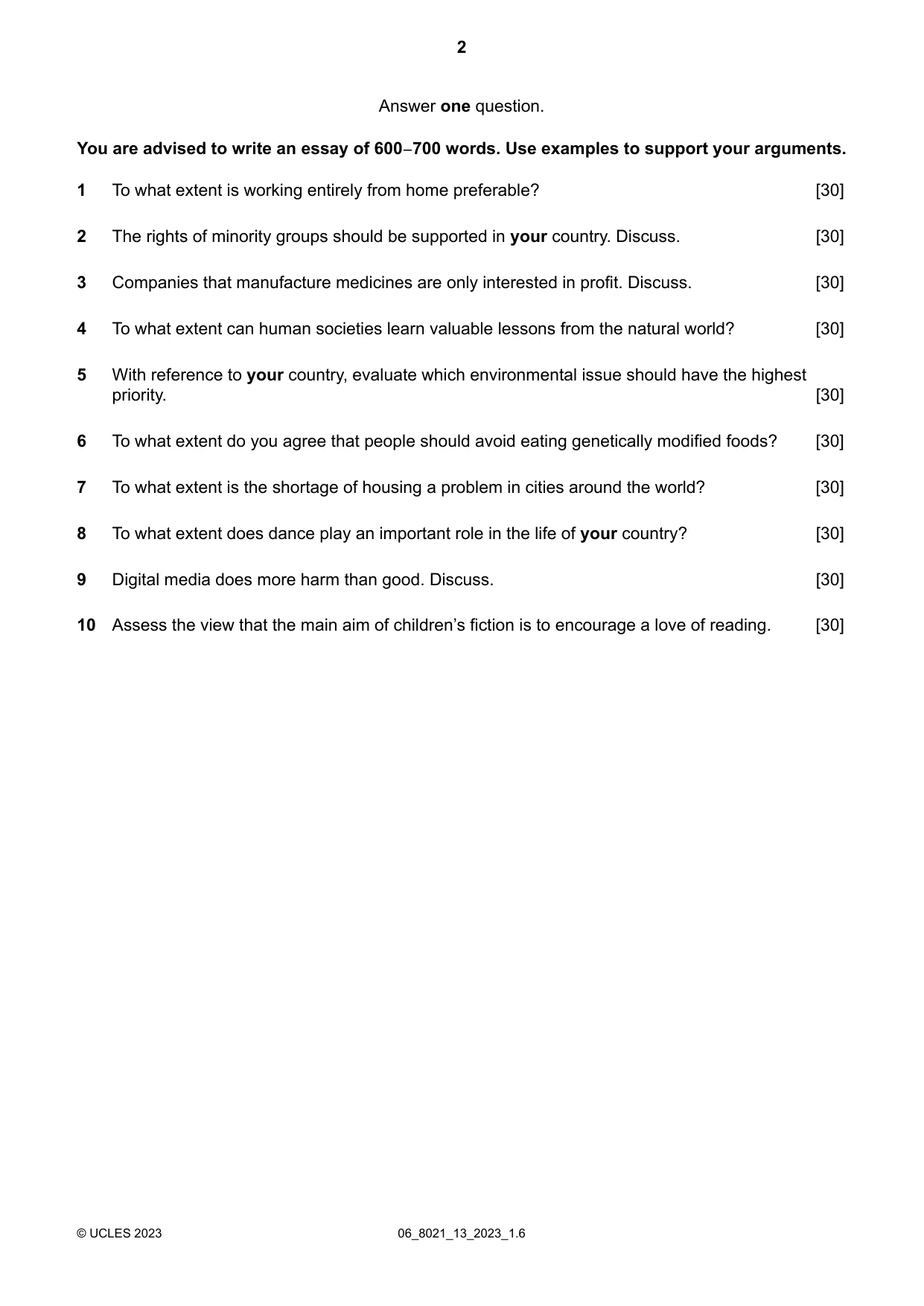
Answer one question. You are advised to write an essay of 600−700 words. Use examples to support your arguments. To what extent is working entirely from home preferable? [30] 1 The rights of minority groups should be supported in your country. Discuss. [30] 2 Companies that manufacture medicines are only interested in profit. Discuss. [30] 3 To what extent can human societies learn valuable lessons from the natural world? [30] 4 With reference to your country, evaluate which environmental issue should have the highest priority. [30] 5 To what extent do you agree that people should avoid eating genetically modified foods? [30] 6 To what extent is the shortage of housing a problem in cities around the world? [30] 7 To what extent does dance play an important role in the life of your country? [30] 8 Digital media does more harm than good. Discuss. [30] 9 Assess the view that the main aim of children’s fiction is to encourage a love of reading. [30] 10 06_8021_13_2023_1.6 © UCLES 2023 2
Question paper, page 3
BLANK PAGE 06_8021_13_2023_1.6 © UCLES 2023 3
Question paper, page 4
BLANK PAGE Permission to reproduce items where third-party owned material protected by copyright is included has been sought and cleared where possible. Every reasonable effort has been made by the publisher (UCLES) to trace copyright holders, but if any items requiring clearance have unwittingly been included, the publisher will be pleased to make amends at the earliest possible opportunity. To avoid the issue of disclosure of answer-related information to candidates, all copyright acknowledgements are reproduced online in the Cambridge Assessment International Education Copyright Acknowledgements Booklet. This is produced for each series of examinations and is freely available to download at www.cambridgeinternational.org after the live examination series. Cambridge Assessment International Education is part of Cambridge Assessment. Cambridge Assessment is the brand name of the University of Cambridge Local Examinations Syndicate (UCLES), which is a department of the University of Cambridge. 06_8021_13_2023_1.6 © UCLES 2023 4
Mark scheme, page 1
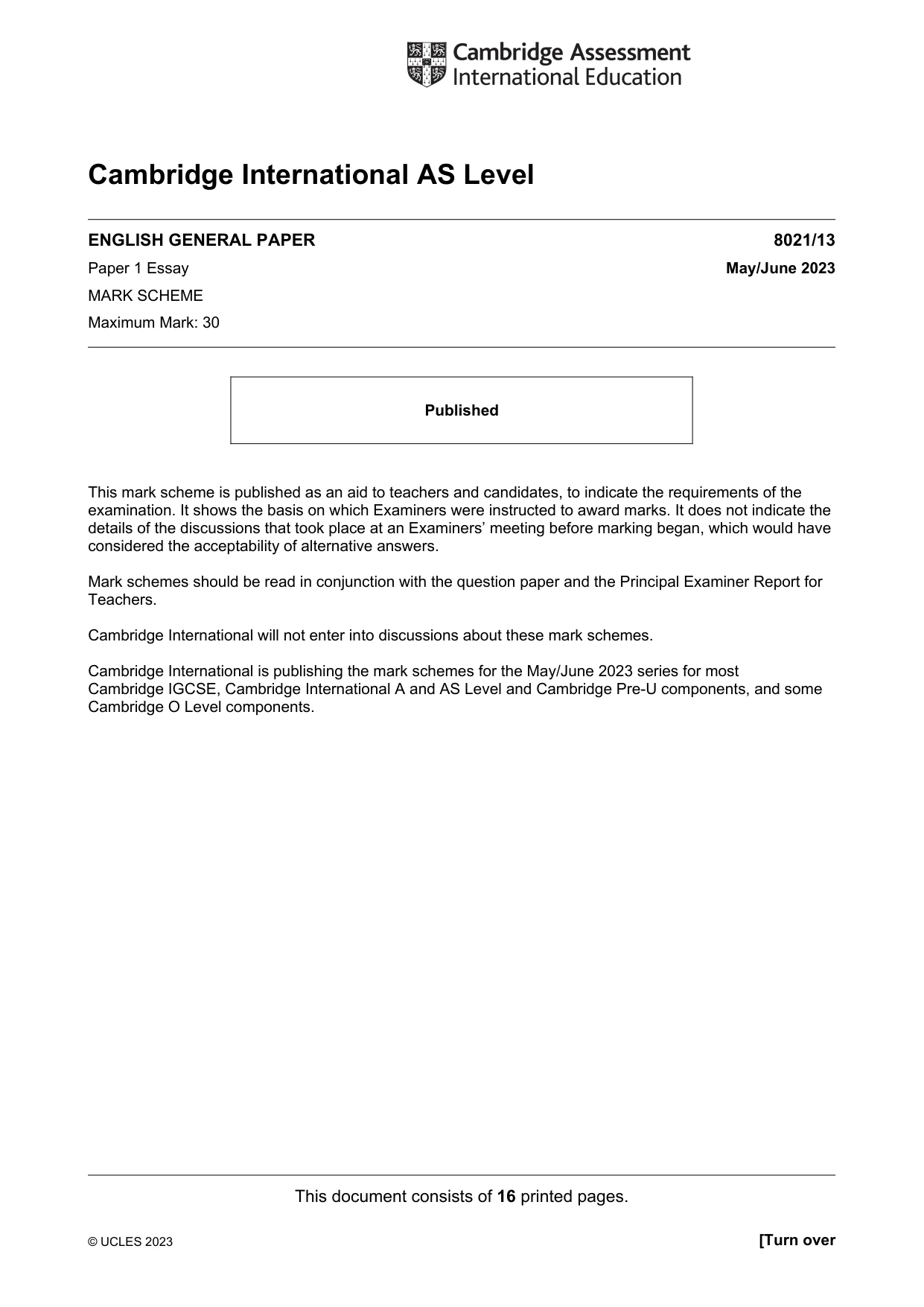
This document consists of 16 printed pages. © UCLES 2023 [Turn over Cambridge International AS Level ENGLISH GENERAL PAPER 8021/13 Paper 1 Essay May/June 2023 MARK SCHEME Maximum Mark: 30 Published This mark scheme is published as an aid to teachers and candidates, to indicate the requirements of the examination. It shows the basis on which Examiners were instructed to award marks. It does not indicate the details of the discussions that took place at an Examiners’ meeting before marking began, which would have considered the acceptability of alternative answers. Mark schemes should be read in conjunction with the question paper and the Principal Examiner Report for Teachers. Cambridge International will not enter into discussions about these mark schemes. Cambridge International is publishing the mark schemes for the May/June 2023 series for most Cambridge IGCSE, Cambridge International A and AS Level and Cambridge Pre-U components, and some Cambridge O Level components.
Mark scheme, page 2
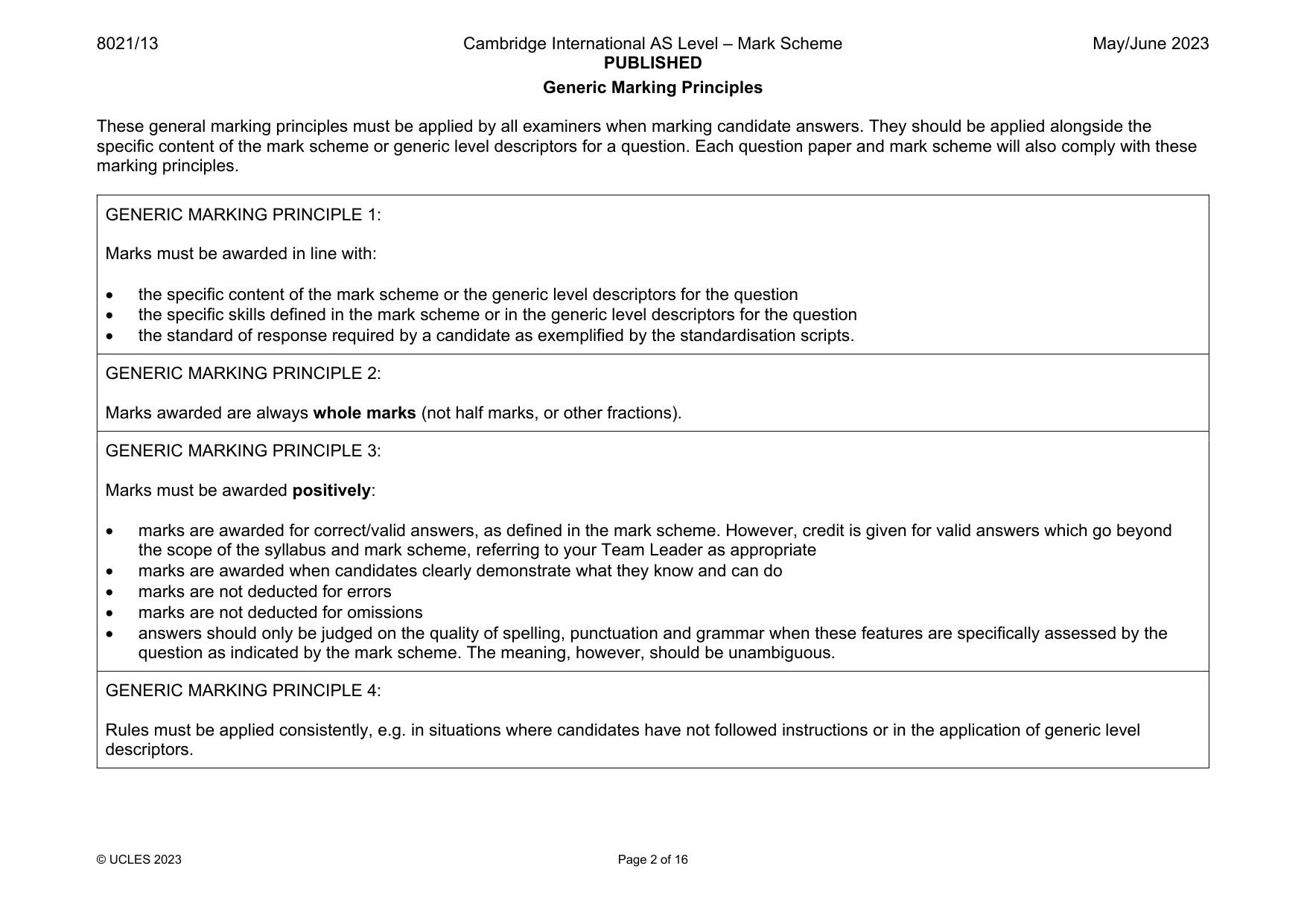
8021/13 Cambridge International AS Level – Mark Scheme PUBLISHED May/June 2023 © UCLES 2023 Page 2 of 16 Generic Marking Principles These general marking principles must be applied by all examiners when marking candidate answers. They should be applied alongside the specific content of the mark scheme or generic level descriptors for a question. Each question paper and mark scheme will also comply with these marking principles. GENERIC MARKING PRINCIPLE 1: Marks must be awarded in line with: the specific content of the mark scheme or the generic level descriptors for the question the specific skills defined in the mark scheme or in the generic level descriptors for the question the standard of response required by a candidate as exemplified by the standardisation scripts. GENERIC MARKING PRINCIPLE 2: Marks awarded are always whole marks (not half marks, or other fractions). GENERIC MARKING PRINCIPLE 3: Marks must be awarded positively: marks are awarded for correct/valid answers, as defined in the mark scheme. However, credit is given for valid answers which go beyond the scope of the syllabus and mark scheme, referring to your Team Leader as appropriate marks are awarded when candidates clearly demonstrate what they know and can do marks are not deducted for errors marks are not deducted for omissions answers should only be judged on the quality of spelling, punctuation and grammar when these features are specifically assessed by the question as indicated by the mark scheme. The meaning, however, should be unambiguous. GENERIC MARKING PRINCIPLE 4: Rules must be applied consistently, e.g. in situations where candidates have not followed instructions or in the application of generic level descriptors.
Mark scheme, page 3
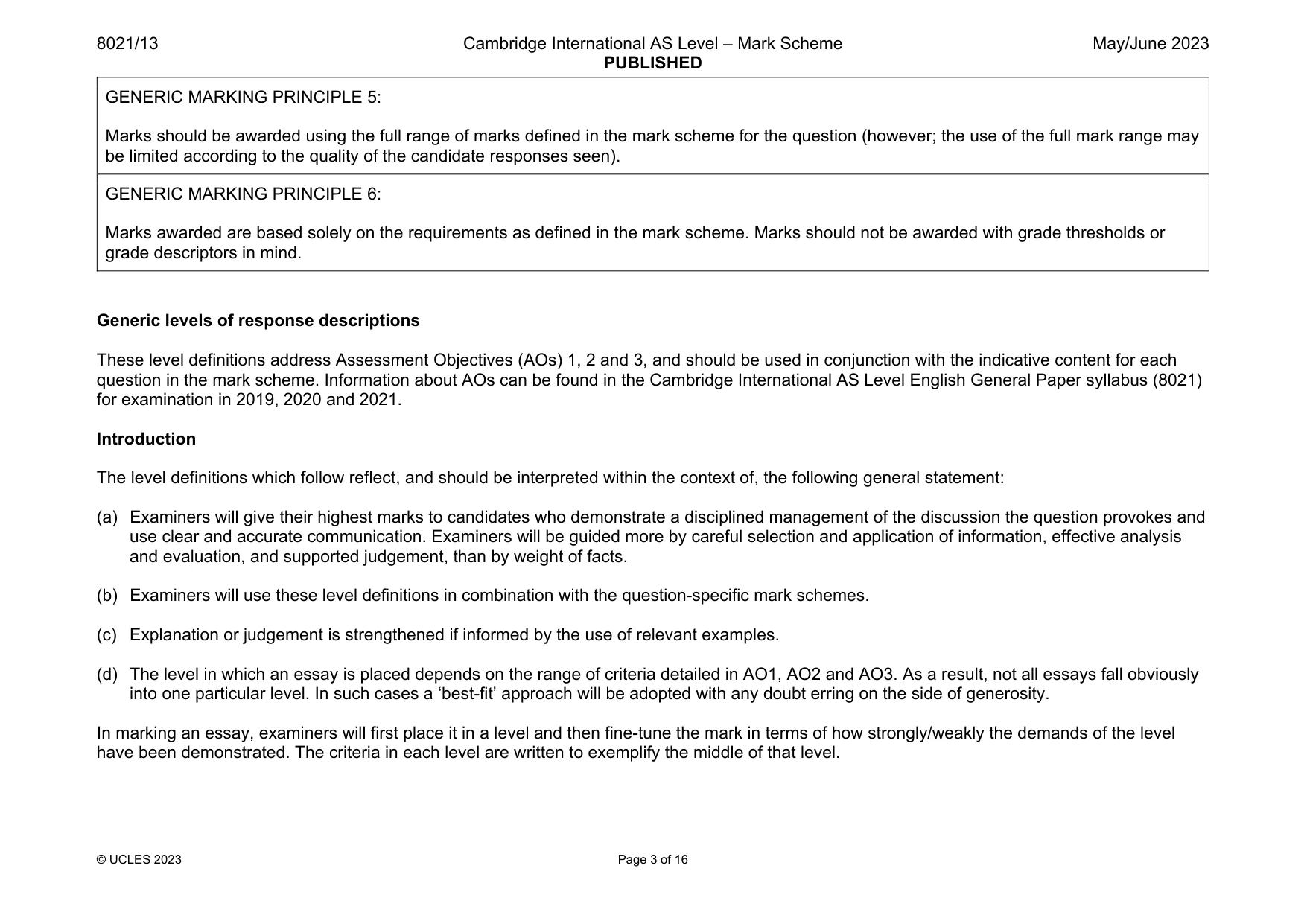
8021/13 Cambridge International AS Level – Mark Scheme PUBLISHED May/June 2023 © UCLES 2023 Page 3 of 16 GENERIC MARKING PRINCIPLE 5: Marks should be awarded using the full range of marks defined in the mark scheme for the question (however; the use of the full mark range may be limited according to the quality of the candidate responses seen). GENERIC MARKING PRINCIPLE 6: Marks awarded are based solely on the requirements as defined in the mark scheme. Marks should not be awarded with grade thresholds or grade descriptors in mind. Generic levels of response descriptions These level definitions address Assessment Objectives (AOs) 1, 2 and 3, and should be used in conjunction with the indicative content for each question in the mark scheme. Information about AOs can be found in the Cambridge International AS Level English General Paper syllabus (8021) for examination in 2019, 2020 and 2021. Introduction The level definitions which follow reflect, and should be interpreted within the context of, the following general statement: (a) Examiners will give their highest marks to candidates who demonstrate a disciplined management of the discussion the question provokes and use clear and accurate communication. Examiners will be guided more by careful selection and application of information, effective analysis and evaluation, and supported judgement, than by weight of facts. (b) Examiners will use these level definitions in combination with the question-specific mark schemes. (c) Explanation or judgement is strengthened if informed by the use of relevant examples. (d) The level in which an essay is placed depends on the range of criteria detailed in AO1, AO2 and AO3. As a result, not all essays fall obviously into one particular level. In such cases a ‘best-fit’ approach will be adopted with any doubt erring on the side of generosity. In marking an essay, examiners will first place it in a level and then fine-tune the mark in terms of how strongly/weakly the demands of the level have been demonstrated. The criteria in each level are written to exemplify the middle of that level.
Mark scheme, page 4
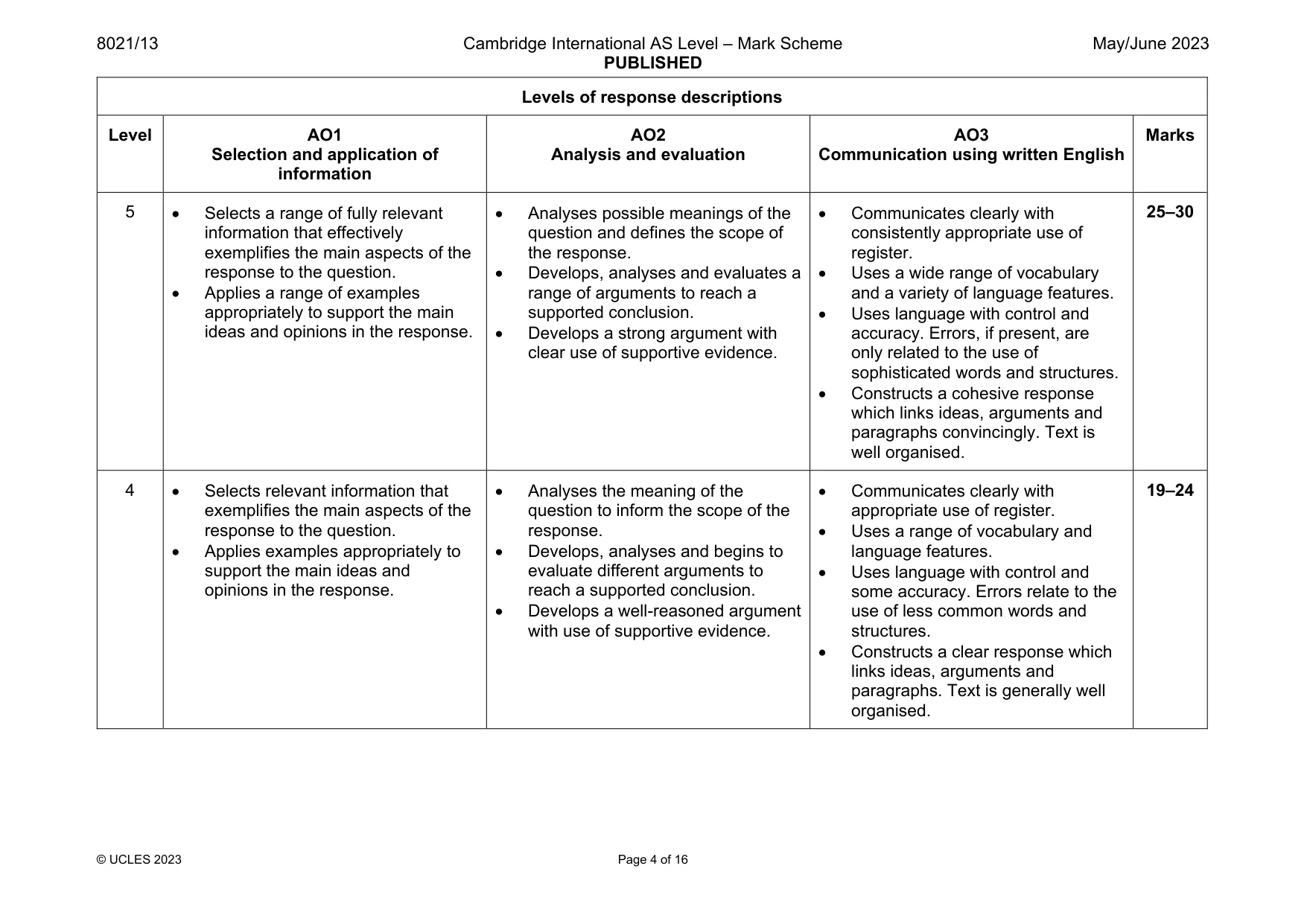
8021/13 Cambridge International AS Level – Mark Scheme PUBLISHED May/June 2023 © UCLES 2023 Page 4 of 16 Levels of response descriptions Level AO1 Selection and application of information AO2 Analysis and evaluation AO3 Communication using written English Marks 5 Selects a range of fully relevant information that effectively exemplifies the main aspects of the response to the question. Applies a range of examples appropriately to support the main ideas and opinions in the response. Analyses possible meanings of the question and defines the scope of the response. Develops, analyses and evaluates a range of arguments to reach a supported conclusion. Develops a strong argument with clear use of supportive evidence. Communicates clearly with consistently appropriate use of register. Uses a wide range of vocabulary and a variety of language features. Uses language with control and accuracy. Errors, if present, are only related to the use of sophisticated words and structures. Constructs a cohesive response which links ideas, arguments and paragraphs convincingly. Text is well organised. 25–30 4 Selects relevant information that exemplifies the main aspects of the response to the question. Applies examples appropriately to support the main ideas and opinions in the response. Analyses the meaning of the question to inform the scope of the response. Develops, analyses and begins to evaluate different arguments to reach a supported conclusion. Develops a well-reasoned argument with use of supportive evidence. Communicates clearly with appropriate use of register. Uses a range of vocabulary and language features. Uses language with control and some accuracy. Errors relate to the use of less common words and structures. Constructs a clear response which links ideas, arguments and paragraphs. Text is generally well organised. 19–24
Mark scheme, page 5
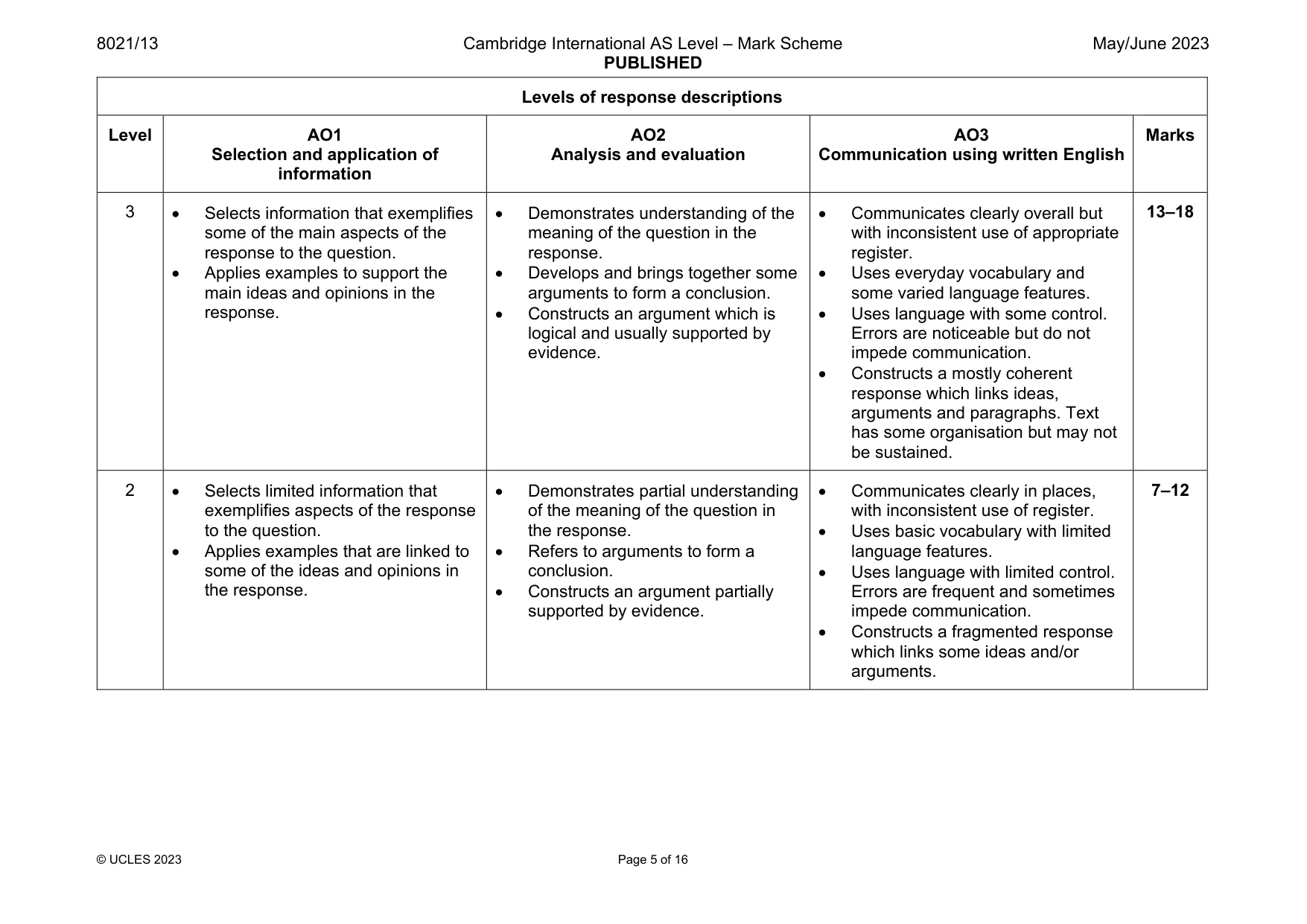
8021/13 Cambridge International AS Level – Mark Scheme PUBLISHED May/June 2023 © UCLES 2023 Page 5 of 16 Levels of response descriptions Level AO1 Selection and application of information AO2 Analysis and evaluation AO3 Communication using written English Marks 3 Selects information that exemplifies some of the main aspects of the response to the question. Applies examples to support the main ideas and opinions in the response. Demonstrates understanding of the meaning of the question in the response. Develops and brings together some arguments to form a conclusion. Constructs an argument which is logical and usually supported by evidence. Communicates clearly overall but with inconsistent use of appropriate register. Uses everyday vocabulary and some varied language features. Uses language with some control. Errors are noticeable but do not impede communication. Constructs a mostly coherent response which links ideas, arguments and paragraphs. Text has some organisation but may not be sustained. 13–18 2 Selects limited information that exemplifies aspects of the response to the question. Applies examples that are linked to some of the ideas and opinions in the response. Demonstrates partial understanding of the meaning of the question in the response. Refers to arguments to form a conclusion. Constructs an argument partially supported by evidence. Communicates clearly in places, with inconsistent use of register. Uses basic vocabulary with limited language features. Uses language with limited control. Errors are frequent and sometimes impede communication. Constructs a fragmented response which links some ideas and/or arguments. 7–12
Mark scheme, page 6
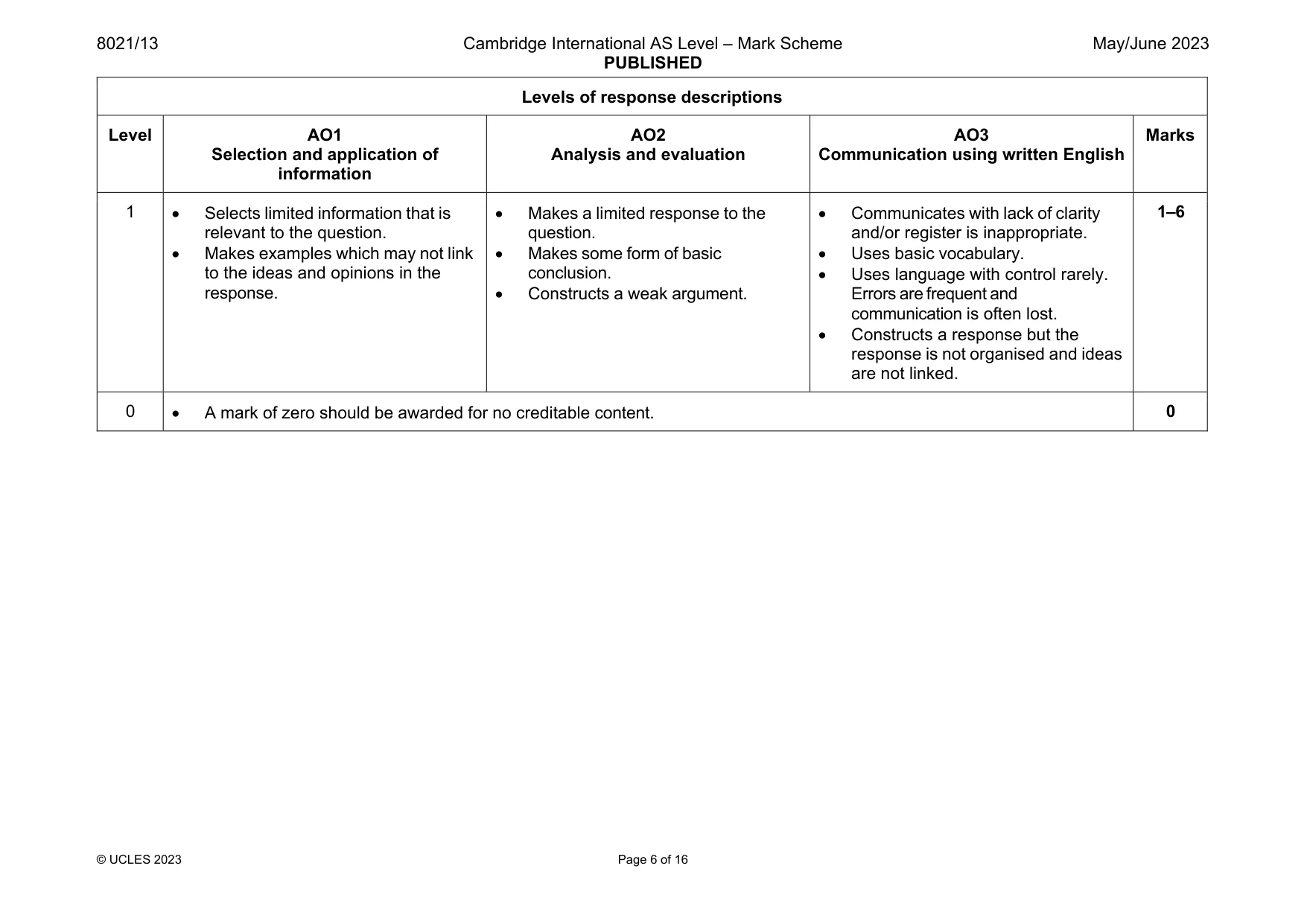
8021/13 Cambridge International AS Level – Mark Scheme PUBLISHED May/June 2023 © UCLES 2023 Page 6 of 16 Levels of response descriptions Level AO1 Selection and application of information AO2 Analysis and evaluation AO3 Communication using written English Marks 1 Selects limited information that is relevant to the question. Makes examples which may not link to the ideas and opinions in the response. Makes a limited response to the question. Makes some form of basic conclusion. Constructs a weak argument. Communicates with lack of clarity and/or register is inappropriate. Uses basic vocabulary. Uses language with control rarely. Errors are frequent and communication is often lost. Constructs a response but the response is not organised and ideas are not linked. 1–6 0 A mark of zero should be awarded for no creditable content. 0
Mark scheme, page 7
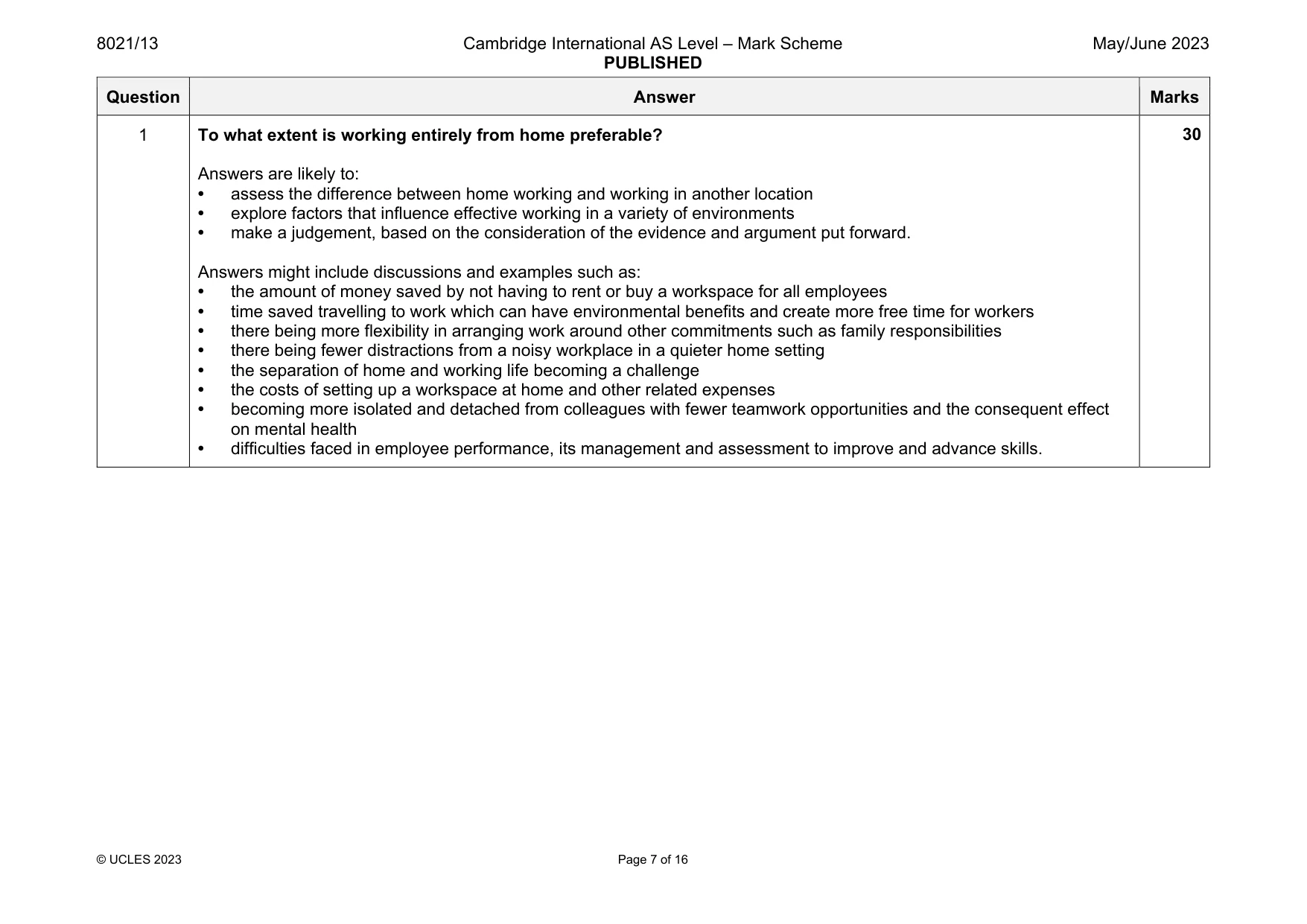
8021/13 Cambridge International AS Level – Mark Scheme PUBLISHED May/June 2023 © UCLES 2023 Page 7 of 16 Question Answer Marks 1 To what extent is working entirely from home preferable? Answers are likely to: • assess the difference between home working and working in another location • explore factors that influence effective working in a variety of environments • make a judgement, based on the consideration of the evidence and argument put forward. Answers might include discussions and examples such as: • the amount of money saved by not having to rent or buy a workspace for all employees • time saved travelling to work which can have environmental benefits and create more free time for workers • there being more flexibility in arranging work around other commitments such as family responsibilities • there being fewer distractions from a noisy workplace in a quieter home setting • the separation of home and working life becoming a challenge • the costs of setting up a workspace at home and other related expenses • becoming more isolated and detached from colleagues with fewer teamwork opportunities and the consequent effect on mental health • difficulties faced in employee performance, its management and assessment to improve and advance skills. 30
Mark scheme, page 8
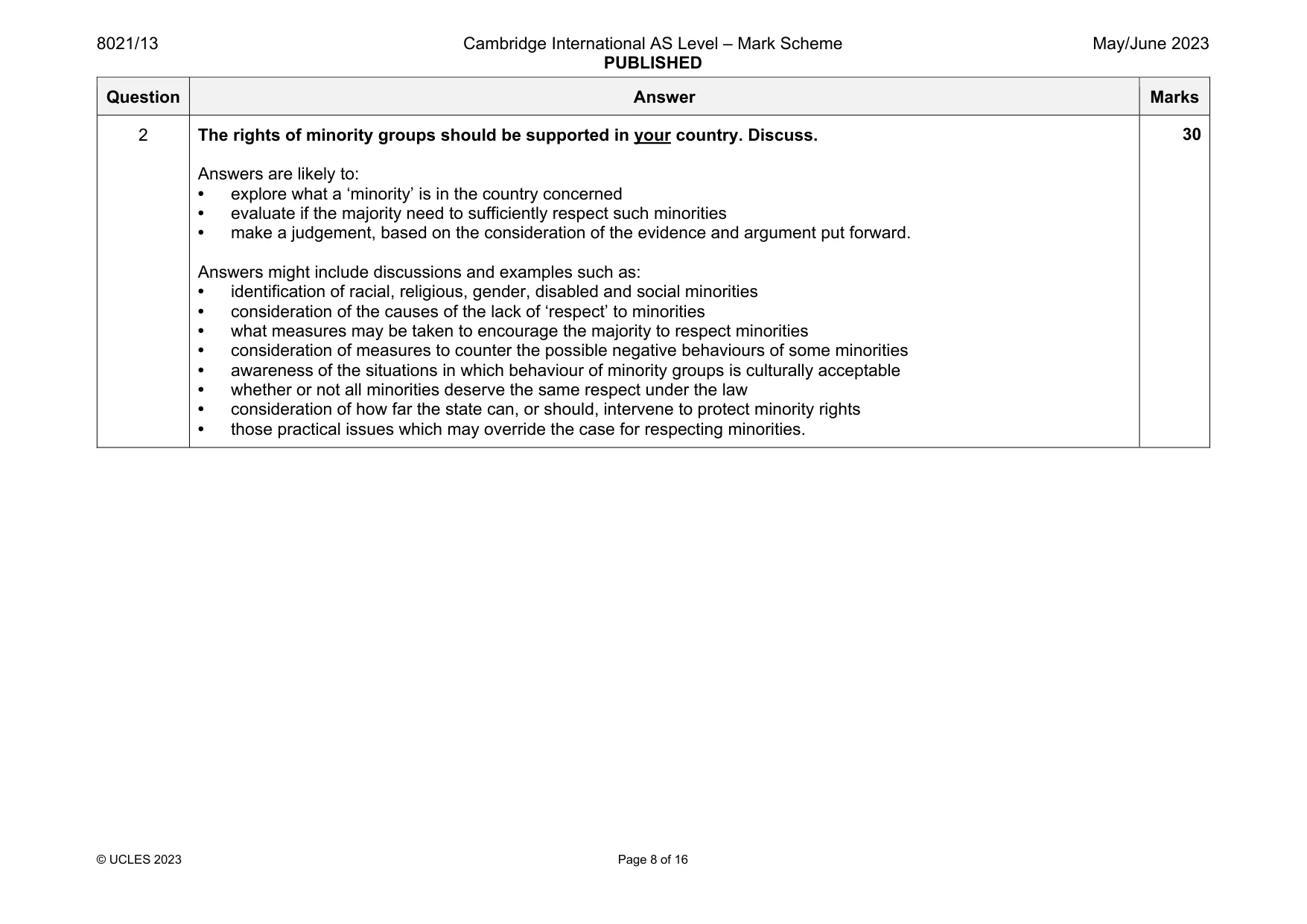
8021/13 Cambridge International AS Level – Mark Scheme PUBLISHED May/June 2023 © UCLES 2023 Page 8 of 16 Question Answer Marks 2 The rights of minority groups should be supported in your country. Discuss. Answers are likely to: • explore what a ‘minority’ is in the country concerned • evaluate if the majority need to sufficiently respect such minorities • make a judgement, based on the consideration of the evidence and argument put forward. Answers might include discussions and examples such as: • identification of racial, religious, gender, disabled and social minorities • consideration of the causes of the lack of ‘respect’ to minorities • what measures may be taken to encourage the majority to respect minorities • consideration of measures to counter the possible negative behaviours of some minorities • awareness of the situations in which behaviour of minority groups is culturally acceptable • whether or not all minorities deserve the same respect under the law • consideration of how far the state can, or should, intervene to protect minority rights • those practical issues which may override the case for respecting minorities. 30
Mark scheme, page 9
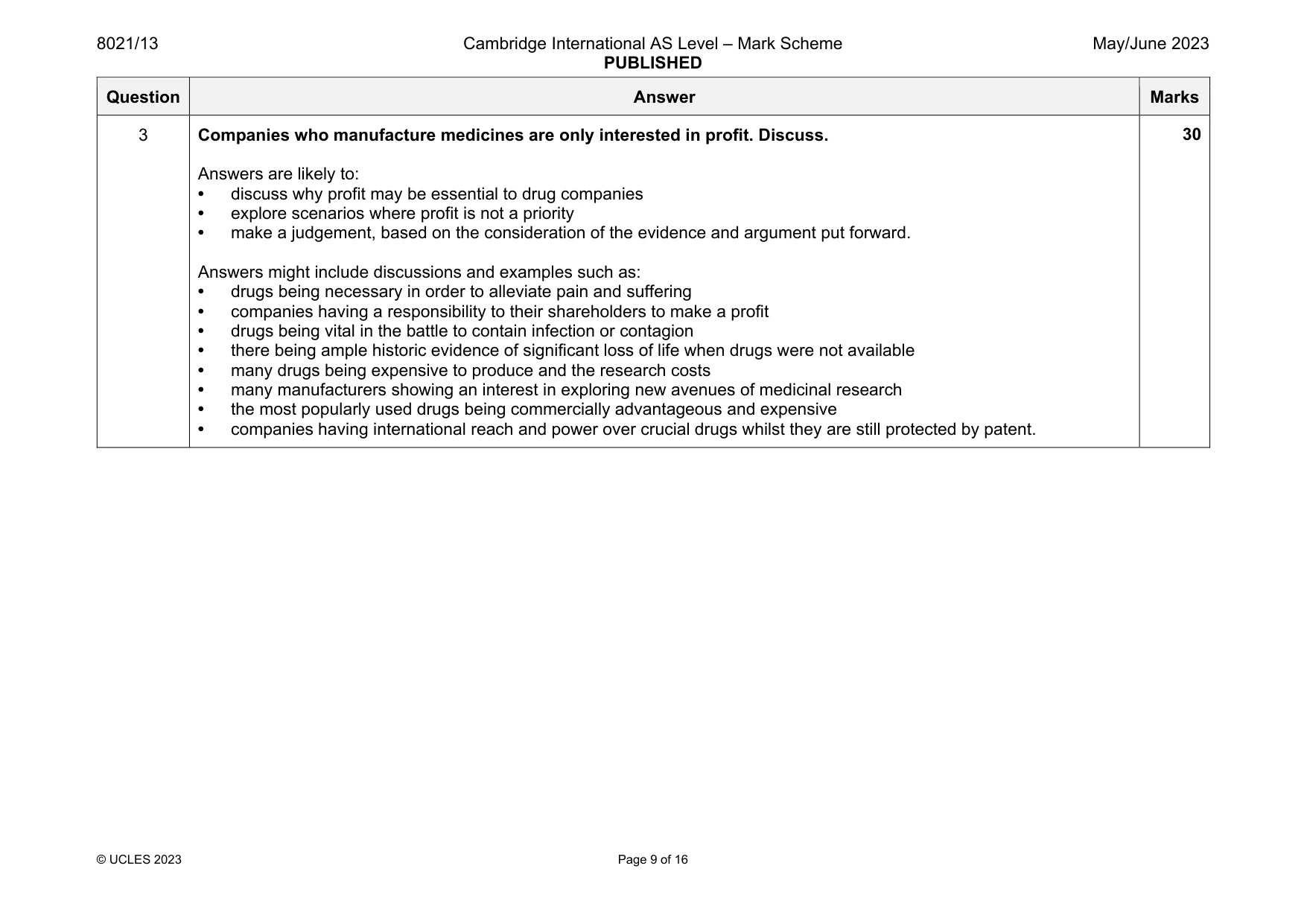
8021/13 Cambridge International AS Level – Mark Scheme PUBLISHED May/June 2023 © UCLES 2023 Page 9 of 16 Question Answer Marks 3 Companies who manufacture medicines are only interested in profit. Discuss. Answers are likely to: • discuss why profit may be essential to drug companies • explore scenarios where profit is not a priority • make a judgement, based on the consideration of the evidence and argument put forward. Answers might include discussions and examples such as: • drugs being necessary in order to alleviate pain and suffering • companies having a responsibility to their shareholders to make a profit • drugs being vital in the battle to contain infection or contagion • there being ample historic evidence of significant loss of life when drugs were not available • many drugs being expensive to produce and the research costs • many manufacturers showing an interest in exploring new avenues of medicinal research • the most popularly used drugs being commercially advantageous and expensive • companies having international reach and power over crucial drugs whilst they are still protected by patent. 30
Mark scheme, page 10
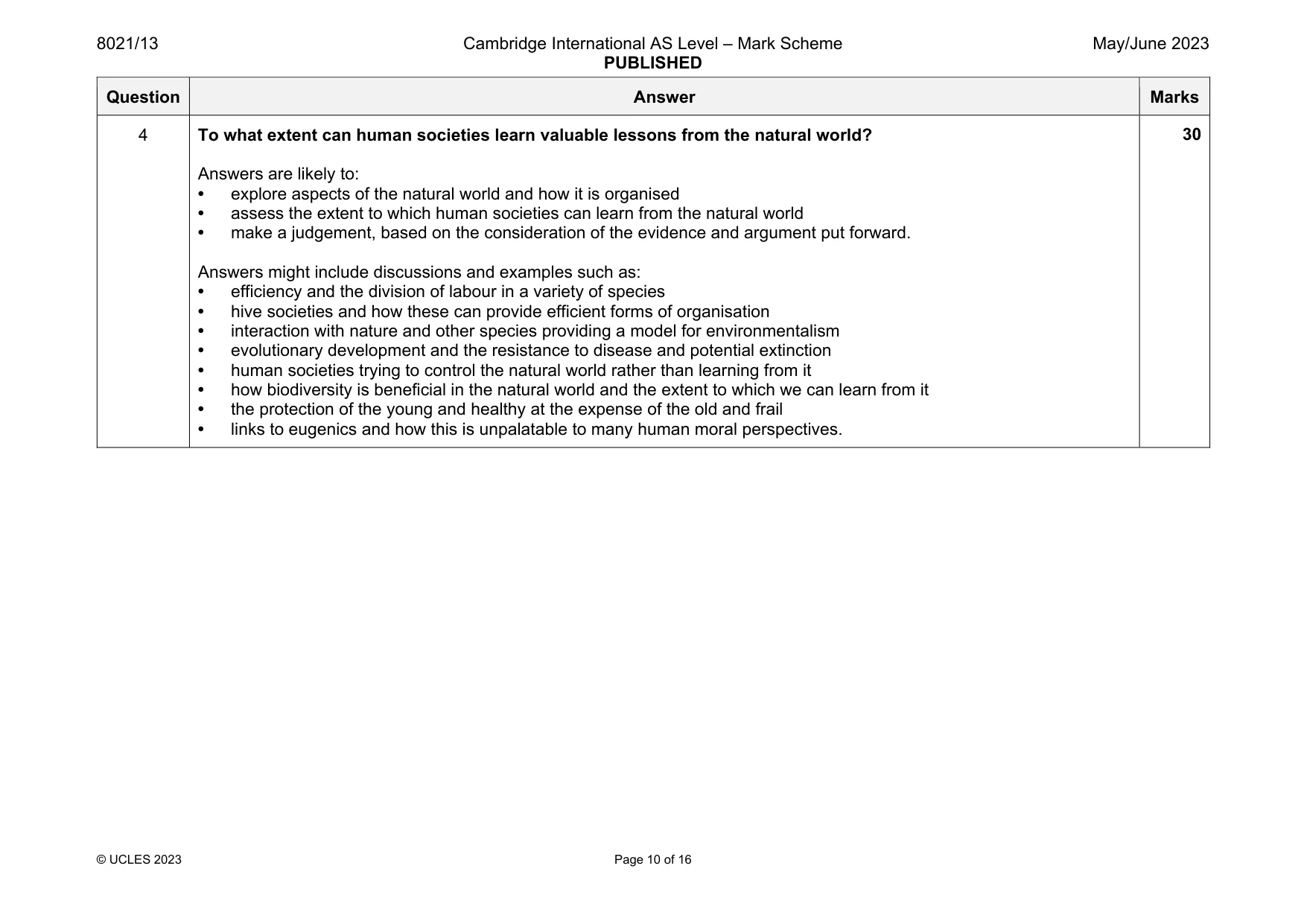
8021/13 Cambridge International AS Level – Mark Scheme PUBLISHED May/June 2023 © UCLES 2023 Page 10 of 16 Question Answer Marks 4 To what extent can human societies learn valuable lessons from the natural world? Answers are likely to: • explore aspects of the natural world and how it is organised • assess the extent to which human societies can learn from the natural world • make a judgement, based on the consideration of the evidence and argument put forward. Answers might include discussions and examples such as: • efficiency and the division of labour in a variety of species • hive societies and how these can provide efficient forms of organisation • interaction with nature and other species providing a model for environmentalism • evolutionary development and the resistance to disease and potential extinction • human societies trying to control the natural world rather than learning from it • how biodiversity is beneficial in the natural world and the extent to which we can learn from it • the protection of the young and healthy at the expense of the old and frail • links to eugenics and how this is unpalatable to many human moral perspectives. 30
Mark scheme, page 11
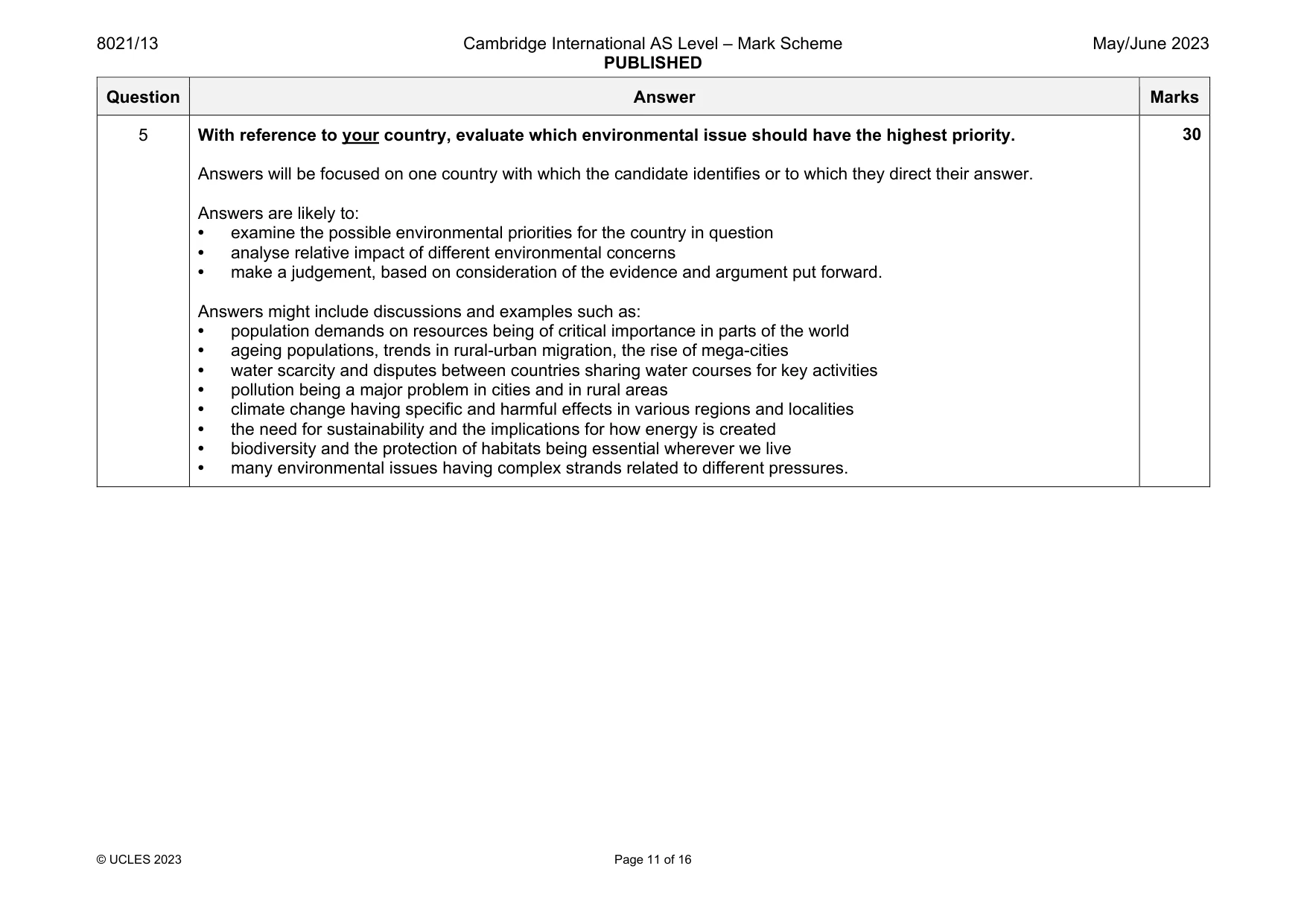
8021/13 Cambridge International AS Level – Mark Scheme PUBLISHED May/June 2023 © UCLES 2023 Page 11 of 16 Question Answer Marks 5 With reference to your country, evaluate which environmental issue should have the highest priority. Answers will be focused on one country with which the candidate identifies or to which they direct their answer. Answers are likely to: • examine the possible environmental priorities for the country in question • analyse relative impact of different environmental concerns • make a judgement, based on consideration of the evidence and argument put forward. Answers might include discussions and examples such as: • population demands on resources being of critical importance in parts of the world • ageing populations, trends in rural-urban migration, the rise of mega-cities • water scarcity and disputes between countries sharing water courses for key activities • pollution being a major problem in cities and in rural areas • climate change having specific and harmful effects in various regions and localities • the need for sustainability and the implications for how energy is created • biodiversity and the protection of habitats being essential wherever we live • many environmental issues having complex strands related to different pressures. 30
Mark scheme, page 12
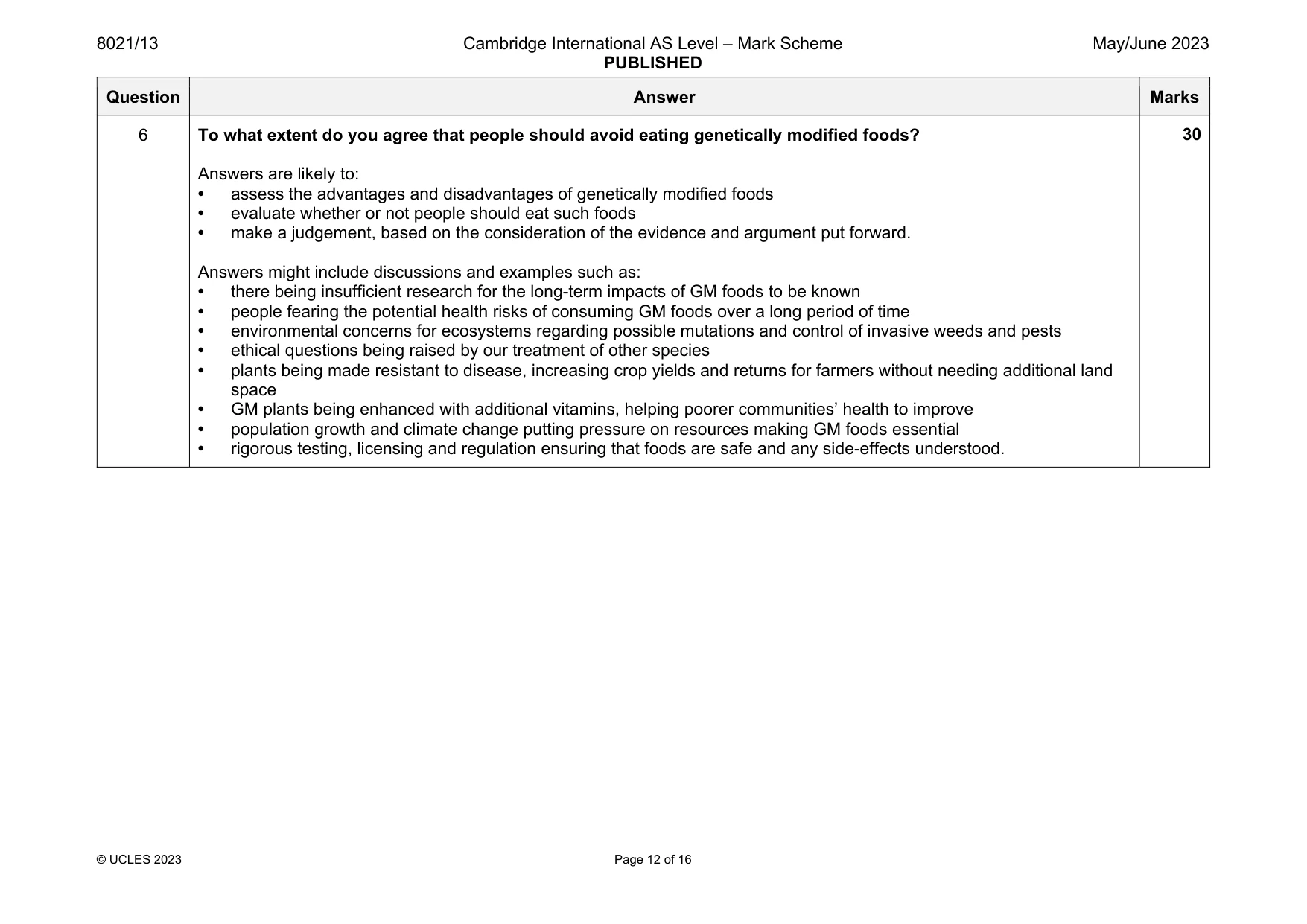
8021/13 Cambridge International AS Level – Mark Scheme PUBLISHED May/June 2023 © UCLES 2023 Page 12 of 16 Question Answer Marks 6 To what extent do you agree that people should avoid eating genetically modified foods? Answers are likely to: • assess the advantages and disadvantages of genetically modified foods • evaluate whether or not people should eat such foods • make a judgement, based on the consideration of the evidence and argument put forward. Answers might include discussions and examples such as: • there being insufficient research for the long-term impacts of GM foods to be known • people fearing the potential health risks of consuming GM foods over a long period of time • environmental concerns for ecosystems regarding possible mutations and control of invasive weeds and pests • ethical questions being raised by our treatment of other species • plants being made resistant to disease, increasing crop yields and returns for farmers without needing additional land space • GM plants being enhanced with additional vitamins, helping poorer communities’ health to improve • population growth and climate change putting pressure on resources making GM foods essential • rigorous testing, licensing and regulation ensuring that foods are safe and any side-effects understood. 30
Mark scheme, page 13
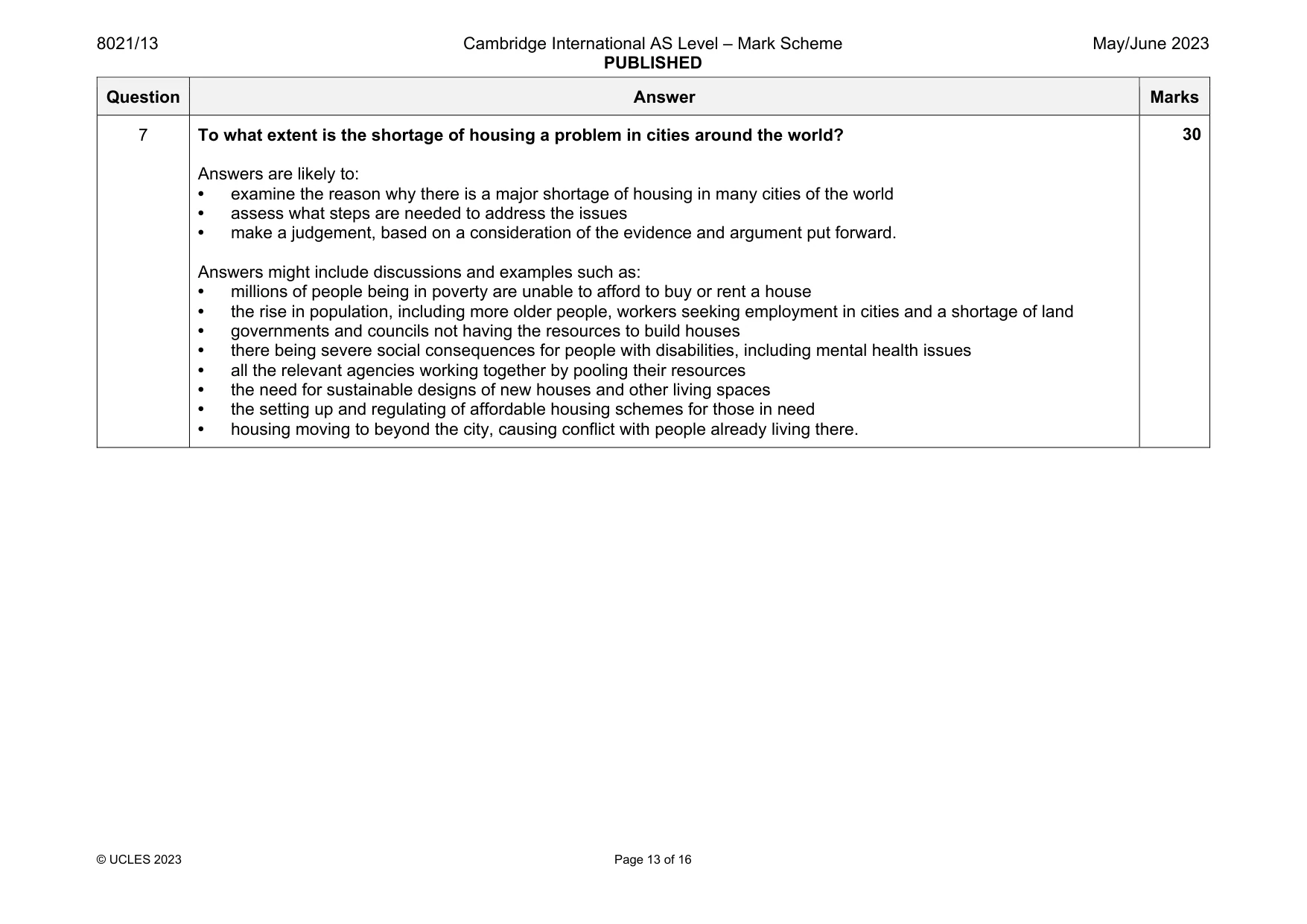
8021/13 Cambridge International AS Level – Mark Scheme PUBLISHED May/June 2023 © UCLES 2023 Page 13 of 16 Question Answer Marks 7 To what extent is the shortage of housing a problem in cities around the world? Answers are likely to: • examine the reason why there is a major shortage of housing in many cities of the world • assess what steps are needed to address the issues • make a judgement, based on a consideration of the evidence and argument put forward. Answers might include discussions and examples such as: • millions of people being in poverty are unable to afford to buy or rent a house • the rise in population, including more older people, workers seeking employment in cities and a shortage of land • governments and councils not having the resources to build houses • there being severe social consequences for people with disabilities, including mental health issues • all the relevant agencies working together by pooling their resources • the need for sustainable designs of new houses and other living spaces • the setting up and regulating of affordable housing schemes for those in need • housing moving to beyond the city, causing conflict with people already living there. 30
Mark scheme, page 14
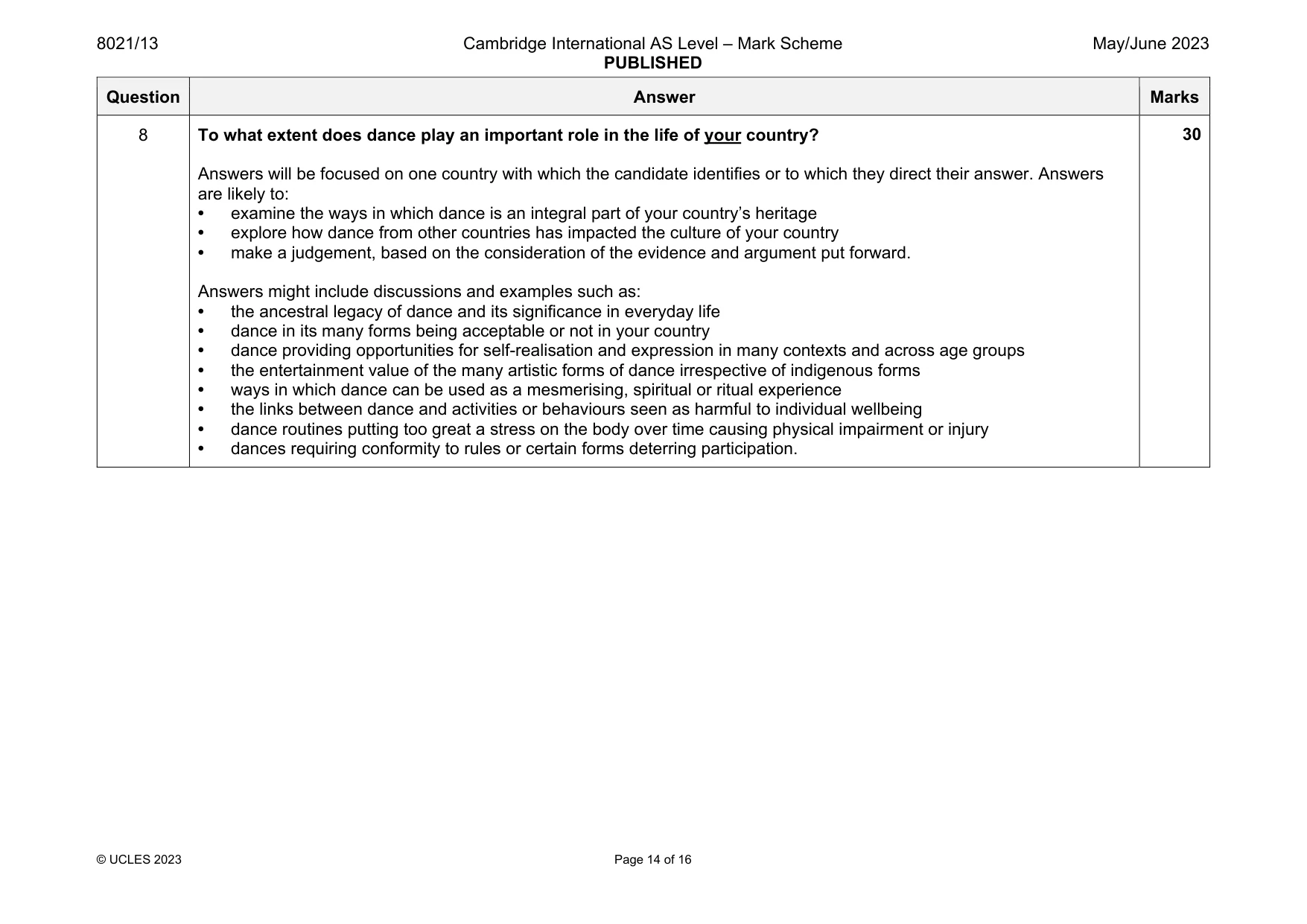
8021/13 Cambridge International AS Level – Mark Scheme PUBLISHED May/June 2023 © UCLES 2023 Page 14 of 16 Question Answer Marks 8 To what extent does dance play an important role in the life of your country? Answers will be focused on one country with which the candidate identifies or to which they direct their answer. Answers are likely to: • examine the ways in which dance is an integral part of your country’s heritage • explore how dance from other countries has impacted the culture of your country • make a judgement, based on the consideration of the evidence and argument put forward. Answers might include discussions and examples such as: • the ancestral legacy of dance and its significance in everyday life • dance in its many forms being acceptable or not in your country • dance providing opportunities for self-realisation and expression in many contexts and across age groups • the entertainment value of the many artistic forms of dance irrespective of indigenous forms • ways in which dance can be used as a mesmerising, spiritual or ritual experience • the links between dance and activities or behaviours seen as harmful to individual wellbeing • dance routines putting too great a stress on the body over time causing physical impairment or injury • dances requiring conformity to rules or certain forms deterring participation. 30
Mark scheme, page 15
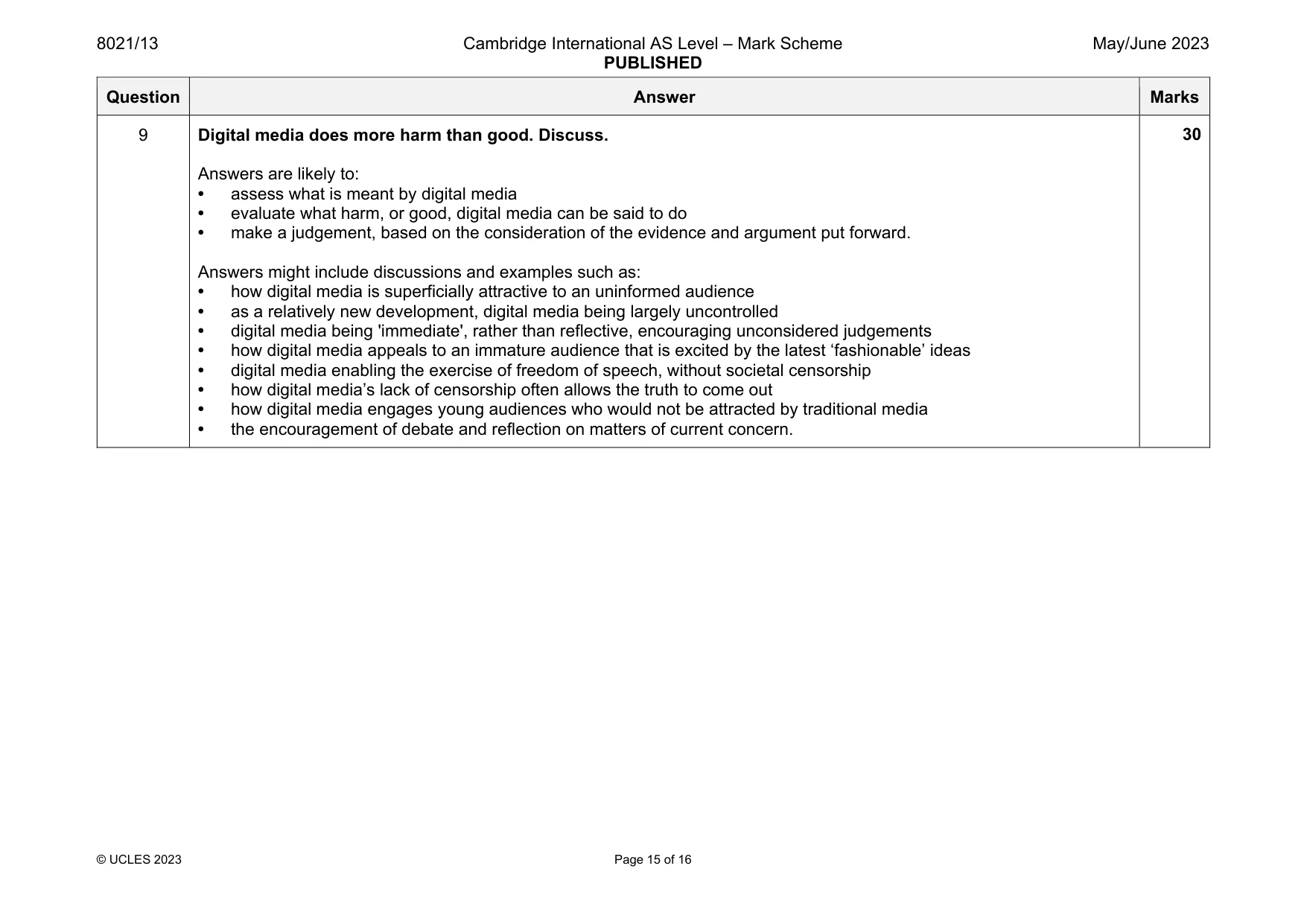
8021/13 Cambridge International AS Level – Mark Scheme PUBLISHED May/June 2023 © UCLES 2023 Page 15 of 16 Question Answer Marks 9 Digital media does more harm than good. Discuss. Answers are likely to: • assess what is meant by digital media • evaluate what harm, or good, digital media can be said to do • make a judgement, based on the consideration of the evidence and argument put forward. Answers might include discussions and examples such as: • how digital media is superficially attractive to an uninformed audience • as a relatively new development, digital media being largely uncontrolled • digital media being 'immediate', rather than reflective, encouraging unconsidered judgements • how digital media appeals to an immature audience that is excited by the latest ‘fashionable’ ideas • digital media enabling the exercise of freedom of speech, without societal censorship • how digital media’s lack of censorship often allows the truth to come out • how digital media engages young audiences who would not be attracted by traditional media • the encouragement of debate and reflection on matters of current concern. 30
Mark scheme, page 16
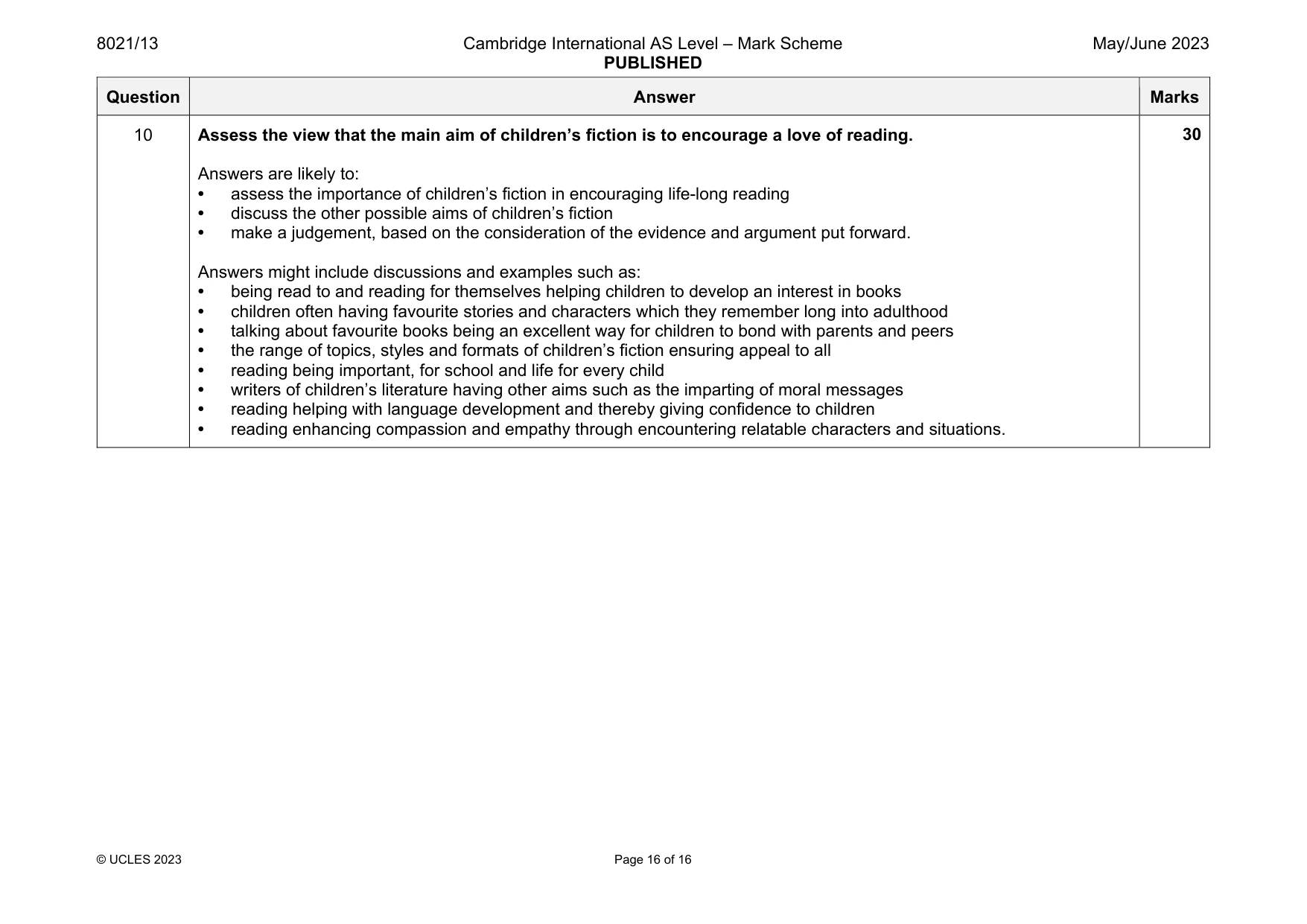
8021/13 Cambridge International AS Level – Mark Scheme PUBLISHED May/June 2023 © UCLES 2023 Page 16 of 16 Question Answer Marks 10 Assess the view that the main aim of children’s fiction is to encourage a love of reading. Answers are likely to: • assess the importance of children’s fiction in encouraging life-long reading • discuss the other possible aims of children’s fiction • make a judgement, based on the consideration of the evidence and argument put forward. Answers might include discussions and examples such as: • being read to and reading for themselves helping children to develop an interest in books • children often having favourite stories and characters which they remember long into adulthood • talking about favourite books being an excellent way for children to bond with parents and peers • the range of topics, styles and formats of children’s fiction ensuring appeal to all • reading being important, for school and life for every child • writers of children’s literature having other aims such as the imparting of moral messages • reading helping with language development and thereby giving confidence to children • reading enhancing compassion and empathy through encountering relatable characters and situations. 30
What you needed in this session
Cambridge’s own grade thresholds for 2023 May/June, Paper 1 · Variant 3. A higher threshold means an easier paper — the bar moves with how the cohort did.