Cambridge A Level English General Paper 8021 — 2023 May/June Paper 1 · Variant 1
8021/11/M/J/23 · 30 marks · ≈34 min
The question paper and its mark scheme, free to read here and free to download. This is Cambridge’s own paper, exactly as it was sat.
Question paper4 pages


Mark scheme17 pages
Answers below. Sit the paper first if you are practising.
Paper as text
Question paper, page 1
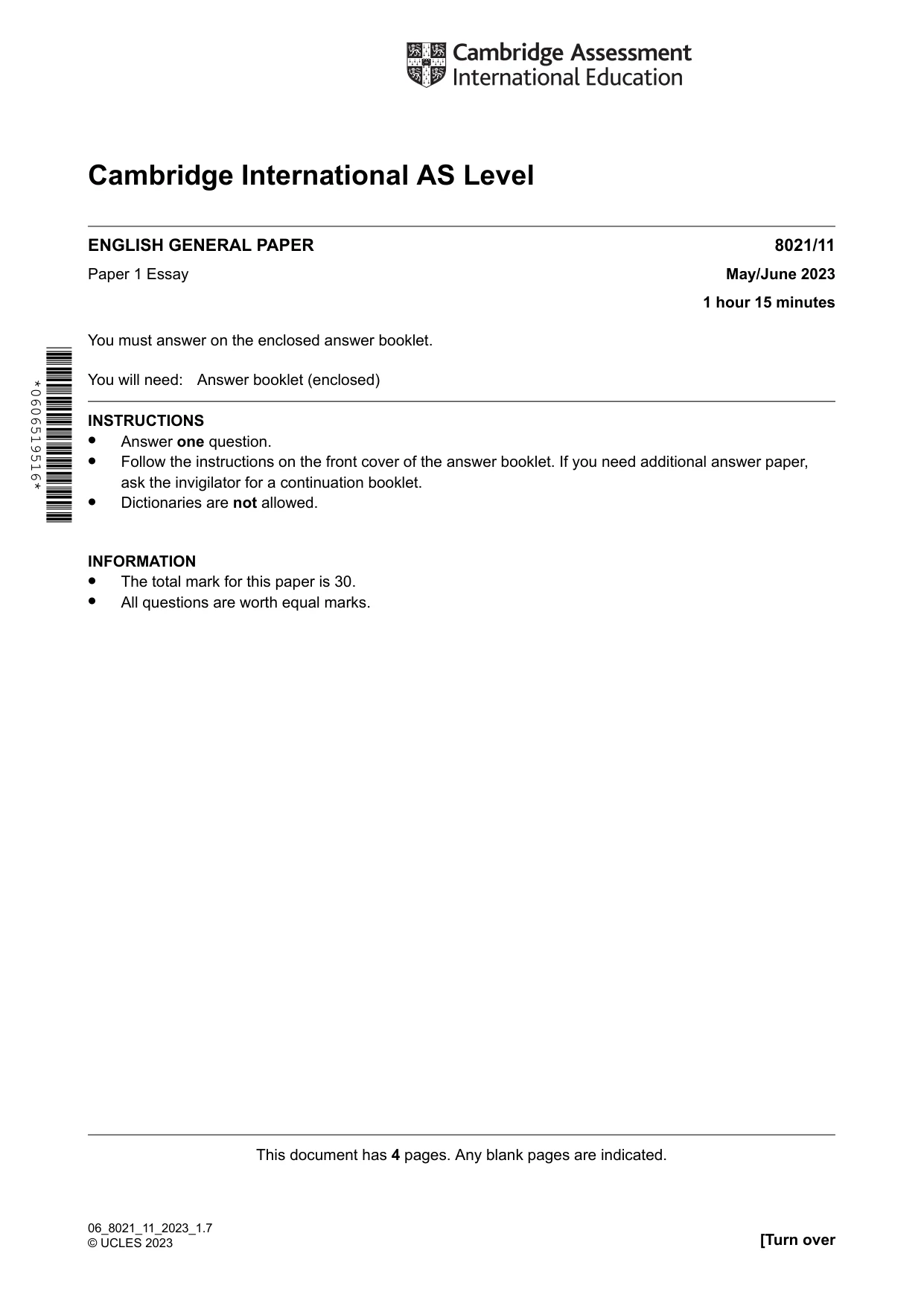
Cambridge International AS Level 8021/11 May/June 2023 1 hour 15 minutes ENGLISH GENERAL PAPER Paper 1 Essay You must answer on the enclosed answer booklet. You will need: Answer booklet (enclosed) INSTRUCTIONS • Answer one question. • Follow the instructions on the front cover of the answer booklet. If you need additional answer paper, ask the invigilator for a continuation booklet. • Dictionaries are not allowed. INFORMATION • The total mark for this paper is 30. • All questions are worth equal marks. This document has 4 pages. Any blank pages are indicated. [Turn over 06_8021_11_2023_1.7 © UCLES 2023 *0606519516*
Question paper, page 2
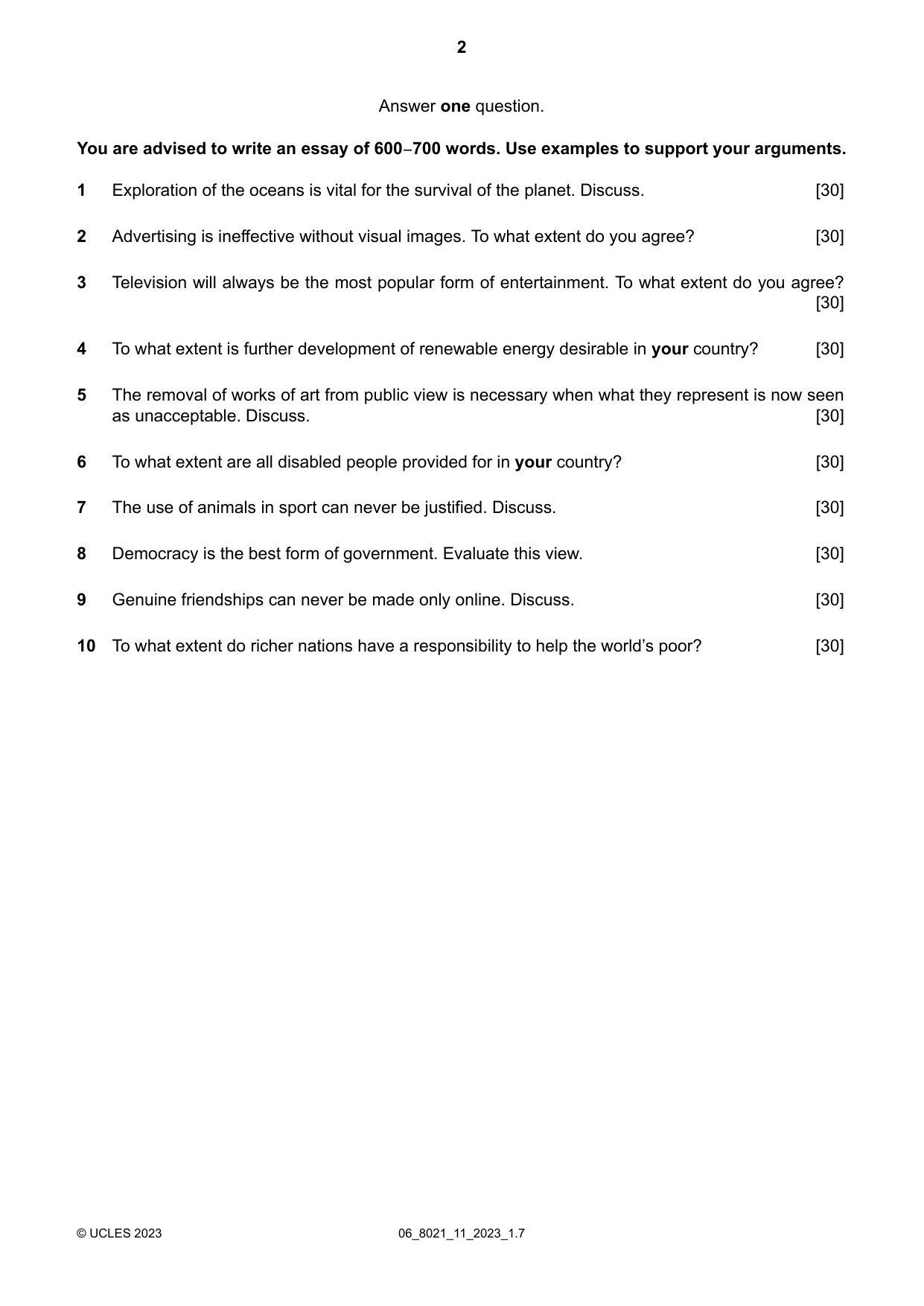
Answer one question. You are advised to write an essay of 600−700 words. Use examples to support your arguments. Exploration of the oceans is vital for the survival of the planet. Discuss. [30] 1 Advertising is ineffective without visual images. To what extent do you agree? [30] 2 Television will always be the most popular form of entertainment. To what extent do you agree? [30] 3 To what extent is further development of renewable energy desirable in your country? [30] 4 The removal of works of art from public view is necessary when what they represent is now seen as unacceptable. Discuss. [30] 5 To what extent are all disabled people provided for in your country? [30] 6 The use of animals in sport can never be justified. Discuss. [30] 7 Democracy is the best form of government. Evaluate this view. [30] 8 Genuine friendships can never be made only online. Discuss. [30] 9 To what extent do richer nations have a responsibility to help the world’s poor? [30] 10 06_8021_11_2023_1.7 © UCLES 2023 2
Question paper, page 3
BLANK PAGE 06_8021_11_2023_1.7 © UCLES 2023 3
Question paper, page 4
BLANK PAGE Permission to reproduce items where third-party owned material protected by copyright is included has been sought and cleared where possible. Every reasonable effort has been made by the publisher (UCLES) to trace copyright holders, but if any items requiring clearance have unwittingly been included, the publisher will be pleased to make amends at the earliest possible opportunity. To avoid the issue of disclosure of answer-related information to candidates, all copyright acknowledgements are reproduced online in the Cambridge Assessment International Education Copyright Acknowledgements Booklet. This is produced for each series of examinations and is freely available to download at www.cambridgeinternational.org after the live examination series. Cambridge Assessment International Education is part of Cambridge Assessment. Cambridge Assessment is the brand name of the University of Cambridge Local Examinations Syndicate (UCLES), which is a department of the University of Cambridge. 06_8021_11_2023_1.7 © UCLES 2023 4
Mark scheme, page 1
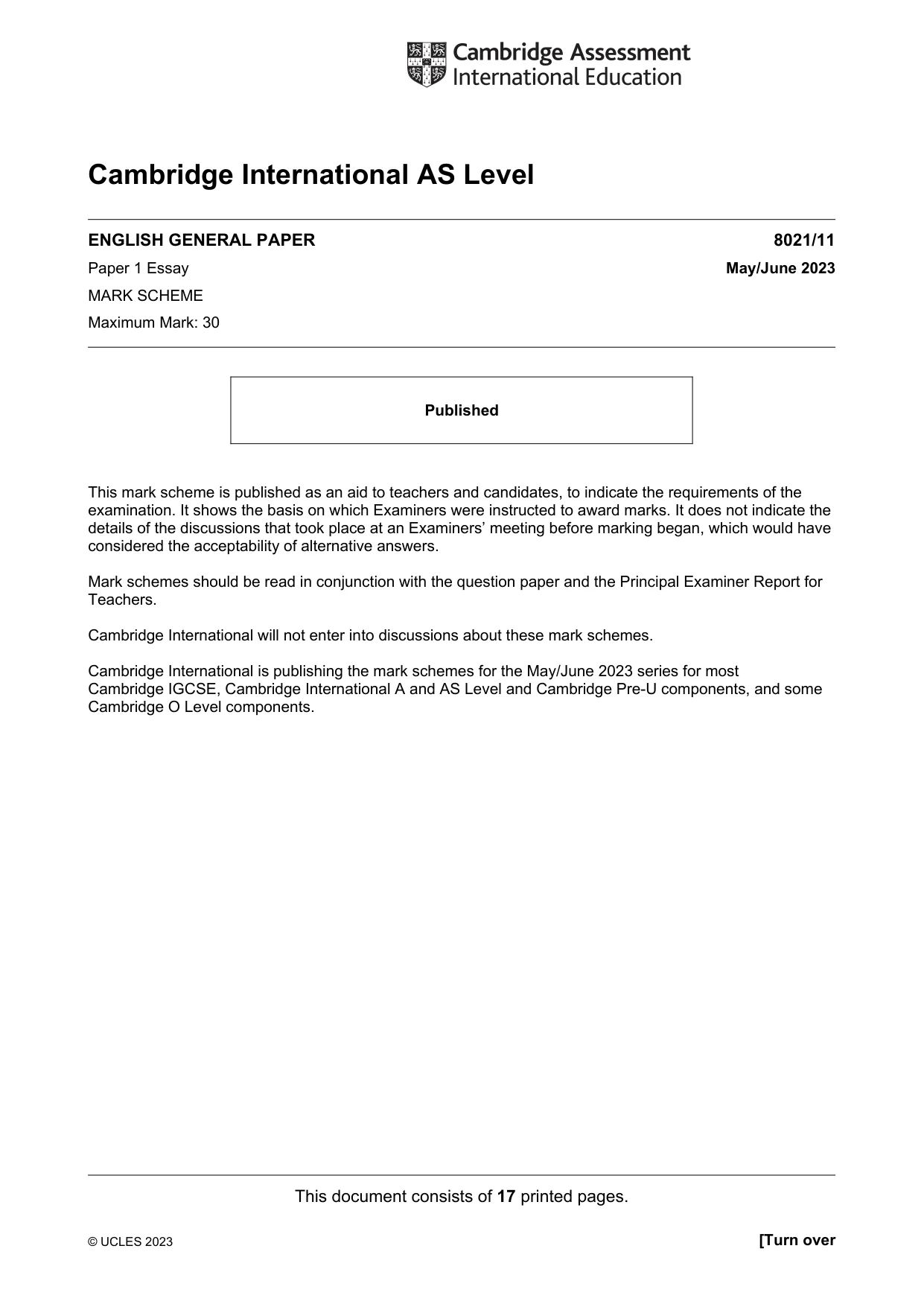
This document consists of 17 printed pages. © UCLES 2023 [Turn over Cambridge International AS Level ENGLISH GENERAL PAPER 8021/11 Paper 1 Essay May/June 2023 MARK SCHEME Maximum Mark: 30 Published This mark scheme is published as an aid to teachers and candidates, to indicate the requirements of the examination. It shows the basis on which Examiners were instructed to award marks. It does not indicate the details of the discussions that took place at an Examiners’ meeting before marking began, which would have considered the acceptability of alternative answers. Mark schemes should be read in conjunction with the question paper and the Principal Examiner Report for Teachers. Cambridge International will not enter into discussions about these mark schemes. Cambridge International is publishing the mark schemes for the May/June 2023 series for most Cambridge IGCSE, Cambridge International A and AS Level and Cambridge Pre-U components, and some Cambridge O Level components.
Mark scheme, page 2
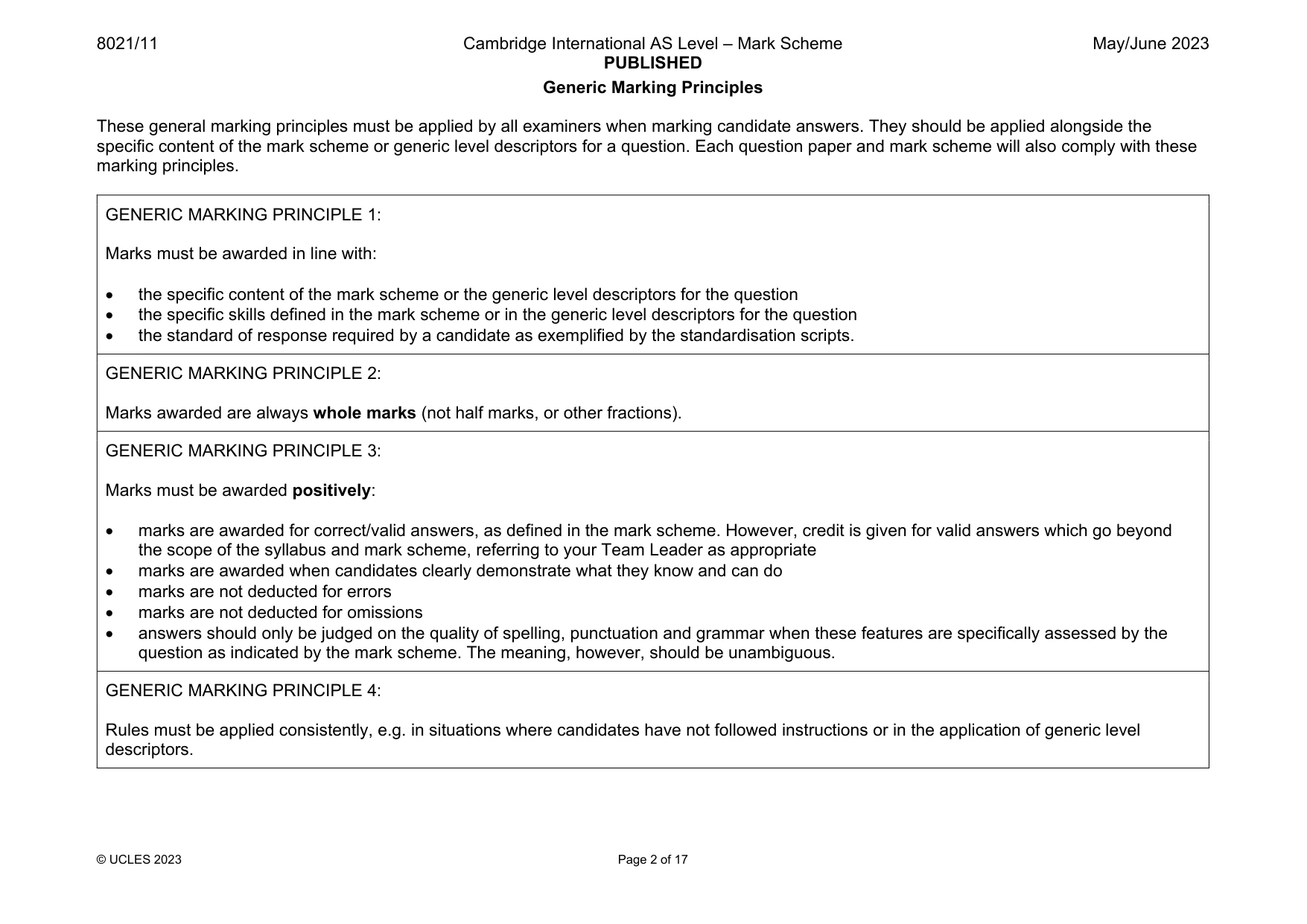
8021/11 Cambridge International AS Level – Mark Scheme PUBLISHED May/June 2023 © UCLES 2023 Page 2 of 17 Generic Marking Principles These general marking principles must be applied by all examiners when marking candidate answers. They should be applied alongside the specific content of the mark scheme or generic level descriptors for a question. Each question paper and mark scheme will also comply with these marking principles. GENERIC MARKING PRINCIPLE 1: Marks must be awarded in line with: the specific content of the mark scheme or the generic level descriptors for the question the specific skills defined in the mark scheme or in the generic level descriptors for the question the standard of response required by a candidate as exemplified by the standardisation scripts. GENERIC MARKING PRINCIPLE 2: Marks awarded are always whole marks (not half marks, or other fractions). GENERIC MARKING PRINCIPLE 3: Marks must be awarded positively: marks are awarded for correct/valid answers, as defined in the mark scheme. However, credit is given for valid answers which go beyond the scope of the syllabus and mark scheme, referring to your Team Leader as appropriate marks are awarded when candidates clearly demonstrate what they know and can do marks are not deducted for errors marks are not deducted for omissions answers should only be judged on the quality of spelling, punctuation and grammar when these features are specifically assessed by the question as indicated by the mark scheme. The meaning, however, should be unambiguous. GENERIC MARKING PRINCIPLE 4: Rules must be applied consistently, e.g. in situations where candidates have not followed instructions or in the application of generic level descriptors.
Mark scheme, page 3
8021/11 Cambridge International AS Level – Mark Scheme PUBLISHED May/June 2023 © UCLES 2023 Page 3 of 17 GENERIC MARKING PRINCIPLE 5: Marks should be awarded using the full range of marks defined in the mark scheme for the question (however; the use of the full mark range may be limited according to the quality of the candidate responses seen). GENERIC MARKING PRINCIPLE 6: Marks awarded are based solely on the requirements as defined in the mark scheme. Marks should not be awarded with grade thresholds or grade descriptors in mind.
Mark scheme, page 4
8021/11 Cambridge International AS Level – Mark Scheme PUBLISHED May/June 2023 © UCLES 2023 Page 4 of 17 Generic levels of response descriptions These level definitions address Assessment Objectives (AOs) 1, 2 and 3, and should be used in conjunction with the indicative content for each question in the mark scheme. Information about AOs can be found in the Cambridge International AS Level English General Paper syllabus (8021) for examination in 2019, 2020 and 2021. Introduction The level definitions which follow reflect, and should be interpreted within the context of, the following general statement: (a) Examiners will give their highest marks to candidates who demonstrate a disciplined management of the discussion the question provokes and use clear and accurate communication. Examiners will be guided more by careful selection and application of information, effective analysis and evaluation, and supported judgement, than by weight of facts. (b) Examiners will use these level definitions in combination with the question-specific mark schemes. (c) Explanation or judgement is strengthened if informed by the use of relevant examples. (d) The level in which an essay is placed depends on the range of criteria detailed in AO1, AO2 and AO3. As a result, not all essays fall obviously into one particular level. In such cases a ‘best-fit’ approach will be adopted with any doubt erring on the side of generosity. In marking an essay, examiners will first place it in a level and then fine-tune the mark in terms of how strongly/weakly the demands of the level have been demonstrated. The criteria in each level are written to exemplify the middle of that level.
Mark scheme, page 5
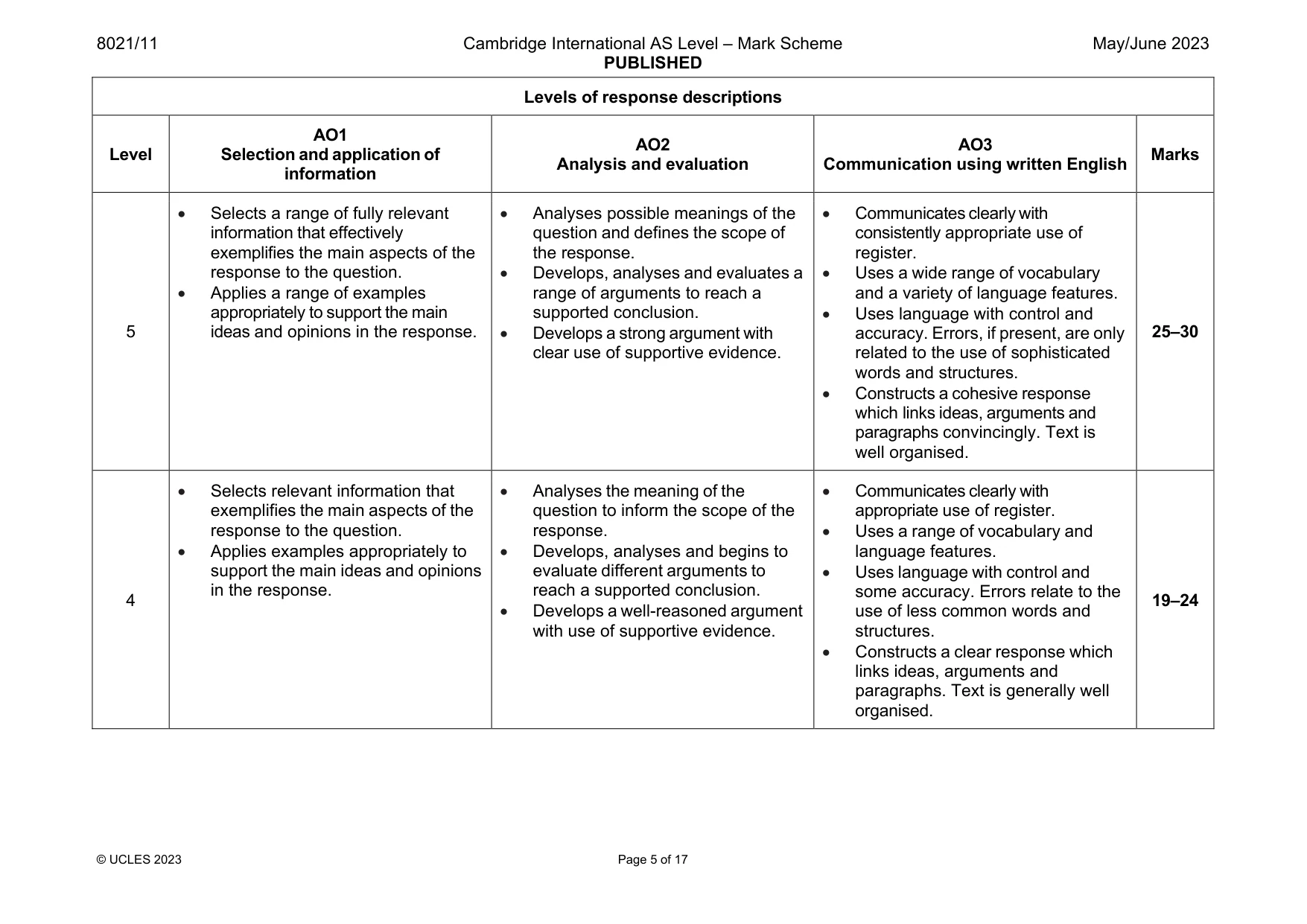
8021/11 Cambridge International AS Level – Mark Scheme PUBLISHED May/June 2023 © UCLES 2023 Page 5 of 17 Levels of response descriptions Level AO1 Selection and application of information AO2 Analysis and evaluation AO3 Communication using written English Marks 5 Selects a range of fully relevant information that effectively exemplifies the main aspects of the response to the question. Applies a range of examples appropriately to support the main ideas and opinions in the response. Analyses possible meanings of the question and defines the scope of the response. Develops, analyses and evaluates a range of arguments to reach a supported conclusion. Develops a strong argument with clear use of supportive evidence. Communicates clearly with consistently appropriate use of register. Uses a wide range of vocabulary and a variety of language features. Uses language with control and accuracy. Errors, if present, are only related to the use of sophisticated words and structures. Constructs a cohesive response which links ideas, arguments and paragraphs convincingly. Text is well organised. 25–30 4 Selects relevant information that exemplifies the main aspects of the response to the question. Applies examples appropriately to support the main ideas and opinions in the response. Analyses the meaning of the question to inform the scope of the response. Develops, analyses and begins to evaluate different arguments to reach a supported conclusion. Develops a well-reasoned argument with use of supportive evidence. Communicates clearly with appropriate use of register. Uses a range of vocabulary and language features. Uses language with control and some accuracy. Errors relate to the use of less common words and structures. Constructs a clear response which links ideas, arguments and paragraphs. Text is generally well organised. 19–24
Mark scheme, page 6
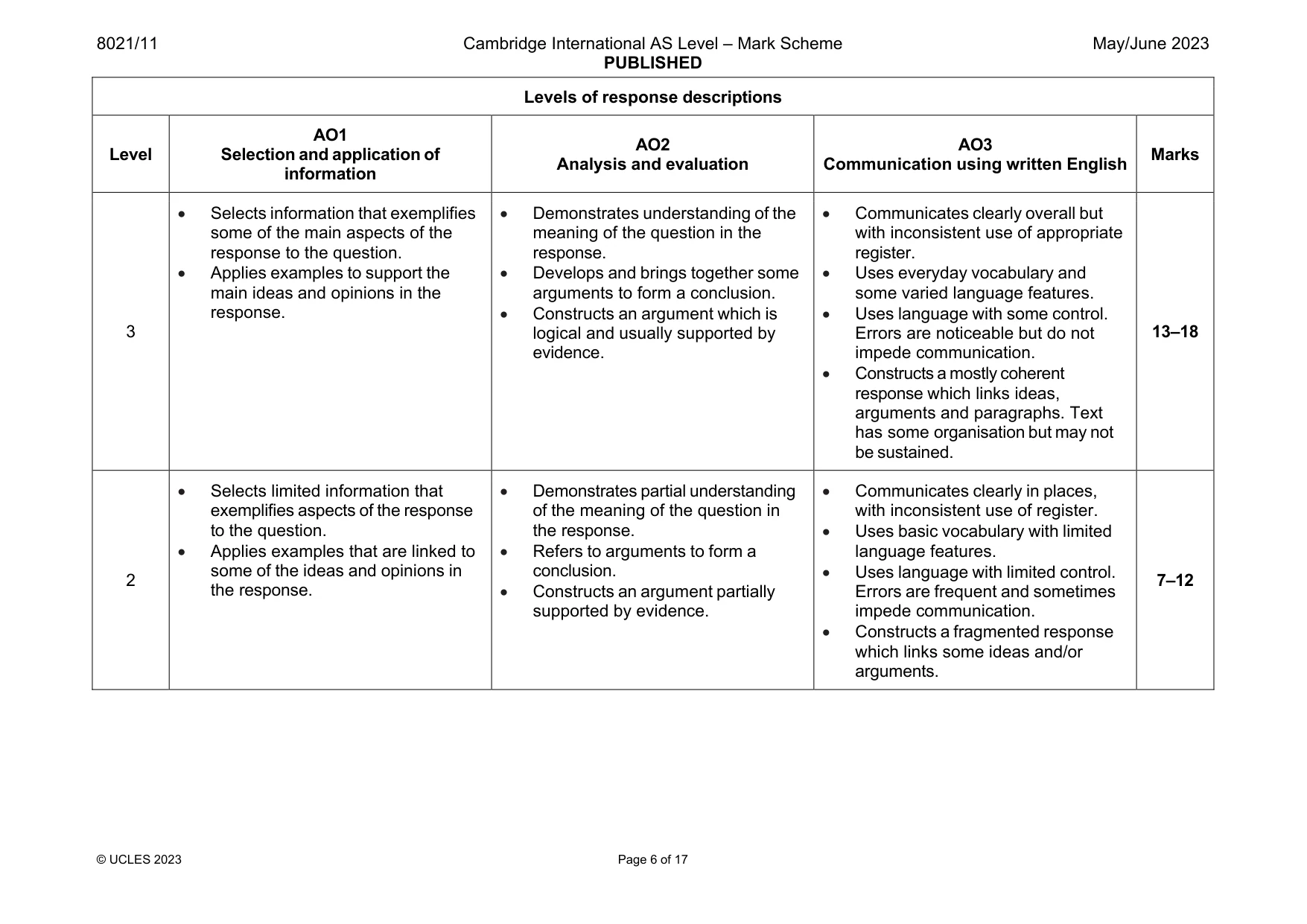
8021/11 Cambridge International AS Level – Mark Scheme PUBLISHED May/June 2023 © UCLES 2023 Page 6 of 17 Levels of response descriptions Level AO1 Selection and application of information AO2 Analysis and evaluation AO3 Communication using written English Marks 3 Selects information that exemplifies some of the main aspects of the response to the question. Applies examples to support the main ideas and opinions in the response. Demonstrates understanding of the meaning of the question in the response. Develops and brings together some arguments to form a conclusion. Constructs an argument which is logical and usually supported by evidence. Communicates clearly overall but with inconsistent use of appropriate register. Uses everyday vocabulary and some varied language features. Uses language with some control. Errors are noticeable but do not impede communication. Constructs a mostly coherent response which links ideas, arguments and paragraphs. Text has some organisation but may not be sustained. 13–18 2 Selects limited information that exemplifies aspects of the response to the question. Applies examples that are linked to some of the ideas and opinions in the response. Demonstrates partial understanding of the meaning of the question in the response. Refers to arguments to form a conclusion. Constructs an argument partially supported by evidence. Communicates clearly in places, with inconsistent use of register. Uses basic vocabulary with limited language features. Uses language with limited control. Errors are frequent and sometimes impede communication. Constructs a fragmented response which links some ideas and/or arguments. 7–12
Mark scheme, page 7
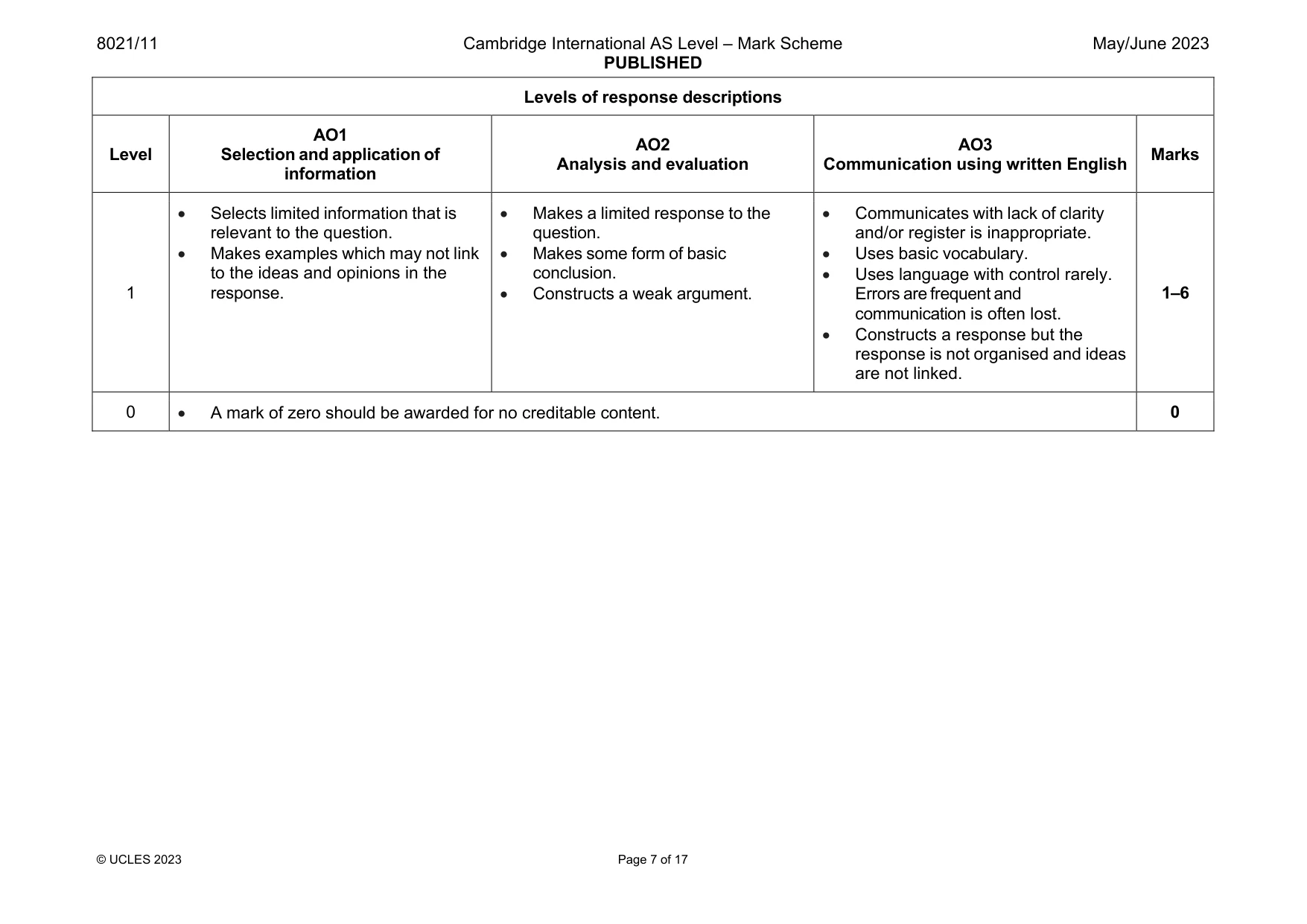
8021/11 Cambridge International AS Level – Mark Scheme PUBLISHED May/June 2023 © UCLES 2023 Page 7 of 17 Levels of response descriptions Level AO1 Selection and application of information AO2 Analysis and evaluation AO3 Communication using written English Marks 1 Selects limited information that is relevant to the question. Makes examples which may not link to the ideas and opinions in the response. Makes a limited response to the question. Makes some form of basic conclusion. Constructs a weak argument. Communicates with lack of clarity and/or register is inappropriate. Uses basic vocabulary. Uses language with control rarely. Errors are frequent and communication is often lost. Constructs a response but the response is not organised and ideas are not linked. 1–6 0 A mark of zero should be awarded for no creditable content. 0
Mark scheme, page 8
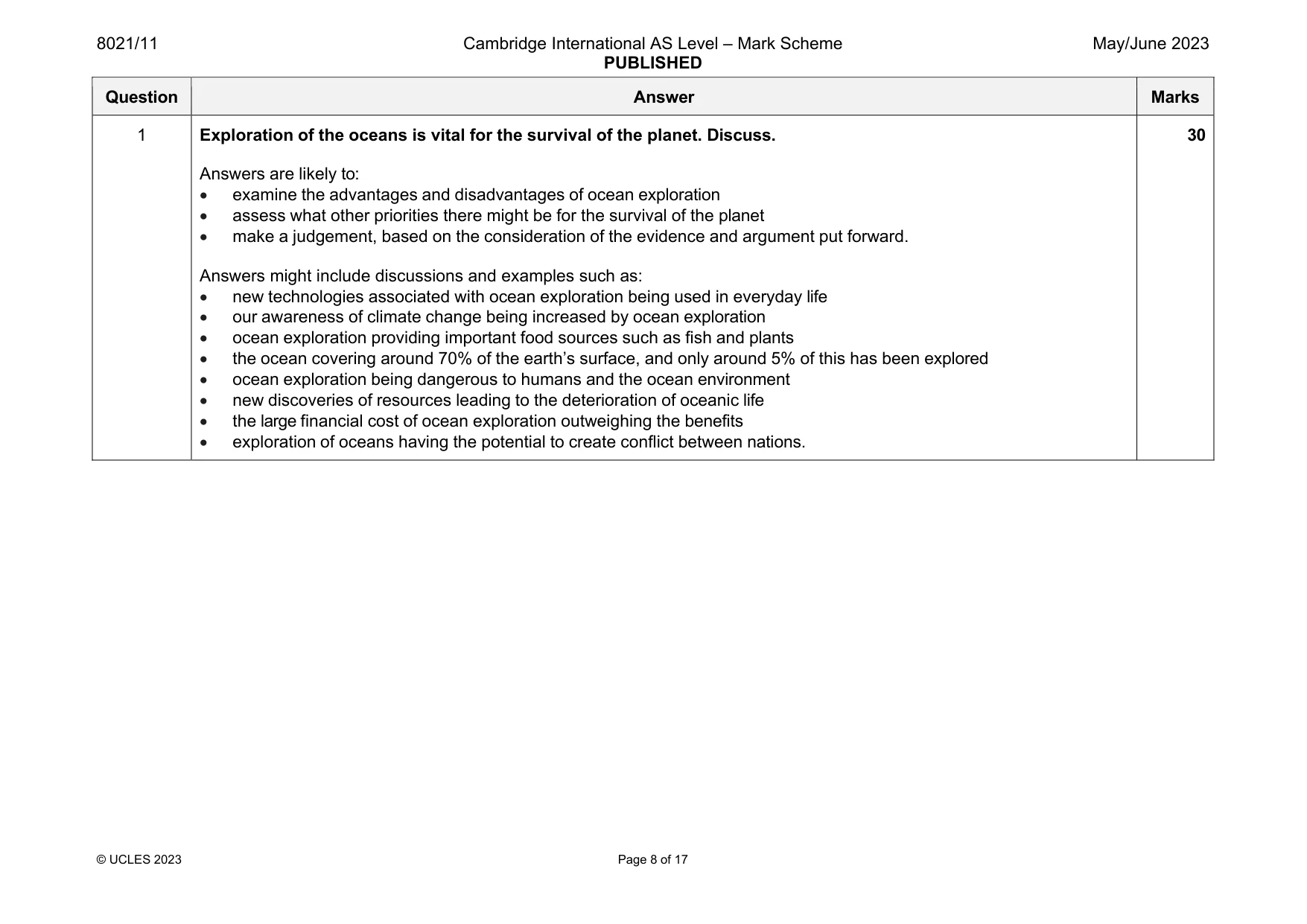
8021/11 Cambridge International AS Level – Mark Scheme PUBLISHED May/June 2023 © UCLES 2023 Page 8 of 17 Question Answer Marks 1 Exploration of the oceans is vital for the survival of the planet. Discuss. Answers are likely to: examine the advantages and disadvantages of ocean exploration assess what other priorities there might be for the survival of the planet make a judgement, based on the consideration of the evidence and argument put forward. Answers might include discussions and examples such as: new technologies associated with ocean exploration being used in everyday life our awareness of climate change being increased by ocean exploration ocean exploration providing important food sources such as fish and plants the ocean covering around 70% of the earth’s surface, and only around 5% of this has been explored ocean exploration being dangerous to humans and the ocean environment new discoveries of resources leading to the deterioration of oceanic life the large financial cost of ocean exploration outweighing the benefits exploration of oceans having the potential to create conflict between nations. 30
Mark scheme, page 9
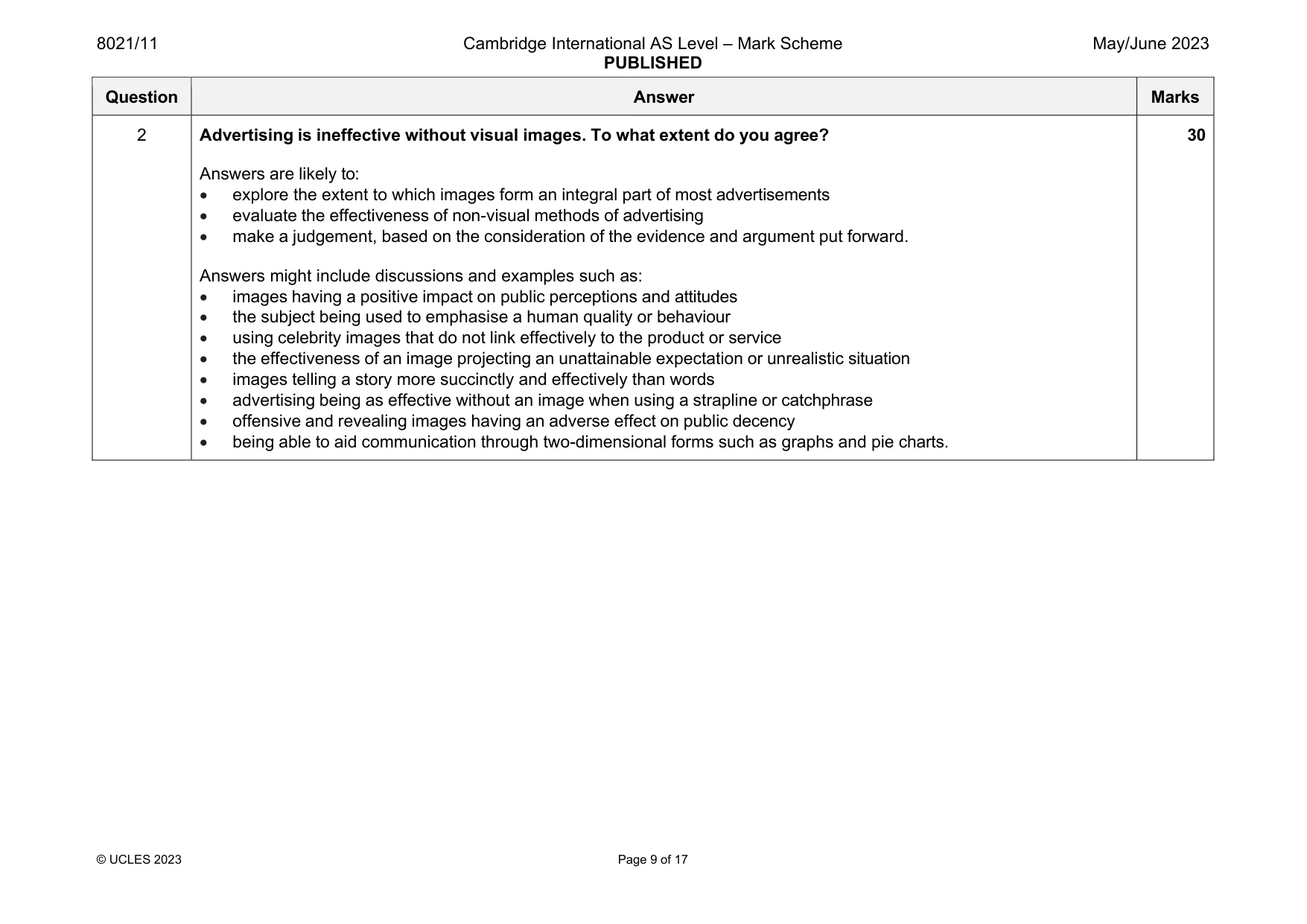
8021/11 Cambridge International AS Level – Mark Scheme PUBLISHED May/June 2023 © UCLES 2023 Page 9 of 17 Question Answer Marks 2 Advertising is ineffective without visual images. To what extent do you agree? Answers are likely to: explore the extent to which images form an integral part of most advertisements evaluate the effectiveness of non-visual methods of advertising make a judgement, based on the consideration of the evidence and argument put forward. Answers might include discussions and examples such as: images having a positive impact on public perceptions and attitudes the subject being used to emphasise a human quality or behaviour using celebrity images that do not link effectively to the product or service the effectiveness of an image projecting an unattainable expectation or unrealistic situation images telling a story more succinctly and effectively than words advertising being as effective without an image when using a strapline or catchphrase offensive and revealing images having an adverse effect on public decency being able to aid communication through two-dimensional forms such as graphs and pie charts. 30
Mark scheme, page 10
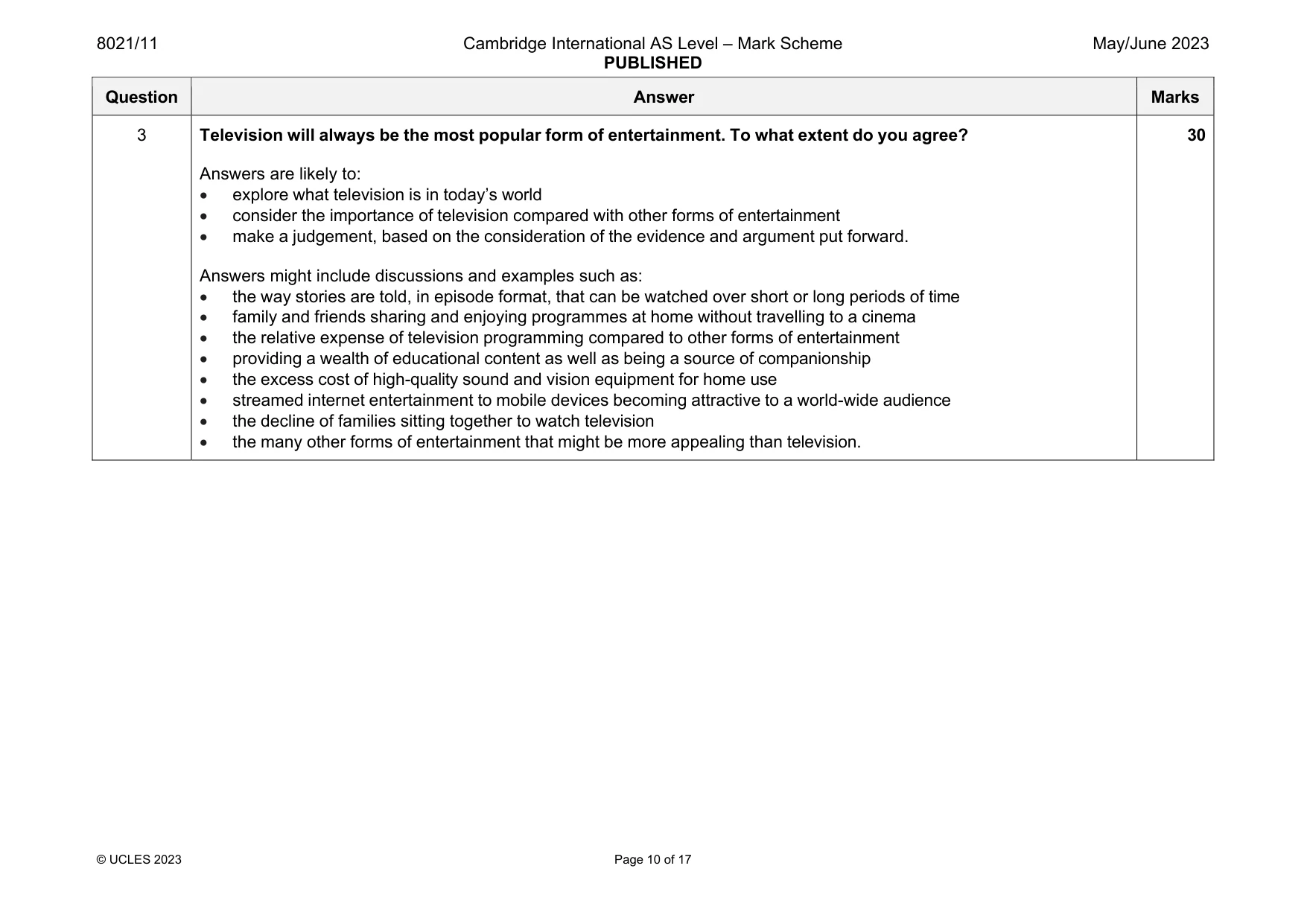
8021/11 Cambridge International AS Level – Mark Scheme PUBLISHED May/June 2023 © UCLES 2023 Page 10 of 17 Question Answer Marks 3 Television will always be the most popular form of entertainment. To what extent do you agree? Answers are likely to: explore what television is in today’s world consider the importance of television compared with other forms of entertainment make a judgement, based on the consideration of the evidence and argument put forward. Answers might include discussions and examples such as: the way stories are told, in episode format, that can be watched over short or long periods of time family and friends sharing and enjoying programmes at home without travelling to a cinema the relative expense of television programming compared to other forms of entertainment providing a wealth of educational content as well as being a source of companionship the excess cost of high-quality sound and vision equipment for home use streamed internet entertainment to mobile devices becoming attractive to a world-wide audience the decline of families sitting together to watch television the many other forms of entertainment that might be more appealing than television. 30
Mark scheme, page 11
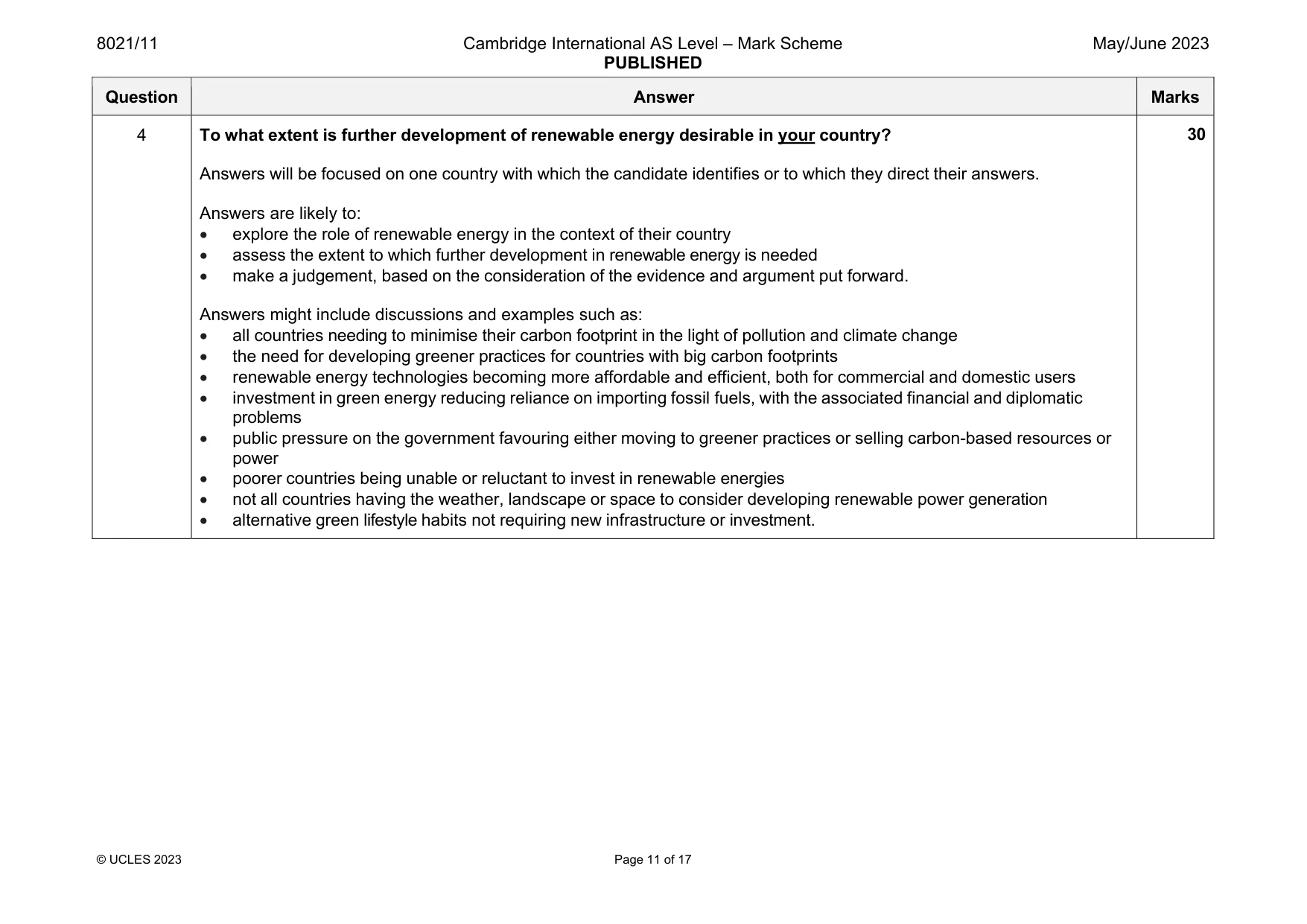
8021/11 Cambridge International AS Level – Mark Scheme PUBLISHED May/June 2023 © UCLES 2023 Page 11 of 17 Question Answer Marks 4 To what extent is further development of renewable energy desirable in your country? Answers will be focused on one country with which the candidate identifies or to which they direct their answers. Answers are likely to: explore the role of renewable energy in the context of their country assess the extent to which further development in renewable energy is needed make a judgement, based on the consideration of the evidence and argument put forward. Answers might include discussions and examples such as: all countries needing to minimise their carbon footprint in the light of pollution and climate change the need for developing greener practices for countries with big carbon footprints renewable energy technologies becoming more affordable and efficient, both for commercial and domestic users investment in green energy reducing reliance on importing fossil fuels, with the associated financial and diplomatic problems public pressure on the government favouring either moving to greener practices or selling carbon-based resources or power poorer countries being unable or reluctant to invest in renewable energies not all countries having the weather, landscape or space to consider developing renewable power generation alternative green lifestyle habits not requiring new infrastructure or investment. 30
Mark scheme, page 12
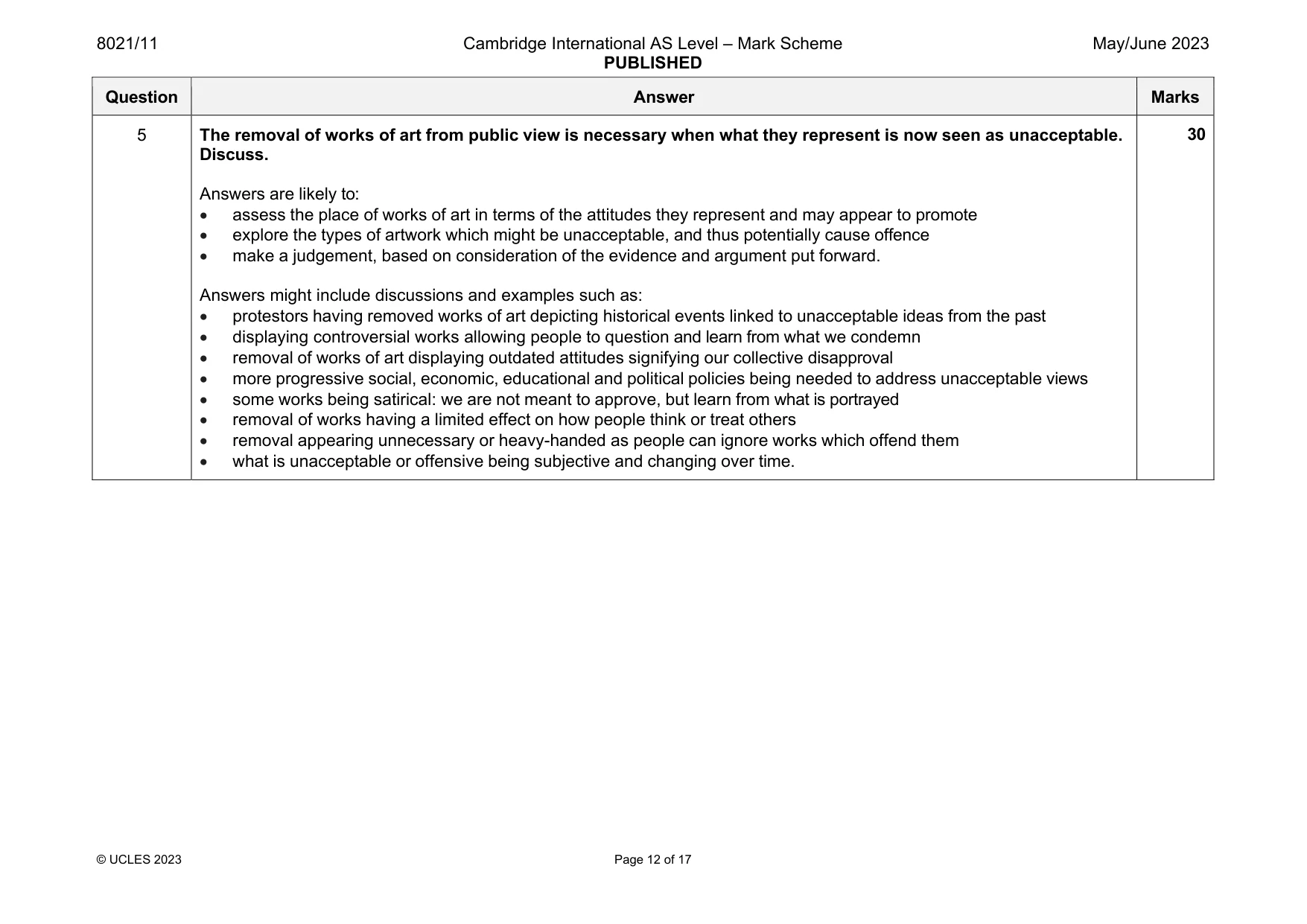
8021/11 Cambridge International AS Level – Mark Scheme PUBLISHED May/June 2023 © UCLES 2023 Page 12 of 17 Question Answer Marks 5 The removal of works of art from public view is necessary when what they represent is now seen as unacceptable. Discuss. Answers are likely to: assess the place of works of art in terms of the attitudes they represent and may appear to promote explore the types of artwork which might be unacceptable, and thus potentially cause offence make a judgement, based on consideration of the evidence and argument put forward. Answers might include discussions and examples such as: protestors having removed works of art depicting historical events linked to unacceptable ideas from the past displaying controversial works allowing people to question and learn from what we condemn removal of works of art displaying outdated attitudes signifying our collective disapproval more progressive social, economic, educational and political policies being needed to address unacceptable views some works being satirical: we are not meant to approve, but learn from what is portrayed removal of works having a limited effect on how people think or treat others removal appearing unnecessary or heavy-handed as people can ignore works which offend them what is unacceptable or offensive being subjective and changing over time. 30
Mark scheme, page 13
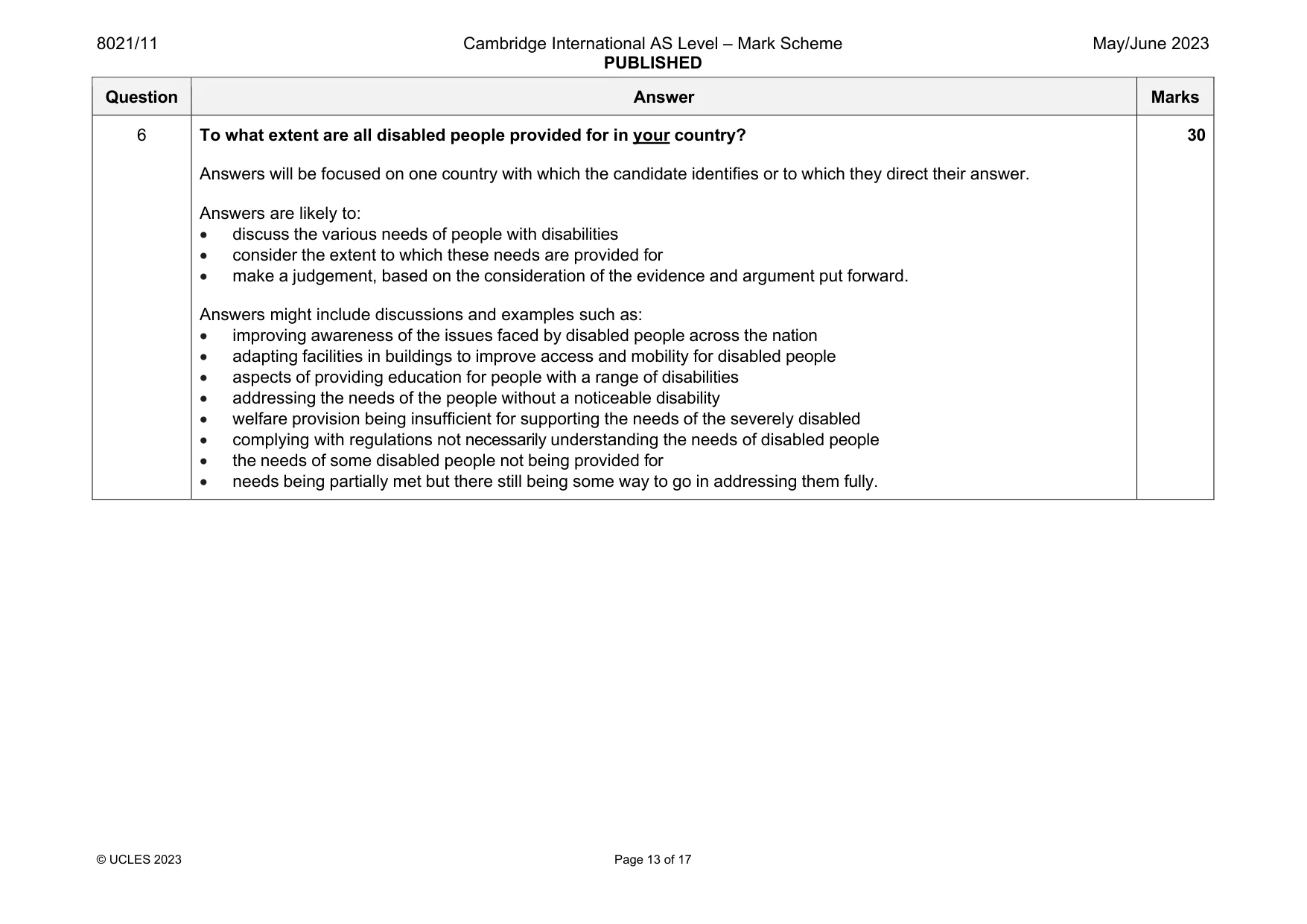
8021/11 Cambridge International AS Level – Mark Scheme PUBLISHED May/June 2023 © UCLES 2023 Page 13 of 17 Question Answer Marks 6 To what extent are all disabled people provided for in your country? Answers will be focused on one country with which the candidate identifies or to which they direct their answer. Answers are likely to: discuss the various needs of people with disabilities consider the extent to which these needs are provided for make a judgement, based on the consideration of the evidence and argument put forward. Answers might include discussions and examples such as: improving awareness of the issues faced by disabled people across the nation adapting facilities in buildings to improve access and mobility for disabled people aspects of providing education for people with a range of disabilities addressing the needs of the people without a noticeable disability welfare provision being insufficient for supporting the needs of the severely disabled complying with regulations not necessarily understanding the needs of disabled people the needs of some disabled people not being provided for needs being partially met but there still being some way to go in addressing them fully. 30
Mark scheme, page 14
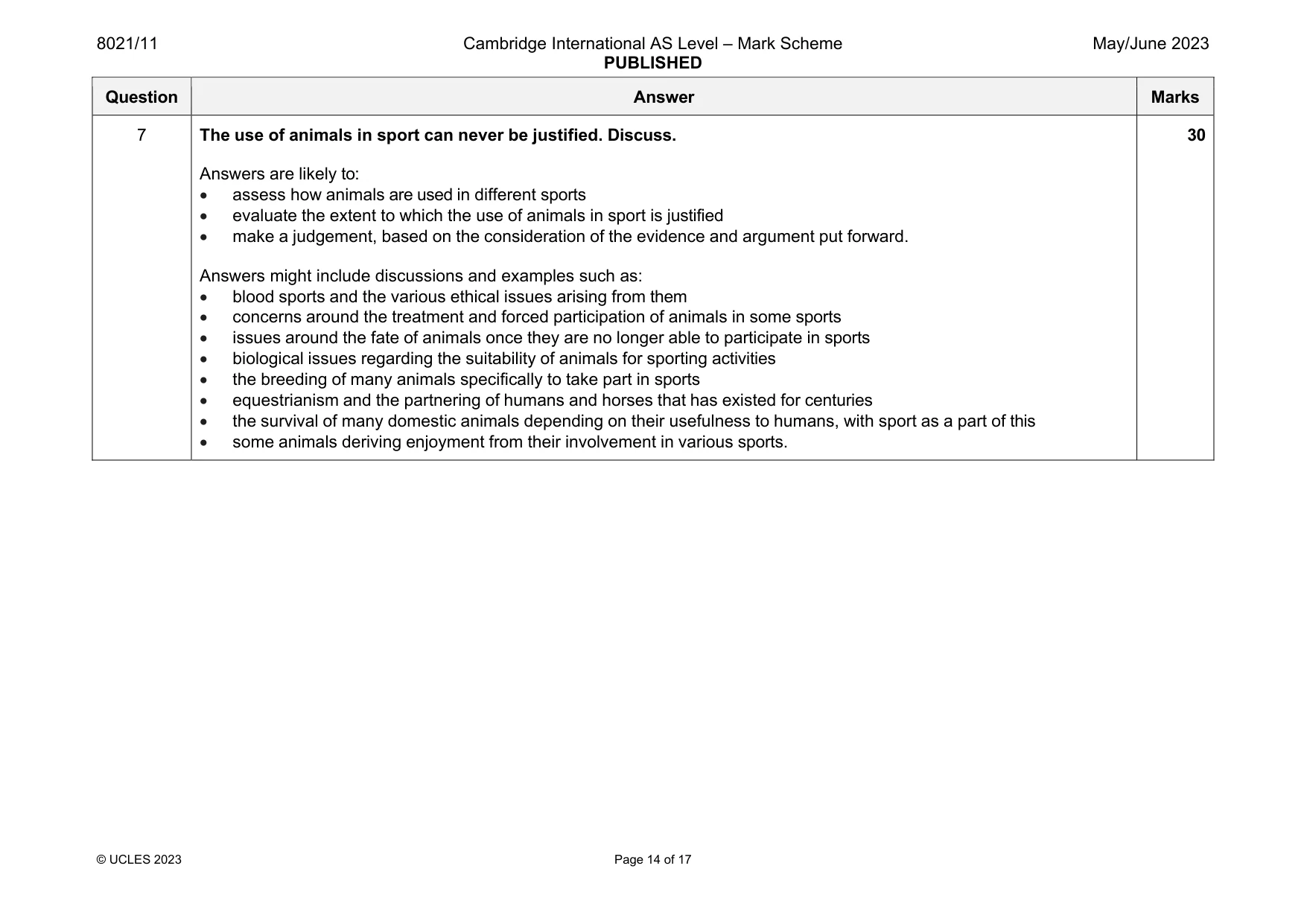
8021/11 Cambridge International AS Level – Mark Scheme PUBLISHED May/June 2023 © UCLES 2023 Page 14 of 17 Question Answer Marks 7 The use of animals in sport can never be justified. Discuss. Answers are likely to: assess how animals are used in different sports evaluate the extent to which the use of animals in sport is justified make a judgement, based on the consideration of the evidence and argument put forward. Answers might include discussions and examples such as: blood sports and the various ethical issues arising from them concerns around the treatment and forced participation of animals in some sports issues around the fate of animals once they are no longer able to participate in sports biological issues regarding the suitability of animals for sporting activities the breeding of many animals specifically to take part in sports equestrianism and the partnering of humans and horses that has existed for centuries the survival of many domestic animals depending on their usefulness to humans, with sport as a part of this some animals deriving enjoyment from their involvement in various sports. 30
Mark scheme, page 15
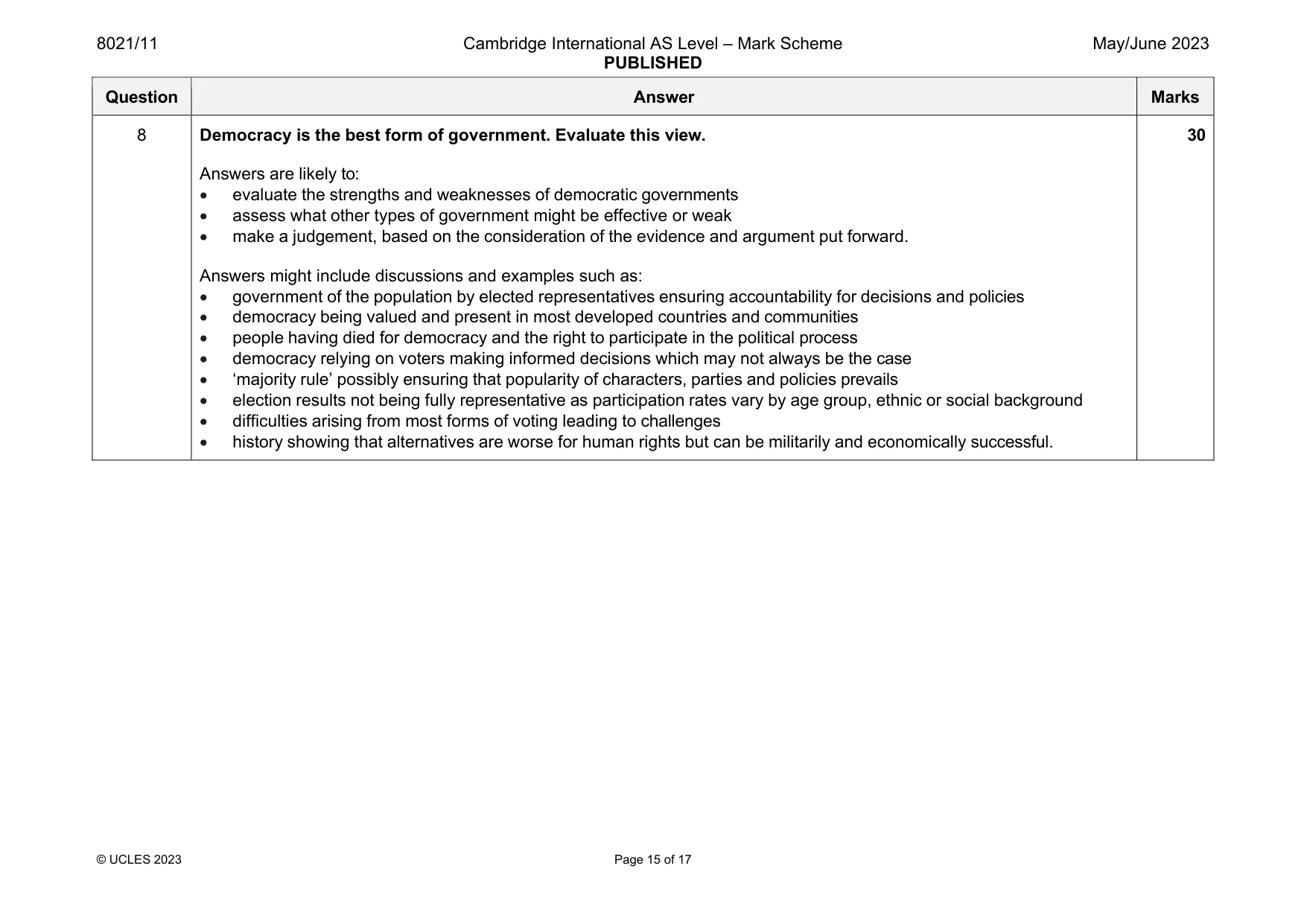
8021/11 Cambridge International AS Level – Mark Scheme PUBLISHED May/June 2023 © UCLES 2023 Page 15 of 17 Question Answer Marks 8 Democracy is the best form of government. Evaluate this view. Answers are likely to: evaluate the strengths and weaknesses of democratic governments assess what other types of government might be effective or weak make a judgement, based on the consideration of the evidence and argument put forward. Answers might include discussions and examples such as: government of the population by elected representatives ensuring accountability for decisions and policies democracy being valued and present in most developed countries and communities people having died for democracy and the right to participate in the political process democracy relying on voters making informed decisions which may not always be the case ‘majority rule’ possibly ensuring that popularity of characters, parties and policies prevails election results not being fully representative as participation rates vary by age group, ethnic or social background difficulties arising from most forms of voting leading to challenges history showing that alternatives are worse for human rights but can be militarily and economically successful. 30
Mark scheme, page 16
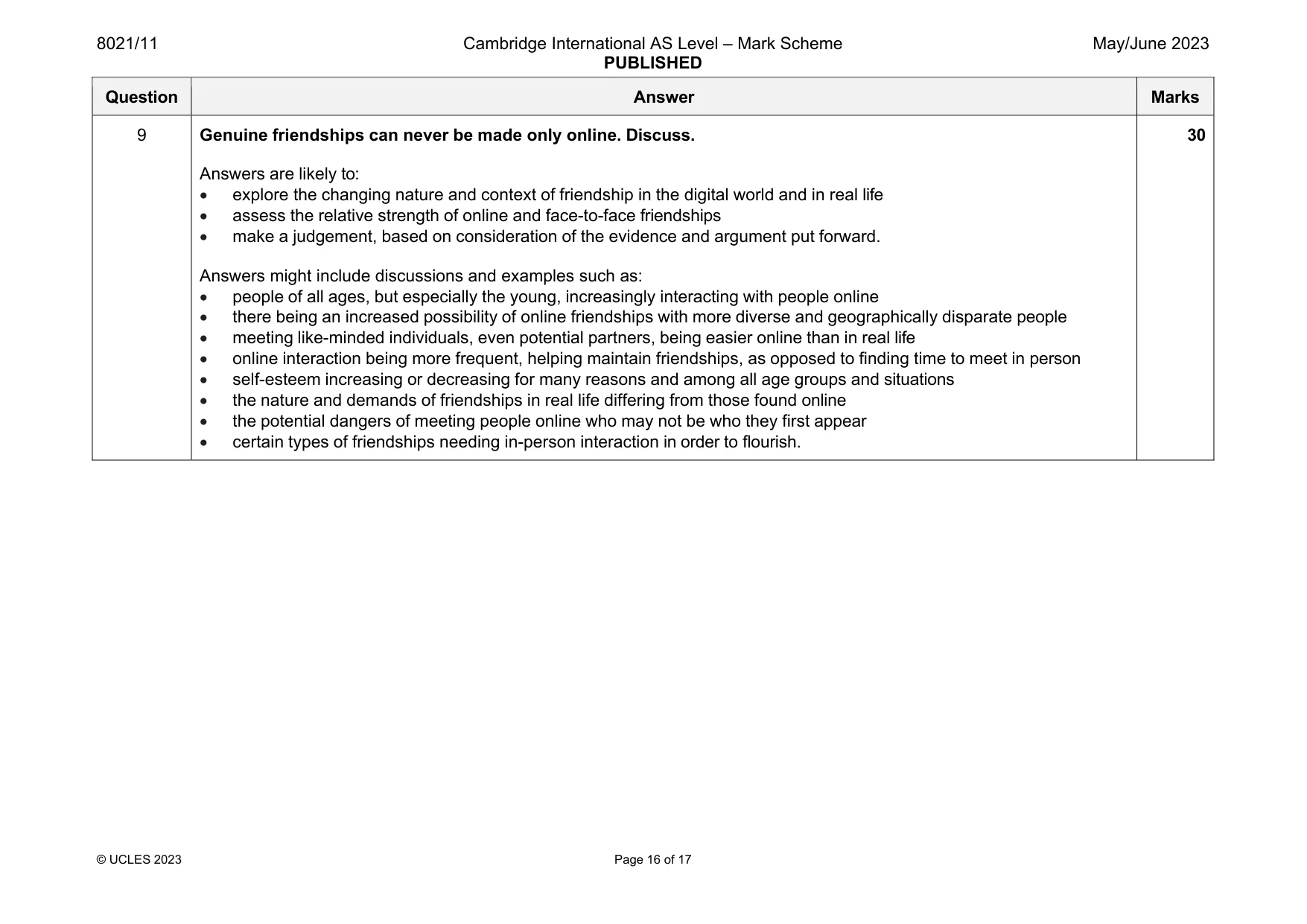
8021/11 Cambridge International AS Level – Mark Scheme PUBLISHED May/June 2023 © UCLES 2023 Page 16 of 17 Question Answer Marks 9 Genuine friendships can never be made only online. Discuss. Answers are likely to: explore the changing nature and context of friendship in the digital world and in real life assess the relative strength of online and face-to-face friendships make a judgement, based on consideration of the evidence and argument put forward. Answers might include discussions and examples such as: people of all ages, but especially the young, increasingly interacting with people online there being an increased possibility of online friendships with more diverse and geographically disparate people meeting like-minded individuals, even potential partners, being easier online than in real life online interaction being more frequent, helping maintain friendships, as opposed to finding time to meet in person self-esteem increasing or decreasing for many reasons and among all age groups and situations the nature and demands of friendships in real life differing from those found online the potential dangers of meeting people online who may not be who they first appear certain types of friendships needing in-person interaction in order to flourish. 30
Mark scheme, page 17
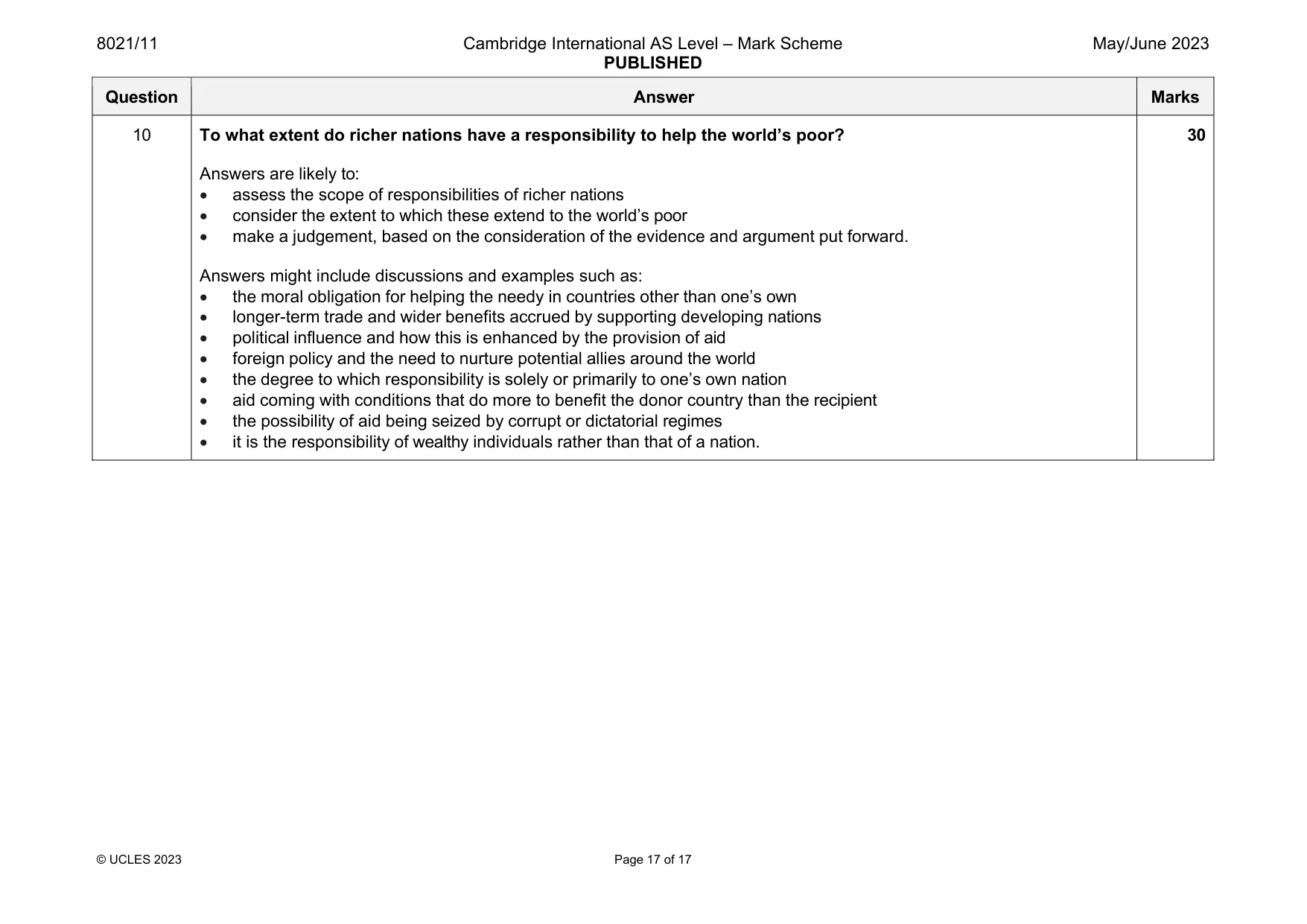
8021/11 Cambridge International AS Level – Mark Scheme PUBLISHED May/June 2023 © UCLES 2023 Page 17 of 17 Question Answer Marks 10 To what extent do richer nations have a responsibility to help the world’s poor? Answers are likely to: assess the scope of responsibilities of richer nations consider the extent to which these extend to the world’s poor make a judgement, based on the consideration of the evidence and argument put forward. Answers might include discussions and examples such as: the moral obligation for helping the needy in countries other than one’s own longer-term trade and wider benefits accrued by supporting developing nations political influence and how this is enhanced by the provision of aid foreign policy and the need to nurture potential allies around the world the degree to which responsibility is solely or primarily to one’s own nation aid coming with conditions that do more to benefit the donor country than the recipient the possibility of aid being seized by corrupt or dictatorial regimes it is the responsibility of wealthy individuals rather than that of a nation. 30
What you needed in this session
Cambridge’s own grade thresholds for 2023 May/June, Paper 1 · Variant 1. A higher threshold means an easier paper — the bar moves with how the cohort did.