Cambridge A Level English General Paper 8021 — 2024 Oct/Nov Paper 1 · Variant 2
8021/12/O/N/24 · 30 marks · ≈34 min
The question paper and its mark scheme, free to read here and free to download. This is Cambridge’s own paper, exactly as it was sat.
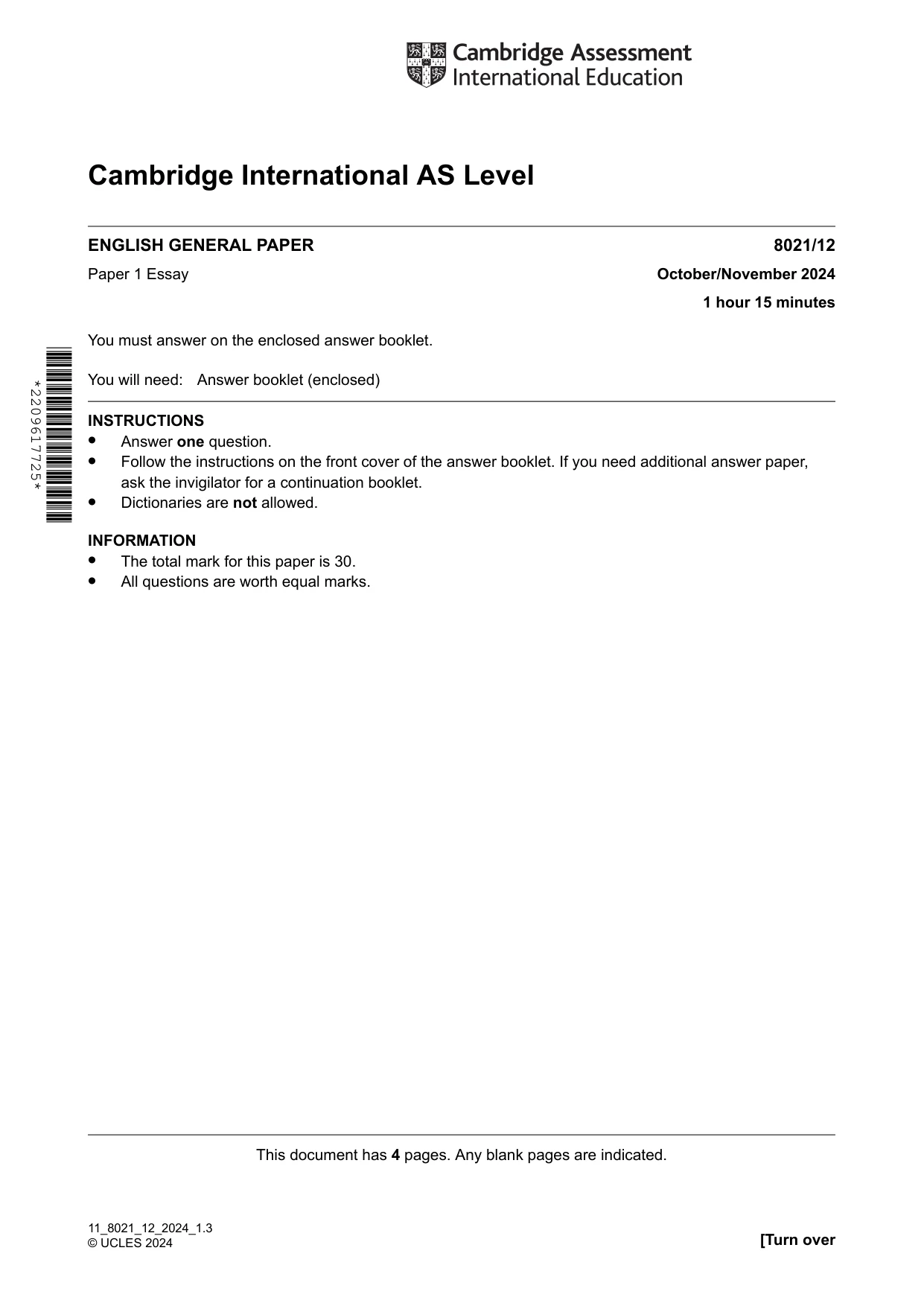
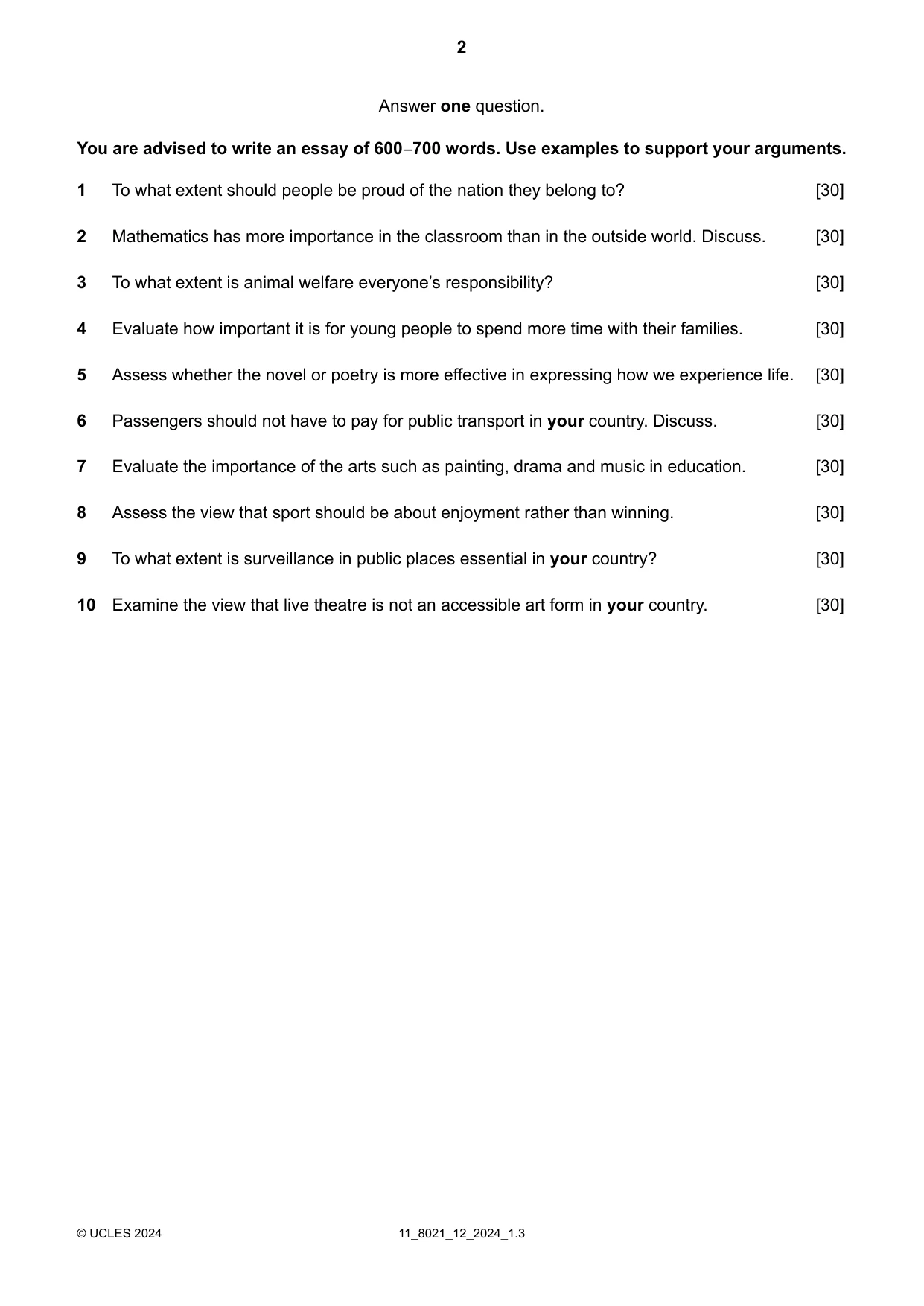
Question paper4 pages


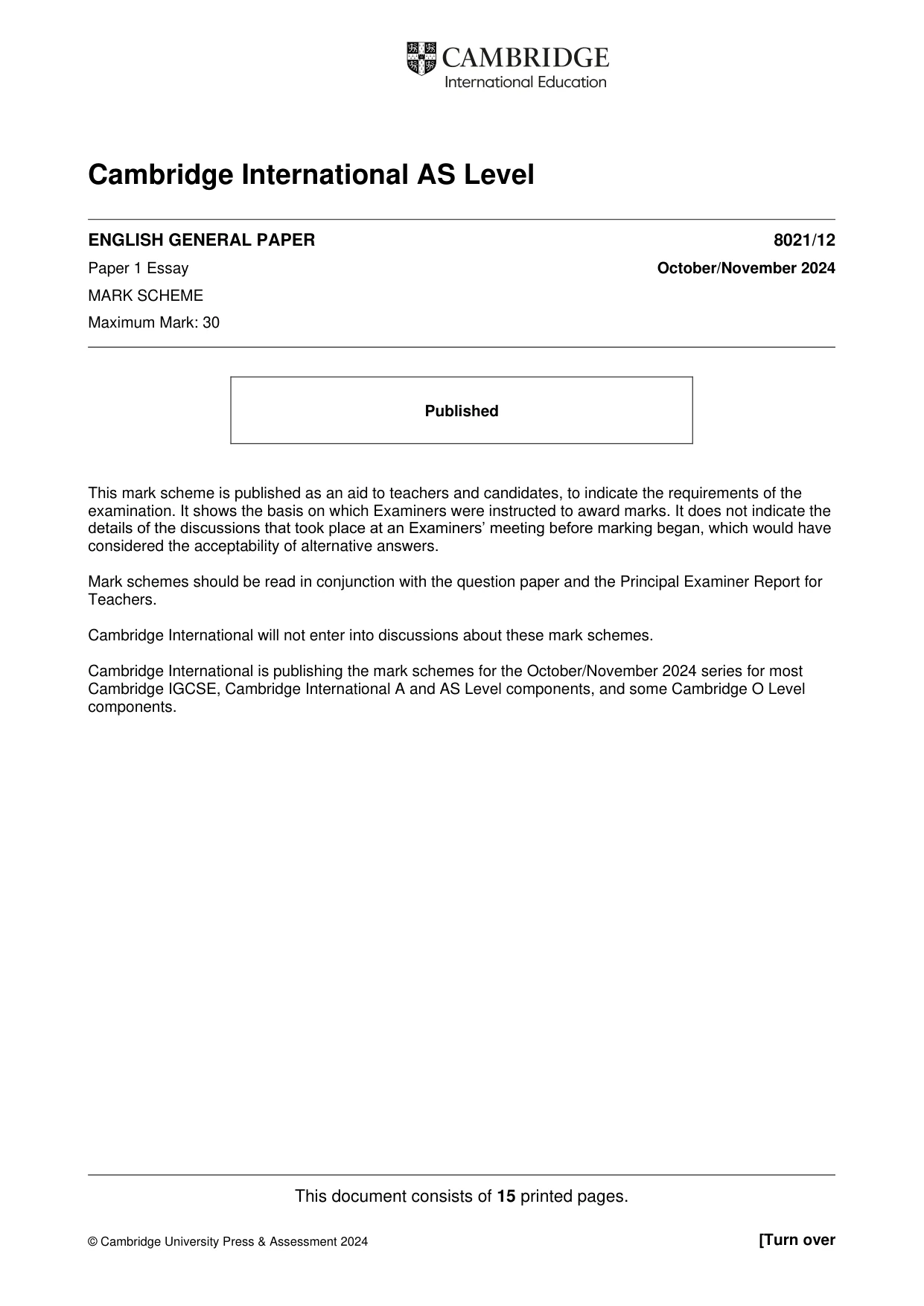
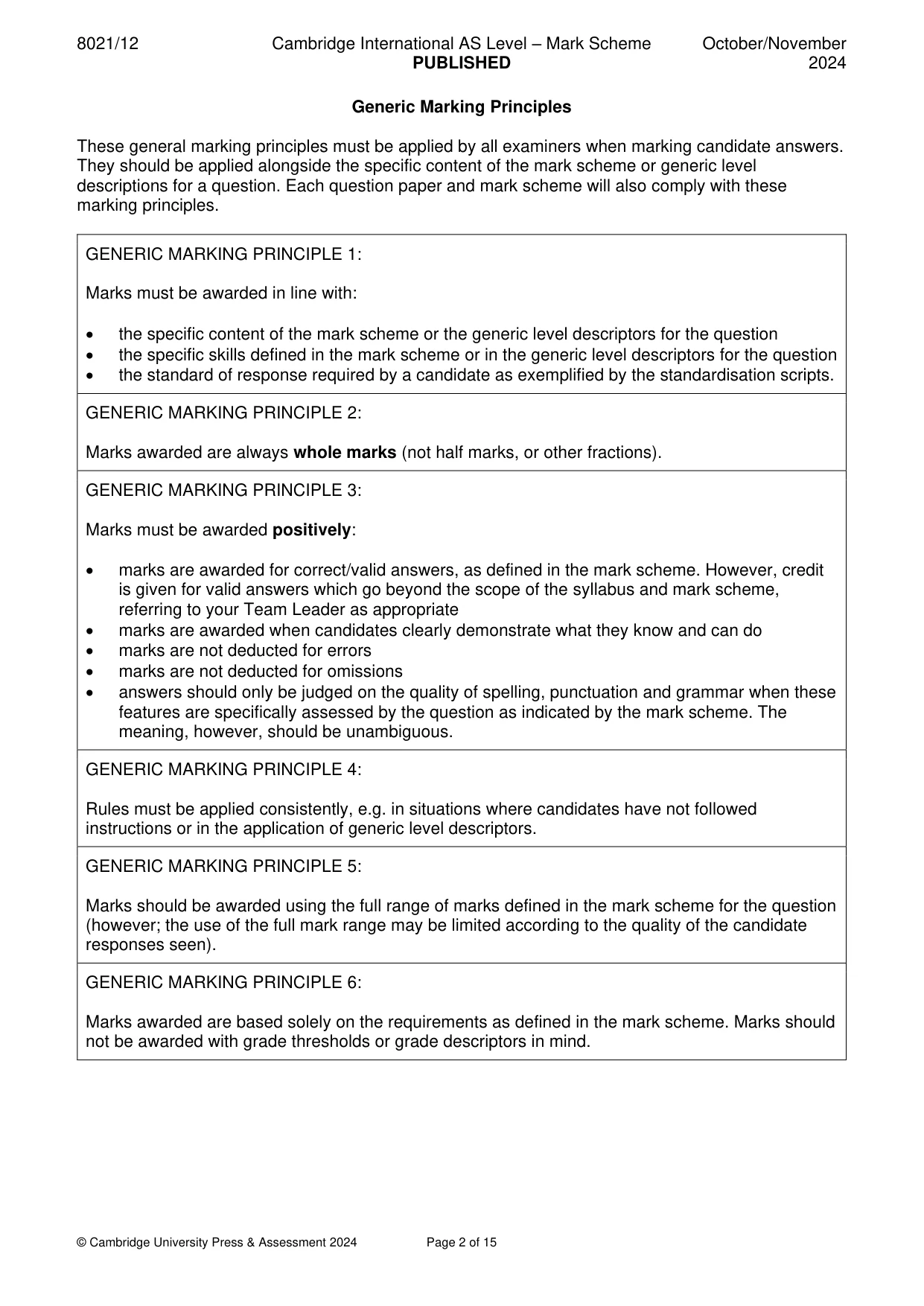
Mark scheme15 pages
Answers below. Sit the paper first if you are practising.
Paper as text
Question paper, page 1
Cambridge International AS Level 8021/12 October/November 2024 1 hour 15 minutes ENGLISH GENERAL PAPER Paper 1 Essay You must answer on the enclosed answer booklet. You will need: Answer booklet (enclosed) INSTRUCTIONS • Answer one question. • Follow the instructions on the front cover of the answer booklet. If you need additional answer paper, ask the invigilator for a continuation booklet. • Dictionaries are not allowed. INFORMATION • The total mark for this paper is 30. • All questions are worth equal marks. This document has 4 pages. Any blank pages are indicated. [Turn over 11_8021_12_2024_1.3 © UCLES 2024 *2209617725*
Question paper, page 2
Answer one question. You are advised to write an essay of 600−700 words. Use examples to support your arguments. To what extent should people be proud of the nation they belong to? [30] 1 Mathematics has more importance in the classroom than in the outside world. Discuss. [30] 2 To what extent is animal welfare everyone’s responsibility? [30] 3 Evaluate how important it is for young people to spend more time with their families. [30] 4 Assess whether the novel or poetry is more effective in expressing how we experience life. [30] 5 Passengers should not have to pay for public transport in your country. Discuss. [30] 6 Evaluate the importance of the arts such as painting, drama and music in education. [30] 7 Assess the view that sport should be about enjoyment rather than winning. [30] 8 To what extent is surveillance in public places essential in your country? [30] 9 Examine the view that live theatre is not an accessible art form in your country. [30] 10 11_8021_12_2024_1.3 © UCLES 2024 2
Question paper, page 3
BLANK PAGE 11_8021_12_2024_1.3 © UCLES 2024 3
Question paper, page 4
BLANK PAGE Permission to reproduce items where third-party owned material protected by copyright is included has been sought and cleared where possible. Every reasonable effort has been made by the publisher (UCLES) to trace copyright holders, but if any items requiring clearance have unwittingly been included, the publisher will be pleased to make amends at the earliest possible opportunity. To avoid the issue of disclosure of answer-related information to candidates, all copyright acknowledgements are reproduced online in the Cambridge Assessment International Education Copyright Acknowledgements Booklet. This is produced for each series of examinations and is freely available to download at www.cambridgeinternational.org after the live examination series. Cambridge Assessment International Education is part of Cambridge Assessment. Cambridge Assessment is the brand name of the University of Cambridge Local Examinations Syndicate (UCLES), which is a department of the University of Cambridge. 11_8021_12_2024_1.3 © UCLES 2024 4
Mark scheme, page 1
This document consists of 15 printed pages. © Cambridge University Press & Assessment 2024 [Turn over Cambridge International AS Level ENGLISH GENERAL PAPER 8021/12 Paper 1 Essay October/November 2024 MARK SCHEME Maximum Mark: 30 Published This mark scheme is published as an aid to teachers and candidates, to indicate the requirements of the examination. It shows the basis on which Examiners were instructed to award marks. It does not indicate the details of the discussions that took place at an Examiners’ meeting before marking began, which would have considered the acceptability of alternative answers. Mark schemes should be read in conjunction with the question paper and the Principal Examiner Report for Teachers. Cambridge International will not enter into discussions about these mark schemes. Cambridge International is publishing the mark schemes for the October/November 2024 series for most Cambridge IGCSE, Cambridge International A and AS Level components, and some Cambridge O Level components.
Mark scheme, page 2
8021/12 Cambridge International AS Level – Mark Scheme PUBLISHED October/November 2024 © Cambridge University Press & Assessment 2024 Page 2 of 15 Generic Marking Principles These general marking principles must be applied by all examiners when marking candidate answers. They should be applied alongside the specific content of the mark scheme or generic level descriptions for a question. Each question paper and mark scheme will also comply with these marking principles. GENERIC MARKING PRINCIPLE 1: Marks must be awarded in line with: • the specific content of the mark scheme or the generic level descriptors for the question • the specific skills defined in the mark scheme or in the generic level descriptors for the question • the standard of response required by a candidate as exemplified by the standardisation scripts. GENERIC MARKING PRINCIPLE 2: Marks awarded are always whole marks (not half marks, or other fractions). GENERIC MARKING PRINCIPLE 3: Marks must be awarded positively: • marks are awarded for correct/valid answers, as defined in the mark scheme. However, credit is given for valid answers which go beyond the scope of the syllabus and mark scheme, referring to your Team Leader as appropriate • marks are awarded when candidates clearly demonstrate what they know and can do • marks are not deducted for errors • marks are not deducted for omissions • answers should only be judged on the quality of spelling, punctuation and grammar when these features are specifically assessed by the question as indicated by the mark scheme. The meaning, however, should be unambiguous. GENERIC MARKING PRINCIPLE 4: Rules must be applied consistently, e.g. in situations where candidates have not followed instructions or in the application of generic level descriptors. GENERIC MARKING PRINCIPLE 5: Marks should be awarded using the full range of marks defined in the mark scheme for the question (however; the use of the full mark range may be limited according to the quality of the candidate responses seen). GENERIC MARKING PRINCIPLE 6: Marks awarded are based solely on the requirements as defined in the mark scheme. Marks should not be awarded with grade thresholds or grade descriptors in mind.
Mark scheme, page 3
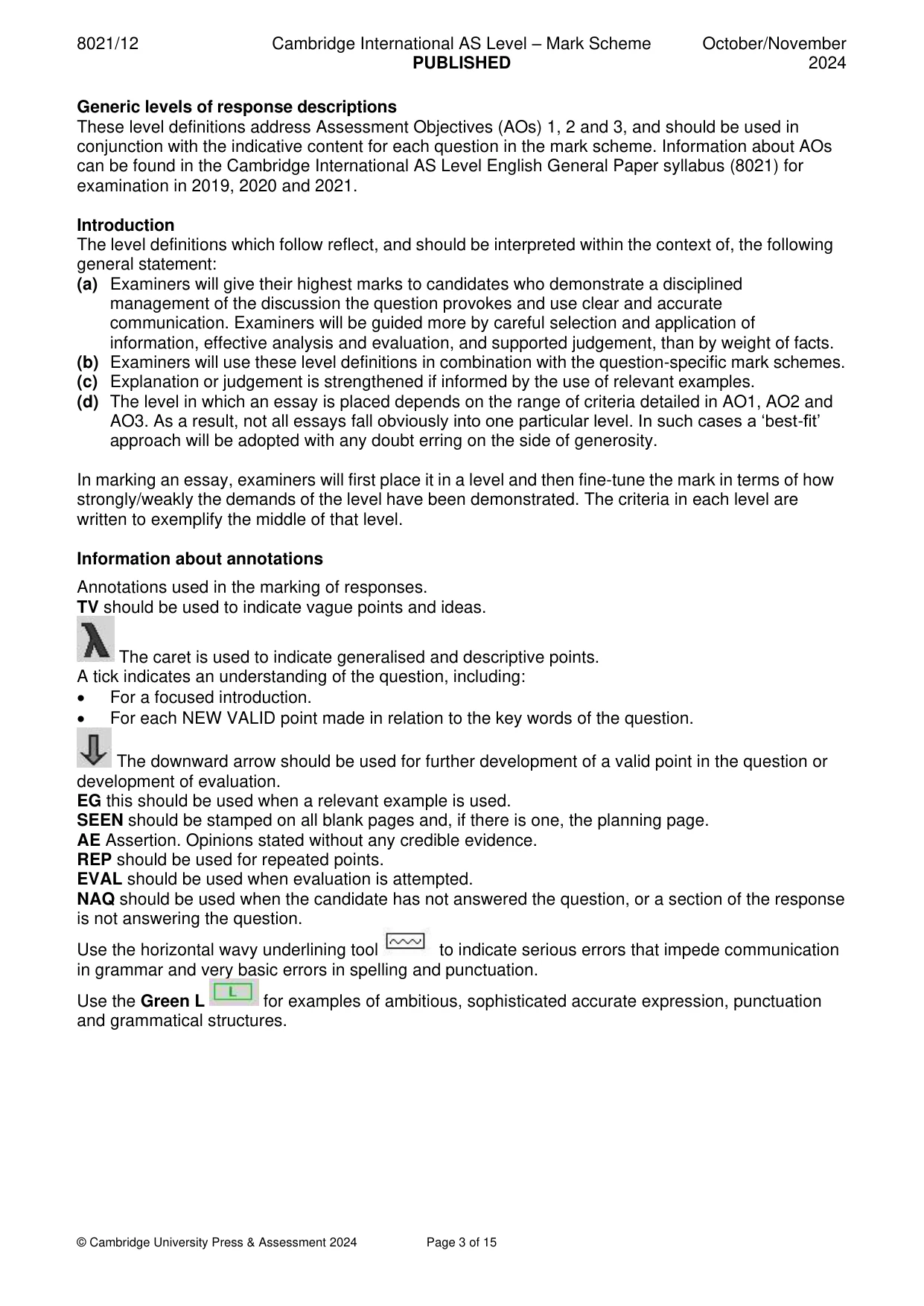
8021/12 Cambridge International AS Level – Mark Scheme PUBLISHED October/November 2024 © Cambridge University Press & Assessment 2024 Page 3 of 15 Generic levels of response descriptions These level definitions address Assessment Objectives (AOs) 1, 2 and 3, and should be used in conjunction with the indicative content for each question in the mark scheme. Information about AOs can be found in the Cambridge International AS Level English General Paper syllabus (8021) for examination in 2019, 2020 and 2021. Introduction The level definitions which follow reflect, and should be interpreted within the context of, the following general statement: (a) Examiners will give their highest marks to candidates who demonstrate a disciplined management of the discussion the question provokes and use clear and accurate communication. Examiners will be guided more by careful selection and application of information, effective analysis and evaluation, and supported judgement, than by weight of facts. (b) Examiners will use these level definitions in combination with the question-specific mark schemes. (c) Explanation or judgement is strengthened if informed by the use of relevant examples. (d) The level in which an essay is placed depends on the range of criteria detailed in AO1, AO2 and AO3. As a result, not all essays fall obviously into one particular level. In such cases a ‘best-fit’ approach will be adopted with any doubt erring on the side of generosity. In marking an essay, examiners will first place it in a level and then fine-tune the mark in terms of how strongly/weakly the demands of the level have been demonstrated. The criteria in each level are written to exemplify the middle of that level. Information about annotations Annotations used in the marking of responses. TV should be used to indicate vague points and ideas. The caret is used to indicate generalised and descriptive points. A tick indicates an understanding of the question, including: • For a focused introduction. • For each NEW VALID point made in relation to the key words of the question. The downward arrow should be used for further development of a valid point in the question or development of evaluation. EG this should be used when a relevant example is used. SEEN should be stamped on all blank pages and, if there is one, the planning page. AE Assertion. Opinions stated without any credible evidence. REP should be used for repeated points. EVAL should be used when evaluation is attempted. NAQ should be used when the candidate has not answered the question, or a section of the response is not answering the question. Use the horizontal wavy underlining tool to indicate serious errors that impede communication in grammar and very basic errors in spelling and punctuation. Use the Green L for examples of ambitious, sophisticated accurate expression, punctuation and grammatical structures.
Mark scheme, page 4
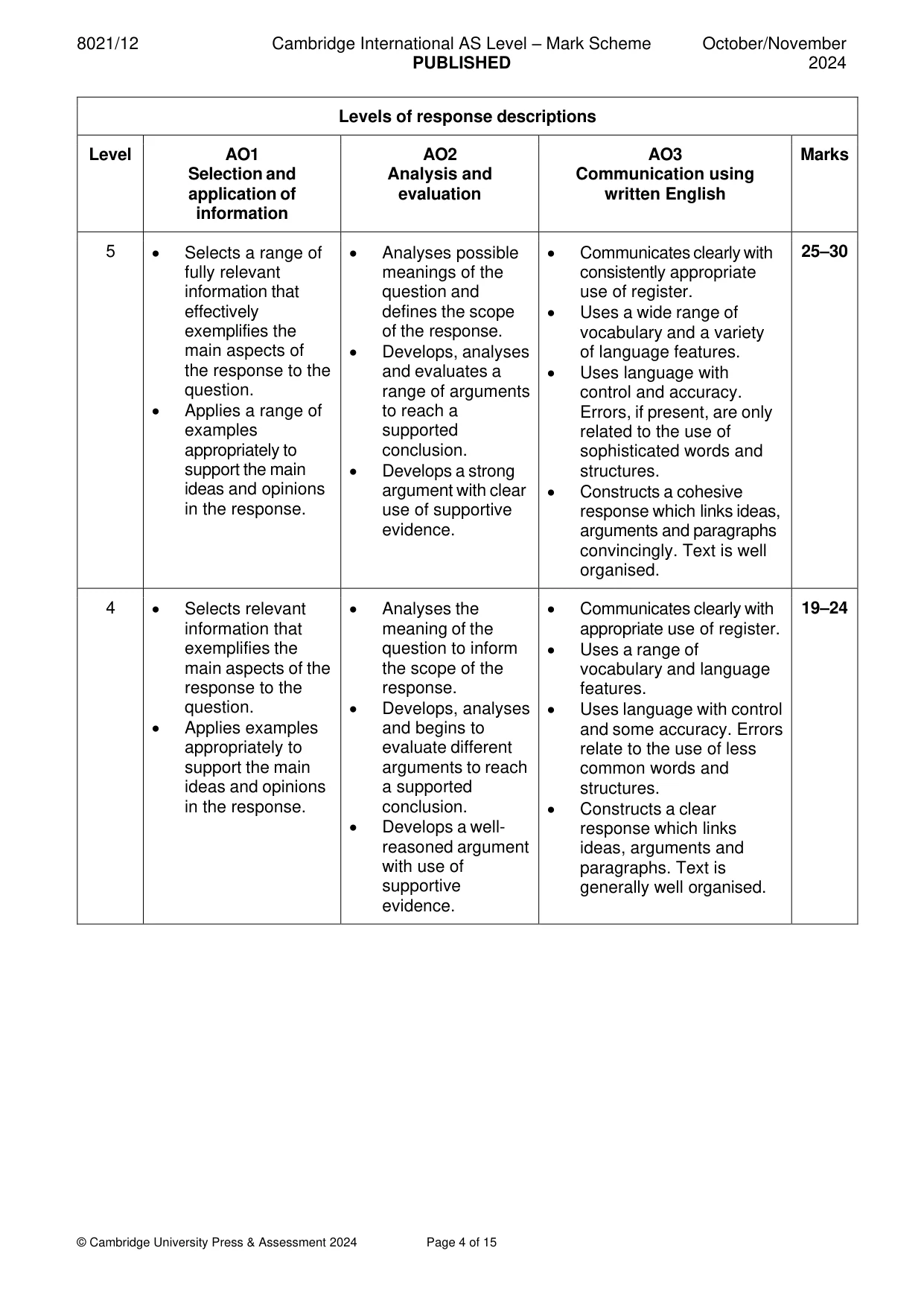
8021/12 Cambridge International AS Level – Mark Scheme PUBLISHED October/November 2024 © Cambridge University Press & Assessment 2024 Page 4 of 15 Levels of response descriptions Level AO1 Selection and application of information AO2 Analysis and evaluation AO3 Communication using written English Marks 5 • Selects a range of fully relevant information that effectively exemplifies the main aspects of the response to the question. • Applies a range of examples appropriately to support the main ideas and opinions in the response. • Analyses possible meanings of the question and defines the scope of the response. • Develops, analyses and evaluates a range of arguments to reach a supported conclusion. • Develops a strong argument with clear use of supportive evidence. • Communicates clearly with consistently appropriate use of register. • Uses a wide range of vocabulary and a variety of language features. • Uses language with control and accuracy. Errors, if present, are only related to the use of sophisticated words and structures. • Constructs a cohesive response which links ideas, arguments and paragraphs convincingly. Text is well organised. 25–30 4 • Selects relevant information that exemplifies the main aspects of the response to the question. • Applies examples appropriately to support the main ideas and opinions in the response. • Analyses the meaning of the question to inform the scope of the response. • Develops, analyses and begins to evaluate different arguments to reach a supported conclusion. • Develops a well- reasoned argument with use of supportive evidence. • Communicates clearly with appropriate use of register. • Uses a range of vocabulary and language features. • Uses language with control and some accuracy. Errors relate to the use of less common words and structures. • Constructs a clear response which links ideas, arguments and paragraphs. Text is generally well organised. 19–24
Mark scheme, page 5
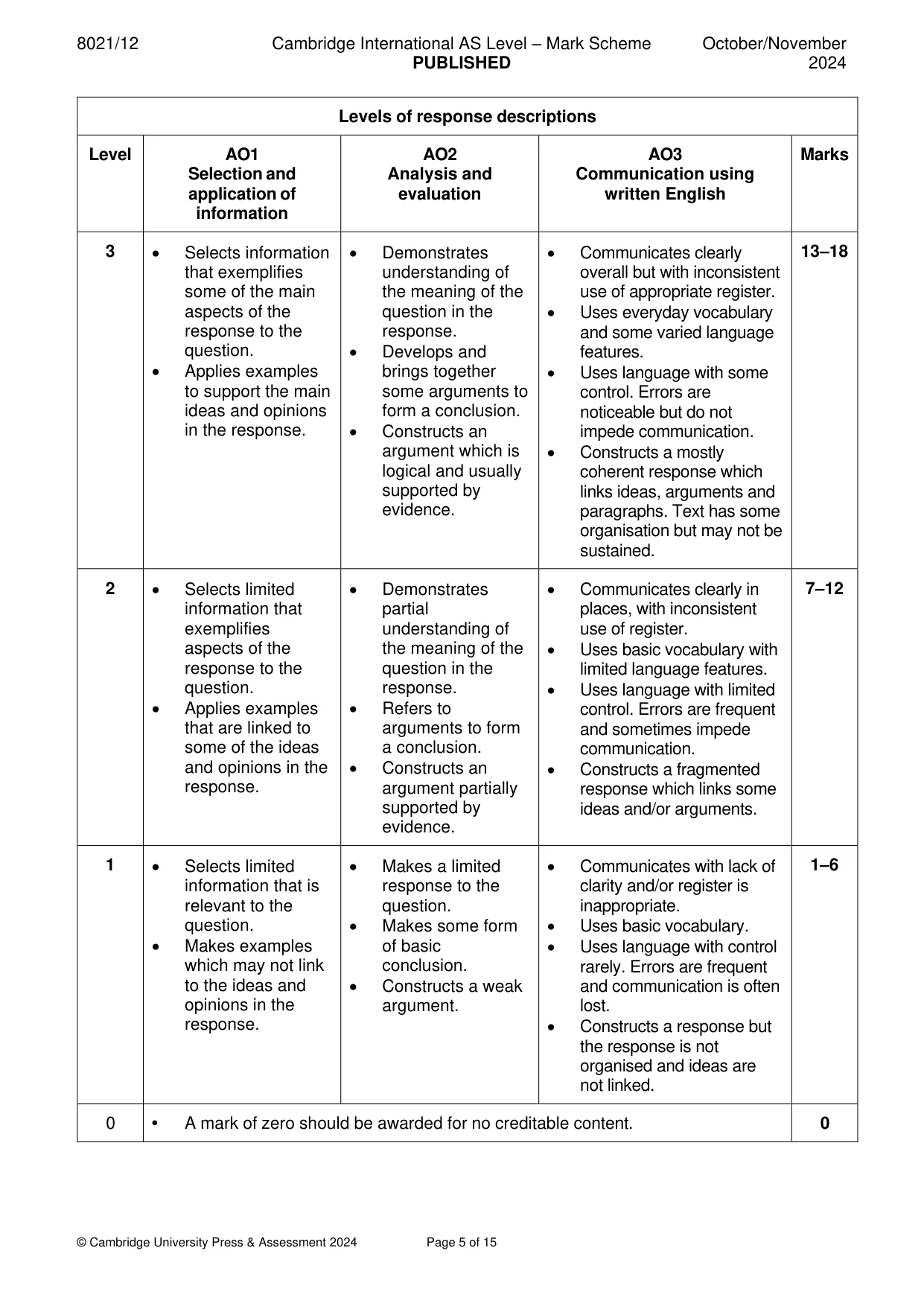
8021/12 Cambridge International AS Level – Mark Scheme PUBLISHED October/November 2024 © Cambridge University Press & Assessment 2024 Page 5 of 15 Levels of response descriptions Level AO1 Selection and application of information AO2 Analysis and evaluation AO3 Communication using written English Marks 3 • Selects information that exemplifies some of the main aspects of the response to the question. • Applies examples to support the main ideas and opinions in the response. • Demonstrates understanding of the meaning of the question in the response. • Develops and brings together some arguments to form a conclusion. • Constructs an argument which is logical and usually supported by evidence. • Communicates clearly overall but with inconsistent use of appropriate register. • Uses everyday vocabulary and some varied language features. • Uses language with some control. Errors are noticeable but do not impede communication. • Constructs a mostly coherent response which links ideas, arguments and paragraphs. Text has some organisation but may not be sustained. 13–18 2 • Selects limited information that exemplifies aspects of the response to the question. • Applies examples that are linked to some of the ideas and opinions in the response. • Demonstrates partial understanding of the meaning of the question in the response. • Refers to arguments to form a conclusion. • Constructs an argument partially supported by evidence. • Communicates clearly in places, with inconsistent use of register. • Uses basic vocabulary with limited language features. • Uses language with limited control. Errors are frequent and sometimes impede communication. • Constructs a fragmented response which links some ideas and/or arguments. 7–12 1 • Selects limited information that is relevant to the question. • Makes examples which may not link to the ideas and opinions in the response. • Makes a limited response to the question. • Makes some form of basic conclusion. • Constructs a weak argument. • Communicates with lack of clarity and/or register is inappropriate. • Uses basic vocabulary. • Uses language with control rarely. Errors are frequent and communication is often lost. • Constructs a response but the response is not organised and ideas are not linked. 1–6 0 • A mark of zero should be awarded for no creditable content. 0
Mark scheme, page 6
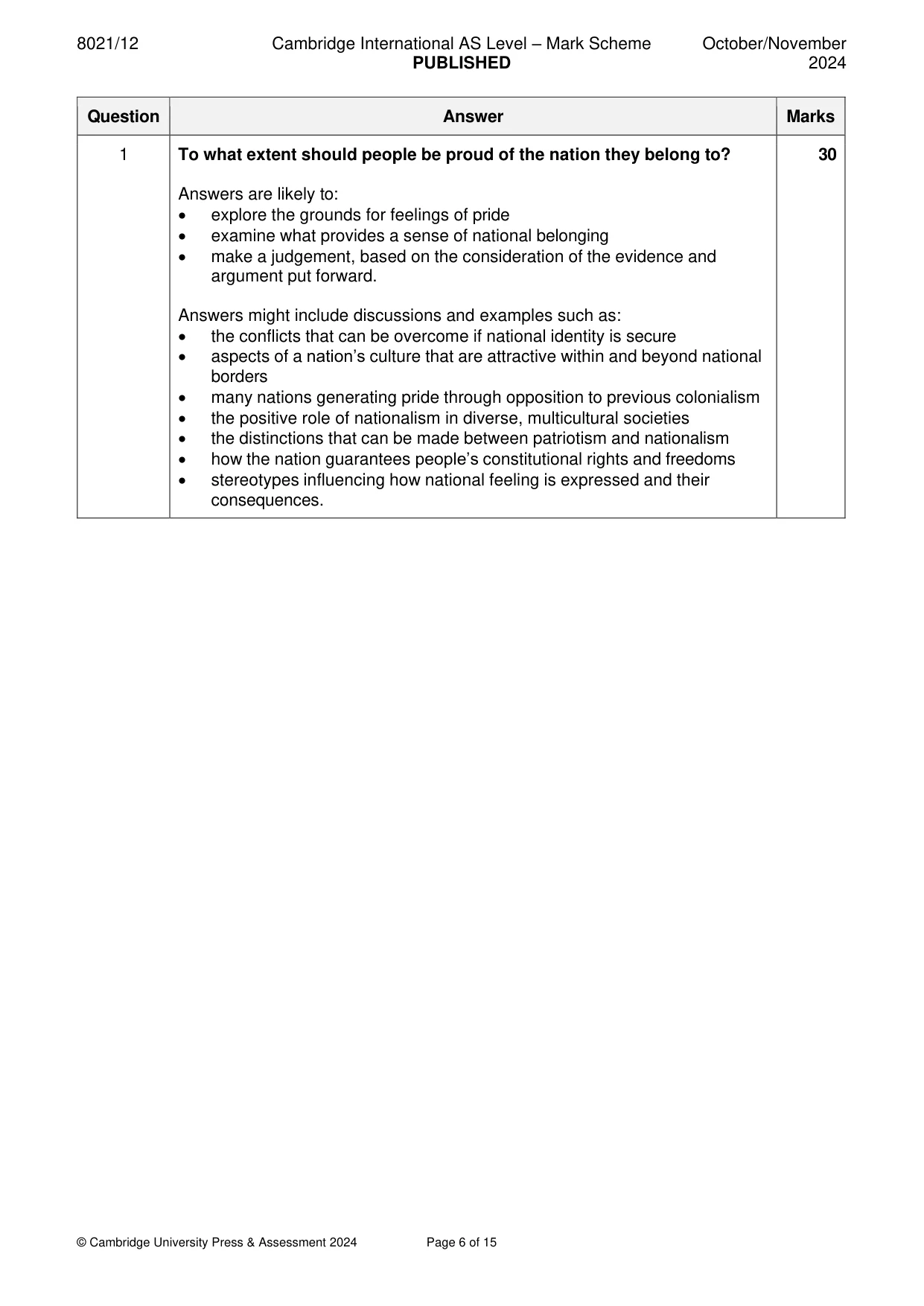
8021/12 Cambridge International AS Level – Mark Scheme PUBLISHED October/November 2024 © Cambridge University Press & Assessment 2024 Page 6 of 15 Question Answer Marks 1 To what extent should people be proud of the nation they belong to? Answers are likely to: • explore the grounds for feelings of pride • examine what provides a sense of national belonging • make a judgement, based on the consideration of the evidence and argument put forward. Answers might include discussions and examples such as: • the conflicts that can be overcome if national identity is secure • aspects of a nation’s culture that are attractive within and beyond national borders • many nations generating pride through opposition to previous colonialism • the positive role of nationalism in diverse, multicultural societies • the distinctions that can be made between patriotism and nationalism • how the nation guarantees people’s constitutional rights and freedoms • stereotypes influencing how national feeling is expressed and their consequences. 30
Mark scheme, page 7
8021/12 Cambridge International AS Level – Mark Scheme PUBLISHED October/November 2024 © Cambridge University Press & Assessment 2024 Page 7 of 15 Question Answer Marks 2 Mathematics has more importance in the classroom than in the outside world. Discuss. Answers are likely to: • consider the importance and influence of mathematics in the school curriculum • examine the role of mathematics outside of the classroom • make a judgement, based on the consideration of the evidence and argument put forward. Answers might include discussions and examples such as: • mathematical activities are more engaging within a classroom setting • mathematical principles and skills enhancing understanding of other curriculum areas • its importance as a core subject and educational qualification • the acquisition of problem-solving skills being enhanced by mathematics • mathematics is so embedded in people’s lives that its concepts and principles are not evident or visible • some occupations or professions that do not require higher levels of mathematics that were taught in school • mathematical concepts transmitted to us in popular entertainment • occupations where mathematical understanding is used and enhanced in the workplace • attitudes and beliefs being shaped by statistics, graphs and charts. 30
Mark scheme, page 8
8021/12 Cambridge International AS Level – Mark Scheme PUBLISHED October/November 2024 © Cambridge University Press & Assessment 2024 Page 8 of 15 Question Answer Marks 3 To what extent is animal welfare everyone’s responsibility? Answers are likely to: • discuss what is meant by the welfare of animals, wild and domestic • consider the positive and negative consequences of animal welfare • make a judgement, based on the consideration of the evidence and argument put forward. Answers might include discussions and examples such as: • organisations promoting more awareness of the solutions to the abuse and mistreatment of animals • closer monitoring of the breeding of animals leading to safer and plentiful food supplies • educating pet owners about animal care giving them the ability to properly look after their animals • considering the role of zoos and wildlife parks in preserving species and securing areas with no access for hunters • the impact of banning testing on animals resulting in the loss of human lives unless this is regulated • the growing support that animals should be afforded the same rights as humans • the impact that giving animals rights might have on global food resources and the need for changing eating habits • cultural and religious traditions having an impact on animals’ welfare. 30
Mark scheme, page 9
8021/12 Cambridge International AS Level – Mark Scheme PUBLISHED October/November 2024 © Cambridge University Press & Assessment 2024 Page 9 of 15 Question Answer Marks 4 Evaluate how important it is for young people to spend more time with their families. Answers are likely to: • discuss the potential issues if people don’t spend enough time with their families • consider the possible advantages of spending more time with family • make a judgement, based on the consideration of the evidence and argument put forward. Answers might include discussions and examples such as: • not spending much quality time together having a negative impact on our relationships • young people can learn about their family traditions, values and experiences • the importance of the family unit in teaching young people personal discipline and social rules • spending time with family being important for young people’s mental health • new technology offering opportunities to foster relationships in alternative ways • friends and peers are better placed to offer support and advice • distractions of various kinds damaging the quality time we could spend with family • some people not having positive relationships with their family. 30
Mark scheme, page 10
8021/12 Cambridge International AS Level – Mark Scheme PUBLISHED October/November 2024 © Cambridge University Press & Assessment 2024 Page 10 of 15 Question Answer Marks 5 Assess whether the novel or poetry is more effective in expressing how we experience life. Answers are likely to: • examine and compare the forms of poetry and the novel • consider which form is more successful in expressing our experience of life • make a judgement, based on the consideration of the evidence and argument put forward. Answers might include examples of novels and poems and contain discussions and examples such as: • the length of a novel allowing a novelist to deal with multiple subjects and issues • novels making full use of multifaceted characterisation and a complex narrative • the reader closely identifying with a character and become involved with the narrative • genres such as crime, fantasy and science fiction bearing less relation to most readers’ lives • how poetry encourages the reader to engage with the thoughts and feelings of the poet in an intimate manner • poems being usually more concise or compressed, requiring the writer to choose their words with great care • poems having the chance to use different literary devices compared to novels • poetry can often unlock an empathetic response from those not used to reading extensively. 30
Mark scheme, page 11
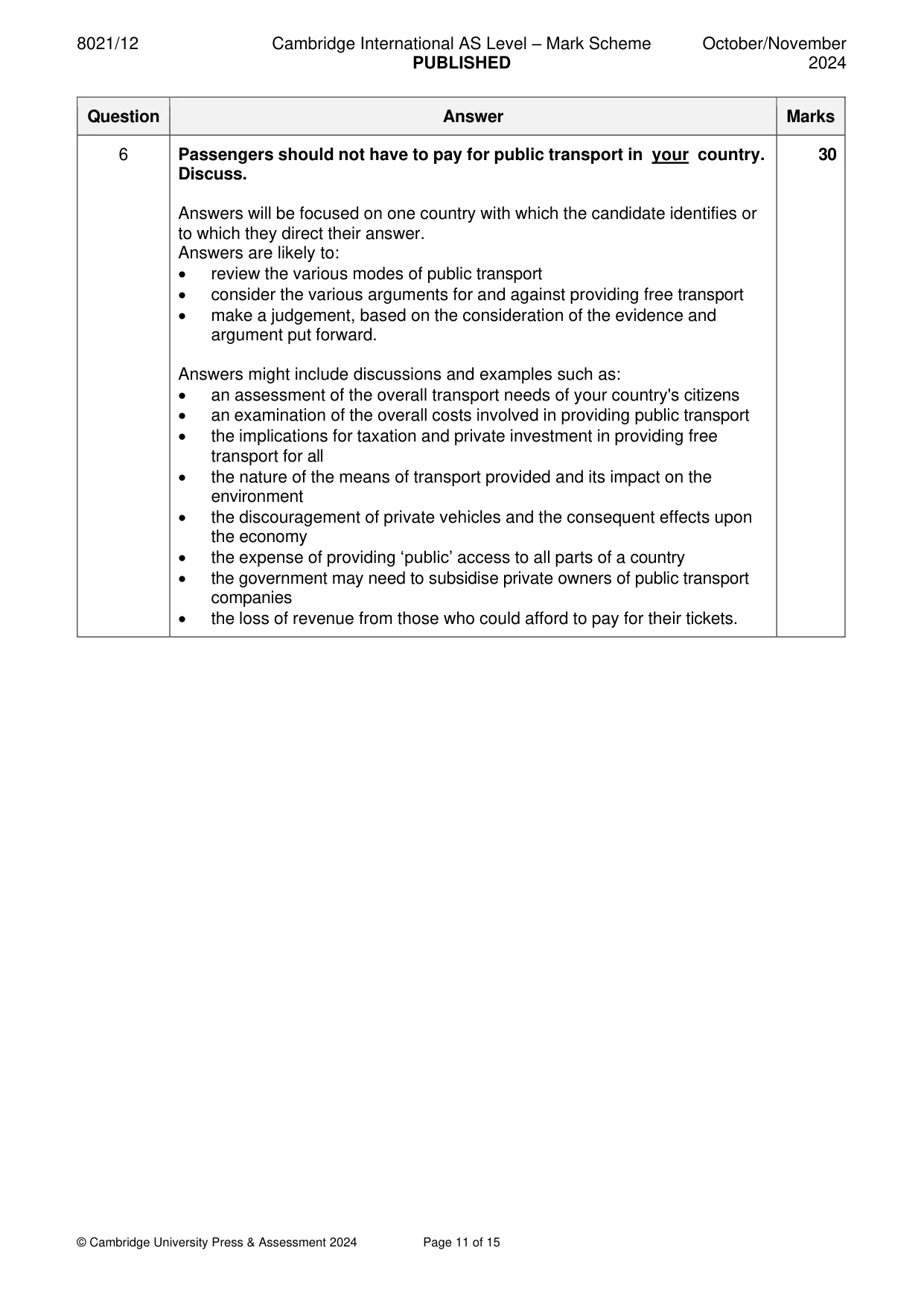
8021/12 Cambridge International AS Level – Mark Scheme PUBLISHED October/November 2024 © Cambridge University Press & Assessment 2024 Page 11 of 15 Question Answer Marks 6 Passengers should not have to pay for public transport in your country. Discuss. Answers will be focused on one country with which the candidate identifies or to which they direct their answer. Answers are likely to: • review the various modes of public transport • consider the various arguments for and against providing free transport • make a judgement, based on the consideration of the evidence and argument put forward. Answers might include discussions and examples such as: • an assessment of the overall transport needs of your country's citizens • an examination of the overall costs involved in providing public transport • the implications for taxation and private investment in providing free transport for all • the nature of the means of transport provided and its impact on the environment • the discouragement of private vehicles and the consequent effects upon the economy • the expense of providing ‘public’ access to all parts of a country • the government may need to subsidise private owners of public transport companies • the loss of revenue from those who could afford to pay for their tickets. 30
Mark scheme, page 12
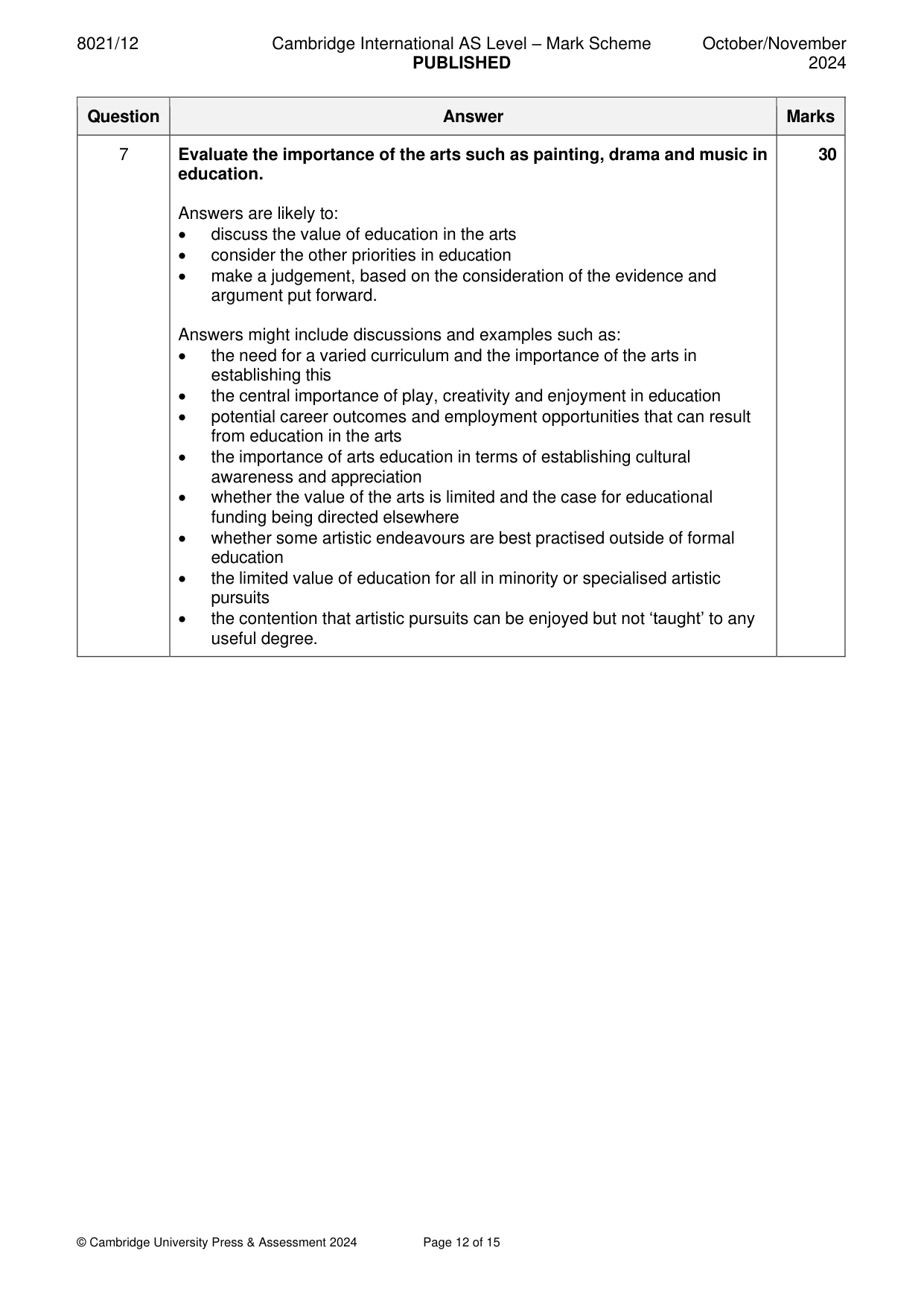
8021/12 Cambridge International AS Level – Mark Scheme PUBLISHED October/November 2024 © Cambridge University Press & Assessment 2024 Page 12 of 15 Question Answer Marks 7 Evaluate the importance of the arts such as painting, drama and music in education. Answers are likely to: • discuss the value of education in the arts • consider the other priorities in education • make a judgement, based on the consideration of the evidence and argument put forward. Answers might include discussions and examples such as: • the need for a varied curriculum and the importance of the arts in establishing this • the central importance of play, creativity and enjoyment in education • potential career outcomes and employment opportunities that can result from education in the arts • the importance of arts education in terms of establishing cultural awareness and appreciation • whether the value of the arts is limited and the case for educational funding being directed elsewhere • whether some artistic endeavours are best practised outside of formal education • the limited value of education for all in minority or specialised artistic pursuits • the contention that artistic pursuits can be enjoyed but not ‘taught’ to any useful degree. 30
Mark scheme, page 13
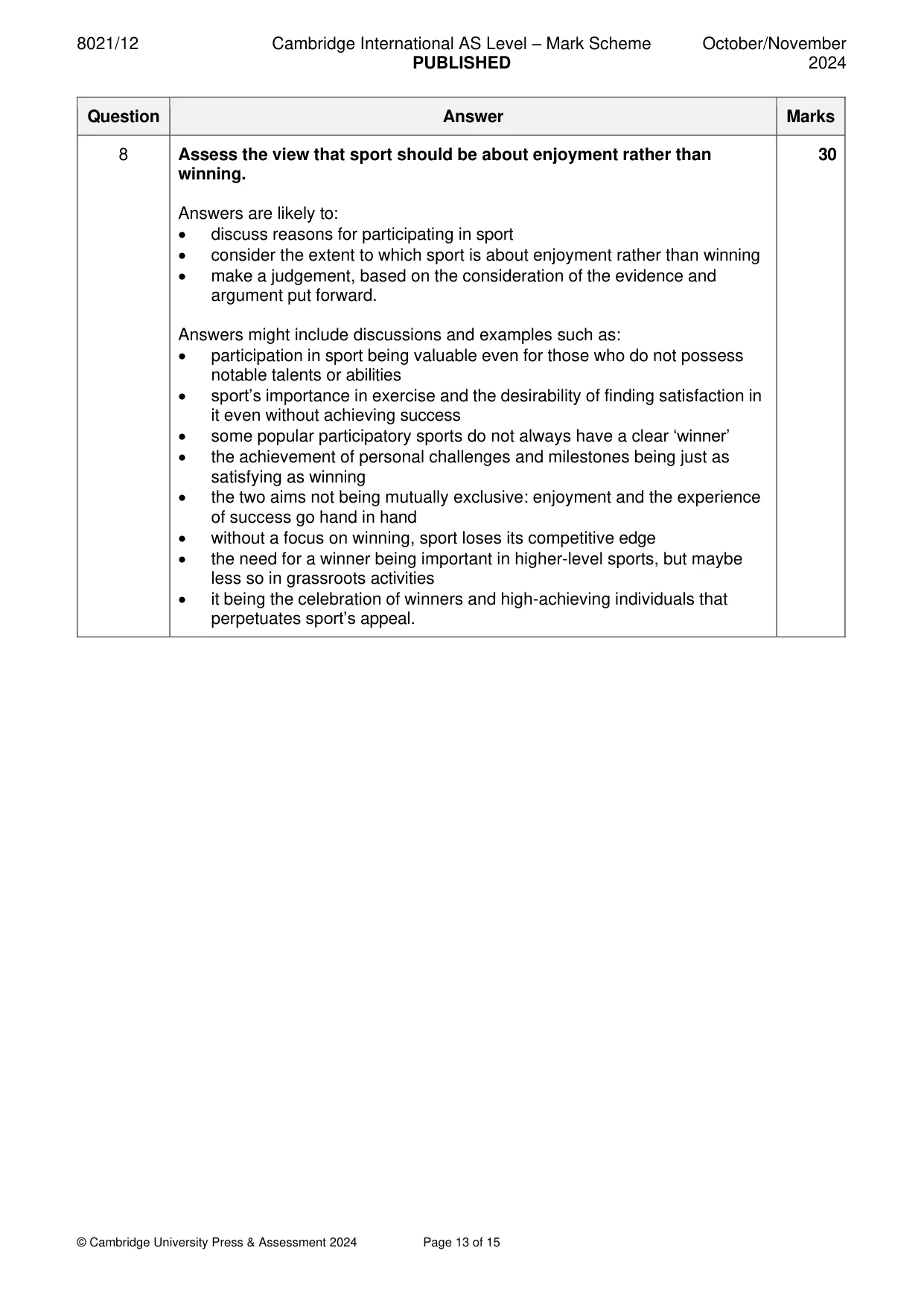
8021/12 Cambridge International AS Level – Mark Scheme PUBLISHED October/November 2024 © Cambridge University Press & Assessment 2024 Page 13 of 15 Question Answer Marks 8 Assess the view that sport should be about enjoyment rather than winning. Answers are likely to: • discuss reasons for participating in sport • consider the extent to which sport is about enjoyment rather than winning • make a judgement, based on the consideration of the evidence and argument put forward. Answers might include discussions and examples such as: • participation in sport being valuable even for those who do not possess notable talents or abilities • sport’s importance in exercise and the desirability of finding satisfaction in it even without achieving success • some popular participatory sports do not always have a clear ‘winner’ • the achievement of personal challenges and milestones being just as satisfying as winning • the two aims not being mutually exclusive: enjoyment and the experience of success go hand in hand • without a focus on winning, sport loses its competitive edge • the need for a winner being important in higher-level sports, but maybe less so in grassroots activities • it being the celebration of winners and high-achieving individuals that perpetuates sport’s appeal. 30
Mark scheme, page 14
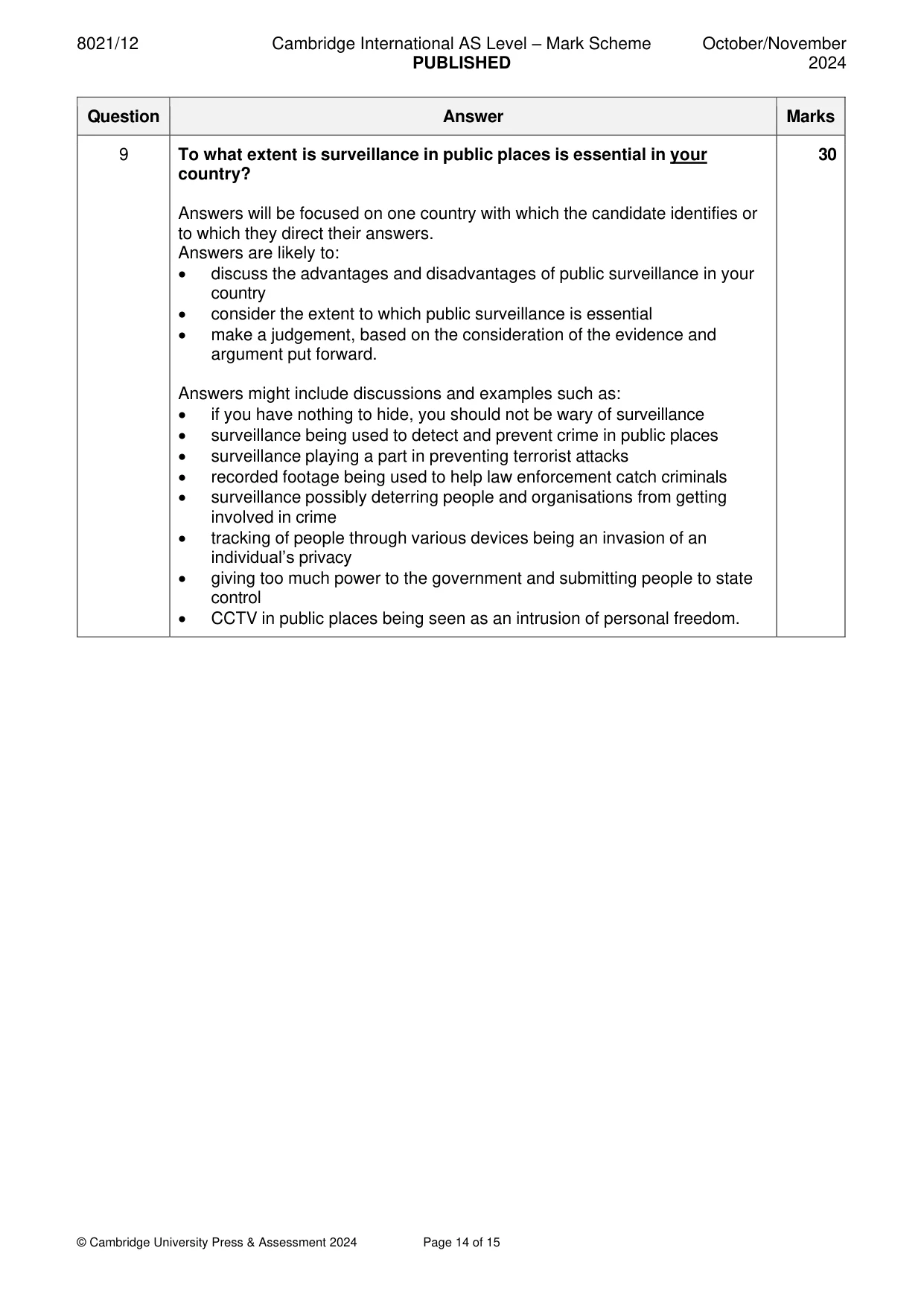
8021/12 Cambridge International AS Level – Mark Scheme PUBLISHED October/November 2024 © Cambridge University Press & Assessment 2024 Page 14 of 15 Question Answer Marks 9 To what extent is surveillance in public places is essential in your country? Answers will be focused on one country with which the candidate identifies or to which they direct their answers. Answers are likely to: • discuss the advantages and disadvantages of public surveillance in your country • consider the extent to which public surveillance is essential • make a judgement, based on the consideration of the evidence and argument put forward. Answers might include discussions and examples such as: • if you have nothing to hide, you should not be wary of surveillance • surveillance being used to detect and prevent crime in public places • surveillance playing a part in preventing terrorist attacks • recorded footage being used to help law enforcement catch criminals • surveillance possibly deterring people and organisations from getting involved in crime • tracking of people through various devices being an invasion of an individual’s privacy • giving too much power to the government and submitting people to state control • CCTV in public places being seen as an intrusion of personal freedom. 30
Mark scheme, page 15
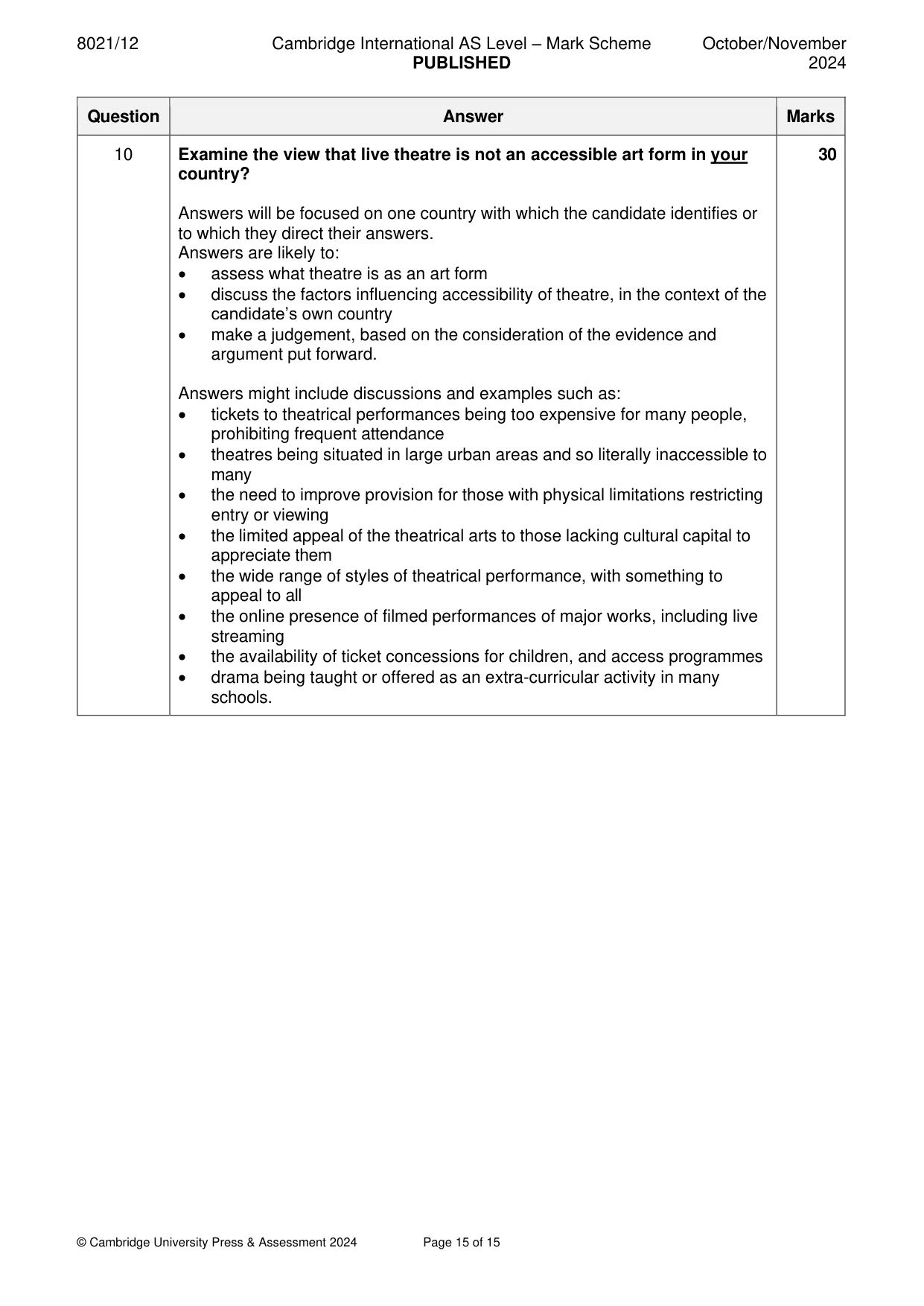
8021/12 Cambridge International AS Level – Mark Scheme PUBLISHED October/November 2024 © Cambridge University Press & Assessment 2024 Page 15 of 15 Question Answer Marks 10 Examine the view that live theatre is not an accessible art form in your country? Answers will be focused on one country with which the candidate identifies or to which they direct their answers. Answers are likely to: • assess what theatre is as an art form • discuss the factors influencing accessibility of theatre, in the context of the candidate’s own country • make a judgement, based on the consideration of the evidence and argument put forward. Answers might include discussions and examples such as: • tickets to theatrical performances being too expensive for many people, prohibiting frequent attendance • theatres being situated in large urban areas and so literally inaccessible to many • the need to improve provision for those with physical limitations restricting entry or viewing • the limited appeal of the theatrical arts to those lacking cultural capital to appreciate them • the wide range of styles of theatrical performance, with something to appeal to all • the online presence of filmed performances of major works, including live streaming • the availability of ticket concessions for children, and access programmes • drama being taught or offered as an extra-curricular activity in many schools. 30
What you needed in this session
Cambridge’s own grade thresholds for 2024 Oct/Nov, Paper 1 · Variant 2. A higher threshold means an easier paper — the bar moves with how the cohort did.