Cambridge A Level English General Paper 8021 — 2025 Feb/March Paper 1 · Variant 2
8021/12/F/M/25 · 30 marks · 75 min
The question paper and its mark scheme, free to read here and free to download. This is Cambridge’s own paper, exactly as it was sat.
Question paper4 pages


Mark scheme18 pages
Answers below. Sit the paper first if you are practising.
Paper as text
Question paper, page 1
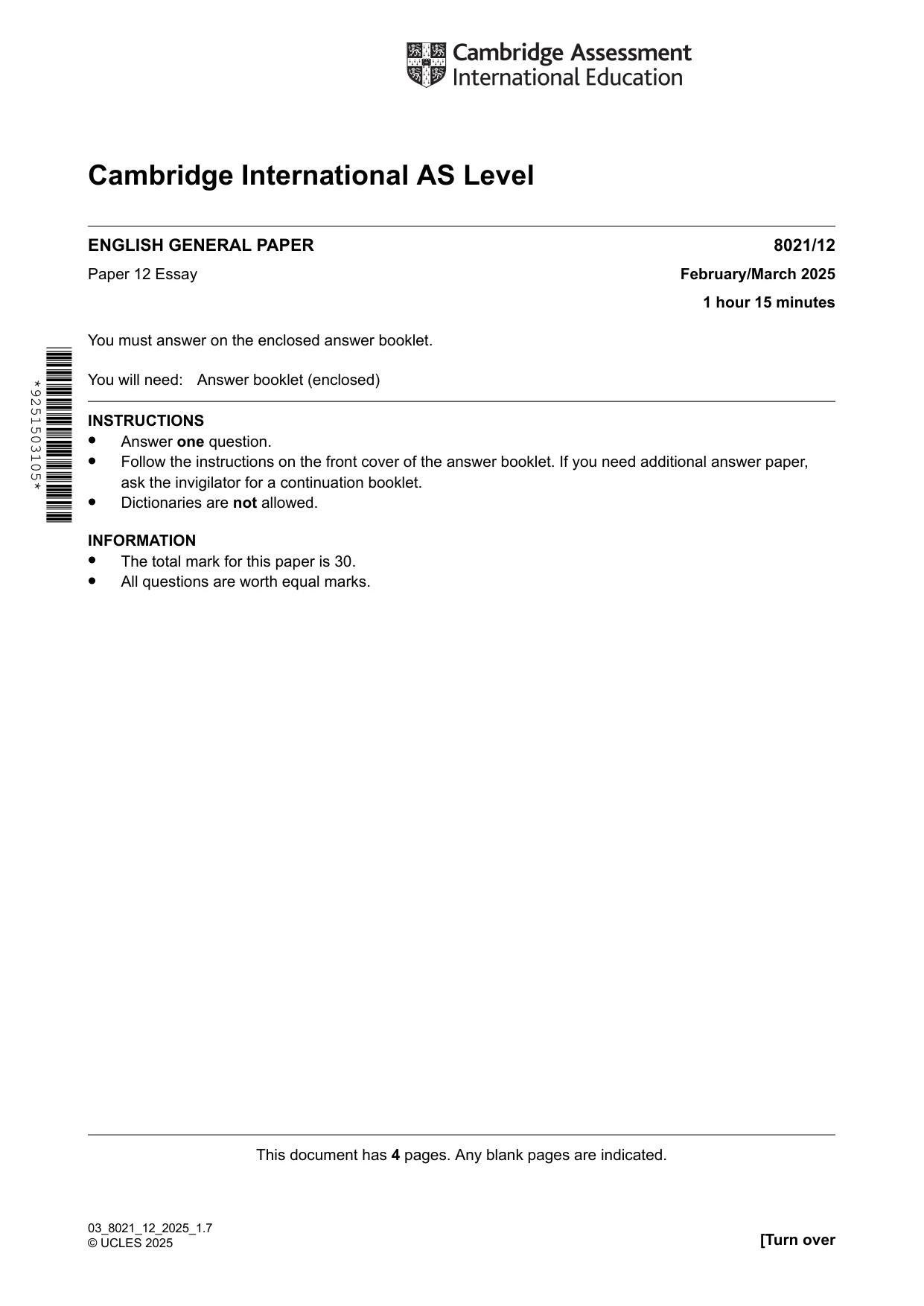
Cambridge International AS Level 8021/12 February/March 2025 1 hour 15 minutes ENGLISH GENERAL PAPER Paper 12 Essay You must answer on the enclosed answer booklet. You will need: Answer booklet (enclosed) INSTRUCTIONS • Answer one question. • Follow the instructions on the front cover of the answer booklet. If you need additional answer paper, ask the invigilator for a continuation booklet. • Dictionaries are not allowed. INFORMATION • The total mark for this paper is 30. • All questions are worth equal marks. This document has 4 pages. Any blank pages are indicated. [Turn over 03_8021_12_2025_1.7 © UCLES 2025 *9251503105*
Question paper, page 2
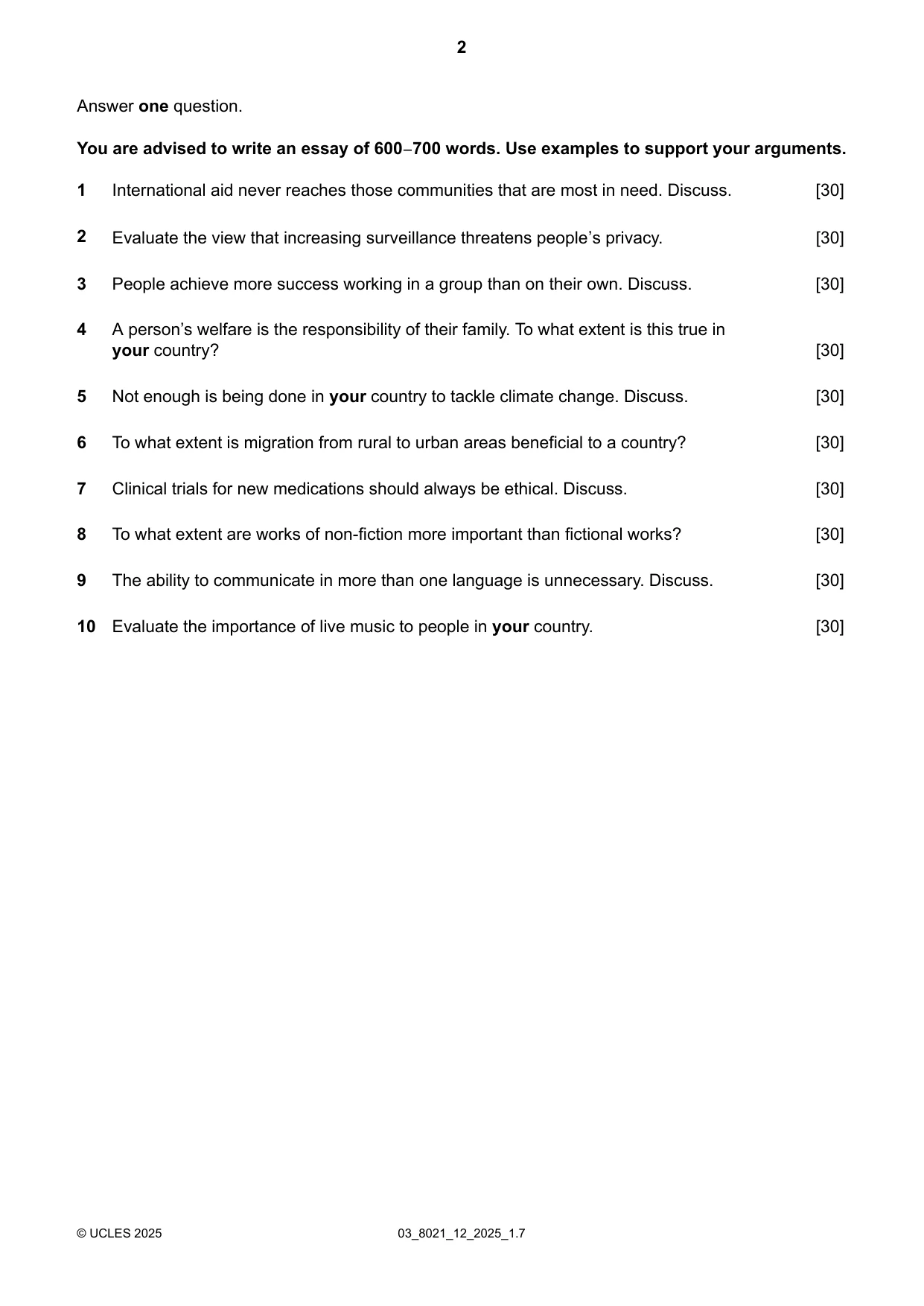
Answer one question. You are advised to write an essay of 600−700 words. Use examples to support your arguments. International aid never reaches those communities that are most in need. Discuss. [30] 1 Evaluate the view that increasing surveillance threatens people’s privacy. [30] 2 People achieve more success working in a group than on their own. Discuss. [30] 3 A person’s welfare is the responsibility of their family. To what extent is this true in your country? [30] 4 Not enough is being done in your country to tackle climate change. Discuss. [30] 5 To what extent is migration from rural to urban areas beneficial to a country? [30] 6 Clinical trials for new medications should always be ethical. Discuss. [30] 7 To what extent are works of non-fiction more important than fictional works? [30] 8 The ability to communicate in more than one language is unnecessary. Discuss. [30] 9 Evaluate the importance of live music to people in your country. [30] 10 03_8021_12_2025_1.7 © UCLES 2025 2
Question paper, page 3
BLANK PAGE 03_8021_12_2025_1.7 © UCLES 2025 3
Question paper, page 4
BLANK PAGE Permission to reproduce items where third-party owned material protected by copyright is included has been sought and cleared where possible. Every reasonable effort has been made by the publisher (UCLES) to trace copyright holders, but if any items requiring clearance have unwittingly been included, the publisher will be pleased to make amends at the earliest possible opportunity. To avoid the issue of disclosure of answer-related information to candidates, all copyright acknowledgements are reproduced online in the Cambridge Assessment International Education Copyright Acknowledgements Booklet. This is produced for each series of examinations and is freely available to download at www.cambridgeinternational.org after the live examination series. Cambridge Assessment International Education is part of Cambridge Assessment. Cambridge Assessment is the brand name of the University of Cambridge Local Examinations Syndicate (UCLES), which is a department of the University of Cambridge. 03_8021_12_2025_1.7 © UCLES 2025 4
Mark scheme, page 1
This document consists of 18 printed pages. © Cambridge University Press & Assessment 2025 [Turn over Cambridge International AS Level ENGLISH GENERAL PAPER 8021/12 Paper 1 Essay February/March 2025 MARK SCHEME Maximum Mark: 30 Published This mark scheme is published as an aid to teachers and candidates, to indicate the requirements of the examination. It shows the basis on which Examiners were instructed to award marks. It does not indicate the details of the discussions that took place at an Examiners’ meeting before marking began, which would have considered the acceptability of alternative answers. Mark schemes should be read in conjunction with the question paper and the Principal Examiner Report for Teachers. Cambridge International will not enter into discussions about these mark schemes. Cambridge International is publishing the mark schemes for the February/March 2025 series for most Cambridge IGCSE, Cambridge International A and AS Level components, and some Cambridge O Level components.
Mark scheme, page 2
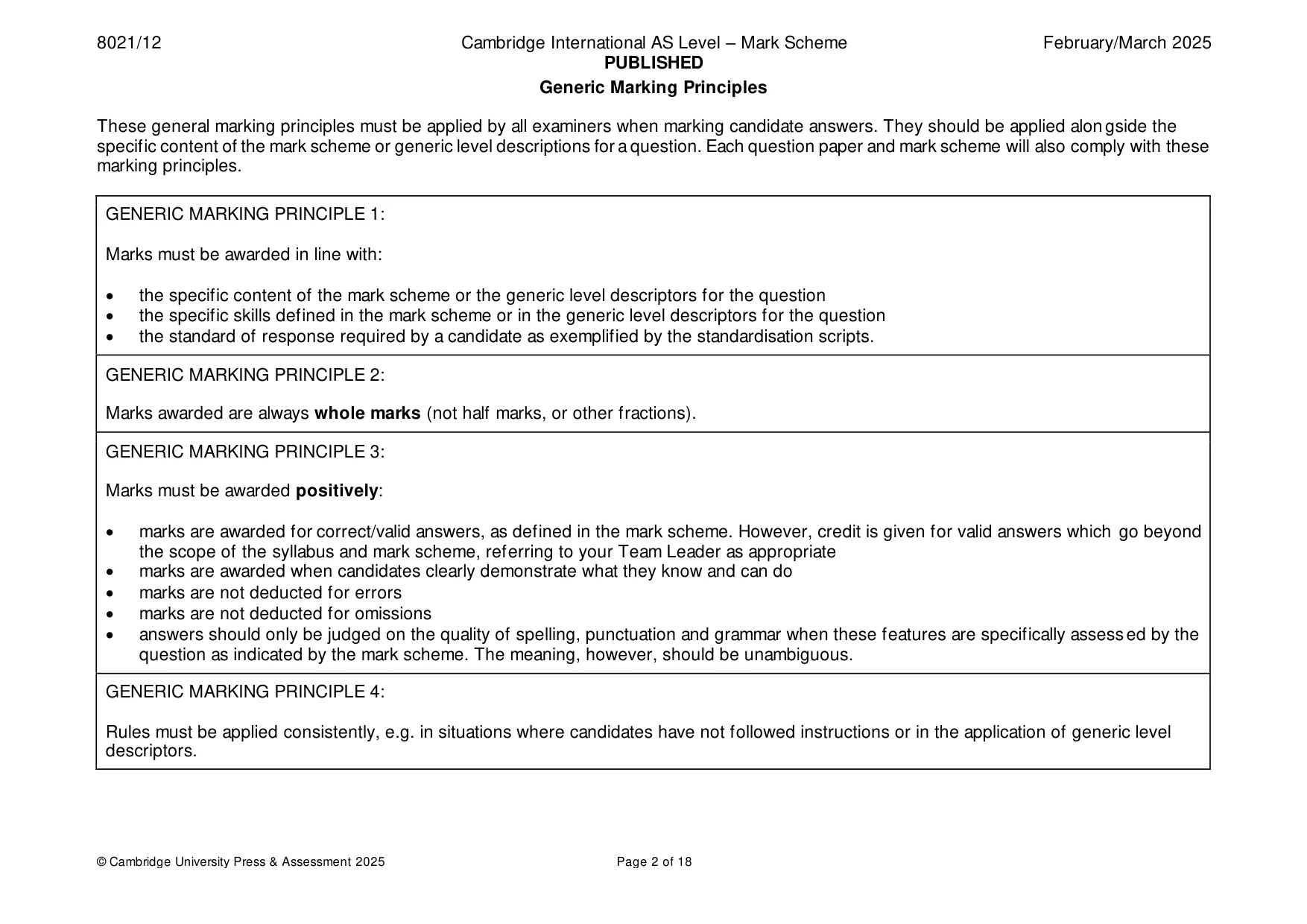
8021/12 Cambridge International AS Level – Mark Scheme PUBLISHED February/March 2025 © Cambridge University Press & Assessment 2025 Page 2 of 18 Generic Marking Principles These general marking principles must be applied by all examiners when marking candidate answers. They should be applied alon gside the specific content of the mark scheme or generic level descriptions for a question. Each question paper and mark scheme will also comply with these marking principles. GENERIC MARKING PRINCIPLE 1: Marks must be awarded in line with: • the specific content of the mark scheme or the generic level descriptors for the question • the specific skills defined in the mark scheme or in the generic level descriptors for the question • the standard of response required by a candidate as exemplified by the standardisation scripts. GENERIC MARKING PRINCIPLE 2: Marks awarded are always whole marks (not half marks, or other fractions). GENERIC MARKING PRINCIPLE 3: Marks must be awarded positively: • marks are awarded for correct/valid answers, as defined in the mark scheme. However, credit is given for valid answers which go beyond the scope of the syllabus and mark scheme, referring to your Team Leader as appropriate • marks are awarded when candidates clearly demonstrate what they know and can do • marks are not deducted for errors • marks are not deducted for omissions • answers should only be judged on the quality of spelling, punctuation and grammar when these features are specifically assessed by the question as indicated by the mark scheme. The meaning, however, should be unambiguous. GENERIC MARKING PRINCIPLE 4: Rules must be applied consistently, e.g. in situations where candidates have not followed instructions or in the application of generic level descriptors.
Mark scheme, page 3
8021/12 Cambridge International AS Level – Mark Scheme PUBLISHED February/March 2025 © Cambridge University Press & Assessment 2025 Page 3 of 18 GENERIC MARKING PRINCIPLE 5: Marks should be awarded using the full range of marks defined in the mark scheme for the question (however; the use of the full mark range may be limited according to the quality of the candidate responses seen). GENERIC MARKING PRINCIPLE 6: Marks awarded are based solely on the requirements as defined in the mark scheme. Marks should not be awarded with grade thresholds or grade descriptors in mind.
Mark scheme, page 4
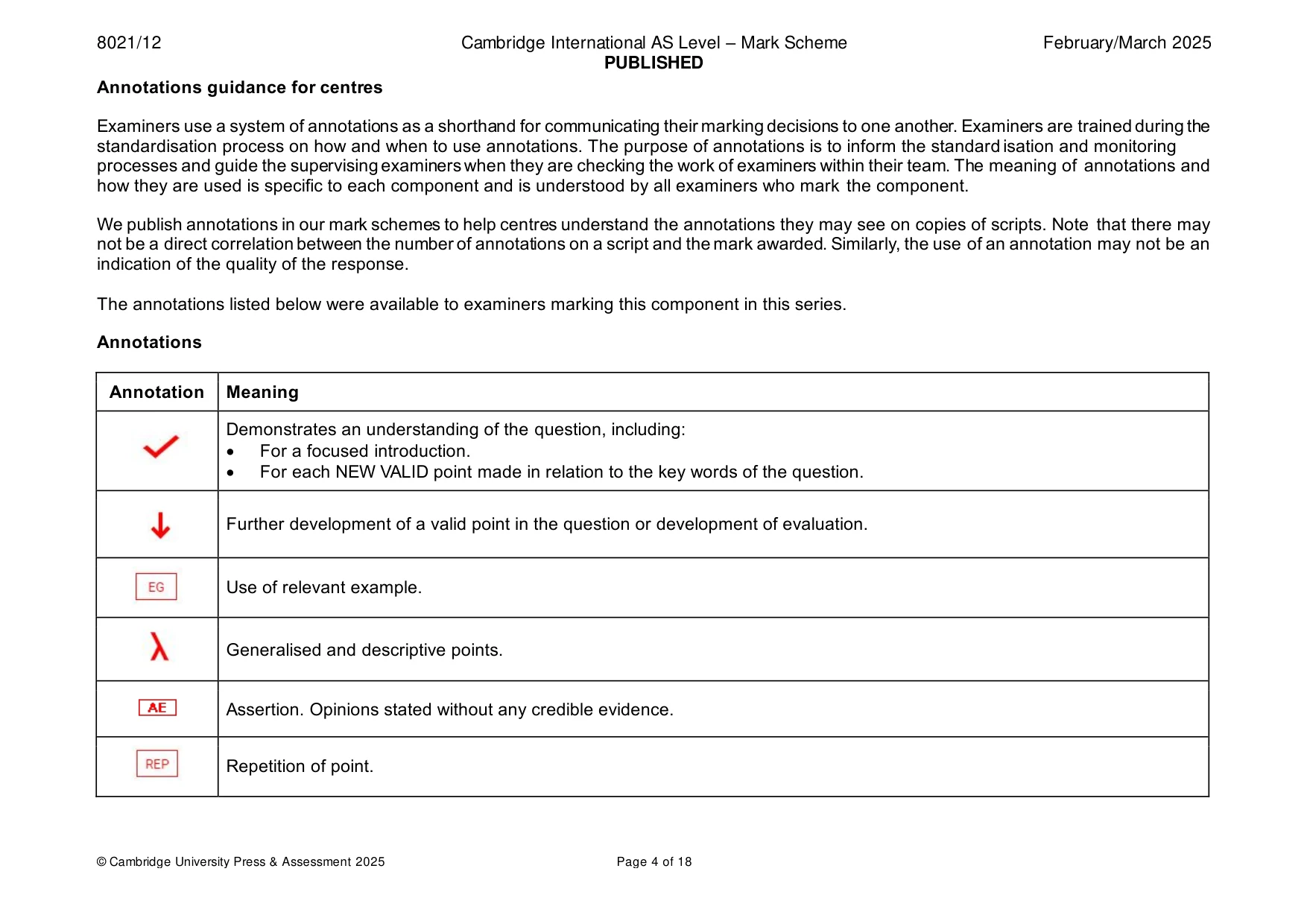
8021/12 Cambridge International AS Level – Mark Scheme PUBLISHED February/March 2025 © Cambridge University Press & Assessment 2025 Page 4 of 18 Annotations guidance for centres Examiners use a system of annotations as a shorthand for communicating their marking decisions to one another. Examiners are trained during the standardisation process on how and when to use annotations. The purpose of annotations is to inform the standard isation and monitoring processes and guide the supervising examiners when they are checking the work of examiners within their team. The meaning of annotations and how they are used is specific to each component and is understood by all examiners who mark the component. We publish annotations in our mark schemes to help centres understand the annotations they may see on copies of scripts. Note that there may not be a direct correlation between the number of annotations on a script and the mark awarded. Similarly, the use of an annotation may not be an indication of the quality of the response. The annotations listed below were available to examiners marking this component in this series. Annotations Annotation Meaning Demonstrates an understanding of the question, including: • For a focused introduction. • For each NEW VALID point made in relation to the key words of the question. Further development of a valid point in the question or development of evaluation. Use of relevant example. Generalised and descriptive points. Assertion. Opinions stated without any credible evidence. Repetition of point.
Mark scheme, page 5
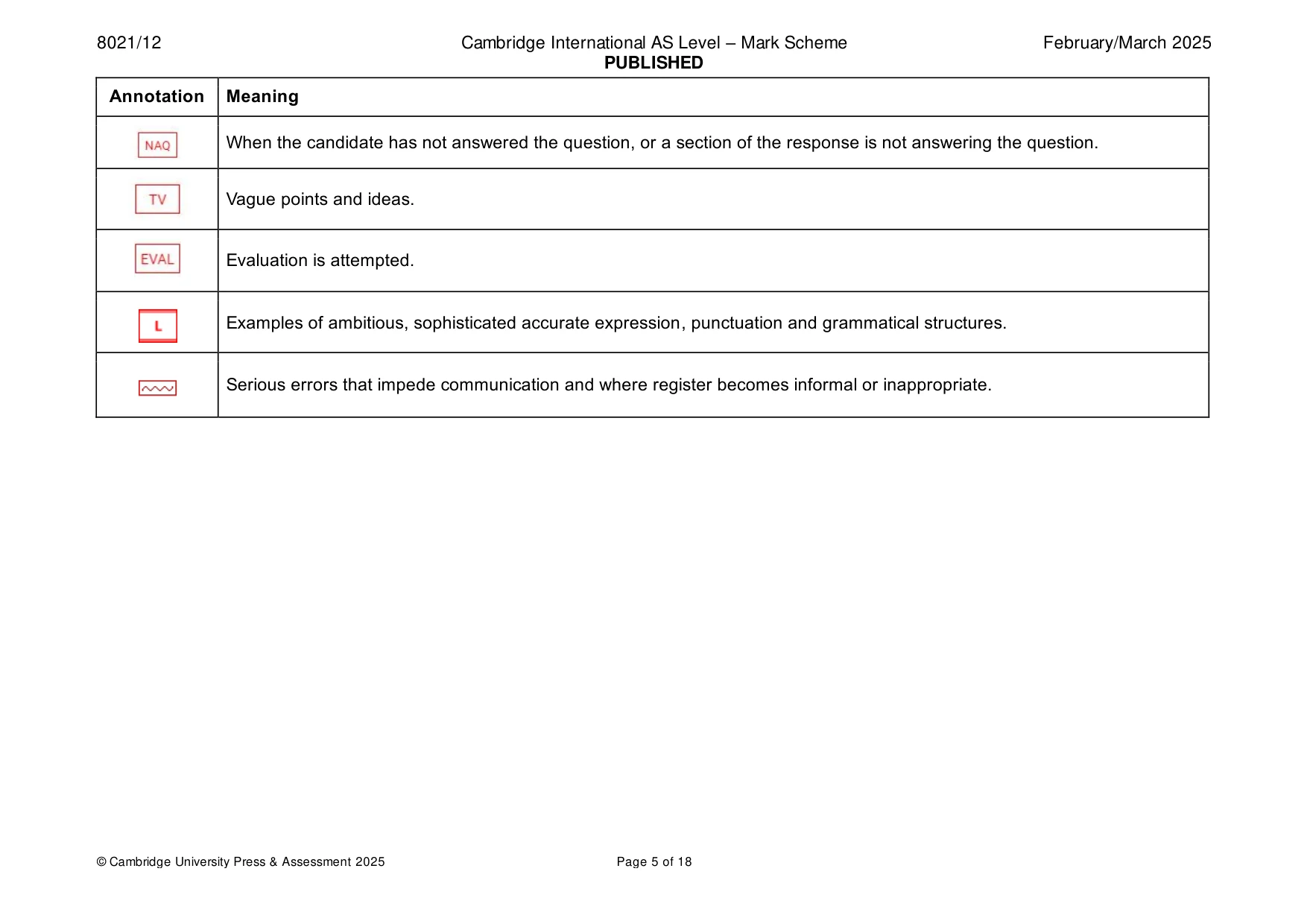
8021/12 Cambridge International AS Level – Mark Scheme PUBLISHED February/March 2025 © Cambridge University Press & Assessment 2025 Page 5 of 18 Annotation Meaning When the candidate has not answered the question, or a section of the response is not answering the question. Vague points and ideas. Evaluation is attempted. Examples of ambitious, sophisticated accurate expression, punctuation and grammatical structures. Serious errors that impede communication and where register becomes informal or inappropriate.
Mark scheme, page 6
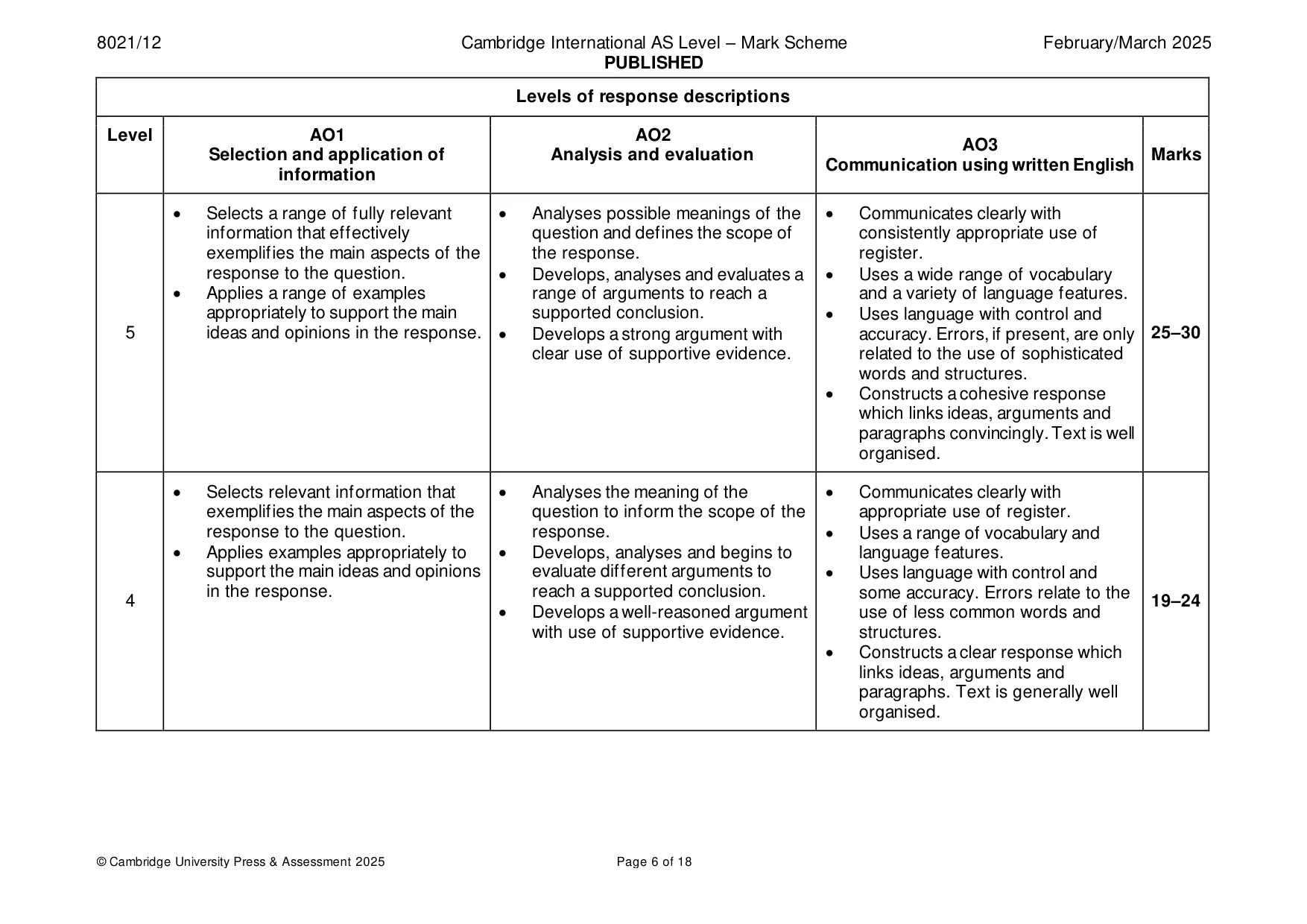
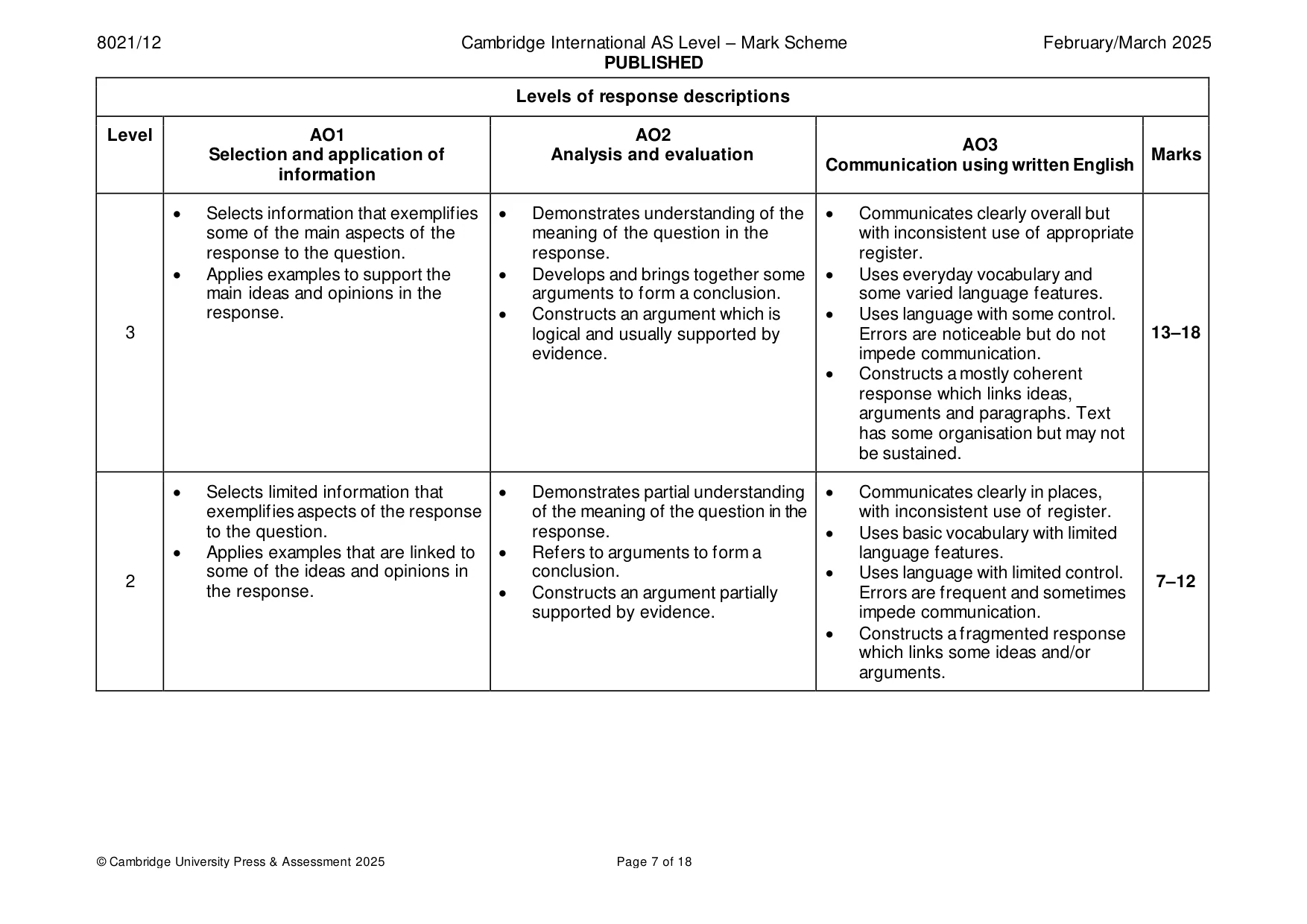
8021/12 Cambridge International AS Level – Mark Scheme PUBLISHED February/March 2025 © Cambridge University Press & Assessment 2025 Page 6 of 18 Levels of response descriptions Level AO1 Selection and application of information AO2 Analysis and evaluation AO3 Communication using written English Marks 5 • Selects a range of fully relevant information that effectively exemplifies the main aspects of the response to the question. • Applies a range of examples appropriately to support the main ideas and opinions in the response. • Analyses possible meanings of the question and defines the scope of the response. • Develops, analyses and evaluates a range of arguments to reach a supported conclusion. • Develops a strong argument with clear use of supportive evidence. • Communicates clearly with consistently appropriate use of register. • Uses a wide range of vocabulary and a variety of language features. • Uses language with control and accuracy. Errors, if present, are only related to the use of sophisticated words and structures. • Constructs a cohesive response which links ideas, arguments and paragraphs convincingly. Text is well organised. 25–30 4 • Selects relevant information that exemplifies the main aspects of the response to the question. • Applies examples appropriately to support the main ideas and opinions in the response. • Analyses the meaning of the question to inform the scope of the response. • Develops, analyses and begins to evaluate different arguments to reach a supported conclusion. • Develops a well-reasoned argument with use of supportive evidence. • Communicates clearly with appropriate use of register. • Uses a range of vocabulary and language features. • Uses language with control and some accuracy. Errors relate to the use of less common words and structures. • Constructs a clear response which links ideas, arguments and paragraphs. Text is generally well organised. 19–24
Mark scheme, page 7
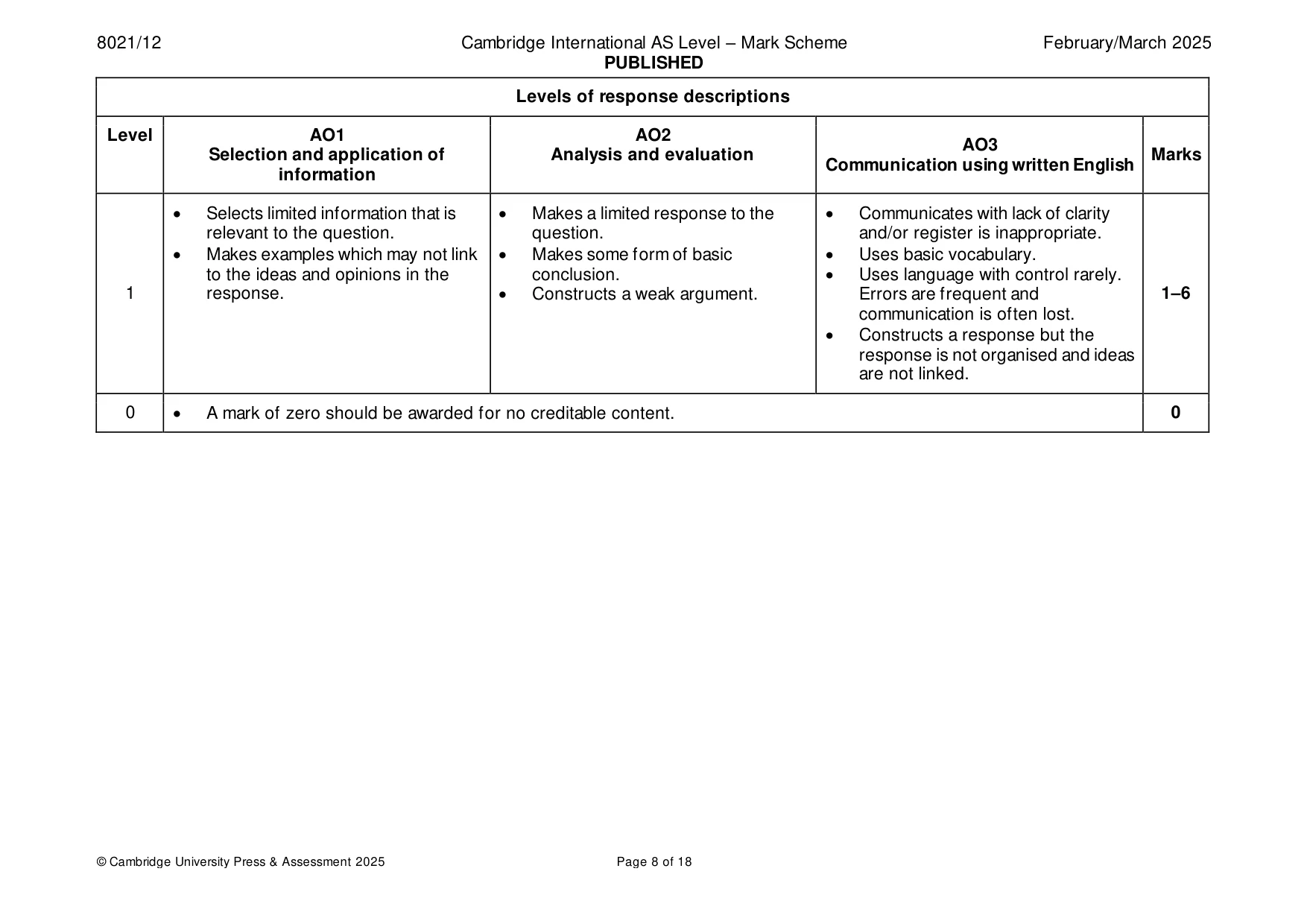
8021/12 Cambridge International AS Level – Mark Scheme PUBLISHED February/March 2025 © Cambridge University Press & Assessment 2025 Page 7 of 18 Levels of response descriptions Level AO1 Selection and application of information AO2 Analysis and evaluation AO3 Communication using written English Marks 3 • Selects information that exemplifies some of the main aspects of the response to the question. • Applies examples to support the main ideas and opinions in the response. • Demonstrates understanding of the meaning of the question in the response. • Develops and brings together some arguments to form a conclusion. • Constructs an argument which is logical and usually supported by evidence. • Communicates clearly overall but with inconsistent use of appropriate register. • Uses everyday vocabulary and some varied language features. • Uses language with some control. Errors are noticeable but do not impede communication. • Constructs a mostly coherent response which links ideas, arguments and paragraphs. Text has some organisation but may not be sustained. 13–18 2 • Selects limited information that exemplifies aspects of the response to the question. • Applies examples that are linked to some of the ideas and opinions in the response. • Demonstrates partial understanding of the meaning of the question in the response. • Refers to arguments to form a conclusion. • Constructs an argument partially supported by evidence. • Communicates clearly in places, with inconsistent use of register. • Uses basic vocabulary with limited language features. • Uses language with limited control. Errors are frequent and sometimes impede communication. • Constructs a fragmented response which links some ideas and/or arguments. 7–12
Mark scheme, page 8
8021/12 Cambridge International AS Level – Mark Scheme PUBLISHED February/March 2025 © Cambridge University Press & Assessment 2025 Page 8 of 18 Levels of response descriptions Level AO1 Selection and application of information AO2 Analysis and evaluation AO3 Communication using written English Marks 1 • Selects limited information that is relevant to the question. • Makes examples which may not link to the ideas and opinions in the response. • Makes a limited response to the question. • Makes some form of basic conclusion. • Constructs a weak argument. • Communicates with lack of clarity and/or register is inappropriate. • Uses basic vocabulary. • Uses language with control rarely. Errors are frequent and communication is often lost. • Constructs a response but the response is not organised and ideas are not linked. 1–6 0 • A mark of zero should be awarded for no creditable content. 0
Mark scheme, page 9
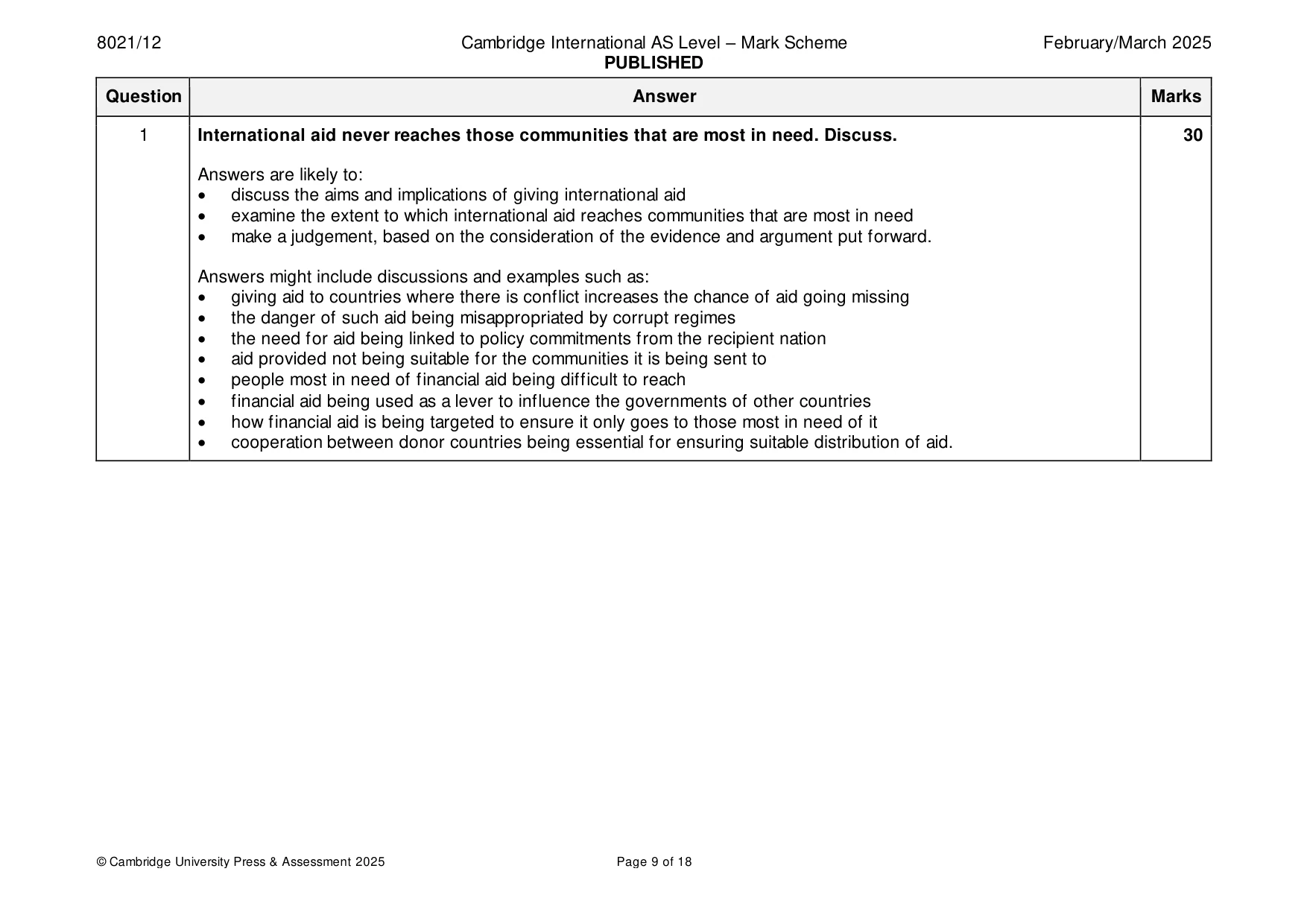
8021/12 Cambridge International AS Level – Mark Scheme PUBLISHED February/March 2025 © Cambridge University Press & Assessment 2025 Page 9 of 18 Question Answer Marks 1 International aid never reaches those communities that are most in need. Discuss. Answers are likely to: • discuss the aims and implications of giving international aid • examine the extent to which international aid reaches communities that are most in need • make a judgement, based on the consideration of the evidence and argument put forward. Answers might include discussions and examples such as: • giving aid to countries where there is conflict increases the chance of aid going missing • the danger of such aid being misappropriated by corrupt regimes • the need for aid being linked to policy commitments from the recipient nation • aid provided not being suitable for the communities it is being sent to • people most in need of financial aid being difficult to reach • financial aid being used as a lever to influence the governments of other countries • how financial aid is being targeted to ensure it only goes to those most in need of it • cooperation between donor countries being essential for ensuring suitable distribution of aid. 30
Mark scheme, page 10
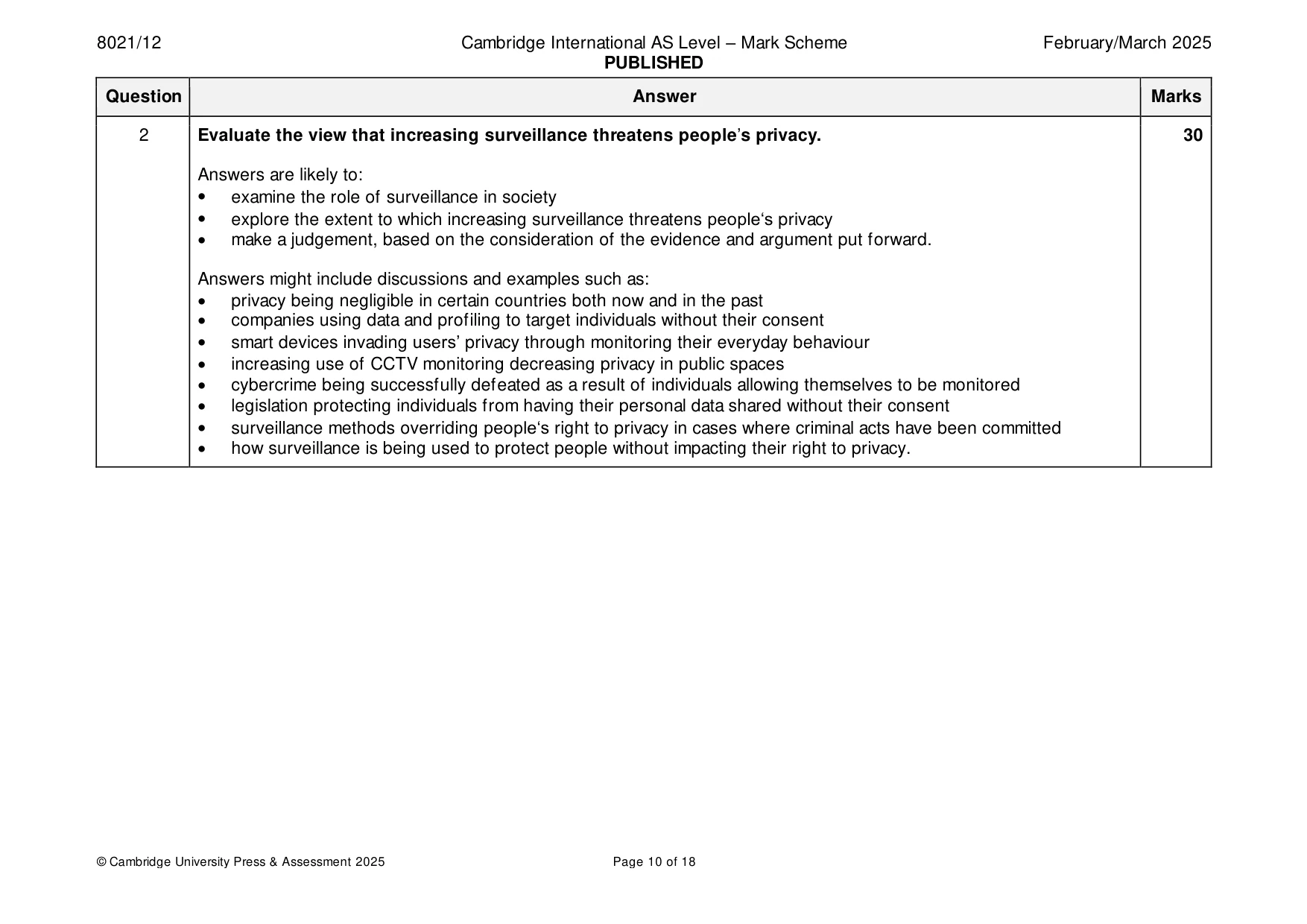
8021/12 Cambridge International AS Level – Mark Scheme PUBLISHED February/March 2025 © Cambridge University Press & Assessment 2025 Page 10 of 18 Question Answer Marks 2 Evaluate the view that increasing surveillance threatens people’s privacy. Answers are likely to: • examine the role of surveillance in society • explore the extent to which increasing surveillance threatens people‘s privacy • make a judgement, based on the consideration of the evidence and argument put forward. Answers might include discussions and examples such as: • privacy being negligible in certain countries both now and in the past • companies using data and profiling to target individuals without their consent • smart devices invading users’ privacy through monitoring their everyday behaviour • increasing use of CCTV monitoring decreasing privacy in public spaces • cybercrime being successfully defeated as a result of individuals allowing themselves to be monitored • legislation protecting individuals from having their personal data shared without their consent • surveillance methods overriding people‘s right to privacy in cases where criminal acts have been committed • how surveillance is being used to protect people without impacting their right to privacy. 30
Mark scheme, page 11
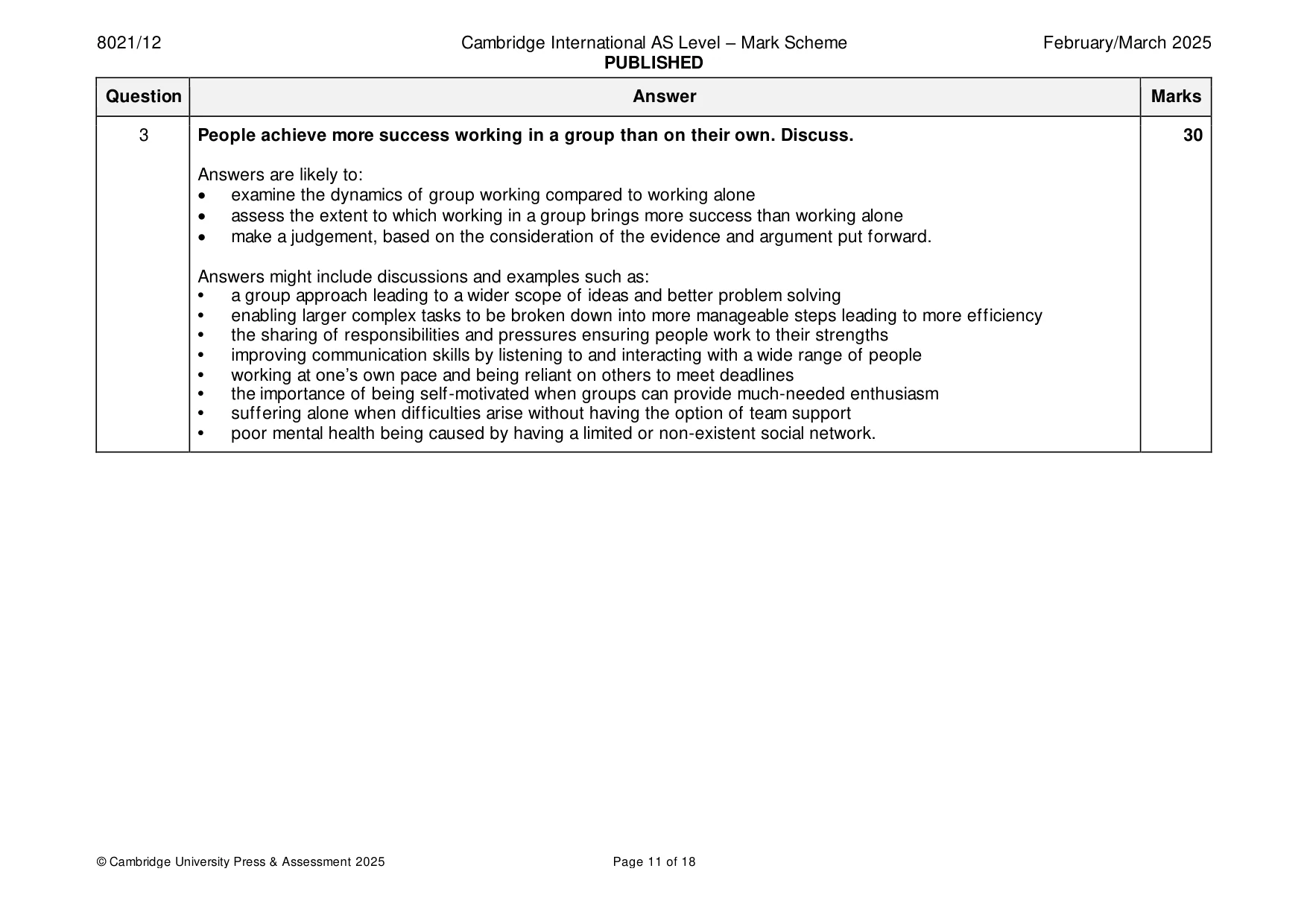
8021/12 Cambridge International AS Level – Mark Scheme PUBLISHED February/March 2025 © Cambridge University Press & Assessment 2025 Page 11 of 18 Question Answer Marks 3 People achieve more success working in a group than on their own. Discuss. Answers are likely to: • examine the dynamics of group working compared to working alone • assess the extent to which working in a group brings more success than working alone • make a judgement, based on the consideration of the evidence and argument put forward. Answers might include discussions and examples such as: • a group approach leading to a wider scope of ideas and better problem solving • enabling larger complex tasks to be broken down into more manageable steps leading to more efficiency • the sharing of responsibilities and pressures ensuring people work to their strengths • improving communication skills by listening to and interacting with a wide range of people • working at one’s own pace and being reliant on others to meet deadlines • the importance of being self-motivated when groups can provide much-needed enthusiasm • suffering alone when difficulties arise without having the option of team support • poor mental health being caused by having a limited or non-existent social network. 30
Mark scheme, page 12
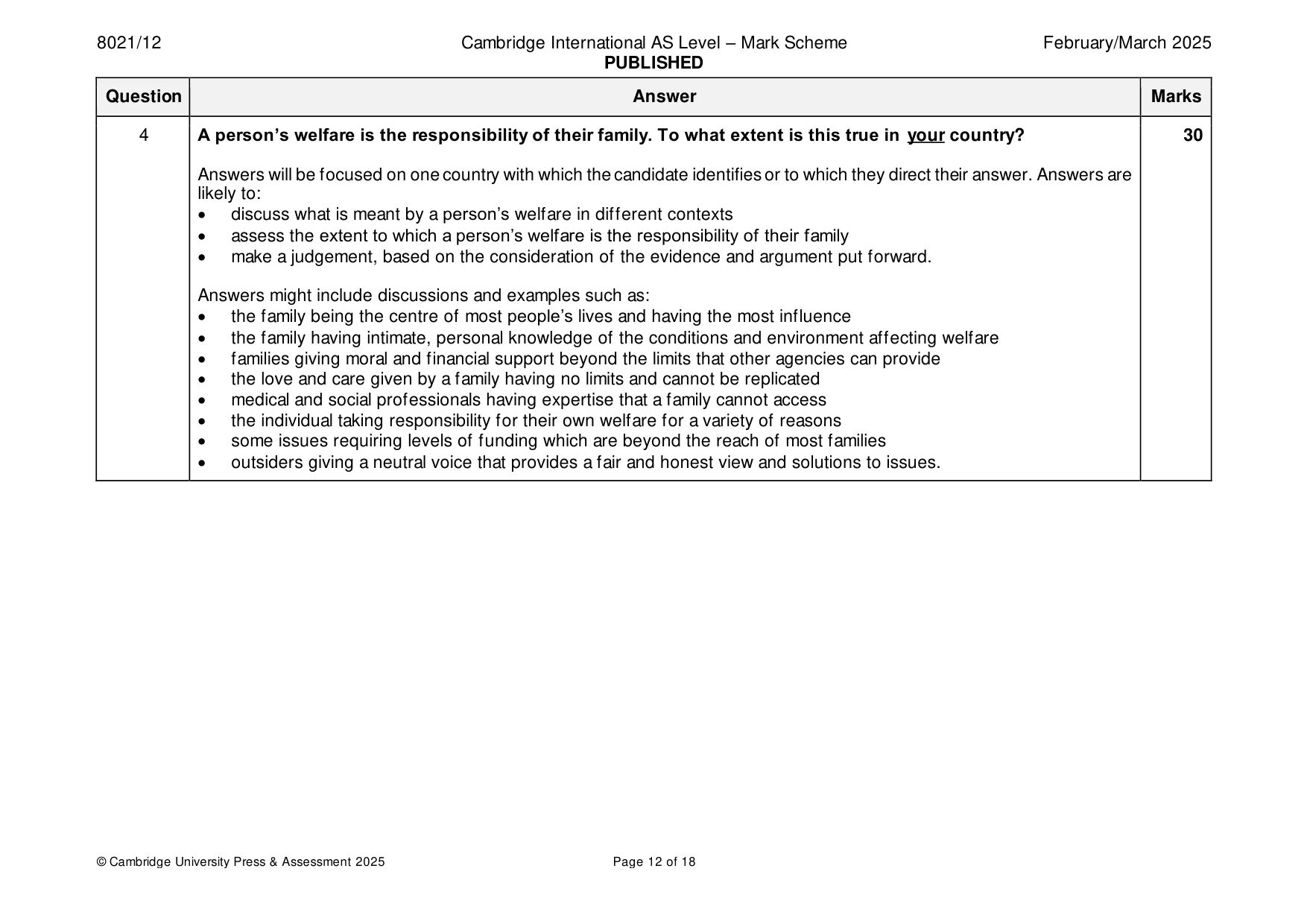
8021/12 Cambridge International AS Level – Mark Scheme PUBLISHED February/March 2025 © Cambridge University Press & Assessment 2025 Page 12 of 18 Question Answer Marks 4 A person’s welfare is the responsibility of their family. To what extent is this true in your country? Answers will be focused on one country with which the candidate identifies or to which they direct their answer. Answers are likely to: • discuss what is meant by a person’s welfare in different contexts • assess the extent to which a person’s welfare is the responsibility of their family • make a judgement, based on the consideration of the evidence and argument put forward. Answers might include discussions and examples such as: • the family being the centre of most people’s lives and having the most influence • the family having intimate, personal knowledge of the conditions and environment affecting welfare • families giving moral and financial support beyond the limits that other agencies can provide • the love and care given by a family having no limits and cannot be replicated • medical and social professionals having expertise that a family cannot access • the individual taking responsibility for their own welfare for a variety of reasons • some issues requiring levels of funding which are beyond the reach of most families • outsiders giving a neutral voice that provides a fair and honest view and solutions to issues. 30
Mark scheme, page 13
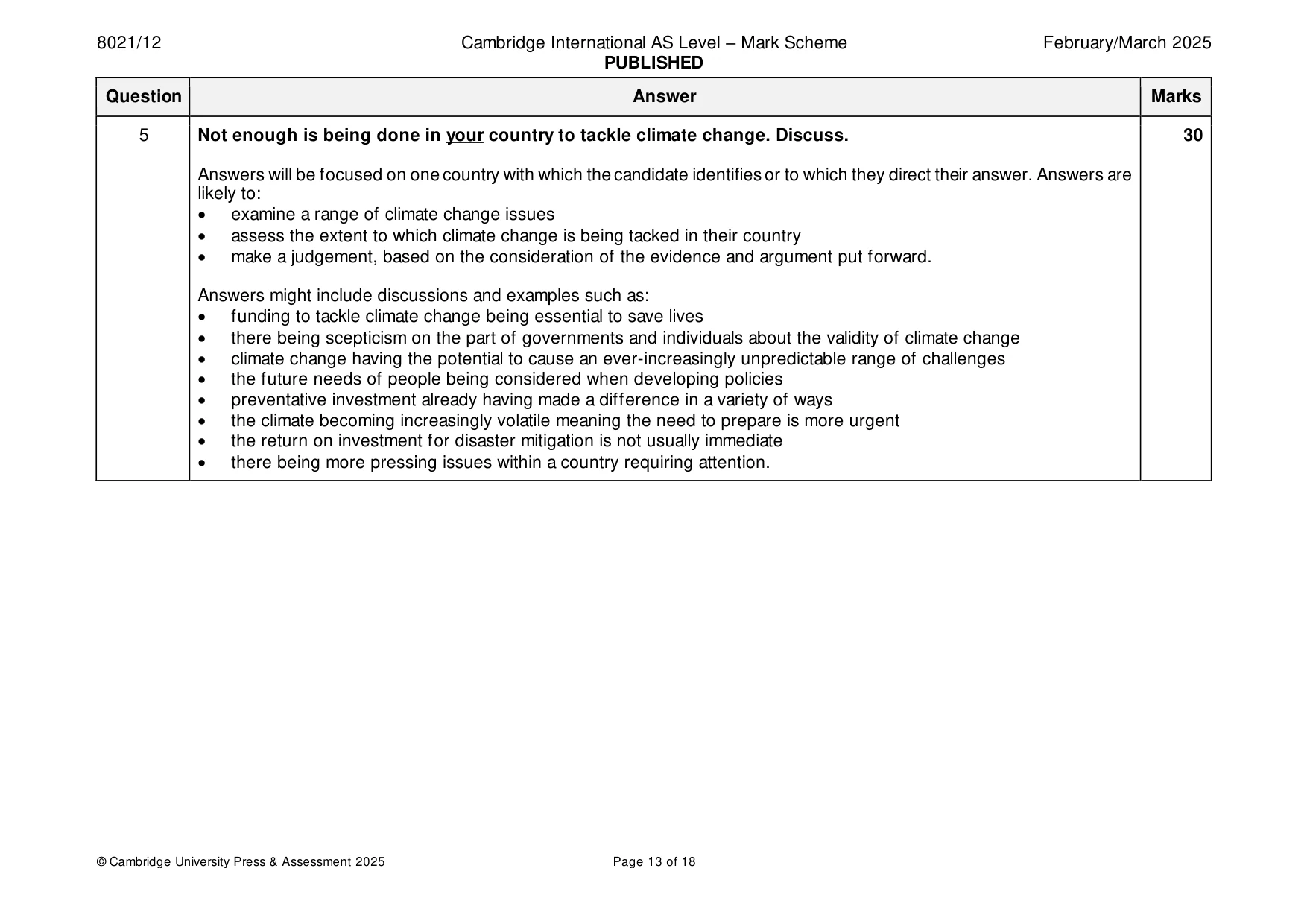
8021/12 Cambridge International AS Level – Mark Scheme PUBLISHED February/March 2025 © Cambridge University Press & Assessment 2025 Page 13 of 18 Question Answer Marks 5 Not enough is being done in your country to tackle climate change. Discuss. Answers will be focused on one country with which the candidate identifies or to which they direct their answer. Answers are likely to: • examine a range of climate change issues • assess the extent to which climate change is being tacked in their country • make a judgement, based on the consideration of the evidence and argument put forward. Answers might include discussions and examples such as: • funding to tackle climate change being essential to save lives • there being scepticism on the part of governments and individuals about the validity of climate change • climate change having the potential to cause an ever-increasingly unpredictable range of challenges • the future needs of people being considered when developing policies • preventative investment already having made a difference in a variety of ways • the climate becoming increasingly volatile meaning the need to prepare is more urgent • the return on investment for disaster mitigation is not usually immediate • there being more pressing issues within a country requiring attention. 30
Mark scheme, page 14
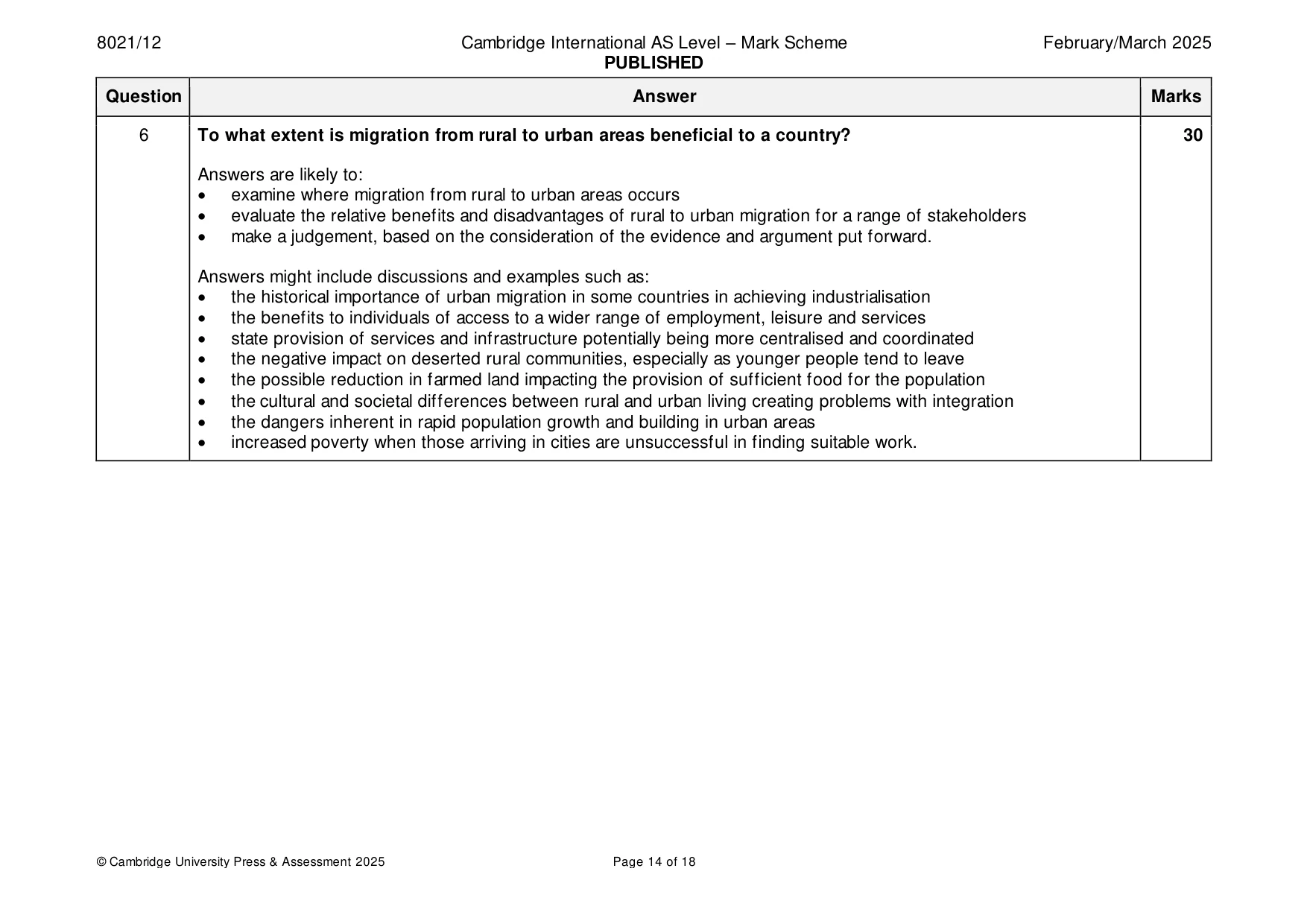
8021/12 Cambridge International AS Level – Mark Scheme PUBLISHED February/March 2025 © Cambridge University Press & Assessment 2025 Page 14 of 18 Question Answer Marks 6 To what extent is migration from rural to urban areas beneficial to a country? Answers are likely to: • examine where migration from rural to urban areas occurs • evaluate the relative benefits and disadvantages of rural to urban migration for a range of stakeholders • make a judgement, based on the consideration of the evidence and argument put forward. Answers might include discussions and examples such as: • the historical importance of urban migration in some countries in achieving industrialisation • the benefits to individuals of access to a wider range of employment, leisure and services • state provision of services and infrastructure potentially being more centralised and coordinated • the negative impact on deserted rural communities, especially as younger people tend to leave • the possible reduction in farmed land impacting the provision of sufficient food for the population • the cultural and societal differences between rural and urban living creating problems with integration • the dangers inherent in rapid population growth and building in urban areas • increased poverty when those arriving in cities are unsuccessful in finding suitable work. 30
Mark scheme, page 15
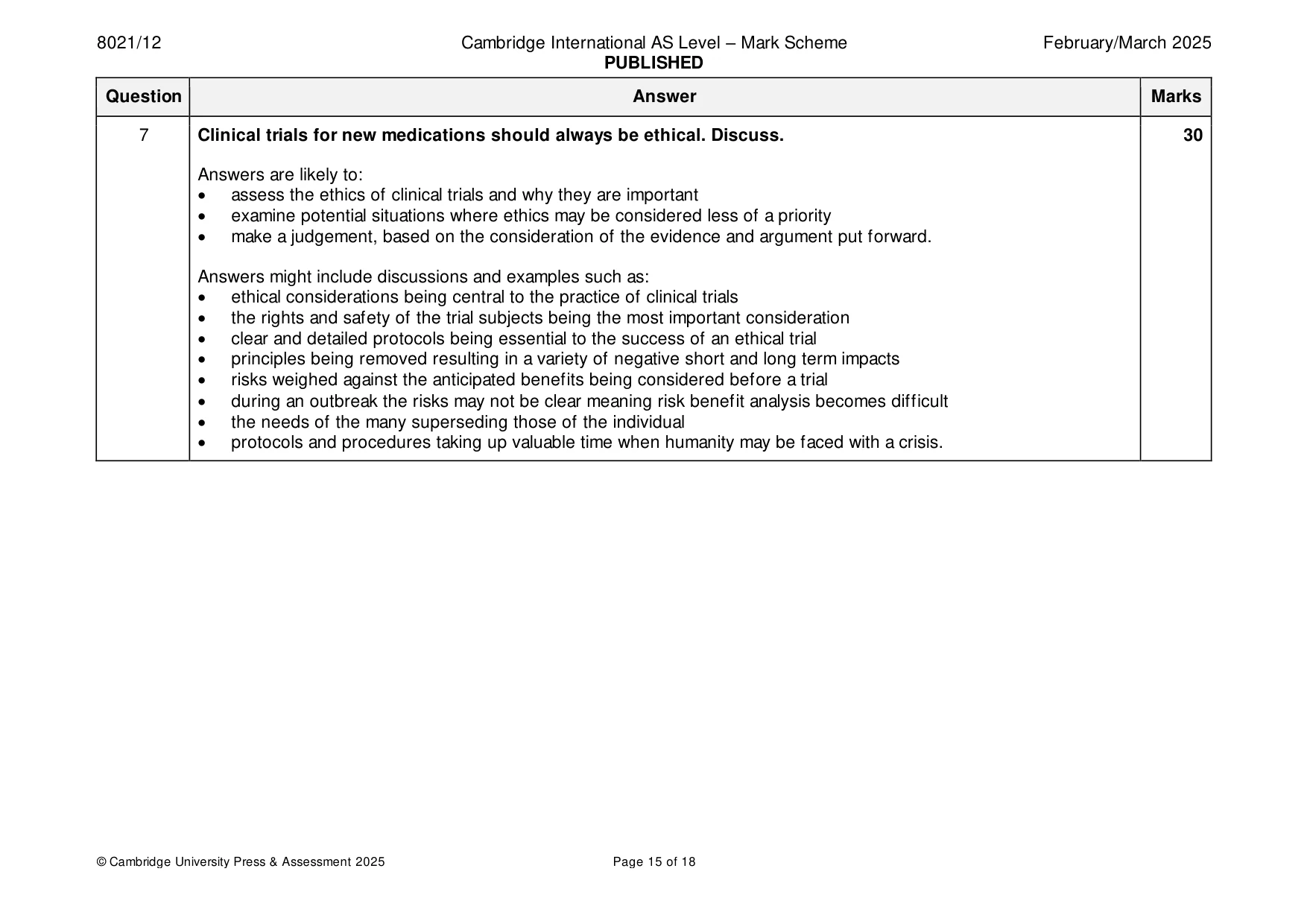
8021/12 Cambridge International AS Level – Mark Scheme PUBLISHED February/March 2025 © Cambridge University Press & Assessment 2025 Page 15 of 18 Question Answer Marks 7 Clinical trials for new medications should always be ethical. Discuss. Answers are likely to: • assess the ethics of clinical trials and why they are important • examine potential situations where ethics may be considered less of a priority • make a judgement, based on the consideration of the evidence and argument put forward. Answers might include discussions and examples such as: • ethical considerations being central to the practice of clinical trials • the rights and safety of the trial subjects being the most important consideration • clear and detailed protocols being essential to the success of an ethical trial • principles being removed resulting in a variety of negative short and long term impacts • risks weighed against the anticipated benefits being considered before a trial • during an outbreak the risks may not be clear meaning risk benefit analysis becomes difficult • the needs of the many superseding those of the individual • protocols and procedures taking up valuable time when humanity may be faced with a crisis. 30
Mark scheme, page 16
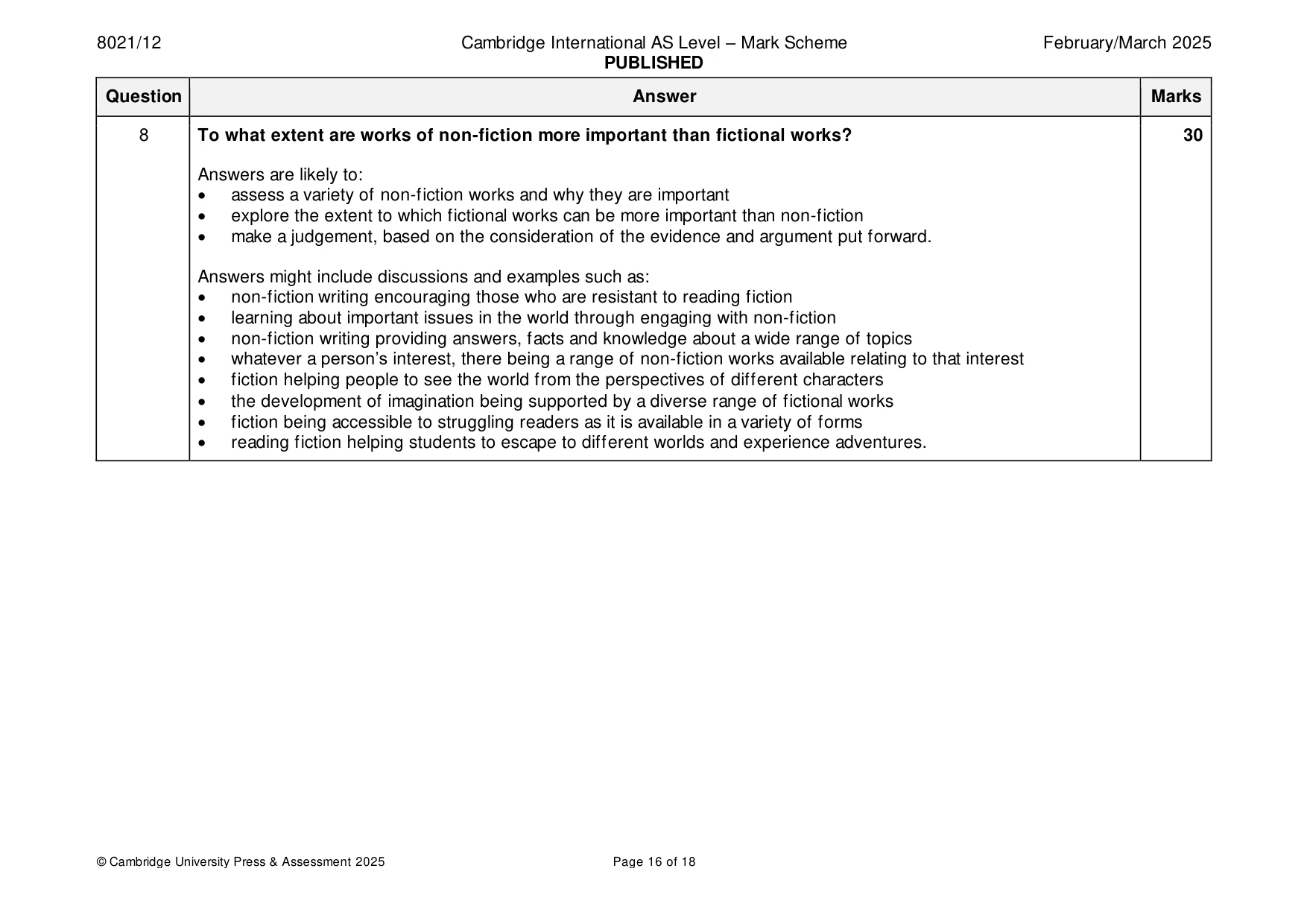
8021/12 Cambridge International AS Level – Mark Scheme PUBLISHED February/March 2025 © Cambridge University Press & Assessment 2025 Page 16 of 18 Question Answer Marks 8 To what extent are works of non-fiction more important than fictional works? Answers are likely to: • assess a variety of non-fiction works and why they are important • explore the extent to which fictional works can be more important than non-fiction • make a judgement, based on the consideration of the evidence and argument put forward. Answers might include discussions and examples such as: • non-fiction writing encouraging those who are resistant to reading fiction • learning about important issues in the world through engaging with non-fiction • non-fiction writing providing answers, facts and knowledge about a wide range of topics • whatever a person’s interest, there being a range of non-fiction works available relating to that interest • fiction helping people to see the world from the perspectives of different characters • the development of imagination being supported by a diverse range of fictional works • fiction being accessible to struggling readers as it is available in a variety of forms • reading fiction helping students to escape to different worlds and experience adventures. 30
Mark scheme, page 17
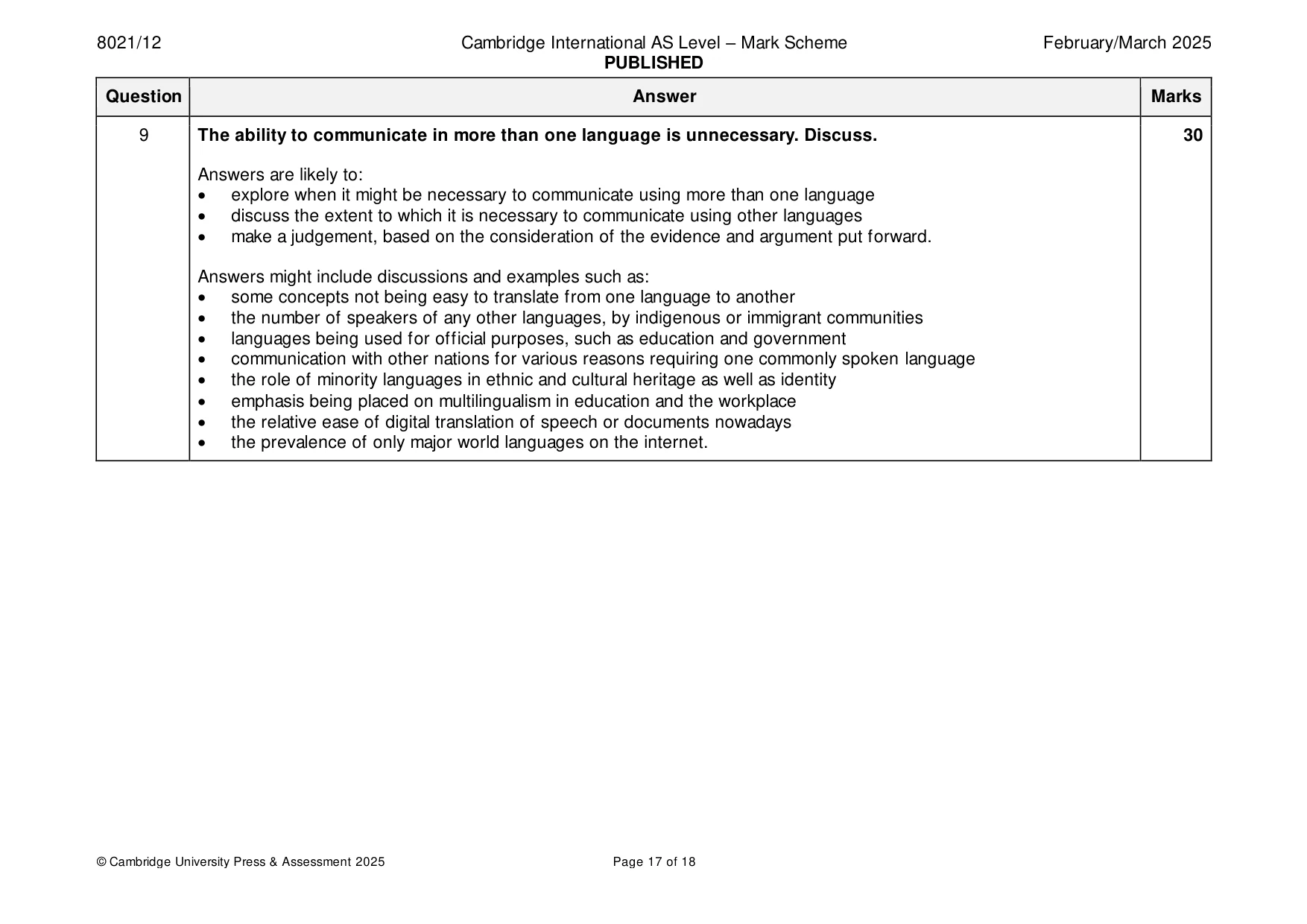
8021/12 Cambridge International AS Level – Mark Scheme PUBLISHED February/March 2025 © Cambridge University Press & Assessment 2025 Page 17 of 18 Question Answer Marks 9 The ability to communicate in more than one language is unnecessary. Discuss. Answers are likely to: • explore when it might be necessary to communicate using more than one language • discuss the extent to which it is necessary to communicate using other languages • make a judgement, based on the consideration of the evidence and argument put forward. Answers might include discussions and examples such as: • some concepts not being easy to translate from one language to another • the number of speakers of any other languages, by indigenous or immigrant communities • languages being used for official purposes, such as education and government • communication with other nations for various reasons requiring one commonly spoken language • the role of minority languages in ethnic and cultural heritage as well as identity • emphasis being placed on multilingualism in education and the workplace • the relative ease of digital translation of speech or documents nowadays • the prevalence of only major world languages on the internet. 30
Mark scheme, page 18
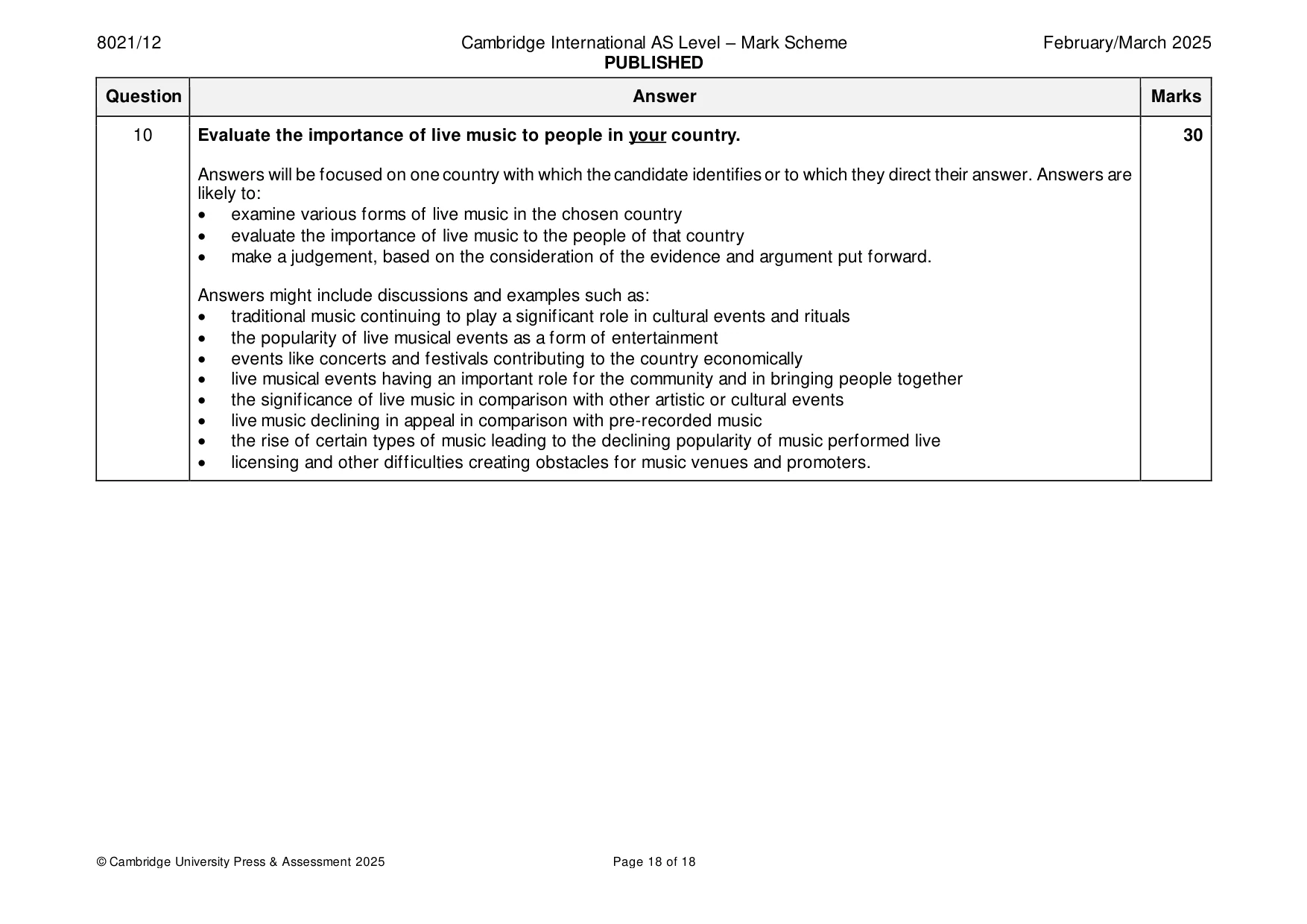
8021/12 Cambridge International AS Level – Mark Scheme PUBLISHED February/March 2025 © Cambridge University Press & Assessment 2025 Page 18 of 18 Question Answer Marks 10 Evaluate the importance of live music to people in your country. Answers will be focused on one country with which the candidate identifies or to which they direct their answer. Answers are likely to: • examine various forms of live music in the chosen country • evaluate the importance of live music to the people of that country • make a judgement, based on the consideration of the evidence and argument put forward. Answers might include discussions and examples such as: • traditional music continuing to play a significant role in cultural events and rituals • the popularity of live musical events as a form of entertainment • events like concerts and festivals contributing to the country economically • live musical events having an important role for the community and in bringing people together • the significance of live music in comparison with other artistic or cultural events • live music declining in appeal in comparison with pre-recorded music • the rise of certain types of music leading to the declining popularity of music performed live • licensing and other difficulties creating obstacles for music venues and promoters. 30
What you needed in this session
Cambridge’s own grade thresholds for 2025 Feb/March, Paper 1 · Variant 2. A higher threshold means an easier paper — the bar moves with how the cohort did.