Cambridge A Level English General Paper 8021 — 2025 May/June Paper 1 · Variant 2
8021/12/M/J/25 · 30 marks · 75 min
The question paper and its mark scheme, free to read here and free to download. This is Cambridge’s own paper, exactly as it was sat.
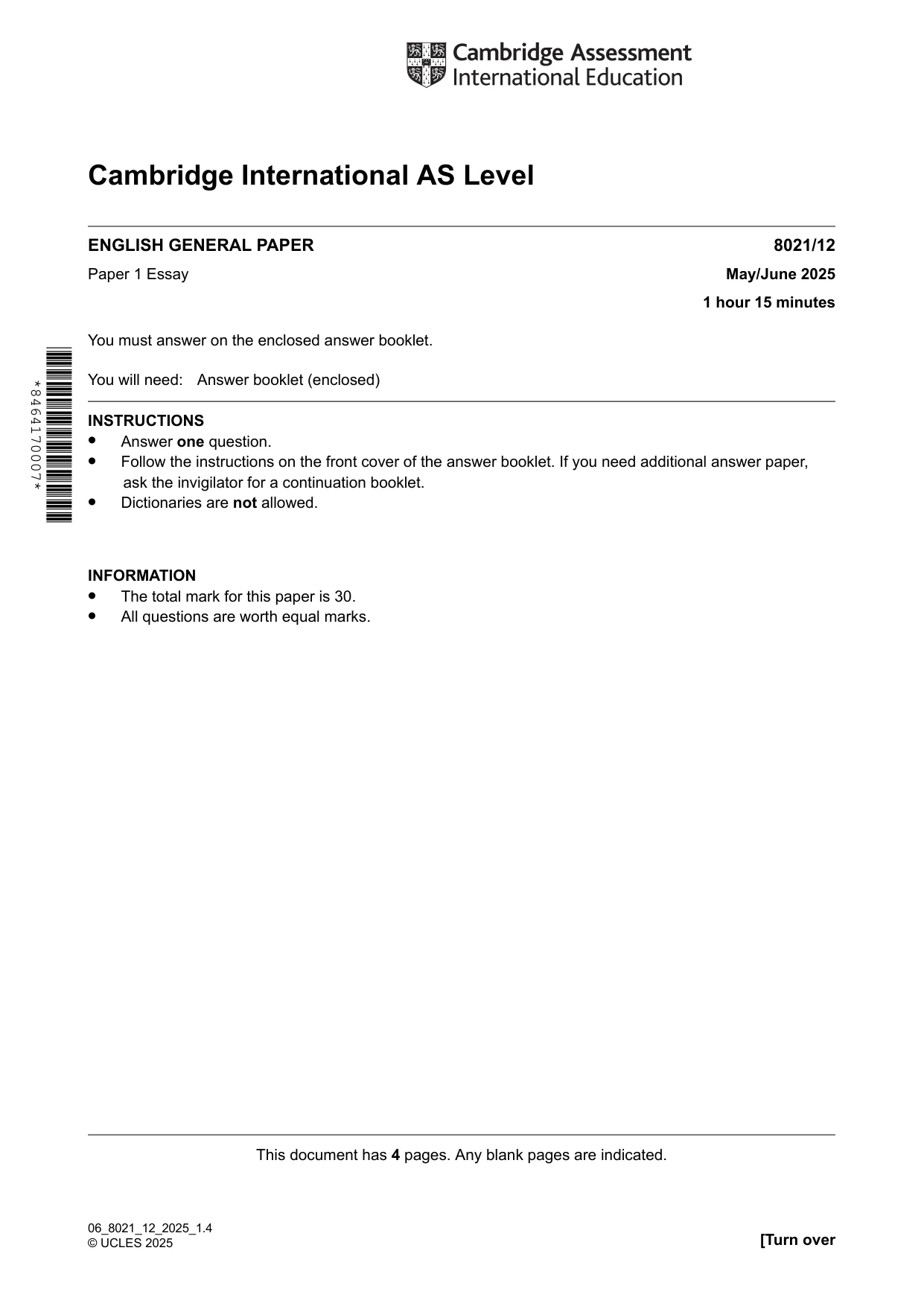
Question paper4 pages


Mark scheme13 pages
Answers below. Sit the paper first if you are practising.
Paper as text
Question paper, page 1
Cambridge International AS Level 8021/12 May/June 2025 1 hour 15 minutes ENGLISH GENERAL PAPER Paper 1 Essay You must answer on the enclosed answer booklet. You will need: Answer booklet (enclosed) INSTRUCTIONS • Answer one question. • Follow the instructions on the front cover of the answer booklet. If you need additional answer paper, ask the invigilator for a continuation booklet. • Dictionaries are not allowed. INFORMATION • The total mark for this paper is 30. • All questions are worth equal marks. This document has 4 pages. Any blank pages are indicated. [Turn over 06_8021_12_2025_1.4 © UCLES 2025 *8464170007*
Question paper, page 2
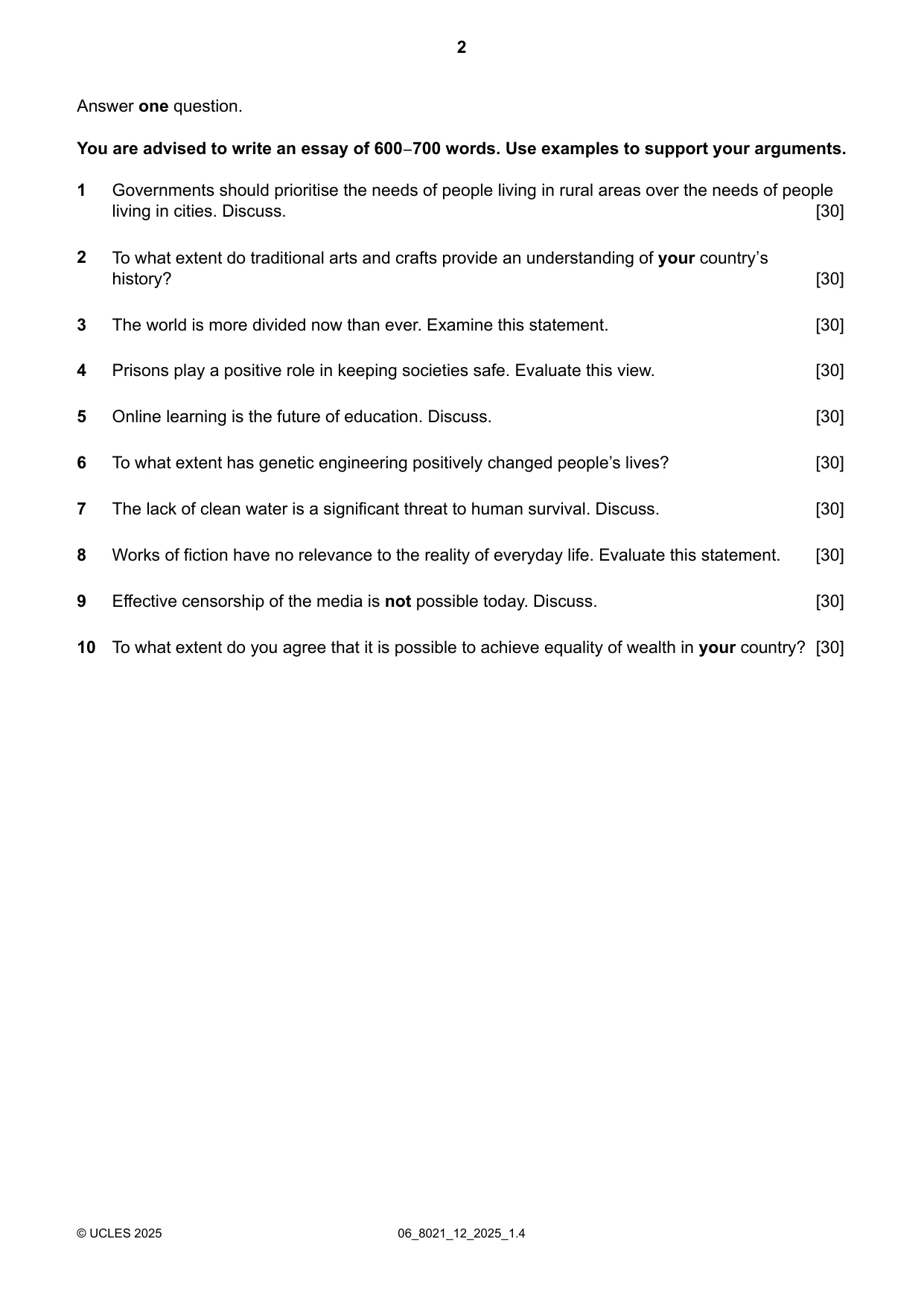
Answer one question. You are advised to write an essay of 600−700 words. Use examples to support your arguments. Governments should prioritise the needs of people living in rural areas over the needs of people living in cities. Discuss. [30] 1 To what extent do traditional arts and crafts provide an understanding of your country’s history? [30] 2 The world is more divided now than ever. Examine this statement. [30] 3 Prisons play a positive role in keeping societies safe. Evaluate this view. [30] 4 Online learning is the future of education. Discuss. [30] 5 To what extent has genetic engineering positively changed people’s lives? [30] 6 The lack of clean water is a significant threat to human survival. Discuss. [30] 7 Works of fiction have no relevance to the reality of everyday life. Evaluate this statement. [30] 8 Effective censorship of the media is not possible today. Discuss. [30] 9 To what extent do you agree that it is possible to achieve equality of wealth in your country? [30] 10 06_8021_12_2025_1.4 © UCLES 2025 2
Question paper, page 3
BLANK PAGE 06_8021_12_2025_1.4 © UCLES 2025 3
Question paper, page 4
BLANK PAGE Permission to reproduce items where third-party owned material protected by copyright is included has been sought and cleared where possible. Every reasonable effort has been made by the publisher (UCLES) to trace copyright holders, but if any items requiring clearance have unwittingly been included, the publisher will be pleased to make amends at the earliest possible opportunity. To avoid the issue of disclosure of answer-related information to candidates, all copyright acknowledgements are reproduced online in the Cambridge Assessment International Education Copyright Acknowledgements Booklet. This is produced for each series of examinations and is freely available to download at www.cambridgeinternational.org after the live examination series. Cambridge Assessment International Education is part of Cambridge Assessment. Cambridge Assessment is the brand name of the University of Cambridge Local Examinations Syndicate (UCLES), which is a department of the University of Cambridge. 06_8021_12_2025_1.4 © UCLES 2025 4
Mark scheme, page 1
This document consists of 13 printed pages. © Cambridge University Press & Assessment 2025 [Turn over Cambridge International AS Level ENGLISH GENERAL PAPER 8021/12 Paper 1 Essay May/June 2025 MARK SCHEME Maximum Mark: 30 Published This mark scheme is published as an aid to teachers and candidates, to indicate the requirements of the examination. It shows the basis on which Examiners were instructed to award marks. It does not indicate the details of the discussions that took place at an Examiners’ meeting before marking began, which would have considered the acceptability of alternative answers. Mark schemes should be read in conjunction with the question paper and the Principal Examiner Report for Teachers. Cambridge International will not enter into discussions about these mark schemes. Cambridge International is publishing the mark schemes for the May/June 2025 series for most Cambridge IGCSE, Cambridge International A and AS Level components, and some Cambridge O Level components.
Mark scheme, page 2
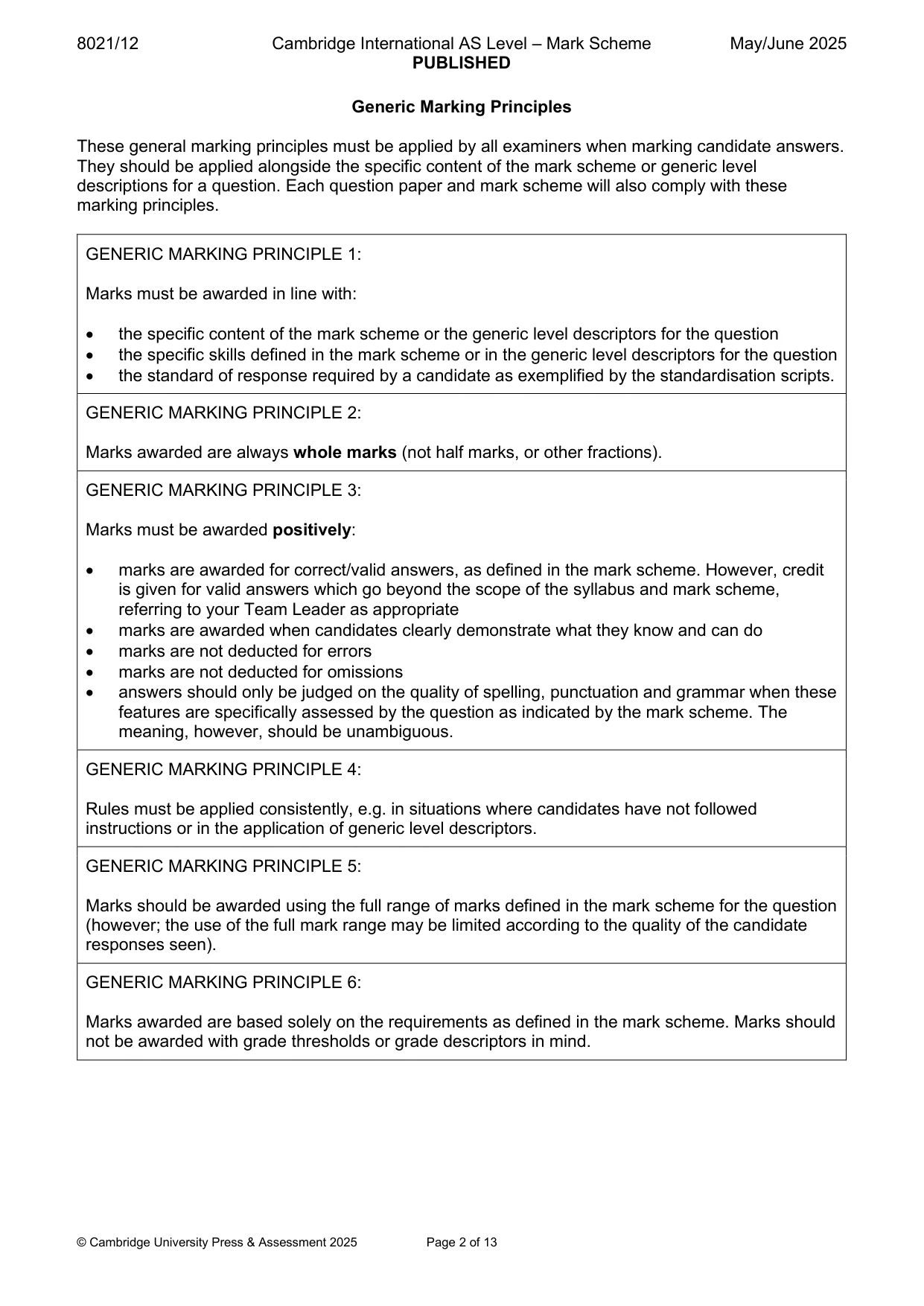
8021/12 Cambridge International AS Level – Mark Scheme PUBLISHED May/June 2025 © Cambridge University Press & Assessment 2025 Page 2 of 13 Generic Marking Principles These general marking principles must be applied by all examiners when marking candidate answers. They should be applied alongside the specific content of the mark scheme or generic level descriptions for a question. Each question paper and mark scheme will also comply with these marking principles. GENERIC MARKING PRINCIPLE 1: Marks must be awarded in line with: • the specific content of the mark scheme or the generic level descriptors for the question • the specific skills defined in the mark scheme or in the generic level descriptors for the question • the standard of response required by a candidate as exemplified by the standardisation scripts. GENERIC MARKING PRINCIPLE 2: Marks awarded are always whole marks (not half marks, or other fractions). GENERIC MARKING PRINCIPLE 3: Marks must be awarded positively: • marks are awarded for correct/valid answers, as defined in the mark scheme. However, credit is given for valid answers which go beyond the scope of the syllabus and mark scheme, referring to your Team Leader as appropriate • marks are awarded when candidates clearly demonstrate what they know and can do • marks are not deducted for errors • marks are not deducted for omissions • answers should only be judged on the quality of spelling, punctuation and grammar when these features are specifically assessed by the question as indicated by the mark scheme. The meaning, however, should be unambiguous. GENERIC MARKING PRINCIPLE 4: Rules must be applied consistently, e.g. in situations where candidates have not followed instructions or in the application of generic level descriptors. GENERIC MARKING PRINCIPLE 5: Marks should be awarded using the full range of marks defined in the mark scheme for the question (however; the use of the full mark range may be limited according to the quality of the candidate responses seen). GENERIC MARKING PRINCIPLE 6: Marks awarded are based solely on the requirements as defined in the mark scheme. Marks should not be awarded with grade thresholds or grade descriptors in mind.
Mark scheme, page 3
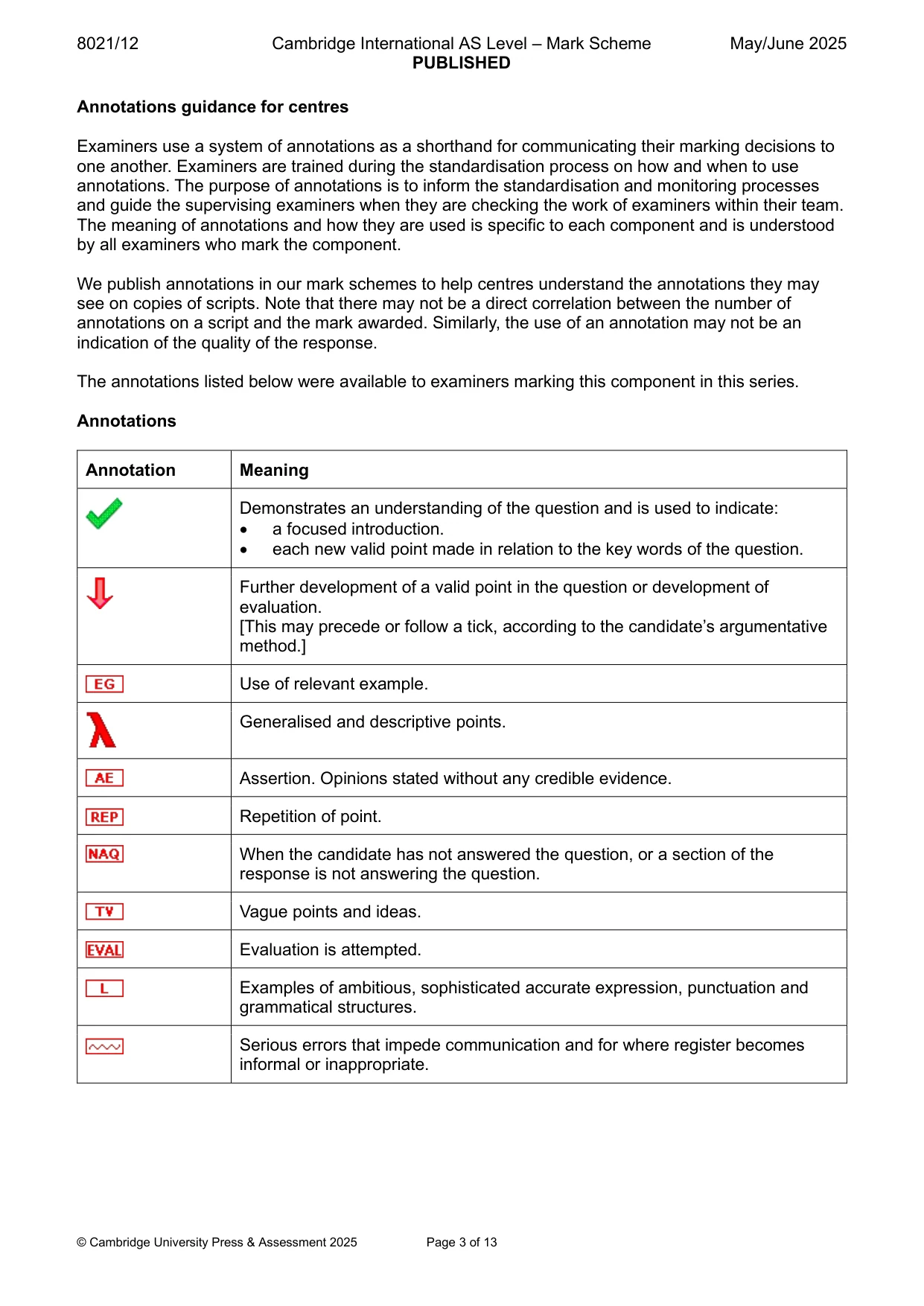
8021/12 Cambridge International AS Level – Mark Scheme PUBLISHED May/June 2025 © Cambridge University Press & Assessment 2025 Page 3 of 13 Annotations guidance for centres Examiners use a system of annotations as a shorthand for communicating their marking decisions to one another. Examiners are trained during the standardisation process on how and when to use annotations. The purpose of annotations is to inform the standardisation and monitoring processes and guide the supervising examiners when they are checking the work of examiners within their team. The meaning of annotations and how they are used is specific to each component and is understood by all examiners who mark the component. We publish annotations in our mark schemes to help centres understand the annotations they may see on copies of scripts. Note that there may not be a direct correlation between the number of annotations on a script and the mark awarded. Similarly, the use of an annotation may not be an indication of the quality of the response. The annotations listed below were available to examiners marking this component in this series. Annotations Annotation Meaning Demonstrates an understanding of the question and is used to indicate: • a focused introduction. • each new valid point made in relation to the key words of the question. Further development of a valid point in the question or development of evaluation. [This may precede or follow a tick, according to the candidate’s argumentative method.] Use of relevant example. Generalised and descriptive points. Assertion. Opinions stated without any credible evidence. Repetition of point. When the candidate has not answered the question, or a section of the response is not answering the question. Vague points and ideas. Evaluation is attempted. Examples of ambitious, sophisticated accurate expression, punctuation and grammatical structures. Serious errors that impede communication and for where register becomes informal or inappropriate.
Mark scheme, page 4
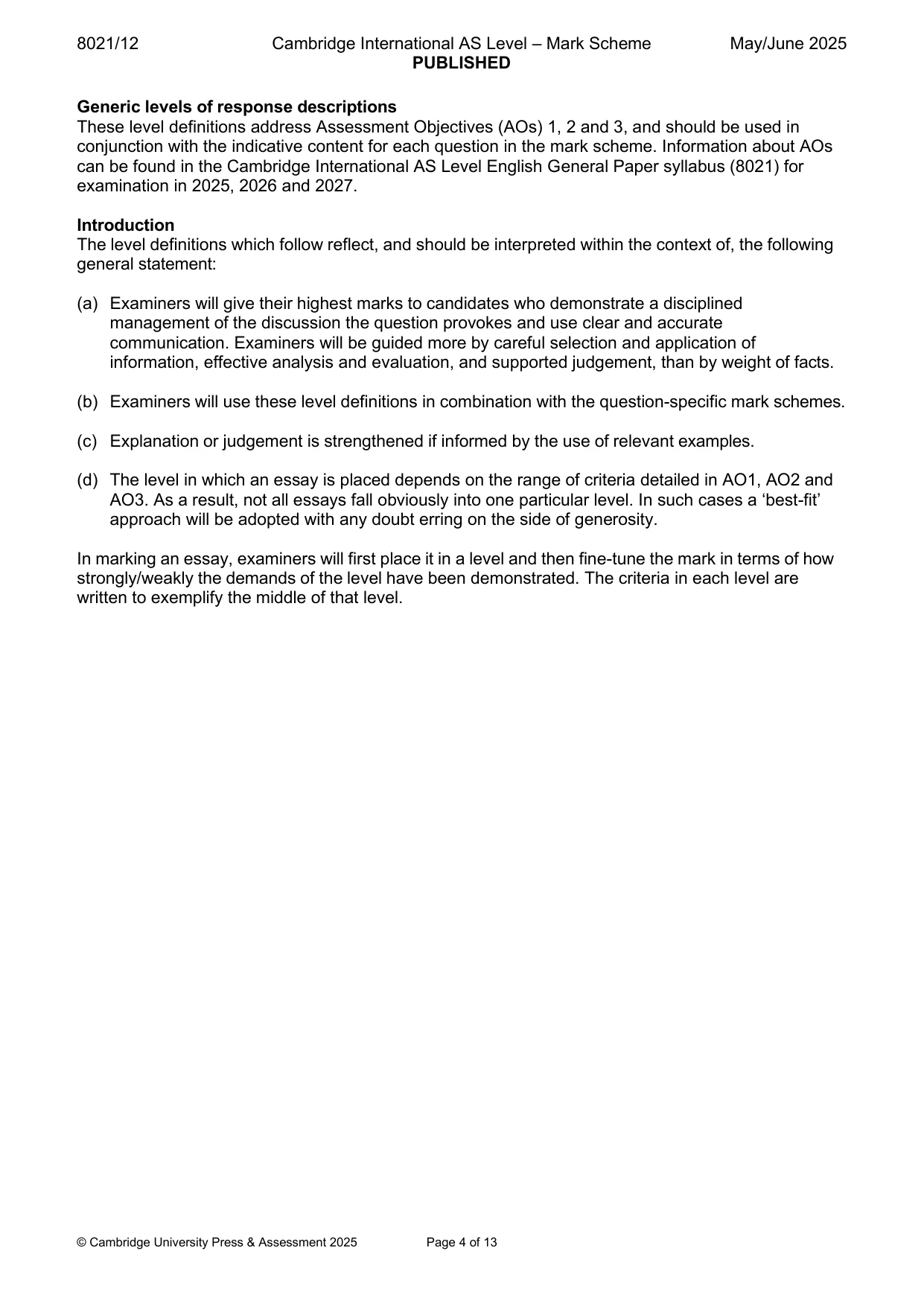
8021/12 Cambridge International AS Level – Mark Scheme PUBLISHED May/June 2025 © Cambridge University Press & Assessment 2025 Page 4 of 13 Generic levels of response descriptions These level definitions address Assessment Objectives (AOs) 1, 2 and 3, and should be used in conjunction with the indicative content for each question in the mark scheme. Information about AOs can be found in the Cambridge International AS Level English General Paper syllabus (8021) for examination in 2025, 2026 and 2027. Introduction The level definitions which follow reflect, and should be interpreted within the context of, the following general statement: (a) Examiners will give their highest marks to candidates who demonstrate a disciplined management of the discussion the question provokes and use clear and accurate communication. Examiners will be guided more by careful selection and application of information, effective analysis and evaluation, and supported judgement, than by weight of facts. (b) Examiners will use these level definitions in combination with the question-specific mark schemes. (c) Explanation or judgement is strengthened if informed by the use of relevant examples. (d) The level in which an essay is placed depends on the range of criteria detailed in AO1, AO2 and AO3. As a result, not all essays fall obviously into one particular level. In such cases a ‘best-fit’ approach will be adopted with any doubt erring on the side of generosity. In marking an essay, examiners will first place it in a level and then fine-tune the mark in terms of how strongly/weakly the demands of the level have been demonstrated. The criteria in each level are written to exemplify the middle of that level.
Mark scheme, page 5
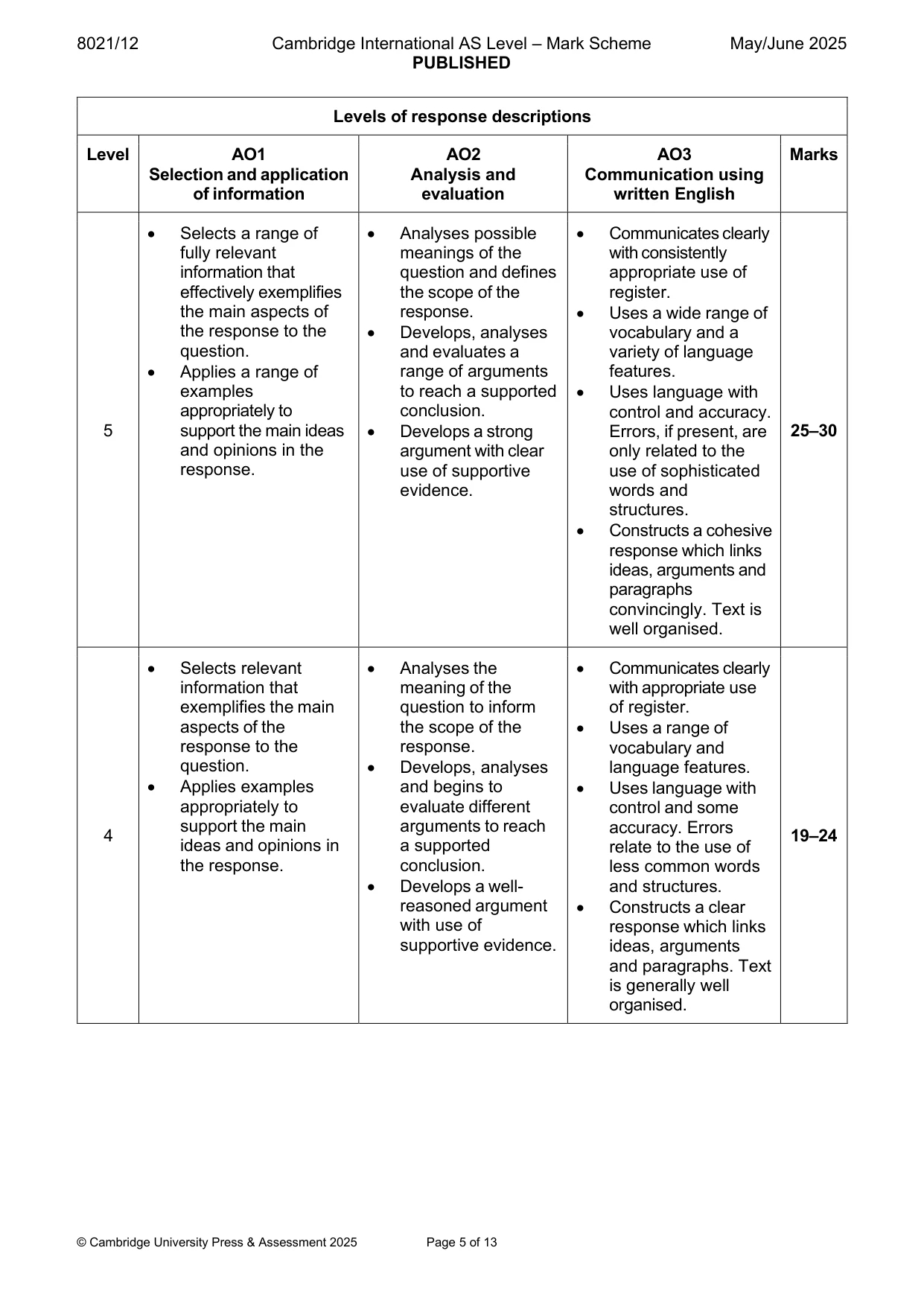
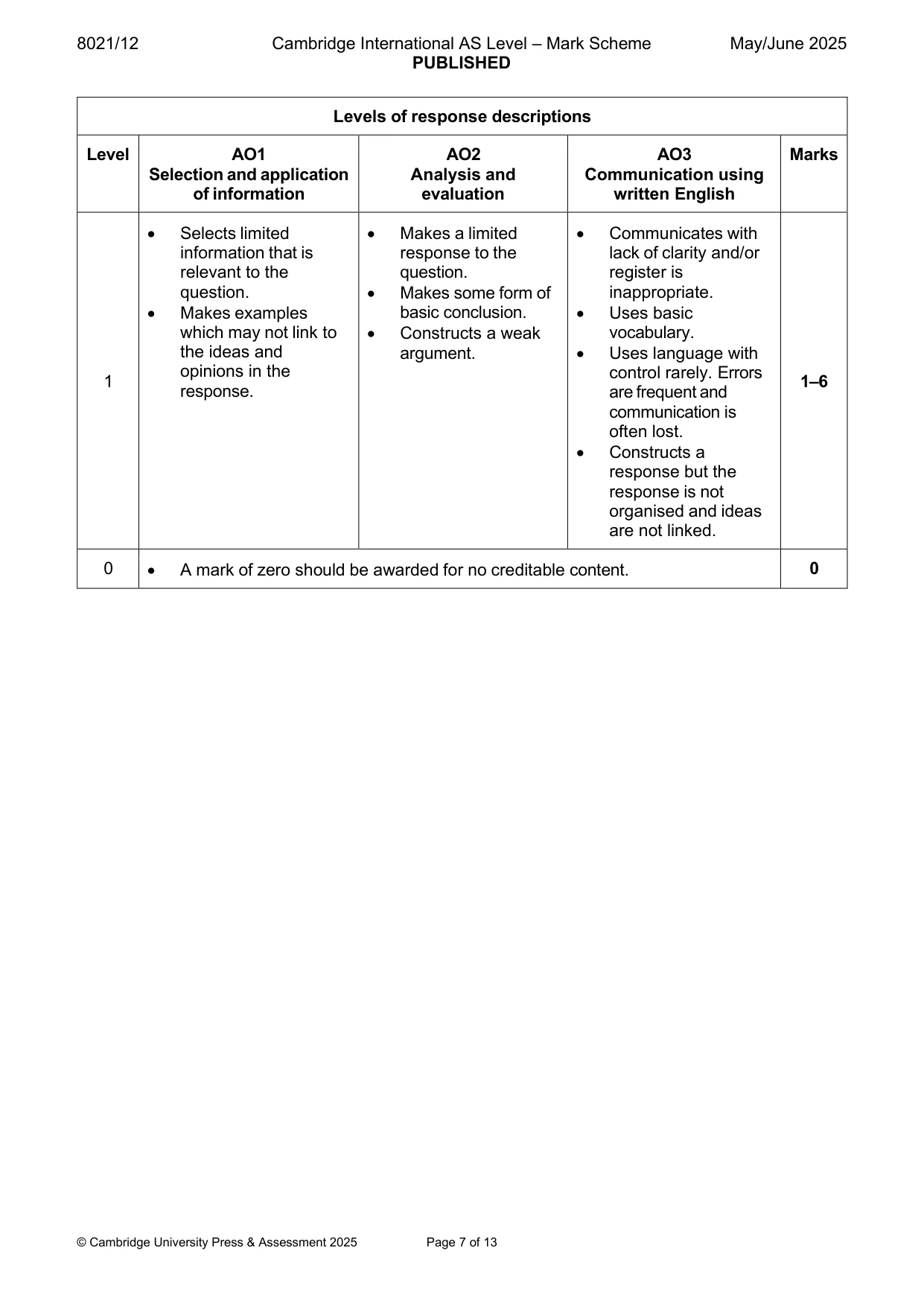
8021/12 Cambridge International AS Level – Mark Scheme PUBLISHED May/June 2025 © Cambridge University Press & Assessment 2025 Page 5 of 13 Levels of response descriptions Level AO1 Selection and application of information AO2 Analysis and evaluation AO3 Communication using written English Marks 5 • Selects a range of fully relevant information that effectively exemplifies the main aspects of the response to the question. • Applies a range of examples appropriately to support the main ideas and opinions in the response. • Analyses possible meanings of the question and defines the scope of the response. • Develops, analyses and evaluates a range of arguments to reach a supported conclusion. • Develops a strong argument with clear use of supportive evidence. • Communicates clearly with consistently appropriate use of register. • Uses a wide range of vocabulary and a variety of language features. • Uses language with control and accuracy. Errors, if present, are only related to the use of sophisticated words and structures. • Constructs a cohesive response which links ideas, arguments and paragraphs convincingly. Text is well organised. 25–30 4 • Selects relevant information that exemplifies the main aspects of the response to the question. • Applies examples appropriately to support the main ideas and opinions in the response. • Analyses the meaning of the question to inform the scope of the response. • Develops, analyses and begins to evaluate different arguments to reach a supported conclusion. • Develops a well- reasoned argument with use of supportive evidence. • Communicates clearly with appropriate use of register. • Uses a range of vocabulary and language features. • Uses language with control and some accuracy. Errors relate to the use of less common words and structures. • Constructs a clear response which links ideas, arguments and paragraphs. Text is generally well organised. 19–24
Mark scheme, page 6
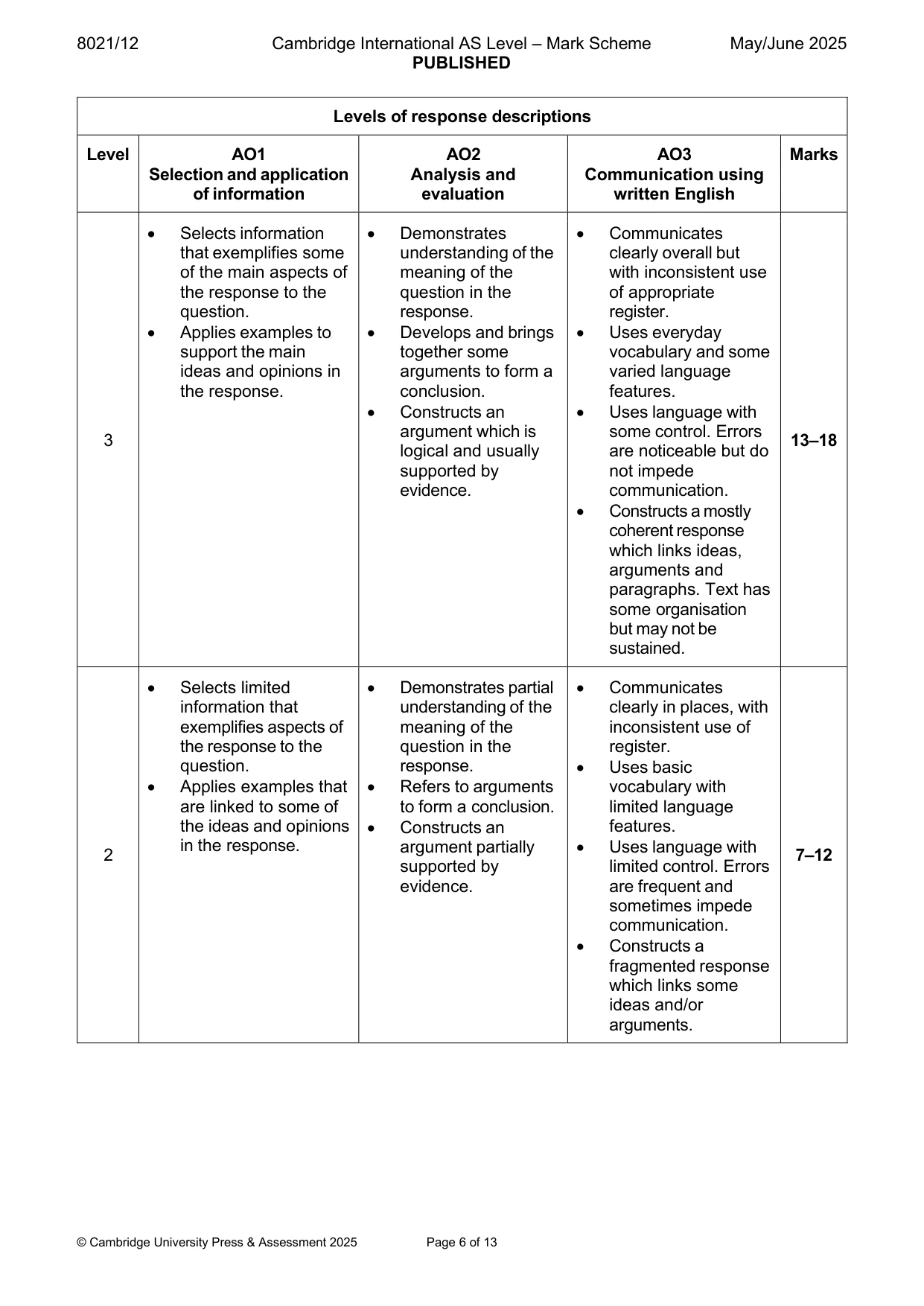
8021/12 Cambridge International AS Level – Mark Scheme PUBLISHED May/June 2025 © Cambridge University Press & Assessment 2025 Page 6 of 13 Levels of response descriptions Level AO1 Selection and application of information AO2 Analysis and evaluation AO3 Communication using written English Marks 3 • Selects information that exemplifies some of the main aspects of the response to the question. • Applies examples to support the main ideas and opinions in the response. • Demonstrates understanding of the meaning of the question in the response. • Develops and brings together some arguments to form a conclusion. • Constructs an argument which is logical and usually supported by evidence. • Communicates clearly overall but with inconsistent use of appropriate register. • Uses everyday vocabulary and some varied language features. • Uses language with some control. Errors are noticeable but do not impede communication. • Constructs a mostly coherent response which links ideas, arguments and paragraphs. Text has some organisation but may not be sustained. 13–18 2 • Selects limited information that exemplifies aspects of the response to the question. • Applies examples that are linked to some of the ideas and opinions in the response. • Demonstrates partial understanding of the meaning of the question in the response. • Refers to arguments to form a conclusion. • Constructs an argument partially supported by evidence. • Communicates clearly in places, with inconsistent use of register. • Uses basic vocabulary with limited language features. • Uses language with limited control. Errors are frequent and sometimes impede communication. • Constructs a fragmented response which links some ideas and/or arguments. 7–12
Mark scheme, page 7
8021/12 Cambridge International AS Level – Mark Scheme PUBLISHED May/June 2025 © Cambridge University Press & Assessment 2025 Page 7 of 13 Levels of response descriptions Level AO1 Selection and application of information AO2 Analysis and evaluation AO3 Communication using written English Marks 1 • Selects limited information that is relevant to the question. • Makes examples which may not link to the ideas and opinions in the response. • Makes a limited response to the question. • Makes some form of basic conclusion. • Constructs a weak argument. • Communicates with lack of clarity and/or register is inappropriate. • Uses basic vocabulary. • Uses language with control rarely. Errors are frequent and communication is often lost. • Constructs a response but the response is not organised and ideas are not linked. 1–6 0 • A mark of zero should be awarded for no creditable content. 0
Mark scheme, page 8
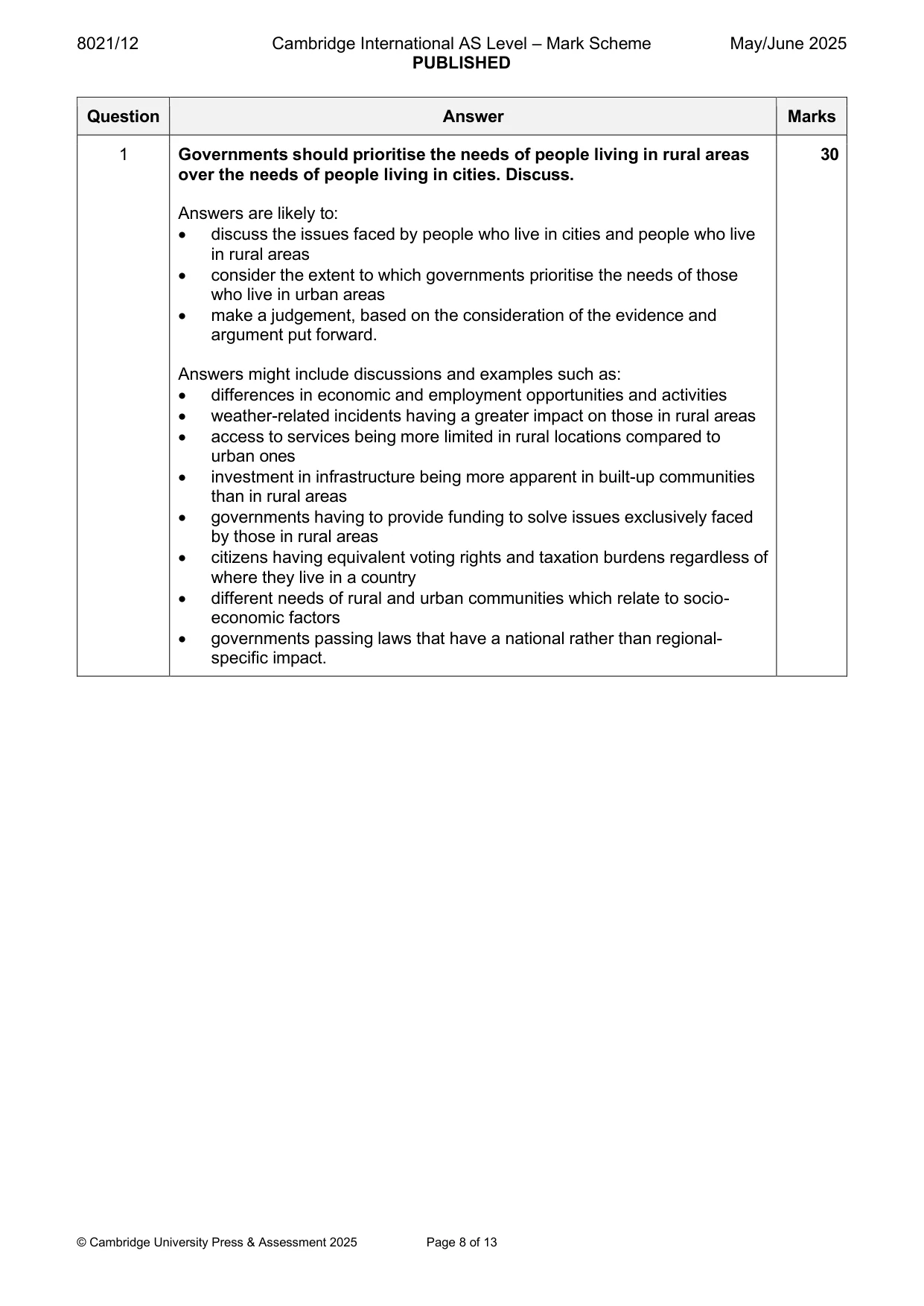
8021/12 Cambridge International AS Level – Mark Scheme PUBLISHED May/June 2025 © Cambridge University Press & Assessment 2025 Page 8 of 13 Question Answer Marks 1 Governments should prioritise the needs of people living in rural areas over the needs of people living in cities. Discuss. Answers are likely to: • discuss the issues faced by people who live in cities and people who live in rural areas • consider the extent to which governments prioritise the needs of those who live in urban areas • make a judgement, based on the consideration of the evidence and argument put forward. Answers might include discussions and examples such as: • differences in economic and employment opportunities and activities • weather-related incidents having a greater impact on those in rural areas • access to services being more limited in rural locations compared to urban ones • investment in infrastructure being more apparent in built-up communities than in rural areas • governments having to provide funding to solve issues exclusively faced by those in rural areas • citizens having equivalent voting rights and taxation burdens regardless of where they live in a country • different needs of rural and urban communities which relate to socio- economic factors • governments passing laws that have a national rather than regional- specific impact. 30
Mark scheme, page 9
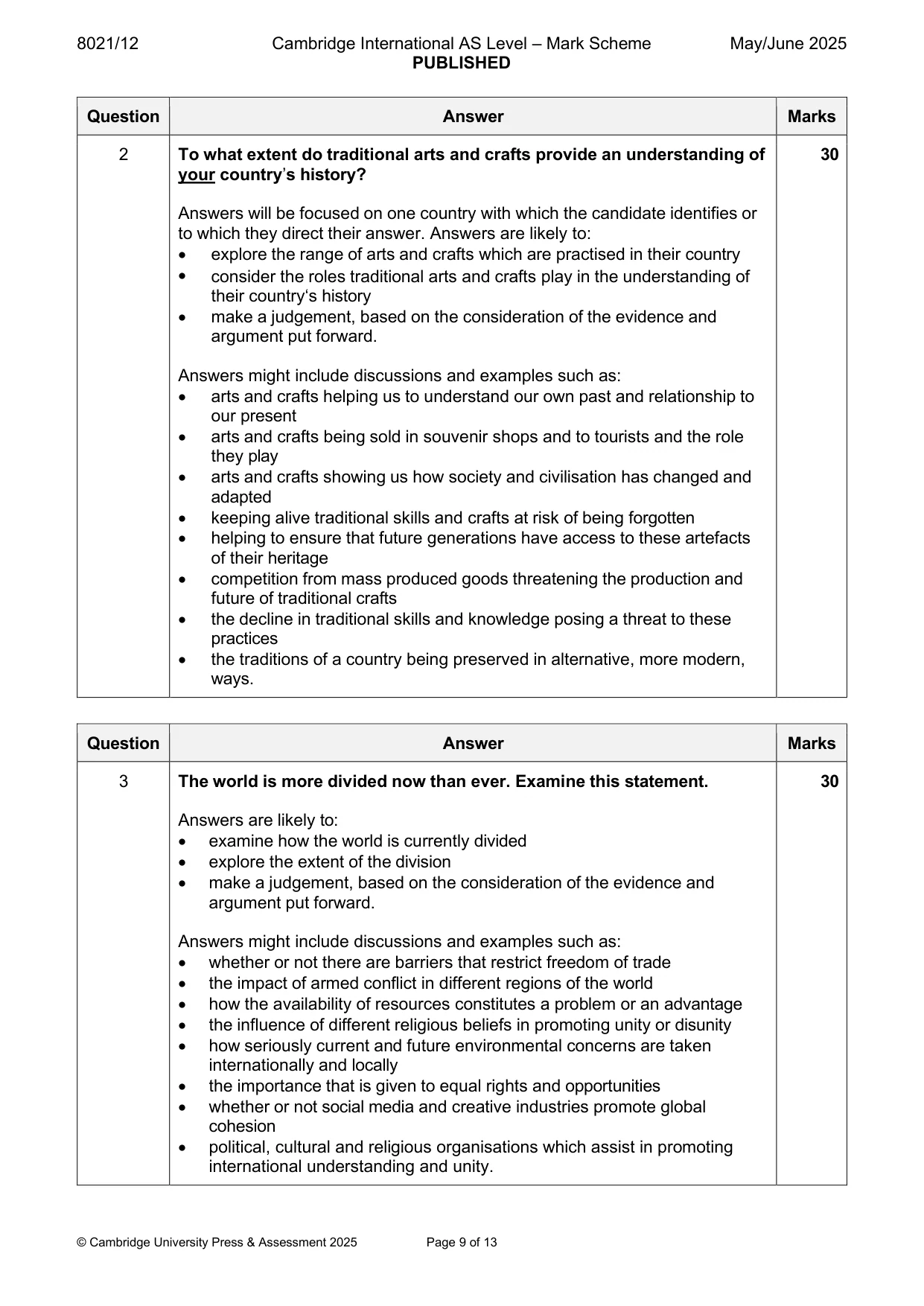
8021/12 Cambridge International AS Level – Mark Scheme PUBLISHED May/June 2025 © Cambridge University Press & Assessment 2025 Page 9 of 13 Question Answer Marks 2 To what extent do traditional arts and crafts provide an understanding of your country’s history? Answers will be focused on one country with which the candidate identifies or to which they direct their answer. Answers are likely to: • explore the range of arts and crafts which are practised in their country • consider the roles traditional arts and crafts play in the understanding of their country‘s history • make a judgement, based on the consideration of the evidence and argument put forward. Answers might include discussions and examples such as: • arts and crafts helping us to understand our own past and relationship to our present • arts and crafts being sold in souvenir shops and to tourists and the role they play • arts and crafts showing us how society and civilisation has changed and adapted • keeping alive traditional skills and crafts at risk of being forgotten • helping to ensure that future generations have access to these artefacts of their heritage • competition from mass produced goods threatening the production and future of traditional crafts • the decline in traditional skills and knowledge posing a threat to these practices • the traditions of a country being preserved in alternative, more modern, ways. 30 Question Answer Marks 3 The world is more divided now than ever. Examine this statement. Answers are likely to: • examine how the world is currently divided • explore the extent of the division • make a judgement, based on the consideration of the evidence and argument put forward. Answers might include discussions and examples such as: • whether or not there are barriers that restrict freedom of trade • the impact of armed conflict in different regions of the world • how the availability of resources constitutes a problem or an advantage • the influence of different religious beliefs in promoting unity or disunity • how seriously current and future environmental concerns are taken internationally and locally • the importance that is given to equal rights and opportunities • whether or not social media and creative industries promote global cohesion • political, cultural and religious organisations which assist in promoting international understanding and unity. 30
Mark scheme, page 10
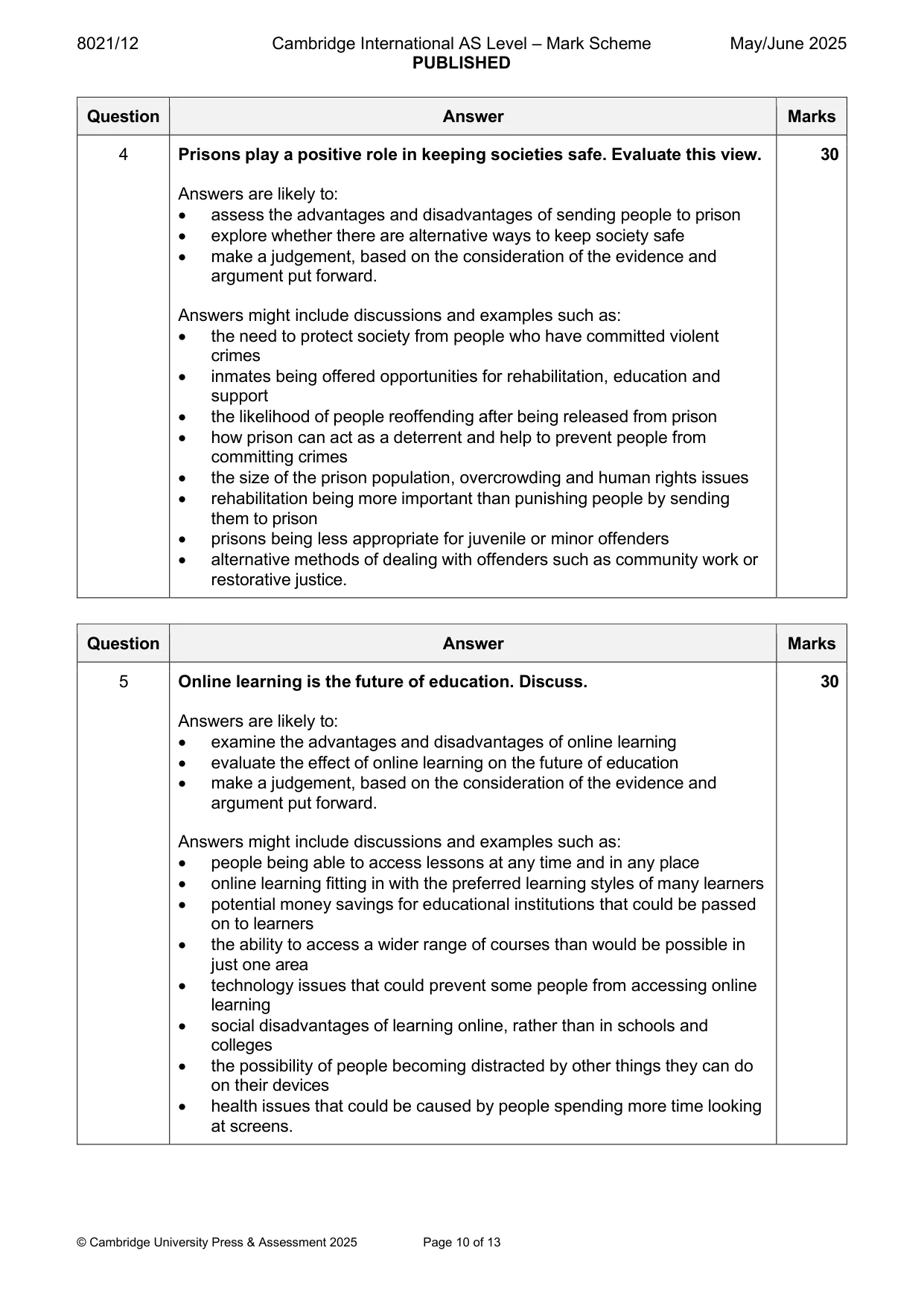
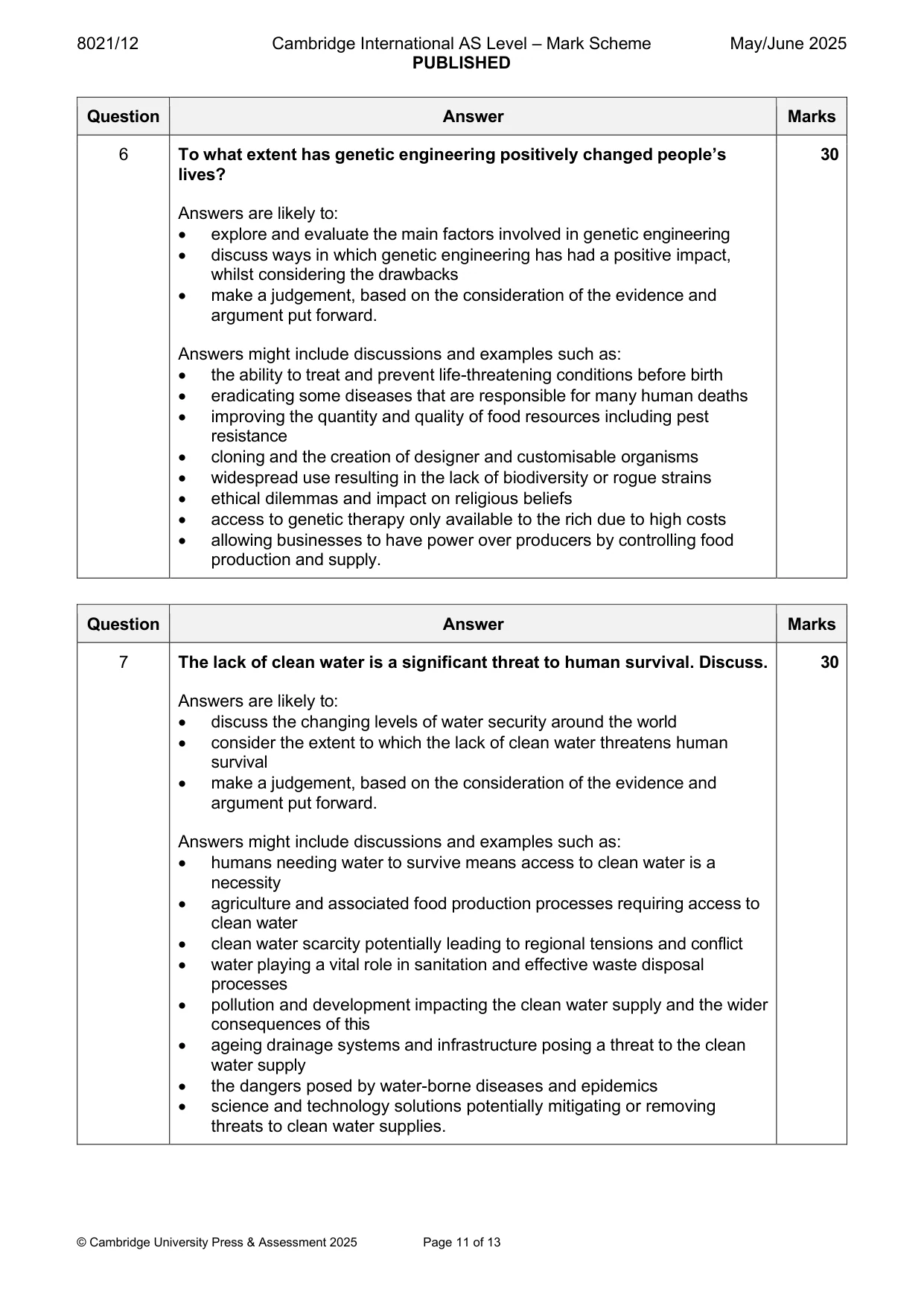
8021/12 Cambridge International AS Level – Mark Scheme PUBLISHED May/June 2025 © Cambridge University Press & Assessment 2025 Page 10 of 13 Question Answer Marks 4 Prisons play a positive role in keeping societies safe. Evaluate this view. Answers are likely to: • assess the advantages and disadvantages of sending people to prison • explore whether there are alternative ways to keep society safe • make a judgement, based on the consideration of the evidence and argument put forward. Answers might include discussions and examples such as: • the need to protect society from people who have committed violent crimes • inmates being offered opportunities for rehabilitation, education and support • the likelihood of people reoffending after being released from prison • how prison can act as a deterrent and help to prevent people from committing crimes • the size of the prison population, overcrowding and human rights issues • rehabilitation being more important than punishing people by sending them to prison • prisons being less appropriate for juvenile or minor offenders • alternative methods of dealing with offenders such as community work or restorative justice. 30 Question Answer Marks 5 Online learning is the future of education. Discuss. Answers are likely to: • examine the advantages and disadvantages of online learning • evaluate the effect of online learning on the future of education • make a judgement, based on the consideration of the evidence and argument put forward. Answers might include discussions and examples such as: • people being able to access lessons at any time and in any place • online learning fitting in with the preferred learning styles of many learners • potential money savings for educational institutions that could be passed on to learners • the ability to access a wider range of courses than would be possible in just one area • technology issues that could prevent some people from accessing online learning • social disadvantages of learning online, rather than in schools and colleges • the possibility of people becoming distracted by other things they can do on their devices • health issues that could be caused by people spending more time looking at screens. 30
Mark scheme, page 11
8021/12 Cambridge International AS Level – Mark Scheme PUBLISHED May/June 2025 © Cambridge University Press & Assessment 2025 Page 11 of 13 Question Answer Marks 6 To what extent has genetic engineering positively changed people’s lives? Answers are likely to: • explore and evaluate the main factors involved in genetic engineering • discuss ways in which genetic engineering has had a positive impact, whilst considering the drawbacks • make a judgement, based on the consideration of the evidence and argument put forward. Answers might include discussions and examples such as: • the ability to treat and prevent life-threatening conditions before birth • eradicating some diseases that are responsible for many human deaths • improving the quantity and quality of food resources including pest resistance • cloning and the creation of designer and customisable organisms • widespread use resulting in the lack of biodiversity or rogue strains • ethical dilemmas and impact on religious beliefs • access to genetic therapy only available to the rich due to high costs • allowing businesses to have power over producers by controlling food production and supply. 30 Question Answer Marks 7 The lack of clean water is a significant threat to human survival. Discuss. Answers are likely to: • discuss the changing levels of water security around the world • consider the extent to which the lack of clean water threatens human survival • make a judgement, based on the consideration of the evidence and argument put forward. Answers might include discussions and examples such as: • humans needing water to survive means access to clean water is a necessity • agriculture and associated food production processes requiring access to clean water • clean water scarcity potentially leading to regional tensions and conflict • water playing a vital role in sanitation and effective waste disposal processes • pollution and development impacting the clean water supply and the wider consequences of this • ageing drainage systems and infrastructure posing a threat to the clean water supply • the dangers posed by water-borne diseases and epidemics • science and technology solutions potentially mitigating or removing threats to clean water supplies. 30
Mark scheme, page 12
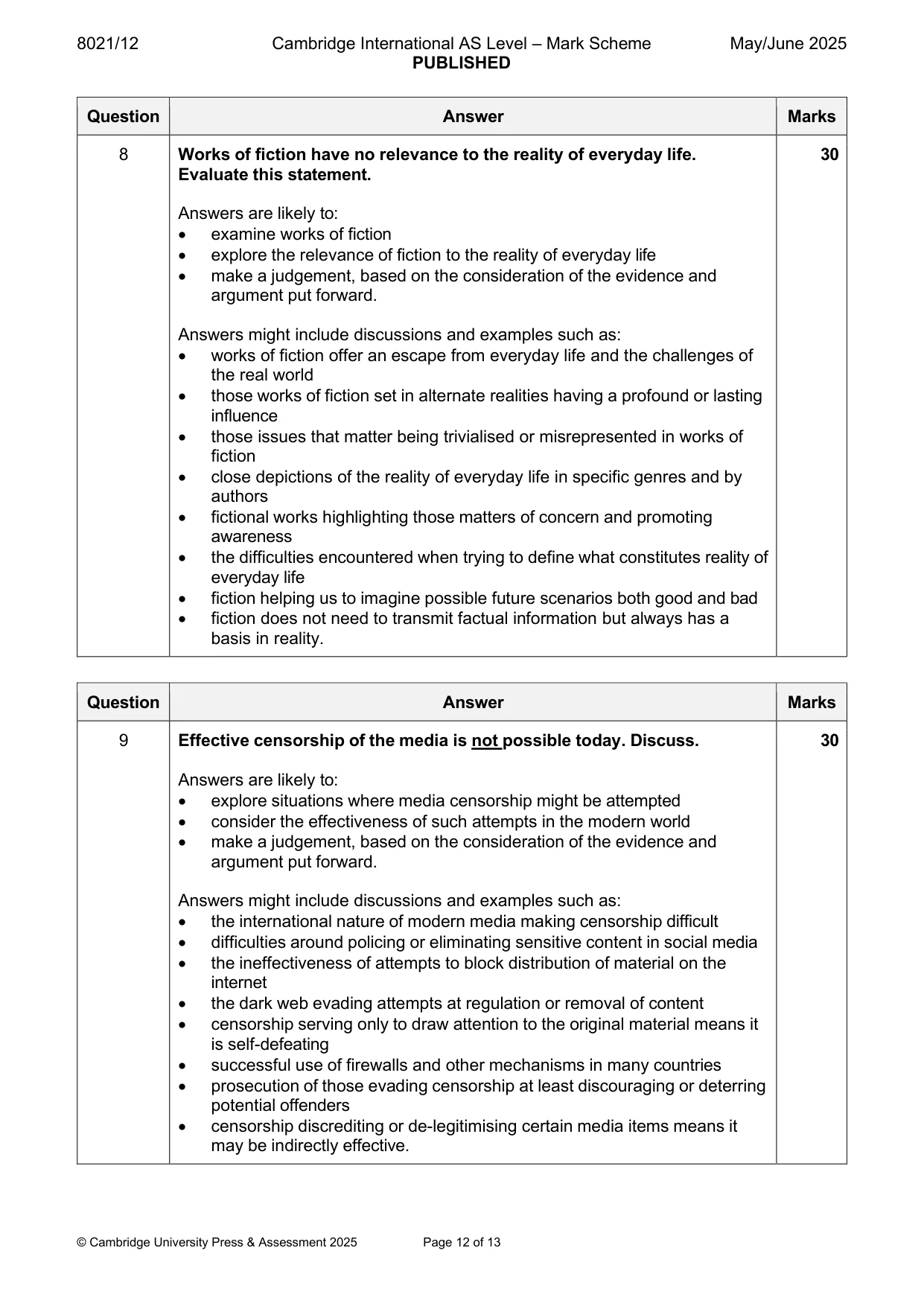
8021/12 Cambridge International AS Level – Mark Scheme PUBLISHED May/June 2025 © Cambridge University Press & Assessment 2025 Page 12 of 13 Question Answer Marks 8 Works of fiction have no relevance to the reality of everyday life. Evaluate this statement. Answers are likely to: • examine works of fiction • explore the relevance of fiction to the reality of everyday life • make a judgement, based on the consideration of the evidence and argument put forward. Answers might include discussions and examples such as: • works of fiction offer an escape from everyday life and the challenges of the real world • those works of fiction set in alternate realities having a profound or lasting influence • those issues that matter being trivialised or misrepresented in works of fiction • close depictions of the reality of everyday life in specific genres and by authors • fictional works highlighting those matters of concern and promoting awareness • the difficulties encountered when trying to define what constitutes reality of everyday life • fiction helping us to imagine possible future scenarios both good and bad • fiction does not need to transmit factual information but always has a basis in reality. 30 Question Answer Marks 9 Effective censorship of the media is not possible today. Discuss. Answers are likely to: • explore situations where media censorship might be attempted • consider the effectiveness of such attempts in the modern world • make a judgement, based on the consideration of the evidence and argument put forward. Answers might include discussions and examples such as: • the international nature of modern media making censorship difficult • difficulties around policing or eliminating sensitive content in social media • the ineffectiveness of attempts to block distribution of material on the internet • the dark web evading attempts at regulation or removal of content • censorship serving only to draw attention to the original material means it is self-defeating • successful use of firewalls and other mechanisms in many countries • prosecution of those evading censorship at least discouraging or deterring potential offenders • censorship discrediting or de-legitimising certain media items means it may be indirectly effective. 30
Mark scheme, page 13
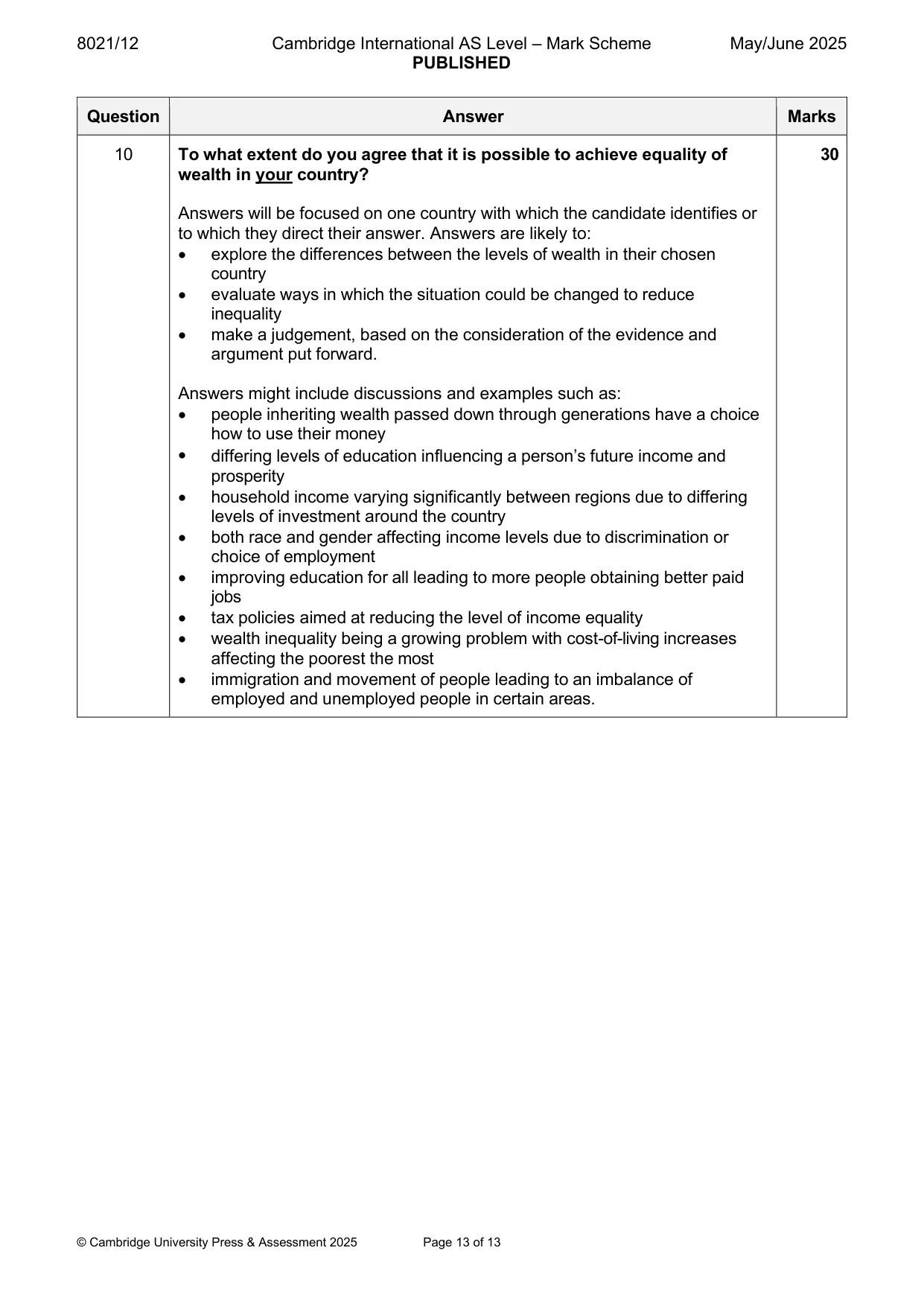
8021/12 Cambridge International AS Level – Mark Scheme PUBLISHED May/June 2025 © Cambridge University Press & Assessment 2025 Page 13 of 13 Question Answer Marks 10 To what extent do you agree that it is possible to achieve equality of wealth in your country? Answers will be focused on one country with which the candidate identifies or to which they direct their answer. Answers are likely to: • explore the differences between the levels of wealth in their chosen country • evaluate ways in which the situation could be changed to reduce inequality • make a judgement, based on the consideration of the evidence and argument put forward. Answers might include discussions and examples such as: • people inheriting wealth passed down through generations have a choice how to use their money • differing levels of education influencing a person’s future income and prosperity • household income varying significantly between regions due to differing levels of investment around the country • both race and gender affecting income levels due to discrimination or choice of employment • improving education for all leading to more people obtaining better paid jobs • tax policies aimed at reducing the level of income equality • wealth inequality being a growing problem with cost-of-living increases affecting the poorest the most • immigration and movement of people leading to an imbalance of employed and unemployed people in certain areas. 30
What you needed in this session
Cambridge’s own grade thresholds for 2025 May/June, Paper 1 · Variant 2. A higher threshold means an easier paper — the bar moves with how the cohort did.