Cambridge A Level English General Paper 8021 — 2024 May/June Paper 1 · Variant 2
8021/12/M/J/24 · 30 marks · ≈34 min
The question paper and its mark scheme, free to read here and free to download. This is Cambridge’s own paper, exactly as it was sat.
Question paper4 pages


Mark scheme16 pages
Answers below. Sit the paper first if you are practising.
Paper as text
Question paper, page 1
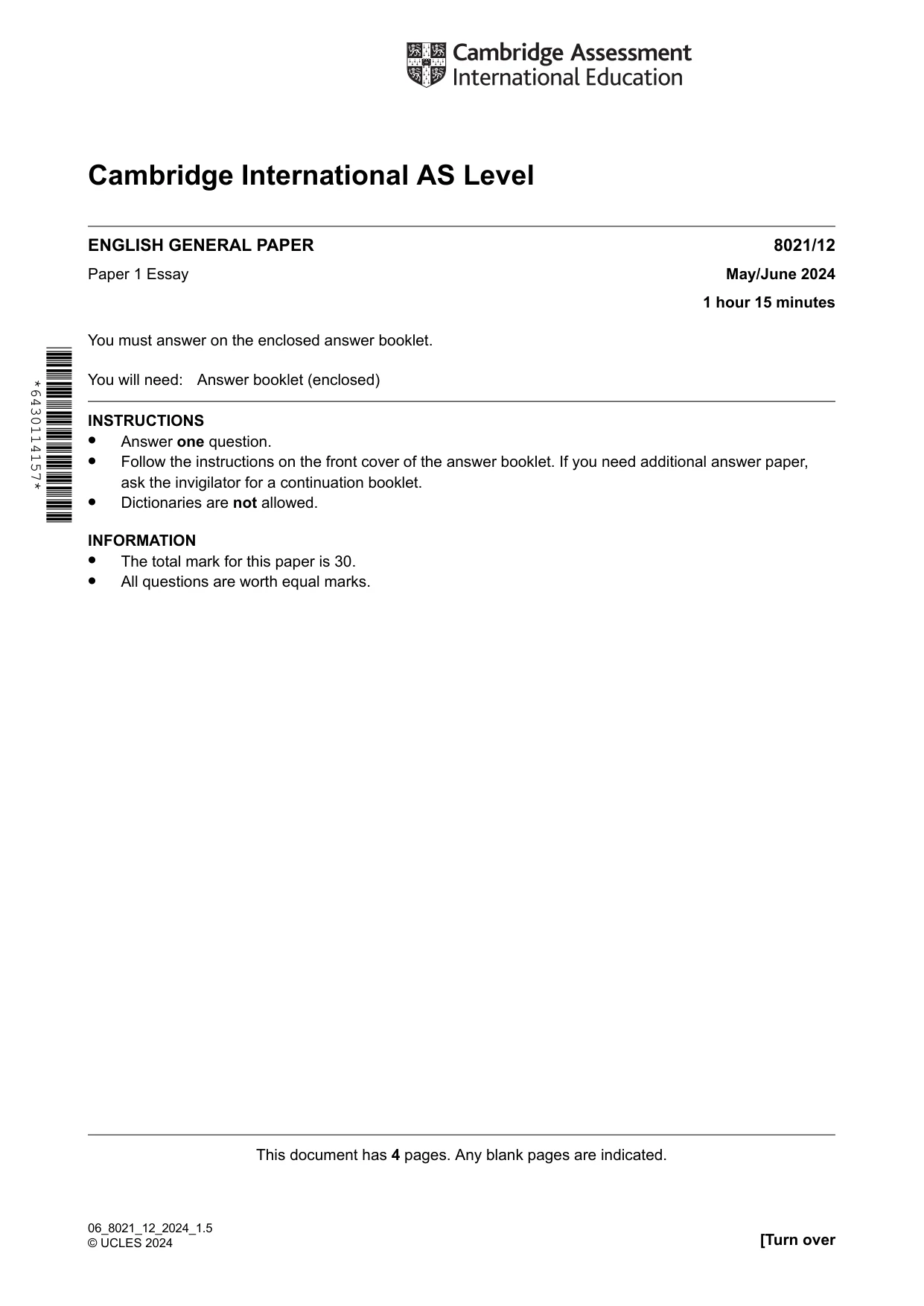
Cambridge International AS Level 8021/12 May/June 2024 1 hour 15 minutes ENGLISH GENERAL PAPER Paper 1 Essay You must answer on the enclosed answer booklet. You will need: Answer booklet (enclosed) INSTRUCTIONS • Answer one question. • Follow the instructions on the front cover of the answer booklet. If you need additional answer paper, ask the invigilator for a continuation booklet. • Dictionaries are not allowed. INFORMATION • The total mark for this paper is 30. • All questions are worth equal marks. This document has 4 pages. Any blank pages are indicated. [Turn over 06_8021_12_2024_1.5 © UCLES 2024 *6430114157*
Question paper, page 2
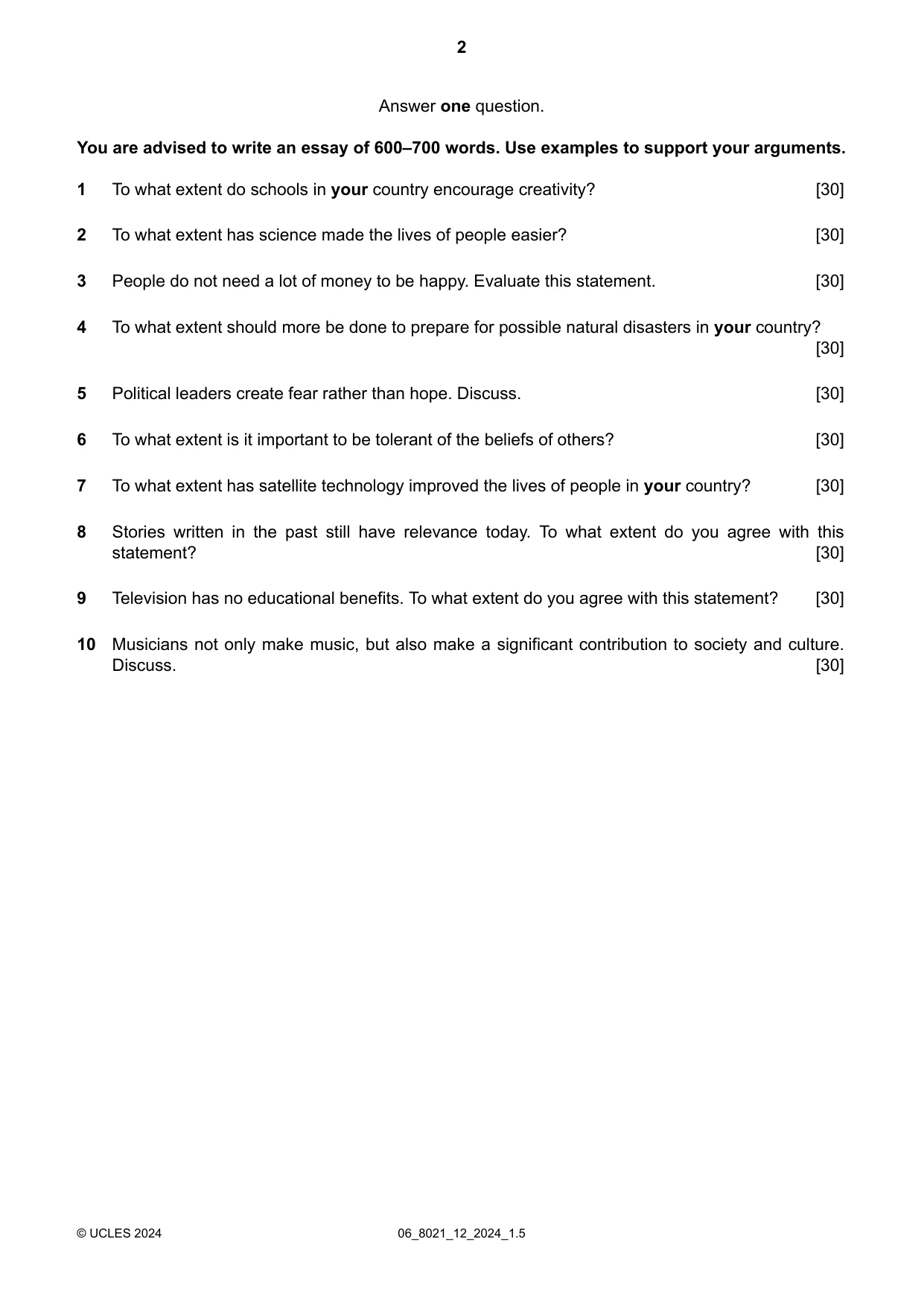
Answer one question. You are advised to write an essay of 600–700 words. Use examples to support your arguments. To what extent do schools in your country encourage creativity? [30] 1 To what extent has science made the lives of people easier? [30] 2 People do not need a lot of money to be happy. Evaluate this statement. [30] 3 To what extent should more be done to prepare for possible natural disasters in your country? [30] 4 Political leaders create fear rather than hope. Discuss. [30] 5 To what extent is it important to be tolerant of the beliefs of others? [30] 6 To what extent has satellite technology improved the lives of people in your country? [30] 7 Stories written in the past still have relevance today. To what extent do you agree with this statement? [30] 8 Television has no educational benefits. To what extent do you agree with this statement? [30] 9 Musicians not only make music, but also make a significant contribution to society and culture. Discuss. [30] 10 06_8021_12_2024_1.5 © UCLES 2024 2
Question paper, page 3
BLANK PAGE 06_8021_12_2024_1.5 © UCLES 2024 3
Question paper, page 4
BLANK PAGE Permission to reproduce items where third-party owned material protected by copyright is included has been sought and cleared where possible. Every reasonable effort has been made by the publisher (UCLES) to trace copyright holders, but if any items requiring clearance have unwittingly been included, the publisher will be pleased to make amends at the earliest possible opportunity. To avoid the issue of disclosure of answer-related information to candidates, all copyright acknowledgements are reproduced online in the Cambridge Assessment International Education Copyright Acknowledgements Booklet. This is produced for each series of examinations and is freely available to download at www.cambridgeinternational.org after the live examination series. Cambridge Assessment International Education is part of Cambridge Assessment. Cambridge Assessment is the brand name of the University of Cambridge Local Examinations Syndicate (UCLES), which is a department of the University of Cambridge. 06_8021_12_2024_1.5 © UCLES 2024 4
Mark scheme, page 1
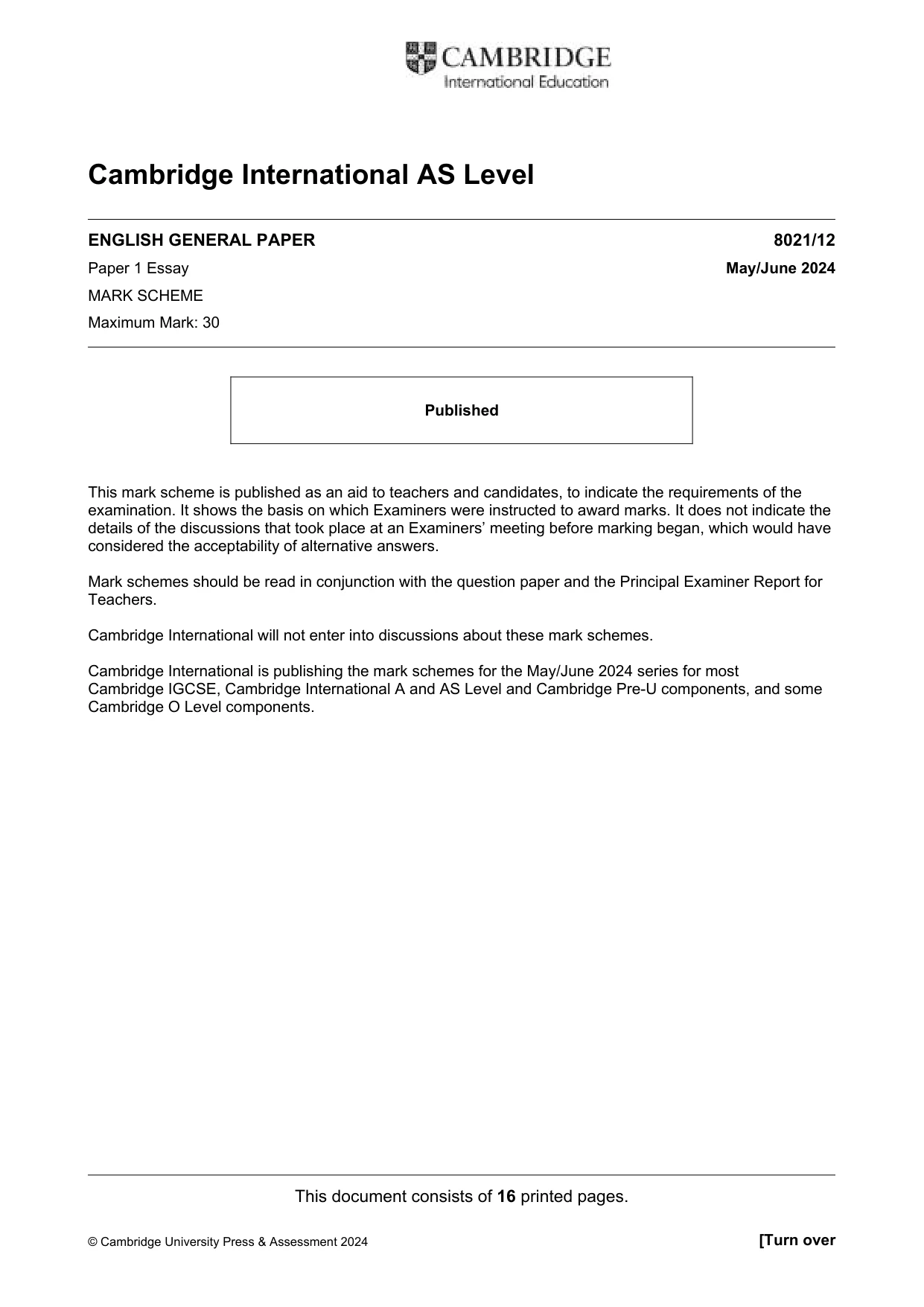
This document consists of 16 printed pages. © Cambridge University Press & Assessment 2024 [Turn over Cambridge International AS Level ENGLISH GENERAL PAPER 8021/12 Paper 1 Essay May/June 2024 MARK SCHEME Maximum Mark: 30 Published This mark scheme is published as an aid to teachers and candidates, to indicate the requirements of the examination. It shows the basis on which Examiners were instructed to award marks. It does not indicate the details of the discussions that took place at an Examiners’ meeting before marking began, which would have considered the acceptability of alternative answers. Mark schemes should be read in conjunction with the question paper and the Principal Examiner Report for Teachers. Cambridge International will not enter into discussions about these mark schemes. Cambridge International is publishing the mark schemes for the May/June 2024 series for most Cambridge IGCSE, Cambridge International A and AS Level and Cambridge Pre-U components, and some Cambridge O Level components.
Mark scheme, page 2
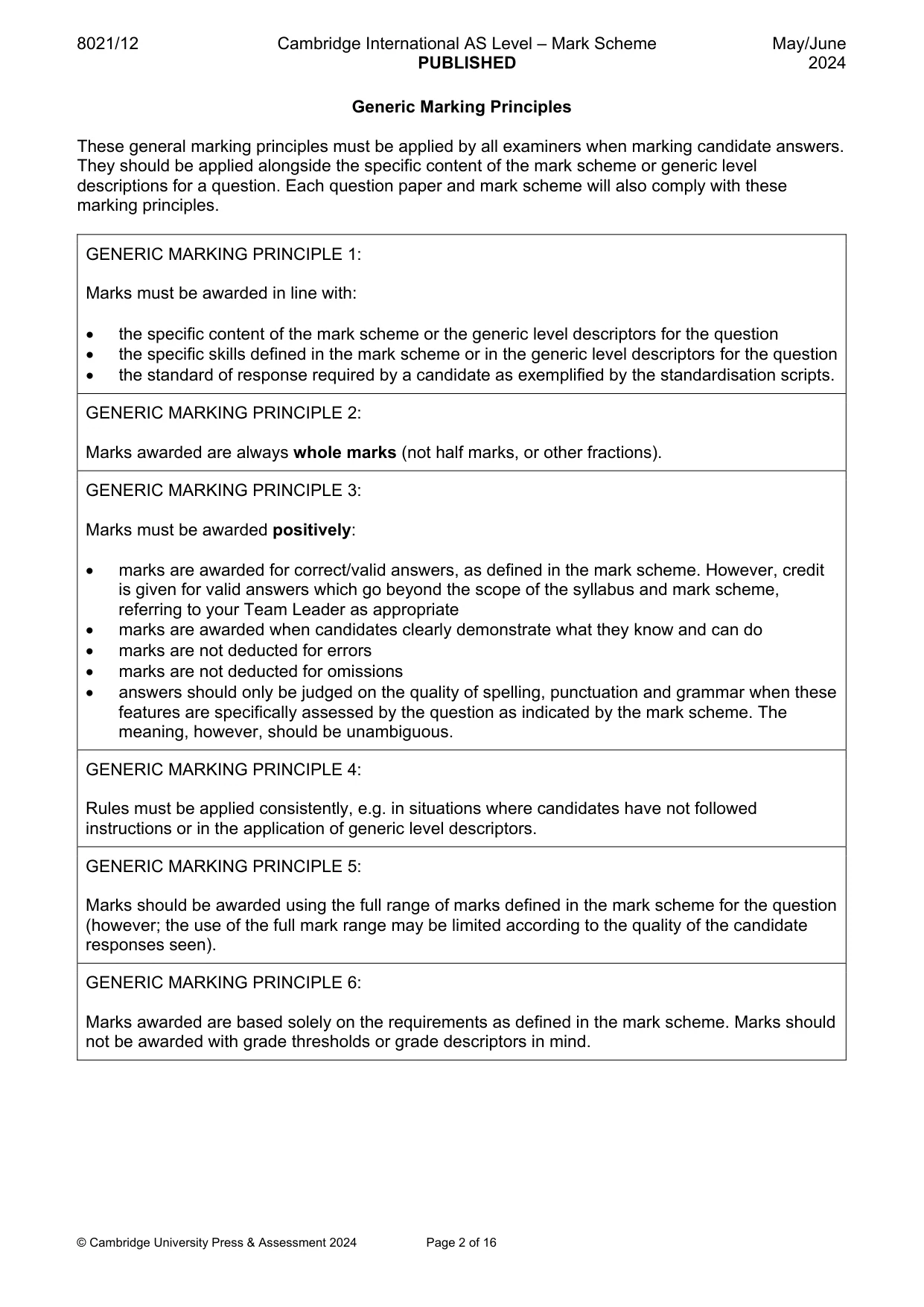
8021/12 Cambridge International AS Level – Mark Scheme PUBLISHED May/June 2024 © Cambridge University Press & Assessment 2024 Page 2 of 16 Generic Marking Principles These general marking principles must be applied by all examiners when marking candidate answers. They should be applied alongside the specific content of the mark scheme or generic level descriptions for a question. Each question paper and mark scheme will also comply with these marking principles. GENERIC MARKING PRINCIPLE 1: Marks must be awarded in line with: the specific content of the mark scheme or the generic level descriptors for the question the specific skills defined in the mark scheme or in the generic level descriptors for the question the standard of response required by a candidate as exemplified by the standardisation scripts. GENERIC MARKING PRINCIPLE 2: Marks awarded are always whole marks (not half marks, or other fractions). GENERIC MARKING PRINCIPLE 3: Marks must be awarded positively: marks are awarded for correct/valid answers, as defined in the mark scheme. However, credit is given for valid answers which go beyond the scope of the syllabus and mark scheme, referring to your Team Leader as appropriate marks are awarded when candidates clearly demonstrate what they know and can do marks are not deducted for errors marks are not deducted for omissions answers should only be judged on the quality of spelling, punctuation and grammar when these features are specifically assessed by the question as indicated by the mark scheme. The meaning, however, should be unambiguous. GENERIC MARKING PRINCIPLE 4: Rules must be applied consistently, e.g. in situations where candidates have not followed instructions or in the application of generic level descriptors. GENERIC MARKING PRINCIPLE 5: Marks should be awarded using the full range of marks defined in the mark scheme for the question (however; the use of the full mark range may be limited according to the quality of the candidate responses seen). GENERIC MARKING PRINCIPLE 6: Marks awarded are based solely on the requirements as defined in the mark scheme. Marks should not be awarded with grade thresholds or grade descriptors in mind.
Mark scheme, page 3
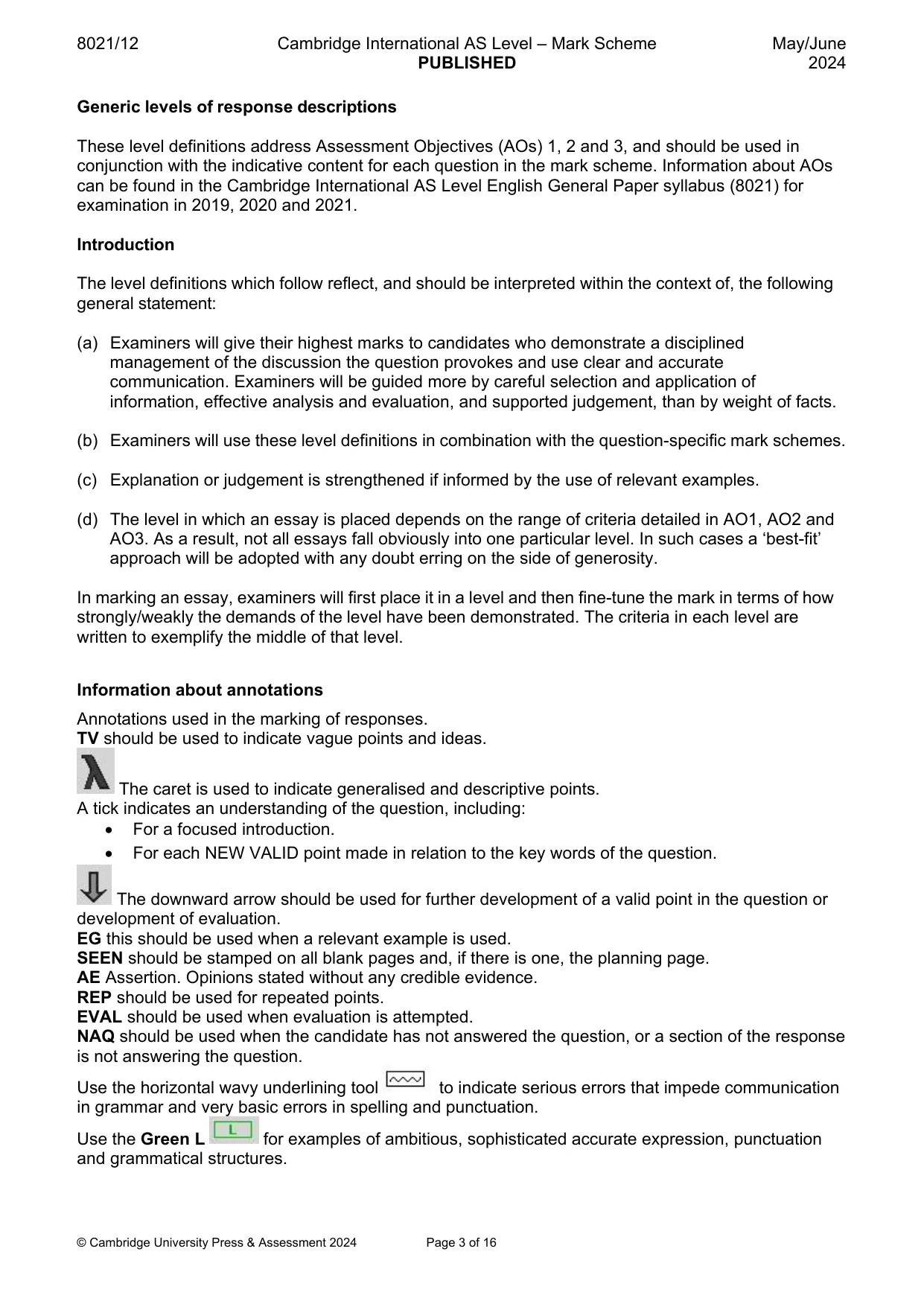
8021/12 Cambridge International AS Level – Mark Scheme PUBLISHED May/June 2024 © Cambridge University Press & Assessment 2024 Page 3 of 16 Generic levels of response descriptions These level definitions address Assessment Objectives (AOs) 1, 2 and 3, and should be used in conjunction with the indicative content for each question in the mark scheme. Information about AOs can be found in the Cambridge International AS Level English General Paper syllabus (8021) for examination in 2019, 2020 and 2021. Introduction The level definitions which follow reflect, and should be interpreted within the context of, the following general statement: (a) Examiners will give their highest marks to candidates who demonstrate a disciplined management of the discussion the question provokes and use clear and accurate communication. Examiners will be guided more by careful selection and application of information, effective analysis and evaluation, and supported judgement, than by weight of facts. (b) Examiners will use these level definitions in combination with the question-specific mark schemes. (c) Explanation or judgement is strengthened if informed by the use of relevant examples. (d) The level in which an essay is placed depends on the range of criteria detailed in AO1, AO2 and AO3. As a result, not all essays fall obviously into one particular level. In such cases a ‘best-fit’ approach will be adopted with any doubt erring on the side of generosity. In marking an essay, examiners will first place it in a level and then fine-tune the mark in terms of how strongly/weakly the demands of the level have been demonstrated. The criteria in each level are written to exemplify the middle of that level. Information about annotations Annotations used in the marking of responses. TV should be used to indicate vague points and ideas. The caret is used to indicate generalised and descriptive points. A tick indicates an understanding of the question, including: For a focused introduction. For each NEW VALID point made in relation to the key words of the question. The downward arrow should be used for further development of a valid point in the question or development of evaluation. EG this should be used when a relevant example is used. SEEN should be stamped on all blank pages and, if there is one, the planning page. AE Assertion. Opinions stated without any credible evidence. REP should be used for repeated points. EVAL should be used when evaluation is attempted. NAQ should be used when the candidate has not answered the question, or a section of the response is not answering the question. Use the horizontal wavy underlining tool to indicate serious errors that impede communication in grammar and very basic errors in spelling and punctuation. Use the Green L for examples of ambitious, sophisticated accurate expression, punctuation and grammatical structures.
Mark scheme, page 4
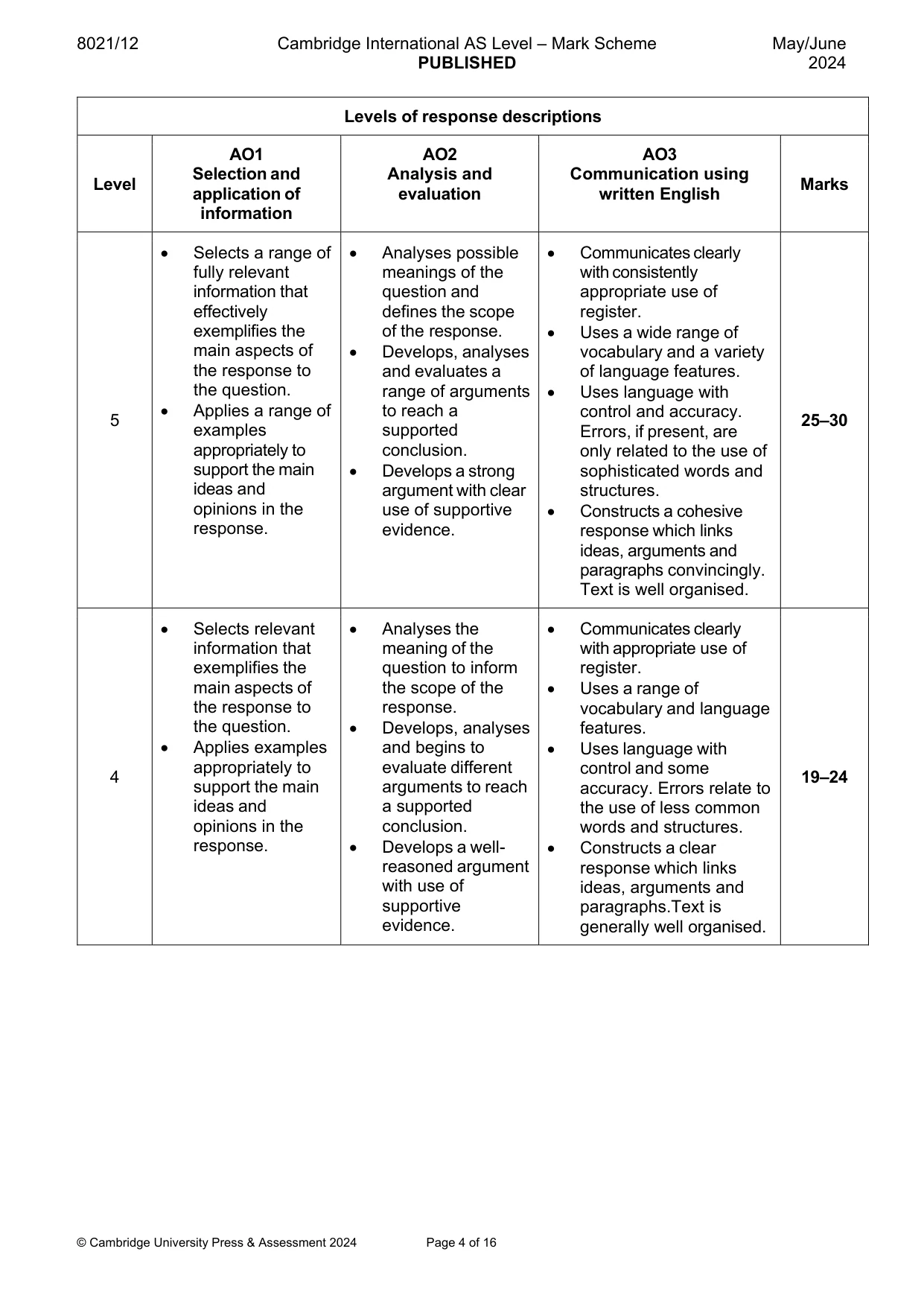
8021/12 Cambridge International AS Level – Mark Scheme PUBLISHED May/June 2024 © Cambridge University Press & Assessment 2024 Page 4 of 16 Levels of response descriptions Level AO1 Selection and application of information AO2 Analysis and evaluation AO3 Communication using written English Marks 5 Selects a range of fully relevant information that effectively exemplifies the main aspects of the response to the question. Applies a range of examples appropriately to support the main ideas and opinions in the response. Analyses possible meanings of the question and defines the scope of the response. Develops, analyses and evaluates a range of arguments to reach a supported conclusion. Develops a strong argument with clear use of supportive evidence. Communicates clearly with consistently appropriate use of register. Uses a wide range of vocabulary and a variety of language features. Uses language with control and accuracy. Errors, if present, are only related to the use of sophisticated words and structures. Constructs a cohesive response which links ideas, arguments and paragraphs convincingly. Text is well organised. 25–30 4 Selects relevant information that exemplifies the main aspects of the response to the question. Applies examples appropriately to support the main ideas and opinions in the response. Analyses the meaning of the question to inform the scope of the response. Develops, analyses and begins to evaluate different arguments to reach a supported conclusion. Develops a well- reasoned argument with use of supportive evidence. Communicates clearly with appropriate use of register. Uses a range of vocabulary and language features. Uses language with control and some accuracy. Errors relate to the use of less common words and structures. Constructs a clear response which links ideas, arguments and paragraphs.Text is generally well organised. 19–24
Mark scheme, page 5
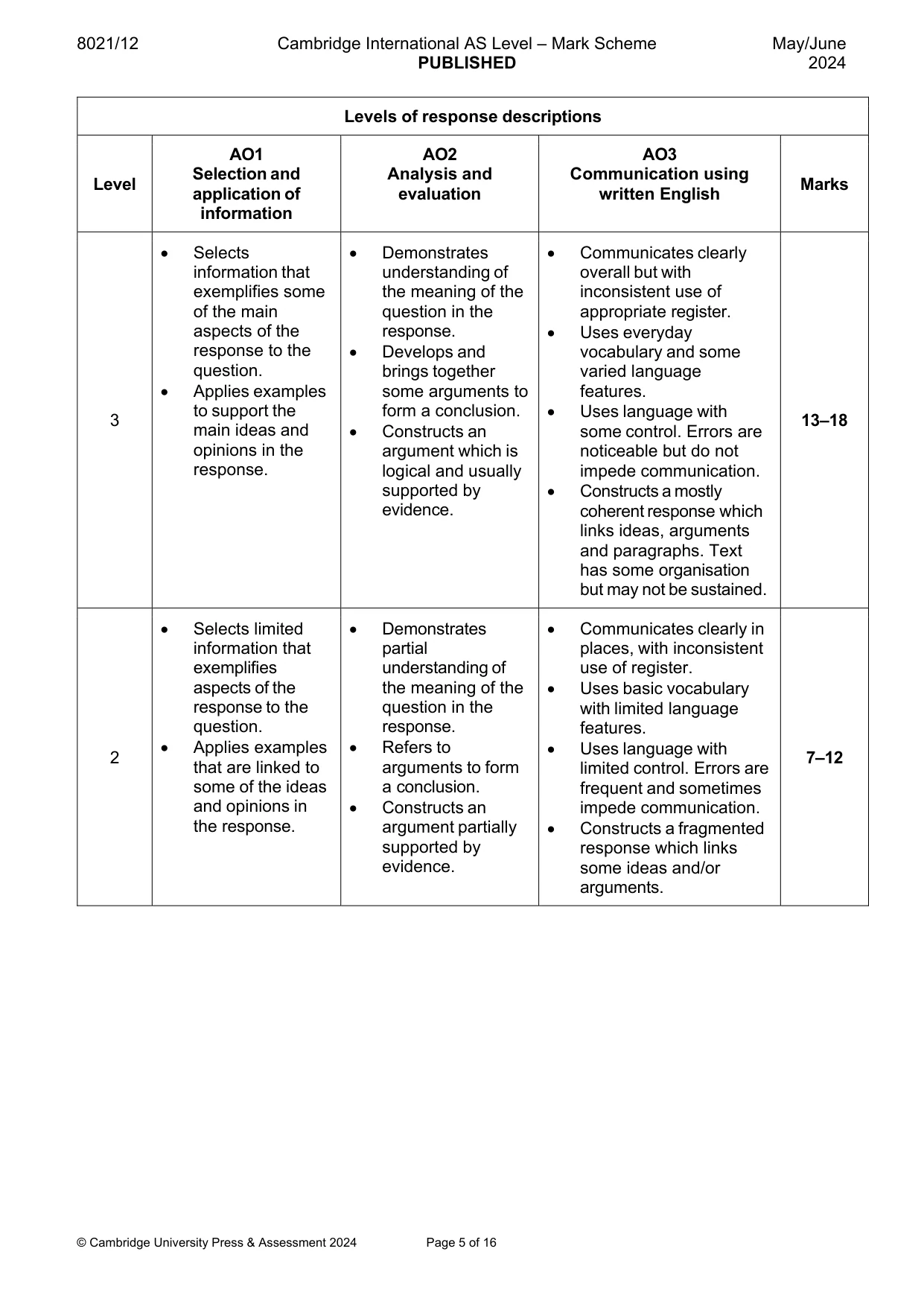
8021/12 Cambridge International AS Level – Mark Scheme PUBLISHED May/June 2024 © Cambridge University Press & Assessment 2024 Page 5 of 16 Levels of response descriptions Level AO1 Selection and application of information AO2 Analysis and evaluation AO3 Communication using written English Marks 3 Selects information that exemplifies some of the main aspects of the response to the question. Applies examples to support the main ideas and opinions in the response. Demonstrates understanding of the meaning of the question in the response. Develops and brings together some arguments to form a conclusion. Constructs an argument which is logical and usually supported by evidence. Communicates clearly overall but with inconsistent use of appropriate register. Uses everyday vocabulary and some varied language features. Uses language with some control. Errors are noticeable but do not impede communication. Constructs a mostly coherent response which links ideas, arguments and paragraphs. Text has some organisation but may not be sustained. 13–18 2 Selects limited information that exemplifies aspects of the response to the question. Applies examples that are linked to some of the ideas and opinions in the response. Demonstrates partial understanding of the meaning of the question in the response. Refers to arguments to form a conclusion. Constructs an argument partially supported by evidence. Communicates clearly in places, with inconsistent use of register. Uses basic vocabulary with limited language features. Uses language with limited control. Errors are frequent and sometimes impede communication. Constructs a fragmented response which links some ideas and/or arguments. 7–12
Mark scheme, page 6
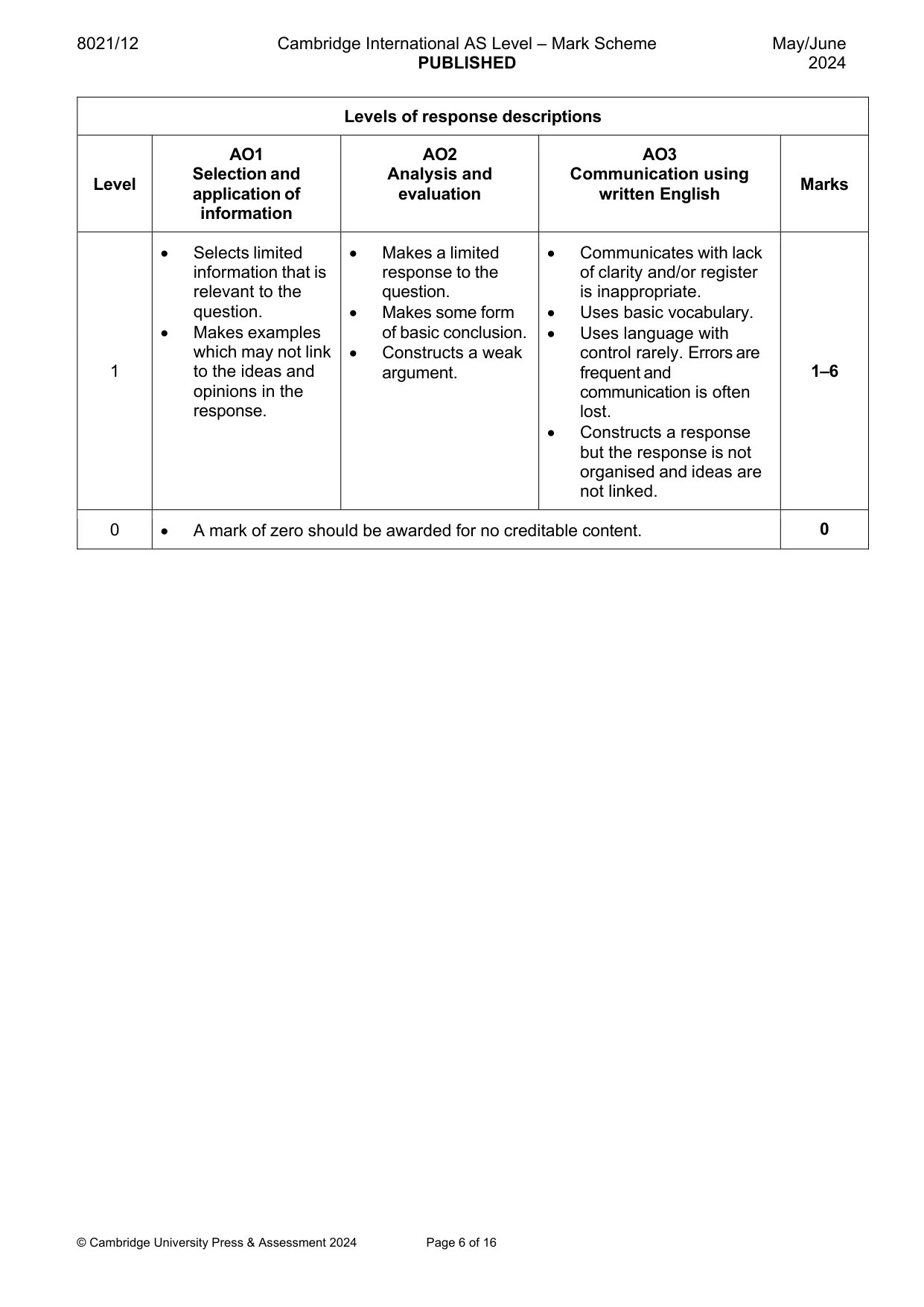
8021/12 Cambridge International AS Level – Mark Scheme PUBLISHED May/June 2024 © Cambridge University Press & Assessment 2024 Page 6 of 16 Levels of response descriptions Level AO1 Selection and application of information AO2 Analysis and evaluation AO3 Communication using written English Marks 1 Selects limited information that is relevant to the question. Makes examples which may not link to the ideas and opinions in the response. Makes a limited response to the question. Makes some form of basic conclusion. Constructs a weak argument. Communicates with lack of clarity and/or register is inappropriate. Uses basic vocabulary. Uses language with control rarely. Errors are frequent and communication is often lost. Constructs a response but the response is not organised and ideas are not linked. 1–6 0 A mark of zero should be awarded for no creditable content. 0
Mark scheme, page 7
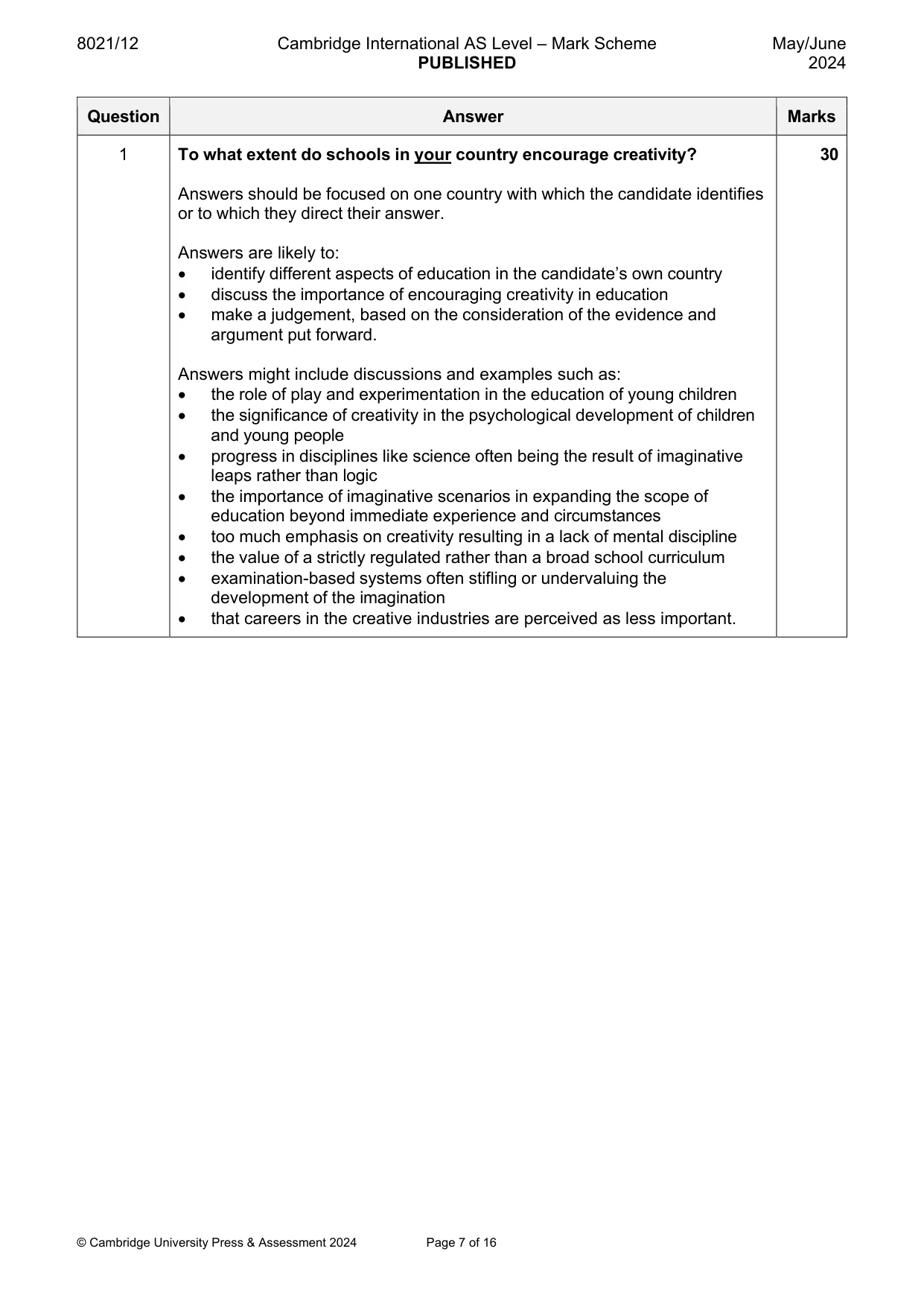
8021/12 Cambridge International AS Level – Mark Scheme PUBLISHED May/June 2024 © Cambridge University Press & Assessment 2024 Page 7 of 16 Question Answer Marks 1 To what extent do schools in your country encourage creativity? Answers should be focused on one country with which the candidate identifies or to which they direct their answer. Answers are likely to: identify different aspects of education in the candidate’s own country discuss the importance of encouraging creativity in education make a judgement, based on the consideration of the evidence and argument put forward. Answers might include discussions and examples such as: the role of play and experimentation in the education of young children the significance of creativity in the psychological development of children and young people progress in disciplines like science often being the result of imaginative leaps rather than logic the importance of imaginative scenarios in expanding the scope of education beyond immediate experience and circumstances too much emphasis on creativity resulting in a lack of mental discipline the value of a strictly regulated rather than a broad school curriculum examination-based systems often stifling or undervaluing the development of the imagination that careers in the creative industries are perceived as less important. 30
Mark scheme, page 8
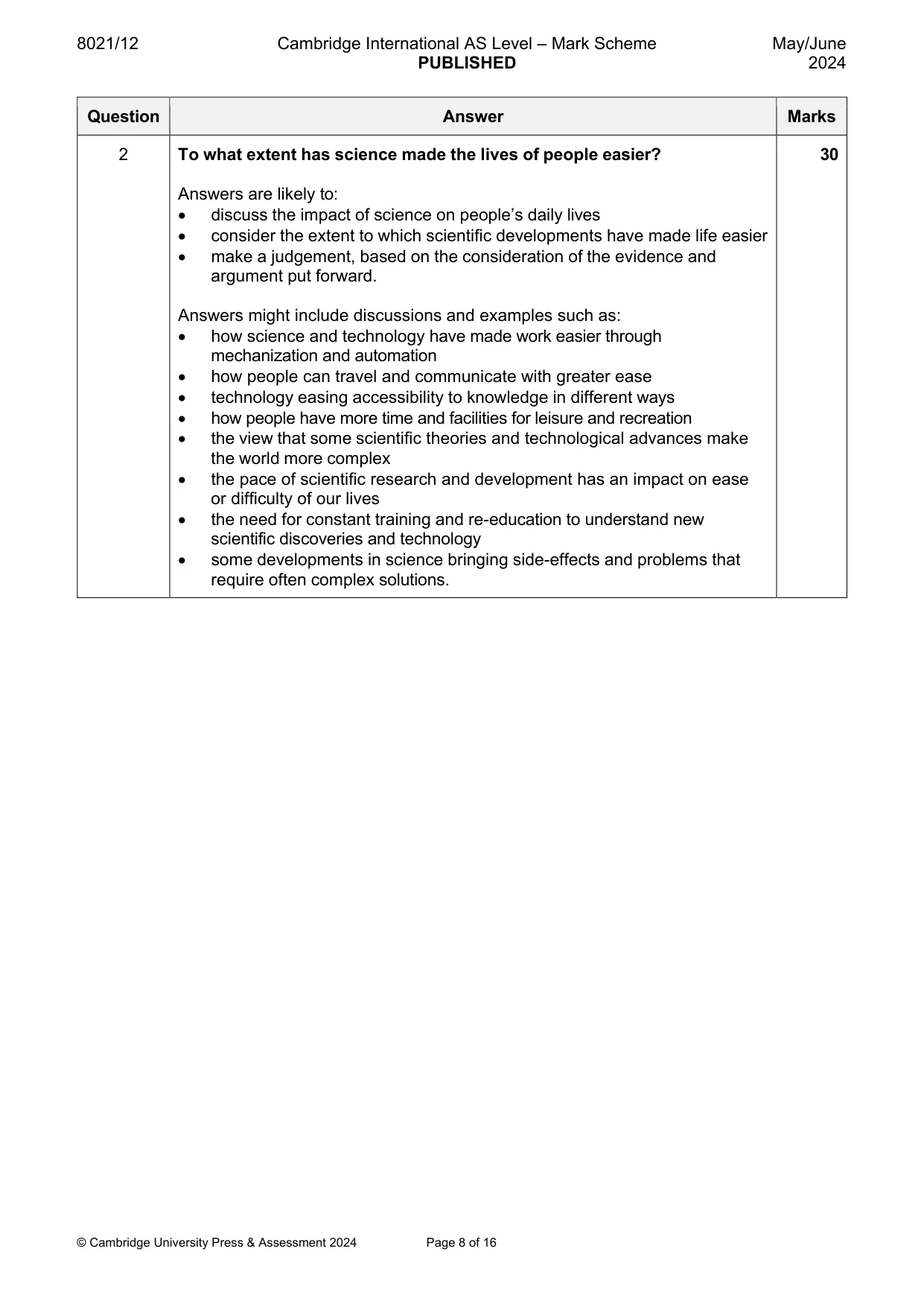
8021/12 Cambridge International AS Level – Mark Scheme PUBLISHED May/June 2024 © Cambridge University Press & Assessment 2024 Page 8 of 16 Question Answer Marks 2 To what extent has science made the lives of people easier? Answers are likely to: discuss the impact of science on people’s daily lives consider the extent to which scientific developments have made life easier make a judgement, based on the consideration of the evidence and argument put forward. Answers might include discussions and examples such as: how science and technology have made work easier through mechanization and automation how people can travel and communicate with greater ease technology easing accessibility to knowledge in different ways how people have more time and facilities for leisure and recreation the view that some scientific theories and technological advances make the world more complex the pace of scientific research and development has an impact on ease or difficulty of our lives the need for constant training and re-education to understand new scientific discoveries and technology some developments in science bringing side-effects and problems that require often complex solutions. 30
Mark scheme, page 9
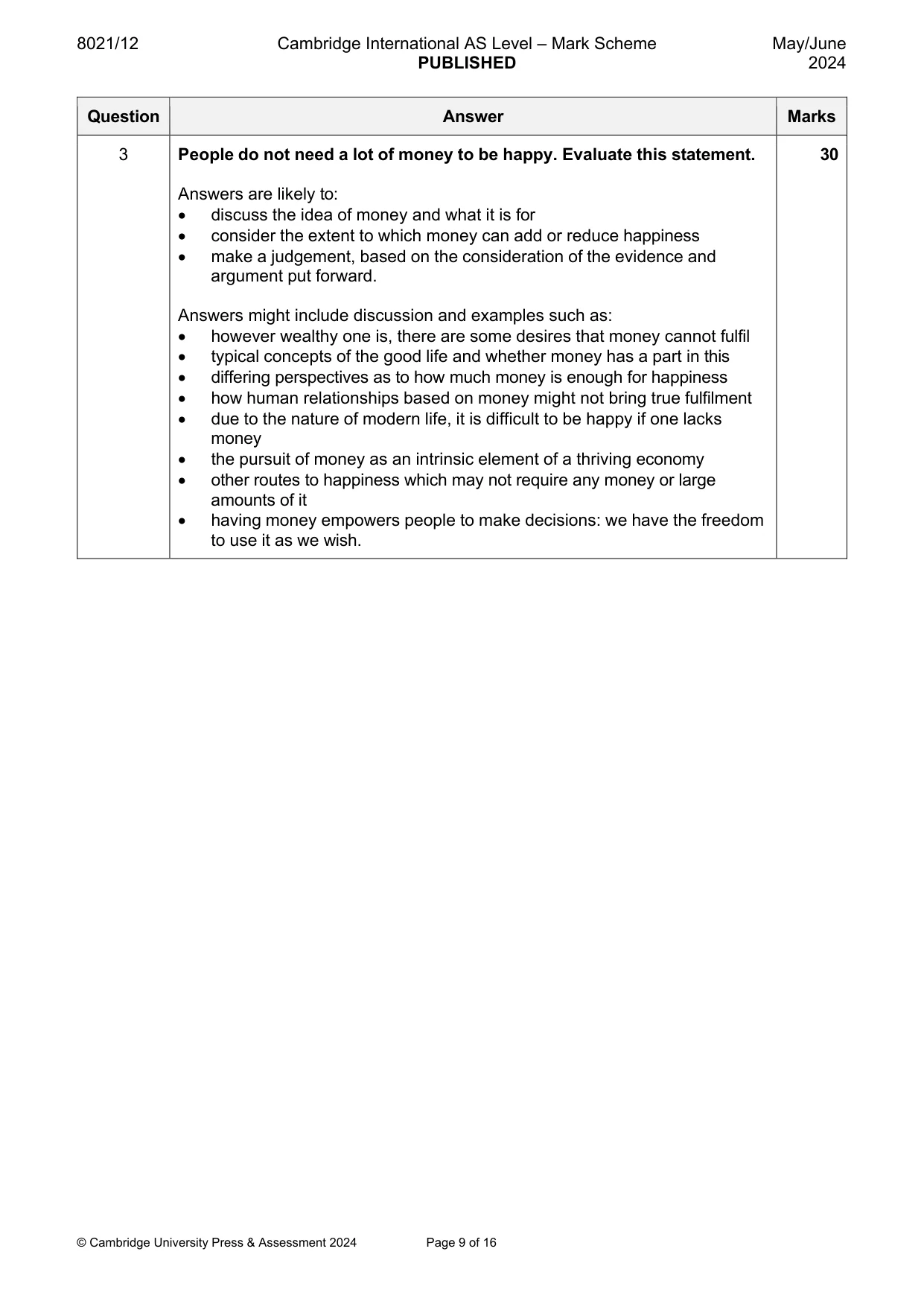
8021/12 Cambridge International AS Level – Mark Scheme PUBLISHED May/June 2024 © Cambridge University Press & Assessment 2024 Page 9 of 16 Question Answer Marks 3 People do not need a lot of money to be happy. Evaluate this statement. Answers are likely to: discuss the idea of money and what it is for consider the extent to which money can add or reduce happiness make a judgement, based on the consideration of the evidence and argument put forward. Answers might include discussion and examples such as: however wealthy one is, there are some desires that money cannot fulfil typical concepts of the good life and whether money has a part in this differing perspectives as to how much money is enough for happiness how human relationships based on money might not bring true fulfilment due to the nature of modern life, it is difficult to be happy if one lacks money the pursuit of money as an intrinsic element of a thriving economy other routes to happiness which may not require any money or large amounts of it having money empowers people to make decisions: we have the freedom to use it as we wish. 30
Mark scheme, page 10
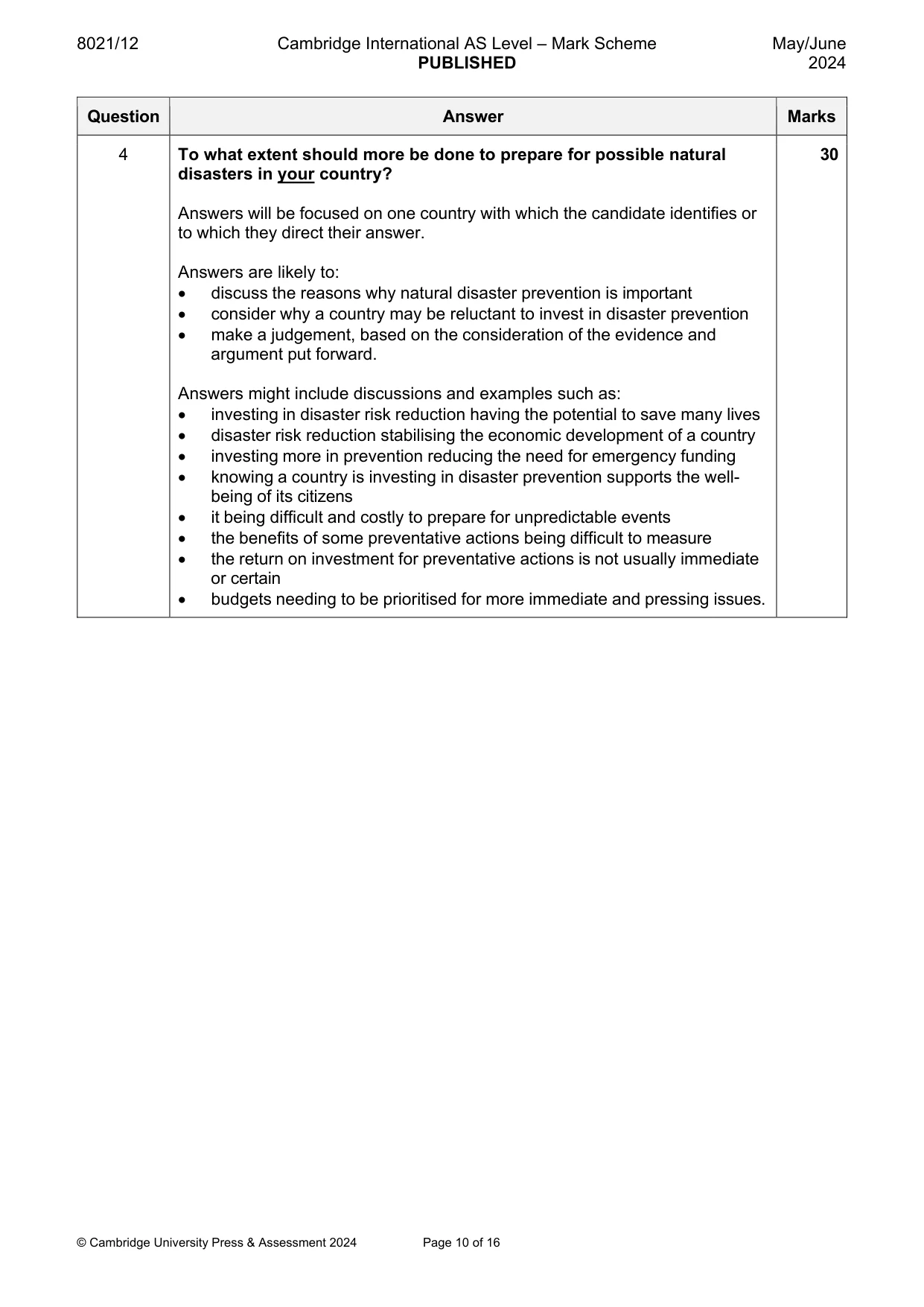
8021/12 Cambridge International AS Level – Mark Scheme PUBLISHED May/June 2024 © Cambridge University Press & Assessment 2024 Page 10 of 16 Question Answer Marks 4 To what extent should more be done to prepare for possible natural disasters in your country? Answers will be focused on one country with which the candidate identifies or to which they direct their answer. Answers are likely to: discuss the reasons why natural disaster prevention is important consider why a country may be reluctant to invest in disaster prevention make a judgement, based on the consideration of the evidence and argument put forward. Answers might include discussions and examples such as: investing in disaster risk reduction having the potential to save many lives disaster risk reduction stabilising the economic development of a country investing more in prevention reducing the need for emergency funding knowing a country is investing in disaster prevention supports the well- being of its citizens it being difficult and costly to prepare for unpredictable events the benefits of some preventative actions being difficult to measure the return on investment for preventative actions is not usually immediate or certain budgets needing to be prioritised for more immediate and pressing issues. 30
Mark scheme, page 11
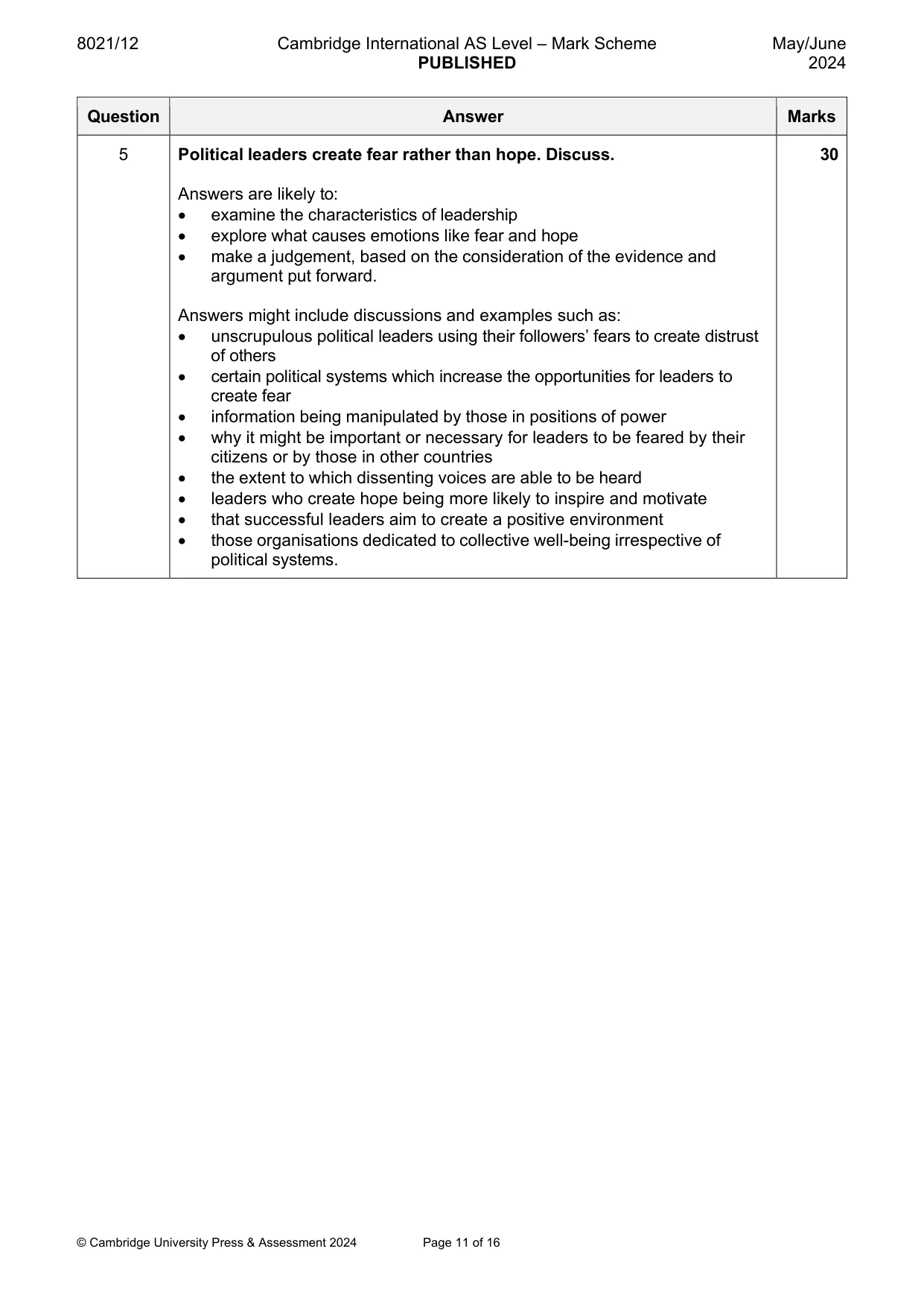
8021/12 Cambridge International AS Level – Mark Scheme PUBLISHED May/June 2024 © Cambridge University Press & Assessment 2024 Page 11 of 16 Question Answer Marks 5 Political leaders create fear rather than hope. Discuss. Answers are likely to: examine the characteristics of leadership explore what causes emotions like fear and hope make a judgement, based on the consideration of the evidence and argument put forward. Answers might include discussions and examples such as: unscrupulous political leaders using their followers’ fears to create distrust of others certain political systems which increase the opportunities for leaders to create fear information being manipulated by those in positions of power why it might be important or necessary for leaders to be feared by their citizens or by those in other countries the extent to which dissenting voices are able to be heard leaders who create hope being more likely to inspire and motivate that successful leaders aim to create a positive environment those organisations dedicated to collective well-being irrespective of political systems. 30
Mark scheme, page 12
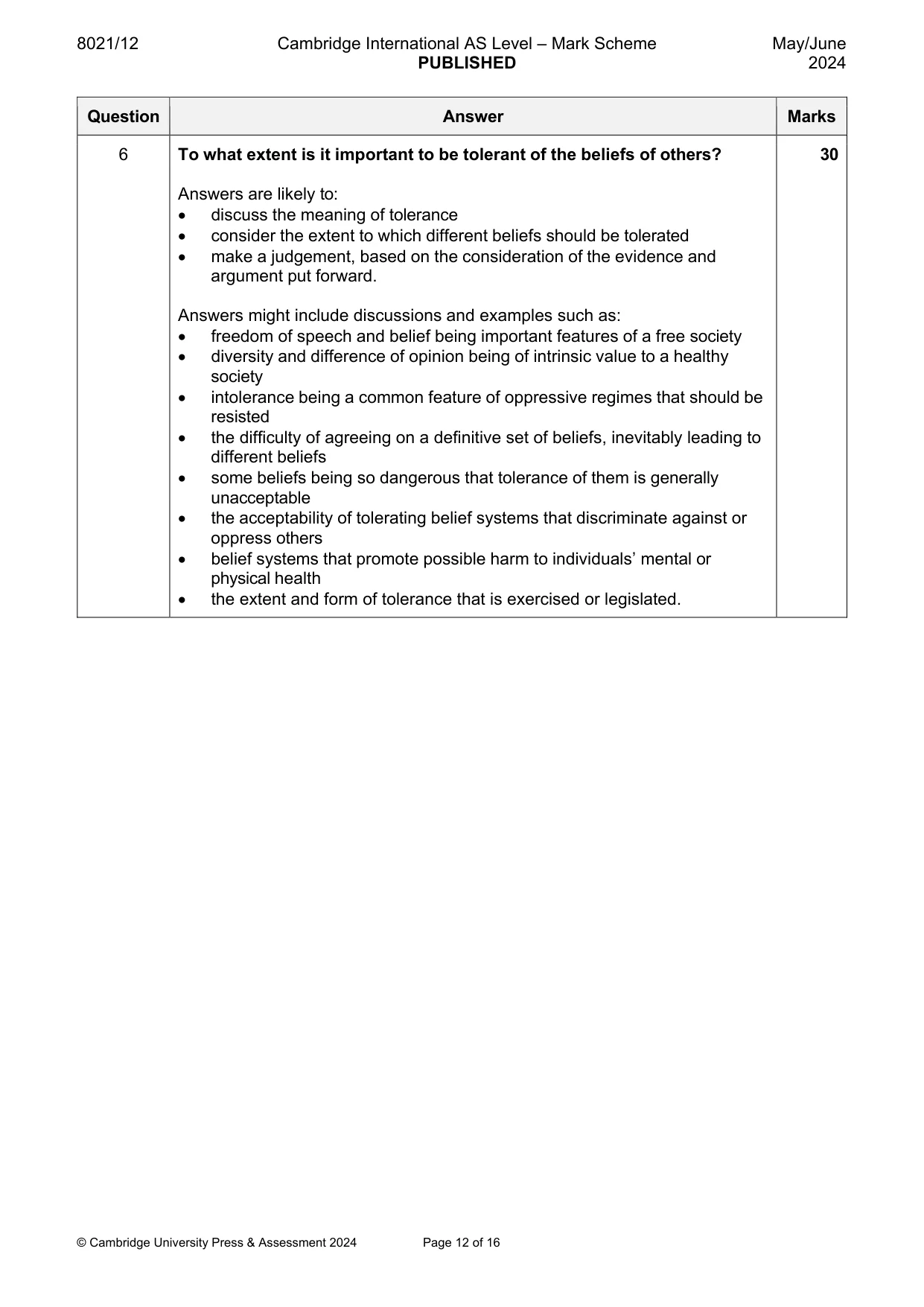
8021/12 Cambridge International AS Level – Mark Scheme PUBLISHED May/June 2024 © Cambridge University Press & Assessment 2024 Page 12 of 16 Question Answer Marks 6 To what extent is it important to be tolerant of the beliefs of others? Answers are likely to: discuss the meaning of tolerance consider the extent to which different beliefs should be tolerated make a judgement, based on the consideration of the evidence and argument put forward. Answers might include discussions and examples such as: freedom of speech and belief being important features of a free society diversity and difference of opinion being of intrinsic value to a healthy society intolerance being a common feature of oppressive regimes that should be resisted the difficulty of agreeing on a definitive set of beliefs, inevitably leading to different beliefs some beliefs being so dangerous that tolerance of them is generally unacceptable the acceptability of tolerating belief systems that discriminate against or oppress others belief systems that promote possible harm to individuals’ mental or physical health the extent and form of tolerance that is exercised or legislated. 30
Mark scheme, page 13
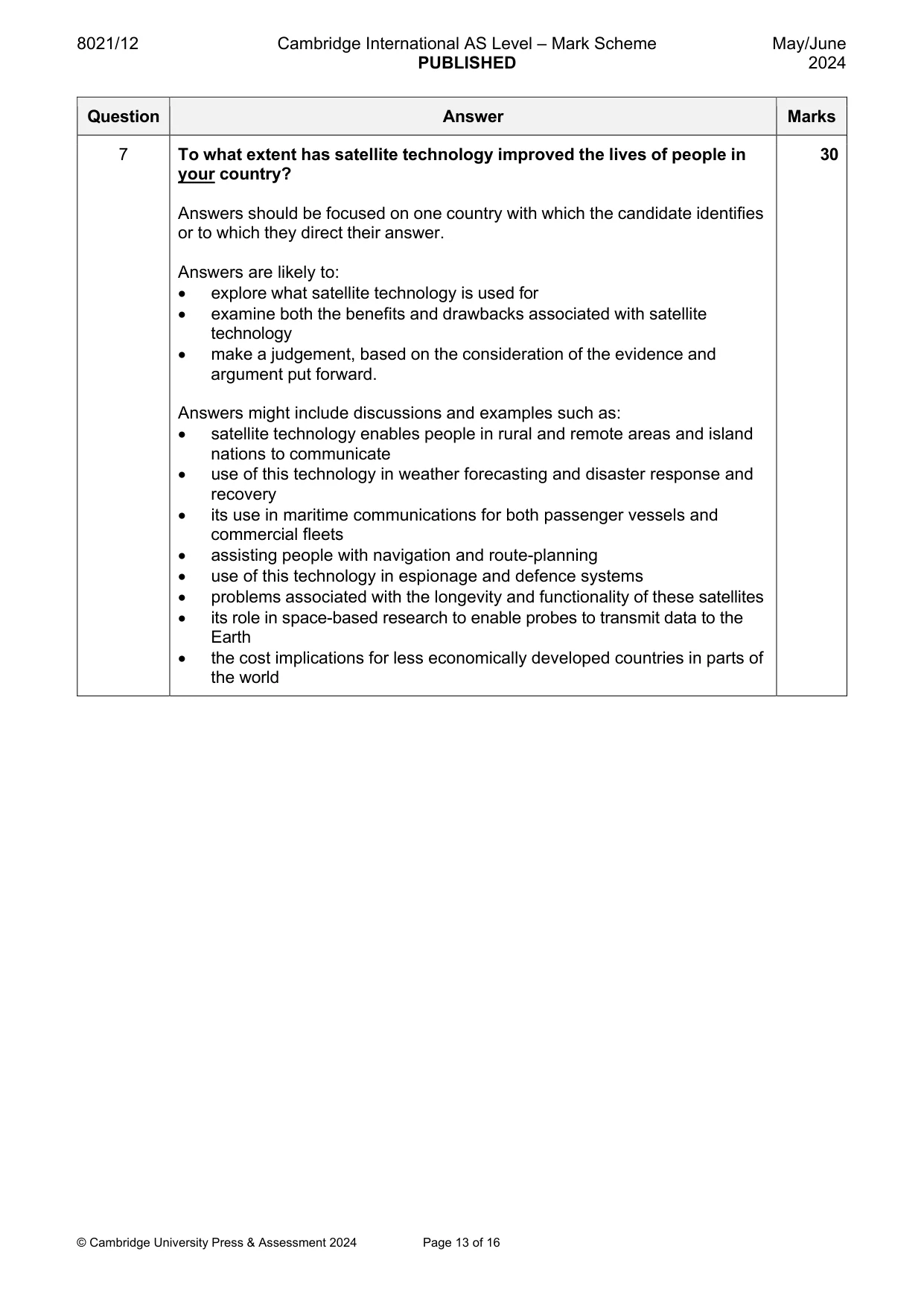
8021/12 Cambridge International AS Level – Mark Scheme PUBLISHED May/June 2024 © Cambridge University Press & Assessment 2024 Page 13 of 16 Question Answer Marks 7 To what extent has satellite technology improved the lives of people in your country? Answers should be focused on one country with which the candidate identifies or to which they direct their answer. Answers are likely to: explore what satellite technology is used for examine both the benefits and drawbacks associated with satellite technology make a judgement, based on the consideration of the evidence and argument put forward. Answers might include discussions and examples such as: satellite technology enables people in rural and remote areas and island nations to communicate use of this technology in weather forecasting and disaster response and recovery its use in maritime communications for both passenger vessels and commercial fleets assisting people with navigation and route-planning use of this technology in espionage and defence systems problems associated with the longevity and functionality of these satellites its role in space-based research to enable probes to transmit data to the Earth the cost implications for less economically developed countries in parts of the world 30
Mark scheme, page 14
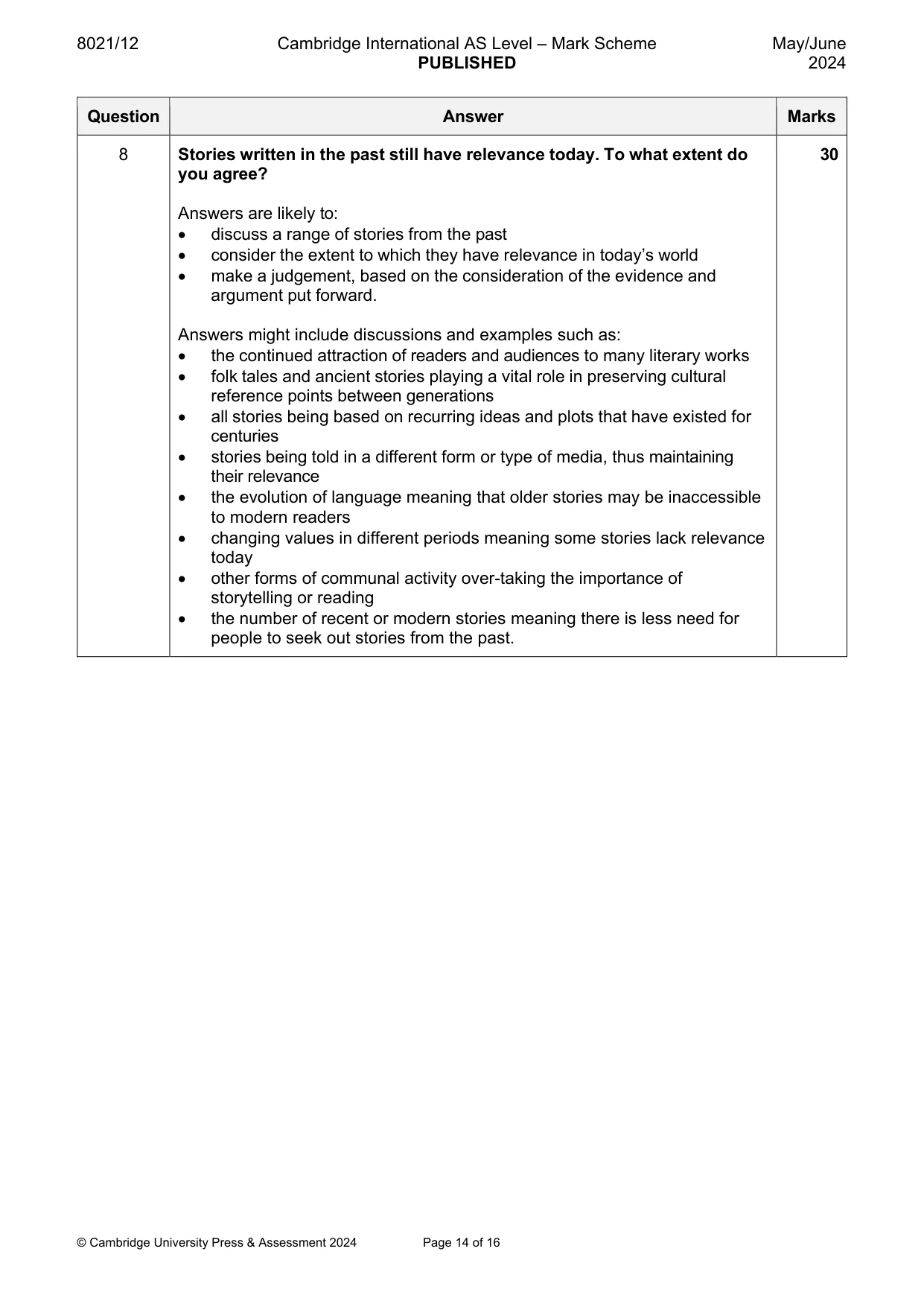
8021/12 Cambridge International AS Level – Mark Scheme PUBLISHED May/June 2024 © Cambridge University Press & Assessment 2024 Page 14 of 16 Question Answer Marks 8 Stories written in the past still have relevance today. To what extent do you agree? Answers are likely to: discuss a range of stories from the past consider the extent to which they have relevance in today’s world make a judgement, based on the consideration of the evidence and argument put forward. Answers might include discussions and examples such as: the continued attraction of readers and audiences to many literary works folk tales and ancient stories playing a vital role in preserving cultural reference points between generations all stories being based on recurring ideas and plots that have existed for centuries stories being told in a different form or type of media, thus maintaining their relevance the evolution of language meaning that older stories may be inaccessible to modern readers changing values in different periods meaning some stories lack relevance today other forms of communal activity over-taking the importance of storytelling or reading the number of recent or modern stories meaning there is less need for people to seek out stories from the past. 30
Mark scheme, page 15
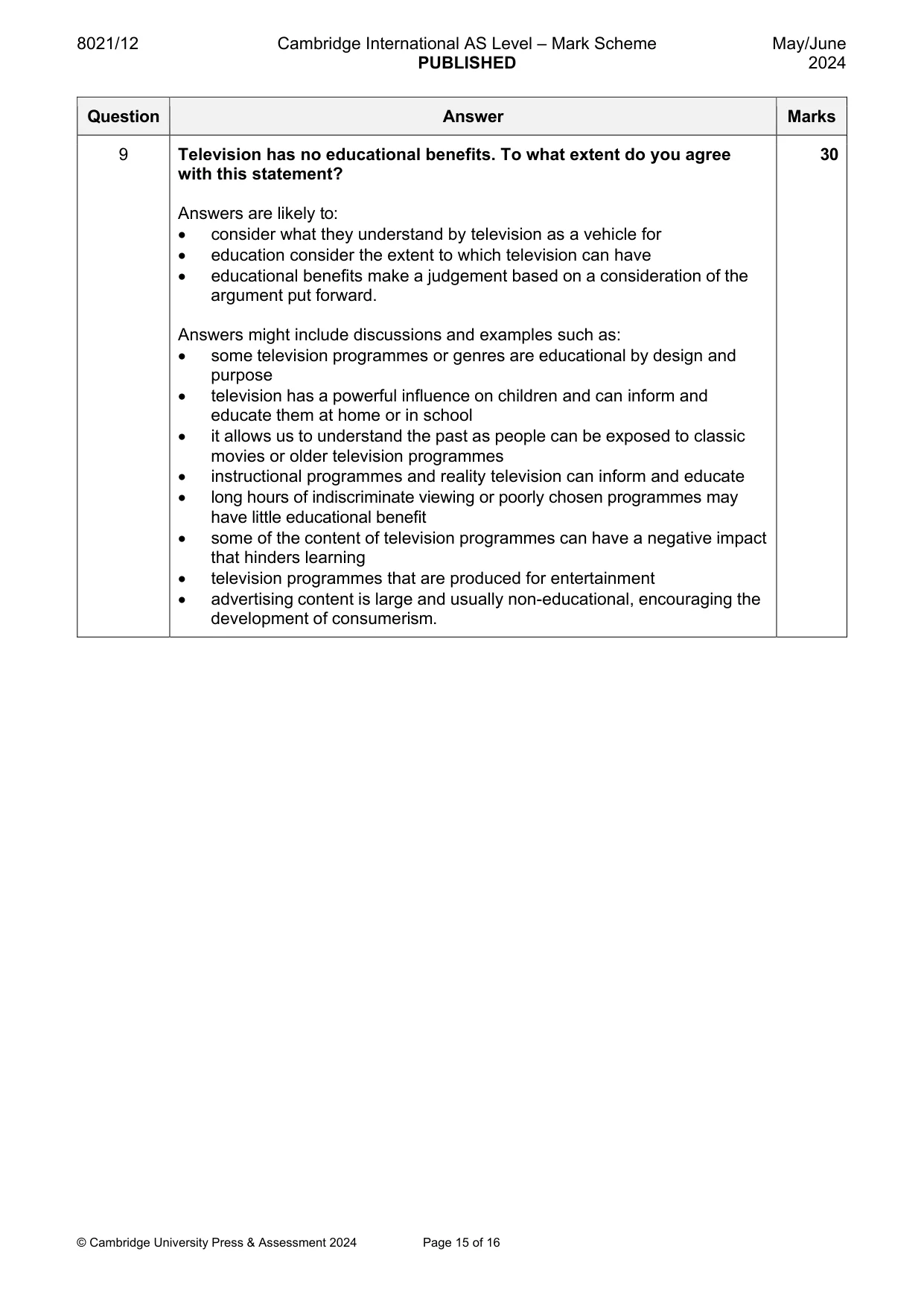
8021/12 Cambridge International AS Level – Mark Scheme PUBLISHED May/June 2024 © Cambridge University Press & Assessment 2024 Page 15 of 16 Question Answer Marks 9 Television has no educational benefits. To what extent do you agree with this statement? Answers are likely to: consider what they understand by television as a vehicle for education consider the extent to which television can have educational benefits make a judgement based on a consideration of the argument put forward. Answers might include discussions and examples such as: some television programmes or genres are educational by design and purpose television has a powerful influence on children and can inform and educate them at home or in school it allows us to understand the past as people can be exposed to classic movies or older television programmes instructional programmes and reality television can inform and educate long hours of indiscriminate viewing or poorly chosen programmes may have little educational benefit some of the content of television programmes can have a negative impact that hinders learning television programmes that are produced for entertainment advertising content is large and usually non-educational, encouraging the development of consumerism. 30
Mark scheme, page 16
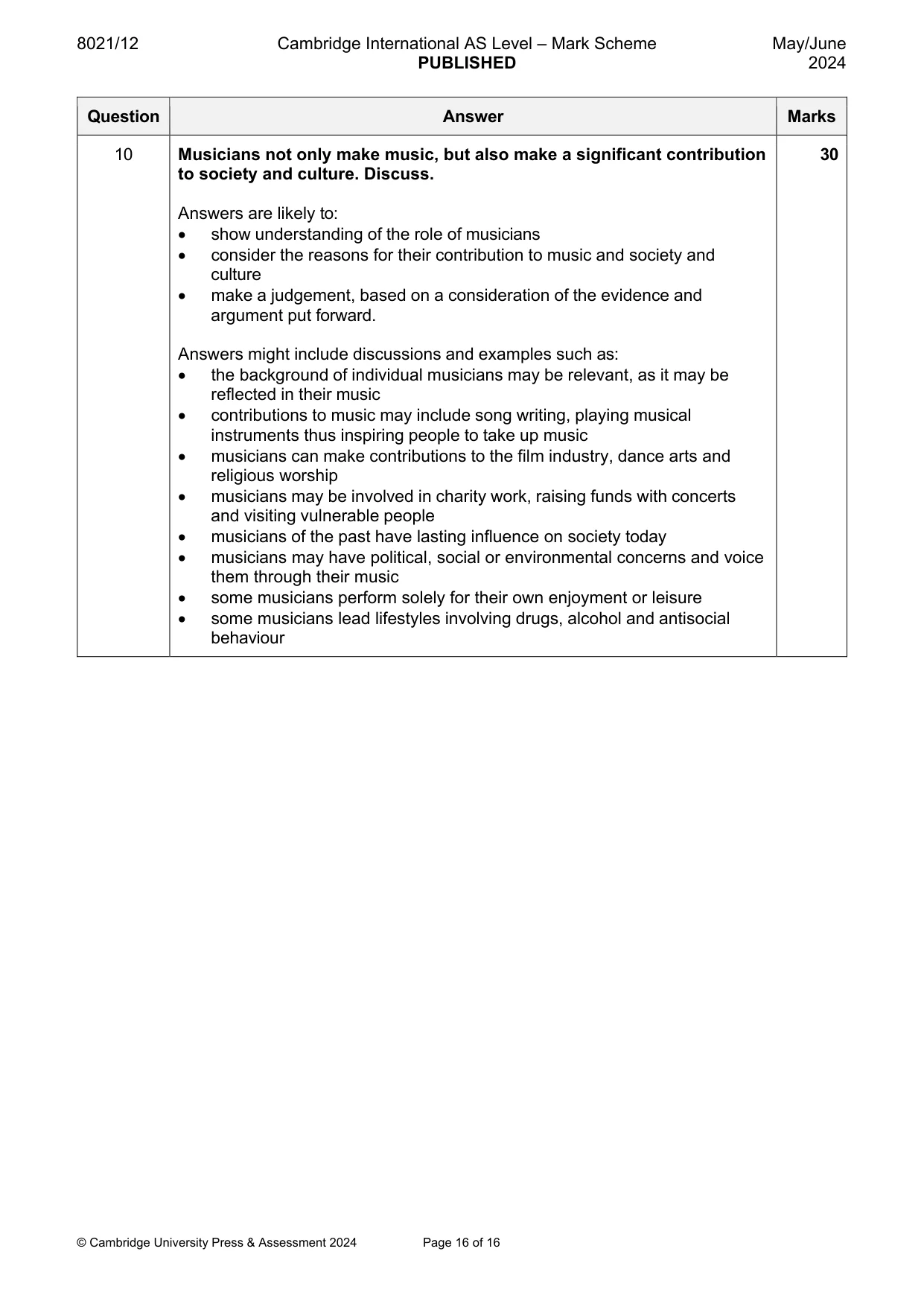
8021/12 Cambridge International AS Level – Mark Scheme PUBLISHED May/June 2024 © Cambridge University Press & Assessment 2024 Page 16 of 16 Question Answer Marks 10 Musicians not only make music, but also make a significant contribution to society and culture. Discuss. Answers are likely to: show understanding of the role of musicians consider the reasons for their contribution to music and society and culture make a judgement, based on a consideration of the evidence and argument put forward. Answers might include discussions and examples such as: the background of individual musicians may be relevant, as it may be reflected in their music contributions to music may include song writing, playing musical instruments thus inspiring people to take up music musicians can make contributions to the film industry, dance arts and religious worship musicians may be involved in charity work, raising funds with concerts and visiting vulnerable people musicians of the past have lasting influence on society today musicians may have political, social or environmental concerns and voice them through their music some musicians perform solely for their own enjoyment or leisure some musicians lead lifestyles involving drugs, alcohol and antisocial behaviour 30
What you needed in this session
Cambridge’s own grade thresholds for 2024 May/June, Paper 1 · Variant 2. A higher threshold means an easier paper — the bar moves with how the cohort did.