Cambridge A Level English General Paper 8021 — 2020 Oct/Nov Paper 1 · Variant 2
8021/12/O/N/20 · 30 marks · ≈34 min
The question paper and its mark scheme, free to read here and free to download. This is Cambridge’s own paper, exactly as it was sat.
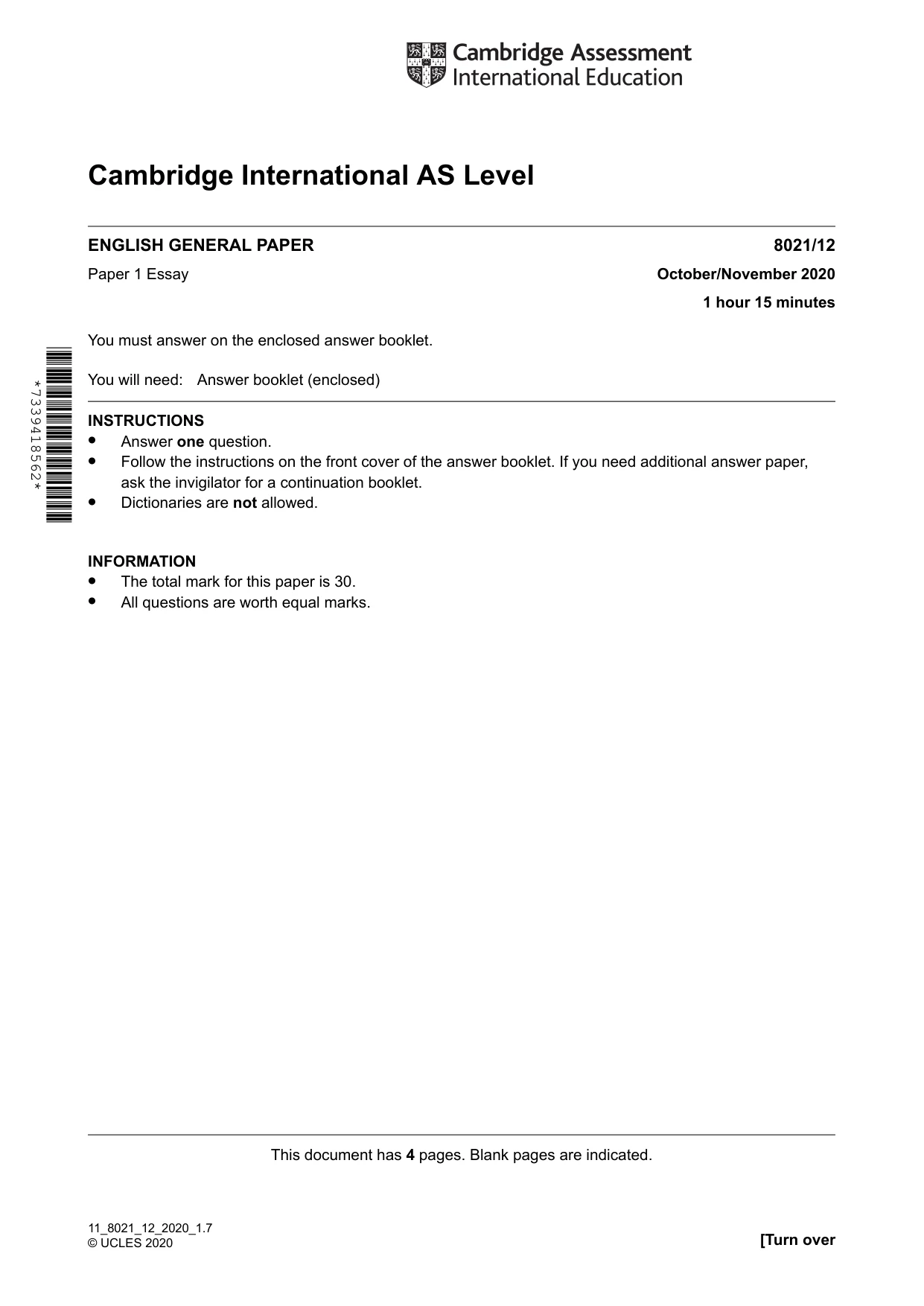
Question paper4 pages


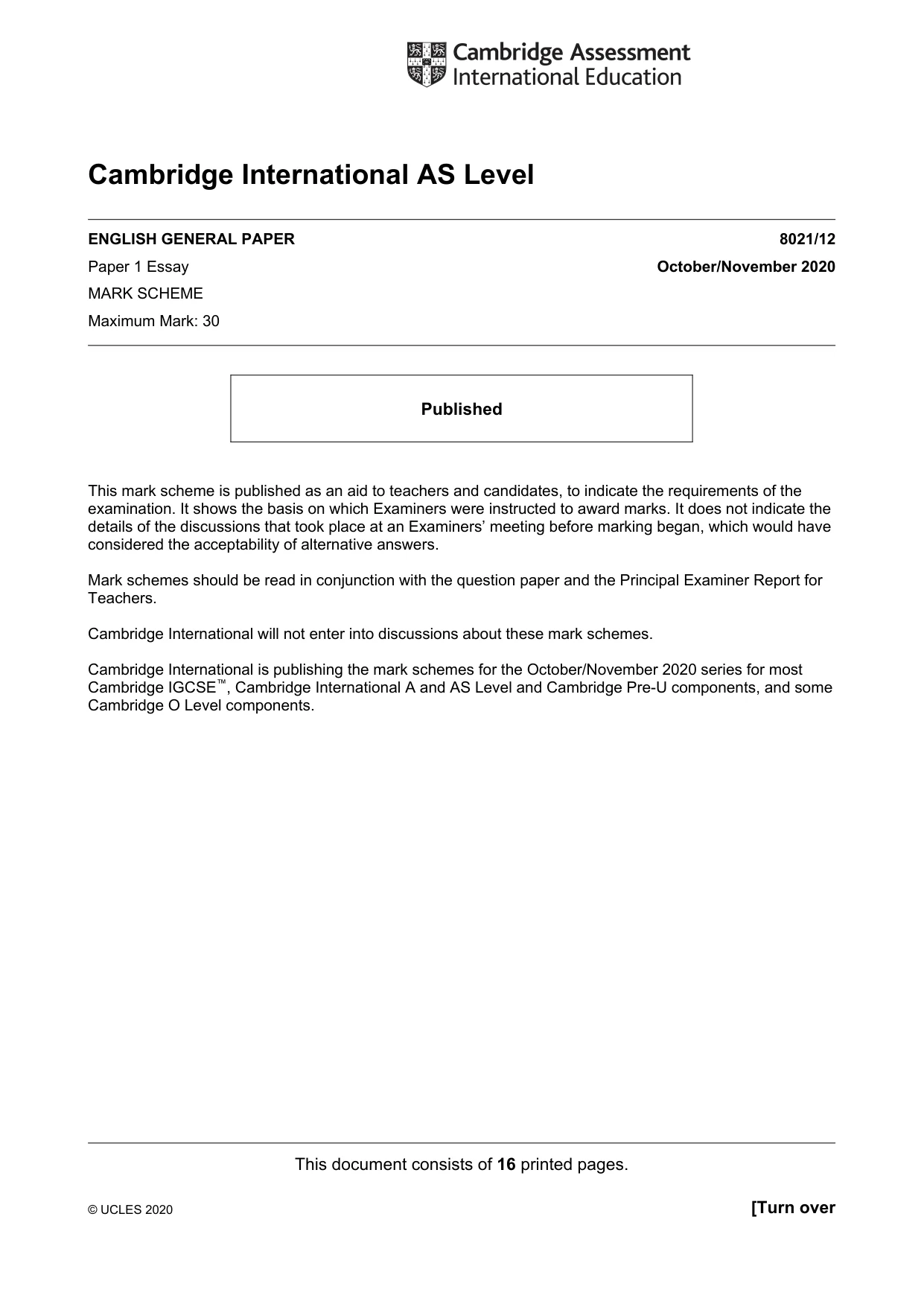
Mark scheme16 pages
Answers below. Sit the paper first if you are practising.
Paper as text
Question paper, page 1
Cambridge International AS Level 8021/12 October/November 2020 1 hour 15 minutes ENGLISH GENERAL PAPER Paper 1 Essay You must answer on the enclosed answer booklet. You will need: Answer booklet (enclosed) INSTRUCTIONS • Answer one question. • Follow the instructions on the front cover of the answer booklet. If you need additional answer paper, ask the invigilator for a continuation booklet. • Dictionaries are not allowed. INFORMATION • The total mark for this paper is 30. • All questions are worth equal marks. This document has 4 pages. Blank pages are indicated. [Turn over 11_8021_12_2020_1.7 © UCLES 2020 *7339418562*
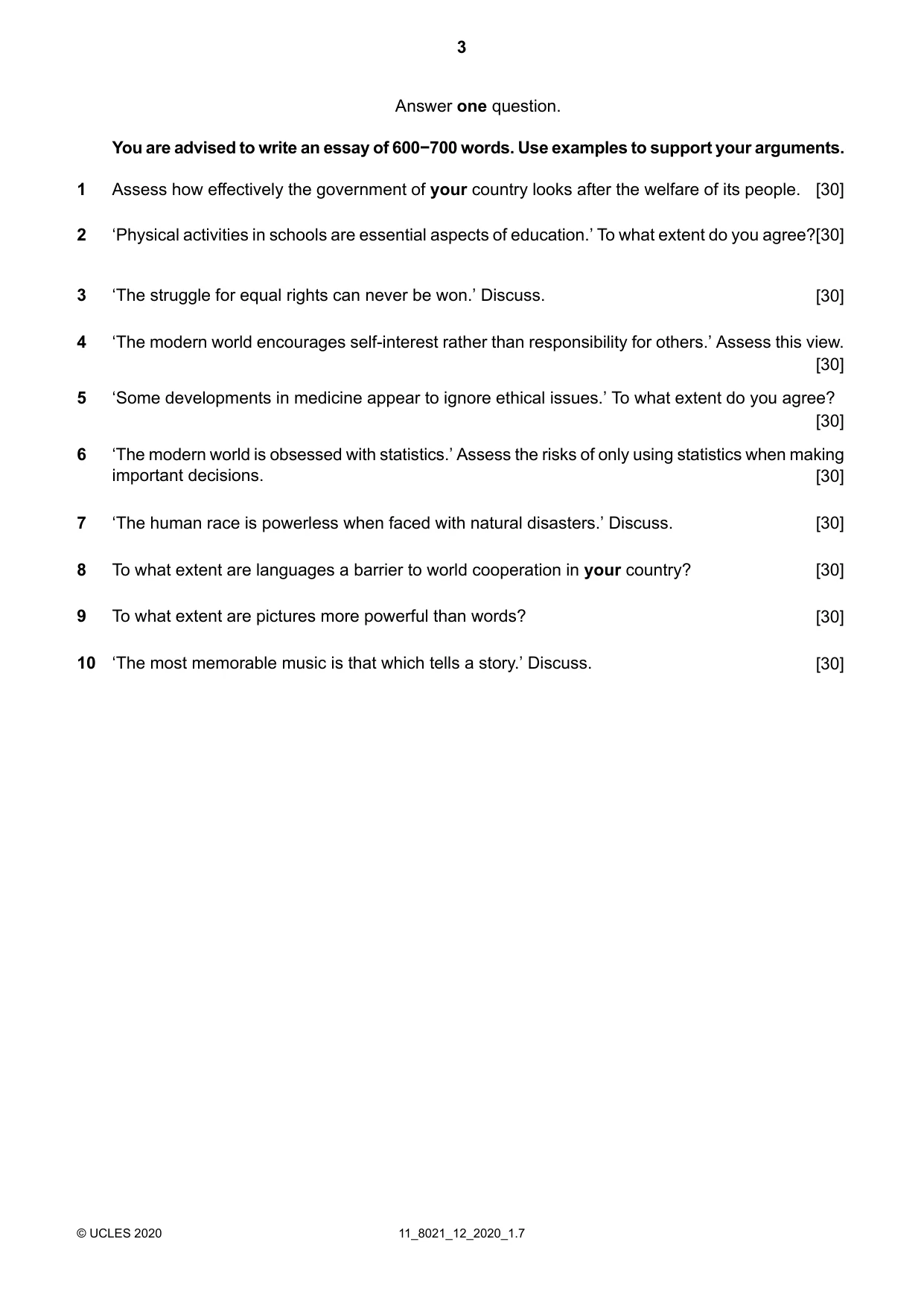
Question paper, page 2
BLANK PAGE 11_8021_12_2020_1.7 © UCLES 2020 2
Question paper, page 3
Answer one question. You are advised to write an essay of 600−700 words. Use examples to support your arguments. Assess how effectively the government of your country looks after the welfare of its people. [30] 1 ‘Physical activities in schools are essential aspects of education.’ To what extent do you agree?[30] 2 ‘The struggle for equal rights can never be won.’ Discuss. [30] 3 ‘The modern world encourages self-interest rather than responsibility for others.’ Assess this view. [30] 4 ‘Some developments in medicine appear to ignore ethical issues.’ To what extent do you agree? [30] 5 ‘The modern world is obsessed with statistics.’ Assess the risks of only using statistics when making important decisions. [30] 6 ‘The human race is powerless when faced with natural disasters.’ Discuss. [30] 7 To what extent are languages a barrier to world cooperation in your country? [30] 8 To what extent are pictures more powerful than words? [30] 9 ‘The most memorable music is that which tells a story.’ Discuss. [30] 10 11_8021_12_2020_1.7 © UCLES 2020 3
Question paper, page 4
BLANK PAGE Permission to reproduce items where third-party owned material protected by copyright is included has been sought and cleared where possible. Every reasonable effort has been made by the publisher (UCLES) to trace copyright holders, but if any items requiring clearance have unwittingly been included, the publisher will be pleased to make amends at the earliest possible opportunity. To avoid the issue of disclosure of answer-related information to candidates, all copyright acknowledgements are reproduced online in the Cambridge Assessment International Education Copyright Acknowledgements Booklet. This is produced for each series of examinations and is freely available to download at www.cambridgeinternational.org after the live examination series. Cambridge Assessment International Education is part of the Cambridge Assessment Group. Cambridge Assessment is the brand name of the University of Cambridge Local Examinations Syndicate (UCLES), which itself is a department of the University of Cambridge. 11_8021_12_2020_1.7 © UCLES 2020 4
Mark scheme, page 1
This document consists of 16 printed pages. © UCLES 2020 [Turn over Cambridge International AS Level ENGLISH GENERAL PAPER 8021/12 Paper 1 Essay October/November 2020 MARK SCHEME Maximum Mark: 30 Published This mark scheme is published as an aid to teachers and candidates, to indicate the requirements of the examination. It shows the basis on which Examiners were instructed to award marks. It does not indicate the details of the discussions that took place at an Examiners’ meeting before marking began, which would have considered the acceptability of alternative answers. Mark schemes should be read in conjunction with the question paper and the Principal Examiner Report for Teachers. Cambridge International will not enter into discussions about these mark schemes. Cambridge International is publishing the mark schemes for the October/November 2020 series for most Cambridge IGCSE™, Cambridge International A and AS Level and Cambridge Pre-U components, and some Cambridge O Level components.
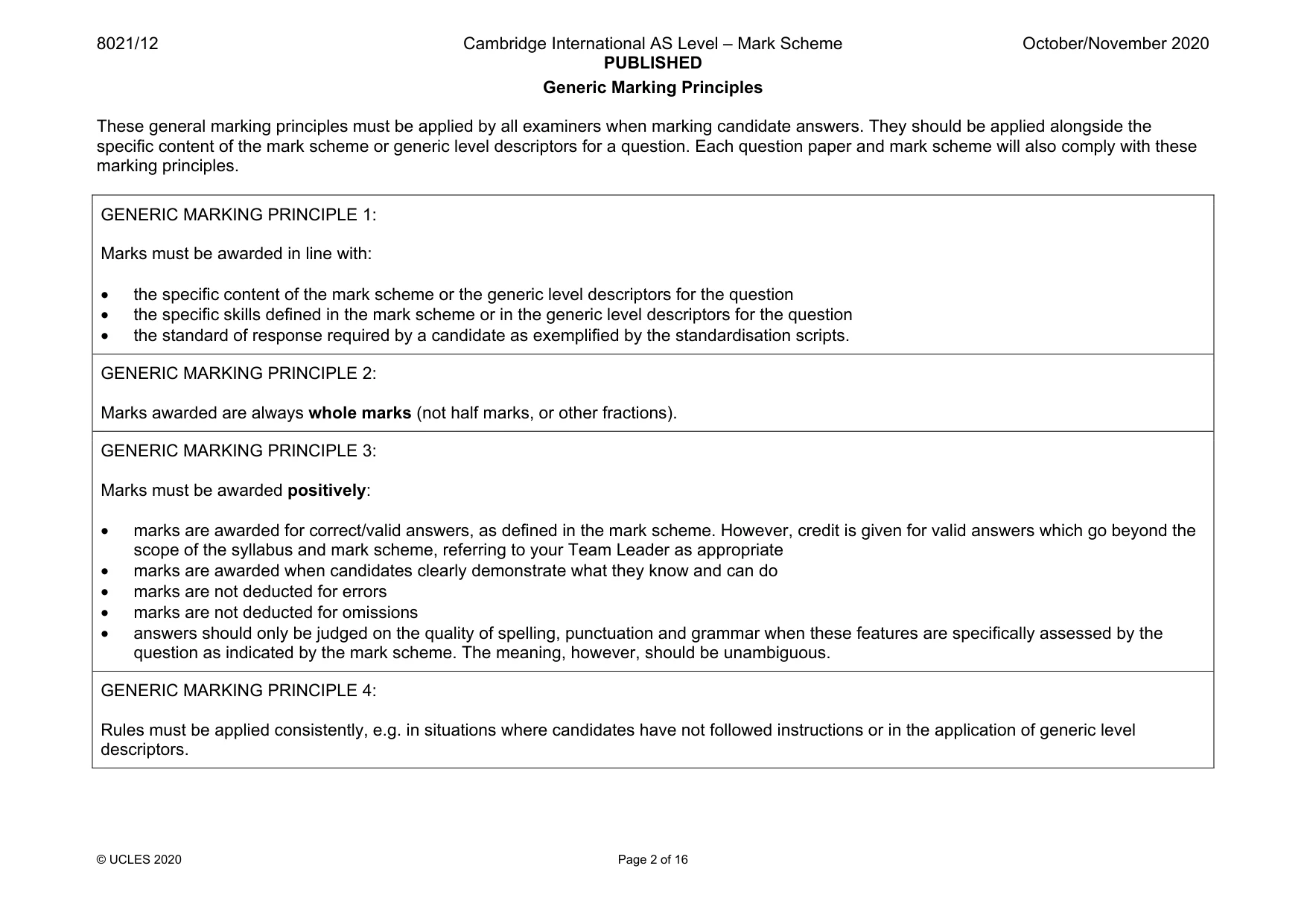
Mark scheme, page 2
8021/12 Cambridge International AS Level – Mark Scheme PUBLISHED October/November 2020 © UCLES 2020 Page 2 of 16 Generic Marking Principles These general marking principles must be applied by all examiners when marking candidate answers. They should be applied alongside the specific content of the mark scheme or generic level descriptors for a question. Each question paper and mark scheme will also comply with these marking principles. GENERIC MARKING PRINCIPLE 1: Marks must be awarded in line with: • the specific content of the mark scheme or the generic level descriptors for the question • the specific skills defined in the mark scheme or in the generic level descriptors for the question • the standard of response required by a candidate as exemplified by the standardisation scripts. GENERIC MARKING PRINCIPLE 2: Marks awarded are always whole marks (not half marks, or other fractions). GENERIC MARKING PRINCIPLE 3: Marks must be awarded positively: • marks are awarded for correct/valid answers, as defined in the mark scheme. However, credit is given for valid answers which go beyond the scope of the syllabus and mark scheme, referring to your Team Leader as appropriate • marks are awarded when candidates clearly demonstrate what they know and can do • marks are not deducted for errors • marks are not deducted for omissions • answers should only be judged on the quality of spelling, punctuation and grammar when these features are specifically assessed by the question as indicated by the mark scheme. The meaning, however, should be unambiguous. GENERIC MARKING PRINCIPLE 4: Rules must be applied consistently, e.g. in situations where candidates have not followed instructions or in the application of generic level descriptors.
Mark scheme, page 3
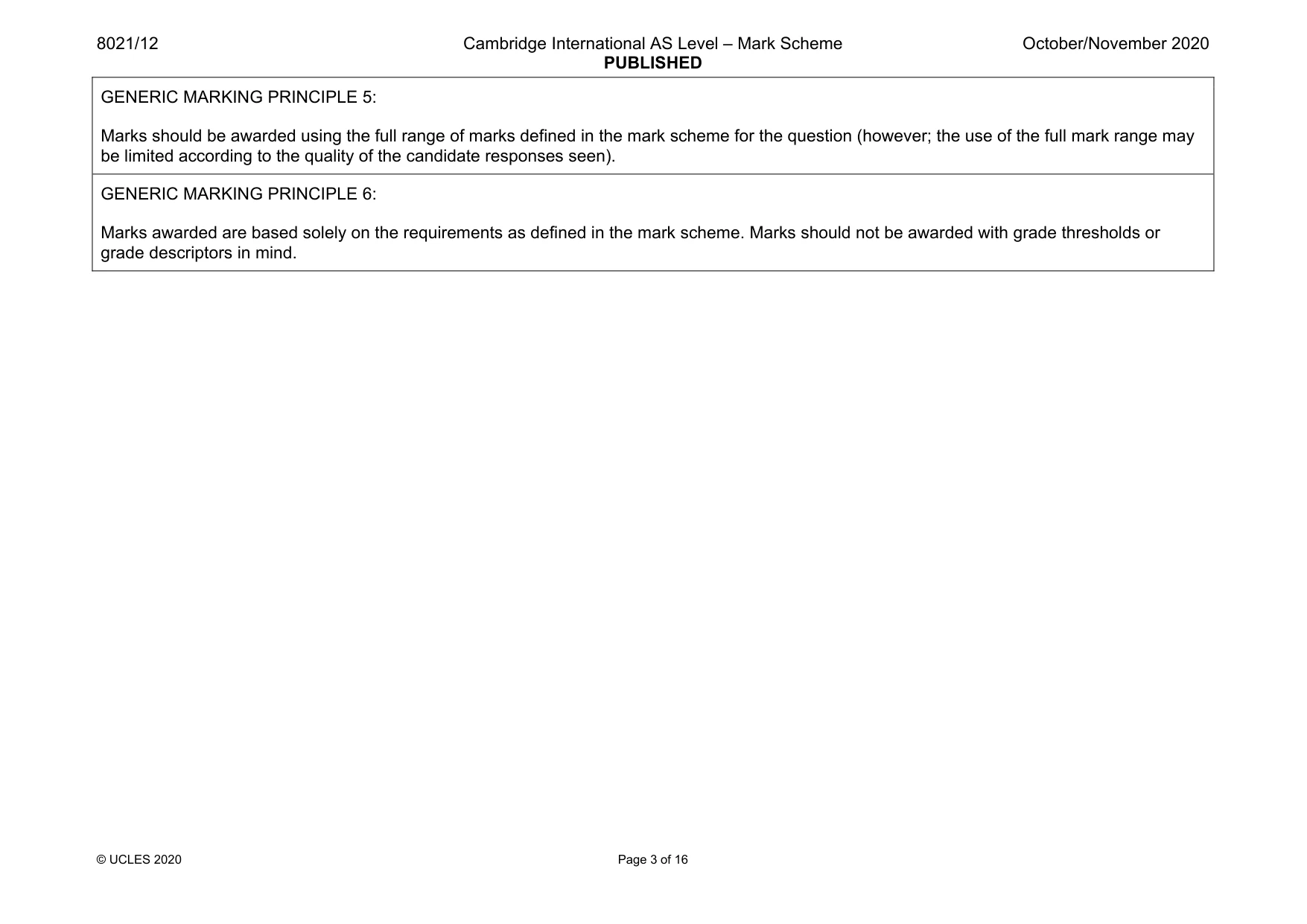
8021/12 Cambridge International AS Level – Mark Scheme PUBLISHED October/November 2020 © UCLES 2020 Page 3 of 16 GENERIC MARKING PRINCIPLE 5: Marks should be awarded using the full range of marks defined in the mark scheme for the question (however; the use of the full mark range may be limited according to the quality of the candidate responses seen). GENERIC MARKING PRINCIPLE 6: Marks awarded are based solely on the requirements as defined in the mark scheme. Marks should not be awarded with grade thresholds or grade descriptors in mind.
Mark scheme, page 4
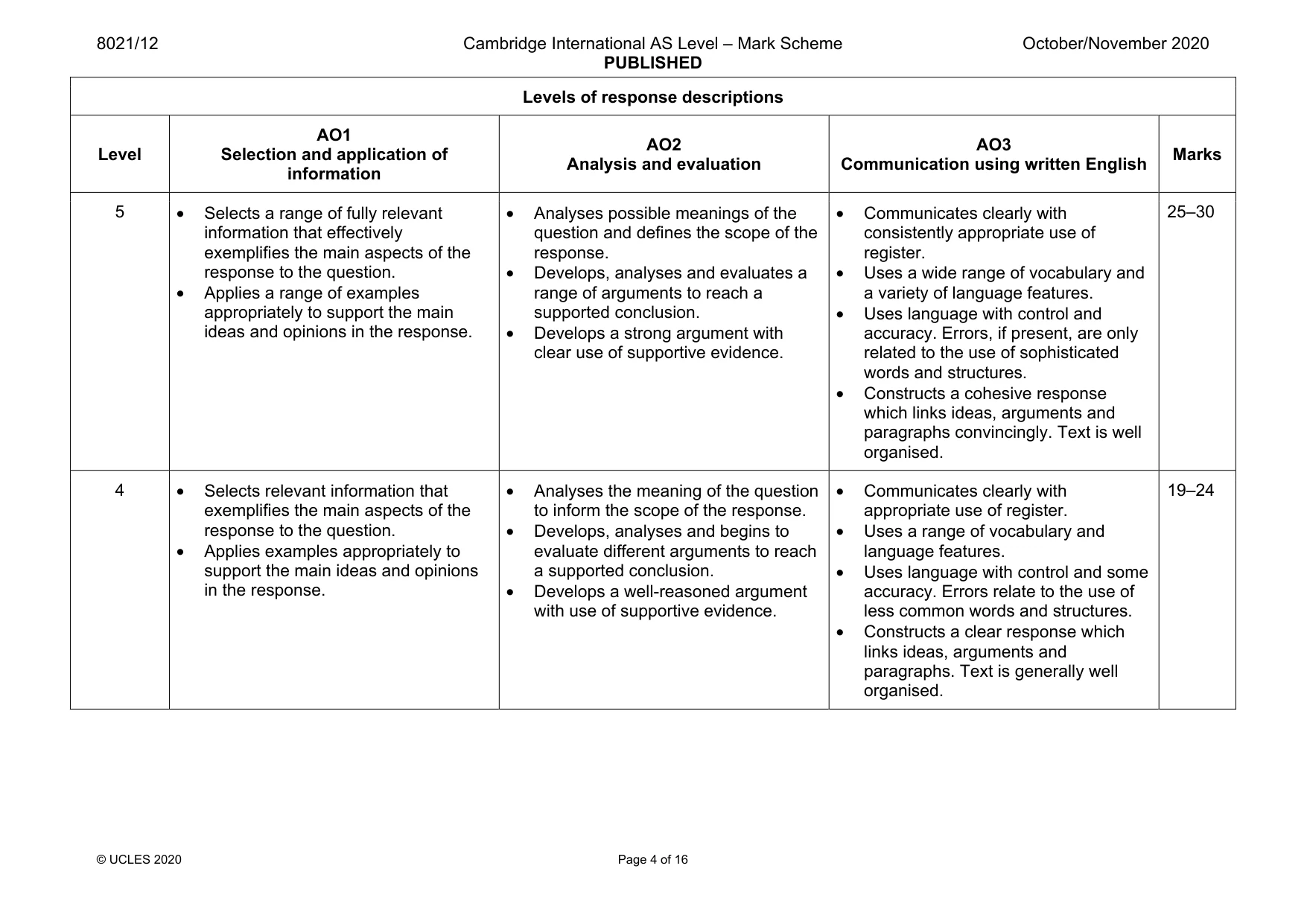
8021/12 Cambridge International AS Level – Mark Scheme PUBLISHED October/November 2020 © UCLES 2020 Page 4 of 16 Levels of response descriptions Level AO1 Selection and application of information AO2 Analysis and evaluation AO3 Communication using written English Marks 5 • Selects a range of fully relevant information that effectively exemplifies the main aspects of the response to the question. • Applies a range of examples appropriately to support the main ideas and opinions in the response. • Analyses possible meanings of the question and defines the scope of the response. • Develops, analyses and evaluates a range of arguments to reach a supported conclusion. • Develops a strong argument with clear use of supportive evidence. • Communicates clearly with consistently appropriate use of register. • Uses a wide range of vocabulary and a variety of language features. • Uses language with control and accuracy. Errors, if present, are only related to the use of sophisticated words and structures. • Constructs a cohesive response which links ideas, arguments and paragraphs convincingly. Text is well organised. 25–30 4 • Selects relevant information that exemplifies the main aspects of the response to the question. • Applies examples appropriately to support the main ideas and opinions in the response. • Analyses the meaning of the question to inform the scope of the response. • Develops, analyses and begins to evaluate different arguments to reach a supported conclusion. • Develops a well-reasoned argument with use of supportive evidence. • Communicates clearly with appropriate use of register. • Uses a range of vocabulary and language features. • Uses language with control and some accuracy. Errors relate to the use of less common words and structures. • Constructs a clear response which links ideas, arguments and paragraphs. Text is generally well organised. 19–24
Mark scheme, page 5
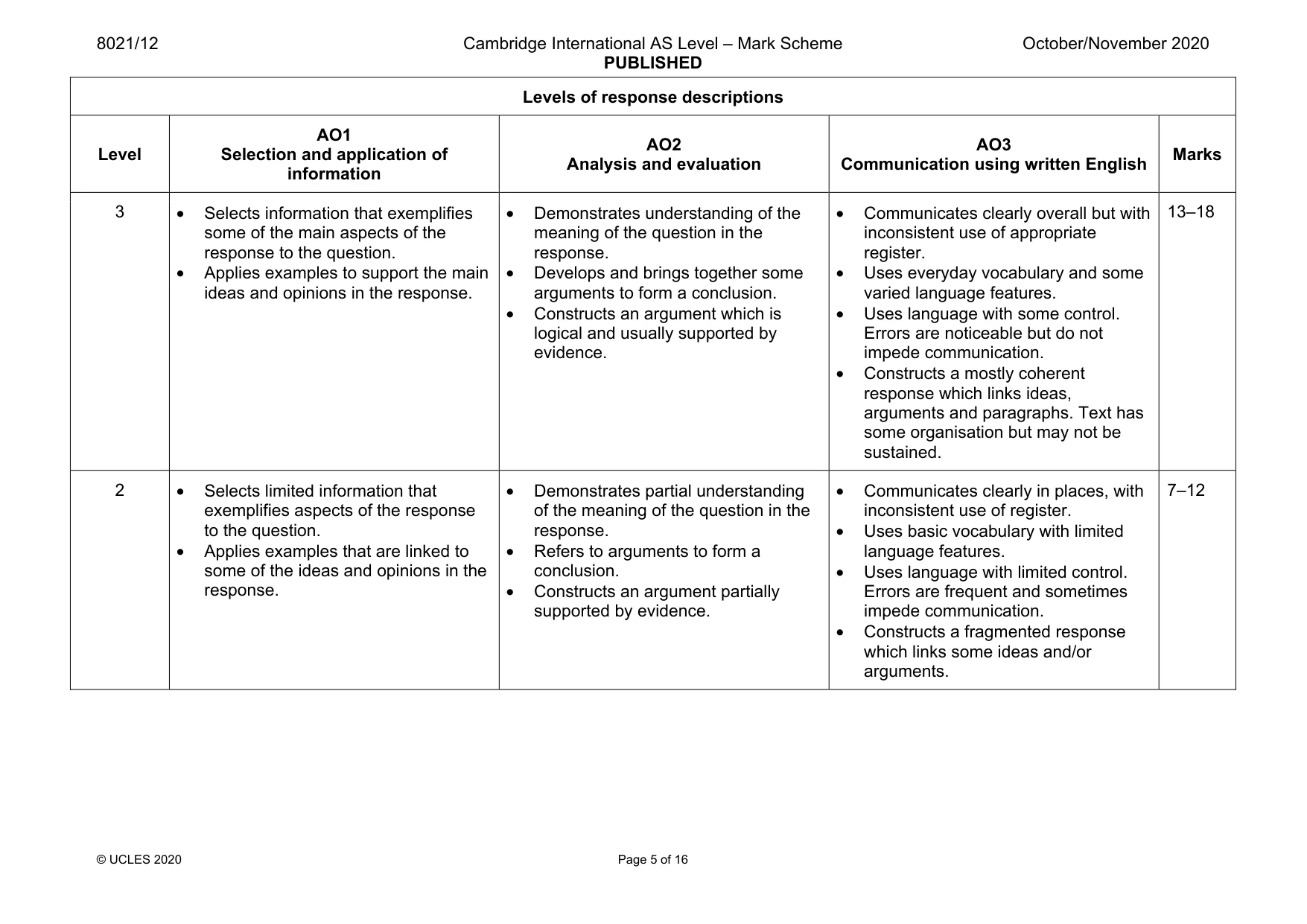
8021/12 Cambridge International AS Level – Mark Scheme PUBLISHED October/November 2020 © UCLES 2020 Page 5 of 16 Levels of response descriptions Level AO1 Selection and application of information AO2 Analysis and evaluation AO3 Communication using written English Marks 3 • Selects information that exemplifies some of the main aspects of the response to the question. • Applies examples to support the main ideas and opinions in the response. • Demonstrates understanding of the meaning of the question in the response. • Develops and brings together some arguments to form a conclusion. • Constructs an argument which is logical and usually supported by evidence. • Communicates clearly overall but with inconsistent use of appropriate register. • Uses everyday vocabulary and some varied language features. • Uses language with some control. Errors are noticeable but do not impede communication. • Constructs a mostly coherent response which links ideas, arguments and paragraphs. Text has some organisation but may not be sustained. 13–18 2 • Selects limited information that exemplifies aspects of the response to the question. • Applies examples that are linked to some of the ideas and opinions in the response. • Demonstrates partial understanding of the meaning of the question in the response. • Refers to arguments to form a conclusion. • Constructs an argument partially supported by evidence. • Communicates clearly in places, with inconsistent use of register. • Uses basic vocabulary with limited language features. • Uses language with limited control. Errors are frequent and sometimes impede communication. • Constructs a fragmented response which links some ideas and/or arguments. 7–12
Mark scheme, page 6
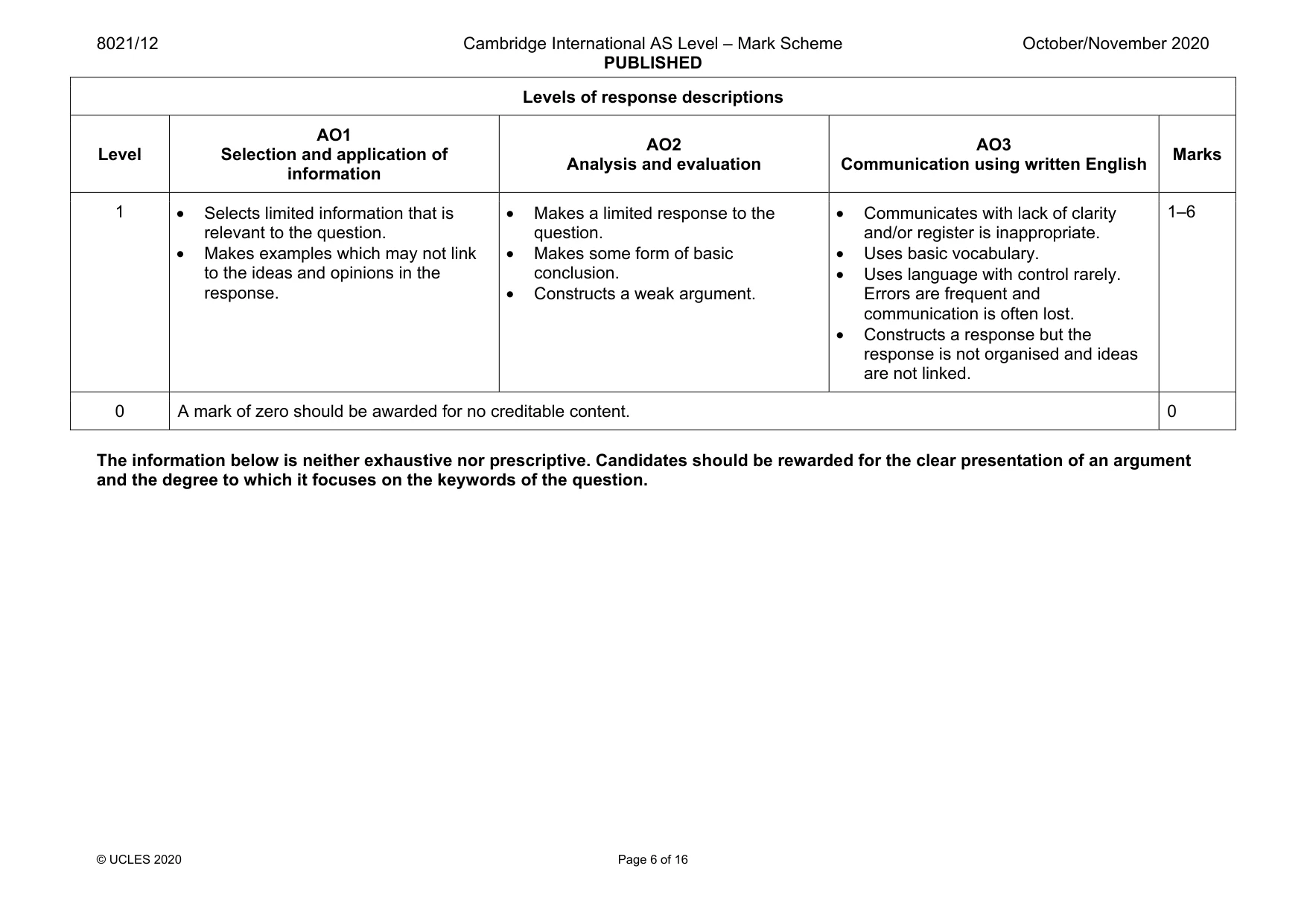
8021/12 Cambridge International AS Level – Mark Scheme PUBLISHED October/November 2020 © UCLES 2020 Page 6 of 16 Levels of response descriptions Level AO1 Selection and application of information AO2 Analysis and evaluation AO3 Communication using written English Marks 1 • Selects limited information that is relevant to the question. • Makes examples which may not link to the ideas and opinions in the response. • Makes a limited response to the question. • Makes some form of basic conclusion. • Constructs a weak argument. • Communicates with lack of clarity and/or register is inappropriate. • Uses basic vocabulary. • Uses language with control rarely. Errors are frequent and communication is often lost. • Constructs a response but the response is not organised and ideas are not linked. 1–6 0 A mark of zero should be awarded for no creditable content. 0 The information below is neither exhaustive nor prescriptive. Candidates should be rewarded for the clear presentation of an argument and the degree to which it focuses on the keywords of the question.
Mark scheme, page 7
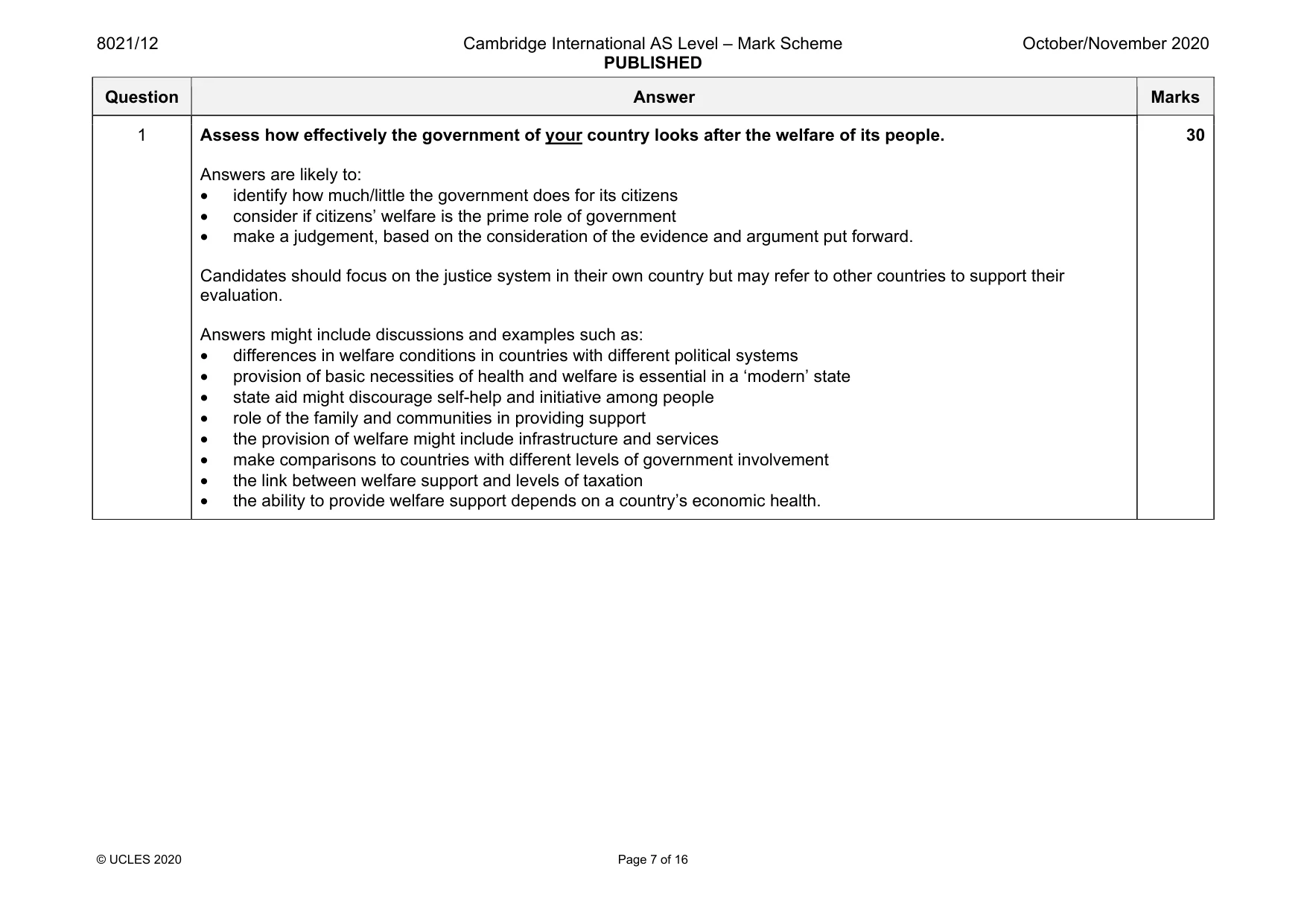
8021/12 Cambridge International AS Level – Mark Scheme PUBLISHED October/November 2020 © UCLES 2020 Page 7 of 16 Question Answer Marks 1 Assess how effectively the government of your country looks after the welfare of its people. Answers are likely to: • identify how much/little the government does for its citizens • consider if citizens’ welfare is the prime role of government • make a judgement, based on the consideration of the evidence and argument put forward. Candidates should focus on the justice system in their own country but may refer to other countries to support their evaluation. Answers might include discussions and examples such as: • differences in welfare conditions in countries with different political systems • provision of basic necessities of health and welfare is essential in a ‘modern’ state • state aid might discourage self-help and initiative among people • role of the family and communities in providing support • the provision of welfare might include infrastructure and services • make comparisons to countries with different levels of government involvement • the link between welfare support and levels of taxation • the ability to provide welfare support depends on a country’s economic health. 30
Mark scheme, page 8
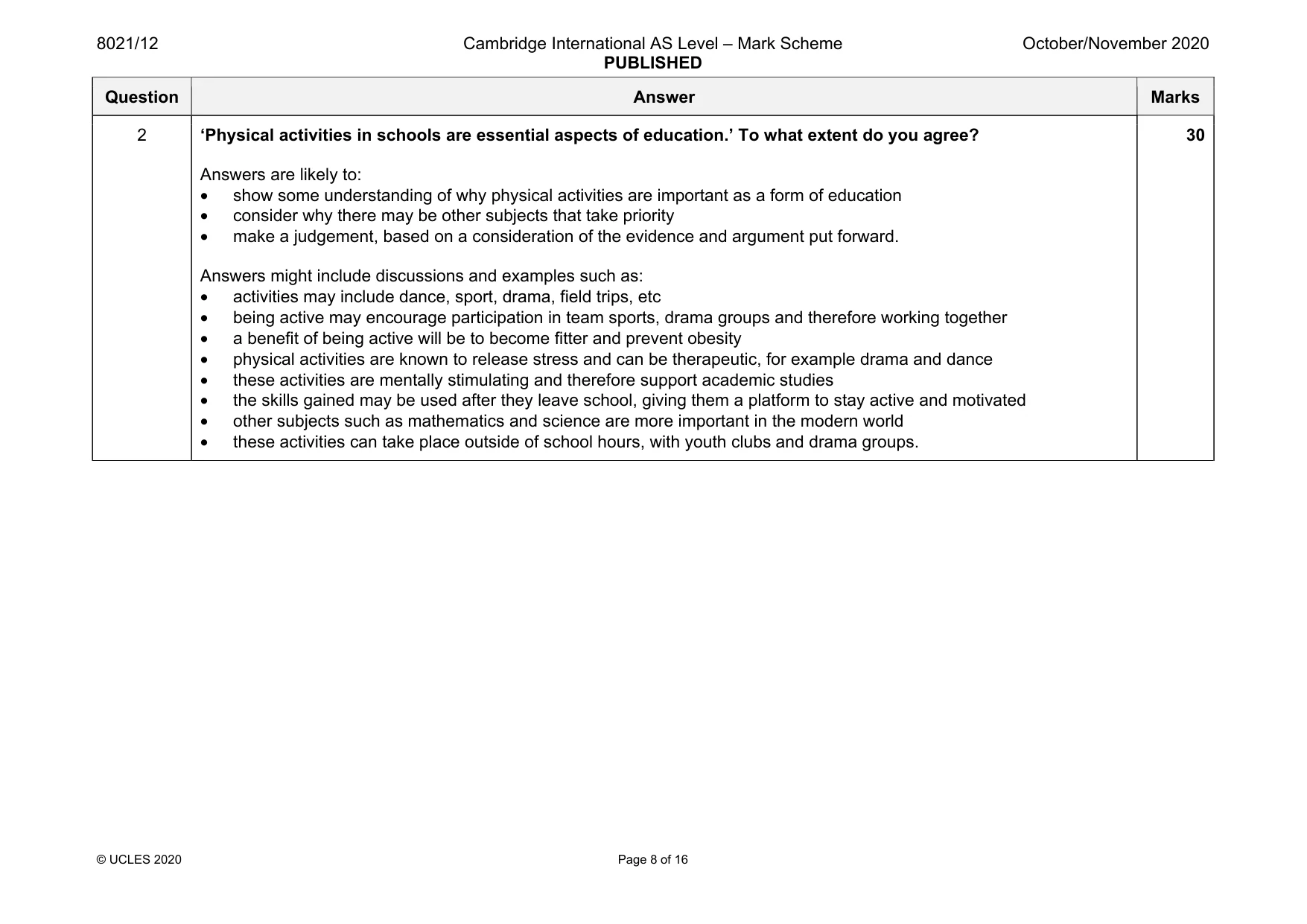
8021/12 Cambridge International AS Level – Mark Scheme PUBLISHED October/November 2020 © UCLES 2020 Page 8 of 16 Question Answer Marks 2 ‘Physical activities in schools are essential aspects of education.’ To what extent do you agree? Answers are likely to: • show some understanding of why physical activities are important as a form of education • consider why there may be other subjects that take priority • make a judgement, based on a consideration of the evidence and argument put forward. Answers might include discussions and examples such as: • activities may include dance, sport, drama, field trips, etc • being active may encourage participation in team sports, drama groups and therefore working together • a benefit of being active will be to become fitter and prevent obesity • physical activities are known to release stress and can be therapeutic, for example drama and dance • these activities are mentally stimulating and therefore support academic studies • the skills gained may be used after they leave school, giving them a platform to stay active and motivated • other subjects such as mathematics and science are more important in the modern world • these activities can take place outside of school hours, with youth clubs and drama groups. 30
Mark scheme, page 9
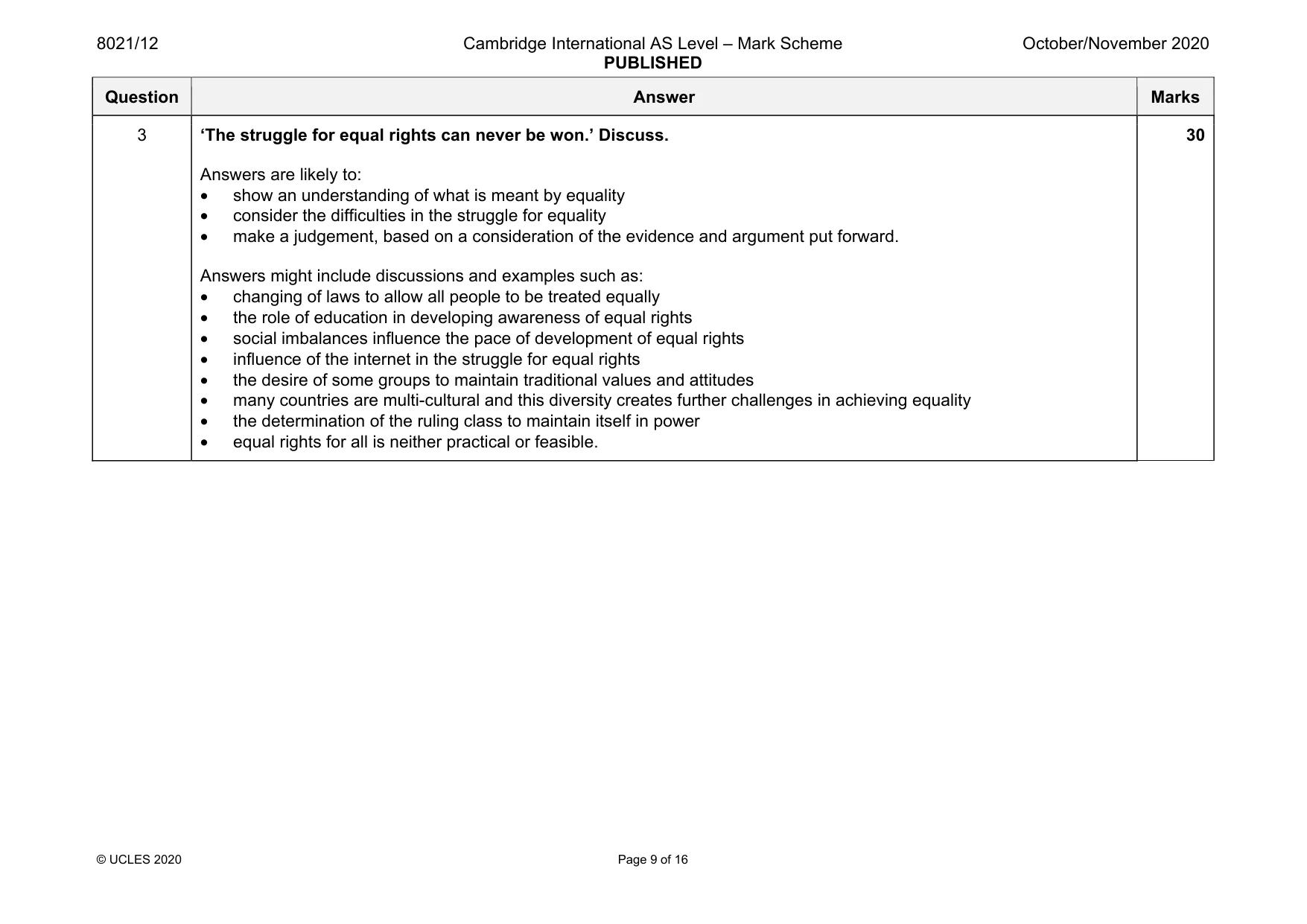
8021/12 Cambridge International AS Level – Mark Scheme PUBLISHED October/November 2020 © UCLES 2020 Page 9 of 16 Question Answer Marks 3 ‘The struggle for equal rights can never be won.’ Discuss. Answers are likely to: • show an understanding of what is meant by equality • consider the difficulties in the struggle for equality • make a judgement, based on a consideration of the evidence and argument put forward. Answers might include discussions and examples such as: • changing of laws to allow all people to be treated equally • the role of education in developing awareness of equal rights • social imbalances influence the pace of development of equal rights • influence of the internet in the struggle for equal rights • the desire of some groups to maintain traditional values and attitudes • many countries are multi-cultural and this diversity creates further challenges in achieving equality • the determination of the ruling class to maintain itself in power • equal rights for all is neither practical or feasible. 30
Mark scheme, page 10
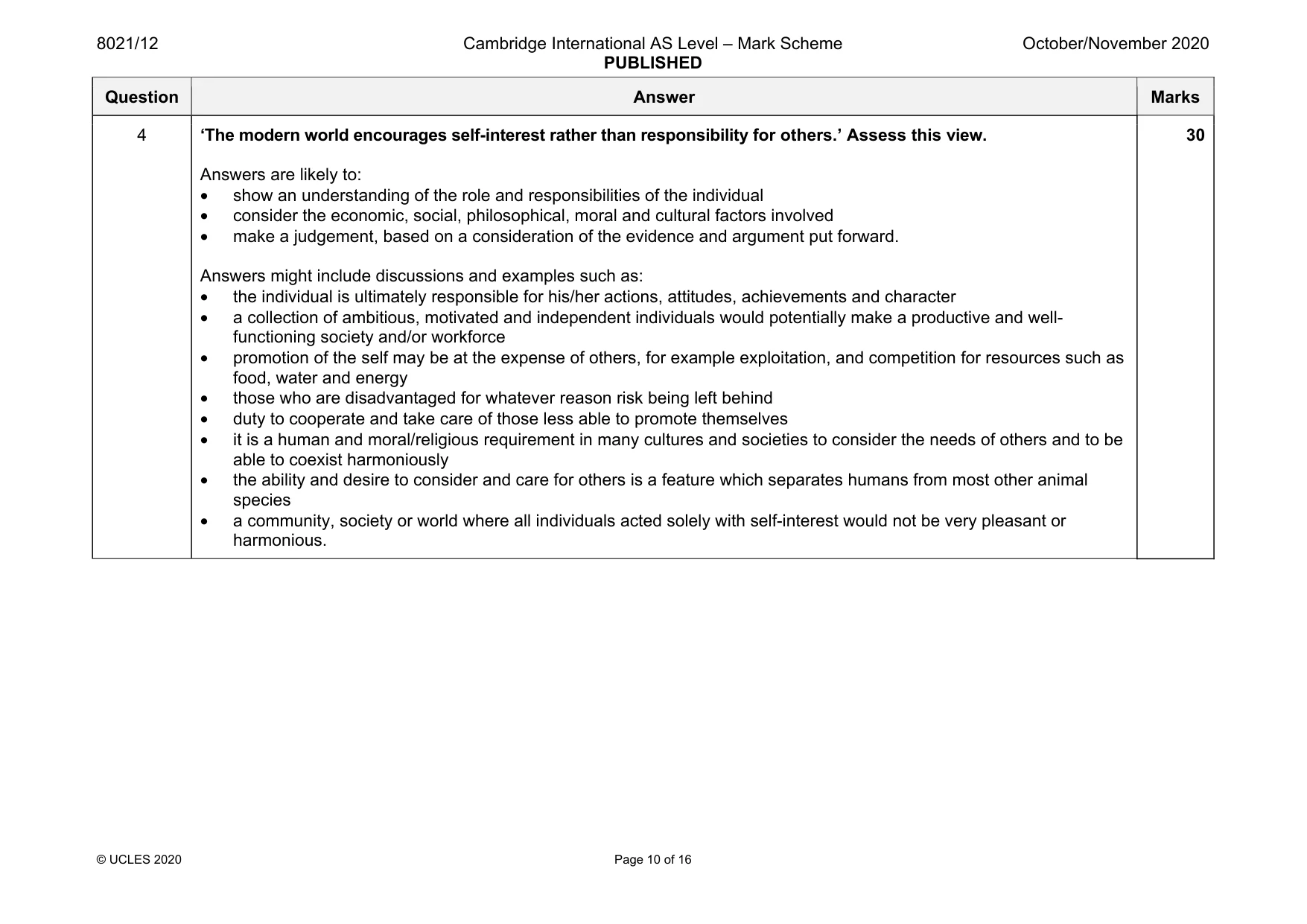
8021/12 Cambridge International AS Level – Mark Scheme PUBLISHED October/November 2020 © UCLES 2020 Page 10 of 16 Question Answer Marks 4 ‘The modern world encourages self-interest rather than responsibility for others.’ Assess this view. Answers are likely to: • show an understanding of the role and responsibilities of the individual • consider the economic, social, philosophical, moral and cultural factors involved • make a judgement, based on a consideration of the evidence and argument put forward. Answers might include discussions and examples such as: • the individual is ultimately responsible for his/her actions, attitudes, achievements and character • a collection of ambitious, motivated and independent individuals would potentially make a productive and well- functioning society and/or workforce • promotion of the self may be at the expense of others, for example exploitation, and competition for resources such as food, water and energy • those who are disadvantaged for whatever reason risk being left behind • duty to cooperate and take care of those less able to promote themselves • it is a human and moral/religious requirement in many cultures and societies to consider the needs of others and to be able to coexist harmoniously • the ability and desire to consider and care for others is a feature which separates humans from most other animal species • a community, society or world where all individuals acted solely with self-interest would not be very pleasant or harmonious. 30
Mark scheme, page 11
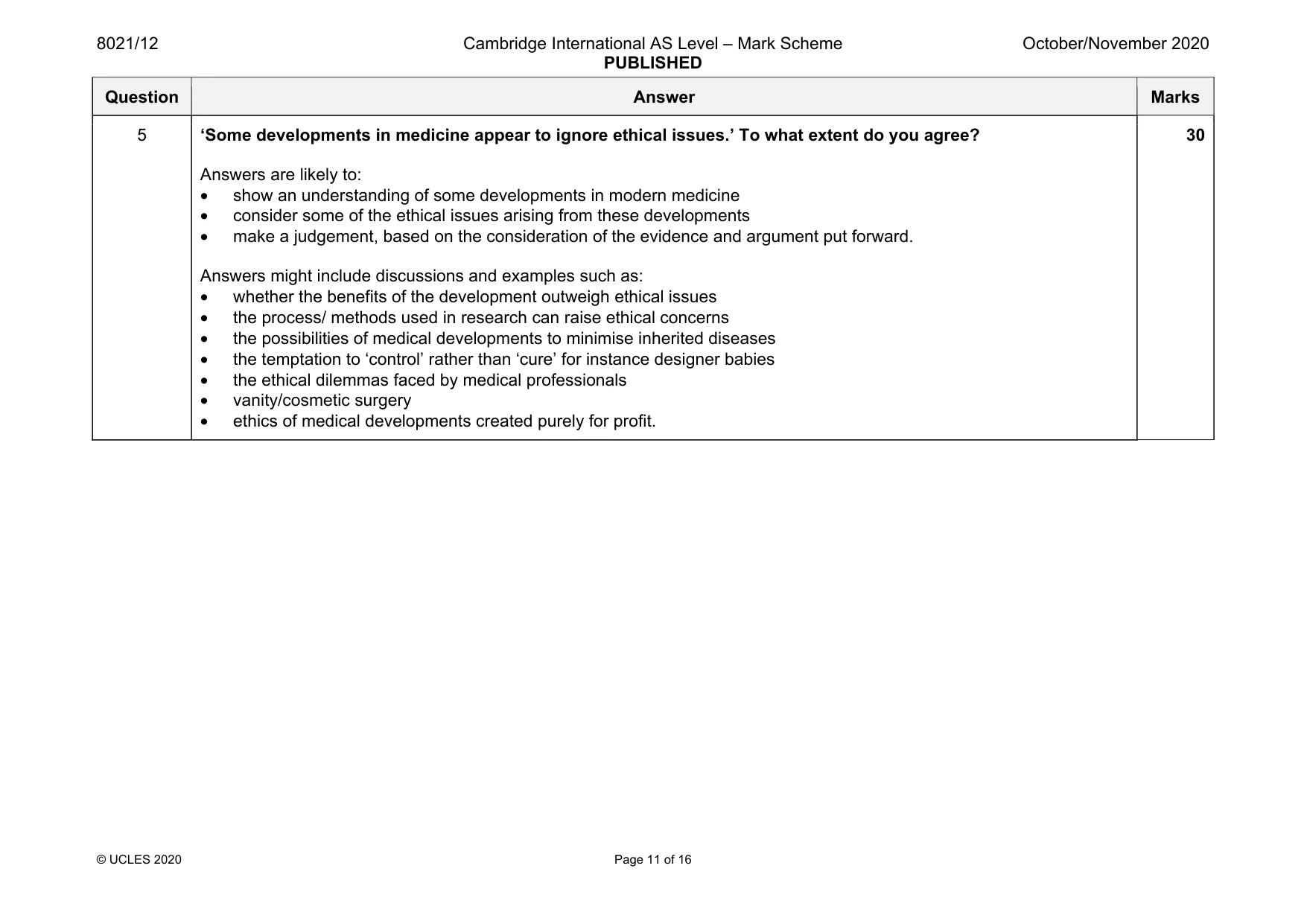
8021/12 Cambridge International AS Level – Mark Scheme PUBLISHED October/November 2020 © UCLES 2020 Page 11 of 16 Question Answer Marks 5 ‘Some developments in medicine appear to ignore ethical issues.’ To what extent do you agree? Answers are likely to: • show an understanding of some developments in modern medicine • consider some of the ethical issues arising from these developments • make a judgement, based on the consideration of the evidence and argument put forward. Answers might include discussions and examples such as: • whether the benefits of the development outweigh ethical issues • the process/ methods used in research can raise ethical concerns • the possibilities of medical developments to minimise inherited diseases • the temptation to ‘control’ rather than ‘cure’ for instance designer babies • the ethical dilemmas faced by medical professionals • vanity/cosmetic surgery • ethics of medical developments created purely for profit. 30
Mark scheme, page 12
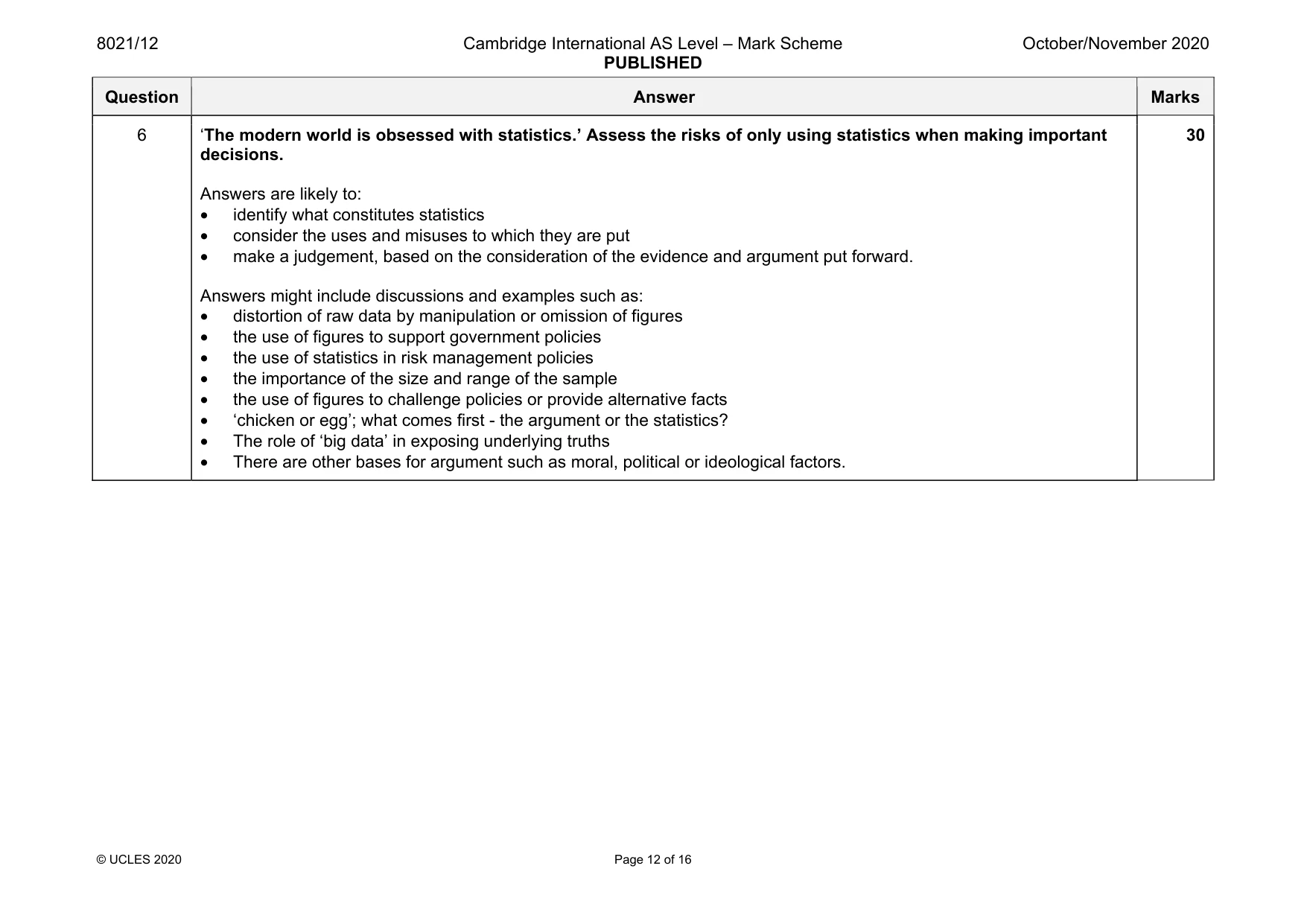
8021/12 Cambridge International AS Level – Mark Scheme PUBLISHED October/November 2020 © UCLES 2020 Page 12 of 16 Question Answer Marks 6 ‘The modern world is obsessed with statistics.’ Assess the risks of only using statistics when making important decisions. Answers are likely to: • identify what constitutes statistics • consider the uses and misuses to which they are put • make a judgement, based on the consideration of the evidence and argument put forward. Answers might include discussions and examples such as: • distortion of raw data by manipulation or omission of figures • the use of figures to support government policies • the use of statistics in risk management policies • the importance of the size and range of the sample • the use of figures to challenge policies or provide alternative facts • ‘chicken or egg’; what comes first - the argument or the statistics? • The role of ‘big data’ in exposing underlying truths • There are other bases for argument such as moral, political or ideological factors. 30
Mark scheme, page 13
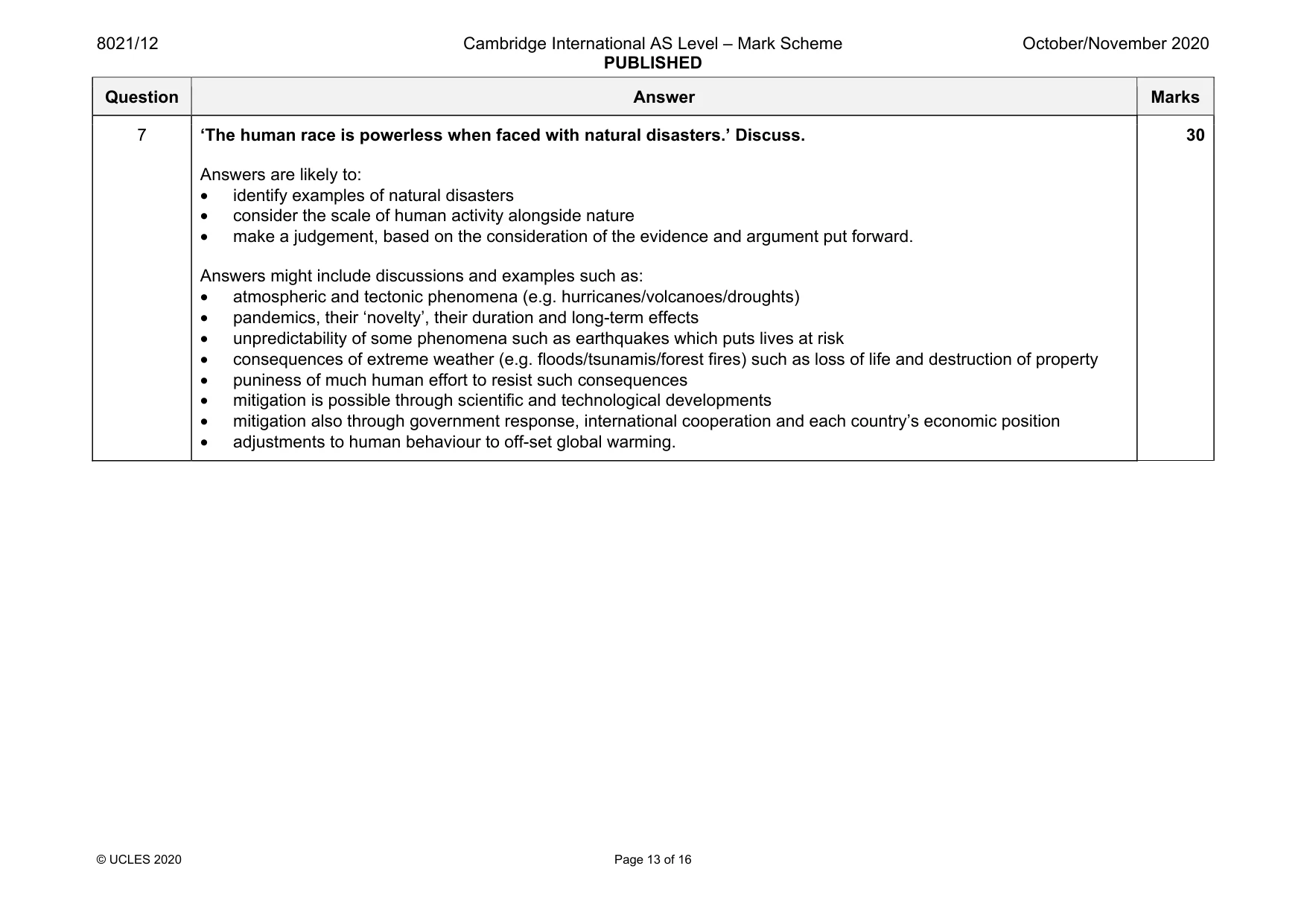
8021/12 Cambridge International AS Level – Mark Scheme PUBLISHED October/November 2020 © UCLES 2020 Page 13 of 16 Question Answer Marks 7 ‘The human race is powerless when faced with natural disasters.’ Discuss. Answers are likely to: • identify examples of natural disasters • consider the scale of human activity alongside nature • make a judgement, based on the consideration of the evidence and argument put forward. Answers might include discussions and examples such as: • atmospheric and tectonic phenomena (e.g. hurricanes/volcanoes/droughts) • pandemics, their ‘novelty’, their duration and long-term effects • unpredictability of some phenomena such as earthquakes which puts lives at risk • consequences of extreme weather (e.g. floods/tsunamis/forest fires) such as loss of life and destruction of property • puniness of much human effort to resist such consequences • mitigation is possible through scientific and technological developments • mitigation also through government response, international cooperation and each country’s economic position • adjustments to human behaviour to off-set global warming. 30
Mark scheme, page 14
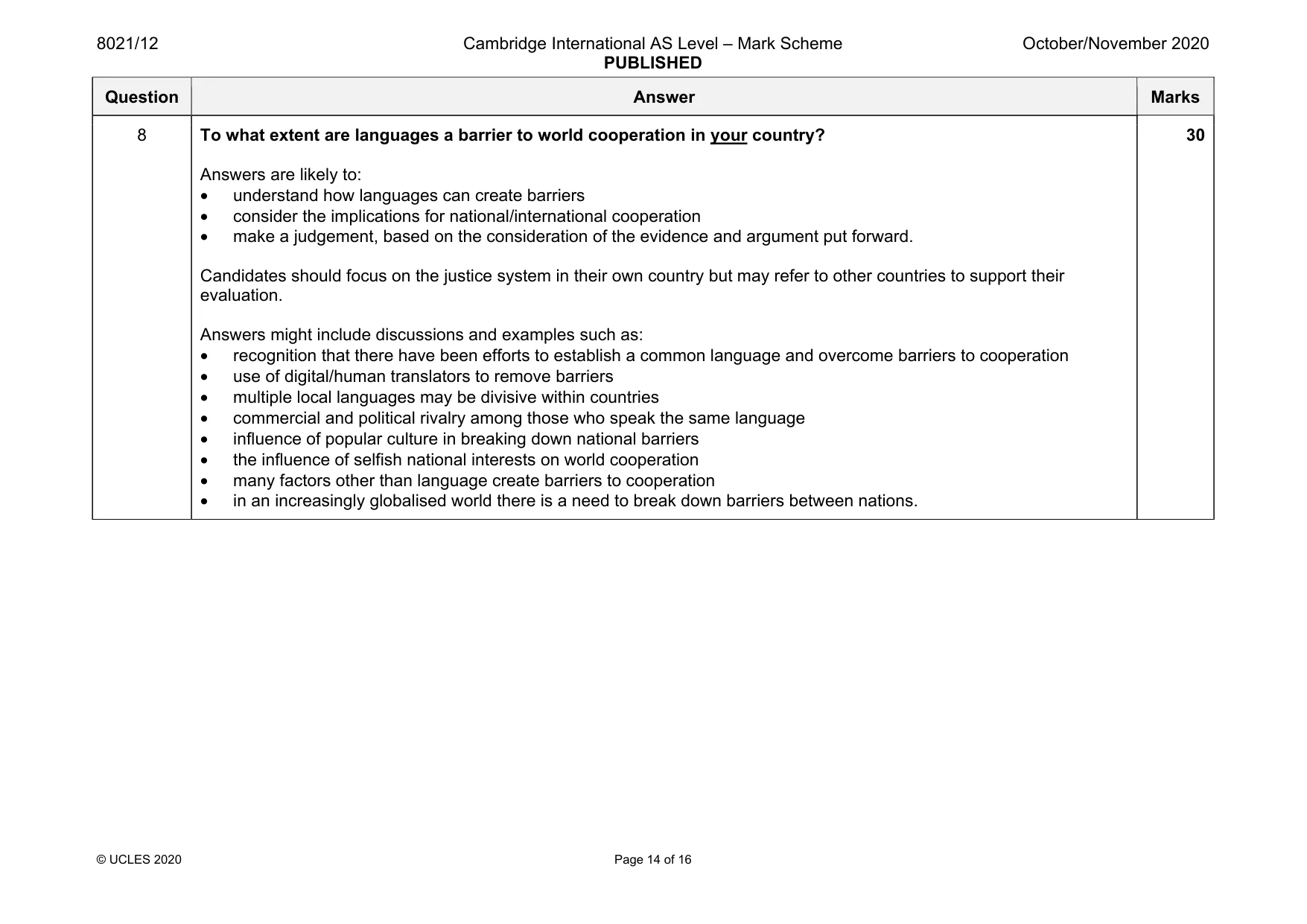
8021/12 Cambridge International AS Level – Mark Scheme PUBLISHED October/November 2020 © UCLES 2020 Page 14 of 16 Question Answer Marks 8 To what extent are languages a barrier to world cooperation in your country? Answers are likely to: • understand how languages can create barriers • consider the implications for national/international cooperation • make a judgement, based on the consideration of the evidence and argument put forward. Candidates should focus on the justice system in their own country but may refer to other countries to support their evaluation. Answers might include discussions and examples such as: • recognition that there have been efforts to establish a common language and overcome barriers to cooperation • use of digital/human translators to remove barriers • multiple local languages may be divisive within countries • commercial and political rivalry among those who speak the same language • influence of popular culture in breaking down national barriers • the influence of selfish national interests on world cooperation • many factors other than language create barriers to cooperation • in an increasingly globalised world there is a need to break down barriers between nations. 30
Mark scheme, page 15
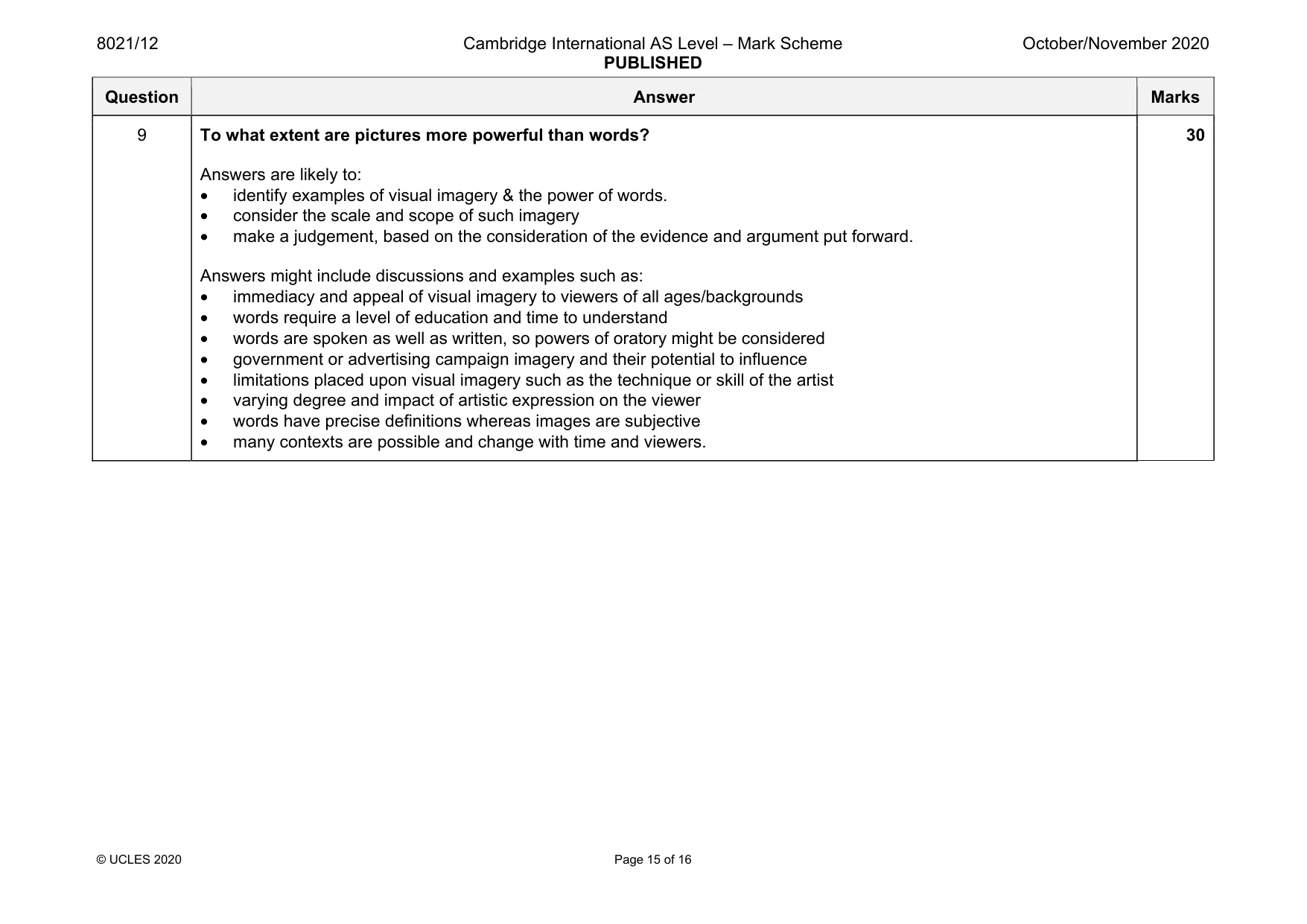
8021/12 Cambridge International AS Level – Mark Scheme PUBLISHED October/November 2020 © UCLES 2020 Page 15 of 16 Question Answer Marks 9 To what extent are pictures more powerful than words? Answers are likely to: • identify examples of visual imagery & the power of words. • consider the scale and scope of such imagery • make a judgement, based on the consideration of the evidence and argument put forward. Answers might include discussions and examples such as: • immediacy and appeal of visual imagery to viewers of all ages/backgrounds • words require a level of education and time to understand • words are spoken as well as written, so powers of oratory might be considered • government or advertising campaign imagery and their potential to influence • limitations placed upon visual imagery such as the technique or skill of the artist • varying degree and impact of artistic expression on the viewer • words have precise definitions whereas images are subjective • many contexts are possible and change with time and viewers. 30
Mark scheme, page 16
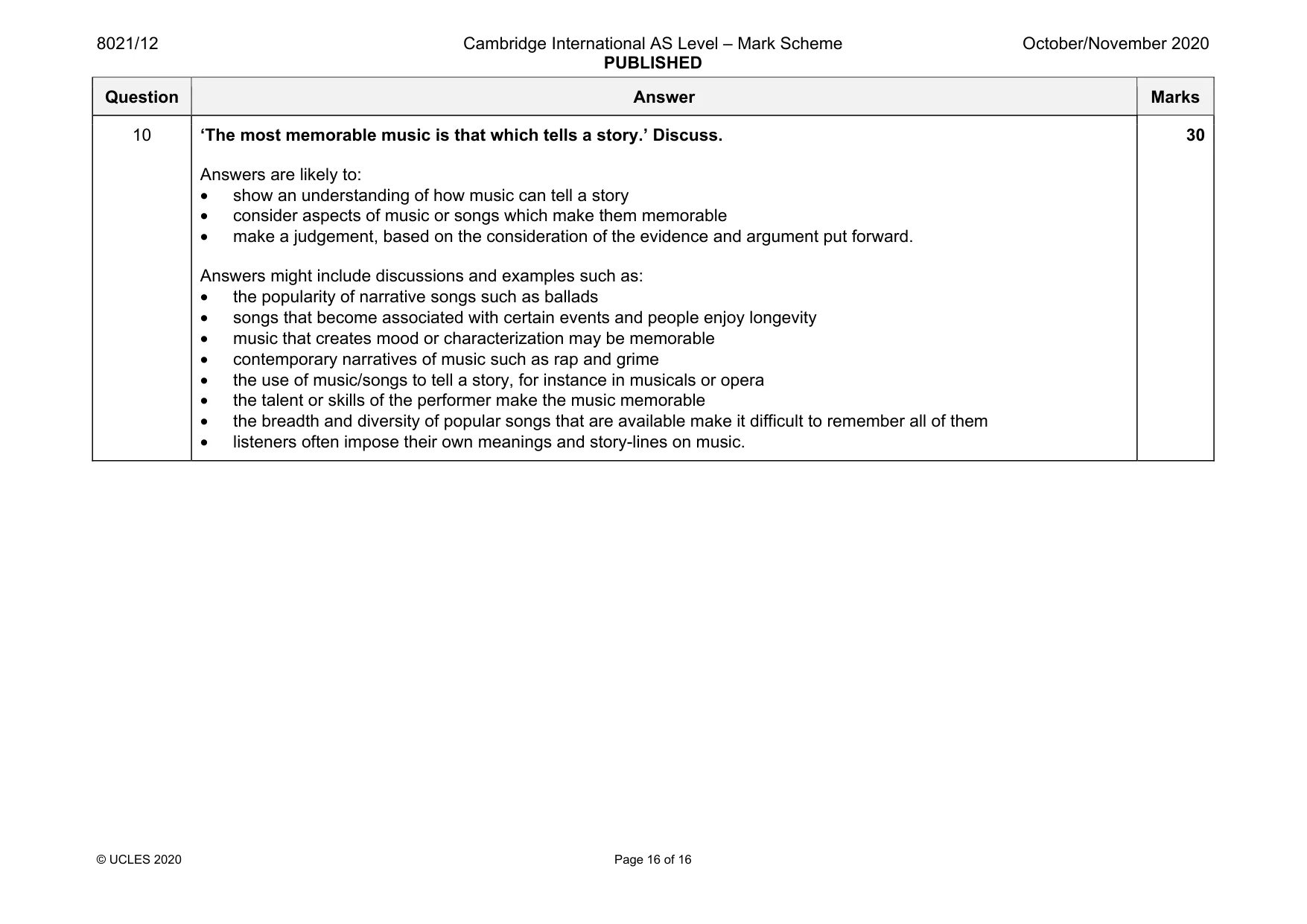
8021/12 Cambridge International AS Level – Mark Scheme PUBLISHED October/November 2020 © UCLES 2020 Page 16 of 16 Question Answer Marks 10 ‘The most memorable music is that which tells a story.’ Discuss. Answers are likely to: • show an understanding of how music can tell a story • consider aspects of music or songs which make them memorable • make a judgement, based on the consideration of the evidence and argument put forward. Answers might include discussions and examples such as: • the popularity of narrative songs such as ballads • songs that become associated with certain events and people enjoy longevity • music that creates mood or characterization may be memorable • contemporary narratives of music such as rap and grime • the use of music/songs to tell a story, for instance in musicals or opera • the talent or skills of the performer make the music memorable • the breadth and diversity of popular songs that are available make it difficult to remember all of them • listeners often impose their own meanings and story-lines on music. 30
What you needed in this session
Cambridge’s own grade thresholds for 2020 Oct/Nov, Paper 1 · Variant 2. A higher threshold means an easier paper — the bar moves with how the cohort did.