Cambridge A Level English General Paper 8021 — 2020 Oct/Nov Paper 1 · Variant 1
8021/11/O/N/20 · 30 marks · ≈34 min
The question paper and its mark scheme, free to read here and free to download. This is Cambridge’s own paper, exactly as it was sat.
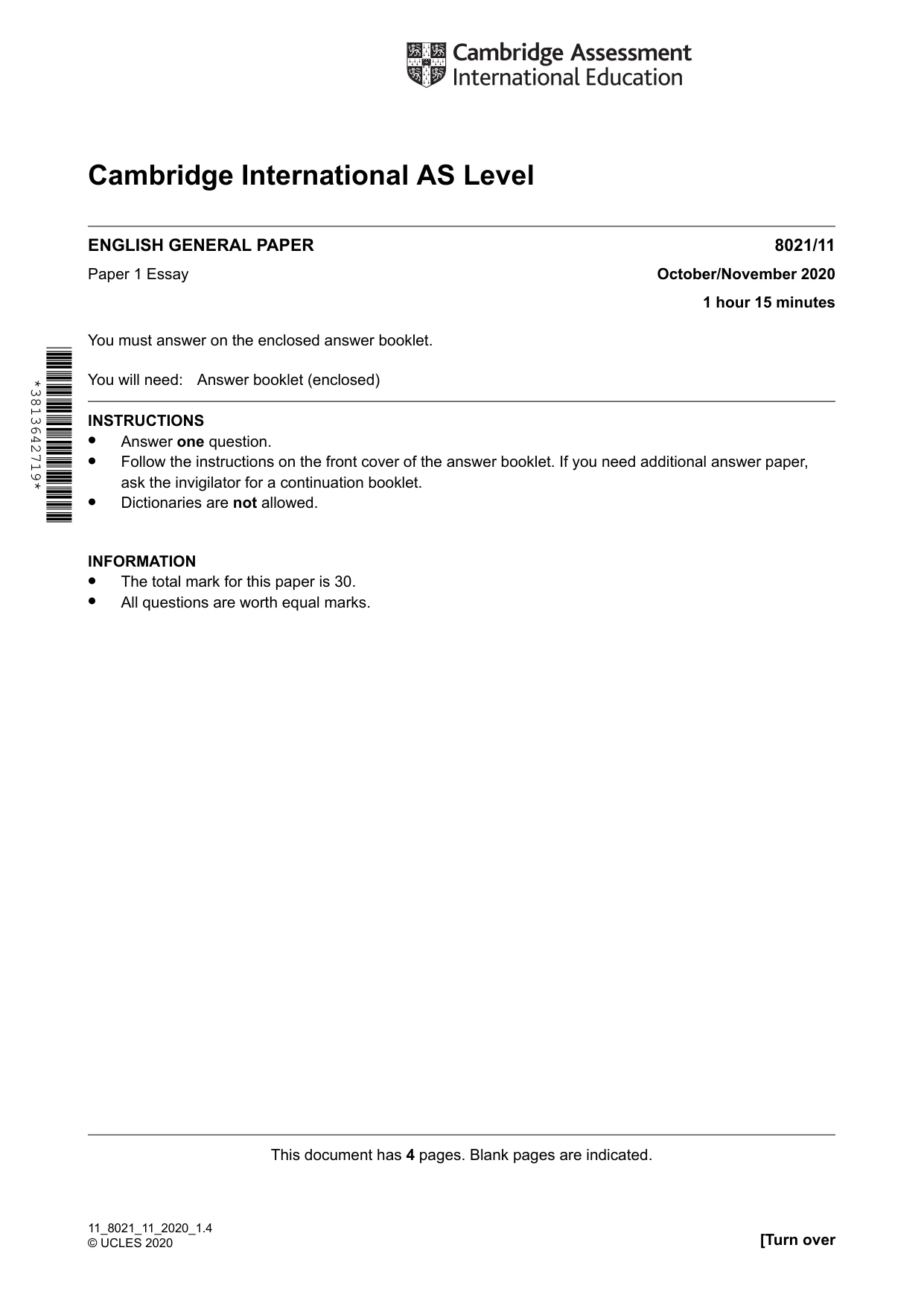
Question paper4 pages


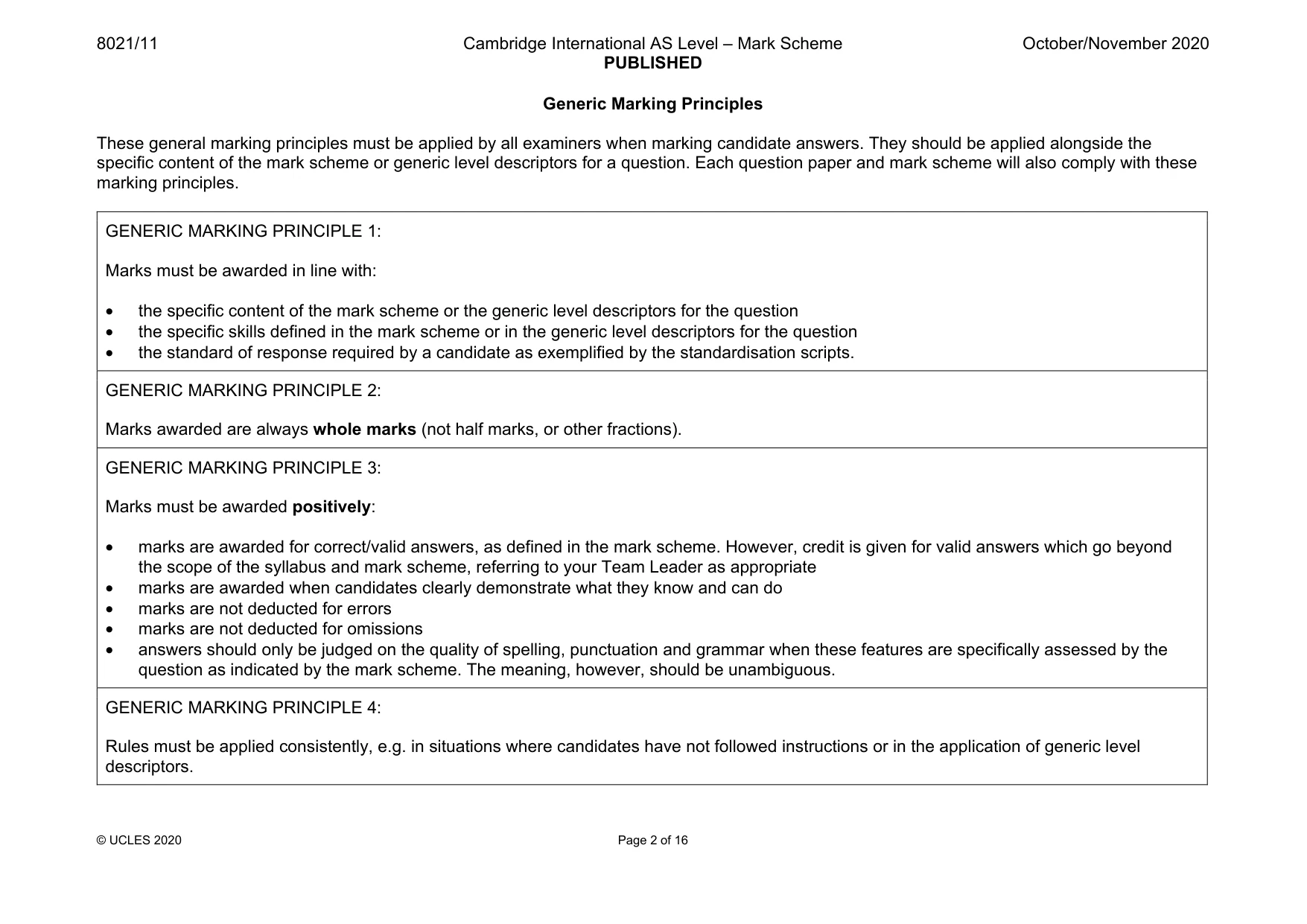
Mark scheme16 pages
Answers below. Sit the paper first if you are practising.
Paper as text
Question paper, page 1
Cambridge International AS Level 8021/11 October/November 2020 1 hour 15 minutes ENGLISH GENERAL PAPER Paper 1 Essay You must answer on the enclosed answer booklet. You will need: Answer booklet (enclosed) INSTRUCTIONS • Answer one question. • Follow the instructions on the front cover of the answer booklet. If you need additional answer paper, ask the invigilator for a continuation booklet. • Dictionaries are not allowed. INFORMATION • The total mark for this paper is 30. • All questions are worth equal marks. This document has 4 pages. Blank pages are indicated. [Turn over 11_8021_11_2020_1.4 © UCLES 2020 *3813642719*
Question paper, page 2
BLANK PAGE 11_8021_11_2020_1.4 © UCLES 2020 2
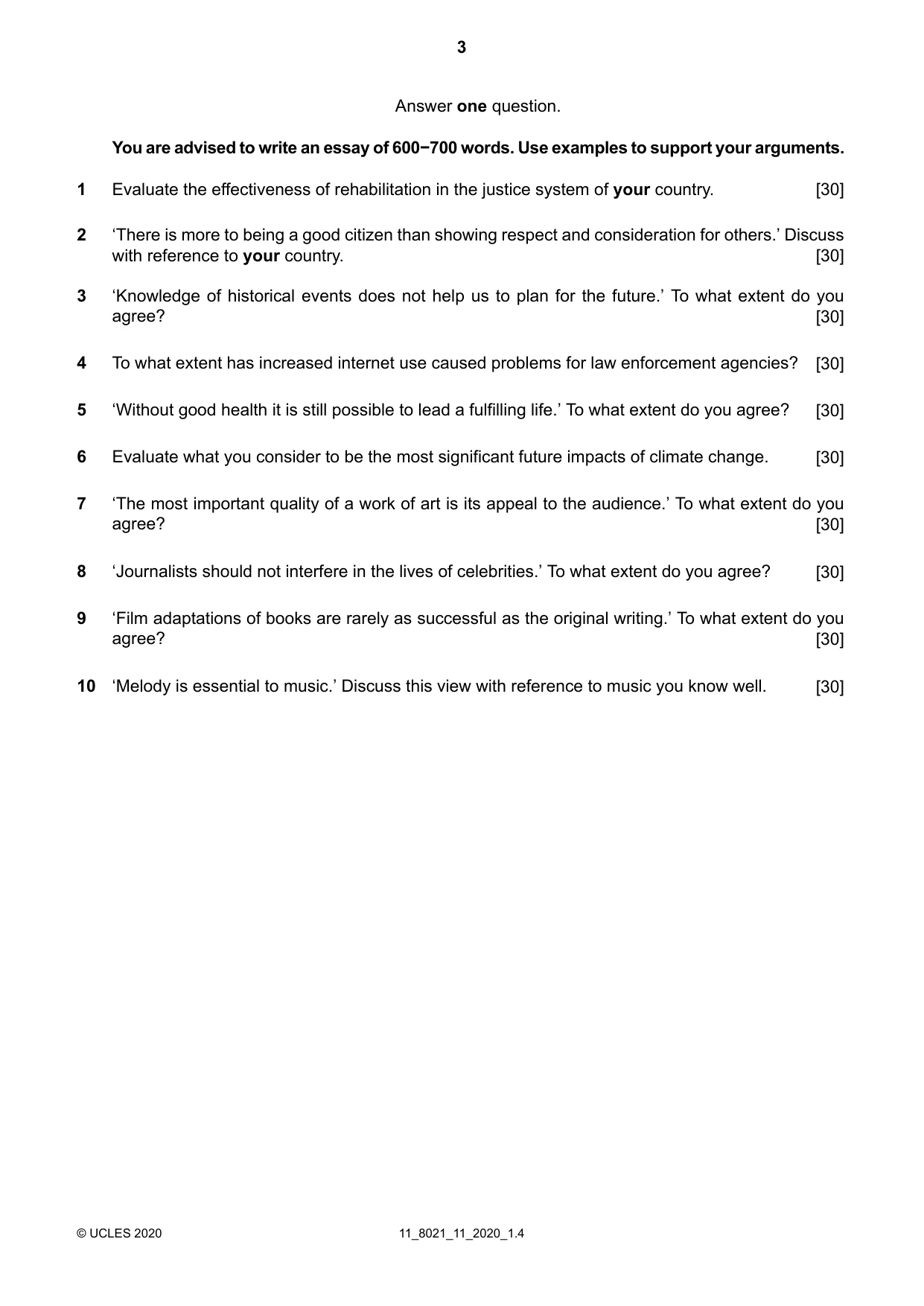
Question paper, page 3
Answer one question. You are advised to write an essay of 600−700 words. Use examples to support your arguments. Evaluate the effectiveness of rehabilitation in the justice system of your country. [30] 1 ‘There is more to being a good citizen than showing respect and consideration for others.’ Discuss with reference to your country. [30] 2 ‘Knowledge of historical events does not help us to plan for the future.’ To what extent do you agree? [30] 3 To what extent has increased internet use caused problems for law enforcement agencies? [30] 4 ‘Without good health it is still possible to lead a fulfilling life.’ To what extent do you agree? [30] 5 Evaluate what you consider to be the most significant future impacts of climate change. [30] 6 ‘The most important quality of a work of art is its appeal to the audience.’ To what extent do you agree? [30] 7 ‘Journalists should not interfere in the lives of celebrities.’ To what extent do you agree? [30] 8 ‘Film adaptations of books are rarely as successful as the original writing.’ To what extent do you agree? [30] 9 ‘Melody is essential to music.’ Discuss this view with reference to music you know well. [30] 10 11_8021_11_2020_1.4 © UCLES 2020 3
Question paper, page 4
BLANK PAGE Permission to reproduce items where third-party owned material protected by copyright is included has been sought and cleared where possible. Every reasonable effort has been made by the publisher (UCLES) to trace copyright holders, but if any items requiring clearance have unwittingly been included, the publisher will be pleased to make amends at the earliest possible opportunity. To avoid the issue of disclosure of answer-related information to candidates, all copyright acknowledgements are reproduced online in the Cambridge Assessment International Education Copyright Acknowledgements Booklet. This is produced for each series of examinations and is freely available to download at www.cambridgeinternational.org after the live examination series. Cambridge Assessment International Education is part of the Cambridge Assessment Group. Cambridge Assessment is the brand name of the University of Cambridge Local Examinations Syndicate (UCLES), which itself is a department of the University of Cambridge. 11_8021_11_2020_1.4 © UCLES 2020 4
Mark scheme, page 1
This document consists of 16 printed pages. © UCLES 2020 [Turn over Cambridge International AS Level ENGLISH GENERAL PAPER 8021/11 Paper 1 Essay October/November 2020 MARK SCHEME Maximum Mark: 30 Published This mark scheme is published as an aid to teachers and candidates, to indicate the requirements of the examination. It shows the basis on which Examiners were instructed to award marks. It does not indicate the details of the discussions that took place at an Examiners’ meeting before marking began, which would have considered the acceptability of alternative answers. Mark schemes should be read in conjunction with the question paper and the Principal Examiner Report for Teachers. Cambridge International will not enter into discussions about these mark schemes. Cambridge International is publishing the mark schemes for the October/November 2020 series for most Cambridge IGCSE™, Cambridge International A and AS Level and Cambridge Pre-U components, and some Cambridge O Level components.
Mark scheme, page 2
8021/11 Cambridge International AS Level – Mark Scheme PUBLISHED October/November 2020 © UCLES 2020 Page 2 of 16 Generic Marking Principles These general marking principles must be applied by all examiners when marking candidate answers. They should be applied alongside the specific content of the mark scheme or generic level descriptors for a question. Each question paper and mark scheme will also comply with these marking principles. GENERIC MARKING PRINCIPLE 1: Marks must be awarded in line with: • the specific content of the mark scheme or the generic level descriptors for the question • the specific skills defined in the mark scheme or in the generic level descriptors for the question • the standard of response required by a candidate as exemplified by the standardisation scripts. GENERIC MARKING PRINCIPLE 2: Marks awarded are always whole marks (not half marks, or other fractions). GENERIC MARKING PRINCIPLE 3: Marks must be awarded positively: • marks are awarded for correct/valid answers, as defined in the mark scheme. However, credit is given for valid answers which go beyond the scope of the syllabus and mark scheme, referring to your Team Leader as appropriate • marks are awarded when candidates clearly demonstrate what they know and can do • marks are not deducted for errors • marks are not deducted for omissions • answers should only be judged on the quality of spelling, punctuation and grammar when these features are specifically assessed by the question as indicated by the mark scheme. The meaning, however, should be unambiguous. GENERIC MARKING PRINCIPLE 4: Rules must be applied consistently, e.g. in situations where candidates have not followed instructions or in the application of generic level descriptors.
Mark scheme, page 3
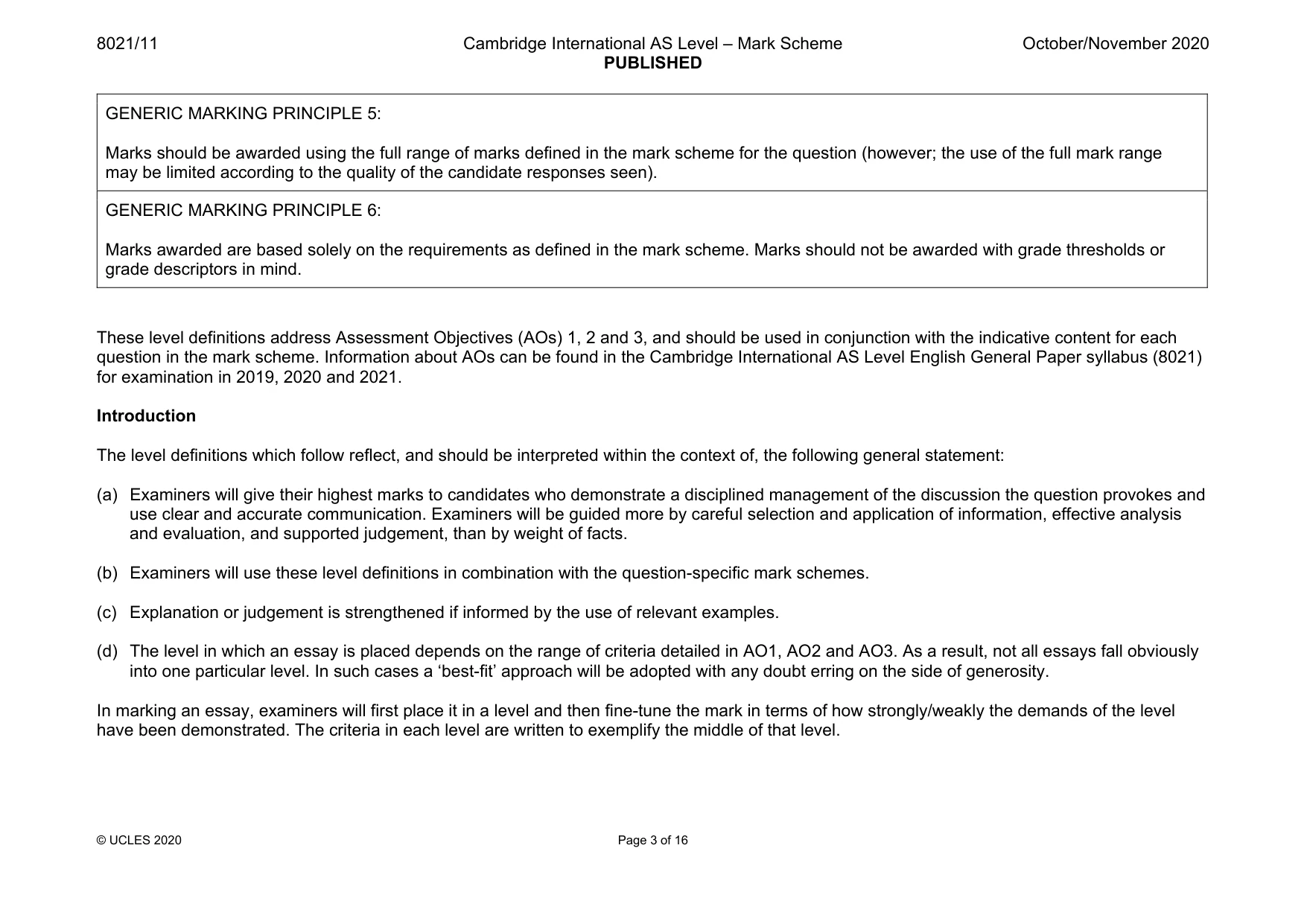
8021/11 Cambridge International AS Level – Mark Scheme PUBLISHED October/November 2020 © UCLES 2020 Page 3 of 16 GENERIC MARKING PRINCIPLE 5: Marks should be awarded using the full range of marks defined in the mark scheme for the question (however; the use of the full mark range may be limited according to the quality of the candidate responses seen). GENERIC MARKING PRINCIPLE 6: Marks awarded are based solely on the requirements as defined in the mark scheme. Marks should not be awarded with grade thresholds or grade descriptors in mind. These level definitions address Assessment Objectives (AOs) 1, 2 and 3, and should be used in conjunction with the indicative content for each question in the mark scheme. Information about AOs can be found in the Cambridge International AS Level English General Paper syllabus (8021) for examination in 2019, 2020 and 2021. Introduction The level definitions which follow reflect, and should be interpreted within the context of, the following general statement: (a) Examiners will give their highest marks to candidates who demonstrate a disciplined management of the discussion the question provokes and use clear and accurate communication. Examiners will be guided more by careful selection and application of information, effective analysis and evaluation, and supported judgement, than by weight of facts. (b) Examiners will use these level definitions in combination with the question-specific mark schemes. (c) Explanation or judgement is strengthened if informed by the use of relevant examples. (d) The level in which an essay is placed depends on the range of criteria detailed in AO1, AO2 and AO3. As a result, not all essays fall obviously into one particular level. In such cases a ‘best-fit’ approach will be adopted with any doubt erring on the side of generosity. In marking an essay, examiners will first place it in a level and then fine-tune the mark in terms of how strongly/weakly the demands of the level have been demonstrated. The criteria in each level are written to exemplify the middle of that level.
Mark scheme, page 4
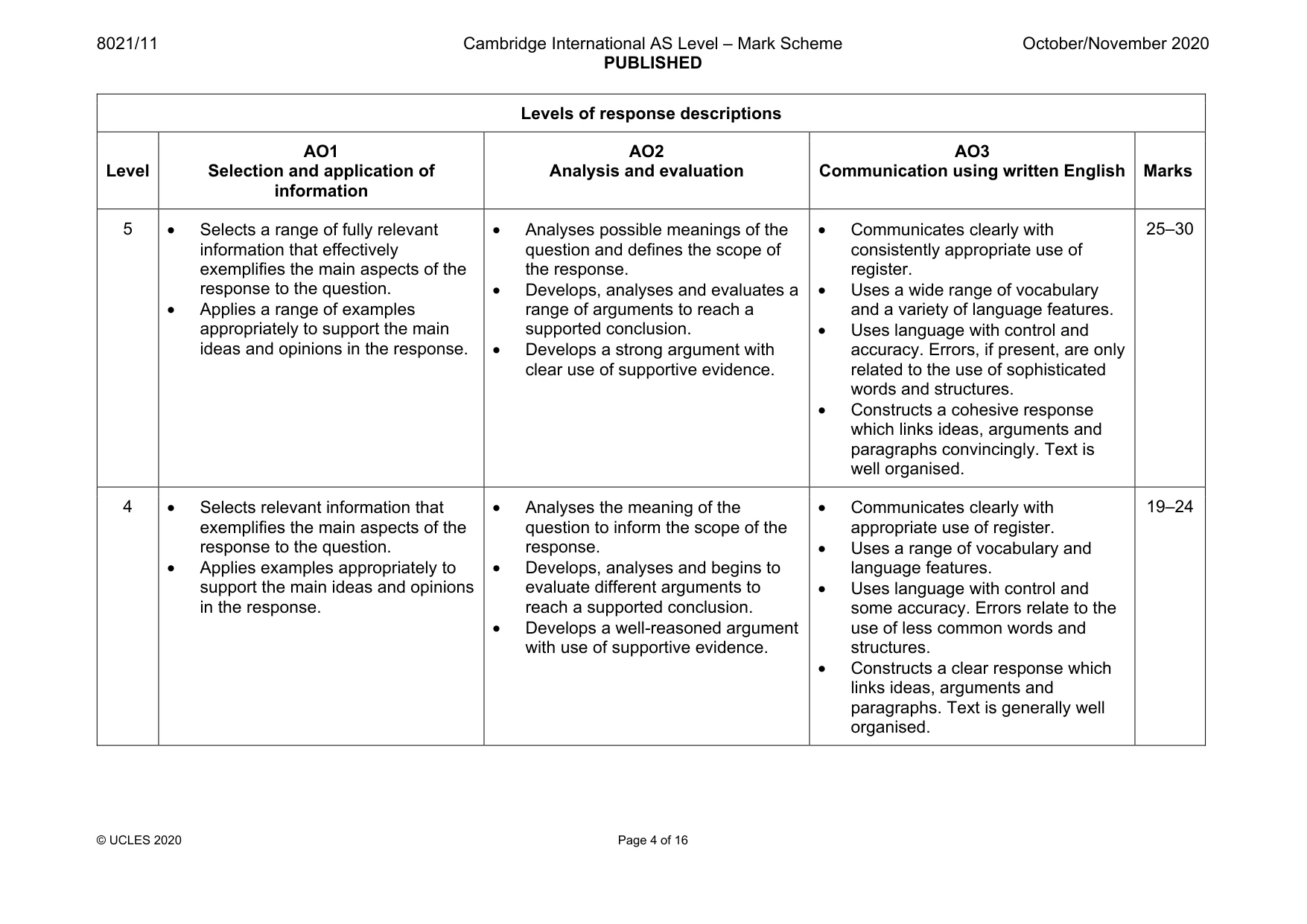
8021/11 Cambridge International AS Level – Mark Scheme PUBLISHED October/November 2020 © UCLES 2020 Page 4 of 16 Levels of response descriptions Level AO1 Selection and application of information AO2 Analysis and evaluation AO3 Communication using written English Marks 5 • Selects a range of fully relevant information that effectively exemplifies the main aspects of the response to the question. • Applies a range of examples appropriately to support the main ideas and opinions in the response. • Analyses possible meanings of the question and defines the scope of the response. • Develops, analyses and evaluates a range of arguments to reach a supported conclusion. • Develops a strong argument with clear use of supportive evidence. • Communicates clearly with consistently appropriate use of register. • Uses a wide range of vocabulary and a variety of language features. • Uses language with control and accuracy. Errors, if present, are only related to the use of sophisticated words and structures. • Constructs a cohesive response which links ideas, arguments and paragraphs convincingly. Text is well organised. 25–30 4 • Selects relevant information that exemplifies the main aspects of the response to the question. • Applies examples appropriately to support the main ideas and opinions in the response. • Analyses the meaning of the question to inform the scope of the response. • Develops, analyses and begins to evaluate different arguments to reach a supported conclusion. • Develops a well-reasoned argument with use of supportive evidence. • Communicates clearly with appropriate use of register. • Uses a range of vocabulary and language features. • Uses language with control and some accuracy. Errors relate to the use of less common words and structures. • Constructs a clear response which links ideas, arguments and paragraphs. Text is generally well organised. 19–24
Mark scheme, page 5
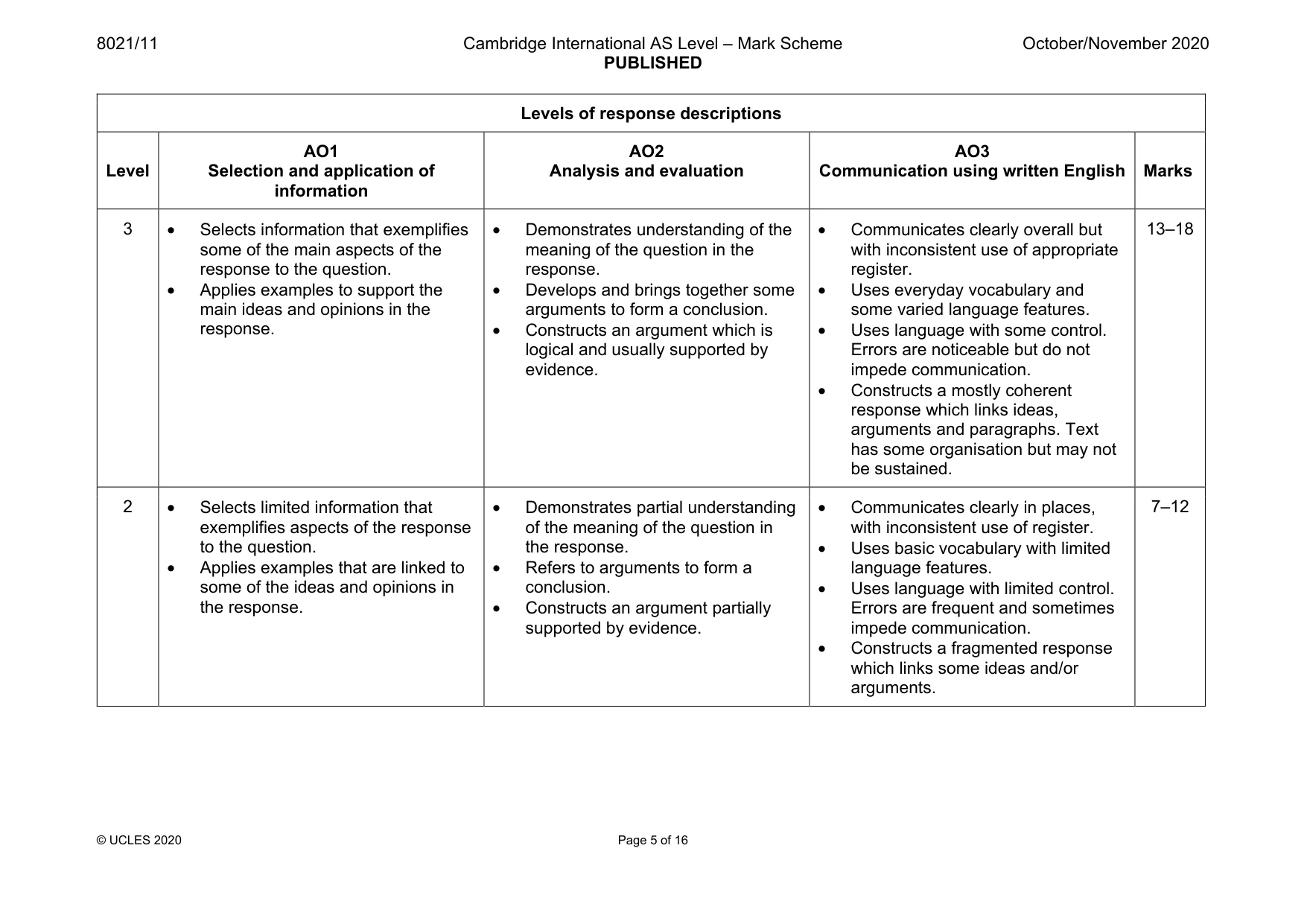
8021/11 Cambridge International AS Level – Mark Scheme PUBLISHED October/November 2020 © UCLES 2020 Page 5 of 16 Levels of response descriptions Level AO1 Selection and application of information AO2 Analysis and evaluation AO3 Communication using written English Marks 3 • Selects information that exemplifies some of the main aspects of the response to the question. • Applies examples to support the main ideas and opinions in the response. • Demonstrates understanding of the meaning of the question in the response. • Develops and brings together some arguments to form a conclusion. • Constructs an argument which is logical and usually supported by evidence. • Communicates clearly overall but with inconsistent use of appropriate register. • Uses everyday vocabulary and some varied language features. • Uses language with some control. Errors are noticeable but do not impede communication. • Constructs a mostly coherent response which links ideas, arguments and paragraphs. Text has some organisation but may not be sustained. 13–18 2 • Selects limited information that exemplifies aspects of the response to the question. • Applies examples that are linked to some of the ideas and opinions in the response. • Demonstrates partial understanding of the meaning of the question in the response. • Refers to arguments to form a conclusion. • Constructs an argument partially supported by evidence. • Communicates clearly in places, with inconsistent use of register. • Uses basic vocabulary with limited language features. • Uses language with limited control. Errors are frequent and sometimes impede communication. • Constructs a fragmented response which links some ideas and/or arguments. 7–12
Mark scheme, page 6
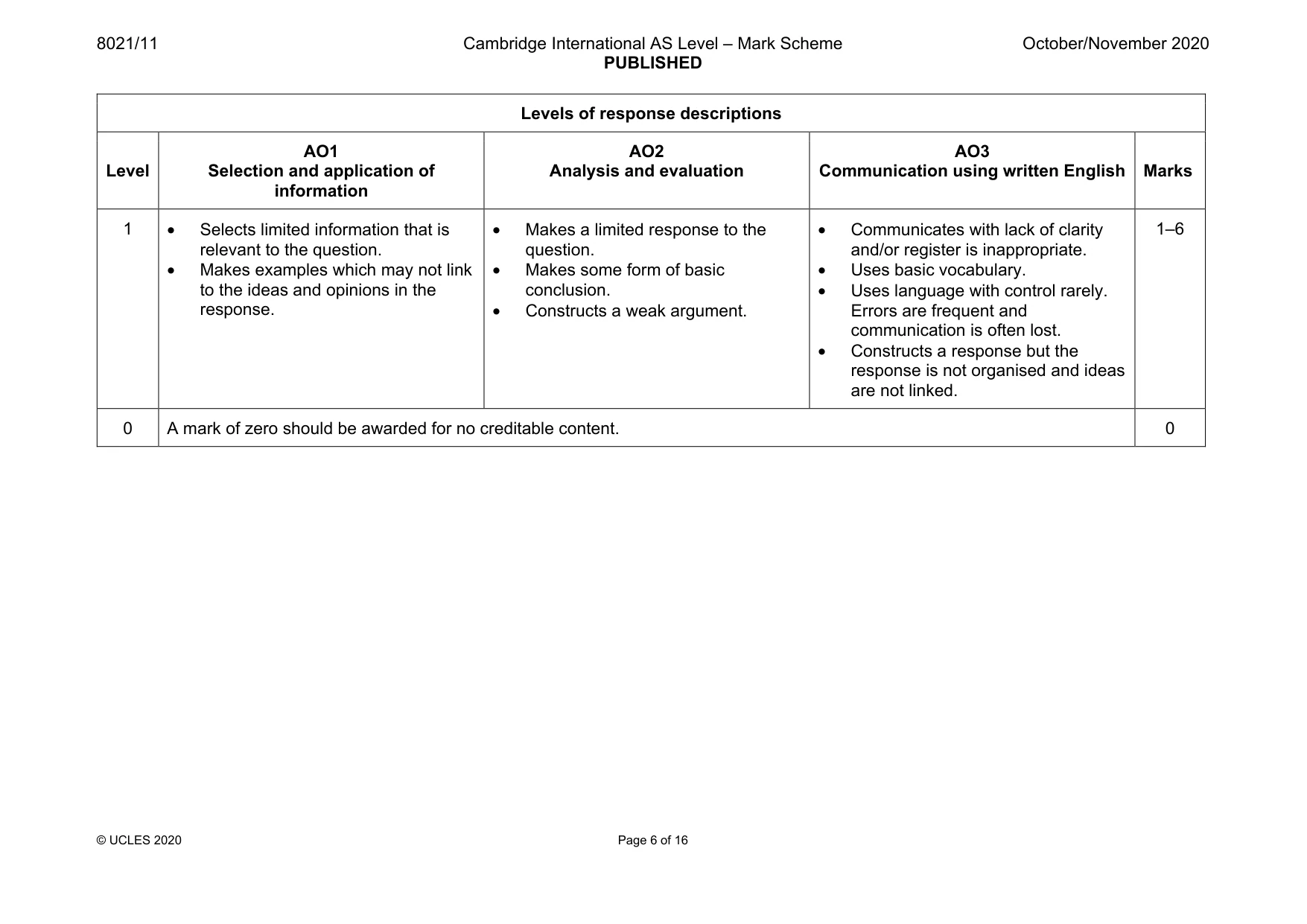
8021/11 Cambridge International AS Level – Mark Scheme PUBLISHED October/November 2020 © UCLES 2020 Page 6 of 16 Levels of response descriptions Level AO1 Selection and application of information AO2 Analysis and evaluation AO3 Communication using written English Marks 1 • Selects limited information that is relevant to the question. • Makes examples which may not link to the ideas and opinions in the response. • Makes a limited response to the question. • Makes some form of basic conclusion. • Constructs a weak argument. • Communicates with lack of clarity and/or register is inappropriate. • Uses basic vocabulary. • Uses language with control rarely. Errors are frequent and communication is often lost. • Constructs a response but the response is not organised and ideas are not linked. 1–6 0 A mark of zero should be awarded for no creditable content. 0
Mark scheme, page 7
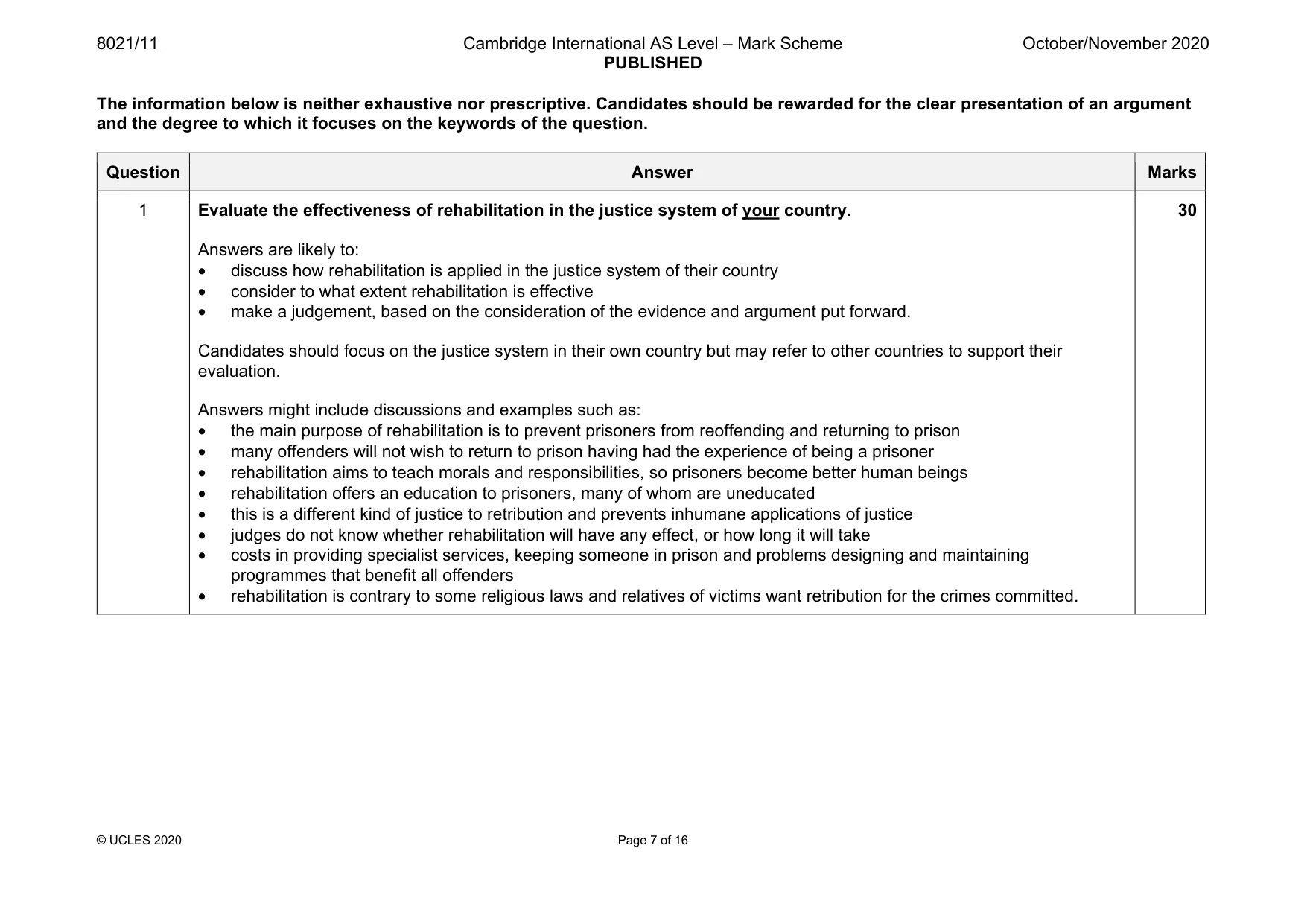
8021/11 Cambridge International AS Level – Mark Scheme PUBLISHED October/November 2020 © UCLES 2020 Page 7 of 16 The information below is neither exhaustive nor prescriptive. Candidates should be rewarded for the clear presentation of an argument and the degree to which it focuses on the keywords of the question. Question Answer Marks 1 Evaluate the effectiveness of rehabilitation in the justice system of your country. Answers are likely to: • discuss how rehabilitation is applied in the justice system of their country • consider to what extent rehabilitation is effective • make a judgement, based on the consideration of the evidence and argument put forward. Candidates should focus on the justice system in their own country but may refer to other countries to support their evaluation. Answers might include discussions and examples such as: • the main purpose of rehabilitation is to prevent prisoners from reoffending and returning to prison • many offenders will not wish to return to prison having had the experience of being a prisoner • rehabilitation aims to teach morals and responsibilities, so prisoners become better human beings • rehabilitation offers an education to prisoners, many of whom are uneducated • this is a different kind of justice to retribution and prevents inhumane applications of justice • judges do not know whether rehabilitation will have any effect, or how long it will take • costs in providing specialist services, keeping someone in prison and problems designing and maintaining programmes that benefit all offenders • rehabilitation is contrary to some religious laws and relatives of victims want retribution for the crimes committed. 30
Mark scheme, page 8
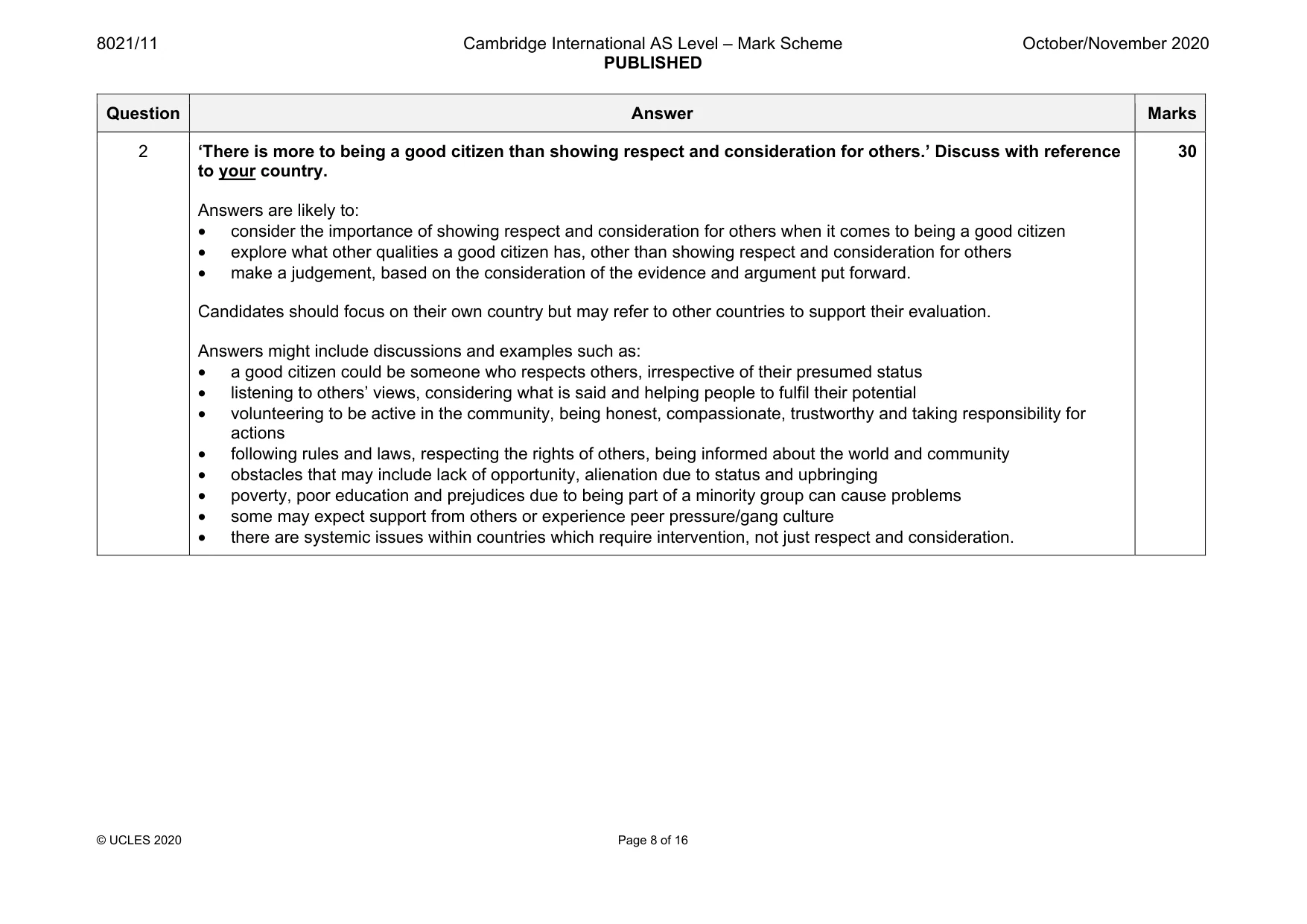
8021/11 Cambridge International AS Level – Mark Scheme PUBLISHED October/November 2020 © UCLES 2020 Page 8 of 16 Question Answer Marks 2 ‘There is more to being a good citizen than showing respect and consideration for others.’ Discuss with reference to your country. Answers are likely to: • consider the importance of showing respect and consideration for others when it comes to being a good citizen • explore what other qualities a good citizen has, other than showing respect and consideration for others • make a judgement, based on the consideration of the evidence and argument put forward. Candidates should focus on their own country but may refer to other countries to support their evaluation. Answers might include discussions and examples such as: • a good citizen could be someone who respects others, irrespective of their presumed status • listening to others’ views, considering what is said and helping people to fulfil their potential • volunteering to be active in the community, being honest, compassionate, trustworthy and taking responsibility for actions • following rules and laws, respecting the rights of others, being informed about the world and community • obstacles that may include lack of opportunity, alienation due to status and upbringing • poverty, poor education and prejudices due to being part of a minority group can cause problems • some may expect support from others or experience peer pressure/gang culture • there are systemic issues within countries which require intervention, not just respect and consideration. 30
Mark scheme, page 9
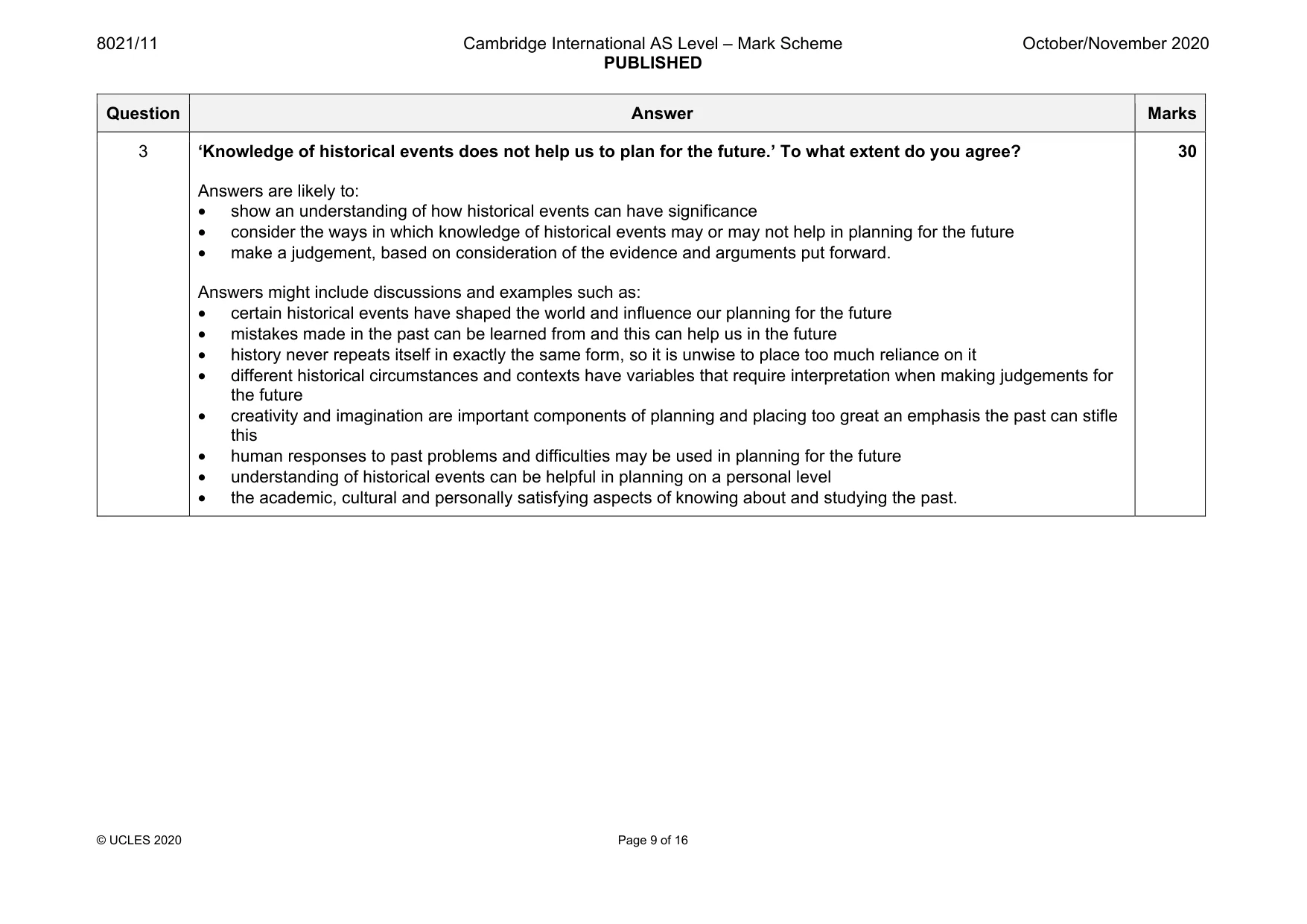
8021/11 Cambridge International AS Level – Mark Scheme PUBLISHED October/November 2020 © UCLES 2020 Page 9 of 16 Question Answer Marks 3 ‘Knowledge of historical events does not help us to plan for the future.’ To what extent do you agree? Answers are likely to: • show an understanding of how historical events can have significance • consider the ways in which knowledge of historical events may or may not help in planning for the future • make a judgement, based on consideration of the evidence and arguments put forward. Answers might include discussions and examples such as: • certain historical events have shaped the world and influence our planning for the future • mistakes made in the past can be learned from and this can help us in the future • history never repeats itself in exactly the same form, so it is unwise to place too much reliance on it • different historical circumstances and contexts have variables that require interpretation when making judgements for the future • creativity and imagination are important components of planning and placing too great an emphasis the past can stifle this • human responses to past problems and difficulties may be used in planning for the future • understanding of historical events can be helpful in planning on a personal level • the academic, cultural and personally satisfying aspects of knowing about and studying the past. 30
Mark scheme, page 10
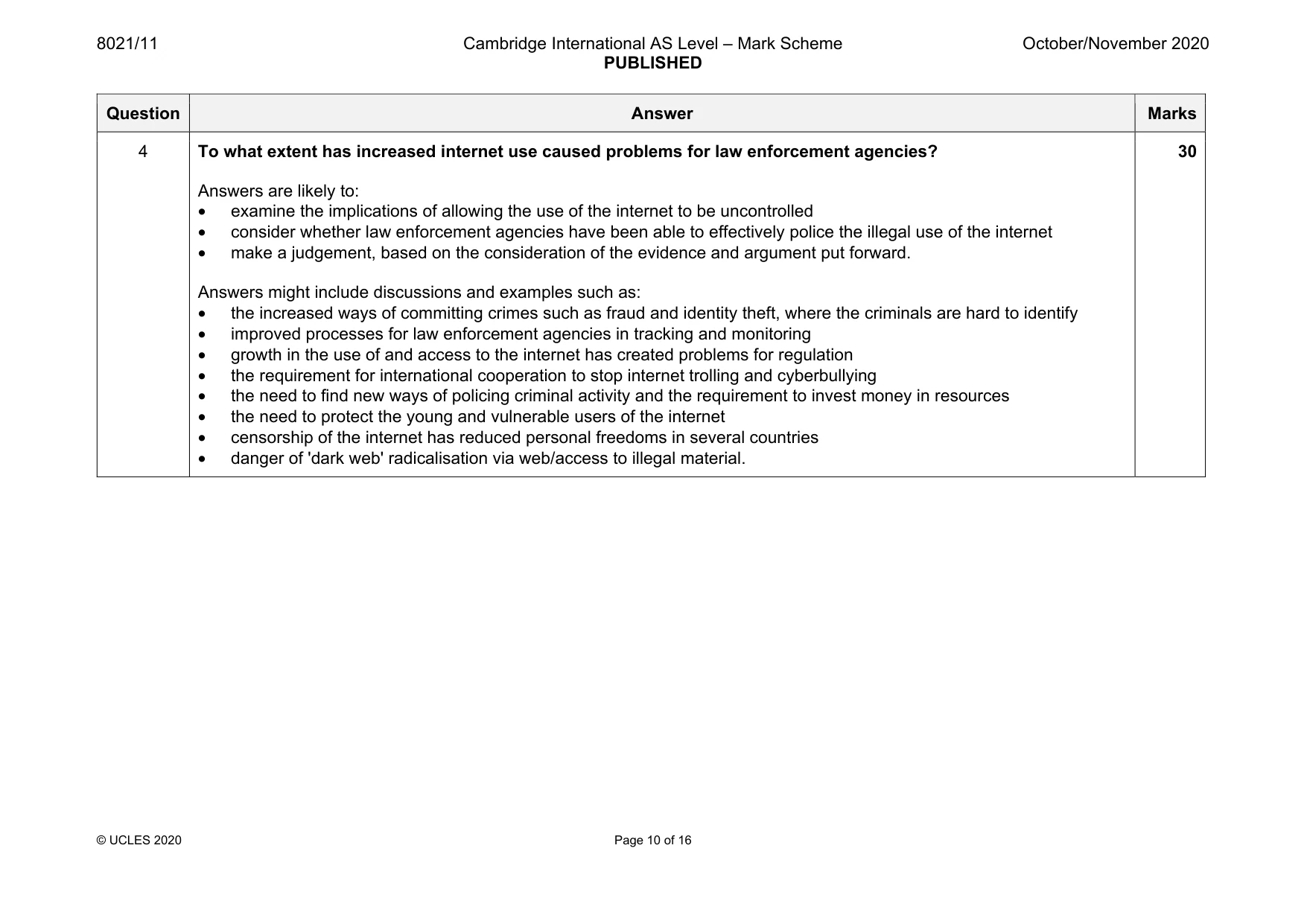
8021/11 Cambridge International AS Level – Mark Scheme PUBLISHED October/November 2020 © UCLES 2020 Page 10 of 16 Question Answer Marks 4 To what extent has increased internet use caused problems for law enforcement agencies? Answers are likely to: • examine the implications of allowing the use of the internet to be uncontrolled • consider whether law enforcement agencies have been able to effectively police the illegal use of the internet • make a judgement, based on the consideration of the evidence and argument put forward. Answers might include discussions and examples such as: • the increased ways of committing crimes such as fraud and identity theft, where the criminals are hard to identify • improved processes for law enforcement agencies in tracking and monitoring • growth in the use of and access to the internet has created problems for regulation • the requirement for international cooperation to stop internet trolling and cyberbullying • the need to find new ways of policing criminal activity and the requirement to invest money in resources • the need to protect the young and vulnerable users of the internet • censorship of the internet has reduced personal freedoms in several countries • danger of 'dark web' radicalisation via web/access to illegal material. 30
Mark scheme, page 11
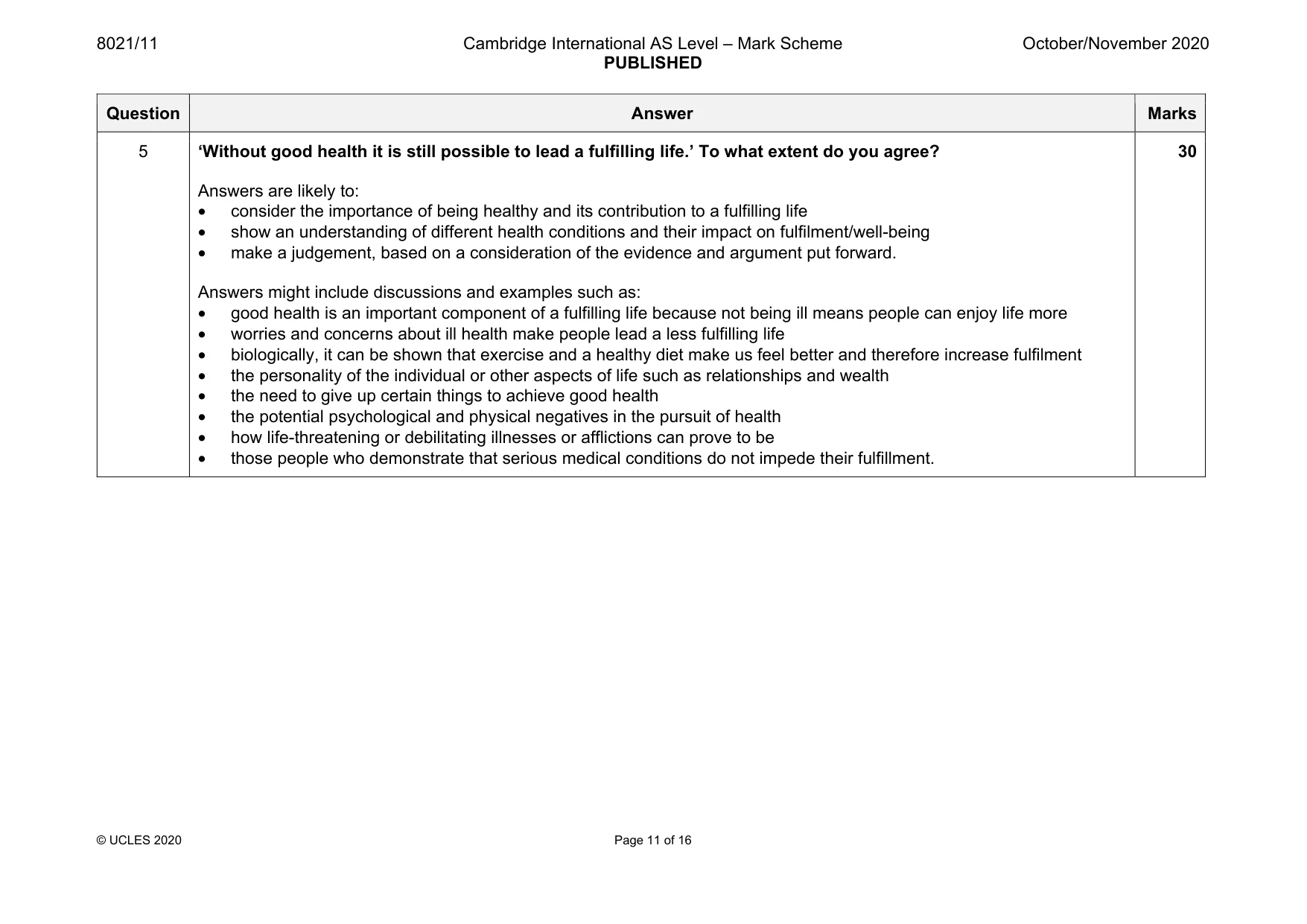
8021/11 Cambridge International AS Level – Mark Scheme PUBLISHED October/November 2020 © UCLES 2020 Page 11 of 16 Question Answer Marks 5 ‘Without good health it is still possible to lead a fulfilling life.’ To what extent do you agree? Answers are likely to: • consider the importance of being healthy and its contribution to a fulfilling life • show an understanding of different health conditions and their impact on fulfilment/well-being • make a judgement, based on a consideration of the evidence and argument put forward. Answers might include discussions and examples such as: • good health is an important component of a fulfilling life because not being ill means people can enjoy life more • worries and concerns about ill health make people lead a less fulfilling life • biologically, it can be shown that exercise and a healthy diet make us feel better and therefore increase fulfilment • the personality of the individual or other aspects of life such as relationships and wealth • the need to give up certain things to achieve good health • the potential psychological and physical negatives in the pursuit of health • how life-threatening or debilitating illnesses or afflictions can prove to be • those people who demonstrate that serious medical conditions do not impede their fulfillment. 30
Mark scheme, page 12
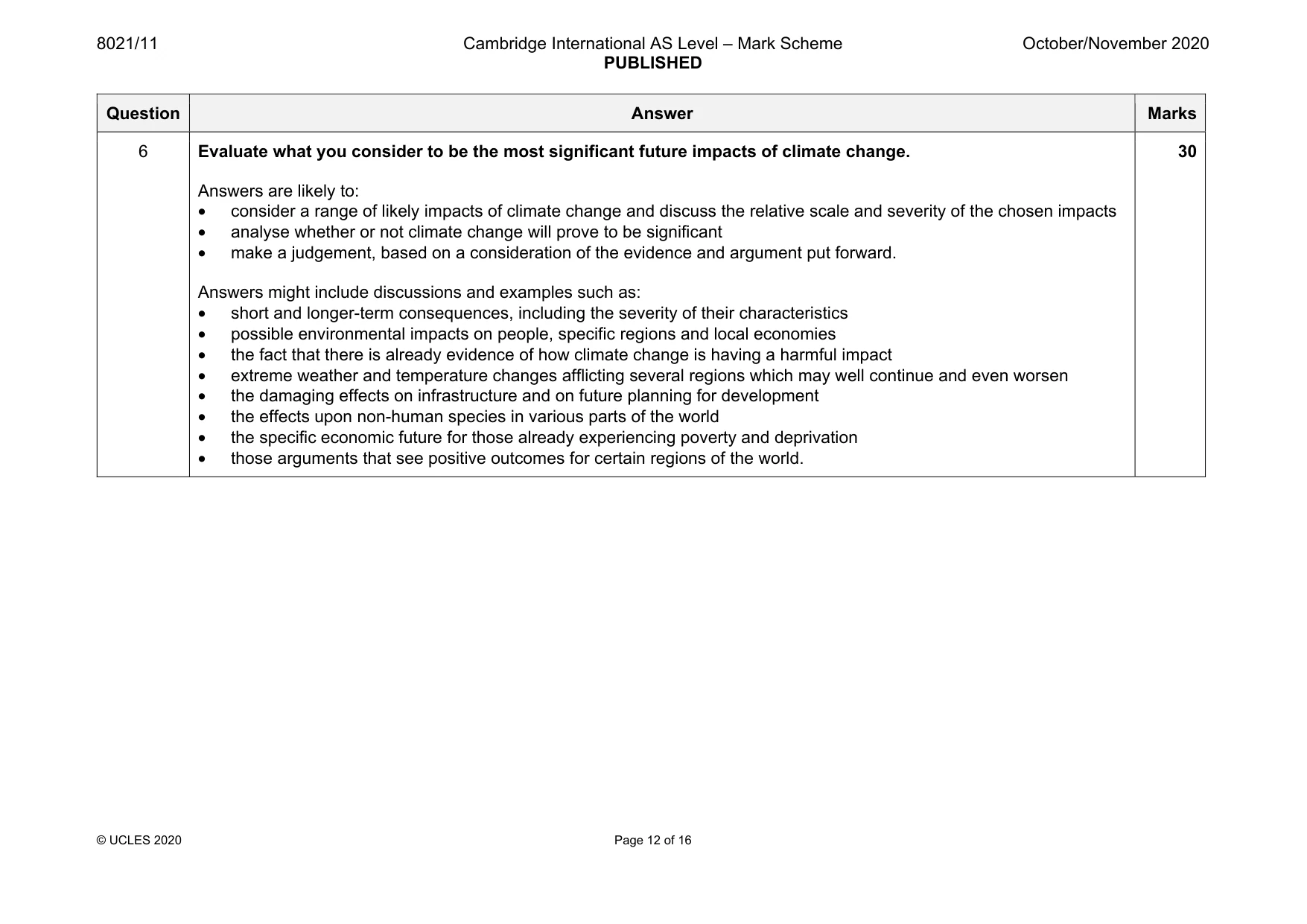
8021/11 Cambridge International AS Level – Mark Scheme PUBLISHED October/November 2020 © UCLES 2020 Page 12 of 16 Question Answer Marks 6 Evaluate what you consider to be the most significant future impacts of climate change. Answers are likely to: • consider a range of likely impacts of climate change and discuss the relative scale and severity of the chosen impacts • analyse whether or not climate change will prove to be significant • make a judgement, based on a consideration of the evidence and argument put forward. Answers might include discussions and examples such as: • short and longer-term consequences, including the severity of their characteristics • possible environmental impacts on people, specific regions and local economies • the fact that there is already evidence of how climate change is having a harmful impact • extreme weather and temperature changes afflicting several regions which may well continue and even worsen • the damaging effects on infrastructure and on future planning for development • the effects upon non-human species in various parts of the world • the specific economic future for those already experiencing poverty and deprivation • those arguments that see positive outcomes for certain regions of the world. 30
Mark scheme, page 13
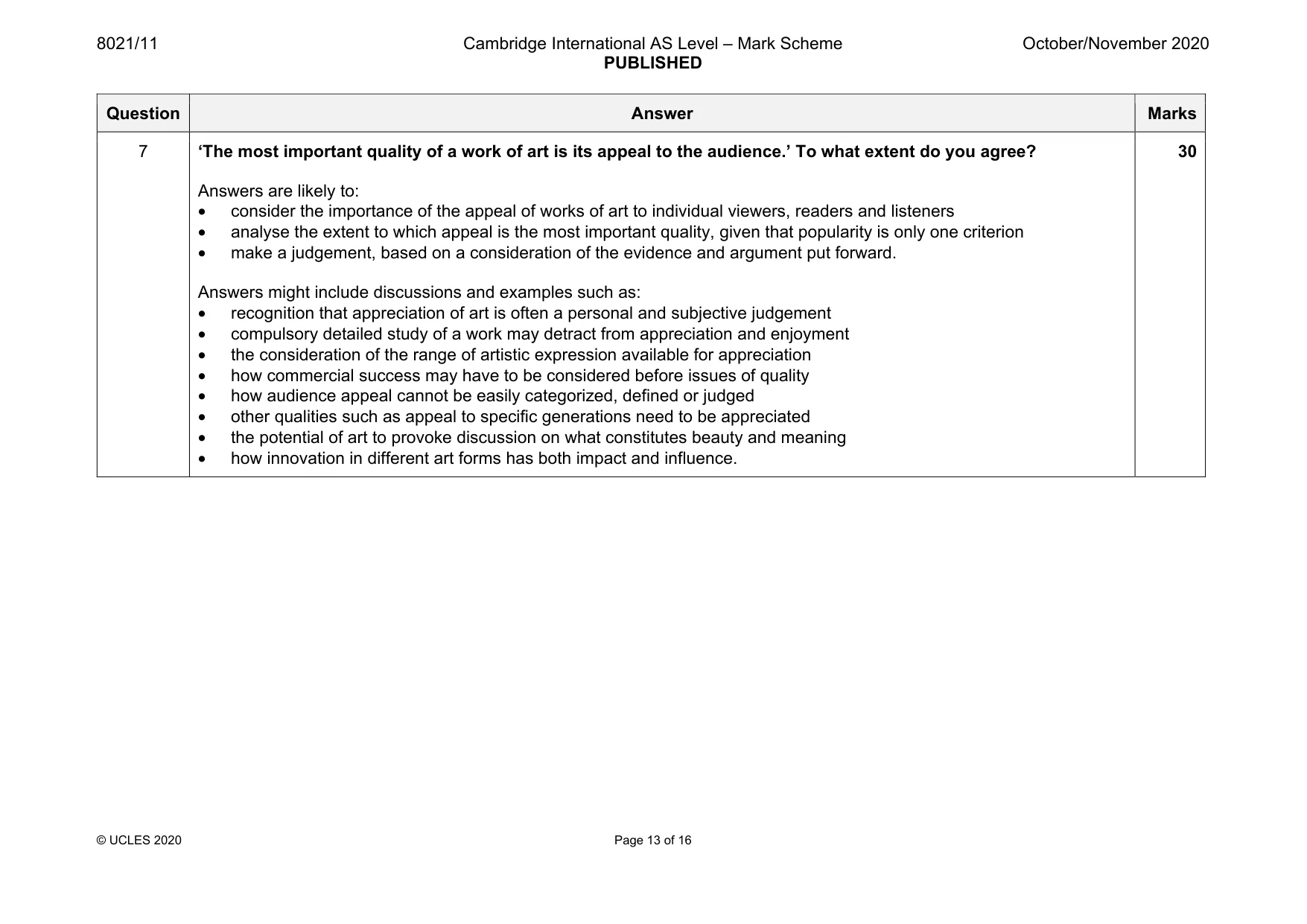
8021/11 Cambridge International AS Level – Mark Scheme PUBLISHED October/November 2020 © UCLES 2020 Page 13 of 16 Question Answer Marks 7 ‘The most important quality of a work of art is its appeal to the audience.’ To what extent do you agree? Answers are likely to: • consider the importance of the appeal of works of art to individual viewers, readers and listeners • analyse the extent to which appeal is the most important quality, given that popularity is only one criterion • make a judgement, based on a consideration of the evidence and argument put forward. Answers might include discussions and examples such as: • recognition that appreciation of art is often a personal and subjective judgement • compulsory detailed study of a work may detract from appreciation and enjoyment • the consideration of the range of artistic expression available for appreciation • how commercial success may have to be considered before issues of quality • how audience appeal cannot be easily categorized, defined or judged • other qualities such as appeal to specific generations need to be appreciated • the potential of art to provoke discussion on what constitutes beauty and meaning • how innovation in different art forms has both impact and influence. 30
Mark scheme, page 14
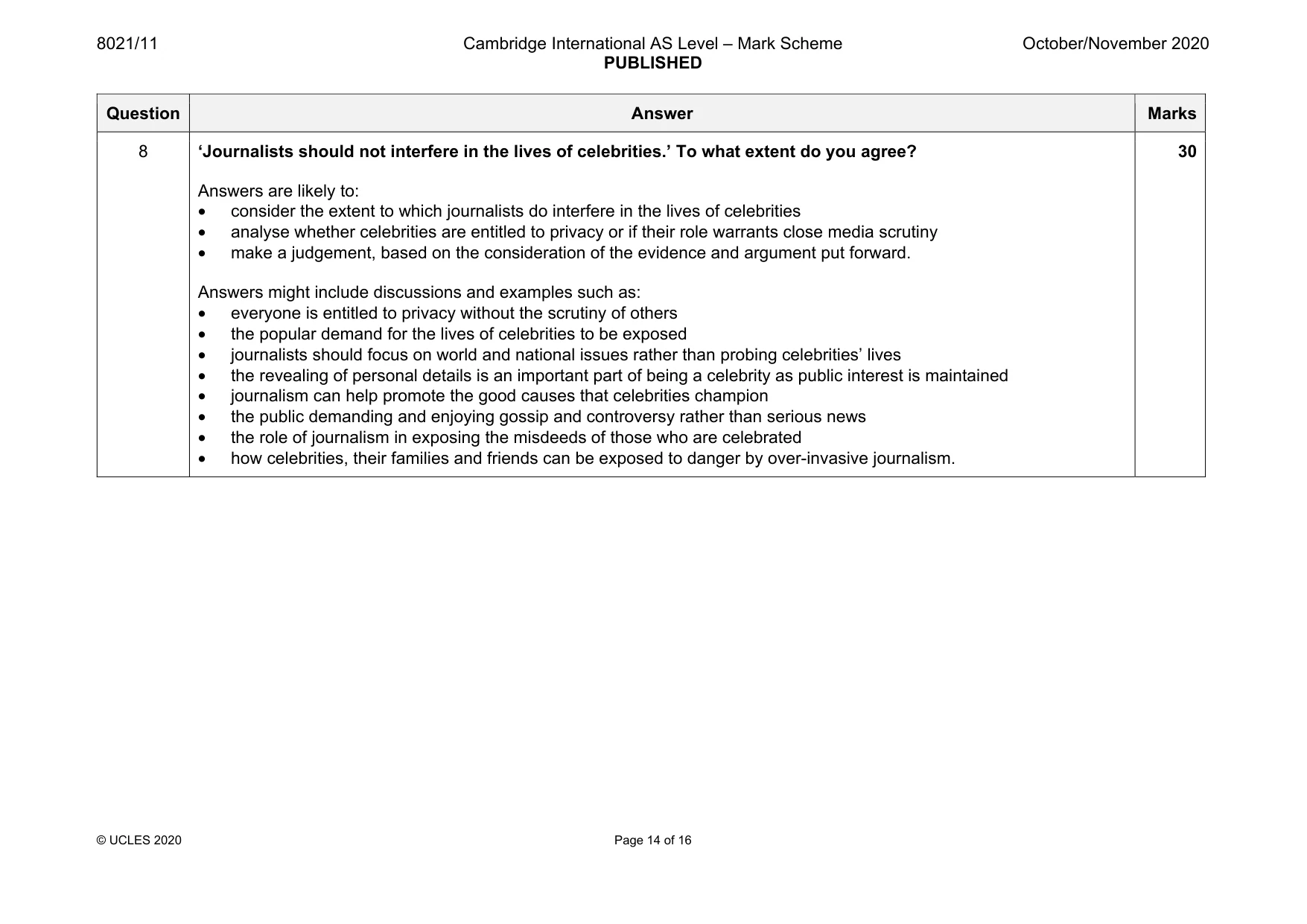
8021/11 Cambridge International AS Level – Mark Scheme PUBLISHED October/November 2020 © UCLES 2020 Page 14 of 16 Question Answer Marks 8 ‘Journalists should not interfere in the lives of celebrities.’ To what extent do you agree? Answers are likely to: • consider the extent to which journalists do interfere in the lives of celebrities • analyse whether celebrities are entitled to privacy or if their role warrants close media scrutiny • make a judgement, based on the consideration of the evidence and argument put forward. Answers might include discussions and examples such as: • everyone is entitled to privacy without the scrutiny of others • the popular demand for the lives of celebrities to be exposed • journalists should focus on world and national issues rather than probing celebrities’ lives • the revealing of personal details is an important part of being a celebrity as public interest is maintained • journalism can help promote the good causes that celebrities champion • the public demanding and enjoying gossip and controversy rather than serious news • the role of journalism in exposing the misdeeds of those who are celebrated • how celebrities, their families and friends can be exposed to danger by over-invasive journalism. 30
Mark scheme, page 15
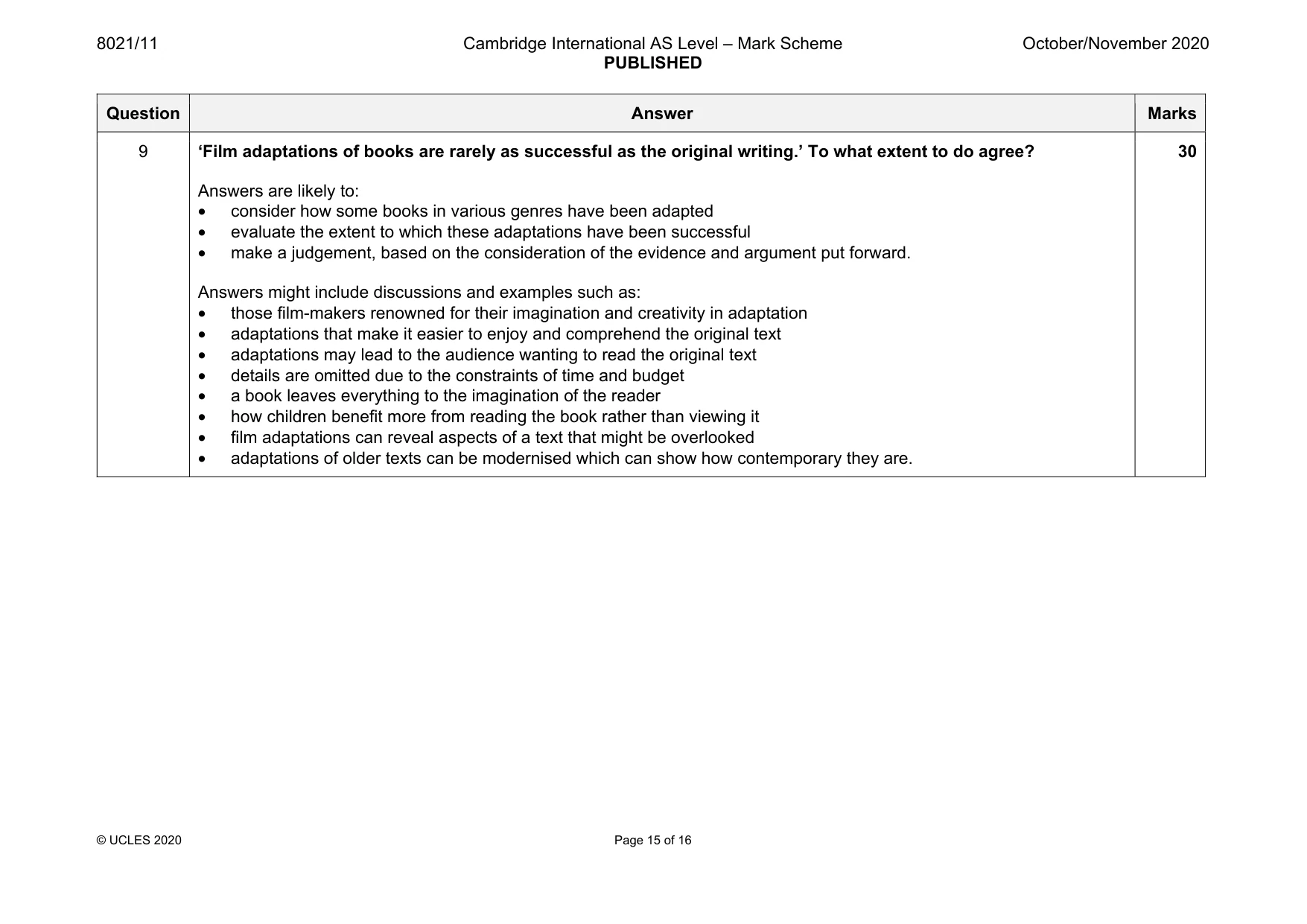
8021/11 Cambridge International AS Level – Mark Scheme PUBLISHED October/November 2020 © UCLES 2020 Page 15 of 16 Question Answer Marks 9 ‘Film adaptations of books are rarely as successful as the original writing.’ To what extent to do agree? Answers are likely to: • consider how some books in various genres have been adapted • evaluate the extent to which these adaptations have been successful • make a judgement, based on the consideration of the evidence and argument put forward. Answers might include discussions and examples such as: • those film-makers renowned for their imagination and creativity in adaptation • adaptations that make it easier to enjoy and comprehend the original text • adaptations may lead to the audience wanting to read the original text • details are omitted due to the constraints of time and budget • a book leaves everything to the imagination of the reader • how children benefit more from reading the book rather than viewing it • film adaptations can reveal aspects of a text that might be overlooked • adaptations of older texts can be modernised which can show how contemporary they are. 30
Mark scheme, page 16
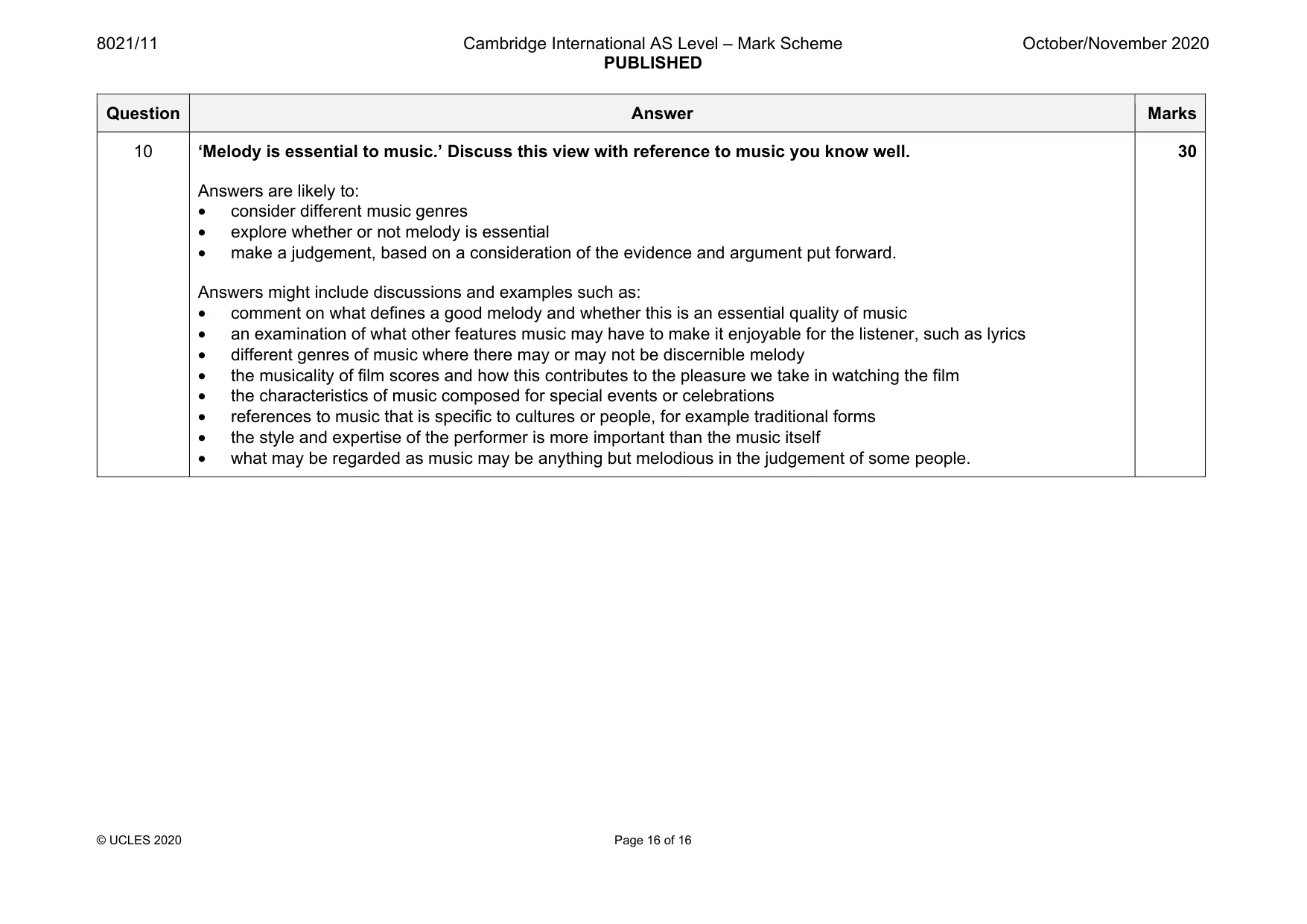
8021/11 Cambridge International AS Level – Mark Scheme PUBLISHED October/November 2020 © UCLES 2020 Page 16 of 16 Question Answer Marks 10 ‘Melody is essential to music.’ Discuss this view with reference to music you know well. Answers are likely to: • consider different music genres • explore whether or not melody is essential • make a judgement, based on a consideration of the evidence and argument put forward. Answers might include discussions and examples such as: • comment on what defines a good melody and whether this is an essential quality of music • an examination of what other features music may have to make it enjoyable for the listener, such as lyrics • different genres of music where there may or may not be discernible melody • the musicality of film scores and how this contributes to the pleasure we take in watching the film • the characteristics of music composed for special events or celebrations • references to music that is specific to cultures or people, for example traditional forms • the style and expertise of the performer is more important than the music itself • what may be regarded as music may be anything but melodious in the judgement of some people. 30
What you needed in this session
Cambridge’s own grade thresholds for 2020 Oct/Nov, Paper 1 · Variant 1. A higher threshold means an easier paper — the bar moves with how the cohort did.